
A English
Young's Double Slit Experiment (YDSE) Questions in English
Class 12 Physics · Wave Optics · Young's Double Slit Experiment (YDSE)
616+
Questions
English
Language
100%
With Solutions
Showing 50 of 616 questions in English
1
EasyMCQ
Interference was observed in an interference chamber when air was present. Now,the chamber is evacuated and if the same light is used,a careful observer will see:
A
No interference
B
Interference with bright bands
C
Interference with dark bands
D
Interference in which the width of the fringe will be slightly increased
Solution
(D) The fringe width $\beta$ in an interference experiment is given by $\beta = \frac{\lambda D}{d}$,where $\lambda$ is the wavelength of light,$D$ is the distance between the slits and the screen,and $d$ is the distance between the slits.
When the chamber is filled with air,the wavelength of light is $\lambda_{air} = \frac{\lambda_0}{\mu_{air}}$,where $\lambda_0$ is the wavelength in vacuum and $\mu_{air} \approx 1.0003$.
When the chamber is evacuated,the refractive index becomes $\mu_{vac} = 1$.
Since $\mu_{vac} < \mu_{air}$,the wavelength of light in the vacuum becomes larger than in air $(\lambda_{vac} > \lambda_{air})$.
As $\beta \propto \lambda$,the fringe width $\beta$ increases when the chamber is evacuated.
When the chamber is filled with air,the wavelength of light is $\lambda_{air} = \frac{\lambda_0}{\mu_{air}}$,where $\lambda_0$ is the wavelength in vacuum and $\mu_{air} \approx 1.0003$.
When the chamber is evacuated,the refractive index becomes $\mu_{vac} = 1$.
Since $\mu_{vac} < \mu_{air}$,the wavelength of light in the vacuum becomes larger than in air $(\lambda_{vac} > \lambda_{air})$.
As $\beta \propto \lambda$,the fringe width $\beta$ increases when the chamber is evacuated.
0 likes
View Solution2
EasyMCQ
Young's experiment establishes that
A
Light consists of waves
B
Light consists of particles
C
Light consists of neither particles nor waves
D
Light consists of both particles and waves
Solution
(A) Young's double-slit experiment demonstrates the phenomenon of interference of light.
Interference is a characteristic property of waves,where two or more waves superpose to form a resultant wave of greater,lower,or the same amplitude.
Since interference patterns are observed in Young's experiment,it provides direct evidence that light behaves as a wave.
Therefore,the correct option is $A$.
Interference is a characteristic property of waves,where two or more waves superpose to form a resultant wave of greater,lower,or the same amplitude.
Since interference patterns are observed in Young's experiment,it provides direct evidence that light behaves as a wave.
Therefore,the correct option is $A$.
0 likes
View Solution3
EasyMCQ
Monochromatic green light of wavelength $5 \times 10^{-7} \, m$ illuminates a pair of slits $1 \, mm$ apart. The separation of bright lines (fringe width) on the interference pattern formed on a screen $2 \, m$ away is ...... $mm$.
A
$0.25$
B
$0.1$
C
$1$
D
$0.01$
Solution
(C) The fringe width $\beta$ in a Young's double-slit experiment is given by the formula: $\beta = \frac{\lambda D}{d}$.
Given:
- Wavelength $\lambda = 5 \times 10^{-7} \, m$
- Distance between slits $d = 1 \, mm = 10^{-3} \, m$
- Distance to the screen $D = 2 \, m$
Substituting the values:
$\beta = \frac{5 \times 10^{-7} \times 2}{10^{-3}} \, m$
$\beta = 10 \times 10^{-4} \, m = 10^{-3} \, m$
Since $10^{-3} \, m = 1 \, mm$,the separation between bright lines is $1 \, mm$.
Given:
- Wavelength $\lambda = 5 \times 10^{-7} \, m$
- Distance between slits $d = 1 \, mm = 10^{-3} \, m$
- Distance to the screen $D = 2 \, m$
Substituting the values:
$\beta = \frac{5 \times 10^{-7} \times 2}{10^{-3}} \, m$
$\beta = 10 \times 10^{-4} \, m = 10^{-3} \, m$
Since $10^{-3} \, m = 1 \, mm$,the separation between bright lines is $1 \, mm$.
0 likes
View Solution4
EasyMCQ
In Young's double slit interference experiment,the slit separation is made $3$ fold. The fringe width becomes
A
$1/3$ times
B
$1/9$ times
C
$3$ times
D
$9$ times
Solution
(A) The fringe width $\beta$ in Young's double slit experiment is given by the formula $\beta = \frac{\lambda D}{d}$,where $\lambda$ is the wavelength of light,$D$ is the distance between the slits and the screen,and $d$ is the slit separation.
From the formula,we can see that $\beta \propto \frac{1}{d}$.
If the slit separation $d$ is made $3$ fold (i.e.,$d' = 3d$),the new fringe width $\beta'$ will be $\beta' = \frac{\lambda D}{3d} = \frac{1}{3} \beta$.
Therefore,the fringe width becomes $1/3$ times the original width.
From the formula,we can see that $\beta \propto \frac{1}{d}$.
If the slit separation $d$ is made $3$ fold (i.e.,$d' = 3d$),the new fringe width $\beta'$ will be $\beta' = \frac{\lambda D}{3d} = \frac{1}{3} \beta$.
Therefore,the fringe width becomes $1/3$ times the original width.
0 likes
View Solution5
MediumMCQ
In a certain double-slit experimental arrangement,interference fringes of width $1.0 \ mm$ each are observed when light of wavelength $5000 \ \mathring{A}$ is used. Keeping the setup unaltered,if the source is replaced by another source of wavelength $6000 \ \mathring{A}$,the fringe width will be $...... \ mm$.
A
$0.5$
B
$1.0$
C
$1.2$
D
$1.5$
Solution
(C) The fringe width $\beta$ in a Young's double-slit experiment is given by the formula $\beta = \frac{\lambda D}{d}$.
Since the experimental setup ($D$ and $d$) remains unchanged,the fringe width is directly proportional to the wavelength of light: $\beta \propto \lambda$.
Therefore,$\frac{\beta_2}{\beta_1} = \frac{\lambda_2}{\lambda_1}$.
Given: $\beta_1 = 1.0 \ mm$,$\lambda_1 = 5000 \ \mathring{A}$,and $\lambda_2 = 6000 \ \mathring{A}$.
Substituting the values: $\beta_2 = \beta_1 \times \frac{\lambda_2}{\lambda_1} = 1.0 \times \frac{6000}{5000} = 1.2 \ mm$.
Thus,the new fringe width is $1.2 \ mm$.
Since the experimental setup ($D$ and $d$) remains unchanged,the fringe width is directly proportional to the wavelength of light: $\beta \propto \lambda$.
Therefore,$\frac{\beta_2}{\beta_1} = \frac{\lambda_2}{\lambda_1}$.
Given: $\beta_1 = 1.0 \ mm$,$\lambda_1 = 5000 \ \mathring{A}$,and $\lambda_2 = 6000 \ \mathring{A}$.
Substituting the values: $\beta_2 = \beta_1 \times \frac{\lambda_2}{\lambda_1} = 1.0 \times \frac{6000}{5000} = 1.2 \ mm$.
Thus,the new fringe width is $1.2 \ mm$.
0 likes
View Solution6
EasyMCQ
Two coherent light sources $S_1$ and $S_2$ $(\lambda = 6000 \ \mathring{A})$ are $1 \, mm$ apart from each other. The screen is placed at a distance of $25 \, cm$ from the sources. The width of the fringes on the screen should be (in $, cm$)
A
$0.015$
B
$0.025$
C
$0.010$
D
$0.030$
Solution
(A) The fringe width $\beta$ in Young's double-slit experiment is given by the formula $\beta = \frac{\lambda D}{d}$.
Given values are:
$\lambda = 6000 \ \mathring{A} = 6000 \times 10^{-10} \, m = 6 \times 10^{-7} \, m$
$D = 25 \, cm = 0.25 \, m$
$d = 1 \, mm = 10^{-3} \, m$
Substituting these values into the formula:
$\beta = \frac{6 \times 10^{-7} \times 0.25}{10^{-3}}$
$\beta = 6 \times 10^{-4} \times 0.25 = 1.5 \times 10^{-4} \, m$
Converting to centimeters:
$\beta = 1.5 \times 10^{-4} \times 10^2 \, cm = 0.015 \, cm$.
Given values are:
$\lambda = 6000 \ \mathring{A} = 6000 \times 10^{-10} \, m = 6 \times 10^{-7} \, m$
$D = 25 \, cm = 0.25 \, m$
$d = 1 \, mm = 10^{-3} \, m$
Substituting these values into the formula:
$\beta = \frac{6 \times 10^{-7} \times 0.25}{10^{-3}}$
$\beta = 6 \times 10^{-4} \times 0.25 = 1.5 \times 10^{-4} \, m$
Converting to centimeters:
$\beta = 1.5 \times 10^{-4} \times 10^2 \, cm = 0.015 \, cm$.
0 likes
View Solution7
MediumMCQ
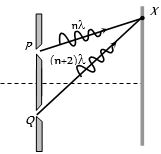
The figure shows a double slit experiment where $P$ and $Q$ are the slits. The path lengths $PX$ and $QX$ are $n\lambda$ and $(n + 2)\lambda$ respectively,where $n$ is a whole number and $\lambda$ is the wavelength. Taking the central fringe as zero,what is formed at $X$?
A
First bright
B
First dark
C
Second bright
D
Second dark
Solution
(C) The path difference $\Delta x$ between the two waves reaching point $X$ is given by:
$\Delta x = |QX - PX| = |(n + 2)\lambda - n\lambda| = 2\lambda$.
For constructive interference (bright fringe),the condition is $\Delta x = m\lambda$,where $m = 0, 1, 2, ...$.
Here,$\Delta x = 2\lambda$,which corresponds to $m = 2$.
Since the central fringe $(m = 0)$ is at the center,$m = 1$ corresponds to the first bright fringe,and $m = 2$ corresponds to the second bright fringe.
Therefore,the second bright fringe is formed at $X$.
$\Delta x = |QX - PX| = |(n + 2)\lambda - n\lambda| = 2\lambda$.
For constructive interference (bright fringe),the condition is $\Delta x = m\lambda$,where $m = 0, 1, 2, ...$.
Here,$\Delta x = 2\lambda$,which corresponds to $m = 2$.
Since the central fringe $(m = 0)$ is at the center,$m = 1$ corresponds to the first bright fringe,and $m = 2$ corresponds to the second bright fringe.
Therefore,the second bright fringe is formed at $X$.
0 likes
View Solution8
EasyMCQ
In Young's double slit experiment,if one of the slits is closed fully,then in the interference pattern:
A
$A$ bright slit will be observed,no interference pattern will exist
B
The bright fringes will become more bright
C
The bright fringes will become fainter
D
None of the above
Solution
(A) In Young's double slit experiment,the interference pattern is formed by the superposition of light waves originating from two coherent sources (the two slits).
If one of the slits is closed,the condition for interference is no longer satisfied because there is only one source of light.
Consequently,the interference pattern disappears.
Instead,the light from the remaining open slit undergoes diffraction,resulting in a single-slit diffraction pattern on the screen.
Therefore,no interference pattern will exist.
If one of the slits is closed,the condition for interference is no longer satisfied because there is only one source of light.
Consequently,the interference pattern disappears.
Instead,the light from the remaining open slit undergoes diffraction,resulting in a single-slit diffraction pattern on the screen.
Therefore,no interference pattern will exist.
0 likes
View Solution9
EasyMCQ
In Young's double-slit experiment,if the distance between the slits is reduced to half and the distance between the slit and the screen is doubled,then the fringe width
A
Will not change
B
Will become half
C
Will be doubled
D
Will become four times
Solution
(D) The formula for fringe width in Young's double-slit experiment is given by $\beta = \frac{\lambda D}{d}$,where $\lambda$ is the wavelength of light,$D$ is the distance between the slit and the screen,and $d$ is the distance between the slits.
Given that the new distance between the slits is $d' = \frac{d}{2}$ and the new distance between the slit and the screen is $D' = 2D$.
The new fringe width $\beta'$ will be $\beta' = \frac{\lambda D'}{d'} = \frac{\lambda (2D)}{(d/2)} = 4 \left( \frac{\lambda D}{d} \right) = 4\beta$.
Therefore,the fringe width will become four times the original value.
Given that the new distance between the slits is $d' = \frac{d}{2}$ and the new distance between the slit and the screen is $D' = 2D$.
The new fringe width $\beta'$ will be $\beta' = \frac{\lambda D'}{d'} = \frac{\lambda (2D)}{(d/2)} = 4 \left( \frac{\lambda D}{d} \right) = 4\beta$.
Therefore,the fringe width will become four times the original value.
0 likes
View Solution10
MediumMCQ
The maximum intensity of fringes in Young's experiment is $I$. If one of the slits is closed,then the intensity at that place becomes $I_o$. Which of the following relations is true?
A
$I = I_o$
B
$I = 2I_o$
C
$I = 4I_o$
D
There is no relation between $I$ and $I_o$
Solution
(C) Suppose the slit widths are equal,so they produce waves of equal intensity,say $I'$.
The resultant intensity at any point is given by $I_R = 4I' \cos^2 \phi$,where $\phi$ is the phase difference between the waves at the point of observation.
For maximum intensity,$\phi = 0^\circ$,so $I_{\max} = 4I' = I$ ... $(i)$
If one of the slits is closed,the resultant intensity at the same point will be $I'$ only,i.e.,$I' = I_o$ ... $(ii)$
Comparing equation $(i)$ and $(ii)$,we get $I = 4I_o$.
The resultant intensity at any point is given by $I_R = 4I' \cos^2 \phi$,where $\phi$ is the phase difference between the waves at the point of observation.
For maximum intensity,$\phi = 0^\circ$,so $I_{\max} = 4I' = I$ ... $(i)$
If one of the slits is closed,the resultant intensity at the same point will be $I'$ only,i.e.,$I' = I_o$ ... $(ii)$
Comparing equation $(i)$ and $(ii)$,we get $I = 4I_o$.
0 likes
View Solution11
MediumMCQ
In the Young's double slit experiment,the ratio of intensities of bright and dark fringes is $9$. This means that
A
The intensities of individual sources are $5$ and $4$ units respectively
B
The intensities of individual sources are $4$ and $1$ units respectively
C
The ratio of their amplitudes is $2$
D
Both $(b)$ and $(c)$
Solution
(D) The ratio of maximum intensity to minimum intensity is given by $\frac{I_{\max}}{I_{\min}} = 9$.
We know that $\frac{I_{\max}}{I_{\min}} = \left( \frac{a_1 + a_2}{a_1 - a_2} \right)^2 = 9$.
Taking the square root on both sides,we get $\frac{a_1 + a_2}{a_1 - a_2} = 3$.
Solving for the ratio of amplitudes: $a_1 + a_2 = 3a_1 - 3a_2 \Rightarrow 4a_2 = 2a_1 \Rightarrow \frac{a_1}{a_2} = 2$.
Since intensity $I \propto a^2$,the ratio of intensities of individual sources is $\frac{I_1}{I_2} = \left( \frac{a_1}{a_2} \right)^2 = 2^2 = 4$,which means $I_1 : I_2 = 4 : 1$.
Thus,both statements $(b)$ and $(c)$ are correct.
We know that $\frac{I_{\max}}{I_{\min}} = \left( \frac{a_1 + a_2}{a_1 - a_2} \right)^2 = 9$.
Taking the square root on both sides,we get $\frac{a_1 + a_2}{a_1 - a_2} = 3$.
Solving for the ratio of amplitudes: $a_1 + a_2 = 3a_1 - 3a_2 \Rightarrow 4a_2 = 2a_1 \Rightarrow \frac{a_1}{a_2} = 2$.
Since intensity $I \propto a^2$,the ratio of intensities of individual sources is $\frac{I_1}{I_2} = \left( \frac{a_1}{a_2} \right)^2 = 2^2 = 4$,which means $I_1 : I_2 = 4 : 1$.
Thus,both statements $(b)$ and $(c)$ are correct.
0 likes
View Solution12
MediumMCQ
In a Young's double-slit experiment,the experiment is performed with blue light of wavelength $4360 \; \mathring{A}$ and green light of wavelength $5460 \; \mathring{A}$. If the distance of the $4^{th}$ bright fringe from the central maximum is $x$,then:
A
$x(\text{Blue}) = x(\text{Green})$
B
$x(\text{Blue}) > x(\text{Green})$
C
$x(\text{Blue}) < x(\text{Green})$
D
$\frac{x(\text{Blue})}{x(\text{Green})} = \frac{5460}{4360}$
Solution
(C) The distance of the $n^{th}$ bright fringe from the central maximum is given by the formula: $y_n = \frac{n \lambda D}{d}$.
Since $n$,$D$,and $d$ are constant for both cases,we have $y_n \propto \lambda$.
Therefore,the ratio of the distances for the $4^{th}$ fringe is: $\frac{x(\text{Blue})}{x(\text{Green})} = \frac{\lambda(\text{Blue})}{\lambda(\text{Green})} = \frac{4360}{5460}$.
Since $4360 < 5460$,it follows that $x(\text{Blue}) < x(\text{Green})$.
Since $n$,$D$,and $d$ are constant for both cases,we have $y_n \propto \lambda$.
Therefore,the ratio of the distances for the $4^{th}$ fringe is: $\frac{x(\text{Blue})}{x(\text{Green})} = \frac{\lambda(\text{Blue})}{\lambda(\text{Green})} = \frac{4360}{5460}$.
Since $4360 < 5460$,it follows that $x(\text{Blue}) < x(\text{Green})$.
0 likes
View Solution13
EasyMCQ
In the Young's double-slit experiment, the spacing between two slits is $0.1 \, mm$. If the screen is kept at a distance of $1.0 \, m$ from the slits and the wavelength of light is $5000 \, \mathring{A}$, then the fringe width is ........ $cm$.
A
$1$
B
$1.5$
C
$0.5$
D
$2$
Solution
(C) The formula for fringe width $\beta$ in Young's double-slit experiment is given by $\beta = \frac{\lambda D}{d}$.
Given values are:
Wavelength $\lambda = 5000 \, \mathring{A} = 5000 \times 10^{-10} \, m = 5 \times 10^{-7} \, m$.
Distance of the screen $D = 1.0 \, m$.
Slit separation $d = 0.1 \, mm = 0.1 \times 10^{-3} \, m = 10^{-4} \, m$.
Substituting these values into the formula:
$\beta = \frac{5 \times 10^{-7} \times 1}{10^{-4}} \, m = 5 \times 10^{-3} \, m$.
To convert meters to centimeters, multiply by $100$:
$\beta = 5 \times 10^{-3} \times 10^2 \, cm = 0.5 \, cm$.
Given values are:
Wavelength $\lambda = 5000 \, \mathring{A} = 5000 \times 10^{-10} \, m = 5 \times 10^{-7} \, m$.
Distance of the screen $D = 1.0 \, m$.
Slit separation $d = 0.1 \, mm = 0.1 \times 10^{-3} \, m = 10^{-4} \, m$.
Substituting these values into the formula:
$\beta = \frac{5 \times 10^{-7} \times 1}{10^{-4}} \, m = 5 \times 10^{-3} \, m$.
To convert meters to centimeters, multiply by $100$:
$\beta = 5 \times 10^{-3} \times 10^2 \, cm = 0.5 \, cm$.
0 likes
View Solution14
EasyMCQ
In Young's double-slit experiment,if $L$ is the distance between the slits and the screen upon which the interference pattern is observed,$x$ is the average distance between adjacent fringes,and $d$ is the slit separation,then the wavelength of light is given by:
A
$\frac{xd}{L}$
B
$\frac{xL}{d}$
C
$\frac{Ld}{x}$
D
$\frac{1}{Ldx}$
Solution
(A) The fringe width $\beta$ in Young's double-slit experiment is given by the formula $\beta = \frac{D\lambda}{d}$.
In this problem,the distance between the slits and the screen is denoted by $L$ (instead of $D$),and the fringe width is denoted by $x$ (instead of $\beta$).
Substituting these variables into the formula,we get $x = \frac{L\lambda}{d}$.
Rearranging the equation to solve for the wavelength $\lambda$,we get $\lambda = \frac{xd}{L}$.
In this problem,the distance between the slits and the screen is denoted by $L$ (instead of $D$),and the fringe width is denoted by $x$ (instead of $\beta$).
Substituting these variables into the formula,we get $x = \frac{L\lambda}{d}$.
Rearranging the equation to solve for the wavelength $\lambda$,we get $\lambda = \frac{xd}{L}$.
0 likes
View Solution15
EasyMCQ
In a Young's double slit experiment,the central point on the screen is
A
Bright
B
Dark
C
First bright and then dark
D
First dark and then bright
Solution
(A) In a Young's double slit experiment,the path difference between the two waves reaching the central point on the screen is zero.
Since the path difference $\Delta x = 0$,the phase difference $\phi = \frac{2\pi}{\lambda} \Delta x = 0$.
For constructive interference,the condition is $\Delta x = n\lambda$ where $n = 0, 1, 2, ...$.
Since $n = 0$ satisfies this condition,the central point corresponds to the central maximum,which is always bright.
Since the path difference $\Delta x = 0$,the phase difference $\phi = \frac{2\pi}{\lambda} \Delta x = 0$.
For constructive interference,the condition is $\Delta x = n\lambda$ where $n = 0, 1, 2, ...$.
Since $n = 0$ satisfies this condition,the central point corresponds to the central maximum,which is always bright.
0 likes
View Solution16
MediumMCQ
In a Young's double slit experiment,the fringe width is found to be $0.4 \, mm$. If the whole apparatus is immersed in water of refractive index $4/3$ without disturbing the geometrical arrangement,the new fringe width will be
A
$0.30 \, mm$
B
$0.40 \, mm$
C
$0.53 \, mm$
D
$450 \, \mu m$
Solution
(A) The fringe width in a Young's double slit experiment is given by the formula $\beta = \frac{\lambda D}{d}$.
Here,$\lambda$ is the wavelength of light,$D$ is the distance between the slits and the screen,and $d$ is the distance between the two slits.
When the apparatus is immersed in a medium of refractive index $\mu$,the wavelength of light changes to $\lambda' = \frac{\lambda}{\mu}$.
Since $D$ and $d$ remain unchanged,the new fringe width $\beta'$ is given by $\beta' = \frac{\lambda' D}{d} = \frac{\lambda D}{\mu d} = \frac{\beta}{\mu}$.
Given $\beta = 0.4 \, mm$ and $\mu = 4/3$,we have $\beta' = \frac{0.4}{4/3} = 0.4 \times \frac{3}{4} = 0.3 \, mm$.
Here,$\lambda$ is the wavelength of light,$D$ is the distance between the slits and the screen,and $d$ is the distance between the two slits.
When the apparatus is immersed in a medium of refractive index $\mu$,the wavelength of light changes to $\lambda' = \frac{\lambda}{\mu}$.
Since $D$ and $d$ remain unchanged,the new fringe width $\beta'$ is given by $\beta' = \frac{\lambda' D}{d} = \frac{\lambda D}{\mu d} = \frac{\beta}{\mu}$.
Given $\beta = 0.4 \, mm$ and $\mu = 4/3$,we have $\beta' = \frac{0.4}{4/3} = 0.4 \times \frac{3}{4} = 0.3 \, mm$.
1 likes
View Solution17
EasyMCQ
Young's double-slit experiment is performed in air and then performed in water. How does the fringe width change?
A
Will remain same
B
Will decrease
C
Will increase
D
Will be infinite
Solution
(B) The fringe width $\beta$ in Young's double-slit experiment is given by the formula $\beta = \frac{\lambda D}{d}$.
Here,$\lambda$ is the wavelength of light,$D$ is the distance between the slits and the screen,and $d$ is the distance between the two slits.
When the experiment is performed in a medium with refractive index $\mu$,the wavelength of light changes to $\lambda' = \frac{\lambda}{\mu}$.
Since the refractive index of water $(\mu \approx 1.33)$ is greater than that of air $(\mu \approx 1.0)$,the wavelength of light decreases in water.
Consequently,the fringe width $\beta' = \frac{\lambda' D}{d} = \frac{\lambda D}{\mu d} = \frac{\beta}{\mu}$.
Since $\mu > 1$,the fringe width $\beta'$ will be less than $\beta$. Therefore,the fringe width will decrease.
Here,$\lambda$ is the wavelength of light,$D$ is the distance between the slits and the screen,and $d$ is the distance between the two slits.
When the experiment is performed in a medium with refractive index $\mu$,the wavelength of light changes to $\lambda' = \frac{\lambda}{\mu}$.
Since the refractive index of water $(\mu \approx 1.33)$ is greater than that of air $(\mu \approx 1.0)$,the wavelength of light decreases in water.
Consequently,the fringe width $\beta' = \frac{\lambda' D}{d} = \frac{\lambda D}{\mu d} = \frac{\beta}{\mu}$.
Since $\mu > 1$,the fringe width $\beta'$ will be less than $\beta$. Therefore,the fringe width will decrease.
0 likes
View Solution18
EasyMCQ
In a double-slit experiment,for light of which colour will the fringe width be minimum?
A
Violet
B
Red
C
Green
D
Yellow
Solution
(A) The fringe width $\beta$ in a Young's double-slit experiment is given by the formula $\beta = \frac{\lambda D}{d}$,where $\lambda$ is the wavelength of light,$D$ is the distance between the slits and the screen,and $d$ is the distance between the two slits.
Since $\beta \propto \lambda$,the fringe width is directly proportional to the wavelength of the light used.
Among the given colours,violet light has the minimum wavelength $(\lambda_v \approx 400 \ nm)$ and red light has the maximum wavelength $(\lambda_r \approx 700 \ nm)$.
Therefore,the fringe width will be minimum for violet light.
Since $\beta \propto \lambda$,the fringe width is directly proportional to the wavelength of the light used.
Among the given colours,violet light has the minimum wavelength $(\lambda_v \approx 400 \ nm)$ and red light has the maximum wavelength $(\lambda_r \approx 700 \ nm)$.
Therefore,the fringe width will be minimum for violet light.
0 likes
View Solution19
MediumMCQ
In Young's double-slit experiment, light of wavelength $4000 \, Å$ is used to produce bright fringes of width $0.6 \, mm$ at a distance of $2 \, m$ from the slits. If the whole apparatus is immersed in a liquid of refractive index $1.5$, what will be the new fringe width in $mm$?
A
$0.2$
B
$0.3$
C
$0.4$
D
$1.2$
Solution
(C) The fringe width in air is given by $\beta_{air} = \frac{\lambda D}{d} = 0.6 \, mm$.
When the apparatus is immersed in a liquid of refractive index $\mu$, the wavelength of light changes to $\lambda' = \frac{\lambda}{\mu}$.
Consequently, the new fringe width $\beta_{medium}$ is given by $\beta_{medium} = \frac{\lambda' D}{d} = \frac{\lambda D}{\mu d} = \frac{\beta_{air}}{\mu}$.
Given $\beta_{air} = 0.6 \, mm$ and $\mu = 1.5$, we have:
$\beta_{medium} = \frac{0.6}{1.5} = 0.4 \, mm$.
When the apparatus is immersed in a liquid of refractive index $\mu$, the wavelength of light changes to $\lambda' = \frac{\lambda}{\mu}$.
Consequently, the new fringe width $\beta_{medium}$ is given by $\beta_{medium} = \frac{\lambda' D}{d} = \frac{\lambda D}{\mu d} = \frac{\beta_{air}}{\mu}$.
Given $\beta_{air} = 0.6 \, mm$ and $\mu = 1.5$, we have:
$\beta_{medium} = \frac{0.6}{1.5} = 0.4 \, mm$.
0 likes
View Solution20
MediumMCQ
In Young's double slit experiment,if the widths of the slits are in the ratio $4 : 9$,the ratio of the intensity at maxima to the intensity at minima will be
A
$169:25$
B
$81:16$
C
$25:1$
D
$9:4$
Solution
(C) The intensity of light $I$ is directly proportional to the width of the slit $w$,so $I_1/I_2 = w_1/w_2 = 4/9$.
Since intensity $I \propto a^2$,where $a$ is the amplitude,we have $a_1/a_2 = \sqrt{I_1/I_2} = \sqrt{4/9} = 2/3$.
Let $a_1 = 2k$ and $a_2 = 3k$.
The ratio of maximum intensity to minimum intensity is given by the formula $\frac{I_{\max}}{I_{\min}} = \frac{(a_1 + a_2)^2}{(a_1 - a_2)^2}$.
Substituting the values,$\frac{I_{\max}}{I_{\min}} = \frac{(2k + 3k)^2}{(2k - 3k)^2} = \frac{(5k)^2}{(-k)^2} = \frac{25k^2}{k^2} = 25/1$.
Thus,the ratio is $25:1$.
Since intensity $I \propto a^2$,where $a$ is the amplitude,we have $a_1/a_2 = \sqrt{I_1/I_2} = \sqrt{4/9} = 2/3$.
Let $a_1 = 2k$ and $a_2 = 3k$.
The ratio of maximum intensity to minimum intensity is given by the formula $\frac{I_{\max}}{I_{\min}} = \frac{(a_1 + a_2)^2}{(a_1 - a_2)^2}$.
Substituting the values,$\frac{I_{\max}}{I_{\min}} = \frac{(2k + 3k)^2}{(2k - 3k)^2} = \frac{(5k)^2}{(-k)^2} = \frac{25k^2}{k^2} = 25/1$.
Thus,the ratio is $25:1$.
0 likes
View Solution21
MediumMCQ
In Young's double slit experiment,when the wavelength used is $6000 \ \mathring{A}$ and the screen is $40 \ cm$ from the slits,the fringes are $0.012 \ cm$ wide. What is the distance between the slits in $cm$?
A
$0.024$
B
$2.4$
C
$0.24$
D
$0.2$
Solution
(D) The fringe width $\beta$ in Young's double slit experiment is given by the formula: $\beta = \frac{\lambda D}{d}$.
Here,$\lambda = 6000 \ \mathring{A} = 6000 \times 10^{-8} \ cm = 6 \times 10^{-5} \ cm$.
The distance of the screen from the slits is $D = 40 \ cm$.
The fringe width is $\beta = 0.012 \ cm$.
Rearranging the formula to solve for the distance between the slits $d$:
$d = \frac{\lambda D}{\beta} = \frac{6 \times 10^{-5} \ cm \times 40 \ cm}{0.012 \ cm}$.
$d = \frac{240 \times 10^{-5}}{0.012} \ cm = \frac{2.4 \times 10^{-3}}{1.2 \times 10^{-2}} \ cm = 2 \times 10^{-1} \ cm = 0.2 \ cm$.
Therefore,the distance between the slits is $0.2 \ cm$.
Here,$\lambda = 6000 \ \mathring{A} = 6000 \times 10^{-8} \ cm = 6 \times 10^{-5} \ cm$.
The distance of the screen from the slits is $D = 40 \ cm$.
The fringe width is $\beta = 0.012 \ cm$.
Rearranging the formula to solve for the distance between the slits $d$:
$d = \frac{\lambda D}{\beta} = \frac{6 \times 10^{-5} \ cm \times 40 \ cm}{0.012 \ cm}$.
$d = \frac{240 \times 10^{-5}}{0.012} \ cm = \frac{2.4 \times 10^{-3}}{1.2 \times 10^{-2}} \ cm = 2 \times 10^{-1} \ cm = 0.2 \ cm$.
Therefore,the distance between the slits is $0.2 \ cm$.
0 likes
View Solution22
MediumMCQ
In two separate set-ups of the Young's double slit experiment,fringes of equal width are observed when lights of wavelengths in the ratio $1:2$ are used. If the ratio of the slit separation in the two cases is $2:1$,the ratio of the distances between the plane of the slits and the screen in the two set-ups is
A
$4:1$
B
$1:1$
C
$1:4$
D
$2:1$
Solution
(A) The fringe width $\beta$ in Young's double slit experiment is given by $\beta = \frac{D\lambda}{d}$,where $D$ is the distance between the slits and the screen,$\lambda$ is the wavelength of light,and $d$ is the slit separation.
Given that the fringe widths are equal,$\beta_1 = \beta_2$,so $\frac{\beta_1}{\beta_2} = 1$.
We are given the ratios $\frac{\lambda_1}{\lambda_2} = \frac{1}{2}$ and $\frac{d_1}{d_2} = \frac{2}{1}$.
Using the formula $\frac{\beta_1}{\beta_2} = \left(\frac{D_1}{D_2}\right) \left(\frac{\lambda_1}{\lambda_2}\right) \left(\frac{d_2}{d_1}\right)$,we substitute the known values:
$1 = \left(\frac{D_1}{D_2}\right) \times \left(\frac{1}{2}\right) \times \left(\frac{1}{2}\right)$.
$1 = \left(\frac{D_1}{D_2}\right) \times \frac{1}{4}$.
Therefore,$\frac{D_1}{D_2} = \frac{4}{1}$.
Given that the fringe widths are equal,$\beta_1 = \beta_2$,so $\frac{\beta_1}{\beta_2} = 1$.
We are given the ratios $\frac{\lambda_1}{\lambda_2} = \frac{1}{2}$ and $\frac{d_1}{d_2} = \frac{2}{1}$.
Using the formula $\frac{\beta_1}{\beta_2} = \left(\frac{D_1}{D_2}\right) \left(\frac{\lambda_1}{\lambda_2}\right) \left(\frac{d_2}{d_1}\right)$,we substitute the known values:
$1 = \left(\frac{D_1}{D_2}\right) \times \left(\frac{1}{2}\right) \times \left(\frac{1}{2}\right)$.
$1 = \left(\frac{D_1}{D_2}\right) \times \frac{1}{4}$.
Therefore,$\frac{D_1}{D_2} = \frac{4}{1}$.
0 likes
View Solution23
EasyMCQ
In an interference experiment,the spacing between successive maxima or minima is (where the symbols have their usual meanings):
A
$\frac{\lambda d}{D}$
B
$\frac{\lambda D}{d}$
C
$\frac{dD}{\lambda}$
D
$\frac{\lambda d}{4D}$
Solution
(B) In an interference experiment,the distance between two consecutive bright fringes (maxima) or two consecutive dark fringes (minima) is known as the fringe width,denoted by $\beta$.
The formula for fringe width is derived from the path difference condition for constructive interference,which is $\Delta x = n\lambda = \frac{yd}{D}$.
For consecutive maxima,the separation is given by $\beta = \frac{D\lambda}{d}$,where $D$ is the distance between the screen and the slits,$\lambda$ is the wavelength of light used,and $d$ is the distance between the two slits.
Therefore,the correct option is $B$.
The formula for fringe width is derived from the path difference condition for constructive interference,which is $\Delta x = n\lambda = \frac{yd}{D}$.
For consecutive maxima,the separation is given by $\beta = \frac{D\lambda}{d}$,where $D$ is the distance between the screen and the slits,$\lambda$ is the wavelength of light used,and $d$ is the distance between the two slits.
Therefore,the correct option is $B$.
0 likes
View Solution24
EasyMCQ
If yellow light in the Young's double slit experiment is replaced by red light,the fringe width will
A
Decrease
B
Remain unaffected
C
Increase
D
First increase and then decrease
Solution
(C) The fringe width $(\beta)$ in Young's double slit experiment is given by the formula $\beta = \frac{D\lambda}{d}$.
From this relation,it is clear that the fringe width is directly proportional to the wavelength of the light used,i.e.,$\beta \propto \lambda$.
Since the wavelength of red light $(\lambda_{red})$ is greater than the wavelength of yellow light $(\lambda_{yellow})$,the fringe width will increase when yellow light is replaced by red light.
From this relation,it is clear that the fringe width is directly proportional to the wavelength of the light used,i.e.,$\beta \propto \lambda$.
Since the wavelength of red light $(\lambda_{red})$ is greater than the wavelength of yellow light $(\lambda_{yellow})$,the fringe width will increase when yellow light is replaced by red light.
0 likes
View Solution25
MediumMCQ
In Young's double slit experiment,the fringe width is $1 \times 10^{-4} \ m$. If the distance between the slit and screen is doubled,the distance between the two slits is reduced to half,and the wavelength is changed from $6.4 \times 10^{-7} \ m$ to $4.0 \times 10^{-7} \ m$,what will be the value of the new fringe width?
A
$0.15 \times 10^{-4} \ m$
B
$2.0 \times 10^{-4} \ m$
C
$1.25 \times 10^{-4} \ m$
D
$2.5 \times 10^{-4} \ m$
Solution
(D) The formula for fringe width in Young's double slit experiment is $\beta = \frac{\lambda D}{d}$.
Given initial values: $\beta_1 = 1 \times 10^{-4} \ m$,$\lambda_1 = 6.4 \times 10^{-7} \ m$.
New parameters: $D_2 = 2D_1$,$d_2 = \frac{d_1}{2}$,$\lambda_2 = 4.0 \times 10^{-7} \ m$.
Using the ratio: $\frac{\beta_2}{\beta_1} = \frac{\lambda_2}{\lambda_1} \times \frac{D_2}{D_1} \times \frac{d_1}{d_2}$.
Substituting the values: $\frac{\beta_2}{1 \times 10^{-4}} = \left( \frac{4.0 \times 10^{-7}}{6.4 \times 10^{-7}} \right) \times \left( \frac{2D_1}{D_1} \right) \times \left( \frac{d_1}{d_1/2} \right)$.
$\frac{\beta_2}{1 \times 10^{-4}} = \left( \frac{4.0}{6.4} \right) \times 2 \times 2 = \frac{16}{6.4} = 2.5$.
Therefore,$\beta_2 = 2.5 \times 10^{-4} \ m$.
Given initial values: $\beta_1 = 1 \times 10^{-4} \ m$,$\lambda_1 = 6.4 \times 10^{-7} \ m$.
New parameters: $D_2 = 2D_1$,$d_2 = \frac{d_1}{2}$,$\lambda_2 = 4.0 \times 10^{-7} \ m$.
Using the ratio: $\frac{\beta_2}{\beta_1} = \frac{\lambda_2}{\lambda_1} \times \frac{D_2}{D_1} \times \frac{d_1}{d_2}$.
Substituting the values: $\frac{\beta_2}{1 \times 10^{-4}} = \left( \frac{4.0 \times 10^{-7}}{6.4 \times 10^{-7}} \right) \times \left( \frac{2D_1}{D_1} \right) \times \left( \frac{d_1}{d_1/2} \right)$.
$\frac{\beta_2}{1 \times 10^{-4}} = \left( \frac{4.0}{6.4} \right) \times 2 \times 2 = \frac{16}{6.4} = 2.5$.
Therefore,$\beta_2 = 2.5 \times 10^{-4} \ m$.
0 likes
View Solution26
EasyMCQ
In Young's double-slit experiment,one slit is covered with a blue filter and the other slit with a yellow filter. Then the interference pattern
A
Will be blue
B
Will be yellow
C
Will be green
D
Will not be formed
Solution
(D) For an interference pattern to be observed,the two light waves must be coherent and have the same frequency and wavelength.
Since a blue filter and a yellow filter transmit light of different wavelengths,the waves originating from the two slits will have different frequencies and wavelengths.
Therefore,the condition for sustained interference is not met,and no stable interference pattern will be formed on the screen.
Since a blue filter and a yellow filter transmit light of different wavelengths,the waves originating from the two slits will have different frequencies and wavelengths.
Therefore,the condition for sustained interference is not met,and no stable interference pattern will be formed on the screen.
0 likes
View Solution27
EasyMCQ
Two sources produce an interference pattern which is observed on a screen,at a distance $D$ from the sources. The fringe width is $2w$. If the distance $D$ is now doubled,the fringe width will be:
A
Become $w/2$
B
Remain the same
C
Become $w$
D
Become $4w$
Solution
(D) The fringe width $\beta$ in a Young's double-slit experiment is given by the formula: $\beta = \frac{\lambda D}{d}$,where $\lambda$ is the wavelength of light,$D$ is the distance between the screen and the sources,and $d$ is the distance between the two sources.
From this formula,we can see that the fringe width is directly proportional to the distance $D$,i.e.,$\beta \propto D$.
Given that the initial fringe width is $\beta_1 = 2w$ at distance $D_1 = D$.
If the distance is doubled,$D_2 = 2D$.
Then the new fringe width $\beta_2$ will be: $\beta_2 = \beta_1 \times \frac{D_2}{D_1} = 2w \times \frac{2D}{D} = 4w$.
Therefore,the fringe width becomes $4w$.
From this formula,we can see that the fringe width is directly proportional to the distance $D$,i.e.,$\beta \propto D$.
Given that the initial fringe width is $\beta_1 = 2w$ at distance $D_1 = D$.
If the distance is doubled,$D_2 = 2D$.
Then the new fringe width $\beta_2$ will be: $\beta_2 = \beta_1 \times \frac{D_2}{D_1} = 2w \times \frac{2D}{D} = 4w$.
Therefore,the fringe width becomes $4w$.
0 likes
View Solution28
MediumMCQ
In a double-slit experiment,the angular width of the fringes is $0.20^o$ for sodium light $(\lambda = 5890 \ \mathring{A})$. In order to increase the angular width of the fringes by $10\%$,the necessary change in the wavelength is:
A
Increase of $589 \ \mathring{A}$
B
Decrease of $589 \ \mathring{A}$
C
Increase of $6479 \ \mathring{A}$
D
Zero
Solution
(A) The angular width of the fringes in a double-slit experiment is given by the formula $\theta = \frac{\lambda}{d}$,where $\lambda$ is the wavelength of light and $d$ is the distance between the slits.
Since $\theta \propto \lambda$,to increase the angular width $\theta$ by $10\%$,the wavelength $\lambda$ must also be increased by $10\%$.
The required change in wavelength is $\Delta\lambda = 10\% \text{ of } \lambda = \frac{10}{100} \times 5890 \ \mathring{A} = 589 \ \mathring{A}$.
Therefore,the wavelength must be increased by $589 \ \mathring{A}$.
Since $\theta \propto \lambda$,to increase the angular width $\theta$ by $10\%$,the wavelength $\lambda$ must also be increased by $10\%$.
The required change in wavelength is $\Delta\lambda = 10\% \text{ of } \lambda = \frac{10}{100} \times 5890 \ \mathring{A} = 589 \ \mathring{A}$.
Therefore,the wavelength must be increased by $589 \ \mathring{A}$.
0 likes
View Solution29
MediumMCQ
The slits in a Young's double-slit experiment have equal widths, and the source is placed symmetrically relative to the slits. The intensity at the central fringe is $I_0$. If one of the slits is closed, the intensity at this point will be
A
$I_0$
B
$I_0 / 4$
C
$I_0 / 2$
D
$4I_0$
Solution
(B) In a Young's double-slit experiment, if the intensity of light from each slit is $I$, the resultant intensity at the central fringe is given by $I_0 = I + I + 2\sqrt{I \cdot I} \cos(0) = 4I$.
When one of the slits is closed, only one source of light remains.
The intensity at the same point due to a single slit is simply $I$.
Since $I_0 = 4I$, we have $I = I_0 / 4$.
Therefore, the intensity at the central point becomes $I_0 / 4$.
When one of the slits is closed, only one source of light remains.
The intensity at the same point due to a single slit is simply $I$.
Since $I_0 = 4I$, we have $I = I_0 / 4$.
Therefore, the intensity at the central point becomes $I_0 / 4$.
0 likes
View Solution30
EasyMCQ
In a Young's double slit experiment,the fringe width will remain the same if ($D =$ distance between screen and plane of slits,$d =$ separation between two slits,and $\lambda =$ wavelength of light used).
A
Both $\lambda$ and $D$ are doubled.
B
Both $d$ and $D$ are doubled.
C
$D$ is doubled but $d$ is halved.
D
$\lambda$ is doubled but $d$ is halved.
Solution
(B) The fringe width $\beta$ in a Young's double slit experiment is given by the formula: $\beta = \frac{\lambda D}{d}$.
For the fringe width to remain the same,the ratio $\frac{\lambda D}{d}$ must remain constant.
If both $d$ and $D$ are doubled,the new fringe width $\beta'$ becomes: $\beta' = \frac{\lambda (2D)}{(2d)} = \frac{\lambda D}{d} = \beta$.
Therefore,the fringe width remains unchanged when both $d$ and $D$ are doubled.
For the fringe width to remain the same,the ratio $\frac{\lambda D}{d}$ must remain constant.
If both $d$ and $D$ are doubled,the new fringe width $\beta'$ becomes: $\beta' = \frac{\lambda (2D)}{(2d)} = \frac{\lambda D}{d} = \beta$.
Therefore,the fringe width remains unchanged when both $d$ and $D$ are doubled.
0 likes
View Solution31
MediumMCQ
In Young's double slit experiment,the slits are $0.5\, mm$ apart and interference pattern is observed on a screen placed at a distance of $1.0\, m$ from the plane containing the slits. If the wavelength of the incident light is $6000\ \mathring A$,then the separation between the third bright fringe and the central maxima is......$mm$.
A
$4$
B
$3.6$
C
$3$
D
$2.5$
Solution
(B) The distance of the $n^{th}$ bright fringe from the central maxima is given by the formula: $x_n = \frac{n \lambda D}{d}$.
Here,$n = 3$,$\lambda = 6000\ \mathring A = 6000 \times 10^{-10}\ m$,$D = 1.0\ m$,and $d = 0.5\ mm = 0.5 \times 10^{-3}\ m$.
Substituting these values into the formula:
$x_3 = \frac{3 \times 6000 \times 10^{-10} \times 1.0}{0.5 \times 10^{-3}}$
$x_3 = \frac{18000 \times 10^{-10}}{0.5 \times 10^{-3}}$
$x_3 = 36000 \times 10^{-7}\ m = 3.6 \times 10^{-3}\ m = 3.6\ mm$.
Therefore,the separation is $3.6\ mm$.
Here,$n = 3$,$\lambda = 6000\ \mathring A = 6000 \times 10^{-10}\ m$,$D = 1.0\ m$,and $d = 0.5\ mm = 0.5 \times 10^{-3}\ m$.
Substituting these values into the formula:
$x_3 = \frac{3 \times 6000 \times 10^{-10} \times 1.0}{0.5 \times 10^{-3}}$
$x_3 = \frac{18000 \times 10^{-10}}{0.5 \times 10^{-3}}$
$x_3 = 36000 \times 10^{-7}\ m = 3.6 \times 10^{-3}\ m = 3.6\ mm$.
Therefore,the separation is $3.6\ mm$.
0 likes
View Solution32
MediumMCQ
In Young's double slit experiment,$62$ fringes are seen in the visible region for sodium light of wavelength $5893 \ \mathring{A}$. If violet light of wavelength $4358 \ \mathring{A}$ is used in place of sodium light,then the number of fringes seen will be:
A
$54$
B
$64$
C
$74$
D
$84$
Solution
(D) The total width of the visible region $W$ remains constant for a given experimental setup.
For $n$ fringes of wavelength $\lambda$,the width is given by $W = n \times \beta$,where $\beta = \frac{D\lambda}{d}$ is the fringe width.
Thus,$W = n \times \frac{D\lambda}{d}$.
Since $W$,$D$,and $d$ are constant,we have $n_1 \lambda_1 = n_2 \lambda_2$.
Given $n_1 = 62$,$\lambda_1 = 5893 \ \mathring{A}$,and $\lambda_2 = 4358 \ \mathring{A}$.
Substituting the values: $62 \times 5893 = n_2 \times 4358$.
$n_2 = \frac{62 \times 5893}{4358} \approx 83.83$.
Rounding to the nearest whole number,we get $n_2 = 84$.
For $n$ fringes of wavelength $\lambda$,the width is given by $W = n \times \beta$,where $\beta = \frac{D\lambda}{d}$ is the fringe width.
Thus,$W = n \times \frac{D\lambda}{d}$.
Since $W$,$D$,and $d$ are constant,we have $n_1 \lambda_1 = n_2 \lambda_2$.
Given $n_1 = 62$,$\lambda_1 = 5893 \ \mathring{A}$,and $\lambda_2 = 4358 \ \mathring{A}$.
Substituting the values: $62 \times 5893 = n_2 \times 4358$.
$n_2 = \frac{62 \times 5893}{4358} \approx 83.83$.
Rounding to the nearest whole number,we get $n_2 = 84$.
0 likes
View Solution33
MediumMCQ
In Young's double slit experiment,the angular width of fringes is $0.20^o$ for sodium light of wavelength $5890 \ \mathring A$. If the complete system is dipped in water,then the angular width of the fringes becomes....$^o$
A
$0.11$
B
$0.15$
C
$0.22$
D
$0.30$
Solution
(B) The angular fringe width is given by $\theta = \frac{\lambda}{d}$,which implies $\theta \propto \lambda$.
When the system is dipped in water,the wavelength of light changes to $\lambda_w = \frac{\lambda_a}{\mu_w}$,where $\mu_w$ is the refractive index of water.
Since $\theta \propto \lambda$,the new angular width $\theta_w$ is given by $\theta_w = \frac{\theta_a}{\mu_w}$.
Given $\theta_a = 0.20^o$ and $\mu_w = \frac{4}{3}$,we have $\theta_w = \frac{0.20}{4/3} = 0.20 \times \frac{3}{4} = 0.15^o$.
When the system is dipped in water,the wavelength of light changes to $\lambda_w = \frac{\lambda_a}{\mu_w}$,where $\mu_w$ is the refractive index of water.
Since $\theta \propto \lambda$,the new angular width $\theta_w$ is given by $\theta_w = \frac{\theta_a}{\mu_w}$.
Given $\theta_a = 0.20^o$ and $\mu_w = \frac{4}{3}$,we have $\theta_w = \frac{0.20}{4/3} = 0.20 \times \frac{3}{4} = 0.15^o$.
0 likes
View Solution34
MediumMCQ
In Young's double slit experiment,the distance between the slits is $1 \,mm$ and the distance between the slit and the screen is $1 \,m$. If the $10^{th}$ fringe is $5 \,mm$ away from the central bright fringe,then the wavelength of the light used will be.....$\mathring A$.
A
$5000$
B
$6000$
C
$7000$
D
$8000$
Solution
(A) The formula for the position of the $n^{th}$ bright fringe is given by $x_n = \frac{n \lambda D}{d}$.
Given values are:
Slit separation $d = 1 \,mm = 1 \times 10^{-3} \,m$.
Distance to screen $D = 1 \,m$.
Position of $10^{th}$ fringe $x_{10} = 5 \,mm = 5 \times 10^{-3} \,m$.
Order of fringe $n = 10$.
Substituting these values into the formula:
$5 \times 10^{-3} = \frac{10 \times \lambda \times 1}{1 \times 10^{-3}}$
$\lambda = \frac{5 \times 10^{-3} \times 10^{-3}}{10} = 5 \times 10^{-7} \,m$.
Converting to $\mathring A$:
$\lambda = 5 \times 10^{-7} \times 10^{10} \, \mathring A = 5000 \, \mathring A$.
Given values are:
Slit separation $d = 1 \,mm = 1 \times 10^{-3} \,m$.
Distance to screen $D = 1 \,m$.
Position of $10^{th}$ fringe $x_{10} = 5 \,mm = 5 \times 10^{-3} \,m$.
Order of fringe $n = 10$.
Substituting these values into the formula:
$5 \times 10^{-3} = \frac{10 \times \lambda \times 1}{1 \times 10^{-3}}$
$\lambda = \frac{5 \times 10^{-3} \times 10^{-3}}{10} = 5 \times 10^{-7} \,m$.
Converting to $\mathring A$:
$\lambda = 5 \times 10^{-7} \times 10^{10} \, \mathring A = 5000 \, \mathring A$.
0 likes
View Solution35
MediumMCQ
In Young's double slit experiment, carried out with light of wavelength $\lambda = 5000\;\mathring{A}$, the distance between the slits is $d = 0.2\;mm$ and the screen is at $D = 200\;cm$ from the slits. The central maximum is at $x = 0$. The third maximum (taking the central maximum as the zeroth maximum) will be at $x$ equal to......$cm$.
A
$1.67$
B
$1.5$
C
$0.5$
D
$5$
Solution
(B) The formula for the position of the $n^{th}$ bright fringe (maxima) in Young's double slit experiment is given by $x_n = \frac{n \lambda D}{d}$.
Given values are:
$\lambda = 5000\;\mathring{A} = 5000 \times 10^{-10}\;m = 5 \times 10^{-7}\;m$
$d = 0.2\;mm = 0.2 \times 10^{-3}\;m = 2 \times 10^{-4}\;m$
$D = 200\;cm = 2\;m$
For the third maximum, $n = 3$.
Substituting these values into the formula:
$x_3 = \frac{3 \times (5 \times 10^{-7}\;m) \times (2\;m)}{2 \times 10^{-4}\;m}$
$x_3 = \frac{30 \times 10^{-7}}{2 \times 10^{-4}}\;m = 15 \times 10^{-3}\;m = 1.5 \times 10^{-2}\;m = 1.5\;cm$.
Therefore, the third maximum is at $x = 1.5\;cm$.
Given values are:
$\lambda = 5000\;\mathring{A} = 5000 \times 10^{-10}\;m = 5 \times 10^{-7}\;m$
$d = 0.2\;mm = 0.2 \times 10^{-3}\;m = 2 \times 10^{-4}\;m$
$D = 200\;cm = 2\;m$
For the third maximum, $n = 3$.
Substituting these values into the formula:
$x_3 = \frac{3 \times (5 \times 10^{-7}\;m) \times (2\;m)}{2 \times 10^{-4}\;m}$
$x_3 = \frac{30 \times 10^{-7}}{2 \times 10^{-4}}\;m = 15 \times 10^{-3}\;m = 1.5 \times 10^{-2}\;m = 1.5\;cm$.
Therefore, the third maximum is at $x = 1.5\;cm$.
0 likes
View Solution36
DifficultMCQ
In a Young's experiment,two coherent sources are placed $0.90 \, mm$ apart and the fringes are observed one metre away. If it produces the second dark fringe at a distance of $1 \, mm$ from the central fringe,the wavelength of monochromatic light used would be
A
$60 \times 10^{-4} \, cm$
B
$10 \times 10^{-4} \, cm$
C
$10 \times 10^{-5} \, cm$
D
$6 \times 10^{-5} \, cm$
Solution
(D) The distance of the $n^{th}$ dark fringe from the central fringe is given by the formula:
$x_n = \frac{(2n - 1) \lambda D}{2d}$
For the second dark fringe $(n = 2)$:
$x_2 = \frac{(2 \times 2 - 1) \lambda D}{2d} = \frac{3 \lambda D}{2d}$
Given: $x_2 = 1 \, mm = 1 \times 10^{-3} \, m$,$D = 1 \, m$,and $d = 0.90 \, mm = 0.9 \times 10^{-3} \, m$.
Substituting the values:
$1 \times 10^{-3} = \frac{3 \times \lambda \times 1}{2 \times 0.9 \times 10^{-3}}$
$1 \times 10^{-3} = \frac{3 \lambda}{1.8 \times 10^{-3}}$
$3 \lambda = 1.8 \times 10^{-6}$
$\lambda = 0.6 \times 10^{-6} \, m = 6 \times 10^{-7} \, m = 6 \times 10^{-5} \, cm$.
$x_n = \frac{(2n - 1) \lambda D}{2d}$
For the second dark fringe $(n = 2)$:
$x_2 = \frac{(2 \times 2 - 1) \lambda D}{2d} = \frac{3 \lambda D}{2d}$
Given: $x_2 = 1 \, mm = 1 \times 10^{-3} \, m$,$D = 1 \, m$,and $d = 0.90 \, mm = 0.9 \times 10^{-3} \, m$.
Substituting the values:
$1 \times 10^{-3} = \frac{3 \times \lambda \times 1}{2 \times 0.9 \times 10^{-3}}$
$1 \times 10^{-3} = \frac{3 \lambda}{1.8 \times 10^{-3}}$
$3 \lambda = 1.8 \times 10^{-6}$
$\lambda = 0.6 \times 10^{-6} \, m = 6 \times 10^{-7} \, m = 6 \times 10^{-5} \, cm$.
0 likes
View Solution37
EasyMCQ
In Young's double slit experiment, the distance between the two slits is $0.1 \, mm$ and the wavelength of light used is $4 \times 10^{-7} \, m$. If the width of the fringe on the screen is $4 \, mm$, the distance between the screen and the slit is:
A
$0.1 \, mm$
B
$1 \, cm$
C
$0.1 \, cm$
D
$1 \, m$
Solution
(D) The formula for fringe width $(\beta)$ in Young's double slit experiment is given by: $\beta = \frac{\lambda D}{d}$.
Here, $\beta = 4 \, mm = 4 \times 10^{-3} \, m$, $\lambda = 4 \times 10^{-7} \, m$, and $d = 0.1 \, mm = 0.1 \times 10^{-3} \, m$.
Substituting these values into the formula:
$4 \times 10^{-3} = \frac{(4 \times 10^{-7}) \times D}{0.1 \times 10^{-3}}$
$D = \frac{(4 \times 10^{-3}) \times (0.1 \times 10^{-3})}{4 \times 10^{-7}}$
$D = \frac{0.4 \times 10^{-6}}{4 \times 10^{-7}} = 0.1 \times 10^1 = 1 \, m$.
Therefore, the distance between the screen and the slit is $1 \, m$.
Here, $\beta = 4 \, mm = 4 \times 10^{-3} \, m$, $\lambda = 4 \times 10^{-7} \, m$, and $d = 0.1 \, mm = 0.1 \times 10^{-3} \, m$.
Substituting these values into the formula:
$4 \times 10^{-3} = \frac{(4 \times 10^{-7}) \times D}{0.1 \times 10^{-3}}$
$D = \frac{(4 \times 10^{-3}) \times (0.1 \times 10^{-3})}{4 \times 10^{-7}}$
$D = \frac{0.4 \times 10^{-6}}{4 \times 10^{-7}} = 0.1 \times 10^1 = 1 \, m$.
Therefore, the distance between the screen and the slit is $1 \, m$.
0 likes
View Solution38
EasyMCQ
In Young's double slit experiment,the distance between the sources is $1 \ mm$ and the distance between the screen and the source is $1 \ m$. If the fringe width on the screen is $0.06 \ cm$,then $\lambda = \dots \mathring{A}$.
A
$6000$
B
$4000$
C
$1200$
D
$2400$
Solution
(A) The formula for fringe width in Young's double slit experiment is given by $\beta = \frac{\lambda D}{d}$.
Here,the fringe width $\beta = 0.06 \ cm = 0.06 \times 10^{-2} \ m = 6 \times 10^{-4} \ m$.
The distance between the sources $d = 1 \ mm = 10^{-3} \ m$.
The distance between the screen and the source $D = 1 \ m$.
Substituting these values into the formula:
$6 \times 10^{-4} = \frac{\lambda \times 1}{10^{-3}}$
$\lambda = 6 \times 10^{-4} \times 10^{-3} \ m$
$\lambda = 6 \times 10^{-7} \ m$
To convert this into $\mathring{A}$,we multiply by $10^{10}$:
$\lambda = 6 \times 10^{-7} \times 10^{10} \ \mathring{A} = 6000 \ \mathring{A}$.
Here,the fringe width $\beta = 0.06 \ cm = 0.06 \times 10^{-2} \ m = 6 \times 10^{-4} \ m$.
The distance between the sources $d = 1 \ mm = 10^{-3} \ m$.
The distance between the screen and the source $D = 1 \ m$.
Substituting these values into the formula:
$6 \times 10^{-4} = \frac{\lambda \times 1}{10^{-3}}$
$\lambda = 6 \times 10^{-4} \times 10^{-3} \ m$
$\lambda = 6 \times 10^{-7} \ m$
To convert this into $\mathring{A}$,we multiply by $10^{10}$:
$\lambda = 6 \times 10^{-7} \times 10^{10} \ \mathring{A} = 6000 \ \mathring{A}$.
0 likes
View Solution39
MediumMCQ
In Young's double slit experiment,a mica sheet of thickness $t$ and refractive index $\mu$ is introduced in the path of the ray from the first source $S_1$. By what distance will the fringe pattern be displaced?
A
$\frac{d}{D}(\mu - 1)t$
B
$\frac{D}{d}(\mu - 1)t$
C
$\frac{d}{(\mu - 1)D}$
D
$\frac{D}{d}(\mu - 1)$
Solution
(B) When a mica sheet of thickness $t$ and refractive index $\mu$ is introduced in the path of one of the interfering beams,an additional optical path difference is created.
The optical path difference introduced is $\Delta x = (\mu - 1)t$.
Let the fringe pattern shift by a distance $y$ on the screen. The path difference at a point $y$ on the screen is given by $\Delta x = \frac{yd}{D}$,where $d$ is the distance between the slits and $D$ is the distance between the slits and the screen.
Equating the two expressions for path difference:
$(\mu - 1)t = \frac{yd}{D}$
Solving for $y$:
$y = \frac{D}{d}(\mu - 1)t$
Therefore,the fringe pattern is displaced by a distance of $\frac{D}{d}(\mu - 1)t$. Thus,option $B$ is correct.
The optical path difference introduced is $\Delta x = (\mu - 1)t$.
Let the fringe pattern shift by a distance $y$ on the screen. The path difference at a point $y$ on the screen is given by $\Delta x = \frac{yd}{D}$,where $d$ is the distance between the slits and $D$ is the distance between the slits and the screen.
Equating the two expressions for path difference:
$(\mu - 1)t = \frac{yd}{D}$
Solving for $y$:
$y = \frac{D}{d}(\mu - 1)t$
Therefore,the fringe pattern is displaced by a distance of $\frac{D}{d}(\mu - 1)t$. Thus,option $B$ is correct.
0 likes
View Solution40
MediumMCQ
In Young's double slit experiment using sodium light $(\lambda_1 = 5898 \ \text{\AA})$, $92$ fringes are seen. If a light of wavelength $\lambda_2 = 5461 \ \text{\AA}$ is used instead, how many fringes will be seen in the same field of view?
A
$62$
B
$67$
C
$85$
D
$99$
Solution
(D) The total width of the interference pattern $(W)$ remains constant for a given experimental setup.
The width of the pattern is given by $W = n_1 \beta_1 = n_2 \beta_2$, where $\beta = \frac{D\lambda}{d}$.
Thus, $n_1 \lambda_1 = n_2 \lambda_2$.
Given: $n_1 = 92$, $\lambda_1 = 5898 \ \text{\AA}$, and $\lambda_2 = 5461 \ \text{\AA}$.
Substituting the values: $92 \times 5898 = n_2 \times 5461$.
$n_2 = \frac{92 \times 5898}{5461} \approx 99.37$.
Since the number of fringes must be an integer, we consider $n_2 = 99$.
The width of the pattern is given by $W = n_1 \beta_1 = n_2 \beta_2$, where $\beta = \frac{D\lambda}{d}$.
Thus, $n_1 \lambda_1 = n_2 \lambda_2$.
Given: $n_1 = 92$, $\lambda_1 = 5898 \ \text{\AA}$, and $\lambda_2 = 5461 \ \text{\AA}$.
Substituting the values: $92 \times 5898 = n_2 \times 5461$.
$n_2 = \frac{92 \times 5898}{5461} \approx 99.37$.
Since the number of fringes must be an integer, we consider $n_2 = 99$.
0 likes
View Solution41
EasyMCQ
If a torch is used in place of monochromatic light in Young's experiment,what will happen?
A
Fringes will appear for a moment then they will disappear.
B
Fringes will occur as they do with monochromatic light.
C
Only bright fringes will appear.
D
No fringes will appear.
Solution
(D) In Young's double-slit experiment,interference fringes are formed due to the superposition of light waves from two coherent sources.
For clear interference fringes,the light source must be monochromatic (having a single wavelength).
$A$ torch emits white light,which consists of a continuous spectrum of many different wavelengths.
Each wavelength produces its own interference pattern with a different fringe width.
These patterns overlap in such a way that the bright and dark fringes of different colors wash each other out,resulting in a general illumination on the screen.
Therefore,no distinct interference fringes will be observed.
For clear interference fringes,the light source must be monochromatic (having a single wavelength).
$A$ torch emits white light,which consists of a continuous spectrum of many different wavelengths.
Each wavelength produces its own interference pattern with a different fringe width.
These patterns overlap in such a way that the bright and dark fringes of different colors wash each other out,resulting in a general illumination on the screen.
Therefore,no distinct interference fringes will be observed.
0 likes
View Solution42
EasyMCQ
When a thin metal plate is placed in the path of one of the interfering beams of light in a Young's double-slit experiment,what happens to the interference pattern?
A
Fringe width increases
B
Fringes disappear
C
Fringes become brighter
D
Fringes become blurred
Solution
(B) In Young's double-slit experiment,the interference pattern is formed due to the superposition of coherent light waves originating from two slits.
When a thin metal plate is placed in the path of one of the interfering beams,it blocks that beam completely.
Since interference requires the superposition of two coherent waves,blocking one beam prevents the overlapping of waves.
Without the overlapping of two waves,no interference pattern can be formed,and therefore,the fringes disappear.
When a thin metal plate is placed in the path of one of the interfering beams,it blocks that beam completely.
Since interference requires the superposition of two coherent waves,blocking one beam prevents the overlapping of waves.
Without the overlapping of two waves,no interference pattern can be formed,and therefore,the fringes disappear.
0 likes
View Solution43
MediumMCQ
In Young's experiment,the distance between slits is $0.28 \,mm$ and the distance between the slits and the screen is $1.4 \,m$. The distance between the central bright fringe and the third bright fringe is $0.9 \,cm$. What is the wavelength of the light used in $\mathring{A}$?
A
$5000$
B
$6000$
C
$7000$
D
$9000$
Solution
(B) The position of the $n^{th}$ bright fringe is given by $x_n = \frac{n D \lambda}{d}$.
Given: $n = 3$,$D = 1.4 \,m$,$d = 0.28 \,mm = 0.28 \times 10^{-3} \,m$,and $x_3 = 0.9 \,cm = 0.9 \times 10^{-2} \,m$.
Substituting these values into the formula:
$0.9 \times 10^{-2} = \frac{3 \times 1.4 \times \lambda}{0.28 \times 10^{-3}}$
$\lambda = \frac{0.9 \times 10^{-2} \times 0.28 \times 10^{-3}}{3 \times 1.4}$
$\lambda = \frac{0.252 \times 10^{-5}}{4.2} = 0.06 \times 10^{-5} \,m = 6 \times 10^{-7} \,m$
Converting to $\mathring{A}$: $\lambda = 6 \times 10^{-7} \times 10^{10} \, \mathring{A} = 6000 \, \mathring{A}$.
Given: $n = 3$,$D = 1.4 \,m$,$d = 0.28 \,mm = 0.28 \times 10^{-3} \,m$,and $x_3 = 0.9 \,cm = 0.9 \times 10^{-2} \,m$.
Substituting these values into the formula:
$0.9 \times 10^{-2} = \frac{3 \times 1.4 \times \lambda}{0.28 \times 10^{-3}}$
$\lambda = \frac{0.9 \times 10^{-2} \times 0.28 \times 10^{-3}}{3 \times 1.4}$
$\lambda = \frac{0.252 \times 10^{-5}}{4.2} = 0.06 \times 10^{-5} \,m = 6 \times 10^{-7} \,m$
Converting to $\mathring{A}$: $\lambda = 6 \times 10^{-7} \times 10^{10} \, \mathring{A} = 6000 \, \mathring{A}$.
0 likes
View Solution44
MediumMCQ
Two parallel slits $0.6 \,mm$ apart are illuminated by a light source of wavelength $6000 \,\mathring{A}$. The distance between two consecutive dark fringes on a screen $1 \,m$ away from the slits is:
A
$1 \,mm$
B
$0.01 \,mm$
C
$0.1 \,m$
D
$10 \,m$
Solution
(A) The distance between two consecutive dark fringes is known as the fringe width, denoted by $\beta$.
The formula for fringe width is $\beta = \frac{\lambda D}{d}$.
Given:
$\lambda = 6000 \,\mathring{A} = 6000 \times 10^{-10} \,m = 6 \times 10^{-7} \,m$
$D = 1 \,m$
$d = 0.6 \,mm = 0.6 \times 10^{-3} \,m$
Substituting the values:
$\beta = \frac{6 \times 10^{-7} \times 1}{0.6 \times 10^{-3}}$
$\beta = \frac{6}{0.6} \times 10^{-7+3}$
$\beta = 10 \times 10^{-4} \,m = 10^{-3} \,m$
$\beta = 1 \,mm$.
The formula for fringe width is $\beta = \frac{\lambda D}{d}$.
Given:
$\lambda = 6000 \,\mathring{A} = 6000 \times 10^{-10} \,m = 6 \times 10^{-7} \,m$
$D = 1 \,m$
$d = 0.6 \,mm = 0.6 \times 10^{-3} \,m$
Substituting the values:
$\beta = \frac{6 \times 10^{-7} \times 1}{0.6 \times 10^{-3}}$
$\beta = \frac{6}{0.6} \times 10^{-7+3}$
$\beta = 10 \times 10^{-4} \,m = 10^{-3} \,m$
$\beta = 1 \,mm$.
0 likes
View Solution45
EasyMCQ
In Young's double-slit experiment with a source of light of wavelength $6320 \ \mathring{A}$,the first maxima will occur when:
A
Path difference is $9480 \ \mathring{A}$
B
Phase difference is $2\pi \ \text{radian}$
C
Path difference is $6320 \ \mathring{A}$
D
Both $(b)$ and $(c)$
Solution
(D) For constructive interference (maxima),the path difference $\Delta x$ must be an integer multiple of the wavelength $\lambda$,i.e.,$\Delta x = n\lambda$,where $n = 0, 1, 2, \dots$.
For the first maxima $(n=1)$,the path difference is $\Delta x = 1 \times 6320 \ \mathring{A} = 6320 \ \mathring{A}$.
The relationship between path difference $\Delta x$ and phase difference $\phi$ is given by $\phi = \frac{2\pi}{\lambda} \Delta x$.
For the first maxima,substituting $\Delta x = \lambda$,we get $\phi = \frac{2\pi}{\lambda} \times \lambda = 2\pi \ \text{radian}$.
Since both conditions are satisfied,the correct option is $(d)$.
For the first maxima $(n=1)$,the path difference is $\Delta x = 1 \times 6320 \ \mathring{A} = 6320 \ \mathring{A}$.
The relationship between path difference $\Delta x$ and phase difference $\phi$ is given by $\phi = \frac{2\pi}{\lambda} \Delta x$.
For the first maxima,substituting $\Delta x = \lambda$,we get $\phi = \frac{2\pi}{\lambda} \times \lambda = 2\pi \ \text{radian}$.
Since both conditions are satisfied,the correct option is $(d)$.
0 likes
View Solution46
EasyMCQ
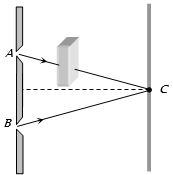
In Young's double-slit experiment,monochromatic light is used to illuminate the two slits $A$ and $B$. Interference fringes are observed on a screen placed in front of the slits. If a thin glass plate is placed normally in the path of the beam coming from one of the slits,what happens to the interference pattern?
A
The fringes will disappear.
B
The fringe width will increase.
C
The fringe width will decrease.
D
There will be no change in the fringe width,but the pattern shifts.
Solution
(D) When a thin glass plate of thickness $t$ and refractive index $\mu$ is placed in the path of one of the beams,an additional path difference is introduced.
This path difference is given by $\Delta x = (\mu - 1)t$.
Due to this additional path difference,the entire interference pattern shifts by a distance $y = \frac{D}{d}(\mu - 1)t$ towards the side where the glass plate is placed.
However,the fringe width $\beta = \frac{\lambda D}{d}$ depends only on the wavelength $\lambda$,the distance between the slits $d$,and the distance to the screen $D$.
Since these parameters remain unchanged,the fringe width remains constant.
Therefore,the correct option is $(d)$.
This path difference is given by $\Delta x = (\mu - 1)t$.
Due to this additional path difference,the entire interference pattern shifts by a distance $y = \frac{D}{d}(\mu - 1)t$ towards the side where the glass plate is placed.
However,the fringe width $\beta = \frac{\lambda D}{d}$ depends only on the wavelength $\lambda$,the distance between the slits $d$,and the distance to the screen $D$.
Since these parameters remain unchanged,the fringe width remains constant.
Therefore,the correct option is $(d)$.
0 likes
View Solution47
EasyMCQ
The fringe width in Young's double-slit experiment increases when:
A
Wavelength increases
B
Distance between the slits increases
C
Distance between the source and screen decreases
D
The width of the slits increases
Solution
(A) The formula for fringe width in Young's double-slit experiment is given by $\beta = \frac{\lambda D}{d}$,where $\lambda$ is the wavelength of light,$D$ is the distance between the slits and the screen,and $d$ is the distance between the two slits.
From the relation $\beta \propto \lambda$,it is clear that the fringe width $\beta$ is directly proportional to the wavelength $\lambda$ of the light used.
Therefore,if the wavelength $\lambda$ increases,the fringe width $\beta$ also increases.
Thus,option $A$ is correct.
From the relation $\beta \propto \lambda$,it is clear that the fringe width $\beta$ is directly proportional to the wavelength $\lambda$ of the light used.
Therefore,if the wavelength $\lambda$ increases,the fringe width $\beta$ also increases.
Thus,option $A$ is correct.
0 likes
View Solution48
EasyMCQ
Two slits,$4 \, mm$ apart,are illuminated by light of wavelength $6000 \, \mathring{A}$. What will be the fringe width on a screen placed $2 \, m$ from the slits in $mm$?
A
$0.12$
B
$0.3$
C
$3$
D
$4$
Solution
(B) The formula for fringe width $\beta$ in Young's Double Slit Experiment is given by $\beta = \frac{\lambda D}{d}$.
Given:
- Wavelength $\lambda = 6000 \, \mathring{A} = 6000 \times 10^{-10} \, m = 6 \times 10^{-7} \, m$.
- Distance between slits $d = 4 \, mm = 4 \times 10^{-3} \, m$.
- Distance of screen from slits $D = 2 \, m$.
Substituting these values into the formula:
$\beta = \frac{6 \times 10^{-7} \times 2}{4 \times 10^{-3}}$
$\beta = \frac{12 \times 10^{-7}}{4 \times 10^{-3}}$
$\beta = 3 \times 10^{-4} \, m$
Converting meters to millimeters:
$\beta = 3 \times 10^{-4} \times 10^3 \, mm = 0.3 \, mm$.
Therefore,the correct option is $B$.
Given:
- Wavelength $\lambda = 6000 \, \mathring{A} = 6000 \times 10^{-10} \, m = 6 \times 10^{-7} \, m$.
- Distance between slits $d = 4 \, mm = 4 \times 10^{-3} \, m$.
- Distance of screen from slits $D = 2 \, m$.
Substituting these values into the formula:
$\beta = \frac{6 \times 10^{-7} \times 2}{4 \times 10^{-3}}$
$\beta = \frac{12 \times 10^{-7}}{4 \times 10^{-3}}$
$\beta = 3 \times 10^{-4} \, m$
Converting meters to millimeters:
$\beta = 3 \times 10^{-4} \times 10^3 \, mm = 0.3 \, mm$.
Therefore,the correct option is $B$.
0 likes
View Solution49
EasyMCQ
In the Young's double slit experiment,for which colour is the fringe width the least?
A
Red
B
Green
C
Blue
D
Yellow
Solution
(C) The fringe width $\beta$ in Young's double slit experiment is given by the formula $\beta = \frac{\lambda D}{d}$,where $\lambda$ is the wavelength of light,$D$ is the distance between the screen and the slits,and $d$ is the distance between the two slits.
From the relation $\beta \propto \lambda$,it is clear that the fringe width is directly proportional to the wavelength of the light used.
Among the given colours,the wavelength of red light is the longest and the wavelength of blue light is the shortest.
Since blue light has the shortest wavelength,the fringe width will be the least for blue light.
From the relation $\beta \propto \lambda$,it is clear that the fringe width is directly proportional to the wavelength of the light used.
Among the given colours,the wavelength of red light is the longest and the wavelength of blue light is the shortest.
Since blue light has the shortest wavelength,the fringe width will be the least for blue light.
0 likes
View Solution50
EasyMCQ
In a Young's double-slit experiment,the separation of the two slits is doubled. To keep the same spacing of fringes,the distance $D$ of the screen from the slits should be made
A
$\frac{D}{2}$
B
$\frac{D}{\sqrt{2}}$
C
$2D$
D
$4D$
Solution
(C) The fringe width $\beta$ in a Young's double-slit experiment is given by the formula: $\beta = \frac{\lambda D}{d}$,where $\lambda$ is the wavelength of light,$D$ is the distance between the slits and the screen,and $d$ is the separation between the two slits.
Given that the fringe width $\beta$ remains constant,we have $\frac{\lambda D}{d} = \text{constant}$.
If the slit separation $d$ is doubled $(d' = 2d)$,let the new distance be $D'$.
Then,$\frac{\lambda D}{d} = \frac{\lambda D'}{2d}$.
Solving for $D'$,we get $D' = 2D$.
Therefore,the distance of the screen from the slits should be doubled.
Given that the fringe width $\beta$ remains constant,we have $\frac{\lambda D}{d} = \text{constant}$.
If the slit separation $d$ is doubled $(d' = 2d)$,let the new distance be $D'$.
Then,$\frac{\lambda D}{d} = \frac{\lambda D'}{2d}$.
Solving for $D'$,we get $D' = 2D$.
Therefore,the distance of the screen from the slits should be doubled.
0 likes
View SolutionWave Optics — Young's Double Slit Experiment (YDSE) · Frequently Asked Questions
1Are these Wave Optics questions useful for JEE and NEET?
Yes. All questions in this section are mapped to JEE Main and NEET exam patterns. Previous year questions from JEE Main, NEET, GUJCET and state-level exams are included with full solutions.
2Can I switch to Hindi or Gujarati for these questions?
Yes. Use the language tabs in the hero section or the sidebar to view the same questions and solutions in English, Hindi or Gujarati.
3How do I generate a question paper from this subtopic?
Use the Vedclass Exam Paper Generator — select the chapter and subtopic, set difficulty, and generate Sets A, B, C, D automatically. First 3 chapters of every subject are free.
Vedclass Products
For Students
Vedclass Test Series
Mock tests in real JEE/NEET style with performance analysis. 5-day free trial.
Start Free TrialFor Teachers
Exam Paper Generator
Generate Set A/B/C/D papers from this chapter in 2 minutes. 3 chapters free.
Try FreeFor Institutes
Online Exam Module
Live online exams with unlimited students, 360° analytics & white-label branding.
See DemoFor Teachers & Institutes
Generate a Wave Optics Exam Paper in 2 Minutes
Select subtopic & difficulty — Sets A, B, C, D auto-generated with No Repeat logic.
First 3 chapters of every subject are free — no payment required.