
A English
Young's Double Slit Experiment (YDSE) Questions in English
Class 12 Physics · Wave Optics · Young's Double Slit Experiment (YDSE)
616+
Questions
English
Language
100%
With Solutions
Showing 50 of 616 questions in English
201
AdvancedMCQ
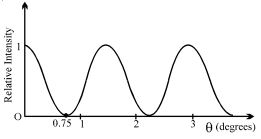
Light of wavelength $520\, nm$ passing through a double slit produces an interference pattern of relative intensity versus deflection angle $\theta$ as shown in the figure. The separation $d$ between the slits is
A
$2 \times 10^{-2}\, mm$
B
$5 \times 10^{-2}\, mm$
C
$4.5 \times 10^{-2}\, mm$
D
$1.1 \times 10^{-2}\, mm$
Solution
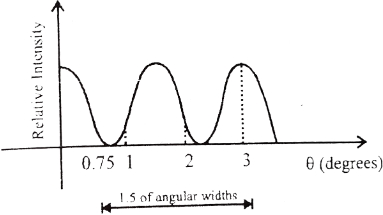
(A) From the given interference pattern,the angular width of a fringe is the distance between two consecutive minima or maxima.
From the figure,the first minimum is at $\theta = 0.75^{\circ}$.
The angular width of a fringe is $\Delta\theta = 0.75^{\circ}$.
For a double slit experiment,the condition for the first minimum is $d \sin\theta = \frac{\lambda}{2}$.
Since $\theta$ is very small,$\sin\theta \approx \theta$ (in radians).
Thus,$d \theta = \frac{\lambda}{2} \Rightarrow d = \frac{\lambda}{2\theta}$.
Convert $\theta$ to radians: $\theta = 0.75^{\circ} = 0.75 \times \frac{\pi}{180} \text{ rad} = \frac{3}{4} \times \frac{\pi}{180} = \frac{\pi}{240} \text{ rad}$.
Given $\lambda = 520 \times 10^{-9} \text{ m}$.
Substituting the values: $d = \frac{520 \times 10^{-9}}{2 \times (\pi / 240)} = \frac{520 \times 10^{-9} \times 120}{\pi} \approx \frac{62400 \times 10^{-9}}{3.14} \approx 1.987 \times 10^{-5} \text{ m}$.
Converting to mm: $d \approx 1.987 \times 10^{-2} \text{ mm} \approx 2 \times 10^{-2} \text{ mm}$.
Therefore,the correct option is $A$.
From the figure,the first minimum is at $\theta = 0.75^{\circ}$.
The angular width of a fringe is $\Delta\theta = 0.75^{\circ}$.
For a double slit experiment,the condition for the first minimum is $d \sin\theta = \frac{\lambda}{2}$.
Since $\theta$ is very small,$\sin\theta \approx \theta$ (in radians).
Thus,$d \theta = \frac{\lambda}{2} \Rightarrow d = \frac{\lambda}{2\theta}$.
Convert $\theta$ to radians: $\theta = 0.75^{\circ} = 0.75 \times \frac{\pi}{180} \text{ rad} = \frac{3}{4} \times \frac{\pi}{180} = \frac{\pi}{240} \text{ rad}$.
Given $\lambda = 520 \times 10^{-9} \text{ m}$.
Substituting the values: $d = \frac{520 \times 10^{-9}}{2 \times (\pi / 240)} = \frac{520 \times 10^{-9} \times 120}{\pi} \approx \frac{62400 \times 10^{-9}}{3.14} \approx 1.987 \times 10^{-5} \text{ m}$.
Converting to mm: $d \approx 1.987 \times 10^{-2} \text{ mm} \approx 2 \times 10^{-2} \text{ mm}$.
Therefore,the correct option is $A$.
0 likes
View Solution202
DifficultMCQ
In Young's double slit experiment,the slits are $0.5 \, mm$ apart and the interference is observed on a screen at a distance of $100 \, cm$ from the slits. It is found that the $9^{th}$ bright fringe is at a distance of $7.5 \, mm$ from the $2^{nd}$ dark fringe on the same side of the central fringe. The wavelength of the light used is ..... $\mathring{A}$.
A
$\frac{2500}{7}$
B
$2500$
C
$5000$
D
$\frac{5000}{7}$
Solution
(C) The position of the $n^{th}$ bright fringe is given by $y_n = \frac{n \lambda D}{d}$.
For the $9^{th}$ bright fringe,$y_9 = \frac{9 \lambda D}{d}$.
The position of the $m^{th}$ dark fringe is given by $y'_m = \frac{(2m-1) \lambda D}{2d}$.
For the $2^{nd}$ dark fringe,$y'_2 = \frac{(2 \times 2 - 1) \lambda D}{2d} = \frac{3 \lambda D}{2d}$.
The distance between them is $y_9 - y'_2 = 7.5 \, mm = 7.5 \times 10^{-3} \, m$.
$\frac{9 \lambda D}{d} - \frac{3 \lambda D}{2d} = 7.5 \times 10^{-3}$.
$\frac{(18-3) \lambda D}{2d} = 7.5 \times 10^{-3} \implies \frac{15 \lambda D}{2d} = 7.5 \times 10^{-3}$.
Given $d = 0.5 \times 10^{-3} \, m$ and $D = 1 \, m$.
$\lambda = \frac{7.5 \times 10^{-3} \times 2 \times 0.5 \times 10^{-3}}{15 \times 1} = \frac{7.5 \times 10^{-6}}{15} = 0.5 \times 10^{-6} \, m = 5000 \, \mathring{A}$.
For the $9^{th}$ bright fringe,$y_9 = \frac{9 \lambda D}{d}$.
The position of the $m^{th}$ dark fringe is given by $y'_m = \frac{(2m-1) \lambda D}{2d}$.
For the $2^{nd}$ dark fringe,$y'_2 = \frac{(2 \times 2 - 1) \lambda D}{2d} = \frac{3 \lambda D}{2d}$.
The distance between them is $y_9 - y'_2 = 7.5 \, mm = 7.5 \times 10^{-3} \, m$.
$\frac{9 \lambda D}{d} - \frac{3 \lambda D}{2d} = 7.5 \times 10^{-3}$.
$\frac{(18-3) \lambda D}{2d} = 7.5 \times 10^{-3} \implies \frac{15 \lambda D}{2d} = 7.5 \times 10^{-3}$.
Given $d = 0.5 \times 10^{-3} \, m$ and $D = 1 \, m$.
$\lambda = \frac{7.5 \times 10^{-3} \times 2 \times 0.5 \times 10^{-3}}{15 \times 1} = \frac{7.5 \times 10^{-6}}{15} = 0.5 \times 10^{-6} \, m = 5000 \, \mathring{A}$.
0 likes
View Solution203
AdvancedMCQ
In a $YDSE$ apparatus,two identical slits are separated by $1\, mm$ and the distance between the slits and the screen is $1\, m$. The wavelength of light used is $6000\, \mathring{A}$. The minimum distance between two points on the screen having $75\%$ intensity of the maximum intensity is ......$mm$.
A
$0.45$
B
$0.40$
C
$0.30$
D
$0.20$
Solution
(B) The intensity at any point on the screen is given by $I = I_{\max} \cos^2(\phi/2)$.
Given $I = 0.75 I_{\max}$,we have $0.75 = \cos^2(\phi/2)$,which implies $\cos(\phi/2) = \pm \sqrt{3}/2$.
Thus,$\phi/2 = \pi/6$ or $5\pi/6$,leading to phase differences $\phi = \pi/3$ or $5\pi/3$.
The path difference is $\Delta x = (\lambda/2\pi) \phi = yd/D$.
For $\phi_1 = \pi/3$,$y_1 = (\lambda D / 2\pi d) \times (\pi/3) = \lambda D / 6d$.
For $\phi_2 = 5\pi/3$,$y_2 = (\lambda D / 2\pi d) \times (5\pi/3) = 5\lambda D / 6d$.
Substituting values: $\lambda = 6 \times 10^{-7} \, m$,$D = 1 \, m$,$d = 10^{-3} \, m$.
$y_1 = (6 \times 10^{-7} \times 1) / (6 \times 10^{-3}) = 10^{-4} \, m = 0.1 \, mm$.
$y_2 = 5 \times 0.1 \, mm = 0.5 \, mm$.
The distance between the two points is $\Delta y = y_2 - y_1 = 0.5 - 0.1 = 0.4 \, mm$.
Given $I = 0.75 I_{\max}$,we have $0.75 = \cos^2(\phi/2)$,which implies $\cos(\phi/2) = \pm \sqrt{3}/2$.
Thus,$\phi/2 = \pi/6$ or $5\pi/6$,leading to phase differences $\phi = \pi/3$ or $5\pi/3$.
The path difference is $\Delta x = (\lambda/2\pi) \phi = yd/D$.
For $\phi_1 = \pi/3$,$y_1 = (\lambda D / 2\pi d) \times (\pi/3) = \lambda D / 6d$.
For $\phi_2 = 5\pi/3$,$y_2 = (\lambda D / 2\pi d) \times (5\pi/3) = 5\lambda D / 6d$.
Substituting values: $\lambda = 6 \times 10^{-7} \, m$,$D = 1 \, m$,$d = 10^{-3} \, m$.
$y_1 = (6 \times 10^{-7} \times 1) / (6 \times 10^{-3}) = 10^{-4} \, m = 0.1 \, mm$.
$y_2 = 5 \times 0.1 \, mm = 0.5 \, mm$.
The distance between the two points is $\Delta y = y_2 - y_1 = 0.5 - 0.1 = 0.4 \, mm$.
0 likes
View Solution204
AdvancedMCQ
In a Young's double-slit experiment,$D$ is the distance of the screen from the slits and $d$ is the separation between the slits. The distance of the nearest point to the central maximum where the intensity is the same as that due to a single slit is equal to:
A
$\frac{D\lambda}{d}$
B
$\frac{D\lambda}{2d}$
C
$\frac{D\lambda}{3d}$
D
$\frac{2D\lambda}{d}$
Solution
(C) Let $I_0$ be the intensity due to a single slit. The resultant intensity $I$ in a double-slit experiment is given by $I = I_0 + I_0 + 2\sqrt{I_0}\sqrt{I_0}\cos\phi = 2I_0(1 + \cos\phi)$.
Given that the intensity at the point is equal to that of a single slit,we set $I = I_0$.
$I_0 = 2I_0(1 + \cos\phi) \Rightarrow 1 = 2(1 + \cos\phi) \Rightarrow \frac{1}{2} = 1 + \cos\phi$.
$\cos\phi = -\frac{1}{2} \Rightarrow \phi = \frac{2\pi}{3}$.
The phase difference $\phi$ is related to the path difference $\Delta x$ by $\phi = \frac{2\pi}{\lambda}\Delta x$.
$\frac{2\pi}{3} = \frac{2\pi}{\lambda}\Delta x \Rightarrow \Delta x = \frac{\lambda}{3}$.
For small angles,the path difference $\Delta x = \frac{dy}{D}$.
Equating the two,$\frac{dy}{D} = \frac{\lambda}{3} \Rightarrow y = \frac{D\lambda}{3d}$.
Given that the intensity at the point is equal to that of a single slit,we set $I = I_0$.
$I_0 = 2I_0(1 + \cos\phi) \Rightarrow 1 = 2(1 + \cos\phi) \Rightarrow \frac{1}{2} = 1 + \cos\phi$.
$\cos\phi = -\frac{1}{2} \Rightarrow \phi = \frac{2\pi}{3}$.
The phase difference $\phi$ is related to the path difference $\Delta x$ by $\phi = \frac{2\pi}{\lambda}\Delta x$.
$\frac{2\pi}{3} = \frac{2\pi}{\lambda}\Delta x \Rightarrow \Delta x = \frac{\lambda}{3}$.
For small angles,the path difference $\Delta x = \frac{dy}{D}$.
Equating the two,$\frac{dy}{D} = \frac{\lambda}{3} \Rightarrow y = \frac{D\lambda}{3d}$.
0 likes
View Solution205
MediumMCQ
$A$ beam of light consisting of two wavelengths $6300 \, \mathring{A}$ and $\lambda \, \mathring{A}$ is used to obtain interference fringes in a Young's double-slit experiment. If the $4^{th}$ bright fringe of $6300 \, \mathring{A}$ coincides with the $5^{th}$ dark fringe of $\lambda \, \mathring{A}$,the value of $\lambda$ (in $\mathring{A}$) is:
A
$5200$
B
$4800$
C
$6200$
D
$5600$
Solution
(D) The condition for the $n^{th}$ bright fringe is $y_n = n \frac{D \lambda_1}{d}$. For $n = 4$ and $\lambda_1 = 6300 \, \mathring{A}$,$y_4 = 4 \frac{D \times 6300}{d}$.
The condition for the $m^{th}$ dark fringe is $y_m = (m - \frac{1}{2}) \frac{D \lambda_2}{d}$. For $m = 5$ and $\lambda_2 = \lambda$,$y_5 = (5 - 0.5) \frac{D \lambda}{d} = 4.5 \frac{D \lambda}{d} = \frac{9}{2} \frac{D \lambda}{d}$.
Since the fringes coincide,$y_4 = y_5$:
$4 \frac{D \times 6300}{d} = \frac{9}{2} \frac{D \lambda}{d}$.
Canceling $\frac{D}{d}$ from both sides:
$4 \times 6300 = 4.5 \times \lambda$.
$\lambda = \frac{4 \times 6300}{4.5} = \frac{25200}{4.5} = 5600 \, \mathring{A}$.
The condition for the $m^{th}$ dark fringe is $y_m = (m - \frac{1}{2}) \frac{D \lambda_2}{d}$. For $m = 5$ and $\lambda_2 = \lambda$,$y_5 = (5 - 0.5) \frac{D \lambda}{d} = 4.5 \frac{D \lambda}{d} = \frac{9}{2} \frac{D \lambda}{d}$.
Since the fringes coincide,$y_4 = y_5$:
$4 \frac{D \times 6300}{d} = \frac{9}{2} \frac{D \lambda}{d}$.
Canceling $\frac{D}{d}$ from both sides:
$4 \times 6300 = 4.5 \times \lambda$.
$\lambda = \frac{4 \times 6300}{4.5} = \frac{25200}{4.5} = 5600 \, \mathring{A}$.
0 likes
View Solution206
DifficultMCQ
$A$ beam of light consisting of two wavelengths $6500 \mathring{A}$ and $5200 \mathring{A}$ is used to obtain interference fringes in Young's double-slit experiment. The distance between slits is $2 \text{ mm}$ and the distance of the screen from the slits is $120 \text{ cm}$. What is the least distance from the central maximum where the bright fringes due to both wavelengths coincide (in $\text{ cm}$)?
A
$0.156$
B
$0.312$
C
$0.078$
D
$0.468$
Solution
(A) For the bright fringes of two different wavelengths to coincide at a distance $x$ from the central maximum,the condition is given by:
$x = \frac{n_1 \lambda_1 D}{d} = \frac{n_2 \lambda_2 D}{d}$
This implies $n_1 \lambda_1 = n_2 \lambda_2$,where $n_1$ and $n_2$ are the orders of the bright fringes.
Rearranging the terms,we get:
$\frac{n_1}{n_2} = \frac{\lambda_2}{\lambda_1} = \frac{5200 \mathring{A}}{6500 \mathring{A}} = \frac{4}{5}$
For the least distance,we take the smallest integer values: $n_1 = 4$ and $n_2 = 5$.
Now,substituting these values into the formula for $x$:
$x = \frac{n_1 \lambda_1 D}{d} = \frac{4 \times 6500 \times 10^{-10} \text{ m} \times 1.2 \text{ m}}{2 \times 10^{-3} \text{ m}}$
$x = \frac{4 \times 6500 \times 1.2 \times 10^{-10}}{2 \times 10^{-3}} \text{ m} = 15600 \times 10^{-7} \text{ m} = 1.56 \times 10^{-3} \text{ m}$
$x = 0.156 \text{ cm}$.
$x = \frac{n_1 \lambda_1 D}{d} = \frac{n_2 \lambda_2 D}{d}$
This implies $n_1 \lambda_1 = n_2 \lambda_2$,where $n_1$ and $n_2$ are the orders of the bright fringes.
Rearranging the terms,we get:
$\frac{n_1}{n_2} = \frac{\lambda_2}{\lambda_1} = \frac{5200 \mathring{A}}{6500 \mathring{A}} = \frac{4}{5}$
For the least distance,we take the smallest integer values: $n_1 = 4$ and $n_2 = 5$.
Now,substituting these values into the formula for $x$:
$x = \frac{n_1 \lambda_1 D}{d} = \frac{4 \times 6500 \times 10^{-10} \text{ m} \times 1.2 \text{ m}}{2 \times 10^{-3} \text{ m}}$
$x = \frac{4 \times 6500 \times 1.2 \times 10^{-10}}{2 \times 10^{-3}} \text{ m} = 15600 \times 10^{-7} \text{ m} = 1.56 \times 10^{-3} \text{ m}$
$x = 0.156 \text{ cm}$.
0 likes
View Solution207
DifficultMCQ
In a two-slit experiment with monochromatic light,fringes are obtained on a screen placed at some distance from the slits. If the screen is moved by $5 \times 10^{-2} \ m$ towards the slits,the change in fringe width is $3 \times 10^{-5} \ m$. If the separation between the slits is $10^{-3} \ m$,the wavelength of light used is ....... $\mathring{A}$.
A
$6000$
B
$5000$
C
$3000$
D
$4500$
Solution
(A) The fringe width $\beta$ is given by the formula $\beta = \frac{\lambda D}{d}$,where $D$ is the distance between the slits and the screen,$d$ is the separation between the slits,and $\lambda$ is the wavelength of light.
Given the change in screen distance $\Delta D = 5 \times 10^{-2} \ m$ and the change in fringe width $\Delta \beta = 3 \times 10^{-5} \ m$.
The change in fringe width is related to the change in distance by $\Delta \beta = \frac{\lambda \Delta D}{d}$.
Rearranging for $\lambda$,we get $\lambda = \frac{\Delta \beta \cdot d}{\Delta D}$.
Substituting the given values: $\lambda = \frac{(3 \times 10^{-5} \ m) \times (10^{-3} \ m)}{5 \times 10^{-2} \ m}$.
$\lambda = \frac{3 \times 10^{-8}}{5 \times 10^{-2}} = 0.6 \times 10^{-6} \ m$.
Converting to $\mathring{A}$: $\lambda = 0.6 \times 10^{-6} \times 10^{10} \ \mathring{A} = 6000 \ \mathring{A}$.
Given the change in screen distance $\Delta D = 5 \times 10^{-2} \ m$ and the change in fringe width $\Delta \beta = 3 \times 10^{-5} \ m$.
The change in fringe width is related to the change in distance by $\Delta \beta = \frac{\lambda \Delta D}{d}$.
Rearranging for $\lambda$,we get $\lambda = \frac{\Delta \beta \cdot d}{\Delta D}$.
Substituting the given values: $\lambda = \frac{(3 \times 10^{-5} \ m) \times (10^{-3} \ m)}{5 \times 10^{-2} \ m}$.
$\lambda = \frac{3 \times 10^{-8}}{5 \times 10^{-2}} = 0.6 \times 10^{-6} \ m$.
Converting to $\mathring{A}$: $\lambda = 0.6 \times 10^{-6} \times 10^{10} \ \mathring{A} = 6000 \ \mathring{A}$.
0 likes
View Solution208
DifficultMCQ
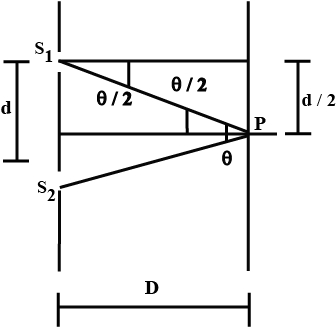
In $YDSE$,let $S_1$ and $S_2$ be the two slits,and $C$ be the centre of the screen. If $\theta$ is the angle $S_1CS_2$ and $\lambda$ is the wavelength,the fringe width will be
A
$\frac{\lambda}{\theta}$
B
$\lambda \theta$
C
$\frac{2 \lambda}{\theta}$
D
$\frac{\lambda}{2 \theta}$
Solution
(A) Let $d$ be the distance between the slits $S_1$ and $S_2$,and $D$ be the distance between the slits and the screen.
From the geometry of the setup,the angle $\theta$ subtended by the slits at the centre of the screen $C$ is given by $\tan(\theta/2) = \frac{d/2}{D}$.
For small angles,$\tan(\theta/2) \approx \theta/2 = \frac{d}{2D}$,which implies $\theta = \frac{d}{D}$.
The fringe width $\beta$ is defined as $\beta = \frac{\lambda D}{d}$.
Substituting $d/D = \theta$ into the expression for fringe width,we get $\beta = \frac{\lambda}{\theta}$.
From the geometry of the setup,the angle $\theta$ subtended by the slits at the centre of the screen $C$ is given by $\tan(\theta/2) = \frac{d/2}{D}$.
For small angles,$\tan(\theta/2) \approx \theta/2 = \frac{d}{2D}$,which implies $\theta = \frac{d}{D}$.
The fringe width $\beta$ is defined as $\beta = \frac{\lambda D}{d}$.
Substituting $d/D = \theta$ into the expression for fringe width,we get $\beta = \frac{\lambda}{\theta}$.
0 likes
View Solution209
DifficultMCQ
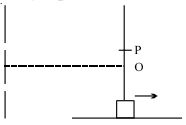
In a Young's Double slit experiment,the first maxima is observed at a fixed point $P$ on the screen. Now,the screen is continuously moved away from the plane of the slits. The ratio of the intensity at point $P$ to the intensity at point $O$ (centre of the screen) is:
A
remains constant
B
keeps on decreasing
C
first decreases and then increases
D
first decreases and then becomes constant
Solution
(C) The intensity at any point $P$ on the screen is given by $I_P = I_{\max} \cos^2(\phi/2)$,where $\phi$ is the phase difference.
The phase difference $\phi = \frac{2\pi}{\lambda} \Delta x = \frac{2\pi}{\lambda} \frac{yd}{D}$,where $y$ is the distance of point $P$ from the centre $O$,$d$ is the slit separation,and $D$ is the distance of the screen from the slits.
At the centre $O$,$y = 0$,so $\phi = 0$ and $I_O = I_{\max}$.
At point $P$,the first maxima is initially observed,so the path difference $\Delta x = \lambda$,which means $\phi = 2\pi$.
As the screen is moved away,$D$ increases. Since $\phi = \frac{2\pi yd}{\lambda D}$,as $D$ increases,$\phi$ decreases from $2\pi$ towards $0$.
As $\phi$ decreases from $2\pi$ to $0$,the value of $\cos^2(\phi/2)$ increases from $\cos^2(\pi) = 1$ to $\cos^2(0) = 1$,passing through $0$ at $\phi = \pi$ (the first minima).
Therefore,the intensity $I_P$ first decreases (as it moves from maxima to minima) and then increases (as it moves from minima towards the central maxima). Thus,the ratio $I_P/I_O$ first decreases and then increases.
The phase difference $\phi = \frac{2\pi}{\lambda} \Delta x = \frac{2\pi}{\lambda} \frac{yd}{D}$,where $y$ is the distance of point $P$ from the centre $O$,$d$ is the slit separation,and $D$ is the distance of the screen from the slits.
At the centre $O$,$y = 0$,so $\phi = 0$ and $I_O = I_{\max}$.
At point $P$,the first maxima is initially observed,so the path difference $\Delta x = \lambda$,which means $\phi = 2\pi$.
As the screen is moved away,$D$ increases. Since $\phi = \frac{2\pi yd}{\lambda D}$,as $D$ increases,$\phi$ decreases from $2\pi$ towards $0$.
As $\phi$ decreases from $2\pi$ to $0$,the value of $\cos^2(\phi/2)$ increases from $\cos^2(\pi) = 1$ to $\cos^2(0) = 1$,passing through $0$ at $\phi = \pi$ (the first minima).
Therefore,the intensity $I_P$ first decreases (as it moves from maxima to minima) and then increases (as it moves from minima towards the central maxima). Thus,the ratio $I_P/I_O$ first decreases and then increases.
0 likes
View Solution210
DifficultMCQ
In Young's double-slit experiment,the value of $\lambda = 500\, nm$. The value of $d = 1\, mm$ and $D = 1\, m$. Then the minimum distance from the central maximum for which the intensity is half the maximum intensity will be:
A
$2.5 \times 10^{-4}\, m$
B
$2 \times 10^{-4}\, m$
C
$1.25 \times 10^{-4}\, m$
D
$10^{-4}\, m$
Solution
(C) The intensity at any point in a Young's double-slit experiment is given by $I = I_{max} \cos^2(\frac{\phi}{2})$,where $\phi$ is the phase difference.
Given $I = \frac{I_{max}}{2}$,we have $\cos^2(\frac{\phi}{2}) = \frac{1}{2}$,which implies $\frac{\phi}{2} = \frac{\pi}{4}$,so $\phi = \frac{\pi}{2}$.
The phase difference $\phi$ is related to the path difference $\Delta x$ by $\phi = \frac{2\pi}{\lambda} \Delta x$. Thus,$\frac{\pi}{2} = \frac{2\pi}{\lambda} \Delta x$,which gives $\Delta x = \frac{\lambda}{4}$.
For small angles,the path difference $\Delta x = \frac{yd}{D}$.
Equating the two,we get $\frac{yd}{D} = \frac{\lambda}{4}$,so $y = \frac{\lambda D}{4d}$.
Substituting the given values: $\lambda = 5 \times 10^{-7}\, m$,$D = 1\, m$,and $d = 10^{-3}\, m$.
$y = \frac{5 \times 10^{-7} \times 1}{4 \times 10^{-3}} = 1.25 \times 10^{-4}\, m$.
Given $I = \frac{I_{max}}{2}$,we have $\cos^2(\frac{\phi}{2}) = \frac{1}{2}$,which implies $\frac{\phi}{2} = \frac{\pi}{4}$,so $\phi = \frac{\pi}{2}$.
The phase difference $\phi$ is related to the path difference $\Delta x$ by $\phi = \frac{2\pi}{\lambda} \Delta x$. Thus,$\frac{\pi}{2} = \frac{2\pi}{\lambda} \Delta x$,which gives $\Delta x = \frac{\lambda}{4}$.
For small angles,the path difference $\Delta x = \frac{yd}{D}$.
Equating the two,we get $\frac{yd}{D} = \frac{\lambda}{4}$,so $y = \frac{\lambda D}{4d}$.
Substituting the given values: $\lambda = 5 \times 10^{-7}\, m$,$D = 1\, m$,and $d = 10^{-3}\, m$.
$y = \frac{5 \times 10^{-7} \times 1}{4 \times 10^{-3}} = 1.25 \times 10^{-4}\, m$.
0 likes
View Solution211
AdvancedMCQ
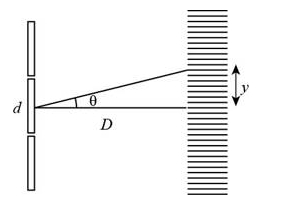
Two slits are separated by $0.3\, mm$. $A$ beam of $500\, nm$ light strikes the slits producing an interference pattern. Find the number of maxima observed in the angular range $-30^{\circ} < \theta < 30^{\circ}$.

A
$300$
B
$150$
C
$599$
D
$149$
Solution
(C) Given: Slit separation $d = 0.3\, mm = 0.3 \times 10^{-3}\, m$,wavelength $\lambda = 500\, nm = 500 \times 10^{-9}\, m$.
For constructive interference (maxima),the path difference is given by $d \sin \theta = n \lambda$,where $n$ is an integer.
We need to find the number of maxima in the range $-30^{\circ} < \theta < 30^{\circ}$.
Thus,$\sin \theta < \sin 30^{\circ} = 0.5$.
Substituting the condition $d \sin \theta = n \lambda$ into the inequality:
$n \lambda < d \sin 30^{\circ}$
$n < \frac{d \sin 30^{\circ}}{\lambda} = \frac{0.3 \times 10^{-3} \times 0.5}{500 \times 10^{-9}}$
$n < \frac{0.15 \times 10^{-3}}{5 \times 10^{-7}} = \frac{0.15}{5} \times 10^4 = 0.03 \times 10^4 = 300$.
Since $n$ must be an integer and $|n| < 300$,the possible values for $n$ are $0, \pm 1, \pm 2, \dots, \pm 299$.
The total number of maxima is $299$ (positive) $+ 299$ (negative) $+ 1$ (central maximum at $n=0$) $= 599$.
For constructive interference (maxima),the path difference is given by $d \sin \theta = n \lambda$,where $n$ is an integer.
We need to find the number of maxima in the range $-30^{\circ} < \theta < 30^{\circ}$.
Thus,$\sin \theta < \sin 30^{\circ} = 0.5$.
Substituting the condition $d \sin \theta = n \lambda$ into the inequality:
$n \lambda < d \sin 30^{\circ}$
$n < \frac{d \sin 30^{\circ}}{\lambda} = \frac{0.3 \times 10^{-3} \times 0.5}{500 \times 10^{-9}}$
$n < \frac{0.15 \times 10^{-3}}{5 \times 10^{-7}} = \frac{0.15}{5} \times 10^4 = 0.03 \times 10^4 = 300$.
Since $n$ must be an integer and $|n| < 300$,the possible values for $n$ are $0, \pm 1, \pm 2, \dots, \pm 299$.
The total number of maxima is $299$ (positive) $+ 299$ (negative) $+ 1$ (central maximum at $n=0$) $= 599$.
0 likes
View Solution212
DifficultMCQ
In a $YDSE$ experiment,if a slab whose refractive index can be varied is placed in front of one of the slits,then the variation of resultant intensity at the mid-point of the screen with $\mu$ will be best represented by $(\mu \geq 1)$. [Assume slits of equal width and there is no absorption by the slab]
A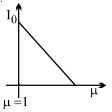
B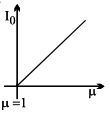
C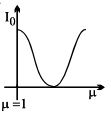
D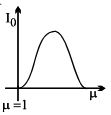
Solution
(C) In a $YDSE$ experiment,the intensity at any point on the screen is given by $I = 4I_0 \cos^2(\frac{\phi}{2})$,where $\phi$ is the phase difference between the two waves.
At the mid-point of the screen,the path difference due to the geometry is zero.
When a slab of thickness $t$ and refractive index $\mu$ is placed in front of one slit,an additional path difference $\Delta x = (\mu - 1)t$ is introduced.
The corresponding phase difference is $\phi = \frac{2\pi}{\lambda} \Delta x = \frac{2\pi}{\lambda} (\mu - 1)t$.
The intensity at the mid-point is $I = 4I_0 \cos^2(\frac{\pi t}{\lambda}(\mu - 1))$.
As $\mu$ increases from $1$,the term $(\mu - 1)$ increases,causing the phase difference $\phi$ to increase.
The intensity $I$ follows a $\cos^2$ variation,starting from a maximum value $(4I_0)$ at $\mu = 1$ (where $\phi = 0$) and decreasing as $\mu$ increases,following the shape of a squared cosine function.
At the mid-point of the screen,the path difference due to the geometry is zero.
When a slab of thickness $t$ and refractive index $\mu$ is placed in front of one slit,an additional path difference $\Delta x = (\mu - 1)t$ is introduced.
The corresponding phase difference is $\phi = \frac{2\pi}{\lambda} \Delta x = \frac{2\pi}{\lambda} (\mu - 1)t$.
The intensity at the mid-point is $I = 4I_0 \cos^2(\frac{\pi t}{\lambda}(\mu - 1))$.
As $\mu$ increases from $1$,the term $(\mu - 1)$ increases,causing the phase difference $\phi$ to increase.
The intensity $I$ follows a $\cos^2$ variation,starting from a maximum value $(4I_0)$ at $\mu = 1$ (where $\phi = 0$) and decreasing as $\mu$ increases,following the shape of a squared cosine function.
0 likes
View Solution213
DifficultMCQ
In a $YDSE$ with two identical slits,when the upper slit is covered with a thin,perfectly transparent sheet of mica,the intensity at the centre of the screen reduces to $75\%$ of the initial value. The second minimum is observed to be above this point and the third maximum below it. Which of the following cannot be a possible value of the phase difference caused by the mica sheet?
A
$\frac{\pi}{3}$
B
$\frac{13\pi}{3}$
C
$\frac{17\pi}{3}$
D
$\frac{11\pi}{3}$
Solution
(A) Let the phase difference introduced by the mica sheet be $\phi$. The intensity at the center of the screen is given by $I = I_0 \cos^2(\phi/2)$. Given $I = 0.75 I_0$,we have $\cos^2(\phi/2) = 3/4$,which implies $\cos(\phi/2) = \pm \sqrt{3}/2$. Thus,$\phi/2 = n\pi \pm \pi/6$,or $\phi = 2n\pi \pm \pi/3$.
For $n=1$,$\phi = 2\pi \pm \pi/3$,giving $\phi = 5\pi/3$ or $7\pi/3$.
For $n=2$,$\phi = 4\pi \pm \pi/3$,giving $\phi = 11\pi/3$ or $13\pi/3$.
For $n=3$,$\phi = 6\pi \pm \pi/3$,giving $\phi = 17\pi/3$ or $19\pi/3$.
The condition that the second minimum is above the center and the third maximum is below the center constrains the value of $\phi$. Based on the shift analysis,the phase difference $\phi$ must satisfy $3\pi < \phi < 4\pi$. Among the options,$\pi/3$ does not fall in the required range.
For $n=1$,$\phi = 2\pi \pm \pi/3$,giving $\phi = 5\pi/3$ or $7\pi/3$.
For $n=2$,$\phi = 4\pi \pm \pi/3$,giving $\phi = 11\pi/3$ or $13\pi/3$.
For $n=3$,$\phi = 6\pi \pm \pi/3$,giving $\phi = 17\pi/3$ or $19\pi/3$.
The condition that the second minimum is above the center and the third maximum is below the center constrains the value of $\phi$. Based on the shift analysis,the phase difference $\phi$ must satisfy $3\pi < \phi < 4\pi$. Among the options,$\pi/3$ does not fall in the required range.
0 likes
View Solution214
AdvancedMCQ
Four monochromatic and coherent sources of light,emitting waves in phase of wavelength $\lambda$,are placed at the points $x = 0, d, 2d$,and $3d$ on the $x$-axis. Then:
A
points having $|x| >> d$ appear dark if $d = \lambda /4$
B
points having $|x| >> d$ appear dark if $d = \lambda /8$
C
points having $|x| >> d$ appear maximum bright if $d = \lambda /4$
D
points having $|x| >> d$ appear maximum bright if $d = \lambda /8$
Solution
(A) For points at a large distance $(|x| >> d)$,the path difference between waves from adjacent sources is $\Delta x = d \cos \theta$. For a point on the $x$-axis at a large distance,$\theta = 0$,so $\Delta x = d$.
The total amplitude at a distant point is the sum of the four waves: $A = A_0(1 + e^{ikd} + e^{i2kd} + e^{i3kd})$,where $k = 2\pi / \lambda$.
This is a geometric series with $r = e^{ikd}$. The sum is $A = A_0 \frac{1 - e^{i4kd}}{1 - e^{ikd}}$.
The intensity $I$ is proportional to $|A|^2 = A_0^2 \left| \frac{1 - e^{i4kd}}{1 - e^{ikd}} \right|^2 = A_0^2 \frac{\sin^2(2kd)}{\sin^2(kd/2)}$.
For dark points (intensity = $0$),we need $\sin(2kd) = 0$ but $\sin(kd/2) \neq 0$.
$2kd = n\pi$ (where $n$ is an integer). For $n=1$,$2(2\pi/\lambda)d = \pi \implies d = \lambda / 4$.
Thus,if $d = \lambda / 4$,the intensity is zero,and the points appear dark.
The total amplitude at a distant point is the sum of the four waves: $A = A_0(1 + e^{ikd} + e^{i2kd} + e^{i3kd})$,where $k = 2\pi / \lambda$.
This is a geometric series with $r = e^{ikd}$. The sum is $A = A_0 \frac{1 - e^{i4kd}}{1 - e^{ikd}}$.
The intensity $I$ is proportional to $|A|^2 = A_0^2 \left| \frac{1 - e^{i4kd}}{1 - e^{ikd}} \right|^2 = A_0^2 \frac{\sin^2(2kd)}{\sin^2(kd/2)}$.
For dark points (intensity = $0$),we need $\sin(2kd) = 0$ but $\sin(kd/2) \neq 0$.
$2kd = n\pi$ (where $n$ is an integer). For $n=1$,$2(2\pi/\lambda)d = \pi \implies d = \lambda / 4$.
Thus,if $d = \lambda / 4$,the intensity is zero,and the points appear dark.
0 likes
View Solution215
AdvancedMCQ
White light is used to illuminate two slits in a $YDSE$. The separation between the slits is $d$ and the screen is at a distance $D (D >> d)$ from the slits. At a point on the screen directly in front of one of the slits,which of the following wavelengths are missing?
A
$\frac{d^2}{D}$
B
$\frac{2d^2}{D}$
C
$\frac{d^2}{3D}$
D
Both $(A)$ and $(C)$
Solution
(D) In a $YDSE$ setup,the path difference $\Delta x$ at a point on the screen at a distance $y$ from the central axis is given by $\Delta x = \frac{yd}{D}$.
For a point directly in front of one of the slits,the distance from the central axis is $y = \frac{d}{2}$.
Substituting this into the path difference formula: $\Delta x = \frac{(d/2)d}{D} = \frac{d^2}{2D}$.
For destructive interference (missing wavelengths),the path difference must be an odd multiple of half the wavelength: $\Delta x = (2m + 1) \frac{\lambda}{2}$,where $m = 0, 1, 2, ...$.
Equating the two expressions: $\frac{d^2}{2D} = (2m + 1) \frac{\lambda}{2}$.
Solving for $\lambda$: $\lambda = \frac{d^2}{(2m + 1)D}$.
For $m = 0$,$\lambda = \frac{d^2}{D}$.
For $m = 1$,$\lambda = \frac{d^2}{3D}$.
Thus,both wavelengths $\frac{d^2}{D}$ and $\frac{d^2}{3D}$ are missing.
For a point directly in front of one of the slits,the distance from the central axis is $y = \frac{d}{2}$.
Substituting this into the path difference formula: $\Delta x = \frac{(d/2)d}{D} = \frac{d^2}{2D}$.
For destructive interference (missing wavelengths),the path difference must be an odd multiple of half the wavelength: $\Delta x = (2m + 1) \frac{\lambda}{2}$,where $m = 0, 1, 2, ...$.
Equating the two expressions: $\frac{d^2}{2D} = (2m + 1) \frac{\lambda}{2}$.
Solving for $\lambda$: $\lambda = \frac{d^2}{(2m + 1)D}$.
For $m = 0$,$\lambda = \frac{d^2}{D}$.
For $m = 1$,$\lambda = \frac{d^2}{3D}$.
Thus,both wavelengths $\frac{d^2}{D}$ and $\frac{d^2}{3D}$ are missing.
0 likes
View Solution216
DifficultMCQ
In a $YDSE$ apparatus,if we use white light,then:
A
there will not be a completely dark fringe.
B
the central fringe will be white.
C
the fringe next to the central will be violet.
D
All of the above.
Solution
(D) In $YDSE$ with white light,the path difference for the central fringe is $0$ for all wavelengths. Since all wavelengths overlap at the center,the central fringe appears white.
As we move away from the center,the path difference $\Delta x = d \sin \theta$ increases. For a given point,different wavelengths satisfy the condition for constructive interference at slightly different positions. Since violet light has the shortest wavelength,the first order maximum for violet appears closest to the central fringe.
Because different wavelengths have different positions for their maxima and minima,the fringes overlap significantly,preventing the formation of a completely dark fringe (where intensity would be zero for all wavelengths simultaneously).
Therefore,all the given statements are correct.
As we move away from the center,the path difference $\Delta x = d \sin \theta$ increases. For a given point,different wavelengths satisfy the condition for constructive interference at slightly different positions. Since violet light has the shortest wavelength,the first order maximum for violet appears closest to the central fringe.
Because different wavelengths have different positions for their maxima and minima,the fringes overlap significantly,preventing the formation of a completely dark fringe (where intensity would be zero for all wavelengths simultaneously).
Therefore,all the given statements are correct.
0 likes
View Solution217
MediumMCQ
If the source of light used in a Young's Double Slit Experiment is changed from red to blue,then
A
the fringes will become brighter
B
consecutive fringes will come closer
C
the number of maxima formed on the screen increases
D
Both $(B)$ and $(C)$
Solution
(D) In a Young's Double Slit Experiment $(YDSE)$,the fringe width $\beta$ is given by the formula $\beta = \frac{\lambda D}{d}$,where $\lambda$ is the wavelength of light,$D$ is the distance between the screen and the slits,and $d$ is the distance between the two slits.
Since the wavelength of blue light $(\lambda_{blue})$ is smaller than the wavelength of red light $(\lambda_{red})$,the fringe width $\beta$ decreases when the source is changed from red to blue.
As $\beta$ decreases,the consecutive fringes come closer to each other.
Since the fringe width decreases,more fringes can fit within the same space on the screen,which means the number of maxima formed on the screen increases.
Therefore,both statements $(B)$ and $(C)$ are correct.
Since the wavelength of blue light $(\lambda_{blue})$ is smaller than the wavelength of red light $(\lambda_{red})$,the fringe width $\beta$ decreases when the source is changed from red to blue.
As $\beta$ decreases,the consecutive fringes come closer to each other.
Since the fringe width decreases,more fringes can fit within the same space on the screen,which means the number of maxima formed on the screen increases.
Therefore,both statements $(B)$ and $(C)$ are correct.
0 likes
View Solution218
AdvancedMCQ
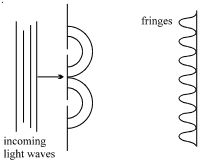
In a Young's double slit experiment,green light is incident on the two slits. The interference pattern is observed on a screen. Which of the following changes would cause the observed fringes to be more closely spaced?
A
Reducing the separation between the slits
B
Using blue light instead of green light
C
Using red light instead of green light
D
Moving the light source further away from the slits
Solution
(B) The fringe width $\beta$ in a Young's double slit experiment is given by the formula:
$\beta = \frac{\lambda D}{d}$
where $\lambda$ is the wavelength of the light used,$D$ is the distance between the slits and the screen,and $d$ is the separation between the two slits.
For the fringes to be more closely spaced,the fringe width $\beta$ must decrease.
From the formula,$\beta$ is directly proportional to the wavelength $\lambda$ $(\beta \propto \lambda)$.
Since the wavelength of blue light is less than the wavelength of green light $(\lambda_{\text{blue}} < \lambda_{\text{green}})$,using blue light instead of green light will decrease the fringe width,making the fringes more closely spaced.
$\beta = \frac{\lambda D}{d}$
where $\lambda$ is the wavelength of the light used,$D$ is the distance between the slits and the screen,and $d$ is the separation between the two slits.
For the fringes to be more closely spaced,the fringe width $\beta$ must decrease.
From the formula,$\beta$ is directly proportional to the wavelength $\lambda$ $(\beta \propto \lambda)$.
Since the wavelength of blue light is less than the wavelength of green light $(\lambda_{\text{blue}} < \lambda_{\text{green}})$,using blue light instead of green light will decrease the fringe width,making the fringes more closely spaced.
0 likes
View Solution219
MediumMCQ
In a $YDSE$,if the slits are of unequal width:
A
fringes will not be formed
B
the positions of minimum intensity will not be completely dark
C
bright fringe will not be formed at the centre of the screen
D
distance between two consecutive bright fringes will not be equal to the distance between two consecutive dark fringes
Solution
(B) In a $YDSE$,the intensity of light coming from the slits is proportional to the width of the slits. If the slits have unequal widths,the amplitudes of the waves from the two slits,$a_1$ and $a_2$,will be unequal $(a_1 \neq a_2)$.
The intensity of the interference pattern is given by $I = I_1 + I_2 + 2\sqrt{I_1 I_2} \cos \phi$.
For destructive interference,the intensity is $I_{min} = (\sqrt{I_1} - \sqrt{I_2})^2$.
Since $I_1 \neq I_2$,$I_{min} \neq 0$. Therefore,the positions of minimum intensity will not be completely dark.
The intensity of the interference pattern is given by $I = I_1 + I_2 + 2\sqrt{I_1 I_2} \cos \phi$.
For destructive interference,the intensity is $I_{min} = (\sqrt{I_1} - \sqrt{I_2})^2$.
Since $I_1 \neq I_2$,$I_{min} \neq 0$. Therefore,the positions of minimum intensity will not be completely dark.
0 likes
View Solution220
DifficultMCQ
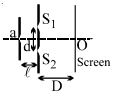
The figure shows a schematic diagram of the arrangement of Young's Double Slit Experiment. If the distance $d$ is varied,then identify the correct statement.
A
The angular width does not change.
B
The fringe width changes in inverse proportion.
C
The positions of all minima change.
D
Both $(B)$ and $(C)$.
Solution
(D) In Young's Double Slit Experiment,the fringe width $\beta$ is given by $\beta = \frac{\lambda D}{d}$,where $\lambda$ is the wavelength of light,$D$ is the distance between the slits and the screen,and $d$ is the distance between the two slits.
From this formula,it is clear that $\beta \propto \frac{1}{d}$,meaning the fringe width changes in inverse proportion to $d$. This confirms statement $(B)$.
The position of the $n$-th minimum is given by $y_n = (2n - 1) \frac{\lambda D}{2d}$. Since $y_n$ depends on $d$,changing $d$ will shift the positions of all minima on the screen. This confirms statement $(C)$.
Therefore,both statements $(B)$ and $(C)$ are correct.
From this formula,it is clear that $\beta \propto \frac{1}{d}$,meaning the fringe width changes in inverse proportion to $d$. This confirms statement $(B)$.
The position of the $n$-th minimum is given by $y_n = (2n - 1) \frac{\lambda D}{2d}$. Since $y_n$ depends on $d$,changing $d$ will shift the positions of all minima on the screen. This confirms statement $(C)$.
Therefore,both statements $(B)$ and $(C)$ are correct.
0 likes
View Solution221
DifficultMCQ
The figure shows a schematic diagram of Young's Double Slit Experiment. Identify the correct statement$(s)$ if the source slit $S$ is moved closer to the slits $S_1$ and $S_2$,i.e.,the distance $\ell$ decreases.
A
Fringe pattern may disappear.
B
Fringe pattern may become less sharp.
C
Fringe width remains unchanged.
D
All of the above.
Solution
(D) In Young's Double Slit Experiment,the condition for obtaining a sharp interference pattern is that the source slit must be narrow and the light must be coherent.
When the distance $\ell$ between the source slit and the double slits $S_1S_2$ decreases,the spatial coherence of the light reaching the slits $S_1$ and $S_2$ decreases.
$1$. As $\ell$ decreases,the angular width of the source as seen from the slits increases,which reduces the visibility of the fringes. If $\ell$ becomes too small,the fringe pattern may disappear (Option $A$).
$2$. The reduction in spatial coherence causes the fringes to lose their sharpness (Option $B$).
$3$. The fringe width is given by $\beta = \frac{\lambda D}{d}$. Since $\beta$ depends only on the wavelength $\lambda$,the distance between the slits $d$,and the distance to the screen $D$,it remains unchanged when $\ell$ is varied (Option $C$).
Therefore,all the given statements are correct.
When the distance $\ell$ between the source slit and the double slits $S_1S_2$ decreases,the spatial coherence of the light reaching the slits $S_1$ and $S_2$ decreases.
$1$. As $\ell$ decreases,the angular width of the source as seen from the slits increases,which reduces the visibility of the fringes. If $\ell$ becomes too small,the fringe pattern may disappear (Option $A$).
$2$. The reduction in spatial coherence causes the fringes to lose their sharpness (Option $B$).
$3$. The fringe width is given by $\beta = \frac{\lambda D}{d}$. Since $\beta$ depends only on the wavelength $\lambda$,the distance between the slits $d$,and the distance to the screen $D$,it remains unchanged when $\ell$ is varied (Option $C$).
Therefore,all the given statements are correct.
0 likes
View Solution222
MediumMCQ
$A$ mixture of light,consisting of wavelengths $590 \ nm$ and an unknown wavelength,illuminates Young's double slit and gives rise to two overlapping interference patterns on the screen. The central maximum of both lights coincide. Further,it is observed that the $3^{rd}$ bright fringe of the known light coincides with the $4^{th}$ bright fringe of the unknown light. From this data,the wavelength of the unknown light is ...... $nm$.
A
$393.4$
B
$885$
C
$442.5$
D
$776.8$
Solution
(C) The condition for the $n^{th}$ bright fringe in Young's double slit experiment is given by $y_n = \frac{n \lambda D}{d}$.
Given that the $3^{rd}$ bright fringe of the known light $(\lambda_1 = 590 \ nm)$ coincides with the $4^{th}$ bright fringe of the unknown light $(\lambda_2 = \lambda)$:
$\frac{3 \lambda_1 D}{d} = \frac{4 \lambda_2 D}{d}$
$3 \lambda_1 = 4 \lambda_2$
$\lambda_2 = \frac{3}{4} \times 590 \ nm$
$\lambda_2 = 0.75 \times 590 \ nm = 442.5 \ nm$.
Given that the $3^{rd}$ bright fringe of the known light $(\lambda_1 = 590 \ nm)$ coincides with the $4^{th}$ bright fringe of the unknown light $(\lambda_2 = \lambda)$:
$\frac{3 \lambda_1 D}{d} = \frac{4 \lambda_2 D}{d}$
$3 \lambda_1 = 4 \lambda_2$
$\lambda_2 = \frac{3}{4} \times 590 \ nm$
$\lambda_2 = 0.75 \times 590 \ nm = 442.5 \ nm$.
0 likes
View Solution223
MediumMCQ
In a Young's double slit experiment,slits are separated by $0.5 \ mm$,and the screen is placed $150 \ cm$ away. $A$ beam of light consisting of two wavelengths,$650 \ nm$ and $520 \ nm$,is used to obtain interference fringes on the screen. The least distance from the common central maximum to the point where the bright fringes due to both the wavelengths coincide is...... $mm$.
A
$1.56$
B
$7.8$
C
$9.75$
D
$15.6$
Solution
(B) For bright fringes to coincide,the path difference must be an integer multiple of both wavelengths. Let $n_1$ be the order for $\lambda_1 = 650 \ nm$ and $n_2$ be the order for $\lambda_2 = 520 \ nm$.
The condition for coincidence is $y = \frac{n_1 \lambda_1 D}{d} = \frac{n_2 \lambda_2 D}{d}$,which implies $n_1 \lambda_1 = n_2 \lambda_2$.
$\frac{n_1}{n_2} = \frac{\lambda_2}{\lambda_1} = \frac{520 \ nm}{650 \ nm} = \frac{4}{5}$.
For the least distance,we take the smallest integers $n_1 = 4$ and $n_2 = 5$.
Now,calculate the position $y$ using $n_1 = 4$,$\lambda_1 = 650 \times 10^{-9} \ m$,$D = 1.5 \ m$,and $d = 0.5 \times 10^{-3} \ m$:
$y = \frac{n_1 \lambda_1 D}{d} = \frac{4 \times 650 \times 10^{-9} \times 1.5}{0.5 \times 10^{-3}} \ m$.
$y = \frac{4 \times 650 \times 1.5}{0.5} \times 10^{-6} \ m = 7800 \times 10^{-6} \ m = 7.8 \times 10^{-3} \ m = 7.8 \ mm$.
The condition for coincidence is $y = \frac{n_1 \lambda_1 D}{d} = \frac{n_2 \lambda_2 D}{d}$,which implies $n_1 \lambda_1 = n_2 \lambda_2$.
$\frac{n_1}{n_2} = \frac{\lambda_2}{\lambda_1} = \frac{520 \ nm}{650 \ nm} = \frac{4}{5}$.
For the least distance,we take the smallest integers $n_1 = 4$ and $n_2 = 5$.
Now,calculate the position $y$ using $n_1 = 4$,$\lambda_1 = 650 \times 10^{-9} \ m$,$D = 1.5 \ m$,and $d = 0.5 \times 10^{-3} \ m$:
$y = \frac{n_1 \lambda_1 D}{d} = \frac{4 \times 650 \times 10^{-9} \times 1.5}{0.5 \times 10^{-3}} \ m$.
$y = \frac{4 \times 650 \times 1.5}{0.5} \times 10^{-6} \ m = 7800 \times 10^{-6} \ m = 7.8 \times 10^{-3} \ m = 7.8 \ mm$.
0 likes
View Solution224
MediumMCQ
The angular width of the central maximum in a single slit diffraction pattern is $60^o$. The width of the slit is $1 \mu m$. The slit is illuminated by monochromatic plane waves. If another slit of same width is made near it,Young's fringes can be observed on a screen placed at a distance $50 \ cm$ from the slits. If the observed fringe width is $1 \ cm$,what is the slit separation distance in $\mu m$ (i.e.,distance between the centres of each slit)?
A
$50$
B
$75$
C
$100$
D
$25$
Solution
(D) The angular width of the central maximum in a single slit diffraction is given by $\theta = \frac{2\lambda}{d}$,where $d$ is the slit width.
Given $\theta = 60^o = \frac{\pi}{3}$ radians,but typically for small angles $\sin \theta \approx \theta$. However,using the standard formula $\frac{2\lambda}{d} = 2 \sin^{-1}(\frac{\lambda}{d})$. For $60^o$ angular width,$\frac{\lambda}{d} = \sin(30^o) = 0.5$.
Thus,$\lambda = 0.5 \times d = 0.5 \times 1 \mu m = 0.5 \mu m$.
For Young's double slit experiment,the fringe width is $\beta = \frac{\lambda D}{d'}$,where $d'$ is the slit separation.
Given $\beta = 1 \ cm = 10^{-2} \ m$,$D = 50 \ cm = 0.5 \ m$,and $\lambda = 0.5 \times 10^{-6} \ m$.
$10^{-2} = \frac{0.5 \times 10^{-6} \times 0.5}{d'}$.
$d' = \frac{0.25 \times 10^{-6}}{10^{-2}} = 0.25 \times 10^{-4} \ m = 25 \times 10^{-6} \ m = 25 \mu m$.
Given $\theta = 60^o = \frac{\pi}{3}$ radians,but typically for small angles $\sin \theta \approx \theta$. However,using the standard formula $\frac{2\lambda}{d} = 2 \sin^{-1}(\frac{\lambda}{d})$. For $60^o$ angular width,$\frac{\lambda}{d} = \sin(30^o) = 0.5$.
Thus,$\lambda = 0.5 \times d = 0.5 \times 1 \mu m = 0.5 \mu m$.
For Young's double slit experiment,the fringe width is $\beta = \frac{\lambda D}{d'}$,where $d'$ is the slit separation.
Given $\beta = 1 \ cm = 10^{-2} \ m$,$D = 50 \ cm = 0.5 \ m$,and $\lambda = 0.5 \times 10^{-6} \ m$.
$10^{-2} = \frac{0.5 \times 10^{-6} \times 0.5}{d'}$.
$d' = \frac{0.25 \times 10^{-6}}{10^{-2}} = 0.25 \times 10^{-4} \ m = 25 \times 10^{-6} \ m = 25 \mu m$.
0 likes
View Solution225
MediumMCQ
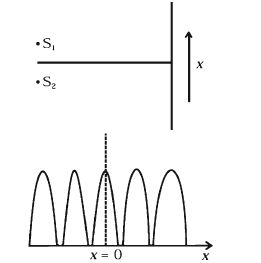
In a standard $YDSE$ setup,two sources $S_1$ and $S_2$ of intensities $I_1$ and $I_2$ are placed in front of a screen (figure). The pattern of intensity distribution seen in the central portion is given by the graph. In this case,which of the following statements is true?
A
$S_1$ and $S_2$ must have the same intensities.
B
$S_1$ and $S_2$ have a constant phase difference.
C
$S_1$ and $S_2$ must have equal phase.
D
$S_1$ and $S_2$ must have the same wavelength.
Solution
(B) The intensity distribution in a $YDSE$ experiment is given by $I = I_1 + I_2 + 2\sqrt{I_1 I_2} \cos(\Delta \phi)$.
From the graph,we observe that the minimum intensity $(I_{min})$ is zero. Since $I_{min} = (\sqrt{I_1} - \sqrt{I_2})^2$,$I_{min} = 0$ implies that $I_1 = I_2$. Thus,the sources must have the same intensity.
Furthermore,for a stable interference pattern to be observed on the screen,the sources $S_1$ and $S_2$ must be coherent. Coherent sources are defined as sources that maintain a constant phase difference over time. Therefore,the statement that $S_1$ and $S_2$ have a constant phase difference is a fundamental requirement for the observed interference pattern.
From the graph,we observe that the minimum intensity $(I_{min})$ is zero. Since $I_{min} = (\sqrt{I_1} - \sqrt{I_2})^2$,$I_{min} = 0$ implies that $I_1 = I_2$. Thus,the sources must have the same intensity.
Furthermore,for a stable interference pattern to be observed on the screen,the sources $S_1$ and $S_2$ must be coherent. Coherent sources are defined as sources that maintain a constant phase difference over time. Therefore,the statement that $S_1$ and $S_2$ have a constant phase difference is a fundamental requirement for the observed interference pattern.
0 likes
View Solution226
MediumMCQ
Two thin parallel slits are made in an opaque screen. When a monochromatic beam of light passes through them at normal incidence,the first bright fringe in the transmitted light occurs at $\pm 45^{\circ}$ with the original direction of the light beam on a distant screen when the apparatus is in air. When the apparatus is immersed in a liquid,the same bright fringe now occurs at $\pm 30^{\circ}$. The refractive index of the liquid is:
A
$\sqrt{2}$
B
$\sqrt{3}$
C
$\frac{4}{3}$
D
$\frac{3}{2}$
Solution
(A) For Young's Double Slit Experiment,the condition for the $n^{th}$ bright fringe is given by the path difference $\Delta x = d \sin \theta = n \lambda$.
For the first bright fringe $(n = 1)$,the condition becomes $d \sin \theta = \lambda$.
When the apparatus is in air,$\lambda_{air} = \lambda$ and $\theta_1 = 45^{\circ}$,so $d \sin 45^{\circ} = \lambda$.
When the apparatus is immersed in a liquid of refractive index $\mu$,the wavelength changes to $\lambda_{liquid} = \frac{\lambda}{\mu}$. The new angle is $\theta_2 = 30^{\circ}$,so $d \sin 30^{\circ} = \frac{\lambda}{\mu}$.
Dividing the two equations: $\frac{d \sin 45^{\circ}}{d \sin 30^{\circ}} = \frac{\lambda}{\lambda / \mu} = \mu$.
Substituting the values: $\mu = \frac{\sin 45^{\circ}}{\sin 30^{\circ}} = \frac{1/\sqrt{2}}{1/2} = \frac{2}{\sqrt{2}} = \sqrt{2}$.
For the first bright fringe $(n = 1)$,the condition becomes $d \sin \theta = \lambda$.
When the apparatus is in air,$\lambda_{air} = \lambda$ and $\theta_1 = 45^{\circ}$,so $d \sin 45^{\circ} = \lambda$.
When the apparatus is immersed in a liquid of refractive index $\mu$,the wavelength changes to $\lambda_{liquid} = \frac{\lambda}{\mu}$. The new angle is $\theta_2 = 30^{\circ}$,so $d \sin 30^{\circ} = \frac{\lambda}{\mu}$.
Dividing the two equations: $\frac{d \sin 45^{\circ}}{d \sin 30^{\circ}} = \frac{\lambda}{\lambda / \mu} = \mu$.
Substituting the values: $\mu = \frac{\sin 45^{\circ}}{\sin 30^{\circ}} = \frac{1/\sqrt{2}}{1/2} = \frac{2}{\sqrt{2}} = \sqrt{2}$.
0 likes
View Solution227
DifficultMCQ
If the slit widths of $YDSE$ are in the ratio $1:4$,then the ratio of maximum to minimum intensity on the screen is: (in $:1$)
A
$9$
B
$3$
C
$2$
D
$8$
Solution
(A) The intensity $I$ of light is directly proportional to the slit width $w$,so $I \propto w$. Thus,the ratio of intensities of the two slits is $\frac{I_1}{I_2} = \frac{w_1}{w_2} = \frac{1}{4}$.
Since $I \propto a^2$ (where $a$ is the amplitude),the ratio of amplitudes is $\frac{a_1}{a_2} = \sqrt{\frac{I_1}{I_2}} = \sqrt{\frac{1}{4}} = \frac{1}{2}$.
Let $a_1 = a$ and $a_2 = 2a$.
The ratio of maximum to minimum intensity is given by $\frac{I_{\max}}{I_{\min}} = \frac{(a_1 + a_2)^2}{(a_1 - a_2)^2}$.
Substituting the values,we get $\frac{I_{\max}}{I_{\min}} = \frac{(a + 2a)^2}{(a - 2a)^2} = \frac{(3a)^2}{(-a)^2} = \frac{9a^2}{a^2} = \frac{9}{1}$.
Since $I \propto a^2$ (where $a$ is the amplitude),the ratio of amplitudes is $\frac{a_1}{a_2} = \sqrt{\frac{I_1}{I_2}} = \sqrt{\frac{1}{4}} = \frac{1}{2}$.
Let $a_1 = a$ and $a_2 = 2a$.
The ratio of maximum to minimum intensity is given by $\frac{I_{\max}}{I_{\min}} = \frac{(a_1 + a_2)^2}{(a_1 - a_2)^2}$.
Substituting the values,we get $\frac{I_{\max}}{I_{\min}} = \frac{(a + 2a)^2}{(a - 2a)^2} = \frac{(3a)^2}{(-a)^2} = \frac{9a^2}{a^2} = \frac{9}{1}$.
0 likes
View Solution228
DifficultMCQ
Minimum thickness of a mica sheet having $\mu = 3/2$ which should be placed in front of one of the slits in $YDSE$ is required to reduce the intensity at the centre of the screen to half of the maximum intensity is-
A
$\lambda /4$
B
$\lambda /8$
C
$\lambda /2$
D
$\lambda /3$
Solution
(C) The intensity at any point in $YDSE$ is given by $I = 4I_0 \cos^2(\phi/2)$,where $I_{\max} = 4I_0$ and $\phi$ is the phase difference.
Given that the intensity at the center becomes half of the maximum intensity,we have $I = I_{\max}/2 = 2I_0$.
Substituting this into the formula: $2I_0 = 4I_0 \cos^2(\phi/2) \Rightarrow \cos^2(\phi/2) = 1/2 \Rightarrow \phi/2 = \pi/4 \Rightarrow \phi = \pi/2$.
The phase difference introduced by the mica sheet of thickness $t$ and refractive index $\mu$ is $\phi = (2\pi/\lambda)(\mu - 1)t$.
Equating the two expressions for $\phi$: $\pi/2 = (2\pi/\lambda)(3/2 - 1)t$.
$\pi/2 = (2\pi/\lambda)(1/2)t = \pi t / \lambda$.
Solving for $t$,we get $t = \lambda/2$.
Given that the intensity at the center becomes half of the maximum intensity,we have $I = I_{\max}/2 = 2I_0$.
Substituting this into the formula: $2I_0 = 4I_0 \cos^2(\phi/2) \Rightarrow \cos^2(\phi/2) = 1/2 \Rightarrow \phi/2 = \pi/4 \Rightarrow \phi = \pi/2$.
The phase difference introduced by the mica sheet of thickness $t$ and refractive index $\mu$ is $\phi = (2\pi/\lambda)(\mu - 1)t$.
Equating the two expressions for $\phi$: $\pi/2 = (2\pi/\lambda)(3/2 - 1)t$.
$\pi/2 = (2\pi/\lambda)(1/2)t = \pi t / \lambda$.
Solving for $t$,we get $t = \lambda/2$.
0 likes
View Solution229
MediumMCQ
Statement-$1$: If white light is used in $YDSE$,then the central bright fringe will be white.
Statement-$2$: In the case of white light used in $YDSE$,all the wavelengths produce their zero-order maxima at the same position.
Statement-$2$: In the case of white light used in $YDSE$,all the wavelengths produce their zero-order maxima at the same position.
A
Statement-$1$ is True,Statement-$2$ is True; Statement-$2$ is a correct explanation for Statement-$1$.
B
Statement-$1$ is True,Statement-$2$ is True; Statement-$2$ is not a correct explanation for Statement-$1$.
C
Statement-$1$ is True,Statement-$2$ is False.
D
Statement-$1$ is False,Statement-$2$ is True.
Solution
(A) In $YDSE$,the path difference at the central point $(y=0)$ is $\Delta x = 0$ for all wavelengths.
Since the condition for constructive interference is $\Delta x = n\lambda$,for $n=0$,$\Delta x = 0$ is satisfied for all wavelengths $\lambda$ present in white light.
Therefore,all wavelengths produce their zero-order maxima at the central point $(y=0)$.
Since all colors overlap at the center,they combine to form a white fringe.
Thus,Statement-$1$ is True,Statement-$2$ is True,and Statement-$2$ is the correct explanation for Statement-$1$.
Since the condition for constructive interference is $\Delta x = n\lambda$,for $n=0$,$\Delta x = 0$ is satisfied for all wavelengths $\lambda$ present in white light.
Therefore,all wavelengths produce their zero-order maxima at the central point $(y=0)$.
Since all colors overlap at the center,they combine to form a white fringe.
Thus,Statement-$1$ is True,Statement-$2$ is True,and Statement-$2$ is the correct explanation for Statement-$1$.
0 likes
View Solution230
DifficultMCQ
In Young's double slit experiment,the fringes are displaced by a distance $x$ when a glass plate of refractive index $1.5$ is introduced in the path of one of the beams. When this plate is replaced by another plate of the same thickness,the shift of fringes is $(3/2)x$. The refractive index of the second plate is
A
$1.75$
B
$1.50$
C
$1.25$
D
$1$
Solution
(A) The fringe shift $x$ produced by a plate of thickness $t$ and refractive index $\mu$ is given by $x = \frac{(\mu - 1)tD}{d}$,where $D$ is the distance to the screen and $d$ is the slit separation.
Since $t$,$D$,and $d$ are constant for both cases,the shift $x$ is directly proportional to $(\mu - 1)$.
For the first plate: $x \propto (\mu_1 - 1)$,where $\mu_1 = 1.5$.
For the second plate: $\frac{3}{2}x \propto (\mu_2 - 1)$.
Dividing the two expressions: $\frac{(3/2)x}{x} = \frac{\mu_2 - 1}{\mu_1 - 1}$.
$\frac{3}{2} = \frac{\mu_2 - 1}{1.5 - 1}$.
$\frac{3}{2} = \frac{\mu_2 - 1}{0.5}$.
$\mu_2 - 1 = \frac{3}{2} \times 0.5 = 0.75$.
$\mu_2 = 1.75$.
Since $t$,$D$,and $d$ are constant for both cases,the shift $x$ is directly proportional to $(\mu - 1)$.
For the first plate: $x \propto (\mu_1 - 1)$,where $\mu_1 = 1.5$.
For the second plate: $\frac{3}{2}x \propto (\mu_2 - 1)$.
Dividing the two expressions: $\frac{(3/2)x}{x} = \frac{\mu_2 - 1}{\mu_1 - 1}$.
$\frac{3}{2} = \frac{\mu_2 - 1}{1.5 - 1}$.
$\frac{3}{2} = \frac{\mu_2 - 1}{0.5}$.
$\mu_2 - 1 = \frac{3}{2} \times 0.5 = 0.75$.
$\mu_2 = 1.75$.
0 likes
View Solution231
DifficultMCQ
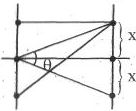
In a Young's double-slit experiment,sources of equal intensities are used. The distance between the slits is $d$ and the wavelength of light used is $\lambda$ (where $\lambda \ll d$). Find the angular separation of the nearest points on either side of the central maximum where the intensity becomes half of the maximum value.
A
$\frac{\lambda}{d}$
B
$\frac{\lambda}{2d}$
C
$\frac{\lambda}{4d}$
D
$\frac{\lambda}{6d}$
Solution
(B) Let the intensity of each source be $I_0$. The maximum intensity is $I_{max} = 4I_0$.
We are looking for points where the intensity $I = \frac{I_{max}}{2} = 2I_0$.
The resultant intensity is given by $I = I_0 + I_0 + 2\sqrt{I_0 I_0} \cos \phi = 2I_0(1 + \cos \phi)$.
Setting $I = 2I_0$,we get $2I_0 = 2I_0(1 + \cos \phi)$,which implies $1 + \cos \phi = 1$,so $\cos \phi = 0$.
This gives the phase difference $\phi = \frac{\pi}{2}$.
The path difference $\Delta x$ is related to the phase difference by $\phi = \frac{2\pi}{\lambda} \Delta x$.
Thus,$\frac{\pi}{2} = \frac{2\pi}{\lambda} \Delta x$,which gives $\Delta x = \frac{\lambda}{4}$.
For small angles,the path difference is $\Delta x = d \sin \theta \approx d \theta$.
Therefore,$d \theta = \frac{\lambda}{4}$,which gives $\theta = \frac{\lambda}{4d}$.
The angular separation between the points on either side of the central maximum is $\Delta \theta = \theta - (-\theta) = 2\theta = 2 \times \frac{\lambda}{4d} = \frac{\lambda}{2d}$.
We are looking for points where the intensity $I = \frac{I_{max}}{2} = 2I_0$.
The resultant intensity is given by $I = I_0 + I_0 + 2\sqrt{I_0 I_0} \cos \phi = 2I_0(1 + \cos \phi)$.
Setting $I = 2I_0$,we get $2I_0 = 2I_0(1 + \cos \phi)$,which implies $1 + \cos \phi = 1$,so $\cos \phi = 0$.
This gives the phase difference $\phi = \frac{\pi}{2}$.
The path difference $\Delta x$ is related to the phase difference by $\phi = \frac{2\pi}{\lambda} \Delta x$.
Thus,$\frac{\pi}{2} = \frac{2\pi}{\lambda} \Delta x$,which gives $\Delta x = \frac{\lambda}{4}$.
For small angles,the path difference is $\Delta x = d \sin \theta \approx d \theta$.
Therefore,$d \theta = \frac{\lambda}{4}$,which gives $\theta = \frac{\lambda}{4d}$.
The angular separation between the points on either side of the central maximum is $\Delta \theta = \theta - (-\theta) = 2\theta = 2 \times \frac{\lambda}{4d} = \frac{\lambda}{2d}$.
0 likes
View Solution232
MediumMCQ
In Young's double-slit experiment,the separation between the slits is halved and the distance between the slits and the screen is doubled. The fringe width is
A
unchanged
B
halved
C
doubled
D
quadrupled
Solution
(D) The formula for fringe width $\beta$ in Young's double-slit experiment is given by $\beta = \frac{D \lambda}{d}$,where $D$ is the distance between the slits and the screen,$\lambda$ is the wavelength of light,and $d$ is the separation between the slits.
According to the problem,the new distance $D' = 2D$ and the new slit separation $d' = \frac{d}{2}$.
Substituting these values into the formula for the new fringe width $\beta'$:
$\beta' = \frac{D' \lambda}{d'} = \frac{(2D) \lambda}{(d/2)} = 4 \left( \frac{D \lambda}{d} \right) = 4\beta$.
Therefore,the fringe width becomes quadrupled.
According to the problem,the new distance $D' = 2D$ and the new slit separation $d' = \frac{d}{2}$.
Substituting these values into the formula for the new fringe width $\beta'$:
$\beta' = \frac{D' \lambda}{d'} = \frac{(2D) \lambda}{(d/2)} = 4 \left( \frac{D \lambda}{d} \right) = 4\beta$.
Therefore,the fringe width becomes quadrupled.
0 likes
View Solution233
MediumMCQ
In Young's double-slit experiment,both slits are illuminated by a laser beam and the interference pattern was observed on a screen. If the viewing screen is moved farther from the slit,what happens to the interference pattern?
A
The pattern gets brighter.
B
The pattern gets brighter and closer together.
C
The pattern gets less bright and farther apart.
D
There is no change in the pattern.
Solution
(C) In Young's double-slit experiment,the fringe width $\beta$ is given by the formula $\beta = \frac{\lambda D}{d}$,where $\lambda$ is the wavelength of light,$D$ is the distance between the slits and the screen,and $d$ is the distance between the two slits.
As the viewing screen is moved farther from the slits,the distance $D$ increases.
Since $\beta \propto D$,an increase in $D$ leads to an increase in the fringe width $\beta$,meaning the interference fringes move farther apart.
Additionally,as the screen moves farther away,the intensity of light reaching the screen decreases due to the inverse square law and the spreading of the beam,making the pattern less bright.
Therefore,the pattern becomes less bright and the fringes move farther apart.
As the viewing screen is moved farther from the slits,the distance $D$ increases.
Since $\beta \propto D$,an increase in $D$ leads to an increase in the fringe width $\beta$,meaning the interference fringes move farther apart.
Additionally,as the screen moves farther away,the intensity of light reaching the screen decreases due to the inverse square law and the spreading of the beam,making the pattern less bright.
Therefore,the pattern becomes less bright and the fringes move farther apart.
0 likes
View Solution234
DifficultMCQ
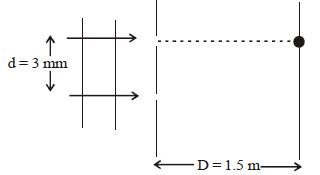
In a $YDSE$,light of two different wavelengths $(\lambda_1, \lambda_2)$ is incident normal to the plane of slits. The $n^{th}$ maxima of $\lambda_1$ coincides with the $m^{th}$ maxima of $\lambda_2$ exactly in front of one of the slits. Given $D = 1.5 \ m$,$d = 3 \ mm$,and $4500 \ \mathring{A} < \lambda_1, \lambda_2 < 7000 \ \mathring{A}$,then $n, m$ and $\lambda_1$ are:
A
$3, 4, 4000 \ \mathring{A}$
B
$5, 6, 6000 \ \mathring{A}$
C
$2, 3, 5000 \ \mathring{A}$
D
$4, 5, 3000 \ \mathring{A}$
Solution
(B) The position of the $n^{th}$ maxima for wavelength $\lambda_1$ is given by $y_n = \frac{n \lambda_1 D}{d}$.
The position of the $m^{th}$ maxima for wavelength $\lambda_2$ is given by $y_m = \frac{m \lambda_2 D}{d}$.
Since the maxima coincide exactly in front of one of the slits,the distance from the central fringe is $y = \frac{d}{2}$.
Thus,$\frac{n \lambda_1 D}{d} = \frac{d}{2} \implies n \lambda_1 = \frac{d^2}{2D} = \frac{(3 \times 10^{-3})^2}{2 \times 1.5} = \frac{9 \times 10^{-6}}{3} = 3 \times 10^{-6} \ m = 30000 \ \mathring{A}$.
Similarly,$m \lambda_2 = 30000 \ \mathring{A}$.
For option $B$: $n=5, m=6$. Then $\lambda_1 = \frac{30000}{5} = 6000 \ \mathring{A}$ and $\lambda_2 = \frac{30000}{6} = 5000 \ \mathring{A}$.
Both wavelengths $6000 \ \mathring{A}$ and $5000 \ \mathring{A}$ lie within the given range $4500 \ \mathring{A} < \lambda < 7000 \ \mathring{A}$.
Therefore,the correct values are $n=5, m=6, \lambda_1 = 6000 \ \mathring{A}$.
The position of the $m^{th}$ maxima for wavelength $\lambda_2$ is given by $y_m = \frac{m \lambda_2 D}{d}$.
Since the maxima coincide exactly in front of one of the slits,the distance from the central fringe is $y = \frac{d}{2}$.
Thus,$\frac{n \lambda_1 D}{d} = \frac{d}{2} \implies n \lambda_1 = \frac{d^2}{2D} = \frac{(3 \times 10^{-3})^2}{2 \times 1.5} = \frac{9 \times 10^{-6}}{3} = 3 \times 10^{-6} \ m = 30000 \ \mathring{A}$.
Similarly,$m \lambda_2 = 30000 \ \mathring{A}$.
For option $B$: $n=5, m=6$. Then $\lambda_1 = \frac{30000}{5} = 6000 \ \mathring{A}$ and $\lambda_2 = \frac{30000}{6} = 5000 \ \mathring{A}$.
Both wavelengths $6000 \ \mathring{A}$ and $5000 \ \mathring{A}$ lie within the given range $4500 \ \mathring{A} < \lambda < 7000 \ \mathring{A}$.
Therefore,the correct values are $n=5, m=6, \lambda_1 = 6000 \ \mathring{A}$.
0 likes
View Solution235
DifficultMCQ
In Young's double-slit experiment,the intensity of light at a point on the screen where the path difference is $\lambda$ is $k$ units; $\lambda$ being the wavelength of light used. The intensity at a point where the path difference is $\lambda/4$ will be:
A
$k/4$
B
$k/2$
C
$k$
D
zero
Solution
(B) The intensity $I$ at any point in an interference pattern is given by $I = I_{max} \cos^2(\phi/2)$,where $\phi$ is the phase difference.
Phase difference $\phi$ is related to path difference $\Delta x$ by $\phi = \frac{2\pi}{\lambda} \Delta x$.
For path difference $\Delta x = \lambda$,the phase difference is $\phi = \frac{2\pi}{\lambda} \cdot \lambda = 2\pi$.
Given intensity $I = k$ at $\Delta x = \lambda$,we have $k = I_{max} \cos^2(2\pi/2) = I_{max} \cos^2(\pi) = I_{max}(1)^2 = I_{max}$. So,$I_{max} = k$.
Now,for path difference $\Delta x = \lambda/4$,the phase difference is $\phi = \frac{2\pi}{\lambda} \cdot \frac{\lambda}{4} = \frac{\pi}{2}$.
The intensity at this point is $I = I_{max} \cos^2(\phi/2) = k \cos^2(\pi/4) = k \cdot (1/\sqrt{2})^2 = k/2$.
Phase difference $\phi$ is related to path difference $\Delta x$ by $\phi = \frac{2\pi}{\lambda} \Delta x$.
For path difference $\Delta x = \lambda$,the phase difference is $\phi = \frac{2\pi}{\lambda} \cdot \lambda = 2\pi$.
Given intensity $I = k$ at $\Delta x = \lambda$,we have $k = I_{max} \cos^2(2\pi/2) = I_{max} \cos^2(\pi) = I_{max}(1)^2 = I_{max}$. So,$I_{max} = k$.
Now,for path difference $\Delta x = \lambda/4$,the phase difference is $\phi = \frac{2\pi}{\lambda} \cdot \frac{\lambda}{4} = \frac{\pi}{2}$.
The intensity at this point is $I = I_{max} \cos^2(\phi/2) = k \cos^2(\pi/4) = k \cdot (1/\sqrt{2})^2 = k/2$.
0 likes
View Solution236
DifficultMCQ
In the ideal double-slit experiment,when a glass plate (refractive index $\mu = 1.5$) of thickness $t$ is introduced in the path of one of the interfering beams (wavelength $\lambda$),the intensity at the position where the central maximum occurred previously remains unchanged. The minimum thickness of the glass plate is:
A
$2\lambda$
B
$2\lambda/3$
C
$\lambda/3$
D
$\lambda$
Solution
(A) When a glass plate of thickness $t$ and refractive index $\mu$ is introduced in the path of one of the beams,the path difference introduced is $\Delta x = (\mu - 1)t$.
The shift in the central maximum is given by $\Delta y = \frac{D}{d}(\mu - 1)t$.
For the intensity at the original central position to remain unchanged,the new path difference at that point must correspond to a condition of constructive interference,i.e.,$\Delta x = n\lambda$,where $n$ is an integer.
Since the intensity remains the same,the path difference must be an integer multiple of the wavelength. For the minimum thickness,we take the smallest non-zero integer $n = 1$.
$(\mu - 1)t = 1 \cdot \lambda$
Given $\mu = 1.5$,we have $(1.5 - 1)t = \lambda$.
$0.5t = \lambda \implies t = 2\lambda$.
The shift in the central maximum is given by $\Delta y = \frac{D}{d}(\mu - 1)t$.
For the intensity at the original central position to remain unchanged,the new path difference at that point must correspond to a condition of constructive interference,i.e.,$\Delta x = n\lambda$,where $n$ is an integer.
Since the intensity remains the same,the path difference must be an integer multiple of the wavelength. For the minimum thickness,we take the smallest non-zero integer $n = 1$.
$(\mu - 1)t = 1 \cdot \lambda$
Given $\mu = 1.5$,we have $(1.5 - 1)t = \lambda$.
$0.5t = \lambda \implies t = 2\lambda$.
0 likes
View Solution237
MediumMCQ
If yellow light emitted by a sodium lamp in Young's double-slit experiment is replaced by monochromatic blue light of the same intensity,then:
A
fringe width will increase
B
fringe width will remain unchanged
C
fringes will become less intense
D
fringe width will decrease
Solution
(D) The formula for fringe width in Young's double-slit experiment is $\beta = \frac{\lambda D}{d}$,where $\lambda$ is the wavelength of light,$D$ is the distance between the screen and the slits,and $d$ is the distance between the two slits.
Since the wavelength of blue light $(\lambda_{b})$ is less than the wavelength of yellow light $(\lambda_{y})$,i.e.,$\lambda_{b} < \lambda_{y}$.
As $\beta \propto \lambda$,the fringe width $\beta$ will decrease when yellow light is replaced by blue light.
Since the wavelength of blue light $(\lambda_{b})$ is less than the wavelength of yellow light $(\lambda_{y})$,i.e.,$\lambda_{b} < \lambda_{y}$.
As $\beta \propto \lambda$,the fringe width $\beta$ will decrease when yellow light is replaced by blue light.
0 likes
View Solution238
DifficultMCQ
In a Young's double-slit experiment,$12$ fringes are observed to be formed in a certain segment of the screen when light of wavelength $600 \ nm$ is used. If the wavelength of light is changed to $400 \ nm$,the number of fringes observed in the same segment of the screen is:
A
$12$
B
$18$
C
$24$
D
$30$
Solution
(B) The width of the segment on the screen is constant. The width of a fringe is given by $\beta = \frac{\lambda D}{d}$.
For a segment containing $n$ fringes,the total width $W = n \beta = n \frac{\lambda D}{d}$.
Since the segment width $W$ remains the same for both wavelengths,we have:
$n_1 \lambda_1 = n_2 \lambda_2$
Given $n_1 = 12$,$\lambda_1 = 600 \ nm$,and $\lambda_2 = 400 \ nm$:
$12 \times 600 = n_2 \times 400$
$n_2 = \frac{12 \times 600}{400}$
$n_2 = 18$
Therefore,$18$ fringes will be observed.
For a segment containing $n$ fringes,the total width $W = n \beta = n \frac{\lambda D}{d}$.
Since the segment width $W$ remains the same for both wavelengths,we have:
$n_1 \lambda_1 = n_2 \lambda_2$
Given $n_1 = 12$,$\lambda_1 = 600 \ nm$,and $\lambda_2 = 400 \ nm$:
$12 \times 600 = n_2 \times 400$
$n_2 = \frac{12 \times 600}{400}$
$n_2 = 18$
Therefore,$18$ fringes will be observed.
0 likes
View Solution239
MediumMCQ
In $YDSE$,how many maxima can be obtained on the screen if the wavelength of light used is $200 \, nm$ and $d = 700 \, nm$?
A
$12$
B
$7$
C
$18$
D
none of these
Solution
(B) The condition for maxima in $YDSE$ is given by $\Delta x = d \sin \theta = n \lambda$,where $n$ is an integer.
Given $d = 700 \, nm$ and $\lambda = 200 \, nm$.
Substituting these values: $700 \sin \theta = n \times 200$.
Thus,$\sin \theta = \frac{200n}{700} = \frac{2n}{7}$.
Since the maximum value of $\sin \theta$ is $1$,we have $|\frac{2n}{7}| \le 1$,which implies $|n| \le \frac{7}{2} = 3.5$.
Therefore,the possible integer values for $n$ are $n = 0, \pm 1, \pm 2, \pm 3$.
Counting these values: $0, 1, -1, 2, -2, 3, -3$,we get a total of $7$ maxima.
Given $d = 700 \, nm$ and $\lambda = 200 \, nm$.
Substituting these values: $700 \sin \theta = n \times 200$.
Thus,$\sin \theta = \frac{200n}{700} = \frac{2n}{7}$.
Since the maximum value of $\sin \theta$ is $1$,we have $|\frac{2n}{7}| \le 1$,which implies $|n| \le \frac{7}{2} = 3.5$.
Therefore,the possible integer values for $n$ are $n = 0, \pm 1, \pm 2, \pm 3$.
Counting these values: $0, 1, -1, 2, -2, 3, -3$,we get a total of $7$ maxima.
0 likes
View Solution240
DifficultMCQ
In a Young's double slit experiment,$I_0$ is the intensity at the central maximum and $\beta$ is the fringe width. The intensity at a point $P$ at a distance $x$ from the central maximum will be
A
$I_0 \cos \frac{\pi x}{\beta}$
B
$4 I_0 \cos^2 \frac{\pi x}{\beta}$
C
$I_0 \cos^2 \frac{\pi x}{\beta}$
D
$\frac{I_0}{4} \cos^2 \frac{\pi x}{\beta}$
Solution
(C) The path difference at point $P$ is given by $\Delta x = \frac{xd}{D}$.
The phase difference $\phi$ at point $P$ is $\phi = \frac{2\pi}{\lambda} \Delta x = \frac{2\pi}{\lambda} \frac{xd}{D}$.
Since the fringe width $\beta = \frac{\lambda D}{d}$,we can write $\phi = \frac{2\pi x}{\beta}$.
The intensity at any point is given by $I = I_1 + I_2 + 2\sqrt{I_1 I_2} \cos \phi$. Assuming $I_1 = I_2 = I$,we have $I = 2I + 2I \cos \phi = 4I \cos^2 \frac{\phi}{2}$.
Given the intensity at the central maximum is $I_0 = 4I$,we substitute $I = \frac{I_0}{4}$ and $\phi = \frac{2\pi x}{\beta}$:
$I_P = 4 \left( \frac{I_0}{4} \right) \cos^2 \left( \frac{2\pi x / \beta}{2} \right) = I_0 \cos^2 \frac{\pi x}{\beta}$.
The phase difference $\phi$ at point $P$ is $\phi = \frac{2\pi}{\lambda} \Delta x = \frac{2\pi}{\lambda} \frac{xd}{D}$.
Since the fringe width $\beta = \frac{\lambda D}{d}$,we can write $\phi = \frac{2\pi x}{\beta}$.
The intensity at any point is given by $I = I_1 + I_2 + 2\sqrt{I_1 I_2} \cos \phi$. Assuming $I_1 = I_2 = I$,we have $I = 2I + 2I \cos \phi = 4I \cos^2 \frac{\phi}{2}$.
Given the intensity at the central maximum is $I_0 = 4I$,we substitute $I = \frac{I_0}{4}$ and $\phi = \frac{2\pi x}{\beta}$:
$I_P = 4 \left( \frac{I_0}{4} \right) \cos^2 \left( \frac{2\pi x / \beta}{2} \right) = I_0 \cos^2 \frac{\pi x}{\beta}$.
0 likes
View Solution241
MediumMCQ
Light consisting of wavelengths $6000\,\mathring{A}$ and $5500\,\mathring{A}$ falls on the double slits in $YDSE$. The $n^{th}$ order bright fringe of $\lambda_1 = 6000\,\mathring{A}$ is found to coincide with the $m^{th}$ order bright fringe of $\lambda_2 = 5500\,\mathring{A}$. The smallest values of $n$ and $m$ are respectively:
A
$22, 23$
B
$11, 12$
C
$7, 9$
D
$15, 17$
Solution
(B) In $YDSE$,the position of the $n^{th}$ bright fringe is given by $y_n = \frac{n \lambda D}{d}$.
For the fringes to coincide,their positions must be equal: $y_n = y_m$.
Therefore,$n \lambda_1 = m \lambda_2$.
Substituting the given values: $n(6000) = m(5500)$.
This simplifies to $\frac{n}{m} = \frac{5500}{6000} = \frac{11}{12}$.
Since $n$ and $m$ must be integers,the smallest values are $n = 11$ and $m = 12$.
For the fringes to coincide,their positions must be equal: $y_n = y_m$.
Therefore,$n \lambda_1 = m \lambda_2$.
Substituting the given values: $n(6000) = m(5500)$.
This simplifies to $\frac{n}{m} = \frac{5500}{6000} = \frac{11}{12}$.
Since $n$ and $m$ must be integers,the smallest values are $n = 11$ and $m = 12$.
0 likes
View Solution242
DifficultMCQ
In Young's double slit experiment,the light emitted from the source has $\lambda = 6.5 \times 10^{-7} \, m$ and the distance between the two slits is $1 \, mm$. The distance between the screen and the slits is $1 \, m$. The distance between the third dark fringe and the fifth bright fringe will be ......... $mm$.
A
$3.2$
B
$1.63$
C
$0.585$
D
$2.31$
Solution
(B) Given: $\lambda = 6.5 \times 10^{-7} \, m$,$d = 1 \, mm = 10^{-3} \, m$,$D = 1 \, m$.
The position of the $n^{th}$ bright fringe is given by $x_{n, bright} = n \frac{\lambda D}{d}$.
For the $5^{th}$ bright fringe $(n=5)$:
$x_{5, bright} = 5 \times \frac{6.5 \times 10^{-7} \times 1}{10^{-3}} = 32.5 \times 10^{-4} \, m = 3.25 \, mm$.
The position of the $n^{th}$ dark fringe is given by $x_{n, dark} = (2n - 1) \frac{\lambda D}{2d}$.
For the $3^{rd}$ dark fringe $(n=3)$:
$x_{3, dark} = (2 \times 3 - 1) \times \frac{6.5 \times 10^{-7} \times 1}{2 \times 10^{-3}} = 5 \times \frac{6.5 \times 10^{-4}}{2} = 16.25 \times 10^{-4} \, m = 1.625 \, mm$.
The distance between the $5^{th}$ bright fringe and the $3^{rd}$ dark fringe is:
$\Delta x = |x_{5, bright} - x_{3, dark}| = |3.25 - 1.625| \, mm = 1.625 \, mm \approx 1.63 \, mm$.
The position of the $n^{th}$ bright fringe is given by $x_{n, bright} = n \frac{\lambda D}{d}$.
For the $5^{th}$ bright fringe $(n=5)$:
$x_{5, bright} = 5 \times \frac{6.5 \times 10^{-7} \times 1}{10^{-3}} = 32.5 \times 10^{-4} \, m = 3.25 \, mm$.
The position of the $n^{th}$ dark fringe is given by $x_{n, dark} = (2n - 1) \frac{\lambda D}{2d}$.
For the $3^{rd}$ dark fringe $(n=3)$:
$x_{3, dark} = (2 \times 3 - 1) \times \frac{6.5 \times 10^{-7} \times 1}{2 \times 10^{-3}} = 5 \times \frac{6.5 \times 10^{-4}}{2} = 16.25 \times 10^{-4} \, m = 1.625 \, mm$.
The distance between the $5^{th}$ bright fringe and the $3^{rd}$ dark fringe is:
$\Delta x = |x_{5, bright} - x_{3, dark}| = |3.25 - 1.625| \, mm = 1.625 \, mm \approx 1.63 \, mm$.
0 likes
View Solution243
DifficultMCQ
White light is used to illuminate two slits in Young's double-slit experiment. The separation between the slits is $b$ and the screen is at a distance $d (d >> b)$ from the slits. The wavelengths missing at a point on the screen directly in front of one of the slits are
A
$\frac{b^2}{d}, \frac{b^2}{3d}$
B
$\frac{b^2}{d}, \frac{b^2}{4d}$
C
$\frac{b^2}{2d}, \frac{b^2}{3d}$
D
$\frac{b^2}{2d}, \frac{b^2}{4d}$
Solution
(A) The path difference $\delta$ at a point on the screen directly in front of one of the slits is given by $\delta = \frac{b^2}{2d}$.
For destructive interference (missing wavelengths),the path difference must be an odd multiple of $\frac{\lambda}{2}$,i.e.,$\delta = (2n-1)\frac{\lambda}{2}$ where $n = 1, 2, 3, ...$.
Setting $\delta = \frac{b^2}{2d}$,we get $\frac{b^2}{2d} = (2n-1)\frac{\lambda}{2}$.
For $n=1$,$\frac{b^2}{2d} = \frac{\lambda_1}{2} \implies \lambda_1 = \frac{b^2}{d}$.
For $n=2$,$\frac{b^2}{2d} = \frac{3\lambda_2}{2} \implies \lambda_2 = \frac{b^2}{3d}$.
Thus,the missing wavelengths are $\frac{b^2}{d}$ and $\frac{b^2}{3d}$.
For destructive interference (missing wavelengths),the path difference must be an odd multiple of $\frac{\lambda}{2}$,i.e.,$\delta = (2n-1)\frac{\lambda}{2}$ where $n = 1, 2, 3, ...$.
Setting $\delta = \frac{b^2}{2d}$,we get $\frac{b^2}{2d} = (2n-1)\frac{\lambda}{2}$.
For $n=1$,$\frac{b^2}{2d} = \frac{\lambda_1}{2} \implies \lambda_1 = \frac{b^2}{d}$.
For $n=2$,$\frac{b^2}{2d} = \frac{3\lambda_2}{2} \implies \lambda_2 = \frac{b^2}{3d}$.
Thus,the missing wavelengths are $\frac{b^2}{d}$ and $\frac{b^2}{3d}$.
0 likes
View Solution244
DifficultMCQ
In a Young's double slit experiment illuminated by monochromatic light,the intensity reaching the screen from each slit is $I$. What is the resultant intensity at a point where the phase difference is $60^{\circ}$?
A
$I$
B
$2\,I$
C
$3\,I$
D
$4\,I$
Solution
(C) The resultant intensity $I_R$ in a double slit experiment is given by the formula: $I_R = I_1 + I_2 + 2\sqrt{I_1 I_2} \cos \phi$.
Given that the intensity from each slit is $I_1 = I_2 = I$ and the phase difference $\phi = 60^{\circ}$.
Substituting these values into the formula:
$I_R = I + I + 2\sqrt{I \cdot I} \cos 60^{\circ}$
$I_R = 2I + 2I \cdot (1/2)$
$I_R = 2I + I = 3I$.
Therefore,the resultant intensity is $3I$.
Given that the intensity from each slit is $I_1 = I_2 = I$ and the phase difference $\phi = 60^{\circ}$.
Substituting these values into the formula:
$I_R = I + I + 2\sqrt{I \cdot I} \cos 60^{\circ}$
$I_R = 2I + 2I \cdot (1/2)$
$I_R = 2I + I = 3I$.
Therefore,the resultant intensity is $3I$.
0 likes
View Solution245
DifficultMCQ
In a Young's double slit experiment,the intensity at a point where the path difference is $\frac{\lambda}{6}$ ($\lambda$ being the wavelength of the light used) is $I$. If $I_0$ denotes the maximum intensity,$I/I_0$ is equal to
A
$\frac{1}{\sqrt{2}}$
B
$\frac{\sqrt{3}}{2}$
C
$\frac{1}{2}$
D
$\frac{3}{4}$
Solution
(D) The phase difference $\Delta \phi$ is related to the path difference $\Delta x$ by the formula $\Delta \phi = \frac{2 \pi}{\lambda} \Delta x$.
Given $\Delta x = \frac{\lambda}{6}$,we have $\Delta \phi = \frac{2 \pi}{\lambda} \cdot \frac{\lambda}{6} = \frac{\pi}{3}$.
The intensity $I$ at any point is given by $I = I_0 \cos^2 \left( \frac{\Delta \phi}{2} \right)$,where $I_0$ is the maximum intensity.
Substituting the value of $\Delta \phi$,we get $I = I_0 \cos^2 \left( \frac{\pi/3}{2} \right) = I_0 \cos^2 \left( \frac{\pi}{6} \right)$.
Since $\cos \left( \frac{\pi}{6} \right) = \frac{\sqrt{3}}{2}$,we have $I = I_0 \left( \frac{\sqrt{3}}{2} \right)^2 = I_0 \cdot \frac{3}{4}$.
Therefore,$\frac{I}{I_0} = \frac{3}{4}$.
Given $\Delta x = \frac{\lambda}{6}$,we have $\Delta \phi = \frac{2 \pi}{\lambda} \cdot \frac{\lambda}{6} = \frac{\pi}{3}$.
The intensity $I$ at any point is given by $I = I_0 \cos^2 \left( \frac{\Delta \phi}{2} \right)$,where $I_0$ is the maximum intensity.
Substituting the value of $\Delta \phi$,we get $I = I_0 \cos^2 \left( \frac{\pi/3}{2} \right) = I_0 \cos^2 \left( \frac{\pi}{6} \right)$.
Since $\cos \left( \frac{\pi}{6} \right) = \frac{\sqrt{3}}{2}$,we have $I = I_0 \left( \frac{\sqrt{3}}{2} \right)^2 = I_0 \cdot \frac{3}{4}$.
Therefore,$\frac{I}{I_0} = \frac{3}{4}$.
0 likes
View Solution246
MediumMCQ
$A$ Young's double-slit experiment uses a monochromatic source. The shape of the interference fringes formed on a screen is
A
Straight line
B
Parabola
C
Hyperbola
D
Circle
Solution
(C) In a Young's double-slit experiment,the condition for constructive or destructive interference at any point on the screen is based on the path difference between the waves from the two slits.
Let the slits be at $S_1$ and $S_2$. For any point $P(x, y)$ on the screen,the path difference $\Delta = S_2P - S_1P = n\lambda$ (for maxima) or $(n + 1/2)\lambda$ (for minima).
The locus of points having a constant path difference from two fixed points (the slits) is a hyperbola.
Therefore,the interference fringes formed on a screen are hyperbolic in shape.
Let the slits be at $S_1$ and $S_2$. For any point $P(x, y)$ on the screen,the path difference $\Delta = S_2P - S_1P = n\lambda$ (for maxima) or $(n + 1/2)\lambda$ (for minima).
The locus of points having a constant path difference from two fixed points (the slits) is a hyperbola.
Therefore,the interference fringes formed on a screen are hyperbolic in shape.
0 likes
View Solution247
MediumMCQ
In Young's double slit experiment,the seventh maximum with wavelength $\lambda_1$ is at a distance $d_1$ from the central maximum,and the same maximum with wavelength $\lambda_2$ is at a distance $d_2$. Then $d_1/d_2$ is:
A
$\frac{\lambda_1}{\lambda_2}$
B
$\frac{\lambda_2}{\lambda_1}$
C
$\frac{\lambda_1^2}{\lambda_2^2}$
D
$\frac{\lambda_2^2}{\lambda_1^2}$
Solution
(A) The position of the $n^{th}$ maximum in Young's double slit experiment is given by the formula $x_n = \frac{n \lambda D}{d}$,where $n$ is the order of the maximum,$\lambda$ is the wavelength,$D$ is the distance between the slits and the screen,and $d$ is the distance between the two slits.
For the seventh maximum $(n=7)$ with wavelength $\lambda_1$,the distance from the central maximum is $d_1 = \frac{7 \lambda_1 D}{d}$.
For the seventh maximum $(n=7)$ with wavelength $\lambda_2$,the distance from the central maximum is $d_2 = \frac{7 \lambda_2 D}{d}$.
Taking the ratio of the two distances:
$\frac{d_1}{d_2} = \frac{\frac{7 \lambda_1 D}{d}}{\frac{7 \lambda_2 D}{d}} = \frac{\lambda_1}{\lambda_2}$.
For the seventh maximum $(n=7)$ with wavelength $\lambda_1$,the distance from the central maximum is $d_1 = \frac{7 \lambda_1 D}{d}$.
For the seventh maximum $(n=7)$ with wavelength $\lambda_2$,the distance from the central maximum is $d_2 = \frac{7 \lambda_2 D}{d}$.
Taking the ratio of the two distances:
$\frac{d_1}{d_2} = \frac{\frac{7 \lambda_1 D}{d}}{\frac{7 \lambda_2 D}{d}} = \frac{\lambda_1}{\lambda_2}$.
0 likes
View Solution248
DifficultMCQ
Two parallel slits $0.6 \, mm$ apart are illuminated by a light source of wavelength $6000 \, \mathring{A}$. The distance between two consecutive dark fringes on a screen $1 \, m$ away from the slits is ........ $mm$.
A
$1$
B
$0.01$
C
$0.1$
D
$10$
Solution
(A) The fringe width $\beta$ for Young's double-slit experiment is given by the formula: $\beta = \frac{\lambda D}{d}$.
Given values are:
$\lambda = 6000 \, \mathring{A} = 6000 \times 10^{-10} \, m = 6 \times 10^{-7} \, m$
$D = 1 \, m$
$d = 0.6 \, mm = 0.6 \times 10^{-3} \, m$
Substituting these values into the formula:
$\beta = \frac{6 \times 10^{-7} \times 1}{0.6 \times 10^{-3}}$
$\beta = \frac{6}{0.6} \times 10^{-4} = 10 \times 10^{-4} = 10^{-3} \, m$
Since $10^{-3} \, m = 1 \, mm$,the distance between two consecutive dark fringes is $1 \, mm$.
Given values are:
$\lambda = 6000 \, \mathring{A} = 6000 \times 10^{-10} \, m = 6 \times 10^{-7} \, m$
$D = 1 \, m$
$d = 0.6 \, mm = 0.6 \times 10^{-3} \, m$
Substituting these values into the formula:
$\beta = \frac{6 \times 10^{-7} \times 1}{0.6 \times 10^{-3}}$
$\beta = \frac{6}{0.6} \times 10^{-4} = 10 \times 10^{-4} = 10^{-3} \, m$
Since $10^{-3} \, m = 1 \, mm$,the distance between two consecutive dark fringes is $1 \, mm$.
0 likes
View Solution249
MediumMCQ
In $Y.D.S.E.$,the separation between the two slits $S_1$ and $S_2$ is $a$,and the screen is at a distance $x$ from the slits. The light source $S$ is moving with velocity $v$ parallel to the line joining $S_1$ and $S_2$ and is at a perpendicular distance $h$ from the plane of the slits. What is the frequency of change in brightness at the central point on the screen?
A
$\frac{h^2 v}{x^2 a}$
B
$\frac{v a}{\lambda h}$
C
$\frac{v^2}{x^2} \frac{a \lambda}{h}$
D
$\frac{v h}{2 \lambda a}$
Solution
(B) The path difference at the central point $O$ on the screen due to the source $S$ being at a distance $y$ from the central axis is given by $\Delta x = \frac{a y}{h}$.
For constructive interference (maximum brightness) at the central point,the path difference must be an integer multiple of the wavelength: $\Delta x = n \lambda$,where $n = 0, 1, 2, \dots$.
Thus,$\frac{a y}{h} = n \lambda \Rightarrow y = \frac{n \lambda h}{a}$.
The velocity of the source is $v = \frac{dy}{dt}$.
The rate of change of the order $n$ is given by $\frac{dn}{dt} = \frac{a}{h \lambda} \frac{dy}{dt} = \frac{a v}{h \lambda}$.
This represents the frequency of the fringes passing through the central point,which corresponds to the frequency of change in brightness.
For constructive interference (maximum brightness) at the central point,the path difference must be an integer multiple of the wavelength: $\Delta x = n \lambda$,where $n = 0, 1, 2, \dots$.
Thus,$\frac{a y}{h} = n \lambda \Rightarrow y = \frac{n \lambda h}{a}$.
The velocity of the source is $v = \frac{dy}{dt}$.
The rate of change of the order $n$ is given by $\frac{dn}{dt} = \frac{a}{h \lambda} \frac{dy}{dt} = \frac{a v}{h \lambda}$.
This represents the frequency of the fringes passing through the central point,which corresponds to the frequency of change in brightness.
0 likes
View Solution250
MediumMCQ
In Young's double slit experiment,the phase difference between the light waves reaching the third bright fringe from the central fringe is: $(\lambda = 6000 \ \mathring{A})$
A
zero
B
$2\pi$
C
$4\pi$
D
$6\pi$
Solution
(D) For constructive interference,the path difference $\Delta x$ for the $n^{th}$ bright fringe is given by $\Delta x = n\lambda$,where $n$ is the order of the fringe.
For the third bright fringe,$n = 3$,so the path difference is $\Delta x = 3\lambda$.
The relationship between phase difference $\phi$ and path difference $\Delta x$ is given by $\phi = \frac{2\pi}{\lambda} \times \Delta x$.
Substituting the value of $\Delta x$,we get $\phi = \frac{2\pi}{\lambda} \times 3\lambda = 6\pi$.
Therefore,the phase difference is $6\pi$.
For the third bright fringe,$n = 3$,so the path difference is $\Delta x = 3\lambda$.
The relationship between phase difference $\phi$ and path difference $\Delta x$ is given by $\phi = \frac{2\pi}{\lambda} \times \Delta x$.
Substituting the value of $\Delta x$,we get $\phi = \frac{2\pi}{\lambda} \times 3\lambda = 6\pi$.
Therefore,the phase difference is $6\pi$.
0 likes
View SolutionWave Optics — Young's Double Slit Experiment (YDSE) · Frequently Asked Questions
1Are these Wave Optics questions useful for JEE and NEET?
Yes. All questions in this section are mapped to JEE Main and NEET exam patterns. Previous year questions from JEE Main, NEET, GUJCET and state-level exams are included with full solutions.
2Can I switch to Hindi or Gujarati for these questions?
Yes. Use the language tabs in the hero section or the sidebar to view the same questions and solutions in English, Hindi or Gujarati.
3How do I generate a question paper from this subtopic?
Use the Vedclass Exam Paper Generator — select the chapter and subtopic, set difficulty, and generate Sets A, B, C, D automatically. First 3 chapters of every subject are free.
Vedclass Products
For Students
Vedclass Test Series
Mock tests in real JEE/NEET style with performance analysis. 5-day free trial.
Start Free TrialFor Teachers
Exam Paper Generator
Generate Set A/B/C/D papers from this chapter in 2 minutes. 3 chapters free.
Try FreeFor Institutes
Online Exam Module
Live online exams with unlimited students, 360° analytics & white-label branding.
See DemoFor Teachers & Institutes
Generate a Wave Optics Exam Paper in 2 Minutes
Select subtopic & difficulty — Sets A, B, C, D auto-generated with No Repeat logic.
First 3 chapters of every subject are free — no payment required.