
A English
Wave Nature and Interference of Light (Intensity) Questions in English
Class 12 Physics · Wave Optics · Wave Nature and Interference of Light (Intensity)
229+
Questions
English
Language
100%
With Solutions
Showing 50 of 229 questions in English
151
MediumMCQ
Which optical phenomena can be explained by the wave nature of light?
A
Photoelectric effect
B
Compton effect
C
Interference and diffraction
D
Black body radiation
Solution
(C) The wave nature of light is demonstrated by phenomena that involve the superposition of waves and the interaction of waves with obstacles of comparable size to their wavelength.
$1$. Interference: This occurs when two or more light waves overlap,resulting in a new wave pattern.
$2$. Diffraction: This is the bending of light around the corners of an obstacle or through an aperture.
$3$. Polarization: This confirms the transverse wave nature of light.
Conversely,the photoelectric effect,Compton effect,and black body radiation are explained by the particle nature of light (photons).
Therefore,interference and diffraction are the correct phenomena explained by the wave nature of light.
$1$. Interference: This occurs when two or more light waves overlap,resulting in a new wave pattern.
$2$. Diffraction: This is the bending of light around the corners of an obstacle or through an aperture.
$3$. Polarization: This confirms the transverse wave nature of light.
Conversely,the photoelectric effect,Compton effect,and black body radiation are explained by the particle nature of light (photons).
Therefore,interference and diffraction are the correct phenomena explained by the wave nature of light.
0 likes
View Solution152
MediumMCQ
Two light waves having the same wavelength $\lambda$ in vacuum are in phase initially. Then the first wave travels a path $L_{1}$ through a medium of refractive index $n_{1}$ while the second wave travels a path of length $L_{2}$ through a medium of refractive index $n_{2}$. After this the phase difference between the two waves is:
A
$\frac{2 \pi}{\lambda}(n_{1}L_{1} - n_{2}L_{2})$
B
$\frac{2 \pi}{\lambda}(\frac{L_{2}}{n_{1}} - \frac{L_{1}}{n_{2}})$
C
$\frac{2 \pi}{\lambda}(\frac{L_{1}}{n_{1}} - \frac{L_{2}}{n_{2}})$
D
$\frac{2 \pi}{\lambda}(n_{2}L_{1} - n_{1}L_{2})$
Solution
(A) The optical path length of a wave traveling through a medium of refractive index $n$ and geometric path length $L$ is given by $OPL = n \times L$.
The optical path length for the first wave is $OPL_{1} = n_{1}L_{1}$.
The optical path length for the second wave is $OPL_{2} = n_{2}L_{2}$.
The optical path difference between the two waves is $\Delta p = |OPL_{1} - OPL_{2}| = |n_{1}L_{1} - n_{2}L_{2}|$.
The phase difference $\Delta \phi$ is related to the path difference $\Delta p$ by the formula $\Delta \phi = \frac{2 \pi}{\lambda} \Delta p$.
Substituting the path difference,we get $\Delta \phi = \frac{2 \pi}{\lambda} (n_{1}L_{1} - n_{2}L_{2})$.
The optical path length for the first wave is $OPL_{1} = n_{1}L_{1}$.
The optical path length for the second wave is $OPL_{2} = n_{2}L_{2}$.
The optical path difference between the two waves is $\Delta p = |OPL_{1} - OPL_{2}| = |n_{1}L_{1} - n_{2}L_{2}|$.
The phase difference $\Delta \phi$ is related to the path difference $\Delta p$ by the formula $\Delta \phi = \frac{2 \pi}{\lambda} \Delta p$.
Substituting the path difference,we get $\Delta \phi = \frac{2 \pi}{\lambda} (n_{1}L_{1} - n_{2}L_{2})$.
0 likes
View Solution153
DifficultMCQ
In the figure below,$P$ and $Q$ are two equally intense coherent sources emitting radiation of wavelength $20\, m$. The separation between $P$ and $Q$ is $5\, m$ and the phase of $P$ is ahead of that of $Q$ by $90^{\circ}$. $A, B$ and $C$ are three distinct points of observation,each equidistant from the midpoint of $PQ$. The intensities of radiation at $A, B, C$ will be in the ratio
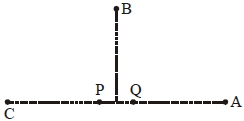
A
$0:1:2$
B
$4:1:0$
C
$0:1:4$
D
$2:1:0$
Solution
(D) Let the intensity of each source be $I$. The resultant intensity is given by $I_{res} = I_1 + I_2 + 2\sqrt{I_1 I_2} \cos(\Delta \phi) = 2I + 2I \cos(\Delta \phi) = 4I \cos^2(\Delta \phi / 2)$,where $\Delta \phi$ is the total phase difference.
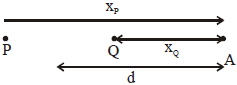
$1$. For point $A$: The path difference $\Delta x = x_P - x_Q = 5\, m$. The phase difference due to path is $\Delta \phi_{path} = \frac{2\pi}{\lambda} \Delta x = \frac{2\pi}{20} \times 5 = \frac{\pi}{2}$. Since $P$ is ahead of $Q$ by $90^{\circ}$ $(\pi/2)$,the wave from $Q$ travels a shorter distance to $A$. The total phase difference is $\Delta \phi_A = \Delta \phi_{source} - \Delta \phi_{path} = \frac{\pi}{2} - \frac{\pi}{2} = 0$. Thus,$I_A = 4I \cos^2(0) = 4I$.
$2$. For point $B$: The path difference $\Delta x = 0$ as $B$ is on the perpendicular bisector. The total phase difference is $\Delta \phi_B = \Delta \phi_{source} = \frac{\pi}{2}$. Thus,$I_B = 4I \cos^2(\pi/4) = 4I(1/2) = 2I$.
$3$. For point $C$: The path difference $\Delta x = x_Q - x_P = 5\, m$. The phase difference due to path is $\Delta \phi_{path} = \frac{\pi}{2}$. The total phase difference is $\Delta \phi_C = \Delta \phi_{source} + \Delta \phi_{path} = \frac{\pi}{2} + \frac{\pi}{2} = \pi$. Thus,$I_C = 4I \cos^2(\pi/2) = 0$.
Therefore,the ratio $I_A : I_B : I_C = 4I : 2I : 0 = 2 : 1 : 0$.
$1$. For point $A$: The path difference $\Delta x = x_P - x_Q = 5\, m$. The phase difference due to path is $\Delta \phi_{path} = \frac{2\pi}{\lambda} \Delta x = \frac{2\pi}{20} \times 5 = \frac{\pi}{2}$. Since $P$ is ahead of $Q$ by $90^{\circ}$ $(\pi/2)$,the wave from $Q$ travels a shorter distance to $A$. The total phase difference is $\Delta \phi_A = \Delta \phi_{source} - \Delta \phi_{path} = \frac{\pi}{2} - \frac{\pi}{2} = 0$. Thus,$I_A = 4I \cos^2(0) = 4I$.
$2$. For point $B$: The path difference $\Delta x = 0$ as $B$ is on the perpendicular bisector. The total phase difference is $\Delta \phi_B = \Delta \phi_{source} = \frac{\pi}{2}$. Thus,$I_B = 4I \cos^2(\pi/4) = 4I(1/2) = 2I$.
$3$. For point $C$: The path difference $\Delta x = x_Q - x_P = 5\, m$. The phase difference due to path is $\Delta \phi_{path} = \frac{\pi}{2}$. The total phase difference is $\Delta \phi_C = \Delta \phi_{source} + \Delta \phi_{path} = \frac{\pi}{2} + \frac{\pi}{2} = \pi$. Thus,$I_C = 4I \cos^2(\pi/2) = 0$.
Therefore,the ratio $I_A : I_B : I_C = 4I : 2I : 0 = 2 : 1 : 0$.
0 likes
View Solution154
EasyMCQ
Two coherent sources of light interfere and produce a fringe pattern on a screen. For the central maximum,the phase difference between the two waves will be,
A
$\frac{\pi}{2}$
B
$0$
C
$\pi$
D
$\frac{3\pi}{2}$
Solution
(B) In an interference pattern,the condition for constructive interference is that the path difference $\Delta x$ must be an integral multiple of the wavelength $\lambda$,i.e.,$\Delta x = n\lambda$ where $n = 0, 1, 2, \dots$.
The central maximum occurs at the point where the path difference between the two waves is zero $(\Delta x = 0)$.
The relationship between phase difference $\phi$ and path difference $\Delta x$ is given by $\phi = \frac{2\pi}{\lambda} \Delta x$.
Substituting $\Delta x = 0$ into the equation,we get $\phi = \frac{2\pi}{\lambda} \times 0 = 0$.
Therefore,for the central maximum,the phase difference is $0$.
The central maximum occurs at the point where the path difference between the two waves is zero $(\Delta x = 0)$.
The relationship between phase difference $\phi$ and path difference $\Delta x$ is given by $\phi = \frac{2\pi}{\lambda} \Delta x$.
Substituting $\Delta x = 0$ into the equation,we get $\phi = \frac{2\pi}{\lambda} \times 0 = 0$.
Therefore,for the central maximum,the phase difference is $0$.
0 likes
View Solution155
MediumMCQ
The light waves from two coherent sources have same intensity $I_{1} = I_{2} = I_{0}$. In the interference pattern,the intensity of light at minima is zero. What will be the intensity of light at maxima?
A
$I_{0}$
B
$2 I_{0}$
C
$5 I_{0}$
D
$4 I_{0}$
Solution
(D) The intensity of the resultant wave in an interference pattern is given by the formula: $I = I_{1} + I_{2} + 2\sqrt{I_{1}I_{2}} \cos \phi$.
For maxima,the phase difference $\phi = 2n\pi$,so $\cos \phi = 1$.
Thus,$I_{\max} = I_{1} + I_{2} + 2\sqrt{I_{1}I_{2}} = (\sqrt{I_{1}} + \sqrt{I_{2}})^2$.
Given $I_{1} = I_{2} = I_{0}$,we substitute these values into the formula:
$I_{\max} = (\sqrt{I_{0}} + \sqrt{I_{0}})^2 = (2\sqrt{I_{0}})^2 = 4I_{0}$.
For maxima,the phase difference $\phi = 2n\pi$,so $\cos \phi = 1$.
Thus,$I_{\max} = I_{1} + I_{2} + 2\sqrt{I_{1}I_{2}} = (\sqrt{I_{1}} + \sqrt{I_{2}})^2$.
Given $I_{1} = I_{2} = I_{0}$,we substitute these values into the formula:
$I_{\max} = (\sqrt{I_{0}} + \sqrt{I_{0}})^2 = (2\sqrt{I_{0}})^2 = 4I_{0}$.
0 likes
View Solution156
DifficultMCQ
The interference pattern is obtained with two coherent light sources of intensity ratio $4:1$. If the ratio $\frac{I_{\max} + I_{\min}}{I_{\max} - I_{\min}}$ is $\frac{5}{x}$,then the value of $x$ will be equal to:
A
$3$
B
$1$
C
$2$
D
$4$
Solution
(D) Given the intensity ratio $\frac{I_1}{I_2} = 4$,we can write $I_1 = 4I_2$.
The ratio of maximum to minimum intensity in an interference pattern is given by:
$\frac{I_{\max}}{I_{\min}} = \left[ \frac{\sqrt{I_1} + \sqrt{I_2}}{\sqrt{I_1} - \sqrt{I_2}} \right]^2$
Substituting $I_1 = 4I_2$:
$\frac{I_{\max}}{I_{\min}} = \left[ \frac{\sqrt{4I_2} + \sqrt{I_2}}{\sqrt{4I_2} - \sqrt{I_2}} \right]^2 = \left[ \frac{2\sqrt{I_2} + \sqrt{I_2}}{2\sqrt{I_2} - \sqrt{I_2}} \right]^2 = \left( \frac{3}{1} \right)^2 = 9$.
Now,we need to calculate $\frac{I_{\max} + I_{\min}}{I_{\max} - I_{\min}}$:
$\frac{I_{\max} + I_{\min}}{I_{\max} - I_{\min}} = \frac{9 + 1}{9 - 1} = \frac{10}{8} = \frac{5}{4}$.
Comparing this with the given expression $\frac{5}{x}$,we get:
$\frac{5}{x} = \frac{5}{4} \implies x = 4$.
The ratio of maximum to minimum intensity in an interference pattern is given by:
$\frac{I_{\max}}{I_{\min}} = \left[ \frac{\sqrt{I_1} + \sqrt{I_2}}{\sqrt{I_1} - \sqrt{I_2}} \right]^2$
Substituting $I_1 = 4I_2$:
$\frac{I_{\max}}{I_{\min}} = \left[ \frac{\sqrt{4I_2} + \sqrt{I_2}}{\sqrt{4I_2} - \sqrt{I_2}} \right]^2 = \left[ \frac{2\sqrt{I_2} + \sqrt{I_2}}{2\sqrt{I_2} - \sqrt{I_2}} \right]^2 = \left( \frac{3}{1} \right)^2 = 9$.
Now,we need to calculate $\frac{I_{\max} + I_{\min}}{I_{\max} - I_{\min}}$:
$\frac{I_{\max} + I_{\min}}{I_{\max} - I_{\min}} = \frac{9 + 1}{9 - 1} = \frac{10}{8} = \frac{5}{4}$.
Comparing this with the given expression $\frac{5}{x}$,we get:
$\frac{5}{x} = \frac{5}{4} \implies x = 4$.
0 likes
View Solution157
MediumMCQ
Two light beams having intensities $I$ and $9I$ interfere to produce a fringe pattern on a screen. The phase difference between the beams is $\frac{\pi}{2}$ at point $P$ and $\pi$ at point $Q$. The difference between the resultant intensities at $P$ and $Q$ will be ....... $I$.
A
$2$
B
$6$
C
$5$
D
$7$
Solution
(B) The resultant intensity $I_R$ for two interfering beams with intensities $I_1$ and $I_2$ and phase difference $\phi$ is given by $I_R = I_1 + I_2 + 2\sqrt{I_1 I_2} \cos \phi$.
At point $P$,the phase difference is $\phi_P = \frac{\pi}{2}$.
$I_P = I + 9I + 2\sqrt{I \times 9I} \cos \frac{\pi}{2} = 10I + 2(3I)(0) = 10I$.
At point $Q$,the phase difference is $\phi_Q = \pi$.
$I_Q = I + 9I + 2\sqrt{I \times 9I} \cos \pi = 10I + 2(3I)(-1) = 10I - 6I = 4I$.
The difference between the resultant intensities at $P$ and $Q$ is:
$I_P - I_Q = 10I - 4I = 6I$.
At point $P$,the phase difference is $\phi_P = \frac{\pi}{2}$.
$I_P = I + 9I + 2\sqrt{I \times 9I} \cos \frac{\pi}{2} = 10I + 2(3I)(0) = 10I$.
At point $Q$,the phase difference is $\phi_Q = \pi$.
$I_Q = I + 9I + 2\sqrt{I \times 9I} \cos \pi = 10I + 2(3I)(-1) = 10I - 6I = 4I$.
The difference between the resultant intensities at $P$ and $Q$ is:
$I_P - I_Q = 10I - 4I = 6I$.
0 likes
View Solution158
DifficultMCQ
Two coherent sources of light interfere. The intensity ratio of two sources is $1:4$. For this interference pattern,if the value of $\frac{I_{\max} + I_{\min}}{I_{\max} - I_{\min}}$ is equal to $\frac{2\alpha + 1}{\beta + 3}$,then the value of $\frac{\alpha}{\beta}$ will be:
A
$1.5$
B
$2$
C
$0.5$
D
$1$
Solution
(B) Given the intensity ratio of two coherent sources is $\frac{I_1}{I_2} = \frac{1}{4}$,so $I_2 = 4I_1$.
The maximum intensity is given by $I_{\max} = I_1 + I_2 + 2\sqrt{I_1 I_2} = I_1 + 4I_1 + 2\sqrt{I_1(4I_1)} = 5I_1 + 4I_1 = 9I_1$.
The minimum intensity is given by $I_{\min} = I_1 + I_2 - 2\sqrt{I_1 I_2} = I_1 + 4I_1 - 2\sqrt{I_1(4I_1)} = 5I_1 - 4I_1 = I_1$.
Now,calculate the ratio $\frac{I_{\max} + I_{\min}}{I_{\max} - I_{\min}} = \frac{9I_1 + I_1}{9I_1 - I_1} = \frac{10I_1}{8I_1} = \frac{5}{4}$.
Comparing this with the given expression $\frac{2\alpha + 1}{\beta + 3} = \frac{5}{4}$,we have $2\alpha + 1 = 5 \implies 2\alpha = 4 \implies \alpha = 2$ and $\beta + 3 = 4 \implies \beta = 1$.
Therefore,$\frac{\alpha}{\beta} = \frac{2}{1} = 2$.
The maximum intensity is given by $I_{\max} = I_1 + I_2 + 2\sqrt{I_1 I_2} = I_1 + 4I_1 + 2\sqrt{I_1(4I_1)} = 5I_1 + 4I_1 = 9I_1$.
The minimum intensity is given by $I_{\min} = I_1 + I_2 - 2\sqrt{I_1 I_2} = I_1 + 4I_1 - 2\sqrt{I_1(4I_1)} = 5I_1 - 4I_1 = I_1$.
Now,calculate the ratio $\frac{I_{\max} + I_{\min}}{I_{\max} - I_{\min}} = \frac{9I_1 + I_1}{9I_1 - I_1} = \frac{10I_1}{8I_1} = \frac{5}{4}$.
Comparing this with the given expression $\frac{2\alpha + 1}{\beta + 3} = \frac{5}{4}$,we have $2\alpha + 1 = 5 \implies 2\alpha = 4 \implies \alpha = 2$ and $\beta + 3 = 4 \implies \beta = 1$.
Therefore,$\frac{\alpha}{\beta} = \frac{2}{1} = 2$.
0 likes
View Solution159
MediumMCQ
Two beams of light having intensities $I$ and $4I$ interfere to produce a fringe pattern on a screen. The phase difference between the two beams are $\pi/2$ and $\pi/3$ at points $A$ and $B$ respectively. The difference between the resultant intensities at the two points is $xI$. The value of $x$ will be.
A
$1$
B
$3$
C
$4$
D
$2$
Solution
(D) The resultant intensity $I_R$ for two interfering beams with intensities $I_1$ and $I_2$ and phase difference $\phi$ is given by $I_R = I_1 + I_2 + 2\sqrt{I_1 I_2} \cos(\phi)$.
Given $I_1 = I$ and $I_2 = 4I$.
At point $A$,$\phi_A = \pi/2$. Thus,$I_A = I + 4I + 2\sqrt{I \cdot 4I} \cos(\pi/2) = 5I + 4I(0) = 5I$.
At point $B$,$\phi_B = \pi/3$. Thus,$I_B = I + 4I + 2\sqrt{I \cdot 4I} \cos(\pi/3) = 5I + 4I(1/2) = 5I + 2I = 7I$.
The difference between the resultant intensities is $I_B - I_A = 7I - 5I = 2I$.
Comparing this with $xI$,we get $x = 2$.
Given $I_1 = I$ and $I_2 = 4I$.
At point $A$,$\phi_A = \pi/2$. Thus,$I_A = I + 4I + 2\sqrt{I \cdot 4I} \cos(\pi/2) = 5I + 4I(0) = 5I$.
At point $B$,$\phi_B = \pi/3$. Thus,$I_B = I + 4I + 2\sqrt{I \cdot 4I} \cos(\pi/3) = 5I + 4I(1/2) = 5I + 2I = 7I$.
The difference between the resultant intensities is $I_B - I_A = 7I - 5I = 2I$.
Comparing this with $xI$,we get $x = 2$.
0 likes
View Solution160
MediumMCQ
Two light beams of intensities $4\,I$ and $9\,I$ interfere on a screen. The phase difference between these beams on the screen at point $A$ is $0$ and at point $B$ is $\pi$. The difference of resultant intensities,at the points $A$ and $B$,will be $....I$.
A
$24$
B
$12$
C
$6$
D
$3$
Solution
(A) The resultant intensity $I_R$ of two interfering beams is given by the formula: $I_R = I_1 + I_2 + 2\sqrt{I_1 I_2} \cos \phi$.
At point $A$,the phase difference $\phi = 0$. Therefore,the intensity is maximum:
$I_A = I_{\max} = (\sqrt{I_1} + \sqrt{I_2})^2 = (\sqrt{9I} + \sqrt{4I})^2 = (3\sqrt{I} + 2\sqrt{I})^2 = (5\sqrt{I})^2 = 25I$.
At point $B$,the phase difference $\phi = \pi$. Therefore,the intensity is minimum:
$I_B = I_{\min} = (\sqrt{I_1} - \sqrt{I_2})^2 = (\sqrt{9I} - \sqrt{4I})^2 = (3\sqrt{I} - 2\sqrt{I})^2 = (\sqrt{I})^2 = I$.
The difference between the resultant intensities at points $A$ and $B$ is:
$I_A - I_B = 25I - I = 24I$.
At point $A$,the phase difference $\phi = 0$. Therefore,the intensity is maximum:
$I_A = I_{\max} = (\sqrt{I_1} + \sqrt{I_2})^2 = (\sqrt{9I} + \sqrt{4I})^2 = (3\sqrt{I} + 2\sqrt{I})^2 = (5\sqrt{I})^2 = 25I$.
At point $B$,the phase difference $\phi = \pi$. Therefore,the intensity is minimum:
$I_B = I_{\min} = (\sqrt{I_1} - \sqrt{I_2})^2 = (\sqrt{9I} - \sqrt{4I})^2 = (3\sqrt{I} - 2\sqrt{I})^2 = (\sqrt{I})^2 = I$.
The difference between the resultant intensities at points $A$ and $B$ is:
$I_A - I_B = 25I - I = 24I$.
0 likes
View Solution161
MediumMCQ
Two coherent sources are kept at a distance of $d = 2 \lambda$. $A$ large screen is placed perpendicular to the line joining the sources. Determine the total number of maximas observed on the screen. (Here,$\lambda$ is the wavelength of light.)
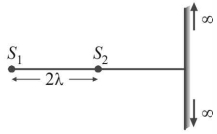
A
$1$
B
$3$
C
$5$
D
$7$
Solution
(B) The path difference $\Delta x$ at any point on the screen is given by $\Delta x = d \cos \theta$,where $d = 2 \lambda$ is the distance between the sources and $\theta$ is the angle with the line joining the sources.
For maxima,the path difference must be an integer multiple of $\lambda$,i.e.,$\Delta x = n \lambda$.
Since the screen is perpendicular to the line joining the sources,the range of $\theta$ is from $0$ to $90^\circ$ (or $0$ to $\pi/2$ radians).
Thus,$\Delta x = 2 \lambda \cos \theta$.
As $\theta$ varies from $0$ to $90^\circ$,$\cos \theta$ varies from $1$ to $0$.
Therefore,the path difference $\Delta x$ varies from $2 \lambda$ to $0$.
The possible values for $n$ in $\Delta x = n \lambda$ are $n = 0, 1, 2$.
For $n = 2$,$\Delta x = 2 \lambda$ (at $\theta = 0$,the point on the screen closest to the sources).
For $n = 1$,$\Delta x = \lambda$ (at $\cos \theta = 0.5$,i.e.,$\theta = 60^\circ$).
For $n = 0$,$\Delta x = 0$ (at $\theta = 90^\circ$,i.e.,at infinity).
Since the screen is symmetric on both sides of the line joining the sources,we have:
- At $\theta = 0$: $1$ central maxima $(n=2)$.
- For $\theta > 0$: $2$ maximas for $n=1$ (one on each side) and $2$ maximas for $n=0$ (one on each side at infinity).
However,the question typically asks for finite points on the screen. At $\theta = 90^\circ$,the path difference is $0$,which corresponds to the point at infinity. Excluding the points at infinity,we have $n=2$ (one point) and $n=1$ (two points),totaling $3$ maximas.
For maxima,the path difference must be an integer multiple of $\lambda$,i.e.,$\Delta x = n \lambda$.
Since the screen is perpendicular to the line joining the sources,the range of $\theta$ is from $0$ to $90^\circ$ (or $0$ to $\pi/2$ radians).
Thus,$\Delta x = 2 \lambda \cos \theta$.
As $\theta$ varies from $0$ to $90^\circ$,$\cos \theta$ varies from $1$ to $0$.
Therefore,the path difference $\Delta x$ varies from $2 \lambda$ to $0$.
The possible values for $n$ in $\Delta x = n \lambda$ are $n = 0, 1, 2$.
For $n = 2$,$\Delta x = 2 \lambda$ (at $\theta = 0$,the point on the screen closest to the sources).
For $n = 1$,$\Delta x = \lambda$ (at $\cos \theta = 0.5$,i.e.,$\theta = 60^\circ$).
For $n = 0$,$\Delta x = 0$ (at $\theta = 90^\circ$,i.e.,at infinity).
Since the screen is symmetric on both sides of the line joining the sources,we have:
- At $\theta = 0$: $1$ central maxima $(n=2)$.
- For $\theta > 0$: $2$ maximas for $n=1$ (one on each side) and $2$ maximas for $n=0$ (one on each side at infinity).
However,the question typically asks for finite points on the screen. At $\theta = 90^\circ$,the path difference is $0$,which corresponds to the point at infinity. Excluding the points at infinity,we have $n=2$ (one point) and $n=1$ (two points),totaling $3$ maximas.
0 likes
View Solution162
MediumMCQ
Given below are two statements: one is labelled as Assertion $A$ and the other is labelled as Reason $R$.
Assertion $A$: The phase difference of two light waves changes if they travel through different media having the same thickness,but different indices of refraction.
Reason $R$: The wavelengths of waves are different in different media.
In the light of the above statements,choose the most appropriate answer from the options given below.
Assertion $A$: The phase difference of two light waves changes if they travel through different media having the same thickness,but different indices of refraction.
Reason $R$: The wavelengths of waves are different in different media.
In the light of the above statements,choose the most appropriate answer from the options given below.
A
Both $A$ and $R$ are correct but $R$ is $NOT$ the correct explanation of $A$.
B
$A$ is correct but $R$ is not correct.
C
Both $A$ and $R$ are correct and $R$ is the correct explanation of $A$.
D
$A$ is not correct but $R$ is correct.
Solution
(C) The optical path length of a wave traveling through a medium of thickness $t$ and refractive index $\mu$ is given by $\Delta = \mu t$.
When two waves travel through media with different refractive indices $\mu_1$ and $\mu_2$ but the same thickness $t$,their optical paths are $\mu_1 t$ and $\mu_2 t$ respectively.
The phase difference $\Delta \phi$ is related to the path difference $\Delta x$ by the relation $\Delta \phi = \frac{2 \pi}{\lambda_0} \Delta x$,where $\lambda_0$ is the wavelength in vacuum.
Since the refractive index $\mu = \frac{\lambda_0}{\lambda_m}$ (where $\lambda_m$ is the wavelength in the medium),the wavelength in the medium is $\lambda_m = \frac{\lambda_0}{\mu}$.
Because the wavelengths in the media are different due to different refractive indices,the optical paths differ,leading to a change in phase difference.
Thus,both Assertion $A$ and Reason $R$ are correct,and $R$ is the correct explanation of $A$.
When two waves travel through media with different refractive indices $\mu_1$ and $\mu_2$ but the same thickness $t$,their optical paths are $\mu_1 t$ and $\mu_2 t$ respectively.
The phase difference $\Delta \phi$ is related to the path difference $\Delta x$ by the relation $\Delta \phi = \frac{2 \pi}{\lambda_0} \Delta x$,where $\lambda_0$ is the wavelength in vacuum.
Since the refractive index $\mu = \frac{\lambda_0}{\lambda_m}$ (where $\lambda_m$ is the wavelength in the medium),the wavelength in the medium is $\lambda_m = \frac{\lambda_0}{\mu}$.
Because the wavelengths in the media are different due to different refractive indices,the optical paths differ,leading to a change in phase difference.
Thus,both Assertion $A$ and Reason $R$ are correct,and $R$ is the correct explanation of $A$.
0 likes
View Solution163
DifficultMCQ
Two waves of intensity ratio $1:9$ cross each other at a point. The resultant intensities at the point are $I_1$ when the waves are incoherent and $I_2$ when the waves are coherent with a phase difference of $60^{\circ}$. If $\frac{I_1}{I_2} = \frac{10}{x}$,then $x = . . . . . . . . . . .$
A
$10$
B
$13$
C
$15$
D
$20$
Solution
(B) Let the intensities of the two waves be $I_A = I_0$ and $I_B = 9I_0$.
For incoherent waves,the resultant intensity is the sum of individual intensities:
$I_1 = I_A + I_B = I_0 + 9I_0 = 10I_0$.
For coherent waves,the resultant intensity is given by $I_2 = I_A + I_B + 2\sqrt{I_A I_B} \cos \phi$,where $\phi = 60^{\circ}$.
$I_2 = I_0 + 9I_0 + 2\sqrt{I_0 \cdot 9I_0} \cos 60^{\circ}$.
$I_2 = 10I_0 + 2(3I_0) \cdot \frac{1}{2} = 10I_0 + 3I_0 = 13I_0$.
Given $\frac{I_1}{I_2} = \frac{10}{x}$,we have $\frac{10I_0}{13I_0} = \frac{10}{x}$.
Therefore,$x = 13$.
For incoherent waves,the resultant intensity is the sum of individual intensities:
$I_1 = I_A + I_B = I_0 + 9I_0 = 10I_0$.
For coherent waves,the resultant intensity is given by $I_2 = I_A + I_B + 2\sqrt{I_A I_B} \cos \phi$,where $\phi = 60^{\circ}$.
$I_2 = I_0 + 9I_0 + 2\sqrt{I_0 \cdot 9I_0} \cos 60^{\circ}$.
$I_2 = 10I_0 + 2(3I_0) \cdot \frac{1}{2} = 10I_0 + 3I_0 = 13I_0$.
Given $\frac{I_1}{I_2} = \frac{10}{x}$,we have $\frac{10I_0}{13I_0} = \frac{10}{x}$.
Therefore,$x = 13$.
0 likes
View Solution164
DifficultMCQ
Two coherent monochromatic light beams of intensities $I$ and $4I$ are superimposed. The difference between maximum and minimum possible intensities in the resulting beam is $x I$. The value of $x$ is . . . .
A
$5$
B
$6$
C
$4$
D
$8$
Solution
(D) The maximum intensity $I_{\max}$ for two interfering beams with intensities $I_1$ and $I_2$ is given by $I_{\max} = (\sqrt{I_1} + \sqrt{I_2})^2$.
Given $I_1 = I$ and $I_2 = 4I$,we have $I_{\max} = (\sqrt{I} + \sqrt{4I})^2 = (\sqrt{I} + 2\sqrt{I})^2 = (3\sqrt{I})^2 = 9I$.
The minimum intensity $I_{\min}$ is given by $I_{\min} = (\sqrt{I_2} - \sqrt{I_1})^2$.
Substituting the values,$I_{\min} = (\sqrt{4I} - \sqrt{I})^2 = (2\sqrt{I} - \sqrt{I})^2 = (\sqrt{I})^2 = I$.
The difference between maximum and minimum intensity is $I_{\max} - I_{\min} = 9I - I = 8I$.
Comparing this with $xI$,we get $x = 8$.
Given $I_1 = I$ and $I_2 = 4I$,we have $I_{\max} = (\sqrt{I} + \sqrt{4I})^2 = (\sqrt{I} + 2\sqrt{I})^2 = (3\sqrt{I})^2 = 9I$.
The minimum intensity $I_{\min}$ is given by $I_{\min} = (\sqrt{I_2} - \sqrt{I_1})^2$.
Substituting the values,$I_{\min} = (\sqrt{4I} - \sqrt{I})^2 = (2\sqrt{I} - \sqrt{I})^2 = (\sqrt{I})^2 = I$.
The difference between maximum and minimum intensity is $I_{\max} - I_{\min} = 9I - I = 8I$.
Comparing this with $xI$,we get $x = 8$.
0 likes
View Solution165
AdvancedMCQ
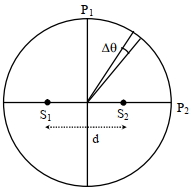
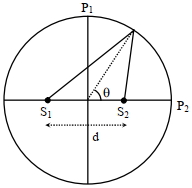
Two coherent monochromatic point sources $S_1$ and $S_2$ of wavelength $\lambda = 600 \ nm$ are placed symmetrically on either side of the centre of the circle as shown. The sources are separated by a distance $d = 1.8 \ mm$. This arrangement produces interference fringes visible as alternate bright and dark spots on the circumference of the circle. The angular separation between two consecutive bright spots is $\Delta \theta$. Which of the following options is/are correct?
$[A]$ $A$ dark spot will be formed at the point $P_2$
$[B]$ At $P_2$ the order of the fringe will be maximum
$[C]$ The total number of fringes produced between $P_1$ and $P_2$ in the first quadrant is close to $3000$
$[D]$ The angular separation between two consecutive bright spots decreases as we move from $P_1$ to $P_2$ along the first quadrant
$[A]$ $A$ dark spot will be formed at the point $P_2$
$[B]$ At $P_2$ the order of the fringe will be maximum
$[C]$ The total number of fringes produced between $P_1$ and $P_2$ in the first quadrant is close to $3000$
$[D]$ The angular separation between two consecutive bright spots decreases as we move from $P_1$ to $P_2$ along the first quadrant
A
$A, C$
B
$A, B$
C
$A, D$
D
$B, C$
Solution
(D) The path difference at a point $P$ on the circumference,where the line joining the center to $P$ makes an angle $\theta$ with the line joining the sources,is given by $\Delta x = d \cos \theta$.
At point $P_1$,$\theta = 90^{\circ}$,so $\Delta x = d \cos 90^{\circ} = 0$. This corresponds to the central maximum.
At point $P_2$,$\theta = 0^{\circ}$,so $\Delta x = d \cos 0^{\circ} = d = 1.8 \ mm$.
The order of the fringe $n$ at $P_2$ is $n = \frac{d}{\lambda} = \frac{1.8 \times 10^{-3} \ m}{600 \times 10^{-9} \ m} = 3000$.
Since $n = 3000$ is an integer,a bright spot (maxima) is formed at $P_2$. Thus,option $[A]$ is incorrect and option $[B]$ is correct.
The number of fringes between $P_1$ $(\theta = 90^{\circ}, n=0)$ and $P_2$ $(\theta = 0^{\circ}, n=3000)$ is $3000$. Thus,option $[C]$ is correct.
For maxima,$d \cos \theta = n \lambda$. Differentiating,$-d \sin \theta \ d\theta = \lambda \ dn$,so the angular fringe width is $\Delta \theta \approx |d\theta| = \frac{\lambda}{d \sin \theta}$.
As we move from $P_1$ $(\theta = 90^{\circ})$ to $P_2$ $(\theta = 0^{\circ})$,$\sin \theta$ decreases,so $\Delta \theta$ increases. Thus,option $[D]$ is incorrect.
Therefore,the correct options are $[B]$ and $[C]$.
At point $P_1$,$\theta = 90^{\circ}$,so $\Delta x = d \cos 90^{\circ} = 0$. This corresponds to the central maximum.
At point $P_2$,$\theta = 0^{\circ}$,so $\Delta x = d \cos 0^{\circ} = d = 1.8 \ mm$.
The order of the fringe $n$ at $P_2$ is $n = \frac{d}{\lambda} = \frac{1.8 \times 10^{-3} \ m}{600 \times 10^{-9} \ m} = 3000$.
Since $n = 3000$ is an integer,a bright spot (maxima) is formed at $P_2$. Thus,option $[A]$ is incorrect and option $[B]$ is correct.
The number of fringes between $P_1$ $(\theta = 90^{\circ}, n=0)$ and $P_2$ $(\theta = 0^{\circ}, n=3000)$ is $3000$. Thus,option $[C]$ is correct.
For maxima,$d \cos \theta = n \lambda$. Differentiating,$-d \sin \theta \ d\theta = \lambda \ dn$,so the angular fringe width is $\Delta \theta \approx |d\theta| = \frac{\lambda}{d \sin \theta}$.
As we move from $P_1$ $(\theta = 90^{\circ})$ to $P_2$ $(\theta = 0^{\circ})$,$\sin \theta$ decreases,so $\Delta \theta$ increases. Thus,option $[D]$ is incorrect.
Therefore,the correct options are $[B]$ and $[C]$.
0 likes
View Solution166
MediumMCQ
Two coherent monochromatic light beams of intensities $4 I$ and $9I$ are superimposed. The difference between the maximum and minimum intensities in the resulting interference pattern is $xI$. The value of $x$ is . . . . . . .
A
$25$
B
$22$
C
$24$
D
$20$
Solution
(C) The maximum intensity in an interference pattern is given by $I_{\max} = (\sqrt{I_1} + \sqrt{I_2})^2$.
Substituting the given values,$I_{\max} = (\sqrt{4I} + \sqrt{9I})^2 = (2\sqrt{I} + 3\sqrt{I})^2 = (5\sqrt{I})^2 = 25I$.
The minimum intensity in an interference pattern is given by $I_{\min} = (\sqrt{I_1} - \sqrt{I_2})^2$.
Substituting the given values,$I_{\min} = (\sqrt{4I} - \sqrt{9I})^2 = (2\sqrt{I} - 3\sqrt{I})^2 = (-\sqrt{I})^2 = I$.
The difference between the maximum and minimum intensities is $I_{\max} - I_{\min} = 25I - I = 24I$.
Comparing this with $xI$,we get $x = 24$.
Substituting the given values,$I_{\max} = (\sqrt{4I} + \sqrt{9I})^2 = (2\sqrt{I} + 3\sqrt{I})^2 = (5\sqrt{I})^2 = 25I$.
The minimum intensity in an interference pattern is given by $I_{\min} = (\sqrt{I_1} - \sqrt{I_2})^2$.
Substituting the given values,$I_{\min} = (\sqrt{4I} - \sqrt{9I})^2 = (2\sqrt{I} - 3\sqrt{I})^2 = (-\sqrt{I})^2 = I$.
The difference between the maximum and minimum intensities is $I_{\max} - I_{\min} = 25I - I = 24I$.
Comparing this with $xI$,we get $x = 24$.
0 likes
View Solution167
MediumMCQ
Two monochromatic light beams have intensities in the ratio $1 : 9$. An interference pattern is obtained by these beams. The ratio of the intensities of maximum to minimum is (in $: 1$)
A
$8$
B
$9$
C
$3$
D
$4$
Solution
(D) Given the ratio of intensities $I_1 : I_2 = 1 : 9$. Let $I_1 = I$ and $I_2 = 9I$.
The formula for the ratio of maximum to minimum intensity in an interference pattern is given by:
$\frac{I_{\max}}{I_{\min}} = \frac{(\sqrt{I_1} + \sqrt{I_2})^2}{(\sqrt{I_1} - \sqrt{I_2})^2}$
Substituting the values:
$\frac{I_{\max}}{I_{\min}} = \frac{(\sqrt{I} + \sqrt{9I})^2}{(\sqrt{I} - \sqrt{9I})^2}$
$\frac{I_{\max}}{I_{\min}} = \frac{(\sqrt{I} + 3\sqrt{I})^2}{(\sqrt{I} - 3\sqrt{I})^2}$
$\frac{I_{\max}}{I_{\min}} = \frac{(4\sqrt{I})^2}{(-2\sqrt{I})^2} = \frac{16I}{4I} = \frac{4}{1}$
Thus,the ratio is $4 : 1$.
The formula for the ratio of maximum to minimum intensity in an interference pattern is given by:
$\frac{I_{\max}}{I_{\min}} = \frac{(\sqrt{I_1} + \sqrt{I_2})^2}{(\sqrt{I_1} - \sqrt{I_2})^2}$
Substituting the values:
$\frac{I_{\max}}{I_{\min}} = \frac{(\sqrt{I} + \sqrt{9I})^2}{(\sqrt{I} - \sqrt{9I})^2}$
$\frac{I_{\max}}{I_{\min}} = \frac{(\sqrt{I} + 3\sqrt{I})^2}{(\sqrt{I} - 3\sqrt{I})^2}$
$\frac{I_{\max}}{I_{\min}} = \frac{(4\sqrt{I})^2}{(-2\sqrt{I})^2} = \frac{16I}{4I} = \frac{4}{1}$
Thus,the ratio is $4 : 1$.
0 likes
View Solution168
MediumMCQ
Two plane polarized light waves combine at a certain point whose electric field components are $E_1 = E_0 \sin(\omega t)$ and $E_2 = E_0 \sin(\omega t + \frac{\pi}{3})$. Find the amplitude of the resultant wave.
A
$0.9 E_0$
B
$E_0$
C
$1.73 E_0$
D
$3.46 E_0$
Solution
(C) The resultant amplitude $A$ of two waves with amplitudes $A_1$ and $A_2$ and phase difference $\phi$ is given by the formula: $A = \sqrt{A_1^2 + A_2^2 + 2A_1 A_2 \cos \phi}$.
Here,$A_1 = E_0$,$A_2 = E_0$,and $\phi = \frac{\pi}{3}$.
Substituting these values into the formula:
$A = \sqrt{E_0^2 + E_0^2 + 2(E_0)(E_0) \cos(\frac{\pi}{3})}$
Since $\cos(\frac{\pi}{3}) = 0.5$,we have:
$A = \sqrt{E_0^2 + E_0^2 + 2E_0^2(0.5)}$
$A = \sqrt{2E_0^2 + E_0^2} = \sqrt{3E_0^2}$
$A = \sqrt{3} E_0 \approx 1.732 E_0$.
Here,$A_1 = E_0$,$A_2 = E_0$,and $\phi = \frac{\pi}{3}$.
Substituting these values into the formula:
$A = \sqrt{E_0^2 + E_0^2 + 2(E_0)(E_0) \cos(\frac{\pi}{3})}$
Since $\cos(\frac{\pi}{3}) = 0.5$,we have:
$A = \sqrt{E_0^2 + E_0^2 + 2E_0^2(0.5)}$
$A = \sqrt{2E_0^2 + E_0^2} = \sqrt{3E_0^2}$
$A = \sqrt{3} E_0 \approx 1.732 E_0$.
0 likes
View Solution169
MediumMCQ
Interference fringes are produced on the screen by using two light sources of intensities $I$ and $9I$. The phase difference between the beams is $\pi / 2$ at point $P$ and $\pi$ at point $Q$ on the screen. The difference between the resultant intensities at points $P$ and $Q$ is $(\cos 90^{\circ}=0, \cos 180^{\circ}=-1)$. (in $I$)
A
$2$
B
$4$
C
$6$
D
$8$
Solution
(C) The resultant intensity $I_R$ in an interference pattern is given by the formula: $I_R = I_1 + I_2 + 2\sqrt{I_1 I_2} \cos \phi$,where $\phi$ is the phase difference.
Given $I_1 = I$ and $I_2 = 9I$.
At point $P$,the phase difference $\phi_P = \pi / 2$. Thus,$I_P = I + 9I + 2\sqrt{I \cdot 9I} \cos(\pi / 2) = 10I + 6I(0) = 10I$.
At point $Q$,the phase difference $\phi_Q = \pi$. Thus,$I_Q = I + 9I + 2\sqrt{I \cdot 9I} \cos(\pi) = 10I + 6I(-1) = 10I - 6I = 4I$.
The difference between the resultant intensities at points $P$ and $Q$ is $|I_P - I_Q| = |10I - 4I| = 6I$.
Given $I_1 = I$ and $I_2 = 9I$.
At point $P$,the phase difference $\phi_P = \pi / 2$. Thus,$I_P = I + 9I + 2\sqrt{I \cdot 9I} \cos(\pi / 2) = 10I + 6I(0) = 10I$.
At point $Q$,the phase difference $\phi_Q = \pi$. Thus,$I_Q = I + 9I + 2\sqrt{I \cdot 9I} \cos(\pi) = 10I + 6I(-1) = 10I - 6I = 4I$.
The difference between the resultant intensities at points $P$ and $Q$ is $|I_P - I_Q| = |10I - 4I| = 6I$.
0 likes
View Solution170
MediumMCQ
If two sources of light emit waves of different amplitudes and interfere, then:
A
there is some intensity of light in the region of destructive interference.
B
fringe width is less.
C
brightness of fringes is less.
D
fringes disappear after short time.
Solution
(A) In the phenomenon of interference, the intensity of light is given by $I = I_1 + I_2 + 2\sqrt{I_1 I_2} \cos \phi$, where $I_1$ and $I_2$ are the intensities of the two waves.
Since $I \propto A^2$, where $A$ is the amplitude, the intensities at the points of destructive interference are given by $I_{min} = (\sqrt{I_1} - \sqrt{I_2})^2 = (A_1 - A_2)^2$.
If the amplitudes $A_1$ and $A_2$ are different, then $(A_1 - A_2)^2 \neq 0$.
Therefore, the intensity at the region of destructive interference is not zero, meaning there is some residual intensity of light.
Since $I \propto A^2$, where $A$ is the amplitude, the intensities at the points of destructive interference are given by $I_{min} = (\sqrt{I_1} - \sqrt{I_2})^2 = (A_1 - A_2)^2$.
If the amplitudes $A_1$ and $A_2$ are different, then $(A_1 - A_2)^2 \neq 0$.
Therefore, the intensity at the region of destructive interference is not zero, meaning there is some residual intensity of light.
0 likes
View Solution171
EasyMCQ
Two light rays having the same wavelength ' $\lambda$ ' in vacuum are in phase initially. Then,the first ray travels a path ' $L_1$ ' through a medium of refractive index ' $\mu_1$ ' while the second ray travels a path of length ' $L_2$ ' through a medium of refractive index ' $\mu_2$ '. The two waves are then combined to observe interference. The phase difference between the two waves is
A
$\frac{2 \pi}{\lambda}(\mu_1 L_1 - \mu_2 L_2)$
B
$\frac{2 \pi}{\lambda}(L_2 - L_1)$
C
$\frac{2 \pi}{\lambda}(\frac{L_1}{\mu_1} - \frac{L_2}{\mu_2})$
D
$\frac{2 \pi}{\lambda}(\mu_2 L_1 - \mu_1 L_2)$
Solution
(A) The optical path length of a ray in a medium is defined as the product of the refractive index of the medium and the geometric path length traveled by the ray.
Optical path of the first ray = $\mu_1 L_1$.
Optical path of the second ray = $\mu_2 L_2$.
The optical path difference between the two rays is $\Delta x = |\mu_1 L_1 - \mu_2 L_2|$.
The relationship between phase difference $(\Delta \phi)$ and optical path difference $(\Delta x)$ is given by $\Delta \phi = \frac{2 \pi}{\lambda} \Delta x$.
Substituting the value of path difference,the phase difference is $\Delta \phi = \frac{2 \pi}{\lambda} |\mu_1 L_1 - \mu_2 L_2|$.
Optical path of the first ray = $\mu_1 L_1$.
Optical path of the second ray = $\mu_2 L_2$.
The optical path difference between the two rays is $\Delta x = |\mu_1 L_1 - \mu_2 L_2|$.
The relationship between phase difference $(\Delta \phi)$ and optical path difference $(\Delta x)$ is given by $\Delta \phi = \frac{2 \pi}{\lambda} \Delta x$.
Substituting the value of path difference,the phase difference is $\Delta \phi = \frac{2 \pi}{\lambda} |\mu_1 L_1 - \mu_2 L_2|$.
0 likes
View Solution172
MediumMCQ
Two identical light waves having phase difference $\phi$ propagate in the same direction. When they superpose,the intensity of the resultant wave is proportional to:
A
$\cos ^2\left(\frac{\phi}{4}\right)$
B
$\cos ^2\left(\frac{\phi}{3}\right)$
C
$\cos ^2\left(\frac{\phi}{2}\right)$
D
$\cos ^2 \phi$
Solution
(C) The resultant amplitude $A$ of two superposing waves with individual amplitudes $a_1$ and $a_2$ and phase difference $\phi$ is given by: $A^2 = a_1^2 + a_2^2 + 2 a_1 a_2 \cos \phi$.
Since the waves are identical,$a_1 = a_2 = a$.
Substituting this into the equation: $A^2 = a^2 + a^2 + 2 a^2 \cos \phi = 2 a^2 (1 + \cos \phi)$.
Using the trigonometric identity $1 + \cos \phi = 2 \cos^2(\phi/2)$,we get: $A^2 = 2 a^2 (2 \cos^2(\phi/2)) = 4 a^2 \cos^2(\phi/2)$.
Since intensity $I$ is proportional to the square of the amplitude $(I \propto A^2)$,we have $I \propto \cos^2(\phi/2)$.
Since the waves are identical,$a_1 = a_2 = a$.
Substituting this into the equation: $A^2 = a^2 + a^2 + 2 a^2 \cos \phi = 2 a^2 (1 + \cos \phi)$.
Using the trigonometric identity $1 + \cos \phi = 2 \cos^2(\phi/2)$,we get: $A^2 = 2 a^2 (2 \cos^2(\phi/2)) = 4 a^2 \cos^2(\phi/2)$.
Since intensity $I$ is proportional to the square of the amplitude $(I \propto A^2)$,we have $I \propto \cos^2(\phi/2)$.
0 likes
View Solution173
MediumMCQ
Light waves from two coherent sources arrive at two points on a screen with path difference of $0$ and $\frac{\lambda}{2}$. The ratio of intensities at the points is $(\cos 0^{\circ}=1, \cos \pi=-1)$.
A
$2: 1$
B
$1: 1$
C
$1: 2$
D
$\infty: 1$
Solution
(D) The phase difference $\Delta \phi$ is related to the path difference $\Delta x$ by the formula $\Delta \phi = \frac{2 \pi}{\lambda} \cdot \Delta x$.
For the first point,$\Delta x_1 = 0$,so $\Delta \phi_1 = 0$. The intensity is $I_1 = I_{max} \cos^2(\frac{\Delta \phi_1}{2}) = I_{max} \cos^2(0) = I_{max}$.
For the second point,$\Delta x_2 = \frac{\lambda}{2}$,so $\Delta \phi_2 = \frac{2 \pi}{\lambda} \cdot \frac{\lambda}{2} = \pi$. The intensity is $I_2 = I_{max} \cos^2(\frac{\pi}{2}) = 0$.
The ratio of intensities is $\frac{I_1}{I_2} = \frac{I_{max}}{0} = \infty$.
Thus,the ratio is $\infty: 1$.
For the first point,$\Delta x_1 = 0$,so $\Delta \phi_1 = 0$. The intensity is $I_1 = I_{max} \cos^2(\frac{\Delta \phi_1}{2}) = I_{max} \cos^2(0) = I_{max}$.
For the second point,$\Delta x_2 = \frac{\lambda}{2}$,so $\Delta \phi_2 = \frac{2 \pi}{\lambda} \cdot \frac{\lambda}{2} = \pi$. The intensity is $I_2 = I_{max} \cos^2(\frac{\pi}{2}) = 0$.
The ratio of intensities is $\frac{I_1}{I_2} = \frac{I_{max}}{0} = \infty$.
Thus,the ratio is $\infty: 1$.
0 likes
View Solution174
DifficultMCQ
$A$ and $B$ are two interfering sources where $A$ is ahead in phase by $54^{\circ}$ relative to $B$. The observation is taken from point $P$ such that $PB-PA=2.5 \lambda$. Then the phase difference between the waves from $A$ and $B$ reaching point $P$ is (in rad) (in $\pi$)
A
$3.5$
B
$4.3$
C
$5.3$
D
$5.8$
Solution
(C) The total phase difference $\Delta \phi$ at point $P$ is given by the sum of the initial phase difference between the sources and the phase difference due to the path difference.
Let $\phi_1$ be the initial phase difference between the sources $A$ and $B$. Given $\phi_1 = 54^{\circ}$.
Converting to radians: $\phi_1 = 54 \times \frac{\pi}{180} = 0.3 \pi \text{ rad}$.
Let $\phi_2$ be the phase difference due to the path difference $\Delta x = PB - PA = 2.5 \lambda$.
The formula for phase difference due to path difference is $\phi_2 = \frac{2 \pi}{\lambda} \times \Delta x$.
Substituting the values: $\phi_2 = \frac{2 \pi}{\lambda} \times 2.5 \lambda = 5 \pi \text{ rad}$.
Since source $A$ is ahead in phase, the total phase difference is $\Delta \phi = \phi_2 + \phi_1 = 5 \pi + 0.3 \pi = 5.3 \pi \text{ rad}$.
Let $\phi_1$ be the initial phase difference between the sources $A$ and $B$. Given $\phi_1 = 54^{\circ}$.
Converting to radians: $\phi_1 = 54 \times \frac{\pi}{180} = 0.3 \pi \text{ rad}$.
Let $\phi_2$ be the phase difference due to the path difference $\Delta x = PB - PA = 2.5 \lambda$.
The formula for phase difference due to path difference is $\phi_2 = \frac{2 \pi}{\lambda} \times \Delta x$.
Substituting the values: $\phi_2 = \frac{2 \pi}{\lambda} \times 2.5 \lambda = 5 \pi \text{ rad}$.
Since source $A$ is ahead in phase, the total phase difference is $\Delta \phi = \phi_2 + \phi_1 = 5 \pi + 0.3 \pi = 5.3 \pi \text{ rad}$.
0 likes
View Solution175
MediumMCQ
Consider the following statements about interference of light.
$A$-When crest of one wave coincides with crest of another wave at a point,this point is a point of destructive interference.
$B$-Two coherent sources emit waves of the same frequency with a constant phase difference.
Choose the correct option from the following.
$A$-When crest of one wave coincides with crest of another wave at a point,this point is a point of destructive interference.
$B$-Two coherent sources emit waves of the same frequency with a constant phase difference.
Choose the correct option from the following.
A
Both statements $A$ and $B$ are wrong.
B
Statement $A$ is correct while statement $B$ is wrong.
C
Statement $B$ is correct while statement $A$ is wrong.
D
Both statements $A$ and $B$ are correct.
Solution
(C) The correct option is $C$.
Statement $A$ is false because when the crest of one wave coincides with the crest of another wave,the amplitudes add up,resulting in constructive interference,not destructive interference.
Statement $B$ is true because,by definition,coherent sources are sources that emit light waves of the same frequency and maintain a constant phase difference over time.
Statement $A$ is false because when the crest of one wave coincides with the crest of another wave,the amplitudes add up,resulting in constructive interference,not destructive interference.
Statement $B$ is true because,by definition,coherent sources are sources that emit light waves of the same frequency and maintain a constant phase difference over time.
0 likes
View Solution176
MediumMCQ
Consider the following statements about interference of light:
$A$. The interference fringes are equally bright and equally spaced.
$B$. At the centre of a bright fringe,the intensity is four times the intensity of the incident wave.
$C$. For constructive interference of two waves,the crest of one wave coincides with the trough of another wave.
Which of the above statements are correct?
$A$. The interference fringes are equally bright and equally spaced.
$B$. At the centre of a bright fringe,the intensity is four times the intensity of the incident wave.
$C$. For constructive interference of two waves,the crest of one wave coincides with the trough of another wave.
Which of the above statements are correct?
A
$A$ and $B$ only
B
$A$ and $C$ only
C
All $A, B$ and $C$
D
$B$ and $C$ only
Solution
(A) In interference,the fringes are equally bright and equally spaced,and the intensity of the bright fringe is four times the intensity of each incident wave.
Resultant intensity at a point is given by $I = I_1 + I_2 + 2\sqrt{I_1}\sqrt{I_2}\cos\delta$,where $I_1$ and $I_2$ are the intensities of the waves from the two sources.
For constructive interference,the crest of one wave coincides with the crest of another wave,or the trough coincides with the trough. Statement $C$ is incorrect because the condition described (crest coinciding with trough) leads to destructive interference.
For constructive interference at the central maxima,the phase difference $\delta = 0$.
If $I_1 = I_2 = I$,then $I_{\max} = I + I + 2\sqrt{I}\sqrt{I}\cos(0) = 4I$.
Thus,statements $A$ and $B$ are correct.
Resultant intensity at a point is given by $I = I_1 + I_2 + 2\sqrt{I_1}\sqrt{I_2}\cos\delta$,where $I_1$ and $I_2$ are the intensities of the waves from the two sources.
For constructive interference,the crest of one wave coincides with the crest of another wave,or the trough coincides with the trough. Statement $C$ is incorrect because the condition described (crest coinciding with trough) leads to destructive interference.
For constructive interference at the central maxima,the phase difference $\delta = 0$.
If $I_1 = I_2 = I$,then $I_{\max} = I + I + 2\sqrt{I}\sqrt{I}\cos(0) = 4I$.
Thus,statements $A$ and $B$ are correct.
0 likes
View Solution177
EasyMCQ
Two coherent sources of wavelength $\lambda$ produce a steady interference pattern. The path difference corresponding to the $10^{\text{th}}$ order maximum will be:
A
$9.5 \lambda$
B
$10.5 \lambda$
C
$9 \lambda$
D
$10 \lambda$
Solution
(D) In an interference pattern produced by two coherent sources,the condition for constructive interference (maximum intensity) is given by the path difference $\Delta x = n \lambda$,where $n$ is the order of the maximum $(n = 0, 1, 2, 3, \dots)$.
For the $10^{\text{th}}$ order maximum,we substitute $n = 10$ into the formula.
Therefore,the path difference $\Delta x = 10 \lambda$.
For the $10^{\text{th}}$ order maximum,we substitute $n = 10$ into the formula.
Therefore,the path difference $\Delta x = 10 \lambda$.
0 likes
View Solution178
EasyMCQ
If two sources emit light waves of different amplitudes, then:
A
brightness of fringes is less
B
fringes disappear after a short time
C
fringe width is less
D
there is some intensity of light in the region of destructive interference
Solution
(D) The intensity of light in an interference pattern is given by $I = I_1 + I_2 + 2\sqrt{I_1 I_2} \cos \phi$.
For destructive interference, the phase difference $\phi = (2n+1)\pi$, which leads to $I_{min} = (\sqrt{I_1} - \sqrt{I_2})^2$.
If the amplitudes are different, then $I_1 \neq I_2$, which implies $\sqrt{I_1} \neq \sqrt{I_2}$.
Therefore, $I_{min} \neq 0$.
This means that in the region of destructive interference, the waves do not cancel each other out completely, and there remains some residual intensity of light.
For destructive interference, the phase difference $\phi = (2n+1)\pi$, which leads to $I_{min} = (\sqrt{I_1} - \sqrt{I_2})^2$.
If the amplitudes are different, then $I_1 \neq I_2$, which implies $\sqrt{I_1} \neq \sqrt{I_2}$.
Therefore, $I_{min} \neq 0$.
This means that in the region of destructive interference, the waves do not cancel each other out completely, and there remains some residual intensity of light.
0 likes
View Solution179
EasyMCQ
Two coherent sources of intensities $I_{1}$ and $I_{2}$ produce an interference pattern on a screen. The maximum intensity in the interference pattern is
A
$(\sqrt{I_{1}}+\sqrt{I_{2}})^{2}$
B
$I_{1}+I_{2}$
C
$(I_{1}+I_{2})^{2}$
D
$I_{1}^{2}+I_{2}^{2}$
Solution
(A) The intensity $I$ of a wave is proportional to the square of its amplitude $a$,i.e.,$I \propto a^{2}$.
This implies that the amplitude $a$ is proportional to the square root of the intensity,i.e.,$a \propto \sqrt{I}$.
Let the amplitudes of the two coherent sources be $a_{1}$ and $a_{2}$,where $a_{1} \propto \sqrt{I_{1}}$ and $a_{2} \propto \sqrt{I_{2}}$.
In an interference pattern,the maximum intensity $(I_{\max})$ occurs at points of constructive interference,where the phase difference is an even multiple of $\pi$ $(2n\pi)$.
At these points,the resultant amplitude is the sum of the individual amplitudes: $A_{\max} = a_{1} + a_{2}$.
Since $I_{\max} \propto A_{\max}^{2}$,we have $I_{\max} \propto (a_{1} + a_{2})^{2}$.
Substituting the expressions for $a_{1}$ and $a_{2}$,we get $I_{\max} = (\sqrt{I_{1}} + \sqrt{I_{2}})^{2}$.
This implies that the amplitude $a$ is proportional to the square root of the intensity,i.e.,$a \propto \sqrt{I}$.
Let the amplitudes of the two coherent sources be $a_{1}$ and $a_{2}$,where $a_{1} \propto \sqrt{I_{1}}$ and $a_{2} \propto \sqrt{I_{2}}$.
In an interference pattern,the maximum intensity $(I_{\max})$ occurs at points of constructive interference,where the phase difference is an even multiple of $\pi$ $(2n\pi)$.
At these points,the resultant amplitude is the sum of the individual amplitudes: $A_{\max} = a_{1} + a_{2}$.
Since $I_{\max} \propto A_{\max}^{2}$,we have $I_{\max} \propto (a_{1} + a_{2})^{2}$.
Substituting the expressions for $a_{1}$ and $a_{2}$,we get $I_{\max} = (\sqrt{I_{1}} + \sqrt{I_{2}})^{2}$.
0 likes
View Solution180
MediumMCQ
Light waves from two coherent sources arrive at two points on a screen with path difference of zero and $\lambda / 2$. The ratio of the intensities at the points is
A
$2:1$
B
$1:2$
C
$1:1$
D
$\infty:1$
Solution
(D) The intensity of the resultant wave in interference is given by $I = 4I_0 \cos^2(\phi/2)$,where $\phi$ is the phase difference and $I_0$ is the intensity of each individual source.
Phase difference $\phi$ is related to path difference $\Delta x$ by $\phi = \frac{2\pi}{\lambda} \Delta x$.
For path difference $\Delta x = 0$,the phase difference $\phi = 0$. Thus,$I_1 = 4I_0 \cos^2(0) = 4I_0$.
For path difference $\Delta x = \lambda/2$,the phase difference $\phi = \frac{2\pi}{\lambda} \cdot \frac{\lambda}{2} = \pi$. Thus,$I_2 = 4I_0 \cos^2(\pi/2) = 4I_0 \cdot 0 = 0$.
The ratio of intensities is $\frac{I_1}{I_2} = \frac{4I_0}{0} = \infty$.
Therefore,the ratio is $\infty:1$.
Phase difference $\phi$ is related to path difference $\Delta x$ by $\phi = \frac{2\pi}{\lambda} \Delta x$.
For path difference $\Delta x = 0$,the phase difference $\phi = 0$. Thus,$I_1 = 4I_0 \cos^2(0) = 4I_0$.
For path difference $\Delta x = \lambda/2$,the phase difference $\phi = \frac{2\pi}{\lambda} \cdot \frac{\lambda}{2} = \pi$. Thus,$I_2 = 4I_0 \cos^2(\pi/2) = 4I_0 \cdot 0 = 0$.
The ratio of intensities is $\frac{I_1}{I_2} = \frac{4I_0}{0} = \infty$.
Therefore,the ratio is $\infty:1$.
0 likes
View Solution181
EasyMCQ
If two sources emit light waves of different amplitudes, then in the interference pattern:
A
fringes disappear after a short time.
B
brightness of fringes is less.
C
there is some intensity of light in the region of destructive interference.
D
fringe width will be less.
Solution
(C) In an interference pattern, the intensity $I$ is given by $I = I_1 + I_2 + 2\sqrt{I_1 I_2} \cos \phi$.
For destructive interference, the phase difference $\phi = (2n+1)\pi$, so $\cos \phi = -1$.
The minimum intensity is $I_{min} = (\sqrt{I_1} - \sqrt{I_2})^2$.
If the amplitudes are different, then $I_1 \neq I_2$, which implies $\sqrt{I_1} \neq \sqrt{I_2}$.
Therefore, $I_{min} \neq 0$.
This means that in the region of destructive interference, there is some residual intensity of light instead of complete darkness.
For destructive interference, the phase difference $\phi = (2n+1)\pi$, so $\cos \phi = -1$.
The minimum intensity is $I_{min} = (\sqrt{I_1} - \sqrt{I_2})^2$.
If the amplitudes are different, then $I_1 \neq I_2$, which implies $\sqrt{I_1} \neq \sqrt{I_2}$.
Therefore, $I_{min} \neq 0$.
This means that in the region of destructive interference, there is some residual intensity of light instead of complete darkness.
0 likes
View Solution182
EasyMCQ
If two light waves reaching at a point produce destructive interference,then the condition of phase difference is:
A
$0, 2\pi, 4\pi, 6\pi, \ldots$
B
$\frac{\pi}{4}, \frac{\pi}{2}, \frac{3\pi}{4}, \ldots$
C
$\frac{\pi}{2}, \frac{3\pi}{2}, \frac{5\pi}{2}, \ldots$
D
$\pi, 3\pi, 5\pi, \ldots$
Solution
(D) For destructive interference to occur,the two light waves must arrive at a point with a phase difference that results in the cancellation of their amplitudes.
This occurs when the waves are in anti-phase,meaning one wave is at a crest while the other is at a trough.
The condition for destructive interference is given by the phase difference $\Delta \phi = (2n + 1)\pi$,where $n = 0, 1, 2, \ldots$.
Substituting values for $n$,we get $\Delta \phi = \pi, 3\pi, 5\pi, \ldots$.
This occurs when the waves are in anti-phase,meaning one wave is at a crest while the other is at a trough.
The condition for destructive interference is given by the phase difference $\Delta \phi = (2n + 1)\pi$,where $n = 0, 1, 2, \ldots$.
Substituting values for $n$,we get $\Delta \phi = \pi, 3\pi, 5\pi, \ldots$.
0 likes
View Solution183
EasyMCQ
The phenomenon of interference is based on
A
Conservation of momentum
B
Quantum nature of light
C
Conservation of energy
D
Conservation of charge
Solution
(C) In the phenomenon of interference,the energy is redistributed in the medium.
At points of constructive interference,the intensity (and thus energy) is maximum,while at points of destructive interference,the intensity is minimum.
Since the total energy remains constant throughout the medium,the phenomenon of interference is based on the principle of conservation of energy.
At points of constructive interference,the intensity (and thus energy) is maximum,while at points of destructive interference,the intensity is minimum.
Since the total energy remains constant throughout the medium,the phenomenon of interference is based on the principle of conservation of energy.
0 likes
View Solution184
EasyMCQ
In an interference experiment,the phase difference for points where the intensity is minimum is $(n=1, 2, 3, \ldots)$
A
$n \pi$
B
$(n+1) \pi$
C
$(2n-1) \pi$
D
zero
Solution
(C) In an interference experiment,the resultant intensity $I$ is given by $I = I_1 + I_2 + 2\sqrt{I_1 I_2} \cos \phi$,where $\phi$ is the phase difference between the two interfering waves.
The intensity is minimum when $\cos \phi = -1$.
This occurs when the phase difference $\phi$ is an odd multiple of $\pi$.
Therefore,the condition for minimum intensity is $\phi = (2n-1) \pi$,where $n = 1, 2, 3, \ldots$.
The intensity is minimum when $\cos \phi = -1$.
This occurs when the phase difference $\phi$ is an odd multiple of $\pi$.
Therefore,the condition for minimum intensity is $\phi = (2n-1) \pi$,where $n = 1, 2, 3, \ldots$.
0 likes
View Solution185
MediumMCQ
$A$ ray of light from a monochromatic point source of light is incident at a point on the screen. If a thin mica film of thickness $t$ and refractive index $n$ is introduced in its path,then the optical path
A
is decreased by $(n-1) t$.
B
is increased by $(n+1) t$.
C
is not affected.
D
is increased by $(n-1) t$.
Solution
(D) The optical path length is defined as the product of the refractive index of the medium and the geometric distance traveled by the light.
In vacuum (or air),the optical path for a distance $t$ is $t_{opt} = 1 \times t = t$.
When a mica film of thickness $t$ and refractive index $n$ is introduced,the light travels a distance $t$ through the film.
The optical path through the film is $t'_{opt} = n \times t = nt$.
The change in optical path is $\Delta = t'_{opt} - t_{opt} = nt - t = (n-1)t$.
Since $n > 1$,the optical path increases by $(n-1)t$.
In vacuum (or air),the optical path for a distance $t$ is $t_{opt} = 1 \times t = t$.
When a mica film of thickness $t$ and refractive index $n$ is introduced,the light travels a distance $t$ through the film.
The optical path through the film is $t'_{opt} = n \times t = nt$.
The change in optical path is $\Delta = t'_{opt} - t_{opt} = nt - t = (n-1)t$.
Since $n > 1$,the optical path increases by $(n-1)t$.
0 likes
View Solution186
EasyMCQ
Two waves having amplitudes in the ratio $5:1$ produce interference. The ratio of the maximum to minimum intensity is
A
$6: 4$
B
$25: 1$
C
$3: 2$
D
$9: 4$
Solution
(D) Let the amplitudes of the two waves be $A_1 = 5x$ and $A_2 = x$.
The maximum intensity $I_{max}$ is proportional to the square of the sum of amplitudes: $I_{max} \propto (A_1 + A_2)^2 = (5x + x)^2 = (6x)^2 = 36x^2$.
The minimum intensity $I_{min}$ is proportional to the square of the difference of amplitudes: $I_{min} \propto (A_1 - A_2)^2 = (5x - x)^2 = (4x)^2 = 16x^2$.
The ratio of maximum to minimum intensity is $\frac{I_{max}}{I_{min}} = \frac{36x^2}{16x^2} = \frac{36}{16} = \frac{9}{4}$.
The maximum intensity $I_{max}$ is proportional to the square of the sum of amplitudes: $I_{max} \propto (A_1 + A_2)^2 = (5x + x)^2 = (6x)^2 = 36x^2$.
The minimum intensity $I_{min}$ is proportional to the square of the difference of amplitudes: $I_{min} \propto (A_1 - A_2)^2 = (5x - x)^2 = (4x)^2 = 16x^2$.
The ratio of maximum to minimum intensity is $\frac{I_{max}}{I_{min}} = \frac{36x^2}{16x^2} = \frac{36}{16} = \frac{9}{4}$.
0 likes
View Solution187
EasyMCQ
Two monochromatic beams of intensities $I$ and $4I$ respectively are superposed to form a steady interference pattern. The maximum and minimum intensities in the pattern are
A
$4I$ and $I$
B
$9I$ and $3I$
C
$5I$ and $3I$
D
$9I$ and $I$
Solution
(D) The resultant intensity $I_R$ in an interference pattern is given by the formula: $I_R = I_1 + I_2 + 2\sqrt{I_1 I_2} \cos \phi$.
For maximum intensity $(I_{\max})$,the phase difference $\phi = 0$,so $I_{\max} = I_1 + I_2 + 2\sqrt{I_1 I_2} = (\sqrt{I_1} + \sqrt{I_2})^2$.
Given $I_1 = I$ and $I_2 = 4I$:
$I_{\max} = (\sqrt{I} + \sqrt{4I})^2 = (\sqrt{I} + 2\sqrt{I})^2 = (3\sqrt{I})^2 = 9I$.
For minimum intensity $(I_{\min})$,the phase difference $\phi = \pi$,so $I_{\min} = I_1 + I_2 - 2\sqrt{I_1 I_2} = (\sqrt{I_1} - \sqrt{I_2})^2$.
$I_{\min} = (\sqrt{I} - \sqrt{4I})^2 = (\sqrt{I} - 2\sqrt{I})^2 = (-\sqrt{I})^2 = I$.
Thus,the maximum and minimum intensities are $9I$ and $I$ respectively.
For maximum intensity $(I_{\max})$,the phase difference $\phi = 0$,so $I_{\max} = I_1 + I_2 + 2\sqrt{I_1 I_2} = (\sqrt{I_1} + \sqrt{I_2})^2$.
Given $I_1 = I$ and $I_2 = 4I$:
$I_{\max} = (\sqrt{I} + \sqrt{4I})^2 = (\sqrt{I} + 2\sqrt{I})^2 = (3\sqrt{I})^2 = 9I$.
For minimum intensity $(I_{\min})$,the phase difference $\phi = \pi$,so $I_{\min} = I_1 + I_2 - 2\sqrt{I_1 I_2} = (\sqrt{I_1} - \sqrt{I_2})^2$.
$I_{\min} = (\sqrt{I} - \sqrt{4I})^2 = (\sqrt{I} - 2\sqrt{I})^2 = (-\sqrt{I})^2 = I$.
Thus,the maximum and minimum intensities are $9I$ and $I$ respectively.
0 likes
View Solution188
EasyMCQ
The ratio of intensities of two waves producing interference is $9: 4$. The ratio of the resultant maximum and minimum intensities will be:
A
$4: 9$
B
$9: 4$
C
$25: 1$
D
$5: 1$
Solution
(C) Given the ratio of intensities of two waves is $\frac{I_1}{I_2} = \frac{9}{4}$.
Since intensity $I \propto a^2$,the ratio of amplitudes is $\frac{a_1}{a_2} = \sqrt{\frac{I_1}{I_2}} = \sqrt{\frac{9}{4}} = \frac{3}{2}$.
The maximum intensity is $I_{max} = (a_1 + a_2)^2$ and the minimum intensity is $I_{min} = (a_1 - a_2)^2$.
The ratio of maximum to minimum intensity is $\frac{I_{max}}{I_{min}} = \frac{(a_1 + a_2)^2}{(a_1 - a_2)^2} = \left( \frac{a_1 + a_2}{a_1 - a_2} \right)^2$.
Substituting the values,$\frac{I_{max}}{I_{min}} = \left( \frac{3 + 2}{3 - 2} \right)^2 = \left( \frac{5}{1} \right)^2 = \frac{25}{1}$.
Thus,the ratio is $25: 1$.
Since intensity $I \propto a^2$,the ratio of amplitudes is $\frac{a_1}{a_2} = \sqrt{\frac{I_1}{I_2}} = \sqrt{\frac{9}{4}} = \frac{3}{2}$.
The maximum intensity is $I_{max} = (a_1 + a_2)^2$ and the minimum intensity is $I_{min} = (a_1 - a_2)^2$.
The ratio of maximum to minimum intensity is $\frac{I_{max}}{I_{min}} = \frac{(a_1 + a_2)^2}{(a_1 - a_2)^2} = \left( \frac{a_1 + a_2}{a_1 - a_2} \right)^2$.
Substituting the values,$\frac{I_{max}}{I_{min}} = \left( \frac{3 + 2}{3 - 2} \right)^2 = \left( \frac{5}{1} \right)^2 = \frac{25}{1}$.
Thus,the ratio is $25: 1$.
0 likes
View Solution189
DifficultMCQ
Two light rays having the same wavelength $\lambda$ in vacuum are in phase initially. Then the first ray travels a path $L_1$ through a medium of refractive index $\mu_1$,while the second ray travels a path of length $L_2$ through a medium of refractive index $\mu_2$. The two waves are then combined to observe interference. The phase difference between the two waves is
A
$\frac{2 \pi}{\lambda}[\mu_2 L_1-\mu_1 L_2]$
B
$\frac{2 \pi}{\lambda}[\frac{L_1}{\mu_1}-\frac{L_2}{\mu_2}]$
C
$\frac{2 \pi}{\lambda}[\mu_1 L_1-\mu_2 L_2]$
D
$\frac{2 \pi}{\lambda}[L_2-L_1]$
Solution
(C) The optical path length in a medium of refractive index $\mu$ for a physical path length $L$ is defined as $\Delta = \mu L$.
For the first ray,the optical path is $\Delta_1 = \mu_1 L_1$.
For the second ray,the optical path is $\Delta_2 = \mu_2 L_2$.
The path difference between the two rays is $\Delta x = |\Delta_1 - \Delta_2| = |\mu_1 L_1 - \mu_2 L_2|$.
The phase difference $\phi$ is related to the path difference $\Delta x$ by the formula $\phi = \frac{2 \pi}{\lambda} \Delta x$.
Therefore,the phase difference is $\frac{2 \pi}{\lambda} |\mu_1 L_1 - \mu_2 L_2|$.
Comparing this with the given options,the correct expression is $\frac{2 \pi}{\lambda} [\mu_1 L_1 - \mu_2 L_2]$.
For the first ray,the optical path is $\Delta_1 = \mu_1 L_1$.
For the second ray,the optical path is $\Delta_2 = \mu_2 L_2$.
The path difference between the two rays is $\Delta x = |\Delta_1 - \Delta_2| = |\mu_1 L_1 - \mu_2 L_2|$.
The phase difference $\phi$ is related to the path difference $\Delta x$ by the formula $\phi = \frac{2 \pi}{\lambda} \Delta x$.
Therefore,the phase difference is $\frac{2 \pi}{\lambda} |\mu_1 L_1 - \mu_2 L_2|$.
Comparing this with the given options,the correct expression is $\frac{2 \pi}{\lambda} [\mu_1 L_1 - \mu_2 L_2]$.

0 likes
View Solution190
MediumMCQ
If the ratio of the intensities of two waves producing interference is $49: 16$,then the ratio of the resultant maximum intensity to minimum intensity will be
A
$11:3$
B
$121:9$
C
$7:4$
D
$49:16$
Solution
(B) Let the intensities of the two waves be $I_1$ and $I_2$.
Given: $I_1/I_2 = 49/16$.
Since intensity $I \propto A^2$,the ratio of amplitudes is $\sqrt{I_1}/\sqrt{I_2} = A_1/A_2 = \sqrt{49}/\sqrt{16} = 7/4$.
The ratio of maximum intensity to minimum intensity is given by the formula:
$\frac{I_{\max}}{I_{\min}} = \left(\frac{A_1 + A_2}{A_1 - A_2}\right)^2$.
Substituting the values:
$\frac{I_{\max}}{I_{\min}} = \left(\frac{7 + 4}{7 - 4}\right)^2 = \left(\frac{11}{3}\right)^2 = \frac{121}{9}$.
Thus,the ratio is $121:9$.
Given: $I_1/I_2 = 49/16$.
Since intensity $I \propto A^2$,the ratio of amplitudes is $\sqrt{I_1}/\sqrt{I_2} = A_1/A_2 = \sqrt{49}/\sqrt{16} = 7/4$.
The ratio of maximum intensity to minimum intensity is given by the formula:
$\frac{I_{\max}}{I_{\min}} = \left(\frac{A_1 + A_2}{A_1 - A_2}\right)^2$.
Substituting the values:
$\frac{I_{\max}}{I_{\min}} = \left(\frac{7 + 4}{7 - 4}\right)^2 = \left(\frac{11}{3}\right)^2 = \frac{121}{9}$.
Thus,the ratio is $121:9$.
0 likes
View Solution191
EasyMCQ
The optical path difference between two identical light waves arriving at a point is $31.5 \lambda$,where $\lambda$ is the wavelength of light used. The point is [Given: Two light sources are coherent]
A
alternative bright and dark.
B
dark.
C
bright.
D
neither bright nor dark.
Solution
(B) The condition for destructive interference is that the path difference $\Delta x$ must be an odd multiple of $\frac{\lambda}{2}$.
Given path difference $\Delta x = 31.5 \lambda = \frac{63}{2} \lambda = 63 \left( \frac{\lambda}{2} \right)$.
Since $63$ is an odd integer,the path difference is an odd multiple of $\frac{\lambda}{2}$.
Therefore,the point corresponds to destructive interference,which results in a dark point.
Given path difference $\Delta x = 31.5 \lambda = \frac{63}{2} \lambda = 63 \left( \frac{\lambda}{2} \right)$.
Since $63$ is an odd integer,the path difference is an odd multiple of $\frac{\lambda}{2}$.
Therefore,the point corresponds to destructive interference,which results in a dark point.
0 likes
View Solution192
MediumMCQ
Two light waves of intensities $I_1$ and $I_2$ having the same frequency pass through the same medium at a time in the same direction and interfere. The sum of the minimum and maximum intensities is
A
$(I_1+I_2)$
B
$2(I_1+I_2)$
C
$(\sqrt{I_1}+\sqrt{I_2})$
D
$(\sqrt{I_1}-\sqrt{I_2})$
Solution
(B) The intensity of a wave is proportional to the square of its amplitude,$I \propto a^2$,so $I = ka^2$. Let $I_1 = ka_1^2$ and $I_2 = ka_2^2$.
The maximum intensity during interference is given by $I_{\max} = k(a_1 + a_2)^2 = k(a_1^2 + a_2^2 + 2a_1a_2)$.
The minimum intensity during interference is given by $I_{\min} = k(a_1 - a_2)^2 = k(a_1^2 + a_2^2 - 2a_1a_2)$.
The sum of the maximum and minimum intensities is $I_{\max} + I_{\min} = k(a_1^2 + a_2^2 + 2a_1a_2) + k(a_1^2 + a_2^2 - 2a_1a_2)$.
$I_{\max} + I_{\min} = k(2a_1^2 + 2a_2^2) = 2(ka_1^2 + ka_2^2)$.
Substituting the intensities back,we get $I_{\max} + I_{\min} = 2(I_1 + I_2)$.
The maximum intensity during interference is given by $I_{\max} = k(a_1 + a_2)^2 = k(a_1^2 + a_2^2 + 2a_1a_2)$.
The minimum intensity during interference is given by $I_{\min} = k(a_1 - a_2)^2 = k(a_1^2 + a_2^2 - 2a_1a_2)$.
The sum of the maximum and minimum intensities is $I_{\max} + I_{\min} = k(a_1^2 + a_2^2 + 2a_1a_2) + k(a_1^2 + a_2^2 - 2a_1a_2)$.
$I_{\max} + I_{\min} = k(2a_1^2 + 2a_2^2) = 2(ka_1^2 + ka_2^2)$.
Substituting the intensities back,we get $I_{\max} + I_{\min} = 2(I_1 + I_2)$.
0 likes
View Solution193
EasyMCQ
Two identical light waves having phase difference $\phi$ propagate in the same direction. When they superpose,the intensity of the resultant wave is proportional to
A
$\cos ^2 \phi$
B
$\cos ^2 \frac{\phi}{2}$
C
$\cos ^2 \frac{\phi}{3}$
D
$\cos ^2 \frac{\phi}{4}$
Solution
(B) Let the intensity of each individual wave be $I$.
When two identical waves with phase difference $\phi$ superpose,the resultant intensity $I_R$ is given by the formula:
$I_R = I_1 + I_2 + 2\sqrt{I_1 I_2} \cos \phi$
Since the waves are identical,$I_1 = I_2 = I$.
Substituting these values:
$I_R = I + I + 2\sqrt{I \cdot I} \cos \phi$
$I_R = 2I + 2I \cos \phi$
$I_R = 2I(1 + \cos \phi)$
Using the trigonometric identity $1 + \cos \phi = 2 \cos^2 \frac{\phi}{2}$:
$I_R = 2I(2 \cos^2 \frac{\phi}{2}) = 4I \cos^2 \frac{\phi}{2}$
Therefore,the resultant intensity is proportional to $\cos^2 \frac{\phi}{2}$.
When two identical waves with phase difference $\phi$ superpose,the resultant intensity $I_R$ is given by the formula:
$I_R = I_1 + I_2 + 2\sqrt{I_1 I_2} \cos \phi$
Since the waves are identical,$I_1 = I_2 = I$.
Substituting these values:
$I_R = I + I + 2\sqrt{I \cdot I} \cos \phi$
$I_R = 2I + 2I \cos \phi$
$I_R = 2I(1 + \cos \phi)$
Using the trigonometric identity $1 + \cos \phi = 2 \cos^2 \frac{\phi}{2}$:
$I_R = 2I(2 \cos^2 \frac{\phi}{2}) = 4I \cos^2 \frac{\phi}{2}$
Therefore,the resultant intensity is proportional to $\cos^2 \frac{\phi}{2}$.
0 likes
View Solution194
EasyMCQ
Interference fringes are produced on a screen by using two light sources of intensities $I$ and $9I$. The phase difference between the beams is $\frac{\pi}{2}$ at the point $P$ and $\pi$ at the point $Q$ on the screen. The difference between the resultant intensities at point $P$ and $Q$ is (in $I$)
A
$2$
B
$4$
C
$6$
D
$8$
Solution
(C) The resultant intensity $I_R$ for two interfering waves with intensities $I_1$ and $I_2$ and phase difference $\phi$ is given by $I_R = I_1 + I_2 + 2\sqrt{I_1 I_2} \cos \phi$.
Given $I_1 = I$ and $I_2 = 9I$.
At point $P$,the phase difference $\phi_P = \frac{\pi}{2}$.
$I_P = I + 9I + 2\sqrt{I \cdot 9I} \cos(\frac{\pi}{2}) = 10I + 6I(0) = 10I$.
At point $Q$,the phase difference $\phi_Q = \pi$.
$I_Q = I + 9I + 2\sqrt{I \cdot 9I} \cos(\pi) = 10I + 6I(-1) = 10I - 6I = 4I$.
The difference between the resultant intensities at points $P$ and $Q$ is $\Delta I = I_P - I_Q = 10I - 4I = 6I$.
Given $I_1 = I$ and $I_2 = 9I$.
At point $P$,the phase difference $\phi_P = \frac{\pi}{2}$.
$I_P = I + 9I + 2\sqrt{I \cdot 9I} \cos(\frac{\pi}{2}) = 10I + 6I(0) = 10I$.
At point $Q$,the phase difference $\phi_Q = \pi$.
$I_Q = I + 9I + 2\sqrt{I \cdot 9I} \cos(\pi) = 10I + 6I(-1) = 10I - 6I = 4I$.
The difference between the resultant intensities at points $P$ and $Q$ is $\Delta I = I_P - I_Q = 10I - 4I = 6I$.
0 likes
View Solution195
EasyMCQ
Considering interference between two sources of intensities $I$ and $4I$,the intensity at a point where the phase difference is $\pi$ is $(\cos \pi = -1)$.
A
$I$
B
$4$ $I$
C
$5$ $I$
D
$3$ $I$
Solution
(A) The resultant intensity $I'$ of two interfering waves with intensities $I_1$ and $I_2$ and phase difference $\phi$ is given by the formula:
$I' = I_1 + I_2 + 2\sqrt{I_1 I_2} \cos \phi$
Given $I_1 = I$,$I_2 = 4I$,and $\phi = \pi$:
$I' = I + 4I + 2\sqrt{I \times 4I} \cos \pi$
Since $\cos \pi = -1$:
$I' = 5I + 2\sqrt{4I^2} (-1)$
$I' = 5I + 2(2I)(-1)$
$I' = 5I - 4I = I$
$I' = I_1 + I_2 + 2\sqrt{I_1 I_2} \cos \phi$
Given $I_1 = I$,$I_2 = 4I$,and $\phi = \pi$:
$I' = I + 4I + 2\sqrt{I \times 4I} \cos \pi$
Since $\cos \pi = -1$:
$I' = 5I + 2\sqrt{4I^2} (-1)$
$I' = 5I + 2(2I)(-1)$
$I' = 5I - 4I = I$
0 likes
View Solution196
MediumMCQ
Two periodic waves of intensities $I_{1}$ and $I_{2}$ pass through a region at the same time in the same direction. The sum of the maximum and minimum intensities is
A
$I_{1}+I_{2}$
B
$(\sqrt{I_{1}}+\sqrt{I_{2}})^{2}$
C
$(\sqrt{I_{1}}-\sqrt{I_{2}})^{2}$
D
$2(I_{1}+I_{2})$
Solution
(D) The resultant intensity of two periodic waves is given by the formula:
$I = I_{1} + I_{2} + 2\sqrt{I_{1}I_{2}}\cos\delta$
where $\delta$ is the phase difference between the waves.
For maximum intensity,$\cos\delta = 1$,so:
$I_{\max} = I_{1} + I_{2} + 2\sqrt{I_{1}I_{2}} = (\sqrt{I_{1}} + \sqrt{I_{2}})^{2}$
For minimum intensity,$\cos\delta = -1$,so:
$I_{\min} = I_{1} + I_{2} - 2\sqrt{I_{1}I_{2}} = (\sqrt{I_{1}} - \sqrt{I_{2}})^{2}$
The sum of the maximum and minimum intensities is:
$I_{\max} + I_{\min} = (\sqrt{I_{1}} + \sqrt{I_{2}})^{2} + (\sqrt{I_{1}} - \sqrt{I_{2}})^{2}$
Expanding the squares:
$I_{\max} + I_{\min} = (I_{1} + I_{2} + 2\sqrt{I_{1}I_{2}}) + (I_{1} + I_{2} - 2\sqrt{I_{1}I_{2}})$
$I_{\max} + I_{\min} = 2(I_{1} + I_{2})$
$I = I_{1} + I_{2} + 2\sqrt{I_{1}I_{2}}\cos\delta$
where $\delta$ is the phase difference between the waves.
For maximum intensity,$\cos\delta = 1$,so:
$I_{\max} = I_{1} + I_{2} + 2\sqrt{I_{1}I_{2}} = (\sqrt{I_{1}} + \sqrt{I_{2}})^{2}$
For minimum intensity,$\cos\delta = -1$,so:
$I_{\min} = I_{1} + I_{2} - 2\sqrt{I_{1}I_{2}} = (\sqrt{I_{1}} - \sqrt{I_{2}})^{2}$
The sum of the maximum and minimum intensities is:
$I_{\max} + I_{\min} = (\sqrt{I_{1}} + \sqrt{I_{2}})^{2} + (\sqrt{I_{1}} - \sqrt{I_{2}})^{2}$
Expanding the squares:
$I_{\max} + I_{\min} = (I_{1} + I_{2} + 2\sqrt{I_{1}I_{2}}) + (I_{1} + I_{2} - 2\sqrt{I_{1}I_{2}})$
$I_{\max} + I_{\min} = 2(I_{1} + I_{2})$
0 likes
View Solution197
EasyMCQ
If the wavelength of light is $4000 \text{ Å}$, then the number of waves in $1 \text{ mm}$ length will be . . . . . . -
A
$25$
B
$2500$
C
$250$
D
$25000$
Solution
(B) The number of waves $N$ in a given length $L$ is calculated by the formula: $N = \frac{L}{\lambda}$.
Given:
Length $L = 1 \text{ mm} = 10^{-3} \text{ m}$.
Wavelength $\lambda = 4000 \text{ Å} = 4000 \times 10^{-10} \text{ m} = 4 \times 10^{-7} \text{ m}$.
Substituting the values:
$N = \frac{10^{-3}}{4 \times 10^{-7}}$
$N = \frac{1}{4} \times 10^{-3 - (-7)}$
$N = 0.25 \times 10^4$
$N = 2500$.
Therefore, the number of waves is $2500$.
Given:
Length $L = 1 \text{ mm} = 10^{-3} \text{ m}$.
Wavelength $\lambda = 4000 \text{ Å} = 4000 \times 10^{-10} \text{ m} = 4 \times 10^{-7} \text{ m}$.
Substituting the values:
$N = \frac{10^{-3}}{4 \times 10^{-7}}$
$N = \frac{1}{4} \times 10^{-3 - (-7)}$
$N = 0.25 \times 10^4$
$N = 2500$.
Therefore, the number of waves is $2500$.
0 likes
View Solution198
EasyMCQ
Two waves having same intensity $I_{0}$ and originated from two non-coherent sources superpose at a point. The average intensity at that point is . . . . . . .
A
$I_{0}$
B
$3 I_{0}$
C
$2 I_{0}$
D
$4 I_{0}$
Solution
(C) The resultant intensity $I$ of two superposing waves is given by the formula: $I = I_{1} + I_{2} + 2\sqrt{I_{1}I_{2}} \cos \phi$.
For non-coherent sources,the phase difference $\phi$ changes randomly with time.
Therefore,the average value of the interference term $\langle 2\sqrt{I_{1}I_{2}} \cos \phi \rangle$ over time is $0$ because the average value of $\cos \phi$ is $0$.
Given that $I_{1} = I_{2} = I_{0}$,the resultant average intensity is:
$I_{avg} = I_{1} + I_{2} = I_{0} + I_{0} = 2I_{0}$.
For non-coherent sources,the phase difference $\phi$ changes randomly with time.
Therefore,the average value of the interference term $\langle 2\sqrt{I_{1}I_{2}} \cos \phi \rangle$ over time is $0$ because the average value of $\cos \phi$ is $0$.
Given that $I_{1} = I_{2} = I_{0}$,the resultant average intensity is:
$I_{avg} = I_{1} + I_{2} = I_{0} + I_{0} = 2I_{0}$.
0 likes
View Solution199
EasyMCQ
The total energy carried by a light wave when it travels from a rarer to a non-reflecting and non-absorbing medium:
A
remains same
B
increases
C
either increases or decreases depending upon the angle of incidence
D
decreases
Solution
(A) When a light wave travels from a rarer medium to a non-reflecting and non-absorbing medium,the total energy it carries remains the same.
Energy in a light wave is proportional to the frequency of the wave and the number of photons present.
Since the frequency of light remains constant when it changes mediums and the medium is non-absorbing (no energy loss) and non-reflecting (no energy diverted),the total energy is conserved.
Energy in a light wave is proportional to the frequency of the wave and the number of photons present.
Since the frequency of light remains constant when it changes mediums and the medium is non-absorbing (no energy loss) and non-reflecting (no energy diverted),the total energy is conserved.
0 likes
View Solution200
MediumMCQ
Two monochromatic light waves of amplitudes $3 A$ and $2 A$ interfering at a point have a phase difference of $60^{\circ}$. The intensity at that point will be proportional to (in $A^{2}$)
A
$5$
B
$13$
C
$7$
D
$19$
Solution
(D) The resultant amplitude $R$ of two interfering waves with amplitudes $A_1$ and $A_2$ and phase difference $\phi$ is given by $R = \sqrt{A_1^2 + A_2^2 + 2 A_1 A_2 \cos \phi}$.
Given $A_1 = 3 A$,$A_2 = 2 A$,and $\phi = 60^{\circ}$.
The intensity $I$ is proportional to the square of the resultant amplitude,$I \propto R^2$.
$R^2 = (3 A)^2 + (2 A)^2 + 2(3 A)(2 A) \cos(60^{\circ})$.
$R^2 = 9 A^2 + 4 A^2 + 12 A^2 \times (0.5)$.
$R^2 = 13 A^2 + 6 A^2 = 19 A^2$.
Therefore,the intensity is proportional to $19 A^2$.
Given $A_1 = 3 A$,$A_2 = 2 A$,and $\phi = 60^{\circ}$.
The intensity $I$ is proportional to the square of the resultant amplitude,$I \propto R^2$.
$R^2 = (3 A)^2 + (2 A)^2 + 2(3 A)(2 A) \cos(60^{\circ})$.
$R^2 = 9 A^2 + 4 A^2 + 12 A^2 \times (0.5)$.
$R^2 = 13 A^2 + 6 A^2 = 19 A^2$.
Therefore,the intensity is proportional to $19 A^2$.
0 likes
View SolutionWave Optics — Wave Nature and Interference of Light (Intensity) · Frequently Asked Questions
1Are these Wave Optics questions useful for JEE and NEET?
Yes. All questions in this section are mapped to JEE Main and NEET exam patterns. Previous year questions from JEE Main, NEET, GUJCET and state-level exams are included with full solutions.
2Can I switch to Hindi or Gujarati for these questions?
Yes. Use the language tabs in the hero section or the sidebar to view the same questions and solutions in English, Hindi or Gujarati.
3How do I generate a question paper from this subtopic?
Use the Vedclass Exam Paper Generator — select the chapter and subtopic, set difficulty, and generate Sets A, B, C, D automatically. First 3 chapters of every subject are free.
Vedclass Products
For Students
Vedclass Test Series
Mock tests in real JEE/NEET style with performance analysis. 5-day free trial.
Start Free TrialFor Teachers
Exam Paper Generator
Generate Set A/B/C/D papers from this chapter in 2 minutes. 3 chapters free.
Try FreeFor Institutes
Online Exam Module
Live online exams with unlimited students, 360° analytics & white-label branding.
See DemoFor Teachers & Institutes
Generate a Wave Optics Exam Paper in 2 Minutes
Select subtopic & difficulty — Sets A, B, C, D auto-generated with No Repeat logic.
First 3 chapters of every subject are free — no payment required.