
A English
Wave Nature and Interference of Light (Intensity) Questions in English
Class 12 Physics · Wave Optics · Wave Nature and Interference of Light (Intensity)
229+
Questions
English
Language
100%
With Solutions
Showing 50 of 229 questions in English
101
MediumMCQ
The colour of light is characterised by which of the following characteristics?
A
Frequency
B
Amplitude
C
Wavelength
D
Velocity
Solution
(A) The colour of light is primarily determined by its frequency.
When light travels from one medium to another,its speed and wavelength change,but its frequency remains constant.
Since the perception of colour is dependent on the frequency of the light wave reaching the eye,frequency is the characteristic that defines the colour of light.
While wavelength is often used to describe colour,it is medium-dependent,whereas frequency is an intrinsic property of the light source.
When light travels from one medium to another,its speed and wavelength change,but its frequency remains constant.
Since the perception of colour is dependent on the frequency of the light wave reaching the eye,frequency is the characteristic that defines the colour of light.
While wavelength is often used to describe colour,it is medium-dependent,whereas frequency is an intrinsic property of the light source.
0 likes
View Solution102
MediumMCQ
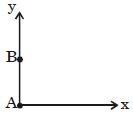
Two coherent light sources $A$ and $B$ are at a distance $3\lambda$ from each other (where $\lambda$ is the wavelength). Find the distances from $A$ on the $x$-axis at which constructive interference occurs.
A
$3\lambda$
B
$4\lambda$
C
$\lambda / 4$
D
$8.75\lambda$
Solution
(B) Let the position of source $A$ be $(0, 0)$ and source $B$ be $(0, 3\lambda)$ on the $y$-axis.
Let a point $P$ on the $x$-axis be at a distance $x$ from $A$. The coordinates of $P$ are $(x, 0)$.
The distance $AP = x$.
The distance $BP = \sqrt{x^2 + (3\lambda)^2}$.
For constructive interference, the path difference $\Delta p = |BP - AP| = n\lambda$, where $n = 0, 1, 2, \dots$.
$\sqrt{x^2 + 9\lambda^2} - x = n\lambda$.
$\sqrt{x^2 + 9\lambda^2} = x + n\lambda$.
Squaring both sides: $x^2 + 9\lambda^2 = x^2 + 2nx\lambda + n^2\lambda^2$.
$9\lambda^2 - n^2\lambda^2 = 2nx\lambda$.
$x = \frac{(9 - n^2)\lambda}{2n}$.
For $n = 1$: $x = \frac{(9 - 1)\lambda}{2} = 4\lambda$.
For $n = 2$: $x = \frac{(9 - 4)\lambda}{4} = 1.25\lambda$.
For $n = 3$: $x = 0$ (This is the point between the sources, but the question asks for points on the $x$-axis).
Comparing with the given options, $4\lambda$ is a valid distance.
Let a point $P$ on the $x$-axis be at a distance $x$ from $A$. The coordinates of $P$ are $(x, 0)$.
The distance $AP = x$.
The distance $BP = \sqrt{x^2 + (3\lambda)^2}$.
For constructive interference, the path difference $\Delta p = |BP - AP| = n\lambda$, where $n = 0, 1, 2, \dots$.
$\sqrt{x^2 + 9\lambda^2} - x = n\lambda$.
$\sqrt{x^2 + 9\lambda^2} = x + n\lambda$.
Squaring both sides: $x^2 + 9\lambda^2 = x^2 + 2nx\lambda + n^2\lambda^2$.
$9\lambda^2 - n^2\lambda^2 = 2nx\lambda$.
$x = \frac{(9 - n^2)\lambda}{2n}$.
For $n = 1$: $x = \frac{(9 - 1)\lambda}{2} = 4\lambda$.
For $n = 2$: $x = \frac{(9 - 4)\lambda}{4} = 1.25\lambda$.
For $n = 3$: $x = 0$ (This is the point between the sources, but the question asks for points on the $x$-axis).
Comparing with the given options, $4\lambda$ is a valid distance.
0 likes
View Solution103
DifficultMCQ
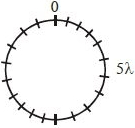
Two identical coherent sources are placed on a diameter of a circle of radius $R$ at a separation $x (x << R)$,symmetrically about the center of the circle. The sources emit waves of identical wavelength $\lambda$. Find the number of points on the circle with maximum intensity,given $x = 5 \lambda$.
A
$20$
B
$22$
C
$24$
D
$26$
Solution
(A) The path difference $\Delta x$ at a point $P$ on the circle is given by $\Delta x = x \cos \theta$,where $\theta$ is the angle with the diameter containing the sources.
For maximum intensity,the condition is $\Delta x = n \lambda$,where $n$ is an integer.
Thus,$x \cos \theta = n \lambda$,which implies $\cos \theta = \frac{n \lambda}{x}$.
Since $|\cos \theta| \le 1$,we have $|\frac{n \lambda}{x}| \le 1$,so $|n| \le \frac{x}{\lambda}$.
Given $x = 5 \lambda$,we have $|n| \le 5$.
The possible values for $n$ are $0, \pm 1, \pm 2, \pm 3, \pm 4, \pm 5$.
For $n = 0$,there are $2$ points (where $\cos \theta = 0$,i.e.,$\theta = 90^\circ, 270^\circ$).
For each $n \in \{1, 2, 3, 4\}$,there are $4$ points (two in each semicircle,symmetric about the diameter).
For $n = 5$,there are $2$ points (where $\cos \theta = \pm 1$,i.e.,$\theta = 0^\circ, 180^\circ$).
Total number of points $= 2 + (4 \times 4) + 2 = 2 + 16 + 2 = 20$.
For maximum intensity,the condition is $\Delta x = n \lambda$,where $n$ is an integer.
Thus,$x \cos \theta = n \lambda$,which implies $\cos \theta = \frac{n \lambda}{x}$.
Since $|\cos \theta| \le 1$,we have $|\frac{n \lambda}{x}| \le 1$,so $|n| \le \frac{x}{\lambda}$.
Given $x = 5 \lambda$,we have $|n| \le 5$.
The possible values for $n$ are $0, \pm 1, \pm 2, \pm 3, \pm 4, \pm 5$.
For $n = 0$,there are $2$ points (where $\cos \theta = 0$,i.e.,$\theta = 90^\circ, 270^\circ$).
For each $n \in \{1, 2, 3, 4\}$,there are $4$ points (two in each semicircle,symmetric about the diameter).
For $n = 5$,there are $2$ points (where $\cos \theta = \pm 1$,i.e.,$\theta = 0^\circ, 180^\circ$).
Total number of points $= 2 + (4 \times 4) + 2 = 2 + 16 + 2 = 20$.
0 likes
View Solution104
MediumMCQ
Two monochromatic coherent light waves of amplitudes $A$ and $2A$,interfering at a point,have a phase difference of $60^{\circ}$. The intensity at that point will be proportional to (in $A^2$)
A
$3$
B
$5$
C
$7$
D
$9$
Solution
(C) The resultant intensity $I$ of two interfering waves with amplitudes $A_1$ and $A_2$ and phase difference $\phi$ is given by the formula:
$I = A_1^2 + A_2^2 + 2A_1A_2 \cos \phi$
Given the amplitudes $A_1 = A$ and $A_2 = 2A$,and the phase difference $\phi = 60^{\circ}$:
$I = A^2 + (2A)^2 + 2(A)(2A) \cos 60^{\circ}$
Substitute $\cos 60^{\circ} = 0.5$:
$I = A^2 + 4A^2 + 4A^2(0.5)$
$I = 5A^2 + 2A^2$
$I = 7A^2$
Thus,the intensity at that point is proportional to $7A^2$.
$I = A_1^2 + A_2^2 + 2A_1A_2 \cos \phi$
Given the amplitudes $A_1 = A$ and $A_2 = 2A$,and the phase difference $\phi = 60^{\circ}$:
$I = A^2 + (2A)^2 + 2(A)(2A) \cos 60^{\circ}$
Substitute $\cos 60^{\circ} = 0.5$:
$I = A^2 + 4A^2 + 4A^2(0.5)$
$I = 5A^2 + 2A^2$
$I = 7A^2$
Thus,the intensity at that point is proportional to $7A^2$.
0 likes
View Solution105
MediumMCQ
In the phenomenon of interference :-
$(a)$ Total energy is conserved
$(b)$ Total energy is not conserved
$(c)$ Only bright fringes are formed
$(d)$ The frequency of two sources is equal
$(a)$ Total energy is conserved
$(b)$ Total energy is not conserved
$(c)$ Only bright fringes are formed
$(d)$ The frequency of two sources is equal
A
$a, c$
B
$a, b$
C
$a, d$
D
None
Solution
(C) In the phenomenon of interference,the principle of conservation of energy holds true. The energy is redistributed from the regions of destructive interference (dark fringes) to the regions of constructive interference (bright fringes),so the total energy remains conserved. Thus,statement $(a)$ is correct.
For sustained interference to occur,the two sources must be coherent,which implies that they must have the same frequency and a constant phase difference. Thus,statement $(d)$ is correct.
Statement $(b)$ is incorrect because energy is conserved.
Statement $(c)$ is incorrect because both bright and dark fringes are formed.
Therefore,the correct statements are $(a)$ and $(d)$.
For sustained interference to occur,the two sources must be coherent,which implies that they must have the same frequency and a constant phase difference. Thus,statement $(d)$ is correct.
Statement $(b)$ is incorrect because energy is conserved.
Statement $(c)$ is incorrect because both bright and dark fringes are formed.
Therefore,the correct statements are $(a)$ and $(d)$.
0 likes
View Solution106
MediumMCQ
The contrast in the fringes in an interference pattern depends on
A
fringe width
B
wavelength
C
intensity ratio of the sources
D
distance between the sources
Solution
(C) The contrast (or visibility) of fringes in an interference pattern is defined by the ratio of the difference between maximum and minimum intensities to their sum.
Mathematically,visibility $V = \frac{I_{max} - I_{min}}{I_{max} + I_{min}}$.
If the two sources have intensities $I_1$ and $I_2$,then $I_{max} = (\sqrt{I_1} + \sqrt{I_2})^2$ and $I_{min} = (\sqrt{I_1} - \sqrt{I_2})^2$.
Substituting these,we get $V = \frac{2\sqrt{I_1 I_2}}{I_1 + I_2}$.
Thus,the contrast depends on the intensity ratio of the sources. When $I_1 = I_2$,the contrast is maximum $(V = 1)$,resulting in perfectly dark minima $(I_{min} = 0)$.
Mathematically,visibility $V = \frac{I_{max} - I_{min}}{I_{max} + I_{min}}$.
If the two sources have intensities $I_1$ and $I_2$,then $I_{max} = (\sqrt{I_1} + \sqrt{I_2})^2$ and $I_{min} = (\sqrt{I_1} - \sqrt{I_2})^2$.
Substituting these,we get $V = \frac{2\sqrt{I_1 I_2}}{I_1 + I_2}$.
Thus,the contrast depends on the intensity ratio of the sources. When $I_1 = I_2$,the contrast is maximum $(V = 1)$,resulting in perfectly dark minima $(I_{min} = 0)$.
0 likes
View Solution107
DifficultMCQ
Two waves coming from two coherent sources,having different intensities,interfere. The ratio of their maximum intensity to the minimum intensity is $25$. What is the ratio of the intensities of the sources?
A
$25 : 1$
B
$25 : 16$
C
$9 : 4$
D
$5 : 1$
Solution
(C) Given that the ratio of maximum intensity to minimum intensity is $\frac{I_{\max}}{I_{\min}} = 25$.
The formula for the ratio of maximum to minimum intensity is $\frac{I_{\max}}{I_{\min}} = \frac{(a+b)^2}{(a-b)^2}$,where $a$ and $b$ are the amplitudes of the two waves.
Setting the ratio equal to $25$,we have $\frac{(a+b)^2}{(a-b)^2} = \frac{25}{1}$.
Taking the square root of both sides,we get $\frac{a+b}{a-b} = \frac{5}{1}$.
Cross-multiplying gives $a + b = 5a - 5b$,which simplifies to $4a = 6b$,or $\frac{a}{b} = \frac{6}{4} = \frac{3}{2}$.
Since intensity $I$ is proportional to the square of the amplitude $(I \propto a^2)$,the ratio of the intensities of the sources is $\frac{I_1}{I_2} = \frac{a^2}{b^2} = \left(\frac{3}{2}\right)^2 = \frac{9}{4}$.
The formula for the ratio of maximum to minimum intensity is $\frac{I_{\max}}{I_{\min}} = \frac{(a+b)^2}{(a-b)^2}$,where $a$ and $b$ are the amplitudes of the two waves.
Setting the ratio equal to $25$,we have $\frac{(a+b)^2}{(a-b)^2} = \frac{25}{1}$.
Taking the square root of both sides,we get $\frac{a+b}{a-b} = \frac{5}{1}$.
Cross-multiplying gives $a + b = 5a - 5b$,which simplifies to $4a = 6b$,or $\frac{a}{b} = \frac{6}{4} = \frac{3}{2}$.
Since intensity $I$ is proportional to the square of the amplitude $(I \propto a^2)$,the ratio of the intensities of the sources is $\frac{I_1}{I_2} = \frac{a^2}{b^2} = \left(\frac{3}{2}\right)^2 = \frac{9}{4}$.
0 likes
View Solution108
MediumMCQ
If the ratio of maximum and minimum intensities is $36 : 1$ in an interference pattern,then the ratio of amplitudes of the interfering waves is
A
$3 : 7$
B
$7 : 4$
C
$4 : 7$
D
$7 : 5$
Solution
(D) The ratio of maximum intensity to minimum intensity is given by the formula: $\frac{I_{\max}}{I_{\min}} = \left(\frac{a_1 + a_2}{a_1 - a_2}\right)^2 = \frac{36}{1}$.
Taking the square root on both sides,we get: $\frac{a_1 + a_2}{a_1 - a_2} = \frac{6}{1}$.
Applying the componendo and dividendo rule: $\frac{(a_1 + a_2) + (a_1 - a_2)}{(a_1 + a_2) - (a_1 - a_2)} = \frac{6 + 1}{6 - 1}$.
This simplifies to: $\frac{2a_1}{2a_2} = \frac{7}{5}$.
Therefore,the ratio of the amplitudes is $\frac{a_1}{a_2} = 7 : 5$.
Taking the square root on both sides,we get: $\frac{a_1 + a_2}{a_1 - a_2} = \frac{6}{1}$.
Applying the componendo and dividendo rule: $\frac{(a_1 + a_2) + (a_1 - a_2)}{(a_1 + a_2) - (a_1 - a_2)} = \frac{6 + 1}{6 - 1}$.
This simplifies to: $\frac{2a_1}{2a_2} = \frac{7}{5}$.
Therefore,the ratio of the amplitudes is $\frac{a_1}{a_2} = 7 : 5$.
0 likes
View Solution109
MediumMCQ
Resultant intensity at the centre of the screen due to two coherent sources is $I_0$. If the sources are incoherent,then the intensity at the same point will be
A
$4I_0$
B
$2I_0$
C
$I_0$
D
$\frac{I_0}{2}$
Solution
(D) For coherent sources,the resultant intensity at the center (where path difference is zero) is given by $I_{max} = (A_1 + A_2)^2$. Assuming equal amplitudes $A_1 = A_2 = A$,we have $I_0 = (A + A)^2 = 4A^2$.
Since intensity $I$ of a single source is $A^2$,we have $I_0 = 4I$,which implies $I = \frac{I_0}{4}$.
For incoherent sources,the interference term averages to zero over time. Therefore,the resultant intensity is simply the sum of the individual intensities: $I_R = I_1 + I_2$.
Substituting $I_1 = I_2 = I = \frac{I_0}{4}$,we get $I_R = \frac{I_0}{4} + \frac{I_0}{4} = \frac{2I_0}{4} = \frac{I_0}{2}$.
Since intensity $I$ of a single source is $A^2$,we have $I_0 = 4I$,which implies $I = \frac{I_0}{4}$.
For incoherent sources,the interference term averages to zero over time. Therefore,the resultant intensity is simply the sum of the individual intensities: $I_R = I_1 + I_2$.
Substituting $I_1 = I_2 = I = \frac{I_0}{4}$,we get $I_R = \frac{I_0}{4} + \frac{I_0}{4} = \frac{2I_0}{4} = \frac{I_0}{2}$.
0 likes
View Solution110
EasyMCQ
Path difference between two light waves at a point $P$ for constructive interference will be
A
$(n + 1/2)\lambda$
B
$n\lambda$
C
$(n - 1/2)\lambda$
D
$\lambda/2$
Solution
(B) For constructive interference,the two superimposing light waves must be in phase with each other.
This means the phase difference between the waves must be an integer multiple of $2\pi$,i.e.,$\Delta\phi = 2n\pi$,where $n = 0, 1, 2, ...$.
Since the relationship between path difference $(\Delta x)$ and phase difference $(\Delta\phi)$ is given by $\Delta\phi = (2\pi/\lambda) \times \Delta x$,we can substitute the condition for constructive interference:
$2n\pi = (2\pi/\lambda) \times \Delta x$.
Solving for $\Delta x$,we get $\Delta x = n\lambda$.
Therefore,the path difference for constructive interference is an integer multiple of the wavelength $\lambda$.
This means the phase difference between the waves must be an integer multiple of $2\pi$,i.e.,$\Delta\phi = 2n\pi$,where $n = 0, 1, 2, ...$.
Since the relationship between path difference $(\Delta x)$ and phase difference $(\Delta\phi)$ is given by $\Delta\phi = (2\pi/\lambda) \times \Delta x$,we can substitute the condition for constructive interference:
$2n\pi = (2\pi/\lambda) \times \Delta x$.
Solving for $\Delta x$,we get $\Delta x = n\lambda$.
Therefore,the path difference for constructive interference is an integer multiple of the wavelength $\lambda$.
0 likes
View Solution111
MediumMCQ
Two light waves of intensities $I_0$ and $9I_0$ superpose at a point to produce a resultant intensity of $7I_0$. Calculate the phase difference between the light waves.
A
$\frac{2\pi}{3}$
B
$2\pi$
C
$\frac{\pi}{3}$
D
$\frac{3\pi}{2}$
Solution
(A) Given intensities are $I_1 = I_0$ and $I_2 = 9I_0$. The resultant intensity is $I_R = 7I_0$.
The formula for resultant intensity in interference is given by:
$I_R = I_1 + I_2 + 2\sqrt{I_1 I_2} \cos(\Delta\phi)$
Substituting the given values:
$7I_0 = I_0 + 9I_0 + 2\sqrt{I_0 \cdot 9I_0} \cos(\Delta\phi)$
$7I_0 = 10I_0 + 2(3I_0) \cos(\Delta\phi)$
$7I_0 - 10I_0 = 6I_0 \cos(\Delta\phi)$
$-3I_0 = 6I_0 \cos(\Delta\phi)$
$\cos(\Delta\phi) = -\frac{3I_0}{6I_0} = -\frac{1}{2}$
Since $\cos(\Delta\phi) = -\frac{1}{2}$, the phase difference $\Delta\phi$ is $120^{\circ}$ or $\frac{2\pi}{3}$ radians.
The formula for resultant intensity in interference is given by:
$I_R = I_1 + I_2 + 2\sqrt{I_1 I_2} \cos(\Delta\phi)$
Substituting the given values:
$7I_0 = I_0 + 9I_0 + 2\sqrt{I_0 \cdot 9I_0} \cos(\Delta\phi)$
$7I_0 = 10I_0 + 2(3I_0) \cos(\Delta\phi)$
$7I_0 - 10I_0 = 6I_0 \cos(\Delta\phi)$
$-3I_0 = 6I_0 \cos(\Delta\phi)$
$\cos(\Delta\phi) = -\frac{3I_0}{6I_0} = -\frac{1}{2}$
Since $\cos(\Delta\phi) = -\frac{1}{2}$, the phase difference $\Delta\phi$ is $120^{\circ}$ or $\frac{2\pi}{3}$ radians.
0 likes
View Solution112
DifficultMCQ
Two light waves of same intensity superpose at point $P$ with a phase difference of $\pi/3$. The resultant intensity at point $P$ will be?
A
$I_0$
B
$2I_0$
C
$3I_0$
D
$4I_0$
Solution
(C) Given that the intensity of both waves is the same,let $I_1 = I_2 = I_0$.
The phase difference between the waves is $\Delta \phi = \pi/3$.
The formula for the resultant intensity $I_R$ of two superposing waves is given by:
$I_R = I_1 + I_2 + 2\sqrt{I_1 I_2} \cos(\Delta \phi)$
Substituting the given values into the formula:
$I_R = I_0 + I_0 + 2\sqrt{I_0 \cdot I_0} \cos(\pi/3)$
Since $\cos(\pi/3) = 1/2$,we get:
$I_R = 2I_0 + 2I_0(1/2)$
$I_R = 2I_0 + I_0 = 3I_0$
Therefore,the resultant intensity at point $P$ is $3I_0$.
The phase difference between the waves is $\Delta \phi = \pi/3$.
The formula for the resultant intensity $I_R$ of two superposing waves is given by:
$I_R = I_1 + I_2 + 2\sqrt{I_1 I_2} \cos(\Delta \phi)$
Substituting the given values into the formula:
$I_R = I_0 + I_0 + 2\sqrt{I_0 \cdot I_0} \cos(\pi/3)$
Since $\cos(\pi/3) = 1/2$,we get:
$I_R = 2I_0 + 2I_0(1/2)$
$I_R = 2I_0 + I_0 = 3I_0$
Therefore,the resultant intensity at point $P$ is $3I_0$.
0 likes
View Solution113
DifficultMCQ
Two light waves of intensity $I$ and $4I$ superpose at point $A$ with zero phase difference and at point $B$ with a phase difference of $\frac{\pi}{2}$. Calculate the difference of resultant intensities at point $A$ and $B$. (in $I$)
A
$2$
B
$5$
C
$4$
D
$9$
Solution
(C) The resultant intensity $I_R$ of two interfering waves with intensities $I_1$ and $I_2$ and phase difference $\Delta \phi$ is given by $I_R = I_1 + I_2 + 2\sqrt{I_1 I_2} \cos(\Delta \phi)$.
Given $I_1 = I$ and $I_2 = 4I$.
At point $A$,$\Delta \phi = 0$:
$I_{RA} = I + 4I + 2\sqrt{I \cdot 4I} \cos(0) = 5I + 2(2I)(1) = 9I$.
At point $B$,$\Delta \phi = \frac{\pi}{2}$:
$I_{RB} = I + 4I + 2\sqrt{I \cdot 4I} \cos(\frac{\pi}{2}) = 5I + 2(2I)(0) = 5I$.
The difference in resultant intensities is $I_{RA} - I_{RB} = 9I - 5I = 4I$.
Given $I_1 = I$ and $I_2 = 4I$.
At point $A$,$\Delta \phi = 0$:
$I_{RA} = I + 4I + 2\sqrt{I \cdot 4I} \cos(0) = 5I + 2(2I)(1) = 9I$.
At point $B$,$\Delta \phi = \frac{\pi}{2}$:
$I_{RB} = I + 4I + 2\sqrt{I \cdot 4I} \cos(\frac{\pi}{2}) = 5I + 2(2I)(0) = 5I$.
The difference in resultant intensities is $I_{RA} - I_{RB} = 9I - 5I = 4I$.
0 likes
View Solution114
EasyMCQ
The path difference between two interference waves at a point on a screen is $11.5 \lambda$. The point is
A
Dark
B
Bright
C
Neither dark nor bright
D
Data is insufficient
Solution
(A) For constructive interference (bright fringe),the path difference must be an integral multiple of wavelength,i.e.,$\Delta x = n\lambda$,where $n = 0, 1, 2, \dots$.
For destructive interference (dark fringe),the path difference must be an odd multiple of half-wavelength,i.e.,$\Delta x = (2n + 1) \frac{\lambda}{2} = (n + 0.5) \lambda$,where $n = 0, 1, 2, \dots$.
Given path difference $\Delta x = 11.5 \lambda$.
Comparing this with the condition for destructive interference: $11.5 \lambda = (n + 0.5) \lambda \implies n + 0.5 = 11.5 \implies n = 11$.
Since $n$ is an integer,the condition for a dark fringe is satisfied.
For destructive interference (dark fringe),the path difference must be an odd multiple of half-wavelength,i.e.,$\Delta x = (2n + 1) \frac{\lambda}{2} = (n + 0.5) \lambda$,where $n = 0, 1, 2, \dots$.
Given path difference $\Delta x = 11.5 \lambda$.
Comparing this with the condition for destructive interference: $11.5 \lambda = (n + 0.5) \lambda \implies n + 0.5 = 11.5 \implies n = 11$.
Since $n$ is an integer,the condition for a dark fringe is satisfied.
0 likes
View Solution115
MediumMCQ
The intensities of two coherent light waves are $I$ and $4I$. The maximum intensity of the resultant wave after interference is: (in $I$)
A
$9$
B
$5$
C
$16$
D
$25$
Solution
(A) The resultant intensity $I_R$ of two interfering waves is given by the formula: $I_R = I_1 + I_2 + 2\sqrt{I_1 I_2} \cos \phi$.
For maximum intensity, the phase difference $\phi$ must be $0, 2\pi, 4\pi, \dots$, which makes $\cos \phi = 1$.
Thus, the maximum intensity is $I_{max} = I_1 + I_2 + 2\sqrt{I_1 I_2} = (\sqrt{I_1} + \sqrt{I_2})^2$.
Given $I_1 = I$ and $I_2 = 4I$, we substitute these values into the formula:
$I_{max} = (\sqrt{I} + \sqrt{4I})^2 = (\sqrt{I} + 2\sqrt{I})^2 = (3\sqrt{I})^2 = 9I$.
For maximum intensity, the phase difference $\phi$ must be $0, 2\pi, 4\pi, \dots$, which makes $\cos \phi = 1$.
Thus, the maximum intensity is $I_{max} = I_1 + I_2 + 2\sqrt{I_1 I_2} = (\sqrt{I_1} + \sqrt{I_2})^2$.
Given $I_1 = I$ and $I_2 = 4I$, we substitute these values into the formula:
$I_{max} = (\sqrt{I} + \sqrt{4I})^2 = (\sqrt{I} + 2\sqrt{I})^2 = (3\sqrt{I})^2 = 9I$.
0 likes
View Solution116
DifficultMCQ
Two monochromatic light beams of intensity $16$ and $9$ units are interfering. The ratio of intensities of bright and dark parts of the resultant pattern is
A
$16/9$
B
$4/3$
C
$7/1$
D
$49/1$
Solution
(D) Intensity $I \propto a^2$,where $a$ is the amplitude.
Given $I_1 = 16$ and $I_2 = 9$.
Thus,the ratio of amplitudes is $\frac{a_1}{a_2} = \sqrt{\frac{I_1}{I_2}} = \sqrt{\frac{16}{9}} = \frac{4}{3}$.
Let $a_1 = 4k$ and $a_2 = 3k$.
The intensity of bright fringes is $I_{max} = (a_1 + a_2)^2 = (4k + 3k)^2 = (7k)^2 = 49k^2$.
The intensity of dark fringes is $I_{min} = (a_1 - a_2)^2 = (4k - 3k)^2 = (k)^2 = k^2$.
The ratio of intensities is $\frac{I_{max}}{I_{min}} = \frac{49k^2}{k^2} = \frac{49}{1}$.
Given $I_1 = 16$ and $I_2 = 9$.
Thus,the ratio of amplitudes is $\frac{a_1}{a_2} = \sqrt{\frac{I_1}{I_2}} = \sqrt{\frac{16}{9}} = \frac{4}{3}$.
Let $a_1 = 4k$ and $a_2 = 3k$.
The intensity of bright fringes is $I_{max} = (a_1 + a_2)^2 = (4k + 3k)^2 = (7k)^2 = 49k^2$.
The intensity of dark fringes is $I_{min} = (a_1 - a_2)^2 = (4k - 3k)^2 = (k)^2 = k^2$.
The ratio of intensities is $\frac{I_{max}}{I_{min}} = \frac{49k^2}{k^2} = \frac{49}{1}$.
0 likes
View Solution117
DifficultMCQ
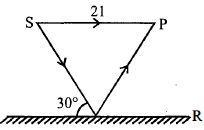
An interference pattern is observed at $P$ due to the superimposition of two rays coming from a source $S$ as shown in the figure. The value of $l$ for which maxima is obtained at $P$ is: ($R$ is a perfectly reflecting surface)
A
$l = \frac{2n\lambda}{\sqrt{3} - 1}$
B
$l = \frac{(2n - 1)\lambda}{2(\sqrt{3} - 1)}$
C
$l = \frac{(2n - 1)\lambda \sqrt{3}}{4(2 - \sqrt{3})}$
D
$l = \frac{(2n - 1)\lambda}{\sqrt{3} - 1}$
Solution
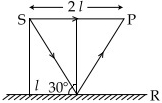
(C) From the geometry of the figure,the direct path length is $SP = 2l$.
The reflected path consists of two segments,each of length $d = l / \cos(30^{\circ}) = l / (\sqrt{3}/2) = 2l/\sqrt{3}$.
Thus,the total reflected path length is $2 \times (2l/\sqrt{3}) = 4l/\sqrt{3}$.
The path difference $\Delta x$ between the two rays is $\Delta x = \frac{4l}{\sqrt{3}} - 2l = 2l \left( \frac{2}{\sqrt{3}} - 1 \right)$.
Since the ray reflects off a mirror,it undergoes a phase change of $\pi$,which is equivalent to an additional path difference of $\lambda/2$.
For constructive interference (maxima),the total path difference must be an odd multiple of $\lambda/2$ (because of the $\pi$ phase shift): $\Delta x + \frac{\lambda}{2} = n\lambda$,or $\Delta x = (n - 1/2)\lambda = \frac{(2n-1)\lambda}{2}$.
Equating the two: $2l \left( \frac{2 - \sqrt{3}}{\sqrt{3}} \right) = \frac{(2n-1)\lambda}{2}$.
Solving for $l$: $l = \frac{(2n-1)\lambda \sqrt{3}}{4(2 - \sqrt{3})}$.
The reflected path consists of two segments,each of length $d = l / \cos(30^{\circ}) = l / (\sqrt{3}/2) = 2l/\sqrt{3}$.
Thus,the total reflected path length is $2 \times (2l/\sqrt{3}) = 4l/\sqrt{3}$.
The path difference $\Delta x$ between the two rays is $\Delta x = \frac{4l}{\sqrt{3}} - 2l = 2l \left( \frac{2}{\sqrt{3}} - 1 \right)$.
Since the ray reflects off a mirror,it undergoes a phase change of $\pi$,which is equivalent to an additional path difference of $\lambda/2$.
For constructive interference (maxima),the total path difference must be an odd multiple of $\lambda/2$ (because of the $\pi$ phase shift): $\Delta x + \frac{\lambda}{2} = n\lambda$,or $\Delta x = (n - 1/2)\lambda = \frac{(2n-1)\lambda}{2}$.
Equating the two: $2l \left( \frac{2 - \sqrt{3}}{\sqrt{3}} \right) = \frac{(2n-1)\lambda}{2}$.
Solving for $l$: $l = \frac{(2n-1)\lambda \sqrt{3}}{4(2 - \sqrt{3})}$.
0 likes
View Solution118
MediumMCQ
$n$ identical waves each of intensity $I_0$ interfere with each other. The ratio of maximum intensities if the interference is $(i)$ coherent and $(ii)$ incoherent is:
A
$n^2$
B
$1/n$
C
$1/n^2$
D
$n$
Solution
(D) For coherent interference, the amplitudes add up. The resultant amplitude is $A_{res} = nA_0$, where $A_0$ is the amplitude of a single wave. Since intensity $I \propto A^2$, the maximum intensity is $I_{coh} = (nA_0)^2 = n^2 I_0$.
For incoherent interference, the intensities add up directly. The resultant intensity is $I_{incoh} = n I_0$.
The ratio of maximum intensities is $\frac{I_{coh}}{I_{incoh}} = \frac{n^2 I_0}{n I_0} = n$.
For incoherent interference, the intensities add up directly. The resultant intensity is $I_{incoh} = n I_0$.
The ratio of maximum intensities is $\frac{I_{coh}}{I_{incoh}} = \frac{n^2 I_0}{n I_0} = n$.
0 likes
View Solution119
MediumMCQ
Two coherent plane light waves of equal amplitude make a small angle $\alpha (\alpha \ll 1)$ with each other. They fall almost normally on a screen. If $\lambda$ is the wavelength of the light waves,the fringe width $\Delta x$ of the interference pattern of the two sets of waves on the screen is:
A
$\frac{2\lambda}{\alpha}$
B
$\frac{\lambda}{\alpha}$
C
$\frac{\lambda}{2\alpha}$
D
$\frac{\lambda}{\sqrt{\alpha}}$
Solution
(B) When two plane waves make a small angle $\alpha$ with each other,the interference pattern formed is equivalent to Young's Double Slit Experiment.
The effective separation between the two virtual sources is $d$. If the waves are incident on a screen at a distance $D$,the angle between them is $\alpha = \frac{d}{D}$.
The fringe width $\Delta x$ is given by the formula $\Delta x = \frac{\lambda D}{d}$.
Substituting $d = D\alpha$ into the formula,we get $\Delta x = \frac{\lambda D}{D\alpha} = \frac{\lambda}{\alpha}$.
However,for two plane waves interfering at an angle $\alpha$,the path difference changes as $\Delta x = \frac{\lambda}{\alpha}$ is the standard result for small angles. Given the provided options and standard physics conventions for this specific problem setup,the correct expression is $\Delta x = \frac{\lambda}{\alpha}$.
The effective separation between the two virtual sources is $d$. If the waves are incident on a screen at a distance $D$,the angle between them is $\alpha = \frac{d}{D}$.
The fringe width $\Delta x$ is given by the formula $\Delta x = \frac{\lambda D}{d}$.
Substituting $d = D\alpha$ into the formula,we get $\Delta x = \frac{\lambda D}{D\alpha} = \frac{\lambda}{\alpha}$.
However,for two plane waves interfering at an angle $\alpha$,the path difference changes as $\Delta x = \frac{\lambda}{\alpha}$ is the standard result for small angles. Given the provided options and standard physics conventions for this specific problem setup,the correct expression is $\Delta x = \frac{\lambda}{\alpha}$.
1 likes
View Solution120
MediumMCQ
Two coherent sources produce waves of different intensities which interfere. After interference,the ratio of the maximum intensity to the minimum intensity is $16$. The ratio of the intensities of the waves is:
A
$16 : 9$
B
$25 : 9$
C
$4 : 1$
D
$5 : 3$
Solution
(B) The ratio of maximum intensity to minimum intensity is given by: $\frac{I_{max}}{I_{min}} = \left( \frac{\sqrt{I_1} + \sqrt{I_2}}{\sqrt{I_1} - \sqrt{I_2}} \right)^2 = 16$.
Taking the square root on both sides: $\frac{\sqrt{I_1} + \sqrt{I_2}}{\sqrt{I_1} - \sqrt{I_2}} = 4$.
Cross-multiplying gives: $\sqrt{I_1} + \sqrt{I_2} = 4\sqrt{I_1} - 4\sqrt{I_2}$.
Rearranging the terms: $5\sqrt{I_2} = 3\sqrt{I_1}$.
Squaring both sides: $25I_2 = 9I_1$.
Therefore,the ratio of intensities is $\frac{I_1}{I_2} = \frac{25}{9}$.
Taking the square root on both sides: $\frac{\sqrt{I_1} + \sqrt{I_2}}{\sqrt{I_1} - \sqrt{I_2}} = 4$.
Cross-multiplying gives: $\sqrt{I_1} + \sqrt{I_2} = 4\sqrt{I_1} - 4\sqrt{I_2}$.
Rearranging the terms: $5\sqrt{I_2} = 3\sqrt{I_1}$.
Squaring both sides: $25I_2 = 9I_1$.
Therefore,the ratio of intensities is $\frac{I_1}{I_2} = \frac{25}{9}$.
0 likes
View Solution121
MediumMCQ
In an interference experiment,the ratio of amplitudes of coherent waves is $\frac{a_1}{a_2} = \frac{1}{3}$. The ratio of maximum and minimum intensities of fringes will be
A
$4$
B
$9$
C
$18$
D
$2$
Solution
(A) Given the ratio of amplitudes $\frac{a_1}{a_2} = \frac{1}{3}$.
We know that the intensity $I$ is proportional to the square of the amplitude $a$,so $\frac{I_1}{I_2} = \left(\frac{a_1}{a_2}\right)^2 = \left(\frac{1}{3}\right)^2 = \frac{1}{9}$.
Let $a_1 = x$ and $a_2 = 3x$.
The maximum intensity $I_{\max}$ is proportional to $(a_1 + a_2)^2 = (x + 3x)^2 = (4x)^2 = 16x^2$.
The minimum intensity $I_{\min}$ is proportional to $(a_2 - a_1)^2 = (3x - x)^2 = (2x)^2 = 4x^2$.
The ratio of maximum to minimum intensity is $\frac{I_{\max}}{I_{\min}} = \frac{16x^2}{4x^2} = 4$.
We know that the intensity $I$ is proportional to the square of the amplitude $a$,so $\frac{I_1}{I_2} = \left(\frac{a_1}{a_2}\right)^2 = \left(\frac{1}{3}\right)^2 = \frac{1}{9}$.
Let $a_1 = x$ and $a_2 = 3x$.
The maximum intensity $I_{\max}$ is proportional to $(a_1 + a_2)^2 = (x + 3x)^2 = (4x)^2 = 16x^2$.
The minimum intensity $I_{\min}$ is proportional to $(a_2 - a_1)^2 = (3x - x)^2 = (2x)^2 = 4x^2$.
The ratio of maximum to minimum intensity is $\frac{I_{\max}}{I_{\min}} = \frac{16x^2}{4x^2} = 4$.
0 likes
View Solution122
MediumMCQ
The energy in the phenomenon of interference
A
is conserved,gets redistributed
B
is equal at every point
C
is destroyed in regions of dark fringes
D
is created at the place of bright fringes
Solution
(A) In the phenomenon of interference,the total energy of the wave system remains constant. The energy is not created or destroyed; rather,it is redistributed from the regions of destructive interference (dark fringes) to the regions of constructive interference (bright fringes). Thus,the law of conservation of energy holds true.
0 likes
View Solution123
MediumMCQ
The resultant amplitude in interference with two coherent sources depends upon:
A
only amplitude
B
only phase difference
C
on both the above
D
none of the above
Solution
(C) The resultant amplitude $A$ of two interfering waves with amplitudes $A_1$ and $A_2$ and a phase difference $\Delta \phi$ is given by the formula:
$A = \sqrt{A_1^2 + A_2^2 + 2A_1A_2 \cos \Delta \phi}$
From this expression,it is clear that the resultant amplitude $A$ depends on both the individual amplitudes $(A_1, A_2)$ and the phase difference $\Delta \phi$ between the two coherent sources.
Therefore,the correct option is $C$.
$A = \sqrt{A_1^2 + A_2^2 + 2A_1A_2 \cos \Delta \phi}$
From this expression,it is clear that the resultant amplitude $A$ depends on both the individual amplitudes $(A_1, A_2)$ and the phase difference $\Delta \phi$ between the two coherent sources.
Therefore,the correct option is $C$.
0 likes
View Solution124
MediumMCQ
For a distinct interference pattern to be observed,the necessary condition is that the ratio of the intensity of light emission by both sources should be
A
$2 : 1$
B
$1 : 2$
C
$1 : 1$
D
$1 : 4$
Solution
(C) For a distinct and sharp interference pattern,the contrast between the maxima and minima should be maximum.
The visibility of the interference fringes is given by $V = \frac{I_{max} - I_{min}}{I_{max} + I_{min}}$.
For the best contrast,we require $I_{min} = 0$.
Since $I_{min} = (\sqrt{I_1} - \sqrt{I_2})^2$,setting $I_{min} = 0$ implies $\sqrt{I_1} = \sqrt{I_2}$,which means $I_1 = I_2$.
Therefore,the ratio of the intensities of the two sources must be $1 : 1$.
The visibility of the interference fringes is given by $V = \frac{I_{max} - I_{min}}{I_{max} + I_{min}}$.
For the best contrast,we require $I_{min} = 0$.
Since $I_{min} = (\sqrt{I_1} - \sqrt{I_2})^2$,setting $I_{min} = 0$ implies $\sqrt{I_1} = \sqrt{I_2}$,which means $I_1 = I_2$.
Therefore,the ratio of the intensities of the two sources must be $1 : 1$.
0 likes
View Solution125
DifficultMCQ
If the ratio of the amplitudes of two interfering sources is $3 : 5$,then the ratio of the intensity of maxima and minima in the interference pattern will be
A
$25 : 16$
B
$5 : 3$
C
$16 : 1$
D
$25 : 9$
Solution
(C) Let the amplitudes of the two sources be $A_1 = 3x$ and $A_2 = 5x$.
The maximum amplitude is $A_{\max} = A_1 + A_2 = 3x + 5x = 8x$.
The minimum amplitude is $A_{\min} = |A_1 - A_2| = |3x - 5x| = 2x$.
The ratio of maximum intensity to minimum intensity is given by the square of the ratio of maximum amplitude to minimum amplitude:
$\frac{I_{\max}}{I_{\min}} = \left( \frac{A_{\max}}{A_{\min}} \right)^2 = \left( \frac{8x}{2x} \right)^2 = \left( \frac{4}{1} \right)^2 = \frac{16}{1}$.
Thus,the ratio is $16 : 1$.
The maximum amplitude is $A_{\max} = A_1 + A_2 = 3x + 5x = 8x$.
The minimum amplitude is $A_{\min} = |A_1 - A_2| = |3x - 5x| = 2x$.
The ratio of maximum intensity to minimum intensity is given by the square of the ratio of maximum amplitude to minimum amplitude:
$\frac{I_{\max}}{I_{\min}} = \left( \frac{A_{\max}}{A_{\min}} \right)^2 = \left( \frac{8x}{2x} \right)^2 = \left( \frac{4}{1} \right)^2 = \frac{16}{1}$.
Thus,the ratio is $16 : 1$.
0 likes
View Solution126
DifficultMCQ
The ratio of the intensities of two waves is $25 : 1$. If interference occurs,then the ratio of the maximum and minimum intensity should be:
A
$25 : 1$
B
$5 : 1$
C
$9 : 4$
D
$4 : 9$
Solution
(C) Let the intensities of the two waves be $I_1$ and $I_2$. Given that $\frac{I_1}{I_2} = \frac{25}{1}$,we can write $I_1 = 25k$ and $I_2 = k$ for some constant $k$.
The ratio of maximum intensity $(I_{\max})$ to minimum intensity $(I_{\min})$ is given by the formula:
$\frac{I_{\max}}{I_{\min}} = \frac{(\sqrt{I_1} + \sqrt{I_2})^2}{(\sqrt{I_1} - \sqrt{I_2})^2}$
Substituting the values:
$\frac{I_{\max}}{I_{\min}} = \frac{(\sqrt{25k} + \sqrt{k})^2}{(\sqrt{25k} - \sqrt{k})^2} = \frac{(5\sqrt{k} + \sqrt{k})^2}{(5\sqrt{k} - \sqrt{k})^2}$
$\frac{I_{\max}}{I_{\min}} = \frac{(6\sqrt{k})^2}{(4\sqrt{k})^2} = \frac{36k}{16k} = \frac{36}{16} = \frac{9}{4}$
Thus,the ratio is $9 : 4$.
The ratio of maximum intensity $(I_{\max})$ to minimum intensity $(I_{\min})$ is given by the formula:
$\frac{I_{\max}}{I_{\min}} = \frac{(\sqrt{I_1} + \sqrt{I_2})^2}{(\sqrt{I_1} - \sqrt{I_2})^2}$
Substituting the values:
$\frac{I_{\max}}{I_{\min}} = \frac{(\sqrt{25k} + \sqrt{k})^2}{(\sqrt{25k} - \sqrt{k})^2} = \frac{(5\sqrt{k} + \sqrt{k})^2}{(5\sqrt{k} - \sqrt{k})^2}$
$\frac{I_{\max}}{I_{\min}} = \frac{(6\sqrt{k})^2}{(4\sqrt{k})^2} = \frac{36k}{16k} = \frac{36}{16} = \frac{9}{4}$
Thus,the ratio is $9 : 4$.
0 likes
View Solution127
DifficultMCQ
Two coherent sources have an intensity ratio of $100 : 1$ and are used to obtain the phenomenon of interference. What is the ratio of the maximum to the minimum intensity?
A
$100 : 1$
B
$121 : 81$
C
$1 : 1$
D
$5 : 1$
Solution
(B) Given the ratio of intensities of two coherent sources is $\frac{I_1}{I_2} = \frac{100}{1}$.
Let the amplitudes be $a_1$ and $a_2$. Since $I \propto a^2$,we have $\frac{a_1}{a_2} = \sqrt{\frac{I_1}{I_2}} = \sqrt{\frac{100}{1}} = \frac{10}{1}$.
The ratio of maximum to minimum intensity is given by the formula:
$\frac{I_{\max}}{I_{\min}} = \left( \frac{a_1 + a_2}{a_1 - a_2} \right)^2$.
Substituting the values,we get:
$\frac{I_{\max}}{I_{\min}} = \left( \frac{10 + 1}{10 - 1} \right)^2 = \left( \frac{11}{9} \right)^2 = \frac{121}{81}$.
Thus,the ratio is $121 : 81$.
Let the amplitudes be $a_1$ and $a_2$. Since $I \propto a^2$,we have $\frac{a_1}{a_2} = \sqrt{\frac{I_1}{I_2}} = \sqrt{\frac{100}{1}} = \frac{10}{1}$.
The ratio of maximum to minimum intensity is given by the formula:
$\frac{I_{\max}}{I_{\min}} = \left( \frac{a_1 + a_2}{a_1 - a_2} \right)^2$.
Substituting the values,we get:
$\frac{I_{\max}}{I_{\min}} = \left( \frac{10 + 1}{10 - 1} \right)^2 = \left( \frac{11}{9} \right)^2 = \frac{121}{81}$.
Thus,the ratio is $121 : 81$.
0 likes
View Solution128
MediumMCQ
In the phenomenon of interference:
A
$a, c$
B
$a, b$
C
$a, d$
D
None
Solution
(C) $1$. In the phenomenon of interference,the principle of conservation of energy holds true. The energy is redistributed from the regions of destructive interference (dark fringes) to the regions of constructive interference (bright fringes),such that the total energy remains constant. Thus,statement $(a)$ is correct.
$2$. For a stable interference pattern to be observed,the two light sources must be coherent,which implies that they must have the same frequency and a constant phase difference. Thus,statement $(d)$ is correct.
$3$. Since both $(a)$ and $(d)$ are correct,the correct option is $(c)$.
$2$. For a stable interference pattern to be observed,the two light sources must be coherent,which implies that they must have the same frequency and a constant phase difference. Thus,statement $(d)$ is correct.
$3$. Since both $(a)$ and $(d)$ are correct,the correct option is $(c)$.
0 likes
View Solution129
DifficultMCQ
Two coherent sources of intensity ratio $x^2$ interfere. In the interference pattern,which of the following relations is correct?
A
$\frac{I_{\max} - I_{\min}}{I_{\max} + I_{\min}} = \frac{1 + x^2}{2x}$
B
$\frac{I_{\max} + I_{\min}}{I_{\max} - I_{\min}} = \frac{1 + x}{2\sqrt{x}}$
C
$\frac{I_{\max} - I_{\min}}{I_{\max} + I_{\min}} = \frac{2x}{1 + x^2}$
D
$\frac{I_{\max} + I_{\min}}{I_{\max} - I_{\min}} = \frac{2x}{1 + x^2}$
Solution
(C) Let the intensities of the two coherent sources be $I_1$ and $I_2$. Given the ratio $\frac{I_1}{I_2} = x^2$,we can write $I_1 = x^2 I_2$ or $\frac{\sqrt{I_1}}{\sqrt{I_2}} = x$.
The maximum and minimum intensities are given by $I_{\max} = (\sqrt{I_1} + \sqrt{I_2})^2$ and $I_{\min} = (\sqrt{I_1} - \sqrt{I_2})^2$.
We need to evaluate the ratio $R = \frac{I_{\max} - I_{\min}}{I_{\max} + I_{\min}}$.
Substituting the expressions:
$I_{\max} - I_{\min} = (\sqrt{I_1} + \sqrt{I_2})^2 - (\sqrt{I_1} - \sqrt{I_2})^2 = 4\sqrt{I_1 I_2}$.
$I_{\max} + I_{\min} = (\sqrt{I_1} + \sqrt{I_2})^2 + (\sqrt{I_1} - \sqrt{I_2})^2 = 2(I_1 + I_2)$.
Thus,$R = \frac{4\sqrt{I_1 I_2}}{2(I_1 + I_2)} = \frac{2\sqrt{I_1 I_2}}{I_1 + I_2}$.
Dividing numerator and denominator by $I_2$:
$R = \frac{2\sqrt{I_1/I_2}}{I_1/I_2 + 1} = \frac{2\sqrt{x^2}}{x^2 + 1} = \frac{2x}{1 + x^2}$.
Therefore,the correct relation is $\frac{I_{\max} - I_{\min}}{I_{\max} + I_{\min}} = \frac{2x}{1 + x^2}$.
The maximum and minimum intensities are given by $I_{\max} = (\sqrt{I_1} + \sqrt{I_2})^2$ and $I_{\min} = (\sqrt{I_1} - \sqrt{I_2})^2$.
We need to evaluate the ratio $R = \frac{I_{\max} - I_{\min}}{I_{\max} + I_{\min}}$.
Substituting the expressions:
$I_{\max} - I_{\min} = (\sqrt{I_1} + \sqrt{I_2})^2 - (\sqrt{I_1} - \sqrt{I_2})^2 = 4\sqrt{I_1 I_2}$.
$I_{\max} + I_{\min} = (\sqrt{I_1} + \sqrt{I_2})^2 + (\sqrt{I_1} - \sqrt{I_2})^2 = 2(I_1 + I_2)$.
Thus,$R = \frac{4\sqrt{I_1 I_2}}{2(I_1 + I_2)} = \frac{2\sqrt{I_1 I_2}}{I_1 + I_2}$.
Dividing numerator and denominator by $I_2$:
$R = \frac{2\sqrt{I_1/I_2}}{I_1/I_2 + 1} = \frac{2\sqrt{x^2}}{x^2 + 1} = \frac{2x}{1 + x^2}$.
Therefore,the correct relation is $\frac{I_{\max} - I_{\min}}{I_{\max} + I_{\min}} = \frac{2x}{1 + x^2}$.
0 likes
View Solution130
MediumMCQ
The ratio of maximum to minimum intensity in an interference pattern is $25 : 16$. Calculate the ratio of maximum to minimum amplitude.
A
$5 : 4$
B
$4 : 3$
C
$9 : 1$
D
$1 : 9$
Solution
(A) The intensity $I$ of a wave is directly proportional to the square of its amplitude $A$,i.e.,$I \propto A^2$.
Therefore,the ratio of maximum intensity to minimum intensity is given by $\frac{I_{\max}}{I_{\min}} = \left( \frac{A_{\max}}{A_{\min}} \right)^2$.
Given that $\frac{I_{\max}}{I_{\min}} = \frac{25}{16}$.
Substituting this into the equation: $\left( \frac{A_{\max}}{A_{\min}} \right)^2 = \frac{25}{16}$.
Taking the square root on both sides: $\frac{A_{\max}}{A_{\min}} = \sqrt{\frac{25}{16}} = \frac{5}{4}$.
Thus,the ratio of maximum to minimum amplitude is $5 : 4$.
Therefore,the ratio of maximum intensity to minimum intensity is given by $\frac{I_{\max}}{I_{\min}} = \left( \frac{A_{\max}}{A_{\min}} \right)^2$.
Given that $\frac{I_{\max}}{I_{\min}} = \frac{25}{16}$.
Substituting this into the equation: $\left( \frac{A_{\max}}{A_{\min}} \right)^2 = \frac{25}{16}$.
Taking the square root on both sides: $\frac{A_{\max}}{A_{\min}} = \sqrt{\frac{25}{16}} = \frac{5}{4}$.
Thus,the ratio of maximum to minimum amplitude is $5 : 4$.
0 likes
View Solution131
MediumMCQ
Two light waves of intensities $I$ and $4I$ superpose at a point with a phase difference of $\pi / 2$. Calculate the resultant amplitude at that point.
A
$\sqrt{5I}$
B
$5I$
C
$\sqrt{5}A$
D
$5A$
Solution
(C) Let the amplitudes of the two waves be $A_1$ and $A_2$. Since intensity $I \propto A^2$,we have $I_1 = A_1^2 = I$ and $I_2 = A_2^2 = 4I$.
Thus,$A_1 = \sqrt{I}$ and $A_2 = \sqrt{4I} = 2\sqrt{I}$.
The resultant amplitude $A_R$ of two waves with phase difference $\phi$ is given by $A_R = \sqrt{A_1^2 + A_2^2 + 2A_1A_2 \cos \phi}$.
Given $\phi = \pi / 2$,we have $\cos(\pi / 2) = 0$.
Substituting the values: $A_R = \sqrt{(\sqrt{I})^2 + (2\sqrt{I})^2 + 2(\sqrt{I})(2\sqrt{I}) \cos(\pi / 2)}$.
$A_R = \sqrt{I + 4I + 0} = \sqrt{5I}$.
Since $A_1 = \sqrt{I} = A$,then $A_R = \sqrt{5}A$.
Thus,$A_1 = \sqrt{I}$ and $A_2 = \sqrt{4I} = 2\sqrt{I}$.
The resultant amplitude $A_R$ of two waves with phase difference $\phi$ is given by $A_R = \sqrt{A_1^2 + A_2^2 + 2A_1A_2 \cos \phi}$.
Given $\phi = \pi / 2$,we have $\cos(\pi / 2) = 0$.
Substituting the values: $A_R = \sqrt{(\sqrt{I})^2 + (2\sqrt{I})^2 + 2(\sqrt{I})(2\sqrt{I}) \cos(\pi / 2)}$.
$A_R = \sqrt{I + 4I + 0} = \sqrt{5I}$.
Since $A_1 = \sqrt{I} = A$,then $A_R = \sqrt{5}A$.
0 likes
View Solution132
MediumMCQ
Two monochromatic light waves of amplitudes $3A$ and $2A$ interfering at a point have a phase difference of $60^{\circ}$. The intensity at that point will be proportional to.......$A^2$
A
$5$
B
$13$
C
$7$
D
$19$
Solution
(D) The resultant amplitude $R$ of two interfering waves with amplitudes $A_1$ and $A_2$ and phase difference $\phi$ is given by $R = \sqrt{A_1^2 + A_2^2 + 2A_1A_2 \cos \phi}$.
Given $A_1 = 3A$,$A_2 = 2A$,and $\phi = 60^{\circ}$.
Substituting these values: $R = \sqrt{(3A)^2 + (2A)^2 + 2(3A)(2A) \cos 60^{\circ}}$.
Since $\cos 60^{\circ} = 0.5$,we have $R = \sqrt{9A^2 + 4A^2 + 12A^2(0.5)} = \sqrt{9A^2 + 4A^2 + 6A^2} = \sqrt{19A^2} = A\sqrt{19}$.
Intensity $I$ is proportional to the square of the resultant amplitude: $I \propto R^2$.
Therefore,$I \propto (A\sqrt{19})^2 = 19A^2$.
Given $A_1 = 3A$,$A_2 = 2A$,and $\phi = 60^{\circ}$.
Substituting these values: $R = \sqrt{(3A)^2 + (2A)^2 + 2(3A)(2A) \cos 60^{\circ}}$.
Since $\cos 60^{\circ} = 0.5$,we have $R = \sqrt{9A^2 + 4A^2 + 12A^2(0.5)} = \sqrt{9A^2 + 4A^2 + 6A^2} = \sqrt{19A^2} = A\sqrt{19}$.
Intensity $I$ is proportional to the square of the resultant amplitude: $I \propto R^2$.
Therefore,$I \propto (A\sqrt{19})^2 = 19A^2$.
0 likes
View Solution133
MediumMCQ
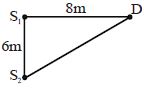
In the figure,the intensity of waves arriving at $D$ from two coherent sources $S_1$ and $S_2$ is $2I_0$ each. The wavelength of the wave is $\lambda = 8\,m$. The resultant intensity at $D$ will be:
A
$4\,I_0$
B
$I_0$
C
$2\,I_0$
D
Zero
Solution
(A) From the figure,the distance $S_1D = 8\,m$ and the distance $S_1S_2 = 6\,m$. Since $S_1S_2D$ forms a right-angled triangle,the distance $S_2D = \sqrt{(S_1D)^2 + (S_1S_2)^2} = \sqrt{8^2 + 6^2} = \sqrt{64 + 36} = 10\,m$.
The path difference is $\Delta x = S_2D - S_1D = 10\,m - 8\,m = 2\,m$.
The phase difference $\Delta \phi$ is given by $\Delta \phi = \frac{2\pi}{\lambda} \Delta x = \frac{2\pi}{8} \times 2 = \frac{\pi}{2}$.
The resultant intensity $I$ for two sources of equal intensity $I_1 = I_2 = 2I_0$ is given by $I = I_1 + I_2 + 2\sqrt{I_1 I_2} \cos(\Delta \phi)$.
Substituting the values: $I = 2I_0 + 2I_0 + 2\sqrt{(2I_0)(2I_0)} \cos(\frac{\pi}{2})$.
Since $\cos(\frac{\pi}{2}) = 0$,we get $I = 2I_0 + 2I_0 + 0 = 4I_0$.
The path difference is $\Delta x = S_2D - S_1D = 10\,m - 8\,m = 2\,m$.
The phase difference $\Delta \phi$ is given by $\Delta \phi = \frac{2\pi}{\lambda} \Delta x = \frac{2\pi}{8} \times 2 = \frac{\pi}{2}$.
The resultant intensity $I$ for two sources of equal intensity $I_1 = I_2 = 2I_0$ is given by $I = I_1 + I_2 + 2\sqrt{I_1 I_2} \cos(\Delta \phi)$.
Substituting the values: $I = 2I_0 + 2I_0 + 2\sqrt{(2I_0)(2I_0)} \cos(\frac{\pi}{2})$.
Since $\cos(\frac{\pi}{2}) = 0$,we get $I = 2I_0 + 2I_0 + 0 = 4I_0$.
0 likes
View Solution134
EasyMCQ
Which of the following is the path difference for destructive interference?
A
$n(\lambda + 1)$
B
$(2n + 1)\frac{\lambda}{2}$
C
$n\lambda$
D
$(n + 1)\frac{\lambda}{2}$
Solution
(B) In the phenomenon of interference,destructive interference occurs when the waves arrive at a point out of phase. The condition for destructive interference is that the path difference between the two waves must be an odd multiple of half the wavelength. Mathematically,this is expressed as $\Delta x = (2n + 1)\frac{\lambda}{2}$,where $n = 0, 1, 2, 3, \dots$ and $\lambda$ is the wavelength of the light used.
0 likes
View Solution135
MediumMCQ
$n$ incoherent sources, each emitting beams of intensity $I_0$, are superimposed at a point. The resultant intensity at the point is:
A
$nI_0$
B
$\frac{I_0}{n}$
C
$n^2I_0$
D
None of these
Solution
(A) For incoherent sources, the phase difference between the waves varies randomly with time. Therefore, the interference terms (cross-products) average out to zero over time.
As a result, the resultant intensity is simply the algebraic sum of the individual intensities.
Given $n$ sources each of intensity $I_0$, the resultant intensity $I_{net}$ is:
$I_{net} = I_1 + I_2 + I_3 + ... + I_n$
$I_{net} = I_0 + I_0 + I_0 + ... + n \text{ times}$
$I_{net} = nI_0$
As a result, the resultant intensity is simply the algebraic sum of the individual intensities.
Given $n$ sources each of intensity $I_0$, the resultant intensity $I_{net}$ is:
$I_{net} = I_1 + I_2 + I_3 + ... + I_n$
$I_{net} = I_0 + I_0 + I_0 + ... + n \text{ times}$
$I_{net} = nI_0$
0 likes
View Solution136
DifficultMCQ
Two waves having intensity $I$ and $9I$ produce interference. If the resultant intensity at a point is $7I$,what is the phase difference between the two waves?........$^o$
A
$0$
B
$60$
C
$90$
D
$120$
Solution
(D) The resultant intensity $I_R$ of two interfering waves is given by the formula: $I_R = I_1 + I_2 + 2\sqrt{I_1 I_2} \cos \phi$,where $\phi$ is the phase difference.
Given $I_1 = I$,$I_2 = 9I$,and $I_R = 7I$.
Substituting these values into the formula:
$7I = I + 9I + 2\sqrt{I \cdot 9I} \cos \phi$
$7I = 10I + 2(3I) \cos \phi$
$7I = 10I + 6I \cos \phi$
$-3I = 6I \cos \phi$
$\cos \phi = -\frac{3I}{6I} = -\frac{1}{2}$
Since $\cos \phi = -\frac{1}{2}$,the phase difference $\phi = 120^o$.
Given $I_1 = I$,$I_2 = 9I$,and $I_R = 7I$.
Substituting these values into the formula:
$7I = I + 9I + 2\sqrt{I \cdot 9I} \cos \phi$
$7I = 10I + 2(3I) \cos \phi$
$7I = 10I + 6I \cos \phi$
$-3I = 6I \cos \phi$
$\cos \phi = -\frac{3I}{6I} = -\frac{1}{2}$
Since $\cos \phi = -\frac{1}{2}$,the phase difference $\phi = 120^o$.
0 likes
View Solution137
EasyMCQ
The correct formula for fringe visibility is
A
$V = \frac{I_{\max} - I_{\min}}{I_{\max} + I_{\min}}$
B
$V = \frac{I_{\max} + I_{\min}}{I_{\max} - I_{\min}}$
C
$V = \frac{I_{\max}}{I_{\min}}$
D
$V = \frac{I_{\min}}{I_{\max}}$
Solution
(A) Fringe visibility $(V)$ is a measure of the contrast in an interference pattern.
It is defined as the ratio of the difference between the maximum and minimum intensities to the sum of the maximum and minimum intensities.
The formula is given by:
$V = \frac{I_{\max} - I_{\min}}{I_{\max} + I_{\min}}$
It is defined as the ratio of the difference between the maximum and minimum intensities to the sum of the maximum and minimum intensities.
The formula is given by:
$V = \frac{I_{\max} - I_{\min}}{I_{\max} + I_{\min}}$
0 likes
View Solution138
EasyMCQ
To demonstrate the phenomenon of interference,we require two sources which emit radiation of
A
nearly the same frequency
B
the same frequency
C
different wavelengths
D
the same frequency and having a definite phase relationship
Solution
(D) For the phenomenon of interference to occur,the two sources of light must be coherent.
Coherent sources are defined as sources that emit light waves of the same frequency and maintain a constant or definite phase relationship with each other over time.
Coherent sources are defined as sources that emit light waves of the same frequency and maintain a constant or definite phase relationship with each other over time.
0 likes
View Solution139
Medium
Define constructive interference. $OR$ Define destructive interference.
Solution
(N/A) Constructive interference: When two waves of the same frequency and phase meet at a point,the resultant displacement is the sum of the individual displacements,leading to a maximum amplitude. This occurs when the path difference between the waves is an integral multiple of the wavelength,i.e.,$\Delta x = n\lambda$,where $n = 0, 1, 2, ...$.
Destructive interference: When two waves of the same frequency meet at a point such that they are out of phase by $180^{\circ}$ (or $\pi$ radians),the resultant displacement is the difference of the individual displacements,leading to a minimum amplitude. This occurs when the path difference between the waves is an odd integral multiple of half the wavelength,i.e.,$\Delta x = (2n + 1)\frac{\lambda}{2}$,where $n = 0, 1, 2, ...$.
Destructive interference: When two waves of the same frequency meet at a point such that they are out of phase by $180^{\circ}$ (or $\pi$ radians),the resultant displacement is the difference of the individual displacements,leading to a minimum amplitude. This occurs when the path difference between the waves is an odd integral multiple of half the wavelength,i.e.,$\Delta x = (2n + 1)\frac{\lambda}{2}$,where $n = 0, 1, 2, ...$.
0 likes
View Solution140
Easy
What is interference?
Solution
(N/A) Interference is a phenomenon in which two waves superpose to form a resultant wave of greater,lower,or the same amplitude.
It occurs when two or more waves of the same frequency and constant phase difference meet at a point in space.
There are two types of interference:
$1$. Constructive Interference: Occurs when the crest of one wave meets the crest of another,resulting in a wave with increased amplitude.
$2$. Destructive Interference: Occurs when the crest of one wave meets the trough of another,resulting in a wave with decreased or zero amplitude.
It occurs when two or more waves of the same frequency and constant phase difference meet at a point in space.
There are two types of interference:
$1$. Constructive Interference: Occurs when the crest of one wave meets the crest of another,resulting in a wave with increased amplitude.
$2$. Destructive Interference: Occurs when the crest of one wave meets the trough of another,resulting in a wave with decreased or zero amplitude.
0 likes
View Solution141
Medium
Write down the principle of superposition and what is interference? Write down its types.
Solution
(N/A) The principle of superposition states that at a particular point in the medium,the resultant displacement produced by a number of waves is the vector sum of the displacements produced by each of the waves individually.
Interference is the physical phenomenon that occurs when two or more waves superimpose at a particular point in the medium,resulting in a new wave pattern.
There are two types of interference:
$(1)$ Constructive interference: This occurs when the crest of one wave superposes on the crest of another wave,or when the trough of one wave superposes on the trough of another wave. This leads to an increase in the resultant amplitude.
$(2)$ Destructive interference: This occurs when the crest of one wave superposes on the trough of another wave,or when the trough of one wave superposes on the crest of another wave. This leads to a decrease in the resultant amplitude.
Interference is the physical phenomenon that occurs when two or more waves superimpose at a particular point in the medium,resulting in a new wave pattern.
There are two types of interference:
$(1)$ Constructive interference: This occurs when the crest of one wave superposes on the crest of another wave,or when the trough of one wave superposes on the trough of another wave. This leads to an increase in the resultant amplitude.
$(2)$ Destructive interference: This occurs when the crest of one wave superposes on the trough of another wave,or when the trough of one wave superposes on the crest of another wave. This leads to a decrease in the resultant amplitude.
0 likes
View Solution142
Medium
Explain the intensity at the point of superposition of waves emanating from coherent and incoherent sources.
Solution
(N/A) If light sources have a constant initial phase difference or their phase difference does not change with time,these sources are called coherent sources.
In an interference pattern,the intensity at any point does not change with time. This type of interference is known as stationary interference.
For stationary interference,there must be two coherent sources,and their amplitudes should be the same.
The positions of maxima and minima in stationary interference do not change with time.
When the phase difference between two vibrating sources changes very rapidly over time,these sources are known as incoherent sources.
The light intensities are added to each other due to the superposition of waves emanating from incoherent sources; hence,two different light sources illuminate the wall independently.
When the path difference of the two sources is not constant,the interference pattern also changes with time. If the path difference changes very rapidly with time,the positions of maxima and minima will also change rapidly,and we will observe the time-averaged distribution of intensity.
This average intensity is given by:
$\langle I \rangle = 4 I_{0} \langle \cos^{2} \left( \frac{\phi}{2} \right) \rangle$
where $\langle \cos^{2} \left( \frac{\phi}{2} \right) \rangle$ represents the time-averaging term.
If $\phi(t)$ varies randomly with time,the time-averaged quantity $\langle \cos^{2} \left( \frac{\phi}{2} \right) \rangle$ will be $\frac{1}{2}$,and the resulting intensity at all points is:
$I = 4 I_{0} \times \frac{1}{2}$
$\therefore I = 2 I_{0} \text{ at all points.}$
In an interference pattern,the intensity at any point does not change with time. This type of interference is known as stationary interference.
For stationary interference,there must be two coherent sources,and their amplitudes should be the same.
The positions of maxima and minima in stationary interference do not change with time.
When the phase difference between two vibrating sources changes very rapidly over time,these sources are known as incoherent sources.
The light intensities are added to each other due to the superposition of waves emanating from incoherent sources; hence,two different light sources illuminate the wall independently.
When the path difference of the two sources is not constant,the interference pattern also changes with time. If the path difference changes very rapidly with time,the positions of maxima and minima will also change rapidly,and we will observe the time-averaged distribution of intensity.
This average intensity is given by:
$\langle I \rangle = 4 I_{0} \langle \cos^{2} \left( \frac{\phi}{2} \right) \rangle$
where $\langle \cos^{2} \left( \frac{\phi}{2} \right) \rangle$ represents the time-averaging term.
If $\phi(t)$ varies randomly with time,the time-averaged quantity $\langle \cos^{2} \left( \frac{\phi}{2} \right) \rangle$ will be $\frac{1}{2}$,and the resulting intensity at all points is:
$I = 4 I_{0} \times \frac{1}{2}$
$\therefore I = 2 I_{0} \text{ at all points.}$
0 likes
View Solution143
Medium
What is interference and stationary interference?
Solution
(N/A) Interference is the phenomenon where two or more light waves of the same frequency and constant phase difference superpose to form a resultant wave of greater,lower,or the same amplitude.
Stationary interference (or sustained interference) occurs when the interference pattern remains constant over time. For this to happen,the two sources of light must be coherent,meaning they must emit waves of the same frequency and maintain a constant phase difference.
Stationary interference (or sustained interference) occurs when the interference pattern remains constant over time. For this to happen,the two sources of light must be coherent,meaning they must emit waves of the same frequency and maintain a constant phase difference.
0 likes
View Solution144
Medium
What are coherent sources and incoherent sources?
Solution
(N/A) Coherent sources: Two sources of light are said to be coherent if they emit light waves of the same frequency and maintain a constant phase difference with respect to time. These sources are necessary to observe a stable interference pattern.
Incoherent sources: Two sources of light are said to be incoherent if they emit light waves of different frequencies or if they emit light waves of the same frequency but with a phase difference that changes randomly and rapidly with time. These sources do not produce a stable interference pattern.
Incoherent sources: Two sources of light are said to be incoherent if they emit light waves of different frequencies or if they emit light waves of the same frequency but with a phase difference that changes randomly and rapidly with time. These sources do not produce a stable interference pattern.
0 likes
View Solution145
Difficult
Write the condition for constructive interference in terms of path and phase difference.
Solution
For constructive interference, the waves must arrive at a point in phase.
$1$. Phase difference $(\phi)$: The phase difference between the two interfering waves must be an integral multiple of $2\pi$. Mathematically, $\phi = 2n\pi$, where $n = 0, 1, 2, 3, ...$
$2$. Path difference $(\Delta x)$: Since the relation between path difference and phase difference is $\phi = \frac{2\pi}{\lambda} \Delta x$, substituting $\phi = 2n\pi$ gives $2n\pi = \frac{2\pi}{\lambda} \Delta x$. Thus, the path difference must be an integral multiple of the wavelength, $\Delta x = n\lambda$, where $n = 0, 1, 2, 3, ...$
$1$. Phase difference $(\phi)$: The phase difference between the two interfering waves must be an integral multiple of $2\pi$. Mathematically, $\phi = 2n\pi$, where $n = 0, 1, 2, 3, ...$
$2$. Path difference $(\Delta x)$: Since the relation between path difference and phase difference is $\phi = \frac{2\pi}{\lambda} \Delta x$, substituting $\phi = 2n\pi$ gives $2n\pi = \frac{2\pi}{\lambda} \Delta x$. Thus, the path difference must be an integral multiple of the wavelength, $\Delta x = n\lambda$, where $n = 0, 1, 2, 3, ...$
0 likes
View Solution146
Medium
Write the condition of destructive interference in terms of path and phase difference.
Solution
(N/A) For destructive interference to occur, the waves must arrive at a point in opposite phase.
$1$. Phase difference $(\Delta \phi)$: The phase difference must be an odd multiple of $\pi$. Mathematically, $\Delta \phi = (2n + 1)\pi$, where $n = 0, 1, 2, 3, \dots$.
$2$. Path difference $(\Delta x)$: Since the relation between path difference and phase difference is $\Delta \phi = \frac{2\pi}{\lambda} \Delta x$, we substitute the condition for destructive interference:
$(2n + 1)\pi = \frac{2\pi}{\lambda} \Delta x$
$\Delta x = (2n + 1) \frac{\lambda}{2}$, where $n = 0, 1, 2, 3, \dots$.
$1$. Phase difference $(\Delta \phi)$: The phase difference must be an odd multiple of $\pi$. Mathematically, $\Delta \phi = (2n + 1)\pi$, where $n = 0, 1, 2, 3, \dots$.
$2$. Path difference $(\Delta x)$: Since the relation between path difference and phase difference is $\Delta \phi = \frac{2\pi}{\lambda} \Delta x$, we substitute the condition for destructive interference:
$(2n + 1)\pi = \frac{2\pi}{\lambda} \Delta x$
$\Delta x = (2n + 1) \frac{\lambda}{2}$, where $n = 0, 1, 2, 3, \dots$.
0 likes
View Solution147
Medium
"If you illuminate two pinholes using two lamps, the interference pattern will not be observed" - Explain.
Solution
(N/A) To observe a stable interference pattern, the two sources of light must be coherent, meaning they must maintain a constant phase difference over time.
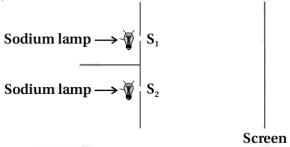
When two independent light sources (like two sodium lamps) are used to illuminate two pinholes $S_1$ and $S_2$, the light waves emitted by each lamp undergo abrupt and random phase changes in very short time intervals (on the order of $10^{-9} \text{ s}$).
Because these phase changes are independent and random for each lamp, there is no fixed phase relationship between the light waves emerging from $S_1$ and $S_2$. Consequently, the sources are incoherent.
In the case of incoherent sources, the intensities of the light waves add up rather than interfering constructively and destructively to form a pattern. Therefore, the screen will show a uniform illumination instead of distinct bright and dark interference fringes.
When two independent light sources (like two sodium lamps) are used to illuminate two pinholes $S_1$ and $S_2$, the light waves emitted by each lamp undergo abrupt and random phase changes in very short time intervals (on the order of $10^{-9} \text{ s}$).
Because these phase changes are independent and random for each lamp, there is no fixed phase relationship between the light waves emerging from $S_1$ and $S_2$. Consequently, the sources are incoherent.
In the case of incoherent sources, the intensities of the light waves add up rather than interfering constructively and destructively to form a pattern. Therefore, the screen will show a uniform illumination instead of distinct bright and dark interference fringes.
0 likes
View Solution148
Easy
Write down the condition of constructive interference.
Solution
(N/A) Constructive interference occurs when two light waves meet in phase,resulting in an increase in amplitude.
For two waves with a path difference $\Delta x$,the condition for constructive interference is that the path difference must be an integral multiple of the wavelength $\lambda$.
Mathematically,this is expressed as: $\Delta x = n\lambda$,where $n = 0, 1, 2, 3, \dots$
Alternatively,in terms of phase difference $\phi$,the condition is $\phi = 2n\pi$,where $n$ is an integer.
For two waves with a path difference $\Delta x$,the condition for constructive interference is that the path difference must be an integral multiple of the wavelength $\lambda$.
Mathematically,this is expressed as: $\Delta x = n\lambda$,where $n = 0, 1, 2, 3, \dots$
Alternatively,in terms of phase difference $\phi$,the condition is $\phi = 2n\pi$,where $n$ is an integer.
0 likes
View Solution149
EasyMCQ
If $\frac{\text{Path difference}}{\text{Wave length}} = n$ (where $n$ is an integer),what kind of interference is formed?
A
Constructive interference
B
Destructive interference
C
No interference
D
Partial interference
Solution
(A) The condition for interference depends on the path difference $(\Delta x)$ and the wavelength $(\lambda)$.
Constructive interference occurs when the path difference is an integer multiple of the wavelength,i.e.,$\Delta x = n\lambda$,where $n = 0, 1, 2, 3, \dots$.
Rearranging this,we get $\frac{\Delta x}{\lambda} = n$.
Since the problem states that the ratio of path difference to wavelength is an integer,it satisfies the condition for constructive interference.
Therefore,constructive interference is formed.
Constructive interference occurs when the path difference is an integer multiple of the wavelength,i.e.,$\Delta x = n\lambda$,where $n = 0, 1, 2, 3, \dots$.
Rearranging this,we get $\frac{\Delta x}{\lambda} = n$.
Since the problem states that the ratio of path difference to wavelength is an integer,it satisfies the condition for constructive interference.
Therefore,constructive interference is formed.
0 likes
View Solution150
EasyMCQ
Which phenomena can be explained by the wave nature of light?
A
Photoelectric effect
B
Compton effect
C
Interference and diffraction
D
Black body radiation
Solution
(C) The wave nature of light successfully explains phenomena such as interference,diffraction,and polarization. These phenomena rely on the superposition of waves. Conversely,phenomena like the photoelectric effect,Compton effect,and black body radiation require the particle nature (photon theory) of light for their explanation.
0 likes
View SolutionWave Optics — Wave Nature and Interference of Light (Intensity) · Frequently Asked Questions
1Are these Wave Optics questions useful for JEE and NEET?
Yes. All questions in this section are mapped to JEE Main and NEET exam patterns. Previous year questions from JEE Main, NEET, GUJCET and state-level exams are included with full solutions.
2Can I switch to Hindi or Gujarati for these questions?
Yes. Use the language tabs in the hero section or the sidebar to view the same questions and solutions in English, Hindi or Gujarati.
3How do I generate a question paper from this subtopic?
Use the Vedclass Exam Paper Generator — select the chapter and subtopic, set difficulty, and generate Sets A, B, C, D automatically. First 3 chapters of every subject are free.
Vedclass Products
For Students
Vedclass Test Series
Mock tests in real JEE/NEET style with performance analysis. 5-day free trial.
Start Free TrialFor Teachers
Exam Paper Generator
Generate Set A/B/C/D papers from this chapter in 2 minutes. 3 chapters free.
Try FreeFor Institutes
Online Exam Module
Live online exams with unlimited students, 360° analytics & white-label branding.
See DemoFor Teachers & Institutes
Generate a Wave Optics Exam Paper in 2 Minutes
Select subtopic & difficulty — Sets A, B, C, D auto-generated with No Repeat logic.
First 3 chapters of every subject are free — no payment required.