
A English
Refraction by Lenses Questions in English
Class 12 Physics · Ray Optics and Optical Instruments · Refraction by Lenses
470+
Questions
English
Language
100%
With Solutions
Showing 45 of 470 questions in English
401
DifficultMCQ
$A$ planoconvex lens has a maximum thickness of $6 \,cm$. When placed on a horizontal table with the curved surface in contact with the table surface, the apparent depth of the bottommost point of the lens is found to be $4 \,cm$. If the lens is inverted such that the plane face of the lens is in contact with the surface of the table, the apparent depth of the centre of the plane face is found to be $\left(\frac{17}{4}\right) \,cm$. The radius of curvature of the lens is (in $\,cm$)
A
$68$
B
$75$
C
$128$
D
$34$
Solution
(D) Case $1$: Curved surface in contact with the table.
The real depth of the lens is $t = 6 \,cm$. The apparent depth is $d' = 4 \,cm$.
The refractive index $n$ is given by $n = \frac{\text{Real depth}}{\text{Apparent depth}} = \frac{6}{4} = 1.5$.
Case $2$: Plane surface in contact with the table.
We use the refraction formula at a spherical surface: $\frac{n_2}{v} - \frac{n_1}{u} = \frac{n_2 - n_1}{R}$.
Here, the light travels from the lens $(n = 1.5)$ to the air $(n = 1)$.
Real depth $u = 6 \,cm$, apparent depth $v = -\frac{17}{4} \,cm$ (virtual image).
Using the formula $\frac{1}{v} - \frac{1.5}{u} = \frac{1 - 1.5}{R}$:
$\frac{1}{-17/4} - \frac{1.5}{6} = \frac{-0.5}{R}$
$-\frac{4}{17} - 0.25 = -\frac{0.5}{R}$
$-\frac{4}{17} - \frac{1}{4} = -\frac{1}{2R}$
$-\frac{16 + 17}{68} = -\frac{1}{2R}$
$\frac{33}{68} = \frac{1}{2R} \implies R = \frac{68}{66} \times 33 = 34 \,cm$.
The real depth of the lens is $t = 6 \,cm$. The apparent depth is $d' = 4 \,cm$.
The refractive index $n$ is given by $n = \frac{\text{Real depth}}{\text{Apparent depth}} = \frac{6}{4} = 1.5$.
Case $2$: Plane surface in contact with the table.
We use the refraction formula at a spherical surface: $\frac{n_2}{v} - \frac{n_1}{u} = \frac{n_2 - n_1}{R}$.
Here, the light travels from the lens $(n = 1.5)$ to the air $(n = 1)$.
Real depth $u = 6 \,cm$, apparent depth $v = -\frac{17}{4} \,cm$ (virtual image).
Using the formula $\frac{1}{v} - \frac{1.5}{u} = \frac{1 - 1.5}{R}$:
$\frac{1}{-17/4} - \frac{1.5}{6} = \frac{-0.5}{R}$
$-\frac{4}{17} - 0.25 = -\frac{0.5}{R}$
$-\frac{4}{17} - \frac{1}{4} = -\frac{1}{2R}$
$-\frac{16 + 17}{68} = -\frac{1}{2R}$
$\frac{33}{68} = \frac{1}{2R} \implies R = \frac{68}{66} \times 33 = 34 \,cm$.
0 likes
View Solution402
MediumMCQ
The focal length of a lens is $10 \ cm$. What is the power of the lens in dioptre (in $D$)?
A
$0.1$
B
$10$
C
$15$
D
$20$
Solution
(B) Given,focal length $f = 10 \ cm = 0.1 \ m$.
Power of a lens $P$ is defined as the reciprocal of the focal length in meters.
$P = \frac{1}{f(m)} = \frac{1}{0.1 \ m} = 10 \ D$.
Thus,the power of the lens is $10 \ D$.
Power of a lens $P$ is defined as the reciprocal of the focal length in meters.
$P = \frac{1}{f(m)} = \frac{1}{0.1 \ m} = 10 \ D$.
Thus,the power of the lens is $10 \ D$.
0 likes
View Solution403
MediumMCQ
Images of same size are formed by a convex lens when an object is placed either at $20 \ cm$ or $10 \ cm$ distance from the lens. The focal length of the lens is (in $cm$)
A
$12$
B
$40$
C
$18$
D
$15$
Solution
(D) Let the focal length of the convex lens be $f$. The magnification $m$ produced by a lens is given by $m = \frac{f}{f+u}$,where $u$ is the object distance.
For a convex lens,if the image size is the same,the magnification $m$ must be $m = 1$ (virtual image) or $m = -1$ (real image).
Case $1$: For a real image,$m = -1$. Using the formula $m = \frac{f}{f+u}$,we have $-1 = \frac{f}{f+u_1}$,which implies $f+u_1 = -f$,so $u_1 = -2f$. Given $u_1 = -20 \ cm$,we get $2f = 20 \ cm$,so $f = 10 \ cm$. However,this would mean the object is at $2f$,forming a real image of the same size.
Case $2$: If the image size is the same for two different positions,one must be a real image and one must be a virtual image. For a convex lens,the magnification $m = \frac{v}{u}$. Since the image size is the same,$|m_1| = |m_2|$.
Let the object distances be $u_1 = -20 \ cm$ and $u_2 = -10 \ cm$. The magnification is $m = \frac{f}{f+u}$.
For $u_1 = -20$,$m_1 = \frac{f}{f-20}$. For $u_2 = -10$,$m_2 = \frac{f}{f-10}$.
Since the image sizes are equal,$|m_1| = |m_2|$. Thus,$\left| \frac{f}{f-20} \right| = \left| \frac{f}{f-10} \right|$.
This implies $\frac{f}{20-f} = \frac{f}{f-10}$ (since one image is real and one is virtual,one magnification is negative).
$20-f = f-10 \implies 2f = 30 \implies f = 15 \ cm$.
For a convex lens,if the image size is the same,the magnification $m$ must be $m = 1$ (virtual image) or $m = -1$ (real image).
Case $1$: For a real image,$m = -1$. Using the formula $m = \frac{f}{f+u}$,we have $-1 = \frac{f}{f+u_1}$,which implies $f+u_1 = -f$,so $u_1 = -2f$. Given $u_1 = -20 \ cm$,we get $2f = 20 \ cm$,so $f = 10 \ cm$. However,this would mean the object is at $2f$,forming a real image of the same size.
Case $2$: If the image size is the same for two different positions,one must be a real image and one must be a virtual image. For a convex lens,the magnification $m = \frac{v}{u}$. Since the image size is the same,$|m_1| = |m_2|$.
Let the object distances be $u_1 = -20 \ cm$ and $u_2 = -10 \ cm$. The magnification is $m = \frac{f}{f+u}$.
For $u_1 = -20$,$m_1 = \frac{f}{f-20}$. For $u_2 = -10$,$m_2 = \frac{f}{f-10}$.
Since the image sizes are equal,$|m_1| = |m_2|$. Thus,$\left| \frac{f}{f-20} \right| = \left| \frac{f}{f-10} \right|$.
This implies $\frac{f}{20-f} = \frac{f}{f-10}$ (since one image is real and one is virtual,one magnification is negative).
$20-f = f-10 \implies 2f = 30 \implies f = 15 \ cm$.
0 likes
View Solution404
MediumMCQ
The ratio of the focal lengths of a convex lens when kept in air and when it is immersed in a liquid is $1: 2$. If the refractive index of the material of the lens is $1.5$,then the refractive index of the liquid is
A
$1.20$
B
$1.30$
C
$1.25$
D
$1.35$
Solution
(A) The lens maker's formula is given by $\frac{1}{f} = (\mu_g - 1) \left( \frac{1}{R_1} - \frac{1}{R_2} \right)$.
For a lens in air $(\mu_a = 1)$: $\frac{1}{f_a} = (\mu_l - 1) K$,where $K = (\frac{1}{R_1} - \frac{1}{R_2})$.
For a lens in liquid $(\mu_{liq})$: $\frac{1}{f_l} = (\frac{\mu_l}{\mu_{liq}} - 1) K$.
Given $\frac{f_a}{f_l} = \frac{1}{2}$,we have $\frac{f_l}{f_a} = 2$.
Dividing the two equations: $\frac{f_a}{f_l} = \frac{(\frac{\mu_l}{\mu_{liq}} - 1)}{(\mu_l - 1)} = \frac{1}{2}$.
Substituting $\mu_l = 1.5$: $\frac{(\frac{1.5}{\mu_{liq}} - 1)}{(1.5 - 1)} = \frac{1}{2}$.
$\frac{1.5}{\mu_{liq}} - 1 = 0.5 \times 0.5 = 0.25$.
$\frac{1.5}{\mu_{liq}} = 1.25$.
$\mu_{liq} = \frac{1.5}{1.25} = 1.2$.
For a lens in air $(\mu_a = 1)$: $\frac{1}{f_a} = (\mu_l - 1) K$,where $K = (\frac{1}{R_1} - \frac{1}{R_2})$.
For a lens in liquid $(\mu_{liq})$: $\frac{1}{f_l} = (\frac{\mu_l}{\mu_{liq}} - 1) K$.
Given $\frac{f_a}{f_l} = \frac{1}{2}$,we have $\frac{f_l}{f_a} = 2$.
Dividing the two equations: $\frac{f_a}{f_l} = \frac{(\frac{\mu_l}{\mu_{liq}} - 1)}{(\mu_l - 1)} = \frac{1}{2}$.
Substituting $\mu_l = 1.5$: $\frac{(\frac{1.5}{\mu_{liq}} - 1)}{(1.5 - 1)} = \frac{1}{2}$.
$\frac{1.5}{\mu_{liq}} - 1 = 0.5 \times 0.5 = 0.25$.
$\frac{1.5}{\mu_{liq}} = 1.25$.
$\mu_{liq} = \frac{1.5}{1.25} = 1.2$.
0 likes
View Solution405
DifficultMCQ
The focal length of a thin converging lens in air is $20 \ cm$. When the lens is immersed in a liquid,it behaves like a concave lens of power $1 \ D$. If the refractive index of the material of the lens is $1.5$,the refractive index of the liquid is
A
$\frac{5}{3}$
B
$\frac{4}{3}$
C
$\frac{5}{4}$
D
$\frac{7}{4}$
Solution
(A) In air,the lens maker's formula is $\frac{1}{f_a} = (\mu_g - 1) \left( \frac{1}{R_1} - \frac{1}{R_2} \right)$. Given $f_a = 20 \ cm = 0.2 \ m$ and $\mu_g = 1.5$,we have $\frac{1}{0.2} = (1.5 - 1) \left( \frac{1}{R_1} - \frac{1}{R_2} \right) \Rightarrow 5 = 0.5 \left( \frac{1}{R_1} - \frac{1}{R_2} \right) \Rightarrow \left( \frac{1}{R_1} - \frac{1}{R_2} \right) = 10 \ m^{-1}$.
When immersed in a liquid of refractive index $\mu_l$,the focal length $f_l$ is given by $\frac{1}{f_l} = \left( \frac{\mu_g}{\mu_l} - 1 \right) \left( \frac{1}{R_1} - \frac{1}{R_2} \right)$.
Given the power $P = -1 \ D$,the focal length is $f_l = \frac{1}{P} = -1 \ m = -100 \ cm$.
Substituting the values: $\frac{1}{-1} = \left( \frac{1.5}{\mu_l} - 1 \right) (10)$.
$-0.1 = \frac{1.5}{\mu_l} - 1 \Rightarrow \frac{1.5}{\mu_l} = 0.9$.
$\mu_l = \frac{1.5}{0.9} = \frac{15}{9} = \frac{5}{3}$.
When immersed in a liquid of refractive index $\mu_l$,the focal length $f_l$ is given by $\frac{1}{f_l} = \left( \frac{\mu_g}{\mu_l} - 1 \right) \left( \frac{1}{R_1} - \frac{1}{R_2} \right)$.
Given the power $P = -1 \ D$,the focal length is $f_l = \frac{1}{P} = -1 \ m = -100 \ cm$.
Substituting the values: $\frac{1}{-1} = \left( \frac{1.5}{\mu_l} - 1 \right) (10)$.
$-0.1 = \frac{1.5}{\mu_l} - 1 \Rightarrow \frac{1.5}{\mu_l} = 0.9$.
$\mu_l = \frac{1.5}{0.9} = \frac{15}{9} = \frac{5}{3}$.
0 likes
View Solution406
MediumMCQ
When a convex lens is immersed in a liquid of refractive index equal to $80 \%$ of the refractive index of the material of the lens,the focal length of the lens increases by $100 \%$. The refractive index of the liquid is
A
$1.27$
B
$1.2$
C
$1.33$
D
$1.4$
Solution
(B) Let the refractive index of the lens material be $\mu_l$ and the refractive index of the liquid be $\mu_m$. Given $\mu_m = 0.8 \mu_l = \frac{4}{5} \mu_l$,which implies $\mu_l = 1.25 \mu_m = \frac{5}{4} \mu_m$.
Using the Lens Maker's Formula for air $(f_a)$:
$\frac{1}{f_a} = (\mu_l - 1) K$,where $K = (\frac{1}{R_1} - \frac{1}{R_2})$.
Using the Lens Maker's Formula for the liquid medium $(f_m)$:
$\frac{1}{f_m} = (\frac{\mu_l}{\mu_m} - 1) K$.
Given that the focal length increases by $100 \%$,$f_m = f_a + 100 \% f_a = 2 f_a$.
Dividing the two equations:
$\frac{f_m}{f_a} = \frac{\mu_l - 1}{\frac{\mu_l}{\mu_m} - 1} = 2$.
Substituting $\mu_l = \frac{5}{4} \mu_m$:
$\frac{\frac{5}{4} \mu_m - 1}{\frac{5}{4} - 1} = 2$.
$\frac{\frac{5}{4} \mu_m - 1}{0.25} = 2 \Rightarrow \frac{5}{4} \mu_m - 1 = 0.5$.
$\frac{5}{4} \mu_m = 1.5 \Rightarrow \mu_m = 1.5 \times 0.8 = 1.2$.
Using the Lens Maker's Formula for air $(f_a)$:
$\frac{1}{f_a} = (\mu_l - 1) K$,where $K = (\frac{1}{R_1} - \frac{1}{R_2})$.
Using the Lens Maker's Formula for the liquid medium $(f_m)$:
$\frac{1}{f_m} = (\frac{\mu_l}{\mu_m} - 1) K$.
Given that the focal length increases by $100 \%$,$f_m = f_a + 100 \% f_a = 2 f_a$.
Dividing the two equations:
$\frac{f_m}{f_a} = \frac{\mu_l - 1}{\frac{\mu_l}{\mu_m} - 1} = 2$.
Substituting $\mu_l = \frac{5}{4} \mu_m$:
$\frac{\frac{5}{4} \mu_m - 1}{\frac{5}{4} - 1} = 2$.
$\frac{\frac{5}{4} \mu_m - 1}{0.25} = 2 \Rightarrow \frac{5}{4} \mu_m - 1 = 0.5$.
$\frac{5}{4} \mu_m = 1.5 \Rightarrow \mu_m = 1.5 \times 0.8 = 1.2$.
0 likes
View Solution407
DifficultMCQ
When a convex lens is immersed in two different liquids of refractive indices $1.25$ and $1.5$,the ratio of the focal lengths of the lens is $5:16$. The refractive index of the material of the lens is
A
$1.55$
B
$1.5$
C
$1.65$
D
$1.6$
Solution
(C) The lens maker's formula is given by $\frac{1}{f} = (\frac{\mu_l}{\mu_m} - 1)(\frac{1}{R_1} - \frac{1}{R_2})$,where $\mu_l$ is the refractive index of the lens and $\mu_m$ is the refractive index of the medium.
Let $\mu_l$ be the refractive index of the lens material and $K = (\frac{1}{R_1} - \frac{1}{R_2})$.
For the first liquid with refractive index $\mu_{m1} = 1.25$,the focal length $f_1$ is $\frac{1}{f_1} = (\frac{\mu_l}{1.25} - 1)K$.
For the second liquid with refractive index $\mu_{m2} = 1.5$,the focal length $f_2$ is $\frac{1}{f_2} = (\frac{\mu_l}{1.5} - 1)K$.
The ratio of focal lengths is given as $\frac{f_1}{f_2} = \frac{5}{16}$.
Therefore,$\frac{f_1}{f_2} = \frac{(\frac{\mu_l}{1.5} - 1)}{(\frac{\mu_l}{1.25} - 1)} = \frac{5}{16}$.
$\frac{\mu_l - 1.5}{1.5} \times \frac{1.25}{\mu_l - 1.25} = \frac{5}{16}$.
$\frac{\mu_l - 1.5}{\mu_l - 1.25} = \frac{5}{16} \times \frac{1.5}{1.25} = \frac{5}{16} \times 1.2 = \frac{6}{16} = \frac{3}{8}$.
$8(\mu_l - 1.5) = 3(\mu_l - 1.25)$.
$8\mu_l - 12 = 3\mu_l - 3.75$.
$5\mu_l = 8.25$.
$\mu_l = 1.65$.
Let $\mu_l$ be the refractive index of the lens material and $K = (\frac{1}{R_1} - \frac{1}{R_2})$.
For the first liquid with refractive index $\mu_{m1} = 1.25$,the focal length $f_1$ is $\frac{1}{f_1} = (\frac{\mu_l}{1.25} - 1)K$.
For the second liquid with refractive index $\mu_{m2} = 1.5$,the focal length $f_2$ is $\frac{1}{f_2} = (\frac{\mu_l}{1.5} - 1)K$.
The ratio of focal lengths is given as $\frac{f_1}{f_2} = \frac{5}{16}$.
Therefore,$\frac{f_1}{f_2} = \frac{(\frac{\mu_l}{1.5} - 1)}{(\frac{\mu_l}{1.25} - 1)} = \frac{5}{16}$.
$\frac{\mu_l - 1.5}{1.5} \times \frac{1.25}{\mu_l - 1.25} = \frac{5}{16}$.
$\frac{\mu_l - 1.5}{\mu_l - 1.25} = \frac{5}{16} \times \frac{1.5}{1.25} = \frac{5}{16} \times 1.2 = \frac{6}{16} = \frac{3}{8}$.
$8(\mu_l - 1.5) = 3(\mu_l - 1.25)$.
$8\mu_l - 12 = 3\mu_l - 3.75$.
$5\mu_l = 8.25$.
$\mu_l = 1.65$.
0 likes
View Solution408
EasyMCQ
The radius of curvature of a convex lens is $40 \,cm$ for each surface. Its refractive index is $1.5$. Its focal length is: (in $\,cm$)
A
$40$
B
$20$
C
$80$
D
$30$
Solution
(A) For a convex lens,the radius of curvature of the first surface $R_1$ is positive $(+40 \,cm)$ and the radius of curvature of the second surface $R_2$ is negative $(-40 \,cm)$.
Using the Lens Maker's formula:
$\frac{1}{f} = (\mu - 1) \left( \frac{1}{R_1} - \frac{1}{R_2} \right)$
Given $\mu = 1.5$,$R_1 = 40 \,cm$,and $R_2 = -40 \,cm$.
Substituting the values:
$\frac{1}{f} = (1.5 - 1) \left( \frac{1}{40} - \frac{1}{-40} \right)$
$\frac{1}{f} = (0.5) \left( \frac{1}{40} + \frac{1}{40} \right)$
$\frac{1}{f} = (0.5) \left( \frac{2}{40} \right) = 0.5 \times 0.05 = 0.025$
$\frac{1}{f} = \frac{1}{40}$
Therefore,the focal length $f = 40 \,cm$.
Using the Lens Maker's formula:
$\frac{1}{f} = (\mu - 1) \left( \frac{1}{R_1} - \frac{1}{R_2} \right)$
Given $\mu = 1.5$,$R_1 = 40 \,cm$,and $R_2 = -40 \,cm$.
Substituting the values:
$\frac{1}{f} = (1.5 - 1) \left( \frac{1}{40} - \frac{1}{-40} \right)$
$\frac{1}{f} = (0.5) \left( \frac{1}{40} + \frac{1}{40} \right)$
$\frac{1}{f} = (0.5) \left( \frac{2}{40} \right) = 0.5 \times 0.05 = 0.025$
$\frac{1}{f} = \frac{1}{40}$
Therefore,the focal length $f = 40 \,cm$.
0 likes
View Solution409
EasyMCQ
The radii of curvature of a double convex lens are $4 \ cm$ and $8 \ cm$. If the refractive index of the material of the lens is $1.5$,the focal length of the lens is nearly (in $cm$)
A
$16$
B
$12.11$
C
$7.33$
D
$5.33$
Solution
(D) Using the Lens Maker's formula: $\frac{1}{f} = (\mu - 1) \left( \frac{1}{R_1} - \frac{1}{R_2} \right)$.
For a double convex lens,$R_1 = +4 \ cm$ and $R_2 = -8 \ cm$.
The refractive index $\mu = 1.5$.
Substituting the values: $\frac{1}{f} = (1.5 - 1) \left( \frac{1}{4} - \frac{1}{-8} \right)$.
$\frac{1}{f} = (0.5) \left( \frac{1}{4} + \frac{1}{8} \right)$.
$\frac{1}{f} = (0.5) \left( \frac{2+1}{8} \right) = (0.5) \left( \frac{3}{8} \right) = \frac{1.5}{8} = \frac{3}{16}$.
Therefore,$f = \frac{16}{3} \approx 5.33 \ cm$.
For a double convex lens,$R_1 = +4 \ cm$ and $R_2 = -8 \ cm$.
The refractive index $\mu = 1.5$.
Substituting the values: $\frac{1}{f} = (1.5 - 1) \left( \frac{1}{4} - \frac{1}{-8} \right)$.
$\frac{1}{f} = (0.5) \left( \frac{1}{4} + \frac{1}{8} \right)$.
$\frac{1}{f} = (0.5) \left( \frac{2+1}{8} \right) = (0.5) \left( \frac{3}{8} \right) = \frac{1.5}{8} = \frac{3}{16}$.
Therefore,$f = \frac{16}{3} \approx 5.33 \ cm$.
0 likes
View Solution410
EasyMCQ
$A$ screen is placed $100 \,cm$ from an object. The image of the object on the screen is formed by a convex lens at two different locations separated by $20 \,cm$. The focal length of the lens is (in $\,cm$)
A
$18$
B
$24$
C
$25$
D
$30$
Solution
(B) Given, distance between the screen and the object, $d = 100 \,cm$.
Separation between the two positions of the convex lens, $x = 20 \,cm$.
The formula for the focal length of the lens in the displacement method is $f = \frac{d^2 - x^2}{4d}$.
Substituting the given values:
$f = \frac{(100)^2 - (20)^2}{4 \times 100}$
$f = \frac{10000 - 400}{400}$
$f = \frac{9600}{400}$
$f = 24 \,cm$.
Therefore, the focal length of the lens is $24 \,cm$.
Separation between the two positions of the convex lens, $x = 20 \,cm$.
The formula for the focal length of the lens in the displacement method is $f = \frac{d^2 - x^2}{4d}$.
Substituting the given values:
$f = \frac{(100)^2 - (20)^2}{4 \times 100}$
$f = \frac{10000 - 400}{400}$
$f = \frac{9600}{400}$
$f = 24 \,cm$.
Therefore, the focal length of the lens is $24 \,cm$.
0 likes
View Solution411
EasyMCQ
An optician prescribes a corrective lens of power $+2.0 \,D$. The focal length of the required convex lens is:
A
$10 \,cm$
B
$50 \,cm$
C
$10 \,m$
D
$50 \,m$
Solution
(B) The power $P$ of a lens in diopters $(D)$ is related to its focal length $f$ in meters $(m)$ by the formula: $P = \frac{1}{f(m)}$.
Alternatively, if the focal length is in centimeters $(cm)$, the formula is: $P = \frac{100}{f(cm)}$.
Given that the power $P = +2.0 \,D$, we substitute this into the formula:
$2.0 = \frac{100}{f(cm)}$
$f(cm) = \frac{100}{2.0} = 50 \,cm$.
Therefore, the focal length of the required convex lens is $50 \,cm$.
Alternatively, if the focal length is in centimeters $(cm)$, the formula is: $P = \frac{100}{f(cm)}$.
Given that the power $P = +2.0 \,D$, we substitute this into the formula:
$2.0 = \frac{100}{f(cm)}$
$f(cm) = \frac{100}{2.0} = 50 \,cm$.
Therefore, the focal length of the required convex lens is $50 \,cm$.
0 likes
View Solution412
MediumMCQ
$Assertion (A)$: The focal length of a lens does not change when red light is replaced by blue light.
$Reason (R)$: The focal length of a lens does not depend on the colour of the light used.
$Reason (R)$: The focal length of a lens does not depend on the colour of the light used.
A
Both $A$ and $R$ are true and $R$ is a correct explanation for $A$
B
Both $A$ and $R$ are true but $R$ is not a correct explanation for $A$
C
$A$ is true,$R$ is false
D
Both $A$ and $R$ are false
Solution
(D) The focal length $f$ of a lens is given by the Lens Maker's Formula: $\frac{1}{f} = (\mu - 1) \left( \frac{1}{R_1} - \frac{1}{R_2} \right)$.
According to Cauchy's equation,the refractive index $\mu$ of a material depends on the wavelength $\lambda$ of light,where $\mu$ increases as $\lambda$ decreases.
Since the wavelength of blue light is shorter than that of red light,the refractive index for blue light is greater than that for red light $(\mu_{blue} > \mu_{red})$.
Consequently,the focal length $f$ decreases when red light is replaced by blue light.
Therefore,the assertion $(A)$ is false and the reason $(R)$ is also false.
According to Cauchy's equation,the refractive index $\mu$ of a material depends on the wavelength $\lambda$ of light,where $\mu$ increases as $\lambda$ decreases.
Since the wavelength of blue light is shorter than that of red light,the refractive index for blue light is greater than that for red light $(\mu_{blue} > \mu_{red})$.
Consequently,the focal length $f$ decreases when red light is replaced by blue light.
Therefore,the assertion $(A)$ is false and the reason $(R)$ is also false.
0 likes
View Solution413
MediumMCQ
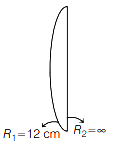
The radius of curvature of the curved face of a plano-convex lens is $12 \,cm$ and its refractive index is $1.5$. Then,the focal length of the lens is (in $\,cm$)
A
$26$
B
$22$
C
$24$
D
$20$
Solution
(C) Given,refractive index of the lens,$\mu = 1.5$.
Radius of the curved face,$R_1 = 12 \,cm$.
Radius of the plane face,$R_2 = \infty$.
Using the lens maker's formula:
$\frac{1}{f} = (\mu - 1) \left[ \frac{1}{R_1} - \frac{1}{R_2} \right]$
Substituting the values:
$\frac{1}{f} = (1.5 - 1) \left[ \frac{1}{12} - \frac{1}{\infty} \right]$
Since $\frac{1}{\infty} = 0$,we have:
$\frac{1}{f} = 0.5 \times \frac{1}{12}$
$\frac{1}{f} = \frac{0.5}{12} = \frac{1}{24}$
Therefore,$f = 24 \,cm$.
Thus,the focal length of the given plano-convex lens is $24 \,cm$.
Radius of the curved face,$R_1 = 12 \,cm$.
Radius of the plane face,$R_2 = \infty$.
Using the lens maker's formula:
$\frac{1}{f} = (\mu - 1) \left[ \frac{1}{R_1} - \frac{1}{R_2} \right]$
Substituting the values:
$\frac{1}{f} = (1.5 - 1) \left[ \frac{1}{12} - \frac{1}{\infty} \right]$
Since $\frac{1}{\infty} = 0$,we have:
$\frac{1}{f} = 0.5 \times \frac{1}{12}$
$\frac{1}{f} = \frac{0.5}{12} = \frac{1}{24}$
Therefore,$f = 24 \,cm$.
Thus,the focal length of the given plano-convex lens is $24 \,cm$.
0 likes
View Solution414
MediumMCQ
The focal length of a convex lens is $f$. An object is placed at a distance $x$ from its first focal point. The ratio of the size of the real image to that of the object is
A
$\frac{f}{x^2}$
B
$\frac{x^2}{f}$
C
$\frac{f}{x}$
D
$\frac{x}{f}$
Solution
(C) The focal length of the convex lens is given as $f$.
The object is placed at a distance $x$ from the first focal point.
Since the first focal point is at a distance $f$ from the optical center,the total object distance $u$ from the optical center is $u = -(f + x)$.
Using the lens formula,$\frac{1}{v} - \frac{1}{u} = \frac{1}{f}$.
Substituting $u = -(f + x)$,we get $\frac{1}{v} - \frac{1}{-(f + x)} = \frac{1}{f}$.
$\frac{1}{v} = \frac{1}{f} - \frac{1}{f + x} = \frac{f + x - f}{f(f + x)} = \frac{x}{f(f + x)}$.
Thus,$v = \frac{f(f + x)}{x}$.
The magnification $m$ is given by $m = \frac{v}{u}$.
$m = \frac{\frac{f(f + x)}{x}}{-(f + x)} = -\frac{f}{x}$.
The ratio of the size of the real image to the object is the magnitude of magnification,which is $|m| = \frac{f}{x}$.
The object is placed at a distance $x$ from the first focal point.
Since the first focal point is at a distance $f$ from the optical center,the total object distance $u$ from the optical center is $u = -(f + x)$.
Using the lens formula,$\frac{1}{v} - \frac{1}{u} = \frac{1}{f}$.
Substituting $u = -(f + x)$,we get $\frac{1}{v} - \frac{1}{-(f + x)} = \frac{1}{f}$.
$\frac{1}{v} = \frac{1}{f} - \frac{1}{f + x} = \frac{f + x - f}{f(f + x)} = \frac{x}{f(f + x)}$.
Thus,$v = \frac{f(f + x)}{x}$.
The magnification $m$ is given by $m = \frac{v}{u}$.
$m = \frac{\frac{f(f + x)}{x}}{-(f + x)} = -\frac{f}{x}$.
The ratio of the size of the real image to the object is the magnitude of magnification,which is $|m| = \frac{f}{x}$.
0 likes
View Solution415
MediumMCQ
$A$ thin lens of refractive index $1.5$ has an optical power of $-5 \ D$ in air. Its optical power in a liquid medium with a refractive index of $1.6$ is $D$.
A
$0.625$
B
$1.25$
C
$2.5$
D
$0.5$
Solution
(A) Given: Refractive index of the lens,$\mu_g = 1.5$.
Refractive index of the medium,$\mu_m = 1.6$.
Power of the lens in air,$P = -5 \ D$.
Refractive index of air,$\mu_a = 1$.
Using the Lens Maker's Formula:
$P = \frac{1}{f} = (\mu_g - 1) \left( \frac{1}{R_1} - \frac{1}{R_2} \right)$ (in air).
For the medium,the power $P'$ is given by:
$P' = \frac{1}{f'} = \left( \frac{\mu_g}{\mu_m} - 1 \right) \left( \frac{1}{R_1} - \frac{1}{R_2} \right)$.
Dividing $P'$ by $P$:
$\frac{P'}{P} = \frac{(\frac{\mu_g}{\mu_m} - 1)}{(\mu_g - 1)} = \frac{(\frac{1.5}{1.6} - 1)}{(1.5 - 1)} = \frac{(\frac{1.5 - 1.6}{1.6})}{0.5} = \frac{-0.1}{1.6 \times 0.5} = \frac{-0.1}{0.8} = -\frac{1}{8}$.
Therefore,$P' = P \times (-\frac{1}{8}) = -5 \times (-0.125) = 0.625 \ D$.
Refractive index of the medium,$\mu_m = 1.6$.
Power of the lens in air,$P = -5 \ D$.
Refractive index of air,$\mu_a = 1$.
Using the Lens Maker's Formula:
$P = \frac{1}{f} = (\mu_g - 1) \left( \frac{1}{R_1} - \frac{1}{R_2} \right)$ (in air).
For the medium,the power $P'$ is given by:
$P' = \frac{1}{f'} = \left( \frac{\mu_g}{\mu_m} - 1 \right) \left( \frac{1}{R_1} - \frac{1}{R_2} \right)$.
Dividing $P'$ by $P$:
$\frac{P'}{P} = \frac{(\frac{\mu_g}{\mu_m} - 1)}{(\mu_g - 1)} = \frac{(\frac{1.5}{1.6} - 1)}{(1.5 - 1)} = \frac{(\frac{1.5 - 1.6}{1.6})}{0.5} = \frac{-0.1}{1.6 \times 0.5} = \frac{-0.1}{0.8} = -\frac{1}{8}$.
Therefore,$P' = P \times (-\frac{1}{8}) = -5 \times (-0.125) = 0.625 \ D$.
0 likes
View Solution416
DifficultMCQ
$A$ concave lens of glass,refractive index $1.5$,has both surfaces of the same radius of curvature $R$. On immersion in a medium of refractive index $1.75$,it will behave as a:
A
Convergent lens of focal length $3.5 R$.
B
Convergent lens of focal length $3.0 R$.
C
Divergent lens of focal length $3.5 R$.
D
Divergent lens of focal length $3.0 R$.
Solution
(A) The focal length of a lens in a medium is given by the Lens Maker's Formula: $\frac{1}{f} = (\frac{n_l}{n_m} - 1) (\frac{1}{R_1} - \frac{1}{R_2})$.
For a concave lens,$R_1 = -R$ and $R_2 = +R$.
Given: $n_l = 1.5$,$n_m = 1.75$.
Substituting the values: $\frac{1}{f} = (\frac{1.5}{1.75} - 1) (\frac{1}{-R} - \frac{1}{R})$.
$\frac{1}{f} = (\frac{6}{7} - 1) (-\frac{2}{R}) = (-\frac{1}{7}) (-\frac{2}{R}) = \frac{2}{7R}$.
Therefore,$f = +3.5 R$.
Since the focal length is positive,the lens behaves as a convergent (convex) lens.
For a concave lens,$R_1 = -R$ and $R_2 = +R$.
Given: $n_l = 1.5$,$n_m = 1.75$.
Substituting the values: $\frac{1}{f} = (\frac{1.5}{1.75} - 1) (\frac{1}{-R} - \frac{1}{R})$.
$\frac{1}{f} = (\frac{6}{7} - 1) (-\frac{2}{R}) = (-\frac{1}{7}) (-\frac{2}{R}) = \frac{2}{7R}$.
Therefore,$f = +3.5 R$.
Since the focal length is positive,the lens behaves as a convergent (convex) lens.
0 likes
View Solution417
DifficultMCQ
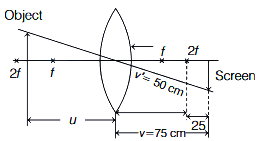
$A$ thin converging lens of focal length $25 \,cm$ forms a sharp image of an object on a screen placed at a distance of $75 \,cm$ from the lens. Later, the screen is moved closer to the lens by a distance of $25 \,cm$. The distance through which the object is to be shifted so that its image on the screen is sharp again is
A
$50 \,cm$ towards the lens
B
$50 \,cm$ away from the lens
C
$12.5 \,cm$ towards the lens
D
$12.5 \,cm$ away from the lens
Solution
(D) Given: Focal length $f = 25 \,cm$. Initial image distance $v_1 = 75 \,cm$.
Using the lens formula $\frac{1}{f} = \frac{1}{v} - \frac{1}{u}$, we find the initial object distance $u_1$:
$\frac{1}{25} = \frac{1}{75} - \frac{1}{u_1} \Rightarrow \frac{1}{u_1} = \frac{1}{75} - \frac{1}{25} = \frac{1-3}{75} = -\frac{2}{75}$.
So, $u_1 = -37.5 \,cm$ (object is $37.5 \,cm$ in front of the lens).
Now, the screen is moved $25 \,cm$ closer to the lens, so the new image distance is $v_2 = 75 - 25 = 50 \,cm$.
For the new image to be sharp, we find the new object distance $u_2$:
$\frac{1}{25} = \frac{1}{50} - \frac{1}{u_2} \Rightarrow \frac{1}{u_2} = \frac{1}{50} - \frac{1}{25} = \frac{1-2}{50} = -\frac{1}{50}$.
So, $u_2 = -50 \,cm$ (object is $50 \,cm$ in front of the lens).
The shift in the object position is $|u_2| - |u_1| = 50 \,cm - 37.5 \,cm = 12.5 \,cm$.
Since the object distance from the lens must increase from $37.5 \,cm$ to $50 \,cm$, the object must be shifted $12.5 \,cm$ away from the lens.
Using the lens formula $\frac{1}{f} = \frac{1}{v} - \frac{1}{u}$, we find the initial object distance $u_1$:
$\frac{1}{25} = \frac{1}{75} - \frac{1}{u_1} \Rightarrow \frac{1}{u_1} = \frac{1}{75} - \frac{1}{25} = \frac{1-3}{75} = -\frac{2}{75}$.
So, $u_1 = -37.5 \,cm$ (object is $37.5 \,cm$ in front of the lens).
Now, the screen is moved $25 \,cm$ closer to the lens, so the new image distance is $v_2 = 75 - 25 = 50 \,cm$.
For the new image to be sharp, we find the new object distance $u_2$:
$\frac{1}{25} = \frac{1}{50} - \frac{1}{u_2} \Rightarrow \frac{1}{u_2} = \frac{1}{50} - \frac{1}{25} = \frac{1-2}{50} = -\frac{1}{50}$.
So, $u_2 = -50 \,cm$ (object is $50 \,cm$ in front of the lens).
The shift in the object position is $|u_2| - |u_1| = 50 \,cm - 37.5 \,cm = 12.5 \,cm$.
Since the object distance from the lens must increase from $37.5 \,cm$ to $50 \,cm$, the object must be shifted $12.5 \,cm$ away from the lens.
0 likes
View Solution418
DifficultMCQ
$A$ lens forms real and virtual images of an object when the object is at $u_1$ and $u_2$ distances respectively. If the size of the virtual image is double that of the real image,then the focal length of the lens is (Take the magnification of the real image as $m$)
A
$\left(\frac{u_1+u_2}{2}\right) m$
B
$\left(\frac{u_1-u_2}{3}\right) 2 m$
C
$\left(\frac{u_1-u_2}{2}\right) 3 m$
D
$\left(\frac{u_1+u_2}{3}\right) 2 m$
Solution
(B) For a convex lens,the lens formula is $\frac{1}{f} = \frac{1}{v} - \frac{1}{u}$ and magnification is $m = \frac{v}{u}$.
For a real image,$u = -u_1$ and $v = v_1$. The magnification is $m = \frac{v_1}{u_1}$,so $v_1 = m u_1$.
Using the lens formula: $\frac{1}{f} = \frac{1}{m u_1} - \frac{1}{-u_1} = \frac{1}{u_1} (\frac{1}{m} + 1) = \frac{1}{u_1} (\frac{1+m}{m})$.
Thus,$\frac{u_1}{f} = \frac{1+m}{m} \dots (1)$.
For a virtual image,$u = -u_2$ and $v = -v_2$. The size of the virtual image is $2$ times the real image,so $v_2 = 2 v_1 = 2 m u_1$.
Using the lens formula: $\frac{1}{f} = \frac{1}{-2 m u_1} - \frac{1}{-u_2} = \frac{1}{u_2} - \frac{1}{2 m u_1}$.
Multiplying by $f$: $1 = \frac{f}{u_2} - \frac{f}{2 m u_1}$.
From $(1)$,$f = \frac{m u_1}{1+m}$. Substituting this into the equation for $u_2$ and solving for $f$ leads to the relation: $\frac{u_1-u_2}{f} = \frac{3}{2m}$,which gives $f = \frac{2 m (u_1-u_2)}{3}$.
For a real image,$u = -u_1$ and $v = v_1$. The magnification is $m = \frac{v_1}{u_1}$,so $v_1 = m u_1$.
Using the lens formula: $\frac{1}{f} = \frac{1}{m u_1} - \frac{1}{-u_1} = \frac{1}{u_1} (\frac{1}{m} + 1) = \frac{1}{u_1} (\frac{1+m}{m})$.
Thus,$\frac{u_1}{f} = \frac{1+m}{m} \dots (1)$.
For a virtual image,$u = -u_2$ and $v = -v_2$. The size of the virtual image is $2$ times the real image,so $v_2 = 2 v_1 = 2 m u_1$.
Using the lens formula: $\frac{1}{f} = \frac{1}{-2 m u_1} - \frac{1}{-u_2} = \frac{1}{u_2} - \frac{1}{2 m u_1}$.
Multiplying by $f$: $1 = \frac{f}{u_2} - \frac{f}{2 m u_1}$.
From $(1)$,$f = \frac{m u_1}{1+m}$. Substituting this into the equation for $u_2$ and solving for $f$ leads to the relation: $\frac{u_1-u_2}{f} = \frac{3}{2m}$,which gives $f = \frac{2 m (u_1-u_2)}{3}$.
0 likes
View Solution419
EasyMCQ
The distance between an object and its real image formed by a lens is '$D$'. If the magnification is '$m$',the focal length of the lens is
A
$\frac{m D}{(m-1)^2}$
B
$\frac{m D}{(m+1)^2}$
C
$\frac{(m-1) D}{m^2}$
D
$\frac{m D}{m^2-1}$
Solution
(B) Let the object distance be '$u$' and the image distance be '$v$'. Since the image is real,'$v$' and '$u$' are on opposite sides of the lens. The distance between them is '$D = |v| + |u|$'.
Magnification '$m = |v/u|$',so '$|v| = m|u|$'.
Substituting this into the distance equation: '$D = m|u| + |u| = |u|(m+1)$'.
Thus,'$|u| = D/(m+1)$' and '$|v| = mD/(m+1)$'.
Using the lens formula: '$1/f = 1/v - 1/u$'.
For a real image,'$v$' is positive and '$u$' is negative,so '$1/f = 1/|v| + 1/|u|$'.
'$1/f = (m+1)/(mD) + (m+1)/D = (m+1)/D * (1/m + 1) = (m+1)/D * ((1+m)/m) = (m+1)^2 / (mD)$'.
Therefore,'$f = mD / (m+1)^2$'.
Magnification '$m = |v/u|$',so '$|v| = m|u|$'.
Substituting this into the distance equation: '$D = m|u| + |u| = |u|(m+1)$'.
Thus,'$|u| = D/(m+1)$' and '$|v| = mD/(m+1)$'.
Using the lens formula: '$1/f = 1/v - 1/u$'.
For a real image,'$v$' is positive and '$u$' is negative,so '$1/f = 1/|v| + 1/|u|$'.
'$1/f = (m+1)/(mD) + (m+1)/D = (m+1)/D * (1/m + 1) = (m+1)/D * ((1+m)/m) = (m+1)^2 / (mD)$'.
Therefore,'$f = mD / (m+1)^2$'.
0 likes
View Solution420
DifficultMCQ
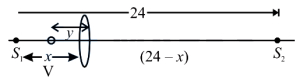
Two point sources $S_1$ and $S_2$ are $24 \ cm$ apart. Where should a convex lens of focal length $9 \ cm$ be placed in between them,so that the images of both sources are formed at the same place (in $cm$)?
A
$8$
B
$12$
C
$6$
D
$10$
Solution
(C) Let the distance of the lens from $S_1$ be $x$. Then the distance from $S_2$ is $(24 - x)$.
For the images to form at the same place,one source must form a virtual image and the other a real image.
Let $S_1$ be at distance $u_1 = -x$ and $S_2$ be at distance $u_2 = +(24 - x)$.
For $S_1$,the image $v$ is virtual,so $v = -v_0$. Using the lens formula $\frac{1}{v} - \frac{1}{u} = \frac{1}{f}$:
$\frac{1}{-v_0} - \frac{1}{-x} = \frac{1}{9} \Rightarrow \frac{1}{v_0} = \frac{1}{x} - \frac{1}{9} \quad (i)$
For $S_2$,the image $v$ is real,so $v = +v_0$. Using the lens formula:
$\frac{1}{v_0} - \frac{1}{24-x} = \frac{1}{9} \Rightarrow \frac{1}{v_0} = \frac{1}{9} + \frac{1}{24-x} \quad (ii)$
Equating $(i)$ and $(ii)$:
$\frac{1}{x} - \frac{1}{9} = \frac{1}{9} + \frac{1}{24-x}$
$\frac{1}{x} - \frac{1}{24-x} = \frac{2}{9}$
$\frac{24-x-x}{x(24-x)} = \frac{2}{9} \Rightarrow \frac{24-2x}{24x-x^2} = \frac{2}{9}$
$9(12-x) = 24x - x^2 \Rightarrow 108 - 9x = 24x - x^2$
$x^2 - 33x + 108 = 0$
$(x - 27)(x - 6) = 0$
Since $x < 24$,we have $x = 6 \ cm$.
For the images to form at the same place,one source must form a virtual image and the other a real image.
Let $S_1$ be at distance $u_1 = -x$ and $S_2$ be at distance $u_2 = +(24 - x)$.
For $S_1$,the image $v$ is virtual,so $v = -v_0$. Using the lens formula $\frac{1}{v} - \frac{1}{u} = \frac{1}{f}$:
$\frac{1}{-v_0} - \frac{1}{-x} = \frac{1}{9} \Rightarrow \frac{1}{v_0} = \frac{1}{x} - \frac{1}{9} \quad (i)$
For $S_2$,the image $v$ is real,so $v = +v_0$. Using the lens formula:
$\frac{1}{v_0} - \frac{1}{24-x} = \frac{1}{9} \Rightarrow \frac{1}{v_0} = \frac{1}{9} + \frac{1}{24-x} \quad (ii)$
Equating $(i)$ and $(ii)$:
$\frac{1}{x} - \frac{1}{9} = \frac{1}{9} + \frac{1}{24-x}$
$\frac{1}{x} - \frac{1}{24-x} = \frac{2}{9}$
$\frac{24-x-x}{x(24-x)} = \frac{2}{9} \Rightarrow \frac{24-2x}{24x-x^2} = \frac{2}{9}$
$9(12-x) = 24x - x^2 \Rightarrow 108 - 9x = 24x - x^2$
$x^2 - 33x + 108 = 0$
$(x - 27)(x - 6) = 0$
Since $x < 24$,we have $x = 6 \ cm$.
0 likes
View Solution421
DifficultMCQ
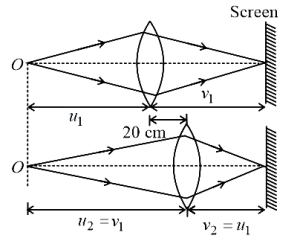
$A$ screen is placed $90 \ cm$ from an object. The image is formed on the screen by a convex lens placed at two different locations separated by $20 \ cm$. The focal length of the lens is approximately equal to: (in $cm$)
A
$21.38$
B
$30.0$
C
$35.0$
D
$24$
Solution
(A) For a fixed distance $D$ between the object and the screen,a convex lens of focal length $f$ forms a sharp image at two positions if $D > 4f$.
Let $D = 90 \ cm$ and the separation between the two lens positions be $d = 20 \ cm$.
The focal length $f$ is given by the displacement method formula:
$f = \frac{D^2 - d^2}{4D}$
Substituting the given values:
$f = \frac{90^2 - 20^2}{4 \times 90}$
$f = \frac{8100 - 400}{360}$
$f = \frac{7700}{360}$
$f = \frac{770}{36} \approx 21.38 \ cm$.
Let $D = 90 \ cm$ and the separation between the two lens positions be $d = 20 \ cm$.
The focal length $f$ is given by the displacement method formula:
$f = \frac{D^2 - d^2}{4D}$
Substituting the given values:
$f = \frac{90^2 - 20^2}{4 \times 90}$
$f = \frac{8100 - 400}{360}$
$f = \frac{7700}{360}$
$f = \frac{770}{36} \approx 21.38 \ cm$.
0 likes
View Solution422
MediumMCQ
$A$ convex lens of radii of curvature $6 \ cm$ and $12 \ cm$ is immersed in a liquid of refractive index $1.3$. If the refractive index of the material of the lens is $1.5$,then the focal length of the lens when immersed in the liquid is (in $cm$)
A
$39$
B
$13$
C
$26$
D
$52$
Solution
(C) The lens maker's formula is given by $\frac{1}{f} = (\mu_{rel} - 1) \left( \frac{1}{R_1} - \frac{1}{R_2} \right)$.
Here,$\mu_{rel} = \frac{\mu_{lens}}{\mu_{liquid}} = \frac{1.5}{1.3} = \frac{15}{13}$.
For a convex lens,$R_1 = +6 \ cm$ and $R_2 = -12 \ cm$.
Substituting these values into the formula:
$\frac{1}{f} = \left( \frac{15}{13} - 1 \right) \left( \frac{1}{6} - \frac{1}{-12} \right)$
$\frac{1}{f} = \left( \frac{2}{13} \right) \left( \frac{1}{6} + \frac{1}{12} \right)$
$\frac{1}{f} = \left( \frac{2}{13} \right) \left( \frac{2+1}{12} \right) = \left( \frac{2}{13} \right) \left( \frac{3}{12} \right) = \left( \frac{2}{13} \right) \left( \frac{1}{4} \right) = \frac{2}{52} = \frac{1}{26}$.
Therefore,$f = 26 \ cm$.
Here,$\mu_{rel} = \frac{\mu_{lens}}{\mu_{liquid}} = \frac{1.5}{1.3} = \frac{15}{13}$.
For a convex lens,$R_1 = +6 \ cm$ and $R_2 = -12 \ cm$.
Substituting these values into the formula:
$\frac{1}{f} = \left( \frac{15}{13} - 1 \right) \left( \frac{1}{6} - \frac{1}{-12} \right)$
$\frac{1}{f} = \left( \frac{2}{13} \right) \left( \frac{1}{6} + \frac{1}{12} \right)$
$\frac{1}{f} = \left( \frac{2}{13} \right) \left( \frac{2+1}{12} \right) = \left( \frac{2}{13} \right) \left( \frac{3}{12} \right) = \left( \frac{2}{13} \right) \left( \frac{1}{4} \right) = \frac{2}{52} = \frac{1}{26}$.
Therefore,$f = 26 \ cm$.
0 likes
View Solution423
DifficultMCQ
The power of a thin convex lens placed in air is $+4 \ D$. The refractive index of the material of the convex lens is $\frac{3}{2}$. If this convex lens is immersed in a liquid of refractive index $\frac{5}{3}$,then
A
it behaves like a convex lens of focal length $75 \ cm$
B
it behaves like a convex lens of focal length $125 \ cm$
C
it behaves like a concave lens of focal length $125 \ cm$
D
it behaves like a concave lens of focal length $75 \ cm$
Solution
(C) For a thin convex lens,$P = +4 \ D$,$\mu_{\ell} = \frac{3}{2}$,$\mu_m = \frac{5}{3}$.
Since $P = \frac{1}{f_a}$,we have $f_a = \frac{1}{4} \ m = 25 \ cm$.
In air,the lens maker's formula is $\frac{1}{f_a} = (\mu_{\ell} - 1) \left(\frac{1}{R_1} - \frac{1}{R_2}\right)$ ... $(i)$.
In a liquid medium,the focal length $f_m$ is given by $\frac{1}{f_m} = \left(\frac{\mu_{\ell}}{\mu_m} - 1\right) \left(\frac{1}{R_1} - \frac{1}{R_2}\right)$ ... (ii).
Dividing equation (ii) by $(i)$,we get $\frac{f_a}{f_m} = \frac{(\mu_{\ell} - 1)}{(\frac{\mu_{\ell}}{\mu_m} - 1)}$.
Substituting the values: $\frac{f_a}{f_m} = \frac{(\frac{3}{2} - 1)}{(\frac{3/2}{5/3} - 1)} = \frac{1/2}{(9/10 - 1)} = \frac{1/2}{-1/10} = -5$.
Therefore,$f_m = -5 \times f_a = -5 \times 25 \ cm = -125 \ cm$.
The negative sign indicates that the lens behaves like a concave lens with a focal length of $125 \ cm$.
Since $P = \frac{1}{f_a}$,we have $f_a = \frac{1}{4} \ m = 25 \ cm$.
In air,the lens maker's formula is $\frac{1}{f_a} = (\mu_{\ell} - 1) \left(\frac{1}{R_1} - \frac{1}{R_2}\right)$ ... $(i)$.
In a liquid medium,the focal length $f_m$ is given by $\frac{1}{f_m} = \left(\frac{\mu_{\ell}}{\mu_m} - 1\right) \left(\frac{1}{R_1} - \frac{1}{R_2}\right)$ ... (ii).
Dividing equation (ii) by $(i)$,we get $\frac{f_a}{f_m} = \frac{(\mu_{\ell} - 1)}{(\frac{\mu_{\ell}}{\mu_m} - 1)}$.
Substituting the values: $\frac{f_a}{f_m} = \frac{(\frac{3}{2} - 1)}{(\frac{3/2}{5/3} - 1)} = \frac{1/2}{(9/10 - 1)} = \frac{1/2}{-1/10} = -5$.
Therefore,$f_m = -5 \times f_a = -5 \times 25 \ cm = -125 \ cm$.
The negative sign indicates that the lens behaves like a concave lens with a focal length of $125 \ cm$.
0 likes
View Solution424
EasyMCQ
$A$ thin plano-convex lens of focal length $73.5 \ cm$ has a circular aperture of diameter $8.4 \ cm$. If the refractive index of the material of the lens is $\frac{5}{3}$,then the thickness of the lens is nearly
A
$2.4 \ cm$
B
$2.4 \ mm$
C
$1.8 \ mm$
D
$1.8 \ cm$
Solution
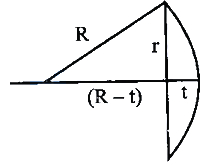
(C) For a plano-convex lens,the radius of curvature $R$ is related to the aperture radius $r$ and the thickness $t$ by the geometry: $R^2 = r^2 + (R-t)^2$. Since $t$ is very small,$R^2 = r^2 + R^2 - 2Rt + t^2 \approx r^2 + R^2 - 2Rt$,which simplifies to $R = \frac{r^2}{2t}$.
Using the Lens Maker's Formula: $\frac{1}{f} = (n-1) \left(\frac{1}{R_1} - \frac{1}{R_2}\right)$. For a plano-convex lens,$R_1 = R$ and $R_2 = \infty$,so $\frac{1}{f} = (n-1) \frac{1}{R}$,which gives $R = f(n-1)$.
Equating the two expressions for $R$: $f(n-1) = \frac{r^2}{2t}$.
Given $f = 73.5 \ cm$,$n = \frac{5}{3}$,and diameter $d = 8.4 \ cm$,so $r = \frac{d}{2} = 4.2 \ cm$.
Substituting the values: $73.5 \times \left(\frac{5}{3} - 1\right) = \frac{(4.2)^2}{2t}$.
$73.5 \times \frac{2}{3} = \frac{17.64}{2t} \Rightarrow 49 = \frac{8.82}{t}$.
$t = \frac{8.82}{49} \ cm = 0.18 \ cm = 1.8 \ mm$.
Using the Lens Maker's Formula: $\frac{1}{f} = (n-1) \left(\frac{1}{R_1} - \frac{1}{R_2}\right)$. For a plano-convex lens,$R_1 = R$ and $R_2 = \infty$,so $\frac{1}{f} = (n-1) \frac{1}{R}$,which gives $R = f(n-1)$.
Equating the two expressions for $R$: $f(n-1) = \frac{r^2}{2t}$.
Given $f = 73.5 \ cm$,$n = \frac{5}{3}$,and diameter $d = 8.4 \ cm$,so $r = \frac{d}{2} = 4.2 \ cm$.
Substituting the values: $73.5 \times \left(\frac{5}{3} - 1\right) = \frac{(4.2)^2}{2t}$.
$73.5 \times \frac{2}{3} = \frac{17.64}{2t} \Rightarrow 49 = \frac{8.82}{t}$.
$t = \frac{8.82}{49} \ cm = 0.18 \ cm = 1.8 \ mm$.
0 likes
View Solution425
EasyMCQ
When an object of height $12 \ cm$ is placed at a distance from a convex lens,an image of height $18 \ cm$ is formed on a screen. Without changing the positions of the object and the screen,if the lens is moved towards the screen,another clear image is formed on the screen. The height of this image is (in $cm$)
A
$4$
B
$6$
C
$8$
D
$10$
Solution
(C) For a convex lens,the displacement method states that for a fixed distance between the object and the screen,there are two positions of the lens where a sharp image is formed on the screen.
Let $h_0$ be the height of the object,$h_1$ be the height of the first image,and $h_2$ be the height of the second image.
The relationship between these heights is given by the formula $h_0 = \sqrt{h_1 \times h_2}$.
Given: $h_0 = 12 \ cm$ and $h_1 = 18 \ cm$.
Substituting the values into the formula:
$12 = \sqrt{18 \times h_2}$
Squaring both sides:
$144 = 18 \times h_2$
$h_2 = \frac{144}{18} = 8 \ cm$.
Therefore,the height of the second image is $8 \ cm$.
Let $h_0$ be the height of the object,$h_1$ be the height of the first image,and $h_2$ be the height of the second image.
The relationship between these heights is given by the formula $h_0 = \sqrt{h_1 \times h_2}$.
Given: $h_0 = 12 \ cm$ and $h_1 = 18 \ cm$.
Substituting the values into the formula:
$12 = \sqrt{18 \times h_2}$
Squaring both sides:
$144 = 18 \times h_2$
$h_2 = \frac{144}{18} = 8 \ cm$.
Therefore,the height of the second image is $8 \ cm$.
0 likes
View Solution426
EasyMCQ
$A$ convex lens forms a real image of a point object placed on its principal axis. If the upper half of the lens is painted black,then
A
the image shifts upward
B
the image shifts downward
C
the intensity of the image decreases
D
the intensity of the image increases
Solution
(C) When the upper half of the lens is covered,the remaining lower half of the lens still forms the complete image of the object at the same position. This is because every point on the lens contributes to the formation of the image. However,since the total amount of light passing through the lens is reduced,the intensity of the image decreases.
0 likes
View Solution427
MediumMCQ
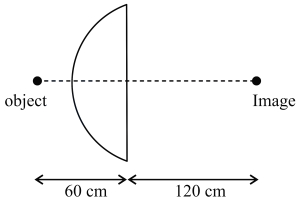
$A$ lens is made of glass having an index of refraction $1.5$. One side of the lens is flat and the other side is convex with a radius $R$. If an object is placed $60 \ cm$ towards the convex side of the lens,the image is formed at $120 \ cm$ on the other side of the lens. The value of $R$ is (in $cm$)
A
$20$
B
$40$
C
$33$
D
$18$
Solution
(A) Given: Refractive index $\mu = 1.5$,object distance $u = -60 \ cm$,image distance $v = +120 \ cm$.
For a plano-convex lens,let the radius of the convex surface be $R_1 = -R$ (as it faces the object) and the flat surface be $R_2 = \infty$.
Using the lens maker's formula:
$\frac{1}{f} = (\mu - 1) \left( \frac{1}{R_1} - \frac{1}{R_2} \right)$
$\frac{1}{f} = (1.5 - 1) \left( \frac{1}{-R} - \frac{1}{\infty} \right) = 0.5 \left( -\frac{1}{R} \right) = -\frac{1}{2R}$
So,$f = -2R$.
Using the lens formula:
$\frac{1}{v} - \frac{1}{u} = \frac{1}{f}$
$\frac{1}{120} - \frac{1}{-60} = \frac{1}{-2R}$
$\frac{1}{120} + \frac{1}{60} = -\frac{1}{2R}$
$\frac{1 + 2}{120} = -\frac{1}{2R}$
$\frac{3}{120} = -\frac{1}{2R} \Rightarrow \frac{1}{40} = -\frac{1}{2R}$
$2R = -40 \ cm$. Since $R$ represents the magnitude of the radius,we take $R = 20 \ cm$.
For a plano-convex lens,let the radius of the convex surface be $R_1 = -R$ (as it faces the object) and the flat surface be $R_2 = \infty$.
Using the lens maker's formula:
$\frac{1}{f} = (\mu - 1) \left( \frac{1}{R_1} - \frac{1}{R_2} \right)$
$\frac{1}{f} = (1.5 - 1) \left( \frac{1}{-R} - \frac{1}{\infty} \right) = 0.5 \left( -\frac{1}{R} \right) = -\frac{1}{2R}$
So,$f = -2R$.
Using the lens formula:
$\frac{1}{v} - \frac{1}{u} = \frac{1}{f}$
$\frac{1}{120} - \frac{1}{-60} = \frac{1}{-2R}$
$\frac{1}{120} + \frac{1}{60} = -\frac{1}{2R}$
$\frac{1 + 2}{120} = -\frac{1}{2R}$
$\frac{3}{120} = -\frac{1}{2R} \Rightarrow \frac{1}{40} = -\frac{1}{2R}$
$2R = -40 \ cm$. Since $R$ represents the magnitude of the radius,we take $R = 20 \ cm$.
0 likes
View Solution428
EasyMCQ
What is the refractive index of the material of a double convex lens having radii of curvature of $5 \ cm$ and $10 \ cm$ and focal length of $\frac{20}{3} \ cm$?
A
$1.5$
B
$2$
C
$2.4$
D
$2.6$
Solution
(A) Using the lens maker's formula:
$\frac{1}{f} = (\mu - 1) \left( \frac{1}{R_1} - \frac{1}{R_2} \right)$
Given: $f = \frac{20}{3} \ cm$,$R_1 = 5 \ cm$,$R_2 = -10 \ cm$ (for a double convex lens).
Substituting the values:
$\frac{3}{20} = (\mu - 1) \left( \frac{1}{5} - \frac{1}{-10} \right)$
$\frac{3}{20} = (\mu - 1) \left( \frac{2 + 1}{10} \right)$
$\frac{3}{20} = (\mu - 1) \left( \frac{3}{10} \right)$
$\mu - 1 = \frac{3}{20} \times \frac{10}{3}$
$\mu - 1 = \frac{1}{2}$
$\mu = 1 + 0.5 = 1.5$
$\frac{1}{f} = (\mu - 1) \left( \frac{1}{R_1} - \frac{1}{R_2} \right)$
Given: $f = \frac{20}{3} \ cm$,$R_1 = 5 \ cm$,$R_2 = -10 \ cm$ (for a double convex lens).
Substituting the values:
$\frac{3}{20} = (\mu - 1) \left( \frac{1}{5} - \frac{1}{-10} \right)$
$\frac{3}{20} = (\mu - 1) \left( \frac{2 + 1}{10} \right)$
$\frac{3}{20} = (\mu - 1) \left( \frac{3}{10} \right)$
$\mu - 1 = \frac{3}{20} \times \frac{10}{3}$
$\mu - 1 = \frac{1}{2}$
$\mu = 1 + 0.5 = 1.5$
0 likes
View Solution429
MediumMCQ
$A$ convex lens of focal length $25 \ cm$ and made of glass with refractive index $1.5$ is immersed in water. The absolute change in focal length of the glass is [Use refractive index of water = $\frac{4}{3}$] (in $cm$)
A
$100$
B
$37.5$
C
$75$
D
$12.5$
Solution
(C) The focal length of a lens in air is given by the Lens Maker's Formula: $\frac{1}{f_a} = (\mu_g - 1) \left( \frac{2}{R} \right) = 25^{-1} \ cm^{-1}$.
When immersed in water,the new focal length $f_w$ is given by: $\frac{1}{f_w} = \left( \frac{\mu_g}{\mu_w} - 1 \right) \left( \frac{2}{R} \right)$.
Taking the ratio: $\frac{f_w}{f_a} = \frac{\mu_g - 1}{\frac{\mu_g}{\mu_w} - 1} = \frac{1.5 - 1}{\frac{1.5}{4/3} - 1} = \frac{0.5}{1.125 - 1} = \frac{0.5}{0.125} = 4$.
Thus,$f_w = 4 \times f_a = 4 \times 25 \ cm = 100 \ cm$.
The absolute change in focal length is $|f_w - f_a| = |100 \ cm - 25 \ cm| = 75 \ cm$.
When immersed in water,the new focal length $f_w$ is given by: $\frac{1}{f_w} = \left( \frac{\mu_g}{\mu_w} - 1 \right) \left( \frac{2}{R} \right)$.
Taking the ratio: $\frac{f_w}{f_a} = \frac{\mu_g - 1}{\frac{\mu_g}{\mu_w} - 1} = \frac{1.5 - 1}{\frac{1.5}{4/3} - 1} = \frac{0.5}{1.125 - 1} = \frac{0.5}{0.125} = 4$.
Thus,$f_w = 4 \times f_a = 4 \times 25 \ cm = 100 \ cm$.
The absolute change in focal length is $|f_w - f_a| = |100 \ cm - 25 \ cm| = 75 \ cm$.
0 likes
View Solution430
DifficultMCQ
The focal length of a biconvex lens made of glass with equal radii of curvature is $f$. If the lens is dipped in water,what will be its new focal length? (Take the refractive index of glass as $3/2$ and water as $4/3$)
A
$2f$
B
$4f$
C
$(5/3)f$
D
$(7/4)f$
Solution
(B) The focal length of the biconvex lens is $f$. Since the radii are equal,let $R_1 = R$ and $R_2 = -R$.
The refractive index of glass with respect to air is ${}_a\mu_g = 3/2$.
Using the Lens Maker's formula: $\frac{1}{f} = (\mu - 1) \left( \frac{1}{R_1} - \frac{1}{R_2} \right)$.
Substituting the values: $\frac{1}{f} = (\frac{3}{2} - 1) \left( \frac{1}{R} - \frac{1}{-R} \right) = (\frac{1}{2}) \left( \frac{2}{R} \right) = \frac{1}{R}$.
Thus,$f = R$.
When the lens is dipped in water,the refractive index of glass with respect to water is ${}_w\mu_g = \frac{{}_a\mu_g}{{}_a\mu_w} = \frac{3/2}{4/3} = \frac{9}{8}$.
Using the Lens Maker's formula for the lens in water:
$\frac{1}{f_w} = ({}_w\mu_g - 1) \left( \frac{1}{R_1} - \frac{1}{R_2} \right) = (\frac{9}{8} - 1) \left( \frac{1}{R} + \frac{1}{R} \right)$.
$\frac{1}{f_w} = (\frac{1}{8}) \left( \frac{2}{R} \right) = \frac{1}{4R}$.
Since $R = f$,we get $\frac{1}{f_w} = \frac{1}{4f}$,which implies $f_w = 4f$.
The refractive index of glass with respect to air is ${}_a\mu_g = 3/2$.
Using the Lens Maker's formula: $\frac{1}{f} = (\mu - 1) \left( \frac{1}{R_1} - \frac{1}{R_2} \right)$.
Substituting the values: $\frac{1}{f} = (\frac{3}{2} - 1) \left( \frac{1}{R} - \frac{1}{-R} \right) = (\frac{1}{2}) \left( \frac{2}{R} \right) = \frac{1}{R}$.
Thus,$f = R$.
When the lens is dipped in water,the refractive index of glass with respect to water is ${}_w\mu_g = \frac{{}_a\mu_g}{{}_a\mu_w} = \frac{3/2}{4/3} = \frac{9}{8}$.
Using the Lens Maker's formula for the lens in water:
$\frac{1}{f_w} = ({}_w\mu_g - 1) \left( \frac{1}{R_1} - \frac{1}{R_2} \right) = (\frac{9}{8} - 1) \left( \frac{1}{R} + \frac{1}{R} \right)$.
$\frac{1}{f_w} = (\frac{1}{8}) \left( \frac{2}{R} \right) = \frac{1}{4R}$.
Since $R = f$,we get $\frac{1}{f_w} = \frac{1}{4f}$,which implies $f_w = 4f$.
0 likes
View Solution431
MediumMCQ
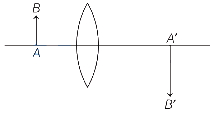
An object is placed at a certain distance to the left of a convex lens of focal length $20 \,cm$. Find the distance of the object if the image obtained is magnified by $4$ times.
A
$25 \,cm$ when the image is real
B
$15 \,cm$ when the image is real
C
$25 \,cm$ when the image is virtual
D
$15 \,cm$ when the image is virtual
Solution
(A) For a lens, magnification $m = \frac{v}{u}$.
Given $m = \pm 4$ and $f = 20 \,cm$.
Case $1$: Real image $(m = -4)$.
$m = \frac{v}{u} = -4 \Rightarrow v = -4u$.
Using lens formula $\frac{1}{v} - \frac{1}{u} = \frac{1}{f}$:
$\frac{1}{-4u} - \frac{1}{u} = \frac{1}{20} \Rightarrow \frac{-1-4}{4u} = \frac{1}{20} \Rightarrow \frac{-5}{4u} = \frac{1}{20}$.
$4u = -100 \Rightarrow u = -25 \,cm$.
So, the object is at a distance of $25 \,cm$ when the image is real.
Case $2$: Virtual image $(m = +4)$.
$m = \frac{v}{u} = 4 \Rightarrow v = 4u$.
Using lens formula $\frac{1}{v} - \frac{1}{u} = \frac{1}{f}$:
$\frac{1}{4u} - \frac{1}{u} = \frac{1}{20} \Rightarrow \frac{1-4}{4u} = \frac{1}{20} \Rightarrow \frac{-3}{4u} = \frac{1}{20}$.
$4u = -60 \Rightarrow u = -15 \,cm$.
So, the object is at a distance of $15 \,cm$ when the image is virtual.
Given $m = \pm 4$ and $f = 20 \,cm$.
Case $1$: Real image $(m = -4)$.
$m = \frac{v}{u} = -4 \Rightarrow v = -4u$.
Using lens formula $\frac{1}{v} - \frac{1}{u} = \frac{1}{f}$:
$\frac{1}{-4u} - \frac{1}{u} = \frac{1}{20} \Rightarrow \frac{-1-4}{4u} = \frac{1}{20} \Rightarrow \frac{-5}{4u} = \frac{1}{20}$.
$4u = -100 \Rightarrow u = -25 \,cm$.
So, the object is at a distance of $25 \,cm$ when the image is real.
Case $2$: Virtual image $(m = +4)$.
$m = \frac{v}{u} = 4 \Rightarrow v = 4u$.
Using lens formula $\frac{1}{v} - \frac{1}{u} = \frac{1}{f}$:
$\frac{1}{4u} - \frac{1}{u} = \frac{1}{20} \Rightarrow \frac{1-4}{4u} = \frac{1}{20} \Rightarrow \frac{-3}{4u} = \frac{1}{20}$.
$4u = -60 \Rightarrow u = -15 \,cm$.
So, the object is at a distance of $15 \,cm$ when the image is virtual.
0 likes
View Solution432
EasyMCQ
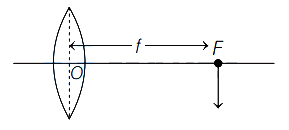
If the image of an object is at the focal point $f$ to the right side of a convex lens,the position of the object on the left of the lens is at
A
$f$
B
$2 f$
C
$< f$
D
$\infty$
Solution
(D) For a convex lens,the lens formula is given by $\frac{1}{v} - \frac{1}{u} = \frac{1}{f}$.
Given that the image is formed at the focal point on the right side,the image distance is $v = +f$.
The focal length of a convex lens is $f = +f$.
Substituting these values into the lens formula:
$\frac{1}{f} - \frac{1}{u} = \frac{1}{f}$
$\frac{1}{u} = \frac{1}{f} - \frac{1}{f} = 0$
$u = \infty$
Therefore,the object must be placed at infinity for the image to be formed at the focal point.
Given that the image is formed at the focal point on the right side,the image distance is $v = +f$.
The focal length of a convex lens is $f = +f$.
Substituting these values into the lens formula:
$\frac{1}{f} - \frac{1}{u} = \frac{1}{f}$
$\frac{1}{u} = \frac{1}{f} - \frac{1}{f} = 0$
$u = \infty$
Therefore,the object must be placed at infinity for the image to be formed at the focal point.
0 likes
View Solution433
MediumMCQ
The magnifications produced by a convex lens for two positions of an object are $4$ and $3$, respectively. If the distance of separation between the two positions of the object is $2 \,cm$, then the focal length of the lens is (in $\,cm$)
A
$20$
B
$16$
C
$28$
D
$24$
Solution
(D) Given, $m_1 = 4$ and $m_2 = 3$.
The distance between the two object positions is $|u_2 - u_1| = 2 \,cm$.
For a real image formed by a convex lens, the magnification is $m = \frac{f}{f+u}$. Since the image is real, $u$ is negative, so let $u = -x$. Then $m = \frac{f}{f-x}$.
Rearranging gives $f-x = \frac{f}{m}$, or $x = f(1 - \frac{1}{m}) = f(\frac{m-1}{m})$.
For $m_1 = 4$, $u_1 = f(\frac{4-1}{4}) = \frac{3f}{4}$.
For $m_2 = 3$, $u_2 = f(\frac{3-1}{3}) = \frac{2f}{3}$.
The separation is $u_1 - u_2 = 2 \,cm$ (assuming $m_1 > m_2$ implies $u_1 < u_2$ in magnitude for real images).
$\frac{3f}{4} - \frac{2f}{3} = 2$.
$\frac{9f - 8f}{12} = 2$.
$\frac{f}{12} = 2 \Rightarrow f = 24 \,cm$.
The distance between the two object positions is $|u_2 - u_1| = 2 \,cm$.
For a real image formed by a convex lens, the magnification is $m = \frac{f}{f+u}$. Since the image is real, $u$ is negative, so let $u = -x$. Then $m = \frac{f}{f-x}$.
Rearranging gives $f-x = \frac{f}{m}$, or $x = f(1 - \frac{1}{m}) = f(\frac{m-1}{m})$.
For $m_1 = 4$, $u_1 = f(\frac{4-1}{4}) = \frac{3f}{4}$.
For $m_2 = 3$, $u_2 = f(\frac{3-1}{3}) = \frac{2f}{3}$.
The separation is $u_1 - u_2 = 2 \,cm$ (assuming $m_1 > m_2$ implies $u_1 < u_2$ in magnitude for real images).
$\frac{3f}{4} - \frac{2f}{3} = 2$.
$\frac{9f - 8f}{12} = 2$.
$\frac{f}{12} = 2 \Rightarrow f = 24 \,cm$.
0 likes
View Solution434
EasyMCQ
Where should an object be placed on the axis of a convex lens of focal length $8 \ cm$ so as to achieve magnification of $-4$ (in $cm$)? (Distances are measured from the optic centre of the lens)
A
$-6$
B
$-10$
C
$-12$
D
$-9$
Solution
(B) The magnification $M$ for a lens is given by the formula $M = \frac{f}{u + f}$,where $f$ is the focal length and $u$ is the object distance.
Given: Focal length $f = +8 \ cm$ (for a convex lens) and magnification $M = -4$.
Substituting the values into the formula:
$-4 = \frac{8}{u + 8}$
Multiplying both sides by $(u + 8)$:
$-4(u + 8) = 8$
$-4u - 32 = 8$
$-4u = 8 + 32$
$-4u = 40$
$u = -10 \ cm$.
Thus,the object should be placed at a distance of $10 \ cm$ in front of the lens.
Given: Focal length $f = +8 \ cm$ (for a convex lens) and magnification $M = -4$.
Substituting the values into the formula:
$-4 = \frac{8}{u + 8}$
Multiplying both sides by $(u + 8)$:
$-4(u + 8) = 8$
$-4u - 32 = 8$
$-4u = 8 + 32$
$-4u = 40$
$u = -10 \ cm$.
Thus,the object should be placed at a distance of $10 \ cm$ in front of the lens.
0 likes
View Solution435
EasyMCQ
At what distance from a biconvex lens of focal length $F$ must an object be placed so that the distance between the object and its real image is minimal?
A
$2 F$
B
$F$
C
$\frac{F}{2}$
D
$4 F$
Solution
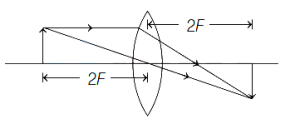
(A) Let the distance of the object from the lens be $u$ and the distance of the real image from the lens be $v$. Since the image is real,$u$ and $v$ are positive in magnitude. The total distance $D$ between the object and the image is $D = u + v$.
Using the lens formula,$\frac{1}{f} = \frac{1}{v} - \frac{1}{-u} = \frac{1}{v} + \frac{1}{u}$.
Thus,$v = \frac{uf}{u-f}$.
The total distance is $D = u + \frac{uf}{u-f}$.
To find the minimum distance,we differentiate $D$ with respect to $u$ and set it to zero: $\frac{dD}{du} = 1 + \frac{f(u-f) - uf}{(u-f)^2} = 1 - \frac{f^2}{(u-f)^2} = 0$.
This gives $(u-f)^2 = f^2$,so $u-f = f$ (since $u > f$),which means $u = 2F$.
At $u = 2F$,the distance $D = 2F + 2F = 4F$,which is the minimum distance.
Using the lens formula,$\frac{1}{f} = \frac{1}{v} - \frac{1}{-u} = \frac{1}{v} + \frac{1}{u}$.
Thus,$v = \frac{uf}{u-f}$.
The total distance is $D = u + \frac{uf}{u-f}$.
To find the minimum distance,we differentiate $D$ with respect to $u$ and set it to zero: $\frac{dD}{du} = 1 + \frac{f(u-f) - uf}{(u-f)^2} = 1 - \frac{f^2}{(u-f)^2} = 0$.
This gives $(u-f)^2 = f^2$,so $u-f = f$ (since $u > f$),which means $u = 2F$.
At $u = 2F$,the distance $D = 2F + 2F = 4F$,which is the minimum distance.
0 likes
View Solution436
EasyMCQ
Two objects $P$ and $Q$ are placed at $10 \ cm$ and $30 \ cm$ in front of a convex lens of focal length $20 \ cm$. The correct option for the image of $P$ and $Q$ is:
A
$P$ virtual and inverted,$Q$ real and upright
B
$P$ virtual and upright,$Q$ real and inverted
C
$P$ real and inverted,$Q$ virtual and upright
D
$P$ real and upright,$Q$ virtual and inverted
Solution
(B) The focal length of the convex lens is $f = 20 \ cm$.
For object $P$ placed at $u_P = 10 \ cm$,since $u_P < f$,the object lies between the optical center and the focus. Therefore,the image formed is virtual and upright.
For object $Q$ placed at $u_Q = 30 \ cm$,since $f < u_Q < 2f$ (as $20 \ cm < 30 \ cm < 40 \ cm$),the object lies between the focus and twice the focal length. Therefore,the image formed is real and inverted.
For object $P$ placed at $u_P = 10 \ cm$,since $u_P < f$,the object lies between the optical center and the focus. Therefore,the image formed is virtual and upright.
For object $Q$ placed at $u_Q = 30 \ cm$,since $f < u_Q < 2f$ (as $20 \ cm < 30 \ cm < 40 \ cm$),the object lies between the focus and twice the focal length. Therefore,the image formed is real and inverted.
0 likes
View Solution437
DifficultMCQ
Two convex lenses of focal lengths $f_1$ and $f_2$ form images with magnification $m_1$ and $m_2$,when used individually for an object kept at the same distance from the lenses. Then,$f_1 / f_2$ is
A
$\frac{m_1(1-m_1)}{m_2(1-m_2)}$
B
$\frac{m_1(1-m_2)}{m_2(1-m_1)}$
C
$\frac{m_2(1-m_1)}{m_1(1-m_2)}$
D
$\frac{m_2(1-m_2)}{m_1(1-m_1)}$
Solution
(B) The linear magnification $m$ of a lens in terms of focal length $f$ and object distance $u$ is given by $m = \frac{f}{f+u}$.
For the first lens,$m_1 = \frac{f_1}{f_1+u}$,which implies $f_1 + u = \frac{f_1}{m_1}$,so $u = f_1(\frac{1}{m_1} - 1) = f_1(\frac{1-m_1}{m_1})$.
For the second lens,$m_2 = \frac{f_2}{f_2+u}$,which implies $u = f_2(\frac{1-m_2}{m_2})$.
Since the object distance $u$ is the same for both lenses,we have $f_1(\frac{1-m_1}{m_1}) = f_2(\frac{1-m_2}{m_2})$.
Rearranging the terms to find the ratio $f_1/f_2$,we get $\frac{f_1}{f_2} = \frac{m_1(1-m_2)}{m_2(1-m_1)}$.
For the first lens,$m_1 = \frac{f_1}{f_1+u}$,which implies $f_1 + u = \frac{f_1}{m_1}$,so $u = f_1(\frac{1}{m_1} - 1) = f_1(\frac{1-m_1}{m_1})$.
For the second lens,$m_2 = \frac{f_2}{f_2+u}$,which implies $u = f_2(\frac{1-m_2}{m_2})$.
Since the object distance $u$ is the same for both lenses,we have $f_1(\frac{1-m_1}{m_1}) = f_2(\frac{1-m_2}{m_2})$.
Rearranging the terms to find the ratio $f_1/f_2$,we get $\frac{f_1}{f_2} = \frac{m_1(1-m_2)}{m_2(1-m_1)}$.
0 likes
View Solution438
MediumMCQ
$A$ thin convex lens of focal length $f$ made of crown glass is immersed in a liquid of refractive index $\mu_l$ $(\mu_l > \mu_c)$,where $\mu_c$ is the refractive index of the crown glass. The convex lens now acts as:
A
a convex lens of longer focal length
B
a convex lens of shorter focal length
C
a divergent lens
D
a convex lens of focal length $(\mu_c - \mu_l) f$
Solution
(C) According to the lens maker's formula,the focal length $f'$ of a lens in a medium is given by $\frac{1}{f'} = \left( \frac{\mu_c}{\mu_l} - 1 \right) \left( \frac{1}{R_1} - \frac{1}{R_2} \right)$.
For a convex lens in air,$\frac{1}{f} = (\mu_c - 1) \left( \frac{1}{R_1} - \frac{1}{R_2} \right)$.
When immersed in a liquid with refractive index $\mu_l > \mu_c$,the term $\left( \frac{\mu_c}{\mu_l} - 1 \right)$ becomes negative because $\frac{\mu_c}{\mu_l} < 1$.
Since the term $\left( \frac{1}{R_1} - \frac{1}{R_2} \right)$ is positive for a convex lens,the new focal length $f'$ becomes negative.
$A$ lens with a negative focal length behaves as a concave or divergent lens.
For a convex lens in air,$\frac{1}{f} = (\mu_c - 1) \left( \frac{1}{R_1} - \frac{1}{R_2} \right)$.
When immersed in a liquid with refractive index $\mu_l > \mu_c$,the term $\left( \frac{\mu_c}{\mu_l} - 1 \right)$ becomes negative because $\frac{\mu_c}{\mu_l} < 1$.
Since the term $\left( \frac{1}{R_1} - \frac{1}{R_2} \right)$ is positive for a convex lens,the new focal length $f'$ becomes negative.
$A$ lens with a negative focal length behaves as a concave or divergent lens.
0 likes
View Solution439
EasyMCQ
$A$ convex lens of glass $(\mu_g = 1.45)$ has a focal length $f_a$ in air. The lens is immersed in a liquid of refractive index $(\mu_l) = 1.3$. The ratio of the $f_l / f_a$ is
A
$3.9$
B
$0.23$
C
$0.43$
D
$0.39$
Solution
(A) The focal length of a lens is given by the Lens Maker's Formula: $\frac{1}{f} = (\mu_{rel} - 1) \left(\frac{1}{R_1} - \frac{1}{R_2}\right)$.
In air,the focal length $f_a$ is: $\frac{1}{f_a} = (\mu_g - 1) K$,where $K = (\frac{1}{R_1} - \frac{1}{R_2})$.
Given $\mu_g = 1.45$,so $\frac{1}{f_a} = (1.45 - 1) K = 0.45 K$.
In the liquid,the focal length $f_l$ is: $\frac{1}{f_l} = (\frac{\mu_g}{\mu_l} - 1) K$.
Given $\mu_l = 1.3$,so $\frac{1}{f_l} = (\frac{1.45}{1.3} - 1) K = (\frac{1.45 - 1.3}{1.3}) K = (\frac{0.15}{1.3}) K$.
Now,find the ratio $f_l / f_a$:
$\frac{f_l}{f_a} = \frac{0.45 K}{(\frac{0.15}{1.3}) K} = \frac{0.45 \times 1.3}{0.15} = 3 \times 1.3 = 3.9$.
In air,the focal length $f_a$ is: $\frac{1}{f_a} = (\mu_g - 1) K$,where $K = (\frac{1}{R_1} - \frac{1}{R_2})$.
Given $\mu_g = 1.45$,so $\frac{1}{f_a} = (1.45 - 1) K = 0.45 K$.
In the liquid,the focal length $f_l$ is: $\frac{1}{f_l} = (\frac{\mu_g}{\mu_l} - 1) K$.
Given $\mu_l = 1.3$,so $\frac{1}{f_l} = (\frac{1.45}{1.3} - 1) K = (\frac{1.45 - 1.3}{1.3}) K = (\frac{0.15}{1.3}) K$.
Now,find the ratio $f_l / f_a$:
$\frac{f_l}{f_a} = \frac{0.45 K}{(\frac{0.15}{1.3}) K} = \frac{0.45 \times 1.3}{0.15} = 3 \times 1.3 = 3.9$.
0 likes
View Solution440
DifficultMCQ
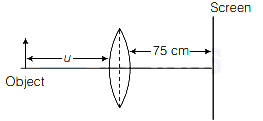
$A$ thin converging lens of focal length $f=25 \,cm$ forms the image of an object on a screen placed at a distance of $75 \,cm$ from the lens. The screen is moved closer to the lens by a distance of $25 \,cm$. The distance through which the object has to be shifted,so that its image on the screen is sharp again,is (in $\,cm$)
A
$37.5$
B
$16.25$
C
$12.5$
D
$13.5$
Solution
(C) According to the first condition,for a converging lens,the lens formula is $\frac{1}{f} = \frac{1}{v} - \frac{1}{u}$.
Given $f = 25 \,cm$ and $v = 75 \,cm$,we have:
$\frac{1}{25} = \frac{1}{75} - \frac{1}{u}$
$\frac{1}{u} = \frac{1}{75} - \frac{1}{25} = \frac{1-3}{75} = -\frac{2}{75}$
$u = -37.5 \,cm$.
So,the object is placed at a distance of $37.5 \,cm$ from the lens.
According to the second condition,the screen is moved closer to the lens by $25 \,cm$,so the new image distance is $v_1 = 75 \,cm - 25 \,cm = 50 \,cm$.
Using the lens formula again:
$\frac{1}{25} = \frac{1}{50} - \frac{1}{u_1}$
$\frac{1}{u_1} = \frac{1}{50} - \frac{1}{25} = \frac{1-2}{50} = -\frac{1}{50}$
$u_1 = -50 \,cm$.
So,the new object distance is $50 \,cm$.
The distance through which the object has to be shifted is $\Delta u = |u_1| - |u| = 50 \,cm - 37.5 \,cm = 12.5 \,cm$.
Given $f = 25 \,cm$ and $v = 75 \,cm$,we have:
$\frac{1}{25} = \frac{1}{75} - \frac{1}{u}$
$\frac{1}{u} = \frac{1}{75} - \frac{1}{25} = \frac{1-3}{75} = -\frac{2}{75}$
$u = -37.5 \,cm$.
So,the object is placed at a distance of $37.5 \,cm$ from the lens.
According to the second condition,the screen is moved closer to the lens by $25 \,cm$,so the new image distance is $v_1 = 75 \,cm - 25 \,cm = 50 \,cm$.
Using the lens formula again:
$\frac{1}{25} = \frac{1}{50} - \frac{1}{u_1}$
$\frac{1}{u_1} = \frac{1}{50} - \frac{1}{25} = \frac{1-2}{50} = -\frac{1}{50}$
$u_1 = -50 \,cm$.
So,the new object distance is $50 \,cm$.
The distance through which the object has to be shifted is $\Delta u = |u_1| - |u| = 50 \,cm - 37.5 \,cm = 12.5 \,cm$.
0 likes
View Solution441
DifficultMCQ
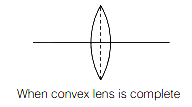
$A$ convex lens has its radii of curvature equal. The focal length of the lens is $f$. If it is divided vertically into two identical plano-convex lenses by cutting it,then the focal length of the plano-convex lens is ($\mu =$ the refractive index of the material of the lens).
A
$f$
B
$\frac{f}{2}$
C
$2 f$
D
$(\mu-1) f$
Solution
(C) For a biconvex lens with equal radii of curvature $R_1 = R$ and $R_2 = -R$,the Lens Maker's formula is given by:
$\frac{1}{f} = (\mu - 1) \left[ \frac{1}{R_1} - \frac{1}{R_2} \right]$
Substituting the values:
$\frac{1}{f} = (\mu - 1) \left[ \frac{1}{R} - \frac{1}{-R} \right] = (\mu - 1) \left[ \frac{2}{R} \right]$
Thus,$R = 2f(\mu - 1)$.
When the lens is cut vertically into two identical plano-convex lenses,each new lens has one surface with radius $R$ and the other surface as a plane (radius $\infty$).
Using the Lens Maker's formula for the new lens with focal length $f'$:
$\frac{1}{f'} = (\mu - 1) \left[ \frac{1}{R} - \frac{1}{\infty} \right]$
$\frac{1}{f'} = (\mu - 1) \left[ \frac{1}{R} \right]$
$f' = \frac{R}{\mu - 1}$
Substituting $R = 2f(\mu - 1)$:
$f' = \frac{2f(\mu - 1)}{\mu - 1} = 2f$.
$\frac{1}{f} = (\mu - 1) \left[ \frac{1}{R_1} - \frac{1}{R_2} \right]$
Substituting the values:
$\frac{1}{f} = (\mu - 1) \left[ \frac{1}{R} - \frac{1}{-R} \right] = (\mu - 1) \left[ \frac{2}{R} \right]$
Thus,$R = 2f(\mu - 1)$.
When the lens is cut vertically into two identical plano-convex lenses,each new lens has one surface with radius $R$ and the other surface as a plane (radius $\infty$).
Using the Lens Maker's formula for the new lens with focal length $f'$:
$\frac{1}{f'} = (\mu - 1) \left[ \frac{1}{R} - \frac{1}{\infty} \right]$
$\frac{1}{f'} = (\mu - 1) \left[ \frac{1}{R} \right]$
$f' = \frac{R}{\mu - 1}$
Substituting $R = 2f(\mu - 1)$:
$f' = \frac{2f(\mu - 1)}{\mu - 1} = 2f$.
0 likes
View Solution442
DifficultMCQ
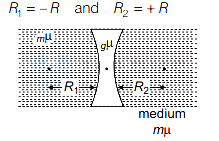
The two surfaces of a concave lens,made of glass of refractive index $1.5$,have the same radii of curvature $R$. It is now immersed in a medium of refractive index $1.75$. Then the lens:
A
becomes a convergent lens of focal length $3.5 R$
B
becomes a convergent lens of focal length $3.0 R$
C
changes as a divergent lens of focal length $3.5 R$
D
changes as a divergent lens of focal length $3.0 R$
Solution
(A) Using the lens maker's formula:
$\frac{1}{f} = \left( \frac{\mu_g}{\mu_m} - 1 \right) \left( \frac{1}{R_1} - \frac{1}{R_2} \right)$
Given that the refractive index of the glass lens is $\mu_g = 1.5$ and the refractive index of the surrounding medium is $\mu_m = 1.75$.
For a biconcave lens,the radii of curvature are $R_1 = -R$ and $R_2 = +R$.
Substituting these values into the formula:
$\frac{1}{f} = \left( \frac{1.5}{1.75} - 1 \right) \left( \frac{1}{-R} - \frac{1}{R} \right)$
$\frac{1}{f} = \left( \frac{1.5 - 1.75}{1.75} \right) \left( -\frac{2}{R} \right)$
$\frac{1}{f} = \left( \frac{-0.25}{1.75} \right) \left( -\frac{2}{R} \right)$
$\frac{1}{f} = \left( -\frac{1}{7} \right) \left( -\frac{2}{R} \right) = \frac{2}{7R}$
$f = +3.5 R$
Since the focal length $f$ is positive,the lens behaves as a convergent lens.
$\frac{1}{f} = \left( \frac{\mu_g}{\mu_m} - 1 \right) \left( \frac{1}{R_1} - \frac{1}{R_2} \right)$
Given that the refractive index of the glass lens is $\mu_g = 1.5$ and the refractive index of the surrounding medium is $\mu_m = 1.75$.
For a biconcave lens,the radii of curvature are $R_1 = -R$ and $R_2 = +R$.
Substituting these values into the formula:
$\frac{1}{f} = \left( \frac{1.5}{1.75} - 1 \right) \left( \frac{1}{-R} - \frac{1}{R} \right)$
$\frac{1}{f} = \left( \frac{1.5 - 1.75}{1.75} \right) \left( -\frac{2}{R} \right)$
$\frac{1}{f} = \left( \frac{-0.25}{1.75} \right) \left( -\frac{2}{R} \right)$
$\frac{1}{f} = \left( -\frac{1}{7} \right) \left( -\frac{2}{R} \right) = \frac{2}{7R}$
$f = +3.5 R$
Since the focal length $f$ is positive,the lens behaves as a convergent lens.
0 likes
View Solution443
DifficultMCQ
The refractive index of a material of a plano-concave lens is $5/3$, and the radius of curvature is $0.3 \,m$. The focal length of the lens in air is (in $\,m$)
A
$-0.45$
B
$-0.6$
C
$-0.75$
D
$-1.0$
Solution
(A) For a plano-concave lens, one surface is plane $(R_1 = \infty)$ and the other is concave $(R_2 = 0.3 \,m)$. By convention, for a concave surface, $R_2 = -0.3 \,m$.
Using the lens maker's formula:
$\frac{1}{f} = (\mu - 1) \left( \frac{1}{R_1} - \frac{1}{R_2} \right)$
Given $\mu = 5/3$, $R_1 = \infty$, and $R_2 = -0.3 \,m$:
$\frac{1}{f} = \left( \frac{5}{3} - 1 \right) \left( \frac{1}{\infty} - \frac{1}{-0.3} \right)$
$\frac{1}{f} = \left( \frac{2}{3} \right) \left( 0 + \frac{1}{0.3} \right)$
$\frac{1}{f} = \frac{2}{3} \times \frac{10}{3} = \frac{20}{9}$
$f = \frac{9}{20} = 0.45 \,m$
Since it is a concave lens, the focal length must be negative by sign convention, so $f = -0.45 \,m$.
Using the lens maker's formula:
$\frac{1}{f} = (\mu - 1) \left( \frac{1}{R_1} - \frac{1}{R_2} \right)$
Given $\mu = 5/3$, $R_1 = \infty$, and $R_2 = -0.3 \,m$:
$\frac{1}{f} = \left( \frac{5}{3} - 1 \right) \left( \frac{1}{\infty} - \frac{1}{-0.3} \right)$
$\frac{1}{f} = \left( \frac{2}{3} \right) \left( 0 + \frac{1}{0.3} \right)$
$\frac{1}{f} = \frac{2}{3} \times \frac{10}{3} = \frac{20}{9}$
$f = \frac{9}{20} = 0.45 \,m$
Since it is a concave lens, the focal length must be negative by sign convention, so $f = -0.45 \,m$.
0 likes
View Solution444
DifficultMCQ
The refractive index of the material of a double convex lens is $1.5$ and its focal length is $5 \,cm$. If the radii of curvature are equal, the value of the radius of curvature (in $cm$) is
A
$5.0$
B
$6.5$
C
$8.0$
D
$9.5$
Solution
(A) The lens maker's formula is given by $\frac{1}{f} = (\mu - 1) \left( \frac{1}{R_1} - \frac{1}{R_2} \right)$.
For a double convex lens, the radii of curvature are $R_1 = R$ and $R_2 = -R$.
Given $\mu = 1.5$ and $f = 5 \,cm$.
Substituting these values into the formula:
$\frac{1}{5} = (1.5 - 1) \left( \frac{1}{R} - \frac{1}{-R} \right)$
$\frac{1}{5} = 0.5 \times \left( \frac{1}{R} + \frac{1}{R} \right)$
$\frac{1}{5} = 0.5 \times \frac{2}{R}$
$\frac{1}{5} = \frac{1}{R}$
Therefore, $R = 5 \,cm$.
For a double convex lens, the radii of curvature are $R_1 = R$ and $R_2 = -R$.
Given $\mu = 1.5$ and $f = 5 \,cm$.
Substituting these values into the formula:
$\frac{1}{5} = (1.5 - 1) \left( \frac{1}{R} - \frac{1}{-R} \right)$
$\frac{1}{5} = 0.5 \times \left( \frac{1}{R} + \frac{1}{R} \right)$
$\frac{1}{5} = 0.5 \times \frac{2}{R}$
$\frac{1}{5} = \frac{1}{R}$
Therefore, $R = 5 \,cm$.
0 likes
View Solution445
DifficultMCQ
The focal length of an equi-convex lens is greater than the radius of curvature of any of the surfaces. Then the refractive index of the material of the lens is
A
greater than zero but less than $1.5$
B
greater than $1.5$ but less than $2.0$
C
greater than $2.0$ but less than $2.5$
D
greater than $2.5$ but less than $3.0$
Solution
(A) The lens maker's formula is given by $\frac{1}{f} = (\mu - 1) \left( \frac{1}{R_1} - \frac{1}{R_2} \right)$.
For an equi-convex lens,$R_1 = R$ and $R_2 = -R$.
Substituting these values,we get $\frac{1}{f} = (\mu - 1) \left( \frac{1}{R} - \frac{1}{-R} \right) = (\mu - 1) \left( \frac{2}{R} \right)$.
Thus,$f = \frac{R}{2(\mu - 1)}$.
According to the problem,$f > R$.
Therefore,$\frac{R}{2(\mu - 1)} > R$,which implies $\frac{1}{2(\mu - 1)} > 1$.
This simplifies to $2(\mu - 1) < 1$,or $\mu - 1 < 0.5$.
So,$\mu < 1.5$.
Since the lens must be made of a material with a refractive index greater than $1$ (for it to act as a lens in air),the refractive index $\mu$ must be greater than $1$ but less than $1.5$.
For an equi-convex lens,$R_1 = R$ and $R_2 = -R$.
Substituting these values,we get $\frac{1}{f} = (\mu - 1) \left( \frac{1}{R} - \frac{1}{-R} \right) = (\mu - 1) \left( \frac{2}{R} \right)$.
Thus,$f = \frac{R}{2(\mu - 1)}$.
According to the problem,$f > R$.
Therefore,$\frac{R}{2(\mu - 1)} > R$,which implies $\frac{1}{2(\mu - 1)} > 1$.
This simplifies to $2(\mu - 1) < 1$,or $\mu - 1 < 0.5$.
So,$\mu < 1.5$.
Since the lens must be made of a material with a refractive index greater than $1$ (for it to act as a lens in air),the refractive index $\mu$ must be greater than $1$ but less than $1.5$.
0 likes
View SolutionRay Optics and Optical Instruments — Refraction by Lenses · Frequently Asked Questions
1Are these Ray Optics and Optical Instruments questions useful for JEE and NEET?
Yes. All questions in this section are mapped to JEE Main and NEET exam patterns. Previous year questions from JEE Main, NEET, GUJCET and state-level exams are included with full solutions.
2Can I switch to Hindi or Gujarati for these questions?
Yes. Use the language tabs in the hero section or the sidebar to view the same questions and solutions in English, Hindi or Gujarati.
3How do I generate a question paper from this subtopic?
Use the Vedclass Exam Paper Generator — select the chapter and subtopic, set difficulty, and generate Sets A, B, C, D automatically. First 3 chapters of every subject are free.
Vedclass Products
For Students
Vedclass Test Series
Mock tests in real JEE/NEET style with performance analysis. 5-day free trial.
Start Free TrialFor Teachers
Exam Paper Generator
Generate Set A/B/C/D papers from this chapter in 2 minutes. 3 chapters free.
Try FreeFor Institutes
Online Exam Module
Live online exams with unlimited students, 360° analytics & white-label branding.
See DemoFor Teachers & Institutes
Generate a Ray Optics and Optical Instruments Exam Paper in 2 Minutes
Select subtopic & difficulty — Sets A, B, C, D auto-generated with No Repeat logic.
First 3 chapters of every subject are free — no payment required.