
A English
Refraction by Lenses Questions in English
Class 12 Physics · Ray Optics and Optical Instruments · Refraction by Lenses
470+
Questions
English
Language
100%
With Solutions
Showing 19 of 470 questions in English
451
DifficultMCQ
The focal length of an equi-convex lens is greater than the radius of curvature of any of the surfaces. Then the refractive index of the material of the lens is
A
greater than zero but less than $1.5$
B
greater than $1.5$ but less than $2.0$
C
greater than $2.0$ but less than $2.5$
D
greater than $2.5$ but less than $3.0$
Solution
(A) The lens maker's formula is given by $\frac{1}{f} = (\mu - 1) \left( \frac{1}{R_1} - \frac{1}{R_2} \right)$.
For an equi-convex lens,$R_1 = R$ and $R_2 = -R$.
Substituting these values,we get $\frac{1}{f} = (\mu - 1) \left( \frac{1}{R} - \frac{1}{-R} \right) = (\mu - 1) \left( \frac{2}{R} \right)$.
Thus,$f = \frac{R}{2(\mu - 1)}$.
According to the problem,$f > R$.
Therefore,$\frac{R}{2(\mu - 1)} > R$,which implies $\frac{1}{2(\mu - 1)} > 1$.
This simplifies to $2(\mu - 1) < 1$,or $\mu - 1 < 0.5$.
So,$\mu < 1.5$.
Since the lens must be made of a material with a refractive index greater than $1$ (for it to act as a lens in air),the refractive index $\mu$ must be greater than $1$ but less than $1.5$.
For an equi-convex lens,$R_1 = R$ and $R_2 = -R$.
Substituting these values,we get $\frac{1}{f} = (\mu - 1) \left( \frac{1}{R} - \frac{1}{-R} \right) = (\mu - 1) \left( \frac{2}{R} \right)$.
Thus,$f = \frac{R}{2(\mu - 1)}$.
According to the problem,$f > R$.
Therefore,$\frac{R}{2(\mu - 1)} > R$,which implies $\frac{1}{2(\mu - 1)} > 1$.
This simplifies to $2(\mu - 1) < 1$,or $\mu - 1 < 0.5$.
So,$\mu < 1.5$.
Since the lens must be made of a material with a refractive index greater than $1$ (for it to act as a lens in air),the refractive index $\mu$ must be greater than $1$ but less than $1.5$.
0 likes
View Solution452
DifficultMCQ
$A$ convex lens of focal length $0.15 \,m$ is made of a material of refractive index $\frac{3}{2}$. When it is placed in a liquid, its focal length is increased by $0.225 \,m$. The refractive index of the liquid is
A
$\frac{7}{4}$
B
$\frac{5}{4}$
C
$\frac{9}{4}$
D
$\frac{3}{2}$
Solution
(B) Given: Focal length in air $f_a = 0.15 \,m$, refractive index of glass $\mu_g = 1.5 = \frac{3}{2}$, and the increase in focal length is $0.225 \,m$.
Therefore, the new focal length in liquid is $f_l = f_a + 0.225 = 0.15 + 0.225 = 0.375 \,m$.
Using the Lens Maker's formula:
$\frac{1}{f} = (\frac{\mu_{lens}}{\mu_{medium}} - 1)(\frac{1}{R_1} - \frac{1}{R_2})$
For air $(\mu_a = 1)$: $\frac{1}{f_a} = (\frac{\mu_g}{1} - 1)(\frac{1}{R_1} - \frac{1}{R_2}) = (1.5 - 1)K = 0.5K$, where $K = (\frac{1}{R_1} - \frac{1}{R_2})$.
For liquid $(\mu_l)$: $\frac{1}{f_l} = (\frac{\mu_g}{\mu_l} - 1)K$.
Dividing the two equations: $\frac{f_l}{f_a} = \frac{0.5}{(\frac{1.5}{\mu_l} - 1)}$.
Substituting values: $\frac{0.375}{0.15} = \frac{0.5}{(\frac{1.5}{\mu_l} - 1)} \Rightarrow 2.5 = \frac{0.5}{(\frac{1.5}{\mu_l} - 1)}$.
$(\frac{1.5}{\mu_l} - 1) = \frac{0.5}{2.5} = 0.2$.
$\frac{1.5}{\mu_l} = 1.2 \Rightarrow \mu_l = \frac{1.5}{1.2} = \frac{15}{12} = \frac{5}{4} = 1.25$.
Therefore, the new focal length in liquid is $f_l = f_a + 0.225 = 0.15 + 0.225 = 0.375 \,m$.
Using the Lens Maker's formula:
$\frac{1}{f} = (\frac{\mu_{lens}}{\mu_{medium}} - 1)(\frac{1}{R_1} - \frac{1}{R_2})$
For air $(\mu_a = 1)$: $\frac{1}{f_a} = (\frac{\mu_g}{1} - 1)(\frac{1}{R_1} - \frac{1}{R_2}) = (1.5 - 1)K = 0.5K$, where $K = (\frac{1}{R_1} - \frac{1}{R_2})$.
For liquid $(\mu_l)$: $\frac{1}{f_l} = (\frac{\mu_g}{\mu_l} - 1)K$.
Dividing the two equations: $\frac{f_l}{f_a} = \frac{0.5}{(\frac{1.5}{\mu_l} - 1)}$.
Substituting values: $\frac{0.375}{0.15} = \frac{0.5}{(\frac{1.5}{\mu_l} - 1)} \Rightarrow 2.5 = \frac{0.5}{(\frac{1.5}{\mu_l} - 1)}$.
$(\frac{1.5}{\mu_l} - 1) = \frac{0.5}{2.5} = 0.2$.
$\frac{1.5}{\mu_l} = 1.2 \Rightarrow \mu_l = \frac{1.5}{1.2} = \frac{15}{12} = \frac{5}{4} = 1.25$.
0 likes
View Solution453
DifficultMCQ
$A$ convex lens focuses an object $20 \ cm$ from it on a screen placed $5 \ cm$ away from it. $A$ glass plate (refractive index $\mu = \frac{7}{5}$) of thickness $t = 1.4 \ cm$ is inserted between the lens and the screen. What is the new distance of the object from the lens so that its image is again focused on the screen (in $cm$)?
A
$22.5$
B
$30.7$
C
$25.0$
D
$28.4$
Solution
(B) The apparent shift in the position of the image due to the glass slab is given by $d = t(1 - \frac{1}{\mu})$.
Substituting the values,$d = 1.4(1 - \frac{5}{7}) = 1.4(\frac{2}{7}) = 0.4 \ cm$.
First,calculate the focal length $f$ of the lens using the initial conditions: $u = -20 \ cm$ and $v = 5 \ cm$.
Using the lens formula $\frac{1}{f} = \frac{1}{v} - \frac{1}{u}$,we get $\frac{1}{f} = \frac{1}{5} - \frac{1}{-20} = \frac{4+1}{20} = \frac{5}{20} = \frac{1}{4}$. Thus,$f = 4 \ cm$.
When the glass slab is inserted,the image must still form on the screen at $v = 5 \ cm$. However,the slab shifts the image position towards the lens by $d = 0.4 \ cm$. Therefore,the effective image distance becomes $v' = 5 - 0.4 = 4.6 \ cm$.
Using the lens formula again for the new object distance $u'$: $\frac{1}{f} = \frac{1}{v'} - \frac{1}{u'}$.
$\frac{1}{4} = \frac{1}{4.6} - \frac{1}{u'} \Rightarrow \frac{1}{u'} = \frac{1}{4.6} - \frac{1}{4} = \frac{4 - 4.6}{18.4} = \frac{-0.6}{18.4}$.
$u' = -\frac{18.4}{0.6} \approx -30.66 \ cm \approx 30.7 \ cm$.
Substituting the values,$d = 1.4(1 - \frac{5}{7}) = 1.4(\frac{2}{7}) = 0.4 \ cm$.
First,calculate the focal length $f$ of the lens using the initial conditions: $u = -20 \ cm$ and $v = 5 \ cm$.
Using the lens formula $\frac{1}{f} = \frac{1}{v} - \frac{1}{u}$,we get $\frac{1}{f} = \frac{1}{5} - \frac{1}{-20} = \frac{4+1}{20} = \frac{5}{20} = \frac{1}{4}$. Thus,$f = 4 \ cm$.
When the glass slab is inserted,the image must still form on the screen at $v = 5 \ cm$. However,the slab shifts the image position towards the lens by $d = 0.4 \ cm$. Therefore,the effective image distance becomes $v' = 5 - 0.4 = 4.6 \ cm$.
Using the lens formula again for the new object distance $u'$: $\frac{1}{f} = \frac{1}{v'} - \frac{1}{u'}$.
$\frac{1}{4} = \frac{1}{4.6} - \frac{1}{u'} \Rightarrow \frac{1}{u'} = \frac{1}{4.6} - \frac{1}{4} = \frac{4 - 4.6}{18.4} = \frac{-0.6}{18.4}$.
$u' = -\frac{18.4}{0.6} \approx -30.66 \ cm \approx 30.7 \ cm$.
0 likes
View Solution454
EasyMCQ
$A$ point source is located at a distance of $20 \ cm$ from the front surface of a symmetrical glass biconvex lens with equal radii of curvature $5 \ cm$. The distance at which the image is formed from the rear surface of this lens is $[$Given refractive index of the glass is $1.5]$
A
$\frac{20}{3} \ cm$
B
$\frac{10}{3} \ cm$
C
$5 \ cm$
D
$10 \ cm$
Solution
(A) Using the lens maker's formula for a biconvex lens,we have:
$\frac{1}{f} = (\mu - 1) \left( \frac{1}{R_1} - \frac{1}{R_2} \right)$
Since the lens is symmetrical and biconvex,$R_1 = 5 \ cm$ and $R_2 = -5 \ cm$.
$\frac{1}{f} = (1.5 - 1) \left( \frac{1}{5} - \frac{1}{-5} \right) = 0.5 \times \left( \frac{2}{5} \right) = \frac{1}{5} \ cm^{-1}$.
Thus,the focal length $f = 5 \ cm$.
Using the lens equation $\frac{1}{v} - \frac{1}{u} = \frac{1}{f}$,where $u = -20 \ cm$:
$\frac{1}{v} - \frac{1}{-20} = \frac{1}{5}$
$\frac{1}{v} = \frac{1}{5} - \frac{1}{20} = \frac{4 - 1}{20} = \frac{3}{20}$
$v = \frac{20}{3} \ cm$.
The image is formed at a distance of $\frac{20}{3} \ cm$ from the optical center of the lens.
$\frac{1}{f} = (\mu - 1) \left( \frac{1}{R_1} - \frac{1}{R_2} \right)$
Since the lens is symmetrical and biconvex,$R_1 = 5 \ cm$ and $R_2 = -5 \ cm$.
$\frac{1}{f} = (1.5 - 1) \left( \frac{1}{5} - \frac{1}{-5} \right) = 0.5 \times \left( \frac{2}{5} \right) = \frac{1}{5} \ cm^{-1}$.
Thus,the focal length $f = 5 \ cm$.
Using the lens equation $\frac{1}{v} - \frac{1}{u} = \frac{1}{f}$,where $u = -20 \ cm$:
$\frac{1}{v} - \frac{1}{-20} = \frac{1}{5}$
$\frac{1}{v} = \frac{1}{5} - \frac{1}{20} = \frac{4 - 1}{20} = \frac{3}{20}$
$v = \frac{20}{3} \ cm$.
The image is formed at a distance of $\frac{20}{3} \ cm$ from the optical center of the lens.
0 likes
View Solution455
DifficultMCQ
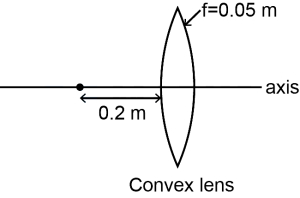
$A$ point object is placed on the axis of a thin convex lens of focal length $0.05 \ m$ at a distance of $0.2 \ m$ from the lens and its image is formed on the axis. If the object is now made to oscillate along the axis with a small amplitude of $A \ cm,$ then what is the amplitude of oscillation of the image? [You may assume $\frac{1}{1+x} \approx 1-x,$ where $x << 1$]
A
$\frac{4 A}{9} \times 10^{-2} \ m$
B
$\frac{5 A}{9} \times 10^{-2} \ m$
C
$\frac{A}{3} \times 10^{-2} \ m$
D
$\frac{A}{9} \times 10^{-2} \ m$
Solution
(D) Given: Focal length $f = 0.05 \ m$,object distance $u = -0.2 \ m$.
Using the lens formula: $\frac{1}{v} - \frac{1}{u} = \frac{1}{f}$.
Substituting the values: $\frac{1}{v} = \frac{1}{f} + \frac{1}{u} = \frac{1}{0.05} - \frac{1}{0.2} = 20 - 5 = 15 \ m^{-1}$.
Thus,$v = \frac{1}{15} \ m$.
Differentiating the lens formula $\frac{1}{v} - \frac{1}{u} = \frac{1}{f}$ with respect to time,we get: $-\frac{dv}{v^2} + \frac{du}{u^2} = 0$.
This implies $dv = \left( \frac{v^2}{u^2} \right) du$.
The amplitude of the image oscillation $A_{image} = |dv|$ is given by $A_{image} = \left( \frac{v}{u} \right)^2 A_{object}$.
Given $A_{object} = A \ cm = A \times 10^{-2} \ m$.
$A_{image} = \left( \frac{1/15}{0.2} \right)^2 \times A \times 10^{-2} \ m = \left( \frac{1}{15 \times 0.2} \right)^2 \times A \times 10^{-2} \ m = \left( \frac{1}{3} \right)^2 \times A \times 10^{-2} \ m = \frac{A}{9} \times 10^{-2} \ m$.
Using the lens formula: $\frac{1}{v} - \frac{1}{u} = \frac{1}{f}$.
Substituting the values: $\frac{1}{v} = \frac{1}{f} + \frac{1}{u} = \frac{1}{0.05} - \frac{1}{0.2} = 20 - 5 = 15 \ m^{-1}$.
Thus,$v = \frac{1}{15} \ m$.
Differentiating the lens formula $\frac{1}{v} - \frac{1}{u} = \frac{1}{f}$ with respect to time,we get: $-\frac{dv}{v^2} + \frac{du}{u^2} = 0$.
This implies $dv = \left( \frac{v^2}{u^2} \right) du$.
The amplitude of the image oscillation $A_{image} = |dv|$ is given by $A_{image} = \left( \frac{v}{u} \right)^2 A_{object}$.
Given $A_{object} = A \ cm = A \times 10^{-2} \ m$.
$A_{image} = \left( \frac{1/15}{0.2} \right)^2 \times A \times 10^{-2} \ m = \left( \frac{1}{15 \times 0.2} \right)^2 \times A \times 10^{-2} \ m = \left( \frac{1}{3} \right)^2 \times A \times 10^{-2} \ m = \frac{A}{9} \times 10^{-2} \ m$.
0 likes
View Solution456
MediumMCQ
$A$ luminous object is separated from a screen by a distance $d$. $A$ convex lens is placed between the object and the screen such that it forms a distinct image on the screen. The maximum possible focal length of this convex lens is
A
$4 d$
B
$2 d$
C
$\frac{d}{2}$
D
$\frac{d}{4}$
Solution
(D) For a convex lens to form a real image of an object on a screen separated by a fixed distance $d$,the condition for the existence of the image is given by the displacement method.
Let $u$ be the object distance and $v$ be the image distance. Then $u + v = d$.
For a real image,the lens formula is $\frac{1}{v} - \frac{1}{u} = \frac{1}{f}$.
Substituting $u = -(d - v)$,we get $\frac{1}{v} + \frac{1}{d - v} = \frac{1}{f}$.
This simplifies to the quadratic equation $v^2 - dv + df = 0$.
For $v$ to have real roots,the discriminant must be non-negative: $D = d^2 - 4df \geq 0$.
This implies $d^2 \geq 4df$,or $f \leq \frac{d}{4}$.
Thus,the maximum possible focal length of the convex lens is $\frac{d}{4}$.
Let $u$ be the object distance and $v$ be the image distance. Then $u + v = d$.
For a real image,the lens formula is $\frac{1}{v} - \frac{1}{u} = \frac{1}{f}$.
Substituting $u = -(d - v)$,we get $\frac{1}{v} + \frac{1}{d - v} = \frac{1}{f}$.
This simplifies to the quadratic equation $v^2 - dv + df = 0$.
For $v$ to have real roots,the discriminant must be non-negative: $D = d^2 - 4df \geq 0$.
This implies $d^2 \geq 4df$,or $f \leq \frac{d}{4}$.
Thus,the maximum possible focal length of the convex lens is $\frac{d}{4}$.
0 likes
View Solution457
DifficultMCQ
An object placed at a distance of $16 \ cm$ from a convex lens produces an image of magnification $m$ $(m > 1)$. If the object is moved towards the lens by $8 \ cm$,then again an image of magnification $m$ is obtained. The numerical value of the focal length of the lens is (in $cm$)
A
$12$
B
$14$
C
$18$
D
$20$
Solution
(A) For a convex lens,the magnification $m$ is given by $m = \frac{f}{f+u}$,where $u$ is the object distance (using sign convention,$u$ is negative).
Given that the magnification $m$ is the same for two different object positions,this is only possible if one image is real and the other is virtual.
For the first case,$u_1 = -16 \ cm$. The magnification is $m = \frac{f}{f-16}$. Since $m > 1$,this must be a virtual image,so $m = \frac{f}{f-16}$.
When the object is moved towards the lens by $8 \ cm$,the new object distance is $u_2 = -(16 - 8) = -8 \ cm$. The magnification is $m' = \frac{f}{f-8}$. Since the magnitude of magnification is the same,we have $|\frac{f}{f-16}| = |\frac{f}{f-8}|$.
Since $m > 1$,one must be positive and one negative: $\frac{f}{f-16} = -\frac{f}{f-8}$.
Dividing by $f$ (as $f \neq 0$): $\frac{1}{f-16} = -\frac{1}{f-8}$.
$\Rightarrow f - 8 = -(f - 16) = -f + 16$.
$\Rightarrow 2f = 24$.
$\Rightarrow f = 12 \ cm$.
Given that the magnification $m$ is the same for two different object positions,this is only possible if one image is real and the other is virtual.
For the first case,$u_1 = -16 \ cm$. The magnification is $m = \frac{f}{f-16}$. Since $m > 1$,this must be a virtual image,so $m = \frac{f}{f-16}$.
When the object is moved towards the lens by $8 \ cm$,the new object distance is $u_2 = -(16 - 8) = -8 \ cm$. The magnification is $m' = \frac{f}{f-8}$. Since the magnitude of magnification is the same,we have $|\frac{f}{f-16}| = |\frac{f}{f-8}|$.
Since $m > 1$,one must be positive and one negative: $\frac{f}{f-16} = -\frac{f}{f-8}$.
Dividing by $f$ (as $f \neq 0$): $\frac{1}{f-16} = -\frac{1}{f-8}$.
$\Rightarrow f - 8 = -(f - 16) = -f + 16$.
$\Rightarrow 2f = 24$.
$\Rightarrow f = 12 \ cm$.
0 likes
View Solution458
EasyMCQ
$A$ biconvex lens of focal length $f$ and radii of curvature of both surfaces $R$ is made of a material of refractive index $n_{1}$. This lens is placed in a liquid of refractive index $n_{2}$. How will this lens behave?
A
Either as a convex or as a concave lens depending solely on $R$
B
$A$ convex lens depending on $n_{1}$ and $n_{2}$
C
$A$ concave lens depending on $n_{1}$ and $n_{2}$
D
$A$ convex lens of same focal length irrespective of $R, n_{1}$ and $n_{2}$
Solution
(A) According to the Lens Maker's Formula,the focal length $f'$ of a lens in a medium is given by $\frac{1}{f'} = (\frac{n_{1}}{n_{2}} - 1)(\frac{1}{R_{1}} - \frac{1}{R_{2}})$.
For a biconvex lens,$R_{1} = R$ and $R_{2} = -R$,so $(\frac{1}{R_{1}} - \frac{1}{R_{2}}) = \frac{2}{R}$.
Thus,$\frac{1}{f'} = (\frac{n_{1}}{n_{2}} - 1)(\frac{2}{R})$.
If $n_{1} > n_{2}$,then $(\frac{n_{1}}{n_{2}} - 1) > 0$,so $f' > 0$,and the lens behaves as a convex (converging) lens.
If $n_{1} < n_{2}$,then $(\frac{n_{1}}{n_{2}} - 1) < 0$,so $f' < 0$,and the lens behaves as a concave (diverging) lens.
Therefore,the behavior of the lens depends on the relative values of $n_{1}$ and $n_{2}$.
For a biconvex lens,$R_{1} = R$ and $R_{2} = -R$,so $(\frac{1}{R_{1}} - \frac{1}{R_{2}}) = \frac{2}{R}$.
Thus,$\frac{1}{f'} = (\frac{n_{1}}{n_{2}} - 1)(\frac{2}{R})$.
If $n_{1} > n_{2}$,then $(\frac{n_{1}}{n_{2}} - 1) > 0$,so $f' > 0$,and the lens behaves as a convex (converging) lens.
If $n_{1} < n_{2}$,then $(\frac{n_{1}}{n_{2}} - 1) < 0$,so $f' < 0$,and the lens behaves as a concave (diverging) lens.
Therefore,the behavior of the lens depends on the relative values of $n_{1}$ and $n_{2}$.
0 likes
View Solution459
EasyMCQ
$A$ convex lens of focal length $30 \,cm$ produces $5$ times magnified real image of an object. What is the object distance (in $\,cm$)?
A
$36$
B
$25$
C
$30$
D
$150$
Solution
(A) Given: Focal length $f = +30 \,cm$ (for a convex lens).
Magnification $m = -5$ (since the image is real).
We know that magnification $m = \frac{v}{u}$, so $v = mu = -5u$.
Using the lens formula: $\frac{1}{f} = \frac{1}{v} - \frac{1}{u}$.
Substituting the values: $\frac{1}{30} = \frac{1}{-5u} - \frac{1}{u}$.
$\frac{1}{30} = \frac{-1 - 5}{5u} = \frac{-6}{5u}$.
$5u = -180$.
$u = -36 \,cm$.
The magnitude of the object distance is $36 \,cm$.
Magnification $m = -5$ (since the image is real).
We know that magnification $m = \frac{v}{u}$, so $v = mu = -5u$.
Using the lens formula: $\frac{1}{f} = \frac{1}{v} - \frac{1}{u}$.
Substituting the values: $\frac{1}{30} = \frac{1}{-5u} - \frac{1}{u}$.
$\frac{1}{30} = \frac{-1 - 5}{5u} = \frac{-6}{5u}$.
$5u = -180$.
$u = -36 \,cm$.
The magnitude of the object distance is $36 \,cm$.
0 likes
View Solution460
EasyMCQ
$A$ plano-concave lens is made of glass of refractive index $1.5$ and the radius of curvature of its curved face is $100 \,cm$. What is the power of the lens?
A
$+0.5 \,D$
B
$-0.5 \,D$
C
$-2 \,D$
D
$+2 \,D$
Solution
(B) The power $P$ of a lens is given by the lens maker's formula: $P = \frac{1}{f} = (\mu - 1) \left( \frac{1}{R_1} - \frac{1}{R_2} \right)$.
For a plano-concave lens, the first surface is plane $(R_1 = \infty)$ and the second surface is concave $(R_2 = -100 \,cm = -1 \,m)$.
Given refractive index $\mu = 1.5$.
Substituting the values: $P = (1.5 - 1) \left( \frac{1}{\infty} - \frac{1}{-1} \right)$.
$P = (0.5) (0 + 1) = 0.5 \,D$.
Wait, for a concave lens, the power must be negative. Let's re-evaluate the sign convention: For a plano-concave lens, light enters the plane surface first $(R_1 = \infty)$ and exits the concave surface $(R_2 = -R = -1 \,m)$.
$P = (1.5 - 1) \left( \frac{1}{\infty} - \frac{1}{-1} \right) = 0.5 \times 1 = +0.5 \,D$ (This is for a plano-convex).
For a plano-concave lens, the curved surface is the first surface $(R_1 = -1 \,m)$ and the second is plane $(R_2 = \infty)$.
$P = (1.5 - 1) \left( \frac{1}{-1} - \frac{1}{\infty} \right) = 0.5 \times (-1) = -0.5 \,D$.
For a plano-concave lens, the first surface is plane $(R_1 = \infty)$ and the second surface is concave $(R_2 = -100 \,cm = -1 \,m)$.
Given refractive index $\mu = 1.5$.
Substituting the values: $P = (1.5 - 1) \left( \frac{1}{\infty} - \frac{1}{-1} \right)$.
$P = (0.5) (0 + 1) = 0.5 \,D$.
Wait, for a concave lens, the power must be negative. Let's re-evaluate the sign convention: For a plano-concave lens, light enters the plane surface first $(R_1 = \infty)$ and exits the concave surface $(R_2 = -R = -1 \,m)$.
$P = (1.5 - 1) \left( \frac{1}{\infty} - \frac{1}{-1} \right) = 0.5 \times 1 = +0.5 \,D$ (This is for a plano-convex).
For a plano-concave lens, the curved surface is the first surface $(R_1 = -1 \,m)$ and the second is plane $(R_2 = \infty)$.
$P = (1.5 - 1) \left( \frac{1}{-1} - \frac{1}{\infty} \right) = 0.5 \times (-1) = -0.5 \,D$.
0 likes
View Solution461
MediumMCQ
The distance between an object and a divergent lens is $m$ times the focal length of the lens. The linear magnification produced by the lens is
A
$m$
B
$\frac{1}{m}$
C
$m+1$
D
$\frac{1}{m+1}$
Solution
(D) For a divergent (concave) lens,the focal length $f$ is taken as negative,so $f_{lens} = -f$ (where $f > 0$).
Given the object distance $u = -mf$.
Using the lens formula: $\frac{1}{v} - \frac{1}{u} = \frac{1}{f_{lens}}$.
Substituting the values: $\frac{1}{v} - \frac{1}{-mf} = \frac{1}{-f}$.
$\frac{1}{v} + \frac{1}{mf} = -\frac{1}{f}$.
$\frac{1}{v} = -\frac{1}{f} - \frac{1}{mf} = -\frac{1}{f} \left(1 + \frac{1}{m}\right) = -\frac{1}{f} \left(\frac{m+1}{m}\right)$.
Therefore,$v = -f \left(\frac{m}{m+1}\right)$.
The linear magnification $M$ is given by $M = \frac{v}{u}$.
$M = \frac{-f \left(\frac{m}{m+1}\right)}{-mf} = \frac{1}{m+1}$.
Given the object distance $u = -mf$.
Using the lens formula: $\frac{1}{v} - \frac{1}{u} = \frac{1}{f_{lens}}$.
Substituting the values: $\frac{1}{v} - \frac{1}{-mf} = \frac{1}{-f}$.
$\frac{1}{v} + \frac{1}{mf} = -\frac{1}{f}$.
$\frac{1}{v} = -\frac{1}{f} - \frac{1}{mf} = -\frac{1}{f} \left(1 + \frac{1}{m}\right) = -\frac{1}{f} \left(\frac{m+1}{m}\right)$.
Therefore,$v = -f \left(\frac{m}{m+1}\right)$.
The linear magnification $M$ is given by $M = \frac{v}{u}$.
$M = \frac{-f \left(\frac{m}{m+1}\right)}{-mf} = \frac{1}{m+1}$.
0 likes
View Solution462
MediumMCQ
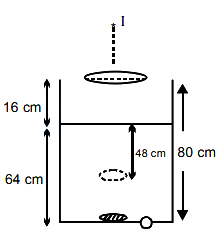
$A$ thin convex lens is placed just above an empty vessel of depth $80 \,cm$. The image of a coin kept at the bottom of the vessel is thus formed $20 \,cm$ above the lens. If now water is poured in the vessel up to a height of $64 \,cm$, what will be the approximate new position of the image? Assume that the refractive index of water is $4/3$.
A
$21.33 \,cm$ above the lens
B
$6.67 \,cm$ below the lens
C
$33.67 \,cm$ above the lens
D
$24 \,cm$ above the lens
Solution
(A) Step $1$: Find the focal length of the lens using the empty vessel condition.
For an empty vessel, the object distance $u = -80 \,cm$ and the image distance $v = +20 \,cm$.
Using the lens formula $\frac{1}{f} = \frac{1}{v} - \frac{1}{u}$:
$\frac{1}{f} = \frac{1}{20} - \frac{1}{-80} = \frac{1}{20} + \frac{1}{80} = \frac{4+1}{80} = \frac{5}{80} = \frac{1}{16} \,cm^{-1}$.
So, the focal length $f = 16 \,cm$.
Step $2$: Find the new object distance after pouring water.
When water of height $h = 64 \,cm$ is poured, the apparent depth of the coin is $d' = \frac{h}{\mu} = \frac{64}{4/3} = 64 \times \frac{3}{4} = 48 \,cm$.
The distance of the coin from the lens is $80 \,cm$. The distance of the apparent image from the bottom is $64 - 48 = 16 \,cm$. Thus, the new object distance $u'$ from the lens is $80 - 16 = 64 \,cm$ (or $16 \,cm$ air + $48 \,cm$ apparent depth).
So, $u' = -64 \,cm$.
Step $3$: Find the new image position $v'$.
Using the lens formula $\frac{1}{f} = \frac{1}{v'} - \frac{1}{u'}$:
$\frac{1}{16} = \frac{1}{v'} - \frac{1}{-64} \implies \frac{1}{v'} = \frac{1}{16} - \frac{1}{64} = \frac{4-1}{64} = \frac{3}{64}$.
$v' = \frac{64}{3} \approx 21.33 \,cm$.
Therefore, the image is formed $21.33 \,cm$ above the lens.
For an empty vessel, the object distance $u = -80 \,cm$ and the image distance $v = +20 \,cm$.
Using the lens formula $\frac{1}{f} = \frac{1}{v} - \frac{1}{u}$:
$\frac{1}{f} = \frac{1}{20} - \frac{1}{-80} = \frac{1}{20} + \frac{1}{80} = \frac{4+1}{80} = \frac{5}{80} = \frac{1}{16} \,cm^{-1}$.
So, the focal length $f = 16 \,cm$.
Step $2$: Find the new object distance after pouring water.
When water of height $h = 64 \,cm$ is poured, the apparent depth of the coin is $d' = \frac{h}{\mu} = \frac{64}{4/3} = 64 \times \frac{3}{4} = 48 \,cm$.
The distance of the coin from the lens is $80 \,cm$. The distance of the apparent image from the bottom is $64 - 48 = 16 \,cm$. Thus, the new object distance $u'$ from the lens is $80 - 16 = 64 \,cm$ (or $16 \,cm$ air + $48 \,cm$ apparent depth).
So, $u' = -64 \,cm$.
Step $3$: Find the new image position $v'$.
Using the lens formula $\frac{1}{f} = \frac{1}{v'} - \frac{1}{u'}$:
$\frac{1}{16} = \frac{1}{v'} - \frac{1}{-64} \implies \frac{1}{v'} = \frac{1}{16} - \frac{1}{64} = \frac{4-1}{64} = \frac{3}{64}$.
$v' = \frac{64}{3} \approx 21.33 \,cm$.
Therefore, the image is formed $21.33 \,cm$ above the lens.
0 likes
View Solution463
MediumMCQ
$A$ convex lens of refractive index $1.5$ and focal length $f = 18 \ cm$ is immersed in water. The difference in focal lengths of the given lens when it is in water and in air is $\alpha \times f$. The value of $\alpha$ is . . . . . . . (Refractive index of water $= 4/3$)
A
$1$
B
$2$
C
$3$
D
$4$
Solution
(C) Using the Lens Maker's Formula: $\frac{1}{f} = (\mu - 1) \left( \frac{1}{R_1} - \frac{1}{R_2} \right)$.
In air: $\frac{1}{f_{\text{air}}} = (1.5 - 1) \left( \frac{1}{R_1} - \frac{1}{R_2} \right) = 0.5 \times K$,where $K = (\frac{1}{R_1} - \frac{1}{R_2})$.
Given $f_{\text{air}} = f = 18 \ cm$,so $K = \frac{1}{0.5f} = \frac{2}{f}$.
In water $(\mu_w = 4/3)$: $\frac{1}{f_{\text{water}}} = (\frac{1.5}{4/3} - 1) K = (\frac{4.5}{4} - 1) K = (1.125 - 1) K = 0.125 K$.
Substituting $K = \frac{2}{f}$: $\frac{1}{f_{\text{water}}} = 0.125 \times \frac{2}{f} = \frac{0.25}{f} = \frac{1}{4f}$.
Thus,$f_{\text{water}} = 4f$.
The difference in focal lengths is $f_{\text{water}} - f_{\text{air}} = 4f - f = 3f$.
Comparing with $\alpha \times f$,we get $\alpha = 3$.
In air: $\frac{1}{f_{\text{air}}} = (1.5 - 1) \left( \frac{1}{R_1} - \frac{1}{R_2} \right) = 0.5 \times K$,where $K = (\frac{1}{R_1} - \frac{1}{R_2})$.
Given $f_{\text{air}} = f = 18 \ cm$,so $K = \frac{1}{0.5f} = \frac{2}{f}$.
In water $(\mu_w = 4/3)$: $\frac{1}{f_{\text{water}}} = (\frac{1.5}{4/3} - 1) K = (\frac{4.5}{4} - 1) K = (1.125 - 1) K = 0.125 K$.
Substituting $K = \frac{2}{f}$: $\frac{1}{f_{\text{water}}} = 0.125 \times \frac{2}{f} = \frac{0.25}{f} = \frac{1}{4f}$.
Thus,$f_{\text{water}} = 4f$.
The difference in focal lengths is $f_{\text{water}} - f_{\text{air}} = 4f - f = 3f$.
Comparing with $\alpha \times f$,we get $\alpha = 3$.
0 likes
View Solution464
DifficultMCQ
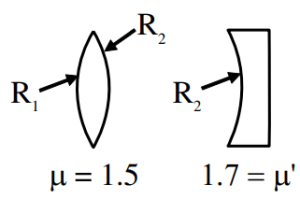
The magnitudes of power of a biconvex lens (refractive index $1.5$) and that of a plano-concave lens (refractive index $= 1.7$) are same. If the curvature of the plano-concave lens exactly matches with the curvature of the back surface of the biconvex lens, then the ratio of the radius of curvature of the front and back surface of the biconvex lens is . . . . . . .
A
$5 : 2$
B
$5 : 12$
C
$12 : 5$
D
$2 : 5$
Solution
(A) Let the radii of curvature of the biconvex lens be $R_1$ and $R_2$. The power of the biconvex lens is given by $P_A = (\mu - 1) \left( \frac{1}{R_1} + \frac{1}{R_2} \right) = (1.5 - 1) \left( \frac{1}{R_1} + \frac{1}{R_2} \right) = 0.5 \left( \frac{1}{R_1} + \frac{1}{R_2} \right)$.
For the plano-concave lens, the radius of curvature of the curved surface is $R_2$ and the other surface is flat $(R = \infty)$. Its power is $P_B = -(\mu' - 1) \left( \frac{1}{R_2} + \frac{1}{\infty} \right) = -(1.7 - 1) \left( \frac{1}{R_2} \right) = -0.7 \left( \frac{1}{R_2} \right)$.
Given that the magnitudes of power are equal, $|P_A| = |P_B|$.
$0.5 \left( \frac{1}{R_1} + \frac{1}{R_2} \right) = 0.7 \left( \frac{1}{R_2} \right)$.
$0.5 \left( \frac{1}{R_1} \right) = (0.7 - 0.5) \left( \frac{1}{R_2} \right) = 0.2 \left( \frac{1}{R_2} \right)$.
$\frac{0.5}{R_1} = \frac{0.2}{R_2} \implies \frac{R_1}{R_2} = \frac{0.5}{0.2} = \frac{5}{2}$.
For the plano-concave lens, the radius of curvature of the curved surface is $R_2$ and the other surface is flat $(R = \infty)$. Its power is $P_B = -(\mu' - 1) \left( \frac{1}{R_2} + \frac{1}{\infty} \right) = -(1.7 - 1) \left( \frac{1}{R_2} \right) = -0.7 \left( \frac{1}{R_2} \right)$.
Given that the magnitudes of power are equal, $|P_A| = |P_B|$.
$0.5 \left( \frac{1}{R_1} + \frac{1}{R_2} \right) = 0.7 \left( \frac{1}{R_2} \right)$.
$0.5 \left( \frac{1}{R_1} \right) = (0.7 - 0.5) \left( \frac{1}{R_2} \right) = 0.2 \left( \frac{1}{R_2} \right)$.
$\frac{0.5}{R_1} = \frac{0.2}{R_2} \implies \frac{R_1}{R_2} = \frac{0.5}{0.2} = \frac{5}{2}$.
0 likes
View Solution465
MediumMCQ
The size of the images of an object,formed by a thin lens,are equal when the object is placed at two different positions $8 \ cm$ and $24 \ cm$ from the lens. The focal length of the lens is . . . . . . $cm$.
A
$12$
B
$16$
C
$18$
D
$20$
Solution
(B) For a thin lens,the magnification $m$ is given by $m = \frac{f}{f+u}$.
Since the sizes of the images are equal,the magnitude of magnification must be the same,but one image is real (inverted) and the other is virtual (erect).
Thus,$m_1 = -m_2$.
Let the two positions be $u_1 = -8 \ cm$ and $u_2 = -24 \ cm$.
Substituting these into the magnification formula: $\frac{f}{f-8} = -\frac{f}{f-24}$.
Canceling $f$ from both sides (assuming $f \neq 0$): $\frac{1}{f-8} = -\frac{1}{f-24}$.
Cross-multiplying gives: $f - 24 = -(f - 8)$.
$f - 24 = -f + 8$.
$2f = 32$.
$f = 16 \ cm$.
Since the sizes of the images are equal,the magnitude of magnification must be the same,but one image is real (inverted) and the other is virtual (erect).
Thus,$m_1 = -m_2$.
Let the two positions be $u_1 = -8 \ cm$ and $u_2 = -24 \ cm$.
Substituting these into the magnification formula: $\frac{f}{f-8} = -\frac{f}{f-24}$.
Canceling $f$ from both sides (assuming $f \neq 0$): $\frac{1}{f-8} = -\frac{1}{f-24}$.
Cross-multiplying gives: $f - 24 = -(f - 8)$.
$f - 24 = -f + 8$.
$2f = 32$.
$f = 16 \ cm$.
0 likes
View Solution466
DifficultMCQ
Five persons $P_1, P_2, P_3, P_4$ and $P_5$ recorded object distance $(u)$ and image distance $(v)$ using the same convex lens having power $+5 \ D$ as $(25, 96), (30, 62), (35, 37), (45, 35)$ and $(50, 32)$ respectively. Identify the correct statement.
A
Readings recorded by all persons are correct
B
Reading recorded by $P_3$ person is incorrect
C
Reading recorded by $P_3$ and $P_2$ persons are incorrect
D
Reading recorded by $P_4$ and $P_5$ persons are incorrect
Solution
(B) Given power $P = +5 \ D$. The focal length $f = \frac{100}{P} = \frac{100}{5} = 20 \ cm$.
Using the lens formula $\frac{1}{v} - \frac{1}{u} = \frac{1}{f}$,where $u$ is negative,we have $\frac{1}{v} = \frac{1}{f} + \frac{1}{u} = \frac{1}{20} - \frac{1}{|u|}$.
For $P_1: u = -25 \ cm, \frac{1}{v} = \frac{1}{20} - \frac{1}{25} = \frac{5-4}{100} = \frac{1}{100} \Rightarrow v = 100 \ cm$ (approx $96 \ cm$ is close).
For $P_2: u = -30 \ cm, \frac{1}{v} = \frac{1}{20} - \frac{1}{30} = \frac{3-2}{60} = \frac{1}{60} \Rightarrow v = 60 \ cm$ (approx $62 \ cm$ is close).
For $P_3: u = -35 \ cm, \frac{1}{v} = \frac{1}{20} - \frac{1}{35} = \frac{7-4}{140} = \frac{3}{140} \Rightarrow v \approx 46.6 \ cm$. The recorded value $37 \ cm$ is significantly incorrect.
For $P_4: u = -45 \ cm, \frac{1}{v} = \frac{1}{20} - \frac{1}{45} = \frac{9-4}{180} = \frac{5}{180} = \frac{1}{36} \Rightarrow v = 36 \ cm$ (approx $35 \ cm$ is close).
For $P_5: u = -50 \ cm, \frac{1}{v} = \frac{1}{20} - \frac{1}{50} = \frac{5-2}{100} = \frac{3}{100} \Rightarrow v \approx 33.3 \ cm$ (approx $32 \ cm$ is close).
Thus,the reading recorded by $P_3$ is incorrect.
Using the lens formula $\frac{1}{v} - \frac{1}{u} = \frac{1}{f}$,where $u$ is negative,we have $\frac{1}{v} = \frac{1}{f} + \frac{1}{u} = \frac{1}{20} - \frac{1}{|u|}$.
For $P_1: u = -25 \ cm, \frac{1}{v} = \frac{1}{20} - \frac{1}{25} = \frac{5-4}{100} = \frac{1}{100} \Rightarrow v = 100 \ cm$ (approx $96 \ cm$ is close).
For $P_2: u = -30 \ cm, \frac{1}{v} = \frac{1}{20} - \frac{1}{30} = \frac{3-2}{60} = \frac{1}{60} \Rightarrow v = 60 \ cm$ (approx $62 \ cm$ is close).
For $P_3: u = -35 \ cm, \frac{1}{v} = \frac{1}{20} - \frac{1}{35} = \frac{7-4}{140} = \frac{3}{140} \Rightarrow v \approx 46.6 \ cm$. The recorded value $37 \ cm$ is significantly incorrect.
For $P_4: u = -45 \ cm, \frac{1}{v} = \frac{1}{20} - \frac{1}{45} = \frac{9-4}{180} = \frac{5}{180} = \frac{1}{36} \Rightarrow v = 36 \ cm$ (approx $35 \ cm$ is close).
For $P_5: u = -50 \ cm, \frac{1}{v} = \frac{1}{20} - \frac{1}{50} = \frac{5-2}{100} = \frac{3}{100} \Rightarrow v \approx 33.3 \ cm$ (approx $32 \ cm$ is close).
Thus,the reading recorded by $P_3$ is incorrect.
0 likes
View Solution467
DifficultMCQ
$A$ convex lens is made from glass material having a refractive index of $1.4$ with the same radius of curvature on both sides. The ratio of its focal length to its radius of curvature is . . . . . . .
A
$0.5$
B
$2.5$
C
$0.8$
D
$1.25$
Solution
(D) Using the lens maker's formula: $\frac{1}{f} = (\mu - 1)(\frac{1}{R_1} - \frac{1}{R_2})$.
For a biconvex lens with equal radii of curvature $R$,we have $R_1 = R$ and $R_2 = -R$.
Substituting the values: $\frac{1}{f} = (1.4 - 1)(\frac{1}{R} - (\frac{1}{-R}))$.
$\frac{1}{f} = 0.4 \times (\frac{1}{R} + \frac{1}{R}) = 0.4 \times \frac{2}{R} = \frac{0.8}{R}$.
Therefore,the ratio of focal length $f$ to the radius of curvature $R$ is $\frac{f}{R} = \frac{1}{0.8} = 1.25$.
For a biconvex lens with equal radii of curvature $R$,we have $R_1 = R$ and $R_2 = -R$.
Substituting the values: $\frac{1}{f} = (1.4 - 1)(\frac{1}{R} - (\frac{1}{-R}))$.
$\frac{1}{f} = 0.4 \times (\frac{1}{R} + \frac{1}{R}) = 0.4 \times \frac{2}{R} = \frac{0.8}{R}$.
Therefore,the ratio of focal length $f$ to the radius of curvature $R$ is $\frac{f}{R} = \frac{1}{0.8} = 1.25$.
0 likes
View Solution468
DifficultMCQ
If sunlight is focused on a paper using a convex lens,it starts burning the paper in the shortest time when the lens is kept at $30 \text{ cm}$ above the paper. If the radius of curvature of the lens is $60 \text{ cm}$,then the refractive index of the lens material is $\frac{\alpha}{10}$. The value of $\alpha$ is . . . . . . .
A
$15$
B
$20$
C
$25$
D
$30$
Solution
(B) The shortest time to burn the paper occurs when the sunlight is focused exactly at the focal point of the lens. Therefore,the focal length $f = 30 \text{ cm}$.
Using the lens maker's formula: $\frac{1}{f} = (\mu - 1) \left( \frac{1}{R_1} - \frac{1}{R_2} \right)$.
For a symmetric double convex lens,$R_1 = R = 60 \text{ cm}$ and $R_2 = -R = -60 \text{ cm}$.
Substituting these values: $\frac{1}{30} = (\mu - 1) \left( \frac{1}{60} - \frac{1}{-60} \right)$.
$\frac{1}{30} = (\mu - 1) \left( \frac{1}{60} + \frac{1}{60} \right) = (\mu - 1) \left( \frac{2}{60} \right) = (\mu - 1) \left( \frac{1}{30} \right)$.
This implies $\mu - 1 = 1$,so $\mu = 2$.
Given $\mu = \frac{\alpha}{10}$,we have $2 = \frac{\alpha}{10}$,which gives $\alpha = 20$.
Using the lens maker's formula: $\frac{1}{f} = (\mu - 1) \left( \frac{1}{R_1} - \frac{1}{R_2} \right)$.
For a symmetric double convex lens,$R_1 = R = 60 \text{ cm}$ and $R_2 = -R = -60 \text{ cm}$.
Substituting these values: $\frac{1}{30} = (\mu - 1) \left( \frac{1}{60} - \frac{1}{-60} \right)$.
$\frac{1}{30} = (\mu - 1) \left( \frac{1}{60} + \frac{1}{60} \right) = (\mu - 1) \left( \frac{2}{60} \right) = (\mu - 1) \left( \frac{1}{30} \right)$.
This implies $\mu - 1 = 1$,so $\mu = 2$.
Given $\mu = \frac{\alpha}{10}$,we have $2 = \frac{\alpha}{10}$,which gives $\alpha = 20$.
0 likes
View Solution469
EasyMCQ
In a concave lens,a ray of light emanating from the object parallel to the principal axis of the lens,after refraction:
A
passes through the second principal focus.
B
appears to diverge from the first principal focus.
C
passes through $2F$,which is the radius of curvature of the lens.
D
emerges parallel to the principal axis.
Solution
(B) For a concave lens,a ray of light traveling parallel to the principal axis diverges after refraction.
When this diverged ray is traced backward,it appears to originate from the first principal focus of the lens.
Therefore,the correct option is $B$.
When this diverged ray is traced backward,it appears to originate from the first principal focus of the lens.
Therefore,the correct option is $B$.
0 likes
View SolutionRay Optics and Optical Instruments — Refraction by Lenses · Frequently Asked Questions
1Are these Ray Optics and Optical Instruments questions useful for JEE and NEET?
Yes. All questions in this section are mapped to JEE Main and NEET exam patterns. Previous year questions from JEE Main, NEET, GUJCET and state-level exams are included with full solutions.
2Can I switch to Hindi or Gujarati for these questions?
Yes. Use the language tabs in the hero section or the sidebar to view the same questions and solutions in English, Hindi or Gujarati.
3How do I generate a question paper from this subtopic?
Use the Vedclass Exam Paper Generator — select the chapter and subtopic, set difficulty, and generate Sets A, B, C, D automatically. First 3 chapters of every subject are free.
Vedclass Products
For Students
Vedclass Test Series
Mock tests in real JEE/NEET style with performance analysis. 5-day free trial.
Start Free TrialFor Teachers
Exam Paper Generator
Generate Set A/B/C/D papers from this chapter in 2 minutes. 3 chapters free.
Try FreeFor Institutes
Online Exam Module
Live online exams with unlimited students, 360° analytics & white-label branding.
See DemoFor Teachers & Institutes
Generate a Ray Optics and Optical Instruments Exam Paper in 2 Minutes
Select subtopic & difficulty — Sets A, B, C, D auto-generated with No Repeat logic.
First 3 chapters of every subject are free — no payment required.