
A English
Properties of Alpha, Beta and Gamma Rays and Decay Process Questions in English
Class 12 Physics · Nuclei · Properties of Alpha, Beta and Gamma Rays and Decay Process
286+
Questions
English
Language
100%
With Solutions
Showing 50 of 286 questions in English
201
MediumMCQ
$A$ radioactive nucleus ${}_{Z}^{A}X$ undergoes spontaneous decay in the sequence ${}_{Z}^{A}X \rightarrow {}_{Z-1}B \rightarrow {}_{Z-3}C \rightarrow {}_{Z-2}D$,where $Z$ is the atomic number of element $X$. The possible decay particles in the sequence are:
A
$\alpha, \beta^{-}, \beta^{+}$
B
$\alpha, \beta^{+}, \beta^{-}$
C
$\beta^{+}, \alpha, \beta^{-}$
D
$\beta^{-}, \alpha, \beta^{+}$
Solution
(C) $1$. In the first step,${}_{Z}^{A}X \rightarrow {}_{Z-1}B$,the atomic number decreases by $1$. This corresponds to $\beta^{+}$ decay (positron emission).
$2$. In the second step,${}_{Z-1}B \rightarrow {}_{Z-3}C$,the atomic number decreases by $2$. This corresponds to $\alpha$ decay.
$3$. In the third step,${}_{Z-3}C \rightarrow {}_{Z-2}D$,the atomic number increases by $1$. This corresponds to $\beta^{-}$ decay (electron emission).
$4$. Therefore,the sequence of decay particles is $\beta^{+}, \alpha, \beta^{-}$.
$2$. In the second step,${}_{Z-1}B \rightarrow {}_{Z-3}C$,the atomic number decreases by $2$. This corresponds to $\alpha$ decay.
$3$. In the third step,${}_{Z-3}C \rightarrow {}_{Z-2}D$,the atomic number increases by $1$. This corresponds to $\beta^{-}$ decay (electron emission).
$4$. Therefore,the sequence of decay particles is $\beta^{+}, \alpha, \beta^{-}$.
0 likes
View Solution202
DifficultMCQ
$A$ nucleus with mass number $184$ initially at rest emits an $\alpha$-particle. If the $Q$ value of the reaction is $5.5\, \text{MeV}$,calculate the kinetic energy of the $\alpha$-particle in $\text{MeV}$.
A
$5.0$
B
$5.5$
C
$0.12$
D
$5.38$
Solution
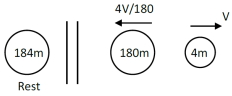
(D) Let $M = 184$ be the mass number of the parent nucleus. The daughter nucleus has mass number $M' = 180$ and the $\alpha$-particle has mass number $m_{\alpha} = 4$.
By conservation of linear momentum,$p_{\alpha} = p_{d}$,where $p_{\alpha}$ is the momentum of the $\alpha$-particle and $p_{d}$ is the momentum of the daughter nucleus.
Since $K = \frac{p^2}{2m}$,the kinetic energy $K_{\alpha}$ of the $\alpha$-particle and $K_{d}$ of the daughter nucleus are related by $K_{d} = K_{\alpha} \cdot \frac{m_{\alpha}}{M'} = K_{\alpha} \cdot \frac{4}{180} = \frac{K_{\alpha}}{45}$.
The total $Q$ value is the sum of the kinetic energies: $Q = K_{\alpha} + K_{d} = K_{\alpha} + \frac{K_{\alpha}}{45} = K_{\alpha} \left(1 + \frac{1}{45}\right) = K_{\alpha} \left(\frac{46}{45}\right)$.
Given $Q = 5.5\, \text{MeV}$,we have $5.5 = K_{\alpha} \cdot \frac{46}{45}$.
Therefore,$K_{\alpha} = 5.5 \cdot \frac{45}{46} \approx 5.38\, \text{MeV}$.
By conservation of linear momentum,$p_{\alpha} = p_{d}$,where $p_{\alpha}$ is the momentum of the $\alpha$-particle and $p_{d}$ is the momentum of the daughter nucleus.
Since $K = \frac{p^2}{2m}$,the kinetic energy $K_{\alpha}$ of the $\alpha$-particle and $K_{d}$ of the daughter nucleus are related by $K_{d} = K_{\alpha} \cdot \frac{m_{\alpha}}{M'} = K_{\alpha} \cdot \frac{4}{180} = \frac{K_{\alpha}}{45}$.
The total $Q$ value is the sum of the kinetic energies: $Q = K_{\alpha} + K_{d} = K_{\alpha} + \frac{K_{\alpha}}{45} = K_{\alpha} \left(1 + \frac{1}{45}\right) = K_{\alpha} \left(\frac{46}{45}\right)$.
Given $Q = 5.5\, \text{MeV}$,we have $5.5 = K_{\alpha} \cdot \frac{46}{45}$.
Therefore,$K_{\alpha} = 5.5 \cdot \frac{45}{46} \approx 5.38\, \text{MeV}$.
0 likes
View Solution203
EasyMCQ
In the given nuclear reaction,the element $X$ is:
${ }_{11}^{22} Na \rightarrow X + e ^{+} + \nu$
${ }_{11}^{22} Na \rightarrow X + e ^{+} + \nu$
A
${ }_{10}^{23} Ne$
B
${ }_{10}^{22} Ne$
C
${ }_{12}^{22} Mg$
D
${ }_{11}^{23} Na$
Solution
(B) The given reaction is ${ }_{11}^{22} Na \rightarrow X + e ^{+} + \nu$.
This represents a $\beta^{+}$ decay (positron emission).
In $\beta^{+}$ decay,the atomic number $Z$ decreases by $1$ while the mass number $A$ remains constant.
For the parent nucleus ${ }_{11}^{22} Na$,the atomic number $Z = 11$ and the mass number $A = 22$.
After emitting a positron $(e^{+})$,the new atomic number $Z' = 11 - 1 = 10$.
The mass number remains $A' = 22$.
The element with atomic number $10$ is Neon $(Ne)$.
Therefore,the reaction is ${ }_{11}^{22} Na \rightarrow { }_{10}^{22} Ne + e ^{+} + \nu$.
Thus,$X$ is ${ }_{10}^{22} Ne$.
This represents a $\beta^{+}$ decay (positron emission).
In $\beta^{+}$ decay,the atomic number $Z$ decreases by $1$ while the mass number $A$ remains constant.
For the parent nucleus ${ }_{11}^{22} Na$,the atomic number $Z = 11$ and the mass number $A = 22$.
After emitting a positron $(e^{+})$,the new atomic number $Z' = 11 - 1 = 10$.
The mass number remains $A' = 22$.
The element with atomic number $10$ is Neon $(Ne)$.
Therefore,the reaction is ${ }_{11}^{22} Na \rightarrow { }_{10}^{22} Ne + e ^{+} + \nu$.
Thus,$X$ is ${ }_{10}^{22} Ne$.
0 likes
View Solution204
MediumMCQ
How many alpha and beta particles are emitted when Uranium ${}_{92}U^{238}$ decays to lead ${}_{82}Pb^{206}$?
A
$8$ alpha particles and $6$ beta particles
B
$6$ alpha particles and $4$ beta particles
C
$4$ alpha particles and $5$ beta particles
D
$3$ alpha particles and $5$ beta particles
Solution
(A) Let $n$ be the number of alpha particles and $m$ be the number of beta particles emitted.
The decay process is: ${}_{92}U^{238} \rightarrow {}_{82}Pb^{206} + n({}_{2}He^{4}) + m({}_{-1}e^{0})$.
Equating the mass numbers: $238 = 206 + 4n \implies 4n = 32 \implies n = 8$.
Equating the atomic numbers: $92 = 82 + 2n - m$.
Substituting $n = 8$: $92 = 82 + 2(8) - m \implies 92 = 82 + 16 - m \implies 92 = 98 - m \implies m = 6$.
Thus,$8$ alpha particles and $6$ beta particles are emitted.
The decay process is: ${}_{92}U^{238} \rightarrow {}_{82}Pb^{206} + n({}_{2}He^{4}) + m({}_{-1}e^{0})$.
Equating the mass numbers: $238 = 206 + 4n \implies 4n = 32 \implies n = 8$.
Equating the atomic numbers: $92 = 82 + 2n - m$.
Substituting $n = 8$: $92 = 82 + 2(8) - m \implies 92 = 82 + 16 - m \implies 92 = 98 - m \implies m = 6$.
Thus,$8$ alpha particles and $6$ beta particles are emitted.
0 likes
View Solution205
MediumMCQ
In the following nuclear reaction,$D \xrightarrow{\alpha} D_{1} \xrightarrow{\beta^-} D_{2} \xrightarrow{\alpha} D_{3} \xrightarrow{\gamma} D_{4}$. The mass number of $D$ is $182$ and the atomic number is $74$. The mass number and atomic number of $D_{4}$ respectively will be:
A
$174$ and $71$
B
$174$ and $69$
C
$172$ and $69$
D
$172$ and $71$
Solution
(A) The initial nucleus $D$ has mass number $A = 182$ and atomic number $Z = 74$.
$1$. Alpha decay $(\alpha)$: Mass number decreases by $4$, atomic number decreases by $2$.
$2$. Beta decay $(\beta^-)$: Mass number remains unchanged, atomic number increases by $1$.
$3$. Gamma decay $(\gamma)$: Mass number and atomic number remain unchanged.
Calculation for mass number $(A)$:
$A_{final} = 182 - 4 (\text{first } \alpha) - 4 (\text{second } \alpha) = 182 - 8 = 174$.
Calculation for atomic number $(Z)$:
$Z_{final} = 74 - 2 (\text{first } \alpha) + 1 (\beta^-) - 2 (\text{second } \alpha) = 74 - 4 + 1 = 71$.
Thus, the mass number is $174$ and the atomic number is $71$.
$1$. Alpha decay $(\alpha)$: Mass number decreases by $4$, atomic number decreases by $2$.
$2$. Beta decay $(\beta^-)$: Mass number remains unchanged, atomic number increases by $1$.
$3$. Gamma decay $(\gamma)$: Mass number and atomic number remain unchanged.
Calculation for mass number $(A)$:
$A_{final} = 182 - 4 (\text{first } \alpha) - 4 (\text{second } \alpha) = 182 - 8 = 174$.
Calculation for atomic number $(Z)$:
$Z_{final} = 74 - 2 (\text{first } \alpha) + 1 (\beta^-) - 2 (\text{second } \alpha) = 74 - 4 + 1 = 71$.
Thus, the mass number is $174$ and the atomic number is $71$.
0 likes
View Solution206
AdvancedMCQ
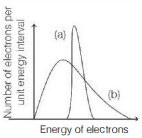
Originally, radioactive beta decay was thought to be a decay of a nucleus with the emission of electrons only (Case $I$). However, in addition to the electron, another (nearly) massless and electrically neutral particle is also emitted (Case $II$). Based on the figure below, which of the following is correct?
A
$(a)$ in both cases $I$ and $II$
B
$(a)$ in case $I$ and $(b)$ in case $II$
C
$(a)$ in case $II$ and $(b)$ in case $I$
D
$(b)$ in both cases $I$ and $II$
Solution
(B) In $\beta^{-}$ decay, the process is represented as:
${ }_{Z}^{A} X \longrightarrow { }_{Z+1}^{A} Y + { }_{-1}^{0} \beta + \bar{\nu}$
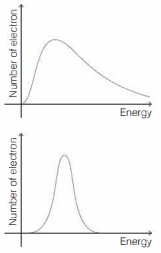
If only an electron were emitted (Case $I$), the electron would carry a fixed amount of energy, resulting in a sharp, monoenergetic peak as shown in curve $(a)$.
However, in reality (Case $II$), the decay energy is shared between the emitted electron $(\beta^{-})$ and the antineutrino $(\bar{\nu})$. Because the energy is distributed between two particles, the emitted electrons have a continuous range of energies, resulting in the broad spectrum shown in curve $(b)$.
Therefore, Case $I$ corresponds to $(a)$ and Case $II$ corresponds to $(b)$.
${ }_{Z}^{A} X \longrightarrow { }_{Z+1}^{A} Y + { }_{-1}^{0} \beta + \bar{\nu}$
If only an electron were emitted (Case $I$), the electron would carry a fixed amount of energy, resulting in a sharp, monoenergetic peak as shown in curve $(a)$.
However, in reality (Case $II$), the decay energy is shared between the emitted electron $(\beta^{-})$ and the antineutrino $(\bar{\nu})$. Because the energy is distributed between two particles, the emitted electrons have a continuous range of energies, resulting in the broad spectrum shown in curve $(b)$.
Therefore, Case $I$ corresponds to $(a)$ and Case $II$ corresponds to $(b)$.
0 likes
View Solution207
DifficultMCQ
$A$ nuclear decay is possible if the mass of the parent nucleus exceeds the total mass of the decay particles. If $M(A, Z)$ denotes the mass of a single neutral atom of an element with mass number $A$ and atomic number $Z$,then the minimal condition that the $\beta^{-}$ decay $X_Z^A \rightarrow Y_{Z+1}^A + \beta^{-} + \bar{\nu}_e$ will occur is ($m_e$ denotes the mass of the $\beta^{-}$ particle and the neutrino mass $m_{\nu}$ can be neglected).
A
$M(A, Z) > M(A, Z+1) + m_e$
B
$M(A, Z) > M(A, Z+1)$
C
$M(A, Z) > M(A, Z+1) + Z m_e$
D
$M(A, Z) > M(A, Z+1) - m_e$
Solution
(B) For a nuclear decay to be spontaneous,the $Q$-value of the reaction must be positive,which implies that the mass of the parent nucleus must be greater than the sum of the masses of the daughter nucleus and the emitted particles.
The decay process is: $X_Z^A \rightarrow Y_{Z+1}^A + e^{-} + \bar{\nu}_e$.
Let $M_n(A, Z)$ be the mass of the nucleus. The condition is: $M_n(A, Z) > M_n(A, Z+1) + m_e$ (neglecting neutrino mass).
Since $M(A, Z)$ represents the mass of the neutral atom,we have $M_n(A, Z) = M(A, Z) - Z m_e$.
Substituting this into the condition:
$(M(A, Z) - Z m_e) > (M(A, Z+1) - (Z+1) m_e) + m_e$.
Simplifying the right side:
$M(A, Z) - Z m_e > M(A, Z+1) - Z m_e - m_e + m_e$.
$M(A, Z) - Z m_e > M(A, Z+1) - Z m_e$.
Therefore,$M(A, Z) > M(A, Z+1)$.
The decay process is: $X_Z^A \rightarrow Y_{Z+1}^A + e^{-} + \bar{\nu}_e$.
Let $M_n(A, Z)$ be the mass of the nucleus. The condition is: $M_n(A, Z) > M_n(A, Z+1) + m_e$ (neglecting neutrino mass).
Since $M(A, Z)$ represents the mass of the neutral atom,we have $M_n(A, Z) = M(A, Z) - Z m_e$.
Substituting this into the condition:
$(M(A, Z) - Z m_e) > (M(A, Z+1) - (Z+1) m_e) + m_e$.
Simplifying the right side:
$M(A, Z) - Z m_e > M(A, Z+1) - Z m_e - m_e + m_e$.
$M(A, Z) - Z m_e > M(A, Z+1) - Z m_e$.
Therefore,$M(A, Z) > M(A, Z+1)$.
0 likes
View Solution208
MediumMCQ
The $\beta$-particles of a radioactive metal originate from
A
the free electrons in the metal
B
the orbiting electrons of the metal atoms
C
the photons released from the nucleus
D
the nucleus of the metal atoms
Solution
(D) The correct option is $D$.
$\beta^{-}$-particles are emitted during the process of radioactive decay,which originates from the nucleus of an atom.
The fundamental nuclear reaction for $\beta^{-}$-decay is:
${ }_{0}^{1} n \longrightarrow{ }_{1}^{1} p+{ }_{-1}^{0} e+\bar{\nu}$
In this process,a neutron inside the nucleus is converted into a proton,emitting a $\beta^{-}$-particle (an electron) and an antineutrino $(\bar{\nu})$.
This changes the atomic number of the nucleus,as represented by:
${ }_{Z}^{A} X \longrightarrow{ }_{Z+1}^{A} Y+{ }_{-1}^{0} e+\bar{\nu}$
Since this process involves the transformation of nucleons (protons and neutrons),the $\beta$-particles originate from the nucleus of the metal atoms.
$\beta^{-}$-particles are emitted during the process of radioactive decay,which originates from the nucleus of an atom.
The fundamental nuclear reaction for $\beta^{-}$-decay is:
${ }_{0}^{1} n \longrightarrow{ }_{1}^{1} p+{ }_{-1}^{0} e+\bar{\nu}$
In this process,a neutron inside the nucleus is converted into a proton,emitting a $\beta^{-}$-particle (an electron) and an antineutrino $(\bar{\nu})$.
This changes the atomic number of the nucleus,as represented by:
${ }_{Z}^{A} X \longrightarrow{ }_{Z+1}^{A} Y+{ }_{-1}^{0} e+\bar{\nu}$
Since this process involves the transformation of nucleons (protons and neutrons),the $\beta$-particles originate from the nucleus of the metal atoms.
0 likes
View Solution209
MediumMCQ
The ${ }_{92}^{238} U$ atom disintegrates to ${ }_{84}^{214} Po$ with a half-life of $4.5 \times 10^9$ years by emitting $6$ $\alpha$-particles and $n$ electrons. Here,$n$ is:
A
$6$
B
$4$
C
$10$
D
$7$
Solution
(B) The decay process is represented as: ${ }_{92}^{238} U \longrightarrow{ }_{84}^{214} Po + 6({ }_{2}^{4} He) + n({ }_{-1}^{0} e)$.
Applying the law of conservation of mass number:
$238 = 214 + 6(4) + n(0)$
$238 = 214 + 24 = 238$ (This is satisfied).
Applying the law of conservation of atomic number (charge):
$92 = 84 + 6(2) + n(-1)$
$92 = 84 + 12 - n$
$92 = 96 - n$
$n = 96 - 92 = 4$.
Therefore,the number of electrons emitted is $4$.
Applying the law of conservation of mass number:
$238 = 214 + 6(4) + n(0)$
$238 = 214 + 24 = 238$ (This is satisfied).
Applying the law of conservation of atomic number (charge):
$92 = 84 + 6(2) + n(-1)$
$92 = 84 + 12 - n$
$92 = 96 - n$
$n = 96 - 92 = 4$.
Therefore,the number of electrons emitted is $4$.
0 likes
View Solution210
MediumMCQ
$A$ nucleus of lead $Pb_{82}^{214}$ emits two electrons followed by an $\alpha$-particle. The resulting nucleus will have
A
$82$ protons and $128$ neutrons
B
$80$ protons and $130$ neutrons
C
$82$ protons and $130$ neutrons
D
$78$ protons and $134$ neutrons
Solution
(A) The decay process is as follows:
$1$. Initial nucleus: $Pb_{82}^{214}$.
$2$. Emission of two electrons ($\beta^-$-decay): Each $\beta^-$-decay increases the atomic number by $1$ and keeps the mass number constant.
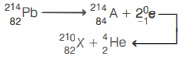
$Pb_{82}^{214} \rightarrow A_{84}^{214} + 2_{-1}^{0}e$.
$3$. Emission of an $\alpha$-particle: An $\alpha$-particle $(He_{2}^{4})$ emission decreases the atomic number by $2$ and the mass number by $4$.
$A_{84}^{214} \rightarrow X_{82}^{210} + He_{2}^{4}$.
$4$. The resulting nucleus is $X_{82}^{210}$.
$5$. Number of protons $(Z)$ = $82$.
$6$. Number of neutrons $(N)$ = $A - Z = 210 - 82 = 128$.
Therefore,the resulting nucleus has $82$ protons and $128$ neutrons.
$1$. Initial nucleus: $Pb_{82}^{214}$.
$2$. Emission of two electrons ($\beta^-$-decay): Each $\beta^-$-decay increases the atomic number by $1$ and keeps the mass number constant.
$Pb_{82}^{214} \rightarrow A_{84}^{214} + 2_{-1}^{0}e$.
$3$. Emission of an $\alpha$-particle: An $\alpha$-particle $(He_{2}^{4})$ emission decreases the atomic number by $2$ and the mass number by $4$.
$A_{84}^{214} \rightarrow X_{82}^{210} + He_{2}^{4}$.
$4$. The resulting nucleus is $X_{82}^{210}$.
$5$. Number of protons $(Z)$ = $82$.
$6$. Number of neutrons $(N)$ = $A - Z = 210 - 82 = 128$.
Therefore,the resulting nucleus has $82$ protons and $128$ neutrons.
0 likes
View Solution211
MediumMCQ
The ${ }_{92}^{235} U$ atom disintegrates to ${ }_{82}^{207} Pb$ with a half-life of $10^9 \ yr$. In the process,it emits $7 \ \alpha$ particles and $n \ \beta^{-}$ particles. Here,$n$ is
A
$7$
B
$3$
C
$4$
D
$14$
Solution
(C) The initial nucleus is ${ }_{92}^{235} U$ and the final nucleus is ${ }_{82}^{207} Pb$.
The emission of $7 \ \alpha$ particles results in a change in mass number and atomic number as follows:
Mass number change: $7 \times 4 = 28$.
Atomic number change: $7 \times 2 = 14$.
Let the intermediate nucleus be ${ }_{Z}^{A} X$. After emitting $7 \ \alpha$ particles:
$A = 235 - 28 = 207$
$Z = 92 - 14 = 78$
Now,$n \ \beta^{-}$ particles are emitted to reach the final state ${ }_{82}^{207} Pb$:
${ }_{78}^{207} X \longrightarrow { }_{82}^{207} Pb + n({ }_{-1}^{0} \beta)$
By the conservation of atomic number:
$78 = 82 - n$
$n = 82 - 78 = 4$
Therefore,$4 \ \beta^{-}$ particles are emitted.
The emission of $7 \ \alpha$ particles results in a change in mass number and atomic number as follows:
Mass number change: $7 \times 4 = 28$.
Atomic number change: $7 \times 2 = 14$.
Let the intermediate nucleus be ${ }_{Z}^{A} X$. After emitting $7 \ \alpha$ particles:
$A = 235 - 28 = 207$
$Z = 92 - 14 = 78$
Now,$n \ \beta^{-}$ particles are emitted to reach the final state ${ }_{82}^{207} Pb$:
${ }_{78}^{207} X \longrightarrow { }_{82}^{207} Pb + n({ }_{-1}^{0} \beta)$
By the conservation of atomic number:
$78 = 82 - n$
$n = 82 - 78 = 4$
Therefore,$4 \ \beta^{-}$ particles are emitted.
0 likes
View Solution212
EasyMCQ
Out of the following,choose the ray which does not travel with the velocity of light.
A
$X$-ray
B
Microwave
C
$\gamma$-rays
D
$\beta$-rays
Solution
(D) The correct answer is $(d)$.
$X$-rays,microwaves,and $\gamma$-rays are all types of electromagnetic waves. All electromagnetic waves travel through a vacuum at the speed of light,denoted by $c \approx 3 \times 10^8 \ m/s$.
$\beta$-rays consist of high-energy electrons or positrons. Since they are particles with non-zero rest mass,they cannot travel at the speed of light. Therefore,$\beta$-rays do not travel with the velocity of light.
$X$-rays,microwaves,and $\gamma$-rays are all types of electromagnetic waves. All electromagnetic waves travel through a vacuum at the speed of light,denoted by $c \approx 3 \times 10^8 \ m/s$.
$\beta$-rays consist of high-energy electrons or positrons. Since they are particles with non-zero rest mass,they cannot travel at the speed of light. Therefore,$\beta$-rays do not travel with the velocity of light.
0 likes
View Solution213
EasyMCQ
$A$ nucleus $X$ undergoes the following transformation:
$X \xrightarrow{\alpha} Y$
$Y \xrightarrow{2\beta} Z$
Then:
$X \xrightarrow{\alpha} Y$
$Y \xrightarrow{2\beta} Z$
Then:
A
$X$ and $Y$ are isotopes
B
$X$ and $Z$ are isobars
C
$X$ and $Y$ are isobars
D
$X$ and $Z$ are isotopes
Solution
(D) Let the nucleus $X$ be represented as $_{Z}^{A}X$.
$1$. When $X$ undergoes $\alpha$-decay,it emits an $\alpha$-particle $(_{2}^{4}He)$. The new nucleus $Y$ will have an atomic number $Z-2$ and a mass number $A-4$:
$_{Z}^{A}X \xrightarrow{\alpha} _{Z-2}^{A-4}Y + _{2}^{4}He$
$2$. When $Y$ undergoes $2\beta$-decay,it emits two $\beta$-particles (electrons,$_{-1}^{0}e$). Each $\beta$-decay increases the atomic number by $1$ without changing the mass number:
$_{Z-2}^{A-4}Y \xrightarrow{2\beta} _{Z-2+2}^{A-4}Z + 2_{-1}^{0}e$
$3$. The resulting nucleus $Z$ is $_{Z}^{A-4}Z$.
Comparing $X$ $(_{Z}^{A}X)$ and $Z$ $(_{Z}^{A-4}Z)$,we see they have the same atomic number $Z$ but different mass numbers. Therefore,$X$ and $Z$ are isotopes.
$1$. When $X$ undergoes $\alpha$-decay,it emits an $\alpha$-particle $(_{2}^{4}He)$. The new nucleus $Y$ will have an atomic number $Z-2$ and a mass number $A-4$:
$_{Z}^{A}X \xrightarrow{\alpha} _{Z-2}^{A-4}Y + _{2}^{4}He$
$2$. When $Y$ undergoes $2\beta$-decay,it emits two $\beta$-particles (electrons,$_{-1}^{0}e$). Each $\beta$-decay increases the atomic number by $1$ without changing the mass number:
$_{Z-2}^{A-4}Y \xrightarrow{2\beta} _{Z-2+2}^{A-4}Z + 2_{-1}^{0}e$
$3$. The resulting nucleus $Z$ is $_{Z}^{A-4}Z$.
Comparing $X$ $(_{Z}^{A}X)$ and $Z$ $(_{Z}^{A-4}Z)$,we see they have the same atomic number $Z$ but different mass numbers. Therefore,$X$ and $Z$ are isotopes.
0 likes
View Solution214
EasyMCQ
Out of the following, which one is not emitted by a natural radioactive substance?
A
Electrons
B
Electromagnetic radiations
C
Helium nuclei with charge equal to that of two protons
D
Neutrons
Solution
(D) The correct answer is $D$.
Natural radioactive decay processes include alpha decay, beta decay, and gamma decay.
$1$. In alpha decay, the nucleus emits an alpha particle, which is a helium nucleus $({ }_2 He ^4)$.
$2$. In beta decay, the nucleus emits electrons ($\beta^{-}$ decay) or positrons ($\beta^{+}$ decay).
$3$. In gamma decay, the nucleus emits high-energy photons, which are electromagnetic radiations.
Neutrons are not emitted during standard natural radioactive disintegration processes.
Natural radioactive decay processes include alpha decay, beta decay, and gamma decay.
$1$. In alpha decay, the nucleus emits an alpha particle, which is a helium nucleus $({ }_2 He ^4)$.
$2$. In beta decay, the nucleus emits electrons ($\beta^{-}$ decay) or positrons ($\beta^{+}$ decay).
$3$. In gamma decay, the nucleus emits high-energy photons, which are electromagnetic radiations.
Neutrons are not emitted during standard natural radioactive disintegration processes.
0 likes
View Solution215
EasyMCQ
$\gamma$-decay occurs when
A
Pair annihilation takes place
B
Energy is released due to conversion of neutron into proton
C
Energy is released due to de-excitation of nucleus
D
None of these
Solution
(C) The correct answer is $C$.
In $\gamma$-decay,an excited nucleus transitions from a higher energy state to a lower energy state.
This transition releases energy in the form of high-energy electromagnetic radiation,known as $\gamma$-rays (photons).
During this process,the number of protons and neutrons in the nucleus remains unchanged,meaning the identity of the element does not change.
In $\gamma$-decay,an excited nucleus transitions from a higher energy state to a lower energy state.
This transition releases energy in the form of high-energy electromagnetic radiation,known as $\gamma$-rays (photons).
During this process,the number of protons and neutrons in the nucleus remains unchanged,meaning the identity of the element does not change.
0 likes
View Solution216
MediumMCQ
If a heavy nucleus has an $N/Z$ ratio higher than that required for stability,then:
A
It emits $\beta^{-}$
B
It emits $\beta^{+}$
C
It emits an $\alpha$ particle
D
It will undergo $K$ electron capture
Solution
(A) For a nucleus to be stable,it must have an appropriate ratio of neutrons $(N)$ to protons $(Z)$.
If the $N/Z$ ratio is higher than the stability requirement,the nucleus has an excess of neutrons.
To achieve stability,the nucleus converts a neutron into a proton,an electron,and an antineutrino through $\beta^{-}$ decay: $n \rightarrow p + e^{-} + \bar{\nu}_{e}$.
This process increases the number of protons $(Z)$ and decreases the number of neutrons $(N)$,thereby lowering the $N/Z$ ratio towards the stability line.
Therefore,the correct option is $A$.
If the $N/Z$ ratio is higher than the stability requirement,the nucleus has an excess of neutrons.
To achieve stability,the nucleus converts a neutron into a proton,an electron,and an antineutrino through $\beta^{-}$ decay: $n \rightarrow p + e^{-} + \bar{\nu}_{e}$.
This process increases the number of protons $(Z)$ and decreases the number of neutrons $(N)$,thereby lowering the $N/Z$ ratio towards the stability line.
Therefore,the correct option is $A$.
0 likes
View Solution217
EasyMCQ
Pauli suggested the emission of neutrino during $\beta^{+}$ decay to explain:
A
Continuous energy distribution of positrons
B
Conservation of linear momentum
C
Conservation of mass-energy
D
All of these
Solution
(D) In $\beta$-decay,it was observed that the energy spectrum of the emitted particles (electrons or positrons) is continuous rather than discrete.
According to the laws of conservation of energy,linear momentum,and angular momentum,the emitted particle should have a fixed energy.
To resolve this discrepancy,Wolfgang Pauli proposed the existence of a third,neutral,and nearly massless particle called the neutrino (or antineutrino).
The emission of the neutrino allows for the simultaneous conservation of energy,linear momentum,and angular momentum in the decay process,thereby explaining the continuous energy distribution observed.
Therefore,all the listed options are valid reasons for the suggestion of the neutrino.
According to the laws of conservation of energy,linear momentum,and angular momentum,the emitted particle should have a fixed energy.
To resolve this discrepancy,Wolfgang Pauli proposed the existence of a third,neutral,and nearly massless particle called the neutrino (or antineutrino).
The emission of the neutrino allows for the simultaneous conservation of energy,linear momentum,and angular momentum in the decay process,thereby explaining the continuous energy distribution observed.
Therefore,all the listed options are valid reasons for the suggestion of the neutrino.
0 likes
View Solution218
EasyMCQ
$A$ radioactive element $X$ emits six $\alpha$-particles and four $\beta$-particles,leading to the final product ${ }_{82}^{208} Pb$. The element $X$ is:
A
${ }_{92}^{238} U$
B
${ }_{90}^{230} Th$
C
${ }_{90}^{232} Th$
D
${ }_{92}^{239} U$
Solution
(C) Let the radioactive element $X$ be represented as ${ }_{Z}^{A} X$.
When an $\alpha$-particle $({ }_{2}^{4} He)$ is emitted,the mass number decreases by $4$ and the atomic number decreases by $2$.
When a $\beta$-particle $({ }_{-1}^{0} e)$ is emitted,the mass number remains unchanged and the atomic number increases by $1$.
Given that $6$ $\alpha$-particles and $4$ $\beta$-particles are emitted to form ${ }_{82}^{208} Pb$,we can write the conservation equations:
For the mass number $A$:
$A - (6 \times 4) - (4 \times 0) = 208$
$A - 24 = 208$
$A = 208 + 24 = 232$
For the atomic number $Z$:
$Z - (6 \times 2) + (4 \times 1) = 82$
$Z - 12 + 4 = 82$
$Z - 8 = 82$
$Z = 82 + 8 = 90$
Thus,the element $X$ is ${ }_{90}^{232} Th$.
When an $\alpha$-particle $({ }_{2}^{4} He)$ is emitted,the mass number decreases by $4$ and the atomic number decreases by $2$.
When a $\beta$-particle $({ }_{-1}^{0} e)$ is emitted,the mass number remains unchanged and the atomic number increases by $1$.
Given that $6$ $\alpha$-particles and $4$ $\beta$-particles are emitted to form ${ }_{82}^{208} Pb$,we can write the conservation equations:
For the mass number $A$:
$A - (6 \times 4) - (4 \times 0) = 208$
$A - 24 = 208$
$A = 208 + 24 = 232$
For the atomic number $Z$:
$Z - (6 \times 2) + (4 \times 1) = 82$
$Z - 12 + 4 = 82$
$Z - 8 = 82$
$Z = 82 + 8 = 90$
Thus,the element $X$ is ${ }_{90}^{232} Th$.
0 likes
View Solution219
EasyMCQ
$37$ Rutherford equals
A
$1$ milli curie
B
$1$ milli becquerel
C
$1$ micro becquerel
D
$1$ micro curie
Solution
(A) The Rutherford $(Rd)$ is a non-$SI$ unit of radioactivity defined as $1 \ Rd = 10^6$ disintegrations per second.
The Curie $(Ci)$ is defined as $1 \ Ci = 3.7 \times 10^{10}$ disintegrations per second.
Therefore,$1 \ Rd = \frac{10^6}{3.7 \times 10^{10}} \ Ci = \frac{1}{37000} \ Ci$.
Thus,$37 \ Rd = 37 \times \frac{1}{37000} \ Ci = \frac{1}{1000} \ Ci = 1 \text{ milli curie}$ $(1 \ mCi)$.
The Curie $(Ci)$ is defined as $1 \ Ci = 3.7 \times 10^{10}$ disintegrations per second.
Therefore,$1 \ Rd = \frac{10^6}{3.7 \times 10^{10}} \ Ci = \frac{1}{37000} \ Ci$.
Thus,$37 \ Rd = 37 \times \frac{1}{37000} \ Ci = \frac{1}{1000} \ Ci = 1 \text{ milli curie}$ $(1 \ mCi)$.
0 likes
View Solution220
EasyMCQ
The $Q$-value of the decay ${ }_{11}^{22} Na \rightarrow{ }_{10}^{22} Ne + e ^{+}+v$ is
A
$[m({ }_{11}^{22} Na) - m({ }_{10}^{22} Ne)] c^2$
B
$[m({ }_{11}^{22} Na) - m({ }_{10}^{22} Ne) - m_e] c^2$
C
$[m({ }_{11}^{22} Na) - m({ }_{10}^{22} Ne) - 2m_e] c^2$
D
$[m({ }_{11}^{22} Na) - m({ }_{10}^{22} Ne) - 3m_e] c^2$
Solution
(C) In $\beta^+$ decay,a proton inside the nucleus converts into a neutron,a positron $(e^+)$,and a neutrino $(v)$. The reaction is: ${ }_{11}^{22} Na \rightarrow{ }_{10}^{22} Ne + e^+ + v$.
Here,$m({ }_{11}^{22} Na)$ and $m({ }_{10}^{22} Ne)$ represent the masses of the neutral atoms.
The mass of the ${ }_{11}^{22} Na$ atom includes $11$ electrons,while the mass of the ${ }_{10}^{22} Ne$ atom includes $10$ electrons.
Writing the mass balance for the nuclei: $M_{nuc}({ }_{11}^{22} Na) = m({ }_{11}^{22} Na) - 11m_e$ and $M_{nuc}({ }_{10}^{22} Ne) = m({ }_{10}^{22} Ne) - 10m_e$.
The $Q$-value is given by: $Q = [M_{nuc}({ }_{11}^{22} Na) - M_{nuc}({ }_{10}^{22} Ne) - m_e] c^2$.
Substituting the atomic masses: $Q = [(m({ }_{11}^{22} Na) - 11m_e) - (m({ }_{10}^{22} Ne) - 10m_e) - m_e] c^2$.
$Q = [m({ }_{11}^{22} Na) - m({ }_{10}^{22} Ne) - 11m_e + 10m_e - m_e] c^2$.
$Q = [m({ }_{11}^{22} Na) - m({ }_{10}^{22} Ne) - 2m_e] c^2$.
Here,$m({ }_{11}^{22} Na)$ and $m({ }_{10}^{22} Ne)$ represent the masses of the neutral atoms.
The mass of the ${ }_{11}^{22} Na$ atom includes $11$ electrons,while the mass of the ${ }_{10}^{22} Ne$ atom includes $10$ electrons.
Writing the mass balance for the nuclei: $M_{nuc}({ }_{11}^{22} Na) = m({ }_{11}^{22} Na) - 11m_e$ and $M_{nuc}({ }_{10}^{22} Ne) = m({ }_{10}^{22} Ne) - 10m_e$.
The $Q$-value is given by: $Q = [M_{nuc}({ }_{11}^{22} Na) - M_{nuc}({ }_{10}^{22} Ne) - m_e] c^2$.
Substituting the atomic masses: $Q = [(m({ }_{11}^{22} Na) - 11m_e) - (m({ }_{10}^{22} Ne) - 10m_e) - m_e] c^2$.
$Q = [m({ }_{11}^{22} Na) - m({ }_{10}^{22} Ne) - 11m_e + 10m_e - m_e] c^2$.
$Q = [m({ }_{11}^{22} Na) - m({ }_{10}^{22} Ne) - 2m_e] c^2$.
0 likes
View Solution221
MediumMCQ
Consider the following radioactive decay process:
${ }_{84}^{218} A \stackrel{\alpha}{\longrightarrow} A_1 \stackrel{\beta^{-}}{\longrightarrow} A_2 \stackrel{\gamma}{\longrightarrow} A_3 \stackrel{\alpha}{\longrightarrow} A_4 \stackrel{\beta^{+}}{\longrightarrow} A_5 \stackrel{\gamma}{\longrightarrow} A_6$
The mass number and the atomic number of $A_6$ are given by:
${ }_{84}^{218} A \stackrel{\alpha}{\longrightarrow} A_1 \stackrel{\beta^{-}}{\longrightarrow} A_2 \stackrel{\gamma}{\longrightarrow} A_3 \stackrel{\alpha}{\longrightarrow} A_4 \stackrel{\beta^{+}}{\longrightarrow} A_5 \stackrel{\gamma}{\longrightarrow} A_6$
The mass number and the atomic number of $A_6$ are given by:
A
$210$ and $82$
B
$210$ and $84$
C
$210$ and $80$
D
$211$ and $80$
Solution
(C) The radioactive decay process is analyzed step-by-step:
$1$. ${ }_{84}^{218} A \xrightarrow{\alpha} { }_{82}^{214} A_1$ (Alpha decay: mass number decreases by $4$,atomic number decreases by $2$)
$2$. ${ }_{82}^{214} A_1 \xrightarrow{\beta^{-}} { }_{83}^{214} A_2$ (Beta-minus decay: mass number remains same,atomic number increases by $1$)
$3$. ${ }_{83}^{214} A_2 \xrightarrow{\gamma} { }_{83}^{214} A_3$ (Gamma decay: no change in mass or atomic number)
$4$. ${ }_{83}^{214} A_3 \xrightarrow{\alpha} { }_{81}^{210} A_4$ (Alpha decay: mass number decreases by $4$,atomic number decreases by $2$)
$5$. ${ }_{81}^{210} A_4 \xrightarrow{\beta^{+}} { }_{80}^{210} A_5$ (Beta-plus decay: mass number remains same,atomic number decreases by $1$)
$6$. ${ }_{80}^{210} A_5 \xrightarrow{\gamma} { }_{80}^{210} A_6$ (Gamma decay: no change in mass or atomic number)
Thus,the final nucleus $A_6$ has a mass number of $210$ and an atomic number of $80$.
$1$. ${ }_{84}^{218} A \xrightarrow{\alpha} { }_{82}^{214} A_1$ (Alpha decay: mass number decreases by $4$,atomic number decreases by $2$)
$2$. ${ }_{82}^{214} A_1 \xrightarrow{\beta^{-}} { }_{83}^{214} A_2$ (Beta-minus decay: mass number remains same,atomic number increases by $1$)
$3$. ${ }_{83}^{214} A_2 \xrightarrow{\gamma} { }_{83}^{214} A_3$ (Gamma decay: no change in mass or atomic number)
$4$. ${ }_{83}^{214} A_3 \xrightarrow{\alpha} { }_{81}^{210} A_4$ (Alpha decay: mass number decreases by $4$,atomic number decreases by $2$)
$5$. ${ }_{81}^{210} A_4 \xrightarrow{\beta^{+}} { }_{80}^{210} A_5$ (Beta-plus decay: mass number remains same,atomic number decreases by $1$)
$6$. ${ }_{80}^{210} A_5 \xrightarrow{\gamma} { }_{80}^{210} A_6$ (Gamma decay: no change in mass or atomic number)
Thus,the final nucleus $A_6$ has a mass number of $210$ and an atomic number of $80$.
0 likes
View Solution222
MediumMCQ
$A$ radioactive element ${}_{92}^{242}X$ emits two $\alpha$-particles,one electron,and two positrons. The product nucleus is represented by ${}_{P}^{234}Y$. The value of $P$ is $..................$
A
$87$
B
$88$
C
$80$
D
$86$
Solution
(A) The initial nucleus is ${}_{92}^{242}X$.
An $\alpha$-particle is ${}_{2}^{4}He$,an electron $(\beta^-)$ is ${}_{-1}^{0}e$,and a positron $(\beta^+)$ is ${}_{+1}^{0}e$.
The emission process is: ${}_{92}^{242}X \rightarrow 2({}_{2}^{4}He) + 1({}_{-1}^{0}e) + 2({}_{+1}^{0}e) + {}_{P}^{234}Y$.
Conservation of atomic number $(Z)$: $92 = 2(2) + 1(-1) + 2(1) + P$.
$92 = 4 - 1 + 2 + P$.
$92 = 5 + P$.
$P = 92 - 5 = 87$.
An $\alpha$-particle is ${}_{2}^{4}He$,an electron $(\beta^-)$ is ${}_{-1}^{0}e$,and a positron $(\beta^+)$ is ${}_{+1}^{0}e$.
The emission process is: ${}_{92}^{242}X \rightarrow 2({}_{2}^{4}He) + 1({}_{-1}^{0}e) + 2({}_{+1}^{0}e) + {}_{P}^{234}Y$.
Conservation of atomic number $(Z)$: $92 = 2(2) + 1(-1) + 2(1) + P$.
$92 = 4 - 1 + 2 + P$.
$92 = 5 + P$.
$P = 92 - 5 = 87$.
0 likes
View Solution223
MediumMCQ
$A$ common example of alpha decay is ${ }_{92}^{238} U \longrightarrow{ }_{90}^{234} Th +{ }_{2}^{4} He + Q$. (Given: ${ }_{92}^{238} U = 238.05060 \, u$,${ }_{90}^{234} Th = 234.04360 \, u$,${ }_{2}^{4} He = 4.00260 \, u$,and $1 \, u = 931.5 \, MeV/c^2$). The energy released $(Q)$ during the alpha decay of ${ }_{92}^{238} U$ is $...... \, MeV$.
A
$4.0986$
B
$4.2500$
C
$3.8500$
D
$5.1200$
Solution
(A) The energy released $(Q)$ in a nuclear decay is given by the mass defect multiplied by the energy equivalent of $1 \, u$.
Mass defect $(\Delta m) = m(U) - [m(Th) + m(He)]$
$\Delta m = 238.05060 \, u - (234.04360 \, u + 4.00260 \, u)$
$\Delta m = 238.05060 \, u - 238.04620 \, u = 0.0044 \, u$
Energy released $(Q) = \Delta m \times 931.5 \, MeV/u$
$Q = 0.0044 \times 931.5 \, MeV = 4.0986 \, MeV$.
Mass defect $(\Delta m) = m(U) - [m(Th) + m(He)]$
$\Delta m = 238.05060 \, u - (234.04360 \, u + 4.00260 \, u)$
$\Delta m = 238.05060 \, u - 238.04620 \, u = 0.0044 \, u$
Energy released $(Q) = \Delta m \times 931.5 \, MeV/u$
$Q = 0.0044 \times 931.5 \, MeV = 4.0986 \, MeV$.
0 likes
View Solution224
MediumMCQ
${ }_{82}^{290} X \xrightarrow{\alpha} Y \xrightarrow{e^{+}} Z \xrightarrow{\beta^{-}} P \xrightarrow{e^{-}} Q$
In the nuclear emission stated above, the mass number and atomic number of the product $Q$ respectively, are
In the nuclear emission stated above, the mass number and atomic number of the product $Q$ respectively, are
A
$286, 80$
B
$288, 82$
C
$286, 81$
D
$280, 81$
Solution
(C) $1$. Alpha decay ($\alpha$): Mass number decreases by $4$, atomic number decreases by $2$.
${ }_{82}^{290} X \xrightarrow{\alpha} { }_{80}^{286} Y$
$2$. Positron emission ($e^{+}$): Mass number remains same, atomic number decreases by $1$.
${ }_{80}^{286} Y \xrightarrow{e^{+}} { }_{79}^{286} Z$
$3$. Beta decay ($\beta^{-}$): Mass number remains same, atomic number increases by $1$.
${ }_{79}^{286} Z \xrightarrow{\beta^{-}} { }_{80}^{286} P$
$4$. Electron emission ($e^{-}$): This is equivalent to $\beta^{-}$ decay. Mass number remains same, atomic number increases by $1$.
${ }_{80}^{286} P \xrightarrow{e^{-}} { }_{81}^{286} Q$
Thus, for the final product $Q$, the mass number $A = 286$ and the atomic number $Z = 81$.
${ }_{82}^{290} X \xrightarrow{\alpha} { }_{80}^{286} Y$
$2$. Positron emission ($e^{+}$): Mass number remains same, atomic number decreases by $1$.
${ }_{80}^{286} Y \xrightarrow{e^{+}} { }_{79}^{286} Z$
$3$. Beta decay ($\beta^{-}$): Mass number remains same, atomic number increases by $1$.
${ }_{79}^{286} Z \xrightarrow{\beta^{-}} { }_{80}^{286} P$
$4$. Electron emission ($e^{-}$): This is equivalent to $\beta^{-}$ decay. Mass number remains same, atomic number increases by $1$.
${ }_{80}^{286} P \xrightarrow{e^{-}} { }_{81}^{286} Q$
Thus, for the final product $Q$, the mass number $A = 286$ and the atomic number $Z = 81$.
0 likes
View Solution225
DifficultMCQ
$A$ positron is emitted from ${}^{23}Na_{11}$. The ratio of the atomic mass and atomic number of the resulting nuclide is
A
$22 / 10$
B
$22 / 11$
C
$23 / 10$
D
$23 / 12$
Solution
(C) During positron emission from a nucleus,a proton is converted into a neutron $(p \rightarrow n + e^+ + \nu_e)$.
As a result,the atomic number $(Z)$ decreases by $1$,while the atomic mass $(A)$ remains constant.
For the parent nucleus ${}^{23}Na_{11}$,the atomic mass $A = 23$ and atomic number $Z = 11$.
After the emission of a positron,the new atomic number $Z' = 11 - 1 = 10$,and the atomic mass $A' = 23$.
The ratio of the atomic mass to the atomic number of the resulting nuclide is $\frac{A'}{Z'} = \frac{23}{10}$.
Therefore,option $(C)$ is correct.
As a result,the atomic number $(Z)$ decreases by $1$,while the atomic mass $(A)$ remains constant.
For the parent nucleus ${}^{23}Na_{11}$,the atomic mass $A = 23$ and atomic number $Z = 11$.
After the emission of a positron,the new atomic number $Z' = 11 - 1 = 10$,and the atomic mass $A' = 23$.
The ratio of the atomic mass to the atomic number of the resulting nuclide is $\frac{A'}{Z'} = \frac{23}{10}$.
Therefore,option $(C)$ is correct.
0 likes
View Solution226
AdvancedMCQ
List-$I$ shows different radioactive decay processes and List-$II$ provides possible emitted particles. Match each entry in List-$I$ with an appropriate entry from List-$II$, and choose the correct option.
| List-$I$ | List-$II$ |
| $(P)$ ${ }_{92}^{238} U \rightarrow{ }_{91}^{234} Pa$ | $(1)$ $1 \alpha$ and $1 \beta^{+}$ |
| $(Q)$ ${ }_{82}^{214} Pb \rightarrow{ }_{82}^{210} Pb$ | $(2)$ $3 \beta^{-}$ and $1 \alpha$ |
| $(R)$ ${ }_{81}^{210} Tl \rightarrow{ }_{82}^{206} Pb$ | $(3)$ $2 \beta^{-}$ and $1 \alpha$ |
| $(S)$ ${ }_{91}^{228} Pa \rightarrow{ }_{88}^{224} Ra$ | $(4)$ $1 \alpha$ and $1 \beta^{-}$ |
| $(5)$ $1 \alpha$ and $2 \beta^{+}$ |
A
$P \rightarrow 4, Q \rightarrow 3, R \rightarrow 2, S \rightarrow 1$
B
$P \rightarrow 4, Q \rightarrow 1, R \rightarrow 2, S \rightarrow 5$
C
$P \rightarrow 5, Q \rightarrow 3, R \rightarrow 1, S \rightarrow 4$
D
$P \rightarrow 5, Q \rightarrow 1, R \rightarrow 3, S \rightarrow 2$
Solution
(A) For a decay process ${ }_{Z_1}^{A_1} X \rightarrow { }_{Z_2}^{A_2} Y + N_{\alpha} { }_{2}^{4} He + N_{\beta^-} { }_{-1}^{0} e + N_{\beta^+} { }_{1}^{0} e$:
$1$. Conservation of mass number: $A_1 = A_2 + 4 N_{\alpha} \implies N_{\alpha} = \frac{A_1 - A_2}{4}$.
$2$. Conservation of atomic number: $Z_1 = Z_2 + 2 N_{\alpha} - N_{\beta^-} + N_{\beta^+}$.
$(P)$ ${ }_{92}^{238} U \rightarrow { }_{91}^{234} Pa$: $N_{\alpha} = \frac{238-234}{4} = 1$. $92 = 91 + 2(1) - N_{\beta^-} + N_{\beta^+} \implies N_{\beta^-} - N_{\beta^+} = 1$. Matches $(4)$: $1 \alpha, 1 \beta^-$.
$(Q)$ ${ }_{82}^{214} Pb \rightarrow { }_{82}^{210} Pb$: $N_{\alpha} = \frac{214-210}{4} = 1$. $82 = 82 + 2(1) - N_{\beta^-} + N_{\beta^+} \implies N_{\beta^-} - N_{\beta^+} = 2$. Matches $(3)$: $1 \alpha, 2 \beta^-$.
$(R)$ ${ }_{81}^{210} Tl \rightarrow { }_{82}^{206} Pb$: $N_{\alpha} = \frac{210-206}{4} = 1$. $81 = 82 + 2(1) - N_{\beta^-} + N_{\beta^+} \implies N_{\beta^-} - N_{\beta^+} = 3$. Matches $(2)$: $1 \alpha, 3 \beta^-$.
$(S)$ ${ }_{91}^{228} Pa \rightarrow { }_{88}^{224} Ra$: $N_{\alpha} = \frac{228-224}{4} = 1$. $91 = 88 + 2(1) - N_{\beta^-} + N_{\beta^+} \implies N_{\beta^-} - N_{\beta^+} = -1$. Matches $(1)$: $1 \alpha, 1 \beta^+$.
Correct mapping: $P \rightarrow 4, Q \rightarrow 3, R \rightarrow 2, S \rightarrow 1$.
$1$. Conservation of mass number: $A_1 = A_2 + 4 N_{\alpha} \implies N_{\alpha} = \frac{A_1 - A_2}{4}$.
$2$. Conservation of atomic number: $Z_1 = Z_2 + 2 N_{\alpha} - N_{\beta^-} + N_{\beta^+}$.
$(P)$ ${ }_{92}^{238} U \rightarrow { }_{91}^{234} Pa$: $N_{\alpha} = \frac{238-234}{4} = 1$. $92 = 91 + 2(1) - N_{\beta^-} + N_{\beta^+} \implies N_{\beta^-} - N_{\beta^+} = 1$. Matches $(4)$: $1 \alpha, 1 \beta^-$.
$(Q)$ ${ }_{82}^{214} Pb \rightarrow { }_{82}^{210} Pb$: $N_{\alpha} = \frac{214-210}{4} = 1$. $82 = 82 + 2(1) - N_{\beta^-} + N_{\beta^+} \implies N_{\beta^-} - N_{\beta^+} = 2$. Matches $(3)$: $1 \alpha, 2 \beta^-$.
$(R)$ ${ }_{81}^{210} Tl \rightarrow { }_{82}^{206} Pb$: $N_{\alpha} = \frac{210-206}{4} = 1$. $81 = 82 + 2(1) - N_{\beta^-} + N_{\beta^+} \implies N_{\beta^-} - N_{\beta^+} = 3$. Matches $(2)$: $1 \alpha, 3 \beta^-$.
$(S)$ ${ }_{91}^{228} Pa \rightarrow { }_{88}^{224} Ra$: $N_{\alpha} = \frac{228-224}{4} = 1$. $91 = 88 + 2(1) - N_{\beta^-} + N_{\beta^+} \implies N_{\beta^-} - N_{\beta^+} = -1$. Matches $(1)$: $1 \alpha, 1 \beta^+$.
Correct mapping: $P \rightarrow 4, Q \rightarrow 3, R \rightarrow 2, S \rightarrow 1$.
0 likes
View Solution227
DifficultMCQ
The total number of $\alpha$ and $\beta$ particles emitted in the nuclear reaction ${ }_{92}^{238} U \rightarrow{ }_{82}^{214} Pb$ is
A
$6$
B
$8$
C
$10$
D
$12$
Solution
(B) Let $x$ be the number of $\alpha$ particles and $y$ be the number of $\beta$ particles emitted.
The nuclear reaction is: ${ }_{92}^{238} U \rightarrow{ }_{82}^{214} Pb + x { }_{2}^{4} He + y { }_{-1}^{0} e$.
Equating the mass numbers on both sides:
$238 = 214 + 4x$
$4x = 238 - 214 = 24$
$x = 6$.
Equating the atomic numbers on both sides:
$92 = 82 + 2x - y$
$92 = 82 + 2(6) - y$
$92 = 82 + 12 - y$
$92 = 94 - y$
$y = 94 - 92 = 2$.
The total number of particles emitted is $x + y = 6 + 2 = 8$.
The nuclear reaction is: ${ }_{92}^{238} U \rightarrow{ }_{82}^{214} Pb + x { }_{2}^{4} He + y { }_{-1}^{0} e$.
Equating the mass numbers on both sides:
$238 = 214 + 4x$
$4x = 238 - 214 = 24$
$x = 6$.
Equating the atomic numbers on both sides:
$92 = 82 + 2x - y$
$92 = 82 + 2(6) - y$
$92 = 82 + 12 - y$
$92 = 94 - y$
$y = 94 - 92 = 2$.
The total number of particles emitted is $x + y = 6 + 2 = 8$.
0 likes
View Solution228
MediumMCQ
In a radioactive decay chain,${ }_{90}^{232} Th$ nucleus decays to ${ }_{82}^{212} Pb$ nucleus. Let $N_{\alpha}$ and $N_{\beta}$ be the number of $\alpha$ and $\beta^{-}$ particles,respectively,emitted in this decay process. Which of the following statements is (are) true?
$(A)$ $N_{\alpha}=5$
$(B)$ $N_{\alpha}=6$
$(C)$ $N_{\beta}=2$
$(D)$ $N_{\beta}=4$
$(A)$ $N_{\alpha}=5$
$(B)$ $N_{\alpha}=6$
$(C)$ $N_{\beta}=2$
$(D)$ $N_{\beta}=4$
A
$A, C$
B
$A, D$
C
$B, C$
D
$B, D$
Solution
(B) The decay process is represented as: ${ }_{90}^{232} Th \rightarrow { }_{82}^{212} Pb + N_{\alpha} { }_{2}^{4} He + N_{\beta} { }_{-1}^{0} e$.
First,consider the change in mass number $(\Delta A)$:
$\Delta A = 232 - 212 = 20$.
Since each $\alpha$-particle has a mass number of $4$,the number of $\alpha$-particles emitted is $N_{\alpha} = \frac{20}{4} = 5$.
Next,consider the change in atomic number $(\Delta Z)$:
$\Delta Z = 90 - 82 = 8$.
In the decay,the change in atomic number is given by $2N_{\alpha} - N_{\beta} = \Delta Z$.
Substituting the values: $2(5) - N_{\beta} = 8$.
$10 - N_{\beta} = 8$,which gives $N_{\beta} = 2$.
Thus,$N_{\alpha} = 5$ and $N_{\beta} = 2$. The correct statements are $(A)$ and $(C)$.
First,consider the change in mass number $(\Delta A)$:
$\Delta A = 232 - 212 = 20$.
Since each $\alpha$-particle has a mass number of $4$,the number of $\alpha$-particles emitted is $N_{\alpha} = \frac{20}{4} = 5$.
Next,consider the change in atomic number $(\Delta Z)$:
$\Delta Z = 90 - 82 = 8$.
In the decay,the change in atomic number is given by $2N_{\alpha} - N_{\beta} = \Delta Z$.
Substituting the values: $2(5) - N_{\beta} = 8$.
$10 - N_{\beta} = 8$,which gives $N_{\beta} = 2$.
Thus,$N_{\alpha} = 5$ and $N_{\beta} = 2$. The correct statements are $(A)$ and $(C)$.
0 likes
View Solution229
AdvancedMCQ
In a radioactive sample,${ }_{19}^{40} K$ nuclei decay into stable ${ }_{20}^{40} Ca$ nuclei with a decay constant of $4.5 \times 10^{-10} \text{ per year}$ or into stable ${ }_{18}^{40} Ar$ nuclei with a decay constant of $0.5 \times 10^{-10} \text{ per year}$. Given that in this sample,all the stable ${ }_{20}^{40} Ca$ and ${ }_{18}^{40} Ar$ nuclei are produced by the ${ }_{19}^{40} K$ nuclei only. In time $t \times 10^9 \text{ years}$,if the ratio of the sum of stable ${ }_{20}^{40} Ca$ and ${ }_{18}^{40} Ar$ nuclei to the radioactive ${ }_{19}^{40} K$ nuclei is $99$,the value of $t$ will be: [Given $\ln 10 = 2.3$]
A
$9.2$
B
$1.15$
C
$4.6$
D
$2.3$
Solution
(A) The total decay constant $\lambda$ is the sum of the individual decay constants for the two branches:
$\lambda = \lambda_1 + \lambda_2 = 4.5 \times 10^{-10} + 0.5 \times 10^{-10} = 5.0 \times 10^{-10} \text{ per year}$.
Let $N_0$ be the initial number of ${ }_{19}^{40} K$ nuclei and $N$ be the number of radioactive nuclei at time $t$.
The number of stable nuclei produced is $N_s = N_0 - N$.
According to the problem,the ratio of stable nuclei to radioactive nuclei is $99$:
$\frac{N_0 - N}{N} = 99 \Rightarrow \frac{N_0}{N} - 1 = 99 \Rightarrow \frac{N_0}{N} = 100$.
Using the radioactive decay law $N = N_0 e^{-\lambda t}$,we have $\frac{N}{N_0} = e^{-\lambda t} = \frac{1}{100} = 10^{-2}$.
Taking the natural logarithm on both sides:
$-\lambda t = \ln(10^{-2}) = -2 \ln 10$.
Given $\ln 10 = 2.3$,we get $\lambda t = 2 \times 2.3 = 4.6$.
Substituting $\lambda = 5 \times 10^{-10} \text{ per year}$:
$(5 \times 10^{-10}) \times t = 4.6 \Rightarrow t = \frac{4.6}{5} \times 10^{10} = 0.92 \times 10^{10} = 9.2 \times 10^9 \text{ years}$.
Thus,the value of $t$ is $9.2$.
$\lambda = \lambda_1 + \lambda_2 = 4.5 \times 10^{-10} + 0.5 \times 10^{-10} = 5.0 \times 10^{-10} \text{ per year}$.
Let $N_0$ be the initial number of ${ }_{19}^{40} K$ nuclei and $N$ be the number of radioactive nuclei at time $t$.
The number of stable nuclei produced is $N_s = N_0 - N$.
According to the problem,the ratio of stable nuclei to radioactive nuclei is $99$:
$\frac{N_0 - N}{N} = 99 \Rightarrow \frac{N_0}{N} - 1 = 99 \Rightarrow \frac{N_0}{N} = 100$.
Using the radioactive decay law $N = N_0 e^{-\lambda t}$,we have $\frac{N}{N_0} = e^{-\lambda t} = \frac{1}{100} = 10^{-2}$.
Taking the natural logarithm on both sides:
$-\lambda t = \ln(10^{-2}) = -2 \ln 10$.
Given $\ln 10 = 2.3$,we get $\lambda t = 2 \times 2.3 = 4.6$.
Substituting $\lambda = 5 \times 10^{-10} \text{ per year}$:
$(5 \times 10^{-10}) \times t = 4.6 \Rightarrow t = \frac{4.6}{5} \times 10^{10} = 0.92 \times 10^{10} = 9.2 \times 10^9 \text{ years}$.
Thus,the value of $t$ is $9.2$.
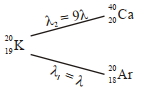
0 likes
View Solution230
AdvancedMCQ
The $\beta$-decay process,discovered around $1900$,is basically the decay of a neutron $(n)$. In the laboratory,a proton $(p)$ and an electron $(e^-)$ are observed as the decay products of the neutron. Therefore,considering the decay of a neutron as a two-body decay process,it was predicted theoretically that the kinetic energy of the electron should be a constant. But experimentally,it was observed that the electron kinetic energy has a continuous spectrum. Considering a three-body decay process,i.e.,$n \rightarrow p + e^- + \bar{\nu}_e$,around $1930$,Pauli explained the observed electron energy spectrum. Assuming the anti-neutrino $(\bar{\nu}_e)$ to be massless and possessing negligible energy,and the neutron to be at rest,momentum and energy conservation principles are applied. From this calculation,the maximum kinetic energy of the electron is $0.8 \times 10^6 \ eV$. The kinetic energy carried by the proton is only the recoil energy.
$1.$ What is the maximum energy of the anti-neutrino?
$(A)$ Zero
$(B)$ Much less than $0.8 \times 10^6 \ eV$
$(C)$ Nearly $0.8 \times 10^6 \ eV$
$(D)$ Much larger than $0.8 \times 10^6 \ eV$
$2.$ If the anti-neutrino had a mass of $3 \ eV/c^2$ (where $c$ is the speed of light) instead of zero mass,what should be the range of the kinetic energy,$K$,of the electron?
$(A)$ $0 \leq K \leq 0.8 \times 10^6 \ eV$
$(B)$ $3.0 \ eV \leq K \leq 0.8 \times 10^6 \ eV$
$(C)$ $3.0 \ eV \leq K < 0.8 \times 10^6 \ eV$
$(D)$ $0 \leq K < 0.8 \times 10^6 \ eV$
Give the answer for question $1$ and $2$.
$1.$ What is the maximum energy of the anti-neutrino?
$(A)$ Zero
$(B)$ Much less than $0.8 \times 10^6 \ eV$
$(C)$ Nearly $0.8 \times 10^6 \ eV$
$(D)$ Much larger than $0.8 \times 10^6 \ eV$
$2.$ If the anti-neutrino had a mass of $3 \ eV/c^2$ (where $c$ is the speed of light) instead of zero mass,what should be the range of the kinetic energy,$K$,of the electron?
$(A)$ $0 \leq K \leq 0.8 \times 10^6 \ eV$
$(B)$ $3.0 \ eV \leq K \leq 0.8 \times 10^6 \ eV$
$(C)$ $3.0 \ eV \leq K < 0.8 \times 10^6 \ eV$
$(D)$ $0 \leq K < 0.8 \times 10^6 \ eV$
Give the answer for question $1$ and $2$.
A
$(B, D)$
B
$(B, C)$
C
$(A, D)$
D
$(C, D)$
Solution
(B) $1.$ In $\beta$-decay,the total energy $Q$ is shared between the proton,electron,and anti-neutrino: $Q = KE_p + KE_e + KE_{\bar{\nu}}$. Since the proton is very heavy,its recoil energy $KE_p$ is negligible. Thus,$Q \approx KE_e + KE_{\bar{\nu}}$. The maximum energy of the anti-neutrino occurs when the electron's kinetic energy is zero,which is $KE_{\bar{\nu}, \max} \approx Q = 0.8 \times 10^6 \ eV$. Therefore,option $(C)$ is correct.
$2.$ If the anti-neutrino has a non-zero mass $m_{\bar{\nu}} = 3 \ eV/c^2$,the total energy $Q$ must also account for the rest mass energy of the anti-neutrino. The electron's kinetic energy $K$ is maximum when the anti-neutrino is at rest (its kinetic energy is zero). Thus,$K_{\max} = Q - m_{\bar{\nu}}c^2$. Since $m_{\bar{\nu}}c^2 = 3 \ eV$,$K_{\max} = 0.8 \times 10^6 \ eV - 3 \ eV$. The electron's kinetic energy $K$ can range from $0$ (when the anti-neutrino carries away the maximum possible energy) to $K_{\max}$ (when the anti-neutrino is at rest). Thus,$0 \leq K < 0.8 \times 10^6 \ eV$. Therefore,option $(D)$ is correct.
$2.$ If the anti-neutrino has a non-zero mass $m_{\bar{\nu}} = 3 \ eV/c^2$,the total energy $Q$ must also account for the rest mass energy of the anti-neutrino. The electron's kinetic energy $K$ is maximum when the anti-neutrino is at rest (its kinetic energy is zero). Thus,$K_{\max} = Q - m_{\bar{\nu}}c^2$. Since $m_{\bar{\nu}}c^2 = 3 \ eV$,$K_{\max} = 0.8 \times 10^6 \ eV - 3 \ eV$. The electron's kinetic energy $K$ can range from $0$ (when the anti-neutrino carries away the maximum possible energy) to $K_{\max}$ (when the anti-neutrino is at rest). Thus,$0 \leq K < 0.8 \times 10^6 \ eV$. Therefore,option $(D)$ is correct.
0 likes
View Solution231
DifficultMCQ
In a radioactive decay chain reaction,${ }_{90}^{230} Th$ nucleus decays into ${ }_{84}^{214} Po$ nucleus. The ratio of the number of $\alpha$ to number of $\beta^{-}$ particles emitted in this process is. . . . .
A
$4$
B
$2$
C
$3$
D
$8$
Solution
(B) Let the number of $\alpha$-particles emitted be $n$ and the number of $\beta^{-}$-particles emitted be $m$.
The decay reaction is: ${ }_{90}^{230} Th \rightarrow { }_{84}^{214} Po + n({ }_{2}^{4} He) + m({ }_{-1}^{0} e)$.
Equating the mass numbers: $230 = 214 + 4n \Rightarrow 4n = 16 \Rightarrow n = 4$.
Equating the atomic numbers: $90 = 84 + 2n - m$.
Substituting $n = 4$: $90 = 84 + 2(4) - m \Rightarrow 90 = 84 + 8 - m \Rightarrow 90 = 92 - m$.
Thus,$m = 92 - 90 = 2$.
The ratio of the number of $\alpha$-particles to $\beta^{-}$-particles is $\frac{n}{m} = \frac{4}{2} = 2$.
The decay reaction is: ${ }_{90}^{230} Th \rightarrow { }_{84}^{214} Po + n({ }_{2}^{4} He) + m({ }_{-1}^{0} e)$.
Equating the mass numbers: $230 = 214 + 4n \Rightarrow 4n = 16 \Rightarrow n = 4$.
Equating the atomic numbers: $90 = 84 + 2n - m$.
Substituting $n = 4$: $90 = 84 + 2(4) - m \Rightarrow 90 = 84 + 8 - m \Rightarrow 90 = 92 - m$.
Thus,$m = 92 - 90 = 2$.
The ratio of the number of $\alpha$-particles to $\beta^{-}$-particles is $\frac{n}{m} = \frac{4}{2} = 2$.
0 likes
View Solution232
EasyMCQ
Choose the correct nuclear process from the below options $[p : \text{proton}, n : \text{neutron}, e^{-} : \text{electron}, e^{+} : \text{positron}, v : \text{neutrino}, \overline{v} : \text{antineutrino}]$.
A
$n \rightarrow p + e^{-} + \overline{v}$
B
$n \rightarrow p + e^{-} + v$
C
$n \rightarrow p + e^{+} + \overline{v}$
D
$n \rightarrow p + e^{+} + v$
Solution
(A) In $\beta^{-}$ decay, a neutron inside the nucleus transforms into a proton, an electron, and an antineutrino.
The reaction is given by: $n \rightarrow p + e^{-} + \overline{v}$.
This process conserves charge, baryon number, and lepton number.
The reaction is given by: $n \rightarrow p + e^{-} + \overline{v}$.
This process conserves charge, baryon number, and lepton number.
0 likes
View Solution233
DifficultMCQ
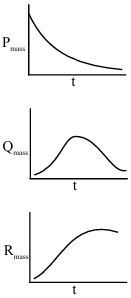
$A$ radioactive material $P$ first decays into $Q$ and then $Q$ decays to non-radioactive material $R$. Which of the following figures represents the time-dependent mass of $P$,$Q$,and $R$?
A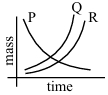
B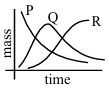
C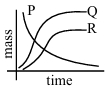
D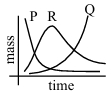
Solution
(B) The radioactive decay process is given by $P \rightarrow Q \rightarrow R$.
$1$. The mass of the parent radioactive material $P$ decreases exponentially with time according to the law of radioactive decay: $N_P(t) = N_0 e^{-\lambda_1 t}$.
$2$. The intermediate material $Q$ is produced by the decay of $P$ and simultaneously decays into $R$. Initially,the amount of $Q$ is zero,then it increases as $P$ decays,reaches a maximum value,and finally decreases as it decays into $R$.
$3$. The non-radioactive material $R$ is the final product. Its amount starts from zero and increases over time as $Q$ decays,eventually approaching a constant value as all of $P$ and $Q$ are converted into $R$.
Comparing these characteristics with the given options,figure $B$ correctly represents the decay chain $P \rightarrow Q \rightarrow R$,where $P$ decays exponentially,$Q$ shows a peak,and $R$ increases to a stable value.
$1$. The mass of the parent radioactive material $P$ decreases exponentially with time according to the law of radioactive decay: $N_P(t) = N_0 e^{-\lambda_1 t}$.
$2$. The intermediate material $Q$ is produced by the decay of $P$ and simultaneously decays into $R$. Initially,the amount of $Q$ is zero,then it increases as $P$ decays,reaches a maximum value,and finally decreases as it decays into $R$.
$3$. The non-radioactive material $R$ is the final product. Its amount starts from zero and increases over time as $Q$ decays,eventually approaching a constant value as all of $P$ and $Q$ are converted into $R$.
Comparing these characteristics with the given options,figure $B$ correctly represents the decay chain $P \rightarrow Q \rightarrow R$,where $P$ decays exponentially,$Q$ shows a peak,and $R$ increases to a stable value.
0 likes
View Solution234
DifficultMCQ
$A$ nucleus with $Z=92$ emits the following in a sequence: $\alpha, \alpha, \beta^{-}, \beta^{-}, \alpha, \alpha, \alpha, \alpha, \beta^{-}, \beta^{-}, \alpha, \beta^{+}, \beta^{+}$ and $\alpha$. The atomic number of the resulting nucleus is
A
$76$
B
$78$
C
$80$
D
$72$
Solution
(B) The change in atomic number $Z$ due to radioactive decay is as follows:
$1$. An $\alpha$ particle emission decreases $Z$ by $2$.
$2$. $A$ $\beta^{-}$ particle emission increases $Z$ by $1$.
$3$. $A$ $\beta^{+}$ particle emission decreases $Z$ by $1$.
Counting the particles emitted:
- Number of $\alpha$ particles $= 8$
- Number of $\beta^{-}$ particles $= 4$
- Number of $\beta^{+}$ particles $= 2$
The final atomic number $Z'$ is given by:
$Z' = Z_{initial} - (8 \times 2) + (4 \times 1) - (2 \times 1)$
$Z' = 92 - 16 + 4 - 2$
$Z' = 78$
Therefore,the atomic number of the resulting nucleus is $78$.
$1$. An $\alpha$ particle emission decreases $Z$ by $2$.
$2$. $A$ $\beta^{-}$ particle emission increases $Z$ by $1$.
$3$. $A$ $\beta^{+}$ particle emission decreases $Z$ by $1$.
Counting the particles emitted:
- Number of $\alpha$ particles $= 8$
- Number of $\beta^{-}$ particles $= 4$
- Number of $\beta^{+}$ particles $= 2$
The final atomic number $Z'$ is given by:
$Z' = Z_{initial} - (8 \times 2) + (4 \times 1) - (2 \times 1)$
$Z' = 92 - 16 + 4 - 2$
$Z' = 78$
Therefore,the atomic number of the resulting nucleus is $78$.
0 likes
View Solution235
MediumMCQ
In the uranium radioactive series,the initial nucleus is ${ }_{92}^{238} U$ and the final nucleus is ${ }_{82}^{206} Pb$. When the uranium nucleus decays into lead,the number of $\alpha$-particles and $\beta$-particles emitted are
A
$8 \alpha, 6 \beta$
B
$6 \alpha, 8 \beta$
C
$4 \alpha, 5 \beta$
D
$5 \alpha, 3 \beta$
Solution
(A) Let $n_{\alpha}$ be the number of $\alpha$-particles and $n_{\beta}$ be the number of $\beta$-particles emitted.
For the mass number change: $238 = 206 + 4n_{\alpha} + 0n_{\beta}$.
$4n_{\alpha} = 238 - 206 = 32 \implies n_{\alpha} = 8$.
For the atomic number change: $92 = 82 + 2n_{\alpha} - 1n_{\beta}$.
Substituting $n_{\alpha} = 8$: $92 = 82 + 2(8) - n_{\beta}$.
$92 = 82 + 16 - n_{\beta} \implies 92 = 98 - n_{\beta}$.
$n_{\beta} = 98 - 92 = 6$.
Thus,$8$ $\alpha$-particles and $6$ $\beta$-particles are emitted.
For the mass number change: $238 = 206 + 4n_{\alpha} + 0n_{\beta}$.
$4n_{\alpha} = 238 - 206 = 32 \implies n_{\alpha} = 8$.
For the atomic number change: $92 = 82 + 2n_{\alpha} - 1n_{\beta}$.
Substituting $n_{\alpha} = 8$: $92 = 82 + 2(8) - n_{\beta}$.
$92 = 82 + 16 - n_{\beta} \implies 92 = 98 - n_{\beta}$.
$n_{\beta} = 98 - 92 = 6$.
Thus,$8$ $\alpha$-particles and $6$ $\beta$-particles are emitted.
0 likes
View Solution236
EasyMCQ
$A$ radioactive element $A$ decays into radioactive element $C$ by the following processes in succession.
$A \rightarrow B + {}_{2}^{4}He$
$B \rightarrow C + 2e^{-}$
Then elements
$A \rightarrow B + {}_{2}^{4}He$
$B \rightarrow C + 2e^{-}$
Then elements
A
$A$ and $B$ are isobars.
B
$A$ and $C$ are isobars.
C
$A$ and $C$ are isotopes.
D
$A$ and $B$ are isotopes.
Solution
(C) Let the atomic number of $A$ be $Z$ and its mass number be $A_{mass}$.
$1$. In the first decay: $A \rightarrow B + {}_{2}^{4}He$. The element $B$ will have atomic number $(Z-2)$ and mass number $(A_{mass}-4)$.
$2$. In the second decay: $B \rightarrow C + 2e^{-}$. The emission of two electrons (beta particles) increases the atomic number by $2$ but does not change the mass number.
$3$. Therefore,the atomic number of $C$ is $(Z-2) + 2 = Z$ and its mass number is $(A_{mass}-4)$.
$4$. Comparing $A$ (atomic number $Z$,mass number $A_{mass}$) and $C$ (atomic number $Z$,mass number $A_{mass}-4$),they have the same atomic number but different mass numbers. Thus,$A$ and $C$ are isotopes.
$1$. In the first decay: $A \rightarrow B + {}_{2}^{4}He$. The element $B$ will have atomic number $(Z-2)$ and mass number $(A_{mass}-4)$.
$2$. In the second decay: $B \rightarrow C + 2e^{-}$. The emission of two electrons (beta particles) increases the atomic number by $2$ but does not change the mass number.
$3$. Therefore,the atomic number of $C$ is $(Z-2) + 2 = Z$ and its mass number is $(A_{mass}-4)$.
$4$. Comparing $A$ (atomic number $Z$,mass number $A_{mass}$) and $C$ (atomic number $Z$,mass number $A_{mass}-4$),they have the same atomic number but different mass numbers. Thus,$A$ and $C$ are isotopes.
0 likes
View Solution237
EasyMCQ
For the following reaction, the particle '$x$' is: ${ }_{6}^{11}C \longrightarrow{ }_{5}^{11}B+\beta^{+}+X$
A
proton
B
neutrino
C
anti neutrino
D
neutron
Solution
(B) In the given nuclear reaction, a carbon-$11$ nucleus decays into a boron-$11$ nucleus by emitting a positron $(\beta^{+})$.
This process is known as $\beta^{+}$ decay.
According to the law of conservation of lepton number, the total lepton number before and after the reaction must remain constant.
The lepton number of a positron $(\beta^{+})$ is $-1$.
To balance the equation, a particle with a lepton number of $+1$ must be emitted.
This particle is the neutrino ($\nu_{e}$).
Therefore, the reaction is: ${ }_{6}^{11}C \longrightarrow{ }_{5}^{11}B+\beta^{+}+\nu_{e}$.
This process is known as $\beta^{+}$ decay.
According to the law of conservation of lepton number, the total lepton number before and after the reaction must remain constant.
The lepton number of a positron $(\beta^{+})$ is $-1$.
To balance the equation, a particle with a lepton number of $+1$ must be emitted.
This particle is the neutrino ($\nu_{e}$).
Therefore, the reaction is: ${ }_{6}^{11}C \longrightarrow{ }_{5}^{11}B+\beta^{+}+\nu_{e}$.
0 likes
View Solution238
EasyMCQ
The nucleus ${ }_{88}^{226} Ra$ is converted into ${ }_{82}^{206} Pb$ by the emission of alpha $(\alpha)$ and beta $(\beta)$ particles. The number of alpha and beta particles emitted are respectively:
A
$5$,$4$
B
$4$,$5$
C
$6$,$4$
D
$4$,$6$
Solution
(A) Let $n_{\alpha}$ be the number of alpha particles and $n_{\beta}$ be the number of beta particles emitted.
For the mass number $(A)$: $226 = 206 + 4n_{\alpha} + 0n_{\beta}$
$20 = 4n_{\alpha} \implies n_{\alpha} = 5$.
For the atomic number $(Z)$: $88 = 82 + 2n_{\alpha} - 1n_{\beta}$
$88 = 82 + 2(5) - n_{\beta}$
$88 = 82 + 10 - n_{\beta}$
$88 = 92 - n_{\beta}$
$n_{\beta} = 92 - 88 = 4$.
Thus,the number of alpha particles is $5$ and the number of beta particles is $4$.
For the mass number $(A)$: $226 = 206 + 4n_{\alpha} + 0n_{\beta}$
$20 = 4n_{\alpha} \implies n_{\alpha} = 5$.
For the atomic number $(Z)$: $88 = 82 + 2n_{\alpha} - 1n_{\beta}$
$88 = 82 + 2(5) - n_{\beta}$
$88 = 82 + 10 - n_{\beta}$
$88 = 92 - n_{\beta}$
$n_{\beta} = 92 - 88 = 4$.
Thus,the number of alpha particles is $5$ and the number of beta particles is $4$.
0 likes
View Solution239
MediumMCQ
$A$ radioactive element ${ }_{92}^{242} X$ emits two $\alpha$ particles,one electron and two positrons. The product nucleus is represented by ${ }_{P}^{234} Y$. The value of $P$ is
A
$87$
B
$85$
C
$92$
D
$96$
Solution
(A) The initial nucleus is ${ }_{92}^{242} X$.
An $\alpha$ particle is ${ }_{2}^{4} He$,an electron (beta-minus) is ${ }_{-1}^{0} e$,and a positron (beta-plus) is ${ }_{1}^{0} e$.
The emission process is given by: ${ }_{92}^{242} X \rightarrow 2({ }_{2}^{4} He) + 1({ }_{-1}^{0} e) + 2({ }_{1}^{0} e) + { }_{P}^{234} Y$.
Conservation of atomic number $(Z)$: $92 = 2(2) + 1(-1) + 2(1) + P$.
$92 = 4 - 1 + 2 + P$.
$92 = 5 + P$.
$P = 92 - 5 = 87$.
An $\alpha$ particle is ${ }_{2}^{4} He$,an electron (beta-minus) is ${ }_{-1}^{0} e$,and a positron (beta-plus) is ${ }_{1}^{0} e$.
The emission process is given by: ${ }_{92}^{242} X \rightarrow 2({ }_{2}^{4} He) + 1({ }_{-1}^{0} e) + 2({ }_{1}^{0} e) + { }_{P}^{234} Y$.
Conservation of atomic number $(Z)$: $92 = 2(2) + 1(-1) + 2(1) + P$.
$92 = 4 - 1 + 2 + P$.
$92 = 5 + P$.
$P = 92 - 5 = 87$.
0 likes
View Solution240
MediumMCQ
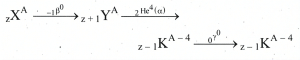
In the given reaction sequence ${ }_z X^A \rightarrow{ }_{z+1} Y^A \rightarrow{ }_{z-1} K^{A-4} \rightarrow{ }_{z-1} K^{A-4}$,identify the radioactive radiations emitted in order.
A
$\alpha, \beta, \gamma$
B
$\beta, \alpha, \gamma$
C
$\gamma, \alpha, \beta$
D
$\beta, \gamma, \alpha$
Solution
(B) $1$. In the first step,${ }_z X^A \rightarrow{ }_{z+1} Y^A$,the atomic number increases by $1$ while the mass number remains the same. This corresponds to the emission of a $\beta^-$ particle $(-1\beta^0)$.
$2$. In the second step,${ }_{z+1} Y^A \rightarrow{ }_{z-1} K^{A-4}$,the atomic number decreases by $2$ and the mass number decreases by $4$. This corresponds to the emission of an $\alpha$ particle $(2\text{He}^4)$.
$3$. In the third step,${ }_{z-1} K^{A-4} \rightarrow{ }_{z-1} K^{A-4}$,there is no change in atomic number or mass number,which corresponds to the emission of a $\gamma$ ray $(0\gamma^0)$.
$4$. Therefore,the sequence of emissions is $\beta, \alpha, \gamma$.
$2$. In the second step,${ }_{z+1} Y^A \rightarrow{ }_{z-1} K^{A-4}$,the atomic number decreases by $2$ and the mass number decreases by $4$. This corresponds to the emission of an $\alpha$ particle $(2\text{He}^4)$.
$3$. In the third step,${ }_{z-1} K^{A-4} \rightarrow{ }_{z-1} K^{A-4}$,there is no change in atomic number or mass number,which corresponds to the emission of a $\gamma$ ray $(0\gamma^0)$.
$4$. Therefore,the sequence of emissions is $\beta, \alpha, \gamma$.
0 likes
View Solution241
EasyMCQ
An isotope of the original nucleus can be formed in a radioactive decay,with the emission of which of the following particles?
A
one $\alpha$ and one $\beta$
B
one $\alpha$ and two $\beta$
C
one $\alpha$ and four $\beta$
D
four $\alpha$ and one $\beta$
Solution
(B) Let the original nucleus be ${ }_{Z} X^{A}$.
When one $\alpha$ particle $({ }_{2} He^{4})$ is emitted,the nucleus becomes ${ }_{Z-2} Y^{A-4}$.
When one $\beta^{-}$ particle $({ }_{-1} e^{0})$ is emitted,the atomic number increases by $1$ $(Z-2+1 = Z-1)$.
When two $\beta^{-}$ particles are emitted,the atomic number increases by $2$ $(Z-2+2 = Z)$.
Thus,the final nucleus is ${ }_{Z} X^{A-4}$,which is an isotope of the original nucleus ${ }_{Z} X^{A}$ because they have the same atomic number $Z$ but different mass numbers.
When one $\alpha$ particle $({ }_{2} He^{4})$ is emitted,the nucleus becomes ${ }_{Z-2} Y^{A-4}$.
When one $\beta^{-}$ particle $({ }_{-1} e^{0})$ is emitted,the atomic number increases by $1$ $(Z-2+1 = Z-1)$.
When two $\beta^{-}$ particles are emitted,the atomic number increases by $2$ $(Z-2+2 = Z)$.
Thus,the final nucleus is ${ }_{Z} X^{A-4}$,which is an isotope of the original nucleus ${ }_{Z} X^{A}$ because they have the same atomic number $Z$ but different mass numbers.
0 likes
View Solution242
MediumMCQ
$A$ radioactive nucleus emits $4 \alpha$ particles and $7 \beta$ particles in succession. The ratio of the number of neutrons to that of protons in the final nucleus is $[A = \text{mass number}, Z = \text{atomic number}]$
A
$\frac{A-Z-13}{Z-1}$
B
$\frac{A-Z-15}{Z-1}$
C
$\frac{A-Z-11}{Z-2}$
D
$\frac{A-Z-13}{Z-2}$
Solution
(B) Let the initial nucleus be $^A_Z X$.
Emission of one $\alpha$ particle $(^4_2 He)$ decreases the mass number by $4$ and atomic number by $2$.
Emission of $4 \alpha$ particles results in a change: $A' = A - (4 \times 4) = A - 16$ and $Z' = Z - (4 \times 2) = Z - 8$.
Emission of one $\beta$ particle $(^0_{-1} e)$ increases the atomic number by $1$ and leaves the mass number unchanged.
Emission of $7 \beta$ particles results in: $A_{final} = A - 16$ and $Z_{final} = Z - 8 + 7 = Z - 1$.
The number of protons in the final nucleus is $P = Z_{final} = Z - 1$.
The number of neutrons is $N = A_{final} - Z_{final} = (A - 16) - (Z - 1) = A - Z - 15$.
The ratio of neutrons to protons is $\frac{N}{P} = \frac{A - Z - 15}{Z - 1}$.
Emission of one $\alpha$ particle $(^4_2 He)$ decreases the mass number by $4$ and atomic number by $2$.
Emission of $4 \alpha$ particles results in a change: $A' = A - (4 \times 4) = A - 16$ and $Z' = Z - (4 \times 2) = Z - 8$.
Emission of one $\beta$ particle $(^0_{-1} e)$ increases the atomic number by $1$ and leaves the mass number unchanged.
Emission of $7 \beta$ particles results in: $A_{final} = A - 16$ and $Z_{final} = Z - 8 + 7 = Z - 1$.
The number of protons in the final nucleus is $P = Z_{final} = Z - 1$.
The number of neutrons is $N = A_{final} - Z_{final} = (A - 16) - (Z - 1) = A - Z - 15$.
The ratio of neutrons to protons is $\frac{N}{P} = \frac{A - Z - 15}{Z - 1}$.
0 likes
View Solution243
EasyMCQ
In radioactive decay process,the negatively charged emitted $\beta$-particles are
A
the electrons present inside the nucleus
B
the electrons produced as a result of the decay of neutrons inside the nucleus
C
the electrons produced as a result of collisions between atoms
D
the electrons orbiting around the nucleus
Solution
(B) Beta decay can involve the emission of either electrons or positrons.
The electrons or positrons emitted in a $\beta$-decay do not exist inside the nucleus.
They are only created at the time of emission,just as photons are created when an atom makes a transition from a higher to a lower energy state.
In negative $\beta$-decay,a neutron in the nucleus is transformed into a proton,an electron,and an antineutrino.
Hence,in the radioactive decay process,the negatively charged emitted $\beta$-particles are the electrons produced as a result of the decay of neutrons present inside the nucleus.
The electrons or positrons emitted in a $\beta$-decay do not exist inside the nucleus.
They are only created at the time of emission,just as photons are created when an atom makes a transition from a higher to a lower energy state.
In negative $\beta$-decay,a neutron in the nucleus is transformed into a proton,an electron,and an antineutrino.
Hence,in the radioactive decay process,the negatively charged emitted $\beta$-particles are the electrons produced as a result of the decay of neutrons present inside the nucleus.
0 likes
View Solution244
EasyMCQ
In medicine,to destroy cancer cells . . . . . . rays are used.
A
Gamma
B
Visible
C
Ultraviolet
D
Infrared
Solution
(A) The correct answer is $A$. Gamma rays have very high energy and high penetrating power. Due to this property,they are used in medical treatments,specifically in radiotherapy,to kill or destroy cancer cells by damaging their $DNA$.
0 likes
View Solution245
EasyMCQ
Neutrino is a particle which $\qquad$
A
has no charge but has mass nearly that of an electron
B
has no charge and no spin
C
has no charge but has spin
D
is charged like an electron and has spin
Solution
(C) neutrino is an elementary subatomic particle that is electrically neutral. It has a very small mass (nearly zero) and possesses an intrinsic angular momentum known as spin,which is $1/2$ in units of $\hbar$. Therefore,it has no charge but has spin.
0 likes
View Solution246
MediumMCQ
The particles emitted in the decay of $ { }_{92}^{238} U $ to $ { }_{92}^{234} U $ are:
A
$1 \alpha$ and $2 \beta$
B
$1 \alpha$ only
C
$1 \alpha$ and $1 \beta$
D
$2 \alpha$ and $2 \beta$
Solution
(A) The given decay reaction is $ { }_{92}^{238} U \rightarrow { }_{92}^{234} U $.
An $\alpha$-decay is represented as $ { }_{Z}^{A} X \rightarrow { }_{Z-2}^{A-4} Y + { }_{2}^{4} \text{He} $.
$A$ $\beta$-decay is represented as $ { }_{Z}^{A} X \rightarrow { }_{Z+1}^{A} Y + { }_{-1}^{0} e $.
In the decay of $ { }_{92}^{238} U $ to $ { }_{92}^{234} U $,the change in mass number $\Delta A = 238 - 234 = 4$.
Since each $\alpha$-particle carries a mass number of $4$,the number of $\alpha$-particles emitted is $4/4 = 1$.
Emission of $1$ $\alpha$-particle reduces the atomic number $Z$ by $2$,so the atomic number becomes $92 - 2 = 90$.
However,the final atomic number is $92$. To increase the atomic number from $90$ to $92$,we need $2$ $\beta$-decays,as each $\beta$-decay increases $Z$ by $1$.
Therefore,$1$ $\alpha$ and $2$ $\beta$ particles are emitted.
An $\alpha$-decay is represented as $ { }_{Z}^{A} X \rightarrow { }_{Z-2}^{A-4} Y + { }_{2}^{4} \text{He} $.
$A$ $\beta$-decay is represented as $ { }_{Z}^{A} X \rightarrow { }_{Z+1}^{A} Y + { }_{-1}^{0} e $.
In the decay of $ { }_{92}^{238} U $ to $ { }_{92}^{234} U $,the change in mass number $\Delta A = 238 - 234 = 4$.
Since each $\alpha$-particle carries a mass number of $4$,the number of $\alpha$-particles emitted is $4/4 = 1$.
Emission of $1$ $\alpha$-particle reduces the atomic number $Z$ by $2$,so the atomic number becomes $92 - 2 = 90$.
However,the final atomic number is $92$. To increase the atomic number from $90$ to $92$,we need $2$ $\beta$-decays,as each $\beta$-decay increases $Z$ by $1$.
Therefore,$1$ $\alpha$ and $2$ $\beta$ particles are emitted.
0 likes
View Solution247
EasyMCQ
In the following equation representing $\beta^{-}$ decay,the number of neutrons in the nucleus $X$ is ${ }_{83}^{210} Bi \longrightarrow X + { }_{-1}^{0} e + \bar{\nu}$
A
$126$
B
$127$
C
$125$
D
$84$
Solution
(A) In $\beta^{-}$ decay,the reaction is given by the conservation of mass number and atomic number:
${ }_{83}^{210} Bi \longrightarrow { }_{84}^{210} X + { }_{-1}^{0} e + \bar{\nu}$
Here,the mass number $A = 210$ and the atomic number $Z = 84$ for the daughter nucleus $X$.
The number of neutrons $N$ is calculated as $N = A - Z$.
$N = 210 - 84 = 126$.
${ }_{83}^{210} Bi \longrightarrow { }_{84}^{210} X + { }_{-1}^{0} e + \bar{\nu}$
Here,the mass number $A = 210$ and the atomic number $Z = 84$ for the daughter nucleus $X$.
The number of neutrons $N$ is calculated as $N = A - Z$.
$N = 210 - 84 = 126$.
0 likes
View Solution248
EasyMCQ
${ }_{92} U^{235}$ undergoes successive disintegrations with the end product of ${ }_{82} Pb^{203}$. The number of $\alpha$ and $\beta$ particles emitted are
A
$\alpha=6, \beta=4$
B
$\alpha=6, \beta=0$
C
$\alpha=8, \beta=6$
D
$\alpha=3, \beta=3$
Solution
(C) Let the number of $\alpha$ particles emitted be $x$ and the number of $\beta$ particles emitted be $y$.
The nuclear decay reaction is represented as:
${ }_{92} U^{235} \longrightarrow x({ }_{2} \alpha^{4}) + y({ }_{-1} \beta^{0}) + { }_{82} Pb^{203}$
Equating the mass numbers on both sides:
$235 = 4x + 203$
$4x = 235 - 203 = 32$
$x = 8$
Equating the atomic numbers on both sides:
$92 = 2x - y + 82$
Substituting $x = 8$ into the equation:
$92 = 2(8) - y + 82$
$92 = 16 - y + 82$
$92 = 98 - y$
$y = 98 - 92 = 6$
Therefore,$8$ $\alpha$ particles and $6$ $\beta$ particles are emitted.
The nuclear decay reaction is represented as:
${ }_{92} U^{235} \longrightarrow x({ }_{2} \alpha^{4}) + y({ }_{-1} \beta^{0}) + { }_{82} Pb^{203}$
Equating the mass numbers on both sides:
$235 = 4x + 203$
$4x = 235 - 203 = 32$
$x = 8$
Equating the atomic numbers on both sides:
$92 = 2x - y + 82$
Substituting $x = 8$ into the equation:
$92 = 2(8) - y + 82$
$92 = 16 - y + 82$
$92 = 98 - y$
$y = 98 - 92 = 6$
Therefore,$8$ $\alpha$ particles and $6$ $\beta$ particles are emitted.
0 likes
View Solution249
EasyMCQ
Which of the following radiations is deflected by an electric field?
A
Neutrons
B
$\gamma$-rays
C
$\alpha$-particles
D
$X$-rays
Solution
(C) An electric field exerts a force on charged particles,causing them to deflect from their path.
$\alpha$-particles carry a positive charge of $+2e$,which causes them to be deflected by both electric and magnetic fields.
$\gamma$-rays and $X$-rays are electromagnetic waves that carry no charge,so they remain undeflected in electric and magnetic fields.
Neutrons are neutral particles with zero charge,and therefore,they are not deflected by electric or magnetic fields.
$\alpha$-particles carry a positive charge of $+2e$,which causes them to be deflected by both electric and magnetic fields.
$\gamma$-rays and $X$-rays are electromagnetic waves that carry no charge,so they remain undeflected in electric and magnetic fields.
Neutrons are neutral particles with zero charge,and therefore,they are not deflected by electric or magnetic fields.
0 likes
View Solution250
MediumMCQ
During a $\beta^{-}$-decay,
A
an atomic electron is ejected
B
an electron which is already present within the nucleus is ejected
C
a neutron in the nucleus decays emitting an electron
D
a proton in the nucleus decays emitting an electron
Solution
(C) The process of $\beta^{-}$-decay is represented by the following nuclear reaction:
${ }_{Z}^{A} X \longrightarrow{ }_{Z+1}^{A} Y + e^{-} + \bar{\nu} + Q$
In this process,a neutron inside the nucleus transforms into a proton,emitting an electron $(e^{-})$ and an anti-neutrino $(\bar{\nu})$.
Therefore,the correct statement is that a neutron in the nucleus decays,emitting an electron.
${ }_{Z}^{A} X \longrightarrow{ }_{Z+1}^{A} Y + e^{-} + \bar{\nu} + Q$
In this process,a neutron inside the nucleus transforms into a proton,emitting an electron $(e^{-})$ and an anti-neutrino $(\bar{\nu})$.
Therefore,the correct statement is that a neutron in the nucleus decays,emitting an electron.
0 likes
View SolutionNuclei — Properties of Alpha, Beta and Gamma Rays and Decay Process · Frequently Asked Questions
1Are these Nuclei questions useful for JEE and NEET?
Yes. All questions in this section are mapped to JEE Main and NEET exam patterns. Previous year questions from JEE Main, NEET, GUJCET and state-level exams are included with full solutions.
2Can I switch to Hindi or Gujarati for these questions?
Yes. Use the language tabs in the hero section or the sidebar to view the same questions and solutions in English, Hindi or Gujarati.
3How do I generate a question paper from this subtopic?
Use the Vedclass Exam Paper Generator — select the chapter and subtopic, set difficulty, and generate Sets A, B, C, D automatically. First 3 chapters of every subject are free.
Vedclass Products
For Students
Vedclass Test Series
Mock tests in real JEE/NEET style with performance analysis. 5-day free trial.
Start Free TrialFor Teachers
Exam Paper Generator
Generate Set A/B/C/D papers from this chapter in 2 minutes. 3 chapters free.
Try FreeFor Institutes
Online Exam Module
Live online exams with unlimited students, 360° analytics & white-label branding.
See DemoFor Teachers & Institutes
Generate a Nuclei Exam Paper in 2 Minutes
Select subtopic & difficulty — Sets A, B, C, D auto-generated with No Repeat logic.
First 3 chapters of every subject are free — no payment required.