
A English
Properties of Alpha, Beta and Gamma Rays and Decay Process Questions in English
Class 12 Physics · Nuclei · Properties of Alpha, Beta and Gamma Rays and Decay Process
286+
Questions
English
Language
100%
With Solutions
Showing 49 of 286 questions in English
101
MediumMCQ
The intensity of gamma rays is reduced to half when they pass through a lead sheet of thickness $2.5 \, mm$. The absorption coefficient of lead is ......... $mm^{-1}$.
A
$2.5$
B
$0.4$
C
$0.28$
D
$0.2$
Solution
(C) The intensity of radiation passing through a material is given by the formula $I = I_0 e^{-\mu t}$,where $I$ is the final intensity,$I_0$ is the initial intensity,$\mu$ is the absorption coefficient,and $t$ is the thickness of the material.
Given that the intensity is reduced to half $(I = I_0 / 2)$ for a thickness $t = 2.5 \, mm$.
Substituting these values into the equation: $I_0 / 2 = I_0 e^{-\mu (2.5)}$.
This simplifies to $1/2 = e^{-2.5 \mu}$.
Taking the natural logarithm on both sides: $\ln(1/2) = -2.5 \mu$.
$-\ln(2) = -2.5 \mu$.
$0.693 = 2.5 \mu$.
$\mu = 0.693 / 2.5 = 0.2772 \, mm^{-1}$.
Rounding to two decimal places,we get $\mu \approx 0.28 \, mm^{-1}$.
Given that the intensity is reduced to half $(I = I_0 / 2)$ for a thickness $t = 2.5 \, mm$.
Substituting these values into the equation: $I_0 / 2 = I_0 e^{-\mu (2.5)}$.
This simplifies to $1/2 = e^{-2.5 \mu}$.
Taking the natural logarithm on both sides: $\ln(1/2) = -2.5 \mu$.
$-\ln(2) = -2.5 \mu$.
$0.693 = 2.5 \mu$.
$\mu = 0.693 / 2.5 = 0.2772 \, mm^{-1}$.
Rounding to two decimal places,we get $\mu \approx 0.28 \, mm^{-1}$.
0 likes
View Solution102
MediumMCQ
What does the nuclear reaction $_z{X^A} \to {_{z + 1}}{Y^A} + {_{ - 1}}{e^0} + \bar \nu$ represent?
A
$\beta^-$ decay
B
$\gamma$ decay
C
Nuclear fusion
D
Nuclear fission
Solution
(A) In the given nuclear reaction,the atomic number increases by $1$ $(z \to z+1)$,while the mass number $A$ remains constant.
An electron $(_{-1}e^0)$ and an antineutrino $(\bar \nu)$ are emitted.
This process is characteristic of $\beta^-$ decay,where a neutron transforms into a proton,emitting an electron and an antineutrino.
An electron $(_{-1}e^0)$ and an antineutrino $(\bar \nu)$ are emitted.
This process is characteristic of $\beta^-$ decay,where a neutron transforms into a proton,emitting an electron and an antineutrino.
0 likes
View Solution103
DifficultMCQ
$A$ nucleus with mass number $220$ is initially at rest. It emits an $\alpha$-particle. If the $Q$-value of the reaction is $5.5 \, MeV$,then the kinetic energy of the $\alpha$-particle will be .......... $MeV$.
A
$4.4$
B
$5.4$
C
$5.6$
D
$6.5$
Solution
(B) Let the mass number of the parent nucleus be $A = 220$. After emitting an $\alpha$-particle $(m_2 = 4)$,the daughter nucleus has a mass number $m_1 = 220 - 4 = 216$.
The total energy released in the reaction is $Q = K_1 + K_2 = 5.5 \, MeV$,where $K_1$ is the kinetic energy of the daughter nucleus and $K_2$ is the kinetic energy of the $\alpha$-particle.
By the law of conservation of linear momentum,the initial momentum is zero,so the magnitudes of the momenta of the daughter nucleus and the $\alpha$-particle must be equal:
$p_1 = p_2$
$\sqrt{2 m_1 K_1} = \sqrt{2 m_2 K_2}$
$m_1 K_1 = m_2 K_2$
$216 K_1 = 4 K_2$
$K_1 = \frac{4}{216} K_2 = \frac{1}{54} K_2$
Substituting this into the $Q$-value equation:
$K_1 + K_2 = 5.5$
$\frac{1}{54} K_2 + K_2 = 5.5$
$\frac{55}{54} K_2 = 5.5$
$K_2 = 5.5 \times \frac{54}{55} = 0.1 \times 54 = 5.4 \, MeV$.
Thus,the kinetic energy of the $\alpha$-particle is $5.4 \, MeV$.
The total energy released in the reaction is $Q = K_1 + K_2 = 5.5 \, MeV$,where $K_1$ is the kinetic energy of the daughter nucleus and $K_2$ is the kinetic energy of the $\alpha$-particle.
By the law of conservation of linear momentum,the initial momentum is zero,so the magnitudes of the momenta of the daughter nucleus and the $\alpha$-particle must be equal:
$p_1 = p_2$
$\sqrt{2 m_1 K_1} = \sqrt{2 m_2 K_2}$
$m_1 K_1 = m_2 K_2$
$216 K_1 = 4 K_2$
$K_1 = \frac{4}{216} K_2 = \frac{1}{54} K_2$
Substituting this into the $Q$-value equation:
$K_1 + K_2 = 5.5$
$\frac{1}{54} K_2 + K_2 = 5.5$
$\frac{55}{54} K_2 = 5.5$
$K_2 = 5.5 \times \frac{54}{55} = 0.1 \times 54 = 5.4 \, MeV$.
Thus,the kinetic energy of the $\alpha$-particle is $5.4 \, MeV$.

0 likes
View Solution104
EasyMCQ
If a nucleus emits an $e^-$ particle,then its neutron-to-proton ratio $[n/p]$ will .....
A
increase
B
decrease
C
remain unchanged
D
cannot be determined
Solution
(B) During $\beta^-$ decay,a neutron inside the nucleus transforms into a proton,an electron $(e^-)$,and an antineutrino $(\bar{\nu}_e)$.
The reaction is: $n \to p + e^- + \bar{\nu}_e$.
As a result of this process,the number of neutrons $(n)$ decreases by $1$ and the number of protons $(p)$ increases by $1$.
Since the numerator $(n)$ decreases and the denominator $(p)$ increases,the overall ratio $[n/p]$ will decrease.
The reaction is: $n \to p + e^- + \bar{\nu}_e$.
As a result of this process,the number of neutrons $(n)$ decreases by $1$ and the number of protons $(p)$ increases by $1$.
Since the numerator $(n)$ decreases and the denominator $(p)$ increases,the overall ratio $[n/p]$ will decrease.
0 likes
View Solution105
DifficultMCQ
$A$ radioactive nucleus decays as follows. If the atomic number of $X$ is $72$ and the mass number is $180$,what are the mass number and atomic number of $X_4$?
$X \xrightarrow{\alpha} X_1 \xrightarrow{\beta} X_2 \xrightarrow{\alpha} X_3 \xrightarrow{\gamma} X_4$
$X \xrightarrow{\alpha} X_1 \xrightarrow{\beta} X_2 \xrightarrow{\alpha} X_3 \xrightarrow{\gamma} X_4$
A
$172, 70$
B
$171, 69$
C
$172, 69$
D
$172, 68$
Solution
(C) The initial nucleus is $_{72}X^{180}$.
$1$. After $\alpha$-decay ($_{2}He^{4}$ emission),the mass number decreases by $4$ and the atomic number decreases by $2$: $_{72}X^{180} \xrightarrow{\alpha} _{70}X_1^{176}$.
$2$. After $\beta$-decay (emission of an electron,$_{ -1}e^{0}$),the mass number remains unchanged and the atomic number increases by $1$: $_{70}X_1^{176} \xrightarrow{\beta} _{71}X_2^{176}$.
$3$. After another $\alpha$-decay,the mass number decreases by $4$ and the atomic number decreases by $2$: $_{71}X_2^{176} \xrightarrow{\alpha} _{69}X_3^{172}$.
$4$. After $\gamma$-decay,there is no change in mass number or atomic number: $_{69}X_3^{172} \xrightarrow{\gamma} _{69}X_4^{172}$.
Therefore,the mass number of $X_4$ is $172$ and the atomic number is $69$.
$1$. After $\alpha$-decay ($_{2}He^{4}$ emission),the mass number decreases by $4$ and the atomic number decreases by $2$: $_{72}X^{180} \xrightarrow{\alpha} _{70}X_1^{176}$.
$2$. After $\beta$-decay (emission of an electron,$_{ -1}e^{0}$),the mass number remains unchanged and the atomic number increases by $1$: $_{70}X_1^{176} \xrightarrow{\beta} _{71}X_2^{176}$.
$3$. After another $\alpha$-decay,the mass number decreases by $4$ and the atomic number decreases by $2$: $_{71}X_2^{176} \xrightarrow{\alpha} _{69}X_3^{172}$.
$4$. After $\gamma$-decay,there is no change in mass number or atomic number: $_{69}X_3^{172} \xrightarrow{\gamma} _{69}X_4^{172}$.
Therefore,the mass number of $X_4$ is $172$ and the atomic number is $69$.
0 likes
View Solution106
MediumMCQ
$A$ nucleus $_Z{X^A}$ emits $3 \alpha$-particles and $5 \beta$-particles. The ratio of total neutrons to protons in the final nucleus is:
A
$\frac{A - Z - 12}{Z - 6}$
B
$\frac{A - Z}{Z - 1}$
C
$\frac{A - Z - 11}{Z - 6}$
D
$\frac{A - Z - 11}{Z - 1}$
Solution
(D) The initial nucleus is $_Z{X^A}$.
When a nucleus emits an $\alpha$-particle $(_{2}^{4}He)$,the mass number decreases by $4$ and the atomic number decreases by $2$.
When it emits a $\beta$-particle $(_{-1}^{0}e)$,the mass number remains unchanged and the atomic number increases by $1$.
After emitting $3 \alpha$-particles and $5 \beta$-particles,the new mass number $A'$ and atomic number $Z'$ are:
$A' = A - 3(4) = A - 12$
$Z' = Z - 3(2) + 5(1) = Z - 6 + 5 = Z - 1$
Number of protons $P = Z' = Z - 1$
Number of neutrons $N = A' - Z' = (A - 12) - (Z - 1) = A - Z - 11$
Therefore,the ratio of neutrons to protons is $\frac{N}{P} = \frac{A - Z - 11}{Z - 1}$.
When a nucleus emits an $\alpha$-particle $(_{2}^{4}He)$,the mass number decreases by $4$ and the atomic number decreases by $2$.
When it emits a $\beta$-particle $(_{-1}^{0}e)$,the mass number remains unchanged and the atomic number increases by $1$.
After emitting $3 \alpha$-particles and $5 \beta$-particles,the new mass number $A'$ and atomic number $Z'$ are:
$A' = A - 3(4) = A - 12$
$Z' = Z - 3(2) + 5(1) = Z - 6 + 5 = Z - 1$
Number of protons $P = Z' = Z - 1$
Number of neutrons $N = A' - Z' = (A - 12) - (Z - 1) = A - Z - 11$
Therefore,the ratio of neutrons to protons is $\frac{N}{P} = \frac{A - Z - 11}{Z - 1}$.
0 likes
View Solution107
DifficultMCQ
$A$ nucleus with $Z = 92$ emits $\alpha, \alpha, \beta^-, \beta^-, \alpha, \alpha, \alpha, \alpha, \beta^-, \beta^-, \alpha, \beta^+, \beta^+, \alpha$ particles in sequence. What is the $Z$ of the resulting nucleus?
A
$76$
B
$78$
C
$82$
D
$74$
Solution
(B) The initial atomic number is $Z = 92$.
An $\alpha$-decay $(_{2}He^{4})$ decreases $Z$ by $2$.
$A$ $\beta^-$-decay $(_{-1}e^{0})$ increases $Z$ by $1$.
$A$ $\beta^+$-decay $(_{+1}e^{0})$ decreases $Z$ by $1$.
Counting the particles:
- Total $\alpha$ particles: $8$ (emitted at steps $1$,$2$,$5$,$6$,$7$,$8$,$11$,$14$).
- Total $\beta^-$ particles: $4$ (emitted at steps $3$,$4$,$9$,$10$).
- Total $\beta^+$ particles: $2$ (emitted at steps $12$,$13$).
Calculation of final $Z$:
$Z_{final} = Z_{initial} - (8 \times 2) + (4 \times 1) - (2 \times 1)$
$Z_{final} = 92 - 16 + 4 - 2$
$Z_{final} = 78$.
An $\alpha$-decay $(_{2}He^{4})$ decreases $Z$ by $2$.
$A$ $\beta^-$-decay $(_{-1}e^{0})$ increases $Z$ by $1$.
$A$ $\beta^+$-decay $(_{+1}e^{0})$ decreases $Z$ by $1$.
Counting the particles:
- Total $\alpha$ particles: $8$ (emitted at steps $1$,$2$,$5$,$6$,$7$,$8$,$11$,$14$).
- Total $\beta^-$ particles: $4$ (emitted at steps $3$,$4$,$9$,$10$).
- Total $\beta^+$ particles: $2$ (emitted at steps $12$,$13$).
Calculation of final $Z$:
$Z_{final} = Z_{initial} - (8 \times 2) + (4 \times 1) - (2 \times 1)$
$Z_{final} = 92 - 16 + 4 - 2$
$Z_{final} = 78$.
0 likes
View Solution108
EasyMCQ
An $U^{238}$ nucleus is initially at rest. It decays by emitting an $\alpha$-particle with speed $u$. Find the recoil speed of the daughter nucleus.
A
$\frac{4u}{238}$
B
$-\frac{4u}{234}$
C
$\frac{4u}{234}$
D
$-\frac{4u}{238}$
Solution
(C) According to the law of conservation of linear momentum,the initial momentum of the system is equal to the final momentum.
Initially,the $U^{238}$ nucleus is at rest,so the initial momentum is $0$.
The decay process is: $U^{238} \to Th^{234} + He^{4}$.
Let $M_D = 234$ be the mass of the daughter nucleus and $M_{\alpha} = 4$ be the mass of the $\alpha$-particle.
Let $v$ be the recoil speed of the daughter nucleus and $u$ be the speed of the $\alpha$-particle.
Applying conservation of momentum: $0 = M_D \cdot v + M_{\alpha} \cdot u$.
$0 = 234 \cdot v + 4 \cdot u$.
Solving for $v$: $v = -\frac{4u}{234}$.
The magnitude of the recoil speed is $\frac{4u}{234}$.
Initially,the $U^{238}$ nucleus is at rest,so the initial momentum is $0$.
The decay process is: $U^{238} \to Th^{234} + He^{4}$.
Let $M_D = 234$ be the mass of the daughter nucleus and $M_{\alpha} = 4$ be the mass of the $\alpha$-particle.
Let $v$ be the recoil speed of the daughter nucleus and $u$ be the speed of the $\alpha$-particle.
Applying conservation of momentum: $0 = M_D \cdot v + M_{\alpha} \cdot u$.
$0 = 234 \cdot v + 4 \cdot u$.
Solving for $v$: $v = -\frac{4u}{234}$.
The magnitude of the recoil speed is $\frac{4u}{234}$.
0 likes
View Solution109
EasyMCQ
If $_{92}U^{238} \to _{Z}X^{A} + _{2}He^{4}$,then $Z$ and $A$ will be ..........
A
$90, 234$
B
$94, 242$
C
$91, 236$
D
$91, 239$
Solution
(A) In an alpha decay process,the mass number decreases by $4$ and the atomic number decreases by $2$.
Given the reaction: $_{92}U^{238} \to _{Z}X^{A} + _{2}He^{4}$.
According to the law of conservation of mass number: $238 = A + 4 \implies A = 238 - 4 = 234$.
According to the law of conservation of atomic number: $92 = Z + 2 \implies Z = 92 - 2 = 90$.
Therefore,$Z = 90$ and $A = 234$.
Given the reaction: $_{92}U^{238} \to _{Z}X^{A} + _{2}He^{4}$.
According to the law of conservation of mass number: $238 = A + 4 \implies A = 238 - 4 = 234$.
According to the law of conservation of atomic number: $92 = Z + 2 \implies Z = 92 - 2 = 90$.
Therefore,$Z = 90$ and $A = 234$.
0 likes
View Solution110
MediumMCQ
In the uranium series,the decay constant of the parent nuclide is $\lambda$. What is the decay constant of the stable end product of this series?
A
$\lambda / 238$
B
$\lambda / 206$
C
$\lambda / 208$
D
Zero
Solution
(D) The uranium series starts with an unstable radioactive parent nuclide and undergoes a series of alpha and beta decays until it reaches a stable isotope.
By definition,a stable nuclide does not undergo radioactive decay.
Since the decay constant $\lambda$ is defined as the probability of decay per unit time,for a stable nuclide,the probability of decay is zero.
Therefore,the decay constant of the stable end product is $0$.
By definition,a stable nuclide does not undergo radioactive decay.
Since the decay constant $\lambda$ is defined as the probability of decay per unit time,for a stable nuclide,the probability of decay is zero.
Therefore,the decay constant of the stable end product is $0$.
0 likes
View Solution111
EasyMCQ
An element $A$ decays into $C$ in two steps: $A \to B + _{2}^{4}He$ and $B \to C + 2e^{-}$. Then:
A
$A$ and $C$ are isotopes.
B
$A$ and $C$ are isobars.
C
$A$ and $B$ are isotopes.
D
$A$ and $B$ are isobars.
Solution
(A) Let the atomic number of $A$ be $Z$ and its mass number be $M$.
In the first step: $A \to B + _{2}^{4}He$.
The atomic number of $B$ becomes $Z - 2$ and the mass number becomes $M - 4$.
In the second step: $B \to C + 2e^{-}$.
Since each beta decay $(e^{-})$ increases the atomic number by $1$ without changing the mass number,the emission of $2e^{-}$ increases the atomic number of $B$ by $2$.
Therefore,the atomic number of $C = (Z - 2) + 2 = Z$.
The mass number of $C$ remains $M - 4$.
Since $A$ and $C$ have the same atomic number $Z$ but different mass numbers,they are isotopes.
In the first step: $A \to B + _{2}^{4}He$.
The atomic number of $B$ becomes $Z - 2$ and the mass number becomes $M - 4$.
In the second step: $B \to C + 2e^{-}$.
Since each beta decay $(e^{-})$ increases the atomic number by $1$ without changing the mass number,the emission of $2e^{-}$ increases the atomic number of $B$ by $2$.
Therefore,the atomic number of $C = (Z - 2) + 2 = Z$.
The mass number of $C$ remains $M - 4$.
Since $A$ and $C$ have the same atomic number $Z$ but different mass numbers,they are isotopes.
0 likes
View Solution112
MediumMCQ
In the given nuclear decay process,identify the order in which radioactive radiations are emitted:
${}_{Z}^{A}X \to {}_{Z+1}^{A}Y \to {}_{Z-1}^{A-4}K \to {}_{Z-1}^{A-4}K$
${}_{Z}^{A}X \to {}_{Z+1}^{A}Y \to {}_{Z-1}^{A-4}K \to {}_{Z-1}^{A-4}K$
A
$\beta^-$,$\alpha$,$\gamma$
B
$\gamma$,$\alpha$,$\beta^-$
C
$\alpha$,$\beta^-$,$\gamma$
D
$\gamma$,$\beta^-$,$\alpha$
Solution
(A) $1$. In the first step,${}_{Z}^{A}X \to {}_{Z+1}^{A}Y$,the atomic number $Z$ increases by $1$ while the mass number $A$ remains constant. This corresponds to the emission of a $\beta^-$ particle.
$2$. In the second step,${}_{Z+1}^{A}Y \to {}_{Z-1}^{A-4}K$,the mass number $A$ decreases by $4$ and the atomic number $Z$ decreases by $2$. This corresponds to the emission of an $\alpha$ particle.
$3$. In the third step,${}_{Z-1}^{A-4}K \to {}_{Z-1}^{A-4}K$,there is no change in the mass number $A$ or the atomic number $Z$. This corresponds to the emission of a $\gamma$ ray (de-excitation of the nucleus).
Therefore,the order of emission is $\beta^-$,$\alpha$,$\gamma$.
$2$. In the second step,${}_{Z+1}^{A}Y \to {}_{Z-1}^{A-4}K$,the mass number $A$ decreases by $4$ and the atomic number $Z$ decreases by $2$. This corresponds to the emission of an $\alpha$ particle.
$3$. In the third step,${}_{Z-1}^{A-4}K \to {}_{Z-1}^{A-4}K$,there is no change in the mass number $A$ or the atomic number $Z$. This corresponds to the emission of a $\gamma$ ray (de-excitation of the nucleus).
Therefore,the order of emission is $\beta^-$,$\alpha$,$\gamma$.
0 likes
View Solution113
MediumMCQ
In the given radioactive decay,the number of $\alpha$ and $\beta$ particles emitted are respectively: $_{90}X^{200} \rightarrow _{80}Y^{168}$
A
$6$ and $8$
B
$8$ and $8$
C
$6$ and $6$
D
$8$ and $6$
Solution
(D) The number of $\alpha$-particles emitted is given by $n_{\alpha} = \frac{A - A'}{4} = \frac{200 - 168}{4} = \frac{32}{4} = 8$.
The change in atomic number due to $8$ $\alpha$-particles is $8 \times 2 = 16$. The new atomic number would be $90 - 16 = 74$.
Since the final atomic number is $80$,the number of $\beta$-particles emitted is $n_{\beta} = Z' - (Z - 2n_{\alpha}) = 80 - (90 - 16) = 80 - 74 = 6$.
Thus,the number of $\alpha$ and $\beta$ particles are $8$ and $6$ respectively.
The change in atomic number due to $8$ $\alpha$-particles is $8 \times 2 = 16$. The new atomic number would be $90 - 16 = 74$.
Since the final atomic number is $80$,the number of $\beta$-particles emitted is $n_{\beta} = Z' - (Z - 2n_{\alpha}) = 80 - (90 - 16) = 80 - 74 = 6$.
Thus,the number of $\alpha$ and $\beta$ particles are $8$ and $6$ respectively.
0 likes
View Solution114
EasyMCQ
Arrange the radioactive radiations in increasing order of their ionizing power and penetrating power.
A
Respectively $\gamma, \beta, \alpha$ and $\gamma, \beta, \alpha$
B
Respectively $\gamma, \beta, \alpha$ and $\alpha, \beta, \gamma$
C
Respectively $\alpha, \beta, \gamma$ and $\alpha, \beta, \gamma$
D
Respectively $\alpha, \beta, \gamma$ and $\gamma, \beta, \alpha$
Solution
(B) The ionizing power of radioactive radiations follows the order: $\alpha > \beta > \gamma$. Thus,the increasing order of ionizing power is $\gamma < \beta < \alpha$.
The penetrating power of radioactive radiations follows the order: $\gamma > \beta > \alpha$. Thus,the increasing order of penetrating power is $\alpha < \beta < \gamma$.
The penetrating power of radioactive radiations follows the order: $\gamma > \beta > \alpha$. Thus,the increasing order of penetrating power is $\alpha < \beta < \gamma$.
0 likes
View Solution115
DifficultMCQ
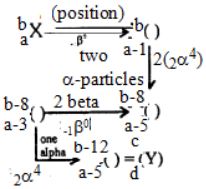
If $_a^b X$ emits a positron,then two $\alpha$-particles,two $\beta$-particles,and finally one $\alpha$-particle,it transforms into $_d^c Y$. What is the correct relationship?
A
$c = b - 12, d = a - 5$
B
$a = c - 8, d = b - 1$
C
$a = c - 6, d = b - 0$
D
$a = c - 4, a = b - 2$
Solution
(A) The initial nucleus is $_a^b X$.
$1$. Positron emission $(_{+1}^0 \beta)$: $_a^b X \rightarrow _{a-1}^b X_1 + _{+1}^0 \beta$.
$2$. Emission of two $\alpha$-particles $(_{2}^4 \alpha)$: $_{a-1}^b X_1 \rightarrow _{a-1-4}^{b-8} X_2 + 2(_{2}^4 \alpha) = _{a-5}^{b-8} X_2$.
$3$. Emission of two $\beta$-particles $(_{-1}^0 \beta)$: $_{a-5}^{b-8} X_2 \rightarrow _{a-5+2}^{b-8} X_3 + 2(_{-1}^0 \beta) = _{a-3}^{b-8} X_3$.
$4$. Emission of one $\alpha$-particle $(_{2}^4 \alpha)$: $_{a-3}^{b-8} X_3 \rightarrow _{a-3-2}^{b-8-4} Y = _{a-5}^{b-12} Y$.
Comparing this with $_d^c Y$,we get $c = b - 12$ and $d = a - 5$.
$1$. Positron emission $(_{+1}^0 \beta)$: $_a^b X \rightarrow _{a-1}^b X_1 + _{+1}^0 \beta$.
$2$. Emission of two $\alpha$-particles $(_{2}^4 \alpha)$: $_{a-1}^b X_1 \rightarrow _{a-1-4}^{b-8} X_2 + 2(_{2}^4 \alpha) = _{a-5}^{b-8} X_2$.
$3$. Emission of two $\beta$-particles $(_{-1}^0 \beta)$: $_{a-5}^{b-8} X_2 \rightarrow _{a-5+2}^{b-8} X_3 + 2(_{-1}^0 \beta) = _{a-3}^{b-8} X_3$.
$4$. Emission of one $\alpha$-particle $(_{2}^4 \alpha)$: $_{a-3}^{b-8} X_3 \rightarrow _{a-3-2}^{b-8-4} Y = _{a-5}^{b-12} Y$.
Comparing this with $_d^c Y$,we get $c = b - 12$ and $d = a - 5$.
0 likes
View Solution116
MediumMCQ
The intensity of gamma radiation emitted from a source is $I_0$. After passing through a lead sheet of thickness $36 \, mm$,its intensity becomes $I_0/8$. Find the thickness of the lead sheet in $mm$ when the intensity becomes $I_0/2$.
A
$18$
B
$12$
C
$6$
D
$9$
Solution
(B) The intensity of radiation after passing through a material of thickness $x$ is given by the formula: $I = I_0 e^{-kx}$,where $k$ is the absorption coefficient.
From the given data,when $x_1 = 36 \, mm$,$I_1 = I_0/8$.
Substituting these values: $I_0/8 = I_0 e^{-k(36)} \Rightarrow 1/8 = e^{-36k}$.
Taking the natural logarithm on both sides: $\ln(1/8) = -36k \Rightarrow -\ln(8) = -36k \Rightarrow \ln(2^3) = 36k \Rightarrow 3 \ln(2) = 36k \Rightarrow k = \frac{3 \ln(2)}{36} = \frac{\ln(2)}{12}$.
Now,we need to find the thickness $x_2$ when $I_2 = I_0/2$.
Using the formula: $I_0/2 = I_0 e^{-kx_2} \Rightarrow 1/2 = e^{-kx_2}$.
Taking the natural logarithm: $\ln(1/2) = -kx_2 \Rightarrow -\ln(2) = -kx_2 \Rightarrow \ln(2) = kx_2$.
Substituting the value of $k$: $\ln(2) = (\frac{\ln(2)}{12}) x_2$.
Solving for $x_2$: $x_2 = 12 \, mm$.
From the given data,when $x_1 = 36 \, mm$,$I_1 = I_0/8$.
Substituting these values: $I_0/8 = I_0 e^{-k(36)} \Rightarrow 1/8 = e^{-36k}$.
Taking the natural logarithm on both sides: $\ln(1/8) = -36k \Rightarrow -\ln(8) = -36k \Rightarrow \ln(2^3) = 36k \Rightarrow 3 \ln(2) = 36k \Rightarrow k = \frac{3 \ln(2)}{36} = \frac{\ln(2)}{12}$.
Now,we need to find the thickness $x_2$ when $I_2 = I_0/2$.
Using the formula: $I_0/2 = I_0 e^{-kx_2} \Rightarrow 1/2 = e^{-kx_2}$.
Taking the natural logarithm: $\ln(1/2) = -kx_2 \Rightarrow -\ln(2) = -kx_2 \Rightarrow \ln(2) = kx_2$.
Substituting the value of $k$: $\ln(2) = (\frac{\ln(2)}{12}) x_2$.
Solving for $x_2$: $x_2 = 12 \, mm$.
0 likes
View Solution117
MediumMCQ
When $_{90}Th^{238}$ transforms into $_{83}Bi^{222}$,the number of $\alpha$ and $\beta$ particles emitted are:
A
$4 \alpha, 1 \beta$
B
$4 \alpha, 7 \beta$
C
$8 \alpha, 7 \beta$
D
$4 \alpha, 4 \beta$
Solution
(A) Let the number of $\alpha$-particles emitted be $n_{\alpha}$ and the number of $\beta$-particles emitted be $n_{\beta}$.
The decay equation is: $_{90}Th^{238} \rightarrow _{83}Bi^{222} + n_{\alpha}(_{2}He^{4}) + n_{\beta}(-_{1}e^{0})$.
Equating the mass numbers: $238 = 222 + 4n_{\alpha} \Rightarrow 4n_{\alpha} = 16 \Rightarrow n_{\alpha} = 4$.
Equating the atomic numbers: $90 = 83 + 2n_{\alpha} - n_{\beta}$.
Substituting $n_{\alpha} = 4$: $90 = 83 + 2(4) - n_{\beta} \Rightarrow 90 = 83 + 8 - n_{\beta} \Rightarrow 90 = 91 - n_{\beta} \Rightarrow n_{\beta} = 1$.
Thus,$4 \alpha$ particles and $1 \beta$ particle are emitted.
The decay equation is: $_{90}Th^{238} \rightarrow _{83}Bi^{222} + n_{\alpha}(_{2}He^{4}) + n_{\beta}(-_{1}e^{0})$.
Equating the mass numbers: $238 = 222 + 4n_{\alpha} \Rightarrow 4n_{\alpha} = 16 \Rightarrow n_{\alpha} = 4$.
Equating the atomic numbers: $90 = 83 + 2n_{\alpha} - n_{\beta}$.
Substituting $n_{\alpha} = 4$: $90 = 83 + 2(4) - n_{\beta} \Rightarrow 90 = 83 + 8 - n_{\beta} \Rightarrow 90 = 91 - n_{\beta} \Rightarrow n_{\beta} = 1$.
Thus,$4 \alpha$ particles and $1 \beta$ particle are emitted.
0 likes
View Solution118
EasyMCQ
Which of the following physical quantities is measured using the unit $rad$?
A
Ionizing capacity of a target produced by gamma-ray photons
B
Energy absorbed by the target from radiation
C
Biological effect of radiation
D
Decay rate of a radioactive source
Solution
(B) The $rad$ (radiation absorbed dose) is a unit of absorbed dose of ionizing radiation.
It is defined as the absorption of $0.01 \ J$ of energy per kilogram of matter.
Therefore,it measures the energy absorbed by the target from radiation.
It is defined as the absorption of $0.01 \ J$ of energy per kilogram of matter.
Therefore,it measures the energy absorbed by the target from radiation.
0 likes
View Solution119
DifficultMCQ
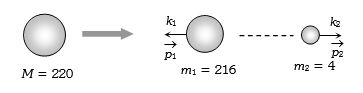
$A$ stationary nucleus of mass number $220$ emits an $\alpha$-particle. If the energy released in the process is $5.5 \, MeV$,find the kinetic energy of the $\alpha$-particle in $MeV$.
A
$4.4$
B
$5.4$
C
$5.6$
D
$6.5$
Solution
(B) Let $m_1 = 216$ be the mass number of the daughter nucleus and $m_2 = 4$ be the mass number of the $\alpha$-particle.
Let $k_1$ and $k_2$ be their respective kinetic energies.
According to the law of conservation of energy,$k_1 + k_2 = 5.5 \, MeV \dots (i)$
According to the law of conservation of linear momentum,the magnitudes of momenta must be equal: $p_1 = p_2$.
Since $p = \sqrt{2mk}$,we have $\sqrt{2(216)k_1} = \sqrt{2(4)k_2}$.
Squaring both sides,$216 k_1 = 4 k_2$,which gives $k_2 = 54 k_1$.
Substituting this into equation $(i)$,$k_1 + 54 k_1 = 5.5 \, MeV$.
$55 k_1 = 5.5 \, MeV$,so $k_1 = 0.1 \, MeV$.
Therefore,the kinetic energy of the $\alpha$-particle is $k_2 = 54 \times 0.1 = 5.4 \, MeV$.
Let $k_1$ and $k_2$ be their respective kinetic energies.
According to the law of conservation of energy,$k_1 + k_2 = 5.5 \, MeV \dots (i)$
According to the law of conservation of linear momentum,the magnitudes of momenta must be equal: $p_1 = p_2$.
Since $p = \sqrt{2mk}$,we have $\sqrt{2(216)k_1} = \sqrt{2(4)k_2}$.
Squaring both sides,$216 k_1 = 4 k_2$,which gives $k_2 = 54 k_1$.
Substituting this into equation $(i)$,$k_1 + 54 k_1 = 5.5 \, MeV$.
$55 k_1 = 5.5 \, MeV$,so $k_1 = 0.1 \, MeV$.
Therefore,the kinetic energy of the $\alpha$-particle is $k_2 = 54 \times 0.1 = 5.4 \, MeV$.
0 likes
View Solution120
DifficultMCQ
The nucleus $_{90}Th^{228}$ transforms into $_{83}Bi^{212}$. How many $\alpha$-particles and $\beta$-particles are emitted during this process?
A
$4\,\alpha, 1\,\beta$
B
$4\,\alpha, 7\,\beta$
C
$4\,\alpha, 4\,\beta$
D
$8\,\alpha, 7\,\beta$
Solution
(A) Let the number of $\alpha$-particles emitted be $n_{\alpha}$ and the number of $\beta$-particles emitted be $n_{\beta}$.
The change in mass number is given by $A - A' = 4n_{\alpha}$.
$228 - 212 = 4n_{\alpha} \implies 16 = 4n_{\alpha} \implies n_{\alpha} = 4$.
The change in atomic number is given by $Z - Z' = 2n_{\alpha} - n_{\beta}$.
$90 - 83 = 2(4) - n_{\beta}$.
$7 = 8 - n_{\beta} \implies n_{\beta} = 1$.
Thus,$4$ $\alpha$-particles and $1$ $\beta$-particle are emitted.
The change in mass number is given by $A - A' = 4n_{\alpha}$.
$228 - 212 = 4n_{\alpha} \implies 16 = 4n_{\alpha} \implies n_{\alpha} = 4$.
The change in atomic number is given by $Z - Z' = 2n_{\alpha} - n_{\beta}$.
$90 - 83 = 2(4) - n_{\beta}$.
$7 = 8 - n_{\beta} \implies n_{\beta} = 1$.
Thus,$4$ $\alpha$-particles and $1$ $\beta$-particle are emitted.
0 likes
View Solution121
DifficultMCQ
The intensity of gamma radiation becomes $1/8$th of its initial value after traveling a distance of $36 \, mm$. After traveling what distance (in $mm$) will the intensity become half?
A
$18$
B
$12$
C
$6$
D
$9$
Solution
(B) The intensity of radiation after traveling a distance $x$ is given by $I' = I_0 e^{-\mu x}$,where $I_0$ is the initial intensity and $\mu$ is the absorption coefficient.
Given that after $x_1 = 36 \, mm$,$I_1 = I_0 / 8$.
Substituting this into the formula: $I_0 / 8 = I_0 e^{-\mu (36)} \implies 8 = e^{36\mu} \implies \ln(8) = 36\mu \implies 3 \ln(2) = 36\mu \implies \mu = \frac{\ln(2)}{12}$.
We need to find the distance $x_2$ where the intensity becomes half,i.e.,$I_2 = I_0 / 2$.
Using the formula: $I_0 / 2 = I_0 e^{-\mu x_2} \implies 2 = e^{\mu x_2} \implies \ln(2) = \mu x_2$.
Substituting the value of $\mu$: $\ln(2) = \left( \frac{\ln(2)}{12} \right) x_2$.
Solving for $x_2$: $x_2 = 12 \, mm$.
Given that after $x_1 = 36 \, mm$,$I_1 = I_0 / 8$.
Substituting this into the formula: $I_0 / 8 = I_0 e^{-\mu (36)} \implies 8 = e^{36\mu} \implies \ln(8) = 36\mu \implies 3 \ln(2) = 36\mu \implies \mu = \frac{\ln(2)}{12}$.
We need to find the distance $x_2$ where the intensity becomes half,i.e.,$I_2 = I_0 / 2$.
Using the formula: $I_0 / 2 = I_0 e^{-\mu x_2} \implies 2 = e^{\mu x_2} \implies \ln(2) = \mu x_2$.
Substituting the value of $\mu$: $\ln(2) = \left( \frac{\ln(2)}{12} \right) x_2$.
Solving for $x_2$: $x_2 = 12 \, mm$.
0 likes
View Solution122
EasyMCQ
In a radioactive decay process, the negatively charged emitted $\beta -$ particles are
A
the electrons orbiting around the nucleus
B
the electrons produced as a result of collisions between atoms
C
the electrons produced as a result of the decay of neutrons inside the nucleus
D
the electrons present inside the nucleus
Solution
(C) In beta minus decay $(\beta^{-})$, a neutron is transformed into a proton, and an electron is emitted from the nucleus along with an antineutrino.
The process is represented by the equation: $n \rightarrow p + e^{-} + \bar{\nu}$
where $n$ is the neutron, $p$ is the proton, $e^{-}$ is the emitted electron ($\beta$-particle), and $\bar{\nu}$ is the antineutrino.
The process is represented by the equation: $n \rightarrow p + e^{-} + \bar{\nu}$
where $n$ is the neutron, $p$ is the proton, $e^{-}$ is the emitted electron ($\beta$-particle), and $\bar{\nu}$ is the antineutrino.
0 likes
View Solution123
MediumMCQ
In the nuclear decay sequence given below:
$_Z{X^A} \to {}_{Z + 1}{Y^A} \to {}_{Z - 1}{K^{A - 4}} \to {}_{Z - 1}{K^{A - 4}}$
the particles emitted in the sequence are:
$_Z{X^A} \to {}_{Z + 1}{Y^A} \to {}_{Z - 1}{K^{A - 4}} \to {}_{Z - 1}{K^{A - 4}}$
the particles emitted in the sequence are:
A
$\alpha, \beta, \gamma$
B
$\beta, \alpha, \gamma$
C
$\gamma, \alpha, \beta$
D
$\beta, \gamma, \alpha$
Solution
(B) The given decay sequence is: ${}_Z^AX \to {}_{Z + 1}^AY \to {}_{Z - 1}^{A - 4}K \to {}_{Z - 1}^{A - 4}K$.
$1$. In the first step,${}_Z^AX \to {}_{Z + 1}^AY$: The atomic number increases by $1$ while the mass number remains the same. This corresponds to the emission of a $\beta^-$ particle.
$2$. In the second step,${}_{Z + 1}^AY \to {}_{Z - 1}^{A - 4}K$: The atomic number decreases by $2$ and the mass number decreases by $4$. This corresponds to the emission of an $\alpha$ particle.
$3$. In the third step,${}_{Z - 1}^{A - 4}K \to {}_{Z - 1}^{A - 4}K$: There is no change in the atomic number or mass number,which indicates the emission of a $\gamma$ ray (de-excitation of the nucleus).
Therefore,the sequence of particles emitted is $\beta, \alpha, \gamma$.
$1$. In the first step,${}_Z^AX \to {}_{Z + 1}^AY$: The atomic number increases by $1$ while the mass number remains the same. This corresponds to the emission of a $\beta^-$ particle.
$2$. In the second step,${}_{Z + 1}^AY \to {}_{Z - 1}^{A - 4}K$: The atomic number decreases by $2$ and the mass number decreases by $4$. This corresponds to the emission of an $\alpha$ particle.
$3$. In the third step,${}_{Z - 1}^{A - 4}K \to {}_{Z - 1}^{A - 4}K$: There is no change in the atomic number or mass number,which indicates the emission of a $\gamma$ ray (de-excitation of the nucleus).
Therefore,the sequence of particles emitted is $\beta, \alpha, \gamma$.
0 likes
View Solution124
MediumMCQ
The number of beta particles emitted by a radioactive substance is twice the number of alpha particles emitted by it. The resulting daughter nucleus is an
A
isomer of parent
B
isotone of parent
C
isotope of parent
D
isobar of parent
Solution
(C) Let the parent nucleus be represented as ${}_Z^AX$.
When one $\alpha$ particle $({}_2^4He)$ is emitted,the atomic number $Z$ decreases by $2$ and the mass number $A$ decreases by $4$.
When one $\beta^-$ particle $({}_{-1}^0e)$ is emitted,the atomic number $Z$ increases by $1$ and the mass number $A$ remains unchanged.
Given that the number of $\beta$ particles emitted is twice the number of $\alpha$ particles,let the number of $\alpha$ particles be $n$. Then the number of $\beta$ particles is $2n$.
The change in atomic number $Z'$ of the daughter nucleus is given by: $Z' = Z - 2(n) + 1(2n) = Z - 2n + 2n = Z$.
The change in mass number $A'$ of the daughter nucleus is given by: $A' = A - 4(n) + 0(2n) = A - 4n$.
Since the atomic number $Z$ remains the same,the resulting daughter nucleus is an isotope of the parent nucleus.
When one $\alpha$ particle $({}_2^4He)$ is emitted,the atomic number $Z$ decreases by $2$ and the mass number $A$ decreases by $4$.
When one $\beta^-$ particle $({}_{-1}^0e)$ is emitted,the atomic number $Z$ increases by $1$ and the mass number $A$ remains unchanged.
Given that the number of $\beta$ particles emitted is twice the number of $\alpha$ particles,let the number of $\alpha$ particles be $n$. Then the number of $\beta$ particles is $2n$.
The change in atomic number $Z'$ of the daughter nucleus is given by: $Z' = Z - 2(n) + 1(2n) = Z - 2n + 2n = Z$.
The change in mass number $A'$ of the daughter nucleus is given by: $A' = A - 4(n) + 0(2n) = A - 4n$.
Since the atomic number $Z$ remains the same,the resulting daughter nucleus is an isotope of the parent nucleus.
0 likes
View Solution125
MediumMCQ
$A$ nucleus $_n{X^m}$ emits one $\alpha$ particle and two $\beta$ particles. The resulting nucleus is
A
$_n{X^{m - 4}}$
B
$_{n - 2}{Y^{m - 4}}$
C
$_{n - 4}{Z^{m - 4}}$
D
$_{n}{Z^{m - 4}}$
Solution
(D) When an alpha particle $({}_2^4He)$ is emitted,the mass number decreases by $4$ and the atomic number decreases by $2$.
When a beta particle $(\beta^-)$ is emitted,the atomic number increases by $1$ and the mass number remains unchanged.
Starting with $_n^mX$:
$1$. After emitting one $\alpha$ particle: $_n^mX \rightarrow {}_{n-2}^{m-4}Y + {}_2^4He$.
$2$. After emitting two $\beta$ particles: ${}_{n-2}^{m-4}Y \rightarrow {}_{n-2+2}^{m-4}Z + 2_{-1}^0e = {}_n^{m-4}Z$.
Thus,the resulting nucleus is $_n^{m-4}Z$.
When a beta particle $(\beta^-)$ is emitted,the atomic number increases by $1$ and the mass number remains unchanged.
Starting with $_n^mX$:
$1$. After emitting one $\alpha$ particle: $_n^mX \rightarrow {}_{n-2}^{m-4}Y + {}_2^4He$.
$2$. After emitting two $\beta$ particles: ${}_{n-2}^{m-4}Y \rightarrow {}_{n-2+2}^{m-4}Z + 2_{-1}^0e = {}_n^{m-4}Z$.
Thus,the resulting nucleus is $_n^{m-4}Z$.
0 likes
View Solution126
MediumMCQ
$A$ nucleus $_Z{X^A}$ emits $9 \alpha$-particles and $5 \beta$-particles. The ratio of total protons to neutrons in the final nucleus is:
A
$\frac{Z - 13}{A - Z - 23}$
B
$\frac{Z - 18}{A - 36}$
C
$\frac{Z - 13}{A - 36}$
D
$\frac{Z - 13}{A - Z - 13}$
Solution
(A) The initial nucleus is $_Z{X^A}$.
When it emits $9 \alpha$-particles,the atomic number $Z$ decreases by $9 \times 2 = 18$ and the mass number $A$ decreases by $9 \times 4 = 36$. The nucleus becomes $_{Z-18}{X^{A-36}}$.
When this nucleus emits $5 \beta$-particles,the atomic number $Z$ increases by $5 \times 1 = 5$,while the mass number $A$ remains unchanged. The final nucleus is $_{Z-18+5}{X^{A-36}} = _{Z-13}{X^{A-36}}$.
In the final nucleus,the number of protons $P = Z - 13$.
The number of neutrons $N = (A - 36) - (Z - 13) = A - Z - 23$.
Therefore,the ratio of protons to neutrons is $\frac{P}{N} = \frac{Z - 13}{A - Z - 23}$.
When it emits $9 \alpha$-particles,the atomic number $Z$ decreases by $9 \times 2 = 18$ and the mass number $A$ decreases by $9 \times 4 = 36$. The nucleus becomes $_{Z-18}{X^{A-36}}$.
When this nucleus emits $5 \beta$-particles,the atomic number $Z$ increases by $5 \times 1 = 5$,while the mass number $A$ remains unchanged. The final nucleus is $_{Z-18+5}{X^{A-36}} = _{Z-13}{X^{A-36}}$.
In the final nucleus,the number of protons $P = Z - 13$.
The number of neutrons $N = (A - 36) - (Z - 13) = A - Z - 23$.
Therefore,the ratio of protons to neutrons is $\frac{P}{N} = \frac{Z - 13}{A - Z - 23}$.
0 likes
View Solution127
MediumMCQ
$U^{238}$ decays into $Th^{234}$ by the emission of an $\alpha$-particle. There follows a chain of further radioactive decays,either by $\alpha$-decay or by $\beta$-decay. Eventually,a stable nuclide is reached,and after that,no further radioactive decay is possible. Which of the following stable nuclides is the end product of the $U^{238}$ radioactive decay chain?
A
$Pb^{206}$
B
$Pb^{207}$
C
$Pb^{208}$
D
$Pb^{209}$
Solution
(A) The radioactive decay chain starting from $U^{238}$ is known as the uranium series or the $(4n+2)$ series.
In this series,the mass number of the parent nucleus is $238$,which can be expressed as $4n+2$ where $n=59$.
Through a sequence of $8$ $\alpha$-decays and $6$ $\beta$-decays,the nucleus reaches a stable state.
The final stable end product of this decay chain is $Pb^{206}$.
In this series,the mass number of the parent nucleus is $238$,which can be expressed as $4n+2$ where $n=59$.
Through a sequence of $8$ $\alpha$-decays and $6$ $\beta$-decays,the nucleus reaches a stable state.
The final stable end product of this decay chain is $Pb^{206}$.
0 likes
View Solution128
DifficultMCQ
In the uranium radioactive series,the initial nucleus is $_{92}U^{238}$ and the final nucleus is $_{82}Pb^{206}$. When the uranium nucleus decays to lead,the number of $\alpha$-particles emitted is $x$ and the number of $\beta$-particles emitted is $y$. Find $x$ and $y$.
A
$6, 8$
B
$8, 6$
C
$16, 6$
D
$32, 12$
Solution
(B) Let the number of $\alpha$-particles emitted be $x$ and the number of $\beta$-particles emitted be $y$.
The change in mass number is due only to $\alpha$-particles,as each $\alpha$-particle reduces the mass number by $4$.
$4x = 238 - 206 = 32$
$x = 8$
The change in atomic number (charge) is given by $2x - y = 92 - 82$,where $2x$ is the decrease due to $\alpha$-decay and $y$ is the increase due to $\beta$-decay.
$2(8) - y = 10$
$16 - y = 10$
$y = 6$
Thus,the number of $\alpha$-particles is $8$ and the number of $\beta$-particles is $6$.
The change in mass number is due only to $\alpha$-particles,as each $\alpha$-particle reduces the mass number by $4$.
$4x = 238 - 206 = 32$
$x = 8$
The change in atomic number (charge) is given by $2x - y = 92 - 82$,where $2x$ is the decrease due to $\alpha$-decay and $y$ is the increase due to $\beta$-decay.
$2(8) - y = 10$
$16 - y = 10$
$y = 6$
Thus,the number of $\alpha$-particles is $8$ and the number of $\beta$-particles is $6$.
0 likes
View Solution129
MediumMCQ
$A$ certain radioactive nuclide of mass number $m_x$ disintegrates,with the emission of an electron and $\gamma$ radiation only,to give a second nuclide of mass number $m_y$. Which one of the following equations correctly relates $m_x$ and $m_y$?
A
$m_y = m_x + 1$
B
$m_y = m_x - 2$
C
$m_y = m_x - 1$
D
$m_y = m_x$
Solution
(D) In radioactive decay involving the emission of an electron (beta decay,$\beta^-$),a neutron in the nucleus is converted into a proton and an electron (and an antineutrino).
The process is represented as: $n \rightarrow p + e^- + \bar{\nu}_e$.
The mass number $A$ is the total number of protons and neutrons.
Since one neutron is lost and one proton is gained,the total number of nucleons remains constant.
The emission of $\gamma$ radiation involves the release of energy from an excited nucleus and does not change the mass number or atomic number.
Therefore,the mass number of the daughter nucleus $(m_y)$ is equal to the mass number of the parent nucleus $(m_x)$.
Thus,$m_y = m_x$.
The process is represented as: $n \rightarrow p + e^- + \bar{\nu}_e$.
The mass number $A$ is the total number of protons and neutrons.
Since one neutron is lost and one proton is gained,the total number of nucleons remains constant.
The emission of $\gamma$ radiation involves the release of energy from an excited nucleus and does not change the mass number or atomic number.
Therefore,the mass number of the daughter nucleus $(m_y)$ is equal to the mass number of the parent nucleus $(m_x)$.
Thus,$m_y = m_x$.
0 likes
View Solution130
MediumMCQ
The number of $\alpha$ and $\beta^-$ particles emitted during the radioactive decay chain starting from ${}_{88}^{226}Ra$ and ending at ${}_{82}^{206}Pb$ is:
A
$3\alpha$ and $6\beta^-$
B
$4\alpha$ and $5\beta^-$
C
$5\alpha$ and $4\beta^-$
D
$6\alpha$ and $6\beta^-$
Solution
(C) Let the number of $\alpha$ particles emitted be $x$ and the number of $\beta^-$ particles emitted be $y$.
The decay reaction is: ${}_{88}^{226}Ra \rightarrow {}_{82}^{206}Pb + x({}_{2}^{4}\alpha) + y({}_{-1}^{0}\beta^-)$.
Balancing the mass number:
$226 = 206 + 4x + 0$
$4x = 226 - 206$
$4x = 20$
$x = 5$.
Balancing the atomic number:
$88 = 82 + 2x - y$
$88 = 82 + 2(5) - y$
$88 = 82 + 10 - y$
$88 = 92 - y$
$y = 92 - 88$
$y = 4$.
Therefore,$5$ $\alpha$ particles and $4$ $\beta^-$ particles are emitted.
The decay reaction is: ${}_{88}^{226}Ra \rightarrow {}_{82}^{206}Pb + x({}_{2}^{4}\alpha) + y({}_{-1}^{0}\beta^-)$.
Balancing the mass number:
$226 = 206 + 4x + 0$
$4x = 226 - 206$
$4x = 20$
$x = 5$.
Balancing the atomic number:
$88 = 82 + 2x - y$
$88 = 82 + 2(5) - y$
$88 = 82 + 10 - y$
$88 = 92 - y$
$y = 92 - 88$
$y = 4$.
Therefore,$5$ $\alpha$ particles and $4$ $\beta^-$ particles are emitted.
0 likes
View Solution131
EasyMCQ
The decay constant of the end product of a radioactive series is
A
zero
B
infinite
C
finite (non zero)
D
depends on the end product
Solution
(A) radioactive series consists of a sequence of radioactive decays where a parent nucleus decays into a daughter nucleus,which then decays further until a stable nucleus is reached.
By definition,the end product of a radioactive series is a stable nucleus.
$A$ stable nucleus does not undergo radioactive decay.
The decay constant $\lambda$ is defined as the probability of decay per unit time.
Since a stable nucleus does not decay,its decay constant is $0$.
By definition,the end product of a radioactive series is a stable nucleus.
$A$ stable nucleus does not undergo radioactive decay.
The decay constant $\lambda$ is defined as the probability of decay per unit time.
Since a stable nucleus does not decay,its decay constant is $0$.
0 likes
View Solution132
MediumMCQ
When a nucleus with atomic number $Z$ and mass number $A$ undergoes a radioactive decay process:
A
both $Z$ and $A$ will decrease,if the process is $\alpha$ decay.
B
$Z$ will decrease but $A$ will not change,if the process is $\beta^+$ decay.
C
$Z$ and $A$ will remain unchanged,if the process is $\gamma$ decay.
D
all of the above.
Solution
(D) In $\alpha$ decay,the nucleus emits an $\alpha$ particle $(^4_2He)$,so the atomic number $Z$ decreases by $2$ and the mass number $A$ decreases by $4$.
In $\beta^+$ decay (positron emission),a proton converts into a neutron,so the atomic number $Z$ decreases by $1$ while the mass number $A$ remains unchanged.
In $\gamma$ decay,the nucleus transitions from an excited state to a lower energy state by emitting a photon,so neither $Z$ nor $A$ changes.
Since all the given statements are correct,the correct option is $D$.
In $\beta^+$ decay (positron emission),a proton converts into a neutron,so the atomic number $Z$ decreases by $1$ while the mass number $A$ remains unchanged.
In $\gamma$ decay,the nucleus transitions from an excited state to a lower energy state by emitting a photon,so neither $Z$ nor $A$ changes.
Since all the given statements are correct,the correct option is $D$.
0 likes
View Solution133
EasyMCQ
The energy spectrum of $\beta$-particles [number $N(E)$ as a function of $\beta$-energy $E$] emitted from a radioactive source is
A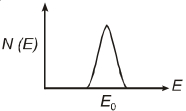
B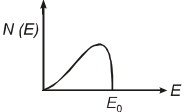
C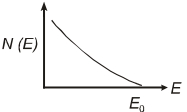
D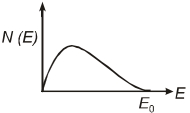
Solution
(D) In $\beta$-decay,the energy released is shared between the $\beta$-particle and the antineutrino (or neutrino). Because the energy is shared in a continuous manner,the $\beta$-particles are emitted with a continuous range of kinetic energies,from zero up to a maximum value $E_0$. The distribution curve $N(E)$ versus $E$ starts from zero at $E=0$,reaches a peak at an intermediate energy,and drops to zero at the maximum energy $E_0$. This corresponds to the graph shown in option $D$.
0 likes
View Solution134
EasyMCQ
The '$rad$' is the correct unit used to report the measurement of
A
the rate of decay of a radioactive source
B
the ability of a beam of gamma ray photons to produce ions in a target
C
the energy delivered by radiation to a target
D
the biological effect of radiation
Solution
(C) The '$rad$' (radiation absorbed dose) is a unit of absorbed radiation dose.
It is defined as the absorption of $100 \ erg$ of energy per gram of matter (usually tissue).
Therefore,it measures the energy delivered by radiation to a target material.
One '$rad$' is equivalent to $0.01 \ J/kg$ or $0.01 \ Gray$ $(Gy)$.
It is defined as the absorption of $100 \ erg$ of energy per gram of matter (usually tissue).
Therefore,it measures the energy delivered by radiation to a target material.
One '$rad$' is equivalent to $0.01 \ J/kg$ or $0.01 \ Gray$ $(Gy)$.
0 likes
View Solution135
EasyMCQ
In gamma ray emission from a nucleus,
A
there is no change in the proton number and the neutron number
B
only the neutron number changes
C
only the proton number changes
D
both the neutron number and the proton number change
Solution
(A) Gamma $(\gamma)$ emission occurs when a nucleus in an excited state transitions to a lower energy state or the ground state. During this process,the nucleus emits a high-energy photon known as a $\gamma$-ray. Since $\gamma$-rays have zero charge and zero rest mass,the emission does not alter the atomic number $(Z)$ or the mass number $(A)$ of the nucleus. Therefore,the number of protons and neutrons remains unchanged.
0 likes
View Solution136
MediumMCQ
$A$ radioactive nucleus (initial mass number $A$ and atomic number $Z$) emits $3$ $\alpha$-particles and $2$ positrons. The ratio of the number of neutrons to that of protons in the final nucleus will be:
A
$\frac{A - Z - 4}{Z - 8}$
B
$\frac{A - Z - 8}{Z - 4}$
C
$\frac{A - Z - 4}{Z - 4}$
D
$\frac{A - Z - 12}{Z - 4}$
Solution
(B) The initial nucleus is represented as $_Z^AX$.
An $\alpha$-particle is $_2^4He$ and a positron is $_1^0e^+$.
After emitting $3$ $\alpha$-particles and $2$ positrons, the final nucleus $_Z^AY$ is formed.
The new mass number $A' = A - (3 \times 4) = A - 12$.
The new atomic number $Z' = Z - (3 \times 2) + (2 \times 1) = Z - 6 + 2 = Z - 4$.
The number of protons in the final nucleus is $P = Z' = Z - 4$.
The number of neutrons in the final nucleus is $N = A' - Z' = (A - 12) - (Z - 4) = A - Z - 8$.
The ratio of neutrons to protons is $\frac{N}{P} = \frac{A - Z - 8}{Z - 4}$.
An $\alpha$-particle is $_2^4He$ and a positron is $_1^0e^+$.
After emitting $3$ $\alpha$-particles and $2$ positrons, the final nucleus $_Z^AY$ is formed.
The new mass number $A' = A - (3 \times 4) = A - 12$.
The new atomic number $Z' = Z - (3 \times 2) + (2 \times 1) = Z - 6 + 2 = Z - 4$.
The number of protons in the final nucleus is $P = Z' = Z - 4$.
The number of neutrons in the final nucleus is $N = A' - Z' = (A - 12) - (Z - 4) = A - Z - 8$.
The ratio of neutrons to protons is $\frac{N}{P} = \frac{A - Z - 8}{Z - 4}$.
0 likes
View Solution137
DifficultMCQ
$A$ radioactive nucleus of mass $M$ emits a photon of frequency $v$ and the nucleus recoils. The recoil energy will be
A
$M{c^2} - hv$
B
$\frac{h^2 v^2}{2Mc^2}$
C
Zero
D
$hv$
Solution
(B) According to the law of conservation of momentum,the momentum of the emitted photon must be equal to the momentum of the recoiling nucleus.
Momentum of photon $p = \frac{hv}{c}$.
Let $V$ be the recoil velocity of the nucleus. Then,the momentum of the nucleus is $p = MV$.
Equating the two: $\frac{hv}{c} = MV$,which gives $V = \frac{hv}{Mc}$.
The recoil kinetic energy of the nucleus is $K = \frac{1}{2}MV^2$.
Substituting the value of $V$: $K = \frac{1}{2}M \left( \frac{hv}{Mc} \right)^2 = \frac{1}{2}M \frac{h^2 v^2}{M^2 c^2} = \frac{h^2 v^2}{2Mc^2}$.
Momentum of photon $p = \frac{hv}{c}$.
Let $V$ be the recoil velocity of the nucleus. Then,the momentum of the nucleus is $p = MV$.
Equating the two: $\frac{hv}{c} = MV$,which gives $V = \frac{hv}{Mc}$.
The recoil kinetic energy of the nucleus is $K = \frac{1}{2}MV^2$.
Substituting the value of $V$: $K = \frac{1}{2}M \left( \frac{hv}{Mc} \right)^2 = \frac{1}{2}M \frac{h^2 v^2}{M^2 c^2} = \frac{h^2 v^2}{2Mc^2}$.
0 likes
View Solution138
MediumMCQ
The energy spectrum of $\beta$-particles [number $N(E)$ as a function of $\beta$-energy $E$] emitted from a radioactive source is:
A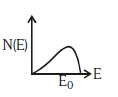
B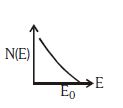
C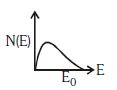
D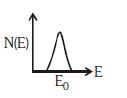
Solution
(A) In $\beta$-decay,the energy released is shared between the $\beta$-particle (electron or positron) and an antineutrino (or neutrino).
Because the energy is shared between two particles,the $\beta$-particles are emitted with a continuous range of energies from $0$ up to a maximum value $E_0$.
The number of $\beta$-particles $N(E)$ emitted with a particular energy $E$ follows a characteristic distribution curve that starts at $N(E)=0$ for $E=0$,rises to a peak,and then drops to zero at the maximum energy $E_0$.
This continuous spectrum is a fundamental feature of $\beta$-decay,as shown in option $A$.
Because the energy is shared between two particles,the $\beta$-particles are emitted with a continuous range of energies from $0$ up to a maximum value $E_0$.
The number of $\beta$-particles $N(E)$ emitted with a particular energy $E$ follows a characteristic distribution curve that starts at $N(E)=0$ for $E=0$,rises to a peak,and then drops to zero at the maximum energy $E_0$.
This continuous spectrum is a fundamental feature of $\beta$-decay,as shown in option $A$.
0 likes
View Solution139
AdvancedMCQ
$A$ radio nuclide $A_1$ with decay constant $\lambda_1$ transforms into a radio nuclide $A_2$ with decay constant $\lambda_2$. If at the initial moment the preparation contained only the radio nuclide $A_1$,then the time interval after which the activity of the radio nuclide $A_2$ reaches its maximum value is:
A
$\frac{\ln(\lambda_2/\lambda_1)}{\lambda_2 - \lambda_1}$
B
$\frac{\ln(\lambda_2/\lambda_1)}{\lambda_2 + \lambda_1}$
C
$\ln(\lambda_2 - \lambda_1)$
D
$e^{-(\lambda_1 - \lambda_2)}$
Solution
(A) Let $N_1$ and $N_2$ be the number of nuclei of $A_1$ and $A_2$ at time $t$.
Given $\frac{dN_1}{dt} = -\lambda_1 N_1$,which integrates to $N_1(t) = N_{10} e^{-\lambda_1 t}$.
The rate of change of $N_2$ is $\frac{dN_2}{dt} = \lambda_1 N_1 - \lambda_2 N_2$.
Substituting $N_1$,we get $\frac{dN_2}{dt} + \lambda_2 N_2 = \lambda_1 N_{10} e^{-\lambda_1 t}$.
Solving this linear differential equation with initial condition $N_2(0) = 0$,we get $N_2(t) = \frac{\lambda_1 N_{10}}{\lambda_2 - \lambda_1} (e^{-\lambda_1 t} - e^{-\lambda_2 t})$.
The activity of $A_2$ is $R_2 = \lambda_2 N_2$. For $R_2$ to be maximum,$\frac{dR_2}{dt} = 0$,which implies $\frac{dN_2}{dt} = 0$.
Setting $\lambda_1 N_1 = \lambda_2 N_2$ gives $\lambda_1 N_{10} e^{-\lambda_1 t} = \lambda_2 \left[ \frac{\lambda_1 N_{10}}{\lambda_2 - \lambda_1} (e^{-\lambda_1 t} - e^{-\lambda_2 t}) \right]$.
Simplifying,we get $e^{-\lambda_1 t} = \frac{\lambda_2}{\lambda_2 - \lambda_1} (e^{-\lambda_1 t} - e^{-\lambda_2 t})$.
Rearranging leads to $e^{(\lambda_2 - \lambda_1)t} = \frac{\lambda_2}{\lambda_1}$.
Taking the natural logarithm on both sides,$t = \frac{\ln(\lambda_2/\lambda_1)}{\lambda_2 - \lambda_1}$.
Given $\frac{dN_1}{dt} = -\lambda_1 N_1$,which integrates to $N_1(t) = N_{10} e^{-\lambda_1 t}$.
The rate of change of $N_2$ is $\frac{dN_2}{dt} = \lambda_1 N_1 - \lambda_2 N_2$.
Substituting $N_1$,we get $\frac{dN_2}{dt} + \lambda_2 N_2 = \lambda_1 N_{10} e^{-\lambda_1 t}$.
Solving this linear differential equation with initial condition $N_2(0) = 0$,we get $N_2(t) = \frac{\lambda_1 N_{10}}{\lambda_2 - \lambda_1} (e^{-\lambda_1 t} - e^{-\lambda_2 t})$.
The activity of $A_2$ is $R_2 = \lambda_2 N_2$. For $R_2$ to be maximum,$\frac{dR_2}{dt} = 0$,which implies $\frac{dN_2}{dt} = 0$.
Setting $\lambda_1 N_1 = \lambda_2 N_2$ gives $\lambda_1 N_{10} e^{-\lambda_1 t} = \lambda_2 \left[ \frac{\lambda_1 N_{10}}{\lambda_2 - \lambda_1} (e^{-\lambda_1 t} - e^{-\lambda_2 t}) \right]$.
Simplifying,we get $e^{-\lambda_1 t} = \frac{\lambda_2}{\lambda_2 - \lambda_1} (e^{-\lambda_1 t} - e^{-\lambda_2 t})$.
Rearranging leads to $e^{(\lambda_2 - \lambda_1)t} = \frac{\lambda_2}{\lambda_1}$.
Taking the natural logarithm on both sides,$t = \frac{\ln(\lambda_2/\lambda_1)}{\lambda_2 - \lambda_1}$.
0 likes
View Solution140
MediumMCQ
Consider a $\beta$ decay reaction:
${}_1^3H \to {}_2^3He + {e^{ - 1}} + \bar v$
The atomic masses of ${}_1^3H$ and ${}_2^3He$ are $3.016050 \, u$ and $3.016030 \, u$,respectively. Find the maximum possible energy of the electron in $MeV$.
${}_1^3H \to {}_2^3He + {e^{ - 1}} + \bar v$
The atomic masses of ${}_1^3H$ and ${}_2^3He$ are $3.016050 \, u$ and $3.016030 \, u$,respectively. Find the maximum possible energy of the electron in $MeV$.
A
$0.729$
B
$0.293$
C
$0.0186$
D
$0.0439$
Solution
(C) The $Q$-value of the $\beta$ decay reaction is given by the mass difference between the parent nucleus and the products.
Since the atomic mass of ${}_1^3H$ includes one electron and the atomic mass of ${}_2^3He$ includes two electrons,we must account for the electron emitted in the decay.
The $Q$-value is calculated as:
$Q = [M({}_1^3H) - M({}_2^3He)] \times c^2$
Note: The mass of the emitted electron is already accounted for in the atomic mass difference of the neutral atoms.
$Q = (3.016050 \, u - 3.016030 \, u) \times 931.5 \, MeV/u$
$Q = 0.000020 \, u \times 931.5 \, MeV/u$
$Q = 0.01863 \, MeV$
The maximum kinetic energy of the electron is approximately equal to the $Q$-value of the reaction.
Therefore,the maximum energy is $0.0186 \, MeV$.
Since the atomic mass of ${}_1^3H$ includes one electron and the atomic mass of ${}_2^3He$ includes two electrons,we must account for the electron emitted in the decay.
The $Q$-value is calculated as:
$Q = [M({}_1^3H) - M({}_2^3He)] \times c^2$
Note: The mass of the emitted electron is already accounted for in the atomic mass difference of the neutral atoms.
$Q = (3.016050 \, u - 3.016030 \, u) \times 931.5 \, MeV/u$
$Q = 0.000020 \, u \times 931.5 \, MeV/u$
$Q = 0.01863 \, MeV$
The maximum kinetic energy of the electron is approximately equal to the $Q$-value of the reaction.
Therefore,the maximum energy is $0.0186 \, MeV$.
0 likes
View Solution141
MediumMCQ
$A$ certain radioactive material can undergo three different types of decay,each with a different decay constant $\lambda_1$,$\lambda_2$,and $\lambda_3$. Then the effective decay constant is:
A
$\lambda_{eff} = \frac{\lambda_1 + \lambda_2 + \lambda_3}{3}$
B
$\frac{1}{\lambda_{eff}} = \frac{1}{\lambda_1} + \frac{1}{\lambda_2} + \frac{1}{\lambda_3}$
C
$\lambda_{eff} = \lambda_1 + \lambda_2 + \lambda_3$
D
$\frac{1}{\lambda_{eff}} = \frac{1}{3} (\frac{1}{\lambda_1} + \frac{1}{\lambda_2} + \frac{1}{\lambda_3})$
Solution
(C) The rate of decay for each process is given by $\frac{dN_1}{dt} = -\lambda_1 N$,$\frac{dN_2}{dt} = -\lambda_2 N$,and $\frac{dN_3}{dt} = -\lambda_3 N$.
The total rate of decay is the sum of the individual rates: $\frac{dN}{dt} = \frac{dN_1}{dt} + \frac{dN_2}{dt} + \frac{dN_3}{dt}$.
Substituting the expressions,we get: $\frac{dN}{dt} = -\lambda_1 N - \lambda_2 N - \lambda_3 N = -(\lambda_1 + \lambda_2 + \lambda_3) N$.
Comparing this with the general decay equation $\frac{dN}{dt} = -\lambda_{eff} N$,we find that the effective decay constant is $\lambda_{eff} = \lambda_1 + \lambda_2 + \lambda_3$.
The total rate of decay is the sum of the individual rates: $\frac{dN}{dt} = \frac{dN_1}{dt} + \frac{dN_2}{dt} + \frac{dN_3}{dt}$.
Substituting the expressions,we get: $\frac{dN}{dt} = -\lambda_1 N - \lambda_2 N - \lambda_3 N = -(\lambda_1 + \lambda_2 + \lambda_3) N$.
Comparing this with the general decay equation $\frac{dN}{dt} = -\lambda_{eff} N$,we find that the effective decay constant is $\lambda_{eff} = \lambda_1 + \lambda_2 + \lambda_3$.
0 likes
View Solution142
MediumMCQ
$A$ nucleus of an element ${}_{84}X^{202}$ emits an $\alpha$-particle first,a $\beta$-particle next,and then a gamma photon. The final nucleus formed has an atomic number:
A
$200$
B
$199$
C
$83$
D
$198$
Solution
(C) The initial nucleus is ${}_{84}X^{202}$.
$1$. After $\alpha$-decay: The atomic number decreases by $2$ and the mass number decreases by $4$.
${}_{84}X^{202} \rightarrow {}_{82}Y^{198} + {}_{2}He^{4}$.
$2$. After $\beta$-decay: The atomic number increases by $1$ and the mass number remains unchanged.
${}_{82}Y^{198} \rightarrow {}_{83}Z^{198} + {}_{-1}e^{0}$.
$3$. After $\gamma$-emission: The atomic number and mass number remain unchanged.
${}_{83}Z^{198} \rightarrow {}_{83}Z^{198} + \gamma$.
The final nucleus formed is ${}_{83}Z^{198}$,which has an atomic number of $83$.
$1$. After $\alpha$-decay: The atomic number decreases by $2$ and the mass number decreases by $4$.
${}_{84}X^{202} \rightarrow {}_{82}Y^{198} + {}_{2}He^{4}$.
$2$. After $\beta$-decay: The atomic number increases by $1$ and the mass number remains unchanged.
${}_{82}Y^{198} \rightarrow {}_{83}Z^{198} + {}_{-1}e^{0}$.
$3$. After $\gamma$-emission: The atomic number and mass number remain unchanged.
${}_{83}Z^{198} \rightarrow {}_{83}Z^{198} + \gamma$.
The final nucleus formed is ${}_{83}Z^{198}$,which has an atomic number of $83$.
0 likes
View Solution143
DifficultMCQ
$A$ radioactive nucleus undergoes a series of decays according to the scheme
$A \xrightarrow{\alpha} A_1 \xrightarrow{\beta} A_2 \xrightarrow{\alpha} A_3 \xrightarrow{\gamma} A_4$
If the mass number and atomic number of $A$ are $180$ and $72$,respectively,then what are these numbers for $A_4$?
$A \xrightarrow{\alpha} A_1 \xrightarrow{\beta} A_2 \xrightarrow{\alpha} A_3 \xrightarrow{\gamma} A_4$
If the mass number and atomic number of $A$ are $180$ and $72$,respectively,then what are these numbers for $A_4$?
A
$172$ and $69$
B
$174$ and $70$
C
$176$ and $69$
D
$176$ and $70$
Solution
(A) The initial nucleus $A$ has mass number $M = 180$ and atomic number $Z = 72$.
$1$. Emission of an $\alpha$-particle $(_{2}^{4}He)$ reduces the mass number by $4$ and the atomic number by $2$.
$2$. Emission of a $\beta$-particle $(_{-1}^{0}e)$ does not change the mass number but increases the atomic number by $1$.
$3$. Emission of a $\gamma$-ray does not change the mass number or the atomic number.
Sequence of decays:
$A(180, 72) \xrightarrow{\alpha} A_1(176, 70) \xrightarrow{\beta} A_2(176, 71) \xrightarrow{\alpha} A_3(172, 69) \xrightarrow{\gamma} A_4(172, 69)$.
Therefore,the mass number and atomic number for $A_4$ are $172$ and $69$ respectively.
$1$. Emission of an $\alpha$-particle $(_{2}^{4}He)$ reduces the mass number by $4$ and the atomic number by $2$.
$2$. Emission of a $\beta$-particle $(_{-1}^{0}e)$ does not change the mass number but increases the atomic number by $1$.
$3$. Emission of a $\gamma$-ray does not change the mass number or the atomic number.
Sequence of decays:
$A(180, 72) \xrightarrow{\alpha} A_1(176, 70) \xrightarrow{\beta} A_2(176, 71) \xrightarrow{\alpha} A_3(172, 69) \xrightarrow{\gamma} A_4(172, 69)$.
Therefore,the mass number and atomic number for $A_4$ are $172$ and $69$ respectively.
0 likes
View Solution144
MediumMCQ
Identify the particle $x$ in the following reaction: ${}_3^7Li(p, x){}_4Be^8$,where $p$ is a proton.
A
$\alpha$ particle
B
$\beta^-$ particle
C
gamma photon
D
Neutrons
Solution
(C) The given nuclear reaction is: ${}_3^7Li + {}_1^1p \to {}_4^8Be + x$.
According to the law of conservation of mass number:
$7 + 1 = 8 + A_x \Rightarrow A_x = 0$.
According to the law of conservation of atomic number (charge):
$3 + 1 = 4 + Z_x \Rightarrow Z_x = 0$.
$A$ particle with mass number $0$ and atomic number $0$ is a gamma photon $(\gamma)$.
Therefore,the correct option is $C$.
According to the law of conservation of mass number:
$7 + 1 = 8 + A_x \Rightarrow A_x = 0$.
According to the law of conservation of atomic number (charge):
$3 + 1 = 4 + Z_x \Rightarrow Z_x = 0$.
$A$ particle with mass number $0$ and atomic number $0$ is a gamma photon $(\gamma)$.
Therefore,the correct option is $C$.
0 likes
View Solution145
DifficultMCQ
When ${}_{92}U^{238}$ changes into ${}_{82}Pb^{206}$,the number of $\alpha$ and $\beta^-$ particles emitted are:
A
$6$ and $6$
B
$8$ and $8$
C
$6$ and $8$
D
$8$ and $6$
Solution
(D) Let the number of $\alpha$-particles emitted be $n_{\alpha}$ and the number of $\beta^-$-particles emitted be $n_{\beta}$.
In an $\alpha$-decay,the mass number decreases by $4$ and the atomic number decreases by $2$. In a $\beta^-$-decay,the mass number remains unchanged and the atomic number increases by $1$.
The change in mass number is $238 - 206 = 32$. Since only $\alpha$-decay affects the mass number,$4n_{\alpha} = 32$,which gives $n_{\alpha} = 8$.
The change in atomic number is $92 - 82 = 10$. The net change in atomic number is given by $2n_{\alpha} - n_{\beta} = 10$.
Substituting $n_{\alpha} = 8$,we get $2(8) - n_{\beta} = 10$,which implies $16 - n_{\beta} = 10$,so $n_{\beta} = 6$.
Thus,$8$ $\alpha$-particles and $6$ $\beta^-$-particles are emitted.
In an $\alpha$-decay,the mass number decreases by $4$ and the atomic number decreases by $2$. In a $\beta^-$-decay,the mass number remains unchanged and the atomic number increases by $1$.
The change in mass number is $238 - 206 = 32$. Since only $\alpha$-decay affects the mass number,$4n_{\alpha} = 32$,which gives $n_{\alpha} = 8$.
The change in atomic number is $92 - 82 = 10$. The net change in atomic number is given by $2n_{\alpha} - n_{\beta} = 10$.
Substituting $n_{\alpha} = 8$,we get $2(8) - n_{\beta} = 10$,which implies $16 - n_{\beta} = 10$,so $n_{\beta} = 6$.
Thus,$8$ $\alpha$-particles and $6$ $\beta^-$-particles are emitted.
0 likes
View Solution146
DifficultMCQ
In an $\alpha$-decay,the kinetic energy of the $\alpha$-particle is $48 \, MeV$ and the $Q$-value of the reaction is $50 \, MeV$. The mass number of the mother nucleus is: (Assume that the daughter nucleus is in the ground state)
A
$96$
B
$100$
C
$104$
D
$50$
Solution
(B) In an $\alpha$-decay,the energy released ($Q$-value) is shared between the $\alpha$-particle and the daughter nucleus to conserve momentum.
The kinetic energy of the $\alpha$-particle $(K_{\alpha})$ is given by the formula: $K_{\alpha} = \left( \frac{A - 4}{A} \right) Q$,where $A$ is the mass number of the mother nucleus.
Given: $K_{\alpha} = 48 \, MeV$ and $Q = 50 \, MeV$.
Substituting the values: $48 = \left( \frac{A - 4}{A} \right) \times 50$.
Divide both sides by $50$: $\frac{48}{50} = \frac{A - 4}{A}$.
Simplify the fraction: $0.96 = 1 - \frac{4}{A}$.
Rearrange to solve for $A$: $\frac{4}{A} = 1 - 0.96 = 0.04$.
$A = \frac{4}{0.04} = 100$.
Thus,the mass number of the mother nucleus is $100$.
The kinetic energy of the $\alpha$-particle $(K_{\alpha})$ is given by the formula: $K_{\alpha} = \left( \frac{A - 4}{A} \right) Q$,where $A$ is the mass number of the mother nucleus.
Given: $K_{\alpha} = 48 \, MeV$ and $Q = 50 \, MeV$.
Substituting the values: $48 = \left( \frac{A - 4}{A} \right) \times 50$.
Divide both sides by $50$: $\frac{48}{50} = \frac{A - 4}{A}$.
Simplify the fraction: $0.96 = 1 - \frac{4}{A}$.
Rearrange to solve for $A$: $\frac{4}{A} = 1 - 0.96 = 0.04$.
$A = \frac{4}{0.04} = 100$.
Thus,the mass number of the mother nucleus is $100$.
0 likes
View Solution147
DifficultMCQ
An atomic nucleus $_{90}Th^{232}$ emits several $\alpha$ and $\beta$-radiations and finally reduces to $_{82}Pb^{208}$. It must have emitted:
A
$4 \,\alpha$ and $2 \,\beta$
B
$6 \,\alpha$ and $4 \,\beta$
C
$8 \,\alpha$ and $24 \,\beta$
D
$4 \,\alpha$ and $16 \,\beta$
Solution
(B) Let the number of $\alpha$-particles emitted be $n$ and the number of $\beta$-particles emitted be $m$.
The change in mass number is given by $232 - 208 = 24$.
Since each $\alpha$-particle reduces the mass number by $4$,the number of $\alpha$-particles emitted is $n = \frac{24}{4} = 6$.
The change in atomic number is given by $90 - 82 = 8$.
Each $\alpha$-particle reduces the atomic number by $2$,and each $\beta$-particle increases it by $1$.
Therefore,$90 - 2n + m = 82$.
Substituting $n = 6$ into the equation: $90 - 2(6) + m = 82$.
$90 - 12 + m = 82 \Rightarrow 78 + m = 82$.
$m = 82 - 78 = 4$.
Thus,the nucleus emitted $6 \,\alpha$ and $4 \,\beta$ particles.
The change in mass number is given by $232 - 208 = 24$.
Since each $\alpha$-particle reduces the mass number by $4$,the number of $\alpha$-particles emitted is $n = \frac{24}{4} = 6$.
The change in atomic number is given by $90 - 82 = 8$.
Each $\alpha$-particle reduces the atomic number by $2$,and each $\beta$-particle increases it by $1$.
Therefore,$90 - 2n + m = 82$.
Substituting $n = 6$ into the equation: $90 - 2(6) + m = 82$.
$90 - 12 + m = 82 \Rightarrow 78 + m = 82$.
$m = 82 - 78 = 4$.
Thus,the nucleus emitted $6 \,\alpha$ and $4 \,\beta$ particles.
0 likes
View Solution148
EasyMCQ
Which of the following will have the highest penetrating power?
A
$\alpha$-rays
B
Radio waves
C
$\gamma$-rays
D
Light waves
Solution
(C) The penetrating power of radiation depends on its energy and interaction with matter.
$\alpha$-particles are heavy and charged,leading to high ionization but low penetration.
$\beta$-particles have higher penetrating power than $\alpha$-particles.
$\gamma$-rays are high-energy electromagnetic waves with no charge and very small mass,allowing them to pass through most materials.
The penetrating power of $\gamma$-rays is approximately $1000$ times that of $\beta$-particles,and $\beta$-particles have about $100$ times the penetrating power of $\alpha$-particles.
Therefore,$\gamma$-rays have the highest penetrating power among the given options.
$\alpha$-particles are heavy and charged,leading to high ionization but low penetration.
$\beta$-particles have higher penetrating power than $\alpha$-particles.
$\gamma$-rays are high-energy electromagnetic waves with no charge and very small mass,allowing them to pass through most materials.
The penetrating power of $\gamma$-rays is approximately $1000$ times that of $\beta$-particles,and $\beta$-particles have about $100$ times the penetrating power of $\alpha$-particles.
Therefore,$\gamma$-rays have the highest penetrating power among the given options.
0 likes
View Solution149
MediumMCQ
In a radioactive decay chain,the initial nucleus is ${}_{90}^{232}Th$. At the end,$6$ $\alpha$-particles and $4$ $\beta$-particles are emitted. If the final nucleus is ${}_{Z}^{A}X$,then $A$ and $Z$ are given by:
A
$A = 208; Z = 80$
B
$A = 202; Z = 80$
C
$A = 208; Z = 82$
D
$A = 200; Z = 81$
Solution
(C) The initial nucleus is ${}_{90}^{232}Th$.
Each $\alpha$-particle emission reduces the mass number $A$ by $4$ and the atomic number $Z$ by $2$.
Each $\beta$-particle emission does not change the mass number $A$ and increases the atomic number $Z$ by $1$.
After $6$ $\alpha$-decays:
$A' = 232 - (6 \times 4) = 232 - 24 = 208$
$Z' = 90 - (6 \times 2) = 90 - 12 = 78$
After $4$ $\beta$-decays:
$A = A' = 208$
$Z = Z' + (4 \times 1) = 78 + 4 = 82$
Thus,the final nucleus is ${}_{82}^{208}X$,where $A = 208$ and $Z = 82$.
Each $\alpha$-particle emission reduces the mass number $A$ by $4$ and the atomic number $Z$ by $2$.
Each $\beta$-particle emission does not change the mass number $A$ and increases the atomic number $Z$ by $1$.
After $6$ $\alpha$-decays:
$A' = 232 - (6 \times 4) = 232 - 24 = 208$
$Z' = 90 - (6 \times 2) = 90 - 12 = 78$
After $4$ $\beta$-decays:
$A = A' = 208$
$Z = Z' + (4 \times 1) = 78 + 4 = 82$
Thus,the final nucleus is ${}_{82}^{208}X$,where $A = 208$ and $Z = 82$.
0 likes
View SolutionNuclei — Properties of Alpha, Beta and Gamma Rays and Decay Process · Frequently Asked Questions
1Are these Nuclei questions useful for JEE and NEET?
Yes. All questions in this section are mapped to JEE Main and NEET exam patterns. Previous year questions from JEE Main, NEET, GUJCET and state-level exams are included with full solutions.
2Can I switch to Hindi or Gujarati for these questions?
Yes. Use the language tabs in the hero section or the sidebar to view the same questions and solutions in English, Hindi or Gujarati.
3How do I generate a question paper from this subtopic?
Use the Vedclass Exam Paper Generator — select the chapter and subtopic, set difficulty, and generate Sets A, B, C, D automatically. First 3 chapters of every subject are free.
Vedclass Products
For Students
Vedclass Test Series
Mock tests in real JEE/NEET style with performance analysis. 5-day free trial.
Start Free TrialFor Teachers
Exam Paper Generator
Generate Set A/B/C/D papers from this chapter in 2 minutes. 3 chapters free.
Try FreeFor Institutes
Online Exam Module
Live online exams with unlimited students, 360° analytics & white-label branding.
See DemoFor Teachers & Institutes
Generate a Nuclei Exam Paper in 2 Minutes
Select subtopic & difficulty — Sets A, B, C, D auto-generated with No Repeat logic.
First 3 chapters of every subject are free — no payment required.