
A English
Composition of Nucleus, Size of the Nucleus, Nuclear force Questions in English
Class 12 Physics · Nuclei · Composition of Nucleus, Size of the Nucleus, Nuclear force
295+
Questions
English
Language
100%
With Solutions
Showing 48 of 295 questions in English
201
MediumMCQ
$A$ nucleus breaks into two nuclear parts,which have their velocity ratio $2:1$. The ratio of their nuclear radii will be
A
$\sqrt{2}$
B
$1/2$
C
$1/2^{1/3}$
D
$1/\sqrt{2}$
Solution
(C) By the law of conservation of momentum,the two parts will have equal and opposite momentum,assuming the nucleus was initially at rest.
$m_1 v_1 = m_2 v_2$
$\frac{m_1}{m_2} = \frac{v_2}{v_1} = \frac{1}{2}$
Since the nuclear mass $m$ is proportional to the volume,which is proportional to the cube of the radius $r^3$ (i.e.,$m \propto r^3$):
$\frac{m_1}{m_2} = \left(\frac{r_1}{r_2}\right)^3$
Substituting the mass ratio:
$\left(\frac{r_1}{r_2}\right)^3 = \frac{1}{2}$
$\frac{r_1}{r_2} = \left(\frac{1}{2}\right)^{1/3} = \frac{1}{2^{1/3}}$
$m_1 v_1 = m_2 v_2$
$\frac{m_1}{m_2} = \frac{v_2}{v_1} = \frac{1}{2}$
Since the nuclear mass $m$ is proportional to the volume,which is proportional to the cube of the radius $r^3$ (i.e.,$m \propto r^3$):
$\frac{m_1}{m_2} = \left(\frac{r_1}{r_2}\right)^3$
Substituting the mass ratio:
$\left(\frac{r_1}{r_2}\right)^3 = \frac{1}{2}$
$\frac{r_1}{r_2} = \left(\frac{1}{2}\right)^{1/3} = \frac{1}{2^{1/3}}$
0 likes
View Solution202
EasyMCQ
$A$ particle having almost zero mass and exactly zero charge is
A
positron
B
electron
C
neutron
D
neutrino
Solution
(D) We know that the neutrino is the particle which has almost zero mass and exactly zero charge.
Positron has the charge $+e$ and mass $m_{e}$ (equal to electron mass).
Electron is a particle which has $-e$ charge and $9.1 \times 10^{-31} \ kg$ mass.
Neutron is a particle which has zero charge and $1838 \ m_{e}$ mass.
Therefore,the required answer is neutrino.
Positron has the charge $+e$ and mass $m_{e}$ (equal to electron mass).
Electron is a particle which has $-e$ charge and $9.1 \times 10^{-31} \ kg$ mass.
Neutron is a particle which has zero charge and $1838 \ m_{e}$ mass.
Therefore,the required answer is neutrino.
0 likes
View Solution203
DifficultMCQ
Two nuclei have their mass numbers in the ratio of $1: 3$. The ratio of their nuclear densities would be
A
$1: 3$
B
$3: 1$
C
$(3)^{1 / 3}: 1$
D
$1: 1$
Solution
(D) The nuclear density $\rho$ is defined as the ratio of the mass of the nucleus to its volume.
Since the mass of a nucleus is approximately $M = A \cdot m_p$ (where $A$ is the mass number and $m_p$ is the mass of a nucleon) and the volume is $V = \frac{4}{3} \pi R^3$,where $R = R_0 A^{1/3}$.
Substituting the expression for $R$,we get $V = \frac{4}{3} \pi (R_0 A^{1/3})^3 = \frac{4}{3} \pi R_0^3 A$.
Thus,$\rho = \frac{A \cdot m_p}{\frac{4}{3} \pi R_0^3 A} = \frac{m_p}{\frac{4}{3} \pi R_0^3}$.
This expression shows that the nuclear density is independent of the mass number $A$.
Therefore,the ratio of the nuclear densities of any two nuclei is always $1: 1$.
Since the mass of a nucleus is approximately $M = A \cdot m_p$ (where $A$ is the mass number and $m_p$ is the mass of a nucleon) and the volume is $V = \frac{4}{3} \pi R^3$,where $R = R_0 A^{1/3}$.
Substituting the expression for $R$,we get $V = \frac{4}{3} \pi (R_0 A^{1/3})^3 = \frac{4}{3} \pi R_0^3 A$.
Thus,$\rho = \frac{A \cdot m_p}{\frac{4}{3} \pi R_0^3 A} = \frac{m_p}{\frac{4}{3} \pi R_0^3}$.
This expression shows that the nuclear density is independent of the mass number $A$.
Therefore,the ratio of the nuclear densities of any two nuclei is always $1: 1$.
0 likes
View Solution204
EasyMCQ
If the radii of ${}_{13}^{27}Al$ and ${}_{30}^{64}Zn$ nuclei are $R_{1}$ and $R_{2}$ respectively,then $\frac{R_{1}}{R_{2}} = $
A
$\frac{64}{27}$
B
$\frac{3}{4}$
C
$\frac{27}{64}$
D
$\frac{4}{3}$
Solution
(B) The radius of a nucleus is given by the formula $R = R_{0} A^{1/3}$,where $A$ is the mass number and $R_{0}$ is a constant.
For ${}_{13}^{27}Al$,the mass number $A_{1} = 27$.
For ${}_{30}^{64}Zn$,the mass number $A_{2} = 64$.
Taking the ratio of the radii:
$\frac{R_{1}}{R_{2}} = \frac{R_{0} A_{1}^{1/3}}{R_{0} A_{2}^{1/3}} = \left(\frac{A_{1}}{A_{2}}\right)^{1/3}$
Substituting the values:
$\frac{R_{1}}{R_{2}} = \left(\frac{27}{64}\right)^{1/3}$
Since $27 = 3^{3}$ and $64 = 4^{3}$,we have:
$\frac{R_{1}}{R_{2}} = \left(\frac{3^{3}}{4^{3}}\right)^{1/3} = \frac{3}{4}$
Thus,the correct option is $B$.
For ${}_{13}^{27}Al$,the mass number $A_{1} = 27$.
For ${}_{30}^{64}Zn$,the mass number $A_{2} = 64$.
Taking the ratio of the radii:
$\frac{R_{1}}{R_{2}} = \frac{R_{0} A_{1}^{1/3}}{R_{0} A_{2}^{1/3}} = \left(\frac{A_{1}}{A_{2}}\right)^{1/3}$
Substituting the values:
$\frac{R_{1}}{R_{2}} = \left(\frac{27}{64}\right)^{1/3}$
Since $27 = 3^{3}$ and $64 = 4^{3}$,we have:
$\frac{R_{1}}{R_{2}} = \left(\frac{3^{3}}{4^{3}}\right)^{1/3} = \frac{3}{4}$
Thus,the correct option is $B$.
0 likes
View Solution205
EasyMCQ
The atomic mass number of an element is $\qquad$ .
A
always smaller than its atomic number
B
always greater than its atomic number
C
equal to or greater than its atomic number
D
greater than its atomic number in some cases
Solution
(C) The atomic mass number $(A)$ is defined as the sum of the number of protons $(Z)$ and the number of neutrons $(N)$ in the nucleus,so $A = Z + N$.
Since the number of neutrons $(N)$ is always greater than or equal to zero,the atomic mass number $(A)$ must be greater than or equal to the atomic number $(Z)$.
For the simplest element,Hydrogen $(_{1}^{1}H)$,the number of neutrons is $0$,so $A = Z = 1$.
For all other elements,the number of neutrons is greater than zero,making $A > Z$.
Therefore,the atomic mass number is always equal to or greater than the atomic number.
Since the number of neutrons $(N)$ is always greater than or equal to zero,the atomic mass number $(A)$ must be greater than or equal to the atomic number $(Z)$.
For the simplest element,Hydrogen $(_{1}^{1}H)$,the number of neutrons is $0$,so $A = Z = 1$.
For all other elements,the number of neutrons is greater than zero,making $A > Z$.
Therefore,the atomic mass number is always equal to or greater than the atomic number.
0 likes
View Solution206
EasyMCQ
The value of the average density of a nucleus is $\qquad$ times that of water.
A
$2.3 \times 10^{19}$
B
$2.3 \times 10^{14}$
C
$2.3 \times 10^{17}$
D
$2.3 \times 10^{12}$
Solution
(B) The average density of a nucleus is approximately $\rho_{n} = 2.3 \times 10^{17} \ kg/m^{3}$.
The density of water is $\rho_{w} = 10^{3} \ kg/m^{3}$.
To find the ratio,we divide the density of the nucleus by the density of water:
$\text{Ratio} = \frac{\rho_{n}}{\rho_{w}} = \frac{2.3 \times 10^{17} \ kg/m^{3}}{10^{3} \ kg/m^{3}} = 2.3 \times 10^{14}$.
Therefore,the density of the nucleus is $2.3 \times 10^{14}$ times that of water.
The density of water is $\rho_{w} = 10^{3} \ kg/m^{3}$.
To find the ratio,we divide the density of the nucleus by the density of water:
$\text{Ratio} = \frac{\rho_{n}}{\rho_{w}} = \frac{2.3 \times 10^{17} \ kg/m^{3}}{10^{3} \ kg/m^{3}} = 2.3 \times 10^{14}$.
Therefore,the density of the nucleus is $2.3 \times 10^{14}$ times that of water.
0 likes
View Solution207
EasyMCQ
How many neutrons are more than protons in the ${ }_{92}^{235} U$ nucleus?
A
$51$
B
$143$
C
$49$
D
$54$
Solution
(A) In the ${ }_{92}^{235} U$ nucleus,the atomic number $Z$ (number of protons) is $92$.
The mass number $A$ is $235$.
The number of neutrons $N$ is given by $N = A - Z$.
$N = 235 - 92 = 143$.
The difference between the number of neutrons and protons is $N - Z$.
$N - Z = 143 - 92 = 51$.
Therefore,there are $51$ more neutrons than protons in the nucleus.
The mass number $A$ is $235$.
The number of neutrons $N$ is given by $N = A - Z$.
$N = 235 - 92 = 143$.
The difference between the number of neutrons and protons is $N - Z$.
$N - Z = 143 - 92 = 51$.
Therefore,there are $51$ more neutrons than protons in the nucleus.
0 likes
View Solution208
EasyMCQ
$A$ nucleus at rest splits into two nuclear parts having the same density and radii in the ratio $1:2$. Their velocities are in the ratio $\qquad$ . (in $:1$)
A
$2$
B
$4$
C
$6$
D
$8$
Solution
(D) The correct answer is $D$. $8:1$.
According to the law of conservation of linear momentum,the initial momentum of the nucleus at rest is zero.
Therefore,the magnitude of the momentum of the two parts must be equal: $M_1 v_1 = M_2 v_2$.
Since the density $\rho$ is the same for both parts,the mass $M$ is given by $M = \rho \cdot V = \rho \cdot (\frac{4}{3} \pi r^3)$.
Substituting this into the momentum equation:
$(\rho \cdot \frac{4}{3} \pi r_1^3) v_1 = (\rho \cdot \frac{4}{3} \pi r_2^3) v_2$.
Canceling the common terms $(\rho \cdot \frac{4}{3} \pi)$,we get $r_1^3 v_1 = r_2^3 v_2$.
Rearranging for the ratio of velocities: $\frac{v_1}{v_2} = (\frac{r_2}{r_1})^3$.
Given the ratio of radii $\frac{r_1}{r_2} = \frac{1}{2}$,we have $\frac{r_2}{r_1} = \frac{2}{1}$.
Thus,$\frac{v_1}{v_2} = (\frac{2}{1})^3 = \frac{8}{1}$.
According to the law of conservation of linear momentum,the initial momentum of the nucleus at rest is zero.
Therefore,the magnitude of the momentum of the two parts must be equal: $M_1 v_1 = M_2 v_2$.
Since the density $\rho$ is the same for both parts,the mass $M$ is given by $M = \rho \cdot V = \rho \cdot (\frac{4}{3} \pi r^3)$.
Substituting this into the momentum equation:
$(\rho \cdot \frac{4}{3} \pi r_1^3) v_1 = (\rho \cdot \frac{4}{3} \pi r_2^3) v_2$.
Canceling the common terms $(\rho \cdot \frac{4}{3} \pi)$,we get $r_1^3 v_1 = r_2^3 v_2$.
Rearranging for the ratio of velocities: $\frac{v_1}{v_2} = (\frac{r_2}{r_1})^3$.
Given the ratio of radii $\frac{r_1}{r_2} = \frac{1}{2}$,we have $\frac{r_2}{r_1} = \frac{2}{1}$.
Thus,$\frac{v_1}{v_2} = (\frac{2}{1})^3 = \frac{8}{1}$.
0 likes
View Solution209
EasyMCQ
The density of a nucleus is $\qquad$ the atomic mass number $A$.
A
Directly proportional to
B
Directly proportional to the square of
C
Inversely proportional to
D
Independent of
Solution
(D) The correct answer is $D$.
Let $m$ be the average mass of a nucleon and $A$ be the mass number.
The mass of the nucleus is given by $M = m A$.
The radius of the nucleus is given by $R = R_0 A^{1/3}$,where $R_0$ is a constant.
The volume of the nucleus is $V = \frac{4}{3} \pi R^3 = \frac{4}{3} \pi (R_0 A^{1/3})^3 = \frac{4}{3} \pi R_0^3 A$.
The density of the nucleus $\rho$ is defined as the ratio of mass to volume:
$\rho = \frac{M}{V} = \frac{m A}{\frac{4}{3} \pi R_0^3 A} = \frac{m}{\frac{4}{3} \pi R_0^3}$.
Since $m$ and $R_0$ are constants,the density $\rho$ is independent of the mass number $A$.
Let $m$ be the average mass of a nucleon and $A$ be the mass number.
The mass of the nucleus is given by $M = m A$.
The radius of the nucleus is given by $R = R_0 A^{1/3}$,where $R_0$ is a constant.
The volume of the nucleus is $V = \frac{4}{3} \pi R^3 = \frac{4}{3} \pi (R_0 A^{1/3})^3 = \frac{4}{3} \pi R_0^3 A$.
The density of the nucleus $\rho$ is defined as the ratio of mass to volume:
$\rho = \frac{M}{V} = \frac{m A}{\frac{4}{3} \pi R_0^3 A} = \frac{m}{\frac{4}{3} \pi R_0^3}$.
Since $m$ and $R_0$ are constants,the density $\rho$ is independent of the mass number $A$.
0 likes
View Solution210
EasyMCQ
The ratio of the nuclear radii of the gold isotope ${}_{79}^{197}Au$ and the silver isotope ${}_{47}^{107}Ag$ is $ . . . . . . $.
A
$2.13$
B
$3.12$
C
$1.23$
D
$2.31$
Solution
(C) The nuclear radius $R$ is given by the formula $R = R_0 A^{1/3}$,where $A$ is the mass number and $R_0$ is a constant.
Therefore,the ratio of the radii is given by $\frac{R_{Au}}{R_{Ag}} = \left( \frac{A_{Au}}{A_{Ag}} \right)^{1/3}$.
Given $A_{Au} = 197$ and $A_{Ag} = 107$,we have:
$\frac{R_{Au}}{R_{Ag}} = \left( \frac{197}{107} \right)^{1/3}$.
Calculating the value: $\frac{197}{107} \approx 1.841$.
Then,$(1.841)^{1/3} \approx 1.2256$.
Rounding to two decimal places,we get $1.23$.
Therefore,the ratio of the radii is given by $\frac{R_{Au}}{R_{Ag}} = \left( \frac{A_{Au}}{A_{Ag}} \right)^{1/3}$.
Given $A_{Au} = 197$ and $A_{Ag} = 107$,we have:
$\frac{R_{Au}}{R_{Ag}} = \left( \frac{197}{107} \right)^{1/3}$.
Calculating the value: $\frac{197}{107} \approx 1.841$.
Then,$(1.841)^{1/3} \approx 1.2256$.
Rounding to two decimal places,we get $1.23$.
0 likes
View Solution211
EasyMCQ
${ }_{92}^{238} U$ and ${ }_{90}^{236} Th$ are $\qquad$ of each other.
A
isotopes
B
isotones
C
isobars
D
isomers
Solution
(B) The correct answer is $B$ (isotones).
For ${ }_{92}^{238} U$,the number of neutrons $N$ is calculated as $N = A - Z = 238 - 92 = 146$.
For ${ }_{90}^{236} Th$,the number of neutrons $N$ is calculated as $N = A - Z = 236 - 90 = 146$.
Since both nuclei have the same number of neutrons $(N = 146)$,they are isotones.
For ${ }_{92}^{238} U$,the number of neutrons $N$ is calculated as $N = A - Z = 238 - 92 = 146$.
For ${ }_{90}^{236} Th$,the number of neutrons $N$ is calculated as $N = A - Z = 236 - 90 = 146$.
Since both nuclei have the same number of neutrons $(N = 146)$,they are isotones.
0 likes
View Solution212
EasyMCQ
The atomic masses of two isotopes of an element are $34.98 \ u$ and $36.98 \ u$ and their relative abundances are $75.4 \%$ and $24.6 \%$ respectively. The average atomic mass of the element is: (in $u$)
A
$34.51$
B
$35.47$
C
$36.46$
D
$35.99$
Solution
(B) The average atomic mass is calculated by taking the weighted average of the isotopic masses based on their relative abundances.
Average atomic mass $= \frac{(m_1 \times p_1) + (m_2 \times p_2)}{100}$
$= \frac{(34.98 \times 75.4) + (36.98 \times 24.6)}{100}$
$= \frac{2637.492 + 909.708}{100}$
$= \frac{3547.2}{100}$
$= 35.47 \ u$
Average atomic mass $= \frac{(m_1 \times p_1) + (m_2 \times p_2)}{100}$
$= \frac{(34.98 \times 75.4) + (36.98 \times 24.6)}{100}$
$= \frac{2637.492 + 909.708}{100}$
$= \frac{3547.2}{100}$
$= 35.47 \ u$
0 likes
View Solution213
EasyMCQ
The radius of the nucleus of ${ }_{13}^{27} Al$ is $\qquad$ . (Given: $R_{0}=1.2 \text{ fm}$)
A
$3.0 \times 10^{-15} \text{ m}$
B
$3.2 \times 10^{-14} \text{ m}$
C
$3.6 \times 10^{-15} \text{ m}$
D
$3.6 \times 10^{-12} \text{ m}$
Solution
(C) The radius of a nucleus is given by the formula $R = R_{0} A^{1/3}$,where $R_{0} = 1.2 \text{ fm} = 1.2 \times 10^{-15} \text{ m}$ and $A$ is the mass number.
For ${ }_{13}^{27} Al$,the mass number $A = 27$.
Substituting the values into the formula:
$R = 1.2 \times 10^{-15} \times (27)^{1/3} \text{ m}$
Since $(27)^{1/3} = 3$,we get:
$R = 1.2 \times 10^{-15} \times 3 \text{ m}$
$R = 3.6 \times 10^{-15} \text{ m}$
Thus,the correct option is $C$.
For ${ }_{13}^{27} Al$,the mass number $A = 27$.
Substituting the values into the formula:
$R = 1.2 \times 10^{-15} \times (27)^{1/3} \text{ m}$
Since $(27)^{1/3} = 3$,we get:
$R = 1.2 \times 10^{-15} \times 3 \text{ m}$
$R = 3.6 \times 10^{-15} \text{ m}$
Thus,the correct option is $C$.
0 likes
View Solution214
DifficultMCQ
The force between two protons is the same as the force between a proton and a neutron. The nature of the force is:
A
Weak nuclear force
B
Strong nuclear force
C
Electrical force
D
Gravitational force
Solution
(B) The force between two protons is the same as the force between a proton and a neutron. This is a characteristic property of the strong nuclear force,which is charge-independent. The strong nuclear force acts between nucleons (protons and neutrons) and is responsible for holding the nucleus together. It is extremely strong at short distances and becomes negligible at larger distances.
0 likes
View Solution215
EasyMCQ
Which of the following is not made by quarks?
A
Neutron
B
Positron
C
Proton
D
$\pi$-meson
Solution
(B) Quarks are elementary particles that combine to form composite particles known as hadrons.
Protons and neutrons are baryons,which are made of three quarks.
$\pi$-mesons (pions) are mesons,which are made of a quark and an antiquark.
$A$ positron is an antiparticle of the electron,which is a lepton.
Leptons are fundamental particles and are not composed of quarks.
Therefore,the positron is not made of quarks.
Protons and neutrons are baryons,which are made of three quarks.
$\pi$-mesons (pions) are mesons,which are made of a quark and an antiquark.
$A$ positron is an antiparticle of the electron,which is a lepton.
Leptons are fundamental particles and are not composed of quarks.
Therefore,the positron is not made of quarks.
0 likes
View Solution216
EasyMCQ
The ratio of the volume of an $Al^{27}$ nucleus to its surface area is (Given,$R_0 = 1.2 \times 10^{-15} \ m$):
A
$2.1 \times 10^{-15} \ m$
B
$1.3 \times 10^{-15} \ m$
C
$0.22 \times 10^{-15} \ m$
D
$1.2 \times 10^{-15} \ m$
Solution
(D) The volume of a nucleus is given by $V = \frac{4}{3} \pi R^3$ and its surface area is $S = 4 \pi R^2$.
The ratio of volume to surface area is $\frac{V}{S} = \frac{\frac{4}{3} \pi R^3}{4 \pi R^2} = \frac{R}{3}$.
The radius of a nucleus is given by $R = R_0 A^{1/3}$,where $A$ is the mass number.
For $Al^{27}$,$A = 27$. Thus,$R = R_0 (27)^{1/3} = 3 R_0$.
Substituting this into the ratio: $\frac{V}{S} = \frac{3 R_0}{3} = R_0$.
Given $R_0 = 1.2 \times 10^{-15} \ m$,the ratio is $1.2 \times 10^{-15} \ m$.
The ratio of volume to surface area is $\frac{V}{S} = \frac{\frac{4}{3} \pi R^3}{4 \pi R^2} = \frac{R}{3}$.
The radius of a nucleus is given by $R = R_0 A^{1/3}$,where $A$ is the mass number.
For $Al^{27}$,$A = 27$. Thus,$R = R_0 (27)^{1/3} = 3 R_0$.
Substituting this into the ratio: $\frac{V}{S} = \frac{3 R_0}{3} = R_0$.
Given $R_0 = 1.2 \times 10^{-15} \ m$,the ratio is $1.2 \times 10^{-15} \ m$.
0 likes
View Solution217
EasyMCQ
$A$ nucleus at rest splits into two nuclear parts having radii in the ratio $1:2$. Their velocities are in the ratio: (in $:1$)
A
$8$
B
$4$
C
$6$
D
$2$
Solution
(A) According to the law of conservation of linear momentum,for a nucleus initially at rest,the total momentum after splitting must be zero.
$m_1 v_1 = m_2 v_2 \implies \frac{v_1}{v_2} = \frac{m_2}{m_1}$
Since the density of nuclear matter is constant,the mass $m$ of a nucleus is proportional to its volume,which is proportional to the cube of its radius $R$.
$m \propto R^3 \implies \frac{m_2}{m_1} = \left(\frac{R_2}{R_1}\right)^3$
Given the ratio of radii $\frac{R_1}{R_2} = \frac{1}{2}$,we have $\frac{R_2}{R_1} = \frac{2}{1}$.
Substituting this into the velocity ratio equation:
$\frac{v_1}{v_2} = \left(\frac{2}{1}\right)^3 = \frac{8}{1}$.
Thus,the ratio of their velocities is $8:1$.
$m_1 v_1 = m_2 v_2 \implies \frac{v_1}{v_2} = \frac{m_2}{m_1}$
Since the density of nuclear matter is constant,the mass $m$ of a nucleus is proportional to its volume,which is proportional to the cube of its radius $R$.
$m \propto R^3 \implies \frac{m_2}{m_1} = \left(\frac{R_2}{R_1}\right)^3$
Given the ratio of radii $\frac{R_1}{R_2} = \frac{1}{2}$,we have $\frac{R_2}{R_1} = \frac{2}{1}$.
Substituting this into the velocity ratio equation:
$\frac{v_1}{v_2} = \left(\frac{2}{1}\right)^3 = \frac{8}{1}$.
Thus,the ratio of their velocities is $8:1$.
0 likes
View Solution218
EasyMCQ
Two protons are kept at a separation of $10 \, nm$. Let $F_{n}$ and $F_{e}$ be the nuclear force and the electromagnetic force between them, respectively.
A
$F_{e} = F_{n}$
B
$F_{e} \gg F_{n}$
C
$F_{e} < F_{n}$
D
$F_{e}$ and $F_{n}$ differ only slightly
Solution
(B) The nuclear force is a short-range force, typically effective within a range of a few $fm$ $(1 \, fm = 10^{-15} \, m)$.
Whereas, the electromagnetic force is a long-range force that follows the inverse-square law.
Given the separation is $10 \, nm = 10 \times 10^{-9} \, m = 10^{-8} \, m$.
Since $10^{-8} \, m$ is much larger than the range of the nuclear force $(\, 10^{-15} \, m)$, the nuclear force $F_{n}$ is effectively zero at this distance.
Therefore, the electromagnetic force $F_{e}$ is significantly greater than the nuclear force $F_{n}$, i.e., $F_{e} \gg F_{n}$.
Whereas, the electromagnetic force is a long-range force that follows the inverse-square law.
Given the separation is $10 \, nm = 10 \times 10^{-9} \, m = 10^{-8} \, m$.
Since $10^{-8} \, m$ is much larger than the range of the nuclear force $(\, 10^{-15} \, m)$, the nuclear force $F_{n}$ is effectively zero at this distance.
Therefore, the electromagnetic force $F_{e}$ is significantly greater than the nuclear force $F_{n}$, i.e., $F_{e} \gg F_{n}$.
0 likes
View Solution219
EasyMCQ
The most stable particle in the Baryon group is
A
sigma particle
B
neutron
C
proton
D
lambda particle
Solution
(C) In the context of particle physics,baryons are composite particles made of three quarks. Among all baryons,the proton is the only stable particle in free space. While the neutron is stable when bound within an atomic nucleus,it is unstable in isolation,decaying into a proton,an electron,and an antineutrino with a mean lifetime of approximately $880 \ s$. Therefore,the proton is the most stable baryon.
0 likes
View Solution220
MediumMCQ
According to the quark model,it is possible to build all the hadrons using
A
$2$ quarks and $3$ antiquarks
B
$3$ quarks and $2$ antiquarks
C
$3$ quarks and $3$ antiquarks
D
$2$ quarks and $2$ antiquarks
Solution
(C) Hadrons are subatomic particles composed of quarks held together by the strong force. They are broadly classified into two categories: baryons and mesons.
Baryons are composed of $3$ quarks (e.g.,protons and neutrons).
Mesons are composed of a quark and an antiquark pair.
Therefore,according to the quark model,all hadrons can be constructed using $3$ quarks and $3$ antiquarks.
Baryons are composed of $3$ quarks (e.g.,protons and neutrons).
Mesons are composed of a quark and an antiquark pair.
Therefore,according to the quark model,all hadrons can be constructed using $3$ quarks and $3$ antiquarks.
0 likes
View Solution221
EasyMCQ
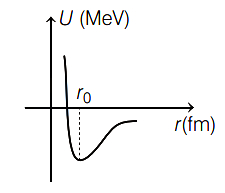
Which graph in the following diagrams correctly represents the potential energy $U$ of a pair of nucleons as a function of their separation $r$?
A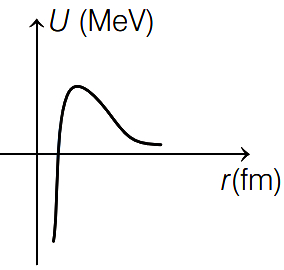
B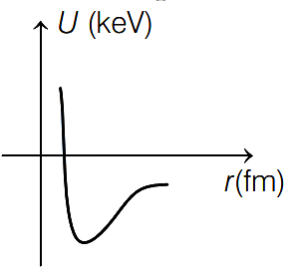
C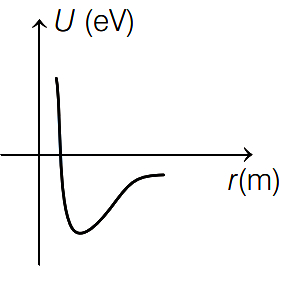
D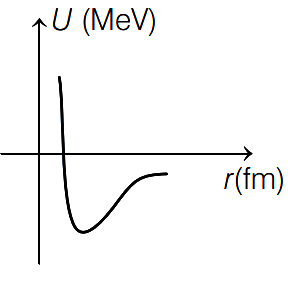
Solution
(D) The potential energy $U$ of a pair of nucleons as a function of their separation $r$ is characterized by a deep potential well.
For separations $r < r_{0}$ (where $r_{0} \approx 0.8 \ \text{fm}$), the nuclear force is strongly repulsive, causing the potential energy to rise sharply.
For separations $r > r_{0}$, the nuclear force is attractive, and the potential energy increases towards zero as $r$ increases.
The minimum potential energy occurs at the equilibrium separation $r_{0}$, where the net force between the nucleons is zero.
Graph $D$ correctly depicts this behavior with $U$ in $\text{MeV}$ and $r$ in $\text{fm}$.
For separations $r < r_{0}$ (where $r_{0} \approx 0.8 \ \text{fm}$), the nuclear force is strongly repulsive, causing the potential energy to rise sharply.
For separations $r > r_{0}$, the nuclear force is attractive, and the potential energy increases towards zero as $r$ increases.
The minimum potential energy occurs at the equilibrium separation $r_{0}$, where the net force between the nucleons is zero.
Graph $D$ correctly depicts this behavior with $U$ in $\text{MeV}$ and $r$ in $\text{fm}$.
0 likes
View Solution222
EasyMCQ
Two protons are kept at a separation of $10 \ nm$. Let $F_n$ and $F_e$ be the nuclear force and the electromagnetic force between them,respectively.
A
$F_e \ll F_n$
B
$F_e = F_n$
C
$F_e$ and $F_n$ differ only slightly
D
$F_e \gg F_n$
Solution
(D) The nuclear force is a short-range force that acts effectively only within a range of approximately $1 \ fm$ to $3 \ fm$ $(1 \ fm = 10^{-15} \ m)$.
Given the separation between the two protons is $10 \ nm = 10 \times 10^{-9} \ m = 10^{-8} \ m$.
Since $10^{-8} \ m$ is much larger than the range of the nuclear force $(10^{-15} \ m)$,the nuclear force $F_n$ is negligible at this distance.
However,the electromagnetic force $F_e$ (Coulomb force) follows an inverse-square law and acts over long distances.
Therefore,at a separation of $10 \ nm$,the electromagnetic force is significantly greater than the nuclear force,i.e.,$F_e \gg F_n$.
Given the separation between the two protons is $10 \ nm = 10 \times 10^{-9} \ m = 10^{-8} \ m$.
Since $10^{-8} \ m$ is much larger than the range of the nuclear force $(10^{-15} \ m)$,the nuclear force $F_n$ is negligible at this distance.
However,the electromagnetic force $F_e$ (Coulomb force) follows an inverse-square law and acts over long distances.
Therefore,at a separation of $10 \ nm$,the electromagnetic force is significantly greater than the nuclear force,i.e.,$F_e \gg F_n$.
0 likes
View Solution223
EasyMCQ
Pick out the correct statement from the following.
A
Energy released per unit mass of the reactant is less in case of fusion reaction
B
Packing fraction may be positive or may be negative
C
$Pu^{239}$ is not suitable for a fission reaction
D
For stable nucleus,the specific binding energy is low
Solution
(B) The packing fraction $(f)$ is defined as the mass defect per nucleon,given by $f = \frac{m - A}{A}$,where $m$ is the mass of the nucleus and $A$ is the mass number.
Packing fraction is a measure of the stability of a nucleus.
$A$ smaller (or more negative) value of the packing fraction indicates higher stability of the nucleus.
The packing fraction can be positive,negative,or zero depending on the mass number of the nucleus.
Therefore,the statement that the packing fraction may be positive or negative is correct.
Packing fraction is a measure of the stability of a nucleus.
$A$ smaller (or more negative) value of the packing fraction indicates higher stability of the nucleus.
The packing fraction can be positive,negative,or zero depending on the mass number of the nucleus.
Therefore,the statement that the packing fraction may be positive or negative is correct.
0 likes
View Solution224
EasyMCQ
Match the following types of nuclei with their respective examples:
| Column-$I$ | Column-$II$ |
| $A$. Isotopes | $i$. $Li^7, Be^7$ |
| $B$. Isobars | $ii$. $_8O^{18}, _9F^{19}$ |
| $C$. Isotones | $iii$. $_1H^1, _1H^2$ |
A
$A-ii, B-iii, C-i$
B
$A-i, B-iii, C-ii$
C
$A-iii, B-ii, C-i$
D
$A-iii, B-i, C-ii$
Solution
(D) $1$. Isotopes: Atoms with the same atomic number $(Z)$ but different mass numbers $(A)$. Example: $_1H^1$ and $_1H^2$ have $Z=1$. Thus,$A-iii$.
$2$. Isobars: Atoms with the same mass number $(A)$ but different atomic numbers $(Z)$. Example: $Li^7$ and $Be^7$ both have $A=7$. Thus,$B-i$.
$3$. Isotones: Atoms with the same number of neutrons $(N = A-Z)$. For $_8O^{18}$,$N = 18-8 = 10$. For $_9F^{19}$,$N = 19-9 = 10$. Thus,$C-ii$.
Therefore,the correct matching is $A-iii, B-i, C-ii$.
$2$. Isobars: Atoms with the same mass number $(A)$ but different atomic numbers $(Z)$. Example: $Li^7$ and $Be^7$ both have $A=7$. Thus,$B-i$.
$3$. Isotones: Atoms with the same number of neutrons $(N = A-Z)$. For $_8O^{18}$,$N = 18-8 = 10$. For $_9F^{19}$,$N = 19-9 = 10$. Thus,$C-ii$.
Therefore,the correct matching is $A-iii, B-i, C-ii$.
0 likes
View Solution225
MediumMCQ
Which of the following statements is incorrect with reference to 'Nuclear force'?
A
Nuclear force becomes attractive for nucleon distances larger than $0.8 \ fm$
B
Nuclear force becomes repulsive for nucleon distances less than $0.8 \ fm$
C
Nuclear force is always attractive
D
Potential energy is minimum if the separation between the nucleons is $0.8 \ fm$
Solution
(C) The strong nuclear force is not always attractive. It is strongly attractive at distances larger than $0.8 \ fm$ and becomes strongly repulsive at distances less than $0.8 \ fm$ to prevent the collapse of the nucleus. Therefore,the statement that the nuclear force is 'always attractive' is incorrect.
0 likes
View Solution226
EasyMCQ
The radius of ${ }_{29} Cu^{64}$ nucleus in Fermi is (given $R_{0}=1.2 \times 10^{-15} \ m$)
A
$9.6$
B
$4.8$
C
$1.2$
D
$7.7$
Solution
(B) The radius of a nucleus is given by the formula $R = R_{0} A^{1/3}$,where $R_{0} = 1.2 \times 10^{-15} \ m$ and $A$ is the mass number.
For ${ }_{29} Cu^{64}$,the mass number $A = 64$.
Substituting the values into the formula:
$R = 1.2 \times 10^{-15} \times (64)^{1/3} \ m$
Since $(64)^{1/3} = 4$,we have:
$R = 1.2 \times 4 \times 10^{-15} \ m$
$R = 4.8 \times 10^{-15} \ m$
Since $1 \ \text{Fermi} = 10^{-15} \ m$,the radius is $4.8 \ \text{Fermi}$.
For ${ }_{29} Cu^{64}$,the mass number $A = 64$.
Substituting the values into the formula:
$R = 1.2 \times 10^{-15} \times (64)^{1/3} \ m$
Since $(64)^{1/3} = 4$,we have:
$R = 1.2 \times 4 \times 10^{-15} \ m$
$R = 4.8 \times 10^{-15} \ m$
Since $1 \ \text{Fermi} = 10^{-15} \ m$,the radius is $4.8 \ \text{Fermi}$.
0 likes
View Solution227
EasyMCQ
Two protons are kept at a separation of $40 \text{ Å}$. $F_{n}$ is the nuclear force and $F_{e}$ is the electrostatic force between them. Then:
A
$F_{n} \gg F_{e}$
B
$F_{n} = F_{e}$
C
$F_{n} \ll F_{e}$
D
$F_{n} \approx F_{e}$
Solution
(C) The nuclear force $F_{n}$ is a short-range force that acts effectively only within the range of approximately $10^{-15} \text{ m}$ (or $1 \text{ fm}$).
Beyond this distance,the nuclear force decreases exponentially and becomes negligible.
The given separation is $40 \text{ Å} = 40 \times 10^{-10} \text{ m} = 4 \times 10^{-9} \text{ m}$.
Since $4 \times 10^{-9} \text{ m} \gg 10^{-15} \text{ m}$,the nuclear force $F_{n}$ is essentially zero at this distance.
However,the electrostatic force $F_{e}$ follows the inverse-square law $(F_{e} \propto 1/r^2)$ and remains significant even at this distance.
Therefore,$F_{n} \ll F_{e}$.
Beyond this distance,the nuclear force decreases exponentially and becomes negligible.
The given separation is $40 \text{ Å} = 40 \times 10^{-10} \text{ m} = 4 \times 10^{-9} \text{ m}$.
Since $4 \times 10^{-9} \text{ m} \gg 10^{-15} \text{ m}$,the nuclear force $F_{n}$ is essentially zero at this distance.
However,the electrostatic force $F_{e}$ follows the inverse-square law $(F_{e} \propto 1/r^2)$ and remains significant even at this distance.
Therefore,$F_{n} \ll F_{e}$.
0 likes
View Solution228
EasyMCQ
The ratio of the nuclear radii of elements with mass numbers $216$ and $125$ is
A
$216: 125$
B
$\sqrt{216}: \sqrt{125}$
C
$6: 5$
D
None of these
Solution
(C) The nuclear radius $R$ is given by the formula $R = R_0 A^{1/3}$,where $A$ is the mass number and $R_0$ is a constant.
Given mass numbers are $A_1 = 216$ and $A_2 = 125$.
The ratio of the radii is $\frac{R_1}{R_2} = \frac{R_0 (A_1)^{1/3}}{R_0 (A_2)^{1/3}}$.
Substituting the values,$\frac{R_1}{R_2} = \frac{(216)^{1/3}}{(125)^{1/3}}$.
Since $216 = 6^3$ and $125 = 5^3$,we have $\frac{R_1}{R_2} = \frac{6}{5}$ or $6:5$.
Given mass numbers are $A_1 = 216$ and $A_2 = 125$.
The ratio of the radii is $\frac{R_1}{R_2} = \frac{R_0 (A_1)^{1/3}}{R_0 (A_2)^{1/3}}$.
Substituting the values,$\frac{R_1}{R_2} = \frac{(216)^{1/3}}{(125)^{1/3}}$.
Since $216 = 6^3$ and $125 = 5^3$,we have $\frac{R_1}{R_2} = \frac{6}{5}$ or $6:5$.
0 likes
View Solution229
EasyMCQ
The most stable particle in the Baryon group is
A
neutron
B
omega-particle
C
proton
D
lambda-particle
Solution
(C) Baryons are a family of subatomic particles made of three quarks.
Among all baryons,the proton is the only stable particle that does not decay into other particles.
While the free neutron decays into a proton,an electron,and an antineutrino with a mean life of approximately $880 \ s$,the proton is considered stable with a lifetime exceeding $10^{34}$ years.
Therefore,the proton is the most stable particle in the Baryon group.
Among all baryons,the proton is the only stable particle that does not decay into other particles.
While the free neutron decays into a proton,an electron,and an antineutrino with a mean life of approximately $880 \ s$,the proton is considered stable with a lifetime exceeding $10^{34}$ years.
Therefore,the proton is the most stable particle in the Baryon group.
0 likes
View Solution230
EasyMCQ
The volume of a nucleus is directly proportional to
A
$A$
B
$A^{3}$
C
$\sqrt{A}$
D
$A^{1/3}$ (where $A$ is the mass number of the nucleus)
Solution
(A) The radius of a nucleus is given by $R = R_{0} A^{1/3}$,where $R_{0} \approx 1.2 \times 10^{-15} \text{ m}$.
The volume of a nucleus $(V)$ is given by the formula for the volume of a sphere: $V = \frac{4}{3} \pi R^{3}$.
Substituting the expression for $R$ into the volume formula:
$V = \frac{4}{3} \pi (R_{0} A^{1/3})^{3}$
$V = \frac{4}{3} \pi R_{0}^{3} A$
Since $\frac{4}{3}$,$\pi$,and $R_{0}^{3}$ are constants,it follows that $V \propto A$.
Therefore,the volume of a nucleus is directly proportional to the mass number $A$.
The volume of a nucleus $(V)$ is given by the formula for the volume of a sphere: $V = \frac{4}{3} \pi R^{3}$.
Substituting the expression for $R$ into the volume formula:
$V = \frac{4}{3} \pi (R_{0} A^{1/3})^{3}$
$V = \frac{4}{3} \pi R_{0}^{3} A$
Since $\frac{4}{3}$,$\pi$,and $R_{0}^{3}$ are constants,it follows that $V \propto A$.
Therefore,the volume of a nucleus is directly proportional to the mass number $A$.
0 likes
View Solution231
EasyMCQ
Which physical quantity is measured in barn?
A
Radius of the nuclei
B
Pressure in a liquid drop
C
Scattering cross-section
D
Rate of flow of liquid
Solution
(C) The unit $barn$ is a non-$SI$ unit of area used in nuclear and particle physics to express the cross-sectional area of nuclei and nuclear reactions. $1 \ barn = 10^{-28} \ m^2$. Therefore,it is used to measure the scattering cross-section.
0 likes
View Solution232
EasyMCQ
The radius of the nucleus of an atom whose mass number is $125$ is:
A
$1 \times 10^{-15} \ m$
B
$6 \times 10^{-15} \ m$
C
$10 \times 10^{-15} \ m$
D
$16 \times 10^{-15} \ m$
Solution
(B) The radius of a nucleus is given by the formula $R = R_0 A^{1/3}$,where $R_0 \approx 1.2 \times 10^{-15} \ m$ and $A$ is the mass number.
Given $A = 125$.
Substituting the values:
$R = 1.2 \times 10^{-15} \times (125)^{1/3}$
$R = 1.2 \times 10^{-15} \times (5^3)^{1/3}$
$R = 1.2 \times 10^{-15} \times 5$
$R = 6 \times 10^{-15} \ m$.
Given $A = 125$.
Substituting the values:
$R = 1.2 \times 10^{-15} \times (125)^{1/3}$
$R = 1.2 \times 10^{-15} \times (5^3)^{1/3}$
$R = 1.2 \times 10^{-15} \times 5$
$R = 6 \times 10^{-15} \ m$.
0 likes
View Solution233
EasyMCQ
The electric potential at the surface of an atomic nucleus $(Z=50)$ of radius $9 \times 10^{-15} \,m$ is
A
$4 \times 10^6 \,V$
B
$8 \times 10^6 \,V$
C
$4 \times 10^{-6} \,V$
D
$8 \times 10^{-6} \,V$
Solution
(B) Given: Atomic number $Z = 50$, Radius $r = 9 \times 10^{-15} \,m$, and elementary charge $e = 1.6 \times 10^{-19} \,C$.
The electric potential $V$ at the surface of a charged sphere (nucleus) is given by the formula:
$V = \frac{1}{4 \pi \varepsilon_0} \cdot \frac{q}{r}$
Since the total charge $q = Z e$, we substitute the values:
$V = (9 \times 10^9) \times \frac{50 \times 1.6 \times 10^{-19}}{9 \times 10^{-15}}$
$V = 9 \times 10^9 \times \frac{80 \times 10^{-19}}{9 \times 10^{-15}}$
$V = 10^9 \times 80 \times 10^{-19} \times 10^{15}$
$V = 80 \times 10^5 = 8 \times 10^6 \,V$
Thus, the electric potential is $8 \times 10^6 \,V$.
The electric potential $V$ at the surface of a charged sphere (nucleus) is given by the formula:
$V = \frac{1}{4 \pi \varepsilon_0} \cdot \frac{q}{r}$
Since the total charge $q = Z e$, we substitute the values:
$V = (9 \times 10^9) \times \frac{50 \times 1.6 \times 10^{-19}}{9 \times 10^{-15}}$
$V = 9 \times 10^9 \times \frac{80 \times 10^{-19}}{9 \times 10^{-15}}$
$V = 10^9 \times 80 \times 10^{-19} \times 10^{15}$
$V = 80 \times 10^5 = 8 \times 10^6 \,V$
Thus, the electric potential is $8 \times 10^6 \,V$.
0 likes
View Solution234
MediumMCQ
The maximum potential energy due to electrostatic repulsion between two hydrogen nuclei is nearly (radius of the nucleus $= 1.1 \ Fermi$). $\left[ \frac{1}{4 \pi \epsilon_0} = 9 \times 10^9 \ N \ m^2 \ C^{-2} \right]$ (in $MeV$)
A
$0.65$
B
$2.09$
C
$3.31$
D
$0.92$
Solution
(A) The maximum potential energy occurs when the two hydrogen nuclei (protons) are in contact.
The separation distance $r$ between the centers of the two nuclei is equal to the sum of their radii,which is $r = 2 \times R = 2 \times 1.1 \times 10^{-15} \ m = 2.2 \times 10^{-15} \ m$.
The electrostatic potential energy $U$ is given by $U = \frac{1}{4 \pi \epsilon_0} \frac{q_1 q_2}{r}$.
Substituting the values: $U = 9 \times 10^9 \times \frac{(1.6 \times 10^{-19})^2}{2.2 \times 10^{-15}} \ J$.
$U = \frac{9 \times 2.56 \times 10^{-29} \times 10^9}{2.2 \times 10^{-15}} = \frac{23.04 \times 10^{-20}}{2.2 \times 10^{-15}} \approx 10.47 \times 10^{-5} \ J$.
To convert to $MeV$,divide by $1.6 \times 10^{-13} \ J/MeV$:
$U = \frac{10.47 \times 10^{-5}}{1.6 \times 10^{-13}} \approx 6.54 \times 10^7 \ eV = 0.65 \ MeV$.
The separation distance $r$ between the centers of the two nuclei is equal to the sum of their radii,which is $r = 2 \times R = 2 \times 1.1 \times 10^{-15} \ m = 2.2 \times 10^{-15} \ m$.
The electrostatic potential energy $U$ is given by $U = \frac{1}{4 \pi \epsilon_0} \frac{q_1 q_2}{r}$.
Substituting the values: $U = 9 \times 10^9 \times \frac{(1.6 \times 10^{-19})^2}{2.2 \times 10^{-15}} \ J$.
$U = \frac{9 \times 2.56 \times 10^{-29} \times 10^9}{2.2 \times 10^{-15}} = \frac{23.04 \times 10^{-20}}{2.2 \times 10^{-15}} \approx 10.47 \times 10^{-5} \ J$.
To convert to $MeV$,divide by $1.6 \times 10^{-13} \ J/MeV$:
$U = \frac{10.47 \times 10^{-5}}{1.6 \times 10^{-13}} \approx 6.54 \times 10^7 \ eV = 0.65 \ MeV$.
0 likes
View Solution235
EasyMCQ
The strongest force in nature is
A
nuclear force
B
gravitational force
C
coulomb force
D
frictional force
Solution
(A) In nature,there are four fundamental forces: gravitational force,electromagnetic force,weak nuclear force,and strong nuclear force. Among these,the strong nuclear force is the most powerful force,acting between nucleons (protons and neutrons) to hold the nucleus together. Therefore,the strongest force in nature is the nuclear force.
0 likes
View Solution236
EasyMCQ
Which of the following is a fundamental force in nature?
A
Normal force
B
Frictional force
C
Spring force
D
Strong nuclear force
Solution
(D) There are four fundamental forces in nature: $1$. Gravitational force,$2$. Electromagnetic force,$3$. Weak nuclear force,and $4$. Strong nuclear force.
Normal force,frictional force,and spring force are derived forces that arise from electromagnetic interactions between atoms and molecules. Therefore,the strong nuclear force is the only fundamental force among the given options.
Normal force,frictional force,and spring force are derived forces that arise from electromagnetic interactions between atoms and molecules. Therefore,the strong nuclear force is the only fundamental force among the given options.
0 likes
View Solution237
EasyMCQ
Weak nuclear force always operates between
A
electrons and neutrino
B
heavier elementary particles
C
charged particles
D
all the objects in the universe
Solution
(B) The weak nuclear force is a fundamental interaction that occurs during certain processes of radioactive decay,such as beta decay. It acts between elementary particles,specifically heavier elementary particles like quarks and leptons,which are involved in these decay processes. Therefore,the correct option is $B$.
0 likes
View Solution238
EasyMCQ
The density (in $kg m^{-3}$) of nuclear matter is of the order of
A
$10^{21}$
B
$10^{17}$
C
$10^{12}$
D
$10^8$
Solution
(B) The radius of a nucleus with mass number $A$ is given by $R = R_0 A^{1/3}$, where $R_0 \approx 1.2 fm = 1.2 \times 10^{-15} m$.
The volume of the nucleus is $V = \frac{4}{3} \pi R^3 = \frac{4}{3} \pi (R_0 A^{1/3})^3 = \frac{4}{3} \pi R_0^3 A$.
The mass of the nucleus is approximately $M = A \times m_p$, where $m_p \approx 1.67 \times 10^{-27} kg$ is the mass of a proton.
The density $\rho$ is given by $\rho = \frac{M}{V} = \frac{A \times m_p}{\frac{4}{3} \pi R_0^3 A} = \frac{m_p}{\frac{4}{3} \pi R_0^3}$.
Substituting the values: $\rho = \frac{1.67 \times 10^{-27}}{\frac{4}{3} \times 3.14 \times (1.2 \times 10^{-15})^3} \approx 2.3 \times 10^{17} kg m^{-3}$.
Thus, the order of magnitude is $10^{17} kg m^{-3}$.
The volume of the nucleus is $V = \frac{4}{3} \pi R^3 = \frac{4}{3} \pi (R_0 A^{1/3})^3 = \frac{4}{3} \pi R_0^3 A$.
The mass of the nucleus is approximately $M = A \times m_p$, where $m_p \approx 1.67 \times 10^{-27} kg$ is the mass of a proton.
The density $\rho$ is given by $\rho = \frac{M}{V} = \frac{A \times m_p}{\frac{4}{3} \pi R_0^3 A} = \frac{m_p}{\frac{4}{3} \pi R_0^3}$.
Substituting the values: $\rho = \frac{1.67 \times 10^{-27}}{\frac{4}{3} \times 3.14 \times (1.2 \times 10^{-15})^3} \approx 2.3 \times 10^{17} kg m^{-3}$.
Thus, the order of magnitude is $10^{17} kg m^{-3}$.
0 likes
View Solution239
MediumMCQ
If the surface areas of two nuclei are in the ratio $9 : 49$, then the ratio of their mass numbers is
A
$27 : 343$
B
$9 : 49$
C
$3 : 7$
D
$49 : 81$
Solution
(A) The surface area $S$ of a nucleus is given by $S = 4\pi R^2$, where $R$ is the radius of the nucleus.
Given that the radius $R$ is proportional to the cube root of the mass number $A$, i.e., $R = R_0 A^{1/3}$.
Therefore, the surface area $S \propto R^2 \propto (A^{1/3})^2 = A^{2/3}$.
Given the ratio of surface areas $S_1/S_2 = 9/49$.
Since $S_1/S_2 = (A_1/A_2)^{2/3}$, we have $(A_1/A_2)^{2/3} = 9/49$.
Taking the power of $3/2$ on both sides: $A_1/A_2 = (9/49)^{3/2} = ( (3/7)^2 )^{3/2} = (3/7)^3$.
Calculating the value: $A_1/A_2 = 27/343$.
Thus, the ratio of their mass numbers is $27 : 343$.
Given that the radius $R$ is proportional to the cube root of the mass number $A$, i.e., $R = R_0 A^{1/3}$.
Therefore, the surface area $S \propto R^2 \propto (A^{1/3})^2 = A^{2/3}$.
Given the ratio of surface areas $S_1/S_2 = 9/49$.
Since $S_1/S_2 = (A_1/A_2)^{2/3}$, we have $(A_1/A_2)^{2/3} = 9/49$.
Taking the power of $3/2$ on both sides: $A_1/A_2 = (9/49)^{3/2} = ( (3/7)^2 )^{3/2} = (3/7)^3$.
Calculating the value: $A_1/A_2 = 27/343$.
Thus, the ratio of their mass numbers is $27 : 343$.
0 likes
View Solution240
EasyMCQ
The surface areas of two nuclei are in the ratio $9: 25$. The mass numbers of the nuclei are in the ratio
A
$27: 125$
B
$9: 25$
C
$3: 5$
D
$1: 1$
Solution
(A) The surface area $S$ of a nucleus is given by $S = 4\pi R^2$,where $R$ is the radius of the nucleus.
Given the ratio of surface areas: $\frac{S_1}{S_2} = \frac{4\pi R_1^2}{4\pi R_2^2} = \frac{R_1^2}{R_2^2} = \frac{9}{25}$.
Taking the square root,we get the ratio of radii: $\frac{R_1}{R_2} = \sqrt{\frac{9}{25}} = \frac{3}{5}$.
The radius $R$ of a nucleus is related to its mass number $A$ by the formula $R = R_0 A^{1/3}$,where $R_0$ is a constant.
Therefore,$\frac{R_1}{R_2} = \left(\frac{A_1}{A_2}\right)^{1/3}$.
Cubing both sides,we get $\frac{A_1}{A_2} = \left(\frac{R_1}{R_2}\right)^3$.
Substituting the ratio of radii: $\frac{A_1}{A_2} = \left(\frac{3}{5}\right)^3 = \frac{27}{125}$.
Thus,the ratio of the mass numbers is $27: 125$.
Given the ratio of surface areas: $\frac{S_1}{S_2} = \frac{4\pi R_1^2}{4\pi R_2^2} = \frac{R_1^2}{R_2^2} = \frac{9}{25}$.
Taking the square root,we get the ratio of radii: $\frac{R_1}{R_2} = \sqrt{\frac{9}{25}} = \frac{3}{5}$.
The radius $R$ of a nucleus is related to its mass number $A$ by the formula $R = R_0 A^{1/3}$,where $R_0$ is a constant.
Therefore,$\frac{R_1}{R_2} = \left(\frac{A_1}{A_2}\right)^{1/3}$.
Cubing both sides,we get $\frac{A_1}{A_2} = \left(\frac{R_1}{R_2}\right)^3$.
Substituting the ratio of radii: $\frac{A_1}{A_2} = \left(\frac{3}{5}\right)^3 = \frac{27}{125}$.
Thus,the ratio of the mass numbers is $27: 125$.
0 likes
View Solution241
MediumMCQ
The graph of $\ln \left(\frac{R}{R_0}\right)$ versus $\ln A$ is,where $R$ is the radius of a nucleus,$A$ is its mass number,and $R_0$ is a constant.
A
$A$ straight line
B
$A$ circle of radius $R$
C
$A$ parabola
D
An ellipse
Solution
(A) The relationship between the radius $R$ of a nucleus and its mass number $A$ is given by the formula:
$R = R_0 A^{1/3} \dots(1)$
Taking the natural logarithm on both sides:
$\ln(R) = \ln(R_0 A^{1/3}) = \ln(R_0) + \frac{1}{3} \ln(A)$
Rearranging the terms to isolate the ratio:
$\ln(R) - \ln(R_0) = \frac{1}{3} \ln(A)$
$\ln \left(\frac{R}{R_0}\right) = \frac{1}{3} \ln(A)$
This equation is of the form $y = mx$,where $y = \ln \left(\frac{R}{R_0}\right)$,$x = \ln(A)$,and the slope $m = \frac{1}{3}$.
Since this represents a linear equation passing through the origin,the graph is a straight line.
$R = R_0 A^{1/3} \dots(1)$
Taking the natural logarithm on both sides:
$\ln(R) = \ln(R_0 A^{1/3}) = \ln(R_0) + \frac{1}{3} \ln(A)$
Rearranging the terms to isolate the ratio:
$\ln(R) - \ln(R_0) = \frac{1}{3} \ln(A)$
$\ln \left(\frac{R}{R_0}\right) = \frac{1}{3} \ln(A)$
This equation is of the form $y = mx$,where $y = \ln \left(\frac{R}{R_0}\right)$,$x = \ln(A)$,and the slope $m = \frac{1}{3}$.
Since this represents a linear equation passing through the origin,the graph is a straight line.
0 likes
View Solution242
DifficultMCQ
The radius of an atomic nucleus of mass number $64$ is $4.8 \text{ fermi}$. Then the mass number of another atomic nucleus of radius $6 \text{ fermi}$ is
A
$64$
B
$81$
C
$100$
D
$125$
Solution
(D) The radius $R$ of an atomic nucleus is related to its mass number $A$ by the formula $R = R_0 A^{1/3}$,where $R_0$ is a constant.
This implies that $R \propto A^{1/3}$ or $A \propto R^3$.
Given for the first nucleus: $A_1 = 64$ and $R_1 = 4.8 \text{ fermi}$.
For the second nucleus: $R_2 = 6 \text{ fermi}$ and we need to find $A_2$.
Using the ratio: $\frac{A_2}{A_1} = \left(\frac{R_2}{R_1}\right)^3$.
Substituting the values: $\frac{A_2}{64} = \left(\frac{6}{4.8}\right)^3$.
Simplifying the fraction: $\frac{6}{4.8} = \frac{60}{48} = \frac{5}{4} = 1.25$.
Therefore,$A_2 = 64 \times (1.25)^3 = 64 \times \frac{125}{64} = 125$.
This implies that $R \propto A^{1/3}$ or $A \propto R^3$.
Given for the first nucleus: $A_1 = 64$ and $R_1 = 4.8 \text{ fermi}$.
For the second nucleus: $R_2 = 6 \text{ fermi}$ and we need to find $A_2$.
Using the ratio: $\frac{A_2}{A_1} = \left(\frac{R_2}{R_1}\right)^3$.
Substituting the values: $\frac{A_2}{64} = \left(\frac{6}{4.8}\right)^3$.
Simplifying the fraction: $\frac{6}{4.8} = \frac{60}{48} = \frac{5}{4} = 1.25$.
Therefore,$A_2 = 64 \times (1.25)^3 = 64 \times \frac{125}{64} = 125$.
0 likes
View Solution243
EasyMCQ
Choose the correct statement from the following:
A
The nuclear density,in general,is independent of mass number $A$.
B
The radius of a nucleus is directly proportional to the mass number $A$ of the nucleus.
C
The binding energy of a nucleus is inversely proportional to its mass defect.
D
Energy is observed when heavy nuclei undergo transmutation into light nuclei.
Solution
(A) We know that the radius $(R)$ of a nucleus is given by the relation: $R = R_0 A^{1/3}$,which implies $R \propto A^{1/3}$.
Here,$R_0$ is a constant and $A$ is the mass number.
Nuclear density $(\rho)$ is defined as the ratio of mass to volume: $\rho = \frac{\text{mass}}{\text{volume}} = \frac{m A}{\frac{4}{3} \pi R^3}$,where $m$ is the mass of a single nucleon.
Substituting $R = R_0 A^{1/3}$,we get: $\rho = \frac{m A}{\frac{4}{3} \pi (R_0 A^{1/3})^3} = \frac{3m}{4 \pi R_0^3}$.
Since $m$ and $R_0$ are constants,the nuclear density $\rho$ is independent of the mass number $A$.
Regarding other options: Binding energy $E = \Delta m c^2$,so $E \propto \Delta m$ (directly proportional,not inversely).
Energy is released (not just observed) during nuclear fission of heavy nuclei into lighter ones.
Here,$R_0$ is a constant and $A$ is the mass number.
Nuclear density $(\rho)$ is defined as the ratio of mass to volume: $\rho = \frac{\text{mass}}{\text{volume}} = \frac{m A}{\frac{4}{3} \pi R^3}$,where $m$ is the mass of a single nucleon.
Substituting $R = R_0 A^{1/3}$,we get: $\rho = \frac{m A}{\frac{4}{3} \pi (R_0 A^{1/3})^3} = \frac{3m}{4 \pi R_0^3}$.
Since $m$ and $R_0$ are constants,the nuclear density $\rho$ is independent of the mass number $A$.
Regarding other options: Binding energy $E = \Delta m c^2$,so $E \propto \Delta m$ (directly proportional,not inversely).
Energy is released (not just observed) during nuclear fission of heavy nuclei into lighter ones.
0 likes
View Solution244
MediumMCQ
$A$ nucleus has mass number $A_1$ and volume $V_1$. Another nucleus has mass number $A_2$ and volume $V_2$. If the relation between the mass numbers is $A_2 = 3 A_1$,then $\frac{V_1}{V_2} =$
A
$3^{1/3}$
B
$(1/3)^{1/3}$
C
$1/3$
D
$1/\sqrt{3}$
Solution
(C) The volume $V$ of a nucleus is directly proportional to its mass number $A$,given by the relation $V = \frac{4}{3} \pi R^3$,where $R = R_0 A^{1/3}$.
Thus,$V = \frac{4}{3} \pi R_0^3 A$,which implies $V \propto A$.
Given $A_2 = 3 A_1$,we have the ratio of volumes as:
$\frac{V_1}{V_2} = \frac{A_1}{A_2} = \frac{A_1}{3 A_1} = \frac{1}{3}$.
Thus,$V = \frac{4}{3} \pi R_0^3 A$,which implies $V \propto A$.
Given $A_2 = 3 A_1$,we have the ratio of volumes as:
$\frac{V_1}{V_2} = \frac{A_1}{A_2} = \frac{A_1}{3 A_1} = \frac{1}{3}$.
0 likes
View Solution245
EasyMCQ
Which of the following values is the correct order of nuclear density?
A
$5 \times 10^5 \text{ kg m}^{-3}$
B
$9 \times 10^{10} \text{ kg m}^{-3}$
C
$3 \times 10^{21} \text{ kg m}^{-3}$
D
$2 \times 10^{17} \text{ kg m}^{-3}$
Solution
(D) Nuclear density is defined as the ratio of the mass of the nucleus to its volume.
The mass of a nucleus with mass number $A$ is approximately $M = A \cdot m$,where $m$ is the average mass of a nucleon $(m \approx 1.67 \times 10^{-27} \text{ kg})$.
The radius of a nucleus is given by $R = R_0 A^{1/3}$,where $R_0 \approx 1.2 \times 10^{-15} \text{ m}$.
The volume of the nucleus is $V = \frac{4}{3} \pi R^3 = \frac{4}{3} \pi (R_0 A^{1/3})^3 = \frac{4}{3} \pi R_0^3 A$.
Nuclear density $\rho = \frac{M}{V} = \frac{A \cdot m}{\frac{4}{3} \pi R_0^3 A} = \frac{3m}{4 \pi R_0^3}$.
Since $\rho$ is independent of the mass number $A$,it is constant for all nuclei.
Substituting the values,$\rho \approx 2.3 \times 10^{17} \text{ kg m}^{-3}$ to $3.0 \times 10^{17} \text{ kg m}^{-3}$.
Thus,the correct order of magnitude is $10^{17} \text{ kg m}^{-3}$.
The mass of a nucleus with mass number $A$ is approximately $M = A \cdot m$,where $m$ is the average mass of a nucleon $(m \approx 1.67 \times 10^{-27} \text{ kg})$.
The radius of a nucleus is given by $R = R_0 A^{1/3}$,where $R_0 \approx 1.2 \times 10^{-15} \text{ m}$.
The volume of the nucleus is $V = \frac{4}{3} \pi R^3 = \frac{4}{3} \pi (R_0 A^{1/3})^3 = \frac{4}{3} \pi R_0^3 A$.
Nuclear density $\rho = \frac{M}{V} = \frac{A \cdot m}{\frac{4}{3} \pi R_0^3 A} = \frac{3m}{4 \pi R_0^3}$.
Since $\rho$ is independent of the mass number $A$,it is constant for all nuclei.
Substituting the values,$\rho \approx 2.3 \times 10^{17} \text{ kg m}^{-3}$ to $3.0 \times 10^{17} \text{ kg m}^{-3}$.
Thus,the correct order of magnitude is $10^{17} \text{ kg m}^{-3}$.
0 likes
View Solution246
EasyMCQ
The radius of germanium $(Ge)$ nuclide is measured to be twice the radius of ${ }_4^9 Be$. The number of nucleons in $Ge$ will be
A
$72$
B
$73$
C
$74$
D
$75$
Solution
(A) The radius of a nucleus is given by the relation $R = R_0 A^{1/3}$,where $A$ is the number of nucleons.
Therefore,the ratio of the radii of two nuclei is given by $\frac{R_1}{R_2} = \left(\frac{A_1}{A_2}\right)^{1/3}$.
Given that $R_{Ge} = 2 R_{Be}$ and $A_{Be} = 9$.
Substituting these values into the formula:
$2 = \left(\frac{A_{Ge}}{9}\right)^{1/3}$.
Cubing both sides,we get $2^3 = \frac{A_{Ge}}{9}$.
$8 = \frac{A_{Ge}}{9}$.
$A_{Ge} = 8 \times 9 = 72$.
Thus,the number of nucleons in germanium is $72$.
Therefore,the ratio of the radii of two nuclei is given by $\frac{R_1}{R_2} = \left(\frac{A_1}{A_2}\right)^{1/3}$.
Given that $R_{Ge} = 2 R_{Be}$ and $A_{Be} = 9$.
Substituting these values into the formula:
$2 = \left(\frac{A_{Ge}}{9}\right)^{1/3}$.
Cubing both sides,we get $2^3 = \frac{A_{Ge}}{9}$.
$8 = \frac{A_{Ge}}{9}$.
$A_{Ge} = 8 \times 9 = 72$.
Thus,the number of nucleons in germanium is $72$.
0 likes
View Solution247
MediumMCQ
$A$ nucleus with atomic mass number $A$ produces another nucleus by losing $2$ alpha particles. The volume of the new nucleus is $60$ times that of the alpha particle. The atomic mass number $A$ of the original nucleus is:
A
$228$
B
$238$
C
$248$
D
$244$
Solution
(C) Let the original nucleus be ${ }_Z^A X$. After losing $2$ alpha particles $({ }_2^4 He)$,the new nucleus $R$ will have an atomic mass number $A' = A - 2 \times 4 = A - 8$.
Given that the volume of the new nucleus $R$ is $60$ times the volume of an alpha particle $({ }_2^4 He)$:
Volume of nucleus $\propto$ (Mass number $A$)
$\Rightarrow V_R = 60 \times V_{\alpha}$
Since $V \propto A$,we have $A' = 60 \times 4$.
Substituting $A' = A - 8$:
$A - 8 = 240$
$A = 248$.
Given that the volume of the new nucleus $R$ is $60$ times the volume of an alpha particle $({ }_2^4 He)$:
Volume of nucleus $\propto$ (Mass number $A$)
$\Rightarrow V_R = 60 \times V_{\alpha}$
Since $V \propto A$,we have $A' = 60 \times 4$.
Substituting $A' = A - 8$:
$A - 8 = 240$
$A = 248$.
0 likes
View Solution248
EasyMCQ
In the atomic scale,the weakest force in nature is
A
strong force
B
electromagnetic force
C
gravitational force
D
weak force
Solution
(C) In the atomic scale,the relative strengths of the fundamental forces in nature are ordered as:
Strong nuclear force $>$ electromagnetic force $>$ weak nuclear force $>$ gravitational force.
Therefore,the gravitational force is the weakest force in nature on the atomic scale.
Strong nuclear force $>$ electromagnetic force $>$ weak nuclear force $>$ gravitational force.
Therefore,the gravitational force is the weakest force in nature on the atomic scale.
0 likes
View SolutionNuclei — Composition of Nucleus, Size of the Nucleus, Nuclear force · Frequently Asked Questions
1Are these Nuclei questions useful for JEE and NEET?
Yes. All questions in this section are mapped to JEE Main and NEET exam patterns. Previous year questions from JEE Main, NEET, GUJCET and state-level exams are included with full solutions.
2Can I switch to Hindi or Gujarati for these questions?
Yes. Use the language tabs in the hero section or the sidebar to view the same questions and solutions in English, Hindi or Gujarati.
3How do I generate a question paper from this subtopic?
Use the Vedclass Exam Paper Generator — select the chapter and subtopic, set difficulty, and generate Sets A, B, C, D automatically. First 3 chapters of every subject are free.
Vedclass Products
For Students
Vedclass Test Series
Mock tests in real JEE/NEET style with performance analysis. 5-day free trial.
Start Free TrialFor Teachers
Exam Paper Generator
Generate Set A/B/C/D papers from this chapter in 2 minutes. 3 chapters free.
Try FreeFor Institutes
Online Exam Module
Live online exams with unlimited students, 360° analytics & white-label branding.
See DemoFor Teachers & Institutes
Generate a Nuclei Exam Paper in 2 Minutes
Select subtopic & difficulty — Sets A, B, C, D auto-generated with No Repeat logic.
First 3 chapters of every subject are free — no payment required.