
A English
Composition of Nucleus, Size of the Nucleus, Nuclear force Questions in English
Class 12 Physics · Nuclei · Composition of Nucleus, Size of the Nucleus, Nuclear force
295+
Questions
English
Language
100%
With Solutions
Showing 39 of 295 questions in English
251
MediumMCQ
The radius and mass number of nucleus '$1$' is $R_1$ and $A_1$ respectively. The radius and mass number of nucleus '$2$' is $R_2$ and $A_2$ respectively. If $A_2$ is larger than $A_1$ by $2 \%$,then $R_2$ is larger than $R_1$ by
A
$\frac{2}{3} \%$
B
$1 \%$
C
$8 \%$
D
$\frac{3}{2} \%$
Solution
(A) The radius of a nucleus is given by the relation $R = R_0 A^{1/3}$,where $R_0$ is a constant and $A$ is the mass number.
For nucleus $1$: $R_1 = R_0 A_1^{1/3}$.
For nucleus $2$: $R_2 = R_0 A_2^{1/3}$.
Taking the ratio: $\frac{R_2}{R_1} = \left( \frac{A_2}{A_1} \right)^{1/3}$.
Given that $A_2$ is $2\%$ larger than $A_1$,we have $A_2 = A_1(1 + 0.02) = 1.02 A_1$,so $\frac{A_2}{A_1} = 1.02$.
Using the binomial approximation $(1 + x)^n \approx 1 + nx$ for small $x$:
$\frac{R_2}{R_1} = (1.02)^{1/3} = (1 + 0.02)^{1/3} \approx 1 + \frac{1}{3}(0.02) = 1 + 0.00666...$
Thus,$\frac{R_2}{R_1} \approx 1 + \frac{2}{300} = 1 + \frac{2}{3} \%$.
Therefore,$R_2$ is larger than $R_1$ by $\frac{2}{3} \%$.
For nucleus $1$: $R_1 = R_0 A_1^{1/3}$.
For nucleus $2$: $R_2 = R_0 A_2^{1/3}$.
Taking the ratio: $\frac{R_2}{R_1} = \left( \frac{A_2}{A_1} \right)^{1/3}$.
Given that $A_2$ is $2\%$ larger than $A_1$,we have $A_2 = A_1(1 + 0.02) = 1.02 A_1$,so $\frac{A_2}{A_1} = 1.02$.
Using the binomial approximation $(1 + x)^n \approx 1 + nx$ for small $x$:
$\frac{R_2}{R_1} = (1.02)^{1/3} = (1 + 0.02)^{1/3} \approx 1 + \frac{1}{3}(0.02) = 1 + 0.00666...$
Thus,$\frac{R_2}{R_1} \approx 1 + \frac{2}{300} = 1 + \frac{2}{3} \%$.
Therefore,$R_2$ is larger than $R_1$ by $\frac{2}{3} \%$.
0 likes
View Solution252
EasyMCQ
Among the fundamental forces,which one of the following is the strongest force?
A
Electromagnetic force
B
Strong nuclear force
C
Gravitational force
D
Weak nuclear force
Solution
(B) There are four fundamental forces in nature: Gravitational force,Weak nuclear force,Electromagnetic force,and Strong nuclear force.
Among these,the strong nuclear force is the strongest force,which acts between nucleons (protons and neutrons) to hold the nucleus together.
Among these,the strong nuclear force is the strongest force,which acts between nucleons (protons and neutrons) to hold the nucleus together.
0 likes
View Solution253
EasyMCQ
The strongest force among the following forces in nature is
A
electromagnetic force
B
weak nuclear force
C
gravitational force
D
strong nuclear force
Solution
(D) According to the fundamental forces in nature,the increasing order of strength of forces is given by:
Gravitational force $ < $ Weak nuclear force $ < $ Electromagnetic force $ < $ Strong nuclear force.
Therefore,the strong nuclear force is the strongest force in nature.
Gravitational force $ < $ Weak nuclear force $ < $ Electromagnetic force $ < $ Strong nuclear force.
Therefore,the strong nuclear force is the strongest force in nature.
0 likes
View Solution254
Easy
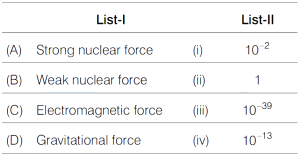
Match the following fundamental forces of nature with their relative strength:
| List-$I$ | List-$II$ |
|---|---|
| $(A)$ Strong nuclear force | $(i)$ $10^{-2}$ |
| $(B)$ Weak nuclear force | (ii) $1$ |
| $(C)$ Electromagnetic force | (iii) $10^{-39}$ |
| $(D)$ Gravitational force | (iv) $10^{-13}$ |
Solution
(A-(II), B-(IV), C-(I), D-(III)) The four fundamental forces of nature and their relative strengths are as follows:
$(i)$ Strong nuclear force: It is the strongest force,acting between nucleons (protons and neutrons) and quarks. Its relative strength is of the order of $1$.
(ii) Electromagnetic force: It acts between electrically charged particles. Its relative strength is of the order of $10^{-2}$.
(iii) Weak nuclear force: It acts between subatomic particles during certain radioactive decays. Its relative strength is of the order of $10^{-13}$.
(iv) Gravitational force: It is the force of attraction between masses. Its relative strength is the weakest,of the order of $10^{-39}$.
Comparing these with the given lists:
$(A)$ Strong nuclear force $\rightarrow$ (ii) $1$
$(B)$ Weak nuclear force $\rightarrow$ (iv) $10^{-13}$
$(C)$ Electromagnetic force $\rightarrow$ $(i)$ $10^{-2}$
$(D)$ Gravitational force $\rightarrow$ (iii) $10^{-39}$
Thus,the correct matching is $A-(ii), B-(iv), C-(i), D-(iii)$.
$(i)$ Strong nuclear force: It is the strongest force,acting between nucleons (protons and neutrons) and quarks. Its relative strength is of the order of $1$.
(ii) Electromagnetic force: It acts between electrically charged particles. Its relative strength is of the order of $10^{-2}$.
(iii) Weak nuclear force: It acts between subatomic particles during certain radioactive decays. Its relative strength is of the order of $10^{-13}$.
(iv) Gravitational force: It is the force of attraction between masses. Its relative strength is the weakest,of the order of $10^{-39}$.
Comparing these with the given lists:
$(A)$ Strong nuclear force $\rightarrow$ (ii) $1$
$(B)$ Weak nuclear force $\rightarrow$ (iv) $10^{-13}$
$(C)$ Electromagnetic force $\rightarrow$ $(i)$ $10^{-2}$
$(D)$ Gravitational force $\rightarrow$ (iii) $10^{-39}$
Thus,the correct matching is $A-(ii), B-(iv), C-(i), D-(iii)$.
0 likes
View Solution255
EasyMCQ
Choose the incorrect statement from the following.
A
Strong nuclear force is a short range force.
B
Weak nuclear force is weakest among gravitational,electromagnetic,weak and strong nuclear forces.
C
Electromagnetic force is a long range force.
D
Gravitational force acts on all objects.
Solution
(B) The fundamental forces of nature in decreasing order of their strength are: Strong nuclear force $>$ Electromagnetic force $>$ Weak nuclear force $>$ Gravitational force.
Therefore,the gravitational force is the weakest force in nature,not the weak nuclear force.
Thus,the statement in option $B$ is incorrect.
Therefore,the gravitational force is the weakest force in nature,not the weak nuclear force.
Thus,the statement in option $B$ is incorrect.
0 likes
View Solution256
MediumMCQ
Particles and their anti-particles have
A
the same masses but opposite spins
B
the same masses but opposite magnetic moments
C
the same masses and same magnetic moments
D
opposite spins and same magnetic moments
Solution
(B) By definition,an anti-particle has the same mass and the same spin as its corresponding particle.
However,properties like electric charge,lepton number,and magnetic moment are opposite in sign to those of the particle.
Therefore,particles and their anti-particles have the same masses but opposite magnetic moments.
However,properties like electric charge,lepton number,and magnetic moment are opposite in sign to those of the particle.
Therefore,particles and their anti-particles have the same masses but opposite magnetic moments.
0 likes
View Solution257
EasyMCQ
The distance between two nucleons for which the potential energy is minimum,is (in $fm$)
A
$0.2$
B
$0.6$
C
$0.8$
D
$0.1$
Solution
(C) The potential energy between two nucleons as a function of their separation distance is described by the nuclear force potential,often modeled by the Reid potential.
This potential curve shows that the nuclear force is strongly attractive at short distances and repulsive at very short distances.
The potential energy reaches its minimum value at a separation distance of approximately $0.8 \ fm$.
At this distance,the nucleons are in a stable configuration,which allows them to form a bound state with a negative binding energy.
This potential curve shows that the nuclear force is strongly attractive at short distances and repulsive at very short distances.
The potential energy reaches its minimum value at a separation distance of approximately $0.8 \ fm$.
At this distance,the nucleons are in a stable configuration,which allows them to form a bound state with a negative binding energy.
0 likes
View Solution258
MediumMCQ
$F_{pp}$,$F_{nn}$,and $F_{np}$ are the nuclear forces between proton-proton,neutron-neutron,and neutron-proton respectively. Then the relation between them is:
A
$F_{pp} = F_{nn} \neq F_{np}$
B
$F_{pp} \neq F_{nn} = F_{np}$
C
$F_{pp} = F_{nn} = F_{np}$
D
$F_{pp} \neq F_{nn} \neq F_{np}$
Solution
(C) The nuclear force is the strong force that acts between nucleons (protons and neutrons) within the nucleus.
Experimental evidence shows that the nuclear force is charge-independent.
This means the force between two protons,two neutrons,or a proton and a neutron is essentially the same,provided the distance between them and their spin states are the same.
Therefore,$F_{pp} = F_{nn} = F_{np}$.
Experimental evidence shows that the nuclear force is charge-independent.
This means the force between two protons,two neutrons,or a proton and a neutron is essentially the same,provided the distance between them and their spin states are the same.
Therefore,$F_{pp} = F_{nn} = F_{np}$.
0 likes
View Solution259
EasyMCQ
The range of weak nuclear force is of the order of
A
$10^{16} \,m$
B
$10^{-10} \,m$
C
$10^{10} \,m$
D
$10^{-16} \,m$
Solution
(D) The weak nuclear force is one of the four fundamental forces of nature.
It is responsible for processes like beta decay in nuclei.
Unlike the strong nuclear force, which has a range of about $10^{-15} \,m$, the weak nuclear force has an extremely short range.
The range of the weak nuclear force is approximately $10^{-16} \,m$ to $10^{-18} \,m$.
Therefore, the correct order of magnitude among the given options is $10^{-16} \,m$.
It is responsible for processes like beta decay in nuclei.
Unlike the strong nuclear force, which has a range of about $10^{-15} \,m$, the weak nuclear force has an extremely short range.
The range of the weak nuclear force is approximately $10^{-16} \,m$ to $10^{-18} \,m$.
Therefore, the correct order of magnitude among the given options is $10^{-16} \,m$.
0 likes
View Solution260
MediumMCQ
If the ratio of the mass numbers of two nuclei is $27 : 125$, then the ratio of their surface areas is
A
$3 : 5$
B
$9 : 25$
C
$27 : 125$
D
$1 : 1$
Solution
(B) The radius $R$ of a nucleus is related to its mass number $A$ by the formula $R = R_0 A^{1/3}$, where $R_0$ is a constant.
The surface area $S$ of a spherical nucleus is given by $S = 4 \pi R^2$.
Substituting the expression for $R$, we get $S = 4 \pi (R_0 A^{1/3})^2 = 4 \pi R_0^2 A^{2/3}$.
Thus, the surface area is proportional to $A^{2/3}$, i.e., $S \propto A^{2/3}$.
Given the ratio of mass numbers $A_1 : A_2 = 27 : 125$, the ratio of their surface areas is $S_1 : S_2 = (A_1 / A_2)^{2/3}$.
Substituting the values: $S_1 / S_2 = (27 / 125)^{2/3} = ((3^3) / (5^3))^{2/3} = (3/5)^2 = 9/25$.
Therefore, the ratio of their surface areas is $9 : 25$.
The surface area $S$ of a spherical nucleus is given by $S = 4 \pi R^2$.
Substituting the expression for $R$, we get $S = 4 \pi (R_0 A^{1/3})^2 = 4 \pi R_0^2 A^{2/3}$.
Thus, the surface area is proportional to $A^{2/3}$, i.e., $S \propto A^{2/3}$.
Given the ratio of mass numbers $A_1 : A_2 = 27 : 125$, the ratio of their surface areas is $S_1 : S_2 = (A_1 / A_2)^{2/3}$.
Substituting the values: $S_1 / S_2 = (27 / 125)^{2/3} = ((3^3) / (5^3))^{2/3} = (3/5)^2 = 9/25$.
Therefore, the ratio of their surface areas is $9 : 25$.
0 likes
View Solution261
MediumMCQ
An element consists of a mixture of three isotopes $A$,$B$,and $C$ of masses $m_1$,$m_2$,and $m_3$ respectively. If the relative abundances of the three isotopes $A$,$B$,and $C$ are in the ratio $2:3:5$,the average mass of the element is:
A
$0.2 m_1 + 0.3 m_2 + 0.5 m_3$
B
$2 m_1 + 3 m_2 + 5 m_3$
C
$0.4 m_1 + 0.6 m_2 + m_3$
D
$4 m_1 + 6 m_2 + 10 m_3$
Solution
(A) The average mass of an element is calculated by taking the weighted average of the masses of its isotopes based on their relative abundances.
Given the ratio of abundances is $2:3:5$,the total parts are $2 + 3 + 5 = 10$.
The fractional abundances are:
For isotope $A$: $2/10 = 0.2$
For isotope $B$: $3/10 = 0.3$
For isotope $C$: $5/10 = 0.5$
The average mass is given by the formula: $\text{Average Mass} = (\text{fraction}_A \times m_1) + (\text{fraction}_B \times m_2) + (\text{fraction}_C \times m_3)$.
Substituting the values: $\text{Average Mass} = 0.2 m_1 + 0.3 m_2 + 0.5 m_3$.
Given the ratio of abundances is $2:3:5$,the total parts are $2 + 3 + 5 = 10$.
The fractional abundances are:
For isotope $A$: $2/10 = 0.2$
For isotope $B$: $3/10 = 0.3$
For isotope $C$: $5/10 = 0.5$
The average mass is given by the formula: $\text{Average Mass} = (\text{fraction}_A \times m_1) + (\text{fraction}_B \times m_2) + (\text{fraction}_C \times m_3)$.
Substituting the values: $\text{Average Mass} = 0.2 m_1 + 0.3 m_2 + 0.5 m_3$.
0 likes
View Solution262
MediumMCQ
If $S$ is the surface area of a nucleus of mass number $A$,then
A
$S \propto A$
B
$S \propto A^{1/3}$
C
$S \propto A^2$
D
$S \propto A^{2/3}$
Solution
(D) The radius $R$ of a nucleus with mass number $A$ is given by $R = R_0 A^{1/3}$,where $R_0$ is a constant.
Assuming the nucleus is spherical,its surface area $S$ is given by $S = 4 \pi R^2$.
Substituting the expression for $R$ into the formula for $S$:
$S = 4 \pi (R_0 A^{1/3})^2$
$S = 4 \pi R_0^2 A^{2/3}$
Since $4 \pi R_0^2$ is a constant,we have $S \propto A^{2/3}$.
Assuming the nucleus is spherical,its surface area $S$ is given by $S = 4 \pi R^2$.
Substituting the expression for $R$ into the formula for $S$:
$S = 4 \pi (R_0 A^{1/3})^2$
$S = 4 \pi R_0^2 A^{2/3}$
Since $4 \pi R_0^2$ is a constant,we have $S \propto A^{2/3}$.
0 likes
View Solution263
EasyMCQ
The radius of a nucleus with mass number $27$ is $R$. Which of the following is true about a nucleus whose radius is $2R$?
A
It is stable in nature
B
Its mass number is $54$
C
It is likely to undergo fission reaction
D
It is likely to undergo fusion reaction
Solution
(C) The radius of a nucleus is given by the relation $R = R_0 A^{1/3}$,where $A$ is the mass number.
Given $R_1 = R$ for $A_1 = 27$ and $R_2 = 2R$ for $A_2$.
Taking the ratio: $\frac{R_1}{R_2} = \left(\frac{A_1}{A_2}\right)^{1/3}$.
Substituting the values: $\frac{R}{2R} = \left(\frac{27}{A_2}\right)^{1/3}$.
$\frac{1}{2} = \left(\frac{27}{A_2}\right)^{1/3}$.
Cubing both sides: $\frac{1}{8} = \frac{27}{A_2}$.
$A_2 = 27 \times 8 = 216$.
Nuclei with very high mass numbers (like $A=216$) are generally unstable and tend to undergo radioactive decay or fission to reach a more stable state.
Given $R_1 = R$ for $A_1 = 27$ and $R_2 = 2R$ for $A_2$.
Taking the ratio: $\frac{R_1}{R_2} = \left(\frac{A_1}{A_2}\right)^{1/3}$.
Substituting the values: $\frac{R}{2R} = \left(\frac{27}{A_2}\right)^{1/3}$.
$\frac{1}{2} = \left(\frac{27}{A_2}\right)^{1/3}$.
Cubing both sides: $\frac{1}{8} = \frac{27}{A_2}$.
$A_2 = 27 \times 8 = 216$.
Nuclei with very high mass numbers (like $A=216$) are generally unstable and tend to undergo radioactive decay or fission to reach a more stable state.
0 likes
View Solution264
EasyMCQ
As the mass number $A$ increases,which of the following quantities related to a nucleus does not change?
A
mass
B
volume
C
density
D
binding energy
Solution
(C) The radius of the atomic nucleus in terms of mass number $A$ is given by $R = R_0 A^{1/3}$.
As the mass number $A$ increases,the mass of the nucleus $(M \approx A \cdot m_p)$ and the volume of the nucleus $(V = \frac{4}{3} \pi R^3 = \frac{4}{3} \pi R_0^3 A)$ both increase.
Binding energy also changes as the number of nucleons increases.
However,the nuclear density $\rho$ is given by:
$\rho = \frac{\text{mass of nucleus}}{\text{volume of nucleus}} = \frac{m A}{\frac{4}{3} \pi R^3} = \frac{m A}{\frac{4}{3} \pi (R_0 A^{1/3})^3} = \frac{m A}{\frac{4}{3} \pi R_0^3 A} = \frac{3m}{4 \pi R_0^3}$.
Since $m$ (average nucleon mass) and $R_0$ are constants,the nuclear density is independent of the mass number $A$ and remains constant.
As the mass number $A$ increases,the mass of the nucleus $(M \approx A \cdot m_p)$ and the volume of the nucleus $(V = \frac{4}{3} \pi R^3 = \frac{4}{3} \pi R_0^3 A)$ both increase.
Binding energy also changes as the number of nucleons increases.
However,the nuclear density $\rho$ is given by:
$\rho = \frac{\text{mass of nucleus}}{\text{volume of nucleus}} = \frac{m A}{\frac{4}{3} \pi R^3} = \frac{m A}{\frac{4}{3} \pi (R_0 A^{1/3})^3} = \frac{m A}{\frac{4}{3} \pi R_0^3 A} = \frac{3m}{4 \pi R_0^3}$.
Since $m$ (average nucleon mass) and $R_0$ are constants,the nuclear density is independent of the mass number $A$ and remains constant.
0 likes
View Solution265
MediumMCQ
Consider a nucleus ${ }_{30}^{60} X$. Its approximate density is (Take $1 \text{ amu} = 1.6 \times 10^{-27} \text{ kg}$,$R_0 = 1.2 \times 10^{-15} \text{ m}$)
A
$1.2 \times 10^{18} \text{ kg m}^{-3}$
B
$8.5 \times 10^{19} \text{ kg m}^{-3}$
C
$3.3 \times 10^{16} \text{ kg m}^{-3}$
D
$2.2 \times 10^{17} \text{ kg m}^{-3}$
Solution
(D) The density of a nucleus is given by the formula: $\rho = \frac{\text{Mass}}{\text{Volume}}$.
Mass of the nucleus $M = A \times m_p$,where $A$ is the mass number and $m_p \approx 1.6 \times 10^{-27} \text{ kg}$.
Volume of the nucleus $V = \frac{4}{3} \pi R^3$,where $R = R_0 A^{1/3}$.
Substituting $V$: $V = \frac{4}{3} \pi (R_0 A^{1/3})^3 = \frac{4}{3} \pi R_0^3 A$.
Density $\rho = \frac{A \times m_p}{\frac{4}{3} \pi R_0^3 A} = \frac{3 m_p}{4 \pi R_0^3}$.
Substituting the values: $\rho = \frac{3 \times 1.6 \times 10^{-27}}{4 \times 3.14 \times (1.2 \times 10^{-15})^3}$.
$\rho = \frac{4.8 \times 10^{-27}}{12.56 \times 1.728 \times 10^{-45}} \approx 2.2 \times 10^{17} \text{ kg m}^{-3}$.
Mass of the nucleus $M = A \times m_p$,where $A$ is the mass number and $m_p \approx 1.6 \times 10^{-27} \text{ kg}$.
Volume of the nucleus $V = \frac{4}{3} \pi R^3$,where $R = R_0 A^{1/3}$.
Substituting $V$: $V = \frac{4}{3} \pi (R_0 A^{1/3})^3 = \frac{4}{3} \pi R_0^3 A$.
Density $\rho = \frac{A \times m_p}{\frac{4}{3} \pi R_0^3 A} = \frac{3 m_p}{4 \pi R_0^3}$.
Substituting the values: $\rho = \frac{3 \times 1.6 \times 10^{-27}}{4 \times 3.14 \times (1.2 \times 10^{-15})^3}$.
$\rho = \frac{4.8 \times 10^{-27}}{12.56 \times 1.728 \times 10^{-45}} \approx 2.2 \times 10^{17} \text{ kg m}^{-3}$.
0 likes
View Solution266
EasyMCQ
What is the mass number of a nucleus having a radius equal to $\frac{1}{3}$ of that of ${}^{189}\text{Os}$?
A
$20$
B
$7$
C
$12$
D
$14$
Solution
(B) The radius of a nucleus is given by the formula $R = R_0 A^{1/3}$,where $R_0$ is a constant and $A$ is the mass number.
Let $R_1$ be the radius of the nucleus with mass number $A_1 = 189$,so $R_1 = R_0 (189)^{1/3}$.
Let $R_2$ be the radius of the target nucleus with mass number $A_2$,so $R_2 = R_0 (A_2)^{1/3}$.
According to the problem,$R_2 = \frac{1}{3} R_1$.
Substituting the expressions,we get $R_0 (A_2)^{1/3} = \frac{1}{3} R_0 (189)^{1/3}$.
Canceling $R_0$ from both sides,we have $(A_2)^{1/3} = \frac{1}{3} (189)^{1/3}$.
Raising both sides to the power of $3$,we get $A_2 = (\frac{1}{3})^3 \times 189$.
$A_2 = \frac{1}{27} \times 189 = 7$.
Therefore,the mass number is $7$.
Let $R_1$ be the radius of the nucleus with mass number $A_1 = 189$,so $R_1 = R_0 (189)^{1/3}$.
Let $R_2$ be the radius of the target nucleus with mass number $A_2$,so $R_2 = R_0 (A_2)^{1/3}$.
According to the problem,$R_2 = \frac{1}{3} R_1$.
Substituting the expressions,we get $R_0 (A_2)^{1/3} = \frac{1}{3} R_0 (189)^{1/3}$.
Canceling $R_0$ from both sides,we have $(A_2)^{1/3} = \frac{1}{3} (189)^{1/3}$.
Raising both sides to the power of $3$,we get $A_2 = (\frac{1}{3})^3 \times 189$.
$A_2 = \frac{1}{27} \times 189 = 7$.
Therefore,the mass number is $7$.
0 likes
View Solution267
EasyMCQ
The range of the nuclear force is
A
$10^{-18} \,m$
B
$10^{-16} \,m$
C
$10^{-15} \,m$
D
$10^{-13} \,m$
Solution
(C) The nuclear force is a short-range force that acts between nucleons (protons and neutrons) within the nucleus.
It is effective only when the distance between two nucleons is approximately $1$ fermi, which is equal to $10^{-15} \,m$.
Beyond this distance, the nuclear force decreases rapidly and becomes negligible.
Therefore, the range of the nuclear force is $10^{-15} \,m$.
It is effective only when the distance between two nucleons is approximately $1$ fermi, which is equal to $10^{-15} \,m$.
Beyond this distance, the nuclear force decreases rapidly and becomes negligible.
Therefore, the range of the nuclear force is $10^{-15} \,m$.
0 likes
View Solution268
EasyMCQ
Estimate the approximate volume of an aluminium nucleus $(A=27)$.
$\text{Use } (R_0 \simeq 1.0 \times 10^{-15} \ m, \pi \simeq 3)$.
$\text{Use } (R_0 \simeq 1.0 \times 10^{-15} \ m, \pi \simeq 3)$.
A
$1 \times 10^{-13} \ (\text{Å})^3$
B
$1 \times 10^{-10} \ (\text{Å})^3$
C
$1 \times 10^{-15} \ (\text{Å})^3$
D
$1 \times 10^{-17} \ (\text{Å})^3$
Solution
(A) The radius of a nucleus is given by $R = R_0 A^{1/3}$.
The volume of a nucleus is $V = \frac{4}{3} \pi R^3$.
Substituting $R$,we get $V = \frac{4}{3} \pi (R_0 A^{1/3})^3 = \frac{4}{3} \pi R_0^3 A$.
Given $R_0 \simeq 1.0 \times 10^{-15} \ m$,$\pi \simeq 3$,and $A = 27$:
$V = \frac{4}{3} \times 3 \times (1.0 \times 10^{-15} \ m)^3 \times 27$.
$V = 4 \times 10^{-45} \times 27 \ m^3 = 108 \times 10^{-45} \ m^3$.
Since $1 \ \text{Å} = 10^{-10} \ m$,then $1 \ m = 10^{10} \ \text{Å}$,so $1 \ m^3 = 10^{30} \ (\text{Å})^3$.
$V = 108 \times 10^{-45} \times 10^{30} \ (\text{Å})^3 = 108 \times 10^{-15} \ (\text{Å})^3 \approx 1 \times 10^{-13} \ (\text{Å})^3$.
The volume of a nucleus is $V = \frac{4}{3} \pi R^3$.
Substituting $R$,we get $V = \frac{4}{3} \pi (R_0 A^{1/3})^3 = \frac{4}{3} \pi R_0^3 A$.
Given $R_0 \simeq 1.0 \times 10^{-15} \ m$,$\pi \simeq 3$,and $A = 27$:
$V = \frac{4}{3} \times 3 \times (1.0 \times 10^{-15} \ m)^3 \times 27$.
$V = 4 \times 10^{-45} \times 27 \ m^3 = 108 \times 10^{-45} \ m^3$.
Since $1 \ \text{Å} = 10^{-10} \ m$,then $1 \ m = 10^{10} \ \text{Å}$,so $1 \ m^3 = 10^{30} \ (\text{Å})^3$.
$V = 108 \times 10^{-45} \times 10^{30} \ (\text{Å})^3 = 108 \times 10^{-15} \ (\text{Å})^3 \approx 1 \times 10^{-13} \ (\text{Å})^3$.
0 likes
View Solution269
DifficultMCQ
The mass number of an iodine nucleus and a polonium nucleus is $125$ and $216$ respectively. The ratio of the radius of the iodine nucleus to that of the polonium nucleus is:
A
$5: 6$
B
$6: 5$
C
$7: 6$
D
$5: 7$
Solution
(A) The radius $R$ of a nucleus with mass number $A$ is given by the formula $R = R_0 A^{1/3}$,where $R_0$ is a constant.
Given the mass numbers for iodine $(A_i = 125)$ and polonium $(A_p = 216)$.
The ratio of the radii is given by $\frac{R_i}{R_p} = \frac{R_0 A_i^{1/3}}{R_0 A_p^{1/3}} = \left( \frac{A_i}{A_p} \right)^{1/3}$.
Substituting the given values: $\frac{R_i}{R_p} = \left( \frac{125}{216} \right)^{1/3}$.
Since $125 = 5^3$ and $216 = 6^3$,we have $\frac{R_i}{R_p} = \frac{5}{6}$.
Therefore,the ratio is $5:6$.
Given the mass numbers for iodine $(A_i = 125)$ and polonium $(A_p = 216)$.
The ratio of the radii is given by $\frac{R_i}{R_p} = \frac{R_0 A_i^{1/3}}{R_0 A_p^{1/3}} = \left( \frac{A_i}{A_p} \right)^{1/3}$.
Substituting the given values: $\frac{R_i}{R_p} = \left( \frac{125}{216} \right)^{1/3}$.
Since $125 = 5^3$ and $216 = 6^3$,we have $\frac{R_i}{R_p} = \frac{5}{6}$.
Therefore,the ratio is $5:6$.
0 likes
View Solution270
EasyMCQ
$A$ nucleus of deuterons or deuterium is a bound atomic system best described by
A
composed of a proton and a neutron
B
spherical shaped
C
contains more than two nucleons
D
proton and neutron are bound by electrostatic forces
Solution
(A) deuteron is the nucleus of deuterium,which is an isotope of hydrogen denoted as ${ }_1^2 H$.
It consists of exactly one proton and one neutron bound together by the strong nuclear force.
Therefore,the most accurate description among the given options is that it is composed of a proton and a neutron.
It consists of exactly one proton and one neutron bound together by the strong nuclear force.
Therefore,the most accurate description among the given options is that it is composed of a proton and a neutron.
0 likes
View Solution271
EasyMCQ
If the radius of a nucleus with mass number $125$ is $1.5 \text{ fermi}$, then the radius of a nucleus with mass number $64$ is: (in $\text{ fermi}$)
A
$0.48$
B
$0.96$
C
$1.92$
D
$1.2$
Solution
(D) The radius of a nucleus is given by the formula $R = R_0 A^{1/3}$, where $R_0$ is a constant and $A$ is the mass number.
Given:
$R_1 = 1.5 \text{ fermi}$, $A_1 = 125$
$A_2 = 64$
We need to find $R_2$.
Taking the ratio of the radii:
$\frac{R_1}{R_2} = \left( \frac{A_1}{A_2} \right)^{1/3}$
$\frac{1.5}{R_2} = \left( \frac{125}{64} \right)^{1/3}$
$\frac{1.5}{R_2} = \frac{5}{4}$
$R_2 = \frac{1.5 \times 4}{5} = 0.3 \times 4 = 1.2 \text{ fermi}$.
Given:
$R_1 = 1.5 \text{ fermi}$, $A_1 = 125$
$A_2 = 64$
We need to find $R_2$.
Taking the ratio of the radii:
$\frac{R_1}{R_2} = \left( \frac{A_1}{A_2} \right)^{1/3}$
$\frac{1.5}{R_2} = \left( \frac{125}{64} \right)^{1/3}$
$\frac{1.5}{R_2} = \frac{5}{4}$
$R_2 = \frac{1.5 \times 4}{5} = 0.3 \times 4 = 1.2 \text{ fermi}$.
0 likes
View Solution272
DifficultMCQ
The radius of ${ }_{52} Te^{125}$ nucleus is $6 \text{ fermi}$. The radius of ${ }_{13} Al^{27}$ nucleus in meters is
A
$3.6 \times 10^{-12} \text{ m}$
B
$3.6 \times 10^{-15} \text{ m}$
C
$7.2 \times 10^{-8} \text{ m}$
D
$7.2 \times 10^{-15} \text{ m}$
Solution
(B) The relation between the radius $(R)$ and the mass number $(A)$ of a nucleus is given by $R = R_0 A^{1/3}$.
Therefore,the ratio of the radii of two nuclei is given by $\frac{R_1}{R_2} = \left(\frac{A_1}{A_2}\right)^{1/3}$.
Given: $R_1 = 6 \text{ fermi}$,$A_1 = 125$,and $A_2 = 27$.
Substituting the values:
$\frac{6}{R_2} = \left(\frac{125}{27}\right)^{1/3} = \frac{5}{3}$.
Solving for $R_2$:
$R_2 = \frac{6 \times 3}{5} = \frac{18}{5} = 3.6 \text{ fermi}$.
Since $1 \text{ fermi} = 10^{-15} \text{ m}$,we have $R_2 = 3.6 \times 10^{-15} \text{ m}$.
Therefore,the ratio of the radii of two nuclei is given by $\frac{R_1}{R_2} = \left(\frac{A_1}{A_2}\right)^{1/3}$.
Given: $R_1 = 6 \text{ fermi}$,$A_1 = 125$,and $A_2 = 27$.
Substituting the values:
$\frac{6}{R_2} = \left(\frac{125}{27}\right)^{1/3} = \frac{5}{3}$.
Solving for $R_2$:
$R_2 = \frac{6 \times 3}{5} = \frac{18}{5} = 3.6 \text{ fermi}$.
Since $1 \text{ fermi} = 10^{-15} \text{ m}$,we have $R_2 = 3.6 \times 10^{-15} \text{ m}$.
0 likes
View Solution273
EasyMCQ
Consider the following two statements,$A$ and $B$ and identify the correct answer given below:
$A$. Nuclear density is same for all nuclei.
$B$. Radius of the nucleus $R$ and its mass number $A$ are related as $\sqrt{A} \propto R^{1 / 6}$.
$A$. Nuclear density is same for all nuclei.
$B$. Radius of the nucleus $R$ and its mass number $A$ are related as $\sqrt{A} \propto R^{1 / 6}$.
A
Both $A$ and $B$ are true
B
Both $A$ and $B$ are false
C
$A$ is true but $B$ is false
D
$A$ is false but $B$ is true
Solution
(C) The nuclear density is independent of the mass number and is approximately constant for all nuclei,given by $\rho \approx 2.3 \times 10^{17} \ kg/m^3$. Thus,statement $A$ is true.
The relationship between the radius of the nucleus $R$ and the mass number $A$ is given by $R = R_0 A^{1/3}$,where $R_0$ is a constant. This implies $R^3 \propto A$,or $R \propto A^{1/3}$.
Given statement $B$ is $\sqrt{A} \propto R^{1/6}$. Squaring both sides gives $A \propto R^{1/3}$,which contradicts the established relation $R \propto A^{1/3}$ (or $A \propto R^3$). Therefore,statement $B$ is false.
Hence,$A$ is true and $B$ is false.
The relationship between the radius of the nucleus $R$ and the mass number $A$ is given by $R = R_0 A^{1/3}$,where $R_0$ is a constant. This implies $R^3 \propto A$,or $R \propto A^{1/3}$.
Given statement $B$ is $\sqrt{A} \propto R^{1/6}$. Squaring both sides gives $A \propto R^{1/3}$,which contradicts the established relation $R \propto A^{1/3}$ (or $A \propto R^3$). Therefore,statement $B$ is false.
Hence,$A$ is true and $B$ is false.
0 likes
View Solution274
DifficultMCQ
$A$ heavy nucleus at rest breaks into two fragments which fly off with velocities in the ratio $3: 1$. The ratio of radii of the fragments is
A
$1: 3^{1/3}$
B
$3^{1/3}: 4$
C
$4: 1$
D
$2: 1$
Solution
(A) According to the law of conservation of linear momentum,for a nucleus initially at rest,the magnitudes of momenta of the two fragments must be equal: $m_1 v_1 = m_2 v_2$.
This implies $\frac{m_1}{m_2} = \frac{v_2}{v_1}$.
Given the velocity ratio $\frac{v_1}{v_2} = \frac{3}{1}$,we have $\frac{m_1}{m_2} = \frac{1}{3}$.
Assuming the density $\rho$ of the nucleus is constant,the mass $m$ is proportional to the volume,so $m = \rho \cdot \frac{4}{3} \pi R^3$.
Therefore,$\frac{m_1}{m_2} = \frac{R_1^3}{R_2^3}$.
Equating the two expressions for the mass ratio: $\frac{R_1^3}{R_2^3} = \frac{v_2}{v_1} = \frac{1}{3}$.
Taking the cube root on both sides,we get $\frac{R_1}{R_2} = (\frac{1}{3})^{1/3} = 1 : 3^{1/3}$.
This implies $\frac{m_1}{m_2} = \frac{v_2}{v_1}$.
Given the velocity ratio $\frac{v_1}{v_2} = \frac{3}{1}$,we have $\frac{m_1}{m_2} = \frac{1}{3}$.
Assuming the density $\rho$ of the nucleus is constant,the mass $m$ is proportional to the volume,so $m = \rho \cdot \frac{4}{3} \pi R^3$.
Therefore,$\frac{m_1}{m_2} = \frac{R_1^3}{R_2^3}$.
Equating the two expressions for the mass ratio: $\frac{R_1^3}{R_2^3} = \frac{v_2}{v_1} = \frac{1}{3}$.
Taking the cube root on both sides,we get $\frac{R_1}{R_2} = (\frac{1}{3})^{1/3} = 1 : 3^{1/3}$.
0 likes
View Solution275
MediumMCQ
The mass number and the volume of a nucleus are $A$ and $V$ respectively. If the mass number is increased to $2A$,then the volume changes to:
A
$4V$
B
$\frac{V}{2}$
C
$2V$
D
$8V$
Solution
(C) The radius $R$ of a nucleus is related to its mass number $A$ by the formula $R = R_0 A^{1/3}$,where $R_0$ is a constant.
The volume $V$ of a nucleus is given by $V = \frac{4}{3} \pi R^3$.
Substituting the expression for $R$,we get $V = \frac{4}{3} \pi (R_0 A^{1/3})^3 = \frac{4}{3} \pi R_0^3 A$.
This shows that the volume $V$ is directly proportional to the mass number $A$ $(V \propto A)$.
If the mass number is increased from $A$ to $2A$,the new volume $V'$ will be $V' \propto 2A$.
Therefore,$V' = 2V$.
The volume $V$ of a nucleus is given by $V = \frac{4}{3} \pi R^3$.
Substituting the expression for $R$,we get $V = \frac{4}{3} \pi (R_0 A^{1/3})^3 = \frac{4}{3} \pi R_0^3 A$.
This shows that the volume $V$ is directly proportional to the mass number $A$ $(V \propto A)$.
If the mass number is increased from $A$ to $2A$,the new volume $V'$ will be $V' \propto 2A$.
Therefore,$V' = 2V$.
0 likes
View Solution276
MediumMCQ
The ratio of the relative strengths of strong and weak nuclear forces is
A
$10^{13}$
B
$10^{26}$
C
$10^{39}$
D
$10^{11}$
Solution
(A) The relative strength of the strong nuclear force is approximately $1$.
The relative strength of the weak nuclear force is approximately $10^{-13}$.
Therefore,the ratio of the relative strengths of strong and weak nuclear forces is given by:
Ratio $= \frac{\text{Strong nuclear force}}{\text{Weak nuclear force}} = \frac{1}{10^{-13}} = 10^{13}$.
The relative strength of the weak nuclear force is approximately $10^{-13}$.
Therefore,the ratio of the relative strengths of strong and weak nuclear forces is given by:
Ratio $= \frac{\text{Strong nuclear force}}{\text{Weak nuclear force}} = \frac{1}{10^{-13}} = 10^{13}$.
0 likes
View Solution277
EasyMCQ
The nuclear forces are
A
long range repulsive forces
B
long range attractive forces
C
short range attractive forces
D
short range repulsive forces
Solution
(C) Nuclear forces are the strongest forces in nature, acting only over very small distances within the nucleus (typically $r \approx 10^{-15} \,m$).
These forces are responsible for binding protons and neutrons together, overcoming the electrostatic repulsion between protons.
Therefore, nuclear forces are short-range attractive forces.
These forces are responsible for binding protons and neutrons together, overcoming the electrostatic repulsion between protons.
Therefore, nuclear forces are short-range attractive forces.
0 likes
View Solution278
MediumMCQ
Let the binding energy per nucleon of a nucleus be denoted by $E_{bn}$ and the radius of the nucleus be denoted by $r$. If the mass numbers of nuclei $A$ and $B$ are $64$ and $125$ respectively,then:
A
$r_A < r_B$
B
$r_A > r_B$
C
$E_{bnA} > E_{bnB}$
D
$E_{bnA} < E_{bnB}$
Solution
(A, C) The radius of a nucleus is given by the formula $r = R_0 A^{1/3}$,where $R_0$ is a constant and $A$ is the mass number.
Since $A_A = 64$ and $A_B = 125$,we have $r_A = R_0 (64)^{1/3} = 4R_0$ and $r_B = R_0 (125)^{1/3} = 5R_0$.
Thus,$r_A < r_B$.
Regarding binding energy per nucleon $(E_{bn})$,the value of $E_{bn}$ increases with mass number for light nuclei and reaches a maximum near $A = 56$ (Iron). For nuclei with $A > 60$,$E_{bn}$ gradually decreases.
Since $A_A = 64$ is closer to $56$ than $A_B = 125$,the binding energy per nucleon for nucleus $A$ is greater than that for nucleus $B$,i.e.,$E_{bnA} > E_{bnB}$.
Therefore,both options $A$ and $C$ are correct.
Since $A_A = 64$ and $A_B = 125$,we have $r_A = R_0 (64)^{1/3} = 4R_0$ and $r_B = R_0 (125)^{1/3} = 5R_0$.
Thus,$r_A < r_B$.
Regarding binding energy per nucleon $(E_{bn})$,the value of $E_{bn}$ increases with mass number for light nuclei and reaches a maximum near $A = 56$ (Iron). For nuclei with $A > 60$,$E_{bn}$ gradually decreases.
Since $A_A = 64$ is closer to $56$ than $A_B = 125$,the binding energy per nucleon for nucleus $A$ is greater than that for nucleus $B$,i.e.,$E_{bnA} > E_{bnB}$.
Therefore,both options $A$ and $C$ are correct.
0 likes
View Solution279
EasyMCQ
In the nuclear reaction ${ }_{7}^{14} N + X \rightarrow { }_{6}^{14} C + { }_{1}^{1} H$,the $X$ will be
A
${ }_{-1}^{0} e$
B
${ }_{1}^{1} H$
C
${ }_{1}^{2} H$
D
${ }_{0}^{1} n$
Solution
(D) In a nuclear reaction,both the total atomic number $(Z)$ and the total mass number $(A)$ must be conserved on both sides of the equation.
Let $X$ be represented as ${ }_{Z'}^{A'} X$.
The reaction is: ${ }_{7}^{14} N + { }_{Z'}^{A'} X \rightarrow { }_{6}^{14} C + { }_{1}^{1} H$.
Conservation of mass number $(A)$: $14 + A' = 14 + 1 \Rightarrow A' = 1$.
Conservation of atomic number $(Z)$: $7 + Z' = 6 + 1 \Rightarrow 7 + Z' = 7 \Rightarrow Z' = 0$.
$A$ particle with mass number $1$ and atomic number $0$ is a neutron,denoted as ${ }_{0}^{1} n$.
Let $X$ be represented as ${ }_{Z'}^{A'} X$.
The reaction is: ${ }_{7}^{14} N + { }_{Z'}^{A'} X \rightarrow { }_{6}^{14} C + { }_{1}^{1} H$.
Conservation of mass number $(A)$: $14 + A' = 14 + 1 \Rightarrow A' = 1$.
Conservation of atomic number $(Z)$: $7 + Z' = 6 + 1 \Rightarrow 7 + Z' = 7 \Rightarrow Z' = 0$.
$A$ particle with mass number $1$ and atomic number $0$ is a neutron,denoted as ${ }_{0}^{1} n$.
0 likes
View Solution280
MediumMCQ
What is the particle $x$ in the following nuclear reaction :
${ }_4^9 Be+{ }_2^4 He \rightarrow{ }_6^{12} C+x$
${ }_4^9 Be+{ }_2^4 He \rightarrow{ }_6^{12} C+x$
A
electron
B
proton
C
Photon
D
Neutron
Solution
(D) In a nuclear reaction,both the total atomic number $(Z)$ and the total mass number $(A)$ must be conserved on both sides of the equation.
Given reaction: ${ }_4^9 Be + { }_2^4 He \rightarrow { }_6^{12} C + x$
Let the particle $x$ be represented by ${ }_Z^A X$.
Conservation of mass number $(A)$: $9 + 4 = 12 + A \Rightarrow 13 = 12 + A \Rightarrow A = 1$.
Conservation of atomic number $(Z)$: $4 + 2 = 6 + Z \Rightarrow 6 = 6 + Z \Rightarrow Z = 0$.
The particle with mass number $1$ and atomic number $0$ is a neutron,denoted as ${ }_0^1 n$.
Given reaction: ${ }_4^9 Be + { }_2^4 He \rightarrow { }_6^{12} C + x$
Let the particle $x$ be represented by ${ }_Z^A X$.
Conservation of mass number $(A)$: $9 + 4 = 12 + A \Rightarrow 13 = 12 + A \Rightarrow A = 1$.
Conservation of atomic number $(Z)$: $4 + 2 = 6 + Z \Rightarrow 6 = 6 + Z \Rightarrow Z = 0$.
The particle with mass number $1$ and atomic number $0$ is a neutron,denoted as ${ }_0^1 n$.
0 likes
View Solution281
DifficultMCQ
$A$ nucleus has mass number $\alpha$ and radius $R_{\alpha}$. Another nucleus has mass number $\beta$ and radius $R_{\beta}$. If $\beta = 8\alpha$,then $R_{\alpha}/R_{\beta}$ is:
A
$2$
B
$8$
C
$1$
D
$0.5$
Solution
(D) The radius of a nucleus is given by the formula $R = R_{0}A^{1/3}$,where $R_{0}$ is a constant and $A$ is the mass number.
For the first nucleus,$R_{\alpha} = R_{0}\alpha^{1/3}$.
For the second nucleus,$R_{\beta} = R_{0}\beta^{1/3}$.
Taking the ratio,we get $\frac{R_{\alpha}}{R_{\beta}} = \left(\frac{\alpha}{\beta}\right)^{1/3}$.
Given that $\beta = 8\alpha$,we substitute this into the ratio:
$\frac{R_{\alpha}}{R_{\beta}} = \left(\frac{\alpha}{8\alpha}\right)^{1/3} = \left(\frac{1}{8}\right)^{1/3} = \frac{1}{2} = 0.5$.
For the first nucleus,$R_{\alpha} = R_{0}\alpha^{1/3}$.
For the second nucleus,$R_{\beta} = R_{0}\beta^{1/3}$.
Taking the ratio,we get $\frac{R_{\alpha}}{R_{\beta}} = \left(\frac{\alpha}{\beta}\right)^{1/3}$.
Given that $\beta = 8\alpha$,we substitute this into the ratio:
$\frac{R_{\alpha}}{R_{\beta}} = \left(\frac{\alpha}{8\alpha}\right)^{1/3} = \left(\frac{1}{8}\right)^{1/3} = \frac{1}{2} = 0.5$.
0 likes
View Solution282
DifficultMCQ
An atom ${}_3^8 X$ is bombarded by a shower of fundamental particles. In $10 \ s$,this atom absorbs $10$ electrons,$10$ protons,and $9$ neutrons. The percentage growth in the surface area of the nucleus is recorded as: (in $\%$)
A
$250$
B
$150$
C
$125$
D
$900$
Solution
(C) The radius of a nucleus is given by $R = R_0 A^{1/3}$,where $A$ is the mass number.
The surface area $S$ of a spherical nucleus is $S = 4 \pi R^2 = 4 \pi R_0^2 A^{2/3}$.
Thus,$S \propto A^{2/3}$.
Initial mass number $A_i = 8$.
Initial surface area $S_i \propto (8)^{2/3} = (2^3)^{2/3} = 2^2 = 4$.
After absorbing $10$ protons and $9$ neutrons (electrons do not contribute to the mass number),the new mass number $A_f = 8 + 10 + 9 = 27$.
Final surface area $S_f \propto (27)^{2/3} = (3^3)^{2/3} = 3^2 = 9$.
The percentage increase in surface area is given by $\frac{S_f - S_i}{S_i} \times 100$.
Percentage increase $= \frac{9 - 4}{4} \times 100 = \frac{5}{4} \times 100 = 125\%$.
The surface area $S$ of a spherical nucleus is $S = 4 \pi R^2 = 4 \pi R_0^2 A^{2/3}$.
Thus,$S \propto A^{2/3}$.
Initial mass number $A_i = 8$.
Initial surface area $S_i \propto (8)^{2/3} = (2^3)^{2/3} = 2^2 = 4$.
After absorbing $10$ protons and $9$ neutrons (electrons do not contribute to the mass number),the new mass number $A_f = 8 + 10 + 9 = 27$.
Final surface area $S_f \propto (27)^{2/3} = (3^3)^{2/3} = 3^2 = 9$.
The percentage increase in surface area is given by $\frac{S_f - S_i}{S_i} \times 100$.
Percentage increase $= \frac{9 - 4}{4} \times 100 = \frac{5}{4} \times 100 = 125\%$.
0 likes
View Solution283
EasyMCQ
Which of the following pairs of nuclei are isobars?
A
${}_{1}^{2}H$ and ${}_{1}^{3}H$
B
${}_{92}^{236}U$ and ${}_{92}^{238}U$
C
${}_{80}^{198}Hg$ and ${}_{79}^{197}Au$
D
${}_{1}^{3}H$ and ${}_{2}^{3}He$
Solution
(D) Isobars are defined as nuclei that have the same mass number $(A)$ but different atomic numbers $(Z)$.
In the pair ${}_{1}^{3}H$ and ${}_{2}^{3}He$:
$1$. For ${}_{1}^{3}H$,the mass number $A = 3$.
$2$. For ${}_{2}^{3}He$,the mass number $A = 3$.
Since both nuclei have the same mass number $(A = 3)$,they are isobars.
In the pair ${}_{1}^{3}H$ and ${}_{2}^{3}He$:
$1$. For ${}_{1}^{3}H$,the mass number $A = 3$.
$2$. For ${}_{2}^{3}He$,the mass number $A = 3$.
Since both nuclei have the same mass number $(A = 3)$,they are isobars.
0 likes
View Solution284
DifficultMCQ
Calculate the height of the potential barrier for a head-on collision of two deuterons. (Radius of deuteron is $2$ fm).
A
$7.2 \times 10^{-19}$ $J$
B
$7.2 \times 10^{-14}$ $J$
C
$3.6 \times 10^{-19}$ $J$
D
$5.76 \times 10^{-14}$ $J$
Solution
(D) The potential energy of the barrier at the point of contact is given by $U = k \frac{q_1 q_2}{r}$.
Here,the charge of each deuteron is $q_1 = q_2 = e = 1.6 \times 10^{-19}$ $C$.
The distance between the centers of the two deuterons at the point of contact is $r = R_1 + R_2 = 2 \text{ fm} + 2 \text{ fm} = 4 \text{ fm} = 4 \times 10^{-15}$ m.
Substituting the values into the formula:
$U = \frac{(9 \times 10^9 \text{ N m}^2/\text{C}^2) \times (1.6 \times 10^{-19} \text{ C})^2}{4 \times 10^{-15} \text{ m}}$
$U = \frac{9 \times 10^9 \times 2.56 \times 10^{-38}}{4 \times 10^{-15}}$
$U = \frac{23.04 \times 10^{-29}}{4 \times 10^{-15}}$
$U = 5.76 \times 10^{-14}$ $J$.
Here,the charge of each deuteron is $q_1 = q_2 = e = 1.6 \times 10^{-19}$ $C$.
The distance between the centers of the two deuterons at the point of contact is $r = R_1 + R_2 = 2 \text{ fm} + 2 \text{ fm} = 4 \text{ fm} = 4 \times 10^{-15}$ m.
Substituting the values into the formula:
$U = \frac{(9 \times 10^9 \text{ N m}^2/\text{C}^2) \times (1.6 \times 10^{-19} \text{ C})^2}{4 \times 10^{-15} \text{ m}}$
$U = \frac{9 \times 10^9 \times 2.56 \times 10^{-38}}{4 \times 10^{-15}}$
$U = \frac{23.04 \times 10^{-29}}{4 \times 10^{-15}}$
$U = 5.76 \times 10^{-14}$ $J$.
0 likes
View Solution285
MediumMCQ
Which of the following pairs is called isotones?
A
$^{198}_{80}\text{Hg}, ^{197}_{79}\text{Au}$
B
$^3_1\text{H}, ^3_2\text{He}$
C
$^{214}_{82}\text{Pb}, ^{214}_{83}\text{Bi}$
D
$^{12}_6\text{C}, ^{14}_6\text{C}$
Solution
(A) Isotones are atoms of different elements that have the same number of neutrons.
To find the number of neutrons $(N)$,we use the formula $N = A - Z$,where $A$ is the mass number and $Z$ is the atomic number.
For $^{198}_{80}\text{Hg}$: $N = 198 - 80 = 118$.
For $^{197}_{79}\text{Au}$: $N = 197 - 79 = 118$.
Since both atoms have the same number of neutrons $(118)$,they are isotones.
For other options:
- $^3_1\text{H}$ $(N=2)$ and $^3_2\text{He}$ $(N=1)$ are not isotones.
- $^{214}_{82}\text{Pb}$ $(N=132)$ and $^{214}_{83}\text{Bi}$ $(N=131)$ are not isotones.
- $^{12}_6\text{C}$ $(N=6)$ and $^{14}_6\text{C}$ $(N=8)$ are isotopes,not isotones.
To find the number of neutrons $(N)$,we use the formula $N = A - Z$,where $A$ is the mass number and $Z$ is the atomic number.
For $^{198}_{80}\text{Hg}$: $N = 198 - 80 = 118$.
For $^{197}_{79}\text{Au}$: $N = 197 - 79 = 118$.
Since both atoms have the same number of neutrons $(118)$,they are isotones.
For other options:
- $^3_1\text{H}$ $(N=2)$ and $^3_2\text{He}$ $(N=1)$ are not isotones.
- $^{214}_{82}\text{Pb}$ $(N=132)$ and $^{214}_{83}\text{Bi}$ $(N=131)$ are not isotones.
- $^{12}_6\text{C}$ $(N=6)$ and $^{14}_6\text{C}$ $(N=8)$ are isotopes,not isotones.
0 likes
View Solution286
MediumMCQ
The nuclides of $^{197}_{79} \text{Au}$ and $^{198}_{80} \text{Hg}$ are called . . . . . . of each other.
A
isotopes
B
isotones
C
isobars
D
isomers
Solution
(B) To determine the relationship,we calculate the number of neutrons $(N)$ for each nuclide using the formula $N = A - Z$,where $A$ is the mass number and $Z$ is the atomic number.
For $^{197}_{79} \text{Au}$: $A = 197$,$Z = 79$. Thus,$N = 197 - 79 = 118$.
For $^{198}_{80} \text{Hg}$: $A = 198$,$Z = 80$. Thus,$N = 198 - 80 = 118$.
Since both nuclides have the same number of neutrons $(N = 118)$,they are classified as isotones.
For $^{197}_{79} \text{Au}$: $A = 197$,$Z = 79$. Thus,$N = 197 - 79 = 118$.
For $^{198}_{80} \text{Hg}$: $A = 198$,$Z = 80$. Thus,$N = 198 - 80 = 118$.
Since both nuclides have the same number of neutrons $(N = 118)$,they are classified as isotones.
0 likes
View Solution287
MediumMCQ
The nuclear radius of a hydrogen atom is approximately . . . . . . . (in $fm$)
A
$1.5$
B
$1.2$
C
$2.3$
D
$3.2$
Solution
(B) The nuclear radius $R$ is calculated using the formula $R = R_0 A^{1/3}$,where $R_0 \approx 1.2 \text{ fm}$ and $A$ is the mass number of the nucleus.
For a hydrogen atom,the nucleus consists of a single proton,so the mass number $A = 1$.
Substituting the value of $A$ into the formula:
$R = 1.2 \times (1)^{1/3} \text{ fm}$
$R = 1.2 \times 1 \text{ fm} = 1.2 \text{ fm}$.
Therefore,the nuclear radius of a hydrogen atom is $1.2 \text{ fm}$.
The correct option is $B$.
For a hydrogen atom,the nucleus consists of a single proton,so the mass number $A = 1$.
Substituting the value of $A$ into the formula:
$R = 1.2 \times (1)^{1/3} \text{ fm}$
$R = 1.2 \times 1 \text{ fm} = 1.2 \text{ fm}$.
Therefore,the nuclear radius of a hydrogen atom is $1.2 \text{ fm}$.
The correct option is $B$.
0 likes
View Solution288
MediumMCQ
Four statements are given ($A$ is mass number) :
$A$. The volume of a nucleus is proportional to $A^{1/3}$.
$B$. The volume of a nucleus is proportional to $A$.
$C$. The difference in mass of an atom and its nucleus is called the mass defect.
$D$. The difference in mass of a nucleus and its constituents is called the mass defect.
Choose the correct answer from the options given below :
$A$. The volume of a nucleus is proportional to $A^{1/3}$.
$B$. The volume of a nucleus is proportional to $A$.
$C$. The difference in mass of an atom and its nucleus is called the mass defect.
$D$. The difference in mass of a nucleus and its constituents is called the mass defect.
Choose the correct answer from the options given below :
A
$A$ and $D$ are true,but $B$ and $C$ are false
B
$B$ and $D$ are true,but $A$ and $C$ are false
C
$B$ and $C$ are true,but $A$ and $D$ are false
D
$A$ and $C$ are true,but $B$ and $D$ are false
Solution
(B) The radius of a nucleus is given by $R = R_0 A^{1/3}$,where $R_0$ is a constant and $A$ is the mass number.
The volume of a nucleus is $V = \frac{4}{3} \pi R^3 = \frac{4}{3} \pi (R_0 A^{1/3})^3 = \frac{4}{3} \pi R_0^3 A$.
Since $\frac{4}{3} \pi R_0^3$ is a constant,the volume $V$ is directly proportional to the mass number $A$. Therefore,statement $A$ is false and statement $B$ is true.
Mass defect is defined as the difference between the sum of the masses of the individual nucleons (protons and neutrons) and the actual mass of the nucleus. Therefore,statement $C$ is false and statement $D$ is true.
Thus,statements $B$ and $D$ are true,while $A$ and $C$ are false.
The volume of a nucleus is $V = \frac{4}{3} \pi R^3 = \frac{4}{3} \pi (R_0 A^{1/3})^3 = \frac{4}{3} \pi R_0^3 A$.
Since $\frac{4}{3} \pi R_0^3$ is a constant,the volume $V$ is directly proportional to the mass number $A$. Therefore,statement $A$ is false and statement $B$ is true.
Mass defect is defined as the difference between the sum of the masses of the individual nucleons (protons and neutrons) and the actual mass of the nucleus. Therefore,statement $C$ is false and statement $D$ is true.
Thus,statements $B$ and $D$ are true,while $A$ and $C$ are false.
0 likes
View Solution289
MediumMCQ
An unknown nucleus has a nuclear density of $2.29 \times 10^{17} \text{ kg/m}^3$ and mass of $19.926 \times 10^{-27} \text{ kg}$. Its mass number $A$ is approximately: (Take $R_0 = 1.2 \times 10^{-15} \text{ m}$,$4\pi = 12.56$)
A
$16$
B
$20$
C
$12$
D
$19$
Solution
(C) The mass of a nucleus is given by $M = A \times m_p$,where $A$ is the mass number and $m_p$ is the average mass of a nucleon (approximately $1.67 \times 10^{-27} \text{ kg}$).
Given the total mass of the nucleus $M = 19.926 \times 10^{-27} \text{ kg}$.
We can calculate the mass number $A$ as:
$A = \frac{M}{m_p} = \frac{19.926 \times 10^{-27} \text{ kg}}{1.67 \times 10^{-27} \text{ kg}} \approx 11.93$.
Rounding this value to the nearest integer,we get $A \approx 12$.
Thus,the mass number of the nucleus is $12$.
Given the total mass of the nucleus $M = 19.926 \times 10^{-27} \text{ kg}$.
We can calculate the mass number $A$ as:
$A = \frac{M}{m_p} = \frac{19.926 \times 10^{-27} \text{ kg}}{1.67 \times 10^{-27} \text{ kg}} \approx 11.93$.
Rounding this value to the nearest integer,we get $A \approx 12$.
Thus,the mass number of the nucleus is $12$.
0 likes
View SolutionNuclei — Composition of Nucleus, Size of the Nucleus, Nuclear force · Frequently Asked Questions
1Are these Nuclei questions useful for JEE and NEET?
Yes. All questions in this section are mapped to JEE Main and NEET exam patterns. Previous year questions from JEE Main, NEET, GUJCET and state-level exams are included with full solutions.
2Can I switch to Hindi or Gujarati for these questions?
Yes. Use the language tabs in the hero section or the sidebar to view the same questions and solutions in English, Hindi or Gujarati.
3How do I generate a question paper from this subtopic?
Use the Vedclass Exam Paper Generator — select the chapter and subtopic, set difficulty, and generate Sets A, B, C, D automatically. First 3 chapters of every subject are free.
Vedclass Products
For Students
Vedclass Test Series
Mock tests in real JEE/NEET style with performance analysis. 5-day free trial.
Start Free TrialFor Teachers
Exam Paper Generator
Generate Set A/B/C/D papers from this chapter in 2 minutes. 3 chapters free.
Try FreeFor Institutes
Online Exam Module
Live online exams with unlimited students, 360° analytics & white-label branding.
See DemoFor Teachers & Institutes
Generate a Nuclei Exam Paper in 2 Minutes
Select subtopic & difficulty — Sets A, B, C, D auto-generated with No Repeat logic.
First 3 chapters of every subject are free — no payment required.