
A English
Composition of Nucleus, Size of the Nucleus, Nuclear force Questions in English
Class 12 Physics · Nuclei · Composition of Nucleus, Size of the Nucleus, Nuclear force
295+
Questions
English
Language
100%
With Solutions
Showing 50 of 295 questions in English
151
EasyMCQ
Write the value of the $R_0$ constant used in the formula for the radius of a nucleus.
A
$1.1 \times 10^{-15} \ m$
B
$1.2 \times 10^{-15} \ m$
C
$1.5 \times 10^{-15} \ m$
D
$1.0 \times 10^{-15} \ m$
Solution
(B) The radius of a nucleus is given by the formula $R = R_0 A^{1/3}$,where $A$ is the mass number.
Here,$R_0$ is an empirical constant.
The value of $R_0$ is approximately $1.2 \times 10^{-15} \ m$ or $1.2 \ \text{fm}$ (femtometers).
Here,$R_0$ is an empirical constant.
The value of $R_0$ is approximately $1.2 \times 10^{-15} \ m$ or $1.2 \ \text{fm}$ (femtometers).
0 likes
View Solution152
Easy
Show that the volume of a nucleus is proportional to its atomic mass number $A$.
Solution
(N/A) The radius $R$ of a nucleus with mass number $A$ is given by the empirical relation: $R = R_0 A^{1/3}$,where $R_0$ is a constant approximately equal to $1.2 \times 10^{-15} \ m$.
The volume $V$ of a nucleus,assuming it is spherical,is given by the formula: $V = \frac{4}{3} \pi R^3$.
Substituting the expression for $R$ into the volume formula:
$V = \frac{4}{3} \pi (R_0 A^{1/3})^3$
$V = \frac{4}{3} \pi R_0^3 A$.
Since $\frac{4}{3}$,$\pi$,and $R_0^3$ are constants,we can write:
$V \propto A$.
Thus,the volume of the nucleus is directly proportional to its atomic mass number $A$.
The volume $V$ of a nucleus,assuming it is spherical,is given by the formula: $V = \frac{4}{3} \pi R^3$.
Substituting the expression for $R$ into the volume formula:
$V = \frac{4}{3} \pi (R_0 A^{1/3})^3$
$V = \frac{4}{3} \pi R_0^3 A$.
Since $\frac{4}{3}$,$\pi$,and $R_0^3$ are constants,we can write:
$V \propto A$.
Thus,the volume of the nucleus is directly proportional to its atomic mass number $A$.
0 likes
View Solution153
EasyMCQ
How many times is the density of the nucleus more than the density of water?
A
$10^{14}$
B
$10^{17}$
C
$10^{12}$
D
$10^{10}$
Solution
(A) The density of a nucleus is approximately constant for all nuclei and is given by $\rho_{n} \approx 2.3 \times 10^{17} \ kg/m^3$.
The density of water is $\rho_{w} = 10^3 \ kg/m^3$.
To find how many times the density of the nucleus is greater than the density of water, we calculate the ratio:
$\text{Ratio} = \frac{\rho_{n}}{\rho_{w}} = \frac{2.3 \times 10^{17}}{10^3} = 2.3 \times 10^{14}$.
Rounding to the nearest order of magnitude, the density of the nucleus is approximately $10^{14}$ times the density of water.
The density of water is $\rho_{w} = 10^3 \ kg/m^3$.
To find how many times the density of the nucleus is greater than the density of water, we calculate the ratio:
$\text{Ratio} = \frac{\rho_{n}}{\rho_{w}} = \frac{2.3 \times 10^{17}}{10^3} = 2.3 \times 10^{14}$.
Rounding to the nearest order of magnitude, the density of the nucleus is approximately $10^{14}$ times the density of water.
0 likes
View Solution154
Easy
Write the formula for the average radius of a nucleus.
Solution
(N/A) The radius $R$ of a nucleus is related to its mass number $A$ by the empirical formula:
$R = R_0 A^{1/3}$
Where:
$R$ is the radius of the nucleus.
$A$ is the mass number (total number of protons and neutrons).
$R_0$ is a constant,approximately equal to $1.2 \times 10^{-15} \ m$ or $1.2 \ fm$ (femtometers).
$R = R_0 A^{1/3}$
Where:
$R$ is the radius of the nucleus.
$A$ is the mass number (total number of protons and neutrons).
$R_0$ is a constant,approximately equal to $1.2 \times 10^{-15} \ m$ or $1.2 \ fm$ (femtometers).
0 likes
View Solution155
Difficult
Describe the nuclear force and its characteristics.
Solution
(N/A) The nucleus is the central part of the atom. It contains positively charged protons and electrically neutral neutrons.
The Coulomb repulsive force between two protons acts at all distances,both small and large. However,nucleons are held tightly together in the tiny region of the nucleus.
This indicates that another attractive force must exist between nucleons in the nucleus,which is strong enough to overcome the Coulomb repulsive force and hold them together.
The force acting between two protons,two neutrons,or a proton and a neutron in a nucleus is called the nuclear (or strong) force.
The constancy of binding energy per nucleon can be understood in terms of the short-range nature of this force.
Following are the key features of the nuclear force determined from experiments conducted between $1930$ and $1950$:
$(i)$ The nuclear force is much stronger than the Coulomb force acting between charges or the gravitational force between masses. This is why it binds protons and neutrons together in the nucleus.
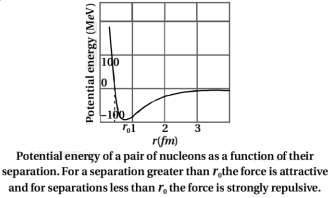
$(ii)$ The nuclear force between two nucleons falls rapidly to zero as their distance increases beyond a few femtometres $(fm)$. This leads to the saturation of forces in medium or large-sized nuclei,which is the reason for the constancy of the binding energy per nucleon.
$(iii)$ The force is attractive for distances greater than $r_0$ and strongly repulsive for distances less than $r_0$,where $r_0$ is approximately $0.8 \ fm$.
The Coulomb repulsive force between two protons acts at all distances,both small and large. However,nucleons are held tightly together in the tiny region of the nucleus.
This indicates that another attractive force must exist between nucleons in the nucleus,which is strong enough to overcome the Coulomb repulsive force and hold them together.
The force acting between two protons,two neutrons,or a proton and a neutron in a nucleus is called the nuclear (or strong) force.
The constancy of binding energy per nucleon can be understood in terms of the short-range nature of this force.
Following are the key features of the nuclear force determined from experiments conducted between $1930$ and $1950$:
$(i)$ The nuclear force is much stronger than the Coulomb force acting between charges or the gravitational force between masses. This is why it binds protons and neutrons together in the nucleus.
$(ii)$ The nuclear force between two nucleons falls rapidly to zero as their distance increases beyond a few femtometres $(fm)$. This leads to the saturation of forces in medium or large-sized nuclei,which is the reason for the constancy of the binding energy per nucleon.
$(iii)$ The force is attractive for distances greater than $r_0$ and strongly repulsive for distances less than $r_0$,where $r_0$ is approximately $0.8 \ fm$.
0 likes
View Solution156
EasyMCQ
What kind of force exists between two neutrons?
A
Gravitational force only
B
Electrostatic force only
C
Nuclear force and gravitational force
D
Electrostatic force and nuclear force
Solution
(C) The force between two neutrons is primarily the strong nuclear force,which is attractive at short distances $(< 10^{-15} \ m)$.
Additionally,there is a gravitational force between them due to their masses,although it is extremely weak compared to the nuclear force.
Since neutrons are electrically neutral,there is no electrostatic force between them.
Therefore,the forces acting between two neutrons are the nuclear force and the gravitational force.
Additionally,there is a gravitational force between them due to their masses,although it is extremely weak compared to the nuclear force.
Since neutrons are electrically neutral,there is no electrostatic force between them.
Therefore,the forces acting between two neutrons are the nuclear force and the gravitational force.
0 likes
View Solution157
Easy
Define nuclear force.
Solution
(N/A) The nuclear force is the strong attractive force that acts between nucleons (protons and neutrons) within the nucleus of an atom.
It is responsible for binding the nucleons together to form a stable nucleus,overcoming the electrostatic repulsion between positively charged protons.
Key characteristics include:
$1$. It is a short-range force,effective only up to a distance of about $1-2 \ fm$ $(1 \ fm = 10^{-15} \ m)$.
$2$. It is much stronger than the electromagnetic force and gravitational force.
$3$. It is charge-independent,meaning it acts equally between proton-proton,neutron-neutron,and proton-neutron pairs.
It is responsible for binding the nucleons together to form a stable nucleus,overcoming the electrostatic repulsion between positively charged protons.
Key characteristics include:
$1$. It is a short-range force,effective only up to a distance of about $1-2 \ fm$ $(1 \ fm = 10^{-15} \ m)$.
$2$. It is much stronger than the electromagnetic force and gravitational force.
$3$. It is charge-independent,meaning it acts equally between proton-proton,neutron-neutron,and proton-neutron pairs.
0 likes
View Solution158
EasyMCQ
Is nuclear force short range or long range?
A
Short range
B
Long range
C
Both short and long range
D
None of the above
Solution
(A) The nuclear force is a strong attractive force that acts between nucleons (protons and neutrons) within the nucleus.
It is a short-range force,meaning it only acts over very small distances,typically on the order of $10^{-15} \ m$ (or $1 \ fm$).
Beyond this range,the force drops to zero very rapidly,which is why it does not influence the structure of the atom as a whole,unlike the electromagnetic or gravitational forces.
It is a short-range force,meaning it only acts over very small distances,typically on the order of $10^{-15} \ m$ (or $1 \ fm$).
Beyond this range,the force drops to zero very rapidly,which is why it does not influence the structure of the atom as a whole,unlike the electromagnetic or gravitational forces.
0 likes
View Solution159
EasyMCQ
At what distance does the minimum value of potential energy be obtained between the nucleons (in $fm$)?
A
$0.8$
B
$1.5$
C
$2.5$
D
$3.0$
Solution
(A) The nuclear potential energy between two nucleons depends on their separation distance $r$.
According to the nuclear force model,the potential energy is highly attractive at short distances and becomes repulsive at very short distances due to the Pauli exclusion principle and hard-core repulsion.
The potential energy curve reaches its minimum value at a distance of approximately $0.8 \ fm$.
This distance corresponds to the equilibrium position where the net force between the nucleons is zero.
According to the nuclear force model,the potential energy is highly attractive at short distances and becomes repulsive at very short distances due to the Pauli exclusion principle and hard-core repulsion.
The potential energy curve reaches its minimum value at a distance of approximately $0.8 \ fm$.
This distance corresponds to the equilibrium position where the net force between the nucleons is zero.
0 likes
View Solution160
Easy
Why is radioactivity considered a nuclear phenomenon?
Solution
(N/A) Radioactivity is considered a nuclear phenomenon because it involves the spontaneous disintegration of an unstable atomic nucleus.
$1$. The process originates from within the nucleus,where the ratio of neutrons to protons is not optimal for stability.
$2$. The emission of alpha particles,beta particles,or gamma rays occurs due to the rearrangement of nucleons (protons and neutrons) inside the nucleus to reach a more stable state.
$3$. External factors such as temperature,pressure,chemical state,or electromagnetic fields do not affect the rate of radioactive decay,proving that the process is independent of the electronic structure of the atom and is entirely confined to the nucleus.
$1$. The process originates from within the nucleus,where the ratio of neutrons to protons is not optimal for stability.
$2$. The emission of alpha particles,beta particles,or gamma rays occurs due to the rearrangement of nucleons (protons and neutrons) inside the nucleus to reach a more stable state.
$3$. External factors such as temperature,pressure,chemical state,or electromagnetic fields do not affect the rate of radioactive decay,proving that the process is independent of the electronic structure of the atom and is entirely confined to the nucleus.
0 likes
View Solution161
Medium
Why do stable nuclei never have more protons than neutrons?
Solution
(N/A) The stability of a nucleus is determined by the balance between the attractive nuclear force and the repulsive electrostatic force. The nuclear force acts only between nucleons (protons and neutrons) over a very short range. If the number of protons significantly exceeds the number of neutrons,the long-range electrostatic repulsive force between the protons becomes stronger than the short-range attractive nuclear force. Consequently,the nucleus becomes unstable and tends to undergo radioactive decay to achieve a more stable configuration.
0 likes
View Solution162
Medium
Are the nucleons fundamental particles,or do they consist of still smaller parts? One way to find out is to probe a nucleon just as Rutherford probed an atom. What should be the kinetic energy of an electron for it to be able to probe a nucleon? Assume the diameter of a nucleon to be approximately $10^{-15} \ m$.
Solution
(N/A) Nucleons are not fundamental particles; they are composed of smaller particles called quarks. $A$ proton consists of $2$ up quarks and $1$ down quark $(uud)$,while a neutron consists of $1$ up quark and $2$ down quarks $(udd)$.
To probe a nucleon,the wavelength $\lambda$ of the incident electron must be less than or equal to the diameter $d$ of the nucleon $(d = 10^{-15} \ m)$.
Using the de Broglie relation,$\lambda = h/p$. For high-energy electrons,the kinetic energy $K$ is approximately equal to the total energy $E = pc$ (since the rest mass energy is negligible).
Thus,$K = pc = hc/\lambda$.
Setting $\lambda = d = 10^{-15} \ m$:
$K = \frac{(6.625 \times 10^{-34} \ J \cdot s) \times (3 \times 10^8 \ m/s)}{10^{-15} \ m} = 1.9875 \times 10^{-10} \ J$.
Converting to electron volts:
$K = \frac{1.9875 \times 10^{-10} \ J}{1.6 \times 10^{-19} \ J/eV} \approx 1.242 \times 10^9 \ eV = 1.242 \ GeV$.
Therefore,the electron must have a kinetic energy of at least $1.242 \ GeV$ to probe the internal structure of a nucleon.
To probe a nucleon,the wavelength $\lambda$ of the incident electron must be less than or equal to the diameter $d$ of the nucleon $(d = 10^{-15} \ m)$.
Using the de Broglie relation,$\lambda = h/p$. For high-energy electrons,the kinetic energy $K$ is approximately equal to the total energy $E = pc$ (since the rest mass energy is negligible).
Thus,$K = pc = hc/\lambda$.
Setting $\lambda = d = 10^{-15} \ m$:
$K = \frac{(6.625 \times 10^{-34} \ J \cdot s) \times (3 \times 10^8 \ m/s)}{10^{-15} \ m} = 1.9875 \times 10^{-10} \ J$.
Converting to electron volts:
$K = \frac{1.9875 \times 10^{-10} \ J}{1.6 \times 10^{-19} \ J/eV} \approx 1.242 \times 10^9 \ eV = 1.242 \ GeV$.
Therefore,the electron must have a kinetic energy of at least $1.242 \ GeV$ to probe the internal structure of a nucleon.
0 likes
View Solution163
Medium
Nuclei with magic numbers of protons $Z = 2, 8, 20, 28, 50, 82$ and magic numbers of neutrons $N = 2, 8, 20, 28, 50, 82, 126$ are found to be very stable.
$(i)$ Verify this by calculating the proton separation energy $S_p$ for $^{120}Sn$ $(Z = 50)$ and $^{121}Sb$ $(Z = 51)$. The proton separation energy for a nuclide is the minimum energy required to separate the least tightly bound proton from a nucleus of that nuclide. It is given by $S_p = (M_{Z-1, N} + M_H - M_{Z, N})c^2$. Given:
$^{119}In = 118.9058 \ u, ^{120}Sn = 119.902199 \ u, ^{121}Sb = 120.903824 \ u, ^1H = 1.0078252 \ u$
$(ii)$ What does the existence of magic numbers indicate?
$(i)$ Verify this by calculating the proton separation energy $S_p$ for $^{120}Sn$ $(Z = 50)$ and $^{121}Sb$ $(Z = 51)$. The proton separation energy for a nuclide is the minimum energy required to separate the least tightly bound proton from a nucleus of that nuclide. It is given by $S_p = (M_{Z-1, N} + M_H - M_{Z, N})c^2$. Given:
$^{119}In = 118.9058 \ u, ^{120}Sn = 119.902199 \ u, ^{121}Sb = 120.903824 \ u, ^1H = 1.0078252 \ u$
$(ii)$ What does the existence of magic numbers indicate?
Solution
(N/A) $(i)$ For $^{120}Sn$:
$S_p = [m(^{119}In) + m(^1H) - m(^{120}Sn)]c^2$
$S_p = (118.9058 + 1.0078252 - 119.902199) \times 931.5 \ MeV/u \approx 10.64 \ MeV$
For $^{121}Sb$:
$S_p = [m(^{120}Sn) + m(^1H) - m(^{121}Sb)]c^2$
$S_p = (119.902199 + 1.0078252 - 120.903824) \times 931.5 \ MeV/u \approx 5.77 \ MeV$
Conclusion: Since $(S_p)_{Sn} > (S_p)_{Sb}$,$^{120}Sn$ is more stable because $Z=50$ is a magic number.
$(ii)$ The existence of magic numbers indicates that nucleons (protons and neutrons) in a nucleus are arranged in a shell structure,similar to the shell structure of electrons in an atom. It also explains the peaks in the binding energy per nucleon curve.
$S_p = [m(^{119}In) + m(^1H) - m(^{120}Sn)]c^2$
$S_p = (118.9058 + 1.0078252 - 119.902199) \times 931.5 \ MeV/u \approx 10.64 \ MeV$
For $^{121}Sb$:
$S_p = [m(^{120}Sn) + m(^1H) - m(^{121}Sb)]c^2$
$S_p = (119.902199 + 1.0078252 - 120.903824) \times 931.5 \ MeV/u \approx 5.77 \ MeV$
Conclusion: Since $(S_p)_{Sn} > (S_p)_{Sb}$,$^{120}Sn$ is more stable because $Z=50$ is a magic number.
$(ii)$ The existence of magic numbers indicates that nucleons (protons and neutrons) in a nucleus are arranged in a shell structure,similar to the shell structure of electrons in an atom. It also explains the peaks in the binding energy per nucleon curve.
0 likes
View Solution164
EasyMCQ
The radius of an atom is of the order of $1\,\mathring{A}$ and the radius of a nucleus is of the order of $1$ fermi. How many magnitudes higher is the volume of the atom as compared to the volume of the nucleus?
A
$10^{10}$
B
$10^{15}$
C
$10^{5}$
D
$10^{20}$
Solution
(B) Radius of atom $R_{1} = 1\,\mathring{A} = 10^{-10}\,\text{m}$.
Radius of nucleus $R_{2} = 1\,\text{fermi} = 10^{-15}\,\text{m}$.
Volume of atom $V_{1} = \frac{4}{3} \pi R_{1}^{3}$.
Volume of nucleus $V_{2} = \frac{4}{3} \pi R_{2}^{3}$.
The ratio of the volumes is given by $\frac{V_{1}}{V_{2}} = \frac{\frac{4}{3} \pi R_{1}^{3}}{\frac{4}{3} \pi R_{2}^{3}} = \left(\frac{R_{1}}{R_{2}}\right)^{3}$.
Substituting the values: $\frac{V_{1}}{V_{2}} = \left(\frac{10^{-10}}{10^{-15}}\right)^{3} = (10^{5})^{3} = 10^{15}$.
Thus,the volume of the atom is $10^{15}$ times larger than the volume of the nucleus.
Radius of nucleus $R_{2} = 1\,\text{fermi} = 10^{-15}\,\text{m}$.
Volume of atom $V_{1} = \frac{4}{3} \pi R_{1}^{3}$.
Volume of nucleus $V_{2} = \frac{4}{3} \pi R_{2}^{3}$.
The ratio of the volumes is given by $\frac{V_{1}}{V_{2}} = \frac{\frac{4}{3} \pi R_{1}^{3}}{\frac{4}{3} \pi R_{2}^{3}} = \left(\frac{R_{1}}{R_{2}}\right)^{3}$.
Substituting the values: $\frac{V_{1}}{V_{2}} = \left(\frac{10^{-10}}{10^{-15}}\right)^{3} = (10^{5})^{3} = 10^{15}$.
Thus,the volume of the atom is $10^{15}$ times larger than the volume of the nucleus.
0 likes
View Solution165
EasyMCQ
Express unified atomic mass unit $(amu)$ in $kg$.
A
$1.66 \times 10^{-27} \ kg$
B
$1.66 \times 10^{-24} \ kg$
C
$1.66 \times 10^{-31} \ kg$
D
$1.66 \times 10^{-20} \ kg$
Solution
(A) One atomic mass unit $(amu)$ is defined as $\frac{1}{12}$ of the mass of a ${ }_{6} C^{12}$ atom.
Mass of one mole of ${ }_{6} C^{12}$ atoms $= 12 \ g = 12 \times 10^{-3} \ kg$.
Number of atoms in one mole is given by Avogadro's number,$N_A = 6.022 \times 10^{23} \ atoms/mol$.
Mass of one ${ }_{6} C^{12}$ atom $= \frac{12 \times 10^{-3} \ kg}{6.022 \times 10^{23}} \approx 1.9926 \times 10^{-26} \ kg$.
$1 \ amu = \frac{1}{12} \times (\text{mass of one } { }_{6} C^{12} \text{ atom})$.
$1 \ amu = \frac{1}{12} \times \frac{12 \times 10^{-3} \ kg}{6.022 \times 10^{23}} = \frac{10^{-3}}{6.022 \times 10^{23}} \ kg$.
$1 \ amu \approx 1.66 \times 10^{-27} \ kg$.
Mass of one mole of ${ }_{6} C^{12}$ atoms $= 12 \ g = 12 \times 10^{-3} \ kg$.
Number of atoms in one mole is given by Avogadro's number,$N_A = 6.022 \times 10^{23} \ atoms/mol$.
Mass of one ${ }_{6} C^{12}$ atom $= \frac{12 \times 10^{-3} \ kg}{6.022 \times 10^{23}} \approx 1.9926 \times 10^{-26} \ kg$.
$1 \ amu = \frac{1}{12} \times (\text{mass of one } { }_{6} C^{12} \text{ atom})$.
$1 \ amu = \frac{1}{12} \times \frac{12 \times 10^{-3} \ kg}{6.022 \times 10^{23}} = \frac{10^{-3}}{6.022 \times 10^{23}} \ kg$.
$1 \ amu \approx 1.66 \times 10^{-27} \ kg$.
0 likes
View Solution166
Medium
Give one example each of central force and non-central force.
Solution
(N/A) central force is a force that acts along the line joining the centers of two objects. Example: Gravitational force between two masses or electrostatic force between two point charges.
$A$ non-central force is a force that does not act along the line joining the centers of two objects. Example: Nuclear force or the magnetic force between two current-carrying loops.
$A$ non-central force is a force that does not act along the line joining the centers of two objects. Example: Nuclear force or the magnetic force between two current-carrying loops.
0 likes
View Solution167
MediumMCQ
The radius $R$ of a nucleus of mass number $A$ can be estimated by the formula $R = (1.3 \times 10^{-15}) A^{1/3} \; m$. It follows that the mass density of a nucleus is of the order of $(M_{\text{prot}} \cong M_{\text{neut}} = 1.67 \times 10^{-27} \; kg)$.
A
$10^{24} \; kg \; m^{-3}$
B
$10^{3} \; kg \; m^{-3}$
C
$10^{17} \; kg \; m^{-3}$
D
$10^{10} \; kg \; m^{-3}$
Solution
(C) The mass of a nucleus is approximately $M = A \times M_{\text{nucleon}}$,where $M_{\text{nucleon}} \cong 1.67 \times 10^{-27} \; kg$.
The volume of the nucleus is $V = \frac{4}{3} \pi R^3$.
Substituting $R = R_0 A^{1/3}$ where $R_0 = 1.3 \times 10^{-15} \; m$,we get $V = \frac{4}{3} \pi (R_0 A^{1/3})^3 = \frac{4}{3} \pi R_0^3 A$.
The density $\rho$ is given by $\rho = \frac{M}{V} = \frac{A \times M_{\text{nucleon}}}{\frac{4}{3} \pi R_0^3 A} = \frac{M_{\text{nucleon}}}{\frac{4}{3} \pi R_0^3}$.
Substituting the values: $\rho = \frac{1.67 \times 10^{-27}}{\frac{4}{3} \times 3.14 \times (1.3 \times 10^{-15})^3} \cong \frac{1.67 \times 10^{-27}}{4.186 \times 2.197 \times 10^{-45}} \cong 1.8 \times 10^{17} \; kg \; m^{-3}$.
Thus,the order of magnitude is $10^{17} \; kg \; m^{-3}$.
The volume of the nucleus is $V = \frac{4}{3} \pi R^3$.
Substituting $R = R_0 A^{1/3}$ where $R_0 = 1.3 \times 10^{-15} \; m$,we get $V = \frac{4}{3} \pi (R_0 A^{1/3})^3 = \frac{4}{3} \pi R_0^3 A$.
The density $\rho$ is given by $\rho = \frac{M}{V} = \frac{A \times M_{\text{nucleon}}}{\frac{4}{3} \pi R_0^3 A} = \frac{M_{\text{nucleon}}}{\frac{4}{3} \pi R_0^3}$.
Substituting the values: $\rho = \frac{1.67 \times 10^{-27}}{\frac{4}{3} \times 3.14 \times (1.3 \times 10^{-15})^3} \cong \frac{1.67 \times 10^{-27}}{4.186 \times 2.197 \times 10^{-45}} \cong 1.8 \times 10^{17} \; kg \; m^{-3}$.
Thus,the order of magnitude is $10^{17} \; kg \; m^{-3}$.
0 likes
View Solution168
MediumMCQ
$A$ nucleus of mass number $189$ splits into two nuclei having mass numbers $125$ and $64$. The ratio of the radii of the two daughter nuclei is:
A
$4: 5$
B
$5: 4$
C
$25: 16$
D
$1: 1$
Solution
(B) The radius $R$ of a nucleus with mass number $A$ is given by the formula: $R = R_{0} A^{1/3}$, where $R_{0}$ is a constant.
For the two daughter nuclei with mass numbers $A_{1} = 125$ and $A_{2} = 64$, their radii $R_{1}$ and $R_{2}$ are:
$R_{1} = R_{0} (125)^{1/3} = R_{0} \times 5$
$R_{2} = R_{0} (64)^{1/3} = R_{0} \times 4$
The ratio of the radii is:
$\frac{R_{1}}{R_{2}} = \frac{R_{0} (125)^{1/3}}{R_{0} (64)^{1/3}} = \frac{5}{4}$
Thus, the ratio is $5: 4$.
For the two daughter nuclei with mass numbers $A_{1} = 125$ and $A_{2} = 64$, their radii $R_{1}$ and $R_{2}$ are:
$R_{1} = R_{0} (125)^{1/3} = R_{0} \times 5$
$R_{2} = R_{0} (64)^{1/3} = R_{0} \times 4$
The ratio of the radii is:
$\frac{R_{1}}{R_{2}} = \frac{R_{0} (125)^{1/3}}{R_{0} (64)^{1/3}} = \frac{5}{4}$
Thus, the ratio is $5: 4$.
0 likes
View Solution169
MediumMCQ
Which of the following figures represents the variation of $\ln \left(\frac{R}{R_{0}}\right)$ with $\ln A$ (where $R =$ radius of a nucleus and $A =$ its mass number)?
A
B
C
D
Solution
(B) The radius of a nucleus is given by the relation: $R = R_{0} A^{1/3}$,where $R_{0}$ is a constant and $A$ is the mass number.
Taking the natural logarithm on both sides:
$\ln \left(\frac{R}{R_{0}}\right) = \ln (A^{1/3})$
Using the logarithmic property $\ln(x^n) = n \ln(x)$,we get:
$\ln \left(\frac{R}{R_{0}}\right) = \frac{1}{3} \ln A$
This equation is of the form $y = mx$,which represents a straight line passing through the origin with a slope of $1/3$.
Therefore,the graph of $\ln \left(\frac{R}{R_{0}}\right)$ versus $\ln A$ is a straight line.
Taking the natural logarithm on both sides:
$\ln \left(\frac{R}{R_{0}}\right) = \ln (A^{1/3})$
Using the logarithmic property $\ln(x^n) = n \ln(x)$,we get:
$\ln \left(\frac{R}{R_{0}}\right) = \frac{1}{3} \ln A$
This equation is of the form $y = mx$,which represents a straight line passing through the origin with a slope of $1/3$.
Therefore,the graph of $\ln \left(\frac{R}{R_{0}}\right)$ versus $\ln A$ is a straight line.

0 likes
View Solution170
MediumMCQ
Mass numbers of two nuclei are in the ratio of $4: 3$. Their nuclear densities will be in the ratio of
A
$4: 3$
B
$\left(\frac{3}{4}\right)^{\frac{1}{3}}$
C
$1: 1$
D
$\left(\frac{4}{3}\right)^{\frac{1}{3}}$
Solution
(C) The radius of a nucleus is given by $R = R_{0} A^{\frac{1}{3}}$,where $A$ is the mass number and $R_{0}$ is a constant.
The density of a nucleus $\rho$ is defined as the ratio of the mass of the nucleus to its volume.
$\rho = \frac{\text{Mass of nucleus}}{\text{Volume of nucleus}} = \frac{m \times A}{\frac{4}{3} \pi R^{3}}$,where $m$ is the average mass of a nucleon (proton or neutron).
Substituting the expression for $R$:
$\rho = \frac{m \times A}{\frac{4}{3} \pi (R_{0} A^{\frac{1}{3}})^{3}} = \frac{m \times A}{\frac{4}{3} \pi R_{0}^{3} A}$.
Simplifying the expression,the $A$ terms cancel out:
$\rho = \frac{m}{\frac{4}{3} \pi R_{0}^{3}}$.
Since $\rho$ is independent of the mass number $A$,the nuclear density is constant for all nuclei.
Therefore,the ratio of the nuclear densities of two nuclei is $1: 1$.
The density of a nucleus $\rho$ is defined as the ratio of the mass of the nucleus to its volume.
$\rho = \frac{\text{Mass of nucleus}}{\text{Volume of nucleus}} = \frac{m \times A}{\frac{4}{3} \pi R^{3}}$,where $m$ is the average mass of a nucleon (proton or neutron).
Substituting the expression for $R$:
$\rho = \frac{m \times A}{\frac{4}{3} \pi (R_{0} A^{\frac{1}{3}})^{3}} = \frac{m \times A}{\frac{4}{3} \pi R_{0}^{3} A}$.
Simplifying the expression,the $A$ terms cancel out:
$\rho = \frac{m}{\frac{4}{3} \pi R_{0}^{3}}$.
Since $\rho$ is independent of the mass number $A$,the nuclear density is constant for all nuclei.
Therefore,the ratio of the nuclear densities of two nuclei is $1: 1$.
0 likes
View Solution171
MediumMCQ
Read the following statements:
$(A)$ Volume of the nucleus is directly proportional to the mass number.
$(B)$ Volume of the nucleus is independent of mass number.
$(C)$ Density of the nucleus is directly proportional to the mass number.
$(D)$ Density of the nucleus is directly proportional to the cube root of the mass number.
$(E)$ Density of the nucleus is independent of the mass number.
Choose the correct option from the following options.
$(A)$ Volume of the nucleus is directly proportional to the mass number.
$(B)$ Volume of the nucleus is independent of mass number.
$(C)$ Density of the nucleus is directly proportional to the mass number.
$(D)$ Density of the nucleus is directly proportional to the cube root of the mass number.
$(E)$ Density of the nucleus is independent of the mass number.
Choose the correct option from the following options.
A
$(A)$ and $(D)$ only.
B
$(A)$ and $(E)$ only.
C
$(B)$ and $(E)$ only.
D
$(A)$ and $(C)$ only.
Solution
(B) The radius of a nucleus is given by $R = R_0 A^{1/3}$,where $A$ is the mass number.
The volume $V$ of the nucleus is given by $V = \frac{4}{3} \pi R^3 = \frac{4}{3} \pi (R_0 A^{1/3})^3 = \frac{4}{3} \pi R_0^3 A$.
Since $\frac{4}{3} \pi R_0^3$ is a constant,the volume $V$ is directly proportional to the mass number $A$. Thus,statement $(A)$ is correct.
The density $\rho$ of the nucleus is given by $\rho = \frac{\text{Mass}}{\text{Volume}} = \frac{m A}{V}$,where $m$ is the average mass of a nucleon.
Substituting $V \propto A$,we get $\rho = \frac{m A}{k A} = \frac{m}{k}$,where $k$ is a constant.
Since $\rho$ is a constant,the density of the nucleus is independent of the mass number $A$. Thus,statement $(E)$ is correct.
Therefore,statements $(A)$ and $(E)$ are correct.
The volume $V$ of the nucleus is given by $V = \frac{4}{3} \pi R^3 = \frac{4}{3} \pi (R_0 A^{1/3})^3 = \frac{4}{3} \pi R_0^3 A$.
Since $\frac{4}{3} \pi R_0^3$ is a constant,the volume $V$ is directly proportional to the mass number $A$. Thus,statement $(A)$ is correct.
The density $\rho$ of the nucleus is given by $\rho = \frac{\text{Mass}}{\text{Volume}} = \frac{m A}{V}$,where $m$ is the average mass of a nucleon.
Substituting $V \propto A$,we get $\rho = \frac{m A}{k A} = \frac{m}{k}$,where $k$ is a constant.
Since $\rho$ is a constant,the density of the nucleus is independent of the mass number $A$. Thus,statement $(E)$ is correct.
Therefore,statements $(A)$ and $(E)$ are correct.
0 likes
View Solution172
MediumMCQ
Consider the following nuclear reactions:
$I$. ${ }_{7}^{14} N +{ }_{2}^{4} He \longrightarrow{ }_{8}^{17} O + X$
$II$. ${ }_{4}^{9} Be +{ }_{2}^{4} He \longrightarrow{ }_{6}^{12} C + Y$
Then,
$I$. ${ }_{7}^{14} N +{ }_{2}^{4} He \longrightarrow{ }_{8}^{17} O + X$
$II$. ${ }_{4}^{9} Be +{ }_{2}^{4} He \longrightarrow{ }_{6}^{12} C + Y$
Then,
A
$X$ and $Y$ are both protons
B
$X$ and $Y$ are both neutrons
C
$X$ is a proton and $Y$ is a neutron
D
$X$ is a neutron and $Y$ is a proton
Solution
(C) To find $X$ and $Y$,we apply the law of conservation of atomic number $(Z)$ and mass number $(A)$ to both reactions.
For reaction $I$: ${ }_{7}^{14} N +{ }_{2}^{4} He \longrightarrow{ }_{8}^{17} O + X$
Sum of $Z$: $7 + 2 = 8 + Z_X \implies Z_X = 1$
Sum of $A$: $14 + 4 = 17 + A_X \implies A_X = 1$
Thus,$X$ is ${ }_{1}^{1} H$ (a proton).
For reaction $II$: ${ }_{4}^{9} Be +{ }_{2}^{4} He \longrightarrow{ }_{6}^{12} C + Y$
Sum of $Z$: $4 + 2 = 6 + Z_Y \implies Z_Y = 0$
Sum of $A$: $9 + 4 = 12 + A_Y \implies A_Y = 1$
Thus,$Y$ is ${ }_{0}^{1} n$ (a neutron).
Therefore,$X$ is a proton and $Y$ is a neutron.
For reaction $I$: ${ }_{7}^{14} N +{ }_{2}^{4} He \longrightarrow{ }_{8}^{17} O + X$
Sum of $Z$: $7 + 2 = 8 + Z_X \implies Z_X = 1$
Sum of $A$: $14 + 4 = 17 + A_X \implies A_X = 1$
Thus,$X$ is ${ }_{1}^{1} H$ (a proton).
For reaction $II$: ${ }_{4}^{9} Be +{ }_{2}^{4} He \longrightarrow{ }_{6}^{12} C + Y$
Sum of $Z$: $4 + 2 = 6 + Z_Y \implies Z_Y = 0$
Sum of $A$: $9 + 4 = 12 + A_Y \implies A_Y = 1$
Thus,$Y$ is ${ }_{0}^{1} n$ (a neutron).
Therefore,$X$ is a proton and $Y$ is a neutron.
0 likes
View Solution173
AdvancedMCQ
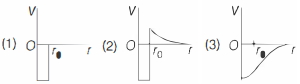
Given below are three schematic graphs of potential energy $V(r)$ versus distance $r$ for three atomic particles: electron $(e^{-})$,proton $(p^{+})$,and neutron $(n)$,in the presence of a nucleus at the origin $O$. The radius of the nucleus is $r_0$. The scale on the $V$-axis may not be the same for all figures. The correct pairing of each graph with the corresponding atomic particle is
A
$(1, n), (2, p^{+}), (3, e^{-})$
B
$(1, p^{+}), (2, e^{-}), (3, n)$
C
$(1, e^{-}), (2, p^{+}), (3, n)$
D
$(1, p^{+}), (2, n), (3, e^{-})$
Solution
(A) For an electron and nucleus pair,the potential energy is given by $V(r) = \frac{K(-e)(+Ze)}{r} = -\frac{KZe^2}{r}$.
Since the potential energy is negative and approaches zero as $r$ increases,graph $(3)$ represents the electron.
For a neutron,there is no electrostatic force outside the nucleus $(r > r_0)$. Thus,the potential energy is zero for $r > r_0$. Graph $(1)$ represents the neutron.
For a proton,the electrostatic force is repulsive for $r > r_0$ because both the nucleus and the proton are positively charged. Thus,the potential energy is positive and decreases as $r$ increases. Graph $(2)$ represents the proton.
Therefore,the correct pairing is $(1, n), (2, p^{+}), (3, e^{-})$,which corresponds to option $A$.
Since the potential energy is negative and approaches zero as $r$ increases,graph $(3)$ represents the electron.
For a neutron,there is no electrostatic force outside the nucleus $(r > r_0)$. Thus,the potential energy is zero for $r > r_0$. Graph $(1)$ represents the neutron.
For a proton,the electrostatic force is repulsive for $r > r_0$ because both the nucleus and the proton are positively charged. Thus,the potential energy is positive and decreases as $r$ increases. Graph $(2)$ represents the proton.
Therefore,the correct pairing is $(1, n), (2, p^{+}), (3, e^{-})$,which corresponds to option $A$.
0 likes
View Solution174
MediumMCQ
The nuclear radius is given by $R = r_0 A^{1/3}$,where $r_0$ is a constant and $A$ is the atomic mass number. Then,the nuclear mass density of $^{238}U$ is
A
twice that of $^{119}Sn$
B
thrice that of $^{119}Sn$
C
same as that of $^{119}Sn$
D
half that of $^{119}Sn$
Solution
(C) The nuclear radius is given by $R = r_0 A^{1/3}$.
The volume of the nucleus is $V = \frac{4}{3} \pi R^3 = \frac{4}{3} \pi (r_0 A^{1/3})^3 = \frac{4}{3} \pi r_0^3 A$.
The nuclear mass is approximately $M = A \times m_p$,where $m_p$ is the mass of a nucleon (proton or neutron).
The nuclear density $\rho$ is given by $\rho = \frac{M}{V} = \frac{A \cdot m_p}{\frac{4}{3} \pi r_0^3 A} = \frac{3 m_p}{4 \pi r_0^3}$.
Since $m_p$ and $r_0$ are constants,the nuclear density $\rho$ is independent of the mass number $A$.
Therefore,the nuclear mass density of $^{238}U$ is the same as that of $^{119}Sn$.
The volume of the nucleus is $V = \frac{4}{3} \pi R^3 = \frac{4}{3} \pi (r_0 A^{1/3})^3 = \frac{4}{3} \pi r_0^3 A$.
The nuclear mass is approximately $M = A \times m_p$,where $m_p$ is the mass of a nucleon (proton or neutron).
The nuclear density $\rho$ is given by $\rho = \frac{M}{V} = \frac{A \cdot m_p}{\frac{4}{3} \pi r_0^3 A} = \frac{3 m_p}{4 \pi r_0^3}$.
Since $m_p$ and $r_0$ are constants,the nuclear density $\rho$ is independent of the mass number $A$.
Therefore,the nuclear mass density of $^{238}U$ is the same as that of $^{119}Sn$.
0 likes
View Solution175
MediumMCQ
Consider the following statements ($X$ and $Y$ stand for two different elements):
$(I)$ ${ }_{32}^{65} X$ and ${ }_{33}^{65} Y$ are isotopes.
$(II)$ ${ }_{42}^{86} X$ and ${ }_{42}^{85} Y$ are isotopes.
$(III)$ ${ }_{85}^{174} X$ and ${ }_{88}^{177} Y$ have the same number of neutrons.
$(IV)$ ${ }_{92}^{235} X$ and ${ }_{94}^{235} Y$ are isobars.
Which of the above statements are correct?
$(I)$ ${ }_{32}^{65} X$ and ${ }_{33}^{65} Y$ are isotopes.
$(II)$ ${ }_{42}^{86} X$ and ${ }_{42}^{85} Y$ are isotopes.
$(III)$ ${ }_{85}^{174} X$ and ${ }_{88}^{177} Y$ have the same number of neutrons.
$(IV)$ ${ }_{92}^{235} X$ and ${ }_{94}^{235} Y$ are isobars.
Which of the above statements are correct?
A
Only statements $II$ and $IV$ are correct
B
Only statements $I, II$ and $IV$ are correct
C
Only statements $II, III$ and $IV$ are correct
D
All statements are correct
Solution
(C) For a nucleus,${ }_Z^A X$,the mass number is $A = N + Z$,where $N$ is the number of neutrons and $Z$ is the number of protons.
$(I)$ In ${ }_{32}^{65} X$ and ${ }_{33}^{65} Y$,the atomic numbers $(Z)$ are $32$ and $33$ respectively. Since $Z$ is different,they are not isotopes. This statement is incorrect.
$(II)$ In ${ }_{42}^{86} X$ and ${ }_{42}^{85} Y$,the atomic numbers $(Z)$ are both $42$. Since they have the same $Z$ but different mass numbers $(A)$,they are isotopes. This statement is correct.
$(III)$ For ${ }_{85}^{174} X$,$N = 174 - 85 = 89$. For ${ }_{88}^{177} Y$,$N = 177 - 88 = 89$. Since both have $89$ neutrons,this statement is correct.
$(IV)$ In ${ }_{92}^{235} X$ and ${ }_{94}^{235} Y$,both have the same mass number $(A = 235)$. Nuclei with the same mass number are called isobars. This statement is correct.
Therefore,statements $(II), (III),$ and $(IV)$ are correct.
$(I)$ In ${ }_{32}^{65} X$ and ${ }_{33}^{65} Y$,the atomic numbers $(Z)$ are $32$ and $33$ respectively. Since $Z$ is different,they are not isotopes. This statement is incorrect.
$(II)$ In ${ }_{42}^{86} X$ and ${ }_{42}^{85} Y$,the atomic numbers $(Z)$ are both $42$. Since they have the same $Z$ but different mass numbers $(A)$,they are isotopes. This statement is correct.
$(III)$ For ${ }_{85}^{174} X$,$N = 174 - 85 = 89$. For ${ }_{88}^{177} Y$,$N = 177 - 88 = 89$. Since both have $89$ neutrons,this statement is correct.
$(IV)$ In ${ }_{92}^{235} X$ and ${ }_{94}^{235} Y$,both have the same mass number $(A = 235)$. Nuclei with the same mass number are called isobars. This statement is correct.
Therefore,statements $(II), (III),$ and $(IV)$ are correct.
0 likes
View Solution176
AdvancedMCQ
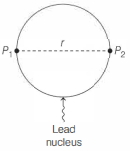
The radius of a nucleus is given by $r = r_0 A^{1/3}$,where $r_0 = 1.3 \times 10^{-15} \, m$ and $A$ is the mass number of the nucleus. The lead nucleus has $A = 206$. The electrostatic force between two protons at diametrically opposite points in this nucleus is approximately ................ $N$.
A
$10^2$
B
$10^7$
C
$10^{12}$
D
$10^{17}$
Solution
(A) The radius of the nucleus is $R = r_0 A^{1/3}$.
Given $r_0 = 1.3 \times 10^{-15} \, m$ and $A = 206$.
$R = 1.3 \times 10^{-15} \times (206)^{1/3} \approx 1.3 \times 10^{-15} \times 5.9 \approx 7.67 \times 10^{-15} \, m$.
The distance between two protons at diametrically opposite points is $d = 2R = 2 \times 7.67 \times 10^{-15} = 15.34 \times 10^{-15} \, m$.
The electrostatic force $F$ is given by Coulomb's law: $F = \frac{k e^2}{d^2}$.
$F = \frac{(9 \times 10^9) \times (1.6 \times 10^{-19})^2}{(15.34 \times 10^{-15})^2} \approx \frac{9 \times 10^9 \times 2.56 \times 10^{-38}}{235.3 \times 10^{-30}} \approx \frac{23.04 \times 10^{-29}}{235.3 \times 10^{-30}} \approx 0.0979 \times 10^1 \approx 1 \, N$.
Comparing this with the given options,the order of magnitude is $10^2 \, N$ (as the calculation often assumes $d=R$ in simplified textbook models,leading to $F \approx 10^2 \, N$). Thus,option $A$ is the correct choice.
Given $r_0 = 1.3 \times 10^{-15} \, m$ and $A = 206$.
$R = 1.3 \times 10^{-15} \times (206)^{1/3} \approx 1.3 \times 10^{-15} \times 5.9 \approx 7.67 \times 10^{-15} \, m$.
The distance between two protons at diametrically opposite points is $d = 2R = 2 \times 7.67 \times 10^{-15} = 15.34 \times 10^{-15} \, m$.
The electrostatic force $F$ is given by Coulomb's law: $F = \frac{k e^2}{d^2}$.
$F = \frac{(9 \times 10^9) \times (1.6 \times 10^{-19})^2}{(15.34 \times 10^{-15})^2} \approx \frac{9 \times 10^9 \times 2.56 \times 10^{-38}}{235.3 \times 10^{-30}} \approx \frac{23.04 \times 10^{-29}}{235.3 \times 10^{-30}} \approx 0.0979 \times 10^1 \approx 1 \, N$.
Comparing this with the given options,the order of magnitude is $10^2 \, N$ (as the calculation often assumes $d=R$ in simplified textbook models,leading to $F \approx 10^2 \, N$). Thus,option $A$ is the correct choice.
0 likes
View Solution177
MediumMCQ
Consider the following statements:
$I$. All isotopes of an element have the same number of neutrons.
$II$. Only one isotope of an element can be stable and non-radioactive.
$III$. All elements have isotopes.
$IV$. All isotopes of carbon can form chemical compounds with oxygen-$16$.
Choose the correct option regarding an isotope.
$I$. All isotopes of an element have the same number of neutrons.
$II$. Only one isotope of an element can be stable and non-radioactive.
$III$. All elements have isotopes.
$IV$. All isotopes of carbon can form chemical compounds with oxygen-$16$.
Choose the correct option regarding an isotope.
A
Statements $III$ and $IV$ are correct
B
Statements $II, III$ and $IV$ are correct
C
Statements $I, II$ and $III$ are correct
D
Statements $I, III$ and $IV$ are correct
Solution
(A) Statement $I$ is incorrect because isotopes of an element have the same number of protons but different numbers of neutrons.
Statement $II$ is incorrect because some elements have multiple stable isotopes (e.g.,oxygen has three stable isotopes: $^{16}O, ^{17}O, ^{18}O$).
Statement $III$ is correct because every element has isotopes,which are atoms with the same atomic number but different mass numbers.
Statement $IV$ is correct because isotopes of the same element exhibit identical chemical properties; therefore,all carbon isotopes $(^{12}C, ^{13}C, ^{14}C)$ can react with oxygen to form compounds like $CO_2$.
Thus,only statements $III$ and $IV$ are correct.
Statement $II$ is incorrect because some elements have multiple stable isotopes (e.g.,oxygen has three stable isotopes: $^{16}O, ^{17}O, ^{18}O$).
Statement $III$ is correct because every element has isotopes,which are atoms with the same atomic number but different mass numbers.
Statement $IV$ is correct because isotopes of the same element exhibit identical chemical properties; therefore,all carbon isotopes $(^{12}C, ^{13}C, ^{14}C)$ can react with oxygen to form compounds like $CO_2$.
Thus,only statements $III$ and $IV$ are correct.
0 likes
View Solution178
EasyMCQ
The ratio of the nuclear radii of ${}^{135}Cs$ to ${}^{40}Ca$ is:
A
$1.40$
B
$1.50$
C
$2.750$
D
$3.375$
Solution
(B) The nuclear radius $R$ is given by the formula $R = R_0 A^{1/3}$,where $R_0$ is a constant and $A$ is the mass number.
Therefore,the ratio of the radii is given by $\frac{R_{Cs}}{R_{Ca}} = \left( \frac{A_{Cs}}{A_{Ca}} \right)^{1/3}$.
Substituting the given mass numbers $A_{Cs} = 135$ and $A_{Ca} = 40$:
$\frac{R_{Cs}}{R_{Ca}} = \left( \frac{135}{40} \right)^{1/3}$.
Simplifying the fraction inside the bracket by dividing both numerator and denominator by $5$:
$\frac{135}{40} = \frac{27}{8}$.
Thus,$\frac{R_{Cs}}{R_{Ca}} = \left( \frac{27}{8} \right)^{1/3} = \frac{3}{2} = 1.50$.
Therefore,the ratio of the radii is given by $\frac{R_{Cs}}{R_{Ca}} = \left( \frac{A_{Cs}}{A_{Ca}} \right)^{1/3}$.
Substituting the given mass numbers $A_{Cs} = 135$ and $A_{Ca} = 40$:
$\frac{R_{Cs}}{R_{Ca}} = \left( \frac{135}{40} \right)^{1/3}$.
Simplifying the fraction inside the bracket by dividing both numerator and denominator by $5$:
$\frac{135}{40} = \frac{27}{8}$.
Thus,$\frac{R_{Cs}}{R_{Ca}} = \left( \frac{27}{8} \right)^{1/3} = \frac{3}{2} = 1.50$.
0 likes
View Solution179
EasyMCQ
The nuclear force between two nucleons is explained by
A
Quark exchange theory
B
Meson exchange theory
C
Photon exchange theory
D
Gravitation exchange theory
Solution
(B) The nuclear force between two nucleons is primarily explained by the $Meson$ exchange theory, originally proposed by $Hideki$ $Yukawa$ in $1935$. According to this theory, nucleons (protons and neutrons) interact by exchanging particles called mesons (specifically $\pi$-mesons or pions). These mesons act as the force carriers for the strong nuclear force, which binds the nucleons together within the nucleus.
0 likes
View Solution180
EasyMCQ
$A$ heavy nucleus is unstable for any value of $\frac{N}{P}$ because
A
Electrostatic repulsion dominates over nuclear attraction
B
Nuclear repulsion dominates over nuclear attraction
C
Nuclear forces are absent in heavy nucleus
D
Nuclear force is a long-range force
Solution
(A) The correct option is $A$.
In heavy nuclei,the number of protons is very large. Since protons are positively charged,they exert a strong electrostatic repulsive force on each other.
While the strong nuclear force is attractive,it is a short-range force that only acts between nearest neighbors.
As the size of the nucleus increases,the long-range electrostatic repulsion between all protons grows faster than the short-range nuclear attraction,eventually making the nucleus unstable.
In heavy nuclei,the number of protons is very large. Since protons are positively charged,they exert a strong electrostatic repulsive force on each other.
While the strong nuclear force is attractive,it is a short-range force that only acts between nearest neighbors.
As the size of the nucleus increases,the long-range electrostatic repulsion between all protons grows faster than the short-range nuclear attraction,eventually making the nucleus unstable.
0 likes
View Solution181
EasyMCQ
$A$ neutrino is a particle which:
A
Has no charge and no spin
B
Has no charge but has spin
C
Is charged like an electron and has spin
D
Has no charge but has mass nearly equal to that of a proton
Solution
(B) neutrino is an elementary particle that interacts only via the weak subatomic force and gravity. It is electrically neutral (has no charge). According to the Standard Model of particle physics,neutrinos are fermions with a spin of $1/2$. Therefore,a neutrino has no charge but possesses spin.
0 likes
View Solution182
EasyMCQ
In the equation ${ }_{13}^{27} Al + { }_2^4 He \longrightarrow { }_{15}^{30} P + X$,the correct symbol for $X$ is:
A
${ }_{-1}^0 e$
B
${ }_1^1 H$
C
${ }_2^4 He$
D
${ }_0^1 n$
Solution
(D) To find the identity of $X$,we apply the laws of conservation of mass number and atomic number.
Conservation of mass number $(A)$:
$27 + 4 = 30 + A_X$
$31 = 30 + A_X$
$A_X = 1$
Conservation of atomic number $(Z)$:
$13 + 2 = 15 + Z_X$
$15 = 15 + Z_X$
$Z_X = 0$
$A$ particle with mass number $1$ and atomic number $0$ is a neutron,denoted as ${ }_0^1 n$.
Conservation of mass number $(A)$:
$27 + 4 = 30 + A_X$
$31 = 30 + A_X$
$A_X = 1$
Conservation of atomic number $(Z)$:
$13 + 2 = 15 + Z_X$
$15 = 15 + Z_X$
$Z_X = 0$
$A$ particle with mass number $1$ and atomic number $0$ is a neutron,denoted as ${ }_0^1 n$.
0 likes
View Solution183
EasyMCQ
Choose the correct statement.
A
The nuclear force becomes strong if the nucleus contains too many protons compared to neutrons.
B
The nuclear force becomes strong if the nucleus contains too many neutrons compared to protons.
C
Nuclei with atomic number less than $82$ show a tendency to disintegrate.
D
The nuclear force becomes weak if the nucleus contains a large number of nucleons.
Solution
(D) The correct statement is $(d)$.
The nuclear force is a short-range force,meaning it only acts effectively between neighboring nucleons.
As the number of nucleons $(A)$ increases,the size of the nucleus increases.
Since the nuclear force does not act over long distances,the overall binding effect per nucleon decreases as the nucleus becomes very large,making it less stable.
Therefore,the nuclear force effectively becomes weak in terms of maintaining stability when the nucleus contains a very large number of nucleons.
The nuclear force is a short-range force,meaning it only acts effectively between neighboring nucleons.
As the number of nucleons $(A)$ increases,the size of the nucleus increases.
Since the nuclear force does not act over long distances,the overall binding effect per nucleon decreases as the nucleus becomes very large,making it less stable.
Therefore,the nuclear force effectively becomes weak in terms of maintaining stability when the nucleus contains a very large number of nucleons.
0 likes
View Solution184
EasyMCQ
Two spherical nuclei have mass numbers $216$ and $64$ with their radii $R_1$ and $R_2$ respectively. The ratio,$\frac{R_1}{R_2}$ is equal to
A
$3:2$
B
$1:3$
C
$1:2$
D
$2:3$
Solution
(A) The relation between the radius $(R)$ of a nucleus and its mass number $(A)$ is given by the formula $R = R_0 A^{1/3}$,where $R_0$ is an empirical constant.
Given the mass numbers $A_1 = 216$ and $A_2 = 64$,we can find the ratio of their radii as follows:
$\frac{R_1}{R_2} = \frac{R_0 A_1^{1/3}}{R_0 A_2^{1/3}} = \left( \frac{A_1}{A_2} \right)^{1/3}$
Substituting the given values:
$\frac{R_1}{R_2} = \left( \frac{216}{64} \right)^{1/3}$
Since $216 = 6^3$ and $64 = 4^3$:
$\frac{R_1}{R_2} = \left( \frac{6^3}{4^3} \right)^{1/3} = \frac{6}{4} = \frac{3}{2}$
Thus,the ratio $\frac{R_1}{R_2}$ is $3:2$.
Given the mass numbers $A_1 = 216$ and $A_2 = 64$,we can find the ratio of their radii as follows:
$\frac{R_1}{R_2} = \frac{R_0 A_1^{1/3}}{R_0 A_2^{1/3}} = \left( \frac{A_1}{A_2} \right)^{1/3}$
Substituting the given values:
$\frac{R_1}{R_2} = \left( \frac{216}{64} \right)^{1/3}$
Since $216 = 6^3$ and $64 = 4^3$:
$\frac{R_1}{R_2} = \left( \frac{6^3}{4^3} \right)^{1/3} = \frac{6}{4} = \frac{3}{2}$
Thus,the ratio $\frac{R_1}{R_2}$ is $3:2$.
0 likes
View Solution185
MediumMCQ
Assertion $(A):$ Forces acting between proton-proton $(f_{pp})$, proton-neutron $(f_{pn})$ and neutron-neutron $(f_{nn})$ are such that $f_{pp} < f_{pn} = f_{nn}$.
Reason $(R):$ Electrostatic force of repulsion between two protons reduces the net nuclear force between them.
Reason $(R):$ Electrostatic force of repulsion between two protons reduces the net nuclear force between them.
A
If both Assertion and Reason are true and Reason is the correct explanation of Assertion.
B
If both Assertion and Reason are true but Reason is not the correct explanation of Assertion.
C
If Assertion is true but Reason is false.
D
If both Assertion and Reason are false.
Solution
$(A)$ The nuclear force is charge-independent, meaning the strong nuclear force between any two nucleons (proton-proton, proton-neutron, or neutron-neutron) is approximately the same at a given distance.
However, in the case of two protons, there is an additional electrostatic force of repulsion acting between them due to their positive charges.
Since the nuclear force is attractive and the electrostatic force is repulsive, the net force between two protons is $f_{pp} = f_{\text{nuclear}} - f_{\text{electrostatic}}$.
For proton-neutron or neutron-neutron pairs, there is no electrostatic repulsion, so the net force is simply the attractive nuclear force $(f_{pn} = f_{nn} = f_{\text{nuclear}})$.
Therefore, $f_{pp} < f_{pn} = f_{nn}$.
Both the Assertion and the Reason are true, and the Reason correctly explains why the net force between protons is smaller.
However, in the case of two protons, there is an additional electrostatic force of repulsion acting between them due to their positive charges.
Since the nuclear force is attractive and the electrostatic force is repulsive, the net force between two protons is $f_{pp} = f_{\text{nuclear}} - f_{\text{electrostatic}}$.
For proton-neutron or neutron-neutron pairs, there is no electrostatic repulsion, so the net force is simply the attractive nuclear force $(f_{pn} = f_{nn} = f_{\text{nuclear}})$.
Therefore, $f_{pp} < f_{pn} = f_{nn}$.
Both the Assertion and the Reason are true, and the Reason correctly explains why the net force between protons is smaller.
0 likes
View Solution186
MediumMCQ
Assume that protons and neutrons have equal masses. The mass of a nucleon is $1.6 \times 10^{-27} \ kg$ and the radius of a nucleus is $R = 1.5 \times 10^{-15} A^{1/3} \ m$. The approximate ratio of the nuclear density to the water density is $n \times 10^{13}$. The value of $n$ is $.................$
A
$11$
B
$12$
C
$14$
D
$16$
Solution
(A) The density of a nucleus is given by $\rho = \frac{\text{Mass}}{\text{Volume}}$.
The mass of a nucleus with mass number $A$ is $M = A \times (1.6 \times 10^{-27} \ kg)$.
The volume of a nucleus is $V = \frac{4}{3} \pi R^3 = \frac{4}{3} \pi (1.5 \times 10^{-15} A^{1/3})^3 = \frac{4}{3} \pi (1.5)^3 \times 10^{-45} A \ m^3$.
Calculating the nuclear density: $\rho = \frac{1.6 \times 10^{-27} A}{\frac{4}{3} \times 3.14 \times 3.375 \times 10^{-45} A} = \frac{1.6 \times 10^{-27}}{14.137 \times 10^{-45}} \approx 0.11317 \times 10^{18} \ kg/m^3 = 1.1317 \times 10^{17} \ kg/m^3$.
The density of water is $\rho_w = 10^3 \ kg/m^3$.
The ratio is $\frac{\rho}{\rho_w} = \frac{1.1317 \times 10^{17}}{10^3} = 1.1317 \times 10^{14} = 11.317 \times 10^{13}$.
Comparing this with $n \times 10^{13}$,we get $n \approx 11$.
The mass of a nucleus with mass number $A$ is $M = A \times (1.6 \times 10^{-27} \ kg)$.
The volume of a nucleus is $V = \frac{4}{3} \pi R^3 = \frac{4}{3} \pi (1.5 \times 10^{-15} A^{1/3})^3 = \frac{4}{3} \pi (1.5)^3 \times 10^{-45} A \ m^3$.
Calculating the nuclear density: $\rho = \frac{1.6 \times 10^{-27} A}{\frac{4}{3} \times 3.14 \times 3.375 \times 10^{-45} A} = \frac{1.6 \times 10^{-27}}{14.137 \times 10^{-45}} \approx 0.11317 \times 10^{18} \ kg/m^3 = 1.1317 \times 10^{17} \ kg/m^3$.
The density of water is $\rho_w = 10^3 \ kg/m^3$.
The ratio is $\frac{\rho}{\rho_w} = \frac{1.1317 \times 10^{17}}{10^3} = 1.1317 \times 10^{14} = 11.317 \times 10^{13}$.
Comparing this with $n \times 10^{13}$,we get $n \approx 11$.
0 likes
View Solution187
MediumMCQ
The ratio of the density of oxygen nucleus $\left({ }_{8}^{16} O \right)$ and helium nucleus $\left({ }_{2}^{4} He \right)$ is (in $:1$)
A
$4$
B
$8$
C
$1$
D
$2$
Solution
(C) The nuclear density is defined as the ratio of the mass of the nucleus to its volume.
Let $A$ be the mass number and $R$ be the radius of the nucleus.
The radius of a nucleus is given by $R = R_0 A^{1/3}$,where $R_0$ is a constant.
The volume of the nucleus is $V = \frac{4}{3} \pi R^3 = \frac{4}{3} \pi (R_0 A^{1/3})^3 = \frac{4}{3} \pi R_0^3 A$.
The mass of the nucleus is approximately $M = A \cdot u$,where $u$ is the atomic mass unit.
Therefore,the nuclear density $\rho = \frac{M}{V} = \frac{A \cdot u}{\frac{4}{3} \pi R_0^3 A} = \frac{3u}{4 \pi R_0^3}$.
Since the expression for nuclear density depends only on constants ($u$ and $R_0$),it is independent of the mass number $A$.
Thus,the density of all nuclei is the same.
Therefore,the ratio of the density of oxygen nucleus to helium nucleus is $1:1$.
Let $A$ be the mass number and $R$ be the radius of the nucleus.
The radius of a nucleus is given by $R = R_0 A^{1/3}$,where $R_0$ is a constant.
The volume of the nucleus is $V = \frac{4}{3} \pi R^3 = \frac{4}{3} \pi (R_0 A^{1/3})^3 = \frac{4}{3} \pi R_0^3 A$.
The mass of the nucleus is approximately $M = A \cdot u$,where $u$ is the atomic mass unit.
Therefore,the nuclear density $\rho = \frac{M}{V} = \frac{A \cdot u}{\frac{4}{3} \pi R_0^3 A} = \frac{3u}{4 \pi R_0^3}$.
Since the expression for nuclear density depends only on constants ($u$ and $R_0$),it is independent of the mass number $A$.
Thus,the density of all nuclei is the same.
Therefore,the ratio of the density of oxygen nucleus to helium nucleus is $1:1$.
0 likes
View Solution188
MediumMCQ
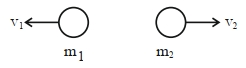
$A$ nucleus disintegrates into two smaller parts,which have their velocities in the ratio $3: 2$. The ratio of their nuclear sizes will be $\left(\frac{x}{3}\right)^{\frac{1}{3}}$. The value of '$x$' is:
A
$1$
B
$2$
C
$3$
D
$4$
Solution
(B) Given the ratio of velocities is $\frac{v_1}{v_2} = \frac{3}{2}$.
According to the law of conservation of linear momentum,$m_1 v_1 = m_2 v_2$. Therefore,the ratio of their masses is $\frac{m_1}{m_2} = \frac{v_2}{v_1} = \frac{2}{3}$.
Since the nuclear mass density is constant,the mass of a nucleus is proportional to its volume,i.e.,$m \propto r^3$,where $r$ is the nuclear radius.
Thus,$\frac{m_1}{m_2} = \left(\frac{r_1}{r_2}\right)^3$.
Substituting the mass ratio: $\left(\frac{r_1}{r_2}\right)^3 = \frac{2}{3}$.
Taking the cube root on both sides: $\frac{r_1}{r_2} = \left(\frac{2}{3}\right)^{\frac{1}{3}}$.
Comparing this with the given expression $\left(\frac{x}{3}\right)^{\frac{1}{3}}$,we get $x = 2$.
According to the law of conservation of linear momentum,$m_1 v_1 = m_2 v_2$. Therefore,the ratio of their masses is $\frac{m_1}{m_2} = \frac{v_2}{v_1} = \frac{2}{3}$.
Since the nuclear mass density is constant,the mass of a nucleus is proportional to its volume,i.e.,$m \propto r^3$,where $r$ is the nuclear radius.
Thus,$\frac{m_1}{m_2} = \left(\frac{r_1}{r_2}\right)^3$.
Substituting the mass ratio: $\left(\frac{r_1}{r_2}\right)^3 = \frac{2}{3}$.
Taking the cube root on both sides: $\frac{r_1}{r_2} = \left(\frac{2}{3}\right)^{\frac{1}{3}}$.
Comparing this with the given expression $\left(\frac{x}{3}\right)^{\frac{1}{3}}$,we get $x = 2$.
0 likes
View Solution189
MediumMCQ
Given below are two statements: one is labelled as Assertion $A$ and the other is labelled as Reason $R$.
Assertion $A$: The nuclear density of nuclides ${ }_{5}^{10} B, { }_{3}^{6} Li, { }_{26}^{56} Fe, { }_{10}^{20} Ne$ and ${ }_{83}^{209} Bi$ can be arranged as $\rho_{ Bi }^{ N } > \rho_{ Fe }^{ N } > \rho_{ Ne }^{ N } > \rho_{ B }^{ N } > \rho_{ Li }^{ N }$.
Reason $R$: The radius $R$ of a nucleus is related to its mass number $A$ as $R = R_0 A^{1/3}$,where $R_0$ is a constant.
In the light of the above statements,choose the correct answer from the options given below:
Assertion $A$: The nuclear density of nuclides ${ }_{5}^{10} B, { }_{3}^{6} Li, { }_{26}^{56} Fe, { }_{10}^{20} Ne$ and ${ }_{83}^{209} Bi$ can be arranged as $\rho_{ Bi }^{ N } > \rho_{ Fe }^{ N } > \rho_{ Ne }^{ N } > \rho_{ B }^{ N } > \rho_{ Li }^{ N }$.
Reason $R$: The radius $R$ of a nucleus is related to its mass number $A$ as $R = R_0 A^{1/3}$,where $R_0$ is a constant.
In the light of the above statements,choose the correct answer from the options given below:
A
Both $A$ and $R$ are true and $R$ is the correct explanation of $A$.
B
$A$ is false but $R$ is true.
C
$A$ is true but $R$ is false.
D
Both $A$ and $R$ are true but $R$ is $NOT$ the correct explanation of $A$.
Solution
(B) The radius of a nucleus is given by $R = R_0 A^{1/3}$,where $R_0 \approx 1.2 \times 10^{-15} \ m$.
The volume of the nucleus is $V = \frac{4}{3} \pi R^3 = \frac{4}{3} \pi R_0^3 A$.
The mass of the nucleus is approximately $M = A \times m_p$ (where $m_p$ is the mass of a nucleon).
The nuclear density $\rho_N$ is given by $\rho_N = \frac{M}{V} = \frac{A m_p}{\frac{4}{3} \pi R_0^3 A} = \frac{3 m_p}{4 \pi R_0^3}$.
Since $m_p$,$\pi$,and $R_0$ are constants,the nuclear density $\rho_N$ is independent of the mass number $A$.
Therefore,the nuclear density for all nuclides is approximately the same.
Assertion $A$ states that the densities are different and ordered,which is false.
Reason $R$ is a standard formula for the nuclear radius,which is true.
Thus,$A$ is false but $R$ is true.
The volume of the nucleus is $V = \frac{4}{3} \pi R^3 = \frac{4}{3} \pi R_0^3 A$.
The mass of the nucleus is approximately $M = A \times m_p$ (where $m_p$ is the mass of a nucleon).
The nuclear density $\rho_N$ is given by $\rho_N = \frac{M}{V} = \frac{A m_p}{\frac{4}{3} \pi R_0^3 A} = \frac{3 m_p}{4 \pi R_0^3}$.
Since $m_p$,$\pi$,and $R_0$ are constants,the nuclear density $\rho_N$ is independent of the mass number $A$.
Therefore,the nuclear density for all nuclides is approximately the same.
Assertion $A$ states that the densities are different and ordered,which is false.
Reason $R$ is a standard formula for the nuclear radius,which is true.
Thus,$A$ is false but $R$ is true.
0 likes
View Solution190
MediumMCQ
$A$ free neutron decays into a proton,but a free proton does not decay into a neutron. This is because
A
neutron is an uncharged particle
B
proton is a charged particle
C
neutron is a composite particle made of a proton and an electron
D
neutron has a larger rest mass than a proton
Solution
(D) The decay of a particle is governed by the conservation of energy and mass. The rest mass of a free neutron $(m_n \approx 939.57 \ MeV/c^2)$ is greater than the rest mass of a free proton $(m_p \approx 938.27 \ MeV/c^2)$.
Since the total energy of the system must be conserved,a particle can only decay into lighter particles (plus any necessary leptons to conserve charge and lepton number).
Because $m_n > m_p$,a neutron can decay into a proton,an electron,and an antineutrino $(n \rightarrow p + e^- + \bar{\nu}_e)$.
Conversely,a free proton cannot decay into a neutron because it lacks the necessary mass-energy to create the additional mass required for the neutron.
Since the total energy of the system must be conserved,a particle can only decay into lighter particles (plus any necessary leptons to conserve charge and lepton number).
Because $m_n > m_p$,a neutron can decay into a proton,an electron,and an antineutrino $(n \rightarrow p + e^- + \bar{\nu}_e)$.
Conversely,a free proton cannot decay into a neutron because it lacks the necessary mass-energy to create the additional mass required for the neutron.
0 likes
View Solution191
MediumMCQ
$A$ nucleus disintegrates into two nuclear parts,in such a way that the ratio of their nuclear radii is $1: 2^{1/3}$. Their respective speeds have a ratio of $n: 1$. The value of $n$ is $.....$.
A
$2$
B
$4$
C
$6$
D
$8$
Solution
(A) The radius of a nucleus is given by $R = R_0 A^{1/3}$,where $A$ is the mass number.
Given the ratio of radii $\frac{R_1}{R_2} = \frac{1}{2^{1/3}}$,we have $\frac{A_1^{1/3}}{A_2^{1/3}} = \frac{1}{2^{1/3}}$,which implies $\frac{A_1}{A_2} = \frac{1}{2}$.
Thus,the ratio of their masses is $\frac{m_1}{m_2} = \frac{A_1}{A_2} = \frac{1}{2}$.
According to the law of conservation of linear momentum,$m_1 v_1 = m_2 v_2$ (assuming the initial nucleus was at rest).
Therefore,the ratio of their speeds is $\frac{v_1}{v_2} = \frac{m_2}{m_1} = \frac{2}{1}$.
Given that the ratio of speeds is $n:1$,we find $n = 2$.
Given the ratio of radii $\frac{R_1}{R_2} = \frac{1}{2^{1/3}}$,we have $\frac{A_1^{1/3}}{A_2^{1/3}} = \frac{1}{2^{1/3}}$,which implies $\frac{A_1}{A_2} = \frac{1}{2}$.
Thus,the ratio of their masses is $\frac{m_1}{m_2} = \frac{A_1}{A_2} = \frac{1}{2}$.
According to the law of conservation of linear momentum,$m_1 v_1 = m_2 v_2$ (assuming the initial nucleus was at rest).
Therefore,the ratio of their speeds is $\frac{v_1}{v_2} = \frac{m_2}{m_1} = \frac{2}{1}$.
Given that the ratio of speeds is $n:1$,we find $n = 2$.
0 likes
View Solution192
DifficultMCQ
The electric potential at the surface of an atomic nucleus $(Z=50)$ of radius $9 \times 10^{-13} \text{ cm}$ is . . . . . . $\times 10^6 \text{ V}$.
A
$10$
B
$9$
C
$7$
D
$8$
Solution
(D) The electric potential $V$ at the surface of a nucleus is given by the formula: $V = \frac{kQ}{R}$,where $k = 9 \times 10^9 \text{ N m}^2/\text{C}^2$,$Q = Ze$,and $R$ is the radius.
Given: $Z = 50$,$e = 1.6 \times 10^{-19} \text{ C}$,and $R = 9 \times 10^{-13} \text{ cm} = 9 \times 10^{-15} \text{ m}$.
Substituting the values:
$V = \frac{(9 \times 10^9) \times (50 \times 1.6 \times 10^{-19})}{9 \times 10^{-15}}$
$V = \frac{9 \times 10^9 \times 80 \times 10^{-19}}{9 \times 10^{-15}}$
$V = 80 \times 10^{-10} \times 10^{15} \text{ V}$
$V = 80 \times 10^5 \text{ V} = 8 \times 10^6 \text{ V}$.
Thus,the potential is $8 \times 10^6 \text{ V}$.
Given: $Z = 50$,$e = 1.6 \times 10^{-19} \text{ C}$,and $R = 9 \times 10^{-13} \text{ cm} = 9 \times 10^{-15} \text{ m}$.
Substituting the values:
$V = \frac{(9 \times 10^9) \times (50 \times 1.6 \times 10^{-19})}{9 \times 10^{-15}}$
$V = \frac{9 \times 10^9 \times 80 \times 10^{-19}}{9 \times 10^{-15}}$
$V = 80 \times 10^{-10} \times 10^{15} \text{ V}$
$V = 80 \times 10^5 \text{ V} = 8 \times 10^6 \text{ V}$.
Thus,the potential is $8 \times 10^6 \text{ V}$.
0 likes
View Solution193
DifficultMCQ
The mass number of a nucleus having a radius equal to half of the radius of a nucleus with mass number $192$ is:
A
$24$
B
$32$
C
$40$
D
$20$
Solution
(A) The radius $R$ of a nucleus with mass number $A$ is given by the formula $R = R_0 A^{1/3}$,where $R_0$ is a constant.
Let the mass number of the first nucleus be $A_1$ and its radius be $R_1$.
Let the mass number of the second nucleus be $A_2 = 192$ and its radius be $R_2$.
According to the problem,$R_1 = \frac{R_2}{2}$.
Substituting the formula for radius: $R_0 (A_1)^{1/3} = \frac{1}{2} R_0 (A_2)^{1/3}$.
Dividing both sides by $R_0$: $(A_1)^{1/3} = \frac{1}{2} (A_2)^{1/3}$.
Cubing both sides: $A_1 = \frac{1}{8} A_2$.
Given $A_2 = 192$,we have $A_1 = \frac{192}{8} = 24$.
Therefore,the mass number of the nucleus is $24$.
Let the mass number of the first nucleus be $A_1$ and its radius be $R_1$.
Let the mass number of the second nucleus be $A_2 = 192$ and its radius be $R_2$.
According to the problem,$R_1 = \frac{R_2}{2}$.
Substituting the formula for radius: $R_0 (A_1)^{1/3} = \frac{1}{2} R_0 (A_2)^{1/3}$.
Dividing both sides by $R_0$: $(A_1)^{1/3} = \frac{1}{2} (A_2)^{1/3}$.
Cubing both sides: $A_1 = \frac{1}{8} A_2$.
Given $A_2 = 192$,we have $A_1 = \frac{192}{8} = 24$.
Therefore,the mass number of the nucleus is $24$.
0 likes
View Solution194
DifficultMCQ
$A$ nucleus has mass number $A_1$ and volume $V_1$. Another nucleus has mass number $A_2$ and volume $V_2$. If the relation between mass numbers is $A_2 = 4 A_1$,then $\frac{V_2}{V_1} = $ . . . . . . .
A
$3$
B
$4$
C
$5$
D
$6$
Solution
(B) The volume of a nucleus is given by $V = \frac{4}{3} \pi R^3$.
Since the radius of a nucleus is $R = R_0 A^{1/3}$,where $R_0$ is a constant and $A$ is the mass number,we substitute $R$ into the volume formula:
$V = \frac{4}{3} \pi (R_0 A^{1/3})^3 = \frac{4}{3} \pi R_0^3 A$.
This shows that the volume of a nucleus is directly proportional to its mass number,i.e.,$V \propto A$.
Therefore,the ratio of the volumes is $\frac{V_2}{V_1} = \frac{A_2}{A_1}$.
Given $A_2 = 4 A_1$,we have $\frac{V_2}{V_1} = \frac{4 A_1}{A_1} = 4$.
Since the radius of a nucleus is $R = R_0 A^{1/3}$,where $R_0$ is a constant and $A$ is the mass number,we substitute $R$ into the volume formula:
$V = \frac{4}{3} \pi (R_0 A^{1/3})^3 = \frac{4}{3} \pi R_0^3 A$.
This shows that the volume of a nucleus is directly proportional to its mass number,i.e.,$V \propto A$.
Therefore,the ratio of the volumes is $\frac{V_2}{V_1} = \frac{A_2}{A_1}$.
Given $A_2 = 4 A_1$,we have $\frac{V_2}{V_1} = \frac{4 A_1}{A_1} = 4$.
0 likes
View Solution195
DifficultMCQ
The radius of a nucleus of mass number $64$ is $4.8 \text{ fermi}$. Then the mass number of another nucleus having radius of $4 \text{ fermi}$ is $\frac{1000}{x}$,where $x$ is . . . . . . .
A
$27$
B
$28$
C
$29$
D
$30$
Solution
(A) The radius of a nucleus is given by the formula $R = R_0 A^{1/3}$,where $R_0$ is a constant and $A$ is the mass number.
This implies $R^3 \propto A$,or $\frac{R_1^3}{R_2^3} = \frac{A_1}{A_2}$.
Given $R_1 = 4.8 \text{ fermi}$,$A_1 = 64$,and $R_2 = 4 \text{ fermi}$.
Substituting the values: $\left(\frac{4.8}{4}\right)^3 = \frac{64}{A_2}$.
$(1.2)^3 = \frac{64}{A_2}$.
$1.728 = \frac{64}{A_2}$.
$A_2 = \frac{64}{1.728} = \frac{64000}{1728}$.
Simplifying the fraction: $A_2 = \frac{1000}{27}$.
Comparing this with $\frac{1000}{x}$,we get $x = 27$.
This implies $R^3 \propto A$,or $\frac{R_1^3}{R_2^3} = \frac{A_1}{A_2}$.
Given $R_1 = 4.8 \text{ fermi}$,$A_1 = 64$,and $R_2 = 4 \text{ fermi}$.
Substituting the values: $\left(\frac{4.8}{4}\right)^3 = \frac{64}{A_2}$.
$(1.2)^3 = \frac{64}{A_2}$.
$1.728 = \frac{64}{A_2}$.
$A_2 = \frac{64}{1.728} = \frac{64000}{1728}$.
Simplifying the fraction: $A_2 = \frac{1000}{27}$.
Comparing this with $\frac{1000}{x}$,we get $x = 27$.
0 likes
View Solution196
DifficultMCQ
$A$ nucleus at rest disintegrates into two smaller nuclei with their masses in the ratio of $2:1$. After disintegration,they will move:
A
In opposite directions with speeds in the ratio of $1:2$ respectively.
B
In opposite directions with speeds in the ratio of $2:1$ respectively.
C
In the same direction with the same speed.
D
In opposite directions with the same speed.
Solution
(A) According to the law of conservation of linear momentum,since the initial nucleus is at rest,the initial momentum is $0$.
Let the masses of the two nuclei be $m_1$ and $m_2$ and their velocities be $v_1$ and $v_2$ respectively.
$p_i = p_f$
$0 = m_1 v_1 + m_2 v_2$
$m_1 v_1 = -m_2 v_2$
Taking the magnitude of the velocities,we have $m_1 |v_1| = m_2 |v_2|$,which implies $\frac{|v_1|}{|v_2|} = \frac{m_2}{m_1}$.
Given the ratio of masses is $\frac{m_1}{m_2} = \frac{2}{1}$,we substitute this into the ratio of speeds:
$\frac{|v_1|}{|v_2|} = \frac{1}{2}$.
The negative sign indicates that the nuclei move in opposite directions.
Therefore,they move in opposite directions with speeds in the ratio of $1:2$.
Let the masses of the two nuclei be $m_1$ and $m_2$ and their velocities be $v_1$ and $v_2$ respectively.
$p_i = p_f$
$0 = m_1 v_1 + m_2 v_2$
$m_1 v_1 = -m_2 v_2$
Taking the magnitude of the velocities,we have $m_1 |v_1| = m_2 |v_2|$,which implies $\frac{|v_1|}{|v_2|} = \frac{m_2}{m_1}$.
Given the ratio of masses is $\frac{m_1}{m_2} = \frac{2}{1}$,we substitute this into the ratio of speeds:
$\frac{|v_1|}{|v_2|} = \frac{1}{2}$.
The negative sign indicates that the nuclei move in opposite directions.
Therefore,they move in opposite directions with speeds in the ratio of $1:2$.
0 likes
View Solution197
MediumMCQ
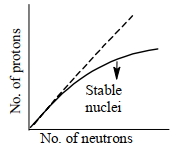
$STATEMENT-1$: The plot of atomic number ($y$-axis) versus number of neutrons ($x$-axis) for stable nuclei shows a curvature towards the $x$-axis from the line of $45^{\circ}$ slope as the atomic number is increased.
$STATEMENT-2$: Proton-proton electrostatic repulsions begin to overcome attractive nuclear forces in heavier nuclides,requiring more neutrons to maintain stability.
$STATEMENT-2$: Proton-proton electrostatic repulsions begin to overcome attractive nuclear forces in heavier nuclides,requiring more neutrons to maintain stability.
A
$STATEMENT-1$ is True,$STATEMENT-2$ is True; $STATEMENT-2$ is the correct explanation for $STATEMENT-1$.
B
$STATEMENT-1$ is True,$STATEMENT-2$ is True; $STATEMENT-2$ is $NOT$ a correct explanation for $STATEMENT-1$.
C
$STATEMENT-1$ is True,$STATEMENT-2$ is False.
D
$STATEMENT-1$ is False,$STATEMENT-2$ is True.
Solution
(A) For light nuclei,the number of protons $(Z)$ is approximately equal to the number of neutrons $(N)$,so the plot follows the $N=Z$ line (slope $45^{\circ}$).
As the atomic number increases,the long-range electrostatic repulsion between protons increases faster than the short-range attractive nuclear force.
To maintain stability in heavier nuclei,more neutrons are required to provide additional attractive nuclear force without adding electrostatic repulsion.
This causes the curve to bend towards the $x$-axis (neutron axis),meaning $N > Z$ for stable heavy nuclei.
Thus,$STATEMENT-1$ is True and $STATEMENT-2$ is True,and $STATEMENT-2$ is the correct explanation for $STATEMENT-1$.
As the atomic number increases,the long-range electrostatic repulsion between protons increases faster than the short-range attractive nuclear force.
To maintain stability in heavier nuclei,more neutrons are required to provide additional attractive nuclear force without adding electrostatic repulsion.
This causes the curve to bend towards the $x$-axis (neutron axis),meaning $N > Z$ for stable heavy nuclei.
Thus,$STATEMENT-1$ is True and $STATEMENT-2$ is True,and $STATEMENT-2$ is the correct explanation for $STATEMENT-1$.
0 likes
View Solution198
MediumMCQ
Given below are two statements $:$ one is labelled as Assertion $(A)$ and the other is labelled as Reason $(R)$.
Assertion $(A) :$ The density of the copper $\left({ }_{29}^{64} Cu \right)$ nucleus is greater than that of the carbon $\left({ }_6^{12} C \right)$ nucleus.
Reason $(R) :$ The nucleus of mass number $A$ has a radius proportional to $A^{1/3}$.
In the light of the above statements,choose the most appropriate answer from the options given below.
Assertion $(A) :$ The density of the copper $\left({ }_{29}^{64} Cu \right)$ nucleus is greater than that of the carbon $\left({ }_6^{12} C \right)$ nucleus.
Reason $(R) :$ The nucleus of mass number $A$ has a radius proportional to $A^{1/3}$.
In the light of the above statements,choose the most appropriate answer from the options given below.
A
$(A)$ is correct but $(R)$ is not correct
B
$(A)$ is not correct but $(R)$ is correct
C
Both $(A)$ and $(R)$ are correct and $(R)$ is the correct explanation of $(A)$
D
Both $(A)$ and $(R)$ are correct but $(R)$ is not the correct explanation of $(A)$
Solution
(B) The density of a nucleus is given by $\rho = \frac{\text{Mass}}{\text{Volume}} = \frac{A \cdot m_n}{\frac{4}{3} \pi R^3}$,where $A$ is the mass number and $m_n$ is the average mass of a nucleon.
Since the radius of a nucleus is given by $R = R_0 A^{1/3}$,substituting this into the density formula gives $\rho = \frac{A \cdot m_n}{\frac{4}{3} \pi (R_0 A^{1/3})^3} = \frac{A \cdot m_n}{\frac{4}{3} \pi R_0^3 A} = \frac{m_n}{\frac{4}{3} \pi R_0^3}$.
This shows that the nuclear density $\rho$ is independent of the mass number $A$.
Therefore,the density of all nuclei is approximately constant and does not depend on the element.
Thus,Assertion $(A)$ is incorrect because the densities are equal,while Reason $(R)$ is a correct statement regarding the relationship between nuclear radius and mass number.
Since the radius of a nucleus is given by $R = R_0 A^{1/3}$,substituting this into the density formula gives $\rho = \frac{A \cdot m_n}{\frac{4}{3} \pi (R_0 A^{1/3})^3} = \frac{A \cdot m_n}{\frac{4}{3} \pi R_0^3 A} = \frac{m_n}{\frac{4}{3} \pi R_0^3}$.
This shows that the nuclear density $\rho$ is independent of the mass number $A$.
Therefore,the density of all nuclei is approximately constant and does not depend on the element.
Thus,Assertion $(A)$ is incorrect because the densities are equal,while Reason $(R)$ is a correct statement regarding the relationship between nuclear radius and mass number.
0 likes
View Solution199
EasyMCQ
For a nucleus of mass number $A$ and radius $R$,the mass density of the nucleus can be represented as:
A
$A^3$
B
$A^{1/3}$
C
$A^{2/3}$
D
Independent of $A$
Solution
(D) The radius of a nucleus is given by the relation $R = R_0 A^{1/3}$,where $R_0$ is a constant (approximately $1.2 \times 10^{-15} \ m$).
The mass of a nucleus is approximately $M = A \times m_p$,where $m_p$ is the mass of a nucleon (proton or neutron).
The volume of the nucleus is $V = \frac{4}{3} \pi R^3 = \frac{4}{3} \pi (R_0 A^{1/3})^3 = \frac{4}{3} \pi R_0^3 A$.
The mass density $\rho$ is given by $\rho = \frac{M}{V} = \frac{A \cdot m_p}{\frac{4}{3} \pi R_0^3 A}$.
Canceling $A$ from the numerator and denominator,we get $\rho = \frac{m_p}{\frac{4}{3} \pi R_0^3}$.
Since $m_p$,$\pi$,and $R_0$ are constants,the density $\rho$ is independent of the mass number $A$.
The mass of a nucleus is approximately $M = A \times m_p$,where $m_p$ is the mass of a nucleon (proton or neutron).
The volume of the nucleus is $V = \frac{4}{3} \pi R^3 = \frac{4}{3} \pi (R_0 A^{1/3})^3 = \frac{4}{3} \pi R_0^3 A$.
The mass density $\rho$ is given by $\rho = \frac{M}{V} = \frac{A \cdot m_p}{\frac{4}{3} \pi R_0^3 A}$.
Canceling $A$ from the numerator and denominator,we get $\rho = \frac{m_p}{\frac{4}{3} \pi R_0^3}$.
Since $m_p$,$\pi$,and $R_0$ are constants,the density $\rho$ is independent of the mass number $A$.
0 likes
View Solution200
EasyMCQ
Given below are two statements $:$ one is labelled as Assertion $(A)$ and other is labelled as Reason $(R).$
Assertion $(A) :$ Neutrons penetrate matter more readily as compared to protons.
Reason $(R) :$ Neutrons are slightly more massive than protons.
Assertion $(A) :$ Neutrons penetrate matter more readily as compared to protons.
Reason $(R) :$ Neutrons are slightly more massive than protons.
A
Both $(A)$ and $(R)$ are true but $(R)$ is not the correct explanation of the $(A).$
B
$(A)$ is true but $(R)$ is false.
C
Both $(A)$ and $(R)$ are false.
D
Both $(A)$ and $(R)$ are true and $(R)$ is the correct explanation of the $(A).$
Solution
(A) The Assertion $(A)$ is true because neutrons are neutral particles,meaning they do not experience the Coulomb force when passing through the electron clouds of atoms. This allows them to penetrate matter much more easily than charged particles like protons.
The Reason $(R)$ is also true because the mass of a neutron $(m_n \approx 1.6749 \times 10^{-27} \ kg)$ is slightly greater than the mass of a proton $(m_p \approx 1.6726 \times 10^{-27} \ kg)$.
However,the reason for the high penetrating power of neutrons is their lack of electric charge,not their mass. Therefore,$(R)$ is not the correct explanation for $(A).$
The Reason $(R)$ is also true because the mass of a neutron $(m_n \approx 1.6749 \times 10^{-27} \ kg)$ is slightly greater than the mass of a proton $(m_p \approx 1.6726 \times 10^{-27} \ kg)$.
However,the reason for the high penetrating power of neutrons is their lack of electric charge,not their mass. Therefore,$(R)$ is not the correct explanation for $(A).$
0 likes
View SolutionNuclei — Composition of Nucleus, Size of the Nucleus, Nuclear force · Frequently Asked Questions
1Are these Nuclei questions useful for JEE and NEET?
Yes. All questions in this section are mapped to JEE Main and NEET exam patterns. Previous year questions from JEE Main, NEET, GUJCET and state-level exams are included with full solutions.
2Can I switch to Hindi or Gujarati for these questions?
Yes. Use the language tabs in the hero section or the sidebar to view the same questions and solutions in English, Hindi or Gujarati.
3How do I generate a question paper from this subtopic?
Use the Vedclass Exam Paper Generator — select the chapter and subtopic, set difficulty, and generate Sets A, B, C, D automatically. First 3 chapters of every subject are free.
Vedclass Products
For Students
Vedclass Test Series
Mock tests in real JEE/NEET style with performance analysis. 5-day free trial.
Start Free TrialFor Teachers
Exam Paper Generator
Generate Set A/B/C/D papers from this chapter in 2 minutes. 3 chapters free.
Try FreeFor Institutes
Online Exam Module
Live online exams with unlimited students, 360° analytics & white-label branding.
See DemoFor Teachers & Institutes
Generate a Nuclei Exam Paper in 2 Minutes
Select subtopic & difficulty — Sets A, B, C, D auto-generated with No Repeat logic.
First 3 chapters of every subject are free — no payment required.