
A English
Torque , Potential Energy and Work Done in Mangetic Field Questions in English
Class 12 Physics · Moving Charges and Magnetism · Torque , Potential Energy and Work Done in Mangetic Field
116+
Questions
English
Language
100%
With Solutions
Showing 49 of 116 questions in English
51
MediumMCQ
The radius of a circular ring of wire is $R$ and it carries a current of $I \, A$. At its centre,a smaller ring of radius $r$ with current $i$ and $N$ turns is placed. Assuming that the planes of the two rings are perpendicular to each other and the magnetic induction produced at the centre of the bigger ring is constant,then the torque acting on the smaller ring will be:
A
$Ni\pi r^2 \times \left( \frac{\mu_0 I}{2R} \right)$
B
zero
C
$Ni r^2 \times \left( \frac{\mu_0 I}{2R} \right)$
D
$Ni\pi r^2 \times \left( \frac{I^2}{2R} \right)$
Solution
(A) The magnetic field $B$ produced by the larger ring at its center is given by $B = \frac{\mu_0 I}{2R}$.
The magnetic moment of the smaller coil with $N$ turns,current $i$,and radius $r$ is $M = N i A = N i (\pi r^2)$.
The torque $\tau$ acting on a magnetic dipole in an external magnetic field is given by $\tau = M B \sin \theta$,where $\theta$ is the angle between the magnetic moment vector and the magnetic field vector.
Since the planes of the two rings are perpendicular,the magnetic moment vector of the smaller ring (which is perpendicular to its plane) is perpendicular to the magnetic field vector produced by the larger ring (which is perpendicular to the larger ring's plane). Thus,$\theta = 90^{\circ}$.
Substituting the values,we get $\tau = (N i \pi r^2) \times \left( \frac{\mu_0 I}{2R} \right) \times \sin 90^{\circ}$.
Since $\sin 90^{\circ} = 1$,the torque is $\tau = Ni\pi r^2 \left( \frac{\mu_0 I}{2R} \right)$.
The magnetic moment of the smaller coil with $N$ turns,current $i$,and radius $r$ is $M = N i A = N i (\pi r^2)$.
The torque $\tau$ acting on a magnetic dipole in an external magnetic field is given by $\tau = M B \sin \theta$,where $\theta$ is the angle between the magnetic moment vector and the magnetic field vector.
Since the planes of the two rings are perpendicular,the magnetic moment vector of the smaller ring (which is perpendicular to its plane) is perpendicular to the magnetic field vector produced by the larger ring (which is perpendicular to the larger ring's plane). Thus,$\theta = 90^{\circ}$.
Substituting the values,we get $\tau = (N i \pi r^2) \times \left( \frac{\mu_0 I}{2R} \right) \times \sin 90^{\circ}$.
Since $\sin 90^{\circ} = 1$,the torque is $\tau = Ni\pi r^2 \left( \frac{\mu_0 I}{2R} \right)$.
0 likes
View Solution52
MediumMCQ
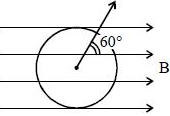
$A$ circular coil of $30$ turns and radius $8.0\, cm$ carrying a current of $6.0\, A$ is suspended vertically in a uniform horizontal magnetic field of magnitude $1.0\, T$. The field lines make an angle of $60^o$ with the normal of the coil. Calculate the magnitude of the counter torque that must be applied to prevent the coil from turning. (in $, Nm$)
A
$4$
B
$6$
C
$3.1$
D
$2.8$
Solution
(C) The torque $\tau$ acting on a current-carrying coil in a magnetic field is given by $\tau = N I A B \sin \theta$,where $\theta$ is the angle between the normal to the coil and the magnetic field.
Given:
Number of turns $N = 30$
Radius $r = 8.0\, cm = 0.08\, m$
Current $I = 6.0\, A$
Magnetic field $B = 1.0\, T$
Angle $\theta = 60^o$
Area $A = \pi r^2 = 3.14 \times (0.08)^2 = 3.14 \times 0.0064 = 0.020096\, m^2$
Substituting the values:
$\tau = 30 \times 6.0 \times 0.020096 \times 1.0 \times \sin 60^o$
$\tau = 180 \times 0.020096 \times \frac{\sqrt{3}}{2}$
$\tau = 90 \times 0.020096 \times 1.732$
$\tau \approx 3.133\, Nm$
Rounding to two significant figures,the magnitude of the counter torque is $3.1\, Nm$.
Given:
Number of turns $N = 30$
Radius $r = 8.0\, cm = 0.08\, m$
Current $I = 6.0\, A$
Magnetic field $B = 1.0\, T$
Angle $\theta = 60^o$
Area $A = \pi r^2 = 3.14 \times (0.08)^2 = 3.14 \times 0.0064 = 0.020096\, m^2$
Substituting the values:
$\tau = 30 \times 6.0 \times 0.020096 \times 1.0 \times \sin 60^o$
$\tau = 180 \times 0.020096 \times \frac{\sqrt{3}}{2}$
$\tau = 90 \times 0.020096 \times 1.732$
$\tau \approx 3.133\, Nm$
Rounding to two significant figures,the magnitude of the counter torque is $3.1\, Nm$.
0 likes
View Solution53
MediumMCQ
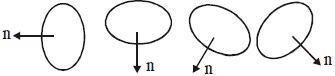
The figure represents four positions of a current-carrying coil in a magnetic field directed towards the right. $\hat{n}$ represents the direction of the area vector of the coil. The correct order of potential energy is:
A
$I > III > II > IV$
B
$I < III < II < IV$
C
$IV < I < II < III$
D
$III > II > IV > I$
Solution
(A) The potential energy $U$ of a magnetic dipole (current-carrying coil) in a magnetic field $\vec{B}$ is given by $U = -\vec{M} \cdot \vec{B} = -MB \cos \theta$,where $\theta$ is the angle between the magnetic moment $\vec{M}$ (which is in the direction of the area vector $\hat{n}$) and the magnetic field $\vec{B}$.
Given that the magnetic field $\vec{B}$ is directed towards the right:
In position $I$,$\hat{n}$ is to the left,so $\theta = 180^\circ$,$U = -MB \cos(180^\circ) = +MB$ (Maximum).
In position $II$,$\hat{n}$ is downwards,so $\theta = 90^\circ$,$U = -MB \cos(90^\circ) = 0$.
In position $III$,$\hat{n}$ is at an obtuse angle,so $\cos \theta$ is negative,making $U$ positive.
In position $IV$,$\hat{n}$ is at an acute angle,so $\cos \theta$ is positive,making $U$ negative (Minimum).
Comparing the angles: $\theta_I = 180^\circ$,$\theta_{III} > 90^\circ$,$\theta_{II} = 90^\circ$,$\theta_{IV} < 90^\circ$.
Thus,the potential energy order is $U_I > U_{III} > U_{II} > U_{IV}$.
Given that the magnetic field $\vec{B}$ is directed towards the right:
In position $I$,$\hat{n}$ is to the left,so $\theta = 180^\circ$,$U = -MB \cos(180^\circ) = +MB$ (Maximum).
In position $II$,$\hat{n}$ is downwards,so $\theta = 90^\circ$,$U = -MB \cos(90^\circ) = 0$.
In position $III$,$\hat{n}$ is at an obtuse angle,so $\cos \theta$ is negative,making $U$ positive.
In position $IV$,$\hat{n}$ is at an acute angle,so $\cos \theta$ is positive,making $U$ negative (Minimum).
Comparing the angles: $\theta_I = 180^\circ$,$\theta_{III} > 90^\circ$,$\theta_{II} = 90^\circ$,$\theta_{IV} < 90^\circ$.
Thus,the potential energy order is $U_I > U_{III} > U_{II} > U_{IV}$.
0 likes
View Solution54
EasyMCQ
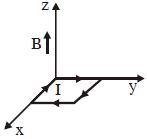
$A$ uniform magnetic field of $3000\,G$ is established in the positive $z-$ direction. $A$ rectangular loop of sides $10\,cm$ and $5\,cm$ carries a current of $12\,A$. The loop is placed in the $xy-$ plane as shown in the figure. What is the magnitude of the torque on the loop?
A
Zero
B
$1.8 \times 10^{-3}\,N-m$
C
$9 \times 10^{-4}\,N-m$
D
None of these
Solution
(A) The magnetic field is given as $B = 3000\,G = 3000 \times 10^{-4}\,T = 0.3\,T$ in the positive $z-$ direction.
The area vector $\vec{A}$ of the loop placed in the $xy-$ plane is perpendicular to the plane,i.e.,along the $z-$ axis.
The magnetic moment $\vec{M}$ is given by $\vec{M} = I\vec{A}$. Since the current loop is in the $xy-$ plane,its area vector is along the $z-$ axis.
The torque $\vec{\tau}$ on a current loop in a magnetic field is given by $\vec{\tau} = \vec{M} \times \vec{B}$.
Since both the magnetic moment vector $\vec{M}$ and the magnetic field vector $\vec{B}$ are directed along the $z-$ axis,the angle $\theta$ between them is $0^\circ$.
Therefore,the magnitude of the torque is $\tau = MB \sin(0^\circ) = 0$.
The area vector $\vec{A}$ of the loop placed in the $xy-$ plane is perpendicular to the plane,i.e.,along the $z-$ axis.
The magnetic moment $\vec{M}$ is given by $\vec{M} = I\vec{A}$. Since the current loop is in the $xy-$ plane,its area vector is along the $z-$ axis.
The torque $\vec{\tau}$ on a current loop in a magnetic field is given by $\vec{\tau} = \vec{M} \times \vec{B}$.
Since both the magnetic moment vector $\vec{M}$ and the magnetic field vector $\vec{B}$ are directed along the $z-$ axis,the angle $\theta$ between them is $0^\circ$.
Therefore,the magnitude of the torque is $\tau = MB \sin(0^\circ) = 0$.
0 likes
View Solution55
EasyMCQ
$A$ current-carrying coil is subjected to a uniform magnetic field. The coil will orient itself so that its plane becomes
A
inclined at $45^{\circ}$ to the magnetic field
B
inclined at any arbitrary angle to the magnetic field
C
parallel to the magnetic field
D
perpendicular to the magnetic field
Solution
(D) The torque on a current-carrying coil in a uniform magnetic field is given by $\vec{\tau} = \vec{m} \times \vec{B}$,where $\vec{m}$ is the magnetic moment and $\vec{B}$ is the magnetic field.
The coil experiences zero torque when the magnetic moment $\vec{m}$ is parallel to the magnetic field $\vec{B}$.
The magnetic moment vector $\vec{m}$ is always perpendicular to the plane of the coil.
For $\vec{m}$ to be parallel to $\vec{B}$,the plane of the coil must be perpendicular to the magnetic field $\vec{B}$.
The coil experiences zero torque when the magnetic moment $\vec{m}$ is parallel to the magnetic field $\vec{B}$.
The magnetic moment vector $\vec{m}$ is always perpendicular to the plane of the coil.
For $\vec{m}$ to be parallel to $\vec{B}$,the plane of the coil must be perpendicular to the magnetic field $\vec{B}$.
0 likes
View Solution56
MediumMCQ
Two identical conducting wires $A$ and $B$ of same dimensions and same material are bent in the form of circular coils. Wire $A$ consists of a single turn,whereas wire $B$ consists of $2$ turns. Both these wires are then suspended in a uniform magnetic field with their planes parallel to one another,and the same current is passed through them. Which statement is correct?
A
Couple on loop $A$ is more than on loop $B$
B
Couple on loop $B$ is more than on loop $A$
C
Couples on both the loops are equal
D
Couple on loop $B$ is twice that on loop $A$
Solution
(A) The torque (couple) on a current-carrying loop in a magnetic field is given by $C = NiAB \sin \theta$.
Since the current $i$,magnetic field $B$,and angle $\theta$ are the same for both,the torque is proportional to the product of the number of turns $N$ and the area $A$ of the loop: $C \propto N \cdot A$.
Let $L$ be the length of the wire. For loop $A$ with $N_A = 1$ turn,$L = 2 \pi r_A$,so $r_A = L / (2 \pi)$. The area $A_A = \pi r_A^2 = \pi (L / 2 \pi)^2 = L^2 / (4 \pi)$.
For loop $B$ with $N_B = 2$ turns,$L = 2 \times (2 \pi r_B)$,so $r_B = L / (4 \pi)$. The area $A_B = \pi r_B^2 = \pi (L / 4 \pi)^2 = L^2 / (16 \pi)$.
Now,calculate the ratio of the torques:
$\frac{C_A}{C_B} = \frac{N_A A_A}{N_B A_B} = \frac{1 \times (L^2 / 4 \pi)}{2 \times (L^2 / 16 \pi)} = \frac{1/4}{2/16} = \frac{1/4}{1/8} = 2$.
Thus,$C_A = 2 C_B$,which means the couple on loop $A$ is twice that on loop $B$,or the couple on loop $A$ is greater than on loop $B$.
Since the current $i$,magnetic field $B$,and angle $\theta$ are the same for both,the torque is proportional to the product of the number of turns $N$ and the area $A$ of the loop: $C \propto N \cdot A$.
Let $L$ be the length of the wire. For loop $A$ with $N_A = 1$ turn,$L = 2 \pi r_A$,so $r_A = L / (2 \pi)$. The area $A_A = \pi r_A^2 = \pi (L / 2 \pi)^2 = L^2 / (4 \pi)$.
For loop $B$ with $N_B = 2$ turns,$L = 2 \times (2 \pi r_B)$,so $r_B = L / (4 \pi)$. The area $A_B = \pi r_B^2 = \pi (L / 4 \pi)^2 = L^2 / (16 \pi)$.
Now,calculate the ratio of the torques:
$\frac{C_A}{C_B} = \frac{N_A A_A}{N_B A_B} = \frac{1 \times (L^2 / 4 \pi)}{2 \times (L^2 / 16 \pi)} = \frac{1/4}{2/16} = \frac{1/4}{1/8} = 2$.
Thus,$C_A = 2 C_B$,which means the couple on loop $A$ is twice that on loop $B$,or the couple on loop $A$ is greater than on loop $B$.
0 likes
View Solution57
EasyMCQ
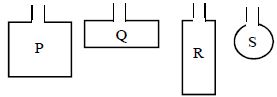
Four wires,each of length $2.0\,m$,are bent into four loops $P, Q, R$ and $S$ and then suspended in a uniform magnetic field. If the same current is passed in each,then the torque will be maximum on the loop:
A
$P$
B
$Q$
C
$R$
D
$S$
Solution
(D) The torque acting on a current-carrying loop in a uniform magnetic field is given by $\tau = NIAB \sin \theta$,where $N$ is the number of turns,$I$ is the current,$A$ is the area of the loop,$B$ is the magnetic field,and $\theta$ is the angle between the normal to the loop and the magnetic field.
For a given perimeter (length of wire $L = 2.0\,m$),the area $A$ enclosed by a loop is maximum for a circle.
Since the torque $\tau$ is directly proportional to the area $A$ $(\tau \propto A)$,the torque will be maximum for the loop with the largest area.
Among the given shapes,the circular loop $S$ encloses the maximum area for a fixed perimeter.
Therefore,the torque is maximum on the loop $S$.
For a given perimeter (length of wire $L = 2.0\,m$),the area $A$ enclosed by a loop is maximum for a circle.
Since the torque $\tau$ is directly proportional to the area $A$ $(\tau \propto A)$,the torque will be maximum for the loop with the largest area.
Among the given shapes,the circular loop $S$ encloses the maximum area for a fixed perimeter.
Therefore,the torque is maximum on the loop $S$.
0 likes
View Solution58
MediumMCQ
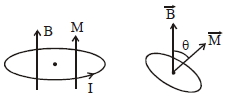
$A$ small circular loop of conducting wire has radius $a$ and carries current $I$. It is placed in a uniform magnetic field $B$ perpendicular to its plane such that when rotated slightly about its diameter and released,it starts performing simple harmonic motion of time period $T$. If the mass of the loop is $m$,then find the expression for $T$.
A
$T=\sqrt{\frac{\pi m}{2 IB}}$
B
$T=\sqrt{\frac{2 \pi m}{IB}}$
C
$T=\sqrt{\frac{\pi m}{IB}}$
D
$T=\sqrt{\frac{2 m}{IB}}$
Solution
(B) The magnetic torque on the loop is given by $\vec{\tau} = \vec{M} \times \vec{B}$.
For a small angular displacement $\theta$,the magnitude of the torque is $\tau = MB \sin \theta \approx MB \theta$.
The restoring torque is $\tau = -MB \theta$.
Using Newton's second law for rotation,$\tau = I_{moment} \alpha$,where $I_{moment}$ is the moment of inertia of the circular loop about its diameter,$I_{moment} = \frac{ma^2}{2}$.
Thus,$\frac{ma^2}{2} \alpha = - (I \pi a^2) B \theta$.
$\alpha = - \frac{2 I \pi B}{m} \theta$.
Comparing this with the $SHM$ equation $\alpha = - \omega^2 \theta$,we get $\omega^2 = \frac{2 I \pi B}{m}$.
Therefore,$\omega = \sqrt{\frac{2 I \pi B}{m}}$.
The time period $T$ is given by $T = \frac{2 \pi}{\omega} = 2 \pi \sqrt{\frac{m}{2 I \pi B}} = \sqrt{\frac{4 \pi^2 m}{2 I \pi B}} = \sqrt{\frac{2 \pi m}{IB}}$.
For a small angular displacement $\theta$,the magnitude of the torque is $\tau = MB \sin \theta \approx MB \theta$.
The restoring torque is $\tau = -MB \theta$.
Using Newton's second law for rotation,$\tau = I_{moment} \alpha$,where $I_{moment}$ is the moment of inertia of the circular loop about its diameter,$I_{moment} = \frac{ma^2}{2}$.
Thus,$\frac{ma^2}{2} \alpha = - (I \pi a^2) B \theta$.
$\alpha = - \frac{2 I \pi B}{m} \theta$.
Comparing this with the $SHM$ equation $\alpha = - \omega^2 \theta$,we get $\omega^2 = \frac{2 I \pi B}{m}$.
Therefore,$\omega = \sqrt{\frac{2 I \pi B}{m}}$.
The time period $T$ is given by $T = \frac{2 \pi}{\omega} = 2 \pi \sqrt{\frac{m}{2 I \pi B}} = \sqrt{\frac{4 \pi^2 m}{2 I \pi B}} = \sqrt{\frac{2 \pi m}{IB}}$.
0 likes
View Solution59
Medium
$(a)$ $A$ current-carrying circular loop lies on a smooth horizontal plane. Can a uniform magnetic field be set up in such a manner that the loop turns around itself (i.e.,turns about the vertical axis)?
$(b)$ $A$ current-carrying circular loop is located in a uniform external magnetic field. If the loop is free to turn,what is its orientation of stable equilibrium? Show that in this orientation,the flux of the total field (external field $+$ field produced by the loop) is maximum.
$(c)$ $A$ loop of irregular shape carrying current is located in an external magnetic field. If the wire is flexible,why does it change to a circular shape?
$(b)$ $A$ current-carrying circular loop is located in a uniform external magnetic field. If the loop is free to turn,what is its orientation of stable equilibrium? Show that in this orientation,the flux of the total field (external field $+$ field produced by the loop) is maximum.
$(c)$ $A$ loop of irregular shape carrying current is located in an external magnetic field. If the wire is flexible,why does it change to a circular shape?
Solution
(N/A) No,because that would require the torque $\tau$ to be in the vertical direction. Since the area vector $\vec{A}$ of the horizontal loop is in the vertical direction,the torque $\vec{\tau} = I(\vec{A} \times \vec{B})$ would always lie in the horizontal plane of the loop for any uniform magnetic field $\vec{B}$. Thus,it cannot rotate about the vertical axis.
$(b)$ The orientation of stable equilibrium is one where the area vector $\vec{A}$ of the loop is parallel to the external magnetic field $\vec{B}$. In this orientation,the magnetic field produced by the loop is in the same direction as the external field,both being normal to the plane of the loop. This alignment maximizes the total magnetic flux through the loop.
$(c)$ $A$ flexible current-carrying loop in a magnetic field tends to maximize the magnetic flux through it to reach a state of minimum potential energy. For a fixed perimeter,a circular shape encloses the maximum area. Therefore,the loop adopts a circular shape with its plane normal to the magnetic field to maximize the total flux.
$(b)$ The orientation of stable equilibrium is one where the area vector $\vec{A}$ of the loop is parallel to the external magnetic field $\vec{B}$. In this orientation,the magnetic field produced by the loop is in the same direction as the external field,both being normal to the plane of the loop. This alignment maximizes the total magnetic flux through the loop.
$(c)$ $A$ flexible current-carrying loop in a magnetic field tends to maximize the magnetic flux through it to reach a state of minimum potential energy. For a fixed perimeter,a circular shape encloses the maximum area. Therefore,the loop adopts a circular shape with its plane normal to the magnetic field to maximize the total flux.
0 likes
View Solution60
EasyMCQ
$A$ square coil of side $10 \; cm$ consists of $20$ turns and carries a current of $12 \; A$. The coil is suspended vertically and the normal to the plane of the coil makes an angle of $30^{\circ}$ with the direction of a uniform horizontal magnetic field of magnitude $0.80 \; T$. What is the magnitude of torque (in $N \; m$) experienced by the coil?
A
$1.64$
B
$0.96$
C
$0.42$
D
$0.24$
Solution
(B) The side length of the square coil is $l = 10 \; cm = 0.1 \; m$.
The area of the coil is $A = l^2 = (0.1 \; m)^2 = 0.01 \; m^2$.
The number of turns is $n = 20$,and the current is $I = 12 \; A$.
The magnetic field strength is $B = 0.80 \; T$.
The angle between the normal to the plane of the coil and the magnetic field is $\theta = 30^{\circ}$.
The magnitude of the magnetic torque $\tau$ experienced by the coil is given by the formula $\tau = n I A B \sin \theta$.
Substituting the values: $\tau = 20 \times 12 \times 0.01 \times 0.80 \times \sin 30^{\circ}$.
Since $\sin 30^{\circ} = 0.5$,we have $\tau = 20 \times 12 \times 0.01 \times 0.80 \times 0.5$.
$\tau = 0.96 \; N \; m$.
The area of the coil is $A = l^2 = (0.1 \; m)^2 = 0.01 \; m^2$.
The number of turns is $n = 20$,and the current is $I = 12 \; A$.
The magnetic field strength is $B = 0.80 \; T$.
The angle between the normal to the plane of the coil and the magnetic field is $\theta = 30^{\circ}$.
The magnitude of the magnetic torque $\tau$ experienced by the coil is given by the formula $\tau = n I A B \sin \theta$.
Substituting the values: $\tau = 20 \times 12 \times 0.01 \times 0.80 \times \sin 30^{\circ}$.
Since $\sin 30^{\circ} = 0.5$,we have $\tau = 20 \times 12 \times 0.01 \times 0.80 \times 0.5$.
$\tau = 0.96 \; N \; m$.
0 likes
View Solution61
Medium
$(a)$ $A$ circular coil of $30$ turns and radius $8.0 \; cm$ carrying a current of $6.0 \; A$ is suspended vertically in a uniform horizontal magnetic field of magnitude $1.0 \; T$. The field lines make an angle of $60^{\circ}$ with the normal of the coil. Calculate the magnitude of the counter torque that must be applied to prevent the coil from turning.
$(b)$ Would your answer change,if the circular coil in $(a)$ were replaced by a planar coil of some irregular shape that encloses the same area? (All other particulars are also unaltered.)
$(b)$ Would your answer change,if the circular coil in $(a)$ were replaced by a planar coil of some irregular shape that encloses the same area? (All other particulars are also unaltered.)
Solution
(A) Number of turns on the circular coil,$n=30$.
Radius of the coil,$r=8.0 \; cm = 0.08 \; m$.
Area of the coil,$A = \pi r^2 = \pi(0.08)^2 \approx 0.0201 \; m^2$.
Current flowing in the coil,$I=6.0 \; A$.
Magnetic field strength,$B = 1.0 \; T$.
Angle between the field lines and the normal to the coil surface,$\theta = 60^{\circ}$.
The coil experiences a magnetic torque $\tau = n I A B \sin \theta$. To prevent the coil from turning,an equal and opposite counter-torque must be applied.
$\tau = 30 \times 6.0 \times 0.0201 \times 1.0 \times \sin 60^{\circ}$.
$\tau = 30 \times 6.0 \times 0.0201 \times 1.0 \times \frac{\sqrt{3}}{2} \approx 3.133 \; Nm$.
$(b)$ The torque on a current-carrying coil in a magnetic field is given by $\vec{\tau} = \vec{m} \times \vec{B}$,where the magnetic moment $\vec{m} = n I \vec{A}$. Since the magnitude of the torque depends only on the area $A$ and not on the specific shape of the coil,the answer would not change if the circular coil were replaced by a planar coil of any irregular shape that encloses the same area.
Radius of the coil,$r=8.0 \; cm = 0.08 \; m$.
Area of the coil,$A = \pi r^2 = \pi(0.08)^2 \approx 0.0201 \; m^2$.
Current flowing in the coil,$I=6.0 \; A$.
Magnetic field strength,$B = 1.0 \; T$.
Angle between the field lines and the normal to the coil surface,$\theta = 60^{\circ}$.
The coil experiences a magnetic torque $\tau = n I A B \sin \theta$. To prevent the coil from turning,an equal and opposite counter-torque must be applied.
$\tau = 30 \times 6.0 \times 0.0201 \times 1.0 \times \sin 60^{\circ}$.
$\tau = 30 \times 6.0 \times 0.0201 \times 1.0 \times \frac{\sqrt{3}}{2} \approx 3.133 \; Nm$.
$(b)$ The torque on a current-carrying coil in a magnetic field is given by $\vec{\tau} = \vec{m} \times \vec{B}$,where the magnetic moment $\vec{m} = n I \vec{A}$. Since the magnitude of the torque depends only on the area $A$ and not on the specific shape of the coil,the answer would not change if the circular coil were replaced by a planar coil of any irregular shape that encloses the same area.
0 likes
View Solution62
Medium
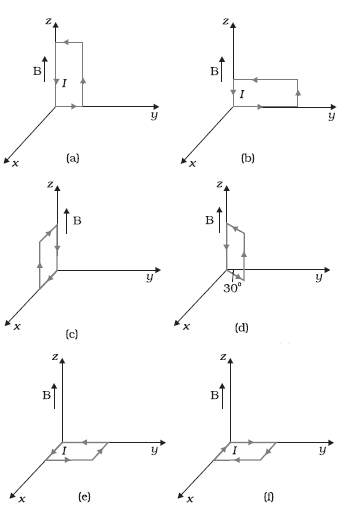
$A$ uniform magnetic field of $3000 \; G$ is established along the positive $z-$direction. $A$ rectangular loop of sides $10 \; cm$ and $5 \; cm$ carries a current of $12 \; A$. What is the torque on the loop in the different cases shown in Figure? What is the force on each case? Which case corresponds to stable equilibrium?
Solution
(E) Magnetic field strength,$B = 3000 \; G = 3000 \times 10^{-4} \; T = 0.3 \; T$.
Length of the rectangular loop,$l = 10 \; cm = 0.1 \; m$.
Width of the rectangular loop,$b = 5 \; cm = 0.05 \; m$.
Area of the loop,$A = l \times b = 0.1 \times 0.05 = 50 \times 10^{-4} \; m^2$.
Current in the loop,$I = 12 \; A$.
The magnetic moment is $\vec{m} = I \vec{A}$. The torque is $\vec{\tau} = \vec{m} \times \vec{B}$.
In a uniform magnetic field,the net force on a current loop is always zero.
$(a)$ $\vec{A}$ is along the $x-$axis. $\vec{m} = I A \hat{i}$. $\vec{\tau} = (I A \hat{i}) \times (B \hat{k}) = -I A B \hat{j} = -1.8 \times 10^{-2} \hat{j} \; Nm$.
$(b)$ Similar to $(a)$,$\vec{\tau} = -1.8 \times 10^{-2} \hat{j} \; Nm$.
$(c)$ $\vec{A}$ is along the $y-$axis. $\vec{m} = I A \hat{j}$. $\vec{\tau} = (I A \hat{j}) \times (B \hat{k}) = I A B \hat{i} = 1.8 \times 10^{-2} \hat{i} \; Nm$.
$(d)$ The angle between $\vec{m}$ and $\vec{B}$ is $60^{\circ}$. $|\vec{\tau}| = m B \sin(60^{\circ}) = 1.8 \times 10^{-2} \times \frac{\sqrt{3}}{2} \approx 1.56 \times 10^{-2} \; Nm$.
$(e)$ $\vec{m}$ is along the $z-$axis. $\vec{m} = I A \hat{k}$. $\vec{\tau} = (I A \hat{k}) \times (B \hat{k}) = 0$. This is stable equilibrium as $\vec{m} \parallel \vec{B}$.
$(f)$ $\vec{m}$ is along the $-z-$axis. $\vec{\tau} = 0$. This is unstable equilibrium as $\vec{m}$ is anti-parallel to $\vec{B}$.
Length of the rectangular loop,$l = 10 \; cm = 0.1 \; m$.
Width of the rectangular loop,$b = 5 \; cm = 0.05 \; m$.
Area of the loop,$A = l \times b = 0.1 \times 0.05 = 50 \times 10^{-4} \; m^2$.
Current in the loop,$I = 12 \; A$.
The magnetic moment is $\vec{m} = I \vec{A}$. The torque is $\vec{\tau} = \vec{m} \times \vec{B}$.
In a uniform magnetic field,the net force on a current loop is always zero.
$(a)$ $\vec{A}$ is along the $x-$axis. $\vec{m} = I A \hat{i}$. $\vec{\tau} = (I A \hat{i}) \times (B \hat{k}) = -I A B \hat{j} = -1.8 \times 10^{-2} \hat{j} \; Nm$.
$(b)$ Similar to $(a)$,$\vec{\tau} = -1.8 \times 10^{-2} \hat{j} \; Nm$.
$(c)$ $\vec{A}$ is along the $y-$axis. $\vec{m} = I A \hat{j}$. $\vec{\tau} = (I A \hat{j}) \times (B \hat{k}) = I A B \hat{i} = 1.8 \times 10^{-2} \hat{i} \; Nm$.
$(d)$ The angle between $\vec{m}$ and $\vec{B}$ is $60^{\circ}$. $|\vec{\tau}| = m B \sin(60^{\circ}) = 1.8 \times 10^{-2} \times \frac{\sqrt{3}}{2} \approx 1.56 \times 10^{-2} \; Nm$.
$(e)$ $\vec{m}$ is along the $z-$axis. $\vec{m} = I A \hat{k}$. $\vec{\tau} = (I A \hat{k}) \times (B \hat{k}) = 0$. This is stable equilibrium as $\vec{m} \parallel \vec{B}$.
$(f)$ $\vec{m}$ is along the $-z-$axis. $\vec{\tau} = 0$. This is unstable equilibrium as $\vec{m}$ is anti-parallel to $\vec{B}$.
0 likes
View Solution63
Medium
$A$ circular coil of $20$ turns and radius $10\; cm$ is placed in a uniform magnetic field of $0.10\; T$ normal to the plane of the coil. If the current in the coil is $5.0\; A$,what is the
$(a)$ total torque on the coil,
$(b)$ total force on the coil,
$(c)$ average force on each electron in the coil due to the magnetic field?
(The coil is made of copper wire of cross-sectional area $10^{-5} \;m ^{2},$ and the free electron density in copper is given to be about $10^{29}\; m ^{-3}.$)
$(a)$ total torque on the coil,
$(b)$ total force on the coil,
$(c)$ average force on each electron in the coil due to the magnetic field?
(The coil is made of copper wire of cross-sectional area $10^{-5} \;m ^{2},$ and the free electron density in copper is given to be about $10^{29}\; m ^{-3}.$)
Solution
(A) Given:
Number of turns,$n = 20$
Radius,$r = 10 \; cm = 0.1 \; m$
Magnetic field,$B = 0.10 \; T$
Current,$I = 5.0 \; A$
Cross-sectional area,$A = 10^{-5} \; m^2$
Electron density,$n_e = 10^{29} \; m^{-3}$
Charge of electron,$e = 1.6 \times 10^{-19} \; C$
$(a)$ The torque $\tau$ on a current loop is given by $\tau = N I A B \sin \theta$. Since the magnetic field is normal to the plane of the coil,the angle $\theta$ between the magnetic field and the area vector is $0^\circ$. Thus,$\tau = N I A B \sin(0^\circ) = 0$.
$(b)$ The total force on a closed current loop in a uniform magnetic field is always zero,as the forces on opposite segments cancel each other out.
$(c)$ The magnetic force on an electron is $F = B e v_d$,where $v_d$ is the drift velocity. The drift velocity is given by $v_d = \frac{I}{n_e e A}$. Substituting this into the force equation:
$F = B e \left( \frac{I}{n_e e A} \right) = \frac{B I}{n_e A}$
$F = \frac{0.10 \times 5.0}{10^{29} \times 10^{-5}} = \frac{0.5}{10^{24}} = 5 \times 10^{-25} \; N$.
Thus,the average force on each electron is $5 \times 10^{-25} \; N$.
Number of turns,$n = 20$
Radius,$r = 10 \; cm = 0.1 \; m$
Magnetic field,$B = 0.10 \; T$
Current,$I = 5.0 \; A$
Cross-sectional area,$A = 10^{-5} \; m^2$
Electron density,$n_e = 10^{29} \; m^{-3}$
Charge of electron,$e = 1.6 \times 10^{-19} \; C$
$(a)$ The torque $\tau$ on a current loop is given by $\tau = N I A B \sin \theta$. Since the magnetic field is normal to the plane of the coil,the angle $\theta$ between the magnetic field and the area vector is $0^\circ$. Thus,$\tau = N I A B \sin(0^\circ) = 0$.
$(b)$ The total force on a closed current loop in a uniform magnetic field is always zero,as the forces on opposite segments cancel each other out.
$(c)$ The magnetic force on an electron is $F = B e v_d$,where $v_d$ is the drift velocity. The drift velocity is given by $v_d = \frac{I}{n_e e A}$. Substituting this into the force equation:
$F = B e \left( \frac{I}{n_e e A} \right) = \frac{B I}{n_e A}$
$F = \frac{0.10 \times 5.0}{10^{29} \times 10^{-5}} = \frac{0.5}{10^{24}} = 5 \times 10^{-25} \; N$.
Thus,the average force on each electron is $5 \times 10^{-25} \; N$.
0 likes
View Solution64
MediumMCQ
$A$ closely wound solenoid of $800$ turns and area of cross section $2.5 \times 10^{-4} \;m^{2}$ carries a current of $3.0 \;A$. If the solenoid is free to turn about the vertical direction and a uniform horizontal magnetic field of $0.25 \;T$ is applied,what is the magnitude of torque on the solenoid when its axis makes an angle of $30^{\circ}$ with the direction of the applied field?
A
$7.5 \times 10^{-2} \;N \,m$
B
$2.5 \times 10^{-2} \;N \,m$
C
$6.5 \times 10^{-3} \;N \,m$
D
$1.25 \times 10^{-2} \;N \,m$
Solution
(A) The magnetic moment $M$ of the solenoid is given by $M = N I A$,where $N$ is the number of turns,$I$ is the current,and $A$ is the cross-sectional area.
$M = 800 \times 3.0 \times 2.5 \times 10^{-4} = 0.6 \;A \cdot m^{2}$.
The torque $\tau$ on a magnetic dipole in a magnetic field $B$ is given by $\tau = M B \sin \theta$,where $\theta$ is the angle between the magnetic moment vector (axis of the solenoid) and the magnetic field.
Given $\theta = 30^{\circ}$ and $B = 0.25 \;T$.
$\tau = 0.6 \times 0.25 \times \sin 30^{\circ}$.
$\tau = 0.6 \times 0.25 \times 0.5 = 0.075 \;N \cdot m$.
$\tau = 7.5 \times 10^{-2} \;N \cdot m$.
$M = 800 \times 3.0 \times 2.5 \times 10^{-4} = 0.6 \;A \cdot m^{2}$.
The torque $\tau$ on a magnetic dipole in a magnetic field $B$ is given by $\tau = M B \sin \theta$,where $\theta$ is the angle between the magnetic moment vector (axis of the solenoid) and the magnetic field.
Given $\theta = 30^{\circ}$ and $B = 0.25 \;T$.
$\tau = 0.6 \times 0.25 \times \sin 30^{\circ}$.
$\tau = 0.6 \times 0.25 \times 0.5 = 0.075 \;N \cdot m$.
$\tau = 7.5 \times 10^{-2} \;N \cdot m$.
0 likes
View Solution65
Medium
$A$ closely wound solenoid of $2000$ turns and area of cross-section $1.6 \times 10^{-4} \;m^{2},$ carrying a current of $4.0 \;A,$ is suspended through its centre allowing it to turn in a horizontal plane.
$(a)$ What is the magnetic moment associated with the solenoid?
$(b)$ What is the force and torque on the solenoid if a uniform horizontal magnetic field of $7.5 \times 10^{-2} \;T$ is set up at an angle of $30^{\circ}$ with the axis of the solenoid?
$(a)$ What is the magnetic moment associated with the solenoid?
$(b)$ What is the force and torque on the solenoid if a uniform horizontal magnetic field of $7.5 \times 10^{-2} \;T$ is set up at an angle of $30^{\circ}$ with the axis of the solenoid?
Solution
(A) Number of turns on the solenoid,$n = 2000$.
Area of cross-section of the solenoid,$A = 1.6 \times 10^{-4} \;m^{2}$.
Current in the solenoid,$I = 4.0 \;A$.
$(a)$ The magnetic moment $M$ associated with the solenoid is given by $M = nIA$.
Substituting the values: $M = 2000 \times 4.0 \times 1.6 \times 10^{-4} = 1.28 \;A \cdot m^{2}$.
$(b)$ Magnetic field,$B = 7.5 \times 10^{-2} \;T$.
Angle between the magnetic field and the axis of the solenoid,$\theta = 30^{\circ}$.
Since the magnetic field is uniform,the net force on the solenoid is zero.
The torque $\tau$ on the solenoid is given by $\tau = MB \sin \theta$.
Substituting the values: $\tau = 1.28 \times 7.5 \times 10^{-2} \times \sin 30^{\circ} = 1.28 \times 7.5 \times 10^{-2} \times 0.5 = 4.8 \times 10^{-2} \;N \cdot m$.
Area of cross-section of the solenoid,$A = 1.6 \times 10^{-4} \;m^{2}$.
Current in the solenoid,$I = 4.0 \;A$.
$(a)$ The magnetic moment $M$ associated with the solenoid is given by $M = nIA$.
Substituting the values: $M = 2000 \times 4.0 \times 1.6 \times 10^{-4} = 1.28 \;A \cdot m^{2}$.
$(b)$ Magnetic field,$B = 7.5 \times 10^{-2} \;T$.
Angle between the magnetic field and the axis of the solenoid,$\theta = 30^{\circ}$.
Since the magnetic field is uniform,the net force on the solenoid is zero.
The torque $\tau$ on the solenoid is given by $\tau = MB \sin \theta$.
Substituting the values: $\tau = 1.28 \times 7.5 \times 10^{-2} \times \sin 30^{\circ} = 1.28 \times 7.5 \times 10^{-2} \times 0.5 = 4.8 \times 10^{-2} \;N \cdot m$.
1 likes
View Solution66
MediumMCQ
$A$ circular coil of $16$ turns and radius $10 \;cm$ carrying a current of $0.75 \;A$ rests with its plane normal to an external field of magnitude $5.0 \times 10^{-2} \;T$. The coil is free to turn about an axis in its plane perpendicular to the field direction. When the coil is turned slightly and released,it oscillates about its stable equilibrium with a frequency of $2.0 \;s^{-1}$. What is the moment of inertia of the coil about its axis of rotation?
A
$6.43 \times 10^{-5} \;kg \;m^2$
B
$7.26 \times 10^{-3} \;kg \;m^2$
C
$2.81 \times 10^{-3} \;kg \;m^2$
D
$1.19 \times 10^{-4} \;kg \;m^2$
Solution
(D) Number of turns in the circular coil,$N = 16$.
Radius of the coil,$r = 10 \;cm = 0.1 \;m$.
Area of the coil,$A = \pi r^2 = \pi \times (0.1)^2 = 0.01\pi \;m^2$.
Current in the coil,$I = 0.75 \;A$.
Magnetic field strength,$B = 5.0 \times 10^{-2} \;T$.
Frequency of oscillations,$\nu = 2.0 \;s^{-1}$.
Magnetic moment,$M = N I A = 16 \times 0.75 \times 0.01\pi = 0.12\pi \;A \;m^2 \approx 0.377 \;J \;T^{-1}$.
The frequency of oscillation for a magnetic dipole in a magnetic field is given by $\nu = \frac{1}{2\pi} \sqrt{\frac{MB}{I_{rot}}}$,where $I_{rot}$ is the moment of inertia.
Rearranging for $I_{rot}$: $I_{rot} = \frac{MB}{4\pi^2 \nu^2}$.
Substituting the values: $I_{rot} = \frac{0.377 \times 5.0 \times 10^{-2}}{4 \times \pi^2 \times (2.0)^2}$.
$I_{rot} = \frac{0.01885}{157.91} \approx 1.19 \times 10^{-4} \;kg \;m^2$.
Radius of the coil,$r = 10 \;cm = 0.1 \;m$.
Area of the coil,$A = \pi r^2 = \pi \times (0.1)^2 = 0.01\pi \;m^2$.
Current in the coil,$I = 0.75 \;A$.
Magnetic field strength,$B = 5.0 \times 10^{-2} \;T$.
Frequency of oscillations,$\nu = 2.0 \;s^{-1}$.
Magnetic moment,$M = N I A = 16 \times 0.75 \times 0.01\pi = 0.12\pi \;A \;m^2 \approx 0.377 \;J \;T^{-1}$.
The frequency of oscillation for a magnetic dipole in a magnetic field is given by $\nu = \frac{1}{2\pi} \sqrt{\frac{MB}{I_{rot}}}$,where $I_{rot}$ is the moment of inertia.
Rearranging for $I_{rot}$: $I_{rot} = \frac{MB}{4\pi^2 \nu^2}$.
Substituting the values: $I_{rot} = \frac{0.377 \times 5.0 \times 10^{-2}}{4 \times \pi^2 \times (2.0)^2}$.
$I_{rot} = \frac{0.01885}{157.91} \approx 1.19 \times 10^{-4} \;kg \;m^2$.
0 likes
View Solution67
Easy
Derive an expression for the torque acting on a current-carrying loop which subtends an angle $\theta$ with a uniform magnetic field.
Solution
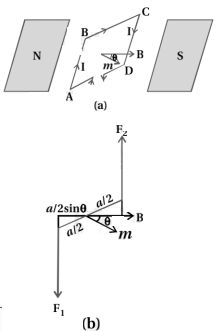
(N/A) As shown in the figure,the plane $ABCD$ is not along the magnetic field but makes an angle with it.
We take the angle between the field and the normal to the coil to be angle $\theta$.
The forces on the arms $BC$ and $DA$ are equal,opposite,and act along the axis of the coil,which connects the centers of mass of $BC$ and $DA$. Being collinear along the axis,they cancel each other,resulting in no net force or torque.
The forces on arms $AB$ and $CD$ are $\overrightarrow{F}_{1}$ and $\overrightarrow{F}_{2}$ respectively.
They are also equal and opposite with magnitude $F_{1} = F_{2} = I b B$.
The figure illustrates a view of the arrangement from the $AD$ side,showing these two forces constituting a couple. The magnitude of the torque on the loop is,
$\tau = \tau_{1} + \tau_{2}$
$\tau = F_{1} \left( \frac{a}{2} \sin \theta \right) + F_{2} \left( \frac{a}{2} \sin \theta \right)$
$[\because \tau = (\text{magnitude of force}) \times (\text{perpendicular distance from reference points})]$
$\tau = (I b B) \left( \frac{a}{2} \sin \theta \right) + (I b B) \left( \frac{a}{2} \sin \theta \right)$
$\tau = I (a b) B \sin \theta$
$\tau = I A B \sin \theta$
We take the angle between the field and the normal to the coil to be angle $\theta$.
The forces on the arms $BC$ and $DA$ are equal,opposite,and act along the axis of the coil,which connects the centers of mass of $BC$ and $DA$. Being collinear along the axis,they cancel each other,resulting in no net force or torque.
The forces on arms $AB$ and $CD$ are $\overrightarrow{F}_{1}$ and $\overrightarrow{F}_{2}$ respectively.
They are also equal and opposite with magnitude $F_{1} = F_{2} = I b B$.
The figure illustrates a view of the arrangement from the $AD$ side,showing these two forces constituting a couple. The magnitude of the torque on the loop is,
$\tau = \tau_{1} + \tau_{2}$
$\tau = F_{1} \left( \frac{a}{2} \sin \theta \right) + F_{2} \left( \frac{a}{2} \sin \theta \right)$
$[\because \tau = (\text{magnitude of force}) \times (\text{perpendicular distance from reference points})]$
$\tau = (I b B) \left( \frac{a}{2} \sin \theta \right) + (I b B) \left( \frac{a}{2} \sin \theta \right)$
$\tau = I (a b) B \sin \theta$
$\tau = I A B \sin \theta$
0 likes
View Solution68
Easy
Write an expression for the torque acting on a current-carrying loop suspended in a uniform magnetic field.
Solution
(N/A) When a current-carrying loop of area $A$ and current $I$ is placed in a uniform magnetic field $B$,it experiences a torque $\tau$. The expression for the torque is given by:
$\tau = \vec{m} \times \vec{B}$
Where:
- $\vec{m}$ is the magnetic dipole moment of the loop,defined as $\vec{m} = I\vec{A}$.
- $\vec{B}$ is the external uniform magnetic field.
- The magnitude of the torque is $\tau = mB \sin \theta$,where $\theta$ is the angle between the area vector $\vec{A}$ (normal to the loop) and the magnetic field vector $\vec{B}$.
$\tau = \vec{m} \times \vec{B}$
Where:
- $\vec{m}$ is the magnetic dipole moment of the loop,defined as $\vec{m} = I\vec{A}$.
- $\vec{B}$ is the external uniform magnetic field.
- The magnitude of the torque is $\tau = mB \sin \theta$,where $\theta$ is the angle between the area vector $\vec{A}$ (normal to the loop) and the magnetic field vector $\vec{B}$.
0 likes
View Solution69
Medium
Write an equation for the torque acting on a current-carrying loop which subtends an angle $\theta$ with a uniform magnetic field.
Solution
(N/A) The torque $\vec{\tau}$ acting on a current-carrying loop placed in a uniform magnetic field $\vec{B}$ is given by the vector product of the magnetic dipole moment $\vec{m}$ and the magnetic field $\vec{B}$.
Mathematically,$\vec{\tau} = \vec{m} \times \vec{B}$.
If $\theta$ is the angle between the magnetic dipole moment vector $\vec{m}$ (which is perpendicular to the plane of the loop) and the magnetic field $\vec{B}$,the magnitude of the torque is given by $\tau = mB \sin \theta$.
If $\theta$ is defined as the angle between the plane of the loop and the magnetic field,the torque is given by $\tau = mB \cos \theta$.
Mathematically,$\vec{\tau} = \vec{m} \times \vec{B}$.
If $\theta$ is the angle between the magnetic dipole moment vector $\vec{m}$ (which is perpendicular to the plane of the loop) and the magnetic field $\vec{B}$,the magnitude of the torque is given by $\tau = mB \sin \theta$.
If $\theta$ is defined as the angle between the plane of the loop and the magnetic field,the torque is given by $\tau = mB \cos \theta$.
0 likes
View Solution70
Medium
Suppose we want to verify the analogy between electrostatic and magnetostatic by an explicit experiment. Consider the motion of
$(i)$ electric dipole $\vec{p}$ in an electrostatic field $\vec{E}$ and
$(ii)$ magnetic dipole $\vec{M}$ in a magnetic field $\vec{B}$. Write down a set of conditions on $\vec{E}, \vec{B}, \vec{p}, \vec{M}$ so that the two motions are verified to be identical. (Assume identical initial conditions.)
$(i)$ electric dipole $\vec{p}$ in an electrostatic field $\vec{E}$ and
$(ii)$ magnetic dipole $\vec{M}$ in a magnetic field $\vec{B}$. Write down a set of conditions on $\vec{E}, \vec{B}, \vec{p}, \vec{M}$ so that the two motions are verified to be identical. (Assume identical initial conditions.)
Solution
(D) The torque on an electric dipole $\vec{p}$ in an electric field $\vec{E}$ is given by $\vec{\tau}_e = \vec{p} \times \vec{E}$,with magnitude $\tau_e = pE \sin \theta$.
The torque on a magnetic dipole $\vec{M}$ in a magnetic field $\vec{B}$ is given by $\vec{\tau}_m = \vec{M} \times \vec{B}$,with magnitude $\tau_m = MB \sin \theta$.
For the motions to be identical,the torques must be equal for the same angular displacement $\theta$,implying $\tau_e = \tau_m$.
Thus,$pE \sin \theta = MB \sin \theta$,which simplifies to $pE = MB$.
Using the relation between electric and magnetic fields in electromagnetic waves,$E = cB$,where $c$ is the speed of light.
Substituting $E = cB$ into the equation $pE = MB$,we get $p(cB) = MB$.
Therefore,the condition for identical motion is $p = \frac{M}{c}$ and the fields must be related by $E = cB$.
The torque on a magnetic dipole $\vec{M}$ in a magnetic field $\vec{B}$ is given by $\vec{\tau}_m = \vec{M} \times \vec{B}$,with magnitude $\tau_m = MB \sin \theta$.
For the motions to be identical,the torques must be equal for the same angular displacement $\theta$,implying $\tau_e = \tau_m$.
Thus,$pE \sin \theta = MB \sin \theta$,which simplifies to $pE = MB$.
Using the relation between electric and magnetic fields in electromagnetic waves,$E = cB$,where $c$ is the speed of light.
Substituting $E = cB$ into the equation $pE = MB$,we get $p(cB) = MB$.
Therefore,the condition for identical motion is $p = \frac{M}{c}$ and the fields must be related by $E = cB$.
0 likes
View Solution71
Difficult
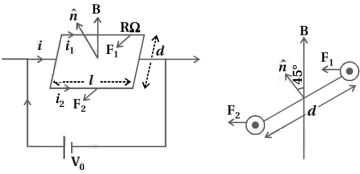
$A$ rectangular conducting loop consists of two wires on two opposite sides of length $l$ joined together by rods of length $d$. The wires are each of the same material but with cross-sections differing by a factor of $2$. The thicker wire has a resistance $R$ and the rods are of low resistance,which in turn are connected to a constant voltage source $V_{0}$. The loop is placed in a uniform magnetic field $\vec{B}$ at $45^{\circ}$ to its plane. Find the torque exerted by the magnetic field on the loop about an axis through the centers of the rods.
Solution
(N/A) Let the resistance of the thick wire be $R$ and the thin wire be $2R$. Both wires are connected in parallel to the voltage source $V_{0}$.
The current in the thick wire is $I_{1} = \frac{V_{0}}{R}$ and the current in the thin wire is $I_{2} = \frac{V_{0}}{2R}$.
The magnetic force on each wire is given by $\vec{F} = I(\vec{l} \times \vec{B})$. Since the wires are perpendicular to the magnetic field component in the plane of the loop,the magnitude of the force is $F = IlB \sin(90^{\circ}) = IlB$.
The forces on the two wires are $F_{1} = I_{1}lB = \frac{V_{0}lB}{R}$ and $F_{2} = I_{2}lB = \frac{V_{0}lB}{2R}$.
The axis of rotation passes through the centers of the rods of length $d$. The perpendicular distance of each wire from this axis is $r_{\perp} = \frac{d}{2} \cos(45^{\circ}) = \frac{d}{2\sqrt{2}}$.
The torque exerted by each force is $\tau = F \cdot r_{\perp}$. Both forces create a torque in the same direction about the axis.
$\tau_{net} = F_{1} \left( \frac{d}{2\sqrt{2}} \right) + F_{2} \left( \frac{d}{2\sqrt{2}} \right) = (F_{1} + F_{2}) \frac{d}{2\sqrt{2}}$.
Substituting the values: $\tau_{net} = \left( \frac{V_{0}lB}{R} + \frac{V_{0}lB}{2R} \right) \frac{d}{2\sqrt{2}} = \left( \frac{3V_{0}lB}{2R} \right) \frac{d}{2\sqrt{2}} = \frac{3V_{0}ldB}{4\sqrt{2}R}$.
The current in the thick wire is $I_{1} = \frac{V_{0}}{R}$ and the current in the thin wire is $I_{2} = \frac{V_{0}}{2R}$.
The magnetic force on each wire is given by $\vec{F} = I(\vec{l} \times \vec{B})$. Since the wires are perpendicular to the magnetic field component in the plane of the loop,the magnitude of the force is $F = IlB \sin(90^{\circ}) = IlB$.
The forces on the two wires are $F_{1} = I_{1}lB = \frac{V_{0}lB}{R}$ and $F_{2} = I_{2}lB = \frac{V_{0}lB}{2R}$.
The axis of rotation passes through the centers of the rods of length $d$. The perpendicular distance of each wire from this axis is $r_{\perp} = \frac{d}{2} \cos(45^{\circ}) = \frac{d}{2\sqrt{2}}$.
The torque exerted by each force is $\tau = F \cdot r_{\perp}$. Both forces create a torque in the same direction about the axis.
$\tau_{net} = F_{1} \left( \frac{d}{2\sqrt{2}} \right) + F_{2} \left( \frac{d}{2\sqrt{2}} \right) = (F_{1} + F_{2}) \frac{d}{2\sqrt{2}}$.
Substituting the values: $\tau_{net} = \left( \frac{V_{0}lB}{R} + \frac{V_{0}lB}{2R} \right) \frac{d}{2\sqrt{2}} = \left( \frac{3V_{0}lB}{2R} \right) \frac{d}{2\sqrt{2}} = \frac{3V_{0}ldB}{4\sqrt{2}R}$.
0 likes
View Solution72
MediumMCQ
$A$ galvanometer coil has $500$ turns and each turn has an average area of $3 \times 10^{-4} \ m^{2}$. If a torque of $1.5 \ Nm$ is required to keep this coil parallel to the magnetic field when a current of $0.5 \ A$ is flowing through it,the strength of the magnetic field (in $T$) is:
A
$15$
B
$20$
C
$35$
D
$30$
Solution
(B) The torque $\tau$ acting on a current-carrying coil in a magnetic field is given by $\tau = N I A B \sin(\theta)$.
Since the coil is kept parallel to the magnetic field,the angle between the normal to the coil and the magnetic field is $\theta = 90^{\circ}$,so $\sin(90^{\circ}) = 1$.
Given: $N = 500$,$A = 3 \times 10^{-4} \ m^{2}$,$I = 0.5 \ A$,and $\tau = 1.5 \ Nm$.
Substituting the values into the formula: $1.5 = 500 \times 0.5 \times (3 \times 10^{-4}) \times B$.
$1.5 = 250 \times 3 \times 10^{-4} \times B$.
$1.5 = 750 \times 10^{-4} \times B$.
$1.5 = 0.075 \times B$.
$B = \frac{1.5}{0.075} = \frac{1500}{75} = 20 \ T$.
Since the coil is kept parallel to the magnetic field,the angle between the normal to the coil and the magnetic field is $\theta = 90^{\circ}$,so $\sin(90^{\circ}) = 1$.
Given: $N = 500$,$A = 3 \times 10^{-4} \ m^{2}$,$I = 0.5 \ A$,and $\tau = 1.5 \ Nm$.
Substituting the values into the formula: $1.5 = 500 \times 0.5 \times (3 \times 10^{-4}) \times B$.
$1.5 = 250 \times 3 \times 10^{-4} \times B$.
$1.5 = 750 \times 10^{-4} \times B$.
$1.5 = 0.075 \times B$.
$B = \frac{1.5}{0.075} = \frac{1500}{75} = 20 \ T$.
0 likes
View Solution73
DifficultMCQ
$A$ circular coil has a moment of inertia of $0.8 \, kg \cdot m^2$ around any diameter and is carrying a current to produce a magnetic moment of $20 \, A \cdot m^2$. The coil is kept initially in a vertical position and it can rotate freely around a horizontal diameter. When a uniform magnetic field of $4 \, T$ is applied along the vertical,it starts rotating around its horizontal diameter. The angular speed the coil acquires after rotating by $60^{\circ}$ will be:
A
$10 \, rad \cdot s^{-1}$
B
$20 \pi \, rad \cdot s^{-1}$
C
$10 \pi \, rad \cdot s^{-1}$
D
$20 \, rad \cdot s^{-1}$
Solution
(D) Given: Moment of inertia $I = 0.8 \, kg \cdot m^2$,Magnetic moment $M = 20 \, A \cdot m^2$,Magnetic field $B = 4 \, T$.
Initially,the coil is in a vertical position,so the angle between the magnetic moment vector (perpendicular to the plane of the coil) and the magnetic field (vertical) is $\theta_i = 90^{\circ}$.
After rotating by $60^{\circ}$,the new angle is $\theta_f = 90^{\circ} - 60^{\circ} = 30^{\circ}$.
Using the principle of conservation of energy: $U_i + K_i = U_f + K_f$.
Potential energy $U = -\vec{M} \cdot \vec{B} = -MB \cos \theta$.
$K_i = 0$ (starts from rest).
$U_i = -MB \cos 90^{\circ} = 0$.
$U_f = -MB \cos 30^{\circ} = -20 \times 4 \times \frac{\sqrt{3}}{2} = -40\sqrt{3} \, J$.
$K_f = \frac{1}{2} I \omega^2 = \frac{1}{2} (0.8) \omega^2 = 0.4 \omega^2$.
Equating energies: $0 + 0 = -40\sqrt{3} + 0.4 \omega^2$.
$0.4 \omega^2 = 40\sqrt{3} \implies \omega^2 = 100\sqrt{3}$.
$\omega = 10(3)^{1/4} \, rad \cdot s^{-1}$.
Note: The provided options do not match the calculated result. Based on standard physics problem patterns,if the rotation was $90^{\circ}$ instead of $60^{\circ}$,$\omega$ would be $20 \, rad \cdot s^{-1}$.
Initially,the coil is in a vertical position,so the angle between the magnetic moment vector (perpendicular to the plane of the coil) and the magnetic field (vertical) is $\theta_i = 90^{\circ}$.
After rotating by $60^{\circ}$,the new angle is $\theta_f = 90^{\circ} - 60^{\circ} = 30^{\circ}$.
Using the principle of conservation of energy: $U_i + K_i = U_f + K_f$.
Potential energy $U = -\vec{M} \cdot \vec{B} = -MB \cos \theta$.
$K_i = 0$ (starts from rest).
$U_i = -MB \cos 90^{\circ} = 0$.
$U_f = -MB \cos 30^{\circ} = -20 \times 4 \times \frac{\sqrt{3}}{2} = -40\sqrt{3} \, J$.
$K_f = \frac{1}{2} I \omega^2 = \frac{1}{2} (0.8) \omega^2 = 0.4 \omega^2$.
Equating energies: $0 + 0 = -40\sqrt{3} + 0.4 \omega^2$.
$0.4 \omega^2 = 40\sqrt{3} \implies \omega^2 = 100\sqrt{3}$.
$\omega = 10(3)^{1/4} \, rad \cdot s^{-1}$.
Note: The provided options do not match the calculated result. Based on standard physics problem patterns,if the rotation was $90^{\circ}$ instead of $60^{\circ}$,$\omega$ would be $20 \, rad \cdot s^{-1}$.
0 likes
View Solution74
DifficultMCQ
$A$ square loop of side $2a$ carrying current $I$ is kept in the $XZ$ plane with its centre at the origin. $A$ long wire carrying the same current $I$ is placed parallel to the $z$-axis and passes through the point $(0, b, 0)$,where $b >> a$. The magnitude of the torque on the loop about the $z$-axis is given by:
A
$\frac{2 \mu_{0} I^{2} a^{2}}{\pi b}$
B
$\frac{\mu_{0} I^{2} a^{3}}{2 \pi b^{2}}$
C
$\frac{\mu_{0} I^{2} a^{2}}{2 \pi b}$
D
$\frac{2 \mu_{0} I^{2} a^{3}}{\pi b^{2}}$
Solution
(A) The magnetic field produced by the long wire at the center of the loop is $B = \frac{\mu_{0} I}{2 \pi b}$.
The magnetic moment of the square loop is $M = I \times \text{Area} = I \times (2a)^2 = 4a^2 I$.
The torque on the loop is given by $\tau = M \times B \times \sin(\theta)$.
Since the magnetic moment vector is along the $y$-axis and the magnetic field is along the $x$-axis,the angle between them is $90^{\circ}$.
Thus,$\tau = (4a^2 I) \times (\frac{\mu_{0} I}{2 \pi b}) \times \sin(90^{\circ}) = \frac{2 \mu_{0} I^{2} a^{2}}{\pi b}$.
The magnetic moment of the square loop is $M = I \times \text{Area} = I \times (2a)^2 = 4a^2 I$.
The torque on the loop is given by $\tau = M \times B \times \sin(\theta)$.
Since the magnetic moment vector is along the $y$-axis and the magnetic field is along the $x$-axis,the angle between them is $90^{\circ}$.
Thus,$\tau = (4a^2 I) \times (\frac{\mu_{0} I}{2 \pi b}) \times \sin(90^{\circ}) = \frac{2 \mu_{0} I^{2} a^{2}}{\pi b}$.
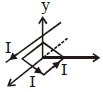
0 likes
View Solution75
DifficultMCQ
$A$ square loop of side $2a$ carrying current $I$ is kept in the $xz$-plane with its centre at the origin. $A$ long wire carrying the same current $I$ is placed parallel to the $z$-axis and passes through the point $(0, b, 0)$,where $b \gg a$. The magnitude of the torque on the loop about the $z$-axis is:
A
$\frac{2 \mu_{0} I^{2} a^{2} b}{\pi(a^{2}+b^{2})}$
B
$\frac{\mu_{0} I^{2} a^{2} b}{2 \pi(a^{2}+b^{2})}$
C
$\frac{\mu_{0} I^{2} a^{2}}{2 \pi b}$
D
$\frac{2 \mu_{0} I^{2} a^{2}}{\pi b}$
Solution
(A) The magnetic field $B$ produced by the long wire at a distance $r$ is given by $B = \frac{\mu_{0} I}{2 \pi r}$.
For the two sides of the loop parallel to the $z$-axis,the distance from the wire is $r = \sqrt{b^2 + a^2}$.
The force on each of these sides is $F = B I (2a) = \frac{\mu_{0} I}{2 \pi \sqrt{b^2 + a^2}} \cdot I \cdot 2a = \frac{\mu_{0} I^2 a}{\pi \sqrt{b^2 + a^2}}$.
The torque $\tau$ about the $z$-axis is produced by the vertical components of these forces. The component of force perpendicular to the lever arm is $F \cos \theta$,where $\cos \theta = \frac{b}{\sqrt{b^2 + a^2}}$.
The total torque is $\tau = 2 \cdot (F \cos \theta) \cdot a = 2 \cdot \left( \frac{\mu_{0} I^2 a}{\pi \sqrt{b^2 + a^2}} \right) \cdot \left( \frac{b}{\sqrt{b^2 + a^2}} \right) \cdot a$.
Simplifying this,we get $\tau = \frac{2 \mu_{0} I^2 a^2 b}{\pi (a^2 + b^2)}$.
For the two sides of the loop parallel to the $z$-axis,the distance from the wire is $r = \sqrt{b^2 + a^2}$.
The force on each of these sides is $F = B I (2a) = \frac{\mu_{0} I}{2 \pi \sqrt{b^2 + a^2}} \cdot I \cdot 2a = \frac{\mu_{0} I^2 a}{\pi \sqrt{b^2 + a^2}}$.
The torque $\tau$ about the $z$-axis is produced by the vertical components of these forces. The component of force perpendicular to the lever arm is $F \cos \theta$,where $\cos \theta = \frac{b}{\sqrt{b^2 + a^2}}$.
The total torque is $\tau = 2 \cdot (F \cos \theta) \cdot a = 2 \cdot \left( \frac{\mu_{0} I^2 a}{\pi \sqrt{b^2 + a^2}} \right) \cdot \left( \frac{b}{\sqrt{b^2 + a^2}} \right) \cdot a$.
Simplifying this,we get $\tau = \frac{2 \mu_{0} I^2 a^2 b}{\pi (a^2 + b^2)}$.
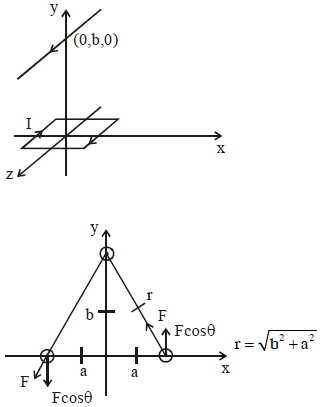
0 likes
View Solution76
MediumMCQ
$A$ coil is placed in $y-z$ plane making an angle of $30^{\circ}$ with the $x$-axis. The current through the coil is $I$,and the number of turns is $N$. If a magnetic field of strength $B$ is applied in the positive $x$-direction,find the torque experienced by the coil (Radius of the coil is $R$).
$(N=100, I=1 \text{ A}, R=2 \text{ m}, B=\frac{1}{\pi} \text{ T})$
$(N=100, I=1 \text{ A}, R=2 \text{ m}, B=\frac{1}{\pi} \text{ T})$
A
$100$
B
$50$
C
$200$
D
$150$
Solution
(C) The torque $\tau$ experienced by a current-carrying coil in a magnetic field is given by $\tau = |\vec{m} \times \vec{B}| = N I A B \sin \theta$,where $\theta$ is the angle between the area vector $\vec{A}$ and the magnetic field $\vec{B}$.
The coil is in the $y-z$ plane,so its area vector $\vec{A}$ is along the $x$-axis. However,the problem states the coil makes an angle of $30^{\circ}$ with the $x$-axis. This implies the angle between the normal to the coil (area vector) and the magnetic field (which is along the $x$-axis) is $\theta = 30^{\circ}$.
Given values: $N=100$,$I=1 \text{ A}$,$R=2 \text{ m}$,$B=\frac{1}{\pi} \text{ T}$.
Area $A = \pi R^2 = \pi (2)^2 = 4\pi \text{ m}^2$.
Substituting these into the torque formula:
$\tau = N I A B \sin 30^{\circ}$
$\tau = 100 \times 1 \times (4\pi) \times \frac{1}{\pi} \times \sin 30^{\circ}$
$\tau = 100 \times 4 \times \frac{1}{2}$
$\tau = 200 \text{ N} \cdot \text{m}$.
The coil is in the $y-z$ plane,so its area vector $\vec{A}$ is along the $x$-axis. However,the problem states the coil makes an angle of $30^{\circ}$ with the $x$-axis. This implies the angle between the normal to the coil (area vector) and the magnetic field (which is along the $x$-axis) is $\theta = 30^{\circ}$.
Given values: $N=100$,$I=1 \text{ A}$,$R=2 \text{ m}$,$B=\frac{1}{\pi} \text{ T}$.
Area $A = \pi R^2 = \pi (2)^2 = 4\pi \text{ m}^2$.
Substituting these into the torque formula:
$\tau = N I A B \sin 30^{\circ}$
$\tau = 100 \times 1 \times (4\pi) \times \frac{1}{\pi} \times \sin 30^{\circ}$
$\tau = 100 \times 4 \times \frac{1}{2}$
$\tau = 200 \text{ N} \cdot \text{m}$.
0 likes
View Solution77
MediumMCQ
$A$ coil in the shape of an equilateral triangle of side $10 \, cm$ lies in a vertical plane between the pole pieces of a permanent magnet producing a horizontal magnetic field of $20 \, mT$. The torque acting on the coil when a current of $0.2 \, A$ is passed through it and its plane becomes parallel to the magnetic field will be $\sqrt{x} \times 10^{-5} \, Nm$. The value of $x$ is ..... .
A
$3$
B
$7$
C
$10$
D
$13$
Solution
(A) The area of an equilateral triangle with side length $a = 10 \, cm = 0.1 \, m$ is given by $A = \frac{\sqrt{3}}{4} a^2 = \frac{\sqrt{3}}{4} (0.1)^2 = \frac{\sqrt{3}}{4} \times 0.01 \, m^2$.
The magnetic moment of the coil is $M = I A = 0.2 \times \frac{\sqrt{3}}{4} \times 0.01 = 0.05 \times \sqrt{3} \times 0.01 = 5 \sqrt{3} \times 10^{-4} \, Am^2$.
The torque acting on the coil is $\tau = M B \sin \theta$,where $\theta$ is the angle between the normal to the coil and the magnetic field. When the plane of the coil is parallel to the magnetic field,the normal to the coil is perpendicular to the magnetic field,so $\theta = 90^{\circ}$.
Thus,$\tau = M B \sin 90^{\circ} = M B = (5 \sqrt{3} \times 10^{-4}) \times (20 \times 10^{-3} \, T) = 100 \sqrt{3} \times 10^{-7} = \sqrt{3} \times 10^{-5} \, Nm$.
Comparing this with $\sqrt{x} \times 10^{-5} \, Nm$,we get $\sqrt{x} = \sqrt{3}$,which implies $x = 3$.
The magnetic moment of the coil is $M = I A = 0.2 \times \frac{\sqrt{3}}{4} \times 0.01 = 0.05 \times \sqrt{3} \times 0.01 = 5 \sqrt{3} \times 10^{-4} \, Am^2$.
The torque acting on the coil is $\tau = M B \sin \theta$,where $\theta$ is the angle between the normal to the coil and the magnetic field. When the plane of the coil is parallel to the magnetic field,the normal to the coil is perpendicular to the magnetic field,so $\theta = 90^{\circ}$.
Thus,$\tau = M B \sin 90^{\circ} = M B = (5 \sqrt{3} \times 10^{-4}) \times (20 \times 10^{-3} \, T) = 100 \sqrt{3} \times 10^{-7} = \sqrt{3} \times 10^{-5} \, Nm$.
Comparing this with $\sqrt{x} \times 10^{-5} \, Nm$,we get $\sqrt{x} = \sqrt{3}$,which implies $x = 3$.
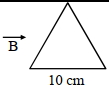
0 likes
View Solution78
MediumMCQ
$A$ square loop of side $l$ is kept in a uniform magnetic field $B$ such that its plane makes an angle $\alpha$ with $\vec{B}$. The loop carries a current $i$. The torque experienced by the loop in this position is
A
$B i l^2$
B
$B i l^2 \sin \alpha$
C
$B i l^2 \cos \alpha$
D
Zero
Solution
(C) The torque $\tau$ on a current-carrying loop in a magnetic field is given by the formula $\vec{\tau} = \vec{M} \times \vec{B}$,where $\vec{M}$ is the magnetic dipole moment.
The magnitude of the magnetic moment is $M = i A$,where $A = l^2$ is the area of the square loop. Thus,$M = i l^2$.
The angle between the area vector $\vec{A}$ (which is perpendicular to the plane of the loop) and the magnetic field $\vec{B}$ is $\theta = 90^\circ - \alpha$,where $\alpha$ is the angle between the plane of the loop and the magnetic field.
The magnitude of the torque is $\tau = M B \sin \theta$.
Substituting the values,we get $\tau = (i l^2) B \sin(90^\circ - \alpha)$.
Since $\sin(90^\circ - \alpha) = \cos \alpha$,the torque is $\tau = B i l^2 \cos \alpha$.
The magnitude of the magnetic moment is $M = i A$,where $A = l^2$ is the area of the square loop. Thus,$M = i l^2$.
The angle between the area vector $\vec{A}$ (which is perpendicular to the plane of the loop) and the magnetic field $\vec{B}$ is $\theta = 90^\circ - \alpha$,where $\alpha$ is the angle between the plane of the loop and the magnetic field.
The magnitude of the torque is $\tau = M B \sin \theta$.
Substituting the values,we get $\tau = (i l^2) B \sin(90^\circ - \alpha)$.
Since $\sin(90^\circ - \alpha) = \cos \alpha$,the torque is $\tau = B i l^2 \cos \alpha$.
0 likes
View Solution79
DifficultMCQ
$A$ uniform magnetic field of $2 \times 10^{-3} \ T$ acts along the positive $Y$-direction. $A$ rectangular loop of sides $20 \ cm$ and $10 \ cm$ carrying a current of $5 \ A$ is placed in the $Y-Z$ plane. The current flows in an anticlockwise sense with reference to the negative $X$-axis. Find the magnitude and direction of the torque.
A
$2 \times 10^{-4} \ N-m$ along the positive $Z$-direction
B
$2 \times 10^{-4} \ N-m$ along the negative $Z$-direction
C
$2 \times 10^{-4} \ N-m$ along the positive $X$-direction
D
$2 \times 10^{-4} \ N-m$ along the positive $Y$-direction
Solution
(B) The area vector $\vec{A}$ of the loop in the $Y-Z$ plane,with current flowing anticlockwise when viewed from the negative $X$-axis,is directed along the negative $X$-axis: $\vec{A} = (0.2 \ m \times 0.1 \ m)(-\hat{i}) = 0.02(-\hat{i}) \ m^2$.
The magnetic moment $\vec{M}$ is given by $\vec{M} = i\vec{A} = 5 \ A \times 0.02(-\hat{i}) \ m^2 = 0.1(-\hat{i}) \ A-m^2$.
The magnetic field is $\vec{B} = 2 \times 10^{-3} \hat{j} \ T$.
The torque $\vec{\tau}$ is given by $\vec{\tau} = \vec{M} \times \vec{B}$.
$\vec{\tau} = [0.1(-\hat{i})] \times [2 \times 10^{-3} \hat{j}] = 0.1 \times 2 \times 10^{-3} \times (-\hat{i} \times \hat{j}) = 2 \times 10^{-4} \times (-\hat{k}) \ N-m$.
Thus,the torque is $2 \times 10^{-4} \ N-m$ along the negative $Z$-direction.
The magnetic moment $\vec{M}$ is given by $\vec{M} = i\vec{A} = 5 \ A \times 0.02(-\hat{i}) \ m^2 = 0.1(-\hat{i}) \ A-m^2$.
The magnetic field is $\vec{B} = 2 \times 10^{-3} \hat{j} \ T$.
The torque $\vec{\tau}$ is given by $\vec{\tau} = \vec{M} \times \vec{B}$.
$\vec{\tau} = [0.1(-\hat{i})] \times [2 \times 10^{-3} \hat{j}] = 0.1 \times 2 \times 10^{-3} \times (-\hat{i} \times \hat{j}) = 2 \times 10^{-4} \times (-\hat{k}) \ N-m$.
Thus,the torque is $2 \times 10^{-4} \ N-m$ along the negative $Z$-direction.
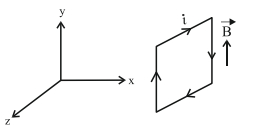
0 likes
View Solution80
DifficultMCQ
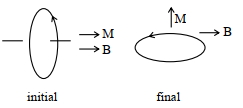
$A$ circular coil having $200$ turns,$2.5 \times 10^{-4} \text{ m}^2$ area and carrying $100 \mu\text{A}$ current is placed in a uniform magnetic field of $1 \text{ T}$. Initially,the magnetic dipole moment $(\vec{M})$ was directed along $\vec{B}$. The amount of work required to rotate the coil through $90^{\circ}$ from its initial orientation such that $\vec{M}$ becomes perpendicular to $\vec{B}$ is . . . . $\mu\text{J}$.
A
$8$
B
$3$
C
$4$
D
$5$
Solution
(D) The work done $W$ in rotating a magnetic dipole in a magnetic field is given by the change in potential energy:
$W = U_f - U_i$
Potential energy $U = -\vec{M} \cdot \vec{B} = -MB \cos \theta$
Initial orientation: $\vec{M}$ is along $\vec{B}$,so $\theta_i = 0^{\circ}$.
$U_i = -MB \cos 0^{\circ} = -MB$
Final orientation: $\vec{M}$ is perpendicular to $\vec{B}$,so $\theta_f = 90^{\circ}$.
$U_f = -MB \cos 90^{\circ} = 0$
Work done $W = 0 - (-MB) = MB$
Given: $N = 200$,$I = 100 \mu\text{A} = 100 \times 10^{-6} \text{ A}$,$A = 2.5 \times 10^{-4} \text{ m}^2$,$B = 1 \text{ T}$.
Magnetic moment $M = NIA = 200 \times (100 \times 10^{-6}) \times (2.5 \times 10^{-4}) = 5 \times 10^{-6} \text{ A m}^2$.
Work $W = MB = (5 \times 10^{-6}) \times 1 = 5 \times 10^{-6} \text{ J} = 5 \mu\text{J}$.
$W = U_f - U_i$
Potential energy $U = -\vec{M} \cdot \vec{B} = -MB \cos \theta$
Initial orientation: $\vec{M}$ is along $\vec{B}$,so $\theta_i = 0^{\circ}$.
$U_i = -MB \cos 0^{\circ} = -MB$
Final orientation: $\vec{M}$ is perpendicular to $\vec{B}$,so $\theta_f = 90^{\circ}$.
$U_f = -MB \cos 90^{\circ} = 0$
Work done $W = 0 - (-MB) = MB$
Given: $N = 200$,$I = 100 \mu\text{A} = 100 \times 10^{-6} \text{ A}$,$A = 2.5 \times 10^{-4} \text{ m}^2$,$B = 1 \text{ T}$.
Magnetic moment $M = NIA = 200 \times (100 \times 10^{-6}) \times (2.5 \times 10^{-4}) = 5 \times 10^{-6} \text{ A m}^2$.
Work $W = MB = (5 \times 10^{-6}) \times 1 = 5 \times 10^{-6} \text{ J} = 5 \mu\text{J}$.
0 likes
View Solution81
DifficultMCQ
$A$ coil having $100$ turns, area of $5 \times 10^{-3} \, m^2$, carrying current of $1 \, mA$ is placed in a uniform magnetic field of $0.20 \, T$ such that the plane of the coil is perpendicular to the magnetic field. The work done in turning the coil through $90^{\circ}$ is . . . . . . $\mu J$.
A
$100$
B
$99$
C
$200$
D
$199$
Solution
(A) The work done in rotating a magnetic dipole in a magnetic field is given by $W = U_f - U_i = -\vec{\mu} \cdot \vec{B}_f - (-\vec{\mu} \cdot \vec{B}_i)$.
Initially, the plane of the coil is perpendicular to the magnetic field, so the area vector $\vec{A}$ is parallel to $\vec{B}$. Thus, the angle $\theta_i = 0^{\circ}$.
After rotating by $90^{\circ}$, the plane of the coil becomes parallel to the magnetic field, so the area vector $\vec{A}$ is perpendicular to $\vec{B}$. Thus, $\theta_f = 90^{\circ}$.
The magnetic moment $\mu = N I A = 100 \times 1 \times 10^{-3} \times 5 \times 10^{-3} = 5 \times 10^{-4} \, A \cdot m^2$.
The work done is $W = -\mu B \cos(90^{\circ}) - (-\mu B \cos(0^{\circ})) = 0 + \mu B = \mu B$.
$W = (5 \times 10^{-4}) \times 0.20 = 1 \times 10^{-4} \, J$.
Since $1 \, J = 10^6 \, \mu J$, we have $W = 10^{-4} \times 10^6 \, \mu J = 100 \, \mu J$.
Initially, the plane of the coil is perpendicular to the magnetic field, so the area vector $\vec{A}$ is parallel to $\vec{B}$. Thus, the angle $\theta_i = 0^{\circ}$.
After rotating by $90^{\circ}$, the plane of the coil becomes parallel to the magnetic field, so the area vector $\vec{A}$ is perpendicular to $\vec{B}$. Thus, $\theta_f = 90^{\circ}$.
The magnetic moment $\mu = N I A = 100 \times 1 \times 10^{-3} \times 5 \times 10^{-3} = 5 \times 10^{-4} \, A \cdot m^2$.
The work done is $W = -\mu B \cos(90^{\circ}) - (-\mu B \cos(0^{\circ})) = 0 + \mu B = \mu B$.
$W = (5 \times 10^{-4}) \times 0.20 = 1 \times 10^{-4} \, J$.
Since $1 \, J = 10^6 \, \mu J$, we have $W = 10^{-4} \times 10^6 \, \mu J = 100 \, \mu J$.
0 likes
View Solution82
DifficultMCQ
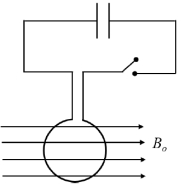
$A$ circular coil of radius $R$ and $N$ turns has negligible resistance. As shown in the schematic figure,its two ends are connected to two wires and it is hanging by those wires with its plane being vertical. The wires are connected to a capacitor with charge $Q$ through a switch. The coil is in a horizontal uniform magnetic field $B_0$ parallel to the plane of the coil. When the switch is closed,the capacitor gets discharged through the coil in a very short time. By the time the capacitor is discharged fully,the magnitude of the angular momentum gained by the coil will be (assume that the discharge time is so short that the coil has hardly rotated during this time):
A
$\frac{\pi}{2} N Q B_0 R^2$
B
$\pi N Q B_0 R^2$
C
$2 \pi N Q B_0 R^2$
D
$4 \pi N Q B_0 R^2$
Solution
(B) The torque $\tau$ experienced by a current-carrying coil in a magnetic field is given by $\vec{\tau} = \vec{M} \times \vec{B}_0$,where $\vec{M}$ is the magnetic moment of the coil.
The magnitude of the torque is $\tau = M B_0 \sin(\theta)$. Since the plane of the coil is vertical and the magnetic field $B_0$ is horizontal and parallel to the plane of the coil,the angle between the area vector (normal to the plane) and the magnetic field is $\theta = 90^\circ$. Thus,$\sin(90^\circ) = 1$.
The magnetic moment of the coil is $M = N i A = N i (\pi R^2)$.
Therefore,the torque is $\tau = N i \pi R^2 B_0$.
From the angular impulse-momentum theorem,the change in angular momentum $L$ is given by $\Delta L = \int \tau dt$.
Substituting the expression for torque: $\Delta L = \int (N i \pi R^2 B_0) dt = N \pi R^2 B_0 \int i dt$.
Since the total charge $Q$ discharged through the coil is $Q = \int i dt$,we get:
$L = N \pi R^2 B_0 Q$.
The magnitude of the torque is $\tau = M B_0 \sin(\theta)$. Since the plane of the coil is vertical and the magnetic field $B_0$ is horizontal and parallel to the plane of the coil,the angle between the area vector (normal to the plane) and the magnetic field is $\theta = 90^\circ$. Thus,$\sin(90^\circ) = 1$.
The magnetic moment of the coil is $M = N i A = N i (\pi R^2)$.
Therefore,the torque is $\tau = N i \pi R^2 B_0$.
From the angular impulse-momentum theorem,the change in angular momentum $L$ is given by $\Delta L = \int \tau dt$.
Substituting the expression for torque: $\Delta L = \int (N i \pi R^2 B_0) dt = N \pi R^2 B_0 \int i dt$.
Since the total charge $Q$ discharged through the coil is $Q = \int i dt$,we get:
$L = N \pi R^2 B_0 Q$.
0 likes
View Solution83
MediumMCQ
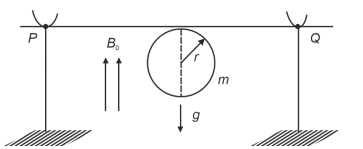
$A$ thin stiff insulated metal wire is bent into a circular loop with its two ends extending tangentially from the same point of the loop. The wire loop has mass $m$ and radius $r$ and it is in a uniform vertical magnetic field $B_0$,as shown in the figure. Initially,it hangs vertically downwards,because of acceleration due to gravity $g$,on two conducting supports at $P$ and $Q$. When a current $I$ is passed through the loop,the loop turns about the line $PQ$ by an angle $\theta$ given by
A
$\tan \theta = \frac{\pi r I B_0}{mg}$
B
$\tan \theta = \frac{2 \pi r I B_0}{mg}$
C
$\tan \theta = \frac{\pi r I B_0}{2 mg}$
D
$\tan \theta = \frac{mg}{\pi r I B_0}$
Solution
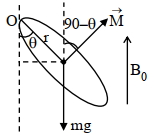
(A) Let the loop make an angle $\theta$ with the vertical.
In equilibrium,the net torque about the axis $PQ$ is zero.
The magnetic torque is $\tau_m = M B_0 \sin(90^\circ - \theta) = M B_0 \cos \theta$,where $M = I A = I (\pi r^2)$ is the magnetic moment.
So,$\tau_m = I \pi r^2 B_0 \cos \theta$.
The gravitational torque is $\tau_g = mg \cdot r \sin \theta$,where $r \sin \theta$ is the horizontal distance of the center of mass from the axis $PQ$.
For equilibrium,$\tau_m = \tau_g$.
$I \pi r^2 B_0 \cos \theta = mg r \sin \theta$.
Dividing both sides by $mg r \cos \theta$,we get $\tan \theta = \frac{\pi r I B_0}{mg}$.
In equilibrium,the net torque about the axis $PQ$ is zero.
The magnetic torque is $\tau_m = M B_0 \sin(90^\circ - \theta) = M B_0 \cos \theta$,where $M = I A = I (\pi r^2)$ is the magnetic moment.
So,$\tau_m = I \pi r^2 B_0 \cos \theta$.
The gravitational torque is $\tau_g = mg \cdot r \sin \theta$,where $r \sin \theta$ is the horizontal distance of the center of mass from the axis $PQ$.
For equilibrium,$\tau_m = \tau_g$.
$I \pi r^2 B_0 \cos \theta = mg r \sin \theta$.
Dividing both sides by $mg r \cos \theta$,we get $\tan \theta = \frac{\pi r I B_0}{mg}$.
0 likes
View Solution84
MediumMCQ
$A$ uniform magnetic field is established along the positive $z-$direction. $A$ rectangular loop,carrying a current $I,$ is suspended in this magnetic field. Which case corresponds to stable equilibrium?
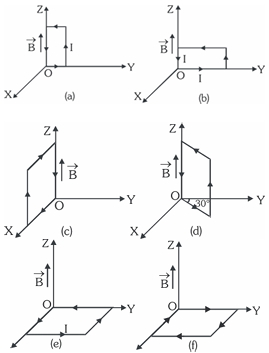
A
$e$ and $f$
B
$a, d, f$
C
all
D
only $e$
Solution
(D) The torque on a current loop in a magnetic field is given by $\vec{\tau} = \vec{m} \times \vec{B}$,where $\vec{m}$ is the magnetic dipole moment. Equilibrium occurs when $\vec{\tau} = 0$,which means $\vec{m}$ is parallel or anti-parallel to $\vec{B}$.
Stable equilibrium occurs when the potential energy $U = -\vec{m} \cdot \vec{B}$ is minimum,which happens when $\vec{m}$ is parallel to $\vec{B}$ (i.e.,the angle $\theta = 0^{\circ}$).
In case $(e)$,the current flows such that the area vector $\vec{A}$ (and thus $\vec{m}$) points in the positive $z-$direction,parallel to $\vec{B}$. This is a state of stable equilibrium.
In case $(f)$,the current flows such that $\vec{m}$ points in the negative $z-$direction,anti-parallel to $\vec{B}$. This is a state of unstable equilibrium.
Therefore,only case $(e)$ corresponds to stable equilibrium.
Stable equilibrium occurs when the potential energy $U = -\vec{m} \cdot \vec{B}$ is minimum,which happens when $\vec{m}$ is parallel to $\vec{B}$ (i.e.,the angle $\theta = 0^{\circ}$).
In case $(e)$,the current flows such that the area vector $\vec{A}$ (and thus $\vec{m}$) points in the positive $z-$direction,parallel to $\vec{B}$. This is a state of stable equilibrium.
In case $(f)$,the current flows such that $\vec{m}$ points in the negative $z-$direction,anti-parallel to $\vec{B}$. This is a state of unstable equilibrium.
Therefore,only case $(e)$ corresponds to stable equilibrium.
0 likes
View Solution85
EasyMCQ
$A$ circular coil having $N$ turns and radius $R$ carrying current $I$ is held in the $z-x$ plane in a magnetic field $B\hat{k}$. The torque on the coil due to the magnetic field in $N-m$ is:
A
$\frac{BR^2I}{\pi N}$
B
$B\pi R^2IN$
C
$\frac{B\pi R^2I}{N}$
D
Zero
Solution
(B) The torque $\vec{\tau}$ on a current-carrying coil in a magnetic field is given by $\vec{\tau} = \vec{M} \times \vec{B}$.
Here,the magnetic moment $\vec{M} = N I A \hat{n}$,where $A = \pi R^2$.
Since the coil is in the $z-x$ plane,its area vector $\hat{n}$ is along the $y$-axis,so $\vec{M} = N I (\pi R^2) \hat{j}$.
The magnetic field is $\vec{B} = B \hat{k}$.
Therefore,$\vec{\tau} = (N I \pi R^2 \hat{j}) \times (B \hat{k})$.
Using the cross product rules $\hat{j} \times \hat{k} = \hat{i}$,we get $\vec{\tau} = N I \pi R^2 B \hat{i}$.
The magnitude of the torque is $N I \pi R^2 B$.
Here,the magnetic moment $\vec{M} = N I A \hat{n}$,where $A = \pi R^2$.
Since the coil is in the $z-x$ plane,its area vector $\hat{n}$ is along the $y$-axis,so $\vec{M} = N I (\pi R^2) \hat{j}$.
The magnetic field is $\vec{B} = B \hat{k}$.
Therefore,$\vec{\tau} = (N I \pi R^2 \hat{j}) \times (B \hat{k})$.
Using the cross product rules $\hat{j} \times \hat{k} = \hat{i}$,we get $\vec{\tau} = N I \pi R^2 B \hat{i}$.
The magnitude of the torque is $N I \pi R^2 B$.
0 likes
View Solution86
MediumMCQ
Two similar wires of equal lengths are bent in the form of a square and a circular loop. They are suspended in a uniform magnetic field and the same current is passed through them. The torque experienced by:
A
circular loop is greater.
B
square loop is greater.
C
both loops is same.
D
both will be zero.
Solution
(A) Let the length of the wire be $L$. For the square loop, the perimeter is $4a = L$, so the side length $a = L/4$. The area $A_s = a^2 = (L/4)^2 = L^2/16$.
For the circular loop, the circumference is $2\pi r = L$, so the radius $r = L/(2\pi)$. The area $A_c = \pi r^2 = \pi (L/(2\pi))^2 = L^2/(4\pi)$.
Since $\pi \approx 3.14$, $4\pi \approx 12.56$, which is less than $16$. Therefore, $A_c > A_s$.
The torque experienced by a current-carrying loop in a magnetic field is given by $\tau = NIAB \sin \theta$. Since $N$, $I$, $B$, and $\theta$ are the same for both loops, the torque is directly proportional to the area $A$.
Since $A_c > A_s$, the torque experienced by the circular loop is greater.
For the circular loop, the circumference is $2\pi r = L$, so the radius $r = L/(2\pi)$. The area $A_c = \pi r^2 = \pi (L/(2\pi))^2 = L^2/(4\pi)$.
Since $\pi \approx 3.14$, $4\pi \approx 12.56$, which is less than $16$. Therefore, $A_c > A_s$.
The torque experienced by a current-carrying loop in a magnetic field is given by $\tau = NIAB \sin \theta$. Since $N$, $I$, $B$, and $\theta$ are the same for both loops, the torque is directly proportional to the area $A$.
Since $A_c > A_s$, the torque experienced by the circular loop is greater.
0 likes
View Solution87
MediumMCQ
Current $I$ is carried in a wire of length $L$. If the wire is bent into a circular coil of single turn,the maximum torque in a given magnetic field $B$ is:
A
$\frac{L^2 IB}{4 \pi}$
B
$\frac{L^2 IB}{2 \pi}$
C
$\frac{L^2 IB}{4}$
D
$\frac{L^2 IB}{8 \pi}$
Solution
(A) The length of the wire $L$ forms the circumference of the circular coil,so $L = 2 \pi r$,where $r$ is the radius of the coil.
Thus,$r = \frac{L}{2 \pi}$.
The area of the coil is $A = \pi r^2 = \pi \left( \frac{L}{2 \pi} \right)^2 = \frac{L^2}{4 \pi}$.
The magnetic moment of the coil is $M = I A = I \left( \frac{L^2}{4 \pi} \right)$.
The maximum torque $\tau$ on a current-carrying coil in a magnetic field $B$ is given by $\tau = M B \sin \theta$. For maximum torque,$\sin \theta = 1$.
Therefore,$\tau_{max} = M B = \left( \frac{I L^2}{4 \pi} \right) B = \frac{L^2 IB}{4 \pi}$.
Thus,$r = \frac{L}{2 \pi}$.
The area of the coil is $A = \pi r^2 = \pi \left( \frac{L}{2 \pi} \right)^2 = \frac{L^2}{4 \pi}$.
The magnetic moment of the coil is $M = I A = I \left( \frac{L^2}{4 \pi} \right)$.
The maximum torque $\tau$ on a current-carrying coil in a magnetic field $B$ is given by $\tau = M B \sin \theta$. For maximum torque,$\sin \theta = 1$.
Therefore,$\tau_{max} = M B = \left( \frac{I L^2}{4 \pi} \right) B = \frac{L^2 IB}{4 \pi}$.
0 likes
View Solution88
MediumMCQ
Two wires of equal lengths are bent in the form of a square and a circular loop. They are suspended in a uniform magnetic field and the same current is passed through them. The torque experienced by:
A
square loop is greater.
B
both the loops is same but not zero.
C
both the loops is zero.
D
circular loop is maximum.
Solution
(D) Let the length of each wire be $L$.
For the square loop, perimeter $4a = L$, so $a = L/4$. The area $A_s = a^2 = (L/4)^2 = L^2/16$.
For the circular loop, circumference $2\pi r = L$, so $r = L/(2\pi)$. The area $A_c = \pi r^2 = \pi (L/(2\pi))^2 = L^2/(4\pi)$.
Since $\pi \approx 3.14$, $4\pi \approx 12.56$, which is less than $16$. Therefore, $A_c > A_s$.
The torque on a current-carrying loop in a magnetic field is given by $\tau = NIAB \sin \theta$.
Since $N$, $I$, $B$, and $\theta$ are the same for both loops, the torque is directly proportional to the area $A$.
Because $A_c > A_s$, the torque experienced by the circular loop is greater than that experienced by the square loop.
For the square loop, perimeter $4a = L$, so $a = L/4$. The area $A_s = a^2 = (L/4)^2 = L^2/16$.
For the circular loop, circumference $2\pi r = L$, so $r = L/(2\pi)$. The area $A_c = \pi r^2 = \pi (L/(2\pi))^2 = L^2/(4\pi)$.
Since $\pi \approx 3.14$, $4\pi \approx 12.56$, which is less than $16$. Therefore, $A_c > A_s$.
The torque on a current-carrying loop in a magnetic field is given by $\tau = NIAB \sin \theta$.
Since $N$, $I$, $B$, and $\theta$ are the same for both loops, the torque is directly proportional to the area $A$.
Because $A_c > A_s$, the torque experienced by the circular loop is greater than that experienced by the square loop.
0 likes
View Solution89
MediumMCQ
$A$ wire of length $L$ carries a current $I$. If the wire is turned into a square coil of single turn,the maximum magnitude of the torque in a given magnetic field $\overrightarrow{B}$ is
A
$\frac{IBL^2}{16}$
B
$\frac{IBL^2}{8}$
C
$\frac{IBL}{8}$
D
$\frac{IBL}{16}$
Solution
(A) The length of the wire is $L$. When it is formed into a square coil of single turn,the perimeter of the square is $L$.
Let $a$ be the side of the square. Then $4a = L$,which implies $a = \frac{L}{4}$.
The area of the square coil is $A = a^2 = (\frac{L}{4})^2 = \frac{L^2}{16}$.
The torque $\tau$ on a current-carrying coil in a magnetic field is given by $\tau = NIAB \sin \theta$.
For maximum torque,$\sin \theta = 1$.
Given $N = 1$,the maximum torque is $\tau_{max} = IAB = I \times (\frac{L^2}{16}) \times B = \frac{IBL^2}{16}$.
Let $a$ be the side of the square. Then $4a = L$,which implies $a = \frac{L}{4}$.
The area of the square coil is $A = a^2 = (\frac{L}{4})^2 = \frac{L^2}{16}$.
The torque $\tau$ on a current-carrying coil in a magnetic field is given by $\tau = NIAB \sin \theta$.
For maximum torque,$\sin \theta = 1$.
Given $N = 1$,the maximum torque is $\tau_{max} = IAB = I \times (\frac{L^2}{16}) \times B = \frac{IBL^2}{16}$.
0 likes
View Solution90
MediumMCQ
$A$ solenoid of length $0.4 \ m$ and having $500$ turns of wire carries a current $3 \ A$. $A$ thin coil having $10$ turns of wire and radius $0.1 \ m$ carries current $0.4 \ A$. The torque required to hold the coil in the middle of the solenoid with its axis perpendicular to the axis of the solenoid is $(\mu_0 = 4\pi \times 10^{-7} \ SI \ units, \pi^2 = 10, \sin 90^{\circ} = 1)$.
A
$3 \times 10^{-4} \ Nm$
B
$12 \times 10^{-4} \ Nm$
C
$6 \times 10^{-4} \ Nm$
D
$24 \times 10^{-4} \ Nm$
Solution
(C) The magnetic field $B$ inside a long solenoid is given by $B = \mu_0 n I_s$, where $n = \frac{N_s}{L}$.
Given: $N_s = 500$, $L = 0.4 \ m$, $I_s = 3 \ A$.
$B = (4\pi \times 10^{-7}) \times (500 / 0.4) \times 3 = 4\pi \times 10^{-7} \times 1250 \times 3 = 15000\pi \times 10^{-7} = 1.5\pi \times 10^{-3} \ T$.
The torque $\tau$ on a coil in a magnetic field is $\tau = N_c I_c A B \sin \theta$.
Given: $N_c = 10$, $I_c = 0.4 \ A$, $r = 0.1 \ m$, $\theta = 90^{\circ}$.
Area $A = \pi r^2 = \pi (0.1)^2 = 0.01\pi \ m^2$.
$\tau = 10 \times 0.4 \times (0.01\pi) \times (1.5\pi \times 10^{-3}) \times \sin 90^{\circ}$.
$\tau = 4 \times 0.01 \times 1.5 \times \pi^2 \times 10^{-3} \times 1$.
Using $\pi^2 = 10$:
$\tau = 0.06 \times 10 \times 10^{-3} = 0.6 \times 10^{-3} = 6 \times 10^{-4} \ Nm$.
Given: $N_s = 500$, $L = 0.4 \ m$, $I_s = 3 \ A$.
$B = (4\pi \times 10^{-7}) \times (500 / 0.4) \times 3 = 4\pi \times 10^{-7} \times 1250 \times 3 = 15000\pi \times 10^{-7} = 1.5\pi \times 10^{-3} \ T$.
The torque $\tau$ on a coil in a magnetic field is $\tau = N_c I_c A B \sin \theta$.
Given: $N_c = 10$, $I_c = 0.4 \ A$, $r = 0.1 \ m$, $\theta = 90^{\circ}$.
Area $A = \pi r^2 = \pi (0.1)^2 = 0.01\pi \ m^2$.
$\tau = 10 \times 0.4 \times (0.01\pi) \times (1.5\pi \times 10^{-3}) \times \sin 90^{\circ}$.
$\tau = 4 \times 0.01 \times 1.5 \times \pi^2 \times 10^{-3} \times 1$.
Using $\pi^2 = 10$:
$\tau = 0.06 \times 10 \times 10^{-3} = 0.6 \times 10^{-3} = 6 \times 10^{-4} \ Nm$.
0 likes
View Solution91
MediumMCQ
$A$ wire of length $L$ carries a current $i$. If the wire is turned into a circular coil and kept in a uniform magnetic field $B$,the maximum magnitude of torque in the given magnetic field will be
A
$\frac{B i L^2}{4 \pi}$
B
$\frac{B i L^2}{2 \pi}$
C
$\frac{B^2 L^2}{2}$
D
$\frac{B i L^2}{2}$
Solution
(A) The torque $\tau$ on a current-carrying loop in a magnetic field is given by $\tau = N i A B \sin \theta$,where $N$ is the number of turns,$i$ is the current,$A$ is the area,$B$ is the magnetic field,and $\theta$ is the angle between the normal to the loop and the magnetic field.
For a wire of length $L$ formed into a circular coil of $N$ turns with radius $r$,the circumference is $L = N(2 \pi r)$,so $r = \frac{L}{2 \pi N}$.
The area of the coil is $A = \pi r^2 = \pi \left( \frac{L}{2 \pi N} \right)^2 = \frac{L^2}{4 \pi N^2}$.
Substituting $A$ into the torque equation: $\tau = N i \left( \frac{L^2}{4 \pi N^2} \right) B \sin \theta = \frac{i L^2 B \sin \theta}{4 \pi N}$.
To maximize the torque,we set $\sin \theta = 1$ and choose the minimum number of turns,$N = 1$.
Therefore,the maximum torque is $\tau_{\max} = \frac{i L^2 B}{4 \pi}$.
For a wire of length $L$ formed into a circular coil of $N$ turns with radius $r$,the circumference is $L = N(2 \pi r)$,so $r = \frac{L}{2 \pi N}$.
The area of the coil is $A = \pi r^2 = \pi \left( \frac{L}{2 \pi N} \right)^2 = \frac{L^2}{4 \pi N^2}$.
Substituting $A$ into the torque equation: $\tau = N i \left( \frac{L^2}{4 \pi N^2} \right) B \sin \theta = \frac{i L^2 B \sin \theta}{4 \pi N}$.
To maximize the torque,we set $\sin \theta = 1$ and choose the minimum number of turns,$N = 1$.
Therefore,the maximum torque is $\tau_{\max} = \frac{i L^2 B}{4 \pi}$.
0 likes
View Solution92
EasyMCQ
$A$ current-carrying loop is placed in a uniform magnetic field. The torque acting on the loop does not depend upon
A
area of the loop
B
number of turns in the loop
C
shape of the loop
D
strength of the magnetic field
Solution
(C) The torque $\tau$ acting on a current-carrying loop in a uniform magnetic field is given by the formula: $\tau = N i A B \sin \theta$.
Here,$N$ is the number of turns,$i$ is the current,$A$ is the area of the loop,$B$ is the magnetic field strength,and $\theta$ is the angle between the normal to the loop and the magnetic field.
From the formula,it is evident that the torque depends on $N, i, A, B,$ and $\theta$.
It does not depend on the shape of the loop,as long as the area $A$ remains constant.
Here,$N$ is the number of turns,$i$ is the current,$A$ is the area of the loop,$B$ is the magnetic field strength,and $\theta$ is the angle between the normal to the loop and the magnetic field.
From the formula,it is evident that the torque depends on $N, i, A, B,$ and $\theta$.
It does not depend on the shape of the loop,as long as the area $A$ remains constant.
0 likes
View Solution93
MediumMCQ
$A$ metal wire of length '$L$' is bent to form a circular coil of number of turns '$n$'. The coil is placed in a magnetic field '$B$' and a current '$I$' is passed through the coil. The maximum torque acting on the coil is:
A
$\frac{BIL^{2}}{4 \pi n}$
B
$\frac{BIL^{2}}{2 \pi n}$
C
$\frac{B^{2} IL}{2 \pi n}$
D
$\frac{B^{2} IL}{4 \pi n}$
Solution
(A) The length of the wire is $L$. When it is bent into a circular coil of $n$ turns,the circumference of one turn is $2\pi r = L/n$,where $r$ is the radius of the coil.
Thus,the radius $r = \frac{L}{2\pi n}$.
The area of one turn is $A = \pi r^2 = \pi \left(\frac{L}{2\pi n}\right)^2 = \frac{\pi L^2}{4\pi^2 n^2} = \frac{L^2}{4\pi n^2}$.
The total magnetic moment of the coil with $n$ turns is $M = nIA = nI \left(\frac{L^2}{4\pi n^2}\right) = \frac{IL^2}{4\pi n}$.
The maximum torque acting on a coil in a magnetic field is given by $\tau_{max} = MB$.
Substituting the value of $M$,we get $\tau_{max} = \left(\frac{IL^2}{4\pi n}\right)B = \frac{BIL^2}{4\pi n}$.
Thus,the radius $r = \frac{L}{2\pi n}$.
The area of one turn is $A = \pi r^2 = \pi \left(\frac{L}{2\pi n}\right)^2 = \frac{\pi L^2}{4\pi^2 n^2} = \frac{L^2}{4\pi n^2}$.
The total magnetic moment of the coil with $n$ turns is $M = nIA = nI \left(\frac{L^2}{4\pi n^2}\right) = \frac{IL^2}{4\pi n}$.
The maximum torque acting on a coil in a magnetic field is given by $\tau_{max} = MB$.
Substituting the value of $M$,we get $\tau_{max} = \left(\frac{IL^2}{4\pi n}\right)B = \frac{BIL^2}{4\pi n}$.
0 likes
View Solution94
EasyMCQ
$A$ coil having $10 \text{ A m}^2$ magnetic moment is placed in a vertical plane and is free to rotate about its horizontal axis, which coincides with its diameter. $A$ uniform magnetic field of $2 \text{ T}$ in the horizontal direction exists such that initially the axis of the coil is in the direction of the field. The coil rotates through an angle of $90^{\circ}$ under the influence of the magnetic field. The moment of inertia of the coil is $0.1 \text{ kg m}^2$. What will be its angular speed (in $\text{ rad/s}$)?
A
$40$
B
$10$
C
$20$
D
$5$
Solution
(C) The potential energy of a magnetic dipole in a magnetic field is given by $U = -\vec{m} \cdot \vec{B} = -mB \cos \theta$.
Initially, the axis of the coil is in the direction of the field, so $\theta_i = 0^{\circ}$.
$U_i = -mB \cos 0^{\circ} = -mB$.
After rotating through $90^{\circ}$, the final angle is $\theta_f = 90^{\circ}$.
$U_f = -mB \cos 90^{\circ} = 0$.
The change in potential energy is $\Delta U = U_f - U_i = 0 - (-mB) = mB$.
This change in potential energy is converted into rotational kinetic energy: $\Delta U = K_f - K_i$.
Since the coil starts from rest, $K_i = 0$, so $mB = \frac{1}{2} I \omega^2$.
Rearranging for $\omega$: $\omega = \sqrt{\frac{2mB}{I}}$.
Substituting the given values: $m = 10 \text{ A m}^2$, $B = 2 \text{ T}$, $I = 0.1 \text{ kg m}^2$.
$\omega = \sqrt{\frac{2 \times 10 \times 2}{0.1}} = \sqrt{\frac{40}{0.1}} = \sqrt{400} = 20 \text{ rad/s}$.
Initially, the axis of the coil is in the direction of the field, so $\theta_i = 0^{\circ}$.
$U_i = -mB \cos 0^{\circ} = -mB$.
After rotating through $90^{\circ}$, the final angle is $\theta_f = 90^{\circ}$.
$U_f = -mB \cos 90^{\circ} = 0$.
The change in potential energy is $\Delta U = U_f - U_i = 0 - (-mB) = mB$.
This change in potential energy is converted into rotational kinetic energy: $\Delta U = K_f - K_i$.
Since the coil starts from rest, $K_i = 0$, so $mB = \frac{1}{2} I \omega^2$.
Rearranging for $\omega$: $\omega = \sqrt{\frac{2mB}{I}}$.
Substituting the given values: $m = 10 \text{ A m}^2$, $B = 2 \text{ T}$, $I = 0.1 \text{ kg m}^2$.
$\omega = \sqrt{\frac{2 \times 10 \times 2}{0.1}} = \sqrt{\frac{40}{0.1}} = \sqrt{400} = 20 \text{ rad/s}$.
0 likes
View Solution95
EasyMCQ
$A$ uniform magnetic field of $0.3 \text{ T}$ is established along the $+z$-direction. $A$ rectangular loop of sides $10 \text{ cm}$ and $5 \text{ cm}$ carries a current of $12 \text{ A}$ and is placed in the $xy$-plane as shown in the figure. The torque acting on the loop is $....... \text{ Nm}$.
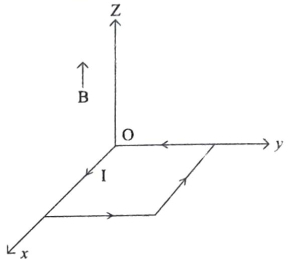
A
$-1.8 \times 10^{-2} \hat{i}$
B
$-1.8 \times 10^{-2} \hat{j}$
C
$1.8 \times 10^{-2} \hat{i}$
D
zero
Solution
(D) The magnetic field is given by $\vec{B} = 0.3 \hat{k} \text{ T}$.
The area vector $\vec{A}$ of the loop placed in the $xy$-plane is perpendicular to the plane,so $\vec{A} = (10 \times 10^{-2} \text{ m} \times 5 \times 10^{-2} \text{ m}) \hat{k} = 50 \times 10^{-4} \hat{k} \text{ m}^2 = 5 \times 10^{-3} \hat{k} \text{ m}^2$.
The magnetic moment $\vec{m}$ is given by $\vec{m} = I \vec{A} = 12 \times 5 \times 10^{-3} \hat{k} = 60 \times 10^{-3} \hat{k} = 0.06 \hat{k} \text{ A m}^2$.
The torque $\vec{\tau}$ acting on the loop is given by $\vec{\tau} = \vec{m} \times \vec{B}$.
Substituting the values,$\vec{\tau} = (0.06 \hat{k}) \times (0.3 \hat{k})$.
Since the cross product of a vector with itself is zero $(\hat{k} \times \hat{k} = 0)$,the torque $\vec{\tau} = 0$.
The area vector $\vec{A}$ of the loop placed in the $xy$-plane is perpendicular to the plane,so $\vec{A} = (10 \times 10^{-2} \text{ m} \times 5 \times 10^{-2} \text{ m}) \hat{k} = 50 \times 10^{-4} \hat{k} \text{ m}^2 = 5 \times 10^{-3} \hat{k} \text{ m}^2$.
The magnetic moment $\vec{m}$ is given by $\vec{m} = I \vec{A} = 12 \times 5 \times 10^{-3} \hat{k} = 60 \times 10^{-3} \hat{k} = 0.06 \hat{k} \text{ A m}^2$.
The torque $\vec{\tau}$ acting on the loop is given by $\vec{\tau} = \vec{m} \times \vec{B}$.
Substituting the values,$\vec{\tau} = (0.06 \hat{k}) \times (0.3 \hat{k})$.
Since the cross product of a vector with itself is zero $(\hat{k} \times \hat{k} = 0)$,the torque $\vec{\tau} = 0$.
0 likes
View Solution96
DifficultMCQ
The torque required to hold a small circular coil of $10$ turns, area $1 \,mm^{2}$ and carrying a current of $\left(\frac{21}{44}\right) \,A$ in the middle of a long solenoid of $10^{3} \,turns/m$ carrying a current of $2.5 \,A$, with its axis perpendicular to the axis of the solenoid is
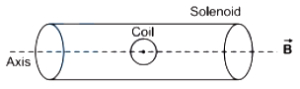
A
$1.5 \times 10^{-6} \,N-m$
B
$1.5 \times 10^{-8} \,N-m$
C
$1.5 \times 10^{+6} \,N-m$
D
$1.5 \times 10^{+8} \,N-m$
Solution
(B) The magnetic moment of the coil is $M = N I A$.
Given: $N = 10$, $I = \frac{21}{44} \,A$, $A = 1 \,mm^{2} = 10^{-6} \,m^{2}$.
$M = 10 \times \frac{21}{44} \times 10^{-6} \,A-m^{2}$.
The magnetic field inside the solenoid is $B = \mu_{0} n I_{s}$.
Given: $n = 10^{3} \,turns/m$, $I_{s} = 2.5 \,A$, $\mu_{0} = 4\pi \times 10^{-7} \,T-m/A$.
$B = (4 \times \frac{22}{7} \times 10^{-7}) \times 10^{3} \times 2.5 \,T$.
The torque $\tau$ required to hold the coil with its axis perpendicular to the magnetic field is $\tau = M B \sin(90^{\circ}) = M B$.
$\tau = (10 \times \frac{21}{44} \times 10^{-6}) \times (4 \times \frac{22}{7} \times 10^{-7} \times 10^{3} \times 2.5)$.
$\tau = (10 \times \frac{21}{44} \times 10^{-6}) \times (4 \times \frac{22}{7} \times 2.5 \times 10^{-4})$.
$\tau = (10 \times \frac{21}{44} \times 10^{-6}) \times (22 \times 10^{-4}) = 1.5 \times 10^{-8} \,N-m$.
Given: $N = 10$, $I = \frac{21}{44} \,A$, $A = 1 \,mm^{2} = 10^{-6} \,m^{2}$.
$M = 10 \times \frac{21}{44} \times 10^{-6} \,A-m^{2}$.
The magnetic field inside the solenoid is $B = \mu_{0} n I_{s}$.
Given: $n = 10^{3} \,turns/m$, $I_{s} = 2.5 \,A$, $\mu_{0} = 4\pi \times 10^{-7} \,T-m/A$.
$B = (4 \times \frac{22}{7} \times 10^{-7}) \times 10^{3} \times 2.5 \,T$.
The torque $\tau$ required to hold the coil with its axis perpendicular to the magnetic field is $\tau = M B \sin(90^{\circ}) = M B$.
$\tau = (10 \times \frac{21}{44} \times 10^{-6}) \times (4 \times \frac{22}{7} \times 10^{-7} \times 10^{3} \times 2.5)$.
$\tau = (10 \times \frac{21}{44} \times 10^{-6}) \times (4 \times \frac{22}{7} \times 2.5 \times 10^{-4})$.
$\tau = (10 \times \frac{21}{44} \times 10^{-6}) \times (22 \times 10^{-4}) = 1.5 \times 10^{-8} \,N-m$.
0 likes
View Solution97
EasyMCQ
$A$ circular current loop of magnetic moment $M$ is in an arbitrary orientation in an external uniform magnetic field $\vec{B}$. The work done to rotate the loop by $30^{\circ}$ about an axis perpendicular to its plane is
A
$MB/2$
B
$MB$
C
Zero
D
$\sqrt{3} MB/2$
Solution
(C) The potential energy $U$ of a magnetic dipole in a magnetic field is given by $U = -\vec{M} \cdot \vec{B} = -MB \cos \theta$,where $\theta$ is the angle between the magnetic moment vector $\vec{M}$ and the magnetic field vector $\vec{B}$.
When the loop is rotated about an axis perpendicular to its plane,the direction of the magnetic moment vector $\vec{M}$ (which is always perpendicular to the plane of the loop) remains unchanged relative to the magnetic field $\vec{B}$.
Since the angle $\theta$ between $\vec{M}$ and $\vec{B}$ does not change,the potential energy of the loop remains constant.
Therefore,the work done $W = \Delta U = 0$.
When the loop is rotated about an axis perpendicular to its plane,the direction of the magnetic moment vector $\vec{M}$ (which is always perpendicular to the plane of the loop) remains unchanged relative to the magnetic field $\vec{B}$.
Since the angle $\theta$ between $\vec{M}$ and $\vec{B}$ does not change,the potential energy of the loop remains constant.
Therefore,the work done $W = \Delta U = 0$.
0 likes
View Solution98
MediumMCQ
$A$ thin wire of length $L$ made of an insulating material is bent to form a circular loop and a positive charge $q$ is given so that it is distributed uniformly around the circumference of the loop. The loop is then rotated with an angular speed $\omega$ about an axis passing through its centre. If a uniform magnetic field $B$ directed parallel to the plane of the loop is applied,then the magnitude of the magnetic torque on the loop is:
A
$\frac{q \omega L^2 B}{8 \pi^2}$
B
$\frac{q \omega L^2 B}{4 \pi^2}$
C
$\frac{q \omega L^2 B}{2 \pi^2}$
D
$\frac{q \omega L^2 B}{\pi^2}$
Solution
(A) $1$. The circumference of the loop is $L = 2 \pi r$,so the radius $r = \frac{L}{2 \pi}$.
$2$. The loop rotates with angular velocity $\omega$,creating an equivalent current $I = \frac{q}{T} = \frac{q \omega}{2 \pi}$.
$3$. The magnetic moment of the loop is $M = I A = I (\pi r^2) = \left( \frac{q \omega}{2 \pi} \right) \pi \left( \frac{L}{2 \pi} \right)^2 = \frac{q \omega L^2}{8 \pi^2}$.
$4$. The magnetic torque is given by $\tau = |\vec{M} \times \vec{B}| = M B \sin \theta$. Since the magnetic field $B$ is parallel to the plane of the loop,the angle between the magnetic moment vector (perpendicular to the plane) and the magnetic field is $\theta = 90^\circ$.
$5$. Therefore,$\tau = M B \sin 90^\circ = M B = \frac{q \omega L^2 B}{8 \pi^2}$.
$2$. The loop rotates with angular velocity $\omega$,creating an equivalent current $I = \frac{q}{T} = \frac{q \omega}{2 \pi}$.
$3$. The magnetic moment of the loop is $M = I A = I (\pi r^2) = \left( \frac{q \omega}{2 \pi} \right) \pi \left( \frac{L}{2 \pi} \right)^2 = \frac{q \omega L^2}{8 \pi^2}$.
$4$. The magnetic torque is given by $\tau = |\vec{M} \times \vec{B}| = M B \sin \theta$. Since the magnetic field $B$ is parallel to the plane of the loop,the angle between the magnetic moment vector (perpendicular to the plane) and the magnetic field is $\theta = 90^\circ$.
$5$. Therefore,$\tau = M B \sin 90^\circ = M B = \frac{q \omega L^2 B}{8 \pi^2}$.
0 likes
View Solution99
MediumMCQ
$A$ wire of length $10 \ m$ carrying a current of $1 \ A$ is bent into a circular loop. If a magnetic field of $2 \pi \times 10^{-4} \ T$ is applied on the loop,then the maximum torque acting on it is
A
$100 \times 10^{-4} \ N \ m$
B
$50 \times 10^{-4} \ N \ m$
C
$25 \times 10^{-4} \ N \ m$
D
$75 \times 10^{-4} \ N \ m$
Solution
(B) The length of the wire is $L = 10 \ m$. When it is bent into a circular loop of radius $r$,the circumference is $2 \pi r = L = 10 \ m$.
Thus,$r = \frac{10}{2 \pi} \ m$.
The area of the loop is $A = \pi r^2 = \pi \left( \frac{10}{2 \pi} \right)^2 = \pi \left( \frac{100}{4 \pi^2} \right) = \frac{25}{\pi} \ m^2$.
The magnetic moment of the loop is $M = I \times A = 1 \times \frac{25}{\pi} = \frac{25}{\pi} \ A \ m^2$.
The maximum torque acting on the loop in a magnetic field $B$ is given by $\tau_{max} = M \times B$.
Substituting the values,$\tau_{max} = \left( \frac{25}{\pi} \right) \times (2 \pi \times 10^{-4}) = 50 \times 10^{-4} \ N \ m$.
Thus,$r = \frac{10}{2 \pi} \ m$.
The area of the loop is $A = \pi r^2 = \pi \left( \frac{10}{2 \pi} \right)^2 = \pi \left( \frac{100}{4 \pi^2} \right) = \frac{25}{\pi} \ m^2$.
The magnetic moment of the loop is $M = I \times A = 1 \times \frac{25}{\pi} = \frac{25}{\pi} \ A \ m^2$.
The maximum torque acting on the loop in a magnetic field $B$ is given by $\tau_{max} = M \times B$.
Substituting the values,$\tau_{max} = \left( \frac{25}{\pi} \right) \times (2 \pi \times 10^{-4}) = 50 \times 10^{-4} \ N \ m$.
0 likes
View SolutionMoving Charges and Magnetism — Torque , Potential Energy and Work Done in Mangetic Field · Frequently Asked Questions
1Are these Moving Charges and Magnetism questions useful for JEE and NEET?
Yes. All questions in this section are mapped to JEE Main and NEET exam patterns. Previous year questions from JEE Main, NEET, GUJCET and state-level exams are included with full solutions.
2Can I switch to Hindi or Gujarati for these questions?
Yes. Use the language tabs in the hero section or the sidebar to view the same questions and solutions in English, Hindi or Gujarati.
3How do I generate a question paper from this subtopic?
Use the Vedclass Exam Paper Generator — select the chapter and subtopic, set difficulty, and generate Sets A, B, C, D automatically. First 3 chapters of every subject are free.
Vedclass Products
For Students
Vedclass Test Series
Mock tests in real JEE/NEET style with performance analysis. 5-day free trial.
Start Free TrialFor Teachers
Exam Paper Generator
Generate Set A/B/C/D papers from this chapter in 2 minutes. 3 chapters free.
Try FreeFor Institutes
Online Exam Module
Live online exams with unlimited students, 360° analytics & white-label branding.
See DemoFor Teachers & Institutes
Generate a Moving Charges and Magnetism Exam Paper in 2 Minutes
Select subtopic & difficulty — Sets A, B, C, D auto-generated with No Repeat logic.
First 3 chapters of every subject are free — no payment required.