
A English
Electric Dipole and Electric Field Questions in English
Class 12 Physics · Electric Charges and Fields · Electric Dipole and Electric Field
270+
Questions
English
Language
100%
With Solutions
Showing 50 of 270 questions in English
1
EasyMCQ
An electric dipole when placed in a uniform electric field $E$ will have minimum potential energy,if the positive direction of dipole moment makes the following angle with $E$.
A
$\pi$
B
$\pi / 2$
C
Zero
D
$3\pi / 2$
Solution
(C) The potential energy $U$ of an electric dipole in a uniform electric field $E$ is given by the formula $U = -p \cdot E = -pE \cos \theta$,where $p$ is the dipole moment and $\theta$ is the angle between the dipole moment vector and the electric field vector.
To minimize the potential energy $U$,the value of $\cos \theta$ must be maximum.
The maximum value of $\cos \theta$ is $1$,which occurs when $\theta = 0$.
Therefore,the potential energy is minimum when the dipole moment is aligned in the direction of the electric field,i.e.,$\theta = 0$.
To minimize the potential energy $U$,the value of $\cos \theta$ must be maximum.
The maximum value of $\cos \theta$ is $1$,which occurs when $\theta = 0$.
Therefore,the potential energy is minimum when the dipole moment is aligned in the direction of the electric field,i.e.,$\theta = 0$.
0 likes
View Solution2
EasyMCQ
An electric dipole is kept in a non-uniform electric field. It experiences
A
$A$ force and a torque
B
$A$ force but not a torque
C
$A$ torque but not a force
D
Neither a force nor a torque
Solution
(A) In a non-uniform electric field,the electric field intensity at the position of the two charges of the dipole ($-q$ and $+q$) is different.
Since $F = qE$,the forces acting on the two charges are $F_1 = -qE_1$ and $F_2 = qE_2$.
Because $E_1
eq E_2$,the net force $F_{net} = F_1 + F_2
eq 0$.
Additionally,since these forces act at different points and are not collinear,they exert a net torque on the dipole.
Therefore,the dipole experiences both a net force and a net torque.
Since $F = qE$,the forces acting on the two charges are $F_1 = -qE_1$ and $F_2 = qE_2$.
Because $E_1
eq E_2$,the net force $F_{net} = F_1 + F_2
eq 0$.
Additionally,since these forces act at different points and are not collinear,they exert a net torque on the dipole.
Therefore,the dipole experiences both a net force and a net torque.
0 likes
View Solution3
EasyMCQ
An electric dipole consisting of two opposite charges of $2 \times 10^{-6} \, C$ each,separated by a distance of $3 \, cm$,is placed in an electric field of $2 \times 10^5 \, N/C$. The maximum torque on the dipole will be:
A
$12 \times 10^{-1} \, N \cdot m$
B
$12 \times 10^{-3} \, N \cdot m$
C
$24 \times 10^{-1} \, N \cdot m$
D
$24 \times 10^{-3} \, N \cdot m$
Solution
(B) The electric dipole moment $p$ is given by $p = q \times (2a)$,where $q = 2 \times 10^{-6} \, C$ and the separation distance $2a = 3 \, cm = 3 \times 10^{-2} \, m$.
$p = (2 \times 10^{-6} \, C) \times (3 \times 10^{-2} \, m) = 6 \times 10^{-8} \, C \cdot m$.
The maximum torque $\tau_{max}$ on a dipole in an electric field $E$ is given by $\tau_{max} = pE$.
Given $E = 2 \times 10^5 \, N/C$.
$\tau_{max} = (6 \times 10^{-8} \, C \cdot m) \times (2 \times 10^5 \, N/C) = 12 \times 10^{-3} \, N \cdot m$.
$p = (2 \times 10^{-6} \, C) \times (3 \times 10^{-2} \, m) = 6 \times 10^{-8} \, C \cdot m$.
The maximum torque $\tau_{max}$ on a dipole in an electric field $E$ is given by $\tau_{max} = pE$.
Given $E = 2 \times 10^5 \, N/C$.
$\tau_{max} = (6 \times 10^{-8} \, C \cdot m) \times (2 \times 10^5 \, N/C) = 12 \times 10^{-3} \, N \cdot m$.
0 likes
View Solution4
EasyMCQ
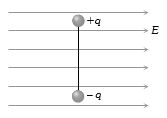
An electric dipole of moment $\overrightarrow{p}$ is placed normal to the lines of force of electric intensity $\overrightarrow{E}$. The work done in deflecting it through an angle of $180^\circ$ is:
A
$pE$
B
$+2pE$
C
$-2pE$
D
Zero
Solution
(D) The work done $W$ in rotating an electric dipole in an external electric field is given by the formula:
$W = pE(\cos \theta_1 - \cos \theta_2)$
Here,the initial angle $\theta_1 = 90^\circ$ (since it is placed normal to the field).
The dipole is deflected through an angle of $180^\circ$,so the final angle $\theta_2 = 90^\circ + 180^\circ = 270^\circ$.
Substituting these values:
$W = pE(\cos 90^\circ - \cos 270^\circ)$
Since $\cos 90^\circ = 0$ and $\cos 270^\circ = 0$,
$W = pE(0 - 0) = 0$.
Therefore,the work done is zero.
$W = pE(\cos \theta_1 - \cos \theta_2)$
Here,the initial angle $\theta_1 = 90^\circ$ (since it is placed normal to the field).
The dipole is deflected through an angle of $180^\circ$,so the final angle $\theta_2 = 90^\circ + 180^\circ = 270^\circ$.
Substituting these values:
$W = pE(\cos 90^\circ - \cos 270^\circ)$
Since $\cos 90^\circ = 0$ and $\cos 270^\circ = 0$,
$W = pE(0 - 0) = 0$.
Therefore,the work done is zero.
0 likes
View Solution5
EasyMCQ
The distance between the two charges $+q$ and $-q$ of a dipole is $r$. On the axial line at a distance $d$ from the centre of the dipole,the electric field intensity is proportional to:
A
$\frac{q}{d^2}$
B
$\frac{qr}{d^2}$
C
$\frac{q}{d^3}$
D
$\frac{qr}{d^3}$
Solution
(D) The electric field intensity $E$ on the axial line of a dipole at a distance $d$ from its center is given by the formula:
$E = \frac{1}{4\pi \varepsilon_0} \cdot \frac{2p}{d^3}$
Since the dipole moment $p$ is defined as the product of the magnitude of one charge $q$ and the separation distance $r$ between them $(p = q \times r)$,we substitute this into the formula:
$E = \frac{1}{4\pi \varepsilon_0} \cdot \frac{2(q \times r)}{d^3}$
From this expression,it is clear that the electric field intensity $E$ is proportional to $\frac{qr}{d^3}$.
Therefore,the correct option is $D$.
$E = \frac{1}{4\pi \varepsilon_0} \cdot \frac{2p}{d^3}$
Since the dipole moment $p$ is defined as the product of the magnitude of one charge $q$ and the separation distance $r$ between them $(p = q \times r)$,we substitute this into the formula:
$E = \frac{1}{4\pi \varepsilon_0} \cdot \frac{2(q \times r)}{d^3}$
From this expression,it is clear that the electric field intensity $E$ is proportional to $\frac{qr}{d^3}$.
Therefore,the correct option is $D$.
0 likes
View Solution6
EasyMCQ
An electron and a proton are at a distance of $1\,\mathring{A}$. The dipole moment of this system will be in $(C \cdot m)$:
A
$1.6 \times 10^{19}$
B
$1.6 \times 10^{-29}$
C
$3.2 \times 10^{19}$
D
$3.2 \times 10^{-29}$
Solution
(B) The electric dipole moment $p$ is defined as the product of the magnitude of one of the charges $q$ and the distance of separation $2l$ between them.
Given: Charge of an electron or proton $q = 1.6 \times 10^{-19}\,C$.
Distance $2l = 1\,\mathring{A} = 10^{-10}\,m$.
Therefore,the dipole moment $p = q \times 2l = (1.6 \times 10^{-19}\,C) \times (10^{-10}\,m) = 1.6 \times 10^{-29}\,C \cdot m$.
Thus,the correct option is $B$.
Given: Charge of an electron or proton $q = 1.6 \times 10^{-19}\,C$.
Distance $2l = 1\,\mathring{A} = 10^{-10}\,m$.
Therefore,the dipole moment $p = q \times 2l = (1.6 \times 10^{-19}\,C) \times (10^{-10}\,m) = 1.6 \times 10^{-29}\,C \cdot m$.
Thus,the correct option is $B$.
0 likes
View Solution7
EasyMCQ
The electric field due to a dipole at a distance $r$ on its axis is
A
Directly proportional to $r^3$
B
Inversely proportional to $r^3$
C
Directly proportional to $r^2$
D
Inversely proportional to $r^2$
Solution
(B) The electric field $E$ at an axial point of an electric dipole at a distance $r$ from its center is given by the formula:
$E = \frac{1}{4\pi \varepsilon_0} \cdot \frac{2pr}{ (r^2 - a^2)^2 }$
For a short dipole where $r \gg a$,the expression simplifies to:
$E = \frac{1}{4\pi \varepsilon_0} \cdot \frac{2p}{r^3}$
Thus,the electric field $E$ is inversely proportional to the cube of the distance $r$ (i.e.,$E \propto \frac{1}{r^3}$).
Therefore,the correct option is $B$.
$E = \frac{1}{4\pi \varepsilon_0} \cdot \frac{2pr}{ (r^2 - a^2)^2 }$
For a short dipole where $r \gg a$,the expression simplifies to:
$E = \frac{1}{4\pi \varepsilon_0} \cdot \frac{2p}{r^3}$
Thus,the electric field $E$ is inversely proportional to the cube of the distance $r$ (i.e.,$E \propto \frac{1}{r^3}$).
Therefore,the correct option is $B$.
0 likes
View Solution8
EasyMCQ
Two charges $+3.2 \times 10^{-19} \text{ C}$ and $-3.2 \times 10^{-19} \text{ C}$ placed at $2.4 \text{ Å}$ apart form an electric dipole. It is placed in a uniform electric field of intensity $4 \times 10^5 \text{ V/m}$. The electric dipole moment is
A
$15.36 \times 10^{-29} \text{ C} \cdot \text{m}$
B
$15.36 \times 10^{-19} \text{ C} \cdot \text{m}$
C
$7.68 \times 10^{-29} \text{ C} \cdot \text{m}$
D
$7.68 \times 10^{-19} \text{ C} \cdot \text{m}$
Solution
(C) The electric dipole moment $p$ is defined as the product of the magnitude of one of the charges and the distance between them.
$p = q \times (2l)$
Given:
Charge $q = 3.2 \times 10^{-19} \text{ C}$
Separation distance $2l = 2.4 \text{ Å} = 2.4 \times 10^{-10} \text{ m}$
Calculating the dipole moment:
$p = (3.2 \times 10^{-19} \text{ C}) \times (2.4 \times 10^{-10} \text{ m})$
$p = 7.68 \times 10^{-29} \text{ C} \cdot \text{m}$
$p = q \times (2l)$
Given:
Charge $q = 3.2 \times 10^{-19} \text{ C}$
Separation distance $2l = 2.4 \text{ Å} = 2.4 \times 10^{-10} \text{ m}$
Calculating the dipole moment:
$p = (3.2 \times 10^{-19} \text{ C}) \times (2.4 \times 10^{-10} \text{ m})$
$p = 7.68 \times 10^{-29} \text{ C} \cdot \text{m}$
0 likes
View Solution9
MediumMCQ
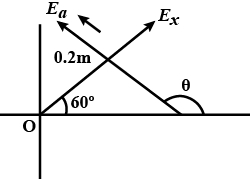
An electric dipole of moment $p$ is placed at the origin along the $x$-axis. The electric field at a point $P$,whose position vector makes an angle $\theta$ with the $x$-axis,will make an angle $\phi$ with the $x$-axis. If $\tan \alpha = \frac{1}{2} \tan \theta$,where $\alpha$ is the angle between the electric field vector and the position vector,then the angle $\phi$ that the electric field makes with the $x$-axis is:
A
$\alpha$
B
$\theta$
C
$\theta + \alpha$
D
$\theta + 2\alpha$
Solution
(C) For an electric dipole placed at the origin along the $x$-axis,the electric field components at a point $P(r, \theta)$ are given by:
Radial component: $E_r = \frac{2p \cos \theta}{4 \pi \epsilon_0 r^3}$
Transverse component: $E_{\theta} = \frac{p \sin \theta}{4 \pi \epsilon_0 r^3}$
The angle $\alpha$ that the resultant electric field makes with the position vector (radial direction) is given by $\tan \alpha = \frac{E_{\theta}}{E_r} = \frac{1}{2} \tan \theta$.
The position vector makes an angle $\theta$ with the $x$-axis.
The angle $\phi$ that the electric field makes with the $x$-axis is the sum of the angle of the position vector with the $x$-axis and the angle $\alpha$ between the electric field and the position vector.
Therefore,$\phi = \theta + \alpha$.
Radial component: $E_r = \frac{2p \cos \theta}{4 \pi \epsilon_0 r^3}$
Transverse component: $E_{\theta} = \frac{p \sin \theta}{4 \pi \epsilon_0 r^3}$
The angle $\alpha$ that the resultant electric field makes with the position vector (radial direction) is given by $\tan \alpha = \frac{E_{\theta}}{E_r} = \frac{1}{2} \tan \theta$.
The position vector makes an angle $\theta$ with the $x$-axis.
The angle $\phi$ that the electric field makes with the $x$-axis is the sum of the angle of the position vector with the $x$-axis and the angle $\alpha$ between the electric field and the position vector.
Therefore,$\phi = \theta + \alpha$.
0 likes
View Solution10
EasyMCQ
The torque acting on a dipole of moment $\overrightarrow{P}$ in an electric field $\overrightarrow{E}$ is:
A
$\overrightarrow{P} \cdot \overrightarrow{E}$
B
$\overrightarrow{P} \times \overrightarrow{E}$
C
Zero
D
$\overrightarrow{E} \times \overrightarrow{P}$
Solution
(B) When an electric dipole with dipole moment $\overrightarrow{P}$ is placed in an external uniform electric field $\overrightarrow{E}$,it experiences a torque $\overrightarrow{\tau}$.
By definition,the torque is the cross product of the dipole moment and the electric field.
The formula for torque is given by $\overrightarrow{\tau} = \overrightarrow{P} \times \overrightarrow{E}$.
Therefore,the correct option is $(b)$.
By definition,the torque is the cross product of the dipole moment and the electric field.
The formula for torque is given by $\overrightarrow{\tau} = \overrightarrow{P} \times \overrightarrow{E}$.
Therefore,the correct option is $(b)$.
0 likes
View Solution11
EasyMCQ
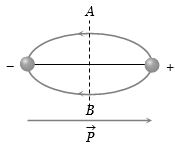
The electric field at a point on the equatorial line of a dipole and the direction of the dipole moment:
A
Will be parallel
B
Will be in opposite direction
C
Will be perpendicular
D
Are not related
Solution
(B) The electric dipole moment $\vec{p}$ is directed from the negative charge to the positive charge.
For a point on the equatorial line of an electric dipole,the electric field $\vec{E}$ is given by $\vec{E} = -\frac{1}{4\pi\epsilon_0} \frac{\vec{p}}{r^3}$.
The negative sign indicates that the direction of the electric field at any point on the equatorial line is opposite to the direction of the dipole moment $\vec{p}$.
Thus,the electric field and the dipole moment are anti-parallel.
For a point on the equatorial line of an electric dipole,the electric field $\vec{E}$ is given by $\vec{E} = -\frac{1}{4\pi\epsilon_0} \frac{\vec{p}}{r^3}$.
The negative sign indicates that the direction of the electric field at any point on the equatorial line is opposite to the direction of the dipole moment $\vec{p}$.
Thus,the electric field and the dipole moment are anti-parallel.
0 likes
View Solution12
MediumMCQ
Two opposite and equal charges $4 \times 10^{-8} \, C$ are placed $2 \times 10^{-2} \, cm$ apart,forming a dipole. If this dipole is placed in an external electric field of $4 \times 10^8 \, N/C$,what are the values of the maximum torque and the work done in rotating it through $180^\circ$?
A
$64 \times 10^{-4} \, Nm$ and $64 \times 10^{-4} \, J$
B
$32 \times 10^{-4} \, Nm$ and $32 \times 10^{-4} \, J$
C
$64 \times 10^{-4} \, Nm$ and $32 \times 10^{-4} \, J$
D
$32 \times 10^{-4} \, Nm$ and $64 \times 10^{-4} \, J$
Solution
(D) Given: Charge $q = 4 \times 10^{-8} \, C$,separation $2a = 2 \times 10^{-2} \, cm = 2 \times 10^{-4} \, m$,and electric field $E = 4 \times 10^8 \, N/C$.
Dipole moment $p = q \times 2a = (4 \times 10^{-8}) \times (2 \times 10^{-4}) = 8 \times 10^{-12} \, Cm$.
Maximum torque $\tau_{max} = pE = (8 \times 10^{-12}) \times (4 \times 10^8) = 32 \times 10^{-4} \, Nm$.
Work done in rotating the dipole from $0^\circ$ to $180^\circ$ is $W = pE(1 - \cos 180^\circ) = pE(1 - (-1)) = 2pE$.
$W = 2 \times (32 \times 10^{-4}) = 64 \times 10^{-4} \, J$.
Dipole moment $p = q \times 2a = (4 \times 10^{-8}) \times (2 \times 10^{-4}) = 8 \times 10^{-12} \, Cm$.
Maximum torque $\tau_{max} = pE = (8 \times 10^{-12}) \times (4 \times 10^8) = 32 \times 10^{-4} \, Nm$.
Work done in rotating the dipole from $0^\circ$ to $180^\circ$ is $W = pE(1 - \cos 180^\circ) = pE(1 - (-1)) = 2pE$.
$W = 2 \times (32 \times 10^{-4}) = 64 \times 10^{-4} \, J$.
0 likes
View Solution13
EasyMCQ
If ${E_a}$ is the electric field strength of a short dipole at a point on its axial line and ${E_e}$ is the electric field strength on the equatorial line at the same distance,then:
A
${E_e} = 2{E_a}$
B
${E_a} = 2{E_e}$
C
${E_a} = {E_e}$
D
None of the above
Solution
(B) The electric field strength of a short dipole at a point on its axial line at a distance $r$ is given by ${E_a} = \frac{1}{4\pi\epsilon_0} \cdot \frac{2p}{r^3}$.
The electric field strength of a short dipole at a point on its equatorial line at the same distance $r$ is given by ${E_e} = \frac{1}{4\pi\epsilon_0} \cdot \frac{p}{r^3}$.
Comparing the two expressions,we can see that ${E_a} = 2 \times \left( \frac{1}{4\pi\epsilon_0} \cdot \frac{p}{r^3} \right) = 2{E_e}$.
Therefore,the correct relationship is ${E_a} = 2{E_e}$.
The electric field strength of a short dipole at a point on its equatorial line at the same distance $r$ is given by ${E_e} = \frac{1}{4\pi\epsilon_0} \cdot \frac{p}{r^3}$.
Comparing the two expressions,we can see that ${E_a} = 2 \times \left( \frac{1}{4\pi\epsilon_0} \cdot \frac{p}{r^3} \right) = 2{E_e}$.
Therefore,the correct relationship is ${E_a} = 2{E_e}$.
0 likes
View Solution14
EasyMCQ
An electric dipole is placed in an electric field generated by a point charge. Which of the following statements is correct?
A
The net electric force on the dipole must be zero.
B
The net electric force on the dipole may be zero.
C
The torque on the dipole due to the field must be zero.
D
The torque on the dipole due to the field may be zero.
Solution
(D) point charge $q$ produces a non-uniform electric field given by $E = \frac{kq}{r^2}$.
Since the electric field is non-uniform,the force on the two charges of the dipole ($+q$ and $-q$) will not be equal and opposite,so the net force on the dipole cannot be zero.
However,the torque on the dipole is given by $\vec{\tau} = \vec{p} \times \vec{E}$.
If the dipole is placed such that its dipole moment $\vec{p}$ is parallel or anti-parallel to the electric field $\vec{E}$ at that point,the torque $\vec{\tau}$ will be zero.
Therefore,the torque on the dipole due to the field may be zero.
Since the electric field is non-uniform,the force on the two charges of the dipole ($+q$ and $-q$) will not be equal and opposite,so the net force on the dipole cannot be zero.
However,the torque on the dipole is given by $\vec{\tau} = \vec{p} \times \vec{E}$.
If the dipole is placed such that its dipole moment $\vec{p}$ is parallel or anti-parallel to the electric field $\vec{E}$ at that point,the torque $\vec{\tau}$ will be zero.
Therefore,the torque on the dipole due to the field may be zero.
0 likes
View Solution15
EasyMCQ
$A$ point $Q$ lies on the perpendicular bisector of an electric dipole with dipole moment $p$. If the distance of $Q$ from the dipole is $r$ (where $r$ is much larger than the size of the dipole),then the electric field at $Q$ is proportional to:
A
$p^{-1}$ and $r^{-2}$
B
$p$ and $r^{-2}$
C
$p^{-1}$ and $r^{-3}$
D
$p$ and $r^{-3}$
Solution
(D) The electric field at a point on the equatorial line (perpendicular bisector) of an electric dipole is given by the formula:
$E_{equatorial} = \frac{1}{4\pi\epsilon_0} \frac{p}{r^3}$
where $p$ is the dipole moment and $r$ is the distance from the center of the dipole.
From this expression,it is clear that the electric field $E$ is directly proportional to the dipole moment $p$ $(E \propto p)$ and inversely proportional to the cube of the distance $r$ $(E \propto r^{-3})$.
Therefore,the electric field at $Q$ is proportional to $p$ and $r^{-3}$.
$E_{equatorial} = \frac{1}{4\pi\epsilon_0} \frac{p}{r^3}$
where $p$ is the dipole moment and $r$ is the distance from the center of the dipole.
From this expression,it is clear that the electric field $E$ is directly proportional to the dipole moment $p$ $(E \propto p)$ and inversely proportional to the cube of the distance $r$ $(E \propto r^{-3})$.
Therefore,the electric field at $Q$ is proportional to $p$ and $r^{-3}$.
0 likes
View Solution16
MediumMCQ
If the magnitude of the intensity of the electric field at a distance $x$ on the axial line and at a distance $y$ on the equatorial line for a given electric dipole are equal,then the ratio $x:y$ is:
A
$1:1$
B
$1:\sqrt{2}$
C
$1:2$
D
$\sqrt[3]{2}:1$
Solution
(D) The electric field intensity on the axial line of a dipole at a distance $x$ is given by $E_{axial} = \frac{1}{4\pi\epsilon_0} \cdot \frac{2p}{x^3}$.
The electric field intensity on the equatorial line of a dipole at a distance $y$ is given by $E_{equatorial} = \frac{1}{4\pi\epsilon_0} \cdot \frac{p}{y^3}$.
Given that the magnitudes are equal,we have $E_{axial} = E_{equatorial}$.
Substituting the expressions: $\frac{2p}{x^3} = \frac{p}{y^3}$.
Simplifying the equation: $\frac{2}{x^3} = \frac{1}{y^3}$.
Rearranging for the ratio: $\frac{x^3}{y^3} = 2$.
Taking the cube root on both sides: $\frac{x}{y} = \sqrt[3]{2}$.
Therefore,the ratio $x:y$ is $\sqrt[3]{2}:1$.
The electric field intensity on the equatorial line of a dipole at a distance $y$ is given by $E_{equatorial} = \frac{1}{4\pi\epsilon_0} \cdot \frac{p}{y^3}$.
Given that the magnitudes are equal,we have $E_{axial} = E_{equatorial}$.
Substituting the expressions: $\frac{2p}{x^3} = \frac{p}{y^3}$.
Simplifying the equation: $\frac{2}{x^3} = \frac{1}{y^3}$.
Rearranging for the ratio: $\frac{x^3}{y^3} = 2$.
Taking the cube root on both sides: $\frac{x}{y} = \sqrt[3]{2}$.
Therefore,the ratio $x:y$ is $\sqrt[3]{2}:1$.
0 likes
View Solution17
EasyMCQ
An electric dipole in a uniform electric field experiences (when it is placed at an angle $\theta$ with the field):
A
Force and torque both
B
Force but no torque
C
Torque but no force
D
No force and no torque
Solution
(C) In a uniform electric field,the force on the positive charge is $F_+ = qE$ and the force on the negative charge is $F_- = -qE$. The net force on the dipole is $F_{net} = F_+ + F_- = qE - qE = 0$. However,since these two forces act at different points,they form a couple that exerts a torque on the dipole given by $\tau = pE \sin \theta$. Therefore,the dipole experiences only a torque and no net force.
0 likes
View Solution18
MediumMCQ
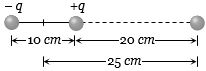
The electric intensity due to a dipole of length $10 \, cm$ and having a charge of $500 \, \mu C$,at a point on the axis at a distance $20 \, cm$ from one of the charges in air,is
A
$6.25 \times 10^7 \, N/C$
B
$9.28 \times 10^7 \, N/C$
C
$13.1 \times 10^{11} \, N/C$
D
$20.5 \times 10^7 \, N/C$
Solution
(A) Given: Dipole length $2l = 10 \, cm = 0.1 \, m$,so $l = 0.05 \, m$. Charge $q = 500 \, \mu C = 5 \times 10^{-4} \, C$. Distance from the center of the dipole $r = 20 \, cm + 5 \, cm = 25 \, cm = 0.25 \, m$.
Dipole moment $p = q \times 2l = (5 \times 10^{-4} \, C) \times (0.1 \, m) = 5 \times 10^{-5} \, C \cdot m$.
The electric field on the axial line of a dipole is given by $E = \frac{1}{4\pi\epsilon_0} \cdot \frac{2pr}{(r^2 - l^2)^2}$.
Substituting the values: $E = (9 \times 10^9) \times \frac{2 \times (5 \times 10^{-5}) \times 0.25}{((0.25)^2 - (0.05)^2)^2}$.
$E = (9 \times 10^9) \times \frac{2.5 \times 10^{-5}}{(0.0625 - 0.0025)^2} = (9 \times 10^9) \times \frac{2.5 \times 10^{-5}}{(0.06)^2}$.
$E = \frac{22.5 \times 10^4}{0.0036} = 6.25 \times 10^7 \, N/C$.
Dipole moment $p = q \times 2l = (5 \times 10^{-4} \, C) \times (0.1 \, m) = 5 \times 10^{-5} \, C \cdot m$.
The electric field on the axial line of a dipole is given by $E = \frac{1}{4\pi\epsilon_0} \cdot \frac{2pr}{(r^2 - l^2)^2}$.
Substituting the values: $E = (9 \times 10^9) \times \frac{2 \times (5 \times 10^{-5}) \times 0.25}{((0.25)^2 - (0.05)^2)^2}$.
$E = (9 \times 10^9) \times \frac{2.5 \times 10^{-5}}{(0.0625 - 0.0025)^2} = (9 \times 10^9) \times \frac{2.5 \times 10^{-5}}{(0.06)^2}$.
$E = \frac{22.5 \times 10^4}{0.0036} = 6.25 \times 10^7 \, N/C$.
0 likes
View Solution19
EasyMCQ
The potential at a point due to an electric dipole will be maximum and minimum when the angles between the axis of the dipole and the line joining the point to the dipole are respectively:
A
$90^\circ$ and $180^\circ$
B
$0^\circ$ and $90^\circ$
C
$90^\circ$ and $0^\circ$
D
$0^\circ$ and $180^\circ$
Solution
(D) The electric potential $V$ at a point due to an electric dipole is given by the formula: $V = \frac{kp \cos \theta}{r^2}$,where $p$ is the dipole moment,$r$ is the distance from the center of the dipole,and $\theta$ is the angle between the dipole axis and the position vector of the point.
For the potential to be maximum,$\cos \theta$ must be maximum $(+1)$,which occurs at $\theta = 0^\circ$.
For the potential to be minimum,$\cos \theta$ must be minimum $(-1)$,which occurs at $\theta = 180^\circ$.
Therefore,the potential is maximum at $0^\circ$ and minimum at $180^\circ$.
For the potential to be maximum,$\cos \theta$ must be maximum $(+1)$,which occurs at $\theta = 0^\circ$.
For the potential to be minimum,$\cos \theta$ must be minimum $(-1)$,which occurs at $\theta = 180^\circ$.
Therefore,the potential is maximum at $0^\circ$ and minimum at $180^\circ$.
0 likes
View Solution20
EasyMCQ
An electric dipole has the magnitude of its charge as $q$ and its dipole moment is $p$. It is placed in a uniform electric field $E$. If its dipole moment is along the direction of the field,the force on it and its potential energy are respectively
A
$2q \cdot E$ and minimum
B
$q \cdot E$ and $p \cdot E$
C
Zero and minimum
D
$q \cdot E$ and maximum
Solution
(C) In a uniform electric field,the force on a dipole is given by $\vec{F} = q\vec{E} + (-q)\vec{E} = 0$.
Since the dipole moment $\vec{p}$ is along the direction of the electric field $\vec{E}$,the angle $\theta$ between them is $0^\circ$.
The potential energy $U$ of an electric dipole in an external electric field is given by $U = -\vec{p} \cdot \vec{E} = -pE \cos \theta$.
Substituting $\theta = 0^\circ$,we get $U = -pE \cos(0^\circ) = -pE$.
Since $-pE$ is the lowest possible value for the potential energy,it is the minimum potential energy.
Therefore,the force is zero and the potential energy is minimum.
Since the dipole moment $\vec{p}$ is along the direction of the electric field $\vec{E}$,the angle $\theta$ between them is $0^\circ$.
The potential energy $U$ of an electric dipole in an external electric field is given by $U = -\vec{p} \cdot \vec{E} = -pE \cos \theta$.
Substituting $\theta = 0^\circ$,we get $U = -pE \cos(0^\circ) = -pE$.
Since $-pE$ is the lowest possible value for the potential energy,it is the minimum potential energy.
Therefore,the force is zero and the potential energy is minimum.
0 likes
View Solution21
EasyMCQ
Intensity of an electric field $E$ due to a dipole,depends on distance $r$ as
A
$E \propto \frac{1}{r^4}$
B
$E \propto \frac{1}{r^3}$
C
$E \propto \frac{1}{r^2}$
D
$E \propto \frac{1}{r}$
Solution
(B) The electric field intensity $E$ at a point due to an electric dipole is given by the formula:
$E = \frac{p}{4 \pi \varepsilon_{0} r^{3}} \sqrt{3 \cos^{2} \theta + 1}$
where $p$ is the dipole moment,$r$ is the distance from the center of the dipole,and $\theta$ is the angle with the dipole axis.
From this expression,it is clear that $E \propto \frac{1}{r^{3}}$.
Therefore,the intensity of the electric field is inversely proportional to the cube of the distance $r$.
$E = \frac{p}{4 \pi \varepsilon_{0} r^{3}} \sqrt{3 \cos^{2} \theta + 1}$
where $p$ is the dipole moment,$r$ is the distance from the center of the dipole,and $\theta$ is the angle with the dipole axis.
From this expression,it is clear that $E \propto \frac{1}{r^{3}}$.
Therefore,the intensity of the electric field is inversely proportional to the cube of the distance $r$.
0 likes
View Solution22
EasyMCQ
The ratio of electric fields on the axis and at the equator of an electric dipole is
A
$1:1$
B
$2:1$
C
$4:1$
D
None of these
Solution
(B) The electric field on the axis of an electric dipole at a distance $r$ from the center is given by $E_a = \frac{1}{4\pi\epsilon_0} \frac{2p}{r^3}$.
The electric field on the equatorial plane of an electric dipole at a distance $r$ from the center is given by $E_e = \frac{1}{4\pi\epsilon_0} \frac{p}{r^3}$.
Taking the ratio of the two fields:
$\frac{E_a}{E_e} = \frac{\frac{1}{4\pi\epsilon_0} \frac{2p}{r^3}}{\frac{1}{4\pi\epsilon_0} \frac{p}{r^3}} = \frac{2}{1}$.
Therefore,the ratio is $2:1$.
The electric field on the equatorial plane of an electric dipole at a distance $r$ from the center is given by $E_e = \frac{1}{4\pi\epsilon_0} \frac{p}{r^3}$.
Taking the ratio of the two fields:
$\frac{E_a}{E_e} = \frac{\frac{1}{4\pi\epsilon_0} \frac{2p}{r^3}}{\frac{1}{4\pi\epsilon_0} \frac{p}{r^3}} = \frac{2}{1}$.
Therefore,the ratio is $2:1$.
0 likes
View Solution23
EasyMCQ
For a dipole with charge $q = 2 \times 10^{-6} \, C$ and separation $d = 0.01 \, m$,calculate the maximum torque acting on this dipole if it is placed in an electric field $E = 5 \times 10^5 \, N/C$.
A
$1 \times 10^{-3} \, N \cdot m$
B
$10 \times 10^{-3} \, N \cdot m^{-1}$
C
$10 \times 10^{-3} \, N \cdot m$
D
$1 \times 10^2 \, N \cdot m^2$
Solution
(C) The dipole moment $p$ is given by $p = q \times d$.
Given $q = 2 \times 10^{-6} \, C$ and $d = 0.01 \, m$.
$p = (2 \times 10^{-6} \, C) \times (0.01 \, m) = 2 \times 10^{-8} \, C \cdot m$.
The torque $\tau$ on a dipole is given by $\tau = pE \sin \theta$.
For maximum torque,$\sin \theta = 1$,so $\tau_{\max} = pE$.
Substituting the values: $\tau_{\max} = (2 \times 10^{-8} \, C \cdot m) \times (5 \times 10^5 \, N/C)$.
$\tau_{\max} = 10 \times 10^{-3} \, N \cdot m$.
Given $q = 2 \times 10^{-6} \, C$ and $d = 0.01 \, m$.
$p = (2 \times 10^{-6} \, C) \times (0.01 \, m) = 2 \times 10^{-8} \, C \cdot m$.
The torque $\tau$ on a dipole is given by $\tau = pE \sin \theta$.
For maximum torque,$\sin \theta = 1$,so $\tau_{\max} = pE$.
Substituting the values: $\tau_{\max} = (2 \times 10^{-8} \, C \cdot m) \times (5 \times 10^5 \, N/C)$.
$\tau_{\max} = 10 \times 10^{-3} \, N \cdot m$.
0 likes
View Solution24
MediumMCQ
$A$ molecule with a dipole moment $p$ is placed in an electric field of strength $E$. Initially,the dipole is aligned parallel to the field. If the dipole is to be rotated to be anti-parallel to the field,the work required to be done by an external agent is:
A
$-2pE$
B
$-pE$
C
$pE$
D
$2pE$
Solution
(D) The potential energy $U$ of a dipole in an electric field is given by $U = -pE \cos \theta$,where $\theta$ is the angle between the dipole moment $p$ and the electric field $E$.
Initially,the dipole is parallel to the field,so $\theta_1 = 0^\circ$.
The initial potential energy is $U_1 = -pE \cos(0^\circ) = -pE$.
Finally,the dipole is anti-parallel to the field,so $\theta_2 = 180^\circ$.
The final potential energy is $U_2 = -pE \cos(180^\circ) = -pE(-1) = pE$.
The work done by an external agent is equal to the change in potential energy: $W = U_2 - U_1$.
$W = pE - (-pE) = 2pE$.
Initially,the dipole is parallel to the field,so $\theta_1 = 0^\circ$.
The initial potential energy is $U_1 = -pE \cos(0^\circ) = -pE$.
Finally,the dipole is anti-parallel to the field,so $\theta_2 = 180^\circ$.
The final potential energy is $U_2 = -pE \cos(180^\circ) = -pE(-1) = pE$.
The work done by an external agent is equal to the change in potential energy: $W = U_2 - U_1$.
$W = pE - (-pE) = 2pE$.
0 likes
View Solution25
EasyMCQ
$A$ region surrounding a stationary electric dipole has:
A
Magnetic field only
B
Electric field only
C
Both electric and magnetic fields
D
No electric and magnetic fields
Solution
(B) An electric dipole consists of two equal and opposite charges separated by a small distance.
Since the charges are stationary,they produce only an electrostatic field in the surrounding region.
According to the principles of electromagnetism,a magnetic field is produced only by moving charges (currents) or time-varying electric fields.
Therefore,a stationary electric dipole produces an electric field only.
Since the charges are stationary,they produce only an electrostatic field in the surrounding region.
According to the principles of electromagnetism,a magnetic field is produced only by moving charges (currents) or time-varying electric fields.
Therefore,a stationary electric dipole produces an electric field only.
0 likes
View Solution26
DifficultMCQ
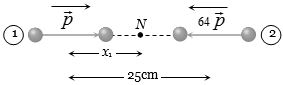
Two electric dipoles of moment $P$ and $64 P$ are placed in opposite directions on a line at a distance of $25 \ cm$. The electric field will be zero at a point between the dipoles whose distance from the dipole of moment $P$ is.....$cm$.
A
$5$
B
$\frac{25}{9}$
C
$10$
D
$\frac{4}{13}$
Solution
(A) Let the neutral point $N$ be at a distance $x$ from the dipole of moment $P$ and at a distance $(25 - x)$ from the dipole of moment $64 P$.
At the neutral point $N$,the magnitude of the electric field due to dipole $1$ must be equal to the magnitude of the electric field due to dipole $2$.
The electric field on the axial line of a dipole is given by $E = \frac{1}{4\pi \varepsilon_0} \cdot \frac{2p}{r^3}$.
Equating the fields:
$\frac{1}{4\pi \varepsilon_0} \cdot \frac{2P}{x^3} = \frac{1}{4\pi \varepsilon_0} \cdot \frac{2(64P)}{(25 - x)^3}$
$\frac{1}{x^3} = \frac{64}{(25 - x)^3}$
Taking the cube root on both sides:
$\frac{1}{x} = \frac{4}{25 - x}$
$25 - x = 4x$
$5x = 25$
$x = 5 \ cm$.
At the neutral point $N$,the magnitude of the electric field due to dipole $1$ must be equal to the magnitude of the electric field due to dipole $2$.
The electric field on the axial line of a dipole is given by $E = \frac{1}{4\pi \varepsilon_0} \cdot \frac{2p}{r^3}$.
Equating the fields:
$\frac{1}{4\pi \varepsilon_0} \cdot \frac{2P}{x^3} = \frac{1}{4\pi \varepsilon_0} \cdot \frac{2(64P)}{(25 - x)^3}$
$\frac{1}{x^3} = \frac{64}{(25 - x)^3}$
Taking the cube root on both sides:
$\frac{1}{x} = \frac{4}{25 - x}$
$25 - x = 4x$
$5x = 25$
$x = 5 \ cm$.
0 likes
View Solution27
EasyMCQ
When an electric dipole $\overrightarrow{P}$ is placed in a uniform electric field $\overrightarrow{E}$,at what angle between $\overrightarrow{P}$ and $\overrightarrow{E}$ will the magnitude of the torque be maximum? (in degrees)
A
$90$
B
$0$
C
$180$
D
$45$
Solution
(A) The torque $\vec{\tau}$ acting on an electric dipole placed in a uniform electric field is given by the cross product: $\vec{\tau} = \vec{P} \times \vec{E}$.
The magnitude of the torque is given by $\tau = PE \sin \theta$,where $\theta$ is the angle between the dipole moment vector $\vec{P}$ and the electric field vector $\vec{E}$.
For the torque to be maximum,$\sin \theta$ must be maximum.
The maximum value of $\sin \theta$ is $1$,which occurs when $\theta = 90^{\circ}$.
Therefore,the torque is maximum when the angle between $\vec{P}$ and $\vec{E}$ is $90^{\circ}$.
The magnitude of the torque is given by $\tau = PE \sin \theta$,where $\theta$ is the angle between the dipole moment vector $\vec{P}$ and the electric field vector $\vec{E}$.
For the torque to be maximum,$\sin \theta$ must be maximum.
The maximum value of $\sin \theta$ is $1$,which occurs when $\theta = 90^{\circ}$.
Therefore,the torque is maximum when the angle between $\vec{P}$ and $\vec{E}$ is $90^{\circ}$.
0 likes
View Solution28
EasyMCQ
What is the angle between the electric dipole moment and the electric field strength due to it on the equatorial line? $(...^o)$
A
$0$
B
$90$
C
$180$
D
None of these
Solution
(C) The electric dipole moment $\vec{p}$ is directed from the negative charge to the positive charge.
At any point on the equatorial line of an electric dipole,the direction of the electric field $\vec{E}$ is parallel to the dipole axis but directed from the positive charge towards the negative charge.
Therefore,the direction of the electric field intensity at a point on the equatorial line is exactly opposite to the direction of the dipole moment.
Since the vectors are anti-parallel,the angle between them is $180^o$.
At any point on the equatorial line of an electric dipole,the direction of the electric field $\vec{E}$ is parallel to the dipole axis but directed from the positive charge towards the negative charge.
Therefore,the direction of the electric field intensity at a point on the equatorial line is exactly opposite to the direction of the dipole moment.
Since the vectors are anti-parallel,the angle between them is $180^o$.
0 likes
View Solution29
EasyMCQ
The electric field due to an electric dipole at a distance $r$ from its centre in the axial position is $E$. If the dipole is rotated through an angle of $90^{\circ}$ about its perpendicular axis,the electric field at the same point will be
A
$E$
B
$E / 4$
C
$E / 2$
D
$2E$
Solution
(C) The electric field due to a dipole at an axial point at distance $r$ is given by $E_{\text{axial}} = \frac{1}{4\pi\epsilon_0} \frac{2p}{r^3} = E$.
When the dipole is rotated by $90^{\circ}$ about its perpendicular axis,the point that was previously on the axial line now lies on the equatorial line of the dipole.
The electric field due to a dipole at an equatorial point at distance $r$ is given by $E_{\text{equatorial}} = \frac{1}{4\pi\epsilon_0} \frac{p}{r^3}$.
Comparing the two expressions,we get $E_{\text{equatorial}} = \frac{E_{\text{axial}}}{2} = \frac{E}{2}$.
When the dipole is rotated by $90^{\circ}$ about its perpendicular axis,the point that was previously on the axial line now lies on the equatorial line of the dipole.
The electric field due to a dipole at an equatorial point at distance $r$ is given by $E_{\text{equatorial}} = \frac{1}{4\pi\epsilon_0} \frac{p}{r^3}$.
Comparing the two expressions,we get $E_{\text{equatorial}} = \frac{E_{\text{axial}}}{2} = \frac{E}{2}$.
0 likes
View Solution30
DifficultMCQ
An electric dipole is situated in an electric field of uniform intensity $E$ whose dipole moment is $p$ and moment of inertia is $I$. If the dipole is displaced slightly from the equilibrium position,then the angular frequency of its oscillations is
A
$(\frac{pE}{I})^{1/2}$
B
$(\frac{pE}{I})^{3/2}$
C
$(\frac{I}{pE})^{1/2}$
D
$(\frac{p}{IE})^{1/2}$
Solution
(A) When an electric dipole is placed in a uniform electric field $E$,it experiences a torque $\tau = pE \sin \theta$.
For a small angular displacement $\theta$ from the equilibrium position,$\sin \theta \approx \theta$.
Thus,the restoring torque is $\tau = -pE\theta$.
Using Newton's second law for rotation,$\tau = I \alpha = I \frac{d^2\theta}{dt^2}$.
Equating the two expressions: $I \frac{d^2\theta}{dt^2} = -pE\theta$.
Rearranging gives $\frac{d^2\theta}{dt^2} = -(\frac{pE}{I})\theta$.
Comparing this with the standard simple harmonic motion equation $\frac{d^2\theta}{dt^2} = -\omega^2 \theta$,we get $\omega^2 = \frac{pE}{I}$.
Therefore,the angular frequency is $\omega = \sqrt{\frac{pE}{I}}$.
For a small angular displacement $\theta$ from the equilibrium position,$\sin \theta \approx \theta$.
Thus,the restoring torque is $\tau = -pE\theta$.
Using Newton's second law for rotation,$\tau = I \alpha = I \frac{d^2\theta}{dt^2}$.
Equating the two expressions: $I \frac{d^2\theta}{dt^2} = -pE\theta$.
Rearranging gives $\frac{d^2\theta}{dt^2} = -(\frac{pE}{I})\theta$.
Comparing this with the standard simple harmonic motion equation $\frac{d^2\theta}{dt^2} = -\omega^2 \theta$,we get $\omega^2 = \frac{pE}{I}$.
Therefore,the angular frequency is $\omega = \sqrt{\frac{pE}{I}}$.
0 likes
View Solution31
EasyMCQ
An electric dipole has a charge of magnitude $q$ and a dipole moment $p$. It is placed in a uniform electric field $E$. If its dipole moment is aligned with the direction of the electric field, the force acting on it and its potential energy will be, respectively:
A
$qE$ and $-pE$
B
Zero and minimum
C
$qE$ and minimum
D
$2qE$ and minimum
Solution
(B) $1$. In a uniform electric field $E$, the force on the positive charge is $F_+ = qE$ and the force on the negative charge is $F_- = -qE$.
$2$. The net force on the dipole is $F_{net} = F_+ + F_- = qE - qE = 0$.
$3$. The potential energy $U$ of a dipole in an electric field is given by $U = -p \cdot E = -pE \cos \theta$.
$4$. When the dipole moment $p$ is aligned with the electric field $E$, the angle $\theta = 0^\circ$.
$5$. Thus, $U = -pE \cos(0^\circ) = -pE$, which is the minimum possible potential energy.
$2$. The net force on the dipole is $F_{net} = F_+ + F_- = qE - qE = 0$.
$3$. The potential energy $U$ of a dipole in an electric field is given by $U = -p \cdot E = -pE \cos \theta$.
$4$. When the dipole moment $p$ is aligned with the electric field $E$, the angle $\theta = 0^\circ$.
$5$. Thus, $U = -pE \cos(0^\circ) = -pE$, which is the minimum possible potential energy.
0 likes
View Solution32
MediumMCQ
The electric field $\vec{E}$ at a point at a distance $r$ from the axis of a dipole is given by:
A
$\frac{1}{4\pi\epsilon_0} \frac{2\vec{p}}{r^3}$
B
$\frac{1}{4\pi\epsilon_0} \times 2\vec{p} r^3$
C
$\frac{\vec{p} r^3}{4\pi\epsilon_0}$
D
$\frac{\vec{p}}{4\pi\epsilon_0 r^3}$
Solution
(A) For an electric dipole with dipole moment $\vec{p}$,the electric field at a point on its axial line at a distance $r$ from the center (where $r \gg a$) is given by the formula:
$\vec{E}_{axial} = \frac{1}{4\pi\epsilon_0} \frac{2\vec{p}}{r^3}$.
This field is directed along the direction of the dipole moment $\vec{p}$.
$\vec{E}_{axial} = \frac{1}{4\pi\epsilon_0} \frac{2\vec{p}}{r^3}$.
This field is directed along the direction of the dipole moment $\vec{p}$.
0 likes
View Solution33
EasyMCQ
At any point on the perpendicular bisector of the line joining two equal and opposite charges,which of the following is true?
A
The electric field is zero.
B
The electric potential is zero.
C
The electric potential decreases with the increase in distance from the center.
D
The electric field is perpendicular to the line joining the charges.
Solution
(B) Consider two charges $+q$ and $-q$ separated by a distance $2a$. Let $P$ be a point on the perpendicular bisector at a distance $x$ from the midpoint.
The electric potential $V$ at point $P$ due to a charge $q$ at distance $r$ is given by $V = \frac{1}{4 \pi \varepsilon_0} \frac{q}{r}$.
The distance of point $P$ from both charges $+q$ and $-q$ is $r = \sqrt{x^2 + a^2}$.
The potential due to $+q$ is $V_1 = \frac{1}{4 \pi \varepsilon_0} \frac{q}{\sqrt{x^2 + a^2}}$.
The potential due to $-q$ is $V_2 = -\frac{1}{4 \pi \varepsilon_0} \frac{q}{\sqrt{x^2 + a^2}}$.
The total electric potential at point $P$ is $V = V_1 + V_2 = \frac{1}{4 \pi \varepsilon_0} \frac{q}{\sqrt{x^2 + a^2}} - \frac{1}{4 \pi \varepsilon_0} \frac{q}{\sqrt{x^2 + a^2}} = 0$.
Thus,the electric potential at any point on the perpendicular bisector of an electric dipole is zero.
The electric potential $V$ at point $P$ due to a charge $q$ at distance $r$ is given by $V = \frac{1}{4 \pi \varepsilon_0} \frac{q}{r}$.
The distance of point $P$ from both charges $+q$ and $-q$ is $r = \sqrt{x^2 + a^2}$.
The potential due to $+q$ is $V_1 = \frac{1}{4 \pi \varepsilon_0} \frac{q}{\sqrt{x^2 + a^2}}$.
The potential due to $-q$ is $V_2 = -\frac{1}{4 \pi \varepsilon_0} \frac{q}{\sqrt{x^2 + a^2}}$.
The total electric potential at point $P$ is $V = V_1 + V_2 = \frac{1}{4 \pi \varepsilon_0} \frac{q}{\sqrt{x^2 + a^2}} - \frac{1}{4 \pi \varepsilon_0} \frac{q}{\sqrt{x^2 + a^2}} = 0$.
Thus,the electric potential at any point on the perpendicular bisector of an electric dipole is zero.
0 likes
View Solution34
EasyMCQ
$A$ dipole with dipole moment $p$ is rotated by an angle $\theta$ in an electric field $E$ from the direction of the electric field. The work done on the dipole is ......
A
$pE(1 - \cos \theta)$
B
$pE$
C
Zero
D
$-pE \cos \theta$
Solution
(A) The electric field exerts a torque on the dipole given by $\tau = pE \sin \theta$.
The work done $W$ in rotating the dipole from an initial angle $\theta_1 = 0^\circ$ (equilibrium position) to a final angle $\theta_2 = \theta$ is given by the integral of the torque with respect to the angle:
$W = \int_{0}^{\theta} \tau \, d\theta$
$W = \int_{0}^{\theta} pE \sin \theta \, d\theta$
$W = pE [-\cos \theta]_{0}^{\theta}$
$W = -pE (\cos \theta - \cos 0^\circ)$
Since $\cos 0^\circ = 1$,we get:
$W = -pE (\cos \theta - 1) = pE(1 - \cos \theta)$.
The work done $W$ in rotating the dipole from an initial angle $\theta_1 = 0^\circ$ (equilibrium position) to a final angle $\theta_2 = \theta$ is given by the integral of the torque with respect to the angle:
$W = \int_{0}^{\theta} \tau \, d\theta$
$W = \int_{0}^{\theta} pE \sin \theta \, d\theta$
$W = pE [-\cos \theta]_{0}^{\theta}$
$W = -pE (\cos \theta - \cos 0^\circ)$
Since $\cos 0^\circ = 1$,we get:
$W = -pE (\cos \theta - 1) = pE(1 - \cos \theta)$.
0 likes
View Solution35
EasyMCQ
At the midpoint of the axis of an electric dipole,which of the following is true?
A
The electric field is zero.
B
The electric potential is zero.
C
Neither the electric field nor the electric potential is zero.
D
The electric field is directed perpendicular to the axis of the dipole.
Solution
(B) An electric dipole consists of two equal and opposite charges,$+q$ and $-q$,separated by a distance $2a$.
Let the midpoint of the dipole be the origin $O$.
The electric potential $V$ at any point due to a dipole is given by $V = \frac{1}{4\pi\epsilon_0} \frac{p \cos\theta}{r^2}$.
At the midpoint of the axis,the distance from the positive charge is $a$ and from the negative charge is $a$.
The potential due to $+q$ is $V_+ = \frac{1}{4\pi\epsilon_0} \frac{q}{a}$ and the potential due to $-q$ is $V_- = -\frac{1}{4\pi\epsilon_0} \frac{q}{a}$.
The total potential $V = V_+ + V_- = \frac{1}{4\pi\epsilon_0} \frac{q}{a} - \frac{1}{4\pi\epsilon_0} \frac{q}{a} = 0$.
Thus,the electric potential at the midpoint of an electric dipole is zero.
Let the midpoint of the dipole be the origin $O$.
The electric potential $V$ at any point due to a dipole is given by $V = \frac{1}{4\pi\epsilon_0} \frac{p \cos\theta}{r^2}$.
At the midpoint of the axis,the distance from the positive charge is $a$ and from the negative charge is $a$.
The potential due to $+q$ is $V_+ = \frac{1}{4\pi\epsilon_0} \frac{q}{a}$ and the potential due to $-q$ is $V_- = -\frac{1}{4\pi\epsilon_0} \frac{q}{a}$.
The total potential $V = V_+ + V_- = \frac{1}{4\pi\epsilon_0} \frac{q}{a} - \frac{1}{4\pi\epsilon_0} \frac{q}{a} = 0$.
Thus,the electric potential at the midpoint of an electric dipole is zero.
0 likes
View Solution36
MediumMCQ
When an electric dipole $\vec{p}$ is placed in a uniform electric field $\vec{E}$,for what angle (in degrees) between $\vec{p}$ and $\vec{E}$ will the torque be maximum?
A
$90$
B
$0$
C
$180$
D
$45$
Solution
(A) The torque $\vec{\tau}$ acting on an electric dipole placed in a uniform electric field is given by the cross product: $\vec{\tau} = \vec{p} \times \vec{E}$.
The magnitude of the torque is given by: $\tau = pE \sin(\theta)$,where $\theta$ is the angle between the dipole moment $\vec{p}$ and the electric field $\vec{E}$.
For the torque to be maximum,$\sin(\theta)$ must be maximum.
The maximum value of $\sin(\theta)$ is $1$,which occurs when $\theta = 90^{\circ}$.
Therefore,the torque is maximum when the angle between $\vec{p}$ and $\vec{E}$ is $90^{\circ}$.
The magnitude of the torque is given by: $\tau = pE \sin(\theta)$,where $\theta$ is the angle between the dipole moment $\vec{p}$ and the electric field $\vec{E}$.
For the torque to be maximum,$\sin(\theta)$ must be maximum.
The maximum value of $\sin(\theta)$ is $1$,which occurs when $\theta = 90^{\circ}$.
Therefore,the torque is maximum when the angle between $\vec{p}$ and $\vec{E}$ is $90^{\circ}$.
0 likes
View Solution37
DifficultMCQ
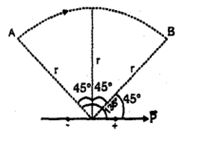
As shown in the figure,a charge $+q$ is moved from point $A \,(r, 135^{\circ})$ to point $B \,(r, 45^{\circ})$. If the dipole moment is $p$,what is the work done by an external agent?
A
$0$
B
$\frac{qp}{4\pi \varepsilon_0 r^2}$
C
$\frac{1}{4\pi \varepsilon_0} \frac{\sqrt{2} qp}{r^2}$
D
$\frac{1}{4\pi \varepsilon_0} \frac{qp}{r}$
Solution
(C) The electric potential due to a dipole at a point $(r, \theta)$ is given by $V = \frac{1}{4\pi \varepsilon_0} \frac{p \cos \theta}{r^2}$.
Potential at point $A$ $(r, 135^{\circ})$:
$V_A = \frac{1}{4\pi \varepsilon_0} \frac{p \cos 135^{\circ}}{r^2} = \frac{1}{4\pi \varepsilon_0} \frac{p (-1/\sqrt{2})}{r^2}$.
Potential at point $B$ $(r, 45^{\circ})$:
$V_B = \frac{1}{4\pi \varepsilon_0} \frac{p \cos 45^{\circ}}{r^2} = \frac{1}{4\pi \varepsilon_0} \frac{p (1/\sqrt{2})}{r^2}$.
The work done by an external agent in moving a charge $q$ from $A$ to $B$ is $W = q(V_B - V_A)$.
$W = q \left[ \frac{1}{4\pi \varepsilon_0} \frac{p}{r^2} \left( \frac{1}{\sqrt{2}} - \left( -\frac{1}{\sqrt{2}} \right) \right) \right]$
$W = q \left[ \frac{1}{4\pi \varepsilon_0} \frac{p}{r^2} \left( \frac{2}{\sqrt{2}} \right) \right]$
$W = \frac{1}{4\pi \varepsilon_0} \frac{\sqrt{2} qp}{r^2}$.
Potential at point $A$ $(r, 135^{\circ})$:
$V_A = \frac{1}{4\pi \varepsilon_0} \frac{p \cos 135^{\circ}}{r^2} = \frac{1}{4\pi \varepsilon_0} \frac{p (-1/\sqrt{2})}{r^2}$.
Potential at point $B$ $(r, 45^{\circ})$:
$V_B = \frac{1}{4\pi \varepsilon_0} \frac{p \cos 45^{\circ}}{r^2} = \frac{1}{4\pi \varepsilon_0} \frac{p (1/\sqrt{2})}{r^2}$.
The work done by an external agent in moving a charge $q$ from $A$ to $B$ is $W = q(V_B - V_A)$.
$W = q \left[ \frac{1}{4\pi \varepsilon_0} \frac{p}{r^2} \left( \frac{1}{\sqrt{2}} - \left( -\frac{1}{\sqrt{2}} \right) \right) \right]$
$W = q \left[ \frac{1}{4\pi \varepsilon_0} \frac{p}{r^2} \left( \frac{2}{\sqrt{2}} \right) \right]$
$W = \frac{1}{4\pi \varepsilon_0} \frac{\sqrt{2} qp}{r^2}$.
0 likes
View Solution38
MediumMCQ
An electric dipole is placed at an angle of $30^{\circ}$ in a non-uniform electric field. The electric dipole will experience:
A
$A$ net force in the direction of the electric field
B
$A$ net force in the direction of the electric field and a torque
C
$A$ torque only
D
$A$ net force and a torque
Solution
(D) In a uniform electric field,an electric dipole experiences only a torque,and the net force is zero.
However,in a non-uniform electric field,the electric field strength varies at different points.
Since the two charges of the dipole ($+q$ and $-q$) are at different positions,they experience different electric forces $(F = qE)$.
Therefore,the net force on the dipole is non-zero.
Additionally,because the forces are not collinear,the dipole also experiences a torque.
Thus,in a non-uniform electric field,an electric dipole experiences both a net force and a torque.
However,in a non-uniform electric field,the electric field strength varies at different points.
Since the two charges of the dipole ($+q$ and $-q$) are at different positions,they experience different electric forces $(F = qE)$.
Therefore,the net force on the dipole is non-zero.
Additionally,because the forces are not collinear,the dipole also experiences a torque.
Thus,in a non-uniform electric field,an electric dipole experiences both a net force and a torque.
0 likes
View Solution39
EasyMCQ
The unit of electric dipole moment is ......... .
A
$A-m$
B
$C-m$
C
$A-m^2$
D
$C-m^2$
Solution
(B) The electric dipole moment $(p)$ is defined as the product of the magnitude of one of the charges $(q)$ and the distance of separation $(2a)$ between them.
Mathematically,$p = q \times 2a$.
The $SI$ unit of charge $(q)$ is Coulomb $(C)$ and the $SI$ unit of distance $(2a)$ is meter $(m)$.
Therefore,the $SI$ unit of electric dipole moment is $C \cdot m$ (Coulomb-meter).
Mathematically,$p = q \times 2a$.
The $SI$ unit of charge $(q)$ is Coulomb $(C)$ and the $SI$ unit of distance $(2a)$ is meter $(m)$.
Therefore,the $SI$ unit of electric dipole moment is $C \cdot m$ (Coulomb-meter).
0 likes
View Solution40
MediumMCQ
The ratio of the electric field on the axial line to the equatorial line of a short electric dipole is:
A
$1 : 2$
B
$2 : 1$
C
$4 : 1$
D
$1 : 4$
Solution
(B) The electric field due to a short electric dipole at a distance $r$ on its axial line is given by $E_{\text{axial}} = \frac{1}{4\pi\epsilon_0} \frac{2p}{r^3}$.
The electric field due to a short electric dipole at a distance $r$ on its equatorial line is given by $E_{\text{equatorial}} = \frac{1}{4\pi\epsilon_0} \frac{p}{r^3}$.
Taking the ratio of the axial field to the equatorial field:
$\frac{E_{\text{axial}}}{E_{\text{equatorial}}} = \frac{\frac{1}{4\pi\epsilon_0} \frac{2p}{r^3}}{\frac{1}{4\pi\epsilon_0} \frac{p}{r^3}} = \frac{2}{1}$.
Therefore,the ratio is $2 : 1$.
The electric field due to a short electric dipole at a distance $r$ on its equatorial line is given by $E_{\text{equatorial}} = \frac{1}{4\pi\epsilon_0} \frac{p}{r^3}$.
Taking the ratio of the axial field to the equatorial field:
$\frac{E_{\text{axial}}}{E_{\text{equatorial}}} = \frac{\frac{1}{4\pi\epsilon_0} \frac{2p}{r^3}}{\frac{1}{4\pi\epsilon_0} \frac{p}{r^3}} = \frac{2}{1}$.
Therefore,the ratio is $2 : 1$.
0 likes
View Solution41
EasyMCQ
An electric dipole is placed in an electric field generated by a point charge.
A
The net electric force on the dipole is always zero.
B
The net electric force on the dipole may be zero.
C
The torque on the dipole due to the electric field must always be zero.
D
The torque on the dipole due to the electric field may be zero.
Solution
(D) The electric field $E$ produced by a point charge is non-uniform,as it varies with distance $r$ $(E \propto 1/r^2)$.
The force on a dipole in a non-uniform electric field is given by $\vec{F} = (\vec{p} \cdot \nabla) \vec{E}$. Since the field is non-uniform,the net force on the dipole is generally non-zero.
The torque on a dipole is given by $\vec{\tau} = \vec{p} \times \vec{E}$.
If the dipole moment $\vec{p}$ is parallel or anti-parallel to the electric field $\vec{E}$,the angle $\theta$ between them is $0^\circ$ or $180^\circ$. Since $\tau = pE \sin \theta$,in these specific orientations,$\sin(0^\circ) = 0$ or $\sin(180^\circ) = 0$,making the torque zero.
Therefore,the torque on the dipole may be zero.
The force on a dipole in a non-uniform electric field is given by $\vec{F} = (\vec{p} \cdot \nabla) \vec{E}$. Since the field is non-uniform,the net force on the dipole is generally non-zero.
The torque on a dipole is given by $\vec{\tau} = \vec{p} \times \vec{E}$.
If the dipole moment $\vec{p}$ is parallel or anti-parallel to the electric field $\vec{E}$,the angle $\theta$ between them is $0^\circ$ or $180^\circ$. Since $\tau = pE \sin \theta$,in these specific orientations,$\sin(0^\circ) = 0$ or $\sin(180^\circ) = 0$,making the torque zero.
Therefore,the torque on the dipole may be zero.
0 likes
View Solution42
EasyMCQ
The direction of the electric field at a point on the equatorial line of an electric dipole is .......
A
Parallel to the dipole moment
B
Anti-parallel to the dipole moment
C
Perpendicular to the dipole moment
D
Independent of the dipole moment
Solution
(B) The electric field $\vec{E}$ at a point on the equatorial line of an electric dipole is given by the formula $\vec{E} = -\frac{1}{4\pi\epsilon_0} \frac{\vec{p}}{r^3}$,where $\vec{p}$ is the electric dipole moment.
The negative sign indicates that the direction of the electric field $\vec{E}$ is opposite to the direction of the dipole moment $\vec{p}$.
Therefore,the electric field is anti-parallel to the dipole moment.
The negative sign indicates that the direction of the electric field $\vec{E}$ is opposite to the direction of the dipole moment $\vec{p}$.
Therefore,the electric field is anti-parallel to the dipole moment.
0 likes
View Solution43
EasyMCQ
The electric dipole moment of a short electric dipole is $p$. The electric potential at a point at a distance $r$ from its center and making an angle $\theta$ with the axis of the dipole is .......
A
$\frac{kp \sin \theta}{r^2}$
B
$\frac{kp \cos \theta}{r^2}$
C
$\frac{kp}{r^3} \sqrt{1 + 3 \cos^2 \theta}$
D
$\frac{kp}{r^3} \sqrt{1 + 3 \sin^2 \theta}$
Solution
(B) The electric potential $V$ due to a short electric dipole at a point $(r, \theta)$ is given by the formula:
$V = \frac{kp \cos \theta}{r^2}$
where $k = \frac{1}{4\pi \epsilon_0}$ is the Coulomb constant,$p$ is the dipole moment,$r$ is the distance from the center of the dipole,and $\theta$ is the angle between the position vector of the point and the dipole axis.
Thus,the correct option is $B$.
$V = \frac{kp \cos \theta}{r^2}$
where $k = \frac{1}{4\pi \epsilon_0}$ is the Coulomb constant,$p$ is the dipole moment,$r$ is the distance from the center of the dipole,and $\theta$ is the angle between the position vector of the point and the dipole axis.
Thus,the correct option is $B$.
0 likes
View Solution44
MediumMCQ
What does an electric dipole experience when placed in a non-uniform electric field?
A
No force
B
Only torque
C
Only a net linear force
D
Both a net linear force and a torque
Solution
(D) An electric dipole consists of two equal and opposite charges separated by a small distance $d$.
When placed in a non-uniform electric field,the electric field strength at the position of the two charges is different.
Since $F = qE$,the forces acting on the two charges are not equal in magnitude,resulting in a net linear force.
Additionally,because the forces act at different points,they create a torque about the center of the dipole.
Therefore,an electric dipole in a non-uniform electric field experiences both a net linear force and a torque.
When placed in a non-uniform electric field,the electric field strength at the position of the two charges is different.
Since $F = qE$,the forces acting on the two charges are not equal in magnitude,resulting in a net linear force.
Additionally,because the forces act at different points,they create a torque about the center of the dipole.
Therefore,an electric dipole in a non-uniform electric field experiences both a net linear force and a torque.
0 likes
View Solution45
EasyMCQ
The force on a charge situated on the axis of a dipole is $F$. If the charge is shifted to double the distance,the new force will be
A
Zero
B
$F/2$
C
$F/4$
D
$F/8$
Solution
(D) The electric field $E$ on the axis of a dipole at a distance $r$ is given by $E = \frac{2Kp}{r^3}$,where $K$ is Coulomb's constant and $p$ is the dipole moment.
The force $F$ on a charge $q$ is given by $F = qE = q \left( \frac{2Kp}{r^3} \right) = \frac{2Kpq}{r^3}$.
From this expression,we see that $F \propto \frac{1}{r^3}$.
If the distance is doubled,i.e.,$r' = 2r$,the new force $F'$ will be:
$F' = \frac{2Kpq}{(2r)^3} = \frac{2Kpq}{8r^3} = \frac{1}{8} \left( \frac{2Kpq}{r^3} \right) = \frac{F}{8}$.
The force $F$ on a charge $q$ is given by $F = qE = q \left( \frac{2Kp}{r^3} \right) = \frac{2Kpq}{r^3}$.
From this expression,we see that $F \propto \frac{1}{r^3}$.
If the distance is doubled,i.e.,$r' = 2r$,the new force $F'$ will be:
$F' = \frac{2Kpq}{(2r)^3} = \frac{2Kpq}{8r^3} = \frac{1}{8} \left( \frac{2Kpq}{r^3} \right) = \frac{F}{8}$.
0 likes
View Solution46
MediumMCQ
The magnitude of the charge of an electric dipole is $3.2 \times 10^{-19} \ C$ and the distance between them is $2.4 \ \mathring{A}$. If it is placed in an electric field of $4 \times 10^5 \ V/m$,then its dipole moment (in $C-m$) is .......
A
$9.6 \times 10^{-5}$
B
$12.8 \times 10^{-14}$
C
$7.68 \times 10^{-29}$
D
$30.72 \times 10^{-24}$
Solution
(C) The dipole moment $p$ is defined as the product of the magnitude of one of the charges $q$ and the distance between them $2a$.
Given:
Charge $q = 3.2 \times 10^{-19} \ C$
Distance $2a = 2.4 \ \mathring{A} = 2.4 \times 10^{-10} \ m$
Electric field $E = 4 \times 10^5 \ V/m$ (Note: The electric field is extra information not required to calculate the dipole moment).
Formula: $p = q \times (2a)$
Calculation: $p = (3.2 \times 10^{-19} \ C) \times (2.4 \times 10^{-10} \ m)$
$p = 7.68 \times 10^{-29} \ C-m$.
Given:
Charge $q = 3.2 \times 10^{-19} \ C$
Distance $2a = 2.4 \ \mathring{A} = 2.4 \times 10^{-10} \ m$
Electric field $E = 4 \times 10^5 \ V/m$ (Note: The electric field is extra information not required to calculate the dipole moment).
Formula: $p = q \times (2a)$
Calculation: $p = (3.2 \times 10^{-19} \ C) \times (2.4 \times 10^{-10} \ m)$
$p = 7.68 \times 10^{-29} \ C-m$.
0 likes
View Solution47
DifficultMCQ
An electric dipole consists of two equal and opposite charges of $2 \ \mu C$ separated by a distance of $3 \ cm$. If it is placed in an external electric field of $2 \times 10^{5} \ N/C$,the maximum torque experienced by it is:
A
$12 \times 10^{-1} \ Nm$
B
$12 \times 10^{-3} \ Nm$
C
$24 \times 10^{-3} \ Nm$
D
$24 \times 10^{-1} \ Nm$
Solution
(B) The dipole moment $p$ is given by $p = q \times (2a)$,where $q = 2 \times 10^{-6} \ C$ and $2a = 3 \times 10^{-2} \ m$.
$p = (2 \times 10^{-6}) \times (3 \times 10^{-2}) = 6 \times 10^{-8} \ Cm$.
The torque $\tau$ on a dipole in an electric field $E$ is given by $\tau = pE \sin \theta$.
For maximum torque,$\sin \theta = 1$,so $\tau_{max} = pE$.
$\tau_{max} = (6 \times 10^{-8} \ Cm) \times (2 \times 10^{5} \ N/C)$.
$\tau_{max} = 12 \times 10^{-3} \ Nm$.
$p = (2 \times 10^{-6}) \times (3 \times 10^{-2}) = 6 \times 10^{-8} \ Cm$.
The torque $\tau$ on a dipole in an electric field $E$ is given by $\tau = pE \sin \theta$.
For maximum torque,$\sin \theta = 1$,so $\tau_{max} = pE$.
$\tau_{max} = (6 \times 10^{-8} \ Cm) \times (2 \times 10^{5} \ N/C)$.
$\tau_{max} = 12 \times 10^{-3} \ Nm$.
0 likes
View Solution48
DifficultMCQ
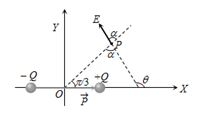
An electric dipole is placed at the origin in the direction of the $x$-axis. $A$ point $P$ is at a distance of $20 \, cm$ from the origin $O$ such that $OP$ makes an angle of $\pi/3$ with the $x$-axis. If the electric field at point $P$ makes an angle $\theta$ with the $x$-axis,then the value of $\theta$ is:
A
$\frac{\pi}{3}$
B
$\frac{\pi}{3} + \tan^{-1}\left(\frac{\sqrt{3}}{2}\right)$
C
$\frac{2\pi}{3}$
D
$\tan^{-1}\left(\frac{\sqrt{3}}{2}\right)$
Solution
(B) The electric field of a dipole at a point $(r, \phi)$ in polar coordinates is given by the radial component $E_r = \frac{2kp \cos \phi}{r^3}$ and the tangential component $E_t = \frac{kp \sin \phi}{r^3}$.
Here,$\phi = \pi/3$ is the angle the position vector $OP$ makes with the dipole axis (the $x$-axis).
The angle $\alpha$ that the resultant electric field makes with the radial vector $OP$ is given by $\tan \alpha = \frac{E_t}{E_r} = \frac{kp \sin \phi / r^3}{2kp \cos \phi / r^3} = \frac{1}{2} \tan \phi$.
Substituting $\phi = \pi/3$,we get $\tan \alpha = \frac{1}{2} \tan(\pi/3) = \frac{\sqrt{3}}{2}$,so $\alpha = \tan^{-1}\left(\frac{\sqrt{3}}{2}\right)$.
The angle $\theta$ that the electric field makes with the $x$-axis is the sum of the angle of the position vector $\phi$ and the angle $\alpha$,so $\theta = \phi + \alpha = \frac{\pi}{3} + \tan^{-1}\left(\frac{\sqrt{3}}{2}\right)$.
Here,$\phi = \pi/3$ is the angle the position vector $OP$ makes with the dipole axis (the $x$-axis).
The angle $\alpha$ that the resultant electric field makes with the radial vector $OP$ is given by $\tan \alpha = \frac{E_t}{E_r} = \frac{kp \sin \phi / r^3}{2kp \cos \phi / r^3} = \frac{1}{2} \tan \phi$.
Substituting $\phi = \pi/3$,we get $\tan \alpha = \frac{1}{2} \tan(\pi/3) = \frac{\sqrt{3}}{2}$,so $\alpha = \tan^{-1}\left(\frac{\sqrt{3}}{2}\right)$.
The angle $\theta$ that the electric field makes with the $x$-axis is the sum of the angle of the position vector $\phi$ and the angle $\alpha$,so $\theta = \phi + \alpha = \frac{\pi}{3} + \tan^{-1}\left(\frac{\sqrt{3}}{2}\right)$.
0 likes
View Solution49
EasyMCQ
For an electric dipole, if the magnitude of each charge is $10^{-10} \, \text{stC}$ and the distance between them is $1 \, \mathring{A}$, then the dipole moment is:
A
$1 \, \text{Debye}$
B
$2 \, \text{Debye}$
C
$10^{-3} \, \text{Debye}$
D
$3 \times 10^{-20} \, \text{Debye}$
Solution
(A) The dipole moment $p$ is given by the product of the magnitude of one charge $q$ and the separation distance $2a$ (or $\ell$):
$p = q \times \ell$
Given:
$q = 10^{-10} \, \text{stC}$
$\ell = 1 \, \mathring{A} = 10^{-8} \, \text{cm}$
Substituting the values:
$p = 10^{-10} \, \text{stC} \times 10^{-8} \, \text{cm} = 10^{-18} \, \text{esu} \cdot \text{cm}$
Since $1 \, \text{Debye} = 10^{-18} \, \text{esu} \cdot \text{cm}$,
Therefore, $p = 1 \, \text{Debye}$.
$p = q \times \ell$
Given:
$q = 10^{-10} \, \text{stC}$
$\ell = 1 \, \mathring{A} = 10^{-8} \, \text{cm}$
Substituting the values:
$p = 10^{-10} \, \text{stC} \times 10^{-8} \, \text{cm} = 10^{-18} \, \text{esu} \cdot \text{cm}$
Since $1 \, \text{Debye} = 10^{-18} \, \text{esu} \cdot \text{cm}$,
Therefore, $p = 1 \, \text{Debye}$.
0 likes
View Solution50
DifficultMCQ
If the electric field intensity at a distance $x$ on the axis of a dipole is equal to the electric field intensity at a distance $y$ on its equatorial line,then the ratio $x:y$ is:
A
$1:1$
B
$1:\sqrt{2}$
C
$1:2$
D
$\sqrt[3]{2}:1$
Solution
(D) The electric field on the axis of a dipole at distance $x$ is given by $E_{\text{axis}} = \frac{1}{4\pi\epsilon_0} \cdot \frac{2p}{x^3}$.
The electric field on the equatorial line of a dipole at distance $y$ is given by $E_{\text{equatorial}} = \frac{1}{4\pi\epsilon_0} \cdot \frac{p}{y^3}$.
Given that $E_{\text{axis}} = E_{\text{equatorial}}$,we have:
$\frac{2p}{x^3} = \frac{p}{y^3}$.
Simplifying the equation:
$\frac{2}{x^3} = \frac{1}{y^3} \Rightarrow \frac{x^3}{y^3} = 2$.
Taking the cube root on both sides:
$\frac{x}{y} = \sqrt[3]{2} = 2^{1/3}$.
Therefore,the ratio $x:y$ is $\sqrt[3]{2}:1$.
The electric field on the equatorial line of a dipole at distance $y$ is given by $E_{\text{equatorial}} = \frac{1}{4\pi\epsilon_0} \cdot \frac{p}{y^3}$.
Given that $E_{\text{axis}} = E_{\text{equatorial}}$,we have:
$\frac{2p}{x^3} = \frac{p}{y^3}$.
Simplifying the equation:
$\frac{2}{x^3} = \frac{1}{y^3} \Rightarrow \frac{x^3}{y^3} = 2$.
Taking the cube root on both sides:
$\frac{x}{y} = \sqrt[3]{2} = 2^{1/3}$.
Therefore,the ratio $x:y$ is $\sqrt[3]{2}:1$.
0 likes
View SolutionElectric Charges and Fields — Electric Dipole and Electric Field · Frequently Asked Questions
1Are these Electric Charges and Fields questions useful for JEE and NEET?
Yes. All questions in this section are mapped to JEE Main and NEET exam patterns. Previous year questions from JEE Main, NEET, GUJCET and state-level exams are included with full solutions.
2Can I switch to Hindi or Gujarati for these questions?
Yes. Use the language tabs in the hero section or the sidebar to view the same questions and solutions in English, Hindi or Gujarati.
3How do I generate a question paper from this subtopic?
Use the Vedclass Exam Paper Generator — select the chapter and subtopic, set difficulty, and generate Sets A, B, C, D automatically. First 3 chapters of every subject are free.
Vedclass Products
For Students
Vedclass Test Series
Mock tests in real JEE/NEET style with performance analysis. 5-day free trial.
Start Free TrialFor Teachers
Exam Paper Generator
Generate Set A/B/C/D papers from this chapter in 2 minutes. 3 chapters free.
Try FreeFor Institutes
Online Exam Module
Live online exams with unlimited students, 360° analytics & white-label branding.
See DemoFor Teachers & Institutes
Generate a Electric Charges and Fields Exam Paper in 2 Minutes
Select subtopic & difficulty — Sets A, B, C, D auto-generated with No Repeat logic.
First 3 chapters of every subject are free — no payment required.