
A English
Electric Cells and Combination of cells in Series and Parallel Questions in English
Class 12 Physics · Current Electricity · Electric Cells and Combination of cells in Series and Parallel
187+
Questions
English
Language
100%
With Solutions
Showing 50 of 187 questions in English
1
EasyMCQ
It is easier to start a car engine on a hot day than on a cold day. This is because the internal resistance of the car battery
A
Decreases with rise in temperature
B
Increases with rise in temperature
C
Decreases with a fall in temperature
D
Does not change with a change in temperature
Solution
(A) The internal resistance $r$ of a lead-acid battery (commonly used in cars) is primarily due to the viscosity of the electrolyte.
As the temperature increases,the viscosity of the electrolyte decreases,which increases the mobility of the ions.
Consequently,the internal resistance $r$ of the battery decreases as the temperature rises.
Since $r$ is lower on a hot day,the battery can deliver a higher current to the starter motor,making it easier to start the engine.
Therefore,the correct option is $A$.
As the temperature increases,the viscosity of the electrolyte decreases,which increases the mobility of the ions.
Consequently,the internal resistance $r$ of the battery decreases as the temperature rises.
Since $r$ is lower on a hot day,the battery can deliver a higher current to the starter motor,making it easier to start the engine.
Therefore,the correct option is $A$.
0 likes
View Solution2
MediumMCQ
$A$ cell of e.m.f. $E$ is connected with an external resistance $R$,then the potential difference across the cell is $V$. The internal resistance of the cell will be:
A
$\frac{(E - V)R}{E}$
B
$\frac{(E - V)R}{V}$
C
$\frac{(V - E)R}{V}$
D
$\frac{(V - E)R}{E}$
Solution
(B) Let the current in the circuit be $i = \frac{V}{R}$.
Across the cell,the terminal potential difference is given by $E = V + ir$,where $r$ is the internal resistance.
Rearranging the equation for $r$,we get $ir = E - V$.
Substituting $i = \frac{V}{R}$ into the equation,we have $\left( \frac{V}{R} \right) r = E - V$.
Solving for $r$,we get $r = \frac{(E - V)R}{V}$.
Across the cell,the terminal potential difference is given by $E = V + ir$,where $r$ is the internal resistance.
Rearranging the equation for $r$,we get $ir = E - V$.
Substituting $i = \frac{V}{R}$ into the equation,we have $\left( \frac{V}{R} \right) r = E - V$.
Solving for $r$,we get $r = \frac{(E - V)R}{V}$.
0 likes
View Solution3
EasyMCQ
Two cells,each of $e.m.f.$ $E$ and internal resistance $r$,are connected in parallel across an external resistor $R$. The maximum energy delivered to the resistor occurs when:
A
$R = r/2$
B
$R = r$
C
$R = 2r$
D
$R = 0$
Solution
(A) For two cells of $e.m.f.$ $E$ and internal resistance $r$ connected in parallel,the equivalent $e.m.f.$ $(E_{eq})$ is $E$ and the equivalent internal resistance $(r_{eq})$ is $r/2$.
According to the Maximum Power Transfer Theorem,the power delivered to an external resistor $R$ is maximum when the external resistance equals the equivalent internal resistance of the source.
Therefore,for maximum energy transfer,$R = r_{eq} = r/2$.
According to the Maximum Power Transfer Theorem,the power delivered to an external resistor $R$ is maximum when the external resistance equals the equivalent internal resistance of the source.
Therefore,for maximum energy transfer,$R = r_{eq} = r/2$.
0 likes
View Solution4
EasyMCQ
The terminal potential difference of a cell is greater than its $e.m.f.$ when it is
A
Being discharged
B
In open circuit
C
Being charged
D
Being either charged or discharged
Solution
(C) The terminal potential difference $V$ of a cell is given by the relation $V = E \pm Ir$,where $E$ is the $e.m.f.$,$I$ is the current,and $r$ is the internal resistance of the cell.
When a cell is being discharged,$V = E - Ir$,so $V < E$.
When a cell is in an open circuit,$I = 0$,so $V = E$.
When a cell is being charged,the current flows into the positive terminal,so the relation becomes $V = E + Ir$. Therefore,$V > E$.
Thus,the terminal potential difference is greater than the $e.m.f.$ only when the cell is being charged.
When a cell is being discharged,$V = E - Ir$,so $V < E$.
When a cell is in an open circuit,$I = 0$,so $V = E$.
When a cell is being charged,the current flows into the positive terminal,so the relation becomes $V = E + Ir$. Therefore,$V > E$.
Thus,the terminal potential difference is greater than the $e.m.f.$ only when the cell is being charged.
0 likes
View Solution5
MediumMCQ
When a resistance of $2\,\Omega$ is connected across the terminals of a cell,the current is $0.5\,A$. When the resistance is increased to $5\,\Omega$,the current is $0.25\,A$. The internal resistance of the cell is ............. $\Omega$.
A
$0.5$
B
$1$
C
$1.5$
D
$2$
Solution
(B) Let the $e.m.f.$ of the cell be $E$ and the internal resistance be $r$.
According to Ohm's law for a circuit with a cell,the current $I$ is given by $I = \frac{E}{R + r}$.
For the first case: $0.5 = \frac{E}{2 + r}$ --- $(1)$
For the second case: $0.25 = \frac{E}{5 + r}$ --- $(2)$
Dividing equation $(1)$ by equation $(2)$:
$\frac{0.5}{0.25} = \frac{E / (2 + r)}{E / (5 + r)}$
$2 = \frac{5 + r}{2 + r}$
$2(2 + r) = 5 + r$
$4 + 2r = 5 + r$
$2r - r = 5 - 4$
$r = 1\,\Omega$.
Therefore,the internal resistance of the cell is $1\,\Omega$.
According to Ohm's law for a circuit with a cell,the current $I$ is given by $I = \frac{E}{R + r}$.
For the first case: $0.5 = \frac{E}{2 + r}$ --- $(1)$
For the second case: $0.25 = \frac{E}{5 + r}$ --- $(2)$
Dividing equation $(1)$ by equation $(2)$:
$\frac{0.5}{0.25} = \frac{E / (2 + r)}{E / (5 + r)}$
$2 = \frac{5 + r}{2 + r}$
$2(2 + r) = 5 + r$
$4 + 2r = 5 + r$
$2r - r = 5 - 4$
$r = 1\,\Omega$.
Therefore,the internal resistance of the cell is $1\,\Omega$.
0 likes
View Solution6
EasyMCQ
The terminal potential difference of a cell when short-circuited is ($E$ = $E.M.F.$ of the cell).
A
$E$
B
$E/2$
C
Zero
D
$E/3$
Solution
(C) The terminal potential difference $V$ of a cell is given by the formula $V = E - Ir$,where $E$ is the $E.M.F.$,$I$ is the current,and $r$ is the internal resistance of the cell.
When a cell is short-circuited,the external resistance $R$ is equal to $0$.
The current flowing through the circuit is $I = E / (R + r) = E / (0 + r) = E/r$.
Substituting this value of $I$ into the terminal potential difference formula: $V = E - (E/r) \times r = E - E = 0$.
Therefore,the terminal potential difference of a cell when short-circuited is $0$.
When a cell is short-circuited,the external resistance $R$ is equal to $0$.
The current flowing through the circuit is $I = E / (R + r) = E / (0 + r) = E/r$.
Substituting this value of $I$ into the terminal potential difference formula: $V = E - (E/r) \times r = E - E = 0$.
Therefore,the terminal potential difference of a cell when short-circuited is $0$.
0 likes
View Solution7
EasyMCQ
$A$ primary cell has an $e.m.f.$ of $1.5\,V$. When short-circuited,it gives a current of $3\,A$. The internal resistance of the cell is ............. $\Omega$.
A
$4.5$
B
$2$
C
$0.5$
D
$0.33$
Solution
(C) The formula for the short-circuit current of a cell is given by $i_{SC} = \frac{E}{r}$,where $E$ is the $e.m.f.$ and $r$ is the internal resistance.
Given: $E = 1.5\,V$ and $i_{SC} = 3\,A$.
Substituting the values into the formula: $3 = \frac{1.5}{r}$.
Solving for $r$: $r = \frac{1.5}{3} = 0.5\,\Omega$.
Therefore,the internal resistance of the cell is $0.5\,\Omega$.
Given: $E = 1.5\,V$ and $i_{SC} = 3\,A$.
Substituting the values into the formula: $3 = \frac{1.5}{r}$.
Solving for $r$: $r = \frac{1.5}{3} = 0.5\,\Omega$.
Therefore,the internal resistance of the cell is $0.5\,\Omega$.
0 likes
View Solution8
MediumMCQ
The potential difference in open circuit for a cell is $2.2\, V$. When a $4\, \Omega$ resistor is connected between its two electrodes,the potential difference becomes $2\, V$. The internal resistance of the cell will be .............. $\Omega$.
A
$1$
B
$0.2$
C
$2.5$
D
$0.4$
Solution
(D) The electromotive force $(E)$ of the cell is the potential difference in an open circuit,so $E = 2.2\, V$.
When a resistor $R = 4\, \Omega$ is connected,the terminal potential difference $V = 2\, V$.
The formula for terminal potential difference is $V = E - Ir$,where $I$ is the current and $r$ is the internal resistance.
Also,$I = \frac{V}{R} = \frac{2}{4} = 0.5\, A$.
Substituting these values into the equation $V = E - Ir$:
$2 = 2.2 - (0.5)r$
$0.5r = 2.2 - 2$
$0.5r = 0.2$
$r = \frac{0.2}{0.5} = 0.4\, \Omega$.
Therefore,the internal resistance of the cell is $0.4\, \Omega$.
When a resistor $R = 4\, \Omega$ is connected,the terminal potential difference $V = 2\, V$.
The formula for terminal potential difference is $V = E - Ir$,where $I$ is the current and $r$ is the internal resistance.
Also,$I = \frac{V}{R} = \frac{2}{4} = 0.5\, A$.
Substituting these values into the equation $V = E - Ir$:
$2 = 2.2 - (0.5)r$
$0.5r = 2.2 - 2$
$0.5r = 0.2$
$r = \frac{0.2}{0.5} = 0.4\, \Omega$.
Therefore,the internal resistance of the cell is $0.4\, \Omega$.
0 likes
View Solution9
DifficultMCQ
The reading of a high resistance voltmeter when a cell is connected across it is $2.2\, V$. When the terminals of the cell are also connected to a resistance of $5\,\Omega$,the voltmeter reading drops to $1.8\, V$. Find the internal resistance of the cell in $\Omega$.
A
$1.2$
B
$1.3$
C
$1.1$
D
$1.4$
Solution
(C) The electromotive force $(E)$ of the cell is the reading of the voltmeter when no current is drawn,so $E = 2.2\, V$.
When a resistance $R = 5\,\Omega$ is connected,the terminal voltage $V$ becomes $1.8\, V$.
The formula for internal resistance $(r)$ is given by $r = \left( \frac{E}{V} - 1 \right) R$.
Substituting the values: $r = \left( \frac{2.2}{1.8} - 1 \right) \times 5$.
$r = \left( \frac{2.2 - 1.8}{1.8} \right) \times 5 = \left( \frac{0.4}{1.8} \right) \times 5$.
$r = \left( \frac{4}{18} \right) \times 5 = \left( \frac{2}{9} \right) \times 5 = \frac{10}{9} \approx 1.11\,\Omega$.
Rounding to one decimal place,we get $r = 1.1\,\Omega$.
When a resistance $R = 5\,\Omega$ is connected,the terminal voltage $V$ becomes $1.8\, V$.
The formula for internal resistance $(r)$ is given by $r = \left( \frac{E}{V} - 1 \right) R$.
Substituting the values: $r = \left( \frac{2.2}{1.8} - 1 \right) \times 5$.
$r = \left( \frac{2.2 - 1.8}{1.8} \right) \times 5 = \left( \frac{0.4}{1.8} \right) \times 5$.
$r = \left( \frac{4}{18} \right) \times 5 = \left( \frac{2}{9} \right) \times 5 = \frac{10}{9} \approx 1.11\,\Omega$.
Rounding to one decimal place,we get $r = 1.1\,\Omega$.
0 likes
View Solution10
EasyMCQ
When cells are connected in parallel,then
A
The current decreases
B
The current increases
C
The e.m.f. increases
D
The e.m.f. decreases
Solution
(B) When $n$ identical cells,each of e.m.f. $E$ and internal resistance $r$,are connected in parallel across an external resistance $R$,the equivalent e.m.f. of the combination remains $E$.
However,the equivalent internal resistance of the combination becomes $r_{eq} = r/n$.
The total current $I$ in the circuit is given by $I = \frac{E}{R + r/n}$.
Since the internal resistance decreases in a parallel combination,the total current $I$ flowing through the external resistance $R$ increases compared to a single cell.
However,the equivalent internal resistance of the combination becomes $r_{eq} = r/n$.
The total current $I$ in the circuit is given by $I = \frac{E}{R + r/n}$.
Since the internal resistance decreases in a parallel combination,the total current $I$ flowing through the external resistance $R$ increases compared to a single cell.
0 likes
View Solution11
EasyMCQ
The internal resistance of a cell depends on
A
The distance between the plates
B
The area of the plates immersed
C
The concentration of the electrolyte
D
All the above
Solution
(D) The internal resistance $r$ of a cell is determined by several factors:
$1$. It is directly proportional to the distance $d$ between the electrodes.
$2$. It is inversely proportional to the area $A$ of the electrodes immersed in the electrolyte.
$3$. It depends on the nature and concentration of the electrolyte.
Since the internal resistance is influenced by all these factors,the correct option is $D$.
$1$. It is directly proportional to the distance $d$ between the electrodes.
$2$. It is inversely proportional to the area $A$ of the electrodes immersed in the electrolyte.
$3$. It depends on the nature and concentration of the electrolyte.
Since the internal resistance is influenced by all these factors,the correct option is $D$.
0 likes
View Solution12
MediumMCQ
$n$ identical cells each of $e.m.f.$ $E$ and internal resistance $r$ are connected in series. An external resistance $R$ is connected in series to this combination. The current through $R$ is
A
$\frac{nE}{R + nr}$
B
$\frac{nE}{nR + r}$
C
$\frac{E}{R + nr}$
D
$\frac{nE}{R + r}$
Solution
(A) When $n$ identical cells,each with $e.m.f.$ $E$ and internal resistance $r$,are connected in series,the total $e.m.f.$ of the combination is $nE$.
The total internal resistance of the $n$ cells connected in series is $nr$.
When an external resistance $R$ is connected in series with this combination,the total resistance of the circuit becomes $R + nr$.
According to Ohm's law,the current $i$ flowing through the circuit is given by $i = \frac{\text{Total } e.m.f.}{\text{Total resistance}}$.
Therefore,$i = \frac{nE}{R + nr}$.
The total internal resistance of the $n$ cells connected in series is $nr$.
When an external resistance $R$ is connected in series with this combination,the total resistance of the circuit becomes $R + nr$.
According to Ohm's law,the current $i$ flowing through the circuit is given by $i = \frac{\text{Total } e.m.f.}{\text{Total resistance}}$.
Therefore,$i = \frac{nE}{R + nr}$.
0 likes
View Solution13
MediumMCQ
$A$ cell of internal resistance $r$ is connected to an external resistance $R$. The current will be maximum in $R$,if
A
$R = r$
B
$R < r$
C
$R > r$
D
$R = r/2$
Solution
(A) The current $I$ in a circuit with a cell of electromotive force $E$,internal resistance $r$,and external resistance $R$ is given by $I = \frac{E}{R + r}$.
To maximize the current $I$ for a fixed $E$,the denominator $(R + r)$ must be minimized.
However,in the context of the Maximum Power Transfer Theorem,the power delivered to the external resistor is maximum when $R = r$.
If the question asks for the maximum current,it is theoretically highest when $R$ approaches $0$. Given the standard options provided in physics textbooks for this specific problem type,the condition $R = r$ is the intended answer related to impedance matching and power transfer.
To maximize the current $I$ for a fixed $E$,the denominator $(R + r)$ must be minimized.
However,in the context of the Maximum Power Transfer Theorem,the power delivered to the external resistor is maximum when $R = r$.
If the question asks for the maximum current,it is theoretically highest when $R$ approaches $0$. Given the standard options provided in physics textbooks for this specific problem type,the condition $R = r$ is the intended answer related to impedance matching and power transfer.
0 likes
View Solution14
EasyMCQ
To get the maximum current from a parallel combination of $n$ identical cells,each of internal resistance $r$,connected to an external resistance $R$,which of the following conditions must be satisfied?
A
$R >> r$
B
$R << r$
C
$R = r$
D
None of these
Solution
(B) For $n$ identical cells connected in parallel,each with electromotive force $E$ and internal resistance $r$,the total electromotive force is $E_{eq} = E$ and the equivalent internal resistance is $r_{eq} = \frac{r}{n}$.
The total current $I$ flowing through the external resistance $R$ is given by:
$I = \frac{E}{R + \frac{r}{n}} = \frac{nE}{nR + r}$.
To maximize the current $I$,the denominator $(nR + r)$ must be minimized.
If $R << r$,then $nR$ is very small compared to $r$,making the denominator approximately equal to $r$,which maximizes the current $I \approx \frac{nE}{r}$.
Therefore,the condition for maximum current in a parallel combination is $R << r$.
The total current $I$ flowing through the external resistance $R$ is given by:
$I = \frac{E}{R + \frac{r}{n}} = \frac{nE}{nR + r}$.
To maximize the current $I$,the denominator $(nR + r)$ must be minimized.
If $R << r$,then $nR$ is very small compared to $r$,making the denominator approximately equal to $r$,which maximizes the current $I \approx \frac{nE}{r}$.
Therefore,the condition for maximum current in a parallel combination is $R << r$.
0 likes
View Solution15
MediumMCQ
Two identical cells send the same current in $2\,\Omega$ resistance,whether connected in series or in parallel. The internal resistance of the cell should be ............... $\Omega$.
A
$1$
B
$2$
C
$0.5$
D
$2.5$
Solution
(B) Let $E$ be the electromotive force $(EMF)$ and $r$ be the internal resistance of each cell. The external resistance is $R = 2\,\Omega$.
When connected in series,the total $EMF$ is $2E$ and the total internal resistance is $2r$. The current $i_1$ is given by:
$i_1 = \frac{2E}{R + 2r} = \frac{2E}{2 + 2r}$
When connected in parallel,the total $EMF$ is $E$ and the total internal resistance is $r/2$. The current $i_2$ is given by:
$i_2 = \frac{E}{R + r/2} = \frac{E}{2 + r/2} = \frac{2E}{4 + r}$
Given that $i_1 = i_2$,we equate the two expressions:
$\frac{2E}{2 + 2r} = \frac{2E}{4 + r}$
Canceling $2E$ from both sides:
$2 + 2r = 4 + r$
Solving for $r$:
$2r - r = 4 - 2$
$r = 2\,\Omega$
When connected in series,the total $EMF$ is $2E$ and the total internal resistance is $2r$. The current $i_1$ is given by:
$i_1 = \frac{2E}{R + 2r} = \frac{2E}{2 + 2r}$
When connected in parallel,the total $EMF$ is $E$ and the total internal resistance is $r/2$. The current $i_2$ is given by:
$i_2 = \frac{E}{R + r/2} = \frac{E}{2 + r/2} = \frac{2E}{4 + r}$
Given that $i_1 = i_2$,we equate the two expressions:
$\frac{2E}{2 + 2r} = \frac{2E}{4 + r}$
Canceling $2E$ from both sides:
$2 + 2r = 4 + r$
Solving for $r$:
$2r - r = 4 - 2$
$r = 2\,\Omega$
0 likes
View Solution16
EasyMCQ
The electromotive force of a primary cell is $2\,V$. When it is short-circuited,it gives a current of $4\,A$. Its internal resistance in $\Omega$ is:
A
$0.5$
B
$5$
C
$2$
D
$8$
Solution
(A) The electromotive force $(E)$ of the cell is $2\,V$.
When a cell is short-circuited,the external resistance $(R)$ is $0$.
The current $(i)$ flowing through the circuit is given by the formula $i = \frac{E}{R + r}$,where $r$ is the internal resistance.
Since $R = 0$,the formula becomes $i = \frac{E}{r}$.
Rearranging to solve for $r$,we get $r = \frac{E}{i}$.
Substituting the given values,$r = \frac{2\,V}{4\,A} = 0.5\,\Omega$.
Therefore,the internal resistance of the cell is $0.5\,\Omega$.
When a cell is short-circuited,the external resistance $(R)$ is $0$.
The current $(i)$ flowing through the circuit is given by the formula $i = \frac{E}{R + r}$,where $r$ is the internal resistance.
Since $R = 0$,the formula becomes $i = \frac{E}{r}$.
Rearranging to solve for $r$,we get $r = \frac{E}{i}$.
Substituting the given values,$r = \frac{2\,V}{4\,A} = 0.5\,\Omega$.
Therefore,the internal resistance of the cell is $0.5\,\Omega$.
0 likes
View Solution17
MediumMCQ
$A$ current of $2\,A$ is flowing through a cell of $e.m.f.$ $5\,V$ and internal resistance $0.5\,\Omega$ from negative to positive electrode. If the potential of the negative electrode is $10\,V$,the potential of the positive electrode will be .............. $V$.
A
$5$
B
$14$
C
$15$
D
$16$
Solution
(D) When current flows from the negative to the positive electrode inside a cell,the cell is being charged.
For a cell being charged,the potential difference across the electrodes is given by $V = E + Ir$.
Here,$E = 5\,V$,$I = 2\,A$,and $r = 0.5\,\Omega$.
The potential difference $V = V_{positive} - V_{negative} = E + Ir$.
Substituting the values: $V_{positive} - 10 = 5 + (2 \times 0.5)$.
$V_{positive} - 10 = 5 + 1 = 6$.
$V_{positive} = 16\,V$.
For a cell being charged,the potential difference across the electrodes is given by $V = E + Ir$.
Here,$E = 5\,V$,$I = 2\,A$,and $r = 0.5\,\Omega$.
The potential difference $V = V_{positive} - V_{negative} = E + Ir$.
Substituting the values: $V_{positive} - 10 = 5 + (2 \times 0.5)$.
$V_{positive} - 10 = 5 + 1 = 6$.
$V_{positive} = 16\,V$.
0 likes
View Solution18
DifficultMCQ
$100$ cells, each of $e.m.f.$ $5\, V$ and internal resistance $1\, \Omega$, are to be arranged to produce maximum current in a $25\, \Omega$ external resistance. Each row must contain an equal number of cells. The number of rows should be:
A
$2$
B
$4$
C
$5$
D
$10$
Solution
(A) Let $m$ be the number of rows and $n$ be the number of cells in each row.
Total number of cells $N = m \times n = 100$ .....$(i)$
For a mixed grouping of cells, the current is maximum when the external resistance $R$ is equal to the equivalent internal resistance of the combination.
The condition for maximum current is $R = \frac{nr}{m}$, where $r$ is the internal resistance of one cell.
Given $R = 25\, \Omega$ and $r = 1\, \Omega$, we have $25 = \frac{n \times 1}{m}$, which implies $n = 25m$ .....$(ii)$
Substituting equation $(ii)$ into equation $(i)$:
$m \times (25m) = 100$
$25m^2 = 100$
$m^2 = 4$
$m = 2$
Thus, the number of rows should be $2$.
Total number of cells $N = m \times n = 100$ .....$(i)$
For a mixed grouping of cells, the current is maximum when the external resistance $R$ is equal to the equivalent internal resistance of the combination.
The condition for maximum current is $R = \frac{nr}{m}$, where $r$ is the internal resistance of one cell.
Given $R = 25\, \Omega$ and $r = 1\, \Omega$, we have $25 = \frac{n \times 1}{m}$, which implies $n = 25m$ .....$(ii)$
Substituting equation $(ii)$ into equation $(i)$:
$m \times (25m) = 100$
$25m^2 = 100$
$m^2 = 4$
$m = 2$
Thus, the number of rows should be $2$.
0 likes
View Solution19
EasyMCQ
Two non-ideal identical batteries are connected in parallel. Consider the following statements:
$(i)$ The equivalent e.m.f. is smaller than either of the two e.m.f.s.
$(ii)$ The equivalent internal resistance is smaller than either of the two internal resistances.
$(i)$ The equivalent e.m.f. is smaller than either of the two e.m.f.s.
$(ii)$ The equivalent internal resistance is smaller than either of the two internal resistances.
A
Both $(i)$ and $(ii)$ are correct.
B
$(i)$ is correct but $(ii)$ is wrong.
C
$(ii)$ is correct but $(i)$ is wrong.
D
Both $(i)$ and $(ii)$ are wrong.
Solution
(C) For two identical batteries with e.m.f. $E$ and internal resistance $r$ connected in parallel,the equivalent e.m.f. $E_{eq}$ is given by $E_{eq} = E$.
Since $E_{eq} = E$,statement $(i)$ is incorrect because the equivalent e.m.f. is equal to the e.m.f. of either battery,not smaller.
The equivalent internal resistance $r_{eq}$ for two resistors in parallel is given by $\frac{1}{r_{eq}} = \frac{1}{r} + \frac{1}{r} = \frac{2}{r}$,which implies $r_{eq} = \frac{r}{2}$.
Since $\frac{r}{2} < r$,statement $(ii)$ is correct.
Therefore,$(ii)$ is correct but $(i)$ is wrong.
Since $E_{eq} = E$,statement $(i)$ is incorrect because the equivalent e.m.f. is equal to the e.m.f. of either battery,not smaller.
The equivalent internal resistance $r_{eq}$ for two resistors in parallel is given by $\frac{1}{r_{eq}} = \frac{1}{r} + \frac{1}{r} = \frac{2}{r}$,which implies $r_{eq} = \frac{r}{2}$.
Since $\frac{r}{2} < r$,statement $(ii)$ is correct.
Therefore,$(ii)$ is correct but $(i)$ is wrong.
0 likes
View Solution20
EasyMCQ
If six identical cells each having an $e.m.f.$ of $6\,V$ are connected in parallel,the $e.m.f.$ of the combination is ................ $V$.
A
$1$
B
$36$
C
$1/6$
D
$6$
Solution
(D) When $n$ identical cells,each having an $e.m.f.$ $E$,are connected in parallel,the equivalent $e.m.f.$ of the combination is equal to the $e.m.f.$ of a single cell.
Mathematically,$E_{eq} = E$.
Given that each cell has an $e.m.f.$ of $6\,V$,the equivalent $e.m.f.$ of the parallel combination is $6\,V$.
Mathematically,$E_{eq} = E$.
Given that each cell has an $e.m.f.$ of $6\,V$,the equivalent $e.m.f.$ of the parallel combination is $6\,V$.
0 likes
View Solution21
MediumMCQ
The number of dry cells,each of $e.m.f.$ $1.5\,V$ and internal resistance $0.5\,\Omega$,that must be joined in series with a resistance of $20\,\Omega$ so as to send a current of $0.6\,A$ through the circuit is:
A
$2$
B
$8$
C
$10$
D
$12$
Solution
(C) For $n$ cells connected in series,the total $e.m.f.$ is $nE$ and the total internal resistance is $nr$.
Given: $E = 1.5\,V$,$r = 0.5\,\Omega$,$R = 20\,\Omega$,and $I = 0.6\,A$.
The formula for current in a series circuit is $I = \frac{nE}{nr + R}$.
Substituting the values: $0.6 = \frac{n \times 1.5}{n \times 0.5 + 20}$.
$0.6(0.5n + 20) = 1.5n$.
$0.3n + 12 = 1.5n$.
$12 = 1.2n$.
$n = \frac{12}{1.2} = 10$.
Therefore,$10$ cells are required.
Given: $E = 1.5\,V$,$r = 0.5\,\Omega$,$R = 20\,\Omega$,and $I = 0.6\,A$.
The formula for current in a series circuit is $I = \frac{nE}{nr + R}$.
Substituting the values: $0.6 = \frac{n \times 1.5}{n \times 0.5 + 20}$.
$0.6(0.5n + 20) = 1.5n$.
$0.3n + 12 = 1.5n$.
$12 = 1.2n$.
$n = \frac{12}{1.2} = 10$.
Therefore,$10$ cells are required.
0 likes
View Solution22
EasyMCQ
$EMF$ is most closely related to
A
Mechanical force
B
Potential difference
C
Electric field
D
Magnetic field
Solution
(B) The term $EMF$ stands for Electromotive Force. Despite its name,it is not a force but a measure of the energy provided by a source (like a battery or cell) to drive charge around a circuit.
It represents the work done per unit charge in moving the charge across the terminals of the source when no current is flowing.
Therefore,$EMF$ is most closely related to Potential difference,as both are measured in volts $(V)$ and represent energy per unit charge.
It represents the work done per unit charge in moving the charge across the terminals of the source when no current is flowing.
Therefore,$EMF$ is most closely related to Potential difference,as both are measured in volts $(V)$ and represent energy per unit charge.
0 likes
View Solution23
EasyMCQ
Four identical cells,each having an electromotive force $(e.m.f.)$ of $12\,V$,are connected in parallel. The resultant electromotive force $(e.m.f.)$ of the combination is .............. $V$.
A
$48$
B
$12$
C
$4$
D
$3$
Solution
(B) When $n$ identical cells,each of electromotive force $E$,are connected in parallel,the equivalent electromotive force $(E_{eq})$ of the combination is equal to the electromotive force of a single cell.
Mathematically,$E_{eq} = E$.
Given that each cell has an $e.m.f.$ of $12\,V$,the resultant $e.m.f.$ of the combination is $12\,V$.
Mathematically,$E_{eq} = E$.
Given that each cell has an $e.m.f.$ of $12\,V$,the resultant $e.m.f.$ of the combination is $12\,V$.
0 likes
View Solution24
EasyMCQ
Electromotive force is the force,which is able to maintain a constant
A
Current
B
Resistance
C
Power
D
Potential difference
Solution
(D) Electromotive force $(EMF)$ is defined as the potential difference between the terminals of a cell when no current is flowing through the circuit. It is the energy provided by the cell per unit charge to maintain a constant potential difference across the external circuit.
0 likes
View Solution25
EasyMCQ
$A$ storage cell is charged by $5\, A$ $D.C.$ for $18\, hours$. Its strength after charging will be .............. $AH$.
A
$18$
B
$5$
C
$90$
D
$15$
Solution
(C) The capacity or strength of a storage cell in $AH$ (Ampere-Hour) is calculated by multiplying the charging current by the time for which it is charged.
Given:
Charging current $(I)$ = $5\, A$
Time $(t)$ = $18\, hours$
Strength = $I \times t = 5\, A \times 18\, h = 90\, AH$.
Therefore, the correct option is $C$.
Given:
Charging current $(I)$ = $5\, A$
Time $(t)$ = $18\, hours$
Strength = $I \times t = 5\, A \times 18\, h = 90\, AH$.
Therefore, the correct option is $C$.
0 likes
View Solution26
EasyMCQ
$A$ car battery of $e.m.f.$ $12\,V$ and internal resistance $5 \times 10^{-2}\,\Omega$,receives a current of $60\,A$ from an external source. What is the terminal voltage of the battery (in $,V$)?
A
$9$
B
$12$
C
$15$
D
$20$
Solution
(C) When a battery is being charged,the terminal voltage $V$ is given by the formula $V = E + Ir$,where $E$ is the $e.m.f.$,$I$ is the charging current,and $r$ is the internal resistance.
Given:
$E = 12\,V$
$I = 60\,A$
$r = 5 \times 10^{-2}\,\Omega = 0.05\,\Omega$
Substituting the values:
$V = 12 + (60 \times 0.05)$
$V = 12 + 3$
$V = 15\,V$.
Given:
$E = 12\,V$
$I = 60\,A$
$r = 5 \times 10^{-2}\,\Omega = 0.05\,\Omega$
Substituting the values:
$V = 12 + (60 \times 0.05)$
$V = 12 + 3$
$V = 15\,V$.
0 likes
View Solution27
MediumMCQ
When a resistor of $11 \,\Omega$ is connected in series with an electric cell,the current flowing in it is $0.5 \, A$. Instead,when a resistor of $5 \,\Omega$ is connected to the same electric cell in series,the current increases by $0.4 \, A$. The internal resistance of the cell is ................ $\Omega$.
A
$1.5$
B
$2$
C
$2.5$
D
$3.5$
Solution
(C) The current $i$ in a circuit with an electric cell of $EMF$ $E$ and internal resistance $r$ connected to an external resistor $R$ is given by $i = \frac{E}{R + r}$.
Case $1$: When $R_1 = 11 \, \Omega$,$i_1 = 0.5 \, A$.
$0.5 = \frac{E}{11 + r} \Rightarrow E = 0.5(11 + r) = 5.5 + 0.5r$ ... $(i)$
Case $2$: When $R_2 = 5 \, \Omega$,the current increases by $0.4 \, A$,so $i_2 = 0.5 + 0.4 = 0.9 \, A$.
$0.9 = \frac{E}{5 + r} \Rightarrow E = 0.9(5 + r) = 4.5 + 0.9r$ ... $(ii)$
Equating $(i)$ and $(ii)$:
$5.5 + 0.5r = 4.5 + 0.9r$
$5.5 - 4.5 = 0.9r - 0.5r$
$1.0 = 0.4r$
$r = \frac{1.0}{0.4} = 2.5 \, \Omega$.
Thus,the internal resistance of the cell is $2.5 \, \Omega$.
Case $1$: When $R_1 = 11 \, \Omega$,$i_1 = 0.5 \, A$.
$0.5 = \frac{E}{11 + r} \Rightarrow E = 0.5(11 + r) = 5.5 + 0.5r$ ... $(i)$
Case $2$: When $R_2 = 5 \, \Omega$,the current increases by $0.4 \, A$,so $i_2 = 0.5 + 0.4 = 0.9 \, A$.
$0.9 = \frac{E}{5 + r} \Rightarrow E = 0.9(5 + r) = 4.5 + 0.9r$ ... $(ii)$
Equating $(i)$ and $(ii)$:
$5.5 + 0.5r = 4.5 + 0.9r$
$5.5 - 4.5 = 0.9r - 0.5r$
$1.0 = 0.4r$
$r = \frac{1.0}{0.4} = 2.5 \, \Omega$.
Thus,the internal resistance of the cell is $2.5 \, \Omega$.
0 likes
View Solution28
EasyMCQ
The internal resistance of a cell is the resistance of
A
Electrodes of the cell
B
Vessel of the cell
C
Electrolyte used in the cell
D
Material used in the cell
Solution
(C) The internal resistance of a cell is defined as the opposition offered by the electrolyte and the electrodes of the cell to the flow of current through it.
However,the primary contribution to the internal resistance comes from the electrolyte present between the two electrodes.
Therefore,the correct option is $(c)$.
However,the primary contribution to the internal resistance comes from the electrolyte present between the two electrodes.
Therefore,the correct option is $(c)$.
0 likes
View Solution29
DifficultMCQ
Eels are able to generate current with biological cells called electroplaques. The electroplaques in an eel are arranged in $100$ rows,each row stretching horizontally along the body of the fish containing $5000$ electroplaques. The arrangement is shown below. Each electroplaque has an emf of $0.15\, V$ and internal resistance of $0.25\,\Omega$. The water surrounding the eel completes a circuit between the head and its tail. If the water surrounding it has a resistance of $500\,\Omega$,the current an eel can produce in water is about .............. $A$.
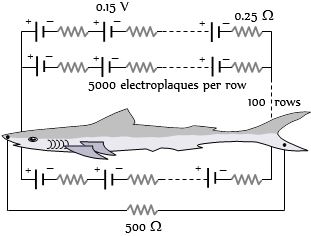
A
$1.5$
B
$3$
C
$15$
D
$30$
Solution
(A) The given problem represents a mixed grouping of cells.
Let $n$ be the number of cells in each row and $m$ be the number of rows.
Given: $n = 5000$,$m = 100$,$E = 0.15\, V$,$r = 0.25\,\Omega$,and external resistance $R = 500\,\Omega$.
The total emf of the arrangement is $E_{eq} = nE = 5000 \times 0.15 = 750\, V$.
The total internal resistance of the arrangement is $r_{eq} = \frac{nr}{m} = \frac{5000 \times 0.25}{100} = 50 \times 0.25 = 12.5\,\Omega$.
The total current $i$ in the circuit is given by $i = \frac{E_{eq}}{R + r_{eq}}$.
Substituting the values: $i = \frac{750}{500 + 12.5} = \frac{750}{512.5} \approx 1.463\, A$.
Rounding to the nearest option,the current is approximately $1.5\, A$.
Let $n$ be the number of cells in each row and $m$ be the number of rows.
Given: $n = 5000$,$m = 100$,$E = 0.15\, V$,$r = 0.25\,\Omega$,and external resistance $R = 500\,\Omega$.
The total emf of the arrangement is $E_{eq} = nE = 5000 \times 0.15 = 750\, V$.
The total internal resistance of the arrangement is $r_{eq} = \frac{nr}{m} = \frac{5000 \times 0.25}{100} = 50 \times 0.25 = 12.5\,\Omega$.
The total current $i$ in the circuit is given by $i = \frac{E_{eq}}{R + r_{eq}}$.
Substituting the values: $i = \frac{750}{500 + 12.5} = \frac{750}{512.5} \approx 1.463\, A$.
Rounding to the nearest option,the current is approximately $1.5\, A$.
0 likes
View Solution30
EasyMCQ
The current provided by a battery is maximum when:
A
Internal resistance is equal to external resistance
B
Internal resistance is greater than external resistance
C
Internal resistance is less than external resistance
D
None of these
Solution
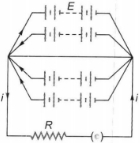
(A) For a general combination of $n$ cells in series and $m$ such rows in parallel,the total electromotive force $(emf)$ is $nE$ and the total internal resistance is $\frac{nr}{m}$.
The current $i$ in the external circuit $R$ is given by:
$i = \frac{nE}{R + \frac{nr}{m}} = \frac{mnE}{mR + nr}$
To maximize the current $i$,the denominator $(mR + nr)$ must be minimum. We can rewrite the denominator as:
$mR + nr = (\sqrt{mR} - \sqrt{nr})^2 + 2\sqrt{mnRr}$
The denominator is minimum when $(\sqrt{mR} - \sqrt{nr})^2 = 0$,which implies:
$\sqrt{mR} = \sqrt{nr}$
$mR = nr$
$R = \frac{nr}{m}$
Since $\frac{nr}{m}$ is the total internal resistance of the battery,the current is maximum when the external resistance is equal to the total internal resistance of the battery.
The current $i$ in the external circuit $R$ is given by:
$i = \frac{nE}{R + \frac{nr}{m}} = \frac{mnE}{mR + nr}$
To maximize the current $i$,the denominator $(mR + nr)$ must be minimum. We can rewrite the denominator as:
$mR + nr = (\sqrt{mR} - \sqrt{nr})^2 + 2\sqrt{mnRr}$
The denominator is minimum when $(\sqrt{mR} - \sqrt{nr})^2 = 0$,which implies:
$\sqrt{mR} = \sqrt{nr}$
$mR = nr$
$R = \frac{nr}{m}$
Since $\frac{nr}{m}$ is the total internal resistance of the battery,the current is maximum when the external resistance is equal to the total internal resistance of the battery.
0 likes
View Solution31
EasyMCQ
Two batteries,one of emf $18 \, V$ and internal resistance $2 \, \Omega$ and the other of emf $12 \, V$ and internal resistance $1 \, \Omega$,are connected in parallel as shown. The voltmeter $V$ will record a reading of ............. $V$.
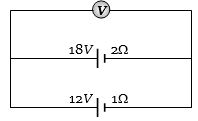
A
$15$
B
$30$
C
$14$
D
$18$
Solution
(C) When two cells with emf $E_1, E_2$ and internal resistances $r_1, r_2$ are connected in parallel,the equivalent emf $E_{eq}$ is given by the formula:
$E_{eq} = \frac{E_1 r_2 + E_2 r_1}{r_1 + r_2}$
Given:
$E_1 = 18 \, V, r_1 = 2 \, \Omega$
$E_2 = 12 \, V, r_2 = 1 \, \Omega$
Substituting these values into the formula:
$E_{eq} = \frac{(18 \times 1) + (12 \times 2)}{2 + 1}$
$E_{eq} = \frac{18 + 24}{3}$
$E_{eq} = \frac{42}{3} = 14 \, V$
Since the voltmeter is connected across the parallel combination,it will measure the equivalent emf of the circuit.
Therefore,the reading of the voltmeter is $14 \, V$.
$E_{eq} = \frac{E_1 r_2 + E_2 r_1}{r_1 + r_2}$
Given:
$E_1 = 18 \, V, r_1 = 2 \, \Omega$
$E_2 = 12 \, V, r_2 = 1 \, \Omega$
Substituting these values into the formula:
$E_{eq} = \frac{(18 \times 1) + (12 \times 2)}{2 + 1}$
$E_{eq} = \frac{18 + 24}{3}$
$E_{eq} = \frac{42}{3} = 14 \, V$
Since the voltmeter is connected across the parallel combination,it will measure the equivalent emf of the circuit.
Therefore,the reading of the voltmeter is $14 \, V$.
0 likes
View Solution32
EasyMCQ
An energy source will supply a constant current into the load if its internal resistance is
A
Very large as compared to the load resistance
B
Non-zero but less than the resistance of the load
C
Equal to the resistance of the load
D
Zero
Solution
(D) The current $I$ supplied by an energy source with electromotive force $E$ and internal resistance $r$ to a load resistance $R$ is given by the formula: $I = \frac{E}{R + r}$.
For the current $I$ to be constant regardless of changes in the load resistance $R$,the internal resistance $r$ must be zero.
If $r = 0$,then $I = \frac{E}{R}$. However,in the context of an ideal constant current source,the internal resistance is considered to be infinite. But based on the provided options,if $r = 0$,the source behaves as an ideal voltage source. Given the standard interpretation of this specific question,the correct answer is $D$.
For the current $I$ to be constant regardless of changes in the load resistance $R$,the internal resistance $r$ must be zero.
If $r = 0$,then $I = \frac{E}{R}$. However,in the context of an ideal constant current source,the internal resistance is considered to be infinite. But based on the provided options,if $r = 0$,the source behaves as an ideal voltage source. Given the standard interpretation of this specific question,the correct answer is $D$.
0 likes
View Solution33
EasyMCQ
To draw maximum current from a combination of cells,how should the cells be grouped?
A
Series
B
Parallel
C
Mixed
D
Depends upon the relative values of external and internal resistance
Solution
(D) The current $I$ in a mixed grouping of $n$ rows of cells,each containing $m$ cells in series,is given by $I = \frac{mnE}{mR + nr}$,where $E$ is the $EMF$ of each cell,$r$ is the internal resistance,and $R$ is the external resistance.
For maximum current,the denominator $(mR + nr)$ must be minimum.
By the $AM$-$GM$ inequality,$mR + nr \geq 2\sqrt{mR \cdot nr}$. The minimum value occurs when $mR = nr$,or $R = \frac{nr}{m}$.
Thus,the condition for maximum current depends on the relationship between the external resistance $R$ and the total internal resistance of the combination $\frac{nr}{m}$.
Therefore,the correct grouping depends on the relative values of external and internal resistance.
For maximum current,the denominator $(mR + nr)$ must be minimum.
By the $AM$-$GM$ inequality,$mR + nr \geq 2\sqrt{mR \cdot nr}$. The minimum value occurs when $mR = nr$,or $R = \frac{nr}{m}$.
Thus,the condition for maximum current depends on the relationship between the external resistance $R$ and the total internal resistance of the combination $\frac{nr}{m}$.
Therefore,the correct grouping depends on the relative values of external and internal resistance.
0 likes
View Solution34
DifficultMCQ
The $n$ rows,each containing $m$ cells in series,are joined in parallel. Maximum current is drawn from this combination across an external resistance of $3 \,\Omega$. If the total number of cells used is $24$ and the internal resistance of each cell is $0.5 \,\Omega$,then:
A
$m = 8, n = 3$
B
$m = 6, n = 4$
C
$m = 12, n = 2$
D
$m = 2, n = 12$
Solution
(C) The total number of cells is given by $m \times n = 24$ ... $(i)$.
For maximum current in a mixed grouping of cells,the external resistance $R$ must be equal to the equivalent internal resistance of the combination.
The equivalent internal resistance is given by $R_{eq} = \frac{mr}{n}$.
Given $R = 3 \,\Omega$ and $r = 0.5 \,\Omega$,we have $3 = \frac{m \times 0.5}{n}$.
This simplifies to $3 = \frac{m}{2n}$,which gives $m = 6n$ ... $(ii)$.
Substituting equation $(ii)$ into equation $(i)$: $(6n) \times n = 24$.
$6n^2 = 24 \implies n^2 = 4 \implies n = 2$.
Using $n = 2$ in equation $(ii)$,we get $m = 6 \times 2 = 12$.
Therefore,$m = 12$ and $n = 2$.
For maximum current in a mixed grouping of cells,the external resistance $R$ must be equal to the equivalent internal resistance of the combination.
The equivalent internal resistance is given by $R_{eq} = \frac{mr}{n}$.
Given $R = 3 \,\Omega$ and $r = 0.5 \,\Omega$,we have $3 = \frac{m \times 0.5}{n}$.
This simplifies to $3 = \frac{m}{2n}$,which gives $m = 6n$ ... $(ii)$.
Substituting equation $(ii)$ into equation $(i)$: $(6n) \times n = 24$.
$6n^2 = 24 \implies n^2 = 4 \implies n = 2$.
Using $n = 2$ in equation $(ii)$,we get $m = 6 \times 2 = 12$.
Therefore,$m = 12$ and $n = 2$.
0 likes
View Solution35
DifficultMCQ
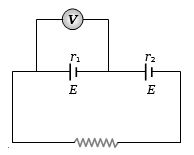
Two cells of equal $e.m.f.$ $E$ and internal resistances $r_1$ and $r_2$ $(r_1 > r_2)$ are connected in series. On connecting this combination to an external resistance $R$,it is observed that the potential difference across the first cell becomes zero. The value of $R$ will be
A
$r_1 + r_2$
B
$r_1 - r_2$
C
$\frac{r_1 + r_2}{2}$
D
$\frac{r_1 - r_2}{2}$
Solution
(B) The total $e.m.f.$ of the series combination is $E_{eq} = E + E = 2E$.
The total internal resistance is $r_{eq} = r_1 + r_2$.
The total resistance of the circuit is $R_{total} = R + r_1 + r_2$.
The current $i$ flowing through the circuit is given by $i = \frac{2E}{R + r_1 + r_2}$.
The potential difference $V_1$ across the first cell (with internal resistance $r_1$) is given by $V_1 = E - i r_1$.
Given that $V_1 = 0$,we have $E - i r_1 = 0$,which implies $E = i r_1$.
Substituting the value of $i$ into this equation:
$E = \left( \frac{2E}{R + r_1 + r_2} \right) r_1$
$1 = \frac{2r_1}{R + r_1 + r_2}$
$R + r_1 + r_2 = 2r_1$
$R = 2r_1 - r_1 - r_2$
$R = r_1 - r_2$.
The total internal resistance is $r_{eq} = r_1 + r_2$.
The total resistance of the circuit is $R_{total} = R + r_1 + r_2$.
The current $i$ flowing through the circuit is given by $i = \frac{2E}{R + r_1 + r_2}$.
The potential difference $V_1$ across the first cell (with internal resistance $r_1$) is given by $V_1 = E - i r_1$.
Given that $V_1 = 0$,we have $E - i r_1 = 0$,which implies $E = i r_1$.
Substituting the value of $i$ into this equation:
$E = \left( \frac{2E}{R + r_1 + r_2} \right) r_1$
$1 = \frac{2r_1}{R + r_1 + r_2}$
$R + r_1 + r_2 = 2r_1$
$R = 2r_1 - r_1 - r_2$
$R = r_1 - r_2$.
0 likes
View Solution36
MediumMCQ
$A$ group of $N$ cells whose $emf$ varies directly with the internal resistance as per the equation $E_N = 1.5\, r_N$ are connected in series as shown in the figure. The current $I$ in the circuit is ........... $A$.
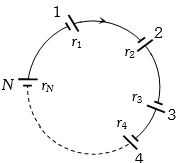
A
$0.51$
B
$5.1$
C
$0.15$
D
$1.5$
Solution
(D) The cells are connected in series. The total $emf$ of the circuit is the sum of the individual $emf$s: $E_{total} = E_1 + E_2 + E_3 + ... + E_N$.
Given that $E_N = 1.5\, r_N$,we can write $E_{total} = 1.5\, r_1 + 1.5\, r_2 + ... + 1.5\, r_N = 1.5(r_1 + r_2 + ... + r_N)$.
The total internal resistance of the circuit is $R_{total} = r_1 + r_2 + r_3 + ... + r_N$.
Using Ohm's law,the current $I$ in the circuit is given by $I = \frac{E_{total}}{R_{total}}$.
Substituting the values,$I = \frac{1.5(r_1 + r_2 + ... + r_N)}{(r_1 + r_2 + ... + r_N)} = 1.5\, A$.
Given that $E_N = 1.5\, r_N$,we can write $E_{total} = 1.5\, r_1 + 1.5\, r_2 + ... + 1.5\, r_N = 1.5(r_1 + r_2 + ... + r_N)$.
The total internal resistance of the circuit is $R_{total} = r_1 + r_2 + r_3 + ... + r_N$.
Using Ohm's law,the current $I$ in the circuit is given by $I = \frac{E_{total}}{R_{total}}$.
Substituting the values,$I = \frac{1.5(r_1 + r_2 + ... + r_N)}{(r_1 + r_2 + ... + r_N)} = 1.5\, A$.
0 likes
View Solution37
DifficultMCQ
$12$ cells,each having the same $emf$ $E$ and internal resistance $r$,are connected in series,but some cells are wrongly connected. This arrangement is connected in series with an ammeter and two additional cells (each of $emf$ $E$ and internal resistance $r$). The current is $3 \, A$ when the cells and the battery aid each other,and it is $2 \, A$ when they oppose each other. The number of cells wrongly connected is:
A
$4$
B
$1$
C
$3$
D
$2$
Solution
(B) Let $n$ be the number of wrongly connected cells.
Number of cells helping = $(12 - n)$.
Number of cells opposing = $n$.
Resultant $emf$ of the $12$ cells = $(12 - n)E - nE = (12 - 2n)E$.
Total resistance of the $12$ cells = $12r$.
When the two additional cells aid the battery,the total $emf$ is $(12 - 2n)E + 2E = (14 - 2n)E$ and total resistance is $14r$.
Given current $I_1 = 3 \, A$,so $\frac{(14 - 2n)E}{14r} = 3$ --- $(i)$.
When the two additional cells oppose the battery,the total $emf$ is $(12 - 2n)E - 2E = (10 - 2n)E$ and total resistance is $14r$.
Given current $I_2 = 2 \, A$,so $\frac{(10 - 2n)E}{14r} = 2$ --- $(ii)$.
Dividing $(i)$ by $(ii)$:
$\frac{14 - 2n}{10 - 2n} = \frac{3}{2}$
$28 - 4n = 30 - 6n$
$2n = 2 \implies n = 1$.
Thus,the number of wrongly connected cells is $1$.
Number of cells helping = $(12 - n)$.
Number of cells opposing = $n$.
Resultant $emf$ of the $12$ cells = $(12 - n)E - nE = (12 - 2n)E$.
Total resistance of the $12$ cells = $12r$.
When the two additional cells aid the battery,the total $emf$ is $(12 - 2n)E + 2E = (14 - 2n)E$ and total resistance is $14r$.
Given current $I_1 = 3 \, A$,so $\frac{(14 - 2n)E}{14r} = 3$ --- $(i)$.
When the two additional cells oppose the battery,the total $emf$ is $(12 - 2n)E - 2E = (10 - 2n)E$ and total resistance is $14r$.
Given current $I_2 = 2 \, A$,so $\frac{(10 - 2n)E}{14r} = 2$ --- $(ii)$.
Dividing $(i)$ by $(ii)$:
$\frac{14 - 2n}{10 - 2n} = \frac{3}{2}$
$28 - 4n = 30 - 6n$
$2n = 2 \implies n = 1$.
Thus,the number of wrongly connected cells is $1$.
0 likes
View Solution38
EasyMCQ
$A$ battery consists of a variable number '$n$' of identical cells,each having an electromotive force '$E$' and internal resistance '$r$',connected in series. The terminals of the battery are short-circuited,and the current '$i$' is measured. Which of the graphs below shows the relationship between '$i$' and '$n$?'
A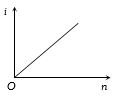
B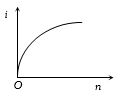
C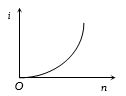
D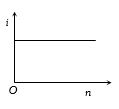
Solution
(D) When '$n$' identical cells,each with electromotive force '$E$' and internal resistance '$r$',are connected in series,the total electromotive force of the battery is '$nE$' and the total internal resistance is '$nr$'.
When the terminals of the battery are short-circuited,the external resistance is zero.
According to Ohm's law,the current '$i$' flowing through the circuit is given by:
$i = \frac{\text{Total EMF}}{\text{Total Resistance}} = \frac{nE}{nr} = \frac{E}{r}$
Since '$E$' and '$r$' are constants for the given cells,the current '$i$' is independent of the number of cells '$n$'.
Therefore,the graph representing the relationship between '$i$' and '$n$' is a horizontal straight line parallel to the '$n$-axis'.
This corresponds to Graph $D$.
When the terminals of the battery are short-circuited,the external resistance is zero.
According to Ohm's law,the current '$i$' flowing through the circuit is given by:
$i = \frac{\text{Total EMF}}{\text{Total Resistance}} = \frac{nE}{nr} = \frac{E}{r}$
Since '$E$' and '$r$' are constants for the given cells,the current '$i$' is independent of the number of cells '$n$'.
Therefore,the graph representing the relationship between '$i$' and '$n$' is a horizontal straight line parallel to the '$n$-axis'.
This corresponds to Graph $D$.
0 likes
View Solution39
MediumMCQ
Two identical batteries, each of $e.m.f.$ $2\,V$ and internal resistance $1.0\,\Omega$, are available to produce heat in an external resistance $R = 0.5\,\Omega$ by passing a current through it. The maximum Joulean power that can be developed across $R$ using these batteries is ............. $W$.
A
$1.28$
B
$2$
C
$8/9$
D
$3.2$
Solution
(B) For two identical batteries of $e.m.f.$ $E = 2\,V$ and internal resistance $r = 1.0\,\Omega$, we can connect them in series or parallel.
Case $1$: Series connection.
Total $e.m.f.$ $E_{eq} = 2E = 4\,V$.
Total internal resistance $r_{eq} = 2r = 2.0\,\Omega$.
Current $I = E_{eq} / (R + r_{eq}) = 4 / (0.5 + 2.0) = 4 / 2.5 = 1.6\,A$.
Power $P = I^2 R = (1.6)^2 \times 0.5 = 2.56 \times 0.5 = 1.28\,W$.
Case $2$: Parallel connection.
Total $e.m.f.$ $E_{eq} = E = 2\,V$.
Total internal resistance $r_{eq} = r/2 = 0.5\,\Omega$.
Current $I = E_{eq} / (R + r_{eq}) = 2 / (0.5 + 0.5) = 2 / 1.0 = 2.0\,A$.
Power $P = I^2 R = (2.0)^2 \times 0.5 = 4.0 \times 0.5 = 2.0\,W$.
Comparing both cases, the maximum power is $2.0\,W$.
Case $1$: Series connection.
Total $e.m.f.$ $E_{eq} = 2E = 4\,V$.
Total internal resistance $r_{eq} = 2r = 2.0\,\Omega$.
Current $I = E_{eq} / (R + r_{eq}) = 4 / (0.5 + 2.0) = 4 / 2.5 = 1.6\,A$.
Power $P = I^2 R = (1.6)^2 \times 0.5 = 2.56 \times 0.5 = 1.28\,W$.
Case $2$: Parallel connection.
Total $e.m.f.$ $E_{eq} = E = 2\,V$.
Total internal resistance $r_{eq} = r/2 = 0.5\,\Omega$.
Current $I = E_{eq} / (R + r_{eq}) = 2 / (0.5 + 0.5) = 2 / 1.0 = 2.0\,A$.
Power $P = I^2 R = (2.0)^2 \times 0.5 = 4.0 \times 0.5 = 2.0\,W$.
Comparing both cases, the maximum power is $2.0\,W$.
0 likes
View Solution40
EasyMCQ
The value of the internal resistance of an ideal cell is:
A
$0$
B
$0.5$
C
$1$
D
Infinity
Solution
(A) An ideal cell is defined as a source of electromotive force $(EMF)$ that has no internal resistance.
In a real cell,the internal resistance causes a potential drop when current flows through it.
For an ideal cell,the internal resistance $r$ is equal to $0 \ \Omega$,meaning there is no energy loss within the cell itself.
In a real cell,the internal resistance causes a potential drop when current flows through it.
For an ideal cell,the internal resistance $r$ is equal to $0 \ \Omega$,meaning there is no energy loss within the cell itself.
0 likes
View Solution41
MediumMCQ
The internal resistance of a primary cell is $4\,\Omega$. It generates a current of $0.2\,A$ in an external resistance of $21\,\Omega$. The rate at which chemical energy is consumed in providing the current is .............. $J/s$.
A
$0.42$
B
$0.84$
C
$5$
D
$1$
Solution
(D) The rate at which chemical energy is consumed is equal to the total power dissipated in the circuit,which includes both the external resistance and the internal resistance of the cell.
Total resistance $R_{total} = R_{external} + r_{internal} = 21\,\Omega + 4\,\Omega = 25\,\Omega$.
The current $I = 0.2\,A$.
The rate of energy consumption (power) is given by $P = I^2 \times R_{total}$.
$P = (0.2)^2 \times 25 = 0.04 \times 25 = 1\,J/s$.
Therefore,the correct option is $D$.
Total resistance $R_{total} = R_{external} + r_{internal} = 21\,\Omega + 4\,\Omega = 25\,\Omega$.
The current $I = 0.2\,A$.
The rate of energy consumption (power) is given by $P = I^2 \times R_{total}$.
$P = (0.2)^2 \times 25 = 0.04 \times 25 = 1\,J/s$.
Therefore,the correct option is $D$.
0 likes
View Solution42
EasyMCQ
In charging a battery of a motor car,which of the following effects of electric current is used?
A
Magnetic
B
Heating
C
Chemical
D
Induction
Solution
(C) The charging of a battery involves the conversion of electrical energy into chemical energy.
When an external current is passed through a secondary cell (like a lead-acid battery in a motor car),it reverses the chemical reaction that occurs during discharge.
This process is based on the chemical effect of electric current,where ions move to electrodes to undergo oxidation and reduction reactions.
Therefore,the correct option is $C$.
When an external current is passed through a secondary cell (like a lead-acid battery in a motor car),it reverses the chemical reaction that occurs during discharge.
This process is based on the chemical effect of electric current,where ions move to electrodes to undergo oxidation and reduction reactions.
Therefore,the correct option is $C$.
0 likes
View Solution43
EasyMCQ
Who among the following scientists made the statement "Chemical change can produce electricity"?
A
Galvani
B
Faraday
C
Coulomb
D
Thomson
Solution
(A) The correct answer is $A$. Luigi Galvani was the scientist who observed that electrical effects could be produced by chemical processes, specifically in his experiments with frog legs. This observation laid the foundation for the understanding that chemical changes can generate electricity, eventually leading to the invention of the voltaic pile by Alessandro Volta.
0 likes
View Solution44
MediumMCQ
In which of the following cells is the potential difference between the terminals of the cell greater than its $EMF$?

A
$a$
B
$b$
C
$c$
D
$d$
Solution
(B) The terminal potential difference $V$ of a cell with $EMF$ $\varepsilon$ and internal resistance $r$ is given by $V = \varepsilon - Ir$ when the cell is discharging (current $I$ flows out of the positive terminal).
When the cell is charging (current $I$ flows into the positive terminal),the terminal potential difference is given by $V = \varepsilon + Ir$.
In option $a$,the current $I$ flows out of the positive terminal,so $V = \varepsilon - Ir < \varepsilon$.
In option $b$,the current $I$ flows into the positive terminal,so $V = \varepsilon + Ir > \varepsilon$.
In option $c$,there is no current,so $V = \varepsilon$.
In option $d$,the current $I$ flows out of the positive terminal,so $V = \varepsilon - Ir < \varepsilon$.
Therefore,the potential difference is greater than the $EMF$ in case $b$.
When the cell is charging (current $I$ flows into the positive terminal),the terminal potential difference is given by $V = \varepsilon + Ir$.
In option $a$,the current $I$ flows out of the positive terminal,so $V = \varepsilon - Ir < \varepsilon$.
In option $b$,the current $I$ flows into the positive terminal,so $V = \varepsilon + Ir > \varepsilon$.
In option $c$,there is no current,so $V = \varepsilon$.
In option $d$,the current $I$ flows out of the positive terminal,so $V = \varepsilon - Ir < \varepsilon$.
Therefore,the potential difference is greater than the $EMF$ in case $b$.
0 likes
View Solution45
EasyMCQ
The $e.m.f.$ of a cell is generally........
A
Force
B
Power
C
Work
D
Current capacity
Solution
(C) The term $e.m.f.$ stands for electromotive force. Despite its name,it is not a force. It is defined as the work done by a non-electrostatic source in moving a unit positive charge from the lower potential terminal to the higher potential terminal inside the cell. Therefore,$e.m.f.$ is equivalent to the work done per unit charge,which is measured in volts $(J/C)$. Thus,it represents work.
0 likes
View Solution46
EasyMCQ
Two batteries with different $e.m.f.$ are connected in parallel. Consider the following statements: $(i)$ The equivalent $e.m.f.$ is less than the individual $e.m.f.s$. $(ii)$ The equivalent internal resistance is less than the individual internal resistances.
A
$(i)$ and $(ii)$ both are correct.
B
$(i)$ is correct but $(ii)$ is incorrect.
C
$(ii)$ is correct but $(i)$ is incorrect.
D
$(i)$ and $(ii)$ both are incorrect.
Solution
(A) For two batteries with $e.m.f.s$ $E_1, E_2$ and internal resistances $r_1, r_2$ connected in parallel,the equivalent $e.m.f.$ $E_{eq}$ is given by $E_{eq} = \frac{E_1 r_2 + E_2 r_1}{r_1 + r_2}$.
This value $E_{eq}$ always lies between $E_1$ and $E_2$,meaning it is less than the larger $e.m.f.$ and greater than the smaller $e.m.f.$ Thus,statement $(i)$ is correct.
The equivalent internal resistance $r_{eq}$ for parallel connection is given by $\frac{1}{r_{eq}} = \frac{1}{r_1} + \frac{1}{r_2}$,which implies $r_{eq} = \frac{r_1 r_2}{r_1 + r_2}$.
Since $r_{eq} = \frac{r_1 r_2}{r_1 + r_2}$,it is mathematically certain that $r_{eq} < r_1$ and $r_{eq} < r_2$. Thus,statement $(ii)$ is also correct.
This value $E_{eq}$ always lies between $E_1$ and $E_2$,meaning it is less than the larger $e.m.f.$ and greater than the smaller $e.m.f.$ Thus,statement $(i)$ is correct.
The equivalent internal resistance $r_{eq}$ for parallel connection is given by $\frac{1}{r_{eq}} = \frac{1}{r_1} + \frac{1}{r_2}$,which implies $r_{eq} = \frac{r_1 r_2}{r_1 + r_2}$.
Since $r_{eq} = \frac{r_1 r_2}{r_1 + r_2}$,it is mathematically certain that $r_{eq} < r_1$ and $r_{eq} < r_2$. Thus,statement $(ii)$ is also correct.
0 likes
View Solution47
EasyMCQ
Eight identical cells,each having an electromotive force $E$ and internal resistance $r$,are connected in series to form a closed circuit. An ideal voltmeter is connected across $2$ cells. The voltmeter will read ........ $E$.
A
$1$
B
$0$
C
$2$
D
$8$
Solution
(B) Let the $8$ cells be connected in series in a closed loop.
The total electromotive force of the circuit is $E_{total} = 8E$.
The total internal resistance of the circuit is $R_{total} = 8r$.
According to Ohm's law,the current $i$ flowing through the circuit is given by $i = \frac{E_{total}}{R_{total}} = \frac{8E}{8r} = \frac{E}{r}$.
An ideal voltmeter connected across $2$ cells measures the potential difference $V$ across them.
The potential difference across $2$ cells in series is given by $V = 2E - 2(ir)$.
Substituting the value of $i = \frac{E}{r}$ into the equation:
$V = 2E - 2(\frac{E}{r} \cdot r) = 2E - 2E = 0$.
Therefore,the voltmeter will read $0$.
The total electromotive force of the circuit is $E_{total} = 8E$.
The total internal resistance of the circuit is $R_{total} = 8r$.
According to Ohm's law,the current $i$ flowing through the circuit is given by $i = \frac{E_{total}}{R_{total}} = \frac{8E}{8r} = \frac{E}{r}$.
An ideal voltmeter connected across $2$ cells measures the potential difference $V$ across them.
The potential difference across $2$ cells in series is given by $V = 2E - 2(ir)$.
Substituting the value of $i = \frac{E}{r}$ into the equation:
$V = 2E - 2(\frac{E}{r} \cdot r) = 2E - 2E = 0$.
Therefore,the voltmeter will read $0$.
0 likes
View Solution48
DifficultMCQ
Two sources of equal $emf$ $E$ are connected in series with an external resistance $R$. The internal resistances of the two sources are $R_1$ and $R_2$ $(R_2 > R_1)$. If the potential difference across the source of internal resistance $R_2$ is zero,then the value of $R$ is:
A
$R = \frac{R_1 R_2}{R_1 + R_2}$
B
$R = \frac{R_1 R_2}{R_1 - R_2}$
C
$R = R_2 \frac{(R_1 + R_2)}{(R_1 - R_2)}$
D
$R = R_2 - R_1$
Solution
(D) The total $emf$ of the series combination is $E_{net} = E + E = 2E$.
The total resistance of the circuit is $R_{total} = R + R_1 + R_2$.
The current flowing through the circuit is $I = \frac{E_{net}}{R_{total}} = \frac{2E}{R + R_1 + R_2}$.
The potential difference across the source with internal resistance $R_2$ is given by $V = E - IR_2$.
Given that the potential difference across this source is zero,we have $E - IR_2 = 0$,which implies $E = IR_2$.
Substituting the value of $I$ into this equation:
$E = \left( \frac{2E}{R + R_1 + R_2} \right) R_2$.
Dividing both sides by $E$ (assuming $E \neq 0$):
$1 = \frac{2R_2}{R + R_1 + R_2}$.
$R + R_1 + R_2 = 2R_2$.
$R = 2R_2 - R_2 - R_1$.
$R = R_2 - R_1$.
The total resistance of the circuit is $R_{total} = R + R_1 + R_2$.
The current flowing through the circuit is $I = \frac{E_{net}}{R_{total}} = \frac{2E}{R + R_1 + R_2}$.
The potential difference across the source with internal resistance $R_2$ is given by $V = E - IR_2$.
Given that the potential difference across this source is zero,we have $E - IR_2 = 0$,which implies $E = IR_2$.
Substituting the value of $I$ into this equation:
$E = \left( \frac{2E}{R + R_1 + R_2} \right) R_2$.
Dividing both sides by $E$ (assuming $E \neq 0$):
$1 = \frac{2R_2}{R + R_1 + R_2}$.
$R + R_1 + R_2 = 2R_2$.
$R = 2R_2 - R_2 - R_1$.
$R = R_2 - R_1$.
0 likes
View Solution49
DifficultMCQ
Two sources of equal $emf$ are connected to an external resistance $R$. The internal resistances of the two sources are $R_1$ and $R_2$ $(R_2 > R_1)$. If the potential difference across the source having internal resistance $R_2$ is zero,then:
A
$R = \frac{R_2(R_1 + R_2)}{(R_2 - R_1)}$
B
$R = R_2 - R_1$
C
$R = \frac{R_1 R_2}{(R_1 + R_2)}$
D
$R = \frac{R_1 R_2}{(R_2 - R_1)}$
Solution
(B) The two cells are connected in series. The total $emf$ of the circuit is $E + E = 2E$.
The total resistance of the circuit is $R + R_1 + R_2$.
The current $i$ flowing through the circuit is given by $i = \frac{2E}{R + R_1 + R_2}$.
The potential difference $V$ across the cell with internal resistance $R_2$ is given by $V = E - i R_2$.
Given that $V = 0$,we have $0 = E - i R_2$,which implies $E = i R_2$.
Substituting the value of $i$ into this equation:
$E = \left( \frac{2E}{R + R_1 + R_2} \right) R_2$
$1 = \frac{2 R_2}{R + R_1 + R_2}$
$R + R_1 + R_2 = 2 R_2$
$R = R_2 - R_1$.
The total resistance of the circuit is $R + R_1 + R_2$.
The current $i$ flowing through the circuit is given by $i = \frac{2E}{R + R_1 + R_2}$.
The potential difference $V$ across the cell with internal resistance $R_2$ is given by $V = E - i R_2$.
Given that $V = 0$,we have $0 = E - i R_2$,which implies $E = i R_2$.
Substituting the value of $i$ into this equation:
$E = \left( \frac{2E}{R + R_1 + R_2} \right) R_2$
$1 = \frac{2 R_2}{R + R_1 + R_2}$
$R + R_1 + R_2 = 2 R_2$
$R = R_2 - R_1$.
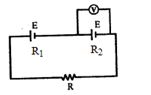
0 likes
View Solution50
DifficultMCQ
$N$ identical cells are connected in series or in parallel. When an external resistor $R$ is connected to them,they provide the same current. The internal resistance $r$ of each cell is:
A
$r = nR$
B
$r = R$
C
$r = R/n$
D
$r = n^2R$
Solution
(B) For $N$ identical cells in series,the total $EMF$ is $NE$ and total internal resistance is $Nr$. The current $I_s$ is given by $I_s = \frac{NE}{Nr + R}$.
For $N$ identical cells in parallel,the total $EMF$ is $E$ and total internal resistance is $r/N$. The current $I_p$ is given by $I_p = \frac{E}{r/N + R} = \frac{NE}{r + NR}$.
Given that $I_s = I_p$,we have $\frac{NE}{Nr + R} = \frac{NE}{r + NR}$.
This implies $Nr + R = r + NR$.
Rearranging the terms: $Nr - r = NR - R$.
$r(N - 1) = R(N - 1)$.
Since $N \neq 1$,we get $r = R$.
For $N$ identical cells in parallel,the total $EMF$ is $E$ and total internal resistance is $r/N$. The current $I_p$ is given by $I_p = \frac{E}{r/N + R} = \frac{NE}{r + NR}$.
Given that $I_s = I_p$,we have $\frac{NE}{Nr + R} = \frac{NE}{r + NR}$.
This implies $Nr + R = r + NR$.
Rearranging the terms: $Nr - r = NR - R$.
$r(N - 1) = R(N - 1)$.
Since $N \neq 1$,we get $r = R$.
0 likes
View SolutionCurrent Electricity — Electric Cells and Combination of cells in Series and Parallel · Frequently Asked Questions
1Are these Current Electricity questions useful for JEE and NEET?
Yes. All questions in this section are mapped to JEE Main and NEET exam patterns. Previous year questions from JEE Main, NEET, GUJCET and state-level exams are included with full solutions.
2Can I switch to Hindi or Gujarati for these questions?
Yes. Use the language tabs in the hero section or the sidebar to view the same questions and solutions in English, Hindi or Gujarati.
3How do I generate a question paper from this subtopic?
Use the Vedclass Exam Paper Generator — select the chapter and subtopic, set difficulty, and generate Sets A, B, C, D automatically. First 3 chapters of every subject are free.
Vedclass Products
For Students
Vedclass Test Series
Mock tests in real JEE/NEET style with performance analysis. 5-day free trial.
Start Free TrialFor Teachers
Exam Paper Generator
Generate Set A/B/C/D papers from this chapter in 2 minutes. 3 chapters free.
Try FreeFor Institutes
Online Exam Module
Live online exams with unlimited students, 360° analytics & white-label branding.
See DemoFor Teachers & Institutes
Generate a Current Electricity Exam Paper in 2 Minutes
Select subtopic & difficulty — Sets A, B, C, D auto-generated with No Repeat logic.
First 3 chapters of every subject are free — no payment required.