
A English
Current Density, Drift Velocity and Mobility Questions in English
Class 12 Physics · Current Electricity · Current Density, Drift Velocity and Mobility
187+
Questions
English
Language
100%
With Solutions
Showing 50 of 187 questions in English
101
Medium
Derive the equation of mobility in terms of relaxation time $(\tau)$. Write its unit.
Solution
(N/A) The drift velocity $v_d$ of an electron in the presence of an external electric field $E$ is given by the relation: $v_d = -\frac{eE}{m} \tau$,where $e$ is the charge of an electron,$m$ is the mass of the electron,and $\tau$ is the relaxation time.
Taking the magnitude,we have $|v_d| = \frac{eE}{m} \tau$.
Mobility $\mu$ is defined as the magnitude of drift velocity per unit electric field: $\mu = \frac{|v_d|}{E}$.
Substituting the expression for $|v_d|$,we get $\mu = \frac{eE\tau}{mE} = \frac{e\tau}{m}$.
The $SI$ unit of mobility is $\frac{m/s}{V/m} = m^2 V^{-1} s^{-1}$.
Taking the magnitude,we have $|v_d| = \frac{eE}{m} \tau$.
Mobility $\mu$ is defined as the magnitude of drift velocity per unit electric field: $\mu = \frac{|v_d|}{E}$.
Substituting the expression for $|v_d|$,we get $\mu = \frac{eE\tau}{mE} = \frac{e\tau}{m}$.
The $SI$ unit of mobility is $\frac{m/s}{V/m} = m^2 V^{-1} s^{-1}$.
0 likes
View Solution102
Difficult
Derive the equation of mobility in terms of electric current.
Solution
(A) When $n$ electrons move with drift velocity $v_{d}$ in a conductor of cross-sectional area $A$,the electric current $I$ is given by:
$I = n A v_{d} e$
By definition,mobility $\mu$ is the ratio of drift velocity to the applied electric field $E$:
$\mu = \frac{v_{d}}{E}$
Therefore,the drift velocity can be expressed as:
$v_{d} = \mu E$
Substituting this into the current equation:
$I = n A (\mu E) e$
Rearranging the equation to solve for mobility $\mu$:
$\mu = \frac{I}{n A E e}$
The $SI$ unit of mobility is calculated as:
$\mu = \frac{A}{m^{-3} \times m^{2} \times (V/m) \times C} = \frac{A}{V \cdot C} = m^{2} V^{-1} s^{-1}$
$I = n A v_{d} e$
By definition,mobility $\mu$ is the ratio of drift velocity to the applied electric field $E$:
$\mu = \frac{v_{d}}{E}$
Therefore,the drift velocity can be expressed as:
$v_{d} = \mu E$
Substituting this into the current equation:
$I = n A (\mu E) e$
Rearranging the equation to solve for mobility $\mu$:
$\mu = \frac{I}{n A E e}$
The $SI$ unit of mobility is calculated as:
$\mu = \frac{A}{m^{-3} \times m^{2} \times (V/m) \times C} = \frac{A}{V \cdot C} = m^{2} V^{-1} s^{-1}$
0 likes
View Solution103
MediumMCQ
Why is the average velocity of an electron at time $t$ equal to zero in the absence of an external electric field?
A
Due to random thermal motion.
B
Due to the absence of collisions.
C
Due to the presence of a magnetic field.
D
Due to the high mass of the electron.
Solution
(A) In the absence of an external electric field,the free electrons in a conductor move randomly in all possible directions due to thermal energy.
Because the motion is completely random,for every electron moving with a velocity $\vec{v}$,there is,on average,another electron moving with a velocity $-\vec{v}$.
Consequently,the vector sum of the velocities of all $N$ electrons in the conductor is zero.
Therefore,the average velocity $\vec{v}_{avg} = \frac{1}{N} \sum_{i=1}^{N} \vec{v}_i = 0$.
Because the motion is completely random,for every electron moving with a velocity $\vec{v}$,there is,on average,another electron moving with a velocity $-\vec{v}$.
Consequently,the vector sum of the velocities of all $N$ electrons in the conductor is zero.
Therefore,the average velocity $\vec{v}_{avg} = \frac{1}{N} \sum_{i=1}^{N} \vec{v}_i = 0$.
0 likes
View Solution104
Medium
What is relaxation time $(\tau )$? And what is drift velocity $(v_d)$?
Solution
(N/A) $1$. Relaxation Time $(\tau )$: It is defined as the average time interval between two successive collisions of an electron with the positive ions in a conductor. It is typically of the order of $10^{-14} \ s$.
$2$. Drift Velocity $(v_d)$: It is defined as the average velocity acquired by the free electrons in a conductor in the opposite direction of the externally applied electric field. It is given by the formula $v_d = -\frac{eE\tau}{m}$,where $e$ is the charge of an electron,$E$ is the electric field,$\tau$ is the relaxation time,and $m$ is the mass of the electron.
$2$. Drift Velocity $(v_d)$: It is defined as the average velocity acquired by the free electrons in a conductor in the opposite direction of the externally applied electric field. It is given by the formula $v_d = -\frac{eE\tau}{m}$,where $e$ is the charge of an electron,$E$ is the electric field,$\tau$ is the relaxation time,and $m$ is the mass of the electron.
0 likes
View Solution105
Easy
Define mobility and write its $SI$ unit.
Solution
(N/A) Mobility $(\mu)$ is defined as the magnitude of the drift velocity $(v_d)$ per unit electric field $(E)$.
Mathematically, $\mu = \frac{v_d}{E}$.
The $SI$ unit of drift velocity is $m/s$ and the $SI$ unit of electric field is $V/m$ or $N/C$.
Therefore, the $SI$ unit of mobility is $\frac{m/s}{V/m} = m^2 V^{-1} s^{-1}$ or $m^2 / (V \cdot s)$.
Mathematically, $\mu = \frac{v_d}{E}$.
The $SI$ unit of drift velocity is $m/s$ and the $SI$ unit of electric field is $V/m$ or $N/C$.
Therefore, the $SI$ unit of mobility is $\frac{m/s}{V/m} = m^2 V^{-1} s^{-1}$ or $m^2 / (V \cdot s)$.
0 likes
View Solution106
Easy
Is the motion of a charge across a junction momentum conserving? Why or why not?
Solution
(N/A) The motion of a charge across a junction is generally not momentum-conserving.
When a charge carrier (such as an electron) moves through a conductor,it experiences collisions with the lattice ions,which exert external forces on the charge.
According to Newton's second law,the rate of change of momentum of a system is equal to the net external force acting on it.
Since the lattice ions exert a force on the charge carriers to maintain a steady drift velocity $v_{d} = \frac{eE\tau}{m}$,the momentum of the charge carrier is not conserved because the external force from the lattice is non-zero.
Furthermore,at a junction,the redistribution of charge creates localized electric fields that further alter the momentum of the charge carriers.
When a charge carrier (such as an electron) moves through a conductor,it experiences collisions with the lattice ions,which exert external forces on the charge.
According to Newton's second law,the rate of change of momentum of a system is equal to the net external force acting on it.
Since the lattice ions exert a force on the charge carriers to maintain a steady drift velocity $v_{d} = \frac{eE\tau}{m}$,the momentum of the charge carrier is not conserved because the external force from the lattice is non-zero.
Furthermore,at a junction,the redistribution of charge creates localized electric fields that further alter the momentum of the charge carriers.
0 likes
View Solution107
Medium
The relaxation time $\tau$ is nearly independent of the applied $E$ field,whereas it changes significantly with temperature $T$. The first fact is (in part) responsible for Ohm's law,whereas the second fact leads to the variation of resistivity $\rho$ with temperature. Elaborate why?
Solution
(N/A) Relaxation time $\tau$ is defined as the average time interval between two successive collisions of an electron with the lattice ions.
$1$. Dependence on $E$ field: When an external electric field $E$ is applied,the drift velocity $v_d$ acquired by electrons is very small (order of $10^{-3} \ m/s$) compared to their random thermal velocity (order of $10^5 \ m/s$). Since the collision frequency is primarily determined by the random thermal motion,the relaxation time $\tau$ remains nearly independent of the applied $E$ field. This constancy of $\tau$ ensures that the current density $J$ is directly proportional to $E$ $(J = \sigma E)$,which is the microscopic form of Ohm's law.
$2$. Dependence on $T$: As temperature $T$ increases,the random thermal velocity of electrons increases significantly. This leads to more frequent collisions between electrons and lattice ions,thereby decreasing the relaxation time $\tau$. According to the relation $\rho = \frac{m}{n e^2 \tau}$,since $\tau$ decreases with an increase in temperature,the resistivity $\rho$ of the conductor increases.
$1$. Dependence on $E$ field: When an external electric field $E$ is applied,the drift velocity $v_d$ acquired by electrons is very small (order of $10^{-3} \ m/s$) compared to their random thermal velocity (order of $10^5 \ m/s$). Since the collision frequency is primarily determined by the random thermal motion,the relaxation time $\tau$ remains nearly independent of the applied $E$ field. This constancy of $\tau$ ensures that the current density $J$ is directly proportional to $E$ $(J = \sigma E)$,which is the microscopic form of Ohm's law.
$2$. Dependence on $T$: As temperature $T$ increases,the random thermal velocity of electrons increases significantly. This leads to more frequent collisions between electrons and lattice ions,thereby decreasing the relaxation time $\tau$. According to the relation $\rho = \frac{m}{n e^2 \tau}$,since $\tau$ decreases with an increase in temperature,the resistivity $\rho$ of the conductor increases.
0 likes
View Solution108
MediumMCQ
Which particles are responsible for the conductivity of metals?
A
Protons
B
Free electrons
C
Neutrons
D
Positive ions
Solution
(B) In metals,the outer shell electrons are loosely bound to the nucleus. These electrons are called free electrons or valence electrons. Due to thermal energy at room temperature,these electrons detach from their parent atoms and move randomly throughout the crystal lattice. When an external electric field is applied,these free electrons drift in a specific direction,creating an electric current. Therefore,free electrons are the charge carriers responsible for the conductivity of metals.
0 likes
View Solution109
Medium
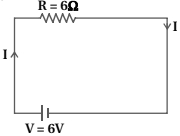
$(a)$ Consider the circuit in the figure. How much energy is absorbed by electrons from the initial state of no current (ignore thermal motion) to the state of drift velocity?
$(b)$ Electrons give up energy at the rate of $R I^2$ per second to thermal energy. What time scale would one associate with the energy in problem $(a)$? Given: $n = 10^{29} \, m^{-3}$,length of circuit $l = 10 \, cm$,cross-section $A = (1 \, mm)^2$.
$(b)$ Electrons give up energy at the rate of $R I^2$ per second to thermal energy. What time scale would one associate with the energy in problem $(a)$? Given: $n = 10^{29} \, m^{-3}$,length of circuit $l = 10 \, cm$,cross-section $A = (1 \, mm)^2$.
Solution
(N/A) Current in the circuit $I = \frac{V}{R} = \frac{6}{6} = 1 \, A$.
Number density of electrons $n = 10^{29} \, m^{-3}$.
Length of the wire $l = 10 \, cm = 0.1 \, m$.
Area of cross-section $A = (1 \, mm)^2 = 10^{-6} \, m^2$.
Volume of the wire $V_{vol} = A \times l = 10^{-6} \times 0.1 = 10^{-7} \, m^3$.
Total number of electrons $N = n \times V_{vol} = 10^{29} \times 10^{-7} = 10^{22}$.
Drift velocity $v_d = \frac{I}{nAe} = \frac{1}{10^{29} \times 10^{-6} \times 1.6 \times 10^{-19}} = \frac{1}{1.6 \times 10^4} = 0.625 \times 10^{-4} \, m/s = 6.25 \times 10^{-5} \, m/s$.
Total kinetic energy $K.E. = N \times \frac{1}{2} m_e v_d^2 = 10^{22} \times 0.5 \times 9.1 \times 10^{-31} \times (6.25 \times 10^{-5})^2$.
$K.E. = 4.55 \times 10^{-9} \times 39.06 \times 10^{-10} \approx 1.78 \times 10^{-17} \, J$.
$(b)$ Power dissipated $P = I^2 R = (1)^2 \times 6 = 6 \, W$.
Since $P = \frac{E}{t}$,the time scale $t = \frac{E}{P} = \frac{1.78 \times 10^{-17}}{6} \approx 2.97 \times 10^{-18} \, s \approx 3 \times 10^{-18} \, s$.
Number density of electrons $n = 10^{29} \, m^{-3}$.
Length of the wire $l = 10 \, cm = 0.1 \, m$.
Area of cross-section $A = (1 \, mm)^2 = 10^{-6} \, m^2$.
Volume of the wire $V_{vol} = A \times l = 10^{-6} \times 0.1 = 10^{-7} \, m^3$.
Total number of electrons $N = n \times V_{vol} = 10^{29} \times 10^{-7} = 10^{22}$.
Drift velocity $v_d = \frac{I}{nAe} = \frac{1}{10^{29} \times 10^{-6} \times 1.6 \times 10^{-19}} = \frac{1}{1.6 \times 10^4} = 0.625 \times 10^{-4} \, m/s = 6.25 \times 10^{-5} \, m/s$.
Total kinetic energy $K.E. = N \times \frac{1}{2} m_e v_d^2 = 10^{22} \times 0.5 \times 9.1 \times 10^{-31} \times (6.25 \times 10^{-5})^2$.
$K.E. = 4.55 \times 10^{-9} \times 39.06 \times 10^{-10} \approx 1.78 \times 10^{-17} \, J$.
$(b)$ Power dissipated $P = I^2 R = (1)^2 \times 6 = 6 \, W$.
Since $P = \frac{E}{t}$,the time scale $t = \frac{E}{P} = \frac{1.78 \times 10^{-17}}{6} \approx 2.97 \times 10^{-18} \, s \approx 3 \times 10^{-18} \, s$.
0 likes
View Solution110
EasyMCQ
$A$ charged particle having a drift velocity of $7.5 \times 10^{-4} \, m s^{-1}$ in an electric field of $3 \times 10^{-10} \, V m^{-1}$ has a mobility in $m^{2} V^{-1} s^{-1}$ of:
A
$2.25 \times 10^{-15}$
B
$2.25 \times 10^{15}$
C
$2.5 \times 10^{6}$
D
$2.5 \times 10^{-6}$
Solution
(C) The mobility $\mu$ of a charged particle is defined as the ratio of its drift velocity $v_d$ to the applied electric field $E$.
Formula: $\mu = \frac{v_d}{E}$
Given:
$v_d = 7.5 \times 10^{-4} \, m s^{-1}$
$E = 3 \times 10^{-10} \, V m^{-1}$
Calculation:
$\mu = \frac{7.5 \times 10^{-4}}{3 \times 10^{-10}}$
$\mu = 2.5 \times 10^{-4 - (-10)}$
$\mu = 2.5 \times 10^{6} \, m^{2} V^{-1} s^{-1}$
Formula: $\mu = \frac{v_d}{E}$
Given:
$v_d = 7.5 \times 10^{-4} \, m s^{-1}$
$E = 3 \times 10^{-10} \, V m^{-1}$
Calculation:
$\mu = \frac{7.5 \times 10^{-4}}{3 \times 10^{-10}}$
$\mu = 2.5 \times 10^{-4 - (-10)}$
$\mu = 2.5 \times 10^{6} \, m^{2} V^{-1} s^{-1}$
0 likes
View Solution111
DifficultMCQ
$A$ current of $10 \, A$ is passing through an aluminum wire of cross-sectional area $4 \times 10^{-6} \, m^{2}$. If the density of aluminum is $2.7 \, g/cm^{3}$ and it provides $1$ free electron per atom for conduction,find the drift speed of the electrons in $\times 10^{-4} \, m/s$. (Given: molecular weight of aluminum = $27 \, g/mol$,Avogadro's number $N_{A} = 6.022 \times 10^{23} \, mol^{-1}$)
A
$1.6$
B
$3.6$
C
$2.6$
D
$1.5$
Solution
(C) The drift speed $v_{d}$ is given by the formula $i = neAv_{d}$,where $n$ is the number density of free electrons.
First,calculate the number density $n$:
$n = \frac{\text{Density} \times N_{A}}{\text{Molar Mass}} = \frac{2.7 \times 10^{3} \, kg/m^{3} \times 6.022 \times 10^{23} \, mol^{-1}}{27 \times 10^{-3} \, kg/mol} \approx 6.022 \times 10^{28} \, m^{-3}$.
Using $n \approx 6 \times 10^{28} \, m^{-3}$ for simplicity.
Now,rearrange the current formula for $v_{d}$:
$v_{d} = \frac{i}{neA}$.
Substitute the given values:
$i = 10 \, A$,$n = 6 \times 10^{28} \, m^{-3}$,$e = 1.6 \times 10^{-19} \, C$,$A = 4 \times 10^{-6} \, m^{2}$.
$v_{d} = \frac{10}{(6 \times 10^{28}) \times (1.6 \times 10^{-19}) \times (4 \times 10^{-6})}$
$v_{d} = \frac{10}{38.4 \times 10^{3}} = \frac{10}{38400} \approx 2.6 \times 10^{-4} \, m/s$.
First,calculate the number density $n$:
$n = \frac{\text{Density} \times N_{A}}{\text{Molar Mass}} = \frac{2.7 \times 10^{3} \, kg/m^{3} \times 6.022 \times 10^{23} \, mol^{-1}}{27 \times 10^{-3} \, kg/mol} \approx 6.022 \times 10^{28} \, m^{-3}$.
Using $n \approx 6 \times 10^{28} \, m^{-3}$ for simplicity.
Now,rearrange the current formula for $v_{d}$:
$v_{d} = \frac{i}{neA}$.
Substitute the given values:
$i = 10 \, A$,$n = 6 \times 10^{28} \, m^{-3}$,$e = 1.6 \times 10^{-19} \, C$,$A = 4 \times 10^{-6} \, m^{2}$.
$v_{d} = \frac{10}{(6 \times 10^{28}) \times (1.6 \times 10^{-19}) \times (4 \times 10^{-6})}$
$v_{d} = \frac{10}{38.4 \times 10^{3}} = \frac{10}{38400} \approx 2.6 \times 10^{-4} \, m/s$.
0 likes
View Solution112
DifficultMCQ
The current density in a solid cylindrical wire of radius $R$,as a function of radial distance $r$,is given by $J(r) = J_{0}(1 - \frac{r}{R})$. The total current in the radial region $r = 0$ to $r = \frac{R}{4}$ will be:
A
$\frac{5 J_{0} \pi R^{2}}{32}$
B
$\frac{5 J_{0} \pi R^{2}}{96}$
C
$\frac{3 J_{0} \pi R^{2}}{64}$
D
$\frac{J_{0} \pi R^{2}}{128}$
Solution
(B) The current $i$ through a cross-sectional area element $dA$ is given by $di = J(r) dA$.
For a cylindrical wire,the area element at a radial distance $r$ with thickness $dr$ is $dA = 2 \pi r dr$.
Substituting the given current density $J(r) = J_{0}(1 - \frac{r}{R})$,we get:
$di = J_{0}(1 - \frac{r}{R}) (2 \pi r dr) = 2 \pi J_{0} (r - \frac{r^{2}}{R}) dr$.
To find the total current $i$ from $r = 0$ to $r = \frac{R}{4}$,we integrate:
$i = \int_{0}^{R/4} 2 \pi J_{0} (r - \frac{r^{2}}{R}) dr = 2 \pi J_{0} [\frac{r^{2}}{2} - \frac{r^{3}}{3R}]_{0}^{R/4}$.
Substituting the limits:
$i = 2 \pi J_{0} [\frac{(R/4)^{2}}{2} - \frac{(R/4)^{3}}{3R}] = 2 \pi J_{0} [\frac{R^{2}}{32} - \frac{R^{3}}{192R}] = 2 \pi J_{0} [\frac{R^{2}}{32} - \frac{R^{2}}{192}]$.
Finding a common denominator:
$i = 2 \pi J_{0} [\frac{6R^{2} - R^{2}}{192}] = 2 \pi J_{0} [\frac{5R^{2}}{192}] = \frac{5 J_{0} \pi R^{2}}{96}$.
For a cylindrical wire,the area element at a radial distance $r$ with thickness $dr$ is $dA = 2 \pi r dr$.
Substituting the given current density $J(r) = J_{0}(1 - \frac{r}{R})$,we get:
$di = J_{0}(1 - \frac{r}{R}) (2 \pi r dr) = 2 \pi J_{0} (r - \frac{r^{2}}{R}) dr$.
To find the total current $i$ from $r = 0$ to $r = \frac{R}{4}$,we integrate:
$i = \int_{0}^{R/4} 2 \pi J_{0} (r - \frac{r^{2}}{R}) dr = 2 \pi J_{0} [\frac{r^{2}}{2} - \frac{r^{3}}{3R}]_{0}^{R/4}$.
Substituting the limits:
$i = 2 \pi J_{0} [\frac{(R/4)^{2}}{2} - \frac{(R/4)^{3}}{3R}] = 2 \pi J_{0} [\frac{R^{2}}{32} - \frac{R^{3}}{192R}] = 2 \pi J_{0} [\frac{R^{2}}{32} - \frac{R^{2}}{192}]$.
Finding a common denominator:
$i = 2 \pi J_{0} [\frac{6R^{2} - R^{2}}{192}] = 2 \pi J_{0} [\frac{5R^{2}}{192}] = \frac{5 J_{0} \pi R^{2}}{96}$.
0 likes
View Solution113
MediumMCQ
$A$ current of $10\, A$ exists in a wire of cross-sectional area of $5\, mm^{2}$ with a drift velocity of $2 \times 10^{-3}\, m/s$. The number of free electrons in each cubic meter of the wire is ..........
A
$2 \times 10^{6}$
B
$625 \times 10^{25}$
C
$2 \times 10^{25}$
D
$1 \times 10^{23}$
Solution
(B) Given: Current $i = 10\, A$,Area $A = 5\, mm^{2} = 5 \times 10^{-6}\, m^{2}$,Drift velocity $v_{d} = 2 \times 10^{-3}\, m/s$,and charge of an electron $e = 1.6 \times 10^{-19}\, C$.
We know the relation between current and drift velocity is $i = neAv_{d}$.
Rearranging for the number density $n$,we get $n = \frac{i}{eAv_{d}}$.
Substituting the values: $n = \frac{10}{1.6 \times 10^{-19} \times 5 \times 10^{-6} \times 2 \times 10^{-3}}$.
$n = \frac{10}{16 \times 10^{-28}} = 0.625 \times 10^{28} = 625 \times 10^{25}\, m^{-3}$.
We know the relation between current and drift velocity is $i = neAv_{d}$.
Rearranging for the number density $n$,we get $n = \frac{i}{eAv_{d}}$.
Substituting the values: $n = \frac{10}{1.6 \times 10^{-19} \times 5 \times 10^{-6} \times 2 \times 10^{-3}}$.
$n = \frac{10}{16 \times 10^{-28}} = 0.625 \times 10^{28} = 625 \times 10^{25}\, m^{-3}$.
0 likes
View Solution114
MediumMCQ
$A$ cylindrical wire of radius $0.5 \, mm$ and conductivity $5 \times 10^{7} \, S/m$ is subjected to an electric field of $10 \, mV/m$. The expected value of current in the wire will be $x^{3} \, \pi \, mA$. The value of $x$ is ......
A
$5$
B
$10$
C
$8$
D
$15$
Solution
(A) Given:
Conductivity $\sigma = 5 \times 10^{7} \, S/m$
Radius $r = 0.5 \, mm = 5 \times 10^{-4} \, m$
Electric field $E = 10 \, mV/m = 10 \times 10^{-3} \, V/m = 10^{-2} \, V/m$
Using Ohm's law in microscopic form,current density $J = \sigma E$:
$J = (5 \times 10^{7}) \times (10^{-2}) = 5 \times 10^{5} \, A/m^{2}$
Current $i = J \times A = J \times (\pi r^{2})$:
$i = (5 \times 10^{5}) \times \pi \times (5 \times 10^{-4})^{2}$
$i = 5 \times 10^{5} \times \pi \times 25 \times 10^{-8}$
$i = 125 \times 10^{-3} \, \pi \, A$
$i = 125 \, \pi \, mA$
Given that $i = x^{3} \, \pi \, mA$,we have:
$x^{3} = 125$
$x = \sqrt[3]{125} = 5$
Conductivity $\sigma = 5 \times 10^{7} \, S/m$
Radius $r = 0.5 \, mm = 5 \times 10^{-4} \, m$
Electric field $E = 10 \, mV/m = 10 \times 10^{-3} \, V/m = 10^{-2} \, V/m$
Using Ohm's law in microscopic form,current density $J = \sigma E$:
$J = (5 \times 10^{7}) \times (10^{-2}) = 5 \times 10^{5} \, A/m^{2}$
Current $i = J \times A = J \times (\pi r^{2})$:
$i = (5 \times 10^{5}) \times \pi \times (5 \times 10^{-4})^{2}$
$i = 5 \times 10^{5} \times \pi \times 25 \times 10^{-8}$
$i = 125 \times 10^{-3} \, \pi \, A$
$i = 125 \, \pi \, mA$
Given that $i = x^{3} \, \pi \, mA$,we have:
$x^{3} = 125$
$x = \sqrt[3]{125} = 5$
0 likes
View Solution115
DifficultMCQ
$A$ current of $5\; A$ is passing through a non-linear magnesium wire of cross-section $0.04\; m^2$. At every point,the direction of current density is at an angle of $60^{\circ}$ with the unit vector of the area of cross-section. The magnitude of the electric field at every point of the conductor is .... $V/m$ (Resistivity of magnesium is $\rho = 44 \times 10^{-8}\, \Omega m$).
A
$11 \times 10^{-3}$
B
$11 \times 10^{-5}$
C
$11 \times 10^{-7}$
D
$11 \times 10^{-2}$
Solution
(B) The current $I$ is given by the dot product of current density $\vec{J}$ and area vector $\vec{A}$: $I = \vec{J} \cdot \vec{A} = J A \cos(\theta)$.
Given $I = 5\; A$,$A = 0.04\; m^2$,and $\theta = 60^{\circ}$.
Substituting the values: $5 = J \times 0.04 \times \cos(60^{\circ})$.
Since $\cos(60^{\circ}) = 0.5$,we have $5 = J \times 0.04 \times 0.5 = J \times 0.02$.
Thus,$J = \frac{5}{0.02} = 250\; A/m^2$.
Using Ohm's law in vector form,$\vec{E} = \rho \vec{J}$,the magnitude is $E = \rho J$.
$E = (44 \times 10^{-8}) \times 250 = 11000 \times 10^{-8} = 11 \times 10^{-5}\; V/m$.
Given $I = 5\; A$,$A = 0.04\; m^2$,and $\theta = 60^{\circ}$.
Substituting the values: $5 = J \times 0.04 \times \cos(60^{\circ})$.
Since $\cos(60^{\circ}) = 0.5$,we have $5 = J \times 0.04 \times 0.5 = J \times 0.02$.
Thus,$J = \frac{5}{0.02} = 250\; A/m^2$.
Using Ohm's law in vector form,$\vec{E} = \rho \vec{J}$,the magnitude is $E = \rho J$.
$E = (44 \times 10^{-8}) \times 250 = 11000 \times 10^{-8} = 11 \times 10^{-5}\; V/m$.
1 likes
View Solution116
DifficultMCQ
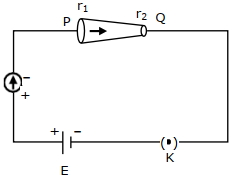
In the given figure,a battery of emf $E$ is connected across a conductor $PQ$ of length $L$ and different area of cross-sections having radii $r_{1}$ and $r_{2}$ $(r_{2} < r_{1})$. Choose the correct option as one moves from $P$ to $Q$:
A
Electric field decreases.
B
Drift velocity of electron increases.
C
Electron current decreases.
D
All of these
Solution
(B) In a series circuit,the current $i$ flowing through the conductor remains constant at every cross-section.
Since $i = n e A v_{d}$,where $n$ is the number density of electrons,$e$ is the charge,$A$ is the cross-sectional area,and $v_{d}$ is the drift velocity,we have $v_{d} = \frac{i}{n e A}$.
As we move from $P$ to $Q$,the radius $r$ decreases,so the cross-sectional area $A = \pi r^{2}$ decreases. Since $i$ is constant,the drift velocity $v_{d}$ must increase.
From the relation $v_{d} = \frac{e E \tau}{m}$,where $E$ is the electric field,$\tau$ is the relaxation time,and $m$ is the mass of the electron,we see that $v_{d} \propto E$. Therefore,as $v_{d}$ increases,the electric field $E$ also increases.
Since the current $i$ is constant throughout the conductor,the electron current does not change.
Thus,as we move from $P$ to $Q$,the drift velocity of electrons increases and the electric field increases.
Since $i = n e A v_{d}$,where $n$ is the number density of electrons,$e$ is the charge,$A$ is the cross-sectional area,and $v_{d}$ is the drift velocity,we have $v_{d} = \frac{i}{n e A}$.
As we move from $P$ to $Q$,the radius $r$ decreases,so the cross-sectional area $A = \pi r^{2}$ decreases. Since $i$ is constant,the drift velocity $v_{d}$ must increase.
From the relation $v_{d} = \frac{e E \tau}{m}$,where $E$ is the electric field,$\tau$ is the relaxation time,and $m$ is the mass of the electron,we see that $v_{d} \propto E$. Therefore,as $v_{d}$ increases,the electric field $E$ also increases.
Since the current $i$ is constant throughout the conductor,the electron current does not change.
Thus,as we move from $P$ to $Q$,the drift velocity of electrons increases and the electric field increases.
0 likes
View Solution117
MediumMCQ
$A$ copper wire of length $10 \, m$ and radius $(10^{-2} / \sqrt{\pi}) \, m$ has an electrical resistance of $10 \, \Omega$. The current density in the wire for an electric field strength of $10 \, V/m$ is:
A
$10^{6} \, A/m^{2}$
B
$10^{-5} \, A/m^{2}$
C
$10^{5} \, A/m^{2}$
D
$10^{4} \, A/m^{2}$
Solution
(C) Given: Length $L = 10 \, m$,Radius $r = \frac{10^{-2}}{\sqrt{\pi}} \, m$,Resistance $R = 10 \, \Omega$,Electric field $E = 10 \, V/m$.
First,calculate the cross-sectional area $A$:
$A = \pi r^{2} = \pi \left( \frac{10^{-2}}{\sqrt{\pi}} \right)^{2} = \pi \cdot \frac{10^{-4}}{\pi} = 10^{-4} \, m^{2}$.
We know that current density $J = \sigma E$,where $\sigma$ is conductivity.
Since $\sigma = \frac{1}{\rho}$ and $R = \rho \frac{L}{A}$,we have $\rho = \frac{RA}{L}$.
Thus,$\sigma = \frac{L}{RA}$.
Substituting this into the expression for $J$:
$J = \left( \frac{L}{RA} \right) E = \frac{E \cdot L}{R \cdot A}$.
Plugging in the values:
$J = \frac{10 \times 10}{10 \times 10^{-4}} = \frac{100}{10^{-3}} = 10^{5} \, A/m^{2}$.
First,calculate the cross-sectional area $A$:
$A = \pi r^{2} = \pi \left( \frac{10^{-2}}{\sqrt{\pi}} \right)^{2} = \pi \cdot \frac{10^{-4}}{\pi} = 10^{-4} \, m^{2}$.
We know that current density $J = \sigma E$,where $\sigma$ is conductivity.
Since $\sigma = \frac{1}{\rho}$ and $R = \rho \frac{L}{A}$,we have $\rho = \frac{RA}{L}$.
Thus,$\sigma = \frac{L}{RA}$.
Substituting this into the expression for $J$:
$J = \left( \frac{L}{RA} \right) E = \frac{E \cdot L}{R \cdot A}$.
Plugging in the values:
$J = \frac{10 \times 10}{10 \times 10^{-4}} = \frac{100}{10^{-3}} = 10^{5} \, A/m^{2}$.
0 likes
View Solution118
MediumMCQ
The current density in a cylindrical wire of radius $4 \; mm$ is $4 \times 10^{6} \; A \cdot m^{-2}$. The current through the outer portion of the wire between radial distance $\frac{R}{2}$ and $R$ is $\dots \; \pi \; A$.
A
$48$
B
$58$
C
$38$
D
$28$
Solution
(A) The current density $J$ is given as $4 \times 10^{6} \; A \cdot m^{-2}$.
The radius of the wire is $R = 4 \; mm = 4 \times 10^{-3} \; m$.
The current $I$ through an area $A$ is given by $I = \int J \cdot dA$.
For the outer portion between radial distance $\frac{R}{2}$ and $R$,the area is $A' = \pi R^{2} - \pi \left(\frac{R}{2}\right)^{2} = \pi R^{2} - \frac{\pi R^{2}}{4} = \frac{3}{4} \pi R^{2}$.
Substituting the values:
$I = J \times A' = 4 \times 10^{6} \times \frac{3}{4} \pi R^{2}$.
$I = 4 \times 10^{6} \times \frac{3}{4} \times \pi \times (4 \times 10^{-3})^{2}$.
$I = 3 \times 10^{6} \times \pi \times 16 \times 10^{-6}$.
$I = 48 \; \pi \; A$.
The radius of the wire is $R = 4 \; mm = 4 \times 10^{-3} \; m$.
The current $I$ through an area $A$ is given by $I = \int J \cdot dA$.
For the outer portion between radial distance $\frac{R}{2}$ and $R$,the area is $A' = \pi R^{2} - \pi \left(\frac{R}{2}\right)^{2} = \pi R^{2} - \frac{\pi R^{2}}{4} = \frac{3}{4} \pi R^{2}$.
Substituting the values:
$I = J \times A' = 4 \times 10^{6} \times \frac{3}{4} \pi R^{2}$.
$I = 4 \times 10^{6} \times \frac{3}{4} \times \pi \times (4 \times 10^{-3})^{2}$.
$I = 3 \times 10^{6} \times \pi \times 16 \times 10^{-6}$.
$I = 48 \; \pi \; A$.
0 likes
View Solution119
DifficultMCQ
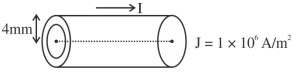
The current density in a cylindrical wire of radius $r = 4.0 \, mm$ is $J = 1.0 \times 10^{6} \, A/m^{2}$. The current through the outer portion of the wire between radial distances $r/2$ and $r$ is $x \pi \, A$,where $x$ is ..........
A
$10$
B
$11$
C
$12$
D
$14$
Solution
(C) The current $I$ through an area element $dA$ is given by $I = \int J \cdot dA$.
For a cylindrical wire,the area element of a ring at radius $r'$ with thickness $dr'$ is $dA = 2 \pi r' dr'$.
Given $J = 1.0 \times 10^{6} \, A/m^{2}$ and $r = 4.0 \, mm = 4.0 \times 10^{-3} \, m$.
The current $I$ through the region between $r/2$ and $r$ is:
$I = \int_{r/2}^{r} J (2 \pi r') dr' = 2 \pi J \int_{r/2}^{r} r' dr'$
$I = 2 \pi J \left[ \frac{(r')^{2}}{2} \right]_{r/2}^{r} = \pi J \left[ r^{2} - \left( \frac{r}{2} \right)^{2} \right]$
$I = \pi J \left[ r^{2} - \frac{r^{2}}{4} \right] = \pi J \left( \frac{3r^{2}}{4} \right)$
Substituting the values $J = 10^{6} \, A/m^{2}$ and $r = 4 \times 10^{-3} \, m$:
$I = \pi \times 10^{6} \times \frac{3}{4} \times (4 \times 10^{-3})^{2}$
$I = \pi \times 10^{6} \times \frac{3}{4} \times 16 \times 10^{-6} = 12 \pi \, A$
Comparing this with $x \pi \, A$,we get $x = 12$.
For a cylindrical wire,the area element of a ring at radius $r'$ with thickness $dr'$ is $dA = 2 \pi r' dr'$.
Given $J = 1.0 \times 10^{6} \, A/m^{2}$ and $r = 4.0 \, mm = 4.0 \times 10^{-3} \, m$.
The current $I$ through the region between $r/2$ and $r$ is:
$I = \int_{r/2}^{r} J (2 \pi r') dr' = 2 \pi J \int_{r/2}^{r} r' dr'$
$I = 2 \pi J \left[ \frac{(r')^{2}}{2} \right]_{r/2}^{r} = \pi J \left[ r^{2} - \left( \frac{r}{2} \right)^{2} \right]$
$I = \pi J \left[ r^{2} - \frac{r^{2}}{4} \right] = \pi J \left( \frac{3r^{2}}{4} \right)$
Substituting the values $J = 10^{6} \, A/m^{2}$ and $r = 4 \times 10^{-3} \, m$:
$I = \pi \times 10^{6} \times \frac{3}{4} \times (4 \times 10^{-3})^{2}$
$I = \pi \times 10^{6} \times \frac{3}{4} \times 16 \times 10^{-6} = 12 \pi \, A$
Comparing this with $x \pi \, A$,we get $x = 12$.
0 likes
View Solution120
DifficultMCQ
$A$. The drift velocity of electrons decreases with the increase in the temperature of a conductor.
$B$. The drift velocity is inversely proportional to the area of cross-section of a given conductor.
$C$. The drift velocity does not depend on the applied potential difference to the conductor.
$D$. The drift velocity of an electron is inversely proportional to the length of the conductor.
$E$. The drift velocity increases with the increase in the temperature of a conductor.
Choose the correct answer from the options given below:
$B$. The drift velocity is inversely proportional to the area of cross-section of a given conductor.
$C$. The drift velocity does not depend on the applied potential difference to the conductor.
$D$. The drift velocity of an electron is inversely proportional to the length of the conductor.
$E$. The drift velocity increases with the increase in the temperature of a conductor.
Choose the correct answer from the options given below:
A
$A$ and $B$ only
B
$A$ and $D$ only
C
$B$ and $E$ only
D
$B$ and $C$ only
Solution
(B) The drift velocity $v_d$ is given by the formula: $v_d = \frac{e \tau E}{m} = \frac{e \tau}{m} \left( \frac{\Delta V}{\ell} \right)$.
$1$. Effect of temperature: As temperature increases,the collision frequency of electrons increases,which causes the relaxation time $\tau$ to decrease. Since $v_d \propto \tau$,the drift velocity decreases. Thus,statement $A$ is correct and $E$ is incorrect.
$2$. Effect of length: From the formula $v_d = \frac{e \tau \Delta V}{m \ell}$,it is clear that $v_d \propto \frac{1}{\ell}$. Thus,statement $D$ is correct.
$3$. Effect of area: The drift velocity is related to current by $I = n e A v_d$. If the current $I$ is constant,then $v_d = \frac{I}{n e A}$,implying $v_d \propto \frac{1}{A}$. However,in a general conductor where potential difference $\Delta V$ is fixed,$v_d = \frac{e \tau \Delta V}{m \ell}$,which is independent of the cross-sectional area $A$. Thus,statement $B$ is incorrect.
$4$. Effect of potential difference: Since $v_d = \frac{e \tau \Delta V}{m \ell}$,the drift velocity is directly proportional to the applied potential difference $\Delta V$. Thus,statement $C$ is incorrect.
Therefore,statements $A$ and $D$ are correct.
$1$. Effect of temperature: As temperature increases,the collision frequency of electrons increases,which causes the relaxation time $\tau$ to decrease. Since $v_d \propto \tau$,the drift velocity decreases. Thus,statement $A$ is correct and $E$ is incorrect.
$2$. Effect of length: From the formula $v_d = \frac{e \tau \Delta V}{m \ell}$,it is clear that $v_d \propto \frac{1}{\ell}$. Thus,statement $D$ is correct.
$3$. Effect of area: The drift velocity is related to current by $I = n e A v_d$. If the current $I$ is constant,then $v_d = \frac{I}{n e A}$,implying $v_d \propto \frac{1}{A}$. However,in a general conductor where potential difference $\Delta V$ is fixed,$v_d = \frac{e \tau \Delta V}{m \ell}$,which is independent of the cross-sectional area $A$. Thus,statement $B$ is incorrect.
$4$. Effect of potential difference: Since $v_d = \frac{e \tau \Delta V}{m \ell}$,the drift velocity is directly proportional to the applied potential difference $\Delta V$. Thus,statement $C$ is incorrect.
Therefore,statements $A$ and $D$ are correct.
0 likes
View Solution121
MediumMCQ
$A$ $1\,m$ long copper wire carries a current of $1\,A$. If the cross-section of the wire is $2.0\,mm^{2}$ and the resistivity of copper is $1.7 \times 10^{-8}\,\Omega\,m$,the force experienced by a moving electron in the wire is $x \times 10^{-23}\,N$. Find the value of $x$. (Charge on electron $= 1.6 \times 10^{-19}\,C$)
A
$137$
B
$136$
C
$135$
D
$134$
Solution
(B) Given: Length $l = 1\,m$,Current $i = 1\,A$,Area $A = 2.0\,mm^{2} = 2.0 \times 10^{-6}\,m^{2}$,Resistivity $\rho = 1.7 \times 10^{-8}\,\Omega\,m$,Charge $e = 1.6 \times 10^{-19}\,C$.
First,calculate the resistance $R$ of the wire:
$R = \frac{\rho l}{A} = \frac{1.7 \times 10^{-8} \times 1}{2.0 \times 10^{-6}} = 0.85 \times 10^{-2}\,\Omega$.
The potential difference $V$ across the wire is given by Ohm's Law:
$V = iR = 1 \times 0.85 \times 10^{-2} = 0.85 \times 10^{-2}\,V$.
The electric field $E$ in the wire is:
$E = \frac{V}{l} = \frac{0.85 \times 10^{-2}}{1} = 0.85 \times 10^{-2}\,V/m$.
The force $F$ experienced by an electron is:
$F = eE = 1.6 \times 10^{-19} \times 0.85 \times 10^{-2} = 1.36 \times 10^{-21}\,N$.
Expressing this in terms of $10^{-23}$:
$F = 136 \times 10^{-23}\,N$.
Thus,$x = 136$.
First,calculate the resistance $R$ of the wire:
$R = \frac{\rho l}{A} = \frac{1.7 \times 10^{-8} \times 1}{2.0 \times 10^{-6}} = 0.85 \times 10^{-2}\,\Omega$.
The potential difference $V$ across the wire is given by Ohm's Law:
$V = iR = 1 \times 0.85 \times 10^{-2} = 0.85 \times 10^{-2}\,V$.
The electric field $E$ in the wire is:
$E = \frac{V}{l} = \frac{0.85 \times 10^{-2}}{1} = 0.85 \times 10^{-2}\,V/m$.
The force $F$ experienced by an electron is:
$F = eE = 1.6 \times 10^{-19} \times 0.85 \times 10^{-2} = 1.36 \times 10^{-21}\,N$.
Expressing this in terms of $10^{-23}$:
$F = 136 \times 10^{-23}\,N$.
Thus,$x = 136$.
0 likes
View Solution122
MediumMCQ
In a particle accelerator,a current of $500 \,\mu A$ is carried by a proton beam in which each proton has a speed of $3 \times 10^7 \,m/s$. The cross-sectional area of the beam is $1.50 \,mm^2$. The charge density in this beam (in $C/m^3$) is close to
A
$10^{-8}$
B
$10^{-7}$
C
$10^{-6}$
D
$10^{-5}$
Solution
(D) The current $I$ is related to the charge density $\rho$,cross-sectional area $A$,and velocity $v$ by the formula $I = \rho A v$.
Given:
$I = 500 \,\mu A = 500 \times 10^{-6} \,A$
$v = 3 \times 10^7 \,m/s$
$A = 1.50 \,mm^2 = 1.50 \times 10^{-6} \,m^2$
Rearranging the formula to solve for charge density $\rho$:
$\rho = \frac{I}{A v}$
Substituting the values:
$\rho = \frac{500 \times 10^{-6}}{(1.50 \times 10^{-6}) \times (3 \times 10^7)}$
$\rho = \frac{500}{1.50 \times 3 \times 10^7}$
$\rho = \frac{500}{4.5 \times 10^7} \approx 111.11 \times 10^{-9} \approx 1.11 \times 10^{-7} \,C/m^3$.
Wait,re-evaluating the calculation:
$\rho = \frac{500 \times 10^{-6}}{1.5 \times 10^{-6} \times 3 \times 10^7} = \frac{500}{4.5 \times 10^7} = \frac{500}{45,000,000} = \frac{5}{450,000} = \frac{1}{90,000} \approx 1.11 \times 10^{-5} \,C/m^3$.
Thus,the value is close to $10^{-5} \,C/m^3$.
Given:
$I = 500 \,\mu A = 500 \times 10^{-6} \,A$
$v = 3 \times 10^7 \,m/s$
$A = 1.50 \,mm^2 = 1.50 \times 10^{-6} \,m^2$
Rearranging the formula to solve for charge density $\rho$:
$\rho = \frac{I}{A v}$
Substituting the values:
$\rho = \frac{500 \times 10^{-6}}{(1.50 \times 10^{-6}) \times (3 \times 10^7)}$
$\rho = \frac{500}{1.50 \times 3 \times 10^7}$
$\rho = \frac{500}{4.5 \times 10^7} \approx 111.11 \times 10^{-9} \approx 1.11 \times 10^{-7} \,C/m^3$.
Wait,re-evaluating the calculation:
$\rho = \frac{500 \times 10^{-6}}{1.5 \times 10^{-6} \times 3 \times 10^7} = \frac{500}{4.5 \times 10^7} = \frac{500}{45,000,000} = \frac{5}{450,000} = \frac{1}{90,000} \approx 1.11 \times 10^{-5} \,C/m^3$.
Thus,the value is close to $10^{-5} \,C/m^3$.
0 likes
View Solution123
AdvancedMCQ
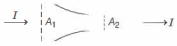
$A$ steady current $I$ is set up in a wire whose cross-sectional area decreases in the direction of the flow of the current. Then,as we examine the narrowing region,
A
the current density decreases in value
B
the magnitude of the electric field increases
C
the current density remains constant
D
the average speed of the moving charges remains constant
Solution
(B) When current $I$ flows through a conductor of varying cross-section,the current remains constant through every cross-section due to the continuity of charge.
Since $I = jA$,where $j$ is the current density and $A$ is the cross-sectional area,we have $j_1 A_1 = j_2 A_2$.
As the area decreases $(A_2 < A_1)$,the current density must increase $(j_2 > j_1)$.
Also,current density is related to drift velocity $v_d$ by $j = n e v_d$. Since $n$ and $e$ are constant,the drift velocity $v_d$ increases as the area decreases.
From Ohm's law in microscopic form,$j = \frac{E}{\rho}$,where $E$ is the electric field and $\rho$ is the resistivity of the material.
Since $j$ increases and $\rho$ is constant for a given material,the magnitude of the electric field $E$ must increase in the narrowing region.
Therefore,the correct option is $(b)$.
Since $I = jA$,where $j$ is the current density and $A$ is the cross-sectional area,we have $j_1 A_1 = j_2 A_2$.
As the area decreases $(A_2 < A_1)$,the current density must increase $(j_2 > j_1)$.
Also,current density is related to drift velocity $v_d$ by $j = n e v_d$. Since $n$ and $e$ are constant,the drift velocity $v_d$ increases as the area decreases.
From Ohm's law in microscopic form,$j = \frac{E}{\rho}$,where $E$ is the electric field and $\rho$ is the resistivity of the material.
Since $j$ increases and $\rho$ is constant for a given material,the magnitude of the electric field $E$ must increase in the narrowing region.
Therefore,the correct option is $(b)$.
0 likes
View Solution124
AdvancedMCQ
Consider a metallic cube of edge length $L$. Its resistance,$R$,measured across its opposite faces is $R = \frac{m_e v}{n e^2 L^2}$,where $n$ is the number density and $v$ is the drift speed of electrons in the cube,and $e$ and $m_e$ are the charge and mass of an electron respectively. Assuming the de-Broglie wavelength of the electron to be $L$,the maximum resistance of the sample is closest to ............. $\Omega$ ($e = 1.60 \times 10^{-19} \, C$; $m_e = 9.11 \times 10^{-31} \, kg$; Planck's constant,$h = 6.63 \times 10^{-34} \, Js$)
A
$10^2$
B
$10^4$
C
$10^6$
D
$10^8$
Solution
(B) Given the resistance formula $R = \frac{m_e v}{n e^2 L^2}$.
From the de-Broglie wavelength relation,$\lambda = \frac{h}{p} = \frac{h}{m_e v}$.
Given $\lambda = L$,we have $L = \frac{h}{m_e v}$,which implies $m_e v = \frac{h}{L}$.
Substituting this into the resistance formula: $R = \frac{(h/L)}{n e^2 L^2} = \frac{h}{n e^2 L^3}$.
Since $n = \frac{N}{V} = \frac{N}{L^3}$ (where $N$ is the number of electrons),we get $R = \frac{h}{N e^2}$.
For maximum resistance,the number of electrons $N$ must be minimum. The minimum number of electrons in a metallic sample is $N = 1$.
Thus,$R_{max} = \frac{h}{e^2} = \frac{6.63 \times 10^{-34}}{(1.60 \times 10^{-19})^2}$.
$R_{max} = \frac{6.63 \times 10^{-34}}{2.56 \times 10^{-38}} \approx 2.59 \times 10^4 \, \Omega$.
This value is closest to $10^4 \, \Omega$.
From the de-Broglie wavelength relation,$\lambda = \frac{h}{p} = \frac{h}{m_e v}$.
Given $\lambda = L$,we have $L = \frac{h}{m_e v}$,which implies $m_e v = \frac{h}{L}$.
Substituting this into the resistance formula: $R = \frac{(h/L)}{n e^2 L^2} = \frac{h}{n e^2 L^3}$.
Since $n = \frac{N}{V} = \frac{N}{L^3}$ (where $N$ is the number of electrons),we get $R = \frac{h}{N e^2}$.
For maximum resistance,the number of electrons $N$ must be minimum. The minimum number of electrons in a metallic sample is $N = 1$.
Thus,$R_{max} = \frac{h}{e^2} = \frac{6.63 \times 10^{-34}}{(1.60 \times 10^{-19})^2}$.
$R_{max} = \frac{6.63 \times 10^{-34}}{2.56 \times 10^{-38}} \approx 2.59 \times 10^4 \, \Omega$.
This value is closest to $10^4 \, \Omega$.
0 likes
View Solution125
EasyMCQ
$A$ current of $10 \,A$ is maintained in a conductor of cross-section $1 \,cm^2$. If the number density of free electrons is $9 \times 10^{28} \,m^{-3}$,the drift velocity of free electrons is .......... $m/s$.
A
$6.94 \times 10^{-6}$
B
$5.94 \times 10^{-2}$
C
$1.94 \times 10^{-3}$
D
$2.94 \times 10^{-4}$
Solution
(A) The relationship between current $I$ and drift velocity $V_d$ is given by the formula: $I = n e A V_d$.
Here,$I = 10 \,A$,$n = 9 \times 10^{28} \,m^{-3}$,$e = 1.6 \times 10^{-19} \,C$,and $A = 1 \,cm^2 = 10^{-4} \,m^2$.
Substituting the values into the equation:
$10 = (9 \times 10^{28}) \times (1.6 \times 10^{-19}) \times (10^{-4}) \times V_d$.
$10 = (9 \times 1.6 \times 10^{28-19-4}) \times V_d$.
$10 = (14.4 \times 10^5) \times V_d$.
$V_d = \frac{10}{14.4 \times 10^5} = \frac{1}{1.44} \times 10^{-5} \approx 0.6944 \times 10^{-5} = 6.94 \times 10^{-6} \,m/s$.
Here,$I = 10 \,A$,$n = 9 \times 10^{28} \,m^{-3}$,$e = 1.6 \times 10^{-19} \,C$,and $A = 1 \,cm^2 = 10^{-4} \,m^2$.
Substituting the values into the equation:
$10 = (9 \times 10^{28}) \times (1.6 \times 10^{-19}) \times (10^{-4}) \times V_d$.
$10 = (9 \times 1.6 \times 10^{28-19-4}) \times V_d$.
$10 = (14.4 \times 10^5) \times V_d$.
$V_d = \frac{10}{14.4 \times 10^5} = \frac{1}{1.44} \times 10^{-5} \approx 0.6944 \times 10^{-5} = 6.94 \times 10^{-6} \,m/s$.
0 likes
View Solution126
EasyMCQ
$A$ potential difference of $5 \,V$ is applied across a conductor of length $10 \,cm$. If the drift velocity of electrons is $2.5 \times 10^{-4} \,m/s$,then the electron mobility will be ............ $m^2 V^{-1} s^{-1}$.
A
$5 \times 10^{-4}$
B
$5 \times 10^{-6}$
C
$5 \times 10^{-2}$
D
$0$
Solution
(B) The mobility $\mu$ of electrons is defined as the ratio of drift velocity $v_d$ to the electric field $E$.
Given:
Potential difference $V = 5 \,V$
Length $l = 10 \,cm = 0.1 \,m$
Drift velocity $v_d = 2.5 \times 10^{-4} \,m/s$
The electric field $E$ is given by $E = \frac{V}{l} = \frac{5}{0.1} = 50 \,V/m$.
Now,calculate mobility $\mu$:
$\mu = \frac{v_d}{E} = \frac{2.5 \times 10^{-4}}{50}$
$\mu = \frac{2.5}{50} \times 10^{-4} = 0.05 \times 10^{-4} = 5 \times 10^{-6} \,m^2 V^{-1} s^{-1}$.
Given:
Potential difference $V = 5 \,V$
Length $l = 10 \,cm = 0.1 \,m$
Drift velocity $v_d = 2.5 \times 10^{-4} \,m/s$
The electric field $E$ is given by $E = \frac{V}{l} = \frac{5}{0.1} = 50 \,V/m$.
Now,calculate mobility $\mu$:
$\mu = \frac{v_d}{E} = \frac{2.5 \times 10^{-4}}{50}$
$\mu = \frac{2.5}{50} \times 10^{-4} = 0.05 \times 10^{-4} = 5 \times 10^{-6} \,m^2 V^{-1} s^{-1}$.
0 likes
View Solution127
MediumMCQ
Two wires $A$ and $B$ of the same material,having radii in the ratio $1: 2$,carry currents in the ratio $4: 1$. The ratio of drift speed of electrons in $A$ and $B$ is .......
A
$16: 1$
B
$1: 16$
C
$1: 4$
D
$4: 1$
Solution
(A) The current $I$ in a conductor is given by the relation $I = n e A v_d$,where $n$ is the number density of electrons,$e$ is the charge of an electron,$A$ is the cross-sectional area,and $v_d$ is the drift velocity.
Since both wires are of the same material,$n$ and $e$ are constant.
Thus,$v_d = \frac{I}{n e A} = \frac{I}{n e (\pi r^2)}$.
Given the ratio of radii $r_A : r_B = 1 : 2$,the ratio of areas is $A_A : A_B = r_A^2 : r_B^2 = 1^2 : 2^2 = 1 : 4$.
Given the ratio of currents $I_A : I_B = 4 : 1$.
The ratio of drift velocities is $\frac{v_{dA}}{v_{dB}} = \frac{I_A}{A_A} \times \frac{A_B}{I_B} = \left(\frac{4}{1}\right) \times \left(\frac{4}{1}\right) = \frac{16}{1}$.
Therefore,the ratio is $16:1$.
Since both wires are of the same material,$n$ and $e$ are constant.
Thus,$v_d = \frac{I}{n e A} = \frac{I}{n e (\pi r^2)}$.
Given the ratio of radii $r_A : r_B = 1 : 2$,the ratio of areas is $A_A : A_B = r_A^2 : r_B^2 = 1^2 : 2^2 = 1 : 4$.
Given the ratio of currents $I_A : I_B = 4 : 1$.
The ratio of drift velocities is $\frac{v_{dA}}{v_{dB}} = \frac{I_A}{A_A} \times \frac{A_B}{I_B} = \left(\frac{4}{1}\right) \times \left(\frac{4}{1}\right) = \frac{16}{1}$.
Therefore,the ratio is $16:1$.
0 likes
View Solution128
EasyMCQ
The drift velocity of electrons in a silver wire with a cross-sectional area of $3.14 \times 10^{-6} \, m^2$ carrying a current of $20 \, A$ is. Given the atomic weight of $Ag = 108$ and the density of silver $= 10.5 \times 10^3 \, kg/m^3$,the drift velocity is $.......... \times 10^{-4} \, m/s$.
A
$2.798$
B
$67.98$
C
$0.67$
D
$6.798$
Solution
(D) The number of free electrons per unit volume $(n)$ is given by:
$n = \frac{N_A \times \rho}{M} = \frac{6.023 \times 10^{26} \times 10.5 \times 10^3}{108} \approx 5.86 \times 10^{28} \, m^{-3}$.
Using the formula for drift velocity $v_d = \frac{I}{n e A}$:
$v_d = \frac{20}{(5.86 \times 10^{28}) \times (1.6 \times 10^{-19}) \times (3.14 \times 10^{-6})}$.
$v_d = \frac{20}{29.45} \times 10^{-4} \, m/s \approx 6.798 \times 10^{-4} \, m/s$.
$n = \frac{N_A \times \rho}{M} = \frac{6.023 \times 10^{26} \times 10.5 \times 10^3}{108} \approx 5.86 \times 10^{28} \, m^{-3}$.
Using the formula for drift velocity $v_d = \frac{I}{n e A}$:
$v_d = \frac{20}{(5.86 \times 10^{28}) \times (1.6 \times 10^{-19}) \times (3.14 \times 10^{-6})}$.
$v_d = \frac{20}{29.45} \times 10^{-4} \, m/s \approx 6.798 \times 10^{-4} \, m/s$.
0 likes
View Solution129
EasyMCQ
The drift velocity of electrons for a conductor connected in an electrical circuit is $V_{d}$. The conductor is now replaced by another conductor of the same material and same length but with double the area of cross-section. The applied voltage remains the same. The new drift velocity of electrons will be
A
$V_{d}$
B
$\frac{V_{d}}{2}$
C
$\frac{V_{d}}{4}$
D
$2V_{d}$
Solution
(A) The drift velocity $V_{d}$ is given by the formula $V_{d} = \frac{eE}{m}\tau$,where $e$ is the charge of an electron,$E$ is the electric field,$m$ is the mass of the electron,and $\tau$ is the relaxation time.
Since $E = \frac{V}{L}$,where $V$ is the applied voltage and $L$ is the length of the conductor,we can write $V_{d} = \frac{eV}{mL}\tau$.
In this problem,the applied voltage $V$,length $L$,material (which determines $\tau$),and charge/mass of the electron remain constant.
Therefore,the drift velocity $V_{d}$ is independent of the area of cross-section $A$.
Thus,the new drift velocity remains $V_{d}$.
Since $E = \frac{V}{L}$,where $V$ is the applied voltage and $L$ is the length of the conductor,we can write $V_{d} = \frac{eV}{mL}\tau$.
In this problem,the applied voltage $V$,length $L$,material (which determines $\tau$),and charge/mass of the electron remain constant.
Therefore,the drift velocity $V_{d}$ is independent of the area of cross-section $A$.
Thus,the new drift velocity remains $V_{d}$.
0 likes
View Solution130
EasyMCQ
$A$ current of $2\,A$ flows through a wire of cross-sectional area $25.0\,mm^2$. The number of free electrons per cubic meter is $2.0 \times 10^{28}$. The drift velocity of the electrons is $...............\times 10^{-6}\,ms^{-1}$ (given,charge on electron $= 1.6 \times 10^{-19}\,C$).
A
$24$
B
$25$
C
$23$
D
$89$
Solution
(B) The formula for drift velocity is given by $v_d = \frac{I}{neA}$.
Here,$I = 2\,A$,$n = 2.0 \times 10^{28}\,m^{-3}$,$e = 1.6 \times 10^{-19}\,C$,and $A = 25.0\,mm^2 = 25.0 \times 10^{-6}\,m^2$.
Substituting these values into the formula:
$v_d = \frac{2}{(2.0 \times 10^{28}) \times (1.6 \times 10^{-19}) \times (25.0 \times 10^{-6})}$
$v_d = \frac{2}{80 \times 10^3 \times 10^{-6}}$
$v_d = \frac{2}{80 \times 10^{-3}}$
$v_d = \frac{2}{0.08} = 25\,ms^{-1}$.
Since the question asks for the value in terms of $\times 10^{-6}\,ms^{-1}$,we express $25$ as $25 \times 10^{-6} \times 10^6$ (Note: The calculation yields $25 \times 10^{-6}\,ms^{-1}$ based on the provided parameters).
Here,$I = 2\,A$,$n = 2.0 \times 10^{28}\,m^{-3}$,$e = 1.6 \times 10^{-19}\,C$,and $A = 25.0\,mm^2 = 25.0 \times 10^{-6}\,m^2$.
Substituting these values into the formula:
$v_d = \frac{2}{(2.0 \times 10^{28}) \times (1.6 \times 10^{-19}) \times (25.0 \times 10^{-6})}$
$v_d = \frac{2}{80 \times 10^3 \times 10^{-6}}$
$v_d = \frac{2}{80 \times 10^{-3}}$
$v_d = \frac{2}{0.08} = 25\,ms^{-1}$.
Since the question asks for the value in terms of $\times 10^{-6}\,ms^{-1}$,we express $25$ as $25 \times 10^{-6} \times 10^6$ (Note: The calculation yields $25 \times 10^{-6}\,ms^{-1}$ based on the provided parameters).
0 likes
View Solution131
EasyMCQ
The number density of free electrons in copper is nearly $8 \times 10^{28} \ m^{-3}$. $A$ copper wire has an area of cross-section $= 2 \times 10^{-6} \ m^2$ and is carrying a current of $3.2 \ A$. The drift speed of the electrons is $..... \times 10^{-6} \ m \ s^{-1}$.
A
$125$
B
$124$
C
$123$
D
$122$
Solution
(A) Given:
Number density of electrons,$n = 8 \times 10^{28} \ m^{-3}$
Area of cross-section,$A = 2 \times 10^{-6} \ m^2$
Current,$I = 3.2 \ A$
Charge of an electron,$e = 1.6 \times 10^{-19} \ C$
The formula for drift velocity $(v_d)$ is given by:
$I = n e A v_d$
Rearranging for $v_d$:
$v_d = \frac{I}{n e A}$
Substituting the values:
$v_d = \frac{3.2}{(8 \times 10^{28}) \times (1.6 \times 10^{-19}) \times (2 \times 10^{-6})}$
$v_d = \frac{3.2}{25.6 \times 10^3}$
$v_d = 0.125 \times 10^{-3} \ m/s$
$v_d = 125 \times 10^{-6} \ m/s$
Thus,the drift speed is $125 \times 10^{-6} \ m/s$.
Number density of electrons,$n = 8 \times 10^{28} \ m^{-3}$
Area of cross-section,$A = 2 \times 10^{-6} \ m^2$
Current,$I = 3.2 \ A$
Charge of an electron,$e = 1.6 \times 10^{-19} \ C$
The formula for drift velocity $(v_d)$ is given by:
$I = n e A v_d$
Rearranging for $v_d$:
$v_d = \frac{I}{n e A}$
Substituting the values:
$v_d = \frac{3.2}{(8 \times 10^{28}) \times (1.6 \times 10^{-19}) \times (2 \times 10^{-6})}$
$v_d = \frac{3.2}{25.6 \times 10^3}$
$v_d = 0.125 \times 10^{-3} \ m/s$
$v_d = 125 \times 10^{-6} \ m/s$
Thus,the drift speed is $125 \times 10^{-6} \ m/s$.
0 likes
View Solution132
MediumMCQ
In a metallic conductor,under the effect of an applied electric field,the free electrons of the conductor
A
drift from higher potential to lower potential.
B
move in curved paths from lower potential to higher potential.
C
move with uniform velocity throughout from lower potential to higher potential.
D
move in straight-line paths in the same direction.
Solution
(B) When an electric field $E$ is applied to a metallic conductor,the free electrons experience an electrostatic force $F = -eE$ in the direction opposite to the electric field.
Since the electric field points from higher potential to lower potential,the electrons are accelerated towards the higher potential.
However,due to continuous collisions with the positive ions of the metallic lattice,the electrons do not move in straight lines but follow random,curved paths between successive collisions.
On average,they exhibit a net drift velocity towards the higher potential region.
Thus,the motion of free electrons between collisions is along curved paths.
Since the electric field points from higher potential to lower potential,the electrons are accelerated towards the higher potential.
However,due to continuous collisions with the positive ions of the metallic lattice,the electrons do not move in straight lines but follow random,curved paths between successive collisions.
On average,they exhibit a net drift velocity towards the higher potential region.
Thus,the motion of free electrons between collisions is along curved paths.
0 likes
View Solution133
MediumMCQ
The drift velocity of the electrons in a copper wire of length $2\ m$ under the application of a potential difference of $200\ V$ is $0.5\ m/s$. Their mobility (in $m^2 V^{-1} s^{-1}$) is
A
$2.5 \times 10^{-3}$
B
$2.5 \times 10^{-2}$
C
$5 \times 10^2$
D
$5 \times 10^{-3}$
Solution
(D) The mobility $\mu$ of charge carriers is defined as the ratio of drift velocity $v_d$ to the electric field $E$.
Formula: $\mu = \frac{v_d}{E}$
Since the electric field $E$ is given by $E = \frac{V}{\ell}$,where $V$ is the potential difference and $\ell$ is the length of the wire,we have:
$\mu = \frac{v_d}{V/\ell} = \frac{v_d \cdot \ell}{V}$
Given values: $v_d = 0.5\ m/s$,$\ell = 2\ m$,$V = 200\ V$.
Substituting these values into the formula:
$\mu = \frac{0.5 \times 2}{200} = \frac{1}{200} = 0.005\ m^2 V^{-1} s^{-1}$
$\mu = 5 \times 10^{-3}\ m^2 V^{-1} s^{-1}$
Formula: $\mu = \frac{v_d}{E}$
Since the electric field $E$ is given by $E = \frac{V}{\ell}$,where $V$ is the potential difference and $\ell$ is the length of the wire,we have:
$\mu = \frac{v_d}{V/\ell} = \frac{v_d \cdot \ell}{V}$
Given values: $v_d = 0.5\ m/s$,$\ell = 2\ m$,$V = 200\ V$.
Substituting these values into the formula:
$\mu = \frac{0.5 \times 2}{200} = \frac{1}{200} = 0.005\ m^2 V^{-1} s^{-1}$
$\mu = 5 \times 10^{-3}\ m^2 V^{-1} s^{-1}$
0 likes
View Solution134
MediumMCQ
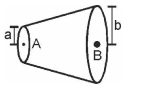
An electric current passes through a wire of non-uniform cross-section,made of a homogeneous and isotropic material. If $j_A$ and $j_B$ are the current densities and $E_A$ and $E_B$ are the electric field intensities at $A$ and $B$ respectively,then $-$
A
$j_A > j_B; E_A > E_B$
B
$j_A < j_B; E_A < E_B$
C
$j_A < j_B; E_A > E_B$
D
$j_A > j_B; E_A < E_B$
Solution
(A) The current $I$ flowing through the wire is constant at all cross-sections.
Current density is defined as $J = \frac{I}{A}$,where $A$ is the cross-sectional area.
Since $I$ is constant,$J \propto \frac{1}{A}$.
From the figure,the area at $A$ is smaller than the area at $B$ $(A_A < A_B)$,therefore $j_A > j_B$.
According to Ohm's law in microscopic form,$\vec{J} = \sigma \vec{E}$,where $\sigma$ is the conductivity of the material.
Since the material is homogeneous and isotropic,$\sigma$ is constant throughout the wire.
Thus,$E = \frac{J}{\sigma}$,which implies $E \propto J$.
Since $j_A > j_B$,it follows that $E_A > E_B$.
Current density is defined as $J = \frac{I}{A}$,where $A$ is the cross-sectional area.
Since $I$ is constant,$J \propto \frac{1}{A}$.
From the figure,the area at $A$ is smaller than the area at $B$ $(A_A < A_B)$,therefore $j_A > j_B$.
According to Ohm's law in microscopic form,$\vec{J} = \sigma \vec{E}$,where $\sigma$ is the conductivity of the material.
Since the material is homogeneous and isotropic,$\sigma$ is constant throughout the wire.
Thus,$E = \frac{J}{\sigma}$,which implies $E \propto J$.
Since $j_A > j_B$,it follows that $E_A > E_B$.
0 likes
View Solution135
MediumMCQ
Consider a conductor of length $40 \ cm$,where a potential difference of $10 \ V$ is maintained between the ends of the conductor. Find out the mobility of the electrons,provided the drift velocity of the electrons is $5 \times 10^{-6} \ m/s$.
A
$8 \times 10^{-7} \ m^2 \ V^{-1} \ s^{-1}$
B
$2 \times 10^{-7} \ m^2 \ V^{-1} \ s^{-1}$
C
$4 \times 10^{-6} \ m^2 \ V^{-1} \ s^{-1}$
D
$10^{-7} \ m^2 \ V^{-1} \ s^{-1}$
Solution
(B) Given:
Length of conductor $L = 40 \ cm = 0.4 \ m$
Potential difference $V = 10 \ V$
Drift velocity $v_d = 5 \times 10^{-6} \ m/s$
Electric field $E$ is given by $E = \frac{V}{L} = \frac{10}{0.4} = 25 \ V/m$.
Mobility $\mu$ is defined as the ratio of drift velocity to the electric field: $\mu = \frac{v_d}{E}$.
Substituting the values: $\mu = \frac{5 \times 10^{-6}}{25} = 0.2 \times 10^{-6} = 2 \times 10^{-7} \ m^2 \ V^{-1} \ s^{-1}$.
Length of conductor $L = 40 \ cm = 0.4 \ m$
Potential difference $V = 10 \ V$
Drift velocity $v_d = 5 \times 10^{-6} \ m/s$
Electric field $E$ is given by $E = \frac{V}{L} = \frac{10}{0.4} = 25 \ V/m$.
Mobility $\mu$ is defined as the ratio of drift velocity to the electric field: $\mu = \frac{v_d}{E}$.
Substituting the values: $\mu = \frac{5 \times 10^{-6}}{25} = 0.2 \times 10^{-6} = 2 \times 10^{-7} \ m^2 \ V^{-1} \ s^{-1}$.
0 likes
View Solution136
EasyMCQ
The drift velocity of free electrons in a conductor is '$V$' when a current '$i$' is flowing in it. If both the radius and current are doubled,then the drift velocity will be:
A
$V$
B
$V / 2$
C
$V / 4$
D
$V / 8$
Solution
(B) The drift velocity $V_d$ is given by the formula $V_d = \frac{I}{neA}$,where $I$ is the current,$n$ is the electron density,$e$ is the charge of an electron,and $A$ is the cross-sectional area of the conductor.
Since $A = \pi r^2$,we can write $V_d = \frac{I}{ne\pi r^2}$.
From this expression,we see that $V_d \propto \frac{I}{r^2}$.
Let the initial drift velocity be $V_1 = V$,initial current be $I_1 = i$,and initial radius be $r_1 = r$.
When the current and radius are doubled,the new current $I_2 = 2i$ and the new radius $r_2 = 2r$.
The new drift velocity $V_2$ is given by $V_2 = V_1 \times \left( \frac{I_2}{I_1} \right) \times \left( \frac{r_1}{r_2} \right)^2$.
Substituting the values: $V_2 = V \times \left( \frac{2i}{i} \right) \times \left( \frac{r}{2r} \right)^2 = V \times 2 \times \frac{1}{4} = \frac{V}{2}$.
Since $A = \pi r^2$,we can write $V_d = \frac{I}{ne\pi r^2}$.
From this expression,we see that $V_d \propto \frac{I}{r^2}$.
Let the initial drift velocity be $V_1 = V$,initial current be $I_1 = i$,and initial radius be $r_1 = r$.
When the current and radius are doubled,the new current $I_2 = 2i$ and the new radius $r_2 = 2r$.
The new drift velocity $V_2$ is given by $V_2 = V_1 \times \left( \frac{I_2}{I_1} \right) \times \left( \frac{r_1}{r_2} \right)^2$.
Substituting the values: $V_2 = V \times \left( \frac{2i}{i} \right) \times \left( \frac{r}{2r} \right)^2 = V \times 2 \times \frac{1}{4} = \frac{V}{2}$.
0 likes
View Solution137
EasyMCQ
The magnitude of the drift velocity per unit electric field is known as . . . . . . .
A
Conductivity
B
Obstructionism
C
Mobility
D
Electric charge density
Solution
(C) The drift velocity $v_d$ of a charge carrier is directly proportional to the applied electric field $E$,given by $v_d = \mu E$.
Here,$\mu$ is defined as the mobility of the charge carrier.
Therefore,mobility $\mu = \frac{v_d}{E}$.
It represents the magnitude of the drift velocity per unit electric field.
Here,$\mu$ is defined as the mobility of the charge carrier.
Therefore,mobility $\mu = \frac{v_d}{E}$.
It represents the magnitude of the drift velocity per unit electric field.
0 likes
View Solution138
EasyMCQ
The $SI$ unit of the current density is . . . . . . .
A
$A \ m^{-1}$
B
$A \ m^{2}$
C
$A \ m^{3}$
D
$A \ m^{-2}$
Solution
(D) Current density $(J)$ is defined as the current $(I)$ flowing per unit area $(A)$ perpendicular to the direction of flow.
Mathematically,$J = \frac{I}{A}$.
The $SI$ unit of current $(I)$ is Ampere $(A)$ and the $SI$ unit of area $(A)$ is square meter $(m^{2})$.
Therefore,the $SI$ unit of current density is $\frac{A}{m^{2}} = A \ m^{-2}$.
Thus,the correct option is $(D)$.
Mathematically,$J = \frac{I}{A}$.
The $SI$ unit of current $(I)$ is Ampere $(A)$ and the $SI$ unit of area $(A)$ is square meter $(m^{2})$.
Therefore,the $SI$ unit of current density is $\frac{A}{m^{2}} = A \ m^{-2}$.
Thus,the correct option is $(D)$.
0 likes
View Solution139
EasyMCQ
The unit of mobility in terms of fundamental units is . . . . . . .
A
$kg^{-1} s^2 A$
B
$kg s^2 A$
C
$kg^{-1} s^2 A$
D
$kg^{-1} s^2 A^{-1}$
Solution
(C) Mobility $\mu$ is defined as the ratio of drift velocity $v_d$ to the electric field $E$: $\mu = \frac{v_d}{E}$.
The unit of drift velocity $v_d$ is $m/s$.
The unit of electric field $E$ is $N/C$ (or $V/m$).
Substituting the fundamental units:
$1 \ N = 1 \ kg \cdot m/s^2$
$1 \ C = 1 \ A \cdot s$
Therefore,the unit of $E$ is $\frac{kg \cdot m/s^2}{A \cdot s} = \frac{kg \cdot m}{A \cdot s^3}$.
Now,calculating the unit of $\mu$:
$\mu = \frac{m/s}{kg \cdot m / (A \cdot s^3)} = \frac{m}{s} \cdot \frac{A \cdot s^3}{kg \cdot m} = \frac{A \cdot s^2}{kg} = kg^{-1} s^2 A$.
Thus,the correct option is $C$.
The unit of drift velocity $v_d$ is $m/s$.
The unit of electric field $E$ is $N/C$ (or $V/m$).
Substituting the fundamental units:
$1 \ N = 1 \ kg \cdot m/s^2$
$1 \ C = 1 \ A \cdot s$
Therefore,the unit of $E$ is $\frac{kg \cdot m/s^2}{A \cdot s} = \frac{kg \cdot m}{A \cdot s^3}$.
Now,calculating the unit of $\mu$:
$\mu = \frac{m/s}{kg \cdot m / (A \cdot s^3)} = \frac{m}{s} \cdot \frac{A \cdot s^3}{kg \cdot m} = \frac{A \cdot s^2}{kg} = kg^{-1} s^2 A$.
Thus,the correct option is $C$.
0 likes
View Solution140
EasyMCQ
The number density of free electrons in a copper conductor is estimated to be $8.5 \times 10^{28} \ m^{-3}$. How long does an electron take to drift from one end of a wire $6 \ m$ long to its other end? The area of cross-section of the wire is $1.0 \times 10^{-6} \ m^2$ and it is carrying a current of $1.5 \ A$.
A
$8.1 \times 10^4 \ s$
B
$5.4 \times 10^4 \ s$
C
$12.7 \times 10^4 \ s$
D
$4.5 \times 10^4 \ s$
Solution
(B) The relationship between current $I$ and drift velocity $v_d$ is given by $I = n A v_d e$,where $n$ is the number density,$A$ is the cross-sectional area,and $e$ is the elementary charge.
Since $v_d = \frac{l}{t}$,where $l$ is the length of the wire and $t$ is the time taken,we can write:
$I = n A \left( \frac{l}{t} \right) e$
Rearranging for $t$:
$t = \frac{n A l e}{I}$
Given values:
$n = 8.5 \times 10^{28} \ m^{-3}$
$A = 1.0 \times 10^{-6} \ m^2$
$l = 6 \ m$
$e = 1.6 \times 10^{-19} \ C$
$I = 1.5 \ A$
Substituting these values:
$t = \frac{8.5 \times 10^{28} \times 1.0 \times 10^{-6} \times 6 \times 1.6 \times 10^{-19}}{1.5}$
$t = \frac{81.6 \times 10^3}{1.5} = 54.4 \times 10^3 \ s$
$t = 5.44 \times 10^4 \ s$
Thus,the correct option is $B$.
Since $v_d = \frac{l}{t}$,where $l$ is the length of the wire and $t$ is the time taken,we can write:
$I = n A \left( \frac{l}{t} \right) e$
Rearranging for $t$:
$t = \frac{n A l e}{I}$
Given values:
$n = 8.5 \times 10^{28} \ m^{-3}$
$A = 1.0 \times 10^{-6} \ m^2$
$l = 6 \ m$
$e = 1.6 \times 10^{-19} \ C$
$I = 1.5 \ A$
Substituting these values:
$t = \frac{8.5 \times 10^{28} \times 1.0 \times 10^{-6} \times 6 \times 1.6 \times 10^{-19}}{1.5}$
$t = \frac{81.6 \times 10^3}{1.5} = 54.4 \times 10^3 \ s$
$t = 5.44 \times 10^4 \ s$
Thus,the correct option is $B$.
0 likes
View Solution141
EasyMCQ
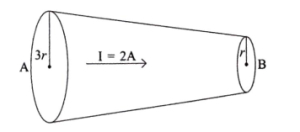
As shown in the figure,a current is passing through a conducting wire. The radius of the cross-section of the wire at point $A$ is $3r$ and at point $B$ is $r$. Find the ratio of the drift velocity at point $A$ to that at point $B$.
A
$3$
B
$\frac{1}{9}$
C
$\frac{1}{3}$
D
$9$
Solution
(B) The current $I$ flowing through a conductor is given by the relation: $I = n A v_d e$,where $n$ is the number density of electrons,$A$ is the cross-sectional area,$v_d$ is the drift velocity,and $e$ is the charge of an electron.
Since the current $I$ is constant throughout the wire,we have $v_d = \frac{I}{n A e}$.
Since $I$,$n$,and $e$ are constant,$v_d \propto \frac{1}{A}$.
Since the cross-section is circular,$A = \pi r^2$,therefore $v_d \propto \frac{1}{r^2}$.
Now,calculating the ratio of drift velocities at points $A$ and $B$:
$\frac{(v_d)_A}{(v_d)_B} = \frac{r_B^2}{r_A^2} = \frac{(r)^2}{(3r)^2} = \frac{r^2}{9r^2} = \frac{1}{9}$.
Thus,the ratio is $\frac{1}{9}$.
Since the current $I$ is constant throughout the wire,we have $v_d = \frac{I}{n A e}$.
Since $I$,$n$,and $e$ are constant,$v_d \propto \frac{1}{A}$.
Since the cross-section is circular,$A = \pi r^2$,therefore $v_d \propto \frac{1}{r^2}$.
Now,calculating the ratio of drift velocities at points $A$ and $B$:
$\frac{(v_d)_A}{(v_d)_B} = \frac{r_B^2}{r_A^2} = \frac{(r)^2}{(3r)^2} = \frac{r^2}{9r^2} = \frac{1}{9}$.
Thus,the ratio is $\frac{1}{9}$.
0 likes
View Solution142
EasyMCQ
The dimensional formula of mobility is . . . . . .
A
$M^1 L^{-1} T^{-2} A^{-1}$
B
$M^1 L^0 T^{-2} A^{-1}$
C
$M^{-1} L^1 T^2 A^1$
D
$M^{-1} L^0 T^2 A^1$
Solution
(D) Mobility $\mu$ is defined as the ratio of drift velocity $v_d$ to the applied electric field $E$: $\mu = \frac{v_d}{E}$.
The dimensional formula for drift velocity $v_d$ is $[L^1 T^{-1}]$.
The dimensional formula for electric field $E$ is $[M^1 L^1 T^{-3} A^{-1}]$.
Substituting these into the formula: $\mu = \frac{[L^1 T^{-1}]}{[M^1 L^1 T^{-3} A^{-1}]}$.
Simplifying the expression: $\mu = [M^{-1} L^{1-1} T^{-1 - (-3)} A^1] = [M^{-1} L^0 T^2 A^1]$.
The dimensional formula for drift velocity $v_d$ is $[L^1 T^{-1}]$.
The dimensional formula for electric field $E$ is $[M^1 L^1 T^{-3} A^{-1}]$.
Substituting these into the formula: $\mu = \frac{[L^1 T^{-1}]}{[M^1 L^1 T^{-3} A^{-1}]}$.
Simplifying the expression: $\mu = [M^{-1} L^{1-1} T^{-1 - (-3)} A^1] = [M^{-1} L^0 T^2 A^1]$.
0 likes
View Solution143
EasyMCQ
Cross-sectional area of a copper wire is equal to the area of a square of length $2 \ mm$. If this copper wire draws $8 \ A$ electric current,then find the drift velocity of free electrons. The number density of electrons in the copper wire is $8 \times 10^{28} \ m^{-3}$.
A
$1.56 \times 10^{-4} \ ms^{-1}$
B
$1.56 \times 10^{-2} \ ms^{-1}$
C
$3.12 \times 10^{-3} \ ms^{-1}$
D
$3.12 \times 10^{-2} \ ms^{-1}$
Solution
(A) Given: Area $A = (2 \ mm)^2 = (2 \times 10^{-3} \ m)^2 = 4 \times 10^{-6} \ m^2$. Current $I = 8 \ A$. Number density $n = 8 \times 10^{28} \ m^{-3}$. Charge of electron $e = 1.6 \times 10^{-19} \ C$.
Using the formula for drift velocity: $I = n A v_d e$.
Rearranging for $v_d$: $v_d = \frac{I}{n A e}$.
Substituting the values: $v_d = \frac{8}{8 \times 10^{28} \times 4 \times 10^{-6} \times 1.6 \times 10^{-19}}$.
$v_d = \frac{8}{51.2 \times 10^3} = \frac{8}{51200} \approx 1.56 \times 10^{-4} \ ms^{-1}$.
Using the formula for drift velocity: $I = n A v_d e$.
Rearranging for $v_d$: $v_d = \frac{I}{n A e}$.
Substituting the values: $v_d = \frac{8}{8 \times 10^{28} \times 4 \times 10^{-6} \times 1.6 \times 10^{-19}}$.
$v_d = \frac{8}{51.2 \times 10^3} = \frac{8}{51200} \approx 1.56 \times 10^{-4} \ ms^{-1}$.
0 likes
View Solution144
EasyMCQ
For a given electric current,the drift velocity of conduction electrons in a copper wire is $v_d$ and their mobility is $\mu$. When the current is increased at constant temperature,
A
$v_d$ increases,$\mu$ remains the same
B
$v_d$ remains the same,$\mu$ increases
C
$v_d$ decreases,$\mu$ remains the same
D
$v_d$ remains the same,$\mu$ decreases
Solution
(A) The mobility of an electron is given by the formula: $\mu = \frac{e \tau}{m}$.
Since the temperature is constant,the relaxation time $\tau$ remains constant,and therefore the mobility $\mu$ remains the same.
The relationship between electric current $I$ and drift velocity $v_d$ is given by $I = n e A v_d$.
From this equation,we can see that $v_d = \frac{I}{n e A}$.
Since $n$,$e$,and $A$ are constants for a given wire,$v_d \propto I$.
Therefore,when the current $I$ is increased,the drift velocity $v_d$ also increases.
Since the temperature is constant,the relaxation time $\tau$ remains constant,and therefore the mobility $\mu$ remains the same.
The relationship between electric current $I$ and drift velocity $v_d$ is given by $I = n e A v_d$.
From this equation,we can see that $v_d = \frac{I}{n e A}$.
Since $n$,$e$,and $A$ are constants for a given wire,$v_d \propto I$.
Therefore,when the current $I$ is increased,the drift velocity $v_d$ also increases.
0 likes
View Solution145
EasyMCQ
$A$ charged particle is moving in an electric field of $3 \times 10^{-10} \text{ Vm}^{-1}$ with mobility $2.5 \times 10^6 \text{ m}^2 \text{V}^{-1} \text{s}^{-1}$. Its drift velocity is:
A
$8.33 \times 10^{-4} \text{ m/s}$
B
$25 \times 10^4 \text{ m/s}$
C
$1.2 \times 10^{-4} \text{ m/s}$
D
$7.5 \times 10^{-4} \text{ m/s}$
Solution
(D) Given: Electric field,$E = 3 \times 10^{-10} \text{ Vm}^{-1}$.
Mobility,$\mu = 2.5 \times 10^6 \text{ m}^2 \text{V}^{-1} \text{s}^{-1}$.
The relationship between drift velocity $(v_d)$,mobility $(\mu)$,and electric field $(E)$ is given by the formula:
$v_d = \mu E$
Substituting the given values:
$v_d = (2.5 \times 10^6) \times (3 \times 10^{-10})$
$v_d = 7.5 \times 10^{-4} \text{ m/s}$.
Therefore,the drift velocity is $7.5 \times 10^{-4} \text{ m/s}$.
Mobility,$\mu = 2.5 \times 10^6 \text{ m}^2 \text{V}^{-1} \text{s}^{-1}$.
The relationship between drift velocity $(v_d)$,mobility $(\mu)$,and electric field $(E)$ is given by the formula:
$v_d = \mu E$
Substituting the given values:
$v_d = (2.5 \times 10^6) \times (3 \times 10^{-10})$
$v_d = 7.5 \times 10^{-4} \text{ m/s}$.
Therefore,the drift velocity is $7.5 \times 10^{-4} \text{ m/s}$.
0 likes
View Solution146
DifficultMCQ
$A$ copper wire of length $1 \,m$ and uniform cross-sectional area $5 \times 10^{-7} \,m^{2}$ carries a current of $1 \,A$. Assuming that there are $8 \times 10^{28}$ free electrons per $m^{3}$ in copper,how long will an electron take to drift from one end of the wire to the other?
A
$0.8 \times 10^{3} \,s$
B
$1.6 \times 10^{3} \,s$
C
$3.2 \times 10^{3} \,s$
D
$6.4 \times 10^{3} \,s$
Solution
(D) Given: Length $l = 1 \,m$,Area $A = 5 \times 10^{-7} \,m^{2}$,Current $I = 1 \,A$,Electron density $n = 8 \times 10^{28} \,m^{-3}$,Charge of electron $e = 1.6 \times 10^{-19} \,C$.
The drift velocity $v_{d}$ is given by the formula $v_{d} = \frac{I}{neA}$.
Substituting the values: $v_{d} = \frac{1}{8 \times 10^{28} \times 1.6 \times 10^{-19} \times 5 \times 10^{-7}} = \frac{1}{64 \times 10^{2}} = \frac{1}{6.4 \times 10^{3}} \,m/s$.
The time $T$ taken to drift across the length $l$ is $T = \frac{l}{v_{d}}$.
$T = \frac{1}{1 / (6.4 \times 10^{3})} = 6.4 \times 10^{3} \,s$.
The drift velocity $v_{d}$ is given by the formula $v_{d} = \frac{I}{neA}$.
Substituting the values: $v_{d} = \frac{1}{8 \times 10^{28} \times 1.6 \times 10^{-19} \times 5 \times 10^{-7}} = \frac{1}{64 \times 10^{2}} = \frac{1}{6.4 \times 10^{3}} \,m/s$.
The time $T$ taken to drift across the length $l$ is $T = \frac{l}{v_{d}}$.
$T = \frac{1}{1 / (6.4 \times 10^{3})} = 6.4 \times 10^{3} \,s$.
0 likes
View Solution147
EasyMCQ
Though the electron drift velocity is small and electron charge is very small, a conductor can carry an appreciably large current because
A
electron number density depends on temperature
B
electron number density is very large
C
relaxation time is small
D
drift velocity of electron is very large
Solution
(B) The current $I$ in a conductor is given by the formula $I = neAv_d$, where $n$ is the electron number density, $e$ is the charge of an electron, $A$ is the cross-sectional area, and $v_d$ is the drift velocity.
Even though the drift velocity $v_d$ is very small (typically $10^{-4} \, m/s$) and the charge $e$ is small $(1.6 \times 10^{-19} \, C)$, the number density $n$ of free electrons in a conductor is extremely large, typically of the order of $10^{28} \, m^{-3}$.
Therefore, the product $neAv_d$ results in an appreciably large current.
Even though the drift velocity $v_d$ is very small (typically $10^{-4} \, m/s$) and the charge $e$ is small $(1.6 \times 10^{-19} \, C)$, the number density $n$ of free electrons in a conductor is extremely large, typically of the order of $10^{28} \, m^{-3}$.
Therefore, the product $neAv_d$ results in an appreciably large current.
0 likes
View Solution148
EasyMCQ
Mobility of free electrons in a conductor is
A
directly proportional to electron density.
B
directly proportional to relaxation time.
C
inversely proportional to electron density.
D
inversely proportional to relaxation time.
Solution
(B) The mobility $\mu$ of free electrons is defined as the drift velocity per unit electric field,given by the formula:
$\mu = \frac{v_d}{E} = \frac{e \tau}{m}$
Where:
$e$ is the charge of an electron,
$\tau$ is the relaxation time,
$m$ is the mass of an electron.
Since $e$ and $m$ are constants,we have:
$\mu \propto \tau$
Therefore,the mobility of free electrons in a conductor is directly proportional to the relaxation time.
$\mu = \frac{v_d}{E} = \frac{e \tau}{m}$
Where:
$e$ is the charge of an electron,
$\tau$ is the relaxation time,
$m$ is the mass of an electron.
Since $e$ and $m$ are constants,we have:
$\mu \propto \tau$
Therefore,the mobility of free electrons in a conductor is directly proportional to the relaxation time.
0 likes
View Solution149
MediumMCQ
$A$ current of $2 \,A$ is passing through a metal wire of cross-sectional area $2 \times 10^{-6} \,m^{2}$. If the number density of free electrons in the wire is $5 \times 10^{26} \,m^{-3}$, the drift speed of electrons is (Given, $e = 1.6 \times 10^{-19} \,C$)
A
$\frac{1}{32} \,ms^{-1}$
B
$\frac{1}{16} \,ms^{-1}$
C
$\frac{1}{40} \,ms^{-1}$
D
$\frac{1}{80} \,ms^{-1}$
Solution
(D) The formula for the drift velocity $(v_{d})$ of electrons is given by:
$v_{d} = \frac{I}{n e A}$
Where:
$I = 2 \,A$ (Current)
$n = 5 \times 10^{26} \,m^{-3}$ (Number density of free electrons)
$e = 1.6 \times 10^{-19} \,C$ (Charge of an electron)
$A = 2 \times 10^{-6} \,m^{2}$ (Cross-sectional area)
Substituting the values:
$v_{d} = \frac{2}{(5 \times 10^{26}) \times (1.6 \times 10^{-19}) \times (2 \times 10^{-6})}$
$v_{d} = \frac{2}{16 \times 10^{26-19-6}} = \frac{2}{16 \times 10^{1}} = \frac{2}{160} = \frac{1}{80} \,ms^{-1}$
$v_{d} = \frac{I}{n e A}$
Where:
$I = 2 \,A$ (Current)
$n = 5 \times 10^{26} \,m^{-3}$ (Number density of free electrons)
$e = 1.6 \times 10^{-19} \,C$ (Charge of an electron)
$A = 2 \times 10^{-6} \,m^{2}$ (Cross-sectional area)
Substituting the values:
$v_{d} = \frac{2}{(5 \times 10^{26}) \times (1.6 \times 10^{-19}) \times (2 \times 10^{-6})}$
$v_{d} = \frac{2}{16 \times 10^{26-19-6}} = \frac{2}{16 \times 10^{1}} = \frac{2}{160} = \frac{1}{80} \,ms^{-1}$
0 likes
View Solution150
MediumMCQ
$A$ conductor wire having $10^{29}$ free electrons $/ m^{3}$ carries a current of $20 \,A$. If the cross-section of the wire is $1 \,mm^{2}$, then the drift velocity of electrons will be. $\left(e=1.6 \times 10^{-19} \,C\right)$
A
$1.25 \times 10^{-4} \,ms^{-1}$
B
$1.25 \times 10^{-3} \,ms^{-1}$
C
$1.25 \times 10^{-5} \,ms^{-1}$
D
$6.25 \times 10^{-3} \,ms^{-1}$
Solution
(B) The relationship between current $I$ and drift velocity $v_{d}$ is given by the formula: $I = n A e v_{d}$.
Here, $n = 10^{29} \,m^{-3}$ is the electron density, $A = 1 \,mm^{2} = 10^{-6} \,m^{2}$ is the cross-sectional area, $e = 1.6 \times 10^{-19} \,C$ is the charge of an electron, and $I = 20 \,A$.
Rearranging the formula for drift velocity: $v_{d} = \frac{I}{n A e}$.
Substituting the values: $v_{d} = \frac{20}{10^{29} \times 10^{-6} \times 1.6 \times 10^{-19}}$.
$v_{d} = \frac{20}{1.6 \times 10^{4}} = \frac{20}{16000} = 1.25 \times 10^{-3} \,ms^{-1}$.
Here, $n = 10^{29} \,m^{-3}$ is the electron density, $A = 1 \,mm^{2} = 10^{-6} \,m^{2}$ is the cross-sectional area, $e = 1.6 \times 10^{-19} \,C$ is the charge of an electron, and $I = 20 \,A$.
Rearranging the formula for drift velocity: $v_{d} = \frac{I}{n A e}$.
Substituting the values: $v_{d} = \frac{20}{10^{29} \times 10^{-6} \times 1.6 \times 10^{-19}}$.
$v_{d} = \frac{20}{1.6 \times 10^{4}} = \frac{20}{16000} = 1.25 \times 10^{-3} \,ms^{-1}$.
0 likes
View SolutionCurrent Electricity — Current Density, Drift Velocity and Mobility · Frequently Asked Questions
1Are these Current Electricity questions useful for JEE and NEET?
Yes. All questions in this section are mapped to JEE Main and NEET exam patterns. Previous year questions from JEE Main, NEET, GUJCET and state-level exams are included with full solutions.
2Can I switch to Hindi or Gujarati for these questions?
Yes. Use the language tabs in the hero section or the sidebar to view the same questions and solutions in English, Hindi or Gujarati.
3How do I generate a question paper from this subtopic?
Use the Vedclass Exam Paper Generator — select the chapter and subtopic, set difficulty, and generate Sets A, B, C, D automatically. First 3 chapters of every subject are free.
Vedclass Products
For Students
Vedclass Test Series
Mock tests in real JEE/NEET style with performance analysis. 5-day free trial.
Start Free TrialFor Teachers
Exam Paper Generator
Generate Set A/B/C/D papers from this chapter in 2 minutes. 3 chapters free.
Try FreeFor Institutes
Online Exam Module
Live online exams with unlimited students, 360° analytics & white-label branding.
See DemoFor Teachers & Institutes
Generate a Current Electricity Exam Paper in 2 Minutes
Select subtopic & difficulty — Sets A, B, C, D auto-generated with No Repeat logic.
First 3 chapters of every subject are free — no payment required.