
A English
Current Density, Drift Velocity and Mobility Questions in English
Class 12 Physics · Current Electricity · Current Density, Drift Velocity and Mobility
187+
Questions
English
Language
100%
With Solutions
Showing 49 of 187 questions in English
51
MediumMCQ
In a wire of cross-section radius $r$,free electrons travel with drift velocity $v$ when a current $I$ flows through the wire. What is the current in another wire of half the radius and of the same material when the drift velocity is $2v$?
A
$2I$
B
$I$
C
$I/2$
D
$I/4$
Solution
(C) The current $I$ in a wire is given by the formula $I = neAv_d$,where $n$ is the number density of free electrons,$e$ is the charge of an electron,$A$ is the cross-sectional area,and $v_d$ is the drift velocity.
Since the material is the same,$n$ and $e$ remain constant.
The cross-sectional area $A$ is given by $A = \pi r^2$.
For the first wire: $I_1 = ne(\pi r^2)v$.
For the second wire: $r_2 = r/2$ and $v_{d2} = 2v$.
$I_2 = ne(\pi (r/2)^2)(2v) = ne(\pi r^2 / 4)(2v) = (1/2) ne \pi r^2 v$.
Comparing the two,$I_2 = I_1 / 2 = I/2$.
Since the material is the same,$n$ and $e$ remain constant.
The cross-sectional area $A$ is given by $A = \pi r^2$.
For the first wire: $I_1 = ne(\pi r^2)v$.
For the second wire: $r_2 = r/2$ and $v_{d2} = 2v$.
$I_2 = ne(\pi (r/2)^2)(2v) = ne(\pi r^2 / 4)(2v) = (1/2) ne \pi r^2 v$.
Comparing the two,$I_2 = I_1 / 2 = I/2$.
0 likes
View Solution52
AdvancedMCQ
An insulating pipe of cross-section area $A$ contains an electrolyte which has two types of ions with charges $-e$ and $+2e$. $A$ potential difference applied between the ends of the pipe results in the drifting of the two types of ions,having drift speeds $v$ (for $-e$ ion) and $v/4$ (for $+2e$ ion). Both ions have the same number density $n$. The current flowing through the pipe is:
A
$nev A/2$
B
$nev A/4$
C
$5nev A/2$
D
$3nev A/2$
Solution
(D) The current $I$ due to a charge carrier with charge $q$,number density $n$,cross-sectional area $A$,and drift velocity $v_d$ is given by $I = n q A v_d$.
For the positive ions $(+2e)$: The charge is $q_1 = +2e$,number density is $n$,and drift speed is $v_1 = v/4$. The current is $I_1 = n(2e)A(v/4) = nevA/2$.
For the negative ions $(-e)$: The charge is $q_2 = -e$,number density is $n$,and drift speed is $v_2 = v$. Since the negative ions move in the direction opposite to the positive ions,their contribution to the conventional current is in the same direction as the positive ions. The magnitude of current is $I_2 = n|q_2|Av_2 = n(e)Av = nevA$.
The total current $I_{total} = I_1 + I_2 = nevA/2 + nevA = 3nevA/2$.
For the positive ions $(+2e)$: The charge is $q_1 = +2e$,number density is $n$,and drift speed is $v_1 = v/4$. The current is $I_1 = n(2e)A(v/4) = nevA/2$.
For the negative ions $(-e)$: The charge is $q_2 = -e$,number density is $n$,and drift speed is $v_2 = v$. Since the negative ions move in the direction opposite to the positive ions,their contribution to the conventional current is in the same direction as the positive ions. The magnitude of current is $I_2 = n|q_2|Av_2 = n(e)Av = nevA$.
The total current $I_{total} = I_1 + I_2 = nevA/2 + nevA = 3nevA/2$.
0 likes
View Solution53
AdvancedMCQ
Current density in a cylindrical wire of radius $R$ is given as $J = \begin{cases} J_0 \left( \frac{x}{R} - 1 \right) & 0 \leqslant x < \frac{R}{2} \\ J_0 \frac{x}{R} & \frac{R}{2} \leqslant x \leqslant R \end{cases}$. The current flowing in the wire is:
A
$\frac{7}{24} \pi J_0 R^2$
B
$\frac{1}{6} \pi J_0 R^2$
C
$\frac{7}{14} \pi J_0 R^2$
D
$\frac{5}{12} \pi J_0 R^2$
Solution
(D) The total current $I$ is given by the integral $I = \int J \cdot dA$. For a cylindrical wire,the area element is $dA = 2\pi x dx$.
$I = \int_{0}^{R/2} J_0 \left( \frac{x}{R} - 1 \right) (2\pi x dx) + \int_{R/2}^{R} J_0 \frac{x}{R} (2\pi x dx)$
$I = 2\pi J_0 \left[ \int_{0}^{R/2} \left( \frac{x^2}{R} - x \right) dx + \int_{R/2}^{R} \frac{x^2}{R} dx \right]$
$I = 2\pi J_0 \left[ \left( \frac{x^3}{3R} - \frac{x^2}{2} \right)_{0}^{R/2} + \left( \frac{x^3}{3R} \right)_{R/2}^{R} \right]$
$I = 2\pi J_0 \left[ \left( \frac{R^3/8}{3R} - \frac{R^2/4}{2} \right) + \left( \frac{R^3}{3R} - \frac{R^3/8}{3R} \right) \right]$
$I = 2\pi J_0 \left[ \left( \frac{R^2}{24} - \frac{R^2}{8} \right) + \left( \frac{R^2}{3} - \frac{R^2}{24} \right) \right]$
$I = 2\pi J_0 \left[ \frac{R^2 - 3R^2}{24} + \frac{8R^2 - R^2}{24} \right] = 2\pi J_0 \left[ -\frac{2R^2}{24} + \frac{7R^2}{24} \right]$
$I = 2\pi J_0 \left( \frac{5R^2}{24} \right) = \frac{5}{12} \pi J_0 R^2$.
$I = \int_{0}^{R/2} J_0 \left( \frac{x}{R} - 1 \right) (2\pi x dx) + \int_{R/2}^{R} J_0 \frac{x}{R} (2\pi x dx)$
$I = 2\pi J_0 \left[ \int_{0}^{R/2} \left( \frac{x^2}{R} - x \right) dx + \int_{R/2}^{R} \frac{x^2}{R} dx \right]$
$I = 2\pi J_0 \left[ \left( \frac{x^3}{3R} - \frac{x^2}{2} \right)_{0}^{R/2} + \left( \frac{x^3}{3R} \right)_{R/2}^{R} \right]$
$I = 2\pi J_0 \left[ \left( \frac{R^3/8}{3R} - \frac{R^2/4}{2} \right) + \left( \frac{R^3}{3R} - \frac{R^3/8}{3R} \right) \right]$
$I = 2\pi J_0 \left[ \left( \frac{R^2}{24} - \frac{R^2}{8} \right) + \left( \frac{R^2}{3} - \frac{R^2}{24} \right) \right]$
$I = 2\pi J_0 \left[ \frac{R^2 - 3R^2}{24} + \frac{8R^2 - R^2}{24} \right] = 2\pi J_0 \left[ -\frac{2R^2}{24} + \frac{7R^2}{24} \right]$
$I = 2\pi J_0 \left( \frac{5R^2}{24} \right) = \frac{5}{12} \pi J_0 R^2$.
0 likes
View Solution54
MediumMCQ
$A$ current $I$ flows through a uniform wire of diameter $d$ when the mean electron drift velocity is $V$. The same current will flow through a wire of diameter $d/2$ made of the same material if the mean drift velocity of the electron is:
A
$V/4$
B
$V/2$
C
$2V$
D
$4V$
Solution
(D) The relationship between current $I$,cross-sectional area $A$,and drift velocity $v_d$ is given by $I = n e A v_d$.
Since the area $A = \pi (d/2)^2 = \frac{\pi d^2}{4}$,we can write $I = n e \left( \frac{\pi d^2}{4} \right) v_d$.
For the first wire: $I = n e \left( \frac{\pi d^2}{4} \right) V$.
For the second wire with diameter $d' = d/2$: $I = n e \left( \frac{\pi (d/2)^2}{4} \right) v' = n e \left( \frac{\pi d^2}{16} \right) v'$.
Equating the two expressions for $I$: $n e \left( \frac{\pi d^2}{4} \right) V = n e \left( \frac{\pi d^2}{16} \right) v'$.
Simplifying,we get $\frac{V}{4} = \frac{v'}{16}$,which implies $v' = 4V$.
Since the area $A = \pi (d/2)^2 = \frac{\pi d^2}{4}$,we can write $I = n e \left( \frac{\pi d^2}{4} \right) v_d$.
For the first wire: $I = n e \left( \frac{\pi d^2}{4} \right) V$.
For the second wire with diameter $d' = d/2$: $I = n e \left( \frac{\pi (d/2)^2}{4} \right) v' = n e \left( \frac{\pi d^2}{16} \right) v'$.
Equating the two expressions for $I$: $n e \left( \frac{\pi d^2}{4} \right) V = n e \left( \frac{\pi d^2}{16} \right) v'$.
Simplifying,we get $\frac{V}{4} = \frac{v'}{16}$,which implies $v' = 4V$.
0 likes
View Solution55
MediumMCQ
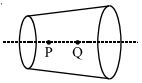
$A$ wire has a non-uniform cross-section as shown in the figure. $A$ steady current flows through it. The drift speed of electrons at points $P$ and $Q$ is $v_P$ and $v_Q$ respectively.
A
$v_P = v_Q$
B
$v_P < v_Q$
C
$v_P > v_Q$
D
Data insufficient
Solution
(C) The current $I$ flowing through a conductor is given by the relation $I = neAv_d$, where $n$ is the number density of electrons, $e$ is the charge of an electron, $A$ is the cross-sectional area, and $v_d$ is the drift speed.
Since the current $I$ is steady and $n$ and $e$ are constant, we have $A v_d = \text{constant}$, which implies $v_d \propto \frac{1}{A}$.
From the figure, the cross-sectional area at point $P$ $(A_P)$ is smaller than the cross-sectional area at point $Q$ $(A_Q)$.
Therefore, since $A_P < A_Q$, it follows that $v_P > v_Q$.
Since the current $I$ is steady and $n$ and $e$ are constant, we have $A v_d = \text{constant}$, which implies $v_d \propto \frac{1}{A}$.
From the figure, the cross-sectional area at point $P$ $(A_P)$ is smaller than the cross-sectional area at point $Q$ $(A_Q)$.
Therefore, since $A_P < A_Q$, it follows that $v_P > v_Q$.
0 likes
View Solution56
MediumMCQ
$A$ uniform copper wire carries a current $i$ amperes and has $p$ carriers per meter$^3$. The length of the wire is $\lambda$ meters and its cross-section area is $s$ meter$^2$. If the charge on a carrier is $q$ coulombs,the drift velocity in $ms^{-1}$ is given by
A
$i/\lambda sq$
B
$i/psq$
C
$psq/i$
D
$i/ps\lambda q$
Solution
(B) The current $i$ flowing through a conductor is related to the drift velocity $v_d$ by the formula:
$i = n A q v_d$
Where:
$i$ = current in amperes
$n$ = number of charge carriers per unit volume (carrier density) = $p$
$A$ = cross-sectional area = $s$
$q$ = charge on each carrier
$v_d$ = drift velocity
Substituting the given variables into the formula:
$i = p \cdot s \cdot q \cdot v_d$
Rearranging to solve for the drift velocity $v_d$:
$v_d = \frac{i}{p s q}$
Thus,the drift velocity is $i/psq$.
$i = n A q v_d$
Where:
$i$ = current in amperes
$n$ = number of charge carriers per unit volume (carrier density) = $p$
$A$ = cross-sectional area = $s$
$q$ = charge on each carrier
$v_d$ = drift velocity
Substituting the given variables into the formula:
$i = p \cdot s \cdot q \cdot v_d$
Rearranging to solve for the drift velocity $v_d$:
$v_d = \frac{i}{p s q}$
Thus,the drift velocity is $i/psq$.
0 likes
View Solution57
EasyMCQ
Which of the following quantities does not change when a resistor connected to a battery is heated due to the current?
A
drift speed
B
resistivity
C
resistance
D
number of free electrons
Solution
(D) When a resistor is heated due to the flow of current, its temperature increases.
$1$. Resistance $(R)$ and resistivity $(\rho)$ are temperature-dependent properties of a conductor. As temperature increases, the relaxation time of electrons decreases, causing both $R$ and $\rho$ to change.
$2$. Drift speed $(v_d)$ is given by $v_d = \frac{eE\tau}{m}$, where $\tau$ is the relaxation time. Since $\tau$ changes with temperature, the drift speed also changes.
$3$. The number of free electrons $(n)$ is a property of the material itself (the number of valence electrons per unit volume). This value remains constant regardless of the temperature changes within the operating range of the resistor.
Therefore, the number of free electrons does not change. The correct option is $D$.
$1$. Resistance $(R)$ and resistivity $(\rho)$ are temperature-dependent properties of a conductor. As temperature increases, the relaxation time of electrons decreases, causing both $R$ and $\rho$ to change.
$2$. Drift speed $(v_d)$ is given by $v_d = \frac{eE\tau}{m}$, where $\tau$ is the relaxation time. Since $\tau$ changes with temperature, the drift speed also changes.
$3$. The number of free electrons $(n)$ is a property of the material itself (the number of valence electrons per unit volume). This value remains constant regardless of the temperature changes within the operating range of the resistor.
Therefore, the number of free electrons does not change. The correct option is $D$.
0 likes
View Solution58
MediumMCQ
$A$ current passes through a wire of nonuniform cross-section. Which of the following quantities are independent of the cross-section?
A
The charge crossing in a given time interval.
B
Drift speed.
C
Free-electron density.
D
Both $(A)$ and $(C)$.
Solution
(D) When a steady current $I$ flows through a wire of non-uniform cross-section,the current $I$ remains constant at every cross-section of the wire.
$1$. The charge $q$ crossing a given cross-section in a time interval $t$ is given by $q = I \times t$. Since $I$ is constant,the charge crossing is independent of the cross-section.
$2$. The free-electron density $n$ is a property of the material of the wire and is independent of the geometry or cross-section of the wire.
$3$. The drift velocity $v_d$ is related to current by $I = n e A v_d$. Since $I$ and $n$ are constant,$v_d$ must change if the cross-sectional area $A$ changes.
Therefore,both the charge crossing in a given time interval and the free-electron density are independent of the cross-section.
$1$. The charge $q$ crossing a given cross-section in a time interval $t$ is given by $q = I \times t$. Since $I$ is constant,the charge crossing is independent of the cross-section.
$2$. The free-electron density $n$ is a property of the material of the wire and is independent of the geometry or cross-section of the wire.
$3$. The drift velocity $v_d$ is related to current by $I = n e A v_d$. Since $I$ and $n$ are constant,$v_d$ must change if the cross-sectional area $A$ changes.
Therefore,both the charge crossing in a given time interval and the free-electron density are independent of the cross-section.
0 likes
View Solution59
MediumMCQ
When $5\ V$ potential difference is applied across a wire of length $0.1\ m$,the drift speed of electrons is $2.5 \times 10^{-4} \ m/s$. If the electron density in the wire is $8 \times 10^{28} \ m^{-3}$,the resistivity of the material is close to:
A
$1.6 \times 10^{-7} \ \Omega m$
B
$1.6 \times 10^{-5} \ \Omega m$
C
$1.6 \times 10^{-3} \ \Omega m$
D
$1.6 \times 10^{-8} \ \Omega m$
Solution
(B) The current $I$ in a conductor is given by $I = n e A v_d$,where $n$ is the electron density,$e$ is the elementary charge,$A$ is the cross-sectional area,and $v_d$ is the drift speed.
From Ohm's law,$V = I R$,where $R = \rho \frac{l}{A}$.
Substituting $I$ and $R$ into the equation: $V = (n e A v_d) \times (\rho \frac{l}{A}) = n e v_d \rho l$.
Rearranging for resistivity $\rho$: $\rho = \frac{V}{n e v_d l}$.
Given values: $V = 5 \ V$,$l = 0.1 \ m$,$n = 8 \times 10^{28} \ m^{-3}$,$v_d = 2.5 \times 10^{-4} \ m/s$,and $e = 1.6 \times 10^{-19} \ C$.
Substituting these values: $\rho = \frac{5}{8 \times 10^{28} \times 1.6 \times 10^{-19} \times 2.5 \times 10^{-4} \times 0.1}$.
$\rho = \frac{5}{3.2 \times 10^5} = 1.5625 \times 10^{-5} \ \Omega m \approx 1.6 \times 10^{-5} \ \Omega m$.
From Ohm's law,$V = I R$,where $R = \rho \frac{l}{A}$.
Substituting $I$ and $R$ into the equation: $V = (n e A v_d) \times (\rho \frac{l}{A}) = n e v_d \rho l$.
Rearranging for resistivity $\rho$: $\rho = \frac{V}{n e v_d l}$.
Given values: $V = 5 \ V$,$l = 0.1 \ m$,$n = 8 \times 10^{28} \ m^{-3}$,$v_d = 2.5 \times 10^{-4} \ m/s$,and $e = 1.6 \times 10^{-19} \ C$.
Substituting these values: $\rho = \frac{5}{8 \times 10^{28} \times 1.6 \times 10^{-19} \times 2.5 \times 10^{-4} \times 0.1}$.
$\rho = \frac{5}{3.2 \times 10^5} = 1.5625 \times 10^{-5} \ \Omega m \approx 1.6 \times 10^{-5} \ \Omega m$.
0 likes
View Solution60
MediumMCQ
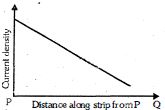
An electric current flows along an insulated strip $PQ$ of a metallic conductor. The current density in the strip varies as shown in the graph. Which one of the following statements could explain this variation?
A
The strip is narrower at $P$ than at $Q$.
B
The strip is narrower at $Q$ than at $P$.
C
The potential gradient along the strip is uniform.
D
The resistance per unit length of the strip is uniform.
Solution
(A) The current density $J$ is defined as $J = I/A$,where $I$ is the current and $A$ is the cross-sectional area.
Since the current $I$ flowing through the series conductor $PQ$ is constant,the current density $J$ is inversely proportional to the cross-sectional area $A$ $(J \propto 1/A)$.
From the graph,the current density is higher at $P$ and decreases towards $Q$.
This implies that the cross-sectional area $A$ must be smaller at $P$ and larger at $Q$.
Therefore,the strip is narrower at $P$ than at $Q$.
Since the current $I$ flowing through the series conductor $PQ$ is constant,the current density $J$ is inversely proportional to the cross-sectional area $A$ $(J \propto 1/A)$.
From the graph,the current density is higher at $P$ and decreases towards $Q$.
This implies that the cross-sectional area $A$ must be smaller at $P$ and larger at $Q$.
Therefore,the strip is narrower at $P$ than at $Q$.
0 likes
View Solution61
MediumMCQ
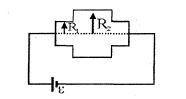
$A$ cylindrical resistor is connected across a battery $\varepsilon$. The cylinder has a uniform free electron density, and the middle part of the cylinder has a larger radius as shown in the figure. Which of the following graphs represents the variation of $V_d$ (drift velocity) with respect to $x$ (distance along the length of the resistor)?
A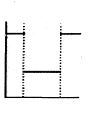
B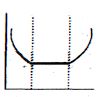
C
D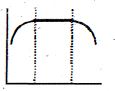
Solution
(B) The current $i$ flowing through the resistor is constant throughout its length because it is a series circuit.
The relationship between current $i$, current density $J$, and drift velocity $V_d$ is given by:
$i = J A$
$J = n e V_d$
Substituting $J$ into the current equation:
$i = (n e V_d) A$
Since $i$, $n$, and $e$ are constants, we have:
$A V_d = \text{constant}$
$V_d \propto \frac{1}{A}$
Since the area $A = \pi r^2$, where $r$ is the radius, we have $V_d \propto \frac{1}{r^2}$.
In the middle part of the cylinder, the radius $r$ is larger, so the area $A$ is larger.
Therefore, the drift velocity $V_d$ must be smaller in the middle part of the cylinder compared to the ends.
This corresponds to the graph where the value of $V_d$ decreases in the region with the larger radius. Graph $B$ shows this behavior.
The relationship between current $i$, current density $J$, and drift velocity $V_d$ is given by:
$i = J A$
$J = n e V_d$
Substituting $J$ into the current equation:
$i = (n e V_d) A$
Since $i$, $n$, and $e$ are constants, we have:
$A V_d = \text{constant}$
$V_d \propto \frac{1}{A}$
Since the area $A = \pi r^2$, where $r$ is the radius, we have $V_d \propto \frac{1}{r^2}$.
In the middle part of the cylinder, the radius $r$ is larger, so the area $A$ is larger.
Therefore, the drift velocity $V_d$ must be smaller in the middle part of the cylinder compared to the ends.
This corresponds to the graph where the value of $V_d$ decreases in the region with the larger radius. Graph $B$ shows this behavior.
0 likes
View Solution62
MediumMCQ
Assume a hypothetical wire in which free electron density changes with temperature in proportionality $n \propto T$,assuming $\tau$ (relaxation time of collision) and dimensions of the wire remain unchanged with increasing temperature. Which one of the resistance $v/s$ temperature graphs is true?
A
B
C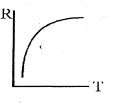
D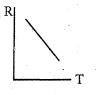
Solution
(A) The resistance $R$ of a wire is given by the formula $R = \frac{\rho l}{A} = \frac{m l}{n e^2 \tau A}$,where $m$ is the mass of an electron,$l$ is the length,$A$ is the cross-sectional area,$e$ is the charge of an electron,$n$ is the free electron density,and $\tau$ is the relaxation time.
Given that $l$,$A$,$m$,$e$,and $\tau$ are constant,the resistance $R$ is inversely proportional to the free electron density $n$,i.e.,$R \propto \frac{1}{n}$.
It is given that $n \propto T$,therefore $R \propto \frac{1}{T}$.
This relationship $R = \frac{k}{T}$ (where $k$ is a constant) represents a rectangular hyperbola,which corresponds to the graph shown in option $A$.
Given that $l$,$A$,$m$,$e$,and $\tau$ are constant,the resistance $R$ is inversely proportional to the free electron density $n$,i.e.,$R \propto \frac{1}{n}$.
It is given that $n \propto T$,therefore $R \propto \frac{1}{T}$.
This relationship $R = \frac{k}{T}$ (where $k$ is a constant) represents a rectangular hyperbola,which corresponds to the graph shown in option $A$.
0 likes
View Solution63
MediumMCQ
Three copper rods are subjected to different potential differences. Compare the drift speed of electrons through them. Assume that all $3$ are at the same temperature.
| Rod | Length,Diameter,Potential Difference |
| $(A)$ | $L, 3d, V$ |
| $(B)$ | $2L, d, 2V$ |
| $(C)$ | $3L, 2d, 2V$ |
A
$v_A = v_B > v_C$
B
$v_A > v_B > v_C$
C
$v_A < v_B < v_C$
D
None of these
Solution
$(A)$ The drift velocity $v_d$ is given by the formula $v_d = \frac{eE\tau}{m}$, where $E = \frac{V}{L}$.
Thus, $v_d = \frac{eV\tau}{mL}$.
Since all rods are made of copper and are at the same temperature, the relaxation time $\tau$ and the mass of electron $m$ are constant.
Therefore, $v_d \propto \frac{V}{L}$.
For rod $(A)$: $v_A \propto \frac{V}{L} = 1 \cdot (V/L)$.
For rod $(B)$: $v_B \propto \frac{2V}{2L} = 1 \cdot (V/L)$.
For rod $(C)$: $v_C \propto \frac{2V}{3L} = 0.67 \cdot (V/L)$.
Comparing the values, we get $v_A = v_B > v_C$.
Thus, $v_d = \frac{eV\tau}{mL}$.
Since all rods are made of copper and are at the same temperature, the relaxation time $\tau$ and the mass of electron $m$ are constant.
Therefore, $v_d \propto \frac{V}{L}$.
For rod $(A)$: $v_A \propto \frac{V}{L} = 1 \cdot (V/L)$.
For rod $(B)$: $v_B \propto \frac{2V}{2L} = 1 \cdot (V/L)$.
For rod $(C)$: $v_C \propto \frac{2V}{3L} = 0.67 \cdot (V/L)$.
Comparing the values, we get $v_A = v_B > v_C$.
0 likes
View Solution64
MediumMCQ
$A$ constant electric current $I$ is passed through a straight conductor of length $l$. If $S$ is the specific charge of an electron,then the total momentum of the electrons is:
A
$\frac{IS}{l}$
B
$\frac{Il}{S}$
C
$\frac{Sl}{I}$
D
$\frac{2Il}{S}$
Solution
(B) The current $I$ in a conductor is given by $I = neAv_d$,where $n$ is the number density of electrons,$e$ is the charge of an electron,$A$ is the cross-sectional area,and $v_d$ is the drift velocity.
The total number of electrons $N$ in a conductor of length $l$ is $N = nAl$.
The total momentum $P$ of the electrons is $P = Nmv_d$,where $m$ is the mass of an electron.
Substituting $N = nAl$,we get $P = (nAl)mv_d$.
From the current formula,$nAv_d = \frac{I}{e}$.
Substituting this into the momentum equation: $P = l \cdot (nAv_d) \cdot m = l \cdot \frac{I}{e} \cdot m$.
Since the specific charge $S$ is defined as the ratio of charge to mass,$S = \frac{e}{m}$,therefore $\frac{m}{e} = \frac{1}{S}$.
Thus,the total momentum $P = \frac{Il}{S}$.
The total number of electrons $N$ in a conductor of length $l$ is $N = nAl$.
The total momentum $P$ of the electrons is $P = Nmv_d$,where $m$ is the mass of an electron.
Substituting $N = nAl$,we get $P = (nAl)mv_d$.
From the current formula,$nAv_d = \frac{I}{e}$.
Substituting this into the momentum equation: $P = l \cdot (nAv_d) \cdot m = l \cdot \frac{I}{e} \cdot m$.
Since the specific charge $S$ is defined as the ratio of charge to mass,$S = \frac{e}{m}$,therefore $\frac{m}{e} = \frac{1}{S}$.
Thus,the total momentum $P = \frac{Il}{S}$.
0 likes
View Solution65
MediumMCQ
Two cylindrical rods of uniform cross-sectional area $A$ and $2A$,having free electrons per unit volume $2n$ and $n$ respectively,are joined in series. $A$ current $I$ flows through them in a steady state. Then the ratio of the drift velocity of free electrons in the left rod to the drift velocity of electrons in the right rod is $\left( \frac{v_L}{v_R} \right)$.
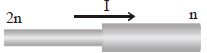
A
$1$
B
$2$
C
$3$
D
$4$
Solution
(A) The current $I$ flowing through a conductor is given by the formula $I = n_e e A v_d$,where $n_e$ is the number of free electrons per unit volume,$e$ is the charge of an electron,$A$ is the cross-sectional area,and $v_d$ is the drift velocity.
Since the two rods are connected in series,the same current $I$ flows through both of them.
For the left rod: $I = (2n) e A v_L$
For the right rod: $I = (n) e (2A) v_R$
Equating the two expressions for current:
$(2n) e A v_L = (n) e (2A) v_R$
$2 n e A v_L = 2 n e A v_R$
Dividing both sides by $2 n e A$,we get:
$v_L = v_R$
Therefore,the ratio $\frac{v_L}{v_R} = 1$.
Since the two rods are connected in series,the same current $I$ flows through both of them.
For the left rod: $I = (2n) e A v_L$
For the right rod: $I = (n) e (2A) v_R$
Equating the two expressions for current:
$(2n) e A v_L = (n) e (2A) v_R$
$2 n e A v_L = 2 n e A v_R$
Dividing both sides by $2 n e A$,we get:
$v_L = v_R$
Therefore,the ratio $\frac{v_L}{v_R} = 1$.
0 likes
View Solution66
MediumMCQ
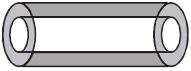
In the given hollow cylindrical conductor,the current density is $J = \frac{J_0}{r^2}$,where $J_0$ is a constant and $r$ is the distance from the axis of the cylinder. If the radius of the inner surface is $a$ and the radius of the outer surface is $2a$,find the current passed through the conductor.
A
$\pi J_0 \ln 2$
B
$2\pi J_0 \ln 2$
C
$2\pi J_0$
D
$2\pi J_0 \ln 3$
Solution
(B) The current $I$ passing through a cross-section is given by the integral of current density $J$ over the area $A$: $I = \int J \cdot dA$.
For a cylindrical shell of radius $r$ and thickness $dr$,the elemental area is $dA = 2\pi r \cdot dr$.
Substituting the given current density $J = \frac{J_0}{r^2}$ and the elemental area $dA$ into the integral,we get:
$I = \int_{a}^{2a} \left( \frac{J_0}{r^2} \right) (2\pi r \cdot dr)$
$I = 2\pi J_0 \int_{a}^{2a} \frac{1}{r} \cdot dr$
$I = 2\pi J_0 [\ln r]_{a}^{2a}$
$I = 2\pi J_0 (\ln(2a) - \ln(a))$
$I = 2\pi J_0 \ln\left( \frac{2a}{a} \right)$
$I = 2\pi J_0 \ln 2$.
For a cylindrical shell of radius $r$ and thickness $dr$,the elemental area is $dA = 2\pi r \cdot dr$.
Substituting the given current density $J = \frac{J_0}{r^2}$ and the elemental area $dA$ into the integral,we get:
$I = \int_{a}^{2a} \left( \frac{J_0}{r^2} \right) (2\pi r \cdot dr)$
$I = 2\pi J_0 \int_{a}^{2a} \frac{1}{r} \cdot dr$
$I = 2\pi J_0 [\ln r]_{a}^{2a}$
$I = 2\pi J_0 (\ln(2a) - \ln(a))$
$I = 2\pi J_0 \ln\left( \frac{2a}{a} \right)$
$I = 2\pi J_0 \ln 2$.
0 likes
View Solution67
MediumMCQ
$A$ copper wire of diameter $1.02\, mm$ carries a current of $1.7\, A$. Find the drift velocity $(v_d)$ of electrons in the wire. Given $n$,the number density of electrons in copper $= 8.5 \times 10^{28} /m^3$. (Express the answer in $mm/s$)
A
$1.75$
B
$1.25$
C
$0.15$
D
$1.5$
Solution
(C) The formula for current is $I = n e A v_d$,where $I$ is the current,$n$ is the number density,$e$ is the elementary charge,$A$ is the cross-sectional area,and $v_d$ is the drift velocity.
Given: $I = 1.7\, A$,$d = 1.02\, mm \implies r = 0.51 \times 10^{-3}\, m$,$n = 8.5 \times 10^{28}\, m^{-3}$,$e = 1.6 \times 10^{-19}\, C$.
The area $A = \pi r^2 = \pi \times (0.51 \times 10^{-3})^2 \approx 8.17 \times 10^{-7}\, m^2$.
Rearranging for $v_d$: $v_d = \frac{I}{n e A}$.
Substituting the values: $v_d = \frac{1.7}{(8.5 \times 10^{28}) \times (1.6 \times 10^{-19}) \times (\pi \times (0.51 \times 10^{-3})^2)}$.
$v_d = \frac{1.7}{8.5 \times 1.6 \times \pi \times 0.2601 \times 10^{-7}} \approx \frac{1.7}{11.12} \times 10^{-3} \approx 0.15 \times 10^{-3}\, m/s$.
Thus,$v_d = 0.15\, mm/s$.
Given: $I = 1.7\, A$,$d = 1.02\, mm \implies r = 0.51 \times 10^{-3}\, m$,$n = 8.5 \times 10^{28}\, m^{-3}$,$e = 1.6 \times 10^{-19}\, C$.
The area $A = \pi r^2 = \pi \times (0.51 \times 10^{-3})^2 \approx 8.17 \times 10^{-7}\, m^2$.
Rearranging for $v_d$: $v_d = \frac{I}{n e A}$.
Substituting the values: $v_d = \frac{1.7}{(8.5 \times 10^{28}) \times (1.6 \times 10^{-19}) \times (\pi \times (0.51 \times 10^{-3})^2)}$.
$v_d = \frac{1.7}{8.5 \times 1.6 \times \pi \times 0.2601 \times 10^{-7}} \approx \frac{1.7}{11.12} \times 10^{-3} \approx 0.15 \times 10^{-3}\, m/s$.
Thus,$v_d = 0.15\, mm/s$.
0 likes
View Solution68
MediumMCQ
The relaxation time in conductors
A
Increases with the increase of temperature
B
Decreases with the increase of temperature
C
It does not depend on temperature
D
All of sudden changes at $400 \ K$
Solution
(B) In conductors,as the temperature increases,the thermal velocity of free electrons increases.
This leads to more frequent collisions between electrons and the lattice ions.
Consequently,the average time between two successive collisions,known as the relaxation time $(\tau)$,decreases.
Since resistivity $(\rho)$ is inversely proportional to the relaxation time $(\rho = \frac{m}{ne^2\tau})$,an increase in temperature causes the relaxation time to decrease.
This leads to more frequent collisions between electrons and the lattice ions.
Consequently,the average time between two successive collisions,known as the relaxation time $(\tau)$,decreases.
Since resistivity $(\rho)$ is inversely proportional to the relaxation time $(\rho = \frac{m}{ne^2\tau})$,an increase in temperature causes the relaxation time to decrease.
0 likes
View Solution69
MediumMCQ
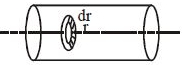
For a cylinder of radius $R$,the current density is given by $J = J_0 \frac{r}{R}$,where $J_0$ is a constant and $r$ is the distance from the axis. Calculate the total current.
A
$\frac{2J_0A}{3}$
B
$\frac{4J_0A}{3}$
C
$\frac{5J_0A}{3}$
D
$\frac{7J_0A}{4}$
Solution
(A) The current $dI$ through a thin cylindrical shell of radius $r$ and thickness $dr$ is given by $dI = J \cdot dA$,where $dA = 2 \pi r dr$.
Substituting the given current density $J = J_0 \frac{r}{R}$:
$dI = (J_0 \frac{r}{R}) \cdot (2 \pi r dr) = \frac{2 \pi J_0}{R} r^2 dr$.
To find the total current $I$,we integrate from $r = 0$ to $r = R$:
$I = \int_{0}^{R} \frac{2 \pi J_0}{R} r^2 dr = \frac{2 \pi J_0}{R} \int_{0}^{R} r^2 dr$.
$I = \frac{2 \pi J_0}{R} \left[ \frac{r^3}{3} \right]_{0}^{R} = \frac{2 \pi J_0}{R} \cdot \frac{R^3}{3} = \frac{2}{3} J_0 (\pi R^2)$.
Since the cross-sectional area $A = \pi R^2$,the total current is $I = \frac{2}{3} J_0 A$.
Substituting the given current density $J = J_0 \frac{r}{R}$:
$dI = (J_0 \frac{r}{R}) \cdot (2 \pi r dr) = \frac{2 \pi J_0}{R} r^2 dr$.
To find the total current $I$,we integrate from $r = 0$ to $r = R$:
$I = \int_{0}^{R} \frac{2 \pi J_0}{R} r^2 dr = \frac{2 \pi J_0}{R} \int_{0}^{R} r^2 dr$.
$I = \frac{2 \pi J_0}{R} \left[ \frac{r^3}{3} \right]_{0}^{R} = \frac{2 \pi J_0}{R} \cdot \frac{R^3}{3} = \frac{2}{3} J_0 (\pi R^2)$.
Since the cross-sectional area $A = \pi R^2$,the total current is $I = \frac{2}{3} J_0 A$.
0 likes
View Solution70
MediumMCQ
$A$ potential difference is applied across the ends of a metallic wire. If the potential difference is doubled,then the drift velocity
A
will be doubled
B
will be halved
C
will be quadrupled
D
will remain unchanged
Solution
(A) The drift velocity $V_{d}$ of electrons in a conductor is given by the formula: $V_{d} = \frac{eE\tau}{m}$.
Since the electric field $E$ is related to the potential difference $V$ across a wire of length $L$ by $E = \frac{V}{L}$,we can substitute this into the equation:
$V_{d} = \frac{e}{m} \left( \frac{V}{L} \right) \tau$.
From this expression,it is clear that $V_{d} \propto V$.
Therefore,if the potential difference $V$ is doubled,the drift velocity $V_{d}$ will also be doubled.
Since the electric field $E$ is related to the potential difference $V$ across a wire of length $L$ by $E = \frac{V}{L}$,we can substitute this into the equation:
$V_{d} = \frac{e}{m} \left( \frac{V}{L} \right) \tau$.
From this expression,it is clear that $V_{d} \propto V$.
Therefore,if the potential difference $V$ is doubled,the drift velocity $V_{d}$ will also be doubled.
0 likes
View Solution71
EasyMCQ
There are $0.8 \times 10^{23}$ free electrons $/ cm^3$ in copper. If a $0.2 \, A$ current is flowing in a copper wire, then the drift velocity of electrons will be, given the cross-sectional area of the wire is $0.01 \, cm^2$.
A
$1.56 \times 10^{-5} \, m/s$
B
$1.56 \times 10^{5} \, m/s$
C
$10^8 \, m/s$
D
$10^7 \, m/s$
Solution
(A) The formula for drift velocity is $I = neAv_d$, where $I$ is the current, $n$ is the number density of electrons, $e$ is the elementary charge, $A$ is the cross-sectional area, and $v_d$ is the drift velocity.
Given values:
$I = 0.2 \, A$
$n = 0.8 \times 10^{23} \, \text{electrons}/cm^3 = 0.8 \times 10^{29} \, \text{electrons}/m^3$
$e = 1.6 \times 10^{-19} \, C$
$A = 0.01 \, cm^2 = 10^{-6} \, m^2$
Rearranging for $v_d$:
$v_d = \frac{I}{neA}$
$v_d = \frac{0.2}{(0.8 \times 10^{29}) \times (1.6 \times 10^{-19}) \times (10^{-6})}$
$v_d = \frac{0.2}{1.28 \times 10^4}$
$v_d = 0.156 \times 10^{-4} \, m/s = 1.56 \times 10^{-5} \, m/s$.
Given values:
$I = 0.2 \, A$
$n = 0.8 \times 10^{23} \, \text{electrons}/cm^3 = 0.8 \times 10^{29} \, \text{electrons}/m^3$
$e = 1.6 \times 10^{-19} \, C$
$A = 0.01 \, cm^2 = 10^{-6} \, m^2$
Rearranging for $v_d$:
$v_d = \frac{I}{neA}$
$v_d = \frac{0.2}{(0.8 \times 10^{29}) \times (1.6 \times 10^{-19}) \times (10^{-6})}$
$v_d = \frac{0.2}{1.28 \times 10^4}$
$v_d = 0.156 \times 10^{-4} \, m/s = 1.56 \times 10^{-5} \, m/s$.
0 likes
View Solution72
EasyMCQ
$A$ wire of non-uniform cross-section is carrying a steady current. Along the wire,
A
Current and current density are constant
B
Only current is constant
C
Only current density is constant
D
Neither current nor current density is constant
Solution
(B) For a steady current flowing through a conductor,the current $I$ remains constant throughout the wire regardless of the cross-sectional area,due to the principle of conservation of charge.
The current density $J$ is defined as $J = I / A$,where $A$ is the cross-sectional area.
Since the wire has a non-uniform cross-section,$A$ varies along the length of the wire.
Therefore,because $I$ is constant and $A$ varies,the current density $J$ must also vary along the wire.
Thus,only the current is constant.
The current density $J$ is defined as $J = I / A$,where $A$ is the cross-sectional area.
Since the wire has a non-uniform cross-section,$A$ varies along the length of the wire.
Therefore,because $I$ is constant and $A$ varies,the current density $J$ must also vary along the wire.
Thus,only the current is constant.
0 likes
View Solution73
MediumMCQ
Drift speed of electrons,when $1.5 \, A$ of current flows in a copper wire of cross-section $5 \, mm^2$,is $v$. If the electron density in copper is $9 \times 10^{28} \, m^{-3}$,the value of $v$ in $mm/s$ is close to (Take charge of electron to be $1.6 \times 10^{-19} \, C$).
A
$0.02$
B
$3$
C
$2$
D
$0.2$
Solution
(A) The relationship between current $I$ and drift velocity $v_d$ is given by the formula: $I = n e A v_d$.
Here,$I = 1.5 \, A$,$n = 9 \times 10^{28} \, m^{-3}$,$e = 1.6 \times 10^{-19} \, C$,and $A = 5 \, mm^2 = 5 \times 10^{-6} \, m^2$.
Substituting the values into the formula:
$1.5 = (9 \times 10^{28}) \times (1.6 \times 10^{-19}) \times (5 \times 10^{-6}) \times v_d$.
$1.5 = (9 \times 1.6 \times 5) \times 10^{28-19-6} \times v_d$.
$1.5 = 72 \times 10^3 \times v_d$.
$v_d = \frac{1.5}{72 \times 10^3} = \frac{1.5}{72} \times 10^{-3} \, m/s$.
$v_d \approx 0.0208 \times 10^{-3} \, m/s = 0.0208 \, mm/s$.
Thus,the value of $v$ is close to $0.02 \, mm/s$.
Here,$I = 1.5 \, A$,$n = 9 \times 10^{28} \, m^{-3}$,$e = 1.6 \times 10^{-19} \, C$,and $A = 5 \, mm^2 = 5 \times 10^{-6} \, m^2$.
Substituting the values into the formula:
$1.5 = (9 \times 10^{28}) \times (1.6 \times 10^{-19}) \times (5 \times 10^{-6}) \times v_d$.
$1.5 = (9 \times 1.6 \times 5) \times 10^{28-19-6} \times v_d$.
$1.5 = 72 \times 10^3 \times v_d$.
$v_d = \frac{1.5}{72 \times 10^3} = \frac{1.5}{72} \times 10^{-3} \, m/s$.
$v_d \approx 0.0208 \times 10^{-3} \, m/s = 0.0208 \, mm/s$.
Thus,the value of $v$ is close to $0.02 \, mm/s$.
0 likes
View Solution74
MediumMCQ
In a conductor,if the number of conduction electrons per unit volume is $8.5 \times 10^{28} \ m^{-3}$ and the mean free time is $25 \ fs$ (femtosecond),what is its approximate resistivity? (Given: $m_e = 9.1 \times 10^{-31} \ kg$,$e = 1.6 \times 10^{-19} \ C$)
A
$10^{-5} \ \Omega m$
B
$10^{-6} \ \Omega m$
C
$10^{-7} \ \Omega m$
D
$10^{-8} \ \Omega m$
Solution
(D) The resistivity $\rho$ of a conductor is given by the formula: $\rho = \frac{m_e}{n e^2 \tau}$.
Given values:
$n = 8.5 \times 10^{28} \ m^{-3}$
$\tau = 25 \ fs = 25 \times 10^{-15} \ s$
$m_e = 9.1 \times 10^{-31} \ kg$
$e = 1.6 \times 10^{-19} \ C$
Substituting these values into the formula:
$\rho = \frac{9.1 \times 10^{-31}}{(8.5 \times 10^{28}) \times (1.6 \times 10^{-19})^2 \times (25 \times 10^{-15})}$
$\rho = \frac{9.1 \times 10^{-31}}{8.5 \times 10^{28} \times 2.56 \times 10^{-38} \times 25 \times 10^{-15}}$
$\rho = \frac{9.1 \times 10^{-31}}{544 \times 10^{-25}}$
$\rho \approx 0.0167 \times 10^{-6} \ \Omega m \approx 1.67 \times 10^{-8} \ \Omega m$.
Comparing this with the given options,the approximate value is $10^{-8} \ \Omega m$.
Given values:
$n = 8.5 \times 10^{28} \ m^{-3}$
$\tau = 25 \ fs = 25 \times 10^{-15} \ s$
$m_e = 9.1 \times 10^{-31} \ kg$
$e = 1.6 \times 10^{-19} \ C$
Substituting these values into the formula:
$\rho = \frac{9.1 \times 10^{-31}}{(8.5 \times 10^{28}) \times (1.6 \times 10^{-19})^2 \times (25 \times 10^{-15})}$
$\rho = \frac{9.1 \times 10^{-31}}{8.5 \times 10^{28} \times 2.56 \times 10^{-38} \times 25 \times 10^{-15}}$
$\rho = \frac{9.1 \times 10^{-31}}{544 \times 10^{-25}}$
$\rho \approx 0.0167 \times 10^{-6} \ \Omega m \approx 1.67 \times 10^{-8} \ \Omega m$.
Comparing this with the given options,the approximate value is $10^{-8} \ \Omega m$.
0 likes
View Solution75
MediumMCQ
$A$ current of $5\, A$ passes through a copper conductor (resistivity $= 1.7 \times 10^{-8}\, \Omega \, m$) of radius of cross-section $5\, mm$. Find the mobility of the charges if their drift velocity is $1.1 \times 10^{-3}\, m/s$.
A
$1.8$
B
$1.0$
C
$1.3$
D
$1.5$
Solution
(B) The mobility $\mu$ is defined as the ratio of drift velocity $V_d$ to the electric field $E$: $\mu = \frac{V_d}{E}$.
From Ohm's law in vector form,$E = \rho J$,where $\rho$ is resistivity and $J$ is current density.
Current density $J = \frac{I}{A} = \frac{I}{\pi r^2}$.
Given: $I = 5\, A$,$\rho = 1.7 \times 10^{-8}\, \Omega \, m$,$r = 5\, mm = 5 \times 10^{-3}\, m$,and $V_d = 1.1 \times 10^{-3}\, m/s$.
First,calculate the electric field $E$:
$E = \rho \times \frac{I}{\pi r^2} = 1.7 \times 10^{-8} \times \frac{5}{\pi \times (5 \times 10^{-3})^2} = 1.7 \times 10^{-8} \times \frac{5}{\pi \times 25 \times 10^{-6}} = \frac{1.7 \times 10^{-8} \times 5}{78.54 \times 10^{-6}} \approx 1.08 \times 10^{-3}\, V/m$.
Now,calculate mobility $\mu$:
$\mu = \frac{1.1 \times 10^{-3}}{1.08 \times 10^{-3}} \approx 1.01\, m^2/Vs$.
Rounding to the nearest given option,the correct value is $1.0\, m^2/Vs$.
From Ohm's law in vector form,$E = \rho J$,where $\rho$ is resistivity and $J$ is current density.
Current density $J = \frac{I}{A} = \frac{I}{\pi r^2}$.
Given: $I = 5\, A$,$\rho = 1.7 \times 10^{-8}\, \Omega \, m$,$r = 5\, mm = 5 \times 10^{-3}\, m$,and $V_d = 1.1 \times 10^{-3}\, m/s$.
First,calculate the electric field $E$:
$E = \rho \times \frac{I}{\pi r^2} = 1.7 \times 10^{-8} \times \frac{5}{\pi \times (5 \times 10^{-3})^2} = 1.7 \times 10^{-8} \times \frac{5}{\pi \times 25 \times 10^{-6}} = \frac{1.7 \times 10^{-8} \times 5}{78.54 \times 10^{-6}} \approx 1.08 \times 10^{-3}\, V/m$.
Now,calculate mobility $\mu$:
$\mu = \frac{1.1 \times 10^{-3}}{1.08 \times 10^{-3}} \approx 1.01\, m^2/Vs$.
Rounding to the nearest given option,the correct value is $1.0\, m^2/Vs$.
0 likes
View Solution76
MediumMCQ
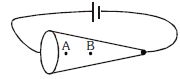
Suppose a current-carrying wire has a cross-sectional area that gradually becomes smaller along the wire,having the shape of a very long cone as shown in the figure. Choose the correct statement.
A
Electric current is different in different portions of the wire.
B
Electric field at point $A$ is the same as that of point $B$.
C
Drift speed of electrons at point $A$ is lesser than that at point $B$.
D
Drift speed of electrons at point $A$ is the same as that at point $B$.
Solution
(C) The current $I$ flowing through any cross-section of a conductor in a steady state is constant,so $I$ is the same at all points.
Using the relation $I = neA V_d$,where $n$ is the number density of electrons,$e$ is the charge of an electron,$A$ is the cross-sectional area,and $V_d$ is the drift speed.
Since $I$,$n$,and $e$ are constant,we have $V_d \propto \frac{1}{A}$.
As the cross-sectional area $A$ decreases along the wire from $A$ to $B$,the drift speed $V_d$ must increase.
Therefore,the drift speed at point $A$ is less than the drift speed at point $B$,i.e.,$(V_d)_A < (V_d)_B$.
Using the relation $I = neA V_d$,where $n$ is the number density of electrons,$e$ is the charge of an electron,$A$ is the cross-sectional area,and $V_d$ is the drift speed.
Since $I$,$n$,and $e$ are constant,we have $V_d \propto \frac{1}{A}$.
As the cross-sectional area $A$ decreases along the wire from $A$ to $B$,the drift speed $V_d$ must increase.
Therefore,the drift speed at point $A$ is less than the drift speed at point $B$,i.e.,$(V_d)_A < (V_d)_B$.
0 likes
View Solution77
EasyMCQ
For which of the following dependencies of drift velocity $v_d$ on electric field $E$ is Ohm's law obeyed?
A
$v_d \propto E$
B
$v_d = \text{constant}$
C
$v_d \propto E^{1/2}$
D
$v_d \propto E^2$
Solution
(A) Ohm's law states that the current $I$ flowing through a conductor is directly proportional to the potential difference $V$ applied across its ends,provided the physical conditions remain constant. This implies that the current density $J$ is directly proportional to the electric field $E$ $(J = \sigma E)$.
Since the current density is given by $J = n e v_d$,where $n$ is the number density of electrons,$e$ is the charge of an electron,and $v_d$ is the drift velocity,we have $n e v_d = \sigma E$.
This implies $v_d \propto E$.
Therefore,Ohm's law is obeyed when the drift velocity is directly proportional to the electric field.
Since the current density is given by $J = n e v_d$,where $n$ is the number density of electrons,$e$ is the charge of an electron,and $v_d$ is the drift velocity,we have $n e v_d = \sigma E$.
This implies $v_d \propto E$.
Therefore,Ohm's law is obeyed when the drift velocity is directly proportional to the electric field.
0 likes
View Solution78
EasyMCQ
$A$ current $I$ flows through a uniform wire of diameter $d$,when the mean drift velocity is $v_d$. The same current will flow through a wire of diameter $d/2$ made of the same material,if the mean drift velocity of the electrons is
A
$v_d/4$
B
$v_d/2$
C
$4v_d$
D
$2v_d$
Solution
(C) The relationship between current $I$ and drift velocity $v_d$ is given by $I = neAv_d$,where $n$ is the electron density,$e$ is the charge of an electron,and $A$ is the cross-sectional area.
Since the material is the same,$n$ and $e$ remain constant. Thus,$I \propto A v_d$.
The cross-sectional area $A$ is given by $A = \pi (d/2)^2 = \pi d^2 / 4$,so $A \propto d^2$.
Therefore,$I \propto d^2 v_d$.
Since the current $I$ is the same in both cases,we have $d_1^2 v_{d1} = d_2^2 v_{d2}$.
Given $d_1 = d$,$v_{d1} = v_d$,and $d_2 = d/2$,we substitute these values:
$d^2 v_d = (d/2)^2 v_{d2}$
$d^2 v_d = (d^2 / 4) v_{d2}$
$v_{d2} = 4v_d$.
Since the material is the same,$n$ and $e$ remain constant. Thus,$I \propto A v_d$.
The cross-sectional area $A$ is given by $A = \pi (d/2)^2 = \pi d^2 / 4$,so $A \propto d^2$.
Therefore,$I \propto d^2 v_d$.
Since the current $I$ is the same in both cases,we have $d_1^2 v_{d1} = d_2^2 v_{d2}$.
Given $d_1 = d$,$v_{d1} = v_d$,and $d_2 = d/2$,we substitute these values:
$d^2 v_d = (d/2)^2 v_{d2}$
$d^2 v_d = (d^2 / 4) v_{d2}$
$v_{d2} = 4v_d$.
0 likes
View Solution79
MediumMCQ
The total momentum of electrons in a straight wire of copper of length $1\, m$ carrying a current of $16\, A$ is
A
$91 \times 10^{-12}\, kg\, m/s$
B
$91 \times 10^{-15}\, kg\, m/s$
C
$91 \times 10^{-14}\, kg\, m/s$
D
$91 \times 10^{-6}\, kg\, m/s$
Solution
(A) The current $i$ is given by $i = neAv_d$,where $n$ is the number density of electrons,$e$ is the charge of an electron,$A$ is the cross-sectional area,and $v_d$ is the drift velocity.
The total number of electrons $N$ in a wire of length $L$ is $N = nAL$.
Thus,$nA = N/L$.
Substituting this into the current equation: $i = (N/L)ev_d$,which implies $Nv_d = iL/e$.
The total momentum $P$ of all electrons is $P = Nmv_d$,where $m$ is the mass of an electron $(m \approx 9.1 \times 10^{-31}\, kg)$.
Substituting $Nv_d = iL/e$ into the momentum equation: $P = m(iL/e) = (m/e) \times iL$.
Given $m = 9.1 \times 10^{-31}\, kg$,$e = 1.6 \times 10^{-19}\, C$,$i = 16\, A$,and $L = 1\, m$:
$P = (9.1 \times 10^{-31} / 1.6 \times 10^{-19}) \times 16 \times 1$
$P = (9.1 / 1.6) \times 10^{-12} \times 16$
$P = 9.1 \times 10^{-12} \times 10 = 91 \times 10^{-12}\, kg\, m/s$.
The total number of electrons $N$ in a wire of length $L$ is $N = nAL$.
Thus,$nA = N/L$.
Substituting this into the current equation: $i = (N/L)ev_d$,which implies $Nv_d = iL/e$.
The total momentum $P$ of all electrons is $P = Nmv_d$,where $m$ is the mass of an electron $(m \approx 9.1 \times 10^{-31}\, kg)$.
Substituting $Nv_d = iL/e$ into the momentum equation: $P = m(iL/e) = (m/e) \times iL$.
Given $m = 9.1 \times 10^{-31}\, kg$,$e = 1.6 \times 10^{-19}\, C$,$i = 16\, A$,and $L = 1\, m$:
$P = (9.1 \times 10^{-31} / 1.6 \times 10^{-19}) \times 16 \times 1$
$P = (9.1 / 1.6) \times 10^{-12} \times 16$
$P = 9.1 \times 10^{-12} \times 10 = 91 \times 10^{-12}\, kg\, m/s$.
0 likes
View Solution80
EasyMCQ
Consider a wire carrying a current of $10\,A$ with a cross-sectional area of $1\,cm^2$. If the number of electrons per unit volume is $9 \times 10^{28}\,m^{-3}$,find the drift velocity of the electrons.
A
$6.94 \times 10^{-6}\,m/s$
B
$6.94 \times 10^{-4}\,m/s$
C
$5.94 \times 10^{-2}\,m/s$
D
$2.94 \times 10^{-4}\,m/s$
Solution
(A) The relation between current $I$ and drift velocity $v_d$ is given by the formula:
$I = n e A v_d$
Where:
$I = 10\,A$ (current)
$n = 9 \times 10^{28}\,m^{-3}$ (number density of electrons)
$e = 1.6 \times 10^{-19}\,C$ (charge of an electron)
$A = 1\,cm^2 = 1 \times 10^{-4}\,m^2$ (cross-sectional area)
Rearranging for drift velocity $v_d$:
$v_d = \frac{I}{n e A}$
Substituting the values:
$v_d = \frac{10}{(9 \times 10^{28}) \times (1.6 \times 10^{-19}) \times (1 \times 10^{-4})}$
$v_d = \frac{10}{9 \times 1.6 \times 10^{28-19-4}}$
$v_d = \frac{10}{14.4 \times 10^5}$
$v_d = \frac{10}{1.44 \times 10^6} \approx 6.94 \times 10^{-6}\,m/s$
$I = n e A v_d$
Where:
$I = 10\,A$ (current)
$n = 9 \times 10^{28}\,m^{-3}$ (number density of electrons)
$e = 1.6 \times 10^{-19}\,C$ (charge of an electron)
$A = 1\,cm^2 = 1 \times 10^{-4}\,m^2$ (cross-sectional area)
Rearranging for drift velocity $v_d$:
$v_d = \frac{I}{n e A}$
Substituting the values:
$v_d = \frac{10}{(9 \times 10^{28}) \times (1.6 \times 10^{-19}) \times (1 \times 10^{-4})}$
$v_d = \frac{10}{9 \times 1.6 \times 10^{28-19-4}}$
$v_d = \frac{10}{14.4 \times 10^5}$
$v_d = \frac{10}{1.44 \times 10^6} \approx 6.94 \times 10^{-6}\,m/s$
0 likes
View Solution81
MediumMCQ
Drift velocity $V_d$ varies with the intensity of electric field $E$ as per the relation:
A
$V_d \propto E$
B
$V_d \propto \frac{1}{E}$
C
$V_d \propto \text{constant}$
D
$V_d \propto E^2$
Solution
(A) The current $I$ in a conductor is given by $I = n e A v_d$,where $n$ is the number density of electrons,$e$ is the charge of an electron,$A$ is the cross-sectional area,and $v_d$ is the drift velocity.
The current density $J$ is defined as $J = \frac{I}{A} = n e v_d$.
According to Ohm's law in microscopic form,the current density $J$ is related to the electric field $E$ by the relation $J = \sigma E$,where $\sigma$ is the electrical conductivity.
Equating the two expressions for $J$,we get $n e v_d = \sigma E$.
Since $n$,$e$,and $\sigma$ are constants for a given material at a constant temperature,it follows that $v_d \propto E$.
The current density $J$ is defined as $J = \frac{I}{A} = n e v_d$.
According to Ohm's law in microscopic form,the current density $J$ is related to the electric field $E$ by the relation $J = \sigma E$,where $\sigma$ is the electrical conductivity.
Equating the two expressions for $J$,we get $n e v_d = \sigma E$.
Since $n$,$e$,and $\sigma$ are constants for a given material at a constant temperature,it follows that $v_d \propto E$.
0 likes
View Solution82
EasyMCQ
When current flows through a conductor,the order of magnitude of the drift velocity of electrons is
A
$10^{10} \ m/s$
B
$10^{-2} \ cm/s$
C
$10^{-4} \ m/s$
D
$10^{-1} \ cm/s$
Solution
(C) The drift velocity $(v_d)$ of electrons in a typical metallic conductor carrying a steady current is approximately $10^{-4} \ m/s$.
This value is extremely small compared to the random thermal velocity of electrons,which is of the order of $10^5 \ m/s$ at room temperature.
Therefore,the correct order of magnitude for drift velocity is $10^{-4} \ m/s$.
This value is extremely small compared to the random thermal velocity of electrons,which is of the order of $10^5 \ m/s$ at room temperature.
Therefore,the correct order of magnitude for drift velocity is $10^{-4} \ m/s$.
0 likes
View Solution83
MediumMCQ
In a copper wire,each atom releases one free electron. If the diameter is $1\, mm$ and the current is $1.1\, A$,find the drift velocity. (Given: Density $\rho = 9 \times 10^{3}\, kg/m^3$,Molar mass $M = 63\, g/mol$,Avogadro number $N_A = 6.023 \times 10^{23}\, mol^{-1}$,Elementary charge $e = 1.6 \times 10^{-19}\, C$)
A
$0.33\, mm/s$
B
$0.1\, mm/s$
C
$0.2\, mm/s$
D
$0.2\, cm/s$
Solution
(B) Given: Current $I = 1.1\, A$,Diameter $d = 1\, mm = 10^{-3}\, m$,Density $\rho = 9 \times 10^{3}\, kg/m^3$,Molar mass $M = 63 \times 10^{-3}\, kg/mol$.
The number of atoms per unit volume $n$ is given by $n = \frac{\rho N_A}{M}$.
Substituting the values: $n = \frac{9 \times 10^{3} \times 6.023 \times 10^{23}}{63 \times 10^{-3}} \approx 8.6 \times 10^{28}\, m^{-3}$.
Since each atom releases one free electron,the electron density $n_e = n = 8.6 \times 10^{28}\, m^{-3}$.
The cross-sectional area $A = \frac{\pi d^2}{4} = \frac{3.14 \times (10^{-3})^2}{4} = 7.85 \times 10^{-7}\, m^2$.
The drift velocity $v_d$ is given by $v_d = \frac{I}{n_e A e}$.
Substituting the values: $v_d = \frac{1.1}{(8.6 \times 10^{28}) \times (7.85 \times 10^{-7}) \times (1.6 \times 10^{-19})}$.
$v_d = \frac{1.1}{1.08 \times 10^{4}} \approx 1.018 \times 10^{-4}\, m/s = 0.1018\, mm/s \approx 0.1\, mm/s$.
The number of atoms per unit volume $n$ is given by $n = \frac{\rho N_A}{M}$.
Substituting the values: $n = \frac{9 \times 10^{3} \times 6.023 \times 10^{23}}{63 \times 10^{-3}} \approx 8.6 \times 10^{28}\, m^{-3}$.
Since each atom releases one free electron,the electron density $n_e = n = 8.6 \times 10^{28}\, m^{-3}$.
The cross-sectional area $A = \frac{\pi d^2}{4} = \frac{3.14 \times (10^{-3})^2}{4} = 7.85 \times 10^{-7}\, m^2$.
The drift velocity $v_d$ is given by $v_d = \frac{I}{n_e A e}$.
Substituting the values: $v_d = \frac{1.1}{(8.6 \times 10^{28}) \times (7.85 \times 10^{-7}) \times (1.6 \times 10^{-19})}$.
$v_d = \frac{1.1}{1.08 \times 10^{4}} \approx 1.018 \times 10^{-4}\, m/s = 0.1018\, mm/s \approx 0.1\, mm/s$.
0 likes
View Solution84
EasyMCQ
$A$ current of $1.6\, A$ is flowing through a wire having a cross-sectional area of $1\, mm^2$. If the density of free electrons in the material of the wire is $10^{29}\, m^{-3}$,the drift velocity of the electrons will be:
A
$10^{-4}\, m/s$
B
$10^{-3}\, m/s$
C
$10^{-2}\, m/s$
D
$0.1\, m/s$
Solution
(A) The relationship between current $i$ and drift velocity $V_d$ is given by the formula: $i = neAV_d$,where $n$ is the electron density,$e$ is the elementary charge $(1.6 \times 10^{-19}\, C)$,and $A$ is the cross-sectional area.
Given:
$i = 1.6\, A$
$n = 10^{29}\, m^{-3}$
$A = 1\, mm^2 = 10^{-6}\, m^2$
$e = 1.6 \times 10^{-19}\, C$
Rearranging for $V_d$:
$V_d = \frac{i}{neA}$
Substituting the values:
$V_d = \frac{1.6}{10^{29} \times 1.6 \times 10^{-19} \times 10^{-6}}$
$V_d = \frac{1.6}{1.6 \times 10^{29-19-6}}$
$V_d = \frac{1}{10^4} = 10^{-4}\, m/s$.
Given:
$i = 1.6\, A$
$n = 10^{29}\, m^{-3}$
$A = 1\, mm^2 = 10^{-6}\, m^2$
$e = 1.6 \times 10^{-19}\, C$
Rearranging for $V_d$:
$V_d = \frac{i}{neA}$
Substituting the values:
$V_d = \frac{1.6}{10^{29} \times 1.6 \times 10^{-19} \times 10^{-6}}$
$V_d = \frac{1.6}{1.6 \times 10^{29-19-6}}$
$V_d = \frac{1}{10^4} = 10^{-4}\, m/s$.
0 likes
View Solution85
DifficultMCQ
$A$ current flows in a wire of circular cross-section with the free electrons travelling with a mean drift velocity $\vec v$. If an equal current flows in a wire of twice the radius,the new mean drift velocity is:
A
$\vec v$
B
$\vec v/2$
C
$\vec v/4$
D
none of these
Solution
(C) The current $I$ in a conductor is given by the relation $I = neAv_d$,where $n$ is the number density of electrons,$e$ is the charge of an electron,$A$ is the cross-sectional area,and $v_d$ is the drift velocity.
Since $A = \pi r^2$,the expression becomes $I = ne(\pi r^2)v_d$.
Given that the current $I$ remains constant,we have $v_d \propto \frac{1}{r^2}$.
If the radius is doubled $(r' = 2r)$,the new drift velocity $v_d'$ is:
$v_d' = v_d \times \left(\frac{r}{r'}\right)^2 = v_d \times \left(\frac{r}{2r}\right)^2 = \frac{v_d}{4}$.
Thus,the new drift velocity is $\vec v/4$.
Since $A = \pi r^2$,the expression becomes $I = ne(\pi r^2)v_d$.
Given that the current $I$ remains constant,we have $v_d \propto \frac{1}{r^2}$.
If the radius is doubled $(r' = 2r)$,the new drift velocity $v_d'$ is:
$v_d' = v_d \times \left(\frac{r}{r'}\right)^2 = v_d \times \left(\frac{r}{2r}\right)^2 = \frac{v_d}{4}$.
Thus,the new drift velocity is $\vec v/4$.
0 likes
View Solution86
EasyMCQ
Assertion : The electric bulb glows immediately when the switch is on.
Reason : The drift velocity of electrons in a metallic wire is very high.
Reason : The drift velocity of electrons in a metallic wire is very high.
A
If both Assertion and Reason are correct and Reason is the correct explanation of Assertion.
B
If both Assertion and Reason are correct,but Reason is not the correct explanation of Assertion.
C
If Assertion is correct but Reason is incorrect.
D
If both the Assertion and Reason are incorrect.
Solution
(C) In a conductor,there are a large number of free electrons. When we close the circuit,an electric field is established instantly throughout the conductor at the speed of electromagnetic waves (approximately $3 \times 10^8 \ m/s$).
This electric field exerts a force on all free electrons simultaneously,causing them to drift.
Consequently,the current is established in the entire circuit instantly.
The current does not depend on the time taken for an individual electron to travel from one end of the conductor to the other.
The drift velocity of electrons is actually very small (typically in the order of $10^{-4} \ m/s$).
Therefore,the Assertion is correct,but the Reason is incorrect.
This electric field exerts a force on all free electrons simultaneously,causing them to drift.
Consequently,the current is established in the entire circuit instantly.
The current does not depend on the time taken for an individual electron to travel from one end of the conductor to the other.
The drift velocity of electrons is actually very small (typically in the order of $10^{-4} \ m/s$).
Therefore,the Assertion is correct,but the Reason is incorrect.
0 likes
View Solution87
MediumMCQ
Assertion: The current density $\vec J$ at any point in an ohmic resistor is in the direction of the electric field $\vec E$ at that point.
Reason: $A$ point charge when released from rest in a region having only an electrostatic field always moves along electric lines of force.
Reason: $A$ point charge when released from rest in a region having only an electrostatic field always moves along electric lines of force.
A
If both Assertion and Reason are correct and Reason is the correct explanation of Assertion.
B
If both Assertion and Reason are correct,but Reason is not the correct explanation of Assertion.
C
If Assertion is correct but Reason is incorrect.
D
If both the Assertion and Reason are incorrect.
Solution
(C) From the microscopic form of Ohm's law,$\vec J = \sigma \vec E$,where $\sigma$ is the conductivity. Since $\sigma$ is a positive scalar,the current density $\vec J$ is always in the direction of the electric field $\vec E$. Thus,the Assertion is correct.
Regarding the Reason,a point charge released from rest in an electrostatic field moves along the electric line of force only if the electric line of force is a straight line. If the electric lines of force are curved,the charge will not follow the path of the line of force because the velocity vector and the force vector (which is tangent to the line of force) will not remain collinear. Thus,the Reason is incorrect.
Regarding the Reason,a point charge released from rest in an electrostatic field moves along the electric line of force only if the electric line of force is a straight line. If the electric lines of force are curved,the charge will not follow the path of the line of force because the velocity vector and the force vector (which is tangent to the line of force) will not remain collinear. Thus,the Reason is incorrect.
0 likes
View Solution88
EasyMCQ
Assertion: Free electrons always keep on moving in a conductor,even then no magnetic force acts on them in a magnetic field unless a current is passed through it.
Reason: The average velocity of free electrons is zero.
Reason: The average velocity of free electrons is zero.
A
If both Assertion and Reason are correct and Reason is the correct explanation of Assertion.
B
If both Assertion and Reason are correct,but Reason is not the correct explanation of Assertion.
C
If Assertion is correct but Reason is incorrect.
D
If both the Assertion and Reason are incorrect.
Solution
(A) In the absence of an electric current,the free electrons in a conductor are in a state of random motion,similar to molecules in a gas.
Their average velocity is zero,meaning they do not have any net velocity in a specific direction.
As a result,there is no net magnetic force on the free electrons in a magnetic field.
When a current is passed,the free electrons acquire a drift velocity in a definite direction,and consequently,a magnetic force acts on them (provided the magnetic field has a component perpendicular to the direction of flow).
Their average velocity is zero,meaning they do not have any net velocity in a specific direction.
As a result,there is no net magnetic force on the free electrons in a magnetic field.
When a current is passed,the free electrons acquire a drift velocity in a definite direction,and consequently,a magnetic force acts on them (provided the magnetic field has a component perpendicular to the direction of flow).
0 likes
View Solution89
Medium
$(a)$ Estimate the average drift speed of conduction electrons in a copper wire of cross-sectional area $1.0 \times 10^{-7} \; m^{2}$ carrying a current of $1.5 \; A$. Assume that each copper atom contributes roughly one conduction electron. The density of copper is $9.0 \times 10^{3} \; kg/m^{3}$ and its atomic mass is $63.5 \; u$.
$(b)$ Compare the drift speed obtained above with,$(i)$ thermal speeds of copper atoms at ordinary temperatures,$(ii)$ speed of propagation of electric field along the conductor which causes the drift motion.
$(b)$ Compare the drift speed obtained above with,$(i)$ thermal speeds of copper atoms at ordinary temperatures,$(ii)$ speed of propagation of electric field along the conductor which causes the drift motion.
Solution
$(A)$ The drift speed $v_{d}$ is given by the formula $v_{d} = \frac{I}{neA}$.
Given: $I = 1.5 \; A$, $A = 1.0 \times 10^{-7} \; m^{2}$, $e = 1.6 \times 10^{-19} \; C$.
The number density $n$ is calculated as:
$n = \frac{\text{Density} \times N_{A}}{\text{Atomic Mass}} = \frac{9.0 \times 10^{3} \; kg/m^{3} \times 6.022 \times 10^{23} \; atoms/mol}{63.5 \times 10^{-3} \; kg/mol} \approx 8.5 \times 10^{28} \; m^{-3}$.
Substituting these values:
$v_{d} = \frac{1.5}{8.5 \times 10^{28} \times 1.6 \times 10^{-19} \times 1.0 \times 10^{-7}} \approx 1.1 \times 10^{-3} \; m/s = 1.1 \; mm/s$.
$(b) (i)$ Thermal speed of copper atoms at $300 \; K$ is approximately $2 \times 10^{2} \; m/s$. The drift speed is about $10^{-5}$ times smaller than the thermal speed.
$(ii)$ The electric field propagates at the speed of light, $c = 3.0 \times 10^{8} \; m/s$. The drift speed is smaller by a factor of $10^{-11}$ compared to this speed.
Given: $I = 1.5 \; A$, $A = 1.0 \times 10^{-7} \; m^{2}$, $e = 1.6 \times 10^{-19} \; C$.
The number density $n$ is calculated as:
$n = \frac{\text{Density} \times N_{A}}{\text{Atomic Mass}} = \frac{9.0 \times 10^{3} \; kg/m^{3} \times 6.022 \times 10^{23} \; atoms/mol}{63.5 \times 10^{-3} \; kg/mol} \approx 8.5 \times 10^{28} \; m^{-3}$.
Substituting these values:
$v_{d} = \frac{1.5}{8.5 \times 10^{28} \times 1.6 \times 10^{-19} \times 1.0 \times 10^{-7}} \approx 1.1 \times 10^{-3} \; m/s = 1.1 \; mm/s$.
$(b) (i)$ Thermal speed of copper atoms at $300 \; K$ is approximately $2 \times 10^{2} \; m/s$. The drift speed is about $10^{-5}$ times smaller than the thermal speed.
$(ii)$ The electric field propagates at the speed of light, $c = 3.0 \times 10^{8} \; m/s$. The drift speed is smaller by a factor of $10^{-11}$ compared to this speed.
0 likes
View Solution90
Medium
$(a)$ The electron drift speed is estimated to be only a few $mm\; s^{-1}$ for currents in the range of a few amperes. How then is current established almost the instant a circuit is closed?
$(b)$ The electron drift arises due to the force experienced by electrons in the electric field inside the conductor. But force should cause acceleration. Why then do the electrons acquire a steady average drift speed?
$(c)$ If the electron drift speed is so small,and the electron's charge is small,how can we still obtain large amounts of current in a conductor?
$(d)$ When electrons drift in a metal from lower to higher potential,does it mean that all the 'free' electrons of the metal are moving in the same direction?
$(e)$ Are the paths of electrons straight lines between successive collisions (with the positive ions of the metal) in the $(i)$ absence of electric field,$(ii)$ presence of electric field?
$(b)$ The electron drift arises due to the force experienced by electrons in the electric field inside the conductor. But force should cause acceleration. Why then do the electrons acquire a steady average drift speed?
$(c)$ If the electron drift speed is so small,and the electron's charge is small,how can we still obtain large amounts of current in a conductor?
$(d)$ When electrons drift in a metal from lower to higher potential,does it mean that all the 'free' electrons of the metal are moving in the same direction?
$(e)$ Are the paths of electrons straight lines between successive collisions (with the positive ions of the metal) in the $(i)$ absence of electric field,$(ii)$ presence of electric field?
Solution
(N/A) The electric field is established throughout the circuit almost instantly (at the speed of light),causing a local electron drift at every point. The establishment of a current does not require electrons to travel from one end of the conductor to the other. However,it takes a short time for the current to reach its steady value.
$(b)$ Each 'free' electron accelerates,increasing its drift speed until it collides with a positive ion of the metal. It loses its drift speed after the collision but starts to accelerate again,only to suffer another collision. On average,therefore,electrons acquire a steady drift speed.
$(c)$ This is possible because the electron number density is enormous,approximately $10^{29}\; m^{-3}$.
$(d)$ No. The drift velocity is superposed over the large random thermal velocities of the electrons.
$(e)$ In the absence of an electric field,the paths are straight lines. In the presence of an electric field,the paths are,in general,curved due to the acceleration provided by the field between collisions.
$(b)$ Each 'free' electron accelerates,increasing its drift speed until it collides with a positive ion of the metal. It loses its drift speed after the collision but starts to accelerate again,only to suffer another collision. On average,therefore,electrons acquire a steady drift speed.
$(c)$ This is possible because the electron number density is enormous,approximately $10^{29}\; m^{-3}$.
$(d)$ No. The drift velocity is superposed over the large random thermal velocities of the electrons.
$(e)$ In the absence of an electric field,the paths are straight lines. In the presence of an electric field,the paths are,in general,curved due to the acceleration provided by the field between collisions.
0 likes
View Solution91
MediumMCQ
The number density of free electrons in a copper conductor is $8.5 \times 10^{28} \; m^{-3}$. How long does an electron take to drift from one end of a wire $3.0 \; m$ long to its other end? The area of cross-section of the wire is $2.0 \times 10^{-6} \; m^2$ and it is carrying a current of $3.0 \; A$.
A
$4.7 \times 10^{5} \; s$
B
$8.6 \times 10^{4} \; s$
C
$2.7 \times 10^{4} \; s$
D
$6.5 \times 10^{4} \; s$
Solution
(C) Given:
Number density of free electrons,$n = 8.5 \times 10^{28} \; m^{-3}$
Length of the wire,$l = 3.0 \; m$
Area of cross-section,$A = 2.0 \times 10^{-6} \; m^2$
Current,$I = 3.0 \; A$
Charge of an electron,$e = 1.6 \times 10^{-19} \; C$
The relation for current is $I = nAe v_d$,where $v_d$ is the drift velocity.
Since $v_d = \frac{l}{t}$,we have $I = nAe \frac{l}{t}$.
Rearranging for time $t$,we get $t = \frac{nAe l}{I}$.
Substituting the values:
$t = \frac{(8.5 \times 10^{28}) \times (2.0 \times 10^{-6}) \times (1.6 \times 10^{-19}) \times 3.0}{3.0}$
$t = 8.5 \times 2.0 \times 1.6 \times 10^{(28 - 6 - 19)}$
$t = 27.2 \times 10^3 = 2.72 \times 10^4 \; s$.
Rounding to two significant figures,$t = 2.7 \times 10^4 \; s$.
Number density of free electrons,$n = 8.5 \times 10^{28} \; m^{-3}$
Length of the wire,$l = 3.0 \; m$
Area of cross-section,$A = 2.0 \times 10^{-6} \; m^2$
Current,$I = 3.0 \; A$
Charge of an electron,$e = 1.6 \times 10^{-19} \; C$
The relation for current is $I = nAe v_d$,where $v_d$ is the drift velocity.
Since $v_d = \frac{l}{t}$,we have $I = nAe \frac{l}{t}$.
Rearranging for time $t$,we get $t = \frac{nAe l}{I}$.
Substituting the values:
$t = \frac{(8.5 \times 10^{28}) \times (2.0 \times 10^{-6}) \times (1.6 \times 10^{-19}) \times 3.0}{3.0}$
$t = 8.5 \times 2.0 \times 1.6 \times 10^{(28 - 6 - 19)}$
$t = 27.2 \times 10^3 = 2.72 \times 10^4 \; s$.
Rounding to two significant figures,$t = 2.7 \times 10^4 \; s$.
0 likes
View Solution92
Easy
Why is current not formed in solid conductors in the absence of an electric field?
Solution
(N/A) In solid conductors,the absence of electric current can be explained as follows:
$1$. When metallic solids are formed,valence electrons separate from their parent atoms and become free electrons,while positive ions remain fixed in a definite three-dimensional geometric arrangement.
$2$. In the absence of an external electric field,these positive ions oscillate about their mean positions due to thermal energy.
$3$. The free electrons move randomly in the space between these positive ions.
$4$. During their motion,electrons frequently collide with the positive ions,causing their directions of motion to change constantly.
$5$. Because the motion is random,at any given time,the net number of electrons crossing any given cross-section in one direction is equal to the number of electrons crossing in the opposite direction. Thus,the net flow of charge is zero,and no current is formed.
$1$. When metallic solids are formed,valence electrons separate from their parent atoms and become free electrons,while positive ions remain fixed in a definite three-dimensional geometric arrangement.
$2$. In the absence of an external electric field,these positive ions oscillate about their mean positions due to thermal energy.
$3$. The free electrons move randomly in the space between these positive ions.
$4$. During their motion,electrons frequently collide with the positive ions,causing their directions of motion to change constantly.
$5$. Because the motion is random,at any given time,the net number of electrons crossing any given cross-section in one direction is equal to the number of electrons crossing in the opposite direction. Thus,the net flow of charge is zero,and no current is formed.
0 likes
View Solution93
Easy
What is relaxation time?
Solution
(N/A) Relaxation time,denoted by $\tau$,is defined as the average time interval between two successive collisions of free electrons in a conductor.
When an electric field is applied to a conductor,the free electrons undergo random motion and collide with the positive ions of the lattice.
The time elapsed between two such consecutive collisions is known as the relaxation time.
It is typically of the order of $10^{-14} \ s$.
When an electric field is applied to a conductor,the free electrons undergo random motion and collide with the positive ions of the lattice.
The time elapsed between two such consecutive collisions is known as the relaxation time.
It is typically of the order of $10^{-14} \ s$.
0 likes
View Solution94
Medium
What are called conductors and non-conductors? In which of these are free electrons more abundant: conductors or non-conductors?
Solution
(A) $1$. Conductors: Materials that allow electric charge to flow through them easily are called conductors. This is because they contain a large number of free electrons that can move freely throughout the material. Examples include metals like copper,silver,and aluminum.
$2$. Non-conductors (Insulators): Materials that do not allow electric charge to flow through them easily are called non-conductors or insulators. This is because they have very few or no free electrons,and the electrons are tightly bound to their respective atoms. Examples include glass,plastic,rubber,and wood.
$3$. Comparison: Conductors have a significantly higher number of free electrons compared to non-conductors. Therefore,conductors possess more free electrons.
$2$. Non-conductors (Insulators): Materials that do not allow electric charge to flow through them easily are called non-conductors or insulators. This is because they have very few or no free electrons,and the electrons are tightly bound to their respective atoms. Examples include glass,plastic,rubber,and wood.
$3$. Comparison: Conductors have a significantly higher number of free electrons compared to non-conductors. Therefore,conductors possess more free electrons.
0 likes
View Solution95
Medium
What is current density? Derive Ohm's law in the form of current density.
Solution
(N/A) Current density: The electric current density at any point is defined as the amount of electric current flowing per unit cross-sectional area perpendicular to the current at that point. Current density is a vector quantity.
$\overrightarrow{J} = \frac{I}{A} \hat{n}$
$\text{Unit} = A/m^2 = A \cdot m^{-2}$
$\text{Dimensional formula} = [M^0 L^{-2} T^0 A^1]$
Derivation of Ohm's law in vector form:
Consider a conductor of length $l$ and cross-sectional area $A$. Let $E$ be the electric field applied across it. The potential difference $V$ is given by $V = E \cdot l$.
From Ohm's law,$V = I \cdot R$.
We know that resistance $R = \rho \cdot \frac{l}{A}$,where $\rho$ is the resistivity.
Substituting $V$ and $R$ in Ohm's law:
$E \cdot l = I \cdot \left( \frac{\rho \cdot l}{A} \right)$
$E = \left( \frac{I}{A} \right) \cdot \rho$
Since current density $J = I/A$,we have:
$E = J \cdot \rho$
Using conductivity $\sigma = 1/\rho$,we get:
$E = J / \sigma$
$J = \sigma \cdot E$
In vector form,this is written as $\overrightarrow{J} = \sigma \overrightarrow{E}$,which is the vector form of Ohm's law.
$\overrightarrow{J} = \frac{I}{A} \hat{n}$
$\text{Unit} = A/m^2 = A \cdot m^{-2}$
$\text{Dimensional formula} = [M^0 L^{-2} T^0 A^1]$
Derivation of Ohm's law in vector form:
Consider a conductor of length $l$ and cross-sectional area $A$. Let $E$ be the electric field applied across it. The potential difference $V$ is given by $V = E \cdot l$.
From Ohm's law,$V = I \cdot R$.
We know that resistance $R = \rho \cdot \frac{l}{A}$,where $\rho$ is the resistivity.
Substituting $V$ and $R$ in Ohm's law:
$E \cdot l = I \cdot \left( \frac{\rho \cdot l}{A} \right)$
$E = \left( \frac{I}{A} \right) \cdot \rho$
Since current density $J = I/A$,we have:
$E = J \cdot \rho$
Using conductivity $\sigma = 1/\rho$,we get:
$E = J / \sigma$
$J = \sigma \cdot E$
In vector form,this is written as $\overrightarrow{J} = \sigma \overrightarrow{E}$,which is the vector form of Ohm's law.
0 likes
View Solution96
Difficult
Write Ohm's law in the form of current density (vector form).
Solution
(N/A) Ohm's law in its microscopic or vector form relates the current density vector $\vec{J}$ to the electric field vector $\vec{E}$.
According to Ohm's law,the current density $\vec{J}$ at a point in a conductor is directly proportional to the electric field $\vec{E}$ at that point.
Mathematically,this is expressed as:
$\vec{J} = \sigma \vec{E}$
Where:
$\vec{J}$ is the current density vector (measured in $A/m^2$),
$\sigma$ is the electrical conductivity of the material (measured in $\Omega^{-1} m^{-1}$ or $S/m$),
$\vec{E}$ is the electric field vector (measured in $V/m$).
Alternatively,since $\sigma = 1/\rho$,where $\rho$ is the resistivity,the equation can also be written as $\vec{E} = \rho \vec{J}$.
According to Ohm's law,the current density $\vec{J}$ at a point in a conductor is directly proportional to the electric field $\vec{E}$ at that point.
Mathematically,this is expressed as:
$\vec{J} = \sigma \vec{E}$
Where:
$\vec{J}$ is the current density vector (measured in $A/m^2$),
$\sigma$ is the electrical conductivity of the material (measured in $\Omega^{-1} m^{-1}$ or $S/m$),
$\vec{E}$ is the electric field vector (measured in $V/m$).
Alternatively,since $\sigma = 1/\rho$,where $\rho$ is the resistivity,the equation can also be written as $\vec{E} = \rho \vec{J}$.
0 likes
View Solution97
Difficult
Explain the drift of electrons and drift velocity. Derive the equation for electric current in terms of the cross-sectional area of a conductor.
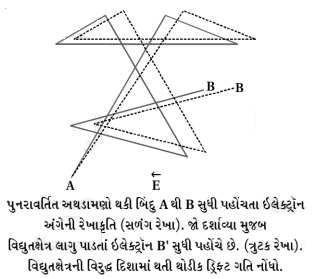
Solution
(N/A) $1$. Drift of Electrons: In a conductor,free electrons move randomly due to thermal energy and collide with positive ions. Their average velocity is zero. When an external electric field $E$ is applied,these electrons experience a force $F = -eE$,causing them to drift slowly in the direction opposite to the electric field. This net slow motion is called drift.
$2$. Drift Velocity $(v_d)$: It is defined as the average velocity acquired by free electrons in a conductor under the influence of an external electric field. If $\tau$ is the average relaxation time,then $v_d = -\frac{eE\tau}{m}$.
$3$. Derivation of Current $(I)$: Consider a conductor of cross-sectional area $A$ and length $L$. Let $n$ be the number density of free electrons. The total number of electrons in a volume $A \Delta x$ is $n A \Delta x$. Since $\Delta x = v_d \Delta t$,the total charge $\Delta Q$ passing through the cross-section in time $\Delta t$ is $\Delta Q = (n A v_d \Delta t) e$. The current $I$ is given by $I = \frac{\Delta Q}{\Delta t} = n e A v_d$.
$2$. Drift Velocity $(v_d)$: It is defined as the average velocity acquired by free electrons in a conductor under the influence of an external electric field. If $\tau$ is the average relaxation time,then $v_d = -\frac{eE\tau}{m}$.
$3$. Derivation of Current $(I)$: Consider a conductor of cross-sectional area $A$ and length $L$. Let $n$ be the number density of free electrons. The total number of electrons in a volume $A \Delta x$ is $n A \Delta x$. Since $\Delta x = v_d \Delta t$,the total charge $\Delta Q$ passing through the cross-section in time $\Delta t$ is $\Delta Q = (n A v_d \Delta t) e$. The current $I$ is given by $I = \frac{\Delta Q}{\Delta t} = n e A v_d$.
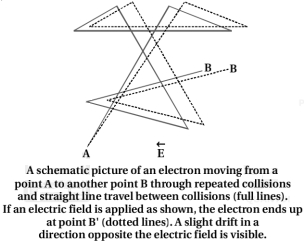
0 likes
View Solution98
Medium
Derive the relation between drift velocity and current density.
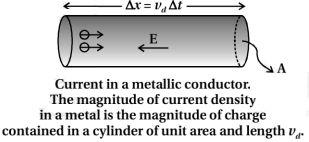
Solution
(N/A) Consider a conductor of cross-sectional area $A$ in which an electric field $\vec{E}$ is applied. Due to this field,free electrons experience a force and drift in the opposite direction of $\vec{E}$ with a drift velocity $v_d$.
In a small time interval $\Delta t$,the distance covered by the electrons is $\Delta x = |v_d| \Delta t$.
The volume of the cylindrical element containing these electrons is $V = A \Delta x = A |v_d| \Delta t$.
If $n$ is the number density of free electrons (number of electrons per unit volume),then the total number of electrons $N$ in this volume is $N = n V = n A |v_d| \Delta t$.
The total charge $\Delta Q$ passing through the cross-section in time $\Delta t$ is $\Delta Q = N e = n A e |v_d| \Delta t$,where $e$ is the magnitude of the charge of an electron.
The current $I$ is given by $I = \frac{\Delta Q}{\Delta t} = n A e |v_d|$.
Since current density $J = \frac{I}{A}$,we have $J = \frac{n A e |v_d|}{A} = n e |v_d|$.
In vector form,since electrons drift opposite to the electric field,$\vec{J} = -n e \vec{v}_d$.
In a small time interval $\Delta t$,the distance covered by the electrons is $\Delta x = |v_d| \Delta t$.
The volume of the cylindrical element containing these electrons is $V = A \Delta x = A |v_d| \Delta t$.
If $n$ is the number density of free electrons (number of electrons per unit volume),then the total number of electrons $N$ in this volume is $N = n V = n A |v_d| \Delta t$.
The total charge $\Delta Q$ passing through the cross-section in time $\Delta t$ is $\Delta Q = N e = n A e |v_d| \Delta t$,where $e$ is the magnitude of the charge of an electron.
The current $I$ is given by $I = \frac{\Delta Q}{\Delta t} = n A e |v_d|$.
Since current density $J = \frac{I}{A}$,we have $J = \frac{n A e |v_d|}{A} = n e |v_d|$.
In vector form,since electrons drift opposite to the electric field,$\vec{J} = -n e \vec{v}_d$.
0 likes
View Solution99
Medium
Explain the mobility of a charge carrier in a conductor and derive its equation.
Solution
(N/A) Mobility $(\mu)$ is defined as the magnitude of the drift velocity $(v_d)$ per unit electric field $(E)$ applied across the conductor.
Mathematically, $\mu = \frac{|v_d|}{E}$.
Since the drift velocity is given by $v_d = \frac{eE\tau}{m}$, where $e$ is the charge, $\tau$ is the relaxation time, and $m$ is the mass of the carrier, substituting this into the mobility equation gives $\mu = \frac{e\tau}{m}$.
$SI$ unit: $\frac{m/s}{V/m} = m^2 V^{-1} s^{-1}$.
Dimensional formula: $[M^{-1} L^0 T^2 A^1]$.
Mathematically, $\mu = \frac{|v_d|}{E}$.
Since the drift velocity is given by $v_d = \frac{eE\tau}{m}$, where $e$ is the charge, $\tau$ is the relaxation time, and $m$ is the mass of the carrier, substituting this into the mobility equation gives $\mu = \frac{e\tau}{m}$.
$SI$ unit: $\frac{m/s}{V/m} = m^2 V^{-1} s^{-1}$.
Dimensional formula: $[M^{-1} L^0 T^2 A^1]$.
0 likes
View SolutionCurrent Electricity — Current Density, Drift Velocity and Mobility · Frequently Asked Questions
1Are these Current Electricity questions useful for JEE and NEET?
Yes. All questions in this section are mapped to JEE Main and NEET exam patterns. Previous year questions from JEE Main, NEET, GUJCET and state-level exams are included with full solutions.
2Can I switch to Hindi or Gujarati for these questions?
Yes. Use the language tabs in the hero section or the sidebar to view the same questions and solutions in English, Hindi or Gujarati.
3How do I generate a question paper from this subtopic?
Use the Vedclass Exam Paper Generator — select the chapter and subtopic, set difficulty, and generate Sets A, B, C, D automatically. First 3 chapters of every subject are free.
Vedclass Products
For Students
Vedclass Test Series
Mock tests in real JEE/NEET style with performance analysis. 5-day free trial.
Start Free TrialFor Teachers
Exam Paper Generator
Generate Set A/B/C/D papers from this chapter in 2 minutes. 3 chapters free.
Try FreeFor Institutes
Online Exam Module
Live online exams with unlimited students, 360° analytics & white-label branding.
See DemoFor Teachers & Institutes
Generate a Current Electricity Exam Paper in 2 Minutes
Select subtopic & difficulty — Sets A, B, C, D auto-generated with No Repeat logic.
First 3 chapters of every subject are free — no payment required.