
A English
RL, RC and LC AC Circuits Questions in English
Class 12 Physics · Alternating Current · RL, RC and LC AC Circuits
281+
Questions
English
Language
100%
With Solutions
Showing 50 of 281 questions in English
51
MediumMCQ
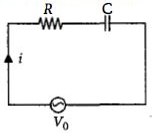
$A$ series $R-C$ circuit is connected to an alternating voltage source. Consider two situations:
$(a)$ When the capacitor is air-filled.
$(b)$ When the capacitor is mica-filled.
If the current through the resistor is $i$ and the voltage across the capacitor is $V$,then:
$(a)$ When the capacitor is air-filled.
$(b)$ When the capacitor is mica-filled.
If the current through the resistor is $i$ and the voltage across the capacitor is $V$,then:
A
$V_a = V_b$
B
$V_a < V_b$
C
$V_a > V_b$
D
$i_a > i_b$
Solution
(C) The current $i$ in a series $R-C$ circuit is given by:
$i = \frac{V_0}{Z} = \frac{V_0}{\sqrt{R^2 + X_C^2}} = \frac{V_0}{\sqrt{R^2 + (1/\omega C)^2}}$
The voltage across the capacitor is $V = i X_C = i \cdot \frac{1}{\omega C}$.
Substituting the expression for $i$:
$V = \frac{V_0}{\sqrt{R^2 + (1/\omega C)^2}} \cdot \frac{1}{\omega C} = \frac{V_0}{\sqrt{R^2 \omega^2 C^2 + 1}}$
When the capacitor is filled with mica (dielectric constant $K > 1$),its capacitance increases,so $C_b > C_a$.
$1$. For current: As $C$ increases,$X_C = 1/\omega C$ decreases,so the impedance $Z = \sqrt{R^2 + X_C^2}$ decreases. Thus,$i_b > i_a$.
$2$. For voltage across the capacitor: From $V = \frac{V_0}{\sqrt{R^2 \omega^2 C^2 + 1}}$,as $C$ increases,the denominator increases,which means $V$ decreases. Therefore,$V_b < V_a$,or $V_a > V_b$.
$i = \frac{V_0}{Z} = \frac{V_0}{\sqrt{R^2 + X_C^2}} = \frac{V_0}{\sqrt{R^2 + (1/\omega C)^2}}$
The voltage across the capacitor is $V = i X_C = i \cdot \frac{1}{\omega C}$.
Substituting the expression for $i$:
$V = \frac{V_0}{\sqrt{R^2 + (1/\omega C)^2}} \cdot \frac{1}{\omega C} = \frac{V_0}{\sqrt{R^2 \omega^2 C^2 + 1}}$
When the capacitor is filled with mica (dielectric constant $K > 1$),its capacitance increases,so $C_b > C_a$.
$1$. For current: As $C$ increases,$X_C = 1/\omega C$ decreases,so the impedance $Z = \sqrt{R^2 + X_C^2}$ decreases. Thus,$i_b > i_a$.
$2$. For voltage across the capacitor: From $V = \frac{V_0}{\sqrt{R^2 \omega^2 C^2 + 1}}$,as $C$ increases,the denominator increases,which means $V$ decreases. Therefore,$V_b < V_a$,or $V_a > V_b$.
0 likes
View Solution52
MediumMCQ
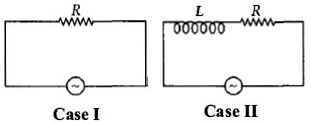
$A$ resistance $R$ draws power $P$ when connected to an $AC$ source. If an inductance is now placed in series with the resistance,such that the impedance of the circuit becomes $Z$,the power drawn will be
A
$P \left( \frac{R}{Z} \right)^2$
B
$P \sqrt{\frac{R}{Z}}$
C
$P \left( \frac{R}{Z} \right)$
D
$P$
Solution
(A) Case $I$: The power consumed by a purely resistive circuit is given by $P = V_{\text{rms}} I_{\text{rms}}$.
Since $I_{\text{rms}} = \frac{V_{\text{rms}}}{R}$,we have $P = \frac{V_{\text{rms}}^2}{R}$,which implies $V_{\text{rms}}^2 = P R$ ... $(i)$.
Case $II$: When an inductance $L$ is connected in series with the resistance $R$,the circuit becomes an $LR$ circuit with impedance $Z$.
The power consumed in an $AC$ circuit is given by $P' = V_{\text{rms}} I_{\text{rms}} \cos \phi$,where $\cos \phi = \frac{R}{Z}$ is the power factor.
Here,$I_{\text{rms}} = \frac{V_{\text{rms}}}{Z}$.
Substituting these values,we get $P' = V_{\text{rms}} \times \left( \frac{V_{\text{rms}}}{Z} \right) \times \left( \frac{R}{Z} \right) = V_{\text{rms}}^2 \frac{R}{Z^2}$.
Using equation $(i)$,$V_{\text{rms}}^2 = P R$,so $P' = (P R) \frac{R}{Z^2} = P \left( \frac{R}{Z} \right)^2$.
Since $I_{\text{rms}} = \frac{V_{\text{rms}}}{R}$,we have $P = \frac{V_{\text{rms}}^2}{R}$,which implies $V_{\text{rms}}^2 = P R$ ... $(i)$.
Case $II$: When an inductance $L$ is connected in series with the resistance $R$,the circuit becomes an $LR$ circuit with impedance $Z$.
The power consumed in an $AC$ circuit is given by $P' = V_{\text{rms}} I_{\text{rms}} \cos \phi$,where $\cos \phi = \frac{R}{Z}$ is the power factor.
Here,$I_{\text{rms}} = \frac{V_{\text{rms}}}{Z}$.
Substituting these values,we get $P' = V_{\text{rms}} \times \left( \frac{V_{\text{rms}}}{Z} \right) \times \left( \frac{R}{Z} \right) = V_{\text{rms}}^2 \frac{R}{Z^2}$.
Using equation $(i)$,$V_{\text{rms}}^2 = P R$,so $P' = (P R) \frac{R}{Z^2} = P \left( \frac{R}{Z} \right)^2$.
0 likes
View Solution53
MediumMCQ
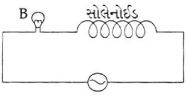
$A$ bulb connected in series with an air-core solenoid is lit by an $A.C.$ source. If a soft iron core is inserted into the solenoid,then
A
The bulb will glow with more brightness.
B
The brightness of the bulb will remain unchanged.
C
The bulb will become dimmer.
D
The bulb will stop glowing.
Solution
(C) When a soft iron core is inserted into the solenoid,its self-inductance $L$ increases because the permeability of the core material increases.
The inductive reactance of the solenoid is given by $X_L = \omega L$.
As $L$ increases,the inductive reactance $X_L$ increases.
The total impedance of the circuit is $Z = \sqrt{R^2 + X_L^2}$,where $R$ is the resistance of the bulb.
Since $X_L$ increases,the total impedance $Z$ of the circuit increases.
According to Ohm's law for $A.C.$ circuits,the current in the circuit is $I = \frac{V}{Z}$.
As $Z$ increases,the current $I$ flowing through the circuit decreases.
Since the brightness of the bulb depends on the power dissipated $(P = I^2 R)$,a decrease in current $I$ leads to a decrease in the brightness of the bulb. Therefore,the bulb will become dimmer.
The inductive reactance of the solenoid is given by $X_L = \omega L$.
As $L$ increases,the inductive reactance $X_L$ increases.
The total impedance of the circuit is $Z = \sqrt{R^2 + X_L^2}$,where $R$ is the resistance of the bulb.
Since $X_L$ increases,the total impedance $Z$ of the circuit increases.
According to Ohm's law for $A.C.$ circuits,the current in the circuit is $I = \frac{V}{Z}$.
As $Z$ increases,the current $I$ flowing through the circuit decreases.
Since the brightness of the bulb depends on the power dissipated $(P = I^2 R)$,a decrease in current $I$ leads to a decrease in the brightness of the bulb. Therefore,the bulb will become dimmer.
0 likes
View Solution54
EasyMCQ
$A$ bulb and a capacitor are in series with an $ac$ source. On increasing the frequency,how will the glow of the bulb change?
A
The glow decreases
B
The glow increases
C
The glow remains the same
D
The bulb quenches
Solution
(B) The impedance of the circuit containing a capacitor is given by $Z = \sqrt{R^2 + X_C^2}$,where $X_C = \frac{1}{2\pi \nu C}$ is the capacitive reactance.
When the frequency $\nu$ of the $ac$ source increases,the capacitive reactance $X_C$ decreases.
Since the total impedance $Z$ of the circuit decreases as $X_C$ decreases,the current $I = \frac{V}{Z}$ flowing through the circuit increases.
As the current through the bulb increases,the power dissipated $(P = I^2 R)$ increases,causing the glow of the bulb to increase.
When the frequency $\nu$ of the $ac$ source increases,the capacitive reactance $X_C$ decreases.
Since the total impedance $Z$ of the circuit decreases as $X_C$ decreases,the current $I = \frac{V}{Z}$ flowing through the circuit increases.
As the current through the bulb increases,the power dissipated $(P = I^2 R)$ increases,causing the glow of the bulb to increase.
0 likes
View Solution55
EasyMCQ
If the power factor is $1/2$ in a series $RL$ circuit with $R = 100\,\Omega$ connected to an $ac$ mains $(50\,Hz)$,find the value of $L$.
A
$\frac{\sqrt{3}}{\pi}\,H$
B
$\pi\,H$
C
$\frac{\pi}{\sqrt{3}}\,H$
D
None of these
Solution
(A) The power factor of an $RL$ circuit is given by $\cos \phi = \frac{R}{Z} = \frac{1}{2}$.
Since $\cos \phi = 1/2$,the phase angle $\phi = 60^\circ$.
In an $RL$ circuit,$\tan \phi = \frac{\omega L}{R}$.
Substituting the values,$\tan 60^\circ = \sqrt{3} = \frac{2\pi f L}{R}$.
Given $f = 50\,Hz$ and $R = 100\,\Omega$,we have $\sqrt{3} = \frac{2 \times \pi \times 50 \times L}{100}$.
$\sqrt{3} = \frac{100\pi L}{100} = \pi L$.
Therefore,$L = \frac{\sqrt{3}}{\pi}\,H$.
Since $\cos \phi = 1/2$,the phase angle $\phi = 60^\circ$.
In an $RL$ circuit,$\tan \phi = \frac{\omega L}{R}$.
Substituting the values,$\tan 60^\circ = \sqrt{3} = \frac{2\pi f L}{R}$.
Given $f = 50\,Hz$ and $R = 100\,\Omega$,we have $\sqrt{3} = \frac{2 \times \pi \times 50 \times L}{100}$.
$\sqrt{3} = \frac{100\pi L}{100} = \pi L$.
Therefore,$L = \frac{\sqrt{3}}{\pi}\,H$.
0 likes
View Solution56
EasyMCQ
What will be the self-inductance of a coil,to be connected in series with a resistance of $\pi \sqrt{3} \, \Omega$,such that the phase difference between the $EMF$ and the current at $50 \, Hz$ frequency is $30^o$ (in $, H$)?
A
$0.5$
B
$0.03$
C
$0.05$
D
$0.01$
Solution
(D) The phase difference $\phi$ in an $LR$ series circuit is given by $\tan \phi = \frac{X_L}{R}$.
Here,$X_L = 2\pi \nu L$,where $\nu = 50 \, Hz$ and $R = \pi \sqrt{3} \, \Omega$.
Given $\phi = 30^o$,we have $\tan 30^o = \frac{2\pi \times 50 \times L}{\pi \sqrt{3}}$.
Since $\tan 30^o = \frac{1}{\sqrt{3}}$,the equation becomes $\frac{1}{\sqrt{3}} = \frac{100\pi L}{\pi \sqrt{3}}$.
Canceling $\sqrt{3}$ from both denominators,we get $1 = 100L$.
Therefore,$L = \frac{1}{100} = 0.01 \, H$.
Here,$X_L = 2\pi \nu L$,where $\nu = 50 \, Hz$ and $R = \pi \sqrt{3} \, \Omega$.
Given $\phi = 30^o$,we have $\tan 30^o = \frac{2\pi \times 50 \times L}{\pi \sqrt{3}}$.
Since $\tan 30^o = \frac{1}{\sqrt{3}}$,the equation becomes $\frac{1}{\sqrt{3}} = \frac{100\pi L}{\pi \sqrt{3}}$.
Canceling $\sqrt{3}$ from both denominators,we get $1 = 100L$.
Therefore,$L = \frac{1}{100} = 0.01 \, H$.
0 likes
View Solution57
EasyMCQ
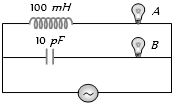
If $A$ and $B$ are identical bulbs,which bulb glows brighter?
A
$A$
B
$B$
C
Both equally bright
D
Cannot say
Solution
(A) The brightness of a bulb depends on the power dissipated,which is given by $P = I^2 R$. Since the bulbs are identical,their resistance $R$ is the same. Therefore,the bulb with the higher current $I$ will glow brighter.
In the circuit,bulb $A$ is in series with an inductor of $100 \ mH$,and bulb $B$ is in series with a capacitor of $10 \ pF$. The current in each branch is determined by the impedance: $I_A = V / Z_A$ and $I_B = V / Z_B$,where $Z_A = \sqrt{R^2 + X_L^2}$ and $Z_B = \sqrt{R^2 + X_C^2}$.
For a typical $AC$ source frequency,the capacitive reactance $X_C = 1 / (\omega C)$ is much larger than the inductive reactance $X_L = \omega L$. However,in this specific circuit,the capacitor has a very small capacitance $(10 \ pF)$,making $X_C$ extremely large compared to $X_L$. Consequently,the impedance $Z_B$ is much larger than $Z_A$.
Since $Z_A < Z_B$,the current $I_A$ is greater than $I_B$. Thus,bulb $A$ glows brighter.
In the circuit,bulb $A$ is in series with an inductor of $100 \ mH$,and bulb $B$ is in series with a capacitor of $10 \ pF$. The current in each branch is determined by the impedance: $I_A = V / Z_A$ and $I_B = V / Z_B$,where $Z_A = \sqrt{R^2 + X_L^2}$ and $Z_B = \sqrt{R^2 + X_C^2}$.
For a typical $AC$ source frequency,the capacitive reactance $X_C = 1 / (\omega C)$ is much larger than the inductive reactance $X_L = \omega L$. However,in this specific circuit,the capacitor has a very small capacitance $(10 \ pF)$,making $X_C$ extremely large compared to $X_L$. Consequently,the impedance $Z_B$ is much larger than $Z_A$.
Since $Z_A < Z_B$,the current $I_A$ is greater than $I_B$. Thus,bulb $A$ glows brighter.
0 likes
View Solution58
MediumMCQ
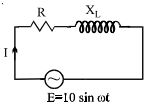
An $AC$ circuit having supply voltage $E = 10 \sin \omega t$ consists of a resistor of resistance $R = 3 \Omega$ and an inductor of reactance $X_L = 4 \Omega$ as shown in the figure. The voltage across the inductor at $t = \pi / \omega$ is: (in $\text{ V}$)
A
$2$
B
$10$
C
$4.8$
D
$0$
Solution
(C) The supply voltage is $E = 10 \sin \omega t$. The circuit is an $RL$ series circuit.
The impedance of the circuit is $Z = \sqrt{R^2 + X_L^2} = \sqrt{3^2 + 4^2} = 5 \, \Omega$.
The current in the circuit is given by $I = I_0 \sin(\omega t - \phi)$,where $I_0 = E_0 / Z = 10 / 5 = 2 \, \text{A}$ and $\tan \phi = X_L / R = 4/3$,so $\phi = \tan^{-1}(4/3)$.
The voltage across the inductor is $V_L = I X_L = (I_0 \sin(\omega t - \phi + \pi/2)) X_L = I_0 X_L \sin(\omega t - \phi + \pi/2)$.
At $t = \pi / \omega$,the voltage across the inductor is $V_L = I_0 X_L \sin(\omega \cdot \frac{\pi}{\omega} - \phi + \frac{\pi}{2}) = I_0 X_L \sin(\pi - \phi + \frac{\pi}{2}) = I_0 X_L \sin(\frac{3\pi}{2} - \phi) = -I_0 X_L \cos \phi$.
Since $\cos \phi = R / Z = 3 / 5 = 0.6$,we have $V_L = -(2)(4)(0.6) = -4.8 \, \text{V}$.
The magnitude of the voltage across the inductor is $|V_L| = 4.8 \, \text{V}$.
The impedance of the circuit is $Z = \sqrt{R^2 + X_L^2} = \sqrt{3^2 + 4^2} = 5 \, \Omega$.
The current in the circuit is given by $I = I_0 \sin(\omega t - \phi)$,where $I_0 = E_0 / Z = 10 / 5 = 2 \, \text{A}$ and $\tan \phi = X_L / R = 4/3$,so $\phi = \tan^{-1}(4/3)$.
The voltage across the inductor is $V_L = I X_L = (I_0 \sin(\omega t - \phi + \pi/2)) X_L = I_0 X_L \sin(\omega t - \phi + \pi/2)$.
At $t = \pi / \omega$,the voltage across the inductor is $V_L = I_0 X_L \sin(\omega \cdot \frac{\pi}{\omega} - \phi + \frac{\pi}{2}) = I_0 X_L \sin(\pi - \phi + \frac{\pi}{2}) = I_0 X_L \sin(\frac{3\pi}{2} - \phi) = -I_0 X_L \cos \phi$.
Since $\cos \phi = R / Z = 3 / 5 = 0.6$,we have $V_L = -(2)(4)(0.6) = -4.8 \, \text{V}$.
The magnitude of the voltage across the inductor is $|V_L| = 4.8 \, \text{V}$.
0 likes
View Solution59
DifficultMCQ
When $100\, V$ $DC$ is applied across a solenoid,a current of $1\, A$ flows in it. When $100\, V$ $AC$ is applied across the same coil,the current drops to $0.5\, A$. If the frequency of the $AC$ source is $50\, Hz$,the impedance and inductance of the solenoid are:
A
$100\, \Omega, 0.93\, H$
B
$200\, \Omega, 1.0\, H$
C
$10\, \Omega, 0.86\, H$
D
$200\, \Omega, 0.55\, H$
Solution
(D) For $DC$ supply,the solenoid acts as a pure resistor $R$. Given $V = 100\, V$ and $I = 1\, A$,the resistance is $R = \frac{V}{I} = \frac{100}{1} = 100\, \Omega$.
For $AC$ supply,the impedance $Z$ is given by $Z = \frac{V_{rms}}{I_{rms}} = \frac{100}{0.5} = 200\, \Omega$.
The impedance of an $RL$ circuit is $Z = \sqrt{R^2 + X_L^2}$,where $X_L = 2\pi f L$.
Substituting the values: $200 = \sqrt{100^2 + (2 \cdot \pi \cdot 50 \cdot L)^2}$.
Squaring both sides: $200^2 = 100^2 + (100\pi L)^2$.
$40000 = 10000 + (100\pi L)^2$.
$30000 = (100\pi L)^2$.
Taking the square root: $100\pi L = \sqrt{30000} = 100\sqrt{3} \approx 173.2$.
$L = \frac{173.2}{100\pi} \approx \frac{1.732}{3.14} \approx 0.55\, H$.
Thus,the impedance is $200\, \Omega$ and the inductance is $0.55\, H$.
For $AC$ supply,the impedance $Z$ is given by $Z = \frac{V_{rms}}{I_{rms}} = \frac{100}{0.5} = 200\, \Omega$.
The impedance of an $RL$ circuit is $Z = \sqrt{R^2 + X_L^2}$,where $X_L = 2\pi f L$.
Substituting the values: $200 = \sqrt{100^2 + (2 \cdot \pi \cdot 50 \cdot L)^2}$.
Squaring both sides: $200^2 = 100^2 + (100\pi L)^2$.
$40000 = 10000 + (100\pi L)^2$.
$30000 = (100\pi L)^2$.
Taking the square root: $100\pi L = \sqrt{30000} = 100\sqrt{3} \approx 173.2$.
$L = \frac{173.2}{100\pi} \approx \frac{1.732}{3.14} \approx 0.55\, H$.
Thus,the impedance is $200\, \Omega$ and the inductance is $0.55\, H$.
0 likes
View Solution60
DifficultMCQ
An inductive circuit contains a resistance of $10 \, \Omega$ and an inductance of $2.0 \, H$. If an $AC$ voltage of $120 \, V$ and frequency $60 \, Hz$ is applied to this circuit,the current would be nearly: ..... $A$
A
$0.8$
B
$0.48$
C
$0.16$
D
$0.32$
Solution
(C) The impedance $(Z)$ of an $RL$ series circuit is given by $Z = \sqrt{R^2 + X_L^2}$.
Here,$R = 10 \, \Omega$,$L = 2.0 \, H$,$f = 60 \, Hz$,and $V = 120 \, V$.
The inductive reactance is $X_L = 2 \pi f L = 2 \times \pi \times 60 \times 2 = 240 \pi \, \Omega$.
Calculating $X_L \approx 240 \times 3.1416 = 753.98 \, \Omega$.
Now,$Z = \sqrt{10^2 + (753.98)^2} = \sqrt{100 + 568485.8} \approx \sqrt{568585.8} \approx 754.05 \, \Omega$.
The current $I$ is given by $I = \frac{V}{Z} = \frac{120}{754.05} \approx 0.159 \, A$.
Rounding to two decimal places,the current is approximately $0.16 \, A$.
Here,$R = 10 \, \Omega$,$L = 2.0 \, H$,$f = 60 \, Hz$,and $V = 120 \, V$.
The inductive reactance is $X_L = 2 \pi f L = 2 \times \pi \times 60 \times 2 = 240 \pi \, \Omega$.
Calculating $X_L \approx 240 \times 3.1416 = 753.98 \, \Omega$.
Now,$Z = \sqrt{10^2 + (753.98)^2} = \sqrt{100 + 568485.8} \approx \sqrt{568585.8} \approx 754.05 \, \Omega$.
The current $I$ is given by $I = \frac{V}{Z} = \frac{120}{754.05} \approx 0.159 \, A$.
Rounding to two decimal places,the current is approximately $0.16 \, A$.
0 likes
View Solution61
MediumMCQ
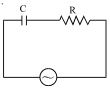
In the circuit shown,if the $emf$ of the source at an instant is $5 \, V$,and the potential difference across the capacitor at the same instant is $4 \, V$,then the potential difference across $R$ at that instant may be ..... $V$.
A
$3$
B
$9$
C
$\frac{3}{\sqrt{2}}$
D
none
Solution
(A) In an $RC$ series circuit connected to an $AC$ source,the instantaneous $emf$ $E$ is given by the vector sum of the potential difference across the resistor $(V_R)$ and the potential difference across the capacitor $(V_C)$.
Since the current in the resistor and capacitor is the same,the voltage across the resistor is in phase with the current,while the voltage across the capacitor lags the current by $90^\circ$.
Therefore,the relationship between the instantaneous values is $E^2 = V_R^2 + V_C^2$.
Given: $E = 5 \, V$ and $V_C = 4 \, V$.
Substituting these values into the equation:
$5^2 = V_R^2 + 4^2$
$25 = V_R^2 + 16$
$V_R^2 = 25 - 16 = 9$
$V_R = 3 \, V$.
Thus,the potential difference across $R$ is $3 \, V$.
Since the current in the resistor and capacitor is the same,the voltage across the resistor is in phase with the current,while the voltage across the capacitor lags the current by $90^\circ$.
Therefore,the relationship between the instantaneous values is $E^2 = V_R^2 + V_C^2$.
Given: $E = 5 \, V$ and $V_C = 4 \, V$.
Substituting these values into the equation:
$5^2 = V_R^2 + 4^2$
$25 = V_R^2 + 16$
$V_R^2 = 25 - 16 = 9$
$V_R = 3 \, V$.
Thus,the potential difference across $R$ is $3 \, V$.
0 likes
View Solution62
MediumMCQ
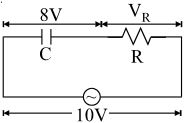
In a series $CR$ circuit shown in the figure,the applied voltage is $10 \, V$ and the voltage across the capacitor is found to be $8 \, V$. Then the voltage across $R$,and the phase difference between the current and the applied voltage will respectively be:
A
$6 \, V, \tan^{-1} \left( \frac{4}{3} \right)$
B
$3 \, V, \tan^{-1} \left( \frac{3}{4} \right)$
C
$6 \, V, \tan^{-1} \left( \frac{5}{3} \right)$
D
None of these
Solution
(A) In a series $CR$ circuit,the total applied voltage $V$ is given by the phasor sum of the voltage across the resistor $(V_R)$ and the voltage across the capacitor $(V_C)$:
$V = \sqrt{V_R^2 + V_C^2}$
Given $V = 10 \, V$ and $V_C = 8 \, V$.
Substituting these values:
$10 = \sqrt{V_R^2 + 8^2}$
$100 = V_R^2 + 64$
$V_R^2 = 36 \implies V_R = 6 \, V$.
The phase difference $\phi$ between the current and the applied voltage in a $CR$ circuit is given by:
$\tan \phi = \frac{V_C}{V_R} = \frac{8}{6} = \frac{4}{3}$
Therefore,$\phi = \tan^{-1} \left( \frac{4}{3} \right)$.
Thus,the voltage across $R$ is $6 \, V$ and the phase difference is $\tan^{-1} \left( \frac{4}{3} \right)$.
$V = \sqrt{V_R^2 + V_C^2}$
Given $V = 10 \, V$ and $V_C = 8 \, V$.
Substituting these values:
$10 = \sqrt{V_R^2 + 8^2}$
$100 = V_R^2 + 64$
$V_R^2 = 36 \implies V_R = 6 \, V$.
The phase difference $\phi$ between the current and the applied voltage in a $CR$ circuit is given by:
$\tan \phi = \frac{V_C}{V_R} = \frac{8}{6} = \frac{4}{3}$
Therefore,$\phi = \tan^{-1} \left( \frac{4}{3} \right)$.
Thus,the voltage across $R$ is $6 \, V$ and the phase difference is $\tan^{-1} \left( \frac{4}{3} \right)$.
0 likes
View Solution63
AdvancedMCQ
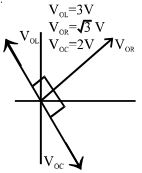
The given figure represents the phasor diagram of a series $LCR$ circuit connected to an $ac$ source. At the instant $t'$ when the source voltage is given by $V = V_0 \cos(\omega t')$,the current in the circuit will be:
Given: $V_{OL} = 3 \text{ V}$,$V_{OR} = \sqrt{3} \text{ V}$,$V_{OC} = 2 \text{ V}$.
Given: $V_{OL} = 3 \text{ V}$,$V_{OR} = \sqrt{3} \text{ V}$,$V_{OC} = 2 \text{ V}$.
A
$I = I_0 \cos(\omega t' + \pi/6)$
B
$I = I_0 \cos(\omega t' - \pi/6)$
C
$I = I_0 \cos(\omega t' + \pi/3)$
D
$I = I_0 \cos(\omega t' - \pi/3)$
Solution
(B) In a series $LCR$ circuit,the current $I$ is in phase with the resistor voltage $V_R$. The net voltage $V$ is the vector sum of $V_R$,$V_L$,and $V_C$.
Let the current be along the $x$-axis. Then $V_R$ is along the $x$-axis,$V_L$ is along the positive $y$-axis,and $V_C$ is along the negative $y$-axis.
The net reactive voltage is $V_L - V_C = 3 \text{ V} - 2 \text{ V} = 1 \text{ V}$ (along the positive $y$-axis).
The resistive voltage is $V_R = \sqrt{3} \text{ V}$ (along the $x$-axis).
The phase angle $\phi$ between the source voltage $V$ and the current $I$ is given by $\tan \phi = \frac{V_L - V_C}{V_R} = \frac{1}{\sqrt{3}}$.
Thus,$\phi = 30^\circ = \pi/6$.
Since the net voltage leads the current by $\phi = \pi/6$,the current lags behind the voltage by $\pi/6$.
If $V = V_0 \cos(\omega t')$,then $I = I_0 \cos(\omega t' - \pi/6)$.
Let the current be along the $x$-axis. Then $V_R$ is along the $x$-axis,$V_L$ is along the positive $y$-axis,and $V_C$ is along the negative $y$-axis.
The net reactive voltage is $V_L - V_C = 3 \text{ V} - 2 \text{ V} = 1 \text{ V}$ (along the positive $y$-axis).
The resistive voltage is $V_R = \sqrt{3} \text{ V}$ (along the $x$-axis).
The phase angle $\phi$ between the source voltage $V$ and the current $I$ is given by $\tan \phi = \frac{V_L - V_C}{V_R} = \frac{1}{\sqrt{3}}$.
Thus,$\phi = 30^\circ = \pi/6$.
Since the net voltage leads the current by $\phi = \pi/6$,the current lags behind the voltage by $\pi/6$.
If $V = V_0 \cos(\omega t')$,then $I = I_0 \cos(\omega t' - \pi/6)$.
0 likes
View Solution64
MediumMCQ
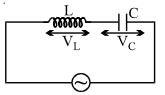
The current $I$,potential difference $V_L$ across the inductor,and potential difference $V_C$ across the capacitor in the circuit as shown in the figure are best represented vectorially as:
A
B
C
D
Solution
(D) In an $AC$ circuit containing an inductor and a capacitor in series:
$1$. The current $I$ is the same through both components.
$2$. In an inductor,the voltage $V_L$ leads the current $I$ by a phase angle of $\frac{\pi}{2}$.
$3$. In a capacitor,the voltage $V_C$ lags behind the current $I$ by a phase angle of $\frac{\pi}{2}$.
$4$. Therefore,if we represent the current $I$ along the positive $x$-axis,the vector $V_L$ must point along the positive $y$-axis,and the vector $V_C$ must point along the negative $y$-axis.
$5$. This corresponds to the representation shown in option $D$.
$1$. The current $I$ is the same through both components.
$2$. In an inductor,the voltage $V_L$ leads the current $I$ by a phase angle of $\frac{\pi}{2}$.
$3$. In a capacitor,the voltage $V_C$ lags behind the current $I$ by a phase angle of $\frac{\pi}{2}$.
$4$. Therefore,if we represent the current $I$ along the positive $x$-axis,the vector $V_L$ must point along the positive $y$-axis,and the vector $V_C$ must point along the negative $y$-axis.
$5$. This corresponds to the representation shown in option $D$.
0 likes
View Solution65
EasyMCQ
The phase difference between the alternating current and emf is $\frac{\pi}{2}$. Which of the following cannot be the constituent of the circuit?
A
$L-C$
B
$L$ alone
C
$C$ alone
D
$R-L$
Solution
(D) In an $AC$ circuit,the phase difference $\phi$ between the alternating current and the electromotive force $(emf)$ is given by $\tan \phi = \frac{X_L - X_C}{R}$.
For a pure inductor ($L$ alone),$\phi = \frac{\pi}{2}$.
For a pure capacitor ($C$ alone),$\phi = -\frac{\pi}{2}$ (magnitude is $\frac{\pi}{2}$).
For an $L-C$ circuit,if $X_L \neq X_C$,the phase difference is $\frac{\pi}{2}$.
For an $R-L$ circuit,the phase difference $\phi$ lies in the range $0 < \phi < \frac{\pi}{2}$.
Therefore,an $R-L$ circuit cannot have a phase difference of $\frac{\pi}{2}$.
For a pure inductor ($L$ alone),$\phi = \frac{\pi}{2}$.
For a pure capacitor ($C$ alone),$\phi = -\frac{\pi}{2}$ (magnitude is $\frac{\pi}{2}$).
For an $L-C$ circuit,if $X_L \neq X_C$,the phase difference is $\frac{\pi}{2}$.
For an $R-L$ circuit,the phase difference $\phi$ lies in the range $0 < \phi < \frac{\pi}{2}$.
Therefore,an $R-L$ circuit cannot have a phase difference of $\frac{\pi}{2}$.
0 likes
View Solution66
MediumMCQ
An arc lamp requires a direct current of $10\ A$ at $80\ V$ to function. If it is connected to a $220\ V$ (rms),$50\ Hz$ $AC$ supply,the series inductor needed for it to work is close to: (in $H$)
A
$0.044$
B
$0.065$
C
$80$
D
$0.08$
Solution
(B) The resistance of the arc lamp is $R = \frac{V}{I} = \frac{80\ V}{10\ A} = 8\ \Omega$.
When connected to an $AC$ supply,the impedance $Z$ of the $RL$ circuit is given by $Z = \sqrt{R^2 + X_L^2}$,where $X_L = 2\pi f L$.
The current in the $AC$ circuit is $I = \frac{V_{rms}}{Z} = \frac{V_{rms}}{\sqrt{R^2 + (2\pi f L)^2}}$.
Given $I = 10\ A$,$V_{rms} = 220\ V$,$f = 50\ Hz$,and $R = 8\ \Omega$:
$10 = \frac{220}{\sqrt{8^2 + (2 \cdot \pi \cdot 50 \cdot L)^2}}$
$\sqrt{64 + (100\pi L)^2} = \frac{220}{10} = 22$
$64 + (100\pi L)^2 = 22^2 = 484$
$(100\pi L)^2 = 484 - 64 = 420$
$100\pi L = \sqrt{420} \approx 20.49$
$L = \frac{20.49}{100 \cdot 3.14} \approx \frac{20.49}{314} \approx 0.065\ H$.
When connected to an $AC$ supply,the impedance $Z$ of the $RL$ circuit is given by $Z = \sqrt{R^2 + X_L^2}$,where $X_L = 2\pi f L$.
The current in the $AC$ circuit is $I = \frac{V_{rms}}{Z} = \frac{V_{rms}}{\sqrt{R^2 + (2\pi f L)^2}}$.
Given $I = 10\ A$,$V_{rms} = 220\ V$,$f = 50\ Hz$,and $R = 8\ \Omega$:
$10 = \frac{220}{\sqrt{8^2 + (2 \cdot \pi \cdot 50 \cdot L)^2}}$
$\sqrt{64 + (100\pi L)^2} = \frac{220}{10} = 22$
$64 + (100\pi L)^2 = 22^2 = 484$
$(100\pi L)^2 = 484 - 64 = 420$
$100\pi L = \sqrt{420} \approx 20.49$
$L = \frac{20.49}{100 \cdot 3.14} \approx \frac{20.49}{314} \approx 0.065\ H$.
0 likes
View Solution67
MediumMCQ
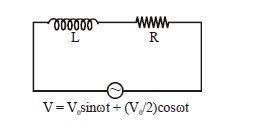
In the given figure,the current amplitude is
A
$\sqrt{\frac{5V_0^2}{4(\omega^2L^2 + R^2)}}$
B
$\frac{V_0}{\sqrt{4(\omega^2L^2 + R^2)}}$
C
$\frac{\sqrt{5}V_0}{2\sqrt{\omega^2L^2 - R^2}}$
D
$\frac{\sqrt{5}V_0}{2\sqrt{R^2 - \omega^2L^2}}$
Solution
(A) The given voltage is $V = V_0 \sin(\omega t) + \frac{V_0}{2} \cos(\omega t)$.
This can be written as $V = V_{eq} \sin(\omega t + \phi)$,where the amplitude $V_{eq} = \sqrt{V_0^2 + (V_0/2)^2} = \sqrt{V_0^2 + V_0^2/4} = \sqrt{\frac{5V_0^2}{4}} = \frac{\sqrt{5}V_0}{2}$.
The impedance of the $LR$ circuit is $Z = \sqrt{R^2 + (\omega L)^2}$.
The current amplitude $I_0$ is given by $I_0 = \frac{V_{eq}}{Z}$.
Substituting the values,$I_0 = \frac{\sqrt{5}V_0 / 2}{\sqrt{R^2 + \omega^2L^2}} = \sqrt{\frac{5V_0^2}{4(R^2 + \omega^2L^2)}}$.
Thus,the correct option is $A$.
This can be written as $V = V_{eq} \sin(\omega t + \phi)$,where the amplitude $V_{eq} = \sqrt{V_0^2 + (V_0/2)^2} = \sqrt{V_0^2 + V_0^2/4} = \sqrt{\frac{5V_0^2}{4}} = \frac{\sqrt{5}V_0}{2}$.
The impedance of the $LR$ circuit is $Z = \sqrt{R^2 + (\omega L)^2}$.
The current amplitude $I_0$ is given by $I_0 = \frac{V_{eq}}{Z}$.
Substituting the values,$I_0 = \frac{\sqrt{5}V_0 / 2}{\sqrt{R^2 + \omega^2L^2}} = \sqrt{\frac{5V_0^2}{4(R^2 + \omega^2L^2)}}$.
Thus,the correct option is $A$.
0 likes
View Solution68
MediumMCQ
An induction coil has an impedance of $10 \Omega$. When an $AC$ signal of frequency $1000 \ Hz$ is applied to the coil,the voltage leads the current by $45^\circ$. The inductance of the coil is
A
$\frac{1}{2\pi}$
B
$\frac{1}{\sqrt{2} \times 200\pi}$
C
$\frac{1}{\sqrt{2} \times 20\pi}$
D
$\frac{1}{200\pi}$
Solution
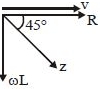
(B) Given: Impedance $Z = 10 \Omega$,Frequency $f = 1000 \ Hz$,Phase angle $\phi = 45^\circ$.
The angular frequency is $\omega = 2\pi f = 2\pi \times 1000 = 2000\pi \ rad/s$.
In an $RL$ circuit,the phase angle $\phi$ is given by $\tan \phi = \frac{\omega L}{R}$.
Since $\phi = 45^\circ$,$\tan 45^\circ = 1$,so $\frac{\omega L}{R} = 1$,which implies $R = \omega L$.
The impedance $Z$ is given by $Z = \sqrt{R^2 + (\omega L)^2}$.
Substituting $R = \omega L$,we get $Z = \sqrt{(\omega L)^2 + (\omega L)^2} = \sqrt{2(\omega L)^2} = \omega L \sqrt{2}$.
Given $Z = 10 \Omega$,we have $10 = \omega L \sqrt{2}$.
Therefore,$\omega L = \frac{10}{\sqrt{2}} = 5\sqrt{2}$.
Since $\omega L = 2000\pi L$,we have $2000\pi L = 5\sqrt{2}$.
$L = \frac{5\sqrt{2}}{2000\pi} = \frac{\sqrt{2}}{400\pi} = \frac{1}{\sqrt{2} \times 200\pi} \ H$.
The angular frequency is $\omega = 2\pi f = 2\pi \times 1000 = 2000\pi \ rad/s$.
In an $RL$ circuit,the phase angle $\phi$ is given by $\tan \phi = \frac{\omega L}{R}$.
Since $\phi = 45^\circ$,$\tan 45^\circ = 1$,so $\frac{\omega L}{R} = 1$,which implies $R = \omega L$.
The impedance $Z$ is given by $Z = \sqrt{R^2 + (\omega L)^2}$.
Substituting $R = \omega L$,we get $Z = \sqrt{(\omega L)^2 + (\omega L)^2} = \sqrt{2(\omega L)^2} = \omega L \sqrt{2}$.
Given $Z = 10 \Omega$,we have $10 = \omega L \sqrt{2}$.
Therefore,$\omega L = \frac{10}{\sqrt{2}} = 5\sqrt{2}$.
Since $\omega L = 2000\pi L$,we have $2000\pi L = 5\sqrt{2}$.
$L = \frac{5\sqrt{2}}{2000\pi} = \frac{\sqrt{2}}{400\pi} = \frac{1}{\sqrt{2} \times 200\pi} \ H$.
0 likes
View Solution69
DifficultMCQ
$A$ long solenoid connected to a $12\,V\, DC$ source passes a steady current of $2\,A.$ When the solenoid is connected to a source of $12\,V\, RMS$ at $50\,Hz,$ the current flowing is $1\,A\, RMS.$ Then the inductance of the solenoid is ....$mH$.
A
$11$
B
$22$
C
$33$
D
None of the above
Solution
(C) For a $DC$ source,the inductor acts as a simple resistor because the frequency is $0$. The resistance $R$ is given by $R = V / I = 12\,V / 2\,A = 6\,\Omega$.
When connected to an $AC$ source,the impedance $Z$ is $Z = V_{rms} / I_{rms} = 12\,V / 1\,A = 12\,\Omega$.
The impedance of an $RL$ circuit is given by $Z = \sqrt{R^2 + X_L^2}$,where $X_L = \omega L = 2\pi f L$.
Squaring both sides: $Z^2 = R^2 + (2\pi f L)^2$.
Substituting the values: $12^2 = 6^2 + (2 \pi \times 50 \times L)^2$.
$144 = 36 + (100\pi L)^2$.
$(100\pi L)^2 = 108$.
$100\pi L = \sqrt{108} \approx 10.39$.
$L = 10.39 / (100 \times 3.14159) \approx 10.39 / 314.16 \approx 0.033\,H$.
Converting to millihenry: $L = 0.033 \times 1000 = 33\,mH$.
When connected to an $AC$ source,the impedance $Z$ is $Z = V_{rms} / I_{rms} = 12\,V / 1\,A = 12\,\Omega$.
The impedance of an $RL$ circuit is given by $Z = \sqrt{R^2 + X_L^2}$,where $X_L = \omega L = 2\pi f L$.
Squaring both sides: $Z^2 = R^2 + (2\pi f L)^2$.
Substituting the values: $12^2 = 6^2 + (2 \pi \times 50 \times L)^2$.
$144 = 36 + (100\pi L)^2$.
$(100\pi L)^2 = 108$.
$100\pi L = \sqrt{108} \approx 10.39$.
$L = 10.39 / (100 \times 3.14159) \approx 10.39 / 314.16 \approx 0.033\,H$.
Converting to millihenry: $L = 0.033 \times 1000 = 33\,mH$.
0 likes
View Solution70
MediumMCQ
In a series $LCR$ circuit,the voltage across the resistance,capacitance,and inductance is $10 \, V$ each. If the inductor is short-circuited,what will be the voltage across the capacitor?
A
$10 \, V$
B
Zero
C
$10 \sqrt{2} \, V$
D
$\frac{10}{\sqrt{2}} \, V$
Solution
(D) Given that in the series $LCR$ circuit,$V_R = V_L = V_C = 10 \, V$. Since $V = IR$,this implies $R = X_L = X_C$.
The source voltage $E$ is equal to $V_R$ because $V_L$ and $V_C$ cancel each other out in resonance $(X_L = X_C)$. Thus,$E = 10 \, V$.
When the inductor is short-circuited,the circuit becomes an $RC$ series circuit with the same source voltage $E = 10 \, V$.
The new impedance of the circuit is $Z' = \sqrt{R^2 + X_C^2}$. Since $R = X_C$,$Z' = \sqrt{R^2 + R^2} = R\sqrt{2}$.
The new current in the circuit is $i' = \frac{E}{Z'} = \frac{10}{R\sqrt{2}}$.
The voltage across the capacitor is $V_C' = i' X_C = \left( \frac{10}{R\sqrt{2}} \right) \times R = \frac{10}{\sqrt{2}} \, V$.
The source voltage $E$ is equal to $V_R$ because $V_L$ and $V_C$ cancel each other out in resonance $(X_L = X_C)$. Thus,$E = 10 \, V$.
When the inductor is short-circuited,the circuit becomes an $RC$ series circuit with the same source voltage $E = 10 \, V$.
The new impedance of the circuit is $Z' = \sqrt{R^2 + X_C^2}$. Since $R = X_C$,$Z' = \sqrt{R^2 + R^2} = R\sqrt{2}$.
The new current in the circuit is $i' = \frac{E}{Z'} = \frac{10}{R\sqrt{2}}$.
The voltage across the capacitor is $V_C' = i' X_C = \left( \frac{10}{R\sqrt{2}} \right) \times R = \frac{10}{\sqrt{2}} \, V$.
0 likes
View Solution71
DifficultMCQ
$A$ charged capacitor discharges through a resistance $R$ with time constant $\tau$. The two are now placed in series across an $AC$ source of angular frequency $\omega = \frac{1}{\tau}$. The impedance of the circuit will be
A
$\frac{R}{\sqrt{2}}$
B
$R$
C
$\sqrt{2}R$
D
$2R$
Solution
(C) The time constant of an $RC$ circuit is given by $\tau = RC$.
Given that the angular frequency of the $AC$ source is $\omega = \frac{1}{\tau}$,we can substitute $\tau = RC$ to get $\omega = \frac{1}{RC}$.
The capacitive reactance is $X_C = \frac{1}{\omega C}$.
Substituting $\omega = \frac{1}{RC}$,we get $X_C = \frac{1}{(1/RC)C} = R$.
The impedance $Z$ of a series $RC$ circuit is given by $Z = \sqrt{R^2 + X_C^2}$.
Substituting $X_C = R$,we get $Z = \sqrt{R^2 + R^2} = \sqrt{2R^2} = \sqrt{2}R$.
Given that the angular frequency of the $AC$ source is $\omega = \frac{1}{\tau}$,we can substitute $\tau = RC$ to get $\omega = \frac{1}{RC}$.
The capacitive reactance is $X_C = \frac{1}{\omega C}$.
Substituting $\omega = \frac{1}{RC}$,we get $X_C = \frac{1}{(1/RC)C} = R$.
The impedance $Z$ of a series $RC$ circuit is given by $Z = \sqrt{R^2 + X_C^2}$.
Substituting $X_C = R$,we get $Z = \sqrt{R^2 + R^2} = \sqrt{2R^2} = \sqrt{2}R$.
0 likes
View Solution72
MediumMCQ
$A$ charged capacitor discharges through a resistance $R$ with time constant $\tau$. The two are now placed in series across an $AC$ source of angular frequency $\omega = \frac{1}{\tau}$. The impedance of the circuit will be-
A
$\frac{R}{\sqrt{2}}$
B
$R$
C
$\sqrt{2}R$
D
$2R$
Solution
(C) The time constant of an $RC$ circuit is given by $\tau = RC$.
Given that the angular frequency of the $AC$ source is $\omega = \frac{1}{\tau}$,we can substitute $\tau = RC$ to get $\omega = \frac{1}{RC}$.
The impedance $Z$ of a series $RC$ circuit is given by $Z = \sqrt{R^2 + X_C^2}$,where $X_C = \frac{1}{\omega C}$ is the capacitive reactance.
Substituting $\omega = \frac{1}{RC}$ into the expression for $X_C$,we get $X_C = \frac{1}{(1/RC)C} = R$.
Now,substituting $X_C = R$ into the impedance formula,we get $Z = \sqrt{R^2 + R^2} = \sqrt{2R^2} = \sqrt{2}R$.
Given that the angular frequency of the $AC$ source is $\omega = \frac{1}{\tau}$,we can substitute $\tau = RC$ to get $\omega = \frac{1}{RC}$.
The impedance $Z$ of a series $RC$ circuit is given by $Z = \sqrt{R^2 + X_C^2}$,where $X_C = \frac{1}{\omega C}$ is the capacitive reactance.
Substituting $\omega = \frac{1}{RC}$ into the expression for $X_C$,we get $X_C = \frac{1}{(1/RC)C} = R$.
Now,substituting $X_C = R$ into the impedance formula,we get $Z = \sqrt{R^2 + R^2} = \sqrt{2R^2} = \sqrt{2}R$.
0 likes
View Solution73
DifficultMCQ
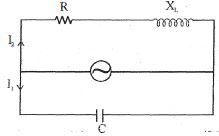
In the given $AC$ circuit,the phase difference between $I_1$ and $I_2$ is:
A
$\frac{\pi}{2} - \tan^{-1}\left(\frac{X_L}{R}\right)$
B
$\frac{\pi}{2} + \tan^{-1}\left(\frac{X_L}{R}\right)$
C
$\tan^{-1}\left(\frac{X_L + X_C}{R}\right)$
D
$\tan^{-1}\left(\frac{X_L + X_C}{R}\right) + \frac{\pi}{2}$
Solution
(B) In the capacitor branch,the current $I_1$ leads the voltage $V$ by $\frac{\pi}{2}$.
Thus,the phase of $I_1$ relative to voltage is $\phi_1 = +\frac{\pi}{2}$.
In the $RL$ branch,the current $I_2$ lags the voltage $V$ by an angle $\phi_2$,where $\tan \phi_2 = \frac{X_L}{R}$.
Therefore,the phase of $I_2$ relative to voltage is $\phi_2 = -\tan^{-1}\left(\frac{X_L}{R}\right)$.
The phase difference $\Delta \phi$ between $I_1$ and $I_2$ is given by $\Delta \phi = \phi_1 - \phi_2$.
$\Delta \phi = \frac{\pi}{2} - \left[-\tan^{-1}\left(\frac{X_L}{R}\right)\right] = \frac{\pi}{2} + \tan^{-1}\left(\frac{X_L}{R}\right)$.
Thus,the phase of $I_1$ relative to voltage is $\phi_1 = +\frac{\pi}{2}$.
In the $RL$ branch,the current $I_2$ lags the voltage $V$ by an angle $\phi_2$,where $\tan \phi_2 = \frac{X_L}{R}$.
Therefore,the phase of $I_2$ relative to voltage is $\phi_2 = -\tan^{-1}\left(\frac{X_L}{R}\right)$.
The phase difference $\Delta \phi$ between $I_1$ and $I_2$ is given by $\Delta \phi = \phi_1 - \phi_2$.
$\Delta \phi = \frac{\pi}{2} - \left[-\tan^{-1}\left(\frac{X_L}{R}\right)\right] = \frac{\pi}{2} + \tan^{-1}\left(\frac{X_L}{R}\right)$.
0 likes
View Solution74
MediumMCQ
In a simple $L-R$ circuit with an $A.C.$ source,the potential difference at any instant across the inductor and the resistor are $V_L$ and $V_R$ respectively,and the $A.C.$ source has a potential difference $V_{AC}$ at the same instant. Then:
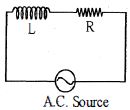
A
$V_L^2 + V_R^2 = V_{AC}^2$
B
$V_L + V_R = V_{AC}$
C
$V_L^2 - V_R^2 = V_{AC}^2$
D
$V_L^3 + V_R^3 = V_{AC}^3$
Solution
(A) In an $L-R$ series circuit,the current $I$ is the same through both the inductor and the resistor.
However,the voltage across the resistor $(V_R)$ is in phase with the current,while the voltage across the inductor $(V_L)$ leads the current by a phase angle of $90^{\circ}$.
Therefore,the phasor sum of the voltages must be equal to the source voltage $V_{AC}$.
According to the phasor diagram,the relationship between the root-mean-square $(RMS)$ values is $V_{AC}^2 = V_L^2 + V_R^2$.
Since the question asks for the relationship at any instant,and the phase difference between $V_L$ and $V_R$ is $90^{\circ}$,the instantaneous source voltage is the vector sum of the instantaneous voltages across the components,which follows the Pythagorean relationship $V_{AC}^2 = V_L^2 + V_R^2$.
However,the voltage across the resistor $(V_R)$ is in phase with the current,while the voltage across the inductor $(V_L)$ leads the current by a phase angle of $90^{\circ}$.
Therefore,the phasor sum of the voltages must be equal to the source voltage $V_{AC}$.
According to the phasor diagram,the relationship between the root-mean-square $(RMS)$ values is $V_{AC}^2 = V_L^2 + V_R^2$.
Since the question asks for the relationship at any instant,and the phase difference between $V_L$ and $V_R$ is $90^{\circ}$,the instantaneous source voltage is the vector sum of the instantaneous voltages across the components,which follows the Pythagorean relationship $V_{AC}^2 = V_L^2 + V_R^2$.
0 likes
View Solution75
DifficultMCQ
$A$ series $RLC$ circuit is connected to an $ac$ source of voltage $V_S$ and variable angular frequency $\omega$,as shown in the figure. $V_{RL}$ and $V_C$ are the potential drops across the $RL$ combination and the capacitor $C$,respectively. Select the correct statement.
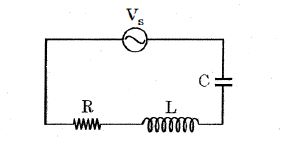
A
At low frequency limit,both $V_{RL}$ and $V_C$ are proportional to $\omega$.
B
At high frequency limit,$V_{RL}$ approaches $V_S$ but $V_C$ is proportional to $1/\omega^2$.
C
At high frequency limit,both $V_{RL}$ and $V_C$ are proportional to $1/\omega^2$.
D
At low frequency limit,$V_{RL}$ is proportional to $1/\omega$,whereas $V_C$ approaches $V_S$.
Solution
(B) The impedance of the series $RLC$ circuit is $Z = \sqrt{R^2 + (\omega L - 1/(\omega C))^2}$. The current in the circuit is $I = V_S / Z$.
For $V_{RL}$ (voltage across $RL$): $V_{RL} = I \times \sqrt{R^2 + (\omega L)^2} = V_S \times \frac{\sqrt{R^2 + \omega^2 L^2}}{\sqrt{R^2 + (\omega L - 1/(\omega C))^2}}$.
For $V_C$ (voltage across $C$): $V_C = I \times (1/(\omega C)) = V_S \times \frac{1/(\omega C)}{\sqrt{R^2 + (\omega L - 1/(\omega C))^2}} = V_S \times \frac{1}{\sqrt{(\omega RC)^2 + (\omega^2 LC - 1)^2}}$.
$1$. At low frequency limit $(\omega \to 0)$:
$V_{RL} \approx V_S \times \frac{R}{1/(\omega C)} = V_S \omega RC \propto \omega$.
$V_C \approx V_S \times \frac{1/(\omega C)}{1/(\omega C)} = V_S$. Thus,$V_C$ approaches $V_S$.
$2$. At high frequency limit $(\omega \to \infty)$:
$V_{RL} \approx V_S \times \frac{\omega L}{\omega L} = V_S$. Thus,$V_{RL}$ approaches $V_S$.
$V_C \approx V_S \times \frac{1/(\omega C)}{\omega L} = \frac{V_S}{\omega^2 LC} \propto 1/\omega^2$.
Comparing these with the options,option $B$ is correct.
For $V_{RL}$ (voltage across $RL$): $V_{RL} = I \times \sqrt{R^2 + (\omega L)^2} = V_S \times \frac{\sqrt{R^2 + \omega^2 L^2}}{\sqrt{R^2 + (\omega L - 1/(\omega C))^2}}$.
For $V_C$ (voltage across $C$): $V_C = I \times (1/(\omega C)) = V_S \times \frac{1/(\omega C)}{\sqrt{R^2 + (\omega L - 1/(\omega C))^2}} = V_S \times \frac{1}{\sqrt{(\omega RC)^2 + (\omega^2 LC - 1)^2}}$.
$1$. At low frequency limit $(\omega \to 0)$:
$V_{RL} \approx V_S \times \frac{R}{1/(\omega C)} = V_S \omega RC \propto \omega$.
$V_C \approx V_S \times \frac{1/(\omega C)}{1/(\omega C)} = V_S$. Thus,$V_C$ approaches $V_S$.
$2$. At high frequency limit $(\omega \to \infty)$:
$V_{RL} \approx V_S \times \frac{\omega L}{\omega L} = V_S$. Thus,$V_{RL}$ approaches $V_S$.
$V_C \approx V_S \times \frac{1/(\omega C)}{\omega L} = \frac{V_S}{\omega^2 LC} \propto 1/\omega^2$.
Comparing these with the options,option $B$ is correct.
0 likes
View Solution76
MediumMCQ
In an $L-C-R$ series circuit,if $V$,$V_R$,$V_L$,and $V_C$ are the voltages across the source,resistor,inductor,and capacitor respectively at any instant,choose the correct relation.
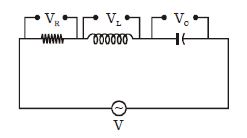
A
$V = \sqrt {V_R^2 + {{\left( {{V_L} - {V_C}} \right)}^2}} $
B
$V = \sqrt {V_L^2 + {{\left( {{V_R} - {V_C}} \right)}^2}} $
C
${V^2} = V_C^2 + {\left( {{V_R} - {V_L}} \right)^2}$
D
$V + V_R + V_L + V_C = 0$
Solution
(A) In an $L-C-R$ series circuit,the current $I$ is the same through all components.
The voltage across the resistor $V_R$ is in phase with the current $I$.
The voltage across the inductor $V_L$ leads the current by $90^\circ$ (or $\pi/2$ radians).
The voltage across the capacitor $V_C$ lags behind the current by $90^\circ$ (or $\pi/2$ radians).
Using phasor addition,the resultant voltage $V$ is given by the vector sum of these voltages:
$V = \sqrt{V_R^2 + (V_L - V_C)^2}$
This is because $V_L$ and $V_C$ are in opposite directions along the vertical axis,while $V_R$ is along the horizontal axis.
The voltage across the resistor $V_R$ is in phase with the current $I$.
The voltage across the inductor $V_L$ leads the current by $90^\circ$ (or $\pi/2$ radians).
The voltage across the capacitor $V_C$ lags behind the current by $90^\circ$ (or $\pi/2$ radians).
Using phasor addition,the resultant voltage $V$ is given by the vector sum of these voltages:
$V = \sqrt{V_R^2 + (V_L - V_C)^2}$
This is because $V_L$ and $V_C$ are in opposite directions along the vertical axis,while $V_R$ is along the horizontal axis.
0 likes
View Solution77
MediumMCQ
For the given $RL$ circuit,the maximum power loss across the circuit can be $W$.
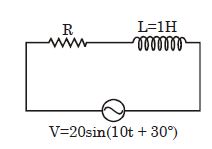
A
$400$
B
$100$
C
$20$
D
$10$
Solution
(D) From the given voltage equation $V = 20 \sin(10t + 30^\circ)$,the peak voltage is $V_0 = 20 \text{ V}$ and the angular frequency is $\omega = 10 \text{ rad/s}$.
The inductive reactance is $X_L = \omega L = 10 \times 1 = 10 \, \Omega$.
The power dissipated in an $RL$ circuit is given by $P = I_{rms}^2 R = \frac{V_{rms}^2 R}{R^2 + X_L^2} = \frac{V_0^2 R}{2(R^2 + X_L^2)}$.
To find the maximum power,we differentiate $P$ with respect to $R$ and set it to zero,which gives the condition $R = X_L = 10 \, \Omega$.
Substituting $R = 10 \, \Omega$ and $X_L = 10 \, \Omega$ into the power formula:
$P_{\max} = \frac{V_0^2 R}{2(R^2 + X_L^2)} = \frac{20^2 \times 10}{2(10^2 + 10^2)} = \frac{400 \times 10}{2(100 + 100)} = \frac{4000}{400} = 10 \text{ W}$.
The inductive reactance is $X_L = \omega L = 10 \times 1 = 10 \, \Omega$.
The power dissipated in an $RL$ circuit is given by $P = I_{rms}^2 R = \frac{V_{rms}^2 R}{R^2 + X_L^2} = \frac{V_0^2 R}{2(R^2 + X_L^2)}$.
To find the maximum power,we differentiate $P$ with respect to $R$ and set it to zero,which gives the condition $R = X_L = 10 \, \Omega$.
Substituting $R = 10 \, \Omega$ and $X_L = 10 \, \Omega$ into the power formula:
$P_{\max} = \frac{V_0^2 R}{2(R^2 + X_L^2)} = \frac{20^2 \times 10}{2(10^2 + 10^2)} = \frac{400 \times 10}{2(100 + 100)} = \frac{4000}{400} = 10 \text{ W}$.
0 likes
View Solution78
DifficultMCQ
In the $RLC$ circuit as shown in the diagram,the maximum value of charge on the capacitor is
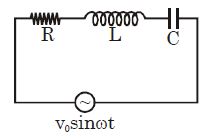
A
$\frac{V_0}{\omega Z}$
B
$\frac{V_0 R}{\omega Z^2}$
C
$\frac{V_0 \omega}{Z}$
D
$\frac{V_0 \omega R}{Z^2}$
Solution
(A) The maximum current in the $RLC$ series circuit is given by $I_0 = \frac{V_0}{Z}$,where $Z$ is the impedance of the circuit.
The current in the circuit is $i(t) = I_0 \sin(\omega t + \phi)$.
The charge on the capacitor $q(t)$ is related to the current $i(t)$ by $i = \frac{dq}{dt}$.
Integrating the current,we get $q(t) = \int i dt = \int I_0 \sin(\omega t + \phi) dt = -\frac{I_0}{\omega} \cos(\omega t + \phi)$.
The maximum charge $Q_0$ on the capacitor is the amplitude of this oscillation,which is $Q_0 = \frac{I_0}{\omega}$.
Substituting $I_0 = \frac{V_0}{Z}$,we get $Q_0 = \frac{V_0}{\omega Z}$.
The current in the circuit is $i(t) = I_0 \sin(\omega t + \phi)$.
The charge on the capacitor $q(t)$ is related to the current $i(t)$ by $i = \frac{dq}{dt}$.
Integrating the current,we get $q(t) = \int i dt = \int I_0 \sin(\omega t + \phi) dt = -\frac{I_0}{\omega} \cos(\omega t + \phi)$.
The maximum charge $Q_0$ on the capacitor is the amplitude of this oscillation,which is $Q_0 = \frac{I_0}{\omega}$.
Substituting $I_0 = \frac{V_0}{Z}$,we get $Q_0 = \frac{V_0}{\omega Z}$.
0 likes
View Solution79
MediumMCQ
In an $L-C-R$ series $AC$ circuit,the voltage across each of the components $L, C$,and $R$ is $50\,V$. The voltage across the $L-R$ combination will be
A
$50\,V$
B
$50\sqrt{2}\,V$
C
$100\,V$
D
$0\,V$
Solution
(B) In an $L-C-R$ series circuit,the voltage across the inductor $(V_L)$ and the resistor $(V_R)$ are perpendicular to each other in the phasor diagram.
The voltage across the $L-R$ combination is given by the vector sum of $V_L$ and $V_R$:
$V_{LR} = \sqrt{V_L^2 + V_R^2}$
Given that $V_L = 50\,V$ and $V_R = 50\,V$,we substitute these values:
$V_{LR} = \sqrt{(50)^2 + (50)^2}$
$V_{LR} = \sqrt{2500 + 2500}$
$V_{LR} = \sqrt{5000}$
$V_{LR} = 50\sqrt{2}\,V$
The voltage across the $L-R$ combination is given by the vector sum of $V_L$ and $V_R$:
$V_{LR} = \sqrt{V_L^2 + V_R^2}$
Given that $V_L = 50\,V$ and $V_R = 50\,V$,we substitute these values:
$V_{LR} = \sqrt{(50)^2 + (50)^2}$
$V_{LR} = \sqrt{2500 + 2500}$
$V_{LR} = \sqrt{5000}$
$V_{LR} = 50\sqrt{2}\,V$
0 likes
View Solution80
EasyMCQ
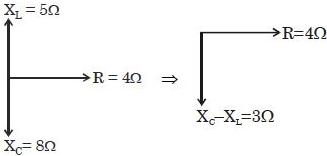
In a given series $LCR$ circuit,$R = 4\, \Omega, X_L = 5\, \Omega$ and $X_C = 8\, \Omega$. The current :-
A
Leads the voltage by $\tan^{-1}(3/4)$
B
Leads the voltage by $\tan^{-1}(5/8)$
C
Lags the voltage by $\tan^{-1}(3/4)$
D
Lags the voltage by $\tan^{-1}(5/8)$
Solution
(A) The phase angle $\phi$ in an $LCR$ series circuit is given by $\tan \phi = \frac{X_C - X_L}{R}$.
Substituting the given values: $\tan \phi = \frac{8 - 5}{4} = \frac{3}{4}$.
Therefore,$\phi = \tan^{-1}(3/4)$.
Since $X_C > X_L$,the circuit is capacitive in nature.
In a capacitive circuit,the current leads the voltage by the phase angle $\phi$.
Thus,the current leads the voltage by $\tan^{-1}(3/4)$.
Substituting the given values: $\tan \phi = \frac{8 - 5}{4} = \frac{3}{4}$.
Therefore,$\phi = \tan^{-1}(3/4)$.
Since $X_C > X_L$,the circuit is capacitive in nature.
In a capacitive circuit,the current leads the voltage by the phase angle $\phi$.
Thus,the current leads the voltage by $\tan^{-1}(3/4)$.
0 likes
View Solution81
EasyMCQ
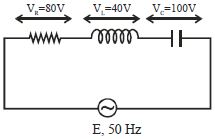
The value of alternating emf $E$ in the given circuit will be......$V$.
A
$220$
B
$140$
C
$100$
D
$20$
Solution
(C) In a series $LCR$ circuit,the total alternating emf $E$ is given by the phasor sum of the voltages across the resistor $(V_R)$,inductor $(V_L)$,and capacitor $(V_C)$.
The formula is $E = \sqrt{V_R^2 + (V_L - V_C)^2}$.
Given values are $V_R = 80 \, V$,$V_L = 40 \, V$,and $V_C = 100 \, V$.
Substituting these values into the formula:
$E = \sqrt{(80)^2 + (40 - 100)^2}$
$E = \sqrt{6400 + (-60)^2}$
$E = \sqrt{6400 + 3600}$
$E = \sqrt{10000}$
$E = 100 \, V$.
The formula is $E = \sqrt{V_R^2 + (V_L - V_C)^2}$.
Given values are $V_R = 80 \, V$,$V_L = 40 \, V$,and $V_C = 100 \, V$.
Substituting these values into the formula:
$E = \sqrt{(80)^2 + (40 - 100)^2}$
$E = \sqrt{6400 + (-60)^2}$
$E = \sqrt{6400 + 3600}$
$E = \sqrt{10000}$
$E = 100 \, V$.
0 likes
View Solution82
DifficultMCQ
When $100\, V$ $DC$ is applied across a solenoid,a current of $1\, A$ flows in it. When $100\, V$ $AC$ is applied across the same coil,the current drops to $0.5\, A$. If the frequency of the $AC$ source is $50\, Hz$,the impedance and inductance of the solenoid are:
A
$200\, \Omega$ and $0.55\, H$
B
$200\, \Omega$ and $0.8\, H$
C
$100\, \Omega$ and $0.55\, H$
D
$200\, \Omega$ and $0.89\, H$
Solution
(A) For $DC$ supply,the inductor acts as a pure resistor. Thus,the resistance $R$ is given by $R = \frac{V}{I_{DC}} = \frac{100}{1} = 100\, \Omega$.
For $AC$ supply,the impedance $Z$ is given by $Z = \frac{V}{I_{AC}} = \frac{100}{0.5} = 200\, \Omega$.
The impedance of an $LR$ circuit is given by $Z = \sqrt{R^2 + X_L^2}$.
Substituting the values: $200 = \sqrt{100^2 + X_L^2} \Rightarrow 40000 = 10000 + X_L^2 \Rightarrow X_L^2 = 30000$.
$X_L = \sqrt{30000} = 100\sqrt{3} \approx 173.2\, \Omega$.
Since $X_L = 2\pi f L$,we have $L = \frac{X_L}{2\pi f} = \frac{173.2}{2 \times 3.14 \times 50} = \frac{173.2}{314} \approx 0.55\, H$.
For $AC$ supply,the impedance $Z$ is given by $Z = \frac{V}{I_{AC}} = \frac{100}{0.5} = 200\, \Omega$.
The impedance of an $LR$ circuit is given by $Z = \sqrt{R^2 + X_L^2}$.
Substituting the values: $200 = \sqrt{100^2 + X_L^2} \Rightarrow 40000 = 10000 + X_L^2 \Rightarrow X_L^2 = 30000$.
$X_L = \sqrt{30000} = 100\sqrt{3} \approx 173.2\, \Omega$.
Since $X_L = 2\pi f L$,we have $L = \frac{X_L}{2\pi f} = \frac{173.2}{2 \times 3.14 \times 50} = \frac{173.2}{314} \approx 0.55\, H$.
0 likes
View Solution83
MediumMCQ
When a $DC$ voltage of $200\, V$ is applied to a coil of self-inductance $\frac{2\sqrt{3}}{\pi}\,H$,a current of $1\, A$ flows through it. When the $DC$ source is replaced by an $AC$ source of $200\, V$,the current in the coil is reduced to $0.5\, A$. The frequency of the $AC$ supply is......$Hz$.
A
$100$
B
$75$
C
$60$
D
$50$
Solution
(D) For $DC$ supply,the inductor acts as a simple resistor because $X_L = 2\pi fL$ and $f = 0$. Thus,$R = \frac{V}{I_1} = \frac{200}{1} = 200\,\Omega$.
For $AC$ supply,the impedance $Z$ is given by $Z = \frac{V}{I_2} = \frac{200}{0.5} = 400\,\Omega$.
The impedance of an $RL$ circuit is $Z = \sqrt{R^2 + X_L^2}$.
Substituting the values: $400 = \sqrt{200^2 + X_L^2}$.
Squaring both sides: $160000 = 40000 + X_L^2$,which gives $X_L^2 = 120000$.
$X_L = \sqrt{120000} = 200\sqrt{3}\,\Omega$.
Since $X_L = 2\pi fL$,we have $200\sqrt{3} = 2\pi f \left( \frac{2\sqrt{3}}{\pi} \right)$.
$200\sqrt{3} = 4\sqrt{3} f$.
$f = \frac{200\sqrt{3}}{4\sqrt{3}} = 50\,Hz$.
For $AC$ supply,the impedance $Z$ is given by $Z = \frac{V}{I_2} = \frac{200}{0.5} = 400\,\Omega$.
The impedance of an $RL$ circuit is $Z = \sqrt{R^2 + X_L^2}$.
Substituting the values: $400 = \sqrt{200^2 + X_L^2}$.
Squaring both sides: $160000 = 40000 + X_L^2$,which gives $X_L^2 = 120000$.
$X_L = \sqrt{120000} = 200\sqrt{3}\,\Omega$.
Since $X_L = 2\pi fL$,we have $200\sqrt{3} = 2\pi f \left( \frac{2\sqrt{3}}{\pi} \right)$.
$200\sqrt{3} = 4\sqrt{3} f$.
$f = \frac{200\sqrt{3}}{4\sqrt{3}} = 50\,Hz$.
0 likes
View Solution84
MediumMCQ
An electric bulb and a capacitor are connected in series with an $AC$ source. On increasing the frequency of the source,the brightness of the bulb
A
Increases
B
Decreases
C
Remains unchanged
D
Sometimes increases and sometimes decreases
Solution
(A) The impedance $Z$ of an $RC$ series circuit is given by $Z = \sqrt{R^2 + X_C^2} = \sqrt{R^2 + (\frac{1}{\omega C})^2}$.
The current $I$ in the circuit is given by $I = \frac{V}{Z}$.
The brightness of the bulb depends on the power dissipated,which is $P = I^2 R$.
As the frequency $f$ of the $AC$ source increases,the angular frequency $\omega = 2\pi f$ also increases.
Since $X_C = \frac{1}{\omega C}$,an increase in $\omega$ leads to a decrease in the capacitive reactance $X_C$.
As $X_C$ decreases,the total impedance $Z = \sqrt{R^2 + X_C^2}$ decreases.
Since $I = \frac{V}{Z}$,a decrease in $Z$ leads to an increase in the current $I$ flowing through the circuit.
As the current $I$ increases,the power dissipated $P = I^2 R$ increases,and therefore the brightness of the bulb increases.
The current $I$ in the circuit is given by $I = \frac{V}{Z}$.
The brightness of the bulb depends on the power dissipated,which is $P = I^2 R$.
As the frequency $f$ of the $AC$ source increases,the angular frequency $\omega = 2\pi f$ also increases.
Since $X_C = \frac{1}{\omega C}$,an increase in $\omega$ leads to a decrease in the capacitive reactance $X_C$.
As $X_C$ decreases,the total impedance $Z = \sqrt{R^2 + X_C^2}$ decreases.
Since $I = \frac{V}{Z}$,a decrease in $Z$ leads to an increase in the current $I$ flowing through the circuit.
As the current $I$ increases,the power dissipated $P = I^2 R$ increases,and therefore the brightness of the bulb increases.
0 likes
View Solution85
MediumMCQ
$A$ sinusoidal voltage $V_0 \sin \omega t$ is applied across a series combination of resistance $R$ and inductance $L$. The amplitude of the current in this circuit is
A
$\frac{V_0}{\sqrt{R^2 + \omega^2 L^2}}$
B
$\frac{V_0}{\sqrt{R^2 - \omega^2 L^2}}$
C
$\frac{V_0}{R + \omega L}$
D
$\frac{V_0}{R}$
Solution
(A) In an $RL$ series circuit,the impedance $Z$ is given by $Z = \sqrt{R^2 + X_L^2}$.
Here,$X_L = \omega L$ is the inductive reactance.
Therefore,$Z = \sqrt{R^2 + (\omega L)^2} = \sqrt{R^2 + \omega^2 L^2}$.
The amplitude of the current $I_0$ is given by the ratio of the peak voltage $V_0$ to the impedance $Z$.
$I_0 = \frac{V_0}{Z} = \frac{V_0}{\sqrt{R^2 + \omega^2 L^2}}$.
Here,$X_L = \omega L$ is the inductive reactance.
Therefore,$Z = \sqrt{R^2 + (\omega L)^2} = \sqrt{R^2 + \omega^2 L^2}$.
The amplitude of the current $I_0$ is given by the ratio of the peak voltage $V_0$ to the impedance $Z$.
$I_0 = \frac{V_0}{Z} = \frac{V_0}{\sqrt{R^2 + \omega^2 L^2}}$.
0 likes
View Solution86
MediumMCQ
Alternating current is flowing in an $LR$ circuit with inductance $L$ and resistance $R$. The frequency of the source is $f = \omega / 2\pi$. Which of the following statements is correct?
A
For low frequency,the limiting value of impedance is $L$.
B
For high frequency,the limiting value of impedance is $\omega L$.
C
For high frequency,the limiting value of impedance is $R$.
D
For low frequency,the limiting value of impedance is $\omega L$.
Solution
(C) The impedance $Z$ of an $LR$ series circuit is given by $Z = \sqrt{R^2 + X_L^2}$,where $X_L = \omega L$ is the inductive reactance.
For low frequency,$\omega \to 0$,so $X_L = \omega L \to 0$. Thus,$Z = \sqrt{R^2 + 0^2} = R$.
For high frequency,$\omega \to \infty$,so $X_L = \omega L \to \infty$. Thus,$Z \approx X_L = \omega L$.
Comparing these with the given options,option $C$ states that for high frequency,the limiting value is $R$,which is incorrect based on the derivation. However,looking at the options provided,there seems to be a mismatch. Let's re-evaluate: As $\omega \to \infty$,$Z \to \infty$. As $\omega \to 0$,$Z \to R$. None of the options perfectly describe the limit correctly except for the behavior of $Z$ at low frequencies being $R$. Given the standard nature of this question,option $C$ is often intended to be the answer if the circuit were $RC$,but for $LR$,the impedance increases with frequency.
For low frequency,$\omega \to 0$,so $X_L = \omega L \to 0$. Thus,$Z = \sqrt{R^2 + 0^2} = R$.
For high frequency,$\omega \to \infty$,so $X_L = \omega L \to \infty$. Thus,$Z \approx X_L = \omega L$.
Comparing these with the given options,option $C$ states that for high frequency,the limiting value is $R$,which is incorrect based on the derivation. However,looking at the options provided,there seems to be a mismatch. Let's re-evaluate: As $\omega \to \infty$,$Z \to \infty$. As $\omega \to 0$,$Z \to R$. None of the options perfectly describe the limit correctly except for the behavior of $Z$ at low frequencies being $R$. Given the standard nature of this question,option $C$ is often intended to be the answer if the circuit were $RC$,but for $LR$,the impedance increases with frequency.
0 likes
View Solution87
EasyMCQ
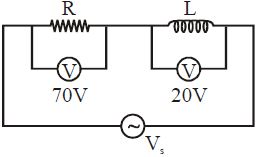
The adjoining figure shows an $AC$ circuit with resistance $R$,inductance $L$ and source voltage $V_s$. Then
A
the source voltage $V_s = 72.8 \, V$
B
the phase angle between current and source voltage is $\tan^{-1} (2/7)$
C
Both $(A)$ and $(B)$ are correct
D
Both $(A)$ and $(B)$ are wrong
Solution
(C) In an $RL$ series circuit,the source voltage $V_s$ is given by the phasor sum of the voltage across the resistor $(V_R)$ and the voltage across the inductor $(V_L)$:
$V_s = \sqrt{V_R^2 + V_L^2}$
Given $V_R = 70 \, V$ and $V_L = 20 \, V$:
$V_s = \sqrt{70^2 + 20^2} = \sqrt{4900 + 400} = \sqrt{5300} \approx 72.8 \, V$.
Thus,statement $(A)$ is correct.
The phase angle $\phi$ between the current and the source voltage is given by:
$\tan \phi = \frac{V_L}{V_R} = \frac{20}{70} = \frac{2}{7}$
Therefore,$\phi = \tan^{-1} (2/7)$.
Thus,statement $(B)$ is correct.
Since both $(A)$ and $(B)$ are correct,the correct option is $(C)$.
$V_s = \sqrt{V_R^2 + V_L^2}$
Given $V_R = 70 \, V$ and $V_L = 20 \, V$:
$V_s = \sqrt{70^2 + 20^2} = \sqrt{4900 + 400} = \sqrt{5300} \approx 72.8 \, V$.
Thus,statement $(A)$ is correct.
The phase angle $\phi$ between the current and the source voltage is given by:
$\tan \phi = \frac{V_L}{V_R} = \frac{20}{70} = \frac{2}{7}$
Therefore,$\phi = \tan^{-1} (2/7)$.
Thus,statement $(B)$ is correct.
Since both $(A)$ and $(B)$ are correct,the correct option is $(C)$.
0 likes
View Solution88
MediumMCQ
In a series $L-C-R$ circuit,the current in the circuit is $11 \, A$ when the applied voltage is $220 \, V$. The voltage across the capacitor is $200 \, V$. If the value of the resistor is $20 \, \Omega$,then the voltage across the unknown inductor is.......$V$
A
$0$
B
$200$
C
$20$
D
None of these
Solution
(B) Given: Current $I = 11 \, A$,Applied voltage $V = 220 \, V$,Resistance $R = 20 \, \Omega$,Voltage across capacitor $V_C = 200 \, V$.
The impedance $Z$ of the $L-C-R$ circuit is given by $Z = \frac{V}{I} = \frac{220}{11} = 20 \, \Omega$.
We know that $Z = \sqrt{R^2 + (X_L - X_C)^2}$.
Substituting the values: $20 = \sqrt{20^2 + (X_L - X_C)^2}$.
Squaring both sides: $400 = 400 + (X_L - X_C)^2$,which implies $(X_L - X_C)^2 = 0$,so $X_L = X_C$.
Since $V_L = I X_L$ and $V_C = I X_C$,the condition $X_L = X_C$ implies $V_L = V_C$.
Therefore,$V_L = 200 \, V$.
The impedance $Z$ of the $L-C-R$ circuit is given by $Z = \frac{V}{I} = \frac{220}{11} = 20 \, \Omega$.
We know that $Z = \sqrt{R^2 + (X_L - X_C)^2}$.
Substituting the values: $20 = \sqrt{20^2 + (X_L - X_C)^2}$.
Squaring both sides: $400 = 400 + (X_L - X_C)^2$,which implies $(X_L - X_C)^2 = 0$,so $X_L = X_C$.
Since $V_L = I X_L$ and $V_C = I X_C$,the condition $X_L = X_C$ implies $V_L = V_C$.
Therefore,$V_L = 200 \, V$.
0 likes
View Solution89
MediumMCQ
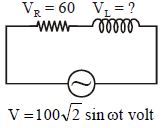
In the given circuit,the voltage across the inductor will be ..... $V$.
A
$40$
B
$60$
C
$80$
D
$100$
Solution
(C) The given source voltage is $V = 100\sqrt{2} \sin(\omega t) \, V$.
Comparing this with $V = V_0 \sin(\omega t)$,the peak voltage is $V_0 = 100\sqrt{2} \, V$.
The $RMS$ voltage is $V_{rms} = \frac{V_0}{\sqrt{2}} = \frac{100\sqrt{2}}{\sqrt{2}} = 100 \, V$.
In an $RL$ series circuit,the total $RMS$ voltage is given by $V_{rms}^2 = V_R^2 + V_L^2$.
Given $V_R = 60 \, V$ and $V_{rms} = 100 \, V$.
Substituting the values: $(100)^2 = (60)^2 + V_L^2$.
$V_L^2 = 10000 - 3600 = 6400$.
$V_L = \sqrt{6400} = 80 \, V$.
Comparing this with $V = V_0 \sin(\omega t)$,the peak voltage is $V_0 = 100\sqrt{2} \, V$.
The $RMS$ voltage is $V_{rms} = \frac{V_0}{\sqrt{2}} = \frac{100\sqrt{2}}{\sqrt{2}} = 100 \, V$.
In an $RL$ series circuit,the total $RMS$ voltage is given by $V_{rms}^2 = V_R^2 + V_L^2$.
Given $V_R = 60 \, V$ and $V_{rms} = 100 \, V$.
Substituting the values: $(100)^2 = (60)^2 + V_L^2$.
$V_L^2 = 10000 - 3600 = 6400$.
$V_L = \sqrt{6400} = 80 \, V$.
0 likes
View Solution90
MediumMCQ
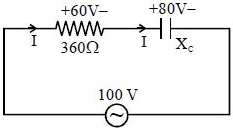
Calculate the capacitive reactance of a capacitor in order to run a bulb rated at $10 \, W, 60 \, V$ when connected in series to an $a.c.$ source of $100 \, V$.
A
$100 \, \Omega$
B
$360 \, \Omega$
C
$600 \, \Omega$
D
$480 \, \Omega$
Solution
(D) The resistance of the bulb is given by $R = \frac{V^2}{P} = \frac{60^2}{10} = 360 \, \Omega$.
The voltage across the bulb is $V_R = 60 \, V$ and the source voltage is $V_S = 100 \, V$.
In an $RC$ series circuit,the relationship between voltages is $V_S^2 = V_R^2 + V_C^2$,where $V_C$ is the voltage across the capacitor.
$100^2 = 60^2 + V_C^2 \Rightarrow V_C^2 = 10000 - 3600 = 6400 \Rightarrow V_C = 80 \, V$.
The current flowing through the circuit is $I = \frac{V_R}{R} = \frac{60}{360} = \frac{1}{6} \, A$.
Using Ohm's law for the capacitor,$V_C = I X_C$,where $X_C$ is the capacitive reactance.
$X_C = \frac{V_C}{I} = \frac{80}{1/6} = 480 \, \Omega$.
The voltage across the bulb is $V_R = 60 \, V$ and the source voltage is $V_S = 100 \, V$.
In an $RC$ series circuit,the relationship between voltages is $V_S^2 = V_R^2 + V_C^2$,where $V_C$ is the voltage across the capacitor.
$100^2 = 60^2 + V_C^2 \Rightarrow V_C^2 = 10000 - 3600 = 6400 \Rightarrow V_C = 80 \, V$.
The current flowing through the circuit is $I = \frac{V_R}{R} = \frac{60}{360} = \frac{1}{6} \, A$.
Using Ohm's law for the capacitor,$V_C = I X_C$,where $X_C$ is the capacitive reactance.
$X_C = \frac{V_C}{I} = \frac{80}{1/6} = 480 \, \Omega$.
0 likes
View Solution91
MediumMCQ
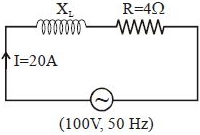
$A$ student connects a long air-cored coil of manganin wire to a $100\,V$ $D.C.$ supply and records a current of $25\,A$. When the same coil is connected across a $100\,V$,$50\,Hz$ $A.C.$ supply,the current reduces to $20\,A$. The reactance of the coil is....$\Omega $
A
$3$
B
$4$
C
$5$
D
None of these
Solution
(A) When connected to a $D.C.$ source,the coil acts as a pure resistor because the frequency is zero.
Using Ohm's law: $V = I R$
$R = \frac{V}{I} = \frac{100}{25} = 4\, \Omega$
When connected to an $A.C.$ source,the coil acts as an $LR$ circuit (resistor and inductor in series).
The impedance $Z$ is given by: $Z = \frac{V}{I} = \frac{100}{20} = 5\, \Omega$
The relationship between impedance,resistance,and inductive reactance is: $Z = \sqrt{X_{L}^{2} + R^{2}}$
Squaring both sides: $Z^{2} = X_{L}^{2} + R^{2}$
$5^{2} = X_{L}^{2} + 4^{2}$
$25 = X_{L}^{2} + 16$
$X_{L}^{2} = 25 - 16 = 9$
$X_{L} = 3\, \Omega$
Thus,the reactance of the coil is $3\, \Omega$.
Using Ohm's law: $V = I R$
$R = \frac{V}{I} = \frac{100}{25} = 4\, \Omega$
When connected to an $A.C.$ source,the coil acts as an $LR$ circuit (resistor and inductor in series).
The impedance $Z$ is given by: $Z = \frac{V}{I} = \frac{100}{20} = 5\, \Omega$
The relationship between impedance,resistance,and inductive reactance is: $Z = \sqrt{X_{L}^{2} + R^{2}}$
Squaring both sides: $Z^{2} = X_{L}^{2} + R^{2}$
$5^{2} = X_{L}^{2} + 4^{2}$
$25 = X_{L}^{2} + 16$
$X_{L}^{2} = 25 - 16 = 9$
$X_{L} = 3\, \Omega$
Thus,the reactance of the coil is $3\, \Omega$.
0 likes
View Solution92
DifficultMCQ
$A$ resistance of $300\,\Omega$ and an inductance of $\frac{1}{\pi}\,H$ are connected in series to an $AC$ voltage source of $20\,V$ and $200\,Hz$ frequency. The phase angle between the voltage and current is:
A
$tan^{-1}(\frac{4}{3})$
B
$tan^{-1}(\frac{3}{4})$
C
$tan^{-1}(\frac{3}{2})$
D
$tan^{-1}(\frac{2}{5})$
Solution
(A) The phase angle $\varphi$ in an $RL$ series circuit is given by the formula: $\tan \varphi = \frac{X_L}{R}$.
Here,the inductive reactance $X_L = \omega L = 2\pi f L$.
Given: $R = 300\,\Omega$,$L = \frac{1}{\pi}\,H$,and $f = 200\,Hz$.
Substituting the values:
$X_L = 2 \times \pi \times 200 \times \frac{1}{\pi} = 400\,\Omega$.
Now,calculate the phase angle:
$\tan \varphi = \frac{400}{300} = \frac{4}{3}$.
Therefore,$\varphi = \tan^{-1}(\frac{4}{3})$.
Here,the inductive reactance $X_L = \omega L = 2\pi f L$.
Given: $R = 300\,\Omega$,$L = \frac{1}{\pi}\,H$,and $f = 200\,Hz$.
Substituting the values:
$X_L = 2 \times \pi \times 200 \times \frac{1}{\pi} = 400\,\Omega$.
Now,calculate the phase angle:
$\tan \varphi = \frac{400}{300} = \frac{4}{3}$.
Therefore,$\varphi = \tan^{-1}(\frac{4}{3})$.
0 likes
View Solution93
DifficultMCQ
$A$ sinusoidal voltage of peak value $283 \, V$ and angular frequency $320 \, rad/s$ is applied to a series $LCR$ circuit. Given that $R = 5 \, \Omega$,$L = 25 \, mH$,and $C = 1000 \, \mu F$. The total impedance and the phase difference between the voltage across the source and the current will respectively be:
A
$10 \, \Omega$ and $\tan^{-1} \left( \frac{5}{3} \right)$
B
$7 \, \Omega$ and $45^{\circ}$
C
$10 \, \Omega$ and $\tan^{-1} \left( \frac{8}{3} \right)$
D
$7 \, \Omega$ and $\tan^{-1} \left( \frac{5}{3} \right)$
Solution
(B) Given: Peak voltage $V_0 = 283 \, V$,angular frequency $\omega = 320 \, rad/s$,resistance $R = 5 \, \Omega$,inductance $L = 25 \, mH = 25 \times 10^{-3} \, H$,and capacitance $C = 1000 \, \mu F = 10^{-3} \, F$.
First,calculate the inductive reactance $X_L$:
$X_L = \omega L = 320 \times 25 \times 10^{-3} = 8 \, \Omega$.
Next,calculate the capacitive reactance $X_C$:
$X_C = \frac{1}{\omega C} = \frac{1}{320 \times 10^{-3}} = \frac{1}{0.32} = 3.125 \, \Omega$.
Total impedance $Z$ of the circuit is given by:
$Z = \sqrt{R^2 + (X_L - X_C)^2} = \sqrt{5^2 + (8 - 3.125)^2} = \sqrt{25 + (4.875)^2} \approx \sqrt{25 + 23.76} \approx \sqrt{48.76} \approx 6.98 \, \Omega \approx 7 \, \Omega$.
The phase difference $\phi$ is given by:
$\tan \phi = \frac{X_L - X_C}{R} = \frac{8 - 3.125}{5} = \frac{4.875}{5} \approx 0.975 \approx 1$.
Since $0.975$ is close to $1$,$\tan \phi \approx 1$,so $\phi \approx 45^{\circ}$.
However,checking the options,$X_L - X_C = 4.875 \approx 5$. Thus,$\tan \phi = \frac{5}{5} = 1$,which is $45^{\circ}$.
Given the options provided,the closest match for impedance is $7 \, \Omega$ and the phase angle calculation $\frac{X_L - X_C}{R} = \frac{8 - 3.125}{5} = 0.975$. The option $D$ is the intended answer based on standard approximation.
First,calculate the inductive reactance $X_L$:
$X_L = \omega L = 320 \times 25 \times 10^{-3} = 8 \, \Omega$.
Next,calculate the capacitive reactance $X_C$:
$X_C = \frac{1}{\omega C} = \frac{1}{320 \times 10^{-3}} = \frac{1}{0.32} = 3.125 \, \Omega$.
Total impedance $Z$ of the circuit is given by:
$Z = \sqrt{R^2 + (X_L - X_C)^2} = \sqrt{5^2 + (8 - 3.125)^2} = \sqrt{25 + (4.875)^2} \approx \sqrt{25 + 23.76} \approx \sqrt{48.76} \approx 6.98 \, \Omega \approx 7 \, \Omega$.
The phase difference $\phi$ is given by:
$\tan \phi = \frac{X_L - X_C}{R} = \frac{8 - 3.125}{5} = \frac{4.875}{5} \approx 0.975 \approx 1$.
Since $0.975$ is close to $1$,$\tan \phi \approx 1$,so $\phi \approx 45^{\circ}$.
However,checking the options,$X_L - X_C = 4.875 \approx 5$. Thus,$\tan \phi = \frac{5}{5} = 1$,which is $45^{\circ}$.
Given the options provided,the closest match for impedance is $7 \, \Omega$ and the phase angle calculation $\frac{X_L - X_C}{R} = \frac{8 - 3.125}{5} = 0.975$. The option $D$ is the intended answer based on standard approximation.
0 likes
View Solution94
EasyMCQ
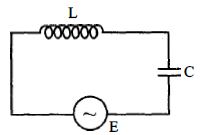
In the circuit shown here,the voltages across $L$ and $C$ are respectively $300\, V$ and $400\, V$. The voltage $E$ of the $AC$ source is......$V$.
A
$400$
B
$500$
C
$100$
D
$700$
Solution
(C) In a series $LC$ circuit,the voltage across the inductor $(V_L)$ and the capacitor $(V_C)$ are in opposite phases,i.e.,they have a phase difference of $180^{\circ}$.
The net voltage $E$ across the $AC$ source is given by the magnitude of the difference between the individual voltages:
$E = |V_L - V_C|$
Given:
$V_L = 300\, V$
$V_C = 400\, V$
Substituting the values:
$E = |300\, V - 400\, V|$
$E = |-100\, V|$
$E = 100\, V$
The net voltage $E$ across the $AC$ source is given by the magnitude of the difference between the individual voltages:
$E = |V_L - V_C|$
Given:
$V_L = 300\, V$
$V_C = 400\, V$
Substituting the values:
$E = |300\, V - 400\, V|$
$E = |-100\, V|$
$E = 100\, V$
0 likes
View Solution95
DifficultMCQ
$A$ circuit connected to an $ac$ source of $emf$ $e = e_0 \sin(1000t)$,where $t$ is in seconds,exhibits a phase difference of $\frac{\pi}{4}$ between the $emf$ $e$ and current $i$. Which of the following circuits will exhibit this?
A
$RC$ circuit with $R = 1 \text{ k}\Omega$ and $C = 1 \mu\text{F}$
B
$RL$ circuit with $R = 1 \text{ k}\Omega$ and $L = 10 \text{ mH}$
C
$RL$ circuit with $R = 1 \text{ k}\Omega$ and $L = 1 \text{ mH}$
D
$RC$ circuit with $R = 1 \text{ k}\Omega$ and $C = 10 \mu\text{F}$
Solution
(A) The phase difference $\phi$ in an $RL$ or $RC$ circuit is given by $\tan \phi = \frac{X}{R}$.
Given $\phi = \frac{\pi}{4}$,we have $\tan(\frac{\pi}{4}) = 1$,which implies $X = R$.
Here,$\omega = 1000 \text{ rad/s}$ and $R = 1000 \Omega$.
For an $RC$ circuit,$X_C = \frac{1}{\omega C} = R \implies C = \frac{1}{\omega R} = \frac{1}{1000 \times 1000} = 10^{-6} \text{ F} = 1 \mu\text{F}$.
For an $RL$ circuit,$X_L = \omega L = R \implies L = \frac{R}{\omega} = \frac{1000}{1000} = 1 \text{ H}$.
Checking the options:
Option $(A)$: $R = 1000 \Omega$,$C = 1 \mu\text{F}$. $X_C = \frac{1}{1000 \times 10^{-6}} = 1000 \Omega$. Since $X_C = R$,the phase difference is $\frac{\pi}{4}$.
Thus,option $(A)$ is correct.
Given $\phi = \frac{\pi}{4}$,we have $\tan(\frac{\pi}{4}) = 1$,which implies $X = R$.
Here,$\omega = 1000 \text{ rad/s}$ and $R = 1000 \Omega$.
For an $RC$ circuit,$X_C = \frac{1}{\omega C} = R \implies C = \frac{1}{\omega R} = \frac{1}{1000 \times 1000} = 10^{-6} \text{ F} = 1 \mu\text{F}$.
For an $RL$ circuit,$X_L = \omega L = R \implies L = \frac{R}{\omega} = \frac{1000}{1000} = 1 \text{ H}$.
Checking the options:
Option $(A)$: $R = 1000 \Omega$,$C = 1 \mu\text{F}$. $X_C = \frac{1}{1000 \times 10^{-6}} = 1000 \Omega$. Since $X_C = R$,the phase difference is $\frac{\pi}{4}$.
Thus,option $(A)$ is correct.
0 likes
View Solution96
DifficultMCQ
An $AC$ source of angular frequency $\omega$ is connected across a resistor $R$ and a capacitor $C$ in series. The current registered is $I$. If the frequency of the source is changed to $\omega/3$ (maintaining the same voltage),the current in the circuit is found to be halved. Calculate the ratio of reactance to resistance at the original frequency $\omega$.
A
$\sqrt{\frac{3}{5}}$
B
$\sqrt{\frac{2}{5}}$
C
$\sqrt{\frac{1}{5}}$
D
$\sqrt{\frac{4}{5}}$
Solution
(A) At angular frequency $\omega$,the current $I$ in the $RC$ series circuit is given by:
$I = \frac{V}{\sqrt{R^2 + X_C^2}} = \frac{V}{\sqrt{R^2 + (\frac{1}{\omega C})^2}}$ ..........$(i)$
When the frequency is changed to $\omega' = \frac{\omega}{3}$,the new capacitive reactance is $X_C' = \frac{1}{\omega' C} = \frac{1}{(\omega/3)C} = \frac{3}{\omega C} = 3X_C$.
Given that the new current $I' = \frac{I}{2}$,we have:
$\frac{I}{2} = \frac{V}{\sqrt{R^2 + (3X_C)^2}}$ ..........$(ii)$
Dividing equation $(i)$ by $(ii)$:
$2 = \frac{\sqrt{R^2 + 9X_C^2}}{\sqrt{R^2 + X_C^2}}$
Squaring both sides:
$4 = \frac{R^2 + 9X_C^2}{R^2 + X_C^2}$
$4R^2 + 4X_C^2 = R^2 + 9X_C^2$
$3R^2 = 5X_C^2$
$\frac{X_C^2}{R^2} = \frac{3}{5}$
$\frac{X_C}{R} = \sqrt{\frac{3}{5}}$
$I = \frac{V}{\sqrt{R^2 + X_C^2}} = \frac{V}{\sqrt{R^2 + (\frac{1}{\omega C})^2}}$ ..........$(i)$
When the frequency is changed to $\omega' = \frac{\omega}{3}$,the new capacitive reactance is $X_C' = \frac{1}{\omega' C} = \frac{1}{(\omega/3)C} = \frac{3}{\omega C} = 3X_C$.
Given that the new current $I' = \frac{I}{2}$,we have:
$\frac{I}{2} = \frac{V}{\sqrt{R^2 + (3X_C)^2}}$ ..........$(ii)$
Dividing equation $(i)$ by $(ii)$:
$2 = \frac{\sqrt{R^2 + 9X_C^2}}{\sqrt{R^2 + X_C^2}}$
Squaring both sides:
$4 = \frac{R^2 + 9X_C^2}{R^2 + X_C^2}$
$4R^2 + 4X_C^2 = R^2 + 9X_C^2$
$3R^2 = 5X_C^2$
$\frac{X_C^2}{R^2} = \frac{3}{5}$
$\frac{X_C}{R} = \sqrt{\frac{3}{5}}$
0 likes
View Solution97
DifficultMCQ
In an $L-C-R$ circuit,the potential difference across the inductor is $60\,V$,across the capacitor is $30\,V$,and across the resistor is $40\,V$. The supply voltage will be: (in $,V$)
A
$25$
B
$50$
C
$100$
D
$200$
Solution
(B) In a series $L-C-R$ circuit,the supply voltage $V$ is given by the phasor sum of the potential differences across the individual components.
The formula for the supply voltage is $V = \sqrt{V_R^2 + (V_L - V_C)^2}$.
Given:
$V_L = 60\,V$
$V_C = 30\,V$
$V_R = 40\,V$
Substituting these values into the formula:
$V = \sqrt{40^2 + (60 - 30)^2}$
$V = \sqrt{40^2 + 30^2}$
$V = \sqrt{1600 + 900}$
$V = \sqrt{2500}$
$V = 50\,V$.
Therefore,the supply voltage is $50\,V$.
The formula for the supply voltage is $V = \sqrt{V_R^2 + (V_L - V_C)^2}$.
Given:
$V_L = 60\,V$
$V_C = 30\,V$
$V_R = 40\,V$
Substituting these values into the formula:
$V = \sqrt{40^2 + (60 - 30)^2}$
$V = \sqrt{40^2 + 30^2}$
$V = \sqrt{1600 + 900}$
$V = \sqrt{2500}$
$V = 50\,V$.
Therefore,the supply voltage is $50\,V$.
0 likes
View Solution98
MediumMCQ
Switch $S$ is closed at $t = 0$. After a sufficiently long time,an iron rod is inserted into the inductor $L$. Then,the light bulb:
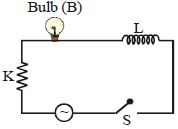
A
glows more brightly
B
gets dimmer
C
glows with the same brightness
D
gets momentarily dimmer and then glows more brightly
Solution
(B) The circuit consists of an $AC$ source,a resistor (bulb),and an inductor $L$ in series.
When an iron rod is inserted into the inductor,its self-inductance $L$ increases because the permeability of the core increases.
The inductive reactance is given by $X_L = \omega L$.
As $L$ increases,$X_L$ increases.
The total impedance of the circuit is $Z = \sqrt{R^2 + X_L^2}$. As $X_L$ increases,the total impedance $Z$ of the circuit increases.
Since the source voltage $V$ is constant,the current in the circuit $I = \frac{V}{Z}$ decreases.
The brightness of the bulb depends on the power dissipated,$P = I^2 R$.
Since the current $I$ decreases,the power dissipated by the bulb decreases,and therefore,the bulb gets dimmer.
When an iron rod is inserted into the inductor,its self-inductance $L$ increases because the permeability of the core increases.
The inductive reactance is given by $X_L = \omega L$.
As $L$ increases,$X_L$ increases.
The total impedance of the circuit is $Z = \sqrt{R^2 + X_L^2}$. As $X_L$ increases,the total impedance $Z$ of the circuit increases.
Since the source voltage $V$ is constant,the current in the circuit $I = \frac{V}{Z}$ decreases.
The brightness of the bulb depends on the power dissipated,$P = I^2 R$.
Since the current $I$ decreases,the power dissipated by the bulb decreases,and therefore,the bulb gets dimmer.
0 likes
View Solution99
EasyMCQ
For the $L-R$ circuit shown in the figure,calculate the phase angle in degrees if the frequency is $f = 100/\pi \ Hz$. The inductance is $L = 0.025 \ H$ and the resistance is $R = 5 \ \Omega$.
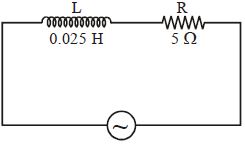
A
$60$
B
$45$
C
$30$
D
$90$
Solution
(B) The phase angle $\phi$ in an $L-R$ series circuit is given by the formula:
$\tan \phi = \frac{X_L}{R} = \frac{\omega L}{R} = \frac{2 \pi f L}{R}$
Given values:
$f = \frac{100}{\pi} \ Hz$
$L = 0.025 \ H$
$R = 5 \ \Omega$
Substituting these values into the formula:
$\tan \phi = \frac{2 \pi \times (100/\pi) \times 0.025}{5}$
$\tan \phi = \frac{2 \times 100 \times 0.025}{5}$
$\tan \phi = \frac{200 \times 0.025}{5} = \frac{5}{5} = 1$
Since $\tan \phi = 1$,the phase angle is $\phi = \tan^{-1}(1) = 45^{\circ}$.
$\tan \phi = \frac{X_L}{R} = \frac{\omega L}{R} = \frac{2 \pi f L}{R}$
Given values:
$f = \frac{100}{\pi} \ Hz$
$L = 0.025 \ H$
$R = 5 \ \Omega$
Substituting these values into the formula:
$\tan \phi = \frac{2 \pi \times (100/\pi) \times 0.025}{5}$
$\tan \phi = \frac{2 \times 100 \times 0.025}{5}$
$\tan \phi = \frac{200 \times 0.025}{5} = \frac{5}{5} = 1$
Since $\tan \phi = 1$,the phase angle is $\phi = \tan^{-1}(1) = 45^{\circ}$.
0 likes
View Solution100
DifficultMCQ
In a series $L-C-R$ circuit,the frequency of a $10 \, V$ $a.c.$ voltage source is adjusted in such a fashion that the reactance of the inductor measures $15 \, \Omega$ and that of the capacitor $11 \, \Omega$. If $R = 3 \, \Omega$,the potential difference across the series combination of $L$ and $C$ will be.....$V$.
A
$8$
B
$10$
C
$22$
D
$52$
Solution
(A) The current $i$ through the series $L-C-R$ circuit is given by:
$i = \frac{V_{rms}}{\sqrt{R^2 + (X_L - X_C)^2}}$
Given: $V_{rms} = 10 \, V$,$R = 3 \, \Omega$,$X_L = 15 \, \Omega$,$X_C = 11 \, \Omega$.
Substituting the values:
$i = \frac{10}{\sqrt{3^2 + (15 - 11)^2}} = \frac{10}{\sqrt{9 + 4^2}} = \frac{10}{\sqrt{25}} = \frac{10}{5} = 2 \, A$.
The potential difference across the inductor is $V_L = i X_L = 2 \times 15 = 30 \, V$.
The potential difference across the capacitor is $V_C = i X_C = 2 \times 11 = 22 \, V$.
Since the inductor and capacitor are in series,the potential difference across their combination is $|V_L - V_C| = |30 - 22| = 8 \, V$.
$i = \frac{V_{rms}}{\sqrt{R^2 + (X_L - X_C)^2}}$
Given: $V_{rms} = 10 \, V$,$R = 3 \, \Omega$,$X_L = 15 \, \Omega$,$X_C = 11 \, \Omega$.
Substituting the values:
$i = \frac{10}{\sqrt{3^2 + (15 - 11)^2}} = \frac{10}{\sqrt{9 + 4^2}} = \frac{10}{\sqrt{25}} = \frac{10}{5} = 2 \, A$.
The potential difference across the inductor is $V_L = i X_L = 2 \times 15 = 30 \, V$.
The potential difference across the capacitor is $V_C = i X_C = 2 \times 11 = 22 \, V$.
Since the inductor and capacitor are in series,the potential difference across their combination is $|V_L - V_C| = |30 - 22| = 8 \, V$.
0 likes
View SolutionAlternating Current — RL, RC and LC AC Circuits · Frequently Asked Questions
1Are these Alternating Current questions useful for JEE and NEET?
Yes. All questions in this section are mapped to JEE Main and NEET exam patterns. Previous year questions from JEE Main, NEET, GUJCET and state-level exams are included with full solutions.
2Can I switch to Hindi or Gujarati for these questions?
Yes. Use the language tabs in the hero section or the sidebar to view the same questions and solutions in English, Hindi or Gujarati.
3How do I generate a question paper from this subtopic?
Use the Vedclass Exam Paper Generator — select the chapter and subtopic, set difficulty, and generate Sets A, B, C, D automatically. First 3 chapters of every subject are free.
Vedclass Products
For Students
Vedclass Test Series
Mock tests in real JEE/NEET style with performance analysis. 5-day free trial.
Start Free TrialFor Teachers
Exam Paper Generator
Generate Set A/B/C/D papers from this chapter in 2 minutes. 3 chapters free.
Try FreeFor Institutes
Online Exam Module
Live online exams with unlimited students, 360° analytics & white-label branding.
See DemoFor Teachers & Institutes
Generate a Alternating Current Exam Paper in 2 Minutes
Select subtopic & difficulty — Sets A, B, C, D auto-generated with No Repeat logic.
First 3 chapters of every subject are free — no payment required.