
A English
Ideal and Non-ideal solution Questions in English
Class 12 Chemistry · Solutions · Ideal and Non-ideal solution
179+
Questions
English
Language
100%
With Solutions
Showing 50 of 179 questions in English
101
MediumMCQ
For an ideal solution,the correct option is
A
$\Delta_{mix} S = 0$ at constant $T$ and $P$
B
$\Delta_{mix} V \neq 0$ at constant $T$ and $P$
C
$\Delta_{mix} H = 0$ at constant $T$ and $P$
D
$\Delta_{mix} G = 0$ at constant $T$ and $P$
Solution
(C) An ideal solution is defined as a solution that obeys Raoult's law over the entire range of concentration.
For an ideal solution,the enthalpy of mixing is zero,i.e.,$\Delta_{mix} H = 0$.
Also,the volume of mixing is zero,i.e.,$\Delta_{mix} V = 0$.
However,the entropy of mixing $(\Delta_{mix} S)$ is always greater than zero for any mixing process,and the Gibbs free energy of mixing $(\Delta_{mix} G)$ is always less than zero for a spontaneous process.
For an ideal solution,the enthalpy of mixing is zero,i.e.,$\Delta_{mix} H = 0$.
Also,the volume of mixing is zero,i.e.,$\Delta_{mix} V = 0$.
However,the entropy of mixing $(\Delta_{mix} S)$ is always greater than zero for any mixing process,and the Gibbs free energy of mixing $(\Delta_{mix} G)$ is always less than zero for a spontaneous process.
0 likes
View Solution102
MediumMCQ
Which of the following statements is correct regarding a solution of two compounds $A$ and $B$ exhibiting positive deviation from ideal behaviour?
A
Intermolecular attractive forces between $A-A$ and $B-B$ are stronger than those between $A-B$.
B
$\Delta_{mix} H > 0$ at constant $T$ and $P$.
C
$\Delta_{mix} V > 0$ at constant $T$ and $P$.
D
Intermolecular attractive forces between $A-A$ and $B-B$ are equal to those between $A-B$.
Solution
(A) For a solution to exhibit positive deviation from Raoult's law:
$1$. The intermolecular attractive forces between $A-A$ and $B-B$ are stronger than those between $A-B$.
$2$. The enthalpy of mixing is positive,i.e.,$\Delta_{mix} H > 0$.
$3$. The volume of mixing is positive,i.e.,$\Delta_{mix} V > 0$.
Since options $A$,$B$,and $C$ are all correct descriptions of positive deviation,this question is a multiple-correct type. However,in standard single-choice contexts,the primary cause is the intermolecular force interaction.
$1$. The intermolecular attractive forces between $A-A$ and $B-B$ are stronger than those between $A-B$.
$2$. The enthalpy of mixing is positive,i.e.,$\Delta_{mix} H > 0$.
$3$. The volume of mixing is positive,i.e.,$\Delta_{mix} V > 0$.
Since options $A$,$B$,and $C$ are all correct descriptions of positive deviation,this question is a multiple-correct type. However,in standard single-choice contexts,the primary cause is the intermolecular force interaction.
0 likes
View Solution103
Easy
What role does the molecular interaction play in a solution of alcohol and water?
Solution
(N/A) Alcohol and water both have a strong tendency to form intermolecular hydrogen bonding. On mixing the two,a solution is formed as a result of the formation of $H$-bonds between alcohol and $H_2O$ molecules. However,these interactions are weaker and less extensive than those in pure $H_2O$. Thus,they show a positive deviation from ideal behavior. As a result of this,the solution of alcohol and water will have a higher vapour pressure and a lower boiling point than that of pure water and pure alcohol.
0 likes
View Solution104
Easy
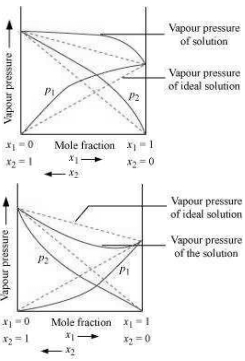
What is meant by positive and negative deviations from Raoult's law and how is the sign of $\Delta_{mix} H$ related to positive and negative deviations from Raoult's law?
Solution
(N/A) According to Raoult's law,the partial vapour pressure of each volatile component in any solution is directly proportional to its mole fraction. The solutions which obey Raoult's law over the entire range of concentration are known as ideal solutions. The solutions that do not obey Raoult's law (non-ideal solutions) have vapour pressures either higher or lower than that predicted by Raoult's law. If the vapour pressure is higher,then the solution is said to exhibit positive deviation,and if it is lower,then the solution is said to exhibit negative deviation from Raoult's law.
In the case of an ideal solution,the enthalpy of the mixing of the pure components for forming the solution is zero,i.e.,$\Delta_{mix} H = 0$.
In the case of solutions showing positive deviations,the intermolecular forces between the solute and solvent are weaker than those between the pure components. Thus,absorption of heat takes place,and $\Delta_{mix} H = \text{Positive}$.
In the case of solutions showing negative deviations,the intermolecular forces between the solute and solvent are stronger than those between the pure components. Thus,evolution of heat takes place,and $\Delta_{mix} H = \text{Negative}$.
In the case of an ideal solution,the enthalpy of the mixing of the pure components for forming the solution is zero,i.e.,$\Delta_{mix} H = 0$.
In the case of solutions showing positive deviations,the intermolecular forces between the solute and solvent are weaker than those between the pure components. Thus,absorption of heat takes place,and $\Delta_{mix} H = \text{Positive}$.
In the case of solutions showing negative deviations,the intermolecular forces between the solute and solvent are stronger than those between the pure components. Thus,evolution of heat takes place,and $\Delta_{mix} H = \text{Negative}$.
0 likes
View Solution105
EasyMCQ
Heptane and octane form an ideal solution. At $373 \, K$,the vapour pressures of the two liquid components are $105.2 \, kPa$ and $46.8 \, kPa$ respectively. What will be the vapour pressure of a mixture of $26.0 \, g$ of heptane and $35 \, g$ of octane (in $, kPa$)?
A
$73.43$
B
$65.20$
C
$82.15$
D
$58.90$
Solution
(A) Vapour pressure of heptane $(p_{1}^{o}) = 105.2 \, kPa$
Vapour pressure of octane $(p_{2}^{o}) = 46.8 \, kPa$
Molar mass of heptane $(C_{7}H_{16}) = 7 \times 12 + 16 \times 1 = 100 \, g \, mol^{-1}$
Number of moles of heptane $(n_{1}) = \frac{26}{100} = 0.26 \, mol$
Molar mass of octane $(C_{8}H_{18}) = 8 \times 12 + 18 \times 1 = 114 \, g \, mol^{-1}$
Number of moles of octane $(n_{2}) = \frac{35}{114} \approx 0.307 \, mol$
Mole fraction of heptane $(x_{1}) = \frac{n_{1}}{n_{1} + n_{2}} = \frac{0.26}{0.26 + 0.307} = \frac{0.26}{0.567} \approx 0.4586$
Mole fraction of octane $(x_{2}) = 1 - 0.4586 = 0.5414$
Total vapour pressure $(p_{total}) = x_{1}p_{1}^{o} + x_{2}p_{2}^{o}$
$p_{total} = (0.4586 \times 105.2) + (0.5414 \times 46.8)$
$p_{total} = 48.24 + 25.34 = 73.58 \, kPa$
The calculated value is approximately $73.43 \, kPa$ based on standard rounding.
Vapour pressure of octane $(p_{2}^{o}) = 46.8 \, kPa$
Molar mass of heptane $(C_{7}H_{16}) = 7 \times 12 + 16 \times 1 = 100 \, g \, mol^{-1}$
Number of moles of heptane $(n_{1}) = \frac{26}{100} = 0.26 \, mol$
Molar mass of octane $(C_{8}H_{18}) = 8 \times 12 + 18 \times 1 = 114 \, g \, mol^{-1}$
Number of moles of octane $(n_{2}) = \frac{35}{114} \approx 0.307 \, mol$
Mole fraction of heptane $(x_{1}) = \frac{n_{1}}{n_{1} + n_{2}} = \frac{0.26}{0.26 + 0.307} = \frac{0.26}{0.567} \approx 0.4586$
Mole fraction of octane $(x_{2}) = 1 - 0.4586 = 0.5414$
Total vapour pressure $(p_{total}) = x_{1}p_{1}^{o} + x_{2}p_{2}^{o}$
$p_{total} = (0.4586 \times 105.2) + (0.5414 \times 46.8)$
$p_{total} = 48.24 + 25.34 = 73.58 \, kPa$
The calculated value is approximately $73.43 \, kPa$ based on standard rounding.
0 likes
View Solution106
Difficult
Vapour pressure of pure acetone and chloroform at $328 \, K$ are $741.8 \, mm \, Hg$ and $632.8 \, mm \, Hg$ respectively. Assuming that they form an ideal solution over the entire range of composition,plot $p_{total}$,$p_{chloroform}$,and $p_{acetone}$ as a function of $x_{acetone}$. The experimental data observed for different compositions of the mixture is:
| $100 \times x_{acetone}$ | $0, 11.8, 23.4, 36.0, 50.8, 85.2, 64.5, 72.1$ |
| $p_{acetone} / mm \, Hg$ | $0, 54.9, 110.1, 202.4, 322.7, 405.9, 454.1, 521.1$ |
| $p_{chloroform} / mm \, Hg$ | $632.8, 548.1, 469.4, 359.7, 257.7, 193.6, 161.2, 120.7$ |
Solution
(N/A) To determine the deviation from ideal behaviour,we calculate the total pressure $p_{total} = p_{acetone} + p_{chloroform}$ for each composition:
By plotting the experimental $p_{total}$ against $x_{acetone}$,we observe that the curve lies below the straight line expected for an ideal solution. This indicates that the mixture of acetone and chloroform exhibits negative deviation from Raoult's law.
| $100 \times x_{acetone}$ | $0, 11.8, 23.4, 36.0, 50.8, 85.2, 64.5, 72.1$ |
| $p_{total} / mm \, Hg$ | $632.8, 603.0, 579.5, 562.1, 580.4, 599.5, 615.3, 641.8$ |
By plotting the experimental $p_{total}$ against $x_{acetone}$,we observe that the curve lies below the straight line expected for an ideal solution. This indicates that the mixture of acetone and chloroform exhibits negative deviation from Raoult's law.
0 likes
View Solution107
Advanced
What is vapour pressure? And what is an ideal solution?
Solution
(N/A) Vapour pressure is the pressure exerted by the vapours of a liquid in equilibrium with the liquid at a given temperature.
An ideal solution is a solution that obeys Raoult's law over the entire range of concentration at all temperatures.
For an ideal solution,the enthalpy of mixing $(\Delta_{mix}H = 0)$ and the volume of mixing $(\Delta_{mix}V = 0)$ are zero.
An ideal solution is a solution that obeys Raoult's law over the entire range of concentration at all temperatures.
For an ideal solution,the enthalpy of mixing $(\Delta_{mix}H = 0)$ and the volume of mixing $(\Delta_{mix}V = 0)$ are zero.
0 likes
View Solution108
Advanced
Explain non-ideal solutions and the occurrence of positive and negative deviations in non-ideal solutions.
Solution
(N/A) non-ideal solution is one that does not obey Raoult's law over the entire range of concentration.
The vapour pressure of such a solution is either higher or lower than that predicted by Raoult's law. If it is higher,the solution exhibits positive deviation,and if it is lower,it exhibits negative deviation from Raoult's law.
Positive Deviation:
In this case,$A-B$ interactions are weaker than those between $A-A$ or $B-B$. The intermolecular attractive forces between solute-solvent molecules are weaker than those between solute-solute and solvent-solvent molecules. Consequently,molecules of $A$ (or $B$) escape more easily than in the pure state,increasing the vapour pressure.
Example: Mixtures of ethanol and acetone.
Negative Deviation:
In this case,$A-B$ interactions are stronger than those between $A-A$ or $B-B$. The intermolecular attractive forces between solute-solvent molecules are stronger than those between solute-solute and solvent-solvent molecules. This decreases the tendency of molecules to escape,lowering the vapour pressure.
Example: Mixtures of phenol and aniline or chloroform and acetone.
The vapour pressure of such a solution is either higher or lower than that predicted by Raoult's law. If it is higher,the solution exhibits positive deviation,and if it is lower,it exhibits negative deviation from Raoult's law.
Positive Deviation:
In this case,$A-B$ interactions are weaker than those between $A-A$ or $B-B$. The intermolecular attractive forces between solute-solvent molecules are weaker than those between solute-solute and solvent-solvent molecules. Consequently,molecules of $A$ (or $B$) escape more easily than in the pure state,increasing the vapour pressure.
Example: Mixtures of ethanol and acetone.
Negative Deviation:
In this case,$A-B$ interactions are stronger than those between $A-A$ or $B-B$. The intermolecular attractive forces between solute-solvent molecules are stronger than those between solute-solute and solvent-solvent molecules. This decreases the tendency of molecules to escape,lowering the vapour pressure.
Example: Mixtures of phenol and aniline or chloroform and acetone.
0 likes
View Solution109
Medium
What is a non-ideal solution and what is meant by positive deviation from Raoult's law?
Solution
(N/A) non-ideal solution is a solution that does not obey Raoult's law over the entire range of concentration.
In a non-ideal solution,the solute-solute $(A-A)$ and solvent-solvent $(B-B)$ interactions are different from the solute-solvent $(A-B)$ interactions.
Positive deviation occurs when the vapor pressure of the solution is higher than that predicted by Raoult's law.
This happens when the solute-solvent $(A-B)$ interactions are weaker than the solute-solute $(A-A)$ and solvent-solvent $(B-B)$ interactions.
Consequently,the molecules escape more easily into the vapor phase,leading to an increase in total vapor pressure,$\Delta H_{mix} > 0$ (endothermic),and $\Delta V_{mix} > 0$ (expansion).
In a non-ideal solution,the solute-solute $(A-A)$ and solvent-solvent $(B-B)$ interactions are different from the solute-solvent $(A-B)$ interactions.
Positive deviation occurs when the vapor pressure of the solution is higher than that predicted by Raoult's law.
This happens when the solute-solvent $(A-B)$ interactions are weaker than the solute-solute $(A-A)$ and solvent-solvent $(B-B)$ interactions.
Consequently,the molecules escape more easily into the vapor phase,leading to an increase in total vapor pressure,$\Delta H_{mix} > 0$ (endothermic),and $\Delta V_{mix} > 0$ (expansion).
0 likes
View Solution110
EasyMCQ
What are the values of $\Delta H_{mix}$ and $\Delta V_{mix}$ for an ideal solution?
A
$\Delta H_{mix} = 0, \Delta V_{mix} = 0$
B
$\Delta H_{mix} > 0, \Delta V_{mix} > 0$
C
$\Delta H_{mix} < 0, \Delta V_{mix} < 0$
D
$\Delta H_{mix} = 0, \Delta V_{mix} \neq 0$
Solution
(A) An ideal solution is defined as a solution that obeys Raoult's law over the entire range of concentration.
For an ideal solution,the intermolecular forces of attraction between the solute-solute and solvent-solvent molecules are nearly equal to those between the solute-solvent molecules.
Consequently,there is no heat evolved or absorbed during the mixing process,so $\Delta H_{mix} = 0$.
Also,there is no change in the total volume of the solution upon mixing,so $\Delta V_{mix} = 0$.
For an ideal solution,the intermolecular forces of attraction between the solute-solute and solvent-solvent molecules are nearly equal to those between the solute-solvent molecules.
Consequently,there is no heat evolved or absorbed during the mixing process,so $\Delta H_{mix} = 0$.
Also,there is no change in the total volume of the solution upon mixing,so $\Delta V_{mix} = 0$.
0 likes
View Solution111
Easy
Explain the terms ideal and non-ideal solutions in the light of forces of interactions operating between molecules in liquid solutions.
Solution
(N/A) An ideal solution is one that obeys Raoult's law over the entire range of concentration. In an ideal solution,the solute-solute $(A-A)$ and solvent-solvent $(B-B)$ interactions are similar to the solute-solvent $(A-B)$ interactions. Consequently,the enthalpy of mixing $(\Delta_{mix}H = 0)$ and the volume of mixing $(\Delta_{mix}V = 0)$ are zero.
$A$ non-ideal solution is one that does not obey Raoult's law over the entire range of concentration. In these solutions,the solute-solvent $(A-B)$ interactions are either stronger or weaker than the solute-solute $(A-A)$ and solvent-solvent $(B-B)$ interactions. This leads to deviations from Raoult's law:
$1$. Positive deviation: $A-B$ interactions are weaker than $A-A$ and $B-B$ interactions,resulting in $\Delta_{mix}H > 0$ and $\Delta_{mix}V > 0$.
$2$. Negative deviation: $A-B$ interactions are stronger than $A-A$ and $B-B$ interactions,resulting in $\Delta_{mix}H < 0$ and $\Delta_{mix}V < 0$.
$A$ non-ideal solution is one that does not obey Raoult's law over the entire range of concentration. In these solutions,the solute-solvent $(A-B)$ interactions are either stronger or weaker than the solute-solute $(A-A)$ and solvent-solvent $(B-B)$ interactions. This leads to deviations from Raoult's law:
$1$. Positive deviation: $A-B$ interactions are weaker than $A-A$ and $B-B$ interactions,resulting in $\Delta_{mix}H > 0$ and $\Delta_{mix}V > 0$.
$2$. Negative deviation: $A-B$ interactions are stronger than $A-A$ and $B-B$ interactions,resulting in $\Delta_{mix}H < 0$ and $\Delta_{mix}V < 0$.
0 likes
View Solution112
MediumMCQ
The mixture which shows positive deviation from Raoult's law is
A
$Chloroethane + Bromoethane$
B
$Ethanol + Acetone$
C
$Benzene + Toluene$
D
$Acetone + Chloroform$
Solution
(B) positive deviation from Raoult's law occurs when the solute-solvent intermolecular interactions are weaker than the solute-solute and solvent-solvent interactions.
In the mixture of $Ethanol + Acetone$,the hydrogen bonding between ethanol molecules is disrupted by the addition of acetone,leading to weaker intermolecular forces in the solution compared to pure ethanol.
Therefore,this mixture exhibits a positive deviation from Raoult's law.
In the mixture of $Ethanol + Acetone$,the hydrogen bonding between ethanol molecules is disrupted by the addition of acetone,leading to weaker intermolecular forces in the solution compared to pure ethanol.
Therefore,this mixture exhibits a positive deviation from Raoult's law.
0 likes
View Solution113
MediumMCQ
At $363 \ K,$ the vapour pressure of $A$ is $21 \ kPa$ and that of $B$ is $18 \ kPa$. One mole of $A$ and $2 \ moles$ of $B$ are mixed. Assuming that this solution is ideal,the vapour pressure of the mixture is $....... \ kPa$. (Round off to the Nearest Integer).
A
$19$
B
$21$
C
$25$
D
$36$
Solution
(A) Given: $P_{A}^{0} = 21 \ kPa$ and $P_{B}^{0} = 18 \ kPa$.
Number of moles of $A$ $(n_{A})$ = $1 \ mol$,Number of moles of $B$ $(n_{B})$ = $2 \ mol$.
Total moles = $1 + 2 = 3 \ mol$.
Mole fraction of $A$ $(X_{A})$ = $\frac{1}{3}$ and mole fraction of $B$ $(X_{B})$ = $\frac{2}{3}$.
According to Raoult's law for an ideal solution: $P_{T} = X_{A} P_{A}^{0} + X_{B} P_{B}^{0}$.
$P_{T} = (\frac{1}{3} \times 21) + (\frac{2}{3} \times 18)$.
$P_{T} = 7 + 12 = 19 \ kPa$.
Number of moles of $A$ $(n_{A})$ = $1 \ mol$,Number of moles of $B$ $(n_{B})$ = $2 \ mol$.
Total moles = $1 + 2 = 3 \ mol$.
Mole fraction of $A$ $(X_{A})$ = $\frac{1}{3}$ and mole fraction of $B$ $(X_{B})$ = $\frac{2}{3}$.
According to Raoult's law for an ideal solution: $P_{T} = X_{A} P_{A}^{0} + X_{B} P_{B}^{0}$.
$P_{T} = (\frac{1}{3} \times 21) + (\frac{2}{3} \times 18)$.
$P_{T} = 7 + 12 = 19 \ kPa$.
0 likes
View Solution114
MediumMCQ
$A$ mixture of toluene and benzene forms a nearly ideal solution. Assume $p_{B}^{\circ}$ and $p_{T}^{\circ}$ to be the vapour pressures of pure benzene and toluene,respectively. The slope of the line obtained by plotting the total vapour pressure versus the mole fraction of benzene is $....$
A
$p_{B}^{\circ} - p_{T}^{\circ}$
B
$p_{T}^{\circ} - p_{B}^{\circ}$
C
$p_{B}^{\circ} + p_{T}^{\circ}$
D
$(p_{B}^{\circ} + p_{T}^{\circ}) / 2$
Solution
(A) mixture of toluene and benzene forms an ideal solution. $p_{B}^{\circ}$ and $p_{T}^{\circ}$ are the vapour pressures of pure benzene and toluene,respectively.
According to Raoult's law,$p_{\text{total}} = \chi_{B} p_{B}^{\circ} + \chi_{T} p_{T}^{\circ}$.
We know that $\chi_{B} + \chi_{T} = 1$,so $\chi_{T} = 1 - \chi_{B}$.
Substituting this into the equation: $p_{\text{total}} = \chi_{B} p_{B}^{\circ} + (1 - \chi_{B}) p_{T}^{\circ}$.
Rearranging the terms: $p_{\text{total}} = p_{T}^{\circ} + (p_{B}^{\circ} - p_{T}^{\circ}) \chi_{B}$.
Comparing this with the equation of a straight line $y = mx + c$,where $y = p_{\text{total}}$ and $x = \chi_{B}$,the slope $m$ is equal to $(p_{B}^{\circ} - p_{T}^{\circ})$.
According to Raoult's law,$p_{\text{total}} = \chi_{B} p_{B}^{\circ} + \chi_{T} p_{T}^{\circ}$.
We know that $\chi_{B} + \chi_{T} = 1$,so $\chi_{T} = 1 - \chi_{B}$.
Substituting this into the equation: $p_{\text{total}} = \chi_{B} p_{B}^{\circ} + (1 - \chi_{B}) p_{T}^{\circ}$.
Rearranging the terms: $p_{\text{total}} = p_{T}^{\circ} + (p_{B}^{\circ} - p_{T}^{\circ}) \chi_{B}$.
Comparing this with the equation of a straight line $y = mx + c$,where $y = p_{\text{total}}$ and $x = \chi_{B}$,the slope $m$ is equal to $(p_{B}^{\circ} - p_{T}^{\circ})$.
0 likes
View Solution115
DifficultMCQ
$A$ mixture of toluene and benzene boils at $100^{\circ} C$. Assuming ideal behaviour,the mole fraction of toluene in the mixture is closest to (Vapour pressures of pure toluene and pure benzene at $100^{\circ} C$ are $0.742 \ bar$ and $1.800 \ bar$,respectively. $1 \ atm = 1.013 \ bar$)
A
$0.824$
B
$0.744$
C
$0.544$
D
$0.624$
Solution
(B) According to Raoult's law,the total pressure $P_{total}$ is given by $P_{total} = P_{toluene}^0 \chi_{toluene} + P_{benzene}^0 \chi_{benzene}$.
Since the mixture boils at $100^{\circ} C$ at $1 \ atm$ pressure,$P_{total} = 1.013 \ bar$.
Let $\chi_{toluene} = x$,then $\chi_{benzene} = 1 - x$.
Substituting the values: $1.013 = 0.742x + 1.800(1 - x)$.
$1.013 = 0.742x + 1.800 - 1.800x$.
$1.013 - 1.800 = (0.742 - 1.800)x$.
$-0.787 = -1.058x$.
$x = \frac{0.787}{1.058} \approx 0.744$.
Since the mixture boils at $100^{\circ} C$ at $1 \ atm$ pressure,$P_{total} = 1.013 \ bar$.
Let $\chi_{toluene} = x$,then $\chi_{benzene} = 1 - x$.
Substituting the values: $1.013 = 0.742x + 1.800(1 - x)$.
$1.013 = 0.742x + 1.800 - 1.800x$.
$1.013 - 1.800 = (0.742 - 1.800)x$.
$-0.787 = -1.058x$.
$x = \frac{0.787}{1.058} \approx 0.744$.
0 likes
View Solution116
MediumMCQ
Assuming ideal behaviour,the enthalpy and volume of mixing of two liquids respectively,are
A
$zero$ and $zero$
B
$+ve$ and $zero$
C
$-ve$ and $zero$
D
$-ve$ and $-ve$
Solution
(A) For an ideal solution,the interactions between the components are similar to the interactions within the pure components.
Therefore,the enthalpy of mixing,$\Delta H_{\text{mix}} = 0$.
Similarly,the volume of mixing,$\Delta V_{\text{mix}} = 0$.
This implies that no heat is absorbed or evolved,and the total volume of the solution is equal to the sum of the volumes of the individual components.
Therefore,the enthalpy of mixing,$\Delta H_{\text{mix}} = 0$.
Similarly,the volume of mixing,$\Delta V_{\text{mix}} = 0$.
This implies that no heat is absorbed or evolved,and the total volume of the solution is equal to the sum of the volumes of the individual components.
0 likes
View Solution117
MediumMCQ
The total pressure observed by mixing two liquids $A$ and $B$ is $350 \ mm \ Hg$ when their mole fractions are $0.7$ and $0.3$ respectively. The total pressure becomes $410 \ mm \ Hg$ if the mole fractions are changed to $0.2$ and $0.8$ respectively for $A$ and $B$. The vapour pressure of pure $A$ is $........... \ mm \ Hg$. (Nearest integer)
Consider the liquids and solutions behave ideally.
Consider the liquids and solutions behave ideally.
A
$314$
B
$312$
C
$311$
D
$310$
Solution
(A) Let the vapour pressure of pure $A$ be $P_{A}^0$ and pure $B$ be $P_{B}^0$.
According to Raoult's law,$P_{total} = X_{A}P_{A}^0 + X_{B}P_{B}^0$.
For the first case: $0.7P_{A}^0 + 0.3P_{B}^0 = 350$ $(i)$
For the second case: $0.2P_{A}^0 + 0.8P_{B}^0 = 410$ $(ii)$
Multiply equation $(i)$ by $8$ and equation $(ii)$ by $3$:
$5.6P_{A}^0 + 2.4P_{B}^0 = 2800$ $(iii)$
$0.6P_{A}^0 + 2.4P_{B}^0 = 1230$ $(iv)$
Subtracting $(iv)$ from $(iii)$:
$5.0P_{A}^0 = 1570$
$P_{A}^0 = 314 \ mm \ Hg$.
According to Raoult's law,$P_{total} = X_{A}P_{A}^0 + X_{B}P_{B}^0$.
For the first case: $0.7P_{A}^0 + 0.3P_{B}^0 = 350$ $(i)$
For the second case: $0.2P_{A}^0 + 0.8P_{B}^0 = 410$ $(ii)$
Multiply equation $(i)$ by $8$ and equation $(ii)$ by $3$:
$5.6P_{A}^0 + 2.4P_{B}^0 = 2800$ $(iii)$
$0.6P_{A}^0 + 2.4P_{B}^0 = 1230$ $(iv)$
Subtracting $(iv)$ from $(iii)$:
$5.0P_{A}^0 = 1570$
$P_{A}^0 = 314 \ mm \ Hg$.
0 likes
View Solution118
DifficultMCQ
$A$ solution of two miscible liquids showing negative deviation from Raoult's law will have :
A
increased vapour pressure,increased boiling point
B
increased vapour pressure,decreased boiling point
C
decreased vapour pressure,decreased boiling point
D
decreased vapour pressure,increased boiling point
Solution
(D) For a solution showing negative deviation from Raoult's law,the intermolecular forces between the components are stronger than those in the pure components.
This leads to a decrease in the tendency of molecules to escape into the vapour phase,resulting in a lower total vapour pressure: $P_{T} < P_{A}^{0} X_{A} + P_{B}^{0} X_{B}$.
Since the vapour pressure is decreased,the solution requires more heat to reach the atmospheric pressure,which leads to an increase in the boiling point.
Therefore,the correct characteristics are decreased vapour pressure and increased boiling point.
This leads to a decrease in the tendency of molecules to escape into the vapour phase,resulting in a lower total vapour pressure: $P_{T} < P_{A}^{0} X_{A} + P_{B}^{0} X_{B}$.
Since the vapour pressure is decreased,the solution requires more heat to reach the atmospheric pressure,which leads to an increase in the boiling point.
Therefore,the correct characteristics are decreased vapour pressure and increased boiling point.
0 likes
View Solution119
DifficultMCQ
Identify the mixture that shows positive deviations from Raoult's Law.
A
$(CH_3)_2 CO + C_6 H_5 NH_2$
B
$CHCl_3 + C_6 H_6$
C
$CHCl_3 + (CH_3)_2 CO$
D
$(CH_3)_2 CO + CS_2$
Solution
(D) mixture shows positive deviation from Raoult's Law when the solute-solvent intermolecular interactions are weaker than the solute-solute and solvent-solvent interactions.
In the mixture of $(CH_3)_2 CO$ (acetone) and $CS_2$ (carbon disulfide),the dipole-dipole interactions between acetone molecules and the dispersion forces between $CS_2$ molecules are stronger than the interactions between acetone and $CS_2$ molecules.
Therefore,$(CH_3)_2 CO + CS_2$ exhibits positive deviations from Raoult's Law.
In the mixture of $(CH_3)_2 CO$ (acetone) and $CS_2$ (carbon disulfide),the dipole-dipole interactions between acetone molecules and the dispersion forces between $CS_2$ molecules are stronger than the interactions between acetone and $CS_2$ molecules.
Therefore,$(CH_3)_2 CO + CS_2$ exhibits positive deviations from Raoult's Law.
0 likes
View Solution120
MediumMCQ
Which of the following mixture$(s)$ show$(s)$ positive deviation from Raoult's law at $35^{\circ}C$?
$(A)$ Carbon tetrachloride + methanol
$(B)$ Carbon disulphide + acetone
$(C)$ Benzene + toluene
$(D)$ Phenol + aniline
$(A)$ Carbon tetrachloride + methanol
$(B)$ Carbon disulphide + acetone
$(C)$ Benzene + toluene
$(D)$ Phenol + aniline
A
$A, C$
B
$A, D$
C
$A, B$
D
$A, C, D$
Solution
(C) Positive deviation from Raoult's law occurs when the solute-solvent intermolecular forces are weaker than the solute-solute and solvent-solvent forces.
$A$. Carbon tetrachloride $(CCl_4)$ + methanol $(CH_3OH)$: Shows positive deviation because the hydrogen bonding in methanol is disrupted by $CCl_4$.
$B$. Carbon disulphide $(CS_2)$ + acetone $(CH_3COCH_3)$: Shows positive deviation as the dipole-dipole interactions are weakened.
$C$. Benzene + toluene: Forms an ideal solution as they have similar structures and intermolecular forces.
$D$. Phenol + aniline: Shows negative deviation due to the formation of strong intermolecular hydrogen bonding between phenol and aniline.
Therefore,the mixtures showing positive deviation are $A$ and $B$.
$A$. Carbon tetrachloride $(CCl_4)$ + methanol $(CH_3OH)$: Shows positive deviation because the hydrogen bonding in methanol is disrupted by $CCl_4$.
$B$. Carbon disulphide $(CS_2)$ + acetone $(CH_3COCH_3)$: Shows positive deviation as the dipole-dipole interactions are weakened.
$C$. Benzene + toluene: Forms an ideal solution as they have similar structures and intermolecular forces.
$D$. Phenol + aniline: Shows negative deviation due to the formation of strong intermolecular hydrogen bonding between phenol and aniline.
Therefore,the mixtures showing positive deviation are $A$ and $B$.
0 likes
View Solution121
AdvancedMCQ
Liquids $A$ and $B$ form an ideal solution over the entire range of composition. At temperature $T$,an equimolar binary solution of liquids $A$ and $B$ has a vapour pressure of $45 \ Torr$. At the same temperature,a new solution of $A$ and $B$ having mole fractions $x_A$ and $x_B$,respectively,has a vapour pressure of $22.5 \ Torr$. The value of $x_A / x_B$ in the new solution is . . . . . (Given that the vapour pressure of pure liquid $A$ is $20 \ Torr$ at temperature $T$)
A
$10$
B
$12$
C
$15$
D
$19$
Solution
(D) The vapour pressure of pure liquid $A$ is $P_A^0 = 20 \ Torr$.
For the equimolar solution,$X_A = 0.5$ and $X_B = 0.5$. The total vapour pressure is $P_{\text{Total}} = P_A^0 X_A + P_B^0 X_B = 45 \ Torr$.
Substituting the values: $45 = 20(0.5) + P_B^0(0.5) \implies 45 = 10 + 0.5 P_B^0 \implies 35 = 0.5 P_B^0 \implies P_B^0 = 70 \ Torr$.
For the new solution,$P_{\text{Total}} = 22.5 \ Torr = P_A^0 X_A + P_B^0 X_B$.
Since $X_A + X_B = 1$,we have $X_B = 1 - X_A$.
$22.5 = 20 X_A + 70(1 - X_A) \implies 22.5 = 20 X_A + 70 - 70 X_A$.
$50 X_A = 47.5 \implies X_A = 0.95$.
Then $X_B = 1 - 0.95 = 0.05$.
Therefore,$\frac{x_A}{x_B} = \frac{0.95}{0.05} = 19$.
For the equimolar solution,$X_A = 0.5$ and $X_B = 0.5$. The total vapour pressure is $P_{\text{Total}} = P_A^0 X_A + P_B^0 X_B = 45 \ Torr$.
Substituting the values: $45 = 20(0.5) + P_B^0(0.5) \implies 45 = 10 + 0.5 P_B^0 \implies 35 = 0.5 P_B^0 \implies P_B^0 = 70 \ Torr$.
For the new solution,$P_{\text{Total}} = 22.5 \ Torr = P_A^0 X_A + P_B^0 X_B$.
Since $X_A + X_B = 1$,we have $X_B = 1 - X_A$.
$22.5 = 20 X_A + 70(1 - X_A) \implies 22.5 = 20 X_A + 70 - 70 X_A$.
$50 X_A = 47.5 \implies X_A = 0.95$.
Then $X_B = 1 - 0.95 = 0.05$.
Therefore,$\frac{x_A}{x_B} = \frac{0.95}{0.05} = 19$.
0 likes
View Solution122
MediumMCQ
Liquids $A$ and $B$ form an ideal solution for all compositions of $A$ and $B$ at $25^{\circ} C$. Two such solutions with $0.25$ and $0.50$ mole fractions of $A$ have total vapor pressures of $0.3 \ bar$ and $0.4 \ bar$,respectively. What is the vapor pressure of pure liquid $B$ in $bar$?
A
$0.10$
B
$0.15$
C
$0.20$
D
$0.25$
Solution
(C) For an ideal solution,the total vapor pressure is given by Raoult's Law: $P_{T} = P_{A}^{\circ} X_{A} + P_{B}^{\circ} X_{B}$.
Since $X_{B} = 1 - X_{A}$,we have $P_{T} = P_{A}^{\circ} X_{A} + P_{B}^{\circ} (1 - X_{A})$.
For the first solution: $0.3 = P_{A}^{\circ} (0.25) + P_{B}^{\circ} (0.75) \implies 0.3 = 0.25 P_{A}^{\circ} + 0.75 P_{B}^{\circ} \implies 1.2 = P_{A}^{\circ} + 3 P_{B}^{\circ} \quad (I)$.
For the second solution: $0.4 = P_{A}^{\circ} (0.50) + P_{B}^{\circ} (0.50) \implies 0.4 = 0.5 P_{A}^{\circ} + 0.5 P_{B}^{\circ} \implies 0.8 = P_{A}^{\circ} + P_{B}^{\circ} \quad (II)$.
Subtracting equation $(II)$ from equation $(I)$: $(P_{A}^{\circ} + 3 P_{B}^{\circ}) - (P_{A}^{\circ} + P_{B}^{\circ}) = 1.2 - 0.8 \implies 2 P_{B}^{\circ} = 0.4 \implies P_{B}^{\circ} = 0.2 \ bar$.
Since $X_{B} = 1 - X_{A}$,we have $P_{T} = P_{A}^{\circ} X_{A} + P_{B}^{\circ} (1 - X_{A})$.
For the first solution: $0.3 = P_{A}^{\circ} (0.25) + P_{B}^{\circ} (0.75) \implies 0.3 = 0.25 P_{A}^{\circ} + 0.75 P_{B}^{\circ} \implies 1.2 = P_{A}^{\circ} + 3 P_{B}^{\circ} \quad (I)$.
For the second solution: $0.4 = P_{A}^{\circ} (0.50) + P_{B}^{\circ} (0.50) \implies 0.4 = 0.5 P_{A}^{\circ} + 0.5 P_{B}^{\circ} \implies 0.8 = P_{A}^{\circ} + P_{B}^{\circ} \quad (II)$.
Subtracting equation $(II)$ from equation $(I)$: $(P_{A}^{\circ} + 3 P_{B}^{\circ}) - (P_{A}^{\circ} + P_{B}^{\circ}) = 1.2 - 0.8 \implies 2 P_{B}^{\circ} = 0.4 \implies P_{B}^{\circ} = 0.2 \ bar$.
0 likes
View Solution123
DifficultMCQ
Liquid $A$ and $B$ form an ideal solution. The vapour pressure of pure liquids $A$ and $B$ are $350 \ mm \ Hg$ and $750 \ mm \ Hg$ respectively at the same temperature. If $x_A$ and $x_B$ are the mole fractions of $A$ and $B$ in the solution,and $y_A$ and $y_B$ are the mole fractions of $A$ and $B$ in the vapour phase,then:
A
$\frac{x_A}{x_B} < \frac{y_A}{y_B}$
B
$\frac{x_A}{x_B} = \frac{y_A}{y_B}$
C
$\frac{x_A}{x_B} > \frac{y_A}{y_B}$
D
$(x_A - y_A) < (x_B - y_B)$
Solution
(C) According to Raoult's law,the partial pressures are $P_A = x_A P_A^o$ and $P_B = x_B P_B^o$.
In the vapour phase,$P_A = y_A P_{total}$ and $P_B = y_B P_{total}$.
Therefore,$\frac{y_A}{y_B} = \frac{P_A}{P_B} = \frac{x_A P_A^o}{x_B P_B^o} = \left(\frac{P_A^o}{P_B^o}\right) \left(\frac{x_A}{x_B}\right)$.
Given $P_A^o = 350 \ mm \ Hg$ and $P_B^o = 750 \ mm \ Hg$,we have $\frac{P_A^o}{P_B^o} = \frac{350}{750} < 1$.
Since $\frac{P_A^o}{P_B^o} < 1$,it follows that $\frac{y_A}{y_B} < \frac{x_A}{x_B}$,which is equivalent to $\frac{x_A}{x_B} > \frac{y_A}{y_B}$.
In the vapour phase,$P_A = y_A P_{total}$ and $P_B = y_B P_{total}$.
Therefore,$\frac{y_A}{y_B} = \frac{P_A}{P_B} = \frac{x_A P_A^o}{x_B P_B^o} = \left(\frac{P_A^o}{P_B^o}\right) \left(\frac{x_A}{x_B}\right)$.
Given $P_A^o = 350 \ mm \ Hg$ and $P_B^o = 750 \ mm \ Hg$,we have $\frac{P_A^o}{P_B^o} = \frac{350}{750} < 1$.
Since $\frac{P_A^o}{P_B^o} < 1$,it follows that $\frac{y_A}{y_B} < \frac{x_A}{x_B}$,which is equivalent to $\frac{x_A}{x_B} > \frac{y_A}{y_B}$.
0 likes
View Solution124
MediumMCQ
$5$ moles of liquid $X$ and $10$ moles of liquid $Y$ make a solution having a vapour pressure of $70 \ torr$. The vapour pressures of pure $X$ and $Y$ are $63 \ torr$ and $78 \ torr$ respectively. Which of the following is true regarding the described solution?
A
The solution shows positive deviation.
B
The solution shows negative deviation.
C
The solution is ideal.
D
The solution has volume greater than the sum of individual volumes.
Solution
(B)
Mole fraction of $X$ $(x_x)$ = $\frac{5}{5+10} = \frac{1}{3}$
Mole fraction of $Y$ $(x_y)$ = $\frac{10}{5+10} = \frac{2}{3}$
According to Raoult's Law,the calculated vapour pressure $(P_{s(calc.)})$ is:
$P_{s(calc.)} = P_x^0 x_x + P_y^0 x_y$
$P_{s(calc.)} = (63 \times \frac{1}{3}) + (78 \times \frac{2}{3})$
$P_{s(calc.)} = 21 + 52 = 73 \ torr$
Given observed vapour pressure $(P_{s(obs.)})$ = $70 \ torr$
Since $P_{s(obs.)} < P_{s(calc.)}$,the solution shows negative deviation from Raoult's Law.
| $X$ | $Y$ |
| $n_x = 5$ | $n_y = 10$ |
| $P_x^0 = 63 \ torr$ | $P_y^0 = 78 \ torr$ |
Mole fraction of $X$ $(x_x)$ = $\frac{5}{5+10} = \frac{1}{3}$
Mole fraction of $Y$ $(x_y)$ = $\frac{10}{5+10} = \frac{2}{3}$
According to Raoult's Law,the calculated vapour pressure $(P_{s(calc.)})$ is:
$P_{s(calc.)} = P_x^0 x_x + P_y^0 x_y$
$P_{s(calc.)} = (63 \times \frac{1}{3}) + (78 \times \frac{2}{3})$
$P_{s(calc.)} = 21 + 52 = 73 \ torr$
Given observed vapour pressure $(P_{s(obs.)})$ = $70 \ torr$
Since $P_{s(obs.)} < P_{s(calc.)}$,the solution shows negative deviation from Raoult's Law.
0 likes
View Solution125
MediumMCQ
Vapour pressures of pure liquids $A$ and $B$ are $300$ and $800 \ torr$ respectively at $25^{\circ}C$. When these two liquids are mixed at this temperature to form a solution in which mole percentage of $B$ is $90$,the total vapour pressure is observed to be $720 \ torr$. Which of the following is true for this solution?
A
$\Delta V_{\text{mix}} > 0$
B
$\Delta H_{\text{mix}} < 0$
C
$\Delta V_{\text{mix}} = 0$
D
$\Delta S_{\text{mix}} < 0$
Solution
(B) Calculate the theoretical vapour pressure using Raoult's law: $P_{\text{calc}} = X_A P^{\circ}_A + X_B P^{\circ}_B = 0.1(300) + 0.9(800) = 30 + 720 = 750 \ torr$.
Since the observed pressure $P_{\text{obs}} = 720 \ torr$ is less than $P_{\text{calc}} = 750 \ torr$,the solution shows negative deviation from Raoult's law.
For solutions showing negative deviation,the intermolecular forces between $A-B$ are stronger than those between $A-A$ and $B-B$.
Consequently,$\Delta H_{\text{mix}} < 0$ and $\Delta V_{\text{mix}} < 0$.
Since the observed pressure $P_{\text{obs}} = 720 \ torr$ is less than $P_{\text{calc}} = 750 \ torr$,the solution shows negative deviation from Raoult's law.
For solutions showing negative deviation,the intermolecular forces between $A-B$ are stronger than those between $A-A$ and $B-B$.
Consequently,$\Delta H_{\text{mix}} < 0$ and $\Delta V_{\text{mix}} < 0$.
0 likes
View Solution126
EasyMCQ
Which of the following mixtures obeys Raoult's law?
A
Chloroform + acetone
B
Carbon disulfide + acetone
C
Benzene + toluene
D
Ethanol + acetone
Solution
(C) An ideal solution is one that obeys Raoult's law over the entire range of concentration.
Mixtures of liquids that have similar molecular structures and polarities form ideal solutions.
Benzene $(C_6H_6)$ and toluene $(C_6H_5CH_3)$ have similar structures and intermolecular forces,thus they form an ideal solution and obey Raoult's law.
Chloroform + acetone,carbon disulfide + acetone,and ethanol + acetone are examples of non-ideal solutions showing deviations from Raoult's law.
Mixtures of liquids that have similar molecular structures and polarities form ideal solutions.
Benzene $(C_6H_6)$ and toluene $(C_6H_5CH_3)$ have similar structures and intermolecular forces,thus they form an ideal solution and obey Raoult's law.
Chloroform + acetone,carbon disulfide + acetone,and ethanol + acetone are examples of non-ideal solutions showing deviations from Raoult's law.
0 likes
View Solution127
MediumMCQ
Which of the following mixtures exhibits positive deviation from Raoult's law?
A
Ethanol and acetone
B
Benzene and toluene
C
Chloroform and acetone
D
Phenol and aniline
Solution
(A) mixture exhibits positive deviation from Raoult's law when the intermolecular forces between the components are weaker than the forces in the pure components.
In the mixture of $Ethanol$ and $Acetone$,the hydrogen bonding between $Ethanol$ molecules is disrupted by the addition of $Acetone$,leading to weaker interactions.
Therefore,the total vapor pressure of the solution is higher than that predicted by Raoult's law.
$Benzene$ and $Toluene$ form an ideal solution.
$Chloroform$ and $Acetone$ exhibit negative deviation due to strong hydrogen bonding between them.
$Phenol$ and $Aniline$ also exhibit negative deviation.
In the mixture of $Ethanol$ and $Acetone$,the hydrogen bonding between $Ethanol$ molecules is disrupted by the addition of $Acetone$,leading to weaker interactions.
Therefore,the total vapor pressure of the solution is higher than that predicted by Raoult's law.
$Benzene$ and $Toluene$ form an ideal solution.
$Chloroform$ and $Acetone$ exhibit negative deviation due to strong hydrogen bonding between them.
$Phenol$ and $Aniline$ also exhibit negative deviation.
0 likes
View Solution128
MediumMCQ
Which of the following mixtures obeys Raoult's law?
A
Phenol and aniline
B
Chloroform and acetone
C
Ethanol and acetone
D
Benzene and toluene
Solution
(D) An ideal solution is one that obeys Raoult's law over the entire range of concentration.
Mixtures of liquids that are structurally similar and have similar intermolecular forces form ideal solutions.
$Benzene$ and $toluene$ have similar structures and similar intermolecular forces,so they form an ideal solution and obey Raoult's law.
$Phenol$ and $aniline$ show negative deviation due to hydrogen bonding.
$Chloroform$ and $acetone$ show negative deviation due to hydrogen bonding.
$Ethanol$ and $acetone$ show positive deviation due to the disruption of hydrogen bonding.
Mixtures of liquids that are structurally similar and have similar intermolecular forces form ideal solutions.
$Benzene$ and $toluene$ have similar structures and similar intermolecular forces,so they form an ideal solution and obey Raoult's law.
$Phenol$ and $aniline$ show negative deviation due to hydrogen bonding.
$Chloroform$ and $acetone$ show negative deviation due to hydrogen bonding.
$Ethanol$ and $acetone$ show positive deviation due to the disruption of hydrogen bonding.
0 likes
View Solution129
EasyMCQ
Which from the following liquid mixtures behaves nearly as an ideal solution?
A
Benzene + toluene
B
Phenol + aniline
C
Chloroform + acetone
D
Ethanol + acetone
Solution
(A) An ideal solution is one that obeys Raoult's law over the entire range of concentration and shows no change in enthalpy $(\Delta H_{mix} = 0)$ or volume $(\Delta V_{mix} = 0)$ upon mixing.
Benzene and toluene have similar molecular structures and polarities,resulting in similar intermolecular forces between the components.
Therefore,the mixture of benzene and toluene behaves nearly as an ideal solution.
Other options like phenol + aniline,chloroform + acetone,and ethanol + acetone show significant deviations from Raoult's law due to strong hydrogen bonding or dipole-dipole interactions.
Benzene and toluene have similar molecular structures and polarities,resulting in similar intermolecular forces between the components.
Therefore,the mixture of benzene and toluene behaves nearly as an ideal solution.
Other options like phenol + aniline,chloroform + acetone,and ethanol + acetone show significant deviations from Raoult's law due to strong hydrogen bonding or dipole-dipole interactions.
0 likes
View Solution130
EasyMCQ
Identify the false statement among the following.
A
Ideal solutions obey Raoult's law over the entire range of temperature and concentration.
B
For an ideal solution,$\Delta_{\text{mix}}V = 0$.
C
Non-ideal solutions do not obey Raoult's law over the entire range of concentration.
D
The vapour pressure of a non-ideal solution always lies between the vapour pressures of the pure components.
Solution
(D) $(1)$ Ideal solutions obey Raoult's law over the entire range of temperature and concentration: This is true. An ideal solution is one in which the intermolecular interactions between the components are identical to those between the molecules of the individual components.
$(2)$ For an ideal solution,$\Delta_{\text{mix}}V = 0$: This is true. In an ideal solution,the volume change upon mixing is zero,meaning the total volume of the solution is the sum of the volumes of the individual components.
$(3)$ Non-ideal solutions do not obey Raoult's law over the entire range of concentration: This is true. Non-ideal solutions exhibit deviations from Raoult's law due to differences in intermolecular forces between the components.
$(4)$ The vapour pressure of a non-ideal solution always lies between the vapour pressures of the pure components: This statement is false. In non-ideal solutions,the vapour pressure can be higher (positive deviation) or lower (negative deviation) than the vapour pressures of the pure components.
$(2)$ For an ideal solution,$\Delta_{\text{mix}}V = 0$: This is true. In an ideal solution,the volume change upon mixing is zero,meaning the total volume of the solution is the sum of the volumes of the individual components.
$(3)$ Non-ideal solutions do not obey Raoult's law over the entire range of concentration: This is true. Non-ideal solutions exhibit deviations from Raoult's law due to differences in intermolecular forces between the components.
$(4)$ The vapour pressure of a non-ideal solution always lies between the vapour pressures of the pure components: This statement is false. In non-ideal solutions,the vapour pressure can be higher (positive deviation) or lower (negative deviation) than the vapour pressures of the pure components.
0 likes
View Solution131
EasyMCQ
Identify the $FALSE$ statement about ideal solutions from the following.
A
Ideal solutions obey Raoult's law over the entire range of concentration.
B
No heat is evolved or absorbed when two components forming an ideal solution are mixed.
C
The volume of an ideal solution is the same as the sum of the volumes of the two components taken for mixing.
D
The vapour pressure of an ideal solution is either higher or lower than the vapour pressure of the pure components.
Solution
(D) For an ideal solution,the vapour pressure always lies between the vapour pressures of the pure components. Therefore,the statement that it is either higher or lower than the pure components is false.
0 likes
View Solution132
DifficultMCQ
Which of the following solutions shows positive deviation from Raoult's law?
A
Ethanol + Acetone
B
Chloroform + Acetone
C
Benzene + Toluene
D
Phenol + Aniline
Solution
(A) In a positive deviation from Raoult's law,the solute-solvent intermolecular forces are weaker than the solute-solute and solvent-solvent interactions.
$Ethanol + Acetone$ shows positive deviation because the hydrogen bonding in pure ethanol is disrupted by the addition of acetone.
$Chloroform + Acetone$ shows negative deviation due to the formation of strong hydrogen bonds between them.
$Benzene + Toluene$ forms an ideal solution.
$Phenol + Aniline$ shows negative deviation due to strong hydrogen bonding between the two components.
$Ethanol + Acetone$ shows positive deviation because the hydrogen bonding in pure ethanol is disrupted by the addition of acetone.
$Chloroform + Acetone$ shows negative deviation due to the formation of strong hydrogen bonds between them.
$Benzene + Toluene$ forms an ideal solution.
$Phenol + Aniline$ shows negative deviation due to strong hydrogen bonding between the two components.
0 likes
View Solution133
EasyMCQ
Which of the following solutions behaves nearly as an ideal solution?
A
Benzene + toluene
B
Chloroform + acetone
C
Phenol + aniline
D
Ethanol + acetone
Solution
(A) An ideal solution is one that obeys Raoult's law over the entire range of concentration and shows no change in enthalpy or volume upon mixing.
Benzene and toluene have similar molecular structures and intermolecular forces,making their mixture behave nearly as an ideal solution.
Chloroform and acetone show negative deviation due to hydrogen bonding.
Phenol and aniline show negative deviation due to strong hydrogen bonding.
Ethanol and acetone show positive deviation due to the disruption of hydrogen bonds.
Benzene and toluene have similar molecular structures and intermolecular forces,making their mixture behave nearly as an ideal solution.
Chloroform and acetone show negative deviation due to hydrogen bonding.
Phenol and aniline show negative deviation due to strong hydrogen bonding.
Ethanol and acetone show positive deviation due to the disruption of hydrogen bonds.
0 likes
View Solution134
EasyMCQ
Which of the following mixtures is a non-ideal solution?
A
Chlorobenzene and bromobenzene
B
Benzene and toluene
C
Chloroform and acetone
D
Bromoethane and chloroethane
Solution
(C) non-ideal solution is one that does not obey Raoult's law over the entire range of concentration.
Chloroform $(CHCl_3)$ and acetone $(CH_3COCH_3)$ form a non-ideal solution with negative deviation from Raoult's law.
This is because the hydrogen bonding between chloroform and acetone is stronger than the intermolecular forces in the pure components.
Chlorobenzene and bromobenzene,benzene and toluene,and bromoethane and chloroethane are examples of ideal solutions.
Chloroform $(CHCl_3)$ and acetone $(CH_3COCH_3)$ form a non-ideal solution with negative deviation from Raoult's law.
This is because the hydrogen bonding between chloroform and acetone is stronger than the intermolecular forces in the pure components.
Chlorobenzene and bromobenzene,benzene and toluene,and bromoethane and chloroethane are examples of ideal solutions.
0 likes
View Solution135
EasyMCQ
Which of the following mixtures is an ideal solution?
A
$Acetone + Chloroform$
B
$Acetone + Ethanol$
C
$n-hexane + n-heptane$
D
$Phenol + Aniline$
Solution
(C) An ideal solution is one that obeys Raoult's Law over the entire range of concentration and shows no change in volume or enthalpy upon mixing ($\Delta V_{mix} = 0$ and $\Delta H_{mix} = 0$).
$n-hexane$ and $n-heptane$ are structurally similar and have similar intermolecular forces,forming an ideal solution.
$Acetone + Chloroform$ shows negative deviation due to hydrogen bonding.
$Acetone + Ethanol$ and $Phenol + Aniline$ show positive and negative deviations respectively due to changes in intermolecular interactions.
Therefore,the correct option is $C$.
$n-hexane$ and $n-heptane$ are structurally similar and have similar intermolecular forces,forming an ideal solution.
$Acetone + Chloroform$ shows negative deviation due to hydrogen bonding.
$Acetone + Ethanol$ and $Phenol + Aniline$ show positive and negative deviations respectively due to changes in intermolecular interactions.
Therefore,the correct option is $C$.
0 likes
View Solution136
EasyMCQ
Which one is an example of an ideal solution from the following?
A
Chloroform and acetone
B
Benzene and Toluene
C
Ethanol and Acetone
D
Water and Ethanol
Solution
(B) An ideal solution is one that obeys Raoult's law over the entire range of concentration and shows no change in enthalpy $(\Delta H_{mix} = 0)$ or volume $(\Delta V_{mix} = 0)$ upon mixing.
Benzene and Toluene form an ideal solution because the intermolecular forces between benzene-benzene,toluene-toluene,and benzene-toluene are nearly identical.
Chloroform and acetone show negative deviation,while ethanol and acetone,and water and ethanol show positive deviation from Raoult's law.
Benzene and Toluene form an ideal solution because the intermolecular forces between benzene-benzene,toluene-toluene,and benzene-toluene are nearly identical.
Chloroform and acetone show negative deviation,while ethanol and acetone,and water and ethanol show positive deviation from Raoult's law.
0 likes
View Solution137
EasyMCQ
Which mixture shows negative deviation from Raoult's law?
A
ethanol and acetone
B
carbon disulphide and acetone
C
hexane and heptane
D
phenol and aniline
Solution
(D) Negative deviation from Raoult's law occurs when the intermolecular forces of attraction between the solute and solvent molecules are stronger than those between the pure components ($A-A$ and $B-B$ interactions < $A-B$ interactions).
In the mixture of phenol $(C_6H_5OH)$ and aniline $(C_6H_5NH_2)$,strong intermolecular hydrogen bonding is formed between the phenolic hydrogen and the lone pair of nitrogen in aniline.
This leads to a decrease in total vapor pressure,which is characteristic of negative deviation.
Therefore,the correct option is $D$.
In the mixture of phenol $(C_6H_5OH)$ and aniline $(C_6H_5NH_2)$,strong intermolecular hydrogen bonding is formed between the phenolic hydrogen and the lone pair of nitrogen in aniline.
This leads to a decrease in total vapor pressure,which is characteristic of negative deviation.
Therefore,the correct option is $D$.
0 likes
View Solution138
EasyMCQ
Which mixture shows positive deviation from Raoult's law?
A
Phenol + Aniline
B
Ethanol + Acetone
C
Chloroform + Acetone
D
Nitric acid + Water
Solution
(B) In a positive deviation from Raoult's law,the solute-solvent interactions are weaker than the solute-solute and solvent-solvent interactions.
This results in an increase in total vapor pressure and a positive enthalpy of mixing $(\Delta H_{mix} > 0)$.
Among the given options,the mixture of $Ethanol + Acetone$ exhibits positive deviation because the hydrogen bonding between ethanol molecules is disrupted by the addition of acetone.
Conversely,$Phenol + Aniline$ and $Chloroform + Acetone$ show negative deviation due to strong intermolecular hydrogen bonding between the components.
$Nitric \ acid + Water$ also shows negative deviation due to the formation of strong hydrogen bonds.
This results in an increase in total vapor pressure and a positive enthalpy of mixing $(\Delta H_{mix} > 0)$.
Among the given options,the mixture of $Ethanol + Acetone$ exhibits positive deviation because the hydrogen bonding between ethanol molecules is disrupted by the addition of acetone.
Conversely,$Phenol + Aniline$ and $Chloroform + Acetone$ show negative deviation due to strong intermolecular hydrogen bonding between the components.
$Nitric \ acid + Water$ also shows negative deviation due to the formation of strong hydrogen bonds.
0 likes
View Solution139
EasyMCQ
Which of the following is a non-ideal solution?
A
Phenol + Aniline
B
Benzene + Toluene
C
n-hexane + n-heptane
D
Bromoethane + Chloroethane
Solution
(A) An ideal solution is one that obeys Raoult's law over the entire range of concentration and shows no change in enthalpy or volume upon mixing.
Pairs like $Benzene + Toluene$,$n-hexane + n-heptane$,and $Bromoethane + Chloroethane$ form ideal solutions because the intermolecular forces between the components are similar to those in the pure liquids.
$Phenol + Aniline$ is a non-ideal solution because it exhibits negative deviation from Raoult's law due to the formation of strong intermolecular hydrogen bonding between the phenol and aniline molecules.
Therefore,the correct option is $A$.
Pairs like $Benzene + Toluene$,$n-hexane + n-heptane$,and $Bromoethane + Chloroethane$ form ideal solutions because the intermolecular forces between the components are similar to those in the pure liquids.
$Phenol + Aniline$ is a non-ideal solution because it exhibits negative deviation from Raoult's law due to the formation of strong intermolecular hydrogen bonding between the phenol and aniline molecules.
Therefore,the correct option is $A$.
0 likes
View Solution140
EasyMCQ
Which of the following is appropriate for the solution made by mixing acetone and carbon disulphide?
A
Negative deviation from Raoult's law
B
$\Delta H_{mixture} < 0$
C
$\Delta V_{mixture} > 0$
D
Obey Raoult's law
Solution
(C) The mixture of acetone $(CH_3COCH_3)$ and carbon disulphide $(CS_2)$ forms a non-ideal solution showing positive deviation from Raoult's law.
For solutions showing positive deviation,the intermolecular forces between the components are weaker than the pure components.
This leads to an increase in volume upon mixing,i.e.,$\Delta V_{mixture} > 0$,and an absorption of heat,i.e.,$\Delta H_{mixture} > 0$.
For solutions showing positive deviation,the intermolecular forces between the components are weaker than the pure components.
This leads to an increase in volume upon mixing,i.e.,$\Delta V_{mixture} > 0$,and an absorption of heat,i.e.,$\Delta H_{mixture} > 0$.
0 likes
View Solution141
MediumMCQ
For an ideal binary liquid mixture,which of the following conditions is true?
A
$\Delta H_{(mix)} = 0 ; \Delta S_{(mix)} < 0$
B
$\Delta S_{(mix)} > 0 ; \Delta G_{(mix)} < 0$
C
$\Delta S_{(mix)} = 0 ; \Delta G_{(mix)} = 0$
D
$\Delta V_{(mix)} = 0 ; \Delta G_{(mix)} > 0$
Solution
(B) For an ideal binary liquid mixture,the following conditions hold true:
$1$. $\Delta H_{(mix)} = 0$ (No heat is absorbed or evolved).
$2$. $\Delta V_{(mix)} = 0$ (No change in volume upon mixing).
$3$. $\Delta S_{(mix)} > 0$ (Entropy increases due to mixing).
$4$. $\Delta G_{(mix)} < 0$ (The process of mixing is spontaneous).
Since $\Delta G = \Delta H - T\Delta S$,and for an ideal solution $\Delta H = 0$,we get $\Delta G = -T\Delta S$. For the process to be spontaneous,$\Delta G$ must be negative,which implies $\Delta S$ must be positive.
$1$. $\Delta H_{(mix)} = 0$ (No heat is absorbed or evolved).
$2$. $\Delta V_{(mix)} = 0$ (No change in volume upon mixing).
$3$. $\Delta S_{(mix)} > 0$ (Entropy increases due to mixing).
$4$. $\Delta G_{(mix)} < 0$ (The process of mixing is spontaneous).
Since $\Delta G = \Delta H - T\Delta S$,and for an ideal solution $\Delta H = 0$,we get $\Delta G = -T\Delta S$. For the process to be spontaneous,$\Delta G$ must be negative,which implies $\Delta S$ must be positive.
0 likes
View Solution142
MediumMCQ
$A$ mixture of phenol and aniline shows negative deviation from Raoult's law. This is due to the formation of
A
polar covalent bond
B
non-polar covalent bond
C
intermolecular hydrogen bond
D
intramolecular hydrogen bond
Solution
(C) mixture of phenol $(C_6H_5OH)$ and aniline $(C_6H_5NH_2)$ shows negative deviation from Raoult's law.
This occurs because the intermolecular hydrogen bonding between the phenolic hydrogen and the lone pair of nitrogen in aniline is stronger than the individual intermolecular forces present in the pure components.
This stronger interaction leads to a decrease in the tendency of molecules to escape into the vapor phase,resulting in a lower vapor pressure than expected.
This occurs because the intermolecular hydrogen bonding between the phenolic hydrogen and the lone pair of nitrogen in aniline is stronger than the individual intermolecular forces present in the pure components.
This stronger interaction leads to a decrease in the tendency of molecules to escape into the vapor phase,resulting in a lower vapor pressure than expected.
0 likes
View Solution143
EasyMCQ
Which one of the following pairs will show positive deviation from Raoult's law?
A
Water $-$ $HCl$
B
Benzene $-$ Methanol
C
Water $-$ $HNO_3$
D
Acetone $-$ Chloroform
Solution
(B) Positive deviation from Raoult's law occurs when the solute-solvent intermolecular forces are weaker than the solute-solute and solvent-solvent forces.
In the mixture of benzene and methanol,the hydrogen bonding between methanol molecules is disrupted by the addition of non-polar benzene,leading to weaker interactions in the solution.
Therefore,the vapour pressure of the solution is higher than that predicted by Raoult's law.
Water $-$ $HCl$ and Water $-$ $HNO_3$ show negative deviation due to strong hydrogen bonding,and Acetone $-$ Chloroform shows negative deviation due to hydrogen bond formation between them.
In the mixture of benzene and methanol,the hydrogen bonding between methanol molecules is disrupted by the addition of non-polar benzene,leading to weaker interactions in the solution.
Therefore,the vapour pressure of the solution is higher than that predicted by Raoult's law.
Water $-$ $HCl$ and Water $-$ $HNO_3$ show negative deviation due to strong hydrogen bonding,and Acetone $-$ Chloroform shows negative deviation due to hydrogen bond formation between them.
0 likes
View Solution144
EasyMCQ
Solution $A$ contains acetone dissolved in chloroform and solution $B$ contains acetone dissolved in carbon disulphide. The type of deviations from Raoult's law shown by solutions $A$ and $B$,respectively,are:
A
Negative and negative
B
Negative and positive
C
Positive and positive
D
Positive and negative
Solution
(B) Solution $A$ consists of acetone and chloroform. The interaction between acetone and chloroform is stronger than the individual interactions due to hydrogen bonding,leading to a negative deviation from Raoult's law.
Solution $B$ consists of acetone and carbon disulphide. The interaction between acetone and carbon disulphide is weaker than the individual interactions,leading to a positive deviation from Raoult's law.
Therefore,the correct sequence is negative and positive.
Solution $B$ consists of acetone and carbon disulphide. The interaction between acetone and carbon disulphide is weaker than the individual interactions,leading to a positive deviation from Raoult's law.
Therefore,the correct sequence is negative and positive.
0 likes
View Solution145
EasyMCQ
$A$ solution of two liquids boils at a temperature higher than the boiling point of either of them. Hence,the binary solution shows:
A
negative deviation from Raoult's law
B
positive deviation from Raoult's law
C
no deviation from Raoult's law
D
positive or negative deviation from Raoult's law depending upon the composition
Solution
(A) When a solution boils at a temperature higher than the boiling points of its individual components,it indicates that the vapour pressure of the solution is lower than what is expected from Raoult's law. This decrease in vapour pressure is characteristic of a negative deviation from Raoult's law.
0 likes
View Solution146
EasyMCQ
Vapour pressure of pure '$A$' is $70 \ mm$ of $Hg$ at $25^{\circ} C$. It forms an ideal solution with '$B$' in which mole fraction of $A$ is $0.8$. If the vapour pressure of the solution is $84 \ mm$ of $Hg$ at $25^{\circ} C$,the vapour pressure of pure '$B$' at $25^{\circ} C$ is (in $mm$)
A
$28$
B
$56$
C
$70$
D
$140$
Solution
(D) According to Raoult's law for an ideal solution,the total vapour pressure $P_{total}$ is given by:
$P_{total} = P_{A}^{\circ} x_{A} + P_{B}^{\circ} x_{B}$
Given: $P_{A}^{\circ} = 70 \ mm \ Hg$,$x_{A} = 0.8$,$P_{total} = 84 \ mm \ Hg$.
Since $x_{A} + x_{B} = 1$,we have $x_{B} = 1 - 0.8 = 0.2$.
Substituting the values:
$84 = (70 \times 0.8) + (P_{B}^{\circ} \times 0.2)$
$84 = 56 + 0.2 P_{B}^{\circ}$
$84 - 56 = 0.2 P_{B}^{\circ}$
$28 = 0.2 P_{B}^{\circ}$
$P_{B}^{\circ} = \frac{28}{0.2} = 140 \ mm \ Hg$.
$P_{total} = P_{A}^{\circ} x_{A} + P_{B}^{\circ} x_{B}$
Given: $P_{A}^{\circ} = 70 \ mm \ Hg$,$x_{A} = 0.8$,$P_{total} = 84 \ mm \ Hg$.
Since $x_{A} + x_{B} = 1$,we have $x_{B} = 1 - 0.8 = 0.2$.
Substituting the values:
$84 = (70 \times 0.8) + (P_{B}^{\circ} \times 0.2)$
$84 = 56 + 0.2 P_{B}^{\circ}$
$84 - 56 = 0.2 P_{B}^{\circ}$
$28 = 0.2 P_{B}^{\circ}$
$P_{B}^{\circ} = \frac{28}{0.2} = 140 \ mm \ Hg$.
0 likes
View Solution147
MediumMCQ
At $300 \ K$,the vapour pressure of a pure liquid $A$ is $70 \ mm \ Hg$. It forms an ideal solution with another liquid $B$. The mole fraction of $B$ in the solution is $0.2$ and the total vapour pressure of the solution is $84 \ mm \ Hg$ at the same temperature. What is the vapour pressure (in $mm \ Hg$) of pure liquid $B$ at $300 \ K$?
A
$140$
B
$70$
C
$280$
D
$560$
Solution
(A) According to Raoult's Law for an ideal solution,the total vapour pressure $P_{total}$ is given by:
$P_{total} = P_A^0 \cdot x_A + P_B^0 \cdot x_B$
Given:
$P_A^0 = 70 \ mm \ Hg$
$x_B = 0.2$
$x_A = 1 - x_B = 1 - 0.2 = 0.8$
$P_{total} = 84 \ mm \ Hg$
Substituting the values:
$84 = (70 \times 0.8) + (P_B^0 \times 0.2)$
$84 = 56 + 0.2 \cdot P_B^0$
$84 - 56 = 0.2 \cdot P_B^0$
$28 = 0.2 \cdot P_B^0$
$P_B^0 = \frac{28}{0.2} = 140 \ mm \ Hg$
Thus,the vapour pressure of pure liquid $B$ is $140 \ mm \ Hg$.
$P_{total} = P_A^0 \cdot x_A + P_B^0 \cdot x_B$
Given:
$P_A^0 = 70 \ mm \ Hg$
$x_B = 0.2$
$x_A = 1 - x_B = 1 - 0.2 = 0.8$
$P_{total} = 84 \ mm \ Hg$
Substituting the values:
$84 = (70 \times 0.8) + (P_B^0 \times 0.2)$
$84 = 56 + 0.2 \cdot P_B^0$
$84 - 56 = 0.2 \cdot P_B^0$
$28 = 0.2 \cdot P_B^0$
$P_B^0 = \frac{28}{0.2} = 140 \ mm \ Hg$
Thus,the vapour pressure of pure liquid $B$ is $140 \ mm \ Hg$.
0 likes
View Solution148
EasyMCQ
At $T \ K$,two liquids $A$ and $B$ form an ideal solution. The vapour pressures of pure liquids $A$ and $B$ at that temperature are $400 \ mm \ Hg$ and $600 \ mm \ Hg$ respectively. If the mole fraction of liquid $B$ is $0.3$ in the mixture,the mole fractions of $A$ and $B$ in the vapour phase respectively are
A
$0.391, 0.609$
B
$0.509, 0.491$
C
$0.609, 0.391$
D
$0.491, 0.509$
Solution
(C) Given: $P_{A}^0 = 400 \ mm \ Hg$,$P_{B}^0 = 600 \ mm \ Hg$,$x_{B} = 0.3$.
Since $x_{A} + x_{B} = 1$,$x_{A} = 1 - 0.3 = 0.7$.
Partial pressure of $A$ is $P_{A} = P_{A}^0 x_{A} = 400 \times 0.7 = 280 \ mm \ Hg$.
Partial pressure of $B$ is $P_{B} = P_{B}^0 x_{B} = 600 \times 0.3 = 180 \ mm \ Hg$.
Total pressure $P_{T} = P_{A} + P_{B} = 280 + 180 = 460 \ mm \ Hg$.
In the vapour phase,mole fraction $y_{i} = \frac{P_{i}}{P_{T}}$.
For $A$: $y_{A} = \frac{280}{460} \approx 0.609$.
For $B$: $y_{B} = \frac{180}{460} \approx 0.391$.
Since $x_{A} + x_{B} = 1$,$x_{A} = 1 - 0.3 = 0.7$.
Partial pressure of $A$ is $P_{A} = P_{A}^0 x_{A} = 400 \times 0.7 = 280 \ mm \ Hg$.
Partial pressure of $B$ is $P_{B} = P_{B}^0 x_{B} = 600 \times 0.3 = 180 \ mm \ Hg$.
Total pressure $P_{T} = P_{A} + P_{B} = 280 + 180 = 460 \ mm \ Hg$.
In the vapour phase,mole fraction $y_{i} = \frac{P_{i}}{P_{T}}$.
For $A$: $y_{A} = \frac{280}{460} \approx 0.609$.
For $B$: $y_{B} = \frac{180}{460} \approx 0.391$.
0 likes
View Solution149
EasyMCQ
Two statements are given below:
Statement-$I$: Liquids $A$ and $B$ form a non-ideal solution with positive deviation. The interactions between $A$ and $B$ are weaker than $A-A$ and $B-B$ interactions.
Statement-$II$: For an ideal solution,$\Delta_{mix} H = 0$ and $\Delta_{mix} V = 0$.
The correct answer is:
Statement-$I$: Liquids $A$ and $B$ form a non-ideal solution with positive deviation. The interactions between $A$ and $B$ are weaker than $A-A$ and $B-B$ interactions.
Statement-$II$: For an ideal solution,$\Delta_{mix} H = 0$ and $\Delta_{mix} V = 0$.
The correct answer is:
A
Both Statement-$I$ and Statement-$II$ are correct.
B
Both Statement-$I$ and Statement-$II$ are not correct.
C
Statement-$I$ is correct but Statement-$II$ is not correct.
D
Statement-$I$ is not correct but Statement-$II$ is correct.
Solution
(A) Statement-$I$ is correct: In a non-ideal solution showing positive deviation from Raoult's law,the solute-solvent $(A-B)$ interactions are weaker than the solute-solute $(A-A)$ and solvent-solvent $(B-B)$ interactions.
Statement-$II$ is correct: By definition,an ideal solution is one that obeys Raoult's law over the entire range of concentration,and for such solutions,the enthalpy of mixing $(\Delta_{mix} H)$ and volume of mixing $(\Delta_{mix} V)$ are both zero.
Therefore,both statements are correct.
Statement-$II$ is correct: By definition,an ideal solution is one that obeys Raoult's law over the entire range of concentration,and for such solutions,the enthalpy of mixing $(\Delta_{mix} H)$ and volume of mixing $(\Delta_{mix} V)$ are both zero.
Therefore,both statements are correct.
0 likes
View Solution150
EasyMCQ
Which of the following does not belong to an ideal solution?
A
$\Delta H_{\text{mix}} = 0$
B
$\Delta V_{\text{mix}} = 0$
C
Obeys Raoult's law over the entire range of concentration
D
Does not obey Raoult's law
Solution
(D) An ideal solution is defined by the following characteristics:
$1$. It obeys Raoult's law over the entire range of concentration.
$2$. The enthalpy of mixing is zero,i.e.,$\Delta H_{\text{mix}} = 0$.
$3$. The volume of mixing is zero,i.e.,$\Delta V_{\text{mix}} = 0$.
Since an ideal solution must obey Raoult's law,the statement 'Does not obey Raoult's law' is incorrect for an ideal solution.
$1$. It obeys Raoult's law over the entire range of concentration.
$2$. The enthalpy of mixing is zero,i.e.,$\Delta H_{\text{mix}} = 0$.
$3$. The volume of mixing is zero,i.e.,$\Delta V_{\text{mix}} = 0$.
Since an ideal solution must obey Raoult's law,the statement 'Does not obey Raoult's law' is incorrect for an ideal solution.
0 likes
View SolutionSolutions — Ideal and Non-ideal solution · Frequently Asked Questions
1Are these Solutions questions useful for JEE and NEET?
Yes. All questions in this section are mapped to JEE Main and NEET exam patterns. Previous year questions from JEE Main, NEET, GUJCET and state-level exams are included with full solutions.
2Can I switch to Hindi or Gujarati for these questions?
Yes. Use the language tabs in the hero section or the sidebar to view the same questions and solutions in English, Hindi or Gujarati.
3How do I generate a question paper from this subtopic?
Use the Vedclass Exam Paper Generator — select the chapter and subtopic, set difficulty, and generate Sets A, B, C, D automatically. First 3 chapters of every subject are free.
Vedclass Products
For Students
Vedclass Test Series
Mock tests in real JEE/NEET style with performance analysis. 5-day free trial.
Start Free TrialFor Teachers
Exam Paper Generator
Generate Set A/B/C/D papers from this chapter in 2 minutes. 3 chapters free.
Try FreeFor Institutes
Online Exam Module
Live online exams with unlimited students, 360° analytics & white-label branding.
See DemoFor Teachers & Institutes
Generate a Solutions Exam Paper in 2 Minutes
Select subtopic & difficulty — Sets A, B, C, D auto-generated with No Repeat logic.
First 3 chapters of every subject are free — no payment required.