
A English
Ideal and Non-ideal solution Questions in English
Class 12 Chemistry · Solutions · Ideal and Non-ideal solution
179+
Questions
English
Language
100%
With Solutions
Showing 29 of 179 questions in English
151
EasyMCQ
Which of the following is not correct?
A
$n-hexane + n-heptane$ - Ideal solution
B
$C_2H_5OH + H_2O$ - Positive deviation from Raoult's Law
C
$Acetone + Chloroform$ - Negative deviation from Raoult's Law
D
$Chloroform + Benzene$ - Ideal solution
Solution
(D) An ideal solution is formed by components with similar molecular structures and polarities,such as $n-hexane$ and $n-heptane$.
$C_2H_5OH + H_2O$ shows positive deviation due to the disruption of hydrogen bonding.
$Acetone + Chloroform$ shows negative deviation from Raoult's Law because of the formation of strong intermolecular hydrogen bonding between them.
$Chloroform + Benzene$ is not an ideal solution; it shows negative deviation from Raoult's Law. Thus,option $D$ is incorrect.
$C_2H_5OH + H_2O$ shows positive deviation due to the disruption of hydrogen bonding.
$Acetone + Chloroform$ shows negative deviation from Raoult's Law because of the formation of strong intermolecular hydrogen bonding between them.
$Chloroform + Benzene$ is not an ideal solution; it shows negative deviation from Raoult's Law. Thus,option $D$ is incorrect.
0 likes
View Solution152
EasyMCQ
Which of the following form an ideal solution?
$I$. Chloroethane and bromoethane
$II$. Benzene and toluene
$III$. $n$-hexane and $n$-heptane
$IV$. Phenol and aniline
$I$. Chloroethane and bromoethane
$II$. Benzene and toluene
$III$. $n$-hexane and $n$-heptane
$IV$. Phenol and aniline
A
$I$ and $II$
B
$I, II$ and $III$
C
$II, III$ and $IV$
D
$I$ and $IV$
Solution
(B) Ideal solutions are those that obey Raoult's law at all temperatures and concentrations.
In these solutions,the solute-solute,solvent-solvent,and solute-solvent interactions are nearly identical.
$I$. Chloroethane and bromoethane have similar structures and polarities,forming an ideal solution.
$II$. Benzene and toluene have similar structures and intermolecular forces,forming an ideal solution.
$III$. $n$-hexane and $n$-heptane are homologous alkanes with similar intermolecular forces,forming an ideal solution.
$IV$. Phenol and aniline form a non-ideal solution showing negative deviation from Raoult's law due to strong hydrogen bonding between phenol and aniline molecules,resulting in $\Delta H_{mix} < 0$ and $\Delta V_{mix} < 0$.
Therefore,$I, II$ and $III$ form an ideal solution.
In these solutions,the solute-solute,solvent-solvent,and solute-solvent interactions are nearly identical.
$I$. Chloroethane and bromoethane have similar structures and polarities,forming an ideal solution.
$II$. Benzene and toluene have similar structures and intermolecular forces,forming an ideal solution.
$III$. $n$-hexane and $n$-heptane are homologous alkanes with similar intermolecular forces,forming an ideal solution.
$IV$. Phenol and aniline form a non-ideal solution showing negative deviation from Raoult's law due to strong hydrogen bonding between phenol and aniline molecules,resulting in $\Delta H_{mix} < 0$ and $\Delta V_{mix} < 0$.
Therefore,$I, II$ and $III$ form an ideal solution.
0 likes
View Solution153
EasyMCQ
For which of the following liquid mixtures $\Delta_{\text{mix}}H=0$ and $\Delta_{\text{mix}}V=0$?
A
Ethyl chloride,ethyl bromide
B
Ethanol,acetone
C
Phenol,aniline
D
Chloroform,acetone
Solution
(A) Ideal solutions are formed when the solute and solvent molecules have similar sizes,identical polarity,and comparable intermolecular forces.
Ethyl chloride and ethyl bromide form an ideal solution because their molecular structures and intermolecular interactions are very similar.
For an ideal solution,the enthalpy change of mixing is $\Delta_{\text{mix}}H = 0$ and the volume change of mixing is $\Delta_{\text{mix}}V = 0$.
Ethyl chloride and ethyl bromide form an ideal solution because their molecular structures and intermolecular interactions are very similar.
For an ideal solution,the enthalpy change of mixing is $\Delta_{\text{mix}}H = 0$ and the volume change of mixing is $\Delta_{\text{mix}}V = 0$.
0 likes
View Solution154
EasyMCQ
Which of the following will form an ideal solution?
A
$C_2H_5OH \& H_2O$
B
$HNO_3 \& H_2O$
C
$CHCl_3 \& CH_3COCH_3$
D
$C_6H_6 \& C_6H_5CH_3$
Solution
(D) An ideal solution is one that obeys Raoult's law over the entire range of concentration and temperature.
For an ideal solution,the enthalpy of mixing $(\Delta H_{mix})$ is $0$ and the volume of mixing $(\Delta V_{mix})$ is $0$.
Benzene $(C_6H_6)$ and toluene $(C_6H_5CH_3)$ have similar structures and intermolecular forces,which leads to the formation of an ideal solution.
Other options like $C_2H_5OH \& H_2O$,$HNO_3 \& H_2O$,and $CHCl_3 \& CH_3COCH_3$ show deviations from Raoult's law due to differences in intermolecular interactions.
Therefore,$C_6H_6 \& C_6H_5CH_3$ form an ideal solution.
For an ideal solution,the enthalpy of mixing $(\Delta H_{mix})$ is $0$ and the volume of mixing $(\Delta V_{mix})$ is $0$.
Benzene $(C_6H_6)$ and toluene $(C_6H_5CH_3)$ have similar structures and intermolecular forces,which leads to the formation of an ideal solution.
Other options like $C_2H_5OH \& H_2O$,$HNO_3 \& H_2O$,and $CHCl_3 \& CH_3COCH_3$ show deviations from Raoult's law due to differences in intermolecular interactions.
Therefore,$C_6H_6 \& C_6H_5CH_3$ form an ideal solution.
0 likes
View Solution155
EasyMCQ
Which condition is not satisfied by an ideal solution?
A
Both $\Delta_{mix} H = 0$ and $\Delta_{mix} S = 0$
B
Obeyance on Raoult's law
C
Both $\Delta_{mix} H = 0$ and $\Delta_{mix} V = 0$
D
$\Delta_{mix} H = 0$
Solution
(A) An ideal solution is defined as a solution that obeys Raoult's law over the entire range of concentration.
For an ideal solution,the enthalpy change of mixing is zero $(\Delta_{mix} H = 0)$ and the volume change of mixing is zero $(\Delta_{mix} V = 0)$.
However,when two components are mixed to form a solution,the entropy of the system increases due to the increase in randomness,so $\Delta_{mix} S > 0$.
Therefore,the condition $\Delta_{mix} S = 0$ is not satisfied by an ideal solution.
For an ideal solution,the enthalpy change of mixing is zero $(\Delta_{mix} H = 0)$ and the volume change of mixing is zero $(\Delta_{mix} V = 0)$.
However,when two components are mixed to form a solution,the entropy of the system increases due to the increase in randomness,so $\Delta_{mix} S > 0$.
Therefore,the condition $\Delta_{mix} S = 0$ is not satisfied by an ideal solution.
0 likes
View Solution156
EasyMCQ
Which of the following is not an ideal solution?
A
Benzene and toluene
B
Chlorobenzene and $1, 2-$dichlorobenzene
C
Methyl iodide and isopropanol
D
Ethyl bromide and methyl bromide
Solution
(C) An ideal solution obeys Raoult’s law at all temperatures and pressures.
In an ideal solution,the solute-solute and solvent-solvent interactions are similar to the solute-solvent interactions.
$1$. Benzene + Toluene: Ideal solution.
$2$. Chlorobenzene + $1, 2-$dichlorobenzene: Ideal solution.
$3$. Methyl iodide + Isopropanol: Non-ideal solution (due to different intermolecular forces).
$4$. Ethyl bromide + Methyl bromide: Ideal solution.
Therefore,the pair of methyl iodide and isopropanol does not form an ideal solution.
In an ideal solution,the solute-solute and solvent-solvent interactions are similar to the solute-solvent interactions.
$1$. Benzene + Toluene: Ideal solution.
$2$. Chlorobenzene + $1, 2-$dichlorobenzene: Ideal solution.
$3$. Methyl iodide + Isopropanol: Non-ideal solution (due to different intermolecular forces).
$4$. Ethyl bromide + Methyl bromide: Ideal solution.
Therefore,the pair of methyl iodide and isopropanol does not form an ideal solution.
0 likes
View Solution157
MediumMCQ
The vapour pressures of chloroform $(CHCl_3)$ and dichloromethane $(CH_2Cl_2)$ at $298 \ K$ are $200 \ mmHg$ and $415 \ mmHg$,respectively. An ideal solution is prepared by mixing $59.75 \ g$ of $CHCl_3$ and $21.25 \ g$ of $CH_2Cl_2$. The mole fractions of chloroform and dichloromethane in the vapour phase,respectively,are:
A
$0.509, 0.491$
B
$0.491, 0.509$
C
$0.201, 0.799$
D
$0.799, 0.201$
Solution
(B) $1$. Calculate moles of each component:
$n_{CHCl_3} = \frac{59.75 \ g}{119.5 \ g \cdot mol^{-1}} = 0.5 \ mol$
$n_{CH_2Cl_2} = \frac{21.25 \ g}{85 \ g \cdot mol^{-1}} = 0.25 \ mol$
$2$. Calculate mole fractions in liquid phase:
$x_{CHCl_3} = \frac{0.5}{0.5 + 0.25} = \frac{0.5}{0.75} = \frac{2}{3}$
$x_{CH_2Cl_2} = \frac{0.25}{0.5 + 0.25} = \frac{0.25}{0.75} = \frac{1}{3}$
$3$. Calculate partial pressures:
$P_{CHCl_3} = x_{CHCl_3} \times P^0_{CHCl_3} = \frac{2}{3} \times 200 \ mmHg = 133.33 \ mmHg$
$P_{CH_2Cl_2} = x_{CH_2Cl_2} \times P^0_{CH_2Cl_2} = \frac{1}{3} \times 415 \ mmHg = 138.33 \ mmHg$
$4$. Calculate total pressure:
$P_{total} = 133.33 + 138.33 = 271.66 \ mmHg$
$5$. Calculate mole fractions in vapour phase $(y_i = \frac{P_i}{P_{total}})$:
$y_{CHCl_3} = \frac{133.33}{271.66} \approx 0.491$
$y_{CH_2Cl_2} = \frac{138.33}{271.66} \approx 0.509$
$n_{CHCl_3} = \frac{59.75 \ g}{119.5 \ g \cdot mol^{-1}} = 0.5 \ mol$
$n_{CH_2Cl_2} = \frac{21.25 \ g}{85 \ g \cdot mol^{-1}} = 0.25 \ mol$
$2$. Calculate mole fractions in liquid phase:
$x_{CHCl_3} = \frac{0.5}{0.5 + 0.25} = \frac{0.5}{0.75} = \frac{2}{3}$
$x_{CH_2Cl_2} = \frac{0.25}{0.5 + 0.25} = \frac{0.25}{0.75} = \frac{1}{3}$
$3$. Calculate partial pressures:
$P_{CHCl_3} = x_{CHCl_3} \times P^0_{CHCl_3} = \frac{2}{3} \times 200 \ mmHg = 133.33 \ mmHg$
$P_{CH_2Cl_2} = x_{CH_2Cl_2} \times P^0_{CH_2Cl_2} = \frac{1}{3} \times 415 \ mmHg = 138.33 \ mmHg$
$4$. Calculate total pressure:
$P_{total} = 133.33 + 138.33 = 271.66 \ mmHg$
$5$. Calculate mole fractions in vapour phase $(y_i = \frac{P_i}{P_{total}})$:
$y_{CHCl_3} = \frac{133.33}{271.66} \approx 0.491$
$y_{CH_2Cl_2} = \frac{138.33}{271.66} \approx 0.509$
0 likes
View Solution158
DifficultMCQ
Benzene and toluene form an ideal solution over the entire range of composition. The vapour pressure of pure benzene and toluene at $T \ K$ are $50 \ mmHg$ and $40 \ mmHg$,respectively. What is the mole fraction of toluene in the vapour phase when $117 \ g$ of benzene is mixed with $46 \ g$ of toluene? (Molar mass of benzene and toluene are $78 \ g \ mol^{-1}$ and $92 \ g \ mol^{-1}$,respectively)
A
$0.78$
B
$0.21$
C
$0.64$
D
$0.35$
Solution
(B) Given:
$P_{B}^{\circ} = 50 \ mmHg$,$P_{T}^{\circ} = 40 \ mmHg$
$M_{B} = 78 \ g \ mol^{-1}$,$M_{T} = 92 \ g \ mol^{-1}$
Moles of benzene $(n_{B})$ $= \frac{117 \ g}{78 \ g \ mol^{-1}} = 1.5 \ mol$
Moles of toluene $(n_{T})$ $= \frac{46 \ g}{92 \ g \ mol^{-1}} = 0.5 \ mol$
Mole fraction of benzene $(X_{B})$ $= \frac{1.5}{1.5 + 0.5} = 0.75$
Mole fraction of toluene $(X_{T})$ $= \frac{0.5}{1.5 + 0.5} = 0.25$
Partial pressure of benzene $(P_{B})$ $= P_{B}^{\circ} \times X_{B} = 50 \times 0.75 = 37.5 \ mmHg$
Partial pressure of toluene $(P_{T})$ $= P_{T}^{\circ} \times X_{T} = 40 \times 0.25 = 10 \ mmHg$
Total vapour pressure $(P_{total})$ $= P_{B} + P_{T} = 37.5 + 10 = 47.5 \ mmHg$
Mole fraction of toluene in vapour phase $(Y_{T})$ $= \frac{P_{T}}{P_{total}} = \frac{10}{47.5} \approx 0.21$
$P_{B}^{\circ} = 50 \ mmHg$,$P_{T}^{\circ} = 40 \ mmHg$
$M_{B} = 78 \ g \ mol^{-1}$,$M_{T} = 92 \ g \ mol^{-1}$
Moles of benzene $(n_{B})$ $= \frac{117 \ g}{78 \ g \ mol^{-1}} = 1.5 \ mol$
Moles of toluene $(n_{T})$ $= \frac{46 \ g}{92 \ g \ mol^{-1}} = 0.5 \ mol$
Mole fraction of benzene $(X_{B})$ $= \frac{1.5}{1.5 + 0.5} = 0.75$
Mole fraction of toluene $(X_{T})$ $= \frac{0.5}{1.5 + 0.5} = 0.25$
Partial pressure of benzene $(P_{B})$ $= P_{B}^{\circ} \times X_{B} = 50 \times 0.75 = 37.5 \ mmHg$
Partial pressure of toluene $(P_{T})$ $= P_{T}^{\circ} \times X_{T} = 40 \times 0.25 = 10 \ mmHg$
Total vapour pressure $(P_{total})$ $= P_{B} + P_{T} = 37.5 + 10 = 47.5 \ mmHg$
Mole fraction of toluene in vapour phase $(Y_{T})$ $= \frac{P_{T}}{P_{total}} = \frac{10}{47.5} \approx 0.21$
0 likes
View Solution159
MediumMCQ
The ideal solutions formed by mixing two liquids $A$ and $B$ at $300 \ K$ in the molar ratio of $1:1$ and $1:2$ have vapour pressures of $400 \ mm$ and $350 \ mm$ respectively. At the same temperature,the vapour pressures of pure liquids $A$ and $B$ in $mm$ respectively are:
A
$250, 550$
B
$500, 500$
C
$550, 250$
D
$350, 450$
Solution
(C) For an ideal solution,the total vapour pressure $P_T$ is given by Raoult's law: $P_T = P_A^0 x_A + P_B^0 x_B$,where $x_A + x_B = 1$.
Case $1$: Molar ratio $1:1$,so $x_A = 0.5$ and $x_B = 0.5$. $P_T = 400 \ mm$. Thus,$0.5 P_A^0 + 0.5 P_B^0 = 400$,which simplifies to $P_A^0 + P_B^0 = 800$ (Equation $1$).
Case $2$: Molar ratio $1:2$,so $x_A = 1/3$ and $x_B = 2/3$. $P_T = 350 \ mm$. Thus,$(1/3) P_A^0 + (2/3) P_B^0 = 350$,which simplifies to $P_A^0 + 2 P_B^0 = 1050$ (Equation $2$).
Subtracting Equation $1$ from Equation $2$: $(P_A^0 + 2 P_B^0) - (P_A^0 + P_B^0) = 1050 - 800$,so $P_B^0 = 250 \ mm$.
Substituting $P_B^0 = 250$ into Equation $1$: $P_A^0 + 250 = 800$,so $P_A^0 = 550 \ mm$.
Therefore,the vapour pressures of pure liquids $A$ and $B$ are $550 \ mm$ and $250 \ mm$ respectively.
Case $1$: Molar ratio $1:1$,so $x_A = 0.5$ and $x_B = 0.5$. $P_T = 400 \ mm$. Thus,$0.5 P_A^0 + 0.5 P_B^0 = 400$,which simplifies to $P_A^0 + P_B^0 = 800$ (Equation $1$).
Case $2$: Molar ratio $1:2$,so $x_A = 1/3$ and $x_B = 2/3$. $P_T = 350 \ mm$. Thus,$(1/3) P_A^0 + (2/3) P_B^0 = 350$,which simplifies to $P_A^0 + 2 P_B^0 = 1050$ (Equation $2$).
Subtracting Equation $1$ from Equation $2$: $(P_A^0 + 2 P_B^0) - (P_A^0 + P_B^0) = 1050 - 800$,so $P_B^0 = 250 \ mm$.
Substituting $P_B^0 = 250$ into Equation $1$: $P_A^0 + 250 = 800$,so $P_A^0 = 550 \ mm$.
Therefore,the vapour pressures of pure liquids $A$ and $B$ are $550 \ mm$ and $250 \ mm$ respectively.
0 likes
View Solution160
MediumMCQ
At $27^{\circ} C$,two liquids $A$ and $B$ form an ideal solution with mole fractions $0.67$ and $0.33$ respectively. If the vapour pressure of pure $A$ and $B$ at $27^{\circ} C$ are $300 \ mm$ and $450 \ mm$ respectively,the total vapour pressure of the solution in $mm$ is:
A
$349.5$
B
$700$
C
$249.5$
D
$148.5$
Solution
(A) According to Raoult's law for an ideal solution,the total vapour pressure $P_{total}$ is given by the sum of the partial pressures of the components: $P_{total} = P_A + P_B$.
Given:
Mole fraction of $A$ $(x_A)$ = $0.67$
Mole fraction of $B$ $(x_B)$ = $0.33$
Vapour pressure of pure $A$ $(P^{\circ}_A)$ = $300 \ mm$
Vapour pressure of pure $B$ $(P^{\circ}_B)$ = $450 \ mm$
Using the formula $P_{total} = x_A P^{\circ}_A + x_B P^{\circ}_B$:
$P_{total} = (0.67 \times 300) + (0.33 \times 450)$
$P_{total} = 201 + 148.5 = 349.5 \ mm$.
Given:
Mole fraction of $A$ $(x_A)$ = $0.67$
Mole fraction of $B$ $(x_B)$ = $0.33$
Vapour pressure of pure $A$ $(P^{\circ}_A)$ = $300 \ mm$
Vapour pressure of pure $B$ $(P^{\circ}_B)$ = $450 \ mm$
Using the formula $P_{total} = x_A P^{\circ}_A + x_B P^{\circ}_B$:
$P_{total} = (0.67 \times 300) + (0.33 \times 450)$
$P_{total} = 201 + 148.5 = 349.5 \ mm$.
0 likes
View Solution161
MediumMCQ
At $T(K)$,the vapour pressures of two liquids,heptane and octane are $106 \ kPa$ and $47 \ kPa$ respectively. If $25 \ g$ of heptane and $57 \ g$ of octane form an ideal solution,at $T(K)$ the vapour pressure of solution in $kPa$ is :
A
$66.66$
B
$76.5$
C
$50$
D
$60$
Solution
(A) $1$. Calculate the molar masses: Heptane $(C_7H_{16})$ = $7 \times 12 + 16 \times 1 = 100 \ g/mol$. Octane $(C_8H_{18})$ = $8 \times 12 + 18 \times 1 = 114 \ g/mol$.
$2$. Calculate the number of moles: $n_{\text{heptane}} = \frac{25 \ g}{100 \ g/mol} = 0.25 \ mol$. $n_{\text{octane}} = \frac{57 \ g}{114 \ g/mol} = 0.50 \ mol$.
$3$. Calculate the mole fractions: $x_{\text{heptane}} = \frac{0.25}{0.25 + 0.50} = \frac{0.25}{0.75} = \frac{1}{3}$. $x_{\text{octane}} = \frac{0.50}{0.75} = \frac{2}{3}$.
$4$. Apply Raoult's Law: $P_{\text{total}} = P^{\circ}_{\text{heptane}} \times x_{\text{heptane}} + P^{\circ}_{\text{octane}} \times x_{\text{octane}}$.
$5$. $P_{\text{total}} = 106 \times \frac{1}{3} + 47 \times \frac{2}{3} = \frac{106 + 94}{3} = \frac{200}{3} = 66.66 \ kPa$.
$2$. Calculate the number of moles: $n_{\text{heptane}} = \frac{25 \ g}{100 \ g/mol} = 0.25 \ mol$. $n_{\text{octane}} = \frac{57 \ g}{114 \ g/mol} = 0.50 \ mol$.
$3$. Calculate the mole fractions: $x_{\text{heptane}} = \frac{0.25}{0.25 + 0.50} = \frac{0.25}{0.75} = \frac{1}{3}$. $x_{\text{octane}} = \frac{0.50}{0.75} = \frac{2}{3}$.
$4$. Apply Raoult's Law: $P_{\text{total}} = P^{\circ}_{\text{heptane}} \times x_{\text{heptane}} + P^{\circ}_{\text{octane}} \times x_{\text{octane}}$.
$5$. $P_{\text{total}} = 106 \times \frac{1}{3} + 47 \times \frac{2}{3} = \frac{106 + 94}{3} = \frac{200}{3} = 66.66 \ kPa$.
0 likes
View Solution162
MediumMCQ
At $300 \ K$,the vapour pressures of $A$ and $B$ liquids are $500 \ mm \ Hg$ and $400 \ mm \ Hg$ respectively. Equal moles of $A$ and $B$ are mixed to form an ideal solution. The mole fraction of $A$ and $B$ in the vapor state is respectively:
A
$0.5, 0.5$
B
$0.666, 0.333$
C
$0.444, 0.555$
D
$0.555, 0.444$
Solution
(D) Given: $P_A^\circ = 500 \ mm \ Hg$,$P_B^\circ = 400 \ mm \ Hg$.
Since equal moles are mixed,$x_A = x_B = 0.5$.
Total pressure $P_{total} = P_A^\circ x_A + P_B^\circ x_B = (500 \times 0.5) + (400 \times 0.5) = 250 + 200 = 450 \ mm \ Hg$.
Mole fraction in vapor phase: $y_A = \frac{P_A}{P_{total}} = \frac{250}{450} = 0.555$ and $y_B = \frac{P_B}{P_{total}} = \frac{200}{450} = 0.444$.
Since equal moles are mixed,$x_A = x_B = 0.5$.
Total pressure $P_{total} = P_A^\circ x_A + P_B^\circ x_B = (500 \times 0.5) + (400 \times 0.5) = 250 + 200 = 450 \ mm \ Hg$.
Mole fraction in vapor phase: $y_A = \frac{P_A}{P_{total}} = \frac{250}{450} = 0.555$ and $y_B = \frac{P_B}{P_{total}} = \frac{200}{450} = 0.444$.
0 likes
View Solution163
MediumMCQ
Two liquids '$A$' and '$B$' form an ideal solution. At $300 \ K$,the vapour pressure of a solution containing $1 \ mole$ of '$A$' and $3 \ moles$ of '$B$' is $550 \ mm \ Hg$. At the same temperature,if one more mole of '$B$' is added to the solution,the vapour pressure of solution increases to $560 \ mm \ Hg$. Then the ratio of vapour pressures of $A$ and $B$ in their pure state is
A
$1:3$
B
$3:1$
C
$2:3$
D
$3:2$
Solution
(C) According to Raoult's law,the total vapour pressure of an ideal solution is given by $P_{total} = X_A P_A^o + X_B P_B^o$.
For the first case: $n_A = 1, n_B = 3$. Total moles = $4$. $X_A = 1/4, X_B = 3/4$.
$550 = (1/4)P_A^o + (3/4)P_B^o \implies P_A^o + 3P_B^o = 2200$ (Equation $1$).
For the second case: $n_A = 1, n_B = 4$. Total moles = $5$. $X_A = 1/5, X_B = 4/5$.
$560 = (1/5)P_A^o + (4/5)P_B^o \implies P_A^o + 4P_B^o = 2800$ (Equation $2$).
Subtracting Equation $1$ from Equation $2$: $(P_A^o + 4P_B^o) - (P_A^o + 3P_B^o) = 2800 - 2200 \implies P_B^o = 600 \ mm \ Hg$.
Substituting $P_B^o$ in Equation $1$: $P_A^o + 3(600) = 2200 \implies P_A^o + 1800 = 2200 \implies P_A^o = 400 \ mm \ Hg$.
The ratio $P_A^o : P_B^o = 400 : 600 = 2 : 3$.
For the first case: $n_A = 1, n_B = 3$. Total moles = $4$. $X_A = 1/4, X_B = 3/4$.
$550 = (1/4)P_A^o + (3/4)P_B^o \implies P_A^o + 3P_B^o = 2200$ (Equation $1$).
For the second case: $n_A = 1, n_B = 4$. Total moles = $5$. $X_A = 1/5, X_B = 4/5$.
$560 = (1/5)P_A^o + (4/5)P_B^o \implies P_A^o + 4P_B^o = 2800$ (Equation $2$).
Subtracting Equation $1$ from Equation $2$: $(P_A^o + 4P_B^o) - (P_A^o + 3P_B^o) = 2800 - 2200 \implies P_B^o = 600 \ mm \ Hg$.
Substituting $P_B^o$ in Equation $1$: $P_A^o + 3(600) = 2200 \implies P_A^o + 1800 = 2200 \implies P_A^o = 400 \ mm \ Hg$.
The ratio $P_A^o : P_B^o = 400 : 600 = 2 : 3$.
0 likes
View Solution164
MediumMCQ
Liquids $A$ and $B$ form an ideal solution. The vapour pressure of pure $A$ and $B$ are $50 \ mm \ Hg$ and $32 \ mm \ Hg$ respectively at $300 \ K$. One mole of liquid $A$ is mixed with $1$ mole of liquid $B$. What is the approximate mole fraction of $A$ in the vapour phase?
A
$0.39$
B
$0.5$
C
$0.25$
D
$0.61$
Solution
(D) Given: $P_A^0 = 50 \ mm \ Hg$,$P_B^0 = 32 \ mm \ Hg$.
Mole fraction in liquid phase: $X_A = \frac{1}{1+1} = 0.5$ and $X_B = \frac{1}{1+1} = 0.5$.
Partial pressures: $P_A = P_A^0 \times X_A = 50 \times 0.5 = 25 \ mm \ Hg$ and $P_B = P_B^0 \times X_B = 32 \times 0.5 = 16 \ mm \ Hg$.
Total pressure: $P_{total} = P_A + P_B = 25 + 16 = 41 \ mm \ Hg$.
Mole fraction of $A$ in vapour phase $(Y_A)$: $Y_A = \frac{P_A}{P_{total}} = \frac{25}{41} \approx 0.6097 \approx 0.61$.
Mole fraction in liquid phase: $X_A = \frac{1}{1+1} = 0.5$ and $X_B = \frac{1}{1+1} = 0.5$.
Partial pressures: $P_A = P_A^0 \times X_A = 50 \times 0.5 = 25 \ mm \ Hg$ and $P_B = P_B^0 \times X_B = 32 \times 0.5 = 16 \ mm \ Hg$.
Total pressure: $P_{total} = P_A + P_B = 25 + 16 = 41 \ mm \ Hg$.
Mole fraction of $A$ in vapour phase $(Y_A)$: $Y_A = \frac{P_A}{P_{total}} = \frac{25}{41} \approx 0.6097 \approx 0.61$.
0 likes
View Solution165
MediumMCQ
Which of the following are correct for an ideal solution?
$(a) \Delta V_{\text{mix}} = 0$
$(b) V_{\text{solvent}} + V_{\text{solute}} = V_{\text{solution}}$
$(c) \Delta H_{\text{mix}} = 0$
$(d) H_2O + CO_2 \rightarrow H_2CO_3$ is an example of an ideal solution.
$(a) \Delta V_{\text{mix}} = 0$
$(b) V_{\text{solvent}} + V_{\text{solute}} = V_{\text{solution}}$
$(c) \Delta H_{\text{mix}} = 0$
$(d) H_2O + CO_2 \rightarrow H_2CO_3$ is an example of an ideal solution.
A
$a, b$ only
B
$b, c$ only
C
$a, b, c$ only
D
$a, b, c, d$
Solution
(C) An ideal solution is a solution that obeys Raoult's law over the entire range of concentration.
Such solutions are formed by mixing two components that are similar in molecular size,structure,and have almost identical intermolecular forces.
The characteristics of ideal solutions are:
$(1)$ It must obey Raoult's law.
$(2)$ The enthalpy of mixing should be zero,i.e.,$\Delta H_{\text{mix}} = 0$.
$(3)$ The volume of mixing should be zero,i.e.,$\Delta V_{\text{mix}} = 0$,which implies $V_{\text{solvent}} + V_{\text{solute}} = V_{\text{solution}}$.
Examples of ideal solutions include $n$-hexane + $n$-heptane and benzene + toluene.
The mixture of carbon dioxide and water is not an ideal solution because they react with each other to form $H_2CO_3$,which involves chemical changes and significant enthalpy changes.
Therefore,statements $(a)$,$(b)$,and $(c)$ are correct.
Such solutions are formed by mixing two components that are similar in molecular size,structure,and have almost identical intermolecular forces.
The characteristics of ideal solutions are:
$(1)$ It must obey Raoult's law.
$(2)$ The enthalpy of mixing should be zero,i.e.,$\Delta H_{\text{mix}} = 0$.
$(3)$ The volume of mixing should be zero,i.e.,$\Delta V_{\text{mix}} = 0$,which implies $V_{\text{solvent}} + V_{\text{solute}} = V_{\text{solution}}$.
Examples of ideal solutions include $n$-hexane + $n$-heptane and benzene + toluene.
The mixture of carbon dioxide and water is not an ideal solution because they react with each other to form $H_2CO_3$,which involves chemical changes and significant enthalpy changes.
Therefore,statements $(a)$,$(b)$,and $(c)$ are correct.
0 likes
View Solution166
MediumMCQ
Which of the following is/are "not correct" for $CH_3OH + CH_3COOH$ mixture solution?
$(a)$ $\Delta H_{\text{mix}} < 0$
$(b)$ Does not obey Raoult's law
$(c)$ $\Delta H_{\text{mix}} > 0$
$(d)$ An example of ideal solution
$(a)$ $\Delta H_{\text{mix}} < 0$
$(b)$ Does not obey Raoult's law
$(c)$ $\Delta H_{\text{mix}} > 0$
$(d)$ An example of ideal solution
A
$d$ only
B
$a, c$ only
C
$a, b, c$ only
D
$c, d$ only
Solution
(D) The mixture of $CH_3OH$ (methanol) and $CH_3COOH$ (acetic acid) forms a non-ideal solution showing negative deviation from Raoult's law due to strong hydrogen bonding between the components.
For solutions showing negative deviation:
$1$. $\Delta H_{\text{mix}} < 0$ (Exothermic process).
$2$. $\Delta V_{\text{mix}} < 0$.
$3$. They do not obey Raoult's law.
Evaluating the given statements:
$(a)$ $\Delta H_{\text{mix}} < 0$ is correct.
$(b)$ Does not obey Raoult's law is correct.
$(c)$ $\Delta H_{\text{mix}} > 0$ is incorrect.
$(d)$ It is not an ideal solution,so it is incorrect.
Therefore,the statements that are "not correct" are $(c)$ and $(d)$.
For solutions showing negative deviation:
$1$. $\Delta H_{\text{mix}} < 0$ (Exothermic process).
$2$. $\Delta V_{\text{mix}} < 0$.
$3$. They do not obey Raoult's law.
Evaluating the given statements:
$(a)$ $\Delta H_{\text{mix}} < 0$ is correct.
$(b)$ Does not obey Raoult's law is correct.
$(c)$ $\Delta H_{\text{mix}} > 0$ is incorrect.
$(d)$ It is not an ideal solution,so it is incorrect.
Therefore,the statements that are "not correct" are $(c)$ and $(d)$.
0 likes
View Solution167
EasyMCQ
$A$ liquid mixture is an ideal solution,if
$(I)$ It obeys ideal gas equation
$(II)$ It obeys Raoult's law at all concentrations
$(III)$ Solute - solute,solute - solvent and solvent - solvent interactions are similar
$(I)$ It obeys ideal gas equation
$(II)$ It obeys Raoult's law at all concentrations
$(III)$ Solute - solute,solute - solvent and solvent - solvent interactions are similar
A
$(I)$ only
B
$(I)$,$(II)$ only
C
$(II)$,$(III)$ only
D
$(III)$ only
Solution
(C) An ideal solution is defined as a solution that obeys Raoult's law over the entire range of concentrations.
For an ideal solution,the enthalpy of mixing $(\Delta H_{\text{mix}})$ is $0$ and the volume of mixing $(\Delta V_{\text{mix}})$ is $0$.
This occurs because the intermolecular forces of attraction between solute-solute,solvent-solvent,and solute-solvent particles are nearly identical.
Therefore,statements $(II)$ and $(III)$ are correct.
For an ideal solution,the enthalpy of mixing $(\Delta H_{\text{mix}})$ is $0$ and the volume of mixing $(\Delta V_{\text{mix}})$ is $0$.
This occurs because the intermolecular forces of attraction between solute-solute,solvent-solvent,and solute-solvent particles are nearly identical.
Therefore,statements $(II)$ and $(III)$ are correct.
0 likes
View Solution168
MediumMCQ
Given:
Solution $A$: Phenol and aniline
Solution $B$: Chloroform and acetone
Which of the following is correct as per Raoult's law?
Solution $A$: Phenol and aniline
Solution $B$: Chloroform and acetone
Which of the following is correct as per Raoult's law?
A
Solution $A$ shows $-ve$ and $B$ shows $+ve$ deviation
B
Both solutions $A$ and $B$ show $-ve$ deviation
C
Solution $A$ shows $+ve$ and $B$ shows $-ve$ deviation
D
Both solutions show $+ve$ deviation
Solution
(B) Solution $A$ (Phenol and aniline) shows negative deviation from Raoult's law because the intermolecular hydrogen bonding between phenol and aniline molecules is stronger than the individual $A-A$ and $B-B$ interactions.
Solution $B$ (Chloroform and acetone) also shows negative deviation because the formation of hydrogen bonding between the chloroform $(CHCl_3)$ and acetone $(CH_3COCH_3)$ molecules makes the $A-B$ interaction stronger than the $A-A$ and $B-B$ interactions.
Therefore,both solutions $A$ and $B$ show $-ve$ deviation.
Solution $B$ (Chloroform and acetone) also shows negative deviation because the formation of hydrogen bonding between the chloroform $(CHCl_3)$ and acetone $(CH_3COCH_3)$ molecules makes the $A-B$ interaction stronger than the $A-A$ and $B-B$ interactions.
Therefore,both solutions $A$ and $B$ show $-ve$ deviation.
0 likes
View Solution169
EasyMCQ
Which of the following mixtures forms an ideal solution?
A
$CCl_4 + C_7H_8$
B
$CHCl_3 + C_6H_6$
C
$H_2O + CH_3OH$
D
$n-C_6H_{14} + n-C_7H_{16}$
Solution
(D) An ideal solution obeys Raoult's law at all temperatures and pressures.
In an ideal solution,the solute-solute and solvent-solvent interactions are similar to the solute-solvent interactions.
There is no change in enthalpy $( \Delta H_{mix} = 0 )$ and no change in volume $( \Delta V_{mix} = 0 )$ upon mixing.
$H_2O + CH_3OH$ shows positive deviation from Raoult's law.
$CHCl_3 + C_6H_6$ shows negative deviation from Raoult's law.
$CCl_4 + C_7H_8$ is also non-ideal.
$n-C_6H_{14} + n-C_7H_{16}$ (n-hexane and n-heptane) form an ideal solution because they have similar molecular structures and polarities.
In an ideal solution,the solute-solute and solvent-solvent interactions are similar to the solute-solvent interactions.
There is no change in enthalpy $( \Delta H_{mix} = 0 )$ and no change in volume $( \Delta V_{mix} = 0 )$ upon mixing.
$H_2O + CH_3OH$ shows positive deviation from Raoult's law.
$CHCl_3 + C_6H_6$ shows negative deviation from Raoult's law.
$CCl_4 + C_7H_8$ is also non-ideal.
$n-C_6H_{14} + n-C_7H_{16}$ (n-hexane and n-heptane) form an ideal solution because they have similar molecular structures and polarities.
0 likes
View Solution170
EasyMCQ
Two compounds form an ideal solution at room temperature. Which of the following are correct for this ideal solution?
$(A)$ $\Delta G_{mix} < 0$
$(B)$ $\Delta S_{mix} > 0$
$(C)$ $\Delta V_{mix} = 0$
$(D)$ $\Delta_{mix} H = 0$
$(A)$ $\Delta G_{mix} < 0$
$(B)$ $\Delta S_{mix} > 0$
$(C)$ $\Delta V_{mix} = 0$
$(D)$ $\Delta_{mix} H = 0$
A
$A, B, C, D$
B
$B, C, D$
C
$A, C, D$
D
$A, B, C$
Solution
(A) For an ideal solution,the following conditions must be satisfied:
$1$. $\Delta_{mix} H = 0$: There is no heat absorbed or evolved during the mixing process.
$2$. $\Delta_{mix} V = 0$: The total volume of the solution is equal to the sum of the volumes of the individual components.
$3$. $\Delta_{mix} S > 0$: The entropy of mixing is positive because the mixing process increases the randomness of the system.
$4$. $\Delta_{mix} G < 0$: The Gibbs free energy of mixing is negative,which makes the formation of an ideal solution a spontaneous process.
Since all four conditions $(A, B, C, D)$ are correct for an ideal solution,the correct option is $(A)$.
$1$. $\Delta_{mix} H = 0$: There is no heat absorbed or evolved during the mixing process.
$2$. $\Delta_{mix} V = 0$: The total volume of the solution is equal to the sum of the volumes of the individual components.
$3$. $\Delta_{mix} S > 0$: The entropy of mixing is positive because the mixing process increases the randomness of the system.
$4$. $\Delta_{mix} G < 0$: The Gibbs free energy of mixing is negative,which makes the formation of an ideal solution a spontaneous process.
Since all four conditions $(A, B, C, D)$ are correct for an ideal solution,the correct option is $(A)$.
0 likes
View Solution171
EasyMCQ
Which of the following conditions are correct for real solutions showing negative deviation from Raoult's law?
A
$\Delta H_{\text{mix}} < 0; \Delta V_{\text{mix}} > 0$
B
$\Delta H_{\text{mix}} > 0; \Delta V_{\text{mix}} > 0$
C
$\Delta H_{\text{mix}} > 0; \Delta V_{\text{mix}} < 0$
D
$\Delta H_{\text{mix}} < 0; \Delta V_{\text{mix}} < 0$
Solution
(D) For real solutions showing negative deviation from Raoult's law,the solute-solvent interactions are stronger than the solute-solute or solvent-solvent interactions.
This leads to a decrease in the total volume of the solution,meaning $\Delta V_{\text{mix}} < 0$.
Additionally,the formation of stronger bonds releases energy,making the process exothermic,which means $\Delta H_{\text{mix}} < 0$.
This leads to a decrease in the total volume of the solution,meaning $\Delta V_{\text{mix}} < 0$.
Additionally,the formation of stronger bonds releases energy,making the process exothermic,which means $\Delta H_{\text{mix}} < 0$.
0 likes
View Solution172
EasyMCQ
$A$ and $B$ on mixing form an ideal solution at room temperature. Which of the following options is correct for this process?
A
| $\Delta G$ | $\Delta S_{\text{system}}$ | $\Delta S_{\text{surroundings}}$ | $\Delta H$ |
| $-$ | $+$ | $+$ | $+$ |
B
| $\Delta G$ | $\Delta S_{\text{system}}$ | $\Delta S_{\text{surroundings}}$ | $\Delta H$ |
| $+$ | $+$ | $0$ | $+$ |
C
| $\Delta G$ | $\Delta S_{\text{system}}$ | $\Delta S_{\text{surroundings}}$ | $\Delta H$ |
| $-$ | $+$ | $0$ | $0$ |
D
| $\Delta G$ | $\Delta S_{\text{system}}$ | $\Delta S_{\text{surroundings}}$ | $\Delta H$ |
| $-$ | $-$ | $+$ | $+$ |
Solution
(C) For the formation of an ideal solution,the process is spontaneous,which implies $\Delta G < 0$.
According to the definition of an ideal solution:
$\Delta H_{\text{mix}} = 0$
$\Delta V_{\text{mix}} = 0$
Since $\Delta H_{\text{mix}} = 0$,there is no heat exchange between the system and the surroundings,so $\Delta S_{\text{surroundings}} = 0$.
Mixing increases the randomness of the components,so $\Delta S_{\text{system}} > 0$.
Using the Gibbs free energy equation: $\Delta G = \Delta H - T\Delta S$.
Since $\Delta H = 0$ and $\Delta S > 0$,we get $\Delta G = -T\Delta S$,which is less than $0$ (negative).
According to the definition of an ideal solution:
$\Delta H_{\text{mix}} = 0$
$\Delta V_{\text{mix}} = 0$
Since $\Delta H_{\text{mix}} = 0$,there is no heat exchange between the system and the surroundings,so $\Delta S_{\text{surroundings}} = 0$.
Mixing increases the randomness of the components,so $\Delta S_{\text{system}} > 0$.
Using the Gibbs free energy equation: $\Delta G = \Delta H - T\Delta S$.
Since $\Delta H = 0$ and $\Delta S > 0$,we get $\Delta G = -T\Delta S$,which is less than $0$ (negative).
0 likes
View Solution173
EasyMCQ
Which of the following will show a negative deviation from Raoult's law?
A
Acetone-benzene
B
Acetone-ethanol
C
Benzene-methanol
D
Acetone-chloroform
Solution
(D) When $Acetone$ $(CH_3COCH_3)$ and $Chloroform$ $(CHCl_3)$ are mixed,they form intermolecular hydrogen bonds between the oxygen atom of acetone and the hydrogen atom of chloroform.
This interaction is stronger than the original $Acetone-Acetone$ and $Chloroform-Chloroform$ interactions.
As a result,the escaping tendency of the molecules decreases,leading to a negative deviation from Raoult's law.
This interaction is stronger than the original $Acetone-Acetone$ and $Chloroform-Chloroform$ interactions.
As a result,the escaping tendency of the molecules decreases,leading to a negative deviation from Raoult's law.
0 likes
View Solution174
DifficultMCQ
Two liquids $A$ and $B$ form an ideal solution at temperature $T \ K$. At $T \ K$,the vapour pressures of pure $A$ and $B$ are $55 \ kNm^{-2}$ and $15 \ kNm^{-2}$ respectively. What is the mole fraction of $A$ in the solution of $A$ and $B$ in equilibrium with a vapour in which the mole fraction of $A$ is $0.8$?
A
$0.5217$
B
$0.480$
C
$0.663$
D
$0.340$
Solution
(A) According to Raoult's law and Dalton's law,the relationship between mole fraction in vapour phase $(Y_A)$ and liquid phase $(X_A)$ is given by:
$Y_A = \frac{P_A^0 X_A}{P_{total}}$
Since $P_{total} = P_A^0 X_A + P_B^0 X_B$,we have:
$Y_A = \frac{P_A^0 X_A}{P_A^0 X_A + P_B^0 (1 - X_A)}$
Given $Y_A = 0.8$,$P_A^0 = 55$,and $P_B^0 = 15$:
$0.8 = \frac{55 X_A}{55 X_A + 15(1 - X_A)}$
$0.8 = \frac{55 X_A}{40 X_A + 15}$
$32 X_A + 12 = 55 X_A$
$23 X_A = 12$
$X_A = \frac{12}{23} \approx 0.5217$
$Y_A = \frac{P_A^0 X_A}{P_{total}}$
Since $P_{total} = P_A^0 X_A + P_B^0 X_B$,we have:
$Y_A = \frac{P_A^0 X_A}{P_A^0 X_A + P_B^0 (1 - X_A)}$
Given $Y_A = 0.8$,$P_A^0 = 55$,and $P_B^0 = 15$:
$0.8 = \frac{55 X_A}{55 X_A + 15(1 - X_A)}$
$0.8 = \frac{55 X_A}{40 X_A + 15}$
$32 X_A + 12 = 55 X_A$
$23 X_A = 12$
$X_A = \frac{12}{23} \approx 0.5217$
0 likes
View Solution175
DifficultMCQ
Which one of the following graphs accurately represents the plot of partial pressure of $CS_{2}$ vs its mole fraction in a mixture of acetone and $CS_{2}$ at constant temperature?
A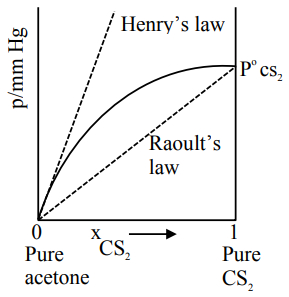
B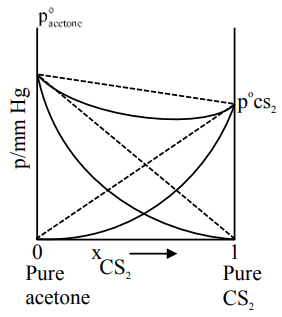
C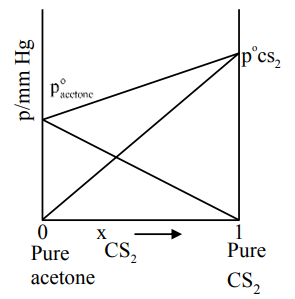
D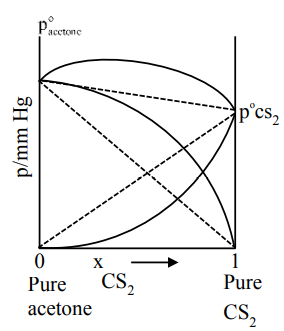
Solution
(A) mixture of $CS_{2}$ and acetone exhibits a positive deviation from Raoult's law.
In a positive deviation,the partial pressure of each component is greater than that predicted by Raoult's law.
Mathematically,this is represented as $P_{CS_{2}} > P_{CS_{2}}^{o} \cdot X_{CS_{2}}$.
Among the given options,the graph that shows the partial pressure curve for $CS_{2}$ lying above the ideal straight line (Raoult's law) is the correct representation.
In a positive deviation,the partial pressure of each component is greater than that predicted by Raoult's law.
Mathematically,this is represented as $P_{CS_{2}} > P_{CS_{2}}^{o} \cdot X_{CS_{2}}$.
Among the given options,the graph that shows the partial pressure curve for $CS_{2}$ lying above the ideal straight line (Raoult's law) is the correct representation.
0 likes
View Solution176
MediumMCQ
For which of the following mixtures is $\Delta_{mix} H > 0$?
A
$CHCl_3 + CH_3COCH_3$
B
$C_6H_5NH_2 + C_6H_5OH$
C
$C_2H_5OH + CH_3COCH_3$
D
$C_6H_6 + C_6H_5CH_3$
Solution
(C) Mixtures that exhibit $\Delta_{mix} H > 0$ show a positive deviation from Raoult's law.
In such mixtures,the solute-solvent interactions are weaker than the solute-solute and solvent-solvent interactions present in the pure components.
This results in the absorption of heat upon mixing,making the process endothermic $(\Delta_{mix} H > 0)$.
Option $(A)$ $(CHCl_3 + CH_3COCH_3)$ shows negative deviation due to strong hydrogen bonding.
Option $(B)$ $(C_6H_5NH_2 + C_6H_5OH)$ shows negative deviation due to acid-base interaction.
Option $(C)$ $(C_2H_5OH + CH_3COCH_3)$ shows positive deviation because the strong hydrogen bonds in pure ethanol are disrupted when acetone is added,and the new interactions are weaker.
Option $(D)$ $(C_6H_6 + C_6H_5CH_3)$ forms an ideal solution with $\Delta_{mix} H \approx 0$.
Therefore,the correct option is $(C)$.
In such mixtures,the solute-solvent interactions are weaker than the solute-solute and solvent-solvent interactions present in the pure components.
This results in the absorption of heat upon mixing,making the process endothermic $(\Delta_{mix} H > 0)$.
Option $(A)$ $(CHCl_3 + CH_3COCH_3)$ shows negative deviation due to strong hydrogen bonding.
Option $(B)$ $(C_6H_5NH_2 + C_6H_5OH)$ shows negative deviation due to acid-base interaction.
Option $(C)$ $(C_2H_5OH + CH_3COCH_3)$ shows positive deviation because the strong hydrogen bonds in pure ethanol are disrupted when acetone is added,and the new interactions are weaker.
Option $(D)$ $(C_6H_6 + C_6H_5CH_3)$ forms an ideal solution with $\Delta_{mix} H \approx 0$.
Therefore,the correct option is $(C)$.
0 likes
View Solution177
MediumMCQ
Which of the following solutions will show negative deviation from Raoult's law?
A
Chloroform + Acetone
B
Benzene + Toluene
C
Ethanol + Acetone
D
Bromoethane + Chloroethane
Solution
(A) Negative deviation from Raoult's law occurs when the intermolecular forces between the solute and solvent molecules are stronger than the forces between the pure components (solute-solute and solvent-solvent interactions).
When Chloroform $(CHCl_3)$ is mixed with Acetone $(CH_3COCH_3)$,a strong hydrogen bond is formed between the oxygen atom of the acetone and the hydrogen atom of the chloroform.
This increased intermolecular attraction results in a decrease in total volume and vapor pressure,which is characteristic of negative deviation.
When Chloroform $(CHCl_3)$ is mixed with Acetone $(CH_3COCH_3)$,a strong hydrogen bond is formed between the oxygen atom of the acetone and the hydrogen atom of the chloroform.
This increased intermolecular attraction results in a decrease in total volume and vapor pressure,which is characteristic of negative deviation.
0 likes
View Solution178
EasyMCQ
For the ideal solutions,which of the following condition is suitable?
A
$\Delta_{\text{mix}}H \neq 0; \Delta_{\text{mix}}V \neq 0$
B
$\Delta_{\text{mix}}H = 0; \Delta_{\text{mix}}V = 0$
C
$\Delta_{\text{mix}}H \neq 0; \Delta_{\text{mix}}V = 0$
D
$\Delta_{\text{mix}}H = 0; \Delta_{\text{mix}}V \neq 0$
Solution
(B) An ideal solution is defined as a solution that obeys Raoult's law over the entire range of concentration.
For an ideal solution,the enthalpy of mixing is zero $(\Delta_{\text{mix}}H = 0)$,meaning no heat is absorbed or evolved during the mixing process.
Additionally,the volume of mixing is zero $(\Delta_{\text{mix}}V = 0)$,meaning the total volume of the solution is equal to the sum of the volumes of the individual components.
Therefore,the correct condition is $\Delta_{\text{mix}}H = 0$ and $\Delta_{\text{mix}}V = 0$.
For an ideal solution,the enthalpy of mixing is zero $(\Delta_{\text{mix}}H = 0)$,meaning no heat is absorbed or evolved during the mixing process.
Additionally,the volume of mixing is zero $(\Delta_{\text{mix}}V = 0)$,meaning the total volume of the solution is equal to the sum of the volumes of the individual components.
Therefore,the correct condition is $\Delta_{\text{mix}}H = 0$ and $\Delta_{\text{mix}}V = 0$.
0 likes
View Solution179
MediumMCQ
Mixture of chloroform and acetone forms a solution with negative deviation from Raoult's law due to:
A
stronger intermolecular forces between chloroform molecules than those between chloroform and acetone molecules
B
formation of hydrogen bonding between acetone and chloroform
C
repulsive forces
D
increase in escaping tendency of molecules of each component
Solution
(B) Chloroform $(CHCl_3)$ and acetone $(CH_3COCH_3)$ form a solution that shows a negative deviation from Raoult's law.
This occurs because the intermolecular forces,specifically the formation of hydrogen bonding between chloroform and acetone molecules,are stronger than the individual intermolecular forces present in the pure components.
This increased attraction reduces the escaping tendency of the molecules,thereby decreasing the total vapour pressure of the solution compared to the ideal behavior.
This occurs because the intermolecular forces,specifically the formation of hydrogen bonding between chloroform and acetone molecules,are stronger than the individual intermolecular forces present in the pure components.
This increased attraction reduces the escaping tendency of the molecules,thereby decreasing the total vapour pressure of the solution compared to the ideal behavior.
0 likes
View SolutionSolutions — Ideal and Non-ideal solution · Frequently Asked Questions
1Are these Solutions questions useful for JEE and NEET?
Yes. All questions in this section are mapped to JEE Main and NEET exam patterns. Previous year questions from JEE Main, NEET, GUJCET and state-level exams are included with full solutions.
2Can I switch to Hindi or Gujarati for these questions?
Yes. Use the language tabs in the hero section or the sidebar to view the same questions and solutions in English, Hindi or Gujarati.
3How do I generate a question paper from this subtopic?
Use the Vedclass Exam Paper Generator — select the chapter and subtopic, set difficulty, and generate Sets A, B, C, D automatically. First 3 chapters of every subject are free.
Vedclass Products
For Students
Vedclass Test Series
Mock tests in real JEE/NEET style with performance analysis. 5-day free trial.
Start Free TrialFor Teachers
Exam Paper Generator
Generate Set A/B/C/D papers from this chapter in 2 minutes. 3 chapters free.
Try FreeFor Institutes
Online Exam Module
Live online exams with unlimited students, 360° analytics & white-label branding.
See DemoFor Teachers & Institutes
Generate a Solutions Exam Paper in 2 Minutes
Select subtopic & difficulty — Sets A, B, C, D auto-generated with No Repeat logic.
First 3 chapters of every subject are free — no payment required.