
A English
Ideal and Non-ideal solution Questions in English
Class 12 Chemistry · Solutions · Ideal and Non-ideal solution
179+
Questions
English
Language
100%
With Solutions
Showing 50 of 179 questions in English
51
MediumMCQ
Which condition is not satisfied by an ideal solution?
A
$\Delta _{mix} V = 0$
B
$\Delta _{mix} S = 0$
C
Obeyance to Raoult's Law
D
$\Delta _{mix} H = 0$
Solution
(B) For an ideal solution,the following conditions must be met:
$1$. $\Delta _{mix} H = 0$ (no heat is absorbed or evolved).
$2$. $\Delta _{mix} V = 0$ (no change in volume upon mixing).
$3$. It must obey Raoult's Law over the entire range of concentration.
$4$. For any spontaneous mixing process,the entropy of mixing must be positive,i.e.,$\Delta _{mix} S > 0$.
Therefore,the condition $\Delta _{mix} S = 0$ is not satisfied by an ideal solution.
$1$. $\Delta _{mix} H = 0$ (no heat is absorbed or evolved).
$2$. $\Delta _{mix} V = 0$ (no change in volume upon mixing).
$3$. It must obey Raoult's Law over the entire range of concentration.
$4$. For any spontaneous mixing process,the entropy of mixing must be positive,i.e.,$\Delta _{mix} S > 0$.
Therefore,the condition $\Delta _{mix} S = 0$ is not satisfied by an ideal solution.
0 likes
View Solution52
DifficultMCQ
$p_A$ and $p_B$ are the vapour pressure of pure liquid components,$A$ and $B,$ respectively of an ideal binary solution. If $x_A$ represents the mole fraction of component $A,$ the total pressure of the solution will be
A
$p_A + x_A(p_B - p_A)$
B
$p_A + x_A(p_A - p_B)$
C
$p_B + x_A(p_B - p_A)$
D
$p_B + x_A(p_A - p_B)$
Solution
(D) According to Raoult's Law,the total pressure $P_T$ of an ideal binary solution is given by the sum of the partial pressures of the components:
$P_T = P_A + P_B$
We know that $P_A = p_A x_A$ and $P_B = p_B x_B$,where $p_A$ and $p_B$ are the vapour pressures of pure components.
Substituting these into the equation:
$P_T = p_A x_A + p_B x_B$
Since $x_A + x_B = 1$,we have $x_B = 1 - x_A$.
Substituting $x_B$ in the equation:
$P_T = p_A x_A + p_B(1 - x_A)$
$P_T = p_A x_A + p_B - p_B x_A$
$P_T = p_B + x_A(p_A - p_B)$
$P_T = P_A + P_B$
We know that $P_A = p_A x_A$ and $P_B = p_B x_B$,where $p_A$ and $p_B$ are the vapour pressures of pure components.
Substituting these into the equation:
$P_T = p_A x_A + p_B x_B$
Since $x_A + x_B = 1$,we have $x_B = 1 - x_A$.
Substituting $x_B$ in the equation:
$P_T = p_A x_A + p_B(1 - x_A)$
$P_T = p_A x_A + p_B - p_B x_A$
$P_T = p_B + x_A(p_A - p_B)$
0 likes
View Solution53
EasyMCQ
$A$ solution of acetone in ethanol:
A
obeys Raoult's law
B
shows a negative deviation from Raoult's law
C
shows a positive deviation from Raoult's law
D
behaves like a near ideal solution
Solution
(C) solution of acetone in ethanol shows a positive deviation from Raoult's law.
In pure ethanol,molecules are held together by strong hydrogen bonding.
When acetone is added,it disrupts these hydrogen bonds,leading to weaker solute-solvent interactions compared to the original solvent-solvent interactions.
This results in an increase in vapor pressure,which is characteristic of a positive deviation from Raoult's law.
In pure ethanol,molecules are held together by strong hydrogen bonding.
When acetone is added,it disrupts these hydrogen bonds,leading to weaker solute-solvent interactions compared to the original solvent-solvent interactions.
This results in an increase in vapor pressure,which is characteristic of a positive deviation from Raoult's law.
0 likes
View Solution54
EasyMCQ
$A$ binary liquid solution is prepared by mixing $n$-heptane and ethanol. Which one of the following statements is correct regarding the behaviour of the solution?
A
The solution is non-ideal,showing $-ve$ deviation from Raoult's Law.
B
The solution is non-ideal,showing $+ve$ deviation from Raoult's Law.
C
$n$-heptane shows $+ve$ deviation while ethanol shows $-ve$ deviation from Raoult's Law.
D
The solution formed is an ideal solution.
Solution
(B) In a mixture of $n$-heptane and ethanol,the intermolecular forces between $n$-heptane and ethanol molecules are weaker than the forces between $n$-heptane$-n$-heptane molecules and ethanol-ethanol molecules.
Due to the presence of hydrogen bonding in pure ethanol,the $n$-heptane molecules disrupt these interactions.
As a result,the total vapor pressure of the solution is higher than that predicted by Raoult's Law.
Therefore,the solution is non-ideal and shows a positive $(+ve)$ deviation from Raoult's Law.
Due to the presence of hydrogen bonding in pure ethanol,the $n$-heptane molecules disrupt these interactions.
As a result,the total vapor pressure of the solution is higher than that predicted by Raoult's Law.
Therefore,the solution is non-ideal and shows a positive $(+ve)$ deviation from Raoult's Law.
0 likes
View Solution55
DifficultMCQ
Two liquids $X$ and $Y$ form an ideal solution. At $300 \ K,$ vapour pressure of the solution containing $1 \ mol$ of $X$ and $3 \ mol$ of $Y$ is $550 \ mm \ Hg.$ At the same temperature,if $1 \ mol$ of $Y$ is further added to this solution,vapour pressure of the solution increases by $10 \ mm \ Hg.$ Vapour pressure (in $mm \ Hg$) of $X$ and $Y$ in their pure states will be,respectively:
A
$300$ and $400$
B
$400$ and $600$
C
$500$ and $600$
D
$200$ and $300$
Solution
(B) According to Raoult's law,$P_{\text{total}} = P_X^{\circ} X_X + P_Y^{\circ} X_Y.$
For the first case: $X_X = \frac{1}{1+3} = \frac{1}{4}$ and $X_Y = \frac{3}{4}.$
$550 = P_X^{\circ} \times \frac{1}{4} + P_Y^{\circ} \times \frac{3}{4} \implies P_X^{\circ} + 3P_Y^{\circ} = 2200 \dots (i)$
For the second case,total moles of $Y = 3+1 = 4 \ mol.$ Total moles of solution = $1+4 = 5 \ mol.$
$X_X = \frac{1}{5}$ and $X_Y = \frac{4}{5}.$
New vapour pressure = $550 + 10 = 560 \ mm \ Hg.$
$560 = P_X^{\circ} \times \frac{1}{5} + P_Y^{\circ} \times \frac{4}{5} \implies P_X^{\circ} + 4P_Y^{\circ} = 2800 \dots (ii)$
Subtracting equation $(i)$ from $(ii)$:
$(P_X^{\circ} + 4P_Y^{\circ}) - (P_X^{\circ} + 3P_Y^{\circ}) = 2800 - 2200$
$P_Y^{\circ} = 600 \ mm \ Hg.$
Substituting $P_Y^{\circ}$ in equation $(i)$:
$P_X^{\circ} + 3(600) = 2200$
$P_X^{\circ} = 2200 - 1800 = 400 \ mm \ Hg.$
Thus,the vapour pressures are $400 \ mm \ Hg$ and $600 \ mm \ Hg$ respectively.
For the first case: $X_X = \frac{1}{1+3} = \frac{1}{4}$ and $X_Y = \frac{3}{4}.$
$550 = P_X^{\circ} \times \frac{1}{4} + P_Y^{\circ} \times \frac{3}{4} \implies P_X^{\circ} + 3P_Y^{\circ} = 2200 \dots (i)$
For the second case,total moles of $Y = 3+1 = 4 \ mol.$ Total moles of solution = $1+4 = 5 \ mol.$
$X_X = \frac{1}{5}$ and $X_Y = \frac{4}{5}.$
New vapour pressure = $550 + 10 = 560 \ mm \ Hg.$
$560 = P_X^{\circ} \times \frac{1}{5} + P_Y^{\circ} \times \frac{4}{5} \implies P_X^{\circ} + 4P_Y^{\circ} = 2800 \dots (ii)$
Subtracting equation $(i)$ from $(ii)$:
$(P_X^{\circ} + 4P_Y^{\circ}) - (P_X^{\circ} + 3P_Y^{\circ}) = 2800 - 2200$
$P_Y^{\circ} = 600 \ mm \ Hg.$
Substituting $P_Y^{\circ}$ in equation $(i)$:
$P_X^{\circ} + 3(600) = 2200$
$P_X^{\circ} = 2200 - 1800 = 400 \ mm \ Hg.$
Thus,the vapour pressures are $400 \ mm \ Hg$ and $600 \ mm \ Hg$ respectively.
0 likes
View Solution56
DifficultMCQ
On mixing,heptane and octane form an ideal solution. At $373 \ K$,the vapour pressures of the two liquid components (heptane and octane) are $105 \ kPa$ and $45 \ kPa$ respectively. Vapour pressure of the solution obtained by mixing $25.0 \ g$ of heptane and $35 \ g$ of octane will be $........ \ kPa$.
(molar mass of heptane $= 100 \ g \ mol^{-1}$ and of octane $= 114 \ g \ mol^{-1}$)
(molar mass of heptane $= 100 \ g \ mol^{-1}$ and of octane $= 114 \ g \ mol^{-1}$)
A
$72.0$
B
$36.1$
C
$96.2$
D
$144.5$
Solution
(A) Step $1$: Calculate the number of moles of each component.
$n_{\text{heptane}} = \frac{25.0 \ g}{100 \ g \ mol^{-1}} = 0.25 \ mol$
$n_{\text{octane}} = \frac{35 \ g}{114 \ g \ mol^{-1}} \approx 0.307 \ mol$
Step $2$: Calculate the mole fractions.
$x_{\text{heptane}} = \frac{0.25}{0.25 + 0.307} = \frac{0.25}{0.557} \approx 0.4488$
$x_{\text{octane}} = \frac{0.307}{0.25 + 0.307} = \frac{0.307}{0.557} \approx 0.5512$
Step $3$: Apply Raoult's Law for the total vapour pressure.
$P_{\text{total}} = P_{\text{heptane}}^{\circ} x_{\text{heptane}} + P_{\text{octane}}^{\circ} x_{\text{octane}}$
$P_{\text{total}} = (105 \ kPa \times 0.4488) + (45 \ kPa \times 0.5512)$
$P_{\text{total}} = 47.124 + 24.804 = 71.928 \ kPa \approx 72.0 \ kPa$.
$n_{\text{heptane}} = \frac{25.0 \ g}{100 \ g \ mol^{-1}} = 0.25 \ mol$
$n_{\text{octane}} = \frac{35 \ g}{114 \ g \ mol^{-1}} \approx 0.307 \ mol$
Step $2$: Calculate the mole fractions.
$x_{\text{heptane}} = \frac{0.25}{0.25 + 0.307} = \frac{0.25}{0.557} \approx 0.4488$
$x_{\text{octane}} = \frac{0.307}{0.25 + 0.307} = \frac{0.307}{0.557} \approx 0.5512$
Step $3$: Apply Raoult's Law for the total vapour pressure.
$P_{\text{total}} = P_{\text{heptane}}^{\circ} x_{\text{heptane}} + P_{\text{octane}}^{\circ} x_{\text{octane}}$
$P_{\text{total}} = (105 \ kPa \times 0.4488) + (45 \ kPa \times 0.5512)$
$P_{\text{total}} = 47.124 + 24.804 = 71.928 \ kPa \approx 72.0 \ kPa$.
0 likes
View Solution57
AdvancedMCQ
The boiling point of an equimolar ideal solution of hexane $(C_6H_{14})$ and heptane $(C_7H_{16})$ is $80 \ ^oC$. What is the boiling point of a mixture of hexane and heptane containing equal mass of both? The boiling points of pure hexane and pure heptane are $69 \ ^oC$ and $98 \ ^oC$ respectively.
A
Greater than $98 \ ^oC$
B
Greater than $80 \ ^oC$
C
Between $69 \ ^oC$ and $80 \ ^oC$
D
Below $69 \ ^oC$
Solution
(B) For an ideal solution,the boiling point $(T_b)$ depends on the mole fraction $(x)$ of the components.
Let the mass of each component be $m$.
Moles of hexane $(n_1)$ = $m / 86$ and moles of heptane $(n_2)$ = $m / 100$.
Mole fraction of hexane $(x_1)$ = $n_1 / (n_1 + n_2) = (m/86) / (m/86 + m/100) = 100 / 186 \approx 0.537$.
Mole fraction of heptane $(x_2)$ = $1 - 0.537 = 0.463$.
The boiling point of the mixture is given by $T_b = x_1 T_{b1} + x_2 T_{b2}$ (approximately for ideal mixtures).
$T_b = (0.537 \times 69) + (0.463 \times 98) \approx 37.05 + 45.37 = 82.42 \ ^oC$.
Since the mole fraction of the lower boiling component (hexane) is higher in the equal mass mixture $(0.537)$ compared to the equimolar mixture $(0.5)$,the boiling point will be slightly higher than the equimolar boiling point of $80 \ ^oC$ but less than $98 \ ^oC$.
Thus,the boiling point is between $80 \ ^oC$ and $98 \ ^oC$.
Let the mass of each component be $m$.
Moles of hexane $(n_1)$ = $m / 86$ and moles of heptane $(n_2)$ = $m / 100$.
Mole fraction of hexane $(x_1)$ = $n_1 / (n_1 + n_2) = (m/86) / (m/86 + m/100) = 100 / 186 \approx 0.537$.
Mole fraction of heptane $(x_2)$ = $1 - 0.537 = 0.463$.
The boiling point of the mixture is given by $T_b = x_1 T_{b1} + x_2 T_{b2}$ (approximately for ideal mixtures).
$T_b = (0.537 \times 69) + (0.463 \times 98) \approx 37.05 + 45.37 = 82.42 \ ^oC$.
Since the mole fraction of the lower boiling component (hexane) is higher in the equal mass mixture $(0.537)$ compared to the equimolar mixture $(0.5)$,the boiling point will be slightly higher than the equimolar boiling point of $80 \ ^oC$ but less than $98 \ ^oC$.
Thus,the boiling point is between $80 \ ^oC$ and $98 \ ^oC$.
0 likes
View Solution58
DifficultMCQ
$A$ liquid mixture contains $10 \ moles$ of $A$ $(P_A^0 = 200 \ mm \ Hg)$ and $10 \ moles$ of $B$ $(P_B^0 = 100 \ mm \ Hg)$. The vapour pressure over the liquid mixture is $160 \ mm \ Hg$. Which statement is correct?
A
$\Delta G_{mix} = + \,ve$
B
$\Delta V_{mix} = - \,ve$
C
$\Delta S_{surrounding} = + \,ve$
D
None of these
Solution
(D) The mole fraction of $A$ $(x_A)$ is $10 / (10 + 10) = 0.5$ and $x_B = 0.5$.
According to Raoult's law,the expected vapour pressure is $P_{ideal} = P_A^0 x_A + P_B^0 x_B = (200 \times 0.5) + (100 \times 0.5) = 100 + 50 = 150 \ mm \ Hg$.
Since the observed vapour pressure $(160 \ mm \ Hg)$ is greater than the ideal vapour pressure $(150 \ mm \ Hg)$,the solution shows a positive deviation from Raoult's law.
For solutions showing positive deviation: $\Delta H_{mix} > 0$,$\Delta V_{mix} > 0$,and $\Delta G_{mix} < 0$.
Since $\Delta H_{mix} > 0$ (endothermic process),the heat is absorbed from the surroundings,so $\Delta S_{surrounding} = -\Delta H_{mix} / T < 0$.
None of the given options $(A, B, C)$ are correct.
According to Raoult's law,the expected vapour pressure is $P_{ideal} = P_A^0 x_A + P_B^0 x_B = (200 \times 0.5) + (100 \times 0.5) = 100 + 50 = 150 \ mm \ Hg$.
Since the observed vapour pressure $(160 \ mm \ Hg)$ is greater than the ideal vapour pressure $(150 \ mm \ Hg)$,the solution shows a positive deviation from Raoult's law.
For solutions showing positive deviation: $\Delta H_{mix} > 0$,$\Delta V_{mix} > 0$,and $\Delta G_{mix} < 0$.
Since $\Delta H_{mix} > 0$ (endothermic process),the heat is absorbed from the surroundings,so $\Delta S_{surrounding} = -\Delta H_{mix} / T < 0$.
None of the given options $(A, B, C)$ are correct.
0 likes
View Solution59
MediumMCQ
Which of the following liquid pairs does not show contraction in volume on mixing?
A
$CHCl_3 + CH_3COCH_3$
B
$H_2O + HCl$
C
$H_2O + HNO_3$
D
$H_2O + C_2H_5OH$
Solution
(D) When two liquids are mixed,if the intermolecular forces of attraction between the components are weaker than the forces in the pure components,the mixture shows positive deviation from Raoult's law. In such cases,the volume of the solution increases $(V_{mix} > 0)$.
Conversely,if the forces are stronger (e.g.,due to hydrogen bonding),the mixture shows negative deviation,resulting in contraction in volume $(V_{mix} < 0)$.
$CHCl_3 + CH_3COCH_3$ forms hydrogen bonds between the chloroform hydrogen and the acetone oxygen,leading to negative deviation and contraction.
$H_2O + HCl$ and $H_2O + HNO_3$ show strong interactions due to ionization and hydrogen bonding,leading to contraction.
$H_2O + C_2H_5OH$ forms a mixture that exhibits positive deviation from Raoult's law because the hydrogen bonding between water and ethanol is weaker than the hydrogen bonding in pure water,leading to an increase in volume rather than contraction.
Conversely,if the forces are stronger (e.g.,due to hydrogen bonding),the mixture shows negative deviation,resulting in contraction in volume $(V_{mix} < 0)$.
$CHCl_3 + CH_3COCH_3$ forms hydrogen bonds between the chloroform hydrogen and the acetone oxygen,leading to negative deviation and contraction.
$H_2O + HCl$ and $H_2O + HNO_3$ show strong interactions due to ionization and hydrogen bonding,leading to contraction.
$H_2O + C_2H_5OH$ forms a mixture that exhibits positive deviation from Raoult's law because the hydrogen bonding between water and ethanol is weaker than the hydrogen bonding in pure water,leading to an increase in volume rather than contraction.
0 likes
View Solution60
MediumMCQ
On mixing $10 \ mL$ of acetone with $40 \ mL$ of chloroform,the total volume of the solution is
A
$< 50 \ mL$
B
$> 50 \ mL$
C
$= 50 \ mL$
D
Cannot be predicted
Solution
(A) Acetone and chloroform interact to form intermolecular hydrogen bonding between the oxygen atom of acetone and the hydrogen atom of chloroform.
This strong interaction leads to a decrease in the total volume of the solution compared to the sum of the individual volumes.
Therefore,the total volume of the solution is $< 50 \ mL$.
This strong interaction leads to a decrease in the total volume of the solution compared to the sum of the individual volumes.
Therefore,the total volume of the solution is $< 50 \ mL$.
0 likes
View Solution61
MediumMCQ
An ideal solution has two components $A$ and $B$. If $A$ is more volatile than $B$,then the correct relation between mole fraction of $A$ in liquid $(X_A)$ and vapour phase $(Y_A)$ is:
A
$X_A < Y_A$
B
$X_A = Y_A$
C
$X_A > Y_A$
D
Nothing can be said
Solution
(A) According to Raoult's law,the partial pressure of a component in a solution is $P_A = P_A^{\circ} X_A$.
According to Dalton's law of partial pressures,the partial pressure of a component in the vapour phase is $P_A = P_T Y_A$.
Equating these,we get $P_A^{\circ} X_A = P_T Y_A$,which implies $\frac{Y_A}{X_A} = \frac{P_A^{\circ}}{P_T}$.
Since $A$ is more volatile than $B$,its pure vapour pressure $P_A^{\circ}$ is greater than the total pressure $P_T$ of the solution $(P_A^{\circ} > P_T)$.
Therefore,$\frac{Y_A}{X_A} > 1$,which means $Y_A > X_A$ or $X_A < Y_A$.
According to Dalton's law of partial pressures,the partial pressure of a component in the vapour phase is $P_A = P_T Y_A$.
Equating these,we get $P_A^{\circ} X_A = P_T Y_A$,which implies $\frac{Y_A}{X_A} = \frac{P_A^{\circ}}{P_T}$.
Since $A$ is more volatile than $B$,its pure vapour pressure $P_A^{\circ}$ is greater than the total pressure $P_T$ of the solution $(P_A^{\circ} > P_T)$.
Therefore,$\frac{Y_A}{X_A} > 1$,which means $Y_A > X_A$ or $X_A < Y_A$.
0 likes
View Solution62
EasyMCQ
An ideal solution has two components $A$ and $B$. If $A$ is more volatile than $B$ and also $P_A^o > P_T$,then the correct relation between mole fraction of $A$ in liquid $(x)$ and vapour $(y)$ phase is
A
$X_A = Y_A$
B
$X_A > Y_A$
C
$X_A < Y_A$
D
Nothing can be said
Solution
(C) According to Raoult's law and Dalton's law,the partial pressure of component $A$ is given by $P_A = X_A P_A^o$ and also $P_A = Y_A P_T$.
Equating these,we get $X_A P_A^o = Y_A P_T$.
Rearranging,we have $\frac{Y_A}{X_A} = \frac{P_A^o}{P_T}$.
Since $A$ is more volatile than $B$,$P_A^o > P_T$,which implies $\frac{P_A^o}{P_T} > 1$.
Therefore,$\frac{Y_A}{X_A} > 1$,which means $Y_A > X_A$ or $X_A < Y_A$.
Equating these,we get $X_A P_A^o = Y_A P_T$.
Rearranging,we have $\frac{Y_A}{X_A} = \frac{P_A^o}{P_T}$.
Since $A$ is more volatile than $B$,$P_A^o > P_T$,which implies $\frac{P_A^o}{P_T} > 1$.
Therefore,$\frac{Y_A}{X_A} > 1$,which means $Y_A > X_A$ or $X_A < Y_A$.
0 likes
View Solution63
EasyMCQ
$A$ mixture of ethanol and acetone shows positive deviation from Raoult's law because:
A
Weakening of $H$-bonding between ethanol molecules
B
Weakening of $H$-bonding between acetone molecules
C
Ethanol and acetone form $H$-bond with each other
D
None of these
Solution
(A) In pure ethanol,molecules are held together by strong intermolecular $H$-bonding.
When acetone is added to ethanol,the acetone molecules get in between the ethanol molecules and break some of the $H$-bonds between them.
This results in a weakening of the intermolecular forces of attraction in the mixture compared to the pure components.
Consequently,the vapor pressure of the solution increases,leading to a positive deviation from Raoult's law.
When acetone is added to ethanol,the acetone molecules get in between the ethanol molecules and break some of the $H$-bonds between them.
This results in a weakening of the intermolecular forces of attraction in the mixture compared to the pure components.
Consequently,the vapor pressure of the solution increases,leading to a positive deviation from Raoult's law.
0 likes
View Solution64
MediumMCQ
On mixing $10 \ mL$ $CCl_4$ and $10 \ mL$ benzene,the total volume of solution is
A
$> 20 \ mL$
B
$< 20 \ mL$
C
$20 \ mL$
D
None of these
Solution
(C) The mixture of $CCl_4$ (carbon tetrachloride) and benzene $(C_6H_6)$ forms an ideal solution.
For an ideal solution,the enthalpy of mixing $(\Delta H_{mix})$ is $0$ and the volume of mixing $(\Delta V_{mix})$ is $0$.
Therefore,the total volume of the solution is equal to the sum of the volumes of the individual components.
Total volume = $10 \ mL 10 \ mL = 20 \ mL$.
For an ideal solution,the enthalpy of mixing $(\Delta H_{mix})$ is $0$ and the volume of mixing $(\Delta V_{mix})$ is $0$.
Therefore,the total volume of the solution is equal to the sum of the volumes of the individual components.
Total volume = $10 \ mL 10 \ mL = 20 \ mL$.
0 likes
View Solution65
MediumMCQ
$A$ liquid solution is formed by mixing $10 \, moles$ of aniline and $20 \, moles$ of phenol at a temperature where the vapour pressure of pure liquid aniline and phenol are $90 \, mmHg$ and $87 \, mmHg$ respectively. The possible vapour pressure of the solution at that temperature is ............. $mmHg$.
A
$80$
B
$88$
C
$90$
D
None of these
Solution
(A) Aniline and phenol form a non-ideal solution showing negative deviation from Raoult's Law due to hydrogen bonding between the amine group of aniline and the hydroxyl group of phenol.
For a solution showing negative deviation,the total vapour pressure $(P_{total})$ is less than the vapour pressure calculated by Raoult's Law $(P_{ideal})$.
First,calculate the mole fractions:
$n_{aniline} = 10 \, moles$,$n_{phenol} = 20 \, moles$.
Total moles = $10 + 20 = 30 \, moles$.
$x_{aniline} = 10 / 30 = 1/3$,$x_{phenol} = 20 / 30 = 2/3$.
$P_{ideal} = x_{aniline} \times P^0_{aniline} + x_{phenol} \times P^0_{phenol} = (1/3 \times 90) + (2/3 \times 87) = 30 + 58 = 88 \, mmHg$.
Since the solution shows negative deviation,$P_{total} < 88 \, mmHg$.
Among the given options,only $80 \, mmHg$ is less than $88 \, mmHg$.
For a solution showing negative deviation,the total vapour pressure $(P_{total})$ is less than the vapour pressure calculated by Raoult's Law $(P_{ideal})$.
First,calculate the mole fractions:
$n_{aniline} = 10 \, moles$,$n_{phenol} = 20 \, moles$.
Total moles = $10 + 20 = 30 \, moles$.
$x_{aniline} = 10 / 30 = 1/3$,$x_{phenol} = 20 / 30 = 2/3$.
$P_{ideal} = x_{aniline} \times P^0_{aniline} + x_{phenol} \times P^0_{phenol} = (1/3 \times 90) + (2/3 \times 87) = 30 + 58 = 88 \, mmHg$.
Since the solution shows negative deviation,$P_{total} < 88 \, mmHg$.
Among the given options,only $80 \, mmHg$ is less than $88 \, mmHg$.
0 likes
View Solution66
EasyMCQ
Total vapour pressure of a mixture of $1 \, mol \, X$ $(P_x^o = 150 \, torr)$ and $2 \, mol \, Y$ $(P_y^o = 300 \, torr)$ is $240 \, torr$. In this case:
A
There is a negative deviation from Raoult's law
B
There is a positive deviation from Raoult's law
C
There is no deviation from Raoult's law
D
Cannot be decided
Solution
(A) According to Raoult's law,the ideal total vapour pressure $(P_{total, ideal})$ is given by:
$P_{total, ideal} = X_x P_x^o + X_y P_y^o$
Given: $n_x = 1 \, mol$,$n_y = 2 \, mol$.
Total moles = $1 + 2 = 3 \, mol$.
Mole fractions: $X_x = 1/3$,$X_y = 2/3$.
$P_{total, ideal} = (1/3 \times 150) + (2/3 \times 300) = 50 + 200 = 250 \, torr$.
The observed total vapour pressure is $240 \, torr$.
Since $P_{observed} < P_{total, ideal}$ $(240 \, torr < 250 \, torr)$,the mixture shows a negative deviation from Raoult's law.
$P_{total, ideal} = X_x P_x^o + X_y P_y^o$
Given: $n_x = 1 \, mol$,$n_y = 2 \, mol$.
Total moles = $1 + 2 = 3 \, mol$.
Mole fractions: $X_x = 1/3$,$X_y = 2/3$.
$P_{total, ideal} = (1/3 \times 150) + (2/3 \times 300) = 50 + 200 = 250 \, torr$.
The observed total vapour pressure is $240 \, torr$.
Since $P_{observed} < P_{total, ideal}$ $(240 \, torr < 250 \, torr)$,the mixture shows a negative deviation from Raoult's law.
0 likes
View Solution67
EasyMCQ
$1 \ mol$ of liquid $A$ and $2 \ mol$ of liquid $B$ make a solution having an observed vapour pressure of $42 \ torr$. The vapour pressures of pure $A$ and pure $B$ are $45 \ torr$ and $36 \ torr$ respectively. The described solution:
A
is an ideal solution
B
shows negative deviation
C
may be a minimum boiling azeotrope
D
has volume less than the sum of individual volumes of both components
Solution
(C) According to Raoult's law,the ideal vapour pressure $(P_{ideal})$ is calculated as:
$P_{ideal} = X_A P_A^0 + X_B P_B^0$
Given: $n_A = 1 \ mol$,$n_B = 2 \ mol$.
Total moles = $1 + 2 = 3 \ mol$.
Mole fractions: $X_A = 1/3$,$X_B = 2/3$.
$P_{ideal} = (1/3 \times 45) + (2/3 \times 36) = 15 + 24 = 39 \ torr$.
The observed vapour pressure is $42 \ torr$.
Since $P_{observed} > P_{ideal}$,the solution shows positive deviation from Raoult's law.
Solutions showing positive deviation exhibit an increase in volume upon mixing $(\Delta V_{mix} > 0)$ and may form a minimum boiling azeotrope.
$P_{ideal} = X_A P_A^0 + X_B P_B^0$
Given: $n_A = 1 \ mol$,$n_B = 2 \ mol$.
Total moles = $1 + 2 = 3 \ mol$.
Mole fractions: $X_A = 1/3$,$X_B = 2/3$.
$P_{ideal} = (1/3 \times 45) + (2/3 \times 36) = 15 + 24 = 39 \ torr$.
The observed vapour pressure is $42 \ torr$.
Since $P_{observed} > P_{ideal}$,the solution shows positive deviation from Raoult's law.
Solutions showing positive deviation exhibit an increase in volume upon mixing $(\Delta V_{mix} > 0)$ and may form a minimum boiling azeotrope.
0 likes
View Solution68
MediumMCQ
For an ideal solution of two components $A$ and $B$,which of the following is true?
A
$\Delta H_{mixing} < 0$
B
$\Delta H_{mixing} > 0$
C
$A-B$ interaction is stronger than $A-A$ and $B-B$ interactions
D
$A-A, B-B$ and $A-B$ interactions are identical
Solution
(D) An ideal solution is defined as a solution that obeys Raoult's law over the entire range of concentration.
For an ideal solution,the enthalpy of mixing,$\Delta H_{mixing}$,is equal to $0$.
Furthermore,the volume of mixing,$\Delta V_{mixing}$,is also equal to $0$.
This occurs because the intermolecular forces of attraction between the solute-solute $(A-A)$,solvent-solvent $(B-B)$,and solute-solvent $(A-B)$ molecules are identical in nature and magnitude.
For an ideal solution,the enthalpy of mixing,$\Delta H_{mixing}$,is equal to $0$.
Furthermore,the volume of mixing,$\Delta V_{mixing}$,is also equal to $0$.
This occurs because the intermolecular forces of attraction between the solute-solute $(A-A)$,solvent-solvent $(B-B)$,and solute-solvent $(A-B)$ molecules are identical in nature and magnitude.
0 likes
View Solution69
AdvancedMCQ
Liquids $A$ and $B$ form an ideal solution. At $30\,^oC$,the total vapour pressure of a solution containing $1\,mol$ of $A$ and $2\,mol$ of $B$ is $250\,mm\,Hg$. The total vapour pressure becomes $300\,mm\,Hg$ when $1$ more $mol$ of $A$ is added to the first solution. The vapour pressures of pure $A$ and $B$ at the same temperature are
A
$150, 450\,mm\,Hg$
B
$125, 150\,mm\,Hg$
C
$450, 150\,mm\,Hg$
D
$250, 300\,mm\,Hg$
Solution
(C) Let the vapour pressure of pure $A$ be $P_A^o$ and pure $B$ be $P_B^o$.
In the first solution,the mole fraction of $A$ is $x_A = \frac{1}{1+2} = \frac{1}{3}$ and the mole fraction of $B$ is $x_B = \frac{2}{1+2} = \frac{2}{3}$.
According to Raoult's law,the total vapour pressure is $P_{total} = P_A^o x_A + P_B^o x_B$.
$250 = \frac{1}{3} P_A^o + \frac{2}{3} P_B^o \implies P_A^o + 2P_B^o = 750$ . . . $(i)$
In the second solution,$1\,mol$ of $A$ is added,so total moles of $A = 2$ and $B = 2$.
The mole fraction of $A$ is $x_A = \frac{2}{2+2} = \frac{1}{2}$ and the mole fraction of $B$ is $x_B = \frac{2}{2+2} = \frac{1}{2}$.
$300 = \frac{1}{2} P_A^o + \frac{1}{2} P_B^o \implies P_A^o + P_B^o = 600$ . . . $(ii)$
Subtracting equation $(ii)$ from equation $(i)$:
$(P_A^o + 2P_B^o) - (P_A^o + P_B^o) = 750 - 600$
$P_B^o = 150\,mm\,Hg$
Substituting $P_B^o = 150$ into equation $(ii)$:
$P_A^o + 150 = 600 \implies P_A^o = 450\,mm\,Hg$.
Thus,the vapour pressures of pure $A$ and $B$ are $450\,mm\,Hg$ and $150\,mm\,Hg$ respectively.
In the first solution,the mole fraction of $A$ is $x_A = \frac{1}{1+2} = \frac{1}{3}$ and the mole fraction of $B$ is $x_B = \frac{2}{1+2} = \frac{2}{3}$.
According to Raoult's law,the total vapour pressure is $P_{total} = P_A^o x_A + P_B^o x_B$.
$250 = \frac{1}{3} P_A^o + \frac{2}{3} P_B^o \implies P_A^o + 2P_B^o = 750$ . . . $(i)$
In the second solution,$1\,mol$ of $A$ is added,so total moles of $A = 2$ and $B = 2$.
The mole fraction of $A$ is $x_A = \frac{2}{2+2} = \frac{1}{2}$ and the mole fraction of $B$ is $x_B = \frac{2}{2+2} = \frac{1}{2}$.
$300 = \frac{1}{2} P_A^o + \frac{1}{2} P_B^o \implies P_A^o + P_B^o = 600$ . . . $(ii)$
Subtracting equation $(ii)$ from equation $(i)$:
$(P_A^o + 2P_B^o) - (P_A^o + P_B^o) = 750 - 600$
$P_B^o = 150\,mm\,Hg$
Substituting $P_B^o = 150$ into equation $(ii)$:
$P_A^o + 150 = 600 \implies P_A^o = 450\,mm\,Hg$.
Thus,the vapour pressures of pure $A$ and $B$ are $450\,mm\,Hg$ and $150\,mm\,Hg$ respectively.
0 likes
View Solution70
DifficultMCQ
Liquids $A$ and $B$ form an ideal solution in the entire composition range. At $350 \ K$,the vapour pressures of pure $A$ and pure $B$ are $7 \times 10^3 \ Pa$ and $12 \times 10^3 \ Pa$,respectively. The composition of the vapour in equilibrium with a solution containing $40 \ \text{mole percent}$ of $A$ at this temperature is
A
$y_A = 0.37$; $y_B = 0.63$
B
$y_A = 0.28$; $y_B = 0.72$
C
$y_A = 0.40$; $y_B = 0.60$
D
$y_A = 0.76$; $y_B = 0.24$
Solution
(B) Given: $\chi_A = 0.4$,$\chi_B = 0.6$,$P_A^o = 7 \times 10^3 \ Pa$,$P_B^o = 12 \times 10^3 \ Pa$.
Total pressure of the solution is $P_T = \chi_A P_A^o + \chi_B P_B^o$.
$P_T = (0.4 \times 7 \times 10^3) + (0.6 \times 12 \times 10^3) = 2.8 \times 10^3 + 7.2 \times 10^3 = 10 \times 10^3 \ Pa = 10^4 \ Pa$.
The mole fraction of $A$ in the vapour phase $(y_A)$ is given by $y_A = \frac{P_A}{P_T} = \frac{\chi_A P_A^o}{P_T}$.
$y_A = \frac{0.4 \times 7 \times 10^3}{10^4} = \frac{2800}{10000} = 0.28$.
The mole fraction of $B$ in the vapour phase is $y_B = 1 - y_A = 1 - 0.28 = 0.72$.
Total pressure of the solution is $P_T = \chi_A P_A^o + \chi_B P_B^o$.
$P_T = (0.4 \times 7 \times 10^3) + (0.6 \times 12 \times 10^3) = 2.8 \times 10^3 + 7.2 \times 10^3 = 10 \times 10^3 \ Pa = 10^4 \ Pa$.
The mole fraction of $A$ in the vapour phase $(y_A)$ is given by $y_A = \frac{P_A}{P_T} = \frac{\chi_A P_A^o}{P_T}$.
$y_A = \frac{0.4 \times 7 \times 10^3}{10^4} = \frac{2800}{10000} = 0.28$.
The mole fraction of $B$ in the vapour phase is $y_B = 1 - y_A = 1 - 0.28 = 0.72$.
0 likes
View Solution71
DifficultMCQ
Liquid $M$ and liquid $N$ form an ideal solution. The vapour pressures of pure liquids $M$ and $N$ are $450 \ mmHg$ and $700 \ mmHg,$ respectively at the same temperature. Then the correct statement is: ( $x_M =$ mole fraction of $M$ in solution; $x_N =$ mole fraction of $N$ in solution; $y_M =$ mole fraction of $M$ in vapour phase; $y_N =$ mole fraction of $N$ in vapour phase)
A
$\frac{x_M}{x_N} > \frac{y_M}{y_N}$
B
$\frac{x_M}{x_N} = \frac{y_M}{y_N}$
C
$(x_M - y_M) < (x_N - y_N)$
D
$\frac{x_M}{x_N} < \frac{y_M}{y_N}$
Solution
(A) Given: $P_M^o = 450 \ mmHg$ and $P_N^o = 700 \ mmHg$.
According to Raoult's law,the partial pressures are $P_M = x_M P_M^o = 450 x_M$ and $P_N = x_N P_N^o = 700 x_N$.
In the vapour phase,the mole fractions are given by $y_M = \frac{P_M}{P_T}$ and $y_N = \frac{P_N}{P_T}$,where $P_T$ is the total pressure.
Therefore,the ratio $\frac{y_M}{y_N} = \frac{P_M}{P_N} = \frac{450 x_M}{700 x_N} = \frac{450}{700} \times \frac{x_M}{x_N}$.
Since $\frac{450}{700} < 1$,it follows that $\frac{y_M}{y_N} < \frac{x_M}{x_N}$,which implies $\frac{x_M}{x_N} > \frac{y_M}{y_N}$.
According to Raoult's law,the partial pressures are $P_M = x_M P_M^o = 450 x_M$ and $P_N = x_N P_N^o = 700 x_N$.
In the vapour phase,the mole fractions are given by $y_M = \frac{P_M}{P_T}$ and $y_N = \frac{P_N}{P_T}$,where $P_T$ is the total pressure.
Therefore,the ratio $\frac{y_M}{y_N} = \frac{P_M}{P_N} = \frac{450 x_M}{700 x_N} = \frac{450}{700} \times \frac{x_M}{x_N}$.
Since $\frac{450}{700} < 1$,it follows that $\frac{y_M}{y_N} < \frac{x_M}{x_N}$,which implies $\frac{x_M}{x_N} > \frac{y_M}{y_N}$.
0 likes
View Solution72
MediumMCQ
Which statement about the composition of vapour over an ideal $1:1$ molar mixture of benzene and toluene is correct? Assume the temperature is constant at $25\,^{\circ}C$. Vapour pressure data $(25\,^{\circ}C)$:
Benzene: $75\, mm\, Hg$
Toluene: $22\, mm\, Hg$
Benzene: $75\, mm\, Hg$
Toluene: $22\, mm\, Hg$
A
The vapour will contain higher percentage of benzene
B
The vapour will contain higher percentage of toluene
C
The vapour will contain equal amount of benzene and toluene
D
Not enough information is given to make a prediction
Solution
(A) For an ideal mixture,the partial pressure of a component $i$ in the vapour phase is given by $P_i = P_i^o X_i$.
Given the molar ratio is $1:1$,the mole fractions are $X_{benzene} = 0.5$ and $X_{toluene} = 0.5$.
The partial pressures are $P_{benzene} = 75 \times 0.5 = 37.5 \, mm \, Hg$ and $P_{toluene} = 22 \times 0.5 = 11 \, mm \, Hg$.
The mole fraction in the vapour phase is $Y_i = P_i / P_{total}$.
Since $P_{benzene} > P_{toluene}$,it follows that $Y_{benzene} > Y_{toluene}$.
Therefore,the vapour will contain a higher percentage of benzene.
Given the molar ratio is $1:1$,the mole fractions are $X_{benzene} = 0.5$ and $X_{toluene} = 0.5$.
The partial pressures are $P_{benzene} = 75 \times 0.5 = 37.5 \, mm \, Hg$ and $P_{toluene} = 22 \times 0.5 = 11 \, mm \, Hg$.
The mole fraction in the vapour phase is $Y_i = P_i / P_{total}$.
Since $P_{benzene} > P_{toluene}$,it follows that $Y_{benzene} > Y_{toluene}$.
Therefore,the vapour will contain a higher percentage of benzene.
0 likes
View Solution73
MediumMCQ
Each pair forms an ideal solution except?
A
$C_2H_5Br$ and $C_2H_5I$
B
$C_6H_5Cl$ and $C_6H_5Br$
C
$C_6H_6$ and $C_6H_5CH_3$
D
$C_2H_5I$ and $C_2H_5OH$
Solution
(D) An ideal solution is formed by components that have similar molecular structures and polarities,resulting in similar intermolecular forces.
$C_2H_5Br$ and $C_2H_5I$,$C_6H_5Cl$ and $C_6H_5Br$,and $C_6H_6$ and $C_6H_5CH_3$ form ideal solutions because their components are structurally similar.
However,$C_2H_5I$ and $C_2H_5OH$ do not form an ideal solution. $C_2H_5OH$ exhibits strong intermolecular hydrogen bonding,whereas $C_2H_5I$ does not. This difference in intermolecular forces leads to significant deviations from Raoult's law.
$C_2H_5Br$ and $C_2H_5I$,$C_6H_5Cl$ and $C_6H_5Br$,and $C_6H_6$ and $C_6H_5CH_3$ form ideal solutions because their components are structurally similar.
However,$C_2H_5I$ and $C_2H_5OH$ do not form an ideal solution. $C_2H_5OH$ exhibits strong intermolecular hydrogen bonding,whereas $C_2H_5I$ does not. This difference in intermolecular forces leads to significant deviations from Raoult's law.
0 likes
View Solution74
MediumMCQ
In a mixture of $A$ and $B$ components,the solution shows positive deviation from Raoult's law when:
A
$A-B$ interaction is stronger than $A-A$ and $B-B$ interaction
B
$A-B$ interaction is weaker than $A-A$ and $B-B$ interaction
C
$\Delta V_{mix} < 0$,$\Delta S_{mix} > 0$
D
$\Delta V_{mix} = 0$,$\Delta S_{mix} > 0$
Solution
(B) For a solution to show positive deviation from Raoult's law,the intermolecular forces between the solute and solvent molecules ($A-B$ interaction) must be weaker than the forces between the pure components ($A-A$ and $B-B$ interactions).
This results in an increase in the total volume of the mixture $(\Delta V_{mix} > 0)$ and an absorption of heat $(\Delta H_{mix} > 0)$.
This results in an increase in the total volume of the mixture $(\Delta V_{mix} > 0)$ and an absorption of heat $(\Delta H_{mix} > 0)$.
0 likes
View Solution75
DifficultMCQ
Two liquids $A$ and $B$ have vapour pressure in the ratio $P_A^o : P_B^o = 1 : 3$ at a certain temperature. Assume $A$ and $B$ form an ideal solution and the ratio of mole fractions of $A$ to $B$ in the vapour phase is $4 : 3$. Then the mole fraction of $B$ in the solution at the same temperature is
A
$\frac{1}{5}$
B
$\frac{2}{3}$
C
$\frac{4}{5}$
D
$\frac{1}{4}$
Solution
(A) Given the ratio of vapour pressures $P_A^o : P_B^o = 1 : 3$ and the ratio of mole fractions in the vapour phase $y_A : y_B = 4 : 3$.
According to Raoult's law and Dalton's law,the mole fraction in the vapour phase is given by $y_A = \frac{P_A}{P_{total}} = \frac{x_A P_A^o}{P_{total}}$ and $y_B = \frac{P_B}{P_{total}} = \frac{x_B P_B^o}{P_{total}}$.
Therefore,$\frac{y_A}{y_B} = \frac{x_A P_A^o}{x_B P_B^o}$.
Substituting the given values: $\frac{4}{3} = \frac{x_A}{x_B} \times \frac{1}{3}$.
This simplifies to $\frac{x_A}{x_B} = 4$,which means $x_A = 4x_B$.
Since the sum of mole fractions in the solution is $x_A + x_B = 1$,we substitute $x_A$: $4x_B + x_B = 1$.
$5x_B = 1$,so $x_B = \frac{1}{5}$.
According to Raoult's law and Dalton's law,the mole fraction in the vapour phase is given by $y_A = \frac{P_A}{P_{total}} = \frac{x_A P_A^o}{P_{total}}$ and $y_B = \frac{P_B}{P_{total}} = \frac{x_B P_B^o}{P_{total}}$.
Therefore,$\frac{y_A}{y_B} = \frac{x_A P_A^o}{x_B P_B^o}$.
Substituting the given values: $\frac{4}{3} = \frac{x_A}{x_B} \times \frac{1}{3}$.
This simplifies to $\frac{x_A}{x_B} = 4$,which means $x_A = 4x_B$.
Since the sum of mole fractions in the solution is $x_A + x_B = 1$,we substitute $x_A$: $4x_B + x_B = 1$.
$5x_B = 1$,so $x_B = \frac{1}{5}$.
0 likes
View Solution76
MediumMCQ
$2 \ moles$ each of liquids $A$ and $B$ are dissolved to form an ideal solution. What will be the mole fraction of $B$ in the vapour phase? Given: $P_A^o = 120 \ torr, P_B^o = 80 \ torr$
A
$\frac{1}{4}$
B
$\frac{1}{2}$
C
$\frac{3}{5}$
D
$\frac{2}{5}$
Solution
(D) The mole fraction of $A$ $(X_A)$ and $B$ $(X_B)$ in the liquid phase are:
$X_A = \frac{2}{2+2} = 0.5$
$X_B = \frac{2}{2+2} = 0.5$
The total vapour pressure of the solution $(P_S)$ is calculated as:
$P_S = P_A^o X_A + P_B^o X_B$
$P_S = 120 \times 0.5 + 80 \times 0.5 = 60 + 40 = 100 \ torr$
According to Dalton's Law,the partial pressure of $B$ in the vapour phase is $P_B = P_B^o X_B = P_S Y_B$,where $Y_B$ is the mole fraction of $B$ in the vapour phase:
$80 \times 0.5 = 100 \times Y_B$
$40 = 100 \times Y_B$
$Y_B = \frac{40}{100} = \frac{2}{5}$
$X_A = \frac{2}{2+2} = 0.5$
$X_B = \frac{2}{2+2} = 0.5$
The total vapour pressure of the solution $(P_S)$ is calculated as:
$P_S = P_A^o X_A + P_B^o X_B$
$P_S = 120 \times 0.5 + 80 \times 0.5 = 60 + 40 = 100 \ torr$
According to Dalton's Law,the partial pressure of $B$ in the vapour phase is $P_B = P_B^o X_B = P_S Y_B$,where $Y_B$ is the mole fraction of $B$ in the vapour phase:
$80 \times 0.5 = 100 \times Y_B$
$40 = 100 \times Y_B$
$Y_B = \frac{40}{100} = \frac{2}{5}$
0 likes
View Solution77
EasyMCQ
In a mixture of $A$ and $B$ components,the solution shows negative deviation when:
A
$A-B$ interaction is weaker than $A-A$ and $B-B$ interaction
B
$A-B$ interaction is stronger than $A-A$ and $B-B$ interaction
C
$\Delta V_{mix} > 0, \Delta S_{mix} > 0$
D
$\Delta V_{mix} = 0, \Delta S_{mix} = 0$
Solution
(B) solution shows negative deviation from Raoult's law when the intermolecular forces of attraction between the solute $(A)$ and solvent $(B)$ are stronger than the forces of attraction between the pure components ($A-A$ and $B-B$ interactions).
This leads to:
$1$. $\Delta H_{mix} < 0$ (Exothermic process).
$2$. $\Delta V_{mix} < 0$ (Volume contraction).
Therefore,the $A-B$ interaction is stronger than $A-A$ and $B-B$ interactions.
This leads to:
$1$. $\Delta H_{mix} < 0$ (Exothermic process).
$2$. $\Delta V_{mix} < 0$ (Volume contraction).
Therefore,the $A-B$ interaction is stronger than $A-A$ and $B-B$ interactions.
0 likes
View Solution78
MediumMCQ
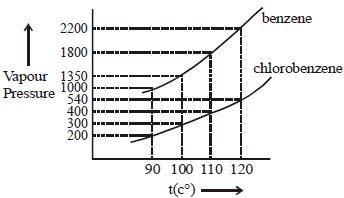
Assuming the formation of an ideal solution,determine the boiling point of a mixture containing $1560 \ g$ benzene (molar mass $= 78 \ g/mol$) and $1125 \ g$ chlorobenzene (molar mass $= 112.5 \ g/mol$) against an external pressure of $1000 \ torr$. Use the provided vapor pressure vs. temperature graph to find the answer. (in $^{\circ}C$)
A
$90$
B
$100$
C
$110$
D
$120$
Solution
(B) $1$. Calculate the moles of benzene $(A)$ and chlorobenzene $(B)$:
$n_A = \frac{1560}{78} = 20 \ mol$
$n_B = \frac{1125}{112.5} = 10 \ mol$
$2$. Calculate the mole fractions:
$X_A = \frac{20}{20+10} = \frac{2}{3}$
$X_B = \frac{10}{20+10} = \frac{1}{3}$
$3$. The boiling point is the temperature where the total vapor pressure $P_s = P_A^0 X_A + P_B^0 X_B = 1000 \ torr$.
$4$. Test $100 \ ^{\circ}C$: From the graph,$P_A^0 = 1350 \ torr$ and $P_B^0 = 300 \ torr$.
$P_s = (1350 \times \frac{2}{3}) + (300 \times \frac{1}{3}) = 900 + 100 = 1000 \ torr$.
Since $P_s = 1000 \ torr$ at $100 \ ^{\circ}C$,the boiling point is $100 \ ^{\circ}C$.
$n_A = \frac{1560}{78} = 20 \ mol$
$n_B = \frac{1125}{112.5} = 10 \ mol$
$2$. Calculate the mole fractions:
$X_A = \frac{20}{20+10} = \frac{2}{3}$
$X_B = \frac{10}{20+10} = \frac{1}{3}$
$3$. The boiling point is the temperature where the total vapor pressure $P_s = P_A^0 X_A + P_B^0 X_B = 1000 \ torr$.
$4$. Test $100 \ ^{\circ}C$: From the graph,$P_A^0 = 1350 \ torr$ and $P_B^0 = 300 \ torr$.
$P_s = (1350 \times \frac{2}{3}) + (300 \times \frac{1}{3}) = 900 + 100 = 1000 \ torr$.
Since $P_s = 1000 \ torr$ at $100 \ ^{\circ}C$,the boiling point is $100 \ ^{\circ}C$.
0 likes
View Solution79
EasyMCQ
When ethanol is mixed with acetone,what happens to the heat?
A
Heat is absorbed
B
Heat is released
C
Heat is neither absorbed nor released
D
Cannot be predicted
Solution
(A) When ethanol is mixed with acetone,the hydrogen bonding between ethanol molecules is disrupted by the addition of acetone. This leads to a weaker interaction between the components compared to the pure substances. Consequently,the solution shows a positive deviation from Raoult's law,which is characterized by an endothermic process where $\Delta H_{mix} > 0$. Therefore,heat is absorbed.
0 likes
View Solution80
MediumMCQ
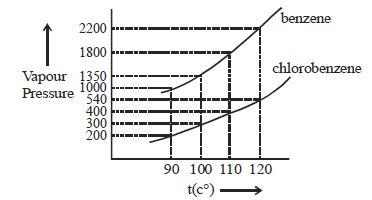
Assuming the formation of an ideal solution,determine the boiling point of a mixture containing $1560 \ g$ benzene (molar mass $= 78 \ g/mol$) and $1125 \ g$ chlorobenzene (molar mass $= 112.5 \ g/mol$) against an external pressure of $1000 \ torr$ using the provided graph. (in $^{\circ}C$)
A
$90$
B
$100$
C
$110$
D
$120$
Solution
(B) $1$. Calculate the moles of each component:
$n_{\text{benzene}} = \frac{1560}{78} = 20 \ mol$
$n_{\text{chlorobenzene}} = \frac{1125}{112.5} = 10 \ mol$
$2$. Calculate the mole fractions:
$\chi_{\text{benzene}} = \frac{20}{20+10} = \frac{2}{3}$
$\chi_{\text{chlorobenzene}} = \frac{10}{20+10} = \frac{1}{3}$
$3$. The boiling point is the temperature where the total vapor pressure $P_{\text{total}} = P_{\text{benzene}}^0 \chi_{\text{benzene}} + P_{\text{chlorobenzene}}^0 \chi_{\text{chlorobenzene}} = 1000 \ torr$.
$4$. Testing $100^{\circ}C$ from the graph:
$P_{\text{benzene}}^0 = 1350 \ torr$
$P_{\text{chlorobenzene}}^0 = 300 \ torr$
$P_{\text{total}} = (1350 \times \frac{2}{3}) + (300 \times \frac{1}{3}) = 900 + 100 = 1000 \ torr$.
$5$. Since the total pressure equals the external pressure at $100^{\circ}C$,the boiling point is $100^{\circ}C$.
$n_{\text{benzene}} = \frac{1560}{78} = 20 \ mol$
$n_{\text{chlorobenzene}} = \frac{1125}{112.5} = 10 \ mol$
$2$. Calculate the mole fractions:
$\chi_{\text{benzene}} = \frac{20}{20+10} = \frac{2}{3}$
$\chi_{\text{chlorobenzene}} = \frac{10}{20+10} = \frac{1}{3}$
$3$. The boiling point is the temperature where the total vapor pressure $P_{\text{total}} = P_{\text{benzene}}^0 \chi_{\text{benzene}} + P_{\text{chlorobenzene}}^0 \chi_{\text{chlorobenzene}} = 1000 \ torr$.
$4$. Testing $100^{\circ}C$ from the graph:
$P_{\text{benzene}}^0 = 1350 \ torr$
$P_{\text{chlorobenzene}}^0 = 300 \ torr$
$P_{\text{total}} = (1350 \times \frac{2}{3}) + (300 \times \frac{1}{3}) = 900 + 100 = 1000 \ torr$.
$5$. Since the total pressure equals the external pressure at $100^{\circ}C$,the boiling point is $100^{\circ}C$.
0 likes
View Solution81
MediumMCQ
Liquids $A$ and $B$ form an ideal solution. If $X_A$ and $Y_A$ are the mole fractions of $A$ in the solution and in vapour phase in equilibrium,respectively,then (Given $P_A^{\circ} > P_B^{\circ}$):
A
$\frac{Y_A}{X_A} = 1$
B
$\frac{Y_A}{X_A} > 1$
C
$\frac{Y_A}{X_A} < 1$
D
$Y_A + X_A = 1$
Solution
(B) For an ideal solution,the partial pressure of component $A$ is given by $P_A = X_A P_A^{\circ}$ and the total pressure is $P_{total} = X_A P_A^{\circ} + X_B P_B^{\circ}$.
According to Dalton's law of partial pressures,$P_A = Y_A P_{total}$.
Equating the two expressions for $P_A$: $Y_A P_{total} = X_A P_A^{\circ} \Rightarrow \frac{Y_A}{X_A} = \frac{P_A^{\circ}}{P_{total}}$.
Since $P_A^{\circ} > P_B^{\circ}$,the component with the higher vapour pressure will be more concentrated in the vapour phase than in the liquid phase.
Therefore,$Y_A > X_A$,which implies $\frac{Y_A}{X_A} > 1$.
According to Dalton's law of partial pressures,$P_A = Y_A P_{total}$.
Equating the two expressions for $P_A$: $Y_A P_{total} = X_A P_A^{\circ} \Rightarrow \frac{Y_A}{X_A} = \frac{P_A^{\circ}}{P_{total}}$.
Since $P_A^{\circ} > P_B^{\circ}$,the component with the higher vapour pressure will be more concentrated in the vapour phase than in the liquid phase.
Therefore,$Y_A > X_A$,which implies $\frac{Y_A}{X_A} > 1$.
0 likes
View Solution82
EasyMCQ
If liquids $A$ and $B$ form an ideal solution,then:
A
$\Delta G_{mix} = 0$
B
$\Delta H_{mix} = 0$
C
$\Delta G_{mix} = 0, \Delta S_{mix} = 0$
D
$\Delta S_{mix} = 0$
Solution
(B) For an ideal solution,the enthalpy of mixing is zero $(\Delta H_{mix} = 0)$ and the volume of mixing is zero $(\Delta V_{mix} = 0)$.
However,for the formation of a solution,the entropy of mixing is always positive $(\Delta S_{mix} > 0)$ and the Gibbs free energy of mixing is always negative $(\Delta G_{mix} < 0)$.
However,for the formation of a solution,the entropy of mixing is always positive $(\Delta S_{mix} > 0)$ and the Gibbs free energy of mixing is always negative $(\Delta G_{mix} < 0)$.
0 likes
View Solution83
MediumMCQ
If vapour pressures of pure liquids $A$ and $B$ are $300$ and $800 \, torr$ respectively at $25 \, ^{\circ}C$. When these two liquids are mixed at this temperature to form a solution in which mole percentage of $B$ is $92$,then the total vapour pressure is observed to be $0.95 \, atm$. Which of the following is true for this solution?
A
$\Delta V_{mix} > 0$
B
$\Delta H_{mix} < 0$
C
$\Delta V_{mix} = 0$
D
$\Delta H_{mix} = 0$
Solution
(B) Given: $P_A^{\circ} = 300 \, torr$,$P_B^{\circ} = 800 \, torr$.
Mole fraction of $B$ $(x_B)$ = $0.92$,so $x_A = 1 - 0.92 = 0.08$.
According to Raoult's Law,the expected total pressure $(P_{ideal})$ is:
$P_{ideal} = P_A^{\circ} x_A + P_B^{\circ} x_B = (300 \times 0.08) + (800 \times 0.92) = 24 + 736 = 760 \, torr$.
Since $1 \, atm = 760 \, torr$,the observed pressure is $0.95 \, atm = 0.95 \times 760 = 722 \, torr$.
Since the observed pressure $(722 \, torr)$ is less than the ideal pressure $(760 \, torr)$,the solution shows a negative deviation from Raoult's Law.
For solutions showing negative deviation,$\Delta H_{mix} < 0$ and $\Delta V_{mix} < 0$.
Mole fraction of $B$ $(x_B)$ = $0.92$,so $x_A = 1 - 0.92 = 0.08$.
According to Raoult's Law,the expected total pressure $(P_{ideal})$ is:
$P_{ideal} = P_A^{\circ} x_A + P_B^{\circ} x_B = (300 \times 0.08) + (800 \times 0.92) = 24 + 736 = 760 \, torr$.
Since $1 \, atm = 760 \, torr$,the observed pressure is $0.95 \, atm = 0.95 \times 760 = 722 \, torr$.
Since the observed pressure $(722 \, torr)$ is less than the ideal pressure $(760 \, torr)$,the solution shows a negative deviation from Raoult's Law.
For solutions showing negative deviation,$\Delta H_{mix} < 0$ and $\Delta V_{mix} < 0$.
0 likes
View Solution84
EasyMCQ
Raoult's law is obeyed by each constituent of a binary liquid solution when
A
the forces of attractions between like molecules are greater than those between unlike molecules.
B
the forces of attractions between like molecules are smaller than those between unlike molecules.
C
the forces of attractions between like molecules are identical with those between unlike molecules.
D
the volume occupied by unlike molecules are different.
Solution
(C) Raoult's law is obeyed by an ideal solution.
In an ideal solution,the intermolecular forces of attraction between the components ($A-A$ and $B-B$) are identical to the intermolecular forces of attraction between the unlike components $(A-B)$.
Therefore,the correct condition is that the forces of attraction between like molecules are identical to those between unlike molecules.
In an ideal solution,the intermolecular forces of attraction between the components ($A-A$ and $B-B$) are identical to the intermolecular forces of attraction between the unlike components $(A-B)$.
Therefore,the correct condition is that the forces of attraction between like molecules are identical to those between unlike molecules.
0 likes
View Solution85
EasyMCQ
Which of the following will form an ideal solution?
A
$C_2H_5OH$ and water
B
$HNO_3$ and water
C
$CHCl_3$ and $CH_3COCH_3$
D
$C_6H_6$ and $C_6H_5CH_3$
Solution
(D) An ideal solution is formed when the solute-solute and solvent-solvent interactions are similar to the solute-solvent interactions.
$C_6H_6$ (benzene) and $C_6H_5CH_3$ (toluene) have similar molecular structures and polarities,resulting in nearly identical intermolecular forces.
Therefore,they form an ideal solution over the entire range of composition.
Other options represent non-ideal solutions showing either positive or negative deviations from Raoult's law.
$C_6H_6$ (benzene) and $C_6H_5CH_3$ (toluene) have similar molecular structures and polarities,resulting in nearly identical intermolecular forces.
Therefore,they form an ideal solution over the entire range of composition.
Other options represent non-ideal solutions showing either positive or negative deviations from Raoult's law.
0 likes
View Solution86
EasyMCQ
If liquids $A$ and $B$ form an ideal solution,which of the following statements is true?
A
The free energy of mixing is zero
B
The free energy as well as entropy of mixing are zero
C
Enthalpy of mixing is zero
D
The entropy of mixing is zero
Solution
(C) For an ideal solution,the following conditions must be satisfied:
$1$. $\Delta H_{mix} = 0$ (Enthalpy of mixing is zero).
$2$. $\Delta V_{mix} = 0$ (Volume of mixing is zero).
$3$. $\Delta S_{mix} > 0$ (Entropy of mixing is positive).
$4$. $\Delta G_{mix} < 0$ (Free energy of mixing is negative,as the process is spontaneous).
Therefore,option $C$ is the correct statement.
$1$. $\Delta H_{mix} = 0$ (Enthalpy of mixing is zero).
$2$. $\Delta V_{mix} = 0$ (Volume of mixing is zero).
$3$. $\Delta S_{mix} > 0$ (Entropy of mixing is positive).
$4$. $\Delta G_{mix} < 0$ (Free energy of mixing is negative,as the process is spontaneous).
Therefore,option $C$ is the correct statement.
0 likes
View Solution87
EasyMCQ
For a binary ideal liquid solution,the total pressure of the solution is given as:
A
$P_{total} = P_A^o + (P_A^o - P_B^o)X_B$
B
$P_{total} = P_B^o + (P_A^o - P_B^o)X_A$
C
$P_{total} = P_B^o + (P_B^o - P_A^o)X_A$
D
$P_{total} = P_B^o + (P_B^o - P_A^o)X_B$
Solution
(B) According to Raoult's Law,the total pressure of a binary ideal solution is given by $P_{total} = X_A P_A^o + X_B P_B^o$.
Since $X_A + X_B = 1$,we can substitute $X_A = 1 - X_B$.
$P_{total} = (1 - X_B) P_A^o + X_B P_B^o$
$P_{total} = P_A^o - X_B P_A^o + X_B P_B^o$
$P_{total} = P_A^o + X_B(P_B^o - P_A^o)$.
Alternatively,substituting $X_B = 1 - X_A$:
$P_{total} = X_A P_A^o + (1 - X_A) P_B^o$
$P_{total} = X_A P_A^o + P_B^o - X_A P_B^o$
$P_{total} = P_B^o + X_A(P_A^o - P_B^o)$.
Comparing this with the given options,option $B$ is correct.
Since $X_A + X_B = 1$,we can substitute $X_A = 1 - X_B$.
$P_{total} = (1 - X_B) P_A^o + X_B P_B^o$
$P_{total} = P_A^o - X_B P_A^o + X_B P_B^o$
$P_{total} = P_A^o + X_B(P_B^o - P_A^o)$.
Alternatively,substituting $X_B = 1 - X_A$:
$P_{total} = X_A P_A^o + (1 - X_A) P_B^o$
$P_{total} = X_A P_A^o + P_B^o - X_A P_B^o$
$P_{total} = P_B^o + X_A(P_A^o - P_B^o)$.
Comparing this with the given options,option $B$ is correct.
0 likes
View Solution88
MediumMCQ
Two liquids $A$ and $B$ form an ideal solution. What will be the vapor pressure of a solution containing a mole ratio of $A$ and $B$ as $3:1$ in $torr$? $(Given: P_A^o = 24 \ torr, P_B^o = 40 \ torr)$
A
$28$
B
$32$
C
$36$
D
$64$
Solution
(A) According to Raoult's Law for an ideal solution,the total vapor pressure $P_{total} = P_A^o x_A + P_B^o x_B$.
Given the mole ratio $n_A : n_B = 3 : 1$,the mole fractions are $x_A = \frac{3}{3+1} = 0.75$ and $x_B = \frac{1}{3+1} = 0.25$.
Substituting the given values: $P_{total} = (24 \ torr \times 0.75) + (40 \ torr \times 0.25)$.
$P_{total} = 18 \ torr + 10 \ torr = 28 \ torr$.
Given the mole ratio $n_A : n_B = 3 : 1$,the mole fractions are $x_A = \frac{3}{3+1} = 0.75$ and $x_B = \frac{1}{3+1} = 0.25$.
Substituting the given values: $P_{total} = (24 \ torr \times 0.75) + (40 \ torr \times 0.25)$.
$P_{total} = 18 \ torr + 10 \ torr = 28 \ torr$.
0 likes
View Solution89
MediumMCQ
Benzene and toluene form an ideal solution. If the partial vapor pressures of benzene and toluene are $1.55 \ kPa$ and $1.85 \ kPa$ respectively,what is the mole ratio of benzene to toluene in the solution?
A
$31 : 37$
B
$37 : 31$
C
$1 : 34$
D
Cannot be determined
Solution
(D) According to Raoult's Law,the partial vapor pressure of a component in an ideal solution is given by $p_i = x_i p_i^0$,where $x_i$ is the mole fraction and $p_i^0$ is the vapor pressure of the pure component.
However,the question provides the partial vapor pressures ($p_B = 1.55 \ kPa$ and $p_T = 1.85 \ kPa$) directly.
In an ideal solution,the ratio of partial pressures is equal to the ratio of the products of mole fractions and pure vapor pressures.
Since $p_B = x_B p_B^0$ and $p_T = x_T p_T^0$,the ratio of partial pressures is $\frac{p_B}{p_T} = \frac{x_B p_B^0}{x_T p_T^0}$.
Without the pure vapor pressures ($p_B^0$ and $p_T^0$),the mole ratio $\frac{x_B}{x_T}$ cannot be calculated from the partial pressures alone.
Therefore,the correct answer is that it cannot be determined.
However,the question provides the partial vapor pressures ($p_B = 1.55 \ kPa$ and $p_T = 1.85 \ kPa$) directly.
In an ideal solution,the ratio of partial pressures is equal to the ratio of the products of mole fractions and pure vapor pressures.
Since $p_B = x_B p_B^0$ and $p_T = x_T p_T^0$,the ratio of partial pressures is $\frac{p_B}{p_T} = \frac{x_B p_B^0}{x_T p_T^0}$.
Without the pure vapor pressures ($p_B^0$ and $p_T^0$),the mole ratio $\frac{x_B}{x_T}$ cannot be calculated from the partial pressures alone.
Therefore,the correct answer is that it cannot be determined.
0 likes
View Solution90
MediumMCQ
Which of the following pairs will form an ideal solution?
A
$CHCl_3$ and $CH_3COCH_3$
B
$C_6H_6$ and $C_6H_5CH_3$
C
$CH_3CH_2OH$ and $H_2O$
D
$H_2SO_4$ and $H_2O$
Solution
(B) An ideal solution is formed by components that have similar molecular structures and polarities,resulting in similar intermolecular forces of attraction between $A-A$,$B-B$,and $A-B$ molecules.
Benzene $(C_6H_6)$ and Toluene $(C_6H_5CH_3)$ have very similar structures and chemical properties.
When mixed,they form an ideal solution because the intermolecular forces in the mixture are nearly identical to those in the pure components.
$CHCl_3$ and $CH_3COCH_3$ show negative deviation due to hydrogen bonding.
$CH_3CH_2OH$ and $H_2O$ show positive deviation.
$H_2SO_4$ and $H_2O$ show large negative deviation due to strong exothermic interaction.
Benzene $(C_6H_6)$ and Toluene $(C_6H_5CH_3)$ have very similar structures and chemical properties.
When mixed,they form an ideal solution because the intermolecular forces in the mixture are nearly identical to those in the pure components.
$CHCl_3$ and $CH_3COCH_3$ show negative deviation due to hydrogen bonding.
$CH_3CH_2OH$ and $H_2O$ show positive deviation.
$H_2SO_4$ and $H_2O$ show large negative deviation due to strong exothermic interaction.
0 likes
View Solution91
EasyMCQ
$1 \, \text{mole}$ of liquid $A$ and $2 \, \text{mole}$ of liquid $B$ form a solution with a vapor pressure of $38 \, \text{torr}$. If the vapor pressures of pure $A$ and pure $B$ are $45 \, \text{torr}$ and $36 \, \text{torr}$ respectively,the solution will be:
A
Ideal
B
Showing negative deviation
C
Minimum boiling azeotrope
D
Having a volume greater than the sum of the volumes of the two liquids
Solution
(B) Given: $n_A = 1 \, \text{mole}$,$n_B = 2 \, \text{mole}$.
Total moles $n_T = 1 + 2 = 3 \, \text{mole}$.
Mole fractions: $x_A = 1/3$,$x_B = 2/3$.
Pure vapor pressures: $P_A^0 = 45 \, \text{torr}$,$P_B^0 = 36 \, \text{torr}$.
According to Raoult's Law,the expected vapor pressure $P_{\text{ideal}} = P_A^0 x_A + P_B^0 x_B$.
$P_{\text{ideal}} = (45 \times 1/3) + (36 \times 2/3) = 15 + 24 = 39 \, \text{torr}$.
The observed vapor pressure is $38 \, \text{torr}$.
Since $P_{\text{observed}} < P_{\text{ideal}}$ $(38 < 39)$,the solution shows negative deviation from Raoult's Law.
Total moles $n_T = 1 + 2 = 3 \, \text{mole}$.
Mole fractions: $x_A = 1/3$,$x_B = 2/3$.
Pure vapor pressures: $P_A^0 = 45 \, \text{torr}$,$P_B^0 = 36 \, \text{torr}$.
According to Raoult's Law,the expected vapor pressure $P_{\text{ideal}} = P_A^0 x_A + P_B^0 x_B$.
$P_{\text{ideal}} = (45 \times 1/3) + (36 \times 2/3) = 15 + 24 = 39 \, \text{torr}$.
The observed vapor pressure is $38 \, \text{torr}$.
Since $P_{\text{observed}} < P_{\text{ideal}}$ $(38 < 39)$,the solution shows negative deviation from Raoult's Law.
0 likes
View Solution92
EasyMCQ
Which of the following pairs of liquids shows a positive deviation from Raoult's law?
A
Water - $HCl$
B
Benzene - Methanol
C
Water - Nitric acid
D
Acetone - Chloroform
Solution
(B) positive deviation from Raoult's law occurs when the solute-solvent intermolecular forces are weaker than the solute-solute and solvent-solvent forces.
In the mixture of $Benzene$ and $Methanol$,the hydrogen bonding between $Methanol$ molecules is disrupted by the addition of $Benzene$,leading to weaker interactions and a positive deviation.
$Water-HCl$ and $Water-Nitric acid$ show negative deviations due to strong hydrogen bonding formation.
$Acetone-Chloroform$ shows a negative deviation due to the formation of intermolecular hydrogen bonds between the two components.
In the mixture of $Benzene$ and $Methanol$,the hydrogen bonding between $Methanol$ molecules is disrupted by the addition of $Benzene$,leading to weaker interactions and a positive deviation.
$Water-HCl$ and $Water-Nitric acid$ show negative deviations due to strong hydrogen bonding formation.
$Acetone-Chloroform$ shows a negative deviation due to the formation of intermolecular hydrogen bonds between the two components.
0 likes
View Solution93
EasyMCQ
Which of the following pairs of liquids shows a negative deviation from Raoult's law?
A
Acetone - Benzene
B
Acetone - Chloroform
C
Benzene - Methanol
D
Acetone - Ethanol
Solution
(B) negative deviation from Raoult's law occurs when the intermolecular forces of attraction between the solute and solvent molecules are stronger than those between the pure components ($A-A$ or $B-B$ interactions).
In the mixture of $Acetone$ $(CH_3COCH_3)$ and $Chloroform$ $(CHCl_3)$,a strong hydrogen bond is formed between the oxygen atom of acetone and the hydrogen atom of chloroform.
This increased attraction leads to a decrease in the total vapor pressure of the solution compared to the expected value,which is characteristic of a negative deviation.
In the mixture of $Acetone$ $(CH_3COCH_3)$ and $Chloroform$ $(CHCl_3)$,a strong hydrogen bond is formed between the oxygen atom of acetone and the hydrogen atom of chloroform.
This increased attraction leads to a decrease in the total vapor pressure of the solution compared to the expected value,which is characteristic of a negative deviation.
0 likes
View Solution94
EasyMCQ
When $25 \ mL$ of acetone is mixed with $25 \ mL$ of ethanol,the volume of the resulting solution will be ...........
A
$> 50 \ mL$
B
$< 50 \ mL$
C
$= 50 \ mL$
D
Cannot be predicted
Solution
(A) Acetone and ethanol form a non-ideal solution showing positive deviation from Raoult's law.
In such solutions,the intermolecular forces of attraction between $A-B$ (acetone-ethanol) are weaker than those between $A-A$ (acetone-acetone) and $B-B$ (ethanol-ethanol).
Due to weaker interactions,the molecules move further apart,leading to an increase in the total volume of the mixture.
Therefore,the final volume will be greater than the sum of the individual volumes,i.e.,$> 50 \ mL$.
In such solutions,the intermolecular forces of attraction between $A-B$ (acetone-ethanol) are weaker than those between $A-A$ (acetone-acetone) and $B-B$ (ethanol-ethanol).
Due to weaker interactions,the molecules move further apart,leading to an increase in the total volume of the mixture.
Therefore,the final volume will be greater than the sum of the individual volumes,i.e.,$> 50 \ mL$.
0 likes
View Solution95
EasyMCQ
Which of the following plots does not represent the behavior of an ideal solution of $A$ and $B$?
A
The plot of $P_B$ vs $X_B$ is a straight line.
B
The plot of $P_A$ vs $X_A$ is a straight line.
C
The plot of $P_{total}$ vs $X_A$ or $X_B$ is a straight line.
D
The plot of $P_{total}$ vs $X_A$ is not a straight line.
Solution
(D) An ideal solution follows Raoult's Law,which states that the partial pressure of each component is directly proportional to its mole fraction: $P_A = P_A^0 X_A$ and $P_B = P_B^0 X_B$.
Therefore,the plots of $P_A$ vs $X_A$ and $P_B$ vs $X_B$ are straight lines passing through the origin.
The total pressure is given by $P_{total} = P_A + P_B = P_A^0 X_A + P_B^0 (1 - X_A) = (P_A^0 - P_B^0) X_A + P_B^0$.
This equation represents a straight line with respect to $X_A$ (or $X_B$).
Thus,the statement that the plot of $P_{total}$ vs $X_A$ is not a straight line is incorrect for an ideal solution.
Therefore,the plots of $P_A$ vs $X_A$ and $P_B$ vs $X_B$ are straight lines passing through the origin.
The total pressure is given by $P_{total} = P_A + P_B = P_A^0 X_A + P_B^0 (1 - X_A) = (P_A^0 - P_B^0) X_A + P_B^0$.
This equation represents a straight line with respect to $X_A$ (or $X_B$).
Thus,the statement that the plot of $P_{total}$ vs $X_A$ is not a straight line is incorrect for an ideal solution.
0 likes
View Solution96
EasyMCQ
For a solution made of two liquids $A$ and $B$,if $P_A < P_A^o X_A$ and $P_B < P_B^o X_B$,then this solution..........
A
will have a lower boiling point than expected
B
will release heat upon formation
C
will show positive deviation
D
the $A-B$ intermolecular interaction will be weaker than $A-A$ and $B-B$
0 likes
View Solution97
MediumMCQ
In a binary ideal solution of liquids $A$ and $B$ at a constant temperature,the mole fraction of $A$ in the liquid phase is $0.7$ and in the vapor phase is $0.4$. If $P_A^o + P_B^o = 90 \, mm$,then the vapor pressures of pure liquids $A$ and $B$ at that temperature are respectively:
A
$40 \, mm$ and $50 \, mm$
B
$30 \, mm$ and $60 \, mm$
C
$50 \, mm$ and $40 \, mm$
D
$20 \, mm$ and $70 \, mm$
Solution
(D) Given: $x_A = 0.7$,$x_B = 1 - 0.7 = 0.3$,$y_A = 0.4$,$y_B = 1 - 0.4 = 0.6$.
According to Raoult's law,$P_A = x_A P_A^o$ and $P_B = x_B P_B^o$.
The total pressure $P_T = P_A + P_B = x_A P_A^o + x_B P_B^o = 0.7 P_A^o + 0.3 P_B^o$.
Also,for vapor phase,$y_A = \frac{P_A}{P_T} = \frac{x_A P_A^o}{P_T}$.
So,$P_T = \frac{x_A P_A^o}{y_A} = \frac{0.7 P_A^o}{0.4} = 1.75 P_A^o$.
Equating the two expressions for $P_T$: $1.75 P_A^o = 0.7 P_A^o + 0.3 P_B^o$.
$1.05 P_A^o = 0.3 P_B^o \implies P_B^o = \frac{1.05}{0.3} P_A^o = 3.5 P_A^o$.
Given $P_A^o + P_B^o = 90 \, mm$,substitute $P_B^o$: $P_A^o + 3.5 P_A^o = 90 \implies 4.5 P_A^o = 90$.
$P_A^o = 20 \, mm$ and $P_B^o = 3.5 \times 20 = 70 \, mm$.
According to Raoult's law,$P_A = x_A P_A^o$ and $P_B = x_B P_B^o$.
The total pressure $P_T = P_A + P_B = x_A P_A^o + x_B P_B^o = 0.7 P_A^o + 0.3 P_B^o$.
Also,for vapor phase,$y_A = \frac{P_A}{P_T} = \frac{x_A P_A^o}{P_T}$.
So,$P_T = \frac{x_A P_A^o}{y_A} = \frac{0.7 P_A^o}{0.4} = 1.75 P_A^o$.
Equating the two expressions for $P_T$: $1.75 P_A^o = 0.7 P_A^o + 0.3 P_B^o$.
$1.05 P_A^o = 0.3 P_B^o \implies P_B^o = \frac{1.05}{0.3} P_A^o = 3.5 P_A^o$.
Given $P_A^o + P_B^o = 90 \, mm$,substitute $P_B^o$: $P_A^o + 3.5 P_A^o = 90 \implies 4.5 P_A^o = 90$.
$P_A^o = 20 \, mm$ and $P_B^o = 3.5 \times 20 = 70 \, mm$.
0 likes
View Solution98
MediumMCQ
In a binary ideal solution of liquids $A$ and $B$ at a constant temperature,the mole fraction of $B$ in the liquid phase is $0.4$ and in the vapor phase is $0.25$. If $P_B^o = 40 \ mm \ Hg$,then the vapor pressure of pure liquid $A$ at that temperature is .......... $mm \ Hg$.
A
$80$
B
$60$
C
$40$
D
$50$
Solution
(A) Given: Mole fraction of $B$ in liquid phase $(x_B)$ = $0.4$,Mole fraction of $B$ in vapor phase $(y_B)$ = $0.25$,$P_B^o = 40 \ mm \ Hg$.
Since $x_A + x_B = 1$,$x_A = 1 - 0.4 = 0.6$.
According to Raoult's Law,the total pressure $P_T = P_A^o x_A + P_B^o x_B = P_A^o(0.6) + 40(0.4) = 0.6 P_A^o + 16$.
Also,the partial pressure of $B$ is $P_B = P_T y_B$.
$P_B = P_B^o x_B = 40 \times 0.4 = 16 \ mm \ Hg$.
Substituting $P_B$ in the vapor phase equation: $16 = P_T \times 0.25$,so $P_T = 16 / 0.25 = 64 \ mm \ Hg$.
Now,$64 = 0.6 P_A^o + 16$.
$0.6 P_A^o = 64 - 16 = 48$.
$P_A^o = 48 / 0.6 = 80 \ mm \ Hg$.
Since $x_A + x_B = 1$,$x_A = 1 - 0.4 = 0.6$.
According to Raoult's Law,the total pressure $P_T = P_A^o x_A + P_B^o x_B = P_A^o(0.6) + 40(0.4) = 0.6 P_A^o + 16$.
Also,the partial pressure of $B$ is $P_B = P_T y_B$.
$P_B = P_B^o x_B = 40 \times 0.4 = 16 \ mm \ Hg$.
Substituting $P_B$ in the vapor phase equation: $16 = P_T \times 0.25$,so $P_T = 16 / 0.25 = 64 \ mm \ Hg$.
Now,$64 = 0.6 P_A^o + 16$.
$0.6 P_A^o = 64 - 16 = 48$.
$P_A^o = 48 / 0.6 = 80 \ mm \ Hg$.
0 likes
View Solution99
MediumMCQ
An aqueous solution of hydrochloric acid:
A
Obeys Raoult's law
B
Shows negative deviation from Raoult's law
C
Shows positive deviation from Raoult's law
D
Obeys Henry's law at all compositions
Solution
(B) An aqueous solution of $HCl$ shows a negative deviation from Raoult's law.
In this solution,the intermolecular forces of attraction between the solute $(HCl)$ and solvent $(H_2O)$ molecules are stronger than the forces between the pure components.
This stronger attraction reduces the escaping tendency of the molecules into the vapour phase.
Consequently,the observed partial vapour pressure is lower than the value predicted by Raoult's law,which is the characteristic definition of a negative deviation.
In this solution,the intermolecular forces of attraction between the solute $(HCl)$ and solvent $(H_2O)$ molecules are stronger than the forces between the pure components.
This stronger attraction reduces the escaping tendency of the molecules into the vapour phase.
Consequently,the observed partial vapour pressure is lower than the value predicted by Raoult's law,which is the characteristic definition of a negative deviation.
0 likes
View Solution100
MediumMCQ
At a particular temperature,the vapour pressures of two liquids $A$ and $B$ are respectively $120 \, mm$ and $180 \, mm$ of mercury. If $2 \, moles$ of $A$ and $3 \, moles$ of $B$ are mixed to form an ideal solution,the vapour pressure of the solution at the same temperature will be (in $mm$ of mercury):
A
$156$
B
$145$
C
$150$
D
$108$
Solution
(A) According to Raoult's law for an ideal solution,the total vapour pressure $P_{total}$ is given by:
$P_{total} = P_A^o x_A + P_B^o x_B$
Given: $P_A^o = 120 \, mm \, Hg$,$P_B^o = 180 \, mm \, Hg$,$n_A = 2 \, moles$,$n_B = 3 \, moles$.
Total moles $= 2 + 3 = 5 \, moles$.
Mole fraction of $A$ $(x_A)$ $= \frac{2}{5} = 0.4$.
Mole fraction of $B$ $(x_B)$ $= \frac{3}{5} = 0.6$.
$P_{total} = (120 \times 0.4) + (180 \times 0.6) = 48 + 108 = 156 \, mm \, Hg$.
$P_{total} = P_A^o x_A + P_B^o x_B$
Given: $P_A^o = 120 \, mm \, Hg$,$P_B^o = 180 \, mm \, Hg$,$n_A = 2 \, moles$,$n_B = 3 \, moles$.
Total moles $= 2 + 3 = 5 \, moles$.
Mole fraction of $A$ $(x_A)$ $= \frac{2}{5} = 0.4$.
Mole fraction of $B$ $(x_B)$ $= \frac{3}{5} = 0.6$.
$P_{total} = (120 \times 0.4) + (180 \times 0.6) = 48 + 108 = 156 \, mm \, Hg$.
0 likes
View SolutionSolutions — Ideal and Non-ideal solution · Frequently Asked Questions
1Are these Solutions questions useful for JEE and NEET?
Yes. All questions in this section are mapped to JEE Main and NEET exam patterns. Previous year questions from JEE Main, NEET, GUJCET and state-level exams are included with full solutions.
2Can I switch to Hindi or Gujarati for these questions?
Yes. Use the language tabs in the hero section or the sidebar to view the same questions and solutions in English, Hindi or Gujarati.
3How do I generate a question paper from this subtopic?
Use the Vedclass Exam Paper Generator — select the chapter and subtopic, set difficulty, and generate Sets A, B, C, D automatically. First 3 chapters of every subject are free.
Vedclass Products
For Students
Vedclass Test Series
Mock tests in real JEE/NEET style with performance analysis. 5-day free trial.
Start Free TrialFor Teachers
Exam Paper Generator
Generate Set A/B/C/D papers from this chapter in 2 minutes. 3 chapters free.
Try FreeFor Institutes
Online Exam Module
Live online exams with unlimited students, 360° analytics & white-label branding.
See DemoFor Teachers & Institutes
Generate a Solutions Exam Paper in 2 Minutes
Select subtopic & difficulty — Sets A, B, C, D auto-generated with No Repeat logic.
First 3 chapters of every subject are free — no payment required.