
A English
Properties of Haloalkanes Questions in English
Class 12 Chemistry · Haloalkanes and Haloarenes · Properties of Haloalkanes
1196+
Questions
English
Language
100%
With Solutions
Showing 50 of 1196 questions in English
101
AdvancedMCQ
Bottles containing $C_6H_5I$ and $C_6H_5CH_2I$ lost their original labels. They were labelled $A$ and $B$ for testing. $A$ and $B$ were separately taken in test tubes and boiled with $NaOH$ solution. The end solution in each tube was made acidic with dilute $HNO_3$ and then some $AgNO_3$ solution was added. Substance $B$ gave a yellow precipitate. Which one of the following statements is true for this experiment?
A
$A$ was $C_6H_5I$
B
$A$ was $C_6H_5CH_2I$
C
$B$ was $C_6H_5I$
D
Addition of $HNO_3$ was unnecessary
Solution
(A) $C_6H_5CH_2I$ is an alkyl halide where the iodine is attached to an $sp^3$ hybridized carbon,making it reactive towards nucleophilic substitution with $NaOH$ to produce $I^-$ ions.
$C_6H_5I$ is an aryl halide where the iodine is attached to an $sp^2$ hybridized carbon,making it inert towards nucleophilic substitution under these conditions.
When $AgNO_3$ is added to the acidified solution,$I^-$ ions react to form a yellow precipitate of $AgI$.
Since $B$ gave a yellow precipitate,$B$ must be $C_6H_5CH_2I$.
Therefore,$A$ must be $C_6H_5I$.
$C_6H_5I$ is an aryl halide where the iodine is attached to an $sp^2$ hybridized carbon,making it inert towards nucleophilic substitution under these conditions.
When $AgNO_3$ is added to the acidified solution,$I^-$ ions react to form a yellow precipitate of $AgI$.
Since $B$ gave a yellow precipitate,$B$ must be $C_6H_5CH_2I$.
Therefore,$A$ must be $C_6H_5I$.
0 likes
View Solution102
MediumMCQ
Which of the following statements is incorrect regarding benzyl chloride?
A
It gives white precipitate with alcoholic $AgNO_3$
B
It is an aromatic compound with substitution in the side chain
C
It undergoes nucleophilic substitution reaction
D
It is less reactive than vinyl chloride
Solution
(D) Benzyl chloride $(C_6H_5CH_2Cl)$ is a primary benzylic halide. The carbocation formed during the reaction is resonance-stabilized,making it highly reactive towards nucleophilic substitution reactions ($S_N1$ or $S_N2$). It readily reacts with alcoholic $AgNO_3$ to form a white precipitate of $AgCl$.
Vinyl chloride $(CH_2=CHCl)$ is much less reactive towards nucleophilic substitution because the $C-Cl$ bond acquires partial double bond character due to resonance,as shown in the image. Therefore,the statement that benzyl chloride is less reactive than vinyl chloride is incorrect.
Vinyl chloride $(CH_2=CHCl)$ is much less reactive towards nucleophilic substitution because the $C-Cl$ bond acquires partial double bond character due to resonance,as shown in the image. Therefore,the statement that benzyl chloride is less reactive than vinyl chloride is incorrect.
0 likes
View Solution103
EasyMCQ
Alkyl halide can be converted into alkene by
A
Nucleophilic substitution reaction
B
Elimination reaction
C
Both nucleophilic substitution and elimination reaction
D
Rearrangement
Solution
(B) Alkyl halides are converted into alkenes primarily through an elimination reaction,specifically dehydrohalogenation,in the presence of a strong base.
$R-CH_2-CH_2-X \xrightarrow{\text{base}} R-CH=CH_2 + HX$
$R-CH_2-CH_2-X \xrightarrow{\text{base}} R-CH=CH_2 + HX$
0 likes
View Solution104
AdvancedMCQ
The major product obtained on treatment of $CH_3CH_2CH(F)CH_3$ with $CH_3O^-/CH_3OH$ is
A
$CH_3CH_2CH(OCH_3)CH_3$
B
$CH_3CH=CHCH_3$
C
$CH_3CH_2CH=CH_2$
D
$CH_3CH_2CH_2CH_2OCH_3$
Solution
(B) The reaction of $CH_3CH_2CH(F)CH_3$ with a strong base like $CH_3O^-$ in $CH_3OH$ proceeds via an $E2$ elimination mechanism.
Two possible alkenes can be formed: $CH_3CH=CHCH_3$ (but-$2$-ene) and $CH_3CH_2CH=CH_2$ (but-$1$-ene).
According to Saytzeff's rule,the more substituted alkene is the major product because it is more stable.
$CH_3CH=CHCH_3$ has two alkyl substituents on the double-bonded carbons,while $CH_3CH_2CH=CH_2$ has only one.
Therefore,$CH_3CH=CHCH_3$ is the major product.
Two possible alkenes can be formed: $CH_3CH=CHCH_3$ (but-$2$-ene) and $CH_3CH_2CH=CH_2$ (but-$1$-ene).
According to Saytzeff's rule,the more substituted alkene is the major product because it is more stable.
$CH_3CH=CHCH_3$ has two alkyl substituents on the double-bonded carbons,while $CH_3CH_2CH=CH_2$ has only one.
Therefore,$CH_3CH=CHCH_3$ is the major product.
0 likes
View Solution105
DifficultMCQ
Alkyl halides react with dialkyl copper reagents (Gilman reagents) to give:
A
Alkenes
B
Alkyl copper halides
C
Alkanes
D
Alkenyl halides
Solution
(C) The reaction of alkyl halides $(R'X)$ with Gilman reagents $(R_2CuLi)$ is known as the Corey-House synthesis.
This reaction is used to form higher alkanes by coupling two alkyl groups.
The general reaction is: $R_2CuLi + R'X \rightarrow R-R' + RCu + LiX$.
This reaction is used to form higher alkanes by coupling two alkyl groups.
The general reaction is: $R_2CuLi + R'X \rightarrow R-R' + RCu + LiX$.
0 likes
View Solution106
MediumMCQ
Which of the following is liquid at room temperature?
A
$CH_3I$
B
$CH_3Br$
C
$C_2H_5Cl$
D
$CH_3F$
Solution
(A) The boiling points of haloalkanes increase with an increase in the size and mass of the halogen atom due to the increase in magnitude of van der Waals forces.
$CH_3F$ (boiling point: $-78.4 \ ^oC$),$CH_3Cl$ (boiling point: $-24.2 \ ^oC$),$CH_3Br$ (boiling point: $3.6 \ ^oC$),and $C_2H_5Cl$ (boiling point: $12.3 \ ^oC$) are gases at room temperature.
$CH_3I$ has a boiling point of $42.4 \ ^oC$,which makes it a liquid at room temperature.
Therefore,the correct option is $(A)$.
$CH_3F$ (boiling point: $-78.4 \ ^oC$),$CH_3Cl$ (boiling point: $-24.2 \ ^oC$),$CH_3Br$ (boiling point: $3.6 \ ^oC$),and $C_2H_5Cl$ (boiling point: $12.3 \ ^oC$) are gases at room temperature.
$CH_3I$ has a boiling point of $42.4 \ ^oC$,which makes it a liquid at room temperature.
Therefore,the correct option is $(A)$.
0 likes
View Solution107
MediumMCQ
Which of the following haloalkanes is most reactive towards nucleophilic substitution reactions?
A
$1-$chloropropane
B
$1-$bromopropane
C
$2-$chloropropane
D
$2-$bromopropane
Solution
(D) The reactivity of haloalkanes towards nucleophilic substitution depends on the nature of the halogen atom and the structure of the alkyl group.
$1$. Nature of the halogen: The bond strength decreases as the size of the halogen increases,making the $C-X$ bond weaker. Thus,the order of reactivity is $I > Br > Cl > F$.
$2$. Structure of the alkyl group: For $S_N1$ reactions,the order is tertiary $ > $ secondary $ > $ primary. For $S_N2$ reactions,the order is primary $ > $ secondary $ > $ tertiary.
Comparing the given options:
- $1-$chloropropane (primary chloride)
- $1-$bromopropane (primary bromide)
- $2-$chloropropane (secondary chloride)
- $2-$bromopropane (secondary bromide)
Considering the leaving group ability,bromides are more reactive than chlorides. Between $1-$bromopropane and $2-$bromopropane,$2-$bromopropane is more reactive in $S_N1$ conditions,and generally,the presence of a better leaving group $(Br)$ makes it more reactive than the corresponding chlorides. Therefore,$2-$bromopropane is the most reactive among the choices provided.
$1$. Nature of the halogen: The bond strength decreases as the size of the halogen increases,making the $C-X$ bond weaker. Thus,the order of reactivity is $I > Br > Cl > F$.
$2$. Structure of the alkyl group: For $S_N1$ reactions,the order is tertiary $ > $ secondary $ > $ primary. For $S_N2$ reactions,the order is primary $ > $ secondary $ > $ tertiary.
Comparing the given options:
- $1-$chloropropane (primary chloride)
- $1-$bromopropane (primary bromide)
- $2-$chloropropane (secondary chloride)
- $2-$bromopropane (secondary bromide)
Considering the leaving group ability,bromides are more reactive than chlorides. Between $1-$bromopropane and $2-$bromopropane,$2-$bromopropane is more reactive in $S_N1$ conditions,and generally,the presence of a better leaving group $(Br)$ makes it more reactive than the corresponding chlorides. Therefore,$2-$bromopropane is the most reactive among the choices provided.
0 likes
View Solution108
DifficultMCQ
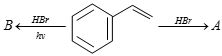
Analyze the following reaction and identify the nature of $A$ and $B$.
A
Formation of $A$ is an electrophilic addition reaction and formation of $B$ is a free radical addition reaction.
B
Formation of $A$ is a free radical addition reaction and formation of $B$ is an electrophilic addition reaction.
C
Both $A$ and $B$ are formed by electrophilic addition reactions.
D
Both $A$ and $B$ are formed by free radical addition reactions.
Solution
(A) The reaction of styrene with $HBr$ in the absence of peroxides (or light) follows Markovnikov's rule,which is an electrophilic addition reaction,yielding $1$-bromo-$1$-phenylethane $(A)$.
In the presence of light $(h\nu)$,the reaction follows the anti-Markovnikov addition (peroxide effect/free radical mechanism),yielding $1$-bromo-$2$-phenylethane $(B)$.
Thus,the formation of $A$ is an electrophilic addition reaction,and the formation of $B$ is a free radical addition reaction.
In the presence of light $(h\nu)$,the reaction follows the anti-Markovnikov addition (peroxide effect/free radical mechanism),yielding $1$-bromo-$2$-phenylethane $(B)$.
Thus,the formation of $A$ is an electrophilic addition reaction,and the formation of $B$ is a free radical addition reaction.
0 likes
View Solution109
DifficultMCQ
The compound $CH_3-C(OH)(CH_3)-CCl_3$ is:
A
Chloretone
B
Chloroquin
C
Chloropicrin
D
Chloropropyl chloride
Solution
(A) The compound $CH_3-C(OH)(CH_3)-CCl_3$ is known as Chloretone.
It is synthesized by the addition reaction of acetone with chloroform in the presence of potassium hydroxide $(KOH)$.
The reaction is: $(CH_3)_2C=O + CHCl_3 \rightarrow (CH_3)_2C(OH)CCl_3$.
It is used in medicine as a sedative and hypnotic.
It is synthesized by the addition reaction of acetone with chloroform in the presence of potassium hydroxide $(KOH)$.
The reaction is: $(CH_3)_2C=O + CHCl_3 \rightarrow (CH_3)_2C(OH)CCl_3$.
It is used in medicine as a sedative and hypnotic.
0 likes
View Solution110
MediumMCQ
When $CHCl_3$ is boiled with $NaOH$,it gives
A
Formic acid
B
Trihydroxy methane
C
Acetylene
D
Sodium formate
Solution
(D) When $CHCl_3$ (chloroform) is boiled with aqueous $NaOH$,it undergoes nucleophilic substitution to form an intermediate,$CH(OH)_3$ (methanetriol or trihydroxy methane).
This intermediate is highly unstable due to the presence of three hydroxyl groups on a single carbon atom.
It immediately loses a water molecule $(H_2O)$ to form formic acid $(HCOOH)$.
Since the medium is basic $(NaOH)$,the formic acid reacts with $NaOH$ to form sodium formate $(HCOONa)$ and water.
The overall reaction is: $CHCl_3 + 4NaOH \rightarrow HCOONa + 3NaCl + 2H_2O$.
This intermediate is highly unstable due to the presence of three hydroxyl groups on a single carbon atom.
It immediately loses a water molecule $(H_2O)$ to form formic acid $(HCOOH)$.
Since the medium is basic $(NaOH)$,the formic acid reacts with $NaOH$ to form sodium formate $(HCOONa)$ and water.
The overall reaction is: $CHCl_3 + 4NaOH \rightarrow HCOONa + 3NaCl + 2H_2O$.
0 likes
View Solution111
MediumMCQ
The hybridization state of carbon atoms in the product formed by the reaction of ethyl chloride with aqueous potassium hydroxide is
A
$sp$
B
$sp^2$
C
$sp^3$
D
$sp^3d$
Solution
(C) The reaction of ethyl chloride $(CH_3CH_2Cl)$ with aqueous potassium hydroxide $(KOH_{(aq)})$ is a nucleophilic substitution reaction ($S_N2$ mechanism).
$CH_3CH_2Cl + KOH_{(aq)} \to CH_3CH_2OH + KCl$
The product formed is ethanol $(CH_3CH_2OH)$.
In ethanol,both carbon atoms are bonded to four other atoms (single bonds),which corresponds to $sp^3$ hybridization.
$CH_3CH_2Cl + KOH_{(aq)} \to CH_3CH_2OH + KCl$
The product formed is ethanol $(CH_3CH_2OH)$.
In ethanol,both carbon atoms are bonded to four other atoms (single bonds),which corresponds to $sp^3$ hybridization.
0 likes
View Solution112
MediumMCQ
Which of the following compounds does not undergo nucleophilic substitution reactions?
A
Vinyl chloride
B
Ethyl bromide
C
Benzyl chloride
D
Isopropyl chloride
Solution
(A) Due to resonance,the $C-Cl$ bond in vinyl chloride $(CH_2=CH-Cl)$ acquires partial double bond character.
This makes the bond stronger and shorter,making it difficult for the nucleophile to replace the chlorine atom.
Therefore,vinyl chloride does not undergo nucleophilic substitution reactions under ordinary conditions.
This makes the bond stronger and shorter,making it difficult for the nucleophile to replace the chlorine atom.
Therefore,vinyl chloride does not undergo nucleophilic substitution reactions under ordinary conditions.
0 likes
View Solution113
MediumMCQ
In which alkyl halide,$SN^2$ mechanism is favoured maximum?
A
$CH_3Cl$
B
$CH_3CH_2Cl$
C
$(CH_3)_2CHCl$
D
$(CH_3)_3CCl$
Solution
(A) The $SN^2$ (Substitution nucleophilic bimolecular) reaction mechanism is highly sensitive to steric hindrance.
The reactivity order for $SN^2$ reactions is: $CH_3X > 1^o > 2^o > 3^o$.
$CH_3Cl$ is a methyl halide,which has the least steric hindrance,making it the most reactive towards the $SN^2$ mechanism.
Therefore,the correct option is $A$.
The reactivity order for $SN^2$ reactions is: $CH_3X > 1^o > 2^o > 3^o$.
$CH_3Cl$ is a methyl halide,which has the least steric hindrance,making it the most reactive towards the $SN^2$ mechanism.
Therefore,the correct option is $A$.
0 likes
View Solution114
AdvancedMCQ
An isomer of $C_3H_6Cl_2$ on boiling with aqueous $KOH$ gives acetone. Hence,the isomer is
A
$2, 2-$ dichloropropane
B
$1, 2-$ dichloropropane
C
$1, 1-$ dichloropropane
D
$1, 3-$ dichloropropane
Solution
(A) $2, 2-$ dichloropropane is a geminal dihalide. When it reacts with aqueous $KOH$,the two chlorine atoms are replaced by two hydroxyl groups on the same carbon atom. This intermediate is unstable and loses a water molecule to form acetone $(CH_3-CO-CH_3)$.
$CH_3-CCl_2-CH_3 + 2KOH_{(aq)}$ $\rightarrow [CH_3-C(OH)_2-CH_3]$ $\rightarrow CH_3-CO-CH_3 + H_2O$.
$CH_3-CCl_2-CH_3 + 2KOH_{(aq)}$ $\rightarrow [CH_3-C(OH)_2-CH_3]$ $\rightarrow CH_3-CO-CH_3 + H_2O$.
0 likes
View Solution115
DifficultMCQ
Which of the following is an example of an $S_N2$ reaction?
A
$CH_3-Br + OH^{-} \rightarrow CH_3-OH + Br^{-}$
B
$CH_3-CH(Br)-CH_3 + OH^{-} \rightarrow CH_3-CH(OH)-CH_3 + Br^{-}$
C
$CH_3-CH_2-OH \xrightarrow{-H_2O} CH_2=CH_2$
D
$CH_3-C(CH_3)(Br)-CH_3 + OH^{-} \rightarrow CH_3-C(CH_3)(OH)-CH_3 + Br^{-}$
Solution
(A) $S_N2$ (Bimolecular Nucleophilic Substitution) reactions involve a single-step mechanism where the nucleophile attacks the carbon atom from the back side.
This mechanism is highly sensitive to steric hindrance.
Therefore,it is most favored in methyl halides $(CH_3X)$ and primary alkyl halides $(1^\circ)$.
In the given options,$CH_3-Br$ is a methyl halide and reacts with $OH^{-}$ via the $S_N2$ mechanism.
This mechanism is highly sensitive to steric hindrance.
Therefore,it is most favored in methyl halides $(CH_3X)$ and primary alkyl halides $(1^\circ)$.
In the given options,$CH_3-Br$ is a methyl halide and reacts with $OH^{-}$ via the $S_N2$ mechanism.
0 likes
View Solution116
DifficultMCQ
Ethyl orthoformate is formed by heating which of the following compounds with sodium ethoxide?
A
$CHCl_3$
B
$C_2H_5OH$
C
$HCOOH$
D
$CH_3CHO$
Solution
(A) The reaction of chloroform $(CHCl_3)$ with sodium ethoxide $(C_2H_5ONa)$ upon heating leads to the formation of ethyl orthoformate $(HC(OC_2H_5)_3)$ and sodium chloride $(NaCl)$.
The chemical equation is:
$CHCl_3 + 3C_2H_5ONa \xrightarrow{\Delta} HC(OC_2H_5)_3 + 3NaCl$
Therefore,the correct option is $(A)$.
The chemical equation is:
$CHCl_3 + 3C_2H_5ONa \xrightarrow{\Delta} HC(OC_2H_5)_3 + 3NaCl$
Therefore,the correct option is $(A)$.
0 likes
View Solution117
EasyMCQ
Which of these does not form a Grignard reagent?
A
$CH_3F$
B
$CH_3Cl$
C
$CH_3Br$
D
$CH_3I$
Solution
(A) . The $C-F$ bond energy is the highest among the given alkyl halides.
Due to the high bond dissociation energy of the $C-F$ bond,$CH_3F$ is the least reactive and does not readily form a Grignard reagent with $Mg$ under standard conditions.
Due to the high bond dissociation energy of the $C-F$ bond,$CH_3F$ is the least reactive and does not readily form a Grignard reagent with $Mg$ under standard conditions.
0 likes
View Solution118
DifficultMCQ
An organic compound $A$ $(C_4H_9Cl)$ on reaction with $Na$ in diethyl ether gives a hydrocarbon,which on monochlorination gives only one chloro derivative. $A$ is:
A
$t$-butyl chloride
B
$s$-butyl chloride
C
Isobutyl chloride
D
$n$-butyl chloride
Solution
(A) The reaction of an alkyl halide with $Na$ in dry ether is the $Wurtz$ reaction,which produces a symmetric alkane.
$A$ is $t$-butyl chloride,$(CH_3)_3C-Cl$.
Reaction: $2 (CH_3)_3C-Cl + 2 Na \xrightarrow{\text{ether}} (CH_3)_3C-C(CH_3)_3 + 2 NaCl$.
The product is $2,2,3,3$-tetramethylbutane.
In $2,2,3,3$-tetramethylbutane,all $18$ hydrogen atoms are equivalent because they are all primary hydrogens attached to methyl groups bonded to quaternary carbons.
Thus,monochlorination of this hydrocarbon yields only one chloro derivative.
$A$ is $t$-butyl chloride,$(CH_3)_3C-Cl$.
Reaction: $2 (CH_3)_3C-Cl + 2 Na \xrightarrow{\text{ether}} (CH_3)_3C-C(CH_3)_3 + 2 NaCl$.
The product is $2,2,3,3$-tetramethylbutane.
In $2,2,3,3$-tetramethylbutane,all $18$ hydrogen atoms are equivalent because they are all primary hydrogens attached to methyl groups bonded to quaternary carbons.
Thus,monochlorination of this hydrocarbon yields only one chloro derivative.
0 likes
View Solution119
DifficultMCQ
Among the following,the most reactive towards alcoholic $KOH$ is:
A
$CH_2=CHBr$
B
$CH_3COCH_2CH_2Br$
C
$CH_3CH_2Br$
D
$CH_3CH_2CH_2Br$
Solution
(D) The reaction of haloalkanes with alcoholic $KOH$ proceeds via the $E2$ elimination mechanism.
In $CH_3CH_2CH_2Br$ (a primary alkyl halide),the presence of the alkyl group provides a $+I$ effect,which facilitates the elimination of the leaving group.
$CH_2=CHBr$ is a vinyl halide where the $C-X$ bond has partial double bond character,making it very unreactive towards elimination.
$CH_3COCH_2CH_2Br$ contains an electron-withdrawing $-CO$ group ($-I$ effect),which destabilizes the transition state for elimination compared to a simple alkyl halide.
Comparing $CH_3CH_2Br$ and $CH_3CH_2CH_2Br$,the latter has a slightly higher $+I$ effect,making it more reactive in this context.
$CH_3CH_2CH_2Br + KOH \xrightarrow{\text{alc.}} CH_3CH=CH_2 + KBr + H_2O$
In $CH_3CH_2CH_2Br$ (a primary alkyl halide),the presence of the alkyl group provides a $+I$ effect,which facilitates the elimination of the leaving group.
$CH_2=CHBr$ is a vinyl halide where the $C-X$ bond has partial double bond character,making it very unreactive towards elimination.
$CH_3COCH_2CH_2Br$ contains an electron-withdrawing $-CO$ group ($-I$ effect),which destabilizes the transition state for elimination compared to a simple alkyl halide.
Comparing $CH_3CH_2Br$ and $CH_3CH_2CH_2Br$,the latter has a slightly higher $+I$ effect,making it more reactive in this context.
$CH_3CH_2CH_2Br + KOH \xrightarrow{\text{alc.}} CH_3CH=CH_2 + KBr + H_2O$
0 likes
View Solution120
MediumMCQ
Which chlorine atom is more electronegative in the following compounds?
A
$CH_3-Cl$
B
$CH_3-CH_2-Cl$
C
$CH_3-CH(CH_3)-Cl$
D
$CH_3-C(CH_3)_2-Cl$
Solution
(D) The electronegativity of an atom in a molecule is influenced by the electron density around it.
In these haloalkanes,the alkyl group exerts an inductive effect ($+I$ effect),which increases electron density on the chlorine atom.
The order of the $+I$ effect of alkyl groups is: $(CH_3)_3C- > (CH_3)_2CH- > CH_3CH_2- > CH_3-$.
As the $+I$ effect increases,the electron density on the chlorine atom increases.
Therefore,the chlorine atom in tert-butyl chloride $(CH_3-C(CH_3)_2-Cl)$ experiences the highest electron density due to the strongest $+I$ effect from the tert-butyl group,making it the most electronegative in this series.
In these haloalkanes,the alkyl group exerts an inductive effect ($+I$ effect),which increases electron density on the chlorine atom.
The order of the $+I$ effect of alkyl groups is: $(CH_3)_3C- > (CH_3)_2CH- > CH_3CH_2- > CH_3-$.
As the $+I$ effect increases,the electron density on the chlorine atom increases.
Therefore,the chlorine atom in tert-butyl chloride $(CH_3-C(CH_3)_2-Cl)$ experiences the highest electron density due to the strongest $+I$ effect from the tert-butyl group,making it the most electronegative in this series.
0 likes
View Solution121
DifficultMCQ
What would be the product formed when $1-Bromo-3-chloro$ cyclobutane reacts with two equivalents of metallic sodium in ether?
A
B
C
D
Solution
(D) The reaction of $1-Bromo-3-chloro$ cyclobutane with two equivalents of metallic sodium in ether is an intramolecular Wurtz reaction.
Sodium acts as a reducing agent,donating electrons to the carbon atoms bonded to the halogen atoms.
This leads to the formation of a carbanion at the carbon bearing the bromine atom,which then performs an intramolecular nucleophilic substitution ($S_N2$ type) on the carbon bearing the chlorine atom.
This results in the formation of a new carbon-carbon bond,closing the ring to form bicyclo$[1.1.0]$butane.
The correct option is $D$.
Sodium acts as a reducing agent,donating electrons to the carbon atoms bonded to the halogen atoms.
This leads to the formation of a carbanion at the carbon bearing the bromine atom,which then performs an intramolecular nucleophilic substitution ($S_N2$ type) on the carbon bearing the chlorine atom.
This results in the formation of a new carbon-carbon bond,closing the ring to form bicyclo$[1.1.0]$butane.
The correct option is $D$.
0 likes
View Solution122
DifficultMCQ
Chlorination of toluene in the presence of light and heat followed by treatment with aqueous $NaOH$ gives:
A
$o-$cresol
B
$p-$cresol
C
$2, 4-$dihydroxy toluene
D
Benzyl alcohol
Solution
(D) The reaction proceeds in two steps:
$1$. Chlorination of toluene in the presence of light and heat (free radical substitution) yields benzyl chloride $(C_6H_5CH_2Cl)$.
$2$. Treatment of benzyl chloride with aqueous $NaOH$ (nucleophilic substitution) replaces the chlorine atom with a hydroxyl group,resulting in the formation of benzyl alcohol $(C_6H_5CH_2OH)$.
$1$. Chlorination of toluene in the presence of light and heat (free radical substitution) yields benzyl chloride $(C_6H_5CH_2Cl)$.
$2$. Treatment of benzyl chloride with aqueous $NaOH$ (nucleophilic substitution) replaces the chlorine atom with a hydroxyl group,resulting in the formation of benzyl alcohol $(C_6H_5CH_2OH)$.
0 likes
View Solution123
DifficultMCQ
What is obtained when chlorine is passed into boiling toluene and the product is hydrolysed?
A
$o-$Cresol
B
$p-$Cresol
C
$2, 4-$Dihydroxytoluene
D
Benzyl alcohol
Solution
(D) When chlorine is passed into boiling toluene,free radical substitution takes place in the side chain to form benzyl chloride $(C_6H_5CH_2Cl)$.
This benzyl chloride,upon hydrolysis with aqueous alkali ($NaOH$ or $KOH$),undergoes nucleophilic substitution to yield benzyl alcohol $(C_6H_5CH_2OH)$.
This benzyl chloride,upon hydrolysis with aqueous alkali ($NaOH$ or $KOH$),undergoes nucleophilic substitution to yield benzyl alcohol $(C_6H_5CH_2OH)$.
0 likes
View Solution124
DifficultMCQ
In the following groups: $I. -OAc$,$II. -OMe$,$III. -OSO_2Me$,$IV. -OSO_2CF_3$. The order of leaving group ability is:
A
$I > II > III > IV$
B
$IV > III > I > II$
C
$III > II > I > IV$
D
$II > III > IV > I$
Solution
(B) The leaving group ability is inversely proportional to the basicity of the leaving group. Weaker bases are better leaving groups.
The acidity of the corresponding conjugate acids follows the order: $CF_3SO_3H > CH_3SO_3H > CH_3COOH > CH_3OH$.
Therefore,the basicity order of their conjugate bases is: $CH_3O^- > CH_3COO^- > CH_3SO_3^- > CF_3SO_3^-$.
Thus,the leaving group ability order is $IV > III > I > II$.
The acidity of the corresponding conjugate acids follows the order: $CF_3SO_3H > CH_3SO_3H > CH_3COOH > CH_3OH$.
Therefore,the basicity order of their conjugate bases is: $CH_3O^- > CH_3COO^- > CH_3SO_3^- > CF_3SO_3^-$.
Thus,the leaving group ability order is $IV > III > I > II$.
0 likes
View Solution125
DifficultMCQ
The reaction of $CH_3-CH=CH-C_6H_4-OH$ with $HBr$ gives:
A
$CH_3-CHBr-CH_2-C_6H_4-OH$
B
$CH_3-CH_2-CHBr-C_6H_4-OH$
C
$CH_3-CHBr-CH_2-C_6H_4-Br$
D
$CH_3-CH_2-CHBr-C_6H_4-Br$
Solution
(B) The reaction of $CH_3-CH=CH-C_6H_4-OH$ with $HBr$ follows Markovnikov's rule.
In this reaction,the proton $(H^+)$ adds to the carbon atom of the double bond that has more hydrogen atoms,and the bromide ion $(Br^-)$ adds to the more substituted carbon atom.
The carbocation formed at the benzylic position is more stable due to resonance with the benzene ring.
Therefore,the product is $CH_3-CH_2-CHBr-C_6H_4-OH$.
In this reaction,the proton $(H^+)$ adds to the carbon atom of the double bond that has more hydrogen atoms,and the bromide ion $(Br^-)$ adds to the more substituted carbon atom.
The carbocation formed at the benzylic position is more stable due to resonance with the benzene ring.
Therefore,the product is $CH_3-CH_2-CHBr-C_6H_4-OH$.
0 likes
View Solution126
MediumMCQ
$A$ compound $A$ $(C_5H_{10}Cl_2)$ on hydrolysis gives $C_5H_{10}O$ which reacts with $NH_2OH$,forms iodoform,but does not give Fehling's test. $A$ is:
A
$CH_3-CCl_2-CH_2-CH_2-CH_3$
B
$CH_3-CH_2-CCl_2-CH_2-CH_3$
C
$CH_3-CH_2-CH_2-CH_2-CHCl_2$
D
$CH_3-CHCl-CHCl-CH_2-CH_3$
Solution
(A) Hydrolysis of a gem-dichloride yields a carbonyl compound.
Since the product $C_5H_{10}O$ reacts with $NH_2OH$,it is a carbonyl compound (aldehyde or ketone).
It gives the iodoform test,which indicates the presence of a methyl ketone group $(CH_3-CO-)$.
It does not give Fehling's test,which confirms it is a ketone and not an aldehyde.
Therefore,$C_5H_{10}O$ is $2$-pentanone $(CH_3-CO-CH_2-CH_2-CH_3)$.
To obtain $2$-pentanone upon hydrolysis,the starting compound $A$ must be $2,2$-dichloropentane $(CH_3-CCl_2-CH_2-CH_2-CH_3)$.
Since the product $C_5H_{10}O$ reacts with $NH_2OH$,it is a carbonyl compound (aldehyde or ketone).
It gives the iodoform test,which indicates the presence of a methyl ketone group $(CH_3-CO-)$.
It does not give Fehling's test,which confirms it is a ketone and not an aldehyde.
Therefore,$C_5H_{10}O$ is $2$-pentanone $(CH_3-CO-CH_2-CH_2-CH_3)$.
To obtain $2$-pentanone upon hydrolysis,the starting compound $A$ must be $2,2$-dichloropentane $(CH_3-CCl_2-CH_2-CH_2-CH_3)$.
0 likes
View Solution127
MediumMCQ
Ethyl acetate is obtained when methyl magnesium iodide reacts with
A
Ethyl formate
B
Ethyl chloroformate
C
Acetyl chloride
D
Carbon dioxide
Solution
(B) $Methyl \ magnesium \ iodide$ $(CH_3MgI)$ reacts with $ethyl \ chloroformate$ $(ClCOOC_2H_5)$ to produce $ethyl \ acetate$ $(CH_3COOC_2H_5)$.
$CH_3MgI + ClCOOC_2H_5 \rightarrow CH_3COOC_2H_5 + MgICl$
$CH_3MgI + ClCOOC_2H_5 \rightarrow CH_3COOC_2H_5 + MgICl$
0 likes
View Solution128
MediumMCQ
$KCN$ reacts readily to give a cyanide with:
A
Ethyl alcohol
B
Ethyl bromide
C
Bromobenzene
D
Chlorobenzene
Solution
(B) $KCN$ is an ionic compound that provides $CN^-$ ions. It undergoes nucleophilic substitution reactions with alkyl halides to form alkyl cyanides.
$C_2H_5Br + KCN \xrightarrow{\text{ethanol/water}} C_2H_5CN + KBr$
Ethyl bromide $(C_2H_5Br)$ is an alkyl halide,whereas ethyl alcohol is not a suitable substrate for this reaction,and aryl halides like bromobenzene and chlorobenzene do not undergo nucleophilic substitution with $KCN$ under normal conditions.
$C_2H_5Br + KCN \xrightarrow{\text{ethanol/water}} C_2H_5CN + KBr$
Ethyl bromide $(C_2H_5Br)$ is an alkyl halide,whereas ethyl alcohol is not a suitable substrate for this reaction,and aryl halides like bromobenzene and chlorobenzene do not undergo nucleophilic substitution with $KCN$ under normal conditions.
0 likes
View Solution129
AdvancedMCQ
The following compound on hydrolysis in aqueous acetone will give:
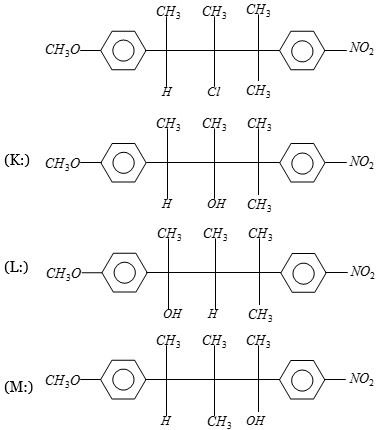
A
Mixture of $(K)$ and $(L)$
B
Mixture of $(K)$ and $(M)$
C
Only $(M)$
D
Only $(K)$
Solution
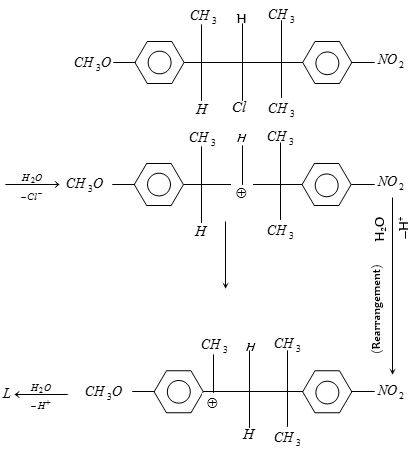
(A) The reaction proceeds via an $S_N1$ mechanism involving the formation of a carbocation intermediate.
$1$. The initial loss of the chloride ion $(Cl^-)$ generates a secondary carbocation.
$2$. This secondary carbocation can undergo a hydride shift (rearrangement) to form a more stable benzylic carbocation.
$3$. The initial secondary carbocation can be attacked by water to form product $(K)$.
$4$. The rearranged,more stable benzylic carbocation can be attacked by water to form product $(L)$.
$5$. Therefore,the hydrolysis results in a mixture of $(K)$ and $(L)$.
$1$. The initial loss of the chloride ion $(Cl^-)$ generates a secondary carbocation.
$2$. This secondary carbocation can undergo a hydride shift (rearrangement) to form a more stable benzylic carbocation.
$3$. The initial secondary carbocation can be attacked by water to form product $(K)$.
$4$. The rearranged,more stable benzylic carbocation can be attacked by water to form product $(L)$.
$5$. Therefore,the hydrolysis results in a mixture of $(K)$ and $(L)$.
0 likes
View Solution130
DifficultMCQ
The insecticide containing $99\%$ $\gamma-isomer$ of benzene hexachloride is known as
A
Lindane
B
$TNT$
C
Malathion
D
Methoxychlor
Solution
(A) The $\gamma-isomer$ of benzene hexachloride $(BHC)$ is known as Lindane or Gammexane.
It is a powerful insecticide containing $99\%$ of the $\gamma-isomer$.
It is a powerful insecticide containing $99\%$ of the $\gamma-isomer$.
0 likes
View Solution131
MediumMCQ
Which of the following compounds will not give a precipitate with $AgNO_3$?
A
Ethyl bromide
B
Sodium bromide
C
Calcium chloride
D
Sodium chloride
Solution
(A) $AgNO_3$ reacts with ionic halides to form a precipitate of silver halide $(AgX)$.
$AgNO_3 + NaBr \rightarrow AgBr(s) + NaNO_3$
$AgNO_3 + CaCl_2 \rightarrow AgCl(s) + Ca(NO_3)_2$
$AgNO_3 + NaCl \rightarrow AgCl(s) + NaNO_3$
Ethyl bromide $(C_2H_5Br)$ is a covalent organic compound and does not provide free halide ions $(Br^-)$ in aqueous solution to react with $Ag^+$ ions to form a precipitate.
Therefore,ethyl bromide will not give a precipitate with $AgNO_3$.
$AgNO_3 + NaBr \rightarrow AgBr(s) + NaNO_3$
$AgNO_3 + CaCl_2 \rightarrow AgCl(s) + Ca(NO_3)_2$
$AgNO_3 + NaCl \rightarrow AgCl(s) + NaNO_3$
Ethyl bromide $(C_2H_5Br)$ is a covalent organic compound and does not provide free halide ions $(Br^-)$ in aqueous solution to react with $Ag^+$ ions to form a precipitate.
Therefore,ethyl bromide will not give a precipitate with $AgNO_3$.
0 likes
View Solution132
MediumMCQ
Which of the following compounds reacts with $KCN$ to form a cyanide?
A
Ethyl alcohol
B
Ethyl bromide
C
Bromobenzene
D
Chlorobenzene
Solution
(B) Nucleophilic substitution reaction occurs between alkyl halides and $KCN$.
Ethyl bromide $(C_2H_5Br)$ is an alkyl halide that reacts with $KCN$ in an alcoholic medium to form ethyl cyanide $(C_2H_5CN)$ and $KBr$.
The reaction is:
$C_2H_5Br + KCN \xrightarrow{\text{alcohol}} C_2H_5CN + KBr$
Ethyl bromide $(C_2H_5Br)$ is an alkyl halide that reacts with $KCN$ in an alcoholic medium to form ethyl cyanide $(C_2H_5CN)$ and $KBr$.
The reaction is:
$C_2H_5Br + KCN \xrightarrow{\text{alcohol}} C_2H_5CN + KBr$
0 likes
View Solution133
DifficultMCQ
What is the product formed by the reaction between ethylbenzene and $N$-bromosuccinimide $(NBS)$?
A
$1-$bromo$-4-$ethylbenzene
B
$1-$bromo$-2-$phenylethane
C
$1-$bromo$-1-$phenylethane
D
$1-$bromo$-3-$ethylbenzene
Solution
(C) $N$-bromosuccinimide $(NBS)$ is a reagent used for free radical bromination at the benzylic position.
In ethylbenzene $(C_6H_5CH_2CH_3)$,the benzylic carbon is the carbon atom directly attached to the benzene ring.
The reaction proceeds via a free radical mechanism to replace a hydrogen atom on the benzylic carbon with a bromine atom.
Thus,the reaction of ethylbenzene with $NBS$ yields $1-$bromo$-1-$phenylethane $(C_6H_5CH(Br)CH_3)$.
In ethylbenzene $(C_6H_5CH_2CH_3)$,the benzylic carbon is the carbon atom directly attached to the benzene ring.
The reaction proceeds via a free radical mechanism to replace a hydrogen atom on the benzylic carbon with a bromine atom.
Thus,the reaction of ethylbenzene with $NBS$ yields $1-$bromo$-1-$phenylethane $(C_6H_5CH(Br)CH_3)$.
0 likes
View Solution134
DifficultMCQ
Identify '$X$' and '$Y$' in the following sequence of transformations: $CH_3-CH_2-CH_2Br$ $\xrightarrow{X} \text{Product}$ $\xrightarrow{Y} CH_3-CH(Br)-CH_3$.
A
$X = \text{dilute aqueous } NaOH, 20 \ ^\circ C, Y = HBr / \text{acetic acid } 20 \ ^\circ C$
B
$X = \text{concentrated alcoholic } NaOH, 80 \ ^\circ C, Y = HBr / \text{acetic acid } 20 \ ^\circ C$
C
$X = \text{dilute aqueous } NaOH, 20 \ ^\circ C, Y = Br_2 / CHCl_3, 0 \ ^\circ C$
D
$X = \text{concentrated alcoholic } NaOH, 80 \ ^\circ C, Y = Br_2 / CHCl_3, 0 \ ^\circ C$
Solution
(B) The transformation involves converting $1$-bromopropane to $2$-bromopropane.
Step $1$ $(X)$: Dehydrohalogenation of $1$-bromopropane using concentrated alcoholic $NaOH$ at $80 \ ^\circ C$ yields propene $(CH_3-CH=CH_2)$.
Step $2$ $(Y)$: Electrophilic addition of $HBr$ to propene follows Markovnikov's rule,resulting in the formation of $2$-bromopropane $(CH_3-CH(Br)-CH_3)$.
Step $1$ $(X)$: Dehydrohalogenation of $1$-bromopropane using concentrated alcoholic $NaOH$ at $80 \ ^\circ C$ yields propene $(CH_3-CH=CH_2)$.
Step $2$ $(Y)$: Electrophilic addition of $HBr$ to propene follows Markovnikov's rule,resulting in the formation of $2$-bromopropane $(CH_3-CH(Br)-CH_3)$.
0 likes
View Solution135
DifficultMCQ
$A$ compound $(a)$,$C_8H_9Br$,gives a white precipitate when heated with alcoholic $AgNO_3$. Oxidation of $(a)$ gives an acid $(b)$. The acid $(b)$,$C_8H_6O_4$,easily forms an anhydride on heating. Identify the compound $(a)$.
A
$1-$bromo$-3-$methylbenzene
B
$1-$bromo$-2-$ethylbenzene
C
$1-$bromo$-4-$methylbenzene
D
$1-$bromo$-2-$methylbenzene
Solution
(D) $1$. The compound $(a)$ has the molecular formula $C_8H_9Br$. Since it gives a white precipitate with alcoholic $AgNO_3$,it must contain a reactive halogen atom,likely a benzylic bromide.
$2$. Oxidation of $(a)$ yields an acid $(b)$ with the formula $C_8H_6O_4$. This acid is phthalic acid (benzene$-1,2-$dicarboxylic acid) because it easily forms an anhydride upon heating.
$3$. For the oxidation of $(a)$ to yield phthalic acid,the substituents on the benzene ring must be in the ortho position. Thus,$(a)$ must be $o$-methylbenzyl bromide ($1$-bromo$-2-$methylbenzene).
$4$. The structure corresponds to option $(D)$.
$2$. Oxidation of $(a)$ yields an acid $(b)$ with the formula $C_8H_6O_4$. This acid is phthalic acid (benzene$-1,2-$dicarboxylic acid) because it easily forms an anhydride upon heating.
$3$. For the oxidation of $(a)$ to yield phthalic acid,the substituents on the benzene ring must be in the ortho position. Thus,$(a)$ must be $o$-methylbenzyl bromide ($1$-bromo$-2-$methylbenzene).
$4$. The structure corresponds to option $(D)$.
0 likes
View Solution136
MediumMCQ
The hydrolysis of $2$-bromo-$3$-methylbutane by the $S_N1$ mechanism primarily yields:
A
$3$-methylbutan-$2$-ol
B
$2$-methylbutan-$2$-ol
C
$2,2$-dimethylpropan-$1$-ol
D
$2$-methylbutan-$1$-ol
Solution
(B) The hydrolysis of $2$-bromo-$3$-methylbutane via the $S_N1$ mechanism proceeds through the formation of a carbocation intermediate.
$1$. The starting material is $(CH_3)_2CH-CH(Br)-CH_3$.
$2$. Upon loss of the bromide ion,a secondary carbocation $(CH_3)_2CH-CH^+-CH_3$ is formed.
$3$. This secondary carbocation undergoes a $1,2$-hydride shift to form a more stable tertiary carbocation: $(CH_3)_2C^+-CH_2-CH_3$.
$4$. The nucleophile $(OH^-)$ then attacks the tertiary carbocation to form the major product,$2$-methylbutan-$2$-ol.
$1$. The starting material is $(CH_3)_2CH-CH(Br)-CH_3$.
$2$. Upon loss of the bromide ion,a secondary carbocation $(CH_3)_2CH-CH^+-CH_3$ is formed.
$3$. This secondary carbocation undergoes a $1,2$-hydride shift to form a more stable tertiary carbocation: $(CH_3)_2C^+-CH_2-CH_3$.
$4$. The nucleophile $(OH^-)$ then attacks the tertiary carbocation to form the major product,$2$-methylbutan-$2$-ol.
0 likes
View Solution137
DifficultMCQ
In the alkaline hydrolysis of an alkyl halide by aqueous alkali,if the concentration of the alkali is doubled,the reaction rate will ...
A
Double
B
Become half
C
Remain constant
D
Cannot be predicted
Solution
(D) The alkaline hydrolysis of an alkyl halide can proceed via $S_N1$ or $S_N2$ mechanisms.
For $S_N1$ reactions,the rate depends only on the concentration of the alkyl halide $(Rate = k[R-X])$,so the rate remains constant when the alkali concentration is doubled.
For $S_N2$ reactions,the rate depends on both the alkyl halide and the nucleophile $(Rate = k[R-X][OH^-])$,so the rate doubles when the alkali concentration is doubled.
Since the mechanism is not specified,the effect on the reaction rate cannot be definitively predicted without knowing the specific alkyl halide and reaction conditions.
For $S_N1$ reactions,the rate depends only on the concentration of the alkyl halide $(Rate = k[R-X])$,so the rate remains constant when the alkali concentration is doubled.
For $S_N2$ reactions,the rate depends on both the alkyl halide and the nucleophile $(Rate = k[R-X][OH^-])$,so the rate doubles when the alkali concentration is doubled.
Since the mechanism is not specified,the effect on the reaction rate cannot be definitively predicted without knowing the specific alkyl halide and reaction conditions.
0 likes
View Solution138
MediumMCQ
Which of the following does not form a Grignard reagent?
A
$CH_3F$
B
$CH_3Cl$
C
$CH_3Br$
D
$CH_3I$
Solution
(A) The $C-F$ bond in $CH_3F$ has the highest bond dissociation energy among the given alkyl halides. Due to this high bond strength,$CH_3F$ is the least reactive towards magnesium $(Mg)$ to form a Grignard reagent $(CH_3MgF)$ under standard conditions.
0 likes
View Solution139
DifficultMCQ
What is added to chloroform to prevent it from becoming toxic when used as an anesthetic?
A
$AgNO_3$ solution
B
Ethyl alcohol
C
Acetone
D
Copper sulphate
Solution
(B) Chloroform $(CHCl_3)$ is slowly oxidized by air in the presence of light to form an extremely poisonous gas called carbonyl chloride,also known as phosgene $(COCl_2)$.
The reaction is: $2CHCl_3 + O_2 \rightarrow 2COCl_2 + 2HCl$.
To prevent this oxidation,chloroform is stored in dark-colored bottles filled up to the brim and a small amount of ethyl alcohol $(C_2H_5OH)$ is added to it.
The ethyl alcohol converts any phosgene formed into harmless diethyl carbonate $(CO(OC_2H_5)_2)$.
The reaction is: $2CHCl_3 + O_2 \rightarrow 2COCl_2 + 2HCl$.
To prevent this oxidation,chloroform is stored in dark-colored bottles filled up to the brim and a small amount of ethyl alcohol $(C_2H_5OH)$ is added to it.
The ethyl alcohol converts any phosgene formed into harmless diethyl carbonate $(CO(OC_2H_5)_2)$.
0 likes
View Solution140
MediumMCQ
What is the product formed when $Ethyl \ bromide$ reacts with alcoholic $Silver \ nitrite$ $(AgNO_2)$?
A
Ethane
B
Methyl nitrile
C
Nitroethane
D
Ethyl alcohol
Solution
(C) When $Ethyl \ bromide$ $(C_2H_5Br)$ reacts with alcoholic $Silver \ nitrite$ $(AgNO_2)$,it undergoes a nucleophilic substitution reaction.
Since $AgNO_2$ is a covalent compound,the nitrogen atom acts as the nucleophile,leading to the formation of a nitro compound.
The reaction is: $C_2H_5Br + AgNO_2 \rightarrow C_2H_5NO_2 + AgBr$.
The product formed is $Nitroethane$ $(C_2H_5NO_2)$.
Since $AgNO_2$ is a covalent compound,the nitrogen atom acts as the nucleophile,leading to the formation of a nitro compound.
The reaction is: $C_2H_5Br + AgNO_2 \rightarrow C_2H_5NO_2 + AgBr$.
The product formed is $Nitroethane$ $(C_2H_5NO_2)$.
0 likes
View Solution141
MediumMCQ
When $HNO_3$ is reacted with $ . . . . . . $,chloropicrin is formed.
A
$CCl_4$
B
$CHCl_3$
C
$CH_3Cl$
D
$CH_2Cl_2$
Solution
(B) Chloropicrin is formed by the nitration of chloroform $(CHCl_3)$ with concentrated nitric acid $(HNO_3)$.
The chemical reaction is:
$CHCl_3 + HNO_3 \rightarrow CCl_3NO_2 + H_2O$
Here,$CCl_3NO_2$ is known as chloropicrin or nitrochloroform.
The chemical reaction is:
$CHCl_3 + HNO_3 \rightarrow CCl_3NO_2 + H_2O$
Here,$CCl_3NO_2$ is known as chloropicrin or nitrochloroform.
0 likes
View Solution142
MediumMCQ
What is not present in a Grignard reagent?
A
$-CH_3$ group
B
$Mg$
C
Halogen
D
$-COOH$ group
Solution
(D) Grignard reagent has the general formula $R-Mg-X$,where $R$ is an alkyl or aryl group,$Mg$ is magnesium,and $X$ is a halogen $(Cl, Br, I)$.
Grignard reagents are highly reactive towards acidic protons,such as those found in carboxylic acids ($-COOH$ group).
Therefore,a $-COOH$ group cannot be present in a Grignard reagent because it would immediately react with the reagent to form an alkane and a magnesium salt.
Grignard reagents are highly reactive towards acidic protons,such as those found in carboxylic acids ($-COOH$ group).
Therefore,a $-COOH$ group cannot be present in a Grignard reagent because it would immediately react with the reagent to form an alkane and a magnesium salt.
0 likes
View Solution143
MediumMCQ
Consider the following bromides. What is the correct order of $S_N1$ reactivity?
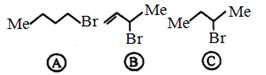
A
$A > B > C$
B
$B > C > A$
C
$B > A > C$
D
$C > B > A$
Solution
(B) The rate of $S_N1$ reaction depends on the stability of the carbocation intermediate formed after the departure of the leaving group $(Br^-)$.
$A$: Forms a primary $(1^{\circ})$ carbocation,which is the least stable.
$B$: Forms an allylic carbocation $(CH_2=CH-CH^+(CH_3))$,which is resonance-stabilized and thus the most stable.
$C$: Forms a secondary $(2^{\circ})$ carbocation,which is more stable than a primary carbocation but less stable than a resonance-stabilized allylic carbocation.
Therefore,the stability order of the carbocations is $B > C > A$,which is also the order of $S_N1$ reactivity.
$A$: Forms a primary $(1^{\circ})$ carbocation,which is the least stable.
$B$: Forms an allylic carbocation $(CH_2=CH-CH^+(CH_3))$,which is resonance-stabilized and thus the most stable.
$C$: Forms a secondary $(2^{\circ})$ carbocation,which is more stable than a primary carbocation but less stable than a resonance-stabilized allylic carbocation.
Therefore,the stability order of the carbocations is $B > C > A$,which is also the order of $S_N1$ reactivity.
0 likes
View Solution144
AdvancedMCQ
What is the product formed when $1$-bromo-$3$-chlorocyclobutane reacts with $2$ moles of sodium in ether?
A
Cyclobutane
B
Bicyclobutane
C
Cyclobutene
D
Bicyclobutane (with a diagonal bond)
Solution
(D) This reaction is an intramolecular Wurtz reaction. The $2$ moles of sodium react with the $1$-bromo-$3$-chlorocyclobutane to form a carbanion at the carbon atom attached to bromine,which then performs an intramolecular nucleophilic substitution on the carbon atom attached to chlorine,resulting in the formation of bicyclo[$1.1.0$]butane.
0 likes
View Solution145
MediumMCQ
What is obtained when toluene is chlorinated in the presence of light and then heated with aqueous $NaOH$?
A
$o$-cresol
B
$p$-cresol
C
$2,4$-hydroxytoluene
D
Benzoic acid
Solution
(D) $1$. Chlorination of toluene in the presence of light (free radical substitution) yields benzyl chloride $(C_6H_5CH_2Cl)$.
$2$. When benzyl chloride is heated with aqueous $NaOH$ (nucleophilic substitution),the chlorine atom is replaced by a hydroxyl group to form benzyl alcohol $(C_6H_5CH_2OH)$.
$3$. Note: The provided options do not contain benzyl alcohol. However,if the question implies side-chain chlorination followed by hydrolysis,the product is benzyl alcohol. Given the options,there might be a discrepancy in the question's intended product or options. Based on standard chemical reactions,the product is benzyl alcohol.
$2$. When benzyl chloride is heated with aqueous $NaOH$ (nucleophilic substitution),the chlorine atom is replaced by a hydroxyl group to form benzyl alcohol $(C_6H_5CH_2OH)$.
$3$. Note: The provided options do not contain benzyl alcohol. However,if the question implies side-chain chlorination followed by hydrolysis,the product is benzyl alcohol. Given the options,there might be a discrepancy in the question's intended product or options. Based on standard chemical reactions,the product is benzyl alcohol.
0 likes
View Solution146
MediumMCQ
The important insecticide compound obtained by the reaction of chloral with chlorobenzene is......
A
$BHC$
B
Gammexane
C
$DDT$
D
Lindane
Solution
(C) The reaction of chloral $(CCl_3CHO)$ with chlorobenzene $(C_6H_5Cl)$ in the presence of concentrated sulfuric acid $(H_2SO_4)$ yields $1,1,1-trichloro-2,2-bis(p-chlorophenyl)ethane$,commonly known as $DDT$ (Dichlorodiphenyltrichloroethane).
This compound is a well-known organochlorine insecticide.
This compound is a well-known organochlorine insecticide.
0 likes
View Solution147
DifficultMCQ
Which of the following compounds undergoes nucleophilic substitution by $OH^-$ ions to form a racemic mixture?
A
$(a)$
B
$(a), (b), (c)$
C
$(b), (c)$
D
$(a), (c)$
Solution
(C) racemic mixture is formed during nucleophilic substitution when the reaction proceeds via an $S_N1$ mechanism,which involves the formation of a planar carbocation intermediate.
This intermediate can be attacked by the nucleophile from either side with equal probability.
Compounds that can form stable carbocations (like tertiary or secondary alkyl halides that are chiral) are more likely to undergo $S_N1$ reactions.
In compound $(a)$,$CH_3-CH(Br)-C_2H_5$ is a secondary chiral alkyl halide,which can form a stable carbocation and undergo $S_N1$ substitution.
In compound $(b)$,$CH_3-C(Br)(CH_3)-C_2H_5$ is a tertiary chiral alkyl halide,which readily forms a stable tertiary carbocation and undergoes $S_N1$ substitution.
In compound $(c)$,$CH_3-CH(C_2H_5)-CH_2Br$ is a primary alkyl halide,which typically undergoes $S_N2$ reactions (inversion of configuration) rather than $S_N1$ (racemization).
Therefore,compounds $(a)$ and $(b)$ are the ones that can form a racemic mixture.
This intermediate can be attacked by the nucleophile from either side with equal probability.
Compounds that can form stable carbocations (like tertiary or secondary alkyl halides that are chiral) are more likely to undergo $S_N1$ reactions.
In compound $(a)$,$CH_3-CH(Br)-C_2H_5$ is a secondary chiral alkyl halide,which can form a stable carbocation and undergo $S_N1$ substitution.
In compound $(b)$,$CH_3-C(Br)(CH_3)-C_2H_5$ is a tertiary chiral alkyl halide,which readily forms a stable tertiary carbocation and undergoes $S_N1$ substitution.
In compound $(c)$,$CH_3-CH(C_2H_5)-CH_2Br$ is a primary alkyl halide,which typically undergoes $S_N2$ reactions (inversion of configuration) rather than $S_N1$ (racemization).
Therefore,compounds $(a)$ and $(b)$ are the ones that can form a racemic mixture.
0 likes
View Solution148
MediumMCQ
What is the major product formed in the following reaction?
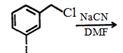
A
$3-$iodophenylacetonitrile
B
$3-$cyanophenylacetonitrile
C
$4-$cyano$-3-$methylphenylacetonitrile
D
$3-$chlorophenylacetonitrile
Solution
(A) The reaction involves the nucleophilic substitution of the chlorine atom in $3$-iodobenzyl chloride by the cyanide ion $(CN^-)$ from $NaCN$.
This is an $S_N2$ reaction.
The primary alkyl halide group $(-CH_2Cl)$ is much more reactive towards $S_N2$ substitution than the aryl iodide group.
Therefore,the $Cl$ atom is replaced by the $CN$ group,while the iodine atom remains unaffected.
The product is $3$-iodophenylacetonitrile.
This is an $S_N2$ reaction.
The primary alkyl halide group $(-CH_2Cl)$ is much more reactive towards $S_N2$ substitution than the aryl iodide group.
Therefore,the $Cl$ atom is replaced by the $CN$ group,while the iodine atom remains unaffected.
The product is $3$-iodophenylacetonitrile.
0 likes
View Solution149
MediumMCQ
When chloroform is treated with excess oxygen,it forms .....
A
$COCl_2 + HCl$
B
$COCl_2 + H_2 + Cl_2$
C
$COCl_2 + H_2O + Cl_2$
D
No product is formed.
Solution
(A) Chloroform $(CHCl_3)$ is slowly oxidized by air in the presence of light to form an extremely poisonous gas,carbonyl chloride,also known as phosgene $(COCl_2)$.
The chemical reaction is:
$2CHCl_3 + O_2 \xrightarrow{\text{light}} 2COCl_2 + 2HCl$
The chemical reaction is:
$2CHCl_3 + O_2 \xrightarrow{\text{light}} 2COCl_2 + 2HCl$
0 likes
View Solution150
MediumMCQ
The formation of butane nitrile is possible in which of the following reactions?
A
$C_3H_7Br + KCN$
B
$C_4H_9Br + KCN$
C
$C_3H_7OH + KCN$
D
$C_4H_9OH + KCN$
Solution
(A) The reaction of propyl bromide $(C_3H_7Br)$ with potassium cyanide $(KCN)$ is a nucleophilic substitution reaction.
$C_3H_7Br + KCN \rightarrow C_3H_7CN + KBr$
In $C_3H_7CN$,there are $3$ carbon atoms in the propyl group plus $1$ carbon atom in the nitrile group $(-CN)$,totaling $4$ carbon atoms.
According to $IUPAC$ nomenclature,the compound with $4$ carbon atoms and a nitrile functional group is called butane nitrile.
$C_3H_7Br + KCN \rightarrow C_3H_7CN + KBr$
In $C_3H_7CN$,there are $3$ carbon atoms in the propyl group plus $1$ carbon atom in the nitrile group $(-CN)$,totaling $4$ carbon atoms.
According to $IUPAC$ nomenclature,the compound with $4$ carbon atoms and a nitrile functional group is called butane nitrile.
0 likes
View SolutionHaloalkanes and Haloarenes — Properties of Haloalkanes · Frequently Asked Questions
1Are these Haloalkanes and Haloarenes questions useful for JEE and NEET?
Yes. All questions in this section are mapped to JEE Main and NEET exam patterns. Previous year questions from JEE Main, NEET, GUJCET and state-level exams are included with full solutions.
2Can I switch to Hindi or Gujarati for these questions?
Yes. Use the language tabs in the hero section or the sidebar to view the same questions and solutions in English, Hindi or Gujarati.
3How do I generate a question paper from this subtopic?
Use the Vedclass Exam Paper Generator — select the chapter and subtopic, set difficulty, and generate Sets A, B, C, D automatically. First 3 chapters of every subject are free.
Vedclass Products
For Students
Vedclass Test Series
Mock tests in real JEE/NEET style with performance analysis. 5-day free trial.
Start Free TrialFor Teachers
Exam Paper Generator
Generate Set A/B/C/D papers from this chapter in 2 minutes. 3 chapters free.
Try FreeFor Institutes
Online Exam Module
Live online exams with unlimited students, 360° analytics & white-label branding.
See DemoFor Teachers & Institutes
Generate a Haloalkanes and Haloarenes Exam Paper in 2 Minutes
Select subtopic & difficulty — Sets A, B, C, D auto-generated with No Repeat logic.
First 3 chapters of every subject are free — no payment required.