
A English
Properties of Haloalkanes Questions in English
Class 12 Chemistry · Haloalkanes and Haloarenes · Properties of Haloalkanes
1196+
Questions
English
Language
100%
With Solutions
Showing 49 of 1196 questions in English
1
DifficultMCQ
Which of the following does not give a precipitate with $Silver$ $nitrate$ $(AgNO_3)$ solution?
A
$Ethyl$ bromide
B
$Sodium$ bromide
C
$Calcium$ chloride
D
$Sodium$ chloride
Solution
(A) $Silver$ $nitrate$ $(AgNO_3)$ reacts with halide ions ($Cl^-$,$Br^-$,$I^-$) in aqueous solution to form a precipitate of silver halide $(AgX)$.
$Ethyl$ bromide $(C_2H_5Br)$ is a covalent organic compound and does not ionize to provide free bromide ions $(Br^-)$ in water.
Therefore,it does not react with $AgNO_3$ to form a precipitate.
In contrast,$Sodium$ bromide $(NaBr)$,$Calcium$ chloride $(CaCl_2)$,and $Sodium$ chloride $(NaCl)$ are ionic compounds that dissociate in water to provide free halide ions,which react with $Ag^+$ to form precipitates of $AgBr$ or $AgCl$.
$Ethyl$ bromide $(C_2H_5Br)$ is a covalent organic compound and does not ionize to provide free bromide ions $(Br^-)$ in water.
Therefore,it does not react with $AgNO_3$ to form a precipitate.
In contrast,$Sodium$ bromide $(NaBr)$,$Calcium$ chloride $(CaCl_2)$,and $Sodium$ chloride $(NaCl)$ are ionic compounds that dissociate in water to provide free halide ions,which react with $Ag^+$ to form precipitates of $AgBr$ or $AgCl$.
0 likes
View Solution2
MediumMCQ
When $32.25 \ g$ of ethyl chloride is dehydrohalogenated,it gives $50\%$ yield of alkene. What is the mass of the product in $g$? (Atomic mass of $Cl = 35.5$)
A
$14$
B
$28$
C
$64.5$
D
$7$
Solution
(D) The reaction for dehydrohalogenation of ethyl chloride is: $C_2H_5Cl \rightarrow C_2H_4 + HCl$
Molar mass of $C_2H_5Cl = (2 \times 12) + (5 \times 1) + 35.5 = 64.5 \ g/mol$
Molar mass of $C_2H_4 = (2 \times 12) + (4 \times 1) = 28 \ g/mol$
According to the stoichiometry,$64.5 \ g$ of $C_2H_5Cl$ produces $28 \ g$ of $C_2H_4$.
Therefore,$32.25 \ g$ of $C_2H_5Cl$ would theoretically produce: $\frac{28 \times 32.25}{64.5} = 14 \ g$ of $C_2H_4$.
Since the yield is $50\%$,the actual mass of the product obtained is: $14 \ g \times 0.50 = 7 \ g$.
Molar mass of $C_2H_5Cl = (2 \times 12) + (5 \times 1) + 35.5 = 64.5 \ g/mol$
Molar mass of $C_2H_4 = (2 \times 12) + (4 \times 1) = 28 \ g/mol$
According to the stoichiometry,$64.5 \ g$ of $C_2H_5Cl$ produces $28 \ g$ of $C_2H_4$.
Therefore,$32.25 \ g$ of $C_2H_5Cl$ would theoretically produce: $\frac{28 \times 32.25}{64.5} = 14 \ g$ of $C_2H_4$.
Since the yield is $50\%$,the actual mass of the product obtained is: $14 \ g \times 0.50 = 7 \ g$.
0 likes
View Solution3
DifficultMCQ
$A$ solution of $D(+)-1-$chloro$-1-$phenylethane in toluene racemises slowly in the presence of a small amount of $SbCl_5$,due to the formation of:
A
Carbanion
B
Carbene
C
Free radical
D
Carbocation
Solution
(D) $SbCl_5$ is a strong Lewis acid. It reacts with the $C-Cl$ bond of $1-$chloro$-1-$phenylethane to abstract the chloride ion,forming a stable benzylic carbocation intermediate: $Ph-CH(CH_3)-Cl + SbCl_5 \rightarrow [Ph-CH^+(CH_3)] + [SbCl_6]^-$.
Since the carbocation is planar,the chloride ion can attack from either side,leading to the formation of a racemic mixture of the $(d)$ and $(l)$ forms.
Since the carbocation is planar,the chloride ion can attack from either side,leading to the formation of a racemic mixture of the $(d)$ and $(l)$ forms.
0 likes
View Solution4
EasyMCQ
An alkyl halide may be converted into an alcohol by
A
Elimination
B
Addition
C
Substitution
D
Dehydrohalogenation
Solution
(C) Alkyl halides undergo alkaline hydrolysis to form alcohols. This process occurs via a nucleophilic substitution reaction where the halogen atom $(-X)$ is replaced by a nucleophile,specifically the hydroxyl group $(-OH)$.
Primary alkyl halides typically follow the $S_{N}2$ mechanism,whereas tertiary alkyl halides follow the $S_{N}1$ mechanism.
The general reaction is: $R-X + KOH \rightarrow R-OH + KX$
Primary alkyl halides typically follow the $S_{N}2$ mechanism,whereas tertiary alkyl halides follow the $S_{N}1$ mechanism.
The general reaction is: $R-X + KOH \rightarrow R-OH + KX$
0 likes
View Solution5
MediumMCQ
$(CH_3)_3CBr + KOH (aq.) \to (CH_3)_3COH + KBr$. The above reaction is:
A
$SN^1$
B
$SN^2$
C
$E_1$
D
Both $(a)$ and $(b)$
Solution
(A) The given reaction involves the conversion of a tertiary alkyl halide,$(CH_3)_3CBr$,into a tertiary alcohol,$(CH_3)_3COH$,using an aqueous base.
Since the substrate is a tertiary alkyl halide,the reaction proceeds via the formation of a stable carbocation intermediate.
This mechanism is characteristic of the $SN^1$ (unimolecular nucleophilic substitution) reaction.
Therefore,the correct option is $(a)$.
Since the substrate is a tertiary alkyl halide,the reaction proceeds via the formation of a stable carbocation intermediate.
This mechanism is characteristic of the $SN^1$ (unimolecular nucleophilic substitution) reaction.
Therefore,the correct option is $(a)$.
0 likes
View Solution6
MediumMCQ
Dehydrohalogenation of an alkyl halide is a/an
A
Nucleophilic substitution reaction
B
Elimination reaction
C
Both nucleophilic substitution and elimination reaction
D
Rearrangement
Solution
(B) Dehydrohalogenation of an alkyl halide in the presence of alcoholic potash is an example of an elimination reaction.
$R-CH_2-CH_2-Cl + KOH \text{ (alc.) } \xrightarrow{\Delta} R-CH=CH_2 + KCl + H_2O$
$R-CH_2-CH_2-Cl + KOH \text{ (alc.) } \xrightarrow{\Delta} R-CH=CH_2 + KCl + H_2O$
0 likes
View Solution7
EasyMCQ
The following reaction,$(CH_3)_3CBr + H_2O \to (CH_3)_3COH + HBr$,is an example of:
A
Elimination reaction
B
Free radical substitution
C
Nucleophilic substitution
D
Electrophilic substitution
Solution
(C) The reaction involves the replacement of a bromine atom $(-Br)$ by a hydroxyl group $(-OH)$ in a tert-butyl bromide molecule.
Since the water molecule acts as a nucleophile (providing the $OH^-$ group) to replace the leaving group $(Br^-)$,this is a nucleophilic substitution reaction.
Since the water molecule acts as a nucleophile (providing the $OH^-$ group) to replace the leaving group $(Br^-)$,this is a nucleophilic substitution reaction.
0 likes
View Solution8
MediumMCQ
Elimination of bromine from $2-$bromobutane results in the formation of
A
Equimolar mixture of $1-$butene and $2-$butene
B
Predominantly $2-$butene
C
Predominantly $1-$butene
D
Predominantly $2-$butyne
Solution
(B) The dehydrohalogenation of $2-$bromobutane follows Saytzeff's rule.
According to this rule,the more substituted alkene is the major product.
$2-$butene $(CH_3-CH=CH-CH_3)$ is a disubstituted alkene,while $1-$butene $(CH_2=CH-CH_2-CH_3)$ is a monosubstituted alkene.
Therefore,$2-$butene is formed as the major product.
According to this rule,the more substituted alkene is the major product.
$2-$butene $(CH_3-CH=CH-CH_3)$ is a disubstituted alkene,while $1-$butene $(CH_2=CH-CH_2-CH_3)$ is a monosubstituted alkene.
Therefore,$2-$butene is formed as the major product.
0 likes
View Solution9
MediumMCQ
Examine the following statements pertaining to an $S_N2$ reaction:
$(1)$ The rate of reaction is independent of the concentration of the nucleophile.
$(2)$ The nucleophile attacks the $C$ atom on the side of the molecule opposite to the group being displaced.
$(3)$ The reaction proceeds with simultaneous bond formation and bond rupture/cleavage.
Amongst the following,which of the above are true?
$(1)$ The rate of reaction is independent of the concentration of the nucleophile.
$(2)$ The nucleophile attacks the $C$ atom on the side of the molecule opposite to the group being displaced.
$(3)$ The reaction proceeds with simultaneous bond formation and bond rupture/cleavage.
Amongst the following,which of the above are true?
A
$1, 2$
B
$1, 3$
C
$1, 2, 3$
D
$2, 3$
Solution
(D) In an $S_N2$ reaction (Substitution Nucleophilic Bimolecular):
$(1)$ The rate of reaction depends on the concentration of both the substrate and the nucleophile. Therefore,statement $(1)$ is false.
$(2)$ The nucleophile attacks the carbon atom from the side opposite to the leaving group (backside attack),which is true.
$(3)$ The reaction occurs in a single step where bond formation and bond cleavage happen simultaneously,which is true.
Thus,statements $(2)$ and $(3)$ are correct.
$(1)$ The rate of reaction depends on the concentration of both the substrate and the nucleophile. Therefore,statement $(1)$ is false.
$(2)$ The nucleophile attacks the carbon atom from the side opposite to the leaving group (backside attack),which is true.
$(3)$ The reaction occurs in a single step where bond formation and bond cleavage happen simultaneously,which is true.
Thus,statements $(2)$ and $(3)$ are correct.
0 likes
View Solution10
MediumMCQ
Which of the following rules applies in the reaction:
$CH_3CHBrCH_2CH_3 \xrightarrow{alc. KOH}$
$(i)$ $CH_3CH = CHCH_3$ (major product)
$(ii)$ $CH_2 = CHCH_2CH_3$ (minor product)
$CH_3CHBrCH_2CH_3 \xrightarrow{alc. KOH}$
$(i)$ $CH_3CH = CHCH_3$ (major product)
$(ii)$ $CH_2 = CHCH_2CH_3$ (minor product)
A
Markovnikov's rule
B
Saytzeff's rule
C
Kharasch effect
D
Hofmann's rule
Solution
(B) The reaction is a dehydrohalogenation of $2$-bromobutane using alcoholic $KOH$.
When an alkyl halide can undergo dehydrohalogenation to form more than one alkene,the major product is the most highly substituted alkene (the one with the most alkyl groups attached to the double-bonded carbons).
According to Saytzeff's rule,$CH_3CH=CHCH_3$ ($2$-butene) is more substituted than $CH_2=CHCH_2CH_3$ ($1$-butene),making it the major product.
Therefore,the correct option is $(b)$.
When an alkyl halide can undergo dehydrohalogenation to form more than one alkene,the major product is the most highly substituted alkene (the one with the most alkyl groups attached to the double-bonded carbons).
According to Saytzeff's rule,$CH_3CH=CHCH_3$ ($2$-butene) is more substituted than $CH_2=CHCH_2CH_3$ ($1$-butene),making it the major product.
Therefore,the correct option is $(b)$.
0 likes
View Solution11
MediumMCQ
Which of the following will have an enantiomer?
A
$CH_3-CH_2-CHCl-CH_3$
B
$CH_3-CH_2-CH_2-CH_2Cl$
C
$CH_3-CH_2-CH_2-CHCl_2$
D
None of these
Solution
(A) molecule has an enantiomer if it contains a chiral carbon atom (a carbon atom bonded to four different groups).
In $2$-chlorobutane $(CH_3-CH_2-CHCl-CH_3)$,the second carbon is chiral as it is attached to four different groups: $-H$,$-Cl$,$-CH_3$,and $-C_2H_5$.
Therefore,it exists as a pair of enantiomers.
In $2$-chlorobutane $(CH_3-CH_2-CHCl-CH_3)$,the second carbon is chiral as it is attached to four different groups: $-H$,$-Cl$,$-CH_3$,and $-C_2H_5$.
Therefore,it exists as a pair of enantiomers.
0 likes
View Solution12
MediumMCQ
$S_N^1$ reaction is faster in
A
$CH_3-CH_2-Cl$
B
$(CH_3)_2CH-Cl$
C
$CH_3-C(CH_3)_2-Cl$
D
$CH_3-CH(CH_3)-CH_2-Cl$
Solution
(C) $S_N^1$ reaction proceeds via the formation of a carbocation intermediate. The rate of $S_N^1$ reaction is directly proportional to the stability of the carbocation formed. The stability order of carbocations is $3^\circ > 2^\circ > 1^\circ > CH_3^+$.
In the given options:
$(a)$ $CH_3-CH_2-Cl$ forms a $1^\circ$ carbocation $(CH_3-CH_2^+)$.
$(b)$ $(CH_3)_2CH-Cl$ forms a $2^\circ$ carbocation $((CH_3)_2CH^+)$.
$(c)$ $CH_3-C(CH_3)_2-Cl$ forms a $3^\circ$ carbocation $((CH_3)_3C^+)$.
$(d)$ $CH_3-CH(CH_3)-CH_2-Cl$ forms a $1^\circ$ carbocation $(CH_3-CH(CH_3)-CH_2^+)$.
Since the $3^\circ$ carbocation is the most stable,the $S_N^1$ reaction is fastest in $CH_3-C(CH_3)_2-Cl$.
In the given options:
$(a)$ $CH_3-CH_2-Cl$ forms a $1^\circ$ carbocation $(CH_3-CH_2^+)$.
$(b)$ $(CH_3)_2CH-Cl$ forms a $2^\circ$ carbocation $((CH_3)_2CH^+)$.
$(c)$ $CH_3-C(CH_3)_2-Cl$ forms a $3^\circ$ carbocation $((CH_3)_3C^+)$.
$(d)$ $CH_3-CH(CH_3)-CH_2-Cl$ forms a $1^\circ$ carbocation $(CH_3-CH(CH_3)-CH_2^+)$.
Since the $3^\circ$ carbocation is the most stable,the $S_N^1$ reaction is fastest in $CH_3-C(CH_3)_2-Cl$.
0 likes
View Solution13
MediumMCQ
The following reaction is described as:
$CH_3(CH_2)_5-CH(CH_3)-Br + OH^- \rightarrow HO-CH(CH_3)(CH_2)_5CH_3 + Br^-$
$CH_3(CH_2)_5-CH(CH_3)-Br + OH^- \rightarrow HO-CH(CH_3)(CH_2)_5CH_3 + Br^-$
A
$S_E2$
B
$S_N1$
C
$S_N2$
D
$S_N0$
Solution
(C) The reaction shows the nucleophilic substitution of a bromide ion by a hydroxide ion.
The product shows an inversion of configuration at the chiral carbon atom,which is a characteristic feature of the $S_N2$ mechanism.
In an $S_N2$ reaction (Bimolecular Nucleophilic Substitution),the nucleophile attacks from the side opposite to the leaving group,leading to Walden inversion.
The product shows an inversion of configuration at the chiral carbon atom,which is a characteristic feature of the $S_N2$ mechanism.
In an $S_N2$ reaction (Bimolecular Nucleophilic Substitution),the nucleophile attacks from the side opposite to the leaving group,leading to Walden inversion.
1 likes
View Solution14
DifficultMCQ
Dehydrohalogenation in the presence of $OH^{-}$ is correctly represented by:
A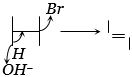
B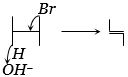
C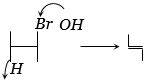
D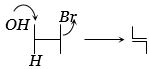
Solution
(D) Dehydrohalogenation is an elimination reaction where a hydrogen atom and a halogen atom are removed from adjacent carbon atoms to form a double bond. In the presence of a base like $OH^{-}$,the base abstracts a proton $(H^{+})$ from the $\beta$-carbon,leading to the formation of a double bond and the elimination of the halide ion $(Br^{-})$. The correct mechanism shows the $OH^{-}$ attacking the $\beta$-hydrogen,the $C-H$ bond breaking to form the $C=C$ double bond,and the $C-Br$ bond breaking to release the $Br^{-}$ ion. Option $D$ correctly depicts this concerted mechanism.
0 likes
View Solution15
MediumMCQ
Iodoethane reacts with sodium in the presence of dry ether. The product is
A
Pentane
B
Propane
C
Butene
D
Butane
Solution
(D) This reaction is a $Wurtz$ reaction,where alkyl halides react with sodium metal in the presence of dry ether to form higher alkanes.
$2C_2H_5I + 2Na \xrightarrow{\text{Dry Ether}} C_2H_5-C_2H_5 + 2NaI$
$2C_2H_5I + 2Na \xrightarrow{\text{Dry Ether}} C_4H_{10} (\text{Butane}) + 2NaI$
Therefore,the product formed is $Butane$.
$2C_2H_5I + 2Na \xrightarrow{\text{Dry Ether}} C_2H_5-C_2H_5 + 2NaI$
$2C_2H_5I + 2Na \xrightarrow{\text{Dry Ether}} C_4H_{10} (\text{Butane}) + 2NaI$
Therefore,the product formed is $Butane$.
0 likes
View Solution16
MediumMCQ
Sodium ethoxide is a specific reagent for
A
Dehydration
B
Dehydrogenation
C
Dehydrohalogenation
D
Dehalogenation
Solution
(C) Sodium ethoxide $(C_2H_5ONa)$ is a strong base commonly used to perform dehydrohalogenation of alkyl halides to form alkenes.
For example: $CH_3-CH_2-CH_2-Br \xrightarrow[C_2H_5ONa]{\Delta} CH_3-CH=CH_2 + C_2H_5OH + NaBr$.
For example: $CH_3-CH_2-CH_2-Br \xrightarrow[C_2H_5ONa]{\Delta} CH_3-CH=CH_2 + C_2H_5OH + NaBr$.
0 likes
View Solution17
MediumMCQ
Grignard reagent is not prepared in aqueous medium but prepared in ether medium because the reagent
A
Reacts with water
B
Is insoluble in water
C
Is highly reactive in ether
D
Becomes inactive in water
Solution
(A) Grignard reagent $(RMgX)$ is a strong base and a strong nucleophile. It reacts violently with water to form an alkane $(RH)$ and magnesium hydroxide halide $(Mg(OH)X)$.
$RMgX + H_2O \rightarrow RH + Mg(OH)X$
Therefore,it is prepared in an anhydrous ether medium to prevent decomposition by moisture.
$RMgX + H_2O \rightarrow RH + Mg(OH)X$
Therefore,it is prepared in an anhydrous ether medium to prevent decomposition by moisture.
0 likes
View Solution18
MediumMCQ
Alcoholic solution of $KOH$ is used for
A
Dehydration
B
Dehydrogenation
C
Dehydrohalogenation
D
Dehalogenation
Solution
(C) The correct answer is $(C)$.
Alcoholic $KOH$ contains alkoxide ions $(RO^-)$,which act as strong bases.
These ions abstract a proton from the $\beta$-carbon of an alkyl halide,leading to an elimination reaction known as dehydrohalogenation.
The reaction is: $CH_3-CH_2-Br + KOH_{(alc)} \xrightarrow{\Delta} CH_2=CH_2 + KBr + H_2O$.
Mechanism:
$ROH + KOH \to ROK + H_2O$
$ROK \to RO^- + K^+$
$RO^- + H-CH_2(\beta)-CH_2(\alpha)-Br \to ROH + CH_2=CH_2 + Br^-$
Alcoholic $KOH$ contains alkoxide ions $(RO^-)$,which act as strong bases.
These ions abstract a proton from the $\beta$-carbon of an alkyl halide,leading to an elimination reaction known as dehydrohalogenation.
The reaction is: $CH_3-CH_2-Br + KOH_{(alc)} \xrightarrow{\Delta} CH_2=CH_2 + KBr + H_2O$.
Mechanism:
$ROH + KOH \to ROK + H_2O$
$ROK \to RO^- + K^+$
$RO^- + H-CH_2(\beta)-CH_2(\alpha)-Br \to ROH + CH_2=CH_2 + Br^-$
0 likes
View Solution19
MediumMCQ
The product obtained on reaction of $C_2H_5Cl$ with hydrogen over palladium carbon is
A
$C_3H_8$
B
$C_4H_{10}$
C
$C_2H_6$
D
$C_2H_4$
Solution
(C) The reaction of $C_2H_5Cl$ with hydrogen in the presence of palladium on carbon $(Pd/C)$ is a reduction reaction.
The chemical equation is: $C_2H_5Cl + H_2 \xrightarrow{Pd/C} C_2H_6 + HCl$.
In this reaction,the chlorine atom is replaced by a hydrogen atom,resulting in the formation of ethane $(C_2H_6)$.
This method is commonly used for the preparation of pure alkanes from alkyl halides.
The chemical equation is: $C_2H_5Cl + H_2 \xrightarrow{Pd/C} C_2H_6 + HCl$.
In this reaction,the chlorine atom is replaced by a hydrogen atom,resulting in the formation of ethane $(C_2H_6)$.
This method is commonly used for the preparation of pure alkanes from alkyl halides.
0 likes
View Solution20
MediumMCQ
$CH_3-CH_2-Cl \xrightarrow{alc. KOH} A$,the product is
A
$CH_3CH_2OK$
B
$CH_3CHO$
C
$CH_3CH_2OCH_2CH_3$
D
$CH_2=CH_2$
Solution
(D) The reaction of haloalkanes with alcoholic $KOH$ is a dehydrohalogenation reaction.
$CH_3-CH_2-Cl + KOH (alc.) \rightarrow CH_2=CH_2 + KCl + H_2O$
This is an elimination reaction where an alkene is formed as the major product.
$CH_3-CH_2-Cl + KOH (alc.) \rightarrow CH_2=CH_2 + KCl + H_2O$
This is an elimination reaction where an alkene is formed as the major product.
0 likes
View Solution21
MediumMCQ
The final product formed when ethyl bromide is treated with excess of alcoholic $KOH$ is
A
Ethylene
B
Ethane
C
Ethyne
D
Vinyl bromide
Solution
(A) When ethyl bromide $(CH_3CH_2Br)$ is treated with alcoholic $KOH$,it undergoes a dehydrohalogenation reaction.
This is an elimination reaction where a hydrogen atom from the $\beta$-carbon and the bromine atom from the $\alpha$-carbon are removed.
The reaction is: $CH_3-CH_2-Br + KOH (\text{alc.}) \to CH_2=CH_2 + KBr + H_2O$.
The final product formed is ethylene $(CH_2=CH_2)$.
This is an elimination reaction where a hydrogen atom from the $\beta$-carbon and the bromine atom from the $\alpha$-carbon are removed.
The reaction is: $CH_3-CH_2-Br + KOH (\text{alc.}) \to CH_2=CH_2 + KBr + H_2O$.
The final product formed is ethylene $(CH_2=CH_2)$.
0 likes
View Solution22
MediumMCQ
When $2-$bromobutane reacts with alcoholic $KOH$,the reaction is called
A
Halogenation
B
Hydrogenation
C
Chlorination
D
Dehydro-halogenation
Solution
(D) . $CH_3-CH(Br)-CH_2-CH_3 \xrightarrow{\text{alc. } KOH} CH_3-CH=CH-CH_3$ ($2-$butene).
The reaction involves the removal of a hydrogen atom and a bromine atom,which is known as dehydrohalogenation.
The reaction involves the removal of a hydrogen atom and a bromine atom,which is known as dehydrohalogenation.
0 likes
View Solution23
MediumMCQ
Ethyl bromide gives ethylene when reacted with
A
Ethyl alcohol
B
Dilute $H_2SO_4$
C
Aqueous $KOH$
D
Alcoholic $KOH$
Solution
(D) The reaction of ethyl bromide $(CH_3-CH_2-Br)$ with alcoholic $KOH$ is a dehydrohalogenation reaction (elimination reaction).
In this reaction,the base $(OH^-)$ abstracts a proton from the $\beta$-carbon,leading to the elimination of $HBr$ and the formation of ethene $(CH_2=CH_2)$.
The reaction is: $CH_3-CH_2-Br + KOH \text{ (alc)} \to CH_2=CH_2 + KBr + H_2O$.
In this reaction,the base $(OH^-)$ abstracts a proton from the $\beta$-carbon,leading to the elimination of $HBr$ and the formation of ethene $(CH_2=CH_2)$.
The reaction is: $CH_3-CH_2-Br + KOH \text{ (alc)} \to CH_2=CH_2 + KBr + H_2O$.
0 likes
View Solution24
MediumMCQ
$A$ mixture of $1-$chloropropane and $2-$chloropropane when treated with alcoholic $KOH$ gives:
A
$1-$propene
B
$2-$propene
C
Isopropylene
D
Propene
Solution
(D) Both $1-$chloropropane $(CH_3-CH_2-CH_2-Cl)$ and $2-$chloropropane $(CH_3-CHCl-CH_3)$ undergo dehydrohalogenation (elimination reaction) in the presence of alcoholic $KOH$ to form propene $(CH_3-CH=CH_2)$.
$CH_3-CH_2-CH_2-Cl + KOH (\text{alc.}) \rightarrow CH_3-CH=CH_2 + KCl + H_2O$
$CH_3-CHCl-CH_3 + KOH (\text{alc.}) \rightarrow CH_3-CH=CH_2 + KCl + H_2O$
Thus,the product obtained in both cases is propene.
$CH_3-CH_2-CH_2-Cl + KOH (\text{alc.}) \rightarrow CH_3-CH=CH_2 + KCl + H_2O$
$CH_3-CHCl-CH_3 + KOH (\text{alc.}) \rightarrow CH_3-CH=CH_2 + KCl + H_2O$
Thus,the product obtained in both cases is propene.
0 likes
View Solution25
MediumMCQ
What product is formed when $1-$chlorobutane reacts with alcoholic $KOH$?
A
$1-$butene
B
$2-$butene
C
$1-$butanol
D
$2-$butanol
Solution
(A) The reaction of $1-$chlorobutane $(CH_3CH_2CH_2CH_2Cl)$ with alcoholic $KOH$ is a dehydrohalogenation reaction.
This reaction follows the $E2$ mechanism,where the base $(OH^-)$ abstracts a proton from the $\beta$-carbon,leading to the elimination of $HCl$.
$CH_3CH_2CH_2CH_2Cl + alc. KOH \rightarrow CH_3CH_2CH=CH_2 + KCl + H_2O$.
The major product formed is $1-$butene.
This reaction follows the $E2$ mechanism,where the base $(OH^-)$ abstracts a proton from the $\beta$-carbon,leading to the elimination of $HCl$.
$CH_3CH_2CH_2CH_2Cl + alc. KOH \rightarrow CH_3CH_2CH=CH_2 + KCl + H_2O$.
The major product formed is $1-$butene.
0 likes
View Solution26
MediumMCQ
Monohalides on reacting with alcoholic $KOH$ give
A
Alkanes
B
Alkenes
C
Alkynes
D
Aromatic hydrocarbons
Solution
(B) The reaction of monohalides (alkyl halides) with alcoholic $KOH$ is a dehydrohalogenation reaction.
This reaction involves the elimination of a hydrogen atom from the $\beta$-carbon and a halogen atom from the $\alpha$-carbon,resulting in the formation of an alkene.
For example: $CH_3-CH_2-Cl \xrightarrow{\text{alc. } KOH} CH_2=CH_2 + KCl + H_2O$.
This reaction involves the elimination of a hydrogen atom from the $\beta$-carbon and a halogen atom from the $\alpha$-carbon,resulting in the formation of an alkene.
For example: $CH_3-CH_2-Cl \xrightarrow{\text{alc. } KOH} CH_2=CH_2 + KCl + H_2O$.
0 likes
View Solution27
MediumMCQ
The formation of alkene from alkyl halide is an example of
A
Addition
B
Elimination
C
Substitution
D
$A$ and $C$
Solution
(B) The reaction of an alkyl halide with alcoholic $KOH$ leads to the removal of a hydrogen atom and a halogen atom from adjacent carbon atoms,resulting in the formation of an alkene. This process is known as dehydrohalogenation,which is a type of elimination reaction.
$R-CH_2-CH_2-X \xrightarrow{\text{alc. } KOH} R-CH=CH_2 + HX$
$R-CH_2-CH_2-X \xrightarrow{\text{alc. } KOH} R-CH=CH_2 + HX$
0 likes
View Solution28
MediumMCQ
$n$-propyl bromide on treatment with ethanolic potassium hydroxide produces
A
Propane
B
Propene
C
Propyne
D
Propanol
Solution
(B) The reaction of $n$-propyl bromide $(CH_3-CH_2-CH_2-Br)$ with ethanolic potassium hydroxide $(KOH)$ is a dehydrohalogenation reaction.
This is an elimination reaction ($E2$ mechanism) where the base removes a proton from the $\beta$-carbon and the bromide ion is eliminated.
$CH_3-CH_2-CH_2-Br + KOH \xrightarrow{C_2H_5OH} CH_3-CH=CH_2 + KBr + H_2O$.
The product formed is $Propene$.
This is an elimination reaction ($E2$ mechanism) where the base removes a proton from the $\beta$-carbon and the bromide ion is eliminated.
$CH_3-CH_2-CH_2-Br + KOH \xrightarrow{C_2H_5OH} CH_3-CH=CH_2 + KBr + H_2O$.
The product formed is $Propene$.
0 likes
View Solution29
MediumMCQ
The dehydrohalogenation of neopentyl bromide with alcoholic $KOH$ mainly gives
A
$2-$methyl$-1-$butene
B
$2-$methyl$-2-$butene
C
$2, 2-$dimethyl$-1-$butene
D
$2-$butene
Solution
(B) Neopentyl bromide $(CH_3-C(CH_3)_2-CH_2-Br)$ is a primary alkyl halide with significant steric hindrance at the $\beta-$carbon.
Upon reaction with alcoholic $KOH$,the formation of a primary carbocation is unfavorable.
Instead,it undergoes a concerted rearrangement via a $1, 2-$methyl shift to form a more stable tertiary carbocation $(CH_3-C^{+}(CH_3)-CH_2-CH_3)$.
Elimination of a proton from this intermediate according to Saytzeff's rule yields $2-$methyl$-2-$butene as the major product.
Upon reaction with alcoholic $KOH$,the formation of a primary carbocation is unfavorable.
Instead,it undergoes a concerted rearrangement via a $1, 2-$methyl shift to form a more stable tertiary carbocation $(CH_3-C^{+}(CH_3)-CH_2-CH_3)$.
Elimination of a proton from this intermediate according to Saytzeff's rule yields $2-$methyl$-2-$butene as the major product.
0 likes
View Solution30
MediumMCQ
Formation of $2-$butene from $2-$bromobutane is according to
A
Markownikoff's rule
B
Bayer's rule
C
Saytzeff's rule
D
Wurtz reaction
Solution
(C) The elimination of $HBr$ from $2-$bromobutane to form $2-$butene is an example of dehydrohalogenation. According to $Saytzeff's$ rule,in dehydrohalogenation reactions,the more substituted alkene (the one with more alkyl groups attached to the double-bonded carbons) is the major product. $CH_3-CH(Br)-CH_2-CH_3 \xrightarrow{alc. KOH} CH_3-CH=CH-CH_3 + HBr$.
0 likes
View Solution31
MediumMCQ
$3$-Phenylpropene on reaction with $HBr$ gives (as a major product)
A
$C_6H_5CH_2CH(Br)CH_3$
B
$C_6H_5CH(Br)CH_2CH_3$
C
$C_6H_5CH_2CH_2CH_2Br$
D
$C_6H_5CH(Br)CH = CH_2$
Solution
(B) $3$-Phenylpropene $(C_6H_5CH_2CH=CH_2)$ reacts with $HBr$ via electrophilic addition.
According to Markownikoff's rule,the electrophile $(H^+)$ adds to the terminal carbon to form a more stable secondary benzylic carbocation $(C_6H_5CH^+CH_2CH_3)$.
The nucleophile $(Br^-)$ then attacks this carbocation to form the major product,$1$-bromo-$1$-phenylpropane $(C_6H_5CH(Br)CH_2CH_3)$.
According to Markownikoff's rule,the electrophile $(H^+)$ adds to the terminal carbon to form a more stable secondary benzylic carbocation $(C_6H_5CH^+CH_2CH_3)$.
The nucleophile $(Br^-)$ then attacks this carbocation to form the major product,$1$-bromo-$1$-phenylpropane $(C_6H_5CH(Br)CH_2CH_3)$.
0 likes
View Solution32
MediumMCQ
The product formed when toluene is heated in light with $Cl_2$ and in the absence of a halogen carrier is:
A
Benzyl chloride
B
Benzal dichloride
C
Benzotrichloride
D
All of these
Solution
(D) When toluene $(C_6H_5CH_3)$ is treated with $Cl_2$ in the presence of light ($UV$ light) and in the absence of a halogen carrier (like $FeCl_3$ or $AlCl_3$),the reaction proceeds via a free-radical mechanism.
This leads to the substitution of hydrogen atoms on the side-chain methyl group.
The reaction proceeds in stages:
$1$. Toluene reacts with $Cl_2$ to form Benzyl chloride $(C_6H_5CH_2Cl)$.
$2$. Further reaction with $Cl_2$ gives Benzal dichloride $(C_6H_5CHCl_2)$.
$3$. Final reaction with $Cl_2$ gives Benzotrichloride $(C_6H_5CCl_3)$.
Since the question asks for the product formed under these conditions,all three products are formed depending on the amount of $Cl_2$ used. Therefore,the most appropriate answer is that all of these are formed.
This leads to the substitution of hydrogen atoms on the side-chain methyl group.
The reaction proceeds in stages:
$1$. Toluene reacts with $Cl_2$ to form Benzyl chloride $(C_6H_5CH_2Cl)$.
$2$. Further reaction with $Cl_2$ gives Benzal dichloride $(C_6H_5CHCl_2)$.
$3$. Final reaction with $Cl_2$ gives Benzotrichloride $(C_6H_5CCl_3)$.
Since the question asks for the product formed under these conditions,all three products are formed depending on the amount of $Cl_2$ used. Therefore,the most appropriate answer is that all of these are formed.
0 likes
View Solution33
EasyMCQ
Benzene hexachloride is
A
$1, 2, 3, 4, 5, 6-$hexachlorocyclohexane
B
$1, 1, 1, 6, 6, 6-$hexachlorocyclohexane
C
$1, 6-$phenyl$-1, 6-$chlorohexane
D
$1, 1-$phenyl$-6, 6-$chlorohexane
Solution
(A) Benzene hexachloride,commonly known as $BHC$ or $Gammexane$,is produced by the addition of chlorine to benzene in the presence of ultraviolet light.
Its chemical structure is $1, 2, 3, 4, 5, 6-$hexachlorocyclohexane,which corresponds to the formula $C_6H_6Cl_6$.
Its chemical structure is $1, 2, 3, 4, 5, 6-$hexachlorocyclohexane,which corresponds to the formula $C_6H_6Cl_6$.
0 likes
View Solution34
DifficultMCQ
The final product obtained by distilling ethyl alcohol with an excess of chlorine and $Ca(OH)_2$ is:
A
$CH_3CHO$
B
$CCl_3CHO$
C
$CHCl_3$
D
$(CH_3)_2O$
Solution
(C) The reaction of ethyl alcohol $(C_2H_5OH)$ with chlorine $(Cl_2)$ and calcium hydroxide $(Ca(OH)_2)$ is known as the haloform reaction.
First,ethyl alcohol is oxidized to acetaldehyde $(CH_3CHO)$ by chlorine.
Then,acetaldehyde is chlorinated to form chloral $(CCl_3CHO)$.
Finally,chloral reacts with $Ca(OH)_2$ to produce chloroform $(CHCl_3)$ and calcium formate.
First,ethyl alcohol is oxidized to acetaldehyde $(CH_3CHO)$ by chlorine.
Then,acetaldehyde is chlorinated to form chloral $(CCl_3CHO)$.
Finally,chloral reacts with $Ca(OH)_2$ to produce chloroform $(CHCl_3)$ and calcium formate.
0 likes
View Solution35
DifficultMCQ
On treatment with chlorine in the presence of sunlight,toluene gives the product
A
$o-$chloro toluene
B
$2,5-$dichloro toluene
C
$p-$chloro toluene
D
Benzyl chloride
Solution
(D) When toluene $(C_6H_5CH_3)$ reacts with chlorine $(Cl_2)$ in the presence of sunlight ($UV$ light),a free radical substitution reaction occurs at the side chain (methyl group).
This results in the formation of benzyl chloride $(C_6H_5CH_2Cl)$ and hydrogen chloride $(HCl)$ as a byproduct.
The reaction is: $C_6H_5CH_3 + Cl_2 \xrightarrow{\text{Sunlight}} C_6H_5CH_2Cl + HCl$.
This results in the formation of benzyl chloride $(C_6H_5CH_2Cl)$ and hydrogen chloride $(HCl)$ as a byproduct.
The reaction is: $C_6H_5CH_3 + Cl_2 \xrightarrow{\text{Sunlight}} C_6H_5CH_2Cl + HCl$.
0 likes
View Solution36
MediumMCQ
Acetone is mixed with bleaching powder to give
A
Chloroform
B
Acetaldehyde
C
Ethanol
D
Phosgene
Solution
(A) . Acetone forms chloroform when heated with bleaching powder.
$CaOCl_2 + H_2O \to Ca(OH)_2 + Cl_2$
$CH_3COCH_3 + 3Cl_2 \to CCl_3COCH_3 + 3HCl$
$2CCl_3COCH_3 + Ca(OH)_2 \to 2CHCl_3 + (CH_3COO)_2Ca$
$CaOCl_2 + H_2O \to Ca(OH)_2 + Cl_2$
$CH_3COCH_3 + 3Cl_2 \to CCl_3COCH_3 + 3HCl$
$2CCl_3COCH_3 + Ca(OH)_2 \to 2CHCl_3 + (CH_3COO)_2Ca$
0 likes
View Solution37
MediumMCQ
The product formed on the reaction of ethyl alcohol with bleaching powder is:
A
$CHCl_3$
B
$CCl_3CHO$
C
$CH_3COCH_3$
D
$CH_3CHO$
Solution
(A) The reaction of ethyl alcohol $(CH_3CH_2OH)$ with bleaching powder $(CaOCl_2)$ involves the following steps:
$1$. Bleaching powder reacts with water to produce chlorine: $CaOCl_2 + H_2O \to Ca(OH)_2 + Cl_2$.
$2$. Chlorine oxidizes ethyl alcohol to acetaldehyde: $CH_3CH_2OH + Cl_2 \to CH_3CHO + 2HCl$.
$3$. Acetaldehyde is then chlorinated to form chloral $(CCl_3CHO)$: $CH_3CHO + 3Cl_2 \to CCl_3CHO + 3HCl$.
$4$. Finally,chloral reacts with calcium hydroxide to form chloroform: $2CCl_3CHO + Ca(OH)_2 \to 2CHCl_3 + (HCOO)_2Ca$.
$1$. Bleaching powder reacts with water to produce chlorine: $CaOCl_2 + H_2O \to Ca(OH)_2 + Cl_2$.
$2$. Chlorine oxidizes ethyl alcohol to acetaldehyde: $CH_3CH_2OH + Cl_2 \to CH_3CHO + 2HCl$.
$3$. Acetaldehyde is then chlorinated to form chloral $(CCl_3CHO)$: $CH_3CHO + 3Cl_2 \to CCl_3CHO + 3HCl$.
$4$. Finally,chloral reacts with calcium hydroxide to form chloroform: $2CCl_3CHO + Ca(OH)_2 \to 2CHCl_3 + (HCOO)_2Ca$.
0 likes
View Solution38
MediumMCQ
$DDT$ is prepared by reacting chlorobenzene with
A
$CCl_4$
B
$CCl_3-CHO$
C
$CHCl_3$
D
Ethane
Solution
(B) $DDT$ (dichlorodiphenyltrichloroethane) is prepared by the condensation reaction of chlorobenzene with chloral $(CCl_3-CHO)$ in the presence of concentrated sulfuric acid $(H_2SO_4)$.
The reaction is as follows:
$CCl_3CHO + 2C_6H_5Cl \xrightarrow{conc. H_2SO_4} (ClC_6H_4)_2CHCCl_3 + H_2O$
Thus,the correct option is $(b)$.
The reaction is as follows:
$CCl_3CHO + 2C_6H_5Cl \xrightarrow{conc. H_2SO_4} (ClC_6H_4)_2CHCCl_3 + H_2O$
Thus,the correct option is $(b)$.
0 likes
View Solution39
MediumMCQ
Ethyl bromide can be converted into ethyl alcohol by
A
Heating with dilute hydrochloric acid and zinc
B
Boiling with an alcoholic solution of $KOH$
C
The action of moist silver oxide
D
Refluxing methanol
Solution
(C) The correct answer is $C$. Moist silver oxide $(Ag_2O + H_2O)$ acts as a source of $AgOH$ (silver hydroxide).
The reaction is:
$Ag_2O + H_2O \to 2AgOH$
$C_2H_5Br + AgOH \to C_2H_5OH + AgBr$
The reaction is:
$Ag_2O + H_2O \to 2AgOH$
$C_2H_5Br + AgOH \to C_2H_5OH + AgBr$
0 likes
View Solution40
MediumMCQ
$2CHCl_3 + O_2 \xrightarrow{X} 2COCl_2 + 2HCl$. In the above reaction,$X$ stands for:
A
An oxidant
B
$A$ reductant
C
Light and air
D
None of these
Solution
(C) The reaction represents the oxidation of chloroform $(CHCl_3)$ in the presence of light and air to form a highly poisonous gas called phosgene $(COCl_2)$.
$2CHCl_3 + O_2 \xrightarrow{\text{Light, air}} 2COCl_2 + 2HCl$
Therefore,$X$ stands for light and air.
$2CHCl_3 + O_2 \xrightarrow{\text{Light, air}} 2COCl_2 + 2HCl$
Therefore,$X$ stands for light and air.
0 likes
View Solution41
MediumMCQ
The reactivity of ethyl chloride towards nucleophilic substitution is:
A
More or less equal to that of benzyl chloride
B
More than that of benzyl chloride
C
More or less equal to that of chlorobenzene
D
Less than that of chlorobenzene
Solution
(D) The reactivity of alkyl halides towards nucleophilic substitution depends on the stability of the carbocation intermediate (in $S_N1$) or steric hindrance (in $S_N2$).
Benzyl chloride $(C_6H_5CH_2Cl)$ is highly reactive due to the resonance stabilization of the benzyl carbocation.
Ethyl chloride $(C_2H_5Cl)$ is a primary alkyl halide and is less reactive than benzyl chloride.
Chlorobenzene $(C_6H_5Cl)$ is the least reactive due to the partial double bond character of the $C-Cl$ bond caused by resonance.
Therefore,the correct order of reactivity is $C_6H_5CH_2Cl > C_2H_5Cl > C_6H_5Cl$.
Thus,the reactivity of ethyl chloride is less than that of benzyl chloride.
Benzyl chloride $(C_6H_5CH_2Cl)$ is highly reactive due to the resonance stabilization of the benzyl carbocation.
Ethyl chloride $(C_2H_5Cl)$ is a primary alkyl halide and is less reactive than benzyl chloride.
Chlorobenzene $(C_6H_5Cl)$ is the least reactive due to the partial double bond character of the $C-Cl$ bond caused by resonance.
Therefore,the correct order of reactivity is $C_6H_5CH_2Cl > C_2H_5Cl > C_6H_5Cl$.
Thus,the reactivity of ethyl chloride is less than that of benzyl chloride.
0 likes
View Solution42
DifficultMCQ
The reactivity of the halogen atom is minimum in:
A
Propyl chloride
B
Propyl iodide
C
Isopropyl chloride
D
Isopropyl bromide
Solution
(A) The reactivity of alkyl halides towards nucleophilic substitution depends on the strength of the $C-X$ bond.
Among the given options,the $C-Cl$ bond is stronger than the $C-I$ and $C-Br$ bonds due to the smaller size of the chlorine atom.
Between $n-$propyl chloride and isopropyl chloride,the $C-Cl$ bond in $n-$propyl chloride is less sterically hindered,but the reactivity is generally compared based on the bond dissociation energy and the stability of the carbocation formed.
However,comparing the halogen atoms,the $C-Cl$ bond is the strongest,making it the least reactive.
Comparing $n-$propyl chloride and isopropyl chloride,$n-$propyl chloride is generally less reactive in $S_N1$ reactions due to the formation of a less stable primary carbocation compared to the secondary carbocation formed by isopropyl chloride.
Thus,$n-$propyl chloride exhibits the minimum reactivity among the choices provided.
Among the given options,the $C-Cl$ bond is stronger than the $C-I$ and $C-Br$ bonds due to the smaller size of the chlorine atom.
Between $n-$propyl chloride and isopropyl chloride,the $C-Cl$ bond in $n-$propyl chloride is less sterically hindered,but the reactivity is generally compared based on the bond dissociation energy and the stability of the carbocation formed.
However,comparing the halogen atoms,the $C-Cl$ bond is the strongest,making it the least reactive.
Comparing $n-$propyl chloride and isopropyl chloride,$n-$propyl chloride is generally less reactive in $S_N1$ reactions due to the formation of a less stable primary carbocation compared to the secondary carbocation formed by isopropyl chloride.
Thus,$n-$propyl chloride exhibits the minimum reactivity among the choices provided.
0 likes
View Solution43
MediumMCQ
The reactivities of $methyl$ $chloride$,$propyl$ $chloride$ and $chlorobenzene$ are in the order:
A
$Methyl$ $chloride$ $>$ $propyl$ $chloride$ $>$ $chlorobenzene$
B
$Propyl$ $chloride$ $>$ $methyl$ $chloride$ $>$ $chlorobenzene$
C
$Methyl$ $chloride$ $>$ $chlorobenzene$ $>$ $propyl$ $chloride$
D
$Chlorobenzene$ $>$ $propyl$ $chloride$ $>$ $methyl$ $chloride$
Solution
(A) The reactivity of alkyl halides towards nucleophilic substitution reactions depends on the stability of the carbocation intermediate (in $S_N1$) or steric hindrance (in $S_N2$).
$Methyl$ $chloride$ $(CH_3Cl)$ is a primary halide with minimal steric hindrance,making it highly reactive in $S_N2$ reactions.
$Propyl$ $chloride$ $(CH_3CH_2CH_2Cl)$ is also a primary halide but has more steric hindrance than $methyl$ $chloride$,making it slightly less reactive.
$Chlorobenzene$ is the least reactive because the $C-Cl$ bond acquires partial double bond character due to resonance,and the $sp^2$ hybridized carbon atom is more electronegative,making the bond shorter and stronger.
Therefore,the order of reactivity is: $Methyl$ $chloride$ $>$ $propyl$ $chloride$ $>$ $chlorobenzene$.
$Methyl$ $chloride$ $(CH_3Cl)$ is a primary halide with minimal steric hindrance,making it highly reactive in $S_N2$ reactions.
$Propyl$ $chloride$ $(CH_3CH_2CH_2Cl)$ is also a primary halide but has more steric hindrance than $methyl$ $chloride$,making it slightly less reactive.
$Chlorobenzene$ is the least reactive because the $C-Cl$ bond acquires partial double bond character due to resonance,and the $sp^2$ hybridized carbon atom is more electronegative,making the bond shorter and stronger.
Therefore,the order of reactivity is: $Methyl$ $chloride$ $>$ $propyl$ $chloride$ $>$ $chlorobenzene$.
0 likes
View Solution44
DifficultMCQ
Which of the following compounds will form a precipitate most readily with $AgNO_3$?
A
$CCl_3CHO$
B
$CHCl_3$
C
$C_6H_5CH_2Cl$
D
$CHI_3$
Solution
(D) The reaction of $AgNO_3$ with organic halides depends on the ease of formation of the carbocation or the reactivity of the $C-X$ bond.
However,in the context of common laboratory tests,$CHI_3$ (iodoform) reacts with $AgNO_3$ to form a yellow precipitate of $AgI$ due to the presence of weakly bonded iodine atoms.
$C_6H_5CH_2Cl$ forms a stable benzylic carbocation,but $CHI_3$ reacts very readily to give the characteristic yellow precipitate of $AgI$.
However,in the context of common laboratory tests,$CHI_3$ (iodoform) reacts with $AgNO_3$ to form a yellow precipitate of $AgI$ due to the presence of weakly bonded iodine atoms.
$C_6H_5CH_2Cl$ forms a stable benzylic carbocation,but $CHI_3$ reacts very readily to give the characteristic yellow precipitate of $AgI$.
0 likes
View Solution45
DifficultMCQ
Reaction of $t-$butyl bromide with sodium methoxide produces
A
Isobutane
B
Isobutylene
C
Sodium $t-$butoxide
D
$t-$butyl methyl ether
Solution
(B) $(CH_3)_3CBr + CH_3ONa \xrightarrow{\text{Elimination}} CH_2=C(CH_3)_2 + CH_3OH + NaBr$
The product is Isobutylene.
$CH_3ONa \to CH_3O^{-} + Na^{+}$
Methoxide ion $(CH_3O^{-})$ is a strong base,therefore it abstracts a proton from the $3^{\circ}$ alkyl halide and favours an elimination reaction.
The product is Isobutylene.
$CH_3ONa \to CH_3O^{-} + Na^{+}$
Methoxide ion $(CH_3O^{-})$ is a strong base,therefore it abstracts a proton from the $3^{\circ}$ alkyl halide and favours an elimination reaction.
0 likes
View Solution46
DifficultMCQ
What happens when $CCl_4$ is treated with $AgNO_3$?
A
$NO_2$ will be evolved
B
$A$ white ppt. of $AgCl$ will be formed
C
$CCl_4$ will dissolve in $AgNO_3$
D
Nothing will happen
Solution
(D) $CCl_4$ is a covalent compound and does not ionize to provide $Cl^-$ ions in the solution.
Since $AgNO_3$ reacts with free $Cl^-$ ions to form a white precipitate of $AgCl$,no reaction occurs between $CCl_4$ and $AgNO_3$.
Therefore,the correct option is $D$.
Since $AgNO_3$ reacts with free $Cl^-$ ions to form a white precipitate of $AgCl$,no reaction occurs between $CCl_4$ and $AgNO_3$.
Therefore,the correct option is $D$.
0 likes
View Solution47
MediumMCQ
$C_6H_5CH_2Cl + KCN(aq.) \to X + Y$
Compounds $X$ and $Y$ are
Compounds $X$ and $Y$ are
A
$C_6H_6 + KCl$
B
$C_6H_5CH_2CN + KCl$
C
$C_6H_5CH_3 + KCl$
D
None of these
Solution
(B) The reaction of benzyl chloride $(C_6H_5CH_2Cl)$ with aqueous potassium cyanide $(KCN)$ is a nucleophilic substitution reaction $(S_N2)$.
The cyanide ion $(CN^-)$ acts as a nucleophile and replaces the chloride ion $(Cl^-)$ to form benzyl cyanide $(C_6H_5CH_2CN)$ and potassium chloride $(KCl)$.
The reaction is: $C_6H_5CH_2Cl + KCN(aq.) \to C_6H_5CH_2CN + KCl$.
Thus,$X$ is $C_6H_5CH_2CN$ and $Y$ is $KCl$.
The cyanide ion $(CN^-)$ acts as a nucleophile and replaces the chloride ion $(Cl^-)$ to form benzyl cyanide $(C_6H_5CH_2CN)$ and potassium chloride $(KCl)$.
The reaction is: $C_6H_5CH_2Cl + KCN(aq.) \to C_6H_5CH_2CN + KCl$.
Thus,$X$ is $C_6H_5CH_2CN$ and $Y$ is $KCl$.
0 likes
View Solution48
DifficultMCQ
Ethylidene chloride on treatment with aqueous $KOH$ gives:
A
Ethylene glycol
B
Acetaldehyde
C
Formaldehyde
D
None
Solution
(B) Ethylidene chloride $(CH_3-CHCl_2)$ reacts with aqueous $KOH$ to undergo nucleophilic substitution,replacing both chlorine atoms with hydroxyl groups to form a geminal diol $(CH_3-CH(OH)_2)$.
Geminal diols are unstable and readily lose a water molecule to form a stable carbonyl compound.
$CH_3-CHCl_2 + 2KOH(aq) \rightarrow CH_3-CH(OH)_2 + 2KCl$
$CH_3-CH(OH)_2 \rightarrow CH_3-CHO + H_2O$
Thus,the final product is acetaldehyde $(CH_3-CHO)$.
Geminal diols are unstable and readily lose a water molecule to form a stable carbonyl compound.
$CH_3-CHCl_2 + 2KOH(aq) \rightarrow CH_3-CH(OH)_2 + 2KCl$
$CH_3-CH(OH)_2 \rightarrow CH_3-CHO + H_2O$
Thus,the final product is acetaldehyde $(CH_3-CHO)$.
0 likes
View Solution49
DifficultMCQ
The dehydrobromination of $2-bromobutane$ gives $CH_3-CH=CH-CH_3$. The product is
A
Hofmann product
B
Saytzeff product
C
Hoffmann-Saytzeff product
D
Markownikoff product
Solution
(B) The dehydrobromination of $2-bromobutane$ $(CH_3-CHBr-CH_2-CH_3)$ yields $but-2-ene$ $(CH_3-CH=CH-CH_3)$ as the major product according to $Saytzeff's$ rule.
This rule states that in an elimination reaction,the more highly substituted alkene (the one with more alkyl groups attached to the doubly bonded carbon atoms) is the preferred product.
This rule states that in an elimination reaction,the more highly substituted alkene (the one with more alkyl groups attached to the doubly bonded carbon atoms) is the preferred product.
0 likes
View SolutionHaloalkanes and Haloarenes — Properties of Haloalkanes · Frequently Asked Questions
1Are these Haloalkanes and Haloarenes questions useful for JEE and NEET?
Yes. All questions in this section are mapped to JEE Main and NEET exam patterns. Previous year questions from JEE Main, NEET, GUJCET and state-level exams are included with full solutions.
2Can I switch to Hindi or Gujarati for these questions?
Yes. Use the language tabs in the hero section or the sidebar to view the same questions and solutions in English, Hindi or Gujarati.
3How do I generate a question paper from this subtopic?
Use the Vedclass Exam Paper Generator — select the chapter and subtopic, set difficulty, and generate Sets A, B, C, D automatically. First 3 chapters of every subject are free.
Vedclass Products
For Students
Vedclass Test Series
Mock tests in real JEE/NEET style with performance analysis. 5-day free trial.
Start Free TrialFor Teachers
Exam Paper Generator
Generate Set A/B/C/D papers from this chapter in 2 minutes. 3 chapters free.
Try FreeFor Institutes
Online Exam Module
Live online exams with unlimited students, 360° analytics & white-label branding.
See DemoFor Teachers & Institutes
Generate a Haloalkanes and Haloarenes Exam Paper in 2 Minutes
Select subtopic & difficulty — Sets A, B, C, D auto-generated with No Repeat logic.
First 3 chapters of every subject are free — no payment required.