
A English
Amino Acids and Proteins Questions in English
Class 12 Chemistry · Biomolecules · Amino Acids and Proteins
518+
Questions
English
Language
100%
With Solutions
Showing 50 of 518 questions in English
201
DifficultMCQ
Which statement correctly completes the statement?
Except for glycine,which is achiral,all the amino acids present in proteins ......
Except for glycine,which is achiral,all the amino acids present in proteins ......
A
are chiral,but racemic
B
have the $L$ configuration at their $\alpha$ carbon
C
have the $R$ configuration at their $\alpha$ carbon
D
have the $S$ configuration at their $\alpha$ carbon
Solution
(B) All naturally occurring amino acids found in proteins,except for glycine,are chiral.
These amino acids exist in the $L$-configuration at their $\alpha$-carbon atom.
Glycine is the simplest amino acid,$NH_2-CH_2-COOH$,and is achiral because it lacks a chiral center.
General structure of an $L$-amino acid: $NH_2-CH(R)-COOH$ where the amino group is on the left in the Fischer projection.
These amino acids exist in the $L$-configuration at their $\alpha$-carbon atom.
Glycine is the simplest amino acid,$NH_2-CH_2-COOH$,and is achiral because it lacks a chiral center.
General structure of an $L$-amino acid: $NH_2-CH(R)-COOH$ where the amino group is on the left in the Fischer projection.
0 likes
View Solution202
MediumMCQ
Assume that a particular amino acid has an isoelectric point of $6.0$. In a solution at $pH$ $1.0$,which of the following species will predominate?
A
$R-CH(NH_3^+)-COOH$
B
$R-CH(NH_2)-COOH$
C
$R-CH(NH_3^+)-COO^-$
D
$R-CH(NH_2)-COO^-$
Solution
(A) The isoelectric point $(pI)$ of an amino acid is the $pH$ at which it exists primarily as a zwitterion,$R-CH(NH_3^+)-COO^-$.
When the $pH$ of the solution is lower than the $pI$ $(pH < pI)$,the concentration of $H^+$ ions is high.
The carboxylate group $(-COO^-)$ of the zwitterion acts as a base and accepts a proton $(H^+)$ to form a carboxylic acid group $(-COOH)$.
Therefore,at $pH$ $1.0$,the species $R-CH(NH_3^+)-COO^-$ gains a proton to become $R-CH(NH_3^+)-COOH$.
When the $pH$ of the solution is lower than the $pI$ $(pH < pI)$,the concentration of $H^+$ ions is high.
The carboxylate group $(-COO^-)$ of the zwitterion acts as a base and accepts a proton $(H^+)$ to form a carboxylic acid group $(-COOH)$.
Therefore,at $pH$ $1.0$,the species $R-CH(NH_3^+)-COO^-$ gains a proton to become $R-CH(NH_3^+)-COOH$.
0 likes
View Solution203
MediumMCQ
The $pK_a$ values for the three ionizable groups $X, Y$ and $Z$ of glutamic acid are $4.3, 9.7$ and $2.2$ respectively. The structure is $HO_2C-CH_2-CH_2-CH(NH_3^+)-CO_2H$. The isoelectric point $(pI)$ for this amino acid is:
A
$7.00$
B
$3.25$
C
$4.95$
D
$5.95$
Solution
(B) Glutamic acid is an acidic amino acid with three ionizable groups: two carboxylic acid groups $(-COOH)$ and one amino group $(-NH_3^+)$.
The $pK_a$ values are given as $2.2$ (for the $\alpha-COOH$),$4.3$ (for the side chain $-COOH$),and $9.7$ (for the $-NH_3^+$ group).
The isoelectric point $(pI)$ of an acidic amino acid is calculated by taking the average of the two lowest $pK_a$ values:
$pI = \frac{pK_{a1} + pK_{a2}}{2} = \frac{2.2 + 4.3}{2} = \frac{6.5}{2} = 3.25$.
The $pK_a$ values are given as $2.2$ (for the $\alpha-COOH$),$4.3$ (for the side chain $-COOH$),and $9.7$ (for the $-NH_3^+$ group).
The isoelectric point $(pI)$ of an acidic amino acid is calculated by taking the average of the two lowest $pK_a$ values:
$pI = \frac{pK_{a1} + pK_{a2}}{2} = \frac{2.2 + 4.3}{2} = \frac{6.5}{2} = 3.25$.
0 likes
View Solution204
AdvancedMCQ
An amino acid may be represented by the general formula $H_2N-CH(R)-COOH$. If $R = -CH_2C_6H_5$,it is phenylalanine $(Phe)$,and if $R = -CH_3$,it is alanine $(Ala)$. Identify the correct reagents from the list below to synthesize the dipeptide $Phe-Ala$:
$(1) ZNH-CH(CH_3)-COOH$
$(2) H_2N-CH(CH_3)-COOCH_2C_6H_5$
$(3) ZNH-CH(CH_2C_6H_5)-COOH$
$(4) H_2N-CH(CH_2C_6H_5)-COOCH_2C_6H_5$
(Note: $Z$ represents the benzyloxycarbonyl protecting group).
$(1) ZNH-CH(CH_3)-COOH$
$(2) H_2N-CH(CH_3)-COOCH_2C_6H_5$
$(3) ZNH-CH(CH_2C_6H_5)-COOH$
$(4) H_2N-CH(CH_2C_6H_5)-COOCH_2C_6H_5$
(Note: $Z$ represents the benzyloxycarbonyl protecting group).
A
$(1)$ and $(2)$
B
$(3)$ and $(2)$
C
$(1)$ and $(4)$
D
$(3)$ and $(4)$
Solution
(B) To synthesize the dipeptide $Phe-Ala$,we need to couple the carboxyl group of $Phe$ with the amino group of $Ala$.
$1$. The $N$-terminus of $Phe$ must be protected,and its $C$-terminus must be free. Thus,we use $ZNH-CH(CH_2C_6H_5)-COOH$ (reagent $(3)$).
$2$. The $C$-terminus of $Ala$ must be protected,and its $N$-terminus must be free. Thus,we use $H_2N-CH(CH_3)-COOCH_2C_6H_5$ (reagent $(2)$).
$3$. Coupling these two reagents followed by deprotection yields $Phe-Ala$.
$1$. The $N$-terminus of $Phe$ must be protected,and its $C$-terminus must be free. Thus,we use $ZNH-CH(CH_2C_6H_5)-COOH$ (reagent $(3)$).
$2$. The $C$-terminus of $Ala$ must be protected,and its $N$-terminus must be free. Thus,we use $H_2N-CH(CH_3)-COOCH_2C_6H_5$ (reagent $(2)$).
$3$. Coupling these two reagents followed by deprotection yields $Phe-Ala$.
0 likes
View Solution205
MediumMCQ
The isoelectric point of alanine is $pH = 6$. At which $pH$ will the maximum concentration of the zwitterion of alanine be present?
A
$pH > 6$
B
$pH < 6$
C
$pH = 6$
D
$pH = 7$
Solution
(C) The isoelectric point $(pI)$ is defined as the $pH$ at which a molecule carries no net electrical charge.
At the isoelectric point,the concentration of the zwitterionic form of an amino acid is at its maximum.
Since the isoelectric point of alanine is $6$,the maximum concentration of its zwitterion occurs at $pH = 6$.
At the isoelectric point,the concentration of the zwitterionic form of an amino acid is at its maximum.
Since the isoelectric point of alanine is $6$,the maximum concentration of its zwitterion occurs at $pH = 6$.
0 likes
View Solution206
MediumMCQ
$NH_2-CH(CH_3)-CO-NH-CH_2-COOH$
Identify the amino acids obtained by the hydrolysis of the above compound.
Identify the amino acids obtained by the hydrolysis of the above compound.
A
Glycine
B
Alanine
C
Both $(A)$ and $(B)$
D
None of these
Solution
(C) The given compound is a dipeptide: $NH_2-CH(CH_3)-CO-NH-CH_2-COOH$.
Upon hydrolysis,the peptide bond $(-CO-NH-)$ breaks to yield the constituent amino acids.
The products are $NH_2-CH(CH_3)-COOH$ (Alanine) and $NH_2-CH_2-COOH$ (Glycine).
Therefore,both $(A)$ and $(B)$ are obtained.
Upon hydrolysis,the peptide bond $(-CO-NH-)$ breaks to yield the constituent amino acids.
The products are $NH_2-CH(CH_3)-COOH$ (Alanine) and $NH_2-CH_2-COOH$ (Glycine).
Therefore,both $(A)$ and $(B)$ are obtained.
0 likes
View Solution207
MediumMCQ
At the isoelectric point:
A
Concentration of cation is equal to concentration of anion.
B
Net charge is zero.
C
Maximum concentration of di-polar ion (Zwitter ion) will be present.
D
All of the above.
Solution
(D) The correct answer is $ (D) $.
An isoelectric point is defined as the $ pH $ at which a particular molecule carries no net electric charge.
Amino acids contain both an amino group (which can form a cation) and a carboxylic group (which can form an anion).
At the isoelectric $ pH $:
$ 1. $ The net charge on the molecule is zero because the cationic and anionic charges are equal.
$ 2. $ The concentration of the cationic form and the anionic form are equal.
$ 3. $ The molecule exists primarily in its di-polar form,known as the Zwitter ion,which reaches its maximum concentration at this $ pH $.
Therefore,all the given statements are correct.
An isoelectric point is defined as the $ pH $ at which a particular molecule carries no net electric charge.
Amino acids contain both an amino group (which can form a cation) and a carboxylic group (which can form an anion).
At the isoelectric $ pH $:
$ 1. $ The net charge on the molecule is zero because the cationic and anionic charges are equal.
$ 2. $ The concentration of the cationic form and the anionic form are equal.
$ 3. $ The molecule exists primarily in its di-polar form,known as the Zwitter ion,which reaches its maximum concentration at this $ pH $.
Therefore,all the given statements are correct.
0 likes
View Solution208
MediumMCQ
Which of the following amino acids has the lowest iso-electric point $(pI)$?
A
Glycine
B
Alanine
C
Aspartic acid
D
Lysine
Solution
(C) The iso-electric point $(pI)$ of an amino acid depends on its side chain ($R$-group).
Acidic amino acids,which contain an extra carboxylic acid group in their side chain,have lower $pI$ values.
Aspartic acid is an acidic amino acid with two carboxylic acid groups and one amino group,resulting in a $pI$ of approximately $2.77$.
Glycine and Alanine are neutral amino acids with $pI$ values around $6.0$.
Lysine is a basic amino acid with an extra amino group,resulting in a high $pI$ value of approximately $9.74$.
Therefore,Aspartic acid has the lowest $pI$.
Acidic amino acids,which contain an extra carboxylic acid group in their side chain,have lower $pI$ values.
Aspartic acid is an acidic amino acid with two carboxylic acid groups and one amino group,resulting in a $pI$ of approximately $2.77$.
Glycine and Alanine are neutral amino acids with $pI$ values around $6.0$.
Lysine is a basic amino acid with an extra amino group,resulting in a high $pI$ value of approximately $9.74$.
Therefore,Aspartic acid has the lowest $pI$.
0 likes
View Solution209
DifficultMCQ
Find the isoelectric point $(pI)$ of the given amino acid.
$CH_3-CH(NH_3^+)-CO_2H, \ pK_a = 2.2, \ pK_b = 4.4$
$CH_3-CH(NH_3^+)-CO_2H, \ pK_a = 2.2, \ pK_b = 4.4$
A
$3.3$
B
$5.9$
C
$9.6$
D
$11.8$
Solution
(B) The isoelectric point $(pI)$ is calculated using the formula: $pI = \frac{pK_{a1} + pK_{a2}}{2}$.
Given $pK_{a1} = 2.2$ (for the carboxyl group).
Given $pK_b = 4.4$ for the amino group,we find $pK_{a2}$ using the relation $pK_{a2} = 14.0 - pK_b = 14.0 - 4.4 = 9.6$.
Substituting these values into the formula: $pI = \frac{2.2 + 9.6}{2} = \frac{11.8}{2} = 5.9$.
Given $pK_{a1} = 2.2$ (for the carboxyl group).
Given $pK_b = 4.4$ for the amino group,we find $pK_{a2}$ using the relation $pK_{a2} = 14.0 - pK_b = 14.0 - 4.4 = 9.6$.
Substituting these values into the formula: $pI = \frac{2.2 + 9.6}{2} = \frac{11.8}{2} = 5.9$.
0 likes
View Solution210
DifficultMCQ
Find the isoelectric point $(pI)$ of the given amino acid: $HOOC-CH_2-CH_2-CH(NH_3^+)-COOH$. Given: $pK_{a1} = 2$,$pK_{a2} = 4$,$pK_{a3} = 9$.
A
$5.5$
B
$6.5$
C
$3.0$
D
$5.0$
Solution
(C) The given amino acid is glutamic acid,which has two carboxylic acid groups and one amino group.
For an acidic amino acid,the isoelectric point $(pI)$ is calculated as the average of the two lowest $pK_a$ values.
$pI = \frac{pK_{a1} + pK_{a2}}{2}$
$pI = \frac{2 + 4}{2} = \frac{6}{2} = 3.0$
Therefore,the correct option is $C$.
For an acidic amino acid,the isoelectric point $(pI)$ is calculated as the average of the two lowest $pK_a$ values.
$pI = \frac{pK_{a1} + pK_{a2}}{2}$
$pI = \frac{2 + 4}{2} = \frac{6}{2} = 3.0$
Therefore,the correct option is $C$.
0 likes
View Solution211
DifficultMCQ
$HC\equiv CH$ $\xrightarrow[HgSO_4]{H_2SO_4} (A)$ $\xrightarrow[(1) NH_3 + HCN]{(2) H_3O^{\oplus}} (B);$ The product $(B)$ of the given reaction is:
A
Glycine
B
Alanine
C
Valine
D
Leucine
Solution
(B) The reaction proceeds as follows:
$1$. Acetylene $(HC\equiv CH)$ undergoes hydration in the presence of $HgSO_4$ and $H_2SO_4$ to form acetaldehyde $(CH_3CHO)$ as product $(A)$.
$2$. Acetaldehyde $(CH_3CHO)$ reacts with $NH_3$ and $HCN$ (Strecker synthesis) followed by hydrolysis $(H_3O^{\oplus})$ to form the amino acid alanine $(CH_3-CH(NH_2)-COOH)$ as product $(B)$.
$1$. Acetylene $(HC\equiv CH)$ undergoes hydration in the presence of $HgSO_4$ and $H_2SO_4$ to form acetaldehyde $(CH_3CHO)$ as product $(A)$.
$2$. Acetaldehyde $(CH_3CHO)$ reacts with $NH_3$ and $HCN$ (Strecker synthesis) followed by hydrolysis $(H_3O^{\oplus})$ to form the amino acid alanine $(CH_3-CH(NH_2)-COOH)$ as product $(B)$.
0 likes
View Solution212
MediumMCQ
Which amino acid does not contain a chiral centre?
A
Valine
B
Leucine
C
Glycine
D
$Iso-leucine$
Solution
(C) chiral centre is a carbon atom bonded to four different groups.
In $Glycine$ $(NH_2-CH_2-COOH)$,the $\alpha$-carbon is bonded to two hydrogen atoms,which are identical.
Therefore,$Glycine$ is the only achiral amino acid among the proteinogenic amino acids.
In $Glycine$ $(NH_2-CH_2-COOH)$,the $\alpha$-carbon is bonded to two hydrogen atoms,which are identical.
Therefore,$Glycine$ is the only achiral amino acid among the proteinogenic amino acids.
0 likes
View Solution213
MediumMCQ
Which of the following is Sanger's reagent?
A
$2,4-$Dinitrofluorobenzene
B
Phenyl isocyanate
C
$2,4-$Dinitrochlorobenzene
D
$2,4-$Dinitroiodobenzene
Solution
(A) Sanger's reagent is used for the identification of the $N$-terminal amino acid in a peptide chain.
It reacts with the free amino group of the $N$-terminal amino acid to form a yellow-colored dinitrophenyl $(DNP)$ derivative.
The chemical name of Sanger's reagent is $2,4-$Dinitrofluorobenzene $(DNFB)$.
Therefore,the correct option is $(A)$.
It reacts with the free amino group of the $N$-terminal amino acid to form a yellow-colored dinitrophenyl $(DNP)$ derivative.
The chemical name of Sanger's reagent is $2,4-$Dinitrofluorobenzene $(DNFB)$.
Therefore,the correct option is $(A)$.
0 likes
View Solution214
AdvancedMCQ
Choose the peptide that matches the abbreviation $Phe-Val-Ala$.
A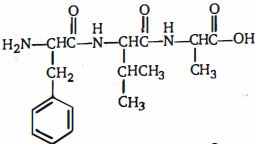
B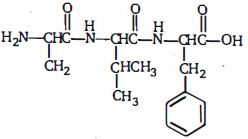
C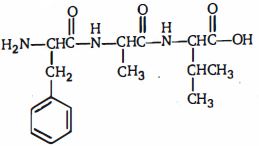
D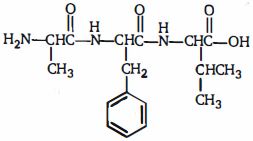
Solution
(A) The abbreviation $Phe-Val-Ala$ represents a tripeptide consisting of Phenylalanine $(Phe)$,Valine $(Val)$,and Alanine $(Ala)$ in that specific order.
$1$. $Phe$ (Phenylalanine) has the side chain $-CH_2C_6H_5$.
$2$. $Val$ (Valine) has the side chain $-CH(CH_3)_2$.
$3$. $Ala$ (Alanine) has the side chain $-CH_3$.
In the structure of a peptide,the amino acids are linked by peptide bonds $(-CONH-)$. The structure starts with the $N$-terminal amino acid $(Phe)$ and ends with the $C$-terminal amino acid $(Ala)$.
Looking at the options:
- Option $A$ shows the sequence $Phe-Val-Ala$ correctly: the first amino acid has a benzyl side chain $(Phe)$,the second has an isopropyl side chain $(Val)$,and the third has a methyl side chain $(Ala)$.
Therefore,the correct structure is represented by option $A$.
$1$. $Phe$ (Phenylalanine) has the side chain $-CH_2C_6H_5$.
$2$. $Val$ (Valine) has the side chain $-CH(CH_3)_2$.
$3$. $Ala$ (Alanine) has the side chain $-CH_3$.
In the structure of a peptide,the amino acids are linked by peptide bonds $(-CONH-)$. The structure starts with the $N$-terminal amino acid $(Phe)$ and ends with the $C$-terminal amino acid $(Ala)$.
Looking at the options:
- Option $A$ shows the sequence $Phe-Val-Ala$ correctly: the first amino acid has a benzyl side chain $(Phe)$,the second has an isopropyl side chain $(Val)$,and the third has a methyl side chain $(Ala)$.
Therefore,the correct structure is represented by option $A$.
0 likes
View Solution215
DifficultMCQ
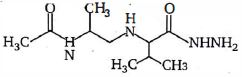
The number of peptide bonds in the compound is:
A
$1$
B
$2$
C
$3$
D
$4$
Solution
(B) peptide bond is a chemical bond formed between two molecules when a carboxylic group $(-COOH)$ of one molecule reacts with an amino group $(-NH_2)$ of the other,releasing a water molecule $(H_2O)$.
The $-CO-NH-$ linkage is known as a peptide bond.
In the given structure,there are $2$ such $-CO-NH-$ linkages,which are marked with red lines in the provided image. Therefore,the total number of peptide bonds is $2$.
The $-CO-NH-$ linkage is known as a peptide bond.
In the given structure,there are $2$ such $-CO-NH-$ linkages,which are marked with red lines in the provided image. Therefore,the total number of peptide bonds is $2$.
0 likes
View Solution216
DifficultMCQ
Serine $(HOCH_2CH(NH_2)COOH)$ is an amino acid. The correct Fischer projection of $L$-serine is:
A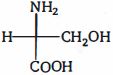
B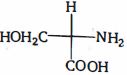
C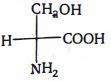
D
Solution
(A) The structure of serine is $HOCH_2-CH(NH_2)-COOH$.
In a Fischer projection for an $L$-amino acid,the $-COOH$ group is placed at the top,the $-R$ group (side chain) at the bottom,and the $-NH_2$ group is on the left side.
For serine,the side chain $-R$ is $-CH_2OH$.
Thus,placing $-COOH$ at the top,$-CH_2OH$ at the bottom,$-NH_2$ on the left,and $-H$ on the right gives the correct $L$-serine configuration.
This corresponds to the structure shown in option $A$.
In a Fischer projection for an $L$-amino acid,the $-COOH$ group is placed at the top,the $-R$ group (side chain) at the bottom,and the $-NH_2$ group is on the left side.
For serine,the side chain $-R$ is $-CH_2OH$.
Thus,placing $-COOH$ at the top,$-CH_2OH$ at the bottom,$-NH_2$ on the left,and $-H$ on the right gives the correct $L$-serine configuration.
This corresponds to the structure shown in option $A$.
0 likes
View Solution217
DifficultMCQ
Which of the following will not exist in zwitter ionic form at $pH = 7$?
A
$2-$aminocyclohexanecarboxylic acid
B
$N$-acetylalanine
C
$2-$aminobenzenesulfonic acid
D
$2-$aminocyclohexanesulfonic acid
Solution
(B) zwitterion is a molecule that has both a positive and a negative charge,allowing it to exist as a dipolar ion. This requires the presence of both an acidic group (like $-COOH$ or $-SO_3H$) and a basic group (like $-NH_2$) in the same molecule.
In $N$-acetylalanine,the amino group $(-NH_2)$ is converted into an amide group $(-NH-CO-CH_3)$. The nitrogen atom in an amide is not basic because its lone pair of electrons is involved in resonance with the carbonyl group $(C=O)$.
Therefore,$N$-acetylalanine cannot accept a proton to form a positive charge,and thus it cannot exist in a zwitterionic form at $pH = 7$.
In $N$-acetylalanine,the amino group $(-NH_2)$ is converted into an amide group $(-NH-CO-CH_3)$. The nitrogen atom in an amide is not basic because its lone pair of electrons is involved in resonance with the carbonyl group $(C=O)$.
Therefore,$N$-acetylalanine cannot accept a proton to form a positive charge,and thus it cannot exist in a zwitterionic form at $pH = 7$.
0 likes
View Solution218
MediumMCQ
The dipeptide,$Gln-Gly$,on treatment with $CH_3COCl$ followed by aqueous work-up gives:
A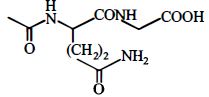
B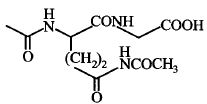
C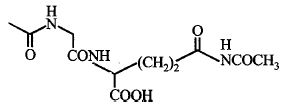
D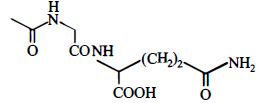
Solution
(D) The dipeptide $Gln-Gly$ consists of Glutamine $(Gln)$ at the $N$-terminus and Glycine $(Gly)$ at the $C$-terminus. The structure of $Gln-Gly$ is $H_2N-CH(CH_2CH_2CONH_2)-CONH-CH_2-COOH$.
When treated with $CH_3COCl$ (acetyl chloride),the primary amino group $(-NH_2)$ at the $N$-terminus is acetylated to form an acetamide group $(-NHCOCH_3)$.
The amide group $(-CONH_2)$ present in the side chain of Glutamine is significantly less nucleophilic due to resonance stabilization and is generally not acetylated under these conditions.
Therefore,the product is $CH_3CONH-CH(CH_2CH_2CONH_2)-CONH-CH_2-COOH$,which corresponds to the structure shown in option $D$.
When treated with $CH_3COCl$ (acetyl chloride),the primary amino group $(-NH_2)$ at the $N$-terminus is acetylated to form an acetamide group $(-NHCOCH_3)$.
The amide group $(-CONH_2)$ present in the side chain of Glutamine is significantly less nucleophilic due to resonance stabilization and is generally not acetylated under these conditions.
Therefore,the product is $CH_3CONH-CH(CH_2CH_2CONH_2)-CONH-CH_2-COOH$,which corresponds to the structure shown in option $D$.
0 likes
View Solution219
EasyMCQ
Among the following,the essential amino acid is
A
Alanine
B
Valine
C
Aspartic acid
D
Serine
Solution
(B) Essential amino acids are those that cannot be synthesized by the human body and must be obtained through the diet. $Valine$ is an essential amino acid. Other examples include $Histidine$,$Isoleucine$,$Leucine$,$Lysine$,$Methionine$,$Phenylalanine$,$Threonine$,and $Tryptophan$.
0 likes
View Solution220
MediumMCQ
Consider the following sequence for aspartic acid:
$H_3N^+-CH(COOH)-CH_2COOH \leftrightarrow{pK_1=1.88} H_3N^+-CH(COO^-)-CH_2COOH \leftrightarrow{pK_R=3.65} H_3N^+-CH(COO^-)-CH_2COO^- \leftrightarrow{pK_2=9.60} H_2N-CH(COO^-)-CH_2COO^-$
The $pI$ (isoelectric point) of aspartic acid is:
$H_3N^+-CH(COOH)-CH_2COOH \leftrightarrow{pK_1=1.88} H_3N^+-CH(COO^-)-CH_2COOH \leftrightarrow{pK_R=3.65} H_3N^+-CH(COO^-)-CH_2COO^- \leftrightarrow{pK_2=9.60} H_2N-CH(COO^-)-CH_2COO^-$
The $pI$ (isoelectric point) of aspartic acid is:
A
$3.65$
B
$2.77$
C
$5.74$
D
$1.88$
Solution
(B) For an acidic amino acid like aspartic acid,the isoelectric point $(pI)$ is calculated as the average of the two $pK_a$ values that flank the zwitterionic form.
The zwitterionic form of aspartic acid exists between the first deprotonation of the $\alpha$-carboxyl group $(pK_1 = 1.88)$ and the deprotonation of the side-chain carboxyl group $(pK_R = 3.65)$.
$pI = \frac{pK_1 + pK_R}{2}$
$pI = \frac{1.88 + 3.65}{2} = \frac{5.53}{2} = 2.765 \approx 2.77$
The zwitterionic form of aspartic acid exists between the first deprotonation of the $\alpha$-carboxyl group $(pK_1 = 1.88)$ and the deprotonation of the side-chain carboxyl group $(pK_R = 3.65)$.
$pI = \frac{pK_1 + pK_R}{2}$
$pI = \frac{1.88 + 3.65}{2} = \frac{5.53}{2} = 2.765 \approx 2.77$
0 likes
View Solution221
DifficultMCQ
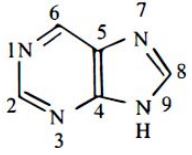
The $N$ atom which does not contribute to the basicity of the given compound is:
A
$N-9$
B
$N-3$
C
$N-1$
D
$N-7$
Solution
(A) The given compound is purine.
In purine,the lone pair of electrons on the $N-9$ atom is involved in the aromatic sextet of the imidazole ring.
Therefore,this lone pair is not available for protonation,and $N-9$ does not contribute to the basicity of the compound.
Other nitrogen atoms $(N-1, N-3, N-7)$ have lone pairs in $sp^2$ hybridized orbitals that are not involved in aromaticity,making them available for protonation.
In purine,the lone pair of electrons on the $N-9$ atom is involved in the aromatic sextet of the imidazole ring.
Therefore,this lone pair is not available for protonation,and $N-9$ does not contribute to the basicity of the compound.
Other nitrogen atoms $(N-1, N-3, N-7)$ have lone pairs in $sp^2$ hybridized orbitals that are not involved in aromaticity,making them available for protonation.
0 likes
View Solution222
MediumMCQ
Observation of "Ruhemann's purple" is a confirmatory test for the presence of
A
Starch
B
Reducing sugar
C
Protein
D
Cupric ion
Solution
(C) Ninhydrin is often used to detect $\alpha$-amino acids and also free amino and carboxylic acid groups on proteins and peptides.
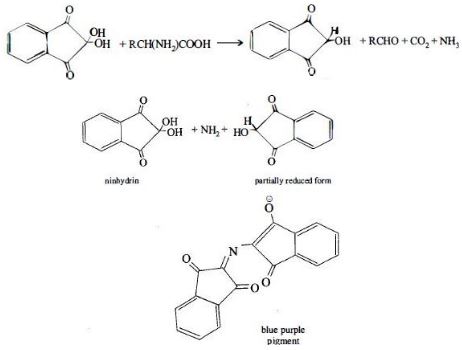
When about $0.5 \ mL$ of a $0.1\%$ solution of ninhydrin is boiled for one or two minutes with a few $mL$ of dilute amino acid or protein solution,a blue color develops.
Ninhydrin degrades amino acids into aldehydes,ammonia,and $CO_2$ through a series of reactions; the net result is ninhydrin in a partially reduced form,hydrindantin.
Ninhydrin then condenses with ammonia and hydrindantin to produce an intensely blue or purple pigment,sometimes called Ruhemann's purple.
When about $0.5 \ mL$ of a $0.1\%$ solution of ninhydrin is boiled for one or two minutes with a few $mL$ of dilute amino acid or protein solution,a blue color develops.
Ninhydrin degrades amino acids into aldehydes,ammonia,and $CO_2$ through a series of reactions; the net result is ninhydrin in a partially reduced form,hydrindantin.
Ninhydrin then condenses with ammonia and hydrindantin to produce an intensely blue or purple pigment,sometimes called Ruhemann's purple.
0 likes
View Solution223
DifficultMCQ
All of the following statements apply to proteins except
A
Proteins generally have no definite melting point
B
Proteins contain the grouping $-CONH-$
C
Proteins have high molecular weight
D
Proteins can only contain the elements $C, H, O$ and $N$.
Solution
(D) Statement $(D)$ is incorrect.
Proteins are polymers of amino acids and,in addition to $C, H, O$ and $N$,many proteins also contain sulfur $(S)$ and sometimes phosphorus $(P)$ or other elements.
Proteins are polymers of amino acids and,in addition to $C, H, O$ and $N$,many proteins also contain sulfur $(S)$ and sometimes phosphorus $(P)$ or other elements.
0 likes
View Solution224
DifficultMCQ
The increasing order of $pKa$ of the following amino acids in aqueous solution is $Gly, Asp, Lys, Arg$.
A
$Asp < Gly < Arg < Lys$
B
$Gly < Asp < Arg < Lys$
C
$Asp < Gly < Lys < Arg$
D
$Arg < Lys < Gly < Asp$
Solution
(C) The $pI$ (isoelectric point) values for the given amino acids are as follows:
$Asp$ $(pI = 3.0)$,
$Gly$ $(pI = 6.0)$,
$Lys$ $(pI = 9.8)$,
$Arg$ $(pI = 10.8)$.
The $pKa$ values of the side chains or the overall acidity of amino acids correlate with their $pI$ values.
Acidic amino acids like $Asp$ have lower $pI$ values,while basic amino acids like $Lys$ and $Arg$ have higher $pI$ values.
Therefore,the increasing order of $pKa$ values is $Asp < Gly < Lys < Arg$.
$Asp$ $(pI = 3.0)$,
$Gly$ $(pI = 6.0)$,
$Lys$ $(pI = 9.8)$,
$Arg$ $(pI = 10.8)$.
The $pKa$ values of the side chains or the overall acidity of amino acids correlate with their $pI$ values.
Acidic amino acids like $Asp$ have lower $pI$ values,while basic amino acids like $Lys$ and $Arg$ have higher $pI$ values.
Therefore,the increasing order of $pKa$ values is $Asp < Gly < Lys < Arg$.
0 likes
View Solution225
AdvancedMCQ
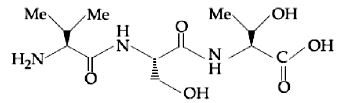
The correct sequence of amino acids present in the tripeptide given below is
A
$Val-Ser-Thr$
B
$Thr-Ser-Val$
C
$Leu-Ser-Thr$
D
$Thr-Ser-Leu$
Solution
(A) The given tripeptide is hydrolyzed to obtain three amino acids: $Valine$ $(Val)$,$Serine$ $(Ser)$,and $Threonine$ $(Thr)$.
By observing the structure from the $N$-terminal (left side) to the $C$-terminal (right side),the sequence of amino acids is $Val-Ser-Thr$.
By observing the structure from the $N$-terminal (left side) to the $C$-terminal (right side),the sequence of amino acids is $Val-Ser-Thr$.
0 likes
View Solution226
DifficultMCQ
The correct structure of product $P$ in the following reaction is
$Asn-Ser + (excess) (CH_3CO)_2O \xrightarrow{NEt_3} P$
$Asn-Ser + (excess) (CH_3CO)_2O \xrightarrow{NEt_3} P$
A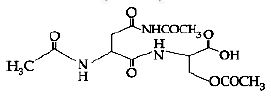
B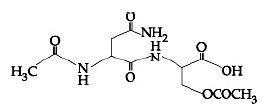
C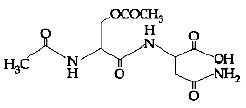
D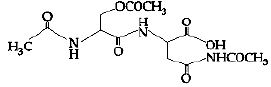
Solution
(D) The reaction involves the treatment of the dipeptide $Asn-Ser$ with excess acetic anhydride $((CH_3CO)_2O)$ in the presence of a base $(NEt_3)$.
Acetic anhydride is an acetylating agent that reacts with nucleophilic functional groups.
In the dipeptide $Asn-Ser$:
$1$. The $N$-terminal amino group $(-NH_2)$ of $Asn$ is nucleophilic and will be acetylated to form an amide $(-NHCOCH_3)$.
$2$. The side-chain amide group $(-CONH_2)$ of $Asn$ is also nucleophilic and will be acetylated to form an imide $(-CONHCOCH_3)$.
$3$. The side-chain hydroxyl group $(-OH)$ of $Ser$ is nucleophilic and will be acetylated to form an ester $(-OCOCH_3)$.
Therefore,all three nucleophilic sites are acetylated,resulting in the structure shown in option $D$.
Acetic anhydride is an acetylating agent that reacts with nucleophilic functional groups.
In the dipeptide $Asn-Ser$:
$1$. The $N$-terminal amino group $(-NH_2)$ of $Asn$ is nucleophilic and will be acetylated to form an amide $(-NHCOCH_3)$.
$2$. The side-chain amide group $(-CONH_2)$ of $Asn$ is also nucleophilic and will be acetylated to form an imide $(-CONHCOCH_3)$.
$3$. The side-chain hydroxyl group $(-OH)$ of $Ser$ is nucleophilic and will be acetylated to form an ester $(-OCOCH_3)$.
Therefore,all three nucleophilic sites are acetylated,resulting in the structure shown in option $D$.
0 likes
View Solution227
MediumMCQ
Which of the following tests cannot be used for identifying amino acids?
A
Biuret test
B
Barfoed test
C
Ninhydrin test
D
Xanthoproteic test
Solution
(B) The $Biuret$ test,$Ninhydrin$ test,and $Xanthoproteic$ test are standard chemical tests used to identify amino acids or proteins.
$Barfoed$ test is specifically used to detect the presence of monosaccharides,not amino acids.
$Barfoed$ test is specifically used to detect the presence of monosaccharides,not amino acids.
0 likes
View Solution228
DifficultMCQ
In the following compound,the favourable site/s for protonation is/are:
(Image description: Adenine structure with labels $a$ on the exocyclic $-NH_2$ group,$b$ on the pyrimidine ring nitrogen,$c$ on the other pyrimidine ring nitrogen,$d$ on the imidazole ring nitrogen,and $e$ on the imidazole ring $-NH-$ group.)
(Image description: Adenine structure with labels $a$ on the exocyclic $-NH_2$ group,$b$ on the pyrimidine ring nitrogen,$c$ on the other pyrimidine ring nitrogen,$d$ on the imidazole ring nitrogen,and $e$ on the imidazole ring $-NH-$ group.)
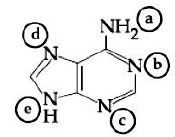
A
$a$ and $e$
B
$b, c$ and $d$
C
$a$ and $d$
D
$a$
Solution
(B) Protonation occurs at the site where the lone pair of electrons is most available for donation to a proton $(H^+)$.
In adenine,the nitrogen atoms at positions $b, c,$ and $d$ have lone pairs that are not involved in the aromatic sextet of the rings.
Specifically,the nitrogen at position $d$ is the most basic site because its lone pair is in an $sp^2$ orbital and is not involved in the aromatic system,making it highly available for protonation.
Protonation at $b, c,$ or $d$ results in a conjugate acid that is stabilized by resonance.
The exocyclic $-NH_2$ group $(a)$ has its lone pair involved in resonance with the ring,and the $-NH-$ group $(e)$ has its lone pair involved in the aromaticity of the imidazole ring,making them less basic.
Thus,the favourable sites for protonation are $b, c,$ and $d$.
In adenine,the nitrogen atoms at positions $b, c,$ and $d$ have lone pairs that are not involved in the aromatic sextet of the rings.
Specifically,the nitrogen at position $d$ is the most basic site because its lone pair is in an $sp^2$ orbital and is not involved in the aromatic system,making it highly available for protonation.
Protonation at $b, c,$ or $d$ results in a conjugate acid that is stabilized by resonance.
The exocyclic $-NH_2$ group $(a)$ has its lone pair involved in resonance with the ring,and the $-NH-$ group $(e)$ has its lone pair involved in the aromaticity of the imidazole ring,making them less basic.
Thus,the favourable sites for protonation are $b, c,$ and $d$.
0 likes
View Solution229
DifficultMCQ
The correct match between Item $I$ and Item $II$ is
| Item $I$ | Item $II$ |
|---|---|
| $A$. Ester test | $P$. Tyr |
| $B$. Carbylamine test | $Q$. Asp |
| $C$. Phthalein dye test | $R$. Ser |
| $S$. Lys |
A
$A-Q, B-S, C-P$
B
$A-R, B-Q, C-P$
C
$A-R, B-S, C-Q$
D
$A-Q, B-S, C-R$
Solution
(C) The identification of amino acids based on functional group tests is as follows:
$1$. Ester test: Serine $(Ser)$ contains a hydroxyl $(-OH)$ group,which can undergo esterification. Thus,$A-R$.
$2$. Carbylamine test: Lysine $(Lys)$ contains a primary amine $(-NH_2)$ group,which gives a positive carbylamine test. Thus,$B-S$.
$3$. Phthalein dye test: Tyrosine $(Tyr)$ contains a phenolic group,which reacts with phthalic anhydride to form a phthalein dye. Thus,$C-P$.
Therefore,the correct matching is $A-R, B-S, C-P$.
$1$. Ester test: Serine $(Ser)$ contains a hydroxyl $(-OH)$ group,which can undergo esterification. Thus,$A-R$.
$2$. Carbylamine test: Lysine $(Lys)$ contains a primary amine $(-NH_2)$ group,which gives a positive carbylamine test. Thus,$B-S$.
$3$. Phthalein dye test: Tyrosine $(Tyr)$ contains a phenolic group,which reacts with phthalic anhydride to form a phthalein dye. Thus,$C-P$.
Therefore,the correct matching is $A-R, B-S, C-P$.
0 likes
View Solution230
DifficultMCQ
Among the following compounds,the most basic amino acid is:
A
Asparagine
B
Lysine
C
Serine
D
Histidine
Solution
(B) The basicity of an amino acid is determined by the number of amino groups relative to the number of carboxylic acid groups in its side chain.
Lysine contains two amino groups and one carboxylic acid group,making it a basic amino acid.
Histidine is also basic,but Lysine is more basic due to the presence of an aliphatic amino group in its side chain.
Comparing their $pI$ values:
$A$ higher $pI$ value indicates a more basic character. Therefore,Lysine is the most basic among the given options.
Lysine contains two amino groups and one carboxylic acid group,making it a basic amino acid.
Histidine is also basic,but Lysine is more basic due to the presence of an aliphatic amino group in its side chain.
Comparing their $pI$ values:
| Compound | $pI$ value |
|---|---|
| $A$. Histidine | $7.6$ |
| $B$. Serine | $5.7$ |
| $C$. Lysine | $9.8$ |
| $D$. Asparagine | $5.4$ |
$A$ higher $pI$ value indicates a more basic character. Therefore,Lysine is the most basic among the given options.
0 likes
View Solution231
DifficultMCQ
The correct structure of histidine in a strongly acidic solution $(pH = 2)$ is
A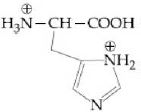
B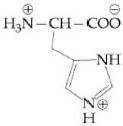
C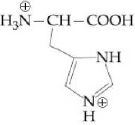
D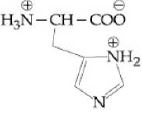
Solution
(A) Histidine is an amino acid with three ionizable groups: the $\alpha$-amino group,the $\alpha$-carboxyl group,and the imidazole side chain.
In a strongly acidic solution $(pH = 2)$,the concentration of $H^{+}$ ions is very high.
At this $pH$,all basic groups will be protonated:
$1$. The carboxyl group exists as $-COOH$ (since $pH < pK_a$ of $-COO^-$).
$2$. The $\alpha$-amino group exists as $-NH_3^+$.
$3$. The imidazole side chain also gets protonated to exist as an imidazolium ion $(-NH^+)$.
Therefore,the structure will have a net charge of $+2$. This corresponds to the structure shown in option $A$.
In a strongly acidic solution $(pH = 2)$,the concentration of $H^{+}$ ions is very high.
At this $pH$,all basic groups will be protonated:
$1$. The carboxyl group exists as $-COOH$ (since $pH < pK_a$ of $-COO^-$).
$2$. The $\alpha$-amino group exists as $-NH_3^+$.
$3$. The imidazole side chain also gets protonated to exist as an imidazolium ion $(-NH^+)$.
Therefore,the structure will have a net charge of $+2$. This corresponds to the structure shown in option $A$.
0 likes
View Solution232
DifficultMCQ
The peptide that gives positive ceric ammonium nitrate and carbylamine tests is
A
$Lys - Asp$
B
$Ser - Lys$
C
$Gln - Asp$
D
$Asp - Gln$
Solution
(B) The ceric ammonium nitrate test is used to detect the presence of an alcoholic $-OH$ group. Among the given amino acids,$Serine$ $(Ser)$ contains an alcoholic $-OH$ group.
The carbylamine test is used to detect the presence of a primary amine $(-NH_2)$ group. Among the given amino acids,$Lysine$ $(Lys)$ contains a primary amine group in its side chain.
Therefore,the peptide $Ser - Lys$ will give a positive result for both tests.
The carbylamine test is used to detect the presence of a primary amine $(-NH_2)$ group. Among the given amino acids,$Lysine$ $(Lys)$ contains a primary amine group in its side chain.
Therefore,the peptide $Ser - Lys$ will give a positive result for both tests.
0 likes
View Solution233
EasyMCQ
Which of the following statements is not correct?
A
At isoelectric point,amino acids exist as zwitter ions.
B
When $pH > pI$,the amino acid moves towards the anode in an electric field.
C
Primary,secondary,and tertiary structures of proteins are denatured by heating.
D
Alanine is the first $\alpha$-amino acid which is optically active.
Solution
(C) $1$. At the isoelectric point $(pI)$,the amino acid exists as a zwitter ion,meaning it has a net charge of zero. This statement is correct.
$2$. When $pH > pI$,the amino acid exists as an anion (negatively charged) and will move towards the anode (positive electrode) in an electric field. This statement is correct.
$3$. Denaturation of proteins involves the loss of secondary and tertiary structures due to physical changes like heating or chemical changes. However,the primary structure (the sequence of amino acids) remains intact. Therefore,the statement that primary structures are denatured by heating is incorrect.
$4$. Glycine is the simplest $\alpha$-amino acid and is optically inactive. Alanine is the next simplest and is the first optically active $\alpha$-amino acid. This statement is correct.
$2$. When $pH > pI$,the amino acid exists as an anion (negatively charged) and will move towards the anode (positive electrode) in an electric field. This statement is correct.
$3$. Denaturation of proteins involves the loss of secondary and tertiary structures due to physical changes like heating or chemical changes. However,the primary structure (the sequence of amino acids) remains intact. Therefore,the statement that primary structures are denatured by heating is incorrect.
$4$. Glycine is the simplest $\alpha$-amino acid and is optically inactive. Alanine is the next simplest and is the first optically active $\alpha$-amino acid. This statement is correct.
0 likes
View Solution234
MediumMCQ
How many amino acids are present in insulin?
A
$51$
B
$41$
C
$31$
D
$101$
Solution
(A) Insulin is a peptide hormone produced by the beta cells of the pancreatic islets.
It consists of two polypeptide chains,chain $A$ and chain $B$,which are linked together by disulfide bonds.
Chain $A$ contains $21$ amino acids and chain $B$ contains $30$ amino acids.
Therefore,the total number of amino acids in insulin is $21 + 30 = 51$.
It consists of two polypeptide chains,chain $A$ and chain $B$,which are linked together by disulfide bonds.
Chain $A$ contains $21$ amino acids and chain $B$ contains $30$ amino acids.
Therefore,the total number of amino acids in insulin is $21 + 30 = 51$.
0 likes
View Solution235
DifficultMCQ
Determine the configuration of the given compound.
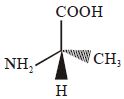
A
$D$
B
$L$
C
$S$
D
both $(B)$ and $(C)$
Solution
(D) $1$. Assign priority to the groups attached to the chiral center using Cahn-Ingold-Prelog $(CIP)$ rules: $-NH_2$ $(1)$,$-COOH$ $(2)$,$-CH_3$ $(3)$,$-H$ $(4)$.
$2$. In the given structure,the lowest priority group $(-H)$ is on a wedge (pointing towards the viewer).
$3$. Looking at the arrangement of the remaining groups ($1$,$2$,$3$),the sequence $1$ $\rightarrow 2$ $\rightarrow 3$ appears clockwise,which corresponds to $R$ configuration. Since the lowest priority group is on a wedge,we reverse the result,making the configuration $S$.
$4$. For $D/L$ nomenclature,we look at the Fischer projection or the orientation of the amino group in amino acids. In the given structure,the $-NH_2$ group is on the left side when the carbon chain is vertical with the most oxidized group at the top,which corresponds to the $L$ configuration.
$5$. Therefore,the compound has both $L$ and $S$ configurations.
$2$. In the given structure,the lowest priority group $(-H)$ is on a wedge (pointing towards the viewer).
$3$. Looking at the arrangement of the remaining groups ($1$,$2$,$3$),the sequence $1$ $\rightarrow 2$ $\rightarrow 3$ appears clockwise,which corresponds to $R$ configuration. Since the lowest priority group is on a wedge,we reverse the result,making the configuration $S$.
$4$. For $D/L$ nomenclature,we look at the Fischer projection or the orientation of the amino group in amino acids. In the given structure,the $-NH_2$ group is on the left side when the carbon chain is vertical with the most oxidized group at the top,which corresponds to the $L$ configuration.
$5$. Therefore,the compound has both $L$ and $S$ configurations.
0 likes
View Solution236
DifficultMCQ
An example of a sulphur-containing amino acid is:
A
$a) \text{ Methionine}$
B
$b) \text{ Isoleucine}$
C
$c) \text{ Valine}$
D
$d) \text{ Cysteine}$
Solution
(A, D) Amino acids are the building blocks of proteins.
Among the given options,$Methionine$ and $Cysteine$ are the two standard amino acids that contain sulphur in their side chains.
$Methionine$ contains a thioether group,while $Cysteine$ contains a thiol $(-SH)$ group.
Therefore,both $a$ and $d$ are correct.
Among the given options,$Methionine$ and $Cysteine$ are the two standard amino acids that contain sulphur in their side chains.
$Methionine$ contains a thioether group,while $Cysteine$ contains a thiol $(-SH)$ group.
Therefore,both $a$ and $d$ are correct.
0 likes
View Solution237
MediumMCQ
The given structure of $\alpha$-amino acid will exist at which $pH$?
$NH_3^+ - CH(R) - COOH$
$NH_3^+ - CH(R) - COOH$
A
$7$
B
$14$
C
$2$
D
$12$
Solution
(C) At low $pH$ (highly acidic medium),the amino acid exists in its cationic form.
In this state,the carboxylate group is protonated $(COO^- \rightarrow COOH)$ while the amino group remains protonated $(NH_3^+)$.
Among the given options,$pH = 2$ represents the acidic condition required for this structure to exist.
In this state,the carboxylate group is protonated $(COO^- \rightarrow COOH)$ while the amino group remains protonated $(NH_3^+)$.
Among the given options,$pH = 2$ represents the acidic condition required for this structure to exist.
0 likes
View Solution238
AdvancedMCQ
Which one of the nitrogen atoms of histidine is protonated first?
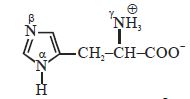
A
$ \alpha $
B
$ \beta $
C
$ \gamma $
D
All of the above
Solution
(B) In the imidazole ring of histidine,there are two nitrogen atoms: the pyrrole-like nitrogen $(\alpha-N)$ and the pyridine-like nitrogen $(\beta-N)$.
The lone pair on the $\alpha-N$ is involved in the aromatic sextet of the imidazole ring.
The lone pair on the $\beta-N$ is in an $sp^2$ orbital perpendicular to the aromatic ring and is available for protonation.
Protonation at the $\beta-N$ leads to the formation of an imidazolium ion,which is stabilized by two equivalent resonance structures,making it the more basic site.
The lone pair on the $\alpha-N$ is involved in the aromatic sextet of the imidazole ring.
The lone pair on the $\beta-N$ is in an $sp^2$ orbital perpendicular to the aromatic ring and is available for protonation.
Protonation at the $\beta-N$ leads to the formation of an imidazolium ion,which is stabilized by two equivalent resonance structures,making it the more basic site.
0 likes
View Solution239
MediumMCQ
What are the hybridisation of the carbon atoms labeled $C_1$ and $C_2$,respectively in glycine?
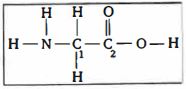
A
$sp^2, sp^2$
B
$sp^2, sp^3$
C
$sp^3, sp^2$
D
$sp^3, sp^3$
Solution
(C) To determine the hybridisation of carbon atoms,we count the number of sigma bonds and lone pairs around each carbon atom.
$C_1$ is bonded to one nitrogen atom,two hydrogen atoms,and one carbon atom $(C_2)$. It forms four sigma bonds and has no lone pairs. Therefore,the steric number is $4$,which corresponds to $sp^3$ hybridisation.
$C_2$ is bonded to one carbon atom $(C_1)$,one oxygen atom (via a double bond),and one oxygen atom (via a single bond). It forms three sigma bonds and has no lone pairs. Therefore,the steric number is $3$,which corresponds to $sp^2$ hybridisation.
Thus,the hybridisation of $C_1$ is $sp^3$ and $C_2$ is $sp^2$.
$C_1$ is bonded to one nitrogen atom,two hydrogen atoms,and one carbon atom $(C_2)$. It forms four sigma bonds and has no lone pairs. Therefore,the steric number is $4$,which corresponds to $sp^3$ hybridisation.
$C_2$ is bonded to one carbon atom $(C_1)$,one oxygen atom (via a double bond),and one oxygen atom (via a single bond). It forms three sigma bonds and has no lone pairs. Therefore,the steric number is $3$,which corresponds to $sp^2$ hybridisation.
Thus,the hybridisation of $C_1$ is $sp^3$ and $C_2$ is $sp^2$.
0 likes
View Solution240
EasyMCQ
Nitrogen is an essential constituent of which of the following?
A
Proteins
B
Fats
C
Proteins and Fats
D
None of these
Solution
(A) Nitrogen is an essential component of amino acids,which are the building blocks of proteins. Therefore,nitrogen is an essential constituent of proteins.
0 likes
View Solution241
EasyMCQ
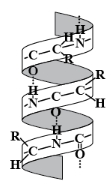
The helical structure of protein is stabilised by
A
Dipeptide bond
B
Hydrogen bond
C
Ether bond
D
Ester bond
Solution
(B) The helical structure of proteins is stabilized by hydrogen bonds.
In the helical structure,the carbonyl oxygen atoms in $C=O$ point in one direction,towards the amide hydrogen atoms in $NH$ groups,$4$ residues away.
Together these groups form a hydrogen bond,which is one of the main forces of secondary structure stabilization in proteins.
Hydrogen bonds are shown by dashed lines in the structure.
In the helical structure,the carbonyl oxygen atoms in $C=O$ point in one direction,towards the amide hydrogen atoms in $NH$ groups,$4$ residues away.
Together these groups form a hydrogen bond,which is one of the main forces of secondary structure stabilization in proteins.
Hydrogen bonds are shown by dashed lines in the structure.
0 likes
View Solution242
EasyMCQ
Which of the following basic amino acids is the least basic?
A
Lysine
B
Arginine
C
Histidine
D
Glycine
Solution
(C) Amino acids are classified as basic if they contain an extra amino group in their side chain.
$Lysine$,$Arginine$,and $Histidine$ are the three basic amino acids.
$Glycine$ is a neutral amino acid.
Among the basic amino acids,$Histidine$ is the least basic because its imidazole ring has a $pK_a$ value of approximately $6.0$,which is close to physiological $pH$,whereas $Lysine$ $(pK_a \approx 10.5)$ and $Arginine$ $(pK_a \approx 12.5)$ are much more basic.
$Lysine$,$Arginine$,and $Histidine$ are the three basic amino acids.
$Glycine$ is a neutral amino acid.
Among the basic amino acids,$Histidine$ is the least basic because its imidazole ring has a $pK_a$ value of approximately $6.0$,which is close to physiological $pH$,whereas $Lysine$ $(pK_a \approx 10.5)$ and $Arginine$ $(pK_a \approx 12.5)$ are much more basic.
0 likes
View Solution243
EasyMCQ
Which one of the following is an essential amino acid?
A
Methionine
B
Tyrosine
C
Proline
D
Glycine
Solution
(A) Essential amino acids are those that cannot be synthesized by the human body and must be obtained through the diet.
Among the given options,$Methionine$ is an essential amino acid.
$Tyrosine$,$Proline$,and $Glycine$ are non-essential amino acids as they can be synthesized by the human body.
Among the given options,$Methionine$ is an essential amino acid.
$Tyrosine$,$Proline$,and $Glycine$ are non-essential amino acids as they can be synthesized by the human body.
0 likes
View Solution244
EasyMCQ
Which bond is responsible for the secondary structure of proteins?
A
Covalent bond
B
Coordinate covalent bond
C
Hydrogen bond
D
Ionic bond
Solution
(C) The secondary structure of proteins refers to the local folding of the polypeptide chain into regular structures such as the $\alpha$-helix and $\beta$-pleated sheets.
These structures are stabilized primarily by $Hydrogen$ bonds formed between the carbonyl oxygen $(C=O)$ and the amide hydrogen $(N-H)$ of the peptide backbone.
These structures are stabilized primarily by $Hydrogen$ bonds formed between the carbonyl oxygen $(C=O)$ and the amide hydrogen $(N-H)$ of the peptide backbone.
0 likes
View Solution245
EasyMCQ
What happens to the biological activity of a protein due to denaturation?
A
Loses primary structure
B
Loses secondary structure
C
Loses primary and secondary structure
D
Loses secondary and tertiary structure
Solution
(D) Denaturation is a process in which the protein loses its higher-order structures (secondary and tertiary) due to physical or chemical changes like temperature or pH variation.
As a result,the protein loses its biological activity because the specific three-dimensional shape required for its function is destroyed.
The primary structure,which is the sequence of amino acids,remains intact during denaturation.
As a result,the protein loses its biological activity because the specific three-dimensional shape required for its function is destroyed.
The primary structure,which is the sequence of amino acids,remains intact during denaturation.
0 likes
View Solution246
EasyMCQ
When proteins are heated with concentrated $HNO_3$,a yellow color is obtained. What is this test called?
A
Oxidizing test
B
Xanthoproteic test
C
Hopkins test
D
Molisch test
Solution
(B) The reaction of proteins with concentrated $HNO_3$ results in the nitration of aromatic amino acid residues (like tyrosine and tryptophan) present in the protein chain,forming yellow-colored nitro compounds. This specific qualitative test for proteins is known as the $Xanthoproteic$ test.
0 likes
View Solution247
MediumMCQ
Which of the following tests is a specific test for proteins?
A
Beilstein test
B
Biuret test
C
Benedict's test
D
Molisch test
Solution
(B) The $Biuret$ test is a chemical test used for detecting the presence of peptide bonds in proteins.
In the presence of peptides,the copper$(II)$ ions in the $Biuret$ reagent form a violet-colored complex in an alkaline solution,which is characteristic of proteins.
In the presence of peptides,the copper$(II)$ ions in the $Biuret$ reagent form a violet-colored complex in an alkaline solution,which is characteristic of proteins.
0 likes
View Solution248
EasyMCQ
Which of the following amino acids is achiral?
A
Alanine
B
Valine
C
Histidine
D
Glycine
0 likes
View Solution249
MediumMCQ
When dilute $H_2SO_4$ is added to an alkaline solution of protein,a violet color is obtained. What is this test called?
A
Biuret test
B
Xanthoproteic test
C
Hopkins-Cole test
D
Millon's test
Solution
(A) The test described is the $Biuret$ test.
In the $Biuret$ test,when a protein solution is treated with an alkaline solution of copper sulfate $(CuSO_4)$,a violet or purple color is produced.
This color is due to the formation of a coordination complex between $Cu^{2+}$ ions and the peptide bonds in the protein.
Therefore,the correct option is $A$.
In the $Biuret$ test,when a protein solution is treated with an alkaline solution of copper sulfate $(CuSO_4)$,a violet or purple color is produced.
This color is due to the formation of a coordination complex between $Cu^{2+}$ ions and the peptide bonds in the protein.
Therefore,the correct option is $A$.
0 likes
View Solution250
DifficultMCQ
For an amino acid,the ionization constant for the carboxyl group is $pK_{a_1} = 2.34$ and for the ammonium ion is $pK_{a_2} = 9.6$. At what $pH$ will the isoelectric point of the amino acid be?
A
$5.97$
B
$2.37$
C
$9.6$
D
$6.97$
Solution
(A) The isoelectric point $(pI)$ of an amino acid is the $pH$ at which the molecule carries no net electric charge.
For a neutral amino acid,the $pI$ is calculated as the average of the $pK_a$ values of the two ionizable groups:
$pI = \frac{pK_{a_1} + pK_{a_2}}{2}$
Given $pK_{a_1} = 2.34$ and $pK_{a_2} = 9.6$:
$pI = \frac{2.34 + 9.6}{2} = \frac{11.94}{2} = 5.97$
Therefore,the isoelectric point is $5.97$.
For a neutral amino acid,the $pI$ is calculated as the average of the $pK_a$ values of the two ionizable groups:
$pI = \frac{pK_{a_1} + pK_{a_2}}{2}$
Given $pK_{a_1} = 2.34$ and $pK_{a_2} = 9.6$:
$pI = \frac{2.34 + 9.6}{2} = \frac{11.94}{2} = 5.97$
Therefore,the isoelectric point is $5.97$.
0 likes
View SolutionBiomolecules — Amino Acids and Proteins · Frequently Asked Questions
1Are these Biomolecules questions useful for JEE and NEET?
Yes. All questions in this section are mapped to JEE Main and NEET exam patterns. Previous year questions from JEE Main, NEET, GUJCET and state-level exams are included with full solutions.
2Can I switch to Hindi or Gujarati for these questions?
Yes. Use the language tabs in the hero section or the sidebar to view the same questions and solutions in English, Hindi or Gujarati.
3How do I generate a question paper from this subtopic?
Use the Vedclass Exam Paper Generator — select the chapter and subtopic, set difficulty, and generate Sets A, B, C, D automatically. First 3 chapters of every subject are free.
Vedclass Products
For Students
Vedclass Test Series
Mock tests in real JEE/NEET style with performance analysis. 5-day free trial.
Start Free TrialFor Teachers
Exam Paper Generator
Generate Set A/B/C/D papers from this chapter in 2 minutes. 3 chapters free.
Try FreeFor Institutes
Online Exam Module
Live online exams with unlimited students, 360° analytics & white-label branding.
See DemoFor Teachers & Institutes
Generate a Biomolecules Exam Paper in 2 Minutes
Select subtopic & difficulty — Sets A, B, C, D auto-generated with No Repeat logic.
First 3 chapters of every subject are free — no payment required.