
A English
Amino Acids and Proteins Questions in English
Class 12 Chemistry · Biomolecules · Amino Acids and Proteins
518+
Questions
English
Language
100%
With Solutions
Showing 48 of 518 questions in English
301
Medium
Write a note on denaturation of proteins.
Solution
(N/A) Protein found in a biological system with a unique three-dimensional structure and biological activity is called a native protein.
When a protein in its native form is subjected to physical changes like a change in temperature or chemical changes like a change in $pH$,the hydrogen bonds are disturbed.
Due to this,the globules unfold and the helix gets uncoiled,causing the protein to lose its biological activity. This process is called denaturation of proteins.
During the denaturation of $2^{\circ}$ and $3^{\circ}$ proteins,the structures are destroyed,but the $1^{\circ}$ structure remains intact.
The coagulation of egg white on boiling is a common example of denaturation.
Another example is the curdling of milk,which is caused by the formation of lactic acid by bacteria present in the milk.
When a protein in its native form is subjected to physical changes like a change in temperature or chemical changes like a change in $pH$,the hydrogen bonds are disturbed.
Due to this,the globules unfold and the helix gets uncoiled,causing the protein to lose its biological activity. This process is called denaturation of proteins.
During the denaturation of $2^{\circ}$ and $3^{\circ}$ proteins,the structures are destroyed,but the $1^{\circ}$ structure remains intact.
The coagulation of egg white on boiling is a common example of denaturation.
Another example is the curdling of milk,which is caused by the formation of lactic acid by bacteria present in the milk.
0 likes
View Solution302
EasyMCQ
Which gas is found in the form of proteins in plants and animals?
A
Oxygen
B
Nitrogen
C
Hydrogen
D
Carbon dioxide
Solution
(B) Proteins are complex organic compounds that are essential for the structure and function of living organisms. The fundamental building blocks of proteins are amino acids,which contain an amino group $(-NH_2)$. Nitrogen is a crucial component of these amino groups,making it an essential element in the composition of proteins found in both plants and animals.
0 likes
View Solution303
EasyMCQ
Which protein is present in milk and eggs?
A
Casein in milk and Albumin in eggs
B
Albumin in milk and Casein in eggs
C
Keratin in milk and Casein in eggs
D
Globulin in milk and Keratin in eggs
Solution
(A) Milk contains the protein $Casein$,which is a phosphoprotein. Eggs contain the protein $Albumin$,which is found in the egg white.
0 likes
View Solution304
Medium
Amino acids can be classified as $\alpha$,$\beta$,$\gamma$,$\delta$ and so on,depending upon the relative positions of the amino group with respect to the carboxyl group. Which type of amino acids form polypeptide chains in proteins?
Solution
(A) Only $\alpha$-amino acids are the building blocks of proteins. In these,the amino group $(-NH_2)$ is attached to the $\alpha$-carbon atom,which is the carbon atom adjacent to the carboxylic acid group $(-COOH)$. These $\alpha$-amino acids undergo polymerization through peptide bond formation to create polypeptide chains in proteins.
0 likes
View Solution305
MediumMCQ
$\alpha$-$helix$ is a secondary structure of proteins formed by twisting of polypeptide chain into right-handed screw-like structures. Which type of interactions are responsible for making the $\alpha$-$helix$ structure stable?
A
Hydrogen bonding
B
Van der Waals forces
C
Ionic bonding
D
Covalent bonding
Solution
(A) The $\alpha$-$helix$ structure of proteins is stabilized by intramolecular hydrogen bonding between the $-NH-$ group of one amino acid residue and the $>C=O$ group of the fourth amino acid residue in the polypeptide chain.
0 likes
View Solution306
Medium
Amino acids behave like salts rather than simple amines or carboxylic acids. Explain.
Solution
In aqueous solution,the carboxylic group $(-COOH)$ loses a proton $(H^+)$ and the amino group $(-NH_2)$ accepts a proton to form a dipolar ion known as a Zwitter ion.
The reaction is:
$R-CH(NH_2)-COOH \rightleftharpoons R-CH(NH_3^+)-COO^-$
Because of this internal salt-like structure,amino acids exhibit high melting points and solubility in water,similar to ionic salts.
The reaction is:
$R-CH(NH_2)-COOH \rightleftharpoons R-CH(NH_3^+)-COO^-$
Because of this internal salt-like structure,amino acids exhibit high melting points and solubility in water,similar to ionic salts.
0 likes
View Solution307
Medium
The structures of glycine and alanine are given below. Show the peptide linkage in glycylalanine.
$H_2N-CH_2-COOH$ (glycine);
$H_2N-CH(CH_3)-COOH$ (alanine)
$H_2N-CH_2-COOH$ (glycine);
$H_2N-CH(CH_3)-COOH$ (alanine)
Solution
(N/A) In glycylalanine,the peptide linkage is formed by the reaction between the carboxyl group $(-COOH)$ of glycine and the amino group $(-NH_2)$ of alanine,with the elimination of a water molecule $(H_2O)$.
The reaction is:
$H_2N-CH_2-COOH + H_2N-CH(CH_3)-COOH \rightarrow H_2N-CH_2-CO-NH-CH(CH_3)-COOH + H_2O$
The group $-CO-NH-$ is the peptide linkage.
The reaction is:
$H_2N-CH_2-COOH + H_2N-CH(CH_3)-COOH \rightarrow H_2N-CH_2-CO-NH-CH(CH_3)-COOH + H_2O$
The group $-CO-NH-$ is the peptide linkage.
0 likes
View Solution308
Medium
Protein found in a biological system with a unique three-dimensional structure and biological activity is called a native protein. When a protein in its native form is subjected to a physical change like a change in temperature or a chemical change like a change in $pH$,denaturation of proteins takes place. Explain the cause.
Solution
(N/A) When a protein in its native form is subjected to physical changes (like change in temperature) or chemical changes (like change in $pH$),the hydrogen bonds are disturbed. Due to this,the globules unfold and the helix gets uncoiled. As a result,the protein loses its biological activity. This process is known as the denaturation of proteins.
0 likes
View Solution309
Medium
Describe the term $D$ and $L$ configuration used for the amino acids with examples.
Solution
(N/A) The $D$ and $L$ configuration of amino acids is based on their structural relationship to the reference compound glyceraldehyde.
In the Fischer projection of an amino acid,if the $-NH_2$ group is on the right side,it is assigned the $D$-configuration.
If the $-NH_2$ group is on the left side,it is assigned the $L$-configuration.
Naturally occurring amino acids found in proteins almost exclusively possess the $L$-configuration.
Except for glycine,all amino acids are optically active due to the presence of a chiral carbon atom.
In the Fischer projection of an amino acid,if the $-NH_2$ group is on the right side,it is assigned the $D$-configuration.
If the $-NH_2$ group is on the left side,it is assigned the $L$-configuration.
Naturally occurring amino acids found in proteins almost exclusively possess the $L$-configuration.
Except for glycine,all amino acids are optically active due to the presence of a chiral carbon atom.
0 likes
View Solution310
Easy
Coagulation of egg white on boiling is an example of denaturation of protein. Explain it in terms of structural changes.
Solution
(N/A) Protein found in a biological system with a unique three-dimensional structure and biological activity is called a native protein.
When a protein in its native form is subjected to physical changes like a change in temperature or chemical changes like a change in $pH$,the hydrogen bonds are disturbed.
Due to this,the globules unfold,the helix gets uncoiled,and the protein loses its biological activity. This is called denaturation of protein.
During the denaturation of $2^{\circ}$ and $3^{\circ}$ proteins,the structures are destroyed,but the $1^{\circ}$ structure remains intact.
The coagulation of egg white on boiling is a common example of denaturation.
Another example is the curdling of milk,which is caused by the formation of lactic acid by bacteria present in the milk.
When a protein in its native form is subjected to physical changes like a change in temperature or chemical changes like a change in $pH$,the hydrogen bonds are disturbed.
Due to this,the globules unfold,the helix gets uncoiled,and the protein loses its biological activity. This is called denaturation of protein.
During the denaturation of $2^{\circ}$ and $3^{\circ}$ proteins,the structures are destroyed,but the $1^{\circ}$ structure remains intact.
The coagulation of egg white on boiling is a common example of denaturation.
Another example is the curdling of milk,which is caused by the formation of lactic acid by bacteria present in the milk.
0 likes
View Solution311
Easy
Explain the terms primary and secondary structure of proteins. What is the difference between $\alpha$-helix and $\beta$-pleated sheet structure of proteins?
Solution
(N/A) $1$. Primary Structure: The primary structure of a protein refers to the specific sequence in which amino acids are arranged in a polypeptide chain. Any change in this sequence results in a different protein.
$2$. Secondary Structure: The secondary structure refers to the regular folding patterns of the polypeptide backbone due to hydrogen bonding between the carbonyl oxygen $(C=O)$ and the amide hydrogen $(N-H)$ of the peptide bond.
$3$. Difference between $\alpha$-helix and $\beta$-pleated sheet:
- $\alpha$-helix: It is formed when the polypeptide chain coils into a right-handed spiral (helix) stabilized by intramolecular hydrogen bonds between the $C=O$ group of one amino acid and the $N-H$ group of the fourth amino acid residue.
- $\beta$-pleated sheet: It is formed when polypeptide chains are stretched out to nearly maximum extension and then laid side by side,held together by intermolecular hydrogen bonds,forming a sheet-like structure.
$2$. Secondary Structure: The secondary structure refers to the regular folding patterns of the polypeptide backbone due to hydrogen bonding between the carbonyl oxygen $(C=O)$ and the amide hydrogen $(N-H)$ of the peptide bond.
$3$. Difference between $\alpha$-helix and $\beta$-pleated sheet:
- $\alpha$-helix: It is formed when the polypeptide chain coils into a right-handed spiral (helix) stabilized by intramolecular hydrogen bonds between the $C=O$ group of one amino acid and the $N-H$ group of the fourth amino acid residue.
- $\beta$-pleated sheet: It is formed when polypeptide chains are stretched out to nearly maximum extension and then laid side by side,held together by intermolecular hydrogen bonds,forming a sheet-like structure.
0 likes
View Solution312
EasyMCQ
Can an enzyme be called a polymer?
A
Yes
B
No
C
Sometimes
D
Cannot be determined
Solution
(A) Yes,enzymes can be called polymers.
Enzymes are biological catalysts composed of proteins.
Proteins are polymers formed by the polymerization of $20$ different types of amino acids linked by peptide bonds.
Enzymes are biological catalysts composed of proteins.
Proteins are polymers formed by the polymerization of $20$ different types of amino acids linked by peptide bonds.
0 likes
View Solution313
Medium
Which type of biomolecules have some structural similarity with synthetic polyamides? What is this similarity?
Solution
(N/A) Proteins are the biomolecules that show structural similarity with synthetic polyamides.
Synthetic polyamides contain repeating amide linkages $(-CONH-)$ in their backbone.
Similarly,proteins are polypeptides formed by the condensation of amino acids,which also contain repeating amide linkages known as peptide bonds $(-CONH-)$ in their structure.
Synthetic polyamides contain repeating amide linkages $(-CONH-)$ in their backbone.
Similarly,proteins are polypeptides formed by the condensation of amino acids,which also contain repeating amide linkages known as peptide bonds $(-CONH-)$ in their structure.
0 likes
View Solution314
Medium
Name two $\alpha$-amino acids which form a dipeptide which is $100$ times more sweet than cane sugar?
Solution
(N/A) The artificial sweetener that is approximately $100$ times sweeter than cane sugar is Aspartame.
Aspartame is a methyl ester of a dipeptide formed from two $\alpha$-amino acids: Aspartic acid and Phenylalanine.
Due to its instability at cooking temperatures,the use of Aspartame is limited to cold foods and soft drinks.
Aspartame is a methyl ester of a dipeptide formed from two $\alpha$-amino acids: Aspartic acid and Phenylalanine.
Due to its instability at cooking temperatures,the use of Aspartame is limited to cold foods and soft drinks.
0 likes
View Solution315
Easy
What do you mean by the sodium-potassium pump?
Solution
(N/A) The sodium-potassium pump is a biological mechanism that maintains a significant concentration gradient of $Na^+$ and $K^+$ ions across the cell membrane. It actively transports $3$ $Na^+$ ions out of the cell and $2$ $K^+$ ions into the cell against their respective concentration gradients,utilizing energy from the hydrolysis of $ATP$.
0 likes
View Solution316
MediumMCQ
The number of $>C=O$ groups present in a tripeptide $Asp-Glu-Lys$ is.......
A
$5$
B
$10$
C
$8$
D
$2$
Solution
(A) tripeptide $Asp-Glu-Lys$ is formed by three amino acids: Aspartic acid $(Asp)$,Glutamic acid $(Glu)$,and Lysine $(Lys)$.
$1$. Each peptide bond contains one $>C=O$ group. In a tripeptide,there are $2$ peptide bonds,contributing $2$ $>C=O$ groups.
$2$. Aspartic acid $(Asp)$ has one side chain carboxyl group $(-COOH)$,which contains one $>C=O$ group.
$3$. Glutamic acid $(Glu)$ has one side chain carboxyl group $(-COOH)$,which contains one $>C=O$ group.
$4$. The terminal carboxyl group $(-COOH)$ of the tripeptide also contains one $>C=O$ group.
Total number of $>C=O$ groups = $2$ (peptide bonds) + $1$ (Asp side chain) + $1$ (Glu side chain) + $1$ (terminal carboxyl) = $5$.
$1$. Each peptide bond contains one $>C=O$ group. In a tripeptide,there are $2$ peptide bonds,contributing $2$ $>C=O$ groups.
$2$. Aspartic acid $(Asp)$ has one side chain carboxyl group $(-COOH)$,which contains one $>C=O$ group.
$3$. Glutamic acid $(Glu)$ has one side chain carboxyl group $(-COOH)$,which contains one $>C=O$ group.
$4$. The terminal carboxyl group $(-COOH)$ of the tripeptide also contains one $>C=O$ group.
Total number of $>C=O$ groups = $2$ (peptide bonds) + $1$ (Asp side chain) + $1$ (Glu side chain) + $1$ (terminal carboxyl) = $5$.
0 likes
View Solution317
MediumMCQ
The number of chiral centres present in threonine is..........
A
$1$
B
$2$
C
$3$
D
$4$
Solution
(B) The chemical structure of threonine is $CH_3-CH(OH)-CH(NH_2)-COOH$.
In this molecule,there are two chiral carbon atoms:
$1$. The carbon atom attached to the $-OH$ group $(C_3)$.
$2$. The carbon atom attached to the $-NH_2$ group $(C_2)$.
Therefore,threonine has $2$ chiral centres.
In this molecule,there are two chiral carbon atoms:
$1$. The carbon atom attached to the $-OH$ group $(C_3)$.
$2$. The carbon atom attached to the $-NH_2$ group $(C_2)$.
Therefore,threonine has $2$ chiral centres.
0 likes
View Solution318
MediumMCQ
Which of the following is not an essential amino acid?
A
Valine
B
Leucine
C
Lysine
D
Tyrosine
Solution
(D) Essential amino acids are those that cannot be synthesized by the human body and must be obtained through the diet.
Valine,Leucine,and Lysine are essential amino acids.
Tyrosine is a non-essential amino acid because it can be synthesized in the body from phenylalanine.
Valine,Leucine,and Lysine are essential amino acids.
Tyrosine is a non-essential amino acid because it can be synthesized in the body from phenylalanine.
0 likes
View Solution319
MediumMCQ
The number of chiral carbon(s) present in the peptide, $Ile-Arg-Pro$, is......
A
$8$
B
$12$
C
$17$
D
$4$
Solution
(D) chiral carbon is a carbon atom bonded to four different groups.
In the peptide $Ile-Arg-Pro$ (Isoleucine-Arginine-Proline):
$1$. $Ile$ (Isoleucine) has $2$ chiral carbons.
$2$. $Arg$ (Arginine) has $1$ chiral carbon.
$3$. $Pro$ (Proline) has $1$ chiral carbon.
Total number of chiral carbons = $2 + 1 + 1 = 4$.
As shown in the structure, there are $4$ carbons marked with an asterisk $(*)$ which are chiral.
In the peptide $Ile-Arg-Pro$ (Isoleucine-Arginine-Proline):
$1$. $Ile$ (Isoleucine) has $2$ chiral carbons.
$2$. $Arg$ (Arginine) has $1$ chiral carbon.
$3$. $Pro$ (Proline) has $1$ chiral carbon.
Total number of chiral carbons = $2 + 1 + 1 = 4$.
As shown in the structure, there are $4$ carbons marked with an asterisk $(*)$ which are chiral.
0 likes
View Solution320
MediumMCQ
Which of the following is a basic amino acid?
A
Lysine
B
Serine
C
Alanine
D
Tyrosine
Solution
(A) An amino acid is classified as basic if it contains more number of $-NH_2$ groups than $-COOH$ groups.
Lysine has the structure $H_2N-(CH_2)_4-CH(NH_2)-COOH$.
It contains two $-NH_2$ groups and one $-COOH$ group.
Therefore,it is a basic amino acid.
Lysine has the structure $H_2N-(CH_2)_4-CH(NH_2)-COOH$.
It contains two $-NH_2$ groups and one $-COOH$ group.
Therefore,it is a basic amino acid.
0 likes
View Solution321
MediumMCQ
| Column-$I$ | Column-$II$ |
| $A$. Tyrosine | $P$. Essential amino acid |
| $B$. Serine | $Q$. Ceric Ammonium Nitrate |
| $C$. Tryptophan | $R$. Neutral $FeCl_{3}$ |
| $D$. Proline | $S$. Carbylamine Test - Negative |
A
$A-S, B-Q, C-P, D-R$
B
$A-Q, B-R, C-S, D-P$
C
$A-R, B-P, C-Q, D-S$
D
$A-R, B-Q, C-P, D-S$
Solution
(D) Tyrosine contains a phenolic group,which gives a violet color with neutral $FeCl_{3}$ solution. Thus,$A-R$.
Serine contains a primary alcoholic group $(-OH)$,which reacts with Ceric Ammonium Nitrate to give a red color. Thus,$B-Q$.
Tryptophan is an essential amino acid that must be obtained from the diet. Thus,$C-P$.
Proline is a secondary amine ($2^{\circ}$ amine). The Carbylamine test is specific for primary amines ($1^{\circ}$ amines) and gives a negative result for secondary amines. Thus,$D-S$.
Therefore,the correct matching is $A-R, B-Q, C-P, D-S$.
Serine contains a primary alcoholic group $(-OH)$,which reacts with Ceric Ammonium Nitrate to give a red color. Thus,$B-Q$.
Tryptophan is an essential amino acid that must be obtained from the diet. Thus,$C-P$.
Proline is a secondary amine ($2^{\circ}$ amine). The Carbylamine test is specific for primary amines ($1^{\circ}$ amines) and gives a negative result for secondary amines. Thus,$D-S$.
Therefore,the correct matching is $A-R, B-Q, C-P, D-S$.
0 likes
View Solution322
MediumMCQ
Assume that a particular amino acid has an isoelectric point of $6.0$. In a solution of $pH$ $1.0$,which of the following species will predominate?
A
$H_3N^{+}-CH(R)-COOH$
B
$H_3N-CH(R)-COOH$
C
$H_3N^{+}-CH(R)-COO^{-}$
D
$H_2N-CH(R)-COO^{-}$
Solution
(A) The isoelectric point $(pI)$ is the $pH$ at which the amino acid exists as a zwitterion,i.e.,$H_3N^{+}-CH(R)-COO^{-}$.
At $pH$ values lower than the $pI$,the concentration of $H^{+}$ ions is high.
This leads to the protonation of the carboxylate group $(COO^{-})$,converting it into a carboxylic acid group $(COOH)$.
Since the given $pH$ $(1.0)$ is significantly lower than the $pI$ $(6.0)$,the amino acid will exist predominantly in its cationic form,$H_3N^{+}-CH(R)-COOH$.
At $pH$ values lower than the $pI$,the concentration of $H^{+}$ ions is high.
This leads to the protonation of the carboxylate group $(COO^{-})$,converting it into a carboxylic acid group $(COOH)$.
Since the given $pH$ $(1.0)$ is significantly lower than the $pI$ $(6.0)$,the amino acid will exist predominantly in its cationic form,$H_3N^{+}-CH(R)-COOH$.
0 likes
View Solution323
MediumMCQ
Accumulation of which of the following molecules in the muscles occurs as a result of vigorous exercise?
A
Glycogen
B
Glucose
C
Pyruvic acid
D
$L^{-}$-Lactic acid
Solution
(D) During vigorous exercise,the demand for energy in muscles exceeds the supply of oxygen.
Under these anaerobic conditions,the body converts pyruvic acid into lactic acid to regenerate $NAD^{+}$ and continue glycolysis for $ATP$ production.
This accumulation of $L^{-}$-Lactic acid in the muscle tissues leads to muscle fatigue and soreness.
The process is represented as: $\text{Glucose}$ $\rightarrow \text{Pyruvic acid}$ $\rightarrow \text{Lactic acid}$.
Under these anaerobic conditions,the body converts pyruvic acid into lactic acid to regenerate $NAD^{+}$ and continue glycolysis for $ATP$ production.
This accumulation of $L^{-}$-Lactic acid in the muscle tissues leads to muscle fatigue and soreness.
The process is represented as: $\text{Glucose}$ $\rightarrow \text{Pyruvic acid}$ $\rightarrow \text{Lactic acid}$.
0 likes
View Solution324
MediumMCQ
In the primary structure of proteins,the amino acids are interconnected by-
A
Hydrogen bonds
B
Ionic bonds
C
Peptide bonds
D
Glycosidic linkages
Solution
(C) In the primary structure of proteins,amino acids are arranged in a specific sequence.
These amino acids are linked to each other by covalent bonds known as peptide bonds,which are formed by the condensation reaction between the carboxyl group $(-COOH)$ of one amino acid and the amino group $(-NH_2)$ of the next amino acid.
These amino acids are linked to each other by covalent bonds known as peptide bonds,which are formed by the condensation reaction between the carboxyl group $(-COOH)$ of one amino acid and the amino group $(-NH_2)$ of the next amino acid.
0 likes
View Solution325
DifficultMCQ
Which of the following is the correct structure of tyrosine?
A
$HO-C_6H_4-CH_2-CH(NH_2)-COOH$
B
$HO-C_6H_4-CH_2-CH_2-NH_2$
C
$CH_3-CH_2-CH(NH_2)-COOH$
D
$HO-C_6H_4-CH(NH_2)-COOH$
Solution
(A) Tyrosine is an $\alpha$-amino acid with the general formula $R-CH(NH_2)-COOH$.
In tyrosine,the side chain $R$ is a $p$-hydroxybenzyl group,which is $-CH_2-C_6H_4-OH$.
Combining these,the structure is $HO-C_6H_4-CH_2-CH(NH_2)-COOH$.
Comparing this with the given options,option $A$ represents the correct structure.
In tyrosine,the side chain $R$ is a $p$-hydroxybenzyl group,which is $-CH_2-C_6H_4-OH$.
Combining these,the structure is $HO-C_6H_4-CH_2-CH(NH_2)-COOH$.
Comparing this with the given options,option $A$ represents the correct structure.
0 likes
View Solution326
MediumMCQ
The secondary structure of protein is stabilised by:
A
Peptide bond
B
Glycosidic bond
C
Hydrogen bonding
D
van der Waals forces
Solution
(C) The secondary structure of proteins includes two main types:
$(a)$ $\alpha-$Helix
$(b)$ $\beta-$pleated sheet
In the $\alpha-$Helix structure,the polypeptide chain is coiled due to the presence of intramolecular hydrogen bonding between the $C=O$ group of one amino acid and the $N-H$ group of another amino acid.
Similarly,in $\beta-$pleated sheets,the polypeptide chains are held together by intermolecular hydrogen bonding.
$(a)$ $\alpha-$Helix
$(b)$ $\beta-$pleated sheet
In the $\alpha-$Helix structure,the polypeptide chain is coiled due to the presence of intramolecular hydrogen bonding between the $C=O$ group of one amino acid and the $N-H$ group of another amino acid.
Similarly,in $\beta-$pleated sheets,the polypeptide chains are held together by intermolecular hydrogen bonding.
0 likes
View Solution327
EasyMCQ
Out of the following,which type of interaction is responsible for the stabilisation of $\alpha$-helix structure of proteins?
A
Ionic bonding
B
Hydrogen bonding
C
Covalent bonding
D
van der Waals forces
Solution
(B) The $\alpha$-helix structure of proteins is stabilized by intramolecular hydrogen bonding between the carbonyl oxygen $(C=O)$ of one amino acid residue and the amide hydrogen $(N-H)$ of the fourth amino acid residue along the polypeptide chain.
0 likes
View Solution328
MediumMCQ
The major product formed in the following reaction is:
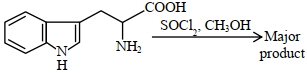
A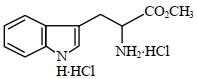
B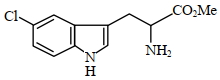
C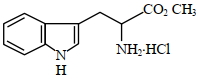
D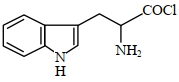
Solution
(C) The reaction of an amino acid (tryptophan) with $SOCl_2$ in $CH_3OH$ is a standard method for esterification.
$1$. $SOCl_2$ reacts with the carboxylic acid group $(-COOH)$ to form an acid chloride intermediate $(-COCl)$.
$2$. The acid chloride then reacts with methanol $(CH_3OH)$ to form the methyl ester $(-COOCH_3)$.
$3$. Since the reaction is carried out in an acidic medium (generated by $SOCl_2$ and $HCl$ byproduct),the basic amino group $(-NH_2)$ gets protonated to form the hydrochloride salt ($-NH_3^+Cl^-$ or $-NH_2 \cdot HCl$).
Thus,the major product is the methyl ester hydrochloride salt of tryptophan.
$1$. $SOCl_2$ reacts with the carboxylic acid group $(-COOH)$ to form an acid chloride intermediate $(-COCl)$.
$2$. The acid chloride then reacts with methanol $(CH_3OH)$ to form the methyl ester $(-COOCH_3)$.
$3$. Since the reaction is carried out in an acidic medium (generated by $SOCl_2$ and $HCl$ byproduct),the basic amino group $(-NH_2)$ gets protonated to form the hydrochloride salt ($-NH_3^+Cl^-$ or $-NH_2 \cdot HCl$).
Thus,the major product is the methyl ester hydrochloride salt of tryptophan.
0 likes
View Solution329
EasyMCQ
The total number of negative charges in the tetrapeptide,$Gly-Glu-Asp-Tyr$,at $pH$ $12.5$ will be $......$ .
A
$4$
B
$3$
C
$1$
D
$2$
Solution
(A) At $pH$ $12.5$,which is a highly basic medium,all acidic groups in the tetrapeptide $Gly-Glu-Asp-Tyr$ will be deprotonated.
$1$. The $C$-terminal $-COOH$ group becomes $-COO^-$.
$2$. The side chain $-COOH$ of $Glu$ becomes $-COO^-$.
$3$. The side chain $-COOH$ of $Asp$ becomes $-COO^-$.
$4$. The phenolic $-OH$ group of $Tyr$ becomes $-O^-$.
Therefore,the total number of negative charges is $4$.
$1$. The $C$-terminal $-COOH$ group becomes $-COO^-$.
$2$. The side chain $-COOH$ of $Glu$ becomes $-COO^-$.
$3$. The side chain $-COOH$ of $Asp$ becomes $-COO^-$.
$4$. The phenolic $-OH$ group of $Tyr$ becomes $-O^-$.
Therefore,the total number of negative charges is $4$.
0 likes
View Solution330
MediumMCQ
Which of the following is $NOT$ an example of a fibrous protein?
A
Keratin
B
Albumin
C
Collagen
D
Myosin
Solution
(B) Fibrous proteins are characterized by long,thread-like structures that are insoluble in water. Examples include $Keratin$ (found in hair and nails),$Collagen$ (found in connective tissues),and $Myosin$ (found in muscles). $Albumin$ is a globular protein,which is soluble in water and has a spherical shape. Therefore,$Albumin$ is not a fibrous protein.
0 likes
View Solution331
DifficultMCQ
$A$ peptide synthesized by the reactions of one molecule each of Glycine,Leucine,Aspartic acid and Histidine will have ..... peptide linkages.
A
$6$
B
$5$
C
$3$
D
$4$
Solution
(C) peptide is formed by the condensation reaction between the amino group $(-NH_2)$ of one amino acid and the carboxyl group $(-COOH)$ of another amino acid.
For a peptide formed from $n$ amino acid molecules,the number of peptide linkages is given by $(n - 1)$.
Here,the peptide is synthesized from $4$ amino acids: Glycine,Leucine,Aspartic acid,and Histidine.
Therefore,the number of peptide linkages = $4 - 1 = 3$.
For a peptide formed from $n$ amino acid molecules,the number of peptide linkages is given by $(n - 1)$.
Here,the peptide is synthesized from $4$ amino acids: Glycine,Leucine,Aspartic acid,and Histidine.
Therefore,the number of peptide linkages = $4 - 1 = 3$.
0 likes
View Solution332
DifficultMCQ
The correct structure of Rhumann's Purple,the compound formed in the reaction of ninhydrin with proteins is :
A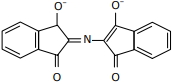
B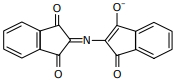
C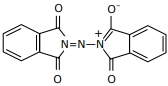
D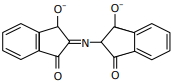
Solution
(A) The reaction of ninhydrin with amino acids or proteins leads to the formation of a deep blue or purple colored compound known as Rhumann's Purple.
The structure of Rhumann's Purple consists of two indane$-1,3-$dione moieties linked by a nitrogen atom,where one of the carbonyl oxygens is deprotonated (exists as an enolate).
Comparing the given options with the standard chemical structure of Rhumann's Purple,option $A$ represents the correct structure where the nitrogen atom connects the two indane rings,with one oxygen atom carrying a negative charge $(O^-)$ and the other carbonyl groups intact.
The structure of Rhumann's Purple consists of two indane$-1,3-$dione moieties linked by a nitrogen atom,where one of the carbonyl oxygens is deprotonated (exists as an enolate).
Comparing the given options with the standard chemical structure of Rhumann's Purple,option $A$ represents the correct structure where the nitrogen atom connects the two indane rings,with one oxygen atom carrying a negative charge $(O^-)$ and the other carbonyl groups intact.
0 likes
View Solution333
MediumMCQ
The water-soluble protein is:
A
Fibrin
B
Albumin
C
Collagen
D
Myosin
Solution
(B) Proteins are classified into fibrous and globular proteins based on their molecular shape.
Globular proteins have a spherical shape and are generally soluble in water.
$Albumin$ is a classic example of a globular protein,which is soluble in water.
In contrast,fibrous proteins like $Fibrin$,$Collagen$,and $Myosin$ are generally insoluble in water.
Globular proteins have a spherical shape and are generally soluble in water.
$Albumin$ is a classic example of a globular protein,which is soluble in water.
In contrast,fibrous proteins like $Fibrin$,$Collagen$,and $Myosin$ are generally insoluble in water.
0 likes
View Solution334
DifficultMCQ
Which one of the following is the correct structure of cytosine?
A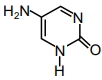
B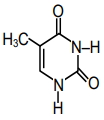
C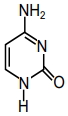
D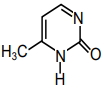
Solution
(C) Cytosine is a pyrimidine derivative. Its structure consists of a six-membered heterocyclic ring containing two nitrogen atoms at positions $1$ and $3$,an amino group $(-NH_2)$ at position $4$,and a carbonyl group $(=O)$ at position $2$. The structure corresponds to the image provided in option $C$.
0 likes
View Solution335
MediumMCQ
Which of the following amino acids is not optically active?
A
Proline
B
Serine
C
Leucine
D
Glycine
Solution
(D) An amino acid is optically active if it contains a chiral carbon atom (an asymmetric carbon bonded to four different groups).
In glycine $(NH_2-CH_2-COOH)$,the central carbon atom is bonded to two hydrogen atoms.
Since two groups attached to the central carbon are identical,it is achiral and therefore not optically active.
In glycine $(NH_2-CH_2-COOH)$,the central carbon atom is bonded to two hydrogen atoms.
Since two groups attached to the central carbon are identical,it is achiral and therefore not optically active.
0 likes
View Solution336
EasyMCQ
In $\text{alanyl-glycyl-leucyl-alanyl-valine}$,the number of peptide linkages is $......$
A
$2$
B
$4$
C
$5$
D
$1$
Solution
(B) The given peptide is a pentapeptide,which consists of $5$ amino acid residues: $\text{alanine}$,$\text{glycine}$,$\text{leucine}$,$\text{alanine}$,and $\text{valine}$.
In a polypeptide chain,the number of peptide linkages is always $(n-1)$,where $n$ is the number of amino acid residues.
Here,$n = 5$,so the number of peptide linkages $= 5 - 1 = 4$.
In a polypeptide chain,the number of peptide linkages is always $(n-1)$,where $n$ is the number of amino acid residues.
Here,$n = 5$,so the number of peptide linkages $= 5 - 1 = 4$.
0 likes
View Solution337
MediumMCQ
How many of the given compounds will give a positive Biuret test?
Glycine,Glycylalanine,Tripeptide,Biuret.
Glycine,Glycylalanine,Tripeptide,Biuret.
A
$1$
B
$3$
C
$4$
D
$2$
Solution
(D) The Biuret test is a chemical test used for detecting the presence of peptide bonds.
It gives a positive result for compounds containing at least two peptide linkages $(-CO-NH-)$.
$1$. Glycine: An amino acid,contains no peptide linkage.
$2$. Glycylalanine: $A$ dipeptide,contains only one peptide linkage.
$3$. Tripeptide: Contains two peptide linkages.
$4$. Biuret: Contains two peptide linkages $(NH_2-CO-NH-CO-NH_2)$.
Therefore,only the Tripeptide and Biuret give a positive Biuret test.
The total count is $2$.
It gives a positive result for compounds containing at least two peptide linkages $(-CO-NH-)$.
$1$. Glycine: An amino acid,contains no peptide linkage.
$2$. Glycylalanine: $A$ dipeptide,contains only one peptide linkage.
$3$. Tripeptide: Contains two peptide linkages.
$4$. Biuret: Contains two peptide linkages $(NH_2-CO-NH-CO-NH_2)$.
Therefore,only the Tripeptide and Biuret give a positive Biuret test.
The total count is $2$.
0 likes
View Solution338
EasyMCQ
Stability of $\alpha$-Helix structure of proteins depends upon:
A
dipolar interaction
B
$H$-bonding interaction
C
van der Waals forces
D
$\pi$-stacking interaction
Solution
(B) The $\alpha$-helix is one of the most common secondary structures of proteins.
It is stabilized by intramolecular hydrogen bonding between the carbonyl oxygen $(C=O)$ of one amino acid residue and the amide hydrogen $(N-H)$ of the fourth amino acid residue along the polypeptide chain.
This regular pattern of $H$-bonding gives the $\alpha$-helix its characteristic stability.
It is stabilized by intramolecular hydrogen bonding between the carbonyl oxygen $(C=O)$ of one amino acid residue and the amide hydrogen $(N-H)$ of the fourth amino acid residue along the polypeptide chain.
This regular pattern of $H$-bonding gives the $\alpha$-helix its characteristic stability.
0 likes
View Solution339
EasyMCQ
The structure of protein that is unaffected by heating is ... .
A
secondary structure
B
tertiary structure
C
primary structure
D
quaternary structure
Solution
(C) The primary structure of a protein refers to the specific sequence of amino acids linked by peptide bonds. This sequence is determined by genetic information and is not disrupted by physical changes like heating or chemical changes,which only affect the higher-level folding (secondary,tertiary,and quaternary structures).
0 likes
View Solution340
MediumMCQ
Observe the structures of the following compounds:
$1$. $2$-chlorobutane
$2$. Glycine $(NH_2CH_2COOH)$
$3$. Alanine $(CH_3CH(NH_2)COOH)$
$4$. Styrene $(C_6H_5CH=CH_2)$
$5$. Menthol
The total number of structures/compounds which possess asymmetric carbon atoms is $....$
$1$. $2$-chlorobutane
$2$. Glycine $(NH_2CH_2COOH)$
$3$. Alanine $(CH_3CH(NH_2)COOH)$
$4$. Styrene $(C_6H_5CH=CH_2)$
$5$. Menthol
The total number of structures/compounds which possess asymmetric carbon atoms is $....$
A
$1$
B
$2$
C
$3$
D
$5$
Solution
(C) An asymmetric carbon atom (chiral center) is a carbon atom bonded to four different groups.
$1$. $2$-chlorobutane $(CH_3-CHCl-CH_2-CH_3)$: The $C_2$ carbon is bonded to $-H, -Cl, -CH_3, -CH_2CH_3$. It is asymmetric.
$2$. Glycine $(NH_2-CH_2-COOH)$: No carbon is bonded to four different groups.
$3$. Alanine $(CH_3-CH(NH_2)-COOH)$: The $C_2$ carbon is bonded to $-H, -NH_2, -CH_3, -COOH$. It is asymmetric.
$4$. Styrene $(C_6H_5-CH=CH_2)$: No $sp^3$ hybridized carbon is bonded to four different groups.
$5$. Menthol: It contains multiple chiral centers (asymmetric carbons).
Thus,compounds $1, 3,$ and $5$ possess asymmetric carbon atoms. The total number is $3$.
$1$. $2$-chlorobutane $(CH_3-CHCl-CH_2-CH_3)$: The $C_2$ carbon is bonded to $-H, -Cl, -CH_3, -CH_2CH_3$. It is asymmetric.
$2$. Glycine $(NH_2-CH_2-COOH)$: No carbon is bonded to four different groups.
$3$. Alanine $(CH_3-CH(NH_2)-COOH)$: The $C_2$ carbon is bonded to $-H, -NH_2, -CH_3, -COOH$. It is asymmetric.
$4$. Styrene $(C_6H_5-CH=CH_2)$: No $sp^3$ hybridized carbon is bonded to four different groups.
$5$. Menthol: It contains multiple chiral centers (asymmetric carbons).
Thus,compounds $1, 3,$ and $5$ possess asymmetric carbon atoms. The total number is $3$.
0 likes
View Solution341
EasyMCQ
During the denaturation of proteins,which of these structures will remain intact?
A
Primary
B
Secondary
C
Tertiary
D
Quaternary
Solution
(A) Denaturation of proteins involves the disruption of the $3D$ structure of the protein,such as the $secondary$,$tertiary$,and $quaternary$ structures,due to physical or chemical changes like temperature or $pH$ variations.
However,the $primary$ structure,which refers to the specific sequence of amino acids held together by peptide bonds,remains intact because these covalent bonds are not affected by the denaturation process.
However,the $primary$ structure,which refers to the specific sequence of amino acids held together by peptide bonds,remains intact because these covalent bonds are not affected by the denaturation process.
0 likes
View Solution342
MediumMCQ
In a linear tetrapeptide (constituted with different amino acids),the value of (number of amino acids) - (number of peptide bonds) is:
A
$3$
B
$2$
C
$1$
D
$0$
Solution
(C) tetrapeptide is formed by the linkage of $4$ amino acids.
In a linear polypeptide chain,the number of peptide bonds is always $(n - 1)$,where $n$ is the number of amino acids.
For a tetrapeptide,$n = 4$.
Number of peptide bonds $= 4 - 1 = 3$.
Therefore,(number of amino acids) - (number of peptide bonds) $= 4 - 3 = 1$.
In a linear polypeptide chain,the number of peptide bonds is always $(n - 1)$,where $n$ is the number of amino acids.
For a tetrapeptide,$n = 4$.
Number of peptide bonds $= 4 - 1 = 3$.
Therefore,(number of amino acids) - (number of peptide bonds) $= 4 - 3 = 1$.
0 likes
View Solution343
DifficultMCQ
$A$ tetrapeptide is made of naturally occurring alanine,serine,glycine,and valine. If the $C$-terminal amino acid is alanine and the $N$-terminal amino acid is chiral,the number of possible sequences of the tetrapeptide is $....$
A
$12$
B
$8$
C
$6$
D
$4$
Solution
(D) tetrapeptide is composed of four distinct amino acids: alanine,serine,glycine,and valine.
Given that the $C$-terminal amino acid is fixed as alanine,the remaining three positions ($N$-terminal,second,and third) must be filled by the remaining three amino acids: serine,glycine,and valine.
The $N$-terminal amino acid must be chiral. Among the three available amino acids (serine,glycine,and valine),glycine is achiral,while serine and valine are chiral.
Therefore,the $N$-terminal position can only be occupied by either serine or valine.
Case $1$: If the $N$-terminal is valine,the remaining two positions (second and third) can be filled by serine and glycine in $2! = 2$ ways (Val-Ser-Gly-Ala and Val-Gly-Ser-Ala).
Case $2$: If the $N$-terminal is serine,the remaining two positions (second and third) can be filled by valine and glycine in $2! = 2$ ways (Ser-Val-Gly-Ala and Ser-Gly-Val-Ala).
Total number of possible sequences = $2 + 2 = 4$.
Given that the $C$-terminal amino acid is fixed as alanine,the remaining three positions ($N$-terminal,second,and third) must be filled by the remaining three amino acids: serine,glycine,and valine.
The $N$-terminal amino acid must be chiral. Among the three available amino acids (serine,glycine,and valine),glycine is achiral,while serine and valine are chiral.
Therefore,the $N$-terminal position can only be occupied by either serine or valine.
Case $1$: If the $N$-terminal is valine,the remaining two positions (second and third) can be filled by serine and glycine in $2! = 2$ ways (Val-Ser-Gly-Ala and Val-Gly-Ser-Ala).
Case $2$: If the $N$-terminal is serine,the remaining two positions (second and third) can be filled by valine and glycine in $2! = 2$ ways (Ser-Val-Gly-Ala and Ser-Gly-Val-Ala).
Total number of possible sequences = $2 + 2 = 4$.
0 likes
View Solution344
MediumMCQ
The following tripeptide can be represented as:
A
$tyr-val-thr$
B
$phe-ala-ser$
C
$phe-leu-cys$
D
$lys-ala-ser$
Solution
(B) The given tripeptide is composed of three amino acids linked by peptide bonds.
By observing the side chains in the structure:
$1$. The $N$-terminal amino acid has a benzyl group $(-CH_2Ph)$,which corresponds to Phenylalanine $(phe)$.
$2$. The middle amino acid has a methyl group $(-CH_3)$,which corresponds to Alanine $(ala)$.
$3$. The $C$-terminal amino acid has a hydroxymethyl group $(-CH_2OH)$,which corresponds to Serine $(ser)$.
Thus,the tripeptide is represented as $phe-ala-ser$.
By observing the side chains in the structure:
$1$. The $N$-terminal amino acid has a benzyl group $(-CH_2Ph)$,which corresponds to Phenylalanine $(phe)$.
$2$. The middle amino acid has a methyl group $(-CH_3)$,which corresponds to Alanine $(ala)$.
$3$. The $C$-terminal amino acid has a hydroxymethyl group $(-CH_2OH)$,which corresponds to Serine $(ser)$.
Thus,the tripeptide is represented as $phe-ala-ser$.
0 likes
View Solution345
MediumMCQ
Among the $\alpha$-amino acids - threonine,tyrosine,methionine,arginine and tryptophan,those which contain an aromatic group in their side chain are
A
threonine and arginine
B
tyrosine and tryptophan
C
methionine and tyrosine
D
arginine and tryptophan
Solution
(B) The correct option is $(B)$.
An aromatic amino acid is an amino acid that includes an aromatic ring in its side chain.
$1$. Tyrosine contains a phenol group (a benzene ring with a hydroxyl group).
$2$. Tryptophan contains an indole group (a fused benzene and pyrrole ring).
Threonine contains a hydroxyl group,methionine contains a sulfur atom (thioether),and arginine contains a guanidino group. None of these are aromatic.
Therefore,tyrosine and tryptophan are the amino acids that contain an aromatic group in their side chain.
An aromatic amino acid is an amino acid that includes an aromatic ring in its side chain.
$1$. Tyrosine contains a phenol group (a benzene ring with a hydroxyl group).
$2$. Tryptophan contains an indole group (a fused benzene and pyrrole ring).
Threonine contains a hydroxyl group,methionine contains a sulfur atom (thioether),and arginine contains a guanidino group. None of these are aromatic.
Therefore,tyrosine and tryptophan are the amino acids that contain an aromatic group in their side chain.
0 likes
View Solution346
DifficultMCQ
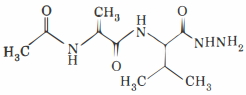
The number of peptide bonds in the following compound is:
A
$1$
B
$2$
C
$3$
D
$4$
Solution
(A) peptide bond is an amide linkage $(-CO-NH-)$ formed between the carboxyl group $(-COOH)$ of one amino acid and the amino group $(-NH_2)$ of another amino acid.
Looking at the structure provided:
$1$. The first linkage on the left is an amide bond $(-CH_3-CO-NH-)$,which is formed by the acetylation of an amino acid.
$2$. The second linkage in the middle is a true peptide bond $(-CH(CH_3)-CO-NH-CH-)$ between two amino acid residues.
$3$. The linkage on the right is a hydrazide group $(-CO-NH-NH_2)$,not a peptide bond.
Therefore,there is only $1$ peptide bond in the given structure.
The correct option is $A$.
Looking at the structure provided:
$1$. The first linkage on the left is an amide bond $(-CH_3-CO-NH-)$,which is formed by the acetylation of an amino acid.
$2$. The second linkage in the middle is a true peptide bond $(-CH(CH_3)-CO-NH-CH-)$ between two amino acid residues.
$3$. The linkage on the right is a hydrazide group $(-CO-NH-NH_2)$,not a peptide bond.
Therefore,there is only $1$ peptide bond in the given structure.
The correct option is $A$.
0 likes
View Solution347
MediumMCQ
Total number of tripeptides possible by mixing of valine and proline is $............$.
A
$8$
B
$4$
C
$2$
D
$6$
Solution
(A) For a tripeptide,there are $3$ positions to be filled by either valine $(V)$ or proline $(P)$.
Since each position can be occupied by either of the $2$ amino acids,the total number of possible combinations is $2^n$,where $n$ is the number of amino acids in the peptide.
For a tripeptide,$n = 3$,so the total number of combinations is $2^3 = 8$.
The possible combinations are:
$1$. $Val-Val-Val$
$2$. $Pro-Pro-Pro$
$3$. $Val-Pro-Pro$
$4$. $Pro-Val-Pro$
$5$. $Val-Val-Pro$
$6$. $Val-Pro-Val$
$7$. $Pro-Pro-Val$
$8$. $Pro-Val-Val$
Since each position can be occupied by either of the $2$ amino acids,the total number of possible combinations is $2^n$,where $n$ is the number of amino acids in the peptide.
For a tripeptide,$n = 3$,so the total number of combinations is $2^3 = 8$.
The possible combinations are:
$1$. $Val-Val-Val$
$2$. $Pro-Pro-Pro$
$3$. $Val-Pro-Pro$
$4$. $Pro-Val-Pro$
$5$. $Val-Val-Pro$
$6$. $Val-Pro-Val$
$7$. $Pro-Pro-Val$
$8$. $Pro-Val-Val$
0 likes
View Solution348
MediumMCQ
The number of cyclic tripeptides formed with $2$ amino acids $A$ and $B$ is:
A
$2$
B
$3$
C
$5$
D
$4$
Solution
(D) cyclic tripeptide is formed by the condensation of $3$ amino acid units in a ring structure.
Given $2$ types of amino acids,$A$ and $B$,each of the $3$ positions in the cyclic tripeptide can be occupied by either $A$ or $B$.
The total number of possible combinations is $2^3 = 8$.
However,in a cyclic structure,rotations are considered identical.
The possible combinations are:
$1$. $AAA$
$2$. $BBB$
$3$. $AAB$ (which is equivalent to $ABA$ and $BAA$ by rotation)
$4$. $ABB$ (which is equivalent to $BBA$ and $BAB$ by rotation)
Thus,there are $4$ distinct cyclic tripeptides possible: $AAA$,$BBB$,$AAB$,and $ABB$.
Given $2$ types of amino acids,$A$ and $B$,each of the $3$ positions in the cyclic tripeptide can be occupied by either $A$ or $B$.
The total number of possible combinations is $2^3 = 8$.
However,in a cyclic structure,rotations are considered identical.
The possible combinations are:
$1$. $AAA$
$2$. $BBB$
$3$. $AAB$ (which is equivalent to $ABA$ and $BAA$ by rotation)
$4$. $ABB$ (which is equivalent to $BBA$ and $BAB$ by rotation)
Thus,there are $4$ distinct cyclic tripeptides possible: $AAA$,$BBB$,$AAB$,and $ABB$.
0 likes
View SolutionBiomolecules — Amino Acids and Proteins · Frequently Asked Questions
1Are these Biomolecules questions useful for JEE and NEET?
Yes. All questions in this section are mapped to JEE Main and NEET exam patterns. Previous year questions from JEE Main, NEET, GUJCET and state-level exams are included with full solutions.
2Can I switch to Hindi or Gujarati for these questions?
Yes. Use the language tabs in the hero section or the sidebar to view the same questions and solutions in English, Hindi or Gujarati.
3How do I generate a question paper from this subtopic?
Use the Vedclass Exam Paper Generator — select the chapter and subtopic, set difficulty, and generate Sets A, B, C, D automatically. First 3 chapters of every subject are free.
Vedclass Products
For Students
Vedclass Test Series
Mock tests in real JEE/NEET style with performance analysis. 5-day free trial.
Start Free TrialFor Teachers
Exam Paper Generator
Generate Set A/B/C/D papers from this chapter in 2 minutes. 3 chapters free.
Try FreeFor Institutes
Online Exam Module
Live online exams with unlimited students, 360° analytics & white-label branding.
See DemoFor Teachers & Institutes
Generate a Biomolecules Exam Paper in 2 Minutes
Select subtopic & difficulty — Sets A, B, C, D auto-generated with No Repeat logic.
First 3 chapters of every subject are free — no payment required.