
A English
Amino Acids and Proteins Questions in English
Class 12 Chemistry · Biomolecules · Amino Acids and Proteins
518+
Questions
English
Language
100%
With Solutions
Showing 48 of 518 questions in English
251
EasyMCQ
Which of the following is not an amino acid?
A
Glycine
B
Alanine
C
Histidine
D
Guanine
Solution
(D) Amino acids are organic compounds that contain both an amino group $(-NH_2)$ and a carboxylic acid group $(-COOH)$.
Glycine,Alanine,and Histidine are standard $\alpha$-amino acids found in proteins.
Guanine is a nitrogenous base (purine) found in nucleic acids ($DNA$ and $RNA$),not an amino acid.
Glycine,Alanine,and Histidine are standard $\alpha$-amino acids found in proteins.
Guanine is a nitrogenous base (purine) found in nucleic acids ($DNA$ and $RNA$),not an amino acid.
0 likes
View Solution252
EasyMCQ
Which of the following compounds exists as a zwitterion?
A
$C_6H_5CH_2CH(NH_2)COOH$
B
$(CH_3)_2CHCH(NH_2)COOH$
C
$C_6H_5CONHCH_2COOH$
D
$HOOCCH_2CH_2CH(NH_2)COOH$
Solution
(A) zwitterion is a molecule that contains both a positive and a negative charge,resulting in a net charge of zero.
Amino acids,which contain both an acidic carboxyl group $(-COOH)$ and a basic amino group $(-NH_2)$,exist as zwitterions in aqueous solution.
Among the given options,$C_6H_5CH_2CH(NH_2)COOH$ (Phenylalanine),$(CH_3)_2CHCH(NH_2)COOH$ (Valine),and $HOOCCH_2CH_2CH(NH_2)COOH$ (Glutamic acid) are amino acids.
However,in standard multiple-choice contexts for this specific question,the structure representing a simple $\alpha$-amino acid is typically the intended answer.
Given the options provided in the prompt were structurally incorrect or incomplete,the standard amino acid $C_6H_5CH_2CH(NH_2)COOH$ is the correct representation of a zwitterionic species.
Amino acids,which contain both an acidic carboxyl group $(-COOH)$ and a basic amino group $(-NH_2)$,exist as zwitterions in aqueous solution.
Among the given options,$C_6H_5CH_2CH(NH_2)COOH$ (Phenylalanine),$(CH_3)_2CHCH(NH_2)COOH$ (Valine),and $HOOCCH_2CH_2CH(NH_2)COOH$ (Glutamic acid) are amino acids.
However,in standard multiple-choice contexts for this specific question,the structure representing a simple $\alpha$-amino acid is typically the intended answer.
Given the options provided in the prompt were structurally incorrect or incomplete,the standard amino acid $C_6H_5CH_2CH(NH_2)COOH$ is the correct representation of a zwitterionic species.
0 likes
View Solution253
EasyMCQ
Which of the following statements regarding the peptide bond is incorrect?
A
The $C-N$ bond length in proteins is greater than the normal $C-N$ bond length.
B
Spectroscopic studies show that the structure of $-CONH-$ is planar.
C
The $C-N$ bond length in proteins is less than the normal $C-N$ bond length.
D
None of the above.
Solution
(A) The peptide bond $(C-N)$ in proteins exhibits partial double bond character due to resonance.
This resonance leads to a shorter $C-N$ bond length compared to a standard $C-N$ single bond.
Therefore,the statement that the $C-N$ bond length in proteins is greater than the normal $C-N$ bond length is incorrect.
This resonance leads to a shorter $C-N$ bond length compared to a standard $C-N$ single bond.
Therefore,the statement that the $C-N$ bond length in proteins is greater than the normal $C-N$ bond length is incorrect.
0 likes
View Solution254
MediumMCQ
Which characteristic of $Proline$ (an amino acid) distinguishes it from other naturally occurring amino acids?
A
It is not optically active
B
It contains an aromatic group
C
It contains two amino groups
D
It is a secondary amine
Solution
(D) Most naturally occurring amino acids are primary amines $(R-CH(NH_2)-COOH)$.
$Proline$ is unique because its amino group is part of a five-membered pyrrolidine ring.
This structure makes the nitrogen atom a secondary amine,as it is bonded to two carbon atoms within the ring structure.
$Proline$ is unique because its amino group is part of a five-membered pyrrolidine ring.
This structure makes the nitrogen atom a secondary amine,as it is bonded to two carbon atoms within the ring structure.
0 likes
View Solution255
MediumMCQ
Which property of glycine distinguishes it from other naturally occurring amino acids?
A
It is not optically active.
B
It contains an aromatic group.
C
It contains two amino groups.
D
It is a secondary amine.
Solution
(A) Glycine $(NH_2-CH_2-COOH)$ is the simplest amino acid.
In glycine,the $\alpha$-carbon atom is bonded to two identical hydrogen atoms.
Because it lacks a chiral center,it does not exhibit optical isomerism.
All other naturally occurring amino acids have at least one chiral center and are optically active.
In glycine,the $\alpha$-carbon atom is bonded to two identical hydrogen atoms.
Because it lacks a chiral center,it does not exhibit optical isomerism.
All other naturally occurring amino acids have at least one chiral center and are optically active.
0 likes
View Solution256
MediumMCQ
At the isoelectric point,in which form does an amino acid exist?
A
$H_2N - CHR - COOH$
B
$H_3N^{+} - CHR - COOH$
C
$H_2N - CHR - COO^{-}$
D
$H_3N^{+} - CHR - COO^{-}$
Solution
(D) The isoelectric point $(pI)$ is the $pH$ at which an amino acid carries no net electrical charge.
At this $pH$,the amino acid exists as a dipolar ion,commonly known as a zwitterion.
In a zwitterion,the carboxyl group loses a proton to become a carboxylate ion $(COO^{-})$ and the amino group gains a proton to become an ammonium ion $(NH_3^{+})$.
Therefore,the structure is $H_3N^{+} - CHR - COO^{-}$.
At this $pH$,the amino acid exists as a dipolar ion,commonly known as a zwitterion.
In a zwitterion,the carboxyl group loses a proton to become a carboxylate ion $(COO^{-})$ and the amino group gains a proton to become an ammonium ion $(NH_3^{+})$.
Therefore,the structure is $H_3N^{+} - CHR - COO^{-}$.
0 likes
View Solution257
MediumMCQ
What is the relationship between the isoelectric point and the solubility of amino acids?
A
The solubility of only a few amino acids depends on the isoelectric point.
B
The solubility of amino acids is minimum at the isoelectric point.
C
The solubility of amino acids is maximum at the isoelectric point.
D
There is no relationship between the isoelectric point and solubility.
Solution
(B) The isoelectric point $(pI)$ is the $pH$ at which an amino acid exists as a zwitterion,having no net charge.
At this point,the electrostatic repulsion between molecules is minimized,and the intermolecular forces are dominated by attractive forces.
Consequently,the solubility of amino acids is at its minimum at the isoelectric point because the molecules tend to aggregate and precipitate out of the solution.
At this point,the electrostatic repulsion between molecules is minimized,and the intermolecular forces are dominated by attractive forces.
Consequently,the solubility of amino acids is at its minimum at the isoelectric point because the molecules tend to aggregate and precipitate out of the solution.
0 likes
View Solution258
MediumMCQ
Which type of linkage is present in the structure of proteins?
A
Phosphodiester linkage
B
Glycosidic linkage
C
Peptide linkage
D
All of the above
Solution
(C) Proteins are polymers of $\alpha$-amino acids. These amino acids are connected to each other by a covalent bond known as a peptide bond or peptide linkage. This linkage is formed by the condensation reaction between the amino group $(-NH_2)$ of one amino acid and the carboxyl group $(-COOH)$ of another amino acid.
0 likes
View Solution259
MediumMCQ
Which of the following is $NOT$ a function of proteins?
A
Formation of nails
B
Formation of skin
C
Formation of muscles
D
Providing energy for metabolism
Solution
(D) Proteins are primarily structural components of the body,such as in nails,skin,and muscles. While they can be broken down to provide energy during extreme starvation,their primary biological function is not to serve as a source of energy for metabolism. Carbohydrates and fats are the primary sources of energy for metabolism.
0 likes
View Solution260
EasyMCQ
Which of the following metals forms a complex with insulin?
A
Copper
B
Iron
C
Zinc
D
Cobalt
Solution
(C) Insulin is a peptide hormone produced by the beta cells of the pancreatic islets. It is stored in the pancreas in the form of a hexameric complex with $Zn^{2+}$ ions. Therefore,zinc is the metal that forms a complex with insulin.
0 likes
View Solution261
EasyMCQ
The $\alpha$-helix structure is found in which of the following?
A
$DNA$
B
$RNA$
C
Lipids
D
Proteins
Solution
(D) The $\alpha$-helix is one of the most common secondary structures of proteins.
It is formed by the regular coiling of the polypeptide chain,which is stabilized by intramolecular hydrogen bonding between the $C=O$ group of one amino acid residue and the $N-H$ group of the fourth amino acid residue along the chain.
Therefore,the $\alpha$-helix structure is characteristic of proteins.
It is formed by the regular coiling of the polypeptide chain,which is stabilized by intramolecular hydrogen bonding between the $C=O$ group of one amino acid residue and the $N-H$ group of the fourth amino acid residue along the chain.
Therefore,the $\alpha$-helix structure is characteristic of proteins.
0 likes
View Solution262
MediumMCQ
Insulin is a .........
A
Steroid hormone
B
Peptide hormone
C
Amine hormone
D
None of the above
Solution
(B) Insulin is a peptide hormone produced by the beta cells of the pancreatic islets. It consists of $51$ amino acids arranged in two polypeptide chains,referred to as chain $A$ and chain $B$,which are linked together by disulfide bridges. Therefore,it is classified as a peptide hormone.
0 likes
View Solution263
EasyMCQ
What is the process of protein synthesis based on genetic information called?
A
Replication
B
Messenger hypothesis
C
Translation
D
Transcription
Solution
(C) The process of protein synthesis based on genetic information stored in $mRNA$ is known as $Translation$.
In this process,the sequence of nucleotides in $mRNA$ is translated into a sequence of amino acids to form a polypeptide chain.
In this process,the sequence of nucleotides in $mRNA$ is translated into a sequence of amino acids to form a polypeptide chain.
0 likes
View Solution264
EasyMCQ
Which of the following are protein fibers?
A
Cotton
B
Rayon
C
Silk
D
Polyester
Solution
(C) Protein fibers are natural fibers that consist largely of proteins. Silk is a natural protein fiber produced by silkworms. Cotton is a cellulose fiber,Rayon is a regenerated cellulose fiber,and Polyester is a synthetic polymer fiber. Therefore,the correct answer is $Silk$.
0 likes
View Solution265
MediumMCQ
Which amino acid is present as a monomer in the polymer $Nylon-2-nylon-6$?
A
Glycine
B
Arginine
C
Alanine
D
Lysine
Solution
(A) $Nylon-2-nylon-6$ is a polyamide copolymer formed by the condensation polymerization of two monomers:
$1$. Glycine $(H_2N-CH_2-COOH)$
$2$. Aminocaproic acid $(H_2N-(CH_2)_5-COOH)$
Since glycine is the only amino acid among the options that acts as a monomer for this polymer,the correct answer is $Glycine$.
$1$. Glycine $(H_2N-CH_2-COOH)$
$2$. Aminocaproic acid $(H_2N-(CH_2)_5-COOH)$
Since glycine is the only amino acid among the options that acts as a monomer for this polymer,the correct answer is $Glycine$.
0 likes
View Solution266
MediumMCQ
Among the following,$L$-serine is
A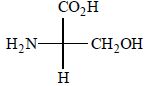
B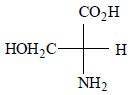
C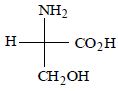
D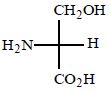
Solution
(A) In $L$-amino acids,the $-NH_2$ group is located on the left side of the chiral carbon in the Fischer projection when the $-COOH$ group is placed at the top.
Serine is $HOCH_2-CH(NH_2)-COOH$.
In option $A$,the $-NH_2$ group is on the left side,which corresponds to the $L$-configuration of serine.
Serine is $HOCH_2-CH(NH_2)-COOH$.
In option $A$,the $-NH_2$ group is on the left side,which corresponds to the $L$-configuration of serine.
0 likes
View Solution267
MediumMCQ
The pair in which both species have iron is
A
Nitrogenase,cytochromes
B
Carboxypeptidase,haemoglobin
C
Haemocyanin,nitrogenase
D
Haemoglobin,cytochromes
Solution
(D) Haemoglobin contains iron as the central metal ion in the heme group. Cytochromes are iron-containing hemoproteins that act as electron carriers. Therefore,both $Haemoglobin$ and $cytochromes$ contain iron.
0 likes
View Solution268
DifficultMCQ
Lysine is least soluble in water in the $pH$ range:
A
$3$ to $4$
B
$5$ to $6$
C
$9$ to $10$
D
$11$ to $12$
Solution
(C) Lysine is a basic amino acid with two amino groups and one carboxyl group.
Its isoelectric point $(pI)$ is approximately $9.74$.
An amino acid is least soluble in water at its isoelectric point because the net charge on the molecule is zero,leading to minimum electrostatic repulsion between molecules.
However,in the context of standard textbook questions regarding lysine,the range $9-10$ is often cited as the region where it approaches its isoelectric state.
Its isoelectric point $(pI)$ is approximately $9.74$.
An amino acid is least soluble in water at its isoelectric point because the net charge on the molecule is zero,leading to minimum electrostatic repulsion between molecules.
However,in the context of standard textbook questions regarding lysine,the range $9-10$ is often cited as the region where it approaches its isoelectric state.
0 likes
View Solution269
MediumMCQ
$\alpha$-Amino acids are:
A
acidic due to $-COOH$ group and basic due to $-NH_2$ group
B
acidic due to $-NH_3^+$ group and basic due to $-COO^-$ group
C
neither acidic nor basic.
D
none of the above
Solution
(B) In aqueous solution,$\alpha$-amino acids exist as zwitterions $(R-CH(NH_3^+)-COO^-)$.
The $-NH_3^+$ group acts as an acid (proton donor) and the $-COO^-$ group acts as a base (proton acceptor).
The $-NH_3^+$ group acts as an acid (proton donor) and the $-COO^-$ group acts as a base (proton acceptor).
0 likes
View Solution270
MediumMCQ
Denaturation of proteins leads to loss of its biological activity by
A
Formation of amino acid
B
Loss of primary structure
C
Loss of both primary and secondary structures
D
Loss of both secondary and tertiary structures
Solution
(D) . Loss of both secondary and tertiary structures
Denaturation of proteins involves the disruption and possible destruction of both the secondary and tertiary structures.
Since denaturation reactions are not strong enough to break the peptide bonds,the primary structure remains intact after a denaturation process.
Denaturation of proteins involves the disruption and possible destruction of both the secondary and tertiary structures.
Since denaturation reactions are not strong enough to break the peptide bonds,the primary structure remains intact after a denaturation process.
0 likes
View Solution271
MediumMCQ
Which of the statements about "Denaturation" given below are correct?
$A$. Denaturation of proteins causes loss of secondary and tertiary structures of the protein
$B$. Denaturation leads to the conversion of double strand of $DNA$ into single strand
$C$. Denaturation affects primary structure which gets distorted
$A$. Denaturation of proteins causes loss of secondary and tertiary structures of the protein
$B$. Denaturation leads to the conversion of double strand of $DNA$ into single strand
$C$. Denaturation affects primary structure which gets distorted
A
$B$ and $C$
B
$A$ and $C$
C
$A$ and $B$
D
$A, B$ and $C$
Solution
(C) Denaturation is a process where proteins or nucleic acids lose their quaternary,tertiary,and secondary structures due to external stress such as heat,pH changes,or chemicals.
Statement $A$ is correct: Denaturation disrupts the hydrogen bonds and other interactions,leading to the loss of secondary and tertiary structures.
Statement $B$ is correct: In $DNA$,denaturation refers to the separation of the double-stranded helix into two single strands.
Statement $C$ is incorrect: The primary structure of proteins (the sequence of amino acids) remains intact during denaturation.
Therefore,statements $A$ and $B$ are correct.
Statement $A$ is correct: Denaturation disrupts the hydrogen bonds and other interactions,leading to the loss of secondary and tertiary structures.
Statement $B$ is correct: In $DNA$,denaturation refers to the separation of the double-stranded helix into two single strands.
Statement $C$ is incorrect: The primary structure of proteins (the sequence of amino acids) remains intact during denaturation.
Therefore,statements $A$ and $B$ are correct.
0 likes
View Solution272
MediumMCQ
Which one of the following statements is correct?
A
All amino acids except lysine are optically active
B
All amino acids are optically active
C
All amino acids except glycine are optically active
D
All amino acids except glutamic acid are optically active
Solution
(C) Except for glycine,all other naturally occurring amino acids contain a chiral center at the $\alpha$-carbon atom.
Glycine has the structure $H_2N-CH_2-COOH$,where the $\alpha$-carbon is bonded to two identical hydrogen atoms,making it achiral.
Therefore,all amino acids except glycine are optically active.
Glycine has the structure $H_2N-CH_2-COOH$,where the $\alpha$-carbon is bonded to two identical hydrogen atoms,making it achiral.
Therefore,all amino acids except glycine are optically active.
0 likes
View Solution273
EasyMCQ
Assertion : Proteins on hydrolysis produce amino acids.
Reason : Amino acids contain $-NH_2$ and $-COOH$ groups.
Reason : Amino acids contain $-NH_2$ and $-COOH$ groups.
A
If both Assertion and Reason are correct and the Reason is a correct explanation of the Assertion.
B
If both Assertion and Reason are correct but Reason is not a correct explanation of the Assertion.
C
If the Assertion is correct but Reason is incorrect.
D
If both the Assertion and Reason are incorrect.
Solution
(B) Proteins are polymers of $\alpha$-amino acids linked by peptide bonds. On hydrolysis,they break down into their constituent amino acids.
Amino acids are bifunctional molecules containing both an amino group $(-NH_2)$ and a carboxylic acid group $(-COOH)$.
While both statements are scientifically correct,the presence of these functional groups in amino acids is not the direct reason why proteins produce amino acids upon hydrolysis; the hydrolysis is due to the cleavage of peptide bonds. Therefore,the Reason is not the correct explanation of the Assertion.
Amino acids are bifunctional molecules containing both an amino group $(-NH_2)$ and a carboxylic acid group $(-COOH)$.
While both statements are scientifically correct,the presence of these functional groups in amino acids is not the direct reason why proteins produce amino acids upon hydrolysis; the hydrolysis is due to the cleavage of peptide bonds. Therefore,the Reason is not the correct explanation of the Assertion.
0 likes
View Solution274
MediumMCQ
Assertion : Haemoglobin is an oxygen carrier.
Reason : Oxygen binds as $O_2^-$ to $Fe$ of haemoglobin.
Reason : Oxygen binds as $O_2^-$ to $Fe$ of haemoglobin.
A
If both Assertion and Reason are correct and the Reason is a correct explanation of the Assertion.
B
If both Assertion and Reason are correct but Reason is not a correct explanation of the Assertion.
C
If the Assertion is correct but Reason is incorrect.
D
If both the Assertion and Reason are incorrect.
Solution
(C) The assertion is correct because haemoglobin acts as a respiratory pigment that transports oxygen in the blood.
The reason is incorrect because oxygen binds to the $Fe^{2+}$ ion of the haem group in its molecular form,$O_2$,not as the superoxide ion,$O_2^-$.
The reason is incorrect because oxygen binds to the $Fe^{2+}$ ion of the haem group in its molecular form,$O_2$,not as the superoxide ion,$O_2^-$.
0 likes
View Solution275
MediumMCQ
Assertion : Carboxypeptidase is an exopeptidase.
Reason : It cleaves the $N$-terminal bond.
Reason : It cleaves the $N$-terminal bond.
A
If both Assertion and Reason are correct and the Reason is a correct explanation of the Assertion.
B
If both Assertion and Reason are correct but Reason is not a correct explanation of the Assertion.
C
If the Assertion is correct but Reason is incorrect.
D
If both the Assertion and Reason are incorrect.
Solution
(C) Carboxypeptidase is an exopeptidase that specifically cleaves the peptide bond at the $C$-terminal end of a polypeptide chain.
The Reason states that it cleaves the $N$-terminal bond,which is incorrect; aminopeptidases cleave the $N$-terminal bond.
Therefore,the Assertion is correct,but the Reason is incorrect.
The Reason states that it cleaves the $N$-terminal bond,which is incorrect; aminopeptidases cleave the $N$-terminal bond.
Therefore,the Assertion is correct,but the Reason is incorrect.
0 likes
View Solution276
DifficultMCQ
Assertion: $\alpha$-amino acids exist as internal salt in solution as they have amino and carboxylic acid groups in near vicinity.
Reason: $H^{+}$ ion given by carboxylic group $(-COOH)$ is captured by amino group $(-NH_2)$ having lone pair of electrons.
Reason: $H^{+}$ ion given by carboxylic group $(-COOH)$ is captured by amino group $(-NH_2)$ having lone pair of electrons.
A
If both Assertion and Reason are correct and the Reason is a correct explanation of the Assertion.
B
If both Assertion and Reason are correct but Reason is not a correct explanation of the Assertion.
C
If the Assertion is correct but Reason is incorrect.
D
If both the Assertion and Reason are incorrect.
Solution
(A) $\alpha$-amino acids contain both an acidic carboxyl group $(-COOH)$ and a basic amino group $(-NH_2)$.
In aqueous solution,the carboxyl group loses a proton $(H^{+})$ and the amino group accepts it,forming a dipolar ion known as a zwitterion or internal salt: $NH_2-CHR-COOH \rightleftharpoons NH_3^+-CHR-COO^-$.
This occurs because the acidic and basic groups are in close proximity.
Therefore,both Assertion and Reason are correct,and the Reason is the correct explanation.
In aqueous solution,the carboxyl group loses a proton $(H^{+})$ and the amino group accepts it,forming a dipolar ion known as a zwitterion or internal salt: $NH_2-CHR-COOH \rightleftharpoons NH_3^+-CHR-COO^-$.
This occurs because the acidic and basic groups are in close proximity.
Therefore,both Assertion and Reason are correct,and the Reason is the correct explanation.
0 likes
View Solution277
DifficultMCQ
Assertion : Disruption of the natural structure of a protein is called denaturation.
Reason : The change in colour and appearance of egg during cooking is due to denaturation.
Reason : The change in colour and appearance of egg during cooking is due to denaturation.
A
If both Assertion and Reason are correct and the Reason is a correct explanation of the Assertion.
B
If both Assertion and Reason are correct but Reason is not a correct explanation of the Assertion.
C
If the Assertion is correct but Reason is incorrect.
D
If both the Assertion and Reason are incorrect.
Solution
(B) Denaturation refers to the process where the natural structure of a protein (secondary,tertiary,or quaternary) is disrupted due to physical or chemical changes,such as temperature or $pH$ changes. This leads to the loss of biological activity.
Cooking an egg involves the coagulation of albumin protein,which is a classic example of denaturation.
Both the Assertion and the Reason are correct statements. However,the Reason describes a specific instance of denaturation and does not explain the general definition provided in the Assertion. Therefore,the Reason is not the correct explanation of the Assertion.
Cooking an egg involves the coagulation of albumin protein,which is a classic example of denaturation.
Both the Assertion and the Reason are correct statements. However,the Reason describes a specific instance of denaturation and does not explain the general definition provided in the Assertion. Therefore,the Reason is not the correct explanation of the Assertion.
0 likes
View Solution278
DifficultMCQ
Assertion : Proteins are made up of $\alpha-$ amino acids.
Reason : During denaturation,secondary and tertiary structures of proteins are destroyed.
Reason : During denaturation,secondary and tertiary structures of proteins are destroyed.
A
If both Assertion and Reason are correct and the Reason is a correct explanation of the Assertion.
B
If both Assertion and Reason are correct but Reason is not a correct explanation of the Assertion.
C
If the Assertion is correct but Reason is incorrect.
D
If both the Assertion and Reason are incorrect.
Solution
(B) The Assertion is correct because proteins are polymers of $\alpha-$ amino acids linked by peptide bonds.
The Reason is also correct because denaturation involves the unfolding of the protein's secondary and tertiary structures due to physical or chemical changes,while the primary structure remains intact.
However,the Reason does not explain why proteins are made of $\alpha-$ amino acids.
Therefore,both statements are correct,but the Reason is not the correct explanation of the Assertion.
The Reason is also correct because denaturation involves the unfolding of the protein's secondary and tertiary structures due to physical or chemical changes,while the primary structure remains intact.
However,the Reason does not explain why proteins are made of $\alpha-$ amino acids.
Therefore,both statements are correct,but the Reason is not the correct explanation of the Assertion.
0 likes
View Solution279
DifficultMCQ
Assertion : At isoelectric point,the amino acid does not migrate under the influence of an electric field.
Reason : At isoelectric point,amino acid exists as a zwitterion.
Reason : At isoelectric point,amino acid exists as a zwitterion.
A
If both Assertion and Reason are correct and the Reason is a correct explanation of the Assertion.
B
If both Assertion and Reason are correct but Reason is not a correct explanation of the Assertion.
C
If the Assertion is correct but Reason is incorrect.
D
If both the Assertion and Reason are incorrect.
Solution
(A) At the isoelectric point $(pH = pI)$,an amino acid exists as a zwitterion,which carries both a positive and a negative charge,resulting in a net charge of zero. Because the molecule is electrically neutral,it does not migrate towards either the cathode or the anode when an electric field is applied. Therefore,the Reason correctly explains the Assertion.
0 likes
View Solution280
MediumMCQ
The non-essential amino acid among the following is
A
valine
B
leucine
C
alanine
D
lysine
Solution
(C) Non-essential amino acids are those that can be synthesized by the human body.
Among the given options,$alanine$ is a non-essential amino acid.
$Valine$,$leucine$,and $lysine$ are essential amino acids that must be obtained through the diet.
Among the given options,$alanine$ is a non-essential amino acid.
$Valine$,$leucine$,and $lysine$ are essential amino acids that must be obtained through the diet.
0 likes
View Solution281
MediumMCQ
Which structure$(s)$ of proteins remain$(s)$ intact during the denaturation process?
A
Both secondary and tertiary structures
B
Primary structure only
C
Secondary structure only
D
Tertiary structure only
Solution
(B) During the process of denaturation,the hydrogen bonds and other interactions that stabilize the $2^o$ and $3^o$ structures are disrupted,leading to their loss.
However,the peptide bonds that hold the amino acids together in the $1^o$ structure remain intact.
However,the peptide bonds that hold the amino acids together in the $1^o$ structure remain intact.
0 likes
View Solution282
DifficultMCQ
The number of $sp^2$ hybridised carbons present in "Aspartame" is
A
$7$
B
$8$
C
$9$
D
$5$
Solution
(C) Aspartame is a dipeptide methyl ester. Its structure contains:
$1$. One carboxylic acid group carbon $(C=O)$: $1$ $sp^2$ carbon.
$2$. One amide group carbon $(C=O)$: $1$ $sp^2$ carbon.
$3$. One ester group carbon $(C=O)$: $1$ $sp^2$ carbon.
$4$. One phenyl ring $(C_6H_5)$: $6$ $sp^2$ carbons.
Total number of $sp^2$ hybridised carbons = $1 + 1 + 1 + 6 = 9$.
$1$. One carboxylic acid group carbon $(C=O)$: $1$ $sp^2$ carbon.
$2$. One amide group carbon $(C=O)$: $1$ $sp^2$ carbon.
$3$. One ester group carbon $(C=O)$: $1$ $sp^2$ carbon.
$4$. One phenyl ring $(C_6H_5)$: $6$ $sp^2$ carbons.
Total number of $sp^2$ hybridised carbons = $1 + 1 + 1 + 6 = 9$.
0 likes
View Solution283
Medium
The melting points and solubility in water of amino acids are generally higher than that of the corresponding halo acids. Explain.
Solution
(N/A) Both acidic (carboxyl) as well as basic (amino) groups are present in the same molecule of amino acids.
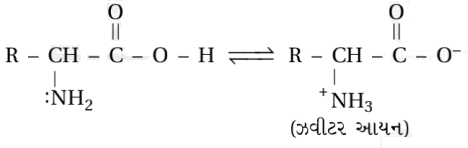
In aqueous solutions,the carboxyl group can lose a proton and the amino group can accept a proton,thus giving rise to a dipolar ion known as a $zwitter$ ion.
$R-CH(NH_2)-COOH \leftrightarrow R-CH(NH_3^+)-COO^-$ ($Zwitter$ ion)
Due to this dipolar behavior,they have strong electrostatic interactions within them and with water.
However,halo-acids do not exhibit such dipolar behavior.
For this reason,the melting points and the solubility of amino acids in water are higher than those of the corresponding halo-acids.
In aqueous solutions,the carboxyl group can lose a proton and the amino group can accept a proton,thus giving rise to a dipolar ion known as a $zwitter$ ion.
$R-CH(NH_2)-COOH \leftrightarrow R-CH(NH_3^+)-COO^-$ ($Zwitter$ ion)
Due to this dipolar behavior,they have strong electrostatic interactions within them and with water.
However,halo-acids do not exhibit such dipolar behavior.
For this reason,the melting points and the solubility of amino acids in water are higher than those of the corresponding halo-acids.
0 likes
View Solution284
Medium
Where does the water present in the egg go after boiling the egg?
Solution
(N/A) When an egg is boiled,the proteins present inside the egg undergo denaturation and coagulation. After boiling,the water present in the egg is absorbed by the coagulated protein network through $H$-bonding.
0 likes
View Solution285
Medium
What are essential and non-essential amino acids? Give two examples of each type.
Solution
(N/A) Essential amino acids are those that cannot be synthesized by the human body and must be obtained through the diet. Examples include $Valine$ and $Leucine$.
Non-essential amino acids are those that can be synthesized by the human body and do not necessarily need to be obtained through the diet. Examples include $Glycine$ and $Alanine$.
Non-essential amino acids are those that can be synthesized by the human body and do not necessarily need to be obtained through the diet. Examples include $Glycine$ and $Alanine$.
0 likes
View Solution286
Difficult
Define the following terms related to proteins: $(i)$ Peptide linkage,$(ii)$ Primary structure,$(iii)$ Denaturation.
Solution
(N/A) $(i)$ Peptide linkage: The amide bond formed between the $-COOH$ group of one amino acid molecule and the $-NH_2$ group of another amino acid molecule by the elimination of a water molecule is called a peptide linkage. For example,the reaction between Valine and Alanine forms a dipeptide with a peptide linkage.
$(ii)$ Primary structure: The primary structure of a protein refers to the specific sequence in which various amino acids are linked together in a polypeptide chain. Each protein has a unique sequence of amino acids,and any change in this sequence results in a different protein.
$(iii)$ Denaturation: In a biological system,a protein exists in a unique $3-D$ structure with specific biological activity,known as a native protein. When this native protein is subjected to physical changes (like temperature change) or chemical changes (like $pH$ change),its hydrogen bonds are disturbed. This causes the globules to unfold and the helix to uncoil,leading to the loss of biological activity. This process is called denaturation. During denaturation,the secondary and tertiary structures are destroyed,but the primary structure remains intact. An example is the coagulation of egg white upon boiling.
$(ii)$ Primary structure: The primary structure of a protein refers to the specific sequence in which various amino acids are linked together in a polypeptide chain. Each protein has a unique sequence of amino acids,and any change in this sequence results in a different protein.
$(iii)$ Denaturation: In a biological system,a protein exists in a unique $3-D$ structure with specific biological activity,known as a native protein. When this native protein is subjected to physical changes (like temperature change) or chemical changes (like $pH$ change),its hydrogen bonds are disturbed. This causes the globules to unfold and the helix to uncoil,leading to the loss of biological activity. This process is called denaturation. During denaturation,the secondary and tertiary structures are destroyed,but the primary structure remains intact. An example is the coagulation of egg white upon boiling.
0 likes
View Solution287
Difficult
What are the common types of secondary structure of proteins?
Solution
(N/A) There are two common types of secondary structure of proteins:
$(i)$ $\alpha$-helix structure
$(ii)$ $\beta$-pleated sheet structure
$\alpha$-Helix structure:
In this structure,the $-NH$ group of an amino acid residue forms an $H$-bond with the $>C=O$ group of the adjacent turn of the right-handed screw ($\alpha$-helix).
$\beta$-Pleated sheet structure:
This structure is called so because it looks like the pleated folds of drapery. In this structure,all the peptide chains are stretched out to nearly the maximum extension and then laid side by side. These peptide chains are held together by intermolecular hydrogen bonds.
$(i)$ $\alpha$-helix structure
$(ii)$ $\beta$-pleated sheet structure
$\alpha$-Helix structure:
In this structure,the $-NH$ group of an amino acid residue forms an $H$-bond with the $>C=O$ group of the adjacent turn of the right-handed screw ($\alpha$-helix).
$\beta$-Pleated sheet structure:
This structure is called so because it looks like the pleated folds of drapery. In this structure,all the peptide chains are stretched out to nearly the maximum extension and then laid side by side. These peptide chains are held together by intermolecular hydrogen bonds.
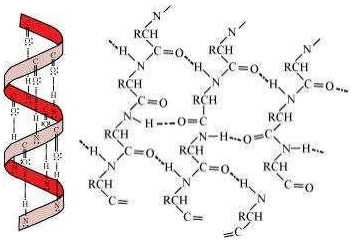
0 likes
View Solution288
MediumMCQ
What type of bonding helps in stabilising the $\alpha$-helix structure of proteins?
A
Hydrogen bonding
B
Ionic bonding
C
Covalent bonding
D
Van der Waals forces
Solution
(A) The $H$-bonds formed between the $-NH$ group of each amino acid residue and the $>C=O$ group of the adjacent turns of the $\alpha$-helix help in stabilising the helix.
0 likes
View Solution289
Difficult
Differentiate between globular and fibrous proteins.
Solution
(N/A)
| Fibrous protein | Globular protein |
|---|---|
| $1.$ It is a fibre-like structure formed by the polypeptide chain. These proteins are held together by strong hydrogen and disulphide bonds. | $1.$ The polypeptide chain in this protein is folded around itself,giving rise to a spherical structure. |
| $2.$ It is usually insoluble in water. | $2.$ It is usually soluble in water. |
| $3.$ Fibrous proteins are usually used for structural purposes. For example,keratin is present in nails and hair; collagen in tendons; and myosin in muscles. | $3.$ All enzymes are globular proteins. Some hormones such as insulin are also globular proteins. |
0 likes
View Solution290
Medium
How do you explain the amphoteric behaviour of amino acids?
Solution
In aqueous solution,the carboxyl group of an amino acid can lose a proton and the amino group can accept a proton to give a dipolar ion known as a zwitter ion.
$R-CH(NH_2)-COOH \leftrightarrow R-CH(NH_3^+)-COO^-$ (Zwitter ion)
Therefore,in zwitter ionic form,the amino acid can act both as an acid and as a base.
$R-CH(NH_2)-COOH \xrightarrow{H^+} R-CH(NH_3^+)-COOH$ (Acidic medium)
$R-CH(NH_3^+)-COO^- \xrightarrow{OH^-} R-CH(NH_2)-COO^-$ (Basic medium)
Thus,amino acids show amphoteric behaviour.
$R-CH(NH_2)-COOH \leftrightarrow R-CH(NH_3^+)-COO^-$ (Zwitter ion)
Therefore,in zwitter ionic form,the amino acid can act both as an acid and as a base.
$R-CH(NH_2)-COOH \xrightarrow{H^+} R-CH(NH_3^+)-COOH$ (Acidic medium)
$R-CH(NH_3^+)-COO^- \xrightarrow{OH^-} R-CH(NH_2)-COO^-$ (Basic medium)
Thus,amino acids show amphoteric behaviour.
0 likes
View Solution291
MediumMCQ
What is the effect of denaturation on the structure of proteins?
A
Primary structure is destroyed.
B
Secondary and tertiary structures are destroyed,while primary structure remains intact.
C
All structures (primary,secondary,and tertiary) are destroyed.
D
Only the primary structure is affected.
Solution
(B) As a result of denaturation,globules get unfolded and helixes get uncoiled.
Secondary and tertiary structures of protein are destroyed,but the primary structures remain unaltered.
It can be said that during denaturation,secondary and tertiary-structured proteins get converted into primary-structured proteins.
Also,as the secondary and tertiary structures of a protein are destroyed,the enzyme loses its activity.
Secondary and tertiary structures of protein are destroyed,but the primary structures remain unaltered.
It can be said that during denaturation,secondary and tertiary-structured proteins get converted into primary-structured proteins.
Also,as the secondary and tertiary structures of a protein are destroyed,the enzyme loses its activity.
0 likes
View Solution292
Medium
Write a general introduction and the importance of proteins.
Solution
(N/A) Proteins are the most abundant biomolecules in the living system. The chief sources of proteins are milk,cheese,pulses,peanuts,fish,meat,etc.
They occur in every part of the body and form the basis of the structure and functions of life. They are an important component for the growth and maintenance of the body.
The word protein is derived from the Greek word "proteios",which means primary or of prime importance. Proteins are polymers of $\alpha$-amino acids.
Amino acids contain amino $(-NH_{2})$ and carboxyl $(-COOH)$ functional groups. Depending upon the relative position of the amino group with respect to the carboxyl group,amino acids can be classified as $\alpha, \beta, \gamma, \delta$,and so on. Only $\alpha$-amino acids are obtained upon the hydrolysis of proteins. They may contain other functional groups as well.
All $\alpha$-amino acids have trivial names,which usually reflect the property of that compound or its source. For example,Glycine is so named since it has a sweet taste (in Greek,glykos means sweet),and Tyrosine was first obtained from cheese (in Greek,tyros means cheese). Amino acids are generally represented by three-letter symbols; sometimes,one-letter symbols are also used.
The general structure of an $\alpha$-amino acid is:
$R-CH(NH_{2})-COOH$
(where $R$ = side chain)
They occur in every part of the body and form the basis of the structure and functions of life. They are an important component for the growth and maintenance of the body.
The word protein is derived from the Greek word "proteios",which means primary or of prime importance. Proteins are polymers of $\alpha$-amino acids.
Amino acids contain amino $(-NH_{2})$ and carboxyl $(-COOH)$ functional groups. Depending upon the relative position of the amino group with respect to the carboxyl group,amino acids can be classified as $\alpha, \beta, \gamma, \delta$,and so on. Only $\alpha$-amino acids are obtained upon the hydrolysis of proteins. They may contain other functional groups as well.
All $\alpha$-amino acids have trivial names,which usually reflect the property of that compound or its source. For example,Glycine is so named since it has a sweet taste (in Greek,glykos means sweet),and Tyrosine was first obtained from cheese (in Greek,tyros means cheese). Amino acids are generally represented by three-letter symbols; sometimes,one-letter symbols are also used.
The general structure of an $\alpha$-amino acid is:
$R-CH(NH_{2})-COOH$
(where $R$ = side chain)
0 likes
View Solution293
Advanced
Write a note on amino acids.
Solution
(N/A) Amino acids are organic compounds containing both an amino group $(-NH_2)$ and a carboxyl group $(-COOH)$ attached to the same carbon atom,known as the $\alpha$-carbon.
They are the building blocks of proteins.
The general structure of an $\alpha$-amino acid is $R-CH(NH_2)-COOH$.
In aqueous solution,the carboxyl group can lose a proton and the amino group can accept a proton,giving rise to a dipolar ion known as a zwitterion.
This is represented as: $R-CH(NH_2)-COOH \rightleftharpoons R-CH(NH_3^+)-COO^-$.
Except for glycine,all naturally occurring $\alpha$-amino acids are optically active.
They are the building blocks of proteins.
The general structure of an $\alpha$-amino acid is $R-CH(NH_2)-COOH$.
In aqueous solution,the carboxyl group can lose a proton and the amino group can accept a proton,giving rise to a dipolar ion known as a zwitterion.
This is represented as: $R-CH(NH_2)-COOH \rightleftharpoons R-CH(NH_3^+)-COO^-$.
Except for glycine,all naturally occurring $\alpha$-amino acids are optically active.
0 likes
View Solution294
Difficult
Give the classification of amino acids based on their acidic,basic,or neutral nature.
Solution
(N/A) $(i)$ Acidic amino acids :
The amino acids with a greater number of carboxyl groups $(-COOH)$ compared to amino groups $(-NH_2)$ are called acidic amino acids. For example,aspartic acid,glutamic acid,etc.
$(ii)$ Basic amino acids :
The amino acids with a greater number of amino groups $(-NH_2)$ than carboxyl groups $(-COOH)$ are called basic amino acids. For example,arginine,lysine,etc.
$(iii)$ Neutral amino acids :
The amino acids with an equal number of carboxyl and amino groups are called neutral amino acids. For example,alanine,phenylalanine,leucine,etc.
The amino acids with a greater number of carboxyl groups $(-COOH)$ compared to amino groups $(-NH_2)$ are called acidic amino acids. For example,aspartic acid,glutamic acid,etc.
$(ii)$ Basic amino acids :
The amino acids with a greater number of amino groups $(-NH_2)$ than carboxyl groups $(-COOH)$ are called basic amino acids. For example,arginine,lysine,etc.
$(iii)$ Neutral amino acids :
The amino acids with an equal number of carboxyl and amino groups are called neutral amino acids. For example,alanine,phenylalanine,leucine,etc.
0 likes
View Solution295
Difficult
Discuss the structure and shape of proteins.
Solution
(N/A) Proteins are complex polymers of $\alpha$-amino acids. Their structure is described at four levels:
$1$. Primary structure: The specific sequence of amino acids in a polypeptide chain.
$2$. Secondary structure: The conformation of the polypeptide chain,which includes $\alpha$-helix and $\beta$-pleated sheet structures,stabilized by hydrogen bonding.
$3$. Tertiary structure: The overall three-dimensional folding of the polypeptide chain,resulting from interactions like hydrophobic interactions,ionic bonds,hydrogen bonds,and disulfide linkages.
$4$. Quaternary structure: The spatial arrangement of two or more polypeptide chains (subunits) in a multi-subunit protein.
Based on shape,proteins are classified as:
$(i)$ Fibrous proteins: Long,thread-like molecules held together by hydrogen and disulfide bonds (e.g.,keratin,myosin).
(ii) Globular proteins: Spherical shapes resulting from the folding of polypeptide chains (e.g.,insulin,albumin).
$1$. Primary structure: The specific sequence of amino acids in a polypeptide chain.
$2$. Secondary structure: The conformation of the polypeptide chain,which includes $\alpha$-helix and $\beta$-pleated sheet structures,stabilized by hydrogen bonding.
$3$. Tertiary structure: The overall three-dimensional folding of the polypeptide chain,resulting from interactions like hydrophobic interactions,ionic bonds,hydrogen bonds,and disulfide linkages.
$4$. Quaternary structure: The spatial arrangement of two or more polypeptide chains (subunits) in a multi-subunit protein.
Based on shape,proteins are classified as:
$(i)$ Fibrous proteins: Long,thread-like molecules held together by hydrogen and disulfide bonds (e.g.,keratin,myosin).
(ii) Globular proteins: Spherical shapes resulting from the folding of polypeptide chains (e.g.,insulin,albumin).
0 likes
View Solution296
MediumMCQ
Explain the classification of proteins based on their molecular structure.
A
Fibrous proteins
B
Globular proteins
C
Both $(A)$ and $(B)$
D
None of the above
Solution
(C) Proteins are classified into two types based on their molecular shape:
$1$. $Fibrous \ proteins$: These are long,thread-like molecules held together by hydrogen and disulfide bonds. They are generally insoluble in water. Examples include keratin (in hair,wool,silk) and myosin (in muscles).
$2$. $Globular \ proteins$: These result from the folding of polypeptide chains into a spherical shape. They are usually soluble in water. Examples include insulin and albumins.
$1$. $Fibrous \ proteins$: These are long,thread-like molecules held together by hydrogen and disulfide bonds. They are generally insoluble in water. Examples include keratin (in hair,wool,silk) and myosin (in muscles).
$2$. $Globular \ proteins$: These result from the folding of polypeptide chains into a spherical shape. They are usually soluble in water. Examples include insulin and albumins.
0 likes
View Solution297
Medium
Enlist the points of difference between fibrous and globular proteins.
Solution
(N/A) The differences between fibrous and globular proteins are as follows:
| No. | Fibrous Proteins | Globular Proteins |
| :--- | :--- | :--- |
| $1$ | These proteins are linear,having a thread-like structure. | These proteins have polypeptide chains folded to give a spheroidal shape. |
| $2$ | These proteins are water-insoluble. | These proteins are soluble in water because,during the folding of peptide chains,the hydrophilic groups are pushed outwards,which interact strongly with water. |
| $3$ | The polypeptide chains are held by strong hydrogen bonding. | The hydrogen bonding is comparatively weaker. |
| $4$ | They are stable to changes in $pH$. | They are sensitive to $pH$ changes. |
| No. | Fibrous Proteins | Globular Proteins |
| :--- | :--- | :--- |
| $1$ | These proteins are linear,having a thread-like structure. | These proteins have polypeptide chains folded to give a spheroidal shape. |
| $2$ | These proteins are water-insoluble. | These proteins are soluble in water because,during the folding of peptide chains,the hydrophilic groups are pushed outwards,which interact strongly with water. |
| $3$ | The polypeptide chains are held by strong hydrogen bonding. | The hydrogen bonding is comparatively weaker. |
| $4$ | They are stable to changes in $pH$. | They are sensitive to $pH$ changes. |
0 likes
View Solution298
Difficult
Explain the types of protein structures based on the provided image.
Solution
(N/A) The image illustrates the $\alpha$-helix structure,which is a type of secondary protein structure. Proteins have four levels of structural organization:
$1$. Primary Structure: The specific sequence of amino acids in a polypeptide chain.
$2$. Secondary Structure: Refers to the shape in which a long polypeptide chain can exist. It includes $\alpha$-helix and $\beta$-pleated sheet structures,stabilized by hydrogen bonding between the $C=O$ and $N-H$ groups of the peptide backbone.
$3$. Tertiary Structure: The overall three-dimensional folding of the entire polypeptide chain,stabilized by various interactions like hydrogen bonds,ionic bonds,disulfide linkages,and van der Waals forces.
$4$. Quaternary Structure: The spatial arrangement of two or more polypeptide chains (subunits) in a multi-subunit protein.
$1$. Primary Structure: The specific sequence of amino acids in a polypeptide chain.
$2$. Secondary Structure: Refers to the shape in which a long polypeptide chain can exist. It includes $\alpha$-helix and $\beta$-pleated sheet structures,stabilized by hydrogen bonding between the $C=O$ and $N-H$ groups of the peptide backbone.
$3$. Tertiary Structure: The overall three-dimensional folding of the entire polypeptide chain,stabilized by various interactions like hydrogen bonds,ionic bonds,disulfide linkages,and van der Waals forces.
$4$. Quaternary Structure: The spatial arrangement of two or more polypeptide chains (subunits) in a multi-subunit protein.
0 likes
View SolutionBiomolecules — Amino Acids and Proteins · Frequently Asked Questions
1Are these Biomolecules questions useful for JEE and NEET?
Yes. All questions in this section are mapped to JEE Main and NEET exam patterns. Previous year questions from JEE Main, NEET, GUJCET and state-level exams are included with full solutions.
2Can I switch to Hindi or Gujarati for these questions?
Yes. Use the language tabs in the hero section or the sidebar to view the same questions and solutions in English, Hindi or Gujarati.
3How do I generate a question paper from this subtopic?
Use the Vedclass Exam Paper Generator — select the chapter and subtopic, set difficulty, and generate Sets A, B, C, D automatically. First 3 chapters of every subject are free.
Vedclass Products
For Students
Vedclass Test Series
Mock tests in real JEE/NEET style with performance analysis. 5-day free trial.
Start Free TrialFor Teachers
Exam Paper Generator
Generate Set A/B/C/D papers from this chapter in 2 minutes. 3 chapters free.
Try FreeFor Institutes
Online Exam Module
Live online exams with unlimited students, 360° analytics & white-label branding.
See DemoFor Teachers & Institutes
Generate a Biomolecules Exam Paper in 2 Minutes
Select subtopic & difficulty — Sets A, B, C, D auto-generated with No Repeat logic.
First 3 chapters of every subject are free — no payment required.