
A English
Amino Acids and Proteins Questions in English
Class 12 Chemistry · Biomolecules · Amino Acids and Proteins
518+
Questions
English
Language
100%
With Solutions
Showing 50 of 518 questions in English
151
MediumMCQ
In aqueous solution,amino acids exist as.......
A
$NH_2-CHR-COOH$
B
$NH_2-CHR-COO^-$
C
$H_3N^+-CHR-COO^-$
D
$H_3N^+-CHR-COOH$
Solution
(C) In an aqueous solution,the carboxyl group $(-COOH)$ of an amino acid can lose a proton to form a carboxylate ion $(-COO^-)$,and the amino group $(-NH_2)$ can accept a proton to form an ammonium ion $(-NH_3^+)$.
This internal proton transfer results in the formation of a dipolar ion known as a zwitterion,represented as $H_3N^+-CHR-COO^-$.
Therefore,amino acids exist as zwitterions in aqueous solutions.
This internal proton transfer results in the formation of a dipolar ion known as a zwitterion,represented as $H_3N^+-CHR-COO^-$.
Therefore,amino acids exist as zwitterions in aqueous solutions.
0 likes
View Solution152
MediumMCQ
Which of the following $\alpha-$amino acids does not contain a chiral carbon?
A
Glycine
B
Alanine
C
Phenylalanine
D
Valine
Solution
(A) An $\alpha-$amino acid has a general structure $R-CH(NH_2)-COOH$.
$A$ chiral carbon is a carbon atom bonded to four different groups.
In Glycine,the $R$ group is a hydrogen atom $(-H)$.
Thus,the structure of Glycine is $H_2N-CH_2-COOH$.
Since the central carbon is bonded to two identical hydrogen atoms,it is achiral.
All other amino acids listed have different $R$ groups,making their $\alpha-$carbon chiral.
$A$ chiral carbon is a carbon atom bonded to four different groups.
In Glycine,the $R$ group is a hydrogen atom $(-H)$.
Thus,the structure of Glycine is $H_2N-CH_2-COOH$.
Since the central carbon is bonded to two identical hydrogen atoms,it is achiral.
All other amino acids listed have different $R$ groups,making their $\alpha-$carbon chiral.
0 likes
View Solution153
MediumMCQ
Which functional groups are responsible for the formation of a zwitterion?
A
$-NH_2, -COOH$
B
$-NH_2, -SO_3H$
C
Both $-NH_2, -COOH$ and $-NH_2, -SO_3H$
D
None of these
Solution
(C) zwitterion is a dipolar ion that contains both a positive and a negative charge.
It is formed when an acidic group (like $-COOH$ or $-SO_3H$) donates a proton to a basic group (like $-NH_2$) within the same molecule.
Therefore,both $-NH_2, -COOH$ and $-NH_2, -SO_3H$ combinations can form zwitterions.
It is formed when an acidic group (like $-COOH$ or $-SO_3H$) donates a proton to a basic group (like $-NH_2$) within the same molecule.
Therefore,both $-NH_2, -COOH$ and $-NH_2, -SO_3H$ combinations can form zwitterions.
0 likes
View Solution154
EasyMCQ
Sanger's reagent is used for the identification of which of the following?
A
$C$-terminal residue of a peptide chain
B
$N$-terminal residue of a peptide chain
C
Molecular weight of a protein
D
Secondary structure of a protein
Solution
(B) Sanger's reagent is $1$-fluoro-$2,4$-dinitrobenzene $(FDNB)$.
It reacts with the free amino group of the $N$-terminal residue of a peptide chain to form a yellow-colored dinitrophenyl derivative,which helps in identifying the $N$-terminal amino acid.
It reacts with the free amino group of the $N$-terminal residue of a peptide chain to form a yellow-colored dinitrophenyl derivative,which helps in identifying the $N$-terminal amino acid.
0 likes
View Solution155
EasyMCQ
What does hemoglobin in red blood cells primarily contain?
A
Iron
B
Copper
C
Zinc
D
Silver
Solution
(A) Hemoglobin is a respiratory pigment present in red blood cells. It is a conjugated protein consisting of a protein part called globin and a prosthetic group called heme. The heme group contains an $Fe^{2+}$ ion at its center,which is responsible for binding with oxygen. Therefore,hemoglobin primarily contains iron.
0 likes
View Solution156
DifficultMCQ
Which of the following acids behaves like a salt in aqueous solution?
A
Acetic acid
B
Benzoic acid
C
Formic acid
D
$\alpha$-Amino acetic acid
Solution
(D) $\alpha$-Amino acetic acid (Glycine) exists as a zwitterion in aqueous solution.
It contains both positive and negative charges within the same molecule,behaving like an internal salt.
$NH_2-CH_2-COOH \rightleftharpoons NH_3^+-CH_2-COO^-$.
This dipolar ion structure is characteristic of amino acids.
It contains both positive and negative charges within the same molecule,behaving like an internal salt.
$NH_2-CH_2-COOH \rightleftharpoons NH_3^+-CH_2-COO^-$.
This dipolar ion structure is characteristic of amino acids.
0 likes
View Solution157
MediumMCQ
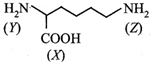
What is the correct order of acidity for the positions $(X)$,$(Y)$,and $(Z)$ in the given compound?
A
$Z > X > Y$
B
$X > Y > Z$
C
$X > Z > Y$
D
$Y > X > Z$
Solution
(B) The position $(X)$ corresponds to the carboxylic acid group $(-COOH)$,which is the most acidic site in the molecule.
Between the two amino groups at positions $(Y)$ and $(Z)$,the position $(Y)$ is closer to the electron-withdrawing $-COOH$ group.
The electron-withdrawing effect of the $-COOH$ group decreases the electron density on the nitrogen atom at position $(Y)$ more than at position $(Z)$,making the conjugate acid of $(Y)$ more stable (or the amino group at $(Y)$ less basic,which implies its conjugate acid is more acidic).
Therefore,the correct order of acidity is $X > Y > Z$.
Between the two amino groups at positions $(Y)$ and $(Z)$,the position $(Y)$ is closer to the electron-withdrawing $-COOH$ group.
The electron-withdrawing effect of the $-COOH$ group decreases the electron density on the nitrogen atom at position $(Y)$ more than at position $(Z)$,making the conjugate acid of $(Y)$ more stable (or the amino group at $(Y)$ less basic,which implies its conjugate acid is more acidic).
Therefore,the correct order of acidity is $X > Y > Z$.
0 likes
View Solution158
MediumMCQ
Which of the following is a protein?
A
Pepsin
B
Adrenaline
C
$ATP$
D
Glutamine
Solution
(A) . Pepsin is a digestive enzyme that is composed of protein. Adrenaline is a hormone,$ATP$ is a nucleotide,and Glutamine is an amino acid.
0 likes
View Solution159
MediumMCQ
Which of the following is not an amino acid?
A
Glycine
B
Alanine
C
Histidine
D
Benzidine
Solution
(D) is the correct answer.
Benzidine is not an amino acid; it is an aromatic amine with the formula $(NH_2C_6H_4)_2$.
Benzidine is not an amino acid; it is an aromatic amine with the formula $(NH_2C_6H_4)_2$.
0 likes
View Solution160
MediumMCQ
$A$ substance forms a zwitter ion. It can have which of the following functional groups?
A
$ - NH_2, - COOH$
B
$ - NH_2, - SO_3H$
C
Both
D
None of these
Solution
(C) zwitter ion is a dipolar ion that contains both a positive and a negative charge within the same molecule,resulting in a net charge of zero.
Amino acids containing both an amino group $(-NH_2)$ and a carboxylic acid group $(-COOH)$ form zwitter ions by internal proton transfer.
Similarly,compounds containing an amino group $(-NH_2)$ and a sulfonic acid group $(-SO_3H)$ can also form zwitter ions through internal proton transfer.
Therefore,both pairs of functional groups can lead to the formation of a zwitter ion.
Amino acids containing both an amino group $(-NH_2)$ and a carboxylic acid group $(-COOH)$ form zwitter ions by internal proton transfer.
Similarly,compounds containing an amino group $(-NH_2)$ and a sulfonic acid group $(-SO_3H)$ can also form zwitter ions through internal proton transfer.
Therefore,both pairs of functional groups can lead to the formation of a zwitter ion.
0 likes
View Solution161
MediumMCQ
Which functional group participates in disulphide bond formation in proteins?
A
Thiolactone
B
Thiol
C
Thioether
D
Thioester
Solution
(B) The thiol $(-SH)$ functional group present in the amino acid cysteine participates in the formation of disulphide bonds $(-S-S-)$ in proteins through an oxidation reaction.
0 likes
View Solution162
MediumMCQ
Which one of the following statements is true for protein synthesis (translation)?
A
Amino acids are directly recognized by $m-RNA$.
B
The third base of the codon is less specific.
C
Only one codon codes for an amino acid.
D
Every $t-RNA$ molecule has more than one amino acid attachment site.
Solution
(B) The correct statement is that the third base of the codon is less specific,which is known as the $Wobble$ $Hypothesis$.
$m-RNA$ does not directly recognize amino acids; instead,$t-RNA$ acts as an adaptor molecule.
Most amino acids are coded by more than one codon (degeneracy of genetic code).
Every $t-RNA$ molecule has only one specific amino acid attachment site at its $3'$-end.
$m-RNA$ does not directly recognize amino acids; instead,$t-RNA$ acts as an adaptor molecule.
Most amino acids are coded by more than one codon (degeneracy of genetic code).
Every $t-RNA$ molecule has only one specific amino acid attachment site at its $3'$-end.
0 likes
View Solution163
DifficultMCQ
An example of a sulphur-containing amino acid is:
A
Lysine
B
Serine
C
Cysteine
D
Tyrosine
Solution
(C) The amino acids are organic compounds containing an amino group $(-NH_2)$ and a carboxylic acid group $(-COOH)$.
Among the given options:
$A$. Lysine is a basic amino acid.
$B$. Serine is a hydroxy-containing amino acid.
$C$. Cysteine has the structure $HS-CH_2-CH(NH_2)-COOH$,which contains a thiol $(-SH)$ group,making it a sulphur-containing amino acid.
$D$. Tyrosine is an aromatic amino acid.
Therefore,the correct option is $C$.
Among the given options:
$A$. Lysine is a basic amino acid.
$B$. Serine is a hydroxy-containing amino acid.
$C$. Cysteine has the structure $HS-CH_2-CH(NH_2)-COOH$,which contains a thiol $(-SH)$ group,making it a sulphur-containing amino acid.
$D$. Tyrosine is an aromatic amino acid.
Therefore,the correct option is $C$.
0 likes
View Solution164
EasyMCQ
Which of the following statements is not correct?
A
Ovalbumin is a simple food reserve in egg-white.
B
Blood proteins thrombin and fibrinogen are involved in blood clotting.
C
Denaturation makes the proteins more active.
D
Insulin maintains sugar level in the blood of a human body.
Solution
(C) Denaturation is a process in which the secondary and tertiary structures of proteins are destroyed due to physical or chemical changes,such as change in $pH$ or temperature. During this process,the globules unfold and the helix becomes uncoiled,causing the protein to lose its biological activity. Therefore,the statement that denaturation makes proteins more active is incorrect.
0 likes
View Solution165
MediumMCQ
The central dogma of molecular genetics states that the genetic information flows from
A
Amino acids $\rightarrow$ Proteins $\rightarrow$ $DNA$
B
$DNA$ $\rightarrow$ Carbohydrates $\rightarrow$ Proteins
C
$DNA$ $\rightarrow$ $RNA$ $\rightarrow$ Proteins
D
$DNA$ $\rightarrow$ $RNA$ $\rightarrow$ Carbohydrates
Solution
(C) The central dogma of molecular biology describes the flow of genetic information within a biological system.
It states that genetic information flows from $DNA$ to $RNA$ and then to proteins.
The process is represented as: $DNA$ $\xrightarrow{\text{Transcription}} RNA$ $\xrightarrow{\text{Translation}} \text{Protein}$.
It states that genetic information flows from $DNA$ to $RNA$ and then to proteins.
The process is represented as: $DNA$ $\xrightarrow{\text{Transcription}} RNA$ $\xrightarrow{\text{Translation}} \text{Protein}$.
0 likes
View Solution166
MediumMCQ
In a protein molecule,various amino acids are linked together by:
A
peptide bond
B
dative bond
C
$\alpha - glycosidic$ bond
D
$\beta - glycosidic$ bond
Solution
(A) The peptide bond is an amide bond $(-CONH-)$ formed by the condensation reaction between the carboxyl group $(-COOH)$ of one amino acid and the amino group $(-NH_2)$ of another amino acid,with the elimination of a water molecule $(H_2O)$.
This linkage is responsible for the primary structure of proteins.
This linkage is responsible for the primary structure of proteins.
0 likes
View Solution167
MediumMCQ
Which of the statements about "Denaturation" given below are correct?
$1.$ Denaturation of proteins causes loss of secondary and tertiary structures of the protein.
$2.$ Denaturation leads to the conversion of double strand of $DNA$ into single strand.
$3.$ Denaturation affects primary structure which gets distorted.
$1.$ Denaturation of proteins causes loss of secondary and tertiary structures of the protein.
$2.$ Denaturation leads to the conversion of double strand of $DNA$ into single strand.
$3.$ Denaturation affects primary structure which gets distorted.
A
$2.$ and $3.$
B
$1.$ and $3.$
C
$1.$ and $2.$
D
$1.$,$2.$ and $3.$
Solution
(C) Statement $1$ is correct: Denaturation of proteins involves the unfolding of the polypeptide chain,leading to the loss of secondary and tertiary structures,while the primary structure remains intact.
Statement $2$ is correct: Denaturation of $DNA$ involves the separation of the two strands of the double helix into single strands due to the breaking of hydrogen bonds.
Statement $3$ is incorrect: Denaturation does not affect the primary structure of proteins,as the peptide bonds remain intact.
Therefore,statements $1$ and $2$ are correct.
Statement $2$ is correct: Denaturation of $DNA$ involves the separation of the two strands of the double helix into single strands due to the breaking of hydrogen bonds.
Statement $3$ is incorrect: Denaturation does not affect the primary structure of proteins,as the peptide bonds remain intact.
Therefore,statements $1$ and $2$ are correct.
0 likes
View Solution168
EasyMCQ
Thiol group is present in:
A
Cysteine
B
Methionine
C
Cytosine
D
Cystine
Solution
(A) The thiol group $(-SH)$ is a functional group consisting of a sulfur atom bonded to a hydrogen atom.
Among the given options,$Cysteine$ is an amino acid that contains a thiol group in its side chain.
The structure of $Cysteine$ is $HS-CH_2-CH(NH_2)-COOH$.
Among the given options,$Cysteine$ is an amino acid that contains a thiol group in its side chain.
The structure of $Cysteine$ is $HS-CH_2-CH(NH_2)-COOH$.
0 likes
View Solution169
MediumMCQ
The secondary structure of a protein refers to
A
fixed configuration of the polypeptide backbone
B
$\alpha -$ helical backbone
C
hydrophobic interactions
D
sequence of $\alpha -$ amino acids
Solution
(A) The primary structure of a protein refers to the specific sequence of $\alpha -$ amino acids in the polypeptide chain.
Secondary structure refers to the regular folding patterns of the polypeptide backbone,such as the $\alpha -$ helix and $\beta -$ pleated sheet structures.
These structures are stabilized by hydrogen bonding between the carbonyl oxygen $(C=O)$ and the amide hydrogen $(N-H)$ of the peptide backbone.
Secondary structure refers to the regular folding patterns of the polypeptide backbone,such as the $\alpha -$ helix and $\beta -$ pleated sheet structures.
These structures are stabilized by hydrogen bonding between the carbonyl oxygen $(C=O)$ and the amide hydrogen $(N-H)$ of the peptide backbone.
0 likes
View Solution170
MediumMCQ
The Biuret test is not given by:
A
Carbohydrates
B
Polypeptides
C
Urea
D
Proteins
Solution
(A) The Biuret test is a chemical test used to detect the presence of peptide bonds ($CONH$ linkage).
Since carbohydrates do not contain peptide bonds,they do not give a positive Biuret test.
Polypeptides and proteins contain multiple peptide bonds and thus give a positive test.
Urea $(NH_2CONH_2)$ also gives a positive Biuret test because it contains a structure similar to the biuret molecule $(H_2N-CO-NH-CO-NH_2)$.
Since carbohydrates do not contain peptide bonds,they do not give a positive Biuret test.
Polypeptides and proteins contain multiple peptide bonds and thus give a positive test.
Urea $(NH_2CONH_2)$ also gives a positive Biuret test because it contains a structure similar to the biuret molecule $(H_2N-CO-NH-CO-NH_2)$.
0 likes
View Solution171
EasyMCQ
Which of the following amino acids contains an alcohol functional group?
A
Valine
B
Serine
C
Cysteine
D
Alanine
Solution
(B) Amino acids are organic molecules consisting of a basic amino group $(-NH_2)$,an acidic carboxyl group $(-COOH)$,and an $R$ group (side chain) unique to each amino acid.
Amino acids are classified based on the chemical properties of their $R$ group.
Serine is an amino acid where the $R$ group is $-CH_2OH$,which contains a hydroxyl $(-OH)$ group,characteristic of an alcohol functional group.
Therefore,Serine is the correct answer.
Amino acids are classified based on the chemical properties of their $R$ group.
Serine is an amino acid where the $R$ group is $-CH_2OH$,which contains a hydroxyl $(-OH)$ group,characteristic of an alcohol functional group.
Therefore,Serine is the correct answer.
0 likes
View Solution172
EasyMCQ
Identify the basic amino acid.
A
Glycine
B
Alanine
C
Arginine
D
Aspartic acid
Solution
(C) Amino acids are classified based on the relative number of amino and carboxyl groups in their structure.
Basic amino acids contain more amino groups than carboxyl groups.
Arginine contains a guanidino group in its side chain,which makes it strongly basic.
The structure of Arginine is $H_2N-C(=NH)-NH-CH_2-CH_2-CH_2-CH(NH_2)-COOH$.
Basic amino acids contain more amino groups than carboxyl groups.
Arginine contains a guanidino group in its side chain,which makes it strongly basic.
The structure of Arginine is $H_2N-C(=NH)-NH-CH_2-CH_2-CH_2-CH(NH_2)-COOH$.
0 likes
View Solution173
MediumMCQ
Which of the following statements correctly describes the migration aptitude of aspartic acid during electrophoresis?
$(pK_1 = 2.0, pK_2 = 3.90, pK_3 = 10.0)$
$HOOC-CH_2-CH(NH_2)-COOH$
$(pK_1 = 2.0, pK_2 = 3.90, pK_3 = 10.0)$
$HOOC-CH_2-CH(NH_2)-COOH$
A
at $pH = 1.0$,aspartic acid migrates towards the $(+)$ electrode
B
at $pH = 2.95$,aspartic acid shows no net migration towards any electrode
C
at $pH = 7.0$,aspartic acid shows no net migration towards any electrode
D
at $pH = 9.0$,aspartic acid shows a net migration towards the $(-)$ electrode
Solution
(B) Aspartic acid is an acidic amino acid with three ionizable groups. The isoelectric point $(pI)$ is the $pH$ at which the molecule exists as a zwitterion with no net charge,resulting in no net migration during electrophoresis.
For an acidic amino acid,the $pI$ is calculated using the two lowest $pK_a$ values:
$pI = \frac{pK_1 + pK_2}{2} = \frac{2.0 + 3.90}{2} = 2.95$.
At $pH = 1.0$ $(pH < pI)$,the molecule is positively charged and migrates towards the $(-)$ electrode.
At $pH = 2.95$ $(pH = pI)$,the molecule has no net charge and shows no net migration.
At $pH = 7.0$ and $pH = 9.0$ $(pH > pI)$,the molecule is negatively charged and migrates towards the $(+)$ electrode.
For an acidic amino acid,the $pI$ is calculated using the two lowest $pK_a$ values:
$pI = \frac{pK_1 + pK_2}{2} = \frac{2.0 + 3.90}{2} = 2.95$.
At $pH = 1.0$ $(pH < pI)$,the molecule is positively charged and migrates towards the $(-)$ electrode.
At $pH = 2.95$ $(pH = pI)$,the molecule has no net charge and shows no net migration.
At $pH = 7.0$ and $pH = 9.0$ $(pH > pI)$,the molecule is negatively charged and migrates towards the $(+)$ electrode.
0 likes
View Solution174
EasyMCQ
Which of the following can be used to detect the presence of $\alpha$-amino acids?
A
Tollen's reagent
B
$NaSO_3H$ test
C
Ninhydrin test
D
Molisch test
Solution
(C) Ninhydrin is a chemical reagent used to detect the presence of proteins and $\alpha$-amino acids.
When $\alpha$-amino acids react with ninhydrin,they undergo oxidative deamination followed by decarboxylation to form a purple-colored compound known as Ruhemann's purple.
This color change allows for the detection of $\alpha$-amino acids.
When $\alpha$-amino acids react with ninhydrin,they undergo oxidative deamination followed by decarboxylation to form a purple-colored compound known as Ruhemann's purple.
This color change allows for the detection of $\alpha$-amino acids.
0 likes
View Solution175
EasyMCQ
Globular protein is present in -
A
Blood
B
Milk
C
Eggs
D
All of these
Solution
(D) Globular proteins are proteins where the polypeptide chain is folded into a spherical shape.
They are found in various biological systems:
$1$. In blood,albumins and globulins are globular proteins.
$2$. In milk,caseinogen is a globular protein.
$3$. In egg white,albumin is a globular protein.
Therefore,all of the given options contain globular proteins.
They are found in various biological systems:
$1$. In blood,albumins and globulins are globular proteins.
$2$. In milk,caseinogen is a globular protein.
$3$. In egg white,albumin is a globular protein.
Therefore,all of the given options contain globular proteins.
0 likes
View Solution176
MediumMCQ
Peptide linkage is:
A
$-CO-O-$
B
$-CO-NH_2$
C
$-CO-NH-NH_2$
D
$-CO-NH-$
Solution
(D) peptide linkage is a chemical bond formed between two molecules when the carboxyl group $(-COOH)$ of one molecule reacts with the amino group $(-NH_2)$ of the other molecule,releasing a molecule of water $(H_2O)$.
This is a condensation reaction and usually occurs between amino acids.
The resulting $-CO-NH-$ bond is called a peptide bond.
This is a condensation reaction and usually occurs between amino acids.
The resulting $-CO-NH-$ bond is called a peptide bond.
0 likes
View Solution177
MediumMCQ
The structural formula of an amino acid,isoleucine is:
A
$CH_3-CH(NH_2)-COOH$
B
$CH_3-CH(CH_3)-CH(NH_2)-COOH$
C
$CH_3-CH_2-CH(CH_3)-CH(NH_2)-COOH$
D
$CH_3-CH(CH_3)-CH_2-CH(NH_2)-COOH$
Solution
(C) Isoleucine is an essential amino acid with the $IUPAC$ name $2-\text{amino}-3-\text{methylpentanoic acid}$.
The structure consists of a pentanoic acid chain ($5$ carbons) with an amino group $(-NH_2)$ at the $C-2$ position and a methyl group $(-CH_3)$ at the $C-3$ position.
Breaking down the chain: The backbone is $CH_3-CH_2-CH(CH_3)-CH(NH_2)-COOH$.
Comparing this with the given options,the correct structural formula matches Option $C$.
The structure consists of a pentanoic acid chain ($5$ carbons) with an amino group $(-NH_2)$ at the $C-2$ position and a methyl group $(-CH_3)$ at the $C-3$ position.
Breaking down the chain: The backbone is $CH_3-CH_2-CH(CH_3)-CH(NH_2)-COOH$.
Comparing this with the given options,the correct structural formula matches Option $C$.
0 likes
View Solution178
EasyMCQ
Which is an optically inactive amino acid?
A
Glycine
B
Alanine
C
Lysine
D
Leucine
Solution
(A) An amino acid is optically active if it contains a chiral carbon atom.
Glycine,with the structure $NH_2-CH_2-COOH$,has two hydrogen atoms attached to the $\alpha$-carbon,making it achiral.
Therefore,Glycine is the only optically inactive amino acid among the standard amino acids.
Glycine,with the structure $NH_2-CH_2-COOH$,has two hydrogen atoms attached to the $\alpha$-carbon,making it achiral.
Therefore,Glycine is the only optically inactive amino acid among the standard amino acids.
0 likes
View Solution179
MediumMCQ
The $pH$ at the isoelectric point of three amino acids are given as follows:
$(Amino \ acid)_{II}$ is . . . . . . ?
| Amino acid | $pH$ at Isoelectric point |
|---|---|
| $(Amino \ acid)_{I}$ | $6$ |
| $(Amino \ acid)_{II}$ | $9.8$ |
| $(Amino \ acid)_{III}$ | $3.9$ |
$(Amino \ acid)_{II}$ is . . . . . . ?
A
Glycine
B
Lysine
C
Aspartic acid
D
Alanine
Solution
(B) The isoelectric point $(pI)$ of an amino acid is the $pH$ at which it exists as a zwitterion and has no net charge.
$1$. $(Amino \ acid)_{III}$ has $pI = 3.9$,which is acidic. This corresponds to an acidic amino acid like Aspartic acid.
$2$. $(Amino \ acid)_{I}$ has $pI = 6$,which is near neutral. This corresponds to a neutral amino acid like Glycine or Alanine.
$3$. $(Amino \ acid)_{II}$ has $pI = 9.8$,which is basic. This corresponds to a basic amino acid like Lysine,which contains an extra amino group.
$1$. $(Amino \ acid)_{III}$ has $pI = 3.9$,which is acidic. This corresponds to an acidic amino acid like Aspartic acid.
$2$. $(Amino \ acid)_{I}$ has $pI = 6$,which is near neutral. This corresponds to a neutral amino acid like Glycine or Alanine.
$3$. $(Amino \ acid)_{II}$ has $pI = 9.8$,which is basic. This corresponds to a basic amino acid like Lysine,which contains an extra amino group.
0 likes
View Solution180
MediumMCQ
Alanine $\xrightarrow{\Delta }$ Product,total number of products formed in this reaction.
A
$1$
B
$2$
C
$3$
D
$4$
Solution
(A) Alanine is $CH_3CH(NH_2)COOH$. When heated $(\Delta)$,it undergoes intermolecular dehydration to form a cyclic dipeptide known as a diketopiperazine. Specifically,two molecules of alanine condense to form $3,6$-dimethyl$-2,5-$diketopiperazine. Thus,the total number of products formed is $1$ (the cyclic dipeptide) plus water as a byproduct,but in the context of organic synthesis questions regarding the main organic product,the formation of the cyclic dimer is the primary result. However,strictly speaking,the reaction $2 \text{ Alanine} \xrightarrow{\Delta} \text{Diketopiperazine} 2H_2O$ yields the cyclic product and water. Given the options,the question asks for the number of organic products,which is $1$.
0 likes
View Solution181
EasyMCQ
Which amino acid is achiral?
A
Alanine
B
Valine
C
Leucine
D
Glycine
Solution
(D) An amino acid is achiral if it does not possess a chiral carbon atom.
In $Glycine$ $(NH_2-CH_2-COOH)$,the central carbon atom is bonded to two identical hydrogen atoms.
Since it lacks four different groups attached to the $\alpha$-carbon,it is achiral.
In $Glycine$ $(NH_2-CH_2-COOH)$,the central carbon atom is bonded to two identical hydrogen atoms.
Since it lacks four different groups attached to the $\alpha$-carbon,it is achiral.
0 likes
View Solution182
MediumMCQ
In the given reaction: $CH_3-CHCl-COOH \xrightarrow[(ii) H_2O]{(i) NH_3 (1 \text{ mole})} [X]$. Product $[X]$ will be:
A
$\alpha$-Amino acid
B
$\alpha$-Aminoamide
C
$\beta$-Amino acid
D
$\beta$-Aminoamide
Solution
(A) In this reaction,the chlorine atom at the $\alpha$-position of the carboxylic acid is substituted by an amino group $(-NH_2)$ via nucleophilic substitution using ammonia $(NH_3)$.
$CH_3-CHCl-COOH + NH_3 \rightarrow CH_3-CH(NH_2)-COOH + HCl$
The resulting product $[X]$ is $2$-aminopropanoic acid (Alanine),which is an $\alpha$-amino acid.
$CH_3-CHCl-COOH + NH_3 \rightarrow CH_3-CH(NH_2)-COOH + HCl$
The resulting product $[X]$ is $2$-aminopropanoic acid (Alanine),which is an $\alpha$-amino acid.
0 likes
View Solution183
MediumMCQ
The artificial sweetener aspartame $(A)$,$H_3N^{+}-CH(CH_2COO^{-})-CONH-CH(CH_2Ph)-COOCH_3$,is converted to . . . . . . on storage for extended periods of time in aqueous solution:
A
$H_3N^{+}-CH(CH_2COO^{-})-CONH-CH(CH_2Ph)-COOCH_3$
B
$H_2N-CH(CH_2COOH)-COOH + H_2N-CH(CH_2Ph)-COOH + CH_3OH$
C
$A$ cyclic diketopiperazine derivative + $CH_3OH$
D
no change,remains as $(A)$
Solution
(C) Aspartame ($L$-aspartyl-$L$-phenylalanine methyl ester) is unstable in aqueous solution.
On storage for extended periods,the amino group of the aspartic acid residue attacks the methyl ester of the phenylalanine residue.
This intramolecular reaction leads to the formation of a cyclic diketopiperazine ($3$-benzyl$-6-$carboxymethyl$-2,5-$diketopiperazine) and the release of methanol $(CH_3OH)$.
On storage for extended periods,the amino group of the aspartic acid residue attacks the methyl ester of the phenylalanine residue.
This intramolecular reaction leads to the formation of a cyclic diketopiperazine ($3$-benzyl$-6-$carboxymethyl$-2,5-$diketopiperazine) and the release of methanol $(CH_3OH)$.
0 likes
View Solution184
MediumMCQ
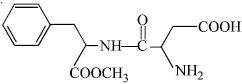
The synthetic sweetener aspartame,known commercially as NutraSweet,is a methyl ester of a dipeptide. In aqueous solution on standing,it changes to:
A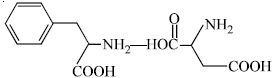
B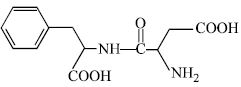
C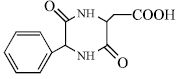
D
no hydrolysis is possible
Solution
(C) Aspartame is the methyl ester of the dipeptide formed from aspartic acid and phenylalanine.
In an aqueous solution,the methyl ester group $(-COOCH_3)$ is susceptible to hydrolysis.
Upon standing in an aqueous medium,the ester group undergoes hydrolysis to form a carboxylic acid group $(-COOH)$,while the peptide bond remains intact under these conditions.
Therefore,the structure changes to the corresponding dipeptide,which is $L-aspartyl-L-phenylalanine$.
In an aqueous solution,the methyl ester group $(-COOCH_3)$ is susceptible to hydrolysis.
Upon standing in an aqueous medium,the ester group undergoes hydrolysis to form a carboxylic acid group $(-COOH)$,while the peptide bond remains intact under these conditions.
Therefore,the structure changes to the corresponding dipeptide,which is $L-aspartyl-L-phenylalanine$.
0 likes
View Solution185
EasyMCQ
Which of the following will not give a purple color with ninhydrin?
A
Alanine
B
Glycine
C
Proline
D
Glutamic acid
Solution
(C) Ninhydrin reacts with $\alpha$-amino acids to form a purple-colored complex known as Ruhemann's purple.
This reaction requires the presence of a free primary amino group ($-NH_2$ group).
Proline is an imino acid where the nitrogen atom is part of a five-membered pyrrolidine ring.
Because the nitrogen in proline is a secondary amine $(-NH-)$ rather than a primary amine,it reacts with ninhydrin to produce a yellow-colored product instead of the characteristic purple color.
This reaction requires the presence of a free primary amino group ($-NH_2$ group).
Proline is an imino acid where the nitrogen atom is part of a five-membered pyrrolidine ring.
Because the nitrogen in proline is a secondary amine $(-NH-)$ rather than a primary amine,it reacts with ninhydrin to produce a yellow-colored product instead of the characteristic purple color.
0 likes
View Solution186
DifficultMCQ
Structures of alanine at $pH = 2$ and $pH = 10$ are respectively
A
$CH_3-CH(N^{+}H_3)-COOH$ and $CH_3-CH(NH_2)-COO^{-}$
B
$CH_3-CH(NH_2)-COO^{-}$ and $CH_3-CH(N^{+}H_3)-COOH$
C
$CH_3-CH(NH_2)-COO^{-}$ both
D
$CH_3-CH(N^{+}H_3)-COOH$ both
Solution
(A) Alanine is an amino acid with the structure $CH_3-CH(NH_2)-COOH$.
$1$. At low $pH$ ($pH = 2$,acidic medium),the basic amino group $(-NH_2)$ accepts a proton to form a cation: $CH_3-CH(N^{+}H_3)-COOH$.
$2$. At high $pH$ ($pH = 10$,basic medium),the acidic carboxylic group $(-COOH)$ loses a proton to form an anion: $CH_3-CH(NH_2)-COO^{-}$.
$1$. At low $pH$ ($pH = 2$,acidic medium),the basic amino group $(-NH_2)$ accepts a proton to form a cation: $CH_3-CH(N^{+}H_3)-COOH$.
$2$. At high $pH$ ($pH = 10$,basic medium),the acidic carboxylic group $(-COOH)$ loses a proton to form an anion: $CH_3-CH(NH_2)-COO^{-}$.
0 likes
View Solution187
MediumMCQ
Which of the following amino acids contains the $HN=C(NH_2)-$ linkage?
A
Tyrosine
B
Tryptophan
C
Arginine
D
Asparagine
Solution
(C) The amino acid $Arginine$ contains a guanidino group in its side chain.
This group is represented by the structure $H_2N-C(=NH)-NH-R$,which contains the $HN=C(NH_2)-$ linkage.
Therefore,the correct option is $(c)$.
This group is represented by the structure $H_2N-C(=NH)-NH-R$,which contains the $HN=C(NH_2)-$ linkage.
Therefore,the correct option is $(c)$.
0 likes
View Solution188
MediumMCQ
When $HNO_3$ is dropped into the palm and washed with water,it turns yellow. The above yellow colour is due to:
A
Nitrosation of protein
B
Sulphonation of protein
C
Nitration of protein
D
Chlorination of protein
Solution
(C) When concentrated $HNO_3$ comes in contact with the skin (which contains proteins),it causes the nitration of the aromatic amino acids present in the protein,such as tyrosine and tryptophan.
This reaction forms yellow-colored nitro compounds,a process known as the xanthoproteic reaction.
Therefore,the yellow stain on the skin is due to the nitration of proteins.
This reaction forms yellow-colored nitro compounds,a process known as the xanthoproteic reaction.
Therefore,the yellow stain on the skin is due to the nitration of proteins.
0 likes
View Solution189
DifficultMCQ
Which of the following amino acids does not contain an asymmetric carbon?
A
Histidine
B
Glycine
C
$\alpha-$ Alanine
D
Threonine
Solution
(B) An asymmetric carbon (or chiral center) is a carbon atom bonded to four different groups.
Glycine has the structure $H_2N-CH_2-COOH$.
In glycine,the central carbon atom is bonded to two identical hydrogen atoms,so it is not asymmetric (achiral).
All other amino acids listed,such as histidine,$\alpha-$ alanine,and threonine,contain at least one chiral carbon atom.
Therefore,the correct option is $B$.
Glycine has the structure $H_2N-CH_2-COOH$.
In glycine,the central carbon atom is bonded to two identical hydrogen atoms,so it is not asymmetric (achiral).
All other amino acids listed,such as histidine,$\alpha-$ alanine,and threonine,contain at least one chiral carbon atom.
Therefore,the correct option is $B$.
0 likes
View Solution190
EasyMCQ
Which of the following amino acids is optically inactive?
A
Glycine
B
Alanine
C
Proline
D
Histidine
Solution
(A) Amino acids consist of an amine group $(-NH_2)$ and a carboxyl group $(-COOH)$ attached to the same alpha-carbon atom.
An amino acid is optically active if the alpha-carbon is chiral,meaning it is bonded to four different groups.
Glycine,with the structure $H_2N-CH_2-COOH$,has two hydrogen atoms attached to the alpha-carbon.
Since the alpha-carbon is not bonded to four different groups,it is achiral.
Therefore,$Glycine$ is the only optically inactive amino acid among the $20$ common amino acids.
An amino acid is optically active if the alpha-carbon is chiral,meaning it is bonded to four different groups.
Glycine,with the structure $H_2N-CH_2-COOH$,has two hydrogen atoms attached to the alpha-carbon.
Since the alpha-carbon is not bonded to four different groups,it is achiral.
Therefore,$Glycine$ is the only optically inactive amino acid among the $20$ common amino acids.
0 likes
View Solution191
EasyMCQ
Optically inactive amino acid is :-
A
Lysine
B
Glycine
C
Arginine
D
Alanine
Solution
(B) Glycine is the simplest amino acid. Its structure is $H_2N-CH_2-COOH$. Since the $\alpha$-carbon is bonded to two identical hydrogen atoms,it is achiral and thus optically inactive.
0 likes
View Solution192
MediumMCQ
Which of the following is the correct structure of $L$-alanine?
A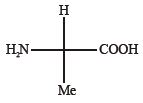
B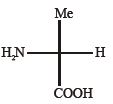
C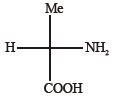
D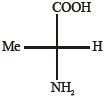
Solution
(B) In the Fischer projection of $L$-amino acids,the $COOH$ group is placed at the top and the side chain ($R$ group) at the bottom. For $L$-alanine,the amino group $(-NH_2)$ must be on the left side of the vertical carbon chain.
$1$. The general structure of an amino acid is $R-CH(NH_2)-COOH$.
$2$. For $L$-alanine,$R = CH_3$ (methyl group,denoted as $Me$).
$3$. In the Fischer projection,placing $COOH$ at the top and $CH_3$ at the bottom,the $-NH_2$ group is placed on the left to represent the $L$-configuration.
$4$. Comparing this with the given options,option $A$ shows the $-NH_2$ group on the left,$COOH$ at the top,$H$ at the top (wait,let's re-examine the images).
Re-evaluating the images:
- Option $A$: $H$ is top,$Me$ is bottom,$H_2N$ is left,$COOH$ is right. This is not the standard orientation.
- Option $B$: $Me$ is top,$COOH$ is bottom,$H_2N$ is left,$H$ is right. This is the correct $L$-configuration where the amino group is on the left when the carbon chain is vertical.
Therefore,the correct structure is $B$.
$1$. The general structure of an amino acid is $R-CH(NH_2)-COOH$.
$2$. For $L$-alanine,$R = CH_3$ (methyl group,denoted as $Me$).
$3$. In the Fischer projection,placing $COOH$ at the top and $CH_3$ at the bottom,the $-NH_2$ group is placed on the left to represent the $L$-configuration.
$4$. Comparing this with the given options,option $A$ shows the $-NH_2$ group on the left,$COOH$ at the top,$H$ at the top (wait,let's re-examine the images).
Re-evaluating the images:
- Option $A$: $H$ is top,$Me$ is bottom,$H_2N$ is left,$COOH$ is right. This is not the standard orientation.
- Option $B$: $Me$ is top,$COOH$ is bottom,$H_2N$ is left,$H$ is right. This is the correct $L$-configuration where the amino group is on the left when the carbon chain is vertical.
Therefore,the correct structure is $B$.
0 likes
View Solution193
EasyMCQ
Example$(s)$ of aromatic amino acid is/are:
A
Tryptophan
B
Phenylalanine
C
Tyrosine
D
All of these
Solution
(D) Amino acids are the building blocks of proteins,composed of $C, H, O, N$ and sometimes $S$.
They contain a carboxyl group and an amine group attached to the $\alpha$-carbon.
Amino acids can exist as zwitterions.
Aromatic amino acids are those that contain an aromatic ring (benzene ring) in their side chain.
Examples of aromatic amino acids include phenylalanine,tyrosine,and tryptophan.
Therefore,all the given options are correct.
They contain a carboxyl group and an amine group attached to the $\alpha$-carbon.
Amino acids can exist as zwitterions.
Aromatic amino acids are those that contain an aromatic ring (benzene ring) in their side chain.
Examples of aromatic amino acids include phenylalanine,tyrosine,and tryptophan.
Therefore,all the given options are correct.
0 likes
View Solution194
EasyMCQ
Which amino acid does not contain a chiral center?
A
Valine
B
Leucine
C
Glycine
D
Isoleucine
Solution
(C) chiral center is a carbon atom bonded to four different groups.
In $Glycine$ $(NH_2-CH_2-COOH)$,the central carbon atom is bonded to two hydrogen atoms,one amino group $(-NH_2)$,and one carboxyl group $(-COOH)$.
Since two of the groups attached to the central carbon are identical (both are hydrogen atoms),it is not a chiral center.
Therefore,$Glycine$ is the only optically inactive amino acid among the options.
In $Glycine$ $(NH_2-CH_2-COOH)$,the central carbon atom is bonded to two hydrogen atoms,one amino group $(-NH_2)$,and one carboxyl group $(-COOH)$.
Since two of the groups attached to the central carbon are identical (both are hydrogen atoms),it is not a chiral center.
Therefore,$Glycine$ is the only optically inactive amino acid among the options.
0 likes
View Solution195
MediumMCQ
Identify the amino acids obtained by hydrolysis of the following compound: $NH_2-CH(CH_3)-CO-NH-CH_2-COOH$
A
Glycine
B
Alanine
C
Both $(A)$ and $(B)$
D
None of these
Solution
(C) The given compound is a dipeptide,Alanyl-glycine.
Upon hydrolysis of the peptide bond $(-CO-NH-)$,the molecule breaks into its constituent amino acids.
The two amino acids obtained are Alanine $(NH_2-CH(CH_3)-COOH)$ and Glycine $(NH_2-CH_2-COOH)$.
Upon hydrolysis of the peptide bond $(-CO-NH-)$,the molecule breaks into its constituent amino acids.
The two amino acids obtained are Alanine $(NH_2-CH(CH_3)-COOH)$ and Glycine $(NH_2-CH_2-COOH)$.
0 likes
View Solution196
MediumMCQ
Which of the following is not an essential amino acid?
A
Valine
B
Leucine
C
Arginine
D
Aspartic acid
Solution
(D) Essential amino acids are those that cannot be synthesized by the human body and must be obtained through the diet.
Non-essential amino acids are those that can be synthesized by the body.
$Valine$,$Leucine$,and $Arginine$ are essential amino acids.
$Aspartic$ $acid$ is a non-essential amino acid because it can be synthesized by the body from oxaloacetate via transamination.
Non-essential amino acids are those that can be synthesized by the body.
$Valine$,$Leucine$,and $Arginine$ are essential amino acids.
$Aspartic$ $acid$ is a non-essential amino acid because it can be synthesized by the body from oxaloacetate via transamination.
0 likes
View Solution197
MediumMCQ
Peptide linkage is present in:
A
Protein
B
Nylon-$66$
C
Biurides
D
All of these
Solution
(D) peptide linkage is an amide bond formed between the carboxyl group $(-COOH)$ of one amino acid and the amino group $(-NH_2)$ of another amino acid.
$1$. Proteins are polymers of amino acids linked by peptide bonds.
$2$. Nylon-$66$ is a polyamide formed by the condensation polymerization of hexamethylenediamine and adipic acid,containing amide linkages $(-CONH-)$,which are chemically identical to peptide linkages.
$3$. Biurides (or biurets) are compounds containing the $-NH-CO-NH-CO-NH_2$ group,which also contain amide linkages.
Therefore,all the given options contain amide/peptide linkages.
$1$. Proteins are polymers of amino acids linked by peptide bonds.
$2$. Nylon-$66$ is a polyamide formed by the condensation polymerization of hexamethylenediamine and adipic acid,containing amide linkages $(-CONH-)$,which are chemically identical to peptide linkages.
$3$. Biurides (or biurets) are compounds containing the $-NH-CO-NH-CO-NH_2$ group,which also contain amide linkages.
Therefore,all the given options contain amide/peptide linkages.
0 likes
View Solution198
EasyMCQ
Which of the following pair of amino acids are obtained during the hydrolysis of aspartame?
A
Aspartic acid + lysine
B
Aspartic acid + phenylalanine
C
Lysine + phenylalanine
D
Aspartic acid + glutamine
Solution
(B) Aspartame is a methyl ester of a dipeptide formed from two amino acids: $L$-aspartic acid and $L$-phenylalanine.
Upon hydrolysis,the peptide bond and the ester bond are broken,yielding $L$-aspartic acid,$L$-phenylalanine,and methanol.
Therefore,the correct pair is $Aspartic \ acid + Phenylalanine$.
Upon hydrolysis,the peptide bond and the ester bond are broken,yielding $L$-aspartic acid,$L$-phenylalanine,and methanol.
Therefore,the correct pair is $Aspartic \ acid + Phenylalanine$.
0 likes
View Solution199
EasyMCQ
Name the molecule which is eliminated during the formation of a peptide bond.
A
Acid
B
Amine
C
Water
D
Alcohol
Solution
(C) peptide bond is formed by the condensation reaction between the carboxyl group $(-COOH)$ of one amino acid and the amino group $(-NH_2)$ of another amino acid.
During this reaction,a molecule of water $(H_2O)$ is eliminated.
The reaction can be represented as: $R-CH(NH_2)-COOH + R'-CH(NH_2)-COOH \rightarrow R-CH(NH_2)-CONH-CH(R')-COOH + H_2O$.
During this reaction,a molecule of water $(H_2O)$ is eliminated.
The reaction can be represented as: $R-CH(NH_2)-COOH + R'-CH(NH_2)-COOH \rightarrow R-CH(NH_2)-CONH-CH(R')-COOH + H_2O$.
0 likes
View Solution200
MediumMCQ
Which of the following is a Zwitter ion?
A
Anilinium chloride
B
Oxonium salt
C
$N$-methylpiperidinium chloride
D
Sulfanilic acid (dipolar form)
Solution
(D) Zwitter ion is a molecule that contains an equal number of positively and negatively charged functional groups,making it electrically neutral overall.
In the given options,the structure in option $D$ represents the dipolar form of sulfanilic acid,where the $-NH_3^+$ group and the $-SO_3^-$ group are present on the same molecule,which is a classic example of a Zwitter ion.
Options $A$,$B$,and $C$ are simple ionic salts,not Zwitter ions.
In the given options,the structure in option $D$ represents the dipolar form of sulfanilic acid,where the $-NH_3^+$ group and the $-SO_3^-$ group are present on the same molecule,which is a classic example of a Zwitter ion.
Options $A$,$B$,and $C$ are simple ionic salts,not Zwitter ions.
0 likes
View SolutionBiomolecules — Amino Acids and Proteins · Frequently Asked Questions
1Are these Biomolecules questions useful for JEE and NEET?
Yes. All questions in this section are mapped to JEE Main and NEET exam patterns. Previous year questions from JEE Main, NEET, GUJCET and state-level exams are included with full solutions.
2Can I switch to Hindi or Gujarati for these questions?
Yes. Use the language tabs in the hero section or the sidebar to view the same questions and solutions in English, Hindi or Gujarati.
3How do I generate a question paper from this subtopic?
Use the Vedclass Exam Paper Generator — select the chapter and subtopic, set difficulty, and generate Sets A, B, C, D automatically. First 3 chapters of every subject are free.
Vedclass Products
For Students
Vedclass Test Series
Mock tests in real JEE/NEET style with performance analysis. 5-day free trial.
Start Free TrialFor Teachers
Exam Paper Generator
Generate Set A/B/C/D papers from this chapter in 2 minutes. 3 chapters free.
Try FreeFor Institutes
Online Exam Module
Live online exams with unlimited students, 360° analytics & white-label branding.
See DemoFor Teachers & Institutes
Generate a Biomolecules Exam Paper in 2 Minutes
Select subtopic & difficulty — Sets A, B, C, D auto-generated with No Repeat logic.
First 3 chapters of every subject are free — no payment required.