
A English
Fats and Lipids Questions in English
Class 12 Chemistry · Biomolecules · Fats and Lipids
86+
Questions
English
Language
100%
With Solutions
Showing 50 of 86 questions in English
1
MediumMCQ
Coconut oil upon alkaline hydrolysis gives
A
Glycol
B
Alcohol
C
Glycerol
D
Ethylene oxide
Solution
(C) Coconut oil is a triglyceride,which is an ester of fatty acids and glycerol.
Upon alkaline hydrolysis (saponification),it reacts with an alkali (like $NaOH$ or $KOH$) to produce soap (salts of fatty acids) and glycerol.
Reaction: $\text{Triglyceride} + 3NaOH \to 3\text{Soap} + \text{Glycerol}$.
Upon alkaline hydrolysis (saponification),it reacts with an alkali (like $NaOH$ or $KOH$) to produce soap (salts of fatty acids) and glycerol.
Reaction: $\text{Triglyceride} + 3NaOH \to 3\text{Soap} + \text{Glycerol}$.
0 likes
View Solution2
MediumMCQ
Oil $ + NaOH_{(aq)} \xrightarrow{\Delta } $ Glycerol + Soap
The above reaction is called:
The above reaction is called:
A
Saponification
B
Esterification
C
Hydrogenation
D
None of these
Solution
(A) Saponification is a process that involves the conversion of fat,oil,or lipid into soap and alcohol (glycerol) by the action of heat in the presence of an aqueous alkali.
Esterification is the process of combining an organic acid $(RCOOH)$ with an alcohol $(ROH)$ to form an ester $(RCOOR)$ and water.
Hydrogenation is a chemical reaction between molecular hydrogen $(H_2)$ and another compound or element,usually in the presence of a catalyst such as nickel,palladium,or platinum.
Therefore,the given reaction is a saponification reaction.
Esterification is the process of combining an organic acid $(RCOOH)$ with an alcohol $(ROH)$ to form an ester $(RCOOR)$ and water.
Hydrogenation is a chemical reaction between molecular hydrogen $(H_2)$ and another compound or element,usually in the presence of a catalyst such as nickel,palladium,or platinum.
Therefore,the given reaction is a saponification reaction.
0 likes
View Solution3
DifficultMCQ
Fats,on alkaline hydrolysis,give:
A
Oils
B
Soaps
C
Detergents
D
Glycol + acid
Solution
(B) Fats are esters of higher fatty acids with glycerol. On alkaline hydrolysis (saponification),they yield glycerol and the sodium or potassium salts of fatty acids,which are known as soaps.
The reaction is: $CH_2(OCOR)-CH(OCOR)-CH_2(OCOR) + 3NaOH \to CH_2(OH)-CH(OH)-CH_2(OH) + 3RCOONa$.
The reaction is: $CH_2(OCOR)-CH(OCOR)-CH_2(OCOR) + 3NaOH \to CH_2(OH)-CH(OH)-CH_2(OH) + 3RCOONa$.
0 likes
View Solution4
MediumMCQ
Which alcohol reacts with fatty acids to form fats?
A
Ethanol
B
Glycerol
C
Methanol
D
Isopropanol
Solution
(B) Fats are triglycerides,which are esters formed by the reaction of $Glycerol$ (propane-$1,2,3$-triol) with three molecules of fatty acids (long-chain carboxylic acids).
The reaction is an esterification process:
$CH_2(OH)CH(OH)CH_2(OH) + 3RCOOH \rightarrow CH_2(OCOR)CH(OCOR)CH_2(OCOR) + 3H_2O$
Thus,$Glycerol$ is the alcohol that reacts with fatty acids to form fats.
The reaction is an esterification process:
$CH_2(OH)CH(OH)CH_2(OH) + 3RCOOH \rightarrow CH_2(OCOR)CH(OCOR)CH_2(OCOR) + 3H_2O$
Thus,$Glycerol$ is the alcohol that reacts with fatty acids to form fats.
0 likes
View Solution5
MediumMCQ
Glycerol as a triester is present in:
A
Petroleum
B
Kerosene
C
Vegetable oil and fat
D
Naphtha
Solution
(C) All naturally occurring fats and oils are triglycerides,which are triesters of glycerol (glycerin) with long-chain fatty acids.
The general structure of a triglyceride is formed by the esterification of glycerol with three fatty acid molecules.
$A$ common example is glyceryl tripalmitate,as shown in the structure:
$CH_2-O-CO-(CH_2)_{14}-CH_3$
$|$
$CH-O-CO-(CH_2)_{14}-CH_3$
$|$
$CH_2-O-CO-(CH_2)_{14}-CH_3$
The general structure of a triglyceride is formed by the esterification of glycerol with three fatty acid molecules.
$A$ common example is glyceryl tripalmitate,as shown in the structure:
$CH_2-O-CO-(CH_2)_{14}-CH_3$
$|$
$CH-O-CO-(CH_2)_{14}-CH_3$
$|$
$CH_2-O-CO-(CH_2)_{14}-CH_3$
0 likes
View Solution6
MediumMCQ
Washing soap can be prepared by saponification with alkali of which of the following oils?
A
Rose oil
B
Paraffin oil
C
Groundnut oil
D
Kerosene
Solution
(C) Soap is the sodium or potassium salt of long-chain fatty acids. It is prepared by the process of saponification,which involves the reaction of fats or oils (triglycerides) with an alkali like $NaOH$ or $KOH$. Among the given options,$Groundnut \ oil$ is a triglyceride (fat/oil) and can undergo saponification to produce soap. $Rose \ oil$ is an essential oil,while $Paraffin \ oil$ and $Kerosene$ are hydrocarbons and do not undergo saponification. Therefore,the correct option is $(C)$.
0 likes
View Solution7
DifficultMCQ
Palmitic acid is
A
$C_{16}H_{31}COOH$
B
$C_{17}H_{35}COOH$
C
$C_{15}H_{31}COOH$
D
$C_{17}H_{31}COOH$
Solution
(C) The correct option is $C$.
Palmitic acid is a saturated fatty acid with a $16$-carbon chain.
Its chemical formula is $C_{15}H_{31}COOH$ (or $CH_3(CH_2)_{14}COOH$).
Palmitic acid is a saturated fatty acid with a $16$-carbon chain.
Its chemical formula is $C_{15}H_{31}COOH$ (or $CH_3(CH_2)_{14}COOH$).
0 likes
View Solution8
MediumMCQ
Fats and oils are mixtures of:
A
Glycerides and saturated fatty acids
B
Glycerides and unsaturated fatty acids
C
Glycerides of saturated and unsaturated fatty acids
D
Only saturated and unsaturated fatty acids
Solution
(C) Fats and oils are chemically known as triglycerides or triacylglycerols.
They are esters formed from the reaction of glycerol $(CH_2OH-CHOH-CH_2OH)$ with three fatty acid molecules.
These fatty acids can be either saturated (e.g.,stearic acid) or unsaturated (e.g.,oleic acid).
Therefore,fats and oils are mixtures of glycerides of both saturated and unsaturated fatty acids.
They are esters formed from the reaction of glycerol $(CH_2OH-CHOH-CH_2OH)$ with three fatty acid molecules.
These fatty acids can be either saturated (e.g.,stearic acid) or unsaturated (e.g.,oleic acid).
Therefore,fats and oils are mixtures of glycerides of both saturated and unsaturated fatty acids.
0 likes
View Solution9
EasyMCQ
Which one of the following is not a glyceride?
A
$Fat$
B
$Oil$
C
$Phospholipid$
D
$Soaps$
Solution
(D) $Soaps$ are the sodium or potassium salts of long-chain fatty acids,such as $C_{17}H_{35}COONa$ (sodium stearate).
$Fats$,$oils$,and $phospholipids$ are all esters of glycerol (glycerides).
Therefore,$soaps$ are not glycerides.
$Fats$,$oils$,and $phospholipids$ are all esters of glycerol (glycerides).
Therefore,$soaps$ are not glycerides.
0 likes
View Solution10
MediumMCQ
Waxes are long-chain compounds belonging to the class of:
A
Acids
B
Alcohols
C
Esters
D
Ethers
Solution
(C) Waxes are naturally occurring organic compounds that are typically long-chain esters formed by the reaction of long-chain fatty acids with long-chain monohydric alcohols. Therefore,they belong to the class of $Esters$.
0 likes
View Solution11
MediumMCQ
Which of the following is not a fatty acid?
A
Stearic acid
B
Palmitic acid
C
Oleic acid
D
Phenyl acetic acid
Solution
(D) Phenyl acetic acid is an aromatic carboxylic acid,whereas stearic acid,palmitic acid,and oleic acid are long-chain aliphatic carboxylic acids known as fatty acids.
0 likes
View Solution12
MediumMCQ
Fats and oils are
A
Acids
B
Alcohols
C
Esters
D
Hydrocarbons
Solution
(C) Fats and oils are collectively known as lipids,which are the $esters$ of glycerol with long-chain fatty acids.
0 likes
View Solution13
MediumMCQ
Sodium or potassium salts of higher fatty acids are called:
A
Soaps
B
Terpenes
C
Sugars
D
Alkaloids
Solution
(A) The correct answer is $(A)$.
Soaps are defined as the sodium or potassium salts of long-chain (higher) fatty acids,such as stearic,palmitic,or oleic acid.
Soaps are defined as the sodium or potassium salts of long-chain (higher) fatty acids,such as stearic,palmitic,or oleic acid.
0 likes
View Solution14
MediumMCQ
Oleic,stearic and palmitic acids are
A
Nucleic acids
B
Amino acids
C
Fatty acids
D
None of these
Solution
(C) Oleic acid,stearic acid,and palmitic acid are classified as $Fatty \ acids$.
They are carboxylic acids with long alkyl chains which may be saturated (palmitic acid,stearic acid) or unsaturated (oleic acid).
They are carboxylic acids with long alkyl chains which may be saturated (palmitic acid,stearic acid) or unsaturated (oleic acid).
0 likes
View Solution15
EasyMCQ
Hydrolytic reaction of fats with caustic soda is known as
A
Esterification
B
Saponification
C
Acetylation
D
Carboxylation
Solution
(B) The hydrolytic reaction of fats (which are triglycerides) with caustic soda $(NaOH)$ is known as $Saponification$.
In this process,the fat is hydrolyzed to produce glycerol and the sodium salt of fatty acids,which is commonly known as soap.
In this process,the fat is hydrolyzed to produce glycerol and the sodium salt of fatty acids,which is commonly known as soap.
0 likes
View Solution16
MediumMCQ
The fatty acid which shows reducing property is
A
Acetic acid
B
Ethanoic acid
C
Oxalic acid
D
Formic acid
Solution
(D) . Formic acid,$HCOOH$,shows reducing property because it contains an aldehyde group $(-CHO)$ attached to a hydrogen atom.
0 likes
View Solution17
MediumMCQ
Shellac contains mainly
A
Cellulose
B
Polyhydroxy organic acids
C
Polyamides
D
Polyesters
Solution
(B) Shellac is a natural resin secreted by the female lac bug. It is a complex mixture of compounds,primarily consisting of polyhydroxy organic acids (such as aleuritic acid and shellolic acid) and their esters. These components form a natural polyester-like structure.
0 likes
View Solution18
EasyMCQ
The 'phosphoglycerides' occur in
A
The brain and the spinal cord
B
Nails and hairs
C
Oils and fats
D
Waxes
Solution
(A) Phosphoglycerides are a type of phospholipid that contains a glycerol backbone,two fatty acid chains,and a phosphate group. They are essential components of biological membranes and are found in high concentrations in the brain and the spinal cord.
0 likes
View Solution19
EasyMCQ
The calorific values of fats,carbohydrates,and proteins vary in the order:
A
Fats $ > $ Carbohydrates $ > $ Proteins
B
Fats $ > $ Proteins $ > $ Carbohydrates
C
Carbohydrates $ > $ Proteins $ > $ Fats
D
Proteins $ > $ Carbohydrates $ > $ Fats
Solution
(B) The physiological calorific values of these macronutrients are as follows:
$1$. Fats: $9.45 \ kcal/g$ (approx $9 \ kcal/g$)
$2$. Proteins: $5.65 \ kcal/g$ (approx $4 \ kcal/g$)
$3$. Carbohydrates: $4.1 \ kcal/g$ (approx $4 \ kcal/g$)
Comparing these values,the order is: Fats $ > $ Proteins $ > $ Carbohydrates.
$1$. Fats: $9.45 \ kcal/g$ (approx $9 \ kcal/g$)
$2$. Proteins: $5.65 \ kcal/g$ (approx $4 \ kcal/g$)
$3$. Carbohydrates: $4.1 \ kcal/g$ (approx $4 \ kcal/g$)
Comparing these values,the order is: Fats $ > $ Proteins $ > $ Carbohydrates.
0 likes
View Solution20
EasyMCQ
The calorific value is maximum in case of
A
Milk
B
Proteins
C
Minerals
D
Fats
Solution
(D) The calorific value is defined as the amount of energy released when $1 \ g$ of a food substance is completely oxidized.
Fats provide the highest energy density among the major food components.
$1 \ g$ of fat yields approximately $9.5 \ kcal$ of energy.
In comparison,$1 \ g$ of carbohydrates and $1 \ g$ of proteins yield approximately $4 \ kcal$ of energy each.
Therefore,the calorific value is maximum in the case of fats.
Fats provide the highest energy density among the major food components.
$1 \ g$ of fat yields approximately $9.5 \ kcal$ of energy.
In comparison,$1 \ g$ of carbohydrates and $1 \ g$ of proteins yield approximately $4 \ kcal$ of energy each.
Therefore,the calorific value is maximum in the case of fats.
0 likes
View Solution21
EasyMCQ
Tripalmitin is
A
$A$ protein
B
An enzyme
C
$A$ lipid
D
$A$ carbohydrate
Solution
(C) Tripalmitin is a triglyceride formed from glycerol and three molecules of palmitic acid.
It belongs to the class of lipids known as fats or triglycerides.
It is constructed from fatty acids containing a $C_{16}$ chain length.
It belongs to the class of lipids known as fats or triglycerides.
It is constructed from fatty acids containing a $C_{16}$ chain length.
0 likes
View Solution22
MediumMCQ
On hydrolysis,all lipids yield
A
Monocarboxylic acids
B
Monohydric alcohols
C
Monohaloalkanes
D
Enzymes
Solution
(A) Lipids are esters of fatty acids and glycerol. Upon hydrolysis,they break down into glycerol and fatty acids. Fatty acids are long-chain $R-COOH$ groups,which are classified as monocarboxylic acids.
0 likes
View Solution23
EasyMCQ
Which of the following is not a lipid?
A
Oils
B
Fats
C
Waxes
D
Proteins
Solution
(D) lipid is chemically defined as a substance that is insoluble in water and soluble in organic solvents like alcohol,ether,and chloroform.
Major types of lipids include fats,oils,waxes,phospholipids,and steroids.
Proteins are polymers of amino acids and are distinct from lipids in their chemical structure and properties.
Therefore,proteins are not classified as lipids.
Major types of lipids include fats,oils,waxes,phospholipids,and steroids.
Proteins are polymers of amino acids and are distinct from lipids in their chemical structure and properties.
Therefore,proteins are not classified as lipids.
0 likes
View Solution24
EasyMCQ
The 'acid value' of an oil or fat is measured in terms of weight of
A
$NH_4OH$
B
$NaOH$
C
$KOH$
D
$CH_3COOH$
Solution
(C) The acid value is defined as the number of $1 \, mg$ of $KOH$ required to neutralize the free fatty acids present in $1 \, g$ of the fat or oil.
0 likes
View Solution25
EasyMCQ
The 'saponification value' of an oil or fat is measured in terms of
A
$NH_4OH$
B
$NaOH$
C
$KOH$
D
$C_6H_5OH$
Solution
(C) The saponification value is defined as the number of $mg$ of $KOH$ required to saponify $1 \, g$ of fat or oil.
It is a measure of the average molecular weight of the fatty acids present in the oil or fat.
It is a measure of the average molecular weight of the fatty acids present in the oil or fat.
0 likes
View Solution26
MediumMCQ
The 'iodine value' of an oil indicates
A
Its boiling point
B
Inflammability
C
Unsaturation present in acid contents
D
Solubility of salt in oils
Solution
(C) The iodine value is defined as the number of grams of $I_2$ that react with $100 \, g$ of an oil or fat.
It is a measure of the degree of unsaturation present in the fatty acid chains of the oil or fat.
It is a measure of the degree of unsaturation present in the fatty acid chains of the oil or fat.
0 likes
View Solution27
EasyMCQ
Which of the following is obtained when an oil is hydrolysed with alkali?
A
Fat
B
Wax
C
Soap
D
Vitamin
Solution
(C) The process of hydrolysis of oils or fats with an alkali (like $NaOH$ or $KOH$) is known as saponification.
In this reaction,the triglyceride present in the oil reacts with the alkali to produce glycerol and the salt of a fatty acid,which is commonly known as soap.
The reaction is represented as: $\text{Oil} + NaOH \xrightarrow{\text{Saponification}} \text{Glycerol} + \text{Soap}$.
In this reaction,the triglyceride present in the oil reacts with the alkali to produce glycerol and the salt of a fatty acid,which is commonly known as soap.
The reaction is represented as: $\text{Oil} + NaOH \xrightarrow{\text{Saponification}} \text{Glycerol} + \text{Soap}$.
0 likes
View Solution28
MediumMCQ
Which of the following indicates the number of free $-OH$ groups in an oil or fat?
A
Iodine value
B
Acid value
C
Acetyl value
D
Saponification value
Solution
(C) $A)$. The iodine value indicates the degree of unsaturation of a fat or oil.
$B)$. The acid value is the relative measure of rancidity as free fatty acids are normally formed during the decomposition of triglycerides.
$C)$. The acetyl value is the measure of the free hydroxyl groups in a fat or oil as determined by acetylation. It is defined as the number of milligrams of potassium hydroxide required for the neutralization of the acetic acid formed by the hydrolysis of one gram of the acetylated substance.
$D)$. The saponification value is the measure of the average molecular weight (or chain length) of all the fatty acids present.
$B)$. The acid value is the relative measure of rancidity as free fatty acids are normally formed during the decomposition of triglycerides.
$C)$. The acetyl value is the measure of the free hydroxyl groups in a fat or oil as determined by acetylation. It is defined as the number of milligrams of potassium hydroxide required for the neutralization of the acetic acid formed by the hydrolysis of one gram of the acetylated substance.
$D)$. The saponification value is the measure of the average molecular weight (or chain length) of all the fatty acids present.
0 likes
View Solution29
MediumMCQ
Which of the following is not a glyceride?
A
Simple lipids
B
Phospholipids
C
Sphingolipids
D
All of these
Solution
(C) Glycerides are esters of glycerol and fatty acids.
Simple lipids (like triglycerides) and many phospholipids contain glycerol as the backbone.
Sphingolipids are non-glyceride lipids because they contain sphingosine (an amino alcohol) instead of glycerol as their backbone.
Simple lipids (like triglycerides) and many phospholipids contain glycerol as the backbone.
Sphingolipids are non-glyceride lipids because they contain sphingosine (an amino alcohol) instead of glycerol as their backbone.
0 likes
View Solution30
EasyMCQ
The most important food reserves of animals and plants are
A
Carbohydrates
B
Proteins
C
Vitamins
D
Fats
Solution
(D) The correct answer is $D$.
$Fats$ are considered the most important energy reserves in both animals and plants.
In animals,they are stored as subcutaneous fat below the dermis,while in plants,they are stored in seeds as oils to provide energy during germination.
$Fats$ are considered the most important energy reserves in both animals and plants.
In animals,they are stored as subcutaneous fat below the dermis,while in plants,they are stored in seeds as oils to provide energy during germination.
0 likes
View Solution31
EasyMCQ
Which of the following gives maximum energy in metabolic processes?
A
Proteins
B
Carbohydrates
C
Lipids
D
Vitamins
Solution
(C) Lipids provide the maximum energy in metabolic processes.
Lipids are hydrophobic and do not bind water,unlike glycogen and proteins which are hydrophilic.
As a result,stored lipids have a much higher energy density.
Fats provide approximately $9 \ kcal/g$ of energy,whereas carbohydrates and proteins provide only about $4 \ kcal/g$.
Lipids are hydrophobic and do not bind water,unlike glycogen and proteins which are hydrophilic.
As a result,stored lipids have a much higher energy density.
Fats provide approximately $9 \ kcal/g$ of energy,whereas carbohydrates and proteins provide only about $4 \ kcal/g$.
0 likes
View Solution32
EasyMCQ
The energy change produced by the combustion of food is called the 'calorific value'. The highest calorific value is given by
A
Proteins
B
Vitamins
C
Carbohydrates
D
Fats
Solution
(D) The calorific value is the amount of heat energy produced by the complete combustion of $1 \, g$ of food.
$1 \, g$ of carbohydrates provides approximately $17 \, kJ$ of energy.
$1 \, g$ of proteins provides approximately $17 \, kJ$ of energy.
$1 \, g$ of fats provides approximately $37 \, kJ$ of energy.
Therefore,fats have the highest calorific value among the given options.
$1 \, g$ of carbohydrates provides approximately $17 \, kJ$ of energy.
$1 \, g$ of proteins provides approximately $17 \, kJ$ of energy.
$1 \, g$ of fats provides approximately $37 \, kJ$ of energy.
Therefore,fats have the highest calorific value among the given options.
0 likes
View Solution33
MediumMCQ
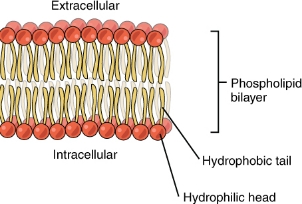
The cell membrane contains:
A
Alternate layers of phospholipid and choline
B
Double layers of phospholipid
C
Double layers of phospholipid with polar ends projected outside
D
Double layers of phospholipid with polar ends projected inside
Solution
(C) The plasma membrane consists of a phospholipid bilayer.
Each phospholipid molecule has a polar (hydrophilic) head and a non-polar (hydrophobic) tail.
In the bilayer,the polar heads are oriented towards the aqueous environment (outside and inside the cell),while the non-polar tails are directed inward,away from the water.
Therefore,the polar ends are projected outside (towards the extracellular and intracellular fluids).
Each phospholipid molecule has a polar (hydrophilic) head and a non-polar (hydrophobic) tail.
In the bilayer,the polar heads are oriented towards the aqueous environment (outside and inside the cell),while the non-polar tails are directed inward,away from the water.
Therefore,the polar ends are projected outside (towards the extracellular and intracellular fluids).
0 likes
View Solution34
EasyMCQ
Which of the following compounds do not belong to lipids?
A
Fats
B
Amino acids
C
Carbohydrates
D
Both $(b)$ and $(c)$
Solution
(D) Lipids are a broad group of naturally occurring molecules which include fats,waxes,sterols,fat-soluble vitamins,monoglycerides,diglycerides,and triglycerides.
Amino acids are the building blocks of proteins,not lipids.
Carbohydrates are a separate class of biomolecules consisting of carbon,hydrogen,and oxygen.
Therefore,both $(b)$ and $(c)$ do not belong to the class of lipids.
Amino acids are the building blocks of proteins,not lipids.
Carbohydrates are a separate class of biomolecules consisting of carbon,hydrogen,and oxygen.
Therefore,both $(b)$ and $(c)$ do not belong to the class of lipids.
0 likes
View Solution35
EasyMCQ
$A$ distinctive and characteristic functional group of fats is
A
An ester group
B
$A$ peptide group
C
$A$ ketonic group
D
An alcoholic group
Solution
(A) Fats are essentially higher-order esters formed by the combination of long-chain fatty acids and glycerol (an alcohol).$ \newline $Therefore,the ester group $(-COO-)$ is the distinctive and characteristic functional group of fats.
0 likes
View Solution36
EasyMCQ
The waxes are long chain compounds of fatty acids,which belong to the class of
A
Esters
B
Ethers
C
Alcohols
D
Acetic acid
Solution
(A) Waxes are defined as esters of long-chain fatty acids with long-chain monohydric alcohols.
Therefore,they belong to the class of $Esters$.
Therefore,they belong to the class of $Esters$.
0 likes
View Solution37
EasyMCQ
The hydrolytic reaction of fats with caustic soda is known as:
A
Acetylation
B
Carboxylation
C
Saponification
D
Esterification
Solution
(C) The alkaline hydrolysis of fats or oils (triglycerides) using caustic soda $(NaOH)$ or caustic potash $(KOH)$ is called saponification.
This reaction produces soap (salts of fatty acids) and glycerol as products.
$Oil/Fat + Alkali \xrightarrow{\text{Saponification}} Soap + Glycerol$
This reaction produces soap (salts of fatty acids) and glycerol as products.
$Oil/Fat + Alkali \xrightarrow{\text{Saponification}} Soap + Glycerol$
0 likes
View Solution38
MediumMCQ
Fat consists of
A
Monohydroxy carboxylic acid
B
Monohydroxy aliphatic carboxylic acid
C
Monohydroxy aliphatic,saturated carboxylic acid
D
Dihydroxy aliphatic carboxylic acid
Solution
(B) Fats are triglycerides,which are triesters of glycerol with three fatty acid chains.
Each fatty acid chain is attached to one of the three $-OH$ groups of glycerol via an ester linkage formed by the reaction of the $-COOH$ group of the fatty acid with the $-OH$ group of glycerol.
Since each fatty acid molecule involved in the formation of the triglyceride is a long-chain aliphatic carboxylic acid,fats are essentially esters of glycerol and long-chain aliphatic carboxylic acids.
Each fatty acid chain is attached to one of the three $-OH$ groups of glycerol via an ester linkage formed by the reaction of the $-COOH$ group of the fatty acid with the $-OH$ group of glycerol.
Since each fatty acid molecule involved in the formation of the triglyceride is a long-chain aliphatic carboxylic acid,fats are essentially esters of glycerol and long-chain aliphatic carboxylic acids.
0 likes
View Solution39
EasyMCQ
The alcohol obtained by the hydrolysis of oils and fats is
A
Glycol
B
Glycerol
C
Propanol
D
Pentanol
Solution
(B) Oils and fats are triglycerides,which are esters of glycerol with long-chain fatty acids.
Hydrolysis of these triglycerides in the presence of water or alkali (saponification) yields glycerol and fatty acids.
The reaction is:
$CH_2OOCR-CHOOCR-CH_2OOCR + 3H_2O \rightarrow CH_2OH-CHOH-CH_2OH + 3RCOOH$
Here,the alcohol produced is $Glycerol$ (propane-$1,2,3$-triol).
Hydrolysis of these triglycerides in the presence of water or alkali (saponification) yields glycerol and fatty acids.
The reaction is:
$CH_2OOCR-CHOOCR-CH_2OOCR + 3H_2O \rightarrow CH_2OH-CHOH-CH_2OH + 3RCOOH$
Here,the alcohol produced is $Glycerol$ (propane-$1,2,3$-triol).
0 likes
View Solution40
EasyMCQ
Iodine value is related to
A
Fats and oils
B
Alcohols
C
Esters
D
Hydrocarbons
Solution
(A) The iodine value is a measure of the degree of unsaturation in fats and oils.
It is defined as the number of grams of $I_2$ that can be absorbed by $100 \ g$ of a fat or oil.
Greater unsaturation (more double bonds) leads to a higher iodine value,which indicates better drying quality of the oil.
It is defined as the number of grams of $I_2$ that can be absorbed by $100 \ g$ of a fat or oil.
Greater unsaturation (more double bonds) leads to a higher iodine value,which indicates better drying quality of the oil.
0 likes
View Solution41
MediumMCQ
Phospholipids are esters of glycerol with
A
Three phosphate groups
B
Three carboxylic acid residues
C
One carboxylic acid residue and two phosphate groups
D
Two carboxylic acid residues and one phosphate group
Solution
(D) Phospholipids are esters of glycerol with two carboxylic acid residues and one phosphate group.
Hence,phospholipids may be regarded as derivatives of glycerol in which two hydroxyl groups are esterified with fatty acids,while the third is esterified with phosphoric acid.
Hence,phospholipids may be regarded as derivatives of glycerol in which two hydroxyl groups are esterified with fatty acids,while the third is esterified with phosphoric acid.
0 likes
View Solution42
EasyMCQ
Oils and fats are jointly called
A
Lipids
B
Soaps
C
Proteins
D
Polymer
Solution
(A) Fats and oils are collectively known as $Lipids$.
They constitute a substantial portion of our diets.
About $35-40\%$ of dietary energy in regions like Europe and North America comes from fats and oils.
They constitute a substantial portion of our diets.
About $35-40\%$ of dietary energy in regions like Europe and North America comes from fats and oils.
0 likes
View Solution43
EasyMCQ
Oleic,stearic and palmitic acids are
A
Fatty acid
B
Amino acid
C
Nucleic acid
D
Essential acid
Solution
(A) Oleic acid,stearic acid,and palmitic acid are long-chain carboxylic acids obtained by the hydrolysis of fats.
These acids are commonly known as fatty acids.
These acids are commonly known as fatty acids.
0 likes
View Solution44
EasyMCQ
An example of a saturated fatty acid present in nature is
A
Oleic acid
B
Linoleic acid
C
Linolenic acid
D
Palmitic acid
Solution
(D) $Oleic \text{ acid}$ - $C_{17}H_{33}COOH$ (unsaturated),
$Linoleic \text{ acid}$ - $C_{17}H_{31}COOH$ (unsaturated),
$Linolenic \text{ acid}$ - $C_{17}H_{29}COOH$ (unsaturated),
$Palmitic \text{ acid}$ - $C_{15}H_{31}COOH$ (saturated).
Saturated fatty acids contain only single bonds between carbon atoms and follow the general formula $C_nH_{2n+1}COOH$. $Palmitic \text{ acid}$ $(n=15)$ fits this criteria, making it a saturated fatty acid.
$Linoleic \text{ acid}$ - $C_{17}H_{31}COOH$ (unsaturated),
$Linolenic \text{ acid}$ - $C_{17}H_{29}COOH$ (unsaturated),
$Palmitic \text{ acid}$ - $C_{15}H_{31}COOH$ (saturated).
Saturated fatty acids contain only single bonds between carbon atoms and follow the general formula $C_nH_{2n+1}COOH$. $Palmitic \text{ acid}$ $(n=15)$ fits this criteria, making it a saturated fatty acid.
0 likes
View Solution45
EasyMCQ
Energy is stored in our body in the form of
A
$ATP$
B
$ADP$
C
Fats
D
Carbohydrates
Solution
(A) The correct option is $(A)$.
Energy is stored in our body in the form of $ATP$ $(Adenosine \ Triphosphate)$,which acts as the primary energy currency of the cell.
Energy is stored in our body in the form of $ATP$ $(Adenosine \ Triphosphate)$,which acts as the primary energy currency of the cell.
0 likes
View Solution46
EasyMCQ
Pick out the unsaturated fatty acid from the following:
A
Stearic acid
B
Lauric acid
C
Oleic acid
D
Palmitic acid
Solution
(C) The correct answer is $C$.
$Stearic \ acid$,$Lauric \ acid$,and $Palmitic \ acid$ are saturated fatty acids.
$Oleic \ acid$ is an unsaturated fatty acid containing a double bond in its carbon chain.
$Stearic \ acid$,$Lauric \ acid$,and $Palmitic \ acid$ are saturated fatty acids.
$Oleic \ acid$ is an unsaturated fatty acid containing a double bond in its carbon chain.
0 likes
View Solution47
DifficultMCQ
The number of molecules of $ATP$ produced in the lipid metabolism of a molecule of palmitic acid is
A
$130$
B
$36$
C
$56$
D
$86$
Solution
(A) Palmitic acid is a $16$-carbon saturated fatty acid $(C_{16}H_{32}O_2)$.
It undergoes $\beta$-oxidation,which involves $7$ cycles to produce $8$ molecules of Acetyl-$CoA$,$7$ molecules of $FADH_2$,and $7$ molecules of $NADH$.
Each Acetyl-$CoA$ enters the Citric Acid Cycle to produce $10$ $ATP$ ($3$ $NADH$,$1$ $FADH_2$,$1$ $GTP/ATP$). Total from $8$ Acetyl-$CoA$ = $8 \times 10 = 80$ $ATP$.
Each $FADH_2$ produces $1.5$ $ATP$ and each $NADH$ produces $2.5$ $ATP$.
From $\beta$-oxidation: $7 \times 1.5 = 10.5$ $ATP$ and $7 \times 2.5 = 17.5$ $ATP$.
Total $ATP = 80 + 10.5 + 17.5 = 108$ $ATP$.
Subtracting $2$ $ATP$ used for activation of fatty acid to fatty acyl-$CoA$,the net yield is $106$ $ATP$.
However,in many older textbooks,the calculation is based on $3$ $ATP$ per $NADH$ and $2$ $ATP$ per $FADH_2$,leading to $129$ or $130$ $ATP$. Given the options,$130$ is the standard answer.
It undergoes $\beta$-oxidation,which involves $7$ cycles to produce $8$ molecules of Acetyl-$CoA$,$7$ molecules of $FADH_2$,and $7$ molecules of $NADH$.
Each Acetyl-$CoA$ enters the Citric Acid Cycle to produce $10$ $ATP$ ($3$ $NADH$,$1$ $FADH_2$,$1$ $GTP/ATP$). Total from $8$ Acetyl-$CoA$ = $8 \times 10 = 80$ $ATP$.
Each $FADH_2$ produces $1.5$ $ATP$ and each $NADH$ produces $2.5$ $ATP$.
From $\beta$-oxidation: $7 \times 1.5 = 10.5$ $ATP$ and $7 \times 2.5 = 17.5$ $ATP$.
Total $ATP = 80 + 10.5 + 17.5 = 108$ $ATP$.
Subtracting $2$ $ATP$ used for activation of fatty acid to fatty acyl-$CoA$,the net yield is $106$ $ATP$.
However,in many older textbooks,the calculation is based on $3$ $ATP$ per $NADH$ and $2$ $ATP$ per $FADH_2$,leading to $129$ or $130$ $ATP$. Given the options,$130$ is the standard answer.
0 likes
View Solution48
EasyMCQ
Waxes are esters of long-chain fatty acids.
A
Esters
B
Ethers
C
Alcohols
D
Acetic acid
Solution
(A) Waxes are esters formed from long-chain fatty acids and long-chain alcohols.
0 likes
View Solution49
EasyMCQ
The process of converting oil or fat into soap is considered in terms of ..........
A
$NH_4OH$
B
$NaOH$
C
$KOH$
D
$C_6H_5OH$
Solution
(C) The saponification value is defined as the number of $mg$ of $KOH$ required to neutralize the fatty acids resulting from the complete hydrolysis of $1 \ g$ of oil or fat.
0 likes
View Solution50
EasyMCQ
The acrolein test is positive for $......$.
A
Polysaccharides
B
Proteins
C
Oils and fats
D
Sugars
Solution
(C) The acrolein test is a standard test for the presence of glycerol or fats. $When$ fats are heated with a dehydrating agent like $KHSO_4$,the glycerol portion of the molecule undergoes dehydration to form an unsaturated aldehyde called acrolein $(CH_2=CHCHO)$.
0 likes
View SolutionBiomolecules — Fats and Lipids · Frequently Asked Questions
1Are these Biomolecules questions useful for JEE and NEET?
Yes. All questions in this section are mapped to JEE Main and NEET exam patterns. Previous year questions from JEE Main, NEET, GUJCET and state-level exams are included with full solutions.
2Can I switch to Hindi or Gujarati for these questions?
Yes. Use the language tabs in the hero section or the sidebar to view the same questions and solutions in English, Hindi or Gujarati.
3How do I generate a question paper from this subtopic?
Use the Vedclass Exam Paper Generator — select the chapter and subtopic, set difficulty, and generate Sets A, B, C, D automatically. First 3 chapters of every subject are free.
Vedclass Products
For Students
Vedclass Test Series
Mock tests in real JEE/NEET style with performance analysis. 5-day free trial.
Start Free TrialFor Teachers
Exam Paper Generator
Generate Set A/B/C/D papers from this chapter in 2 minutes. 3 chapters free.
Try FreeFor Institutes
Online Exam Module
Live online exams with unlimited students, 360° analytics & white-label branding.
See DemoFor Teachers & Institutes
Generate a Biomolecules Exam Paper in 2 Minutes
Select subtopic & difficulty — Sets A, B, C, D auto-generated with No Repeat logic.
First 3 chapters of every subject are free — no payment required.