
A English
Properties of Amines Questions in English
Class 12 Chemistry · Amines · Properties of Amines
1212+
Questions
English
Language
100%
With Solutions
Showing 50 of 1212 questions in English
201
MediumMCQ
Identify $(a)$ and $(b)$ in the following reaction:
$CH_3CH_2NH_2 + CHCl_3 + 3KOH \rightarrow (a) + (b) + 3H_2O$
$CH_3CH_2NH_2 + CHCl_3 + 3KOH \rightarrow (a) + (b) + 3H_2O$
A
$C_2H_5CN$ and $3KCl$
B
$CH_3CH_2CONH_2$ and $3KCl$
C
$C_2H_5NC$ and $K_2CO_3$
D
$C_2H_5NC$ and $3KCl$
Solution
(D) The given reaction is the $Carbylamine$ reaction,which is a characteristic test for primary amines.
In this reaction,a primary amine $(CH_3CH_2NH_2)$ reacts with chloroform $(CHCl_3)$ and alcoholic potassium hydroxide $(KOH)$ to form an isocyanide (carbylamine) and potassium chloride $(KCl)$ as a byproduct.
The balanced chemical equation is:
$CH_3CH_2NH_2 + CHCl_3 + 3KOH \rightarrow CH_3CH_2NC + 3KCl + 3H_2O$
Comparing this with the given equation,$(a)$ is $C_2H_5NC$ (ethyl isocyanide) and $(b)$ is $3KCl$.
In this reaction,a primary amine $(CH_3CH_2NH_2)$ reacts with chloroform $(CHCl_3)$ and alcoholic potassium hydroxide $(KOH)$ to form an isocyanide (carbylamine) and potassium chloride $(KCl)$ as a byproduct.
The balanced chemical equation is:
$CH_3CH_2NH_2 + CHCl_3 + 3KOH \rightarrow CH_3CH_2NC + 3KCl + 3H_2O$
Comparing this with the given equation,$(a)$ is $C_2H_5NC$ (ethyl isocyanide) and $(b)$ is $3KCl$.
0 likes
View Solution202
MediumMCQ
What is obtained when aniline hydrogen sulfate is heated with sulfuric acid at $453 - 473 \, K$?
A
Benzene sulfonic acid
B
Anthranilic acid
C
Aniline
D
Sulfanilic acid
Solution
(D) When aniline is treated with concentrated sulfuric acid,it forms aniline hydrogen sulfate.
Heating aniline hydrogen sulfate at $453 - 473 \, K$ leads to a rearrangement reaction known as baking process.
This results in the formation of $p$-aminobenzenesulfonic acid,which is commonly known as sulfanilic acid.
The reaction is: $C_6H_5NH_2 + H_2SO_4$ $\rightarrow C_6H_5NH_3^+HSO_4^-$ $\xrightarrow{453-473 \, K} NH_2-C_6H_4-SO_3H + H_2O$.
Heating aniline hydrogen sulfate at $453 - 473 \, K$ leads to a rearrangement reaction known as baking process.
This results in the formation of $p$-aminobenzenesulfonic acid,which is commonly known as sulfanilic acid.
The reaction is: $C_6H_5NH_2 + H_2SO_4$ $\rightarrow C_6H_5NH_3^+HSO_4^-$ $\xrightarrow{453-473 \, K} NH_2-C_6H_4-SO_3H + H_2O$.
0 likes
View Solution203
MediumMCQ
What is the product formed when an aliphatic primary amine reacts with $HNO_2$?
A
Diazonium salt
B
Alcohol
C
Aniline
D
Dye
Solution
(B) Aliphatic primary amines react with nitrous acid $(HNO_2)$ at low temperatures $(273-278 \ K)$ to form unstable aliphatic diazonium salts,which immediately decompose to evolve nitrogen gas and form alcohols.
The reaction is: $R-NH_2 + HNO_2 \xrightarrow{273-278 \ K} R-OH + N_2 + H_2O$.
The reaction is: $R-NH_2 + HNO_2 \xrightarrow{273-278 \ K} R-OH + N_2 + H_2O$.
0 likes
View Solution204
MediumMCQ
Heating $n$-propylamine with alcoholic alkali and chloroform yields a compound $X$. What is the structure of $X$?
A
$CH_3CH_2CH_2CN$
B
$(CH_3)_2CHCN$
C
$CH_3CH_2CH_2NC$
D
$(CH_3)_2CHNC$
Solution
(C) The reaction of a primary amine with chloroform $(CHCl_3)$ and alcoholic potassium hydroxide $(KOH)$ is known as the Carbylamine reaction.
This reaction is a test for primary amines,where the amine is converted into an isocyanide (carbylamine),which has a foul smell.
The reaction for $n$-propylamine $(CH_3CH_2CH_2NH_2)$ is:
$CH_3CH_2CH_2NH_2 + CHCl_3 + 3KOH \text{ (alc.)} \rightarrow CH_3CH_2CH_2NC + 3KCl + 3H_2O$.
Thus,the product $X$ is $n$-propyl isocyanide,which has the structure $CH_3CH_2CH_2NC$.
This reaction is a test for primary amines,where the amine is converted into an isocyanide (carbylamine),which has a foul smell.
The reaction for $n$-propylamine $(CH_3CH_2CH_2NH_2)$ is:
$CH_3CH_2CH_2NH_2 + CHCl_3 + 3KOH \text{ (alc.)} \rightarrow CH_3CH_2CH_2NC + 3KCl + 3H_2O$.
Thus,the product $X$ is $n$-propyl isocyanide,which has the structure $CH_3CH_2CH_2NC$.
0 likes
View Solution205
DifficultMCQ
Which of the following substances turns blue litmus red?
A
$ROH$
B
$RNH_2$
C
$RNH_3^+OH^-$
D
$RNH_3^+Cl^-$
Solution
(D) Blue litmus turns red in the presence of an acidic substance.
$RNH_3^+Cl^-$ is a salt of a weak base (amine) and a strong acid $(HCl)$.
Due to the hydrolysis of the $RNH_3^+$ cation,the solution becomes acidic.
$RNH_3^+ + H_2O \rightleftharpoons RNH_2 + H_3O^+$.
Therefore,it turns blue litmus red.
$RNH_3^+Cl^-$ is a salt of a weak base (amine) and a strong acid $(HCl)$.
Due to the hydrolysis of the $RNH_3^+$ cation,the solution becomes acidic.
$RNH_3^+ + H_2O \rightleftharpoons RNH_2 + H_3O^+$.
Therefore,it turns blue litmus red.
0 likes
View Solution206
MediumMCQ
Which of the following statements is incorrect regarding amines?
A
They give the mustard oil reaction.
B
They give the carbylamine reaction.
C
They form salts with acids.
D
They give alcohol upon hydrolysis.
Solution
(D) Amines are basic in nature and react with acids to form salts. Primary amines undergo the carbylamine reaction (isocyanide test) and the mustard oil reaction (specifically primary aliphatic amines with $CS_2$ and $HgCl_2$). However,amines do not undergo hydrolysis to form alcohols. Hydrolysis is a characteristic reaction of esters,amides,or alkyl halides,not amines.
0 likes
View Solution207
MediumMCQ
What is formed when aniline reacts with $HNO_2$ and $HCl$ at $273 \, K$?
A
Phenol
B
Nitrobenzene
C
Diazo compound
D
None of these
Solution
(C) The reaction of aniline with nitrous acid $(HNO_2)$ in the presence of $HCl$ at $273-278 \, K$ $(0-5 \, ^\circ C)$ is known as the diazotization reaction.
In this reaction,aniline is converted into benzene diazonium chloride,which is a diazo compound.
The chemical equation is:
$C_6H_5NH_2 + HNO_2 + HCl \xrightarrow{273-278 \, K} [C_6H_5N_2]^+Cl^- + 2H_2O$
Thus,the correct option is $C$.
In this reaction,aniline is converted into benzene diazonium chloride,which is a diazo compound.
The chemical equation is:
$C_6H_5NH_2 + HNO_2 + HCl \xrightarrow{273-278 \, K} [C_6H_5N_2]^+Cl^- + 2H_2O$
Thus,the correct option is $C$.
0 likes
View Solution208
MediumMCQ
What product is formed when benzamide is reacted with $POCl_3$?
A
Benzonitrile
B
Aniline
C
Chlorobenzene
D
Benzylamine
Solution
(A) When benzamide $(C_6H_5CONH_2)$ is reacted with phosphorus oxychloride $(POCl_3)$,it undergoes a dehydration reaction.
The $POCl_3$ acts as a dehydrating agent,removing a molecule of water from the amide group to form a nitrile group.
The reaction is: $C_6H_5CONH_2 + POCl_3 \rightarrow C_6H_5CN + H_2O$.
Thus,the product formed is benzonitrile.
The $POCl_3$ acts as a dehydrating agent,removing a molecule of water from the amide group to form a nitrile group.
The reaction is: $C_6H_5CONH_2 + POCl_3 \rightarrow C_6H_5CN + H_2O$.
Thus,the product formed is benzonitrile.
0 likes
View Solution209
MediumMCQ
What is the major product formed when $C_6H_5NH_2$ reacts with $CHCl_3$ and $KOH$?
A
Phenyl cyanide
B
Benzyl cyanide
C
Benzyl carbylamine
D
Phenyl isonitrile
Solution
(D) The reaction of a primary amine $(R-NH_2)$ with chloroform $(CHCl_3)$ and alcoholic potassium hydroxide $(KOH)$ is known as the Carbylamine reaction or Isocyanide test.
In this reaction,the amine group $(-NH_2)$ is converted into an isocyanide group $(-NC)$.
For aniline $(C_6H_5NH_2)$,the reaction is:
$C_6H_5NH_2 + CHCl_3 + 3KOH \rightarrow C_6H_5NC + 3KCl + 3H_2O$.
The product $C_6H_5NC$ is known as phenyl isonitrile or phenyl carbylamine.
In this reaction,the amine group $(-NH_2)$ is converted into an isocyanide group $(-NC)$.
For aniline $(C_6H_5NH_2)$,the reaction is:
$C_6H_5NH_2 + CHCl_3 + 3KOH \rightarrow C_6H_5NC + 3KCl + 3H_2O$.
The product $C_6H_5NC$ is known as phenyl isonitrile or phenyl carbylamine.
0 likes
View Solution210
MediumMCQ
What is the product formed when benzene diazonium chloride reacts with phenol in a weakly basic medium?
A
Diphenyl ether
B
$p-$hydroxyazobenzene
C
Chlorobenzene
D
Benzene
Solution
(B) The reaction between benzene diazonium chloride and phenol in a weakly basic medium (typically $pH \approx 9-10$) is a coupling reaction.
In this reaction,the electrophilic diazonium ion attacks the electron-rich ortho or para position of the phenol ring.
Since the para position is sterically less hindered,the major product formed is $p-$hydroxyazobenzene,which is an orange-red dye.
In this reaction,the electrophilic diazonium ion attacks the electron-rich ortho or para position of the phenol ring.
Since the para position is sterically less hindered,the major product formed is $p-$hydroxyazobenzene,which is an orange-red dye.
0 likes
View Solution211
MediumMCQ
Which of the following statements is incorrect for primary amines?
A
Reaction of aryl amines with nitrous acid gives phenols.
B
Reaction of alkyl amines with nitrous acid gives alcohols.
C
Alkyl amines are stronger bases than ammonia.
D
Alkyl amines are stronger bases than aryl amines.
Solution
(A) The reaction of aryl amines with nitrous acid at low temperatures $(0-5 \ ^{\circ}C)$ yields diazonium salts,not phenols. Phenols are formed only when the diazonium salt solution is warmed with water. Therefore,the statement that aryl amines react with nitrous acid to give phenols directly is incorrect.
0 likes
View Solution212
MediumMCQ
$C_6H_5NH_2 \xrightarrow{H_2SO_4, 180^{\circ}C} H_2NC_6H_4(SO_3H)$ (para). Which statement is correct for the product?
A
It does not exist as a zwitterion.
B
$-NH_2$ shows strong basic character.
C
It does not act as an internal salt.
D
$-SO_3H$ diminishes the basic character of $-NH_2$.
0 likes
View Solution213
MediumMCQ
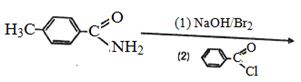
What will be the structure of product $T$ in the following reaction?
A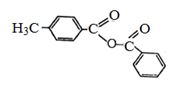
B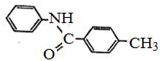
C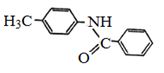
D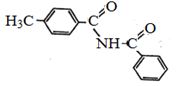
Solution
(D) The reaction proceeds in two steps:
$1$. The first step is the Hofmann bromamide degradation reaction,where the amide $p-CH_3-C_6H_4-CONH_2$ reacts with $NaOH/Br_2$ to form the primary amine $p-CH_3-C_6H_4-NH_2$ ($p$-toluidine).
$2$. The second step is the acylation of the amine with benzoyl chloride $(C_6H_5COCl)$. The lone pair on the nitrogen atom of the amine attacks the carbonyl carbon of the benzoyl chloride,leading to the formation of an amide: $p-CH_3-C_6H_4-NH-CO-C_6H_5$ ($N$-(p-tolyl)benzamide).
Comparing this with the given options,option $D$ represents the correct structure.
$1$. The first step is the Hofmann bromamide degradation reaction,where the amide $p-CH_3-C_6H_4-CONH_2$ reacts with $NaOH/Br_2$ to form the primary amine $p-CH_3-C_6H_4-NH_2$ ($p$-toluidine).
$2$. The second step is the acylation of the amine with benzoyl chloride $(C_6H_5COCl)$. The lone pair on the nitrogen atom of the amine attacks the carbonyl carbon of the benzoyl chloride,leading to the formation of an amide: $p-CH_3-C_6H_4-NH-CO-C_6H_5$ ($N$-(p-tolyl)benzamide).
Comparing this with the given options,option $D$ represents the correct structure.
0 likes
View Solution214
MediumMCQ
Which of the following reduction conditions is appropriate to isolate $Azoxybenzene$ as the major reduction product of $Nitrobenzene$?
A
Alkaline sodium arsenite
B
Alkaline glucose solution
C
Both of the above
D
Alkaline sodium stannite
Solution
(C) The reduction of $Nitrobenzene$ $(C_6H_5NO_2)$ in an alkaline medium can yield different products depending on the reducing agent used.
When $Nitrobenzene$ is reduced using $Alkaline \ sodium \ arsenite$ $(Na_3AsO_3)$ or $Alkaline \ glucose \ solution$,the major product obtained is $Azoxybenzene$ $(C_6H_5-N(O)=N-C_6H_5)$.
Therefore,both the reagents mentioned in options $A$ and $B$ are capable of producing $Azoxybenzene$ as the major product.
When $Nitrobenzene$ is reduced using $Alkaline \ sodium \ arsenite$ $(Na_3AsO_3)$ or $Alkaline \ glucose \ solution$,the major product obtained is $Azoxybenzene$ $(C_6H_5-N(O)=N-C_6H_5)$.
Therefore,both the reagents mentioned in options $A$ and $B$ are capable of producing $Azoxybenzene$ as the major product.
0 likes
View Solution215
DifficultMCQ
Which of the following statements is incorrect for primary amines?
A
Alkyl amines are stronger bases than ammonia.
B
Alkyl amines react with nitrous acid to form alcohols.
C
Alkyl amines are stronger bases than aryl amines.
D
Aryl amines react with nitrous acid to form phenol.
Solution
(D) Aryl amines react with $HNO_2$ at low temperatures $(0-5 \ ^{\circ}C)$ to form benzene diazonium salts,not phenol. Phenol is formed only when the diazonium salt is warmed with water.
0 likes
View Solution216
DifficultMCQ
What is obtained upon the reduction of $t$-butyl isocyanide?
A
$t$-butylamine
B
$t$-butylmethylamine
C
$t$-butylethylamine
D
None of these
Solution
(D) The reduction of isocyanides $(R-NC)$ with a reducing agent like $LiAlH_4$ or $H_2/Ni$ leads to the formation of secondary amines.
Specifically,the reduction of $t$-butyl isocyanide $((CH_3)_3C-NC)$ results in the formation of $N$-methyl-$t$-butylamine,which is a secondary amine.
The reaction is: $(CH_3)_3C-NC + 4[H] \rightarrow (CH_3)_3C-NH-CH_3$.
Since this product is not listed in the options,the correct choice is $D$.
Specifically,the reduction of $t$-butyl isocyanide $((CH_3)_3C-NC)$ results in the formation of $N$-methyl-$t$-butylamine,which is a secondary amine.
The reaction is: $(CH_3)_3C-NC + 4[H] \rightarrow (CH_3)_3C-NH-CH_3$.
Since this product is not listed in the options,the correct choice is $D$.
0 likes
View Solution217
MediumMCQ
What is obtained upon the reduction of a Schiff base?
A
Primary amine
B
Secondary amine
C
Anil
D
Anilide
Solution
(B) The reduction of a Schiff base $(R-CH=N-R')$ yields a secondary amine $(R-CH_2-NH-R')$.
Reaction: $R-CH=N-R' \xrightarrow{\text{Reduction}} R-CH_2-NH-R'$ ($2^\circ$ amine).
Reaction: $R-CH=N-R' \xrightarrow{\text{Reduction}} R-CH_2-NH-R'$ ($2^\circ$ amine).
0 likes
View Solution218
MediumMCQ
Which of the following compounds is more basic than aniline?
A
$P$-nitroaniline
B
Benzylamine
C
Diphenylamine
D
Triphenylamine
Solution
(B) Aniline is an aromatic amine where the lone pair on the nitrogen atom is involved in resonance with the benzene ring,reducing its availability for protonation.
$P$-nitroaniline has an electron-withdrawing $-NO_2$ group,which further decreases basicity.
Diphenylamine and triphenylamine have more phenyl groups attached to the nitrogen,increasing resonance and steric hindrance,which significantly decreases basicity.
Benzylamine $(C_6H_5CH_2NH_2)$ is an aliphatic amine where the lone pair on the nitrogen is not involved in resonance with the benzene ring because of the intervening $-CH_2-$ group.
Therefore,benzylamine is much more basic than aniline.
$P$-nitroaniline has an electron-withdrawing $-NO_2$ group,which further decreases basicity.
Diphenylamine and triphenylamine have more phenyl groups attached to the nitrogen,increasing resonance and steric hindrance,which significantly decreases basicity.
Benzylamine $(C_6H_5CH_2NH_2)$ is an aliphatic amine where the lone pair on the nitrogen is not involved in resonance with the benzene ring because of the intervening $-CH_2-$ group.
Therefore,benzylamine is much more basic than aniline.
0 likes
View Solution219
MediumMCQ
Before nitration of amino benzene,the $-NH_2$ group is first protected by which of the following processes?
A
Alkylation
B
Acetylation
C
Formylation
D
Chloromethylation
Solution
(B) Direct nitration of aniline $(C_6H_5NH_2)$ results in the formation of tarry oxidation products along with nitro derivatives because the $-NH_2$ group is strongly activating and ortho/para-directing.
To control the reaction and obtain the desired para-nitroaniline,the $-NH_2$ group is protected by acetylation using acetic anhydride or acetyl chloride to form acetanilide $(C_6H_5NHCOCH_3)$.
This reduces the activating effect of the group and prevents oxidation,allowing for controlled nitration.
To control the reaction and obtain the desired para-nitroaniline,the $-NH_2$ group is protected by acetylation using acetic anhydride or acetyl chloride to form acetanilide $(C_6H_5NHCOCH_3)$.
This reduces the activating effect of the group and prevents oxidation,allowing for controlled nitration.
0 likes
View Solution220
DifficultMCQ
Identify the final product $D$ in the following reaction sequence: $CH_3CH_2Br$ $\xrightarrow[\Delta]{Aq. KOH} A$ $\xrightarrow[\Delta]{KMnO_4/H^+} B$ $\xrightarrow[\Delta]{NH_3} C$ $\xrightarrow[alkali]{Br_2} D$
A
$CH_3Br$
B
$CH_3CONH_2$
C
$CH_3NH_2$
D
$CHBr_3$
Solution
(C) The reaction sequence is as follows:
$1$. $CH_3CH_2Br \xrightarrow[\Delta]{Aq. KOH} CH_3CH_2OH$ (Product $A$ is ethanol).
$2$. $CH_3CH_2OH \xrightarrow[\Delta]{KMnO_4/H^+} CH_3COOH$ (Product $B$ is acetic acid).
$3$. $CH_3COOH \xrightarrow[\Delta]{NH_3} CH_3CONH_2$ (Product $C$ is acetamide).
$4$. $CH_3CONH_2 \xrightarrow[alkali]{Br_2} CH_3NH_2$ (Product $D$ is methanamine via Hofmann bromamide degradation reaction).
$1$. $CH_3CH_2Br \xrightarrow[\Delta]{Aq. KOH} CH_3CH_2OH$ (Product $A$ is ethanol).
$2$. $CH_3CH_2OH \xrightarrow[\Delta]{KMnO_4/H^+} CH_3COOH$ (Product $B$ is acetic acid).
$3$. $CH_3COOH \xrightarrow[\Delta]{NH_3} CH_3CONH_2$ (Product $C$ is acetamide).
$4$. $CH_3CONH_2 \xrightarrow[alkali]{Br_2} CH_3NH_2$ (Product $D$ is methanamine via Hofmann bromamide degradation reaction).
0 likes
View Solution221
MediumMCQ
What is the nature of an aqueous solution of methylamine?
A
Acidic
B
Basic
C
Neutral
D
Amphoteric
Solution
(B) Methylamine $(CH_3NH_2)$ contains a lone pair of electrons on the nitrogen atom,which makes it a Lewis base.
When dissolved in water,it accepts a proton $(H^+)$ from water to form a methylammonium ion and a hydroxide ion $(OH^-)$.
$CH_3NH_2 + H_2O \rightleftharpoons CH_3NH_3^+ + OH^-$
Since it produces $OH^-$ ions in an aqueous solution,it acts as a base.
When dissolved in water,it accepts a proton $(H^+)$ from water to form a methylammonium ion and a hydroxide ion $(OH^-)$.
$CH_3NH_2 + H_2O \rightleftharpoons CH_3NH_3^+ + OH^-$
Since it produces $OH^-$ ions in an aqueous solution,it acts as a base.
0 likes
View Solution222
MediumMCQ
Which of the following statements is correct?
A
Methylamine is slightly acidic.
B
Methylamine is less basic than $NH_3$.
C
Methylamine is more basic than $NH_3$.
D
Methylamine reacts with alkali to form a salt.
Solution
(C) Methylamine $(CH_3NH_2)$ contains a methyl group which is an electron-donating group due to the $+I$ effect.
This increases the electron density on the nitrogen atom,making the lone pair more available for donation.
Therefore,methylamine is more basic than ammonia $(NH_3)$.
This increases the electron density on the nitrogen atom,making the lone pair more available for donation.
Therefore,methylamine is more basic than ammonia $(NH_3)$.
0 likes
View Solution223
MediumMCQ
Which of the following compounds does not evolve $N_2$ gas upon reaction with $HNO_2$?
A
Carbamide
B
Primary amine
C
Secondary amine
D
Alkanamide
Solution
(C) Primary aliphatic amines react with $HNO_2$ to form unstable diazonium salts which decompose to evolve $N_2$ gas.
Carbamide $(NH_2CONH_2)$ also reacts with $HNO_2$ to evolve $N_2$.
Secondary amines react with $HNO_2$ to form $N$-nitrosamines (yellow oily liquids),which do not evolve $N_2$ gas.
Alkanamides do not react with $HNO_2$ to evolve $N_2$ gas.
Carbamide $(NH_2CONH_2)$ also reacts with $HNO_2$ to evolve $N_2$.
Secondary amines react with $HNO_2$ to form $N$-nitrosamines (yellow oily liquids),which do not evolve $N_2$ gas.
Alkanamides do not react with $HNO_2$ to evolve $N_2$ gas.
0 likes
View Solution224
MediumMCQ
What is the product formed when ethylamine is oxidized with acidic $KMnO_4$?
A
Acetaldehyde
B
Ethylamine oxide
C
Ethanol
D
Acetamide
Solution
(A) The oxidation of primary aliphatic amines like ethylamine $(CH_3CH_2NH_2)$ with strong oxidizing agents such as acidic $KMnO_4$ leads to the formation of aldehydes or ketones depending on the structure.
For ethylamine,the oxidation proceeds through the formation of an imine intermediate which hydrolyzes to form acetaldehyde $(CH_3CHO)$.
For ethylamine,the oxidation proceeds through the formation of an imine intermediate which hydrolyzes to form acetaldehyde $(CH_3CHO)$.
0 likes
View Solution225
MediumMCQ
What is obtained by the ammonolysis of alkyl halides?
A
Primary amine
B
Secondary amine
C
Tertiary amine
D
$A$ mixture of primary,secondary,tertiary amines and quaternary ammonium salt
Solution
(D) The ammonolysis of alkyl halides involves the nucleophilic substitution reaction where the halogen atom is replaced by an amino group.
$R-X + NH_3 \rightarrow R-NH_2 + HX$
Since the primary amine formed is also a nucleophile,it reacts further with the alkyl halide to form secondary and tertiary amines,and finally a quaternary ammonium salt.
$R-NH_2 + R-X \rightarrow R_2NH + HX$
$R_2NH + R-X \rightarrow R_3N + HX$
$R_3N + R-X \rightarrow R_4N^+X^-$
Thus,the reaction produces a mixture of primary,secondary,tertiary amines and quaternary ammonium salt.
$R-X + NH_3 \rightarrow R-NH_2 + HX$
Since the primary amine formed is also a nucleophile,it reacts further with the alkyl halide to form secondary and tertiary amines,and finally a quaternary ammonium salt.
$R-NH_2 + R-X \rightarrow R_2NH + HX$
$R_2NH + R-X \rightarrow R_3N + HX$
$R_3N + R-X \rightarrow R_4N^+X^-$
Thus,the reaction produces a mixture of primary,secondary,tertiary amines and quaternary ammonium salt.
0 likes
View Solution226
MediumMCQ
The reaction of aniline with excess liquid bromine gives $......$.
A
Aniline bromide
B
$o$-Bromoaniline
C
$p$-Bromoaniline
D
$2, 4, 6$-Tribromoaniline
Solution
(D) When aniline is treated with excess bromine water or liquid bromine,the $-NH_2$ group strongly activates the benzene ring.
This leads to the electrophilic substitution of bromine atoms at all available ortho and para positions.
As a result,$2, 4, 6$-tribromoaniline is formed as a white precipitate.
This leads to the electrophilic substitution of bromine atoms at all available ortho and para positions.
As a result,$2, 4, 6$-tribromoaniline is formed as a white precipitate.
0 likes
View Solution227
MediumMCQ
The reason for the solubility of ethylamine in water is......
A
Low molecular weight
B
Ethyl group in ethyl alcohol
C
Formation of $H$-bonds with water
D
It is a derivative of ammonia
Solution
(C) Ethylamine $(C_2H_5NH_2)$ is soluble in water because it can form intermolecular hydrogen bonds with water molecules.
The lone pair on the nitrogen atom of the amine group interacts with the hydrogen atoms of water,facilitating dissolution.
The lone pair on the nitrogen atom of the amine group interacts with the hydrogen atoms of water,facilitating dissolution.
0 likes
View Solution228
MediumMCQ
What is the product formed when a primary amine reacts with a ketone?
A
Urea
B
Guanidine
C
Amide
D
Schiff base
Solution
(D) When a primary amine $(R-NH_2)$ reacts with a ketone $(R'_2C=O)$,it undergoes a condensation reaction to form an imine,which is commonly known as a Schiff base. The reaction involves the loss of a water molecule: $R'_2C=O + R-NH_2 \rightarrow R'_2C=N-R + H_2O$. Thus,the correct product is a Schiff base.
0 likes
View Solution229
MediumMCQ
Which of the following statements is not correct?
A
Amines form hydrogen bonds.
B
Ethylamine has a higher boiling point than propane.
C
Methylamine is more basic than ammonia.
D
The basicity of dimethylamine is less than that of methylamine.
Solution
(D) Methylamine $(CH_3NH_2)$ has one methyl group with a $(+I)$ effect,which increases the electron density on the nitrogen atom.
Dimethylamine $((CH_3)_2NH)$ has two methyl groups,which provide a stronger $(+I)$ effect,making it more basic than methylamine.
Therefore,the statement that the basicity of dimethylamine is less than that of methylamine is incorrect.
Dimethylamine $((CH_3)_2NH)$ has two methyl groups,which provide a stronger $(+I)$ effect,making it more basic than methylamine.
Therefore,the statement that the basicity of dimethylamine is less than that of methylamine is incorrect.
0 likes
View Solution230
MediumMCQ
What occurs during the Hofmann rearrangement in the conversion of an amide to an amine?
A
Intramolecular
B
Intermolecular
C
Both
D
None of these
Solution
(A) The Hofmann rearrangement (also known as the Hofmann degradation) involves the conversion of a primary amide to a primary amine with one carbon atom less.
During the mechanism,the migration of the alkyl or aryl group from the carbonyl carbon to the nitrogen atom occurs within the same molecule.
Therefore,the rearrangement is an $Intramolecular$ process.
During the mechanism,the migration of the alkyl or aryl group from the carbonyl carbon to the nitrogen atom occurs within the same molecule.
Therefore,the rearrangement is an $Intramolecular$ process.
0 likes
View Solution231
MediumMCQ
Which of the following compounds will have the highest $pK_b$ value?
A
$R_3C - NH_2$
B
$R_2NH$
C
$R - NH_2$
D
$NH_3$
Solution
(D) The $pK_b$ value is inversely proportional to the basic strength of the compound. $A$ higher $pK_b$ value indicates a weaker base. Among the given options,$NH_3$ is the weakest base compared to the alkyl amines ($R-NH_2$,$R_2NH$,$R_3C-NH_2$) due to the absence of the electron-donating inductive effect of alkyl groups. Therefore,$NH_3$ has the highest $pK_b$ value.
0 likes
View Solution232
MediumMCQ
Which reagent,when reacted with a primary amine,evolves nitrogen gas?
A
Nitrous acid
B
Nitric acid
C
Nitrosyl chloride
D
$1$ and $3$
Solution
(D) Primary aliphatic amines react with nitrous acid $(HNO_2)$ to form unstable diazonium salts,which decompose to evolve nitrogen gas $(N_2)$.
Similarly,nitrosyl chloride $(NOCl)$ also reacts with primary amines to produce nitrogen gas.
Therefore,both $HNO_2$ and $NOCl$ produce nitrogen gas upon reaction with primary amines.
Similarly,nitrosyl chloride $(NOCl)$ also reacts with primary amines to produce nitrogen gas.
Therefore,both $HNO_2$ and $NOCl$ produce nitrogen gas upon reaction with primary amines.
0 likes
View Solution233
DifficultMCQ
$n$-Butylamine $(I)$,diethylamine $(II)$,and $N,N$-dimethylethylamine $(III)$ have the same molecular mass. Arrange them in the increasing order of their boiling points.
A
$III < II < I$
B
$I < II < III$
C
$II < III < I$
D
$II < I < III$
Solution
(A) The boiling point of amines depends on the extent of intermolecular hydrogen bonding.
Primary amines $(1^o)$ have two hydrogen atoms attached to the nitrogen,allowing for extensive hydrogen bonding.
Secondary amines $(2^o)$ have one hydrogen atom attached to the nitrogen,allowing for moderate hydrogen bonding.
Tertiary amines $(3^o)$ have no hydrogen atoms attached to the nitrogen,so they cannot form intermolecular hydrogen bonds.
Therefore,the order of boiling points is $1^o > 2^o > 3^o$.
$n$-Butylamine $(I)$ is a primary amine,diethylamine $(II)$ is a secondary amine,and $N,N$-dimethylethylamine $(III)$ is a tertiary amine.
Thus,the correct order is $III < II < I$.
Primary amines $(1^o)$ have two hydrogen atoms attached to the nitrogen,allowing for extensive hydrogen bonding.
Secondary amines $(2^o)$ have one hydrogen atom attached to the nitrogen,allowing for moderate hydrogen bonding.
Tertiary amines $(3^o)$ have no hydrogen atoms attached to the nitrogen,so they cannot form intermolecular hydrogen bonds.
Therefore,the order of boiling points is $1^o > 2^o > 3^o$.
$n$-Butylamine $(I)$ is a primary amine,diethylamine $(II)$ is a secondary amine,and $N,N$-dimethylethylamine $(III)$ is a tertiary amine.
Thus,the correct order is $III < II < I$.
0 likes
View Solution234
MediumMCQ
With which of the following compounds does aniline react to form a Schiff base?
A
Acetic acid
B
Benzaldehyde
C
Acetone
D
Ammonia
Solution
(B) Schiff base is formed by the reaction of a primary amine with an aldehyde or ketone.
Aniline $(C_6H_5NH_2)$ reacts with benzaldehyde $(C_6H_5CHO)$ to form benzylidene aniline,which is a Schiff base.
The reaction is:
$C_6H_5NH_2 + OCH-C_6H_5 \xrightarrow{\Delta, -H_2O} C_6H_5N=CH-C_6H_5$.
Aniline $(C_6H_5NH_2)$ reacts with benzaldehyde $(C_6H_5CHO)$ to form benzylidene aniline,which is a Schiff base.
The reaction is:
$C_6H_5NH_2 + OCH-C_6H_5 \xrightarrow{\Delta, -H_2O} C_6H_5N=CH-C_6H_5$.
0 likes
View Solution235
DifficultMCQ
In the reaction $A$ $\xrightarrow{SnCl_2/HCl} B$ $\xrightarrow{NaNO_2/HCl, 0^{\circ}C} C$ $\xrightarrow{H_2O/\Delta} C_6H_5OH$,what are $A, B$,and $C$?
A
Nitrobenzene,Aniline,Benzene diazonium chloride
B
Nitrobenzene,Aniline,Phenol
C
Benzene,Nitrobenzene,Aniline
D
Aniline,Nitrobenzene,Benzene diazonium chloride
Solution
(A) The reaction sequence is as follows:
$1$. $A$ is Nitrobenzene $(C_6H_5NO_2)$.
$2$. Reduction of Nitrobenzene with $Sn/HCl$ gives Aniline $(B = C_6H_5NH_2)$.
$3$. Diazotization of Aniline with $NaNO_2/HCl$ at $0^{\circ}C$ gives Benzene diazonium chloride $(C = C_6H_5N_2^+Cl^-)$.
$4$. Hydrolysis of Benzene diazonium chloride with $H_2O/\Delta$ yields Phenol $(C_6H_5OH)$.
Thus,$A$ is Nitrobenzene,$B$ is Aniline,and $C$ is Benzene diazonium chloride.
$1$. $A$ is Nitrobenzene $(C_6H_5NO_2)$.
$2$. Reduction of Nitrobenzene with $Sn/HCl$ gives Aniline $(B = C_6H_5NH_2)$.
$3$. Diazotization of Aniline with $NaNO_2/HCl$ at $0^{\circ}C$ gives Benzene diazonium chloride $(C = C_6H_5N_2^+Cl^-)$.
$4$. Hydrolysis of Benzene diazonium chloride with $H_2O/\Delta$ yields Phenol $(C_6H_5OH)$.
Thus,$A$ is Nitrobenzene,$B$ is Aniline,and $C$ is Benzene diazonium chloride.
0 likes
View Solution236
MediumMCQ
Which of the following products is $NOT$ obtained when nitrobenzene is reduced in an alkaline medium?
A
Azoxybenzene
B
Hydrazobenzene
C
Azobenzene
D
Nitrosobenzene
Solution
(D) The reduction of nitrobenzene in an alkaline medium (using $Zn/NaOH$ or $Na_3AsO_3/NaOH$) proceeds through the formation of nitrosobenzene and phenylhydroxylamine. These intermediates then condense to form azoxybenzene,azobenzene,and finally hydrazobenzene. Nitrosobenzene is an intermediate product formed during the initial stages of reduction,but it is not the final product of the alkaline reduction process. However,among the given options,all are products formed at various stages of the reduction process. If the question implies the final stable product,the sequence is $Nitrobenzene$ $\rightarrow Azoxybenzene$ $\rightarrow Azobenzene$ $\rightarrow Hydrazobenzene$. Nitrosobenzene is a reactive intermediate. In many textbook contexts,$Nitrosobenzene$ is considered the starting point of the condensation sequence rather than a product of the alkaline reduction pathway itself.
0 likes
View Solution237
MediumMCQ
What is the product of the reaction: $CH_3NH_2 + CHCl_3 \xrightarrow{KOH}$?
A
$CH_3-N^+ \equiv C^-$
B
$CH_3-\ddot{N} \equiv C^+$
C
$CH_3-NH-CH_3$
D
$CH_3-C \equiv N$
Solution
(A) The given reaction is the $Carbylamine$ reaction,which is a characteristic test for primary amines.
In this reaction,a primary amine reacts with chloroform $(CHCl_3)$ and an alcoholic base $(KOH)$ to form an isocyanide (carbylamine),which has an unpleasant odor.
The reaction is: $CH_3NH_2 + CHCl_3 + 3KOH \rightarrow CH_3NC + 3KCl + 3H_2O$.
The product $CH_3NC$ is methyl isocyanide,which can be represented as $CH_3-N^+ \equiv C^-$.
Therefore,the correct option is $A$.
In this reaction,a primary amine reacts with chloroform $(CHCl_3)$ and an alcoholic base $(KOH)$ to form an isocyanide (carbylamine),which has an unpleasant odor.
The reaction is: $CH_3NH_2 + CHCl_3 + 3KOH \rightarrow CH_3NC + 3KCl + 3H_2O$.
The product $CH_3NC$ is methyl isocyanide,which can be represented as $CH_3-N^+ \equiv C^-$.
Therefore,the correct option is $A$.
0 likes
View Solution238
MediumMCQ
The reaction of aniline with chloroform and alcoholic $KOH$ yields .....
A
Phenyl cyanide
B
Phenyl isocyanide
C
Chlorobenzene
D
Phenol
Solution
(B) The reaction of a primary amine with chloroform and alcoholic $KOH$ is known as the carbylamine reaction.
$C_6H_5NH_2 + CHCl_3 + 3KOH \rightarrow C_6H_5NC + 3KCl + 3H_2O$
Aniline $(C_6H_5NH_2)$ reacts with chloroform $(CHCl_3)$ and alcoholic $KOH$ to form phenyl isocyanide $(C_6H_5NC)$,which is also known as phenyl carbylamine.
$C_6H_5NH_2 + CHCl_3 + 3KOH \rightarrow C_6H_5NC + 3KCl + 3H_2O$
Aniline $(C_6H_5NH_2)$ reacts with chloroform $(CHCl_3)$ and alcoholic $KOH$ to form phenyl isocyanide $(C_6H_5NC)$,which is also known as phenyl carbylamine.
0 likes
View Solution239
EasyMCQ
Aniline is purified by which of the following methods?
A
Azeotropic distillation
B
Steam distillation
C
Distillation in the presence of magnesium
D
Fractional distillation
Solution
(B) Aniline is purified by $Steam \ distillation$. This method is used for substances which are steam volatile and are immiscible with water.
0 likes
View Solution240
MediumMCQ
In the reaction: $\text{Primary Amine} + CHCl_3 + KOH \rightarrow \text{Product}$,what is the product?
A
Cyanide
B
Isocyanide
C
Amine
D
Alcohol
Solution
(B) This reaction is known as the $\text{Carbylamine reaction}$.
It is a characteristic test for primary amines $(R-NH_2)$.
When a primary amine is heated with chloroform $(CHCl_3)$ and alcoholic potassium hydroxide $(KOH)$,it produces an isocyanide (or carbylamine),which has a foul smell.
The chemical equation is: $R-NH_2 + CHCl_3 + 3KOH \rightarrow R-NC + 3KCl + 3H_2O$.
It is a characteristic test for primary amines $(R-NH_2)$.
When a primary amine is heated with chloroform $(CHCl_3)$ and alcoholic potassium hydroxide $(KOH)$,it produces an isocyanide (or carbylamine),which has a foul smell.
The chemical equation is: $R-NH_2 + CHCl_3 + 3KOH \rightarrow R-NC + 3KCl + 3H_2O$.
0 likes
View Solution241
MediumMCQ
What is the product $(X)$ in the reaction $C_6H_5NH_2 + HCl + NaNO_2 \rightarrow (X)$?
A
Aniline hydrochloride
B
Nitroaniline
C
Benzene diazonium chloride
D
None of these
Solution
(C) The reaction of aniline with nitrous acid (generated in situ from $NaNO_2$ and $HCl$) at low temperatures $(273-278 \ K)$ is known as diazotization.
The reaction is: $C_6H_5NH_2 + NaNO_2 + 2HCl \xrightarrow{273-278 \ K} C_6H_5N_2^+Cl^- + NaCl + 2H_2O$.
Thus,the product $(X)$ is $C_6H_5N_2^+Cl^-$,which is benzene diazonium chloride.
The reaction is: $C_6H_5NH_2 + NaNO_2 + 2HCl \xrightarrow{273-278 \ K} C_6H_5N_2^+Cl^- + NaCl + 2H_2O$.
Thus,the product $(X)$ is $C_6H_5N_2^+Cl^-$,which is benzene diazonium chloride.
0 likes
View Solution242
MediumMCQ
Which of the following is the strongest base in an aqueous solution?
A
Trimethylamine
B
Aniline
C
Dimethylamine
D
Methylamine
Solution
(C) In an aqueous solution,the basicity of aliphatic amines depends on the combined effect of inductive effect,solvation effect,and steric hindrance.
For methyl-substituted amines,the order of basicity is $(CH_3)_2NH > CH_3NH_2 > (CH_3)_3N$.
Dimethylamine $(CH_3)_2NH$ is a secondary amine and is the strongest base among the given options due to the optimal balance of the $+I$ effect and solvation.
Aniline is a very weak base due to the resonance stabilization of the lone pair on the nitrogen atom into the benzene ring.
For methyl-substituted amines,the order of basicity is $(CH_3)_2NH > CH_3NH_2 > (CH_3)_3N$.
Dimethylamine $(CH_3)_2NH$ is a secondary amine and is the strongest base among the given options due to the optimal balance of the $+I$ effect and solvation.
Aniline is a very weak base due to the resonance stabilization of the lone pair on the nitrogen atom into the benzene ring.
0 likes
View Solution243
DifficultMCQ
Which of the following products is $NOT$ obtained by the Hofmann reaction?
A
$R-NC$
B
$RCH_2NH_2$
C
$R-NHSO_2C_6H_5$
D
$R-N=C=S$
Solution
(B) The Hofmann reaction (specifically the Hofmann carbylamine reaction) is used to identify primary amines,producing isocyanides $(R-NC)$. The Hofmann mustard oil reaction produces isothiocyanates $(R-N=C=S)$. The Hofmann bromamide degradation reaction produces primary amines $(RNH_2)$. Option $B$ $(RCH_2NH_2)$ is not a direct product of these specific Hofmann named reactions.
0 likes
View Solution244
MediumMCQ
Secondary and tertiary amines do not give the carbylamine test because...
A
All the given reasons are correct.
B
There are not enough $H$ atoms on the $N$ atom of the amine group.
C
These substances react with alcoholic $KOH$.
D
These substances combine with $CHCl_3$ to give a stable product.
0 likes
View Solution245
DifficultMCQ
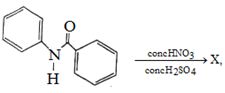
In the given reaction,what is the structure of the major product $X$?
A
$N$-($3$-nitrophenyl)benzamide
B
$N$-($4$-nitrophenyl)benzamide
C
$N$-phenyl$-4-$nitrobenzamide
D
$N$-($3$-nitrophenyl)benzamide
Solution
(B) The reactant is $N$-phenylbenzamide (acetanilide derivative).
In the presence of $conc. HNO_3$ and $conc. H_2SO_4$,nitration occurs.
The $-NH-CO-C_6H_5$ group is ortho/para directing due to the lone pair on the nitrogen atom,which can participate in resonance with the benzene ring attached to it.
However,due to the bulky nature of the $-NH-CO-C_6H_5$ group,steric hindrance makes the ortho position less favorable.
Therefore,the major product formed is the para-substituted isomer,which is $N$-($4$-nitrophenyl)benzamide.
In the presence of $conc. HNO_3$ and $conc. H_2SO_4$,nitration occurs.
The $-NH-CO-C_6H_5$ group is ortho/para directing due to the lone pair on the nitrogen atom,which can participate in resonance with the benzene ring attached to it.
However,due to the bulky nature of the $-NH-CO-C_6H_5$ group,steric hindrance makes the ortho position less favorable.
Therefore,the major product formed is the para-substituted isomer,which is $N$-($4$-nitrophenyl)benzamide.
0 likes
View Solution246
MediumMCQ
Which of the following is the correct decreasing order of basic strength for the given amines and ammonia?
A
$NH_3 > CH_3NH_2 > C_2H_5NH_2 > C_6H_5NH_2$
B
$C_2H_5NH_2 > CH_3NH_2 > NH_3 > C_6H_5NH_2$
C
$C_6H_5NH_2 > C_2H_5NH_2 > CH_3NH_2 > NH_3$
D
$CH_3NH_2 > C_2H_5NH_2 > C_6H_5NH_2 > NH_3$
Solution
(B) The basic strength of amines depends on the availability of the lone pair on the nitrogen atom and the stability of the conjugate acid formed.
$1$. $C_2H_5NH_2$ (Ethylamine) is a stronger base than $CH_3NH_2$ (Methylamine) due to the greater $+I$ effect of the ethyl group compared to the methyl group.
$2$. Both aliphatic amines are stronger bases than $NH_3$ because the alkyl groups increase the electron density on the nitrogen atom.
$3$. $C_6H_5NH_2$ (Aniline) is the weakest base because the lone pair on the nitrogen atom is involved in resonance with the benzene ring,making it less available for protonation.
Therefore,the correct decreasing order is $C_2H_5NH_2 > CH_3NH_2 > NH_3 > C_6H_5NH_2$.
$1$. $C_2H_5NH_2$ (Ethylamine) is a stronger base than $CH_3NH_2$ (Methylamine) due to the greater $+I$ effect of the ethyl group compared to the methyl group.
$2$. Both aliphatic amines are stronger bases than $NH_3$ because the alkyl groups increase the electron density on the nitrogen atom.
$3$. $C_6H_5NH_2$ (Aniline) is the weakest base because the lone pair on the nitrogen atom is involved in resonance with the benzene ring,making it less available for protonation.
Therefore,the correct decreasing order is $C_2H_5NH_2 > CH_3NH_2 > NH_3 > C_6H_5NH_2$.
0 likes
View Solution247
DifficultMCQ
$CH_3CH_2I$ $\xrightarrow{NaCN} A$ $\xrightarrow{OH^- \text{ (partial hydrolysis)}} B$ $\xrightarrow{Br_2/NaOH} C$. Identify the final product $C$.
A
$CH_3CH_2NH_2$
B
$CH_3CH_2CONHBr$
C
$CH_3CH_2COONH_4$
D
$CH_3CH_2CONBr_2$
Solution
(A) $CH_3CH_2I \xrightarrow{NaCN} CH_3CH_2CN$ (Propanenitrile,$A$)
$CH_3CH_2CN \xrightarrow{OH^- \text{ (partial hydrolysis)}} CH_3CH_2CONH_2$ (Propanamide,$B$)
$CH_3CH_2CONH_2 \xrightarrow{Br_2/NaOH} CH_3CH_2NH_2$ (Ethanamine,$C$)
This is a Hoffmann bromamide degradation reaction.
$CH_3CH_2CN \xrightarrow{OH^- \text{ (partial hydrolysis)}} CH_3CH_2CONH_2$ (Propanamide,$B$)
$CH_3CH_2CONH_2 \xrightarrow{Br_2/NaOH} CH_3CH_2NH_2$ (Ethanamine,$C$)
This is a Hoffmann bromamide degradation reaction.
0 likes
View Solution248
MediumMCQ
Identify $X$ and $Y$ in the following reaction: ${C_6H_5NH_2}$ $\xrightarrow[0^{\circ} - 5^{\circ}C]{NaNO_2 + 2HCl} X$ $\xrightarrow[H_2O]{HNO_2} Y + N_2 + HCl$
A
${C_6H_5N = N - C_6H_5}, {C_6H_5N_2^+ Cl^-}$
B
${C_6H_5N_2^+ Cl^-}, {C_6H_5N = N - C_6H_5}$
C
${C_6H_5N_2^+ Cl^-}, {C_6H_5OH}$
D
${C_6H_5NO_2}, {C_6H_6}$
0 likes
View Solution249
MediumMCQ
The reaction of a primary amine with an aldehyde gives $......$.
A
Amide
B
Imine
C
Nitrile
D
Nitro compounds
Solution
(B) Primary amines $(R-NH_2)$ react with aldehydes $(R'-CHO)$ to form imines (also known as Schiff bases) with the elimination of a water molecule.
The general reaction is: $R-NH_2 + R'-CHO \rightarrow R-N=CH-R' + H_2O$.
The general reaction is: $R-NH_2 + R'-CHO \rightarrow R-N=CH-R' + H_2O$.
0 likes
View Solution250
MediumMCQ
In the reaction $CH_3Br + KCN_{(alc)} \to X \xrightarrow[Na + C_2H_5OH]{reduction} Y$,identify $Y$.
A
$CH_3CN$
B
$C_2H_5CN$
C
$C_2H_5NH_2$
D
$CH_3NH_2$
Solution
(C) The reaction proceeds as follows:
$CH_3Br + KCN \to CH_3CN + KBr$
$X$ is $CH_3CN$ (acetonitrile or ethanenitrile).
Reduction of $CH_3CN$ using $Na / C_2H_5OH$ (Mendius reduction) yields $CH_3CH_2NH_2$.
$CH_3CN + 4[H] \xrightarrow{Na/C_2H_5OH} CH_3CH_2NH_2$
Thus,$Y$ is $CH_3CH_2NH_2$ (ethanamine).
$CH_3Br + KCN \to CH_3CN + KBr$
$X$ is $CH_3CN$ (acetonitrile or ethanenitrile).
Reduction of $CH_3CN$ using $Na / C_2H_5OH$ (Mendius reduction) yields $CH_3CH_2NH_2$.
$CH_3CN + 4[H] \xrightarrow{Na/C_2H_5OH} CH_3CH_2NH_2$
Thus,$Y$ is $CH_3CH_2NH_2$ (ethanamine).
0 likes
View SolutionAmines — Properties of Amines · Frequently Asked Questions
1Are these Amines questions useful for JEE and NEET?
Yes. All questions in this section are mapped to JEE Main and NEET exam patterns. Previous year questions from JEE Main, NEET, GUJCET and state-level exams are included with full solutions.
2Can I switch to Hindi or Gujarati for these questions?
Yes. Use the language tabs in the hero section or the sidebar to view the same questions and solutions in English, Hindi or Gujarati.
3How do I generate a question paper from this subtopic?
Use the Vedclass Exam Paper Generator — select the chapter and subtopic, set difficulty, and generate Sets A, B, C, D automatically. First 3 chapters of every subject are free.
Vedclass Products
For Students
Vedclass Test Series
Mock tests in real JEE/NEET style with performance analysis. 5-day free trial.
Start Free TrialFor Teachers
Exam Paper Generator
Generate Set A/B/C/D papers from this chapter in 2 minutes. 3 chapters free.
Try FreeFor Institutes
Online Exam Module
Live online exams with unlimited students, 360° analytics & white-label branding.
See DemoFor Teachers & Institutes
Generate a Amines Exam Paper in 2 Minutes
Select subtopic & difficulty — Sets A, B, C, D auto-generated with No Repeat logic.
First 3 chapters of every subject are free — no payment required.