
A English
Properties of Amines Questions in English
Class 12 Chemistry · Amines · Properties of Amines
1212+
Questions
English
Language
100%
With Solutions
Showing 23 of 1212 questions in English
1101
DifficultMCQ
Identify the final product $Z$ in the following reaction sequence:
A
$3-$Nitrobenzoic acid
B
$3-$Chlorobenzoic acid
C
$3-$Aminobenzoic acid
D
$3-$Chlorobenzoyl chloride
Solution
(B) $1$. Benzoic acid reacts with concentrated $HNO_3$ and concentrated $H_2SO_4$ (nitration) to form $m$-nitrobenzoic acid $(X)$.
$2$. Reduction of $m$-nitrobenzoic acid $(X)$ with $Sn/HCl$ converts the $-NO_2$ group to an $-NH_2$ group,forming $m$-aminobenzoic acid $(Y)$.
$3$. $m$-Aminobenzoic acid $(Y)$ reacts with $NaNO_2/HCl$ at $0-5 \ ^\circ C$ to form the diazonium salt,which then reacts with $Cu_2Cl_2/HCl$ (Sandmeyer reaction) to replace the diazonium group with a chlorine atom,resulting in $m$-chlorobenzoic acid $(Z)$.
$2$. Reduction of $m$-nitrobenzoic acid $(X)$ with $Sn/HCl$ converts the $-NO_2$ group to an $-NH_2$ group,forming $m$-aminobenzoic acid $(Y)$.
$3$. $m$-Aminobenzoic acid $(Y)$ reacts with $NaNO_2/HCl$ at $0-5 \ ^\circ C$ to form the diazonium salt,which then reacts with $Cu_2Cl_2/HCl$ (Sandmeyer reaction) to replace the diazonium group with a chlorine atom,resulting in $m$-chlorobenzoic acid $(Z)$.
0 likes
View Solution1102
DifficultMCQ
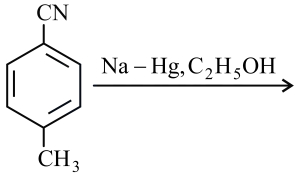
The major product of the following synthetic sequence is
A
$p$-Methylbenzyl alcohol
B
$p$-Xylene
C
$p$-Methylbenzamide
D
$p$-Methylbenzylamine
Solution
(D) The reaction of a nitrile with $Na-Hg$ in the presence of $C_2H_5OH$ is a classic reduction method known as the $Mendius$ reduction.
In this reaction,the nitrile group $(-CN)$ is reduced to a primary amine group $(-CH_2NH_2)$.
Here,$p$-tolunitrile ($4$-methylbenzonitrile) reacts with $Na-Hg$ and $C_2H_5OH$ to produce $p$-methylbenzylamine as the major product.
In this reaction,the nitrile group $(-CN)$ is reduced to a primary amine group $(-CH_2NH_2)$.
Here,$p$-tolunitrile ($4$-methylbenzonitrile) reacts with $Na-Hg$ and $C_2H_5OH$ to produce $p$-methylbenzylamine as the major product.
0 likes
View Solution1103
DifficultMCQ
Which one among the following statements is true?
A
Aliphatic diazonium salts are stable.
B
Aniline cannot be converted into phenol via its diazonium salt.
C
Aliphatic diazonium salts liberate nitrogen gas quantitatively.
D
Aniline cannot be converted into fluorobenzene via its diazonium salt.
Solution
(C) Diazonium salts are a group of organic compounds that have the common functional group $R-N_2^+ X^-$,where $R$ is an organic group (alkyl or aryl) and $X$ is an inorganic anion (e.g.,$Cl^-$,$Br^-$,$HSO_4^-$).
$(a)$ Aliphatic diazonium salts are highly unstable and decompose even at low temperatures.
$(b)$ Aniline can be converted into phenol by heating its diazonium salt with water.
$(c)$ Aliphatic diazonium salts decompose to liberate nitrogen gas quantitatively,which is often used for the estimation of aliphatic amines.
$(d)$ Aniline can be converted into fluorobenzene via the Balz-Schiemann reaction using its diazonium salt.
Therefore,statement $(c)$ is true.
$(a)$ Aliphatic diazonium salts are highly unstable and decompose even at low temperatures.
$(b)$ Aniline can be converted into phenol by heating its diazonium salt with water.
$(c)$ Aliphatic diazonium salts decompose to liberate nitrogen gas quantitatively,which is often used for the estimation of aliphatic amines.
$(d)$ Aniline can be converted into fluorobenzene via the Balz-Schiemann reaction using its diazonium salt.
Therefore,statement $(c)$ is true.
0 likes
View Solution1104
DifficultMCQ
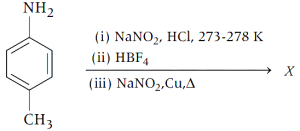
Identify $X$ in the following reaction sequence:
A
$p$-fluorotoluene
B
$p$-cresol
C
$p$-toluenediazonium fluoroborate
D
$p$-nitrotoluene
Solution
(D) The reaction sequence is as follows:
$1$. $p$-toluidine reacts with $NaNO_2$ and $HCl$ at $273-278 \ K$ to form $p$-toluenediazonium chloride (Diazotisation).
$2$. The diazonium salt reacts with $HBF_4$ to form $p$-toluenediazonium fluoroborate,which upon heating decomposes to give $p$-fluorotoluene (Balz-Schiemann reaction).
$3$. $p$-fluorotoluene reacts with $NaNO_2$ and $Cu$ upon heating to replace the fluorine atom with a nitro group,yielding $p$-nitrotoluene.
Therefore,the final product $X$ is $p$-nitrotoluene.
$1$. $p$-toluidine reacts with $NaNO_2$ and $HCl$ at $273-278 \ K$ to form $p$-toluenediazonium chloride (Diazotisation).
$2$. The diazonium salt reacts with $HBF_4$ to form $p$-toluenediazonium fluoroborate,which upon heating decomposes to give $p$-fluorotoluene (Balz-Schiemann reaction).
$3$. $p$-fluorotoluene reacts with $NaNO_2$ and $Cu$ upon heating to replace the fluorine atom with a nitro group,yielding $p$-nitrotoluene.
Therefore,the final product $X$ is $p$-nitrotoluene.
0 likes
View Solution1105
DifficultMCQ
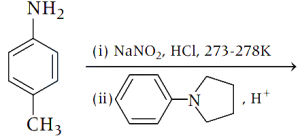
The major product in the following reaction is:
A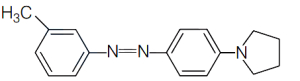
B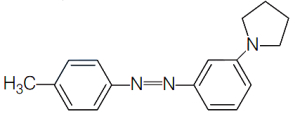
C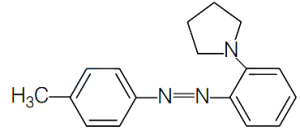
D
Solution
(D) In the given reaction,$p$-toluidine reacts with $NaNO_2$ and $HCl$ at $273-278 \ K$ to form a diazonium salt,which is $p$-methylbenzenediazonium chloride.
This diazonium salt then undergoes an electrophilic aromatic substitution (coupling reaction) with $N$-phenylpyrrolidine in the presence of $H^+$.
The coupling reaction occurs at the para-position of the $N$-phenylpyrrolidine ring because the pyrrolidinyl group is a strong ortho/para-directing group and the para-position is sterically less hindered.
Thus,the major product is the para-coupled azo dye as shown in option $D$.
This diazonium salt then undergoes an electrophilic aromatic substitution (coupling reaction) with $N$-phenylpyrrolidine in the presence of $H^+$.
The coupling reaction occurs at the para-position of the $N$-phenylpyrrolidine ring because the pyrrolidinyl group is a strong ortho/para-directing group and the para-position is sterically less hindered.
Thus,the major product is the para-coupled azo dye as shown in option $D$.
0 likes
View Solution1106
DifficultMCQ
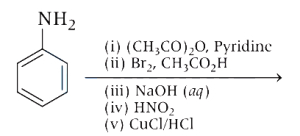
The major product in the following reaction sequence is:
A
$4-$bromo$-2-$chloroaniline
B
$1-$bromo$-4-$chlorobenzene
C
$3-$bromo-chlorobenzene
D
$1-$bromo$-2-$chlorobenzene
Solution
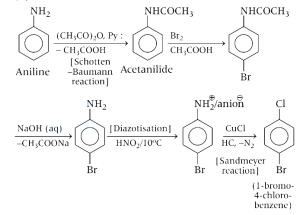
(B) The reaction sequence is as follows:
$1$. Acetylation of aniline with $(CH_3CO)_2O$ and pyridine protects the $-NH_2$ group,forming acetanilide.
$2$. Electrophilic aromatic substitution with $Br_2$ in $CH_3CO_2H$ occurs at the para-position due to the steric hindrance of the $-NHCOCH_3$ group,yielding $p$-bromoacetanilide.
$3$. Hydrolysis with $NaOH(aq)$ removes the acetyl group to regenerate $p$-bromoaniline.
$4$. Diazotization with $HNO_2$ at $0-5 \ ^\circ C$ converts the $-NH_2$ group into a diazonium salt,$-N_2^+Cl^-$.
$5$. The Sandmeyer reaction with $CuCl/HCl$ replaces the diazonium group with a chlorine atom,resulting in $1$-bromo-$4$-chlorobenzene.
$1$. Acetylation of aniline with $(CH_3CO)_2O$ and pyridine protects the $-NH_2$ group,forming acetanilide.
$2$. Electrophilic aromatic substitution with $Br_2$ in $CH_3CO_2H$ occurs at the para-position due to the steric hindrance of the $-NHCOCH_3$ group,yielding $p$-bromoacetanilide.
$3$. Hydrolysis with $NaOH(aq)$ removes the acetyl group to regenerate $p$-bromoaniline.
$4$. Diazotization with $HNO_2$ at $0-5 \ ^\circ C$ converts the $-NH_2$ group into a diazonium salt,$-N_2^+Cl^-$.
$5$. The Sandmeyer reaction with $CuCl/HCl$ replaces the diazonium group with a chlorine atom,resulting in $1$-bromo-$4$-chlorobenzene.
0 likes
View Solution1107
MediumMCQ
The major product formed by the reaction of benzylamine with nitrous acid is
A
phenol
B
benzaldehyde
C
chlorobenzene
D
benzyl alcohol
Solution
(D) Benzylamine $(C_6H_5CH_2NH_2)$ is a primary aliphatic amine.
When it reacts with nitrous acid $(HNO_2)$,which is generated in situ by the reaction of $NaNO_2$ and $HCl$ at low temperatures $(273-278 \ K)$,it forms an unstable diazonium salt.
This diazonium salt immediately undergoes hydrolysis to form benzyl alcohol $(C_6H_5CH_2OH)$ and nitrogen gas $(N_2)$.
The reaction is: $C_6H_5CH_2NH_2 + HNO_2 \rightarrow C_6H_5CH_2OH + N_2 + H_2O$.
Therefore,the major product is benzyl alcohol.
When it reacts with nitrous acid $(HNO_2)$,which is generated in situ by the reaction of $NaNO_2$ and $HCl$ at low temperatures $(273-278 \ K)$,it forms an unstable diazonium salt.
This diazonium salt immediately undergoes hydrolysis to form benzyl alcohol $(C_6H_5CH_2OH)$ and nitrogen gas $(N_2)$.
The reaction is: $C_6H_5CH_2NH_2 + HNO_2 \rightarrow C_6H_5CH_2OH + N_2 + H_2O$.
Therefore,the major product is benzyl alcohol.
0 likes
View Solution1108
MediumMCQ
Which of the following reactions leads to the formation of benzonitrile?
A
Reaction of bromobenzene with $KCN$
B
Reaction of aniline with $NaNO_2$ and $HCl$ at $273 \ K$ followed by the reaction with $CuCN$
C
Reaction of bromobenzene with $NaNO_2$ and $HCl$ at $273 \ K$ followed by the reaction with $CuCN$
D
Reaction of aniline with $KCN$
Solution
(B) The formation of benzonitrile from aniline involves two main steps:
$1$. Diazotization: Aniline reacts with $NaNO_2$ and $HCl$ at $273-278 \ K$ to form benzene diazonium chloride.
$2$. Sandmeyer reaction: Benzene diazonium chloride reacts with $CuCN$ to form benzonitrile.
Therefore,the correct sequence is the reaction of aniline with $NaNO_2$ and $HCl$ at $273 \ K$ followed by the reaction with $CuCN$.
$1$. Diazotization: Aniline reacts with $NaNO_2$ and $HCl$ at $273-278 \ K$ to form benzene diazonium chloride.
$2$. Sandmeyer reaction: Benzene diazonium chloride reacts with $CuCN$ to form benzonitrile.
Therefore,the correct sequence is the reaction of aniline with $NaNO_2$ and $HCl$ at $273 \ K$ followed by the reaction with $CuCN$.
0 likes
View Solution1109
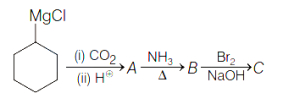
EasyMCQ
In the below given synthetic sequence,the product "$C$" is
A
Cyclohexanamine
B
Cyclohexanecarboxamide
C
Cyclohexylmethanamine
D
$N$-Bromocyclohexanecarboxamide
Solution
(A) $1$. The reaction of cyclohexylmagnesium chloride with $CO_2$ followed by acidic hydrolysis $(H^ )$ yields cyclohexanecarboxylic acid $(A)$.
$2$. Cyclohexanecarboxylic acid reacts with $NH_3$ upon heating $(\Delta)$ to form cyclohexanecarboxamide $(B)$.
$3$. The reaction of cyclohexanecarboxamide with $Br_2$ and $NaOH$ is the Hoffmann bromamide degradation reaction,which converts the amide into a primary amine with one less carbon atom.
$4$. Therefore,the product $C$ is cyclohexanamine.
$2$. Cyclohexanecarboxylic acid reacts with $NH_3$ upon heating $(\Delta)$ to form cyclohexanecarboxamide $(B)$.
$3$. The reaction of cyclohexanecarboxamide with $Br_2$ and $NaOH$ is the Hoffmann bromamide degradation reaction,which converts the amide into a primary amine with one less carbon atom.
$4$. Therefore,the product $C$ is cyclohexanamine.
0 likes
View Solution1110
EasyMCQ
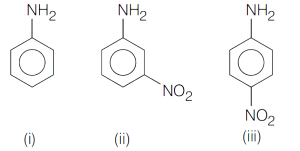
Which of the options correctly represents the basicity order for these compounds?
A
$i > ii > iii$
B
$i > iii > ii$
C
$iii > ii > i$
D
$iii > i > ii$
Solution
(A) The $-NO_2$ group is a strong electron-withdrawing group that exerts both $-I$ (inductive) and $-M$ (mesomeric) effects.
These effects decrease the electron density on the nitrogen atom of the $-NH_2$ group,thereby reducing its basicity.
In compound $(i)$,there is no electron-withdrawing group,so it is the most basic.
In compound $(ii)$,the $-NO_2$ group is at the meta position,exerting only the $-I$ effect.
In compound $(iii)$,the $-NO_2$ group is at the para position,exerting both $-I$ and strong $-M$ effects,which significantly reduce the electron density on the nitrogen atom.
Therefore,the basicity order is $(i) > (ii) > (iii)$.
These effects decrease the electron density on the nitrogen atom of the $-NH_2$ group,thereby reducing its basicity.
In compound $(i)$,there is no electron-withdrawing group,so it is the most basic.
In compound $(ii)$,the $-NO_2$ group is at the meta position,exerting only the $-I$ effect.
In compound $(iii)$,the $-NO_2$ group is at the para position,exerting both $-I$ and strong $-M$ effects,which significantly reduce the electron density on the nitrogen atom.
Therefore,the basicity order is $(i) > (ii) > (iii)$.
0 likes
View Solution1111
DifficultMCQ
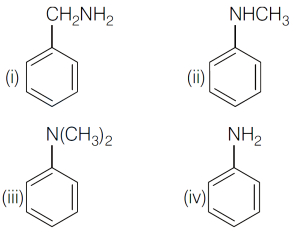
The order of basicity among the following nitrogen compounds is:
A
$iv > i > iii > ii$
B
$iii > i > iv > ii$
C
$ii > i > iii > iv$
D
$i > iii > ii > iv$
Solution
(D) The given compounds are:
$(i)$ $C_6H_5CH_2NH_2$ (Benzylamine)
(ii) $C_6H_5NHCH_3$ ($N$-methylaniline)
(iii) $C_6H_5N(CH_3)_2$ ($N,N$-dimethylaniline)
(iv) $C_6H_5NH_2$ (Aniline)
Benzylamine $(i)$ is an aliphatic amine where the lone pair on nitrogen is not involved in resonance with the benzene ring,making it the most basic.
Among the aryl amines (ii,iii,and iv),the basicity depends on the electron-donating effect of the methyl groups.
$N,N$-dimethylaniline (iii) has two electron-donating methyl groups,making it more basic than $N$-methylaniline (ii),which has one methyl group.
Aniline (iv) has no electron-donating methyl groups,making it the least basic.
Thus,the correct order of basicity is $i > iii > ii > iv$.
$(i)$ $C_6H_5CH_2NH_2$ (Benzylamine)
(ii) $C_6H_5NHCH_3$ ($N$-methylaniline)
(iii) $C_6H_5N(CH_3)_2$ ($N,N$-dimethylaniline)
(iv) $C_6H_5NH_2$ (Aniline)
Benzylamine $(i)$ is an aliphatic amine where the lone pair on nitrogen is not involved in resonance with the benzene ring,making it the most basic.
Among the aryl amines (ii,iii,and iv),the basicity depends on the electron-donating effect of the methyl groups.
$N,N$-dimethylaniline (iii) has two electron-donating methyl groups,making it more basic than $N$-methylaniline (ii),which has one methyl group.
Aniline (iv) has no electron-donating methyl groups,making it the least basic.
Thus,the correct order of basicity is $i > iii > ii > iv$.
0 likes
View Solution1112
DifficultMCQ
Which of the following is the strongest base?
A
$C_6H_5NH_2$
B
$C_6H_5NHCH_3$
C
$C_6H_5N(CH_3)_2$
D
$CH_3NH_2$
Solution
(D) The basicity of amines depends on the availability of the lone pair of electrons on the nitrogen atom for protonation.
In aromatic amines like $C_6H_5NH_2$,$C_6H_5NHCH_3$,and $C_6H_5N(CH_3)_2$,the lone pair of electrons on the nitrogen atom is involved in resonance with the benzene ring,which decreases its availability for protonation.
In aliphatic amines like $CH_3NH_2$,there is no such resonance,and the electron-donating inductive effect of the alkyl group increases the electron density on the nitrogen atom,making it more available for protonation.
Therefore,$CH_3NH_2$ is a much stronger base than the given aromatic amines.
In aromatic amines like $C_6H_5NH_2$,$C_6H_5NHCH_3$,and $C_6H_5N(CH_3)_2$,the lone pair of electrons on the nitrogen atom is involved in resonance with the benzene ring,which decreases its availability for protonation.
In aliphatic amines like $CH_3NH_2$,there is no such resonance,and the electron-donating inductive effect of the alkyl group increases the electron density on the nitrogen atom,making it more available for protonation.
Therefore,$CH_3NH_2$ is a much stronger base than the given aromatic amines.
0 likes
View Solution1113
EasyMCQ
$H_3CCONH_2 + Br_2 + 4NaOH \longrightarrow Y + Na_2CO_3 + 2NaBr + 2H_2O$
What is $Y$ in the above reaction?
What is $Y$ in the above reaction?
A
$H_3CCH_2NH_2$
B
$H_3CNH_2$
C
$H_3CCOBr$
D
$HCONH_2$
Solution
(B) The given reaction is the Hofmann bromamide degradation reaction.
In this reaction,a primary amide $(RCONH_2)$ reacts with bromine $(Br_2)$ and a strong base ($NaOH$ or $KOH$) to form a primary amine $(RNH_2)$ with one carbon atom less than the original amide.
The balanced chemical equation is:
$H_3CCONH_2 + Br_2 + 4NaOH \longrightarrow CH_3NH_2 + Na_2CO_3 + 2NaBr + 2H_2O$
Comparing this with the given reaction,$Y$ is $CH_3NH_2$ (methylamine),which corresponds to option $B$.
In this reaction,a primary amide $(RCONH_2)$ reacts with bromine $(Br_2)$ and a strong base ($NaOH$ or $KOH$) to form a primary amine $(RNH_2)$ with one carbon atom less than the original amide.
The balanced chemical equation is:
$H_3CCONH_2 + Br_2 + 4NaOH \longrightarrow CH_3NH_2 + Na_2CO_3 + 2NaBr + 2H_2O$
Comparing this with the given reaction,$Y$ is $CH_3NH_2$ (methylamine),which corresponds to option $B$.
0 likes
View Solution1114
MediumMCQ
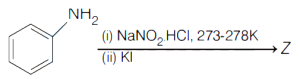
Identify $Z$ in the following reaction:
A
Nitrobenzene
B
Chlorobenzene
C
Iodobenzene
D
$2-$Iodoaniline
Solution
(C) The reaction of aniline with $NaNO_2/HCl$ at $273-278 \ K$ produces benzene diazonium chloride.
When benzene diazonium chloride is treated with $KI$,it undergoes a substitution reaction to form iodobenzene as the final product $Z$.
When benzene diazonium chloride is treated with $KI$,it undergoes a substitution reaction to form iodobenzene as the final product $Z$.
0 likes
View Solution1115
MediumMCQ
Identify $X$ and $Y$ in the following reactions:
$Nitrobenzene \xrightarrow{Zn/NH_4Cl} X$
$Nitrobenzene \xrightarrow{Zn + KOH/C_2H_5OH} Y$
$Nitrobenzene \xrightarrow{Zn/NH_4Cl} X$
$Nitrobenzene \xrightarrow{Zn + KOH/C_2H_5OH} Y$
A
$X = Nitrosobenzene, Y = Hydrazobenzene$
B
$X = Aniline, Y = Hydrazobenzene$
C
$X = Phenylhydroxylamine, Y = Hydrazobenzene$
D
$X = Hydrazobenzene, Y = Phenylhydroxylamine$
Solution
(C) The reduction of nitrobenzene depends on the medium used:
$1$. In neutral medium $(Zn/NH_4Cl)$: Nitrobenzene is reduced to phenylhydroxylamine $(C_6H_5NHOH)$. Thus,$X$ is phenylhydroxylamine.
$2$. In alkaline medium $(Zn + KOH/C_2H_5OH)$: Nitrobenzene undergoes reduction to form azoxybenzene,azobenzene,and finally hydrazobenzene $(C_6H_5NH-NHC_6H_5)$. Thus,$Y$ is hydrazobenzene.
Therefore,the correct option is $C$.
$1$. In neutral medium $(Zn/NH_4Cl)$: Nitrobenzene is reduced to phenylhydroxylamine $(C_6H_5NHOH)$. Thus,$X$ is phenylhydroxylamine.
$2$. In alkaline medium $(Zn + KOH/C_2H_5OH)$: Nitrobenzene undergoes reduction to form azoxybenzene,azobenzene,and finally hydrazobenzene $(C_6H_5NH-NHC_6H_5)$. Thus,$Y$ is hydrazobenzene.
Therefore,the correct option is $C$.
0 likes
View Solution1116
MediumMCQ
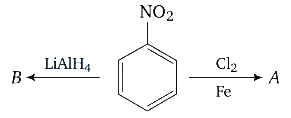
Identify $A$ and $B$ in the following reactions:
A
$A = m-\text{chloronitrobenzene}, B = \text{azobenzene}$
B
$A = p-\text{chloronitrobenzene}, B = \text{azobenzene}$
C
$A = m-\text{chloronitrobenzene}, B = \text{aniline}$
D
$A = m-\text{chloronitrobenzene}, B = \text{hydrazobenzene}$
Solution
(A) $1$. The $-NO_2$ group is a deactivating and meta-directing group. Therefore,when nitrobenzene reacts with $Cl_2$ in the presence of $Fe$ (a Lewis acid catalyst),electrophilic aromatic substitution occurs at the meta position to form $m$-chloronitrobenzene $(A)$.
$2$. The reduction of nitrobenzene with $LiAlH_4$ is a complex process. While $LiAlH_4$ is a strong reducing agent,its reaction with nitrobenzene typically leads to the formation of azobenzene $(C_6H_5-N=N-C_6H_5)$ as the major product $(B)$.
$2$. The reduction of nitrobenzene with $LiAlH_4$ is a complex process. While $LiAlH_4$ is a strong reducing agent,its reaction with nitrobenzene typically leads to the formation of azobenzene $(C_6H_5-N=N-C_6H_5)$ as the major product $(B)$.
0 likes
View Solution1117
MediumMCQ
Nitrobenzene on reduction using zinc in alkaline medium results in $X$. The number of $\sigma$ and $\pi$ bonds in $X$ is
A
$24 \sigma, 7 \pi$
B
$24 \sigma, 6 \pi$
C
$27 \sigma, 7 \pi$
D
$27 \sigma, 6 \pi$
Solution
(D) The reduction of nitrobenzene with zinc in an alkaline medium (e.g.,$Zn/NaOH$) produces hydrazobenzene $(C_{12}H_{12}N_2)$ as the final product $X$.
Structure of hydrazobenzene: $Ph-NH-NH-Ph$.
Each phenyl ring $(C_6H_5)$ contains $6 \pi$ bonds (from the aromatic ring) and $12 \sigma$ bonds ($6$ $C-C$ and $6$ $C-H$).
For two phenyl rings,we have $12 \pi$ bonds and $24 \sigma$ bonds.
Additionally,the central $N-N$ linkage has $1 \sigma$ bond,and the two $N-H$ bonds contribute $2 \sigma$ bonds.
Total $\sigma$ bonds = $24 + 1 + 2 = 27$.
Total $\pi$ bonds = $3 + 3 = 6$ (from the two benzene rings).
Thus,$X$ contains $27 \sigma$ and $6 \pi$ bonds.
Structure of hydrazobenzene: $Ph-NH-NH-Ph$.
Each phenyl ring $(C_6H_5)$ contains $6 \pi$ bonds (from the aromatic ring) and $12 \sigma$ bonds ($6$ $C-C$ and $6$ $C-H$).
For two phenyl rings,we have $12 \pi$ bonds and $24 \sigma$ bonds.
Additionally,the central $N-N$ linkage has $1 \sigma$ bond,and the two $N-H$ bonds contribute $2 \sigma$ bonds.
Total $\sigma$ bonds = $24 + 1 + 2 = 27$.
Total $\pi$ bonds = $3 + 3 = 6$ (from the two benzene rings).
Thus,$X$ contains $27 \sigma$ and $6 \pi$ bonds.
0 likes
View Solution1118
DifficultMCQ
Reduction of nitrobenzene with $Zn$ and alcoholic $KOH$ solution results in the formation of the following compound:
A
hydrazobenzene
B
azobenzene
C
aniline
D
phenyl hydroxyl amine
Solution
(A) The reduction of nitrobenzene $(C_6H_5NO_2)$ with $Zn$ dust and alcoholic $KOH$ is a specific chemical reaction that proceeds through several intermediates to finally yield hydrazobenzene $(C_6H_5NH-NHC_6H_5)$.
This reaction is a classic example of the reduction of nitro compounds in a basic medium.
This reaction is a classic example of the reduction of nitro compounds in a basic medium.
0 likes
View Solution1119
MediumMCQ
The structure of the compound formed when nitrobenzene is reduced by lithium aluminium hydride $(LiAlH_4)$ is
A
Hydrazobenzene
B
Phenylhydroxylamine
C
Azobenzene
D
Aniline
Solution
(C) The reduction of nitrobenzene with lithium aluminium hydride $(LiAlH_4)$ in an alkaline medium or specific conditions leads to the formation of azobenzene as the major product.
The reaction is represented as:
$2 C_6H_5NO_2 \xrightarrow{LiAlH_4} C_6H_5-N=N-C_6H_5$ (Azobenzene).
The reaction is represented as:
$2 C_6H_5NO_2 \xrightarrow{LiAlH_4} C_6H_5-N=N-C_6H_5$ (Azobenzene).
0 likes
View Solution1120
MediumMCQ
Nitrobenzene on reduction with zinc and $NH_4Cl$ gives:
A
azobenzene
B
aniline
C
hydrazobenzene
D
$N$-phenylhydroxylamine
Solution
(D) The reduction of nitrobenzene with zinc dust $(Zn)$ and aqueous ammonium chloride $(NH_4Cl)$ is a controlled reduction process.
This reaction yields $N$-phenylhydroxylamine as the major product.
The chemical equation is:
$C_6H_5NO_2 + 4[H] \xrightarrow{Zn, NH_4Cl} C_6H_5NHOH + H_2O$
This reaction yields $N$-phenylhydroxylamine as the major product.
The chemical equation is:
$C_6H_5NO_2 + 4[H] \xrightarrow{Zn, NH_4Cl} C_6H_5NHOH + H_2O$
0 likes
View Solution1121
DifficultMCQ
Which one of the following compounds forms a quaternary salt on reacting with excess methyl iodide?
A
$C_2H_5OCH_3$
B
$(CH_3)_2CHOC_2H_5$
C
$C_6H_5NH_2$
D
$C_6H_5NO_2$
Solution
(C) Amines react with alkyl halides in excess to undergo exhaustive alkylation,resulting in the formation of a quaternary ammonium salt.
Among the given options,$C_6H_5NH_2$ (aniline) is an amine,which reacts with excess methyl iodide $(CH_3I)$ to form a quaternary ammonium salt as shown below:
$C_6H_5NH_2 + 3CH_3I \rightarrow C_6H_5N^+(CH_3)_3I^- + 2HI$
Ethers ($C_2H_5OCH_3$ and $(CH_3)_2CHOC_2H_5$) do not form quaternary salts under these conditions,and nitro compounds $(C_6H_5NO_2)$ are not nucleophilic enough to undergo this reaction.
Among the given options,$C_6H_5NH_2$ (aniline) is an amine,which reacts with excess methyl iodide $(CH_3I)$ to form a quaternary ammonium salt as shown below:
$C_6H_5NH_2 + 3CH_3I \rightarrow C_6H_5N^+(CH_3)_3I^- + 2HI$
Ethers ($C_2H_5OCH_3$ and $(CH_3)_2CHOC_2H_5$) do not form quaternary salts under these conditions,and nitro compounds $(C_6H_5NO_2)$ are not nucleophilic enough to undergo this reaction.
0 likes
View Solution1122
MediumMCQ
Consider the following reaction:
$C_6H_5NO_2$ $\xrightarrow{Sn/HCl} X$ $\xrightarrow{C_6H_5COCl} Y + HCl$
What is $Y$?
$C_6H_5NO_2$ $\xrightarrow{Sn/HCl} X$ $\xrightarrow{C_6H_5COCl} Y + HCl$
What is $Y$?
A
Acetanilide
B
Benzanilide
C
Azo-benzene
D
Hydrazo-benzene
Solution
(B) Step $1$: Reduction of nitrobenzene $(C_6H_5NO_2)$ with $Sn/HCl$ gives aniline $(C_6H_5NH_2)$ as $X$.
$C_6H_5NO_2 + 6[H] \xrightarrow{Sn/HCl} C_6H_5NH_2 + 2H_2O$
Step $2$: Reaction of aniline $(X)$ with benzoyl chloride $(C_6H_5COCl)$ in the presence of a base (like $NaOH$) is known as benzoylation,which yields benzanilide $(C_6H_5NHCOC_6H_5)$ as $Y$.
$C_6H_5NH_2 + C_6H_5COCl \xrightarrow{NaOH} C_6H_5NHCOC_6H_5 + HCl$
Thus,$Y$ is benzanilide.
$C_6H_5NO_2 + 6[H] \xrightarrow{Sn/HCl} C_6H_5NH_2 + 2H_2O$
Step $2$: Reaction of aniline $(X)$ with benzoyl chloride $(C_6H_5COCl)$ in the presence of a base (like $NaOH$) is known as benzoylation,which yields benzanilide $(C_6H_5NHCOC_6H_5)$ as $Y$.
$C_6H_5NH_2 + C_6H_5COCl \xrightarrow{NaOH} C_6H_5NHCOC_6H_5 + HCl$
Thus,$Y$ is benzanilide.
0 likes
View Solution1123
EasyMCQ
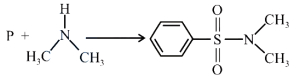
In the following reaction,the suitable starting reagent $P$ is
A
Benzenesulfonic acid
B
Benzenesulfonyl chloride
C
Methyl benzenesulfonate
D
Benzenesulfonamide
Solution
(B) The reaction involves the nucleophilic substitution of a sulfonyl chloride with a secondary amine. The nitrogen atom of dimethylamine acts as a nucleophile and attacks the sulfur atom of benzenesulfonyl chloride,leading to the displacement of the chloride ion. This reaction produces $N,N$-dimethylbenzenesulfonamide. Therefore,the reagent $P$ is benzenesulfonyl chloride $(C_6H_5SO_2Cl)$.
0 likes
View SolutionAmines — Properties of Amines · Frequently Asked Questions
1Are these Amines questions useful for JEE and NEET?
Yes. All questions in this section are mapped to JEE Main and NEET exam patterns. Previous year questions from JEE Main, NEET, GUJCET and state-level exams are included with full solutions.
2Can I switch to Hindi or Gujarati for these questions?
Yes. Use the language tabs in the hero section or the sidebar to view the same questions and solutions in English, Hindi or Gujarati.
3How do I generate a question paper from this subtopic?
Use the Vedclass Exam Paper Generator — select the chapter and subtopic, set difficulty, and generate Sets A, B, C, D automatically. First 3 chapters of every subject are free.
Vedclass Products
For Students
Vedclass Test Series
Mock tests in real JEE/NEET style with performance analysis. 5-day free trial.
Start Free TrialFor Teachers
Exam Paper Generator
Generate Set A/B/C/D papers from this chapter in 2 minutes. 3 chapters free.
Try FreeFor Institutes
Online Exam Module
Live online exams with unlimited students, 360° analytics & white-label branding.
See DemoFor Teachers & Institutes
Generate a Amines Exam Paper in 2 Minutes
Select subtopic & difficulty — Sets A, B, C, D auto-generated with No Repeat logic.
First 3 chapters of every subject are free — no payment required.