
A English
Properties of Amines Questions in English
Class 12 Chemistry · Amines · Properties of Amines
1212+
Questions
English
Language
100%
With Solutions
Showing 41 of 1212 questions in English
1151
EasyMCQ
What are $X$ and $Y$ respectively in the following reactions?

A
$(i) \ LiAlH_4 \ (ii) \ H_2O ; NaOH + Br_2$
B
$NaOH + Br_2 ; (i) \ LiAlH_4 \ (ii) \ H_2O$
C
$NaOH + Br_2 ; (i) \ NaBH_4 \ (ii) \ H_2O$
D
$(i) \ NaBH_4 \ (ii) \ H_2O ; NaOH + Br_2$
Solution
(B) The conversion of benzamide $(C_6H_5CONH_2)$ to aniline $(C_6H_5NH_2)$ involves the removal of a carbonyl group,which is achieved by the Hoffmann bromamide degradation reaction using $NaOH + Br_2$. Thus,$X = NaOH + Br_2$.
The conversion of benzamide $(C_6H_5CONH_2)$ to benzylamine $(C_6H_5CH_2NH_2)$ involves the reduction of the amide group to an amine group,which is achieved using a strong reducing agent like $LiAlH_4$ followed by hydrolysis. Thus,$Y = (i) \ LiAlH_4 \ (ii) \ H_2O$.
Therefore,$X = NaOH + Br_2$ and $Y = (i) \ LiAlH_4 \ (ii) \ H_2O$.
The conversion of benzamide $(C_6H_5CONH_2)$ to benzylamine $(C_6H_5CH_2NH_2)$ involves the reduction of the amide group to an amine group,which is achieved using a strong reducing agent like $LiAlH_4$ followed by hydrolysis. Thus,$Y = (i) \ LiAlH_4 \ (ii) \ H_2O$.
Therefore,$X = NaOH + Br_2$ and $Y = (i) \ LiAlH_4 \ (ii) \ H_2O$.
0 likes
View Solution1152
DifficultMCQ
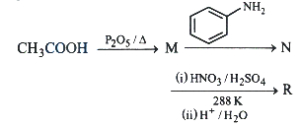
What is the major product '$R$' in the following reaction sequence?
A
$o-$Nitroaniline
B
$m-$Nitroaniline
C
$p-$Nitroaniline
D
$p-$Aminobenzene sulphonic acid
Solution
(C) $1$. The reaction of $CH_3COOH$ with $P_2O_5/\Delta$ produces acetic anhydride $(M)$,which is $(CH_3CO)_2O$.
$2$. Acetic anhydride reacts with aniline $(C_6H_5NH_2)$ to form acetanilide $(N)$,which is $CH_3CONHC_6H_5$.
$3$. Acetanilide is then subjected to nitration using $HNO_3/H_2SO_4$ at $288 \ K$. The $-NHCOCH_3$ group is ortho/para directing,but due to steric hindrance,the para-isomer is the major product.
$4$. Finally,hydrolysis with $H^+/H_2O$ removes the acetyl group to yield $p-$nitroaniline as the major product '$R$'.
$2$. Acetic anhydride reacts with aniline $(C_6H_5NH_2)$ to form acetanilide $(N)$,which is $CH_3CONHC_6H_5$.
$3$. Acetanilide is then subjected to nitration using $HNO_3/H_2SO_4$ at $288 \ K$. The $-NHCOCH_3$ group is ortho/para directing,but due to steric hindrance,the para-isomer is the major product.
$4$. Finally,hydrolysis with $H^+/H_2O$ removes the acetyl group to yield $p-$nitroaniline as the major product '$R$'.
0 likes
View Solution1153
MediumMCQ
Products that are formed in the given reaction including by-products are: $CH_3CH_2CH_2CH_2CONH_2 + Br_2 + 4 NaOH \rightarrow$
A
$CH_3CH_2CH_2CH_2CH_2NH_2 + Na_2CO_3 + 2 NaBr + 2 H_2O$
B
$CH_3CH_2CH_2CH_2NH_2 + Na_2CO_3 + 2 NaBr + 2 H_2O$
C
$CH_3CH_2CH_2CH_2CH_2NH_2 + 2 NaHCO_3 + Br_2 + 2 H_2O$
D
$CH_3CH_2CH_2CH_2NH_2 + 2 Na_2CO_3 + Br_2 + 2 H_2O$
Solution
(B) The given reaction is the Hoffmann Bromamide degradation reaction.
In this reaction,an amide is treated with bromine and an aqueous or alcoholic solution of sodium hydroxide.
The product formed is a primary amine with one carbon atom less than the starting amide.
The balanced chemical equation is:
$CH_3CH_2CH_2CH_2CONH_2 + Br_2 + 4 NaOH \rightarrow CH_3CH_2CH_2CH_2NH_2 + Na_2CO_3 + 2 NaBr + 2 H_2O$
Thus,the products are $CH_3CH_2CH_2CH_2NH_2$,$Na_2CO_3$,$2 NaBr$,and $2 H_2O$.
In this reaction,an amide is treated with bromine and an aqueous or alcoholic solution of sodium hydroxide.
The product formed is a primary amine with one carbon atom less than the starting amide.
The balanced chemical equation is:
$CH_3CH_2CH_2CH_2CONH_2 + Br_2 + 4 NaOH \rightarrow CH_3CH_2CH_2CH_2NH_2 + Na_2CO_3 + 2 NaBr + 2 H_2O$
Thus,the products are $CH_3CH_2CH_2CH_2NH_2$,$Na_2CO_3$,$2 NaBr$,and $2 H_2O$.
0 likes
View Solution1154
MediumMCQ
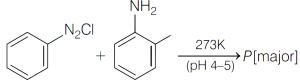
In the following reaction,the major product $(P)$ formed is
A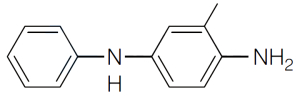
B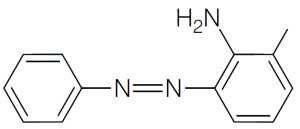
C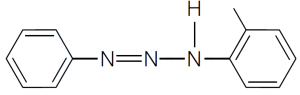
D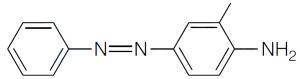
Solution
(D) The reaction between benzene diazonium chloride and $o$-toluidine ($2$-methylaniline) at $273 \ K$ and $pH \ 4-5$ is an electrophilic aromatic substitution reaction known as coupling reaction.
In this reaction,the diazonium cation acts as an electrophile.
The $-NH_2$ group is a strong activating group and is ortho/para directing.
Due to the steric hindrance caused by the methyl group at the ortho position,the electrophile attacks the para position with respect to the $-NH_2$ group.
Therefore,the major product is $4$-amino-$3$-methylazobenzene.
In this reaction,the diazonium cation acts as an electrophile.
The $-NH_2$ group is a strong activating group and is ortho/para directing.
Due to the steric hindrance caused by the methyl group at the ortho position,the electrophile attacks the para position with respect to the $-NH_2$ group.
Therefore,the major product is $4$-amino-$3$-methylazobenzene.
0 likes
View Solution1155
MediumMCQ
The conversion of $A$ to $B$ is an example of which reaction?
$\text{Propanenitrile}$ $\xrightarrow{LiAlH_4} A$ $\xrightarrow{CHCl_3 / \text{alcoholic } KOH, \Delta} B$
$\text{Propanenitrile}$ $\xrightarrow{LiAlH_4} A$ $\xrightarrow{CHCl_3 / \text{alcoholic } KOH, \Delta} B$
A
Reimer-Tiemann reaction
B
Carbylamine reaction
C
Stephen reaction
D
Sandmeyer reaction
Solution
(B) $1$. The reduction of propanenitrile $(CH_3CH_2CN)$ with $LiAlH_4$ gives propan$-1-$amine $(CH_3CH_2CH_2NH_2)$,which is compound $A$.
$2$. The reaction of a primary amine $(A)$ with chloroform $(CHCl_3)$ and alcoholic potassium hydroxide $(KOH)$ is known as the Carbylamine reaction.
$3$. This reaction produces an isocyanide or carbylamine $(CH_3CH_2CH_2NC)$,which is compound $B$,characterized by an offensive smell.
$4$. Therefore,the conversion of $A$ to $B$ is an example of the Carbylamine reaction.
$2$. The reaction of a primary amine $(A)$ with chloroform $(CHCl_3)$ and alcoholic potassium hydroxide $(KOH)$ is known as the Carbylamine reaction.
$3$. This reaction produces an isocyanide or carbylamine $(CH_3CH_2CH_2NC)$,which is compound $B$,characterized by an offensive smell.
$4$. Therefore,the conversion of $A$ to $B$ is an example of the Carbylamine reaction.
0 likes
View Solution1156
EasyMCQ
Which one of the following gives a foul-smelling substance when treated with chloroform and alcoholic $KOH$?
A
$N$-methylaniline $(C_6H_5NHCH_3)$
B
Benzylamine $(C_6H_5CH_2NH_2)$
C
Benzamide $(C_6H_5CONH_2)$
D
$N,N$-dimethylaniline $(C_6H_5N(CH_3)_2)$
Solution
(B) The reaction of primary amines with chloroform $(CHCl_3)$ and alcoholic potassium hydroxide $(KOH)$ is known as the carbylamine reaction. This reaction produces isocyanides (carbylamines),which are characterized by a highly foul smell.
$R-NH_2 + CHCl_3 + 3KOH \rightarrow R-NC + 3KCl + 3H_2O$
Among the given options,only benzylamine $(C_6H_5CH_2NH_2)$ is a primary amine. $N$-methylaniline is a secondary amine,$N,N$-dimethylaniline is a tertiary amine,and benzamide is an amide. Therefore,only benzylamine will undergo the carbylamine reaction to produce a foul-smelling substance.
$R-NH_2 + CHCl_3 + 3KOH \rightarrow R-NC + 3KCl + 3H_2O$
Among the given options,only benzylamine $(C_6H_5CH_2NH_2)$ is a primary amine. $N$-methylaniline is a secondary amine,$N,N$-dimethylaniline is a tertiary amine,and benzamide is an amide. Therefore,only benzylamine will undergo the carbylamine reaction to produce a foul-smelling substance.
0 likes
View Solution1157
MediumMCQ
The product formed when aniline is treated with chloroform in the presence of $KOH$ (alcoholic) is
A
Phenol
B
Phenyl isothiocyanate
C
Phenyl isocyanide
D
Cyanobenzene
Solution
(C) The reaction of primary amines (both aliphatic and aromatic) with chloroform $(CHCl_3)$ and alcoholic potassium hydroxide $(KOH)$ is known as the carbylamine reaction.
In this reaction,aniline $(C_6H_5NH_2)$ reacts with $CHCl_3$ and $KOH$ to form phenyl isocyanide $(C_6H_5NC)$,which is also known as phenyl carbylamine.
The chemical equation is: $C_6H_5NH_2 + CHCl_3 + 3KOH (alc.) \rightarrow C_6H_5NC + 3KCl + 3H_2O$.
Therefore,the correct product is phenyl isocyanide.
In this reaction,aniline $(C_6H_5NH_2)$ reacts with $CHCl_3$ and $KOH$ to form phenyl isocyanide $(C_6H_5NC)$,which is also known as phenyl carbylamine.
The chemical equation is: $C_6H_5NH_2 + CHCl_3 + 3KOH (alc.) \rightarrow C_6H_5NC + 3KCl + 3H_2O$.
Therefore,the correct product is phenyl isocyanide.
0 likes
View Solution1158
MediumMCQ
Which product of the following reactions fails to give the carbylamine test?
A
Hoffmann bromide degradation
B
Gabriel phthalimide synthesis
C
Reduction of nitriles with $LiAlH_4$
D
Reduction of tertiary amides with $LiAlH_4$
Solution
(D) The carbylamine test is a characteristic reaction of primary amines $(R-NH_2)$.
Secondary and tertiary amines do not give this test.
$A$. Hoffmann bromide degradation produces primary amines.
$B$. Gabriel phthalimide synthesis produces primary amines.
$C$. Reduction of nitriles with $LiAlH_4$ produces primary amines.
$D$. Reduction of tertiary amides with $LiAlH_4$ produces tertiary amines $(R_3N)$.
Since tertiary amines do not contain the $-NH_2$ group,they fail to give the carbylamine test.
Secondary and tertiary amines do not give this test.
$A$. Hoffmann bromide degradation produces primary amines.
$B$. Gabriel phthalimide synthesis produces primary amines.
$C$. Reduction of nitriles with $LiAlH_4$ produces primary amines.
$D$. Reduction of tertiary amides with $LiAlH_4$ produces tertiary amines $(R_3N)$.
Since tertiary amines do not contain the $-NH_2$ group,they fail to give the carbylamine test.
0 likes
View Solution1159
MediumMCQ
The sequence of reagents which convert $p-$methyl aniline to $p-$methyl benzoic acid are
A
$KMnO_4 / H^{+} ; NaNO_2 + HCl ; Cu / HCl$
B
$NaNO_2 + HCl / 273 \ K ; Cu / HCl ; KMnO_4 / H^{+}$
C
$NaNO_2 + HCl / 273 \ K ; CuCN / KCN ; H_3O^{+}$
D
$NaNO_2 + HCl / 285 \ K ; KCN ; H_3O^{+}$
Solution
(C) The conversion of $p-$methyl aniline to $p-$methyl benzoic acid involves the following steps:
$1$. Diazotization: $p-$methyl aniline reacts with $NaNO_2 + HCl$ at $273 \ K$ to form $p-$methyl benzene diazonium chloride.
$2$. Sandmeyer reaction: The diazonium salt reacts with $CuCN / KCN$ to form $p-$methyl benzonitrile.
$3$. Hydrolysis: The nitrile group is hydrolyzed using $H_3O^{+}$ to form $p-$methyl benzoic acid.
Thus,the correct sequence is $NaNO_2 + HCl / 273 \ K ; CuCN / KCN ; H_3O^{+}$.
$1$. Diazotization: $p-$methyl aniline reacts with $NaNO_2 + HCl$ at $273 \ K$ to form $p-$methyl benzene diazonium chloride.
$2$. Sandmeyer reaction: The diazonium salt reacts with $CuCN / KCN$ to form $p-$methyl benzonitrile.
$3$. Hydrolysis: The nitrile group is hydrolyzed using $H_3O^{+}$ to form $p-$methyl benzoic acid.
Thus,the correct sequence is $NaNO_2 + HCl / 273 \ K ; CuCN / KCN ; H_3O^{+}$.
0 likes
View Solution1160
EasyMCQ
In the given reaction sequence,$Z$ is
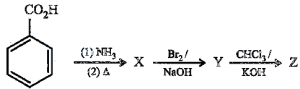
A
Chlorobenzene
B
Phenol
C
Phenyl isocyanide
D
Benzonitrile
Solution
(C) The reaction sequence is as follows:
$1$. Benzoic acid reacts with $NH_3$ followed by heating to form benzamide $(X)$.
$2$. Benzamide undergoes Hofmann bromamide degradation with $Br_2/NaOH$ to form aniline $(Y)$.
$3$. Aniline reacts with $CHCl_3/KOH$ (carbylamine reaction) to form phenyl isocyanide $(Z)$,which is characterized by a foul smell.
$1$. Benzoic acid reacts with $NH_3$ followed by heating to form benzamide $(X)$.
$2$. Benzamide undergoes Hofmann bromamide degradation with $Br_2/NaOH$ to form aniline $(Y)$.
$3$. Aniline reacts with $CHCl_3/KOH$ (carbylamine reaction) to form phenyl isocyanide $(Z)$,which is characterized by a foul smell.
0 likes
View Solution1161
DifficultMCQ
The major product formed in the following reaction sequence is:
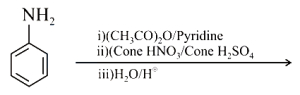
A
$2-$Nitroaniline
B
$N$-($4$-nitrophenyl)acetamide
C
$4-$Nitroaniline
D
$4-$Aminoacetophenone
Solution
(C) The reaction sequence is as follows:
$1$. $N$-acylation of aniline with $(CH_3CO)_2O$ in the presence of pyridine yields acetanilide $(C_6H_5NHCOCH_3)$.
$2$. Nitration of acetanilide using concentrated $HNO_3$ and concentrated $H_2SO_4$ occurs primarily at the para-position due to the steric hindrance of the bulky $-NHCOCH_3$ group,forming $p$-nitroacetanilide.
$3$. Finally,acid-catalyzed hydrolysis $(H_2O/H^+)$ of $p$-nitroacetanilide removes the acetyl group to yield $p$-nitroaniline ($4$-nitroaniline) as the major product.
$1$. $N$-acylation of aniline with $(CH_3CO)_2O$ in the presence of pyridine yields acetanilide $(C_6H_5NHCOCH_3)$.
$2$. Nitration of acetanilide using concentrated $HNO_3$ and concentrated $H_2SO_4$ occurs primarily at the para-position due to the steric hindrance of the bulky $-NHCOCH_3$ group,forming $p$-nitroacetanilide.
$3$. Finally,acid-catalyzed hydrolysis $(H_2O/H^+)$ of $p$-nitroacetanilide removes the acetyl group to yield $p$-nitroaniline ($4$-nitroaniline) as the major product.
0 likes
View Solution1162
EasyMCQ
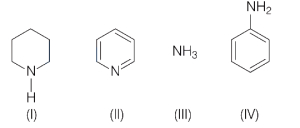
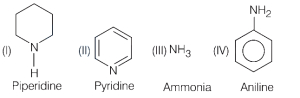
The correct order of basic strength of the following amines is
A
$I > III > II > IV$
B
$II > I > IV > III$
C
$I > II > III > IV$
D
$I > III > IV > II$
Solution
(A) $I$. Piperidine is the most basic. The $N$ lone pair is in an $sp^3$ hybrid orbital,there is no resonance,and due to the $+I$ effect of the alkyl group attached,it becomes more basic than $sp^3$ hybridized ammonia.
$II$. In pyridine,the lone pair is in an $sp^2$ hybridized orbital. The $sp^2$ hybrid is smaller than $sp^3$,so there is a stronger attraction to the nucleus,making it less basic.
$III$. $NH_3$ is more basic than aniline because in ammonia,the lone pair is localized and easily available for donation.
$IV$. The basicity of aniline is lower than that of ammonia because in aniline,the lone pair of electrons on $N$ is involved in resonance with the benzene ring.
Therefore,the correct order of basic strength is $I > III > II > IV$.
$II$. In pyridine,the lone pair is in an $sp^2$ hybridized orbital. The $sp^2$ hybrid is smaller than $sp^3$,so there is a stronger attraction to the nucleus,making it less basic.
$III$. $NH_3$ is more basic than aniline because in ammonia,the lone pair is localized and easily available for donation.
$IV$. The basicity of aniline is lower than that of ammonia because in aniline,the lone pair of electrons on $N$ is involved in resonance with the benzene ring.
Therefore,the correct order of basic strength is $I > III > II > IV$.
0 likes
View Solution1163
MediumMCQ
Assertion $(A)$: $-NH_2$ group of aniline is ortho,para directing in electrophilic substitutions.
Reason $(R)$: $-NH_2$ group stabilises the arenium ion formed by the ortho,para attack of the electrophile.
The correct answer is
Reason $(R)$: $-NH_2$ group stabilises the arenium ion formed by the ortho,para attack of the electrophile.
The correct answer is
A
Both $(A)$ and $(R)$ are correct,$(R)$ is the correct explanation of $(A)$
B
Both $(A)$ and $(R)$ are correct,$(R)$ is not the correct explanation of $(A)$
C
$(A)$ is correct,but $(R)$ is not correct
D
$(A)$ is not correct,but $(R)$ is correct
Solution
(A) The $-NH_2$ group of aniline is a strong electron-donating group due to the $+M$ (mesomeric) effect.
This effect increases the electron density at the ortho and para positions of the benzene ring,making them more nucleophilic and thus more susceptible to electrophilic attack.
During electrophilic aromatic substitution,the intermediate arenium ion (sigma complex) formed by the attack of an electrophile at the ortho or para positions is stabilized by the resonance donation of the lone pair of electrons from the nitrogen atom of the $-NH_2$ group.
Therefore,both the assertion and the reason are correct,and the reason correctly explains why the $-NH_2$ group is ortho,para directing.
This effect increases the electron density at the ortho and para positions of the benzene ring,making them more nucleophilic and thus more susceptible to electrophilic attack.
During electrophilic aromatic substitution,the intermediate arenium ion (sigma complex) formed by the attack of an electrophile at the ortho or para positions is stabilized by the resonance donation of the lone pair of electrons from the nitrogen atom of the $-NH_2$ group.
Therefore,both the assertion and the reason are correct,and the reason correctly explains why the $-NH_2$ group is ortho,para directing.
0 likes
View Solution1164
DifficultMCQ
The correct statements about the products $B$ and $C$ in the given reactions are
$CH_3CH_2OH$ $\xrightarrow[\text{Anhy } ZnCl_2]{HCl} A$ $\xrightarrow[\text{AgCN}]{\text{ethanolic}} \underset{\text{Minor}}{B} + \underset{\text{Major}}{C}$
$I$. $B$ and $C$ are functional isomers
$II$. With $H_2 / \text{Catalyst}$,$B$ gives $1^{\circ}$ amine and $C$ gives $2^{\circ}$ amine
$III$. $B$ on acid hydrolysis gives formic acid and $C$ gives $C_3H_6O_2$
$IV$. $C$ forms isocyanate with $HgO$
$CH_3CH_2OH$ $\xrightarrow[\text{Anhy } ZnCl_2]{HCl} A$ $\xrightarrow[\text{AgCN}]{\text{ethanolic}} \underset{\text{Minor}}{B} + \underset{\text{Major}}{C}$
$I$. $B$ and $C$ are functional isomers
$II$. With $H_2 / \text{Catalyst}$,$B$ gives $1^{\circ}$ amine and $C$ gives $2^{\circ}$ amine
$III$. $B$ on acid hydrolysis gives formic acid and $C$ gives $C_3H_6O_2$
$IV$. $C$ forms isocyanate with $HgO$
A
$I$ & $III$
B
$II$ & $III$
C
$I, II$ & $IV$
D
$II, III$ & $IV$
Solution
(A) $1$. $CH_3CH_2OH + HCl \xrightarrow{ZnCl_2} CH_3CH_2Cl (A) + H_2O$.
$2$. $CH_3CH_2Cl + AgCN \rightarrow CH_3CH_2NC (B, \text{minor}) + CH_3CH_2CN (C, \text{major})$.
$3$. $B$ is ethyl isocyanide and $C$ is ethyl cyanide. They are functional isomers ($I$ is correct).
$4$. Reduction: $CH_3CH_2NC + 4[H] \rightarrow CH_3CH_2NHCH_3$ ($2^{\circ}$ amine) and $CH_3CH_2CN + 4[H] \rightarrow CH_3CH_2CH_2NH_2$ ($1^{\circ}$ amine). Thus,$II$ is incorrect.
$5$. Hydrolysis: $CH_3CH_2NC + 2H_2O \rightarrow CH_3CH_2NH_2 + HCOOH$ (formic acid). $CH_3CH_2CN + 2H_2O \rightarrow CH_3CH_2COOH + NH_3$. $CH_3CH_2COOH$ is $C_3H_6O_2$. Thus,$III$ is correct.
$6$. $C$ (nitrile) does not form isocyanate with $HgO$; $B$ (isocyanide) can be oxidized to isocyanate. Thus,$IV$ is incorrect.
Therefore,statements $I$ and $III$ are correct.
$2$. $CH_3CH_2Cl + AgCN \rightarrow CH_3CH_2NC (B, \text{minor}) + CH_3CH_2CN (C, \text{major})$.
$3$. $B$ is ethyl isocyanide and $C$ is ethyl cyanide. They are functional isomers ($I$ is correct).
$4$. Reduction: $CH_3CH_2NC + 4[H] \rightarrow CH_3CH_2NHCH_3$ ($2^{\circ}$ amine) and $CH_3CH_2CN + 4[H] \rightarrow CH_3CH_2CH_2NH_2$ ($1^{\circ}$ amine). Thus,$II$ is incorrect.
$5$. Hydrolysis: $CH_3CH_2NC + 2H_2O \rightarrow CH_3CH_2NH_2 + HCOOH$ (formic acid). $CH_3CH_2CN + 2H_2O \rightarrow CH_3CH_2COOH + NH_3$. $CH_3CH_2COOH$ is $C_3H_6O_2$. Thus,$III$ is correct.
$6$. $C$ (nitrile) does not form isocyanate with $HgO$; $B$ (isocyanide) can be oxidized to isocyanate. Thus,$IV$ is incorrect.
Therefore,statements $I$ and $III$ are correct.
0 likes
View Solution1165
MediumMCQ
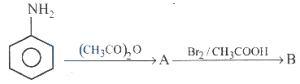
In the following sequence of reaction,identify the major product $B$.
A
p-Bromoacetanilide
B
m-Bromoacetanilide
C
o-Bromoacetanilide
D
$2,4,6-$Tribromoacetanilide
Solution
(A) The reaction of aniline with acetic anhydride $(CH_3CO)_2O$ leads to the formation of acetanilide $(A)$. This process is known as acetylation. The $-NHCOCH_3$ group is less activating than the $-NH_2$ group due to the resonance of the lone pair of nitrogen with the carbonyl group. This reduces the electron density on the ring,preventing polybromination. When acetanilide $(A)$ is treated with $Br_2$ in $CH_3COOH$,the bulky acetamido group directs the incoming bromine atom primarily to the para position due to steric hindrance at the ortho position. Thus,the major product $B$ is $p$-bromoacetanilide.
0 likes
View Solution1166
DifficultMCQ
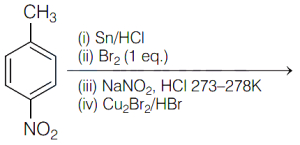
The major product formed in the following reaction is:
A
$1-$methyl$-3,5-$dibromobenzene
B
$1-$methyl$-2,6-$dibromobenzene
C
$1-$methyl$-3,4-$dibromobenzene
D
$1-$methyl$-2,4-$dibromobenzene
Solution
(C) The reaction proceeds as follows:
$(i)$ $Sn/HCl$ reduces the $-NO_2$ group to an $-NH_2$ group,forming $p$-toluidine.
(ii) $Br_2$ $(1 \ eq.)$ in the presence of the strongly activating $-NH_2$ group leads to ortho-bromination,yielding $2$-bromo-$4$-methylaniline.
(iii) $NaNO_2/HCl$ at $273-278 \ K$ converts the $-NH_2$ group into a diazonium salt,$-N_2^+Cl^-$.
(iv) $Cu_2Br_2/HBr$ (Sandmeyer reaction) replaces the diazonium group with a $-Br$ atom,resulting in $1,2$-dibromo-$4$-methylbenzene (also known as $3,4$-dibromotoluene).
$(i)$ $Sn/HCl$ reduces the $-NO_2$ group to an $-NH_2$ group,forming $p$-toluidine.
(ii) $Br_2$ $(1 \ eq.)$ in the presence of the strongly activating $-NH_2$ group leads to ortho-bromination,yielding $2$-bromo-$4$-methylaniline.
(iii) $NaNO_2/HCl$ at $273-278 \ K$ converts the $-NH_2$ group into a diazonium salt,$-N_2^+Cl^-$.
(iv) $Cu_2Br_2/HBr$ (Sandmeyer reaction) replaces the diazonium group with a $-Br$ atom,resulting in $1,2$-dibromo-$4$-methylbenzene (also known as $3,4$-dibromotoluene).
0 likes
View Solution1167
MediumMCQ
$4-$Nitrotoluene ($para-$nitrotoluene) on reduction with $Fe / HCl$ and then electrophilic bromination with an excess amount of $Br_2$ gives
A
$2-$bromo$-4-$methylaniline
B
$2,3-$dibromo$-4-$methylaniline
C
$2,6-$dibromo$-4-$methylaniline
D
$2,5-$dibromo$-4-$methylaniline
Solution
(C) $1$. The reduction of $4-$nitrotoluene with $Fe / HCl$ yields $4-$methylaniline ($p-$toluidine).
$2$. The $-NH_2$ group is a strongly activating and $ortho-para$ directing group.
$3$. The $-CH_3$ group is also an activating and $ortho-para$ directing group.
$4$. In $4-$methylaniline,the $ortho$ positions relative to the $-NH_2$ group are the $2$ and $6$ positions.
$5$. Since the $para$ position is already occupied by the $-CH_3$ group,electrophilic bromination with an excess of $Br_2$ occurs at both available $ortho$ positions ($2$ and $6$) relative to the $-NH_2$ group,resulting in $2,6-$dibromo-$4-$methylaniline.
$2$. The $-NH_2$ group is a strongly activating and $ortho-para$ directing group.
$3$. The $-CH_3$ group is also an activating and $ortho-para$ directing group.
$4$. In $4-$methylaniline,the $ortho$ positions relative to the $-NH_2$ group are the $2$ and $6$ positions.
$5$. Since the $para$ position is already occupied by the $-CH_3$ group,electrophilic bromination with an excess of $Br_2$ occurs at both available $ortho$ positions ($2$ and $6$) relative to the $-NH_2$ group,resulting in $2,6-$dibromo-$4-$methylaniline.
0 likes
View Solution1168
MediumMCQ
The correct decreasing order of the basic strength is
A
$HS^{-} > CH_{3}^{-} > NH_{2}^{-} > CN^{-}$
B
$HS^{-} > CN^{-} > NH_{2}^{-} > CH_{3}^{-}$
C
$CH_{3}^{-} > NH_{2}^{-} > CN^{-} > HS^{-}$
D
$NH_{2}^{-} > CN^{-} > CH_{3}^{-} > HS^{-}$
Solution
(C) The basic strength of an anion is inversely proportional to the acidic strength of its conjugate acid.
First,identify the conjugate acids of the given bases:
$CH_{3}^{-}$'s conjugate acid is $CH_{4}$ $(pKa \approx 50)$.
$NH_{2}^{-}$'s conjugate acid is $NH_{3}$ $(pKa \approx 38)$.
$CN^{-}$'s conjugate acid is $HCN$ $(pKa \approx 9.2)$.
$HS^{-}$'s conjugate acid is $H_{2}S$ $(pKa \approx 7)$.
Since the acidic strength order is $CH_{4} < NH_{3} < HCN < H_{2}S$,the basic strength order of their conjugate bases is the reverse: $CH_{3}^{-} > NH_{2}^{-} > CN^{-} > HS^{-}$.
First,identify the conjugate acids of the given bases:
$CH_{3}^{-}$'s conjugate acid is $CH_{4}$ $(pKa \approx 50)$.
$NH_{2}^{-}$'s conjugate acid is $NH_{3}$ $(pKa \approx 38)$.
$CN^{-}$'s conjugate acid is $HCN$ $(pKa \approx 9.2)$.
$HS^{-}$'s conjugate acid is $H_{2}S$ $(pKa \approx 7)$.
Since the acidic strength order is $CH_{4} < NH_{3} < HCN < H_{2}S$,the basic strength order of their conjugate bases is the reverse: $CH_{3}^{-} > NH_{2}^{-} > CN^{-} > HS^{-}$.
0 likes
View Solution1169
EasyMCQ
If aniline is treated with conc. $H_{2}SO_{4}$ and heated at $200^{\circ}C$,the product is
A
anilinium sulphate
B
benzenesulphonic acid
C
m-aminobenzenesulphonic acid
D
sulphanilic acid
Solution
(D) When aniline is treated with conc. $H_{2}SO_{4}$,it first forms anilinium hydrogen sulphate.
Upon heating this salt at $200^{\circ}C$,it undergoes a rearrangement reaction (sulphonation) to form $p$-aminobenzenesulphonic acid,which is commonly known as sulphanilic acid.
The reaction proceeds through the formation of a zwitter ion.
Upon heating this salt at $200^{\circ}C$,it undergoes a rearrangement reaction (sulphonation) to form $p$-aminobenzenesulphonic acid,which is commonly known as sulphanilic acid.
The reaction proceeds through the formation of a zwitter ion.
0 likes
View Solution1170
MediumMCQ
The possible product$(s)$ obtained from the reaction of cyclobutyl amine with $HNO_{2}$ is/are:
A
Cyclobutanol
B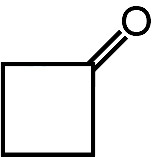
C
Cyclopropylmethanol
D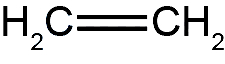
Solution
(A AND C) The reaction of cyclobutyl amine with $HNO_{2}$ produces a diazonium salt,which is unstable and loses $N_{2}$ to form a cyclobutyl carbocation. This carbocation can undergo ring contraction to form a more stable cyclopropylmethyl carbocation. Both carbocations can then react with water to form their respective alcohols. Therefore,the products are cyclobutanol and cyclopropylmethanol. The reaction sequence is as follows:
$1. \text{Cyclobutylamine} + HNO_{2} \rightarrow \text{Cyclobutyl diazonium ion} + H_{2}O$
$2. \text{Cyclobutyl diazonium ion} \rightarrow \text{Cyclobutyl carbocation} + N_{2}$
$3. \text{Cyclobutyl carbocation} \xrightarrow{\text{Ring contraction}} \text{Cyclopropylmethyl carbocation}$
$4. \text{Cyclobutyl carbocation} + H_{2}O \rightarrow \text{Cyclobutanol} + H^{+}$
$5. \text{Cyclopropylmethyl carbocation} + H_{2}O \rightarrow \text{Cyclopropylmethanol} + H^{+}$
$1. \text{Cyclobutylamine} + HNO_{2} \rightarrow \text{Cyclobutyl diazonium ion} + H_{2}O$
$2. \text{Cyclobutyl diazonium ion} \rightarrow \text{Cyclobutyl carbocation} + N_{2}$
$3. \text{Cyclobutyl carbocation} \xrightarrow{\text{Ring contraction}} \text{Cyclopropylmethyl carbocation}$
$4. \text{Cyclobutyl carbocation} + H_{2}O \rightarrow \text{Cyclobutanol} + H^{+}$
$5. \text{Cyclopropylmethyl carbocation} + H_{2}O \rightarrow \text{Cyclopropylmethanol} + H^{+}$
0 likes
View Solution1171
EasyMCQ
The reduction of benzenediazonium chloride to phenylhydrazine can be accomplished by:
A
$SnCl_{2} / HCl$
B
$Na_{2}SO_{3}$
C
$CH_{3}CH_{2}OH$
D
Both $(A)$ and $(B)$
Solution
(D) The reduction of benzenediazonium chloride $(C_{6}H_{5}N_{2}^{+}Cl^{-})$ to phenylhydrazine $(C_{6}H_{5}NHNH_{2})$ is a standard chemical transformation.
It can be achieved using $SnCl_{2} / HCl$ (stannous chloride in hydrochloric acid) or $Na_{2}SO_{3}$ (sodium sulfite).
Therefore,both reagents are effective for this reduction.
It can be achieved using $SnCl_{2} / HCl$ (stannous chloride in hydrochloric acid) or $Na_{2}SO_{3}$ (sodium sulfite).
Therefore,both reagents are effective for this reduction.
0 likes
View Solution1172
MediumMCQ
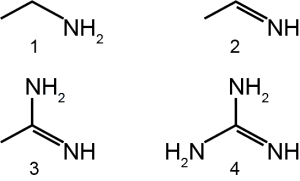
The correct order of basicity of the following compounds is
A
$1 < 2 < 3 < 4$
B
$1 < 2 < 4 < 3$
C
$2 < 1 < 3 < 4$
D
$4 < 3 < 2 < 1$
Solution
(C) The basicity of the given compounds depends on the stability of the conjugate acid formed after protonation and the resonance stabilization of the lone pair on nitrogen atoms.
$(1)$ $CH_3CH_2NH_2$ (Ethylamine): $A$ primary aliphatic amine,basic due to the $+I$ effect of the ethyl group.
$(2)$ $CH_3CH=NH$ (Ethylideneimine): The nitrogen atom is $sp^2$ hybridized,making the lone pair less available for protonation compared to $sp^3$ hybridized nitrogen.
$(3)$ $CH_3C(=NH)NH_2$ (Acetamidine): The lone pair on the imine nitrogen is involved in resonance with the amino group,stabilizing the conjugate acid significantly.
$(4)$ $H_2NC(=NH)NH_2$ (Guanidine): This is the most basic compound because the positive charge on the conjugate acid is delocalized over three nitrogen atoms through resonance,providing maximum stability.
Thus,the order of basicity is $2 < 1 < 3 < 4$.
$(1)$ $CH_3CH_2NH_2$ (Ethylamine): $A$ primary aliphatic amine,basic due to the $+I$ effect of the ethyl group.
$(2)$ $CH_3CH=NH$ (Ethylideneimine): The nitrogen atom is $sp^2$ hybridized,making the lone pair less available for protonation compared to $sp^3$ hybridized nitrogen.
$(3)$ $CH_3C(=NH)NH_2$ (Acetamidine): The lone pair on the imine nitrogen is involved in resonance with the amino group,stabilizing the conjugate acid significantly.
$(4)$ $H_2NC(=NH)NH_2$ (Guanidine): This is the most basic compound because the positive charge on the conjugate acid is delocalized over three nitrogen atoms through resonance,providing maximum stability.
Thus,the order of basicity is $2 < 1 < 3 < 4$.
0 likes
View Solution1173
EasyMCQ
An amine $C_{3}H_{9}N$ reacts with benzene sulphonyl chloride to form a white precipitate which is insoluble in $aq. NaOH$. The amine is
A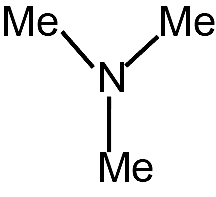
B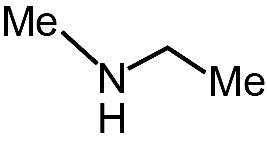
C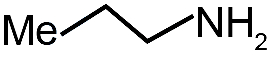
D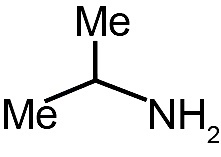
Solution
(B) The reaction of amines with benzene sulphonyl chloride (Hinsberg's reagent) is used to distinguish between primary,secondary,and tertiary amines.
$1$. Primary amines $(R-NH_2)$ form a sulfonamide that is soluble in $aq. NaOH$ due to the presence of an acidic hydrogen on the nitrogen atom.
$2$. Secondary amines $(R_2NH)$ form a sulfonamide that is insoluble in $aq. NaOH$ because they lack an acidic hydrogen on the nitrogen atom.
$3$. Tertiary amines $(R_3N)$ do not react with benzene sulphonyl chloride.
Since the given amine forms a white precipitate that is insoluble in $aq. NaOH$,it must be a secondary amine.
The molecular formula $C_3H_9N$ corresponds to a secondary amine,$N$-methylethanamine $(CH_3-NH-CH_2CH_3)$.
$1$. Primary amines $(R-NH_2)$ form a sulfonamide that is soluble in $aq. NaOH$ due to the presence of an acidic hydrogen on the nitrogen atom.
$2$. Secondary amines $(R_2NH)$ form a sulfonamide that is insoluble in $aq. NaOH$ because they lack an acidic hydrogen on the nitrogen atom.
$3$. Tertiary amines $(R_3N)$ do not react with benzene sulphonyl chloride.
Since the given amine forms a white precipitate that is insoluble in $aq. NaOH$,it must be a secondary amine.
The molecular formula $C_3H_9N$ corresponds to a secondary amine,$N$-methylethanamine $(CH_3-NH-CH_2CH_3)$.
0 likes
View Solution1174
EasyMCQ
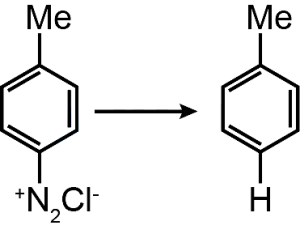
The reagent with which the following reaction is best accomplished is:
A
$H_{3}PO_{2}$
B
$H_{3}PO_{3}$
C
$H_{3}PO_{4}$
D
$NaHSO_{3}$
Solution
(A) The reaction shows the removal of the diazonium group $(-N_{2}^{+}Cl^{-})$ and its replacement with a hydrogen atom $(H)$.
This is a reductive deamination reaction.
$H_{3}PO_{2}$ (hypophosphorous acid) in the presence of water is the standard reagent used to reduce diazonium salts to the corresponding arene.
The reaction is: $Ar-N_{2}^{+}Cl^{-} + H_{3}PO_{2} + H_{2}O \rightarrow Ar-H + N_{2} + H_{3}PO_{3} + HCl$.
Therefore,the correct reagent is $H_{3}PO_{2}$.
This is a reductive deamination reaction.
$H_{3}PO_{2}$ (hypophosphorous acid) in the presence of water is the standard reagent used to reduce diazonium salts to the corresponding arene.
The reaction is: $Ar-N_{2}^{+}Cl^{-} + H_{3}PO_{2} + H_{2}O \rightarrow Ar-H + N_{2} + H_{3}PO_{3} + HCl$.
Therefore,the correct reagent is $H_{3}PO_{2}$.
0 likes
View Solution1175
MediumMCQ
When aniline is nitrated with nitrating mixture in ice-cold condition,the major product obtained is
A
$p$-nitroaniline
B
$2,4$-dinitroaniline
C
$o$-nitroaniline
D
$m$-nitroaniline
Solution
(D) Direct nitration of aniline with concentrated $HNO_3$ and $H_2SO_4$ (nitrating mixture) leads to the formation of a significant amount of $m$-nitroaniline due to the protonation of the $-NH_2$ group to form the $-NH_3^+$ ion,which is meta-directing.
In acidic medium,aniline exists as anilinium ion $(C_6H_5NH_3^+)$,which is strongly deactivating and meta-directing.
Therefore,the major product obtained under these conditions is $m$-nitroaniline.
In acidic medium,aniline exists as anilinium ion $(C_6H_5NH_3^+)$,which is strongly deactivating and meta-directing.
Therefore,the major product obtained under these conditions is $m$-nitroaniline.
0 likes
View Solution1176
EasyMCQ
Which one of the following is called a carbylamine?
A
$RCN$
B
$RCONH_2$
C
$R-CH=NH$
D
$RNC$
Solution
(D) The term $carbylamine$ is another name for an isocyanide or isonitrile,which has the general chemical formula $RNC$.
In the carbylamine reaction,primary amines react with chloroform $(CHCl_3)$ and an alcoholic base $(KOH)$ to form isocyanides $(RNC)$,which are characterized by their foul smell.
In the carbylamine reaction,primary amines react with chloroform $(CHCl_3)$ and an alcoholic base $(KOH)$ to form isocyanides $(RNC)$,which are characterized by their foul smell.
0 likes
View Solution1177
MediumMCQ
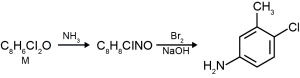
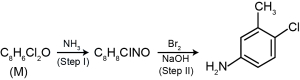
Identify $M$ in the following sequence of reactions:
A
$3-$chloro$-4-$methylbenzoyl chloride
B
$4-$chloro$-3-$methylbenzoyl chloride
C
$4-$chloro$-3-$chloromethylbenzaldehyde
D
$3-$chloro$-4-$methylbenzoyl chloride (isomer)
Solution
0 likes
View Solution1178
MediumMCQ
The basicity of aniline is weaker in comparison to that of methylamine due to
A
hyperconjugative effect of $CH_3$ group in $CH_3NH_2$
B
resonance effect of the phenyl group in aniline
C
lower molecular weight of methylamine as compared to that of aniline
D
resonance effect of $-NH_2$ group in $CH_3NH_2$
Solution
(B) In aniline $(C_6H_5NH_2)$,the lone pair of electrons on the nitrogen atom is delocalized into the benzene ring through resonance.
This reduces the availability of the lone pair for protonation,making aniline a weaker base.
In contrast,in methylamine $(CH_3NH_2)$,the electron-donating methyl group increases the electron density on the nitrogen atom,making it more basic than aniline.
This reduces the availability of the lone pair for protonation,making aniline a weaker base.
In contrast,in methylamine $(CH_3NH_2)$,the electron-donating methyl group increases the electron density on the nitrogen atom,making it more basic than aniline.
0 likes
View Solution1179
MediumMCQ
The reaction of aniline with chloroform under alkaline conditions leads to the formation of
A
phenylcyanide
B
phenylisonitrile
C
phenylcyanate
D
phenylisocyanate
Solution
(B) Aniline is a primary amine (contains $-NH_{2}$ group).
When it is treated with chloroform $(CHCl_{3})$ under alkaline conditions (using $KOH$),it results in the formation of a bad-smelling compound known as phenyl isonitrile (or phenyl carbylamine).
The chemical reaction is:
$C_{6}H_{5}NH_{2} + CHCl_{3} + 3KOH(alc.) \rightarrow C_{6}H_{5}NC + 3KCl + 3H_{2}O$.
This reaction is known as the carbylamine reaction.
When it is treated with chloroform $(CHCl_{3})$ under alkaline conditions (using $KOH$),it results in the formation of a bad-smelling compound known as phenyl isonitrile (or phenyl carbylamine).
The chemical reaction is:
$C_{6}H_{5}NH_{2} + CHCl_{3} + 3KOH(alc.) \rightarrow C_{6}H_{5}NC + 3KCl + 3H_{2}O$.
This reaction is known as the carbylamine reaction.
0 likes
View Solution1180
MediumMCQ
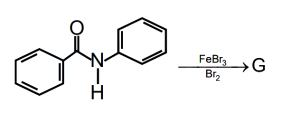
Identify the major product $(G)$ in the following reaction:
A
$N$-($3$-bromophenyl)benzamide
B
$N$-bromobenzamide
C
$N$-($4$-bromophenyl)benzamide
D
$N$-phenyl$-2-$bromobenzamide
Solution
(C) The reaction is an electrophilic aromatic substitution (bromination) of $N$-phenylbenzamide using $Br_2$ and $FeBr_3$.
$N$-phenylbenzamide consists of two phenyl rings attached to an amide group.
The nitrogen atom of the amide group is directly attached to one of the phenyl rings. The lone pair on the nitrogen atom is delocalized into this ring,making it an activated ring towards electrophilic substitution.
Conversely,the other phenyl ring is attached to the carbonyl group $(C=O)$,which is an electron-withdrawing group,making that ring deactivated.
Therefore,the electrophilic substitution occurs on the activated ring at the ortho and para positions. Due to steric hindrance,the para-substituted product is the major product.
Thus,the major product is $N$-($4$-bromophenyl)benzamide.
$N$-phenylbenzamide consists of two phenyl rings attached to an amide group.
The nitrogen atom of the amide group is directly attached to one of the phenyl rings. The lone pair on the nitrogen atom is delocalized into this ring,making it an activated ring towards electrophilic substitution.
Conversely,the other phenyl ring is attached to the carbonyl group $(C=O)$,which is an electron-withdrawing group,making that ring deactivated.
Therefore,the electrophilic substitution occurs on the activated ring at the ortho and para positions. Due to steric hindrance,the para-substituted product is the major product.
Thus,the major product is $N$-($4$-bromophenyl)benzamide.
0 likes
View Solution1181
DifficultMCQ
What is obtained when nitrobenzene is treated sequentially with $(i)$ $NH_4Cl / Zn$ dust and $(ii)$ $H_2SO_4 / Na_2Cr_2O_7$?
A
meta-chloronitrobenzene
B
para-chloronitrobenzene
C
nitrosobenzene
D
benzene
Solution
(C) The reaction proceeds in two steps:
$1$. Nitrobenzene $(C_6H_5NO_2)$ is reduced by $NH_4Cl / Zn$ dust to form phenylhydroxylamine $(C_6H_5NHOH)$.
$2$. Phenylhydroxylamine is then oxidized by $H_2SO_4 / Na_2Cr_2O_7$ to form nitrosobenzene $(C_6H_5NO)$.
$1$. Nitrobenzene $(C_6H_5NO_2)$ is reduced by $NH_4Cl / Zn$ dust to form phenylhydroxylamine $(C_6H_5NHOH)$.
$2$. Phenylhydroxylamine is then oxidized by $H_2SO_4 / Na_2Cr_2O_7$ to form nitrosobenzene $(C_6H_5NO)$.
0 likes
View Solution1182
DifficultMCQ
$A$ student has been given a compound $x$ of molecular formula $C_6H_7N$. $x$ is sparingly soluble in water. However,on addition of dilute mineral acid,$x$ becomes soluble in water. $x$ when treated with $CHCl_3$ and $KOH$ (alc.) produces $y$. $y$ has a specific unpleasant smell. On treatment with benzenesulphonyl chloride,$x$ gives a compound $z$ which is soluble in alkali. The number of different $H$ atoms present in $z$ is:
A
$5$
B
$8$
C
$4$
D
$7$
Solution
(D) The molecular formula $C_6H_7N$ and the given reactions indicate that $x$ is Aniline $(C_6H_5NH_2)$.
$1$. $x$ is a primary amine because it gives the carbylamine test (unpleasant smell of $y$,which is phenyl isocyanide,$C_6H_5NC$).
$2$. Reaction with benzenesulphonyl chloride (Hinsberg reagent): $C_6H_5NH_2 + C_6H_5SO_2Cl \rightarrow C_6H_5-SO_2-NH-C_6H_5$ $(z)$.
$3$. Compound $z$ is $N$-phenylbenzenesulfonamide.
$4$. Different types of $H$ atoms in $z$:
- Ring $1$ (attached to $SO_2$): $3$ types (ortho,meta,para).
- Ring $2$ (attached to $NH$): $3$ types (ortho,meta,para).
- $H$ atom on Nitrogen: $1$ type.
Total different $H$ atoms = $3 + 3 + 1 = 7$.
$1$. $x$ is a primary amine because it gives the carbylamine test (unpleasant smell of $y$,which is phenyl isocyanide,$C_6H_5NC$).
$2$. Reaction with benzenesulphonyl chloride (Hinsberg reagent): $C_6H_5NH_2 + C_6H_5SO_2Cl \rightarrow C_6H_5-SO_2-NH-C_6H_5$ $(z)$.
$3$. Compound $z$ is $N$-phenylbenzenesulfonamide.
$4$. Different types of $H$ atoms in $z$:
- Ring $1$ (attached to $SO_2$): $3$ types (ortho,meta,para).
- Ring $2$ (attached to $NH$): $3$ types (ortho,meta,para).
- $H$ atom on Nitrogen: $1$ type.
Total different $H$ atoms = $3 + 3 + 1 = 7$.
0 likes
View Solution1183
DifficultMCQ
$A$ student performed an analysis of an aliphatic organic compound '$X$' which,upon analysis,gave $C=61.01\%$,$H=15.25\%$,$N=23.74\%$. This compound,on treatment with $HNO_2/H_2O$,produced another compound '$Y$' which did not contain any nitrogen atom. However,the compound '$Y$' upon controlled oxidation produced another compound '$Z$' that responded to the iodoform test. The structure of '$X$' is:
A
$CH_3CH_2CH_2NH_2$
B
$Ph-CH(CH_3)-NH_2$
C
$(CH_3)_2CH-NH_2$
D
$CH_3-CH_2-CH(NH_2)-CH_3$
Solution
(C) $1$. Empirical formula calculation:
$C = 61.01/12 = 5.08$,$H = 15.25/1 = 15.25$,$N = 23.74/14 = 1.69$.
Dividing by the smallest value $(1.69)$: $C = 3$,$H = 9$,$N = 1$.
The empirical formula is $C_3H_9N$.
$2$. Reaction with $HNO_2$:
Aliphatic primary amines react with $HNO_2$ to form unstable diazonium salts,which decompose to form alcohols $(Y)$ and evolve $N_2$ gas.
For $C_3H_9N$ (isopropylamine),the reaction is:
$(CH_3)_2CH-NH_2 + HNO_2 \rightarrow (CH_3)_2CH-OH (Y) + N_2 + H_2O$.
$3$. Oxidation and Iodoform test:
Compound '$Y$' is isopropyl alcohol (propan$-2-$ol).
Controlled oxidation of propan$-2-$ol gives acetone $(Z)$,which is $CH_3COCH_3$.
Acetone contains the $CH_3CO-$ group and thus gives a positive iodoform test.
Therefore,'$X$' is isopropylamine,$(CH_3)_2CH-NH_2$.
$C = 61.01/12 = 5.08$,$H = 15.25/1 = 15.25$,$N = 23.74/14 = 1.69$.
Dividing by the smallest value $(1.69)$: $C = 3$,$H = 9$,$N = 1$.
The empirical formula is $C_3H_9N$.
$2$. Reaction with $HNO_2$:
Aliphatic primary amines react with $HNO_2$ to form unstable diazonium salts,which decompose to form alcohols $(Y)$ and evolve $N_2$ gas.
For $C_3H_9N$ (isopropylamine),the reaction is:
$(CH_3)_2CH-NH_2 + HNO_2 \rightarrow (CH_3)_2CH-OH (Y) + N_2 + H_2O$.
$3$. Oxidation and Iodoform test:
Compound '$Y$' is isopropyl alcohol (propan$-2-$ol).
Controlled oxidation of propan$-2-$ol gives acetone $(Z)$,which is $CH_3COCH_3$.
Acetone contains the $CH_3CO-$ group and thus gives a positive iodoform test.
Therefore,'$X$' is isopropylamine,$(CH_3)_2CH-NH_2$.
0 likes
View Solution1184
DifficultMCQ
Consider the following reactions and identify the correct reaction.
A
B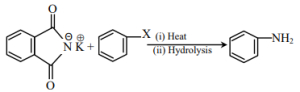
C
D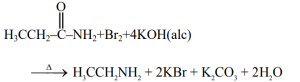
Solution
(D) $1$. In reaction $(A)$,nitration of benzanilide occurs primarily at the ortho and para positions of the aniline ring due to the activating effect of the $-NHCOPh$ group. The product shown in the image is incorrect.
$2$. In reaction $(B)$,aryl halides do not undergo nucleophilic substitution with potassium phthalimide under standard conditions,so no reaction occurs.
$3$. In reaction $(C)$,the carbylamine reaction produces an isocyanide,which upon reduction with $Sn/HCl$ yields a secondary amine ($N$-methylbenzylamine),not the primary amine shown.
$4$. In reaction $(D)$,the Hoffmann bromamide degradation of propanamide $(CH_3CH_2CONH_2)$ correctly yields ethylamine $(CH_3CH_2NH_2)$ along with the specified byproducts. This is a standard textbook reaction.
$2$. In reaction $(B)$,aryl halides do not undergo nucleophilic substitution with potassium phthalimide under standard conditions,so no reaction occurs.
$3$. In reaction $(C)$,the carbylamine reaction produces an isocyanide,which upon reduction with $Sn/HCl$ yields a secondary amine ($N$-methylbenzylamine),not the primary amine shown.
$4$. In reaction $(D)$,the Hoffmann bromamide degradation of propanamide $(CH_3CH_2CONH_2)$ correctly yields ethylamine $(CH_3CH_2NH_2)$ along with the specified byproducts. This is a standard textbook reaction.
0 likes
View Solution1185
DifficultMCQ
The correct stability order of the following diazonium salts is:
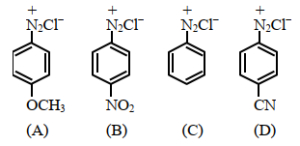
A
$A > C > D > B$
B
$C > D > B > A$
C
$A > B > C > D$
D
$C > A > D > B$
Solution
(A) The stability of benzene diazonium salts is influenced by the nature of the substituent attached to the benzene ring.
Electron-donating groups $(EDG)$ increase the stability of the diazonium cation by dispersing the positive charge,while electron-withdrawing groups $(EWG)$ decrease the stability by intensifying the positive charge.
In the given compounds:
$A$: $-OCH_3$ is a strong $EDG$ ($+M$ effect).
$C$: Benzene diazonium chloride (no substituent).
$D$: $-CN$ is an $EWG$ ($-M$ effect).
$B$: $-NO_2$ is a very strong $EWG$ ($-M$ effect).
Therefore,the stability order is $A > C > D > B$.
Electron-donating groups $(EDG)$ increase the stability of the diazonium cation by dispersing the positive charge,while electron-withdrawing groups $(EWG)$ decrease the stability by intensifying the positive charge.
In the given compounds:
$A$: $-OCH_3$ is a strong $EDG$ ($+M$ effect).
$C$: Benzene diazonium chloride (no substituent).
$D$: $-CN$ is an $EWG$ ($-M$ effect).
$B$: $-NO_2$ is a very strong $EWG$ ($-M$ effect).
Therefore,the stability order is $A > C > D > B$.
0 likes
View Solution1186
DifficultMCQ
The mass of benzanilide obtained from the benzoylation reaction of $5.8 \ g$ of aniline,if the yield of product is $82\%$,is . . . . . . $g$ (nearest integer).
(Given molar mass in $g \ mol^{-1}$: $H: 1, C: 12, N: 14, O: 16$)
(Given molar mass in $g \ mol^{-1}$: $H: 1, C: 12, N: 14, O: 16$)
A
$8$
B
$10$
C
$12$
D
$15$
Solution
(B) The reaction is: $C_6H_5NH_2 + C_6H_5COCl \rightarrow C_6H_5NHCOC_6H_5 + HCl$
Molar mass of aniline $(C_6H_5NH_2)$ = $6 \times 12 + 7 \times 1 + 14 = 93 \ g \ mol^{-1}$.
Molar mass of benzanilide $(C_6H_5NHCOC_6H_5)$ = $13 \times 12 + 11 \times 1 + 14 + 16 = 197 \ g \ mol^{-1}$.
Moles of aniline = $\frac{5.8 \ g}{93 \ g \ mol^{-1}} \approx 0.06237 \ mol$.
Theoretical moles of benzanilide = $0.06237 \ mol$.
Actual moles of benzanilide = $0.06237 \times 0.82 \approx 0.05114 \ mol$.
Mass of benzanilide = $0.05114 \ mol \times 197 \ g \ mol^{-1} \approx 10.07 \ g$.
Rounding to the nearest integer,the mass is $10 \ g$.
Molar mass of aniline $(C_6H_5NH_2)$ = $6 \times 12 + 7 \times 1 + 14 = 93 \ g \ mol^{-1}$.
Molar mass of benzanilide $(C_6H_5NHCOC_6H_5)$ = $13 \times 12 + 11 \times 1 + 14 + 16 = 197 \ g \ mol^{-1}$.
Moles of aniline = $\frac{5.8 \ g}{93 \ g \ mol^{-1}} \approx 0.06237 \ mol$.
Theoretical moles of benzanilide = $0.06237 \ mol$.
Actual moles of benzanilide = $0.06237 \times 0.82 \approx 0.05114 \ mol$.
Mass of benzanilide = $0.05114 \ mol \times 197 \ g \ mol^{-1} \approx 10.07 \ g$.
Rounding to the nearest integer,the mass is $10 \ g$.
0 likes
View Solution1187
DifficultMCQ
The final product $[B]$ is :

A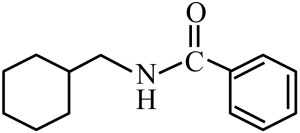
B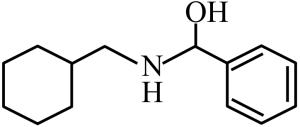
C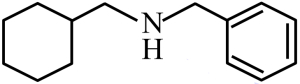
D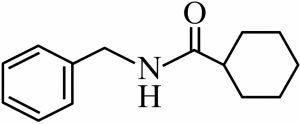
Solution
(C) The reaction proceeds in two steps:
$1$. Cyclohexylmethanamine reacts with benzoyl chloride $(C_6H_5COCl)$ in the presence of a base $(NaOH)$ to form an amide,$N$-(cyclohexylmethyl)benzamide,which is product $[A]$.
$2$. The amide $[A]$ is then reduced using lithium aluminium hydride $(LiAlH_4)$ followed by hydrolysis $(H_2O)$ to yield the corresponding amine,$N$-benzylcyclohexylmethanamine,which is the final product $[B]$.
$1$. Cyclohexylmethanamine reacts with benzoyl chloride $(C_6H_5COCl)$ in the presence of a base $(NaOH)$ to form an amide,$N$-(cyclohexylmethyl)benzamide,which is product $[A]$.
$2$. The amide $[A]$ is then reduced using lithium aluminium hydride $(LiAlH_4)$ followed by hydrolysis $(H_2O)$ to yield the corresponding amine,$N$-benzylcyclohexylmethanamine,which is the final product $[B]$.
0 likes
View Solution1188
DifficultMCQ
For the reaction shown,which statement is correct for Product "$X$"?
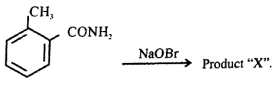
A
It is soluble in $NaOH_{(aq)}$
B
It does not react with Hinsberg's reagent.
C
It has one isomer of $2^\circ$ amine.
D
It does not give Azo dye test.
Solution
(C) The reaction shown is the Hofmann bromamide degradation of $2$-methylbenzamide using $NaOBr$,which yields $2$-methylaniline (o-toluidine) as Product "$X$".
$2$-methylaniline is a primary aromatic amine $(Ar-NH_2)$.
$1$. It reacts with Hinsberg's reagent (benzenesulfonyl chloride) to form a sulfonamide,which is soluble in alkali.
$2$. It reacts with nitrous acid $(HNO_2)$ at $0-5^{\circ}C$ to form a diazonium salt,which gives a positive Azo dye test with $\beta$-naphthol.
$3$. It is a primary amine,and its $2^\circ$ amine isomer is $N$-methylaniline $(C_6H_5NHCH_3)$.
$4$. Primary aromatic amines are generally insoluble in aqueous $NaOH$ because they are basic in nature,not acidic.
Therefore,the correct statement is that it has one isomer of $2^\circ$ amine,which is $N$-methylaniline.
$2$-methylaniline is a primary aromatic amine $(Ar-NH_2)$.
$1$. It reacts with Hinsberg's reagent (benzenesulfonyl chloride) to form a sulfonamide,which is soluble in alkali.
$2$. It reacts with nitrous acid $(HNO_2)$ at $0-5^{\circ}C$ to form a diazonium salt,which gives a positive Azo dye test with $\beta$-naphthol.
$3$. It is a primary amine,and its $2^\circ$ amine isomer is $N$-methylaniline $(C_6H_5NHCH_3)$.
$4$. Primary aromatic amines are generally insoluble in aqueous $NaOH$ because they are basic in nature,not acidic.
Therefore,the correct statement is that it has one isomer of $2^\circ$ amine,which is $N$-methylaniline.
0 likes
View Solution1189
MediumMCQ
The most reactive amine towards dil. $HCl$ is . . . . . . .
A
$(CH_3)_2NH$
B
$(CH_3)_3N$
C
$CH_3NH_2$
D
$C_6H_5NH_2$
Solution
(A) Reactivity towards $HCl$ depends on the basicity of the amine.
Amines act as bases by donating the lone pair of electrons on the nitrogen atom to the $H^+$ ion.
Aliphatic amines are more basic than aromatic amines because the alkyl groups exert an electron-donating inductive effect ($+I$ effect),which increases the electron density on the nitrogen atom.
In aqueous solution,the basicity of aliphatic amines is determined by a combination of inductive effect,solvation effect,and steric hindrance.
For dimethylamine $((CH_3)_2NH)$,the combination of these factors makes it the most basic among the given options,thereby making it the most reactive towards dilute $HCl$.
Amines act as bases by donating the lone pair of electrons on the nitrogen atom to the $H^+$ ion.
Aliphatic amines are more basic than aromatic amines because the alkyl groups exert an electron-donating inductive effect ($+I$ effect),which increases the electron density on the nitrogen atom.
In aqueous solution,the basicity of aliphatic amines is determined by a combination of inductive effect,solvation effect,and steric hindrance.
For dimethylamine $((CH_3)_2NH)$,the combination of these factors makes it the most basic among the given options,thereby making it the most reactive towards dilute $HCl$.
0 likes
View Solution1190
MediumMCQ
Assertion: Only a small amount of $HCl$ is required in the reduction of nitro compounds with iron scrap.
Reason: $FeCl_2$ formed gets hydrolysed to release $HCl$ during the reaction.
Reason: $FeCl_2$ formed gets hydrolysed to release $HCl$ during the reaction.
A
Assertion is wrong but Reason is correct.
B
Both Assertion and Reason are correct,and Reason is the correct explanation for Assertion.
C
Assertion is correct but Reason is wrong.
D
Both Assertion and Reason are correct,but Reason is not the correct explanation for Assertion.
Solution
(B) In the reduction of nitro compounds using iron scrap and $HCl$,iron reacts with $HCl$ to produce $FeCl_2$ and hydrogen gas.
The $FeCl_2$ formed undergoes hydrolysis in the presence of water to produce $Fe_3O_4$ and regenerate $HCl$.
This regenerated $HCl$ further reacts with more iron to continue the reduction process.
Therefore,only a catalytic amount of $HCl$ is required to initiate the reaction.
Both the assertion and the reason are correct,and the reason provides the correct explanation for the assertion.
The $FeCl_2$ formed undergoes hydrolysis in the presence of water to produce $Fe_3O_4$ and regenerate $HCl$.
This regenerated $HCl$ further reacts with more iron to continue the reduction process.
Therefore,only a catalytic amount of $HCl$ is required to initiate the reaction.
Both the assertion and the reason are correct,and the reason provides the correct explanation for the assertion.
0 likes
View Solution1191
MediumMCQ
Which product is formed on carbylamine reaction with $4$-methylaniline?
A
$4-$methylbenzonitrile
B
$4-$methylphenyl isocyanide
C
$4-$methylnitrobenzene
D
$4-$methylbenzenediazonium chloride
Solution
(B) The carbylamine reaction (or isocyanide test) is a characteristic reaction of primary amines. In this reaction,a primary amine reacts with chloroform $(CHCl_3)$ and an alcoholic base (like $KOH$) to form an isocyanide (carbylamine),which has a foul,offensive smell.
The reaction for $4$-methylaniline ($p$-toluidine) is as follows:
$CH_3-C_6H_4-NH_2 + CHCl_3 + 3KOH (alc.) \rightarrow CH_3-C_6H_4-NC + 3KCl + 3H_2O$
Here,$4$-methylaniline reacts with $CHCl_3$ and $KOH$ to produce $4$-methylphenyl isocyanide $(CH_3-C_6H_4-NC)$.
The reaction for $4$-methylaniline ($p$-toluidine) is as follows:
$CH_3-C_6H_4-NH_2 + CHCl_3 + 3KOH (alc.) \rightarrow CH_3-C_6H_4-NC + 3KCl + 3H_2O$
Here,$4$-methylaniline reacts with $CHCl_3$ and $KOH$ to produce $4$-methylphenyl isocyanide $(CH_3-C_6H_4-NC)$.
0 likes
View SolutionAmines — Properties of Amines · Frequently Asked Questions
1Are these Amines questions useful for JEE and NEET?
Yes. All questions in this section are mapped to JEE Main and NEET exam patterns. Previous year questions from JEE Main, NEET, GUJCET and state-level exams are included with full solutions.
2Can I switch to Hindi or Gujarati for these questions?
Yes. Use the language tabs in the hero section or the sidebar to view the same questions and solutions in English, Hindi or Gujarati.
3How do I generate a question paper from this subtopic?
Use the Vedclass Exam Paper Generator — select the chapter and subtopic, set difficulty, and generate Sets A, B, C, D automatically. First 3 chapters of every subject are free.
Vedclass Products
For Students
Vedclass Test Series
Mock tests in real JEE/NEET style with performance analysis. 5-day free trial.
Start Free TrialFor Teachers
Exam Paper Generator
Generate Set A/B/C/D papers from this chapter in 2 minutes. 3 chapters free.
Try FreeFor Institutes
Online Exam Module
Live online exams with unlimited students, 360° analytics & white-label branding.
See DemoFor Teachers & Institutes
Generate a Amines Exam Paper in 2 Minutes
Select subtopic & difficulty — Sets A, B, C, D auto-generated with No Repeat logic.
First 3 chapters of every subject are free — no payment required.