
A English
Properties of Amines Questions in English
Class 12 Chemistry · Amines · Properties of Amines
1212+
Questions
English
Language
100%
With Solutions
Showing 40 of 1212 questions in English
1001
DifficultMCQ
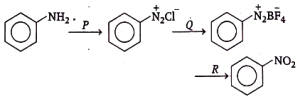
In the reaction,$P, Q$ and $R$ respectively are:
A
$NaNO_2 + \text{dil. } HCl, HBF_4, Cu + NaNO_2$
B
$NaNO_2 + \text{conc. } HCl, F_2, Cu + NaNO_3$
C
$NaNO_2 + \text{dil. } HCl, BF_3, Cu + NaNO_2$
D
$NaNO_2 + \text{dil. } HCl, F_2, Cu + NaNO_3$
Solution
(A) The reaction sequence is as follows:
$1$. The conversion of aniline to benzene diazonium chloride $(C_6H_5N_2^+Cl^-)$ is achieved using $NaNO_2 + \text{dil. } HCl$ at $0-5 \ ^\circ C$. Thus,$P = NaNO_2 + \text{dil. } HCl$.
$2$. The conversion of benzene diazonium chloride to benzene diazonium fluoroborate $(C_6H_5N_2^+BF_4^-)$ is achieved by adding fluoroboric acid $(HBF_4)$. Thus,$Q = HBF_4$.
$3$. The conversion of benzene diazonium fluoroborate to nitrobenzene $(C_6H_5NO_2)$ is achieved by heating with sodium nitrite in the presence of copper powder. Thus,$R = Cu + NaNO_2$.
Therefore,$P, Q$ and $R$ are $NaNO_2 + \text{dil. } HCl, HBF_4, Cu + NaNO_2$ respectively.
$1$. The conversion of aniline to benzene diazonium chloride $(C_6H_5N_2^+Cl^-)$ is achieved using $NaNO_2 + \text{dil. } HCl$ at $0-5 \ ^\circ C$. Thus,$P = NaNO_2 + \text{dil. } HCl$.
$2$. The conversion of benzene diazonium chloride to benzene diazonium fluoroborate $(C_6H_5N_2^+BF_4^-)$ is achieved by adding fluoroboric acid $(HBF_4)$. Thus,$Q = HBF_4$.
$3$. The conversion of benzene diazonium fluoroborate to nitrobenzene $(C_6H_5NO_2)$ is achieved by heating with sodium nitrite in the presence of copper powder. Thus,$R = Cu + NaNO_2$.
Therefore,$P, Q$ and $R$ are $NaNO_2 + \text{dil. } HCl, HBF_4, Cu + NaNO_2$ respectively.
0 likes
View Solution1002
MediumMCQ
Which of the following is least soluble in water at $298 \ K$?
A
$(CH_3)_2NH$
B
$C_6H_5NH_2$
C
$CH_3NH_2$
D
$(CH_3)_3N$
Solution
(D) The solubility of amines in water depends on their ability to form hydrogen bonds with water molecules.
$CH_3NH_2$ and $(CH_3)_2NH$ are primary and secondary amines,respectively,which can form hydrogen bonds with water.
$C_6H_5NH_2$ (aniline) is less soluble due to the large hydrophobic phenyl group,but it still has an $-NH_2$ group capable of hydrogen bonding.
$(CH_3)_3N$ is a tertiary amine and lacks a hydrogen atom attached to the nitrogen atom,meaning it cannot act as a hydrogen bond donor to water molecules.
Therefore,$(CH_3)_3N$ is the least soluble in water among the given options.
$CH_3NH_2$ and $(CH_3)_2NH$ are primary and secondary amines,respectively,which can form hydrogen bonds with water.
$C_6H_5NH_2$ (aniline) is less soluble due to the large hydrophobic phenyl group,but it still has an $-NH_2$ group capable of hydrogen bonding.
$(CH_3)_3N$ is a tertiary amine and lacks a hydrogen atom attached to the nitrogen atom,meaning it cannot act as a hydrogen bond donor to water molecules.
Therefore,$(CH_3)_3N$ is the least soluble in water among the given options.
0 likes
View Solution1003
EasyMCQ
The reaction of Benzenediazonium chloride with aniline yields a yellow dye. The name of the yellow dye is
A
$p$-Hydroxyazobenzene
B
$p$-Aminoazobenzene
C
$p$-Nitroazobenzene
D
$o$-Nitroazobenzene
Solution
(B) The reaction of Benzenediazonium chloride with aniline in the presence of a base is a coupling reaction.
$C_6H_5N_2Cl + C_6H_5NH_2 \xrightarrow{OH^-} C_6H_5-N=N-C_6H_4-NH_2 + HCl$
The product formed is $p$-Aminoazobenzene,which is a yellow dye.
$C_6H_5N_2Cl + C_6H_5NH_2 \xrightarrow{OH^-} C_6H_5-N=N-C_6H_4-NH_2 + HCl$
The product formed is $p$-Aminoazobenzene,which is a yellow dye.
0 likes
View Solution1004
MediumMCQ
Which of the following will be the most stable diazonium salt $(R-N_2{^+} X^{-})$?
A
$CH_3-N_2{^+} X^{-}$
B
$C_6H_5-N_2{^+} X^{-}$
C
$CH_3-CH_2-N_2{^+} X^{-}$
D
$C_6H_5-CH_2-N_2{^+} X^{-}$
Solution
(B) Primary aromatic amines form arenediazonium salts,such as $C_6H_5-N_2{^+} X^{-}$,which are significantly more stable than aliphatic diazonium salts.
This stability is due to the resonance interaction between the diazonium group and the benzene ring,which delocalizes the positive charge over the aromatic system.
This stability is due to the resonance interaction between the diazonium group and the benzene ring,which delocalizes the positive charge over the aromatic system.
0 likes
View Solution1005
EasyMCQ
Which one of the following amides will not undergo the Hoffmann bromamide reaction?
A
$CH_3CONH_2$
B
$CH_3CONHCH_3$
C
$C_6H_5CONH_2$
D
$CH_3CH_2CONH_2$
Solution
(B) Only primary amides $(R-CONH_2)$ undergo the Hoffmann bromamide reaction to yield primary amines.
$R-CONH_2 + Br_2 + 4NaOH \xrightarrow{\Delta} R-NH_2 + Na_2CO_3 + 2NaBr + 2H_2O$
In the given options,$CH_3CONHCH_3$ is a secondary amide ($N$-methylacetamide) because the nitrogen atom is attached to one alkyl group in addition to the carbonyl group.
Since secondary amides lack the two hydrogen atoms on the nitrogen required for the rearrangement mechanism,it does not undergo the Hoffmann bromamide reaction.
$R-CONH_2 + Br_2 + 4NaOH \xrightarrow{\Delta} R-NH_2 + Na_2CO_3 + 2NaBr + 2H_2O$
In the given options,$CH_3CONHCH_3$ is a secondary amide ($N$-methylacetamide) because the nitrogen atom is attached to one alkyl group in addition to the carbonyl group.
Since secondary amides lack the two hydrogen atoms on the nitrogen required for the rearrangement mechanism,it does not undergo the Hoffmann bromamide reaction.
0 likes
View Solution1006
EasyMCQ
Benzylamine is a stronger base than aniline because
A
the lone pair of electrons on the nitrogen atom in aniline is delocalised
B
the lone pair of electrons on the nitrogen atom in aniline is not involved in resonance
C
benzylamine has a higher molecular mass than aniline
D
the lone pair of electrons on the nitrogen atom in benzylamine is delocalised
Solution
(A) In aniline $(C_6H_5NH_2)$,the lone pair of electrons on the nitrogen atom is in conjugation with the benzene ring and is delocalised due to resonance. This makes the lone pair less available for protonation,resulting in lower basicity.
In benzylamine $(C_6H_5CH_2NH_2)$,the lone pair of electrons on the nitrogen atom is not involved in resonance with the benzene ring because the nitrogen atom is separated from the ring by a $CH_2$ group. Thus,the lone pair is more available for protonation,making benzylamine a stronger base than aniline.
In benzylamine $(C_6H_5CH_2NH_2)$,the lone pair of electrons on the nitrogen atom is not involved in resonance with the benzene ring because the nitrogen atom is separated from the ring by a $CH_2$ group. Thus,the lone pair is more available for protonation,making benzylamine a stronger base than aniline.
0 likes
View Solution1007
EasyMCQ
Arrange the following in the increasing order of their basic strengths: $CH_{3}NH_{2}$,$(CH_{3})_{2}NH$,$(CH_{3})_{3}N$,$NH_{3}$.
A
$NH_{3} < (CH_{3})_{3}N < (CH_{3})_{2}NH < CH_{3}NH_{2}$
B
$NH_{3} < (CH_{3})_{3}N < CH_{3}NH_{2} < (CH_{3})_{2}NH$
C
$(CH_{3})_{3}N < NH_{3} < CH_{3}NH_{2} < (CH_{3})_{2}NH$
D
$CH_{3}NH_{2} < (CH_{3})_{2}NH < (CH_{3})_{3}N < NH_{3}$
Solution
(B) Aliphatic amines are more basic than $NH_{3}$ due to the $+I$ effect of alkyl groups.
In an aqueous medium,the basicity is determined by a combination of the $+I$ effect,solvation effect,and steric hindrance.
For methyl-substituted amines in an aqueous solution,the order of basic strength is $(CH_{3})_{2}NH > CH_{3}NH_{2} > (CH_{3})_{3}N > NH_{3}$.
However,looking at the provided options and the standard trend,the correct increasing order is $NH_{3} < (CH_{3})_{3}N < CH_{3}NH_{2} < (CH_{3})_{2}NH$.
In an aqueous medium,the basicity is determined by a combination of the $+I$ effect,solvation effect,and steric hindrance.
For methyl-substituted amines in an aqueous solution,the order of basic strength is $(CH_{3})_{2}NH > CH_{3}NH_{2} > (CH_{3})_{3}N > NH_{3}$.
However,looking at the provided options and the standard trend,the correct increasing order is $NH_{3} < (CH_{3})_{3}N < CH_{3}NH_{2} < (CH_{3})_{2}NH$.
0 likes
View Solution1008
EasyMCQ
Amines behave as
A
Lewis acid
B
Lewis base
C
aprotic acid
D
neutral compound
Solution
(B) The substance which can donate a pair of electrons is called a $Lewis$ base.
Amines contain a lone pair of electrons on the nitrogen atom,which they can donate to an electron-deficient species.
Therefore,amines behave as $Lewis$ bases.
Amines contain a lone pair of electrons on the nitrogen atom,which they can donate to an electron-deficient species.
Therefore,amines behave as $Lewis$ bases.
0 likes
View Solution1009
MediumMCQ
Maximum number of molecules of $CH_3I$ that can react with a molecule of $CH_3NH_2$ are
A
$3$
B
$4$
C
$2$
D
$1$
Solution
(A) $CH_3NH_2$ reacts with $CH_3I$ through a process called exhaustive alkylation (Hofmann's alkylation).
The reaction proceeds as follows:
$1. CH_3NH_2 + CH_3I \rightarrow (CH_3)_2NH + HI$ (Secondary amine)
$2. (CH_3)_2NH + CH_3I \rightarrow (CH_3)_3N + HI$ (Tertiary amine)
$3. (CH_3)_3N + CH_3I \rightarrow (CH_3)_4N^+I^-$ (Quaternary ammonium salt)
Thus,a total of $3$ molecules of $CH_3I$ react with one molecule of $CH_3NH_2$ to reach the final stable product.
The reaction proceeds as follows:
$1. CH_3NH_2 + CH_3I \rightarrow (CH_3)_2NH + HI$ (Secondary amine)
$2. (CH_3)_2NH + CH_3I \rightarrow (CH_3)_3N + HI$ (Tertiary amine)
$3. (CH_3)_3N + CH_3I \rightarrow (CH_3)_4N^+I^-$ (Quaternary ammonium salt)
Thus,a total of $3$ molecules of $CH_3I$ react with one molecule of $CH_3NH_2$ to reach the final stable product.
0 likes
View Solution1010
EasyMCQ
Which of the following is more basic than aniline?
A
Diphenylamine
B
Triphenylamine
C
$p-$nitroaniline
D
Benzylamine
Solution
(D) In aniline,the lone pair of electrons on the nitrogen atom is involved in resonance with the benzene ring,which decreases its availability for protonation.
In $p-$nitroaniline,the $-NO_2$ group is electron-withdrawing,further decreasing the basicity.
In diphenylamine and triphenylamine,the lone pair is delocalized over two and three benzene rings respectively,making them even less basic than aniline.
In benzylamine $(C_6H_5CH_2NH_2)$,the lone pair of electrons on the nitrogen atom is not involved in resonance with the benzene ring because it is separated by a $CH_2$ group.
Therefore,benzylamine is more basic than aniline.
In $p-$nitroaniline,the $-NO_2$ group is electron-withdrawing,further decreasing the basicity.
In diphenylamine and triphenylamine,the lone pair is delocalized over two and three benzene rings respectively,making them even less basic than aniline.
In benzylamine $(C_6H_5CH_2NH_2)$,the lone pair of electrons on the nitrogen atom is not involved in resonance with the benzene ring because it is separated by a $CH_2$ group.
Therefore,benzylamine is more basic than aniline.
0 likes
View Solution1011
EasyMCQ
The conversion of $m$-nitrophenol to resorcinol involves respectively
A
hydrolysis,diazotization and reduction
B
diazotization,reduction and hydrolysis
C
hydrolysis,reduction and diazotization
D
reduction,diazotization and hydrolysis
Solution
(D) The conversion of $m$-nitrophenol to resorcinol proceeds through the following steps:
$1$. Reduction: $m$-nitrophenol is reduced to $m$-aminophenol using a reducing agent like $[H]$.
$2$. Diazotization: $m$-aminophenol is treated with $HNO_2$ at $0-5 \ ^{\circ}C$ to form a diazonium salt.
$3$. Hydrolysis: The diazonium salt is hydrolyzed with $H_2O$ to yield resorcinol,releasing $N_2$ and $HCl$ as byproducts.
Thus,the sequence is reduction,diazotization,and hydrolysis.
$1$. Reduction: $m$-nitrophenol is reduced to $m$-aminophenol using a reducing agent like $[H]$.
$2$. Diazotization: $m$-aminophenol is treated with $HNO_2$ at $0-5 \ ^{\circ}C$ to form a diazonium salt.
$3$. Hydrolysis: The diazonium salt is hydrolyzed with $H_2O$ to yield resorcinol,releasing $N_2$ and $HCl$ as byproducts.
Thus,the sequence is reduction,diazotization,and hydrolysis.
0 likes
View Solution1012
MediumMCQ
Which one of the following has the most nucleophilic nitrogen?
A
Pyridine
B
Pyrrole
C
Acetanilide
D
Aniline
Solution
(A) Nucleophiles are species that have an excess of electrons.
In $Pyrrole$,the lone pair of nitrogen is involved in the delocalization of the ring to maintain aromaticity,so it is not available for donation.
In $Aniline$,the lone pair is involved in conjugation with the $\pi$ electrons of the benzene ring,which reduces its availability.
In $Acetanilide$ $(C_6H_5NHCOCH_3)$,the lone pair on nitrogen is involved in resonance with the carbonyl group $(C=O)$,making it even less nucleophilic.
In $Pyridine$,the lone pair on the nitrogen atom is in an $sp^2$ hybridized orbital that is perpendicular to the $\pi$ system of the ring. Therefore,it is not involved in the aromatic sextet and is relatively free for donation.
Thus,the nitrogen of $Pyridine$ is the most nucleophilic.
In $Pyrrole$,the lone pair of nitrogen is involved in the delocalization of the ring to maintain aromaticity,so it is not available for donation.
In $Aniline$,the lone pair is involved in conjugation with the $\pi$ electrons of the benzene ring,which reduces its availability.
In $Acetanilide$ $(C_6H_5NHCOCH_3)$,the lone pair on nitrogen is involved in resonance with the carbonyl group $(C=O)$,making it even less nucleophilic.
In $Pyridine$,the lone pair on the nitrogen atom is in an $sp^2$ hybridized orbital that is perpendicular to the $\pi$ system of the ring. Therefore,it is not involved in the aromatic sextet and is relatively free for donation.
Thus,the nitrogen of $Pyridine$ is the most nucleophilic.
0 likes
View Solution1013
MediumMCQ
The correct order of increasing basic nature for the bases $NH_{3}$,$CH_{3}NH_{2}$ and $(CH_{3})_{2}NH$ in aqueous solutions is:
A
$CH_{3}NH_{2} < NH_{3} < (CH_{3})_{2}NH$
B
$(CH_{3})_{2}NH < NH_{3} < CH_{3}NH_{2}$
C
$NH_{3} < CH_{3}NH_{2} < (CH_{3})_{2}NH$
D
$CH_{3}NH_{2} < (CH_{3})_{2}NH < NH_{3}$
Solution
(C) The basicity of aliphatic amines in aqueous solution depends on the combined effect of inductive effect $(+I)$,solvation effect,and steric hindrance.
Alkyl groups are electron-releasing ($+I$ effect),which increases the electron density on the nitrogen atom,thereby increasing basicity.
However,in aqueous solutions,the stability of the conjugate acid (ammonium ion) formed by protonation is also crucial,which is influenced by hydrogen bonding (solvation) and steric hindrance.
For the given amines,the order of basicity is $NH_{3} < CH_{3}NH_{2} < (CH_{3})_{2}NH$.
Alkyl groups are electron-releasing ($+I$ effect),which increases the electron density on the nitrogen atom,thereby increasing basicity.
However,in aqueous solutions,the stability of the conjugate acid (ammonium ion) formed by protonation is also crucial,which is influenced by hydrogen bonding (solvation) and steric hindrance.
For the given amines,the order of basicity is $NH_{3} < CH_{3}NH_{2} < (CH_{3})_{2}NH$.
0 likes
View Solution1014
MediumMCQ
$A$ hydrocarbon $A$ $(C_{4}H_{8})$ on reaction with $HCl$ gives a compound $B$ $(C_{4}H_{9}Cl)$ which on reaction with $1 \ mol$ of $NH_{3}$ gives compound $C$ $(C_{4}H_{11}N)$. On reacting with $NaNO_{2}$ and $HCl$ followed by treatment with water,compound $C$ yields an optically active compound $D$. The compound $D$ is
A
$2-$chlorobutane
B
butan$-2-$ol
C
butan$-2-$amine
D
butane
Solution
(B) The hydrocarbon $A$ is $but-2-ene$ $(CH_{3}-CH=CH-CH_{3})$.
Reaction with $HCl$ follows Markovnikov's rule to give $B$,which is $2-chlorobutane$ $(CH_{3}-CHCl-CH_{2}-CH_{3})$.
Reaction of $B$ with $NH_{3}$ gives $C$,which is $butan-2-amine$ $(CH_{3}-CH(NH_{2})-CH_{2}-CH_{3})$.
Reaction of $C$ with $NaNO_{2}/HCl$ forms a diazonium salt,which upon hydrolysis with water yields $D$,which is $butan-2-ol$ $(CH_{3}-CH(OH)-CH_{2}-CH_{3})$.
$Butan-2-ol$ contains a chiral carbon atom and is therefore optically active.
Reaction with $HCl$ follows Markovnikov's rule to give $B$,which is $2-chlorobutane$ $(CH_{3}-CHCl-CH_{2}-CH_{3})$.
Reaction of $B$ with $NH_{3}$ gives $C$,which is $butan-2-amine$ $(CH_{3}-CH(NH_{2})-CH_{2}-CH_{3})$.
Reaction of $C$ with $NaNO_{2}/HCl$ forms a diazonium salt,which upon hydrolysis with water yields $D$,which is $butan-2-ol$ $(CH_{3}-CH(OH)-CH_{2}-CH_{3})$.
$Butan-2-ol$ contains a chiral carbon atom and is therefore optically active.
0 likes
View Solution1015
EasyMCQ
$R$ is

A
sulphanilamide
B
$p-$bromo sulphanilamide
C
$o-$bromo sulphanilic acid
D
sulphanilic acid
Solution
(D) The reaction sequence is as follows:
$1$. $C_6H_5COOH + NH_3 \xrightarrow{\Delta} C_6H_5CONH_2$ ($P$,benzamide).
$2$. $C_6H_5CONH_2 + NaOBr \rightarrow C_6H_5NH_2$ ($Q$,aniline) (Hofmann bromamide degradation).
$3$. $C_6H_5NH_2 + \text{conc. } H_2SO_4 \xrightarrow{460 \ K} NH_2-C_6H_4-SO_3H$ ($R$,sulphanilic acid).
Thus,$R$ is sulphanilic acid.
$1$. $C_6H_5COOH + NH_3 \xrightarrow{\Delta} C_6H_5CONH_2$ ($P$,benzamide).
$2$. $C_6H_5CONH_2 + NaOBr \rightarrow C_6H_5NH_2$ ($Q$,aniline) (Hofmann bromamide degradation).
$3$. $C_6H_5NH_2 + \text{conc. } H_2SO_4 \xrightarrow{460 \ K} NH_2-C_6H_4-SO_3H$ ($R$,sulphanilic acid).
Thus,$R$ is sulphanilic acid.
0 likes
View Solution1016
EasyMCQ
$CH_{3}CH_{2}Br$ $\xrightarrow[\Delta]{aq. KOH} A$ $\xrightarrow[\Delta]{KMnO_{4} / H^{+}} B$ $\xrightarrow[\Delta]{NH_{3}} C$ $\xrightarrow[alkali]{Br_{2}} D$. '$D$' is
A
$CH_{3}Br$
B
$CH_{3}CONH_{2}$
C
$CH_{3}NH_{2}$
D
$CHBr_{3}$
Solution
(C) Step $1$: $CH_{3}CH_{2}Br$ reacts with $aq. KOH$ (nucleophilic substitution) to form ethanol $(A = CH_{3}CH_{2}OH)$.
Step $2$: Ethanol $(CH_{3}CH_{2}OH)$ is oxidized by $KMnO_{4} / H^{+}$ to form acetic acid $(B = CH_{3}COOH)$.
Step $3$: Acetic acid reacts with $NH_{3}$ followed by heating to form acetamide $(C = CH_{3}CONH_{2})$.
Step $4$: Acetamide reacts with $Br_{2}$ in the presence of alkali (Hofmann bromamide degradation reaction) to form methylamine $(D = CH_{3}NH_{2})$.
Thus,the final product '$D$' is $CH_{3}NH_{2}$.
Step $2$: Ethanol $(CH_{3}CH_{2}OH)$ is oxidized by $KMnO_{4} / H^{+}$ to form acetic acid $(B = CH_{3}COOH)$.
Step $3$: Acetic acid reacts with $NH_{3}$ followed by heating to form acetamide $(C = CH_{3}CONH_{2})$.
Step $4$: Acetamide reacts with $Br_{2}$ in the presence of alkali (Hofmann bromamide degradation reaction) to form methylamine $(D = CH_{3}NH_{2})$.
Thus,the final product '$D$' is $CH_{3}NH_{2}$.
0 likes
View Solution1017
EasyMCQ
In the reaction,Aniline $\xrightarrow[\text{Dil. } HCl]{NaNO_2} P$ $\xrightarrow[NaOH]{\text{Phenol}} Q$,identify $Q$.
A
$C_6H_5N_2Cl$
B
$ortho$-hydroxyazobenzene
C
$para$-hydroxyazobenzene
D
$meta$-hydroxyazobenzene
Solution
(C) The reaction sequence is as follows:
$1$. Aniline reacts with $NaNO_2$ and $\text{Dil. } HCl$ at $0-5^{\circ}C$ to form benzenediazonium chloride $(P)$:
$C_6H_5NH_2 + NaNO_2 + 2HCl \rightarrow C_6H_5N_2^+Cl^- + NaCl + 2H_2O$
$2$. Benzenediazonium chloride $(P)$ then undergoes an electrophilic substitution (coupling reaction) with phenol in the presence of $NaOH$ ($pH$ $9-10$). The coupling occurs primarily at the $para$-position due to steric hindrance at the $ortho$-position,forming $p$-hydroxyazobenzene $(Q)$:
$C_6H_5N_2^+Cl^- + C_6H_5OH \xrightarrow{NaOH} C_6H_5-N=N-C_6H_4-OH(p) + HCl$
$1$. Aniline reacts with $NaNO_2$ and $\text{Dil. } HCl$ at $0-5^{\circ}C$ to form benzenediazonium chloride $(P)$:
$C_6H_5NH_2 + NaNO_2 + 2HCl \rightarrow C_6H_5N_2^+Cl^- + NaCl + 2H_2O$
$2$. Benzenediazonium chloride $(P)$ then undergoes an electrophilic substitution (coupling reaction) with phenol in the presence of $NaOH$ ($pH$ $9-10$). The coupling occurs primarily at the $para$-position due to steric hindrance at the $ortho$-position,forming $p$-hydroxyazobenzene $(Q)$:
$C_6H_5N_2^+Cl^- + C_6H_5OH \xrightarrow{NaOH} C_6H_5-N=N-C_6H_4-OH(p) + HCl$
0 likes
View Solution1018
EasyMCQ
$C_6H_5CH_2Cl$ $\xrightarrow{\text{Alc. } NH_3} A$ $\xrightarrow{2 CH_3Cl} B$. The product $B$ is
A
$N, N$-dimethylphenylmethanamine
B
$N, N$-dimethylbenzenamine
C
$N$-benzyl-$N$-methylmethanamine
D
phenyl-$N, N$-dimethylmethanamine
Solution
(A) Benzyl chloride $(C_6H_5CH_2Cl)$ reacts with alcoholic $NH_3$ to form benzylamine ($C_6H_5CH_2NH_2$,$A$) via nucleophilic substitution.
Benzylamine $(A)$ then undergoes alkylation with two moles of methyl chloride $(CH_3Cl)$ to form $N, N$-dimethylphenylmethanamine ($C_6H_5CH_2N(CH_3)_2$,$B$).
Benzylamine $(A)$ then undergoes alkylation with two moles of methyl chloride $(CH_3Cl)$ to form $N, N$-dimethylphenylmethanamine ($C_6H_5CH_2N(CH_3)_2$,$B$).
0 likes
View Solution1019
MediumMCQ
If aniline is treated with a $1:1$ mixture of conc. $HNO_{3}$ and conc. $H_{2}SO_{4}$,$p$-nitroaniline and $m$-nitroaniline are formed in nearly equal amounts. This is due to:
A
$m$- and $p$-directing property of $-NH_{2}$ group.
B
isomerization of some $p$-nitroaniline into $m$-nitroaniline.
C
$m$-directing property of $-NH_{2}$ group.
D
protonation of $-NH_{2}$ which causes the formation of the $m$-directing anilinium ion.
Solution
(D)
In the presence of strong acids like conc. $H_{2}SO_{4}$,the $-NH_{2}$ group of aniline gets protonated to form the anilinium ion $(-NH_{3}^{+})$.
The $-NH_{3}^{+}$ group is electron-withdrawing and meta-directing.
However,because the reaction is an equilibrium and some unprotonated aniline (which is ortho/para-directing) remains,a mixture of products is obtained,including a significant amount of $m$-nitroaniline due to the presence of the anilinium ion.
In the presence of strong acids like conc. $H_{2}SO_{4}$,the $-NH_{2}$ group of aniline gets protonated to form the anilinium ion $(-NH_{3}^{+})$.
The $-NH_{3}^{+}$ group is electron-withdrawing and meta-directing.
However,because the reaction is an equilibrium and some unprotonated aniline (which is ortho/para-directing) remains,a mixture of products is obtained,including a significant amount of $m$-nitroaniline due to the presence of the anilinium ion.
0 likes
View Solution1020
MediumMCQ
In the given set of reactions,the $IUPAC$ name of product '$Y$' is:
$2-\text{Bromopropane}$ $\xrightarrow[\text{alc. / heat}]{AgCN} X$ $\xrightarrow{LiAlH_4} Y$
$2-\text{Bromopropane}$ $\xrightarrow[\text{alc. / heat}]{AgCN} X$ $\xrightarrow{LiAlH_4} Y$
A
$N-\text{Methylpropanamine}$
B
$N-\text{Isopropylmethanamine}$
C
$\text{Butan-2-amine}$
D
$N-\text{Methylpropan-2-amine}$
Solution
(D) $AgCN$ is a covalent compound,therefore,the nucleophilic attack occurs through the nitrogen atom of the $CN^-$ group,leading to the formation of an isocyanide $(R-NC)$.
Step $1$: $CH_3-CH(Br)-CH_3 + AgCN \xrightarrow{\Delta} CH_3-CH(NC)-CH_3$ (Product $X$ is isopropyl isocyanide).
Step $2$: Reduction of isocyanide with $LiAlH_4$ yields a secondary amine.
$CH_3-CH(NC)-CH_3 \xrightarrow{LiAlH_4} CH_3-CH(NHCH_3)-CH_3$ (Product $Y$ is $N-\text{methylpropan-2-amine}$).
Step $1$: $CH_3-CH(Br)-CH_3 + AgCN \xrightarrow{\Delta} CH_3-CH(NC)-CH_3$ (Product $X$ is isopropyl isocyanide).
Step $2$: Reduction of isocyanide with $LiAlH_4$ yields a secondary amine.
$CH_3-CH(NC)-CH_3 \xrightarrow{LiAlH_4} CH_3-CH(NHCH_3)-CH_3$ (Product $Y$ is $N-\text{methylpropan-2-amine}$).
0 likes
View Solution1021
DifficultMCQ
Yellow dye can be prepared by a coupling reaction of benzene diazonium chloride in acidic medium with $X$. Identify $X$ from the following.
A
$Aniline$
B
$Phenol$
C
$Cumene$
D
$Benzene$
Solution
(A) The coupling reaction of benzene diazonium chloride with aniline in a mildly acidic medium $(pH \approx 4-5)$ yields $p$-aminoazobenzene,which is a yellow dye.
The reaction is as follows:
$C_6H_5N_2^+Cl^- + C_6H_5NH_2 \xrightarrow{H^+} C_6H_5-N=N-C_6H_4-NH_2 + HCl$
Thus,$X$ is $Aniline$.
The reaction is as follows:
$C_6H_5N_2^+Cl^- + C_6H_5NH_2 \xrightarrow{H^+} C_6H_5-N=N-C_6H_4-NH_2 + HCl$
Thus,$X$ is $Aniline$.
0 likes
View Solution1022
MediumMCQ
Identify the products $y$ and $x$ in the following reaction sequence:
$C_6H_5CONH_2 \xrightarrow{NaOBr} y$
$C_6H_5CONH_2 \xrightarrow[(ii) H_3O^+]{(i) C_6H_5SO_2Cl / py, \Delta} x$
$C_6H_5CONH_2 \xrightarrow{NaOBr} y$
$C_6H_5CONH_2 \xrightarrow[(ii) H_3O^+]{(i) C_6H_5SO_2Cl / py, \Delta} x$
A
y = $C_6H_5COOH$,x = $p-Br-C_6H_4NH_2$
B
y = $C_6H_5COOH$,x = $C_6H_5NH_2$
C
y = $C_6H_5NH_2$,x = $C_6H_5NH_2$
D
y = $C_6H_5NH_2$,x = $p-Br-C_6H_4NH_2$
Solution
(C) $1$. The reaction $C_6H_5CONH_2 \xrightarrow{NaOBr} y$ is the Hofmann bromamide degradation reaction,which converts an amide into a primary amine with one carbon atom less. Thus,$y$ is aniline $(C_6H_5NH_2)$.
$2$. The reaction $C_6H_5CONH_2 \xrightarrow[(ii) H_3O^+]{(i) C_6H_5SO_2Cl / py, \Delta} x$ involves the reaction of benzamide with benzenesulfonyl chloride in the presence of pyridine,followed by heating and acidic hydrolysis. This sequence is a variation of the Curtius or Lossen-type rearrangement or simply a dehydration/hydrolysis pathway leading to the formation of aniline $(C_6H_5NH_2)$.
$3$. Therefore,both $y$ and $x$ are aniline $(C_6H_5NH_2)$. The correct option is $(C)$.
$2$. The reaction $C_6H_5CONH_2 \xrightarrow[(ii) H_3O^+]{(i) C_6H_5SO_2Cl / py, \Delta} x$ involves the reaction of benzamide with benzenesulfonyl chloride in the presence of pyridine,followed by heating and acidic hydrolysis. This sequence is a variation of the Curtius or Lossen-type rearrangement or simply a dehydration/hydrolysis pathway leading to the formation of aniline $(C_6H_5NH_2)$.
$3$. Therefore,both $y$ and $x$ are aniline $(C_6H_5NH_2)$. The correct option is $(C)$.
0 likes
View Solution1023
MediumMCQ
Consider the following statements:
Statement-$I$: $CH_3NH_2$ is more basic than $NH_3$,but $C_6H_5NH_2$ is less basic than $NH_3$.
Statement-$II$: The order of basic strength of ethyl-substituted amines in the aqueous phase follows the order $(C_2H_5)_2NH > (C_2H_5)_3N > C_2H_5NH_2$.
Statement-$I$: $CH_3NH_2$ is more basic than $NH_3$,but $C_6H_5NH_2$ is less basic than $NH_3$.
Statement-$II$: The order of basic strength of ethyl-substituted amines in the aqueous phase follows the order $(C_2H_5)_2NH > (C_2H_5)_3N > C_2H_5NH_2$.
A
Both statement-$I$ and statement-$II$ are correct
B
Both statement-$I$ and statement-$II$ are not correct
C
Statement-$I$ is correct,but statement-$II$ is not correct
D
Statement-$I$ is not correct,but statement-$II$ is correct
Solution
(C) Statement-$I$ is correct: $CH_3NH_2$ is more basic than $NH_3$ due to the electron-donating $+I$ effect of the methyl group. $C_6H_5NH_2$ (aniline) is less basic than $NH_3$ because the lone pair on nitrogen is delocalized into the benzene ring via resonance.
Statement-$II$ is incorrect: In the aqueous phase,the basicity of ethyl-substituted amines is governed by a combination of inductive effect,solvation effect,and steric hindrance. The correct order for ethylamines is $(C_2H_5)_2NH > C_2H_5NH_2 > (C_2H_5)_3N$ (for $pK_b$ values) or $(C_2H_5)_2NH > C_2H_5NH_2 > (C_2H_5)_3N$ in terms of basic strength. The provided order $(C_2H_5)_3N > (C_2H_5)_2NH > C_2H_5NH_2$ is incorrect.
Statement-$II$ is incorrect: In the aqueous phase,the basicity of ethyl-substituted amines is governed by a combination of inductive effect,solvation effect,and steric hindrance. The correct order for ethylamines is $(C_2H_5)_2NH > C_2H_5NH_2 > (C_2H_5)_3N$ (for $pK_b$ values) or $(C_2H_5)_2NH > C_2H_5NH_2 > (C_2H_5)_3N$ in terms of basic strength. The provided order $(C_2H_5)_3N > (C_2H_5)_2NH > C_2H_5NH_2$ is incorrect.
0 likes
View Solution1024
MediumMCQ
How many amines with molecular formula $C_3H_9N$ can react with benzene sulphonyl chloride?
A
$2$
B
$3$
C
$4$
D
$1$
Solution
(B) The molecular formula $C_3H_9N$ corresponds to the following isomeric amines:
$1$. $CH_3CH_2CH_2NH_2$ (Propan-$1$-amine,$1^{\circ}$ amine)
$2$. $CH_3CH(NH_2)CH_3$ (Propan-$2$-amine,$1^{\circ}$ amine)
$3$. $CH_3CH_2NHCH_3$ ($N$-methylethanamine,$2^{\circ}$ amine)
$4$. $(CH_3)_3N$ ($N,N$-dimethylmethanamine,$3^{\circ}$ amine)
Benzene sulphonyl chloride (Hinsberg reagent) reacts with $1^{\circ}$ and $2^{\circ}$ amines to form sulphonamides.
$1^{\circ}$ amines ($CH_3CH_2CH_2NH_2$ and $CH_3CH(NH_2)CH_3$) react to form $N$-alkylbenzenesulphonamides.
$2^{\circ}$ amines $(CH_3CH_2NHCH_3)$ react to form $N,N$-dialkylbenzenesulphonamides.
$3^{\circ}$ amines $((CH_3)_3N)$ do not react with benzene sulphonyl chloride.
Therefore,there are $3$ amines ($2$ primary and $1$ secondary) that can react with benzene sulphonyl chloride.
$1$. $CH_3CH_2CH_2NH_2$ (Propan-$1$-amine,$1^{\circ}$ amine)
$2$. $CH_3CH(NH_2)CH_3$ (Propan-$2$-amine,$1^{\circ}$ amine)
$3$. $CH_3CH_2NHCH_3$ ($N$-methylethanamine,$2^{\circ}$ amine)
$4$. $(CH_3)_3N$ ($N,N$-dimethylmethanamine,$3^{\circ}$ amine)
Benzene sulphonyl chloride (Hinsberg reagent) reacts with $1^{\circ}$ and $2^{\circ}$ amines to form sulphonamides.
$1^{\circ}$ amines ($CH_3CH_2CH_2NH_2$ and $CH_3CH(NH_2)CH_3$) react to form $N$-alkylbenzenesulphonamides.
$2^{\circ}$ amines $(CH_3CH_2NHCH_3)$ react to form $N,N$-dialkylbenzenesulphonamides.
$3^{\circ}$ amines $((CH_3)_3N)$ do not react with benzene sulphonyl chloride.
Therefore,there are $3$ amines ($2$ primary and $1$ secondary) that can react with benzene sulphonyl chloride.
0 likes
View Solution1025
MediumMCQ
The sequence of reagents required to convert aniline to benzoic acid is
A
$CHCl_3 / OH^{-}, \Delta ; H_3 O^{+}$
B
$NaNO_2 / HCl, 273-278 \ K ; KCN, H_3 O^{+}$
C
$NaNO_2 / HCl, 273-278 \ K ; CuCN / KCN ; H_3 O^{+}$
D
$NaNO_2 / HCl, 273 \ K ; H_3 PO_2 ; CO, HCl, AlCl_3$
Solution
(C) The conversion of aniline to benzoic acid involves the following steps:
$1$. Diazotization: Aniline reacts with $NaNO_2 / HCl$ at $273-278 \ K$ to form benzene diazonium chloride.
$2$. Cyanation: Benzene diazonium chloride reacts with $CuCN / KCN$ (Sandmeyer reaction) to form benzonitrile $(C_6H_5CN)$.
$3$. Hydrolysis: Benzonitrile undergoes acid hydrolysis $(H_3O^+)$ to yield benzoic acid $(C_6H_5COOH)$.
$1$. Diazotization: Aniline reacts with $NaNO_2 / HCl$ at $273-278 \ K$ to form benzene diazonium chloride.
$2$. Cyanation: Benzene diazonium chloride reacts with $CuCN / KCN$ (Sandmeyer reaction) to form benzonitrile $(C_6H_5CN)$.
$3$. Hydrolysis: Benzonitrile undergoes acid hydrolysis $(H_3O^+)$ to yield benzoic acid $(C_6H_5COOH)$.
0 likes
View Solution1026
MediumMCQ
Consider the following:
Statement-$I$: In the nitration of aniline,a significant amount of $m$-nitroaniline is formed.
Statement-$II$: In the presence of a strongly acidic medium,aniline is protonated to form the anilinium ion,which is meta-directing.
Statement-$I$: In the nitration of aniline,a significant amount of $m$-nitroaniline is formed.
Statement-$II$: In the presence of a strongly acidic medium,aniline is protonated to form the anilinium ion,which is meta-directing.
A
Both statement-$I$ and statement-$II$ are correct
B
Both statement-$I$ and statement-$II$ are not correct
C
Statement-$I$ is correct,but statement-$II$ is not correct
D
Statement-$I$ is not correct,but statement-$II$ is correct
Solution
(A) In the nitration of aniline using concentrated $HNO_3$ and concentrated $H_2SO_4$,aniline is protonated to form the anilinium ion $(C_6H_5NH_3^+)$.
The $-NH_3^+$ group is electron-withdrawing and meta-directing due to its positive charge.
Therefore,a significant amount of $m$-nitroaniline is formed along with ortho and para products.
Both Statement-$I$ and Statement-$II$ are correct.
The $-NH_3^+$ group is electron-withdrawing and meta-directing due to its positive charge.
Therefore,a significant amount of $m$-nitroaniline is formed along with ortho and para products.
Both Statement-$I$ and Statement-$II$ are correct.
0 likes
View Solution1027
MediumMCQ
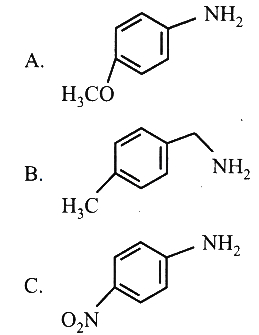
Arrange the following compounds in decreasing order of their basicity:
A
$B > A > C$
B
$B > C > A$
C
$A > B > C$
D
$A > C > B$
Solution
(A) The basicity of amines depends on the availability of the lone pair on the nitrogen atom for protonation.
$1$. Compound $(B)$ is $p$-methylbenzylamine. The nitrogen lone pair is not in conjugation with the benzene ring,making it a primary aliphatic amine,which is significantly more basic than aromatic amines.
$2$. Compound $(A)$ is $p$-methoxyaniline. The $-OCH_3$ group is an electron-donating group by resonance ($+M$ effect),which increases the electron density on the nitrogen atom,making it more basic than aniline.
$3$. Compound $(C)$ is $p$-nitroaniline. The $-NO_2$ group is a strong electron-withdrawing group by resonance ($-M$ effect),which significantly decreases the electron density on the nitrogen atom,making it the least basic.
Therefore,the decreasing order of basicity is $B > A > C$.
$1$. Compound $(B)$ is $p$-methylbenzylamine. The nitrogen lone pair is not in conjugation with the benzene ring,making it a primary aliphatic amine,which is significantly more basic than aromatic amines.
$2$. Compound $(A)$ is $p$-methoxyaniline. The $-OCH_3$ group is an electron-donating group by resonance ($+M$ effect),which increases the electron density on the nitrogen atom,making it more basic than aniline.
$3$. Compound $(C)$ is $p$-nitroaniline. The $-NO_2$ group is a strong electron-withdrawing group by resonance ($-M$ effect),which significantly decreases the electron density on the nitrogen atom,making it the least basic.
Therefore,the decreasing order of basicity is $B > A > C$.
0 likes
View Solution1028
DifficultMCQ
In the reaction sequence $Y$ is $CH_3CO_2H$ $\xrightarrow[(2) \Delta]{(1) NH_3} P$ $\xrightarrow{Br_2 / NaOH} Y$
A
a primary amine with same number of carbons as in $P$
B
a primary amine with one carbon less than in $P$
C
a secondary amine with same number of carbons as in $P$
D
a secondary amine with one carbon less than in $P$
Solution
(B) The reaction sequence is as follows:
$1$. $CH_3COOH + NH_3$ $\rightarrow CH_3COONH_4$ $\xrightarrow{\Delta} CH_3CONH_2 (P) + H_2O$
$2$. $CH_3CONH_2 (P) \xrightarrow{Br_2 / NaOH} CH_3NH_2 (Y) + Na_2CO_3 + NaBr + H_2O$
This is the Hofmann bromamide degradation reaction,which converts an amide into a primary amine containing one carbon atom less than the original amide $(P)$.
$1$. $CH_3COOH + NH_3$ $\rightarrow CH_3COONH_4$ $\xrightarrow{\Delta} CH_3CONH_2 (P) + H_2O$
$2$. $CH_3CONH_2 (P) \xrightarrow{Br_2 / NaOH} CH_3NH_2 (Y) + Na_2CO_3 + NaBr + H_2O$
This is the Hofmann bromamide degradation reaction,which converts an amide into a primary amine containing one carbon atom less than the original amide $(P)$.
0 likes
View Solution1029
EasyMCQ
Arrange the following in increasing order of their boiling points:
$I.$ $N$-Ethylethanamine
$II.$ Butanamine
$III.$ $N,N$-Dimethylethanamine
$I.$ $N$-Ethylethanamine
$II.$ Butanamine
$III.$ $N,N$-Dimethylethanamine
A
$III < I < II$
B
$III < II < I$
C
$II < III < I$
D
$II < I < III$
Solution
(A) The boiling points of isomeric amines follow the order: Primary $(1^{\circ})$ > Secondary $(2^{\circ})$ > Tertiary $(3^{\circ})$.
This is because primary amines $(R-NH_2)$ have two hydrogen atoms available for intermolecular hydrogen bonding,secondary amines $(R_2-NH)$ have one,and tertiary amines $(R_3-N)$ have none.
$I.$ $N$-Ethylethanamine (Secondary amine,$2^{\circ}$)
$II.$ Butanamine (Primary amine,$1^{\circ}$)
$III.$ $N,N$-Dimethylethanamine (Tertiary amine,$3^{\circ}$)
Therefore,the increasing order of boiling points is $III < I < II$.
This is because primary amines $(R-NH_2)$ have two hydrogen atoms available for intermolecular hydrogen bonding,secondary amines $(R_2-NH)$ have one,and tertiary amines $(R_3-N)$ have none.
$I.$ $N$-Ethylethanamine (Secondary amine,$2^{\circ}$)
$II.$ Butanamine (Primary amine,$1^{\circ}$)
$III.$ $N,N$-Dimethylethanamine (Tertiary amine,$3^{\circ}$)
Therefore,the increasing order of boiling points is $III < I < II$.
0 likes
View Solution1030
MediumMCQ
The sequence of reagents required to convert aniline to benzene nitrile is:
A
$NaNO_2 + HCl, 273-278 \ K$; $CuCN / KCN$
B
$NaNO_2 + HCl, 273-278 \ K$; $CuCN / KCN$
C
$NaNO_2 + HCl, 273-298 \ K$; $Cu / HCN$
D
$Cl_2 / Fe$; $KCN$
Solution
(A) The conversion of aniline to benzene nitrile involves two steps:
$1$. Diazotization: Aniline reacts with $NaNO_2$ and $HCl$ at $273-278 \ K$ to form benzene diazonium chloride.
$2$. Sandmeyer reaction: Benzene diazonium chloride reacts with $CuCN / KCN$ to form benzene nitrile (cyanobenzene).
$1$. Diazotization: Aniline reacts with $NaNO_2$ and $HCl$ at $273-278 \ K$ to form benzene diazonium chloride.
$2$. Sandmeyer reaction: Benzene diazonium chloride reacts with $CuCN / KCN$ to form benzene nitrile (cyanobenzene).
0 likes
View Solution1031
EasyMCQ
The product of an amine '$X$' with benzene sulphonyl chloride produces a product which is insoluble in alkali. The product of '$X$' with ethanoyl chloride is:
A
$C_6H_5NHCOCH_3$
B
$C_6H_5N(CH_3)COCH_3$
C
$C_6H_5N(CH_3)CH_2CH_3$
D
$C_6H_5NHCH_2CH_3$
Solution
(B) secondary amine reacts with Hinsberg reagent (benzene sulphonyl chloride) to form a sulfonamide that has no acidic hydrogen,making it insoluble in alkali.
Thus,'$X$' is a secondary amine,$C_6H_5NHCH_3$ ($N$-methylaniline).
The reaction of $C_6H_5NHCH_3$ with ethanoyl chloride $(CH_3COCl)$ is an acetylation reaction:
$C_6H_5NHCH_3 + CH_3COCl \rightarrow C_6H_5N(CH_3)COCH_3 + HCl$
The product formed is $N$-methyl-$N$-phenylacetamide,which corresponds to option $B$.
Thus,'$X$' is a secondary amine,$C_6H_5NHCH_3$ ($N$-methylaniline).
The reaction of $C_6H_5NHCH_3$ with ethanoyl chloride $(CH_3COCl)$ is an acetylation reaction:
$C_6H_5NHCH_3 + CH_3COCl \rightarrow C_6H_5N(CH_3)COCH_3 + HCl$
The product formed is $N$-methyl-$N$-phenylacetamide,which corresponds to option $B$.
0 likes
View Solution1032
MediumMCQ
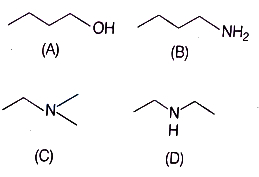
Arrange the following compounds in decreasing order of their boiling points.
A
$A > B > D > C$
B
$A > C > D > B$
C
$B > C > D > A$
D
$C > A > B > D$
Solution
(A) The boiling point of $(A)$ butan$-1-$ol is the highest due to strong intermolecular $H$-bonding compared to amines.
Among the given amines,the boiling point follows the order: Primary amine $(B)$ $>$ Secondary amine $(D)$ $>$ Tertiary amine $(C)$.
This is because the extent of intermolecular $H$-bonding decreases from primary to secondary amines,and tertiary amines lack $H$-bonding due to the absence of $H$ atoms attached to the nitrogen atom.
Therefore,the correct decreasing order of boiling points is $A > B > D > C$.
Among the given amines,the boiling point follows the order: Primary amine $(B)$ $>$ Secondary amine $(D)$ $>$ Tertiary amine $(C)$.
This is because the extent of intermolecular $H$-bonding decreases from primary to secondary amines,and tertiary amines lack $H$-bonding due to the absence of $H$ atoms attached to the nitrogen atom.
Therefore,the correct decreasing order of boiling points is $A > B > D > C$.
0 likes
View Solution1033
MediumMCQ
The relative basic strength of the compounds is correctly shown in the option.
A
$NH_2OH > NH_3 > N_2H_4$
B
$N_2H_4 > NH_2OH > NH_3$
C
$NH_3 > N_2H_4 > NH_2OH$
D
$N_2H_4 > NH_3 > NH_2OH$
Solution
(C) The correct order of relative basic strength is $NH_3 > N_2H_4 > NH_2OH$.
In $NH_3$,the lone pair on nitrogen is completely available for donation,making it the most basic.
$N_2H_4$ and $NH_2OH$ are derivatives of $NH_3$ where one $H$ atom is replaced by $-NH_2$ and $-OH$ groups respectively.
The $-OH$ group is highly electron-withdrawing due to the high electronegativity of the oxygen atom,which significantly decreases the electron density on the nitrogen atom.
The $-I$ effect of the $-NH_2$ group is less than that of the $-OH$ group.
Therefore,the basic strength decreases as the electron-withdrawing nature of the substituent increases,leading to the order $NH_3 > N_2H_4 > NH_2OH$.
In $NH_3$,the lone pair on nitrogen is completely available for donation,making it the most basic.
$N_2H_4$ and $NH_2OH$ are derivatives of $NH_3$ where one $H$ atom is replaced by $-NH_2$ and $-OH$ groups respectively.
The $-OH$ group is highly electron-withdrawing due to the high electronegativity of the oxygen atom,which significantly decreases the electron density on the nitrogen atom.
The $-I$ effect of the $-NH_2$ group is less than that of the $-OH$ group.
Therefore,the basic strength decreases as the electron-withdrawing nature of the substituent increases,leading to the order $NH_3 > N_2H_4 > NH_2OH$.
0 likes
View Solution1034
EasyMCQ
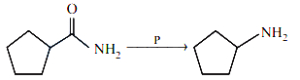
The reagent $P$ used for the reaction is
A
$Zn-Hg / HCl$
B
$HCl / SnCl_2$
C
$Br_2 / NaOH$
D
$ZnCl_2 / HCl$
Solution
(C) The given reaction is the conversion of an amide to a primary amine with one carbon atom less. This is known as the Hofmann bromamide degradation reaction. The reagents used for this reaction are $Br_2$ in the presence of a strong base like $NaOH$ or $KOH$.
0 likes
View Solution1035
MediumMCQ
Arrange the following bases in decreasing order of basicity:
$(i)$ Aniline
$(ii)$ $o$-nitroaniline
$(iii)$ $m$-nitroaniline
$(iv)$ $p$-nitroaniline
$(i)$ Aniline
$(ii)$ $o$-nitroaniline
$(iii)$ $m$-nitroaniline
$(iv)$ $p$-nitroaniline
A
$i > iii > iv > ii$
B
$i > ii > iv > iii$
C
$iv > iii > ii > i$
D
$iii > ii > i > iv$
Solution
(A) Basicity is directly proportional to the $+M$ and $+I$ effects,and inversely proportional to the $-M$ and $-I$ effects.
Aniline $(i)$ is the most basic because it lacks any electron-withdrawing group.
The nitro group $(-NO_2)$ exerts both $-M$ and $-I$ effects.
At the $meta$ position $(iii)$,the $-NO_2$ group exerts only the $-I$ effect.
At the $ortho$ $(ii)$ and $para$ $(iv)$ positions,it exerts both $-M$ and $-I$ effects,which significantly decrease basicity.
Additionally,$o$-nitroaniline $(ii)$ experiences the ortho-effect,which further reduces its basicity compared to $p$-nitroaniline $(iv)$.
Therefore,the decreasing order of basicity is $(i) > (iii) > (iv) > (ii)$.
Aniline $(i)$ is the most basic because it lacks any electron-withdrawing group.
The nitro group $(-NO_2)$ exerts both $-M$ and $-I$ effects.
At the $meta$ position $(iii)$,the $-NO_2$ group exerts only the $-I$ effect.
At the $ortho$ $(ii)$ and $para$ $(iv)$ positions,it exerts both $-M$ and $-I$ effects,which significantly decrease basicity.
Additionally,$o$-nitroaniline $(ii)$ experiences the ortho-effect,which further reduces its basicity compared to $p$-nitroaniline $(iv)$.
Therefore,the decreasing order of basicity is $(i) > (iii) > (iv) > (ii)$.
0 likes
View Solution1036
MediumMCQ
The order of boiling points of the following compounds is:
$1$. $(CH_3)_3N$
$2$. $CH_3CH_2CH_2NH_2$
$3$. $CH_3CH_2NHCH_3$
$1$. $(CH_3)_3N$
$2$. $CH_3CH_2CH_2NH_2$
$3$. $CH_3CH_2NHCH_3$
A
$1 > 3 > 2$
B
$3 > 1 > 2$
C
$2 > 1 > 3$
D
$2 > 3 > 1$
Solution
(D) The boiling points of amines depend on the extent of intermolecular hydrogen bonding.
Primary amines $(R-NH_2)$ have two hydrogen atoms available for hydrogen bonding,secondary amines $(R_2NH)$ have one,and tertiary amines $(R_3N)$ have none.
Therefore,the extent of hydrogen bonding follows the order: primary > secondary > tertiary.
Compound $2$ $(CH_3CH_2CH_2NH_2)$ is a primary amine,compound $3$ $(CH_3CH_2NHCH_3)$ is a secondary amine,and compound $1$ $((CH_3)_3N)$ is a tertiary amine.
Thus,the order of boiling points is $2 > 3 > 1$.
Primary amines $(R-NH_2)$ have two hydrogen atoms available for hydrogen bonding,secondary amines $(R_2NH)$ have one,and tertiary amines $(R_3N)$ have none.
Therefore,the extent of hydrogen bonding follows the order: primary > secondary > tertiary.
Compound $2$ $(CH_3CH_2CH_2NH_2)$ is a primary amine,compound $3$ $(CH_3CH_2NHCH_3)$ is a secondary amine,and compound $1$ $((CH_3)_3N)$ is a tertiary amine.
Thus,the order of boiling points is $2 > 3 > 1$.
0 likes
View Solution1037
MediumMCQ
Which of the following statements about aniline is false?
A
$A$. Aniline is a stronger base than ammonia.
B
$B$. Aniline is less basic than methylamine.
C
$C$. $pK_b$ of aniline is more than that of ammonia.
D
$D$. Aniline reacts with bromine water to form a white precipitate.
Solution
(A) According to Lewis theory,a base is a species that donates a lone pair of electrons.
In aniline,the lone pair on the nitrogen atom is involved in resonance with the benzene ring,making it less available for donation compared to the lone pair in $NH_3$.
Therefore,$NH_3$ is a stronger base than aniline.
Statement $(A)$ claims aniline is a stronger base than ammonia,which is false.
Statement $(B)$ is true because methylamine is an aliphatic amine with an electron-donating alkyl group,making it more basic than aniline.
Statement $(C)$ is true because a weaker base has a higher $pK_b$ value.
Statement $(D)$ is true because aniline reacts with bromine water to form $2,4,6$-tribromoaniline,which appears as a white precipitate.
Thus,the false statement is $(A)$.
In aniline,the lone pair on the nitrogen atom is involved in resonance with the benzene ring,making it less available for donation compared to the lone pair in $NH_3$.
Therefore,$NH_3$ is a stronger base than aniline.
Statement $(A)$ claims aniline is a stronger base than ammonia,which is false.
Statement $(B)$ is true because methylamine is an aliphatic amine with an electron-donating alkyl group,making it more basic than aniline.
Statement $(C)$ is true because a weaker base has a higher $pK_b$ value.
Statement $(D)$ is true because aniline reacts with bromine water to form $2,4,6$-tribromoaniline,which appears as a white precipitate.
Thus,the false statement is $(A)$.
0 likes
View Solution1038
MediumMCQ
Which of the following would produce an alcohol on treatment with $NaNO_2$ and $HCl$ in the presence of water?
A
$CH_3-CH_2-CH_2-NH_2$
B
$CH_3-CH_2-NH-CH_3$
C
$(CH_3)_3N$
D
$C_6H_5-NH_2$
Solution
(A) Primary aliphatic amines $(R-NH_2)$ react with nitrous acid ($HNO_2$,generated in situ from $NaNO_2 + HCl$) to form unstable aliphatic diazonium salts,which decompose in the presence of water to yield alcohols $(R-OH)$,$N_2$ gas,and $HCl$.
$R-NH_2 + NaNO_2 + HCl$ $\rightarrow [R-N_2^+Cl^-] + H_2O$ $\rightarrow R-OH + N_2 + HCl$
Option $A$ is a primary aliphatic amine ($n$-propylamine),which will produce propan$-1-$ol.
Secondary amines $(R_2NH)$ form $N$-nitrosoamines,and tertiary amines $(R_3N)$ form salts with nitrous acid,neither of which yields an alcohol under these conditions. Aniline $(C_6H_5-NH_2)$ forms a stable benzenediazonium chloride at low temperatures $(0-5 \ ^\circ C)$.
$R-NH_2 + NaNO_2 + HCl$ $\rightarrow [R-N_2^+Cl^-] + H_2O$ $\rightarrow R-OH + N_2 + HCl$
Option $A$ is a primary aliphatic amine ($n$-propylamine),which will produce propan$-1-$ol.
Secondary amines $(R_2NH)$ form $N$-nitrosoamines,and tertiary amines $(R_3N)$ form salts with nitrous acid,neither of which yields an alcohol under these conditions. Aniline $(C_6H_5-NH_2)$ forms a stable benzenediazonium chloride at low temperatures $(0-5 \ ^\circ C)$.
0 likes
View Solution1039
EasyMCQ
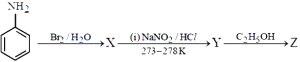
Identify $Z$ in the above sequence of reactions.
A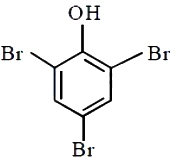
B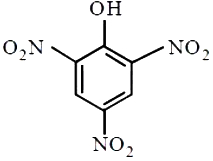
C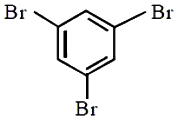
D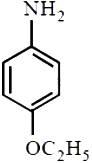
Solution
(C) $1$. Aniline reacts with $Br_2/H_2O$ to form $2,4,6$-tribromoaniline $(X)$.
$2$. $2,4,6$-tribromoaniline reacts with $NaNO_2/HCl$ at $273-278 \ K$ to form the diazonium salt,$2,4,6$-tribromobenzenediazonium chloride $(Y)$.
$3$. The diazonium salt $(Y)$ reacts with ethanol $(C_2H_5OH)$ to undergo reduction,where the diazonium group is replaced by a hydrogen atom,yielding $1,3,5$-tribromobenzene $(Z)$.
$2$. $2,4,6$-tribromoaniline reacts with $NaNO_2/HCl$ at $273-278 \ K$ to form the diazonium salt,$2,4,6$-tribromobenzenediazonium chloride $(Y)$.
$3$. The diazonium salt $(Y)$ reacts with ethanol $(C_2H_5OH)$ to undergo reduction,where the diazonium group is replaced by a hydrogen atom,yielding $1,3,5$-tribromobenzene $(Z)$.
0 likes
View Solution1040
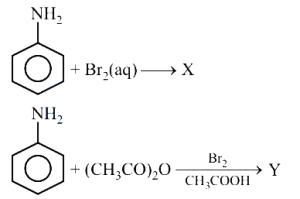
EasyMCQ
What are $X$ and $Y$ in the following reactions?
A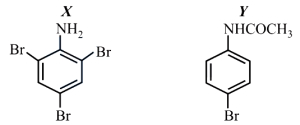
B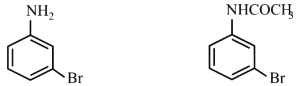
C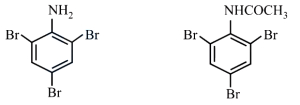
D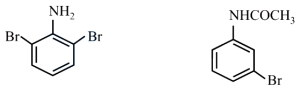
Solution
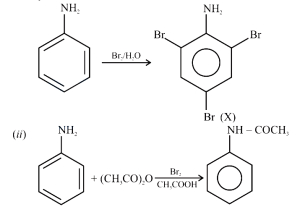
(A) $(i)$ Aniline is highly reactive towards electrophilic substitution. When treated with $Br_2$ in $H_2O$,it undergoes rapid poly-substitution to form $2, 4, 6-$tribromoaniline as the major product $(X)$.
$(ii)$ To control the reactivity of the $-NH_2$ group,it is first acetylated using acetic anhydride $(CH_3CO)_2O$ to form acetanilide. The $-NHCOCH_3$ group is less activating than the $-NH_2$ group,which restricts the bromination to the $p-$position,yielding $p-$bromoacetanilide as the major product $(Y)$.
$(ii)$ To control the reactivity of the $-NH_2$ group,it is first acetylated using acetic anhydride $(CH_3CO)_2O$ to form acetanilide. The $-NHCOCH_3$ group is less activating than the $-NH_2$ group,which restricts the bromination to the $p-$position,yielding $p-$bromoacetanilide as the major product $(Y)$.
0 likes
View SolutionAmines — Properties of Amines · Frequently Asked Questions
1Are these Amines questions useful for JEE and NEET?
Yes. All questions in this section are mapped to JEE Main and NEET exam patterns. Previous year questions from JEE Main, NEET, GUJCET and state-level exams are included with full solutions.
2Can I switch to Hindi or Gujarati for these questions?
Yes. Use the language tabs in the hero section or the sidebar to view the same questions and solutions in English, Hindi or Gujarati.
3How do I generate a question paper from this subtopic?
Use the Vedclass Exam Paper Generator — select the chapter and subtopic, set difficulty, and generate Sets A, B, C, D automatically. First 3 chapters of every subject are free.
Vedclass Products
For Students
Vedclass Test Series
Mock tests in real JEE/NEET style with performance analysis. 5-day free trial.
Start Free TrialFor Teachers
Exam Paper Generator
Generate Set A/B/C/D papers from this chapter in 2 minutes. 3 chapters free.
Try FreeFor Institutes
Online Exam Module
Live online exams with unlimited students, 360° analytics & white-label branding.
See DemoFor Teachers & Institutes
Generate a Amines Exam Paper in 2 Minutes
Select subtopic & difficulty — Sets A, B, C, D auto-generated with No Repeat logic.
First 3 chapters of every subject are free — no payment required.