
A English
Properties of Amines Questions in English
Class 12 Chemistry · Amines · Properties of Amines
1212+
Questions
English
Language
100%
With Solutions
Showing 40 of 1212 questions in English
1051
EasyMCQ
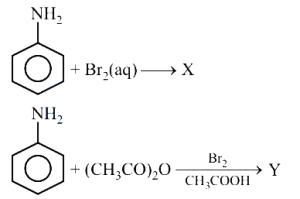
What are $X$ and $Y$ in the following reactions?
A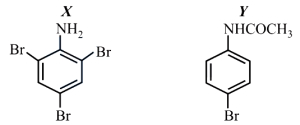
B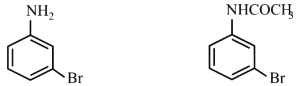
C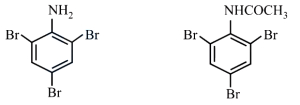
D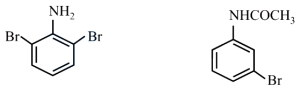
Solution
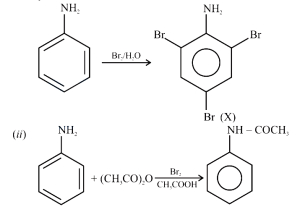
(A) $(i)$ Aniline is highly reactive towards electrophilic substitution. When treated with $Br_2$ in $H_2O$,it undergoes rapid poly-substitution to form $2, 4, 6-$tribromoaniline as the major product $(X)$.
$(ii)$ To control the reactivity of the $-NH_2$ group,it is first acetylated using acetic anhydride $(CH_3CO)_2O$ to form acetanilide. The $-NHCOCH_3$ group is less activating than the $-NH_2$ group,which restricts the bromination to the $p-$position,yielding $p-$bromoacetanilide as the major product $(Y)$.
$(ii)$ To control the reactivity of the $-NH_2$ group,it is first acetylated using acetic anhydride $(CH_3CO)_2O$ to form acetanilide. The $-NHCOCH_3$ group is less activating than the $-NH_2$ group,which restricts the bromination to the $p-$position,yielding $p-$bromoacetanilide as the major product $(Y)$.
0 likes
View Solution1052
EasyMCQ
The order of basic strength of the following in aqueous solution is
$I$. $C_6H_5NH_2$
$II$. $(CH_3)_3N$
$III$. $NH_3$
$IV$. $CH_3NH_2$
$V$. $(CH_3)_2NH$
$I$. $C_6H_5NH_2$
$II$. $(CH_3)_3N$
$III$. $NH_3$
$IV$. $CH_3NH_2$
$V$. $(CH_3)_2NH$
A
$IV > I > V > III > II$
B
$II > V > IV > III > I$
C
$V > IV > II > III > I$
D
$IV > III > V > II > I$
Solution
(C) In aqueous solution,the basic strength of aliphatic amines depends on the combined effect of inductive effect,solvation effect,and steric hindrance.
The order for methyl-substituted amines is $(CH_3)_2NH > CH_3NH_2 > (CH_3)_3N$.
Comparing this with $NH_3$ and aniline $(C_6H_5NH_2)$:
$1$. $(CH_3)_2NH$ $(V)$ is the most basic due to the $+I$ effect and favorable solvation.
$2$. $CH_3NH_2$ $(IV)$ is next.
$3$. $(CH_3)_3N$ $(II)$ is less basic than $CH_3NH_2$ and $(CH_3)_2NH$ due to steric hindrance in the aqueous phase.
$4$. $NH_3$ $(III)$ is less basic than the aliphatic amines.
$5$. $C_6H_5NH_2$ $(I)$ is the least basic because the lone pair on nitrogen is delocalized into the benzene ring.
Thus,the correct order is $V > IV > II > III > I$.
The order for methyl-substituted amines is $(CH_3)_2NH > CH_3NH_2 > (CH_3)_3N$.
Comparing this with $NH_3$ and aniline $(C_6H_5NH_2)$:
$1$. $(CH_3)_2NH$ $(V)$ is the most basic due to the $+I$ effect and favorable solvation.
$2$. $CH_3NH_2$ $(IV)$ is next.
$3$. $(CH_3)_3N$ $(II)$ is less basic than $CH_3NH_2$ and $(CH_3)_2NH$ due to steric hindrance in the aqueous phase.
$4$. $NH_3$ $(III)$ is less basic than the aliphatic amines.
$5$. $C_6H_5NH_2$ $(I)$ is the least basic because the lone pair on nitrogen is delocalized into the benzene ring.
Thus,the correct order is $V > IV > II > III > I$.
0 likes
View Solution1053
MediumMCQ
Predict respectively '$X$' and '$Y$' in the following reactions.
$Ar-NH_2$ $\xrightarrow{X} Ar-\overset{+}{N} \equiv NCl^-$ $\xrightarrow{Y} Ar-Cl$
$Ar-NH_2$ $\xrightarrow{X} Ar-\overset{+}{N} \equiv NCl^-$ $\xrightarrow{Y} Ar-Cl$
A
$NaNO_3$ and $Cl_2$
B
$NaNO_3-HCl$ and $HCl$
C
$NaNO_2-HCl$ and $Cu/HCl$
D
$NaNO_2-HCl$ and $NaNH_2$
Solution
(C) The given reaction sequence is the Sandmeyer reaction.
Step $1$: The conversion of primary aromatic amine $(Ar-NH_2)$ to benzene diazonium chloride $(Ar-\overset{+}{N} \equiv NCl^-)$ is called diazotization,which is carried out using $NaNO_2$ and $HCl$ at $0-5 \ ^\circ C$. Thus,$X = NaNO_2-HCl$.
Step $2$: The conversion of benzene diazonium chloride to aryl chloride $(Ar-Cl)$ is carried out using cuprous chloride $(CuCl)$ or copper powder in $HCl$. This is the Sandmeyer reaction. Thus,$Y = Cu/HCl$.
Step $1$: The conversion of primary aromatic amine $(Ar-NH_2)$ to benzene diazonium chloride $(Ar-\overset{+}{N} \equiv NCl^-)$ is called diazotization,which is carried out using $NaNO_2$ and $HCl$ at $0-5 \ ^\circ C$. Thus,$X = NaNO_2-HCl$.
Step $2$: The conversion of benzene diazonium chloride to aryl chloride $(Ar-Cl)$ is carried out using cuprous chloride $(CuCl)$ or copper powder in $HCl$. This is the Sandmeyer reaction. Thus,$Y = Cu/HCl$.
0 likes
View Solution1054
MediumMCQ
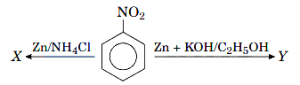
Identify $X$ and $Y$ in the following reactions:
A
$X$ = Nitrosobenzene,$Y$ = Hydrazobenzene
B
$X$ = Aniline,$Y$ = Hydrazobenzene
C
$X$ = Phenylhydroxylamine,$Y$ = Hydrazobenzene
D
$X$ = Hydrazobenzene,$Y$ = Phenylhydroxylamine
Solution
(C) The reduction of nitrobenzene depends on the medium used:
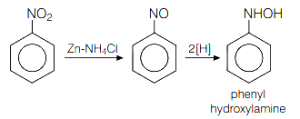
$(i)$ In neutral medium,using $Zn$ dust and $NH_4Cl$ solution,nitrobenzene is reduced to phenylhydroxylamine $(C_6H_5NHOH)$. Thus,$X$ is phenylhydroxylamine.
(ii) In alkaline medium,using $Zn$ and $KOH/C_2H_5OH$,the reduction proceeds further to form hydrazobenzene $(C_6H_5NH-NHC_6H_5)$. Thus,$Y$ is hydrazobenzene.
Therefore,the correct option is $C$.
$(i)$ In neutral medium,using $Zn$ dust and $NH_4Cl$ solution,nitrobenzene is reduced to phenylhydroxylamine $(C_6H_5NHOH)$. Thus,$X$ is phenylhydroxylamine.
(ii) In alkaline medium,using $Zn$ and $KOH/C_2H_5OH$,the reduction proceeds further to form hydrazobenzene $(C_6H_5NH-NHC_6H_5)$. Thus,$Y$ is hydrazobenzene.
Therefore,the correct option is $C$.
0 likes
View Solution1055
MediumMCQ
The type of reaction '$X$' and product '$Y$' of the following are respectively:
$C_6H_5N_2Cl + C_6H_5NH_2 \xrightarrow[H^{+}]{X} Y$
$C_6H_5N_2Cl + C_6H_5NH_2 \xrightarrow[H^{+}]{X} Y$
A
Electrophilic Substitution,$C_6H_5-N=N-C_6H_4-NH_2$ (para-aminoazobenzene)
B
Electrophilic Substitution,$C_6H_5-N=N-C_6H_4-NH_2$ (ortho-aminoazobenzene)
C
Nucleophilic Substitution,$C_6H_5-NH-NH-C_6H_4-NH_2$
D
Nucleophilic Substitution,$C_6H_5-NH-NH-C_6H_4-NH_2$
Solution
(A) The reaction between benzene diazonium chloride $(C_6H_5N_2Cl)$ and aniline $(C_6H_5NH_2)$ in the presence of a mild acid $(H^+)$ is a coupling reaction.
This is a type of electrophilic aromatic substitution reaction where the diazonium cation acts as an electrophile.
The electrophile attacks the electron-rich ring of aniline,primarily at the para-position due to steric hindrance at the ortho-position.
The product formed is $p$-aminoazobenzene $(C_6H_5-N=N-C_6H_4-NH_2)$.
This is a type of electrophilic aromatic substitution reaction where the diazonium cation acts as an electrophile.
The electrophile attacks the electron-rich ring of aniline,primarily at the para-position due to steric hindrance at the ortho-position.
The product formed is $p$-aminoazobenzene $(C_6H_5-N=N-C_6H_4-NH_2)$.
0 likes
View Solution1056
EasyMCQ
$p-$Methylbenzonitrile can be prepared from which of the following?
A
$4-$Chlorotoluene reacting with $NaCN$.
B
$4-$Chlorotoluene reacting with $AgCN$.
C
$p-$Toluidine reacting with $(i) NaNO_2/HCl, 273-278 \ K$ and $(ii) CuCN/KCN$.
D
$p-$Toluidine reacting with $CHCl_3/KOH, \Delta$.
Solution
(C) The preparation of $p-$methylbenzonitrile ($p-$tolunitrile) is best achieved via the Sandmeyer reaction starting from $p-$toluidine.
$1$. $p-$Toluidine reacts with $NaNO_2/HCl$ at $273-278 \ K$ to form the $p-$methylbenzenediazonium chloride salt.
$2$. This diazonium salt then reacts with $CuCN/KCN$ to yield $p-$methylbenzonitrile.
- Option $(a)$ and $(b)$: Aryl halides like $4-$chlorotoluene do not undergo nucleophilic substitution with $NaCN$ or $AgCN$ under standard conditions due to the partial double bond character of the $C-Cl$ bond.
- Option $(d)$: This is the carbylamine reaction,which converts primary amines into isocyanides $(R-NC)$,not nitriles $(R-CN)$.
$1$. $p-$Toluidine reacts with $NaNO_2/HCl$ at $273-278 \ K$ to form the $p-$methylbenzenediazonium chloride salt.
$2$. This diazonium salt then reacts with $CuCN/KCN$ to yield $p-$methylbenzonitrile.
- Option $(a)$ and $(b)$: Aryl halides like $4-$chlorotoluene do not undergo nucleophilic substitution with $NaCN$ or $AgCN$ under standard conditions due to the partial double bond character of the $C-Cl$ bond.
- Option $(d)$: This is the carbylamine reaction,which converts primary amines into isocyanides $(R-NC)$,not nitriles $(R-CN)$.
0 likes
View Solution1057
MediumMCQ
$Benzamide$ $\xrightarrow{Br_2 / NaOH} X$ $\xrightarrow[\text{alc. } KOH]{CHCl_3} Y$
The conversion of $X$ to $Y$ is
The conversion of $X$ to $Y$ is
A
Hoffmann reaction
B
Etard reaction
C
Stephen reaction
D
Carbylamine reaction
Solution
(D) $1$. The first step,$Benzamide \xrightarrow{Br_2 / NaOH} X$,is the Hoffmann bromamide degradation reaction,where $X$ is $Aniline$ $(C_6H_5NH_2)$.
$2$. The second step,$X \xrightarrow[\text{alc. } KOH]{CHCl_3} Y$,involves the reaction of a primary amine $(Aniline)$ with chloroform $(CHCl_3)$ and alcoholic potassium hydroxide $(KOH)$.
$3$. This specific reaction is known as the Carbylamine reaction,which produces an isocyanide ($Y = Phenyl \ isocyanide$ or $C_6H_5NC$).
$4$. Therefore,the conversion of $X$ to $Y$ is the Carbylamine reaction.
$2$. The second step,$X \xrightarrow[\text{alc. } KOH]{CHCl_3} Y$,involves the reaction of a primary amine $(Aniline)$ with chloroform $(CHCl_3)$ and alcoholic potassium hydroxide $(KOH)$.
$3$. This specific reaction is known as the Carbylamine reaction,which produces an isocyanide ($Y = Phenyl \ isocyanide$ or $C_6H_5NC$).
$4$. Therefore,the conversion of $X$ to $Y$ is the Carbylamine reaction.
0 likes
View Solution1058
MediumMCQ
$C_2H_5Cl$ $\xrightarrow{KCN} X$ $\xrightarrow{H_2 / \text{Catalyst}} Y$ $\xrightarrow{CHCl_3 / KOH} Z$
What is '$Z$' in the above sequence of reactions?
What is '$Z$' in the above sequence of reactions?
A
$CH_3CH_2CH_2NC$
B
$CH_3CH_2CH_2CN$
C
$CH_3CH_2NC$
D
$CH_3CHClCH_2CH_3$
Solution
(A) Step $1$: $C_2H_5Cl + KCN \rightarrow C_2H_5CN (X) + KCl$. Here,$X$ is propanenitrile $(CH_3CH_2CN)$.
Step $2$: $C_2H_5CN + 2H_2 \xrightarrow{\text{Catalyst}} CH_3CH_2CH_2NH_2 (Y)$. Here,$Y$ is propan$-1-$amine.
Step $3$: $CH_3CH_2CH_2NH_2 + CHCl_3 + 3KOH \xrightarrow{\Delta} CH_3CH_2CH_2NC (Z) + 3KCl + 3H_2O$. This is the carbylamine reaction,which is a test for primary amines. The product $Z$ is propyl isocyanide $(CH_3CH_2CH_2NC)$.
Step $2$: $C_2H_5CN + 2H_2 \xrightarrow{\text{Catalyst}} CH_3CH_2CH_2NH_2 (Y)$. Here,$Y$ is propan$-1-$amine.
Step $3$: $CH_3CH_2CH_2NH_2 + CHCl_3 + 3KOH \xrightarrow{\Delta} CH_3CH_2CH_2NC (Z) + 3KCl + 3H_2O$. This is the carbylamine reaction,which is a test for primary amines. The product $Z$ is propyl isocyanide $(CH_3CH_2CH_2NC)$.
0 likes
View Solution1059
EasyMCQ
The amine which does not react with chloroform and ethanolic potassium hydroxide is
A
$(CH_3)_2CH-NH-CH_3$
B
$C_6H_5-NH_2$
C
$3\text{-bromo-4-methylaniline}$
D
$4\text{-bromoaniline}$
Solution
(A) The reaction of primary amines with chloroform $(CHCl_3)$ and ethanolic potassium hydroxide $(KOH)$ to form isocyanides (carbylamines) is known as the carbylamine reaction.
This reaction is a characteristic test for primary amines.
Secondary and tertiary amines do not undergo this reaction.
In the given options:
$A$ is a secondary amine $((CH_3)_2CH-NH-CH_3)$,
$B$ is a primary amine $(C_6H_5-NH_2)$,
$C$ is a primary amine $(3\text{-bromo-4-methylaniline})$,
$D$ is a primary amine $(4\text{-bromoaniline})$.
Therefore,the secondary amine $(CH_3)_2CH-NH-CH_3$ will not react.
This reaction is a characteristic test for primary amines.
Secondary and tertiary amines do not undergo this reaction.
In the given options:
$A$ is a secondary amine $((CH_3)_2CH-NH-CH_3)$,
$B$ is a primary amine $(C_6H_5-NH_2)$,
$C$ is a primary amine $(3\text{-bromo-4-methylaniline})$,
$D$ is a primary amine $(4\text{-bromoaniline})$.
Therefore,the secondary amine $(CH_3)_2CH-NH-CH_3$ will not react.
0 likes
View Solution1060
EasyMCQ
The amine which does not react with chloroform and ethanolic potassium hydroxide is
A
$CH_3-CH_2-NH_2$
B
$C_6H_5-NH_2$
C
$(CH_3)_3N$
D
$CH_3-CH_2-NH-CH_3$
Solution
(C) The carbylamine reaction (also known as Hoffmann isocyanide synthesis) is a test used to identify primary amines. In this reaction,a primary amine reacts with chloroform $(CHCl_3)$ and an ethanolic base (like $KOH$) to form an isocyanide (carbylamine),which is characterized by a foul,offensive smell.
Only primary amines ($R-NH_2$ or $Ar-NH_2$) undergo this reaction.
Secondary amines $(R_2NH)$ and tertiary amines $(R_3N)$ do not possess the necessary hydrogen atoms on the nitrogen to form the isocyanide intermediate and thus do not give the carbylamine test.
In the given options:
$CH_3-CH_2-NH_2$ is a primary amine.
$C_6H_5-NH_2$ (aniline) is a primary amine.
$(CH_3)_3N$ is a tertiary amine.
$CH_3-CH_2-NH-CH_3$ is a secondary amine.
Since both $(CH_3)_3N$ and $CH_3-CH_2-NH-CH_3$ do not react,and typically such questions look for the tertiary amine or the most substituted one,$(CH_3)_3N$ is the standard answer for this type of question.
Only primary amines ($R-NH_2$ or $Ar-NH_2$) undergo this reaction.
Secondary amines $(R_2NH)$ and tertiary amines $(R_3N)$ do not possess the necessary hydrogen atoms on the nitrogen to form the isocyanide intermediate and thus do not give the carbylamine test.
In the given options:
$CH_3-CH_2-NH_2$ is a primary amine.
$C_6H_5-NH_2$ (aniline) is a primary amine.
$(CH_3)_3N$ is a tertiary amine.
$CH_3-CH_2-NH-CH_3$ is a secondary amine.
Since both $(CH_3)_3N$ and $CH_3-CH_2-NH-CH_3$ do not react,and typically such questions look for the tertiary amine or the most substituted one,$(CH_3)_3N$ is the standard answer for this type of question.
0 likes
View Solution1061
MediumMCQ
Which of the following sets of reagents convert aniline to chlorobenzene?
A
$NaNO_2 / HCl, 273-278 \ K ; Cu_2Cl_2 / HCl$
B
$NaNO_2 / HCl, 293-298 \ K ; Cu_2Cl_2 / HCl$
C
$NaNO_2 / HCl, 273-278 \ K ; SOCl_2$
D
$NaNO_2 / HCl, 273-278 \ K ; Cl_2$
Solution
(A) The conversion of aniline to chlorobenzene is a two-step process known as the Sandmeyer reaction.
Step $1$: Aniline $(C_6H_5NH_2)$ reacts with $NaNO_2 / HCl$ at a low temperature of $273-278 \ K$ $(0-5 \ ^\circ C)$ to form benzene diazonium chloride $(C_6H_5N_2^+Cl^-)$.
Step $2$: The benzene diazonium chloride is then treated with cuprous chloride $(Cu_2Cl_2)$ in the presence of $HCl$ to yield chlorobenzene $(C_6H_5Cl)$ and nitrogen gas $(N_2)$.
Therefore,the correct set of reagents is $NaNO_2 / HCl, 273-278 \ K ; Cu_2Cl_2 / HCl$.
Step $1$: Aniline $(C_6H_5NH_2)$ reacts with $NaNO_2 / HCl$ at a low temperature of $273-278 \ K$ $(0-5 \ ^\circ C)$ to form benzene diazonium chloride $(C_6H_5N_2^+Cl^-)$.
Step $2$: The benzene diazonium chloride is then treated with cuprous chloride $(Cu_2Cl_2)$ in the presence of $HCl$ to yield chlorobenzene $(C_6H_5Cl)$ and nitrogen gas $(N_2)$.
Therefore,the correct set of reagents is $NaNO_2 / HCl, 273-278 \ K ; Cu_2Cl_2 / HCl$.
0 likes
View Solution1062
MediumMCQ
Which of the following produces nitrogen gas after the reaction with nitrous acid?
A
$(CH_3)_3 N$
B
$C_2 H_5 NH C_2 H_5$
C
$(C_2 H_5)_3 N$
D
$C_2 H_5 NH_2$
Solution
(D) Primary aliphatic amines $(R-NH_2)$ react with nitrous acid $(HNO_2)$ to form unstable diazonium salts,which decompose in the presence of water to release nitrogen gas $(N_2 \uparrow)$.
$C_2 H_5 NH_2 + HNO_2$ $\xrightarrow{0-5^{\circ}C} [C_2 H_5 N_2^+ Cl^-]$ $\xrightarrow{H_2 O} C_2 H_5 OH + N_2 \uparrow + HCl$
Secondary amines form $N$-nitrosoamines (yellow oily liquids),and tertiary amines form salts with nitrous acid without evolving nitrogen gas.
Therefore,$C_2 H_5 NH_2$ (a primary amine) is the correct answer.
$C_2 H_5 NH_2 + HNO_2$ $\xrightarrow{0-5^{\circ}C} [C_2 H_5 N_2^+ Cl^-]$ $\xrightarrow{H_2 O} C_2 H_5 OH + N_2 \uparrow + HCl$
Secondary amines form $N$-nitrosoamines (yellow oily liquids),and tertiary amines form salts with nitrous acid without evolving nitrogen gas.
Therefore,$C_2 H_5 NH_2$ (a primary amine) is the correct answer.
0 likes
View Solution1063
MediumMCQ
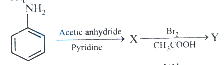
$X$ and $Y$ (major products) in the following reaction sequence are:
A
Aniline,$p$-bromoaniline
B
Acetanilide,$p$-bromoacetanilide
C
Acetanilide,$o$-bromoacetanilide
D
$N$-bromoacetanilide,$p$-bromoacetanilide
Solution
(B) $1$. The reaction of aniline with acetic anhydride in the presence of pyridine is an acylation reaction,which converts the $-NH_2$ group into an acetamido group $(-NHCOCH_3)$. The product $X$ is acetanilide.
$2$. Acetanilide undergoes electrophilic aromatic substitution (bromination) with $Br_2$ in $CH_3COOH$. The $-NHCOCH_3$ group is ortho/para directing. Due to steric hindrance,the para-isomer is the major product. The product $Y$ is $p$-bromoacetanilide.
$2$. Acetanilide undergoes electrophilic aromatic substitution (bromination) with $Br_2$ in $CH_3COOH$. The $-NHCOCH_3$ group is ortho/para directing. Due to steric hindrance,the para-isomer is the major product. The product $Y$ is $p$-bromoacetanilide.
0 likes
View Solution1064
MediumMCQ
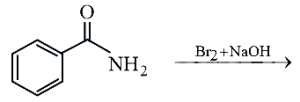
Identify the major product of the following reaction:
A
$4-$Bromobenzylamine
B
Benzylamine
C
$4-$Bromobenzamide
D
Aniline
Solution
(D) The given reaction is the Hoffmann bromamide degradation reaction. In this reaction,an amide $(R-CONH_2)$ reacts with bromine $(Br_2)$ in the presence of an aqueous base (like $NaOH$) to form a primary amine $(R-NH_2)$ with one carbon atom less than the starting amide.
In the given reactant,benzamide $(C_6H_5CONH_2)$,the carbonyl carbon is removed as a carbonate,and the phenyl group attaches directly to the nitrogen atom.
Therefore,the reaction is:
$C_6H_5CONH_2 + Br_2 + 4NaOH \rightarrow C_6H_5NH_2 + Na_2CO_3 + 2NaBr + 2H_2O$
The product formed is aniline $(C_6H_5NH_2)$.
In the given reactant,benzamide $(C_6H_5CONH_2)$,the carbonyl carbon is removed as a carbonate,and the phenyl group attaches directly to the nitrogen atom.
Therefore,the reaction is:
$C_6H_5CONH_2 + Br_2 + 4NaOH \rightarrow C_6H_5NH_2 + Na_2CO_3 + 2NaBr + 2H_2O$
The product formed is aniline $(C_6H_5NH_2)$.
0 likes
View Solution1065
EasyMCQ
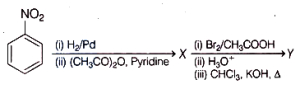
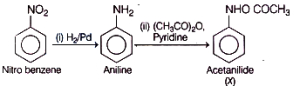
Identify $X$ and $Y$ of the following reaction sequence.
A
$X$ = $C_6H_5NHCOCH_3$,$Y$ = $p-Br-C_6H_4-NC$
B
$X$ = $p-CH_3COC_6H_4NH_2$,$Y$ = $p-CH_3COC_6H_4-NC(Br)$
C
$X$ = $C_6H_5NHCOCH_3$,$Y$ = $p-NHOHC_6H_4CHO$
D
$X$ = $C_6H_5NHCOCH_3$,$Y$ = $m-Br-C_6H_4-NC$
Solution
0 likes
View Solution1066
MediumMCQ
What are the structures of $X$,$Y$ and $Z$ in the following reaction sequence?

A
Structure of $X$: $C_6H_5NHCOCH_3$,Structure of $Y$: $m-NO_2-C_6H_4NHCOCH_3$,Structure of $Z$: $m-NO_2-C_6H_4NH_2$
B
Structure of $X$: $C_6H_5N(COCH_3)_2$,Structure of $Y$: $p-NO_2-C_6H_4N(COCH_3)_2$,Structure of $Z$: $p-NO_2-C_6H_4NH_2$
C
Structure of $X$: $C_6H_5N(COCH_3)_2$,Structure of $Y$: $3,5-(NO_2)_2-C_6H_3N(COCH_3)_2$,Structure of $Z$: $2,4,6-(NO_2)_3-C_6H_2NH_2$
D
Structure of $X$: $C_6H_5NHCOCH_3$,Structure of $Y$: $p-NO_2-C_6H_4NHCOCH_3$,Structure of $Z$: $p-NO_2-C_6H_4NH_2$
Solution
(D) $1$. The reaction of aniline $(C_6H_5NH_2)$ with acetic anhydride $((CH_3CO)_2O)$ in the presence of pyridine yields acetanilide $(C_6H_5NHCOCH_3)$,which is $X$.
$2$. Nitration of acetanilide with $HNO_3/H_2SO_4$ at $288 \ K$ gives $p$-nitroacetanilide $(p-NO_2-C_6H_4NHCOCH_3)$ as the major product,which is $Y$.
$3$. Hydrolysis of $p$-nitroacetanilide with $OH^-$ yields $p$-nitroaniline $(p-NO_2-C_6H_4NH_2)$,which is $Z$.
$4$. Thus,the correct sequence of structures corresponds to option $D$.
$2$. Nitration of acetanilide with $HNO_3/H_2SO_4$ at $288 \ K$ gives $p$-nitroacetanilide $(p-NO_2-C_6H_4NHCOCH_3)$ as the major product,which is $Y$.
$3$. Hydrolysis of $p$-nitroacetanilide with $OH^-$ yields $p$-nitroaniline $(p-NO_2-C_6H_4NH_2)$,which is $Z$.
$4$. Thus,the correct sequence of structures corresponds to option $D$.
0 likes
View Solution1067
EasyMCQ
What is the product formed upon hydrolysis of the minor product obtained from the reaction of $1-$bromopropane with ethanolic $KCN$?
A
$CH_3CH_2CH_2NH_2$
B
$CH_3CH_2CH_2NC$
C
$CH_3CH_2CH_2COOH$
D
$CH_3CH_2COOH$
Solution
(A) The reaction of $1-$bromopropane $(CH_3CH_2CH_2Br)$ with ethanolic $KCN$ is a nucleophilic substitution reaction. $CN^-$ is an ambident nucleophile. The major product is the nitrile $(CH_3CH_2CH_2CN)$ due to attack by carbon,while the minor product is the isocyanide $(CH_3CH_2CH_2NC)$ due to attack by nitrogen.
Hydrolysis of the minor product,$CH_3CH_2CH_2NC$,yields a primary amine and formic acid:
$CH_3CH_2CH_2NC + 2H_2O \xrightarrow{H^+} CH_3CH_2CH_2NH_2 + HCOOH$
Thus,the product is $n-$propylamine $(CH_3CH_2CH_2NH_2)$.
Hydrolysis of the minor product,$CH_3CH_2CH_2NC$,yields a primary amine and formic acid:
$CH_3CH_2CH_2NC + 2H_2O \xrightarrow{H^+} CH_3CH_2CH_2NH_2 + HCOOH$
Thus,the product is $n-$propylamine $(CH_3CH_2CH_2NH_2)$.
0 likes
View Solution1068
MediumMCQ
Acetic acid on heating with $NH_3$ forms $A$. When $A$ reacts with $LiAlH_4$ followed by hydrolysis,it gives $B$. When $B$ is heated with chloroform in $KOH$ medium,it gives $C$. What are $B$ and $C$ respectively?
A
$CH_3CONH_2, CH_3CH_2NC$
B
$CH_3CH_2NH_2, CH_3CH_2NC$
C
$CH_3CH_2NH_2, CH_3COOH$
D
$CH_3CH_2CH_2NH_2, CH_3CH_2NC$
Solution
(B) $1$. Acetic acid $(CH_3COOH)$ reacts with $NH_3$ to form ammonium acetate,which upon heating undergoes dehydration to form acetamide $(A)$: $CH_3COOH + NH_3$ $\rightarrow CH_3COONH_4$ $\xrightarrow{\Delta} CH_3CONH_2 (A) + H_2O$.
$2$. Acetamide $(A)$ is reduced by $LiAlH_4$ to form ethylamine $(B)$: $CH_3CONH_2 \xrightarrow{LiAlH_4} CH_3CH_2NH_2 (B)$.
$3$. Ethylamine $(B)$ reacts with chloroform $(CHCl_3)$ in the presence of $KOH$ (Carbylamine reaction) to form ethyl isocyanide $(C)$: $CH_3CH_2NH_2 + CHCl_3 + 3KOH \rightarrow CH_3CH_2NC (C) + 3KCl + 3H_2O$.
$4$. Therefore,$B$ is $CH_3CH_2NH_2$ and $C$ is $CH_3CH_2NC$.
$2$. Acetamide $(A)$ is reduced by $LiAlH_4$ to form ethylamine $(B)$: $CH_3CONH_2 \xrightarrow{LiAlH_4} CH_3CH_2NH_2 (B)$.
$3$. Ethylamine $(B)$ reacts with chloroform $(CHCl_3)$ in the presence of $KOH$ (Carbylamine reaction) to form ethyl isocyanide $(C)$: $CH_3CH_2NH_2 + CHCl_3 + 3KOH \rightarrow CH_3CH_2NC (C) + 3KCl + 3H_2O$.
$4$. Therefore,$B$ is $CH_3CH_2NH_2$ and $C$ is $CH_3CH_2NC$.
0 likes
View Solution1069
MediumMCQ
Which of the following can form intermolecular $H$-bond?
A
Ethyl acetate
B
Methyl formate
C
Acetamide
D
Acetic anhydride
Solution
(C) Intermolecular $H$-bonding occurs in molecules where a hydrogen atom is covalently bonded to a highly electronegative atom $(N, O, F)$ and is attracted to another electronegative atom in a neighboring molecule.
Acetamide $(CH_3CONH_2)$ contains an $N-H$ bond,which allows it to act as a hydrogen bond donor,and a $C=O$ group,which acts as a hydrogen bond acceptor. This enables the formation of intermolecular $H$-bonds between the $N-H$ of one molecule and the $C=O$ of another.
Ethyl acetate,methyl formate,and acetic anhydride lack $N-H$ or $O-H$ bonds,so they cannot form intermolecular $H$-bonds.
Thus,the correct option is $(C)$.
Acetamide $(CH_3CONH_2)$ contains an $N-H$ bond,which allows it to act as a hydrogen bond donor,and a $C=O$ group,which acts as a hydrogen bond acceptor. This enables the formation of intermolecular $H$-bonds between the $N-H$ of one molecule and the $C=O$ of another.
Ethyl acetate,methyl formate,and acetic anhydride lack $N-H$ or $O-H$ bonds,so they cannot form intermolecular $H$-bonds.
Thus,the correct option is $(C)$.
0 likes
View Solution1070
MediumMCQ
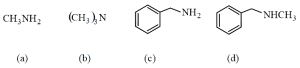
Arrange the following in decreasing order of their $pK_{b}$ values:
A
$d > a > c > b$
B
$a > b > d > c$
C
$d > c > b > a$
D
$a > c > d > b$
Solution
(C) The basicity of amines is inversely proportional to their $pK_{b}$ values. Stronger bases have lower $pK_{b}$ values,while weaker bases have higher $pK_{b}$ values.
$1$. Comparing aliphatic amines: In aqueous solution,the basicity order of methyl-substituted amines is secondary $(CH_{3}NHCH_{3})$ > primary $(CH_{3}NH_{2})$ > tertiary $((CH_{3})_{3}N)$. Thus,$(CH_{3})_{3}N$ is a weaker base than $CH_{3}NH_{2}$,meaning $(CH_{3})_{3}N$ has a higher $pK_{b}$ value than $CH_{3}NH_{2}$.
$2$. Comparing with benzylamines: Benzylamines ($C_{6}H_{5}CH_{2}NH_{2}$ and $C_{6}H_{5}CH_{2}NHCH_{3}$) are significantly less basic than aliphatic amines due to the electron-withdrawing $-I$ effect of the phenyl group.
$3$. Comparing benzylamines: $C_{6}H_{5}CH_{2}NHCH_{3}$ (secondary) is more basic than $C_{6}H_{5}CH_{2}NH_{2}$ (primary) due to the $+I$ effect of the additional methyl group,despite the steric hindrance.
Basicity order: $CH_{3}NH_{2} > (CH_{3})_{3}N > C_{6}H_{5}CH_{2}NHCH_{3} > C_{6}H_{5}CH_{2}NH_{2}$.
Decreasing order of $pK_{b}$ values (inverse of basicity): $C_{6}H_{5}CH_{2}NH_{2} (d) > C_{6}H_{5}CH_{2}NHCH_{3} (c) > (CH_{3})_{3}N (b) > CH_{3}NH_{2} (a)$.
Thus,the correct order is $d > c > b > a$.
$1$. Comparing aliphatic amines: In aqueous solution,the basicity order of methyl-substituted amines is secondary $(CH_{3}NHCH_{3})$ > primary $(CH_{3}NH_{2})$ > tertiary $((CH_{3})_{3}N)$. Thus,$(CH_{3})_{3}N$ is a weaker base than $CH_{3}NH_{2}$,meaning $(CH_{3})_{3}N$ has a higher $pK_{b}$ value than $CH_{3}NH_{2}$.
$2$. Comparing with benzylamines: Benzylamines ($C_{6}H_{5}CH_{2}NH_{2}$ and $C_{6}H_{5}CH_{2}NHCH_{3}$) are significantly less basic than aliphatic amines due to the electron-withdrawing $-I$ effect of the phenyl group.
$3$. Comparing benzylamines: $C_{6}H_{5}CH_{2}NHCH_{3}$ (secondary) is more basic than $C_{6}H_{5}CH_{2}NH_{2}$ (primary) due to the $+I$ effect of the additional methyl group,despite the steric hindrance.
Basicity order: $CH_{3}NH_{2} > (CH_{3})_{3}N > C_{6}H_{5}CH_{2}NHCH_{3} > C_{6}H_{5}CH_{2}NH_{2}$.
Decreasing order of $pK_{b}$ values (inverse of basicity): $C_{6}H_{5}CH_{2}NH_{2} (d) > C_{6}H_{5}CH_{2}NHCH_{3} (c) > (CH_{3})_{3}N (b) > CH_{3}NH_{2} (a)$.
Thus,the correct order is $d > c > b > a$.
0 likes
View Solution1071
MediumMCQ
Choose the correct order of basicity of the following compounds in the aqueous phase:
$(A)$ $(C_2H_5)_2NH$
$(B)$ $C_2H_5NH_2$
$(C)$ $NH_3$
$(D)$ $C_6H_5NH_2$
$(A)$ $(C_2H_5)_2NH$
$(B)$ $C_2H_5NH_2$
$(C)$ $NH_3$
$(D)$ $C_6H_5NH_2$
A
$A > B > C > D$
B
$A > C > B > D$
C
$D > A > C > B$
D
$D > C > B > A$
Solution
(A) The basicity of amines depends on the availability of the lone pair of electrons on the nitrogen atom.
$(A)$ $(C_2H_5)_2NH$ is a secondary amine with two electron-donating ethyl groups,which increase the electron density on $N$ via the $+I$ effect,making it the most basic.
$(B)$ $C_2H_5NH_2$ is a primary amine with one ethyl group,making it less basic than the secondary amine.
$(C)$ $NH_3$ has no alkyl groups to increase electron density,so it is less basic than aliphatic amines.
$(D)$ $C_6H_5NH_2$ (aniline) has the lone pair of electrons on $N$ involved in resonance with the benzene ring,significantly reducing its availability for protonation,making it the least basic.
Thus,the correct order of basicity is $(A) > (B) > (C) > (D)$.
$(A)$ $(C_2H_5)_2NH$ is a secondary amine with two electron-donating ethyl groups,which increase the electron density on $N$ via the $+I$ effect,making it the most basic.
$(B)$ $C_2H_5NH_2$ is a primary amine with one ethyl group,making it less basic than the secondary amine.
$(C)$ $NH_3$ has no alkyl groups to increase electron density,so it is less basic than aliphatic amines.
$(D)$ $C_6H_5NH_2$ (aniline) has the lone pair of electrons on $N$ involved in resonance with the benzene ring,significantly reducing its availability for protonation,making it the least basic.
Thus,the correct order of basicity is $(A) > (B) > (C) > (D)$.
0 likes
View Solution1072
DifficultMCQ
The order of basic strength of methyl substituted amines and $NH_3$ in aqueous solution is
A
$(CH_3)_2NH > CH_3NH_2 > (CH_3)_3N > NH_3$
B
$(CH_3)_3N > (CH_3)_2NH > CH_3NH_2 > NH_3$
C
$(CH_3)_2NH > CH_3NH_2 > NH_3 > (CH_3)_3N$
D
$NH_3 > CH_3NH_2 > (CH_3)_2NH > (CH_3)_3N$
Solution
(A) The basic strength of aliphatic amines in aqueous solution is determined by the combined effect of three factors:
$(i)$ Inductive effect: The $+I$ effect of alkyl groups increases electron density on the nitrogen atom,making tertiary amines potentially more basic.
$(ii)$ Solvation effect: Primary amines are stabilized more effectively by hydrogen bonding with water molecules,which favors their basicity.
$(iii)$ Steric hindrance: Bulky alkyl groups in tertiary amines hinder the approach of a proton to the nitrogen lone pair,reducing basicity.
Considering the interplay of these factors for methyl-substituted amines,the observed order of basicity in aqueous solution is $(CH_3)_2NH > CH_3NH_2 > (CH_3)_3N > NH_3$.
$(i)$ Inductive effect: The $+I$ effect of alkyl groups increases electron density on the nitrogen atom,making tertiary amines potentially more basic.
$(ii)$ Solvation effect: Primary amines are stabilized more effectively by hydrogen bonding with water molecules,which favors their basicity.
$(iii)$ Steric hindrance: Bulky alkyl groups in tertiary amines hinder the approach of a proton to the nitrogen lone pair,reducing basicity.
Considering the interplay of these factors for methyl-substituted amines,the observed order of basicity in aqueous solution is $(CH_3)_2NH > CH_3NH_2 > (CH_3)_3N > NH_3$.
0 likes
View Solution1073
MediumMCQ
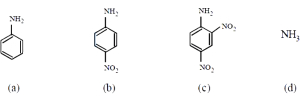
Arrange the following in the order of their basic strength:
A
$a > c > b > d$
B
$c > b > a > d$
C
$d > a > b > c$
D
$b > d > a > c$
Solution
(C) The basic strength of amines depends on the availability of the lone pair on the nitrogen atom. Electron-withdrawing groups (like $-NO_2$) decrease basicity by pulling electron density away from the nitrogen atom via inductive $(-I)$ and resonance $(-R)$ effects.
$(a)$ Aniline: The lone pair is involved in resonance with the benzene ring.
$(b)$ $p$-Nitroaniline: The $-NO_2$ group at the para position exerts a strong $-R$ effect,significantly reducing the basicity compared to aniline.
$(c)$ $2,4$-Dinitroaniline: Two $-NO_2$ groups exert a very strong electron-withdrawing effect,making it the least basic.
$(d)$ Ammonia $(NH_3)$: It does not have a benzene ring to delocalize the lone pair,making it more basic than the substituted anilines.
Therefore,the order of basic strength is: $d > a > b > c$.
$(a)$ Aniline: The lone pair is involved in resonance with the benzene ring.
$(b)$ $p$-Nitroaniline: The $-NO_2$ group at the para position exerts a strong $-R$ effect,significantly reducing the basicity compared to aniline.
$(c)$ $2,4$-Dinitroaniline: Two $-NO_2$ groups exert a very strong electron-withdrawing effect,making it the least basic.
$(d)$ Ammonia $(NH_3)$: It does not have a benzene ring to delocalize the lone pair,making it more basic than the substituted anilines.
Therefore,the order of basic strength is: $d > a > b > c$.
0 likes
View Solution1074
DifficultMCQ
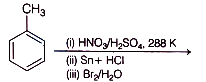
Identify the major product from the following reaction sequence.
A
$4-$methylaniline
B
$2,6-$dibromo$-4-$methylaniline
C
$3,5-$dibromo$-4-$methylaniline
D
$2,4-$dibromo$-6-$methylaniline
Solution
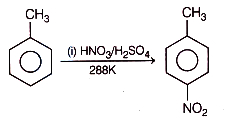
(B) Step $1$: Toluene undergoes nitration with $HNO_3/H_2SO_4$ at $288 \ K$ to give $p$-nitrotoluene as the major product.
Step $2$: Reduction of $p$-nitrotoluene using $Sn/HCl$ gives $4$-methylaniline ($p$-toluidine).
Step $3$: The $-NH_2$ group is a strong activating group. Bromination of $4$-methylaniline with $Br_2/H_2O$ results in the substitution of bromine atoms at both ortho positions relative to the $-NH_2$ group,yielding $2,6$-dibromo-$4$-methylaniline as the major product.
Step $2$: Reduction of $p$-nitrotoluene using $Sn/HCl$ gives $4$-methylaniline ($p$-toluidine).
Step $3$: The $-NH_2$ group is a strong activating group. Bromination of $4$-methylaniline with $Br_2/H_2O$ results in the substitution of bromine atoms at both ortho positions relative to the $-NH_2$ group,yielding $2,6$-dibromo-$4$-methylaniline as the major product.
0 likes
View Solution1075
DifficultMCQ
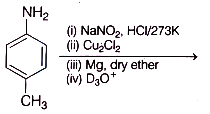
Identify the major product formed from the following reaction sequence.
A
$4$-methylphenyl-deuteride
B
$2$-deuterotoluene
C
$2,6$-dideuterotoluene
D
$2,4,6$-trideuterotoluene
Solution
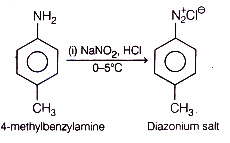
(A) $Step$ $1$: $p$-toluidine ($4$-methylaniline) reacts with $NaNO_2$ and $HCl$ at $273-278 \ K$ to form $4$-methylbenzenediazonium chloride.
$Step$ $2$: The diazonium salt reacts with $Cu_2Cl_2$ (Sandmeyer reaction) to form $4$-chlorotoluene.
$Step$ $3$: $4$-chlorotoluene reacts with $Mg$ in dry ether to form $4$-methylphenylmagnesium chloride (a Grignard reagent).
$Step$ $4$: The Grignard reagent reacts with $D_3O^+$ to replace the $-MgCl$ group with a deuterium atom,resulting in $4$-deuterotoluene (also known as $4$-methylphenyl-deuteride).
$Step$ $2$: The diazonium salt reacts with $Cu_2Cl_2$ (Sandmeyer reaction) to form $4$-chlorotoluene.
$Step$ $3$: $4$-chlorotoluene reacts with $Mg$ in dry ether to form $4$-methylphenylmagnesium chloride (a Grignard reagent).
$Step$ $4$: The Grignard reagent reacts with $D_3O^+$ to replace the $-MgCl$ group with a deuterium atom,resulting in $4$-deuterotoluene (also known as $4$-methylphenyl-deuteride).
0 likes
View Solution1076
MediumMCQ
In which of the following,reagent and product are correctly matched with respect to benzene diazonium chloride as reactant?
A
$Cu_2O ; C_6H_5Br$
B
$HI ; C_6H_5I$
C
$NaNO_2 ; C_6H_5NO$
D
$CH_3CH_2OH ; C_6H_6$
Solution
(D) The reaction of benzene diazonium chloride $(C_6H_5N_2Cl)$ with ethanol $(CH_3CH_2OH)$ is a well-known reduction reaction.
Ethanol acts as a reducing agent and gets oxidized to acetaldehyde $(CH_3CHO)$,while benzene diazonium chloride is reduced to benzene $(C_6H_6)$,with the evolution of nitrogen gas $(N_2)$ and formation of hydrochloric acid $(HCl)$.
The reaction is: $C_6H_5N_2Cl + CH_3CH_2OH \rightarrow C_6H_6 + N_2 + CH_3CHO + HCl$.
Therefore,option $D$ is the correctly matched pair.
Ethanol acts as a reducing agent and gets oxidized to acetaldehyde $(CH_3CHO)$,while benzene diazonium chloride is reduced to benzene $(C_6H_6)$,with the evolution of nitrogen gas $(N_2)$ and formation of hydrochloric acid $(HCl)$.
The reaction is: $C_6H_5N_2Cl + CH_3CH_2OH \rightarrow C_6H_6 + N_2 + CH_3CHO + HCl$.
Therefore,option $D$ is the correctly matched pair.
0 likes
View Solution1077
DifficultMCQ
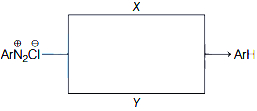
What are $X$ and $Y$ in the following reaction?
A
| $X$ | $Y$ |
| $CH_3CH_2OH$ | $H_3PO_2, H_2O$ |
B
| $X$ | $Y$ |
| $CH_3MgX$ | $H_3PO_3$ |
C
| $X$ | $Y$ |
| $CH_3CHO$ | $H_2O$ |
D
| $X$ | $Y$ |
| $CH_2=CH_2$ | $NaNO_2/HCl$ |
Solution
(A) The conversion of an arenediazonium salt $(ArN_2^+Cl^-)$ to an arene $(ArH)$ is a reduction reaction. This can be achieved using ethanol $(CH_3CH_2OH)$ or hypophosphorous acid $(H_3PO_2)$ in the presence of water.
In the given reaction scheme,$X$ represents the reagent $CH_3CH_2OH$ and $Y$ represents the reagent $H_3PO_2/H_2O$,which are both standard reagents for the deamination of diazonium salts to arenes.
Therefore,the correct option is $A$.
In the given reaction scheme,$X$ represents the reagent $CH_3CH_2OH$ and $Y$ represents the reagent $H_3PO_2/H_2O$,which are both standard reagents for the deamination of diazonium salts to arenes.
Therefore,the correct option is $A$.
0 likes
View Solution1078
MediumMCQ
Which of the following does not undergo a Friedel-Crafts reaction?
A
Anisole
B
Aniline
C
Chlorobenzene
D
Benzene
Solution
(B) The Friedel-Crafts reaction involves an electrophilic aromatic substitution catalyzed by a Lewis acid (e.g.,$AlCl_3$).
Aniline $(C_6H_5NH_2)$ contains a lone pair of electrons on the nitrogen atom.
This lone pair reacts with the Lewis acid catalyst $(AlCl_3)$ to form a complex $(C_6H_5NH_2 \rightarrow AlCl_3)$.
This formation of the complex deactivates the benzene ring towards electrophilic substitution and makes the nitrogen atom positively charged,which strongly withdraws electrons from the ring.
Therefore,aniline does not undergo Friedel-Crafts reactions.
Aniline $(C_6H_5NH_2)$ contains a lone pair of electrons on the nitrogen atom.
This lone pair reacts with the Lewis acid catalyst $(AlCl_3)$ to form a complex $(C_6H_5NH_2 \rightarrow AlCl_3)$.
This formation of the complex deactivates the benzene ring towards electrophilic substitution and makes the nitrogen atom positively charged,which strongly withdraws electrons from the ring.
Therefore,aniline does not undergo Friedel-Crafts reactions.
0 likes
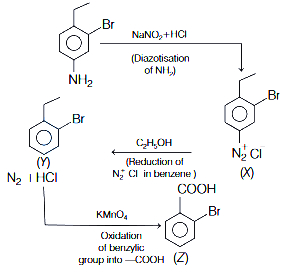
View Solution1079
DifficultMCQ
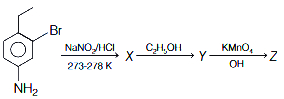
Identify $Z$ in the following sequence of reactions.
A
$2-$bromo$-4-$aminoethylbenzene
B
$2-$bromo$-4-$carboxymethylbenzene
C
$2-$bromo$-1,4-$dicarboxybenzene
D
$2-$bromobenzoic acid
Solution
(D) The reaction sequence is as follows:
$1$. The starting material is $4$-amino-$3$-bromoethylbenzene. Treatment with $NaNO_2/HCl$ at $273-278 \ K$ performs diazotization of the $-NH_2$ group to form the diazonium salt,$X$ ($4$-ethyl-$2$-bromobenzenediazonium chloride).
$2$. Reaction of $X$ with ethanol $(C_2H_5OH)$ reduces the diazonium group to a hydrogen atom,yielding $Y$ ($1$-bromo-$2$-ethylbenzene).
$3$. Finally,oxidation of the ethyl group with alkaline $KMnO_4$ converts the benzylic carbon into a carboxylic acid group,resulting in $Z$ ($2$-bromobenzoic acid).
Thus,the correct structure for $Z$ is $2$-bromobenzoic acid,which corresponds to option $(D)$.
$1$. The starting material is $4$-amino-$3$-bromoethylbenzene. Treatment with $NaNO_2/HCl$ at $273-278 \ K$ performs diazotization of the $-NH_2$ group to form the diazonium salt,$X$ ($4$-ethyl-$2$-bromobenzenediazonium chloride).
$2$. Reaction of $X$ with ethanol $(C_2H_5OH)$ reduces the diazonium group to a hydrogen atom,yielding $Y$ ($1$-bromo-$2$-ethylbenzene).
$3$. Finally,oxidation of the ethyl group with alkaline $KMnO_4$ converts the benzylic carbon into a carboxylic acid group,resulting in $Z$ ($2$-bromobenzoic acid).
Thus,the correct structure for $Z$ is $2$-bromobenzoic acid,which corresponds to option $(D)$.
0 likes
View Solution1080
MediumMCQ
Identify the reagents $(X, Y, Z)$ used in the conversion of $3$-methylaniline to $3$-nitrotoluene.
A
$NaNO_2, HCl$; $HBF_4$; $NaNO_2, Cu, \Delta$
B
$NaNO_3, HCl, 273 \ K$; $HF$; $NaNO_3, Cu, \Delta$
C
$NaNO_2, HCl$; $C_2H_5OH$; $NaNO_3, \Delta$
D
$NaNO_3, HCl$; $NaOH$; $C_6H_5NO_2$
Solution
(A) The conversion of $3$-methylaniline to $3$-nitrotoluene involves the following steps:
$1.$ Diazotization: $3-CH_3-C_6H_4-NH_2 + NaNO_2 + HCl \xrightarrow{273-278 \ K} 3-CH_3-C_6H_4-N_2^+Cl^-$ (Reagent $X = NaNO_2, HCl$).
$2.$ Reaction with $HBF_4$: $3-CH_3-C_6H_4-N_2^+Cl^- + HBF_4 \rightarrow 3-CH_3-C_6H_4-N_2^+BF_4^-$ (Reagent $Y = HBF_4$).
$3.$ Replacement by nitro group: $3-CH_3-C_6H_4-N_2^+BF_4^- + NaNO_2 \xrightarrow{Cu, \Delta} 3-CH_3-C_6H_4-NO_2$ (Reagent $Z = NaNO_2, Cu, \Delta$).
$1.$ Diazotization: $3-CH_3-C_6H_4-NH_2 + NaNO_2 + HCl \xrightarrow{273-278 \ K} 3-CH_3-C_6H_4-N_2^+Cl^-$ (Reagent $X = NaNO_2, HCl$).
$2.$ Reaction with $HBF_4$: $3-CH_3-C_6H_4-N_2^+Cl^- + HBF_4 \rightarrow 3-CH_3-C_6H_4-N_2^+BF_4^-$ (Reagent $Y = HBF_4$).
$3.$ Replacement by nitro group: $3-CH_3-C_6H_4-N_2^+BF_4^- + NaNO_2 \xrightarrow{Cu, \Delta} 3-CH_3-C_6H_4-NO_2$ (Reagent $Z = NaNO_2, Cu, \Delta$).
0 likes
View Solution1081
EasyMCQ
What are $A, B$ and $C$ in the following reaction?
$Ar-N_2^+ BF_4^- \xrightarrow{NaNO_2, \Delta, Cu} A + B + C$
$Ar-N_2^+ BF_4^- \xrightarrow{NaNO_2, \Delta, Cu} A + B + C$
A
$Ar-N=N-Ar, N_2, NaBF_4$
B
$ArNO_2, N_2, NaBF_4$
C
$ArNO, N_2, NaBF_4$
D
$ArF, NaN_3, BF_3$
Solution
(B) The reaction of arene diazonium fluoroborate $(Ar-N_2^+ BF_4^-)$ with sodium nitrite $(NaNO_2)$ in the presence of copper $(Cu)$ powder and heat is a method to introduce a nitro group into an aromatic ring,known as the Schiemann-like reaction or a variation of the Sandmeyer-type reaction for nitro compounds.
The reaction proceeds as follows:
$Ar-N_2^+ BF_4^- + NaNO_2 \xrightarrow{Cu, \Delta} ArNO_2 + N_2 + NaBF_4$
Here,$A = ArNO_2$,$B = N_2$,and $C = NaBF_4$.
Thus,the correct option is $B$.
The reaction proceeds as follows:
$Ar-N_2^+ BF_4^- + NaNO_2 \xrightarrow{Cu, \Delta} ArNO_2 + N_2 + NaBF_4$
Here,$A = ArNO_2$,$B = N_2$,and $C = NaBF_4$.
Thus,the correct option is $B$.
0 likes
View Solution1082
EasyMCQ
Find $A$ in the reaction $R-NH_2 + A \longrightarrow$ Schiff base.
A
Aldehyde
B
Acid
C
Alcohol
D
Grignard reagent
Solution
(A) Schiff bases are formed by the reaction of a primary amine $(R-NH_2)$ with a carbonyl compound,such as an aldehyde or a ketone.
In this reaction,the amine attacks the carbonyl carbon to form a hemiaminal intermediate,which subsequently undergoes dehydration to produce an imine,commonly known as a Schiff base.
Therefore,$A$ represents an aldehyde or a ketone.
In this reaction,the amine attacks the carbonyl carbon to form a hemiaminal intermediate,which subsequently undergoes dehydration to produce an imine,commonly known as a Schiff base.
Therefore,$A$ represents an aldehyde or a ketone.
0 likes
View Solution1083
MediumMCQ
Which of the following statements is true?
$1)$ Tertiary amines react with acid chlorides.
$2)$ $N$-ethylbenzene sulphonamide is soluble in alkali.
$3)$ $N,N$-diethylbenzene sulphonamide is soluble in alkali.
$4)$ Tertiary amines react with Hinsberg's reagent.
$1)$ Tertiary amines react with acid chlorides.
$2)$ $N$-ethylbenzene sulphonamide is soluble in alkali.
$3)$ $N,N$-diethylbenzene sulphonamide is soluble in alkali.
$4)$ Tertiary amines react with Hinsberg's reagent.
A
$1$
B
$2$
C
$3$
D
$4$
Solution
(B) $N$-ethylbenzene sulphonamide $(C_6H_5SO_2NHC_2H_5)$ is soluble in alkali because the hydrogen atom attached to the nitrogen atom is acidic due to the strong electron-withdrawing effect of the sulphonyl group $(-SO_2-)$.
This allows it to form a water-soluble salt with alkali.
$N,N$-diethylbenzene sulphonamide does not have an acidic hydrogen atom attached to the nitrogen,so it is insoluble in alkali.
Tertiary amines do not react with acid chlorides or Hinsberg's reagent $(C_6H_5SO_2Cl)$ because they lack an acidic hydrogen atom on the nitrogen.
This allows it to form a water-soluble salt with alkali.
$N,N$-diethylbenzene sulphonamide does not have an acidic hydrogen atom attached to the nitrogen,so it is insoluble in alkali.
Tertiary amines do not react with acid chlorides or Hinsberg's reagent $(C_6H_5SO_2Cl)$ because they lack an acidic hydrogen atom on the nitrogen.
0 likes
View Solution1084
DifficultMCQ
Identify what is $Y$ in the following reaction sequence?
$CH_3CONH_2$ $\xrightarrow{Br_2/NaOH(aq)} X$ $\xrightarrow[(ii) H_2O]{(i) NaNO_2 + HCl} Y$
$CH_3CONH_2$ $\xrightarrow{Br_2/NaOH(aq)} X$ $\xrightarrow[(ii) H_2O]{(i) NaNO_2 + HCl} Y$
A
$CH_3NH_2$
B
$CH_3CONHBr$
C
$CH_3OH$
D
$BrCH_2CONH_2$
Solution
(C) The given reaction sequence is:
$1$. $CH_3CONH_2 \xrightarrow{Br_2/NaOH(aq)} CH_3NH_2 (X)$
This is the Hofmann bromamide degradation reaction,where an amide is converted into a primary amine with one carbon atom less.
$2$. $CH_3NH_2 (X) \xrightarrow[(ii) H_2O]{(i) NaNO_2 + HCl} CH_3OH (Y)$
Primary aliphatic amines react with nitrous acid ($HNO_2$,generated in situ from $NaNO_2 + HCl$) to form unstable diazonium salts,which decompose in the presence of water to form alcohols.
Therefore,$Y$ is methanol $(CH_3OH)$.
$1$. $CH_3CONH_2 \xrightarrow{Br_2/NaOH(aq)} CH_3NH_2 (X)$
This is the Hofmann bromamide degradation reaction,where an amide is converted into a primary amine with one carbon atom less.
$2$. $CH_3NH_2 (X) \xrightarrow[(ii) H_2O]{(i) NaNO_2 + HCl} CH_3OH (Y)$
Primary aliphatic amines react with nitrous acid ($HNO_2$,generated in situ from $NaNO_2 + HCl$) to form unstable diazonium salts,which decompose in the presence of water to form alcohols.
Therefore,$Y$ is methanol $(CH_3OH)$.
0 likes
View Solution1085
MediumMCQ
What is the major product '$Z$' in the given reaction sequence?

A
Benzene
B
Phenol
C
p-Benzoquinone
D
$2-$Chlorophenol
Solution
(A) The reaction sequence is as follows:
$1$. Nitrobenzene $(C_6H_5NO_2)$ reacts with $Fe/HCl$ to undergo reduction,forming aniline $(C_6H_5NH_2)$,which is '$X$'.
$2$. Aniline $(C_6H_5NH_2)$ reacts with $NaNO_2/HCl$ at $273-278 \ K$ to form benzenediazonium chloride $(C_6H_5N_2^+Cl^-)$,which is '$Y$'.
$3$. Benzenediazonium chloride $(C_6H_5N_2^+Cl^-)$ reacts with $H_3PO_2$ and $H_2O$ to undergo reduction,resulting in the formation of benzene $(C_6H_6)$,which is '$Z$'.
$1$. Nitrobenzene $(C_6H_5NO_2)$ reacts with $Fe/HCl$ to undergo reduction,forming aniline $(C_6H_5NH_2)$,which is '$X$'.
$2$. Aniline $(C_6H_5NH_2)$ reacts with $NaNO_2/HCl$ at $273-278 \ K$ to form benzenediazonium chloride $(C_6H_5N_2^+Cl^-)$,which is '$Y$'.
$3$. Benzenediazonium chloride $(C_6H_5N_2^+Cl^-)$ reacts with $H_3PO_2$ and $H_2O$ to undergo reduction,resulting in the formation of benzene $(C_6H_6)$,which is '$Z$'.
0 likes
View Solution1086
MediumMCQ
The correct statements of the following are:
$A$. Aniline forms a stable benzene diazonium chloride at $285 \ K$.
$B$. $N$-Phenylethanamide is less reactive towards nitration than aniline.
$C$. $p-CH_3C_6H_4COCl$ is Hinsberg reagent.
$A$. Aniline forms a stable benzene diazonium chloride at $285 \ K$.
$B$. $N$-Phenylethanamide is less reactive towards nitration than aniline.
$C$. $p-CH_3C_6H_4COCl$ is Hinsberg reagent.
A
$A$ & $B$ only
B
$A$ & $C$ only
C
$B$ only
D
$C$ only
Solution
(C) Statement $A$ is incorrect: Benzene diazonium chloride is stable only at low temperatures $(273-278 \ K)$. At $285 \ K$,it is unstable and decomposes.
Statement $B$ is correct: The $-NHCOCH_3$ group in $N$-phenylethanamide is electron-withdrawing due to resonance with the carbonyl group,making the ring less electron-rich compared to the $-NH_2$ group in aniline. Thus,it is less reactive towards electrophilic substitution like nitration.
Statement $C$ is incorrect: Hinsberg reagent is benzenesulphonyl chloride $(C_6H_5SO_2Cl)$,not $p-CH_3C_6H_4COCl$.
Therefore,only statement $B$ is correct.
Statement $B$ is correct: The $-NHCOCH_3$ group in $N$-phenylethanamide is electron-withdrawing due to resonance with the carbonyl group,making the ring less electron-rich compared to the $-NH_2$ group in aniline. Thus,it is less reactive towards electrophilic substitution like nitration.
Statement $C$ is incorrect: Hinsberg reagent is benzenesulphonyl chloride $(C_6H_5SO_2Cl)$,not $p-CH_3C_6H_4COCl$.
Therefore,only statement $B$ is correct.
0 likes
View Solution1087
DifficultMCQ
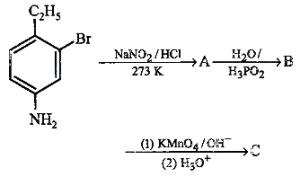
What is '$C$' in the given sequence of reactions?
A
$2-$bromo$-1-$methylbenzene$-4-$carboxylic acid
B
$2-$bromobenzoic acid
C
$2-$bromo-phenylacetic acid
D
Bromobenzene
Solution
(B) $1$. The starting material is $4$-amino-$3$-bromoethylbenzene. Treatment with $NaNO_2/HCl$ at $273 \ K$ converts the $-NH_2$ group into a diazonium salt $(-N_2^+Cl^-)$,forming compound $A$.
$2$. Treatment of the diazonium salt with $H_3PO_2/H_2O$ reduces the diazonium group to a hydrogen atom,resulting in $1$-bromo-$2$-ethylbenzene (compound $B$).
$3$. Finally,oxidation of the ethyl group $(-CH_2CH_3)$ with alkaline $KMnO_4$ followed by acidic workup $(H_3O^+)$ converts the alkyl side chain into a carboxylic acid group $(-COOH)$. The product $C$ is $2$-bromobenzoic acid.
$2$. Treatment of the diazonium salt with $H_3PO_2/H_2O$ reduces the diazonium group to a hydrogen atom,resulting in $1$-bromo-$2$-ethylbenzene (compound $B$).
$3$. Finally,oxidation of the ethyl group $(-CH_2CH_3)$ with alkaline $KMnO_4$ followed by acidic workup $(H_3O^+)$ converts the alkyl side chain into a carboxylic acid group $(-COOH)$. The product $C$ is $2$-bromobenzoic acid.
0 likes
View Solution1088
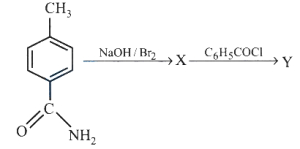
MediumMCQ
Identify the product $Y$ in the following sequence of reactions.
A
$4-$methyl-$N$-phenylbenzamide
B
$N$-($4$-methylphenyl)benzamide
C
$4-$methylphenyl benzoate
D
$N$-($4$-methylphenyl)$-4-$methylbenzamide
Solution
(B) $1$. The starting material is $4$-methylbenzamide. Treatment with $NaOH/Br_2$ is the Hoffmann bromamide degradation reaction,which converts an amide into a primary amine with one less carbon atom. Thus,$X$ is $p$-toluidine ($4$-methylaniline).
$2$. The reaction of $p$-toluidine with benzoyl chloride $(C_6H_5COCl)$ is an acylation reaction. The lone pair on the nitrogen atom of the amine attacks the carbonyl carbon of the acid chloride,resulting in the formation of an amide. The product $Y$ is $N-(4-methylphenyl)benzamide$.
$2$. The reaction of $p$-toluidine with benzoyl chloride $(C_6H_5COCl)$ is an acylation reaction. The lone pair on the nitrogen atom of the amine attacks the carbonyl carbon of the acid chloride,resulting in the formation of an amide. The product $Y$ is $N-(4-methylphenyl)benzamide$.
0 likes
View Solution1089
MediumMCQ
An amine $(X)$ reacts with $p-$toluene sulphonyl chloride to give the product,$Y$,which is insoluble in alkali. The product of $X$ with benzoyl chloride is
A
$CH_3CH_2CH(NH_2)COC_6H_5$
B
$CH_3CH_2CH_2N(CH_3)COCH_2C_6H_5$
C
$CH_3CH_2NHCOC_6H_5$
D
$CH_3CH_2N(CH_3)COC_6H_5$
Solution
(D) secondary amine reacts with Hinsberg reagent ($p-$toluene sulphonyl chloride) to form a corresponding sulphonamide that is insoluble in aqueous $NaOH$. Thus,'$X$' must be a secondary amine. The reaction of a secondary amine $(R_1R_2NH)$ with benzoyl chloride $(C_6H_5COCl)$ is a benzoylation reaction (Schotten-Baumann reaction),which yields an $N,N-$disubstituted benzamide. Given the options,the secondary amine '$X$' is $N-$methylethanamine $(CH_3CH_2NHCH_3)$. The reaction is: $CH_3CH_2NHCH_3 + C_6H_5COCl \rightarrow CH_3CH_2N(CH_3)COC_6H_5 + HCl$.
0 likes
View Solution1090
MediumMCQ
Arrange the following in the order of decreasing basicity:
| $I. RN=CHR^1$ | $II. RC \equiv N$ | $III. RNH_2$ |
A
$I > III > II$
B
$III > I > II$
C
$II > III > I$
D
$II > I > III$
Solution
(B) In $RNH_2$,the $N$ atom is $sp^3$ hybridized. In $RN=CHR^1$,the $N$ atom is $sp^2$ hybridized,whereas in $RC \equiv N$,the $N$ atom is $sp$ hybridized.
The basicity of an amine depends on the availability of the lone pair of electrons on the nitrogen atom. As the $s$-character of the hybrid orbital increases,the electronegativity of the nitrogen atom increases,making the lone pair less available for donation.
The $s$-character increases in the order: $sp^3 < sp^2 < sp$.
Therefore,the electronegativity of the $N$ atom increases in the order: $sp^3 < sp^2 < sp$.
Consequently,the basicity decreases as the $s$-character increases.
The order of decreasing basicity is: $RNH_2 (III) > RN=CHR^1 (I) > RC \equiv N (II)$.
The basicity of an amine depends on the availability of the lone pair of electrons on the nitrogen atom. As the $s$-character of the hybrid orbital increases,the electronegativity of the nitrogen atom increases,making the lone pair less available for donation.
The $s$-character increases in the order: $sp^3 < sp^2 < sp$.
Therefore,the electronegativity of the $N$ atom increases in the order: $sp^3 < sp^2 < sp$.
Consequently,the basicity decreases as the $s$-character increases.
The order of decreasing basicity is: $RNH_2 (III) > RN=CHR^1 (I) > RC \equiv N (II)$.
0 likes
View SolutionAmines — Properties of Amines · Frequently Asked Questions
1Are these Amines questions useful for JEE and NEET?
Yes. All questions in this section are mapped to JEE Main and NEET exam patterns. Previous year questions from JEE Main, NEET, GUJCET and state-level exams are included with full solutions.
2Can I switch to Hindi or Gujarati for these questions?
Yes. Use the language tabs in the hero section or the sidebar to view the same questions and solutions in English, Hindi or Gujarati.
3How do I generate a question paper from this subtopic?
Use the Vedclass Exam Paper Generator — select the chapter and subtopic, set difficulty, and generate Sets A, B, C, D automatically. First 3 chapters of every subject are free.
Vedclass Products
For Students
Vedclass Test Series
Mock tests in real JEE/NEET style with performance analysis. 5-day free trial.
Start Free TrialFor Teachers
Exam Paper Generator
Generate Set A/B/C/D papers from this chapter in 2 minutes. 3 chapters free.
Try FreeFor Institutes
Online Exam Module
Live online exams with unlimited students, 360° analytics & white-label branding.
See DemoFor Teachers & Institutes
Generate a Amines Exam Paper in 2 Minutes
Select subtopic & difficulty — Sets A, B, C, D auto-generated with No Repeat logic.
First 3 chapters of every subject are free — no payment required.