
A English
Properties of Amines Questions in English
Class 12 Chemistry · Amines · Properties of Amines
1212+
Questions
English
Language
100%
With Solutions
Showing 12 of 1212 questions in English
1201
MediumMCQ
What is the correct order of basic strength in substituted amines in an aqueous solution?
A
$NH_3 > C_2H_5NH_2 > (C_2H_5)_3 N > (C_2H_5)_2 NH$
B
$(C_2H_5)_3 N > (C_2H_5)_2 NH > C_2H_5NH_2 > NH_3$
C
$(C_2H_5)_2 NH > (C_2H_5)_3 N > C_2H_5NH_2 > NH_3$
D
$NH_3 > C_2H_5NH_2 > (C_2H_5)_2 NH > (C_2H_5)_3 N$
Solution
(C) In an aqueous solution,the basic strength of ethyl-substituted amines is determined by the interplay of three factors: the inductive effect ($+I$ effect),the solvation effect (hydrogen bonding),and steric hindrance.
For ethyl-substituted amines,the secondary amine $(2^\circ)$ is the most basic due to the optimal balance of these factors.
The tertiary amine $(3^\circ)$ is less basic than the secondary amine due to steric hindrance,but more basic than the primary amine $(1^\circ)$.
Thus,the correct order of basic strength is $(C_2H_5)_2 NH > (C_2H_5)_3 N > C_2H_5NH_2 > NH_3$.
For ethyl-substituted amines,the secondary amine $(2^\circ)$ is the most basic due to the optimal balance of these factors.
The tertiary amine $(3^\circ)$ is less basic than the secondary amine due to steric hindrance,but more basic than the primary amine $(1^\circ)$.
Thus,the correct order of basic strength is $(C_2H_5)_2 NH > (C_2H_5)_3 N > C_2H_5NH_2 > NH_3$.
0 likes
View Solution1202
DifficultMCQ
What will be the name of the product formed upon the ammonolysis of benzyl chloride followed by the reaction of the resulting amine with two moles of $CH_3Cl$?
A
$N$,$N$-dimethylphenylmethanamine
B
$N$,$N$-diphenylmethanamine
C
$N$,$N$-diphenylethanamine
D
$N$-methyl,$N$-phenylmethanamine
Solution
(A) $1$. Ammonolysis of benzyl chloride $(C_6H_5CH_2Cl)$ involves the nucleophilic substitution of the chlorine atom by an ammonia molecule,resulting in the formation of benzylamine $(C_6H_5CH_2NH_2)$.
$2$. Benzylamine is a primary amine. When it reacts with two moles of methyl chloride $(CH_3Cl)$,the two hydrogen atoms attached to the nitrogen atom are replaced by two methyl groups through nucleophilic substitution.
$3$. The final product formed is $C_6H_5CH_2N(CH_3)_2$.
$4$. According to $IUPAC$ nomenclature,this compound is named $N$,$N$-dimethylphenylmethanamine.
$2$. Benzylamine is a primary amine. When it reacts with two moles of methyl chloride $(CH_3Cl)$,the two hydrogen atoms attached to the nitrogen atom are replaced by two methyl groups through nucleophilic substitution.
$3$. The final product formed is $C_6H_5CH_2N(CH_3)_2$.
$4$. According to $IUPAC$ nomenclature,this compound is named $N$,$N$-dimethylphenylmethanamine.
0 likes
View Solution1203
MediumMCQ
Which of the following statements is true for Benzenediazonium fluoroborate?
A
When heated with $NaNO_2$ in the presence of $Cu$,it gives aniline.
B
On heating,it does not decompose to yield fluorobenzene.
C
It is water-insoluble and stable at room temperature.
D
It is water-soluble and unstable at room temperature.
Solution
(C) Benzenediazonium fluoroborate $(C_6H_5N_2^+BF_4^-)$ is unique among diazonium salts because it is water-insoluble and relatively stable at room temperature,which allows it to be dried and stored.
Upon heating,it undergoes thermal decomposition to yield fluorobenzene,a process known as the Schiemann reaction.
Upon heating,it undergoes thermal decomposition to yield fluorobenzene,a process known as the Schiemann reaction.
0 likes
View Solution1204
MediumMCQ
Which statements are True? $A$. In Hoffmann bromamide degradation,$4$ moles of $NaOH$ and $1$ mole of $Br_{2}$ are consumed per mole of an amide. $B$. Hoffmann bromamide reaction is not given by alkyl amides. $C$. Primary amines can be synthesized by Hoffmann bromamide degradation. $D$. Secondary amide on reaction with $Br_{2}$ and $NaOH$ will give secondary amine. $E$. The by-products of Hoffmann degradation are $Na_{2}CO_{3}$,$NaBr$ and $H_{2}O$. Choose the correct answer from the options given below:
A
$A, C$ and $E$ only
B
$B, C$ and $D$ only
C
$C$ and $E$ only
D
$C, D$ and $E$ only
Solution
(A) The chemical equation for the Hoffmann bromamide degradation reaction is: $RCONH_{2} + Br_{2} + 4NaOH \rightarrow RNH_{2} + Na_{2}CO_{3} + 2NaBr + 2H_{2}O$.
$(A)$ is correct because the stoichiometry of the reaction requires $4$ moles of $NaOH$ and $1$ mole of $Br_{2}$ for every mole of primary amide.
$(B)$ is false because alkyl amides (primary amides) readily undergo this reaction.
$(C)$ is correct because this reaction is a standard laboratory method for the synthesis of primary amines.
$(D)$ is false because secondary amides $(RCONHR')$ lack the necessary $-NH_{2}$ group required for the rearrangement mechanism.
$(E)$ is correct because the by-products formed are indeed $Na_{2}CO_{3}$,$NaBr$,and $H_{2}O$.
$(A)$ is correct because the stoichiometry of the reaction requires $4$ moles of $NaOH$ and $1$ mole of $Br_{2}$ for every mole of primary amide.
$(B)$ is false because alkyl amides (primary amides) readily undergo this reaction.
$(C)$ is correct because this reaction is a standard laboratory method for the synthesis of primary amines.
$(D)$ is false because secondary amides $(RCONHR')$ lack the necessary $-NH_{2}$ group required for the rearrangement mechanism.
$(E)$ is correct because the by-products formed are indeed $Na_{2}CO_{3}$,$NaBr$,and $H_{2}O$.
0 likes
View Solution1205
DifficultMCQ
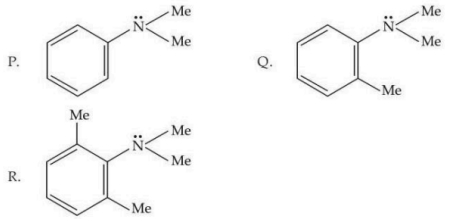
Consider the three aromatic molecules ($P$,$Q$ and $R$) whose structures are given below. The correct order regarding the reactivity of these compounds with $Ph-N\equiv N^{(+)}Cl^{(-)}$ under optimum but slightly acidic medium is:
A
$P > Q > R$
B
$R > P > Q$
C
$R > Q > P$
D
$P > R > Q$
Solution
(A) The reaction is an electrophilic aromatic substitution (diazo coupling).
The reactivity is determined by the electron density on the aromatic ring,which is enhanced by electron-donating groups like $-N(Me)_2$.
Steric hindrance at the ortho position to the $-N(Me)_2$ group significantly reduces the reactivity by preventing the approach of the electrophile.
Molecule $P$ has no ortho substituents,molecule $Q$ has one ortho methyl group,and molecule $R$ has two ortho methyl groups.
Therefore,the steric hindrance increases in the order $P < Q < R$,which means the reactivity decreases in the order $P > Q > R$.
Wait,let us re-evaluate: $P$ has no ortho substituents,$Q$ has one ortho methyl group,and $R$ has two ortho methyl groups. The reactivity order is $P > Q > R$.
The reactivity is determined by the electron density on the aromatic ring,which is enhanced by electron-donating groups like $-N(Me)_2$.
Steric hindrance at the ortho position to the $-N(Me)_2$ group significantly reduces the reactivity by preventing the approach of the electrophile.
Molecule $P$ has no ortho substituents,molecule $Q$ has one ortho methyl group,and molecule $R$ has two ortho methyl groups.
Therefore,the steric hindrance increases in the order $P < Q < R$,which means the reactivity decreases in the order $P > Q > R$.
Wait,let us re-evaluate: $P$ has no ortho substituents,$Q$ has one ortho methyl group,and $R$ has two ortho methyl groups. The reactivity order is $P > Q > R$.
0 likes
View Solution1206
DifficultMCQ
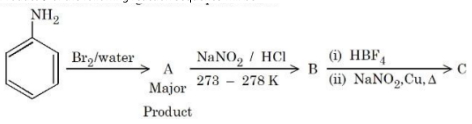
The product $C$ of the following reaction sequence is:
A
$1,3,5-$Tribromobenzene
B
$1,2,3-$Tribromobenzene
C
$1,2,4-$Tribromobenzene
D
$1,3,5-$Tribromo$-2-$nitrobenzene
Solution
(D) $1$. Aniline reacts with $Br_2/H_2O$ to form $2,4,6$-tribromoaniline as the major product $(A)$.
$2$. $2,4,6$-tribromoaniline reacts with $NaNO_2/HCl$ at $273-278 \ K$ to form the diazonium salt,$2,4,6$-tribromobenzenediazonium chloride $(B)$.
$3$. The reaction of the diazonium salt with $HBF_4$ followed by $NaNO_2/Cu, \Delta$ is a variation of the Balz-Schiemann or Sandmeyer-type reaction where the diazonium group $(-N_2^+Cl^-)$ is replaced by a nitro group $(-NO_2)$.
$4$. Thus,the final product $C$ is $1,3,5$-tribromo$-2-$nitrobenzene.
$2$. $2,4,6$-tribromoaniline reacts with $NaNO_2/HCl$ at $273-278 \ K$ to form the diazonium salt,$2,4,6$-tribromobenzenediazonium chloride $(B)$.
$3$. The reaction of the diazonium salt with $HBF_4$ followed by $NaNO_2/Cu, \Delta$ is a variation of the Balz-Schiemann or Sandmeyer-type reaction where the diazonium group $(-N_2^+Cl^-)$ is replaced by a nitro group $(-NO_2)$.
$4$. Thus,the final product $C$ is $1,3,5$-tribromo$-2-$nitrobenzene.
0 likes
View Solution1207
MediumMCQ
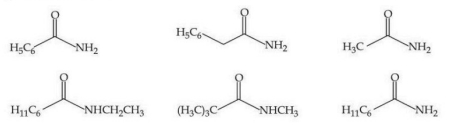
The number of compounds from the following which can undergo reaction with $Br_2/KOH$ (alcoholic) to give respective products,and these respective products can also be obtained separately by the Gabriel phthalimide synthesis,is:
A
$5$
B
$4$
C
$3$
D
$6$
Solution
(B) The Hoffmann bromamide degradation reaction $(Br_2/KOH)$ is specific to primary amides $(R-CONH_2)$,converting them into primary amines $(R-NH_2)$.
Gabriel phthalimide synthesis is also used for the preparation of primary amines $(R-NH_2)$ from primary alkyl halides $(R-X)$.
Therefore,we need to identify the number of primary amides $(R-CONH_2)$ in the given set.
Let's analyze the structures provided in the image:
$1$. $C_6H_5CONH_2$ (Benzamide) - Primary amide.
$2$. $C_6H_5CH_2CONH_2$ ($2$-Phenylacetamide) - Primary amide.
$3$. $CH_3CONH_2$ (Acetamide) - Primary amide.
$4$. $C_6H_{11}CONHCH_2CH_3$ - Secondary amide (Does not undergo Hoffmann degradation).
$5$. $(CH_3)_3CCONHCH_3$ - Secondary amide (Does not undergo Hoffmann degradation).
$6$. $C_6H_{11}CONH_2$ (Cyclohexanecarboxamide) - Primary amide.
Counting the primary amides,we have compounds $1$,$2$,$3$,and $6$.
Thus,there are $4$ such compounds.
Gabriel phthalimide synthesis is also used for the preparation of primary amines $(R-NH_2)$ from primary alkyl halides $(R-X)$.
Therefore,we need to identify the number of primary amides $(R-CONH_2)$ in the given set.
Let's analyze the structures provided in the image:
$1$. $C_6H_5CONH_2$ (Benzamide) - Primary amide.
$2$. $C_6H_5CH_2CONH_2$ ($2$-Phenylacetamide) - Primary amide.
$3$. $CH_3CONH_2$ (Acetamide) - Primary amide.
$4$. $C_6H_{11}CONHCH_2CH_3$ - Secondary amide (Does not undergo Hoffmann degradation).
$5$. $(CH_3)_3CCONHCH_3$ - Secondary amide (Does not undergo Hoffmann degradation).
$6$. $C_6H_{11}CONH_2$ (Cyclohexanecarboxamide) - Primary amide.
Counting the primary amides,we have compounds $1$,$2$,$3$,and $6$.
Thus,there are $4$ such compounds.
0 likes
View Solution1208
MediumMCQ
Given below are two statements:
Statement $I$: Heating benzamide with bromine in an ethanolic solution of sodium hydroxide will give benzylamine.
Statement $II$: Nitration of aniline with $HNO_3/H_2SO_4$ at $288 \ K$ produces $m$-nitroaniline in higher amount than $o$-nitroaniline (pH adjusted).
Statement $I$: Heating benzamide with bromine in an ethanolic solution of sodium hydroxide will give benzylamine.
Statement $II$: Nitration of aniline with $HNO_3/H_2SO_4$ at $288 \ K$ produces $m$-nitroaniline in higher amount than $o$-nitroaniline (pH adjusted).
A
Both Statement $I$ and Statement $II$ are true
B
Both Statement $I$ and Statement $II$ are false
C
Statement $I$ is true but Statement $II$ is false
D
Statement $I$ is false but Statement $II$ is true
Solution
(D) Statement $I$ is false: The reaction of benzamide with $Br_2$ and $NaOH$ (Hofmann bromamide degradation) produces aniline,not benzylamine.
Statement $II$ is true: In the strong acidic medium of nitration $(H_2SO_4)$,aniline gets protonated to form anilinium ion $(-NH_3^+)$,which is meta-directing. Hence,$m$-nitroaniline is formed in a significant amount due to the deactivating and meta-directing nature of the $-NH_3^+$ group.
Statement $II$ is true: In the strong acidic medium of nitration $(H_2SO_4)$,aniline gets protonated to form anilinium ion $(-NH_3^+)$,which is meta-directing. Hence,$m$-nitroaniline is formed in a significant amount due to the deactivating and meta-directing nature of the $-NH_3^+$ group.
0 likes
View Solution1209
MediumMCQ
The strongest conjugate acid will result from:
A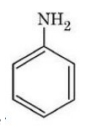
B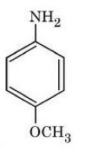
C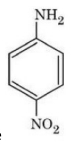
D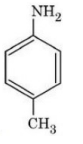
Solution
(C) conjugate acid is formed by the protonation of a base. $A$ stronger conjugate acid is formed from a weaker base.
Among the given substituted anilines,the base strength depends on the electron-donating or electron-withdrawing nature of the substituents.
The $-NO_2$ group in $4$-nitroaniline is a strong electron-withdrawing group via resonance and induction,which significantly reduces the availability of the lone pair on the nitrogen atom,thus making it the weakest base.
Since the strength of a conjugate acid is inversely proportional to the strength of its parent base,the protonated form of $4$-nitroaniline is the strongest conjugate acid.
Among the given substituted anilines,the base strength depends on the electron-donating or electron-withdrawing nature of the substituents.
The $-NO_2$ group in $4$-nitroaniline is a strong electron-withdrawing group via resonance and induction,which significantly reduces the availability of the lone pair on the nitrogen atom,thus making it the weakest base.
Since the strength of a conjugate acid is inversely proportional to the strength of its parent base,the protonated form of $4$-nitroaniline is the strongest conjugate acid.
0 likes
View Solution1210
MediumMCQ
Arrange the following compounds according to increasing order of boiling points: $n-C_4H_9OH$ $(A)$,$n-C_4H_9NH_2$ $(B)$,$n-C_4H_{10}$ $(C)$,and $C_2H_5NHC_2H_5$ $(D)$.
A
$C < B < A < D$
B
$D < C < B < A$
C
$C < D < B < A$
D
$D < B < A < C$
Solution
(C) The boiling point of a compound depends on the strength of intermolecular forces.
$n-C_4H_{10}$ $(C)$ is an alkane and possesses only weak van der Waals forces,resulting in the lowest boiling point.
$C_2H_5NHC_2H_5$ $(D)$ is a secondary amine; it exhibits hydrogen bonding,but the extent is less than that of a primary amine due to steric hindrance.
$n-C_4H_9NH_2$ $(B)$ is a primary amine,which has stronger hydrogen bonding compared to the secondary amine $(D)$.
$n-C_4H_9OH$ $(A)$ is an alcohol,which forms the strongest hydrogen bonds due to the high electronegativity of oxygen compared to nitrogen,resulting in the highest boiling point.
Therefore,the increasing order of boiling points is $C < D < B < A$.
$n-C_4H_{10}$ $(C)$ is an alkane and possesses only weak van der Waals forces,resulting in the lowest boiling point.
$C_2H_5NHC_2H_5$ $(D)$ is a secondary amine; it exhibits hydrogen bonding,but the extent is less than that of a primary amine due to steric hindrance.
$n-C_4H_9NH_2$ $(B)$ is a primary amine,which has stronger hydrogen bonding compared to the secondary amine $(D)$.
$n-C_4H_9OH$ $(A)$ is an alcohol,which forms the strongest hydrogen bonds due to the high electronegativity of oxygen compared to nitrogen,resulting in the highest boiling point.
Therefore,the increasing order of boiling points is $C < D < B < A$.
0 likes
View Solution1211
DifficultMCQ
Consider the following sequence of reactions. The percentage of nitrogen in the yellow product $(X)$ formed is . . . . . . %. (Nearest Integer) (Given Molar mass in g mol$^{-1}$ $H$:$1$,$C$:$12$,$N$:$14$)

A
$21$
B
$28$
C
$30$
D
$32$
Solution
(A) The reaction sequence involves the acid-catalyzed rearrangement of diazoaminobenzene to $p$-aminoazobenzene.
$1$. The starting material is diazoaminobenzene $(C_{12}H_{11}N_3)$.
$2$. Upon treatment with $HCl$ and aniline,it undergoes a rearrangement reaction known as the diazoamino-to-aminoazo rearrangement.
$3$. The yellow product $(X)$ formed is $p$-aminoazobenzene,which has the chemical formula $C_{12}H_{11}N_3$.
$4$. The molar mass of $C_{12}H_{11}N_3$ is $(12 \times 12) + (11 \times 1) + (3 \times 14) = 144 + 11 + 42 = 197$ g/mol.
$5$. The percentage of nitrogen in the product is $\frac{\text{Total mass of N}}{\text{Molar mass of X}} \times 100 = \frac{42}{197} \times 100 \approx 21.32\%$.
$6$. Rounding to the nearest integer,we get $21\%$.
$1$. The starting material is diazoaminobenzene $(C_{12}H_{11}N_3)$.
$2$. Upon treatment with $HCl$ and aniline,it undergoes a rearrangement reaction known as the diazoamino-to-aminoazo rearrangement.
$3$. The yellow product $(X)$ formed is $p$-aminoazobenzene,which has the chemical formula $C_{12}H_{11}N_3$.
$4$. The molar mass of $C_{12}H_{11}N_3$ is $(12 \times 12) + (11 \times 1) + (3 \times 14) = 144 + 11 + 42 = 197$ g/mol.
$5$. The percentage of nitrogen in the product is $\frac{\text{Total mass of N}}{\text{Molar mass of X}} \times 100 = \frac{42}{197} \times 100 \approx 21.32\%$.
$6$. Rounding to the nearest integer,we get $21\%$.
0 likes
View Solution1212
MediumMCQ
The following two reactions give the same foul-smelling product $Z$. $C_2H_5Cl \xrightarrow{X} Z$ and $C_2H_5CONH_2 \xrightarrow{Br_2, NaOH} Y \xrightarrow{CHCl_3/ethanolic KOH, \Delta} Z$. $X$ and $Z$,respectively,are:
A
$X = AgCN; Z = C_2H_5CN$
B
$X = AgCN; Z = C_2H_5NC$
C
$X = KCN; Z = C_2H_5CN$
D
$X = KCN; Z = C_2H_5NC$
Solution
(B) Reaction $1$: $C_2H_5Cl + AgCN \rightarrow C_2H_5NC$ (Ethyl isocyanide,which is a foul-smelling compound).
Reaction $2$: This involves the Hofmann bromamide degradation followed by the carbylamine reaction.
Step $1$: $C_2H_5CONH_2 \xrightarrow{Br_2, NaOH} C_2H_5NH_2$ ($Y$ is ethylamine).
Step $2$: $C_2H_5NH_2 + CHCl_3 + 3KOH \xrightarrow{\Delta} C_2H_5NC + 3KCl + 3H_2O$ (Carbylamine reaction).
Thus,$Z$ is ethyl isocyanide $(C_2H_5NC)$ and $X$ is $AgCN$.
Reaction $2$: This involves the Hofmann bromamide degradation followed by the carbylamine reaction.
Step $1$: $C_2H_5CONH_2 \xrightarrow{Br_2, NaOH} C_2H_5NH_2$ ($Y$ is ethylamine).
Step $2$: $C_2H_5NH_2 + CHCl_3 + 3KOH \xrightarrow{\Delta} C_2H_5NC + 3KCl + 3H_2O$ (Carbylamine reaction).
Thus,$Z$ is ethyl isocyanide $(C_2H_5NC)$ and $X$ is $AgCN$.
0 likes
View SolutionAmines — Properties of Amines · Frequently Asked Questions
1Are these Amines questions useful for JEE and NEET?
Yes. All questions in this section are mapped to JEE Main and NEET exam patterns. Previous year questions from JEE Main, NEET, GUJCET and state-level exams are included with full solutions.
2Can I switch to Hindi or Gujarati for these questions?
Yes. Use the language tabs in the hero section or the sidebar to view the same questions and solutions in English, Hindi or Gujarati.
3How do I generate a question paper from this subtopic?
Use the Vedclass Exam Paper Generator — select the chapter and subtopic, set difficulty, and generate Sets A, B, C, D automatically. First 3 chapters of every subject are free.
Vedclass Products
For Students
Vedclass Test Series
Mock tests in real JEE/NEET style with performance analysis. 5-day free trial.
Start Free TrialFor Teachers
Exam Paper Generator
Generate Set A/B/C/D papers from this chapter in 2 minutes. 3 chapters free.
Try FreeFor Institutes
Online Exam Module
Live online exams with unlimited students, 360° analytics & white-label branding.
See DemoFor Teachers & Institutes
Generate a Amines Exam Paper in 2 Minutes
Select subtopic & difficulty — Sets A, B, C, D auto-generated with No Repeat logic.
First 3 chapters of every subject are free — no payment required.