
A English
Properties of Amines Questions in English
Class 12 Chemistry · Amines · Properties of Amines
1212+
Questions
English
Language
100%
With Solutions
Showing 50 of 1212 questions in English
601
DifficultMCQ
In the following carbylamine reaction,$x$ represents the moles of $KOH$ consumed:
$C_6H_5NH_2 + CHCl_3 + x KOH \rightarrow C_6H_5NC + 3KCl + 3H_2O$
Find the value of $x$.
$C_6H_5NH_2 + CHCl_3 + x KOH \rightarrow C_6H_5NC + 3KCl + 3H_2O$
Find the value of $x$.
A
$1$
B
$2$
C
$3$
D
$4$
Solution
(C) The given reaction is the carbylamine reaction,which is a characteristic test for primary $(1^{\circ})$ amines.
In this reaction,a primary amine reacts with chloroform $(CHCl_3)$ and an alcoholic base $(KOH)$ to form an isocyanide (carbylamine),which has a foul,poisonous smell.
The balanced chemical equation for the reaction of aniline $(C_6H_5NH_2)$ is:
$C_6H_5NH_2 + CHCl_3 + 3KOH \rightarrow C_6H_5NC + 3KCl + 3H_2O$
From the balanced equation,it is clear that $3$ moles of $KOH$ are consumed.
Therefore,$x = 3$.
In this reaction,a primary amine reacts with chloroform $(CHCl_3)$ and an alcoholic base $(KOH)$ to form an isocyanide (carbylamine),which has a foul,poisonous smell.
The balanced chemical equation for the reaction of aniline $(C_6H_5NH_2)$ is:
$C_6H_5NH_2 + CHCl_3 + 3KOH \rightarrow C_6H_5NC + 3KCl + 3H_2O$
From the balanced equation,it is clear that $3$ moles of $KOH$ are consumed.
Therefore,$x = 3$.
0 likes
View Solution602
DifficultMCQ
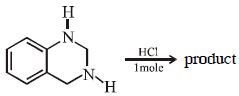
Which is the major product of the following reaction?
A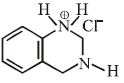
B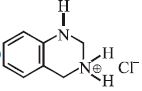
C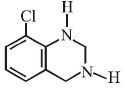
D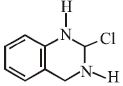
Solution
(B) The reactant is $1,2,3,4$-tetrahydroquinazoline. It contains two nitrogen atoms: one is an aniline-type nitrogen (attached to the benzene ring) and the other is an aliphatic amine-type nitrogen.
The aliphatic amine nitrogen is more basic than the aniline-type nitrogen because the lone pair on the aniline nitrogen is delocalized into the benzene ring.
Therefore,when $1 \text{ mole}$ of $HCl$ is added,the more basic aliphatic nitrogen atom gets protonated to form the corresponding ammonium salt.
The correct product is the one where the aliphatic nitrogen is protonated,which corresponds to option $B$.
The aliphatic amine nitrogen is more basic than the aniline-type nitrogen because the lone pair on the aniline nitrogen is delocalized into the benzene ring.
Therefore,when $1 \text{ mole}$ of $HCl$ is added,the more basic aliphatic nitrogen atom gets protonated to form the corresponding ammonium salt.
The correct product is the one where the aliphatic nitrogen is protonated,which corresponds to option $B$.
0 likes
View Solution603
AdvancedMCQ
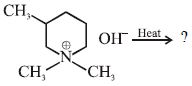
What is the major alkene formed in the following Hofmann elimination?
A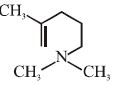
B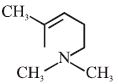
C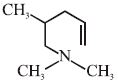
D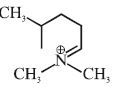
Solution
(D) Hofmann elimination of quaternary ammonium salts follows the anti-Zaitsev rule,where the least substituted alkene is formed as the major product due to steric hindrance.
In the given molecule,the nitrogen atom is attached to three different types of $\beta$-hydrogens:
$1$. The $\beta$-hydrogens on the methyl groups attached to the nitrogen.
$2$. The $\beta$-hydrogen at the $C-2$ position of the ring.
$3$. The $\beta$-hydrogen at the $C-6$ position of the ring.
Elimination involving the $C-2$ hydrogen leads to the formation of the less substituted alkene (terminal alkene) because the base abstracts the most accessible proton,which is less sterically hindered. Thus,the major product is the one where the double bond is formed at the terminal position relative to the ring,resulting in the formation of $N,N$-dimethylpent$-4-$en$-2-$amine.
In the given molecule,the nitrogen atom is attached to three different types of $\beta$-hydrogens:
$1$. The $\beta$-hydrogens on the methyl groups attached to the nitrogen.
$2$. The $\beta$-hydrogen at the $C-2$ position of the ring.
$3$. The $\beta$-hydrogen at the $C-6$ position of the ring.
Elimination involving the $C-2$ hydrogen leads to the formation of the less substituted alkene (terminal alkene) because the base abstracts the most accessible proton,which is less sterically hindered. Thus,the major product is the one where the double bond is formed at the terminal position relative to the ring,resulting in the formation of $N,N$-dimethylpent$-4-$en$-2-$amine.
0 likes
View Solution604
MediumMCQ
Identify the product $Z$ in the following reaction sequence:
Aniline $\xrightarrow{CH_3COCl} X$ $\xrightarrow{Br_2/AlBr_3} Y$ $\xrightarrow{H_3O^+} Z$
Aniline $\xrightarrow{CH_3COCl} X$ $\xrightarrow{Br_2/AlBr_3} Y$ $\xrightarrow{H_3O^+} Z$
A
p-Bromoaniline
B
p-Bromophenol
C
p-Bromoacetanilide
D
$2,4,6-$Tribromoaniline
Solution
(A) $1$. The reaction of aniline with acetyl chloride $(CH_3COCl)$ is an acetylation reaction,which protects the amino group to form $X$,which is acetanilide $(C_6H_5NHCOCH_3)$.
$2$. Acetanilide $(X)$ undergoes electrophilic aromatic substitution with $Br_2/AlBr_3$. The acetamido group $(-NHCOCH_3)$ is ortho/para directing. Due to steric hindrance,the para-substituted product $Y$ (p-bromoacetanilide) is the major product.
$3$. Finally,the hydrolysis of $Y$ with $H_3O^+$ removes the acetyl protecting group to regenerate the amino group,yielding $Z$,which is p-bromoaniline.
$2$. Acetanilide $(X)$ undergoes electrophilic aromatic substitution with $Br_2/AlBr_3$. The acetamido group $(-NHCOCH_3)$ is ortho/para directing. Due to steric hindrance,the para-substituted product $Y$ (p-bromoacetanilide) is the major product.
$3$. Finally,the hydrolysis of $Y$ with $H_3O^+$ removes the acetyl protecting group to regenerate the amino group,yielding $Z$,which is p-bromoaniline.
0 likes
View Solution605
MediumMCQ
$CH_3-C(CH_3)_2-NH_2 \xrightarrow{NaNO_2 + HCl}$ Product. Which of the following is not formed as a product?
A
$CH_3-C(CH_3)_2-OH$
B
$CH_3-C(CH_3)_2-Cl$
C
$CH_2=C(CH_3)_2$
D
$CH_3-C(CH_3)_2-N=O$
Solution
(D) The reaction of primary aliphatic amines with $NaNO_2$ and $HCl$ produces an unstable diazonium salt,which rapidly decomposes to form a carbocation $(R^+)$ and $N_2$ gas.
For $CH_3-C(CH_3)_2-NH_2$,the intermediate is the tert-butyl carbocation $(CH_3)_3C^+$.
This carbocation can react with water to form tert-butyl alcohol $(CH_3-C(CH_3)_2-OH)$,with chloride ions to form tert-butyl chloride $(CH_3-C(CH_3)_2-Cl)$,or lose a proton to form isobutylene $(CH_2=C(CH_3)_2)$.
Nitroso compounds $(R-N=O)$ are typically formed from secondary amines,not primary aliphatic amines,in this reaction. Therefore,option $(d)$ is not formed.
For $CH_3-C(CH_3)_2-NH_2$,the intermediate is the tert-butyl carbocation $(CH_3)_3C^+$.
This carbocation can react with water to form tert-butyl alcohol $(CH_3-C(CH_3)_2-OH)$,with chloride ions to form tert-butyl chloride $(CH_3-C(CH_3)_2-Cl)$,or lose a proton to form isobutylene $(CH_2=C(CH_3)_2)$.
Nitroso compounds $(R-N=O)$ are typically formed from secondary amines,not primary aliphatic amines,in this reaction. Therefore,option $(d)$ is not formed.
0 likes
View Solution606
DifficultMCQ
In which of the following will benzoic acid not be formed as a major product?
A
Propylbenzene reacting with $(1) \ KMnO_4-KOH$ and $(2) \ H^{\oplus}, \Delta$.
B
$Ph-MgX + CO_2 \xrightarrow[{(2) \ H_3O^{\oplus}}]{{(1) \ \text{dry ether}}} Ph-COOH$
C
Acetophenone reacting with $H_2CrO_4$.
D
Benzamide reacting with $NaOH/Br_2$.
Solution
(D) Let us analyze each reaction:
$(A)$ Propylbenzene $(Ph-CH_2-CH_2-CH_3)$ on oxidation with alkaline $KMnO_4$ followed by acidification gives benzoic acid $(Ph-COOH)$. This is a standard reaction for alkylbenzenes with at least one benzylic hydrogen.
$(B)$ Grignard reagent $(Ph-MgX)$ reacts with $CO_2$ to form a carboxylate salt,which upon hydrolysis gives benzoic acid $(Ph-COOH)$.
$(C)$ Acetophenone $(Ph-CO-CH_3)$ on oxidation with $H_2CrO_4$ (Jones reagent) or other strong oxidants typically does not yield benzoic acid as the major product under standard conditions; it is generally resistant to oxidation at the ketone group unless harsh conditions are used to cleave the bond.
$(D)$ Benzamide $(Ph-CONH_2)$ reacts with $NaOH/Br_2$ (Hofmann bromamide degradation) to form aniline $(Ph-NH_2)$,not benzoic acid.
Therefore,both $(C)$ and $(D)$ do not form benzoic acid as a major product. However,in the context of standard textbook questions,the Hofmann degradation $(D)$ is a classic example of a reaction that produces an amine,not an acid. Given the options,$(D)$ is the most definitive case where benzoic acid is not formed.
$(A)$ Propylbenzene $(Ph-CH_2-CH_2-CH_3)$ on oxidation with alkaline $KMnO_4$ followed by acidification gives benzoic acid $(Ph-COOH)$. This is a standard reaction for alkylbenzenes with at least one benzylic hydrogen.
$(B)$ Grignard reagent $(Ph-MgX)$ reacts with $CO_2$ to form a carboxylate salt,which upon hydrolysis gives benzoic acid $(Ph-COOH)$.
$(C)$ Acetophenone $(Ph-CO-CH_3)$ on oxidation with $H_2CrO_4$ (Jones reagent) or other strong oxidants typically does not yield benzoic acid as the major product under standard conditions; it is generally resistant to oxidation at the ketone group unless harsh conditions are used to cleave the bond.
$(D)$ Benzamide $(Ph-CONH_2)$ reacts with $NaOH/Br_2$ (Hofmann bromamide degradation) to form aniline $(Ph-NH_2)$,not benzoic acid.
Therefore,both $(C)$ and $(D)$ do not form benzoic acid as a major product. However,in the context of standard textbook questions,the Hofmann degradation $(D)$ is a classic example of a reaction that produces an amine,not an acid. Given the options,$(D)$ is the most definitive case where benzoic acid is not formed.
0 likes
View Solution607
AdvancedMCQ
Which of the following statements is incorrect?
A
The decreasing order of thermal stability is $CsOH > RbOH > KOH > NaOH$
B
The decreasing order of bond angle is $BF_3 > PF_3 > ClF_3$
C
The decreasing order of bond dissociation energy is $Cl_2 > Br_2 > F_2 > I_2$
D
The decreasing order of melting point is $NH_3 > (CH_3)_2NH > CH_3NH_2 > (CH_3)_3N$
Solution
(D) Option $D$ is incorrect. The correct decreasing order of melting point for these amines and ammonia is $(CH_3)_2NH > CH_3NH_2 > (CH_3)_3N > NH_3$.
$NH_3$ has a lower melting point than the methylamines due to differences in hydrogen bonding and molecular weight.
Option $A$ is correct as thermal stability of alkali metal hydroxides increases down the group.
Option $B$ is correct as bond angles decrease with increasing lone pair-bond pair repulsions.
Option $C$ is correct as $F_2$ has an anomalously low bond dissociation energy due to inter-electronic repulsions.
$NH_3$ has a lower melting point than the methylamines due to differences in hydrogen bonding and molecular weight.
Option $A$ is correct as thermal stability of alkali metal hydroxides increases down the group.
Option $B$ is correct as bond angles decrease with increasing lone pair-bond pair repulsions.
Option $C$ is correct as $F_2$ has an anomalously low bond dissociation energy due to inter-electronic repulsions.
0 likes
View Solution608
DifficultMCQ
Which of the following is the most basic?
A
$CH_3^\ominus$
B
$CH_2=CH^\ominus$
C
$CH \equiv C^\ominus$
D
$CH_3-CH_2^\ominus$
Solution
(D) The basicity of an anion is inversely proportional to the stability of its conjugate acid.
The conjugate acids are $CH_4$ $(sp^3)$,$CH_2=CH_2$ $(sp^2)$,$CH \equiv CH$ $(sp)$,and $CH_3-CH_3$ $(sp^3)$.
The acidity of these conjugate acids follows the order: $CH \equiv CH > CH_2=CH_2 > CH_3-CH_3 \approx CH_4$.
Since $CH_3-CH_3$ is a slightly weaker acid than $CH_4$ due to the $+I$ effect of the alkyl group,its conjugate base $CH_3-CH_2^\ominus$ is more basic than $CH_3^\ominus$.
Thus,the order of basicity is $CH_3-CH_2^\ominus > CH_3^\ominus > CH_2=CH^\ominus > CH \equiv C^\ominus$.
The conjugate acids are $CH_4$ $(sp^3)$,$CH_2=CH_2$ $(sp^2)$,$CH \equiv CH$ $(sp)$,and $CH_3-CH_3$ $(sp^3)$.
The acidity of these conjugate acids follows the order: $CH \equiv CH > CH_2=CH_2 > CH_3-CH_3 \approx CH_4$.
Since $CH_3-CH_3$ is a slightly weaker acid than $CH_4$ due to the $+I$ effect of the alkyl group,its conjugate base $CH_3-CH_2^\ominus$ is more basic than $CH_3^\ominus$.
Thus,the order of basicity is $CH_3-CH_2^\ominus > CH_3^\ominus > CH_2=CH^\ominus > CH \equiv C^\ominus$.
0 likes
View Solution609
DifficultMCQ
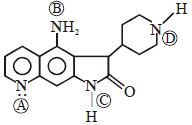
The most basic $'N'$ atom in the following molecule is:
A
$A$
B
$B$
C
$C$
D
$D$
Solution
(D) To determine the most basic nitrogen atom,we analyze the availability of the lone pair on each nitrogen atom:
$1$. Nitrogen at position $A$ is part of an aromatic pyridine-like ring. Its lone pair is in an $sp^2$ orbital perpendicular to the $\pi$-system,making it available for protonation.
$2$. Nitrogen at position $B$ is an aniline-type amine. Its lone pair is delocalized into the aromatic ring,reducing its basicity.
$3$. Nitrogen at position $C$ is an amide nitrogen. Its lone pair is delocalized into the adjacent carbonyl group $(C=O)$,making it non-basic.
$4$. Nitrogen at position $D$ is a secondary aliphatic amine in a saturated piperidine ring. Its lone pair is in an $sp^3$ orbital and is not involved in resonance or delocalization. Aliphatic amines are generally more basic than aromatic amines or pyridine-like nitrogens.
Therefore,the nitrogen at position $D$ is the most basic.
$1$. Nitrogen at position $A$ is part of an aromatic pyridine-like ring. Its lone pair is in an $sp^2$ orbital perpendicular to the $\pi$-system,making it available for protonation.
$2$. Nitrogen at position $B$ is an aniline-type amine. Its lone pair is delocalized into the aromatic ring,reducing its basicity.
$3$. Nitrogen at position $C$ is an amide nitrogen. Its lone pair is delocalized into the adjacent carbonyl group $(C=O)$,making it non-basic.
$4$. Nitrogen at position $D$ is a secondary aliphatic amine in a saturated piperidine ring. Its lone pair is in an $sp^3$ orbital and is not involved in resonance or delocalization. Aliphatic amines are generally more basic than aromatic amines or pyridine-like nitrogens.
Therefore,the nitrogen at position $D$ is the most basic.
0 likes
View Solution610
MediumMCQ
Find the correct order of acidity of the following compounds:
$(I)$ $C_6H_5NH_2$
$(II)$ $C_6H_5CONH_2$
$(III)$ Phthalimide
$(IV)$ $CH_3CH_2NH_2$
$(I)$ $C_6H_5NH_2$
$(II)$ $C_6H_5CONH_2$
$(III)$ Phthalimide
$(IV)$ $CH_3CH_2NH_2$
A
$III > II > I > IV$
B
$III > I > II > IV$
C
$III > II > IV > I$
D
$IV > I > II > III$
Solution
(A) To determine the acidity,we look at the stability of the conjugate base formed after the removal of a proton $(H^+)$ from the nitrogen atom.
$(I)$ Aniline $(C_6H_5NH_2)$: The conjugate base is $C_6H_5NH^-$. The negative charge is delocalized into the benzene ring.
$(II)$ Benzamide $(C_6H_5CONH_2)$: The conjugate base is $C_6H_5CONH^-$. The negative charge is stabilized by resonance with the carbonyl group $(C=O)$.
$(III)$ Phthalimide: The conjugate base is highly stabilized by resonance with two carbonyl groups attached to the nitrogen atom,making it the most acidic.
$(IV)$ Ethylamine $(CH_3CH_2NH_2)$: The conjugate base is $CH_3CH_2NH^-$. The alkyl group is electron-donating ($+I$ effect),which destabilizes the negative charge,making it the least acidic.
Comparing the stability of the conjugate bases: Phthalimide $(III)$ > Benzamide $(II)$ > Aniline $(I)$ > Ethylamine $(IV)$.
Therefore,the correct order of acidity is $III > II > I > IV$.
$(I)$ Aniline $(C_6H_5NH_2)$: The conjugate base is $C_6H_5NH^-$. The negative charge is delocalized into the benzene ring.
$(II)$ Benzamide $(C_6H_5CONH_2)$: The conjugate base is $C_6H_5CONH^-$. The negative charge is stabilized by resonance with the carbonyl group $(C=O)$.
$(III)$ Phthalimide: The conjugate base is highly stabilized by resonance with two carbonyl groups attached to the nitrogen atom,making it the most acidic.
$(IV)$ Ethylamine $(CH_3CH_2NH_2)$: The conjugate base is $CH_3CH_2NH^-$. The alkyl group is electron-donating ($+I$ effect),which destabilizes the negative charge,making it the least acidic.
Comparing the stability of the conjugate bases: Phthalimide $(III)$ > Benzamide $(II)$ > Aniline $(I)$ > Ethylamine $(IV)$.
Therefore,the correct order of acidity is $III > II > I > IV$.
0 likes
View Solution611
MediumMCQ
Which of the following is most basic?
A
Cyclohexylamine $(C_6H_{11}NH_2)$
B
Aniline $(C_6H_5NH_2)$
C
Benzylamine $(C_6H_5CH_2NH_2)$
D
$3,4-$Dihydro-2H-pyridine (or similar cyclic imine structure)
Solution
(A) The basicity of amines depends on the availability of the lone pair of electrons on the nitrogen atom.
$1$. In $C_6H_5NH_2$ (Aniline),the lone pair is delocalized into the benzene ring due to resonance,making it the least basic.
$2$. In $C_6H_5CH_2NH_2$ (Benzylamine),the lone pair is localized,but the phenyl group exerts an electron-withdrawing inductive effect $(-I)$,reducing basicity compared to aliphatic amines.
$3$. In $C_6H_{11}NH_2$ (Cyclohexylamine),the lone pair is localized on the nitrogen atom,and the cyclohexyl group exerts an electron-donating inductive effect $(+I)$,which increases the electron density on the nitrogen atom,making it the most basic among the given options.
$1$. In $C_6H_5NH_2$ (Aniline),the lone pair is delocalized into the benzene ring due to resonance,making it the least basic.
$2$. In $C_6H_5CH_2NH_2$ (Benzylamine),the lone pair is localized,but the phenyl group exerts an electron-withdrawing inductive effect $(-I)$,reducing basicity compared to aliphatic amines.
$3$. In $C_6H_{11}NH_2$ (Cyclohexylamine),the lone pair is localized on the nitrogen atom,and the cyclohexyl group exerts an electron-donating inductive effect $(+I)$,which increases the electron density on the nitrogen atom,making it the most basic among the given options.
0 likes
View Solution612
MediumMCQ
$4$-Methylaniline on heating with alcoholic $KOH$ in the presence of chloroform gives :-
A
$4-$Methylphenyl isocyanide
B
$4-$Methylbenzonitrile
C
$4-$Chlorotoluene
D
$4-$Methylphenol
Solution
(A) The reaction of a primary amine (aromatic or aliphatic) with chloroform $(CHCl_3)$ and alcoholic potassium hydroxide $(KOH)$ is known as the carbylamine reaction or isocyanide test.
In this reaction,the amine group $(-NH_2)$ is converted into an isocyanide group $(-NC)$.
For $4$-methylaniline ($p$-toluidine),the reaction is:
$CH_3-C_6H_4-NH_2 + CHCl_3 + 3KOH \rightarrow CH_3-C_6H_4-NC + 3KCl + 3H_2O$
The product formed is $4$-methylphenyl isocyanide.
In this reaction,the amine group $(-NH_2)$ is converted into an isocyanide group $(-NC)$.
For $4$-methylaniline ($p$-toluidine),the reaction is:
$CH_3-C_6H_4-NH_2 + CHCl_3 + 3KOH \rightarrow CH_3-C_6H_4-NC + 3KCl + 3H_2O$
The product formed is $4$-methylphenyl isocyanide.
0 likes
View Solution613
MediumMCQ
The number of secondary amines with the molecular formula $C_4H_{11}N$ is
A
$4$
B
$3$
C
$5$
D
$2$
Solution
(B) secondary amine has the general structure $R-NH-R'$. For the molecular formula $C_4H_{11}N$,the possible secondary amines are:
$1.$ $N$-methylpropan$-1-$amine $(CH_3-NH-CH_2CH_2CH_3)$
$2.$ $N$-methylpropan$-2-$amine $(CH_3-NH-CH(CH_3)_2)$
$3.$ $N$-ethylethanamine $(CH_3CH_2-NH-CH_2CH_3)$
Thus,there are $3$ possible secondary amines.
$1.$ $N$-methylpropan$-1-$amine $(CH_3-NH-CH_2CH_2CH_3)$
$2.$ $N$-methylpropan$-2-$amine $(CH_3-NH-CH(CH_3)_2)$
$3.$ $N$-ethylethanamine $(CH_3CH_2-NH-CH_2CH_3)$
Thus,there are $3$ possible secondary amines.
0 likes
View Solution614
MediumMCQ
When benzene diazonium chloride is treated with $\beta-$naphthol in an alkaline medium,a coupling reaction takes place,resulting in the formation of an azo dye. In this reaction,benzene diazonium chloride acts as:
A
Electrophile
B
Nucleophile
C
Free radical
D
None of these
Solution
(A) In the coupling reaction between benzene diazonium chloride and $\beta-$naphthol,the benzene diazonium ion $(C_6H_5N_2^+)$ acts as an electrophile.
The diazonium group is electron-deficient and attacks the electron-rich ring of $\beta-$naphthol (which acts as a nucleophile) to form the azo dye.
Therefore,benzene diazonium chloride acts as an electrophile.
The diazonium group is electron-deficient and attacks the electron-rich ring of $\beta-$naphthol (which acts as a nucleophile) to form the azo dye.
Therefore,benzene diazonium chloride acts as an electrophile.
0 likes
View Solution615
MediumMCQ
Which of the following compounds on boiling with hydrochloric acid forms a ketone?
A
$CH_3-CH(NO_2)-CH_3$
B
$CH_3-CH_2-NO_2$
C
$CH_3-NO_2$
D
$CH_3-C(CH_3)(NO_2)-CH_3$
Solution
(A) Secondary nitroalkanes $(2^\circ)$ on boiling with concentrated $HCl$ undergo hydrolysis to give ketones.
$CH_3-CH(NO_2)-CH_3$ ($2$-nitropropane) is a secondary nitroalkane and forms acetone $(CH_3-CO-CH_3)$.
$2CH_3-CH(NO_2)-CH_3 \xrightarrow{HCl, \Delta} 2CH_3-CO-CH_3 + N_2O + H_2O$
$CH_3-CH(NO_2)-CH_3$ ($2$-nitropropane) is a secondary nitroalkane and forms acetone $(CH_3-CO-CH_3)$.
$2CH_3-CH(NO_2)-CH_3 \xrightarrow{HCl, \Delta} 2CH_3-CO-CH_3 + N_2O + H_2O$
0 likes
View Solution616
MediumMCQ
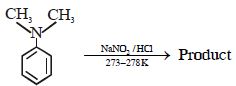
The main product of the following reaction will be:
A
$N,N$-dimethyl-$4$-nitrosoaniline
B
$N,N$-dimethyl-$4$-nitroaniline
C
$N$-methyl-$N$-nitrosoaniline
D
$N,N$-dimethyl-$2$-nitroaniline
Solution
(A) The reaction of $N,N$-dimethylaniline with $NaNO_2/HCl$ at $273-278 \ K$ is an electrophilic aromatic substitution reaction.
Since the $-N(CH_3)_2$ group is a strong ortho/para-directing group,the electrophile $NO^+$ (nitrosonium ion) attacks the para-position due to steric hindrance at the ortho-position.
Thus,the main product formed is $N,N$-dimethyl-$4$-nitrosoaniline.
Since the $-N(CH_3)_2$ group is a strong ortho/para-directing group,the electrophile $NO^+$ (nitrosonium ion) attacks the para-position due to steric hindrance at the ortho-position.
Thus,the main product formed is $N,N$-dimethyl-$4$-nitrosoaniline.
0 likes
View Solution617
MediumMCQ
$Ph-C \equiv CH$ $\xrightarrow[Excess]{HCl} X$ $\xrightarrow{KOH (aq.)} Y$ $\xrightarrow{CH_3-CH_2-NH_2} Z,$
$Z$ is known as
$Z$ is known as
A
Schiff's reagent
B
Magenta dye
C
Schiff's dye
D
Schiff's base
Solution
(D) $1$. The reaction of $Ph-C \equiv CH$ with excess $HCl$ follows Markovnikov's rule,leading to the formation of a gem-dichloride: $Ph-CCl_2-CH_3$ $(X)$.
$2$. Treatment of $X$ with $KOH (aq.)$ performs nucleophilic substitution/hydrolysis,converting the gem-dichloride into a ketone: $Ph-CO-CH_3$ (Acetophenone,$Y$).
$3$. The reaction of acetophenone $(Y)$ with ethylamine $(CH_3-CH_2-NH_2)$ is a condensation reaction forming an imine: $Ph-C(CH_3)=N-CH_2-CH_3$.
$4$. Compounds formed by the condensation of a carbonyl group with a primary amine are known as Schiff's bases.
$2$. Treatment of $X$ with $KOH (aq.)$ performs nucleophilic substitution/hydrolysis,converting the gem-dichloride into a ketone: $Ph-CO-CH_3$ (Acetophenone,$Y$).
$3$. The reaction of acetophenone $(Y)$ with ethylamine $(CH_3-CH_2-NH_2)$ is a condensation reaction forming an imine: $Ph-C(CH_3)=N-CH_2-CH_3$.
$4$. Compounds formed by the condensation of a carbonyl group with a primary amine are known as Schiff's bases.
0 likes
View Solution618
DifficultMCQ
Which of the following is most reactive towards electrophile?
A
Phenol $(C_6H_5OH)$
B
Aniline $(C_6H_5NH_2)$
C
Nitrobenzene $(C_6H_5NO_2)$
D
Toluene $(C_6H_5CH_3)$
Solution
(B) The reactivity of a benzene ring towards an electrophile depends on the electron density of the ring. Groups that donate electrons to the ring (activating groups) increase reactivity,while groups that withdraw electrons (deactivating groups) decrease reactivity.
$1$. The $-NH_2$ group in aniline is a strong electron-donating group due to its lone pair of electrons,which it donates to the benzene ring through resonance ($+M$ effect).
$2$. The $-OH$ group in phenol is also an electron-donating group,but it is less activating than the $-NH_2$ group because oxygen is more electronegative than nitrogen.
$3$. The $-CH_3$ group in toluene is weakly activating due to hyperconjugation and inductive effect ($+I$ effect).
$4$. The $-NO_2$ group in nitrobenzene is a strongly deactivating group due to its strong electron-withdrawing nature ($-M$ and $-I$ effects).
Since the $-NH_2$ group provides the highest electron density to the ring,aniline is the most reactive towards electrophilic substitution.
$1$. The $-NH_2$ group in aniline is a strong electron-donating group due to its lone pair of electrons,which it donates to the benzene ring through resonance ($+M$ effect).
$2$. The $-OH$ group in phenol is also an electron-donating group,but it is less activating than the $-NH_2$ group because oxygen is more electronegative than nitrogen.
$3$. The $-CH_3$ group in toluene is weakly activating due to hyperconjugation and inductive effect ($+I$ effect).
$4$. The $-NO_2$ group in nitrobenzene is a strongly deactivating group due to its strong electron-withdrawing nature ($-M$ and $-I$ effects).
Since the $-NH_2$ group provides the highest electron density to the ring,aniline is the most reactive towards electrophilic substitution.
0 likes
View Solution619
DifficultMCQ
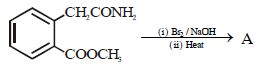
The following sequence of reaction on $A$ gives:
A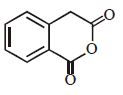
B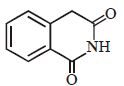
C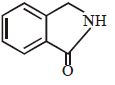
D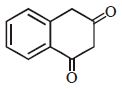
Solution
(C) The starting material is methyl $2-(2-amino-2-oxoethyl)benzoate$.
Step $1$: The reaction with $Br_2/NaOH$ is a Hoffmann bromamide degradation,which converts the $-CONH_2$ group into a $-NH_2$ group,yielding methyl $2-(aminomethyl)benzoate$.
Step $2$: Upon heating,the amino group undergoes an intramolecular nucleophilic attack on the ester group $(-COOCH_3)$,resulting in the elimination of methanol $(CH_3OH)$ and the formation of the cyclic amide,$isoindolin-1-one$.
Step $1$: The reaction with $Br_2/NaOH$ is a Hoffmann bromamide degradation,which converts the $-CONH_2$ group into a $-NH_2$ group,yielding methyl $2-(aminomethyl)benzoate$.
Step $2$: Upon heating,the amino group undergoes an intramolecular nucleophilic attack on the ester group $(-COOCH_3)$,resulting in the elimination of methanol $(CH_3OH)$ and the formation of the cyclic amide,$isoindolin-1-one$.
0 likes
View Solution620
MediumMCQ
The major product $B$ in the following reaction sequence is:
$CH_3-CH_2-CH(CH_3)-CONH_2$ $\xrightarrow{Br_2/KOH, \Delta} (A)$ $\xrightarrow{(1) CH_3I (excess), (2) AgOH/\Delta} (B)$
$CH_3-CH_2-CH(CH_3)-CONH_2$ $\xrightarrow{Br_2/KOH, \Delta} (A)$ $\xrightarrow{(1) CH_3I (excess), (2) AgOH/\Delta} (B)$
A
$CH_3-CH_2-CH=CH_2$
B
$CH_3-CH=CH-CH_3$
C
$CH_3-CH_2-CH(CH_3)-N(CH_3)_2$
D
$CH_3-CH_2-CH(CH_3)-OH$
Solution
(A) The reaction sequence is as follows:
$1.$ Hofmann Bromamide Degradation: $CH_3-CH_2-CH(CH_3)-CONH_2 \xrightarrow{Br_2/KOH, \Delta} CH_3-CH_2-CH(CH_3)-NH_2$ (sec-butylamine).
$2.$ Hofmann Elimination: $CH_3-CH_2-CH(CH_3)-NH_2$ $\xrightarrow{CH_3I (excess)} CH_3-CH_2-CH(CH_3)-N^{+}(CH_3)_3 I^{-}$ $\xrightarrow{AgOH, \Delta} CH_3-CH_2-CH=CH_2$ ($1$-butene).
According to Hofmann's rule,the less substituted alkene is the major product in Hofmann elimination.
$1.$ Hofmann Bromamide Degradation: $CH_3-CH_2-CH(CH_3)-CONH_2 \xrightarrow{Br_2/KOH, \Delta} CH_3-CH_2-CH(CH_3)-NH_2$ (sec-butylamine).
$2.$ Hofmann Elimination: $CH_3-CH_2-CH(CH_3)-NH_2$ $\xrightarrow{CH_3I (excess)} CH_3-CH_2-CH(CH_3)-N^{+}(CH_3)_3 I^{-}$ $\xrightarrow{AgOH, \Delta} CH_3-CH_2-CH=CH_2$ ($1$-butene).
According to Hofmann's rule,the less substituted alkene is the major product in Hofmann elimination.
0 likes
View Solution621
MediumMCQ
Arrange the following in order of their decreasing acidic strength:
$(I)$ $CH_3NH_3^+$
$(II)$ $C_6H_5NH_3^+$
$(III)$ $[H_2N-C(=NH)-NH_2]H^+$
$(IV)$ $O_2N-C_6H_4-NH_3^+$
$(I)$ $CH_3NH_3^+$
$(II)$ $C_6H_5NH_3^+$
$(III)$ $[H_2N-C(=NH)-NH_2]H^+$
$(IV)$ $O_2N-C_6H_4-NH_3^+$
A
$I > II > III > IV$
B
$IV > II > I > III$
C
$IV > III > II > I$
D
$IV > I > II > III$
Solution
(D) The acidic strength of these species depends on the stability of the conjugate base (the corresponding amine). The more stable the conjugate base,the stronger the acid.
$(I)$ $CH_3NH_3^+$: Conjugate base is $CH_3NH_2$ (methylamine).
$(II)$ $C_6H_5NH_3^+$: Conjugate base is $C_6H_5NH_2$ (aniline).
$(III)$ $[H_2N-C(=NH)-NH_2]H^+$: Conjugate base is guanidine $(H_2N-C(=NH)-NH_2)$,which is a very strong base due to resonance stabilization of the cation,making the conjugate acid very weak.
$(IV)$ $O_2N-C_6H_4-NH_3^+$: Conjugate base is $p$-nitroaniline. The $-NO_2$ group is a strong electron-withdrawing group $(EWG)$,which decreases the basicity of the amine,making the conjugate acid stronger.
Comparing the acidity:
$(IV)$ has a strong $-NO_2$ group,making it the strongest acid.
$(I)$ is more acidic than $(II)$ because the phenyl group in $(II)$ is electron-withdrawing compared to the methyl group in $(I)$,but the conjugate base of $(II)$ is resonance stabilized,making $(II)$ a weaker acid than $(I)$.
$(III)$ is the weakest acid because guanidine is a very strong base.
Thus,the order of decreasing acidic strength is $IV > I > II > III$.
$(I)$ $CH_3NH_3^+$: Conjugate base is $CH_3NH_2$ (methylamine).
$(II)$ $C_6H_5NH_3^+$: Conjugate base is $C_6H_5NH_2$ (aniline).
$(III)$ $[H_2N-C(=NH)-NH_2]H^+$: Conjugate base is guanidine $(H_2N-C(=NH)-NH_2)$,which is a very strong base due to resonance stabilization of the cation,making the conjugate acid very weak.
$(IV)$ $O_2N-C_6H_4-NH_3^+$: Conjugate base is $p$-nitroaniline. The $-NO_2$ group is a strong electron-withdrawing group $(EWG)$,which decreases the basicity of the amine,making the conjugate acid stronger.
Comparing the acidity:
$(IV)$ has a strong $-NO_2$ group,making it the strongest acid.
$(I)$ is more acidic than $(II)$ because the phenyl group in $(II)$ is electron-withdrawing compared to the methyl group in $(I)$,but the conjugate base of $(II)$ is resonance stabilized,making $(II)$ a weaker acid than $(I)$.
$(III)$ is the weakest acid because guanidine is a very strong base.
Thus,the order of decreasing acidic strength is $IV > I > II > III$.
0 likes
View Solution622
MediumMCQ
Alcohol is not formed as a product in
A
$CH_3-CH_2-NH_2 \xrightarrow{NaNO_2 + HCl_{(aq)}}$
B
$CH_3-CHO \xrightarrow[(ii) H_2O]{(i) CH_3-MgBr}$
C
$CH_3-CONH_2 \xrightarrow{LiAlH_4}$
D
$CH_3-CH_2-Cl \xrightarrow{KOH_{(aq)}}$
Solution
(C) Reduction of amides with $LiAlH_4$ yields amines. $CH_3-CONH_2 \xrightarrow{LiAlH_4} CH_3-CH_2-NH_2$.
In other options:
$(a)$ Aliphatic primary amines react with $NaNO_2/HCl$ to form alcohols (via diazonium salt).
$(b)$ Grignard reagent reacts with aldehydes to form secondary alcohols.
$(d)$ Aqueous $KOH$ causes nucleophilic substitution of alkyl halides to form alcohols.
In other options:
$(a)$ Aliphatic primary amines react with $NaNO_2/HCl$ to form alcohols (via diazonium salt).
$(b)$ Grignard reagent reacts with aldehydes to form secondary alcohols.
$(d)$ Aqueous $KOH$ causes nucleophilic substitution of alkyl halides to form alcohols.
0 likes
View Solution623
MediumMCQ
Which of the following amines reacts most rapidly with $CH_3I$?
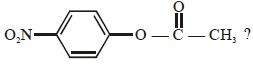
A
$p$-chloroaniline
B
$p$-nitroaniline
C
Aniline
D
Cyclopentylamine
Solution
(D) The reaction of an amine with $CH_3I$ is a nucleophilic substitution reaction $(S_N2)$ where the lone pair on the nitrogen atom of the amine attacks the methyl carbon of $CH_3I$.
The rate of this reaction depends on the nucleophilicity of the amine,which is determined by the availability of the lone pair on the nitrogen atom.
$1$. In aromatic amines like aniline,$p$-chloroaniline,and $p$-nitroaniline,the lone pair on the nitrogen is involved in resonance with the benzene ring,making it less available for nucleophilic attack.
$2$. Electron-withdrawing groups (like $-Cl$ and $-NO_2$) further decrease the electron density on the nitrogen atom,making them even less nucleophilic.
$3$. In contrast,cyclopentylamine is an aliphatic amine. There is no resonance stabilization of the lone pair,and the alkyl group (cyclopentyl) is electron-donating,which increases the electron density on the nitrogen atom,making it more nucleophilic.
Therefore,cyclopentylamine is the most nucleophilic and will react most rapidly with $CH_3I$.
The rate of this reaction depends on the nucleophilicity of the amine,which is determined by the availability of the lone pair on the nitrogen atom.
$1$. In aromatic amines like aniline,$p$-chloroaniline,and $p$-nitroaniline,the lone pair on the nitrogen is involved in resonance with the benzene ring,making it less available for nucleophilic attack.
$2$. Electron-withdrawing groups (like $-Cl$ and $-NO_2$) further decrease the electron density on the nitrogen atom,making them even less nucleophilic.
$3$. In contrast,cyclopentylamine is an aliphatic amine. There is no resonance stabilization of the lone pair,and the alkyl group (cyclopentyl) is electron-donating,which increases the electron density on the nitrogen atom,making it more nucleophilic.
Therefore,cyclopentylamine is the most nucleophilic and will react most rapidly with $CH_3I$.
0 likes
View Solution624
DifficultMCQ
Identify the major product of the following sequence of reactions:
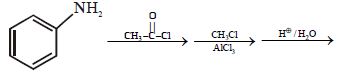
A
$N$-phenylacetamide
B
o-toluidine
C
p-toluidine
D
p-aminobenzoic acid
Solution
(C) $1$. The reaction of aniline with acetyl chloride $(CH_3COCl)$ in the presence of a base (like pyridine) leads to the formation of acetanilide ($N$-phenylacetamide) via acetylation of the amino group. This protects the amino group and reduces its activating effect.
$2$. The subsequent Friedel-Crafts alkylation with $CH_3Cl$ in the presence of $AlCl_3$ occurs at the para-position due to the steric hindrance at the ortho-position and the ortho/para-directing nature of the acetamido group. This yields p-methylacetanilide.
$3$. Finally,the acidic hydrolysis $(H^{\oplus}/H_2O)$ of the amide group removes the acetyl protecting group to regenerate the free amino group,resulting in p-toluidine as the final major product.
$2$. The subsequent Friedel-Crafts alkylation with $CH_3Cl$ in the presence of $AlCl_3$ occurs at the para-position due to the steric hindrance at the ortho-position and the ortho/para-directing nature of the acetamido group. This yields p-methylacetanilide.
$3$. Finally,the acidic hydrolysis $(H^{\oplus}/H_2O)$ of the amide group removes the acetyl protecting group to regenerate the free amino group,resulting in p-toluidine as the final major product.
0 likes
View Solution625
DifficultMCQ
$CH_3-CH_2-CH(CH_3)-CONH_2$ $\xrightarrow[ \Delta ]{ Br_2/KOH } (A)$ $\xrightarrow[ (2) AgOH/\Delta ]{ (1) CH_3I (excess) } (B)$. The major product $(B)$ is:
A
$CH_3-CH_2-CH=CH_2$
B
$CH_3-CH_2-CH(CH_3)-CON(CH_3)_2$
C
$CH_3-CH=CH-CH_3$
D
$CH_3-CH_2-CH(CH_3)-N(CH_3)_2$
Solution
(A) $(1)$ Hofmann Bromamide Degradation: The amide $CH_3-CH_2-CH(CH_3)-CONH_2$ reacts with $Br_2/KOH$ to form an amine with one less carbon atom,which is $CH_3-CH_2-CH(CH_3)-NH_2$ (sec-butylamine).
$(2)$ Hofmann Exhaustive Methylation: The amine reacts with excess $CH_3I$ to form the quaternary ammonium salt $CH_3-CH_2-CH(CH_3)-N^{+}(CH_3)_3 I^{-}$.
$(3)$ Hofmann Elimination: Heating the quaternary ammonium hydroxide (formed with $AgOH$) leads to the formation of the least substituted alkene (Hofmann product). In this case,$CH_3-CH_2-CH=CH_2$ ($1$-butene) is the major product.
$(2)$ Hofmann Exhaustive Methylation: The amine reacts with excess $CH_3I$ to form the quaternary ammonium salt $CH_3-CH_2-CH(CH_3)-N^{+}(CH_3)_3 I^{-}$.
$(3)$ Hofmann Elimination: Heating the quaternary ammonium hydroxide (formed with $AgOH$) leads to the formation of the least substituted alkene (Hofmann product). In this case,$CH_3-CH_2-CH=CH_2$ ($1$-butene) is the major product.
0 likes
View Solution626
DifficultMCQ
Identify the product $B$ in the following reaction sequence:
$F-C_6H_4-NO_2 \xrightarrow[(ii) H_2/Ni]{(CH_3)_2NH, DMF, \Delta} (B)$
$F-C_6H_4-NO_2 \xrightarrow[(ii) H_2/Ni]{(CH_3)_2NH, DMF, \Delta} (B)$
A
$H_2N-C_6H_4-N(CH_3)_2$
B
$H_2N-C_6H_4-NH_2$
C
$O_2N-C_6H_4-N(CH_3)NH_2$
D
$O_2N-C_6H_4-NH_2$
Solution
(A) The reaction proceeds in two steps:
$1$. The first step is a nucleophilic aromatic substitution reaction. The dimethylamine $(CH_3)_2NH$ acts as a nucleophile and replaces the fluorine atom at the para position to the nitro group,forming $p-nitro-N,N-dimethylaniline$ as intermediate $(A)$.
$2$. The second step is the catalytic hydrogenation of the nitro group using $H_2/Ni$. The nitro group $(-NO_2)$ is reduced to an amino group $(-NH_2)$.
Therefore,the final product $(B)$ is $N,N-dimethyl-p-phenylenediamine$,which is $H_2N-C_6H_4-N(CH_3)_2$.
$1$. The first step is a nucleophilic aromatic substitution reaction. The dimethylamine $(CH_3)_2NH$ acts as a nucleophile and replaces the fluorine atom at the para position to the nitro group,forming $p-nitro-N,N-dimethylaniline$ as intermediate $(A)$.
$2$. The second step is the catalytic hydrogenation of the nitro group using $H_2/Ni$. The nitro group $(-NO_2)$ is reduced to an amino group $(-NH_2)$.
Therefore,the final product $(B)$ is $N,N-dimethyl-p-phenylenediamine$,which is $H_2N-C_6H_4-N(CH_3)_2$.
0 likes
View Solution627
MediumMCQ
In the given reaction,$[X]$ will be:
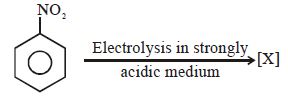
A
$C_6H_5NH_2$
B
$C_6H_5NHOH$
C
$p-\text{aminophenol}$
D
Hydrazobenzene
Solution
(C) The reduction of nitrobenzene by electrolysis in a strongly acidic medium proceeds through the formation of phenylhydroxylamine $(C_6H_5NHOH)$.
In a strongly acidic medium,phenylhydroxylamine undergoes a Bamberger rearrangement to form $p-\text{aminophenol}$ as the final product.
Therefore,$[X]$ is $p-\text{aminophenol}$.
In a strongly acidic medium,phenylhydroxylamine undergoes a Bamberger rearrangement to form $p-\text{aminophenol}$ as the final product.
Therefore,$[X]$ is $p-\text{aminophenol}$.
0 likes
View Solution628
MediumMCQ
Which one of the following compounds on reduction will not give a primary amine?
A
$R-NO_2$
B
$Ar-NO_2$
C
$R-CN$
D
$R-NC$
Solution
(D) Reduction of nitro compounds ($R-NO_2$ or $Ar-NO_2$) yields primary amines ($R-NH_2$ or $Ar-NH_2$).
Reduction of nitriles $(R-CN)$ yields primary amines $(R-CH_2NH_2)$.
Reduction of isonitriles $(R-NC)$ yields secondary amines $(R-NH-CH_3)$.
Therefore,$R-NC$ does not give a primary amine upon reduction.
Reduction of nitriles $(R-CN)$ yields primary amines $(R-CH_2NH_2)$.
Reduction of isonitriles $(R-NC)$ yields secondary amines $(R-NH-CH_3)$.
Therefore,$R-NC$ does not give a primary amine upon reduction.
0 likes
View Solution629
MediumMCQ
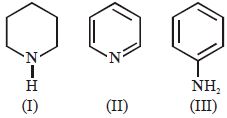
Arrange the given amines in decreasing order of their basicity.
A
$I > II > III$
B
$I > III > II$
C
$III > II > I$
D
$II > I > III$
Solution
(A) The basicity of amines depends on the availability of the lone pair of electrons on the nitrogen atom.
$(I)$ Piperidine: The nitrogen atom is $sp^3$ hybridized,and the lone pair is localized. It is a secondary aliphatic amine,making it the most basic.
$(II)$ Pyridine: The nitrogen atom is $sp^2$ hybridized. The lone pair is in an $sp^2$ orbital,which is more electronegative than an $sp^3$ orbital,making the lone pair less available for donation compared to piperidine.
$(III)$ Aniline: The lone pair on the nitrogen atom is involved in resonance with the benzene ring (delocalized),making it the least basic.
Therefore,the decreasing order of basicity is $I > II > III$.
$(I)$ Piperidine: The nitrogen atom is $sp^3$ hybridized,and the lone pair is localized. It is a secondary aliphatic amine,making it the most basic.
$(II)$ Pyridine: The nitrogen atom is $sp^2$ hybridized. The lone pair is in an $sp^2$ orbital,which is more electronegative than an $sp^3$ orbital,making the lone pair less available for donation compared to piperidine.
$(III)$ Aniline: The lone pair on the nitrogen atom is involved in resonance with the benzene ring (delocalized),making it the least basic.
Therefore,the decreasing order of basicity is $I > II > III$.
0 likes
View Solution630
DifficultMCQ
When a primary amine reacts with chloroform in ethanolic $KOH$,the product formed is:
A
an isocyanide
B
an aldehyde
C
a cyanide
D
an alcohol
Solution
(A) The reaction of a primary amine $(R-NH_2)$ with chloroform $(CHCl_3)$ in the presence of ethanolic potassium hydroxide $(KOH)$ is known as the Carbylamine reaction.
This reaction produces an isocyanide (also called carbylamine),which has a foul smell.
The chemical equation is: $R-NH_2 + CHCl_3 + 3KOH(alc.) \rightarrow R-NC + 3KCl + 3H_2O$.
This reaction produces an isocyanide (also called carbylamine),which has a foul smell.
The chemical equation is: $R-NH_2 + CHCl_3 + 3KOH(alc.) \rightarrow R-NC + 3KCl + 3H_2O$.
0 likes
View Solution631
MediumMCQ
In the given reaction sequence,$[X]$ will be:
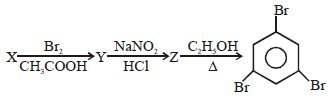
A
Benzoic acid
B
Salicylic acid
C
Phenol
D
Aniline
Solution
(D) The reaction sequence is as follows:
$1$. Aniline $(C_6H_5NH_2)$ reacts with $Br_2$ in $CH_3COOH$ to form $2,4,6$-tribromoaniline $(Y)$.
$2$. $2,4,6$-tribromoaniline $(Y)$ reacts with $NaNO_2/HCl$ at $0-5 \ ^\circ C$ to form $2,4,6$-tribromobenzenediazonium chloride $(Z)$.
$3$. $2,4,6$-tribromobenzenediazonium chloride $(Z)$ reacts with ethanol $(C_2H_5OH)$ upon heating to form $1,3,5$-tribromobenzene.
Thus,the starting compound $[X]$ is aniline.
$1$. Aniline $(C_6H_5NH_2)$ reacts with $Br_2$ in $CH_3COOH$ to form $2,4,6$-tribromoaniline $(Y)$.
$2$. $2,4,6$-tribromoaniline $(Y)$ reacts with $NaNO_2/HCl$ at $0-5 \ ^\circ C$ to form $2,4,6$-tribromobenzenediazonium chloride $(Z)$.
$3$. $2,4,6$-tribromobenzenediazonium chloride $(Z)$ reacts with ethanol $(C_2H_5OH)$ upon heating to form $1,3,5$-tribromobenzene.
Thus,the starting compound $[X]$ is aniline.
0 likes
View Solution632
DifficultMCQ
In the following sequence of reactions:
$C_6H_5-NH_2$ $\xrightarrow[HCl]{NaNO_2} A$ $\xrightarrow{CuCN} B$ $\xrightarrow{H_2/Ni} C$ $\xrightarrow{HNO_2} D$
Product $(D)$ would be:
$C_6H_5-NH_2$ $\xrightarrow[HCl]{NaNO_2} A$ $\xrightarrow{CuCN} B$ $\xrightarrow{H_2/Ni} C$ $\xrightarrow{HNO_2} D$
Product $(D)$ would be:
A
$C_6H_5NHOH$
B
$C_6H_5-NH-C_2H_5$
C
$C_6H_5CH_2NH_2$
D
$C_6H_5-CH_2-OH$
Solution
(D) $1$. $C_6H_5-NH_2$ reacts with $NaNO_2/HCl$ at $0-5 \ ^\circ C$ to form benzene diazonium chloride $(A)$,$C_6H_5N_2Cl$.
$2$. $(A)$ reacts with $CuCN$ (Sandmeyer reaction) to form benzonitrile $(B)$,$C_6H_5-CN$.
$3$. $(B)$ undergoes catalytic hydrogenation with $H_2/Ni$ to form benzylamine $(C)$,$C_6H_5-CH_2-NH_2$.
$4$. $(C)$ is a primary aliphatic amine,which reacts with $HNO_2$ $(NaNO_2/HCl)$ to form an unstable diazonium salt that decomposes to give benzyl alcohol $(D)$,$C_6H_5-CH_2-OH$.
$2$. $(A)$ reacts with $CuCN$ (Sandmeyer reaction) to form benzonitrile $(B)$,$C_6H_5-CN$.
$3$. $(B)$ undergoes catalytic hydrogenation with $H_2/Ni$ to form benzylamine $(C)$,$C_6H_5-CH_2-NH_2$.
$4$. $(C)$ is a primary aliphatic amine,which reacts with $HNO_2$ $(NaNO_2/HCl)$ to form an unstable diazonium salt that decomposes to give benzyl alcohol $(D)$,$C_6H_5-CH_2-OH$.
0 likes
View Solution633
DifficultMCQ
Aniline reacts with acetaldehyde to form
A
Schiff's base
B
Carbylamine
C
Imine
D
None of these
Solution
(A) The reaction between aniline $(C_6H_5NH_2)$ and acetaldehyde $(CH_3CHO)$ is a condensation reaction that produces a Schiff's base.
$C_6H_5NH_2 + CH_3CHO \xrightarrow{H^+} C_6H_5N=CHCH_3 + H_2O$
This product,$C_6H_5N=CHCH_3$,is known as a Schiff's base.
$C_6H_5NH_2 + CH_3CHO \xrightarrow{H^+} C_6H_5N=CHCH_3 + H_2O$
This product,$C_6H_5N=CHCH_3$,is known as a Schiff's base.
0 likes
View Solution634
MediumMCQ
In the given reaction,$[X]$ is:
$4-\text{nitrostyrene} \xrightarrow{[X]} 4-\text{ethylaniline}$
$4-\text{nitrostyrene} \xrightarrow{[X]} 4-\text{ethylaniline}$
A
$LiAlH_4$
B
$NaBH_4$
C
$Zn/CH_3OH$
D
$H_2/Pt$
Solution
(D) The reaction involves the reduction of both the nitro group $(-NO_2)$ to an amino group $(-NH_2)$ and the alkene group $(-CH=CH_2)$ to an alkane group $(-CH_2-CH_3)$.
$1$. $LiAlH_4$ and $NaBH_4$ are selective reducing agents that typically reduce carbonyls or nitro groups but do not reduce isolated carbon-carbon double bonds.
$2$. $Zn/CH_3OH$ is a mild reducing agent that would reduce the nitro group but not the alkene.
$3$. $H_2/Pt$ is a strong catalytic hydrogenation agent that reduces both the nitro group and the carbon-carbon double bond to their respective saturated forms.
Therefore,the reagent $[X]$ is $H_2/Pt$.
$1$. $LiAlH_4$ and $NaBH_4$ are selective reducing agents that typically reduce carbonyls or nitro groups but do not reduce isolated carbon-carbon double bonds.
$2$. $Zn/CH_3OH$ is a mild reducing agent that would reduce the nitro group but not the alkene.
$3$. $H_2/Pt$ is a strong catalytic hydrogenation agent that reduces both the nitro group and the carbon-carbon double bond to their respective saturated forms.
Therefore,the reagent $[X]$ is $H_2/Pt$.
0 likes
View Solution635
MediumMCQ
Phenyl isocyanide is prepared by which of the following reactions?
A
Stephen's reaction
B
Carbylamine reaction
C
Reimer-Tiemann reaction
D
Wurtz reaction
Solution
(B) The reaction of primary amines with chloroform and alcoholic potassium hydroxide is known as the Carbylamine reaction.
$C_6H_5-NH_2 + CHCl_3 + 3KOH(alc.) \xrightarrow{\Delta} C_6H_5-NC + 3KCl + 3H_2O$
This reaction is used as a test for primary amines,producing a foul-smelling isocyanide.
$C_6H_5-NH_2 + CHCl_3 + 3KOH(alc.) \xrightarrow{\Delta} C_6H_5-NC + 3KCl + 3H_2O$
This reaction is used as a test for primary amines,producing a foul-smelling isocyanide.
0 likes
View Solution636
MediumMCQ
Arrange the following compounds in the increasing order of their basic strength:
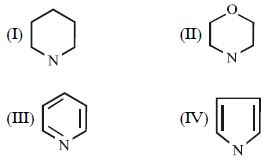
A
$I > II > III > IV$
B
$I > II > IV > III$
C
$II > I > III > IV$
D
$IV > III > II > I$
Solution
(A) To determine the basic strength,we analyze the availability of the lone pair on the nitrogen atom:
$(I)$ Piperidine: The nitrogen is $sp^3$ hybridized. The lone pair is localized and available for donation. It is a strong secondary amine.
$(II)$ Morpholine: The nitrogen is $sp^3$ hybridized,but the presence of an electronegative oxygen atom at the $4$-position exerts an inductive effect ($-I$ effect),which reduces the electron density on nitrogen,making it less basic than piperidine.
$(III)$ Pyridine: The nitrogen is $sp^2$ hybridized. The lone pair is in an $sp^2$ orbital,which has more $s$-character than an $sp^3$ orbital,making it more electronegative and less basic.
$(IV)$ Pyrrole: The lone pair on the nitrogen is involved in the aromatic sextet ($6\pi$ electrons). Therefore,it is not available for donation,making it the least basic.
Thus,the order of basic strength is: $I > II > III > IV$.
$(I)$ Piperidine: The nitrogen is $sp^3$ hybridized. The lone pair is localized and available for donation. It is a strong secondary amine.
$(II)$ Morpholine: The nitrogen is $sp^3$ hybridized,but the presence of an electronegative oxygen atom at the $4$-position exerts an inductive effect ($-I$ effect),which reduces the electron density on nitrogen,making it less basic than piperidine.
$(III)$ Pyridine: The nitrogen is $sp^2$ hybridized. The lone pair is in an $sp^2$ orbital,which has more $s$-character than an $sp^3$ orbital,making it more electronegative and less basic.
$(IV)$ Pyrrole: The lone pair on the nitrogen is involved in the aromatic sextet ($6\pi$ electrons). Therefore,it is not available for donation,making it the least basic.
Thus,the order of basic strength is: $I > II > III > IV$.
0 likes
View Solution637
AdvancedMCQ
In the chemical reaction $CH_3Cl$ $\xrightarrow{AgCN} (A)$ $\xrightarrow{H_2/Pd} (B)$,what is the structure of $(B)$?
A
$CH_3-NH_2$
B
$CH_3-NH-CH_3$
C
$CH_3-CONH_2$
D
$CH_3-CH_2-NH_2$
Solution
(B) In the given reaction sequence,methyl chloride $(CH_3Cl)$ reacts with silver cyanide $(AgCN)$ to form methyl isocyanide $(CH_3NC)$ as the major product because $AgCN$ is covalent in nature.
Subsequent reduction of methyl isocyanide with hydrogen in the presence of a palladium catalyst $(H_2/Pd)$ yields dimethylamine $(CH_3-NH-CH_3)$.
Reaction:
$CH_3Cl + AgCN \rightarrow CH_3NC + AgCl$
$CH_3NC + 2H_2 \xrightarrow{Pd} CH_3-NH-CH_3$
Subsequent reduction of methyl isocyanide with hydrogen in the presence of a palladium catalyst $(H_2/Pd)$ yields dimethylamine $(CH_3-NH-CH_3)$.
Reaction:
$CH_3Cl + AgCN \rightarrow CH_3NC + AgCl$
$CH_3NC + 2H_2 \xrightarrow{Pd} CH_3-NH-CH_3$
0 likes
View Solution638
MediumMCQ
Arrange the following compounds in decreasing order of basic strength:
$(i)$ Aniline
(ii) $p$-Nitroaniline
(iii) $p$-Cyanoaniline
(iv) $p$-Toluidine
$(i)$ Aniline
(ii) $p$-Nitroaniline
(iii) $p$-Cyanoaniline
(iv) $p$-Toluidine
A
$(i) > (ii) > (iii) > (iv)$
B
$(ii) > (iii) > (i) > (iv)$
C
$(iv) > (i) > (iii) > (ii)$
D
$(iv) > (i) > (ii) > (iii)$
Solution
(C) Basic strength is directly proportional to the electron-donating groups ($+M, +H, +I$ effects) and inversely proportional to electron-withdrawing groups ($-M, -H, -I$ effects).
$(i)$ Aniline: Reference compound.
(ii) $p$-Nitroaniline: $-NO_2$ group has strong $-M$ and $-I$ effects,which significantly decrease basic strength.
(iii) $p$-Cyanoaniline: $-CN$ group has $-M$ and $-I$ effects,which decrease basic strength,but less than $-NO_2$.
(iv) $p$-Toluidine: $-CH_3$ group has $+H$ and $+I$ effects,which increase basic strength.
Comparing the effects: The order of electron-withdrawing power is $-NO_2 > -CN$. Thus,the order of basic strength is $(iv) > (i) > (iii) > (ii)$.
$(i)$ Aniline: Reference compound.
(ii) $p$-Nitroaniline: $-NO_2$ group has strong $-M$ and $-I$ effects,which significantly decrease basic strength.
(iii) $p$-Cyanoaniline: $-CN$ group has $-M$ and $-I$ effects,which decrease basic strength,but less than $-NO_2$.
(iv) $p$-Toluidine: $-CH_3$ group has $+H$ and $+I$ effects,which increase basic strength.
Comparing the effects: The order of electron-withdrawing power is $-NO_2 > -CN$. Thus,the order of basic strength is $(iv) > (i) > (iii) > (ii)$.
0 likes
View Solution639
DifficultMCQ
Which of the following gives a bad smell (foul odor) when treated with $CHCl_3 / KOH$?
A
Isopropylamine $(CH_3CH(NH_2)CH_3)$
B
$CH_3-NH-CH_3$
C
$N$-methylaniline $(C_6H_5NHCH_3)$
D
$N$-methylcyclohexylamine $(C_6H_{11}NHCH_3)$
Solution
(A) The reaction of primary amines $(R-NH_2)$ with $CHCl_3$ and alcoholic $KOH$ is known as the Carbylamine reaction. This reaction produces isocyanides (carbylamines),which have a characteristic foul (bad) smell. Secondary and tertiary amines do not give this reaction.
Among the given options:
$A$. Isopropylamine $(CH_3CH(NH_2)CH_3)$ is a primary amine.
$B$. $CH_3-NH-CH_3$ is a secondary amine.
$C$. $N$-methylaniline $(C_6H_5NHCH_3)$ is a secondary amine.
$D$. $N$-methylcyclohexylamine $(C_6H_{11}NHCH_3)$ is a secondary amine.
Therefore,only isopropylamine will give the carbylamine test.
Among the given options:
$A$. Isopropylamine $(CH_3CH(NH_2)CH_3)$ is a primary amine.
$B$. $CH_3-NH-CH_3$ is a secondary amine.
$C$. $N$-methylaniline $(C_6H_5NHCH_3)$ is a secondary amine.
$D$. $N$-methylcyclohexylamine $(C_6H_{11}NHCH_3)$ is a secondary amine.
Therefore,only isopropylamine will give the carbylamine test.
0 likes
View Solution640
AdvancedMCQ
The reaction is shown below. What is $X$ (major)?
$C_6H_5-CONH-C_6H_5 \xrightarrow{Br_2/Fe} X \text{ (major)}$
$C_6H_5-CONH-C_6H_5 \xrightarrow{Br_2/Fe} X \text{ (major)}$
A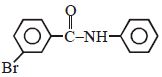
B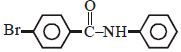
C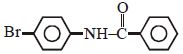
D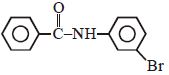
0 likes
View Solution641
MediumMCQ
Isoniazid is used in the treatment of tuberculosis. Identify the least basic $N$ atom present in it.
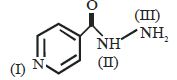
A
$I$
B
$II$
C
$III$
D
Not comparable
Solution
(B) In Isoniazid,there are three nitrogen atoms labeled as $(I)$,$(II)$,and $(III)$.
$(I)$ is a pyridine nitrogen,which is $sp^2$ hybridized and its lone pair is not involved in resonance,making it moderately basic.
$(II)$ is an amide nitrogen $(-CONH-)$. Its lone pair is involved in resonance with the adjacent carbonyl group $(C=O)$,which significantly reduces its basicity.
$(III)$ is an amine nitrogen $(-NH_2)$ attached to the amide nitrogen. It is more basic than the amide nitrogen $(II)$ due to the lack of direct resonance with the carbonyl group.
Comparing these,the amide nitrogen $(II)$ is the least basic because its lone pair is delocalized into the carbonyl group,making it the least available for protonation. Therefore,the correct option is $B$.
$(I)$ is a pyridine nitrogen,which is $sp^2$ hybridized and its lone pair is not involved in resonance,making it moderately basic.
$(II)$ is an amide nitrogen $(-CONH-)$. Its lone pair is involved in resonance with the adjacent carbonyl group $(C=O)$,which significantly reduces its basicity.
$(III)$ is an amine nitrogen $(-NH_2)$ attached to the amide nitrogen. It is more basic than the amide nitrogen $(II)$ due to the lack of direct resonance with the carbonyl group.
Comparing these,the amide nitrogen $(II)$ is the least basic because its lone pair is delocalized into the carbonyl group,making it the least available for protonation. Therefore,the correct option is $B$.
0 likes
View Solution642
MediumMCQ
Which of the following give Hofmann's degradation reaction?
A
Benzamide
B
Cyclohexanecarboxamide
C
Acetamide
D
All
Solution
(D) Hofmann's bromamide degradation reaction is a characteristic reaction of primary amides $(R-CONH_2)$.
In this reaction,a primary amide is treated with bromine in an aqueous or ethanolic solution of sodium hydroxide to form a primary amine with one carbon atom less than the original amide.
All the given compounds,i.e.,Benzamide $(C_6H_5CONH_2)$,Cyclohexanecarboxamide $(C_6H_{11}CONH_2)$,and Acetamide $(CH_3CONH_2)$,are primary amides.
Therefore,all of them undergo Hofmann's degradation reaction.
In this reaction,a primary amide is treated with bromine in an aqueous or ethanolic solution of sodium hydroxide to form a primary amine with one carbon atom less than the original amide.
All the given compounds,i.e.,Benzamide $(C_6H_5CONH_2)$,Cyclohexanecarboxamide $(C_6H_{11}CONH_2)$,and Acetamide $(CH_3CONH_2)$,are primary amides.
Therefore,all of them undergo Hofmann's degradation reaction.
0 likes
View Solution643
MediumMCQ
Arrange the following in decreasing order of their basic strength:
$I$. $CH_2=CHCH_2NH_2$
$II$. $CH_3CH_2CH_2NH_2$
$III$. $CH \equiv CCH_2NH_2$
$I$. $CH_2=CHCH_2NH_2$
$II$. $CH_3CH_2CH_2NH_2$
$III$. $CH \equiv CCH_2NH_2$
A
$I > II > III$
B
$II > I > III$
C
$III > II > I$
D
$II < III < I$
Solution
(B) The basic strength of amines depends on the availability of the lone pair on the nitrogen atom.
Electron-withdrawing groups decrease the electron density on the nitrogen atom,thereby decreasing basicity.
In $III$ $(CH \equiv CCH_2NH_2)$,the $sp$-hybridized carbon is highly electronegative ($-I$ effect),which strongly withdraws electrons,making it the least basic.
In $I$ $(CH_2=CHCH_2NH_2)$,the $sp^2$-hybridized carbon has a weaker $-I$ effect compared to the $sp$-hybridized carbon,so it is more basic than $III$ but less basic than $II$.
In $II$ $(CH_3CH_2CH_2NH_2)$,the alkyl group $(CH_3CH_2CH_2-)$ shows a $+I$ effect,which increases the electron density on the nitrogen atom,making it the most basic.
Therefore,the decreasing order of basic strength is $II > I > III$.
Electron-withdrawing groups decrease the electron density on the nitrogen atom,thereby decreasing basicity.
In $III$ $(CH \equiv CCH_2NH_2)$,the $sp$-hybridized carbon is highly electronegative ($-I$ effect),which strongly withdraws electrons,making it the least basic.
In $I$ $(CH_2=CHCH_2NH_2)$,the $sp^2$-hybridized carbon has a weaker $-I$ effect compared to the $sp$-hybridized carbon,so it is more basic than $III$ but less basic than $II$.
In $II$ $(CH_3CH_2CH_2NH_2)$,the alkyl group $(CH_3CH_2CH_2-)$ shows a $+I$ effect,which increases the electron density on the nitrogen atom,making it the most basic.
Therefore,the decreasing order of basic strength is $II > I > III$.
0 likes
View Solution644
DifficultMCQ
The order of decreasing nucleophilicity of the following is:
A
$H_2O > \Theta OH > CH_3COO\Theta > CH_3O\Theta$
B
$CH_3O\Theta > \Theta OH > CH_3COO\Theta > CH_3SO_3\Theta$
C
$CH_3COO\Theta > CH_3O\Theta > \Theta OH > H_2O$
D
$\Theta OH > CH_3O\Theta > CH_3COO\Theta > H_2O$
Solution
(B) Nucleophilicity is the ability of a species to donate an electron pair to an electrophile.
In general,for species with the same nucleophilic atom,the nucleophilicity follows the basicity order.
The basicity order is: $CH_3O\Theta > \Theta OH > CH_3COO\Theta > CH_3SO_3\Theta > H_2O$.
$CH_3O\Theta$ is a stronger base than $\Theta OH$ due to the $+I$ effect of the methyl group.
$CH_3COO\Theta$ is a weaker base due to resonance stabilization of the negative charge.
$CH_3SO_3\Theta$ is a very weak base due to extensive delocalization of the negative charge.
$H_2O$ is a neutral molecule and the weakest nucleophile among the given species.
Therefore,the correct order of decreasing nucleophilicity is $CH_3O\Theta > \Theta OH > CH_3COO\Theta > CH_3SO_3\Theta$.
In general,for species with the same nucleophilic atom,the nucleophilicity follows the basicity order.
The basicity order is: $CH_3O\Theta > \Theta OH > CH_3COO\Theta > CH_3SO_3\Theta > H_2O$.
$CH_3O\Theta$ is a stronger base than $\Theta OH$ due to the $+I$ effect of the methyl group.
$CH_3COO\Theta$ is a weaker base due to resonance stabilization of the negative charge.
$CH_3SO_3\Theta$ is a very weak base due to extensive delocalization of the negative charge.
$H_2O$ is a neutral molecule and the weakest nucleophile among the given species.
Therefore,the correct order of decreasing nucleophilicity is $CH_3O\Theta > \Theta OH > CH_3COO\Theta > CH_3SO_3\Theta$.
0 likes
View Solution645
MediumMCQ
Which of the following will not give the Hoffmann bromamide degradation reaction?
A
$CH_3CONH_2$
B
$C_6H_5CONH_2$
C
$CH_3CONHCH_3$
D
$CH_3CH_2CONH_2$
Solution
(C) The Hoffmann bromamide degradation reaction is specific to primary amides $(R-CONH_2)$.
In this reaction,a primary amide reacts with bromine in the presence of an aqueous or ethanolic solution of sodium hydroxide to form a primary amine with one carbon atom less than the original amide.
Compounds $CH_3CONH_2$,$C_6H_5CONH_2$,and $CH_3CH_2CONH_2$ are all primary amides and will undergo this reaction.
However,$CH_3CONHCH_3$ is an $N$-substituted amide (a secondary amide). Since it does not have two hydrogen atoms on the nitrogen atom,it cannot form the necessary $N$-bromamide intermediate required for the rearrangement step of the Hoffmann bromamide degradation.
Therefore,$CH_3CONHCH_3$ will not give this reaction.
In this reaction,a primary amide reacts with bromine in the presence of an aqueous or ethanolic solution of sodium hydroxide to form a primary amine with one carbon atom less than the original amide.
Compounds $CH_3CONH_2$,$C_6H_5CONH_2$,and $CH_3CH_2CONH_2$ are all primary amides and will undergo this reaction.
However,$CH_3CONHCH_3$ is an $N$-substituted amide (a secondary amide). Since it does not have two hydrogen atoms on the nitrogen atom,it cannot form the necessary $N$-bromamide intermediate required for the rearrangement step of the Hoffmann bromamide degradation.
Therefore,$CH_3CONHCH_3$ will not give this reaction.
0 likes
View Solution646
MediumMCQ
In the given reaction sequence,what is $Z$?
Aniline $\xrightarrow{CH_3COCl} X$ $\xrightarrow{Br_2/AlBr_3} Y$ $\xrightarrow{H_3O^+} Z$
Aniline $\xrightarrow{CH_3COCl} X$ $\xrightarrow{Br_2/AlBr_3} Y$ $\xrightarrow{H_3O^+} Z$
A
p-Bromoaniline
B
p-Bromophenol
C
p-Bromobenzamide
D
$2,4,6-$Tribromoaniline
Solution
(A) $1$. The reaction of aniline with acetyl chloride $(CH_3COCl)$ in the presence of a base (like pyridine) leads to the formation of acetanilide $(X)$,which is $C_6H_5NHCOCH_3$.
$2$. The acetamido group $(-NHCOCH_3)$ is ortho/para directing,but due to steric hindrance,the para-isomer is the major product. Thus,$Y$ is p-bromoacetanilide $(p-Br-C_6H_4-NHCOCH_3)$.
$3$. Acidic hydrolysis $(H_3O^+)$ of the acetamido group converts it back into the amino group $(-NH_2)$.
$4$. Therefore,the final product $Z$ is p-bromoaniline $(p-Br-C_6H_4-NH_2)$.
$2$. The acetamido group $(-NHCOCH_3)$ is ortho/para directing,but due to steric hindrance,the para-isomer is the major product. Thus,$Y$ is p-bromoacetanilide $(p-Br-C_6H_4-NHCOCH_3)$.
$3$. Acidic hydrolysis $(H_3O^+)$ of the acetamido group converts it back into the amino group $(-NH_2)$.
$4$. Therefore,the final product $Z$ is p-bromoaniline $(p-Br-C_6H_4-NH_2)$.
0 likes
View Solution647
MediumMCQ
Which of the following compounds does not give alcohol on reduction?
A
Benzoyl chloride $(C_6H_5COCl)$
B
Ethyl benzoate $(C_6H_5COOC_2H_5)$
C
Benzoic anhydride $((C_6H_5CO)_2O)$
D
Benzamide $(C_6H_5CONH_2)$
Solution
(D) Reduction of carboxylic acid derivatives using strong reducing agents like $LiAlH_4$ typically yields alcohols,except for amides.
$1$. Benzoyl chloride $(C_6H_5COCl)$ reduces to benzyl alcohol $(C_6H_5CH_2OH)$.
$2$. Ethyl benzoate $(C_6H_5COOC_2H_5)$ reduces to a mixture of benzyl alcohol $(C_6H_5CH_2OH)$ and ethanol $(C_2H_5OH)$.
$3$. Benzoic anhydride $((C_6H_5CO)_2O)$ reduces to benzyl alcohol $(C_6H_5CH_2OH)$.
$4$. Benzamide $(C_6H_5CONH_2)$ on reduction with $LiAlH_4$ yields benzylamine $(C_6H_5CH_2NH_2)$,which is an amine,not an alcohol.
$1$. Benzoyl chloride $(C_6H_5COCl)$ reduces to benzyl alcohol $(C_6H_5CH_2OH)$.
$2$. Ethyl benzoate $(C_6H_5COOC_2H_5)$ reduces to a mixture of benzyl alcohol $(C_6H_5CH_2OH)$ and ethanol $(C_2H_5OH)$.
$3$. Benzoic anhydride $((C_6H_5CO)_2O)$ reduces to benzyl alcohol $(C_6H_5CH_2OH)$.
$4$. Benzamide $(C_6H_5CONH_2)$ on reduction with $LiAlH_4$ yields benzylamine $(C_6H_5CH_2NH_2)$,which is an amine,not an alcohol.
0 likes
View Solution648
MediumMCQ
What is the major product of the following reaction?
$C_6H_5NO_2 \xrightarrow{Zn / NH_4Cl} \text{Product}$
$C_6H_5NO_2 \xrightarrow{Zn / NH_4Cl} \text{Product}$
A
$C_6H_5NO$
B
$C_6H_5NHOH$
C
$C_6H_5NH_2$
D
$(A)$ and $(B)$ both
Solution
(B) The reduction of nitrobenzene $(C_6H_5NO_2)$ with zinc $(Zn)$ and ammonium chloride $(NH_4Cl)$ is a selective reduction process.
This reaction proceeds through the formation of nitrosobenzene $(C_6H_5NO)$ as an intermediate,which is then further reduced to phenylhydroxylamine $(C_6H_5NHOH)$.
Under these specific neutral conditions $(Zn / NH_4Cl)$,the reduction stops at the phenylhydroxylamine stage.
Therefore,the major product is $C_6H_5NHOH$.
This reaction proceeds through the formation of nitrosobenzene $(C_6H_5NO)$ as an intermediate,which is then further reduced to phenylhydroxylamine $(C_6H_5NHOH)$.
Under these specific neutral conditions $(Zn / NH_4Cl)$,the reduction stops at the phenylhydroxylamine stage.
Therefore,the major product is $C_6H_5NHOH$.
0 likes
View Solution649
DifficultMCQ
Identify the product $Y$ in the following reaction sequence:
Phthalimide $\xrightarrow[(2) \text{Cyclohexyl chloride}, (3) H_2O/\Delta]{(1) KOH} X$ $\xrightarrow{CHCl_3, KOH, \Delta} Y$
Phthalimide $\xrightarrow[(2) \text{Cyclohexyl chloride}, (3) H_2O/\Delta]{(1) KOH} X$ $\xrightarrow{CHCl_3, KOH, \Delta} Y$
A
Cyclohexanol
B
Cyclohexylamine
C
Cyclohexyl isocyanide
D
Cyclohexanecarbaldehyde
Solution
(C) The given reaction sequence is the Gabriel phthalimide synthesis followed by the carbylamine reaction.
Step $1$: Phthalimide reacts with $KOH$ to form potassium phthalimide,which then reacts with cyclohexyl chloride via $S_N2$ mechanism to form $N$-cyclohexylphthalimide. Subsequent hydrolysis with $H_2O/\Delta$ yields cyclohexylamine $(X = C_6H_{11}NH_2)$.
Step $2$: Cyclohexylamine $(X)$ reacts with $CHCl_3$ and $KOH$ (carbylamine reaction) to form cyclohexyl isocyanide $(Y = C_6H_{11}NC)$.
Therefore,$Y$ is cyclohexyl isocyanide.
Step $1$: Phthalimide reacts with $KOH$ to form potassium phthalimide,which then reacts with cyclohexyl chloride via $S_N2$ mechanism to form $N$-cyclohexylphthalimide. Subsequent hydrolysis with $H_2O/\Delta$ yields cyclohexylamine $(X = C_6H_{11}NH_2)$.
Step $2$: Cyclohexylamine $(X)$ reacts with $CHCl_3$ and $KOH$ (carbylamine reaction) to form cyclohexyl isocyanide $(Y = C_6H_{11}NC)$.
Therefore,$Y$ is cyclohexyl isocyanide.
0 likes
View Solution650
MediumMCQ
Which of the following is the least basic?
A
$C_6H_5NH_2$
B
$CH_3CONH_2$
C
$(CH_3)_3N$
D
$CH_2=CHNH_2$
Solution
(B) To determine the least basic compound,we evaluate the availability of the lone pair on the nitrogen atom for protonation:
$1$. $(CH_3)_3N$ (Trimethylamine) is an aliphatic tertiary amine,which is relatively basic due to the electron-donating inductive effect of three methyl groups.
$2$. $C_6H_5NH_2$ (Aniline) has the lone pair on nitrogen delocalized into the benzene ring,reducing its basicity.
$3$. $CH_2=CHNH_2$ (Vinylamine) has the lone pair delocalized into the double bond,reducing its basicity.
$4$. $CH_3CONH_2$ (Acetamide) has the lone pair on nitrogen delocalized into the carbonyl group $(C=O)$ via resonance. The resonance structure $CH_3C(O^-)=NH_2^+$ significantly reduces the electron density on the nitrogen atom,making it the least basic among the given options.
$1$. $(CH_3)_3N$ (Trimethylamine) is an aliphatic tertiary amine,which is relatively basic due to the electron-donating inductive effect of three methyl groups.
$2$. $C_6H_5NH_2$ (Aniline) has the lone pair on nitrogen delocalized into the benzene ring,reducing its basicity.
$3$. $CH_2=CHNH_2$ (Vinylamine) has the lone pair delocalized into the double bond,reducing its basicity.
$4$. $CH_3CONH_2$ (Acetamide) has the lone pair on nitrogen delocalized into the carbonyl group $(C=O)$ via resonance. The resonance structure $CH_3C(O^-)=NH_2^+$ significantly reduces the electron density on the nitrogen atom,making it the least basic among the given options.
0 likes
View SolutionAmines — Properties of Amines · Frequently Asked Questions
1Are these Amines questions useful for JEE and NEET?
Yes. All questions in this section are mapped to JEE Main and NEET exam patterns. Previous year questions from JEE Main, NEET, GUJCET and state-level exams are included with full solutions.
2Can I switch to Hindi or Gujarati for these questions?
Yes. Use the language tabs in the hero section or the sidebar to view the same questions and solutions in English, Hindi or Gujarati.
3How do I generate a question paper from this subtopic?
Use the Vedclass Exam Paper Generator — select the chapter and subtopic, set difficulty, and generate Sets A, B, C, D automatically. First 3 chapters of every subject are free.
Vedclass Products
For Students
Vedclass Test Series
Mock tests in real JEE/NEET style with performance analysis. 5-day free trial.
Start Free TrialFor Teachers
Exam Paper Generator
Generate Set A/B/C/D papers from this chapter in 2 minutes. 3 chapters free.
Try FreeFor Institutes
Online Exam Module
Live online exams with unlimited students, 360° analytics & white-label branding.
See DemoFor Teachers & Institutes
Generate a Amines Exam Paper in 2 Minutes
Select subtopic & difficulty — Sets A, B, C, D auto-generated with No Repeat logic.
First 3 chapters of every subject are free — no payment required.