
A English
Properties Questions in English
Class 12 Chemistry · 8-1.Aldehydes and Ketones · Properties
1739+
Questions
English
Language
100%
With Solutions
Showing 49 of 1739 questions in English
851
DifficultMCQ
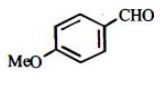
The major product $B$ formed in the following reaction sequence is
$p-Methoxybenzaldehyde$ $\xrightarrow[(ii) H_2O]{(i) C_2H_5MgBr} A$ $\xrightarrow{HCl} B$
$p-Methoxybenzaldehyde$ $\xrightarrow[(ii) H_2O]{(i) C_2H_5MgBr} A$ $\xrightarrow{HCl} B$
A
$4-Chloro-1-methoxy-4-ethylbenzene$
B
$1-(4-Methoxyphenyl)propan-1-ol$
C
$1-Methoxy-4-(prop-1-enyl)benzene$
D
$1-(1-Chloropropyl)-4-methoxybenzene$
Solution
(D) Step $1$: The reaction of $p-methoxybenzaldehyde$ with $C_2H_5MgBr$ followed by hydrolysis $(H_2O)$ is a Grignard reaction. The nucleophilic ethyl group attacks the carbonyl carbon to form a secondary alcohol,$A$,which is $1-(4-methoxyphenyl)propan-1-ol$.
Step $2$: The reaction of $A$ with $HCl$ proceeds via an $S_N1$ mechanism. The hydroxyl group is protonated to form a good leaving group $(H_2O)$,which leaves to form a stable benzylic carbocation. The chloride ion then attacks this carbocation to form the major product $B$,which is $1-(1-chloropropyl)-4-methoxybenzene$.
Step $2$: The reaction of $A$ with $HCl$ proceeds via an $S_N1$ mechanism. The hydroxyl group is protonated to form a good leaving group $(H_2O)$,which leaves to form a stable benzylic carbocation. The chloride ion then attacks this carbocation to form the major product $B$,which is $1-(1-chloropropyl)-4-methoxybenzene$.
0 likes
View Solution852
DifficultMCQ
Which of the following compounds will most readily be dehydrated to give an alkene under acidic conditions?
A
$4-$Hydroxypentan$-2-$one
B
$3-$Hydroxypentan$-2-$one
C
$1-$Pentanol
D
$2-$Hydroxycyclopentanone
Solution
(A) The dehydration of alcohols under acidic conditions proceeds via the formation of a carbocation intermediate.
For the dehydration to occur most readily,the resulting alkene should be stabilized by conjugation with a carbonyl group (forming an $\alpha, \beta-$unsaturated ketone).
In $4-$hydroxypentan$-2-$one $(CH_3-CH(OH)-CH_2-CO-CH_3)$,the hydroxyl group is at the $\beta-$position relative to the carbonyl group.
Upon protonation and loss of water,it forms a carbocation that is stabilized by the adjacent carbonyl group,leading to the formation of a conjugated $\alpha, \beta-$unsaturated ketone $(CH_3-CH=CH-CO-CH_3)$.
This process is highly favorable due to the formation of a conjugated system,making $4-$hydroxypentan$-2-$one the most readily dehydrated compound among the choices.
For the dehydration to occur most readily,the resulting alkene should be stabilized by conjugation with a carbonyl group (forming an $\alpha, \beta-$unsaturated ketone).
In $4-$hydroxypentan$-2-$one $(CH_3-CH(OH)-CH_2-CO-CH_3)$,the hydroxyl group is at the $\beta-$position relative to the carbonyl group.
Upon protonation and loss of water,it forms a carbocation that is stabilized by the adjacent carbonyl group,leading to the formation of a conjugated $\alpha, \beta-$unsaturated ketone $(CH_3-CH=CH-CO-CH_3)$.
This process is highly favorable due to the formation of a conjugated system,making $4-$hydroxypentan$-2-$one the most readily dehydrated compound among the choices.
0 likes
View Solution853
DifficultMCQ
$A$ compound of molecular formula $C_8H_8O_2$ reacts with acetophenone to form a single cross-aldol product in the presence of base. The same compound on reaction with conc. $NaOH$ forms benzyl alcohol as one of the products. The structure of the compound is
A
$4-$methoxybenzaldehyde
B
$4-$hydroxyacetophenone
C
methyl benzoate
D
$4-$methylbenzoic acid
Solution
(A) The molecular formula $C_8H_8O_2$ corresponds to $p$-methoxybenzaldehyde $(CH_3OC_6H_4CHO)$.
$1$. It contains an aldehyde group without $\alpha$-hydrogens,which allows it to undergo the Cannizzaro reaction with conc. $NaOH$ to form $p$-methoxybenzyl alcohol and sodium $p$-methoxybenzoate.
$2$. It reacts with acetophenone $(C_6H_5COCH_3)$ in the presence of a base to undergo a cross-aldol condensation,forming a single product because the aldehyde lacks $\alpha$-hydrogens,ensuring it acts only as the electrophile.
$1$. It contains an aldehyde group without $\alpha$-hydrogens,which allows it to undergo the Cannizzaro reaction with conc. $NaOH$ to form $p$-methoxybenzyl alcohol and sodium $p$-methoxybenzoate.
$2$. It reacts with acetophenone $(C_6H_5COCH_3)$ in the presence of a base to undergo a cross-aldol condensation,forming a single product because the aldehyde lacks $\alpha$-hydrogens,ensuring it acts only as the electrophile.
0 likes
View Solution854
DifficultMCQ
The correct statement about the synthesis of pentaerythritol $(C(CH_2OH)_4)$ used in the preparation of $PETN$ is
A
The synthesis requires three aldol condensations and one Cannizzaro reaction
B
Alpha hydrogens of ethanol and methanol are involved in this reaction.
C
The synthesis requires two aldol condensations and two Cannizzaro reactions
D
The synthesis requires four aldol condensations between methanol and ethanol
Solution
(A) Pentaerythritol is produced by a base-catalyzed reaction of acetaldehyde with excess formaldehyde.
First,three moles of formaldehyde undergo aldol condensation with one mole of acetaldehyde to form pentaerythrose: $CH_3CHO + 3HCHO \to C(CH_2OH)_3CHO$.
This is followed by a crossed Cannizzaro reaction between the intermediate and another mole of formaldehyde to yield pentaerythritol and sodium formate: $C(CH_2OH)_3CHO + HCHO + NaOH \to C(CH_2OH)_4 + HCOONa$.
Thus,the process involves three aldol condensations and one Cannizzaro reaction.
First,three moles of formaldehyde undergo aldol condensation with one mole of acetaldehyde to form pentaerythrose: $CH_3CHO + 3HCHO \to C(CH_2OH)_3CHO$.
This is followed by a crossed Cannizzaro reaction between the intermediate and another mole of formaldehyde to yield pentaerythritol and sodium formate: $C(CH_2OH)_3CHO + HCHO + NaOH \to C(CH_2OH)_4 + HCOONa$.
Thus,the process involves three aldol condensations and one Cannizzaro reaction.
0 likes
View Solution855
AdvancedMCQ
$A$ compound $A$ with molecular formula $C_{10}H_{13}Cl$ gives a white precipitate on adding silver nitrate solution. $A$ on reacting with alcoholic $KOH$ gives compound $B$ as the main product. $B$ on ozonolysis gives $C$ and $D$. $C$ gives Cannizzaro reaction but not aldol condensation. $D$ gives aldol condensation but not Cannizzaro reaction. $A$ is:
A
$C_6H_5-CH_2-CH_2-CH_2-CH_2-Cl$
B
$C_6H_5-CH_2-CH_2-CH(Cl)-CH_3$
C
$C_6H_5-CH_2-C(Cl)(CH_3)_2$
D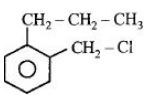
Solution
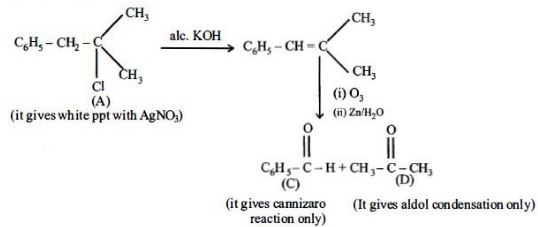
(C) Compound $A$ $(C_{10}H_{13}Cl)$ gives a white precipitate with silver nitrate,indicating it is a tertiary halide or a reactive alkyl halide that forms a stable carbocation.
$C_6H_5-CH_2-C(Cl)(CH_3)_2 (A) \xrightarrow{alc. KOH} C_6H_5-CH=C(CH_3)_2 (B)$
$B$ on ozonolysis:
$C_6H_5-CH=C(CH_3)_2 \xrightarrow{O_3/H_2O} C_6H_5CHO (C) + CH_3COCH_3 (D)$
$C$ $(C_6H_5CHO)$ has no $\alpha$-hydrogen,so it gives Cannizzaro reaction but not aldol condensation.
$D$ $(CH_3COCH_3)$ has $\alpha$-hydrogens,so it gives aldol condensation but not Cannizzaro reaction.
Thus,$A$ is $C_6H_5-CH_2-C(Cl)(CH_3)_2$.
$C_6H_5-CH_2-C(Cl)(CH_3)_2 (A) \xrightarrow{alc. KOH} C_6H_5-CH=C(CH_3)_2 (B)$
$B$ on ozonolysis:
$C_6H_5-CH=C(CH_3)_2 \xrightarrow{O_3/H_2O} C_6H_5CHO (C) + CH_3COCH_3 (D)$
$C$ $(C_6H_5CHO)$ has no $\alpha$-hydrogen,so it gives Cannizzaro reaction but not aldol condensation.
$D$ $(CH_3COCH_3)$ has $\alpha$-hydrogens,so it gives aldol condensation but not Cannizzaro reaction.
Thus,$A$ is $C_6H_5-CH_2-C(Cl)(CH_3)_2$.
0 likes
View Solution856
DifficultMCQ
In the reaction sequence $2CH_3CHO$ $\xrightarrow{OH^{-}} A$ $\xrightarrow{\Delta} B$; the product $B$ is
A
$CH_3-CH_2-CH_2-CH_2-OH$
B
$CH_3-CH=CH-CHO$
C
$CH_3-CH_2-CH_2-CH_3$
D
$CH_3-CO-CH_3$
Solution
(B) The reaction is an Aldol condensation.
Step $1$: $2CH_3CHO \xrightarrow{OH^{-}} CH_3-CH(OH)-CH_2-CHO$ (Aldol,$A$)
Step $2$: $CH_3-CH(OH)-CH_2-CHO \xrightarrow{\Delta} CH_3-CH=CH-CHO$ (Crotonaldehyde,$B$)
Therefore,the product $B$ is $CH_3-CH=CH-CHO$.
Step $1$: $2CH_3CHO \xrightarrow{OH^{-}} CH_3-CH(OH)-CH_2-CHO$ (Aldol,$A$)
Step $2$: $CH_3-CH(OH)-CH_2-CHO \xrightarrow{\Delta} CH_3-CH=CH-CHO$ (Crotonaldehyde,$B$)
Therefore,the product $B$ is $CH_3-CH=CH-CHO$.
0 likes
View Solution857
DifficultMCQ
Which one of the following reactions will not result in the formation of a carbon-carbon bond?
A
Reimer-Tiemann reaction
B
Friedel-Crafts acylation
C
Wurtz reaction
D
Cannizzaro reaction
Solution
(D) The Cannizzaro reaction is a disproportionation reaction of aldehydes lacking $\alpha$-hydrogen atoms,where one molecule of the aldehyde is reduced to an alcohol and another is oxidized to a salt of a carboxylic acid. It does not involve the formation of a new carbon-carbon bond.
$2C_6H_5CHO + KOH \longrightarrow C_6H_5CH_2OH + C_6H_5COOK$
In contrast,the Reimer-Tiemann reaction,Friedel-Crafts acylation,and Wurtz reaction all involve the formation of new carbon-carbon bonds.
$2C_6H_5CHO + KOH \longrightarrow C_6H_5CH_2OH + C_6H_5COOK$
In contrast,the Reimer-Tiemann reaction,Friedel-Crafts acylation,and Wurtz reaction all involve the formation of new carbon-carbon bonds.
0 likes
View Solution858
DifficultMCQ
Which is the major product formed when acetone is heated with iodine and potassium hydroxide?
A
Iodoacetone
B
Acetic acid
C
Iodoform
D
Acetophenone
Solution
(C) Acetone $(CH_3COCH_3)$ reacts with iodine $(I_2)$ in the presence of a base like potassium hydroxide $(KOH)$ to undergo the iodoform reaction.
This reaction is a characteristic test for methyl ketones.
The chemical equation is:
$CH_3COCH_3 + 3I_2 + 4KOH \longrightarrow CHI_3 + CH_3COOK + 3KI + 3H_2O$
The major product formed is iodoform $(CHI_3)$.
This reaction is a characteristic test for methyl ketones.
The chemical equation is:
$CH_3COCH_3 + 3I_2 + 4KOH \longrightarrow CHI_3 + CH_3COOK + 3KI + 3H_2O$
The major product formed is iodoform $(CHI_3)$.
0 likes
View Solution859
DifficultMCQ
Tischenko reaction is a modification of
A
Aldol condensation
B
Claisen condensation
C
Cannizzaro reaction
D
Pinacol-pinacolon reaction
Solution
(C) The Tishchenko reaction is a modification of the Cannizzaro reaction.
In the Tishchenko reaction,two molecules of an aldehyde (which lacks an $\alpha$-hydrogen atom) undergo disproportionation in the presence of an alkoxide catalyst (such as aluminium alkoxide or sodium alkoxide) to form an ester.
In the Cannizzaro reaction,the base used is typically a strong aqueous base like $NaOH$ or $KOH$,and the products are a carboxylic acid salt and an alcohol.
Both reactions involve the disproportionation of aldehydes lacking $\alpha$-hydrogens,making the Tishchenko reaction a variation of the Cannizzaro process.
In the Tishchenko reaction,two molecules of an aldehyde (which lacks an $\alpha$-hydrogen atom) undergo disproportionation in the presence of an alkoxide catalyst (such as aluminium alkoxide or sodium alkoxide) to form an ester.
In the Cannizzaro reaction,the base used is typically a strong aqueous base like $NaOH$ or $KOH$,and the products are a carboxylic acid salt and an alcohol.
Both reactions involve the disproportionation of aldehydes lacking $\alpha$-hydrogens,making the Tishchenko reaction a variation of the Cannizzaro process.
0 likes
View Solution860
DifficultMCQ
Formaldehyde can be distinguished from acetaldehyde by the use of
A
Schiff's reagent
B
Tollen's reagent
C
$I_2 / \text{Alkali}$
D
Fehling's solution
Solution
(C) Acetaldehyde contains a $CH_3CO-$ group,which gives a positive iodoform test with $I_2 / \text{Alkali}$.
Formaldehyde does not contain a $CH_3CO-$ group and therefore does not give the iodoform test.
Thus,$I_2 / \text{Alkali}$ is used to distinguish between them.
Formaldehyde does not contain a $CH_3CO-$ group and therefore does not give the iodoform test.
Thus,$I_2 / \text{Alkali}$ is used to distinguish between them.
0 likes
View Solution861
DifficultMCQ
Clemmensen reduction of a ketone is carried out in the presence of
A
$LiAlH_4$
B
$Zn-Hg$ with $HCl$
C
Glycol with $KOH$
D
$H_2$ with $Pt$ as catalyst
Solution
(B) The Clemmensen reduction is a chemical reaction where a ketone or aldehyde is reduced to an alkane using zinc amalgam $(Zn-Hg)$ and concentrated hydrochloric acid $(HCl)$.
The general reaction is: $\text{>C=O} \xrightarrow{Zn-Hg/HCl} \text{>CH}_2 + H_2O$.
The general reaction is: $\text{>C=O} \xrightarrow{Zn-Hg/HCl} \text{>CH}_2 + H_2O$.
0 likes
View Solution862
DifficultMCQ
Which of the following is the product of aldol condensation?
A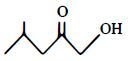
B
C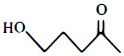
D
Solution
(B) Aldol condensation involves the reaction of two molecules of an aldehyde or ketone having at least one $\alpha$-hydrogen atom in the presence of a dilute base to form a $\beta$-hydroxy aldehyde (aldol) or $\beta$-hydroxy ketone (ketol).
In the given options,option $(b)$ represents $4$-hydroxy-$4$-methylpentan-$2$-one,which is the product of the self-aldol condensation of acetone $(CH_3COCH_3)$.
$2CH_3COCH_3 \xrightarrow{dil. Ba(OH)_2} CH_3-C(OH)(CH_3)-CH_2-COCH_3$
In the given options,option $(b)$ represents $4$-hydroxy-$4$-methylpentan-$2$-one,which is the product of the self-aldol condensation of acetone $(CH_3COCH_3)$.
$2CH_3COCH_3 \xrightarrow{dil. Ba(OH)_2} CH_3-C(OH)(CH_3)-CH_2-COCH_3$
0 likes
View Solution863
DifficultMCQ
Cannizzaro's reaction is not given by
A
$C_6H_5CHO$
B
$HCHO$
C
$CH_3CHO$
D
$CCl_3CHO$
Solution
(C) Only those aldehydes which do not have $\alpha-H$ atoms undergo Cannizzaro's reaction.
$CH_3CHO$ (acetaldehyde) contains $3$ $\alpha-H$ atoms attached to the $\alpha$-carbon.
Therefore,it undergoes aldol condensation instead of Cannizzaro's reaction.
$C_6H_5CHO$,$HCHO$,and $CCl_3CHO$ do not have any $\alpha-H$ atoms and thus undergo Cannizzaro's reaction.
$CH_3CHO$ (acetaldehyde) contains $3$ $\alpha-H$ atoms attached to the $\alpha$-carbon.
Therefore,it undergoes aldol condensation instead of Cannizzaro's reaction.
$C_6H_5CHO$,$HCHO$,and $CCl_3CHO$ do not have any $\alpha-H$ atoms and thus undergo Cannizzaro's reaction.
0 likes
View Solution864
DifficultMCQ
Which of the following reagent$(s)$ is/are used for the given conversion?

A
glycol$/LiAlH_4/H_3O^{+}$
B
glycol$/NaH/H_3O^{+}$
C
$LiAlH_4$
D
$NaBH_4$
Solution
(A) The starting material is an ester containing a ketone group. Direct reduction with $LiAlH_4$ would reduce both the ketone and the ester groups to alcohols. To selectively reduce the ester to an alcohol while keeping the ketone intact,we must first protect the ketone.
$1$. The ketone is protected by forming a cyclic acetal using ethylene glycol (glycol) in the presence of an acid catalyst.
$2$. The ester group is then reduced to a primary alcohol using $LiAlH_4$.
$3$. Finally,the cyclic acetal is deprotected (hydrolyzed) back to the ketone using $H_3O^{+}$.
$1$. The ketone is protected by forming a cyclic acetal using ethylene glycol (glycol) in the presence of an acid catalyst.
$2$. The ester group is then reduced to a primary alcohol using $LiAlH_4$.
$3$. Finally,the cyclic acetal is deprotected (hydrolyzed) back to the ketone using $H_3O^{+}$.
0 likes
View Solution865
DifficultMCQ
Among the following,the order of reactivity towards nucleophilic addition is:
A
$CH_3CHO > CH_3COCH_3 > HCHO$
B
$HCHO > CH_3CHO > CH_3COCH_3$
C
$CH_3CHO > HCHO > CH_3COCH_3$
D
$CH_3COCH_3 > CH_3CHO > HCHO$
Solution
(B) The reactivity of carbonyl compounds towards nucleophilic addition is governed by two factors: steric hindrance and electronic effects.
Alkyl groups are electron-donating ($+I$ effect),which decreases the electrophilicity of the carbonyl carbon.
Additionally,alkyl groups increase steric hindrance,making it difficult for the nucleophile to attack.
$HCHO$ has two hydrogen atoms (no alkyl groups),$CH_3CHO$ has one methyl group,and $CH_3COCH_3$ has two methyl groups.
Therefore,the reactivity order is $HCHO > CH_3CHO > CH_3COCH_3$.
Alkyl groups are electron-donating ($+I$ effect),which decreases the electrophilicity of the carbonyl carbon.
Additionally,alkyl groups increase steric hindrance,making it difficult for the nucleophile to attack.
$HCHO$ has two hydrogen atoms (no alkyl groups),$CH_3CHO$ has one methyl group,and $CH_3COCH_3$ has two methyl groups.
Therefore,the reactivity order is $HCHO > CH_3CHO > CH_3COCH_3$.
0 likes
View Solution866
MediumMCQ
The reaction $CH_3CHO \xrightarrow[Zn(Hg) / \text{Conc. } HCl]{[H]} CH_3CH_3$ is:
A
Cannizzaro's reaction
B
Rosenmund reduction
C
Wolff-Kishner reduction
D
Clemmensen reduction
Solution
(D) The reaction involves the reduction of an aldehyde $(CH_3CHO)$ to an alkane $(CH_3CH_3)$ using zinc amalgam $(Zn(Hg))$ and concentrated hydrochloric acid $(HCl)$.
This specific reagent system is characteristic of the Clemmensen reduction.
This specific reagent system is characteristic of the Clemmensen reduction.
0 likes
View Solution867
DifficultMCQ
Tollen's reagent and Fehling solutions are used to distinguish between
A
acids and alcohols
B
alkanes and alcohols
C
ketones and aldehydes
D
$n-$alkenes and branched alkanes
Solution
(C) All aldehydes show reaction with Tollen's reagent and Fehling solutions,but ketones do not show this reaction.
$Note$ :- Benzaldehyde does not give reaction with Fehling solution.
$Note$ :- Benzaldehyde does not give reaction with Fehling solution.
0 likes
View Solution868
DifficultMCQ
The major product formed in the following reaction is:
$CH_3CHO + PhCOCH_3 \xrightarrow{\text{dil. } NaOH}$
$CH_3CHO + PhCOCH_3 \xrightarrow{\text{dil. } NaOH}$
A
$CH_3CH(OH)CH_2CHO$
B
$H-CH_2-C(OH)(CH_3)-Ph$
C
$CH_3CH(OH)CH_2COPh$
D
$Ph-CO-CH_2-C(OH)(CH_3)-Ph$
Solution
(C) The reaction between $CH_3CHO$ (acetaldehyde) and $PhCOCH_3$ (acetophenone) in the presence of dilute $NaOH$ is a cross-aldol condensation reaction.
$1$. Acetophenone has an $\alpha$-hydrogen atom,so it can form an enolate ion in the presence of a base $(NaOH)$.
$2$. The enolate ion formed from acetophenone acts as a nucleophile and attacks the carbonyl carbon of the acetaldehyde $(CH_3CHO)$,which is more electrophilic than acetophenone.
$3$. The nucleophilic attack leads to the formation of a $\beta$-hydroxy ketone.
$4$. The reaction proceeds as follows:
$PhCOCH_3 + OH^- \rightarrow [PhCOCH_2]^- + H_2O$
$[PhCOCH_2]^- + CH_3CHO \rightarrow CH_3-CH(O^-)-CH_2-COPh$
$CH_3-CH(O^-)-CH_2-COPh + H_2O \rightarrow CH_3-CH(OH)-CH_2-COPh + OH^-$
Thus,the major product is $CH_3-CH(OH)-CH_2-COPh$.
$1$. Acetophenone has an $\alpha$-hydrogen atom,so it can form an enolate ion in the presence of a base $(NaOH)$.
$2$. The enolate ion formed from acetophenone acts as a nucleophile and attacks the carbonyl carbon of the acetaldehyde $(CH_3CHO)$,which is more electrophilic than acetophenone.
$3$. The nucleophilic attack leads to the formation of a $\beta$-hydroxy ketone.
$4$. The reaction proceeds as follows:
$PhCOCH_3 + OH^- \rightarrow [PhCOCH_2]^- + H_2O$
$[PhCOCH_2]^- + CH_3CHO \rightarrow CH_3-CH(O^-)-CH_2-COPh$
$CH_3-CH(O^-)-CH_2-COPh + H_2O \rightarrow CH_3-CH(OH)-CH_2-COPh + OH^-$
Thus,the major product is $CH_3-CH(OH)-CH_2-COPh$.
0 likes
View Solution869
DifficultMCQ
The tests performed on compound $X$ and their inferences are:
Compound $X$ is:
| Test | Inference |
|---|---|
| $(a)$ $2, 4-DNP$ test | Coloured precipitate |
| $(b)$ Iodoform test | Yellow precipitate |
| $(c)$ Azo-dye test | No dye formation |
Compound $X$ is:
A
$2-$aminophenylacetaldehyde
B
$2-$(dimethylamino)acetophenone
C
$1-$($2$-aminophenyl)ethanol
D
$2-$(dimethylamino)phenylacetaldehyde
Solution
(B) The $2, 4-DNP$ test is positive for aldehydes and ketones,indicating the presence of a carbonyl group.
The iodoform test is positive for methyl ketones $(-COCH_3)$ or compounds that can be oxidized to methyl ketones (like $CH_3CH(OH)-R$).
The azo-dye test is used to detect primary aromatic amines. $A$ negative result indicates that the amine is either not primary or its reactivity is hindered.
Option $(B)$ is $2-(dimethylamino)acetophenone$. It contains a $-COCH_3$ group,which gives a positive $2, 4-DNP$ test and a positive iodoform test. The nitrogen atom is tertiary (dimethylamino),so it does not form an azo-dye,consistent with the observations.
The iodoform test is positive for methyl ketones $(-COCH_3)$ or compounds that can be oxidized to methyl ketones (like $CH_3CH(OH)-R$).
The azo-dye test is used to detect primary aromatic amines. $A$ negative result indicates that the amine is either not primary or its reactivity is hindered.
Option $(B)$ is $2-(dimethylamino)acetophenone$. It contains a $-COCH_3$ group,which gives a positive $2, 4-DNP$ test and a positive iodoform test. The nitrogen atom is tertiary (dimethylamino),so it does not form an azo-dye,consistent with the observations.
0 likes
View Solution870
AdvancedMCQ
The major product $X$ formed in the following reaction is:
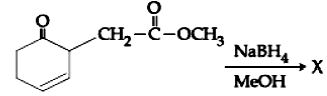
A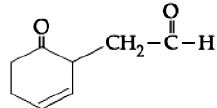
B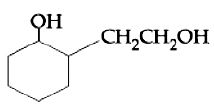
C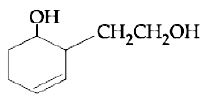
D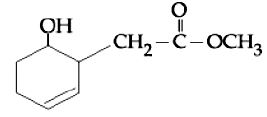
Solution
(D) $NaBH_4$ is a selective reducing agent that reduces ketones and aldehydes to alcohols but does not reduce esters or carboxylic acids.
In the given molecule,there is a ketone group and an ester group.
$NaBH_4$ will selectively reduce the ketone group to a secondary alcohol while leaving the ester group intact.
Therefore,the major product $X$ is an unsaturated cyclic alcohol with an ester side chain.
In the given molecule,there is a ketone group and an ester group.
$NaBH_4$ will selectively reduce the ketone group to a secondary alcohol while leaving the ester group intact.
Therefore,the major product $X$ is an unsaturated cyclic alcohol with an ester side chain.
0 likes
View Solution871
DifficultMCQ
The major product of the following reaction is:

A
$CH_3N=CH-CH_2-CH=CH-CH(OH)-CH_3$
B
$CH_3N=CH-(CH_2)_4-CH(OH)-CH_3$
C
$CH_3NH-CH_2-CH_2-CH_2-CH_2-CO-CH_3$
D
$CH_3NH-CH_2-CH_2-CH=CH-CH(OH)-CH_3$
Solution
(D) The reagent $NaBH_4$ (Sodium borohydride) is a selective reducing agent. It typically reduces aldehydes and ketones to alcohols,but it does not reduce isolated carbon-carbon double bonds $(C=C)$. However,it can reduce imines $(C=N)$ to amines $(C-NH)$. In the given molecule,there is an imine group $(CH_3N=CH-)$,a carbon-carbon double bond $(-CH=CH-)$,and a ketone group $(-CO-CH_3)$. $NaBH_4$ will reduce both the imine group and the ketone group,but it will leave the carbon-carbon double bond intact. Therefore,the product is $CH_3NH-CH_2-CH_2-CH=CH-CH(OH)-CH_3$.
0 likes
View Solution872
DifficultMCQ
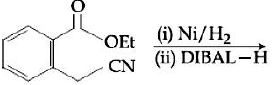
The major product of the following reaction is:
A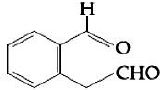
B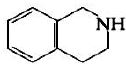
C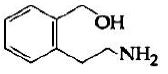
D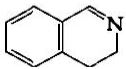
Solution
(D) Step $1$: The reaction of ethyl $2$-(cyanomethyl)benzoate with $H_2/Ni$ leads to the reduction of the nitrile group $(-CN)$ to a primary amine $(-CH_2NH_2)$.
Step $2$: The resulting amino ester undergoes intramolecular cyclization to form a cyclic amide (lactam),specifically $3,4$-dihydroisoquinolin-$1(2H)$-one.
Step $3$: The subsequent reaction with $DIBAL-H$ (diisobutylaluminium hydride) reduces the amide carbonyl group to an imine,resulting in $3,4$-dihydroisoquinoline as the final major product.
Step $2$: The resulting amino ester undergoes intramolecular cyclization to form a cyclic amide (lactam),specifically $3,4$-dihydroisoquinolin-$1(2H)$-one.
Step $3$: The subsequent reaction with $DIBAL-H$ (diisobutylaluminium hydride) reduces the amide carbonyl group to an imine,resulting in $3,4$-dihydroisoquinoline as the final major product.
0 likes
View Solution873
DifficultMCQ
What is the major product obtained in the following reaction?
[Image of a substituted cyclohexane ring with a carboxylic acid group,a vinyl group,a nitro group,and an acetyl group,reacting with excess $LiAlH_4$]
[Image of a substituted cyclohexane ring with a carboxylic acid group,a vinyl group,a nitro group,and an acetyl group,reacting with excess $LiAlH_4$]
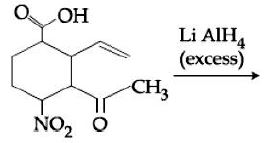
A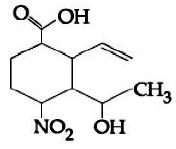
B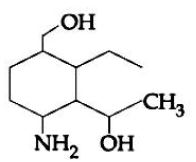
C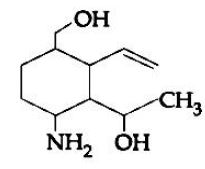
D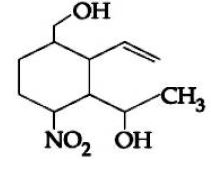
0 likes
View Solution874
MediumMCQ
In the following reaction:
$\text{Aldehyde} + \text{Alcohol} \xrightarrow{HCl} \text{Acetal}$
$HCHO \qquad ^tBuOH$
$CH_3CHO \qquad MeOH$
The best combination for the formation of acetal is:
$\text{Aldehyde} + \text{Alcohol} \xrightarrow{HCl} \text{Acetal}$
$HCHO \qquad ^tBuOH$
$CH_3CHO \qquad MeOH$
The best combination for the formation of acetal is:
A
$CH_3CHO$ and $^tBuOH$
B
$HCHO$ and $MeOH$
C
$CH_3CHO$ and $MeOH$
D
$HCHO$ and $^tBuOH$
Solution
(B) The formation of acetal from an aldehyde and an alcohol is a nucleophilic addition reaction.
This reaction is highly sensitive to steric hindrance.
$Rate \propto \frac{1}{\text{Steric Crowding}}$.
$HCHO$ is the least sterically hindered aldehyde,and $MeOH$ is the least sterically hindered alcohol.
Therefore,the combination of $HCHO$ and $MeOH$ provides the fastest and most efficient reaction to form an acetal.
This reaction is highly sensitive to steric hindrance.
$Rate \propto \frac{1}{\text{Steric Crowding}}$.
$HCHO$ is the least sterically hindered aldehyde,and $MeOH$ is the least sterically hindered alcohol.
Therefore,the combination of $HCHO$ and $MeOH$ provides the fastest and most efficient reaction to form an acetal.
0 likes
View Solution875
DifficultMCQ
In the following reactions,products $A$ and $B$ are
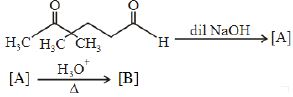
A
$A = \text{3-hydroxy-6,6-dimethylcyclohexanone}; B = \text{6,6-dimethylcyclohex-2-enone}$
B
$A = \text{3-hydroxy-2,2-dimethylcyclohexanone}; B = \text{6,6-dimethylcyclohex-2-enone}$
C
$A = \text{2-hydroxy-2,3-dimethylcyclobutanecarbaldehyde}; B = \text{2,3-dimethylcyclobut-2-enecarbaldehyde}$
D
$A = \text{2-hydroxy-2,3-dimethylcyclobutanecarbaldehyde}; B = \text{2-methylene-3,3-dimethylcyclobutanecarbaldehyde}$
Solution
(B) The given reaction is an intramolecular Aldol condensation followed by dehydration.
$1$. The starting material is $6,6-\text{dimethylheptan-2-one}$ (or a similar keto-aldehyde structure). The base $(OH^-)$ abstracts an $\alpha$-hydrogen from the ketone group to form an enolate.
$2$. This enolate attacks the carbonyl carbon of the aldehyde group,leading to the formation of a cyclic $\beta$-hydroxy ketone,which is product $A$.
$3$. Upon heating with acid $(H_3O^+/\Delta)$,the $\beta$-hydroxy ketone undergoes dehydration (elimination of water) to form an $\alpha,\beta$-unsaturated ketone,which is product $B$.
$4$. Based on the structure,$A$ is $3-\text{hydroxy}-2,2-\text{dimethylcyclohexanone}$ and $B$ is $6,6-\text{dimethylcyclohex}-2-\text{enone}$.
$1$. The starting material is $6,6-\text{dimethylheptan-2-one}$ (or a similar keto-aldehyde structure). The base $(OH^-)$ abstracts an $\alpha$-hydrogen from the ketone group to form an enolate.
$2$. This enolate attacks the carbonyl carbon of the aldehyde group,leading to the formation of a cyclic $\beta$-hydroxy ketone,which is product $A$.
$3$. Upon heating with acid $(H_3O^+/\Delta)$,the $\beta$-hydroxy ketone undergoes dehydration (elimination of water) to form an $\alpha,\beta$-unsaturated ketone,which is product $B$.
$4$. Based on the structure,$A$ is $3-\text{hydroxy}-2,2-\text{dimethylcyclohexanone}$ and $B$ is $6,6-\text{dimethylcyclohex}-2-\text{enone}$.
0 likes
View Solution876
DifficultMCQ
The major product of the following reaction is:
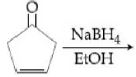
A
$3-$ethoxycyclopentan$-1-$ol
B
cyclopent$-3-$en$-1-$ol
C
cyclopentanone
D
cyclopentanol
Solution
(B) $NaBH_4$ is a selective reducing agent that reduces carbonyl groups (aldehydes and ketones) to alcohols but does not reduce carbon-carbon double bonds $(C=C)$.
In the given reaction,the ketone group of cyclopent$-3-$en$-1-$one is reduced to an alcohol group,while the double bond remains unaffected.
Therefore,the major product is cyclopent$-3-$en$-1-$ol.
In the given reaction,the ketone group of cyclopent$-3-$en$-1-$one is reduced to an alcohol group,while the double bond remains unaffected.
Therefore,the major product is cyclopent$-3-$en$-1-$ol.
0 likes
View Solution877
DifficultMCQ
The aldehydes which will not form a single Grignard product with one equivalent of Grignard reagent are:
$(a)$ Benzaldehyde
$(b)$ $4$-Formylbenzoic acid
$(c)$ $4$-Methoxybenzaldehyde
$(d)$ $4$-(Hydroxymethyl)benzaldehyde
$(a)$ Benzaldehyde
$(b)$ $4$-Formylbenzoic acid
$(c)$ $4$-Methoxybenzaldehyde
$(d)$ $4$-(Hydroxymethyl)benzaldehyde
A
$ (b), (d) $
B
$ (b), (c) $
C
$ (b), (c), (d) $
D
$ (c), (d) $
Solution
(A) Grignard reagents are strong bases as well as nucleophiles. They react with acidic protons (like those in $-COOH$ or $-OH$ groups) before reacting with the carbonyl group.
$(a)$ Benzaldehyde has no acidic protons,so $1$ equivalent of Grignard reagent reacts with the aldehyde group.
$(b)$ $4$-Formylbenzoic acid contains an acidic $-COOH$ group. It consumes $1$ equivalent of Grignard reagent for acid-base reaction and another for the aldehyde,totaling $2$ equivalents.
$(c)$ $4$-Methoxybenzaldehyde has no acidic protons,so $1$ equivalent reacts with the aldehyde group.
$(d)$ $4$-(Hydroxymethyl)benzaldehyde contains an acidic $-OH$ group. It consumes $1$ equivalent for acid-base reaction and another for the aldehyde,totaling $2$ equivalents.
Thus,compounds $(b)$ and $(d)$ will not form a single Grignard product with only $1$ equivalent of reagent.
$(a)$ Benzaldehyde has no acidic protons,so $1$ equivalent of Grignard reagent reacts with the aldehyde group.
$(b)$ $4$-Formylbenzoic acid contains an acidic $-COOH$ group. It consumes $1$ equivalent of Grignard reagent for acid-base reaction and another for the aldehyde,totaling $2$ equivalents.
$(c)$ $4$-Methoxybenzaldehyde has no acidic protons,so $1$ equivalent reacts with the aldehyde group.
$(d)$ $4$-(Hydroxymethyl)benzaldehyde contains an acidic $-OH$ group. It consumes $1$ equivalent for acid-base reaction and another for the aldehyde,totaling $2$ equivalents.
Thus,compounds $(b)$ and $(d)$ will not form a single Grignard product with only $1$ equivalent of reagent.
0 likes
View Solution878
DifficultMCQ
An organic compound neither reacts with neutral ferric chloride solution nor with Fehling solution. It,however,reacts with Grignard reagent and gives a positive iodoform test. The compound is:
A
$2-$hydroxyacetophenone
B
$1-$($2$-methoxyphenyl)propan$-1-$one
C
$1-$($2$-hydroxyphenyl)propan$-1-$one
D
$2-$methoxybenzaldehyde
Solution
(C) The compound must satisfy the following conditions:
$1$. Negative test with neutral $FeCl_3$ solution: This indicates the absence of a phenolic $-OH$ group.
$2$. Negative test with Fehling solution: This indicates the absence of an aldehyde $(-CHO)$ group.
$3$. Reacts with Grignard reagent $(RMgX)$: This indicates the presence of an acidic hydrogen (e.g.,$-OH$ group) or a carbonyl group.
$4$. Positive iodoform test: This indicates the presence of a $CH_3CO-$ group or a $CH_3CH(OH)-$ group.
Analyzing the options:
- Option $A$ ($2$-hydroxyacetophenone) contains a phenolic $-OH$ group,so it would give a positive test with neutral $FeCl_3$.
- Option $B$ ($1-(2$-methoxyphenyl)propan-$1$-one) does not contain a $CH_3CO-$ or $CH_3CH(OH)-$ group,so it would not give a positive iodoform test.
- Option $C$ ($1-(2$-hydroxyphenyl)propan-$1$-one) is incorrect as it contains a phenolic group.
- The structure provided in the solution image corresponds to $1-(2$-hydroxyphenyl)ethanol derivative or similar,but based on the standard chemistry of these functional groups,the compound that satisfies all conditions is one that lacks a phenolic group but possesses a $CH_3CH(OH)-$ moiety and a ketone group. Given the options,the structure in option $C$ is often represented in such problems,but if we strictly follow the criteria,the compound is $1-(2$-hydroxyphenyl)propan-$1$-one derivative. However,based on the provided solution image,the correct structure is $1-(2$-hydroxyphenyl)propan-$1$-one.
$1$. Negative test with neutral $FeCl_3$ solution: This indicates the absence of a phenolic $-OH$ group.
$2$. Negative test with Fehling solution: This indicates the absence of an aldehyde $(-CHO)$ group.
$3$. Reacts with Grignard reagent $(RMgX)$: This indicates the presence of an acidic hydrogen (e.g.,$-OH$ group) or a carbonyl group.
$4$. Positive iodoform test: This indicates the presence of a $CH_3CO-$ group or a $CH_3CH(OH)-$ group.
Analyzing the options:
- Option $A$ ($2$-hydroxyacetophenone) contains a phenolic $-OH$ group,so it would give a positive test with neutral $FeCl_3$.
- Option $B$ ($1-(2$-methoxyphenyl)propan-$1$-one) does not contain a $CH_3CO-$ or $CH_3CH(OH)-$ group,so it would not give a positive iodoform test.
- Option $C$ ($1-(2$-hydroxyphenyl)propan-$1$-one) is incorrect as it contains a phenolic group.
- The structure provided in the solution image corresponds to $1-(2$-hydroxyphenyl)ethanol derivative or similar,but based on the standard chemistry of these functional groups,the compound that satisfies all conditions is one that lacks a phenolic group but possesses a $CH_3CH(OH)-$ moiety and a ketone group. Given the options,the structure in option $C$ is often represented in such problems,but if we strictly follow the criteria,the compound is $1-(2$-hydroxyphenyl)propan-$1$-one derivative. However,based on the provided solution image,the correct structure is $1-(2$-hydroxyphenyl)propan-$1$-one.
0 likes
View Solution879
DifficultMCQ
The major product of the following reaction is:
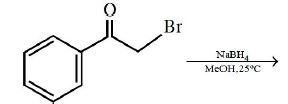
A
$2-$methoxy$-1-$phenylethanol
B
$2-$bromo$-1-$phenylethanol
C
($1$-methoxyvinyl)benzene
D
phenyloxirane
Solution
(D) The reaction involves the reduction of the carbonyl group of $2$-bromoacetophenone by $NaBH_4$ to form an alkoxide intermediate.
This intermediate then undergoes an intramolecular nucleophilic substitution reaction,where the alkoxide oxygen attacks the carbon bearing the bromine atom,displacing the bromide ion to form an epoxide ring.
Thus,the final product is phenyloxirane.
This intermediate then undergoes an intramolecular nucleophilic substitution reaction,where the alkoxide oxygen attacks the carbon bearing the bromine atom,displacing the bromide ion to form an epoxide ring.
Thus,the final product is phenyloxirane.
0 likes
View Solution880
DifficultMCQ
The major product obtained in the following reaction is
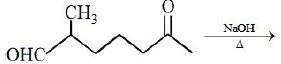
A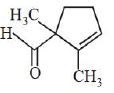
B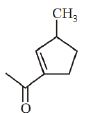
C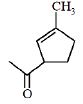
D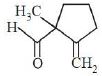
Solution
(B) The given reaction is an intramolecular aldol condensation of $6$-oxoheptanal.
In the presence of a base $(NaOH)$ and heat $(\Delta)$,the enolate ion formed at the $\alpha$-carbon of the ketone attacks the carbonyl carbon of the aldehyde.
This leads to the formation of a five-membered ring.
Subsequent dehydration (loss of $H_2O$) results in the formation of the $\alpha,\beta$-unsaturated carbonyl compound.
The major product is $3$-methylcyclopent$-2-$en$-1-$one derivative,which corresponds to option $B$.
In the presence of a base $(NaOH)$ and heat $(\Delta)$,the enolate ion formed at the $\alpha$-carbon of the ketone attacks the carbonyl carbon of the aldehyde.
This leads to the formation of a five-membered ring.
Subsequent dehydration (loss of $H_2O$) results in the formation of the $\alpha,\beta$-unsaturated carbonyl compound.
The major product is $3$-methylcyclopent$-2-$en$-1-$one derivative,which corresponds to option $B$.
0 likes
View Solution881
DifficultMCQ
Which of the following compounds will show the maximum 'enol' content?
A
$CH_3COCH_3$
B
$CH_3COCH_2CONH_2$
C
$CH_3COCH_2COCH_3$
D
$CH_3COCH_2COOC_2H_5$
Solution
(C) The 'enol' content is determined by the stability of the resulting enol form.
$CH_3COCH_2COCH_3$ (acetylacetone) is a $\beta$-diketone.
It contains an active methylene group $(-CH_2-)$ flanked by two electron-withdrawing carbonyl groups.
The enol form of acetylacetone is highly stabilized by:
$1$. Conjugation between the $C=C$ double bond and the $C=O$ carbonyl group.
$2$. Intramolecular hydrogen bonding,which forms a stable $6$-membered ring structure.
Due to these factors,$CH_3COCH_2COCH_3$ exhibits the maximum 'enol' content among the given options.
$CH_3COCH_2COCH_3$ (acetylacetone) is a $\beta$-diketone.
It contains an active methylene group $(-CH_2-)$ flanked by two electron-withdrawing carbonyl groups.
The enol form of acetylacetone is highly stabilized by:
$1$. Conjugation between the $C=C$ double bond and the $C=O$ carbonyl group.
$2$. Intramolecular hydrogen bonding,which forms a stable $6$-membered ring structure.
Due to these factors,$CH_3COCH_2COCH_3$ exhibits the maximum 'enol' content among the given options.
0 likes
View Solution882
DifficultMCQ
The major products $A$ and $B$ for the following reactions are,respectively:

A
Product $A$ is a cyanohydrin and $B$ is an amine.
B
Product $A$ is a substituted cyclohexanone with a cyano group and $B$ is a substituted cyclohexanol with an amine group.
C
Product $A$ is a cyanohydrin and $B$ is a substituted cyclohexanol with an amine group.
D
Product $A$ is a substituted cyclohexanone with a cyano group and $B$ is a substituted cyclohexanone with an amine group.
Solution
(B) $1$. In the first step,the reaction of $2-(2-iodoethyl)cyclohexanone$ with $KCN$ in $DMSO$ proceeds via an $S_N2$ mechanism. The $CN^-$ nucleophile replaces the iodide ion,resulting in $2-(2-cyanoethyl)cyclohexanone$ as product $A$.
$2$. In the second step,the catalytic hydrogenation of product $A$ using $H_2/Pd$ reduces both the ketone group to a secondary alcohol and the nitrile group to a primary amine. Thus,product $B$ is $2-(3-aminopropyl)cyclohexanol$.
$2$. In the second step,the catalytic hydrogenation of product $A$ using $H_2/Pd$ reduces both the ketone group to a secondary alcohol and the nitrile group to a primary amine. Thus,product $B$ is $2-(3-aminopropyl)cyclohexanol$.
0 likes
View Solution883
DifficultMCQ
In the following reaction:
$\text{Carbonyl compound} + MeOH \xleftarrow[HCl]{} \text{acetal}$
The rate of the reaction is the highest for:
$\text{Carbonyl compound} + MeOH \xleftarrow[HCl]{} \text{acetal}$
The rate of the reaction is the highest for:
A
Acetone as substrate and methanol in stoichiometric amount
B
Propanal as substrate and methanol in stoichiometric amount
C
Acetone as substrate and methanol in excess
D
Propanal as substrate and methanol in excess
Solution
(D) The rate of nucleophilic addition reaction follows the order: $\text{Aldehydes} > \text{Ketones}$.
Only aldehydes react with alcohols to form acetals under these conditions.
Furthermore,an excess of $MeOH$ is required to shift the equilibrium towards the forward direction according to Le Chatelier's principle.
Only aldehydes react with alcohols to form acetals under these conditions.
Furthermore,an excess of $MeOH$ is required to shift the equilibrium towards the forward direction according to Le Chatelier's principle.
0 likes
View Solution884
DifficultMCQ
The major products of the following reaction are:

A
$CH_3OH$ and $HCO_2H$
B
$\text{Benzyl alcohol and Formic acid}$
C
$\text{Benzyl alcohol and Benzoic acid}$
D
$\text{Methanol and Benzoic acid}$
Solution
(B) The given reaction is a cross-Cannizzaro reaction between benzaldehyde $(C_6H_5CHO)$ and formaldehyde $(HCHO)$.
In a cross-Cannizzaro reaction,the more reactive carbonyl compound (formaldehyde) is oxidized to the corresponding acid (formate ion,which gives formic acid $HCOOH$ upon acidification),and the less reactive carbonyl compound (benzaldehyde) is reduced to the corresponding alcohol (benzyl alcohol,$C_6H_5CH_2OH$).
Therefore,the products are benzyl alcohol and formic acid.
In a cross-Cannizzaro reaction,the more reactive carbonyl compound (formaldehyde) is oxidized to the corresponding acid (formate ion,which gives formic acid $HCOOH$ upon acidification),and the less reactive carbonyl compound (benzaldehyde) is reduced to the corresponding alcohol (benzyl alcohol,$C_6H_5CH_2OH$).
Therefore,the products are benzyl alcohol and formic acid.
0 likes
View Solution885
DifficultMCQ
The major product $Y$ in the following reaction is:
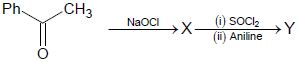
A
B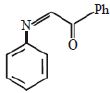
C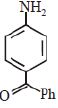
D
Solution
(A) $1$. The reaction of acetophenone $(PhCOCH_3)$ with $NaOCl$ is a haloform reaction,which converts the methyl ketone group into a carboxylate salt,followed by acidification to give benzoic acid $(PhCOOH)$ as product $X$.
$2$. Benzoic acid $(PhCOOH)$ reacts with $SOCl_2$ to form benzoyl chloride $(PhCOCl)$.
$3$. Benzoyl chloride then reacts with aniline $(PhNH_2)$ via a nucleophilic acyl substitution reaction to form $N$-phenylbenzamide $(PhCONHPh)$ as the major product $Y$.
$2$. Benzoic acid $(PhCOOH)$ reacts with $SOCl_2$ to form benzoyl chloride $(PhCOCl)$.
$3$. Benzoyl chloride then reacts with aniline $(PhNH_2)$ via a nucleophilic acyl substitution reaction to form $N$-phenylbenzamide $(PhCONHPh)$ as the major product $Y$.
0 likes
View Solution886
AdvancedMCQ
Compound $A$ $(C_9H_{10}O)$ shows a positive iodoform test. Oxidation of $A$ with $KMnO_4/KOH$ gives acid $B$ $(C_8H_6O_4)$. The anhydride of $B$ is used for the preparation of phenolphthalein. Compound $A$ is:
A
$2-$Methylacetophenone
B
$3-$Methylacetophenone
C
$2-$Ethylbenzaldehyde
D
$4-$Methylacetophenone
Solution
(A) $1$. Compound $A$ $(C_9H_{10}O)$ gives a positive iodoform test,which indicates the presence of a $CH_3CO-$ group attached to a carbon or hydrogen atom.
$2$. Oxidation of $A$ with $KMnO_4/KOH$ yields acid $B$ $(C_8H_6O_4)$.
$3$. The anhydride of $B$ is used to prepare phenolphthalein,which identifies $B$ as phthalic acid (benzene$-1,2-$dicarboxylic acid).
$4$. For $A$ to oxidize to phthalic acid,it must have two alkyl groups at the ortho positions of the benzene ring,one of which is an acetyl group $(CH_3CO-)$ and the other is a methyl group $(CH_3-)$.
$5$. Therefore,$A$ is $2$-methylacetophenone.
$2$. Oxidation of $A$ with $KMnO_4/KOH$ yields acid $B$ $(C_8H_6O_4)$.
$3$. The anhydride of $B$ is used to prepare phenolphthalein,which identifies $B$ as phthalic acid (benzene$-1,2-$dicarboxylic acid).
$4$. For $A$ to oxidize to phthalic acid,it must have two alkyl groups at the ortho positions of the benzene ring,one of which is an acetyl group $(CH_3CO-)$ and the other is a methyl group $(CH_3-)$.
$5$. Therefore,$A$ is $2$-methylacetophenone.
0 likes
View Solution887
MediumMCQ
Tollen's reagent is
A
$[Ag(NH_3)_2]^+$
B
$Ag_2O$
C
$Cu_2O$
D
$[Cu(OH)_4]^{2-}$
Solution
(A) Tollen's reagent is an ammoniacal silver nitrate solution.
It contains the diamminesilver$(I)$ complex ion,represented as $[Ag(NH_3)_2]^+$.
This reagent is used to distinguish aldehydes from ketones,as aldehydes reduce the silver ion to metallic silver,forming a 'silver mirror' on the inner walls of the test tube.
It contains the diamminesilver$(I)$ complex ion,represented as $[Ag(NH_3)_2]^+$.
This reagent is used to distinguish aldehydes from ketones,as aldehydes reduce the silver ion to metallic silver,forming a 'silver mirror' on the inner walls of the test tube.
0 likes
View Solution888
MediumMCQ
Which of the following can be used to convert $3$-methylbutan-$2$-one into isopentane?
A
$Zn-Hg / \text{conc. } HCl$
B
$NH_2-NH_2 / OH^- / \text{ethylene glycol}$
C
$\text{Red } P / HI$
D
$\text{All of these}$
Solution
(D) The conversion of a ketone ($3$-methylbutan-$2$-one) into an alkane (isopentane) is a reduction reaction of the carbonyl group to a methylene group.
$1$. $Zn-Hg / \text{conc. } HCl$ is the reagent for Clemmensen reduction.
$2$. $NH_2-NH_2 / OH^- / \text{ethylene glycol}$ is the reagent for Wolff-Kishner reduction.
$3$. $\text{Red } P / HI$ is a strong reducing agent capable of reducing carbonyl compounds to alkanes.
Since all three reagents are capable of reducing the ketone to an alkane,the correct answer is $D$.
$1$. $Zn-Hg / \text{conc. } HCl$ is the reagent for Clemmensen reduction.
$2$. $NH_2-NH_2 / OH^- / \text{ethylene glycol}$ is the reagent for Wolff-Kishner reduction.
$3$. $\text{Red } P / HI$ is a strong reducing agent capable of reducing carbonyl compounds to alkanes.
Since all three reagents are capable of reducing the ketone to an alkane,the correct answer is $D$.
0 likes
View Solution889
DifficultMCQ
Which of the following reagents can be used for the given chemical transformation?
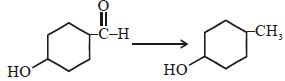
A
$Red \, P + HI$
B
$NH_2-NH_2 + OH^-$
C
$Zn(Hg) + HCl$
D
All of the above
Solution
(D) The given reaction involves the reduction of an aldehyde group $(-CHO)$ to a methyl group $(-CH_3)$ in the presence of a hydroxyl group $(-OH)$.
$1$. $Red \, P + HI$ is a strong reducing agent that reduces carbonyl groups to alkanes.
$2$. $NH_2-NH_2 + OH^-$ (Wolff-Kishner reduction) reduces carbonyl groups to alkanes under basic conditions.
$3$. $Zn(Hg) + HCl$ (Clemmensen reduction) reduces carbonyl groups to alkanes under acidic conditions.
Since the substrate contains an alcohol group $(-OH)$,which is sensitive to acid,the Clemmensen reduction $(Zn(Hg) + HCl)$ might cause side reactions like dehydration or substitution. However,all three reagents are standard methods for reducing aldehydes/ketones to alkanes. Given the options,all are typically cited as reagents for this transformation.
$1$. $Red \, P + HI$ is a strong reducing agent that reduces carbonyl groups to alkanes.
$2$. $NH_2-NH_2 + OH^-$ (Wolff-Kishner reduction) reduces carbonyl groups to alkanes under basic conditions.
$3$. $Zn(Hg) + HCl$ (Clemmensen reduction) reduces carbonyl groups to alkanes under acidic conditions.
Since the substrate contains an alcohol group $(-OH)$,which is sensitive to acid,the Clemmensen reduction $(Zn(Hg) + HCl)$ might cause side reactions like dehydration or substitution. However,all three reagents are standard methods for reducing aldehydes/ketones to alkanes. Given the options,all are typically cited as reagents for this transformation.
0 likes
View Solution890
DifficultMCQ
$CH_3-C(O)-CH_2-CH_2-CH_2-CH_2-CHO \xrightarrow{HO^{-} / \Delta} (A) (73\%)$
Product $(A)$ is
Product $(A)$ is
A
Cycloheptenone
B
$1-$acetylcyclopentene
C
$2-$methylcyclopent$-1-$enecarbaldehyde
D
$1-$acetylcyclopentane
Solution
(B) The reaction is an intramolecular Aldol condensation.
The reactant $CH_3-C(O)-CH_2-CH_2-CH_2-CH_2-CHO$ contains both a ketone and an aldehyde group.
Under basic conditions $(HO^{-} / \Delta)$,the $\alpha$-hydrogen of the ketone is removed to form an enolate.
This enolate then undergoes a nucleophilic attack on the aldehyde carbonyl carbon.
This leads to the formation of a $5$-membered ring,which is thermodynamically favored over a $7$-membered ring.
Subsequent dehydration (loss of $H_2O$) yields the conjugated enone,$1$-acetylcyclopentene.
The reactant $CH_3-C(O)-CH_2-CH_2-CH_2-CH_2-CHO$ contains both a ketone and an aldehyde group.
Under basic conditions $(HO^{-} / \Delta)$,the $\alpha$-hydrogen of the ketone is removed to form an enolate.
This enolate then undergoes a nucleophilic attack on the aldehyde carbonyl carbon.
This leads to the formation of a $5$-membered ring,which is thermodynamically favored over a $7$-membered ring.
Subsequent dehydration (loss of $H_2O$) yields the conjugated enone,$1$-acetylcyclopentene.
0 likes
View Solution891
DifficultMCQ
Which of the following pairs is differentiated by the iodoform test?
A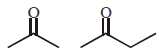
B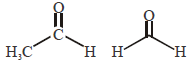
C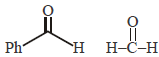
D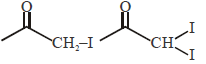
Solution
(B) The iodoform test is given by compounds containing the $CH_3CO-$ group or compounds that can be oxidized to this group (like $CH_3CH(OH)-$ group).
In option $B$,the pair is $CH_3CHO$ (acetaldehyde) and $HCHO$ (formaldehyde).
$CH_3CHO$ contains the $CH_3CO-$ group and gives a positive iodoform test (yellow precipitate of $CHI_3$).
$HCHO$ does not contain the $CH_3CO-$ group and does not give the iodoform test.
Therefore,they can be differentiated by the iodoform test.
In option $B$,the pair is $CH_3CHO$ (acetaldehyde) and $HCHO$ (formaldehyde).
$CH_3CHO$ contains the $CH_3CO-$ group and gives a positive iodoform test (yellow precipitate of $CHI_3$).
$HCHO$ does not contain the $CH_3CO-$ group and does not give the iodoform test.
Therefore,they can be differentiated by the iodoform test.
0 likes
View Solution892
MediumMCQ
Which of the following reactions is correctly matched?
A
But$-1-$ene $\xrightarrow{HCl/H_2O_2}$ $1-$chlorobutane
B
Butan$-2-$one $\xrightarrow{HCN/OH^-}$ $2-$hydroxy$-2-$methylbutanenitrile
C
Cyclohexene $\xrightarrow{Cl_2/\Delta}$ trans$-1,2-$dichlorocyclohexane
D
All of these
Solution
(B) : The reaction of but$-1-$ene with $HCl$ in the presence of $H_2O_2$ (peroxide) does not follow anti-Markovnikov addition because peroxide effect is only applicable for $HBr$. Thus,it gives $2-$chlorobutane,not $1-$chlorobutane. This is incorrect.
$B$: The reaction of butan$-2-$one with $HCN$ in the presence of $OH^-$ is a nucleophilic addition reaction forming a cyanohydrin. The product is $2-$hydroxy$-2-$methylbutanenitrile. This is correct.
$C$: The reaction of cyclohexene with $Cl_2$ in the presence of heat (or light) typically leads to allylic substitution,not addition. Addition of $Cl_2$ to cyclohexene occurs at room temperature to give trans$-1,2-$dichlorocyclohexane. This is incorrect.
Therefore,only option $B$ is correctly matched.
$B$: The reaction of butan$-2-$one with $HCN$ in the presence of $OH^-$ is a nucleophilic addition reaction forming a cyanohydrin. The product is $2-$hydroxy$-2-$methylbutanenitrile. This is correct.
$C$: The reaction of cyclohexene with $Cl_2$ in the presence of heat (or light) typically leads to allylic substitution,not addition. Addition of $Cl_2$ to cyclohexene occurs at room temperature to give trans$-1,2-$dichlorocyclohexane. This is incorrect.
Therefore,only option $B$ is correctly matched.
0 likes
View Solution893
AdvancedMCQ
Consider the reaction sequence and identify $'C'$.
$A + B \xrightarrow{dil \ NaOH / \Delta} C$
(The reaction sequence is: $3,3-\text{dimethylbut-1-ene} \xrightarrow[(ii) Zn/H_2O]{(i) O_3} A + B$)
$A + B \xrightarrow{dil \ NaOH / \Delta} C$
(The reaction sequence is: $3,3-\text{dimethylbut-1-ene} \xrightarrow[(ii) Zn/H_2O]{(i) O_3} A + B$)
A
$3-\text{hydroxy}-4,4-\text{dimethylpentanal}$
B
$3-\text{methylhex-4-en-3-one}$
C
$4,4-\text{dimethylpent-2-enal}$
D
$4,4-\text{dimethylpent-2-enoic acid}$
Solution
(A) $1$. Ozonolysis of $3,3-\text{dimethylbut-1-ene}$ $(CH_3-C(CH_3)_2-CH=CH_2)$ yields $A$ and $B$.
$2$. The products are $A = (CH_3)_3C-CHO$ $(2,2-\text{dimethylpropanal})$ and $B = HCHO$ (formaldehyde).
$3$. The reaction $A + B \xrightarrow{dil \ NaOH / \Delta} C$ is a cross-aldol condensation.
$4$. Since $HCHO$ has no $\alpha-\text{hydrogen}$,it acts as the electrophile (acceptor),and $2,2-\text{dimethylpropanal}$ acts as the nucleophile (donor) because it has $\alpha-\text{hydrogens}$.
$5$. The aldol product formed is $3-\text{hydroxy}-4,4-\text{dimethylpentanal}$.
$2$. The products are $A = (CH_3)_3C-CHO$ $(2,2-\text{dimethylpropanal})$ and $B = HCHO$ (formaldehyde).
$3$. The reaction $A + B \xrightarrow{dil \ NaOH / \Delta} C$ is a cross-aldol condensation.
$4$. Since $HCHO$ has no $\alpha-\text{hydrogen}$,it acts as the electrophile (acceptor),and $2,2-\text{dimethylpropanal}$ acts as the nucleophile (donor) because it has $\alpha-\text{hydrogens}$.
$5$. The aldol product formed is $3-\text{hydroxy}-4,4-\text{dimethylpentanal}$.
0 likes
View Solution894
MediumMCQ
What are the correct products of the following reaction?
$CH_3CH_2COCH_3 \xrightarrow{NaOCl} \text{Products}$
$CH_3CH_2COCH_3 \xrightarrow{NaOCl} \text{Products}$
A
$CHCl_3$
B
$CH_3CH_2COOH$
C
$CH_3CH_2COONa$
D
Both $(A)$ and $(C)$
Solution
(D) The given reaction is a Haloform reaction.
When a methyl ketone like $2$-butanone $(CH_3CH_2COCH_3)$ reacts with sodium hypochlorite $(NaOCl)$,it undergoes oxidative cleavage to form a sodium salt of a carboxylic acid (with one less carbon atom than the starting ketone) and chloroform $(CHCl_3)$.
The chemical equation is:
$CH_3CH_2COCH_3 + 3NaOCl \rightarrow CH_3CH_2COONa + CHCl_3 + 2NaOH$
Therefore,both $CHCl_3$ (Option $A$) and $CH_3CH_2COONa$ (Option $C$) are the correct products.
When a methyl ketone like $2$-butanone $(CH_3CH_2COCH_3)$ reacts with sodium hypochlorite $(NaOCl)$,it undergoes oxidative cleavage to form a sodium salt of a carboxylic acid (with one less carbon atom than the starting ketone) and chloroform $(CHCl_3)$.
The chemical equation is:
$CH_3CH_2COCH_3 + 3NaOCl \rightarrow CH_3CH_2COONa + CHCl_3 + 2NaOH$
Therefore,both $CHCl_3$ (Option $A$) and $CH_3CH_2COONa$ (Option $C$) are the correct products.
0 likes
View Solution895
AdvancedMCQ
Which of the following carbonyl compounds forms the most stable hydrate when $H_2O$ is added across the $C=O$ group?
A
Benzaldehyde
B
Indan$-2-$one
C
Benzophenone
D
Indane$-1,2,3-$trione
Solution
(D) The stability of a hydrate formed by the addition of $H_2O$ to a carbonyl group depends on the electrophilicity of the carbonyl carbon and the presence of intramolecular hydrogen bonding.
Indane$-1,2,3-$trione has three carbonyl groups. The central carbonyl group is highly electrophilic due to the electron-withdrawing effect of the two adjacent carbonyl groups.
Upon hydration,the resulting gem-diol (hydrate) is stabilized by intramolecular hydrogen bonding between the hydroxyl groups of the hydrate and the oxygen atoms of the adjacent carbonyl groups.
This stabilization makes the hydrate of indane$-1,2,3-$trione significantly more stable than the hydrates of the other given compounds.
Indane$-1,2,3-$trione has three carbonyl groups. The central carbonyl group is highly electrophilic due to the electron-withdrawing effect of the two adjacent carbonyl groups.
Upon hydration,the resulting gem-diol (hydrate) is stabilized by intramolecular hydrogen bonding between the hydroxyl groups of the hydrate and the oxygen atoms of the adjacent carbonyl groups.
This stabilization makes the hydrate of indane$-1,2,3-$trione significantly more stable than the hydrates of the other given compounds.
0 likes
View Solution896
MediumMCQ
Which of the following gives the iodoform test?
A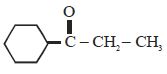
B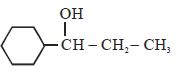
C
$CH_3-CONH_2$
D
$CH_3-CHO$
Solution
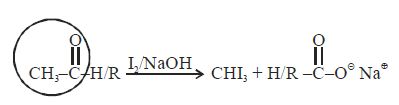
(D) The iodoform test is given by compounds containing the $CH_3-CO-$ group or $CH_3-CH(OH)-$ group.
Acetaldehyde $(CH_3-CHO)$ contains the $CH_3-CO-$ group and thus gives a positive iodoform test.
Acetamide $(CH_3-CONH_2)$ does not contain the required methyl ketone or methyl carbinol structural unit and does not give this test.
The structures in options $(a)$ and $(b)$ also do not contain the $CH_3-CO-$ or $CH_3-CH(OH)-$ group.
Acetaldehyde $(CH_3-CHO)$ contains the $CH_3-CO-$ group and thus gives a positive iodoform test.
Acetamide $(CH_3-CONH_2)$ does not contain the required methyl ketone or methyl carbinol structural unit and does not give this test.
The structures in options $(a)$ and $(b)$ also do not contain the $CH_3-CO-$ or $CH_3-CH(OH)-$ group.
0 likes
View Solution897
MediumMCQ
Haloform reaction is characteristic of
A
Carbonyl compound having $-C(=O)-CH_3$ group
B
Compound having $-C(=O)-Cl$ group
C
$CH_3-C(=O)-NH_2$
D
Anhydride
Solution
(A) The haloform reaction is a characteristic test for methyl ketones (compounds containing the $-C(=O)-CH_3$ group) and secondary alcohols containing the $CH_3-CH(OH)-$ group.
When these compounds react with a halogen in the presence of an aqueous base,they undergo oxidation and cleavage to form a haloform ($CHX_3$,where $X = Cl, Br, I$) and a salt of a carboxylic acid.
When these compounds react with a halogen in the presence of an aqueous base,they undergo oxidation and cleavage to form a haloform ($CHX_3$,where $X = Cl, Br, I$) and a salt of a carboxylic acid.
0 likes
View Solution898
DifficultMCQ
The structure of the main product $(B)$ of the following reaction will be:

A
Benzoic acid
B
$3-$hydroxy$-3-$phenyl$-1-$phenylbutan$-1-$one
C
$1,3-$diphenyl$-2-$methylprop$-2-$en$-1-$one
D
$1-$phenylethanol and benzoic acid
Solution
(C) The given reaction is an aldol condensation of acetophenone $(C_6H_5COCH_3)$.
Step $1$: Two molecules of acetophenone react in the presence of a base $(OH^-)$ to form a $\beta$-hydroxy ketone (aldol product,$A$).
$2 C_6H_5COCH_3 \xrightarrow{OH^-} C_6H_5C(OH)(CH_3)CH_2COC_6H_5$ (Product $A$)
Step $2$: Upon heating $(\Delta)$,the $\beta$-hydroxy ketone undergoes dehydration to form an $\alpha,\beta$-unsaturated ketone (Product $B$).
$C_6H_5C(OH)(CH_3)CH_2COC_6H_5 \xrightarrow{\Delta} C_6H_5C(CH_3)=CHCOC_6H_5$ (Product $B$)
Thus,the final product $(B)$ is $1,3$-diphenyl-$2$-methylprop-$2$-en-$1$-one.
Step $1$: Two molecules of acetophenone react in the presence of a base $(OH^-)$ to form a $\beta$-hydroxy ketone (aldol product,$A$).
$2 C_6H_5COCH_3 \xrightarrow{OH^-} C_6H_5C(OH)(CH_3)CH_2COC_6H_5$ (Product $A$)
Step $2$: Upon heating $(\Delta)$,the $\beta$-hydroxy ketone undergoes dehydration to form an $\alpha,\beta$-unsaturated ketone (Product $B$).
$C_6H_5C(OH)(CH_3)CH_2COC_6H_5 \xrightarrow{\Delta} C_6H_5C(CH_3)=CHCOC_6H_5$ (Product $B$)
Thus,the final product $(B)$ is $1,3$-diphenyl-$2$-methylprop-$2$-en-$1$-one.
0 likes
View Solution899
MediumMCQ
Arrange the following in increasing order of their acidic strength:
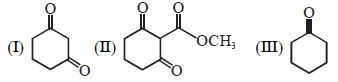
A
$II > I > III$
B
$III > II > I$
C
$I > II > III$
D
$III > I > II$
Solution
(A) The acidic strength of a compound depends on the stability of its conjugate base. The more stable the conjugate base,the stronger the acid.
$I$: $1,3$-cyclohexanedione. The conjugate base is stabilized by resonance with two carbonyl groups.
$II$: Methyl $2$-oxocyclohexanecarboxylate derivative (specifically $2$-methoxycarbonyl-$1,3$-cyclohexanedione). The conjugate base is highly stabilized by resonance with two carbonyl groups and the ester group,and it is also stabilized by the electron-withdrawing effect of the ester group.
$III$: Cyclohexanone. The alpha-hydrogens are much less acidic because the resulting enolate is only stabilized by one carbonyl group.
Comparing the stability of the conjugate bases:
$II$ has the most stable conjugate base due to the presence of three electron-withdrawing groups (two ketones and one ester) participating in resonance.
$I$ has a stable conjugate base due to two ketone groups.
$III$ has the least stable conjugate base due to only one ketone group.
Therefore,the order of acidic strength is $II > I > III$.
$I$: $1,3$-cyclohexanedione. The conjugate base is stabilized by resonance with two carbonyl groups.
$II$: Methyl $2$-oxocyclohexanecarboxylate derivative (specifically $2$-methoxycarbonyl-$1,3$-cyclohexanedione). The conjugate base is highly stabilized by resonance with two carbonyl groups and the ester group,and it is also stabilized by the electron-withdrawing effect of the ester group.
$III$: Cyclohexanone. The alpha-hydrogens are much less acidic because the resulting enolate is only stabilized by one carbonyl group.
Comparing the stability of the conjugate bases:
$II$ has the most stable conjugate base due to the presence of three electron-withdrawing groups (two ketones and one ester) participating in resonance.
$I$ has a stable conjugate base due to two ketone groups.
$III$ has the least stable conjugate base due to only one ketone group.
Therefore,the order of acidic strength is $II > I > III$.
0 likes
View Solution8-1.Aldehydes and Ketones — Properties · Frequently Asked Questions
1Are these 8-1.Aldehydes and Ketones questions useful for JEE and NEET?
Yes. All questions in this section are mapped to JEE Main and NEET exam patterns. Previous year questions from JEE Main, NEET, GUJCET and state-level exams are included with full solutions.
2Can I switch to Hindi or Gujarati for these questions?
Yes. Use the language tabs in the hero section or the sidebar to view the same questions and solutions in English, Hindi or Gujarati.
3How do I generate a question paper from this subtopic?
Use the Vedclass Exam Paper Generator — select the chapter and subtopic, set difficulty, and generate Sets A, B, C, D automatically. First 3 chapters of every subject are free.
Vedclass Products
For Students
Vedclass Test Series
Mock tests in real JEE/NEET style with performance analysis. 5-day free trial.
Start Free TrialFor Teachers
Exam Paper Generator
Generate Set A/B/C/D papers from this chapter in 2 minutes. 3 chapters free.
Try FreeFor Institutes
Online Exam Module
Live online exams with unlimited students, 360° analytics & white-label branding.
See DemoFor Teachers & Institutes
Generate a 8-1.Aldehydes and Ketones Exam Paper in 2 Minutes
Select subtopic & difficulty — Sets A, B, C, D auto-generated with No Repeat logic.
First 3 chapters of every subject are free — no payment required.