
A English
Mix Examples- Strategies for Enhancement in Food Production Questions in English
Class 12 Biology · Strategies for Enhancement in Food Production · Mix Examples- Strategies for Enhancement in Food Production
342+
Questions
English
Language
100%
With Solutions
Showing 48 of 342 questions in English
201
MediumMCQ
Choose the incorrect statement.
A
Semi-dwarf variety of wheat - Sonalika
B
Semi-dwarf variety of rice - Ratna
C
Pusa Swarnim - variety of cauliflower
D
Black rot of crucifers - bacterial disease
Solution
(C) $1$. Sonalika is a high-yielding, semi-dwarf variety of wheat developed during the Green Revolution.
$2$. Ratna is a semi-dwarf variety of rice developed by mutation breeding.
$3$. Pusa Swarnim is a variety of Brassica (mustard), not cauliflower, which is resistant to white rust.
$4$. Black rot of crucifers is caused by the bacterium Xanthomonas campestris, making it a bacterial disease.
Therefore, option $C$ is incorrect.
$2$. Ratna is a semi-dwarf variety of rice developed by mutation breeding.
$3$. Pusa Swarnim is a variety of Brassica (mustard), not cauliflower, which is resistant to white rust.
$4$. Black rot of crucifers is caused by the bacterium Xanthomonas campestris, making it a bacterial disease.
Therefore, option $C$ is incorrect.
0 likes
View Solution202
EasyMCQ
How many people in the world do not have adequate food to meet their daily food and nutritional requirements?
A
$3$ billion
B
More than $840$ million
C
$200$ million
D
$10$ billion
Solution
(B) According to the data provided in the $NCERT$ biology textbook under the chapter 'Strategies for Enhancement in Food Production',more than $840$ million people in the world do not have adequate food to meet their daily food and nutritional requirements. This highlights the global challenge of food security and the importance of agricultural advancements.
0 likes
View Solution203
EasyMCQ
More than $70\%$ of the world's livestock population is found in....
A
Denmark
B
India
C
China
D
$B$ and $C$ both
Solution
(D) According to the data provided in the $NCERT$ textbook for Biology (Class $12$,Chapter: Strategies for Enhancement in Food Production),it is stated that India and China together possess more than $70\%$ of the world's livestock population. However,it is important to note that the contribution of these countries to the world's farm produce is only $25\%$. Therefore,the correct option is $D$.
0 likes
View Solution204
EasyMCQ
Match the following columns.
| Column-$I$ | Column-$II$ |
|---|---|
| $(a)$ Apiculture | $(1)$ Honeybee |
| $(b)$ Pisciculture | $(2)$ Fish |
| $(c)$ Green revolution | $(3)$ Agriculture |
| $(d)$ White revolution | $(4)$ Milk |
A
$(a-1), (b-2), (c-3), (d-4)$
B
$(a-2), (b-3), (c-4), (d-1)$
C
$(a-3), (b-4), (c-1), (d-2)$
D
$(a-1), (b-4), (c-2), (d-3)$
Solution
(A) The correct matches are as follows:
$(a)$ Apiculture is the rearing of honeybees for the production of honey and wax. Thus,$(a-1)$.
$(b)$ Pisciculture is the breeding,rearing,and transplantation of fish. Thus,$(b-2)$.
$(c)$ Green revolution refers to the significant increase in agricultural production,particularly food grains. Thus,$(c-3)$.
$(d)$ White revolution (Operation Flood) is associated with the increase in milk production. Thus,$(d-4)$.
Therefore,the correct sequence is $(a-1), (b-2), (c-3), (d-4)$.
$(a)$ Apiculture is the rearing of honeybees for the production of honey and wax. Thus,$(a-1)$.
$(b)$ Pisciculture is the breeding,rearing,and transplantation of fish. Thus,$(b-2)$.
$(c)$ Green revolution refers to the significant increase in agricultural production,particularly food grains. Thus,$(c-3)$.
$(d)$ White revolution (Operation Flood) is associated with the increase in milk production. Thus,$(d-4)$.
Therefore,the correct sequence is $(a-1), (b-2), (c-3), (d-4)$.
0 likes
View Solution205
EasyMCQ
International Rice Research Institute $(IRRI)$ is situated at:
A
New York
B
Tokyo
C
Philippines
D
Hyderabad
Solution
(C) The International Rice Research Institute $(IRRI)$ is a non-profit agricultural research and training organization.
It was established in $1960$ and is headquartered in Los Baños,Philippines.
Its primary goal is to reduce poverty and hunger,improve the health of rice farmers and consumers,and ensure environmental sustainability of rice farming.
It was established in $1960$ and is headquartered in Los Baños,Philippines.
Its primary goal is to reduce poverty and hunger,improve the health of rice farmers and consumers,and ensure environmental sustainability of rice farming.
0 likes
View Solution206
MediumMCQ
Select the incorrect pair.
A
Outcrossing - remove inbreeding depression
B
Cross-breeding - Hisardale
C
Interspecific hybridization - Mule
D
Artificial Insemination - $FSH$ injection
Solution
(D) The correct answer is $D$.
$A$: Outcrossing is the practice of mating animals of the same breed that have no common ancestors on either side of their pedigree up to $4-6$ generations. It is the best breeding method for animals that are below average in milk production or growth rate in beef cattle,and it helps in overcoming inbreeding depression.
$B$: Cross-breeding allows the desirable qualities of two different breeds to be combined. The progeny hybrid animals may be used for commercial production. For example,Hisardale is a new breed of sheep developed in Punjab by crossing Bikaneri ewes and Marino rams.
$C$: Interspecific hybridization involves mating male and female animals of two different related species. The progeny may combine desirable features of both parents. For example,the mule is produced from a cross between a male donkey and a female horse.
$D$: Artificial Insemination is a technique where semen from a selected male is collected and injected into the reproductive tract of the selected female. $FSH$ injection is part of the Multiple Ovulation Embryo Transfer $(MOET)$ technology,not Artificial Insemination.
$A$: Outcrossing is the practice of mating animals of the same breed that have no common ancestors on either side of their pedigree up to $4-6$ generations. It is the best breeding method for animals that are below average in milk production or growth rate in beef cattle,and it helps in overcoming inbreeding depression.
$B$: Cross-breeding allows the desirable qualities of two different breeds to be combined. The progeny hybrid animals may be used for commercial production. For example,Hisardale is a new breed of sheep developed in Punjab by crossing Bikaneri ewes and Marino rams.
$C$: Interspecific hybridization involves mating male and female animals of two different related species. The progeny may combine desirable features of both parents. For example,the mule is produced from a cross between a male donkey and a female horse.
$D$: Artificial Insemination is a technique where semen from a selected male is collected and injected into the reproductive tract of the selected female. $FSH$ injection is part of the Multiple Ovulation Embryo Transfer $(MOET)$ technology,not Artificial Insemination.
0 likes
View Solution207
EasyMCQ
Wheat : brown rust :: potato : ?
A
Red rot
B
Late blight
C
Leaf curl
D
Himgiri
Solution
(B) The question follows the pattern of matching a crop with a common disease that affects it.
Brown rust is a well-known fungal disease of wheat caused by $Puccinia$ $triticina$.
Similarly,late blight is a devastating fungal disease of potato caused by $Phytophthora$ $infestans$.
Therefore,the correct analogy is Wheat : brown rust :: potato : late blight.
Brown rust is a well-known fungal disease of wheat caused by $Puccinia$ $triticina$.
Similarly,late blight is a devastating fungal disease of potato caused by $Phytophthora$ $infestans$.
Therefore,the correct analogy is Wheat : brown rust :: potato : late blight.
0 likes
View Solution208
MediumMCQ
Match the following columns:
| Column-$I$ | Column-$II$ |
|---|---|
| $(a)$ Cross breeding | $(x)$ Jaya,Ratna |
| $(b)$ Interspecific hybridization | $(y)$ Saccharum barberi |
| $(c)$ Better-yielding semi-dwarf varieties | $(z)$ Hirsadale |
| $(d)$ South Indian variety of sugarcane | $(w)$ Mule |
| $(v)$ Saccharum officinarum |
A
$a-x, b-z, c-y, d-v$
B
$a-z, b-w, c-x, d-v$
C
$a-z, b-w, c-x, d-y$
D
$a-x, b-y, c-z, d-w$
Solution
(B) The correct matches are as follows:
$(a)$ Cross breeding: In this method,superior males of one breed are mated with superior females of another breed. Example: $Hirsadale$ (a sheep breed developed by crossing Bikaneri ewes and Marino rams).
$(b)$ Interspecific hybridization: This involves crossing between two different species of the same genus. Example: Mule (produced by crossing a male donkey and a female horse).
$(c)$ Better-yielding semi-dwarf varieties: These are high-yielding varieties of rice developed during the Green Revolution. Examples: Jaya and Ratna.
$(d)$ South Indian variety of sugarcane: $Saccharum officinarum$ is a thick-stemmed,high-sugar-content variety grown in South India.
Therefore,the correct matching is: $(a-z, b-w, c-x, d-v)$.
$(a)$ Cross breeding: In this method,superior males of one breed are mated with superior females of another breed. Example: $Hirsadale$ (a sheep breed developed by crossing Bikaneri ewes and Marino rams).
$(b)$ Interspecific hybridization: This involves crossing between two different species of the same genus. Example: Mule (produced by crossing a male donkey and a female horse).
$(c)$ Better-yielding semi-dwarf varieties: These are high-yielding varieties of rice developed during the Green Revolution. Examples: Jaya and Ratna.
$(d)$ South Indian variety of sugarcane: $Saccharum officinarum$ is a thick-stemmed,high-sugar-content variety grown in South India.
Therefore,the correct matching is: $(a-z, b-w, c-x, d-v)$.
0 likes
View Solution209
MediumMCQ
The Green Revolution succeeded in increasing the yield of crops mainly due to the use of:
$I.$ Improved varieties of crops
$II.$ Agro-chemicals (fertilizers and pesticides)
$III.$ Better management practices
Choose the correct option.
$I.$ Improved varieties of crops
$II.$ Agro-chemicals (fertilizers and pesticides)
$III.$ Better management practices
Choose the correct option.
A
$I$ and $II$ only
B
$I$ and $III$ only
C
$II$ and $III$ only
D
$I, II$ and $III$
Solution
(D) The Green Revolution was a period of significant increase in agricultural production,particularly in developing countries,during the mid-$20^{th}$ century.
It relied on three main pillars to boost crop yields:
$1.$ Improved crop varieties: The development and use of high-yielding varieties $(HYVs)$ of seeds,such as those of wheat and rice.
$2.$ Agro-chemicals: The increased use of chemical fertilizers to provide essential nutrients and pesticides/herbicides to protect crops from pests and diseases.
$3.$ Better management practices: The implementation of modern irrigation systems,improved soil management,and scientific farming techniques.
Since all three factors were essential for the success of the Green Revolution,the correct option is $I, II,$ and $III$.
It relied on three main pillars to boost crop yields:
$1.$ Improved crop varieties: The development and use of high-yielding varieties $(HYVs)$ of seeds,such as those of wheat and rice.
$2.$ Agro-chemicals: The increased use of chemical fertilizers to provide essential nutrients and pesticides/herbicides to protect crops from pests and diseases.
$3.$ Better management practices: The implementation of modern irrigation systems,improved soil management,and scientific farming techniques.
Since all three factors were essential for the success of the Green Revolution,the correct option is $I, II,$ and $III$.
0 likes
View Solution210
MediumMCQ
Which are greenhouse crops?
A
Tomatoes and bell pepper
B
Tomatoes and rice
C
Banana and wheat
D
Bell pepper and Neem
Solution
(A) Greenhouse crops are plants grown in a controlled environment to optimize their growth,yield,and quality.
Tomatoes and bell peppers are classic examples of crops that are commonly grown in greenhouses to provide them with the necessary light,temperature,and carbon dioxide levels for enhanced photosynthesis and productivity.
Rice,banana,wheat,and Neem are typically grown in open fields rather than in greenhouse conditions.
Tomatoes and bell peppers are classic examples of crops that are commonly grown in greenhouses to provide them with the necessary light,temperature,and carbon dioxide levels for enhanced photosynthesis and productivity.
Rice,banana,wheat,and Neem are typically grown in open fields rather than in greenhouse conditions.
0 likes
View Solution211
MediumMCQ
$Sesbania$ and $Trifolium$ are examples of:
A
Fodder
B
Edible oil
C
Dye
D
Pulses
Solution
(A) $Sesbania$ and $Trifolium$ belong to the family $Fabaceae$. These plants are widely cultivated and used as fodder for livestock. $Fabaceae$ is known for its economic importance,providing pulses,edible oils,dyes,fibers,and fodder.
0 likes
View Solution212
EasyMCQ
Vitamin $B_{12}$ is most abundantly found in:
A
Goat liver and Spirulina
B
Chocolate and green gram
C
Rice and hen's eggs
D
Carrots and bird breast
Solution
(A) Vitamin $B_{12}$ (cobalamin) is primarily found in animal products. Goat liver is an excellent source of vitamin $B_{12}$ due to its role in storage. Spirulina,a cyanobacterium,is also known to be a rich source of vitamin $B_{12}$ and is often used as a dietary supplement for vegetarians.
0 likes
View Solution213
MediumMCQ
Most of our cereal crops are:
A
Autopolyploids in origin.
B
Allopolyploids in origin.
C
Hybrid in origin.
D
Heterozygous in origin.
Solution
(B) Most of our modern cereal crops,such as wheat $(Triticum \ aestivum)$,are $allopolyploids$.
An $allopolyploid$ is an organism that contains two or more sets of chromosomes derived from different species.
These crops were developed through hybridization between different species followed by chromosome doubling,which allowed for the combination of desirable traits from multiple ancestors.
An $allopolyploid$ is an organism that contains two or more sets of chromosomes derived from different species.
These crops were developed through hybridization between different species followed by chromosome doubling,which allowed for the combination of desirable traits from multiple ancestors.
0 likes
View Solution214
MediumMCQ
Long-term cultural evolution in humans is largely based on a scale of ...... .
A
The ability of humans to alter their fertility.
B
Increase in food production.
C
Colonization of sparsely populated areas.
D
Control of human diseases.
Solution
(B) Long-term cultural evolution in humans is primarily driven by the ability to sustain larger populations through advancements in agriculture. The transition from hunting-gathering to settled agriculture allowed for a significant increase in food production. This surplus food provided the stability required for the development of complex societies,technologies,and cultural structures. Therefore,the scale of food production is the fundamental basis for long-term cultural evolution.
0 likes
View Solution215
EasyMCQ
Which are the top five cereals in the world in terms of annual production?
A
Three from Gramineae (Poaceae),one from Leguminosae,and one from Solanaceae
B
Four from Gramineae and one from Leguminosae
C
Four from Gramineae and one from Solanaceae
D
All five from Gramineae (Poaceae)
Solution
(D) The top five cereals in the world based on annual production are Maize,Wheat,Rice,Barley,and Sorghum.
All these five cereals belong to the botanical family 'Gramineae' (now officially known as 'Poaceae').
Therefore,all five cereals are members of the same family,Poaceae.
Thus,the correct option is $D$.
All these five cereals belong to the botanical family 'Gramineae' (now officially known as 'Poaceae').
Therefore,all five cereals are members of the same family,Poaceae.
Thus,the correct option is $D$.
0 likes
View Solution216
EasyMCQ
Which vegetables were absent in India before the arrival of the Europeans?
A
Potatoes and tomatoes
B
Capsicum and brinjal
C
Maize and snake gourd
D
Bitter gourd
Solution
(A) Many vegetables and crops that are now common in India were introduced by Europeans (specifically the Portuguese). Potatoes,tomatoes,and green chillies were not native to India and were brought by the Europeans during their colonial presence.
0 likes
View Solution217
EasyMCQ
Which crops were introduced to India from the New World?
A
Cashew,Potato,Rubber
B
Mango and Tea
C
Tea,Rubber,Mango
D
Coffee
Solution
(A) Many crops were introduced to India from the New World (the Americas) by explorers and traders. These include $Cashew$, $Potato$, $Rubber$, $Tomato$, $Chilli$, $Maize$, and $Tobacco$. Among the given options, $Cashew$, $Potato$, and $Rubber$ are crops that originated in the New World and were introduced to India.
0 likes
View Solution218
EasyMCQ
The three major crops that contribute most to global food grain production are $........$.
A
Wheat,rice,and maize
B
Wheat,maize,and sorghum
C
Rice,maize,and sorghum
D
Wheat,rice,and barley
Solution
(A) The three major crops that contribute most to global food grain production are wheat ($Triticum$ $aestivum$),rice ($Oryza$ $sativa$),and maize ($Zea$ $mays$).
These crops are the primary sources of calories and nutrition for a large portion of the global human population.
Therefore,the correct option is $A$.
These crops are the primary sources of calories and nutrition for a large portion of the global human population.
Therefore,the correct option is $A$.
0 likes
View Solution219
MediumMCQ
What is the advantage of growing crops in a monoculture?
A
Low yield
B
Free from intraspecific competition
C
Poor root system trait
D
High susceptibility to pests
Solution
(B) Monoculture is the agricultural practice of growing a single crop species in a given area.
One of the primary advantages of monoculture is that it allows for uniform management practices,such as irrigation,fertilization,and harvesting,because all plants have the same requirements.
Since the crop is uniform,it is free from intraspecific competition for resources like light,water,and nutrients,as all plants are of the same species and have similar growth patterns.
One of the primary advantages of monoculture is that it allows for uniform management practices,such as irrigation,fertilization,and harvesting,because all plants have the same requirements.
Since the crop is uniform,it is free from intraspecific competition for resources like light,water,and nutrients,as all plants are of the same species and have similar growth patterns.
0 likes
View Solution220
EasyMCQ
Which of the following is a viral disease in poultry?
A
Coryza
B
Newcastle disease
C
Pasteurellosis
D
Salmonellosis
Solution
(B) Poultry diseases can be caused by viruses,bacteria,fungi,or parasites.
$A$. Coryza is a bacterial disease caused by $Avibacterium paragallinarum$.
$B$. Newcastle disease is a highly contagious viral disease affecting many species of domestic and wild birds.
$C$. Pasteurellosis (Fowl Cholera) is a bacterial disease caused by $Pasteurella multocida$.
$D$. Salmonellosis is a bacterial disease caused by $Salmonella$ species.
Therefore,the correct option is $B$.
$A$. Coryza is a bacterial disease caused by $Avibacterium paragallinarum$.
$B$. Newcastle disease is a highly contagious viral disease affecting many species of domestic and wild birds.
$C$. Pasteurellosis (Fowl Cholera) is a bacterial disease caused by $Pasteurella multocida$.
$D$. Salmonellosis is a bacterial disease caused by $Salmonella$ species.
Therefore,the correct option is $B$.
0 likes
View Solution221
MediumMCQ
Consider the following statements $(I-IV)$ regarding organic farming:
$I.$ Use of genetically modified crops like $Bt$ cotton.
$II.$ Input of naturally produced compost.
$III.$ No use of urea and pesticides.
$IV.$ Production of vitamin and mineral-rich vegetables.
Which of the above statements are correct?
$I.$ Use of genetically modified crops like $Bt$ cotton.
$II.$ Input of naturally produced compost.
$III.$ No use of urea and pesticides.
$IV.$ Production of vitamin and mineral-rich vegetables.
Which of the above statements are correct?
A
$II, III$ and $IV$
B
$III$ and $IV$
C
$II$ and $III$
D
$I$ and $II$
Solution
(C) Organic farming is a system of farming that maintains,enhances,and restores the ecological balance.
$I.$ $Bt$ cotton is a genetically modified organism $(GMO)$,which is generally not permitted in certified organic farming.
$II.$ Organic farming relies on the use of organic manures and composts,which is correct.
$III.$ It strictly prohibits the use of synthetic chemical fertilizers like urea and synthetic pesticides,which is correct.
$IV.$ While organic food is often considered healthier,the primary definition of organic farming focuses on the method of cultivation (avoiding chemicals) rather than specifically guaranteeing higher vitamin or mineral content compared to conventional crops.
Therefore,statements $II$ and $III$ are the core principles of organic farming.
$I.$ $Bt$ cotton is a genetically modified organism $(GMO)$,which is generally not permitted in certified organic farming.
$II.$ Organic farming relies on the use of organic manures and composts,which is correct.
$III.$ It strictly prohibits the use of synthetic chemical fertilizers like urea and synthetic pesticides,which is correct.
$IV.$ While organic food is often considered healthier,the primary definition of organic farming focuses on the method of cultivation (avoiding chemicals) rather than specifically guaranteeing higher vitamin or mineral content compared to conventional crops.
Therefore,statements $II$ and $III$ are the core principles of organic farming.
0 likes
View Solution222
EasyMCQ
What is the practice of alternating leguminous crops with forage crops to improve soil structure and fertility called?
A
Contour farming
B
Strip cropping
C
Shifting cultivation
D
Ley farming
Solution
(D) The practice of alternating leguminous crops with forage crops (grasses) to improve soil structure and fertility is known as $Ley$ $farming$.
Leguminous crops fix atmospheric nitrogen into the soil,while forage crops help in maintaining soil structure and preventing erosion.
This system is highly effective in sustainable agriculture to maintain soil health.
Leguminous crops fix atmospheric nitrogen into the soil,while forage crops help in maintaining soil structure and preventing erosion.
This system is highly effective in sustainable agriculture to maintain soil health.
0 likes
View Solution223
MediumMCQ
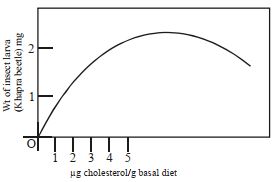
In an experiment,freshly hatched larvae of an insect (Khapra beetle) were reared on a basal diet (complete diet without cholesterol) with increasing amounts of cholesterol. Results obtained are shown in the given graph.
The graph indicates:
The graph indicates:
A
cholesterol is an essential dietary requirement of Khapra beetle
B
growth of Khapra beetle is directly proportional to cholesterol concentration
C
cholesterol concentration of $2 \, \mu g/g$ diet is the optimum level
D
growth of Khapra beetle is inhibited when cholesterol concentration exceeds $5 \, \mu g/g$ diet
Solution
(A) $1$. The graph shows the relationship between the weight of the Khapra beetle larvae and the concentration of cholesterol in their diet.
$2$. At $0 \, \mu g/g$ cholesterol,the growth is minimal or zero,indicating that cholesterol is necessary for the development of these larvae.
$3$. As the concentration of cholesterol increases,the weight of the larvae increases,showing that cholesterol is an essential dietary requirement for the Khapra beetle.
$4$. Option $A$ is the most accurate interpretation because the graph demonstrates that without cholesterol,the larvae do not grow,confirming it is an essential nutrient.
$2$. At $0 \, \mu g/g$ cholesterol,the growth is minimal or zero,indicating that cholesterol is necessary for the development of these larvae.
$3$. As the concentration of cholesterol increases,the weight of the larvae increases,showing that cholesterol is an essential dietary requirement for the Khapra beetle.
$4$. Option $A$ is the most accurate interpretation because the graph demonstrates that without cholesterol,the larvae do not grow,confirming it is an essential nutrient.
0 likes
View Solution224
EasyMCQ
Which of the following is a viral disease of poultry birds?
A
Anthrax
B
Ranikhet
C
Coccidiosis
D
None of these
Solution
(B) Ranikhet disease, also known as Newcastle disease, is a highly contagious viral disease affecting poultry birds.
Anthrax is a bacterial disease caused by $Bacillus \text{ } anthracis$.
Coccidiosis is a protozoan disease caused by $Eimeria$ species.
Anthrax is a bacterial disease caused by $Bacillus \text{ } anthracis$.
Coccidiosis is a protozoan disease caused by $Eimeria$ species.
0 likes
View Solution225
MediumMCQ
Assertion : Use of fertilizers greatly enhances crop productivity.
Reason : Irrigation is very important in increasing crop productivity.
Reason : Irrigation is very important in increasing crop productivity.
A
If both Assertion and Reason are correct and the Reason is a correct explanation of the Assertion.
B
If both Assertion and Reason are correct but Reason is not a correct explanation of the Assertion.
C
If the Assertion is correct but Reason is incorrect.
D
If both the Assertion and Reason are incorrect.
Solution
(B) The Assertion is correct because fertilizers provide essential nutrients like $N, P,$ and $K$ to the soil,which significantly boosts crop yield.
The Reason is also correct because irrigation ensures the timely and adequate supply of water,which is vital for plant growth and metabolic processes.
However,irrigation is a separate agricultural practice from the application of fertilizers. Therefore,the Reason does not explain why fertilizers enhance productivity. Both statements are independent facts regarding agricultural enhancement.
The Reason is also correct because irrigation ensures the timely and adequate supply of water,which is vital for plant growth and metabolic processes.
However,irrigation is a separate agricultural practice from the application of fertilizers. Therefore,the Reason does not explain why fertilizers enhance productivity. Both statements are independent facts regarding agricultural enhancement.
0 likes
View Solution226
MediumMCQ
Assertion : Fish meal is a rich source of protein for cattle and poultry.
Reason : Fish meal is produced from non-edible parts of fishes like fins,tail etc.
Reason : Fish meal is produced from non-edible parts of fishes like fins,tail etc.
A
If both Assertion and Reason are correct and the Reason is a correct explanation of the Assertion.
B
If both Assertion and Reason are correct but Reason is not a correct explanation of the Assertion.
C
If the Assertion is correct but Reason is incorrect.
D
If both the Assertion and Reason are incorrect.
Solution
(A) Fish meal is a high-protein supplement produced from the non-edible parts of fish,such as fins,tails,and bones,which are byproducts of the fish processing industry.
Because these parts are rich in proteins,minerals,and vitamins,fish meal serves as an excellent nutritional supplement for livestock,including cattle and poultry.
Therefore,the Assertion is correct because fish meal is indeed a rich source of protein,and the Reason correctly explains that it is derived from the non-edible parts of fish.
Because these parts are rich in proteins,minerals,and vitamins,fish meal serves as an excellent nutritional supplement for livestock,including cattle and poultry.
Therefore,the Assertion is correct because fish meal is indeed a rich source of protein,and the Reason correctly explains that it is derived from the non-edible parts of fish.
0 likes
View Solution227
MediumMCQ
Assertion : Cattle breeds can be improved by superovulation and embryo transplantation.
Reason : Superovulation in high milk-yielding cows is induced by hormonal injection.
Reason : Superovulation in high milk-yielding cows is induced by hormonal injection.
A
If both Assertion and Reason are correct and the Reason is a correct explanation of the Assertion.
B
If both Assertion and Reason are correct but Reason is not a correct explanation of the Assertion.
C
If the Assertion is correct but Reason is incorrect.
D
If both the Assertion and Reason are incorrect.
Solution
(A) Cattle breeds can be improved by superovulation and embryo transfer technique,which is known as Multiple Ovulation Embryo Transfer Technology $(MOET)$.
In this method,a cow is administered hormones with $FSH$-like activity to induce superovulation.
Instead of one egg,which they normally yield per cycle,they produce $6-8$ eggs.
The animal is then mated with an elite bull or artificially inseminated.
The fertilized eggs at $8-32$ cell stages are removed non-surgically and transferred to surrogate mothers.
This allows the genetic mother to be available for another round of superovulation,thus improving the breed.
In this method,a cow is administered hormones with $FSH$-like activity to induce superovulation.
Instead of one egg,which they normally yield per cycle,they produce $6-8$ eggs.
The animal is then mated with an elite bull or artificially inseminated.
The fertilized eggs at $8-32$ cell stages are removed non-surgically and transferred to surrogate mothers.
This allows the genetic mother to be available for another round of superovulation,thus improving the breed.
0 likes
View Solution228
MediumMCQ
Assertion : In case of vegetatively propagated crops,pure-line selection is not required.
Reason : Hybrid vigour is mostly used in vegetatively propagated plants.
Reason : Hybrid vigour is mostly used in vegetatively propagated plants.
A
If both Assertion and Reason are correct and the Reason is a correct explanation of the Assertion.
B
If both Assertion and Reason are correct but Reason is not a correct explanation of the Assertion.
C
If the Assertion is correct but Reason is incorrect.
D
If both the Assertion and Reason are incorrect.
Solution
(A) In case of vegetatively propagated crops,pure-line selection is not required because these plants are clones and genetically identical.
Pure-line selection is a method used primarily for self-pollinating,sexually reproducing plants to isolate homozygous lines.
Hybrid vigour (heterosis) is indeed most profitably used in vegetatively propagated crops because the hybrid traits can be maintained indefinitely through vegetative propagation without the risk of segregation or loss of superiority that occurs in sexual reproduction.
Therefore,both the Assertion and the Reason are correct,and the Reason provides a valid explanation for why pure-line selection is unnecessary in these crops.
Pure-line selection is a method used primarily for self-pollinating,sexually reproducing plants to isolate homozygous lines.
Hybrid vigour (heterosis) is indeed most profitably used in vegetatively propagated crops because the hybrid traits can be maintained indefinitely through vegetative propagation without the risk of segregation or loss of superiority that occurs in sexual reproduction.
Therefore,both the Assertion and the Reason are correct,and the Reason provides a valid explanation for why pure-line selection is unnecessary in these crops.
0 likes
View Solution229
MediumMCQ
How do microorganisms harm the crop?
A
They increase the soil fertility.
B
They act as pathogens and cause diseases in plants,reducing yield.
C
They help in nitrogen fixation.
D
They promote the growth of beneficial insects.
Solution
(B) wide range of fungal,bacterial,and viral pathogens affect the yield of cultivated crop species,especially in tropical climates.
Crop losses can often be significant,up to $20-30$ percent,or sometimes even total.
In this situation,breeding and development of cultivars resistant to disease enhances food production. This also helps reduce the dependence on the use of fungicides and bactericides.
Resistance of the host plant is the ability to prevent the pathogen from causing disease and is determined by the genetic constitution of the host plant.
Before breeding is undertaken,it is important to know about the causative organism and the mode of transmission.
Some of the diseases caused by fungi are rusts,e.g.,brown rust of wheat,red rot of sugarcane,and late blight of potato; by bacteria,black rot of crucifers; and by viruses,tobacco mosaic,turnip mosaic,etc.
Crop losses can often be significant,up to $20-30$ percent,or sometimes even total.
In this situation,breeding and development of cultivars resistant to disease enhances food production. This also helps reduce the dependence on the use of fungicides and bactericides.
Resistance of the host plant is the ability to prevent the pathogen from causing disease and is determined by the genetic constitution of the host plant.
Before breeding is undertaken,it is important to know about the causative organism and the mode of transmission.
Some of the diseases caused by fungi are rusts,e.g.,brown rust of wheat,red rot of sugarcane,and late blight of potato; by bacteria,black rot of crucifers; and by viruses,tobacco mosaic,turnip mosaic,etc.
0 likes
View Solution230
MediumMCQ
Why do a large number of people in India suffer from 'hidden hunger'? Provide a scientific reason.
A
Due to lack of sufficient calories in the diet.
B
Due to lack of essential micronutrients like iron,vitamin $A$,iodine,and zinc in the diet.
C
Due to the consumption of excessive processed food.
D
Due to the lack of clean drinking water.
Solution
(B) Hidden hunger refers to the deficiency of essential micronutrients in the diet,even when the person consumes enough calories to satisfy hunger.
In India,a large population relies on staple foods like rice and wheat,which are rich in carbohydrates (calories) but lack essential micronutrients such as iron,vitamin $A$,iodine,and zinc.
This deficiency leads to various health issues,including anemia,blindness,and impaired cognitive development,which is why it is termed 'hidden hunger'.
In India,a large population relies on staple foods like rice and wheat,which are rich in carbohydrates (calories) but lack essential micronutrients such as iron,vitamin $A$,iodine,and zinc.
This deficiency leads to various health issues,including anemia,blindness,and impaired cognitive development,which is why it is termed 'hidden hunger'.
0 likes
View Solution231
Easy
Give full names for the following abbreviations:
$(1)$ $\text{MOET}$
$(2)$ $\text{IRRI}$
$(3)$ $\text{IARI}$
$(4)$ $\text{SCP}$
$(5)$ $\text{FSH}$
$(1)$ $\text{MOET}$
$(2)$ $\text{IRRI}$
$(3)$ $\text{IARI}$
$(4)$ $\text{SCP}$
$(5)$ $\text{FSH}$
Solution
(N/A) $(1)$ $\text{MOET}$: $\text{Multiple Ovulation Embryo Transfer}$ $\text{Technology}$
$(2)$ $\text{IRRI}$: $\text{International Rice Research Institute}$
$(3)$ $\text{IARI}$: $\text{Indian Agricultural Research Institute}$
$(4)$ $\text{SCP}$: $\text{Single Cell Protein}$
$(5)$ $\text{FSH}$: $\text{Follicle Stimulating Hormone}$
$(2)$ $\text{IRRI}$: $\text{International Rice Research Institute}$
$(3)$ $\text{IARI}$: $\text{Indian Agricultural Research Institute}$
$(4)$ $\text{SCP}$: $\text{Single Cell Protein}$
$(5)$ $\text{FSH}$: $\text{Follicle Stimulating Hormone}$
0 likes
View Solution232
EasyMCQ
Millions of chickens were killed in West Bengal,Assam,Orissa,and Maharashtra recently. What was the reason?
A
Outbreak of Ranikhet disease
B
Outbreak of Bird Flu $(H_{5}N_{1})$
C
Outbreak of Foot and Mouth disease
D
Outbreak of Anthrax
Solution
(B) Millions of chickens were culled (killed) in West Bengal,Orissa,and Maharashtra.
These chickens were found to be infected with the $H_{5}N_{1}$ virus,which is the causative organism of Bird Flu (Avian Influenza).
Culling is a standard public health measure to prevent the spread of highly contagious viral diseases in poultry populations.
These chickens were found to be infected with the $H_{5}N_{1}$ virus,which is the causative organism of Bird Flu (Avian Influenza).
Culling is a standard public health measure to prevent the spread of highly contagious viral diseases in poultry populations.
0 likes
View Solution233
EasyMCQ
What is meant by 'hidden hunger'?
A
Lack of sufficient calories in the diet.
B
Consumption of food deficient in micronutrients,proteins,and vitamins.
C
Excessive intake of processed food.
D
Inability to access food due to poverty.
Solution
(B) Hidden hunger refers to the consumption of food that is deficient in essential nutrients,particularly micronutrients,proteins,and vitamins.
Even if an individual consumes enough calories to satisfy hunger,they may still suffer from malnutrition if their diet lacks these critical micronutrients,leading to various health issues.
Even if an individual consumes enough calories to satisfy hunger,they may still suffer from malnutrition if their diet lacks these critical micronutrients,leading to various health issues.
0 likes
View Solution234
Medium
In view of the current food crisis,it is said that we need another green revolution. Highlight the major limitations of the earlier green revolution.
Solution
(N/A) Limitations of the Green Revolution:
$(i)$ The Green Revolution succeeded in increasing the food supply,but it was still not enough to feed the growing human population.
$(ii)$ Increased yields were partly due to the use of improved crop varieties,but mainly due to the use of better management practices and the use of agrochemicals (fertilizers and pesticides).
$(iii)$ However,for farmers in the developing world,agrochemicals are often too expensive,and further increases in yield with existing varieties are not possible using conventional breeding.
$(iv)$ The use of agrochemicals causes eutrophication in aquatic ecosystems and biomagnification in terrestrial ecosystems.
$(v)$ Waterlogging and soil salinity are some of the problems that have emerged as a consequence of the Green Revolution.
$(i)$ The Green Revolution succeeded in increasing the food supply,but it was still not enough to feed the growing human population.
$(ii)$ Increased yields were partly due to the use of improved crop varieties,but mainly due to the use of better management practices and the use of agrochemicals (fertilizers and pesticides).
$(iii)$ However,for farmers in the developing world,agrochemicals are often too expensive,and further increases in yield with existing varieties are not possible using conventional breeding.
$(iv)$ The use of agrochemicals causes eutrophication in aquatic ecosystems and biomagnification in terrestrial ecosystems.
$(v)$ Waterlogging and soil salinity are some of the problems that have emerged as a consequence of the Green Revolution.
0 likes
View Solution235
MediumMCQ
How do you express the meaning of words like race,breed,cultivars or variety?
A
Race: Group of organisms with distinct physical traits; Breed: Animals related by descent; Cultivar: Plants selected for desirable traits; Variety: Taxonomic rank below species.
B
Race: Species classification; Breed: Wild animals; Cultivar: Natural plant growth; Variety: Genus level.
C
Race: Genetic mutation; Breed: Hybrid plants; Cultivar: Animal species; Variety: Family level.
D
Race: Geographical location; Breed: Plant species; Cultivar: Fungal growth; Variety: Order level.
Solution
(A) Race is a group of individuals who share similar and distinct physical characteristics. For example,Mongoloid,Caucasoid,and Negroid races of humans.
$A$ group of animals related by descent and similar in most characters like general appearance,features,size,and configuration are said to belong to a breed. For example,Jersey,Sindhi,and Holstein breeds of cattle.
$A$ cultivar is a plant or grouping of plants selected for desirable characteristics that can be maintained by propagation. For example,Pusa Gaurav of mustard.
$A$ taxonomic category that ranks below species,where members differ from others of the same species in minor but heritable characteristics,is called a variety. For example,cauliflower and cabbage.
$A$ group of animals related by descent and similar in most characters like general appearance,features,size,and configuration are said to belong to a breed. For example,Jersey,Sindhi,and Holstein breeds of cattle.
$A$ cultivar is a plant or grouping of plants selected for desirable characteristics that can be maintained by propagation. For example,Pusa Gaurav of mustard.
$A$ taxonomic category that ranks below species,where members differ from others of the same species in minor but heritable characteristics,is called a variety. For example,cauliflower and cabbage.
0 likes
View Solution236
MediumMCQ
What are the duties of a veterinary doctor in the management of a poultry farm?
A
Diagnosis and treatment of diseases.
B
Implementation of vaccination programs.
C
Ensuring public health and prevention of zoonotic diseases.
D
All of the above.
Solution
(D) The duties of a veterinary doctor in a poultry farm include:
$(i)$ Diagnosis and treatment of diseases or injuries in birds.
$(ii)$ Prophylactic treatment to prevent the occurrence of diseases in the future.
$(iii)$ Administration of vaccines against common poultry diseases to ensure flock health.
$(iv)$ Monitoring public health and preventing the transmission of zoonotic diseases (diseases that spread from animals to humans).
$(i)$ Diagnosis and treatment of diseases or injuries in birds.
$(ii)$ Prophylactic treatment to prevent the occurrence of diseases in the future.
$(iii)$ Administration of vaccines against common poultry diseases to ensure flock health.
$(iv)$ Monitoring public health and preventing the transmission of zoonotic diseases (diseases that spread from animals to humans).
0 likes
View Solution237
Medium
$(a)$ Mutations are beneficial for plant breeding. Taking an example,justify the statement.
$(b)$ Discuss briefly the technology that made us self-sufficient in food production.
$(b)$ Discuss briefly the technology that made us self-sufficient in food production.
Solution
(N/A) Mutation is the process:
$(i)$ In which genetic variations are created through changes in the base sequence within genes,resulting in the creation of a new character or trait not found in the parental type.
$(ii)$ It is possible to induce mutations artificially through the use of chemicals or radiations (like gamma radiations) and selecting and using the plants that have the desirable character as a source in breeding.
$(iii)$ This process is called mutation breeding.
$(iv)$ In mung bean,resistance to yellow mosaic virus and powdery mildew were induced by mutations.
$(b)$ Plant breeding:
$(i)$ It is the purposeful manipulation of plant species to create desired plant types that are better suited for cultivation,give better yields,and are disease-resistant.
$(ii)$ With advancements in genetics,molecular biology,and tissue culture,plant breeding is now increasingly being carried out by using molecular genetic tools.
$(i)$ In which genetic variations are created through changes in the base sequence within genes,resulting in the creation of a new character or trait not found in the parental type.
$(ii)$ It is possible to induce mutations artificially through the use of chemicals or radiations (like gamma radiations) and selecting and using the plants that have the desirable character as a source in breeding.
$(iii)$ This process is called mutation breeding.
$(iv)$ In mung bean,resistance to yellow mosaic virus and powdery mildew were induced by mutations.
$(b)$ Plant breeding:
$(i)$ It is the purposeful manipulation of plant species to create desired plant types that are better suited for cultivation,give better yields,and are disease-resistant.
$(ii)$ With advancements in genetics,molecular biology,and tissue culture,plant breeding is now increasingly being carried out by using molecular genetic tools.
0 likes
View Solution238
Difficult
What are three options to increase food production? Discuss each, giving the salient features, merits, and demerits.
Solution
(N/A) With the ever-increasing population of the world, the enhancement of food production is a major necessity. This is achieved by applying biological principles to animal husbandry and plant breeding.
Following are the three options to increase food production:
$(a)$ Single Cell Proteins $(SCP)$: The biomass obtained from microorganisms can be treated or processed in industry to be used as food. Example: $Spirulina$.
Merits of $SCP$: $(i)$ It uses organic and industrial waste, which reduces pollution. $(ii)$ It is a rich source of protein, fulfilling the dietary demands of human beings.
Demerits of $SCP$: $(i)$ It may sometimes cause allergic reactions. $(ii)$ Some microbes produce toxic substances.
$(b)$ Biofortification: This is the method of developing crops with higher levels of vitamins, minerals, healthier fats, and proteins to improve public health. Example: Golden rice.
Merits of Biofortification: $(i)$ It can increase yields on the same or less acreage. $(ii)$ It significantly improves nutritional value.
Demerits of Biofortification: $(i)$ Successful implementation requires safe delivery systems, stable policies, and appropriate social infrastructure. $(ii)$ It requires continuous financial support.
$(c)$ Tissue Culture: It is an $in$ $vitro$ technique for the regeneration of an entire plant from any part of the plant by culturing it on a nutrient medium under aseptic conditions. It is also called micropropagation.
Merits of Tissue Culture: $(i)$ Many genetically identical plants can be grown in a short period. $(ii)$ Through meristem culture, virus-free plants can be produced. $(iii)$ Seedless plants can be produced. $(iv)$ Plants that fail to reproduce sexually can be grown through somatic hybridization.
Demerits of Tissue Culture: $(i)$ It is an expensive technique. $(ii)$ It requires special expertise. $(iii)$ It requires a hardening process for plants to adapt to the external environment.
Following are the three options to increase food production:
$(a)$ Single Cell Proteins $(SCP)$: The biomass obtained from microorganisms can be treated or processed in industry to be used as food. Example: $Spirulina$.
Merits of $SCP$: $(i)$ It uses organic and industrial waste, which reduces pollution. $(ii)$ It is a rich source of protein, fulfilling the dietary demands of human beings.
Demerits of $SCP$: $(i)$ It may sometimes cause allergic reactions. $(ii)$ Some microbes produce toxic substances.
$(b)$ Biofortification: This is the method of developing crops with higher levels of vitamins, minerals, healthier fats, and proteins to improve public health. Example: Golden rice.
Merits of Biofortification: $(i)$ It can increase yields on the same or less acreage. $(ii)$ It significantly improves nutritional value.
Demerits of Biofortification: $(i)$ Successful implementation requires safe delivery systems, stable policies, and appropriate social infrastructure. $(ii)$ It requires continuous financial support.
$(c)$ Tissue Culture: It is an $in$ $vitro$ technique for the regeneration of an entire plant from any part of the plant by culturing it on a nutrient medium under aseptic conditions. It is also called micropropagation.
Merits of Tissue Culture: $(i)$ Many genetically identical plants can be grown in a short period. $(ii)$ Through meristem culture, virus-free plants can be produced. $(iii)$ Seedless plants can be produced. $(iv)$ Plants that fail to reproduce sexually can be grown through somatic hybridization.
Demerits of Tissue Culture: $(i)$ It is an expensive technique. $(ii)$ It requires special expertise. $(iii)$ It requires a hardening process for plants to adapt to the external environment.
0 likes
View Solution239
MediumMCQ
Match the columns:
| Column-$I$ | Column-$II$ |
|---|---|
| $(a)$ Wheat | $(1)$ Red stripe |
| $(b)$ Sugarcane | $(2)$ Septoria leaf spot |
| $(c)$ Potato | $(3)$ Black rot |
| $(d)$ Crucifer | $(4)$ Hill bunt |
A
$a-4, b-1, c-2, d-3$
B
$a-1, b-2, c-3, d-4$
C
$a-2, b-3, c-4, d-1$
D
$a-3, b-4, c-1, d-2$
Solution
(A) The correct matches for disease-resistant crop varieties are as follows:
$(a)$ Wheat is affected by Hill bunt,which is caused by the fungus Tilletia indica. Thus,$(a-4)$.
$(b)$ Sugarcane is affected by Red stripe,caused by the bacterium Acidovorax avenae subsp. avenae. Thus,$(b-1)$.
$(c)$ Potato is affected by Septoria leaf spot,caused by the fungus Septoria lycopersici. Thus,$(c-2)$.
$(d)$ Crucifer is affected by Black rot,caused by the bacterium Xanthomonas campestris. Thus,$(d-3)$.
Therefore,the correct sequence is $(a-4, b-1, c-2, d-3)$.
$(a)$ Wheat is affected by Hill bunt,which is caused by the fungus Tilletia indica. Thus,$(a-4)$.
$(b)$ Sugarcane is affected by Red stripe,caused by the bacterium Acidovorax avenae subsp. avenae. Thus,$(b-1)$.
$(c)$ Potato is affected by Septoria leaf spot,caused by the fungus Septoria lycopersici. Thus,$(c-2)$.
$(d)$ Crucifer is affected by Black rot,caused by the bacterium Xanthomonas campestris. Thus,$(d-3)$.
Therefore,the correct sequence is $(a-4, b-1, c-2, d-3)$.
0 likes
View Solution240
Easy
Match the columns:
| Column-$I$ | Column-$II$ |
|---|---|
| $(a)$ Carrot | $(1)$ Vitamin $C$ |
| $(b)$ Bitter gourd | $(2)$ Protein |
| $(c)$ Spinach | $(3)$ Vitamin $A$ |
| $(d)$ Peas | $(4)$ Vitamin $B_{12}$ |
| $(5)$ Iron |
Solution
(A) The correct matches based on biofortified crops mentioned in $NCERT$ are:
$(a)$ Carrot is rich in Vitamin $A$ $(3)$.
$(b)$ Bitter gourd is rich in Vitamin $C$ $(1)$.
$(c)$ Spinach is rich in Iron $(5)$.
$(d)$ Peas are rich in Protein $(2)$.
Therefore,the correct sequence is $(a-3, b-1, c-5, d-2)$.
$(a)$ Carrot is rich in Vitamin $A$ $(3)$.
$(b)$ Bitter gourd is rich in Vitamin $C$ $(1)$.
$(c)$ Spinach is rich in Iron $(5)$.
$(d)$ Peas are rich in Protein $(2)$.
Therefore,the correct sequence is $(a-3, b-1, c-5, d-2)$.
0 likes
View Solution241
MediumMCQ
$A$ large number of people become victims of hidden hunger in India. What is the primary reason for this?
A
High cost of food items
B
Lack of awareness about nutrition
C
Inability to afford fruits,vegetables,legumes,fish,and meat
D
All of the above
Solution
(D) The population of India is very large in comparison to its geographical area. As a result,food supply,particularly in terms of quality,cannot be provided sufficiently to such a large population.
Almost $3$ crore people suffer from micronutrient,protein,and vitamin deficiencies.
These individuals cannot afford to buy nutrient-rich foods such as vegetables,pulses,fish,and meat.
Consequently,a large number of people in India become victims of 'hidden hunger',which refers to the deficiency of essential micronutrients.
Almost $3$ crore people suffer from micronutrient,protein,and vitamin deficiencies.
These individuals cannot afford to buy nutrient-rich foods such as vegetables,pulses,fish,and meat.
Consequently,a large number of people in India become victims of 'hidden hunger',which refers to the deficiency of essential micronutrients.
0 likes
View Solution242
EasyMCQ
Mention any two examples of plants used as wind breakers in the agricultural fields.
A
Casuarina and Eucalyptus
B
Mango and Neem
C
Rose and Hibiscus
D
Acacia,Nerium,Jamun,and Imli are used as wind breakers in the agricultural fields.
Solution
(A) Wind breakers are rows of trees or shrubs planted to protect agricultural fields from strong winds,which can cause soil erosion and damage crops.
Common examples of plants used as wind breakers include $Casuarina$ and $Eucalyptus$.
These plants are preferred because they grow tall,have dense foliage,and are sturdy enough to withstand high wind speeds.
Common examples of plants used as wind breakers include $Casuarina$ and $Eucalyptus$.
These plants are preferred because they grow tall,have dense foliage,and are sturdy enough to withstand high wind speeds.
0 likes
View Solution243
EasyMCQ
How many of the following are marine fishes?
Hilsa,Catla,Sardine,Pomfret,Rohu,Mackerel
Hilsa,Catla,Sardine,Pomfret,Rohu,Mackerel
A
One
B
Two
C
Three
D
Four
Solution
(D) To identify the marine fishes from the given list:
$1$. $Hilsa$: Marine fish.
$2$. $Catla$: Freshwater fish.
$3$. $Sardine$: Marine fish.
$4$. $Pomfret$: Marine fish.
$5$. $Rohu$: Freshwater fish.
$6$. $Mackerel$: Marine fish.
The marine fishes are $Hilsa$,$Sardine$,$Pomfret$,and $Mackerel$.
There are $4$ marine fishes in total.
Therefore,the correct option is $D$.
$1$. $Hilsa$: Marine fish.
$2$. $Catla$: Freshwater fish.
$3$. $Sardine$: Marine fish.
$4$. $Pomfret$: Marine fish.
$5$. $Rohu$: Freshwater fish.
$6$. $Mackerel$: Marine fish.
The marine fishes are $Hilsa$,$Sardine$,$Pomfret$,and $Mackerel$.
There are $4$ marine fishes in total.
Therefore,the correct option is $D$.
0 likes
View Solution244
MediumMCQ
Which of the following is not a characteristic of $Saccharum$ $barberi$?
A
Very low sugar content
B
Low yield
C
High yield in South India
D
Grown in North India
Solution
(C) $Saccharum$ $barberi$ is a species of sugarcane that was originally grown in North India. It is characterized by having a low sugar content and low yield. In contrast,$Saccharum$ $officinarum$,which was grown in South India,had thicker stems and higher sugar content. Therefore,the statement that $Saccharum$ $barberi$ has a high yield in South India is incorrect,as it is a North Indian variety with low productivity.
0 likes
View Solution245
EasyMCQ
What percentage of India's $GDP$ is contributed by agriculture (in $\%$)?
A
$62$
B
$32$
C
$63$
D
$33$
Solution
(D) According to the $NCERT$ textbook 'Strategies for Enhancement in Food Production',agriculture accounts for approximately $33\%$ of India's $GDP$ and employs nearly $62\%$ of the population. Therefore,the correct option is $D$.
0 likes
View Solution246
EasyMCQ
During the period $1960$ to $2000$,wheat production increased from $.....X......$ million tonnes to $.....Y......$ million tonnes.
A
$X=11, Y=75$
B
$X=21, Y=85$
C
$X=21, Y=65$
D
$X=11, Y=65$
Solution
(A) The Green Revolution in India led to a significant increase in food grain production.
Specifically,wheat production increased from $11$ million tonnes in $1960$ to $75$ million tonnes in $2000$ due to the introduction of high-yielding varieties.
Therefore,$X = 11$ and $Y = 75$.
Specifically,wheat production increased from $11$ million tonnes in $1960$ to $75$ million tonnes in $2000$ due to the introduction of high-yielding varieties.
Therefore,$X = 11$ and $Y = 75$.
0 likes
View Solution247
EasyMCQ
Which of the following is not a variety of rice?
A
$IR-8$
B
Sonalika
C
Jaya
D
Ratna
Solution
(B) $IR-8$,$Jaya$,and $Ratna$ are well-known high-yielding semi-dwarf varieties of rice developed in India.
$Sonalika$ is a high-yielding,disease-resistant variety of wheat,not rice.
$Sonalika$ is a high-yielding,disease-resistant variety of wheat,not rice.
0 likes
View Solution248
MediumMCQ
Identify the odd one out.
A
Brown rust of wheat
B
Late blight of potato
C
Red rot of sugarcane
D
Black rust of crucifers
Solution
(D) The correct answer is $D$.
$A$, $B$, and $C$ are examples of plant diseases caused by fungi that are commonly managed through plant breeding for disease resistance.
$A$ (Brown rust of wheat) is caused by $Puccinia \, triticina$.
$B$ (Late blight of potato) is caused by $Phytophthora \, infestans$.
$C$ (Red rot of sugarcane) is caused by $Colletotrichum \, falcatum$.
$D$ (Black rust of crucifers) is an incorrect term; the disease affecting crucifers is typically 'White rust of crucifers' caused by $Albugo \, candida$. Therefore, $D$ is the odd one out.
$A$, $B$, and $C$ are examples of plant diseases caused by fungi that are commonly managed through plant breeding for disease resistance.
$A$ (Brown rust of wheat) is caused by $Puccinia \, triticina$.
$B$ (Late blight of potato) is caused by $Phytophthora \, infestans$.
$C$ (Red rot of sugarcane) is caused by $Colletotrichum \, falcatum$.
$D$ (Black rust of crucifers) is an incorrect term; the disease affecting crucifers is typically 'White rust of crucifers' caused by $Albugo \, candida$. Therefore, $D$ is the odd one out.
0 likes
View SolutionStrategies for Enhancement in Food Production — Mix Examples- Strategies for Enhancement in Food Production · Frequently Asked Questions
1Are these Strategies for Enhancement in Food Production questions useful for JEE and NEET?
Yes. All questions in this section are mapped to JEE Main and NEET exam patterns. Previous year questions from JEE Main, NEET, GUJCET and state-level exams are included with full solutions.
2Can I switch to Hindi or Gujarati for these questions?
Yes. Use the language tabs in the hero section or the sidebar to view the same questions and solutions in English, Hindi or Gujarati.
3How do I generate a question paper from this subtopic?
Use the Vedclass Exam Paper Generator — select the chapter and subtopic, set difficulty, and generate Sets A, B, C, D automatically. First 3 chapters of every subject are free.
Vedclass Products
For Students
Vedclass Test Series
Mock tests in real JEE/NEET style with performance analysis. 5-day free trial.
Start Free TrialFor Teachers
Exam Paper Generator
Generate Set A/B/C/D papers from this chapter in 2 minutes. 3 chapters free.
Try FreeFor Institutes
Online Exam Module
Live online exams with unlimited students, 360° analytics & white-label branding.
See DemoFor Teachers & Institutes
Generate a Strategies for Enhancement in Food Production Exam Paper in 2 Minutes
Select subtopic & difficulty — Sets A, B, C, D auto-generated with No Repeat logic.
First 3 chapters of every subject are free — no payment required.