
A English
Genetic engineering and Tissue culture Questions in English
Class 12 Biology · Strategies for Enhancement in Food Production · Genetic engineering and Tissue culture
13+
Questions
English
Language
100%
With Solutions
Showing 13 of 13 questions in English
1
EasyMCQ
Haploid plants from anther culture were first obtained in:
A
Brassica
B
Gossypium
C
Nicotiana
D
Datura
Solution
(D) Haploid production through anther (pollen) culture was first successfully achieved in $Datura \, innoxia$ $(Jimson \, weed)$ by $S. \, Guha$ and $S.C. \, Maheshwari$ in $1964$. This breakthrough demonstrated that pollen grains could be induced to develop into haploid embryos,which is a significant technique in plant breeding for creating homozygous lines.
0 likes
View Solution2
EasyMCQ
Somatic hybridization of potato and tomato forms:
A
Triticale
B
Pomato
C
Secale
D
Altonia
Solution
(B) Somatic hybridization involves the fusion of protoplasts from two different plant species to create a hybrid. When protoplasts of potato ($Solanum$ $tuberosum$) and tomato ($Solanum$ $lycopersicum$) are fused,the resulting somatic hybrid is known as a $Pomato$. This technique allows for the combination of desirable traits from both species,although the resulting plant did not have all the desired commercial characteristics.
0 likes
View Solution3
EasyMCQ
Improvement of crops by preserving germplasm in a frozen state is called:
A
Cryopreservation
B
Cold storage preservation
C
Vernalization
D
In situ preservation
Solution
(A) Cryopreservation is a technique used for the conservation of germplasm in a frozen state, typically using liquid nitrogen at $-196^{\circ}C$. This method allows for the long-term storage of plant tissues, seeds, and embryos, ensuring the preservation of genetic diversity for crop improvement.
0 likes
View Solution4
EasyMCQ
Somatic hybridization is a technique of
A
Natural breeding
B
Natural pollination
C
Artificial pollination
D
Somatic cells hybridization
Solution
(D) Somatic hybridization is a technique of somatic cell hybridization that involves the fusion of protoplasts.
The cell formed by the fusion of protoplasts of the same genotype is called a homokaryon,and the fused cell that contains non-identical nuclei is called a heterokaryon.
This process allows for the creation of hybrid plants that cannot be produced through conventional sexual hybridization.
The cell formed by the fusion of protoplasts of the same genotype is called a homokaryon,and the fused cell that contains non-identical nuclei is called a heterokaryon.
This process allows for the creation of hybrid plants that cannot be produced through conventional sexual hybridization.
0 likes
View Solution5
EasyMCQ
Plants produced through plant breeding that possess identical genotypes are called.....
A
Clone
B
Haploid
C
Autopolyploid
D
Genome
Solution
(A) Plants produced through asexual reproduction or specific breeding techniques that possess identical genetic makeup (genotypes) are known as clones. In plant breeding,these are often produced through tissue culture or vegetative propagation,ensuring that the offspring are genetically uniform.
0 likes
View Solution6
MediumMCQ
Which of the following culture techniques is used in interspecific hybridization where the embryo of the hybrid seed aborts at an early stage?
A
Meristem culture
B
Shoot tip culture
C
Embryo culture
D
Anther culture
Solution
(C) Interspecific hybridization often results in the formation of hybrid seeds that fail to develop properly due to the abortion of the embryo at an early stage.
To overcome this, the immature embryo is excised from the seed and grown on a suitable nutrient medium under sterile conditions.
This technique is known as $Embryo culture$.
It allows the rescue of hybrids that would otherwise die, making it a vital tool in plant breeding and biotechnology.
To overcome this, the immature embryo is excised from the seed and grown on a suitable nutrient medium under sterile conditions.
This technique is known as $Embryo culture$.
It allows the rescue of hybrids that would otherwise die, making it a vital tool in plant breeding and biotechnology.
0 likes
View Solution7
EasyMCQ
Which of the following is included in plant breeding?
A
Dairy industry
B
Poultry farming
C
Fisheries
D
Tissue culture
Solution
(D) Plant breeding is the purposeful manipulation of plant species in order to create desired plant types that are better suited for cultivation,give better yields,and are disease resistant.
Tissue culture is a modern technique used in plant breeding to regenerate plants from explants (any part of a plant taken out and grown in a test tube under sterile conditions in special nutrient media).
Dairy industry,poultry farming,and fisheries are components of animal husbandry,not plant breeding.
Tissue culture is a modern technique used in plant breeding to regenerate plants from explants (any part of a plant taken out and grown in a test tube under sterile conditions in special nutrient media).
Dairy industry,poultry farming,and fisheries are components of animal husbandry,not plant breeding.
0 likes
View Solution8
EasyMCQ
What does the part labeled '$A$' in the given figure represent?
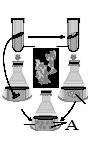
A
Cell mass
B
Explant
C
Agar-agar
D
Callus
Solution
(D) The given figure illustrates the process of plant tissue culture.
In plant tissue culture, an '$A$' represents the '$Callus$'.
'$Callus$' is an unorganized, undifferentiated mass of cells that develops from the '$Explant$' (the piece of plant tissue used for culture) when grown on a suitable nutrient medium under controlled laboratory conditions.
In plant tissue culture, an '$A$' represents the '$Callus$'.
'$Callus$' is an unorganized, undifferentiated mass of cells that develops from the '$Explant$' (the piece of plant tissue used for culture) when grown on a suitable nutrient medium under controlled laboratory conditions.
0 likes
View Solution9
Medium
Define the following terms: $Blue \ Revolution$ and $Somaclones$.
Solution
(N/A) $Blue \ Revolution$: Through aquaculture and pisciculture,we have been able to increase the production of aquatic plants and animals,both fresh-water and marine. This has led to the development and flourishing of the fishery industry,and it has brought a lot of income to the farmers in particular and the country in general.
$Somaclones$: The method of producing thousands of plants through tissue culture is called $micropropagation$. Each of these plants is genetically identical to the original plant from which they were grown; these are known as $somaclones$. This capacity to generate a whole plant from any cell or $explant$ is called $totipotency$.
$Somaclones$: The method of producing thousands of plants through tissue culture is called $micropropagation$. Each of these plants is genetically identical to the original plant from which they were grown; these are known as $somaclones$. This capacity to generate a whole plant from any cell or $explant$ is called $totipotency$.
0 likes
View Solution10
Medium
Give scientific reasons: Genetic engineering is better than hybridization.
Solution
(N/A) Genetic engineering is considered superior to traditional hybridization for several reasons:
$1$. In traditional hybridization,the process involves crossing two organisms,which often leads to the transfer of both desired and undesired genes into the progeny.
$2$. Genetic engineering allows for the precise manipulation of $DNA$,enabling the insertion of only the specific desired gene into the host genome.
$3$. This technology eliminates the risk of introducing unwanted traits,which is a common limitation in conventional breeding methods.
$4$. Consequently,genetic engineering provides a more efficient and accurate way to develop organisms with specific,targeted characteristics.
$1$. In traditional hybridization,the process involves crossing two organisms,which often leads to the transfer of both desired and undesired genes into the progeny.
$2$. Genetic engineering allows for the precise manipulation of $DNA$,enabling the insertion of only the specific desired gene into the host genome.
$3$. This technology eliminates the risk of introducing unwanted traits,which is a common limitation in conventional breeding methods.
$4$. Consequently,genetic engineering provides a more efficient and accurate way to develop organisms with specific,targeted characteristics.
0 likes
View Solution11
MediumMCQ
What is used to overcome the limitations of traditional breeding methods?
A
Bioinformatics
B
Genetic engineering
C
Chemical engineering
D
Biochemistry
Solution
(B) Traditional breeding methods often involve the hybridization of plants and animals,which can lead to the inclusion and multiplication of undesirable genes along with the desired ones. Genetic engineering (or recombinant $DNA$ technology) allows for the isolation and introduction of only one or a set of desirable genes into the target organism,thereby overcoming the limitations of traditional breeding. Thus,genetic engineering is the correct approach to overcome these limitations.
0 likes
View Solution12
EasyMCQ
Pomato is a somatic hybrid of
A
Potato and onion
B
Potato and tomato
C
Potato and brinjal
D
Potato and garlic
Solution
(B) Pomato is a somatic hybrid produced by the fusion of protoplasts from potato $(Solanum \text{ } tuberosum)$ and tomato $(Solanum \text{ } lycopersicum)$.
This process is known as somatic hybridization, where protoplasts from two different plant species are fused to create a new hybrid plant.
This process is known as somatic hybridization, where protoplasts from two different plant species are fused to create a new hybrid plant.
0 likes
View Solution13
MediumMCQ
Somatic hybridization is a technique of
A
Natural breeding
B
Natural pollination
C
Artificial pollination
D
Artificial breeding
Solution
(D) Somatic hybridization is a technique used in plant tissue culture.
It involves the fusion of isolated protoplasts from two different plant species or varieties in vitro to produce a somatic hybrid.
Since this process is performed in a laboratory setting and involves human intervention to create new genetic combinations,it is classified as a form of artificial breeding.
It involves the fusion of isolated protoplasts from two different plant species or varieties in vitro to produce a somatic hybrid.
Since this process is performed in a laboratory setting and involves human intervention to create new genetic combinations,it is classified as a form of artificial breeding.
0 likes
View SolutionStrategies for Enhancement in Food Production — Genetic engineering and Tissue culture · Frequently Asked Questions
1Are these Strategies for Enhancement in Food Production questions useful for JEE and NEET?
Yes. All questions in this section are mapped to JEE Main and NEET exam patterns. Previous year questions from JEE Main, NEET, GUJCET and state-level exams are included with full solutions.
2Can I switch to Hindi or Gujarati for these questions?
Yes. Use the language tabs in the hero section or the sidebar to view the same questions and solutions in English, Hindi or Gujarati.
3How do I generate a question paper from this subtopic?
Use the Vedclass Exam Paper Generator — select the chapter and subtopic, set difficulty, and generate Sets A, B, C, D automatically. First 3 chapters of every subject are free.
Vedclass Products
For Students
Vedclass Test Series
Mock tests in real JEE/NEET style with performance analysis. 5-day free trial.
Start Free TrialFor Teachers
Exam Paper Generator
Generate Set A/B/C/D papers from this chapter in 2 minutes. 3 chapters free.
Try FreeFor Institutes
Online Exam Module
Live online exams with unlimited students, 360° analytics & white-label branding.
See DemoFor Teachers & Institutes
Generate a Strategies for Enhancement in Food Production Exam Paper in 2 Minutes
Select subtopic & difficulty — Sets A, B, C, D auto-generated with No Repeat logic.
First 3 chapters of every subject are free — no payment required.