
A English
Mix Examples- Strategies for Enhancement in Food Production Questions in English
Class 12 Biology · Strategies for Enhancement in Food Production · Mix Examples- Strategies for Enhancement in Food Production
342+
Questions
English
Language
100%
With Solutions
Showing 42 of 342 questions in English
301
MediumMCQ
$A$: Encephalomalacia,a disease of poultry,is caused by the protozoan $Eimeria$.
$R$: Encephalomalacia causes bloody diarrhoea in poultry.
$R$: Encephalomalacia causes bloody diarrhoea in poultry.
A
Assertion and Reason both are correct and Reason is the correct explanation of Assertion.
B
Assertion and Reason both are correct but Reason is not the correct explanation of Assertion.
C
Assertion is correct,but Reason is incorrect.
D
Both Assertion and Reason are incorrect.
Solution
(D) Encephalomalacia is a nutritional disorder in poultry caused by a deficiency of Vitamin $E$,which leads to the softening of brain tissues.
On the other hand,the protozoan $Eimeria$ causes a disease known as Coccidiosis,which is characterized by bloody diarrhoea in poultry.
Since the assertion incorrectly identifies the cause of Encephalomalacia and the reason incorrectly describes its symptoms,both statements are incorrect.
Therefore,the correct option is $D$.
On the other hand,the protozoan $Eimeria$ causes a disease known as Coccidiosis,which is characterized by bloody diarrhoea in poultry.
Since the assertion incorrectly identifies the cause of Encephalomalacia and the reason incorrectly describes its symptoms,both statements are incorrect.
Therefore,the correct option is $D$.
0 likes
View Solution302
MediumMCQ
Which of the following statements about vegetative reproduction is incorrect?
A
Stem cutting is a common horticultural method of plant propagation.
B
In trench layering,the basal branch may be pegged at several places in soil at regular intervals.
C
Stock has a larger diameter than the scion in crown grafting.
D
Gootee is an ancient method of propagation in subtropical trees and shrubs.
Solution
(C) In $crown$ $grafting$,the $stock$ (the rooted plant) usually has a much larger diameter than the $scion$ (the shoot being grafted). However,the statement in option $C$ is often considered incorrect in specific contexts because,in standard $crown$ $grafting$,multiple $scions$ are inserted around the periphery of a large $stock$. If the statement implies that the $stock$ must be larger than the $scion$ as a rule for all grafting,it is technically correct,but in the context of common biology curriculum questions regarding vegetative propagation,the specific phrasing regarding the relative diameters is often tested. Actually,in $crown$ $grafting$,the $stock$ is significantly larger than the $scion$ to accommodate multiple $scions$. Let us re-evaluate: $A$ is correct. $B$ is correct (definition of trench layering). $D$ is correct ($Gootee$ or $air$ $layering$ is indeed an ancient method). Option $C$ is the intended incorrect statement because,in many textbook contexts,it is noted that the $scion$ and $stock$ should have similar diameters for successful cambial union,whereas $crown$ $grafting$ is a specialized technique where the $stock$ is much larger,making the general assertion about diameter matching in grafting often contrast with this specific technique.
0 likes
View Solution303
MediumMCQ
$A$ : Hybrid seeds have to be produced every year because seeds collected from hybrid plants,if sown subsequently,do not maintain hybrid characters.
$R$ : Hybrid seeds show segregation of traits.
$R$ : Hybrid seeds show segregation of traits.
A
Assertion and Reason both are correct and Reason is the correct explanation of Assertion.
B
Assertion and Reason both are correct but Reason is not the correct explanation of Assertion.
C
Assertion is correct,but Reason is incorrect.
D
Both Assertion and Reason are incorrect.
Solution
(A) Hybrid plants are typically $F_1$ hybrids produced by crossing two genetically distinct parent lines.
According to Mendel's Law of Segregation,the alleles for traits segregate during gamete formation.
When $F_1$ hybrid plants are self-pollinated or cross-pollinated,the offspring ($F_2$ generation) show a segregation of traits,leading to a loss of the uniform hybrid vigor and specific phenotypic characteristics observed in the $F_1$ generation.
Therefore,farmers must purchase new hybrid seeds every year to ensure the desired traits are maintained.
Thus,both the Assertion and the Reason are correct,and the Reason correctly explains why hybrid characters are not maintained.
According to Mendel's Law of Segregation,the alleles for traits segregate during gamete formation.
When $F_1$ hybrid plants are self-pollinated or cross-pollinated,the offspring ($F_2$ generation) show a segregation of traits,leading to a loss of the uniform hybrid vigor and specific phenotypic characteristics observed in the $F_1$ generation.
Therefore,farmers must purchase new hybrid seeds every year to ensure the desired traits are maintained.
Thus,both the Assertion and the Reason are correct,and the Reason correctly explains why hybrid characters are not maintained.
0 likes
View Solution304
EasyMCQ
Bombykol or gyplure is a
A
Drug
B
Hormone
C
Antibiotic
D
Pheromone
Solution
(D) Bombykol is a chemical substance secreted by the female silkworm $(Bombyx \text{ } mori)$ to attract males. It is classified as a pheromone, which is a chemical signal used for communication between individuals of the same species.
0 likes
View Solution305
EasyMCQ
Which of the following fish is introduced in ponds to control or eliminate the vector responsible for the transmission of malaria and filariasis?
A
Exocoetus
B
Pristis
C
Scoliodon
D
Gambusia
Solution
(D) Gambusia is a larvivorous fish that feeds on mosquito larvae.
By consuming the larvae of mosquitoes in stagnant water,it effectively reduces the population of mosquitoes,which are the vectors for diseases like malaria and filariasis.
By consuming the larvae of mosquitoes in stagnant water,it effectively reduces the population of mosquitoes,which are the vectors for diseases like malaria and filariasis.
0 likes
View Solution306
EasyMCQ
Which one of the following is being tried in India as a bio-fuel substitute for fossil fuels?
A
Jatropha
B
Azadirachta
C
Musa
D
Aegilops
Solution
(A) Petroplants are plants that can yield large amounts of latex containing long-chain liquid hydrocarbons.
In India,$Jatropha$ $curcas$ is widely being researched and cultivated as a potential source of biodiesel to serve as a substitute for fossil fuels.
These plants belong to families such as $Euphorbiaceae$,$Asclepiadaceae$,and $Apocynaceae$.
In India,$Jatropha$ $curcas$ is widely being researched and cultivated as a potential source of biodiesel to serve as a substitute for fossil fuels.
These plants belong to families such as $Euphorbiaceae$,$Asclepiadaceae$,and $Apocynaceae$.
0 likes
View Solution307
EasyMCQ
The father of the Green Revolution in India is:
A
$M$. $S$. Swaminathan
B
$N$. Borlaug
C
$R$. Mishra
D
$P$. Maheswari
Solution
(A) The Green Revolution refers to the rapid increase in agricultural production,particularly of wheat and rice,during the period $1960-1970$.
In March $1963$,Dr. $N$. $E$. Borlaug visited India at the invitation of Dr. $B$. $P$. Pal (Director of $IARI$) and sent a wide range of genetic material in September $1963$.
Dr. $M$. $S$. Swaminathan is recognized as the father of the Green Revolution in India.
Dr. $N$. Borlaug is known as the father of the Green Revolution in the world.
In March $1963$,Dr. $N$. $E$. Borlaug visited India at the invitation of Dr. $B$. $P$. Pal (Director of $IARI$) and sent a wide range of genetic material in September $1963$.
Dr. $M$. $S$. Swaminathan is recognized as the father of the Green Revolution in India.
Dr. $N$. Borlaug is known as the father of the Green Revolution in the world.
0 likes
View Solution308
EasyMCQ
Quarantine regulation is meant for
A
Preventing entry of diseased plants in the country
B
Spraying diseased plants with insecticides
C
Promoting dry farming
D
Growing fruit trees in all the states
Solution
(A) Quarantine regulation is a legal measure designed to prevent the introduction and spread of plant pests,diseases,and invasive species into a country or region.
It involves the inspection and restriction of the movement of plants,plant products,and soil across borders to ensure that they are free from harmful pathogens or pests.
Therefore,the primary purpose is to prevent the entry of diseased plants into the country.
It involves the inspection and restriction of the movement of plants,plant products,and soil across borders to ensure that they are free from harmful pathogens or pests.
Therefore,the primary purpose is to prevent the entry of diseased plants into the country.
0 likes
View Solution309
EasyMCQ
$CFCL$ is situated at:
A
Delhi
B
Faridabad
C
Mumbai
D
Amritsar
Solution
(B) $CFCL$ (Central Fertilizer Corporation Limited) is situated at Faridabad,Haryana.
0 likes
View Solution310
EasyMCQ
$Leucaena leucocephala$ is:
A
Called subabul
B
$A$ small leguminous tree with edible fruits and seeds
C
$A$ fodder plant as its pods and leaves are consumed by cattle
D
All of the above
Solution
(D) $Leucaena leucocephala$ (subabul) is a fast-growing leguminous tree, native to Central America.
It is a small tree that produces edible fruits and seeds.
It is widely used as a fodder plant because its pods and leaves are highly nutritious and consumed by cattle.
Therefore, all the given statements are correct.
It is a small tree that produces edible fruits and seeds.
It is widely used as a fodder plant because its pods and leaves are highly nutritious and consumed by cattle.
Therefore, all the given statements are correct.
0 likes
View Solution311
MediumMCQ
Consider the following statements about organic farming:
$I.$ Organic farming promotes the use of crop rotations and cover crops and encourages balanced host/predator relationships.
$II.$ Integrated pest and weed management and soil conservation systems are valuable tools on an organic farm.
$III.$ Organic farming protects the environment,minimizes soil degradation and erosion,and decreases pollution.
Which of the statements given above are correct?
$I.$ Organic farming promotes the use of crop rotations and cover crops and encourages balanced host/predator relationships.
$II.$ Integrated pest and weed management and soil conservation systems are valuable tools on an organic farm.
$III.$ Organic farming protects the environment,minimizes soil degradation and erosion,and decreases pollution.
Which of the statements given above are correct?
A
$I, II$ and $III$
B
$I$ and $II$
C
$I$ and $III$
D
$II$ and $III$
Solution
(A) Organic farming is a sustainable agricultural system that avoids the use of synthetic fertilizers and pesticides.
Statement $I$ is correct: It promotes crop rotation and cover crops to maintain soil fertility and encourages natural biological control by balancing host/predator relationships.
Statement $II$ is correct: Integrated pest management $(IPM)$ and weed management,along with soil conservation techniques,are essential components of organic farming practices.
Statement $III$ is correct: By reducing reliance on synthetic chemicals,organic farming protects the environment,minimizes soil degradation and erosion,and significantly decreases pollution.
Therefore,all three statements are correct.
Statement $I$ is correct: It promotes crop rotation and cover crops to maintain soil fertility and encourages natural biological control by balancing host/predator relationships.
Statement $II$ is correct: Integrated pest management $(IPM)$ and weed management,along with soil conservation techniques,are essential components of organic farming practices.
Statement $III$ is correct: By reducing reliance on synthetic chemicals,organic farming protects the environment,minimizes soil degradation and erosion,and significantly decreases pollution.
Therefore,all three statements are correct.
0 likes
View Solution312
MediumMCQ
$A$: Barley,sorghum,and millet are smother crops.
$R$: They favor the growth of some common weeds.
$R$: They favor the growth of some common weeds.
A
Assertion and Reason both are correct and Reason is the correct explanation of Assertion.
B
Assertion and Reason both are correct but Reason is not the correct explanation of Assertion.
C
Assertion is correct,but Reason is incorrect.
D
Both Assertion and Reason are incorrect.
Solution
(C) Smother crops are fast-growing crops that cover the soil surface densely,thereby suppressing the growth of weeds by competing for sunlight,water,and nutrients.
Barley,sorghum,and millet are well-known examples of smother crops.
Since these crops suppress weed growth rather than favoring it,the Assertion is correct,but the Reason is incorrect.
Barley,sorghum,and millet are well-known examples of smother crops.
Since these crops suppress weed growth rather than favoring it,the Assertion is correct,but the Reason is incorrect.
0 likes
View Solution313
MediumMCQ
All are biotechnological applications to increase food production,except:
A
Pisciculture
B
Agro-chemical based agriculture
C
Organic agriculture
D
Genetically engineered crop-based agriculture
Solution
(A) Biotechnology is used to increase food production through various methods,including:
$(i)$ Agrochemical-based agriculture: Uses synthetic fertilizers and pesticides.
$(ii)$ Organic agriculture: Uses natural methods to maintain soil fertility and control pests.
$(iii)$ Genetically engineered crop-based agriculture: Uses transgenic crops to improve yield and resistance.
$Pisciculture$ refers to the commercial breeding and rearing of fish in controlled environments (fish farming). While it is a method of food production,it is not considered a biotechnological application in the context of modern agricultural biotechnology as defined in the curriculum.
$(i)$ Agrochemical-based agriculture: Uses synthetic fertilizers and pesticides.
$(ii)$ Organic agriculture: Uses natural methods to maintain soil fertility and control pests.
$(iii)$ Genetically engineered crop-based agriculture: Uses transgenic crops to improve yield and resistance.
$Pisciculture$ refers to the commercial breeding and rearing of fish in controlled environments (fish farming). While it is a method of food production,it is not considered a biotechnological application in the context of modern agricultural biotechnology as defined in the curriculum.
0 likes
View Solution314
MediumMCQ
Green revolution is related to the increase in
A
Better irrigation,fertilizers and pesticides facilities
B
Exploitation of high yielding varieties
C
Intensive cultivation
D
All of the above
Solution
(D) The term $Green$ $Revolution$ refers to the substantial increase in crop yields achieved through the development of new high-yielding crop varieties.
This was supported by an intensive program involving the use of improved irrigation,chemical fertilizers,and pesticides.
High-yielding varieties of wheat and rice were the key elements that drove the success of the $Green$ $Revolution$.
This was supported by an intensive program involving the use of improved irrigation,chemical fertilizers,and pesticides.
High-yielding varieties of wheat and rice were the key elements that drove the success of the $Green$ $Revolution$.
0 likes
View Solution315
MediumMCQ
Which of the following ways are suitable for increasing food production?
$I$. Agrochemical-based agriculture
$II$. Organic agriculture
$III$. Genetically engineered crop-based agriculture
Choose the correct option.
$I$. Agrochemical-based agriculture
$II$. Organic agriculture
$III$. Genetically engineered crop-based agriculture
Choose the correct option.
A
$I$ and $II$
B
$I$ and $III$
C
$II$ and $III$
D
$I$,$II$ and $III$
Solution
(D) Food production can be increased by applying various agricultural strategies:
$(i)$ Agrochemical-based agriculture: Uses chemical fertilizers and pesticides to enhance crop yield.
$(ii)$ Organic agriculture: Focuses on sustainable farming practices without synthetic chemicals to maintain soil health and productivity.
$(iii)$ Genetically engineered crop-based agriculture: Uses biotechnology to create crops with desirable traits like pest resistance,higher yield,and nutritional enhancement.
All three methods are recognized strategies for improving global food production. Therefore,the correct option is $D$.
$(i)$ Agrochemical-based agriculture: Uses chemical fertilizers and pesticides to enhance crop yield.
$(ii)$ Organic agriculture: Focuses on sustainable farming practices without synthetic chemicals to maintain soil health and productivity.
$(iii)$ Genetically engineered crop-based agriculture: Uses biotechnology to create crops with desirable traits like pest resistance,higher yield,and nutritional enhancement.
All three methods are recognized strategies for improving global food production. Therefore,the correct option is $D$.
0 likes
View Solution316
MediumMCQ
Select the incorrect statement w.r.t. Green Revolution.
A
Succeeded in quadrupling the food supply
B
Increase was insufficient to feed the growing human population
C
Increased yields could be attributed to improved crop varieties
D
Use of agrochemicals contributed to enhanced yields
Solution
(A) The Green Revolution succeeded in tripling the food supply,not quadrupling it. Therefore,the statement that it succeeded in quadrupling the food supply is incorrect. The other statements regarding the insufficiency of the increase to feed the growing population,the role of improved crop varieties,and the use of agrochemicals are correct in the context of the Green Revolution.
0 likes
View Solution317
EasyMCQ
The world's $P$ livestock is possessed by $Q$ and the contribution to the world farm produce is $R$.
$\quad P\quad\quad Q\quad\quad\quad\quad\quad R$
$(A)$ $70 \%\quad$ India and China $\quad 25 \%$
$(B)$ $70 \%\quad$ India and America $\quad 25 \%$
$(C)$ $30 \%\quad$ India and China $\quad 75 \%$
$(D)$ $30 \%\quad$ India and America $\quad 75 \%$
$\quad P\quad\quad Q\quad\quad\quad\quad\quad R$
$(A)$ $70 \%\quad$ India and China $\quad 25 \%$
$(B)$ $70 \%\quad$ India and America $\quad 25 \%$
$(C)$ $30 \%\quad$ India and China $\quad 75 \%$
$(D)$ $30 \%\quad$ India and America $\quad 75 \%$
A
$70 \%\quad$ India and China $\quad 25 \%$
B
$70 \%\quad$ India and America $\quad 25 \%$
C
$30 \%\quad$ India and China $\quad 75 \%$
D
$30 \%\quad$ India and America $\quad 75 \%$
Solution
(A) According to the $NCERT$ textbook for Biology (Class $12$), it is stated that India and China possess $70 \%$ of the world's livestock population.
However, their contribution to the world farm produce is only $25 \%$.
This indicates that the productivity per unit is very low in these countries.
Therefore, the correct values are $P = 70 \%$, $Q = \text{India and China}$, and $R = 25 \%$.
However, their contribution to the world farm produce is only $25 \%$.
This indicates that the productivity per unit is very low in these countries.
Therefore, the correct values are $P = 70 \%$, $Q = \text{India and China}$, and $R = 25 \%$.
0 likes
View Solution318
EasyMCQ
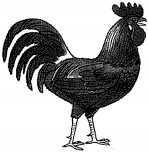
Identify the breed of the organism shown below.
A
Leghorn
B
Aseel
C
Frizzle
D
Turkey
Solution
(B) The image provided shows a chicken breed known as $Aseel$ (or $Asil$).
$Aseel$ is a well-known indigenous breed of chicken from India,primarily known for its fighting qualities,muscular build,and aggressive nature.
Leghorn is a Mediterranean breed known for high egg production.
Frizzle is a breed characterized by its curled feathers.
Turkey is a different species of bird ($Meleagris$ $gallopavo$) and not a breed of chicken.
Therefore,the correct option is $B$.
$Aseel$ is a well-known indigenous breed of chicken from India,primarily known for its fighting qualities,muscular build,and aggressive nature.
Leghorn is a Mediterranean breed known for high egg production.
Frizzle is a breed characterized by its curled feathers.
Turkey is a different species of bird ($Meleagris$ $gallopavo$) and not a breed of chicken.
Therefore,the correct option is $B$.
0 likes
View Solution319
MediumMCQ
Select the incorrect statement$(s)$ from the following:
$I -$ Honey is a food of high nutritional value and is also used in the indigenous system of medicine (Ayurveda).
$II -$ Another product of honey bees is beeswax, which is very useful in the industrial sector.
$III -$ The most common species of honey bee is $Apis \text{ } indica$.
$IV -$ Beekeeping involves labor-intensive work.
$V -$ Beehives cannot be kept in courtyards, verandas, or on the roof of a house.
$VI -$ Beekeeping can be practiced in any area where there are sufficient bee pastures of some wild shrubs, fruit orchards, and cultivated crops.
$I -$ Honey is a food of high nutritional value and is also used in the indigenous system of medicine (Ayurveda).
$II -$ Another product of honey bees is beeswax, which is very useful in the industrial sector.
$III -$ The most common species of honey bee is $Apis \text{ } indica$.
$IV -$ Beekeeping involves labor-intensive work.
$V -$ Beehives cannot be kept in courtyards, verandas, or on the roof of a house.
$VI -$ Beekeeping can be practiced in any area where there are sufficient bee pastures of some wild shrubs, fruit orchards, and cultivated crops.
A
$IV, V$
B
$V$
C
$I, IV$
D
$I, IV, V$
Solution
(D) Statement $I$ is incorrect because honey is a food of high nutritional value, not low.
Statement $II$ is correct; beeswax is used in cosmetics and polishes.
Statement $III$ is correct; $Apis \text{ } indica$ is the most common species in India.
Statement $IV$ is incorrect because beekeeping is not labor-intensive; it requires minimal labor.
Statement $V$ is incorrect because beehives can easily be kept in courtyards, verandas, or on roofs.
Statement $VI$ is correct.
Therefore, the incorrect statements are $I, IV,$ and $V$.
Statement $II$ is correct; beeswax is used in cosmetics and polishes.
Statement $III$ is correct; $Apis \text{ } indica$ is the most common species in India.
Statement $IV$ is incorrect because beekeeping is not labor-intensive; it requires minimal labor.
Statement $V$ is incorrect because beehives can easily be kept in courtyards, verandas, or on roofs.
Statement $VI$ is correct.
Therefore, the incorrect statements are $I, IV,$ and $V$.
0 likes
View Solution320
EasyMCQ
The Green Revolution is related to ........
A
Fisheries
B
Agriculture
C
Poultry farming
D
Apiculture
Solution
(B) The Green Revolution was a period of technology transfer initiatives that saw greatly increased crop yields,particularly in wheat and rice. It is primarily associated with the advancement of $Agriculture$ to ensure food security by introducing high-yielding varieties of seeds,modern irrigation methods,and the use of fertilizers and pesticides.
0 likes
View Solution321
EasyMCQ
As a result of advancements in the field of $......$, plant breeding is now increasingly being carried out using molecular genetic tools.
A
Genetics
B
Molecular biology
C
Tissue culture
D
All of the above
Solution
(D) Plant breeding is the purposeful manipulation of plant species in order to create desired plant types that are better suited for cultivation, give better yields, and are disease-resistant.
With the advancements in the fields of $Genetics$, $Molecular biology$, and $Tissue culture$, plant breeding is now increasingly being carried out using molecular genetic tools.
Therefore, all the mentioned fields contribute to the modern advancements in plant breeding.
With the advancements in the fields of $Genetics$, $Molecular biology$, and $Tissue culture$, plant breeding is now increasingly being carried out using molecular genetic tools.
Therefore, all the mentioned fields contribute to the modern advancements in plant breeding.
0 likes
View Solution322
EasyMCQ
India is an agricultural country. Agriculture accounts for approximately $P$ of India's Gross Domestic Product $(GDP)$ and employs about $Q$ of the population.
$\quad\quad P\quad Q$
$\quad\quad P\quad Q$
A
$50\, \% \quad 30\, \%$
B
$62\, \% \quad 33\, \%$
C
$33\, \% \quad 62\, \%$
D
$30\, \% \quad 50\, \%$
Solution
(C) Agriculture is the backbone of the Indian economy.
According to the $NCERT$ Biology textbook (Chapter: Strategies for Enhancement in Food Production),agriculture accounts for approximately $33\, \%$ of India's Gross Domestic Product $(GDP)$.
It provides employment to nearly $62\, \%$ of the population.
Therefore,$P = 33\, \%$ and $Q = 62\, \%$.
According to the $NCERT$ Biology textbook (Chapter: Strategies for Enhancement in Food Production),agriculture accounts for approximately $33\, \%$ of India's Gross Domestic Product $(GDP)$.
It provides employment to nearly $62\, \%$ of the population.
Therefore,$P = 33\, \%$ and $Q = 62\, \%$.
0 likes
View Solution323
EasyMCQ
As a result of various plant breeding techniques for the development of high-yielding varieties of wheat and rice in the mid-$1960$s, there was a dramatic increase in food production. This phase is called $Green Revolution$.
$\quad\quad P \quad Q$
$\quad\quad P \quad Q$
A
$1960$ Blue Revolution
B
$1960$ Green Revolution
C
$1950$ Blue Revolution
D
$1950$ Green Revolution
Solution
(B) The mid-$1960$s marked a significant period in agricultural history, particularly in India, where the development of high-yielding varieties $(HYVs)$ of wheat and rice through plant breeding techniques led to a massive increase in food grain production. This period of agricultural transformation is famously known as the Green Revolution. Therefore, $P = 1960$ and $Q = \text{Green Revolution}$.
0 likes
View Solution324
EasyMCQ
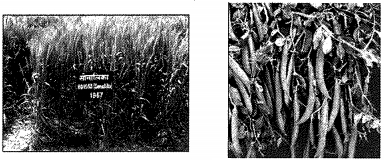
Identify the plants shown in the images below.
A
Sonalika Wheat,$P-1542$ Pea
B
Sonalika Wheat,$P-1320$ Pea
C
Sonalika Rice,$P-1542$ Pea
D
Sonalika Rice,$P-1320$ Pea
Solution
(A) The image on the left shows a field of Sonalika wheat,which is a high-yielding,disease-resistant variety of wheat introduced in India during the Green Revolution.
The image on the right shows a crop of garden peas,specifically the variety $P-1542$,which is a known improved variety of pea.
Therefore,the correct identification is Sonalika wheat and $P-1542$ pea.
The image on the right shows a crop of garden peas,specifically the variety $P-1542$,which is a known improved variety of pea.
Therefore,the correct identification is Sonalika wheat and $P-1542$ pea.
0 likes
View Solution325
EasyMCQ
During the period $1960$ to $2000$,the production of rice increased from ..........
A
$35$ million tonnes to $89.5$ million tonnes
B
$11$ million tonnes to $75$ million tonnes
C
$20$ million tonnes to $79.5$ million tonnes
D
$31$ million tonnes to $98.5$ million tonnes
Solution
(A) According to the data provided in the $NCERT$ textbook regarding the Green Revolution in India,the production of rice increased from $35$ million tonnes to $89.5$ million tonnes during the period $1960$ to $2000$.
0 likes
View Solution326
MediumMCQ
Match the following columns:
| Column-$I$ | Column-$II$ |
| $P$. Philippines | $I$. Developed the first semi-dwarf wheat variety |
| $Q$. Taiwan | $II$. $IR-8$ |
| $R$. India | $III$. Sonalika and Kalyan Sona |
| $S$. Mexico | $IV$. Taichung Native-$I$ |
A
$(P-IV), (Q-I), (R-III), (S-II)$
B
$(P-III), (Q-IV), (R-I), (S-II)$
C
$(P-I), (Q-IV), (R-II), (S-III)$
D
$(P-II), (Q-IV), (R-III), (S-I)$
Solution
(D) The correct matches are as follows:
$1$. Philippines $(P)$ is associated with the development of $IR-8$ $(II)$,which is a high-yielding rice variety.
$2$. Taiwan $(Q)$ is associated with the development of Taichung Native-$I$ $(IV)$,another high-yielding rice variety.
$3$. India $(R)$ is associated with the development of wheat varieties Sonalika and Kalyan Sona $(III)$.
$4$. Mexico $(S)$ is associated with the development of the first semi-dwarf wheat varieties $(I)$ by Dr. Norman Borlaug.
Therefore,the correct matching is $(P-II), (Q-IV), (R-III), (S-I)$.
$1$. Philippines $(P)$ is associated with the development of $IR-8$ $(II)$,which is a high-yielding rice variety.
$2$. Taiwan $(Q)$ is associated with the development of Taichung Native-$I$ $(IV)$,another high-yielding rice variety.
$3$. India $(R)$ is associated with the development of wheat varieties Sonalika and Kalyan Sona $(III)$.
$4$. Mexico $(S)$ is associated with the development of the first semi-dwarf wheat varieties $(I)$ by Dr. Norman Borlaug.
Therefore,the correct matching is $(P-II), (Q-IV), (R-III), (S-I)$.
0 likes
View Solution327
MediumMCQ
Match the following columns:
| Column-$I$ (Crop) | Column-$II$ (Variety) | Column-$III$ (Resistance to Disease) |
|---|---|---|
| $P$. Wheat | $I$. Pusa Swarnim | $W$. White rust |
| $Q$. Brassica | $II$. Pusa Komal | $X$. $CMV, TMV$ and Leaf curl |
| $R$. Cowpea | $III$. Himgiri | $Y$. Bacterial blight |
| $S$. Chilli | $IV$. Pusa Sadabahar | $Z$. Leaf and stripe rust |
A
$(P-III-Z), (Q-I-W), (R-II-Y), (S-IV-X)$
B
$(P-III-W), (Q-I-Z), (R-IV-Y), (S-II-X)$
C
$(P-II-X), (Q-IV-Z), (R-I-Y), (S-III-W)$
D
$(P-IV-Y), (Q-II-W), (R-I-X), (S-III-Z)$
Solution
(A) The correct matches are as follows:
$1$. Wheat $(P)$: Variety 'Himgiri' $(III)$ is resistant to leaf and stripe rust $(Z)$.
$2$. Brassica $(Q)$: Variety 'Pusa Swarnim' $(I)$ is resistant to white rust $(W)$.
$3$. Cowpea $(R)$: Variety 'Pusa Komal' $(II)$ is resistant to bacterial blight $(Y)$.
$4$. Chilli $(S)$: Variety 'Pusa Sadabahar' $(IV)$ is resistant to $CMV, TMV$ and leaf curl $(X)$.
Therefore,the correct sequence is $(P-III-Z), (Q-I-W), (R-II-Y), (S-IV-X)$.
$1$. Wheat $(P)$: Variety 'Himgiri' $(III)$ is resistant to leaf and stripe rust $(Z)$.
$2$. Brassica $(Q)$: Variety 'Pusa Swarnim' $(I)$ is resistant to white rust $(W)$.
$3$. Cowpea $(R)$: Variety 'Pusa Komal' $(II)$ is resistant to bacterial blight $(Y)$.
$4$. Chilli $(S)$: Variety 'Pusa Sadabahar' $(IV)$ is resistant to $CMV, TMV$ and leaf curl $(X)$.
Therefore,the correct sequence is $(P-III-Z), (Q-I-W), (R-II-Y), (S-IV-X)$.
0 likes
View Solution328
MediumMCQ
Match the following columns:
| Column-$I$ (Crop) | Column-$II$ (Variety) | Column-$III$ (Insect) |
|---|---|---|
| $P$. Brassica | $I$. Pusa Sem $2$ and Pusa Sem $3$ | $W$. Aphids |
| $Q$. Flat bean | $II$. Pusa Gaurav | $X$. Shoot and fruit borer |
| $R$. Okra | $III$. Pusa Sawani and Pusa $A-4$ | $Y$. Jassids,aphids and fruit borer |
A
$(P-II-X), (Q-III-Z), (R-I-Y)$
B
$(P-II-W), (Q-I-Y), (R-III-X)$
C
$(P-I-Y), (Q-III-X), (R-II-Z)$
D
$(P-II-W), (Q-I-Y), (R-III-X)$
Solution
(B) Based on the $NCERT$ textbook for 'Strategies for Enhancement in Food Production':
$1$. For Brassica $(P)$,the disease-resistant variety is Pusa Gaurav $(II)$,which is resistant to aphids $(W)$.
$2$. For Flat bean $(Q)$,the variety is Pusa Sem $2$ and Pusa Sem $3$ $(I)$,which is resistant to jassids,aphids,and fruit borer $(Y)$.
$3$. For Okra $(R)$,the variety is Pusa Sawani and Pusa $A-4$ $(III)$,which is resistant to shoot and fruit borer $(X)$.
Therefore,the correct matching is $(P-II-W), (Q-I-Y), (R-III-X)$.
$1$. For Brassica $(P)$,the disease-resistant variety is Pusa Gaurav $(II)$,which is resistant to aphids $(W)$.
$2$. For Flat bean $(Q)$,the variety is Pusa Sem $2$ and Pusa Sem $3$ $(I)$,which is resistant to jassids,aphids,and fruit borer $(Y)$.
$3$. For Okra $(R)$,the variety is Pusa Sawani and Pusa $A-4$ $(III)$,which is resistant to shoot and fruit borer $(X)$.
Therefore,the correct matching is $(P-II-W), (Q-I-Y), (R-III-X)$.
0 likes
View Solution329
EasyMCQ
In the world,more than ...... people do not have access to adequate food to meet their daily food and nutritional requirements.
A
$3$ billion
B
$2$ billion
C
$840$ million
D
$500$ million
Solution
(C) According to the $NCERT$ textbook for Class $12$ Biology,Chapter $9$ (Strategies for Enhancement in Food Production),it is stated that more than $840$ million people in the world do not have access to adequate food and nutritional requirements for a healthy life. This highlights the global challenge of food security and the importance of plant breeding.
0 likes
View Solution330
EasyMCQ
$A$ large number of approximately $\ldots \ldots$ people suffer from hidden hunger—deficiencies of micronutrients,protein,and vitamins.
A
$3$ billion
B
$2$ billion
C
$840$ million
D
$500$ million
Solution
(C) According to the $NCERT$ textbook,more than $840$ million people in the world do not have adequate food to meet their daily food and nutritional requirements. These people suffer from hidden hunger,which refers to the deficiency of essential micronutrients,proteins,and vitamins in their diet. Therefore,the correct option is $C$.
0 likes
View Solution331
EasyMCQ
The Indian Agricultural Research Institute $(IARI)$ is located at ........
A
New Delhi
B
Lucknow
C
Kanpur
D
Mumbai
Solution
(A) The Indian Agricultural Research Institute $(IARI)$ is the country's premier national institute for agricultural research,education,and extension. It is located in New Delhi. It played a significant role in the Green Revolution in India.
0 likes
View Solution332
EasyMCQ
What is the full form of $IARI$?
A
Indian Agricultural Research Institute
B
International Agricultural Research Institute
C
Indian Agrochemical Research Institute
D
International Agrochemical Research Institute
Solution
(A) $IARI$ stands for Indian Agricultural Research Institute. It is a premier national institute for agricultural research,education,and extension,located in New Delhi,India.
0 likes
View Solution333
EasyMCQ
Match the following columns:
| Column-$I$ | Column-$II$ |
| $P$. Vitamin $A$ | $I$. Carrots,spinach,pumpkin |
| $Q$. Vitamin $C$ | $II$. Bitter gourd,bathua,mustard,tomato |
| $R$. Iron and calcium | $III$. Spinach and bathua |
| $S$. Protein | $IV$. Broad bean,lablab,french bean,and garden pea |
A
$(P-II), (Q-I), (R-III), (S-IV)$
B
$(P-I), (Q-II), (R-III), (S-IV)$
C
$(P-IV), (Q-III), (R-II), (S-I)$
D
$(P-III), (Q-I), (R-II), (S-IV)$
Solution
(B) The correct matches based on biofortified crops are:
$P$. Vitamin $A$ is enriched in carrots,spinach,and pumpkin $(I)$.
$Q$. Vitamin $C$ is enriched in bitter gourd,bathua,mustard,and tomato $(II)$.
$R$. Iron and calcium are enriched in spinach and bathua $(III)$.
$S$. Protein is enriched in broad bean,lablab,french bean,and garden pea $(IV)$.
Therefore,the correct matching is $(P-I), (Q-II), (R-III), (S-IV)$.
$P$. Vitamin $A$ is enriched in carrots,spinach,and pumpkin $(I)$.
$Q$. Vitamin $C$ is enriched in bitter gourd,bathua,mustard,and tomato $(II)$.
$R$. Iron and calcium are enriched in spinach and bathua $(III)$.
$S$. Protein is enriched in broad bean,lablab,french bean,and garden pea $(IV)$.
Therefore,the correct matching is $(P-I), (Q-II), (R-III), (S-IV)$.
0 likes
View Solution334
EasyMCQ
Select the incorrect statement from the following.
A
The rate of traditional agricultural production of cereals,pulses,vegetables,fruits,etc.,is not sufficient to meet the needs of the growing human and animal population.
B
The shift from vegetarian to non-vegetarian diet does not help in meeting the demand for cereals.
C
More than $50 \%$ of the human population is a victim of hunger and malnutrition.
D
For the production of $1 \ kg$ of animal meat,$3 - 10 \ kg$ of grain is required.
Solution
(C) The correct answer is $C$. According to the $NCERT$ textbook,it is estimated that more than $25 \%$ of the human population is a victim of hunger and malnutrition,not $50 \%$. Therefore,statement $C$ is incorrect. Statements $A$,$B$,and $D$ are factual statements provided in the chapter 'Strategies for Enhancement in Food Production'.
0 likes
View Solution335
MediumMCQ
Match the following columns:
| Column-$I$ | Column-$II$ |
|---|---|
| $P$. Insecticides | $I$. Pesticides |
| $Q$. Pesticides | $II$. Weedicides |
| $R$. Weedicides | $III$. Insecticides |
A
$(P-III), (Q-I), (R-II)$
B
$(P-III), (Q-II), (R-I)$
C
$(P-I), (Q-III), (R-II)$
D
$(P-II), (Q-I), (R-III)$
Solution
(A) The correct matches are as follows:
$P$. Insecticides are chemicals used to kill insects,which corresponds to $III$.
$Q$. Pesticides is a broad term that encompasses various chemicals used to kill pests,including insects,weeds,and fungi,which corresponds to $I$.
$R$. Weedicides are chemicals used to kill unwanted plants (weeds),which corresponds to $II$.
Therefore,the correct matching is $(P-III), (Q-I), (R-II)$.
$P$. Insecticides are chemicals used to kill insects,which corresponds to $III$.
$Q$. Pesticides is a broad term that encompasses various chemicals used to kill pests,including insects,weeds,and fungi,which corresponds to $I$.
$R$. Weedicides are chemicals used to kill unwanted plants (weeds),which corresponds to $II$.
Therefore,the correct matching is $(P-III), (Q-I), (R-II)$.
0 likes
View Solution336
MediumMCQ
Which of the following is a viable option for increasing food production?
A
Agro-chemical based agriculture
B
Organic agriculture
C
Genetically engineered crop-based agriculture
D
All of the above
Solution
(D) To increase food production,three main options are considered:
$1$. Agro-chemical based agriculture: Uses chemical fertilizers and pesticides to boost yield.
$2$. Organic agriculture: Focuses on sustainable practices without synthetic chemicals.
$3$. Genetically engineered crop-based agriculture: Uses biotechnology to create crops with desirable traits like pest resistance or higher nutritional value.
All these methods are considered viable strategies to meet the growing global food demand. Therefore,the correct option is $D$.
$1$. Agro-chemical based agriculture: Uses chemical fertilizers and pesticides to boost yield.
$2$. Organic agriculture: Focuses on sustainable practices without synthetic chemicals.
$3$. Genetically engineered crop-based agriculture: Uses biotechnology to create crops with desirable traits like pest resistance or higher nutritional value.
All these methods are considered viable strategies to meet the growing global food demand. Therefore,the correct option is $D$.
0 likes
View Solution337
EasyMCQ
Due to the Green Revolution,the food supply has increased by how many times?
A
$2$
B
$3$
C
$4$
D
$5$
Solution
(B) The Green Revolution,which began in the $1960s$,significantly increased agricultural productivity through the use of high-yielding varieties of seeds,improved irrigation,and the use of fertilizers and pesticides. As a result of these advancements,the food supply in India increased by $3$ times,which was sufficient to feed the growing population.
0 likes
View Solution338
EasyMCQ
Match the organisms in Column $I$ with their economic importance in Column $II$.
| Column $I$ (Organism) | Column $II$ (Economic importance) |
| $i$. $Trachardia$ $lacca$ | $a$. Used to produce oils,soaps and isinglass |
| $ii$. $Bombyx$ $mori$ | $b$. Helps in pollination of crops |
| $iii$. $Cirrhina$ $mrigala$ | $c$. Resin-like substance produced by dermal glands |
| $iv$. $Apis$ $mellifera$ | $d$. Best quality of mulberry silk is produced |
A
$i-c, ii-d, iii-b, iv-a$
B
$i-c, ii-d, iii-a, iv-b$
C
$i-c, ii-b, iii-a, iv-d$
D
$i-c, ii-a, iii-b, iv-d$
Solution
(B) The correct matches are as follows:
$i$. $Trachardia$ $lacca$ (Lac insect) produces a resin-like substance from its dermal glands,which is used as lac $(c)$.
$ii$. $Bombyx$ $mori$ (Silkworm) is used for the production of high-quality mulberry silk $(d)$.
$iii$. $Cirrhina$ $mrigala$ (Mrigal carp) is a fish species whose swim bladder is used to produce isinglass,and its body yields oils $(a)$.
$iv$. $Apis$ $mellifera$ (Honey bee) is essential for the pollination of various crops $(b)$.
Therefore,the correct matching is $i-c, ii-d, iii-a, iv-b$.
$i$. $Trachardia$ $lacca$ (Lac insect) produces a resin-like substance from its dermal glands,which is used as lac $(c)$.
$ii$. $Bombyx$ $mori$ (Silkworm) is used for the production of high-quality mulberry silk $(d)$.
$iii$. $Cirrhina$ $mrigala$ (Mrigal carp) is a fish species whose swim bladder is used to produce isinglass,and its body yields oils $(a)$.
$iv$. $Apis$ $mellifera$ (Honey bee) is essential for the pollination of various crops $(b)$.
Therefore,the correct matching is $i-c, ii-d, iii-a, iv-b$.
0 likes
View Solution339
EasyMCQ
Which one of the following pairs are fresh water carps?
A
Cirrhina mrigala and Grass carp
B
Harpadon and Stromateus
C
Sardinella and common carp
D
Rastrelliger and silver carp
Solution
(A) Fresh water fishes are those that live in rivers,lakes,and ponds. Common examples include $Cirrhina \ mrigala$,Grass carp,Common carp,and Silver carp.
Marine fishes are those that live in the ocean. Examples include $Harpadon$ (Bombay duck),$Stromateus$ (Pomfret),$Sardinella$ (Sardine),and $Rastrelliger$ (Mackerel).
Therefore,the pair consisting of fresh water carps is $Cirrhina \ mrigala$ and Grass carp.
Marine fishes are those that live in the ocean. Examples include $Harpadon$ (Bombay duck),$Stromateus$ (Pomfret),$Sardinella$ (Sardine),and $Rastrelliger$ (Mackerel).
Therefore,the pair consisting of fresh water carps is $Cirrhina \ mrigala$ and Grass carp.
0 likes
View Solution340
EasyMCQ
One of the basic elements considered in the Green Revolution is . . . . . . .
A
Optimum use of fertilizers
B
Cultivation of single crop in the same farm land
C
Use of traditional varieties
D
Maximum use of fertilizers
Solution
(A) The Green Revolution was a period of significant agricultural transformation that aimed to increase food production to meet the needs of a growing population.
Key elements of the Green Revolution included the introduction of High-Yielding Varieties $(HYV)$ of seeds,improved irrigation systems,and the scientific management of soil nutrients.
While fertilizers were used,the focus was on the 'optimum' or balanced use of fertilizers alongside modern agricultural practices to maximize yield without degrading soil health.
Therefore,the optimum use of fertilizers is considered a basic element of the Green Revolution.
Key elements of the Green Revolution included the introduction of High-Yielding Varieties $(HYV)$ of seeds,improved irrigation systems,and the scientific management of soil nutrients.
While fertilizers were used,the focus was on the 'optimum' or balanced use of fertilizers alongside modern agricultural practices to maximize yield without degrading soil health.
Therefore,the optimum use of fertilizers is considered a basic element of the Green Revolution.
0 likes
View Solution341
EasyMCQ
Find the $CORRECT$ match:
| Column $A$ | Column $B$ | Column $C$ |
|---|---|---|
| $i$. Mackerel | Rastrelliger | Fresh water fish |
| $ii$. Honey bee | Apis | Wax |
| $iii$. Mrigal | Taccardia | Marine water fish |
| $iv$. Silkworm | Bombyx | Mulberry silk |
A
$ii$ and $iv$
B
$i$ and $ii$
C
$iv$ only
D
$i$ and $iii$
Solution
(A) Let's analyze each row:
$i$. Mackerel is a marine fish,not a freshwater fish. So,this is incorrect.
$ii$. Honey bee belongs to the genus $Apis$ and is used for the production of honey and wax. This is correct.
$iii$. Mrigal ($Cirrhinus$ $mrigala$) is a freshwater fish,not a marine fish. The genus $Tachardia$ (or $Laccifer$) refers to the lac insect. This is incorrect.
$iv$. Silkworm belongs to the genus $Bombyx$ (e.g.,$Bombyx$ $mori$) and is used for the production of mulberry silk. This is correct.
Therefore,the correct matches are $ii$ and $iv$.
$i$. Mackerel is a marine fish,not a freshwater fish. So,this is incorrect.
$ii$. Honey bee belongs to the genus $Apis$ and is used for the production of honey and wax. This is correct.
$iii$. Mrigal ($Cirrhinus$ $mrigala$) is a freshwater fish,not a marine fish. The genus $Tachardia$ (or $Laccifer$) refers to the lac insect. This is incorrect.
$iv$. Silkworm belongs to the genus $Bombyx$ (e.g.,$Bombyx$ $mori$) and is used for the production of mulberry silk. This is correct.
Therefore,the correct matches are $ii$ and $iv$.
0 likes
View Solution342
EasyMCQ
What is the full form of $CDRI$?
A
Central Drug Research Institute
B
Central Drug Resource Institute
C
Central Drug Research Investigation
D
Central Disease Research Institute
Solution
(A) The full form of $CDRI$ is Central Drug Research Institute. It is a premier research laboratory located in Lucknow,India,which is involved in drug discovery and development,including the development of contraceptive pills like $Saheli$.
0 likes
View SolutionStrategies for Enhancement in Food Production — Mix Examples- Strategies for Enhancement in Food Production · Frequently Asked Questions
1Are these Strategies for Enhancement in Food Production questions useful for JEE and NEET?
Yes. All questions in this section are mapped to JEE Main and NEET exam patterns. Previous year questions from JEE Main, NEET, GUJCET and state-level exams are included with full solutions.
2Can I switch to Hindi or Gujarati for these questions?
Yes. Use the language tabs in the hero section or the sidebar to view the same questions and solutions in English, Hindi or Gujarati.
3How do I generate a question paper from this subtopic?
Use the Vedclass Exam Paper Generator — select the chapter and subtopic, set difficulty, and generate Sets A, B, C, D automatically. First 3 chapters of every subject are free.
Vedclass Products
For Students
Vedclass Test Series
Mock tests in real JEE/NEET style with performance analysis. 5-day free trial.
Start Free TrialFor Teachers
Exam Paper Generator
Generate Set A/B/C/D papers from this chapter in 2 minutes. 3 chapters free.
Try FreeFor Institutes
Online Exam Module
Live online exams with unlimited students, 360° analytics & white-label branding.
See DemoFor Teachers & Institutes
Generate a Strategies for Enhancement in Food Production Exam Paper in 2 Minutes
Select subtopic & difficulty — Sets A, B, C, D auto-generated with No Repeat logic.
First 3 chapters of every subject are free — no payment required.