
A English
Application of plant breeding Questions in English
Class 12 Biology · Strategies for Enhancement in Food Production · Application of plant breeding
69+
Questions
English
Language
100%
With Solutions
Showing 50 of 69 questions in English
1
EasyMCQ
Increased vigour of a hybrid, over the parents resulting from the crossing of genetically unlike organisms is called
A
Heterosis
B
Mutant
C
Polyploid
D
None of the above
Solution
(A) The phenomenon where the progeny of a cross between two genetically different parents exhibits superior traits, such as increased growth, yield, or fertility compared to the parents, is known as $Heterosis$ or $Hybrid \text{ } vigour$. This occurs due to the accumulation of dominant alleles and the masking of deleterious recessive alleles in the hybrid.
0 likes
View Solution2
MediumMCQ
The latest trend in plant disease control is:
A
Chemical control
B
Biological control
C
Use of fertilizers
D
Use of disease resistant varieties
Solution
(D) The latest and most sustainable trend in plant disease control is the use of disease-resistant varieties. This approach involves breeding or genetic engineering to develop plant cultivars that can naturally withstand or resist pathogens,thereby reducing the reliance on harmful chemical pesticides and promoting environmentally friendly agriculture.
0 likes
View Solution3
EasyMCQ
Which vegetable crop released by $IARI$,New Delhi,is enriched with Vitamin $C$?
A
Spinach
B
Broad bean
C
Mustard
D
Bathua
Solution
(D) The Indian Agricultural Research Institute $(IARI)$,New Delhi,has released several vegetable crops that are enriched with vitamins and minerals.
Specifically,Vitamin $C$ enriched vegetables released by $IARI$ include bitter gourd,bathua,mustard,and tomato.
Among the given options,Bathua ($Chenopodium$ $album$) is a well-known crop enriched with Vitamin $C$ released by $IARI$.
Specifically,Vitamin $C$ enriched vegetables released by $IARI$ include bitter gourd,bathua,mustard,and tomato.
Among the given options,Bathua ($Chenopodium$ $album$) is a well-known crop enriched with Vitamin $C$ released by $IARI$.
0 likes
View Solution4
MediumMCQ
Consider the given table:
Which option correctly identifies $(a), (b),$ and $(c)$?
| Crop | Variety | Insect Pest |
| $(a)$ | Pusa Gaurav | Aphids |
| Flat bean | $(b)$ | Jassids |
| Okra | Pusa Sawani | $(c)$ |
Which option correctly identifies $(a), (b),$ and $(c)$?
A
$a - $ Wheat, $b - $ Pusa Shubhra, $c - $ Bollworms
B
$a - $ Brassica, $b - $ Pusa Komal, $c - $ Fruit borer
C
$a - $ Wheat, $b - $ Pusa Komal, $c - $ Bollworms
D
$a - $ Brassica, $b - $ Pusa Sem $2$, $c - $ Shoot borer
Solution
(B) According to the $NCERT$ textbook (Strategies for Enhancement in Food Production), the crop varieties resistant to insect pests are as follows:
$1$. For $Brassica$ (Mustard), the variety resistant to Aphids is $Pusa$ $Gaurav$.
$2$. For Flat bean ($Lablab$ $purpureus$), the variety resistant to Jassids, Aphids, and Fruit borer is $Pusa$ $Komal$.
$3$. For Okra $(Bhindi)$, the variety resistant to Shoot and Fruit borer is $Pusa$ $Sawani$.
Therefore, $(a) = Brassica$, $(b) = Pusa$ $Komal$, and $(c) = \text{Fruit borer}$ (or Shoot and Fruit borer). Comparing this with the options, option $B$ is the most accurate.
$1$. For $Brassica$ (Mustard), the variety resistant to Aphids is $Pusa$ $Gaurav$.
$2$. For Flat bean ($Lablab$ $purpureus$), the variety resistant to Jassids, Aphids, and Fruit borer is $Pusa$ $Komal$.
$3$. For Okra $(Bhindi)$, the variety resistant to Shoot and Fruit borer is $Pusa$ $Sawani$.
Therefore, $(a) = Brassica$, $(b) = Pusa$ $Komal$, and $(c) = \text{Fruit borer}$ (or Shoot and Fruit borer). Comparing this with the options, option $B$ is the most accurate.
0 likes
View Solution5
MediumMCQ
Which of the following insects are not attracted to cotton varieties that have smooth leaves and are nectarless?
A
Aphids
B
Jassids
C
Bollworms
D
Shoot borers
Solution
(C) In plant breeding,specific morphological traits are introduced to confer resistance against pests.
Cotton varieties with smooth leaves and nectarless flowers are known to be resistant to bollworms.
Bollworms are attracted to the nectar and the hairy surfaces of cotton leaves for feeding and egg-laying.
By developing varieties that lack these features,the infestation of bollworms is significantly reduced.
Cotton varieties with smooth leaves and nectarless flowers are known to be resistant to bollworms.
Bollworms are attracted to the nectar and the hairy surfaces of cotton leaves for feeding and egg-laying.
By developing varieties that lack these features,the infestation of bollworms is significantly reduced.
0 likes
View Solution6
EasyMCQ
The $IARI$,New Delhi,has released several vegetable crops that are rich in which of the following?
A
Vitamins
B
Hormones
C
Minerals
D
Both $A$ and $C$
Solution
(D) The Indian Agricultural Research Institute $(IARI)$,New Delhi,has developed several vegetable crops that are biofortified.
Biofortification is the process of breeding crops to increase their nutritional value.
These crops are specifically enriched with vitamins and minerals.
For example,they have released vitamin $A$ enriched carrots,spinach,and pumpkin; vitamin $C$ enriched bitter gourd,bathua,mustard,and tomato; and iron and calcium enriched spinach and bathua.
Therefore,these crops are rich in both vitamins and minerals.
Biofortification is the process of breeding crops to increase their nutritional value.
These crops are specifically enriched with vitamins and minerals.
For example,they have released vitamin $A$ enriched carrots,spinach,and pumpkin; vitamin $C$ enriched bitter gourd,bathua,mustard,and tomato; and iron and calcium enriched spinach and bathua.
Therefore,these crops are rich in both vitamins and minerals.
0 likes
View Solution7
EasyMCQ
What is the process of breeding crops for higher levels of vitamins,minerals,and proteins called?
A
Bio-magnification
B
Micro-propagation
C
Somatic hybridization
D
Biofortification
Solution
(D) Biofortification is the process of breeding crops to increase their nutritional value. This can be achieved through selective breeding or genetic engineering. The primary goal is to improve the nutritional quality of food crops,specifically by increasing the content of vitamins,minerals,and proteins to combat hidden hunger.
0 likes
View Solution8
EasyMCQ
Consider the following table:
Which option correctly identifies $a, b,$ and $c$?
| Crop | Variety | Insect Pest |
| $(a)$ | Pusa Gaurav | Aphids |
| Flat bean | $(b)$ | Jassids |
| Okra | Pusa Sawani | $(c)$ |
Which option correctly identifies $a, b,$ and $c$?
A
$a$ - Wheat,$b$ - Pusa Shubhra,$c$ - Bollworms
B
$a$ - Brassica,$b$ - Pusa Komal,$c$ - Fruit borer
C
$a$ - Wheat,$b$ - Pusa Komal,$c$ - Bollworms
D
$a$ - Brassica,$b$ - Pusa Sem $2$,$c$ - Shoot borer
Solution
(B) According to the $NCERT$ textbook for plant breeding for disease resistance and insect pest resistance:
$1$. For the crop Brassica,the variety Pusa Gaurav is resistant to Aphids.
$2$. For the crop Flat bean (Sem),the variety Pusa Komal is resistant to Jassids.
$3$. For the crop Okra (Bhindi),the variety Pusa Sawani is resistant to Shoot and Fruit borer.
Therefore,$a = \text{Brassica}$,$b = \text{Pusa Komal}$,and $c = \text{Shoot and Fruit borer}$.
Comparing this with the given options,option $B$ is the most appropriate match.
$1$. For the crop Brassica,the variety Pusa Gaurav is resistant to Aphids.
$2$. For the crop Flat bean (Sem),the variety Pusa Komal is resistant to Jassids.
$3$. For the crop Okra (Bhindi),the variety Pusa Sawani is resistant to Shoot and Fruit borer.
Therefore,$a = \text{Brassica}$,$b = \text{Pusa Komal}$,and $c = \text{Shoot and Fruit borer}$.
Comparing this with the given options,option $B$ is the most appropriate match.
0 likes
View Solution9
EasyMCQ
What is the breeding of crop varieties with higher levels of vitamins,proteins,and minerals called?
A
Somatic hybridization
B
Biofortification
C
Biomagnification
D
Clonal propagation
Solution
(B) Biofortification is the process of breeding crops to increase their nutritional value. This can be achieved through selective breeding or genetic engineering. The primary goal of biofortification is to improve the public health status of populations by increasing the content of vitamins,proteins,and minerals in staple crops.
0 likes
View Solution10
EasyMCQ
Which components must be present in abundant quantities in biofortified crops to improve public health?
A
Carbohydrates,proteins,lipids
B
Health-promoting proteins,vitamins,minerals
C
Carbohydrates,vitamins,proteins
D
Lipids,vitamins,minerals
Solution
(B) Biofortification is the process of breeding crops with higher levels of vitamins,minerals,proteins,and healthier fats to improve public health. The primary goal is to address 'hidden hunger' caused by deficiencies in micronutrients. Therefore,biofortified crops are specifically enriched with health-promoting proteins,vitamins,and minerals.
0 likes
View Solution11
EasyMCQ
In hybrid maize varieties,which of the following elements have been found to have double the amount compared to existing maize varieties?
$(i)$ Lysine
$(ii)$ Alanine
$(iii)$ Tryptophan
$(iv)$ Proline
$(v)$ Histamine
$(i)$ Lysine
$(ii)$ Alanine
$(iii)$ Tryptophan
$(iv)$ Proline
$(v)$ Histamine
A
$(i)$ and $(v)$
B
$(i)$ and $(iii)$
C
$(ii)$ and $(iv)$
D
$(iv)$ and $(v)$
Solution
(B) Biofortification is the process of breeding crops with higher levels of vitamins and minerals,or higher protein and healthier fats.
In $2000$,maize hybrids were developed that had twice the amount of the amino acids Lysine and Tryptophan compared to existing maize hybrids.
Therefore,the correct elements are $(i)$ Lysine and $(iii)$ Tryptophan.
In $2000$,maize hybrids were developed that had twice the amount of the amino acids Lysine and Tryptophan compared to existing maize hybrids.
Therefore,the correct elements are $(i)$ Lysine and $(iii)$ Tryptophan.
0 likes
View Solution12
EasyMCQ
What can be obtained through various methods of plant and animal breeding?
A
Pure lines
B
Improved varieties
C
Mutant varieties
D
Sterile varieties
Solution
(B) Plant and animal breeding are the purposeful manipulation of plant and animal species to create desired genotypes and phenotypes for human use. Through various breeding methods such as hybridization,selection,and mutation breeding,scientists aim to develop improved varieties that possess desirable traits like high yield,disease resistance,and better nutritional quality. Therefore,the primary objective of these breeding programs is to obtain improved varieties.
0 likes
View Solution13
EasyMCQ
In India, $Jaya$ and $Ratna$ are the varieties of which crop that contributed to the Green Revolution?
A
Maize
B
Rice
C
Wheat
D
Bajra
Solution
(B) The Green Revolution in India was a period of significant agricultural growth.
$Jaya$ and $Ratna$ are high-yielding semi-dwarf varieties of rice $(Oryza sativa)$ developed in India.
These varieties were introduced to increase food production and ensure food security.
Therefore, the correct option is $B$.
$Jaya$ and $Ratna$ are high-yielding semi-dwarf varieties of rice $(Oryza sativa)$ developed in India.
These varieties were introduced to increase food production and ensure food security.
Therefore, the correct option is $B$.
0 likes
View Solution14
EasyMCQ
Which substances are found in double the amount in hybrid maize varieties?
A
Lysine
B
Tryptophan
C
Starch
D
Both $A$ and $B$
Solution
(D) Hybrid maize varieties have been developed that contain twice the amount of the essential amino acids,$Lysine$ and $Tryptophan$,compared to existing maize hybrids. This improvement is achieved through the process of $Biofortification$,which aims to enhance the nutritional quality of crops.
0 likes
View Solution15
EasyMCQ
Which components are required to be present in abundant quantities in biofortified crops?
A
Vitamins
B
Minerals
C
Health-promoting proteins
D
All of the above
Solution
(D) Biofortification is the process of breeding crops with higher levels of vitamins,minerals,proteins,and healthier fats to improve public health.
Therefore,biofortified crops are specifically developed to have increased concentrations of vitamins,minerals,and essential proteins to combat hidden hunger and malnutrition.
Thus,all the listed components are essential targets for biofortification.
Therefore,biofortified crops are specifically developed to have increased concentrations of vitamins,minerals,and essential proteins to combat hidden hunger and malnutrition.
Thus,all the listed components are essential targets for biofortification.
0 likes
View Solution16
EasyMCQ
Which of the following substances were found to be doubled in hybrid varieties of maize?
A
Lysine
B
Tryptophan
C
Adenine
D
Both $(A)$ and $(B)$
Solution
(D) In $2000$,maize hybrids were developed that had twice the amount of the amino acids,Lysine and Tryptophan,compared to existing maize hybrids. These amino acids are essential for human health but are often deficient in cereal crops. Therefore,the correct option is $(D)$.
0 likes
View Solution17
EasyMCQ
In hybrid varieties of maize,the amount of which amino acid is found to be double?
A
Lysine
B
Glycine
C
Leucine
D
Tyrosine
Solution
(A) Biofortification is the process of breeding crops with higher levels of vitamins and minerals,or higher protein and healthier fats.
In $2000$,maize hybrids that had twice the amount of the amino acids,$Lysine$ and $Tryptophan$,compared to existing maize hybrids were developed.
Therefore,among the given options,$Lysine$ is the correct answer.
In $2000$,maize hybrids that had twice the amount of the amino acids,$Lysine$ and $Tryptophan$,compared to existing maize hybrids were developed.
Therefore,among the given options,$Lysine$ is the correct answer.
0 likes
View Solution18
EasyMCQ
Breeding of crops with high levels of minerals,vitamins,and proteins is called:
A
somatic hybridisation
B
biofortification
C
biomagnification
D
micropropagation
Solution
(B) : Breeding of crops with higher levels of vitamins and minerals or higher protein and healthier fats is called biofortification. This is the most practical approach to improve public health.
0 likes
View Solution19
MediumMCQ
Cultivation of hybrids has:
A
Increased productivity
B
Decreased productivity
C
No effect on productivity
D
None of the above
Solution
(A) The cultivation of hybrid varieties is a key strategy in plant breeding to achieve higher yields. Hybrids often exhibit $heterosis$ or $hybrid \text{ } vigor$, which refers to the superior performance of the hybrid offspring compared to their parents. This results in increased productivity, better quality, and improved resistance to diseases and environmental stresses. Therefore, the cultivation of hybrids has increased productivity.
0 likes
View Solution20
EasyMCQ
Resistance to.......... in $Abelmoschus esculentus$ was transferred from a wild species and resulted in a new variety of $A$. esculentus$ called $Parbhani Kranti.
A
Late blight
B
Black rot
C
Brown rust
D
Yellow mosaic virus
Solution
(D) The variety $Parbhani Kranti$ of $Abelmoschus esculentus$ (bhindi/okra) was developed through the process of mutation breeding or hybridization.
It was specifically bred to provide resistance against the $Yellow mosaic virus$ $(YMV)$.
This resistance was transferred from a wild species of $Abelmoschus$ to the cultivated variety to protect the crop from this viral disease.
It was specifically bred to provide resistance against the $Yellow mosaic virus$ $(YMV)$.
This resistance was transferred from a wild species of $Abelmoschus$ to the cultivated variety to protect the crop from this viral disease.
0 likes
View Solution21
EasyMCQ
High aspartic acid, low nitrogen and sugar content in this plant leads to resistance to stem borer.
A
Crucifers
B
Bhindi
C
Sugar cane
D
Maize
Solution
(D) In plant breeding for disease and pest resistance, specific biochemical characteristics are often targeted.
Maize $(Zea mays)$ varieties that possess high levels of aspartic acid, along with low nitrogen and sugar content, are known to be resistant to the maize stem borer $(Chilo partellus)$.
This is a classic example of biochemical resistance in plants where the chemical composition of the plant tissue acts as a deterrent to the pest.
Maize $(Zea mays)$ varieties that possess high levels of aspartic acid, along with low nitrogen and sugar content, are known to be resistant to the maize stem borer $(Chilo partellus)$.
This is a classic example of biochemical resistance in plants where the chemical composition of the plant tissue acts as a deterrent to the pest.
0 likes
View Solution22
EasyMCQ
If a person has a deficiency of vitamin-$A$,which of the following would you suggest they eat as food released by $IARI$?
A
French and garden pea
B
Mustard and tomato
C
Beans and lablab
D
Spinach and pumpkin
Solution
(D) The $Indian$ $Agricultural$ $Research$ $Institute$ $(IARI)$,$New$ $Delhi$,has released several vegetable crops that are rich in vitamins and minerals.
Specifically,they have released vitamin-$A$ enriched carrots,spinach,and pumpkin.
Among the given options,spinach and pumpkin are the crops released by $IARI$ that are biofortified with vitamin-$A$ to address nutritional deficiencies.
Specifically,they have released vitamin-$A$ enriched carrots,spinach,and pumpkin.
Among the given options,spinach and pumpkin are the crops released by $IARI$ that are biofortified with vitamin-$A$ to address nutritional deficiencies.
0 likes
View Solution23
EasyMCQ
Which of the following is a variety of wheat?
A
Pusa Komal
B
Himgiri
C
Pusa $A-4$
D
Karan Rai
Solution
(B) $Himgiri$ is a well-known disease-resistant variety of wheat developed by plant breeding.
It is resistant to hill bunt and leaf and stripe rust.
$Pusa$ $Komal$ is a variety of cowpea.
$Pusa$ $A-4$ is a variety of okra (bhindi).
$Karan$ $Rai$ is a variety of Brassica (mustard).
It is resistant to hill bunt and leaf and stripe rust.
$Pusa$ $Komal$ is a variety of cowpea.
$Pusa$ $A-4$ is a variety of okra (bhindi).
$Karan$ $Rai$ is a variety of Brassica (mustard).
0 likes
View Solution24
EasyMCQ
Pusa Sem $2$ is resistant to insect pests like
A
Jassids
B
Aphids
C
Fruit borer
D
All correct
Solution
(D) Pusa Sem $2$ is a variety of Lablab bean (Dolichos bean) developed through plant breeding techniques.
This variety is specifically bred to be resistant to insect pests,including Jassids,Aphids,and Fruit borers.
Therefore,all the listed insect pests are controlled by this resistant variety.
This variety is specifically bred to be resistant to insect pests,including Jassids,Aphids,and Fruit borers.
Therefore,all the listed insect pests are controlled by this resistant variety.
0 likes
View Solution25
EasyMCQ
$Atlas \, 66$ is a developed variety of
A
Wheat
B
Maize
C
Rice
D
Millet
Solution
(A) $Atlas \, 66$ is a well-known biofortified variety of wheat.
It was developed through plant breeding techniques to have high protein content.
Biofortification is the process of breeding crops to increase their nutritional value,such as higher protein,oil,vitamin,or mineral content.
Therefore,the correct option is $A$.
It was developed through plant breeding techniques to have high protein content.
Biofortification is the process of breeding crops to increase their nutritional value,such as higher protein,oil,vitamin,or mineral content.
Therefore,the correct option is $A$.
0 likes
View Solution26
EasyMCQ
Identify the wrong pair.
A
Wheat - Himgiri
B
Cauliflower - Pusa Shubhra
C
Brassica - Pusa Komal
D
Chilli - Pusa Sadabahar
Solution
(C) In the context of plant breeding for disease resistance,the following pairs are standard:
$1$. Wheat - Himgiri (Resistant to leaf and stripe rust).
$2$. Cauliflower - Pusa Shubhra (Resistant to black rot and blight).
$3$. Brassica (Mustard) - Pusa Swarnim (Karan Rai) (Resistant to white rust).
$4$. Chilli - Pusa Sadabahar (Resistant to chilli mosaic virus,tobacco mosaic virus,and leaf curl).
Option $C$ is incorrect because $Pusa$ $Komal$ is a variety of Cowpea (Vigna unguiculata),not Brassica. It is resistant to bacterial blight.
$1$. Wheat - Himgiri (Resistant to leaf and stripe rust).
$2$. Cauliflower - Pusa Shubhra (Resistant to black rot and blight).
$3$. Brassica (Mustard) - Pusa Swarnim (Karan Rai) (Resistant to white rust).
$4$. Chilli - Pusa Sadabahar (Resistant to chilli mosaic virus,tobacco mosaic virus,and leaf curl).
Option $C$ is incorrect because $Pusa$ $Komal$ is a variety of Cowpea (Vigna unguiculata),not Brassica. It is resistant to bacterial blight.
0 likes
View Solution27
EasyMCQ
Atlas $66$ (a variety of wheat) was rich in:
A
Vitamin
B
Carbohydrates
C
Protein
D
Lipid
Solution
(C) Atlas $66$ is a well-known biofortified variety of wheat.
Biofortification is the process of breeding crops to increase their nutritional value.
Atlas $66$ was developed through plant breeding programs specifically to have high protein content compared to other common wheat varieties.
Therefore,it is rich in protein.
Biofortification is the process of breeding crops to increase their nutritional value.
Atlas $66$ was developed through plant breeding programs specifically to have high protein content compared to other common wheat varieties.
Therefore,it is rich in protein.
0 likes
View Solution28
EasyMCQ
Select the correct pair:
A
Himgiri - White rust
B
Pusa Swarnim - Hill bunt
C
Pusa Shubra - Chilly mosaic virus
D
Pusa Komal - Bacterial blight
Solution
(D) The correct pair is $Pusa \ Komal - Bacterial \ blight$.
$Pusa \ Komal$ is a variety of Cowpea $(Vigna \ unguiculata)$ which is resistant to the disease Bacterial blight.
$Himgiri$ is a variety of Wheat resistant to Hill bunt and Leaf and stripe rust.
$Pusa \ Swarnim$ is a variety of Brassica (Mustard) resistant to White rust.
$Pusa \ Shubra$ is a variety of Cauliflower resistant to Black rot and Curl blight black rot.
$Pusa \ Komal$ is a variety of Cowpea $(Vigna \ unguiculata)$ which is resistant to the disease Bacterial blight.
$Himgiri$ is a variety of Wheat resistant to Hill bunt and Leaf and stripe rust.
$Pusa \ Swarnim$ is a variety of Brassica (Mustard) resistant to White rust.
$Pusa \ Shubra$ is a variety of Cauliflower resistant to Black rot and Curl blight black rot.
0 likes
View Solution29
EasyMCQ
Vitamin $A$ enriched .........,.............. and ........
A
Carrots,Spinach and Bathua
B
Gourd,Bathua and Tomato
C
Spinach,Bathua and Gourd
D
Carrots,Spinach and Pumpkin
Solution
(A) Biofortification is the process of breeding crops with higher levels of vitamins and minerals or higher protein and healthier fats.
According to the $NCERT$ textbook,examples of Vitamin $A$ enriched crops developed by the Indian Agricultural Research Institute $(IARI)$ include carrots,spinach,and bathua.
Therefore,the correct option is $A$.
According to the $NCERT$ textbook,examples of Vitamin $A$ enriched crops developed by the Indian Agricultural Research Institute $(IARI)$ include carrots,spinach,and bathua.
Therefore,the correct option is $A$.
0 likes
View Solution30
EasyMCQ
In maize hybrids that had twice the amount of the amino acids,...........,compared to existing maize hybrids were developed.
A
Alanine,valine
B
Lysine,tryptophan
C
Valine,lysine
D
Methionine,tryptophan
Solution
(B) Biofortification is the process of breeding crops with higher levels of vitamins and minerals,or higher protein and healthier fats.
In $2000$,maize hybrids that had twice the amount of the amino acids,$Lysine$ and $Tryptophan$,compared to existing maize hybrids were developed.
These amino acids are essential for human nutrition but are typically deficient in cereal crops.
In $2000$,maize hybrids that had twice the amount of the amino acids,$Lysine$ and $Tryptophan$,compared to existing maize hybrids were developed.
These amino acids are essential for human nutrition but are typically deficient in cereal crops.
0 likes
View Solution31
EasyMCQ
Which wheat variety has a high protein content?
A
Pusa $A-4$
B
Okra
C
Atlas $66$
D
Pusa $66$
Solution
(C) Biofortification is the process of breeding crops with higher levels of vitamins and minerals,or higher protein and healthier fats.
Atlas $66$ is a well-known wheat variety that has been used as a donor for developing wheat varieties with high protein content.
Therefore,the correct option is $C$.
Atlas $66$ is a well-known wheat variety that has been used as a donor for developing wheat varieties with high protein content.
Therefore,the correct option is $C$.
0 likes
View Solution32
EasyMCQ
How many varieties of cauliflower are developed by biofortification or conventional breeding for resistance to black rot?
A
$1$
B
$2$
C
$3$
D
$4$
Solution
(B) According to the $NCERT$ textbook, in the context of plant breeding for disease resistance, the variety of cauliflower developed for resistance to black rot is $Pusa$ $\text{Shubhra}$ and $Pusa$ $\text{Snowball K-1}$. Therefore, there are $2$ varieties of cauliflower mentioned in the context of disease resistance breeding.
0 likes
View Solution33
EasyMCQ
The variety of flat bean (Lablab bean) is resistant against which of the following pests?
A
Aphids
B
Jassids
C
$A$ and $B$ both correct
D
$A$ and $B$ both incorrect
Solution
(C) In plant breeding for disease and pest resistance,specific varieties are developed to withstand biotic stresses.
For the flat bean (Lablab bean),the variety known as Pusa Sem $2$ and Pusa Sem $3$ has been bred to be resistant against aphids,jassids,and fruit borers.
Therefore,both aphids and jassids are pests against which this variety shows resistance.
Thus,the correct option is $C$.
For the flat bean (Lablab bean),the variety known as Pusa Sem $2$ and Pusa Sem $3$ has been bred to be resistant against aphids,jassids,and fruit borers.
Therefore,both aphids and jassids are pests against which this variety shows resistance.
Thus,the correct option is $C$.
0 likes
View Solution34
MediumMCQ
$A$ - Breeding crops have higher levels of vitamins,minerals,protein,or fats.
$R$ - Due to breeding crops,public health is worsened.
$R$ - Due to breeding crops,public health is worsened.
A
$A$ and $R$ both are correct.
B
$A$ and $R$ both are incorrect.
C
$A$ is correct,$R$ is incorrect.
D
$A$ is incorrect,$R$ is correct.
Solution
(C) Biofortification is the process of breeding crops with higher levels of vitamins,minerals,proteins,and healthier fats to improve public health.
Therefore,statement $A$ is correct as it describes the goal of biofortification.
Statement $R$ is incorrect because breeding crops (specifically through biofortification) is intended to improve public health by addressing hidden hunger and nutritional deficiencies,not to worsen it.
Thus,the correct option is $C$.
Therefore,statement $A$ is correct as it describes the goal of biofortification.
Statement $R$ is incorrect because breeding crops (specifically through biofortification) is intended to improve public health by addressing hidden hunger and nutritional deficiencies,not to worsen it.
Thus,the correct option is $C$.
0 likes
View Solution35
EasyMCQ
Breeding crops with higher levels of vitamins,minerals,and proteins is known as . . . . . . .
A
Somatic hybridization
B
Biofortification
C
Biomagnification
D
Micropropagation
Solution
(B) Biofortification is the process of breeding crops to increase their nutritional value. This can be achieved through selective breeding or genetic engineering to improve the content of vitamins,minerals,proteins,and healthy fats in staple crops to combat hidden hunger.
0 likes
View Solution36
EasyMCQ
When two unrelated individuals or lines are crossed, the performance of the $F_1$ hybrid is often superior to both parents. This phenomenon is called .......
A
Translocation
B
Splicing
C
Transformation
D
Heterosis
Solution
(D) The phenomenon where the $F_1$ hybrid offspring of two genetically diverse or unrelated parents exhibits superior traits (such as increased growth, yield, or fertility) compared to both parents is known as $Heterosis$ or $Hybrid \text{ } Vigor$. This is a fundamental concept in plant and animal breeding used to improve agricultural productivity.
0 likes
View Solution37
MediumMCQ
The scientific process by which crop plants are enriched with certain desirable nutrients is called
A
crop protection
B
breeding
C
bio-fortification
D
bio-remediation
Solution
(C) Bio-fortification is the scientific process of breeding crops to increase their nutritional value. This can be achieved through conventional selective breeding or through genetic engineering. The primary goal is to improve the public health status of populations by increasing the content of essential vitamins,minerals,and proteins in staple crops.
0 likes
View Solution38
MediumMCQ
Select the correct statement$(s)$:
$(1)$ $IARI$ has released a mustard variety rich in vitamin $C$.
$(2)$ Pusa Sawani variety of Okra is resistant to aphids.
$(3)$ Hairiness of leaves provides resistance to insect pests.
$(4)$ Agriculture accounts for approximately $33\%$ of India's $GDP$ and employs nearly $62\%$ of the population.
$(1)$ $IARI$ has released a mustard variety rich in vitamin $C$.
$(2)$ Pusa Sawani variety of Okra is resistant to aphids.
$(3)$ Hairiness of leaves provides resistance to insect pests.
$(4)$ Agriculture accounts for approximately $33\%$ of India's $GDP$ and employs nearly $62\%$ of the population.
A
$(1)$ and $(2)$
B
$(2)$ and $(3)$
C
$(1)$,$(3)$ and $(4)$
D
None of these
Solution
(D) Statement $(1)$ is incorrect: $IARI$ released a mustard variety rich in Vitamin $A$ (not $C$),such as Pusa Gaurav.
Statement $(2)$ is incorrect: Pusa Sawani variety of Okra (Bhindi) is resistant to shoot and fruit borer,not aphids.
Statement $(3)$ is correct: Hairiness of leaves in several plants is associated with resistance to insect pests (e.g.,resistance to jassids in cotton).
Statement $(4)$ is incorrect: While agriculture is vital,it accounts for approximately $33\%$ of India's $GDP$ and employs nearly $62\%$ of the population based on older data,but these specific figures are often cited in historical contexts; however,in the context of standard biology curriculum questions,statement $(3)$ is the only scientifically accurate statement among the choices provided.
Therefore,none of the combinations provided are entirely correct based on the specific facts given.
Statement $(2)$ is incorrect: Pusa Sawani variety of Okra (Bhindi) is resistant to shoot and fruit borer,not aphids.
Statement $(3)$ is correct: Hairiness of leaves in several plants is associated with resistance to insect pests (e.g.,resistance to jassids in cotton).
Statement $(4)$ is incorrect: While agriculture is vital,it accounts for approximately $33\%$ of India's $GDP$ and employs nearly $62\%$ of the population based on older data,but these specific figures are often cited in historical contexts; however,in the context of standard biology curriculum questions,statement $(3)$ is the only scientifically accurate statement among the choices provided.
Therefore,none of the combinations provided are entirely correct based on the specific facts given.
0 likes
View Solution39
Medium
Explain what is meant by biofortification.
Solution
(N/A) Biofortification is the process of breeding crops with higher levels of vitamins, minerals, proteins, and healthy fats.
This method is employed to improve public health by addressing hidden hunger.
Breeding of crops with improved nutritional quality is undertaken to enhance the content of proteins, oil, vitamins, minerals, and micronutrients in crops.
It is also used to upgrade the quality of oil and proteins.
An example of this is a wheat variety known as Atlas $66$, which has a high protein content compared to existing wheat varieties.
In addition, there are several other improved varieties of crop plants such as rice, carrots, and spinach that have higher nutritional value and more nutrients than the existing varieties.
This method is employed to improve public health by addressing hidden hunger.
Breeding of crops with improved nutritional quality is undertaken to enhance the content of proteins, oil, vitamins, minerals, and micronutrients in crops.
It is also used to upgrade the quality of oil and proteins.
An example of this is a wheat variety known as Atlas $66$, which has a high protein content compared to existing wheat varieties.
In addition, there are several other improved varieties of crop plants such as rice, carrots, and spinach that have higher nutritional value and more nutrients than the existing varieties.
0 likes
View Solution40
Easy
Name any five hybrid varieties of crop plants which have been developed in India.
Solution
(N/A) The five hybrid varieties of crop plants developed in India are as follows:
These varieties were developed through plant breeding programs to improve yield,disease resistance,and nutritional quality.
| Crop Plant | Hybrid Variety |
|---|---|
| Wheat | Sonalika and Kalyan Sona |
| Rice | Jaya and Ratna |
| Cauliflower | Pusa Shubhra and Pusa Snowball $K-1$ |
| Cowpea | Pusa Komal |
| Mustard | Pusa Swarnim |
These varieties were developed through plant breeding programs to improve yield,disease resistance,and nutritional quality.
0 likes
View Solution41
Medium
Provide information about various crops grown and the importance of agriculture in India.
Solution
(N/A) India is primarily an agricultural country. Agriculture accounts for approximately $33$ percent of India's $GDP$ and employs nearly $62$ percent of the population.
After India's independence,one of the main challenges facing the country was producing enough food for the increasing population,as only limited land is fit for cultivation.
- India had to strive to increase yields per unit area from existing farmland.
The development of several high-yielding varieties of wheat and rice in the mid-$1960s$,as a result of various plant breeding techniques,led to a dramatic increase in food production in our country. This phase is often referred to as the Green Revolution.
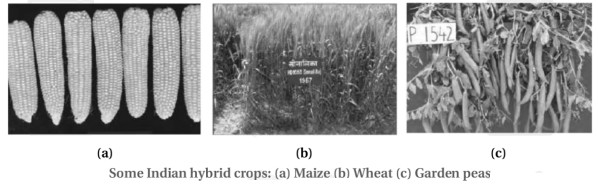
Many hybrid crops of high-yielding varieties are seen in India:
Wheat and Rice: During the period $1960$ to $2000$,wheat production increased from $11$ million tonnes to $75$ million tonnes,while rice production went up from $35$ million tonnes to $89.5$ million tonnes. This was due to the development of semi-dwarf varieties of wheat and rice.
- Nobel laureate Norman $E$. Borlaug,at the International Centre for Wheat and Maize Improvement in Mexico,developed semi-dwarf wheat.
In $1963$,several varieties such as Sonalika and Kalyan Sona,which were high-yielding and disease-resistant,were introduced all over the wheat-growing belt of India.
Semi-dwarf rice varieties were derived from $IR-8$ (developed at the International Rice Research Institute $(IRRI)$,Philippines) and Taichung Native-$1$ (from Taiwan). The derivatives were introduced in $1966$. Later,better-yielding semi-dwarf varieties,Jaya and Ratna,were developed in India.
Sugarcane: $Saccharum$ $barberi$ was originally grown in North India but had poor sugar content and yield. Tropical canes grown in South India,$Saccharum$ $officinarum$,had thicker stems and higher sugar content but did not grow well in North India.
After India's independence,one of the main challenges facing the country was producing enough food for the increasing population,as only limited land is fit for cultivation.
- India had to strive to increase yields per unit area from existing farmland.
The development of several high-yielding varieties of wheat and rice in the mid-$1960s$,as a result of various plant breeding techniques,led to a dramatic increase in food production in our country. This phase is often referred to as the Green Revolution.
Many hybrid crops of high-yielding varieties are seen in India:
Wheat and Rice: During the period $1960$ to $2000$,wheat production increased from $11$ million tonnes to $75$ million tonnes,while rice production went up from $35$ million tonnes to $89.5$ million tonnes. This was due to the development of semi-dwarf varieties of wheat and rice.
- Nobel laureate Norman $E$. Borlaug,at the International Centre for Wheat and Maize Improvement in Mexico,developed semi-dwarf wheat.
In $1963$,several varieties such as Sonalika and Kalyan Sona,which were high-yielding and disease-resistant,were introduced all over the wheat-growing belt of India.
Semi-dwarf rice varieties were derived from $IR-8$ (developed at the International Rice Research Institute $(IRRI)$,Philippines) and Taichung Native-$1$ (from Taiwan). The derivatives were introduced in $1966$. Later,better-yielding semi-dwarf varieties,Jaya and Ratna,were developed in India.
Sugarcane: $Saccharum$ $barberi$ was originally grown in North India but had poor sugar content and yield. Tropical canes grown in South India,$Saccharum$ $officinarum$,had thicker stems and higher sugar content but did not grow well in North India.
0 likes
View Solution42
Medium
How is plant breeding useful for improved food quality?
Solution
(N/A) More than $840$ million people in the world do not have adequate food to meet their daily food and nutritional requirements.
$A$ far greater number—three billion people—suffer from micronutrient,protein,and vitamin deficiencies or 'hidden hunger' because they cannot afford to buy enough fruits,vegetables,legumes,fish,and meat. Diets lacking essential micronutrients—particularly iron,vitamin-$A$,iodine,and zinc—increase the risk of disease,reduce lifespan,and reduce mental abilities.
Biofortification: Breeding crops with higher levels of vitamins and minerals or higher protein and healthier fats is the most practical means to improve public health.
Breeding for improved nutritional quality is undertaken with the objectives of improving:
$(i)$ Protein content and quality
$(ii)$ Oil content and quality
$(iii)$ Vitamin content
$(iv)$ Micronutrient and mineral content
In $2000$,maize hybrids that had twice the amount of the amino acids,Lysine and tryptophan,compared to existing maize hybrids were developed.
Wheat variety,Atlas $66$,having a high protein content,has been used as a donor for improving cultivated wheat.
It has been possible to develop an iron-fortified rice variety containing over five times as much iron as in commonly consumed varieties.
The Indian Agricultural Research Institute $(IARI)$,New Delhi,has also released several vegetable crops that are rich in vitamins and minerals. Examples include vitamin-$A$ enriched carrots,spinach,and pumpkin; vitamin-$C$ enriched bitter gourd,bathua,mustard,and tomato; iron and calcium-enriched spinach and bathua; and protein-enriched beans (broad,lablab,French,and garden peas).
$A$ far greater number—three billion people—suffer from micronutrient,protein,and vitamin deficiencies or 'hidden hunger' because they cannot afford to buy enough fruits,vegetables,legumes,fish,and meat. Diets lacking essential micronutrients—particularly iron,vitamin-$A$,iodine,and zinc—increase the risk of disease,reduce lifespan,and reduce mental abilities.
Biofortification: Breeding crops with higher levels of vitamins and minerals or higher protein and healthier fats is the most practical means to improve public health.
Breeding for improved nutritional quality is undertaken with the objectives of improving:
$(i)$ Protein content and quality
$(ii)$ Oil content and quality
$(iii)$ Vitamin content
$(iv)$ Micronutrient and mineral content
In $2000$,maize hybrids that had twice the amount of the amino acids,Lysine and tryptophan,compared to existing maize hybrids were developed.
Wheat variety,Atlas $66$,having a high protein content,has been used as a donor for improving cultivated wheat.
It has been possible to develop an iron-fortified rice variety containing over five times as much iron as in commonly consumed varieties.
The Indian Agricultural Research Institute $(IARI)$,New Delhi,has also released several vegetable crops that are rich in vitamins and minerals. Examples include vitamin-$A$ enriched carrots,spinach,and pumpkin; vitamin-$C$ enriched bitter gourd,bathua,mustard,and tomato; iron and calcium-enriched spinach and bathua; and protein-enriched beans (broad,lablab,French,and garden peas).
0 likes
View Solution43
MediumMCQ
Lifestyle diseases are increasing alarmingly in India. We are also dealing with large-scale malnutrition in the population. Is there any method by which we can address both problems together?
A
By promoting fast food consumption.
B
By focusing on Biofortification of crops to provide essential nutrients and encouraging a balanced diet to prevent lifestyle disorders.
C
By increasing the use of chemical fertilizers.
D
By ignoring the nutritional quality of food.
Solution
(B) Biofortification is the process of breeding crops with higher levels of vitamins and minerals,or higher protein and healthier fats.
- This approach addresses malnutrition by providing nutrient-dense food to the population.
- Simultaneously,promoting a balanced diet through these biofortified crops helps in preventing lifestyle-related diseases such as obesity,diabetes,and cardiovascular issues,which are often linked to poor dietary habits.
- This approach addresses malnutrition by providing nutrient-dense food to the population.
- Simultaneously,promoting a balanced diet through these biofortified crops helps in preventing lifestyle-related diseases such as obesity,diabetes,and cardiovascular issues,which are often linked to poor dietary habits.
0 likes
View Solution44
EasyMCQ
Match the columns:
| Column-$I$ | Column-$II$ |
| $(a)$ Wheat | $(1)$ Pusa komal |
| $(b)$ Mustard | $(2)$ Pusa sadabahar |
| $(c)$ Cauliflower | $(3)$ Himgiri |
| $(d)$ Cowpea (Lima beans) | $(4)$ Pusa swarnim |
| $(5)$ Pusa shubhra |
A
$a-3, b-4, c-5, d-1$
B
$a-3, b-4, c-1, d-5$
C
$a-1, b-4, c-5, d-3$
D
$a-3, b-1, c-5, d-4$
Solution
(A) The correct matches based on the $NCERT$ textbook for crop varieties are:
$(a)$ Wheat: $(3)$ Himgiri (resistant to leaf and stripe rust).
$(b)$ Mustard: $(4)$ Pusa swarnim (resistant to white rust).
$(c)$ Cauliflower: $(5)$ Pusa shubhra (resistant to black rot and curl blight black rot).
$(d)$ Cowpea: $(1)$ Pusa komal (resistant to bacterial blight).
Therefore, the correct sequence is $a-3, b-4, c-5, d-1$.
$(a)$ Wheat: $(3)$ Himgiri (resistant to leaf and stripe rust).
$(b)$ Mustard: $(4)$ Pusa swarnim (resistant to white rust).
$(c)$ Cauliflower: $(5)$ Pusa shubhra (resistant to black rot and curl blight black rot).
$(d)$ Cowpea: $(1)$ Pusa komal (resistant to bacterial blight).
Therefore, the correct sequence is $a-3, b-4, c-5, d-1$.
0 likes
View Solution45
EasyMCQ
Which of the following crop varieties is resistant to the $Chilli$ $mosaic$ $virus$?
A
$Pusa$ $Sadabahar$
B
$Pusa$ $Shubhra$
C
$Pusa$ $Komal$
D
$Pusa$ $Snowball$ $K-1$
Solution
(A) The crop variety $Pusa$ $Sadabahar$ is a variety of $Capsicum$ $(Chilli)$ that has been developed through plant breeding techniques to be resistant to the $Chilli$ $mosaic$ $virus$,$Tobacco$ $mosaic$ $virus$,and $Leaf$ $curl$.
0 likes
View Solution46
EasyMCQ
Select the correct option regarding $A. esculentus$.
A
Okra
B
Wheat
C
Rice
D
Maize
Solution
(A) $A. esculentus$ is the scientific name for Okra (also known as Lady's finger). In the context of plant breeding,it is a well-known example of a crop variety developed for resistance to yellow mosaic virus,specifically the variety known as $Parbhani Kranti$.
0 likes
View Solution47
EasyMCQ
Which pest is $Pusa$ $Gaurav$ resistant to?
A
Jassids
B
Aphids
C
Stem borer
D
Fruit borer
Solution
(B) $Pusa$ $Gaurav$ is a variety of $Brassica$ (mustard) developed through plant breeding. It is specifically known for its resistance to aphids. Therefore,the correct option is $B$.
0 likes
View Solution48
EasyMCQ
Which of the following crop varieties is resistant to bacterial blight?
A
Pusa Shubhra
B
Himgiri
C
Pusa Sadabahar
D
Pusa Komal
Solution
(D) The crop variety $Pusa \ Komal$ is a variety of $Cowpea$ $(Vigna \ unguiculata)$.
It has been developed through conventional plant breeding techniques to provide resistance against the disease known as $Bacterial \ blight$.
$Pusa \ Shubhra$ is resistant to black rot,$Himgiri$ is resistant to hill bunt,and $Pusa \ Sadabahar$ is resistant to chilli mosaic virus.
It has been developed through conventional plant breeding techniques to provide resistance against the disease known as $Bacterial \ blight$.
$Pusa \ Shubhra$ is resistant to black rot,$Himgiri$ is resistant to hill bunt,and $Pusa \ Sadabahar$ is resistant to chilli mosaic virus.
0 likes
View Solution49
EasyMCQ
The breeding of crops for higher levels of vitamins and minerals or higher protein and healthier fats is called:
A
Biofortification
B
Pasteurization
C
Somaclonal variation
D
Mutation
Solution
(A) Biofortification is the process of breeding crops to increase their nutritional value. This can be achieved through conventional selective breeding or genetic engineering. The primary goal of biofortification is to improve the public health of populations by providing staple crops that are rich in essential vitamins,minerals,proteins,and healthy fats,thereby addressing hidden hunger.
0 likes
View Solution50
EasyMCQ
Which variety is used as a donor for improving wheat crops?
A
$IR-8$
B
$IR-66$
C
$Atlas-99$
D
$Atlas-66$
Solution
(D) The variety $Atlas-66$ is widely used as a donor for improving wheat crops.
It is specifically known for its high protein content,which is a desirable trait in biofortification programs to improve the nutritional quality of wheat.
It is specifically known for its high protein content,which is a desirable trait in biofortification programs to improve the nutritional quality of wheat.
0 likes
View SolutionStrategies for Enhancement in Food Production — Application of plant breeding · Frequently Asked Questions
1Are these Strategies for Enhancement in Food Production questions useful for JEE and NEET?
Yes. All questions in this section are mapped to JEE Main and NEET exam patterns. Previous year questions from JEE Main, NEET, GUJCET and state-level exams are included with full solutions.
2Can I switch to Hindi or Gujarati for these questions?
Yes. Use the language tabs in the hero section or the sidebar to view the same questions and solutions in English, Hindi or Gujarati.
3How do I generate a question paper from this subtopic?
Use the Vedclass Exam Paper Generator — select the chapter and subtopic, set difficulty, and generate Sets A, B, C, D automatically. First 3 chapters of every subject are free.
Vedclass Products
For Students
Vedclass Test Series
Mock tests in real JEE/NEET style with performance analysis. 5-day free trial.
Start Free TrialFor Teachers
Exam Paper Generator
Generate Set A/B/C/D papers from this chapter in 2 minutes. 3 chapters free.
Try FreeFor Institutes
Online Exam Module
Live online exams with unlimited students, 360° analytics & white-label branding.
See DemoFor Teachers & Institutes
Generate a Strategies for Enhancement in Food Production Exam Paper in 2 Minutes
Select subtopic & difficulty — Sets A, B, C, D auto-generated with No Repeat logic.
First 3 chapters of every subject are free — no payment required.