
A English
Mutation Questions in English
Class 12 Biology · Principles of Inheritance and Variation · Mutation
200+
Questions
English
Language
100%
With Solutions
Showing 50 of 200 questions in English
151
MediumMCQ
Which of the following cannot be considered a mutagen?
A
$UV$ rays
B
None of these
C
Mustard gas
D
Nicotine
Solution
(D) Mutagens are physical or chemical agents that increase the rate of mutation.
$UV$ rays are physical mutagens that cause thymine dimers in $DNA$.
Mustard gas is a well-known chemical mutagen.
Nicotine is a stimulant found in tobacco,but it is not classified as a mutagen.
Therefore,nicotine cannot be considered a mutagen.
$UV$ rays are physical mutagens that cause thymine dimers in $DNA$.
Mustard gas is a well-known chemical mutagen.
Nicotine is a stimulant found in tobacco,but it is not classified as a mutagen.
Therefore,nicotine cannot be considered a mutagen.
0 likes
View Solution152
MediumMCQ
Sickle cell anemia is a result of which type of mutation?
A
Frameshift mutation
B
Point mutation
C
Duplication
D
Deletion
Solution
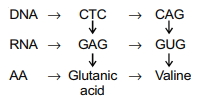
(B) Sickle cell anemia is an autosomal recessive genetic disorder caused by a single base pair substitution in the $\beta$-globin gene of hemoglobin.
Specifically,the codon $GAG$ is replaced by $GUG$ at the sixth position of the $\beta$-globin chain.
This change results in the substitution of glutamic acid with valine at the sixth position of the protein.
Since this mutation involves a change in a single nucleotide base pair,it is classified as a point mutation.
Specifically,the codon $GAG$ is replaced by $GUG$ at the sixth position of the $\beta$-globin chain.
This change results in the substitution of glutamic acid with valine at the sixth position of the protein.
Since this mutation involves a change in a single nucleotide base pair,it is classified as a point mutation.
0 likes
View Solution153
MediumMCQ
Which of the following causes a change in the genetic material?
A
No change in the amount of genetic material.
B
Age
C
Physiological processes of the organism
D
Different stages of the life cycle
Solution
(A) Genetic material $(DNA)$ is generally stable and remains constant throughout the life of an organism. Changes in genetic material occur due to mutations,which can be caused by physical or chemical agents $(mutagens)$. Options $A$,$B$,$C$,and $D$ describe conditions or processes that do not inherently alter the sequence or structure of the $DNA$ molecule in a way that constitutes a permanent genetic change. However,if the question implies what causes a change,and given the provided options,it is important to note that none of the options $B, C,$ or $D$ cause mutations. Option $A$ is a statement of fact regarding stability. In the context of standard biology,genetic material changes only through mutations or recombination events.
0 likes
View Solution154
MediumMCQ
What arises due to errors in $DNA$ replication?
A
Protein
B
$RNA$
C
Replication
D
Mutation
Solution
(D) $DNA$ replication is a highly accurate process,but errors can occur during the copying of the genetic code.
When an incorrect nucleotide is incorporated into the new $DNA$ strand and remains uncorrected by $DNA$ polymerase proofreading mechanisms,it results in a permanent change in the $DNA$ sequence.
This permanent change in the genetic material is known as a mutation.
Therefore,errors in replication are a primary source of mutations.
When an incorrect nucleotide is incorporated into the new $DNA$ strand and remains uncorrected by $DNA$ polymerase proofreading mechanisms,it results in a permanent change in the $DNA$ sequence.
This permanent change in the genetic material is known as a mutation.
Therefore,errors in replication are a primary source of mutations.
0 likes
View Solution155
MediumMCQ
What is the effect of deletion or rearrangement in a segment of $DNA$ on a gene?
A
Complete gene deletion
B
Genome deletion
C
Loss or gain of gene function
D
No effect on the gene
Solution
(C) Deletion or rearrangement in a segment of $DNA$ results in a mutation.
Such mutations can alter the reading frame of the genetic code (frameshift mutation) or change the sequence of amino acids in the resulting protein.
This alteration often leads to the loss of function of the gene product or,in some cases,a gain of function,which significantly impacts the phenotype of the organism.
Such mutations can alter the reading frame of the genetic code (frameshift mutation) or change the sequence of amino acids in the resulting protein.
This alteration often leads to the loss of function of the gene product or,in some cases,a gain of function,which significantly impacts the phenotype of the organism.
0 likes
View Solution156
MediumMCQ
What is the cause of a point mutation?
A
Addition,deletion,or substitution of a single base pair in a gene.
B
Change in the reading frame of the genetic code.
C
Change in two nucleotide pairs.
D
All of the above.
Solution
(A) point mutation is a genetic mutation where a single nucleotide base is changed,inserted,or deleted from a $DNA$ or $RNA$ sequence of an organism's genome.
Specifically,it involves the substitution,addition,or deletion of a single base pair in a gene.
This can lead to changes in the amino acid sequence of the protein being synthesized,potentially affecting its function.
Therefore,the correct option is $A$.
Specifically,it involves the substitution,addition,or deletion of a single base pair in a gene.
This can lead to changes in the amino acid sequence of the protein being synthesized,potentially affecting its function.
Therefore,the correct option is $A$.
0 likes
View Solution157
MediumMCQ
The rate of appearance of new forms is linked to which of the following?
A
Natural selection
B
Mutation
C
Migration
D
Life cycle
Solution
(B) The rate of appearance of new forms (variations) in a population is primarily driven by $Mutation$.
$Mutation$ is a sudden,heritable change in the genetic material $(DNA)$ of an organism.
These changes introduce new alleles into the gene pool,which serve as the raw material for evolution.
While $Natural$ $selection$ acts upon these variations to determine which are advantageous,the actual generation of new genetic forms is fundamentally linked to the process of $Mutation$.
$Mutation$ is a sudden,heritable change in the genetic material $(DNA)$ of an organism.
These changes introduce new alleles into the gene pool,which serve as the raw material for evolution.
While $Natural$ $selection$ acts upon these variations to determine which are advantageous,the actual generation of new genetic forms is fundamentally linked to the process of $Mutation$.
0 likes
View Solution158
EasyMCQ
On which plant did Hugo de Vries work?
A
Evening Lily
B
Evening Primrose
C
Cucurbita
D
Peace Lily
Solution
(B) Hugo de Vries, a Dutch botanist, proposed the mutation theory of evolution. He conducted his experiments on the plant $Oenothera \text{ lamarckiana}$, which is commonly known as the Evening Primrose. He observed sudden, heritable changes in the population of this plant, which he termed as mutations.
0 likes
View Solution159
MediumMCQ
Select the appropriate option for mutation.
A
Random and directional
B
Random and small but directional
C
Directionless and small
D
Directionless and random
Solution
(D) According to the modern synthetic theory of evolution,mutations are the raw material for evolution. Mutations are defined as sudden,heritable changes in the genetic material of an organism. These changes occur randomly and are directionless,meaning they do not occur to fulfill a specific need of the organism. Therefore,the correct description for mutation is that it is directionless and random.
0 likes
View Solution160
MediumMCQ
Which mutation causes a change in an allele?
A
Chemical
B
Radiation
C
Transposons
D
Spontaneous mutation
Solution
(C) Transposons are known as jumping elements that have the ability to move within the genome.
When these transposable elements get inserted into or near genes,they can disrupt the gene sequence or alter gene expression.
This insertion results in a change in the allele,which is a primary cause of genetic variation and mutation.
When these transposable elements get inserted into or near genes,they can disrupt the gene sequence or alter gene expression.
This insertion results in a change in the allele,which is a primary cause of genetic variation and mutation.
0 likes
View Solution161
DifficultMCQ
Which is not possible by mutation?
A
Development of new variety
B
Regeneration
C
Recombination
D
Disease resistant plant
Solution
(B) mutation is defined as a sudden,heritable change in the $DNA$ sequence of an organism.
Mutations can lead to the development of new varieties,the creation of disease-resistant plants,and can influence recombination processes.
However,regeneration is a physiological process involving the regrowth of lost body parts or tissues,which is controlled by developmental and cellular signaling pathways,not by mutation.
Therefore,mutation is not able to cause regeneration.
Mutations can lead to the development of new varieties,the creation of disease-resistant plants,and can influence recombination processes.
However,regeneration is a physiological process involving the regrowth of lost body parts or tissues,which is controlled by developmental and cellular signaling pathways,not by mutation.
Therefore,mutation is not able to cause regeneration.
0 likes
View Solution162
EasyMCQ
$...$ is a phenomenon by which genetic variation is achieved through changes in the base sequences within genes,which creates a new character or trait absent in the parental generation.
A
Apomixis
B
Mutation
C
Breeding
D
Heterosis
Solution
(B) Mutation is a phenomenon by which genetic variation is achieved through changes in the base sequences within genes,which creates a new character or trait absent in the parental generation.
Mutations that occur naturally are called spontaneous mutations,and those that are induced artificially are called induced mutations.
The application of induced mutation for crop improvement is called mutation breeding.
Mutations that occur naturally are called spontaneous mutations,and those that are induced artificially are called induced mutations.
The application of induced mutation for crop improvement is called mutation breeding.
0 likes
View Solution163
MediumMCQ
When mutation is confined to only one substitution,it is called
A
Translocation
B
Point mutation
C
Base inversion
D
Frame shift
Solution
(B) When a mutation is confined to only one base pair substitution,deletion,or insertion,it is called a point mutation.
Sickle-cell anaemia is a classic example of a point mutation,in which the amino acid Glutamic acid $(Glu)$ is replaced by Valine $(Val)$ at the sixth position of the $\beta$-globin chain of the haemoglobin molecule.
Sickle-cell anaemia is a classic example of a point mutation,in which the amino acid Glutamic acid $(Glu)$ is replaced by Valine $(Val)$ at the sixth position of the $\beta$-globin chain of the haemoglobin molecule.
0 likes
View Solution164
MediumMCQ
The most important example of point mutation is found in a disease called
A
Thalassemia
B
Night blindness
C
Down's syndrome
D
Sickle-cell anaemia
Solution
(D) Sickle-cell anaemia is a classic example of a point mutation.
It is caused by a single base pair substitution in the gene coding for the $\beta$-globin chain of hemoglobin.
Specifically,the codon $GAG$ is replaced by $GUG$ at the sixth position of the $\beta$-globin chain.
This results in the substitution of the amino acid glutamic acid with valine,which leads to the formation of abnormal hemoglobin $(HbS)$ and causes the red blood cells to become sickle-shaped under low oxygen tension.
It is caused by a single base pair substitution in the gene coding for the $\beta$-globin chain of hemoglobin.
Specifically,the codon $GAG$ is replaced by $GUG$ at the sixth position of the $\beta$-globin chain.
This results in the substitution of the amino acid glutamic acid with valine,which leads to the formation of abnormal hemoglobin $(HbS)$ and causes the red blood cells to become sickle-shaped under low oxygen tension.
0 likes
View Solution165
EasyMCQ
The first definite proof of the mutagenic action of $X$-rays was given by
A
Muller
B
Hooker
C
Lister
D
Leeuwenhoek
Solution
(A) $H.J. Muller$ provided the first definite experimental proof that $X$-rays can induce mutations in organisms. He demonstrated this using the fruit fly, $Drosophila \text{ } melanogaster$, in $1927$, for which he was later awarded the Nobel Prize.
0 likes
View Solution166
MediumMCQ
Mutagens are
A
Chemical agents which cause change in $DNA$
B
Physical agents which cause mutation
C
Cancer producing agents
D
Both $(A)$ and $(B)$
Solution
(D) Mutagens are agents that induce mutations by causing changes in the $DNA$ sequence.
They can be classified into two main categories:
$1$. Physical agents: Such as $UV$-radiation,$X$-rays,and gamma rays.
$2$. Chemical agents: Such as acridine dyes,base analogs,and alkylating agents.
Therefore,since both physical and chemical agents can cause mutations,the correct answer is $(D)$.
They can be classified into two main categories:
$1$. Physical agents: Such as $UV$-radiation,$X$-rays,and gamma rays.
$2$. Chemical agents: Such as acridine dyes,base analogs,and alkylating agents.
Therefore,since both physical and chemical agents can cause mutations,the correct answer is $(D)$.
0 likes
View Solution167
EasyMCQ
Which phenomenon leads to the variation in $DNA$?
A
Mutation
B
Linkage
C
Both $(a)$ and $(b)$
D
Mitosis
Solution
(A) Mutation is the ultimate source of variation in $DNA$,as proposed by Hugo de Vries.
Linkage refers to the physical association of genes on the same chromosome,which tends to keep parental combinations together rather than creating new variations.
Mitosis is a process of equational division that produces genetically identical daughter cells,thus it does not contribute to genetic variation.
Therefore,mutation is the primary phenomenon responsible for variation.
Linkage refers to the physical association of genes on the same chromosome,which tends to keep parental combinations together rather than creating new variations.
Mitosis is a process of equational division that produces genetically identical daughter cells,thus it does not contribute to genetic variation.
Therefore,mutation is the primary phenomenon responsible for variation.
0 likes
View Solution168
EasyMCQ
Which of the following types of mutation involves the reverse order of genes in a chromosome?
A
Deletion
B
Duplication
C
Inversion
D
Reciprocal translocation
Solution
(C) Inversion is a type of chromosomal mutation where a segment of a chromosome breaks off, rotates $180^{\circ}$, and reattaches to the same chromosome. This results in the reverse order of genes within that specific segment of the chromosome.
0 likes
View Solution169
MediumMCQ
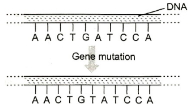
Identify the type of mutation in the given diagram.
A
Inversion
B
Insertion
C
Deletion
D
Substitution
Solution
(B) By comparing the original $DNA$ sequence $(A-A-C-T-G-A-T-C-C-A)$ with the mutated sequence $(A-A-C-T-G-T-A-T-C-C-A)$,we can observe that an extra nucleotide base '$T$' has been added into the sequence.
This addition of a nucleotide base into the $DNA$ sequence is known as an insertion mutation.
This addition of a nucleotide base into the $DNA$ sequence is known as an insertion mutation.
0 likes
View Solution170
MediumMCQ
What is the effect of a change in a single base pair of $DNA$?
A
May not change the phenotype
B
Quickly changes the phenotype
C
Changes the natural process
D
None of the above
Solution
(A) change in a single base pair of $DNA$ is known as a point mutation. Due to the degenerate nature of the genetic code,where multiple codons can code for the same amino acid,a single base substitution may result in a synonymous mutation (silent mutation). In such cases,the amino acid sequence remains unchanged,and consequently,the phenotype may not change.
0 likes
View Solution171
MediumMCQ
Point mutation arises due to change in
A
Single base of $RNA$
B
Single base pair of $DNA$
C
Entire Functional Segment of $DNA$
D
None of these
Solution
(B) point mutation is a type of mutation that causes a single nucleotide base change,insertion,or deletion of the genetic material,$DNA$ or $RNA$.
Specifically,a mutation that occurs due to a change in a single base pair of $DNA$ is known as a point mutation.
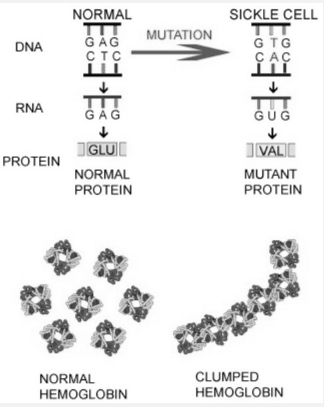
$A$ classic example of this is Sickle-cell anaemia,where a single base pair substitution ($GAG$ to $GTG$) in the gene for $\beta$-globin results in the replacement of glutamic acid with valine in the haemoglobin protein.
Specifically,a mutation that occurs due to a change in a single base pair of $DNA$ is known as a point mutation.
$A$ classic example of this is Sickle-cell anaemia,where a single base pair substitution ($GAG$ to $GTG$) in the gene for $\beta$-globin results in the replacement of glutamic acid with valine in the haemoglobin protein.
0 likes
View Solution172
EasyMCQ
When a segment of a chromosome breaks and later rejoins after $180^{\circ}$ rotation,it is known as
A
Deletion
B
Duplication
C
Inversion
D
Interstitial translocation
Solution
(C) Inversions occur when there are two breaks in a chromosome and the intercalary segment reunites in a reverse order by rotating at $180^{\circ}$.
0 likes
View Solution173
MediumMCQ
The following diagram shows two chromosomes and the letters represent the genes.
Chromosome $1$:
Chromosome $2$:
Which of the following would result if a translocation occurred between chromosome $1$ and $2$?
Chromosome $1$:
| $P$ | $Q$ | $R$ | $S$ | $T$ | $U$ | $V$ | $W$ |
Chromosome $2$:
| $E$ | $F$ | $G$ | $H$ |
Which of the following would result if a translocation occurred between chromosome $1$ and $2$?
A
Chromosome $1$: $P, Q, R, S, W, V, U, T$ (Inversion)
Chromosome $2$: $E, F, G, H$
Chromosome $2$: $E, F, G, H$
B
Chromosome $1$: $P, Q, R, S$
Chromosome $2$: $T, U, V, W, E, F, G, H$ (Translocation)
Chromosome $2$: $T, U, V, W, E, F, G, H$ (Translocation)
C
Chromosome $1$: $P, Q, R, S, T, U, V, W$
Chromosome $2$: $E, F, H$ (Deletion)
Chromosome $2$: $E, F, H$ (Deletion)
D
Chromosome $1$: $P, Q, R, S, T, U, V, W$
Chromosome $2$: $E, F, G, H, G, H$ (Duplication)
Chromosome $2$: $E, F, G, H, G, H$ (Duplication)
Solution
(B) Translocation is a type of chromosomal mutation where a segment of one chromosome breaks off and attaches to a non-homologous chromosome.
$1$. Option $A$ shows an inversion,where a segment of the chromosome is reversed.
$2$. Option $B$ shows a translocation,where a segment $(T, U, V, W)$ from chromosome $1$ has been transferred to chromosome $2$.
$3$. Option $C$ shows a deletion,where a gene $(G)$ is missing.
$4$. Option $D$ shows a duplication,where a segment $(G, H)$ is repeated.
Therefore,the correct result of a translocation is represented by option $B$.
$1$. Option $A$ shows an inversion,where a segment of the chromosome is reversed.
$2$. Option $B$ shows a translocation,where a segment $(T, U, V, W)$ from chromosome $1$ has been transferred to chromosome $2$.
$3$. Option $C$ shows a deletion,where a gene $(G)$ is missing.
$4$. Option $D$ shows a duplication,where a segment $(G, H)$ is repeated.
Therefore,the correct result of a translocation is represented by option $B$.
0 likes
View Solution174
EasyMCQ
$A$ dominant lethal gene is one which:
A
Allows the organism to survive but not reproduce
B
Determines the sex of offspring
C
Allows the organism to survive and reproduce
D
Kills the organism
Solution
(D) dominant lethal gene is a mutation that results in the death of an organism that carries the allele,even if only one copy is present (heterozygous state). Therefore,it kills the organism.
0 likes
View Solution175
MediumMCQ
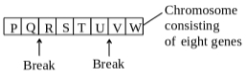
The chromosome shown in the diagram below is broken at the points which are indicated by the arrows and the genes between these points become inverted. The resulting order of the genes will be:
A
$PQUTSRVW$
B
$WVUTSRQP$
C
$PQTURSVW$
D
$VWUTSRPQ$
Solution
(A) The original gene sequence is $P-Q-R-S-T-U-V-W$.
According to the diagram,the chromosome breaks between $Q$ and $R$,and between $U$ and $V$.
The segment between these break points is $R-S-T-U$.
In an inversion mutation,this segment is rotated by $180^{\circ}$,reversing its order to $U-T-S-R$.
Therefore,the new gene sequence becomes $P-Q-U-T-S-R-V-W$.
According to the diagram,the chromosome breaks between $Q$ and $R$,and between $U$ and $V$.
The segment between these break points is $R-S-T-U$.
In an inversion mutation,this segment is rotated by $180^{\circ}$,reversing its order to $U-T-S-R$.
Therefore,the new gene sequence becomes $P-Q-U-T-S-R-V-W$.
0 likes
View Solution176
MediumMCQ
Mutation may result in the:
A
Change in genotype
B
Change in phenotype
C
Change in metabolism
D
All of these
Solution
(D) Mutation is defined as a sudden change in the $DNA$ sequence.
$1$. $A$ change in the $DNA$ sequence directly alters the genotype of an organism.
$2$. Since the genotype determines the protein synthesis and cellular functions,a change in genotype often leads to a change in the phenotype (observable characteristics).
$3$. Metabolic processes are controlled by enzymes,which are proteins encoded by genes. Therefore,a mutation can also alter metabolic pathways.
$4$. Thus,mutation can result in changes in genotype,phenotype,and metabolism.
$1$. $A$ change in the $DNA$ sequence directly alters the genotype of an organism.
$2$. Since the genotype determines the protein synthesis and cellular functions,a change in genotype often leads to a change in the phenotype (observable characteristics).
$3$. Metabolic processes are controlled by enzymes,which are proteins encoded by genes. Therefore,a mutation can also alter metabolic pathways.
$4$. Thus,mutation can result in changes in genotype,phenotype,and metabolism.
0 likes
View Solution177
MediumMCQ
Frameshift mutation arises due to
A
Deletion of base pair of $DNA$
B
Insertion of base pair of $DNA$
C
Both $(a)$ and $(b)$
D
Change in single base pair of $DNA$
Solution
(C) frameshift mutation is a genetic mutation caused by the insertion or deletion of a number of nucleotides in a $DNA$ sequence that is not divisible by three.
Because the genetic code is read in triplets (codons),the insertion or deletion of one or two base pairs shifts the reading frame of the entire sequence downstream from the mutation site.
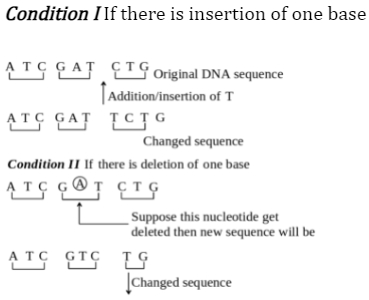
As shown in the diagram:
Condition $I$: If there is an insertion of one base,the original sequence $ATC-GAT-CTG$ changes to $ATC-GAT-TCT-G...$,altering all subsequent codons.
Condition $II$: If there is a deletion of one base,the original sequence $ATC-GAT-CTG$ changes to $ATC-GTC-TG...$,also altering all subsequent codons.
Therefore,both deletion and insertion of base pairs lead to a frameshift mutation.
Because the genetic code is read in triplets (codons),the insertion or deletion of one or two base pairs shifts the reading frame of the entire sequence downstream from the mutation site.
As shown in the diagram:
Condition $I$: If there is an insertion of one base,the original sequence $ATC-GAT-CTG$ changes to $ATC-GAT-TCT-G...$,altering all subsequent codons.
Condition $II$: If there is a deletion of one base,the original sequence $ATC-GAT-CTG$ changes to $ATC-GTC-TG...$,also altering all subsequent codons.
Therefore,both deletion and insertion of base pairs lead to a frameshift mutation.
0 likes
View Solution178
MediumMCQ
$A$ chimera is produced due to:
A
Somatic mutations
B
Reverse mutations
C
Lethal mutations
D
Pleiotropic mutations
Solution
(A) chimera is an organism that contains two or more genetically distinct cell populations derived from different zygotes or through somatic mutations.
In the context of developmental biology,chimerism often arises due to somatic mutations occurring during early embryonic development,where a mutation in a single cell line leads to a mosaic or chimeric phenotype in the adult organism.
Therefore,somatic mutations are a primary cause for the formation of chimeric tissues within an individual.
In the context of developmental biology,chimerism often arises due to somatic mutations occurring during early embryonic development,where a mutation in a single cell line leads to a mosaic or chimeric phenotype in the adult organism.
Therefore,somatic mutations are a primary cause for the formation of chimeric tissues within an individual.
0 likes
View Solution179
EasyMCQ
Which one of the following is a physical factor that induces mutation?
A
Acridines
B
$HNO_2$
C
$UV$-rays
D
Base analogue
Solution
(C) Mutagens are agents that cause mutations. They are classified into physical and chemical mutagens.
$1$. Physical mutagens include radiations such as $UV$-rays,$X$-rays,and gamma rays.
$2$. Chemical mutagens include substances like acridines,$HNO_2$ (nitrous acid),and base analogues.
Therefore,$UV$-rays are physical factors that induce mutation.
$1$. Physical mutagens include radiations such as $UV$-rays,$X$-rays,and gamma rays.
$2$. Chemical mutagens include substances like acridines,$HNO_2$ (nitrous acid),and base analogues.
Therefore,$UV$-rays are physical factors that induce mutation.
0 likes
View Solution180
MediumMCQ
The defect sickle-cell anaemia is caused by the . . . . . . of glutamic acid by valine at the $6^{th}$ position of the . . . . . . globin chain of the haemoglobin molecule.
A
Substitution,$\beta$
B
Deletion,$\alpha$
C
Duplication,$\beta$
D
Translocation,$\alpha$
Solution
(A) Sickle-cell anaemia is a point mutation caused by the substitution of a single nucleotide base in the gene coding for the $\beta$-globin chain of haemoglobin.
Specifically,at the $6^{th}$ position of the $\beta$-globin chain,the codon $GAG$ is replaced by $GUG$.
This results in the substitution of glutamic acid with valine in the protein sequence.
This change is a result of a transversion mutation where the nucleotide $A$ (adenine) is replaced by $T$ (thymine) in the $DNA$ sequence,leading to the change in the mRNA codon from $GAG$ to $GUG$.
Specifically,at the $6^{th}$ position of the $\beta$-globin chain,the codon $GAG$ is replaced by $GUG$.
This results in the substitution of glutamic acid with valine in the protein sequence.
This change is a result of a transversion mutation where the nucleotide $A$ (adenine) is replaced by $T$ (thymine) in the $DNA$ sequence,leading to the change in the mRNA codon from $GAG$ to $GUG$.
0 likes
View Solution181
AdvancedMCQ
Which of the following parental combinations has produced a mutant offspring?
A
$Tt \times tt = Tt$
B
$tt \times tt = Tt$
C
$Tt \times Tt = tt$
D
$TT \times tt = Tt$
Solution
(B) mutant offspring is an individual that possesses a genetic trait or genotype not present in the parents,typically resulting from a mutation. In the given options,the cross $tt \times tt$ involves two homozygous recessive parents. Under normal Mendelian inheritance,the offspring should only be $tt$. The appearance of a $Tt$ offspring from $tt \times tt$ parents indicates a mutation occurred in one of the gametes,making this the correct choice.
0 likes
View Solution182
MediumMCQ
Frame shift mutation occurs when
A
base is deleted or added.
B
base is added.
C
base is deleted.
D
anticodons are not present.
Solution
(A) frame shift mutation occurs when the addition or deletion of one or more nucleotide bases in a $DNA$ sequence causes a shift in the reading frame of the genetic code.
Since the genetic code is read in triplets (codons),changing the number of bases by a value not divisible by $3$ alters the entire sequence of amino acids downstream from the mutation site.
Since the genetic code is read in triplets (codons),changing the number of bases by a value not divisible by $3$ alters the entire sequence of amino acids downstream from the mutation site.
0 likes
View Solution183
MediumMCQ
Mutation introduces new genes into a species and brings about the changes in
A
Phenotypes
B
Genotypes
C
Both $(a)$ and $(b)$
D
None of these
Solution
(C) Mutation is defined as a sudden,heritable change in the genetic material of an organism.
Since mutations alter the $DNA$ sequence (genotype),they frequently result in changes to the observable characteristics or traits of the organism (phenotype).
Therefore,mutations bring about changes in both the genotype and the phenotype of an organism.
Since mutations alter the $DNA$ sequence (genotype),they frequently result in changes to the observable characteristics or traits of the organism (phenotype).
Therefore,mutations bring about changes in both the genotype and the phenotype of an organism.
0 likes
View Solution184
EasyMCQ
Hugo de Vries studied mutations in
A
Eucalyptus
B
Evening primrose
C
Hibiscus
D
Vallisneria
Solution
(B) Hugo de Vries proposed the mutation theory based on his work on the plant $Oenothera \, lamarckiana$, which is commonly known as the Evening primrose.
He observed that new species arise due to sudden, large, and heritable changes in the genetic material, which he termed as mutations.
He observed that new species arise due to sudden, large, and heritable changes in the genetic material, which he termed as mutations.
0 likes
View Solution185
MediumMCQ
$A$: Sickle cell anaemia occurs due to a point mutation.
$R$: $mRNA$ produced from the $Hb^S$ gene has $GUG$ instead of $GAG$.
$R$: $mRNA$ produced from the $Hb^S$ gene has $GUG$ instead of $GAG$.
A
Assertion and Reason both are correct and Reason is the correct explanation of Assertion.
B
Assertion and Reason both are correct but Reason is not the correct explanation of Assertion.
C
Assertion is correct,but Reason is incorrect.
D
Both Assertion and Reason are incorrect.
Solution
(C) Sickle cell anaemia is caused by a point mutation in the $\beta$-globin gene of haemoglobin.
In the normal $Hb^A$ gene,the codon is $GAG$,which codes for Glutamic acid.
In the mutant $Hb^S$ gene,a point mutation changes $GAG$ to $GUG$ in the $mRNA$.
This results in the substitution of Valine for Glutamic acid at the sixth position of the $\beta$-globin chain.
Therefore,the Assertion is correct,but the Reason is incorrect because it states the codons in reverse ($GAG$ instead of $GUG$ for $Hb^S$).
In the normal $Hb^A$ gene,the codon is $GAG$,which codes for Glutamic acid.
In the mutant $Hb^S$ gene,a point mutation changes $GAG$ to $GUG$ in the $mRNA$.
This results in the substitution of Valine for Glutamic acid at the sixth position of the $\beta$-globin chain.
Therefore,the Assertion is correct,but the Reason is incorrect because it states the codons in reverse ($GAG$ instead of $GUG$ for $Hb^S$).
0 likes
View Solution186
MediumMCQ
What is mutation?
A
Alternative change in the $DNA$ sequence
B
Change induced in genotype and phenotype
C
Brings variation in $DNA$ other than recombination
D
All of the above
Solution
(D) Mutation is a phenomenon which results in alteration of $DNA$ sequences and consequently results in changes in the genotype and the phenotype of an organism.
In addition to recombination,mutation is another phenomenon that leads to variation in $DNA$.
Therefore,all the given statements correctly describe the nature and consequences of mutation.
In addition to recombination,mutation is another phenomenon that leads to variation in $DNA$.
Therefore,all the given statements correctly describe the nature and consequences of mutation.
0 likes
View Solution187
MediumMCQ
$A$ mutation that arises due to a change in a single base pair of $DNA$ is known as .... mutation.
A
Duplication
B
Monosomy
C
Frame-shift
D
Point
Solution
(D) mutation that involves a change in a single base pair of $DNA$ is called a $Point$ mutation.
For example,the classic case of $Sickle-cell$ $anemia$ is caused by a single base pair substitution in the gene for $\beta-globin$ chain,where $GAG$ is replaced by $GUG$.
For example,the classic case of $Sickle-cell$ $anemia$ is caused by a single base pair substitution in the gene for $\beta-globin$ chain,where $GAG$ is replaced by $GUG$.
0 likes
View Solution188
MediumMCQ
Deletion or insertion of base pairs of $DNA$ causes which type of mutation?
A
Duplication
B
Monosomy
C
Frame-shift
D
Point
Solution
(C) The deletion or insertion of base pairs of $DNA$ results in a frame-shift mutation.
This occurs because the genetic code is read in triplets (codons).
When one or two base pairs are added or removed,the entire reading frame of the $mRNA$ sequence downstream of the mutation is shifted.
This leads to the translation of a completely different sequence of amino acids,often resulting in a non-functional protein.
This occurs because the genetic code is read in triplets (codons).
When one or two base pairs are added or removed,the entire reading frame of the $mRNA$ sequence downstream of the mutation is shifted.
This leads to the translation of a completely different sequence of amino acids,often resulting in a non-functional protein.
0 likes
View Solution189
MediumMCQ
Agents that induce mutations are called ....
A
Carcinogens
B
Mutagens
C
Antigens
D
Allergens
Solution
(B) Agents that induce mutations are known as $Mutagens$.
$Mutagens$ can be physical (e.g.,$UV$ radiation,$X$-rays) or chemical (e.g.,base analogs,alkylating agents) in nature.
$Carcinogens$ are agents that cause cancer,$Antigens$ are substances that trigger an immune response,and $Allergens$ are substances that cause allergic reactions.
$Mutagens$ can be physical (e.g.,$UV$ radiation,$X$-rays) or chemical (e.g.,base analogs,alkylating agents) in nature.
$Carcinogens$ are agents that cause cancer,$Antigens$ are substances that trigger an immune response,and $Allergens$ are substances that cause allergic reactions.
0 likes
View Solution190
MediumMCQ
Most mutations are caused by ........
A
$UV$ rays
B
$Beta$ rays
C
$Alpha$ rays
D
Infrared rays
Solution
(A) Mutations are sudden changes in the genetic material of an organism.
Physical mutagens are agents that cause mutations,and among the options provided,$UV$ rays (ultraviolet radiation) are the most common physical mutagens that cause damage to $DNA$ by forming pyrimidine dimers.
$Alpha$ and $Beta$ rays are ionizing radiations,but $UV$ rays are more frequently associated with environmental mutagenesis in biological systems.
Physical mutagens are agents that cause mutations,and among the options provided,$UV$ rays (ultraviolet radiation) are the most common physical mutagens that cause damage to $DNA$ by forming pyrimidine dimers.
$Alpha$ and $Beta$ rays are ionizing radiations,but $UV$ rays are more frequently associated with environmental mutagenesis in biological systems.
0 likes
View Solution191
MediumMCQ
$A$ sudden large change in a population is known as.......
A
Natural selection
B
Acquired traits
C
Mutation
D
Crossing over
Solution
(C) sudden large change in the genetic makeup of a population is known as $Mutation$.
$Mutation$ is a sudden, heritable change in the $DNA$ sequence of an organism.
According to Hugo de Vries, mutations are the primary cause of evolution, leading to speciation (saltation).
Natural selection acts on these variations, but the sudden appearance of new traits is primarily due to mutations.
$Mutation$ is a sudden, heritable change in the $DNA$ sequence of an organism.
According to Hugo de Vries, mutations are the primary cause of evolution, leading to speciation (saltation).
Natural selection acts on these variations, but the sudden appearance of new traits is primarily due to mutations.
0 likes
View Solution192
MediumMCQ
The unmodified allele which represents the original phenotype is the $.........$ allele and the modified allele is generally the $.........$ allele.
A
Mutant,wild
B
Recessive,recessive
C
Dominant,dominant
D
Wild,mutant
Solution
(D) In genetics,the unmodified allele that represents the original phenotype is known as the $wild$ type allele.
When a mutation occurs,the modified allele is generally referred to as the $mutant$ allele.
Therefore,the correct sequence is $wild$ and $mutant$.
When a mutation occurs,the modified allele is generally referred to as the $mutant$ allele.
Therefore,the correct sequence is $wild$ and $mutant$.
0 likes
View Solution193
MediumMCQ
Assertion $(A)$: Mutation results in changes in genotype and phenotype of an organism.
Reason $(R)$: Mutation leads to alteration of $\text{DNA}$ sequences,i.e.,variations in $\text{DNA}$.
Choose the correct answer from the options given below.
Reason $(R)$: Mutation leads to alteration of $\text{DNA}$ sequences,i.e.,variations in $\text{DNA}$.
Choose the correct answer from the options given below.
A
Both $(A)$ and $(R)$ are correct and $(R)$ is the correct explanation of $(A)$.
B
Both $(A)$ and $(R)$ are correct but $(R)$ is not the correct explanation of $(A)$.
C
$(A)$ is correct but $(R)$ is not correct.
D
$(A)$ is not correct but $(R)$ is correct.
Solution
(A) Mutation is defined as a phenomenon which results in alteration of $\text{DNA}$ sequences and consequently results in changes in the genotype and the phenotype of an organism.
Since mutation directly changes the genetic material $(\text{DNA})$,it leads to variations in the genetic makeup (genotype) and the observable traits (phenotype) of the organism.
Therefore,both the Assertion $(A)$ and the Reason $(R)$ are correct,and $(R)$ is the correct explanation of $(A)$.
Since mutation directly changes the genetic material $(\text{DNA})$,it leads to variations in the genetic makeup (genotype) and the observable traits (phenotype) of the organism.
Therefore,both the Assertion $(A)$ and the Reason $(R)$ are correct,and $(R)$ is the correct explanation of $(A)$.
0 likes
View Solution194
EasyMCQ
Hugo de Vries proposed the Mutation theory by studying the plant called . . . . . . .
A
Pisum sativum
B
Phaseolus vulgaris
C
Eichhornia crassipes
D
Oenothera lamarkiana
Solution
(D) Hugo de Vries, a Dutch botanist, proposed the Mutation theory of evolution.
He conducted his experiments on the evening primrose plant, scientifically known as $Oenothera \, lamarkiana$.
According to this theory, evolution is a discontinuous process that occurs due to large, sudden, and heritable changes in the genetic material, which he termed as mutations.
He conducted his experiments on the evening primrose plant, scientifically known as $Oenothera \, lamarkiana$.
According to this theory, evolution is a discontinuous process that occurs due to large, sudden, and heritable changes in the genetic material, which he termed as mutations.
0 likes
View Solution195
EasyMCQ
Hugo de Vries proposed 'Mutation theory' by studying the plant . . . . . . .
A
Mirabilis jalapa
B
Antirrhinum majus
C
Pisum sativum
D
Oenothera lamarckiana
Solution
(D) Hugo de Vries, a Dutch botanist, proposed the 'Mutation Theory' of evolution.
He conducted his experiments on the evening primrose plant, scientifically known as $Oenothera$ $lamarckiana$.
According to his theory, evolution is a discontinuous process caused by large, sudden, and heritable changes in the genetic material, which he termed as 'mutations'.
He conducted his experiments on the evening primrose plant, scientifically known as $Oenothera$ $lamarckiana$.
According to his theory, evolution is a discontinuous process caused by large, sudden, and heritable changes in the genetic material, which he termed as 'mutations'.
0 likes
View Solution196
EasyMCQ
Duplication of one or two bases of $DNA$ produces . . . . . . .
A
Point Mutation
B
Frame shift insertion
C
Loss distortion
D
Prob Mutation
Solution
(B) When one or two bases are added (inserted) or duplicated in a $DNA$ sequence,the reading frame of the genetic code is altered from the point of insertion onwards. This type of mutation is known as a $Frame-shift$ $insertion$ mutation. Since the genetic code is read in triplets (codons),the addition of one or two bases shifts the entire sequence,leading to the synthesis of a completely different protein or a premature stop codon.
0 likes
View Solution197
EasyMCQ
Hugo de Vries worked on which plant and proposed the idea of mutation?
A
Dog flower
B
Commelina
C
Evening Primrose
D
Pea
Solution
(C) Hugo de Vries, a Dutch botanist, conducted his experiments on the Evening Primrose $(Oenothera \, lamarckiana)$.
Based on his observations of this plant, he proposed the mutation theory, which suggests that evolution is a discontinuous process caused by large, sudden, and heritable changes in the genetic material, known as mutations.
Based on his observations of this plant, he proposed the mutation theory, which suggests that evolution is a discontinuous process caused by large, sudden, and heritable changes in the genetic material, known as mutations.
0 likes
View Solution198
EasyMCQ
Replacement of which one of the following nucleotides in the $Hb^A$ gene causes sickle cell anaemia?
A
$A$ to $T$
B
$T$ to $A$
C
$U$ to $A$
D
$C$ to $G$
Solution
(A) Sickle cell anaemia is caused by a point mutation in the $Hb^A$ gene.
Specifically,a single nucleotide substitution occurs in the $DNA$ sequence where the nucleotide $Adenine$ $(A)$ is replaced by $Thymine$ $(T)$.
This mutation changes the codon $GAG$ to $GTG$ at the sixth position of the $\beta$-globin chain.
Consequently,the amino acid $Glutamic$ $acid$ is replaced by $Valine$ at the sixth position of the hemoglobin protein,leading to the formation of abnormal $Hb^S$ hemoglobin.
Specifically,a single nucleotide substitution occurs in the $DNA$ sequence where the nucleotide $Adenine$ $(A)$ is replaced by $Thymine$ $(T)$.
This mutation changes the codon $GAG$ to $GTG$ at the sixth position of the $\beta$-globin chain.
Consequently,the amino acid $Glutamic$ $acid$ is replaced by $Valine$ at the sixth position of the hemoglobin protein,leading to the formation of abnormal $Hb^S$ hemoglobin.
0 likes
View Solution199
MediumMCQ
Select the incorrect option for mutation.
A
Results in changes in genotype and phenotype
B
According to Hugo de Vries,mutation is small and directional
C
According to De Vries,mutation is the reason for speciation
D
Results in alteration of $DNA$ sequence
Solution
(B) According to Hugo de Vries,mutations are large,random,and directionless (saltation),not small and directional. Therefore,option $B$ is incorrect.
0 likes
View Solution200
MediumMCQ
The sixth mutant codon of the beta globin gene causing polymerization of haemoglobin and change in $RBC$ shape is . . . . . . .
A
$CAG$
B
$AUG$
C
$GUG$
D
$GAG$
Solution
(C) In sickle-cell anaemia,a point mutation in the beta globin gene changes the sixth codon from $GAG$ (coding for glutamic acid) to $GUG$ (coding for valine).
This substitution leads to the polymerization of haemoglobin under low oxygen tension,which causes the characteristic sickling of $RBC$s.
This substitution leads to the polymerization of haemoglobin under low oxygen tension,which causes the characteristic sickling of $RBC$s.
0 likes
View SolutionPrinciples of Inheritance and Variation — Mutation · Frequently Asked Questions
1Are these Principles of Inheritance and Variation questions useful for JEE and NEET?
Yes. All questions in this section are mapped to JEE Main and NEET exam patterns. Previous year questions from JEE Main, NEET, GUJCET and state-level exams are included with full solutions.
2Can I switch to Hindi or Gujarati for these questions?
Yes. Use the language tabs in the hero section or the sidebar to view the same questions and solutions in English, Hindi or Gujarati.
3How do I generate a question paper from this subtopic?
Use the Vedclass Exam Paper Generator — select the chapter and subtopic, set difficulty, and generate Sets A, B, C, D automatically. First 3 chapters of every subject are free.
Vedclass Products
For Students
Vedclass Test Series
Mock tests in real JEE/NEET style with performance analysis. 5-day free trial.
Start Free TrialFor Teachers
Exam Paper Generator
Generate Set A/B/C/D papers from this chapter in 2 minutes. 3 chapters free.
Try FreeFor Institutes
Online Exam Module
Live online exams with unlimited students, 360° analytics & white-label branding.
See DemoFor Teachers & Institutes
Generate a Principles of Inheritance and Variation Exam Paper in 2 Minutes
Select subtopic & difficulty — Sets A, B, C, D auto-generated with No Repeat logic.
First 3 chapters of every subject are free — no payment required.