
A English
Mutation Questions in English
Class 12 Biology · Principles of Inheritance and Variation · Mutation
200+
Questions
English
Language
100%
With Solutions
Showing 50 of 200 questions in English
101
EasyMCQ
For what did $H.J. Muller$ receive the Nobel Prize?
A
For discovering linked genes
B
For discovering mutations induced by $X$-rays
C
For genetic studies on Drosophila
D
For proving that $DNA$ is the genetic material
Solution
(B) $H.J. Muller$ was awarded the Nobel Prize in Physiology or Medicine in $1946$ for his discovery that mutations can be induced by $X$-rays. This groundbreaking work demonstrated that genetic material could be altered by external physical agents,providing a crucial tool for genetic research.
0 likes
View Solution102
EasyMCQ
Most mutations are .......
A
hereditary
B
non-hereditary
C
harmful
D
beneficial
Solution
(C) Mutations are sudden,heritable changes in the $DNA$ sequence. While some mutations can be beneficial or neutral,the vast majority of mutations that have a phenotypic effect are harmful or deleterious to the organism because they disrupt established,functional biological processes. Therefore,most mutations are considered harmful.
0 likes
View Solution103
MediumMCQ
Mutations generally result in .......
A
Small changes
B
Negligible changes
C
Large changes
D
No changes
Solution
(A) Mutations are sudden,heritable changes in the $DNA$ sequence. According to the synthetic theory of evolution,mutations are the raw material for evolution. While many mutations are neutral or harmful,they generally result in small,incremental changes in the genetic makeup of a population. These small changes,when accumulated over long periods and acted upon by natural selection,lead to significant evolutionary shifts. Therefore,mutations are typically associated with small changes in the phenotype or genotype.
0 likes
View Solution104
EasyMCQ
Who introduced 'artificial transmutation' by $X$-rays?
A
Morgan
B
Muller
C
Stadler
D
de Vries
Solution
(B) $H$.$J$. Muller $(1927)$ was the first to demonstrate that $X$-rays could induce mutations in the fruit fly,$Drosophila$ $melanogaster$. This process is known as artificial transmutation or induced mutagenesis. While Stadler also worked on $X$-ray induced mutations in barley and maize,Muller is credited with the discovery of artificial transmutation of the gene.
0 likes
View Solution105
MediumMCQ
Thalassemia is an example of which type of mutation?
A
Point mutation
B
Frameshift mutation
C
Transition and transversion
D
Transversion
Solution
(B) Thalassemia is a group of inherited blood disorders characterized by reduced or absent synthesis of one of the globin chains of the hemoglobin molecule. It is primarily caused by mutations in the genes that code for the alpha or beta globin chains. These mutations often lead to the production of non-functional or truncated proteins,which is a classic characteristic of a frameshift mutation. Therefore,Thalassemia is considered an example of a frameshift mutation.
0 likes
View Solution106
EasyMCQ
The first recorded instance of a point mutation is $...$.
A
Ancon sheep with short legs by Seth Wright
B
White-eyed Drosophila by Morgan
C
Auxotrophic Neurospora mutants by Beadle and Tatum
D
$E$. coli mutants by Joshua Lederberg
Solution
(A) The first recorded instance of a point mutation is the $Ancon$ sheep,which was observed by $Seth$ $Wright$ in $1791$.
This sheep had short,bowed legs,which was a result of a spontaneous mutation in the population.
This trait was later selected for breeding because the short-legged sheep could not jump over fences,making them easier to manage.
This sheep had short,bowed legs,which was a result of a spontaneous mutation in the population.
This trait was later selected for breeding because the short-legged sheep could not jump over fences,making them easier to manage.
0 likes
View Solution107
EasyMCQ
Who proposed the Mutation Theory?
A
Hugo de Vries
B
$G. J. Mendel$
C
Lamarck
D
Kolreuter
Solution
(A) The Mutation Theory was proposed by $Hugo \text{ } de \text{ } Vries$ in $1901$. He worked on the evening primrose, $Oenothera \text{ } lamarckiana$, and observed that new species arise due to sudden, large, and heritable changes in the genetic material, which he termed as mutations.
0 likes
View Solution108
MediumMCQ
Mutations induced by $5$-bromouracil are known as:
A
Transversion mutations
B
Transition mutations
C
Frame-shift mutations
D
Reverse mutations
Solution
(B) $5$-bromouracil ($5$-$BU$) is a base analog of thymine.
It can exist in two tautomeric forms: the keto form and the enol form.
In its keto form,$5$-$BU$ pairs with adenine,similar to thymine.
However,in its enol form,it can pair with guanine.
During $DNA$ replication,if $5$-$BU$ is incorporated into the $DNA$ strand in place of thymine and undergoes a tautomeric shift to the enol form,it will pair with guanine instead of adenine.
In the subsequent round of replication,this guanine will pair with cytosine,resulting in a $T:A$ to $C:G$ base pair substitution.
Since this involves the substitution of a purine for a purine or a pyrimidine for a pyrimidine,it is classified as a transition mutation.
It can exist in two tautomeric forms: the keto form and the enol form.
In its keto form,$5$-$BU$ pairs with adenine,similar to thymine.
However,in its enol form,it can pair with guanine.
During $DNA$ replication,if $5$-$BU$ is incorporated into the $DNA$ strand in place of thymine and undergoes a tautomeric shift to the enol form,it will pair with guanine instead of adenine.
In the subsequent round of replication,this guanine will pair with cytosine,resulting in a $T:A$ to $C:G$ base pair substitution.
Since this involves the substitution of a purine for a purine or a pyrimidine for a pyrimidine,it is classified as a transition mutation.
0 likes
View Solution109
MediumMCQ
Mutations can be artificially induced by which of the following?
A
Radiations
B
Chemicals
C
None of these
D
Both $A$ and $B$
Solution
(D) Mutations are sudden changes in the $DNA$ sequence. In scientific experiments,various factors known as 'mutagens' are used to artificially induce mutations.
$1$. Radiations: Ionizing and non-ionizing radiations such as $X$-rays,$UV$-rays,and gamma rays induce mutations by altering the $DNA$ structure.
$2$. Chemicals: Chemicals such as mustard gas,ethyl methane sulfonate $(EMS)$,and many others can cause mutations by modifying the structure of $DNA$.
Therefore,both radiations and chemicals are used to artificially induce mutations.
$1$. Radiations: Ionizing and non-ionizing radiations such as $X$-rays,$UV$-rays,and gamma rays induce mutations by altering the $DNA$ structure.
$2$. Chemicals: Chemicals such as mustard gas,ethyl methane sulfonate $(EMS)$,and many others can cause mutations by modifying the structure of $DNA$.
Therefore,both radiations and chemicals are used to artificially induce mutations.
0 likes
View Solution110
MediumMCQ
Which of the following can be termed as a mutation?
A
Halving of chromosome number during meiosis
B
Doubling of chromosomes after syngamy
C
Possessing an extra chromosome
D
All of the above
Solution
(C) mutation is defined as a sudden,heritable change in the genetic material ($DNA$ sequence) of an organism.
$A$. Halving of chromosome number during meiosis is a normal process of gametogenesis.
$B$. Doubling of chromosomes after syngamy (fertilization) is a normal part of the sexual life cycle.
$C$. Possessing an extra chromosome (aneuploidy) is a result of chromosomal mutation (non-disjunction during cell division),which alters the genetic constitution of the individual.
Therefore,option $C$ is the correct answer.
$A$. Halving of chromosome number during meiosis is a normal process of gametogenesis.
$B$. Doubling of chromosomes after syngamy (fertilization) is a normal part of the sexual life cycle.
$C$. Possessing an extra chromosome (aneuploidy) is a result of chromosomal mutation (non-disjunction during cell division),which alters the genetic constitution of the individual.
Therefore,option $C$ is the correct answer.
0 likes
View Solution111
MediumMCQ
Which disease serves as the most classic example of a frameshift mutation?
A
Sickle cell anemia
B
Color blindness
C
Lesch-Nyhan syndrome
D
Thalassemia
Solution
(C) frameshift mutation occurs due to the insertion or deletion of nucleotides in a $DNA$ sequence,which shifts the reading frame of the genetic code.
$Lesch-Nyhan$ syndrome is a classic example of a genetic disorder often associated with various types of mutations,including frameshift mutations,which lead to the deficiency of the enzyme hypoxanthine-guanine phosphoribosyltransferase $(HGPRT)$.
Sickle cell anemia is typically caused by a point mutation (substitution),while thalassemia is often caused by mutations affecting globin chain synthesis,which can include frameshift mutations,but $Lesch-Nyhan$ syndrome is frequently cited in textbooks as a specific example related to such genetic alterations.
$Lesch-Nyhan$ syndrome is a classic example of a genetic disorder often associated with various types of mutations,including frameshift mutations,which lead to the deficiency of the enzyme hypoxanthine-guanine phosphoribosyltransferase $(HGPRT)$.
Sickle cell anemia is typically caused by a point mutation (substitution),while thalassemia is often caused by mutations affecting globin chain synthesis,which can include frameshift mutations,but $Lesch-Nyhan$ syndrome is frequently cited in textbooks as a specific example related to such genetic alterations.
0 likes
View Solution112
MediumMCQ
What causes gene mutation?
A
Due to reproduction
B
Due to linkage
C
Change in the sequence of $N_2$ bases
D
Change in the order of genes in $DNA$
Solution
(C) Gene mutation is defined as a permanent alteration in the $DNA$ sequence that makes up a gene.
This change occurs due to a change in the sequence of nitrogenous $(N_2)$ bases (adenine,guanine,cytosine,and thymine) within the $DNA$ molecule.
Such alterations can lead to changes in the amino acid sequence of the resulting protein,potentially affecting its function.
This change occurs due to a change in the sequence of nitrogenous $(N_2)$ bases (adenine,guanine,cytosine,and thymine) within the $DNA$ molecule.
Such alterations can lead to changes in the amino acid sequence of the resulting protein,potentially affecting its function.
0 likes
View Solution113
MediumMCQ
Which of the following mutagens causes frame-shift mutations?
A
$2$-Aminopurine
B
Proflavin
C
$5$-Bromouracil
D
Methane sulfonates
Solution
(B) Frame-shift mutations are caused by the insertion or deletion of one or more nucleotide base pairs in a $DNA$ sequence,which shifts the reading frame of the genetic message.
Proflavin is an acridine dye that acts as an intercalating agent.
It inserts itself between the stacked base pairs of the $DNA$ double helix,which often leads to the addition or deletion of base pairs during $DNA$ replication,thereby causing frame-shift mutations.
In contrast,$2$-Aminopurine and $5$-Bromouracil are base analogs that cause base-pair substitution mutations,not frame-shift mutations.
Methane sulfonates are alkylating agents that also typically cause base-pair substitutions.
Proflavin is an acridine dye that acts as an intercalating agent.
It inserts itself between the stacked base pairs of the $DNA$ double helix,which often leads to the addition or deletion of base pairs during $DNA$ replication,thereby causing frame-shift mutations.
In contrast,$2$-Aminopurine and $5$-Bromouracil are base analogs that cause base-pair substitution mutations,not frame-shift mutations.
Methane sulfonates are alkylating agents that also typically cause base-pair substitutions.
0 likes
View Solution114
EasyMCQ
Who first discovered lethal mutations?
A
Morgan
B
Muller
C
de Vries
D
Bateson
Solution
(B) Lethal mutations are mutations that lead to the death of the organism.
$H.J. Muller$ first discovered lethal mutations in $Drosophila$ (fruit fly) in $1927$ by using $X$-rays.
He demonstrated that $X$-rays could induce mutations,and some of these mutations were lethal,causing the death of the developing embryo or the adult organism.
Therefore,the correct answer is $B$.
$H.J. Muller$ first discovered lethal mutations in $Drosophila$ (fruit fly) in $1927$ by using $X$-rays.
He demonstrated that $X$-rays could induce mutations,and some of these mutations were lethal,causing the death of the developing embryo or the adult organism.
Therefore,the correct answer is $B$.
0 likes
View Solution115
MediumMCQ
Mutations are generally .......
A
Dominant
B
Recessive
C
Co-dominant
D
Incompletely dominant
Solution
(B) Mutations are changes in the $DNA$ sequence of an organism. Most mutations that occur in nature are $recessive$ because they often result in a loss-of-function or a non-functional protein. Since most organisms are diploid, a single functional copy of a gene (the wild-type allele) is usually sufficient to produce the required phenotype, masking the effect of the mutated recessive allele. Therefore, mutations are generally recessive.
0 likes
View Solution116
MediumMCQ
Mutations that involve a single base substitution are induced by .......
A
Infrared rays
B
Ultrasonic vibrations
C
Ultraviolet rays
D
$X$-rays
Solution
(C) Mutations involving a single base substitution are known as point mutations.
Ultraviolet $(UV)$ rays are a well-known physical mutagen.
$UV$ radiation,particularly at a wavelength of $260 \ nm$,is absorbed by $DNA$,causing the formation of pyrimidine dimers (usually thymine dimers).
These dimers can lead to errors during $DNA$ replication,resulting in base substitution mutations.
Ultraviolet $(UV)$ rays are a well-known physical mutagen.
$UV$ radiation,particularly at a wavelength of $260 \ nm$,is absorbed by $DNA$,causing the formation of pyrimidine dimers (usually thymine dimers).
These dimers can lead to errors during $DNA$ replication,resulting in base substitution mutations.
0 likes
View Solution117
MediumMCQ
Mutations are ........
A
Always useful
B
Rarely useful
C
Never useful
D
Always harmful
Solution
(B) Mutations are sudden,heritable changes in the $DNA$ sequence. Most mutations are either neutral or harmful to the organism because they disrupt established biological functions. However,in rare instances,a mutation can provide a selective advantage,making it beneficial for the organism's survival and evolution. Therefore,mutations are considered rarely useful.
0 likes
View Solution118
MediumMCQ
Haploids are more suitable than diploids for the study of mutations because .........
A
Haploids are more abundant in nature than diploids.
B
All mutations,whether dominant or recessive,are expressed in haploids.
C
Haploids are more reproductively stable than diploids.
D
Mutagens enter haploids more effectively than diploids.
Solution
(B) In diploid organisms,recessive mutations are often masked by the presence of a dominant allele on the homologous chromosome.
However,in haploid organisms,there is only one set of chromosomes.
Therefore,any mutation that occurs,whether it is dominant or recessive,will be directly expressed in the phenotype because there is no second allele to mask its effect.
This makes haploids ideal for genetic studies involving mutations.
However,in haploid organisms,there is only one set of chromosomes.
Therefore,any mutation that occurs,whether it is dominant or recessive,will be directly expressed in the phenotype because there is no second allele to mask its effect.
This makes haploids ideal for genetic studies involving mutations.
0 likes
View Solution119
EasyMCQ
Who discovered the mutagenic effect of $X$-rays?
A
$T$. $H$. Morgan
B
$H$. $J$. Muller
C
$G$. $W$. Beadle
D
Hugo de Vries
Solution
(B) $H$. $J$. Muller discovered the mutagenic effect of $X$-rays in $1927$ using the fruit fly,$Drosophila$ $melanogaster$. For this groundbreaking discovery,he was awarded the Nobel Prize in Physiology or Medicine in $1946$. This discovery proved that radiation can induce mutations in the genetic material of organisms.
0 likes
View Solution120
MediumMCQ
The idea of mutations was brought forth by
A
Hugo de Vries who worked on evening primrose
B
Gregor Mendel who worked on Pisum sativum
C
Hardy Weinberg who worked on allele frequencies in a population
D
Charles Darwin who observed a wide variety of organisms during sea voyage.
Solution
(A) : The term mutation was coined by Hugo de Vries $(1901)$ for large spontaneous inheritable changes which occur suddenly in naturally reproducing populations.
He also proposed the mutation theory of evolution in his book "The Mutation Theory" published in $1903$, in which he stated that evolution occurred due to large, discontinuous variations.
He worked on $Oenothera$ $lamarckiana$, commonly known as the evening primrose.
During his experiments, he observed $834$ mutations in a population of $54343$ plants.
It was later discovered that the mutations observed by Hugo de Vries were actually chromosomal aberrations.
He also proposed the mutation theory of evolution in his book "The Mutation Theory" published in $1903$, in which he stated that evolution occurred due to large, discontinuous variations.
He worked on $Oenothera$ $lamarckiana$, commonly known as the evening primrose.
During his experiments, he observed $834$ mutations in a population of $54343$ plants.
It was later discovered that the mutations observed by Hugo de Vries were actually chromosomal aberrations.
0 likes
View Solution121
MediumMCQ
Haploids are more suitable for mutation studies than diploids. This is because
A
haploids are more abundant in nature than diploids
B
all mutations,whether dominant or recessive,are expressed in haploids
C
haploids are reproductively more stable than diploids
D
mutagens penetrate in haploids more effectively than in diploids
Solution
(B) : Haploid organisms possess only a single set of chromosomes $(n)$.
Because there is no homologous chromosome to mask the effect of a recessive allele,all mutations,whether dominant or recessive,are immediately expressed in the phenotype.
In contrast,in diploids $(2n)$,recessive mutations are often masked by the presence of a dominant allele on the homologous chromosome,making them harder to detect.
Because there is no homologous chromosome to mask the effect of a recessive allele,all mutations,whether dominant or recessive,are immediately expressed in the phenotype.
In contrast,in diploids $(2n)$,recessive mutations are often masked by the presence of a dominant allele on the homologous chromosome,making them harder to detect.
0 likes
View Solution122
EasyMCQ
Which of the following is a mutagen?
A
Cold
B
Heat
C
Water
D
$UV$ radiation
Solution
(D) mutagen is a physical or chemical agent that increases the rate of mutation in an organism.
$UV$ radiation is a well-known physical mutagen that causes the formation of pyrimidine dimers in $DNA$,leading to mutations.
Cold,heat (in moderate ranges),and water are not considered mutagens in the context of biological genetics.
$UV$ radiation is a well-known physical mutagen that causes the formation of pyrimidine dimers in $DNA$,leading to mutations.
Cold,heat (in moderate ranges),and water are not considered mutagens in the context of biological genetics.
0 likes
View Solution123
EasyMCQ
Point mutation may occur due to
A
Gain of a segment of $DNA$
B
Deletion of segment of $DNA$
C
Alteration in $DNA$ sequence
D
Change in a single base pair of $DNA$
Solution
(D) point mutation is a type of mutation that causes a single nucleotide base change,insertion,or deletion of the genetic material,$DNA$ or $RNA$.
Specifically,it refers to a change in a single base pair of $DNA$.
This can lead to a substitution,where one base is replaced by another,potentially altering the amino acid sequence of the resulting protein.
Therefore,the most precise definition among the options provided is a change in a single base pair of $DNA$.
Specifically,it refers to a change in a single base pair of $DNA$.
This can lead to a substitution,where one base is replaced by another,potentially altering the amino acid sequence of the resulting protein.
Therefore,the most precise definition among the options provided is a change in a single base pair of $DNA$.
0 likes
View Solution124
MediumMCQ
The following characteristics are most suitable for which of the following processes?
$(i)$ Due to alteration of $DNA$ sequences,the genotype is changed.
$(ii)$ Changes occur in the phenotype.
$(iii)$ Variation is created in $DNA$.
$(i)$ Due to alteration of $DNA$ sequences,the genotype is changed.
$(ii)$ Changes occur in the phenotype.
$(iii)$ Variation is created in $DNA$.
A
Genetic disorders
B
Sex determination
C
Mutation
D
All of the above
Solution
(C) The characteristics described are fundamental to the process of mutation:
$1$. Mutation is defined as a phenomenon which results in alteration of $DNA$ sequences and consequently results in changes in the genotype and the phenotype of an organism.
$2$. In addition to recombination,mutation is another phenomenon that leads to variation in $DNA$.
$3$. Therefore,all three points $(i)$,$(ii)$,and $(iii)$ describe the effects and nature of mutation.
$1$. Mutation is defined as a phenomenon which results in alteration of $DNA$ sequences and consequently results in changes in the genotype and the phenotype of an organism.
$2$. In addition to recombination,mutation is another phenomenon that leads to variation in $DNA$.
$3$. Therefore,all three points $(i)$,$(ii)$,and $(iii)$ describe the effects and nature of mutation.
0 likes
View Solution125
EasyMCQ
What is the name of the disease that serves as a classic example of point mutation?
A
Thalassemia
B
Color blindness
C
Down syndrome
D
Sickle cell anemia
Solution
(D) Point mutation is a change in a single base pair of $DNA$.
Sickle cell anemia is a classic example of a point mutation where a single base pair substitution occurs in the $\beta$-globin gene.
Specifically,the codon $GAG$ is replaced by $GUG$,which leads to the substitution of glutamic acid with valine at the sixth position of the $\beta$-globin chain of hemoglobin.
This change alters the structure of the hemoglobin molecule,causing red blood cells to become sickle-shaped under low oxygen conditions.
Sickle cell anemia is a classic example of a point mutation where a single base pair substitution occurs in the $\beta$-globin gene.
Specifically,the codon $GAG$ is replaced by $GUG$,which leads to the substitution of glutamic acid with valine at the sixth position of the $\beta$-globin chain of hemoglobin.
This change alters the structure of the hemoglobin molecule,causing red blood cells to become sickle-shaped under low oxygen conditions.
0 likes
View Solution126
EasyMCQ
$H. J. Muller$ was awarded the Nobel Prize for:
A
Discovery that chemicals induce mutations.
B
Discovery that ionizing radiation induces mutations.
C
Work on gene mapping in $Drosophila$.
D
Efforts to prevent the use of nuclear weapons.
Solution
(B) $H. J. Muller$ was awarded the Nobel Prize in Physiology or Medicine in $1946$ for his discovery that mutations can be induced by $X$-rays (ionizing radiation).
This groundbreaking work demonstrated that genetic material could be altered by external physical agents,which significantly advanced the field of genetics and our understanding of the mechanism of mutation.
This groundbreaking work demonstrated that genetic material could be altered by external physical agents,which significantly advanced the field of genetics and our understanding of the mechanism of mutation.
0 likes
View Solution127
MediumMCQ
$A$ mutation in a single base pair of a gene results in the production of a non-functional protein. This type of mutation is called .............
A
Frame-shift mutation
B
Missense mutation
C
Nonsense mutation
D
Reverse mutation
Solution
(B) mutation where a single base pair substitution results in the replacement of one amino acid with another is called a $Missense$ $mutation$. If this change occurs at a critical site in the protein,it can lead to the production of a non-functional protein. $Nonsense$ $mutation$ results in a premature stop codon,while $Frame-shift$ $mutation$ involves the insertion or deletion of bases,changing the entire reading frame. Therefore,the most appropriate term for a single base change causing loss of function is a $Missense$ $mutation$.
0 likes
View Solution128
MediumMCQ
Which base is responsible for spontaneous point mutations?
A
Guanine
B
Adenine
C
$5$-Bromouracil
D
$5$-Methylcytosine
Solution
(D) Spontaneous point mutations often occur due to the deamination of $5$-methylcytosine.
When $5$-methylcytosine undergoes deamination,it is converted into thymine.
Since thymine is a natural base in $DNA$,the repair mechanisms of the cell often fail to recognize this as a mutation,leading to a permanent $C \rightarrow T$ transition mutation.
Therefore,$5$-methylcytosine is considered a 'hotspot' for spontaneous mutations.
When $5$-methylcytosine undergoes deamination,it is converted into thymine.
Since thymine is a natural base in $DNA$,the repair mechanisms of the cell often fail to recognize this as a mutation,leading to a permanent $C \rightarrow T$ transition mutation.
Therefore,$5$-methylcytosine is considered a 'hotspot' for spontaneous mutations.
0 likes
View Solution129
MediumMCQ
Mutations generally produce:
A
Recessive genes
B
Lethal genes
C
Polygenic traits
D
Dominant genes
Solution
(A) Mutations are sudden,heritable changes in the $DNA$ sequence. In most cases,mutations result in the loss of function or alteration of a gene product,which typically manifests as a recessive trait. Since the wild-type allele is usually dominant and functional,a mutated allele that produces a non-functional or altered protein is generally recessive to the wild-type allele. Therefore,mutations generally produce recessive genes.
0 likes
View Solution130
MediumMCQ
What is a change in the nucleotide sequence of $DNA$ called?
A
Mutagen
B
Mutation
C
Recombination
D
Translation
Solution
(B) change in the nucleotide sequence of $DNA$ is known as $Mutation$.
$Mutation$ is a phenomenon which results in alteration of $DNA$ sequences and consequently results in changes in the genotype and the phenotype of an organism.
$Mutagens$ are the agents that induce mutations.
$Recombination$ is the process of forming new combinations of alleles.
$Translation$ is the process of protein synthesis from $mRNA$.
$Mutation$ is a phenomenon which results in alteration of $DNA$ sequences and consequently results in changes in the genotype and the phenotype of an organism.
$Mutagens$ are the agents that induce mutations.
$Recombination$ is the process of forming new combinations of alleles.
$Translation$ is the process of protein synthesis from $mRNA$.
0 likes
View Solution131
EasyMCQ
Which of the following discoveries was awarded the Nobel Prize?
A
Recombination of linked genes
B
Genetic engineering
C
$X$-ray induced sex-linked recessive lethal mutations
D
Cytoplasmic inheritance
Solution
(C) Hermann Joseph Muller was awarded the Nobel Prize in Physiology or Medicine in $1946$ for his discovery that mutations can be induced by $X$-rays. He demonstrated that $X$-ray irradiation of $Drosophila \text{ } melanogaster$ resulted in sex-linked recessive lethal mutations.
0 likes
View Solution132
MediumMCQ
In the case of a mutation,when guanine replaces adenine,it is known as:
A
Frameshift mutation
B
Transcription
C
Point mutation
D
Transversion
Solution
(C) point mutation is a change in a single base pair of $DNA$.
When a purine is replaced by another purine (e.g.,Adenine to Guanine) or a pyrimidine is replaced by another pyrimidine,it is called a transition.
When a purine is replaced by a pyrimidine or vice versa,it is called a transversion.
However,since the question asks for the general category of mutation involving a single base change,'Point mutation' is the most appropriate classification for a substitution mutation.
When a purine is replaced by another purine (e.g.,Adenine to Guanine) or a pyrimidine is replaced by another pyrimidine,it is called a transition.
When a purine is replaced by a pyrimidine or vice versa,it is called a transversion.
However,since the question asks for the general category of mutation involving a single base change,'Point mutation' is the most appropriate classification for a substitution mutation.
0 likes
View Solution133
MediumMCQ
What is involved in a point mutation?
A
Insertion
B
Change in a single base pair
C
Duplication
D
Deletion
Solution
(B) point mutation is a type of mutation that causes a single nucleotide base substitution,insertion,or deletion of the genetic material,$DNA$ or $RNA$.
Specifically,it refers to a change in a single base pair of $DNA$.
This can lead to a change in a single amino acid in the protein sequence,which may or may not affect the protein's function.
Therefore,the most accurate description among the options provided is a change in a single base pair.
Specifically,it refers to a change in a single base pair of $DNA$.
This can lead to a change in a single amino acid in the protein sequence,which may or may not affect the protein's function.
Therefore,the most accurate description among the options provided is a change in a single base pair.
0 likes
View Solution134
MediumMCQ
What is the mechanism of moving a segment from one linkage group to another called?
A
Translocation
B
Duplication
C
Inversion
D
Crossing over
Solution
(A) Translocation is a type of chromosomal mutation in which a segment of a chromosome breaks off and attaches to another non-homologous chromosome. This results in the movement of a genetic segment from one linkage group to another. Therefore,the correct answer is translocation.
0 likes
View Solution135
MediumMCQ
Haploid plants are preferred over diploid plants for mutation studies because:
A
Recessive mutations are expressed immediately.
B
It is easier to induce mutations in them.
C
They are easier to grow.
D
Dominant mutations are expressed immediately.
Solution
(A) In diploid organisms,a recessive mutation is masked by the presence of a dominant allele on the homologous chromosome.
However,in haploid plants,there is only one set of chromosomes.
Therefore,any mutation,whether dominant or recessive,will be expressed in the phenotype immediately because there is no corresponding allele to mask the effect of the recessive mutation.
This makes haploid plants ideal for screening and studying induced mutations.
However,in haploid plants,there is only one set of chromosomes.
Therefore,any mutation,whether dominant or recessive,will be expressed in the phenotype immediately because there is no corresponding allele to mask the effect of the recessive mutation.
This makes haploid plants ideal for screening and studying induced mutations.
0 likes
View Solution136
EasyMCQ
Mutation is induced by ...........
A
Infrared radiations
B
$IAA$
C
Ethylene
D
Gamma radiations
Solution
(D) Mutation breeding is a technique used in plant breeding to create genetic variation.
$Gamma$ radiations are high-energy ionizing radiations that are commonly used as mutagens to induce mutations in plant cells.
These mutations can lead to the development of new crop varieties with desirable traits such as disease resistance or higher yield.
$IAA$ (Indole$-3-$acetic acid) is a plant hormone,and ethylene is a gaseous plant hormone; neither is used to induce mutations.
$Gamma$ radiations are high-energy ionizing radiations that are commonly used as mutagens to induce mutations in plant cells.
These mutations can lead to the development of new crop varieties with desirable traits such as disease resistance or higher yield.
$IAA$ (Indole$-3-$acetic acid) is a plant hormone,and ethylene is a gaseous plant hormone; neither is used to induce mutations.
0 likes
View Solution137
MediumMCQ
Assertion: An organism with lethal mutation may not even develop beyond the zygote.
Reason: All types of gene mutations are lethal.
Reason: All types of gene mutations are lethal.
A
If both Assertion and Reason are correct and the Reason is a correct explanation of the Assertion.
B
If both Assertion and Reason are correct but Reason is not a correct explanation of the Assertion.
C
If the Assertion is correct but Reason is incorrect.
D
If both the Assertion and Reason are incorrect.
Solution
(C) The Assertion is correct because lethal mutations involve genes that are essential for survival,and their expression can lead to the death of the organism at the embryonic or zygotic stage.
The Reason is incorrect because not all mutations are lethal. Mutations can be classified as beneficial,neutral (silent),harmful,or lethal depending on their effect on the phenotype and survival of the organism. Many mutations have no significant effect on the organism's fitness.
The Reason is incorrect because not all mutations are lethal. Mutations can be classified as beneficial,neutral (silent),harmful,or lethal depending on their effect on the phenotype and survival of the organism. Many mutations have no significant effect on the organism's fitness.
0 likes
View Solution138
Easy
What is point mutation? Give one example.
Solution
(N/A) Point mutation is a genetic mutation that involves a change in a single base pair of $DNA$ through substitution,deletion,or insertion of a single nitrogenous base.
An example of point mutation is sickle cell anaemia.
It involves a mutation in a single base pair in the $\beta$-globin chain of the haemoglobin pigment in the blood.
Specifically,the codon for glutamic acid is replaced by the codon for valine at the sixth position in the $\beta$-globin chain,which is encoded by a gene on chromosome $11$.
An example of point mutation is sickle cell anaemia.
It involves a mutation in a single base pair in the $\beta$-globin chain of the haemoglobin pigment in the blood.
Specifically,the codon for glutamic acid is replaced by the codon for valine at the sixth position in the $\beta$-globin chain,which is encoded by a gene on chromosome $11$.
0 likes
View Solution139
Easy
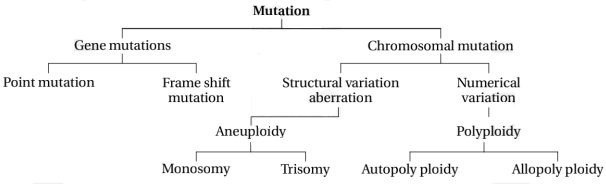
Write a short note on Mutation.
Solution
(N/A) Mutation is a sudden,stable,and inheritable change in the genetic material or $DNA$ sequences of an organism.
The organism that undergoes mutation is called a mutant.
The chemical and physical factors that induce mutations are called mutagens,e.g.,$UV$ radiations,$X$-rays,etc.
Mutations are broadly classified into the following types:
$1$. Gene Mutations:
- Point mutation: Arises due to a change in a single base pair of $DNA$.
- Frame-shift mutation: Refers to the deletion or insertion of base pairs in $DNA$,which shifts the reading frame.
$2$. Chromosomal Mutations:
- Structural variation (Aberration): The loss or gain of a segment of $DNA$ results in structural alteration in chromosomes,as genes are located on them. This is common in cancerous cells.
- Numerical variation:
- Aneuploidy: Occurs when the members of a homologous pair of chromosomes fail to segregate during meiosis. This leads to the loss or gain of one or more chromosomes (e.g.,Monosomy: lack of one chromosome; Trisomy: three instead of two chromosomes).
- Polyploidy: Occurs due to the failure of cytokinesis after the telophase stage of cell division,resulting in an increase in a whole set of chromosomes. Autopolyploids have multiple chromosome sets derived from a single species,while allopolyploids have chromosomes derived from different species.
The organism that undergoes mutation is called a mutant.
The chemical and physical factors that induce mutations are called mutagens,e.g.,$UV$ radiations,$X$-rays,etc.
Mutations are broadly classified into the following types:
$1$. Gene Mutations:
- Point mutation: Arises due to a change in a single base pair of $DNA$.
- Frame-shift mutation: Refers to the deletion or insertion of base pairs in $DNA$,which shifts the reading frame.
$2$. Chromosomal Mutations:
- Structural variation (Aberration): The loss or gain of a segment of $DNA$ results in structural alteration in chromosomes,as genes are located on them. This is common in cancerous cells.
- Numerical variation:
- Aneuploidy: Occurs when the members of a homologous pair of chromosomes fail to segregate during meiosis. This leads to the loss or gain of one or more chromosomes (e.g.,Monosomy: lack of one chromosome; Trisomy: three instead of two chromosomes).
- Polyploidy: Occurs due to the failure of cytokinesis after the telophase stage of cell division,resulting in an increase in a whole set of chromosomes. Autopolyploids have multiple chromosome sets derived from a single species,while allopolyploids have chromosomes derived from different species.
0 likes
View Solution140
Medium
How are point mutations and deletion mutations related to the genetic code?
Solution
(N/A) The relationship between genes and $DNA$ can be understood through mutations. Deletions or rearrangements in $DNA$ segments lead to loss or gain of gene function.
$1$. Point Mutation: $A$ classic example is the change in a single base pair in the gene for the $\beta$-globin chain,where $Glutamate$ is replaced by $Valine$,resulting in $Sickle$ $Cell$ $Anemia$.
$2$. Frame-shift Mutation: The insertion or deletion of one or two bases changes the reading frame from the point of mutation. For example,consider the sentence: $RAM$ $HAS$ $RED$ $CAP$. If we insert $B$ between $HAS$ and $RED$,it becomes $RAM$ $HAS$ $BRE$ $DCA$ $P$,which changes the entire sequence.
$3$. Insertion/Deletion of three or more bases: If bases are added or deleted in multiples of three,one or more $Amino$ $Acids$ are added or removed,but the reading frame remains unchanged after the site of mutation. This is referred to as frame-shift insertion or deletion mutation.
$1$. Point Mutation: $A$ classic example is the change in a single base pair in the gene for the $\beta$-globin chain,where $Glutamate$ is replaced by $Valine$,resulting in $Sickle$ $Cell$ $Anemia$.
$2$. Frame-shift Mutation: The insertion or deletion of one or two bases changes the reading frame from the point of mutation. For example,consider the sentence: $RAM$ $HAS$ $RED$ $CAP$. If we insert $B$ between $HAS$ and $RED$,it becomes $RAM$ $HAS$ $BRE$ $DCA$ $P$,which changes the entire sequence.
$3$. Insertion/Deletion of three or more bases: If bases are added or deleted in multiples of three,one or more $Amino$ $Acids$ are added or removed,but the reading frame remains unchanged after the site of mutation. This is referred to as frame-shift insertion or deletion mutation.
0 likes
View Solution141
EasyMCQ
Mutation is an error that occurs during cell division.
A
True
B
False
Solution
(A) Mutation is a phenomenon which results in alteration of $DNA$ sequences and consequently results in changes in the genotype and the phenotype of an organism.
Since genes are known to be located on chromosomes,alteration in chromosomes results in abnormalities or aberrations in organisms. Chromosomal aberrations are commonly observed in cancer cells. In addition to the above,mutation also arises due to loss (deletion) or gain (insertion/duplication) of a segment of $DNA$.
Since genes are known to be located on chromosomes,alteration in chromosomes results in abnormalities or aberrations in organisms. Chromosomal aberrations are commonly observed in cancer cells. In addition to the above,mutation also arises due to loss (deletion) or gain (insertion/duplication) of a segment of $DNA$.
0 likes
View Solution142
Easy
Define/Explain the following terms:
$1.$ Mutation
$2.$ Alleles
$1.$ Mutation
$2.$ Alleles
Solution
(N/A) Mutation: $A$ sudden heritable change in the $DNA$ sequence,which results in changes in the genotype and phenotype of an organism. It can be caused by changes in base pairs or alterations in chromosome structure or number.
Alleles: These are slightly different forms of the same gene. They occupy the same locus on homologous chromosomes and control the same trait,but may produce different phenotypic expressions.
Alleles: These are slightly different forms of the same gene. They occupy the same locus on homologous chromosomes and control the same trait,but may produce different phenotypic expressions.
0 likes
View Solution143
Medium
How do alleles of a particular gene differ from each other? Explain their significance.
Solution
(N/A) Alleles of a particular gene differ from each other due to specific changes,known as mutations,in the genetic material (a segment of $DNA$ or $RNA$). These changes result in different versions of the same gene. The significance of these different alleles is that they increase genetic variability or variation within a population. Such variations are essential for the processes of evolution and adaptation,allowing organisms to survive and thrive in changing environments.
0 likes
View Solution144
Medium
How does a mutagen induce mutation? Explain with an example.
Solution
(N/A) mutagen is a physical or chemical agent that increases the rate of mutation by altering the genetic material,typically $DNA$.
$1$. Physical Mutagens: These include ionizing radiations (e.g.,$X$-rays,gamma rays) and non-ionizing radiations (e.g.,$UV$ rays). $UV$ radiation with a wavelength around $260 \ nm$ is strongly absorbed by nitrogenous bases,leading to the formation of pyrimidine dimers,which disrupt $DNA$ replication.
$2$. Chemical Mutagens: These include base analogs,alkylating agents,and intercalating agents. They can mimic normal bases or chemically modify them,leading to base-pair substitutions during $DNA$ replication.
Example: Sickle cell anemia is a classic example of a point mutation where a single base pair substitution ($GAG$ to $GTG$) in the $\beta$-globin gene leads to the replacement of glutamic acid with valine,altering the structure of hemoglobin.
$1$. Physical Mutagens: These include ionizing radiations (e.g.,$X$-rays,gamma rays) and non-ionizing radiations (e.g.,$UV$ rays). $UV$ radiation with a wavelength around $260 \ nm$ is strongly absorbed by nitrogenous bases,leading to the formation of pyrimidine dimers,which disrupt $DNA$ replication.
$2$. Chemical Mutagens: These include base analogs,alkylating agents,and intercalating agents. They can mimic normal bases or chemically modify them,leading to base-pair substitutions during $DNA$ replication.
Example: Sickle cell anemia is a classic example of a point mutation where a single base pair substitution ($GAG$ to $GTG$) in the $\beta$-globin gene leads to the replacement of glutamic acid with valine,altering the structure of hemoglobin.
0 likes
View Solution145
Medium
Sometimes cattle or even human beings give birth to their young ones that have extremely different sets of organs,such as limbs or the position of eyes. Comment.
Solution
(N/A) The development of an organism is controlled by the coordinated expression of specific sets of genes. When there is a disturbance or mutation in the regulatory genes or the signaling pathways responsible for organogenesis,it leads to abnormal development. This results in congenital malformations,such as misplaced limbs or altered eye positions,because the genetic instructions for the spatial arrangement of organs are disrupted.
0 likes
View Solution146
Medium
Explain frame-shift mutation.
Solution
(N/A) frame-shift mutation occurs due to the insertion or deletion of one or two base pairs in the $DNA$ sequence.
This causes a change in the reading frame from the point of insertion or deletion onwards.
If one or two bases are added or deleted,the entire sequence of codons downstream is altered,leading to the synthesis of a completely different polypeptide chain.
However,if three bases or a multiple of three bases are inserted or deleted,one or more codons are added or removed,but the reading frame remains unchanged after the site of mutation.
Such mutations are specifically referred to as frame-shift insertion or deletion mutations.
This causes a change in the reading frame from the point of insertion or deletion onwards.
If one or two bases are added or deleted,the entire sequence of codons downstream is altered,leading to the synthesis of a completely different polypeptide chain.
However,if three bases or a multiple of three bases are inserted or deleted,one or more codons are added or removed,but the reading frame remains unchanged after the site of mutation.
Such mutations are specifically referred to as frame-shift insertion or deletion mutations.
0 likes
View Solution147
Medium
Match the columns:
| Column-$I$ | Column-$II$ |
|---|---|
| $(1)$ Lethal mutation | $(a)$ Mutation caused by external factors |
| $(2)$ Spontaneous mutation | $(b)$ They are metabolic errors |
| $(3)$ Induced mutation | $(c)$ As a result the mutant dies |
| $(4)$ Biochemical mutation | $(d)$ Most of the mutations occurring in nature are of this type |
Solution
(1-C, 2-D, 3-A, 4-B) The correct matches are:
$(1)$ Lethal mutation: $(c)$ As a result the mutant dies.
$(2)$ Spontaneous mutation: $(d)$ Most of the mutations occurring in nature are of this type.
$(3)$ Induced mutation: $(a)$ Mutation caused by external factors (mutagens).
$(4)$ Biochemical mutation: $(b)$ They are metabolic errors that affect specific biochemical pathways.
Therefore,the correct sequence is $(1-c, 2-d, 3-a, 4-b)$.
$(1)$ Lethal mutation: $(c)$ As a result the mutant dies.
$(2)$ Spontaneous mutation: $(d)$ Most of the mutations occurring in nature are of this type.
$(3)$ Induced mutation: $(a)$ Mutation caused by external factors (mutagens).
$(4)$ Biochemical mutation: $(b)$ They are metabolic errors that affect specific biochemical pathways.
Therefore,the correct sequence is $(1-c, 2-d, 3-a, 4-b)$.
0 likes
View Solution148
MediumMCQ
Which phenomenon causes changes in the genotype and phenotype of an organism due to alterations in the $DNA$ sequence?
A
Crossing over
B
Mutation
C
Replication
D
None of these
Solution
(B) Mutation is defined as a phenomenon which results in alteration of $DNA$ sequences and consequently results in changes in the genotype and the phenotype of an organism.
In addition to recombination,mutation is another phenomenon that leads to variation in $DNA$.
In addition to recombination,mutation is another phenomenon that leads to variation in $DNA$.
0 likes
View Solution149
MediumMCQ
Which of the following is a classic example of a point mutation?
A
Sickle cell anemia
B
Hemophilia
C
Thalassemia
D
Color blindness
Solution
(A) point mutation is a genetic mutation where a single nucleotide base is changed,inserted,or deleted from a sequence of $DNA$ or $RNA$.
Sickle cell anemia is a classic example of a point mutation.
In this condition,a single base substitution (a transversion) occurs in the gene for the $\beta$-globin chain of hemoglobin.
Specifically,the codon $GAG$ is mutated to $GUG$,which results in the substitution of the amino acid glutamic acid with valine at the $6^{th}$ position of the $\beta$-globin chain.
Sickle cell anemia is a classic example of a point mutation.
In this condition,a single base substitution (a transversion) occurs in the gene for the $\beta$-globin chain of hemoglobin.
Specifically,the codon $GAG$ is mutated to $GUG$,which results in the substitution of the amino acid glutamic acid with valine at the $6^{th}$ position of the $\beta$-globin chain.
0 likes
View Solution150
MediumMCQ
What is observed in a frame-shift mutation?
A
Deletion of more than one $DNA$ base pair
B
Duplication of more than one $DNA$ base pair
C
Change in a single nitrogenous base pair
D
Both $a$ and $b$
Solution
(D) frame-shift mutation is a genetic mutation caused by the insertion or deletion of a number of nucleotides in a $DNA$ sequence that is not divisible by three.
This shift in the reading frame results in the misreading of all subsequent codons,leading to the synthesis of a completely different protein.
Deletion or insertion of one or more base pairs (that are not multiples of three) causes this shift.
Therefore,both the deletion and duplication (insertion) of base pairs (if not in multiples of three) can result in a frame-shift mutation.
This shift in the reading frame results in the misreading of all subsequent codons,leading to the synthesis of a completely different protein.
Deletion or insertion of one or more base pairs (that are not multiples of three) causes this shift.
Therefore,both the deletion and duplication (insertion) of base pairs (if not in multiples of three) can result in a frame-shift mutation.
0 likes
View SolutionPrinciples of Inheritance and Variation — Mutation · Frequently Asked Questions
1Are these Principles of Inheritance and Variation questions useful for JEE and NEET?
Yes. All questions in this section are mapped to JEE Main and NEET exam patterns. Previous year questions from JEE Main, NEET, GUJCET and state-level exams are included with full solutions.
2Can I switch to Hindi or Gujarati for these questions?
Yes. Use the language tabs in the hero section or the sidebar to view the same questions and solutions in English, Hindi or Gujarati.
3How do I generate a question paper from this subtopic?
Use the Vedclass Exam Paper Generator — select the chapter and subtopic, set difficulty, and generate Sets A, B, C, D automatically. First 3 chapters of every subject are free.
Vedclass Products
For Students
Vedclass Test Series
Mock tests in real JEE/NEET style with performance analysis. 5-day free trial.
Start Free TrialFor Teachers
Exam Paper Generator
Generate Set A/B/C/D papers from this chapter in 2 minutes. 3 chapters free.
Try FreeFor Institutes
Online Exam Module
Live online exams with unlimited students, 360° analytics & white-label branding.
See DemoFor Teachers & Institutes
Generate a Principles of Inheritance and Variation Exam Paper in 2 Minutes
Select subtopic & difficulty — Sets A, B, C, D auto-generated with No Repeat logic.
First 3 chapters of every subject are free — no payment required.