
A English
Mix Examples- Principles of Inheritance and Variation Questions in English
Class 12 Biology · Principles of Inheritance and Variation · Mix Examples- Principles of Inheritance and Variation
205+
Questions
English
Language
100%
With Solutions
Showing 50 of 205 questions in English
101
MediumMCQ
Mustache and beard in males are examples of which of the following?
A
Sex-differentiating traits
B
Sex-determining traits
C
Sex-linked traits
D
Sex-limited traits
Solution
(D) Sex-limited traits are autosomal traits that are expressed in only one sex.
Even though both males and females possess the genes for these traits,they are only expressed in the presence of sex-specific hormones.
In humans,the development of a beard and mustache is a secondary sexual characteristic in males,which is controlled by male sex hormones (androgens).
Therefore,these are classified as sex-limited traits.
Even though both males and females possess the genes for these traits,they are only expressed in the presence of sex-specific hormones.
In humans,the development of a beard and mustache is a secondary sexual characteristic in males,which is controlled by male sex hormones (androgens).
Therefore,these are classified as sex-limited traits.
0 likes
View Solution102
DifficultMCQ
$A$ human male is heterozygous for autosomal genes $A$ and $B$ and is also hemizygous for the $hemophilia$ gene. What proportion of his sperm will be $abh$?
A
$1/8$
B
$1/32$
C
$1/16$
D
$1/4$
Solution
(A) The genotype of the male is $AaBbX^hY$.
Since genes $A$ and $B$ are autosomal and heterozygous,the possible gametes for these alleles are $AB, Ab, aB, ab$ with a probability of $1/4$ each.
The male is hemizygous for the $hemophilia$ gene $(X^hY)$,meaning he carries the $X^h$ chromosome and the $Y$ chromosome.
The probability of a sperm receiving the $X^h$ chromosome is $1/2$,and the probability of receiving the $Y$ chromosome is $1/2$.
For a sperm to be $abh$,it must contain the $a$ allele,the $b$ allele,and the $h$ allele (which is carried on the $X^h$ chromosome).
The probability of getting $ab$ from the autosomal genes is $1/4$.
The probability of getting the $X^h$ chromosome is $1/2$.
Therefore,the total probability is $1/4 \times 1/2 = 1/8$.
Since genes $A$ and $B$ are autosomal and heterozygous,the possible gametes for these alleles are $AB, Ab, aB, ab$ with a probability of $1/4$ each.
The male is hemizygous for the $hemophilia$ gene $(X^hY)$,meaning he carries the $X^h$ chromosome and the $Y$ chromosome.
The probability of a sperm receiving the $X^h$ chromosome is $1/2$,and the probability of receiving the $Y$ chromosome is $1/2$.
For a sperm to be $abh$,it must contain the $a$ allele,the $b$ allele,and the $h$ allele (which is carried on the $X^h$ chromosome).
The probability of getting $ab$ from the autosomal genes is $1/4$.
The probability of getting the $X^h$ chromosome is $1/2$.
Therefore,the total probability is $1/4 \times 1/2 = 1/8$.
0 likes
View Solution103
MediumMCQ
The phenotype of an organism is the result of?
A
Mutation and linkage
B
Cytoplasmic effects and nutrition
C
Environmental changes and sexual dimorphism
D
Genotype and environmental interactions
Solution
(D) The phenotype of an organism is determined by the interaction between its genotype (genetic makeup) and the environment in which it develops.
While the genotype provides the potential for specific traits,the environment influences how these traits are expressed.
Therefore,the phenotype is the result of the interaction between the genotype and the environment.
While the genotype provides the potential for specific traits,the environment influences how these traits are expressed.
Therefore,the phenotype is the result of the interaction between the genotype and the environment.
0 likes
View Solution104
MediumMCQ
Identify the incorrect statement from the following.
A
Galactosemia is an inborn error of metabolism.
B
Genetic drift is the change in allele frequency in a small population due to chance.
C
Baldness is a sex-linked trait.
D
Linkage is an exception to the law of independent assortment in genetics.
Solution
(C) The correct answer is $C$. Baldness (specifically androgenetic alopecia) is a sex-influenced trait,not a sex-linked trait. Sex-influenced traits are autosomal traits whose expression is influenced by the sex of the individual (e.g.,presence of hormones like testosterone). In contrast,sex-linked traits are determined by genes located on the sex chromosomes ($X$ or $Y$). Galactosemia is indeed an inborn error of metabolism caused by the deficiency of the enzyme galactose-$1$-phosphate uridylyltransferase. Genetic drift refers to random fluctuations in allele frequencies in small populations. Linkage occurs when genes are located close together on the same chromosome,which violates Mendel's law of independent assortment.
0 likes
View Solution105
EasyMCQ
Which of the following symbols and its representation is correctly used for constructing a human pedigree chart?
A
Mating between relatives
B
Unaffected male
C
Unaffected female
D
Affected male
Solution
(A) In a pedigree analysis,standard symbols are used to represent family members and their relationships.
$1$. $A$ square represents a male.
$2$. $A$ circle represents a female.
$3$. $A$ horizontal line connecting a square and a circle represents mating.
$4$. $A$ horizontal line connecting a square and a circle with a double line represents mating between close relatives (consanguineous mating).
$5$. Shading or filling a symbol indicates that the individual is affected by the trait being studied.
Looking at the provided image for option $A$,the symbol shows a square connected to a circle by a double line,which represents mating between close relatives. Therefore,option $A$ is the correct representation.
$1$. $A$ square represents a male.
$2$. $A$ circle represents a female.
$3$. $A$ horizontal line connecting a square and a circle represents mating.
$4$. $A$ horizontal line connecting a square and a circle with a double line represents mating between close relatives (consanguineous mating).
$5$. Shading or filling a symbol indicates that the individual is affected by the trait being studied.
Looking at the provided image for option $A$,the symbol shows a square connected to a circle by a double line,which represents mating between close relatives. Therefore,option $A$ is the correct representation.
0 likes
View Solution106
MediumMCQ
The color of mashed fruit (or fruit skin color in certain varieties) is an example of ........
A
Recessive epistasis
B
Dominant epistasis
C
Complementary genes
D
Inhibitory genes
Solution
(B) The color of fruit in certain plants (like summer squash) is a classic example of $Dominant \text{ } epistasis$. In this interaction, a dominant allele at one locus masks the expression of alleles at another locus. For example, in summer squash, the $W$ gene (white fruit) is dominant and masks the expression of the $Y$ gene (yellow fruit), resulting in white fruit regardless of the $Y$ genotype. Thus, the correct answer is $Dominant \text{ } epistasis$.
0 likes
View Solution107
MediumMCQ
Match the terms in Column-$I$ with their descriptions in Column-$II$ and select the correct option.
| Column-$I$ | Column-$II$ |
| $(A)$ Dominance | $(1)$ Many genes govern a single character. |
| $(B)$ Co-dominance | $(2)$ In a heterozygous organism, only one allele expresses itself. |
| $(C)$ Pleiotropy | $(3)$ In a heterozygous organism, both alleles express themselves fully. |
| $(D)$ Polygenic inheritance | $(4)$ $A$ single gene influences many characters. |
A
$A-2, B-3, C-4, D-1$
B
$A-4, B-1, C-2, D-3$
C
$A-4, B-3, C-1, D-2$
D
$A-2, B-1, C-4, D-3$
Solution
$(A)$ The correct matches are as follows:
$(A)$ Dominance: In a heterozygous organism, only one allele expresses itself, masking the effect of the other allele. Thus, $(A-2)$.
$(B)$ Co-dominance: In a heterozygous organism, both alleles express themselves fully, such as in $AB$ blood group inheritance. Thus, $(B-3)$.
$(C)$ Pleiotropy: $A$ single gene influences multiple phenotypic traits or characters. Thus, $(C-4)$.
$(D)$ Polygenic inheritance: Multiple genes govern a single character, resulting in a range of phenotypes. Thus, $(D-1)$.
Therefore, the correct sequence is $A-2, B-3, C-4, D-1$.
$(A)$ Dominance: In a heterozygous organism, only one allele expresses itself, masking the effect of the other allele. Thus, $(A-2)$.
$(B)$ Co-dominance: In a heterozygous organism, both alleles express themselves fully, such as in $AB$ blood group inheritance. Thus, $(B-3)$.
$(C)$ Pleiotropy: $A$ single gene influences multiple phenotypic traits or characters. Thus, $(C-4)$.
$(D)$ Polygenic inheritance: Multiple genes govern a single character, resulting in a range of phenotypes. Thus, $(D-1)$.
Therefore, the correct sequence is $A-2, B-3, C-4, D-1$.
0 likes
View Solution108
MediumMCQ
$A$ woman has an $X$-linked condition on one of her $X$ chromosomes. This chromosome can be inherited by
A
Both sons and daughters
B
Only daughters
C
Only grandchildren
D
Only sons
Solution
(A) woman has two $X$ chromosomes $(XX)$. If one of her $X$ chromosomes carries an $X$-linked condition,she can pass this specific chromosome to any of her offspring.
During meiosis,the woman produces eggs,each containing one $X$ chromosome. Half of her eggs will carry the $X$ chromosome with the condition,and the other half will carry the normal $X$ chromosome.
When these eggs are fertilized by sperm from a male $(XY)$:
$1$. If an egg with the affected $X$ chromosome is fertilized by a $Y$-bearing sperm,the resulting offspring will be a son $(XY)$ who inherits the condition.
$2$. If an egg with the affected $X$ chromosome is fertilized by an $X$-bearing sperm,the resulting offspring will be a daughter $(XX)$ who inherits the condition.
Therefore,the $X$-linked condition can be inherited by both sons and daughters.
During meiosis,the woman produces eggs,each containing one $X$ chromosome. Half of her eggs will carry the $X$ chromosome with the condition,and the other half will carry the normal $X$ chromosome.
When these eggs are fertilized by sperm from a male $(XY)$:
$1$. If an egg with the affected $X$ chromosome is fertilized by a $Y$-bearing sperm,the resulting offspring will be a son $(XY)$ who inherits the condition.
$2$. If an egg with the affected $X$ chromosome is fertilized by an $X$-bearing sperm,the resulting offspring will be a daughter $(XX)$ who inherits the condition.
Therefore,the $X$-linked condition can be inherited by both sons and daughters.
0 likes
View Solution109
MediumMCQ
Which of the following characteristics represent 'Inheritance of blood groups' in humans?
$(a)$ Dominance
$(b)$ Co-dominance
$(c)$ Multiple allele
$(d)$ Incomplete dominance
$(e)$ Polygenic inheritance
$(a)$ Dominance
$(b)$ Co-dominance
$(c)$ Multiple allele
$(d)$ Incomplete dominance
$(e)$ Polygenic inheritance
A
$a, c$ and $e$
B
$b, c$ and $e$
C
$b, d$ and $e$
D
$a, b$ and $c$
Solution
(D) The inheritance of $ABO$ blood groups in humans is governed by the gene $I$.
$1$. Dominance: The alleles $I^A$ and $I^B$ are dominant over the allele $i$.
$2$. Co-dominance: When both $I^A$ and $I^B$ are present together,they both express themselves equally,resulting in blood group $AB$.
$3$. Multiple Allelism: The gene $I$ exists in three allelic forms $(I^A, I^B, i)$,which is a classic example of multiple alleles.
Therefore,the characteristics represented are dominance,co-dominance,and multiple alleles,which correspond to $(a), (b),$ and $(c)$.
$1$. Dominance: The alleles $I^A$ and $I^B$ are dominant over the allele $i$.
$2$. Co-dominance: When both $I^A$ and $I^B$ are present together,they both express themselves equally,resulting in blood group $AB$.
$3$. Multiple Allelism: The gene $I$ exists in three allelic forms $(I^A, I^B, i)$,which is a classic example of multiple alleles.
Therefore,the characteristics represented are dominance,co-dominance,and multiple alleles,which correspond to $(a), (b),$ and $(c)$.
0 likes
View Solution110
MediumMCQ
Which of the following pairs is $wrongly$ matched?
A
Starch synthesis in pea : Multiple alleles
B
$T. H. Morgan$ : Linkage
C
$XO$ type sex determination : Grasshopper
D
$ABO$ blood grouping : Co-dominance
Solution
(A) $1$. Starch synthesis in pea is controlled by a single gene with two alleles ($B$ and $b$), which exhibits pleiotropy, not multiple alleles.
$2$. $T. H. Morgan$ is known for his work on linkage in Drosophila.
$3$. $XO$ type sex determination is observed in grasshoppers.
$4$. $ABO$ blood grouping in humans is an example of multiple alleles and co-dominance (for $I^A$ and $I^B$ alleles). However, the primary genetic principle for $ABO$ blood grouping is multiple alleles, and the pairing with co-dominance is technically correct but less specific than the error in option $A$. Since starch synthesis is clearly pleiotropy, option $A$ is the $wrongly$ matched pair.
$2$. $T. H. Morgan$ is known for his work on linkage in Drosophila.
$3$. $XO$ type sex determination is observed in grasshoppers.
$4$. $ABO$ blood grouping in humans is an example of multiple alleles and co-dominance (for $I^A$ and $I^B$ alleles). However, the primary genetic principle for $ABO$ blood grouping is multiple alleles, and the pairing with co-dominance is technically correct but less specific than the error in option $A$. Since starch synthesis is clearly pleiotropy, option $A$ is the $wrongly$ matched pair.
0 likes
View Solution111
MediumMCQ
$A$ gene which suppresses the activity of another gene but does not lie on the same locus is called:
A
epistatic
B
supplementary
C
hypostatic
D
codominant
Solution
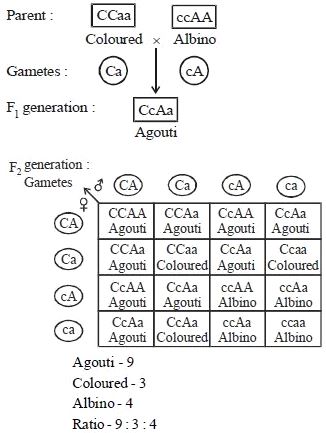
(A) When one gene masks the effect or activity of another gene which does not lie on the same locus,it is called epistasis. The gene that suppresses the other is known as the epistatic gene,while the gene whose expression is masked is called the hypostatic gene. Epistasis refers to non-allelic interactions. For example,coat colour in mice is controlled by an epistatic gene. When a coloured $(CCaa)$ mouse is crossed with an albino $(ccAA)$ mouse,agouti mice $(CcAa)$ appear in the $F_1$ generation. In the $F_2$ generation,agouti,coloured,and albino mice are obtained in a $9:3:4$ ratio.
0 likes
View Solution112
MediumMCQ
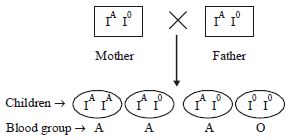
Mother and father both have blood group '$A$'. They have two children,one with blood group '$O$' and the second one with blood group '$A$'. They have:
A
mother has homozygotic gene,father has heterozygote $I^A I^A$.
B
both are homozygotic $(I^A I^A)$.
C
mother is heterozygotic $(I^A i)$ and father is homozygotic $(I^A I^A)$.
D
both are heterozygotic $(I^A i)$.
Solution
(D) The inheritance of blood groups is determined by multiple alleles. For a child to have blood group '$O$' (genotype $ii$),both parents must contribute an 'i' allele.
Since both parents have blood group '$A$',their genotypes must be $I^A I^A$ or $I^A i$.
If a child has blood group '$O$' $(ii)$,it implies that both parents must carry the recessive 'i' allele.
Therefore,both parents must be heterozygotic for blood group '$A$',with the genotype $I^A i$.
When both parents are $I^A i$,the possible genotypes for the offspring are $I^A I^A$ (blood group $A$),$I^A i$ (blood group $A$),and $ii$ (blood group $O$).
Since both parents have blood group '$A$',their genotypes must be $I^A I^A$ or $I^A i$.
If a child has blood group '$O$' $(ii)$,it implies that both parents must carry the recessive 'i' allele.
Therefore,both parents must be heterozygotic for blood group '$A$',with the genotype $I^A i$.
When both parents are $I^A i$,the possible genotypes for the offspring are $I^A I^A$ (blood group $A$),$I^A i$ (blood group $A$),and $ii$ (blood group $O$).
0 likes
View Solution113
EasyMCQ
Match the items of column $I$ with column $II$:
Select the correct option from the following:
| Column $I$ | Column $II$ |
| $(a) XX-XO$ method of sex determination | $(i)$ Turner's syndrome |
| $(b) XX-XY$ method of sex determination | $(ii)$ Female heterogametic |
| $(c)$ Karyotype $45$ | $(iii)$ Grasshopper |
| $(d) ZW-ZZ$ method of sex determination | $(iv)$ Female homogametic |
Select the correct option from the following:
A
$a-iii, b-iv, c-i, d-ii$
B
$a-i, b-iv, c-ii, d-iii$
C
$a-iii, b-iv, c-i, d-ii$
D
$a-iv, b-ii, c-i, d-iii$
Solution
(C) The correct matching is as follows:
$(a) XX-XO$ method of sex determination is observed in insects like grasshoppers,where males are heterogametic $(XO)$ and females are homogametic $(XX)$. Thus,$(a) - (iii)$.
$(b) XX-XY$ method of sex determination is observed in humans and Drosophila,where females are homogametic $(XX)$ and males are heterogametic $(XY)$. Thus,$(b) - (iv)$.
$(c)$ Karyotype $45$ (specifically $44 + XO$) results in Turner's syndrome,which is a chromosomal disorder in females. Thus,$(c) - (i)$.
$(d) ZW-ZZ$ method of sex determination is observed in birds,where females are heterogametic $(ZW)$ and males are homogametic $(ZZ)$. Thus,$(d) - (ii)$.
Therefore,the correct sequence is $a-iii, b-iv, c-i, d-ii$.
$(a) XX-XO$ method of sex determination is observed in insects like grasshoppers,where males are heterogametic $(XO)$ and females are homogametic $(XX)$. Thus,$(a) - (iii)$.
$(b) XX-XY$ method of sex determination is observed in humans and Drosophila,where females are homogametic $(XX)$ and males are heterogametic $(XY)$. Thus,$(b) - (iv)$.
$(c)$ Karyotype $45$ (specifically $44 + XO$) results in Turner's syndrome,which is a chromosomal disorder in females. Thus,$(c) - (i)$.
$(d) ZW-ZZ$ method of sex determination is observed in birds,where females are heterogametic $(ZW)$ and males are homogametic $(ZZ)$. Thus,$(d) - (ii)$.
Therefore,the correct sequence is $a-iii, b-iv, c-i, d-ii$.
0 likes
View Solution114
Difficult
Differentiate between the following:
$(a)$ Dominant and Recessive
$(b)$ Homozygous and Heterozygous
$(c)$ Monohybrid and Dihybrid.
$(a)$ Dominant and Recessive
$(b)$ Homozygous and Heterozygous
$(c)$ Monohybrid and Dihybrid.
Solution
(N/A) Dominant and Recessive
$(b)$ Homozygous and Heterozygous
$(c)$ Monohybrid and Dihybrid
| Dominant | Recessive |
| $1.$ $A$ dominant factor or allele expresses itself in the presence or absence of a recessive trait. | $1.$ $A$ recessive trait is able to express itself only in the absence of a dominant trait. |
| $2.$ For example,tall plant,round seed,and violet flower are dominant characters in a pea plant. | $2.$ For example,dwarf plant,wrinkled seed,and white flower are recessive traits in a pea plant. |
$(b)$ Homozygous and Heterozygous
| Homozygous | Heterozygous |
| $1.$ It contains two similar alleles for a particular trait. | $1.$ It contains two different alleles for a particular trait. |
| $2.$ Genotype possesses either dominant or recessive alleles,but never both. For example,$RR$ or $rr$. | $2.$ Genotype possesses both dominant and recessive alleles. For example,$Rr$. |
| $3.$ It produces only one type of gamete. | $3.$ It produces two different kinds of gametes. |
$(c)$ Monohybrid and Dihybrid
| Monohybrid | Dihybrid |
| $1.$ $A$ monohybrid cross involves parents that differ in only one pair of contrasting characters. | $1.$ $A$ dihybrid cross involves parents that differ in two pairs of contrasting characters. |
| $2.$ For example,a cross between tall and dwarf pea plants is a monohybrid cross. | $2.$ For example,a cross between pea plants having yellow wrinkled seeds and those having green round seeds is a dihybrid cross. |
0 likes
View Solution115
Medium
Explain the following terms with examples:
$(a)$ Co-dominance
$(b)$ Incomplete dominance
$(a)$ Co-dominance
$(b)$ Incomplete dominance
Solution
(N/A) Co-dominance
Co-dominance is the phenomenon in which both alleles of a gene pair are expressed equally in the heterozygous condition. Neither allele is dominant or recessive over the other. $A$ classic example is the $ABO$ blood group system in humans. The blood group is controlled by three alleles: $I^{A}, I^{B},$ and $i$. The alleles $I^{A}$ and $I^{B}$ are equally dominant and are co-dominant,as both are expressed in individuals with the $AB$ blood group,producing both $A$ and $B$ antigens on the surface of red blood cells.
$(b)$ Incomplete dominance
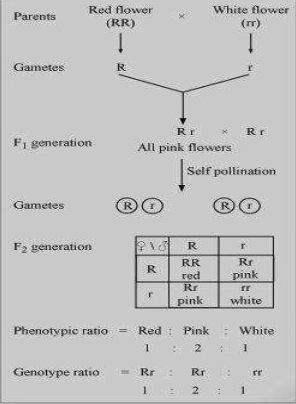
Incomplete dominance is a phenomenon in which one allele is not completely dominant over the other allele of the same gene pair,resulting in a phenotype that is intermediate between the two parental traits. For example,in the snapdragon plant ($Antirrhinum$ species),a cross between red-flowered $(RR)$ and white-flowered $(rr)$ plants results in pink-flowered $(Rr)$ plants in the $F_{1}$ generation. The $F_{1}$ progeny does not resemble either parent but exhibits an intermediate phenotype because the dominant allele $R$ is only partially dominant over the recessive allele $r$.
Co-dominance is the phenomenon in which both alleles of a gene pair are expressed equally in the heterozygous condition. Neither allele is dominant or recessive over the other. $A$ classic example is the $ABO$ blood group system in humans. The blood group is controlled by three alleles: $I^{A}, I^{B},$ and $i$. The alleles $I^{A}$ and $I^{B}$ are equally dominant and are co-dominant,as both are expressed in individuals with the $AB$ blood group,producing both $A$ and $B$ antigens on the surface of red blood cells.
$(b)$ Incomplete dominance
Incomplete dominance is a phenomenon in which one allele is not completely dominant over the other allele of the same gene pair,resulting in a phenotype that is intermediate between the two parental traits. For example,in the snapdragon plant ($Antirrhinum$ species),a cross between red-flowered $(RR)$ and white-flowered $(rr)$ plants results in pink-flowered $(Rr)$ plants in the $F_{1}$ generation. The $F_{1}$ progeny does not resemble either parent but exhibits an intermediate phenotype because the dominant allele $R$ is only partially dominant over the recessive allele $r$.
0 likes
View Solution116
MediumMCQ
Why did Mendel's work remain unrecognized for a long time?
A
Lack of communication
B
Mathematical approach was new
C
Lack of physical proof for factors
D
All of the above
Solution
(D) Mendel published his work on the inheritance of characters in $1865$,but it remained unrecognized until $1900$ for several reasons:
$1$. Communication was not easy at that time,so his work could not be widely publicized.
$2$. His concept of 'factors' (alleles) that stably control the expression of traits was not accepted by his contemporaries.
$3$. Mendel's approach of using mathematics and statistical analysis to explain biological phenomena was entirely new and unacceptable to the biologists of that time.
$4$. He could not provide any physical proof for the existence of 'factors' (what we now call genes) and did not know their location within the cell.
$5$. At that time,there was no knowledge regarding the role of the nucleus in reproduction or the existence of chromosomes within the nucleus.
$1$. Communication was not easy at that time,so his work could not be widely publicized.
$2$. His concept of 'factors' (alleles) that stably control the expression of traits was not accepted by his contemporaries.
$3$. Mendel's approach of using mathematics and statistical analysis to explain biological phenomena was entirely new and unacceptable to the biologists of that time.
$4$. He could not provide any physical proof for the existence of 'factors' (what we now call genes) and did not know their location within the cell.
$5$. At that time,there was no knowledge regarding the role of the nucleus in reproduction or the existence of chromosomes within the nucleus.
0 likes
View Solution117
MediumMCQ
Differentiate between a monohybrid cross and a dihybrid cross.
A
Monohybrid cross involves one trait; Dihybrid cross involves two traits.
B
Monohybrid phenotypic ratio is $3$:$1$; Dihybrid phenotypic ratio is $9$:$3$:$3$:$1$.
C
Monohybrid genotypic ratio is $1$:$2$:$1$; Dihybrid genotypic ratio is $1$:$2$:$1$:$2$:$4$:$2$:$1$:$2$:$1$.
D
All of the above.
Solution
(D) monohybrid cross is a cross between two organisms that are heterozygous for a single trait (e.g.,$Tt \times Tt$). It focuses on the inheritance of one pair of contrasting characters.
$A$ dihybrid cross is a cross between two organisms that are heterozygous for two different traits (e.g.,$RrYy \times RrYy$). It focuses on the inheritance of two pairs of contrasting characters.
The phenotypic ratio for a monohybrid cross in the $F_2$ generation is $3:1$,whereas for a dihybrid cross,it is $9:3:3:1$.
The genotypic ratio for a monohybrid cross is $1:2:1$,while for a dihybrid cross,it is $1:2:1:2:4:2:1:2:1$.
$A$ dihybrid cross is a cross between two organisms that are heterozygous for two different traits (e.g.,$RrYy \times RrYy$). It focuses on the inheritance of two pairs of contrasting characters.
The phenotypic ratio for a monohybrid cross in the $F_2$ generation is $3:1$,whereas for a dihybrid cross,it is $9:3:3:1$.
The genotypic ratio for a monohybrid cross is $1:2:1$,while for a dihybrid cross,it is $1:2:1:2:4:2:1:2:1$.
0 likes
View Solution118
Easy
Give differences: Incomplete dominance and Co-dominance.
Solution
(N/A) Incomplete dominance: In this phenomenon,the $F_1$ generation exhibits a phenotype that is an intermediate blend of the two parental traits,rather than resembling either parent.
Co-dominance: In this phenomenon,the $F_1$ generation simultaneously expresses the phenotypic traits of both parents,meaning both alleles are fully expressed without blending.
Co-dominance: In this phenomenon,the $F_1$ generation simultaneously expresses the phenotypic traits of both parents,meaning both alleles are fully expressed without blending.
0 likes
View Solution119
Easy
Define/Explain the following terms:
$1.$ Genotype
$2.$ Variation
$1.$ Genotype
$2.$ Variation
Solution
(N/A) $1.$ Genotype: The genetic constitution or the set of genes present in an organism that determines its specific traits is known as the genotype.
$2.$ Variation: The differences in characteristics or traits observed among individuals of the same species are referred to as variation.
$2.$ Variation: The differences in characteristics or traits observed among individuals of the same species are referred to as variation.
0 likes
View Solution120
Easy
Distinguish between: Polygenic inheritance and Multiple allelism.
Solution
(N/A) Polygenic Inheritance: This refers to a trait that is controlled by two or more genes,often resulting in a continuous range of phenotypes. Examples include human skin color and height.
Multiple Allelism: This refers to the presence of more than two alleles for a single gene locus within a population. While an individual carries only two alleles,the population exhibits multiple variations. $A$ classic example is the $ABO$ blood grouping system in humans.
Multiple Allelism: This refers to the presence of more than two alleles for a single gene locus within a population. While an individual carries only two alleles,the population exhibits multiple variations. $A$ classic example is the $ABO$ blood grouping system in humans.
0 likes
View Solution121
Medium
For the expression of traits,genes provide only the potentiality and the environment provides the opportunity. Comment on the veracity of the statement.
Solution
(N/A) The statement is scientifically accurate.
$1$. Genes (genotype) contain the genetic information or the 'blueprint' for the development of specific traits. This represents the potentiality of an organism.
$2$. However,the actual manifestation of these traits (phenotype) is significantly influenced by environmental factors such as nutrition,climate,stress,and lifestyle.
$3$. This interaction is represented by the formula: $Phenotype = Genotype + Environment$.
$4$. For example,an individual may have the genetic potential for a certain height,but if they suffer from malnutrition during their developmental years,they may not reach that full potential. Thus,the environment acts as the catalyst or opportunity for the expression of genetic potential.
$1$. Genes (genotype) contain the genetic information or the 'blueprint' for the development of specific traits. This represents the potentiality of an organism.
$2$. However,the actual manifestation of these traits (phenotype) is significantly influenced by environmental factors such as nutrition,climate,stress,and lifestyle.
$3$. This interaction is represented by the formula: $Phenotype = Genotype + Environment$.
$4$. For example,an individual may have the genetic potential for a certain height,but if they suffer from malnutrition during their developmental years,they may not reach that full potential. Thus,the environment acts as the catalyst or opportunity for the expression of genetic potential.
0 likes
View Solution122
MediumMCQ
Interspecific crosses are rare in nature and intergeneric crosses are almost unknown. Why?
A
Due to high genetic compatibility.
B
Due to reproductive isolation and genetic incompatibility.
C
Due to similar chromosome numbers.
D
Due to identical ecological niches.
Solution
(B) Interspecific crosses involve mating between two different species. These are rare because species are reproductively isolated,meaning they cannot produce fertile offspring. The resulting hybrids are often sterile,such as a mule.
Intergeneric crosses involve mating between two different genera. These are almost unknown because the genetic distance between different genera is so large that the resulting zygotes are usually non-viable or fail to develop,making such crosses biologically impossible in nature.
Intergeneric crosses involve mating between two different genera. These are almost unknown because the genetic distance between different genera is so large that the resulting zygotes are usually non-viable or fail to develop,making such crosses biologically impossible in nature.
0 likes
View Solution123
Medium
With the help of an example,differentiate between incomplete dominance and co-dominance.
Solution
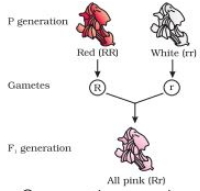
(N/A) Incomplete dominance is a phenomenon where the $F_1$ generation phenotype does not resemble either of the two parents but is an intermediate between them. For example,in snapdragon ($Antirrhinum$ $sp.$),a cross between red-flowered $(RR)$ and white-flowered $(rr)$ plants results in $F_1$ progeny with pink flowers $(Rr)$.
Co-dominance is a phenomenon where the $F_1$ generation resembles both parents simultaneously. $A$ classic example is the human $ABO$ blood grouping system,where both $I^A$ and $I^B$ alleles are expressed equally in the $I^A I^B$ genotype,resulting in $AB$ blood type.
Co-dominance is a phenomenon where the $F_1$ generation resembles both parents simultaneously. $A$ classic example is the human $ABO$ blood grouping system,where both $I^A$ and $I^B$ alleles are expressed equally in the $I^A I^B$ genotype,resulting in $AB$ blood type.
| Allele from Parent $1$ | Allele from Parent $2$ | Genotype of offspring | Blood type of offspring |
|---|---|---|---|
| $I^A$ | $I^A$ | $I^A I^A$ | $A$ |
| $I^A$ | $I^B$ | $I^A I^B$ | $AB$ |
| $I^A$ | $i$ | $I^A i$ | $A$ |
| $I^B$ | $I^A$ | $I^A I^B$ | $AB$ |
| $I^B$ | $I^B$ | $I^B I^B$ | $B$ |
| $I^B$ | $i$ | $I^B i$ | $B$ |
| $i$ | $i$ | $i i$ | $O$ |
0 likes
View Solution124
Medium
It is said that harmful alleles are eliminated from a population over a period of time,yet sickle cell anaemia persists in the human population. Why?
Solution
(N/A) Harmful alleles are typically eliminated from a population over time due to natural selection. However,sickle cell anaemia $(SCA)$ persists because it provides a selective advantage in regions where malaria is endemic. Individuals with the sickle cell trait (heterozygous carriers) possess a significant resistance to malarial infection. When the malaria parasite $(Plasmodium)$ enters the red blood cells,it causes a drop in oxygen levels. In carriers,this reduction is sufficient to trigger the sickling of red blood cells,which leads to the rapid removal of these infected cells from circulation by the spleen. This process effectively limits the progression of the malarial infection. Consequently,these individuals have a higher survival rate during malarial outbreaks,ensuring the $SCA$ allele is maintained in the gene pool through balancing selection.
0 likes
View Solution125
Medium
How do genetic disorders arise? Explain by giving suitable examples.
Solution
(N/A) Every feature in an organism is controlled by one or more genes located on the $DNA$ present in the chromosomes. $DNA$ is the carrier of genetic information and is typically transmitted from one generation to the next without any change.
However,alterations or changes in the genetic material can occur,which are referred to as mutations. $A$ number of disorders in human beings are associated with the inheritance of these altered genes or chromosomes.
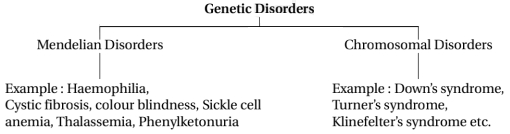
Genetic disorders are broadly classified into two categories:
$1$. Mendelian Disorders: These are primarily determined by alteration or mutation in a single gene. Examples include Haemophilia,Cystic fibrosis,Colour blindness,Sickle cell anaemia,Thalassemia,and Phenylketonuria.
$2$. Chromosomal Disorders: These are caused by an excess,absence,or abnormal arrangement of one or more chromosomes. Examples include Down's syndrome,Turner's syndrome,and Klinefelter's syndrome.
However,alterations or changes in the genetic material can occur,which are referred to as mutations. $A$ number of disorders in human beings are associated with the inheritance of these altered genes or chromosomes.
Genetic disorders are broadly classified into two categories:
$1$. Mendelian Disorders: These are primarily determined by alteration or mutation in a single gene. Examples include Haemophilia,Cystic fibrosis,Colour blindness,Sickle cell anaemia,Thalassemia,and Phenylketonuria.
$2$. Chromosomal Disorders: These are caused by an excess,absence,or abnormal arrangement of one or more chromosomes. Examples include Down's syndrome,Turner's syndrome,and Klinefelter's syndrome.
0 likes
View Solution126
Medium
Give differences: Incomplete dominance and Co-dominance.
Solution
(N/A)
| Co-dominance | Incomplete dominance |
|---|---|
| $(1)$ Effect of both the alleles is equally conspicuous. | $(1)$ Effect of one of the two alleles is more conspicuous,resulting in an intermediate phenotype. |
| $(2)$ There is no mixing of the effect of the two alleles. | $(2)$ It produces a mixture or blending of the expression of two alleles. |
| $(3)$ The $F_{1}$ generation resembles both the parents. | $(3)$ The $F_{1}$ generation does not resemble either of the parents. |
| $(4)$ Example: $ABO$ blood grouping in humans. | $(4)$ Example: Flower colour in snapdragon (dog flower). |
0 likes
View Solution127
Medium
Match the columns:
| Column $I$ | Column $II$ |
| $(a)$ Sickle cell anaemia | $(p)$ Homogentisic acid |
| $(b)$ Alkaptonuria | $(q)$ Lack of Melanin |
| $(c)$ Albinism | $(r)$ Accumulation of Amino acid |
| $(d)$ Phenylketonuria | $(s)$ Defective haemoglobin |
Solution
(A) $(a-s), (b-p), (c-q), (d-r)$
Explanation:
$1$. Sickle cell anaemia $(a)$ is caused by the production of defective haemoglobin $(s)$ due to a point mutation in the $\beta$-globin gene.
$2$. Alkaptonuria $(b)$ is a metabolic disorder characterized by the accumulation of homogentisic acid $(p)$ in the urine.
$3$. Albinism $(c)$ is a genetic condition resulting in the lack of melanin $(q)$ pigment in skin,hair,and eyes.
$4$. Phenylketonuria $(d)$ is an inborn error of metabolism where the enzyme phenylalanine hydroxylase is deficient,leading to the accumulation of phenylalanine (an amino acid) $(r)$ in the body.
Explanation:
$1$. Sickle cell anaemia $(a)$ is caused by the production of defective haemoglobin $(s)$ due to a point mutation in the $\beta$-globin gene.
$2$. Alkaptonuria $(b)$ is a metabolic disorder characterized by the accumulation of homogentisic acid $(p)$ in the urine.
$3$. Albinism $(c)$ is a genetic condition resulting in the lack of melanin $(q)$ pigment in skin,hair,and eyes.
$4$. Phenylketonuria $(d)$ is an inborn error of metabolism where the enzyme phenylalanine hydroxylase is deficient,leading to the accumulation of phenylalanine (an amino acid) $(r)$ in the body.
0 likes
View Solution128
EasyMCQ
What is the number of chromosomes in the gamete cells of a housefly?
A
$12$
B
$21$
C
$06$
D
$08$
Solution
(C) The diploid number of chromosomes $(2n)$ in a housefly $(Musca \text{ } domestica)$ is $12$.
Gamete cells are haploid $(n)$, meaning they contain half the number of chromosomes present in the somatic (diploid) cells.
Therefore, the number of chromosomes in the gamete cells is $n = \frac{12}{2} = 6$.
Gamete cells are haploid $(n)$, meaning they contain half the number of chromosomes present in the somatic (diploid) cells.
Therefore, the number of chromosomes in the gamete cells is $n = \frac{12}{2} = 6$.
0 likes
View Solution129
EasyMCQ
Which of the following organisms has the highest number of chromosomes?
A
Butterfly
B
Human
C
Apple
D
Cat
Solution
(A) To determine the organism with the highest number of chromosomes among the given options,we look at their diploid chromosome number $(2n)$:
$1$. Butterfly ($Ophioglossum$ is a fern,but among the options provided,the butterfly has a very high number,specifically $380$ chromosomes).
$2$. Human ($Homo$ $sapiens$) has $46$ chromosomes.
$3$. Apple ($Malus$ $domestica$) has $34$ chromosomes.
$4$. Cat ($Felis$ $catus$) has $38$ chromosomes.
Therefore,the butterfly has the highest number of chromosomes among these choices.
$1$. Butterfly ($Ophioglossum$ is a fern,but among the options provided,the butterfly has a very high number,specifically $380$ chromosomes).
$2$. Human ($Homo$ $sapiens$) has $46$ chromosomes.
$3$. Apple ($Malus$ $domestica$) has $34$ chromosomes.
$4$. Cat ($Felis$ $catus$) has $38$ chromosomes.
Therefore,the butterfly has the highest number of chromosomes among these choices.
0 likes
View Solution130
MediumMCQ
If a daughter is affected by hemophilia,which of the following possibilities applies to her parents?
A
Both $B$ and $C$
B
Hemophilic father and carrier mother
C
Hemophilic father and hemophilic mother
D
Normal father and carrier mother
Solution
(A) Hemophilia is an $X$-linked recessive disorder. For a daughter to be affected $(X^hX^h)$,she must inherit one recessive allele $(X^h)$ from each parent.
$1$. The father must be hemophilic $(X^hY)$ because he contributes his only $X$ chromosome to his daughter.
$2$. The mother must have at least one recessive allele $(X^h)$. She could be a carrier $(X^hX)$ or hemophilic $(X^hX^h)$.
Therefore,both options $B$ (Hemophilic father and carrier mother) and $C$ (Hemophilic father and hemophilic mother) are possible scenarios.
$1$. The father must be hemophilic $(X^hY)$ because he contributes his only $X$ chromosome to his daughter.
$2$. The mother must have at least one recessive allele $(X^h)$. She could be a carrier $(X^hX)$ or hemophilic $(X^hX^h)$.
Therefore,both options $B$ (Hemophilic father and carrier mother) and $C$ (Hemophilic father and hemophilic mother) are possible scenarios.
0 likes
View Solution131
MediumMCQ
In humans,pattern baldness is a type of ....... trait.
A
Sex-influenced trait
B
Sex-linked trait
C
Autosomal trait
D
All of the above
Solution
(A) Pattern baldness in humans is a classic example of a sex-influenced trait.
Sex-influenced traits are autosomal traits that are expressed differently in males and females due to the influence of sex hormones.
In the case of pattern baldness,the allele for baldness acts as dominant in males (due to higher levels of androgens) and as recessive in females.
Therefore,it is not sex-linked (as it is not located on sex chromosomes) but is influenced by the sex of the individual.
Sex-influenced traits are autosomal traits that are expressed differently in males and females due to the influence of sex hormones.
In the case of pattern baldness,the allele for baldness acts as dominant in males (due to higher levels of androgens) and as recessive in females.
Therefore,it is not sex-linked (as it is not located on sex chromosomes) but is influenced by the sex of the individual.
0 likes
View Solution132
MediumMCQ
What is the probability of a couple having three daughters in their three children?
A
$\frac{1}{8}$
B
$\frac{1}{4}$
C
$\frac{1}{16}$
D
$\frac{3}{8}$
Solution
(A) The probability of having a daughter in a single birth is $\frac{1}{2}$.
Since each birth is an independent event, the probability of having three daughters in three children is calculated by multiplying the individual probabilities for each birth.
Probability = $P(\text{daughter}) \times P(\text{daughter}) \times P(\text{daughter})$
Probability = $\frac{1}{2} \times \frac{1}{2} \times \frac{1}{2} = \frac{1}{8}$.
Since each birth is an independent event, the probability of having three daughters in three children is calculated by multiplying the individual probabilities for each birth.
Probability = $P(\text{daughter}) \times P(\text{daughter}) \times P(\text{daughter})$
Probability = $\frac{1}{2} \times \frac{1}{2} \times \frac{1}{2} = \frac{1}{8}$.
0 likes
View Solution133
MediumMCQ
Which gene is lethal in maize?
A
Gene for albinism
B
Gene for cob formation
C
$TATA$ gene
D
None of these
Solution
(A) In maize,the gene responsible for the production of chlorophyll is essential for survival. When a plant is homozygous recessive for the albinism gene (usually represented as $aa$),it fails to produce chlorophyll. Without chlorophyll,the plant cannot perform photosynthesis and eventually dies after the exhaustion of the seed's food reserves. Therefore,the gene for albinism is considered a lethal gene in maize.
0 likes
View Solution134
MediumMCQ
Which disease is caused by an $X$-linked recessive gene but is not lethal?
A
Color blindness
B
$\beta$-Thalassemia
C
Sickle cell anemia
D
Hemophilia
Solution
(A) Color blindness is an $X$-linked recessive disorder where the individual is unable to distinguish between red and green colors.
It is caused by a mutation in the genes located on the $X$ chromosome.
Unlike some other genetic conditions,color blindness is not lethal and does not significantly reduce the lifespan of the affected individual.
$\beta$-Thalassemia and Sickle cell anemia are autosomal recessive disorders.
Hemophilia is an $X$-linked recessive disorder,but it can be lethal if not treated properly due to severe internal bleeding.
It is caused by a mutation in the genes located on the $X$ chromosome.
Unlike some other genetic conditions,color blindness is not lethal and does not significantly reduce the lifespan of the affected individual.
$\beta$-Thalassemia and Sickle cell anemia are autosomal recessive disorders.
Hemophilia is an $X$-linked recessive disorder,but it can be lethal if not treated properly due to severe internal bleeding.
0 likes
View Solution135
MediumMCQ
Match the following columns:
| Column-$I$ | Column-$II$ |
|---|---|
| $A$. Mendel | $i$. Allele |
| $B$. Bateson | $ii$. Factors |
| $C$. Johannsen | $iii$. Chromosome |
| $D$. Sutton and Boveri | $iv$. Gene |
A
$A-iv, B-ii, C-iii, D-i$
B
$A-iii, B-i, C-iv, D-ii$
C
$A-i, B-iii, C-ii, D-iv$
D
$A-ii, B-i, C-iv, D-iii$
Solution
(D) The correct matches are as follows:
$1$. Mendel proposed the concept of 'Factors' (now known as genes) to explain inheritance. Thus,$A-ii$.
$2$. Bateson coined the term 'Allele' (short for allelomorph). Thus,$B-i$.
$3$. Johannsen coined the term 'Gene'. Thus,$C-iv$.
$4$. Sutton and Boveri proposed the 'Chromosome Theory of Inheritance'. Thus,$D-iii$.
Therefore,the correct sequence is $A-ii, B-i, C-iv, D-iii$.
$1$. Mendel proposed the concept of 'Factors' (now known as genes) to explain inheritance. Thus,$A-ii$.
$2$. Bateson coined the term 'Allele' (short for allelomorph). Thus,$B-i$.
$3$. Johannsen coined the term 'Gene'. Thus,$C-iv$.
$4$. Sutton and Boveri proposed the 'Chromosome Theory of Inheritance'. Thus,$D-iii$.
Therefore,the correct sequence is $A-ii, B-i, C-iv, D-iii$.
0 likes
View Solution136
MediumMCQ
Match the following (Column-$I$ with Column-$II$):
| Column-$I$ | Column-$II$ |
| $(P)$ $(2n-1)$ | $(i)$ Produces normal female |
| $(Q)$ $Hb^s Hb^s$ | $(ii)$ Produces haploid male |
| $(R)$ $22AA+XX$ | $(iii)$ Causes Turner syndrome |
| $(S)$ $(X+O)$ | $(iv)$ Causes sickle cell anemia |
| $(v)$ Causes hemophilia | |
| $(vi)$ Shows Klinefelter syndrome |
A
$P-iii, Q-iv, R-i, S-ii$
B
$P-ii, Q-v, R-i, S-iii$
C
$P-iii, Q-v, R-i, S-ii$
D
$P-vi, Q-iv, R-i, S-iii$
Solution
$(A)$ The correct matches are as follows:
$(P)$ $(2n-1)$ represents monosomy, which leads to Turner syndrome $(iii)$.
$(Q)$ $Hb^s Hb^s$ is the homozygous recessive genotype for sickle cell anemia $(iv)$.
$(R)$ $22AA+XX$ represents the normal diploid chromosome complement of a human female, which produces a normal female $(i)$.
$(S)$ $(X+O)$ represents the sex determination mechanism in honeybees where haploid eggs develop into haploid males $(ii)$.
Therefore, the correct matching is $P-iii, Q-iv, R-i, S-ii$.
$(P)$ $(2n-1)$ represents monosomy, which leads to Turner syndrome $(iii)$.
$(Q)$ $Hb^s Hb^s$ is the homozygous recessive genotype for sickle cell anemia $(iv)$.
$(R)$ $22AA+XX$ represents the normal diploid chromosome complement of a human female, which produces a normal female $(i)$.
$(S)$ $(X+O)$ represents the sex determination mechanism in honeybees where haploid eggs develop into haploid males $(ii)$.
Therefore, the correct matching is $P-iii, Q-iv, R-i, S-ii$.
0 likes
View Solution137
MediumMCQ
Match the following columns correctly:
| Column-$I$ | Column-$II$ |
| $(a)$ $1 : 2 : 1$ | $(i)$ Test cross |
| $(b)$ $3 : 1$ | $(ii)$ Law of Dominance |
| $(c)$ $9 : 3 : 3 : 1$ | $(iii)$ Incomplete Dominance |
| $(d)$ $1 : 1 : 1 : 1$ | $(iv)$ Law of Independent Assortment |
| $(v)$ Law of Segregation |
A
$a-ii, b-iii, c-v, d-i$
B
$a-iii, b-ii, c-iv, d-i$
C
$a-i, b-ii, c-iii, d-v$
D
$a-v, b-iv, c-ii, d-i$
Solution
(B) The correct matches are as follows:
$(a)$ $1:2:1$ ratio is observed in the $F_2$ generation of Incomplete Dominance (e.g., Mirabilis jalapa). Thus, $(a)-(iii)$.
$(b)$ $3:1$ is the phenotypic ratio of a monohybrid cross, which is explained by the Law of Dominance. Thus, $(b)-(ii)$.
$(c)$ $9:3:3:1$ is the phenotypic ratio of a dihybrid cross, which is explained by the Law of Independent Assortment. Thus, $(c)-(iv)$.
$(d)$ $1:1:1:1$ is the phenotypic ratio of a dihybrid test cross. Thus, $(d)-(i)$.
Therefore, the correct sequence is $a-iii, b-ii, c-iv, d-i$.
$(a)$ $1:2:1$ ratio is observed in the $F_2$ generation of Incomplete Dominance (e.g., Mirabilis jalapa). Thus, $(a)-(iii)$.
$(b)$ $3:1$ is the phenotypic ratio of a monohybrid cross, which is explained by the Law of Dominance. Thus, $(b)-(ii)$.
$(c)$ $9:3:3:1$ is the phenotypic ratio of a dihybrid cross, which is explained by the Law of Independent Assortment. Thus, $(c)-(iv)$.
$(d)$ $1:1:1:1$ is the phenotypic ratio of a dihybrid test cross. Thus, $(d)-(i)$.
Therefore, the correct sequence is $a-iii, b-ii, c-iv, d-i$.
0 likes
View Solution138
MediumMCQ
State how many of the given statements are correct.
$(1)$ In a dihybrid cross experiment,Mendel obtained a test cross ratio of $1:1:1:1$.
$(2)$ Coupling and repulsion were first explained by Bateson and Punnett.
$(3)$ Klinefelter syndrome is a sex-chromosomal disorder occurring in females.
$(4)$ Mendel selected $7$ pairs of contrasting traits in pea plants to explain his experiments.
$(5)$ The chromosomal theory of inheritance was first proposed by Sutton and Boveri.
$(1)$ In a dihybrid cross experiment,Mendel obtained a test cross ratio of $1:1:1:1$.
$(2)$ Coupling and repulsion were first explained by Bateson and Punnett.
$(3)$ Klinefelter syndrome is a sex-chromosomal disorder occurring in females.
$(4)$ Mendel selected $7$ pairs of contrasting traits in pea plants to explain his experiments.
$(5)$ The chromosomal theory of inheritance was first proposed by Sutton and Boveri.
A
$3$
B
$2$
C
$4$
D
$1$
Solution
(C) Let's analyze each statement:
$(1)$ Correct: In a dihybrid test cross (e.g.,$RrYy \times rryy$),the phenotypic ratio is $1:1:1:1$.
$(2)$ Correct: Bateson and Punnett proposed the coupling and repulsion hypothesis to explain linkage.
$(3)$ Incorrect: Klinefelter syndrome $(44 + XXY)$ occurs in males,not females.
$(4)$ Correct: Mendel chose $7$ pairs of contrasting traits in Pisum sativum.
$(5)$ Correct: Sutton and Boveri proposed the chromosomal theory of inheritance in $1902$.
Statements $(1), (2), (4),$ and $(5)$ are correct. Therefore,$4$ statements are correct.
$(1)$ Correct: In a dihybrid test cross (e.g.,$RrYy \times rryy$),the phenotypic ratio is $1:1:1:1$.
$(2)$ Correct: Bateson and Punnett proposed the coupling and repulsion hypothesis to explain linkage.
$(3)$ Incorrect: Klinefelter syndrome $(44 + XXY)$ occurs in males,not females.
$(4)$ Correct: Mendel chose $7$ pairs of contrasting traits in Pisum sativum.
$(5)$ Correct: Sutton and Boveri proposed the chromosomal theory of inheritance in $1902$.
Statements $(1), (2), (4),$ and $(5)$ are correct. Therefore,$4$ statements are correct.
0 likes
View Solution139
MediumMCQ
Identify the correct and incorrect statements from the following:
$(1)$ Mendel is considered the father of modern genetics.
$(2)$ Down's syndrome is a sex-linked chromosomal disorder.
$(3)$ Sickle cell anemia is an example of point mutation.
$(4)$ Color blindness is a hereditary trait.
$(5)$ Triploid female flies are found in Drosophila.
$(1)$ Mendel is considered the father of modern genetics.
$(2)$ Down's syndrome is a sex-linked chromosomal disorder.
$(3)$ Sickle cell anemia is an example of point mutation.
$(4)$ Color blindness is a hereditary trait.
$(5)$ Triploid female flies are found in Drosophila.
A
$FFFTT$
B
$FTTFF$
C
$FFTTT$
D
$TFTTT$
Solution
(C) $(1)$ Incorrect: Gregor Mendel is the father of genetics,but Thomas Hunt Morgan is considered the father of modern genetics.
$(2)$ Incorrect: Down's syndrome is an autosomal aneuploidy (trisomy of chromosome $21$),not a sex-linked disorder.
$(3)$ Correct: Sickle cell anemia is caused by a single base pair substitution in the $\beta$-globin gene,which is a point mutation.
$(4)$ Correct: Color blindness is an $X$-linked recessive hereditary trait.
$(5)$ Correct: In Drosophila,triploid females $(3A + XXX)$ can be produced through non-disjunction events.
Therefore,the sequence of True/False is $F, F, T, T, T$.
$(2)$ Incorrect: Down's syndrome is an autosomal aneuploidy (trisomy of chromosome $21$),not a sex-linked disorder.
$(3)$ Correct: Sickle cell anemia is caused by a single base pair substitution in the $\beta$-globin gene,which is a point mutation.
$(4)$ Correct: Color blindness is an $X$-linked recessive hereditary trait.
$(5)$ Correct: In Drosophila,triploid females $(3A + XXX)$ can be produced through non-disjunction events.
Therefore,the sequence of True/False is $F, F, T, T, T$.
0 likes
View Solution140
MediumMCQ
Read all the given statements carefully and determine the number of correct statements.
$(1)$ Mutations are not hereditary.
$(2)$ Male $Drosophila$ flies do not show crossing over.
$(3)$ In honeybees,the male bee is diploid.
$(4)$ In a frame-shift mutation,one nitrogen base is replaced by another nitrogen base at a specific position.
$(5)$ Genes are responsible for inheritance.
$(1)$ Mutations are not hereditary.
$(2)$ Male $Drosophila$ flies do not show crossing over.
$(3)$ In honeybees,the male bee is diploid.
$(4)$ In a frame-shift mutation,one nitrogen base is replaced by another nitrogen base at a specific position.
$(5)$ Genes are responsible for inheritance.
A
$2$
B
$3$
C
$4$
D
$5$
Solution
(A) Let us analyze each statement:
$(1)$ Mutations in germ cells are hereditary,so this statement is incorrect.
$(2)$ Male $Drosophila$ flies do not exhibit crossing over during meiosis,which is a well-known biological fact. This statement is correct.
$(3)$ In honeybees,males (drones) develop from unfertilized eggs and are haploid $(n)$,while females are diploid $(2n)$. This statement is incorrect.
$(4)$ $A$ frame-shift mutation involves the insertion or deletion of nitrogen bases,which shifts the reading frame. Replacing one base with another is a point mutation (substitution),not a frame-shift mutation. This statement is incorrect.
$(5)$ Genes are the units of heredity and are responsible for the transmission of characters from parents to offspring. This statement is correct.
Therefore,only statements $(2)$ and $(5)$ are correct. The total number of correct statements is $2$.
$(1)$ Mutations in germ cells are hereditary,so this statement is incorrect.
$(2)$ Male $Drosophila$ flies do not exhibit crossing over during meiosis,which is a well-known biological fact. This statement is correct.
$(3)$ In honeybees,males (drones) develop from unfertilized eggs and are haploid $(n)$,while females are diploid $(2n)$. This statement is incorrect.
$(4)$ $A$ frame-shift mutation involves the insertion or deletion of nitrogen bases,which shifts the reading frame. Replacing one base with another is a point mutation (substitution),not a frame-shift mutation. This statement is incorrect.
$(5)$ Genes are the units of heredity and are responsible for the transmission of characters from parents to offspring. This statement is correct.
Therefore,only statements $(2)$ and $(5)$ are correct. The total number of correct statements is $2$.
0 likes
View Solution141
MediumMCQ
Read the following statements carefully:
$(1)$ Ploidy is a structural chromosomal abnormality.
$(2)$ Hemophilia is an autosomal recessive disorder in which blood does not clot.
$(3)$ Recombination is one of the factors responsible for evolution.
$(4)$ Genetic mapping allows the determination of the specific location of a gene on a chromosome.
$(5)$ Snapdragon plant is an example of incomplete dominance.
$(6)$ $ABO$ blood grouping shows both dominance and codominance.
Identify the correct and incorrect statements from the given options.
$(1)$ Ploidy is a structural chromosomal abnormality.
$(2)$ Hemophilia is an autosomal recessive disorder in which blood does not clot.
$(3)$ Recombination is one of the factors responsible for evolution.
$(4)$ Genetic mapping allows the determination of the specific location of a gene on a chromosome.
$(5)$ Snapdragon plant is an example of incomplete dominance.
$(6)$ $ABO$ blood grouping shows both dominance and codominance.
Identify the correct and incorrect statements from the given options.
A
$F, F, T, T, T, T$
B
$F, F, T, T, T, T$
C
$F, F, T, T, T, T$
D
$F, F, T, T, T, T$
Solution
(D) $(1)$ False: Ploidy (Aneuploidy/Polyploidy) is a numerical chromosomal abnormality,not a structural one.
$(2)$ False: Hemophilia is an $X$-linked recessive disorder,not autosomal.
$(3)$ True: Recombination during meiosis is a key source of genetic variation,which drives evolution.
$(4)$ True: Genetic mapping is used to determine the relative positions of genes on a chromosome.
$(5)$ True: Snapdragon (Antirrhinum majus) exhibits incomplete dominance where the heterozygote shows an intermediate phenotype.
$(6)$ True: $ABO$ blood grouping shows dominance (e.g.,$I^A$ over $i$) and codominance (e.g.,$I^A$ and $I^B$ together).
$(2)$ False: Hemophilia is an $X$-linked recessive disorder,not autosomal.
$(3)$ True: Recombination during meiosis is a key source of genetic variation,which drives evolution.
$(4)$ True: Genetic mapping is used to determine the relative positions of genes on a chromosome.
$(5)$ True: Snapdragon (Antirrhinum majus) exhibits incomplete dominance where the heterozygote shows an intermediate phenotype.
$(6)$ True: $ABO$ blood grouping shows dominance (e.g.,$I^A$ over $i$) and codominance (e.g.,$I^A$ and $I^B$ together).
0 likes
View Solution142
MediumMCQ
Read the following statements and identify the correct ones.
$(1)$ Linkage and recombination were first understood in $Lathyrus$ $odoratus$.
$(2)$ Mendel's work was rediscovered by Correns,Tschermak,and de Vries,which was published in $1900$.
$(3)$ $T.H.$ Morgan is considered the father of experimental genetics.
$(4)$ $A$ child born to parents with thalassemia major can be affected by thalassemia.
$(5)$ In birds,the female is homogametic and the male is heterogametic.
$(1)$ Linkage and recombination were first understood in $Lathyrus$ $odoratus$.
$(2)$ Mendel's work was rediscovered by Correns,Tschermak,and de Vries,which was published in $1900$.
$(3)$ $T.H.$ Morgan is considered the father of experimental genetics.
$(4)$ $A$ child born to parents with thalassemia major can be affected by thalassemia.
$(5)$ In birds,the female is homogametic and the male is heterogametic.
A
$5$
B
$3$
C
$4$
D
$2$
Solution
(B) Statement $(1)$ is correct: Linkage and recombination were first observed in the sweet pea,$Lathyrus$ $odoratus$,by Bateson and Punnett.
Statement $(2)$ is incorrect: Mendel's work was rediscovered in $1900$,not $1860$.
Statement $(3)$ is correct: $T.H.$ Morgan is known as the father of experimental genetics due to his work on $Drosophila$ $melanogaster$.
Statement $(4)$ is correct: Thalassemia is an autosomal recessive disorder. If both parents are carriers (or affected),the child can inherit the disease.
Statement $(5)$ is incorrect: In birds,the female is heterogametic $(ZW)$ and the male is homogametic $(ZZ)$.
Therefore,statements $(1), (3),$ and $(4)$ are correct. The total number of correct statements is $3$.
Statement $(2)$ is incorrect: Mendel's work was rediscovered in $1900$,not $1860$.
Statement $(3)$ is correct: $T.H.$ Morgan is known as the father of experimental genetics due to his work on $Drosophila$ $melanogaster$.
Statement $(4)$ is correct: Thalassemia is an autosomal recessive disorder. If both parents are carriers (or affected),the child can inherit the disease.
Statement $(5)$ is incorrect: In birds,the female is heterogametic $(ZW)$ and the male is homogametic $(ZZ)$.
Therefore,statements $(1), (3),$ and $(4)$ are correct. The total number of correct statements is $3$.
0 likes
View Solution143
MediumMCQ
Identify the correct statement.
A
In grasshoppers,females are homogametic and males are heterogametic.
B
In Drosophila,the fourth pair of chromosomes determines sex.
C
In squash bugs,males have $(XO)$ and females have $(XX)$ constitution.
D
All of the given statements are correct.
Solution
(D) In grasshoppers,the sex determination mechanism is of the $XO$ type. Females have two $X$ chromosomes $(XX)$ and are homogametic,while males have only one $X$ chromosome $(XO)$ and are heterogametic. This makes option $A$ correct.
In Drosophila,sex is determined by the ratio of $X$ chromosomes to autosomes,not by the fourth pair of chromosomes (which are dot-like autosomes). This makes option $B$ incorrect.
In squash bugs (Anasa tristis),the sex determination mechanism is also of the $XO$ type,where males are $(XO)$ and females are $(XX)$. This makes option $C$ correct.
Since both $A$ and $C$ are correct,the most appropriate answer is $D$.
In Drosophila,sex is determined by the ratio of $X$ chromosomes to autosomes,not by the fourth pair of chromosomes (which are dot-like autosomes). This makes option $B$ incorrect.
In squash bugs (Anasa tristis),the sex determination mechanism is also of the $XO$ type,where males are $(XO)$ and females are $(XX)$. This makes option $C$ correct.
Since both $A$ and $C$ are correct,the most appropriate answer is $D$.
0 likes
View Solution144
EasyMCQ
In which plant was the lethal gene first observed?
A
Mirabilis jalapa
B
Snapdragon
C
Tulsi
D
Pisum sativum
Solution
(B) The lethal gene was first observed by $E. Baur$ in $1907$ in the $Antirrhinum$ $majus$ plant,commonly known as the $Snapdragon$.
In this plant,a recessive lethal gene causes the death of homozygous recessive individuals,leading to a modified phenotypic ratio of $2:1$ instead of the expected $3:1$ Mendelian ratio.
In this plant,a recessive lethal gene causes the death of homozygous recessive individuals,leading to a modified phenotypic ratio of $2:1$ instead of the expected $3:1$ Mendelian ratio.
0 likes
View Solution145
EasyMCQ
The $HLA$ antigen present on human white blood cells is expressed by which chromosome?
A
$4^{th}$ chromosome
B
$6^{th}$ chromosome
C
$21^{st}$ chromosome
D
$22^{nd}$ chromosome
Solution
(B) The $HLA$ (Human Leukocyte Antigen) system is a complex of genes located on the short arm of chromosome $6$.
These genes encode cell surface molecules that are responsible for the regulation of the immune system in humans.
They play a critical role in distinguishing 'self' from 'non-self' and are essential for organ transplantation compatibility.
These genes encode cell surface molecules that are responsible for the regulation of the immune system in humans.
They play a critical role in distinguishing 'self' from 'non-self' and are essential for organ transplantation compatibility.
0 likes
View Solution146
MediumMCQ
Which of the following structures is identical in monozygotic twins?
A
$HLA$
B
Acquired immunity
C
Susceptibility to cancer
D
All of the above
Solution
(D) Monozygotic twins are derived from a single fertilized egg (zygote) that splits into two.
Because they originate from the same zygote,they share the exact same genetic makeup.
$HLA$ (Human Leukocyte Antigen) molecules are genetically determined and are identical in monozygotic twins.
Since their genetic constitution is identical,their immune system development and susceptibility to various diseases,including cancer,are also highly similar.
Therefore,all the given options are correct.
Because they originate from the same zygote,they share the exact same genetic makeup.
$HLA$ (Human Leukocyte Antigen) molecules are genetically determined and are identical in monozygotic twins.
Since their genetic constitution is identical,their immune system development and susceptibility to various diseases,including cancer,are also highly similar.
Therefore,all the given options are correct.
0 likes
View Solution147
DifficultMCQ
Match the Column-$I$ with Column-$II$:
| Column-$I$ | Column-$II$ |
|---|---|
| $(a)$ Pleiotropic gene | $(i)$ Both alleles express equally |
| $(b)$ Co-dominance | $(ii)$ Change in nucleotide |
| $(c)$ Epistasis | $(iii)$ One gene shows multiple phenotypic expression |
| $(d)$ Mutation | $(iv)$ Non-allelic gene interaction |
A
$a-i, b-ii, c-iii, d-iv$
B
$a-ii, b-iii, c-iv, d-i$
C
$a-iii, b-i, c-iv, d-ii$
D
$a-iii, b-iii, c-iv, d-ii$
Solution
(C) The correct matching is as follows:
$(a)$ Pleiotropic gene: $A$ single gene influences multiple phenotypic traits,so $(a)-(iii)$.
$(b)$ Co-dominance: Both alleles of a gene pair express themselves equally in the $F_1$ generation,so $(b)-(i)$.
$(c)$ Epistasis: This is a form of non-allelic gene interaction where one gene masks the expression of another,so $(c)-(iv)$.
$(d)$ Mutation: It is defined as a sudden change in the nucleotide sequence of $DNA$,so $(d)-(ii)$.
Thus,the correct sequence is $a-iii, b-i, c-iv, d-ii$,which corresponds to option $(C)$.
$(a)$ Pleiotropic gene: $A$ single gene influences multiple phenotypic traits,so $(a)-(iii)$.
$(b)$ Co-dominance: Both alleles of a gene pair express themselves equally in the $F_1$ generation,so $(b)-(i)$.
$(c)$ Epistasis: This is a form of non-allelic gene interaction where one gene masks the expression of another,so $(c)-(iv)$.
$(d)$ Mutation: It is defined as a sudden change in the nucleotide sequence of $DNA$,so $(d)-(ii)$.
Thus,the correct sequence is $a-iii, b-i, c-iv, d-ii$,which corresponds to option $(C)$.
0 likes
View Solution148
MediumMCQ
Meiosis in $AaBb$ will produce gametes:
A
$AB, aB, Ab, ab$
B
$AB, ab$
C
$Aa, bb$
D
$Aa, Bb$
Solution
(A) During meiosis,the homologous chromosomes separate,and independent assortment occurs. For a dihybrid organism with the genotype $AaBb$,the alleles segregate independently to form four types of gametes in equal proportions: $AB, aB, Ab,$ and $ab$.
0 likes
View Solution149
MediumMCQ
Arrange the following plants with respect to an increasing number of chromosomes:
Rice,Maize,Apple
Rice,Maize,Apple
A
Maize,Rice,Apple
B
Apple,Rice,Maize
C
Apple,Maize,Rice
D
Rice,Maize,Apple
Solution
(A) To arrange the plants in increasing order of chromosome number $(2n)$, we first identify the diploid chromosome number for each:
$1$. Maize $(Zea \, mays)$: $2n = 20$
$2$. Rice $(Oryza \, sativa)$: $2n = 24$
$3$. Apple $(Malus \, domestica)$: $2n = 34$
Comparing these values: $20 < 24 < 34$.
Therefore, the increasing order is Maize, Rice, Apple.
$1$. Maize $(Zea \, mays)$: $2n = 20$
$2$. Rice $(Oryza \, sativa)$: $2n = 24$
$3$. Apple $(Malus \, domestica)$: $2n = 34$
Comparing these values: $20 < 24 < 34$.
Therefore, the increasing order is Maize, Rice, Apple.
0 likes
View Solution150
MediumMCQ
$A$ hereditary disease,which is never passed on from father to son,is:
A
Autosomal linked disease
B
$X$-chromosomal linked disease
C
$Y$-chromosomal linked disease
D
None of the above
Solution
(B) An $X$-linked recessive or dominant disease is never passed from father to son.
This is because a father passes his $Y$-chromosome to his son and his $X$-chromosome to his daughter.
Therefore,the $X$-linked trait in a father is inherited by all his daughters,but never by his sons.
This is because a father passes his $Y$-chromosome to his son and his $X$-chromosome to his daughter.
Therefore,the $X$-linked trait in a father is inherited by all his daughters,but never by his sons.
0 likes
View SolutionPrinciples of Inheritance and Variation — Mix Examples- Principles of Inheritance and Variation · Frequently Asked Questions
1Are these Principles of Inheritance and Variation questions useful for JEE and NEET?
Yes. All questions in this section are mapped to JEE Main and NEET exam patterns. Previous year questions from JEE Main, NEET, GUJCET and state-level exams are included with full solutions.
2Can I switch to Hindi or Gujarati for these questions?
Yes. Use the language tabs in the hero section or the sidebar to view the same questions and solutions in English, Hindi or Gujarati.
3How do I generate a question paper from this subtopic?
Use the Vedclass Exam Paper Generator — select the chapter and subtopic, set difficulty, and generate Sets A, B, C, D automatically. First 3 chapters of every subject are free.
Vedclass Products
For Students
Vedclass Test Series
Mock tests in real JEE/NEET style with performance analysis. 5-day free trial.
Start Free TrialFor Teachers
Exam Paper Generator
Generate Set A/B/C/D papers from this chapter in 2 minutes. 3 chapters free.
Try FreeFor Institutes
Online Exam Module
Live online exams with unlimited students, 360° analytics & white-label branding.
See DemoFor Teachers & Institutes
Generate a Principles of Inheritance and Variation Exam Paper in 2 Minutes
Select subtopic & difficulty — Sets A, B, C, D auto-generated with No Repeat logic.
First 3 chapters of every subject are free — no payment required.