
A English
Mix Examples- Principles of Inheritance and Variation Questions in English
Class 12 Biology · Principles of Inheritance and Variation · Mix Examples- Principles of Inheritance and Variation
205+
Questions
English
Language
100%
With Solutions
Showing 50 of 205 questions in English
51
MediumMCQ
Which of the following is an exception to Mendelism?
A
Linkage
B
Incomplete dominance
C
Co-dominance
D
All of the above
Solution
(D) Mendel's laws of inheritance,specifically the Law of Dominance and the Law of Independent Assortment,are not universally applicable.
$1$. Linkage is an exception to the Law of Independent Assortment,as genes located on the same chromosome tend to be inherited together.
$2$. Incomplete dominance is an exception to the Law of Dominance,where the $F_1$ hybrid shows an intermediate phenotype rather than the dominant trait.
$3$. Co-dominance is also an exception to the Law of Dominance,where both alleles are expressed equally in the heterozygote.
Therefore,all the given options are exceptions to Mendelism.
$1$. Linkage is an exception to the Law of Independent Assortment,as genes located on the same chromosome tend to be inherited together.
$2$. Incomplete dominance is an exception to the Law of Dominance,where the $F_1$ hybrid shows an intermediate phenotype rather than the dominant trait.
$3$. Co-dominance is also an exception to the Law of Dominance,where both alleles are expressed equally in the heterozygote.
Therefore,all the given options are exceptions to Mendelism.
0 likes
View Solution52
MediumMCQ
If a modified allele produces a non-functional enzyme or no enzyme,then the phenotype will not be affected in which of the following cases?
A
Normal enzyme
B
Non-functional enzyme
C
The phenotype is dependent only on the functioning allele
D
Both $B$ and $C$
0 likes
View Solution53
MediumMCQ
Which of the following is $NOT$ true for $Drosophila$ $melanogaster$?
A
They can be grown on simple synthetic medium.
B
They produce a large number of progeny in a single mating.
C
They complete their life cycle in seven weeks.
D
They show clear sexual dimorphism.
Solution
(C) $Drosophila$ $melanogaster$ (fruit fly) is considered an ideal organism for genetic studies due to several reasons:
$1$. They can be grown on simple synthetic medium in the laboratory.
$2$. They complete their life cycle in about two weeks,not seven weeks.
$3$. $A$ single mating produces a large number of progeny.
$4$. They show clear sexual dimorphism (male and female are morphologically distinct).
Therefore,the statement that they complete their life cycle in seven weeks is incorrect.
$1$. They can be grown on simple synthetic medium in the laboratory.
$2$. They complete their life cycle in about two weeks,not seven weeks.
$3$. $A$ single mating produces a large number of progeny.
$4$. They show clear sexual dimorphism (male and female are morphologically distinct).
Therefore,the statement that they complete their life cycle in seven weeks is incorrect.
0 likes
View Solution54
MediumMCQ
Select the correct match.
A
$F_1$ resembles either of the two parents - Dominance
B
$F_1$ shows traits intermediate between both parents - Incomplete dominance
C
$F_1$ resembles both parents - Co-dominance
D
All of the above
Solution
(D) $1$. In $\text{Dominance}$, the $F_1$ generation phenotype resembles one of the two parents, as seen in Mendel's monohybrid crosses.
$2$. In $\text{Incomplete dominance}$, the $F_1$ generation shows a phenotype that is intermediate between the two parents, such as in $Mirabilis \text{ } jalapa$ (flower color).
$3$. In $\text{Co-dominance}$, the $F_1$ generation expresses both parental traits simultaneously, such as in $ABO$ blood grouping in humans.
$4$. Since all the given statements correctly describe the respective genetic phenomena, the correct option is $D$.
$2$. In $\text{Incomplete dominance}$, the $F_1$ generation shows a phenotype that is intermediate between the two parents, such as in $Mirabilis \text{ } jalapa$ (flower color).
$3$. In $\text{Co-dominance}$, the $F_1$ generation expresses both parental traits simultaneously, such as in $ABO$ blood grouping in humans.
$4$. Since all the given statements correctly describe the respective genetic phenomena, the correct option is $D$.
0 likes
View Solution55
EasyMCQ
Which of the following is a dominant trait?
A
Color blindness
B
Albinism
C
Hemophilia
D
Rh factor
Solution
(D) The $Rh$ factor (Rhesus factor) is an inherited protein found on the surface of red blood cells. It is inherited as an autosomal dominant trait.
Color blindness,albinism,and hemophilia are all examples of recessive genetic disorders or traits.
Color blindness,albinism,and hemophilia are all examples of recessive genetic disorders or traits.
0 likes
View Solution56
MediumMCQ
Among the four couples given,who could be the biological parents of a child with $O^+$ blood group?
A
$AB^-$ and $A^+$
B
$A^+$ and $O^-$
C
$O^+$ and $AB^+$
D
$B^-$ and $O^-$
Solution
(B) To determine the parents of a child with $O^+$ blood group,we consider the inheritance of $ABO$ blood types and the $Rh$ factor.
$1$. For the $ABO$ blood group: $A$ child with $O$ blood group must have the genotype $ii$. This means both parents must contribute an $i$ allele. Parents with $A$ $(I^A i)$,$B$ $(I^B i)$,or $O$ $(ii)$ blood groups can produce an $O$ child. Parents with $AB$ $(I^A I^B)$ blood group cannot produce an $O$ child.
$2$. For the $Rh$ factor: $A$ child with $Rh^+$ $(+)$ blood group must have at least one dominant $Rh^+$ allele. If the child is $Rh^+$,at least one parent must be $Rh^+$.
$3$. Evaluating the options:
- Option $A$: $AB^-$ and $A^+$. $AB$ parent cannot produce an $O$ child.
- Option $B$: $A^+$ and $O^-$. $A$ parent $(I^A i)$ and $O$ parent $(ii)$ can produce an $O$ child $(ii)$. $A^+$ parent ($Rh^+ Rh^-$ or $Rh^+ Rh^+$) and $O^-$ parent $(Rh^- Rh^-)$ can produce an $Rh^+$ child. This is a possible combination.
- Option $C$: $O^+$ and $AB^+$. $AB$ parent cannot produce an $O$ child.
- Option $D$: $B^-$ and $O^-$. Both parents are $Rh^-$,so they cannot produce an $Rh^+$ child.
Therefore,the correct pair is $A^+$ and $O^-$.
$1$. For the $ABO$ blood group: $A$ child with $O$ blood group must have the genotype $ii$. This means both parents must contribute an $i$ allele. Parents with $A$ $(I^A i)$,$B$ $(I^B i)$,or $O$ $(ii)$ blood groups can produce an $O$ child. Parents with $AB$ $(I^A I^B)$ blood group cannot produce an $O$ child.
$2$. For the $Rh$ factor: $A$ child with $Rh^+$ $(+)$ blood group must have at least one dominant $Rh^+$ allele. If the child is $Rh^+$,at least one parent must be $Rh^+$.
$3$. Evaluating the options:
- Option $A$: $AB^-$ and $A^+$. $AB$ parent cannot produce an $O$ child.
- Option $B$: $A^+$ and $O^-$. $A$ parent $(I^A i)$ and $O$ parent $(ii)$ can produce an $O$ child $(ii)$. $A^+$ parent ($Rh^+ Rh^-$ or $Rh^+ Rh^+$) and $O^-$ parent $(Rh^- Rh^-)$ can produce an $Rh^+$ child. This is a possible combination.
- Option $C$: $O^+$ and $AB^+$. $AB$ parent cannot produce an $O$ child.
- Option $D$: $B^-$ and $O^-$. Both parents are $Rh^-$,so they cannot produce an $Rh^+$ child.
Therefore,the correct pair is $A^+$ and $O^-$.
0 likes
View Solution57
MediumMCQ
Which of the following statements are incorrect? $(i)$ $ABO$ blood grouping is controlled by gene $I$. (ii) Gene $I$ has four alleles. (iii) $I^A$ and $I^B$ produce the same type of sugar. (iv) $I$ or $i$ produces a different type of sugar. $(v)$ $I^A$ and $I^B$ are incompletely dominant.
A
$i, ii$
B
$v, ii$
C
$ii, iii, iv$
D
$ii, iii, iv, v$
Solution
(D) $(i)$ $ABO$ blood grouping is controlled by gene $I$. This is correct.
(ii) Gene $I$ has three alleles $(I^A, I^B, i)$,not four. This is incorrect.
(iii) $I^A$ produces $N$-acetylgalactosamine,while $I^B$ produces galactose. They produce different sugars. This is incorrect.
(iv) The allele $i$ does not produce any sugar,whereas $I^A$ and $I^B$ produce specific sugars. This is incorrect.
$(v)$ $I^A$ and $I^B$ are codominant,not incompletely dominant. This is incorrect.
Therefore,statements $(ii), (iii), (iv),$ and $(v)$ are incorrect.
(ii) Gene $I$ has three alleles $(I^A, I^B, i)$,not four. This is incorrect.
(iii) $I^A$ produces $N$-acetylgalactosamine,while $I^B$ produces galactose. They produce different sugars. This is incorrect.
(iv) The allele $i$ does not produce any sugar,whereas $I^A$ and $I^B$ produce specific sugars. This is incorrect.
$(v)$ $I^A$ and $I^B$ are codominant,not incompletely dominant. This is incorrect.
Therefore,statements $(ii), (iii), (iv),$ and $(v)$ are incorrect.
0 likes
View Solution58
MediumMCQ
What will be the ratio of heterozygous,homozygous,and hemizygous color blindness in the offspring of a color-blind husband and a carrier wife?
A
$1:1:2$
B
$1:1:1$
C
$2:1:1$
D
$1:2:1$
Solution
(A) Color blindness is an $X$-linked recessive disorder. Let $X^C$ be the allele for normal vision and $X^c$ be the allele for color blindness.
The genotype of a color-blind husband is $X^cY$ (hemizygous).
The genotype of a carrier wife is $X^CX^c$ (heterozygous).
Crossing $X^cY \times X^CX^c$ results in the following offspring:
$1$. $X^CX^c$ (Carrier daughter - heterozygous)
$2$. $X^cX^c$ (Color-blind daughter - homozygous recessive)
$3$. $X^CY$ (Normal son - hemizygous)
$4$. $X^cY$ (Color-blind son - hemizygous)
Summary of genotypes:
- Heterozygous: $1$ $(X^CX^c)$
- Homozygous: $1$ $(X^cX^c)$
- Hemizygous: $2$ ($X^CY$ and $X^cY$)
The ratio is $1:1:2$.
The genotype of a color-blind husband is $X^cY$ (hemizygous).
The genotype of a carrier wife is $X^CX^c$ (heterozygous).
Crossing $X^cY \times X^CX^c$ results in the following offspring:
$1$. $X^CX^c$ (Carrier daughter - heterozygous)
$2$. $X^cX^c$ (Color-blind daughter - homozygous recessive)
$3$. $X^CY$ (Normal son - hemizygous)
$4$. $X^cY$ (Color-blind son - hemizygous)
Summary of genotypes:
- Heterozygous: $1$ $(X^CX^c)$
- Homozygous: $1$ $(X^cX^c)$
- Hemizygous: $2$ ($X^CY$ and $X^cY$)
The ratio is $1:1:2$.
0 likes
View Solution59
MediumMCQ
Hybrids are generally more vigorous than their parents. This is due to..........
A
Homozygosity
B
Heterozygosity
C
Dominant genes in the hybrid
D
Mixed cytoplasm
Solution
(B) The phenomenon where the offspring of genetically diverse parents (hybrids) exhibit greater growth,productivity,and fitness than either of the parents is known as $Heterosis$ or $Hybrid$ $Vigor$.
This phenomenon is primarily attributed to $Heterozygosity$,where the masking of deleterious recessive alleles by dominant alleles and the accumulation of favorable dominant genes occur in the hybrid state.
This phenomenon is primarily attributed to $Heterozygosity$,where the masking of deleterious recessive alleles by dominant alleles and the accumulation of favorable dominant genes occur in the hybrid state.
0 likes
View Solution60
MediumMCQ
Which of the following is not a sex-linked trait?
A
Hemophilia
B
Color blindness
C
Hypertrichosis
D
Baldness
Solution
(D) Sex-linked traits are those controlled by genes located on the sex chromosomes ($X$ or $Y$).
$1$. Hemophilia is an $X$-linked recessive disorder.
$2$. Color blindness is an $X$-linked recessive disorder.
$3$. Hypertrichosis (hairy pinna) is a $Y$-linked trait.
$4$. Baldness (pattern baldness) is a sex-influenced trait,not a sex-linked trait. It is controlled by autosomal genes whose expression is influenced by the presence of sex hormones (specifically testosterone).
Therefore,the correct answer is $D$.
$1$. Hemophilia is an $X$-linked recessive disorder.
$2$. Color blindness is an $X$-linked recessive disorder.
$3$. Hypertrichosis (hairy pinna) is a $Y$-linked trait.
$4$. Baldness (pattern baldness) is a sex-influenced trait,not a sex-linked trait. It is controlled by autosomal genes whose expression is influenced by the presence of sex hormones (specifically testosterone).
Therefore,the correct answer is $D$.
0 likes
View Solution61
MediumMCQ
Select the incorrect statement from the following.
A
Baldness is a sex-limited trait.
B
Linkage is an exception to the principle of independent assortment.
C
Galactosemia is an inborn error of metabolism.
D
Small population size results in random genetic drift.
Solution
(A) $1$. Baldness is a sex-influenced trait,not a sex-limited trait. Sex-influenced traits are expressed in both sexes but with different frequencies or intensities (e.g.,pattern baldness is more common in males). Sex-limited traits are expressed in only one sex.
$2$. Linkage refers to the physical association of genes on the same chromosome,which prevents them from assorting independently,thus acting as an exception to Mendel's Law of Independent Assortment.
$3$. Galactosemia is a genetic disorder caused by a deficiency of an enzyme (galactose$-1-$phosphate uridylyltransferase),making it an inborn error of metabolism.
$4$. Genetic drift is the change in the frequency of an existing gene variant in a population due to random sampling of organisms. It is more pronounced in small populations.
$2$. Linkage refers to the physical association of genes on the same chromosome,which prevents them from assorting independently,thus acting as an exception to Mendel's Law of Independent Assortment.
$3$. Galactosemia is a genetic disorder caused by a deficiency of an enzyme (galactose$-1-$phosphate uridylyltransferase),making it an inborn error of metabolism.
$4$. Genetic drift is the change in the frequency of an existing gene variant in a population due to random sampling of organisms. It is more pronounced in small populations.
0 likes
View Solution62
MediumMCQ
Which of the following is the significance of dominance?
A
Organisms with dominant genes are more biologically fit.
B
Harmful mutations are not expressed due to the presence of dominant genes.
C
Heterosis is observed due to dominant genes.
D
All of the above.
Solution
(D) The phenomenon of dominance is significant for several reasons:
$1$. Dominant genes often mask the expression of recessive,potentially harmful mutations,thereby protecting the organism from deleterious effects.
$2$. Dominant alleles contribute to the overall fitness and vigor of an organism,often leading to phenomena like heterosis (hybrid vigor) in cross-breeding.
$3$. Because dominant alleles are expressed in both homozygous and heterozygous conditions,they play a crucial role in the survival and adaptation of species.
Therefore,all the given statements correctly describe the significance of dominance.
$1$. Dominant genes often mask the expression of recessive,potentially harmful mutations,thereby protecting the organism from deleterious effects.
$2$. Dominant alleles contribute to the overall fitness and vigor of an organism,often leading to phenomena like heterosis (hybrid vigor) in cross-breeding.
$3$. Because dominant alleles are expressed in both homozygous and heterozygous conditions,they play a crucial role in the survival and adaptation of species.
Therefore,all the given statements correctly describe the significance of dominance.
0 likes
View Solution63
EasyMCQ
$A$ back-cross is a cross between ........
A
$F_1 \times F_1$
B
$F_1 \times$ Recessive parent
C
$F_1 \times$ Dominant parent
D
$F_1 \times$ Any parent
Solution
(D) back-cross is defined as a cross between an $F_1$ hybrid and one of its parents.
Since the $F_1$ generation can be crossed with either the dominant parent or the recessive parent,the definition encompasses both possibilities.
Therefore,a back-cross is a cross between an $F_1$ individual and any of its parents.
Since the $F_1$ generation can be crossed with either the dominant parent or the recessive parent,the definition encompasses both possibilities.
Therefore,a back-cross is a cross between an $F_1$ individual and any of its parents.
0 likes
View Solution64
MediumMCQ
Male pattern baldness is a/an..... trait.
A
Autosomal trait
B
Sex-linked trait
C
Sex-influenced trait
D
Both $A$ and $C$
Solution
(D) Male pattern baldness is a classic example of a sex-influenced trait.
It is controlled by an autosomal gene,meaning it is located on an autosome,not a sex chromosome.
However,the expression of this gene is influenced by the presence of sex hormones,specifically androgens.
In males,the trait acts as dominant,while in females,it acts as recessive,which is why it is classified as a sex-influenced trait.
Therefore,it is both an autosomal trait and a sex-influenced trait.
It is controlled by an autosomal gene,meaning it is located on an autosome,not a sex chromosome.
However,the expression of this gene is influenced by the presence of sex hormones,specifically androgens.
In males,the trait acts as dominant,while in females,it acts as recessive,which is why it is classified as a sex-influenced trait.
Therefore,it is both an autosomal trait and a sex-influenced trait.
0 likes
View Solution65
MediumMCQ
In maize, albinism is caused by the effect of:
A
Pathogenic effect
B
Lack of light
C
Mineral deficiency
D
Lethal gene effect
Solution
(D) In maize $(Zea \, mays)$, albinism is a classic example of a lethal gene effect.
When two heterozygous plants $(Aa)$ are crossed, the offspring follow a $1:2:1$ genotypic ratio.
The homozygous recessive genotype $(aa)$ results in the complete absence of chlorophyll, leading to the albino phenotype.
Since these plants cannot perform photosynthesis, they die at the seedling stage, making the gene lethal.
When two heterozygous plants $(Aa)$ are crossed, the offspring follow a $1:2:1$ genotypic ratio.
The homozygous recessive genotype $(aa)$ results in the complete absence of chlorophyll, leading to the albino phenotype.
Since these plants cannot perform photosynthesis, they die at the seedling stage, making the gene lethal.
0 likes
View Solution66
MediumMCQ
In a diploid organism,the condition where one of the alleles in a pair is present is called.....
A
Homozygous
B
Heterozygous
C
Hemizygous
D
Incomplete dominance
Solution
(C) In a diploid organism,if an individual possesses only one allele for a specific gene instead of the usual pair,the condition is known as $Hemizygous$. This typically occurs in males for genes located on the $X$ chromosome,as they have only one $X$ chromosome $(XY)$. In contrast,$Homozygous$ refers to having two identical alleles,and $Heterozygous$ refers to having two different alleles for a gene.
0 likes
View Solution67
MediumMCQ
In humans,the presence of a beard and mustache in males is an example of a:
A
Sex-linked trait
B
Sex-limited trait
C
Sex-influenced trait
D
Sex-determining trait
Solution
(B) Sex-limited traits are autosomal traits that are expressed in only one sex due to anatomical or physiological differences.
In humans,the development of a beard and mustache is a secondary sexual characteristic in males,controlled by autosomal genes that are expressed only in the presence of male sex hormones (androgens).
Therefore,these are classified as sex-limited traits.
In humans,the development of a beard and mustache is a secondary sexual characteristic in males,controlled by autosomal genes that are expressed only in the presence of male sex hormones (androgens).
Therefore,these are classified as sex-limited traits.
0 likes
View Solution68
MediumMCQ
If a starfish possesses six arms instead of five,what is this an example of?
A
Variation
B
Metamorphosis
C
Biogenesis
D
Evolution
Solution
(A) Variation refers to the differences in characteristics between individuals of the same species. In a population of starfish,while the standard number of arms is five,the occurrence of an individual with six arms due to genetic or developmental differences is a classic example of phenotypic variation.
0 likes
View Solution69
MediumMCQ
In hexaploid wheat, what are the haploid $(n)$ and basic $(x)$ chromosome numbers?
A
$n = 7$ and $x = 21$
B
$n = 21$ and $x = 21$
C
$n = 21$ and $x = 14$
D
$n = 21$ and $x = 7$
Solution
(D) Hexaploid wheat $(Triticum \text{ } aestivum)$ has a total of $42$ chromosomes $(2n = 42)$.
Since $2n = 42$, the haploid number $(n)$ is $42 / 2 = 21$.
The basic chromosome number $(x)$ for wheat is $7$, as it is a polyploid derived from a genome with $7$ chromosomes.
Therefore, $n = 21$ and $x = 7$.
Since $2n = 42$, the haploid number $(n)$ is $42 / 2 = 21$.
The basic chromosome number $(x)$ for wheat is $7$, as it is a polyploid derived from a genome with $7$ chromosomes.
Therefore, $n = 21$ and $x = 7$.
0 likes
View Solution70
EasyMCQ
The number of chromosomes in the cells of bread wheat ($Triticum$ $aestivum$) indicates that it is ...... .
A
Hexaploid
B
Diploid
C
Tetraploid
D
Pentaploid
Solution
(A) Bread wheat ($Triticum$ $aestivum$) is a hexaploid organism.
It has a basic chromosome number of $x = 7$.
Since it is hexaploid $(6x)$,the total number of chromosomes in its somatic cells is $6 \times 7 = 42$.
Therefore,$Triticum$ $aestivum$ is classified as a hexaploid species.
It has a basic chromosome number of $x = 7$.
Since it is hexaploid $(6x)$,the total number of chromosomes in its somatic cells is $6 \times 7 = 42$.
Therefore,$Triticum$ $aestivum$ is classified as a hexaploid species.
0 likes
View Solution71
MediumMCQ
The presence of four horns instead of two in a goat is an example of what?
A
Continuous variations
B
Discontinuous variations
C
Genetic variations
D
Acquired variations
Solution
(B) Variations can be classified as continuous or discontinuous.
Continuous variations are small,quantitative differences that show a range of phenotypes (e.g.,height in humans).
Discontinuous variations are distinct,qualitative differences that do not show a range of phenotypes,often controlled by a single gene or a small set of genes.
The presence of four horns instead of two is a clear,distinct,and qualitative trait that does not show intermediate forms,thus it is an example of discontinuous variation.
Continuous variations are small,quantitative differences that show a range of phenotypes (e.g.,height in humans).
Discontinuous variations are distinct,qualitative differences that do not show a range of phenotypes,often controlled by a single gene or a small set of genes.
The presence of four horns instead of two is a clear,distinct,and qualitative trait that does not show intermediate forms,thus it is an example of discontinuous variation.
0 likes
View Solution72
MediumMCQ
Sickle-cell anemia has not been eliminated from the African population because,........
A
It is controlled by recessive genes.
B
It is not a lethal disease.
C
It provides immunity against malaria.
D
It is controlled by dominant genes.
Solution
(C) Sickle-cell anemia is caused by a mutation in the $Hb^S$ gene. Individuals who are heterozygous $(Hb^A Hb^S)$ for the sickle-cell trait possess a survival advantage in regions where malaria is endemic. The presence of some sickled red blood cells inhibits the growth and reproduction of the malaria parasite $(Plasmodium)$. This phenomenon is known as balanced polymorphism or heterozygote advantage,which maintains the $Hb^S$ allele in the population despite the disease being lethal in the homozygous recessive $(Hb^S Hb^S)$ condition.
0 likes
View Solution73
MediumMCQ
When the blood hemoglobin of a normal person and a sickle-cell patient is placed in an electrophoretic field,what will be observed?
A
Equal mobility
B
Different mobility
C
The hemoglobin of the patient will not move
D
Hemoglobin will remain stationary
Solution
(B) Sickle-cell anemia is caused by a point mutation in the $\beta$-globin chain of hemoglobin,where glutamic acid is replaced by valine at the $6^{th}$ position. This substitution changes the electrical charge of the hemoglobin molecule. Because electrophoresis separates molecules based on their charge-to-mass ratio,normal hemoglobin $(HbA)$ and sickle-cell hemoglobin $(HbS)$ exhibit different electrophoretic mobilities. Therefore,they will show different mobility in an electrophoretic field.
0 likes
View Solution74
MediumMCQ
Identify the correct match:
| Scientist | Associated with |
| $(i)$ William Bateson | $(a)$ Rediscovered Mendel's work. |
| $(ii)$ $T$.$H$. Morgan | $(b)$ Discovered that genes are made of $DNA$. |
| $(iii)$ $O$.$T$. Avery | $(c)$ Coined the term Genetics. |
| $(iv)$ Hugo de Vries | $(d)$ Prepared the first genetic map. |
A
$i-c, ii-d, iii-b, iv-a$
B
$i-a, ii-b, iii-c, iv-d$
C
$i-c, ii-d, iii-a, iv-b$
D
$i-d, ii-c, iii-b, iv-a$
Solution
(A) The correct matches are as follows:
$(i)$ William Bateson coined the term 'Genetics' $(i-c)$.
$(ii)$ $T$.$H$. Morgan prepared the first genetic map using Drosophila $(ii-d)$.
$(iii)$ $O$.$T$. Avery (along with MacLeod and McCarty) proved that the transforming principle is $DNA$ $(iii-b)$.
$(iv)$ Hugo de Vries was one of the three scientists who rediscovered Mendel's laws of inheritance $(iv-a)$.
Therefore, the correct sequence is $i-c, ii-d, iii-b, iv-a$.
$(i)$ William Bateson coined the term 'Genetics' $(i-c)$.
$(ii)$ $T$.$H$. Morgan prepared the first genetic map using Drosophila $(ii-d)$.
$(iii)$ $O$.$T$. Avery (along with MacLeod and McCarty) proved that the transforming principle is $DNA$ $(iii-b)$.
$(iv)$ Hugo de Vries was one of the three scientists who rediscovered Mendel's laws of inheritance $(iv-a)$.
Therefore, the correct sequence is $i-c, ii-d, iii-b, iv-a$.
0 likes
View Solution75
MediumMCQ
The reason for the difference in genetic makeup in each animal species is:
A
Only breeding
B
Breeding and heterozygosity
C
Breeding and homozygosity
D
Hybridization and heterozygosity
Solution
(B) The genetic makeup of an animal species varies due to the processes of breeding and the presence of heterozygosity.
Breeding (specifically sexual reproduction) introduces genetic recombination,which shuffles alleles.
Heterozygosity refers to the presence of different alleles at a specific locus,which increases genetic variation within a population.
Therefore,the combination of breeding and heterozygosity is responsible for the diversity in genetic makeup among individuals of a species.
Breeding (specifically sexual reproduction) introduces genetic recombination,which shuffles alleles.
Heterozygosity refers to the presence of different alleles at a specific locus,which increases genetic variation within a population.
Therefore,the combination of breeding and heterozygosity is responsible for the diversity in genetic makeup among individuals of a species.
0 likes
View Solution76
MediumMCQ
Statement $A:$ Every species has a unique genetic makeup.
Statement $R:$ There is genetic variation in reproduction among all animals.
Statement $R:$ There is genetic variation in reproduction among all animals.
A
Statement $A$ and Reason $R$ are both true. $R$ is the correct explanation of $A$.
B
Statement $A$ and Reason $R$ are both true. $R$ is not the correct explanation of $A$.
C
Statement $A$ and Reason $R$ are both false.
D
Statement $A$ is false. Reason $R$ is true.
Solution
(B) Statement $A$ is true because every species possesses a distinct set of genes (genome) that defines its characteristics.
Statement $R$ is also true because sexual reproduction introduces genetic variation through processes like recombination,independent assortment,and mutation,which is a fundamental aspect of evolution and adaptation in animals.
However,Statement $R$ is not the direct explanation for why a species has a unique genetic makeup; rather,the unique genetic makeup is a result of evolutionary history and species-specific $DNA$ sequences. Therefore,$R$ is a true statement but not the correct explanation for $A$.
Statement $R$ is also true because sexual reproduction introduces genetic variation through processes like recombination,independent assortment,and mutation,which is a fundamental aspect of evolution and adaptation in animals.
However,Statement $R$ is not the direct explanation for why a species has a unique genetic makeup; rather,the unique genetic makeup is a result of evolutionary history and species-specific $DNA$ sequences. Therefore,$R$ is a true statement but not the correct explanation for $A$.
0 likes
View Solution77
EasyMCQ
Why does a new organism differ from its parents in its characteristics?
A
Due to an increase in the degree of variation
B
Due to a decrease in the degree of variation
C
Due to both increase and decrease in the degree of variation
D
Due to the constancy in the degree of variation
Solution
(A) Organisms reproduce to create new individuals that are similar to their parents but not identical.
This phenomenon is known as variation.
Variations arise due to changes in genetic material during reproduction (such as $DNA$ replication errors,recombination during meiosis,or mutations).
When these variations accumulate over generations,they lead to differences in the characteristics of the offspring compared to their parents.
Therefore,the degree of variation determines how distinct an organism is from its parents.
This phenomenon is known as variation.
Variations arise due to changes in genetic material during reproduction (such as $DNA$ replication errors,recombination during meiosis,or mutations).
When these variations accumulate over generations,they lead to differences in the characteristics of the offspring compared to their parents.
Therefore,the degree of variation determines how distinct an organism is from its parents.
0 likes
View Solution78
MediumMCQ
Assertion $A$: Gene is the unit of inheritance.
Reason $R$: The properties of tissues are due to the constituents of their cells.
Which option is correct for Assertion $A$ and Reason $R$?
Reason $R$: The properties of tissues are due to the constituents of their cells.
Which option is correct for Assertion $A$ and Reason $R$?
A
$A$ and $R$ are true and $R$ is the correct explanation of $A$.
B
$A$ and $R$ are true but $R$ is not the correct explanation of $A$.
C
$A$ is true and $R$ is false.
D
$A$ is false and $R$ is true.
Solution
(B) Assertion $A$ is true because genes are the functional units of heredity that carry genetic information from parents to offspring.
Reason $R$ is also true because the properties of tissues arise as a result of interactions among the constituent cells,which is a fundamental principle of biological organization.
However,Reason $R$ does not explain why a gene is the unit of inheritance. Therefore,both statements are true,but $R$ is not the correct explanation of $A$.
Reason $R$ is also true because the properties of tissues arise as a result of interactions among the constituent cells,which is a fundamental principle of biological organization.
However,Reason $R$ does not explain why a gene is the unit of inheritance. Therefore,both statements are true,but $R$ is not the correct explanation of $A$.
0 likes
View Solution79
MediumMCQ
Which of the following is a correct method for the formation of a new species?
A
Hybridization
B
Fernery
C
Floriculture
D
Fumigation
Solution
(A) Speciation is the evolutionary process by which populations evolve to become distinct species. Among the given options,$Hybridization$ is the only process that can lead to the formation of a new species,particularly in plants,through the process of polyploidy or recombination of genetic material from two different species. $Fernery$ is a place for growing ferns,$Floriculture$ is the cultivation of flowers,and $Fumigation$ is a pest control method. Therefore,$Hybridization$ is the correct answer.
0 likes
View Solution80
MediumMCQ
Match the terms in column-$I$ with their description in column-$II$ and choose the correct option.
| Column-$I$ | Column-$II$ |
|---|---|
| $(A)$ Dominance | $(i)$ Many genes govern a single character |
| $(B)$ Codominance | $(ii)$ In a heterozygous organism only one allele expresses itself |
| $(C)$ Pleiotropy | $(iii)$ In a heterozygous organism both alleles express themselves fully |
| $(D)$ Polygenic inheritance | $(iv)$ $A$ single gene influences many characters |
A
$A-(iv), B-(i), C-(ii), D-(iii)$
B
$A-(iv), B-(iii), C-(i), D-(ii)$
C
$A-(ii), B-(i), C-(iv), D-(iii)$
D
$A-(ii), B-(iii), C-(iv), D-(i)$
Solution
(D) The correct matches are as follows:
$(A)$ Dominance: In a heterozygous organism,only one allele expresses itself,masking the effect of the other allele. Thus,$(A)-(ii)$.
$(B)$ Codominance: In a heterozygous organism,both alleles express themselves fully,such as in $AB$ blood group inheritance. Thus,$(B)-(iii)$.
$(C)$ Pleiotropy: This occurs when a single gene influences multiple phenotypic characters. Thus,$(C)-(iv)$.
$(D)$ Polygenic inheritance: This occurs when many genes govern a single character,such as human skin color or height. Thus,$(D)-(i)$.
Therefore,the correct sequence is $A-(ii), B-(iii), C-(iv), D-(i)$,which corresponds to option $(D)$.
$(A)$ Dominance: In a heterozygous organism,only one allele expresses itself,masking the effect of the other allele. Thus,$(A)-(ii)$.
$(B)$ Codominance: In a heterozygous organism,both alleles express themselves fully,such as in $AB$ blood group inheritance. Thus,$(B)-(iii)$.
$(C)$ Pleiotropy: This occurs when a single gene influences multiple phenotypic characters. Thus,$(C)-(iv)$.
$(D)$ Polygenic inheritance: This occurs when many genes govern a single character,such as human skin color or height. Thus,$(D)-(i)$.
Therefore,the correct sequence is $A-(ii), B-(iii), C-(iv), D-(i)$,which corresponds to option $(D)$.
0 likes
View Solution81
MediumMCQ
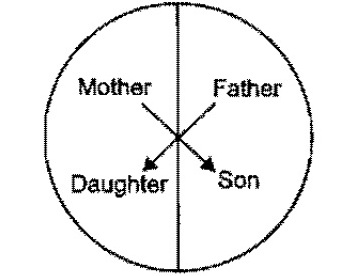
Represented below is the inheritance pattern of a certain type of trait in humans. Which one of the following conditions could be an example of this pattern?
A
Phenylketonuria
B
Sickle cell anaemia
C
Haemophilia
D
Thalassemia
Solution
(C) The diagram shows a criss-cross inheritance pattern,where a trait is passed from the mother to her son and from the father to his daughter. This is characteristic of $X$-linked recessive inheritance.
$1$. Phenylketonuria,Sickle cell anaemia,and Thalassemia are autosomal recessive disorders.
$2$. Haemophilia is an $X$-linked recessive disorder that follows a criss-cross pattern of inheritance.
Therefore,the correct option is $C$.
$1$. Phenylketonuria,Sickle cell anaemia,and Thalassemia are autosomal recessive disorders.
$2$. Haemophilia is an $X$-linked recessive disorder that follows a criss-cross pattern of inheritance.
Therefore,the correct option is $C$.
0 likes
View Solution82
MediumMCQ
Which one of the following symbols and its representation,used in human pedigree analysis,is correct?
A
B
C
D
Solution
(A) The correct answer is $(A)$. In human pedigree analysis,standard symbols are used to represent family relationships and genetic traits:
$1$. $A$ square represents a male,and a circle represents a female.
$2$. $A$ horizontal line connecting a square and a circle represents mating.
$3$. $A$ double horizontal line between a square and a circle represents mating between relatives (consanguineous mating).
$4$. An open (unshaded) symbol represents an unaffected individual.
$5$. $A$ solid (shaded) symbol represents an affected individual.
Based on the provided options:
- Option $(A)$ correctly shows a double horizontal line,which represents mating between relatives.
- Option $(B)$ shows a circle,which represents a female,not a male.
- Option $(C)$ shows a square,which represents a male,not a female.
- Option $(D)$ shows a diamond,which represents an individual of unspecified sex,not an affected male.
$1$. $A$ square represents a male,and a circle represents a female.
$2$. $A$ horizontal line connecting a square and a circle represents mating.
$3$. $A$ double horizontal line between a square and a circle represents mating between relatives (consanguineous mating).
$4$. An open (unshaded) symbol represents an unaffected individual.
$5$. $A$ solid (shaded) symbol represents an affected individual.
Based on the provided options:
- Option $(A)$ correctly shows a double horizontal line,which represents mating between relatives.
- Option $(B)$ shows a circle,which represents a female,not a male.
- Option $(C)$ shows a square,which represents a male,not a female.
- Option $(D)$ shows a diamond,which represents an individual of unspecified sex,not an affected male.
0 likes
View Solution83
MediumMCQ
Select the incorrect statement from the following.
A
Galactosemia is an inborn error of metabolism.
B
Small population size results in random genetic drift in a population.
C
Baldness is a sex-limited trait.
D
Linkage is an exception to the principle of independent assortment in heredity.
Solution
(C) is the incorrect statement. Baldness is a sex-influenced trait,not a sex-limited trait.
Sex-influenced traits are autosomal traits that are expressed differently in males and females due to the influence of sex hormones.
Sex-limited traits are expressed in only one sex (e.g.,milk production in females).
Galactosemia is indeed an inborn error of metabolism.
Genetic drift is more pronounced in small populations.
Linkage violates the law of independent assortment because linked genes do not assort independently during gamete formation.
Sex-influenced traits are autosomal traits that are expressed differently in males and females due to the influence of sex hormones.
Sex-limited traits are expressed in only one sex (e.g.,milk production in females).
Galactosemia is indeed an inborn error of metabolism.
Genetic drift is more pronounced in small populations.
Linkage violates the law of independent assortment because linked genes do not assort independently during gamete formation.
0 likes
View Solution84
MediumMCQ
Sickle cell anaemia has not been eliminated from the African population because
A
it is controlled by dominant genes
B
it is controlled by recessive genes
C
it is not a fatal disease
D
it provides immunity against malaria.
Solution
(D) : Sickle cell anaemia is an autosomal hereditary disorder in which the erythrocytes become sickle-shaped. The disorder is caused by the formation of an abnormal haemoglobin called haemoglobin-$S$. As found out by Ingram $(1958)$,haemoglobin-$S$ differs from normal haemoglobin-$A$ in only one amino acid: the $6^{th}$ amino acid of the $\beta$-chain,glutamic acid,is replaced by valine.
Carriers of the sickle cell anaemia gene are protected against malaria because of this particular haemoglobin mutation. This explains why sickle cell anaemia is particularly common among people of African origin. The malarial parasite has a complex life cycle and spends part of it in red blood cells,feeding on haemoglobin. Both sickle-cell anaemia and thalassemia are more common in malaria-prone areas because these mutations convey some protection against the parasite. In a carrier,the presence of the malaria parasite causes the red blood cell to rupture,making the $Plasmodium$ unable to reproduce. Further,the polymerisation of $Hb$ affects the ability of the parasite to digest $Hb$. Therefore,in areas where malaria is a problem,people's chances of survival actually increase if they carry the sickle cell anaemia trait. Thus,sickle-cell anaemia acts as a potential saviour from malaria.
Carriers of the sickle cell anaemia gene are protected against malaria because of this particular haemoglobin mutation. This explains why sickle cell anaemia is particularly common among people of African origin. The malarial parasite has a complex life cycle and spends part of it in red blood cells,feeding on haemoglobin. Both sickle-cell anaemia and thalassemia are more common in malaria-prone areas because these mutations convey some protection against the parasite. In a carrier,the presence of the malaria parasite causes the red blood cell to rupture,making the $Plasmodium$ unable to reproduce. Further,the polymerisation of $Hb$ affects the ability of the parasite to digest $Hb$. Therefore,in areas where malaria is a problem,people's chances of survival actually increase if they carry the sickle cell anaemia trait. Thus,sickle-cell anaemia acts as a potential saviour from malaria.
0 likes
View Solution85
MediumMCQ
Phenotype of an organism is the result of
A
genotype and environment interactions
B
mutations and linkages
C
cytoplasmic effects and nutrition
D
environmental changes and sexual dimorphism
Solution
(A) The phenotype of an organism refers to its observable physical,morphological,or physiological characteristics.
It is determined by the interaction between the organism's genetic makeup $(genotype)$ and the environmental conditions in which it develops.
While the $genotype$ provides the potential for specific traits,the environment can influence how these traits are expressed.
Therefore,the phenotype is the result of the interaction between the $genotype$ and the environment.
It is determined by the interaction between the organism's genetic makeup $(genotype)$ and the environmental conditions in which it develops.
While the $genotype$ provides the potential for specific traits,the environment can influence how these traits are expressed.
Therefore,the phenotype is the result of the interaction between the $genotype$ and the environment.
0 likes
View Solution86
MediumMCQ
Which one of the following is not a parasitic adaptation?
A
Development of adhesive organs
B
Loss of digestive organs
C
Loss of reproductive capacity
D
Loss of unnecessary sense organs
Solution
(C) : Parasitism is a relationship between two living organisms of different species in which one organism,called the parasite,obtains its food directly from another living organism,called the host. The parasite spends a part or whole of its life either on or inside the body of the host.
The general parasitic adaptations are $(i)$ anaerobic respiration in internal parasites,$(ii)$ loss of certain unnecessary organs,$(iii)$ presence of adhesive organs,$(iv)$ excessive multiplication,$(v)$ resistant cysts and eggs for safe transfer of their progeny to new hosts,and $(vi)$ well-developed and complicated reproductive organs.
Therefore,the loss of reproductive capacity is not a parasitic adaptation; in fact,parasites typically exhibit a high reproductive capacity to ensure the survival of their species.
The general parasitic adaptations are $(i)$ anaerobic respiration in internal parasites,$(ii)$ loss of certain unnecessary organs,$(iii)$ presence of adhesive organs,$(iv)$ excessive multiplication,$(v)$ resistant cysts and eggs for safe transfer of their progeny to new hosts,and $(vi)$ well-developed and complicated reproductive organs.
Therefore,the loss of reproductive capacity is not a parasitic adaptation; in fact,parasites typically exhibit a high reproductive capacity to ensure the survival of their species.
0 likes
View Solution87
EasyMCQ
What is the number of chromosome pairs in maize $(Zea \ mays)$?
A
$20$
B
$12$
C
$13$
D
$10$
Solution
(D) The diploid chromosome number $(2n)$ of maize $(Zea \ mays)$ is $20$.
Since the question asks for the number of pairs of chromosomes,we divide the diploid number by $2$.
Number of pairs = $2n / 2 = 20 / 2 = 10$.
Therefore,maize has $10$ pairs of chromosomes.
Since the question asks for the number of pairs of chromosomes,we divide the diploid number by $2$.
Number of pairs = $2n / 2 = 20 / 2 = 10$.
Therefore,maize has $10$ pairs of chromosomes.
0 likes
View Solution88
MediumMCQ
Select the incorrect pair.
A
Henking - $X$ body
B
Morgan - Linkage and recombination
C
Sutton - Chromosomal theory of Inheritance
D
Alfred Sturtevant - Law of segregation
Solution
(D) The incorrect pair is $Alfred \text{ } Sturtevant - \text{ } Law \text{ } of \text{ } segregation$.
$Alfred \text{ } Sturtevant$ is known for mapping the position of genes on chromosomes based on recombination frequency, not for the $Law \text{ } of \text{ } segregation$.
The $Law \text{ } of \text{ } segregation$ was proposed by $Gregor \text{ } Mendel$.
$Henking$ discovered the $X$ body in $1891$.
$Morgan$ is known for his work on $Linkage \text{ } and \text{ } recombination$ in $Drosophila$.
$Sutton$ and $Boveri$ proposed the $Chromosomal \text{ } theory \text{ } of \text{ } Inheritance$.
$Alfred \text{ } Sturtevant$ is known for mapping the position of genes on chromosomes based on recombination frequency, not for the $Law \text{ } of \text{ } segregation$.
The $Law \text{ } of \text{ } segregation$ was proposed by $Gregor \text{ } Mendel$.
$Henking$ discovered the $X$ body in $1891$.
$Morgan$ is known for his work on $Linkage \text{ } and \text{ } recombination$ in $Drosophila$.
$Sutton$ and $Boveri$ proposed the $Chromosomal \text{ } theory \text{ } of \text{ } Inheritance$.
0 likes
View Solution89
MediumMCQ
Match the following:
| Column-$I$ | Column-$II$ |
|---|---|
| $(1)$ Inheritance of two genes | $(a)$ $ABO$ blood group |
| $(2)$ Incomplete dominance | $(b)$ $1:2:1$ |
| $(3)$ Codominance | $(c)$ $9:3:3:1$ |
| $(4)$ Inheritance of one gene | $(d)$ $3:1$ |
A
$(1-c), (2-b), (3-a), (4-d)$
B
$(1-c), (2-b), (3-d), (4-a)$
C
$(1-c), (2-a), (3-b), (4-d)$
D
$(1-c), (2-d), (3-a), (4-b)$
Solution
(A) $(1)$ Inheritance of two genes follows the dihybrid ratio of $9:3:3:1$ $(1-c)$.
$(2)$ Incomplete dominance (e.g.,in Snapdragon) results in a phenotypic and genotypic ratio of $1:2:1$ $(2-b)$.
$(3)$ Codominance is observed in $ABO$ blood grouping in humans where both alleles $I^A$ and $I^B$ express themselves simultaneously $(3-a)$.
$(4)$ Inheritance of one gene (monohybrid cross) follows the phenotypic ratio of $3:1$ $(4-d)$.
Therefore,the correct match is $(1-c), (2-b), (3-a), (4-d)$.
$(2)$ Incomplete dominance (e.g.,in Snapdragon) results in a phenotypic and genotypic ratio of $1:2:1$ $(2-b)$.
$(3)$ Codominance is observed in $ABO$ blood grouping in humans where both alleles $I^A$ and $I^B$ express themselves simultaneously $(3-a)$.
$(4)$ Inheritance of one gene (monohybrid cross) follows the phenotypic ratio of $3:1$ $(4-d)$.
Therefore,the correct match is $(1-c), (2-b), (3-a), (4-d)$.
0 likes
View Solution90
MediumMCQ
Match the following:
| Column – $I$ | Column – $II$ |
|---|---|
| $(1)$ Failure of cytokinesis | $(p)$ To study inheritance of particular traits |
| $(2)$ Trisomy of $21$ | $(q)$ Polyploidy |
| $(3)$ Error of metabolism | $(r)$ Down's syndrome |
| $(4)$ Pedigree analysis | $(s)$ Phenylketonuria |
A
$(1-p), (2-q), (3-r), (4-s)$
B
$(1-q), (2-p), (3-s), (4-r)$
C
$(1-q), (2-r), (3-s), (4-p)$
D
$(1-p), (2-r), (3-s), (4-q)$
Solution
(C) $(1)$ Failure of cytokinesis leads to an increase in the whole set of chromosomes in an organism,a condition known as Polyploidy $(q)$.
$(2)$ Trisomy of chromosome $21$ is the genetic cause of Down's syndrome $(r)$.
$(3)$ Phenylketonuria is an inborn error of metabolism caused by the deficiency of the enzyme phenylalanine hydroxylase $(s)$.
$(4)$ Pedigree analysis is a tool used to study the inheritance of particular traits in families over several generations $(p)$.
Therefore,the correct matching is $(1-q), (2-r), (3-s), (4-p)$.
$(2)$ Trisomy of chromosome $21$ is the genetic cause of Down's syndrome $(r)$.
$(3)$ Phenylketonuria is an inborn error of metabolism caused by the deficiency of the enzyme phenylalanine hydroxylase $(s)$.
$(4)$ Pedigree analysis is a tool used to study the inheritance of particular traits in families over several generations $(p)$.
Therefore,the correct matching is $(1-q), (2-r), (3-s), (4-p)$.
0 likes
View Solution91
MediumMCQ
Match the following columns.
| Column-$I$ | Column-$II$ |
|---|---|
| $(w)$ Blood group | $(a)$ Polygenic inheritance |
| $(x)$ Skin colour | $(b)$ Aneuploidy |
| $(y)$ Mendelian disorder | $(c)$ Incomplete dominance |
| $(z)$ Chromosomal disorder | $(d)$ Sickle-cell anaemia |
| $(e)$ Co-dominance |
A
$w-e, x-a, y-d, z-b$
B
$w-c, x-a, y-d, z-b$
C
$w-a, x-b, y-c, z-d$
D
$w-b, x-c, y-d, z-e$
Solution
(A) The correct matching is as follows:
$1$. $(w)$ Blood group (specifically $ABO$ blood grouping) exhibits Co-dominance $(e)$.
$2$. $(x)$ Skin colour in humans is an example of Polygenic inheritance $(a)$.
$3$. $(y)$ Sickle-cell anaemia is a classic example of a Mendelian disorder $(d)$.
$4$. $(z)$ Chromosomal disorders,such as Down's syndrome,are caused by Aneuploidy $(b)$.
Therefore,the correct sequence is $w-e, x-a, y-d, z-b$.
$1$. $(w)$ Blood group (specifically $ABO$ blood grouping) exhibits Co-dominance $(e)$.
$2$. $(x)$ Skin colour in humans is an example of Polygenic inheritance $(a)$.
$3$. $(y)$ Sickle-cell anaemia is a classic example of a Mendelian disorder $(d)$.
$4$. $(z)$ Chromosomal disorders,such as Down's syndrome,are caused by Aneuploidy $(b)$.
Therefore,the correct sequence is $w-e, x-a, y-d, z-b$.
0 likes
View Solution92
DifficultMCQ
How many sentences are correct?
$(i)$ Every gene contains the information to express a particular trait.
$(ii)$ Gene responsible for $\beta$-thalassemia is present on the $11^{th}$ pair of autosomal chromosomes.
$(iii)$ Mendel's approach of using mathematics to explain biological phenomena was totally new and unacceptable to many of the biologists of his time.
$(i)$ Every gene contains the information to express a particular trait.
$(ii)$ Gene responsible for $\beta$-thalassemia is present on the $11^{th}$ pair of autosomal chromosomes.
$(iii)$ Mendel's approach of using mathematics to explain biological phenomena was totally new and unacceptable to many of the biologists of his time.
A
$0$
B
$2$
C
$1$
D
$3$
Solution
(B) $(i)$ This statement is correct. $A$ gene is a segment of $DNA$ that codes for a specific protein or trait.
$(ii)$ This statement is incorrect. The gene responsible for $\beta$-thalassemia is located on the $11^{th}$ chromosome,not the $21^{st}$ chromosome.
$(iii)$ This statement is correct. Mendel's use of statistical analysis and mathematical logic to explain inheritance was ahead of its time and was not readily accepted by his contemporaries.
Therefore,there are $2$ correct sentences.
$(ii)$ This statement is incorrect. The gene responsible for $\beta$-thalassemia is located on the $11^{th}$ chromosome,not the $21^{st}$ chromosome.
$(iii)$ This statement is correct. Mendel's use of statistical analysis and mathematical logic to explain inheritance was ahead of its time and was not readily accepted by his contemporaries.
Therefore,there are $2$ correct sentences.
0 likes
View Solution93
MediumMCQ
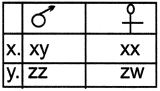
Match the following pairs based on the sex determination mechanism shown in the table:
| Male $(♂)$ | Female $(♀)$ | |
|---|---|---|
| $x$ | $XY$ | $XX$ |
| $y$ | $ZZ$ | $ZW$ |
A
$x$ - human,$y$ - drosophila
B
$x$ - drosophila,$y$ - hen
C
$x$ - hen,$y$ - human
D
$x$ - drosophila,$y$ - human
Solution
(B) The table represents different mechanisms of sex determination:
$1$. The $x$ row shows the $XY-XX$ type of sex determination,where males are heterogametic $(XY)$ and females are homogametic $(XX)$. This is observed in humans and Drosophila.
$2$. The $y$ row shows the $ZZ-ZW$ type of sex determination,where males are homogametic $(ZZ)$ and females are heterogametic $(ZW)$. This is observed in birds (e.g.,hen).
Therefore,$x$ corresponds to humans or Drosophila,and $y$ corresponds to birds like hens. Comparing this with the options,option $B$ is the most appropriate match.
$1$. The $x$ row shows the $XY-XX$ type of sex determination,where males are heterogametic $(XY)$ and females are homogametic $(XX)$. This is observed in humans and Drosophila.
$2$. The $y$ row shows the $ZZ-ZW$ type of sex determination,where males are homogametic $(ZZ)$ and females are heterogametic $(ZW)$. This is observed in birds (e.g.,hen).
Therefore,$x$ corresponds to humans or Drosophila,and $y$ corresponds to birds like hens. Comparing this with the options,option $B$ is the most appropriate match.
0 likes
View Solution94
MediumMCQ
Choose the correct sequence of True $(T)$ and False $(F)$ statements:
$(i)$ Queen Elizabeth shows a number of haemophilic descendants.
$(ii)$ Variation in blood group prevalences is due to incomplete dominance.
$(iii)$ Drosophila has three pairs of autosomal chromosomes.
$(iv)$ In birds,the female is heterozygous.
$(i)$ Queen Elizabeth shows a number of haemophilic descendants.
$(ii)$ Variation in blood group prevalences is due to incomplete dominance.
$(iii)$ Drosophila has three pairs of autosomal chromosomes.
$(iv)$ In birds,the female is heterozygous.
A
$FFTT$
B
$TFFT$
C
$TTFF$
D
$TFTT$
Solution
(D) $(i)$ Queen Elizabeth was a carrier of haemophilia,and many of her descendants were haemophilic. This statement is True $(T)$.
$(ii)$ Variation in blood group prevalences is due to multiple allelism and co-dominance,not incomplete dominance. This statement is False $(F)$.
$(iii)$ Drosophila has $4$ pairs of chromosomes,of which $3$ pairs are autosomes and $1$ pair is sex chromosomes. This statement is True $(T)$.
$(iv)$ In birds,the sex determination system is $ZW-ZZ$ type,where the female is heterogametic $(ZW)$ and the male is homogametic $(ZZ)$. This statement is True $(T)$.
Therefore,the sequence is $T, F, T, T$.
$(ii)$ Variation in blood group prevalences is due to multiple allelism and co-dominance,not incomplete dominance. This statement is False $(F)$.
$(iii)$ Drosophila has $4$ pairs of chromosomes,of which $3$ pairs are autosomes and $1$ pair is sex chromosomes. This statement is True $(T)$.
$(iv)$ In birds,the sex determination system is $ZW-ZZ$ type,where the female is heterogametic $(ZW)$ and the male is homogametic $(ZZ)$. This statement is True $(T)$.
Therefore,the sequence is $T, F, T, T$.
0 likes
View Solution95
MediumMCQ
Choose the correct option for the given descriptions:
$(i)$ The heterozygous female transmits the disease to the son.
$(ii)$ Change in the shape of the $RBC$ from biconcave disc to elongated sickle-like structure.
$(iii)$ Mentally retarded.
$(iv)$ Haemoglobin is not formed in the proper amount in the blood.
$(i)$ The heterozygous female transmits the disease to the son.
$(ii)$ Change in the shape of the $RBC$ from biconcave disc to elongated sickle-like structure.
$(iii)$ Mentally retarded.
$(iv)$ Haemoglobin is not formed in the proper amount in the blood.
A
Colour blindness,thalassaemia,phenylketonuria,anaemia.
B
Haemophilia,sickle cell anaemia,Klinefelter's syndrome,thalassaemia.
C
Down's syndrome,Klinefelter's syndrome,colour blindness,Turner's syndrome.
D
Haemophilia,sickle cell anaemia,phenylketonuria,thalassaemia.
Solution
(D) $(i)$ Haemophilia is an $X$-linked recessive disorder where heterozygous females (carriers) transmit the disease to their sons.
$(ii)$ Sickle cell anaemia is caused by a point mutation in the $\beta$-globin chain of haemoglobin,leading to the change in $RBC$ shape from biconcave to sickle-like.
$(iii)$ Phenylketonuria $(PKU)$ is an inborn error of metabolism that results in mental retardation due to the accumulation of phenylalanine.
$(iv)$ Thalassaemia is a quantitative disorder where there is a reduced synthesis of one of the globin chains of haemoglobin,leading to anaemia.
$(ii)$ Sickle cell anaemia is caused by a point mutation in the $\beta$-globin chain of haemoglobin,leading to the change in $RBC$ shape from biconcave to sickle-like.
$(iii)$ Phenylketonuria $(PKU)$ is an inborn error of metabolism that results in mental retardation due to the accumulation of phenylalanine.
$(iv)$ Thalassaemia is a quantitative disorder where there is a reduced synthesis of one of the globin chains of haemoglobin,leading to anaemia.
0 likes
View Solution96
EasyMCQ
The application of the principles of genetics for the improvement of the human race is called ..............
A
Euthenics
B
Eugenics
C
Euphenics
D
Ethnology
Solution
(B) The application of the principles of genetics to improve the hereditary qualities of the human race is known as $Eugenics$.
$Euthenics$ refers to the improvement of human well-being by improving environmental conditions.
$Euphenics$ refers to the improvement of the human condition by modifying the expression of genes (phenotype) through medical or environmental interventions.
$Ethnology$ is the branch of anthropology that compares and analyzes the characteristics of different peoples and the relationships between them.
Therefore,the correct option is $B$.
$Euthenics$ refers to the improvement of human well-being by improving environmental conditions.
$Euphenics$ refers to the improvement of the human condition by modifying the expression of genes (phenotype) through medical or environmental interventions.
$Ethnology$ is the branch of anthropology that compares and analyzes the characteristics of different peoples and the relationships between them.
Therefore,the correct option is $B$.
0 likes
View Solution97
MediumMCQ
In Mr. Kapoor,there is a pair of autosomal genes $Bb$ and a sex-linked factor $d$. What will be the proportion of $Bd$ in his sperm?
A
$0$
B
$1/2$
C
$1/4$
D
$1/8$
Solution
(C) Mr. Kapoor is a male,so his genotype for the sex chromosomes is $XY$. The sex-linked factor $d$ is located on the $X$ chromosome. Thus,his genotype is $BbXdY$.
During meiosis,the autosomal genes $B$ and $b$ segregate independently.
The possible combinations of autosomal genes and sex chromosomes in the sperm are:
$1$. $B$ with $X^d$
$2$. $B$ with $Y$
$3$. $b$ with $X^d$
$4$. $b$ with $Y$
Each of these four combinations has an equal probability of $1/4$.
Therefore,the proportion of sperm carrying $Bd$ (where $d$ is the sex-linked factor) is $1/4$.
During meiosis,the autosomal genes $B$ and $b$ segregate independently.
The possible combinations of autosomal genes and sex chromosomes in the sperm are:
$1$. $B$ with $X^d$
$2$. $B$ with $Y$
$3$. $b$ with $X^d$
$4$. $b$ with $Y$
Each of these four combinations has an equal probability of $1/4$.
Therefore,the proportion of sperm carrying $Bd$ (where $d$ is the sex-linked factor) is $1/4$.
0 likes
View Solution98
DifficultMCQ
When two genetic loci produce identical phenotypes in both $cis$ and $trans$ configurations,they are considered to be:
A
Pseudoalleles
B
Different genes
C
Multiple alleles
D
Parts of the same gene
Solution
(A) The $cis-trans$ test (or complementation test) is used to determine if two mutations are in the same gene or different genes.
If two mutations are in the same gene,they will show a mutant phenotype in the $trans$ configuration (complementation does not occur).
If two mutations are in different genes,they will show a wild-type phenotype in the $trans$ configuration (complementation occurs).
However,if two genetic loci produce identical phenotypes in both $cis$ and $trans$ configurations,it indicates that the mutations are not affecting the same functional unit in a way that prevents complementation,or they are effectively acting as independent units. In the context of classical genetics,when mutations at two closely linked loci show identical phenotypes and do not exhibit the expected $cis-trans$ effect,they are often referred to as Pseudoalleles.
If two mutations are in the same gene,they will show a mutant phenotype in the $trans$ configuration (complementation does not occur).
If two mutations are in different genes,they will show a wild-type phenotype in the $trans$ configuration (complementation occurs).
However,if two genetic loci produce identical phenotypes in both $cis$ and $trans$ configurations,it indicates that the mutations are not affecting the same functional unit in a way that prevents complementation,or they are effectively acting as independent units. In the context of classical genetics,when mutations at two closely linked loci show identical phenotypes and do not exhibit the expected $cis-trans$ effect,they are often referred to as Pseudoalleles.
0 likes
View Solution99
EasyMCQ
Which of the following are the main categories of genetic disorders?
A
Mendelian disorders
B
Chromosomal disorders
C
Both $A$ and $B$
D
None of the above
Solution
(C) Genetic disorders are broadly grouped into two categories:
$1$. Mendelian disorders: These are primarily determined by alteration or mutation in the single gene. Examples include Hemophilia,Cystic fibrosis,Sickle-cell anemia,etc.
$2$. Chromosomal disorders: These are caused due to absence or excess or abnormal arrangement of one or more chromosomes. Examples include Down's syndrome,Klinefelter's syndrome,and Turner's syndrome.
Therefore,both $A$ and $B$ are correct categories.
$1$. Mendelian disorders: These are primarily determined by alteration or mutation in the single gene. Examples include Hemophilia,Cystic fibrosis,Sickle-cell anemia,etc.
$2$. Chromosomal disorders: These are caused due to absence or excess or abnormal arrangement of one or more chromosomes. Examples include Down's syndrome,Klinefelter's syndrome,and Turner's syndrome.
Therefore,both $A$ and $B$ are correct categories.
0 likes
View Solution100
MediumMCQ
In $Drosophila$,during organ differentiation,if one organ is transformed into another (e.g.,legs instead of wings),what is the gene responsible for such transformation called?
A
Double dominant gene
B
Plastid genes
C
Complementary gene
D
Homeotic gene
Solution
(D) Homeotic genes are a group of genes that control the pattern of body formation during early embryonic development of organisms.
These genes encode transcription factors that determine the identity of body segments along the anterior-posterior axis.
In $Drosophila$,mutations in homeotic genes can lead to homeotic transformations,where one body part is replaced by another,such as the development of legs in place of wings (e.g.,the $Antennapedia$ mutation).
Therefore,the correct answer is $D$.
These genes encode transcription factors that determine the identity of body segments along the anterior-posterior axis.
In $Drosophila$,mutations in homeotic genes can lead to homeotic transformations,where one body part is replaced by another,such as the development of legs in place of wings (e.g.,the $Antennapedia$ mutation).
Therefore,the correct answer is $D$.
0 likes
View SolutionPrinciples of Inheritance and Variation — Mix Examples- Principles of Inheritance and Variation · Frequently Asked Questions
1Are these Principles of Inheritance and Variation questions useful for JEE and NEET?
Yes. All questions in this section are mapped to JEE Main and NEET exam patterns. Previous year questions from JEE Main, NEET, GUJCET and state-level exams are included with full solutions.
2Can I switch to Hindi or Gujarati for these questions?
Yes. Use the language tabs in the hero section or the sidebar to view the same questions and solutions in English, Hindi or Gujarati.
3How do I generate a question paper from this subtopic?
Use the Vedclass Exam Paper Generator — select the chapter and subtopic, set difficulty, and generate Sets A, B, C, D automatically. First 3 chapters of every subject are free.
Vedclass Products
For Students
Vedclass Test Series
Mock tests in real JEE/NEET style with performance analysis. 5-day free trial.
Start Free TrialFor Teachers
Exam Paper Generator
Generate Set A/B/C/D papers from this chapter in 2 minutes. 3 chapters free.
Try FreeFor Institutes
Online Exam Module
Live online exams with unlimited students, 360° analytics & white-label branding.
See DemoFor Teachers & Institutes
Generate a Principles of Inheritance and Variation Exam Paper in 2 Minutes
Select subtopic & difficulty — Sets A, B, C, D auto-generated with No Repeat logic.
First 3 chapters of every subject are free — no payment required.