
A English
Mendel's law of inheritance Questions in English
Class 12 Biology · Principles of Inheritance and Variation · Mendel's law of inheritance
71+
Questions
English
Language
100%
With Solutions
Showing 50 of 71 questions in English
1
EasyMCQ
Who proposed Mendel's conclusions in the form of laws?
A
Bateson
B
Correns
C
Punnett
D
Johannsen
Solution
(B) Correns formulated two of Mendel's generalizations into formal laws of heredity.
These are the Law of Segregation and the Law of Independent Assortment.
These are the Law of Segregation and the Law of Independent Assortment.
0 likes
View Solution2
MediumMCQ
In a zygote,if there are two alternate forms of alleles,the expression in the adult is typically determined by which trait?
A
Recessive
B
Dominant
C
Intermediate
D
Epistatic
Solution
(B) According to the Law of Dominance,in a heterozygous organism where two different alleles (alternate forms of a gene) are present,the allele that expresses itself in the phenotype of the adult is known as the $Dominant$ allele. The other allele,whose expression is masked,is known as the $Recessive$ allele. Therefore,the expression observed in the adult is primarily the $Dominant$ trait.
0 likes
View Solution3
MediumMCQ
If two opposite alleles come together,one finding morphological expression masking the other,the fact is described as the law of:
A
Inheritance
B
Dominance
C
Limiting factor
D
Segregation
Solution
(B) The Law of Dominance states that in a heterozygous organism,when two contrasting alleles are present together,one allele expresses its character (dominant) and masks the expression of the other allele (recessive). This phenomenon explains why the $F_1$ generation only displays the phenotype of one parent.
0 likes
View Solution4
EasyMCQ
Mendel enunciated
A
Two principles of inheritance
B
Three principles of inheritance
C
Four principles of inheritance
D
Five principles of inheritance
Solution
(B) Mendel proposed three major principles (or laws) of inheritance based on his experiments with pea plants:
$1$. Law of Dominance: In a heterozygous condition,only the dominant allele expresses itself.
$2$. Law of Segregation: Alleles separate during gamete formation so that each gamete carries only one allele for a trait.
$3$. Law of Independent Assortment: The inheritance of one pair of traits is independent of the inheritance of another pair of traits.
$1$. Law of Dominance: In a heterozygous condition,only the dominant allele expresses itself.
$2$. Law of Segregation: Alleles separate during gamete formation so that each gamete carries only one allele for a trait.
$3$. Law of Independent Assortment: The inheritance of one pair of traits is independent of the inheritance of another pair of traits.
0 likes
View Solution5
MediumMCQ
Mendel formulated some laws which are known as
A
Laws of germplasm
B
Laws of origin of species
C
Laws of recapitulation
D
Laws of inheritance
Solution
(D) Gregor Mendel proposed the fundamental principles of heredity based on his experiments with pea plants. These principles are collectively known as the $Laws$ $of$ $Inheritance$. Specifically,these include the $Law$ $of$ $Dominance$,the $Law$ $of$ $Segregation$,and the $Law$ $of$ $Independent$ $Assortment$.
0 likes
View Solution6
MediumMCQ
What is the first law of Mendel?
A
Law of inheritance
B
Law of variation
C
Law of independent assortment
D
Law of segregation
Solution
(D) The correct answer is $D$. Mendel proposed two main laws of inheritance based on his experiments with pea plants. The first law is the $Law \text{ of } Segregation$ (also known as the law of purity of gametes), which states that alleles segregate during gamete formation. The second law is the $Law \text{ of } Independent \text{ Assortment}$.
0 likes
View Solution7
MediumMCQ
When heterozygous tall plants are self-pollinated,tall and dwarf plants are obtained. This is explained by:
A
Law of purity of gametes
B
Law of segregation
C
Division in spores
D
Law of independent assortment
Solution
(B) When heterozygous tall plants $(Tt)$ are self-pollinated,they produce offspring in a phenotypic ratio of $3:1$ (tall to dwarf).
This occurs because the two alleles of a gene pair segregate from each other during gamete formation,such that each gamete carries only one allele.
This phenomenon is known as the Law of Segregation or the Law of Purity of Gametes.
This occurs because the two alleles of a gene pair segregate from each other during gamete formation,such that each gamete carries only one allele.
This phenomenon is known as the Law of Segregation or the Law of Purity of Gametes.
0 likes
View Solution8
MediumMCQ
Mendel's principle of segregation was based on the separation of alleles in the garden pea during
A
Pollination
B
Embryonic development
C
Seed formation
D
Gamete formation
Solution
(D) The correct answer is $D$. Mendel's principle of segregation states that allele pairs separate or segregate during the process of gamete formation (meiosis). Each gamete receives only one allele of the pair. The paired condition is subsequently restored by the random fusion of gametes during fertilization.
0 likes
View Solution9
MediumMCQ
The genotype of an individual is $RrBb$. How many different types of gametes will it produce based on the law of independent assortment?
A
$16$
B
$9$
C
$8$
D
$4$
Solution
(D) According to the law of independent assortment,the number of different types of gametes produced by an individual with $n$ heterozygous gene pairs is given by the formula $2^n$.
In the genotype $RrBb$,there are $2$ heterozygous gene pairs $(n = 2)$.
Therefore,the number of different types of gametes produced is $2^2 = 4$.
The four types of gametes are $RB, Rb, rB,$ and $rb$.
In the genotype $RrBb$,there are $2$ heterozygous gene pairs $(n = 2)$.
Therefore,the number of different types of gametes produced is $2^2 = 4$.
The four types of gametes are $RB, Rb, rB,$ and $rb$.
0 likes
View Solution10
MediumMCQ
If in a dihybrid cross, Mendel had used two such characters which were linked, he would have faced difficulty in explaining the results on the basis of his
A
Law of segregation
B
Law of multiple factor hypothesis
C
Law of independent assortment
D
Law of dominance
Solution
(C) The $Law$ of $Independent$ $Assortment$ states that when two pairs of traits are combined in a hybrid, segregation of one pair of characters is independent of the other pair of characters.
Linkage is the phenomenon where genes located on the same chromosome tend to be inherited together, which violates the principle of independent assortment.
Therefore, if Mendel had used linked genes, he would have observed that the traits do not assort independently, making it difficult to explain his results using the $Law$ of $Independent$ $Assortment$.
Linkage is the phenomenon where genes located on the same chromosome tend to be inherited together, which violates the principle of independent assortment.
Therefore, if Mendel had used linked genes, he would have observed that the traits do not assort independently, making it difficult to explain his results using the $Law$ of $Independent$ $Assortment$.
0 likes
View Solution11
MediumMCQ
If a plant heterozygous for tallness is selfed,the $F_2$ generation has both tall and dwarf plants. This proves the principle of
A
Dominance
B
Segregation
C
Independent assortment
D
Incomplete dominance
Solution
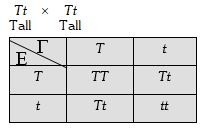
(B) When a heterozygous tall plant $(Tt)$ is self-pollinated,the cross is $Tt \times Tt$.
According to the Law of Segregation,the alleles $T$ and $t$ separate during gamete formation.
The resulting $F_2$ generation genotypes are $1 TT$ (Homozygous tall),$2 Tt$ (Heterozygous tall),and $1 tt$ (Homozygous dwarf).
The phenotypic ratio is $3$ tall : $1$ dwarf.
This reappearance of the dwarf trait in the $F_2$ generation,which was hidden in the $F_1$ generation,confirms the Law of Segregation.
According to the Law of Segregation,the alleles $T$ and $t$ separate during gamete formation.
The resulting $F_2$ generation genotypes are $1 TT$ (Homozygous tall),$2 Tt$ (Heterozygous tall),and $1 tt$ (Homozygous dwarf).
The phenotypic ratio is $3$ tall : $1$ dwarf.
This reappearance of the dwarf trait in the $F_2$ generation,which was hidden in the $F_1$ generation,confirms the Law of Segregation.
0 likes
View Solution12
AdvancedMCQ
If Mendel had studied the seven traits using a plant with $12$ chromosomes instead of $14$,in what way would his interpretation have been different?
A
He could have mapped the chromosome
B
He would have discovered blending or incomplete dominance
C
He would not have discovered the law of independent assortment
D
He would have discovered sex linkage
Solution
(C) Mendel studied $7$ traits in pea plants,which have $14$ chromosomes $(2n = 14)$.
These $7$ traits were located on the $7$ pairs of chromosomes such that each trait was either on a different chromosome or far apart on the same chromosome,allowing them to assort independently.
If the plant had only $12$ chromosomes $(2n = 12)$,there would be only $6$ pairs of chromosomes.
Since there are $7$ traits and only $6$ pairs of chromosomes,at least two traits would have to be located on the same chromosome pair.
If two traits are located on the same chromosome,they are linked and do not show independent assortment.
Therefore,Mendel would not have been able to formulate the Law of Independent Assortment.
These $7$ traits were located on the $7$ pairs of chromosomes such that each trait was either on a different chromosome or far apart on the same chromosome,allowing them to assort independently.
If the plant had only $12$ chromosomes $(2n = 12)$,there would be only $6$ pairs of chromosomes.
Since there are $7$ traits and only $6$ pairs of chromosomes,at least two traits would have to be located on the same chromosome pair.
If two traits are located on the same chromosome,they are linked and do not show independent assortment.
Therefore,Mendel would not have been able to formulate the Law of Independent Assortment.
0 likes
View Solution13
MediumMCQ
Mendel's law of independent assortment is applicable for
A
All genes in all organisms
B
All genes of pea plant only
C
All linked genes only
D
All non-linked genes only
Solution
(D) Mendel's law of independent assortment states that when two pairs of traits are combined in a hybrid,segregation of one pair of characters is independent of the other pair of characters.
This law is applicable only to genes that are located on different chromosomes or are located far apart on the same chromosome such that they do not show linkage.
Linked genes do not assort independently because they are inherited together.
Therefore,the law of independent assortment is applicable only to all non-linked genes.
This law is applicable only to genes that are located on different chromosomes or are located far apart on the same chromosome such that they do not show linkage.
Linked genes do not assort independently because they are inherited together.
Therefore,the law of independent assortment is applicable only to all non-linked genes.
0 likes
View Solution14
MediumMCQ
Mendel's laws are valid for:
A
Asexual reproduction
B
Sexual reproduction
C
Vegetative reproduction
D
All of the above
Solution
(B) Mendel's laws of inheritance (Law of Dominance,Law of Segregation,and Law of Independent Assortment) are based on the behavior of chromosomes during meiosis and the fusion of gametes.
These processes are fundamental characteristics of sexual reproduction,which involves the formation and fusion of haploid gametes to produce genetically diverse offspring.
Asexual and vegetative reproduction involve mitosis,where offspring are genetically identical clones of the parent,and therefore,Mendel's laws of segregation and independent assortment do not apply in the same manner.
These processes are fundamental characteristics of sexual reproduction,which involves the formation and fusion of haploid gametes to produce genetically diverse offspring.
Asexual and vegetative reproduction involve mitosis,where offspring are genetically identical clones of the parent,and therefore,Mendel's laws of segregation and independent assortment do not apply in the same manner.
0 likes
View Solution15
MediumMCQ
Mendel's law of segregation is applicable to
A
Dihybrid cross only
B
Monohybrid cross only
C
Both dihybrid and monohybrid cross
D
Dihybrid but not monohybrid
Solution
(C) Mendel's law of segregation states that the two alleles of a gene pair segregate from each other during the formation of gametes,such that each gamete carries only one of the two alleles.
This law is a fundamental principle of inheritance and applies to all sexually reproducing organisms,regardless of whether the inheritance of one gene (monohybrid cross) or two or more genes (dihybrid or polyhybrid cross) is being studied.
Therefore,it is applicable to both monohybrid and dihybrid crosses.
This law is a fundamental principle of inheritance and applies to all sexually reproducing organisms,regardless of whether the inheritance of one gene (monohybrid cross) or two or more genes (dihybrid or polyhybrid cross) is being studied.
Therefore,it is applicable to both monohybrid and dihybrid crosses.
0 likes
View Solution16
MediumMCQ
Mendel's laws of inheritance are still considered valid because:
A
They occur in sexually reproducing plants.
B
They occur in asexually reproducing plants.
C
They occur in both types of plants mentioned above.
D
They occur in apomictic reproducing plants.
Solution
(A) Mendel's laws of inheritance (Law of Segregation and Law of Independent Assortment) are based on the behavior of chromosomes during meiosis and the fusion of gametes. These processes are fundamental to sexual reproduction. Since sexual reproduction involves the formation of gametes and their subsequent fusion to form a zygote,the segregation of alleles and their independent assortment are observed in sexually reproducing organisms. Therefore,Mendel's laws are applicable to sexually reproducing plants.
0 likes
View Solution17
MediumMCQ
What will be the percentage of $ab$ gametes produced by an $AaBb$ parent (in $\%$)?
A
$12.5$
B
$25$
C
$50$
D
$75$
Solution
(B) According to the law of independent assortment,an $AaBb$ individual produces four types of gametes in equal proportions.
These gametes are $AB$,$Ab$,$aB$,and $ab$.
Since there are four types of gametes,the probability of producing each type is $1/4$ or $25\%$.
Therefore,the percentage of $ab$ gametes produced is $25\%$.
These gametes are $AB$,$Ab$,$aB$,and $ab$.
Since there are four types of gametes,the probability of producing each type is $1/4$ or $25\%$.
Therefore,the percentage of $ab$ gametes produced is $25\%$.
0 likes
View Solution18
MediumMCQ
What does a test cross involve?
A
Crossing an $F_1$ hybrid with a double recessive genotype.
B
Crossing between two $F_1$ hybrids.
C
Crossing an $F_1$ individual with a recessive parent.
D
Crossing two genotypes with dominant traits.
Solution
(C) परीक्षण संकरण (Test cross) $F_1$ पीढ़ी के जीव का उसके अप्रभावी जनक के साथ किया गया संकरण है। इस विधि का उपयोग अज्ञात जीनप्रारूप (genotype) वाले जीव के जीनप्रारूप को निर्धारित करने के लिए किया जाता है। यदि $F_1$ जीव विषमयुग्मजी (heterozygous) है,तो अप्रभावी जनक के साथ संकरण करने पर संतति में $1:1$ का अनुपात प्राप्त होता है।
0 likes
View Solution19
MediumMCQ
Mendel's Law of Segregation is based on the separation of alleles during which process?
A
Gamete formation
B
Seed formation
C
Pollination
D
Embryonic development
Solution
(A) Mendel's Law of Segregation states that the two alleles of a gene pair segregate from each other during the formation of gametes.
This ensures that each gamete receives only one of the two alleles.
Therefore,the correct process is gamete formation.
This ensures that each gamete receives only one of the two alleles.
Therefore,the correct process is gamete formation.
0 likes
View Solution20
EasyMCQ
According to Mendel's Law of Segregation,the phenotypic ratio of the $F_2$ generation will be.................
A
$1:2:1$
B
$3:1$
C
$1:1$
D
$2:1$
Solution
(B) Mendel's Law of Segregation states that the two alleles of a gene pair segregate from each other during the formation of gametes.
In a monohybrid cross,when $F_1$ hybrids (heterozygous,$Aa$) are self-pollinated,the $F_2$ generation produces offspring with genotypes $AA$,$Aa$,and $aa$ in a ratio of $1:2:1$.
However,the phenotypic expression of $AA$ and $Aa$ is the same (dominant trait).
Therefore,the phenotypic ratio observed in the $F_2$ generation is $3:1$ (three dominant to one recessive).
In a monohybrid cross,when $F_1$ hybrids (heterozygous,$Aa$) are self-pollinated,the $F_2$ generation produces offspring with genotypes $AA$,$Aa$,and $aa$ in a ratio of $1:2:1$.
However,the phenotypic expression of $AA$ and $Aa$ is the same (dominant trait).
Therefore,the phenotypic ratio observed in the $F_2$ generation is $3:1$ (three dominant to one recessive).
0 likes
View Solution21
MediumMCQ
The segregation of alleles is a random process and so there is a $50\%$ chance of a gamete containing either allele. This is known as: (in $\%$)
A
$25$
B
$50$
C
$75$
D
$100$
Solution
(B) According to Mendel's Law of Segregation,the two alleles of a gene pair segregate from each other during the formation of gametes.
Since this process is random,each gamete has an equal probability of receiving either one of the two alleles.
Therefore,there is a $50\%$ chance for a gamete to contain a specific allele from the pair.
Since this process is random,each gamete has an equal probability of receiving either one of the two alleles.
Therefore,there is a $50\%$ chance for a gamete to contain a specific allele from the pair.
0 likes
View Solution22
EasyMCQ
Mendel's laws of inheritance are applicable to plants that......
A
reproduce asexually.
B
reproduce sexually.
C
reproduce vegetatively.
D
reproduce by all the above methods.
Solution
(B) Mendel's laws of inheritance,such as the Law of Segregation and the Law of Independent Assortment,are based on the behavior of chromosomes during meiosis and the fusion of gametes during fertilization.
These processes are fundamental characteristics of sexual reproduction.
Asexual and vegetative reproduction involve mitosis and do not involve the formation and fusion of gametes,which is necessary for the segregation and recombination of alleles as described by Mendel.
Therefore,Mendel's laws are applicable only to organisms that reproduce sexually.
These processes are fundamental characteristics of sexual reproduction.
Asexual and vegetative reproduction involve mitosis and do not involve the formation and fusion of gametes,which is necessary for the segregation and recombination of alleles as described by Mendel.
Therefore,Mendel's laws are applicable only to organisms that reproduce sexually.
0 likes
View Solution23
MediumMCQ
When two pairs of traits are combined in a hybrid, the segregation of one pair of characters is independent of the other pair of characters. This is known as the .....
A
Law of Dominance
B
Law of Segregation
C
Law of Independent Assortment
D
Law of Unit Characters
Solution
(C) The statement describes the $Law \text{ of } Independent \text{ Assortment}$.
According to Mendel's $Law \text{ of } Independent \text{ Assortment}$, when two pairs of traits are combined in a hybrid, the segregation of one pair of characters is independent of the other pair of characters.
This principle is observed in dihybrid crosses where the inheritance of one gene does not influence the inheritance of another gene.
According to Mendel's $Law \text{ of } Independent \text{ Assortment}$, when two pairs of traits are combined in a hybrid, the segregation of one pair of characters is independent of the other pair of characters.
This principle is observed in dihybrid crosses where the inheritance of one gene does not influence the inheritance of another gene.
0 likes
View Solution24
MediumMCQ
Which of the following does not explain Mendel's Law of Dominance?
A
Factors do not show any blending in the $F_2$ generation and both traits are recovered.
B
Factors occur in pairs.
C
Discrete units controlling a specific trait are called factors.
D
In a pair of factors,one is dominant and the other is recessive.
Solution
(A) Mendel's Law of Dominance states that in a heterozygous organism,one allele (dominant) masks the expression of the other (recessive).
Option $A$ describes the Law of Segregation (or Purity of Gametes),which explains why traits do not blend and are recovered in the $F_2$ generation.
Options $B$,$C$,and $D$ are fundamental postulates that directly support the Law of Dominance.
Option $A$ describes the Law of Segregation (or Purity of Gametes),which explains why traits do not blend and are recovered in the $F_2$ generation.
Options $B$,$C$,and $D$ are fundamental postulates that directly support the Law of Dominance.
0 likes
View Solution25
MediumMCQ
If Mendel had chosen linked genes for his study of trait inheritance, he would not have discovered which of the following?
A
Law of Segregation
B
Law of Dominance
C
Law of Independent Assortment
D
Law of Unit Characters
Solution
(C) Mendel's $Law of Independent Assortment$ states that the alleles of two (or more) different genes get sorted into gametes independently of one another. This law is based on the observation that genes for different traits are located on different chromosomes or are far apart on the same chromosome. If the genes were linked (located close together on the same chromosome), they would tend to be inherited together, violating the principle of independent assortment. Therefore, Mendel would not have been able to formulate the $Law of Independent Assortment$ if he had chosen linked genes.
0 likes
View Solution26
MediumMCQ
$A$ recessive trait is one that -
A
is expressed only in the heterozygous condition.
B
is expressed only in the homozygous condition.
C
is blended in the heterozygous condition.
D
is always impure.
Solution
(B) In genetics,a recessive trait is a trait that is masked by the presence of a dominant allele. According to Mendel's law of dominance,a recessive trait can only be expressed phenotypically when the organism is homozygous for that trait (i.e.,it possesses two copies of the recessive allele,such as $aa$). In the heterozygous condition (e.g.,$Aa$),the dominant allele masks the expression of the recessive allele,preventing the recessive trait from appearing. Therefore,the correct option is $B$.
0 likes
View Solution27
MediumMCQ
Which law is violated if Mendel had chosen eight traits in garden peas instead of seven?
A
Law of Dominance
B
Law of Segregation
C
Law of Independent Assortment
D
Law of Purity of Gametes
Solution
(C) Mendel chose $7$ pairs of contrasting traits in garden peas. These $7$ traits were located on $4$ different chromosomes. The Law of Independent Assortment states that the alleles of different genes segregate independently of one another during gamete formation. This law holds true only if the genes are located on different chromosomes or are very far apart on the same chromosome. If Mendel had chosen $8$ traits,it is highly probable that at least two of these genes would have been linked (located on the same chromosome). Linked genes do not assort independently,thus violating the Law of Independent Assortment.
0 likes
View Solution28
MediumMCQ
When $F_1$ generation heterozygous tall pea plants produce both tall and dwarf phenotypes after self-pollination,it proves the principle of:
A
Dominance
B
Segregation
C
Independent Assortment
D
Inheritance and Purity of Gametes
Solution
(B) The $F_1$ generation of a monohybrid cross between a homozygous tall $(TT)$ and a homozygous dwarf $(tt)$ plant results in all heterozygous tall $(Tt)$ plants.
When these $F_1$ plants $(Tt)$ undergo self-pollination,the alleles $T$ and $t$ separate during gamete formation.
This separation ensures that each gamete receives only one allele for a trait,which is known as the Law of Segregation or the Law of Purity of Gametes.
As a result,the $F_2$ generation shows both tall and dwarf phenotypes in a $3:1$ ratio,confirming that the alleles do not blend and remain pure.
When these $F_1$ plants $(Tt)$ undergo self-pollination,the alleles $T$ and $t$ separate during gamete formation.
This separation ensures that each gamete receives only one allele for a trait,which is known as the Law of Segregation or the Law of Purity of Gametes.
As a result,the $F_2$ generation shows both tall and dwarf phenotypes in a $3:1$ ratio,confirming that the alleles do not blend and remain pure.
0 likes
View Solution29
MediumMCQ
$A$ plant is heterozygous and is represented as $Bb$. It produces two types of gametes,$B$ and $b$. What is the probability of the $b$ gamete?
A
$1/2$
B
$1/1$
C
$0/1$
D
$1/4$
Solution
(A) In a heterozygous organism with the genotype $Bb$,the alleles segregate during meiosis according to Mendel's Law of Segregation.
Since there are two alleles,$B$ and $b$,they separate into different gametes with equal frequency.
Therefore,$50\%$ of the gametes will carry the $B$ allele and $50\%$ of the gametes will carry the $b$ allele.
The probability of producing a $b$ gamete is $1/2$ or $0.5$.
Since there are two alleles,$B$ and $b$,they separate into different gametes with equal frequency.
Therefore,$50\%$ of the gametes will carry the $B$ allele and $50\%$ of the gametes will carry the $b$ allele.
The probability of producing a $b$ gamete is $1/2$ or $0.5$.
0 likes
View Solution30
MediumMCQ
How many laws of inheritance were proposed by Mendel?
A
One
B
Two
C
Four
D
Three
Solution
(D) Gregor Mendel proposed $3$ main laws of inheritance based on his experiments with pea plants. These are:
$1$. Law of Dominance: In a heterozygous condition,the dominant allele expresses itself.
$2$. Law of Segregation (Law of Purity of Gametes): Alleles separate during gamete formation so that each gamete carries only one allele for a trait.
$3$. Law of Independent Assortment: The inheritance of one trait does not influence the inheritance of another trait when two or more traits are considered together.
$1$. Law of Dominance: In a heterozygous condition,the dominant allele expresses itself.
$2$. Law of Segregation (Law of Purity of Gametes): Alleles separate during gamete formation so that each gamete carries only one allele for a trait.
$3$. Law of Independent Assortment: The inheritance of one trait does not influence the inheritance of another trait when two or more traits are considered together.
0 likes
View Solution31
MediumMCQ
The phenotypic ratio of $3:1$ proves which of the following?
A
Dominance
B
Segregation
C
Crossing over
D
Law of Independent Assortment
Solution
(B) The phenotypic ratio of $3:1$ is observed in the $F_2$ generation of a monohybrid cross.
This ratio is a direct consequence of the Law of Segregation,which states that alleles of a gene pair segregate from each other during gamete formation so that each gamete carries only one allele.
Because the dominant allele masks the expression of the recessive allele in the heterozygous condition,the $3$ dominant phenotypes appear for every $1$ recessive phenotype.
This ratio is a direct consequence of the Law of Segregation,which states that alleles of a gene pair segregate from each other during gamete formation so that each gamete carries only one allele.
Because the dominant allele masks the expression of the recessive allele in the heterozygous condition,the $3$ dominant phenotypes appear for every $1$ recessive phenotype.
0 likes
View Solution32
MediumMCQ
Mendel's $9:3:3:1$ ratio is due to the law of:
A
Law of Segregation
B
Law of Purity of Gametes
C
Law of Independent Assortment
D
Law of Unit Characters
Solution
(C) The $9:3:3:1$ phenotypic ratio is observed in a dihybrid cross,which involves the inheritance of two pairs of contrasting traits.
According to Mendel's Law of Independent Assortment,when two pairs of traits are combined in a hybrid,segregation of one pair of characters is independent of the other pair of characters.
This independent segregation leads to the formation of four types of gametes in equal proportions,resulting in the $9:3:3:1$ ratio in the $F_2$ generation.
According to Mendel's Law of Independent Assortment,when two pairs of traits are combined in a hybrid,segregation of one pair of characters is independent of the other pair of characters.
This independent segregation leads to the formation of four types of gametes in equal proportions,resulting in the $9:3:3:1$ ratio in the $F_2$ generation.
0 likes
View Solution33
MediumMCQ
Mendel's Law of Segregation states that gametes always receive:
A
$A$ pair of factors
B
One-fourth of the gamete
C
Only one factor from a pair of factors
D
Any pair of factors
Solution
(C) Mendel's Law of Segregation,also known as the Law of Purity of Gametes,states that during the formation of gametes,the two alleles (factors) of a gene pair segregate from each other so that each gamete receives only one of the two alleles. This ensures that the gametes are pure for a particular trait.
0 likes
View Solution34
MediumMCQ
Which of the following statements is correct?
A
Traits segregate during the formation of gametes.
B
All traits show true dominance.
C
Traits always blend during the heterozygous state.
D
Mendelian disorders are caused by the mutation or excess of one or more chromosomes.
Solution
(A) According to Mendel's Law of Segregation,the two alleles of a gene pair segregate from each other during the formation of gametes,such that each gamete receives only one of the two alleles.
Option $A$ is correct because it describes the Law of Segregation.
Option $B$ is incorrect because incomplete dominance and codominance are common exceptions.
Option $C$ is incorrect because alleles do not blend; they remain distinct.
Option $D$ is incorrect because Mendelian disorders are caused by mutation in a single gene,whereas chromosomal disorders are caused by the excess or absence of chromosomes.
Option $A$ is correct because it describes the Law of Segregation.
Option $B$ is incorrect because incomplete dominance and codominance are common exceptions.
Option $C$ is incorrect because alleles do not blend; they remain distinct.
Option $D$ is incorrect because Mendelian disorders are caused by mutation in a single gene,whereas chromosomal disorders are caused by the excess or absence of chromosomes.
0 likes
View Solution35
MediumMCQ
Which one of the following cannot be explained on the basis of Mendel's law of dominance?
A
The discrete unit controlling a particular character is called a factor.
B
Out of one pair of factors one is dominant,and the other recessive.
C
Alleles do not show any blending and both the characters recover as such in $F_2$ generation.
D
Factors occur in pairs.
Solution
(C) The correct answer is $(c)$.
According to Mendel's law of dominance,in heterozygous individuals,a character is represented by two contrasting factors called alleles or allelomorphs which occur in pairs.
Out of the two contrasting alleles,only one is able to express its effect in the individual,which is called the dominant factor or dominant allele.
The other allele,which does not show its effect in the heterozygous individual,is called the recessive factor or recessive allele.
Option $(c)$ cannot be explained by the law of dominance.
It is explained by the law of segregation (or law of purity of gametes),which states that alleles do not show any blending and both characters recover as such in the $F_2$ generation.
According to Mendel's law of dominance,in heterozygous individuals,a character is represented by two contrasting factors called alleles or allelomorphs which occur in pairs.
Out of the two contrasting alleles,only one is able to express its effect in the individual,which is called the dominant factor or dominant allele.
The other allele,which does not show its effect in the heterozygous individual,is called the recessive factor or recessive allele.
Option $(c)$ cannot be explained by the law of dominance.
It is explained by the law of segregation (or law of purity of gametes),which states that alleles do not show any blending and both characters recover as such in the $F_2$ generation.
0 likes
View Solution36
MediumMCQ
Which of the following is not correct for a gene?
A
Occur in pairs
B
Segregate at the time of gamete formation
C
Independent pairs segregate independently of each other
D
One pair segregates independently of another pair
Solution
(D) According to Mendel's Laws of Inheritance,genes (or factors) occur in pairs in diploid organisms. During gamete formation,the two alleles of a gene pair segregate from each other such that each gamete receives only one of the two alleles. This is known as the Law of Segregation. Furthermore,the Law of Independent Assortment states that when two pairs of traits are combined in a hybrid,segregation of one pair of characters is independent of the other pair of characters. Options $A$,$B$,and $C$ are correct statements based on these laws. Option $D$ is essentially a restatement of the Law of Independent Assortment,which is also correct. However,in the context of multiple-choice questions regarding Mendelian genetics,if we look for the 'incorrect' statement,there might be a nuance. Upon review,all statements provided are actually consistent with Mendelian principles. If this is a standard question,it is possible that the question intended to test the distinction between linked and unlinked genes. Given the options,all are technically correct descriptions of Mendelian inheritance.
0 likes
View Solution37
MediumMCQ
Which one of the following is not matched with Mendel's Law of Dominance?
A
Characters are controlled by discrete units called factors.
B
Factors occur in pairs.
C
In a dissimilar pair of factors,one member of the pair dominates the other.
D
Alleles of a pair segregate from each other during gamete formation.
Solution
(D) Mendel's Law of Dominance states that in a heterozygous organism,one allele (the dominant one) masks the expression of the other (the recessive one).
Option $A$,$B$,and $C$ are fundamental postulates of the Law of Dominance.
Option $D$ describes the Law of Segregation (also known as the Law of Purity of Gametes),which states that alleles separate during gamete formation so that each gamete carries only one allele for a trait.
Therefore,option $D$ is not matched with the Law of Dominance.
Option $A$,$B$,and $C$ are fundamental postulates of the Law of Dominance.
Option $D$ describes the Law of Segregation (also known as the Law of Purity of Gametes),which states that alleles separate during gamete formation so that each gamete carries only one allele for a trait.
Therefore,option $D$ is not matched with the Law of Dominance.
0 likes
View Solution38
DifficultMCQ
The Law of Independent Assortment is possible only when:
A
Both genes for different characters are on the same chromatids
B
Both genes for different characters are linked genes
C
Both genes show crossing over
D
Both genes for different characters are on different homologous chromosomes
Solution
(D) The Law of Independent Assortment states that when two pairs of traits are combined in a hybrid,segregation of one pair of characters is independent of the other pair of characters.
This law holds true only when the genes controlling the different characters are located on different homologous chromosome pairs.
If the genes were on the same chromosome,they would be linked and tend to be inherited together,violating the principle of independent assortment.
Therefore,the correct condition is that the genes for different characters must be located on different homologous chromosomes.
This law holds true only when the genes controlling the different characters are located on different homologous chromosome pairs.
If the genes were on the same chromosome,they would be linked and tend to be inherited together,violating the principle of independent assortment.
Therefore,the correct condition is that the genes for different characters must be located on different homologous chromosomes.
0 likes
View Solution39
MediumMCQ
Which statement is correct for genes located on different pairs of homologous chromosomes?
A
This type of inheritance of genes indicates linkage.
B
These genes are recombined and exchanged during crossing over.
C
These genes segregate independently during gamete formation.
D
These genes are always dominant.
Solution
(C) Genes located on different pairs of homologous chromosomes follow Mendel's Law of Independent Assortment.
According to this law,the alleles of different genes segregate independently of each other during the formation of gametes.
Linkage (Option $A$) occurs when genes are on the same chromosome.
Crossing over (Option $B$) involves the exchange of segments between non-sister chromatids of homologous chromosomes,which is not the primary outcome for genes on different chromosomes.
Dominance (Option $D$) is a property of alleles,not a consequence of their chromosomal location.
Therefore,the correct statement is that these genes segregate independently.
According to this law,the alleles of different genes segregate independently of each other during the formation of gametes.
Linkage (Option $A$) occurs when genes are on the same chromosome.
Crossing over (Option $B$) involves the exchange of segments between non-sister chromatids of homologous chromosomes,which is not the primary outcome for genes on different chromosomes.
Dominance (Option $D$) is a property of alleles,not a consequence of their chromosomal location.
Therefore,the correct statement is that these genes segregate independently.
0 likes
View Solution40
MediumMCQ
$A$- Independent pair of chromosomes segregate independently of each other.
$R$- One pair of genes segregates independently of another pair.
$R$- One pair of genes segregates independently of another pair.
A
$A$ and $R$ both are correct.
B
$A$ and $R$ both are incorrect.
C
$A$ is correct,$R$ is incorrect.
D
$A$ is incorrect,$R$ is correct.
Solution
(A) Mendel's Law of Independent Assortment states that when two pairs of traits are combined in a hybrid,segregation of one pair of characters is independent of the other pair of characters.
This law is based on the behavior of chromosomes during meiosis.
Since genes are located on chromosomes,the independent segregation of homologous pairs of chromosomes during meiosis $I$ (anaphase $I$) leads to the independent assortment of the genes they carry.
Therefore,both the assertion $(A)$ regarding chromosomes and the reason $(R)$ regarding genes are scientifically correct and represent the fundamental principle of inheritance of two genes.
This law is based on the behavior of chromosomes during meiosis.
Since genes are located on chromosomes,the independent segregation of homologous pairs of chromosomes during meiosis $I$ (anaphase $I$) leads to the independent assortment of the genes they carry.
Therefore,both the assertion $(A)$ regarding chromosomes and the reason $(R)$ regarding genes are scientifically correct and represent the fundamental principle of inheritance of two genes.
0 likes
View Solution41
MediumMCQ
Which is the last law of Mendel?
A
Law of Segregation
B
Law of Dominance
C
Law of Independent Assortment
D
Polygenic Inheritance
Solution
(C) Mendel proposed three main laws of inheritance based on his experiments with pea plants:
$1$. Law of Dominance: States that in a heterozygote,one allele masks the presence of another.
$2$. Law of Segregation: States that alleles separate during gamete formation.
$3$. Law of Independent Assortment: This is the third and final law proposed by Mendel. It states that the alleles of two (or more) different genes get sorted into gametes independently of one another. This law is observed in dihybrid crosses.
$1$. Law of Dominance: States that in a heterozygote,one allele masks the presence of another.
$2$. Law of Segregation: States that alleles separate during gamete formation.
$3$. Law of Independent Assortment: This is the third and final law proposed by Mendel. It states that the alleles of two (or more) different genes get sorted into gametes independently of one another. This law is observed in dihybrid crosses.
0 likes
View Solution42
MediumMCQ
What is the factor called that cannot express its effect in the presence of another factor?
A
Codominance
B
Dominant
C
Supplementary
D
Recessive
Solution
(D) In genetics,a factor (or allele) that fails to express its phenotype in the presence of a dominant allele is known as a $Recessive$ factor. According to Mendel's Law of Dominance,in a heterozygous condition,the allele that expresses itself is called the $Dominant$ allele,while the one that remains masked is called the $Recessive$ allele.
0 likes
View Solution43
MediumMCQ
If Mendel had studied a plant with $12$ chromosomes instead of $14$ chromosomes for his seven traits,how would his interpretation have differed?
A
He would have created chromosome maps.
B
He would have discovered blending or incomplete dominance.
C
He would not have discovered the Law of Independent Assortment.
D
He would not have discovered sex-linked genes.
Solution
(C) Mendel studied $7$ pairs of contrasting traits in pea plants,which have $14$ chromosomes $(2n = 14)$.
If the plant had only $12$ chromosomes $(2n = 12)$,it would mean there are only $6$ pairs of chromosomes.
Since Mendel studied $7$ traits,at least two of these traits would have to be located on the same chromosome pair.
Genes located on the same chromosome are linked and do not assort independently.
Therefore,if Mendel had studied a plant with $12$ chromosomes,he would have observed linkage for some traits and would not have been able to formulate the Law of Independent Assortment.
If the plant had only $12$ chromosomes $(2n = 12)$,it would mean there are only $6$ pairs of chromosomes.
Since Mendel studied $7$ traits,at least two of these traits would have to be located on the same chromosome pair.
Genes located on the same chromosome are linked and do not assort independently.
Therefore,if Mendel had studied a plant with $12$ chromosomes,he would have observed linkage for some traits and would not have been able to formulate the Law of Independent Assortment.
0 likes
View Solution44
MediumMCQ
Which of the following cannot be explained by Mendel's Law of Dominance?
A
Discrete units called factors control a specific trait.
B
In a dissimilar pair of factors,one member of the pair dominates the other.
C
Factors do not show any blending and both characters are recovered in the $F_2$ generation.
D
Factors occur in pairs.
Solution
(C) Mendel's Law of Dominance states that in a heterozygous organism,one allele (dominant) masks the expression of the other (recessive).
Option $A$ describes the concept of 'factors' as discrete units,which is a postulate of Mendel.
Option $B$ is the direct definition of the Law of Dominance.
Option $D$ is the postulate that factors occur in pairs.
Option $C$ describes the Law of Segregation (or Purity of Gametes),which states that factors do not blend and both traits reappear in the $F_2$ generation. Therefore,this observation is explained by the Law of Segregation,not the Law of Dominance.
Option $A$ describes the concept of 'factors' as discrete units,which is a postulate of Mendel.
Option $B$ is the direct definition of the Law of Dominance.
Option $D$ is the postulate that factors occur in pairs.
Option $C$ describes the Law of Segregation (or Purity of Gametes),which states that factors do not blend and both traits reappear in the $F_2$ generation. Therefore,this observation is explained by the Law of Segregation,not the Law of Dominance.
0 likes
View Solution45
Medium
Explain the Law of Dominance and the Law of Segregation.
Solution
(N/A) Law of Dominance:
$(i)$ Characters are controlled by discrete units called factors.
$(ii)$ Factors occur in pairs.
$(iii)$ In a dissimilar pair of factors,one member of the pair dominates (dominant) the other (recessive).
The Law of Dominance is used to explain the expression of only one of the parental characters in a monohybrid cross in the $F_1$ generation and the expression of both in the $F_2$ generation. It also explains the $3:1$ phenotypic ratio obtained in the $F_2$ generation.
Law of Segregation:
This law is based on the fact that the alleles do not show any blending and that both characters are recovered as such in the $F_2$ generation,even though one of these is not seen at the $F_1$ stage.
Though the parents contain two alleles,during gamete formation,the factors or alleles of a pair segregate from each other such that a gamete receives only one of the two factors. $A$ homozygous parent produces all gametes that are similar,while a heterozygous parent produces two kinds of gametes,each having one allele in equal proportion.
$(i)$ Characters are controlled by discrete units called factors.
$(ii)$ Factors occur in pairs.
$(iii)$ In a dissimilar pair of factors,one member of the pair dominates (dominant) the other (recessive).
The Law of Dominance is used to explain the expression of only one of the parental characters in a monohybrid cross in the $F_1$ generation and the expression of both in the $F_2$ generation. It also explains the $3:1$ phenotypic ratio obtained in the $F_2$ generation.
Law of Segregation:
This law is based on the fact that the alleles do not show any blending and that both characters are recovered as such in the $F_2$ generation,even though one of these is not seen at the $F_1$ stage.
Though the parents contain two alleles,during gamete formation,the factors or alleles of a pair segregate from each other such that a gamete receives only one of the two factors. $A$ homozygous parent produces all gametes that are similar,while a heterozygous parent produces two kinds of gametes,each having one allele in equal proportion.
0 likes
View Solution46
Medium
What is the cross between the progeny of $F_1$ and the homozygous recessive parent called? How is it useful?
Solution
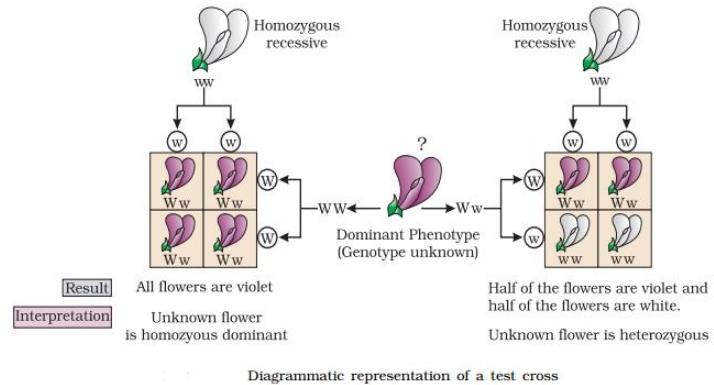
(N/A) The cross between the progeny of $F_1$ and the homozygous recessive parent is called a test cross.
It is useful for determining the genotype of an organism showing a dominant phenotype. By crossing an individual with an unknown genotype (showing a dominant trait) with a homozygous recessive individual,we can observe the phenotypic ratio of the offspring.
If all offspring show the dominant trait,the unknown parent is homozygous dominant. If the offspring show a $1:1$ ratio of dominant and recessive traits,the unknown parent is heterozygous.
It is useful for determining the genotype of an organism showing a dominant phenotype. By crossing an individual with an unknown genotype (showing a dominant trait) with a homozygous recessive individual,we can observe the phenotypic ratio of the offspring.
If all offspring show the dominant trait,the unknown parent is homozygous dominant. If the offspring show a $1:1$ ratio of dominant and recessive traits,the unknown parent is heterozygous.
0 likes
View Solution47
MediumMCQ
During meiosis,the alleles for a trait segregate or separate,and only one allele passes into a gamete. What is the probability of a specific allele being passed to the offspring during fertilization?
A
$25$%
B
$50$%
C
$100$%
D
$1$:$1$:$1$
Solution
(B) According to Mendel's Law of Segregation,the two alleles of a gene pair segregate from each other during the formation of gametes (meiosis).
Each gamete receives only one of the two alleles.
Therefore,for any given trait,there is a $50$% probability that a specific allele will be present in a particular gamete.
Consequently,when fertilization occurs,the probability of a specific allele being passed to the offspring from a heterozygous parent is $50$%.
Each gamete receives only one of the two alleles.
Therefore,for any given trait,there is a $50$% probability that a specific allele will be present in a particular gamete.
Consequently,when fertilization occurs,the probability of a specific allele being passed to the offspring from a heterozygous parent is $50$%.
0 likes
View Solution48
MediumMCQ
What does the Law of Segregation represent?
A
Characters are controlled by factors.
B
In a pair of dissimilar factors,one factor is dominant and the other is recessive.
C
Alleles remain together without blending,and only one factor enters a gamete.
D
All of the above.
Solution
(D) The Law of Segregation,also known as Mendel's First Law,states that the two alleles of a gene pair segregate from each other during the formation of gametes.
This ensures that each gamete carries only one allele for each trait.
Key points include:
$1$. Characters are controlled by discrete units called factors (now known as genes).
$2$. Factors occur in pairs.
$3$. In a dissimilar pair,one factor dominates the other (Law of Dominance).
$4$. During gamete formation,the factors segregate so that each gamete receives only one of the two factors,and they do not blend or mix.
Therefore,all the given statements are correct representations of the principles derived from Mendel's monohybrid cross.
This ensures that each gamete carries only one allele for each trait.
Key points include:
$1$. Characters are controlled by discrete units called factors (now known as genes).
$2$. Factors occur in pairs.
$3$. In a dissimilar pair,one factor dominates the other (Law of Dominance).
$4$. During gamete formation,the factors segregate so that each gamete receives only one of the two factors,and they do not blend or mix.
Therefore,all the given statements are correct representations of the principles derived from Mendel's monohybrid cross.
0 likes
View Solution49
MediumMCQ
According to Mendel,the genes for two traits are located on:
A
The same chromosome
B
Two different chromosomes
C
Any chromosome
D
None of the above
Solution
(B) Mendel's Law of Independent Assortment states that the alleles of two (or more) different genes get sorted into gametes independently of one another. In other words,the allele a gamete receives for one gene does not influence the allele received for another gene. This principle holds true when the genes for the two traits are located on different chromosomes or are very far apart on the same chromosome. Mendel's experiments with pea plants (e.g.,seed shape and seed color) demonstrated this independent inheritance,which implies that the genes for these traits were located on different chromosomes.
0 likes
View Solution50
MediumMCQ
In which phase does the segregation of alleles occur?
A
Prophase
B
Metaphase
C
Anaphase
D
During hybridization
Solution
(C) The segregation of alleles occurs during $Anaphase-I$ of meiosis.
During this phase,homologous chromosomes separate and move towards opposite poles,which leads to the segregation of the alleles of a gene pair into different gametes.
This is the physical basis of Mendel's Law of Segregation.
During this phase,homologous chromosomes separate and move towards opposite poles,which leads to the segregation of the alleles of a gene pair into different gametes.
This is the physical basis of Mendel's Law of Segregation.
0 likes
View SolutionPrinciples of Inheritance and Variation — Mendel's law of inheritance · Frequently Asked Questions
1Are these Principles of Inheritance and Variation questions useful for JEE and NEET?
Yes. All questions in this section are mapped to JEE Main and NEET exam patterns. Previous year questions from JEE Main, NEET, GUJCET and state-level exams are included with full solutions.
2Can I switch to Hindi or Gujarati for these questions?
Yes. Use the language tabs in the hero section or the sidebar to view the same questions and solutions in English, Hindi or Gujarati.
3How do I generate a question paper from this subtopic?
Use the Vedclass Exam Paper Generator — select the chapter and subtopic, set difficulty, and generate Sets A, B, C, D automatically. First 3 chapters of every subject are free.
Vedclass Products
For Students
Vedclass Test Series
Mock tests in real JEE/NEET style with performance analysis. 5-day free trial.
Start Free TrialFor Teachers
Exam Paper Generator
Generate Set A/B/C/D papers from this chapter in 2 minutes. 3 chapters free.
Try FreeFor Institutes
Online Exam Module
Live online exams with unlimited students, 360° analytics & white-label branding.
See DemoFor Teachers & Institutes
Generate a Principles of Inheritance and Variation Exam Paper in 2 Minutes
Select subtopic & difficulty — Sets A, B, C, D auto-generated with No Repeat logic.
First 3 chapters of every subject are free — no payment required.