
A English
Mendel's law of inheritance Questions in English
Class 12 Biology · Principles of Inheritance and Variation · Mendel's law of inheritance
71+
Questions
English
Language
100%
With Solutions
Showing 21 of 71 questions in English
51
MediumMCQ
Which of the following laws was discovered first by Mendel?
A
Law of dominance
B
Law of segregation
C
Law of independent assortment
D
Law of sex determination
Solution
(B) Mendel originally proposed two fundamental laws of inheritance based on his experiments with pea plants.
First, the $Law of Segregation$ (also known as the law of purity of gametes) was derived from his monohybrid cross experiments.
Second, the $Law of Independent Assortment$ was derived from his dihybrid cross experiments.
The $Law of Dominance$ is often considered a conclusion or a principle derived from the monohybrid cross rather than a primary law discovered independently in the same sequence. Among the options provided, the $Law of Segregation$ is the fundamental principle that Mendel established first through his work on single-trait inheritance.
First, the $Law of Segregation$ (also known as the law of purity of gametes) was derived from his monohybrid cross experiments.
Second, the $Law of Independent Assortment$ was derived from his dihybrid cross experiments.
The $Law of Dominance$ is often considered a conclusion or a principle derived from the monohybrid cross rather than a primary law discovered independently in the same sequence. Among the options provided, the $Law of Segregation$ is the fundamental principle that Mendel established first through his work on single-trait inheritance.
0 likes
View Solution52
MediumMCQ
The leaf colour of certain plants is controlled by one gene. For that gene,the allele $G =$ orange and $g =$ green. You have a plant with orange leaves,but do not know whether that plant's genotype is $GG$ or $Gg$. If you cross your unknown plant with one of the plants whose genotype is listed below,you will be able to determine your unknown's genotype. With which plant would you cross it?
A
$GG$
B
$gg$
C
$Gg$
D
Either of parents
Solution
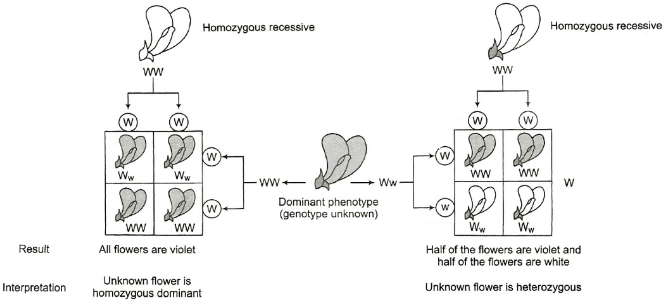
(B) To determine the genotype of an organism showing a dominant phenotype,we perform a test cross. In a test cross,the individual with the unknown genotype is crossed with a homozygous recessive individual.
In this case,the dominant phenotype is orange leaves $(G-)$. The recessive phenotype is green leaves $(gg)$.
If the unknown plant is $GG$,the cross $GG \times gg$ will produce all orange offspring $(Gg)$.
If the unknown plant is $Gg$,the cross $Gg \times gg$ will produce $50\%$ orange $(Gg)$ and $50\%$ green $(gg)$ offspring.
Thus,by crossing with a homozygous recessive plant $(gg)$,we can determine the genotype of the unknown plant.
In this case,the dominant phenotype is orange leaves $(G-)$. The recessive phenotype is green leaves $(gg)$.
If the unknown plant is $GG$,the cross $GG \times gg$ will produce all orange offspring $(Gg)$.
If the unknown plant is $Gg$,the cross $Gg \times gg$ will produce $50\%$ orange $(Gg)$ and $50\%$ green $(gg)$ offspring.
Thus,by crossing with a homozygous recessive plant $(gg)$,we can determine the genotype of the unknown plant.
0 likes
View Solution53
MediumMCQ
The law of segregation of characters is also called the law of purity of gametes because
A
Gametes have only one of the two alleles for each character
B
Gametes cannot be contaminated
C
Gametes are very different types of cells
D
It was just another name adopted accidentally
Solution
(A) The law of segregation of characters is also known as the law of purity of gametes. This is because,during the formation of gametes,the two alleles of a gene pair separate from each other such that each gamete receives only one of the two alleles. Thus,the gametes are always pure for a particular trait,meaning they do not contain a mixture of alleles.
0 likes
View Solution54
MediumMCQ
Some individuals with blood group $A$ may inherit the genes for blonde hair, while other individuals with blood group $A$ may inherit the gene for brown hair. This can be best explained by the principle of
A
Dominance
B
Multiple alleles
C
Independent assortment
D
Incomplete dominance
Solution
(C) Mendel's law of independent assortment states that, "the alleles of different genes segregate independently of each other during meiosis".
Since the gene for blood group (located on chromosome $9$) and the gene for hair color (located on a different chromosome) are inherited independently, an individual can possess any combination of these traits.
This demonstrates that the inheritance of one trait does not influence the inheritance of another trait, which is the core concept of independent assortment.
Since the gene for blood group (located on chromosome $9$) and the gene for hair color (located on a different chromosome) are inherited independently, an individual can possess any combination of these traits.
This demonstrates that the inheritance of one trait does not influence the inheritance of another trait, which is the core concept of independent assortment.
0 likes
View Solution55
MediumMCQ
Mendel's principle of segregation means that the germ cells always receive
A
One pair of alleles
B
One quarter of the genes
C
One of the paired alleles
D
Any pair of alleles
Solution
(C) Mendel's Law of Segregation states that during the formation of gametes (germ cells),the two alleles of a gene pair separate from each other so that each gamete receives only one of the two alleles. This ensures that the offspring receive one allele from each parent,maintaining the diploid condition in the next generation.
0 likes
View Solution56
MediumMCQ
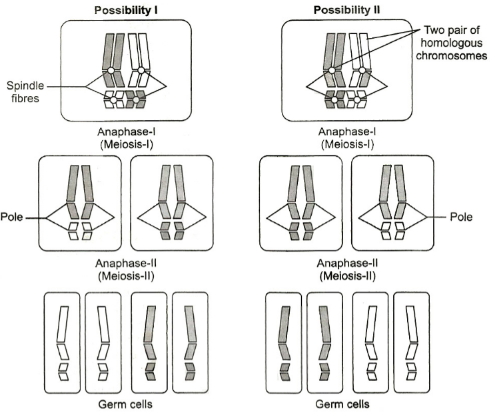
The figure depicts:
A
Linkage
B
Independent assortment
C
Law of dominance
D
Equational division
Solution
(B) The provided figure illustrates the process of meiosis,specifically focusing on the behavior of two pairs of homologous chromosomes during Anaphase-$I$ and Anaphase-$II$.
This diagram demonstrates Mendel's Law of Independent Assortment.
It shows that during the formation of gametes,the segregation of one pair of chromosomes is independent of the segregation of another pair.
As seen in 'Possibility $I$' and 'Possibility $II$',the chromosomes can align in different ways at the metaphase plate,leading to different combinations of chromosomes in the resulting germ cells.
This random alignment and subsequent independent segregation result in the production of various genetic combinations in the offspring.
This diagram demonstrates Mendel's Law of Independent Assortment.
It shows that during the formation of gametes,the segregation of one pair of chromosomes is independent of the segregation of another pair.
As seen in 'Possibility $I$' and 'Possibility $II$',the chromosomes can align in different ways at the metaphase plate,leading to different combinations of chromosomes in the resulting germ cells.
This random alignment and subsequent independent segregation result in the production of various genetic combinations in the offspring.
0 likes
View Solution57
MediumMCQ
Which of the following traits shows transmission from a carrier female to male progeny?
A
Autosomal dominant
B
$X$-linked recessive
C
$Y$-linked recessive
D
$X$-linked dominant
Solution
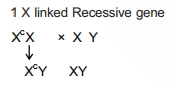
(B) In $X$-linked recessive inheritance,a carrier female (heterozygous,$X^cX$) carries one recessive allele on one of her $X$ chromosomes.
When she reproduces with a normal male $(XY)$,there is a $50\%$ chance that her sons will inherit the $X$ chromosome carrying the recessive allele $(X^cY)$,resulting in the expression of the trait because males are hemizygous for the $X$ chromosome.
This pattern is known as criss-cross inheritance,where the trait is passed from the mother to the son.
Therefore,the correct option is $B$.
When she reproduces with a normal male $(XY)$,there is a $50\%$ chance that her sons will inherit the $X$ chromosome carrying the recessive allele $(X^cY)$,resulting in the expression of the trait because males are hemizygous for the $X$ chromosome.
This pattern is known as criss-cross inheritance,where the trait is passed from the mother to the son.
Therefore,the correct option is $B$.
0 likes
View Solution58
Easy
Describe various laws based on monohybrid experiment.
Solution
(N/A) The study of inheritance of a single pair of alleles or factors of a trait at a time (monohybrid cross) is called one gene inheritance.
Based on his observations on monohybrid crosses,Mendel proposed two general rules in order to consolidate his understanding of inheritance in monohybrid crosses.
These rules are called the principles or laws of inheritance.
They are:
$1$. Law of Dominance (First Law): $(i)$ Characters are controlled by discrete units called factors. $(ii)$ Factors occur in pairs. $(iii)$ In a dissimilar pair of factors,one member of the pair is dominant while the other is recessive.
This law explains the expression of only one of the parental characters in a monohybrid cross in the $F_1$ generation and the expression of both in the $F_2$ generation. It also explains the $3:1$ phenotypic ratio obtained in the $F_2$ generation.
$2$. Law of Segregation (Second Law): This law states that although the parents contain two alleles,during gamete formation,the factors or alleles of a pair segregate from each other such that each gamete receives only one of the two factors.
Hence,the alleles do not show any blending and both characters are recovered as such in the $F_2$ generation,even though one of these is not seen in the $F_1$ generation.
Based on his observations on monohybrid crosses,Mendel proposed two general rules in order to consolidate his understanding of inheritance in monohybrid crosses.
These rules are called the principles or laws of inheritance.
They are:
$1$. Law of Dominance (First Law): $(i)$ Characters are controlled by discrete units called factors. $(ii)$ Factors occur in pairs. $(iii)$ In a dissimilar pair of factors,one member of the pair is dominant while the other is recessive.
This law explains the expression of only one of the parental characters in a monohybrid cross in the $F_1$ generation and the expression of both in the $F_2$ generation. It also explains the $3:1$ phenotypic ratio obtained in the $F_2$ generation.
$2$. Law of Segregation (Second Law): This law states that although the parents contain two alleles,during gamete formation,the factors or alleles of a pair segregate from each other such that each gamete receives only one of the two factors.
Hence,the alleles do not show any blending and both characters are recovered as such in the $F_2$ generation,even though one of these is not seen in the $F_1$ generation.
0 likes
View Solution59
Medium
Explain the concept of dominance.
Solution
(N/A) Every gene contains the information to express a particular trait.
In a diploid organism,there are two copies of each gene,i.e.,as a pair of alleles.
These two alleles need not always be identical,as in a heterozygote.
One of them may be different due to some changes that it has undergone,which modifies the information that particular allele contains.
Let us take an example of a gene that contains the information for producing an enzyme.
Now,there are two copies of this gene,the two allelic forms.
Let us assume that the normal allele produces the normal enzyme that is needed for the transformation of a substrate $S$.
Theoretically,the modified allele could be responsible for the production of: $(i)$ the normal/less efficient enzyme,or $(ii)$ a non-functional enzyme,or $(iii)$ no enzyme at all.
In the first case,the modified allele is equivalent to the unmodified allele,i.e.,it will produce the same phenotype/trait,resulting in the transformation of substrate $S$.
Such equivalent allele pairs are very common.
However,if the allele produces a non-functional enzyme or no enzyme,the phenotype may be affected.
The phenotype/trait will only be dependent on the functioning of the unmodified allele.
The unmodified (functioning) allele,which represents the original phenotype,is the dominant allele,and the modified allele is generally the recessive allele.
Hence,in the example above,the recessive trait is seen due to a non-functional enzyme or because no enzyme is produced.
In a diploid organism,there are two copies of each gene,i.e.,as a pair of alleles.
These two alleles need not always be identical,as in a heterozygote.
One of them may be different due to some changes that it has undergone,which modifies the information that particular allele contains.
Let us take an example of a gene that contains the information for producing an enzyme.
Now,there are two copies of this gene,the two allelic forms.
Let us assume that the normal allele produces the normal enzyme that is needed for the transformation of a substrate $S$.
Theoretically,the modified allele could be responsible for the production of: $(i)$ the normal/less efficient enzyme,or $(ii)$ a non-functional enzyme,or $(iii)$ no enzyme at all.
In the first case,the modified allele is equivalent to the unmodified allele,i.e.,it will produce the same phenotype/trait,resulting in the transformation of substrate $S$.
Such equivalent allele pairs are very common.
However,if the allele produces a non-functional enzyme or no enzyme,the phenotype may be affected.
The phenotype/trait will only be dependent on the functioning of the unmodified allele.
The unmodified (functioning) allele,which represents the original phenotype,is the dominant allele,and the modified allele is generally the recessive allele.
Hence,in the example above,the recessive trait is seen due to a non-functional enzyme or because no enzyme is produced.
0 likes
View Solution60
MediumMCQ
Which of the following is $NOT$ consistent with the Law of Dominance?
A
Alleles in an organism remain together without blending with each other.
B
Characters are controlled by discrete units called factors.
C
Factors occur in pairs.
D
In a dissimilar pair of factors,one member of the pair dominates the other,i.e.,one is dominant and the other is recessive.
Solution
(A) The Law of Dominance states that:
$1$. Characters are controlled by discrete units called factors.
$2$. Factors occur in pairs.
$3$. In a dissimilar pair of factors,one member of the pair dominates the other (dominant),while the other is recessive.
Option $A$ states that alleles remain together without blending. This is actually a postulate of the Law of Segregation (or Purity of Gametes),which states that alleles do not show any blending and that both the characters recover as such in the $F_2$ generation. Therefore,it is not a statement of the Law of Dominance.
$1$. Characters are controlled by discrete units called factors.
$2$. Factors occur in pairs.
$3$. In a dissimilar pair of factors,one member of the pair dominates the other (dominant),while the other is recessive.
Option $A$ states that alleles remain together without blending. This is actually a postulate of the Law of Segregation (or Purity of Gametes),which states that alleles do not show any blending and that both the characters recover as such in the $F_2$ generation. Therefore,it is not a statement of the Law of Dominance.
0 likes
View Solution61
MediumMCQ
Which of the following laws was proposed by Mendel?
A
Law of Incomplete Dominance
B
Law of Codominance
C
Law of Dominance
D
All of the above
Solution
(C) Gregor Mendel proposed three fundamental laws of inheritance based on his experiments with pea plants:
$1$. Law of Dominance
$2$. Law of Segregation
$3$. Law of Independent Assortment
Incomplete Dominance and Codominance are deviations from Mendelian inheritance and were discovered after Mendel's work. Therefore,only the Law of Dominance was proposed by Mendel.
$1$. Law of Dominance
$2$. Law of Segregation
$3$. Law of Independent Assortment
Incomplete Dominance and Codominance are deviations from Mendelian inheritance and were discovered after Mendel's work. Therefore,only the Law of Dominance was proposed by Mendel.
0 likes
View Solution62
MediumMCQ
Which one of the following can be explained on the basis of Mendel's Law of Dominance?
$A$. Out of one pair of factors one is dominant and the other is recessive.
$B$. Alleles do not show any expression and both the characters appear as such in $F_2$ generation.
$C$. Factors occur in pairs in normal diploid plants.
$D$. The discrete unit controlling a particular character is called factor.
$E$. The expression of only one of the parental characters is found in a monohybrid cross.
Choose the correct answer from the options given below:
$A$. Out of one pair of factors one is dominant and the other is recessive.
$B$. Alleles do not show any expression and both the characters appear as such in $F_2$ generation.
$C$. Factors occur in pairs in normal diploid plants.
$D$. The discrete unit controlling a particular character is called factor.
$E$. The expression of only one of the parental characters is found in a monohybrid cross.
Choose the correct answer from the options given below:
A
$A, C, D$ and $E$ only
B
$B, C$ and $D$ only
C
$A, B, C, D$ and $E$
D
$A, B$ and $C$ only
Solution
(A) According to Mendel's Law of Dominance:
$(1)$ Characters are controlled by discrete units called factors $(D)$.
$(2)$ Factors occur in pairs $(C)$.
$(3)$ In a dissimilar pair of factors,one member of the pair dominates (dominant) the other (recessive) $(A)$.
$(4)$ The Law of Dominance explains why only one of the parental characters is expressed in a $F_1$ generation monohybrid cross $(E)$.
Statement $(B)$ describes the Law of Segregation,which states that alleles do not show any blending and both characters are recovered as such in the $F_2$ generation.
Therefore,statements $A, C, D,$ and $E$ are explained by the Law of Dominance.
$(1)$ Characters are controlled by discrete units called factors $(D)$.
$(2)$ Factors occur in pairs $(C)$.
$(3)$ In a dissimilar pair of factors,one member of the pair dominates (dominant) the other (recessive) $(A)$.
$(4)$ The Law of Dominance explains why only one of the parental characters is expressed in a $F_1$ generation monohybrid cross $(E)$.
Statement $(B)$ describes the Law of Segregation,which states that alleles do not show any blending and both characters are recovered as such in the $F_2$ generation.
Therefore,statements $A, C, D,$ and $E$ are explained by the Law of Dominance.
0 likes
View Solution63
EasyMCQ
Mendel's law of segregation is applicable to
A
Dihybrid cross only
B
Both dihybrid and monohybrid crosses
C
Monohybrid cross only
D
Dihybrid but not for monohybrid cross
Solution
(B) Mendel's law of segregation states that the two alleles of a gene pair segregate from each other during the formation of gametes,such that each gamete receives only one of the two alleles.
This law is a fundamental principle of inheritance and applies to all sexually reproducing organisms,regardless of whether the inheritance of one trait (monohybrid cross) or two or more traits (dihybrid or polyhybrid cross) is being studied.
Therefore,the law of segregation is applicable to both monohybrid and dihybrid crosses.
This law is a fundamental principle of inheritance and applies to all sexually reproducing organisms,regardless of whether the inheritance of one trait (monohybrid cross) or two or more traits (dihybrid or polyhybrid cross) is being studied.
Therefore,the law of segregation is applicable to both monohybrid and dihybrid crosses.
0 likes
View Solution64
MediumMCQ
Select the false statement regarding independent assortment:
A
Segregation of one pair of unit factors is independent of the other pair of unit factors.
B
During metaphase of meiosis-$I$,the two chromosome pairs can align at the metaphase plate independently of each other.
C
Due to independent assortment,a dihybrid produces $4$ types of phenotypes in the ratio of $9:3:3:1$.
D
Genes for different characters must be located on different pairs of chromosomes.
Solution
(B) The law of independent assortment states that the segregation of one pair of unit factors is independent of the other pair of unit factors.
Option $A$ is a correct statement.
Option $B$ is false because the independent alignment of chromosome pairs occurs during metaphase-$I$,not telophase-$I$.
Option $C$ is a correct statement as it describes the phenotypic ratio of a dihybrid cross under independent assortment.
Option $D$ is a correct statement because independent assortment only applies to genes located on different chromosomes (or far apart on the same chromosome).
Option $A$ is a correct statement.
Option $B$ is false because the independent alignment of chromosome pairs occurs during metaphase-$I$,not telophase-$I$.
Option $C$ is a correct statement as it describes the phenotypic ratio of a dihybrid cross under independent assortment.
Option $D$ is a correct statement because independent assortment only applies to genes located on different chromosomes (or far apart on the same chromosome).
0 likes
View Solution65
EasyMCQ
In Mendel's experiments,the contrasting traits of pure lines of garden pea,for any character . . . . . . .
A
showed blending in $F_1$ generation only
B
showed blending in $F_2$ generation
C
never showed any blending
D
showed blending in both $F_1$ and $F_2$ generations
Solution
(C) Mendel's experiments on garden pea demonstrated that the factors (alleles) governing contrasting traits do not blend or mix when they coexist in a hybrid.
During gamete formation,these factors segregate from each other,ensuring that each gamete receives only one of the two factors.
This principle of segregation confirms that traits remain distinct and do not show blending in either the $F_1$ or $F_2$ generations.
During gamete formation,these factors segregate from each other,ensuring that each gamete receives only one of the two factors.
This principle of segregation confirms that traits remain distinct and do not show blending in either the $F_1$ or $F_2$ generations.
0 likes
View Solution66
EasyMCQ
The result of which cross illustrates Mendel's law of segregation?
A
Tt x tt
B
Rr x $RR$
C
Rr x Rr
D
tt x tt
Solution
(C) Mendel's $Law$ $of$ $Segregation$ states that the two alleles of a gene pair segregate from each other during the formation of gametes,such that each gamete carries only one allele for each trait.
In a monohybrid cross,such as $Rr \times Rr$,the $F_1$ hybrid $(Rr)$ produces two types of gametes ($R$ and $r$) in equal proportions.
This segregation ensures that the $F_2$ generation exhibits the phenotypic ratio of $3:1$ and the genotypic ratio of $1:2:1$,which confirms the purity of gametes.
In a monohybrid cross,such as $Rr \times Rr$,the $F_1$ hybrid $(Rr)$ produces two types of gametes ($R$ and $r$) in equal proportions.
This segregation ensures that the $F_2$ generation exhibits the phenotypic ratio of $3:1$ and the genotypic ratio of $1:2:1$,which confirms the purity of gametes.
0 likes
View Solution67
EasyMCQ
The Law of Segregation is universally applicable because the gametes:
A
Are always diploid
B
Have only recessive alleles
C
Have only dominant alleles
D
Are always haploid
Solution
(D) The Law of Segregation is considered universally applicable because it is the only law of inheritance without any known exceptions.
It states that each trait consists of two alleles that segregate during the formation of gametes.
Since gametes are always haploid $(n)$,they contain only one allele for each trait,which ensures that the offspring receive one allele from each parent during fertilization.
It states that each trait consists of two alleles that segregate during the formation of gametes.
Since gametes are always haploid $(n)$,they contain only one allele for each trait,which ensures that the offspring receive one allele from each parent during fertilization.
0 likes
View Solution68
EasyMCQ
The law of purity of gametes is universally applicable because the gametes . . . . . . .
A
always have a recessive allele.
B
are never identical.
C
always have a dominant allele.
D
receive only one of the allelic pairs.
Solution
(D) मेंडल का युग्मकों की शुद्धता का नियम (Law of Segregation) यह बताता है कि युग्मक निर्माण के दौरान,युग्मविकल्पी जोड़े (allelic pairs) एक-दूसरे से अलग हो जाते हैं,जिससे प्रत्येक युग्मक को केवल एक ही एलील (allele) प्राप्त होता है। इस प्रक्रिया के कारण युग्मक हमेशा शुद्ध होते हैं,अर्थात वे कभी भी मिश्रित नहीं होते हैं। इसलिए,विकल्प $D$ सही उत्तर है।
0 likes
View Solution69
EasyMCQ
The principle that alleles live together without showing any blending is known as . . . . . . .
A
Co-dominance
B
Law of Segregation
C
Law of Dominance
D
Chromosomal Theory
Solution
(B) The $Law$ $of$ $Segregation$ (also known as the $Law$ $of$ $Purity$ $of$ $Gametes$) states that although the two alleles of a gene pair live together in an individual, they do not blend or mix with each other. During the formation of gametes, these alleles separate (segregate) so that each gamete receives only one of the two alleles. This ensures that the traits remain distinct and pure in subsequent generations.
0 likes
View Solution70
EasyMCQ
The expression of only one parental trait in $F_1$ and the expression of both parental traits in $F_2$ can be explained by $ . . . . . . $.
A
Law of Segregation
B
Punnett Square
C
Law of dominance
D
Multivariate genes
Solution
(C) The $Law$ $of$ $Dominance$ states that in a heterozygous condition, only one allele (the dominant one) expresses its phenotype in the $F_1$ generation, masking the other (recessive) allele. However, during gamete formation, these alleles segregate, allowing the recessive trait to reappear in the $F_2$ generation when the recessive alleles pair up again. Thus, the appearance of only one trait in $F_1$ and both traits in $F_2$ is explained by the $Law$ $of$ $Dominance$.
0 likes
View Solution71
EasyMCQ
Which of the following is a genetically dominant trait in human beings?
A
$O$ blood group
B
Colour blindness
C
Rh+ve blood group
D
Albinism
Solution
(C) In human genetics,the $Rh$ factor is determined by the presence or absence of the $Rh$ antigen on the surface of red blood cells. The presence of the $Rh$ antigen is controlled by a dominant allele,while its absence is recessive. Therefore,the $Rh+ve$ blood group is a genetically dominant trait. In contrast,$O$ blood group is recessive (genotype $ii$),colour blindness is an $X$-linked recessive disorder,and albinism is an autosomal recessive disorder.
0 likes
View SolutionPrinciples of Inheritance and Variation — Mendel's law of inheritance · Frequently Asked Questions
1Are these Principles of Inheritance and Variation questions useful for JEE and NEET?
Yes. All questions in this section are mapped to JEE Main and NEET exam patterns. Previous year questions from JEE Main, NEET, GUJCET and state-level exams are included with full solutions.
2Can I switch to Hindi or Gujarati for these questions?
Yes. Use the language tabs in the hero section or the sidebar to view the same questions and solutions in English, Hindi or Gujarati.
3How do I generate a question paper from this subtopic?
Use the Vedclass Exam Paper Generator — select the chapter and subtopic, set difficulty, and generate Sets A, B, C, D automatically. First 3 chapters of every subject are free.
Vedclass Products
For Students
Vedclass Test Series
Mock tests in real JEE/NEET style with performance analysis. 5-day free trial.
Start Free TrialFor Teachers
Exam Paper Generator
Generate Set A/B/C/D papers from this chapter in 2 minutes. 3 chapters free.
Try FreeFor Institutes
Online Exam Module
Live online exams with unlimited students, 360° analytics & white-label branding.
See DemoFor Teachers & Institutes
Generate a Principles of Inheritance and Variation Exam Paper in 2 Minutes
Select subtopic & difficulty — Sets A, B, C, D auto-generated with No Repeat logic.
First 3 chapters of every subject are free — no payment required.