
A English
Chromosomal disorders Questions in English
Class 12 Biology · Principles of Inheritance and Variation · Chromosomal disorders
204+
Questions
English
Language
100%
With Solutions
Showing 50 of 204 questions in English
151
MediumMCQ
In man,which of the following genotypes and phenotypes may be the correct result of aneuploidy in sex chromosomes?
A
$22$ pairs $+ XXY$ males
B
$22$ pairs $+ XX$ females
C
$22$ pairs $+ XXXY$ females
D
$22$ pairs $+ X$ females
Solution
(A) Aneuploidy refers to the gain or loss of one or more chromosomes due to failure of segregation of chromatids during cell division.
In Klinefelter's syndrome,the individual has an extra $X$ chromosome,resulting in a genotype of $44 + XXY$ ($22$ pairs of autosomes $+ XXY$ sex chromosomes).
This condition is characterized by the presence of an additional $X$ chromosome in a male,leading to a male phenotype with some feminine features.
Therefore,$22$ pairs $+ XXY$ males is a correct example of aneuploidy in sex chromosomes.
In Klinefelter's syndrome,the individual has an extra $X$ chromosome,resulting in a genotype of $44 + XXY$ ($22$ pairs of autosomes $+ XXY$ sex chromosomes).
This condition is characterized by the presence of an additional $X$ chromosome in a male,leading to a male phenotype with some feminine features.
Therefore,$22$ pairs $+ XXY$ males is a correct example of aneuploidy in sex chromosomes.
0 likes
View Solution152
EasyMCQ
Absence or excess or abnormal arrangement of one or more chromosomes results in
A
Point mutation
B
Chromosomal disorders
C
Mendelian disorders
D
Gene mutation
Solution
(B) The failure of segregation of chromatids during cell division cycle results in the gain or loss of a chromosome$(s)$,called aneuploidy. This condition,along with structural changes in chromosomes,leads to chromosomal disorders. Examples include Down's syndrome,Turner's syndrome,and Klinefelter's syndrome.
0 likes
View Solution153
MediumMCQ
Mark the odd one with respect to the syndrome which occurs due to the failure of segregation of homologous pairs of chromosomes during the cell division cycle.
A
Klinefelter's syndrome
B
Down's syndrome
C
Turner's syndrome
D
Thalassemia
Solution
(D) The failure of segregation of chromatids during cell division cycle results in the gain or loss of a chromosome,a phenomenon known as aneuploidy. Klinefelter's syndrome $(47, XXY)$,Down's syndrome (Trisomy $21$),and Turner's syndrome $(45, X0)$ are all chromosomal disorders caused by aneuploidy. Thalassemia,on the other hand,is a Mendelian disorder caused by a mutation in the genes responsible for hemoglobin synthesis,which is an autosomal recessive blood disorder. Therefore,Thalassemia is the odd one out.
0 likes
View Solution154
MediumMCQ
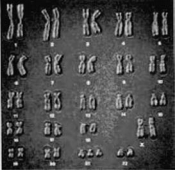
Which of the following disorders is related to the karyotype given below?
A
Turner's syndrome
B
Down's syndrome
C
Myotonic dystrophy
D
Cystic fibrosis
Solution
(B) The provided karyotype shows three chromosomes at the $21^{st}$ position instead of the normal pair. This condition is known as $21$-Trisomy,which is the characteristic chromosomal abnormality associated with Down's syndrome.
0 likes
View Solution155
EasyMCQ
Mark the correct match.
A
$Turner's syndrome - 45 + XO$
B
$Phenylketonuria - 44 + XYY$
C
$Klinefelter's syndrome - 44 + XXY$
D
$Thalassemia - 44 + YO$
Solution
(C) $Turner's syndrome$ is characterized by $44 + XO$ ($45$ chromosomes).
$Phenylketonuria$ is an autosomal recessive disorder,not a chromosomal abnormality.
$Klinefelter's syndrome$ is characterized by the presence of an extra $X$ chromosome in males,resulting in a genotype of $44 + XXY$ ($47$ chromosomes).
$Thalassemia$ is an autosomal recessive blood disorder,not a chromosomal abnormality.
Therefore,the correct match is $Klinefelter's syndrome - 44 + XXY$.
$Phenylketonuria$ is an autosomal recessive disorder,not a chromosomal abnormality.
$Klinefelter's syndrome$ is characterized by the presence of an extra $X$ chromosome in males,resulting in a genotype of $44 + XXY$ ($47$ chromosomes).
$Thalassemia$ is an autosomal recessive blood disorder,not a chromosomal abnormality.
Therefore,the correct match is $Klinefelter's syndrome - 44 + XXY$.
0 likes
View Solution156
MediumMCQ
Physical,psychomotor,and mental development is retarded in an individual affected with
A
Down's syndrome
B
Sickle cell anaemia
C
Turner's syndrome
D
Colour blindness
Solution
(A) Down's syndrome is caused by the presence of an additional copy of chromosome number $21$,a condition known as trisomy of $21$. Individuals affected by this syndrome exhibit characteristic features such as short stature,small round head,furrowed tongue,partially open mouth,and significantly retarded physical,psychomotor,and mental development.
0 likes
View Solution157
MediumMCQ
In which of the following disorders does an affected individual possess $47$ chromosomes?
A
Turner's syndrome
B
Klinefelter's syndrome
C
Down's syndrome
D
Both $(b)$ & $(c)$
Solution
(D) Klinefelter's syndrome is caused by the presence of an additional copy of the $X$ chromosome,resulting in a karyotype of $47, XXY$. Thus,the total number of chromosomes is $47$.
Down's syndrome is caused by the presence of an additional copy of chromosome number $21$ (trisomy $21$),resulting in a total of $47$ chromosomes.
Turner's syndrome is characterized by the absence of one $X$ chromosome,resulting in a karyotype of $45, XO$,meaning the individual has $45$ chromosomes.
Therefore,both Klinefelter's syndrome and Down's syndrome involve individuals with $47$ chromosomes.
Down's syndrome is caused by the presence of an additional copy of chromosome number $21$ (trisomy $21$),resulting in a total of $47$ chromosomes.
Turner's syndrome is characterized by the absence of one $X$ chromosome,resulting in a karyotype of $45, XO$,meaning the individual has $45$ chromosomes.
Therefore,both Klinefelter's syndrome and Down's syndrome involve individuals with $47$ chromosomes.
0 likes
View Solution158
MediumMCQ
The affected individuals are short-statured in disorders like:
A
Turner's syndrome,phenylketonuria
B
Down's syndrome,Turner's syndrome
C
Klinefelter's syndrome,Down's syndrome
D
Turner's syndrome,Klinefelter's syndrome
Solution
(B) $1$. $Turner's$ syndrome is a chromosomal disorder caused by the absence of one $X$ chromosome $(45, XO)$. Affected individuals are females who are sterile and typically short-statured.
$2$. $Down's$ syndrome is caused by the presence of an additional copy of chromosome number $21$ ($trisomy$ of $21$). Affected individuals are characterized by short stature,small round head,furrowed tongue,and partially open mouth.
$3$. $Klinefelter's$ syndrome is caused by the presence of an additional $X$ chromosome $(47, XXY)$. Affected individuals are males who are tall,not short-statured.
$4$. $Phenylketonuria$ is an inborn error of metabolism,not primarily characterized by short stature.
Therefore,both $Turner's$ syndrome and $Down's$ syndrome are characterized by short stature.
$2$. $Down's$ syndrome is caused by the presence of an additional copy of chromosome number $21$ ($trisomy$ of $21$). Affected individuals are characterized by short stature,small round head,furrowed tongue,and partially open mouth.
$3$. $Klinefelter's$ syndrome is caused by the presence of an additional $X$ chromosome $(47, XXY)$. Affected individuals are males who are tall,not short-statured.
$4$. $Phenylketonuria$ is an inborn error of metabolism,not primarily characterized by short stature.
Therefore,both $Turner's$ syndrome and $Down's$ syndrome are characterized by short stature.
0 likes
View Solution159
MediumMCQ
In which of the following disorders is the symptom of gynaecomastia seen in individuals?
A
Down's syndrome
B
Turner's syndrome
C
Klinefelter's syndrome
D
Phenylketonuria
Solution
(C) Gynaecomastia is the development of breast tissue in males. This condition is a characteristic feature of $Klinefelter's$ syndrome,which is caused by the presence of an additional $X$ chromosome,resulting in a karyotype of $47, XXY$.
0 likes
View Solution160
EasyMCQ
Mark the correct option with respect to monosomy.
A
Klinefelter's syndrome
B
Down's syndrome
C
Turner's syndrome
D
Haemophilia
Solution
(C) Monosomy is a type of aneuploidy where one chromosome is missing from a diploid set,represented as $(2n - 1)$.
Turner's syndrome is a classic example of monosomy in humans,specifically involving the sex chromosomes,where the individual has a $(45, XO)$ genotype.
Klinefelter's syndrome is an example of trisomy $(47, XXY)$.
Down's syndrome is an example of trisomy of chromosome $21$ $(47, XX+21)$.
Haemophilia is a sex-linked recessive genetic disorder,not a chromosomal aberration.
Turner's syndrome is a classic example of monosomy in humans,specifically involving the sex chromosomes,where the individual has a $(45, XO)$ genotype.
Klinefelter's syndrome is an example of trisomy $(47, XXY)$.
Down's syndrome is an example of trisomy of chromosome $21$ $(47, XX+21)$.
Haemophilia is a sex-linked recessive genetic disorder,not a chromosomal aberration.
0 likes
View Solution161
MediumMCQ
Allosomic trisomy condition is seen in
A
Turner's syndrome
B
Klinefelter's syndrome
C
Down's syndrome
D
Both $(b)$ & $(c)$
Solution
(B) Trisomy refers to the condition where an extra chromosome is present,represented as $2n+1$.
Allosomes are the sex chromosomes.
In Klinefelter's syndrome,the individual has an extra $X$ chromosome,resulting in a genotype of $44 + XXY$ ($2n+1$ condition).
Since the extra chromosome is a sex chromosome,it is an allosomic trisomy.
Down's syndrome is an autosomal trisomy (trisomy of chromosome $21$),not allosomic.
Turner's syndrome is a monosomy $(45, XO)$,not a trisomy.
Therefore,the correct answer is Klinefelter's syndrome.
Allosomes are the sex chromosomes.
In Klinefelter's syndrome,the individual has an extra $X$ chromosome,resulting in a genotype of $44 + XXY$ ($2n+1$ condition).
Since the extra chromosome is a sex chromosome,it is an allosomic trisomy.
Down's syndrome is an autosomal trisomy (trisomy of chromosome $21$),not allosomic.
Turner's syndrome is a monosomy $(45, XO)$,not a trisomy.
Therefore,the correct answer is Klinefelter's syndrome.
0 likes
View Solution162
MediumMCQ
Which of the following disorders is seen in human females only?
A
Turner's syndrome
B
Down's syndrome
C
Haemophilia
D
Klinefelter's syndrome
Solution
(A) Turner's syndrome is caused by the absence of one $X$ chromosome in females,resulting in a genotype of $45, XO$. This condition is characterized by a $2n-1$ chromosomal arrangement,which is a form of monosomy. Since it involves the loss of an $X$ chromosome,it is specific to females.
0 likes
View Solution163
MediumMCQ
Loss or gain of a segment of $DNA$ results in
A
Frame-shift mutation
B
Point mutation
C
Polyploidy
D
Chromosomal aberration
Solution
(D) The loss (deletion) or gain (insertion/duplication) of a segment of $DNA$ results in alterations in the chromosome structure.
Such structural changes in chromosomes are collectively referred to as chromosomal aberrations.
$A$ frame-shift mutation specifically refers to the insertion or deletion of one or a few nucleotide base pairs in a gene,which changes the reading frame of the genetic code.
$A$ point mutation involves a change in a single base pair of $DNA$.
$Polyploidy$ refers to an increase in the number of whole sets of chromosomes.
Therefore,the loss or gain of a segment of $DNA$ is best described as a chromosomal aberration.
Such structural changes in chromosomes are collectively referred to as chromosomal aberrations.
$A$ frame-shift mutation specifically refers to the insertion or deletion of one or a few nucleotide base pairs in a gene,which changes the reading frame of the genetic code.
$A$ point mutation involves a change in a single base pair of $DNA$.
$Polyploidy$ refers to an increase in the number of whole sets of chromosomes.
Therefore,the loss or gain of a segment of $DNA$ is best described as a chromosomal aberration.
0 likes
View Solution164
MediumMCQ
The Philadelphia chromosome is found in patients suffering from
A
Albinism
B
Hepatitis
C
Insomnia
D
Leukaemia
Solution
(D) Leukaemia is a type of blood cancer.
It is characterized by an abnormal increase in the count of White Blood Corpuscles $(WBCs)$ due to their excessive production in the bone marrow.
The Philadelphia chromosome is a specific genetic abnormality resulting from a reciprocal translocation between chromosomes $9$ and $22$,and it is characteristically found in patients suffering from chronic myeloid leukaemia $(CML)$.
It is characterized by an abnormal increase in the count of White Blood Corpuscles $(WBCs)$ due to their excessive production in the bone marrow.
The Philadelphia chromosome is a specific genetic abnormality resulting from a reciprocal translocation between chromosomes $9$ and $22$,and it is characteristically found in patients suffering from chronic myeloid leukaemia $(CML)$.
0 likes
View Solution165
MediumMCQ
$A$: Turner's syndrome generally does not occur in males.
$R$: Foetus with $44 + YO$ complement generally dies.
$R$: Foetus with $44 + YO$ complement generally dies.
A
Assertion and Reason both are correct and Reason is the correct explanation of Assertion.
B
Assertion and Reason both are correct but Reason is not the correct explanation of Assertion.
C
Assertion is correct,but Reason is incorrect.
D
Both Assertion and Reason are incorrect.
Solution
(A) Turner's syndrome is characterized by the $XO$ genotype $(44 + XO)$,which results in a female phenotype with underdeveloped ovaries and other physical abnormalities.
It does not occur in males because the presence of at least one $X$ chromosome is essential for the survival of the human embryo.
The $YO$ condition $(44 + YO)$ lacks an $X$ chromosome,which contains many vital genes necessary for development and survival.
Therefore,a foetus with a $44 + YO$ chromosomal complement is non-viable and generally dies during early embryonic development.
Thus,both the Assertion and the Reason are correct,and the Reason correctly explains why Turner's syndrome is not observed in males.
It does not occur in males because the presence of at least one $X$ chromosome is essential for the survival of the human embryo.
The $YO$ condition $(44 + YO)$ lacks an $X$ chromosome,which contains many vital genes necessary for development and survival.
Therefore,a foetus with a $44 + YO$ chromosomal complement is non-viable and generally dies during early embryonic development.
Thus,both the Assertion and the Reason are correct,and the Reason correctly explains why Turner's syndrome is not observed in males.
0 likes
View Solution166
MediumMCQ
Match the following columns:
| Column-$I$ (Disorder) | Column-$II$ (Ploidy) |
|---|---|
| $P$. Down's syndrome | $I$. Sex chromosomal trisomy |
| $Q$. Klinefelter's syndrome | $II$. Sex chromosomal monosomy |
| $R$. Turner's syndrome | $III$. Autosomal trisomy |
A
$(P-II), (Q-I), (R-III)$
B
$(P-I), (Q-II), (R-III)$
C
$(P-III), (Q-II), (R-I)$
D
$(P-III), (Q-I), (R-II)$
Solution
(D) The correct matches are as follows:
$1$. Down's syndrome $(P)$ is caused by an extra copy of chromosome $21$,which is an autosomal trisomy $(III)$.
$2$. Klinefelter's syndrome $(Q)$ is characterized by an extra $X$ chromosome in males $(XXY)$,which is a sex chromosomal trisomy $(I)$.
$3$. Turner's syndrome $(R)$ is caused by the absence of one $X$ chromosome in females $(XO)$,which is a sex chromosomal monosomy $(II)$.
Therefore,the correct sequence is $(P-III, Q-I, R-II)$.
$1$. Down's syndrome $(P)$ is caused by an extra copy of chromosome $21$,which is an autosomal trisomy $(III)$.
$2$. Klinefelter's syndrome $(Q)$ is characterized by an extra $X$ chromosome in males $(XXY)$,which is a sex chromosomal trisomy $(I)$.
$3$. Turner's syndrome $(R)$ is caused by the absence of one $X$ chromosome in females $(XO)$,which is a sex chromosomal monosomy $(II)$.
Therefore,the correct sequence is $(P-III, Q-I, R-II)$.
0 likes
View Solution167
MediumMCQ
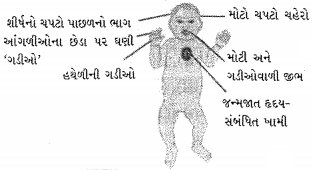
Identify the disorder in the child having the following symptoms as shown in the image.
A
Down's syndrome
B
Klinefelter's syndrome
C
Turner's syndrome
D
Super female
Solution
(A) The image displays characteristic features of Down's syndrome,which is a chromosomal disorder caused by the presence of an additional copy of chromosome number $21$ (trisomy of $21$).
Key symptoms shown include:
$1$. Flat back of the head.
$2$. Broad flat face.
$3$. Many 'loops' on fingertips.
$4$. Palm crease.
$5$. Big and furrowed tongue.
$6$. Congenital heart disease.
These clinical features are diagnostic of Down's syndrome.
Key symptoms shown include:
$1$. Flat back of the head.
$2$. Broad flat face.
$3$. Many 'loops' on fingertips.
$4$. Palm crease.
$5$. Big and furrowed tongue.
$6$. Congenital heart disease.
These clinical features are diagnostic of Down's syndrome.
0 likes
View Solution168
MediumMCQ
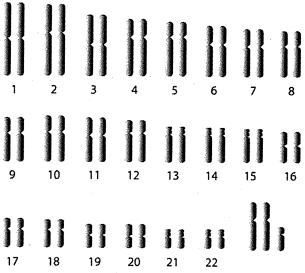
Which disorder is indicated by the following karyotype?
A
Down's syndrome
B
Klinefelter's syndrome
C
Turner's syndrome
D
Super female
Solution
(C) By observing the provided karyotype,we can see that there is only one $X$ chromosome present in the sex chromosome pair (the pair at the end).
This condition,where an individual has a $45, XO$ genotype,is characteristic of Turner's syndrome.
In Turner's syndrome,the individual is phenotypically female but sterile,with underdeveloped ovaries and other specific physical traits.
This condition,where an individual has a $45, XO$ genotype,is characteristic of Turner's syndrome.
In Turner's syndrome,the individual is phenotypically female but sterile,with underdeveloped ovaries and other specific physical traits.
0 likes
View Solution169
MediumMCQ
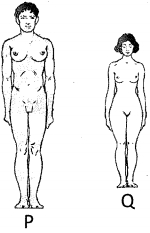
Identify the given figure and select the correct option.
$\quad\quad\quad P\quad\quad Q$
$\quad\quad\quad P\quad\quad Q$
A
Down's syndrome $\quad$ Turner's syndrome
B
Turner's syndrome $\quad$ Down's syndrome
C
Turner's syndrome $\quad$ Klinefelter's syndrome
D
Klinefelter's syndrome $\quad$ Turner's syndrome
Solution
(D) The figure $P$ represents an individual with Klinefelter's syndrome,which is characterized by the presence of an additional $X$ chromosome,resulting in a karyotype of $47, XXY$. These individuals are males with some feminine features.
The figure $Q$ represents an individual with Turner's syndrome,which is caused by the absence of one $X$ chromosome,resulting in a karyotype of $45, X0$. These individuals are females who are sterile and have underdeveloped secondary sexual characteristics.
Therefore,$P$ is Klinefelter's syndrome and $Q$ is Turner's syndrome.
The figure $Q$ represents an individual with Turner's syndrome,which is caused by the absence of one $X$ chromosome,resulting in a karyotype of $45, X0$. These individuals are females who are sterile and have underdeveloped secondary sexual characteristics.
Therefore,$P$ is Klinefelter's syndrome and $Q$ is Turner's syndrome.
0 likes
View Solution170
MediumMCQ
$A$ mother has Down syndrome,and the father is normal. What is the probability of their offspring having Down syndrome (in $\%$)?
A
$100$
B
$75$
C
$50$
D
$25$
Solution
(C) Down syndrome is a chromosomal disorder caused by the presence of an extra copy of chromosome $21$ (trisomy $21$).
In a mother with Down syndrome,the genotype is $47, XX, +21$.
During meiosis,the mother produces two types of gametes: $50 \%$ with $23$ chromosomes (normal) and $50 \%$ with $24$ chromosomes (containing the extra chromosome $21$).
The father is normal $(46, XY)$,producing normal gametes with $23$ chromosomes.
When the mother's gamete with $24$ chromosomes fuses with the father's normal gamete ($23$ chromosomes),the resulting zygote will have $47$ chromosomes,leading to Down syndrome.
Since $50 \%$ of the mother's gametes carry the extra chromosome,there is a $50 \%$ probability that the offspring will inherit the condition.
In a mother with Down syndrome,the genotype is $47, XX, +21$.
During meiosis,the mother produces two types of gametes: $50 \%$ with $23$ chromosomes (normal) and $50 \%$ with $24$ chromosomes (containing the extra chromosome $21$).
The father is normal $(46, XY)$,producing normal gametes with $23$ chromosomes.
When the mother's gamete with $24$ chromosomes fuses with the father's normal gamete ($23$ chromosomes),the resulting zygote will have $47$ chromosomes,leading to Down syndrome.
Since $50 \%$ of the mother's gametes carry the extra chromosome,there is a $50 \%$ probability that the offspring will inherit the condition.
0 likes
View Solution171
MediumMCQ
If a female individual has a small round head,furrowed tongue,partially open mouth,and a broad palm with a characteristic palm crease,and also exhibits retarded physical,psychomotor,and mental development,the karyotype analysis of such an individual will show:
A
$47$ chromosomes with $XXY$ sex chromosomes
B
$45$ chromosomes with $XO$ sex chromosomes
C
$47$ chromosomes with $XYY$ sex chromosomes
D
Trisomy of chromosome $21$
Solution
(D) The symptoms described,such as a small round head,furrowed tongue,partially open mouth,broad palm with a characteristic palm crease,and retarded physical,psychomotor,and mental development,are characteristic of $Down$ syndrome.
$Down$ syndrome is a genetic disorder caused by the presence of an extra copy of chromosome $21$,which is known as Trisomy $21$.
This results in a total of $47$ chromosomes instead of the normal $46$.
$Down$ syndrome is a genetic disorder caused by the presence of an extra copy of chromosome $21$,which is known as Trisomy $21$.
This results in a total of $47$ chromosomes instead of the normal $46$.
0 likes
View Solution172
MediumMCQ
Which of the following statements are correct about Klinefelter's Syndrome?
$A$. This disorder was first described by Langdon Down $(1866)$.
$B$. Such an individual has overall masculine development. However,the feminine development is also expressed.
$C$. The affected individual is short statured.
$D$. Physical,psychomotor and mental development is retarded.
$E$. Such individuals are sterile.
Choose the correct answer from the options given below:
$A$. This disorder was first described by Langdon Down $(1866)$.
$B$. Such an individual has overall masculine development. However,the feminine development is also expressed.
$C$. The affected individual is short statured.
$D$. Physical,psychomotor and mental development is retarded.
$E$. Such individuals are sterile.
Choose the correct answer from the options given below:
A
$A$ and $E$ only
B
$A$ and $B$ only
C
$C$ and $D$ only
D
$B$ and $E$ only
Solution
(D) Klinefelter's syndrome is a genetic disorder caused by the presence of an additional copy of the $X$-chromosome,resulting in a karyotype of $47, XXY$.
Statement $B$ is correct because individuals with this syndrome exhibit overall masculine development,but they also show some feminine characteristics (such as gynaecomastia).
Statement $E$ is correct because these individuals are sterile.
Statements $A$,$C$,and $D$ are incorrect because they describe features associated with Down's syndrome,not Klinefelter's syndrome. Down's syndrome was first described by Langdon Down in $1866$,and affected individuals are typically short-statured with retarded physical,psychomotor,and mental development.
Therefore,statements $B$ and $E$ are correct.
Statement $B$ is correct because individuals with this syndrome exhibit overall masculine development,but they also show some feminine characteristics (such as gynaecomastia).
Statement $E$ is correct because these individuals are sterile.
Statements $A$,$C$,and $D$ are incorrect because they describe features associated with Down's syndrome,not Klinefelter's syndrome. Down's syndrome was first described by Langdon Down in $1866$,and affected individuals are typically short-statured with retarded physical,psychomotor,and mental development.
Therefore,statements $B$ and $E$ are correct.
0 likes
View Solution173
MediumMCQ
Broad palm with single palm crease is visible in a person suffering from-
A
Thalassemia
B
Down's syndrome
C
Turner's syndrome
D
Klinefelter's syndrome
Solution
(B) Down's syndrome is a chromosomal disorder caused by the presence of an additional copy of chromosome number $21$ (trisomy of $21$).
Key clinical features of Down's syndrome include:
$a.$ Broad palm with a characteristic single palm crease (simian crease).
$b.$ Short stature with a small,round head.
$c.$ Furrowed tongue and partially open mouth.
$d.$ Physical,psychomotor,and mental development is retarded.
Key clinical features of Down's syndrome include:
$a.$ Broad palm with a characteristic single palm crease (simian crease).
$b.$ Short stature with a small,round head.
$c.$ Furrowed tongue and partially open mouth.
$d.$ Physical,psychomotor,and mental development is retarded.
0 likes
View Solution174
MediumMCQ
Match List-$I$ with List-$II$ : Choose the correct answer from the options given below :
| List-$I$ | List-$II$ |
| $A.$ Down's syndrome | $I.$ $11^{th}$ chromosome |
| $B.$ $\alpha$-Thalassemia | $II.$ $X$ chromosome |
| $C.$ $\beta$-Thalassemia | $III.$ $21^{st}$ chromosome |
| $D.$ Klinefelter's syndrome | $IV.$ $16^{th}$ chromosome |
A
$A-II, B-III, C-IV, D-I$
B
$A-III, B-IV, C-I, D-II$
C
$A-IV, B-I, C-II, D-III$
D
$A-I, B-II, C-III, D-IV$
Solution
(B) Down's syndrome is caused by the presence of an additional copy of chromosome number $21$ (trisomy $21$).
Klinefelter's syndrome is caused by the presence of an additional copy of the $X$-chromosome (genotype $XXY$).
$\alpha$-Thalassemia is controlled by two closely linked genes, $HBA1$ and $HBA2$, located on chromosome $16$ of each parent.
$\beta$-Thalassemia is controlled by a single gene, $HBB$, located on chromosome $11$ of each parent.
Therefore, the correct matching is $A-III, B-IV, C-I, D-II$.
Klinefelter's syndrome is caused by the presence of an additional copy of the $X$-chromosome (genotype $XXY$).
$\alpha$-Thalassemia is controlled by two closely linked genes, $HBA1$ and $HBA2$, located on chromosome $16$ of each parent.
$\beta$-Thalassemia is controlled by a single gene, $HBB$, located on chromosome $11$ of each parent.
Therefore, the correct matching is $A-III, B-IV, C-I, D-II$.
0 likes
View Solution175
DifficultMCQ
Read the following statements and choose the correct set of statements :
$(a)$ In sickle cell anaemia the mutant haemoglobin molecule undergoes polymerisation under high oxygen tension
$(b)$ Thalassemia is a qualitative problem
$(c)$ Turner's syndrome,Klinefelter's syndrome are common examples of chromosomal disorders.
$(d)$ Haemophilia is a sex-linked recessive disease
$(a)$ In sickle cell anaemia the mutant haemoglobin molecule undergoes polymerisation under high oxygen tension
$(b)$ Thalassemia is a qualitative problem
$(c)$ Turner's syndrome,Klinefelter's syndrome are common examples of chromosomal disorders.
$(d)$ Haemophilia is a sex-linked recessive disease
A
$(a), (b), (c)$ and $(d)$ only
B
$(a), (c)$ and $(d)$ only
C
$(c)$ and $(d)$ only
D
$(a)$ and $(b)$ only
Solution
(C) Let us analyze each statement:
$(a)$ Incorrect: In sickle cell anaemia,the mutant haemoglobin molecule undergoes polymerisation under low oxygen tension,not high oxygen tension.
$(b)$ Incorrect: Thalassemia is a quantitative problem,meaning it involves the reduced synthesis of one of the globin chains of the haemoglobin molecule. Sickle cell anaemia is a qualitative problem.
$(c)$ Correct: Turner's syndrome $(45, XO)$ and Klinefelter's syndrome $(47, XXY)$ are classic examples of chromosomal disorders caused by aneuploidy.
$(d)$ Correct: Haemophilia is a sex-linked recessive disease where the blood fails to clot properly.
Therefore,statements $(c)$ and $(d)$ are correct.
$(a)$ Incorrect: In sickle cell anaemia,the mutant haemoglobin molecule undergoes polymerisation under low oxygen tension,not high oxygen tension.
$(b)$ Incorrect: Thalassemia is a quantitative problem,meaning it involves the reduced synthesis of one of the globin chains of the haemoglobin molecule. Sickle cell anaemia is a qualitative problem.
$(c)$ Correct: Turner's syndrome $(45, XO)$ and Klinefelter's syndrome $(47, XXY)$ are classic examples of chromosomal disorders caused by aneuploidy.
$(d)$ Correct: Haemophilia is a sex-linked recessive disease where the blood fails to clot properly.
Therefore,statements $(c)$ and $(d)$ are correct.
0 likes
View Solution176
MediumMCQ
In which of the genetic disorders does an individual have an overall masculine development,gynaecomastia,and is sterile?
A
Klinefelter's syndrome
B
Edward syndrome
C
Down's syndrome
D
Turner's syndrome
Solution
(A) Klinefelter's syndrome is a genetic disorder caused by the presence of an additional $X$ chromosome,resulting in a karyotype of $47, XXY$.
Individuals with this syndrome exhibit overall masculine development but also show feminine characteristics such as gynaecomastia (development of breast tissue).
These individuals are sterile due to the abnormal chromosomal constitution.
Therefore,the correct option is $A$.
Individuals with this syndrome exhibit overall masculine development but also show feminine characteristics such as gynaecomastia (development of breast tissue).
These individuals are sterile due to the abnormal chromosomal constitution.
Therefore,the correct option is $A$.
0 likes
View Solution177
EasyMCQ
Which one of the following disorders $CANNOT$ be treated by gene therapy?
A
Gaucher's disease
B
Haemophilia
C
Sickle cell anaemia
D
Down's syndrome
Solution
(D) $i$. Gene therapy is the treatment of a disease (disorder) by replacing,altering,or supplementing a gene that is absent or abnormal and whose absence or abnormality is responsible for the disease (disorder).
$ii$. Down's syndrome is a chromosomal disorder caused by the presence of an extra chromosome $21$ (trisomy $21$).
$iii$. Since it is a chromosomal abnormality involving an entire chromosome rather than a single defective gene,it cannot be corrected by current gene therapy techniques.
$ii$. Down's syndrome is a chromosomal disorder caused by the presence of an extra chromosome $21$ (trisomy $21$).
$iii$. Since it is a chromosomal abnormality involving an entire chromosome rather than a single defective gene,it cannot be corrected by current gene therapy techniques.
0 likes
View Solution178
EasyMCQ
Aneuploidy refers to . . . . . . .
A
addition or deletion of one or more chromosomes to the total number.
B
addition of entire set of chromosome to the primary basic number.
C
haploid set of chromosomes.
D
tetraploid set of chromosomes.
Solution
(A) Aneuploidy is a condition characterized by the gain or loss of one or more chromosomes,resulting in an abnormal chromosome number that is not an exact multiple of the haploid set.
This occurs due to the failure of segregation of chromatids during cell division (nondisjunction).
In contrast,polyploidy refers to the addition of an entire set of chromosomes (e.g.,$3n, 4n$).
Therefore,the correct definition of aneuploidy is the addition or deletion of one or more chromosomes to the total number.
This occurs due to the failure of segregation of chromatids during cell division (nondisjunction).
In contrast,polyploidy refers to the addition of an entire set of chromosomes (e.g.,$3n, 4n$).
Therefore,the correct definition of aneuploidy is the addition or deletion of one or more chromosomes to the total number.
0 likes
View Solution179
EasyMCQ
Down's syndrome is a . . . . . . disorder.
A
Mendelian
B
chromosomal
C
$X$-linked
D
$Y$-linked
Solution
(B) Down's syndrome is a chromosomal disorder caused by the presence of an additional copy of chromosome $21$,a condition known as trisomy of chromosome $21$.
0 likes
View Solution180
EasyMCQ
Which one of the following genetic disorders is $CORRECTLY$ matched with its karyotype?
A
Down's syndrome - $44 A + XO$
B
Klinefelter's syndrome - $44 A + XXY$
C
Turner's syndrome - $44 A + XY$
D
Colour blindness - $45 A + XY$
Solution
(B) $1$. Down's syndrome is caused by trisomy of chromosome $21$,resulting in a karyotype of $45 A + XX$ or $45 A + XY$.
$2$. Klinefelter's syndrome occurs in males with an extra $X$ chromosome,resulting in a karyotype of $44 A + XXY$.
$3$. Turner's syndrome occurs in females due to the absence of one $X$ chromosome,resulting in a karyotype of $44 A + XO$.
$4$. Colour blindness is a sex-linked recessive disorder caused by a mutation on the $X$ chromosome,not a chromosomal abnormality involving an extra or missing autosome set ($45 A + XY$ is incorrect).
Therefore,the correct match is Klinefelter's syndrome - $44 A + XXY$.
$2$. Klinefelter's syndrome occurs in males with an extra $X$ chromosome,resulting in a karyotype of $44 A + XXY$.
$3$. Turner's syndrome occurs in females due to the absence of one $X$ chromosome,resulting in a karyotype of $44 A + XO$.
$4$. Colour blindness is a sex-linked recessive disorder caused by a mutation on the $X$ chromosome,not a chromosomal abnormality involving an extra or missing autosome set ($45 A + XY$ is incorrect).
Therefore,the correct match is Klinefelter's syndrome - $44 A + XXY$.
0 likes
View Solution181
EasyMCQ
Which one of the following is a type of hyperploidy?
A
$2n+2$
B
$5n$
C
$2n-2$
D
$4n$
Solution
(A) Hyperploidy (or polysomy) refers to an increase in the number of chromosomes,such as $2n+1$ (trisomy) or $2n+2$ (tetrasomy).
$5n$ and $4n$ represent polyploidy,which is an increase in the number of complete sets of chromosomes.
$2n-2$ represents nullisomy,which is a type of hypoploidy (a decrease in chromosome number).
Therefore,$2n+2$ is the correct example of hyperploidy.
$5n$ and $4n$ represent polyploidy,which is an increase in the number of complete sets of chromosomes.
$2n-2$ represents nullisomy,which is a type of hypoploidy (a decrease in chromosome number).
Therefore,$2n+2$ is the correct example of hyperploidy.
0 likes
View Solution182
EasyMCQ
If there is an addition of a single chromosome to the total set of chromosomes,it is called . . . . . . .
A
Haploidy
B
Diploidy
C
Euploidy
D
Aneuploidy
Solution
(D) Aneuploidy is a condition characterized by a change in the chromosome number,which occurs either by the addition or deletion of one or more chromosomes.
Specifically,the addition of a single chromosome to a diploid set is known as trisomy $(2n+1)$,which is a type of aneuploidy.
Euploidy refers to the variation in the number of complete sets of chromosomes,whereas haploidy and diploidy refer to the number of sets of chromosomes present in an organism.
Specifically,the addition of a single chromosome to a diploid set is known as trisomy $(2n+1)$,which is a type of aneuploidy.
Euploidy refers to the variation in the number of complete sets of chromosomes,whereas haploidy and diploidy refer to the number of sets of chromosomes present in an organism.
0 likes
View Solution183
EasyMCQ
Which one of the following is a chromosomal disorder?
A
Sickle cell anaemia
B
Phenylketonuria
C
Colorblindness
D
Turner syndrome
Solution
(D) Chromosomal disorders are caused by the absence or excess or abnormal arrangement of one or more chromosomes.
$A$. Sickle cell anaemia is a Mendelian disorder caused by a point mutation in the gene for haemoglobin.
$B$. Phenylketonuria is a Mendelian disorder caused by an autosomal recessive gene mutation.
$C$. Colorblindness is a sex-linked recessive Mendelian disorder.
$D$. Turner syndrome is a chromosomal disorder caused by the absence of one of the $X$ chromosomes in females,resulting in a $45, XO$ genotype.
$A$. Sickle cell anaemia is a Mendelian disorder caused by a point mutation in the gene for haemoglobin.
$B$. Phenylketonuria is a Mendelian disorder caused by an autosomal recessive gene mutation.
$C$. Colorblindness is a sex-linked recessive Mendelian disorder.
$D$. Turner syndrome is a chromosomal disorder caused by the absence of one of the $X$ chromosomes in females,resulting in a $45, XO$ genotype.
0 likes
View Solution184
EasyMCQ
An extra sex chromosome is present in . . . . . . .
A
Turner syndrome
B
Thalassemia
C
Klinefelter syndrome
D
Down syndrome
Solution
(C) In $Klinefelter$ syndrome,the individual has an extra sex chromosome,resulting in a genotype of $47, XXY$.
$Turner$ syndrome is characterized by the loss of an $X$ chromosome $(45, XO)$.
$Down$ syndrome is caused by an extra copy of chromosome $21$ (autosome),not a sex chromosome.
$Thalassemia$ is an autosomal recessive blood disorder,not a chromosomal abnormality involving extra sex chromosomes.
Therefore,the correct answer is $Klinefelter$ syndrome.
$Turner$ syndrome is characterized by the loss of an $X$ chromosome $(45, XO)$.
$Down$ syndrome is caused by an extra copy of chromosome $21$ (autosome),not a sex chromosome.
$Thalassemia$ is an autosomal recessive blood disorder,not a chromosomal abnormality involving extra sex chromosomes.
Therefore,the correct answer is $Klinefelter$ syndrome.
0 likes
View Solution185
EasyMCQ
Feminized males have . . . . . . chromosomes.
A
$44$
B
$45$
C
$46$
D
$47$
Solution
(D) Individuals with Klinefelter syndrome have a chromosomal constitution of $44 + XXY$,totaling $47$ chromosomes.
These individuals are phenotypically male but exhibit feminine characteristics such as breast development (gynecomastia),hence they are often described as feminized males.
These individuals are phenotypically male but exhibit feminine characteristics such as breast development (gynecomastia),hence they are often described as feminized males.
0 likes
View Solution186
EasyMCQ
In a diploid set of chromosomes,the deletion or addition of a chromosome leads to:
A
Aneuploidy
B
Euploidy
C
Polyploidy
D
Triploidy
Solution
(A) Aneuploidy is a condition characterized by the gain or loss of one or more chromosomes from the normal diploid number $(2n)$.
This occurs due to the failure of segregation of chromatids during cell division (nondisjunction).
Euploidy refers to the variation in the number of entire sets of chromosomes.
Polyploidy is a type of euploidy where an organism has more than two complete sets of chromosomes (e.g.,$3n, 4n$).
Triploidy is a specific form of polyploidy where an organism has three sets of chromosomes $(3n)$.
This occurs due to the failure of segregation of chromatids during cell division (nondisjunction).
Euploidy refers to the variation in the number of entire sets of chromosomes.
Polyploidy is a type of euploidy where an organism has more than two complete sets of chromosomes (e.g.,$3n, 4n$).
Triploidy is a specific form of polyploidy where an organism has three sets of chromosomes $(3n)$.
0 likes
View Solution187
EasyMCQ
Epicanthal skin fold and simian crease are characteristics of
A
Down syndrome
B
Klinefelter syndrome
C
Thalassemia
D
Turner's syndrome
Solution
(A) $Down$ syndrome is a chromosomal disorder caused by the presence of an additional copy of chromosome number $21$ (trisomy of $21$).
Individuals with $Down$ syndrome exhibit several characteristic physical features,including a broad forehead,a furrowed tongue,and a characteristic palm crease known as the simian crease.
They also typically present with epicanthal skin folds (a skin fold of the upper eyelid that covers the inner corner of the eye).
Therefore,these features are diagnostic characteristics of $Down$ syndrome.
Individuals with $Down$ syndrome exhibit several characteristic physical features,including a broad forehead,a furrowed tongue,and a characteristic palm crease known as the simian crease.
They also typically present with epicanthal skin folds (a skin fold of the upper eyelid that covers the inner corner of the eye).
Therefore,these features are diagnostic characteristics of $Down$ syndrome.
0 likes
View Solution188
EasyMCQ
Which of the following is a correct match?
A
$I - \text{Thalassemia}, II - XO, III - \text{Flat nose, simian crease}$
B
$I - \text{Down's syndrome}, II - 42 AA + XY, III - \text{Webbing of neck}$
C
$I - \text{Turner's syndrome}, II - 44 AA + XXX, III - \text{Anaemia, jaundice}$
D
$I - \text{Klinefelter syndrome}, II - 44 AA + XXY, III - \text{Tall thin eunuchoid}$
Solution
(D) In $Klinefelter \text{ syndrome}$, the chromosomal constitution is $44 AA + XXY$.
This condition results in individuals who are phenotypically male but have some female characteristics, such as breast development (gynecomastia) and a tall, thin, eunuchoid stature.
Option $A$ is incorrect because $XO$ represents $Turner's \text{ syndrome}$, not $Thalassemia$.
Option $B$ is incorrect because $Down's \text{ syndrome}$ has $45 AA + XY$ (trisomy $21$), and webbing of the neck is a feature of $Turner's \text{ syndrome}$.
Option $C$ is incorrect because $44 AA + XXX$ is $Triple-X \text{ syndrome}$, and anaemia/jaundice are symptoms of $Thalassemia$.
This condition results in individuals who are phenotypically male but have some female characteristics, such as breast development (gynecomastia) and a tall, thin, eunuchoid stature.
Option $A$ is incorrect because $XO$ represents $Turner's \text{ syndrome}$, not $Thalassemia$.
Option $B$ is incorrect because $Down's \text{ syndrome}$ has $45 AA + XY$ (trisomy $21$), and webbing of the neck is a feature of $Turner's \text{ syndrome}$.
Option $C$ is incorrect because $44 AA + XXX$ is $Triple-X \text{ syndrome}$, and anaemia/jaundice are symptoms of $Thalassemia$.
0 likes
View Solution189
EasyMCQ
Which chromosomal aberration does the following figure indicate?

A
Duplication
B
Deletion
C
Translocation
D
Inversion
Solution
(C) The figure shows that the segment $AB$ of the chromosome has been replaced by the segment $MNO$.
Translocation is the transfer of a segment of $DNA$ from one chromosome to another or the exchange of segments between non-homologous chromosomes.
Inversion is the reversal of a segment within the same chromosome.
Duplication is the repetition of a chromosomal segment.
Deletion is the loss of a chromosomal segment.
Since the original segment $AB$ is replaced by a different segment $MNO$,this represents a translocation event.
Translocation is the transfer of a segment of $DNA$ from one chromosome to another or the exchange of segments between non-homologous chromosomes.
Inversion is the reversal of a segment within the same chromosome.
Duplication is the repetition of a chromosomal segment.
Deletion is the loss of a chromosomal segment.
Since the original segment $AB$ is replaced by a different segment $MNO$,this represents a translocation event.
0 likes
View Solution190
EasyMCQ
In Turner's Syndrome,during cell division,which type of Aneuploidy is seen?
A
$(2n + 2)$
B
$(2n - 1)$
C
$(2n + 1)$
D
$(2n - 2)$
Solution
(B) Turner's Syndrome is a genetic disorder caused by the absence of one of the $X$ chromosomes in females.
This condition is represented as $45, XO$,which means the individual has $44$ autosomes and only one $X$ chromosome.
In terms of chromosomal notation,this is represented as $(2n - 1)$,where $2n$ is the diploid number and $-1$ indicates the loss of a single chromosome (monosomy).
Therefore,the correct type of Aneuploidy seen is $(2n - 1)$.
This condition is represented as $45, XO$,which means the individual has $44$ autosomes and only one $X$ chromosome.
In terms of chromosomal notation,this is represented as $(2n - 1)$,where $2n$ is the diploid number and $-1$ indicates the loss of a single chromosome (monosomy).
Therefore,the correct type of Aneuploidy seen is $(2n - 1)$.
0 likes
View Solution191
EasyMCQ
In Klinefelter syndrome . . . . . . .
A
Monosomy of $23^{\text{rd}}$ pair of chromosome
B
Trisomy of $23^{\text{rd}}$ pair of chromosome
C
Monosomy of $21^{\text{st}}$ pair of chromosome
D
Trisomy of $21^{\text{st}}$ pair of chromosome
Solution
(B) Klinefelter syndrome is a genetic disorder caused by the presence of an extra $X$ chromosome in males.
This results in a chromosomal constitution of $47, XXY$.
Since the $23^{\text{rd}}$ pair of chromosomes represents the sex chromosomes,the presence of an additional $X$ chromosome constitutes a trisomy of the $23^{\text{rd}}$ pair.
Therefore,the correct option is $B$.
This results in a chromosomal constitution of $47, XXY$.
Since the $23^{\text{rd}}$ pair of chromosomes represents the sex chromosomes,the presence of an additional $X$ chromosome constitutes a trisomy of the $23^{\text{rd}}$ pair.
Therefore,the correct option is $B$.
0 likes
View Solution192
EasyMCQ
What is the correct chromosome composition in a karyotype of Klinefelter's syndrome?
A
$22AA + XY$
B
$22AA + XO$
C
$22AA + XXX$
D
$22AA + XXY$
Solution
(D) Klinefelter's syndrome is a genetic disorder caused by the presence of an extra $X$ chromosome in males.
In this condition,the individual has a total of $47$ chromosomes instead of the normal $46$.
The chromosomal constitution is $44$ autosomes plus $XXY$ sex chromosomes,which can be represented as $22AA + XXY$.
Therefore,the correct option is $D$.
In this condition,the individual has a total of $47$ chromosomes instead of the normal $46$.
The chromosomal constitution is $44$ autosomes plus $XXY$ sex chromosomes,which can be represented as $22AA + XXY$.
Therefore,the correct option is $D$.
0 likes
View Solution193
EasyMCQ
If a person has $45$ chromosomes with $XO$ chromosomal abnormality,then it is considered as which disorder?
A
Super female
B
Down's syndrome
C
Klinefelter's syndrome
D
Turner's syndrome
Solution
(D) The condition characterized by the presence of $45$ chromosomes with an $XO$ genotype (where one $X$ chromosome is missing) is known as Turner's syndrome.
In this disorder,the individual is phenotypically female but has underdeveloped ovaries and lacks secondary sexual characteristics.
Down's syndrome involves trisomy of chromosome $21$ ($47$ chromosomes).
Klinefelter's syndrome involves an $XXY$ genotype ($47$ chromosomes).
Therefore,the correct option is $D$.
In this disorder,the individual is phenotypically female but has underdeveloped ovaries and lacks secondary sexual characteristics.
Down's syndrome involves trisomy of chromosome $21$ ($47$ chromosomes).
Klinefelter's syndrome involves an $XXY$ genotype ($47$ chromosomes).
Therefore,the correct option is $D$.
0 likes
View Solution194
EasyMCQ
Find the incorrect statement among the following:
A
In sex-linked recessive traits,the gene is transmitted from an unaffected carrier female to some of the male progeny.
B
Accumulation of phenylpyruvic acid in the brain results in mental retardation.
C
Individuals affected by Down's Syndrome will have congenital heart defects and are more intelligent.
D
Turner's Syndrome is caused due to the absence of one $X$-chromosome.
Solution
(C) The incorrect statement is $C$. Individuals affected by Down's Syndrome do not have higher intelligence; rather,they typically exhibit mental retardation,short stature,and physical abnormalities such as congenital heart defects. Therefore,the claim that they are 'more intelligent' is factually incorrect.
0 likes
View Solution195
EasyMCQ
Gynecomastia is a symptom of
A
Turner's syndrome
B
Down's syndrome
C
Cri-du-chat syndrome
D
Klinefelter's syndrome
Solution
(D) Klinefelter's syndrome.
Gynecomastia is a condition in which the breast tissue of boys and men swells and becomes larger than normal.
It is a characteristic clinical feature of Klinefelter's syndrome,which is caused by an extra $X$ chromosome (genotype $47, XXY$).
Gynecomastia is a condition in which the breast tissue of boys and men swells and becomes larger than normal.
It is a characteristic clinical feature of Klinefelter's syndrome,which is caused by an extra $X$ chromosome (genotype $47, XXY$).
0 likes
View Solution196
EasyMCQ
Which of the following is an example of a non-Mendelian disorder?
A
Thalassemia
B
Haemophilia
C
Cystic fibrosis
D
Down's syndrome
Solution
(D) is the correct answer.
$A$,$B$,and $C$ are examples of Mendelian disorders,which are caused by mutations in a single gene.
$D$ (Down's syndrome) is a chromosomal disorder caused by an extra copy of chromosome $21$ (trisomy of $21$),which is a non-Mendelian inheritance pattern.
$A$,$B$,and $C$ are examples of Mendelian disorders,which are caused by mutations in a single gene.
$D$ (Down's syndrome) is a chromosomal disorder caused by an extra copy of chromosome $21$ (trisomy of $21$),which is a non-Mendelian inheritance pattern.
0 likes
View Solution197
EasyMCQ
Match the Column $I$ with Column $II$:
| Column $I$ | Column $II$ |
|---|---|
| $(A)$ Autosomal trisomy | $(i)$ Turner's Syndrome |
| $(B)$ Allosomal trisomy | $(ii)$ Mendelian disorder |
| $(C)$ Allosomal Monosomy | $(iii)$ Klinefelter's Syndrome |
| $(D)$ Cystic fibrosis | $(iv)$ Down's Syndrome |
A
$(A)-(i); (B)-(ii); (C)-(iii); (D)-(iv)$
B
$(A)-(i); (B)-(ii); (C)-(iv); (D)-(iii)$
C
$(A)-(iv); (B)-(iii); (C)-(ii); (D)-(i)$
D
$(A)-(iv); (B)-(iii); (C)-(i); (D)-(ii)$
Solution
(D) The correct matching is as follows:
$(A)$ Autosomal trisomy: $(iv)$ Down's Syndrome (Trisomy of chromosome $21$).
$(B)$ Allosomal trisomy: $(iii)$ Klinefelter's Syndrome $(47, XXY)$.
$(C)$ Allosomal Monosomy: $(i)$ Turner's Syndrome $(45, XO)$.
$(D)$ Cystic fibrosis: $(ii)$ Mendelian disorder (Autosomal recessive trait).
Therefore,the correct sequence is $(A)-(iv), (B)-(iii), (C)-(i), (D)-(ii)$.
$(A)$ Autosomal trisomy: $(iv)$ Down's Syndrome (Trisomy of chromosome $21$).
$(B)$ Allosomal trisomy: $(iii)$ Klinefelter's Syndrome $(47, XXY)$.
$(C)$ Allosomal Monosomy: $(i)$ Turner's Syndrome $(45, XO)$.
$(D)$ Cystic fibrosis: $(ii)$ Mendelian disorder (Autosomal recessive trait).
Therefore,the correct sequence is $(A)-(iv), (B)-(iii), (C)-(i), (D)-(ii)$.
0 likes
View Solution198
EasyMCQ
Match Column $I$ with Column $II$ and find the correct answer.
| Column $I$ | Column $II$ |
|---|---|
| $(A)$ Aneuploidy | $(i)$ Increase in whole set of chromosomes |
| $(B)$ Monoploidy | $(ii)$ Loss or gain of a chromosome |
| $(C)$ Polyploidy | $(iii)$ Two sets of chromosomes |
| $(D)$ Diploidy | $(iv)$ $A$ single set of chromosomes |
A
$A-i, B-ii, C-iii, D-iv$
B
$A-iii, B-i, C-ii, D-iv$
C
$A-ii, B-iv, C-i, D-iii$
D
$A-iv, B-iii, C-i, D-ii$
Solution
(C) The correct matching is as follows:
$(A)$ Aneuploidy: It refers to the loss or gain of one or more chromosomes,resulting in an abnormal number of chromosomes $(ii)$.
$(B)$ Monoploidy: It refers to the presence of a single set of chromosomes $(n)$ in an organism $(iv)$.
$(C)$ Polyploidy: It refers to an increase in the whole set of chromosomes,such as $3n, 4n$,etc. $(i)$.
$(D)$ Diploidy: It refers to the presence of two sets of chromosomes $(2n)$ in an organism $(iii)$.
Therefore,the correct sequence is $A-ii, B-iv, C-i, D-iii$.
$(A)$ Aneuploidy: It refers to the loss or gain of one or more chromosomes,resulting in an abnormal number of chromosomes $(ii)$.
$(B)$ Monoploidy: It refers to the presence of a single set of chromosomes $(n)$ in an organism $(iv)$.
$(C)$ Polyploidy: It refers to an increase in the whole set of chromosomes,such as $3n, 4n$,etc. $(i)$.
$(D)$ Diploidy: It refers to the presence of two sets of chromosomes $(2n)$ in an organism $(iii)$.
Therefore,the correct sequence is $A-ii, B-iv, C-i, D-iii$.
0 likes
View Solution199
EasyMCQ
Example for autosomal hyper aneuploidy is
A
Down's syndrome
B
Klinefelter's syndrome
C
Turner's syndrome
D
Haemophilia
Solution
(A) The correct answer is $A$.
Hyper-aneuploidy refers to a condition where the chromosome number is higher than the normal diploid number,specifically represented as $2n + 1$ (trisomy).
Down's syndrome is an example of autosomal hyper-aneuploidy,caused by the presence of an extra copy of chromosome $21$ (trisomy $21$).
Klinefelter's syndrome $(47, XXY)$ and Turner's syndrome $(45, X)$ are examples of sex chromosomal aneuploidy.
Haemophilia is a sex-linked recessive disorder,not an aneuploidy.
Hyper-aneuploidy refers to a condition where the chromosome number is higher than the normal diploid number,specifically represented as $2n + 1$ (trisomy).
Down's syndrome is an example of autosomal hyper-aneuploidy,caused by the presence of an extra copy of chromosome $21$ (trisomy $21$).
Klinefelter's syndrome $(47, XXY)$ and Turner's syndrome $(45, X)$ are examples of sex chromosomal aneuploidy.
Haemophilia is a sex-linked recessive disorder,not an aneuploidy.
0 likes
View Solution200
EasyMCQ
Three copies of chromosome-$21$ in a child with Down's syndrome have been analysed using molecular biology technology to detect any possible $DNA$ polymorphism with reference to different alleles located on chromosome-$21$. Results showed that out of $3$ copies,$2$ of the chromosomes of the child contain the same alleles as one of the mother's alleles. Based on this,when did the non-disjunction event most likely occur?
A
Paternal meiosis-$I$
B
Maternal meiosis-$I$
C
Paternal meiosis-$II$
D
Maternal meiosis-$II$
Solution
(B) The correct answer is $B$.
Down's syndrome is an autosomal aneuploidy caused by the presence of an extra copy of chromosome-$21$.
In this case,the child has $3$ copies of chromosome-$21$,where $2$ copies share the same alleles as one of the mother's chromosomes.
If non-disjunction occurs during meiosis-$I$,the homologous chromosomes fail to separate,resulting in a gamete containing both maternal homologs.
Since these $2$ chromosomes are identical to the mother's alleles (due to the presence of homologous chromosomes that did not segregate),it indicates that the non-disjunction event occurred during maternal meiosis-$I$.
Down's syndrome is an autosomal aneuploidy caused by the presence of an extra copy of chromosome-$21$.
In this case,the child has $3$ copies of chromosome-$21$,where $2$ copies share the same alleles as one of the mother's chromosomes.
If non-disjunction occurs during meiosis-$I$,the homologous chromosomes fail to separate,resulting in a gamete containing both maternal homologs.
Since these $2$ chromosomes are identical to the mother's alleles (due to the presence of homologous chromosomes that did not segregate),it indicates that the non-disjunction event occurred during maternal meiosis-$I$.
0 likes
View SolutionPrinciples of Inheritance and Variation — Chromosomal disorders · Frequently Asked Questions
1Are these Principles of Inheritance and Variation questions useful for JEE and NEET?
Yes. All questions in this section are mapped to JEE Main and NEET exam patterns. Previous year questions from JEE Main, NEET, GUJCET and state-level exams are included with full solutions.
2Can I switch to Hindi or Gujarati for these questions?
Yes. Use the language tabs in the hero section or the sidebar to view the same questions and solutions in English, Hindi or Gujarati.
3How do I generate a question paper from this subtopic?
Use the Vedclass Exam Paper Generator — select the chapter and subtopic, set difficulty, and generate Sets A, B, C, D automatically. First 3 chapters of every subject are free.
Vedclass Products
For Students
Vedclass Test Series
Mock tests in real JEE/NEET style with performance analysis. 5-day free trial.
Start Free TrialFor Teachers
Exam Paper Generator
Generate Set A/B/C/D papers from this chapter in 2 minutes. 3 chapters free.
Try FreeFor Institutes
Online Exam Module
Live online exams with unlimited students, 360° analytics & white-label branding.
See DemoFor Teachers & Institutes
Generate a Principles of Inheritance and Variation Exam Paper in 2 Minutes
Select subtopic & difficulty — Sets A, B, C, D auto-generated with No Repeat logic.
First 3 chapters of every subject are free — no payment required.