
A English
Chromosomal disorders Questions in English
Class 12 Biology · Principles of Inheritance and Variation · Chromosomal disorders
204+
Questions
English
Language
100%
With Solutions
Showing 49 of 204 questions in English
101
MediumMCQ
$A$ human with $45$ chromosomes having only one $X$ chromosome $(XO)$ suffers from which of the following disorders?
A
Down syndrome
B
Klinefelter syndrome
C
Turner syndrome
D
Edward syndrome
Solution
(C) Turner syndrome is caused by the absence of one of the $X$ chromosomes,i.e.,$45$ chromosomes with $XO$ genotype $(44 + XO)$.
Such individuals are sterile females with rudimentary ovaries and lack other secondary sexual characters.
Down syndrome is caused by trisomy of chromosome $21$.
Klinefelter syndrome is caused by the presence of an additional copy of the $X$ chromosome,resulting in a genotype of $47$ $(44 + XXY)$.
Edward syndrome is caused by trisomy of chromosome $18$.
Such individuals are sterile females with rudimentary ovaries and lack other secondary sexual characters.
Down syndrome is caused by trisomy of chromosome $21$.
Klinefelter syndrome is caused by the presence of an additional copy of the $X$ chromosome,resulting in a genotype of $47$ $(44 + XXY)$.
Edward syndrome is caused by trisomy of chromosome $18$.
0 likes
View Solution102
MediumMCQ
$A$ male individual with $47$ chromosomes due to the addition of an $X$ chromosome suffers from a condition called:
A
Down syndrome
B
Super female
C
Turner syndrome
D
Klinefelter syndrome
Solution
(D) Klinefelter syndrome is a genetic disorder in males caused by the presence of an extra $X$ chromosome,resulting in a karyotype of $47, XXY$.
This condition occurs due to the non-disjunction of chromosomes during meiosis.
Individuals with this syndrome exhibit masculine development but also show feminine characteristics such as gynaecomastia (development of breast tissue) and are sterile.
This condition occurs due to the non-disjunction of chromosomes during meiosis.
Individuals with this syndrome exhibit masculine development but also show feminine characteristics such as gynaecomastia (development of breast tissue) and are sterile.
0 likes
View Solution103
DifficultMCQ
In a diploid organism,the formation of a multivalent during meiosis is due to:
A
Monosomy
B
Inversion
C
Deletion
D
Reciprocal translocation
Solution
(D) During meiosis,homologous chromosomes pair up to form bivalents.
When a reciprocal translocation occurs between non-homologous chromosomes,the segments are exchanged.
During prophase-$I$ of meiosis,these translocated chromosomes attempt to pair with their homologous segments,leading to the formation of a cross-shaped structure known as a quadrivalent or multivalent.
Therefore,reciprocal translocation is the cause of multivalent formation in diploid organisms.
When a reciprocal translocation occurs between non-homologous chromosomes,the segments are exchanged.
During prophase-$I$ of meiosis,these translocated chromosomes attempt to pair with their homologous segments,leading to the formation of a cross-shaped structure known as a quadrivalent or multivalent.
Therefore,reciprocal translocation is the cause of multivalent formation in diploid organisms.
0 likes
View Solution104
MediumMCQ
In humans,mental retardation is associated with sex-linked abnormalities. It is generally due to:
A
Gain of an $X$ chromosome
B
Loss of an $X$ chromosome
C
Gain of a $Y$ chromosome
D
Loss of a $Y$ chromosome
Solution
(A) Mental retardation in humans is often associated with sex chromosomal aneuploidy,such as $Klinefelter$ syndrome $(47, XXY)$ or $Turner$ syndrome $(45, X)$.
Specifically,the condition known as $Klinefelter$ syndrome,which involves the presence of an extra $X$ chromosome $(47, XXY)$,is frequently associated with varying degrees of mental retardation.
Therefore,the gain of an $X$ chromosome is a common cause of such sex-linked abnormalities.
Specifically,the condition known as $Klinefelter$ syndrome,which involves the presence of an extra $X$ chromosome $(47, XXY)$,is frequently associated with varying degrees of mental retardation.
Therefore,the gain of an $X$ chromosome is a common cause of such sex-linked abnormalities.
0 likes
View Solution105
MediumMCQ
The number of Barr bodies in a $XXXX$ female is:
A
$1$
B
$2$
C
$3$
D
$4$
Solution
(C) The number of Barr bodies in a cell is calculated using the formula: $N - 1$,where $N$ is the total number of $X$ chromosomes.
In a $XXXX$ female,there are $4$ $X$ chromosomes.
Therefore,the number of Barr bodies = $4 - 1 = 3$.
Thus,the correct option is $C$.
In a $XXXX$ female,there are $4$ $X$ chromosomes.
Therefore,the number of Barr bodies = $4 - 1 = 3$.
Thus,the correct option is $C$.
0 likes
View Solution106
MediumMCQ
Down syndrome is caused by an extra chromosome in the $21$st pair. What percentage of offspring from an affected mother and a normal father will show the effect of this disorder (in $\%$)?
A
$50$
B
$25$
C
$100$
D
$75$
Solution
(A) Down syndrome is a chromosomal disorder caused by trisomy of chromosome $21$ ($47, XX, +21$ or $47, XY, +21$).
In an affected mother (trisomic,$2n+1$),the gametes produced will be $n$ and $n+1$ in equal proportions ($50\%$ each).
When these gametes fuse with normal gametes $(n)$ from a normal father,the resulting offspring will be $2n$ (normal) and $2n+1$ (affected) in a $1:1$ ratio.
Therefore,$50\%$ of the offspring are expected to inherit the extra chromosome and exhibit the disorder.
In an affected mother (trisomic,$2n+1$),the gametes produced will be $n$ and $n+1$ in equal proportions ($50\%$ each).
When these gametes fuse with normal gametes $(n)$ from a normal father,the resulting offspring will be $2n$ (normal) and $2n+1$ (affected) in a $1:1$ ratio.
Therefore,$50\%$ of the offspring are expected to inherit the extra chromosome and exhibit the disorder.
0 likes
View Solution107
MediumMCQ
Which of the following conditions in humans is correctly matched with its chromosomal abnormality or linkage?
A
Klinefelter's syndrome - $44$ autosomes $+ XXY$
B
Color blindness - $Y$-linked
C
Erythroblastosis fetalis - $X$-linked
D
Down's syndrome - $44$ autosomes $+ X0$
Solution
(A) $1$. Klinefelter's syndrome is a genetic disorder caused by an extra $X$ chromosome in males,resulting in a karyotype of $44$ autosomes $+ XXY$ ($47$ chromosomes).
$2$. Color blindness is an $X$-linked recessive disorder,not $Y$-linked.
$3$. Erythroblastosis fetalis is caused by $Rh$ incompatibility between the mother and the fetus,not by $X$-linked inheritance.
$4$. Down's syndrome is caused by trisomy of chromosome $21$,resulting in $45$ autosomes $+ XX$ or $XY$ ($47$ chromosomes total),not $44$ autosomes $+ X0$ (which is Turner's syndrome).
Therefore,the correct match is Klinefelter's syndrome.
$2$. Color blindness is an $X$-linked recessive disorder,not $Y$-linked.
$3$. Erythroblastosis fetalis is caused by $Rh$ incompatibility between the mother and the fetus,not by $X$-linked inheritance.
$4$. Down's syndrome is caused by trisomy of chromosome $21$,resulting in $45$ autosomes $+ XX$ or $XY$ ($47$ chromosomes total),not $44$ autosomes $+ X0$ (which is Turner's syndrome).
Therefore,the correct match is Klinefelter's syndrome.
0 likes
View Solution108
EasyMCQ
In Turner syndrome,a female has:
A
$45$ chromosomes with $XO$ genotype.
B
An extra $X$ chromosome.
C
Male characteristics.
D
Ability to produce offspring with a normal male.
Solution
(A) Turner syndrome is a genetic disorder caused by the absence of one of the $X$ chromosomes in females.
This condition results in a $45$ chromosome count,represented as $45, XO$.
Individuals with Turner syndrome are phenotypically female but are sterile due to underdeveloped ovaries and lack of secondary sexual characteristics.
Therefore,the correct description is that they have $45$ chromosomes with an $XO$ genotype.
This condition results in a $45$ chromosome count,represented as $45, XO$.
Individuals with Turner syndrome are phenotypically female but are sterile due to underdeveloped ovaries and lack of secondary sexual characteristics.
Therefore,the correct description is that they have $45$ chromosomes with an $XO$ genotype.
0 likes
View Solution109
MediumMCQ
Which disorder is caused by autosomal primary non-disjunction?
A
Down syndrome
B
Klinefelter syndrome
C
Turner syndrome
D
Sickle cell anemia
Solution
(A) Non-disjunction is the failure of homologous chromosomes or sister chromatids to separate properly during cell division.
Down syndrome is caused by the presence of an extra copy of chromosome $21$ (trisomy $21$),which occurs due to the non-disjunction of autosomal chromosomes during meiosis.
Klinefelter syndrome $(XXY)$ and Turner syndrome $(XO)$ are sex-chromosomal disorders caused by the non-disjunction of sex chromosomes.
Sickle cell anemia is an autosomal recessive point mutation,not a chromosomal disorder caused by non-disjunction.
Therefore,the correct answer is Down syndrome.
Down syndrome is caused by the presence of an extra copy of chromosome $21$ (trisomy $21$),which occurs due to the non-disjunction of autosomal chromosomes during meiosis.
Klinefelter syndrome $(XXY)$ and Turner syndrome $(XO)$ are sex-chromosomal disorders caused by the non-disjunction of sex chromosomes.
Sickle cell anemia is an autosomal recessive point mutation,not a chromosomal disorder caused by non-disjunction.
Therefore,the correct answer is Down syndrome.
0 likes
View Solution110
MediumMCQ
What is the genetic disorder in which an individual has an overall masculine development,gynaecomastia,and is sterile?
A
Turner's syndrome
B
Klinefelter's syndrome
C
Edward syndrome
D
Down's syndrome
Solution
(B) Klinefelter's syndrome is a genetic disorder caused by the presence of an additional $X$ chromosome,resulting in a karyotype of $47, XXY$.
Individuals with this condition exhibit overall masculine development but also show feminine characteristics such as gynaecomastia (development of breast tissue).
These individuals are sterile due to the inability to produce functional sperm.
In contrast,Turner's syndrome $(45, XO)$ involves a missing $X$ chromosome in females,while Down's syndrome $(47, XX/XY + 21)$ is a trisomy of chromosome $21$.
Individuals with this condition exhibit overall masculine development but also show feminine characteristics such as gynaecomastia (development of breast tissue).
These individuals are sterile due to the inability to produce functional sperm.
In contrast,Turner's syndrome $(45, XO)$ involves a missing $X$ chromosome in females,while Down's syndrome $(47, XX/XY + 21)$ is a trisomy of chromosome $21$.
0 likes
View Solution111
MediumMCQ
In which one of the following combinations $(a - d)$ the number of chromosomes of the present-day hexaploid wheat is correctly represented?
A
Monosomic $\to 21$,Haploid $\to 28$,Nullisomic $\to 42$,Trisomic $\to 43$
B
Monosomic $\to 7$,Haploid $\to 28$,Nullisomic $\to 40$,Trisomic $\to 42$
C
Monosomic $\to 21$,Haploid $\to 7$,Nullisomic $\to 42$,Trisomic $\to 43$
D
Monosomic $\to 41$,Haploid $\to 21$,Nullisomic $\to 40$,Trisomic $\to 43$
Solution
(D) Hexaploid wheat ($Triticum$ $aestivum$) has a chromosome number of $2n = 6x = 42$,where $x = 7$ is the basic chromosome number.
$1$. Haploid number $(n)$: $n = 2n / 2 = 42 / 2 = 21$.
$2$. Monosomic $(2n - 1)$: $42 - 1 = 41$.
$3$. Nullisomic $(2n - 2)$: $42 - 2 = 40$.
$4$. Trisomic $(2n + 1)$: $42 + 1 = 43$.
Comparing these values with the given options,option $D$ is correct.
$1$. Haploid number $(n)$: $n = 2n / 2 = 42 / 2 = 21$.
$2$. Monosomic $(2n - 1)$: $42 - 1 = 41$.
$3$. Nullisomic $(2n - 2)$: $42 - 2 = 40$.
$4$. Trisomic $(2n + 1)$: $42 + 1 = 43$.
Comparing these values with the given options,option $D$ is correct.
0 likes
View Solution112
MediumMCQ
$XO-$ chromosomal abnormality in human beings causes
A
Turner's syndrome
B
Down's syndrome
C
Klinefelter's syndrome
D
none of the above
Solution
(A) Turner's syndrome is caused due to the absence of one $X$ chromosome.
The genotype is $XO$ instead of the normal $XX$,resulting in a total of $45$ chromosomes instead of the normal $46$.
Individuals with this condition are phenotypically females who are sterile as they lack functional ovaries.
Other characteristics include short stature and underdeveloped secondary sexual characteristics.
The genotype is $XO$ instead of the normal $XX$,resulting in a total of $45$ chromosomes instead of the normal $46$.
Individuals with this condition are phenotypically females who are sterile as they lack functional ovaries.
Other characteristics include short stature and underdeveloped secondary sexual characteristics.
0 likes
View Solution113
MediumMCQ
Assertion: Aneuploidy may be of hypoploidy or hyperploidy type.
Reason: Monosomy lacks one pair of chromosomes.
Reason: Monosomy lacks one pair of chromosomes.
A
If both Assertion and Reason are correct and the Reason is a correct explanation of the Assertion.
B
If both Assertion and Reason are correct but Reason is not a correct explanation of the Assertion.
C
If the Assertion is correct but Reason is incorrect.
D
If both the Assertion and Reason are incorrect.
Solution
(C) Aneuploidy is the gain or loss of one or more chromosomes. It is classified as hypoploidy (loss of chromosomes) or hyperploidy (gain of chromosomes).
Monosomy is represented as $(2n - 1)$,which means the loss of a single chromosome,not a pair of chromosomes.
Therefore,the Assertion is correct,but the Reason is incorrect.
Monosomy is represented as $(2n - 1)$,which means the loss of a single chromosome,not a pair of chromosomes.
Therefore,the Assertion is correct,but the Reason is incorrect.
0 likes
View Solution114
EasyMCQ
In which genetic condition,each cell in the affected person has three sex chromosomes $XXY$?
A
Thalassemia
B
Klinefelter's Syndrome
C
Phenylketonuria
D
Turner's Syndrome
Solution
(B) Klinefelter's Syndrome is a genetic disorder caused by the presence of an additional copy of the $X$ chromosome in males,resulting in a karyotype of $47, XXY$.
This condition occurs due to the fusion of an abnormal egg $(XX)$ with a normal sperm $(Y)$ or a normal egg $(X)$ with an abnormal sperm $(XY)$.
Individuals with this syndrome exhibit masculine development but also show feminine characteristics such as breast development (gynecomastia) and are sterile.
This condition occurs due to the fusion of an abnormal egg $(XX)$ with a normal sperm $(Y)$ or a normal egg $(X)$ with an abnormal sperm $(XY)$.
Individuals with this syndrome exhibit masculine development but also show feminine characteristics such as breast development (gynecomastia) and are sterile.
0 likes
View Solution115
Medium
Describe chromosomal disorders and provide examples.
Solution
(N/A) Chromosomal disorders are caused by the absence,excess,or abnormal arrangement of one or more chromosomes.
Failure of segregation of chromatids during the cell division cycle results in the gain or loss of a chromosome$(s)$,a condition called aneuploidy.
For example,Down's syndrome results from the gain of an extra copy of chromosome $21$.
Similarly,Turner's syndrome results from the loss of an $X$-chromosome in human females.
Failure of cytokinesis after the telophase stage of cell division results in an increase in a whole set of chromosomes in an organism,a phenomenon known as polyploidy. This condition is often seen in plants.
The total number of chromosomes in a normal human cell is $46$ ($23$ pairs). Out of these,$22$ pairs are autosomes and one pair consists of sex chromosomes.
Sometimes,though rarely,an additional copy of a chromosome may be included in an individual,or an individual may lack one chromosome from any pair. These situations are known as trisomy or monosomy,respectively. Such conditions lead to very serious consequences for the individual.
Down's syndrome,Turner's syndrome,and Klinefelter's syndrome are common examples of chromosomal disorders.
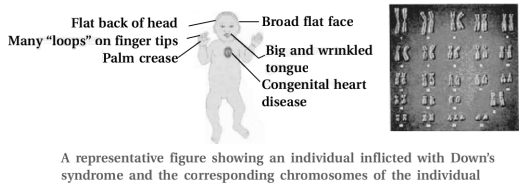
Down's syndrome is caused by the presence of an additional copy of chromosome number $21$ (trisomy of $21$). This disorder was first described by Langdon Down $(1866)$. The affected individual is short-statured with a small round head,furrowed tongue,and partially open mouth. The palm is broad with a characteristic palm crease. Physical,psychomotor,and mental development is retarded.
Failure of segregation of chromatids during the cell division cycle results in the gain or loss of a chromosome$(s)$,a condition called aneuploidy.
For example,Down's syndrome results from the gain of an extra copy of chromosome $21$.
Similarly,Turner's syndrome results from the loss of an $X$-chromosome in human females.
Failure of cytokinesis after the telophase stage of cell division results in an increase in a whole set of chromosomes in an organism,a phenomenon known as polyploidy. This condition is often seen in plants.
The total number of chromosomes in a normal human cell is $46$ ($23$ pairs). Out of these,$22$ pairs are autosomes and one pair consists of sex chromosomes.
Sometimes,though rarely,an additional copy of a chromosome may be included in an individual,or an individual may lack one chromosome from any pair. These situations are known as trisomy or monosomy,respectively. Such conditions lead to very serious consequences for the individual.
Down's syndrome,Turner's syndrome,and Klinefelter's syndrome are common examples of chromosomal disorders.
Down's syndrome is caused by the presence of an additional copy of chromosome number $21$ (trisomy of $21$). This disorder was first described by Langdon Down $(1866)$. The affected individual is short-statured with a small round head,furrowed tongue,and partially open mouth. The palm is broad with a characteristic palm crease. Physical,psychomotor,and mental development is retarded.
0 likes
View Solution116
Medium
Explain chromosomal disorders involving autosomes and sex chromosomes with examples.
Solution
(N/A) In humans,the total number of chromosomes is $23$ pairs $(46)$. Out of these,$22$ pairs are autosomes and $1$ pair consists of sex chromosomes.
Chromosomal disorders are primarily caused by the failure of segregation of chromatids during cell division,leading to gain or loss of chromosomes (aneuploidy).
$1$. Autosomal disorders: These involve abnormalities in the $22$ pairs of autosomes. $A$ classic example is $Down's$ syndrome,which is caused by the presence of an additional copy of chromosome number $21$ (Trisomy of $21$).
$2$. Sex chromosomal disorders: These involve abnormalities in the sex chromosomes ($XX$ or $XY$). Examples include:
- $Klinefelter's$ syndrome: Caused by the presence of an additional $X$ chromosome in males $(47, XXY)$.
- $Turner's$ syndrome: Caused by the absence of one $X$ chromosome in females $(45, X0)$.
Chromosomal disorders are primarily caused by the failure of segregation of chromatids during cell division,leading to gain or loss of chromosomes (aneuploidy).
$1$. Autosomal disorders: These involve abnormalities in the $22$ pairs of autosomes. $A$ classic example is $Down's$ syndrome,which is caused by the presence of an additional copy of chromosome number $21$ (Trisomy of $21$).
$2$. Sex chromosomal disorders: These involve abnormalities in the sex chromosomes ($XX$ or $XY$). Examples include:
- $Klinefelter's$ syndrome: Caused by the presence of an additional $X$ chromosome in males $(47, XXY)$.
- $Turner's$ syndrome: Caused by the absence of one $X$ chromosome in females $(45, X0)$.
0 likes
View Solution117
Medium
Briefly explain Down's syndrome.
Solution
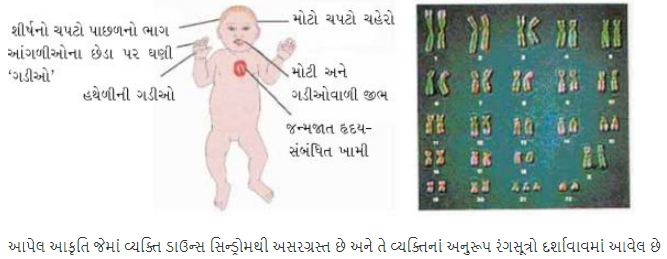
(N/A) Down's syndrome is a chromosomal disorder caused by the presence of an additional copy of chromosome number $21$ (trisomy of $21$).
This results in a total of $47$ chromosomes instead of the normal $46$.
This disorder was first described by Langdon Down in $1866$.
Key features of an affected individual include:
$1$. Short stature with a small round head.
$2$. Furrowed tongue and partially open mouth.
$3$. Palm is broad with a characteristic palm crease.
$4$. Physical,psychomotor,and mental development is retarded.
$5$. Eyes have epicanthic folds.
$6$. Congenital heart defects and underdeveloped reproductive organs.
The incidence of this syndrome is approximately $1$ in $700$ births,and it is more common in children born to mothers of advanced maternal age.
This results in a total of $47$ chromosomes instead of the normal $46$.
This disorder was first described by Langdon Down in $1866$.
Key features of an affected individual include:
$1$. Short stature with a small round head.
$2$. Furrowed tongue and partially open mouth.
$3$. Palm is broad with a characteristic palm crease.
$4$. Physical,psychomotor,and mental development is retarded.
$5$. Eyes have epicanthic folds.
$6$. Congenital heart defects and underdeveloped reproductive organs.
The incidence of this syndrome is approximately $1$ in $700$ births,and it is more common in children born to mothers of advanced maternal age.
0 likes
View Solution118
Medium
Give examples of disorders caused by sex chromosomal abnormalities and describe them briefly.
Solution
(N/A) Examples of sex chromosomal abnormalities include Klinefelter's syndrome (trisomy) and Turner's syndrome (monosomy).
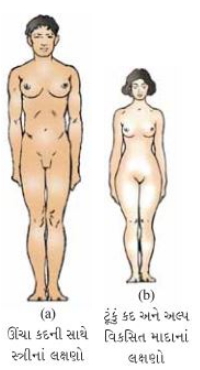
$1$. Klinefelter's Syndrome $(47, XXY)$: This genetic disorder is caused by the presence of an additional copy of the $X$ chromosome,resulting in a karyotype of $47, XXY$.
- Individuals have an overall masculine development,but they are sterile.
- Testes are underdeveloped.
- They exhibit tall stature,long limbs,and sparse body hair.
- They may show feminine characteristics such as gynecomastia (development of breast tissue) and a high-pitched voice.
- Some individuals may exhibit mild mental retardation.
- It occurs in approximately $1$ in $1500$ individuals.
$2$. Turner's Syndrome $(45, XO)$: This disorder is caused by the absence of one $X$ chromosome,resulting in a karyotype of $45, XO$.
- Such individuals are sterile females.
- They have short stature and a webbed neck.
- Ovaries are rudimentary and the uterus is underdeveloped.
- Lack of secondary sexual characteristics is observed.
$1$. Klinefelter's Syndrome $(47, XXY)$: This genetic disorder is caused by the presence of an additional copy of the $X$ chromosome,resulting in a karyotype of $47, XXY$.
- Individuals have an overall masculine development,but they are sterile.
- Testes are underdeveloped.
- They exhibit tall stature,long limbs,and sparse body hair.
- They may show feminine characteristics such as gynecomastia (development of breast tissue) and a high-pitched voice.
- Some individuals may exhibit mild mental retardation.
- It occurs in approximately $1$ in $1500$ individuals.
$2$. Turner's Syndrome $(45, XO)$: This disorder is caused by the absence of one $X$ chromosome,resulting in a karyotype of $45, XO$.
- Such individuals are sterile females.
- They have short stature and a webbed neck.
- Ovaries are rudimentary and the uterus is underdeveloped.
- Lack of secondary sexual characteristics is observed.
0 likes
View Solution119
Easy
Distinguish between: Down's syndrome and Klinefelter's syndrome.
Solution
(N/A)
| Down's Syndrome | Klinefelter's Syndrome |
|---|---|
| $1$. It is an autosomal chromosomal disorder. | $1$. It is a sex chromosomal disorder. |
| $2$. It is caused by the presence of an additional copy of chromosome number $21$. | $2$. It is caused by the presence of an additional copy of $X$-chromosome. |
| $3$. The karyotype is $47, XX, +21$ or $47, XY, +21$. | $3$. The karyotype is $47, XXY$. |
| $4$. It can occur in both males and females. | $4$. It occurs only in males. |
0 likes
View Solution120
Easy
Explain the difference between Haploidy and Polyploidy.
Solution
(N/A) Haploidy: It is a condition where a cell or organism contains only one set of chromosomes $(n)$. This is typical in gametes.
Polyploidy: It is a condition where a cell or organism contains more than two complete sets of chromosomes (e.g.,$3n, 4n, 5n, ...$). This is common in plants and can occur due to failure of cell division.
Polyploidy: It is a condition where a cell or organism contains more than two complete sets of chromosomes (e.g.,$3n, 4n, 5n, ...$). This is common in plants and can occur due to failure of cell division.
0 likes
View Solution121
Easy
Explain the difference between Euploidy and Aneuploidy.
Solution
(N/A) Euploidy: It refers to the condition where the total number of chromosomes in a cell is an exact multiple of the haploid set $(n)$. For example,$2n$ (diploid),$3n$ (triploid),or $4n$ (tetraploid).
Aneuploidy: It refers to the condition where there is a gain or loss of one or more individual chromosomes,rather than an entire set. This results in an abnormal number of chromosomes,such as $2n+1$ (trisomy) or $2n-1$ (monosomy).
Aneuploidy: It refers to the condition where there is a gain or loss of one or more individual chromosomes,rather than an entire set. This results in an abnormal number of chromosomes,such as $2n+1$ (trisomy) or $2n-1$ (monosomy).
0 likes
View Solution122
Medium
What is Down's syndrome? Give its symptoms and cause. Why is it that the chances of having a child with Down's syndrome increase if the age of the mother exceeds forty years?
Solution
(N/A) Down's syndrome is a human genetic disorder caused by the trisomy of chromosome number $21$. Such individuals are aneuploid and possess $47$ chromosomes $(2n+1)$.
Symptoms include mental retardation,stunted physical growth,a constantly open mouth,a furrowed tongue,and short stature.
The cause of this disorder is the non-disjunction (failure to separate) of the homologous chromosomes of pair $21$ during meiotic division in the ovum.
The chances of having a child with Down's syndrome increase with the age of the mother (above $40$ years) because all ova are present in the female from birth. As the mother ages,these older cells are more prone to chromosomal non-disjunction due to the cumulative effect of various physico-chemical exposures throughout the mother's lifetime.
Symptoms include mental retardation,stunted physical growth,a constantly open mouth,a furrowed tongue,and short stature.
The cause of this disorder is the non-disjunction (failure to separate) of the homologous chromosomes of pair $21$ during meiotic division in the ovum.
The chances of having a child with Down's syndrome increase with the age of the mother (above $40$ years) because all ova are present in the female from birth. As the mother ages,these older cells are more prone to chromosomal non-disjunction due to the cumulative effect of various physico-chemical exposures throughout the mother's lifetime.
0 likes
View Solution123
Medium
Define aneuploidy. How is it different from polyploidy? Describe the individuals having the following chromosomal abnormalities:
$(a)$ Trisomy of $21^{st}$ chromosome
$(b)$ $XXY$
$(c)$ $XO$
$(a)$ Trisomy of $21^{st}$ chromosome
$(b)$ $XXY$
$(c)$ $XO$
Solution
(A-D) Definition of Aneuploidy: The failure of segregation of chromatids during the cell division cycle results in the gain or loss of a chromosome$(s)$, which is called aneuploidy.
Difference between aneuploidy and polyploidy:
$(a)$ Down's Syndrome: This is an autosomal aneuploidy caused by the presence of an additional copy of chromosome number $21$ (trisomy of $21$) due to non-disjunction during gamete formation. The affected individual is short-statured with a small round head, furrowed tongue, and partially open mouth. Palm is broad with a characteristic palm crease. Physical, psychomotor, and mental development is retarded.
$(b)$ Klinefelter's Syndrome: This genetic disorder is a trisomy of sex chromosomes caused by the presence of an additional $X$-chromosome ($47$ chromosomes, $XXY$). Such an individual has overall masculine development, but feminine development (e.g., Gynaecomastia) is also expressed. Such individuals are sterile males.
$(c)$ Turner's Syndrome: This is a monosomy of sex chromosomes caused by the absence of one $X$-chromosome ($45$ chromosomes, $XO$). Such females are sterile as ovaries are rudimentary, and they lack other secondary sexual characters.
Difference between aneuploidy and polyploidy:
| Aneuploidy | Polyploidy |
| $(1)$ Chromatids fail to segregate during cell division. | $(1)$ Failure of cytokinesis after telophase. |
| $(2)$ There is a loss or gain of a chromosome from the particular number of homologous pairs, e.g., $2n-1, 2n+1, 2n-2, 2n+2$. | $(2)$ The entire set of chromosomes is altered, e.g., $3n, 4n$. |
| $(3)$ It can lead to disorders like Down syndrome, Turner syndrome, and Klinefelter's syndrome. | $(3)$ It is often useful in plant breeding. |
$(a)$ Down's Syndrome: This is an autosomal aneuploidy caused by the presence of an additional copy of chromosome number $21$ (trisomy of $21$) due to non-disjunction during gamete formation. The affected individual is short-statured with a small round head, furrowed tongue, and partially open mouth. Palm is broad with a characteristic palm crease. Physical, psychomotor, and mental development is retarded.
$(b)$ Klinefelter's Syndrome: This genetic disorder is a trisomy of sex chromosomes caused by the presence of an additional $X$-chromosome ($47$ chromosomes, $XXY$). Such an individual has overall masculine development, but feminine development (e.g., Gynaecomastia) is also expressed. Such individuals are sterile males.
$(c)$ Turner's Syndrome: This is a monosomy of sex chromosomes caused by the absence of one $X$-chromosome ($45$ chromosomes, $XO$). Such females are sterile as ovaries are rudimentary, and they lack other secondary sexual characters.
0 likes
View Solution124
Medium
Describe chromosomal disorders and provide their examples.
Solution
(N/A) Chromosomal disorders are caused due to the absence,excess,or abnormal arrangement of one or more chromosomes.
Failure of segregation of chromatids during the cell division cycle results in the gain or loss of a chromosome$(s)$,a condition called $aneuploidy$. For example,Down's syndrome results in the gain of an extra copy of chromosome $21$. Similarly,Turner's syndrome results from the loss of an $X$ chromosome in human females.
Failure of cytokinesis after the telophase stage of cell division results in an increase in a whole set of chromosomes in an organism; this phenomenon is known as $polyploidy$. This condition is often seen in plants.
The total number of chromosomes in a normal human being is $46$ ($23$ pairs). Out of these,$22$ pairs are autosomes and one pair consists of sex chromosomes. Sometimes,though rarely,an additional copy of a chromosome may be included in an individual,or an individual may lack one chromosome from any pair. These situations are known as $trisomy$ or $monosomy$ of a chromosome,respectively. Such situations lead to serious consequences. Down's syndrome,Turner's syndrome,and Klinefelter's syndrome are common examples of chromosomal disorders.
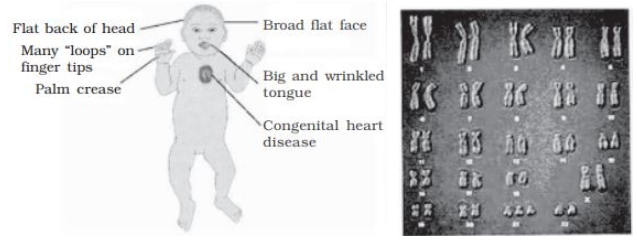
$1$. $Down's$ $Syndrome$: The cause of this genetic disorder is the presence of an additional copy of chromosome number $21$ ($trisomy$ of $21$). This disorder was first described by Langdon Down $(1866)$. The affected individual is short-statured with a small round head,furrowed tongue,and partially open mouth. The palm is broad with a characteristic palm crease. Physical,psychomotor,and mental development is retarded.
$2$. $Klinefelter's$ $Syndrome$: This genetic disorder is caused due to the presence of an additional copy of the $X$-chromosome,resulting in a karyotype of $47$,$XXY$. Such an individual has overall masculine development; however,feminine development (development of breasts,i.e.,$Gynaecomastia$) is also expressed. Such individuals are sterile.
$3$. $Turner's$ $Syndrome$: This disorder is caused due to the absence of one of the $X$ chromosomes,i.e.,$45$ with $X0$. Such females are sterile as ovaries are rudimentary,besides other features including a lack of secondary sexual characters.
Failure of segregation of chromatids during the cell division cycle results in the gain or loss of a chromosome$(s)$,a condition called $aneuploidy$. For example,Down's syndrome results in the gain of an extra copy of chromosome $21$. Similarly,Turner's syndrome results from the loss of an $X$ chromosome in human females.
Failure of cytokinesis after the telophase stage of cell division results in an increase in a whole set of chromosomes in an organism; this phenomenon is known as $polyploidy$. This condition is often seen in plants.
The total number of chromosomes in a normal human being is $46$ ($23$ pairs). Out of these,$22$ pairs are autosomes and one pair consists of sex chromosomes. Sometimes,though rarely,an additional copy of a chromosome may be included in an individual,or an individual may lack one chromosome from any pair. These situations are known as $trisomy$ or $monosomy$ of a chromosome,respectively. Such situations lead to serious consequences. Down's syndrome,Turner's syndrome,and Klinefelter's syndrome are common examples of chromosomal disorders.
$1$. $Down's$ $Syndrome$: The cause of this genetic disorder is the presence of an additional copy of chromosome number $21$ ($trisomy$ of $21$). This disorder was first described by Langdon Down $(1866)$. The affected individual is short-statured with a small round head,furrowed tongue,and partially open mouth. The palm is broad with a characteristic palm crease. Physical,psychomotor,and mental development is retarded.
$2$. $Klinefelter's$ $Syndrome$: This genetic disorder is caused due to the presence of an additional copy of the $X$-chromosome,resulting in a karyotype of $47$,$XXY$. Such an individual has overall masculine development; however,feminine development (development of breasts,i.e.,$Gynaecomastia$) is also expressed. Such individuals are sterile.
$3$. $Turner's$ $Syndrome$: This disorder is caused due to the absence of one of the $X$ chromosomes,i.e.,$45$ with $X0$. Such females are sterile as ovaries are rudimentary,besides other features including a lack of secondary sexual characters.
0 likes
View Solution125
MediumMCQ
What is the number of Barr bodies in a male with Jacobs syndrome?
A
$0$
B
$1$
C
$2$
D
$3$
Solution
(A) Jacobs syndrome is a chromosomal condition characterized by the presence of an extra $Y$ chromosome in a male,resulting in a $47,XYY$ karyotype.
Barr bodies are inactive $X$ chromosomes found in the somatic cells of individuals with more than one $X$ chromosome.
The formula to calculate the number of Barr bodies is $N - 1$,where $N$ is the total number of $X$ chromosomes.
In a $47,XYY$ male,the number of $X$ chromosomes is $1$.
Therefore,the number of Barr bodies = $1 - 1 = 0$.
Barr bodies are inactive $X$ chromosomes found in the somatic cells of individuals with more than one $X$ chromosome.
The formula to calculate the number of Barr bodies is $N - 1$,where $N$ is the total number of $X$ chromosomes.
In a $47,XYY$ male,the number of $X$ chromosomes is $1$.
Therefore,the number of Barr bodies = $1 - 1 = 0$.
0 likes
View Solution126
MediumMCQ
Down's syndrome is caused by the trisomy of which chromosome pair?
A
$22^{nd}$ pair
B
$23^{rd}$ pair
C
$21^{st}$ pair
D
All of these
Solution
(C) Down's syndrome is a genetic disorder caused by the presence of an extra copy of chromosome number $21$.
This condition is known as trisomy of chromosome $21$,where an individual has $47$ chromosomes instead of the normal $46$.
It was first described by Langdon Down in $1866$.
Therefore,the correct option is $C$.
This condition is known as trisomy of chromosome $21$,where an individual has $47$ chromosomes instead of the normal $46$.
It was first described by Langdon Down in $1866$.
Therefore,the correct option is $C$.
0 likes
View Solution127
MediumMCQ
Which disorder is caused by the loss of one $X$ chromosome in females?
A
Klinefelter's syndrome
B
Turner's syndrome
C
Down's syndrome
D
Both $A$ and $B$
Solution
(B) Turner's syndrome is caused by the absence of one of the $X$ chromosomes,i.e.,$45$ with $X0$ genotype.
Such females are sterile as ovaries are rudimentary besides other features including lack of other secondary sexual characters.
Klinefelter's syndrome occurs in males $(47, XXY)$ and Down's syndrome is caused by trisomy of chromosome $21$.
Such females are sterile as ovaries are rudimentary besides other features including lack of other secondary sexual characters.
Klinefelter's syndrome occurs in males $(47, XXY)$ and Down's syndrome is caused by trisomy of chromosome $21$.
0 likes
View Solution128
MediumMCQ
Which of the following characteristics is common in plants?
A
Aneuploidy
B
Monosomy
C
Tetrasomy
D
Polyploidy
Solution
(D) Polyploidy is a condition in which an organism has more than two complete sets of chromosomes. This phenomenon is very common in plants and has played a significant role in plant evolution and speciation. Many cultivated crops,such as wheat,potatoes,and bananas,are polyploids. In contrast,aneuploidy (including monosomy and tetrasomy) is generally less common and often associated with developmental abnormalities in both plants and animals.
0 likes
View Solution129
MediumMCQ
Which of the following disorders exhibits sex chromosomal monosomy?
A
Down's syndrome
B
Turner's syndrome
C
Klinefelter's syndrome
D
Thalassemia
Solution
(B) Turner's syndrome is a chromosomal disorder caused by the absence of one of the $X$ chromosomes,resulting in a $45, XO$ genotype.
This condition is characterized by sex chromosomal monosomy,where an individual has only one $X$ chromosome instead of the usual pair.
Down's syndrome is caused by trisomy of chromosome $21$.
Klinefelter's syndrome is characterized by an extra $X$ chromosome,resulting in a $47, XXY$ genotype.
Thalassemia is an autosomal recessive blood disorder.
This condition is characterized by sex chromosomal monosomy,where an individual has only one $X$ chromosome instead of the usual pair.
Down's syndrome is caused by trisomy of chromosome $21$.
Klinefelter's syndrome is characterized by an extra $X$ chromosome,resulting in a $47, XXY$ genotype.
Thalassemia is an autosomal recessive blood disorder.
0 likes
View Solution130
MediumMCQ
Which of the following does not represent trisomy?
A
Down's syndrome
B
Klinefelter's syndrome
C
Both $a$ and $b$
D
Turner's syndrome
Solution
(D) Trisomy is a type of aneuploidy where an extra chromosome is present in a diploid set,represented as $(2n + 1)$.
$1$. Down's syndrome is caused by the presence of an additional copy of chromosome number $21$ $(2n + 1 = 47)$.
$2$. Klinefelter's syndrome is caused by the presence of an additional $X$ chromosome in males,resulting in a genotype of $XXY$ $(2n + 1 = 47)$.
$3$. Turner's syndrome is caused by the absence of one $X$ chromosome in females,resulting in a genotype of $XO$ $(2n - 1 = 45)$,which is an example of monosomy,not trisomy.
Therefore,Turner's syndrome does not represent trisomy.
$1$. Down's syndrome is caused by the presence of an additional copy of chromosome number $21$ $(2n + 1 = 47)$.
$2$. Klinefelter's syndrome is caused by the presence of an additional $X$ chromosome in males,resulting in a genotype of $XXY$ $(2n + 1 = 47)$.
$3$. Turner's syndrome is caused by the absence of one $X$ chromosome in females,resulting in a genotype of $XO$ $(2n - 1 = 45)$,which is an example of monosomy,not trisomy.
Therefore,Turner's syndrome does not represent trisomy.
0 likes
View Solution131
MediumMCQ
What is the chromosomal constitution in Klinefelter syndrome due to trisomy?
A
$XX$
B
$XXX$
C
$XXY$
D
$XYY$
Solution
(C) Klinefelter syndrome is a genetic disorder caused by the presence of an extra $X$ chromosome in males.
This condition arises due to the fusion of an abnormal egg $(XX)$ with a normal sperm $(Y)$ or an abnormal sperm $(XY)$ with a normal egg $(X)$.
As a result,the individual has a total of $47$ chromosomes instead of the normal $46$,with the sex chromosome constitution being $XXY$.
Therefore,the correct option is $C$.
This condition arises due to the fusion of an abnormal egg $(XX)$ with a normal sperm $(Y)$ or an abnormal sperm $(XY)$ with a normal egg $(X)$.
As a result,the individual has a total of $47$ chromosomes instead of the normal $46$,with the sex chromosome constitution being $XXY$.
Therefore,the correct option is $C$.
0 likes
View Solution132
MediumMCQ
Fissured tongue,short stature,and physical or mental retardation are characteristic features of which disorder?
A
Turner's syndrome
B
Down's syndrome
C
Klinefelter's syndrome
D
All of the above
Solution
(B) Down's syndrome is a chromosomal disorder caused by the presence of an additional copy of chromosome number $21$ (trisomy of $21$).
Individuals with Down's syndrome exhibit several characteristic features,including a short stature,a small round head,a furrowed (fissured) tongue,and partially open mouth.
They also typically show physical,psychomotor,and mental retardation.
Therefore,the correct option is $B$.
Individuals with Down's syndrome exhibit several characteristic features,including a short stature,a small round head,a furrowed (fissured) tongue,and partially open mouth.
They also typically show physical,psychomotor,and mental retardation.
Therefore,the correct option is $B$.
0 likes
View Solution133
MediumMCQ
In a human karyotype,if there are $45$ chromosomes with an $XO$ configuration,which disorder is present?
A
Female - Jacobs syndrome
B
Male - Klinefelter syndrome
C
Female - Turner's syndrome
D
Female - Down's syndrome
Solution
(C) The $XO$ chromosomal configuration represents a condition where an individual has $45$ chromosomes instead of the normal $46$.
This occurs due to the absence of one $X$ chromosome in females.
This condition is known as Turner's syndrome.
Individuals with this syndrome are phenotypically female but are sterile,have rudimentary ovaries,and lack other secondary sexual characteristics.
This occurs due to the absence of one $X$ chromosome in females.
This condition is known as Turner's syndrome.
Individuals with this syndrome are phenotypically female but are sterile,have rudimentary ovaries,and lack other secondary sexual characteristics.
0 likes
View Solution134
MediumMCQ
Which of the following disorders does not result in a sterile individual?
A
Down's syndrome
B
Turner's syndrome
C
Klinefelter's syndrome
D
All of the above
Solution
(A) Down's syndrome is caused by the presence of an additional copy of chromosome number $21$ ($trisomy$ of $21$). Individuals with Down's syndrome are not necessarily sterile; they can be fertile,although they exhibit physical and mental developmental delays.
Turner's syndrome $(45, XO)$ results in sterile females with rudimentary ovaries.
Klinefelter's syndrome $(47, XXY)$ results in sterile males with underdeveloped testes.
Therefore,individuals with Down's syndrome are the only ones among the options who are not inherently sterile.
Turner's syndrome $(45, XO)$ results in sterile females with rudimentary ovaries.
Klinefelter's syndrome $(47, XXY)$ results in sterile males with underdeveloped testes.
Therefore,individuals with Down's syndrome are the only ones among the options who are not inherently sterile.
0 likes
View Solution135
MediumMCQ
What is the number of Barr bodies in an individual with Klinefelter syndrome?
A
$0$
B
$1$
C
$2$
D
$3$
Solution
(B) Klinefelter syndrome is a genetic condition characterized by the presence of an extra $X$ chromosome in males,resulting in a genotype of $47, XXY$.
Barr bodies are inactive $X$ chromosomes found in the somatic cells of individuals with more than one $X$ chromosome.
The formula to calculate the number of Barr bodies is $N - 1$,where $N$ is the total number of $X$ chromosomes.
For Klinefelter syndrome $(XXY)$,$N = 2$.
Therefore,the number of Barr bodies = $2 - 1 = 1$.
Barr bodies are inactive $X$ chromosomes found in the somatic cells of individuals with more than one $X$ chromosome.
The formula to calculate the number of Barr bodies is $N - 1$,where $N$ is the total number of $X$ chromosomes.
For Klinefelter syndrome $(XXY)$,$N = 2$.
Therefore,the number of Barr bodies = $2 - 1 = 1$.
0 likes
View Solution136
MediumMCQ
Match Column $-I$ with Column $-II$ and select the correct option.
| Column $-I$ | Column $-II$ |
| $(P)$ Turner syndrome | $(i)$ Sex chromosome $(2n-1)$ |
| $(Q)$ Down syndrome | $(ii)$ Sex chromosome $(2n+1)$ |
| $(R)$ Klinefelter syndrome | $(iii)$ Autosomal $(2n+1)$ |
A
$P-i, Q-iii, R-ii$
B
$P-i, Q-ii, R-iii$
C
$P-iii, Q-i, R-ii$
D
$P-iii, Q-ii, R-i$
Solution
(A) The correct matches are as follows:
$(P)$ Turner syndrome: It is caused by the absence of one $X$ chromosome, resulting in a $45$ $(XO)$ genotype. This is represented as sex chromosome $(2n-1)$. Thus, $P-i$.
$(Q)$ Down syndrome: It is caused by an extra copy of chromosome $21$, which is an autosome. This is represented as autosomal $(2n+1)$. Thus, $Q-iii$.
$(R)$ Klinefelter syndrome: It is caused by the presence of an extra $X$ chromosome in males, resulting in a $47$ $(XXY)$ genotype. This is represented as sex chromosome $(2n+1)$. Thus, $R-ii$.
Therefore, the correct sequence is $P-i, Q-iii, R-ii$.
$(P)$ Turner syndrome: It is caused by the absence of one $X$ chromosome, resulting in a $45$ $(XO)$ genotype. This is represented as sex chromosome $(2n-1)$. Thus, $P-i$.
$(Q)$ Down syndrome: It is caused by an extra copy of chromosome $21$, which is an autosome. This is represented as autosomal $(2n+1)$. Thus, $Q-iii$.
$(R)$ Klinefelter syndrome: It is caused by the presence of an extra $X$ chromosome in males, resulting in a $47$ $(XXY)$ genotype. This is represented as sex chromosome $(2n+1)$. Thus, $R-ii$.
Therefore, the correct sequence is $P-i, Q-iii, R-ii$.
0 likes
View Solution137
MediumMCQ
The given figure represents the formation of which type of peptide?
A
Hemoglobin $\alpha$-peptide
B
Hemoglobin $\beta$-peptide
C
Sickle-cell anemia affected $\alpha$-peptide
D
Sickle-cell anemia affected $\beta$-peptide
Solution
(D) Sickle-cell anemia is a genetic disorder caused by a point mutation in the gene coding for the $\beta$-globin chain of hemoglobin.
In this mutation,the codon $GAG$ is replaced by $GUG$ at the sixth position of the $\beta$-globin chain.
This results in the substitution of Glutamic acid $(Glu)$ with Valine $(Val)$.
Therefore,the figure typically illustrates the mutated $\beta$-globin chain associated with sickle-cell anemia.
In this mutation,the codon $GAG$ is replaced by $GUG$ at the sixth position of the $\beta$-globin chain.
This results in the substitution of Glutamic acid $(Glu)$ with Valine $(Val)$.
Therefore,the figure typically illustrates the mutated $\beta$-globin chain associated with sickle-cell anemia.
0 likes
View Solution138
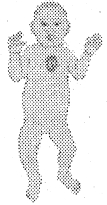
MediumMCQ
The given figure represents which disorder?
A
Turner's syndrome
B
Klinefelter's syndrome
C
Down's syndrome
D
Philadelphia syndrome
Solution
(C) The figure provided is a standard representation of a child with Down's syndrome,as found in the $NCERT$ biology textbook.
Down's syndrome is a chromosomal disorder caused by the presence of an additional copy of chromosome number $21$ (trisomy of $21$).
The clinical features include a short stature,small round head,furrowed tongue,and partially open mouth.
Therefore,the correct option is $C$.
Down's syndrome is a chromosomal disorder caused by the presence of an additional copy of chromosome number $21$ (trisomy of $21$).
The clinical features include a short stature,small round head,furrowed tongue,and partially open mouth.
Therefore,the correct option is $C$.
0 likes
View Solution139
MediumMCQ
$A$ condition characterized by not having an exact number of chromosomes in a diploid set is called
A
Polyploidy
B
Synploidy
C
Aneuploidy
D
None of these
Solution
(C) Aneuploidy is the variation in the number of individual chromosomes within a set.
It occurs due to the loss or gain of one or more chromosomes,which disrupts the genetic balance and prevents normal development.
Examples include conditions like $2n-1$,$2n-2$,$2n+1$,and $2n+2$.
It occurs due to the loss or gain of one or more chromosomes,which disrupts the genetic balance and prevents normal development.
Examples include conditions like $2n-1$,$2n-2$,$2n+1$,and $2n+2$.
0 likes
View Solution140
MediumMCQ
Down's syndrome is an example of
A
Aneuploidy
B
Polyteny
C
Polyploidy
D
Monoploidy
Solution
(A) Aneuploidy is a condition characterized by an abnormal number of chromosomes in a cell,resulting from the gain or loss of one or more chromosomes during cell division.
Down's syndrome is a specific chromosomal disorder caused by the presence of an extra copy of chromosome $21$,a condition known as trisomy $21$.
Since this involves the addition of a single chromosome to the diploid set,it is classified as a type of aneuploidy.
Down's syndrome is a specific chromosomal disorder caused by the presence of an extra copy of chromosome $21$,a condition known as trisomy $21$.
Since this involves the addition of a single chromosome to the diploid set,it is classified as a type of aneuploidy.
0 likes
View Solution141
MediumMCQ
Which of these is not a Mendelian disorder?
A
Cystic fibrosis
B
Sickle-cell anaemia
C
Colour blindness
D
Turner's syndrome
Solution
(D) Mendelian disorders are primarily determined by alteration or mutation in a single gene. Examples include cystic fibrosis,sickle-cell anaemia,colour blindness,and haemophilia.
Turner's syndrome is a chromosomal disorder caused by the absence of one of the $X$ chromosomes,resulting in a $45$ $(44 + XO)$ genotype.
Therefore,Turner's syndrome is not a Mendelian disorder but a chromosomal one.
Turner's syndrome is a chromosomal disorder caused by the absence of one of the $X$ chromosomes,resulting in a $45$ $(44 + XO)$ genotype.
Therefore,Turner's syndrome is not a Mendelian disorder but a chromosomal one.
0 likes
View Solution142
MediumMCQ
When the chromosome number of a given organism has one additional chromosome in one of the homologous pairs,the addition is known as
A
Trisomy
B
Monosomy
C
Polyploidy
D
Nullisomy
Solution
(A) Trisomy is a type of aneuploidy where an individual has one extra chromosome in one of the homologous pairs,represented by the formula $(2n + 1)$.
Monosomy refers to the loss of one chromosome $(2n - 1)$.
Nullisomy refers to the loss of a pair of homologous chromosomes $(2n - 2)$.
Polyploidy refers to an increase in the number of whole sets of chromosomes.
Monosomy refers to the loss of one chromosome $(2n - 1)$.
Nullisomy refers to the loss of a pair of homologous chromosomes $(2n - 2)$.
Polyploidy refers to an increase in the number of whole sets of chromosomes.
0 likes
View Solution143
MediumMCQ
$A$ person having $45$ chromosomes where the $Y$ chromosome is absent. Such a condition is known as
A
Down's syndrome
B
Klinefelter's syndrome
C
Turner's syndrome
D
Gynandromorph
Solution
(C) person having $45$ chromosomes instead of $46$ due to the absence of a $Y$ chromosome is suffering from Turner's syndrome.
This condition is represented as $44 + X$ or $45, XO$.
In this disorder,the individual is a female who is sterile,has rudimentary ovaries,and lacks other secondary sexual characters.
This condition is represented as $44 + X$ or $45, XO$.
In this disorder,the individual is a female who is sterile,has rudimentary ovaries,and lacks other secondary sexual characters.
0 likes
View Solution144
EasyMCQ
$21$ trisomy in humans causes
A
Klinefelter's syndrome
B
Down's syndrome
C
Turner's syndrome
D
Patau's syndrome
Solution
(B) Down's syndrome is a genetic disorder caused by the presence of an extra copy of chromosome $21$ (trisomy $21$).
This condition occurs due to the failure of segregation of homologous chromosomes during meiosis,leading to an individual having $47$ chromosomes instead of the normal $46$.
Key features include mental retardation,a characteristic facial appearance (such as epicanthal folds),and a protruding tongue.
In contrast,Klinefelter's syndrome $(44+XXY)$ and Turner's syndrome $(44+XO)$ are sex-chromosomal disorders,while Patau's syndrome is caused by trisomy of chromosome $13$.
This condition occurs due to the failure of segregation of homologous chromosomes during meiosis,leading to an individual having $47$ chromosomes instead of the normal $46$.
Key features include mental retardation,a characteristic facial appearance (such as epicanthal folds),and a protruding tongue.
In contrast,Klinefelter's syndrome $(44+XXY)$ and Turner's syndrome $(44+XO)$ are sex-chromosomal disorders,while Patau's syndrome is caused by trisomy of chromosome $13$.
0 likes
View Solution145
EasyMCQ
In Turner's syndrome:
A
Female is fertile
B
Male is fertile
C
Female is sterile
D
Male is sterile
Solution
(C) Turner's syndrome is a genetic disorder caused by the absence of one $X$ chromosome in females,resulting in a $45, XO$ genotype (monosomy).
Key characteristics include:
$1$. Affected individuals are phenotypically female.
$2$. They exhibit short stature and webbed neck.
$3$. They have underdeveloped ovaries and breasts.
$4$. They are sterile due to the lack of functional ovaries.
Key characteristics include:
$1$. Affected individuals are phenotypically female.
$2$. They exhibit short stature and webbed neck.
$3$. They have underdeveloped ovaries and breasts.
$4$. They are sterile due to the lack of functional ovaries.
| Disorder | Genetic Basis |
| Down's syndrome | Autosomal aneuploidy ($47, XX+21$ or $47, XY+21$) |
| Turner's syndrome | Sex chromosomal monosomy $(45, XO)$ |
| Klinefelter's syndrome | Sex chromosomal aneuploidy $(47, XXY)$ |
0 likes
View Solution146
MediumMCQ
Number of chromosomes in Down's syndrome are
A
$46$
B
$47$
C
$48$
D
$49$
Solution
(B) Down's syndrome is a genetic disorder caused by the presence of an extra copy of chromosome number $21$,a condition known as trisomy of chromosome $21$.
In a normal human cell,there are $46$ chromosomes ($44$ autosomes + $2$ sex chromosomes).
Due to the trisomy of the $21^{\text{st}}$ chromosome,the total count becomes $46 + 1 = 47$ chromosomes.
Thus,a patient with Down's syndrome has $47$ chromosomes,represented as $45A + XX$ or $45A + XY$.
In a normal human cell,there are $46$ chromosomes ($44$ autosomes + $2$ sex chromosomes).
Due to the trisomy of the $21^{\text{st}}$ chromosome,the total count becomes $46 + 1 = 47$ chromosomes.
Thus,a patient with Down's syndrome has $47$ chromosomes,represented as $45A + XX$ or $45A + XY$.
0 likes
View Solution147
EasyMCQ
The diagrammatic representation of the chromosomes of an individual is called
A
Idiogram
B
Karyotype
C
Phenotype
D
Diploidy
Solution
(A) An idiogram is a diagrammatic representation of the chromosomes of an individual,typically arranged in pairs according to their size,shape,and centromere position. While a karyotype refers to the complete set of chromosomes in an individual,an idiogram specifically refers to the schematic or diagrammatic illustration of these chromosomes.
0 likes
View Solution148
MediumMCQ
Number of Barr bodies in $XXXXY$ is
A
$1$
B
$2$
C
$3$
D
$4$
Solution
(C) Barr body (sex chromatin) is the densely staining mass that represents an inactivated $X$ chromosome found in the nuclei of somatic cells of most female mammals.
The number of Barr bodies is calculated as one less than the total number of $X$ chromosomes.
Therefore,the number of Barr bodies in $XXXXY$ is $4 - 1 = 3$.
The number of Barr bodies is calculated as one less than the total number of $X$ chromosomes.
Therefore,the number of Barr bodies in $XXXXY$ is $4 - 1 = 3$.
0 likes
View Solution149
EasyMCQ
The loss of a chromosomal segment is due to
A
Polyploidy
B
Deletions
C
Duplications
D
Inversions
Solution
(B) Deletion is a type of chromosomal aberration that involves the loss of a segment of a chromosome.
This occurs when a break happens in the chromosome and the broken piece is lost during cell division,leading to a reduction in the total genetic material.
This occurs when a break happens in the chromosome and the broken piece is lost during cell division,leading to a reduction in the total genetic material.
0 likes
View SolutionPrinciples of Inheritance and Variation — Chromosomal disorders · Frequently Asked Questions
1Are these Principles of Inheritance and Variation questions useful for JEE and NEET?
Yes. All questions in this section are mapped to JEE Main and NEET exam patterns. Previous year questions from JEE Main, NEET, GUJCET and state-level exams are included with full solutions.
2Can I switch to Hindi or Gujarati for these questions?
Yes. Use the language tabs in the hero section or the sidebar to view the same questions and solutions in English, Hindi or Gujarati.
3How do I generate a question paper from this subtopic?
Use the Vedclass Exam Paper Generator — select the chapter and subtopic, set difficulty, and generate Sets A, B, C, D automatically. First 3 chapters of every subject are free.
Vedclass Products
For Students
Vedclass Test Series
Mock tests in real JEE/NEET style with performance analysis. 5-day free trial.
Start Free TrialFor Teachers
Exam Paper Generator
Generate Set A/B/C/D papers from this chapter in 2 minutes. 3 chapters free.
Try FreeFor Institutes
Online Exam Module
Live online exams with unlimited students, 360° analytics & white-label branding.
See DemoFor Teachers & Institutes
Generate a Principles of Inheritance and Variation Exam Paper in 2 Minutes
Select subtopic & difficulty — Sets A, B, C, D auto-generated with No Repeat logic.
First 3 chapters of every subject are free — no payment required.