
A English
Mix Examples - Biotechnology Principals and Process Questions in English
Class 12 Biology · Biotechnology Principals and Process · Mix Examples - Biotechnology Principals and Process
62+
Questions
English
Language
100%
With Solutions
Showing 48 of 62 questions in English
1
MediumMCQ
$DNA$ recombinant technology can be:
A
Harmful
B
Useful
C
Both harmful and useful
D
Neither harmful nor useful
Solution
(C) $DNA$ recombinant technology is a powerful tool in biotechnology.
It is considered useful because it allows for the production of therapeutic proteins (like insulin),genetically modified crops with higher yields,and gene therapy for treating diseases.
However,it can be potentially harmful if misused,such as in the creation of biological weapons,the accidental release of genetically modified organisms into the environment,or ethical concerns regarding genetic manipulation.
Therefore,it has both beneficial and potentially hazardous aspects.
It is considered useful because it allows for the production of therapeutic proteins (like insulin),genetically modified crops with higher yields,and gene therapy for treating diseases.
However,it can be potentially harmful if misused,such as in the creation of biological weapons,the accidental release of genetically modified organisms into the environment,or ethical concerns regarding genetic manipulation.
Therefore,it has both beneficial and potentially hazardous aspects.
0 likes
View Solution2
MediumMCQ
'Cloning' is meant for
A
Production of $HGH$ gene in $E. coli$
B
To preserve the genotype of organism
C
To replace the original gene
D
All of these
Solution
(D) Cloning refers to the process of producing genetically identical copies of a biological entity,such as a gene,cell,or organism.
$1$. In molecular cloning,specific $DNA$ fragments (like the $HGH$ gene) are inserted into vectors and replicated in host cells like $E. coli$.
$2$. In reproductive cloning,the primary objective is to create an organism that is genetically identical to the donor,thereby preserving its specific genotype.
$3$. While gene therapy involves replacing genes,cloning itself is fundamentally about replication and preservation of genetic information.
Therefore,the term is used in various contexts related to genetic replication and preservation.
$1$. In molecular cloning,specific $DNA$ fragments (like the $HGH$ gene) are inserted into vectors and replicated in host cells like $E. coli$.
$2$. In reproductive cloning,the primary objective is to create an organism that is genetically identical to the donor,thereby preserving its specific genotype.
$3$. While gene therapy involves replacing genes,cloning itself is fundamentally about replication and preservation of genetic information.
Therefore,the term is used in various contexts related to genetic replication and preservation.
0 likes
View Solution3
EasyMCQ
Biotechnology is the modern branch of biology which deals with
A
Genetic engineering
B
Biochemistry
C
Microbiology
D
All the above
Solution
(D) Biotechnology is a multidisciplinary field that involves the use of living organisms or their components to develop products and processes.
It integrates various scientific disciplines,including $Genetic \ engineering$,$Biochemistry$,and $Microbiology$,to improve human life and industrial efficiency.
Therefore,all the mentioned fields are integral components of modern biotechnology.
Thus,the correct option is $D$.
It integrates various scientific disciplines,including $Genetic \ engineering$,$Biochemistry$,and $Microbiology$,to improve human life and industrial efficiency.
Therefore,all the mentioned fields are integral components of modern biotechnology.
Thus,the correct option is $D$.
0 likes
View Solution4
MediumMCQ
Which one of the following pairs is not correctly matched?
A
Plasmid: Small piece of extrachromosomal $DNA$ in bacteria
B
Interferon: An enzyme that interferes with $DNA$ replication
C
Cosmid: $A$ vector for carrying large $DNA$ fragments into host cells
D
Myeloma: Antibody-producing tumor cells
Solution
(B) The correct answer is $B$.
Interferons are not enzymes; they are a group of signaling proteins (glycoproteins) released by host cells in response to the presence of several viruses.
They act as antiviral agents by inhibiting viral replication within host cells.
Charles Weismann $(1980)$ produced interferons using recombinant $DNA$ technology in $E. coli$.
Interferons are not enzymes; they are a group of signaling proteins (glycoproteins) released by host cells in response to the presence of several viruses.
They act as antiviral agents by inhibiting viral replication within host cells.
Charles Weismann $(1980)$ produced interferons using recombinant $DNA$ technology in $E. coli$.
0 likes
View Solution5
MediumMCQ
Recombinant $DNA$ technology is related with
A
$C$. Darwin
B
Stanley Cohen
C
Herbert Boyer
D
Both $(b)$ and $(c)$
Solution
(D) The development of recombinant $DNA$ technology is primarily attributed to Stanley Cohen and Herbert Boyer.
In $1973$,they successfully constructed the first recombinant $DNA$ molecule by linking an antibiotic resistance gene with a native plasmid of the bacterium $E. coli$.
In $1973$,they successfully constructed the first recombinant $DNA$ molecule by linking an antibiotic resistance gene with a native plasmid of the bacterium $E. coli$.
0 likes
View Solution6
EasyMCQ
Which of these is widely used in genetic engineering?
A
Anopheles
B
Dragon fly
C
Dragon lizard
D
Fruit fly
Solution
(D) The $Fruit \ fly$,scientifically known as $Drosophila \ melanogaster$,is widely used in genetic engineering and developmental biology research.
It serves as a model organism because it has a short life cycle,produces a large number of offspring,and its genome is well-mapped and easy to manipulate.
It serves as a model organism because it has a short life cycle,produces a large number of offspring,and its genome is well-mapped and easy to manipulate.
0 likes
View Solution7
MediumMCQ
The production of human proteins in bacteria through genetic engineering is possible because
A
Bacterial cells can perform $RNA$ splicing
B
The mechanism of gene regulation is similar in humans and bacteria
C
Human chromosomes can replicate in bacterial cells
D
The genetic code is universal
Solution
(D) The genetic code is universal,meaning that the same codons specify the same amino acids in almost all living organisms,from bacteria to humans.
Because of this universality,when a human gene is inserted into a bacterial plasmid,the bacterial machinery can transcribe and translate the gene into the correct human protein.
Option $A$ is incorrect because bacteria lack the machinery for $RNA$ splicing.
Option $B$ is incorrect because gene regulation mechanisms differ significantly between prokaryotes and eukaryotes.
Option $C$ is incorrect because human chromosomes do not replicate in bacteria; instead,the specific human gene is cloned into a vector.
Because of this universality,when a human gene is inserted into a bacterial plasmid,the bacterial machinery can transcribe and translate the gene into the correct human protein.
Option $A$ is incorrect because bacteria lack the machinery for $RNA$ splicing.
Option $B$ is incorrect because gene regulation mechanisms differ significantly between prokaryotes and eukaryotes.
Option $C$ is incorrect because human chromosomes do not replicate in bacteria; instead,the specific human gene is cloned into a vector.
0 likes
View Solution8
EasyMCQ
The transfer of proteins from an electrophoretic gel to a nitrocellulose membrane is called....
A
Transferase
B
Northern blotting
C
Western blotting
D
Southern blotting
Solution
(C) The transfer of proteins from an electrophoretic gel to a nitrocellulose or nylon membrane is known as $Western$ $blotting$.
$Southern$ $blotting$ is used for the transfer of $DNA$ fragments.
$Northern$ $blotting$ is used for the transfer of $RNA$ molecules.
$Transferase$ is an enzyme that catalyzes the transfer of a specific functional group from one molecule to another.
$Southern$ $blotting$ is used for the transfer of $DNA$ fragments.
$Northern$ $blotting$ is used for the transfer of $RNA$ molecules.
$Transferase$ is an enzyme that catalyzes the transfer of a specific functional group from one molecule to another.
0 likes
View Solution9
MediumMCQ
Which of the following restriction enzymes used in recombinant $DNA$ technology produces staggered cuts (sticky ends) in $DNA$?
A
$EcoRI$
B
$HindIII$
C
$BamHI$
D
All of the above
Solution
(D) Restriction enzymes are enzymes that cut $DNA$ at specific recognition sequences.
Many restriction enzymes,such as $EcoRI$,$HindIII$,and $BamHI$,do not cut $DNA$ in the middle of the recognition site.
Instead,they make staggered cuts,which result in single-stranded overhanging segments known as sticky ends.
$EcoRI$ recognizes the sequence $5'-GAATTC-3'$ and cuts between $G$ and $A$,leaving $AATT$ overhangs.
$HindIII$ and $BamHI$ also produce similar sticky ends.
Therefore,all the given enzymes produce staggered cuts.
Many restriction enzymes,such as $EcoRI$,$HindIII$,and $BamHI$,do not cut $DNA$ in the middle of the recognition site.
Instead,they make staggered cuts,which result in single-stranded overhanging segments known as sticky ends.
$EcoRI$ recognizes the sequence $5'-GAATTC-3'$ and cuts between $G$ and $A$,leaving $AATT$ overhangs.
$HindIII$ and $BamHI$ also produce similar sticky ends.
Therefore,all the given enzymes produce staggered cuts.
0 likes
View Solution10
MediumMCQ
Which of the following pairs is $NOT$ correct?
A
Agrobacterium $\Rightarrow$ $Ti-plasmid$
B
Cosmid $\Rightarrow$ Vector $DNA$
C
Rhizobium $\Rightarrow$ Non-symbiotic nitrogen fixer
D
Albinism $\Rightarrow$ Autosomal recessive gene
Solution
(C) $1$. Agrobacterium tumefaciens contains the $Ti-plasmid$ (Tumor-inducing plasmid),which is widely used in genetic engineering to transfer genes into plants. This is correct.
$2$. Cosmids are hybrid vectors derived from plasmids and the $cos$ site of phage $\lambda$,used for cloning large $DNA$ fragments. This is correct.
$3$. Rhizobium is a well-known symbiotic nitrogen-fixing bacterium that lives in the root nodules of leguminous plants. The option states it is a 'non-symbiotic nitrogen fixer',which is incorrect.
$4$. Albinism is a genetic disorder caused by a mutation in an autosomal recessive gene,leading to a lack of melanin pigment. This is correct.
Therefore,the incorrect pair is $C$.
$2$. Cosmids are hybrid vectors derived from plasmids and the $cos$ site of phage $\lambda$,used for cloning large $DNA$ fragments. This is correct.
$3$. Rhizobium is a well-known symbiotic nitrogen-fixing bacterium that lives in the root nodules of leguminous plants. The option states it is a 'non-symbiotic nitrogen fixer',which is incorrect.
$4$. Albinism is a genetic disorder caused by a mutation in an autosomal recessive gene,leading to a lack of melanin pigment. This is correct.
Therefore,the incorrect pair is $C$.
0 likes
View Solution11
MediumMCQ
What is the primary requirement for antibiotic production in biotechnology?
A
Identification of antibiotic-producing microorganisms
B
Isolation of the antibiotic gene
C
Ligation of the antibiotic gene with an $E. coli$ plasmid
D
All of the above
Solution
(D) The production of antibiotics using biotechnology involves several critical steps:
$1$. Identification of microorganisms that naturally produce the desired antibiotic.
$2$. Isolation of the specific gene responsible for the synthesis of that antibiotic.
$3$. Insertion of the isolated gene into a vector (like an $E. coli$ plasmid) to facilitate cloning and expression in a host organism.
Since all these steps are essential for the biotechnological production of antibiotics,the correct answer is $D$.
$1$. Identification of microorganisms that naturally produce the desired antibiotic.
$2$. Isolation of the specific gene responsible for the synthesis of that antibiotic.
$3$. Insertion of the isolated gene into a vector (like an $E. coli$ plasmid) to facilitate cloning and expression in a host organism.
Since all these steps are essential for the biotechnological production of antibiotics,the correct answer is $D$.
0 likes
View Solution12
DifficultMCQ
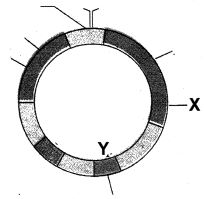
Identify $X$ and $Y$ from the given figure of the cloning vector $pBR322$.
A
$X = BamHI, Y = PstI$
B
$X = HindIII, Y = BamHI$
C
$X = SalI, Y = rop$
D
$X = PvuII, Y = PstI$
Solution
(A) The cloning vector $pBR322$ is a widely used plasmid in biotechnology.
In the standard map of $pBR322$,the restriction site for $BamHI$ is located within the $tet^R$ (tetracycline resistance) gene,and the restriction site for $PstI$ is located within the $amp^R$ (ampicillin resistance) gene.
Based on the standard diagram of $pBR322$,the label $X$ points to the $BamHI$ restriction site,and the label $Y$ points to the $PstI$ restriction site.
Therefore,the correct identification is $X = BamHI$ and $Y = PstI$.
In the standard map of $pBR322$,the restriction site for $BamHI$ is located within the $tet^R$ (tetracycline resistance) gene,and the restriction site for $PstI$ is located within the $amp^R$ (ampicillin resistance) gene.
Based on the standard diagram of $pBR322$,the label $X$ points to the $BamHI$ restriction site,and the label $Y$ points to the $PstI$ restriction site.
Therefore,the correct identification is $X = BamHI$ and $Y = PstI$.
0 likes
View Solution13
MediumMCQ
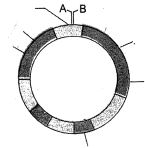
Identify the parts $A$ and $B$ from the given figure of the $pBR322$ cloning vector:
A
$Bam \ HI$ and $Sal \ I$
B
$Pvu \ I$ and $Pst \ I$
C
$Ori$ and $rop$
D
$Cla \ I$ and $Hind \ III$
Solution
(D) The given figure represents the $pBR322$ cloning vector.
In the standard map of $pBR322$,the restriction sites $Cla \ I$ and $Hind \ III$ are located adjacent to each other in the region of the tetracycline resistance gene $(tet^R)$.
Specifically,$A$ points to the $Cla \ I$ restriction site and $B$ points to the $Hind \ III$ restriction site.
Therefore,the correct option is $D$.
In the standard map of $pBR322$,the restriction sites $Cla \ I$ and $Hind \ III$ are located adjacent to each other in the region of the tetracycline resistance gene $(tet^R)$.
Specifically,$A$ points to the $Cla \ I$ restriction site and $B$ points to the $Hind \ III$ restriction site.
Therefore,the correct option is $D$.
0 likes
View Solution14
MediumMCQ
The ability to multiply copies of an antibiotic resistance gene in $E. coli$ is called.....
A
Cloning
B
Transcription
C
$PCR$
D
Synthesis
Solution
(A) The process of making multiple copies of a specific $DNA$ segment or gene using a host organism like $E. coli$ is known as cloning. In recombinant $DNA$ technology,the antibiotic resistance gene is inserted into a vector (like a plasmid),which is then introduced into $E. coli$. As the bacteria replicate,they produce numerous copies of the recombinant $DNA$,a process referred to as gene cloning.
0 likes
View Solution15
MediumMCQ
Find the correct match.
| $I$ | $II$ | $III$ |
| $(a)$ $PCR$ | $(i)$ Specific base sequence | $p.$ $Taq$ polymerase |
| $(b)$ Downstream processing | $(ii)$ Inheritable gene | $q.$ Ampicillin resistant |
| $(c)$ Restriction endonuclease | $(iii)$ Amplification of $DNA$ | $r.$ $E. coli$ |
| $(iv)$ Product separation and modification | $s.$ Quality control |
A
$a-iii-s, b-i-q, c-ii-r$
B
$a-ii-r, b-iii-p, c-i-s$
C
$a-iii-p, b-iv-s, c-i-r$
D
$a-i-s, b-ii-p, c-iii-r$
Solution
(C) The correct match is determined as follows:
$1$. $(a)$ $PCR$ (Polymerase Chain Reaction) is used for the $(iii)$ amplification of $DNA$ using $(p)$ $Taq$ polymerase.
$2$. $(b)$ Downstream processing involves $(iv)$ product separation and modification,followed by $(s)$ quality control.
$3$. $(c)$ Restriction endonuclease recognizes a $(i)$ specific base sequence and is commonly derived from organisms like $(r)$ $E. coli$.
Therefore,the correct sequence is $(a-iii-p, b-iv-s, c-i-r)$.
$1$. $(a)$ $PCR$ (Polymerase Chain Reaction) is used for the $(iii)$ amplification of $DNA$ using $(p)$ $Taq$ polymerase.
$2$. $(b)$ Downstream processing involves $(iv)$ product separation and modification,followed by $(s)$ quality control.
$3$. $(c)$ Restriction endonuclease recognizes a $(i)$ specific base sequence and is commonly derived from organisms like $(r)$ $E. coli$.
Therefore,the correct sequence is $(a-iii-p, b-iv-s, c-i-r)$.
0 likes
View Solution16
MediumMCQ
$A$ - Transformation is a procedure through which a piece of $DNA$ is introduced in a host bacterium.
$R$ - With the help of $PCR$,thousands of $DNA$ copies are formed.
$R$ - With the help of $PCR$,thousands of $DNA$ copies are formed.
A
$A$ and $R$ both are correct.
B
$A$ and $R$ both are incorrect.
C
$A$ is correct,$R$ is incorrect.
D
$A$ is incorrect,$R$ is correct.
Solution
(A) Assertion $(A)$ is correct because transformation is indeed the process of introducing foreign $DNA$ into a host cell (bacterium).
Reason $(R)$ is correct because $PCR$ (Polymerase Chain Reaction) is a technique used to amplify a specific segment of $DNA$,resulting in millions or thousands of copies.
Both statements are scientifically accurate descriptions of processes in biotechnology.
Reason $(R)$ is correct because $PCR$ (Polymerase Chain Reaction) is a technique used to amplify a specific segment of $DNA$,resulting in millions or thousands of copies.
Both statements are scientifically accurate descriptions of processes in biotechnology.
0 likes
View Solution17
MediumMCQ
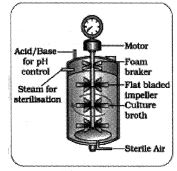
Identify the figure.
A
Fission reactor
B
$PCR$
C
Pressure pump
D
Bio-reactor
Solution
(D) The provided figure represents a stirred-tank bioreactor.
Bioreactors are vessels in which raw materials are biologically converted into specific products,individual enzymes,etc.,using microbial plant,animal,or human cells.
$A$ stirred-tank bioreactor is usually cylindrical or with a curved base to facilitate the mixing of the reactor contents.
The stirrer facilitates even mixing and oxygen availability throughout the bioreactor.
It contains components like a motor,foam breaker,impeller,and inlets for pH control and sterilization.
Bioreactors are vessels in which raw materials are biologically converted into specific products,individual enzymes,etc.,using microbial plant,animal,or human cells.
$A$ stirred-tank bioreactor is usually cylindrical or with a curved base to facilitate the mixing of the reactor contents.
The stirrer facilitates even mixing and oxygen availability throughout the bioreactor.
It contains components like a motor,foam breaker,impeller,and inlets for pH control and sterilization.
0 likes
View Solution18
MediumMCQ
Match the following columns:
| Column $I$ | Column $II$ |
| $A$. Recombinant $DNA$ | $1$. Sea weeds |
| $B$. Gel electrophoresis | $2$. $DNA$ staining |
| $C$. Ethidium bromide | $3$. Plasmid $DNA$ that has incorporated human $DNA$ |
| $D$. Agarose | $4$. Process by which $DNA$ fragments are separated based on their size |
A
$A-3, B-4, C-2, D-1$
B
$A-3, B-2, C-1, D-4$
C
$A-2, B-1, C-4, D-3$
D
$A-3, B-4, C-1, D-2$
Solution
$(A)$ The correct matches are as follows:
$A$. Recombinant $DNA$ $(3)$: This refers to a plasmid $DNA$ molecule that has incorporated a foreign or human $DNA$ fragment.
$B$. Gel electrophoresis $(4)$: This is a laboratory technique used to separate $DNA$ fragments based on their size using an electric field.
$C$. Ethidium bromide $(2)$: This is a fluorescent dye used to stain $DNA$ fragments in an agarose gel so they can be visualized under $UV$ light.
$D$. Agarose $(1)$: This is a natural polymer extracted from sea weeds (red algae) used to create the gel matrix for electrophoresis.
Therefore, the correct sequence is $A-3, B-4, C-2, D-1$.
$A$. Recombinant $DNA$ $(3)$: This refers to a plasmid $DNA$ molecule that has incorporated a foreign or human $DNA$ fragment.
$B$. Gel electrophoresis $(4)$: This is a laboratory technique used to separate $DNA$ fragments based on their size using an electric field.
$C$. Ethidium bromide $(2)$: This is a fluorescent dye used to stain $DNA$ fragments in an agarose gel so they can be visualized under $UV$ light.
$D$. Agarose $(1)$: This is a natural polymer extracted from sea weeds (red algae) used to create the gel matrix for electrophoresis.
Therefore, the correct sequence is $A-3, B-4, C-2, D-1$.
0 likes
View Solution19
EasyMCQ
$Escherichia$ $coli$ $(E. coli)$ is widely used in biological research because:
A
It can be easily cultured.
B
It is easily available.
C
Its maintenance is simple.
D
It can easily multiply in the host.
Solution
(A) $Escherichia$ $coli$ $(E. coli)$ is a preferred model organism in biological research,particularly in molecular biology and genetics,primarily because it can be easily cultured in the laboratory. It has a very short generation time (approximately $20$ minutes under optimal conditions),allowing for rapid growth and experimentation. Furthermore,its genome is relatively simple and well-understood,making it an ideal candidate for genetic manipulation and studies.
0 likes
View Solution20
MediumMCQ
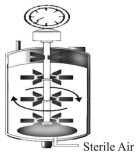
Identify the correct match for the given apparatus.
Apparatus $\to$ Function
Apparatus $\to$ Function
A
Gene gun $\to$ Vectorless direct gene transfer
B
Column chromatograph $\to$ Separation of chlorophyll pigments
C
Stirred tank bioreactor $\to$ Carry out fermentation process
D
Respirometer $\to$ Finding out rate of respiration
Solution
(C) The image provided shows a Stirred tank bioreactor.
$1$. $A$ Stirred tank bioreactor is a cylindrical vessel designed to provide optimal conditions for achieving the desired product by providing optimal growth conditions like temperature,pH,substrate,salts,vitamins,and oxygen.
$2$. It is primarily used to carry out large-scale fermentation processes to produce recombinant proteins or other biotechnological products.
$3$. While other options (Gene gun,Column chromatograph,Respirometer) describe valid scientific apparatus and their functions,the question asks to identify the match for the 'given apparatus' shown in the image,which is the Stirred tank bioreactor.
$1$. $A$ Stirred tank bioreactor is a cylindrical vessel designed to provide optimal conditions for achieving the desired product by providing optimal growth conditions like temperature,pH,substrate,salts,vitamins,and oxygen.
$2$. It is primarily used to carry out large-scale fermentation processes to produce recombinant proteins or other biotechnological products.
$3$. While other options (Gene gun,Column chromatograph,Respirometer) describe valid scientific apparatus and their functions,the question asks to identify the match for the 'given apparatus' shown in the image,which is the Stirred tank bioreactor.
0 likes
View Solution21
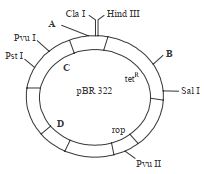
MediumMCQ
The given figure shows the cloning vector $pBR322$. Identify the labels $A, B, C,$ and $D$ correctly.
A
$A \to \text{Hind III}, B \to \text{EcoR I}, C \to \text{amp}^R, D \to \text{ori}$
B
$A \to \text{Hind III}, B \to \text{Bam HI}, C \to \text{kan}^R, D \to \text{amp}^R$
C
$A \to \text{Bam HI}, B \to \text{Pst I}, C \to \text{ori}, D \to \text{amp}^R$
D
$A \to \text{EcoR I}, B \to \text{Bam HI}, C \to \text{amp}^R, D \to \text{ori}$
Solution
(D) The cloning vector $pBR322$ is a widely used plasmid in biotechnology. Based on the standard map of $pBR322$:
$1$. Label $A$ points to the restriction site for $EcoR I$.
$2$. Label $B$ points to the restriction site for $Bam HI$.
$3$. Label $C$ represents the ampicillin resistance gene $(amp^R)$.
$4$. Label $D$ represents the origin of replication $(ori)$.
Therefore,the correct identification is $A \to EcoR I, B \to Bam HI, C \to amp^R, D \to ori$.
$1$. Label $A$ points to the restriction site for $EcoR I$.
$2$. Label $B$ points to the restriction site for $Bam HI$.
$3$. Label $C$ represents the ampicillin resistance gene $(amp^R)$.
$4$. Label $D$ represents the origin of replication $(ori)$.
Therefore,the correct identification is $A \to EcoR I, B \to Bam HI, C \to amp^R, D \to ori$.
0 likes
View Solution22
MediumMCQ
Assertion : $Agrobacterium$ $tumefaciens$ is popular in genetic engineering because this bacterium is associated with the roots of all cereal and pulse crops.
Reason : $A$ gene incorporated in the bacterial chromosomal genome gets automatically transferred to the crop with which the bacterium is associated.
Reason : $A$ gene incorporated in the bacterial chromosomal genome gets automatically transferred to the crop with which the bacterium is associated.
A
If both Assertion and Reason are correct and the Reason is a correct explanation of the Assertion.
B
If both Assertion and Reason are correct but Reason is not a correct explanation of the Assertion.
C
If the Assertion is correct but Reason is incorrect.
D
If both the Assertion and Reason are incorrect.
Solution
(D) $Agrobacterium$ $tumefaciens$ is a soil-inhabiting,plant-pathogenic bacterium that infects broad-leaved crops such as tomato,soybean,sunflower,and cotton,but it does not infect cereals.
Tumor formation (crown galls) is induced by the transfer of its $Ti$ plasmid $DNA$ into the host plant's genome.
The $T-DNA$ segment of the $Ti$ plasmid is responsible for tumor induction.
Because this gene transfer occurs naturally without human intervention,the bacterium is known as the 'natural genetic engineer' of plants.
Since the Assertion incorrectly states that it is associated with all cereal and pulse crops,and the Reason is also factually incorrect regarding the mechanism of gene transfer (it uses $Ti$ plasmid,not the chromosomal genome),both statements are incorrect.
Tumor formation (crown galls) is induced by the transfer of its $Ti$ plasmid $DNA$ into the host plant's genome.
The $T-DNA$ segment of the $Ti$ plasmid is responsible for tumor induction.
Because this gene transfer occurs naturally without human intervention,the bacterium is known as the 'natural genetic engineer' of plants.
Since the Assertion incorrectly states that it is associated with all cereal and pulse crops,and the Reason is also factually incorrect regarding the mechanism of gene transfer (it uses $Ti$ plasmid,not the chromosomal genome),both statements are incorrect.
0 likes
View Solution23
MediumMCQ
Assertion : In recombinant $DNA$ technology,human genes are often transferred into bacteria (prokaryotes) or yeast (eukaryote).
Reason : Both bacteria and yeast multiply very fast to form huge population,which express the desired gene.
Reason : Both bacteria and yeast multiply very fast to form huge population,which express the desired gene.
A
If both Assertion and Reason are correct and the Reason is a correct explanation of the Assertion.
B
If both Assertion and Reason are correct but Reason is not a correct explanation of the Assertion.
C
If the Assertion is correct but Reason is incorrect.
D
If both the Assertion and Reason are incorrect.
Solution
(A) In recombinant $DNA$ technology,human genes are inserted into host organisms like bacteria or yeast to produce large quantities of desired proteins.
Bacteria and yeast are preferred as host cells because they have a very short generation time and multiply rapidly,allowing for the creation of a large population of cells in a short period.
This large population of cells expresses the inserted gene,leading to the efficient production of the recombinant protein.
Therefore,the Reason correctly explains why human genes are transferred into these organisms.
Bacteria and yeast are preferred as host cells because they have a very short generation time and multiply rapidly,allowing for the creation of a large population of cells in a short period.
This large population of cells expresses the inserted gene,leading to the efficient production of the recombinant protein.
Therefore,the Reason correctly explains why human genes are transferred into these organisms.
0 likes
View Solution24
Medium
Give differences between $PCR$ and plasmid.
Solution
(N/A)
| $PCR$ | Plasmid |
|---|---|
| $(1)$ It is an abiotic method of $DNA$ amplification. | $(1)$ It is a biotic vector molecule used for cloning. |
| $(2)$ $PCR$ can generate millions of copies of specific $DNA$ fragments in a short time. | $(2)$ Being a biotic system,the number of copies obtained is generally lower and depends on the host cell replication. |
| $(3)$ $PCR$ is an in vitro process used to amplify specific $DNA$ sequences. | $(3)$ Plasmids are used as vectors to introduce and replicate desired $DNA$ fragments within a living host cell. |
| $(4)$ The process involves cyclic steps: denaturation,annealing,and extension. | $(4)$ Plasmid-based cloning involves restriction digestion,ligation,and transformation,not cyclic $PCR$ steps. |
0 likes
View Solution25
MediumMCQ
Match the columns:
| Column-$I$ | Column-$II$ |
| $(a)$ Ethidium Bromide | $(i)$ Agrobacterium |
| $(b)$ Ti plasmid | $(ii)$ Tetracycline |
| $(c)$ $PvuI$ | $(iii)$ Gel electrophoresis |
| $(iv)$ Ampicillin |
A
$a-iii, b-i, c-iv$
B
$a-iii, b-i, c-ii$
C
$a-i, b-iii, c-iv$
D
$a-iv, b-i, c-iii$
Solution
$(A)$ Ethidium Bromide is used to stain $DNA$ fragments during Gel electrophoresis $(iii)$.
$(b)$ Ti plasmid is derived from Agrobacterium tumefaciens $(i)$, which is used as a vector for plant transformation.
$(c)$ $PvuI$ is a restriction enzyme that has a recognition site within the Ampicillin resistance gene $(iv)$ of the $pBR322$ plasmid.
Therefore, the correct match is $(a-iii, b-i, c-iv)$.
$(b)$ Ti plasmid is derived from Agrobacterium tumefaciens $(i)$, which is used as a vector for plant transformation.
$(c)$ $PvuI$ is a restriction enzyme that has a recognition site within the Ampicillin resistance gene $(iv)$ of the $pBR322$ plasmid.
Therefore, the correct match is $(a-iii, b-i, c-iv)$.
0 likes
View Solution26
MediumMCQ
Match the organism with its use in biotechnology:
$(a)\quad (b)\quad (c)\quad (d)$
| $(a)$ Bacillus thuringiensis | $(i)$ Cloning vector |
| $(b)$ Thermus aquaticus | $(ii)$ Construction of first rDNA molecule |
| $(c)$ Agrobacterium tumefaciens | $(iii)$ $DNA$ polymerase |
| $(d)$ Salmonella typhimurium | $(iv)$ Cry proteins |
$(a)\quad (b)\quad (c)\quad (d)$
A
$(ii)\quad (iv)\quad (iii)\quad (i)$
B
$(iii)\quad (iv)\quad (i)\quad (ii)$
C
$(iii)\quad (ii)\quad (iv)\quad (i)$
D
$(iv)\quad (iii)\quad (i)\quad (ii)$
Solution
(D) The correct matches are as follows:
$(a)$ Bacillus thuringiensis produces $(iv)$ Cry proteins, which are used in insect-resistant crops.
$(b)$ Thermus aquaticus is the source of Taq $(iii)$ $DNA$ polymerase, which is essential for the Polymerase Chain Reaction $(PCR)$.
$(c)$ Agrobacterium tumefaciens acts as a $(i)$ cloning vector (specifically a natural genetic engineer) used to transfer genes into plants.
$(d)$ Salmonella typhimurium was used by Cohen and Boyer for the $(ii)$ construction of the first rDNA molecule in $1972$.
Thus, the correct sequence is $(a-iv, b-iii, c-i, d-ii)$, which corresponds to option $(D)$.
$(a)$ Bacillus thuringiensis produces $(iv)$ Cry proteins, which are used in insect-resistant crops.
$(b)$ Thermus aquaticus is the source of Taq $(iii)$ $DNA$ polymerase, which is essential for the Polymerase Chain Reaction $(PCR)$.
$(c)$ Agrobacterium tumefaciens acts as a $(i)$ cloning vector (specifically a natural genetic engineer) used to transfer genes into plants.
$(d)$ Salmonella typhimurium was used by Cohen and Boyer for the $(ii)$ construction of the first rDNA molecule in $1972$.
Thus, the correct sequence is $(a-iv, b-iii, c-i, d-ii)$, which corresponds to option $(D)$.
0 likes
View Solution27
MediumMCQ
Which of the following bacteria is a close relative of $Salmonella$?
A
$E. coli$
B
$Streptococcus$
C
$Bacillus subtilis$
D
$Prions$
Solution
(A) $Salmonella$ and $E. coli$ (Escherichia coli) both belong to the family $Enterobacteriaceae$.
They are both Gram-negative,rod-shaped,facultative anaerobic bacteria.
$E. coli$ is widely used in biotechnology as a model organism for cloning and gene expression studies,similar to how $Salmonella$ is studied in microbiology.
They are both Gram-negative,rod-shaped,facultative anaerobic bacteria.
$E. coli$ is widely used in biotechnology as a model organism for cloning and gene expression studies,similar to how $Salmonella$ is studied in microbiology.
0 likes
View Solution28
MediumMCQ
Match the following columns:
| Column-$I$ | Column-$II$ |
| $(a)$ $EFB$ | $(1)$ Recognition sequence |
| $(b)$ Biotechnology | $(2)$ Molecular scissors |
| $(c)$ Restriction enzyme | $(3)$ Definition of biotechnology |
| $(d)$ Palindromic sequence | $(4)$ Test tube baby |
A
$a-3, b-4, c-2, d-1$
B
$a-4, b-2, c-3, d-1$
C
$a-2, b-1, c-3, d-3$
D
$a-4, b-3, c-1, d-2$
Solution
(A) The correct matches are as follows:
$(a)$ $EFB$ (European Federation of Biotechnology) provides the definition of biotechnology. Thus, $a-3$.
$(b)$ Biotechnology involves the use of living organisms or enzymes to produce products and processes useful to humans, such as test tube baby programs. Thus, $b-4$.
$(c)$ Restriction enzymes are known as molecular scissors because they cut $DNA$ at specific sites. Thus, $c-2$.
$(d)$ Palindromic sequences are the specific recognition sequences where restriction enzymes bind and cut. Thus, $d-1$.
Therefore, the correct sequence is $a-3, b-4, c-2, d-1$.
$(a)$ $EFB$ (European Federation of Biotechnology) provides the definition of biotechnology. Thus, $a-3$.
$(b)$ Biotechnology involves the use of living organisms or enzymes to produce products and processes useful to humans, such as test tube baby programs. Thus, $b-4$.
$(c)$ Restriction enzymes are known as molecular scissors because they cut $DNA$ at specific sites. Thus, $c-2$.
$(d)$ Palindromic sequences are the specific recognition sequences where restriction enzymes bind and cut. Thus, $d-1$.
Therefore, the correct sequence is $a-3, b-4, c-2, d-1$.
0 likes
View Solution29
MediumMCQ
Match the following items in List-$I$ with List-$II$:
| List-$I$ | List-$II$ |
| $(a)$ Gel electrophoresis | $(1)$ Amplification of gene of interest |
| $(b)$ $PCR$ | $(2)$ Separation of $DNA$ fragments |
| $(c)$ Bioreactor | $(3)$ Plasmid |
| $(d)$ Cloning vector | $(4)$ Production of desired product |
A
$a-3, b-2, c-4, d-1$
B
$a-1, b-2, c-4, d-3$
C
$a-2, b-1, c-3, d-4$
D
$a-2, b-1, c-4, d-3$
Solution
$(D)$ Gel electrophoresis is a technique used for the separation of $DNA$ fragments based on their size and charge. Thus, $a-2$.
$(b)$ $PCR$ (Polymerase Chain Reaction) is used for the amplification of the gene of interest. Thus, $b-1$.
$(c)$ Bioreactors are vessels in which raw materials are biologically converted into specific products by microbes, plant/animal cells, or their enzymes. Thus, $c-4$.
$(d)$ Cloning vectors (like plasmids) are used to carry foreign $DNA$ into the host cell. Thus, $d-3$.
Therefore, the correct matching is $a-2, b-1, c-4, d-3$.
$(b)$ $PCR$ (Polymerase Chain Reaction) is used for the amplification of the gene of interest. Thus, $b-1$.
$(c)$ Bioreactors are vessels in which raw materials are biologically converted into specific products by microbes, plant/animal cells, or their enzymes. Thus, $c-4$.
$(d)$ Cloning vectors (like plasmids) are used to carry foreign $DNA$ into the host cell. Thus, $d-3$.
Therefore, the correct matching is $a-2, b-1, c-4, d-3$.
0 likes
View Solution30
MediumMCQ
Match the following columns:
| Column-$I$ | Column-$II$ |
| $(a)$ $Salmonella$ | $(1)$ $Ti$ plasmid |
| $(b)$ $E. coli$ | $(2)$ Thermostable $DNA$ polymerase |
| $(c)$ $Agrobacterium$ $tumefaciens$ | $(3)$ Plasmid for first $r-DNA$ |
| $(d)$ $Thermus$ $aquaticus$ | $(4)$ $EcoR I$ |
A
$a-4, b-3, c-1, d-2$
B
$a-2, b-4, c-3, d-1$
C
$a-3, b-4, c-1, d-2$
D
$a-1, b-3, c-4, d-2$
Solution
(C) The correct matches are as follows:
$(a)$ $Salmonella$ $typhimurium$ is the source from which the first recombinant $DNA$ molecule was constructed by linking an antibiotic resistance gene with its native plasmid. Thus, $(a-3)$.
$(b)$ $E. coli$ is the source of the restriction enzyme $EcoR I$. Thus, $(b-4)$.
$(c)$ $Agrobacterium$ $tumefaciens$ contains the $Ti$ (Tumor inducing) plasmid, which is used as a vector to transfer genes into plants. Thus, $(c-1)$.
$(d)$ $Thermus$ $aquaticus$ is the bacterium from which the thermostable $DNA$ polymerase (Taq polymerase) is isolated, which is essential for the $PCR$ technique. Thus, $(d-2)$.
Therefore, the correct sequence is $a-3, b-4, c-1, d-2$.
$(a)$ $Salmonella$ $typhimurium$ is the source from which the first recombinant $DNA$ molecule was constructed by linking an antibiotic resistance gene with its native plasmid. Thus, $(a-3)$.
$(b)$ $E. coli$ is the source of the restriction enzyme $EcoR I$. Thus, $(b-4)$.
$(c)$ $Agrobacterium$ $tumefaciens$ contains the $Ti$ (Tumor inducing) plasmid, which is used as a vector to transfer genes into plants. Thus, $(c-1)$.
$(d)$ $Thermus$ $aquaticus$ is the bacterium from which the thermostable $DNA$ polymerase (Taq polymerase) is isolated, which is essential for the $PCR$ technique. Thus, $(d-2)$.
Therefore, the correct sequence is $a-3, b-4, c-1, d-2$.
0 likes
View Solution31
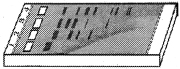
MediumMCQ
Identify the figure given below.
A
Centrifuge
B
Agarose gel electrophoresis
C
$PCR$
D
Microinjection
Solution
(B) The figure shows an agarose gel electrophoresis setup.
In this process,$DNA$ fragments are separated based on their size through an agarose gel matrix under an electric field.
Smaller fragments move faster and travel further towards the anode compared to larger fragments,resulting in distinct bands on the gel.
In this process,$DNA$ fragments are separated based on their size through an agarose gel matrix under an electric field.
Smaller fragments move faster and travel further towards the anode compared to larger fragments,resulting in distinct bands on the gel.
0 likes
View Solution32
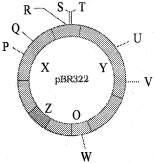
MediumMCQ
What do '$X$' and '$Y$' represent in the given diagram of $pBR322$?
A
$amp^R$ and $kan^R$
B
$Bam\,H\,I$ and $Pvu\,I$
C
$tet^R$ and $rop$
D
$amp^R$ and $tet^R$
Solution
(D) The given diagram represents the cloning vector $pBR322$.
In the standard map of $pBR322$,'$X$' represents the ampicillin resistance gene $(amp^R)$ and '$Y$' represents the tetracycline resistance gene $(tet^R)$.
These genes serve as selectable markers that allow for the identification and elimination of non-transformants and selectively permit the growth of the transformants.
Therefore,the correct option is $D$.
In the standard map of $pBR322$,'$X$' represents the ampicillin resistance gene $(amp^R)$ and '$Y$' represents the tetracycline resistance gene $(tet^R)$.
These genes serve as selectable markers that allow for the identification and elimination of non-transformants and selectively permit the growth of the transformants.
Therefore,the correct option is $D$.
0 likes
View Solution33
MediumMCQ
In the given figure of the cloning vector $pBR322$,what do '$P$' and '$Q$' represent respectively?
A
$Pvu II$ and $Pst I$
B
$Pst I$ and $EcoRI$
C
$Cla I$ and $Pvu II$
D
$Pst I$ and $Pvu I$
Solution
(D) The cloning vector $pBR322$ is a widely used plasmid in biotechnology.
Based on the standard map of $pBR322$,the restriction sites located on the ampicillin resistance gene $(amp^R)$ are $Pst I$ and $Pvu I$.
Specifically,in the standard diagram,'$P$' corresponds to the $Pst I$ restriction site and '$Q$' corresponds to the $Pvu I$ restriction site.
Therefore,the correct representation is $Pst I$ and $Pvu I$.
Based on the standard map of $pBR322$,the restriction sites located on the ampicillin resistance gene $(amp^R)$ are $Pst I$ and $Pvu I$.
Specifically,in the standard diagram,'$P$' corresponds to the $Pst I$ restriction site and '$Q$' corresponds to the $Pvu I$ restriction site.
Therefore,the correct representation is $Pst I$ and $Pvu I$.
0 likes
View Solution34
MediumMCQ
In the given figure,what do '$R$','$S$',and '$T$' represent respectively?
A
$EcoRI, Cla\, I$ and $Hind\, III$
B
$Cla\, I, BamH\, I$ and $Hind\, III$
C
$EcoRI, Sal\, I$ and $Pvu\, II$
D
$Pvu\, I, EcoRI$ and $BamH\, I$
Solution
(A) The given figure represents the cloning vector $pBR322$.
In the standard map of $pBR322$,the restriction sites located near the $EcoRI$ site are $Cla\, I$ and $Hind\, III$.
Specifically,looking at the map,'$R$' corresponds to $EcoRI$,'$S$' corresponds to $Cla\, I$,and '$T$' corresponds to $Hind\, III$.
In the standard map of $pBR322$,the restriction sites located near the $EcoRI$ site are $Cla\, I$ and $Hind\, III$.
Specifically,looking at the map,'$R$' corresponds to $EcoRI$,'$S$' corresponds to $Cla\, I$,and '$T$' corresponds to $Hind\, III$.
0 likes
View Solution35
MediumMCQ
Identify '$Z$' and '$Q$' in the given figure of $pBR322$.
A
$Pvu\ II$ and $Sal\ I$
B
$ori$ and $Pvu\ I$
C
$amp^R$ and $ori$
D
$rop$ and $tet^R$
Solution
(B) The figure represents the cloning vector $pBR322$. In this map,the various restriction sites and genes are located at specific positions.
- '$Q$' represents the origin of replication $(ori)$,which is the sequence where replication starts.
- '$Z$' represents the $Pvu\ I$ restriction site,which is located within the ampicillin resistance gene $(amp^R)$.
Therefore,'$Z$' is $Pvu\ I$ and '$Q$' is $ori$.
- '$Q$' represents the origin of replication $(ori)$,which is the sequence where replication starts.
- '$Z$' represents the $Pvu\ I$ restriction site,which is located within the ampicillin resistance gene $(amp^R)$.
Therefore,'$Z$' is $Pvu\ I$ and '$Q$' is $ori$.
0 likes
View Solution36
MediumMCQ
Identify '$U$','$V$' and '$W$' in the given figure of $pBR322$.
A
$EcoRI, BamHI$ and $PvuII$
B
$HindI, SalI$ and $PstII$
C
$BamHI, SalI$ and $PvuII$
D
$rop, BamHI$ and $SalII$
Solution
(C) The given figure represents the cloning vector $pBR322$.
In the standard map of $pBR322$:
- '$U$' corresponds to the restriction site for $BamHI$.
- '$V$' corresponds to the restriction site for $SalI$.
- '$W$' corresponds to the restriction site for $PvuII$.
Therefore,the correct identification is $BamHI, SalI$ and $PvuII$.
In the standard map of $pBR322$:
- '$U$' corresponds to the restriction site for $BamHI$.
- '$V$' corresponds to the restriction site for $SalI$.
- '$W$' corresponds to the restriction site for $PvuII$.
Therefore,the correct identification is $BamHI, SalI$ and $PvuII$.
0 likes
View Solution37
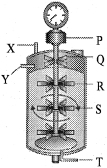
MediumMCQ
What does $P$ represent in the given figure?
A
Meter
B
$pH$ control
C
Motor
D
Foam breaker
Solution
(C) In the given diagram of a stirred-tank bioreactor,the label $P$ points to the motor located at the top of the vessel. The motor is responsible for driving the impeller system,which ensures proper mixing and oxygen availability throughout the culture medium.
0 likes
View Solution38
MediumMCQ
Identify '$Q$' and '$R$' in the given figure of a stirred-tank bioreactor.
A
Sterile air and Foam breaker
B
Culture medium and Steam
C
Gas inlet and Flat-bladed impeller
D
Foam breaker and Flat-bladed impeller
Solution
(D) The provided figure represents a stirred-tank bioreactor.
In this diagram:
- '$Q$' points to the foam breaker,which is used to reduce the foam produced during the fermentation process.
- '$R$' points to the flat-bladed impeller,which is designed to ensure proper mixing and oxygen availability throughout the bioreactor.
Therefore,the correct identification is '$Q$' as the foam breaker and '$R$' as the flat-bladed impeller.
In this diagram:
- '$Q$' points to the foam breaker,which is used to reduce the foam produced during the fermentation process.
- '$R$' points to the flat-bladed impeller,which is designed to ensure proper mixing and oxygen availability throughout the bioreactor.
Therefore,the correct identification is '$Q$' as the foam breaker and '$R$' as the flat-bladed impeller.
0 likes
View Solution39
MediumMCQ
What do '$S$' and '$T$' represent in the given figure of a stirred-tank bioreactor?
A
Flat-bladed impeller and steam for sterilization
B
$pH$ control and motor
C
Foam breaker and sterile air
D
Culture broth and sterile air
Solution
(A) In the provided diagram of a stirred-tank bioreactor,the components are identified as follows:
$P$: Motor
$Q$: $pH$ control system
$R$: Foam breaker
$S$: Flat-bladed impeller
$T$: Sterile air inlet
Therefore,'$S$' represents the flat-bladed impeller,which facilitates the mixing of the culture medium,and '$T$' represents the inlet for sterile air,which provides oxygen to the culture. Thus,option $A$ is the correct answer.
$P$: Motor
$Q$: $pH$ control system
$R$: Foam breaker
$S$: Flat-bladed impeller
$T$: Sterile air inlet
Therefore,'$S$' represents the flat-bladed impeller,which facilitates the mixing of the culture medium,and '$T$' represents the inlet for sterile air,which provides oxygen to the culture. Thus,option $A$ is the correct answer.
0 likes
View Solution40
MediumMCQ
What do '$X$' and '$Y$' represent in the given figure of a stirred-tank bioreactor?
A
pH control and steam for sterilization
B
Temperature control and gas inlet
C
Culture medium and motor
D
Vacuum pipe and temperature control
Solution
(B) The provided figure represents a stirred-tank bioreactor.
In this diagram:
- '$X$' represents the acid/base for pH control.
- '$Y$' represents the sterile air/gas inlet.
- '$P$' is the motor.
- '$Q$' is the foam breaker.
- '$R$' is the flat-bladed impeller.
- '$S$' is the culture broth.
- '$T$' is the sterile withdrawal system.
Therefore,'$X$' and '$Y$' represent pH control and gas inlet respectively.
In this diagram:
- '$X$' represents the acid/base for pH control.
- '$Y$' represents the sterile air/gas inlet.
- '$P$' is the motor.
- '$Q$' is the foam breaker.
- '$R$' is the flat-bladed impeller.
- '$S$' is the culture broth.
- '$T$' is the sterile withdrawal system.
Therefore,'$X$' and '$Y$' represent pH control and gas inlet respectively.
0 likes
View Solution41
MediumMCQ
Match the following techniques or instruments with their usage:
Select the correct option from the following:
| Column-$I$ | Column-$II$ |
| $(a)$ Bioreactor | $(i)$ Separation of $DNA$ fragments |
| $(b)$ Electrophoresis | $(ii)$ Production of large quantities of products |
| $(c)$ $PCR$ | $(iii)$ Detection of pathogen, based on antigen-antibody reaction |
| $(d)$ $ELISA$ | $(iv)$ Amplification of nucleic acids |
Select the correct option from the following:
A
$(a)-(ii), (b)-(i), (c)-(iii), (d)-(iv)$
B
$(a)-(iii), (b)-(ii), (c)-(iv), (d)-(i)$
C
$(a)-(ii), (b)-(i), (c)-(iv), (d)-(iii)$
D
$(a)-(iv), (b)-(iii), (c)-(ii), (d)-(i)$
Solution
(C) The correct matching is as follows:
$(a)$ Bioreactor: Used for the production of large quantities of biological products. Thus, $(a)-(ii)$.
$(b)$ Electrophoresis: $A$ technique used for the separation of $DNA$ fragments based on their size. Thus, $(b)-(i)$.
$(c)$ $PCR$ (Polymerase Chain Reaction): $A$ technique used for the amplification of specific nucleic acid sequences. Thus, $(c)-(iv)$.
$(d)$ $ELISA$ (Enzyme-Linked Immunosorbent Assay): $A$ diagnostic technique used for the detection of pathogens based on antigen-antibody interactions. Thus, $(d)-(iii)$.
Therefore, the correct sequence is $(a)-(ii), (b)-(i), (c)-(iv), (d)-(iii)$.
$(a)$ Bioreactor: Used for the production of large quantities of biological products. Thus, $(a)-(ii)$.
$(b)$ Electrophoresis: $A$ technique used for the separation of $DNA$ fragments based on their size. Thus, $(b)-(i)$.
$(c)$ $PCR$ (Polymerase Chain Reaction): $A$ technique used for the amplification of specific nucleic acid sequences. Thus, $(c)-(iv)$.
$(d)$ $ELISA$ (Enzyme-Linked Immunosorbent Assay): $A$ diagnostic technique used for the detection of pathogens based on antigen-antibody interactions. Thus, $(d)-(iii)$.
Therefore, the correct sequence is $(a)-(ii), (b)-(i), (c)-(iv), (d)-(iii)$.
0 likes
View Solution42
EasyMCQ
Match the Column-$I$ with Column-$II$:
| Column-$I$ | Column-$II$ |
| $(a)$ $K$.$C$. Mehta | $(i)$ Fluid mosaic model |
| $(b)$ $P$. Maheshwari | $(ii)$ First recombinant plasmid |
| $(c)$ Cohen and Boyer | $(iii)$ Haploid culture |
| $(d)$ Singer and Nicolson | $(iv)$ Rust disease |
A
$a-i, b-iii, c-ii, d-iv$
B
$a-iv, b-iii, c-ii, d-i$
C
$a-i, b-ii, c-iii, d-iv$
D
$a-ii, b-iii, c-iv, d-i$
Solution
(B) The correct matching is as follows:
$(a)$ $K$.$C$. Mehta is known for his work on $(iv)$ Rust disease.
$(b)$ $P$. Maheshwari is known for his pioneering work in $(iii)$ Haploid culture.
$(c)$ Cohen and Boyer are credited with the creation of the $(ii)$ First recombinant plasmid.
$(d)$ Singer and Nicolson proposed the $(i)$ Fluid mosaic model of the cell membrane.
Therefore,the correct sequence is $a-iv, b-iii, c-ii, d-i$,which corresponds to option $(B)$.
$(a)$ $K$.$C$. Mehta is known for his work on $(iv)$ Rust disease.
$(b)$ $P$. Maheshwari is known for his pioneering work in $(iii)$ Haploid culture.
$(c)$ Cohen and Boyer are credited with the creation of the $(ii)$ First recombinant plasmid.
$(d)$ Singer and Nicolson proposed the $(i)$ Fluid mosaic model of the cell membrane.
Therefore,the correct sequence is $a-iv, b-iii, c-ii, d-i$,which corresponds to option $(B)$.
0 likes
View Solution43
MediumMCQ
$A$: $cDNA$ libraries are important to scientists in human genomics.
$R$: $cDNA$ is a synthetic type of $DNA$ generated from $mRNA$.
$R$: $cDNA$ is a synthetic type of $DNA$ generated from $mRNA$.
A
Assertion and Reason both are correct and Reason is the correct explanation of Assertion.
B
Assertion and Reason both are correct but Reason is not the correct explanation of Assertion.
C
Assertion is correct,but Reason is incorrect.
D
Both Assertion and Reason are incorrect.
Solution
(A) The Assertion is correct because $cDNA$ (complementary $DNA$) libraries are essential in human genomics as they represent only the expressed genes (exons) of an organism,excluding introns.
The Reason is also correct because $cDNA$ is synthesized in the laboratory using the enzyme reverse transcriptase,which uses $mRNA$ as a template to create a $DNA$ strand.
Since $cDNA$ libraries provide a snapshot of the transcriptome (expressed genes),they are highly valuable for identifying genes and studying gene expression,which directly supports the Assertion. Therefore,the Reason is the correct explanation of the Assertion.
The Reason is also correct because $cDNA$ is synthesized in the laboratory using the enzyme reverse transcriptase,which uses $mRNA$ as a template to create a $DNA$ strand.
Since $cDNA$ libraries provide a snapshot of the transcriptome (expressed genes),they are highly valuable for identifying genes and studying gene expression,which directly supports the Assertion. Therefore,the Reason is the correct explanation of the Assertion.
0 likes
View Solution44
MediumMCQ
Yeast has become important in genetic engineering because it:
A
Has plasmids that can be genetically engineered
B
Allows the study of eukaryotic gene regulation and expression
C
Grows readily and rapidly in the laboratory
D
All of the above
Solution
(D) Yeast, specifically $Saccharomyces \text{ } cerevisiae$, is a fundamental model organism in genetic engineering for several reasons:
$1$. It possesses $2 \mu m$ plasmids, which can be modified and used as vectors for gene cloning.
$2$. As a unicellular eukaryote, it provides a system to study complex eukaryotic processes like gene regulation, protein folding, and post-translational modifications that are not possible in prokaryotes like $E. \text{ } coli$.
$3$. It is easy to culture, has a short generation time, and grows rapidly in laboratory conditions, making it highly efficient for experimental studies.
Therefore, all the given statements are correct.
$1$. It possesses $2 \mu m$ plasmids, which can be modified and used as vectors for gene cloning.
$2$. As a unicellular eukaryote, it provides a system to study complex eukaryotic processes like gene regulation, protein folding, and post-translational modifications that are not possible in prokaryotes like $E. \text{ } coli$.
$3$. It is easy to culture, has a short generation time, and grows rapidly in laboratory conditions, making it highly efficient for experimental studies.
Therefore, all the given statements are correct.
0 likes
View Solution45
MediumMCQ
Consider the following statements:
$I.$ Recombinant $DNA$ technology,popularly known as genetic engineering,is a stream of biotechnology which deals with the manipulation of genetic material by man in vitro.
$II.$ $pBR322$ is the first artificial cloning vector developed in $1977$ by Bolivar and Rodriguez from $E. coli$ plasmid.
$III.$ Restriction enzymes belong to a class of enzymes called nucleases.
Which of the statements given above are correct?
$I.$ Recombinant $DNA$ technology,popularly known as genetic engineering,is a stream of biotechnology which deals with the manipulation of genetic material by man in vitro.
$II.$ $pBR322$ is the first artificial cloning vector developed in $1977$ by Bolivar and Rodriguez from $E. coli$ plasmid.
$III.$ Restriction enzymes belong to a class of enzymes called nucleases.
Which of the statements given above are correct?
A
$I$ and $II$
B
$I$ and $III$
C
$II$ and $III$
D
$I, II,$ and $III$
Solution
(D) Statement $I$ is correct: Genetic engineering is a branch of biotechnology that involves the manipulation of genetic material in vitro.
Statement $II$ is correct: $pBR322$ was indeed the first artificial cloning vector constructed in $1977$ by Bolivar and Rodriguez,derived from $E. coli$ plasmid.
Statement $III$ is correct: Restriction enzymes are a type of nuclease enzyme that cuts $DNA$ at specific recognition sequences.
Since all three statements are accurate,the correct option is $D$.
Statement $II$ is correct: $pBR322$ was indeed the first artificial cloning vector constructed in $1977$ by Bolivar and Rodriguez,derived from $E. coli$ plasmid.
Statement $III$ is correct: Restriction enzymes are a type of nuclease enzyme that cuts $DNA$ at specific recognition sequences.
Since all three statements are accurate,the correct option is $D$.
0 likes
View Solution46
MediumMCQ
Which of the following statements is not true?
$I.$ $DNA$, being a hydrophilic molecule, cannot pass through cell membranes.
$II.$ $Agrobacterium$ $tumefaciens$ delivers a piece of $DNA$ known as $'T-DNA'$ in the $Ti$ plasmid, which transforms normal plant cells into tumour cells to produce chemicals against pathogens.
$III.$ Retrovirus, adenovirus, and papillomavirus are also now used as cloning vectors in animals because of their ability to transform normal cells into cancerous cells.
$IV.$ In genetic engineering, $DNA$ from different sources are cut with the same restriction enzymes so that both $DNA$ fragments have the same kind of sticky ends.
Choose the correct option.
$I.$ $DNA$, being a hydrophilic molecule, cannot pass through cell membranes.
$II.$ $Agrobacterium$ $tumefaciens$ delivers a piece of $DNA$ known as $'T-DNA'$ in the $Ti$ plasmid, which transforms normal plant cells into tumour cells to produce chemicals against pathogens.
$III.$ Retrovirus, adenovirus, and papillomavirus are also now used as cloning vectors in animals because of their ability to transform normal cells into cancerous cells.
$IV.$ In genetic engineering, $DNA$ from different sources are cut with the same restriction enzymes so that both $DNA$ fragments have the same kind of sticky ends.
Choose the correct option.
A
$Only\; I$
B
$Only\; II$
C
$Only\; III$
D
$Only\; IV$
Solution
(B) Statement $I$ is true: $DNA$ is a hydrophilic molecule and cannot pass through cell membranes.
Statement $II$ is false: $Agrobacterium$ $tumefaciens$ delivers a piece of $DNA$ known as $'T-DNA'$ (not $'Z-DNA'$) in the $Ti$ plasmid, which transforms normal plant cells into tumour cells.
Statement $III$ is true: Retroviruses, adenoviruses, and papillomaviruses are used as vectors in animals due to their ability to transform normal cells into cancerous cells.
Statement $IV$ is true: Using the same restriction enzymes ensures that both $DNA$ fragments have complementary sticky ends, allowing them to be joined by $DNA$ ligase.
Statement $II$ is false: $Agrobacterium$ $tumefaciens$ delivers a piece of $DNA$ known as $'T-DNA'$ (not $'Z-DNA'$) in the $Ti$ plasmid, which transforms normal plant cells into tumour cells.
Statement $III$ is true: Retroviruses, adenoviruses, and papillomaviruses are used as vectors in animals due to their ability to transform normal cells into cancerous cells.
Statement $IV$ is true: Using the same restriction enzymes ensures that both $DNA$ fragments have complementary sticky ends, allowing them to be joined by $DNA$ ligase.
0 likes
View Solution47
MediumMCQ
An antibiotic resistance gene in a vector helps in the selection of:
A
Competent cells
B
Transformed cells
C
Recombinant cells
D
Both $(b)$ and $(c)$
Solution
(D) In recombinant $DNA$ technology,a vector (such as a plasmid) contains an antibiotic resistance gene (e.g.,$amp^R$ or $tet^R$) which acts as a selectable marker.
$1$. When host cells are treated with the vector,only those cells that take up the plasmid become 'transformed'.
$2$. These transformed cells can be selected by growing them on a medium containing the specific antibiotic; non-transformed cells will die.
$3$. Furthermore,if the foreign $DNA$ is inserted into the antibiotic resistance gene,it causes 'insertional inactivation'. This allows for the differentiation between 'transformed' cells (containing the vector) and 'recombinant' cells (containing the vector with the foreign $DNA$ insert).
$4$. Therefore,the antibiotic resistance gene is essential for selecting both transformed cells and identifying recombinant cells.
$1$. When host cells are treated with the vector,only those cells that take up the plasmid become 'transformed'.
$2$. These transformed cells can be selected by growing them on a medium containing the specific antibiotic; non-transformed cells will die.
$3$. Furthermore,if the foreign $DNA$ is inserted into the antibiotic resistance gene,it causes 'insertional inactivation'. This allows for the differentiation between 'transformed' cells (containing the vector) and 'recombinant' cells (containing the vector with the foreign $DNA$ insert).
$4$. Therefore,the antibiotic resistance gene is essential for selecting both transformed cells and identifying recombinant cells.
0 likes
View Solution48
MediumMCQ
$A$: Selection of recombinants due to inactivation of antibiotics is a cumbersome procedure.
$R$: It requires simultaneous plating on two plates having different antibiotics.
$R$: It requires simultaneous plating on two plates having different antibiotics.
A
Assertion and Reason both are correct and Reason is the correct explanation of Assertion.
B
Assertion and Reason both are correct but Reason is not the correct explanation of Assertion.
C
Assertion is correct,but Reason is incorrect.
D
Both Assertion and Reason are incorrect.
Solution
(A) The selection of recombinant cells using antibiotic resistance genes (insertional inactivation) involves identifying cells that have lost their resistance to a specific antibiotic due to the insertion of foreign $DNA$.
This process is considered cumbersome because it requires the replica plating technique,where the same set of colonies must be transferred onto two different plates: one containing the antibiotic for which the gene was inactivated and another containing a different antibiotic (or no antibiotic) to ensure the survival of the colonies.
Since both the Assertion and the Reason are scientifically accurate and the Reason correctly explains why the procedure is considered cumbersome,the correct option is $A$.
This process is considered cumbersome because it requires the replica plating technique,where the same set of colonies must be transferred onto two different plates: one containing the antibiotic for which the gene was inactivated and another containing a different antibiotic (or no antibiotic) to ensure the survival of the colonies.
Since both the Assertion and the Reason are scientifically accurate and the Reason correctly explains why the procedure is considered cumbersome,the correct option is $A$.
0 likes
View SolutionBiotechnology Principals and Process — Mix Examples - Biotechnology Principals and Process · Frequently Asked Questions
1Are these Biotechnology Principals and Process questions useful for JEE and NEET?
Yes. All questions in this section are mapped to JEE Main and NEET exam patterns. Previous year questions from JEE Main, NEET, GUJCET and state-level exams are included with full solutions.
2Can I switch to Hindi or Gujarati for these questions?
Yes. Use the language tabs in the hero section or the sidebar to view the same questions and solutions in English, Hindi or Gujarati.
3How do I generate a question paper from this subtopic?
Use the Vedclass Exam Paper Generator — select the chapter and subtopic, set difficulty, and generate Sets A, B, C, D automatically. First 3 chapters of every subject are free.
Vedclass Products
For Students
Vedclass Test Series
Mock tests in real JEE/NEET style with performance analysis. 5-day free trial.
Start Free TrialFor Teachers
Exam Paper Generator
Generate Set A/B/C/D papers from this chapter in 2 minutes. 3 chapters free.
Try FreeFor Institutes
Online Exam Module
Live online exams with unlimited students, 360° analytics & white-label branding.
See DemoFor Teachers & Institutes
Generate a Biotechnology Principals and Process Exam Paper in 2 Minutes
Select subtopic & difficulty — Sets A, B, C, D auto-generated with No Repeat logic.
First 3 chapters of every subject are free — no payment required.