
A English
Work Energy Theorem and Conservation of Mechanical Energy Questions in English
Class 11 Physics · Work, Energy, Power and Collision · Work Energy Theorem and Conservation of Mechanical Energy
204+
Questions
English
Language
100%
With Solutions
Showing 50 of 204 questions in English
101
MediumMCQ
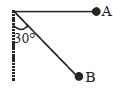
$A$ simple pendulum is released from $A$ as shown in the figure. If $m$ and $l$ represent the mass of the bob and the length of the pendulum respectively,the gain in kinetic energy at $B$ is
A
$\frac{mgl}{2}$
B
$\frac{mgl}{\sqrt{2}}$
C
$\frac{\sqrt{3}}{2} mgl$
D
$\frac{2}{\sqrt{3}} mgl$
Solution
(C) Let the point of suspension be $O$. The pendulum is released from $A$,where the string is horizontal. The vertical distance of $A$ from $O$ is $0$.
The bob moves to position $B$,where the string makes an angle of $30^{\circ}$ with the vertical.
The vertical distance of $B$ below the point of suspension $O$ is $h' = l \cos 30^{\circ} = l \frac{\sqrt{3}}{2}$.
The vertical distance fallen by the bob from $A$ to $B$ is $h = l - h' = l - l \cos 30^{\circ} = l(1 - \frac{\sqrt{3}}{2})$.
By the law of conservation of energy,the gain in kinetic energy is equal to the loss in potential energy.
Gain in kinetic energy $= mgh = mgl(1 - \frac{\sqrt{3}}{2})$.
Note: The provided options seem to assume the height $h$ is measured from the lowest point or relative to the vertical projection. Given the options,the intended calculation is likely based on the vertical drop from the horizontal level to the position $B$ relative to the lowest point,or a misinterpretation of the angle. Re-evaluating the standard interpretation for this specific problem type: The potential energy at $A$ (relative to the lowest point) is $mgl$. The potential energy at $B$ (relative to the lowest point) is $mgl(1 - \cos 30^{\circ})$. The gain in kinetic energy is $PE_A - PE_B = mgl - mgl(1 - \cos 30^{\circ}) = mgl \cos 30^{\circ} = mgl \frac{\sqrt{3}}{2}$.
The bob moves to position $B$,where the string makes an angle of $30^{\circ}$ with the vertical.
The vertical distance of $B$ below the point of suspension $O$ is $h' = l \cos 30^{\circ} = l \frac{\sqrt{3}}{2}$.
The vertical distance fallen by the bob from $A$ to $B$ is $h = l - h' = l - l \cos 30^{\circ} = l(1 - \frac{\sqrt{3}}{2})$.
By the law of conservation of energy,the gain in kinetic energy is equal to the loss in potential energy.
Gain in kinetic energy $= mgh = mgl(1 - \frac{\sqrt{3}}{2})$.
Note: The provided options seem to assume the height $h$ is measured from the lowest point or relative to the vertical projection. Given the options,the intended calculation is likely based on the vertical drop from the horizontal level to the position $B$ relative to the lowest point,or a misinterpretation of the angle. Re-evaluating the standard interpretation for this specific problem type: The potential energy at $A$ (relative to the lowest point) is $mgl$. The potential energy at $B$ (relative to the lowest point) is $mgl(1 - \cos 30^{\circ})$. The gain in kinetic energy is $PE_A - PE_B = mgl - mgl(1 - \cos 30^{\circ}) = mgl \cos 30^{\circ} = mgl \frac{\sqrt{3}}{2}$.

0 likes
View Solution102
DifficultMCQ
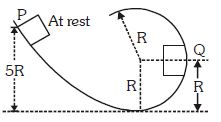
$A$ small block of mass $m$ slides along a smooth track as shown in the figure. If it starts from rest at point $P$,what is the velocity of the block at point $Q$?
A
$\sqrt{2gR}$
B
$\sqrt{3gR}$
C
$2\sqrt{2gR}$
D
$\sqrt{8gR}$
Solution
(C) According to the law of conservation of mechanical energy,the total mechanical energy at point $P$ is equal to the total mechanical energy at point $Q$.
Total energy at $P$ = $PE_P + KE_P = mg(5R) + 0 = 5mgR$.
Total energy at $Q$ = $PE_Q + KE_Q = mgR + \frac{1}{2}mv^2$.
Equating the two,we get:
$5mgR = mgR + \frac{1}{2}mv^2$
$4mgR = \frac{1}{2}mv^2$
$8gR = v^2$
$v = \sqrt{8gR} = 2\sqrt{2gR}$.
Total energy at $P$ = $PE_P + KE_P = mg(5R) + 0 = 5mgR$.
Total energy at $Q$ = $PE_Q + KE_Q = mgR + \frac{1}{2}mv^2$.
Equating the two,we get:
$5mgR = mgR + \frac{1}{2}mv^2$
$4mgR = \frac{1}{2}mv^2$
$8gR = v^2$
$v = \sqrt{8gR} = 2\sqrt{2gR}$.
0 likes
View Solution103
MediumMCQ
$A$ body of mass $10\, kg$ is released from a tower of height $20\, m$ and the body acquires a velocity of $10\, m/s$ after falling through the distance $20\, m$. The work done by the air resistance on the body is: ................. $J$ (Take $g = 10\, m/s^2$)
A
$1500$
B
$1800$
C
$-1500$
D
$-1800$
Solution
(C) According to the work-energy theorem,the total work done on the body is equal to the change in its kinetic energy.
$W_{\text{gravity}} + W_{\text{air}} = \Delta KE$
Given:
Mass $m = 10\, kg$,Height $h = 20\, m$,Final velocity $v = 10\, m/s$,Initial velocity $u = 0\, m/s$,$g = 10\, m/s^2$.
Work done by gravity $W_{\text{gravity}} = mgh = 10 \times 10 \times 20 = 2000\, J$.
Change in kinetic energy $\Delta KE = \frac{1}{2}mv^2 - 0 = \frac{1}{2} \times 10 \times (10)^2 = 500\, J$.
Substituting these values into the work-energy theorem:
$2000 + W_{\text{air}} = 500$
$W_{\text{air}} = 500 - 2000 = -1500\, J$.
Thus,the work done by the air resistance is $-1500\, J$.
$W_{\text{gravity}} + W_{\text{air}} = \Delta KE$
Given:
Mass $m = 10\, kg$,Height $h = 20\, m$,Final velocity $v = 10\, m/s$,Initial velocity $u = 0\, m/s$,$g = 10\, m/s^2$.
Work done by gravity $W_{\text{gravity}} = mgh = 10 \times 10 \times 20 = 2000\, J$.
Change in kinetic energy $\Delta KE = \frac{1}{2}mv^2 - 0 = \frac{1}{2} \times 10 \times (10)^2 = 500\, J$.
Substituting these values into the work-energy theorem:
$2000 + W_{\text{air}} = 500$
$W_{\text{air}} = 500 - 2000 = -1500\, J$.
Thus,the work done by the air resistance is $-1500\, J$.
0 likes
View Solution104
DifficultMCQ
$A$ force acts on a $3\, g$ particle in such a way that the position of the particle as a function of time is given by $x = 3t - 4t^2 + t^3$,where $x$ is in $meters$ and $t$ is in $seconds$. The work done during the first $4\, seconds$ is ................. $mJ$.
A
$384$
B
$168$
C
$528$
D
$541$
Solution
(C) The position of the particle is given by $x = 3t - 4t^2 + t^3$.
The velocity $v$ is the derivative of position with respect to time: $v = \frac{dx}{dt} = 3 - 8t + 3t^2$.
At $t = 0$,the initial velocity $v_1 = 3 - 8(0) + 3(0)^2 = 3\, m/s$.
At $t = 4$,the final velocity $v_2 = 3 - 8(4) + 3(4)^2 = 3 - 32 + 48 = 19\, m/s$.
According to the work-energy theorem,the work done $W$ is equal to the change in kinetic energy: $W = \Delta K = \frac{1}{2} m(v_2^2 - v_1^2)$.
Given mass $m = 3\, g = 3 \times 10^{-3}\, kg$.
$W = \frac{1}{2} \times 3 \times 10^{-3} \times (19^2 - 3^2) = \frac{1}{2} \times 3 \times 10^{-3} \times (361 - 9) = \frac{1}{2} \times 3 \times 10^{-3} \times 352$.
$W = 3 \times 10^{-3} \times 176 = 528 \times 10^{-3}\, J = 528\, mJ$.
The velocity $v$ is the derivative of position with respect to time: $v = \frac{dx}{dt} = 3 - 8t + 3t^2$.
At $t = 0$,the initial velocity $v_1 = 3 - 8(0) + 3(0)^2 = 3\, m/s$.
At $t = 4$,the final velocity $v_2 = 3 - 8(4) + 3(4)^2 = 3 - 32 + 48 = 19\, m/s$.
According to the work-energy theorem,the work done $W$ is equal to the change in kinetic energy: $W = \Delta K = \frac{1}{2} m(v_2^2 - v_1^2)$.
Given mass $m = 3\, g = 3 \times 10^{-3}\, kg$.
$W = \frac{1}{2} \times 3 \times 10^{-3} \times (19^2 - 3^2) = \frac{1}{2} \times 3 \times 10^{-3} \times (361 - 9) = \frac{1}{2} \times 3 \times 10^{-3} \times 352$.
$W = 3 \times 10^{-3} \times 176 = 528 \times 10^{-3}\, J = 528\, mJ$.
0 likes
View Solution105
MediumMCQ
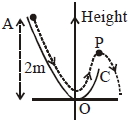
$A$ particle $(m = 1 \; kg)$ slides down a frictionless track $(AOC)$ starting from rest at a point $A$ (height $2 \; m$). After reaching $C$,the particle continues to move freely in air as a projectile. When it reaches its highest point $P$ (height $1 \; m$),the kinetic energy of the particle (in $J$) is: (Figure drawn is schematic and not to scale; take $g = 10 \; ms^{-2}$)
A
$8$
B
$10$
C
$15$
D
$13$
Solution
(B) Since the track is frictionless,the total mechanical energy of the particle is conserved throughout its motion.
Let the potential energy be zero at the ground level.
At point $A$,the particle starts from rest,so its initial kinetic energy $K_A = 0$ and potential energy $U_A = mgh_A = 1 \times 10 \times 2 = 20 \; J$.
At the highest point $P$ of the projectile motion,the particle still has a horizontal velocity component. Let the kinetic energy at $P$ be $K_P$ and potential energy be $U_P = mgh_P = 1 \times 10 \times 1 = 10 \; J$.
By the law of conservation of mechanical energy:
$K_A + U_A = K_P + U_P$
$0 + 20 = K_P + 10$
$K_P = 20 - 10 = 10 \; J$.
Let the potential energy be zero at the ground level.
At point $A$,the particle starts from rest,so its initial kinetic energy $K_A = 0$ and potential energy $U_A = mgh_A = 1 \times 10 \times 2 = 20 \; J$.
At the highest point $P$ of the projectile motion,the particle still has a horizontal velocity component. Let the kinetic energy at $P$ be $K_P$ and potential energy be $U_P = mgh_P = 1 \times 10 \times 1 = 10 \; J$.
By the law of conservation of mechanical energy:
$K_A + U_A = K_P + U_P$
$0 + 20 = K_P + 10$
$K_P = 20 - 10 = 10 \; J$.
0 likes
View Solution106
MediumMCQ
$A$ bullet of mass $0.04\; kg$ moving with a speed of $90\; m/s$ enters a heavy wooden block and is stopped after a distance of $60\; cm$. What is the average resistive force exerted by the block on the bullet (in $; N$)?
A
$270$
B
$135$
C
$540$
D
$675$
Solution
(A) Given: Mass of the bullet $m = 0.04\; kg$,initial velocity $u = 90\; m/s$,final velocity $v = 0\; m/s$,and distance $s = 60\; cm = 0.6\; m$.
Using the third equation of motion,$v^2 = u^2 + 2as$,we find the acceleration $a$:
$0^2 = (90)^2 + 2 \times a \times 0.6$
$0 = 8100 + 1.2a$
$a = -\frac{8100}{1.2} = -6750\; m/s^2$.
The negative sign indicates retardation.
According to Newton's second law of motion,the average resistive force $F$ is given by $F = m \times |a|$.
$F = 0.04\; kg \times 6750\; m/s^2 = 270\; N$.
Thus,the average resistive force exerted by the block on the bullet is $270\; N$.
Using the third equation of motion,$v^2 = u^2 + 2as$,we find the acceleration $a$:
$0^2 = (90)^2 + 2 \times a \times 0.6$
$0 = 8100 + 1.2a$
$a = -\frac{8100}{1.2} = -6750\; m/s^2$.
The negative sign indicates retardation.
According to Newton's second law of motion,the average resistive force $F$ is given by $F = m \times |a|$.
$F = 0.04\; kg \times 6750\; m/s^2 = 270\; N$.
Thus,the average resistive force exerted by the block on the bullet is $270\; N$.
0 likes
View Solution107
MediumMCQ
$A$ body of mass $0.5\; kg$ travels in a straight line with velocity $v=a x^{3/2}$ where $a=5\; m^{-1/2} s^{-1}$. What is the work done (in $J$) by the net force during its displacement from $x=0$ to $x=2\; m$?
A
$50$
B
$30$
C
$40$
D
$60$
Solution
(A) Mass of the body,$m = 0.5\; kg$.
Velocity of the body is given by $v = a x^{3/2}$ with $a = 5\; m^{-1/2} s^{-1}$.
Initial velocity $u$ at $x = 0$ is $v = 5(0)^{3/2} = 0\; m/s$.
Final velocity $v$ at $x = 2\; m$ is $v = 5(2)^{3/2} = 5 \times 2\sqrt{2} = 10\sqrt{2}\; m/s$.
According to the Work-Energy Theorem,the work done $W$ is equal to the change in kinetic energy:
$W = \Delta K = \frac{1}{2} m (v^2 - u^2)$
$W = \frac{1}{2} \times 0.5 \times [(10\sqrt{2})^2 - 0^2]$
$W = 0.25 \times [100 \times 2]$
$W = 0.25 \times 200 = 50\; J$.
Velocity of the body is given by $v = a x^{3/2}$ with $a = 5\; m^{-1/2} s^{-1}$.
Initial velocity $u$ at $x = 0$ is $v = 5(0)^{3/2} = 0\; m/s$.
Final velocity $v$ at $x = 2\; m$ is $v = 5(2)^{3/2} = 5 \times 2\sqrt{2} = 10\sqrt{2}\; m/s$.
According to the Work-Energy Theorem,the work done $W$ is equal to the change in kinetic energy:
$W = \Delta K = \frac{1}{2} m (v^2 - u^2)$
$W = \frac{1}{2} \times 0.5 \times [(10\sqrt{2})^2 - 0^2]$
$W = 0.25 \times [100 \times 2]$
$W = 0.25 \times 200 = 50\; J$.
0 likes
View Solution108
MediumMCQ
What would be the stopping distance if the velocity of a vehicle becomes three times (in $d$)?
A
$3$
B
$6$
C
$9$
D
$12$
Solution
(C) The stopping distance $s$ of a vehicle is given by the work-energy theorem,where the work done by the braking force $F$ equals the change in kinetic energy: $F \cdot s = \frac{1}{2}mv^2$.
Since the braking force $F$ and mass $m$ are constant,the stopping distance is proportional to the square of the velocity: $s \propto v^2$.
If the initial velocity is $v_1 = v$ and the stopping distance is $s_1 = d$,then for a new velocity $v_2 = 3v$,the new stopping distance $s_2$ is:
$\frac{s_2}{s_1} = \left(\frac{v_2}{v_1}\right)^2 = \left(\frac{3v}{v}\right)^2 = 3^2 = 9$.
Therefore,$s_2 = 9d$.
Since the braking force $F$ and mass $m$ are constant,the stopping distance is proportional to the square of the velocity: $s \propto v^2$.
If the initial velocity is $v_1 = v$ and the stopping distance is $s_1 = d$,then for a new velocity $v_2 = 3v$,the new stopping distance $s_2$ is:
$\frac{s_2}{s_1} = \left(\frac{v_2}{v_1}\right)^2 = \left(\frac{3v}{v}\right)^2 = 3^2 = 9$.
Therefore,$s_2 = 9d$.
0 likes
View Solution109
Medium
Explain the work-energy theorem.
Solution
(N/A) For straight-line motion: If a body is moving with initial velocity $u$ and constant acceleration $a$, it acquires velocity $v$ after displacement $s$. From the third equation of motion, $v^{2} - u^{2} = 2as$.
Multiplying by $\frac{m}{2}$ on both sides of the equation:
$\frac{1}{2}mv^{2} - \frac{1}{2}mu^{2} = mas$
Since $F = ma$, we get:
$K_{f} - K_{i} = Fs = W$
For motion in three dimensions:
$v^{2} - u^{2} = 2\vec{a} \cdot \vec{d}$
where $v$ is final velocity, $u$ is initial velocity, $\vec{a}$ is constant acceleration, and $\vec{d}$ is displacement.
Multiplying by $\frac{m}{2}$ on both sides:
$\frac{1}{2}mv^{2} - \frac{1}{2}mu^{2} = m\vec{a} \cdot \vec{d}$
$= \vec{F} \cdot \vec{d} = W$
The left-hand side represents the change in kinetic energy $(\Delta K)$ of the body, while the right-hand side represents the work done $(W)$ by the force.
Therefore, $\Delta K = W$. This relation is known as the work-energy theorem.
Multiplying by $\frac{m}{2}$ on both sides of the equation:
$\frac{1}{2}mv^{2} - \frac{1}{2}mu^{2} = mas$
Since $F = ma$, we get:
$K_{f} - K_{i} = Fs = W$
For motion in three dimensions:
$v^{2} - u^{2} = 2\vec{a} \cdot \vec{d}$
where $v$ is final velocity, $u$ is initial velocity, $\vec{a}$ is constant acceleration, and $\vec{d}$ is displacement.
Multiplying by $\frac{m}{2}$ on both sides:
$\frac{1}{2}mv^{2} - \frac{1}{2}mu^{2} = m\vec{a} \cdot \vec{d}$
$= \vec{F} \cdot \vec{d} = W$
The left-hand side represents the change in kinetic energy $(\Delta K)$ of the body, while the right-hand side represents the work done $(W)$ by the force.
Therefore, $\Delta K = W$. This relation is known as the work-energy theorem.
0 likes
View Solution110
EasyMCQ
What is the difference between work done on a body by a force and work done by a body?
A
Work done on a body increases its energy,while work done by a body decreases its energy.
B
Work done on a body decreases its energy,while work done by a body increases its energy.
C
Both represent the same physical process.
D
Work done on a body is always zero,while work done by a body is always positive.
Solution
(A) Work done on a body by an external force is defined as $W = \int \vec{F} \cdot d\vec{r}$. According to the work-energy theorem,if work is done on a body,energy is transferred to the body,resulting in an increase in its kinetic energy.
Conversely,when a body does work against an external force,it loses energy,resulting in a decrease in its kinetic energy.
Therefore,work done on a body increases its energy,and work done by a body decreases its energy.
Conversely,when a body does work against an external force,it loses energy,resulting in a decrease in its kinetic energy.
Therefore,work done on a body increases its energy,and work done by a body decreases its energy.
0 likes
View Solution111
Medium
Derive the work-energy theorem for a variable force exerted on a body in one dimension.
Solution
(N/A) Consider a body of mass $m$ moving in one dimension along the $X$-axis under the influence of a variable force $F(x)$. The kinetic energy $K$ of the body is given by $K = \frac{1}{2}mv^2$.
Differentiating $K$ with respect to time $t$:
$\frac{dK}{dt} = \frac{d}{dt} \left( \frac{1}{2}mv^2 \right) = \frac{1}{2}m \cdot 2v \cdot \frac{dv}{dt} = mv \cdot a$
Using Newton's second law,$F = ma$,we substitute $ma$ with $F$:
$\frac{dK}{dt} = Fv$
Since velocity $v = \frac{dx}{dt}$,we have:
$\frac{dK}{dt} = F \frac{dx}{dt}$
Multiplying both sides by $dt$:
$dK = F dx$
Integrating both sides from the initial position $x_i$ (with kinetic energy $K_i$) to the final position $x_f$ (with kinetic energy $K_f$):
$\int_{K_i}^{K_f} dK = \int_{x_i}^{x_f} F(x) dx$
$K_f - K_i = \int_{x_i}^{x_f} F(x) dx$
Since the work done $W$ by a variable force is defined as $W = \int_{x_i}^{x_f} F(x) dx$,we get:
$W = K_f - K_i = \Delta K$
This is the work-energy theorem for a variable force. It states that the work done by the net force on a body equals the change in its kinetic energy.
Differentiating $K$ with respect to time $t$:
$\frac{dK}{dt} = \frac{d}{dt} \left( \frac{1}{2}mv^2 \right) = \frac{1}{2}m \cdot 2v \cdot \frac{dv}{dt} = mv \cdot a$
Using Newton's second law,$F = ma$,we substitute $ma$ with $F$:
$\frac{dK}{dt} = Fv$
Since velocity $v = \frac{dx}{dt}$,we have:
$\frac{dK}{dt} = F \frac{dx}{dt}$
Multiplying both sides by $dt$:
$dK = F dx$
Integrating both sides from the initial position $x_i$ (with kinetic energy $K_i$) to the final position $x_f$ (with kinetic energy $K_f$):
$\int_{K_i}^{K_f} dK = \int_{x_i}^{x_f} F(x) dx$
$K_f - K_i = \int_{x_i}^{x_f} F(x) dx$
Since the work done $W$ by a variable force is defined as $W = \int_{x_i}^{x_f} F(x) dx$,we get:
$W = K_f - K_i = \Delta K$
This is the work-energy theorem for a variable force. It states that the work done by the net force on a body equals the change in its kinetic energy.
0 likes
View Solution112
Difficult
State the importance of the work-energy theorem. Is the work-energy theorem a scalar or a vector?
Solution
(N/A) The work-energy theorem states that the net work done on an object equals the change in its kinetic energy,expressed as $W_{net} = \Delta K = K_f - K_i$.
Importance:
$(1)$ If the change in kinetic energy $\Delta K$ of a body is zero,the net work done on the body is zero,meaning its kinetic energy and speed remain constant. For example,a particle in uniform circular motion has constant speed and zero net work done.
$(2)$ If the displacement is in the same direction as the net force (or its component),the work done is positive,causing the kinetic energy of the body to increase. For example,a body in free fall.
$(3)$ If the displacement is in the opposite direction to the net force (or its component),the work done is negative,causing the kinetic energy of the body to decrease.
Nature:
The work-energy theorem is a scalar relation because work $(W)$ and kinetic energy $(K)$ are both scalar quantities.
Importance:
$(1)$ If the change in kinetic energy $\Delta K$ of a body is zero,the net work done on the body is zero,meaning its kinetic energy and speed remain constant. For example,a particle in uniform circular motion has constant speed and zero net work done.
$(2)$ If the displacement is in the same direction as the net force (or its component),the work done is positive,causing the kinetic energy of the body to increase. For example,a body in free fall.
$(3)$ If the displacement is in the opposite direction to the net force (or its component),the work done is negative,causing the kinetic energy of the body to decrease.
Nature:
The work-energy theorem is a scalar relation because work $(W)$ and kinetic energy $(K)$ are both scalar quantities.
0 likes
View Solution113
MediumMCQ
If work is positive,then kinetic energy increases or decreases?
A
Increases
B
Decreases
C
Remains constant
D
Becomes zero
Solution
(A) According to the Work-Energy Theorem,the net work done on an object is equal to the change in its kinetic energy.
Mathematically,$W = \Delta K = K_f - K_i$.
If the work done $(W)$ is positive,then $\Delta K > 0$,which implies $K_f - K_i > 0$ or $K_f > K_i$.
Therefore,the kinetic energy of the object increases.
Mathematically,$W = \Delta K = K_f - K_i$.
If the work done $(W)$ is positive,then $\Delta K > 0$,which implies $K_f - K_i > 0$ or $K_f > K_i$.
Therefore,the kinetic energy of the object increases.
0 likes
View Solution114
Medium
State and establish the principle of conservation of mechanical energy.
Solution
(N/A) The principle of conservation of mechanical energy states that if only conservative forces (like gravitational force) do work on a system,the total mechanical energy (sum of kinetic energy $K$ and potential energy $U$) remains constant.
Proof:
Consider an object of mass $m$ falling freely under gravity from a height $h$ above the ground.
$1$. At height $h$ (point $A$): The velocity $v = 0$. Kinetic energy $K = 0$. Potential energy $U = mgh$. Total energy $E = K + U = mgh$.
$2$. At a distance $x$ below $A$ (point $B$): The object has fallen a distance $x$,so its height is $h - x$. Using $v^2 = u^2 + 2as$,$v^2 = 0 + 2gx = 2gx$. Kinetic energy $K = \frac{1}{2}mv^2 = mgx$. Potential energy $U = mg(h - x)$. Total energy $E = K + U = mgx + mgh - mgx = mgh$.
$3$. At the ground (point $C$): The object has fallen a distance $h$. Using $v^2 = u^2 + 2as$,$v^2 = 0 + 2gh = 2gh$. Kinetic energy $K = \frac{1}{2}mv^2 = mgh$. Potential energy $U = 0$. Total energy $E = K + U = mgh + 0 = mgh$.
Since the total mechanical energy is $mgh$ at all points,the principle is established.
Proof:
Consider an object of mass $m$ falling freely under gravity from a height $h$ above the ground.
$1$. At height $h$ (point $A$): The velocity $v = 0$. Kinetic energy $K = 0$. Potential energy $U = mgh$. Total energy $E = K + U = mgh$.
$2$. At a distance $x$ below $A$ (point $B$): The object has fallen a distance $x$,so its height is $h - x$. Using $v^2 = u^2 + 2as$,$v^2 = 0 + 2gx = 2gx$. Kinetic energy $K = \frac{1}{2}mv^2 = mgx$. Potential energy $U = mg(h - x)$. Total energy $E = K + U = mgx + mgh - mgx = mgh$.
$3$. At the ground (point $C$): The object has fallen a distance $h$. Using $v^2 = u^2 + 2as$,$v^2 = 0 + 2gh = 2gh$. Kinetic energy $K = \frac{1}{2}mv^2 = mgh$. Potential energy $U = 0$. Total energy $E = K + U = mgh + 0 = mgh$.
Since the total mechanical energy is $mgh$ at all points,the principle is established.
0 likes
View Solution115
Medium
Explain the conservation of mechanical energy using the example of a falling ball.
Solution
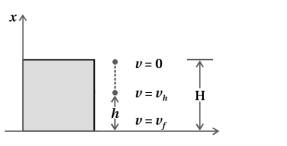
(N/A) Consider a ball of mass $m$ falling from the top of a cliff of height $H$,as shown in the figure.
For heights $H$,$h$,and $0$ (at the ground),the total mechanical energies $E_H$,$E_h$,and $E_0$ are calculated as follows:
At height $H$,the total mechanical energy is:
$E_H = mgH + \frac{1}{2}mv^2$
Since the velocity at the maximum height is $v = 0$,
$\therefore E_H = mgH$
At height $h$,the total energy is:
$E_h = \text{Potential Energy} + \text{Kinetic Energy}$
$E_h = mgh + \frac{1}{2}mv_h^2$ (where $v_h$ is the velocity of the ball at height $h$)
At the ground (height $0$),the total energy is:
$E_0 = \frac{1}{2}mv_f^2$
where $v_f$ is the final velocity of the ball when it hits the ground.
By the law of conservation of energy,$E_H = E_0$:
$mgH = \frac{1}{2}mv_f^2$
$\therefore v_f = \sqrt{2gH}$
Also,from the conservation of mechanical energy between height $H$ and height $h$:
$E_H = E_h$
$mgH = mgh + \frac{1}{2}mv_h^2$
For heights $H$,$h$,and $0$ (at the ground),the total mechanical energies $E_H$,$E_h$,and $E_0$ are calculated as follows:
At height $H$,the total mechanical energy is:
$E_H = mgH + \frac{1}{2}mv^2$
Since the velocity at the maximum height is $v = 0$,
$\therefore E_H = mgH$
At height $h$,the total energy is:
$E_h = \text{Potential Energy} + \text{Kinetic Energy}$
$E_h = mgh + \frac{1}{2}mv_h^2$ (where $v_h$ is the velocity of the ball at height $h$)
At the ground (height $0$),the total energy is:
$E_0 = \frac{1}{2}mv_f^2$
where $v_f$ is the final velocity of the ball when it hits the ground.
By the law of conservation of energy,$E_H = E_0$:
$mgH = \frac{1}{2}mv_f^2$
$\therefore v_f = \sqrt{2gH}$
Also,from the conservation of mechanical energy between height $H$ and height $h$:
$E_H = E_h$
$mgH = mgh + \frac{1}{2}mv_h^2$
0 likes
View Solution116
Difficult
State the principle of conservation of mechanical energy for a conservative force.
Solution
(N/A) The principle of conservation of mechanical energy states that if only conservative forces act on a system, the total mechanical energy of the system remains constant.
Mathematically, the total mechanical energy $E$ is the sum of kinetic energy $K$ and potential energy $U$.
$E = K + U = \text{constant}$.
This implies that any change in kinetic energy is equal to the negative change in potential energy:
$\Delta K + \Delta U = 0$ or $\Delta K = -\Delta U$.
Mathematically, the total mechanical energy $E$ is the sum of kinetic energy $K$ and potential energy $U$.
$E = K + U = \text{constant}$.
This implies that any change in kinetic energy is equal to the negative change in potential energy:
$\Delta K + \Delta U = 0$ or $\Delta K = -\Delta U$.
0 likes
View Solution117
Medium
Write the equation of total mechanical energy of a body of mass $m$ falling freely from a height $H$.
Solution
(N/A) The total mechanical energy $(E)$ of a body is the sum of its kinetic energy $(K)$ and potential energy $(U)$.
For a body of mass $m$ falling freely from a height $H$,at any height $h$ (where $0 \le h \le H$),the velocity $v$ of the body is given by the equation of motion $v^2 = u^2 + 2g(H-h)$. Since the body falls from rest,$u = 0$,so $v^2 = 2g(H-h)$.
The kinetic energy is $K = \frac{1}{2}mv^2 = \frac{1}{2}m(2g(H-h)) = mg(H-h)$.
The potential energy at height $h$ is $U = mgh$.
The total mechanical energy is $E = K + U = mg(H-h) + mgh = mgH - mgh + mgh = mgH$.
Thus,the equation for total mechanical energy is $E = mgH$.
For a body of mass $m$ falling freely from a height $H$,at any height $h$ (where $0 \le h \le H$),the velocity $v$ of the body is given by the equation of motion $v^2 = u^2 + 2g(H-h)$. Since the body falls from rest,$u = 0$,so $v^2 = 2g(H-h)$.
The kinetic energy is $K = \frac{1}{2}mv^2 = \frac{1}{2}m(2g(H-h)) = mg(H-h)$.
The potential energy at height $h$ is $U = mgh$.
The total mechanical energy is $E = K + U = mg(H-h) + mgh = mgH - mgh + mgh = mgH$.
Thus,the equation for total mechanical energy is $E = mgH$.
0 likes
View Solution118
Medium
$A$ body falls freely from a height $h$ in a gravitational field. Match the following:
| Column-$I$ | Column-$II$ |
| $(1)$ Potential Energy $=$ Kinetic Energy | $(a)$ At height $\frac{2h}{3}$ |
| $(2)$ Potential Energy $= 2 \times$ Kinetic Energy | $(b)$ Constant at every point |
| $(c)$ At height $\frac{h}{2}$ |
Solution
(A) Let the total energy be $E = mgh$. At any height $y$ from the ground,Potential Energy $U = mgy$ and Kinetic Energy $K = mg(h-y)$.
For $(1)$,$U = K \implies mgy = mg(h-y) \implies y = h-y \implies 2y = h \implies y = \frac{h}{2}$. Thus,$(1) \rightarrow (c)$.
For $(2)$,$U = 2K \implies mgy = 2mg(h-y) \implies y = 2h - 2y \implies 3y = 2h \implies y = \frac{2h}{3}$. Thus,$(2) \rightarrow (a)$.
Therefore,the correct matching is $(1)-(c)$ and $(2)-(a)$.
For $(1)$,$U = K \implies mgy = mg(h-y) \implies y = h-y \implies 2y = h \implies y = \frac{h}{2}$. Thus,$(1) \rightarrow (c)$.
For $(2)$,$U = 2K \implies mgy = 2mg(h-y) \implies y = 2h - 2y \implies 3y = 2h \implies y = \frac{2h}{3}$. Thus,$(2) \rightarrow (a)$.
Therefore,the correct matching is $(1)-(c)$ and $(2)-(a)$.
0 likes
View Solution119
MediumMCQ
$A$ body is projected vertically upwards with an initial velocity of $7 \, m/s$. At what height will its kinetic energy become half of its initial value (in $, m$)?
A
$1.25$
B
$2.50$
C
$0.625$
D
$5.00$
Solution
(A) Let $h$ be the height at which the kinetic energy becomes half of the initial kinetic energy.
Initial kinetic energy $K_0 = \frac{1}{2} m v_0^2$.
At height $h$,kinetic energy $K = \frac{K_0}{2} = \frac{1}{4} m v_0^2$.
Using the work-energy theorem or conservation of energy,the loss in kinetic energy equals the gain in potential energy:
$K_0 - K = mgh$
$\frac{1}{2} m v_0^2 - \frac{1}{4} m v_0^2 = mgh$
$\frac{1}{4} m v_0^2 = mgh$
$h = \frac{v_0^2}{4g}$
Given $v_0 = 7 \, m/s$ and $g = 9.8 \, m/s^2$:
$h = \frac{7^2}{4 \times 9.8} = \frac{49}{39.2} = 1.25 \, m$.
Initial kinetic energy $K_0 = \frac{1}{2} m v_0^2$.
At height $h$,kinetic energy $K = \frac{K_0}{2} = \frac{1}{4} m v_0^2$.
Using the work-energy theorem or conservation of energy,the loss in kinetic energy equals the gain in potential energy:
$K_0 - K = mgh$
$\frac{1}{2} m v_0^2 - \frac{1}{4} m v_0^2 = mgh$
$\frac{1}{4} m v_0^2 = mgh$
$h = \frac{v_0^2}{4g}$
Given $v_0 = 7 \, m/s$ and $g = 9.8 \, m/s^2$:
$h = \frac{7^2}{4 \times 9.8} = \frac{49}{39.2} = 1.25 \, m$.
0 likes
View Solution120
MediumMCQ
What is the work done on an object moving with a constant speed?
A
Positive
B
Negative
C
Zero
D
Infinite
Solution
(C) According to the Work-Energy Theorem,the net work done on an object is equal to the change in its kinetic energy.
$W_{net} = \Delta K = K_f - K_i$
Since the object is moving with a constant speed,its kinetic energy $K = \frac{1}{2}mv^2$ remains constant.
Therefore,the change in kinetic energy $\Delta K = 0$.
Hence,the net work done on the object is $0 \ J$.
$W_{net} = \Delta K = K_f - K_i$
Since the object is moving with a constant speed,its kinetic energy $K = \frac{1}{2}mv^2$ remains constant.
Therefore,the change in kinetic energy $\Delta K = 0$.
Hence,the net work done on the object is $0 \ J$.
0 likes
View Solution121
MediumMCQ
If mechanical work is done on an object,does its kinetic energy increase or decrease?
A
Increase
B
Decrease
C
Remains constant
D
Becomes zero
Solution
(A) According to the work-energy theorem,the net work done on an object is equal to the change in its kinetic energy $(W = \Delta K)$.
If positive mechanical work is done on an object,its kinetic energy increases.
If negative mechanical work is done on an object,its kinetic energy decreases.
Assuming the question refers to work done by an external force in the direction of motion,the kinetic energy increases.
If positive mechanical work is done on an object,its kinetic energy increases.
If negative mechanical work is done on an object,its kinetic energy decreases.
Assuming the question refers to work done by an external force in the direction of motion,the kinetic energy increases.
0 likes
View Solution122
Medium
Two bodies of unequal mass are moving in the same direction with equal kinetic energy. The two bodies are brought to rest by applying a retarding force of the same magnitude. How would the distance moved by them before coming to rest compare?
Solution
(C) According to the work-energy theorem,the change in kinetic energy is equal to the work done by the force: $\Delta K = W$.
Since the bodies are brought to rest,the work done by the retarding force $F$ over a distance $d$ is $W = F \cdot d$.
Given that the initial kinetic energy $K$ is the same for both bodies and the final kinetic energy is $0$,we have $\Delta K = K - 0 = K$.
Thus,$K = F \cdot d$,which implies $d = K / F$.
Since both the kinetic energy $K$ and the retarding force $F$ are the same for both bodies,the distance $d$ moved by them before coming to rest will be equal.
Since the bodies are brought to rest,the work done by the retarding force $F$ over a distance $d$ is $W = F \cdot d$.
Given that the initial kinetic energy $K$ is the same for both bodies and the final kinetic energy is $0$,we have $\Delta K = K - 0 = K$.
Thus,$K = F \cdot d$,which implies $d = K / F$.
Since both the kinetic energy $K$ and the retarding force $F$ are the same for both bodies,the distance $d$ moved by them before coming to rest will be equal.
0 likes
View Solution123
Difficult
$A$ balloon filled with helium rises against gravity,increasing its potential energy. The speed of the balloon also increases as it rises. How do you reconcile this with the law of conservation of mechanical energy? You can neglect viscous drag of air and assume that the density of air is constant.
Solution
(N/A) The mechanical energy of the balloon alone is not conserved because an external buoyant force acts on it. The work done by the buoyant force is responsible for the increase in the total mechanical energy (kinetic energy + potential energy) of the balloon.
Let $m$ be the mass of the balloon,$V$ be its volume,$\rho_{He}$ be the density of helium,and $\rho_{air}$ be the density of air.
The net upward force on the balloon is $F_{net} = V(\rho_{air} - \rho_{He})g - mg = ma$.
As the balloon rises to a height $h$,the work done by the buoyant force is $W_b = V \rho_{air} g h$.
The change in mechanical energy is $\Delta E = \Delta K + \Delta U = \frac{1}{2}mv^2 + mgh$.
Using the work-energy theorem,the work done by the net force is equal to the change in kinetic energy: $W_{net} = [V(\rho_{air} - \rho_{He})g - mg]h = \frac{1}{2}mv^2$.
Rearranging this,we get $V \rho_{air} g h = \frac{1}{2}mv^2 + mgh$.
This shows that the work done by the buoyant force $(V \rho_{air} g h)$ is exactly equal to the increase in the total mechanical energy of the balloon.
Let $m$ be the mass of the balloon,$V$ be its volume,$\rho_{He}$ be the density of helium,and $\rho_{air}$ be the density of air.
The net upward force on the balloon is $F_{net} = V(\rho_{air} - \rho_{He})g - mg = ma$.
As the balloon rises to a height $h$,the work done by the buoyant force is $W_b = V \rho_{air} g h$.
The change in mechanical energy is $\Delta E = \Delta K + \Delta U = \frac{1}{2}mv^2 + mgh$.
Using the work-energy theorem,the work done by the net force is equal to the change in kinetic energy: $W_{net} = [V(\rho_{air} - \rho_{He})g - mg]h = \frac{1}{2}mv^2$.
Rearranging this,we get $V \rho_{air} g h = \frac{1}{2}mv^2 + mgh$.
This shows that the work done by the buoyant force $(V \rho_{air} g h)$ is exactly equal to the increase in the total mechanical energy of the balloon.
0 likes
View Solution124
Difficult
Correct the following sentence: 'System cannot possess mechanical energy but possesses work.'
Solution
(N/A) The correct statement is: '$A$ system can possess mechanical energy but cannot possess work.'
Reasoning:
$1$. Energy is a state function,meaning it is a property of the system's state. Therefore,a system can possess internal energy or mechanical energy.
$2$. Work is a path function,not a state function. It represents energy in transit across the boundary of a system due to a force acting through a distance. $A$ system does not 'have' or 'possess' work; it performs work or has work done on it.
Reasoning:
$1$. Energy is a state function,meaning it is a property of the system's state. Therefore,a system can possess internal energy or mechanical energy.
$2$. Work is a path function,not a state function. It represents energy in transit across the boundary of a system due to a force acting through a distance. $A$ system does not 'have' or 'possess' work; it performs work or has work done on it.
0 likes
View Solution125
MediumMCQ
$A$ cricket ball of mass $0.15 \, kg$ is thrown vertically up by a bowling machine so that it rises to a maximum height of $20 \, m$ after leaving the machine. If the part pushing the ball applies a constant force $F$ on the ball and moves a distance of $0.2 \, m$ while launching the ball,the value of $F$ (in $N$) is $(g = 10 \, m/s^2)$.
A
$200$
B
$150$
C
$275$
D
$325$
Solution
(B) According to the Work-Energy Theorem,the work done by the force $F$ on the ball is equal to the change in its kinetic energy,which is equal to the potential energy gained at the maximum height.
Work done by the machine,$W = F \times S$,where $S = 0.2 \, m$.
Potential energy gained at maximum height,$U = mgh$,where $m = 0.15 \, kg$,$g = 10 \, m/s^2$,and $h = 20 \, m$.
Equating the work done to the potential energy: $F \times S = mgh$.
$F \times 0.2 = 0.15 \times 10 \times 20$.
$F \times 0.2 = 30$.
$F = \frac{30}{0.2} = 150 \, N$.
Work done by the machine,$W = F \times S$,where $S = 0.2 \, m$.
Potential energy gained at maximum height,$U = mgh$,where $m = 0.15 \, kg$,$g = 10 \, m/s^2$,and $h = 20 \, m$.
Equating the work done to the potential energy: $F \times S = mgh$.
$F \times 0.2 = 0.15 \times 10 \times 20$.
$F \times 0.2 = 30$.
$F = \frac{30}{0.2} = 150 \, N$.
0 likes
View Solution126
MediumMCQ
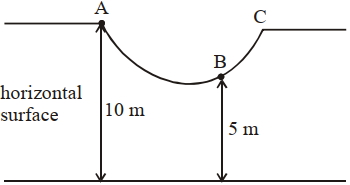
As shown in the figure,a particle of mass $10 \ kg$ is placed at a point $A$. When the particle is slightly displaced to its right,it starts moving and reaches the point $B$. The speed of the particle at $B$ is $x \ m/s$. (Take $g = 10 \ m/s^2$). The value of $x$ to the nearest integer is:
A
$5$
B
$8$
C
$12$
D
$10$
Solution
(D) According to the law of conservation of mechanical energy,the total mechanical energy at point $A$ is equal to the total mechanical energy at point $B$.
$E_A = E_B$
$PE_A + KE_A = PE_B + KE_B$
Given that the particle starts from rest at $A$,$KE_A = 0$.
$mgh_A + 0 = mgh_B + \frac{1}{2}mv^2$
$gh_A = gh_B + \frac{1}{2}v^2$
$v^2 = 2g(h_A - h_B)$
Substituting the given values: $g = 10 \ m/s^2$,$h_A = 10 \ m$,$h_B = 5 \ m$.
$v^2 = 2 \times 10 \times (10 - 5)$
$v^2 = 20 \times 5 = 100$
$v = \sqrt{100} = 10 \ m/s$
Therefore,the value of $x$ is $10$.
$E_A = E_B$
$PE_A + KE_A = PE_B + KE_B$
Given that the particle starts from rest at $A$,$KE_A = 0$.
$mgh_A + 0 = mgh_B + \frac{1}{2}mv^2$
$gh_A = gh_B + \frac{1}{2}v^2$
$v^2 = 2g(h_A - h_B)$
Substituting the given values: $g = 10 \ m/s^2$,$h_A = 10 \ m$,$h_B = 5 \ m$.
$v^2 = 2 \times 10 \times (10 - 5)$
$v^2 = 20 \times 5 = 100$
$v = \sqrt{100} = 10 \ m/s$
Therefore,the value of $x$ is $10$.
0 likes
View Solution127
DifficultMCQ
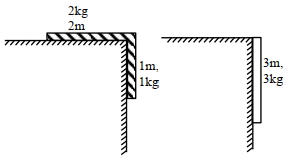
$A$ uniform chain of length $3\, m$ and mass $3\, kg$ overhangs a smooth table with $2\, m$ laying on the table. If $k$ is the kinetic energy of the chain in joules as it completely slips off the table,then the value of $k$ is (Take $g = 10\, m/s^2$).
A
$40$
B
$60$
C
$400$
D
$10$
Solution
(A) Let the total length of the chain be $L = 3\, m$ and total mass be $M = 3\, kg$. The linear mass density is $\lambda = M/L = 3/3 = 1\, kg/m$.
Initially,$2\, m$ of the chain is on the table and $1\, m$ is hanging. The center of mass of the hanging part is at a distance of $0.5\, m$ below the table level. Taking the table surface as the reference level $(U = 0)$,the initial potential energy is $U_i = -(m_{hanging})g(h_{cm}) = -(1\, kg)(10\, m/s^2)(0.5\, m) = -5\, J$.
The initial kinetic energy is $K_i = 0$.
Finally,when the chain completely slips off,the entire chain of length $3\, m$ hangs vertically. Its center of mass is at $1.5\, m$ below the table level. The final potential energy is $U_f = -(M)g(h_{cm}) = -(3\, kg)(10\, m/s^2)(1.5\, m) = -45\, J$.
By the law of conservation of mechanical energy,$K_i + U_i = K_f + U_f$.
$0 + (-5\, J) = K_f + (-45\, J)$.
$K_f = 45 - 5 = 40\, J$.
Thus,the value of $k$ is $40$.
Initially,$2\, m$ of the chain is on the table and $1\, m$ is hanging. The center of mass of the hanging part is at a distance of $0.5\, m$ below the table level. Taking the table surface as the reference level $(U = 0)$,the initial potential energy is $U_i = -(m_{hanging})g(h_{cm}) = -(1\, kg)(10\, m/s^2)(0.5\, m) = -5\, J$.
The initial kinetic energy is $K_i = 0$.
Finally,when the chain completely slips off,the entire chain of length $3\, m$ hangs vertically. Its center of mass is at $1.5\, m$ below the table level. The final potential energy is $U_f = -(M)g(h_{cm}) = -(3\, kg)(10\, m/s^2)(1.5\, m) = -45\, J$.
By the law of conservation of mechanical energy,$K_i + U_i = K_f + U_f$.
$0 + (-5\, J) = K_f + (-45\, J)$.
$K_f = 45 - 5 = 40\, J$.
Thus,the value of $k$ is $40$.
0 likes
View Solution128
DifficultMCQ
$A$ body of mass $m$ dropped from a height $h$ reaches the ground with a speed of $0.8 \sqrt{gh}$. The value of work done by the air friction is $.....$
A
$-0.68 mgh$
B
$mgh$
C
$1.64 mgh$
D
$0.64 mgh$
Solution
(A) According to the Work-Energy Theorem,the total work done on the body is equal to the change in its kinetic energy.
$W_{total} = \Delta K$
$W_{gravity} + W_{air\ friction} = K_f - K_i$
Given that the body is dropped,initial velocity $u = 0$,so $K_i = 0$.
The work done by gravity is $W_{gravity} = mgh$.
The final kinetic energy is $K_f = \frac{1}{2} m v^2 = \frac{1}{2} m (0.8 \sqrt{gh})^2$.
$K_f = \frac{1}{2} m (0.64 gh) = 0.32 mgh$.
Substituting these values into the theorem:
$mgh + W_{air\ friction} = 0.32 mgh - 0$
$W_{air\ friction} = 0.32 mgh - mgh = -0.68 mgh$.
Thus,the work done by air friction is $-0.68 mgh$.
$W_{total} = \Delta K$
$W_{gravity} + W_{air\ friction} = K_f - K_i$
Given that the body is dropped,initial velocity $u = 0$,so $K_i = 0$.
The work done by gravity is $W_{gravity} = mgh$.
The final kinetic energy is $K_f = \frac{1}{2} m v^2 = \frac{1}{2} m (0.8 \sqrt{gh})^2$.
$K_f = \frac{1}{2} m (0.64 gh) = 0.32 mgh$.
Substituting these values into the theorem:
$mgh + W_{air\ friction} = 0.32 mgh - 0$
$W_{air\ friction} = 0.32 mgh - mgh = -0.68 mgh$.
Thus,the work done by air friction is $-0.68 mgh$.
0 likes
View Solution129
MediumMCQ
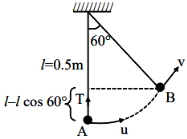
$A$ pendulum bob has a speed of $3 \, m/s$ at its lowest position. The pendulum is $50 \, cm$ long. The speed of the bob, when the string makes an angle of $60^{\circ}$ to the vertical, will be $....... \, m/s$ $(g = 10 \, m/s^2)$.
A
$1$
B
$20$
C
$40$
D
$2$
Solution
(D) Let the mass of the bob be $m$, length of the pendulum be $l = 0.5 \, m$, and initial speed at the lowest point be $u = 3 \, m/s$.
Using the law of conservation of mechanical energy between the lowest point $(A)$ and the point where the string makes an angle $\theta = 60^{\circ}$ with the vertical $(B)$:
Total energy at $A$ = Total energy at $B$
$\frac{1}{2} mu^2 = \frac{1}{2} mv^2 + mgh$
Where $h$ is the vertical height gained by the bob, given by $h = l(1 - \cos \theta)$.
Substituting the values:
$\frac{1}{2} m(3)^2 = \frac{1}{2} mv^2 + mg(0.5)(1 - \cos 60^{\circ})$
$9 = v^2 + 2(10)(0.5)(1 - 0.5)$
$9 = v^2 + 10(0.5)$
$9 = v^2 + 5$
$v^2 = 4$
$v = 2 \, m/s$.
Using the law of conservation of mechanical energy between the lowest point $(A)$ and the point where the string makes an angle $\theta = 60^{\circ}$ with the vertical $(B)$:
Total energy at $A$ = Total energy at $B$
$\frac{1}{2} mu^2 = \frac{1}{2} mv^2 + mgh$
Where $h$ is the vertical height gained by the bob, given by $h = l(1 - \cos \theta)$.
Substituting the values:
$\frac{1}{2} m(3)^2 = \frac{1}{2} mv^2 + mg(0.5)(1 - \cos 60^{\circ})$
$9 = v^2 + 2(10)(0.5)(1 - 0.5)$
$9 = v^2 + 10(0.5)$
$9 = v^2 + 5$
$v^2 = 4$
$v = 2 \, m/s$.
0 likes
View Solution130
MediumMCQ
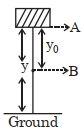
In the given figure, the block of mass $m$ is dropped from the point $A$. The expression for the kinetic energy of the block when it reaches point $B$ is ................
A
$\frac{1}{2} m g y_{0}^{2}$
B
$\frac{1}{2} m g y^{2}$
C
$m g (y - y_{0})$
D
$m g y_{0}$
Solution
(D) According to the work-energy theorem, the work done by all forces acting on an object is equal to the change in its kinetic energy.
Here, the only force doing work on the block is gravity.
Work done by gravity $(W_g)$ = Change in kinetic energy $(\Delta K)$
$W_g = K_B - K_A$
Since the block is dropped from point $A$, its initial velocity is zero, so $K_A = 0$.
The vertical displacement of the block from point $A$ to point $B$ is $y_0$.
Therefore, the work done by gravity is $W_g = m g y_0$.
Substituting these values into the work-energy theorem:
$m g y_0 = K_B - 0$
$K_B = m g y_0$
Here, the only force doing work on the block is gravity.
Work done by gravity $(W_g)$ = Change in kinetic energy $(\Delta K)$
$W_g = K_B - K_A$
Since the block is dropped from point $A$, its initial velocity is zero, so $K_A = 0$.
The vertical displacement of the block from point $A$ to point $B$ is $y_0$.
Therefore, the work done by gravity is $W_g = m g y_0$.
Substituting these values into the work-energy theorem:
$m g y_0 = K_B - 0$
$K_B = m g y_0$
0 likes
View Solution131
MediumMCQ
$A$ particle of mass $500 \,g$ is moving in a straight line with velocity $v = b x^{5/2}$. The work done by the net force during its displacement from $x = 0$ to $x = 4 \,m$ is ................... $J$ (Take $b = 0.25 \,m^{-3/2} s^{-1}$)
A
$2$
B
$4$
C
$8$
D
$16$
Solution
(D) According to the work-energy theorem,the work done by the net force is equal to the change in kinetic energy: $W = \Delta K.E. = K_f - K_i$.
Given mass $m = 500 \,g = 0.5 \,kg$ and velocity $v = b x^{5/2}$.
At $x_i = 0$,$v_i = b(0)^{5/2} = 0$,so $K_i = 0$.
At $x_f = 4 \,m$,$v_f = b(4)^{5/2} = 0.25 \times (2^2)^{5/2} = 0.25 \times 2^5 = 0.25 \times 32 = 8 \,m/s$.
The work done is $W = \frac{1}{2} m v_f^2 - 0 = \frac{1}{2} \times 0.5 \times (8)^2$.
$W = 0.25 \times 64 = 16 \,J$.
Given mass $m = 500 \,g = 0.5 \,kg$ and velocity $v = b x^{5/2}$.
At $x_i = 0$,$v_i = b(0)^{5/2} = 0$,so $K_i = 0$.
At $x_f = 4 \,m$,$v_f = b(4)^{5/2} = 0.25 \times (2^2)^{5/2} = 0.25 \times 2^5 = 0.25 \times 32 = 8 \,m/s$.
The work done is $W = \frac{1}{2} m v_f^2 - 0 = \frac{1}{2} \times 0.5 \times (8)^2$.
$W = 0.25 \times 64 = 16 \,J$.
1 likes
View Solution132
MediumMCQ
$A$ body of mass $0.5\, kg$ travels on a straight-line path with velocity $v = (3x^2 + 4)\, m/s$. The net work done by the force during its displacement from $x = 0$ to $x = 2\, m$ is $.......J$.
A
$64$
B
$60$
C
$120$
D
$128$
Solution
(B) According to the Work-Energy Theorem,the net work done is equal to the change in kinetic energy: $W = \Delta K = K_f - K_i$.
Given mass $m = 0.5\, kg$ and velocity $v = (3x^2 + 4)\, m/s$.
At initial position $x_i = 0\, m$,the velocity is $v_i = 3(0)^2 + 4 = 4\, m/s$.
At final position $x_f = 2\, m$,the velocity is $v_f = 3(2)^2 + 4 = 3(4) + 4 = 16\, m/s$.
The change in kinetic energy is $\Delta K = \frac{1}{2} m (v_f^2 - v_i^2)$.
Substituting the values: $W = \frac{1}{2} \times 0.5 \times (16^2 - 4^2)$.
$W = 0.25 \times (256 - 16) = 0.25 \times 240$.
$W = 60\, J$.
Given mass $m = 0.5\, kg$ and velocity $v = (3x^2 + 4)\, m/s$.
At initial position $x_i = 0\, m$,the velocity is $v_i = 3(0)^2 + 4 = 4\, m/s$.
At final position $x_f = 2\, m$,the velocity is $v_f = 3(2)^2 + 4 = 3(4) + 4 = 16\, m/s$.
The change in kinetic energy is $\Delta K = \frac{1}{2} m (v_f^2 - v_i^2)$.
Substituting the values: $W = \frac{1}{2} \times 0.5 \times (16^2 - 4^2)$.
$W = 0.25 \times (256 - 16) = 0.25 \times 240$.
$W = 60\, J$.
0 likes
View Solution133
DifficultMCQ
$A$ block of mass '$m$' (as shown in the figure) moving with kinetic energy $E$ compresses a spring through a distance $25\,cm$ when its speed is halved. The value of the spring constant of the used spring will be $nE\;N\,m^{-1}$ for $n=$
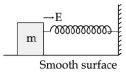
A
$26$
B
$12$
C
$23$
D
$24$
Solution
(D) According to the work-energy theorem,the work done by the spring force is equal to the change in kinetic energy of the block.
$W_{\text{net}} = K_f - K_i$
Given that the initial kinetic energy is $K_i = E = \frac{1}{2}mv^2$.
When the speed is halved,the final speed is $v' = \frac{v}{2}$.
The final kinetic energy is $K_f = \frac{1}{2}m(\frac{v}{2})^2 = \frac{1}{4}(\frac{1}{2}mv^2) = \frac{E}{4}$.
The work done by the spring in compressing it by a distance $x = 25\,cm = 0.25\,m = \frac{1}{4}\,m$ is $W = -\frac{1}{2}Kx^2$.
Applying the work-energy theorem:
$-\frac{1}{2}Kx^2 = K_f - K_i$
$-\frac{1}{2}K(\frac{1}{4})^2 = \frac{E}{4} - E$
$-\frac{1}{2}K(\frac{1}{16}) = -\frac{3E}{4}$
$\frac{K}{32} = \frac{3E}{4}$
$K = \frac{3E \times 32}{4} = 24E$
Comparing this with $nE$,we get $n = 24$.
$W_{\text{net}} = K_f - K_i$
Given that the initial kinetic energy is $K_i = E = \frac{1}{2}mv^2$.
When the speed is halved,the final speed is $v' = \frac{v}{2}$.
The final kinetic energy is $K_f = \frac{1}{2}m(\frac{v}{2})^2 = \frac{1}{4}(\frac{1}{2}mv^2) = \frac{E}{4}$.
The work done by the spring in compressing it by a distance $x = 25\,cm = 0.25\,m = \frac{1}{4}\,m$ is $W = -\frac{1}{2}Kx^2$.
Applying the work-energy theorem:
$-\frac{1}{2}Kx^2 = K_f - K_i$
$-\frac{1}{2}K(\frac{1}{4})^2 = \frac{E}{4} - E$
$-\frac{1}{2}K(\frac{1}{16}) = -\frac{3E}{4}$
$\frac{K}{32} = \frac{3E}{4}$
$K = \frac{3E \times 32}{4} = 24E$
Comparing this with $nE$,we get $n = 24$.
0 likes
View Solution134
MediumMCQ
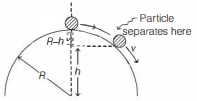
$A$ particle slides from the top of a smooth hemispherical surface of radius $R$ which is fixed on a horizontal surface. If it separates from the hemisphere at a height $h$ from the horizontal surface,then the speed of the particle is
A
$\sqrt{2g(R-h)}$
B
$\sqrt{2g(R+h)}$
C
$\sqrt{2gR}$
D
$\sqrt{2gh}$
Solution
(A) Let $v$ be the speed of the particle when it separates from the hemisphere.
Since the surface is smooth,there is no friction,and mechanical energy is conserved.
The particle starts from rest at the top of the hemisphere (height $R$ from the horizontal surface).
The potential energy at the top is $U_i = mgR$.
The potential energy at height $h$ is $U_f = mgh$.
The kinetic energy at height $h$ is $K_f = \frac{1}{2}mv^2$.
By the law of conservation of energy:
$U_i = U_f + K_f$
$mgR = mgh + \frac{1}{2}mv^2$
$mg(R-h) = \frac{1}{2}mv^2$
$v^2 = 2g(R-h)$
$v = \sqrt{2g(R-h)}$
Thus,the correct option is $A$.
Since the surface is smooth,there is no friction,and mechanical energy is conserved.
The particle starts from rest at the top of the hemisphere (height $R$ from the horizontal surface).
The potential energy at the top is $U_i = mgR$.
The potential energy at height $h$ is $U_f = mgh$.
The kinetic energy at height $h$ is $K_f = \frac{1}{2}mv^2$.
By the law of conservation of energy:
$U_i = U_f + K_f$
$mgR = mgh + \frac{1}{2}mv^2$
$mg(R-h) = \frac{1}{2}mv^2$
$v^2 = 2g(R-h)$
$v = \sqrt{2g(R-h)}$
Thus,the correct option is $A$.
0 likes
View Solution135
MediumMCQ
$A$ block of mass $m$ is sliding down an inclined plane with constant speed. At a certain instant $t_0$,its height above the ground is $h$. The coefficient of kinetic friction between the block and the plane is $\mu$. If the block reaches the ground at a later instant $t_g$,then the energy dissipated by friction in the time interval $(t_g - t_0)$ is
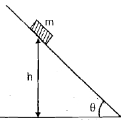
A
$\mu m g h$
B
$\mu m g h / \sin \theta$
C
$m g h$
D
$\mu m g h / \cos \theta$
Solution
(C) Since the block is sliding down the inclined plane with a constant speed,its acceleration is zero. Therefore,the change in kinetic energy $(\Delta KE)$ of the block as it moves from height $h$ to the ground is zero.
According to the work-energy theorem,the total work done on the block is equal to the change in its kinetic energy:
$W_{\text{total}} = \Delta KE = 0$
The total work done is the sum of the work done by gravity $(W_{\text{gravity}})$ and the work done by friction $(W_{\text{friction}})$:
$W_{\text{gravity}} + W_{\text{friction}} = 0$
The work done by gravity as the block descends a vertical height $h$ is $W_{\text{gravity}} = mgh$.
Substituting this into the equation:
$mgh + W_{\text{friction}} = 0$
$W_{\text{friction}} = -mgh$
The energy dissipated by friction is the magnitude of the work done by the friction force:
$\text{Energy dissipated} = |W_{\text{friction}}| = mgh$.
According to the work-energy theorem,the total work done on the block is equal to the change in its kinetic energy:
$W_{\text{total}} = \Delta KE = 0$
The total work done is the sum of the work done by gravity $(W_{\text{gravity}})$ and the work done by friction $(W_{\text{friction}})$:
$W_{\text{gravity}} + W_{\text{friction}} = 0$
The work done by gravity as the block descends a vertical height $h$ is $W_{\text{gravity}} = mgh$.
Substituting this into the equation:
$mgh + W_{\text{friction}} = 0$
$W_{\text{friction}} = -mgh$
The energy dissipated by friction is the magnitude of the work done by the friction force:
$\text{Energy dissipated} = |W_{\text{friction}}| = mgh$.
0 likes
View Solution136
AdvancedMCQ
$A$ student of mass $M$ is $1.5 \,m$ tall and has her centre of mass $1 \,m$ above the ground when standing straight. She wants to jump up vertically. To do so,she bends her knees so that her centre of mass is lowered by $0.2 \,m$ and then pushes the ground by a constant force $F$. As a result,she jumps up such that the maximum height of her feet is $0.3 \,m$ above the ground. The ratio $F / Mg$ is (in $.5$)
A
$1$
B
$2$
C
$3$
D
$4$
Solution
(B) Let the initial position of the center of mass be $h_i = 1.0 \,m$.
When she bends her knees,the center of mass is lowered by $0.2 \,m$,so the new position is $h_{new} = 1.0 - 0.2 = 0.8 \,m$.
She pushes the ground with a constant force $F$ over a distance of $d = 0.2 \,m$.
At the maximum height,the feet are $0.3 \,m$ above the ground. Since the center of mass is $1.0 \,m$ above the feet when standing straight,the final height of the center of mass is $h_f = 0.3 + 1.0 = 1.3 \,m$.
Applying the work-energy theorem from the position where she starts pushing to the maximum height:
Work done by force $F$ + Work done by gravity = Change in kinetic energy.
$F \times 0.2 - Mg(h_f - h_{new}) = 0 - 0$.
$F \times 0.2 - Mg(1.3 - 0.8) = 0$.
$F \times 0.2 = Mg \times 0.5$.
$\frac{F}{Mg} = \frac{0.5}{0.2} = 2.5$.
When she bends her knees,the center of mass is lowered by $0.2 \,m$,so the new position is $h_{new} = 1.0 - 0.2 = 0.8 \,m$.
She pushes the ground with a constant force $F$ over a distance of $d = 0.2 \,m$.
At the maximum height,the feet are $0.3 \,m$ above the ground. Since the center of mass is $1.0 \,m$ above the feet when standing straight,the final height of the center of mass is $h_f = 0.3 + 1.0 = 1.3 \,m$.
Applying the work-energy theorem from the position where she starts pushing to the maximum height:
Work done by force $F$ + Work done by gravity = Change in kinetic energy.
$F \times 0.2 - Mg(h_f - h_{new}) = 0 - 0$.
$F \times 0.2 - Mg(1.3 - 0.8) = 0$.
$F \times 0.2 = Mg \times 0.5$.
$\frac{F}{Mg} = \frac{0.5}{0.2} = 2.5$.
0 likes
View Solution137
EasyMCQ
$A$ bullet of mass $20 \,g$ leaves a rifle at an initial speed $100 \,m/s$ and strikes a target at the same level with speed $50 \,m/s$. The amount of work done by the resistance of air will be ......... $J$.
A
$100$
B
$25$
C
$50$
D
$75$
Solution
(D) According to the Work-Energy Theorem,the work done by all forces acting on an object is equal to the change in its kinetic energy.
$W = \Delta K = K_f - K_i$
Given:
Mass $m = 20 \,g = 0.02 \,kg$
Initial velocity $v_i = 100 \,m/s$
Final velocity $v_f = 50 \,m/s$
$W = \frac{1}{2} m v_f^2 - \frac{1}{2} m v_i^2 = \frac{1}{2} m (v_f^2 - v_i^2)$
$W = \frac{1}{2} \times 0.02 \times (50^2 - 100^2)$
$W = 0.01 \times (2500 - 10000)$
$W = 0.01 \times (-7500) = -75 \,J$
The work done by the air resistance is $-75 \,J$. Since the question asks for the amount of work done by the resistance of air,we consider the magnitude,which is $75 \,J$.
$W = \Delta K = K_f - K_i$
Given:
Mass $m = 20 \,g = 0.02 \,kg$
Initial velocity $v_i = 100 \,m/s$
Final velocity $v_f = 50 \,m/s$
$W = \frac{1}{2} m v_f^2 - \frac{1}{2} m v_i^2 = \frac{1}{2} m (v_f^2 - v_i^2)$
$W = \frac{1}{2} \times 0.02 \times (50^2 - 100^2)$
$W = 0.01 \times (2500 - 10000)$
$W = 0.01 \times (-7500) = -75 \,J$
The work done by the air resistance is $-75 \,J$. Since the question asks for the amount of work done by the resistance of air,we consider the magnitude,which is $75 \,J$.
0 likes
View Solution138
MediumMCQ
$A$ stone with weight $w$ is thrown vertically upward into the air from ground level with initial speed $v_0$. If a constant force $f$ due to air drag acts on the stone throughout its flight,the maximum height attained by the stone is
A
$h=\frac{v_0^2}{2 g\left(1-\frac{f}{w}\right)}$
B
$h=\frac{v_0^2}{2 g\left(1+\frac{f}{w}\right)}$
C
$h=\frac{v_0^2}{2 g\left(1+\frac{w}{f}\right)}$
D
$h=\frac{v_0^2}{2 g\left(1-\frac{w}{f}\right)}$
Solution
(B) According to the work-energy theorem,the net work done on the object is equal to the change in its kinetic energy: $W_{\text{net}} = \Delta K$.
During the upward motion,both the gravitational force $(w = mg)$ and the air drag force $(f)$ act downwards,opposing the motion.
The work done by gravity is $W_g = -wh = -mgh$.
The work done by air drag is $W_f = -fh$.
The change in kinetic energy is $\Delta K = K_f - K_i = 0 - \frac{1}{2}mv_0^2$.
Applying the theorem: $W_g + W_f = \Delta K$.
$-mgh - fh = -\frac{1}{2}mv_0^2$.
Dividing by $m$: $-gh - \frac{f}{m}h = -\frac{1}{2}v_0^2$.
Since $w = mg$,we have $m = \frac{w}{g}$. Substituting this into the drag term: $-gh - \frac{fg}{w}h = -\frac{1}{2}v_0^2$.
$h(g + \frac{fg}{w}) = \frac{1}{2}v_0^2$.
$h g (1 + \frac{f}{w}) = \frac{1}{2}v_0^2$.
$h = \frac{v_0^2}{2g(1 + \frac{f}{w})}$.
During the upward motion,both the gravitational force $(w = mg)$ and the air drag force $(f)$ act downwards,opposing the motion.
The work done by gravity is $W_g = -wh = -mgh$.
The work done by air drag is $W_f = -fh$.
The change in kinetic energy is $\Delta K = K_f - K_i = 0 - \frac{1}{2}mv_0^2$.
Applying the theorem: $W_g + W_f = \Delta K$.
$-mgh - fh = -\frac{1}{2}mv_0^2$.
Dividing by $m$: $-gh - \frac{f}{m}h = -\frac{1}{2}v_0^2$.
Since $w = mg$,we have $m = \frac{w}{g}$. Substituting this into the drag term: $-gh - \frac{fg}{w}h = -\frac{1}{2}v_0^2$.
$h(g + \frac{fg}{w}) = \frac{1}{2}v_0^2$.
$h g (1 + \frac{f}{w}) = \frac{1}{2}v_0^2$.
$h = \frac{v_0^2}{2g(1 + \frac{f}{w})}$.
0 likes
View Solution139
MediumMCQ
$A$ knife of mass $m$ is at a height $x$ from a large wooden block. The knife is allowed to fall freely,strikes the block and comes to rest after penetrating distance $y$. The work done by the wooden block to stop the knife is ..............
A
$m g x$
B
$-m g y$
C
$-m g(x+y)$
D
$m g(x-y)$
Solution
(C) According to the Work-Energy Theorem,the total work done on an object is equal to the change in its kinetic energy: $W_{\text{all}} = \Delta K$.
Here,the forces acting on the knife are gravity and the resistive force exerted by the wooden block. Since the knife starts from rest and comes to rest,the change in kinetic energy $\Delta K = 0$.
Thus,$W_{\text{gravity}} + W_{\text{block}} = 0$.
The total vertical displacement of the knife is $(x + y)$. Therefore,the work done by gravity is $W_{\text{gravity}} = m g (x + y)$.
Substituting this into the equation: $m g (x + y) + W_{\text{block}} = 0$.
Solving for the work done by the block: $W_{\text{block}} = -m g (x + y)$.
Here,the forces acting on the knife are gravity and the resistive force exerted by the wooden block. Since the knife starts from rest and comes to rest,the change in kinetic energy $\Delta K = 0$.
Thus,$W_{\text{gravity}} + W_{\text{block}} = 0$.
The total vertical displacement of the knife is $(x + y)$. Therefore,the work done by gravity is $W_{\text{gravity}} = m g (x + y)$.
Substituting this into the equation: $m g (x + y) + W_{\text{block}} = 0$.
Solving for the work done by the block: $W_{\text{block}} = -m g (x + y)$.
1 likes
View Solution140
MediumMCQ
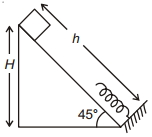
$A$ block of mass $\sqrt{2} \, kg$ is released from the top of an inclined smooth surface as shown in the figure. If the spring constant of the spring is $100 \, N/m$ and the block comes to rest after compressing the spring by $1 \, m$,then the total distance travelled by the block along the incline before it comes to rest is ......... $m$.
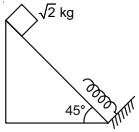
A
$1$
B
$1.25$
C
$2.5$
D
$5$
Solution
(D) Let the total distance travelled by the block along the incline be $d = 1 \, m$.
According to the law of conservation of mechanical energy,the loss in gravitational potential energy of the block is equal to the gain in elastic potential energy of the spring.
Let $d$ be the total distance travelled by the block along the incline. The vertical height dropped by the block is $h = d \sin 45^{\circ}$.
The block comes to rest after compressing the spring by $x = 1 \, m$.
Thus,the total distance travelled by the block is $d = (d_{initial} + x)$.
However,the problem asks for the total distance travelled along the incline. Let this distance be $d$.
Initial potential energy $U_i = mgd \sin 45^{\circ}$.
Final potential energy $U_f = \frac{1}{2} k x^2$.
Equating $U_i = U_f$:
$mgd \sin 45^{\circ} = \frac{1}{2} k x^2$
$(\sqrt{2}) \times 10 \times d \times \frac{1}{\sqrt{2}} = \frac{1}{2} \times 100 \times (1)^2$
$10d = 50$
$d = 5 \, m$.
According to the law of conservation of mechanical energy,the loss in gravitational potential energy of the block is equal to the gain in elastic potential energy of the spring.
Let $d$ be the total distance travelled by the block along the incline. The vertical height dropped by the block is $h = d \sin 45^{\circ}$.
The block comes to rest after compressing the spring by $x = 1 \, m$.
Thus,the total distance travelled by the block is $d = (d_{initial} + x)$.
However,the problem asks for the total distance travelled along the incline. Let this distance be $d$.
Initial potential energy $U_i = mgd \sin 45^{\circ}$.
Final potential energy $U_f = \frac{1}{2} k x^2$.
Equating $U_i = U_f$:
$mgd \sin 45^{\circ} = \frac{1}{2} k x^2$
$(\sqrt{2}) \times 10 \times d \times \frac{1}{\sqrt{2}} = \frac{1}{2} \times 100 \times (1)^2$
$10d = 50$
$d = 5 \, m$.
0 likes
View Solution141
MediumMCQ
Under the action of a force,a $2 \, kg$ body moves such that its position $x$ as a function of time $t$ is given by $x = \frac{t^2}{3}$,where $x$ is in metres and $t$ is in seconds. The work done by the force in the first two seconds is .......... $J$.
A
$1600$
B
$160$
C
$16$
D
$\frac{16}{9}$
Solution
(D) Given: Mass $m = 2 \, kg$,position $x = \frac{t^2}{3}$.
First,find the velocity $v$ by differentiating $x$ with respect to $t$: $v = \frac{dx}{dt} = \frac{d}{dt}(\frac{t^2}{3}) = \frac{2t}{3}$.
At $t = 0 \, s$,velocity $v_i = \frac{2(0)}{3} = 0 \, m/s$.
At $t = 2 \, s$,velocity $v_f = \frac{2(2)}{3} = \frac{4}{3} \, m/s$.
According to the Work-Energy Theorem,the work done $W$ is equal to the change in kinetic energy $\Delta K.E. = \frac{1}{2} m v_f^2 - \frac{1}{2} m v_i^2$.
$W = \frac{1}{2} \times 2 \times (\frac{4}{3})^2 - 0 = \frac{16}{9} \, J$.
First,find the velocity $v$ by differentiating $x$ with respect to $t$: $v = \frac{dx}{dt} = \frac{d}{dt}(\frac{t^2}{3}) = \frac{2t}{3}$.
At $t = 0 \, s$,velocity $v_i = \frac{2(0)}{3} = 0 \, m/s$.
At $t = 2 \, s$,velocity $v_f = \frac{2(2)}{3} = \frac{4}{3} \, m/s$.
According to the Work-Energy Theorem,the work done $W$ is equal to the change in kinetic energy $\Delta K.E. = \frac{1}{2} m v_f^2 - \frac{1}{2} m v_i^2$.
$W = \frac{1}{2} \times 2 \times (\frac{4}{3})^2 - 0 = \frac{16}{9} \, J$.
0 likes
View Solution142
MediumMCQ
$A$ particle of mass $2 \,kg$ travels along a straight line with velocity $v = a \sqrt{x}$,where $a$ is a constant. The work done by the net force during the displacement of the particle from $x = 0$ to $x = 4 \,m$ is .........
A
$a^2$
B
$2 a^2$
C
$4 a^2$
D
$\sqrt{2} a^2$
Solution
(C) According to the Work-Energy Theorem,the work done by the net force is equal to the change in kinetic energy of the particle.
$W = \Delta K = K_f - K_i$
Given $v = a \sqrt{x}$ and mass $m = 2 \,kg$.
At $x = 0$,$v_i = a \sqrt{0} = 0$.
At $x = 4 \,m$,$v_f = a \sqrt{4} = 2a$.
Initial kinetic energy $K_i = \frac{1}{2} m v_i^2 = \frac{1}{2} (2) (0)^2 = 0$.
Final kinetic energy $K_f = \frac{1}{2} m v_f^2 = \frac{1}{2} (2) (2a)^2 = 4a^2$.
Therefore,work done $W = 4a^2 - 0 = 4a^2$.
$W = \Delta K = K_f - K_i$
Given $v = a \sqrt{x}$ and mass $m = 2 \,kg$.
At $x = 0$,$v_i = a \sqrt{0} = 0$.
At $x = 4 \,m$,$v_f = a \sqrt{4} = 2a$.
Initial kinetic energy $K_i = \frac{1}{2} m v_i^2 = \frac{1}{2} (2) (0)^2 = 0$.
Final kinetic energy $K_f = \frac{1}{2} m v_f^2 = \frac{1}{2} (2) (2a)^2 = 4a^2$.
Therefore,work done $W = 4a^2 - 0 = 4a^2$.
0 likes
View Solution143
EasyMCQ
The total work done on a particle is equal to the change in its kinetic energy. This is applicable:
A
Always
B
Only if the conservative forces are acting on it
C
Only in inertial frames
D
Only when pseudo forces are absent
Solution
(A) The Work-Energy Theorem states that the net work done by all forces (conservative,non-conservative,internal,and external) acting on a particle is equal to the change in its kinetic energy.
Mathematically,$W_{\text{net}} = \Delta K = K_f - K_i$.
This theorem is derived from Newton's second law of motion and is valid in all inertial frames of reference. When applied correctly by including pseudo forces in non-inertial frames,it remains valid there as well.
Therefore,the statement is always applicable.
Mathematically,$W_{\text{net}} = \Delta K = K_f - K_i$.
This theorem is derived from Newton's second law of motion and is valid in all inertial frames of reference. When applied correctly by including pseudo forces in non-inertial frames,it remains valid there as well.
Therefore,the statement is always applicable.
0 likes
View Solution144
MediumMCQ
An unloaded bus can be stopped by applying brakes on a straight road after covering a distance $x$. Suppose the passengers add $50 \%$ of its weight as the load and the braking force remains unchanged,how far will the bus go after the application of the brakes? (Velocity of the bus in both cases is the same.)
A
$x$
B
$1.5 x$
C
$2 x$
D
$2.5 x$
Solution
(B) According to the Work-Energy Theorem,the work done by the braking force is equal to the change in kinetic energy of the bus.
For the unloaded bus of mass $m$:
$W = F \cdot x = \frac{1}{2} m v^2$ --- (Equation $1$)
For the loaded bus,the new mass is $m' = m + 0.5 m = 1.5 m$. Let the new stopping distance be $x'$.
$W' = F \cdot x' = \frac{1}{2} (1.5 m) v^2$ --- (Equation $2$)
Dividing Equation $2$ by Equation $1$:
$\frac{F \cdot x'}{F \cdot x} = \frac{\frac{1}{2} (1.5 m) v^2}{\frac{1}{2} m v^2}$
$\frac{x'}{x} = 1.5$
$x' = 1.5 x$
Therefore,the bus will travel a distance of $1.5 x$.
For the unloaded bus of mass $m$:
$W = F \cdot x = \frac{1}{2} m v^2$ --- (Equation $1$)
For the loaded bus,the new mass is $m' = m + 0.5 m = 1.5 m$. Let the new stopping distance be $x'$.
$W' = F \cdot x' = \frac{1}{2} (1.5 m) v^2$ --- (Equation $2$)
Dividing Equation $2$ by Equation $1$:
$\frac{F \cdot x'}{F \cdot x} = \frac{\frac{1}{2} (1.5 m) v^2}{\frac{1}{2} m v^2}$
$\frac{x'}{x} = 1.5$
$x' = 1.5 x$
Therefore,the bus will travel a distance of $1.5 x$.
0 likes
View Solution145
DifficultMCQ
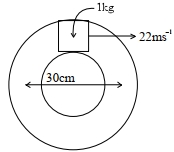
$A$ closed circular tube of average radius $15\,cm$,whose inner walls are rough,is kept in a vertical plane. $A$ block of mass $1\,kg$ just fits inside the tube. The speed of the block is $22\,m/s$ when it is introduced at the top of the tube. After completing five oscillations,the block stops at the bottom region of the tube. The work done by the tube on the block is $......J$. [Given $g=10\,m/s^2$]
A
$+564$
B
$-879$
C
$-986$
D
$-245$
Solution
(D) According to the work-energy theorem,the total work done on the block is equal to the change in its kinetic energy.
$W_{\text{total}} = \Delta KE = KE_f - KE_i$
Here,$W_{\text{total}} = W_{\text{friction}} + W_{\text{gravity}}$.
The block starts at the top and stops at the bottom,so the net change in height is $h = 2r = 2 \times 0.15\,m = 0.3\,m$.
The work done by gravity is $W_g = mg \times h = 1 \times 10 \times 0.3 = 3\,J$.
The initial kinetic energy is $KE_i = \frac{1}{2}mv^2 = \frac{1}{2} \times 1 \times (22)^2 = \frac{484}{2} = 242\,J$.
The final kinetic energy is $KE_f = 0\,J$ (since it stops).
Applying the work-energy theorem:
$W_f + W_g = KE_f - KE_i$
$W_f + 3 = 0 - 242$
$W_f = -242 - 3 = -245\,J$.
Therefore,the work done by the tube (friction) on the block is $-245\,J$.
$W_{\text{total}} = \Delta KE = KE_f - KE_i$
Here,$W_{\text{total}} = W_{\text{friction}} + W_{\text{gravity}}$.
The block starts at the top and stops at the bottom,so the net change in height is $h = 2r = 2 \times 0.15\,m = 0.3\,m$.
The work done by gravity is $W_g = mg \times h = 1 \times 10 \times 0.3 = 3\,J$.
The initial kinetic energy is $KE_i = \frac{1}{2}mv^2 = \frac{1}{2} \times 1 \times (22)^2 = \frac{484}{2} = 242\,J$.
The final kinetic energy is $KE_f = 0\,J$ (since it stops).
Applying the work-energy theorem:
$W_f + W_g = KE_f - KE_i$
$W_f + 3 = 0 - 242$
$W_f = -242 - 3 = -245\,J$.
Therefore,the work done by the tube (friction) on the block is $-245\,J$.
0 likes
View Solution146
MediumMCQ
$A$ car accelerates from rest to $u \ m/s$. The energy spent in this process is $E \ J$. The energy required to accelerate the car from $u \ m/s$ to $2u \ m/s$ is $nE \ J$. The value of $n$ is ..............
A
$6$
B
$3$
C
$9$
D
$12$
Solution
(B) According to the work-energy theorem,the work done (energy spent) is equal to the change in kinetic energy.
For the first process (from rest to $u \ m/s$):
$E_1 = \frac{1}{2} m u^2 - 0 = \frac{1}{2} m u^2 = E$
For the second process (from $u \ m/s$ to $2u \ m/s$):
$E_2 = \frac{1}{2} m (2u)^2 - \frac{1}{2} m u^2$
$E_2 = \frac{1}{2} m (4u^2) - \frac{1}{2} m u^2 = 2 m u^2 - 0.5 m u^2 = 1.5 m u^2 = 3 \left( \frac{1}{2} m u^2 \right)$
Since $E = \frac{1}{2} m u^2$,we have $E_2 = 3E$.
Comparing this with $nE$,we get $n = 3$.
For the first process (from rest to $u \ m/s$):
$E_1 = \frac{1}{2} m u^2 - 0 = \frac{1}{2} m u^2 = E$
For the second process (from $u \ m/s$ to $2u \ m/s$):
$E_2 = \frac{1}{2} m (2u)^2 - \frac{1}{2} m u^2$
$E_2 = \frac{1}{2} m (4u^2) - \frac{1}{2} m u^2 = 2 m u^2 - 0.5 m u^2 = 1.5 m u^2 = 3 \left( \frac{1}{2} m u^2 \right)$
Since $E = \frac{1}{2} m u^2$,we have $E_2 = 3E$.
Comparing this with $nE$,we get $n = 3$.
0 likes
View Solution147
DifficultMCQ
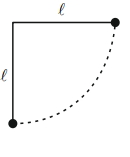
The bob of a pendulum was released from a horizontal position. The length of the pendulum is $10 \ m$. If it dissipates $10 \%$ of its initial energy against air resistance,the speed with which the bob arrives at the lowest point is : [Use $g = 10 \ ms^{-2}$]
A
$6 \sqrt{5} \ ms^{-1}$
B
$5 \sqrt{6} \ ms^{-1}$
C
$5 \sqrt{5} \ ms^{-1}$
D
$2 \sqrt{5} \ ms^{-1}$
Solution
(A) Given,length of the pendulum $\ell = 10 \ m$ and acceleration due to gravity $g = 10 \ ms^{-2}$.
Initially,the bob is at a horizontal position,so its initial potential energy with respect to the lowest point is $U_i = mg\ell$.
The bob is released from rest,so its initial kinetic energy is $K_i = 0$.
Total initial energy $E_i = mg\ell$.
As the bob moves to the lowest point,it dissipates $10 \%$ of its initial energy against air resistance.
Energy lost = $0.10 \times mg\ell$.
Remaining energy at the lowest point = $E_f = E_i - 0.10 \times E_i = 0.90 \times mg\ell$.
At the lowest point,the potential energy is $0$,so the entire remaining energy is kinetic energy $K_f = \frac{1}{2}mv^2$.
Equating the energies: $\frac{1}{2}mv^2 = 0.90 \times mg\ell$.
$v^2 = 2 \times 0.90 \times g \times \ell = 1.8 \times 10 \times 10 = 180$.
$v = \sqrt{180} = \sqrt{36 \times 5} = 6\sqrt{5} \ ms^{-1}$.
Initially,the bob is at a horizontal position,so its initial potential energy with respect to the lowest point is $U_i = mg\ell$.
The bob is released from rest,so its initial kinetic energy is $K_i = 0$.
Total initial energy $E_i = mg\ell$.
As the bob moves to the lowest point,it dissipates $10 \%$ of its initial energy against air resistance.
Energy lost = $0.10 \times mg\ell$.
Remaining energy at the lowest point = $E_f = E_i - 0.10 \times E_i = 0.90 \times mg\ell$.
At the lowest point,the potential energy is $0$,so the entire remaining energy is kinetic energy $K_f = \frac{1}{2}mv^2$.
Equating the energies: $\frac{1}{2}mv^2 = 0.90 \times mg\ell$.
$v^2 = 2 \times 0.90 \times g \times \ell = 1.8 \times 10 \times 10 = 180$.
$v = \sqrt{180} = \sqrt{36 \times 5} = 6\sqrt{5} \ ms^{-1}$.
0 likes
View Solution148
DifficultMCQ
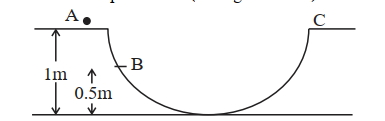
$A$ particle is placed at the point $A$ of a frictionless track $ABC$ as shown in the figure. It is gently pushed toward the right. The speed of the particle when it reaches the point $B$ is: (Take $g = 10 \ m/s^2$).
A
$20 \ m/s$
B
$\sqrt{10} \ m/s$
C
$2\sqrt{10} \ m/s$
D
$10 \ m/s$
Solution
(B) Since the track is frictionless,the total mechanical energy of the particle is conserved.
Applying the Law of Conservation of Mechanical Energy between points $A$ and $B$:
$KE_A + PE_A = KE_B + PE_B$
Here,$KE_A = 0$ (as it is gently pushed,initial velocity is negligible),$PE_A = mgh_A$,$KE_B = \frac{1}{2}mv^2$,and $PE_B = mgh_B$.
Given: $h_A = 1 \ m$,$h_B = 0.5 \ m$,and $g = 10 \ m/s^2$.
Substituting the values:
$0 + mg(1) = \frac{1}{2}mv^2 + mg(0.5)$
$mg(1 - 0.5) = \frac{1}{2}mv^2$
$mg(0.5) = \frac{1}{2}mv^2$
$g = v^2$
$v = \sqrt{g} = \sqrt{10} \ m/s$.
Applying the Law of Conservation of Mechanical Energy between points $A$ and $B$:
$KE_A + PE_A = KE_B + PE_B$
Here,$KE_A = 0$ (as it is gently pushed,initial velocity is negligible),$PE_A = mgh_A$,$KE_B = \frac{1}{2}mv^2$,and $PE_B = mgh_B$.
Given: $h_A = 1 \ m$,$h_B = 0.5 \ m$,and $g = 10 \ m/s^2$.
Substituting the values:
$0 + mg(1) = \frac{1}{2}mv^2 + mg(0.5)$
$mg(1 - 0.5) = \frac{1}{2}mv^2$
$mg(0.5) = \frac{1}{2}mv^2$
$g = v^2$
$v = \sqrt{g} = \sqrt{10} \ m/s$.
0 likes
View Solution149
DifficultMCQ
$A$ particle of mass $m$ moves on a straight line with its velocity increasing with distance according to the equation $v = \alpha \sqrt{x}$,where $\alpha$ is a constant. The total work done by all the forces applied on the particle during its displacement from $x = 0$ to $x = d$ will be:
A
$\frac{m}{2 \alpha^2 d}$
B
$\frac{md}{2 \alpha^2}$
C
$\frac{m \alpha^2 d}{2}$
D
$2 m \alpha^2 d$
Solution
(C) According to the Work-Energy Theorem,the total work done by all forces is equal to the change in kinetic energy of the particle.
$W = \Delta K = K_f - K_i$
Given the velocity equation $v = \alpha \sqrt{x}$:
At $x = 0$,the initial velocity $v_i = \alpha \sqrt{0} = 0$.
At $x = d$,the final velocity $v_f = \alpha \sqrt{d}$.
The initial kinetic energy $K_i = \frac{1}{2} m v_i^2 = \frac{1}{2} m (0)^2 = 0$.
The final kinetic energy $K_f = \frac{1}{2} m v_f^2 = \frac{1}{2} m (\alpha \sqrt{d})^2 = \frac{1}{2} m \alpha^2 d$.
Therefore,the total work done is $W = \frac{1}{2} m \alpha^2 d - 0 = \frac{m \alpha^2 d}{2}$.
$W = \Delta K = K_f - K_i$
Given the velocity equation $v = \alpha \sqrt{x}$:
At $x = 0$,the initial velocity $v_i = \alpha \sqrt{0} = 0$.
At $x = d$,the final velocity $v_f = \alpha \sqrt{d}$.
The initial kinetic energy $K_i = \frac{1}{2} m v_i^2 = \frac{1}{2} m (0)^2 = 0$.
The final kinetic energy $K_f = \frac{1}{2} m v_f^2 = \frac{1}{2} m (\alpha \sqrt{d})^2 = \frac{1}{2} m \alpha^2 d$.
Therefore,the total work done is $W = \frac{1}{2} m \alpha^2 d - 0 = \frac{m \alpha^2 d}{2}$.
0 likes
View Solution150
AdvancedMCQ
Consider an elliptically shaped rail $PQ$ in the vertical plane with $OP = 3 \ m$ and $OQ = 4 \ m$. $A$ block of mass $1 \ kg$ is pulled along the rail from $P$ to $Q$ with a force of $18 \ N$,which is always parallel to the line $PQ$ (see the figure). Assuming no frictional losses,the kinetic energy of the block when it reaches $Q$ is $(n \times 10) \ J$. The value of $n$ is (take acceleration due to gravity $g = 10 \ m/s^2$):
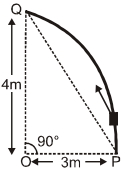
A
$4$
B
$5$
C
$6$
D
$7$
Solution
(B) According to the work-energy theorem,the total work done on the block is equal to the change in its kinetic energy:
$W_{total} = W_{force} + W_{gravity} = K_f - K_i$
Given that the block starts from rest,$K_i = 0$. The force $F = 18 \ N$ is applied parallel to the displacement vector $\vec{PQ}$. The length of the displacement $PQ$ is calculated using the Pythagorean theorem:
$PQ = \sqrt{OP^2 + OQ^2} = \sqrt{3^2 + 4^2} = \sqrt{9 + 16} = 5 \ m$
The work done by the force is:
$W_{force} = F \times PQ = 18 \ N \times 5 \ m = 90 \ J$
The work done by gravity is:
$W_{gravity} = -mgh = -1 \ kg \times 10 \ m/s^2 \times 4 \ m = -40 \ J$
Therefore,the final kinetic energy $K_f$ is:
$K_f = 90 \ J - 40 \ J = 50 \ J$
We are given $K_f = (n \times 10) \ J$,so:
$n \times 10 = 50 \implies n = 5$
$W_{total} = W_{force} + W_{gravity} = K_f - K_i$
Given that the block starts from rest,$K_i = 0$. The force $F = 18 \ N$ is applied parallel to the displacement vector $\vec{PQ}$. The length of the displacement $PQ$ is calculated using the Pythagorean theorem:
$PQ = \sqrt{OP^2 + OQ^2} = \sqrt{3^2 + 4^2} = \sqrt{9 + 16} = 5 \ m$
The work done by the force is:
$W_{force} = F \times PQ = 18 \ N \times 5 \ m = 90 \ J$
The work done by gravity is:
$W_{gravity} = -mgh = -1 \ kg \times 10 \ m/s^2 \times 4 \ m = -40 \ J$
Therefore,the final kinetic energy $K_f$ is:
$K_f = 90 \ J - 40 \ J = 50 \ J$
We are given $K_f = (n \times 10) \ J$,so:
$n \times 10 = 50 \implies n = 5$
0 likes
View SolutionWork, Energy, Power and Collision — Work Energy Theorem and Conservation of Mechanical Energy · Frequently Asked Questions
1Are these Work, Energy, Power and Collision questions useful for JEE and NEET?
Yes. All questions in this section are mapped to JEE Main and NEET exam patterns. Previous year questions from JEE Main, NEET, GUJCET and state-level exams are included with full solutions.
2Can I switch to Hindi or Gujarati for these questions?
Yes. Use the language tabs in the hero section or the sidebar to view the same questions and solutions in English, Hindi or Gujarati.
3How do I generate a question paper from this subtopic?
Use the Vedclass Exam Paper Generator — select the chapter and subtopic, set difficulty, and generate Sets A, B, C, D automatically. First 3 chapters of every subject are free.
Vedclass Products
For Students
Vedclass Test Series
Mock tests in real JEE/NEET style with performance analysis. 5-day free trial.
Start Free TrialFor Teachers
Exam Paper Generator
Generate Set A/B/C/D papers from this chapter in 2 minutes. 3 chapters free.
Try FreeFor Institutes
Online Exam Module
Live online exams with unlimited students, 360° analytics & white-label branding.
See DemoFor Teachers & Institutes
Generate a Work, Energy, Power and Collision Exam Paper in 2 Minutes
Select subtopic & difficulty — Sets A, B, C, D auto-generated with No Repeat logic.
First 3 chapters of every subject are free — no payment required.