
A English
Conservative and Non-Conservative forces and Potential Energy Questions in English
Class 11 Physics · Work, Energy, Power and Collision · Conservative and Non-Conservative forces and Potential Energy
63+
Questions
English
Language
100%
With Solutions
Showing 50 of 63 questions in English
1
EasyMCQ
Which one of the following is not a conservative force?
A
Gravitational force
B
Electrostatic force between two charges
C
Magnetic force between two magnetic dipoles
D
Frictional force
Solution
(D) force is called conservative if the work done by it in moving a particle between two points is independent of the path taken.
Gravitational force,electrostatic force,and magnetic force are examples of conservative forces because the work done by them depends only on the initial and final positions.
Frictional force is a non-conservative force because the work done by it depends on the path taken,and it results in the dissipation of mechanical energy into heat.
Gravitational force,electrostatic force,and magnetic force are examples of conservative forces because the work done by them depends only on the initial and final positions.
Frictional force is a non-conservative force because the work done by it depends on the path taken,and it results in the dissipation of mechanical energy into heat.
0 likes
View Solution2
MediumMCQ
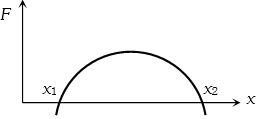
The force acting on a body moving along the $x-$axis varies with the position of the particle as shown in the figure. The body is in stable equilibrium at
A
$x = x_1$
B
$x = x_2$
C
both $x_1$ and $x_2$
D
neither $x_1$ nor $x_2$
Solution
(B) For a particle to be in stable equilibrium,the force $F$ must be zero at the equilibrium position,and if the particle is slightly displaced,the force should act in a direction that brings it back to the equilibrium position.
At $x = x_1$,the force is zero. For $x > x_1$ (slightly to the right),the force $F$ is positive (repulsive),which pushes the particle further away from $x_1$. Thus,$x_1$ is a point of unstable equilibrium.
At $x = x_2$,the force is zero. For $x > x_2$ (slightly to the right),the force $F$ is negative (attractive),which pulls the particle back towards $x_2$. For $x < x_2$ (slightly to the left),the force $F$ is positive (repulsive),which pushes the particle back towards $x_2$. Since the force acts to restore the particle to its original position,$x_2$ is a point of stable equilibrium.
At $x = x_1$,the force is zero. For $x > x_1$ (slightly to the right),the force $F$ is positive (repulsive),which pushes the particle further away from $x_1$. Thus,$x_1$ is a point of unstable equilibrium.
At $x = x_2$,the force is zero. For $x > x_2$ (slightly to the right),the force $F$ is negative (attractive),which pulls the particle back towards $x_2$. For $x < x_2$ (slightly to the left),the force $F$ is positive (repulsive),which pushes the particle back towards $x_2$. Since the force acts to restore the particle to its original position,$x_2$ is a point of stable equilibrium.
0 likes
View Solution3
MediumMCQ
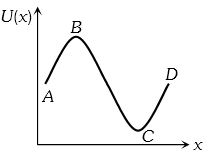
The potential energy of a particle varies with distance $x$ as shown in the graph. The force acting on the particle is zero at
A
$C$
B
$B$
C
$B$ and $C$
D
$A$ and $D$
Solution
(C) The relationship between force $F$ and potential energy $U$ is given by $F = -\frac{dU}{dx}$.
This implies that the force is zero where the slope of the $U-x$ graph is zero,i.e.,$\frac{dU}{dx} = 0$.
In the given graph,the slope of the curve is zero at the local maximum point $B$ and the local minimum point $C$.
Therefore,the force acting on the particle is zero at points $B$ and $C$.
This implies that the force is zero where the slope of the $U-x$ graph is zero,i.e.,$\frac{dU}{dx} = 0$.
In the given graph,the slope of the curve is zero at the local maximum point $B$ and the local minimum point $C$.
Therefore,the force acting on the particle is zero at points $B$ and $C$.
0 likes
View Solution4
MediumMCQ
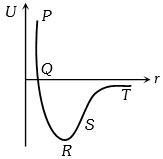
The points of maximum and minimum attraction in the curve between potential energy $(U)$ and distance $(r)$ of a diatomic molecule are respectively:
A
$S$ and $R$
B
$T$ and $S$
C
$R$ and $S$
D
$S$ and $T$
Solution
(D) The force between the atoms is given by $F = -\frac{dU}{dr}$.
Attraction force is negative,so $F = -\frac{dU}{dr} < 0$,which means $\frac{dU}{dr} > 0$. The magnitude of the attractive force is $|F| = |\frac{dU}{dr}|$,which represents the slope of the $U-r$ curve.
At point $S$,the slope of the curve is positive and reaches its maximum value. Thus,the attraction is maximum at point $S$.
At point $T$,the curve becomes horizontal,meaning the slope $\frac{dU}{dr} = 0$. Thus,the attraction force is minimum (zero) at point $T$.
Therefore,the points of maximum and minimum attraction are $S$ and $T$ respectively.
Attraction force is negative,so $F = -\frac{dU}{dr} < 0$,which means $\frac{dU}{dr} > 0$. The magnitude of the attractive force is $|F| = |\frac{dU}{dr}|$,which represents the slope of the $U-r$ curve.
At point $S$,the slope of the curve is positive and reaches its maximum value. Thus,the attraction is maximum at point $S$.
At point $T$,the curve becomes horizontal,meaning the slope $\frac{dU}{dr} = 0$. Thus,the attraction force is minimum (zero) at point $T$.
Therefore,the points of maximum and minimum attraction are $S$ and $T$ respectively.
0 likes
View Solution5
MediumMCQ
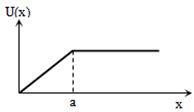
The potential energy $U(x)$ of a particle is shown in the figure. Which of the following graphs represents the force $F(x)$ acting on it?
A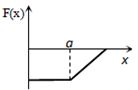
B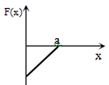
C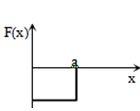
D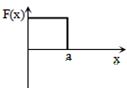
Solution
(C) The relationship between force $F$ and potential energy $U$ is given by $F = -\frac{dU}{dx}$.
$1$. For $0 < x < a$,the graph of $U(x)$ is a straight line with a positive constant slope. Let the slope be $k$ $(k > 0)$. Thus,$U(x) = kx$. The force is $F = -\frac{d}{dx}(kx) = -k$. This is a negative constant value.
$2$. For $x > a$,the graph of $U(x)$ is a horizontal line,meaning $U(x)$ is constant. Thus,$\frac{dU}{dx} = 0$,which implies $F = 0$.
Comparing this with the given options,the graph that shows a negative constant force for $0 < x < a$ and zero force for $x > a$ is Graph $C$.
$1$. For $0 < x < a$,the graph of $U(x)$ is a straight line with a positive constant slope. Let the slope be $k$ $(k > 0)$. Thus,$U(x) = kx$. The force is $F = -\frac{d}{dx}(kx) = -k$. This is a negative constant value.
$2$. For $x > a$,the graph of $U(x)$ is a horizontal line,meaning $U(x)$ is constant. Thus,$\frac{dU}{dx} = 0$,which implies $F = 0$.
Comparing this with the given options,the graph that shows a negative constant force for $0 < x < a$ and zero force for $x > a$ is Graph $C$.
0 likes
View Solution6
EasyMCQ
The potential energy of a system increases if work is done
A
by the system against a conservative force.
B
upon the system by a conservative force.
C
upon the system by a nonconservative force.
D
by the system against a nonconservative force.
Solution
(A) The relationship between a conservative force and potential energy is given by $F_{\text{cons}} = -\frac{dU}{dx}$.
This implies $F_{\text{cons}} \cdot dx = -dU$.
The work done by a conservative force is $W_{\text{cons}} = \int F_{\text{cons}} \cdot dx = -\Delta U$.
Therefore,$\Delta U = -W_{\text{cons}}$.
If work is done by the system against a conservative force,the external work done is positive,which results in an increase in the potential energy of the system $(\Delta U > 0)$.
This implies $F_{\text{cons}} \cdot dx = -dU$.
The work done by a conservative force is $W_{\text{cons}} = \int F_{\text{cons}} \cdot dx = -\Delta U$.
Therefore,$\Delta U = -W_{\text{cons}}$.
If work is done by the system against a conservative force,the external work done is positive,which results in an increase in the potential energy of the system $(\Delta U > 0)$.
0 likes
View Solution7
EasyMCQ
For a system of conservative forces,the potential energy $U$ is given by the formula $U = ax^2 - bx$,where $a$ and $b$ are constants. Determine the force $F$.
A
$-2ax + b$
B
$ax + b$
C
$2ax - 2b$
D
$2ax + 2b$
Solution
(A) For a conservative force field,the relationship between force $F$ and potential energy $U$ is given by $F = -\frac{dU}{dx}$.
Given $U = ax^2 - bx$.
Now,differentiate $U$ with respect to $x$:
$\frac{dU}{dx} = \frac{d}{dx}(ax^2 - bx) = 2ax - b$.
Substituting this into the force equation:
$F = -(2ax - b) = -2ax + b$.
Given $U = ax^2 - bx$.
Now,differentiate $U$ with respect to $x$:
$\frac{dU}{dx} = \frac{d}{dx}(ax^2 - bx) = 2ax - b$.
Substituting this into the force equation:
$F = -(2ax - b) = -2ax + b$.
0 likes
View Solution8
EasyMCQ
$A$ particle moves in a potential region given by the formula $U = K(x^2 + y^2 + z^2)$. Find the force acting on the particle.
A
$k(x\hat{i} + y\hat{j} + z\hat{k})$
B
$2k(x\hat{i} + y\hat{j} + z\hat{k})$
C
$-2k(x\hat{i} + y\hat{j} + z\hat{k})$
D
$-k(x\hat{i} - y\hat{j} + z\hat{k})$
Solution
(C) The force $\vec{F}$ is related to the potential energy $U$ by the negative gradient: $\vec{F} = -\nabla U = -\left( \hat{i} \frac{\partial U}{\partial x} + \hat{j} \frac{\partial U}{\partial y} + \hat{k} \frac{\partial U}{\partial z} \right)$.
Given $U = K(x^2 + y^2 + z^2)$.
Calculating the partial derivatives:
$\frac{\partial U}{\partial x} = 2Kx$,$\frac{\partial U}{\partial y} = 2Ky$,and $\frac{\partial U}{\partial z} = 2Kz$.
Substituting these into the force equation:
$\vec{F} = -(2Kx\hat{i} + 2Ky\hat{j} + 2Kz\hat{k})$.
Therefore,$\vec{F} = -2K(x\hat{i} + y\hat{j} + z\hat{k})$.
Given $U = K(x^2 + y^2 + z^2)$.
Calculating the partial derivatives:
$\frac{\partial U}{\partial x} = 2Kx$,$\frac{\partial U}{\partial y} = 2Ky$,and $\frac{\partial U}{\partial z} = 2Kz$.
Substituting these into the force equation:
$\vec{F} = -(2Kx\hat{i} + 2Ky\hat{j} + 2Kz\hat{k})$.
Therefore,$\vec{F} = -2K(x\hat{i} + y\hat{j} + z\hat{k})$.
0 likes
View Solution9
MediumMCQ
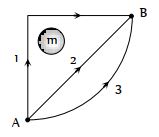
In a gravitational field,if the work done along paths $1, 2$ and $3$ is ${W_1}, {W_2}$ and ${W_3}$ respectively,then:
A
${W_1} > {W_2} > {W_3}$
B
${W_1} = {W_2} = {W_3}$
C
${W_1} < {W_2} < {W_3}$
D
${W_2} > {W_1} > {W_3}$
Solution
(B) The gravitational force is a conservative force.
For a conservative force,the work done in moving a particle from one point to another is independent of the path taken.
It only depends on the initial and final positions of the particle.
In the given figure,all three paths $(1, 2, 3)$ start from point $A$ and end at point $B$.
Since the initial and final positions are the same for all three paths,the work done along each path must be equal.
Therefore,${W_1} = {W_2} = {W_3}$.
For a conservative force,the work done in moving a particle from one point to another is independent of the path taken.
It only depends on the initial and final positions of the particle.
In the given figure,all three paths $(1, 2, 3)$ start from point $A$ and end at point $B$.
Since the initial and final positions are the same for all three paths,the work done along each path must be equal.
Therefore,${W_1} = {W_2} = {W_3}$.
0 likes
View Solution10
MediumMCQ
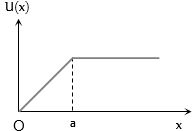
The potential energy graph of a particle is given. Find the corresponding force graph.
A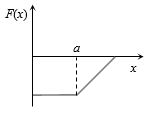
B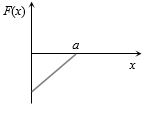
C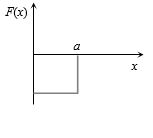
D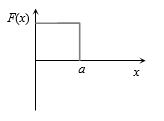
Solution
(C) The relationship between force $F$ and potential energy $U$ is given by $F = -\frac{dU}{dx}$.
For the interval $0 < x < a$,the potential energy $U(x)$ is a linear function with a positive slope,i.e.,$U(x) = kx$ where $k > 0$. Thus,$F = -\frac{d}{dx}(kx) = -k$,which is a constant negative value.
For $x > a$,the potential energy $U(x)$ is constant,so $\frac{dU}{dx} = 0$,which implies $F = 0$.
Comparing this with the given options,the graph that shows a constant negative force for $0 < x < a$ and zero force for $x > a$ is graph $C$.
For the interval $0 < x < a$,the potential energy $U(x)$ is a linear function with a positive slope,i.e.,$U(x) = kx$ where $k > 0$. Thus,$F = -\frac{d}{dx}(kx) = -k$,which is a constant negative value.
For $x > a$,the potential energy $U(x)$ is constant,so $\frac{dU}{dx} = 0$,which implies $F = 0$.
Comparing this with the given options,the graph that shows a constant negative force for $0 < x < a$ and zero force for $x > a$ is graph $C$.
0 likes
View Solution11
EasyMCQ
There will be a decrease in the potential energy of the system if work is done upon the system by:
A
Any conservative or non-conservative force
B
$A$ non-conservative force
C
$A$ conservative force
D
None of the above
Solution
(C) The change in potential energy $U$ of a system is defined by the work done by a conservative force as $\Delta U = -W_{cons}$.
If work is done by a conservative force on the system,the force acts in the direction of displacement,meaning $W_{cons} > 0$.
Consequently,$\Delta U = -W_{cons} < 0$,which implies that the potential energy of the system decreases.
Therefore,the potential energy of a system decreases when work is done upon the system by a conservative force.
If work is done by a conservative force on the system,the force acts in the direction of displacement,meaning $W_{cons} > 0$.
Consequently,$\Delta U = -W_{cons} < 0$,which implies that the potential energy of the system decreases.
Therefore,the potential energy of a system decreases when work is done upon the system by a conservative force.
0 likes
View Solution12
DifficultMCQ
Given the force $F = 2x^2 - 3x - 2$. Choose the correct option regarding the equilibrium positions.
A
$x = -1/2$ is a position of stable equilibrium.
B
$x = 2$ is a position of stable equilibrium.
C
$x = -1/2$ is a position of unstable equilibrium.
D
$x = 2$ is a position of neutral equilibrium.
Solution
(A) For equilibrium,the net force $F$ must be zero: $2x^2 - 3x - 2 = 0$.
Factoring the quadratic equation: $2x^2 - 4x + x - 2 = 0 \Rightarrow 2x(x - 2) + 1(x - 2) = 0 \Rightarrow (x - 2)(2x + 1) = 0$.
The equilibrium positions are $x = 2$ and $x = -1/2$.
The potential energy $U$ is related to force by $F = -dU/dx$,so $dU/dx = -F = -(2x^2 - 3x - 2)$.
To determine stability,we check the second derivative $d^2U/dx^2 = -dF/dx = -(4x - 3)$.
For $x = 2$: $d^2U/dx^2 = -(4(2) - 3) = -5 < 0$. Since the second derivative is negative,$x = 2$ is a position of unstable equilibrium.
For $x = -1/2$: $d^2U/dx^2 = -(4(-1/2) - 3) = -(-2 - 3) = 5 > 0$. Since the second derivative is positive,$x = -1/2$ is a position of stable equilibrium.
Factoring the quadratic equation: $2x^2 - 4x + x - 2 = 0 \Rightarrow 2x(x - 2) + 1(x - 2) = 0 \Rightarrow (x - 2)(2x + 1) = 0$.
The equilibrium positions are $x = 2$ and $x = -1/2$.
The potential energy $U$ is related to force by $F = -dU/dx$,so $dU/dx = -F = -(2x^2 - 3x - 2)$.
To determine stability,we check the second derivative $d^2U/dx^2 = -dF/dx = -(4x - 3)$.
For $x = 2$: $d^2U/dx^2 = -(4(2) - 3) = -5 < 0$. Since the second derivative is negative,$x = 2$ is a position of unstable equilibrium.
For $x = -1/2$: $d^2U/dx^2 = -(4(-1/2) - 3) = -(-2 - 3) = 5 > 0$. Since the second derivative is positive,$x = -1/2$ is a position of stable equilibrium.
0 likes
View Solution13
DifficultMCQ
$A$ particle is released from rest at the origin. It moves under the influence of a potential field $U = x^2 - 3x$. The kinetic energy at $x = 2$ is ............... $J$.
A
$2$
B
$1$
C
$1.5$
D
$0$
Solution
(A) The particle is released from rest at the origin $(x = 0)$,so the initial kinetic energy $K_i = 0$ and initial potential energy $U_i = U(0) = 0^2 - 3(0) = 0 \ J$.
By the law of conservation of mechanical energy,the total energy $E = K + U$ remains constant.
$E_i = K_i + U_i = 0 + 0 = 0 \ J$.
At $x = 2$,the potential energy is $U_f = U(2) = 2^2 - 3(2) = 4 - 6 = -2 \ J$.
Since $E_i = E_f$,we have $0 = K_f + U_f$.
$0 = K_f - 2 \ J$.
Therefore,$K_f = 2 \ J$.
By the law of conservation of mechanical energy,the total energy $E = K + U$ remains constant.
$E_i = K_i + U_i = 0 + 0 = 0 \ J$.
At $x = 2$,the potential energy is $U_f = U(2) = 2^2 - 3(2) = 4 - 6 = -2 \ J$.
Since $E_i = E_f$,we have $0 = K_f + U_f$.
$0 = K_f - 2 \ J$.
Therefore,$K_f = 2 \ J$.
0 likes
View Solution14
MediumMCQ
When a conservative force does positive work on a body,
A
the potential energy increases
B
the potential energy decreases
C
total energy increases
D
total energy decreases
Solution
(B) The work done $W$ by a conservative force $\vec{F}$ is related to the change in potential energy $V$ by the relation: $W = -\Delta V$.
Given that the work done is positive $(W > 0)$,we have $-\Delta V > 0$,which implies $\Delta V < 0$.
Since $\Delta V = V_{final} - V_{initial} < 0$,it follows that $V_{final} < V_{initial}$.
Therefore,the potential energy of the body decreases when a conservative force does positive work on it.
Given that the work done is positive $(W > 0)$,we have $-\Delta V > 0$,which implies $\Delta V < 0$.
Since $\Delta V = V_{final} - V_{initial} < 0$,it follows that $V_{final} < V_{initial}$.
Therefore,the potential energy of the body decreases when a conservative force does positive work on it.
0 likes
View Solution15
MediumMCQ
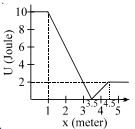
$A$ body with mass $2\, kg$ moves in one direction in the presence of a force which is described by the potential energy graph. If the body is released from rest at $x = 2\, m$,then its speed when it crosses $x = 5\, m$ is ................ $m/s$.
A
$0$
B
$1$
C
$2$
D
$3$
Solution
(C) From the given potential energy graph:
At $x = 2\, m$,the potential energy $U_i = 6\, J$.
At $x = 5\, m$,the potential energy $U_f = 2\, J$.
Since the body is released from rest at $x = 2\, m$,its initial kinetic energy $K_i = 0$.
According to the law of conservation of mechanical energy,the total mechanical energy remains constant:
$K_i + U_i = K_f + U_f$
$0 + 6 = K_f + 2$
$K_f = 6 - 2 = 4\, J$
Since $K_f = \frac{1}{2} m v^2$,where $m = 2\, kg$:
$4 = \frac{1}{2} \times 2 \times v^2$
$4 = v^2$
$v = 2\, m/s$.
At $x = 2\, m$,the potential energy $U_i = 6\, J$.
At $x = 5\, m$,the potential energy $U_f = 2\, J$.
Since the body is released from rest at $x = 2\, m$,its initial kinetic energy $K_i = 0$.
According to the law of conservation of mechanical energy,the total mechanical energy remains constant:
$K_i + U_i = K_f + U_f$
$0 + 6 = K_f + 2$
$K_f = 6 - 2 = 4\, J$
Since $K_f = \frac{1}{2} m v^2$,where $m = 2\, kg$:
$4 = \frac{1}{2} \times 2 \times v^2$
$4 = v^2$
$v = 2\, m/s$.
0 likes
View Solution16
AdvancedMCQ
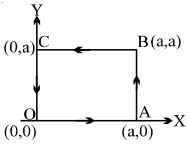
The work done by the force $\vec{F} = x^2 \hat{i} + y^2 \hat{j}$ around the closed path $OABC$ shown in the figure is:
A
$\frac{2}{3} a^3$
B
zero
C
$a^3$
D
$\frac{4}{3} a^3$
Solution
(B) The force is given by $\vec{F}(x, y) = x^2 \hat{i} + y^2 \hat{j}$.
For a force to be conservative,the curl of the force must be zero,i.e.,$\nabla \times \vec{F} = 0$.
Here,$\frac{\partial F_y}{\partial x} = \frac{\partial}{\partial x}(y^2) = 0$ and $\frac{\partial F_x}{\partial y} = \frac{\partial}{\partial y}(x^2) = 0$.
Since $\frac{\partial F_y}{\partial x} - \frac{\partial F_x}{\partial y} = 0$,the force $\vec{F}$ is a conservative force.
The work done by a conservative force around any closed path is always zero.
Therefore,the work done by the force $\vec{F}$ around the closed path $OABC$ is zero.
For a force to be conservative,the curl of the force must be zero,i.e.,$\nabla \times \vec{F} = 0$.
Here,$\frac{\partial F_y}{\partial x} = \frac{\partial}{\partial x}(y^2) = 0$ and $\frac{\partial F_x}{\partial y} = \frac{\partial}{\partial y}(x^2) = 0$.
Since $\frac{\partial F_y}{\partial x} - \frac{\partial F_x}{\partial y} = 0$,the force $\vec{F}$ is a conservative force.
The work done by a conservative force around any closed path is always zero.
Therefore,the work done by the force $\vec{F}$ around the closed path $OABC$ is zero.
0 likes
View Solution17
MediumMCQ
The potential energy $U$ between two molecules as a function of distance $x$ between them is shown. $A, B, C$ are points for which $x = 0.6 \mathring{A}, 1.2 \mathring{A}, 1.8 \mathring{A}$ respectively. At $A, B, C$,the force between the two molecules is:
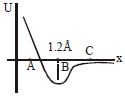
A
Zero,attractive,repulsive
B
Attractive,zero,repulsive
C
Zero,repulsive,attractive
D
Repulsive,zero,attractive
Solution
(D) The force $F$ between two molecules is related to the potential energy $U$ by the relation $F = -\frac{dU}{dx}$.
This means the force is the negative of the slope of the $U-x$ graph.
At point $A$ $(x = 0.6 \mathring{A})$,the slope $\frac{dU}{dx}$ is negative,so $F = -(\text{negative}) = \text{positive}$,which corresponds to a repulsive force.
At point $B$ $(x = 1.2 \mathring{A})$,the curve has a minimum,so the slope $\frac{dU}{dx} = 0$,which means the force $F = 0$.
At point $C$ $(x = 1.8 \mathring{A})$,the slope $\frac{dU}{dx}$ is positive,so $F = -(\text{positive}) = \text{negative}$,which corresponds to an attractive force.
Therefore,the forces at $A, B, C$ are repulsive,zero,and attractive respectively.
This means the force is the negative of the slope of the $U-x$ graph.
At point $A$ $(x = 0.6 \mathring{A})$,the slope $\frac{dU}{dx}$ is negative,so $F = -(\text{negative}) = \text{positive}$,which corresponds to a repulsive force.
At point $B$ $(x = 1.2 \mathring{A})$,the curve has a minimum,so the slope $\frac{dU}{dx} = 0$,which means the force $F = 0$.
At point $C$ $(x = 1.8 \mathring{A})$,the slope $\frac{dU}{dx}$ is positive,so $F = -(\text{positive}) = \text{negative}$,which corresponds to an attractive force.
Therefore,the forces at $A, B, C$ are repulsive,zero,and attractive respectively.
0 likes
View Solution18
MediumMCQ
The potential energy for a force field $\vec{F}$ is given by $U(x,y) = \cos(x + y)$. The force acting on a particle at the position given by coordinates $(0, \frac{\pi}{4})$ is
A
$-\frac{1}{\sqrt{2}}(\hat{i} + \hat{j})$
B
$\frac{1}{\sqrt{2}}(\hat{i} + \hat{j})$
C
$(\frac{1}{2}\hat{i} + \frac{\sqrt{3}}{2}\hat{j})$
D
$(\frac{1}{2}\hat{i} - \frac{\sqrt{3}}{2}\hat{j})$
Solution
(B) The force $\vec{F}$ is related to the potential energy $U$ by the relation $\vec{F} = -\nabla U = -(\frac{\partial U}{\partial x}\hat{i} + \frac{\partial U}{\partial y}\hat{j})$.
Given $U(x,y) = \cos(x + y)$.
Calculating the partial derivatives:
$\frac{\partial U}{\partial x} = -\sin(x + y)$
$\frac{\partial U}{\partial y} = -\sin(x + y)$
Thus,the force components are:
$F_x = -(-\sin(x + y)) = \sin(x + y)$
$F_y = -(-\sin(x + y)) = \sin(x + y)$
At the point $(0, \frac{\pi}{4})$:
$F_x = \sin(0 + \frac{\pi}{4}) = \sin(\frac{\pi}{4}) = \frac{1}{\sqrt{2}}$
$F_y = \sin(0 + \frac{\pi}{4}) = \sin(\frac{\pi}{4}) = \frac{1}{\sqrt{2}}$
Therefore,the force vector is $\vec{F} = \frac{1}{\sqrt{2}}\hat{i} + \frac{1}{\sqrt{2}}\hat{j} = \frac{1}{\sqrt{2}}(\hat{i} + \hat{j})$.
Given $U(x,y) = \cos(x + y)$.
Calculating the partial derivatives:
$\frac{\partial U}{\partial x} = -\sin(x + y)$
$\frac{\partial U}{\partial y} = -\sin(x + y)$
Thus,the force components are:
$F_x = -(-\sin(x + y)) = \sin(x + y)$
$F_y = -(-\sin(x + y)) = \sin(x + y)$
At the point $(0, \frac{\pi}{4})$:
$F_x = \sin(0 + \frac{\pi}{4}) = \sin(\frac{\pi}{4}) = \frac{1}{\sqrt{2}}$
$F_y = \sin(0 + \frac{\pi}{4}) = \sin(\frac{\pi}{4}) = \frac{1}{\sqrt{2}}$
Therefore,the force vector is $\vec{F} = \frac{1}{\sqrt{2}}\hat{i} + \frac{1}{\sqrt{2}}\hat{j} = \frac{1}{\sqrt{2}}(\hat{i} + \hat{j})$.
0 likes
View Solution19
MediumMCQ
The potential energy for a conservative system is given by:
$U = ax^2 - bx$
Where $a$ and $b$ are positive constants. The law of the force governing the system is:
$U = ax^2 - bx$
Where $a$ and $b$ are positive constants. The law of the force governing the system is:
A
$F = \text{constant}$
B
$F = bx - 2a$
C
$F = b - 2ax$
D
$F = 2ax$
Solution
(C) For a conservative system, the force $F$ is related to the potential energy $U$ by the negative gradient of the potential energy with respect to position:
$F = -\frac{dU}{dx}$
Given $U = ax^2 - bx$, we differentiate $U$ with respect to $x$:
$\frac{dU}{dx} = \frac{d}{dx}(ax^2 - bx) = 2ax - b$
Substituting this into the force equation:
$F = -(2ax - b)$
$F = b - 2ax$
Therefore, the correct option is $C$.
$F = -\frac{dU}{dx}$
Given $U = ax^2 - bx$, we differentiate $U$ with respect to $x$:
$\frac{dU}{dx} = \frac{d}{dx}(ax^2 - bx) = 2ax - b$
Substituting this into the force equation:
$F = -(2ax - b)$
$F = b - 2ax$
Therefore, the correct option is $C$.
0 likes
View Solution20
MediumMCQ
The potential energy of a particle varies with distance $x$ as shown in the graph. Select the wrong statement.
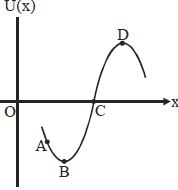
A
Rate of change of potential energy with distance is zero at $B$.
B
Rate of change of potential energy with distance is maximum at $C$.
C
Positions $B$ and $D$ both represent equilibrium.
D
Position $D$ is stable equilibrium.
Solution
(D) The force $F$ is given by $F = -\frac{dU}{dx}$. Equilibrium occurs where $F = 0$,which implies $\frac{dU}{dx} = 0$. This corresponds to the points where the slope of the $U-x$ graph is zero,which are points $B$ and $D$.
At point $B$,the potential energy is at a local minimum,so $\frac{d^2U}{dx^2} > 0$,which indicates stable equilibrium.
At point $D$,the potential energy is at a local maximum,so $\frac{d^2U}{dx^2} < 0$,which indicates unstable equilibrium.
At point $C$,the slope $\frac{dU}{dx}$ is at its maximum positive value.
Therefore,the statement 'Position $D$ is stable equilibrium' is incorrect.
At point $B$,the potential energy is at a local minimum,so $\frac{d^2U}{dx^2} > 0$,which indicates stable equilibrium.
At point $D$,the potential energy is at a local maximum,so $\frac{d^2U}{dx^2} < 0$,which indicates unstable equilibrium.
At point $C$,the slope $\frac{dU}{dx}$ is at its maximum positive value.
Therefore,the statement 'Position $D$ is stable equilibrium' is incorrect.
0 likes
View Solution21
MediumMCQ
$A$ particle moves in a one-dimensional field with total mechanical energy $E$. If the potential energy of the particle is $V(x)$,then:
A
Particle has zero speed where $V(x) = 0$
B
Particle has zero acceleration where $V(x) = E$
C
Particle has zero velocity where $\frac{dV(x)}{dx} = 0$
D
Particle has zero acceleration where $\frac{dV(x)}{dx} = 0$
Solution
(D) The total mechanical energy $E$ of a particle is the sum of its kinetic energy $K$ and potential energy $V(x)$,given by $E = K + V(x)$.
Since $K = \frac{1}{2}mv^2$,we have $E = \frac{1}{2}mv^2 + V(x)$.
The force acting on the particle is given by $F = -\frac{dV(x)}{dx}$.
According to Newton's second law,$F = ma$,so $ma = -\frac{dV(x)}{dx}$.
Acceleration $a = -\frac{1}{m} \frac{dV(x)}{dx}$.
For the acceleration to be zero,we must have $\frac{dV(x)}{dx} = 0$.
Therefore,the particle has zero acceleration where the derivative of the potential energy with respect to position is zero.
Since $K = \frac{1}{2}mv^2$,we have $E = \frac{1}{2}mv^2 + V(x)$.
The force acting on the particle is given by $F = -\frac{dV(x)}{dx}$.
According to Newton's second law,$F = ma$,so $ma = -\frac{dV(x)}{dx}$.
Acceleration $a = -\frac{1}{m} \frac{dV(x)}{dx}$.
For the acceleration to be zero,we must have $\frac{dV(x)}{dx} = 0$.
Therefore,the particle has zero acceleration where the derivative of the potential energy with respect to position is zero.
0 likes
View Solution22
MediumMCQ
The potential energy of an object of mass $m$ moving in the $xy$ plane in a conservative field is given by $U = ax + by$,where $x$ and $y$ are position coordinates of the object. Find the magnitude of its acceleration.
A
$\frac{\sqrt{a^2 + b^2}}{m}$
B
$\frac{a^2 + b^2}{m}$
C
$\sqrt{a^2 + b^2}$
D
None
Solution
(A) The potential energy is given by $U = ax + by$.
The force $\overrightarrow{F}$ acting on the object is the negative gradient of the potential energy: $\overrightarrow{F} = -\nabla U = -\left( \frac{\partial U}{\partial x} \hat{i} + \frac{\partial U}{\partial y} \hat{j} \right)$.
Calculating the partial derivatives: $\frac{\partial U}{\partial x} = a$ and $\frac{\partial U}{\partial y} = b$.
Thus,$\overrightarrow{F} = -a \hat{i} - b \hat{j}$.
The magnitude of the force is $|\overrightarrow{F}| = \sqrt{(-a)^2 + (-b)^2} = \sqrt{a^2 + b^2}$.
Using Newton's second law,$F = ma$,the magnitude of acceleration is $a_{acc} = \frac{|\overrightarrow{F}|}{m} = \frac{\sqrt{a^2 + b^2}}{m}$.
Therefore,the correct option is $A$.
The force $\overrightarrow{F}$ acting on the object is the negative gradient of the potential energy: $\overrightarrow{F} = -\nabla U = -\left( \frac{\partial U}{\partial x} \hat{i} + \frac{\partial U}{\partial y} \hat{j} \right)$.
Calculating the partial derivatives: $\frac{\partial U}{\partial x} = a$ and $\frac{\partial U}{\partial y} = b$.
Thus,$\overrightarrow{F} = -a \hat{i} - b \hat{j}$.
The magnitude of the force is $|\overrightarrow{F}| = \sqrt{(-a)^2 + (-b)^2} = \sqrt{a^2 + b^2}$.
Using Newton's second law,$F = ma$,the magnitude of acceleration is $a_{acc} = \frac{|\overrightarrow{F}|}{m} = \frac{\sqrt{a^2 + b^2}}{m}$.
Therefore,the correct option is $A$.
0 likes
View Solution23
MediumMCQ
If the potential energy for a particle is given by $U = K(x + y)$,where $K$ is a constant,what is the work done by the conservative force in moving a particle from $(1, 1)$ to $(2, 3)$?
A
$-3K$
B
$3K$
C
$K$
D
None of these
Solution
(A) The conservative force $\overrightarrow{F}$ is related to the potential energy $U$ by the relation $\overrightarrow{F} = -\nabla U = -\left( \frac{\partial U}{\partial x} \hat{i} + \frac{\partial U}{\partial y} \hat{j} + \frac{\partial U}{\partial z} \hat{k} \right)$.
Given $U = K(x + y)$,we calculate the partial derivatives:
$\frac{\partial U}{\partial x} = K$ and $\frac{\partial U}{\partial y} = K$.
Thus,the force is $\overrightarrow{F} = -(K \hat{i} + K \hat{j})$.
The displacement vector $\overrightarrow{S}$ from $(1, 1)$ to $(2, 3)$ is $\overrightarrow{S} = (2 - 1) \hat{i} + (3 - 1) \hat{j} = \hat{i} + 2 \hat{j}$.
The work done $W$ by the conservative force is given by $W = \overrightarrow{F} \cdot \overrightarrow{S}$.
$W = -(K \hat{i} + K \hat{j}) \cdot (\hat{i} + 2 \hat{j}) = -(K \times 1 + K \times 2) = -(K + 2K) = -3K$.
Given $U = K(x + y)$,we calculate the partial derivatives:
$\frac{\partial U}{\partial x} = K$ and $\frac{\partial U}{\partial y} = K$.
Thus,the force is $\overrightarrow{F} = -(K \hat{i} + K \hat{j})$.
The displacement vector $\overrightarrow{S}$ from $(1, 1)$ to $(2, 3)$ is $\overrightarrow{S} = (2 - 1) \hat{i} + (3 - 1) \hat{j} = \hat{i} + 2 \hat{j}$.
The work done $W$ by the conservative force is given by $W = \overrightarrow{F} \cdot \overrightarrow{S}$.
$W = -(K \hat{i} + K \hat{j}) \cdot (\hat{i} + 2 \hat{j}) = -(K \times 1 + K \times 2) = -(K + 2K) = -3K$.
0 likes
View Solution24
DifficultMCQ
If $F = 2x^2 - 3x - 2$,then choose the correct option.
A
$x = -1/2$ is a position of stable equilibrium.
B
$x = 2$ is a position of stable equilibrium.
C
$x = -1/2$ is a position of unstable equilibrium.
D
$x = 2$ is a position of neutral equilibrium.
Solution
(A) The force is given by $F = 2x^2 - 3x - 2$. Equilibrium occurs when $F = 0$.
$2x^2 - 3x - 2 = 0$
$2x^2 - 4x + x - 2 = 0$
$2x(x - 2) + 1(x - 2) = 0$
$(2x + 1)(x - 2) = 0$
Thus,equilibrium positions are $x = -1/2$ and $x = 2$.
To determine stability,we check the derivative of force: $dF/dx = 4x - 3$.
For stable equilibrium,$dF/dx < 0$ at the equilibrium point.
At $x = -1/2$: $dF/dx = 4(-1/2) - 3 = -2 - 3 = -5 < 0$. This is stable equilibrium.
At $x = 2$: $dF/dx = 4(2) - 3 = 8 - 3 = 5 > 0$. This is unstable equilibrium.
Therefore,$x = -1/2$ is a position of stable equilibrium.
$2x^2 - 3x - 2 = 0$
$2x^2 - 4x + x - 2 = 0$
$2x(x - 2) + 1(x - 2) = 0$
$(2x + 1)(x - 2) = 0$
Thus,equilibrium positions are $x = -1/2$ and $x = 2$.
To determine stability,we check the derivative of force: $dF/dx = 4x - 3$.
For stable equilibrium,$dF/dx < 0$ at the equilibrium point.
At $x = -1/2$: $dF/dx = 4(-1/2) - 3 = -2 - 3 = -5 < 0$. This is stable equilibrium.
At $x = 2$: $dF/dx = 4(2) - 3 = 8 - 3 = 5 > 0$. This is unstable equilibrium.
Therefore,$x = -1/2$ is a position of stable equilibrium.
0 likes
View Solution25
MediumMCQ
The potential energy of a certain particle is given by $U = \frac{1}{2}\,(x^2 - z^2)$. The force on it is:
A
$-x\hat{i} + z\hat{k}$
B
$x\hat{i} + z\hat{k}$
C
$\frac{1}{2}\,(x\hat{i} + z\hat{k})$
D
$\frac{1}{2}\,(x\hat{i} - z\hat{k})$
Solution
(A) The force $\vec{F}$ is related to the potential energy $U$ by the negative gradient: $\vec{F} = -\nabla U = -\left( \frac{\partial U}{\partial x}\hat{i} + \frac{\partial U}{\partial y}\hat{j} + \frac{\partial U}{\partial z}\hat{k} \right)$.
Given $U = \frac{1}{2}(x^2 - z^2)$,we calculate the partial derivatives:
$F_x = -\frac{\partial U}{\partial x} = -\frac{\partial}{\partial x} \left( \frac{1}{2}x^2 - \frac{1}{2}z^2 \right) = -\frac{1}{2}(2x) = -x$.
$F_y = -\frac{\partial U}{\partial y} = 0$ (since there is no $y$ dependence).
$F_z = -\frac{\partial U}{\partial z} = -\frac{\partial}{\partial z} \left( \frac{1}{2}x^2 - \frac{1}{2}z^2 \right) = -\frac{1}{2}(-2z) = z$.
Thus,the force vector is $\vec{F} = F_x\hat{i} + F_y\hat{j} + F_z\hat{k} = -x\hat{i} + z\hat{k}$.
Given $U = \frac{1}{2}(x^2 - z^2)$,we calculate the partial derivatives:
$F_x = -\frac{\partial U}{\partial x} = -\frac{\partial}{\partial x} \left( \frac{1}{2}x^2 - \frac{1}{2}z^2 \right) = -\frac{1}{2}(2x) = -x$.
$F_y = -\frac{\partial U}{\partial y} = 0$ (since there is no $y$ dependence).
$F_z = -\frac{\partial U}{\partial z} = -\frac{\partial}{\partial z} \left( \frac{1}{2}x^2 - \frac{1}{2}z^2 \right) = -\frac{1}{2}(-2z) = z$.
Thus,the force vector is $\vec{F} = F_x\hat{i} + F_y\hat{j} + F_z\hat{k} = -x\hat{i} + z\hat{k}$.
0 likes
View Solution26
EasyMCQ
$Assertion$ : Frictional forces are conservative forces.
$Reason$ : Potential energy can be associated with frictional forces.
$Reason$ : Potential energy can be associated with frictional forces.
A
If both $Assertion$ and $Reason$ are correct and the $Reason$ is a correct explanation of the $Assertion$.
B
If both $Assertion$ and $Reason$ are correct but $Reason$ is not a correct explanation of the $Assertion$.
C
If the $Assertion$ is correct but $Reason$ is incorrect.
D
If both the $Assertion$ and $Reason$ are incorrect.
Solution
(D) force is called conservative if the work done by or against it in moving a particle between two points is independent of the path taken.
Frictional force is a non-conservative force because the work done against friction depends on the path length.
Furthermore,work done against a non-conservative force like friction is dissipated as heat and cannot be recovered as potential energy.
Therefore,both the $Assertion$ and the $Reason$ are incorrect.
Frictional force is a non-conservative force because the work done against friction depends on the path length.
Furthermore,work done against a non-conservative force like friction is dissipated as heat and cannot be recovered as potential energy.
Therefore,both the $Assertion$ and the $Reason$ are incorrect.
0 likes
View Solution27
Easy
Why are gravitational forces or spring forces considered conservative forces?
Solution
(N/A) force is called a conservative force if the work done by or against it in moving a particle between two points is independent of the path taken.
$1$. When an external force does work in moving a body against a conservative force (like gravitational or spring force),this work is stored as potential energy.
$2$. When the external force is removed,the body moves by converting this stored potential energy back into kinetic energy.
$3$. Throughout this process,the total mechanical energy (sum of kinetic and potential energy) remains constant.
Since the work done depends only on the initial and final positions and not on the path,these forces are classified as conservative forces. Examples include gravitational force,spring force,and electrostatic force.
$1$. When an external force does work in moving a body against a conservative force (like gravitational or spring force),this work is stored as potential energy.
$2$. When the external force is removed,the body moves by converting this stored potential energy back into kinetic energy.
$3$. Throughout this process,the total mechanical energy (sum of kinetic and potential energy) remains constant.
Since the work done depends only on the initial and final positions and not on the path,these forces are classified as conservative forces. Examples include gravitational force,spring force,and electrostatic force.
0 likes
View Solution28
MediumMCQ
Out of contact force and field force,which force is conservative and which force is non-conservative?
A
Both are conservative
B
Both are non-conservative
C
Field forces are conservative,while contact forces are non-conservative
D
Contact forces are conservative,while field forces are non-conservative
Solution
(C) force is called conservative if the work done by it in moving a particle between two points is independent of the path taken.
Field forces,such as gravitational force and electrostatic force,are conservative because the work done by them depends only on the initial and final positions.
Contact forces,such as friction and air resistance,are non-conservative because the work done by them depends on the path taken,and they often dissipate mechanical energy into heat.
Therefore,field forces are generally conservative,and contact forces are generally non-conservative.
Field forces,such as gravitational force and electrostatic force,are conservative because the work done by them depends only on the initial and final positions.
Contact forces,such as friction and air resistance,are non-conservative because the work done by them depends on the path taken,and they often dissipate mechanical energy into heat.
Therefore,field forces are generally conservative,and contact forces are generally non-conservative.
1 likes
View Solution29
Medium
What are conservative force,non-conservative force,conservative field,and non-conservative field?
Solution
(N/A) Conservative force: $A$ force is said to be conservative if the work done by the force on a body is path-independent and depends only on the initial and final positions. Such a field is known as a conservative field.
For example,gravitational force,electrostatic force,and magnetic force.
Non-conservative force: $A$ force is said to be non-conservative if the work done by the force on a body is path-dependent. The work done by such a force in moving a body around a closed path is not zero. Such a field is known as a non-conservative field.
For example,frictional force and viscous force.
For example,gravitational force,electrostatic force,and magnetic force.
Non-conservative force: $A$ force is said to be non-conservative if the work done by the force on a body is path-dependent. The work done by such a force in moving a body around a closed path is not zero. Such a field is known as a non-conservative field.
For example,frictional force and viscous force.
0 likes
View Solution30
Medium
Obtain the relation between potential energy and force for a conservative force.
Solution
(N/A) For a conservative force $F$,the work done $W$ by the force during a small displacement $\Delta x$ is given by $W = F \Delta x$.
According to the work-energy theorem,the work done by all forces equals the change in kinetic energy,$\Delta K = W$.
Thus,$\Delta K = F \Delta x$.
From the law of conservation of mechanical energy,the sum of changes in kinetic energy and potential energy is zero: $\Delta K + \Delta V = 0$.
Substituting $\Delta K = F \Delta x$ into the equation,we get $F \Delta x + \Delta V = 0$.
Rearranging the terms,we have $F \Delta x = -\Delta V$.
Therefore,$F = -\frac{\Delta V}{\Delta x}$.
In the limit $\Delta x \to 0$,this becomes $F = -\frac{dV}{dx}$.
Thus,for a conservative force,the force is the negative gradient of the potential energy with respect to displacement.
According to the work-energy theorem,the work done by all forces equals the change in kinetic energy,$\Delta K = W$.
Thus,$\Delta K = F \Delta x$.
From the law of conservation of mechanical energy,the sum of changes in kinetic energy and potential energy is zero: $\Delta K + \Delta V = 0$.
Substituting $\Delta K = F \Delta x$ into the equation,we get $F \Delta x + \Delta V = 0$.
Rearranging the terms,we have $F \Delta x = -\Delta V$.
Therefore,$F = -\frac{\Delta V}{\Delta x}$.
In the limit $\Delta x \to 0$,this becomes $F = -\frac{dV}{dx}$.
Thus,for a conservative force,the force is the negative gradient of the potential energy with respect to displacement.
1 likes
View Solution31
Difficult
Prove $F = - \frac{dV}{dx}$ for a conservative force.
Solution
(N/A) Suppose that a body undergoes a small displacement $dx$ under the action of a conservative force $F$.
The work done $dW$ by this conservative force is given by $dW = F dx$.
According to the work-energy theorem,the work done by all forces is equal to the change in kinetic energy,$dW = dK$.
From the law of conservation of mechanical energy,the total mechanical energy $E = K + V$ remains constant for a conservative force,meaning $dE = 0$.
Therefore,$dK + dV = 0$,which implies $dK = -dV$.
Substituting $dW = dK$ and $dW = F dx$,we get $F dx = -dV$.
Thus,$F = -\frac{dV}{dx}$.
Hence,for a conservative force,the force is equal to the negative gradient of the potential energy with respect to displacement.
The work done $dW$ by this conservative force is given by $dW = F dx$.
According to the work-energy theorem,the work done by all forces is equal to the change in kinetic energy,$dW = dK$.
From the law of conservation of mechanical energy,the total mechanical energy $E = K + V$ remains constant for a conservative force,meaning $dE = 0$.
Therefore,$dK + dV = 0$,which implies $dK = -dV$.
Substituting $dW = dK$ and $dW = F dx$,we get $F dx = -dV$.
Thus,$F = -\frac{dV}{dx}$.
Hence,for a conservative force,the force is equal to the negative gradient of the potential energy with respect to displacement.
0 likes
View Solution32
Medium
Give examples of a conservative force and a non-conservative force.
Solution
(N/A) conservative force is a force with the property that the total work done in moving a particle between two points is independent of the path taken. Examples include: $1$. Gravitational force,$2$. Electrostatic force,$3$. Spring force (elastic force).
$A$ non-conservative force is a force for which the work done depends on the path taken. Examples include: $1$. Frictional force,$2$. Viscous force,$3$. Air resistance.
$A$ non-conservative force is a force for which the work done depends on the path taken. Examples include: $1$. Frictional force,$2$. Viscous force,$3$. Air resistance.
0 likes
View Solution33
EasyMCQ
Which quantity is obtained by taking the negative derivative of potential energy with respect to displacement in the case of a conservative force?
A
Force
B
Work
C
Power
D
Momentum
Solution
(A) For a conservative force $F(x)$,the potential energy $V(x)$ is defined such that the work done by the force is equal to the negative change in potential energy:
$W = -\Delta V$
Since the work done by a force $F$ over a small displacement $dx$ is $dW = F dx$,we have:
$F dx = -dV$
$F = -\frac{dV}{dx}$
Thus,the negative derivative of potential energy with respect to displacement gives the conservative force.
$W = -\Delta V$
Since the work done by a force $F$ over a small displacement $dx$ is $dW = F dx$,we have:
$F dx = -dV$
$F = -\frac{dV}{dx}$
Thus,the negative derivative of potential energy with respect to displacement gives the conservative force.
0 likes
View Solution34
Easy
State the principle of conservation of mechanical energy in the presence of non-conservative forces.
Solution
(N/A) When non-conservative forces (such as friction or air resistance) act on a system,the total mechanical energy is not conserved. Instead,the work done by these non-conservative forces $(W_{nc})$ is equal to the change in the total mechanical energy of the system.
Mathematically,this is expressed as: $W_{nc} = \Delta E = \Delta K + \Delta U$,where $\Delta K$ is the change in kinetic energy and $\Delta U$ is the change in potential energy.
Alternatively,it can be written as: $E_f - E_i = W_{nc}$,where $E_f$ is the final mechanical energy and $E_i$ is the initial mechanical energy.
This indicates that the work done by non-conservative forces results in a change in the mechanical energy of the system,often dissipated as heat or sound.
Mathematically,this is expressed as: $W_{nc} = \Delta E = \Delta K + \Delta U$,where $\Delta K$ is the change in kinetic energy and $\Delta U$ is the change in potential energy.
Alternatively,it can be written as: $E_f - E_i = W_{nc}$,where $E_f$ is the final mechanical energy and $E_i$ is the initial mechanical energy.
This indicates that the work done by non-conservative forces results in a change in the mechanical energy of the system,often dissipated as heat or sound.
0 likes
View Solution35
Medium
Give three definitions of conservative force.
Solution
(N/A) $(1)$ $A$ force $F$ is conservative if the work done by it on a particle moving between two points depends only on the initial and final positions,not on the path taken.
$(2)$ $A$ force $F$ is conservative if the work done by it in moving a particle around any closed path is zero.
$(3)$ $A$ force $F$ is conservative if it can be expressed as the negative gradient of a scalar potential energy function $U$,such that $F = -\nabla U$.
$(2)$ $A$ force $F$ is conservative if the work done by it in moving a particle around any closed path is zero.
$(3)$ $A$ force $F$ is conservative if it can be expressed as the negative gradient of a scalar potential energy function $U$,such that $F = -\nabla U$.
0 likes
View Solution36
Medium
Write a few remarks on conservative forces.
Solution
(N/A) $(1)$ Conservative forces are path-independent. The work done by a conservative force depends only on the initial and final positions of the object,not on the path taken.
$(2)$ The work done by a conservative force in a closed loop is always zero. Mathematically,$\oint \vec{F} \cdot d\vec{r} = 0$.
$(3)$ $A$ potential energy function $V$ can be defined for conservative forces such that $\vec{F} = -\nabla V$. This allows for the conservation of mechanical energy,where $K + V = \text{constant}$.
$(4)$ Not all forces are conservative. For example,friction is a non-conservative force. In the presence of non-conservative forces,the total mechanical energy is not conserved,and energy is dissipated as heat $(Q)$. The modified law is $K + V + Q = \text{constant}$.
$(5)$ The reference point for potential energy is arbitrary. We choose the zero level based on convenience (e.g.,$x=0$ for springs,Earth's surface for gravity,or infinity for universal gravitation). Only the change in potential energy $(\Delta V)$ is physically significant.
$(2)$ The work done by a conservative force in a closed loop is always zero. Mathematically,$\oint \vec{F} \cdot d\vec{r} = 0$.
$(3)$ $A$ potential energy function $V$ can be defined for conservative forces such that $\vec{F} = -\nabla V$. This allows for the conservation of mechanical energy,where $K + V = \text{constant}$.
$(4)$ Not all forces are conservative. For example,friction is a non-conservative force. In the presence of non-conservative forces,the total mechanical energy is not conserved,and energy is dissipated as heat $(Q)$. The modified law is $K + V + Q = \text{constant}$.
$(5)$ The reference point for potential energy is arbitrary. We choose the zero level based on convenience (e.g.,$x=0$ for springs,Earth's surface for gravity,or infinity for universal gravitation). Only the change in potential energy $(\Delta V)$ is physically significant.
0 likes
View Solution37
MediumMCQ
Is the spring force a conservative or a non-conservative force?
A
Conservative force
B
Non-conservative force
C
Both
D
None of these
Solution
(A) The spring force is given by Hooke's Law,$F = -kx$,where $k$ is the spring constant and $x$ is the displacement from the equilibrium position.
$A$ force is defined as conservative if the work done by the force in moving a particle between two points is independent of the path taken.
For a spring force,the work done in moving from position $x_1$ to $x_2$ is $W = \int_{x_1}^{x_2} (-kx) dx = -\frac{1}{2}k(x_2^2 - x_1^2)$.
Since the work done depends only on the initial and final positions ($x_1$ and $x_2$) and not on the path taken,the spring force is a conservative force.
$A$ force is defined as conservative if the work done by the force in moving a particle between two points is independent of the path taken.
For a spring force,the work done in moving from position $x_1$ to $x_2$ is $W = \int_{x_1}^{x_2} (-kx) dx = -\frac{1}{2}k(x_2^2 - x_1^2)$.
Since the work done depends only on the initial and final positions ($x_1$ and $x_2$) and not on the path taken,the spring force is a conservative force.
0 likes
View Solution38
Medium
State the law of conservation of energy for conservative forces and explain how it is modified for non-conservative forces.
Solution
(N/A) $1$. For conservative forces: The law of conservation of mechanical energy states that if only conservative forces (like gravitational or electrostatic forces) act on a system,the total mechanical energy $(E = K + U)$ remains constant. Mathematically,$\Delta E = \Delta K + \Delta U = 0$,which implies $E_{initial} = E_{final}$.
$2$. For non-conservative forces: When non-conservative forces (like friction or air resistance) act on a system,the total mechanical energy is not conserved. Instead,the work done by non-conservative forces $(W_{nc})$ is equal to the change in total mechanical energy: $W_{nc} = \Delta E = (K_f + U_f) - (K_i + U_i)$. This work is typically dissipated as thermal energy.
$2$. For non-conservative forces: When non-conservative forces (like friction or air resistance) act on a system,the total mechanical energy is not conserved. Instead,the work done by non-conservative forces $(W_{nc})$ is equal to the change in total mechanical energy: $W_{nc} = \Delta E = (K_f + U_f) - (K_i + U_i)$. This work is typically dissipated as thermal energy.
0 likes
View Solution39
MediumMCQ
Define conservative forces. What are the properties of conservative forces?
A
Forces that depend on the path taken.
B
Forces for which the work done is independent of the path taken.
C
Forces that always dissipate energy as heat.
D
Forces that act only on stationary objects.
Solution
(B) force is said to be conservative if the work done by or against the force in moving a body between two points is independent of the path taken.
Alternatively,a force is conservative if the work done by the force in moving a particle around any closed path is zero.
Properties of conservative forces:
$1$. The work done is independent of the path followed.
$2$. The work done in a closed loop is zero.
$3$. The force is the negative gradient of a potential energy function,i.e.,$F = -\nabla U$.
Examples include gravitational force and electrostatic force.
Alternatively,a force is conservative if the work done by the force in moving a particle around any closed path is zero.
Properties of conservative forces:
$1$. The work done is independent of the path followed.
$2$. The work done in a closed loop is zero.
$3$. The force is the negative gradient of a potential energy function,i.e.,$F = -\nabla U$.
Examples include gravitational force and electrostatic force.
0 likes
View Solution40
EasyMCQ
In the case of conservative forces,what physical quantity is represented by the negative value of the derivative of potential energy with respect to position?
A
Force
B
Work
C
Power
D
Momentum
Solution
(A) For a conservative force $F(x)$,the potential energy $U(x)$ is defined such that the work done by the force is equal to the negative change in potential energy: $W = -\Delta U$.
For an infinitesimal displacement $dx$,the work done is $dW = F(x) dx$.
Thus,$F(x) dx = -dU$,which implies $F(x) = -\frac{dU}{dx}$.
Therefore,the negative derivative of potential energy with respect to position gives the force.
For an infinitesimal displacement $dx$,the work done is $dW = F(x) dx$.
Thus,$F(x) dx = -dU$,which implies $F(x) = -\frac{dU}{dx}$.
Therefore,the negative derivative of potential energy with respect to position gives the force.
0 likes
View Solution41
Medium
State the conditions for conservative forces.
Solution
(N/A) force is said to be a conservative force if and only if:
$(1)$ The work done by the force is independent of the path taken between the initial and final points.
$(2)$ The total work done by the force in a closed loop or path is zero.
$(1)$ The work done by the force is independent of the path taken between the initial and final points.
$(2)$ The total work done by the force in a closed loop or path is zero.
0 likes
View Solution42
MediumMCQ
Is the work done by non-conservative forces always negative? Discuss.
A
Yes,it is always negative.
B
No,it can be zero or positive depending on the situation.
C
It is always zero.
D
It is always positive.
Solution
(B) No,the work done by non-conservative forces is not always negative.
$1$. If a body is subjected to a force but does not move,the work done by friction is zero.
$2$. If the motion of a body is caused by friction (e.g.,a block placed on a moving plank),the work done by the friction force on the body can be positive.
$3$. Generally,work done by friction is negative when it opposes the relative motion between surfaces,but it is not a universal rule for all non-conservative forces.
$1$. If a body is subjected to a force but does not move,the work done by friction is zero.
$2$. If the motion of a body is caused by friction (e.g.,a block placed on a moving plank),the work done by the friction force on the body can be positive.
$3$. Generally,work done by friction is negative when it opposes the relative motion between surfaces,but it is not a universal rule for all non-conservative forces.
0 likes
View Solution43
Medium
$A$ body falls towards the Earth in air. Will its total mechanical energy be conserved during the fall? Justify.
Solution
(N/A) No,the total mechanical energy will not be conserved.
During the fall,the body experiences an air resistive force (drag),which is a non-conservative force.
Work done against this resistive force results in the dissipation of some mechanical energy into heat.
Consequently,the gain in kinetic energy $(KE)$ is less than the loss in potential energy $(PE)$,meaning the total mechanical energy decreases over time.
During the fall,the body experiences an air resistive force (drag),which is a non-conservative force.
Work done against this resistive force results in the dissipation of some mechanical energy into heat.
Consequently,the gain in kinetic energy $(KE)$ is less than the loss in potential energy $(PE)$,meaning the total mechanical energy decreases over time.
0 likes
View Solution44
Easy
$A$ body is moved along a closed loop. Is the work done in moving the body necessarily zero? If not,state the condition under which work done over a closed path is always zero.
Solution
(N/A) No,the work done in moving a body along a closed loop is not necessarily zero.
Work done is only zero when the forces acting on the body are conservative forces.
$A$ conservative force is a force with the property that the total work done in moving a particle between two points is independent of the path taken.
Examples of conservative forces include gravitational force and electrostatic force.
In contrast,non-conservative forces like friction or air resistance dissipate energy,meaning the work done over a closed loop is not zero.
Work done is only zero when the forces acting on the body are conservative forces.
$A$ conservative force is a force with the property that the total work done in moving a particle between two points is independent of the path taken.
Examples of conservative forces include gravitational force and electrostatic force.
In contrast,non-conservative forces like friction or air resistance dissipate energy,meaning the work done over a closed loop is not zero.
0 likes
View Solution45
EasyMCQ
Match Column-$I$ with Column-$II$.
| Column-$I$ | Column-$II$ |
|---|---|
| $(1)$ Conservative force | $(a)$ Frictional force |
| $(2)$ Non-conservative force | $(b)$ Gravitational force |
| $(c)$ Internal force |
A
$(1-b), (2-c)$
B
$(1-b), (2-a)$
C
$(1-a), (2-b)$
D
$(1-a), (2-c)$
Solution
(B) conservative force is a force with the property that the total work done in moving a particle between two points is independent of the path taken. Examples include gravitational force and electrostatic force.
$A$ non-conservative force is a force for which the work done depends on the path taken. Examples include frictional force and air resistance.
Therefore,$(1)$ Conservative force matches with $(b)$ Gravitational force,and $(2)$ Non-conservative force matches with $(a)$ Frictional force.
The correct matching is $(1-b), (2-a)$.
$A$ non-conservative force is a force for which the work done depends on the path taken. Examples include frictional force and air resistance.
Therefore,$(1)$ Conservative force matches with $(b)$ Gravitational force,and $(2)$ Non-conservative force matches with $(a)$ Frictional force.
The correct matching is $(1-b), (2-a)$.
0 likes
View Solution46
MediumMCQ
If potential energy is given by $U = \frac{a}{r^2} - \frac{b}{r}$,find the maximum force. (Given $a = 2, b = 4$)
A
$-\frac{16}{27} \ N$
B
$-\frac{32}{27} \ N$
C
$+\frac{32}{27} \ N$
D
$+\frac{16}{27} \ N$
Solution
(A) The force $F$ is related to potential energy $U$ by the relation $F = -\frac{dU}{dr}$.
Given $U = \frac{a}{r^2} - \frac{b}{r}$,we have $F = -\frac{d}{dr}(\frac{a}{r^2} - \frac{b}{r}) = -(-\frac{2a}{r^3} + \frac{b}{r^2}) = \frac{2a}{r^3} - \frac{b}{r^2}$.
To find the maximum force,we differentiate $F$ with respect to $r$ and set it to zero: $\frac{dF}{dr} = \frac{d}{dr}(\frac{2a}{r^3} - \frac{b}{r^2}) = -\frac{6a}{r^4} + \frac{2b}{r^3} = 0$.
This gives $\frac{2b}{r^3} = \frac{6a}{r^4}$,so $r = \frac{3a}{b}$.
Substituting $a = 2$ and $b = 4$,we get $r = \frac{3(2)}{4} = 1.5 = \frac{3}{2}$.
Now,substitute $r = \frac{3}{2}$ into the expression for $F$:
$F = \frac{2(2)}{(3/2)^3} - \frac{4}{(3/2)^2} = \frac{4}{27/8} - \frac{4}{9/4} = \frac{32}{27} - \frac{16}{9} = \frac{32 - 48}{27} = -\frac{16}{27} \ N$.
Given $U = \frac{a}{r^2} - \frac{b}{r}$,we have $F = -\frac{d}{dr}(\frac{a}{r^2} - \frac{b}{r}) = -(-\frac{2a}{r^3} + \frac{b}{r^2}) = \frac{2a}{r^3} - \frac{b}{r^2}$.
To find the maximum force,we differentiate $F$ with respect to $r$ and set it to zero: $\frac{dF}{dr} = \frac{d}{dr}(\frac{2a}{r^3} - \frac{b}{r^2}) = -\frac{6a}{r^4} + \frac{2b}{r^3} = 0$.
This gives $\frac{2b}{r^3} = \frac{6a}{r^4}$,so $r = \frac{3a}{b}$.
Substituting $a = 2$ and $b = 4$,we get $r = \frac{3(2)}{4} = 1.5 = \frac{3}{2}$.
Now,substitute $r = \frac{3}{2}$ into the expression for $F$:
$F = \frac{2(2)}{(3/2)^3} - \frac{4}{(3/2)^2} = \frac{4}{27/8} - \frac{4}{9/4} = \frac{32}{27} - \frac{16}{9} = \frac{32 - 48}{27} = -\frac{16}{27} \ N$.
0 likes
View Solution47
MediumMCQ
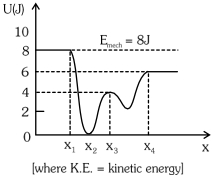
Given below is the plot of a potential energy function $U(x)$ for a system,in which a particle is in one-dimensional motion,while a conservative force $F(x)$ acts on it. Suppose that $E_{\text{mech}} = 8 \, J$,the incorrect statement for this system is:
A
at $x = x_{3}$,$K.E. = 10 \, J$
B
at $x = x_{2}$,$K.E.$ is greatest and the particle is moving at the fastest speed.
C
at $x < x_{1}$,$K.E.$ is smallest and the particle is moving at the slowest speed.
D
at $x > x_{4}$,$K.E.$ is constant throughout the region.
Solution
(A) The total mechanical energy is $E_{\text{mech}} = K.E. + U = 8 \, J$.
$(A)$ At $x = x_{3}$,from the graph,$U = 4 \, J$. Therefore,$K.E. = E_{\text{mech}} - U = 8 - 4 = 4 \, J$. The statement says $K.E. = 10 \, J$,which is incorrect.
$(B)$ At $x = x_{2}$,from the graph,$U = 0 \, J$. Therefore,$K.E. = 8 - 0 = 8 \, J$. Since $U$ is minimum,$K.E.$ is maximum,and the particle moves at the fastest speed. This statement is correct.
$(C)$ At $x < x_{1}$,from the graph,$U = 8 \, J$. Therefore,$K.E. = 8 - 8 = 0 \, J$. The particle is at rest,which is the slowest possible speed. This statement is correct.
$(D)$ At $x > x_{4}$,from the graph,$U = 6 \, J$ (constant). Therefore,$K.E. = 8 - 6 = 2 \, J$ (constant). This statement is also correct.
$(A)$ At $x = x_{3}$,from the graph,$U = 4 \, J$. Therefore,$K.E. = E_{\text{mech}} - U = 8 - 4 = 4 \, J$. The statement says $K.E. = 10 \, J$,which is incorrect.
$(B)$ At $x = x_{2}$,from the graph,$U = 0 \, J$. Therefore,$K.E. = 8 - 0 = 8 \, J$. Since $U$ is minimum,$K.E.$ is maximum,and the particle moves at the fastest speed. This statement is correct.
$(C)$ At $x < x_{1}$,from the graph,$U = 8 \, J$. Therefore,$K.E. = 8 - 8 = 0 \, J$. The particle is at rest,which is the slowest possible speed. This statement is correct.
$(D)$ At $x > x_{4}$,from the graph,$U = 6 \, J$ (constant). Therefore,$K.E. = 8 - 6 = 2 \, J$ (constant). This statement is also correct.
0 likes
View Solution48
DifficultMCQ
$A$ particle is acted upon by a force given by $F=-\alpha x^3-\beta x^4$,where $\alpha$ and $\beta$ are positive constants. At the point $x=0$,the particle is
A
in stable equilibrium
B
in unstable equilibrium
C
in neutral equilibrium
D
not in equilibrium
Solution
(A) The force acting on the particle is given by $F = -\alpha x^3 - \beta x^4$.
Since $F = -\frac{dU}{dx}$,we have $\frac{dU}{dx} = \alpha x^3 + \beta x^4$.
At $x = 0$,$\frac{dU}{dx} = 0$,which implies the particle is in equilibrium.
To determine the stability,we examine the derivatives of the potential energy $U$ at $x = 0$:
$\frac{d^2U}{dx^2} = 3\alpha x^2 + 4\beta x^3$,which is $0$ at $x = 0$.
$\frac{d^3U}{dx^3} = 6\alpha x + 12\beta x^2$,which is $0$ at $x = 0$.
$\frac{d^4U}{dx^4} = 6\alpha + 24\beta x$,which is $6\alpha$ at $x = 0$.
Since $\alpha > 0$,the first non-zero derivative at $x = 0$ is of an even order ($4^{th}$ order) and is positive. This indicates that $U$ has a local minimum at $x = 0$.
Therefore,the particle is in stable equilibrium.
Since $F = -\frac{dU}{dx}$,we have $\frac{dU}{dx} = \alpha x^3 + \beta x^4$.
At $x = 0$,$\frac{dU}{dx} = 0$,which implies the particle is in equilibrium.
To determine the stability,we examine the derivatives of the potential energy $U$ at $x = 0$:
$\frac{d^2U}{dx^2} = 3\alpha x^2 + 4\beta x^3$,which is $0$ at $x = 0$.
$\frac{d^3U}{dx^3} = 6\alpha x + 12\beta x^2$,which is $0$ at $x = 0$.
$\frac{d^4U}{dx^4} = 6\alpha + 24\beta x$,which is $6\alpha$ at $x = 0$.
Since $\alpha > 0$,the first non-zero derivative at $x = 0$ is of an even order ($4^{th}$ order) and is positive. This indicates that $U$ has a local minimum at $x = 0$.
Therefore,the particle is in stable equilibrium.
0 likes
View Solution49
AdvancedMCQ
$A$ particle of mass $m$ with initial kinetic energy $K$ approaches the origin from $x = +\infty$. Assume that a conservative force acts on it and its potential energy $V(x)$ is given by $V(x) = \frac{K}{\exp(3x/x_0) + \exp(-3x/x_0)}$, where $x_0 = 1 \ m$. The speed of the particle at $x = 0$ is
A
$\sqrt{K/m}$
B
$\sqrt{2K/m}$
C
$\sqrt{3K/m}$
D
$0$
Solution
(A) According to the law of conservation of mechanical energy, the total energy remains constant: $K_i + U_i = K_f + U_f$.
At $x = +\infty$, the potential energy $U_i = V(\infty) = \frac{K}{e^{\infty} + e^{-\infty}} = 0$.
The initial kinetic energy is $K_i = K$.
At $x = 0$, the potential energy is $U_f = V(0) = \frac{K}{e^0 + e^0} = \frac{K}{1 + 1} = \frac{K}{2}$.
Let the speed at $x = 0$ be $v$. Then the final kinetic energy is $K_f = \frac{1}{2}mv^2$.
Applying the conservation of energy: $K + 0 = \frac{1}{2}mv^2 + \frac{K}{2}$.
Rearranging the terms: $\frac{1}{2}mv^2 = K - \frac{K}{2} = \frac{K}{2}$.
Solving for $v$: $mv^2 = K \Rightarrow v^2 = \frac{K}{m} \Rightarrow v = \sqrt{\frac{K}{m}}$.
Thus, the correct option is $A$.
At $x = +\infty$, the potential energy $U_i = V(\infty) = \frac{K}{e^{\infty} + e^{-\infty}} = 0$.
The initial kinetic energy is $K_i = K$.
At $x = 0$, the potential energy is $U_f = V(0) = \frac{K}{e^0 + e^0} = \frac{K}{1 + 1} = \frac{K}{2}$.
Let the speed at $x = 0$ be $v$. Then the final kinetic energy is $K_f = \frac{1}{2}mv^2$.
Applying the conservation of energy: $K + 0 = \frac{1}{2}mv^2 + \frac{K}{2}$.
Rearranging the terms: $\frac{1}{2}mv^2 = K - \frac{K}{2} = \frac{K}{2}$.
Solving for $v$: $mv^2 = K \Rightarrow v^2 = \frac{K}{m} \Rightarrow v = \sqrt{\frac{K}{m}}$.
Thus, the correct option is $A$.
0 likes
View Solution50
MediumMCQ
If $F = 2x^2 - 3x - 2$,then select the correct statement.
A
$x = 2$ is the position of stable equilibrium.
B
$x = -1/2$ is the position of unstable equilibrium.
C
$x = -1/2$ is the position of stable equilibrium.
D
$x = 2$ is the position of neutral equilibrium.
Solution
(C) For equilibrium,the force $F$ must be zero.
$F = 2x^2 - 3x - 2 = 0$
Factoring the quadratic equation: $2x^2 - 4x + x - 2 = 0 \Rightarrow 2x(x - 2) + 1(x - 2) = 0 \Rightarrow (2x + 1)(x - 2) = 0$.
Thus,the equilibrium positions are $x = 2$ and $x = -1/2$.
The potential energy $U$ is related to force by $F = -dU/dx$,so $dU/dx = -F$.
The condition for stable equilibrium is that the potential energy $U$ is minimum,which implies $d^2U/dx^2 > 0$.
Since $dU/dx = -F$,we have $d^2U/dx^2 = -dF/dx$.
Calculating the derivative: $dF/dx = d/dx(2x^2 - 3x - 2) = 4x - 3$.
Therefore,$d^2U/dx^2 = -(4x - 3) = 3 - 4x$.
At $x = -1/2$: $d^2U/dx^2 = 3 - 4(-1/2) = 3 + 2 = 5 > 0$. Since the second derivative is positive,$x = -1/2$ is a position of stable equilibrium.
At $x = 2$: $d^2U/dx^2 = 3 - 4(2) = 3 - 8 = -5 < 0$. Since the second derivative is negative,$x = 2$ is a position of unstable equilibrium.
$F = 2x^2 - 3x - 2 = 0$
Factoring the quadratic equation: $2x^2 - 4x + x - 2 = 0 \Rightarrow 2x(x - 2) + 1(x - 2) = 0 \Rightarrow (2x + 1)(x - 2) = 0$.
Thus,the equilibrium positions are $x = 2$ and $x = -1/2$.
The potential energy $U$ is related to force by $F = -dU/dx$,so $dU/dx = -F$.
The condition for stable equilibrium is that the potential energy $U$ is minimum,which implies $d^2U/dx^2 > 0$.
Since $dU/dx = -F$,we have $d^2U/dx^2 = -dF/dx$.
Calculating the derivative: $dF/dx = d/dx(2x^2 - 3x - 2) = 4x - 3$.
Therefore,$d^2U/dx^2 = -(4x - 3) = 3 - 4x$.
At $x = -1/2$: $d^2U/dx^2 = 3 - 4(-1/2) = 3 + 2 = 5 > 0$. Since the second derivative is positive,$x = -1/2$ is a position of stable equilibrium.
At $x = 2$: $d^2U/dx^2 = 3 - 4(2) = 3 - 8 = -5 < 0$. Since the second derivative is negative,$x = 2$ is a position of unstable equilibrium.
0 likes
View SolutionWork, Energy, Power and Collision — Conservative and Non-Conservative forces and Potential Energy · Frequently Asked Questions
1Are these Work, Energy, Power and Collision questions useful for JEE and NEET?
Yes. All questions in this section are mapped to JEE Main and NEET exam patterns. Previous year questions from JEE Main, NEET, GUJCET and state-level exams are included with full solutions.
2Can I switch to Hindi or Gujarati for these questions?
Yes. Use the language tabs in the hero section or the sidebar to view the same questions and solutions in English, Hindi or Gujarati.
3How do I generate a question paper from this subtopic?
Use the Vedclass Exam Paper Generator — select the chapter and subtopic, set difficulty, and generate Sets A, B, C, D automatically. First 3 chapters of every subject are free.
Vedclass Products
For Students
Vedclass Test Series
Mock tests in real JEE/NEET style with performance analysis. 5-day free trial.
Start Free TrialFor Teachers
Exam Paper Generator
Generate Set A/B/C/D papers from this chapter in 2 minutes. 3 chapters free.
Try FreeFor Institutes
Online Exam Module
Live online exams with unlimited students, 360° analytics & white-label branding.
See DemoFor Teachers & Institutes
Generate a Work, Energy, Power and Collision Exam Paper in 2 Minutes
Select subtopic & difficulty — Sets A, B, C, D auto-generated with No Repeat logic.
First 3 chapters of every subject are free — no payment required.